<?xml version="1.0" encoding="ISO-8859-1"?><article xmlns:mml="http://www.w3.org/1998/Math/MathML" xmlns:xlink="http://www.w3.org/1999/xlink" xmlns:xsi="http://www.w3.org/2001/XMLSchema-instance">
<front>
<journal-meta>
<journal-id>1027-2852</journal-id>
<journal-title><![CDATA[Biotecnología Aplicada]]></journal-title>
<abbrev-journal-title><![CDATA[Biotecnol Apl]]></abbrev-journal-title>
<issn>1027-2852</issn>
<publisher>
<publisher-name><![CDATA[Editorial Elfos Scientiae]]></publisher-name>
</publisher>
</journal-meta>
<article-meta>
<article-id>S1027-28522014000300006</article-id>
<title-group>
<article-title xml:lang="en"><![CDATA[Implementation of a competitive ELISA for pharmacokinetics studies of CIGB-300 in human plasma]]></article-title>
<article-title xml:lang="es"><![CDATA[Implementación de un ELISA de competencia para estudios de farmacocinética del péptido CIGB-300 en plasma humano]]></article-title>
</title-group>
<contrib-group>
<contrib contrib-type="author">
<name>
<surname><![CDATA[Reyes]]></surname>
<given-names><![CDATA[Vilcy]]></given-names>
</name>
<xref ref-type="aff" rid="A01"/>
</contrib>
<contrib contrib-type="author">
<name>
<surname><![CDATA[Perera]]></surname>
<given-names><![CDATA[Yasser]]></given-names>
</name>
<xref ref-type="aff" rid="A01"/>
</contrib>
<contrib contrib-type="author">
<name>
<surname><![CDATA[Díaz]]></surname>
<given-names><![CDATA[Euyení]]></given-names>
</name>
<xref ref-type="aff" rid="A01"/>
</contrib>
<contrib contrib-type="author">
<name>
<surname><![CDATA[Rosales]]></surname>
<given-names><![CDATA[Ileana]]></given-names>
</name>
<xref ref-type="aff" rid="A02"/>
</contrib>
<contrib contrib-type="author">
<name>
<surname><![CDATA[García]]></surname>
<given-names><![CDATA[Gerardo]]></given-names>
</name>
<xref ref-type="aff" rid="A02"/>
</contrib>
<contrib contrib-type="author">
<name>
<surname><![CDATA[Perea]]></surname>
<given-names><![CDATA[Silvio E]]></given-names>
</name>
<xref ref-type="aff" rid="A01"/>
</contrib>
</contrib-group>
<aff id="A02">
<institution><![CDATA[,Centro de Ingeniería Genética y Biotecnología, CIGB Departamento Control de la Calidad ]]></institution>
<addr-line><![CDATA[La Habana ]]></addr-line>
<country>Cuba</country>
</aff>
<aff id="A01">
<institution><![CDATA[,Centro de Ingeniería Genética y Biotecnología, CIGB Subdirección de Investigaciones Biomédicas Laboratorio de Oncología Molecular]]></institution>
<addr-line><![CDATA[La Habana ]]></addr-line>
<country>Cuba</country>
</aff>
<pub-date pub-type="pub">
<day>00</day>
<month>09</month>
<year>2014</year>
</pub-date>
<pub-date pub-type="epub">
<day>00</day>
<month>09</month>
<year>2014</year>
</pub-date>
<volume>31</volume>
<numero>3</numero>
<fpage>232</fpage>
<lpage>236</lpage>
<copyright-statement/>
<copyright-year/>
<self-uri xlink:href="http://scielo.sld.cu/scielo.php?script=sci_arttext&amp;pid=S1027-28522014000300006&amp;lng=en&amp;nrm=iso"></self-uri><self-uri xlink:href="http://scielo.sld.cu/scielo.php?script=sci_abstract&amp;pid=S1027-28522014000300006&amp;lng=en&amp;nrm=iso"></self-uri><self-uri xlink:href="http://scielo.sld.cu/scielo.php?script=sci_pdf&amp;pid=S1027-28522014000300006&amp;lng=en&amp;nrm=iso"></self-uri><abstract abstract-type="short" xml:lang="en"><p><![CDATA[CIGB-300 is a synthetic peptide that inhibits the phosphorylation mediated by enzyme casein kinase 2 (CK2) and has a marked antineoplastic effect in different preclinical models. In the clinical setting, it's explored in phase I and II studies using different routes of administration. In particular, the use of the intravenous route requires a reliable analytical method for the detection of CIGB-300 in plasma. A competitive ELISA was developed to detect and quantify the CIGB-300 peptide in human plasma samples. This system showed a detection limit of 0.030 µg/mL and a working range from 10 to 0.039 µg/mL, including concentrations achieved in plasma of patients treated with CIGB-300. In addition, the intra and inter-assay precisions were (coefficient of variation < 5 %) and (CV < 17 %) and the recovered range from 98.9 to 119.8 %. Finally, the impact of three freeze-thaw cycles and the sample storage at - 80 °C on the stability of the analyte was evaluated. We obtained a CV < 20 % for all samples in the stability study. The results support the application of this analytical method as a new tool for the pharmacokinetic studies of the early stages of clinical research with the new anticancer drug CIGB-300.]]></p></abstract>
<abstract abstract-type="short" xml:lang="es"><p><![CDATA[El CIGB-300 es un péptido sintético que inhibe la fosforilación mediada por la enzima caseína quinasa 2 (CK2) y ejerce un marcado efecto antineoplásico en diferentes modelos preclínicos. En estudios fase I y II, se exploran sus efectos por varias vías de administración. En particular, la vía intravenosa requiere un método analítico confiable para su detección en plasma. Con este propósito, se desarrolló un ELISA de competencia, para detectar y cuantificar el péptido CIGB-300 en muestras de plasma humano. Este sistema mostró un límite de detección de 0.030 µg/mL y un rango de trabajo de 10 a 0.039 µg/mL, que incluye las concentraciones alcanzadas en el plasma de pacientes tratados con CIGB-300. Además se determinó la variabilidad intraensayo (CV < 5 %) e interensayo (CV < 17 %) y el rango de recobrado del sistema (de 98.9 a 119.8 %). Finalmente, se evaluó el impacto de hasta tres ciclos de congelación-descongelación y de la conservación de la muestra a -80 °C sobre la estabilidad del analito. Para todas las muestras del estudio de estabilidad se obtuvo un coeficiente de variación menor del 20 %. Los resultados fundamentan la aplicación de este método analítico como una nueva herramienta para los estudios farmacocinéticos de las primeras etapas de la investigación clínica con el nuevo fármaco anticáncer CIGB-300.]]></p></abstract>
<kwd-group>
<kwd lng="en"><![CDATA[CIGB-300]]></kwd>
<kwd lng="en"><![CDATA[ELISA]]></kwd>
<kwd lng="en"><![CDATA[system validation]]></kwd>
<kwd lng="en"><![CDATA[pharmacokinetics]]></kwd>
<kwd lng="en"><![CDATA[intravenous route]]></kwd>
<kwd lng="en"><![CDATA[anticancer drug]]></kwd>
<kwd lng="es"><![CDATA[CIGB-300]]></kwd>
<kwd lng="es"><![CDATA[ELISA]]></kwd>
<kwd lng="es"><![CDATA[validación]]></kwd>
<kwd lng="es"><![CDATA[farmacocinética]]></kwd>
<kwd lng="es"><![CDATA[vía intravenosa]]></kwd>
<kwd lng="es"><![CDATA[fármaco anticáncer]]></kwd>
</kwd-group>
</article-meta>
</front><body><![CDATA[ <DIV class="Part"   >        <P align="right"   ><font size="2" color="#000000" face="Verdana, Arial, Helvetica, sans-serif"><b>TECHNIQUE</b>      </font></P >       <P align="right"   >&nbsp;</P >   <FONT size="+1" color="#000000">        <P   ><font size="2" face="Verdana, Arial, Helvetica, sans-serif"><b><font size="4">Implementation      of a competitive ELISA for pharmacokinetics studies of CIGB-300 in human plasma      </font> </b> </font></P >       <P   >&nbsp;</P >       <P   ><font size="2" face="Verdana, Arial, Helvetica, sans-serif"><B><font size="3">Implementaci&oacute;n      de un ELISA de competencia para estudios de farmacocin&eacute;tica del p&eacute;ptido      CIGB-300 en plasma humano </font></b></font></P >   <FONT size="+1"><B>        <P   ></P >   </B> <FONT size="+1">        <P   >&nbsp;</P >       <P   >&nbsp;</P >       <P   ><font size="2" face="Verdana, Arial, Helvetica, sans-serif"><b>Vilcy Reyes<sup>1</sup>,      Yasser Perera<sup>1</sup>, Euyen&iacute; D&iacute;az<sup>1</sup>, Ileana Rosales<sup>2</sup>,      Gerardo Garc&iacute;a<sup>2</sup>, Silvio E Perea<sup>1</sup> </b></font></P >   <FONT size="+1"><FONT size="+1"><FONT size="+1"><FONT size="+1"><FONT size="+1"><FONT size="+1"><FONT size="+1"><FONT size="+1"><FONT size="+1"><FONT size="+1"><FONT size="+1"><FONT size="+1">        ]]></body>
<body><![CDATA[<P   > </P >   <FONT size="+1">        <P   ><font size="2" face="Verdana, Arial, Helvetica, sans-serif"><sup>1</sup> Laboratorio      de Oncolog&iacute;a Molecular, Subdirecci&oacute;n de Investigaciones Biom&eacute;dicas,      Centro de Ingenier&iacute;a Gen&eacute;tica y Biotecnolog&iacute;a, CIGB.      Ave. 31 e/ 158 y 190, Cubanac&aacute;n, Playa, CP 11600, La Habana, Cuba.    <br>     </font><font size="2" face="Verdana, Arial, Helvetica, sans-serif"><sup>2</sup></font><font size="2" face="Verdana, Arial, Helvetica, sans-serif">      Departamento Control de la Calidad, Centro de Ingenier&iacute;a Gen&eacute;tica      y Biotecnolog&iacute;a, CIGB. Ave. 31 e/ 158 y 190, Cubanac&aacute;n, Playa,      CP 11600, La Habana, Cuba. </font></P>   </font>        <P   >&nbsp;</P >       <P   >&nbsp;</P >   <FONT size="+1"><FONT size="+1">        <P   ></P >   </font></font></font></font></font></font></font></font></font></font></font></font></font></font></font></font></font>    <hr>   <FONT size="+1" color="#000000"><FONT size="+1"><FONT size="+1"><FONT size="+1"><FONT size="+1"><FONT size="+1"><FONT size="+1"><FONT size="+1"><FONT size="+1"><FONT size="+1"><FONT size="+1"><FONT size="+1"><FONT size="+1"><FONT size="+1"><FONT size="+1"><FONT size="+1"><FONT size="+1"><FONT size="+1"><FONT size="+1"><FONT size="+1">       <P   ><b><font size="2" face="Verdana, Arial, Helvetica, sans-serif">ABSTRACT </font></b></P >       <P   ><font size="2" face="Verdana, Arial, Helvetica, sans-serif">CIGB-300 is a synthetic      peptide that inhibits the phosphorylation mediated by enzyme casein kinase      2 (CK2) and has a marked antineoplastic effect in different preclinical models.      In the clinical setting, it&rsquo;s explored in phase I and II studies using      different routes of administration. In particular, the use of the intravenous      route requires a reliable analytical method for the detection of CIGB-300      in plasma. A competitive ELISA was developed to detect and quantify the CIGB-300      peptide in human plasma samples. This system showed a detection limit of 0.030      &micro;g/mL and a working range from 10 to 0.039 &micro;g/mL, including concentrations      achieved in plasma of patients treated with CIGB-300. In addition, the intra      and inter-assay precisions were (coefficient of variation &lt; 5 %) and (CV      &lt; 17 %) and the recovered range from 98.9 to 119.8 %. Finally, the impact      of three freeze-thaw cycles and the sample storage at - 80 &deg;C on the stability      of the analyte was evaluated. We obtained a CV &lt; 20 % for all samples in      the stability study. The results support the application of this analytical      method as a new tool for the pharmacokinetic studies of the early stages of      clinical research with the new anticancer drug CIGB-300. </font></P >       <P   ><font size="2" face="Verdana, Arial, Helvetica, sans-serif"><b>Keywords:</b>      CIGB-300, ELISA, system validation, pharmacokinetics, intravenous route, anticancer      drug. </font></P >   </font></font></font></font></font></font></font></font></font></font></font></font></font></font></font></font></font></font></font></font>    <hr>   <FONT size="+1" color="#000000"><FONT size="+1"><FONT size="+1"><FONT size="+1"><FONT size="+1"><FONT size="+1"><FONT size="+1"><FONT size="+1"><FONT size="+1"><FONT size="+1"><FONT size="+1"><FONT size="+1"><FONT size="+1"><FONT size="+1"><FONT size="+1"><FONT size="+1"><FONT size="+1"><FONT size="+1"><FONT size="+1"><FONT size="+1">       <P   ><font size="2" face="Verdana, Arial, Helvetica, sans-serif"><b>RESUMEN </b></font></P >       ]]></body>
<body><![CDATA[<P   ><font size="2" face="Verdana, Arial, Helvetica, sans-serif">El CIGB-300 es un      p&eacute;ptido sint&eacute;tico que inhibe la fosforilaci&oacute;n mediada      por la enzima case&iacute;na quinasa 2 (CK2) y ejerce un marcado efecto antineopl&aacute;sico      en diferentes modelos precl&iacute;nicos. En estudios fase I y II, se exploran      sus efectos por varias v&iacute;as de administraci&oacute;n. En particular,      la v&iacute;a intravenosa requiere un m&eacute;todo anal&iacute;tico confiable      para su detecci&oacute;n en plasma. Con este prop&oacute;sito, se desarroll&oacute;      un ELISA de competencia, para detectar y cuantificar el p&eacute;ptido CIGB-300      en muestras de plasma humano. Este sistema mostr&oacute; un l&iacute;mite      de detecci&oacute;n de 0.030 &micro;g/mL y un rango de trabajo de 10 a 0.039      &micro;g/mL, que incluye las concentraciones alcanzadas en el plasma de pacientes      tratados con CIGB-300. Adem&aacute;s se determin&oacute; la variabilidad intraensayo      (CV &lt; 5 %) e interensayo (CV &lt; 17 %) y el rango de recobrado del sistema      (de 98.9 a 119.8 %). Finalmente, se evalu&oacute; el impacto de hasta tres      ciclos de congelaci&oacute;n-descongelaci&oacute;n y de la conservaci&oacute;n      de la muestra a -80 &deg;C sobre la estabilidad del analito. Para todas las      muestras del estudio de estabilidad se obtuvo un coeficiente de variaci&oacute;n      menor del 20 %. Los resultados fundamentan la aplicaci&oacute;n de este m&eacute;todo      anal&iacute;tico como una nueva herramienta para los estudios farmacocin&eacute;ticos      de las primeras etapas de la investigaci&oacute;n cl&iacute;nica con el nuevo      f&aacute;rmaco antic&aacute;ncer CIGB-300. </font></P >       <P   ><font size="2" face="Verdana, Arial, Helvetica, sans-serif"><b>Palabras clave:</b>      CIGB-300, ELISA, validaci&oacute;n, farmacocin&eacute;tica, v&iacute;a intravenosa,      f&aacute;rmaco antic&aacute;ncer. </font></P >   </font></font></font></font></font></font></font></font></font></font></font></font></font></font></font></font></font></font></font></font>    <hr>   <FONT size="+1" color="#000000"><FONT size="+1"><FONT size="+1"><FONT size="+1"><FONT size="+1"><FONT size="+1"><FONT size="+1"><FONT size="+1"><FONT size="+1"><FONT size="+1"><FONT size="+1"><FONT size="+1"><FONT size="+1"><FONT size="+1"><FONT size="+1"><FONT size="+1"><FONT size="+1"><FONT size="+1"><FONT size="+1"><FONT size="+1">        <P   > </P >       <P   >&nbsp;</P >       <P   >&nbsp;</P >       <P   ><font size="3" face="Verdana, Arial, Helvetica, sans-serif"><b>INTRODUCTION </b></font></P >   <FONT size="+1">        <P   ><font size="2" face="Verdana, Arial, Helvetica, sans-serif">CIGB-300 is a synthetic      peptide inhibiting the phosphorylation mediated by the casein kinase 2 (CK2)      enzyme and exerting a marked anti-neoplastic effect in different in vitro      and in vivo preclinical models [1]. Experimental evidence in cell lines derived      from lung, cervix, prostate and colon cancer suggest that the multifunctional      protein B23/NPM, a validated substrate of CK2, is a relevant molecular target      for CIGB-300 in tumor cells [2]. As the result of extensive in vivo pharmacological      experimentation, data were collected on antitumor efficacy and safety that      are the pre-clinical basis for the studies of the CIGB-300 peptide in clinical      trials [3]. </font></P >   <FONT size="+1">        <P   ><font size="2" face="Verdana, Arial, Helvetica, sans-serif">The CIGB-300 peptide      was first tested in human beings in the year 2006. This pioneering clinical      study consisted of its direct application in pre-malignant cervix lesions      and gave the first robust evidence of the safety of the product [4]. Nonetheless,      two of the oncological niches now under study are the malignant neoplasia      of the lung and acute </font><font size="2" face="Verdana, Arial, Helvetica, sans-serif">myeloid      leukemia (AML). These locations must be treated with the systemic administration      of the drug since their intervention is difficult (as is lung cancer) or it      is a disseminated disease (as in AML). In this context, the implementation      of an analytical system, enabling the estimation of the concentration of the      compound in the biological fluids of the patients and to calculate the pharmacokinetic      parameters, is an essential tool for the optimization and future development      of the drug in the clinical trial [5]. </font></P >       <P   ><font size="2" face="Verdana, Arial, Helvetica, sans-serif">Pharmacokinetic studies      with CIGB-300, in animal and human models, are based on the estimation of      peptide concentration in the plasma through a radioactive method with a variant      of the CIGB-300 conjugated to technetium 99 (<sup>99</sup>Tc) [3, 6]. Radioactive      methods have, however, important limitations since they make it impossible      to know how much of the radioactive signal recorded corresponds to the entire      peptide and not its degradation residues. This could lead to overestimations      of the true amount of the circulating molecule, thereby giving an incorrect      evaluation of its pharmacokinetic parameters [7]. </font></P >       <P   ><font size="2" face="Verdana, Arial, Helvetica, sans-serif">The ELISA system      is one of the most widely used methods in clinical and analytical laboratories      for pharmacokinetic studies [8]. It is very sensitive to the quantification      of analytes in complex samples and it is not dangerous for human health [9].      Our group carried out a competitive ELISA assay using a polyclonal antibody      generated against the CIGB-300, to capture this analyte found in the plasma.      For its implementation, we first determined the parameters concerning its      accuracy, precision, selectivity, sensitivity, reproducibility and the stability      recommended for this type of analysis [10]. </font></P >       ]]></body>
<body><![CDATA[<P   >&nbsp;</P >       <P   ><b><font face="Verdana, Arial, Helvetica, sans-serif" size="3">MATERIALS AND      METHODS </font></b></P >   <FONT size="+1">        <P   ><font size="2" face="Verdana, Arial, Helvetica, sans-serif"><b>Reagents </b></font></P >   <FONT size="+1"><FONT color="#FF00FF">        <P   ><font color="#000000" size="2" face="Verdana, Arial, Helvetica, sans-serif">The      Tween 20 reagent was purchased at Sigma Aldrich Labochemikalien GmbH, United      Kingdom. Polyclonal antibodies anti-CIGB-300 developed in rabbits (Atlanbio,      France) and anti-rabbit peroxidase (Sigma, Missouri, USA) were used. The substrate      and stopping solutions for the immunoenzymatic reaction were purchased from      R &amp; D Systems (Minneapolis, USA), and the blocking solution Seablock at      EastCoastBio (Maine, USA). The washing solution (0.05 % Tween 20) and the      dilution solution (0.1 % Tween 20) and the 2 % fetal bovine serum (FBS; PAA,      Canada), were prepared in a phosphate buffer saline (PBS; NaCl 1.37 M, KCl      27 mM, Na<sub>2</sub>HPO<sub>4</sub> 100 mM, KH<sub>2</sub>PO<sub>4</sub>      18 mM, pH 7.4) solution at 1&times;. </font></P >   <FONT color="#000000">        <P   ><font size="2" face="Verdana, Arial, Helvetica, sans-serif">The peptide lot CIGB-300      P-300-02-0807 (CIGB, Havana, Cuba) was used as the reference material of the      analyte. </font></P >       <P   ><font size="2" face="Verdana, Arial, Helvetica, sans-serif"><b>Samples of human      plasma </b></font></P >       <P   ><font size="2" face="Verdana, Arial, Helvetica, sans-serif">The samples of plasma      from healthy donors were supplied by the Blood Bank of Vedado, Havana, Cuba.      Those of cancer patients (vulvar carcinoma with lung metastasis, non-small      cell lung adenocarcinoma, retroperitoneal cancer, rectum adenocarcinoma with      muscle infiltration) were provided by the Center for Medical Surgical Research      (Cimeq). The samples were stored at - 80 &deg;C until thawing only once. </font></P >       <P   ><font size="2" face="Verdana, Arial, Helvetica, sans-serif"><b>Immunoenzymatic      assay </b> </font></P >       <P   ><font size="2" face="Verdana, Arial, Helvetica, sans-serif">An ELISA/RIA plate      (high binding polystyrene plates EIA, Costar, USA) was coated with 100 &mu;L      of CIGB-300 (reference material) dissolved at 1 &mu;g/mL in phosphate buffer      saline (PBS) 1&times;. It was incubated at 4 &deg;C for 16 h and was later      blocked with 200 &mu;L of the Seablock blocking solution at room temperature      (RT; 25 &deg;C) in the dark for 2 h. Then, 50 &mu;L of the serial dilutions      of CIGB-300 (standard curve) were added in a concentration range of 0 to 10      &mu;g/mL of the problem sample together with 50 &mu;L of the polyclonal rabbit      serum anti-CIGB-300 diluted at 1:10 000 in PBS 1&times;. The plate was incubated      at RT in the dark for 2 h. Later, four washings were made with the solution      PBS 1&times;-0.05 % Tween 20 and 100 &mu;L of the anti-rabbit peroxidase conjugate      diluted in the dilution buffer were added, and plates were further incubated      at RT in the dark for 2 h. Afterwards, four washings were made with the PBS      1&times;-0.05 % Tween 20 solution, and 100 &mu;L of the substrate solution      were added per well and incubated for 30 min at RT in the dark. To stop the      reaction, 100 &mu;L of the stopping solution were added and the reading of      the absorbancy was made at 450 nm (Abs<sub>450nm</sub>) in a SUMA plate reader,      model PR-521 (Immunoassay Center, Cuba). </font></P >       <P   ><font size="2" face="Verdana, Arial, Helvetica, sans-serif">Finally, the value      of the basic Abs<sub>450nm</sub> (sample without the CIGB-300 coating) was      subtracted from the values of the Abs450nm of the assay for the calculations.      The calibration curve was graphed with the quotient of the binding/maximum      binding (B/Bmax) in the ordinates against the logarithm of the concentration      of CIGB-300 in the abscissa, and the resulting equation was adjusted using      a variable slope non-linear sigmoid model (Prisma program, version 4.0). The      concentration of the CIGB-300 was obtained through the extrapolation of the      individual value of the B/Bmax of each problem sample in the calibration curve.      The Bmax was defined as the value that is equivalent to concentration zero      of the CIGB-300 in the evaluated plasma; it is therefore the highest Abs<sub>450nm</sub>      detected. </font></P >   <FONT size="+1"><FONT size="+1">        ]]></body>
<body><![CDATA[<P   ><font size="2" face="Verdana, Arial, Helvetica, sans-serif"><b>Quality parameters      of the assay </b></font></P >       <P   ><font size="2" face="Verdana, Arial, Helvetica, sans-serif">Repeatability was      verified through four curves of the same sample under identical conditions      in the same assay and on the same day. For intermediate precision, four curves      of the same samples under identical conditions were made in different assays      and on different days. </font></P >       <P   ><font size="2" face="Verdana, Arial, Helvetica, sans-serif">Four calibration      curves were calculated during validation in different days to determine the      linearity and the working range (WR) of the system. Analyte concentrations      in the experimental points of the curve were: 10, 2.5, 0.6, 0.15 and 0.039      &mu;g/mL, respectively. The lower detection limit (LDL) was calculated as      the Abs<sub>450nm</sub> (Bmax) minus two standard deviations (SD) of the system      calibration curve (LDL = Bmax &ndash; 2SD). The upper detection limit (UDL)      was calculated by interpolating the baseline Abs of the system (UDL = mean      + SD). WR was established as the range of concentrations within the UDL and      LDL of the system (LDL &le; RT &le; UDL). </font></P >       <P   ><font size="2" face="Verdana, Arial, Helvetica, sans-serif">Specificity was determined      as the capacity of the ELISA method to detect the analyte in a specific manner,      in the presence of components that may be contained in the matrix and can      interfere with the system. For this purpose, the plasma of four individuals      was processed and known concentrations of the analyte were analyzed (10 &mu;g/mL,      2.5 &mu;g/mL, 0.6 &mu;g/mL, 0.15 &mu;g/mL, 0.039 &mu;g/mL). The values of      Abs450nm corresponding to each one of these samples were compared with the      values of Abs450nm for this same concentration of the analyte in the standard      curve. </font></P >       <P   ><font size="2" face="Verdana, Arial, Helvetica, sans-serif">To measure specificity,      if the estimation of the concentration of the analyte is accurate, there will      be no interference in the factor matrix system (FM), with a value of 1. The      FM was calculated as the quotient of the response in the presence of the matrix      analyte divided by the response in its absence. The variation coefficient      (CV %) between them must be less or equal to 20 %, and therefore FM must be      higher or equal to 0.8, and lower or equal to 1.2, for each one of the plasma      samples analyzed in relation to the mixture, where the determination was made      in the plasma of healthy donors (standard plasma). </font></P >       <P   ><font size="2" face="Verdana, Arial, Helvetica, sans-serif">The recovery of the      system (REC) was determined using three concentrations of the analyte in the      plasma of patients (n = 4) and in the standard plasma. It was calculated as      the quotient between the Abs of different concentrations of the analyte (X)      in the matrix that was to be evaluated, and the Abs of equivalent concentrations      of the analyte in the standard plasma, according to the following formula:      </font></P >       <P align="center"   ><img src="/img/revistas/bta/v31n3/fr0106314.gif" width="309" height="52"></P >       
<P   > </P >       <P   ><font size="2" face="Verdana, Arial, Helvetica, sans-serif">For the analysis      of analyte stability in the plasma, analyses of variance were carried out      on the sample stored at - 80 &deg;C, in the samples submitted to successive      freeze-thaw cycles (up to 3 cycles at - 80 &deg;C to RT), and of the analyte      in the matrix without processing. </font></P >       <P   ><font size="2" face="Verdana, Arial, Helvetica, sans-serif"><b>Stability of the      sample stored at - 80 &deg;C </b></font></P >       ]]></body>
<body><![CDATA[<P   ><font size="2" face="Verdana, Arial, Helvetica, sans-serif">The samples of the      analyte in the plasma were prepared at three concentrations: high (10 &mu;g/mL),      medium (0.6 &mu;g/mL) and low (0.039 &mu;g/mL). Two replicates of each level      of concentration at time 0 were analyzed in the samples prepared. The other      samples were stored at - 80 &deg;C and analyzed on days 18 and 30. The concentration      of the initial determination was compared with the concentration values of      the samples at medium-term and long-term storage. </font></P >       <P   ><font size="2" face="Verdana, Arial, Helvetica, sans-serif"><b>Stability of the      sample in the freeze-thaw cycles </b></font></P >       <P   ><font size="2" face="Verdana, Arial, Helvetica, sans-serif">The samples prepared      at three concentrations were submitted to one, two or three freeze-thaw cycles      (- 80 &deg;C-RT). After each cycle, the sample was processed and analyzed      according to the above description. The determinations were compared with      the analyses of samples that were not submitted to this treatment and the      experiment was duplicated for each concentration level in each experimental      group. The results of the determinations were processed in the Prisma program      (version 4.0). </font></P >       <P   ><font size="2" face="Verdana, Arial, Helvetica, sans-serif"><b>Statistical analysis      </b> </font></P >       <P   ><font size="2" face="Verdana, Arial, Helvetica, sans-serif">The standard deviation      and the coefficient of variation (%) were calculated using Excel 2007 from      Microsoft<sup>&reg;</sup> (Microsoft Corp.; USA). </font></P >       <P   >&nbsp;</P >       <P   ><font size="2" face="Verdana, Arial, Helvetica, sans-serif"><b><font size="3">RESULTS      AND DISCUSSION </font> </b> </font></P >   <FONT size="+1">        <P   ><font size="2" face="Verdana, Arial, Helvetica, sans-serif">The CIGB-300 peptide      is a new anti-tumor drug with a potent anti-neoplastic effect on pre-clinical      cancer models [1], with a clinical evaluation currently in progress. This      molecule inhibits phosphorylation through CK2, an oncologically validated      molecular target [11]. In 2006 it was first evaluated in human beings, where      it was directly administered in pre-malignant lesions of the cervix, and it      showed to be safe and well tolerated [4]. The new oncological niches in which      this molecule is explored are lung malignant neoplasia and acute myeloid leukemia      (AML), in which the administration route must be systemic. The implementation      of an analytical system that makes it possible to estimate the concentrations      and calculate pharmacokinetic parameters in biological fluids is a main objective      to optimize and develop this drug [5]. </font></P >   <FONT size="+1">        <P   ><font size="2" face="Verdana, Arial, Helvetica, sans-serif">A radioactive method      was used in the initial studies of the bioavailability of the CIGB-300, in      which the peptide was conjugated to <sup>99</sup>Tc [3, 6]. Although the concentrations      of CIGB-300 reaching human plasma were calculated, as well as the preliminary      correlations with the biodistribution variables, toxicity and signs of clinical      efficacy, the disadvantages of this method are widely known [12, 13]. </font></P >       <P   ><font size="2" face="Verdana, Arial, Helvetica, sans-serif">Immunoenzymatic assays      have been developed as an alternative having the features of specificity,      sensitivity, reproducibility and speed, among other advantages [14, 15], and      making it possible to quantify peptides and proteins in biological matrices      in a routine manner. This paper describes the process of the development and      implementation of a competitive ELISA system for the determination of the      CIGB-300 peptide in human plasma. It is the first method that makes it possible      to monitor the presence of the complete molecule in biological fluids, in      a relatively easy and reliable manner, and avoids the risks involved in the      work with radioactive isotopes [16]. </font></P >       ]]></body>
<body><![CDATA[<P   ><font size="2" face="Verdana, Arial, Helvetica, sans-serif">The ELISA system      that was implemented made it possible to detect the analyte in the human plasma      at the nanomolecular range, with an estimated LDL of 0.030 &mu;g/mL. The determination      of the detection limits is an important step for any analytical system, since      it defines the minimum amount of analyte that may be quantified in a reliable      manner in a biological fluid, and at the same time it determines the lower      limit of the WR of the system [17]. A low detection limit makes it possible      to track the peptide in the plasma for a longer period of time. A larger number      of experimental points lead to a better estimation of the pharmacokinetic      parameter of the drug under study. On the other hand, the estimation of the      UDL from the dose-response curves obtained, indicated that the ELISA may detect      concentrations of CIGB-300 in human plasma of up to 15 &mu;g/mL, without the      need of </font><font size="2" face="Verdana, Arial, Helvetica, sans-serif">dilution.      These determinations allowed for the establishment of a wide and reliable      WR (from 0.039 to 10.0 &mu;g/mL) for future evaluations, in order to estimate      the concentrations of the analyte in plasma samples of cancer patients. </font></P >       <P   ><font size="2" face="Verdana, Arial, Helvetica, sans-serif">Other important parameters      in establishing an analytical method are precision and accuracy; these are      characteristics of yield that describe the size of random and systematic errors      [18]. During the study of the intra-assay variability, the CV obtained was      less than 5 % for each point of the curve (<a href="#tab1">Table 1</a>), while      the values for intermediate precision were in the range of 14 to 17 % (<a href="#tab2">Table      2</a>). This means that the assay is reproducible and offers acceptable precision,      according to the norm for this type of determination where the CV should be      less than 20 % [19]. </font></P >       <P align="center"   ><img src="/img/revistas/bta/v31n3/t0106314.gif" width="358" height="220"><a name="tab1"></a></P >       
<P align="center"   ><img src="/img/revistas/bta/v31n3/t0206314.gif" width="360" height="228"><a name="tab2"></a></P >       
<P   ><font size="2" face="Verdana, Arial, Helvetica, sans-serif">A ligand binding      assay was used for the analysis of linearity, which uses the four-parameter      logistic model (4PL). This type of test typically follows a non-linear sigmoidal      association between the analyte concentration and the response. The model      was chosen because it optimizes the precision and accuracy of the calibration      range that is being used (of 5 to 8 concentrations that will be evaluated)      [20, 21]. Calibration curves have a determination coefficient that is higher      or equal to 0.98 (R<sup>2</sup> &ge; 0.98) (<a href="/img/revistas/bta/v31n3/f0106314.gif">Figure      1</a>). The closer the R<sup>2</sup> is to 1, the better the adjustment of      the data to the model used, and this is an additional element in favor of      the precision and accuracy of the test. </font></P >       
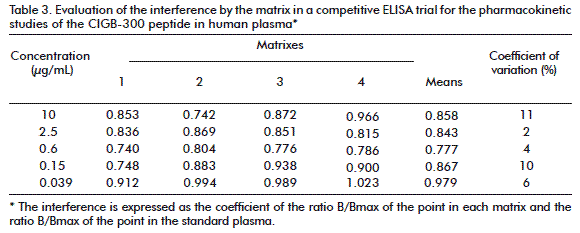
<P   ><font size="2" face="Verdana, Arial, Helvetica, sans-serif">In order to establish      the selectivity of the system, we evaluated the influence of the biological      matrix used in the determinations. The values of the FM obtained in the plasma      sample of the cancer patients, at each point in the curve, are in the range      of 0.8 to 1.0 (<a href="#tab3">Table 3</a>). Although this result must be      corroborated in a larger number of samples, it was demonstrated that the interferences      that may be found in the plasma, such as proteins, lipids or the hemolysis      of any of the samples, do not significantly affect the determination of the      CIGB-300. Another measurement of the capacity of the system to detect the      analyte is by studying the recovery. This is expressed as the ratio between      the response obtained for the analyte in a sample (for example, the plasma      of a patient) with the response obtained for that same amount of analyte in      a standard matrix (for example the plasma of a healthy individual) expressed      as percentage [18]. Three concentrations were analyzed: high (10 &mu;g/mL),      medium (0.6 &mu;g/mL) and low (0.039 &mu;g/mL), and the values obtained were      110.2, 98.9 and 119.8 %, respectively. The interference present in the sample      has a positive influence on the recovery. For the extreme values of the curve,      the analysis of the recovery indicates that the concentrations of CIGB-300      can be overestimated. However, these results must be interpreted with caution,      since the values of recovery are located within the variability of the system.</font></P >       <P align="center"   ><img src="/img/revistas/bta/v31n3/t0306314.gif" width="578" height="231"><a name="tab3"></a></P >       
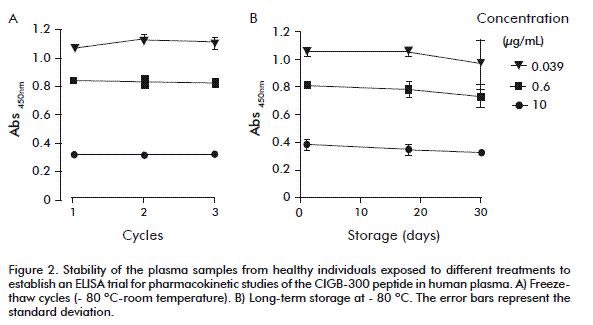
<P   ><font size="2" face="Verdana, Arial, Helvetica, sans-serif">Finally the stability      of the sample was studied in two and three freeze-thaw cycles (- 80 &deg;C-RT).      Stability experiments must simulate the conditions in which the samples of      the study will be collected, processed and stored. The stability of the sample      may be assessed during the implementation phase of the method, for which studies      at RT, from 2 to 8 &deg;C, and the freeze-thaw cycle are generally included.      These evaluations make it possible to define when the samples will be discarded      from the life cycle of the system [17]. Several physicochemical analyses showed      that the CIGB-300 molecule is not stable at 4 &deg;C. For this reason, and      considering the high number of proteases in the blood [22], our stability      studies were carried out at - 80 &deg;C. In the time intervals analyzed in      relation to time zero (t<sub>0</sub>), the CV remained within the range of      3 to 6 % (<a href="/img/revistas/bta/v31n3/f0206314.gif">Figure 2A</a>), indicating that the same      aliquot of the sample may be reevaluated at least three times without affecting      the estimation of the analyte. In relation to the long-term stability, in      the study of the sample stored for 18 days, the CV in relation to t0, remained      in the range of 3 to 14 % (<a href="/img/revistas/bta/v31n3/f0206314.gif">Figure 2B</a>). For the      sample stored for 30 days, the CV in the periods analyzed in relation to t<sub>0</sub>      remained at the range of 6 to 19 % (<a href="/img/revistas/bta/v31n3/f0206314.gif">Figure 2B</a>).      In general, these results express that the analyte is stable in the human      plasma during the time periods evaluated under these storage conditions. This      finding is important from the operational viewpoint in the laboratory, since      it offers a certain amount of flexibility to sample evaluation. </font></P >       
<P   ><font size="2" face="Verdana, Arial, Helvetica, sans-serif">The quantification      of the analytes through the ELISA type platform is generally simple, when      dealing with an antibody having high specificity, as that of the antibody      used in this study [5]. Several immunoenzymatic assays have been described      for the detection of pharmaceuticals of peptide origin. One of them is a competitive      ELISA, which is commercially available, and developed for the detection and      quantification of the exenatide, a synthetic version of exendin-4. Exenatide      is an antagonist of the glucagon-like peptide 1 (GLP-1 agonist) used to control      glycemia, approved since 2005 [23] for the treatment of type II diabetes mellitus      [24]. This system detects up to 0.1 &mu;g/mL with an LDL of 0.00008 &mu;g/mL      [25]. Another competitive ELISA was designed to detect the presence of the      hepcidin peptide, which contributes to the pathogenesis of chronic anemia.      The system showed an LDL of 5.5 &mu;g/mL, and a intra-assay variation of 8      to 15 %, and the intra-assay variation was of 5 to 16 %, with a recovery of      107 % [26]. Interestingly, the estimation of the LDL of our system showed      that the assay is superior in this parameter compared to one of the ELISAs      described (hepcidin), while the inter- and intra-assay variation had a similar      behavior (CV &lt; 20 %). Additionally, as a measure of selectivity the recoveries      were compared and their values were found to be within the variation of 20      %. </font></P >       <P   ><font size="2" face="Verdana, Arial, Helvetica, sans-serif">Although the validation      process for the ligand binding assay requires the introduction of other variables      (for example: equipment, analysts, number of replicates, biological samples,      among others) and data analysis methods [17], the implemented system is precise      and accurate. The assay enables the quantification of the CIGB-300 peptide      in human plasma, in a reliable and reproducible manner, without the possible      estimation errors derived from the degradation of the peptide, which are frequent      in the radioactive methods. At the same time, this stage of implementation      made it possible to establish the critical reagents, the type of developer      used in the system and the experimental design (i.e., the number of plates,      the placement of the standards/validation samples, the number of repetitions,      operation conditions and the size of the evaluation lots), which must be confirmed      during the future validation stage [17]. </font></P >       ]]></body>
<body><![CDATA[<P   ><font size="2" face="Verdana, Arial, Helvetica, sans-serif">Considering the advantages      of an analytical type ELISA system described, the new method constitutes a      robust, flexible and readily implemented alternative, to study the pharmacokinetics      of the CIGB-300 peptide in future clinical trials. </font></P >       <P   >&nbsp;</P >       <P   ><font size="3" face="Verdana, Arial, Helvetica, sans-serif"><b>ACKNOWLEDGEMENTS      </b> </font></P >   <FONT size="+1">        <P   ><font size="2" face="Verdana, Arial, Helvetica, sans-serif">We would like to      thank Dr. Marta Ayala, Eng. Indira Pla, Cristina Rodr&iacute;guez, MSc., Eng.      Osvaldo &Aacute;vila Echemend&iacute;a and the Validation Commission, all      of which are from the Center of Genetic Engineering and Biotechnology of Havana,      Cuba, for their contribution to this work. </font></P >   <FONT size="+1">        <P   > </P >       <P   >&nbsp;</P >       <P   ><b><font size="3" face="Verdana, Arial, Helvetica, sans-serif">REFERENCES</font></b></P >       <!-- ref --><P   ><font size="2" face="Verdana, Arial, Helvetica, sans-serif">1. Perea SE, Reyes      O, Puchades Y, Mendoza O, Vispo NS, Torrens I, <I>et al</I>. Antitumor effect      of a novel proapoptotic peptide that impairs the phosphorylation by the protein      kinase 2 (casein kinase 2). Cancer Res. 2004;64(19):7127-9.     </font></P >       <!-- ref --><P   ><font size="2" face="Verdana, Arial, Helvetica, sans-serif">2. Perera Y, Costales      HC, Diaz Y, Reyes O, Farina HG, Mendez L, <I>et al</I>. Sensitivity of tumor      cells towards CIGB-300 anticancer peptide relies on its nucleolar localization.      J Pept Sci. 2012;18(4):215-23.     </font></P >       <!-- ref --><P   ><font size="2" face="Verdana, Arial, Helvetica, sans-serif">3. Perera Y, Farina      HG, Hernandez I, Mendoza O, Serrano JM, Reyes O, <I>et al</I>. Systemic administration      of a peptide that impairs the protein kinase (CK2) phosphorylation reduces      solid tumor growth in mice. Int J Cancer. 2008;122(1):57-62.     </font></P >       <!-- ref --><P   ><font size="2" face="Verdana, Arial, Helvetica, sans-serif">4. Solares AM, Santana      A, Baladron I, Valenzuela C, Gonzalez CA, Diaz A, <I>et al</I>. Safety and      preliminary efficacy data of a novel casein kinase 2 (CK2) peptide inhibitor      administered intralesionally at four dose levels in patients with cervical      malignancies. BMC Cancer. 2009;9:146.     </font></P >       <!-- ref --><P   ><font size="2" face="Verdana, Arial, Helvetica, sans-serif">5. European Medicines      Agency. Guideline on the clinical investigation of the pharmacokinetics of      therapeutic proteins Committee for medicinal products for human use (CHMP).      London: EMEA; 2007 [cited 2013 Nov 17].     Available from: <A href="http://www.ema.europa.eu/docs/en_GB/document_library/Scientific_guideline/2009/09/WC500003029.pdf" target="_blank">      <FONT color="#0000FF">http://www.ema.europa.eu/docs/en_GB/document_library/Scientific_guideline/2009/09/WC500003029.pdf</font></A><FONT color="#0000FF"><FONT color="#000000">.      </font></font></font></P >       <!-- ref --><P   ><font size="2" face="Verdana, Arial, Helvetica, sans-serif">6. Soriano-Garc&iacute;a      JL, L&oacute;pez-D&iacute;az A, Solares-Asteasuainzarra M, Baladr&oacute;n-Castrillo      I, Batista-Albuerne N, Garc&iacute;a-Garc&iacute;a I, <I>et al</I>. Pharmacological      and safety evaluation of CIGB-300, a casein kinase 2 inhibitor peptide, administered      intralesionally to patients with cervical cancer stage IB2/II. J Cancer Res      Ther. 2013;1(6):163-73.     </font></P >       <!-- ref --><P   ><font size="2" face="Verdana, Arial, Helvetica, sans-serif">7. Richter M, Cyranka      U, Nowak G, Walsmann P. Pharmacokinetics of 125I-hirudin in rats and dogs.      Folia Haematol Int Mag Klin Morphol Blutforsch. 1988;115(1-2):64-9.     </font></P >       <!-- ref --><P   ><font size="2" face="Verdana, Arial, Helvetica, sans-serif">8. Lequin RM. Enzyme      immunoassay (EIA)/enzyme-linked immunosorbent assay (ELISA). Clin Chem. 2005;51(12):2415-8.          </font></P >       <P   ><font size="2" face="Verdana, Arial, Helvetica, sans-serif">9. Wild D, editor.      The immunoassay Hand-book. 2nd ed. London: Nature Publishing Group; 2001.      </font></P >       <P   ><font size="2" face="Verdana, Arial, Helvetica, sans-serif">10. Bansal S, DeStefano      A. Key elements of bioanalytical method validation for small molecules. AAPS      J. 2007;9(1):E109-14. </font></P >       <!-- ref --><P   ><font size="2" face="Verdana, Arial, Helvetica, sans-serif">11. Seeber S, Issinger      OG, Holm T, Kristensen LP, Guerra B. Validation of protein kinase CK2 as oncological      target. Apoptosis. 2005;10(4):875-85.     </font></P >       <!-- ref --><P   ><font size="2" face="Verdana, Arial, Helvetica, sans-serif">12. Yalow RS, Berson      SA. Immunoassay of endogenous plasma insulin in man. J Clin Invest. 1960;39:1157-75.          </font></P >       <!-- ref --><P   ><font size="2" face="Verdana, Arial, Helvetica, sans-serif">13. Ekins RP. The      estimation of thyroxine in human plasma by an electrophoretic technique. Clin      Chim Acta. 1960;5:453-9.     </font></P >       <!-- ref --><P   ><font size="2" face="Verdana, Arial, Helvetica, sans-serif">14. Engvall E, Perlmann      P. Enzyme-linked immunosorbent assay (ELISA). Quantitative assay of immunoglobulin      G. Immunochemistry. 1971;8(9):871-4.     </font></P >       <!-- ref --><P   ><font size="2" face="Verdana, Arial, Helvetica, sans-serif">15. Van Weemen BK,      Schuurs AH. Immunoassay using antigen-enzyme conjugates. FEBS Lett. 1971;15(3):232-6.          </font></P >       <P   ><font size="2" face="Verdana, Arial, Helvetica, sans-serif">16. Zakowicz, H.      A 40-Year-Old Paradox: The Fascinating History of the ELISA. Boster Inmunoleader;      2013. </font></P >       <!-- ref --><P   ><font size="2" face="Verdana, Arial, Helvetica, sans-serif">17. DeSilva B, Smith      W, Weiner R, Kelley M, Smolec J, Lee B, <I>et al</I>. Recommendations for      the bioanalytical method validation of ligand-binding assays to support pharmacokinetic      assessments of macromolecules. Pharm Res. 2003;20(11):1885-900.     </font></P >       <P   ><font size="2" face="Verdana, Arial, Helvetica, sans-serif">18. U.S. Department      of Health and Human Services. Guidance for Industry: Bioanalytical Method      Validation. Rockville: US Department of Health and Human Services; 2001 [cited      2013 Nov 17]. Available from: <a href="http://www.fda.gov/downloads/Drugs/Guidances/ucm070107.pdf" target="_blank">http://www.fda.gov/downloads/Drugs/Guidances/ucm070107.pdf</a>      </font></P >       <P   ><font size="2" face="Verdana, Arial, Helvetica, sans-serif">19. Kelley M, DeSilva      B. Key elements of bioanalytical method validation for macromolecules. The      AAPS J. 2007;9(2):E156-63. </font></P >       ]]></body>
<body><![CDATA[<P   ><font size="2" face="Verdana, Arial, Helvetica, sans-serif">20. Findlay JW, Dillard      RF. Appropriate calibration curve fitting in ligand binding assays. The AAPS      journal. 2007;9(2):E260-7. </font></P >       <!-- ref --><P   ><font size="2" face="Verdana, Arial, Helvetica, sans-serif">21. Ministry of Health,      Labour and Welfare of Japan. Draft Guideline on Bioanalytical Method (Ligand      Binding Assay) Validation in Pharmaceutical Development. Tokyo: MHLW; 2014      [cited 2014 Jan 27].     Available from: <a href="http://www.nihs.go.jp/drug/BMV/BMV-LBA_draft_140124_E_rev.pdf" target="_blank">http://www.nihs.go.jp/drug/BMV/BMV-LBA_draft_140124_E_rev.pdf</a>      </font></P >       <!-- ref --><P   ><font size="2" face="Verdana, Arial, Helvetica, sans-serif">22. Matsui T, Imamura      M, Oka H, Osajima K, Kimoto K, Kawasaki T, <I>et al</I>. Tissue distribution      of antihypertensive dipeptide, Val-Tyr, after its single oral administration      to spontaneously hypertensive rats. J Pept Sci. 2004;10(9):535-45.     </font></P >       <!-- ref --><P   ><font size="2" face="Verdana, Arial, Helvetica, sans-serif">23. Lax R, Meenan      Ch. Challenges for Therapeutic Peptides Part 1: On the Inside, Looking Out.      Innovations in Pharmaceutical Technology. 2012;(42):54-6.     </font></P >       <!-- ref --><P   ><font size="2" face="Verdana, Arial, Helvetica, sans-serif">24. Fineman M, Flanagan      S, Taylor K, Aisporna M, Shen LZ, Mace KF, <I>et al</I>. Pharmacokinetics      and pharmacodynamics of exenatide extended-release after single and multiple      dosing. Clin Pharmacokinet. 2011;50(1):65-74.     </font></P >       <!-- ref --><P   ><font size="2" face="Verdana, Arial, Helvetica, sans-serif">25. Creative Diagnostics.      Heloderma Suspectum Exendin-4 ELISA Kit Cat. No.DEIA10583. New York: Creative      Diagnostics; 2013 [cited 2013 Nov 17].     Available from: <a href="http://img2.creative-diagnostics.com/pdf/DEIA10583,Exendin-4.pdf" target="_blank">http://img2.creative-diagnostics.com/pdf/DEIA10583,Exendin-4.pdf</a>      </font></P >       <P   ><font size="2" face="Verdana, Arial, Helvetica, sans-serif">26. Koliaraki V,      Marinou M, Vassilakopoulos TP, Vavourakis E, Tsochatzis E, Pangalis GA, <I>et      al</I>. A novel immunological assay for hepcidin quantification in human serum.      PLoS One. 2009;4(2):e4581. </font></P >       <p>&nbsp;</p>       <p>&nbsp;</p>   <FONT size="+1"><FONT color="#0000FF"><FONT color="#000000">        <P   ></P >       <P   > </P >       <P   ><font size="2" face="Verdana, Arial, Helvetica, sans-serif">Received in January,      2014.    <br>     </font><font size="2" face="Verdana, Arial, Helvetica, sans-serif">Accepted      in July, 2014. </font></P >       <P   >&nbsp;</P >       <P   >&nbsp;</P >       ]]></body>
<body><![CDATA[<P   > </P >   <FONT size="+1">        <P   ><i><font size="2" face="Verdana, Arial, Helvetica, sans-serif">Vilcy Reyes</font></i><font size="2" face="Verdana, Arial, Helvetica, sans-serif">.      Laboratorio de Oncolog&iacute;a Molecular, Subdirecci&oacute;n de Investigaciones      Biom&eacute;dicas, Centro de Ingenier&iacute;a Gen&eacute;tica y Biotecnolog&iacute;a,      CIGB. Ave. 31 e/ 158 y 190, Cubanac&aacute;n, Playa, CP 11600, La Habana,      Cuba. E-mail: <A href="mailto:vilcy.reyes@cigb.edu.cu"> <FONT color="#0000FF">vilcy.reyes@cigb.edu.cu</font></A><FONT color="#0000FF"><FONT color="#000000">.      </font></font></font></P >   </font></font></font></font></font></font></font></font></font></font></font></font></font></font></font></font></font></font></font></font></font></font></font></font></font></font></font></font></font></font></font></font></font></font></font></font></DIV >      ]]></body><back>
<ref-list>
<ref id="B1">
<label>1</label><nlm-citation citation-type="journal">
<person-group person-group-type="author">
<name>
<surname><![CDATA[Perea]]></surname>
<given-names><![CDATA[SE]]></given-names>
</name>
<name>
<surname><![CDATA[Reyes]]></surname>
<given-names><![CDATA[O]]></given-names>
</name>
<name>
<surname><![CDATA[Puchades]]></surname>
<given-names><![CDATA[Y]]></given-names>
</name>
<name>
<surname><![CDATA[Mendoza]]></surname>
<given-names><![CDATA[O]]></given-names>
</name>
<name>
<surname><![CDATA[Vispo]]></surname>
<given-names><![CDATA[NS]]></given-names>
</name>
<name>
<surname><![CDATA[Torrens]]></surname>
<given-names><![CDATA[I]]></given-names>
</name>
</person-group>
<article-title xml:lang="es"><![CDATA[Antitumor effect of a novel proapoptotic peptide that impairs the phosphorylation by the protein kinase 2 (casein kinase 2)]]></article-title>
<source><![CDATA[Cancer Res]]></source>
<year>2004</year>
<volume>64</volume>
<numero>19</numero>
<issue>19</issue>
<page-range>7127-9</page-range></nlm-citation>
</ref>
<ref id="B2">
<label>2</label><nlm-citation citation-type="journal">
<person-group person-group-type="author">
<name>
<surname><![CDATA[Perera]]></surname>
<given-names><![CDATA[Y]]></given-names>
</name>
<name>
<surname><![CDATA[Costales]]></surname>
<given-names><![CDATA[HC]]></given-names>
</name>
<name>
<surname><![CDATA[Diaz]]></surname>
<given-names><![CDATA[Y]]></given-names>
</name>
<name>
<surname><![CDATA[Reyes]]></surname>
<given-names><![CDATA[O]]></given-names>
</name>
<name>
<surname><![CDATA[Farina]]></surname>
<given-names><![CDATA[HG]]></given-names>
</name>
<name>
<surname><![CDATA[Mendez]]></surname>
<given-names><![CDATA[L]]></given-names>
</name>
</person-group>
<article-title xml:lang="en"><![CDATA[Sensitivity of tumor cells towards CIGB-300 anticancer peptide relies on its nucleolar localization]]></article-title>
<source><![CDATA[J Pept Sci]]></source>
<year>2012</year>
<volume>18</volume>
<numero>4</numero>
<issue>4</issue>
<page-range>215-23</page-range></nlm-citation>
</ref>
<ref id="B3">
<label>3</label><nlm-citation citation-type="journal">
<person-group person-group-type="author">
<name>
<surname><![CDATA[Perera]]></surname>
<given-names><![CDATA[Y]]></given-names>
</name>
<name>
<surname><![CDATA[Farina]]></surname>
<given-names><![CDATA[HG]]></given-names>
</name>
<name>
<surname><![CDATA[Hernandez]]></surname>
<given-names><![CDATA[I]]></given-names>
</name>
<name>
<surname><![CDATA[Mendoza]]></surname>
<given-names><![CDATA[O]]></given-names>
</name>
<name>
<surname><![CDATA[Serrano]]></surname>
<given-names><![CDATA[JM]]></given-names>
</name>
<name>
<surname><![CDATA[Reyes]]></surname>
<given-names><![CDATA[O]]></given-names>
</name>
</person-group>
<article-title xml:lang="en"><![CDATA[Systemic administration of a peptide that impairs the protein kinase (CK2) phosphorylation reduces solid tumor growth in mice]]></article-title>
<source><![CDATA[Int J Cancer]]></source>
<year>2008</year>
<volume>122</volume>
<numero>1</numero>
<issue>1</issue>
<page-range>57-62</page-range></nlm-citation>
</ref>
<ref id="B4">
<label>4</label><nlm-citation citation-type="journal">
<person-group person-group-type="author">
<name>
<surname><![CDATA[Solares]]></surname>
<given-names><![CDATA[AM]]></given-names>
</name>
<name>
<surname><![CDATA[Santana]]></surname>
<given-names><![CDATA[A]]></given-names>
</name>
<name>
<surname><![CDATA[Baladron]]></surname>
<given-names><![CDATA[I]]></given-names>
</name>
<name>
<surname><![CDATA[Valenzuela]]></surname>
<given-names><![CDATA[C]]></given-names>
</name>
<name>
<surname><![CDATA[Gonzalez]]></surname>
<given-names><![CDATA[CA]]></given-names>
</name>
<name>
<surname><![CDATA[Diaz]]></surname>
<given-names><![CDATA[A]]></given-names>
</name>
</person-group>
<article-title xml:lang="es"><![CDATA[Safety and preliminary efficacy data of a novel casein kinase 2 (CK2) peptide inhibitor administered intralesionally at four dose levels in patients with cervical malignancies]]></article-title>
<source><![CDATA[BMC Cancer]]></source>
<year>2009</year>
<volume>9</volume>
<page-range>146</page-range></nlm-citation>
</ref>
<ref id="B5">
<label>5</label><nlm-citation citation-type="book">
<collab>European Medicines Agency</collab>
<source><![CDATA[Guideline on the clinical investigation of the pharmacokinetics of therapeutic proteins Committee for medicinal products for human use (CHMP)]]></source>
<year>2007</year>
<publisher-loc><![CDATA[London ]]></publisher-loc>
<publisher-name><![CDATA[EMEA]]></publisher-name>
</nlm-citation>
</ref>
<ref id="B6">
<label>6</label><nlm-citation citation-type="journal">
<person-group person-group-type="author">
<name>
<surname><![CDATA[Soriano-García]]></surname>
<given-names><![CDATA[JL]]></given-names>
</name>
<name>
<surname><![CDATA[López-Díaz]]></surname>
<given-names><![CDATA[A]]></given-names>
</name>
<name>
<surname><![CDATA[Solares-Asteasuainzarra]]></surname>
<given-names><![CDATA[M]]></given-names>
</name>
<name>
<surname><![CDATA[Baladrón-Castrillo]]></surname>
<given-names><![CDATA[I]]></given-names>
</name>
<name>
<surname><![CDATA[Batista-Albuerne]]></surname>
<given-names><![CDATA[N]]></given-names>
</name>
<name>
<surname><![CDATA[García-García]]></surname>
<given-names><![CDATA[I]]></given-names>
</name>
</person-group>
<article-title xml:lang="en"><![CDATA[Pharmacological and safety evaluation of CIGB-300, a casein kinase 2 inhibitor peptide, administered intralesionally to patients with cervical cancer stage IB2/II]]></article-title>
<source><![CDATA[J Cancer Res Ther]]></source>
<year>2013</year>
<volume>1</volume>
<numero>6</numero>
<issue>6</issue>
<page-range>163-73</page-range></nlm-citation>
</ref>
<ref id="B7">
<label>7</label><nlm-citation citation-type="journal">
<person-group person-group-type="author">
<name>
<surname><![CDATA[Richter]]></surname>
<given-names><![CDATA[M]]></given-names>
</name>
<name>
<surname><![CDATA[Cyranka]]></surname>
<given-names><![CDATA[U]]></given-names>
</name>
<name>
<surname><![CDATA[Nowak]]></surname>
<given-names><![CDATA[G]]></given-names>
</name>
<name>
<surname><![CDATA[Walsmann]]></surname>
<given-names><![CDATA[P]]></given-names>
</name>
</person-group>
<article-title xml:lang="en"><![CDATA[Pharmacokinetics of 125I-hirudin in rats and dogs]]></article-title>
<source><![CDATA[Folia Haematol Int Mag Klin Morphol Blutforsch]]></source>
<year>1988</year>
<volume>115</volume>
<numero>1</numero>
<issue>1</issue>
<page-range>2):64-9</page-range></nlm-citation>
</ref>
<ref id="B8">
<label>8</label><nlm-citation citation-type="journal">
<person-group person-group-type="author">
<name>
<surname><![CDATA[Lequin]]></surname>
<given-names><![CDATA[RM]]></given-names>
</name>
</person-group>
<article-title xml:lang="en"><![CDATA[Enzyme immunoassay (EIA)/enzyme-linked immunosorbent assay (ELISA)]]></article-title>
<source><![CDATA[Clin Chem]]></source>
<year>2005</year>
<volume>51</volume>
<numero>12</numero>
<issue>12</issue>
<page-range>2415-8</page-range></nlm-citation>
</ref>
<ref id="B9">
<label>9</label><nlm-citation citation-type="book">
<person-group person-group-type="author">
<name>
<surname><![CDATA[Wild]]></surname>
<given-names><![CDATA[D]]></given-names>
</name>
</person-group>
<source><![CDATA[The immunoassay Hand-book]]></source>
<year>2001</year>
<edition>2</edition>
<publisher-loc><![CDATA[London ]]></publisher-loc>
<publisher-name><![CDATA[Nature Publishing Group]]></publisher-name>
</nlm-citation>
</ref>
<ref id="B10">
<label>10</label><nlm-citation citation-type="journal">
<person-group person-group-type="author">
<name>
<surname><![CDATA[Bansal]]></surname>
<given-names><![CDATA[S]]></given-names>
</name>
<name>
<surname><![CDATA[DeStefano]]></surname>
<given-names><![CDATA[A]]></given-names>
</name>
</person-group>
<article-title xml:lang="en"><![CDATA[Key elements of bioanalytical method validation for small molecules]]></article-title>
<source><![CDATA[AAPS J]]></source>
<year>2007</year>
<volume>9</volume>
<numero>1</numero>
<issue>1</issue>
<page-range>109-14</page-range></nlm-citation>
</ref>
<ref id="B11">
<label>11</label><nlm-citation citation-type="journal">
<person-group person-group-type="author">
<name>
<surname><![CDATA[Seeber]]></surname>
<given-names><![CDATA[S]]></given-names>
</name>
<name>
<surname><![CDATA[Issinger]]></surname>
<given-names><![CDATA[OG]]></given-names>
</name>
<name>
<surname><![CDATA[Holm]]></surname>
<given-names><![CDATA[T]]></given-names>
</name>
<name>
<surname><![CDATA[Kristensen]]></surname>
<given-names><![CDATA[LP]]></given-names>
</name>
<name>
<surname><![CDATA[Guerra]]></surname>
<given-names><![CDATA[B]]></given-names>
</name>
</person-group>
<article-title xml:lang="en"><![CDATA[Validation of protein kinase CK2 as oncological target]]></article-title>
<source><![CDATA[Apoptosis]]></source>
<year>2005</year>
<volume>10</volume>
<numero>4</numero>
<issue>4</issue>
<page-range>875-85</page-range></nlm-citation>
</ref>
<ref id="B12">
<label>12</label><nlm-citation citation-type="journal">
<person-group person-group-type="author">
<name>
<surname><![CDATA[Yalow]]></surname>
<given-names><![CDATA[RS]]></given-names>
</name>
<name>
<surname><![CDATA[Berson]]></surname>
<given-names><![CDATA[SA]]></given-names>
</name>
</person-group>
<article-title xml:lang="en"><![CDATA[Immunoassay of endogenous plasma insulin in man]]></article-title>
<source><![CDATA[J Clin Invest]]></source>
<year>1960</year>
<volume>39</volume>
<page-range>1157-75</page-range></nlm-citation>
</ref>
<ref id="B13">
<label>13</label><nlm-citation citation-type="journal">
<person-group person-group-type="author">
<name>
<surname><![CDATA[Ekins]]></surname>
<given-names><![CDATA[RP]]></given-names>
</name>
</person-group>
<article-title xml:lang="en"><![CDATA[The estimation of thyroxine in human plasma by an electrophoretic technique]]></article-title>
<source><![CDATA[Clin Chim Acta]]></source>
<year>1960</year>
<volume>5</volume>
<page-range>453-9</page-range></nlm-citation>
</ref>
<ref id="B14">
<label>14</label><nlm-citation citation-type="journal">
<person-group person-group-type="author">
<name>
<surname><![CDATA[Engvall]]></surname>
<given-names><![CDATA[E]]></given-names>
</name>
<name>
<surname><![CDATA[Perlmann]]></surname>
<given-names><![CDATA[P]]></given-names>
</name>
</person-group>
<article-title xml:lang="en"><![CDATA[Enzyme-linked immunosorbent assay (ELISA). Quantitative assay of immunoglobulin G]]></article-title>
<source><![CDATA[Immunochemistry]]></source>
<year>1971</year>
<volume>8</volume>
<numero>9</numero>
<issue>9</issue>
<page-range>871-4</page-range></nlm-citation>
</ref>
<ref id="B15">
<label>15</label><nlm-citation citation-type="journal">
<person-group person-group-type="author">
<name>
<surname><![CDATA[Van Weemen]]></surname>
<given-names><![CDATA[BK]]></given-names>
</name>
<name>
<surname><![CDATA[Schuurs]]></surname>
<given-names><![CDATA[AH]]></given-names>
</name>
</person-group>
<article-title xml:lang="en"><![CDATA[Immunoassay using antigen-enzyme conjugates]]></article-title>
<source><![CDATA[FEBS Lett]]></source>
<year>1971</year>
<volume>15</volume>
<numero>3</numero>
<issue>3</issue>
<page-range>232-6</page-range></nlm-citation>
</ref>
<ref id="B16">
<label>16</label><nlm-citation citation-type="book">
<person-group person-group-type="author">
<name>
<surname><![CDATA[Zakowicz]]></surname>
<given-names><![CDATA[H]]></given-names>
</name>
</person-group>
<source><![CDATA[A 40-Year-Old Paradox: The Fascinating History of the ELISA]]></source>
<year>2013</year>
<publisher-loc><![CDATA[London ]]></publisher-loc>
<publisher-name><![CDATA[Boster Inmunoleader]]></publisher-name>
</nlm-citation>
</ref>
<ref id="B17">
<label>17</label><nlm-citation citation-type="journal">
<person-group person-group-type="author">
<name>
<surname><![CDATA[DeSilva]]></surname>
<given-names><![CDATA[B]]></given-names>
</name>
<name>
<surname><![CDATA[Smith]]></surname>
<given-names><![CDATA[W]]></given-names>
</name>
<name>
<surname><![CDATA[Weiner]]></surname>
<given-names><![CDATA[R]]></given-names>
</name>
<name>
<surname><![CDATA[Kelley]]></surname>
<given-names><![CDATA[M]]></given-names>
</name>
<name>
<surname><![CDATA[Smolec]]></surname>
<given-names><![CDATA[J]]></given-names>
</name>
<name>
<surname><![CDATA[Lee]]></surname>
<given-names><![CDATA[B]]></given-names>
</name>
</person-group>
<article-title xml:lang="en"><![CDATA[Recommendations for the bioanalytical method validation of ligand-binding assays to support pharmacokinetic assessments of macromolecules]]></article-title>
<source><![CDATA[Pharm Res]]></source>
<year>2003</year>
<volume>20</volume>
<numero>11</numero>
<issue>11</issue>
<page-range>1885-900</page-range></nlm-citation>
</ref>
<ref id="B18">
<label>18</label><nlm-citation citation-type="book">
<collab>U.S. Department of Health and Human Services</collab>
<source><![CDATA[Department of Health and Human Services. Guidance for Industry: Bioanalytical Method Validation]]></source>
<year>2001</year>
<publisher-loc><![CDATA[Rockville ]]></publisher-loc>
<publisher-name><![CDATA[US Department of Health and Human Services]]></publisher-name>
</nlm-citation>
</ref>
<ref id="B19">
<label>19</label><nlm-citation citation-type="journal">
<person-group person-group-type="author">
<name>
<surname><![CDATA[Kelley]]></surname>
<given-names><![CDATA[M]]></given-names>
</name>
<name>
<surname><![CDATA[DeSilva]]></surname>
<given-names><![CDATA[B]]></given-names>
</name>
</person-group>
<article-title xml:lang="en"><![CDATA[Key elements of bioanalytical method validation for macromolecules]]></article-title>
<source><![CDATA[The AAPS J]]></source>
<year>2007</year>
<volume>9</volume>
<numero>2</numero>
<issue>2</issue>
<page-range>156-63</page-range></nlm-citation>
</ref>
<ref id="B20">
<label>20</label><nlm-citation citation-type="journal">
<person-group person-group-type="author">
<name>
<surname><![CDATA[Findlay]]></surname>
<given-names><![CDATA[JW]]></given-names>
</name>
<name>
<surname><![CDATA[Dillard]]></surname>
<given-names><![CDATA[RF]]></given-names>
</name>
</person-group>
<article-title xml:lang="en"><![CDATA[Appropriate calibration curve fitting in ligand binding assays]]></article-title>
<source><![CDATA[The AAPS journal]]></source>
<year>2007</year>
<volume>9</volume>
<numero>2</numero>
<issue>2</issue>
<page-range>260-7</page-range></nlm-citation>
</ref>
<ref id="B21">
<label>21</label><nlm-citation citation-type="book">
<collab>Ministry of Health, Labour and Welfare of Japan</collab>
<source><![CDATA[Draft Guideline on Bioanalytical Method (Ligand Binding Assay) Validation in Pharmaceutical Development]]></source>
<year>2014</year>
<publisher-loc><![CDATA[Tokyo ]]></publisher-loc>
<publisher-name><![CDATA[MHLW]]></publisher-name>
</nlm-citation>
</ref>
<ref id="B22">
<label>22</label><nlm-citation citation-type="journal">
<person-group person-group-type="author">
<name>
<surname><![CDATA[Matsui]]></surname>
<given-names><![CDATA[T]]></given-names>
</name>
<name>
<surname><![CDATA[Imamura]]></surname>
<given-names><![CDATA[M]]></given-names>
</name>
<name>
<surname><![CDATA[Oka]]></surname>
<given-names><![CDATA[H]]></given-names>
</name>
<name>
<surname><![CDATA[Osajima]]></surname>
<given-names><![CDATA[K]]></given-names>
</name>
<name>
<surname><![CDATA[Kimoto]]></surname>
<given-names><![CDATA[K]]></given-names>
</name>
<name>
<surname><![CDATA[Kawasaki]]></surname>
<given-names><![CDATA[T]]></given-names>
</name>
</person-group>
<article-title xml:lang="en"><![CDATA[Tissue distribution of antihypertensive dipeptide, Val-Tyr, after its single oral administration to spontaneously hypertensive rats]]></article-title>
<source><![CDATA[J Pept Sci]]></source>
<year>2004</year>
<volume>10</volume>
<numero>9</numero>
<issue>9</issue>
<page-range>535-45</page-range></nlm-citation>
</ref>
<ref id="B23">
<label>23</label><nlm-citation citation-type="journal">
<person-group person-group-type="author">
<name>
<surname><![CDATA[Lax]]></surname>
<given-names><![CDATA[R]]></given-names>
</name>
<name>
<surname><![CDATA[Meenan]]></surname>
<given-names><![CDATA[Ch]]></given-names>
</name>
</person-group>
<article-title xml:lang="en"><![CDATA[Challenges for Therapeutic Peptides Part 1: On the Inside, Looking Out]]></article-title>
<source><![CDATA[Innovations in Pharmaceutical Technology]]></source>
<year>2012</year>
<numero>42</numero>
<issue>42</issue>
<page-range>54-6</page-range></nlm-citation>
</ref>
<ref id="B24">
<label>24</label><nlm-citation citation-type="journal">
<person-group person-group-type="author">
<name>
<surname><![CDATA[Fineman]]></surname>
<given-names><![CDATA[M]]></given-names>
</name>
<name>
<surname><![CDATA[Flanagan]]></surname>
<given-names><![CDATA[S]]></given-names>
</name>
<name>
<surname><![CDATA[Taylor]]></surname>
<given-names><![CDATA[K]]></given-names>
</name>
<name>
<surname><![CDATA[Aisporna]]></surname>
<given-names><![CDATA[M]]></given-names>
</name>
<name>
<surname><![CDATA[Shen]]></surname>
<given-names><![CDATA[LZ]]></given-names>
</name>
<name>
<surname><![CDATA[Mace]]></surname>
<given-names><![CDATA[KF]]></given-names>
</name>
</person-group>
<article-title xml:lang="en"><![CDATA[Pharmacokinetics and pharmacodynamics of exenatide extended-release after single and multiple dosing]]></article-title>
<source><![CDATA[Clin Pharmacokinet]]></source>
<year>2011</year>
<volume>50</volume>
<numero>1</numero>
<issue>1</issue>
<page-range>65-74</page-range></nlm-citation>
</ref>
<ref id="B25">
<label>25</label><nlm-citation citation-type="book">
<collab>Creative Diagnostics</collab>
<source><![CDATA[Heloderma Suspectum Exendin-4 ELISA Kit Cat. No.DEIA10583]]></source>
<year>2013</year>
<publisher-loc><![CDATA[New York ]]></publisher-loc>
<publisher-name><![CDATA[Creative Diagnostics]]></publisher-name>
</nlm-citation>
</ref>
<ref id="B26">
<label>26</label><nlm-citation citation-type="journal">
<person-group person-group-type="author">
<name>
<surname><![CDATA[Koliaraki]]></surname>
<given-names><![CDATA[V]]></given-names>
</name>
<name>
<surname><![CDATA[Marinou]]></surname>
<given-names><![CDATA[M]]></given-names>
</name>
<name>
<surname><![CDATA[Vassilakopoulos]]></surname>
<given-names><![CDATA[TP]]></given-names>
</name>
<name>
<surname><![CDATA[Vavourakis]]></surname>
<given-names><![CDATA[E]]></given-names>
</name>
<name>
<surname><![CDATA[Tsochatzis]]></surname>
<given-names><![CDATA[E]]></given-names>
</name>
<name>
<surname><![CDATA[Pangalis]]></surname>
<given-names><![CDATA[GA]]></given-names>
</name>
</person-group>
<article-title xml:lang="en"><![CDATA[A novel immunological assay for hepcidin quantification in human serum]]></article-title>
<source><![CDATA[PLoS One]]></source>
<year>2009</year>
<volume>4</volume>
<numero>2</numero>
<issue>2</issue>
<page-range>4581</page-range></nlm-citation>
</ref>
</ref-list>
</back>
</article>