<?xml version="1.0" encoding="ISO-8859-1"?><article xmlns:mml="http://www.w3.org/1998/Math/MathML" xmlns:xlink="http://www.w3.org/1999/xlink" xmlns:xsi="http://www.w3.org/2001/XMLSchema-instance">
<front>
<journal-meta>
<journal-id>1027-2852</journal-id>
<journal-title><![CDATA[Biotecnología Aplicada]]></journal-title>
<abbrev-journal-title><![CDATA[Biotecnol Apl]]></abbrev-journal-title>
<issn>1027-2852</issn>
<publisher>
<publisher-name><![CDATA[Editorial Elfos Scientiae]]></publisher-name>
</publisher>
</journal-meta>
<article-meta>
<article-id>S1027-28522014000300009</article-id>
<title-group>
<article-title xml:lang="en"><![CDATA[The inhibition of pathogen-associated molecular patterns confers high protection against fungi and oomycetes in plants]]></article-title>
<article-title xml:lang="es"><![CDATA[Inhibición de patrones moleculares asociados confiere una alta protección frente a hongos y oomicetos en las plantas]]></article-title>
</title-group>
<contrib-group>
<contrib contrib-type="author">
<name>
<surname><![CDATA[Hernandez-Estévez]]></surname>
<given-names><![CDATA[Ingrid]]></given-names>
</name>
<xref ref-type="aff" rid="A01"/>
</contrib>
<contrib contrib-type="author">
<name>
<surname><![CDATA[Portieles-Alvarez]]></surname>
<given-names><![CDATA[Roxana]]></given-names>
</name>
<xref ref-type="aff" rid="A01"/>
</contrib>
<contrib contrib-type="author">
<name>
<surname><![CDATA[Silva]]></surname>
<given-names><![CDATA[Yussuan]]></given-names>
</name>
<xref ref-type="aff" rid="A02"/>
</contrib>
<contrib contrib-type="author">
<name>
<surname><![CDATA[Pujol-Ferrer]]></surname>
<given-names><![CDATA[Merardo]]></given-names>
</name>
<xref ref-type="aff" rid="A01"/>
</contrib>
<contrib contrib-type="author">
<name>
<surname><![CDATA[Oliva-Borbón]]></surname>
<given-names><![CDATA[Osvaldo]]></given-names>
</name>
<xref ref-type="aff" rid="A01"/>
</contrib>
<contrib contrib-type="author">
<name>
<surname><![CDATA[Borrás-Hidalgo]]></surname>
<given-names><![CDATA[Orlando]]></given-names>
</name>
<xref ref-type="aff" rid="A01"/>
</contrib>
</contrib-group>
<aff id="A02">
<institution><![CDATA[,Instituto de Investigaciones del Tabaco, IIT  ]]></institution>
<addr-line><![CDATA[Mayabeque ]]></addr-line>
<country>Cuba</country>
</aff>
<aff id="A01">
<institution><![CDATA[,Centro de Ingeniería Genética y Biotecnología, CIGB División de Plantas ]]></institution>
<addr-line><![CDATA[La Habana ]]></addr-line>
<country>Cuba</country>
</aff>
<pub-date pub-type="pub">
<day>00</day>
<month>09</month>
<year>2014</year>
</pub-date>
<pub-date pub-type="epub">
<day>00</day>
<month>09</month>
<year>2014</year>
</pub-date>
<volume>31</volume>
<numero>3</numero>
<fpage>254</fpage>
<lpage>257</lpage>
<copyright-statement/>
<copyright-year/>
<self-uri xlink:href="http://scielo.sld.cu/scielo.php?script=sci_arttext&amp;pid=S1027-28522014000300009&amp;lng=en&amp;nrm=iso"></self-uri><self-uri xlink:href="http://scielo.sld.cu/scielo.php?script=sci_abstract&amp;pid=S1027-28522014000300009&amp;lng=en&amp;nrm=iso"></self-uri><self-uri xlink:href="http://scielo.sld.cu/scielo.php?script=sci_pdf&amp;pid=S1027-28522014000300009&amp;lng=en&amp;nrm=iso"></self-uri><abstract abstract-type="short" xml:lang="en"><p><![CDATA[Crops of agricultural interest are highly affected by fungi- and oomycetes-caused diseases in Cuba and worldwide. The search for alternatives for its control continues, as a major challenge with the use of biotechnological techniques. In nature, plants are exposed to biotic stress and develop resistance against pathogenic infection through the fast activation of the innate immune system. Such an effective resistance response requires the detection and fast inhibition of the evolutionary conserved pathogen-associated molecular patterns (PAMPs). These PAMPs comprise, among others, proteases and polygalacturonases, which mediate the initial pathogenicity mechanisms during infection that counteract the initial plant defensive responses. In this work, inhibitors of pathogen's proteases and polygalacturonases were developed to generate plant resistance against a wide spectrum of fungi- and oomycetes-caused diseases. Tobacco plants expressing a polygalacturonase inhibitor conferred, for the first time, high levels of resistance against this type of pathogens under field conditions. Additionally, a novel protease inhibitor effective against pathogens' proteases was identified and characterized, which also provided resistance against pathogenic oomycetes in plants. This research granted the 2013 Award of the Cuban National Academy of Sciences.]]></p></abstract>
<abstract abstract-type="short" xml:lang="es"><p><![CDATA[Las enfermedades provocadas por hongos y oomicetos en cultivos son las mayores limitantes en la producción agrícola a escala mundial. Buscar alternativas biotecnológicas para el control de estas enfermedades es el mayor reto de los investigadores de este tema. Las plantas están expuestas a estrés biótico, y resisten a la infección de agentes patógenos por medio de la activación del sistema de inmunidad innato. Esta activación depende de la rápida detección o inhibición de patrones moleculares conservados en muchos agentes patógenos. Los patrones moleculares asociados con agentes patógenos, como las proteasas y las poligalacturonasas, son mecanismos de patogenicidad utilizados por los agentes patógenos en el inicio de la infección, para vencer las defensas de la planta. Este artículo describe el uso de inhibidores de proteasas y poligalacturonasas de agentes patógenos para la resistencia de un amplio espectro de enfermedades provocadas por hongos y oomicetos en plantas. La expresión de un inhibidor de poligalacturonasas en plantas de tabaco permitió obtener, por primera vez, niveles elevados de resistencia a agentes patógenos en condiciones de campo. Además se identificó, caracterizó y analizó la función de un nuevo inhibidor de proteasa de agentes patógenos. Este inhibidor confirió altos niveles de resistencia a oomicetos patógenos de plantas. El trabajo mereció el Premio Anual de la Academia de Ciencias de Cuba, 2013.]]></p></abstract>
<kwd-group>
<kwd lng="en"><![CDATA[disease resistance]]></kwd>
<kwd lng="en"><![CDATA[polygaracturonase inhibitor]]></kwd>
<kwd lng="en"><![CDATA[protease inhibitor]]></kwd>
<kwd lng="en"><![CDATA[plant protection]]></kwd>
<kwd lng="en"><![CDATA[fungi]]></kwd>
<kwd lng="en"><![CDATA[oomycetes]]></kwd>
<kwd lng="es"><![CDATA[resistencia a enfermedades]]></kwd>
<kwd lng="es"><![CDATA[inhibidor de poligalacturonasa]]></kwd>
<kwd lng="es"><![CDATA[inhibidor de proteasa]]></kwd>
<kwd lng="es"><![CDATA[protección de plantas]]></kwd>
<kwd lng="es"><![CDATA[hongos]]></kwd>
<kwd lng="es"><![CDATA[oomicetos]]></kwd>
</kwd-group>
</article-meta>
</front><body><![CDATA[ <DIV class="Part"   >        <P align="right"   ><font size="2" color="#000000" face="Verdana, Arial, Helvetica, sans-serif"><b>REPORT</b>      </font></P >       <P align="right"   >&nbsp;</P >   <FONT size="+1" color="#000000">        <P   ><font size="4" face="Verdana, Arial, Helvetica, sans-serif"><b>The inhibition      of pathogen-associated molecular patterns confers high protection against      fungi and oomycetes in plants </b></font></P >       <P   >&nbsp;</P >       <P   ></P >       <P   > </P >       <P   ><font size="2" face="Verdana, Arial, Helvetica, sans-serif"><b><font size="3">Inhibici&oacute;n      de patrones moleculares asociados confiere una alta protecci&oacute;n frente      a hongos y oomicetos en las plantas</font></b></font></P >   <FONT size="+1">        <P   ></P >   <FONT size="+1">        <P   >&nbsp;</P >       ]]></body>
<body><![CDATA[<P   >&nbsp;</P >       <P   ><font size="2" face="Verdana, Arial, Helvetica, sans-serif"><b>Ingrid Hernandez-Est&eacute;vez<sup>1</sup>,      Roxana Portieles-Alvarez<sup>1</sup>, Yussuan Silva<sup>2</sup>, Merardo Pujol-Ferrer<sup>1</sup>,      Osvaldo Oliva-Borb&oacute;n<sup>1</sup>, Orlando Borr&aacute;s-Hidalgo<sup>1</sup>      </b></font></P >   <FONT size="+1"><FONT size="+1"><FONT size="+1"><FONT size="+1"><FONT size="+1"><FONT size="+1"><FONT size="+1"><FONT size="+1"><FONT size="+1"><FONT size="+1"><FONT size="+1"><FONT size="+1">       <P   ><font size="2" face="Verdana, Arial, Helvetica, sans-serif"><sup>1</sup> Divisi&oacute;n      de Plantas. Centro de Ingenier&iacute;a Gen&eacute;tica y Biotecnolog&iacute;a,      CIGB. Ave. 31 e/ 158 y 190, Cubanac&aacute;n, Playa, CP 11600, La Habana,      Cuba.    <br>     </font><font size="2" face="Verdana, Arial, Helvetica, sans-serif"><sup>2</sup>      Instituto de Investigaciones del Tabaco, IIT. Carretera Tumbadero km 8 &frac12;,      San Antonio de los Ba&ntilde;os, Mayabeque, CP 3500, La Habana, Cuba.</font></P >       <P   >&nbsp;</P >       <P   >&nbsp;</P >   <FONT size="+1"><FONT size="+1"><FONT size="+1"><FONT size="+1"><FONT color="#0000FF"><FONT color="#000000">        <P   > </P >   <FONT size="+1"> </font></font></font></font></font></font></font></font></font></font></font></font></font></font></font></font></font></font></font></font></font></font>    <hr>   <FONT size="+1" color="#000000"><FONT size="+1"><FONT size="+1"><FONT size="+1"><FONT size="+1"><FONT size="+1"><FONT size="+1"><FONT size="+1"><FONT size="+1"><FONT size="+1"><FONT size="+1"><FONT size="+1"><FONT size="+1"><FONT size="+1"><FONT size="+1"><FONT size="+1"><FONT size="+1"><FONT size="+1"><FONT size="+1"><FONT color="#0000FF"><FONT color="#000000"><FONT size="+1">       <P   ><font size="2" face="Verdana, Arial, Helvetica, sans-serif"><b>ABSTRACT </b></font></P >       <P   ><font size="2" face="Verdana, Arial, Helvetica, sans-serif">Crops of agricultural      interest are highly affected by fungi- and oomycetes-caused diseases in Cuba      and worldwide. The search for alternatives for its control continues, as a      major challenge with the use of biotechnological techniques. In nature, plants      are exposed to biotic stress and develop resistance against pathogenic infection      through the fast activation of the innate immune system. Such an effective      resistance response requires the detection and fast inhibition of the evolutionary      conserved pathogen-associated molecular patterns (PAMPs). These PAMPs comprise,      among others, proteases and polygalacturonases, which mediate the initial      pathogenicity mechanisms during infection that counteract the initial plant      defensive responses. In this work, inhibitors of pathogen&rsquo;s proteases      and polygalacturonases were developed to generate plant resistance against      a wide spectrum of fungi- and oomycetes-caused diseases. Tobacco plants expressing      a polygalacturonase inhibitor conferred, for the first time, high levels of      resistance against this type of pathogens under field conditions. Additionally,      a novel protease inhibitor effective against pathogens&rsquo; proteases was      identified and characterized, which also provided resistance against pathogenic      oomycetes in plants. This research granted the 2013 Award of the Cuban National      Academy of Sciences. </font></P >   <FONT size="+1">        <P   ><font size="2" face="Verdana, Arial, Helvetica, sans-serif"><b>Keywords:</b>      disease resistance, polygaracturonase inhibitor, protease inhibitor, plant      protection, fungi, oomycetes. </font></P >   </font></font></font></font></font></font></font></font></font></font></font></font></font></font></font></font></font></font></font></font></font></font></font>    <hr>   <FONT size="+1" color="#000000"><FONT size="+1"><FONT size="+1"><FONT size="+1"><FONT size="+1"><FONT size="+1"><FONT size="+1"><FONT size="+1"><FONT size="+1"><FONT size="+1"><FONT size="+1"><FONT size="+1"><FONT size="+1"><FONT size="+1"><FONT size="+1"><FONT size="+1"><FONT size="+1"><FONT size="+1"><FONT size="+1"><FONT color="#0000FF"><FONT color="#000000"><FONT size="+1"><FONT size="+1">       ]]></body>
<body><![CDATA[<P   > </P >       <P   ><b><font size="2" face="Verdana, Arial, Helvetica, sans-serif">RESUMEN </font></b></P >       <P   ><font size="2" face="Verdana, Arial, Helvetica, sans-serif">Las enfermedades      provocadas por hongos y oomicetos en cultivos son las mayores limitantes en      la producci&oacute;n agr&iacute;cola a escala mundial. Buscar alternativas      biotecnol&oacute;gicas para el control de estas enfermedades es el mayor reto      de los investigadores de este tema. Las plantas est&aacute;n expuestas a estr&eacute;s      bi&oacute;tico, y resisten a la infecci&oacute;n de agentes pat&oacute;genos      por medio de la activaci&oacute;n del sistema de inmunidad innato. Esta activaci&oacute;n      depende de la r&aacute;pida detecci&oacute;n o inhibici&oacute;n de patrones      moleculares conservados en muchos agentes pat&oacute;genos. Los patrones moleculares      asociados con agentes pat&oacute;genos, como las proteasas y las poligalacturonasas,      son mecanismos de patogenicidad utilizados por los agentes pat&oacute;genos      en el inicio de la infecci&oacute;n, para vencer las defensas de la planta.      Este art&iacute;culo describe el uso de inhibidores de proteasas y poligalacturonasas      de agentes pat&oacute;genos para la resistencia de un amplio espectro de enfermedades      provocadas por hongos y oomicetos en plantas. La expresi&oacute;n de un inhibidor      de poligalacturonasas en plantas de tabaco permiti&oacute; obtener, por primera      vez, niveles elevados de resistencia a agentes pat&oacute;genos en condiciones      de campo. Adem&aacute;s se identific&oacute;, caracteriz&oacute; y analiz&oacute;      la funci&oacute;n de un nuevo inhibidor de proteasa de agentes pat&oacute;genos.      Este inhibidor confiri&oacute; altos niveles de resistencia a oomicetos pat&oacute;genos      de plantas. El trabajo mereci&oacute; el Premio Anual de la Academia de Ciencias      de Cuba, 2013. </font></P >       <P   ><font size="2" face="Verdana, Arial, Helvetica, sans-serif"><b>Palabras clave:      </b>resistencia a enfermedades, inhibidor de poligalacturonasa, inhibidor      de proteasa, protecci&oacute;n de plantas, hongos, oomicetos. </font></P >       <P   > </P >   </font></font></font></font></font></font></font></font></font></font></font></font></font></font></font></font></font></font></font></font></font></font></font>    <hr>   <FONT size="+1" color="#000000"><FONT size="+1"><FONT size="+1"><FONT size="+1"><FONT size="+1"><FONT size="+1"><FONT size="+1"><FONT size="+1"><FONT size="+1"><FONT size="+1"><FONT size="+1"><FONT size="+1"><FONT size="+1"><FONT size="+1"><FONT size="+1"><FONT size="+1"><FONT size="+1"><FONT size="+1"><FONT size="+1"><FONT color="#0000FF"><FONT color="#000000"><FONT size="+1"><FONT size="+1">        <P   >&nbsp;</P >       <P   >&nbsp;</P >       <P   ><font size="2" face="Verdana, Arial, Helvetica, sans-serif"><b><font size="3">INTRODUCTION      </font></b></font></P >   <FONT size="+1">        <P   ><font size="2" face="Verdana, Arial, Helvetica, sans-serif">Throughout the evolution,      plants have developed strategies to recognize pathogens and to generate an      effective protective response. Likewise, pathogens have evolved mechanisms      to evade, suppress or both the plant defensive responses. Plants are resistant      to microbial infection through its basal defensive mechanism of the innate      immune system. It becomes activated by the recognition of evolutionary-conserved      pathogens&rsquo; molecules which were denominated pathogen-associated molecular      patterns (PMAPs), which include proteins, enzymes, peptides, carbohydrates      and lipids. </font></P >   <FONT size="+1">        <P   ><font size="2" face="Verdana, Arial, Helvetica, sans-serif">In general, there      are two PAMPs activation pathways in plants [1]. The first one is mediated      by PMAPs receptors or inhibitors. The second one is mainly intracellular and      acts through polymorphic proteins bearing nucleotide binding sites and leucine      repeats (NBS-LRR), most of them encoded by resistance genes (R). In fact,      some authors have proposed a so-called &lsquo;Zig-zag&rsquo; model for the      functioning of the immune system in plants [1]. On its first phase, PAMPs      are detected by its receptors or neutralized by host inhibitors, as part of      the PAMPs-induced immune activation, which could halt plant colonization by      the pathogen. On the second phase, a given effector is recognized by one of      the NBS-LRR proteins what triggers an activation pathway (the effector activated      immunity pathway). </font></P >       ]]></body>
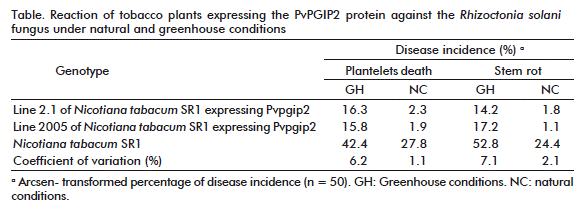
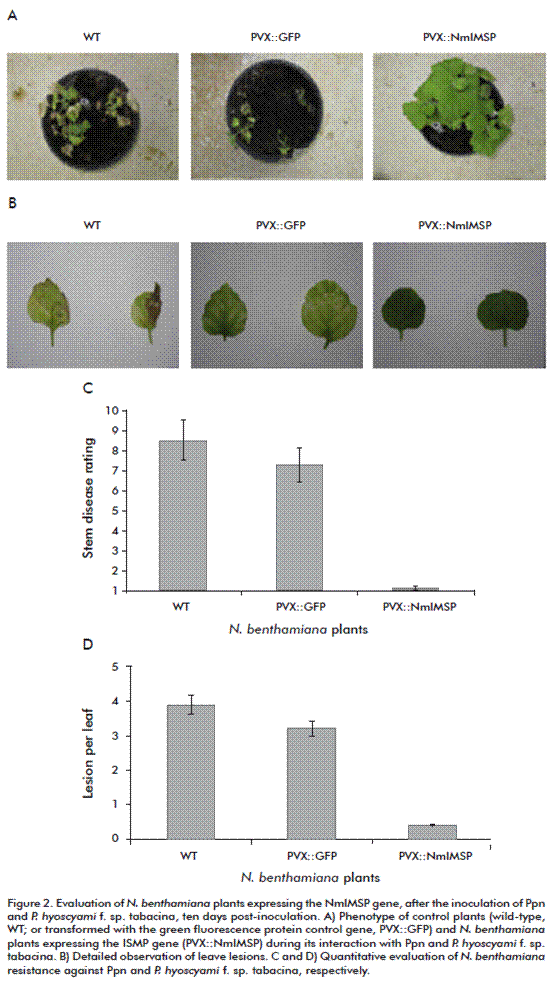
<body><![CDATA[<P   ><font size="2" face="Verdana, Arial, Helvetica, sans-serif">In these processes,      the cell wall is the primary line of defense against pathogenic microorganisms.      Most of them produce cell wall lytic enzymes, particularly relevant for its      specialized penetration structures. Among them, polygalacturonases (PGs) play      a significant role at the initial infection stages. In fact, a set of proteins      known as polygalacturonases-inhibitory proteins (PGIPs), which recognize PGs      and interferes plant cell wall degradation [2]. </font></P >       <P   ><font size="2" face="Verdana, Arial, Helvetica, sans-serif">PGIPs bear leucine-rich      repeats, as most PAMPs receptors [3], and are able to recognize PGs from microorganisms      and insects. They not only bind to PGs and delay pectin hydrolysis, but also      favor the accumulation of oligogalacturonides (OG), a type of damage-associated      molecular patterns (DAMPs) which, like PAMPs, activate the innate immune response      in plants [4]. For example, there was well established how relevant PGIPs      are for plant resistance against the infection of the necrophytic fungus <I>Botrytis      cinerea</I>. Transgenic tomato and grape plants expressing a pear PGIP, and      transgenic tobacco and <I>Arabidopsis</I> plants expressing a PGIP from or      <I>Arabidopsis</I>, respectively, shown improved resistance against <I>Botrytis</I>      sp. infection in green house experiments [5-8]. Monocotyledonous plants have      been also protected by the transgenic expression of a bean PGIP against the      infection by <I>Fusarium graminearum </I>and <I>Bipolaris sorokiniana</I>      fungi, in spite of showing low cell wall pectin content [9, 10]. </font></P >       <P   ><font size="2" face="Verdana, Arial, Helvetica, sans-serif">For the same purposes,      protein inhibitors have been also considered, being among the main sets of      proteins induced by the plant-pathogen interaction. Plant protease inhibitors      are normally expressed in seeds and tubers and become induced in the plant&rsquo;s      vegetative organs as in leaves and roots. They display two main functions:      1) to regulate the plant&rsquo;s endogenous proteases, and 2) to inhibit the      exogenous proteases of plant pathogens. </font></P >       <P   ><font size="2" face="Verdana, Arial, Helvetica, sans-serif">The use of protease      inhibitors to protect plants from fungi and bacterial infection has been reported      [11-14]. Increased levels of chemotrypsin and trypsin inhibitors have been      correlated with plant resistance against different pathogens [12, 15]. This      process was first identified in tomato plants infected with <I>Phytophthora      infestans</I> [16]. Previous studies showed that potato tubers accumulate      serin-proteinase inhibitors in response to the attack by <I>P. infestans</I>      [17, 18]. Noteworthy, PAMPs-mediated resistance shows a wider spectrum and      last longer than that mediated by protease inhibitors. </font></P >       <P   ><font size="2" face="Verdana, Arial, Helvetica, sans-serif">Hence, in this work      we report the results obtained on using both mechanisms of PAMPs inhibitors-mediated      resistance for plant protection against fungi and oomycetes. </font></P >       <P   >&nbsp;</P >       <P   ><font size="3" face="Verdana, Arial, Helvetica, sans-serif"><b>RESULTS AND DISCUSSION      </b> </font></P >   <FONT size="+1">        <P   ><font size="2" face="Verdana, Arial, Helvetica, sans-serif"><b>Polygalacturonase      inhibitory protein (PvPGIP2) </b></font></P >   <FONT size="+1">        <P   ><font size="2" face="Verdana, Arial, Helvetica, sans-serif">The effect of the      polygalacturonase inhibitory protein (PvPGIP2) of <I>Phaseolus vulgaris</I>      protects tobacco plants against the infection of relevant pathogens such as      the <I>Rhizoctonia solani</I> fungus and <I>Phytophthora parasitica</I> var.      <I>nicotianae </I>and <I>Peronospora hyoscyami</I> f. sp. <I>tabacina</I>      oomycetes. Hence, the use of PvPGIP2 as a powerful, wide spectrum genetic      engineering tool was proposed to confer disease resistance. </font></P >       <P   ><font size="2" face="Verdana, Arial, Helvetica, sans-serif">Under greenhouse      conditions, the main symptoms of <I>R. solani</I>, control plants developed      small stem lesions, which progressively spread through the stem, turning it      brown and causing its death. By the contrary, transgenic tobacco lines expressing      PvPGIP2 protein developed sparse and very limited disease symptoms (<a href="#tab1">Table</a>).      In fact, symptoms coincided with an increase in fungus biomass in colonized      control roots while there was no significant increase in transgenic lines.      Moreover, under greenhouse conditions, both transgenic tobacco lines expressing      PvPGIP2 were extraordinarily resistant to <I>P. parasitica</I> var. <I>nicotianae</I>      (<a href="#fig1">Figure 1</a>). </font></P >       ]]></body>
<body><![CDATA[<P align="center"   ><img src="/img/revistas/bta/v31n3/t0109314.gif" width="553" height="194"><a name="tab1"></a></P >       
<P align="center"   ><img src="/img/revistas/bta/v31n3/f0109314.gif" width="556" height="589"><a name="fig1"></a></P >       
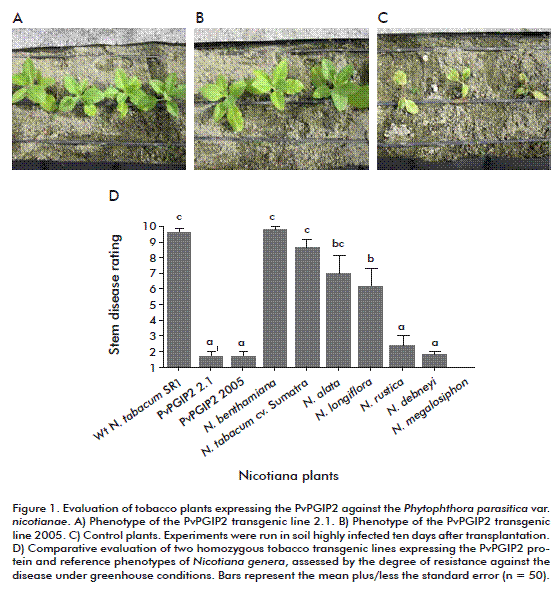
<P   ><font size="2" face="Verdana, Arial, Helvetica, sans-serif">Two weeks after inoculation,      mild symptoms appeared in control plants, while there were no detectable symptoms      in transgenic plants. Nevertheless, severe disease effects were evident in      control plants after 5 weeks (withered leaves and stem rot) but, remarkably,      transgenic plants remained healthy with a resistance similar to the natural      high resistance shown by <I>Nicotiana </I>species. </font></P >       <P   ><font size="2" face="Verdana, Arial, Helvetica, sans-serif">Experiments were      also run under field conditions during the winter, when the cold and wet climate      promotes the incidence of blue mold disease in tobacco, which is caused by      <I>P. hyoscyami</I> f. sp. <I>tabacina</I> in Cuba. Once again, transgenic      plants developed high levels of resistance comparable to that of naturally-resistant      <I>Nicotiana</I> species, demonstrating that the expression of the PvPGIP2      gene, which encodes a PG-inhibitory protein, is a feasible way to confer high      resistance against fungi and oomycetes under greenhouse or field conditions.      This is a good strategy to confer resistance in economically relevant crops      against oomycetes, a high-incidence group of microorganisms which causes great      economic losses and significant environmental damage on natural ecosystems.      </font></P >       <P   ><font size="2" face="Verdana, Arial, Helvetica, sans-serif"><b>Pathogen protease-inhibitory      protein NmIMSP </b></font></P >       <P   ><font size="2" face="Verdana, Arial, Helvetica, sans-serif">Gene regulation during      the <I>N. megalosiphon</I> - <I>P. parasitica</I> var. <I>Nicotianae</I> interaction      was characterized with the aid of SuperSAGE technology, particularly targeting      induced microbial protease inhibitor expression. A cDNA coding for a protease      inhibitor named NmIMSP was identified as overexpressed and associated to the      defensive response of <I>N. megalosiphon</I>. The highest expression levels      were detected in leaves, which remained constant over the test period. </font></P >       <P   ><font size="2" face="Verdana, Arial, Helvetica, sans-serif">Conversely, the functional      silencing of NmIMSP expression compromised the <I>N. megalosiphon</I> resistance      to the infection. Stem damage one week post-inoculation in unsilenced control      plants was established as the unit of disease-related damage (n = 15; mean      &plusmn; standard deviation), with a 1-to-10 evaluation scale from high resistance      to susceptibility. Transgenic plants remained resistant when unsilenced or      by silencing an unrelated gene, while <I>NmIMSP</I>-silenced transgenic plants      showed a 3.2 &plusmn; 0.1 damage degree. Highly susceptible <I>N. tabacum</I>      cv. &lsquo;Sumatra&rsquo; plants were used as control (damage degree 9.8 &plusmn;      0.1). These results corroborated the role of this gene on the observed plant      defensive response. </font></P >       <P   ><font size="2" face="Verdana, Arial, Helvetica, sans-serif">Further evidences      were obtained in <I>N. benthamiana</I> plants, where the expression of the      NmIMSP gene at high levels made plants highly resistant to <I>P. parasitica</I>      var. <I>nicotianae</I> and <I>P. hyoscyami</I> f. sp. <I>tabacina</I> infection,      under greenhouse conditions (<a href="#fig2">Figure 2</a>). Phylogenetic studies      in a set of 25 proteins revealed that NmIMSP belongs to a subgroup of <I>Nicotiana      </I>IMSPs. Specifically, NmIMSP was highly homologous to <I>N. tabacum</I>      IMSP members, including one induced during the interaction of the tobacco      mosaic virus with <I>N. tabacum</I> cv. Samsun NN. Noteworthy, <I>N. tabacum</I>      cv. Samsun NN and <I>N. benthamiana</I> are highly susceptible to <I>P. parasitica</I>      var. <I>nicotianae</I> and <I>P. hyoscyami</I> f. sp. <I>tabacina</I>. </font></P >       <P align="center"   ><img src="/img/revistas/bta/v31n3/f0209314.gif" width="552" height="984"><a name="fig2"></a></P >       
<P   ><font size="2" face="Verdana, Arial, Helvetica, sans-serif">Unlikely, the few      differences in the ISMP aminoacidic sequences among <I>Nicotiana</I> members      would not be responsible for the increased resistance provided by ISMP in      the <I>N. benthamiana</I> susceptible specie against these oomycetes. Probably,      the baseline or delayed expression of ISMP in <I>N. tabacum</I> cv. Samsun      NN and <I>N. benthamiana</I> plants would be insufficient to stop these pathogens&rsquo;      infection. </font></P >       ]]></body>
<body><![CDATA[<P   ><font size="2" face="Verdana, Arial, Helvetica, sans-serif">Nevertheless, the      overexpression of the ISMP gene in the species tested conferred high protection      against the infection by <I>P. parasitica</I> var. <I>nicotianae</I> and <I>P.      hyoscyami</I> f. sp. <I>tabacina</I>, respectively. Undoubtedly, it was evidenced      the relevance of this gene for the plants&rsquo; defensive response against      oomycetes. </font></P >       <P   >&nbsp;</P >       <P   ><font size="2" face="Verdana, Arial, Helvetica, sans-serif"><b><font size="3">MAIN      PRACTICAL RELEVANCE OF THE STUDY </font></b></font></P >   <FONT size="+1">        <P   ><font size="2" face="Verdana, Arial, Helvetica, sans-serif">The major contribution      of the study was to increase plant resistance against high incidence pathogens      of economically relevant plants, through the use of genes encoding the protease      inhibitor and the polygalacturonidase, as part of genetic improvement programs.      By these means, a wide-spectrum resistance can be developed in crops, by inhibiting      PAMPs. </font></P >       <P   >&nbsp;</P >   <FONT size="+1">        <P   > </P >       <P   ><b><font size="3" face="Verdana, Arial, Helvetica, sans-serif">REFERENCES</font></b></P >       <!-- ref --><P   ><font size="2" face="Verdana, Arial, Helvetica, sans-serif">1. Jones JD, Dangl      JL. The plant immune system. Nature. 2006;444(7117):323-9.    </font></P >       <!-- ref --><P   ><font size="2" face="Verdana, Arial, Helvetica, sans-serif">2. De Lorenzo G,      D'Ovidio R, Cervone F. The role of polygalacturonase-inhibiting proteins (PGIPs)      in defense against pathogenic fungi. Annu Rev Phytopathol. 2001;39:313-35.    </font></P >       <!-- ref --><P   ><font size="2" face="Verdana, Arial, Helvetica, sans-serif">3. Casasoli M, Federici      L, Spinelli F, Di Matteo A, Vella N, Scaloni F, et al. Integration of evolutionary      and desolvation energy analysis identifies functional sites in a plant immunity      protein. Proc Natl Acad Sci USA. 2009;106(18):7666-71.    </font></P >       <!-- ref --><P   ><font size="2" face="Verdana, Arial, Helvetica, sans-serif">4. Brutus A, Sicilia      F, Macone A, Cervone F, De Lorenzo G. A domain swap approach reveals a role      of the plant wall-associated kinase 1 (WAK1) as a receptor of oligogalacturonides.      Proc Natl Acad Sci USA. 2010;107(20):9452-7.    </font></P >       <!-- ref --><P   ><font size="2" face="Verdana, Arial, Helvetica, sans-serif">5. Powell AL, van      Kan J, ten Have A, Visser J, Greve LC, Bennett AB, et al. Transgenic expression      of pear PGIP in tomato limits fungal colonization. Mol Plant-Microbe Interact.      2000;13(9):942-50.    </font></P >       <!-- ref --><P   ><font size="2" face="Verdana, Arial, Helvetica, sans-serif">6. Ferrari S, Vairo      D, Ausubel FM, Cervone F, De Lorenzo G. Tandemly duplicated Arabidopsis genes      that encode polygalacturonase-inhibiting proteins are regulated coordinately      by different signal transduction pathways in response to fungal infection.      Plant Cell. 2003;15(1):93-106.    </font></P >       <!-- ref --><P   ><font size="2" face="Verdana, Arial, Helvetica, sans-serif">7. Aguero CB, Uratsu      SL, Greve C, Powell AL, Labavitch JM, Meredith CP, et al. Evaluation of tolerance      to Pierce's disease and Botrytis in transgenic plants of Vitis vinifera L.      expressing the pear PGIP gene. Mol Plant Pathol. 2005;6(1):43-51.    </font></P >       <!-- ref --><P   ><font size="2" face="Verdana, Arial, Helvetica, sans-serif">8. Manfredini C,      Sicilia F, Ferrari S, Pontiggia D, Salvi G, Caprari C, et al. Polygalacturonase-inhibiting      protein 2 of Phaseolus vulgaris inhibits BcPG1, a polygalacturonase of Botrytis      cinerea important for pathogenicity, and protects transgenic plants from infection.      Physiol Mol Plant Pathol. 2005;67(2):108-15.    </font></P >       <!-- ref --><P   ><font size="2" face="Verdana, Arial, Helvetica, sans-serif">9. Janni M, Sella      L, Favaron F, Blechl AE, De Lorenzo G, D'Ovidio R. The expression of a bean      PGIP in transgenic wheat confers increased resistance to the fungal pathogen      Bipolaris sorokiniana. Mol Plant Microbe Interact. 2008;21(2):171-7.    </font></P >       <P   ><font size="2" face="Verdana, Arial, Helvetica, sans-serif">10. Ferrari S, Sella      L, Janni M, De Lorenzo G, Favaron F, D'Ovidio R. Transgenic expression of      polygalacturonase-inhibiting proteins in Arabidopsis and wheat increases resistance      to the flower pathogen Fusarium graminearum. Plant Biol. 2012;14 Suppl 1:31-8.</font></P >       <!-- ref --><P   ><font size="2" face="Verdana, Arial, Helvetica, sans-serif">11. Haq SK, Atif      SM, Khan RH. Protein proteinase inhibitor genes in combat against insects,      pests, and pathogens: natural and engineered phytoprotection. Arch Biochem      Biophys. 2004;431(1):145-59.    </font></P >       <!-- ref --><P   ><font size="2" face="Verdana, Arial, Helvetica, sans-serif">12. Kim JY, Park      SC, Hwang I, Cheong H, Nah JW, Hahm KS, et al. Protease inhibitors from plants      with antimicrobial activity. Int J Mol Sci. 2009;10(6):2860-72.    </font></P >       ]]></body>
<body><![CDATA[<!-- ref --><P   ><font size="2" face="Verdana, Arial, Helvetica, sans-serif">13. Lorito M, Broadway      RM, Hayes CK, Woo SL, Noviello C, Williams DL et al. Proteinase inhibitors      from plants as a novel class of fungicides. Mol Plant-Microbe Interact. 1994;7(4):525-7.    </font></P >       <!-- ref --><P   ><font size="2" face="Verdana, Arial, Helvetica, sans-serif">14. Mosolov VV, Loginova      MD, Fedurkina NV, Benken II. The biological significance of proteinase inhibitors      in plants. Plant Sci Lett. 1976;7(2):77-80.    </font></P >       <P   ><font size="2" face="Verdana, Arial, Helvetica, sans-serif">15. Ryan CA. Protease      inhibitors in plants: genes for improving defenses against insects and pathogens.      Annu Rev Phytopathol. 1990;28:425-49. </font></P >       <!-- ref --><P   ><font size="2" face="Verdana, Arial, Helvetica, sans-serif">16. Woloshuk CP,      Meulenhoff JS, Sela-Buurlage M, van den Elzen PJ, Cornelissen BJ. Pathogen-induced      proteins with inhibitory activity toward Phytophthora infestans. Plant Cell.      1991;3(6):619-28.    </font></P >       <!-- ref --><P   ><font size="2" face="Verdana, Arial, Helvetica, sans-serif">17. Valueva TA, Revina      TA, Gvozdeva EL, Gerasimova NG, Ozeretskovskaia OL. [Role of proteinase inhibitors      in potato protection]. Bioorg Khim. 2003;29(5):499-504.    </font></P >       <!-- ref --><P   ><font size="2" face="Verdana, Arial, Helvetica, sans-serif">18. Valueva TA, Revina      TA, Kladnitskaya GV, Mosolov VV. Kunitz-type proteinase inhibitors from intact      and <i>Phytophthora</i>-infected potato tubers. FEBS Lett. 1998;426(1):131-4.    </font>    <br>   </P >   </font></font></font></font></font></font></font></font></font></font></font></font></font></font></font></font></font></font></font></font></font></font></font></font></font></font></font></font></font><FONT size="+1" color="#000000"><FONT size="+1"><FONT size="+1"><FONT size="+1"><FONT size="+1"><FONT size="+1"><FONT size="+1"><FONT size="+1"><FONT size="+1"><FONT size="+1"><FONT size="+1"><FONT size="+1"><FONT size="+1"><FONT size="+1"><FONT size="+1"><FONT size="+1"><FONT size="+1"><FONT size="+1"><FONT size="+1"><FONT color="#0000FF"><FONT color="#000000"><FONT size="+1"><FONT size="+1"><FONT size="+1"><FONT size="+1"><FONT size="+1"><FONT size="+1"><FONT size="+1"><FONT size="+1"><FONT size="+1">        <P   > </P >       <P   >&nbsp;</P >       <P   >&nbsp;</P >       <P   ><font size="2" face="Verdana, Arial, Helvetica, sans-serif">Received in July,      2014.    <br>     </font><font size="2" face="Verdana, Arial, Helvetica, sans-serif">Accepted      in December, 2014. </font></P >       <P   >&nbsp;</P >       <P   >&nbsp;</P >       <P   > </P >       ]]></body>
<body><![CDATA[<P   ><i><font size="2" face="Verdana, Arial, Helvetica, sans-serif">Ingrid Hernandez-Est&eacute;vez</font></i><font size="2" face="Verdana, Arial, Helvetica, sans-serif">.      Divisi&oacute;n de Plantas. Centro de Ingenier&iacute;a Gen&eacute;tica y      Biotecnolog&iacute;a, CIGB. Ave. 31 e/ 158 y 190, Cubanac&aacute;n, Playa,      CP 11600, La Habana, Cuba. E-mail: <A href="mailto:ingrid.hernandez@cigb.edu.cu">      <FONT color="#0000FF">ingrid.hernandez@cigb.edu.cu</font></A><FONT color="#0000FF"><FONT color="#000000">.      </font></font></font></P >   </font></font></font></font></font></font></font></font></font></font></font></font></font></font></font></font></font></font></font></font></font></font></font></font></font></font></font></font></font></font></DIV >      ]]></body><back>
<ref-list>
<ref id="B1">
<label>1</label><nlm-citation citation-type="journal">
<person-group person-group-type="author">
<name>
<surname><![CDATA[Jones]]></surname>
<given-names><![CDATA[JD]]></given-names>
</name>
<name>
<surname><![CDATA[Dangl]]></surname>
<given-names><![CDATA[JL]]></given-names>
</name>
</person-group>
<article-title xml:lang="en"><![CDATA[The plant immune system]]></article-title>
<source><![CDATA[Nature]]></source>
<year>2006</year>
<volume>444</volume>
<numero>7117</numero>
<issue>7117</issue>
<page-range>323-9</page-range></nlm-citation>
</ref>
<ref id="B2">
<label>2</label><nlm-citation citation-type="journal">
<person-group person-group-type="author">
<name>
<surname><![CDATA[De Lorenzo]]></surname>
<given-names><![CDATA[G]]></given-names>
</name>
<name>
<surname><![CDATA[D'Ovidio]]></surname>
<given-names><![CDATA[R]]></given-names>
</name>
<name>
<surname><![CDATA[Cervone]]></surname>
<given-names><![CDATA[F]]></given-names>
</name>
</person-group>
<article-title xml:lang="en"><![CDATA[The role of polygalacturonase-inhibiting proteins (PGIPs) in defense against pathogenic fungi]]></article-title>
<source><![CDATA[Annu Rev Phytopathol]]></source>
<year>2001</year>
<volume>39</volume>
<page-range>313-35</page-range></nlm-citation>
</ref>
<ref id="B3">
<label>3</label><nlm-citation citation-type="journal">
<person-group person-group-type="author">
<name>
<surname><![CDATA[Casasoli]]></surname>
<given-names><![CDATA[M]]></given-names>
</name>
<name>
<surname><![CDATA[Federici]]></surname>
<given-names><![CDATA[L]]></given-names>
</name>
<name>
<surname><![CDATA[Spinelli]]></surname>
<given-names><![CDATA[F]]></given-names>
</name>
<name>
<surname><![CDATA[Di Matteo]]></surname>
<given-names><![CDATA[A]]></given-names>
</name>
<name>
<surname><![CDATA[Vella]]></surname>
<given-names><![CDATA[N]]></given-names>
</name>
<name>
<surname><![CDATA[Scaloni]]></surname>
<given-names><![CDATA[F]]></given-names>
</name>
</person-group>
<article-title xml:lang="en"><![CDATA[Integration of evolutionary and desolvation energy analysis identifies functional sites in a plant immunity protein]]></article-title>
<source><![CDATA[Proc Natl Acad Sci USA]]></source>
<year>2009</year>
<volume>106</volume>
<numero>18</numero>
<issue>18</issue>
<page-range>7666-71</page-range></nlm-citation>
</ref>
<ref id="B4">
<label>4</label><nlm-citation citation-type="journal">
<person-group person-group-type="author">
<name>
<surname><![CDATA[Brutus]]></surname>
<given-names><![CDATA[A]]></given-names>
</name>
<name>
<surname><![CDATA[Sicilia]]></surname>
<given-names><![CDATA[F]]></given-names>
</name>
<name>
<surname><![CDATA[Macone]]></surname>
<given-names><![CDATA[A]]></given-names>
</name>
<name>
<surname><![CDATA[Cervone]]></surname>
<given-names><![CDATA[F]]></given-names>
</name>
<name>
<surname><![CDATA[De Lorenzo]]></surname>
<given-names><![CDATA[G]]></given-names>
</name>
</person-group>
<article-title xml:lang="en"><![CDATA[A domain swap approach reveals a role of the plant wall-associated kinase 1 (WAK1) as a receptor of oligogalacturonides]]></article-title>
<source><![CDATA[Proc Natl Acad Sci USA]]></source>
<year>2010</year>
<volume>107</volume>
<numero>20</numero>
<issue>20</issue>
<page-range>9452-7</page-range></nlm-citation>
</ref>
<ref id="B5">
<label>5</label><nlm-citation citation-type="journal">
<person-group person-group-type="author">
<name>
<surname><![CDATA[Powell]]></surname>
<given-names><![CDATA[AL]]></given-names>
</name>
<name>
<surname><![CDATA[van Kan]]></surname>
<given-names><![CDATA[J]]></given-names>
</name>
<name>
<surname><![CDATA[ten Have]]></surname>
<given-names><![CDATA[A]]></given-names>
</name>
<name>
<surname><![CDATA[Visser]]></surname>
<given-names><![CDATA[J]]></given-names>
</name>
<name>
<surname><![CDATA[Greve]]></surname>
<given-names><![CDATA[LC]]></given-names>
</name>
<name>
<surname><![CDATA[Bennett]]></surname>
<given-names><![CDATA[AB]]></given-names>
</name>
</person-group>
<article-title xml:lang="en"><![CDATA[Transgenic expression of pear PGIP in tomato limits fungal colonization]]></article-title>
<source><![CDATA[Mol Plant-Microbe Interact]]></source>
<year>2000</year>
<volume>13</volume>
<numero>9</numero>
<issue>9</issue>
<page-range>942-50</page-range></nlm-citation>
</ref>
<ref id="B6">
<label>6</label><nlm-citation citation-type="journal">
<person-group person-group-type="author">
<name>
<surname><![CDATA[Ferrari]]></surname>
<given-names><![CDATA[S]]></given-names>
</name>
<name>
<surname><![CDATA[Vairo]]></surname>
<given-names><![CDATA[D]]></given-names>
</name>
<name>
<surname><![CDATA[Ausubel]]></surname>
<given-names><![CDATA[FM]]></given-names>
</name>
<name>
<surname><![CDATA[Cervone]]></surname>
<given-names><![CDATA[F]]></given-names>
</name>
<name>
<surname><![CDATA[De Lorenzo]]></surname>
<given-names><![CDATA[G]]></given-names>
</name>
</person-group>
<article-title xml:lang="en"><![CDATA[Tandemly duplicated Arabidopsis genes that encode polygalacturonase-inhibiting proteins are regulated coordinately by different signal transduction pathways in response to fungal infection]]></article-title>
<source><![CDATA[Plant Cell]]></source>
<year>2003</year>
<volume>15</volume>
<numero>1</numero>
<issue>1</issue>
<page-range>93-106</page-range></nlm-citation>
</ref>
<ref id="B7">
<label>7</label><nlm-citation citation-type="journal">
<person-group person-group-type="author">
<name>
<surname><![CDATA[Aguero]]></surname>
<given-names><![CDATA[CB]]></given-names>
</name>
<name>
<surname><![CDATA[Uratsu]]></surname>
<given-names><![CDATA[SL]]></given-names>
</name>
<name>
<surname><![CDATA[Greve]]></surname>
<given-names><![CDATA[C]]></given-names>
</name>
<name>
<surname><![CDATA[Powell]]></surname>
<given-names><![CDATA[AL]]></given-names>
</name>
<name>
<surname><![CDATA[Labavitch]]></surname>
<given-names><![CDATA[JM]]></given-names>
</name>
<name>
<surname><![CDATA[Meredith]]></surname>
<given-names><![CDATA[CP]]></given-names>
</name>
</person-group>
<article-title xml:lang="en"><![CDATA[Evaluation of tolerance to Pierce's disease and Botrytis in transgenic plants of Vitis vinifera L. expressing the pear PGIP gene]]></article-title>
<source><![CDATA[Mol Plant Pathol]]></source>
<year>2005</year>
<volume>6</volume>
<numero>1</numero>
<issue>1</issue>
<page-range>43-51</page-range></nlm-citation>
</ref>
<ref id="B8">
<label>8</label><nlm-citation citation-type="journal">
<person-group person-group-type="author">
<name>
<surname><![CDATA[Manfredini]]></surname>
<given-names><![CDATA[C]]></given-names>
</name>
<name>
<surname><![CDATA[Sicilia]]></surname>
<given-names><![CDATA[F]]></given-names>
</name>
<name>
<surname><![CDATA[Ferrari]]></surname>
<given-names><![CDATA[S]]></given-names>
</name>
<name>
<surname><![CDATA[Pontiggia]]></surname>
<given-names><![CDATA[D]]></given-names>
</name>
<name>
<surname><![CDATA[Salvi]]></surname>
<given-names><![CDATA[G]]></given-names>
</name>
<name>
<surname><![CDATA[Caprari]]></surname>
<given-names><![CDATA[C]]></given-names>
</name>
</person-group>
<article-title xml:lang="en"><![CDATA[Polygalacturonase-inhibiting protein 2 of Phaseolus vulgaris inhibits BcPG1, a polygalacturonase of Botrytis cinerea important for pathogenicity, and protects transgenic plants from infection]]></article-title>
<source><![CDATA[Physiol Mol Plant Pathol]]></source>
<year>2005</year>
<volume>67</volume>
<numero>2</numero>
<issue>2</issue>
<page-range>108-15</page-range></nlm-citation>
</ref>
<ref id="B9">
<label>9</label><nlm-citation citation-type="journal">
<person-group person-group-type="author">
<name>
<surname><![CDATA[Janni]]></surname>
<given-names><![CDATA[M]]></given-names>
</name>
<name>
<surname><![CDATA[Sella]]></surname>
<given-names><![CDATA[L]]></given-names>
</name>
<name>
<surname><![CDATA[Favaron]]></surname>
<given-names><![CDATA[F]]></given-names>
</name>
<name>
<surname><![CDATA[Blechl]]></surname>
<given-names><![CDATA[AE]]></given-names>
</name>
<name>
<surname><![CDATA[De Lorenzo]]></surname>
<given-names><![CDATA[G]]></given-names>
</name>
<name>
<surname><![CDATA[D'Ovidio]]></surname>
<given-names><![CDATA[R]]></given-names>
</name>
</person-group>
<article-title xml:lang="en"><![CDATA[The expression of a bean PGIP in transgenic wheat confers increased resistance to the fungal pathogen Bipolaris sorokiniana]]></article-title>
<source><![CDATA[Mol Plant Microbe Interact]]></source>
<year>2008</year>
<volume>21</volume>
<numero>2</numero>
<issue>2</issue>
<page-range>171-7</page-range></nlm-citation>
</ref>
<ref id="B10">
<label>10</label><nlm-citation citation-type="journal">
<person-group person-group-type="author">
<name>
<surname><![CDATA[Ferrari]]></surname>
<given-names><![CDATA[S]]></given-names>
</name>
<name>
<surname><![CDATA[Sella]]></surname>
<given-names><![CDATA[L]]></given-names>
</name>
<name>
<surname><![CDATA[Janni]]></surname>
<given-names><![CDATA[M]]></given-names>
</name>
<name>
<surname><![CDATA[De Lorenzo]]></surname>
<given-names><![CDATA[G]]></given-names>
</name>
<name>
<surname><![CDATA[Favaron]]></surname>
<given-names><![CDATA[F]]></given-names>
</name>
<name>
<surname><![CDATA[D'Ovidio]]></surname>
<given-names><![CDATA[R]]></given-names>
</name>
</person-group>
<article-title xml:lang="en"><![CDATA[Transgenic expression of polygalacturonase-inhibiting proteins in Arabidopsis and wheat increases resistance to the flower pathogen Fusarium graminearum]]></article-title>
<source><![CDATA[Plant Biol]]></source>
<year>2012</year>
<volume>14</volume>
<numero>^s1</numero>
<issue>^s1</issue>
<supplement>1</supplement>
<page-range>31-8</page-range></nlm-citation>
</ref>
<ref id="B11">
<label>11</label><nlm-citation citation-type="journal">
<person-group person-group-type="author">
<name>
<surname><![CDATA[Haq]]></surname>
<given-names><![CDATA[SK]]></given-names>
</name>
<name>
<surname><![CDATA[Atif]]></surname>
<given-names><![CDATA[SM]]></given-names>
</name>
<name>
<surname><![CDATA[Khan]]></surname>
<given-names><![CDATA[RH]]></given-names>
</name>
</person-group>
<article-title xml:lang="en"><![CDATA[Protein proteinase inhibitor genes in combat against insects, pests, and pathogens: natural and engineered phytoprotection]]></article-title>
<source><![CDATA[Arch Biochem Biophys]]></source>
<year>2004</year>
<volume>431</volume>
<numero>1</numero>
<issue>1</issue>
<page-range>145-59</page-range></nlm-citation>
</ref>
<ref id="B12">
<label>12</label><nlm-citation citation-type="journal">
<person-group person-group-type="author">
<name>
<surname><![CDATA[Kim]]></surname>
<given-names><![CDATA[JY]]></given-names>
</name>
<name>
<surname><![CDATA[Park]]></surname>
<given-names><![CDATA[SC]]></given-names>
</name>
<name>
<surname><![CDATA[Hwang]]></surname>
<given-names><![CDATA[I]]></given-names>
</name>
<name>
<surname><![CDATA[Cheong]]></surname>
<given-names><![CDATA[H]]></given-names>
</name>
<name>
<surname><![CDATA[Nah]]></surname>
<given-names><![CDATA[JW]]></given-names>
</name>
<name>
<surname><![CDATA[Hahm]]></surname>
<given-names><![CDATA[KS]]></given-names>
</name>
</person-group>
<article-title xml:lang="en"><![CDATA[Protease inhibitors from plants with antimicrobial activity]]></article-title>
<source><![CDATA[Int J Mol Sci]]></source>
<year>2009</year>
<volume>10</volume>
<numero>6</numero>
<issue>6</issue>
<page-range>2860-72</page-range></nlm-citation>
</ref>
<ref id="B13">
<label>13</label><nlm-citation citation-type="journal">
<person-group person-group-type="author">
<name>
<surname><![CDATA[Lorito]]></surname>
<given-names><![CDATA[M]]></given-names>
</name>
<name>
<surname><![CDATA[Broadway]]></surname>
<given-names><![CDATA[RM]]></given-names>
</name>
<name>
<surname><![CDATA[Hayes]]></surname>
<given-names><![CDATA[CK]]></given-names>
</name>
<name>
<surname><![CDATA[Woo]]></surname>
<given-names><![CDATA[SL]]></given-names>
</name>
<name>
<surname><![CDATA[Noviello]]></surname>
<given-names><![CDATA[C]]></given-names>
</name>
<name>
<surname><![CDATA[Williams]]></surname>
<given-names><![CDATA[DL]]></given-names>
</name>
</person-group>
<article-title xml:lang="en"><![CDATA[Proteinase inhibitors from plants as a novel class of fungicides]]></article-title>
<source><![CDATA[Mol Plant-Microbe Interact]]></source>
<year>1994</year>
<volume>7</volume>
<numero>4</numero>
<issue>4</issue>
<page-range>525-7</page-range></nlm-citation>
</ref>
<ref id="B14">
<label>14</label><nlm-citation citation-type="journal">
<person-group person-group-type="author">
<name>
<surname><![CDATA[Mosolov]]></surname>
<given-names><![CDATA[VV]]></given-names>
</name>
<name>
<surname><![CDATA[Loginova]]></surname>
<given-names><![CDATA[MD]]></given-names>
</name>
<name>
<surname><![CDATA[Fedurkina]]></surname>
<given-names><![CDATA[NV]]></given-names>
</name>
<name>
<surname><![CDATA[Benken]]></surname>
<given-names><![CDATA[II]]></given-names>
</name>
</person-group>
<article-title xml:lang="en"><![CDATA[The biological significance of proteinase inhibitors in plants]]></article-title>
<source><![CDATA[Plant Sci Lett]]></source>
<year>1976</year>
<volume>7</volume>
<numero>2</numero>
<issue>2</issue>
<page-range>77-80</page-range></nlm-citation>
</ref>
<ref id="B15">
<label>15</label><nlm-citation citation-type="journal">
<person-group person-group-type="author">
<name>
<surname><![CDATA[Ryan]]></surname>
<given-names><![CDATA[CA]]></given-names>
</name>
</person-group>
<article-title xml:lang="en"><![CDATA[Protease inhibitors in plants: genes for improving defenses against insects and pathogens]]></article-title>
<source><![CDATA[Annu Rev Phytopathol]]></source>
<year>1990</year>
<volume>28</volume>
<numero>^s1</numero>
<issue>^s1</issue>
<supplement>1</supplement>
<page-range>425-49</page-range></nlm-citation>
</ref>
<ref id="B16">
<label>16</label><nlm-citation citation-type="journal">
<person-group person-group-type="author">
<name>
<surname><![CDATA[Woloshuk]]></surname>
<given-names><![CDATA[CP]]></given-names>
</name>
<name>
<surname><![CDATA[Meulenhoff]]></surname>
<given-names><![CDATA[JS]]></given-names>
</name>
<name>
<surname><![CDATA[Sela-Buurlage]]></surname>
<given-names><![CDATA[M]]></given-names>
</name>
<name>
<surname><![CDATA[van den Elzen]]></surname>
<given-names><![CDATA[PJ]]></given-names>
</name>
<name>
<surname><![CDATA[Cornelissen]]></surname>
<given-names><![CDATA[BJ]]></given-names>
</name>
</person-group>
<article-title xml:lang="en"><![CDATA[Pathogen-induced proteins with inhibitory activity toward Phytophthora infestans]]></article-title>
<source><![CDATA[Plant Cell]]></source>
<year>1991</year>
<volume>3</volume>
<numero>6</numero>
<issue>6</issue>
<page-range>619-28</page-range></nlm-citation>
</ref>
<ref id="B17">
<label>17</label><nlm-citation citation-type="journal">
<person-group person-group-type="author">
<name>
<surname><![CDATA[Valueva]]></surname>
<given-names><![CDATA[TA]]></given-names>
</name>
<name>
<surname><![CDATA[Revina]]></surname>
<given-names><![CDATA[TA]]></given-names>
</name>
<name>
<surname><![CDATA[Gvozdeva]]></surname>
<given-names><![CDATA[EL]]></given-names>
</name>
<name>
<surname><![CDATA[Gerasimova]]></surname>
<given-names><![CDATA[NG]]></given-names>
</name>
<name>
<surname><![CDATA[Ozeretskovskaia]]></surname>
<given-names><![CDATA[OL]]></given-names>
</name>
</person-group>
<article-title xml:lang="en"><![CDATA[Role of proteinase inhibitors in potato protection]]></article-title>
<source><![CDATA[Bioorg Khim]]></source>
<year>2003</year>
<volume>29</volume>
<numero>5</numero>
<issue>5</issue>
<page-range>499-504</page-range></nlm-citation>
</ref>
<ref id="B18">
<label>18</label><nlm-citation citation-type="journal">
<person-group person-group-type="author">
<name>
<surname><![CDATA[Valueva]]></surname>
<given-names><![CDATA[TA]]></given-names>
</name>
<name>
<surname><![CDATA[Revina]]></surname>
<given-names><![CDATA[TA]]></given-names>
</name>
<name>
<surname><![CDATA[Kladnitskaya]]></surname>
<given-names><![CDATA[GV]]></given-names>
</name>
<name>
<surname><![CDATA[Mosolov]]></surname>
<given-names><![CDATA[VV]]></given-names>
</name>
</person-group>
<article-title xml:lang="en"><![CDATA[Kunitz-type proteinase inhibitors from intact and Phytophthora-infected potato tubers]]></article-title>
<source><![CDATA[FEBS Lett]]></source>
<year>1998</year>
<volume>426</volume>
<numero>1</numero>
<issue>1</issue>
<page-range>131-4</page-range></nlm-citation>
</ref>
</ref-list>
</back>
</article>