<?xml version="1.0" encoding="ISO-8859-1"?><article xmlns:mml="http://www.w3.org/1998/Math/MathML" xmlns:xlink="http://www.w3.org/1999/xlink" xmlns:xsi="http://www.w3.org/2001/XMLSchema-instance">
<front>
<journal-meta>
<journal-id>1027-2852</journal-id>
<journal-title><![CDATA[Biotecnología Aplicada]]></journal-title>
<abbrev-journal-title><![CDATA[Biotecnol Apl]]></abbrev-journal-title>
<issn>1027-2852</issn>
<publisher>
<publisher-name><![CDATA[Editorial Elfos Scientiae]]></publisher-name>
</publisher>
</journal-meta>
<article-meta>
<article-id>S1027-28522015000300001</article-id>
<title-group>
<article-title xml:lang="en"><![CDATA[Use of microorganisms to subvert oil spills and their implications for animal and human health]]></article-title>
<article-title xml:lang="es"><![CDATA[El uso de microorganismos para eliminar los derrames de petróleo y sus implicaciones para la salud animal y humana]]></article-title>
</title-group>
<contrib-group>
<contrib contrib-type="author">
<name>
<surname><![CDATA[Rajalingham]]></surname>
<given-names><![CDATA[Kalyani]]></given-names>
</name>
<xref ref-type="aff" rid="A01"/>
</contrib>
</contrib-group>
<aff id="A01">
<institution><![CDATA[,Concordia University  ]]></institution>
<addr-line><![CDATA[Montréal ]]></addr-line>
<country>Canada</country>
</aff>
<pub-date pub-type="pub">
<day>00</day>
<month>09</month>
<year>2015</year>
</pub-date>
<pub-date pub-type="epub">
<day>00</day>
<month>09</month>
<year>2015</year>
</pub-date>
<volume>32</volume>
<numero>3</numero>
<fpage>3101</fpage>
<lpage>3110</lpage>
<copyright-statement/>
<copyright-year/>
<self-uri xlink:href="http://scielo.sld.cu/scielo.php?script=sci_arttext&amp;pid=S1027-28522015000300001&amp;lng=en&amp;nrm=iso"></self-uri><self-uri xlink:href="http://scielo.sld.cu/scielo.php?script=sci_abstract&amp;pid=S1027-28522015000300001&amp;lng=en&amp;nrm=iso"></self-uri><self-uri xlink:href="http://scielo.sld.cu/scielo.php?script=sci_pdf&amp;pid=S1027-28522015000300001&amp;lng=en&amp;nrm=iso"></self-uri><kwd-group>
<kwd lng="en"><![CDATA[oil spills]]></kwd>
<kwd lng="en"><![CDATA[bioremediation]]></kwd>
<kwd lng="en"><![CDATA[biotechnology]]></kwd>
<kwd lng="en"><![CDATA[oil-degrading microorganisms]]></kwd>
<kwd lng="en"><![CDATA[biodegradación de petróleo]]></kwd>
<kwd lng="en"><![CDATA[ingeniería genética]]></kwd>
<kwd lng="en"><![CDATA[Pseudomonas]]></kwd>
<kwd lng="es"><![CDATA[derrames de petróleo]]></kwd>
<kwd lng="es"><![CDATA[biorremediación]]></kwd>
<kwd lng="es"><![CDATA[biotecnología]]></kwd>
<kwd lng="es"><![CDATA[microorganismos degradadores de petróleo]]></kwd>
<kwd lng="es"><![CDATA[biodegradación de petróleo]]></kwd>
<kwd lng="es"><![CDATA[ingeniería genética, Pseudomonas.]]></kwd>
</kwd-group>
</article-meta>
</front><body><![CDATA[ <DIV class="Sect"   >        <P align="right"   ><font size="2" color="#000000" face="Verdana, Arial, Helvetica, sans-serif"><b>REVIEW</b>      </font></P >       <P align="right"   >&nbsp;</P >   <FONT size="+1" color="#000000">        <P   > </P >   <FONT size="+1">        <P   ><b><font size="4" face="Verdana, Arial, Helvetica, sans-serif"> <FONT color="#211E1F">Use      of microorganisms to subvert oil spills and their implications for animal      and human health </font></font></b></P >       <P   >&nbsp;</P >   <FONT size="+1"><FONT size="+1" color="#211E1F">        <P   > </P >   <FONT size="+1" color="#000000">        <P   > </P >   <FONT size="+1">        <P   ><font size="3"><b><font face="Verdana, Arial, Helvetica, sans-serif"> <FONT color="#211E1F">El      uso de microorganismos para eliminar los derrames de petr&oacute;leo y sus      implicaciones para la salud animal y humana </font></font></b></font></P >       <P   >&nbsp;</P >       ]]></body>
<body><![CDATA[<P   >&nbsp;</P >   <FONT size="+1"><FONT size="+1" color="#211E1F">        <P   > </P >       <P   > </P >   <FONT size="+1" color="#000000">        <P   ><b><font size="2" color="#211E1F" face="Verdana, Arial, Helvetica, sans-serif">Kalyani      Rajalingham</font></b></P >       <P   ><font size="2" color="#211E1F" face="Verdana, Arial, Helvetica, sans-serif">Concordia      University 7141 Rue Sherbrooke O, Montr&eacute;al, QC H4B 1R6, Canada.</font></P >       <P   >&nbsp;</P >       <P   >&nbsp;</P >   </font></font></font></font></font></font></font></font></font>   <hr>   <FONT size="+1" color="#000000"><FONT size="+1"><FONT size="+1"><FONT size="+1" color="#211E1F"><FONT size="+1" color="#000000"><FONT size="+1"><FONT size="+1"><FONT size="+1" color="#211E1F"><FONT size="+1" color="#000000"><FONT size="+1" color="#211E1F"><FONT size="+1">        <P   > </P >   <FONT size="+1" color="#000000">        <P   ><font size="2" color="#211E1F" face="Verdana, Arial, Helvetica, sans-serif"><B>ABSTRACT</B>      </font></P >   <FONT size="+1" color="#211E1F">        <P   ><font size="2" face="Verdana, Arial, Helvetica, sans-serif">Bioremediation is      the process by which toxic compounds are removed from the environment by using      microorganisms. Cleaning up of oil spills in soil and water environments require      particular bioremediation strategies. Biotechnology and genetic engineering      techniques, used to confer a set of genes, have also proven to be useful to      increase degradation rates by existing microorganisms. The microorganism-mediated      seeding process begins with the isolation of oil-degrading strains from old      oil spills, which are further subjected to multiple tests to assess their      degradation capacity. In spite of oil spills being primarily dominated by      &gamma;-proteobacteria, in particular Pseudomonadales, bacteria, yeast, and      fungi are all potential oil degrading microorganisms. Therefore, the present      review is aimed at exploring the bioremediation capacity of a number of strains      isolated as potential oil degrading microorganism, along with their implications      for human and animal health. </font></P >       ]]></body>
<body><![CDATA[<P   ><font size="2" face="Verdana, Arial, Helvetica, sans-serif"><b><i>Keywords:</i></b>      oil spills, bioremediation, biotechnology, oil-degrading microorganisms, biodegradaci&oacute;n      de petr&oacute;leo, ingenier&iacute;a gen&eacute;tica, <I>Pseudomonas</I>.      </font></P >   </font></font></font></font></font></font></font></font></font></font></font></font></font>   <hr>   <FONT size="+1" color="#000000"><FONT size="+1"><FONT size="+1"><FONT size="+1" color="#211E1F"><FONT size="+1" color="#000000"><FONT size="+1"><FONT size="+1"><FONT size="+1" color="#211E1F"><FONT size="+1" color="#000000"><FONT size="+1" color="#211E1F"><FONT size="+1"><FONT size="+1" color="#000000"><FONT size="+1" color="#211E1F">        <P   ><b><font size="2" color="#211E1F" face="Verdana, Arial, Helvetica, sans-serif">RESUMEN      </font></b></P >   <FONT size="+1" color="#000000"><FONT size="+1" color="#211E1F">        <P   > </P >   <FONT size="+1" color="#000000">        <P   ><font size="2" color="#211E1F" face="Verdana, Arial, Helvetica, sans-serif">La      bioremediaci&oacute;n es el proceso mediante el cual se eliminan compuestos      t&oacute;xicos del medioambiente con el uso de microorganismos. Debido a sus      efectos contaminantes, los derrames de petr&oacute;leo en suelos y en ambientes      acu&iacute;feros requieren estrategias de bioremediaci&oacute;n espec&iacute;ficas.      Notablemente, la biotecnolog&iacute;a y las t&eacute;cnicas de ingenier&iacute;a      gen&eacute;tica han sido &uacute;tiles para incrementar los procesos de biodegradaci&oacute;n      mediados por los microorganismos y para incorporarles a estos genes necesarios      para determinados procesos de biodegradaci&oacute;n. El proceso de biorremediaci&oacute;n      comienza con el aislamiento de cepas de micoorganismos capaces de biodegradar      el crudo y sus derivados, a partir de derrames antiguos, y continua con la      evaluaci&oacute;n de la capacidad biodegradativa de estos y su posibilidad      de potenciaci&oacute;n. A pesar de que las &gamma;-proteobacteria predominan      entre las poblaciones microbianas identificadas en los derrames de petr&oacute;leo,      en especial las Pseudomonadales, las bacterias, hongos y levaduras muestran      gran potencialidad. Por tales razones, en el presente art&iacute;culo de revisi&oacute;n      se aborda la capacidad biorremediadora de diversas cepas microbianas con potencial      para tales prop&oacute;sitos, as&iacute; como sus posibles implicaciones para      la salud humana y animal. </font></P >   <FONT size="+1" color="#211E1F">        <P   ><font size="2" face="Verdana, Arial, Helvetica, sans-serif"><I><b>Palabras clave:</b>      </I>derrames de petr&oacute;leo, biorremediaci&oacute;n, biotecnolog&iacute;a,      microorganismos degradadores de petr&oacute;leo, biodegradaci&oacute;n de      petr&oacute;leo, ingenier&iacute;a gen&eacute;tica, <I>Pseudomonas.</I></font></P >   </font></font></font></font></font></font></font></font></font></font></font></font></font></font></font></font></font>   <hr>       <p>&nbsp;</p>       <p>&nbsp;</p>       <p><FONT size="+1" color="#000000"><FONT size="+1"><FONT size="+1"><FONT size="+1" color="#211E1F"><FONT size="+1" color="#000000"><FONT size="+1"><FONT size="+1"><FONT size="+1" color="#211E1F"><FONT size="+1" color="#000000"><FONT size="+1" color="#211E1F"><FONT size="+1"><FONT size="+1" color="#000000"><FONT size="+1" color="#211E1F"><FONT size="+1" color="#000000"><FONT size="+1" color="#211E1F"><FONT size="+1" color="#000000"><FONT size="+1" color="#211E1F"><b><font size="3" color="#211E1F" face="Verdana, Arial, Helvetica, sans-serif">INTRODUCTION      </font></b><font size="3" color="#000000"><FONT color="#211E1F"> </font></font></font></font></font></font></font></font></font></font></font></font></font></font></font></font></font></font></font></p>   <FONT size="+1" color="#000000"><FONT size="+1"><FONT size="+1"><FONT size="+1" color="#211E1F"><FONT size="+1" color="#000000"><FONT size="+1"><FONT size="+1"><FONT size="+1" color="#211E1F"><FONT size="+1" color="#000000"><FONT size="+1" color="#211E1F"><FONT size="+1"><FONT size="+1" color="#000000"><FONT size="+1" color="#211E1F"><FONT size="+1" color="#000000"><FONT size="+1" color="#211E1F"><FONT size="+1" color="#000000"><FONT size="+1" color="#211E1F"><FONT size="+1" color="#000000"><FONT size="+1" color="#211E1F">       <P   ><font size="2" face="Verdana, Arial, Helvetica, sans-serif">Bioremediation is      the process by which contaminating material is removed from a medium (soil,      surface water, or groundwater), preferentially using living microorganisms      to degrade toxic compounds into innocuous ones. One of the most serious sources      of adverse effects in human health addressed by bioremediation strategies      is environmental oil contamination [1-3]. </font></P >   <FONT size="+1">        <P   ><font size="2" face="Verdana, Arial, Helvetica, sans-serif">Oil spills are dangerous      for a number of reasons: flammability, explosive vapours, toxicity, hydrogen      sulphide, and oxygen exclusion. Explosive vapours following oil spills can      be displaced by air to nearby cities where they can be easily ignite; emission      of hydrogen sulphide gas can affect the airways of residents near spills.      In humans, the effects of oil translate into inhibition of protein synthesis      and nerve synapse function, impairment of plasma membrane and interruption      of membrane transport systems; in fact, hydrocarbons can damage DNA leading      to mutagenesis, carcinogenesis, and decreased reproductive capacity [3]. In      the case of animal health, oil stains on the feathers of birds can decrease      insulation, and result in death during the winter; oil stains on plants results      in decreased metabolism, and suffocation [4]; fish can suffocate when their      gills are covered with oil [5]. </font></P >       ]]></body>
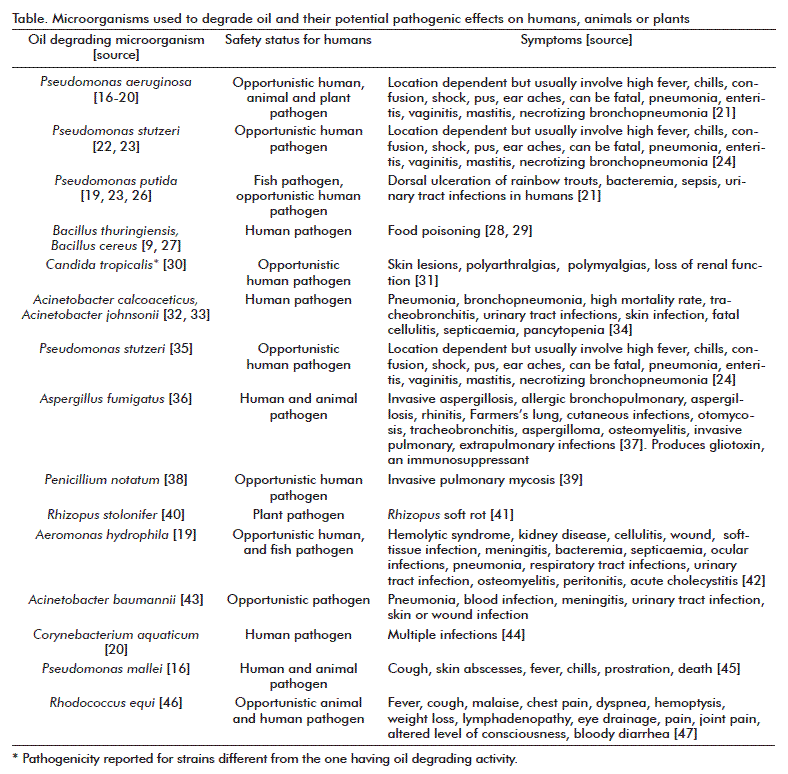
<body><![CDATA[<P   ><font size="2" face="Verdana, Arial, Helvetica, sans-serif">Typically, contaminated      media are usually relocated to a landfill, capped, or contained; incineration      and chemical degradation of toxic compounds are considered as well. In this      case, bioremediation is a safer alternative, in spite of it being slower.      Bioremediation is cheap, a powerful reason to use it as an alternative to      physical methods, since physical washing was found to cost approximately $1      million per day, and the rates of natural biodegradation can vary from 0.03      to 50 g/m<sup>3</sup>&bull;day [6]. Particularly, oil is composed of alkanes,      branched alkanes, cycloalkanes, olefins, monoaromatics, polyaromatics and      phenols [3]. Biodegradation potential decreases with increasing molecular      complexity; in other words, alkanes are easily degraded while complex molecules      remain undegraded for a longer period of time [6]; the reported order of degradation      is as follows: C15 &gt; C20 &gt; (Pristane, Phytane) &gt; C25 &gt; C30 &gt;      C35 &gt; ploy aromatic hydrocarbons (PAHs: fluorine, dibenzothiothene, phenanthrene      and chrysene) [7]. </font></P >   <FONT size="+1"><FONT size="+1">        <P   ><font size="2" face="Verdana, Arial, Helvetica, sans-serif">Another limitation      of bioremediation is that it is not applicable to every toxic compound (e.g.:      cadmium, and lead), and may leave residuals. Most compounds which are naturally      present in the environment are degraded by a microorganism for it which would      have evolved to tackle it. Petroleum, for instance, is a naturally occurring      compound, and as such, there exists microorganisms capable of degrading it      [2]. Furthermore, even when microorganisms can degrade synthetic compounds,      not all compounds are potential targets for microorganisms. Synthetic compounds,      in most cases, require biotechnological strategies to be applied, to enable      or bestow particu-lar microorganisms with the ability to degrade them. In      general, microorganisms are sensitive to temperature, pH, nutrients, soil      structure, and moisture, and under non-optimal conditions, degradation rates      are lowered due to decreased microbial growth rates [2]. Similarly, biodegradation      is dependent upon abiotic factors (oxygen, phosphate, nitrogen). However,      the safety concerns to human, animal, and plant health from using said microorganisms      have not thus far been addressed. </font></P >       <P   ><font size="2" face="Verdana, Arial, Helvetica, sans-serif">In this work, the      potential effects of using said microorganisms in subverting oil spills is      examined, not arguing against bioaugmentation but rather to discuss on the      selection of safe microorganisms for seeding, genetic alteration, and/or strain      improvements, which would be more appropriate for the purpose of bioremediation.      </font></P >       <P   >&nbsp;</P >       <P   ><font size="2" face="Verdana, Arial, Helvetica, sans-serif"><B><font size="3">DISCOVERY      OF TARGET-COMPOUND DEGRADING MICROORGANISMS FOR USE IN BIOREMEDIATION </font></B></font></P >   <FONT size="+1">        <P   ><font size="2" face="Verdana, Arial, Helvetica, sans-serif">A large number of      microorganisms isolated in oil as potential agents for bioremediation were      found to be opportunistic human pathogens. As such, in all cases, the massive      growth of microorganisms can be harmful to humans, animals, or plants. This      implies that selection of safe microorganisms would be advisable. Furthermore,      non-addition of microorganisms to oil, or not resorting to bioremediation,      is not a solution either. In fact, oil spills are the perfect microenvironment      for the propagation of microorganisms such as <I>Pseudomonas putida</I>, where      it grows rapidly. The latter also implies that with time, the density of said      microorganisms increases and causes damage. The addition of more microorganisms,      or even the promotion of their population density by increasing the surface      area of the spill to make it more accessible to microorganisms involved in      bioremediation, increases the chances of damage to the ecosystem. These given      that the presence of the microorganism is accompanied by health effects to      organisms. The argument is not against the use of microorganisms for bioremediation      but rather the selection of a safe organism which might be beneficial when      all aspects are considered (economy, health and others) or at least with the      safest bioremediation/ potential harm balance. </font></P >   <FONT size="+1">        <P   ><font size="2" face="Verdana, Arial, Helvetica, sans-serif">Nearly 79 bacterial,      9 cyanobacterial, 103 fungal and 14 algal genera have been characterized as      having the ability to degrade hydrocarbons. For the process of bioremediation,      microorganisms can be selected from various sources (including extremophiles).      Identification of microorganisms that are capable of degrading the target      compound begins with the collection of microorganisms from various sources      such as old oil spills, and standard culture tests to determine whether the      target compound can be utilized by the microorganisms [8, 9]. </font></P >       <P   ><font size="2" face="Verdana, Arial, Helvetica, sans-serif">Once a potential      microorganism is identified, it is subjected to various tests to assess optimal      growth conditions (pH, temperature, salinity and others), and to determine      the microorganism&rsquo;s ability to degrade the target compound as well as      other compounds of interest [8]. The growth rate of said organisms is also      measured [10-12]. Since classical techniques are time consuming, novel molecular      methods have been applied to achieve the same goal. DNA probes, generated      by examining the genotype of the microorganisms that are capable of degrading      target compounds, are used to identify other microorganisms with the genetic      profile required to degrade those or similar compounds [13, 14]. The extraction      of DNA from a particular microorganism followed by PCR amplification of a      particular gene, and identification with particular probes can speed up the      process [13-15]. </font></P >       <P   ><font size="2" face="Verdana, Arial, Helvetica, sans-serif">A few of the noted      strains that can degrade oil are: <I>Pseudomonas </I>strains, <I>Yokenella      </I>sp., <I>Alcaligenes </I>sp., <I>Roseomonas </I>sp., <I>Stenotrophomonas      </I>sp., <I>Acinetobacter </I>sp., <I>Flavobacter </I>sp., <I>Corynebacterium      </I>sp., <I>Streptococcus </I>sp., <I>Providencia </I>sp., <I>Sphingobacterium      </I>sp., <I>Capnocytophaga </I>sp., <I>Moraxella </I>sp., <I>Bacillus </I>sp.,      and <I>Enterobacter </I>sp. [4]. Moreover, a number of microorganisms found      in oil spills are harmful to humans, animals, and/or plants (<a href="/img/revistas/bta/v32n3/t0101315.gif">Table</a>).      Although the harmful effect of oil is immediate, microorganisms are contagious      and can remain in the flora for longer periods of time, potentially resulting      in bacterial or fungal infections and producing long lasting symptoms. A closer      look at the microorganisms used for bioremediation and their potential health      risks are presented below. </font></P >       
<P   ><font size="2" face="Verdana, Arial, Helvetica, sans-serif"><I><b>Candida </b></I><b>sp.      </b> </font></P >       ]]></body>
<body><![CDATA[<P   ><font size="2" face="Verdana, Arial, Helvetica, sans-serif"><I>Candida tropicalis</I>,      a human pathogen, can cause symptoms similar to those by <I>C. albicans </I>[45].      Infections caused by <I>C. albicans </I>in immunocompromised patients can      trigger an immediate overgrowth of <I>C. albicans </I>fungal cells which can      lead to a myriad of unspecific symptoms such as panic attacks, poor concentration,      brain fog, memory loss, diarrhea/constipation, abdominal cramps, irritable      bowel syndrome, heart burn, extreme lethargy/fatigue, bad breath, eye fatigue,      headaches, premenstrual syndrome, poor libido, frequent yeast infections,      and mood swings amongst others; all these ultimately leading to death. Further,      immunocompromised adults are not the only possible victims, babies, especially      those premature with an incompletely developed immune system, could be po-tential      ones. Current drugs used to treat infection by <I>C. albicans </I>face the      issue of resistance, this microorganism can evolve to become resistant to      currently available drugs. </font></P >       <P   ><font size="2" face="Verdana, Arial, Helvetica, sans-serif"><I><b>Pseudomonas      </b></I><b>sp. </b> </font></P >       <P   ><font size="2" face="Verdana, Arial, Helvetica, sans-serif">In the case of <I>Pseudomonas</I>,      it is a major fish pathogen causing ulcerative syndrome, bacteria haemorrhagic      septicaemia, tail and fin rot, bacteria gill rot, and dropsy. Infection requires      contact and attachment with dermal tissue of fish. In fact, major economic      losses, and decrease in quality of fish results from infections by <I>Pseudomonas</I>.      <I>P. aeruginosa </I>(bacterial dosage LD<FONT color="#000000"><sub>50</sub><FONT color="#211E1F">:      2.4 &times; 10<FONT color="#000000"><sup>8</sup> <FONT color="#211E1F">c.f.u./mL),      injected into <I>Oreochromis niloticus </I>was found to be highly virulent,      resulting in 70-95 % mortality within 48 h [46]. Further, infections of <I>P.      aeruginosa </I>and <I>Aeromonas </I>resulted in the following symptoms: darkness      of skin, scale detachment, hemorrhages on body, necrotizing ulcers on skin,      fin necrosis, inflamed vent, exophthalmia, blindness, and eye cataract/trachoma      [46]. </font></font></font></font></font></P >   <FONT size="+1" color="#000000"><FONT size="+1" color="#211E1F"><FONT size="+1" color="#000000"><FONT size="+1"><FONT color="#211E1F">        <P   ><font size="2" face="Verdana, Arial, Helvetica, sans-serif">This is relevant      since the most common microorganism found growing in oil spills is <I>Pseudomonas      putida</I>, a major opportunistic human pathogen, which is a common pathogen      rainbrow trout, Oncorhynchus mykiss. In experimental settings, <I>P. putida      </I>was shown to cause dermal ulceration, and necrosis of muscles of the rainbrow      trout [21]. The ulceration was quite severe, resulting in kidney swelling      and 35 % mortality [21]. In another experiment, 20 % of rainbow trouts injected      with <I>P. putida </I>(5 &times; 10<FONT color="#000000"><sup>5</sup> <FONT color="#211E1F">cells)      died; the injected fish displaying the following symptoms: dark skin pigmentation,      pale gills and liver, erosion of pectoral and caudal fins, skin haemorrhages      and ulcers [47]. Moreover, rainbow trout infected with <I>P. putida </I>was      found to have lower levels of erythrocytes, and hemoglobin and much higher      levels of mean corpuscular volume and hemoglobin (MCV and MCH, respectively)      [47]. </font></font></font></P >   <FONT size="+1" color="#000000"><FONT size="+1"><FONT color="#211E1F">        <P   ><font size="2" face="Verdana, Arial, Helvetica, sans-serif"><I>P. aeruginosa      </I>is commonly found in soil and water, and requires a minimal nutritional      load for growth and propagation; it can propagate in at least seventy-five      compounds and can grow under multiple conditions [48]. It </font><font size="2" face="Verdana, Arial, Helvetica, sans-serif">can      even grow in distilled water and even better in poor quality water, and it      is recognized as hazardous since contamination of distilled water with <I>P.      aeruginosa </I>is not visible [49, 50]. In theory, this implies that <I>P.      aeruginosa </I>can survive in water once the oil spill has been cleaned. Therefore,      it is plausible that infection and their accompanying diseases could occur,      particularly in immunocompromised patients when open wounds are present [49,      50]. Moreover, only three antibiotics are effective against <I>P. aeruginosa</I>,      making its containment quite difficult. Among its related symptoms in humans      [51] are: </font></P >       <P   ><font size="2" face="Verdana, Arial, Helvetica, sans-serif"><I>General manifestations:      </I>bacteremia, sepsis, febrile neutropenia, bone/joint infection (i.e., osteochondritis,      osteomyelitis, pyarthrosis. </font></P >       <P   ><font size="2" face="Verdana, Arial, Helvetica, sans-serif"><I>Skin and tissue      infections</I>: burn wound sepsis, dermatitis, ecthyma gangrenosum, pyoderma,      cellulitis, hot tub folliculitis, necrotizing fasciitis, chronic paronychia.      </font></P >       <P   ><font size="2" face="Verdana, Arial, Helvetica, sans-serif"><I>Central nervous      system infections</I>: brain abscess, meningitis. </font></P >       <P   ><font size="2" face="Verdana, Arial, Helvetica, sans-serif"><I>Ear infections</I>:      otitis media, chronic suppurative otitis media, otitis externa, malignant      external otitis. </font></P >       <P   ><font size="2" face="Verdana, Arial, Helvetica, sans-serif"><I>Eye infections</I>:      endophthalmitis, keratitis, ophthalmia neonatorum, blepharoconjunctivitis,      scleral abscess, orbital cellulitis, corneal ulcers in humans, and treatments      rarely aid in restoring vision. </font></P >       ]]></body>
<body><![CDATA[<P   ><font size="2" face="Verdana, Arial, Helvetica, sans-serif"><I>Gastrointestinal      infections</I>: epidemic diarrhea, necrotizing enterocolitis, typhlitis, rectal      abscess, Shanghai fever. </font></P >       <P   ><font size="2" face="Verdana, Arial, Helvetica, sans-serif"><I>Genitourinary      infections</I>: epididymitis, prostatitis, urethritis. </font></P >       <P   ><font size="2" face="Verdana, Arial, Helvetica, sans-serif"><I>Cardiovascular      infection</I>s: endocarditis, pericarditis, cardiac tamponade. </font></P >       <P   ><font size="2" face="Verdana, Arial, Helvetica, sans-serif"><I>Respiratory infections</I>:      primary or nonbacteremic, bacteremic, colonization, and nosocomial pneumonia,      lower respiratory tract infections of cystic fibrosis, ventilator-associated      pneumonia. </font></P >       <P   ><font size="2" face="Verdana, Arial, Helvetica, sans-serif"><I>Pseudomonas </I>also      causes major economic losses on the giant freshwater prawn <I>Macrobrachium      rosenbergii</I>, causing degeneration of the body muscle and the hepatopancreas.      This has been observed 96 hours post-inoculation with <I>P. aeruginosa </I>MTCC      1688, with tissue destruction and multiple lesions also present. </font></P >       <P   ><font size="2" face="Verdana, Arial, Helvetica, sans-serif"><I><b>Aspergillus      </b></I><b>sp. </b> </font></P >       <P   ><font size="2" face="Verdana, Arial, Helvetica, sans-serif"><I>Aspergillus fumigatus</I>,      <I>Aspergillus flavus</I>, and <I>Aspergillus niger </I>are potential bioremediation      agents. Particularly, <I>A. fumigatus </I>can produce aflatoxins and cause      aspergillosis. This can result in the dispersion of the microorganism&rsquo;s      spores during its growth and sporulation phase and subsequent inhalation by      animals such as chickens (commercial poultry) [52]; it is allergenic to humans      to say the least. In fact, <I>A. fumigatus </I>is a harsh respiratory pathogen      in birds, with high mortality rates among young animals and chronic infections      in adults. This microorganism also secretes a gliotoxin which functions as      an immunosuppressive agent, making it problematic when coinfections are present.      Currently, there are no treatments available for aspergillosis in humans [53].      </font></P >       <P   ><font size="2" face="Verdana, Arial, Helvetica, sans-serif"><I><b>Moraxellaceae      </b></I><b>sp. </b></font></P >       <P   ><font size="2" face="Verdana, Arial, Helvetica, sans-serif"><I>Moraxellaceae      </I>is another microorganism considered for bioremediation. Data on its potential      harmful effects comes mostly from experimental settings and case reports.      The injection of <I>Moraxellaceae bovis </I>into cattle has resulted in rapid      shallow breathing mydriases, increased serous lacrimination, mouth frothing,      hacking cough, micturition, blood in nasal and oral area; subsequent injection      of epinephrine and antihistamines induced a moribund state and ultimately      death [46]. Injection of <I>M. bovis </I>in mice led to lethargy, diarrhea,      moribundity, and death [46]. <I>M. bovis </I>can also induce keratoconjuntavitis      in cattle, and mice. <I>M. bovis </I>does not require a compromised immune      system for appearance of clinical symptoms. Another species, <I>Moraxella      catarrhalis </I>can cause acute otitis media, chronic or serious otitis media,      acute/chronic sinusitis, upper/lower respiratory tract infections/systemic      infections, meningitis, bacteraemia, endocarditis, keratitis, and suppurative      arthritis [54]. Other species have been reported as causing conjunctivitis,      keratitis, meningitis, arthiritis, endocarditis, osteomyelitis, as well as      upper/lower respiratory tract and otolaryngologic infections [54]. </font></P >       <P   ><font size="2" face="Verdana, Arial, Helvetica, sans-serif"><I><b>Acinetobacter      </b></I><b>sp. </b></font></P >       ]]></body>
<body><![CDATA[<P   ><font size="2" face="Verdana, Arial, Helvetica, sans-serif"><I>Acinetobacter      baumannii </I>is another bacterium affecting healthy animals, is contagious      and preferentially affects the blood, brain or lungs. <I>A. baumannii </I>infections      can cause pneumonia, blood infection, meningitis, and urinary tract, skin      or wound infections [55]. </font></P >       <P   ><font size="2" face="Verdana, Arial, Helvetica, sans-serif"><I><b>Aeromonas </b></I><b>sp.</b>      </font></P >       <P   ><font size="2" face="Verdana, Arial, Helvetica, sans-serif"><I>Aeromonas hydrophila      </I>has been shown to affect the loach (<I>Misgurnus anguillicaudatus</I>)      and <I>Aeromonas salmonicida </I>infects the Brook trout (<I>Salvelinus fontinalis</I>),      the Rainbow trout (<I>Oncorhynchus mykiss</I>) and the Atlantic salmon (<I>Salmo      salar</I>), resulting in hemorrhagic septicemia, tail and fin rot, red-fin      disease and fuminculosis in the three species [56]. </font></P >       <P   >&nbsp;</P >       <P   ><font size="2" face="Verdana, Arial, Helvetica, sans-serif"><B><font size="3">APPROACHES      FOR CREATING NOVEL PROTEINS TO IMPROVE MICROORGANISMS FOR BIOREMEDIATION </font></b></font></P >   <FONT size="+1">        <P   ><font size="2" face="Verdana, Arial, Helvetica, sans-serif">Given that bioaugmentation      has been noted to be less effective than biostimulation, the goal behind strain      improvement would be to generate &lsquo;improved&rsquo; versions of the original      oil-degrading microorganisms. For that purpose, protein engineering aimed      at generating new proteins or modified versions of the existing ones is a      promising alternative to enhance the biodegradative capacity of the available      strains, its practical application still remain to be proven. Briefly, a number      of techniques will be summarized, that could be applied to generate such modifications.      </font></P >   <FONT size="+1">        <P   ><font size="2" face="Verdana, Arial, Helvetica, sans-serif">Common approaches      to creating novel proteins are based on the generation of multiple potential      novel genetic codes followed by directed evolution or selective pressure.      In situ directed mutagenesis, a technique using a primer complementary to      the template DNA to create a single mismatch on it at the desired location,      was one of the former techniques used for generating proteins with modified      structure and function. In fact, primers can be designed in such a manner      to permit insertions, deletions, or mismatches [57]. Other methods, such as      polymerase chain reaction (PCR) amplification to generate mutant segments,      DNA shuffling (also known as in vitro recombina-tion) used to swap segments      between two homologous genes can also being used. </font></P >       <P   ><font size="2" face="Verdana, Arial, Helvetica, sans-serif">Typically, PCR amplification      and random DNA ligation follows cleaving of the two homologous genes with      DNase resulting in the generation of multiple novel potential enzymes which      can be introduced into <I>Escherichia coli </I>for functional screening [58,      59]. An alternative to DNA shuffling is in vitro random priming. In DNA shuffling,      DNAse I is used to generate short segments while in <I>in vitro</I> random      priming, PCR amplification of multiple sections is achieved using random hexanucleotide      primers to generate multiple short segments of DNA from two genes. Subsequently,      the parental templates are removed, and the daughter templates are denatured,      re-annealed, and extended. Repetition of PCR cycles (both annealing, and extension)      results in the generation of novel full length genes. In this method, both      single and double stranded parental DNA molecules can be used, and extension      of segments as short as 200 nucleotides can occur. Errors that occur during      priming and their perpetuation further increase the diversity of final novel      genes [60]. </font></P >       <P   ><font size="2" face="Verdana, Arial, Helvetica, sans-serif">Another technique      named StEP (Staggered Extension Process), uses two homologous parental DNA      strands which are primed (one primer) and extended. Since the annealing-extension      process is allowed to proceed only for a very short period of time, the extended      segments can bind either template, a process known as template switching.      The process ends when a novel gene is created [61]. </font></P >       <P   ><font size="2" face="Verdana, Arial, Helvetica, sans-serif">In Random chimeragenesis      on transient templates (RACHITT), begins with digestion of single stranded      genes with DNAse I, and size fractionation. The latter is followed by segmental      hybridization onto a scaffold. Strands overhangs are excised and gaps are      filled in. Subsequently, the template is digested, and the created partner      strand is amplified using PCR [62]. </font></P >       ]]></body>
<body><![CDATA[<P   ><font size="2" face="Verdana, Arial, Helvetica, sans-serif">Lastly, another method      known as directed evolution relies on Darwinian evolution in test tubes. The      first step consists on generating a variety of codes which can be accomplished      by any of the above mentioned methods. During the second step, a selection      pressure is placed on the created diversity to select the most successful      variants [61]. </font></P >       <P   ><font size="2" face="Verdana, Arial, Helvetica, sans-serif">Novel proteins, generated      by using the abovementioned methods could confer or enhance the bioremediation      capacity of oil-degrading microorganisms. Under selective pressure, strains      that outperform parental or initial strains can be further selected and engineered      for a particular task, such as oil degradation. An alternative could be the      application of a selective pressure over the existing oil-degrading bacterial      strains to permit evolution and response to the selective pressure for the      purpose of bioremediation. Those that are unfit will be a minimal population      and the majority will be the evolved version of the existing strains; this      method is an alternative to genetically modified organisms (GMOs). This particular      strategy could replace the need for any type of genetic alteration, and as      such would be adequate for generating improved strains using an ecosystem-friendly      method without the ethical and biosafety concerns that govern GMOs. In either      case, it is advisable that the potential impact on animal and human health      be carefully considered and tested.</font></P >       <P   >&nbsp;</P >       <P   ><font size="2" face="Verdana, Arial, Helvetica, sans-serif"><B><font size="3">OIL      SPILLS IN THE OCEAN </font></b></font></P >   <FONT size="+1">        <P   ><font size="2" face="Verdana, Arial, Helvetica, sans-serif">Oil spills in watery      environments, particularly in the open sea and oceanic waters results in the      formation of a floating film; heavy components, on the other hand, will sink      [63]. These components settle down in the sediment where it can affect the      fish and the ocean bed ecosystem [63]. Further, the floating oil layer acts      as a barrier between water and air, lowering oxygen inflow to the water basin      that further suffocates living organisms. Particularly, long-term exposure      to petroleum oil and PAHs can damage the liver, kidney, and bone marrow or      even cause cancer [9] in humans. Typically, oil spills affect both land and      water. </font></P >   <FONT size="+1">        <P   ><font size="2" face="Verdana, Arial, Helvetica, sans-serif">The environment onto      which the oil is spilled is also a deciding factor. Spills into flowing water      are less severe due to the currents permitting circulation [5]. Evaporation,      oxidation, and biodegradation are three natural processes that are involved      in the clean-up of oil spills. In fact, 50 % of the light weight oil components      evaporate within the first 12 hours after a spill [5]. Furthermore, the light      weight components are the most toxic components in a spill, and as such, the      toxicity of a spill decreases with time. </font></P >       <P   ><font size="2" face="Verdana, Arial, Helvetica, sans-serif">Oil is ofttimes accidentally      released into the ocean, as an agglomeration of multiple compounds: alkanes,      cycloalkanes and aromatics. Its fate depends on the medium onto which it ends:      a spill of one gram of oil into water will result in its dispersion and coverage      of an area between 1 to 10 m<sup>2</sup>, while on land, it will move vertically,      penetrating the different ground layers until it reaches groundwater (see      below) [64]. For land spills and spills near the shore, physical removal becomes      the method of choice. Therefore, in water, dispersion of oil is the preferable      method for containment; however, bioremediation strategies are also an option.      </font></P >   <FONT size="+1"><FONT size="+1">        <P   ><font size="2" face="Verdana, Arial, Helvetica, sans-serif">Clean-up strategies      usually involve sorbents, vacuuming, low-pressure flushing, the removal of      vegetation or monitoring the natural cleaning process. Another method of decontamination      involves the use of dispersants to disaggregate the spill, and therefore,      increase the degradation area to microorganisms. Thereafter, the scientific      community realized that oil, much like any compound, is degradable but that      it lacks the necessary allies to allow uptake by microorganisms; compounds      were generated that could adhere to oil to fertilize the process and further      accelerates degradation [65]. </font></P >       <P   ><font size="2" face="Verdana, Arial, Helvetica, sans-serif">Two methods have      been developed to deal with oil spills: addition of fertilizers (biostimulation)      or oil degrading microbes (bioaugmentation) [66]. Biostimulation implies providing      nutrients necessary for microbial growth to microorganisms in oil-spills,      microorganisms which are not necessarily innocuous to humans, animals or plants.      Hence, the massive growth of microorganisms using fertilizers (biostimulation)      would be equivalent to bioaugmentation. The addition of fertilizers to increase      hydrocarbon degradation has been shown to be effective [67]. </font></P >       <P   ><font size="2" face="Verdana, Arial, Helvetica, sans-serif">A second solution      that is less effective involves the addition of microorganisms (seeding) [65,      68]. Another study noted that the addition of nutrients without indigenous      microorganisms (ULR: seawater + oil supplemented with uric acid, lecithin      and biosurfactant (rhamnolipids)) had a higher rate of alkane degradation      than when combined with microorganisms (NPKM: seawater + oil supplemented      with KNO<sub>3</sub>, K<sub>2</sub>HPO<sub>4</sub> and pre-adapted indigenous      cultures), the alkane degradation rates were significantly lower for NPKM      than ULR [7]. Addition of biosurfactant (NPKMR: seawater + oil supplemented      with KNO<sub>3</sub>, K<sub>2</sub>HPO<sub>4</sub>, biosurfactant (rhamnolipids)      and pre-adapted indigenous cultures) maximized degradation rates of alkanes.      PAHs, however, were found to be degraded at high rates in the ULR treatment,      and at much lower rates in the NPKM treatment [7]. Effectiveness of seeding      was shown to depend on the growth rates of seed microorganisms, their response      to the physico-chemical environment and their competition with native microbes.      If bioaugmentation is less effective, then the risk associated to health concerns      might supersede the process. </font></P >   <FONT size="+1"><FONT size="+1"><FONT size="+1"><FONT size="+1"><FONT size="+1"><FONT size="+1"><FONT size="+1"><FONT size="+1"><FONT size="+1"><FONT size="+1"><FONT size="+1"><FONT size="+1">        ]]></body>
<body><![CDATA[<P   ><font size="2" face="Verdana, Arial, Helvetica, sans-serif">It was thought that      the solution to this problem would be biotechnology and GMOs. Though many      have isolated a number of microorganisms that have the ability to degrade      oil, it appears that safety concerns have not been addressed. Hence, the adverse      long-term health effects that microorganisms can have on human health when      used for bioremediation have been overlooked for the immediate disastrous      effects of spills. The assumption in most cases is to increase the abundance      of said bacterial population to remove contaminants. Nevertheless most of      the microorganisms used could have significant pernicious effects in humans      depending on the given scenario. Therefore, it would be advisable to carefully      reconsider the intentional growth of such miasmatic microorganisms case by      case; also, inactive microorganisms have not been shown to be an effective      solution as demonstrated by using killed <I>Pseudomonas </I>[16]. </font></P >       <P   >&nbsp;</P >       <P   ><font size="2" face="Verdana, Arial, Helvetica, sans-serif"><B><font size="3">LAND      OIL SPILLS </font> </b></font></P >   <FONT size="+1">        <P   ><font size="2" face="Verdana, Arial, Helvetica, sans-serif">Freshwater and marine      shorelines are the natural ecosystem to many animal species, including elephant      seals, sea lions and salmons, among many others which can be affected by spills      on land. Light weight oil such as alkanes can evaporate and are effortlessly      degraded; light weight oils are rarely found near shorelines. Heavy weight      oil, on the other hand, can be labyrinthic since it can form mousses, tar      balls, and asphalts which are extremely difficult to eradicate. Petroleum      hydrocarbons, when spilled on land, travels vertically towards the groundwater,      it may bind soil particles, further altering the properties and composition      of soil [63]. Oil that is exposed to sunlight or waves is typically degraded      at a faster pace. However, oil that flows vertically into the ground is harder      to degrade and can remain there for longer periods. </font></P >   <FONT size="+1">        <P   ><font size="2" face="Verdana, Arial, Helvetica, sans-serif">Natural biodegradation      of oil spilled onto shorelines can take numerous years. On land, the following      genus have been isolated as oil-degrading microorganisms: <I>Pseudomonas</I>,      <I>Bacillus</I>, <I>Serratia</I>, <I>Rhodococcus</I>, <I>Ralstonia</I>, <I>Cyanobacterium</I>,      <I>Micrococcus</I>, <I>Proteus</I>, <I>Acinetobacter</I>, <I>Mycobacterium</I>,      <I>Arthrobacter</I>, <I>Flavobacterium</I>, <I>Moraxella</I>, <I>Corynebacterium</I>,      <I>Pleurotus</I>, <I>Candida</I>, <I>Eisenia</I>, <I>Allolobophora</I>, <I>Lumbricus</I>,      <I>Phanerochaete</I>, <I>Coriolus</I>, <I>Bacillus</I>, <I>Arthrobacter</I>,      <I>Clavibacter</I>, <I>Corynebacterium</I>, <I>Nocardia</I>, <I>Axoarcus</I>,      <I>Geobacter</I>, and <I>Dechloromonas </I>(reviewed in [69]). Microorganisms      should be halophilic and temperature resistant to be functional near the shore      or in the ocean. Such bacteria are typically isolated from previously contaminated      areas (i.e., an oil spill that occurred 10 years ago) [70]. </font></P >       <P   ><font size="2" face="Verdana, Arial, Helvetica, sans-serif">A number of microorganisms      have been isolated for bioremediation in land spills [9]. In one experiment,      where an oil spill was simulated and microorganisms present were classified,      five categories were defined: &alpha;-proteobacteria, &beta;-proteobacteria,      &delta;-proteobacteria, &gamma;-proteobacteria and the CFB group [71]. Analysis      of a field collected sand sample contaminated with oil showed that the most      predominant microorganisms were Oceanospirilalles, Alteromonadales, Vibrionales,      and Pseudomonadales, all of them belonging to &gamma;-proteobacteria [72].      Additionally, <I>Alcanivorax </I>has been characterized as an &lsquo;obligate      hydrocarbonoclastic bacterium&rsquo;, since it uses petroleum oil hydrocarbons      as the solely carbon source [72]. A representative list of oil-degrading bacteria      and fungi alongside their pathogenic effect is shown in the <a href="/img/revistas/bta/v32n3/t0101315.gif">Table</a>.      </font></P >       
<P   >&nbsp;</P >       <P   ><font size="2" face="Verdana, Arial, Helvetica, sans-serif"><B><font size="3">CONCLUSIONS      </font></b></font></P >   <FONT size="+1">        <P   ><font size="2" face="Verdana, Arial, Helvetica, sans-serif">Modification of a      non-flowing system is acceptable since the modification is compartmentalized,      that is, adding a chemical to soil with the aim of decontamination most probably      will not contaminate another part of soil in another area. However, seas are      flowing systems, circulating water masses that constantly mix with the rest      of the ocean. In such systems, it is not wise to add anything lest it be properly      contained in spite of the associated dilution effect, especially microorganism      on a large scale or GMO nearly coastal areas. The question still remains:      would it be safe to use massive amounts of microorganisms of potential harmful      effect on human health and the ecosystems to contain a significant oil spill?      With safety in mind, the main microorganisms suggested for oil spill clean-up      were analyzed herein. Most of them have some degree of potential harmful effects      on humans and animal. This implies that their compelling use to control an      oil spill should be carefully considered and any potential harmful effect      on the long term be monitored and also mitigated, when present. </font></P >   <FONT size="+1">        <P   ><font size="2" face="Verdana, Arial, Helvetica, sans-serif">Additionally, it      is necessary to recognize that oil spills are also breeding grounds for pernicious      microorganisms, which is further amplified when the spill remained uncontrolled.      Fortunately, only a few microorganisms selected from spills and used for bioremediation      can affect healthy humans and animals, while there are others which can release      airborne spores potentially affecting organisms miles away from the source      of spill. </font></P >       ]]></body>
<body><![CDATA[<P   ><font size="2" face="Verdana, Arial, Helvetica, sans-serif">Given that both biostimulation      and bioaugmentation aim to increase the density of microorganisms with the      assumption that an increase in density corresponds to an increase in degradation      ability, it can be stated that the resulting population could not be necessarily      innocuous to nearby humans or animals. As such, the choosing of symptomless      or non-pathogenic microorganisms would be advisable for massive growth to      cleanse oil spills. In conjunction with directed evolution (placing a selection      pressure on strains followed by selection of outperforming strains), a natural      method of strain improvement could be safer to generate outperforming non-pathogenic      microbial strains for bioremediation of oil spill either in water and soil.      </font></P >       <P   >&nbsp;</P >       <P   ><font size="2" face="Verdana, Arial, Helvetica, sans-serif"><B><font size="3">ACKNOWLEDGEMENTS      </font> </b></font></P >   <FONT size="+1">        <P   ><font size="2" face="Verdana, Arial, Helvetica, sans-serif">The author wishes      to thank Dr. Vincent Martin (Concordia University, Montreal, Qc) for his collaboration.      </font></P >       <P   >&nbsp;</P >   <FONT size="+1">        <P   > </P >       <P   ></P >       <P   > </P >   <FONT size="+1" color="#000000">        <P   ><font size="3"><b><font face="Verdana, Arial, Helvetica, sans-serif">REFERENCES      </font></b></font></P >       <!-- ref --><P   ><font size="2" face="Verdana, Arial, Helvetica, sans-serif">1. Timmis KN, Pieper      DH. Bacteria designed for bioremediation. Trends Biotechnol. 1999;17(5):200-4.          </font></P >   <FONT size="+1">        <!-- ref --><P   ><font size="2" face="Verdana, Arial, Helvetica, sans-serif">2. Maheshwari R,      Singh U, Singh P, Singh N, Lal J, Rani B. To decontaminate wastewater employing      bioremediation technologies. J Adv Sci Res. 2014;5(2):7-15.     </font></P >       <!-- ref --><P   ><font size="2" face="Verdana, Arial, Helvetica, sans-serif">3. Onwurah I, Ogugua      V, Onyike N, Ochonogor A, Otitoju O. Crude Oil Spills in the Environment,      Effects and Some Innovative Clean-up Biotechnologies. Int J Environ Res. 2007;1(4):307-20.          </font></P >       <!-- ref --><P   ><font size="2" face="Verdana, Arial, Helvetica, sans-serif">4. Jain P, Gupta      V, Gaur R, Lowry M, Jaroli D, Chauhan U. Bioremediation of Petroleum oil Contaminated      Soil and Water. Res J Environ Toxicol. 2011;5(1):1-26.     </font></P >       <!-- ref --><P   ><font size="2" face="Verdana, Arial, Helvetica, sans-serif">5. Shoreline Cleanup      Of Oil Spills [Internet].     1st ed. EPA Office of Emergency and Remedial Response;      [cited 21 October 2015]. Available from: <a href="http://wildpro.twycrosszoo.org/000ADOBES/EPA_UnderstandD216/chap4.pdf%20" target="_blank">http://wildpro.twycrosszoo.org/000ADOBES/EPA_UnderstandD216/chap4.pdf      </a> </font></P >       <!-- ref --><P   ><font size="2" face="Verdana, Arial, Helvetica, sans-serif">6. Atlas R. Petroleum      biodegradation and oil spill bioremediation. Marine Pollution Bull. 1995;31:178-82.          </font></P >       <!-- ref --><P   ><font size="2" face="Verdana, Arial, Helvetica, sans-serif">7. Nikolopoulou M,      Pasadakis N, Kalogerakis N. Evaluation of autochthonous bioaugmentation and      biostimulation during microcosm-simulated oil spills. Marine Pollution Bull.      2013;72(1):165-73.     </font></P >       <!-- ref --><P   ><font size="2" face="Verdana, Arial, Helvetica, sans-serif">8. Hosseini Abari      A, Emtiazi G, Ghasemi S, Roghanian R. Isolation and characterization of a      novel toluene-degrading bacterium exhibiting potential application in bioremediation.      Jundishapur J Microbiol. 2013;6(3):256-61.     </font></P >       <!-- ref --><P   ><font size="2" face="Verdana, Arial, Helvetica, sans-serif">9. Borah D, Yadav      R. Biodegradation of diesel, crude oil, kerosene and used engine oil by a      newly isolated Bacillus cereus strain DRDU1 from an automobile engine in liquid      culture. Arabian J Sci Eng. 2014;39(7):5337-45.     </font></P >       <!-- ref --><P   ><font size="2" face="Verdana, Arial, Helvetica, sans-serif">10. Palittapongarnpim      M, Pokethitiyook P, Upatham E, Tangbanluekal L. Biodegradation of crude oil      by soil microorganisms in the tropic. Biodegradation. 1998;9:83-90.     </font></P >       <!-- ref --><P   ><font size="2" face="Verdana, Arial, Helvetica, sans-serif">11. Hassanshahian      M, Emtiazi G, Cappello S. Isolation and characterization of crude-oil-degrading      bacteria from the Persian Gulf and the Caspian Sea. Marine Pollution Bull.      2012;64(1):7-12.     </font></P >       <!-- ref --><P   ><font size="2" face="Verdana, Arial, Helvetica, sans-serif">12. Cerqueira V,      Hollenbach E, Maboni F, Vainstein M, Camargo F, Peralba M, <I>et al.</I> Biodegradation      potential of oily sludge by pure and mixed bacterial cultures. Bioresour Technol.      2011;102(23):11003-10.     </font></P >       <!-- ref --><P   ><font size="2" face="Verdana, Arial, Helvetica, sans-serif">13. Dua M, Singh      A, Sethunathan N, Johri A. Biotechnology and bioremediation: successes and      limitations. Appl Microbiol Biotechnol. 2002;59(2-3):143-52.     </font></P >       <!-- ref --><P   ><font size="2" face="Verdana, Arial, Helvetica, sans-serif">14. Margesin R, Labbe      D, Schinner F, Greer C, Whyte L. Characterization of hydrocarbon-degrading      microbial populations in contaminated and pristine alpine soils. Appl Environ      Microbiol. 2003;69(6):3085-92.     </font></P >       <!-- ref --><P   ><font size="2" face="Verdana, Arial, Helvetica, sans-serif">15. Paliwal V, Puranik      S, Purohit H. Integrated perspective for effective bioremediation. Appl Biochem      Biotechnol. 2012;166(4):903-24.     </font></P >       <!-- ref --><P   ><font size="2" face="Verdana, Arial, Helvetica, sans-serif">16. Zhang G, Wu Y,      Qian X, Meng Q. Biodegradation of crude oil by Pseudomonas aeruginosa in the      presence of rhamnolipids. J Zhejiang Univ Sci. 2005;6B(8):725-30.     </font></P >       <!-- ref --><P   ><font size="2" face="Verdana, Arial, Helvetica, sans-serif">17. Malkawi H, Jahmani      M, Hussein E, Al- Horani F, Al-Deeb T. Investigation on the ability of soil      bacterial isolates to degrade petroleum hydrocarbons. Int J Integrat Biol.      2009;7(2):92-9.     </font></P >       <!-- ref --><P   ><font size="2" face="Verdana, Arial, Helvetica, sans-serif">18. Al-Wasify R,      Hamed S. Bacterial biodegradation of crude oil using local isolates. Int J      Bacteriol. 2014;2014:1-8.     </font></P >       <!-- ref --><P   ><font size="2" face="Verdana, Arial, Helvetica, sans-serif">19. Hamzah A, Rabu      A, Azmy R, Yussoff N. Isolation and characterization of bacteria degrading      Sumandak and South Angsi oils. Sains Malaysiana. 2010;39(2):161-8.     </font></P >       <!-- ref --><P   ><font size="2" face="Verdana, Arial, Helvetica, sans-serif">20. Linda A, Bouziane      A. Petroleum-oil biodegradation by Corynebacterium aquaticum and Pseudomonas      aeruginosa strains isolated from the industrial rejection of the refinery      of ARZEW-Algeria. World Appl Sci J. 2012;18(8):1119-23.     </font></P >       <!-- ref --><P   ><font size="2" face="Verdana, Arial, Helvetica, sans-serif">21. Altinok I, Kayis      S, Capkin E. Pseudomonas putida infection in rainbow trout. Aquaculture. 2006;261(3):850-5.          </font></P >       <!-- ref --><P   ><font size="2" face="Verdana, Arial, Helvetica, sans-serif">22. Kaczorek E, Jesionowski      T, Giec A, Olszanowski A. Cell surface properties of Pseudomonas stutzeri      in the process of diesel oil biodegradation. Biotechnol Lett. 2011;34(5):857-862.          </font></P >       <!-- ref --><P   ><font size="2" face="Verdana, Arial, Helvetica, sans-serif">23. Head I, Jones      D, R&ouml;ling W. Marine microorganisms make a meal of oil. Nat Rev Microbiol.      2006;4(3):173-82.     </font></P >       <!-- ref --><P   ><font size="2" face="Verdana, Arial, Helvetica, sans-serif">24.     Public Health      Agency of Canada. Pseudomonas spp. Pathogen safety data sheet - Infectious      substances [Internet]. 2012 [cited 21 October 2015]. Available from: <a href="http://www.phac-aspc.gc.ca/lab-bio/res/psds-ftss/pseudomonas-spp-eng.php" target="_blank">http://www.phac-aspc.gc.ca/lab-bio/res/psds-ftss/pseudomonas-spp-eng.php</a>      </font></P >       <!-- ref --><P   ><font size="2" face="Verdana, Arial, Helvetica, sans-serif">25. Kebria D, Khodadadi      A, Ganjidoust H, Badkoubi A, Amoozegar M. Isolation and characterization of      a novel native Bacillus strain capable of degrading diesel fuel. Int J Environ      Sci Technol. 2009;6(3):435-42.     </font></P >       <!-- ref --><P   ><font size="2" face="Verdana, Arial, Helvetica, sans-serif">26. Hwang J, Park      J. Characteristics of enterotoxin distribution, hemolysis, lecithinase, and      starch hydrolysis of Bacillus cereus isolated from infant formulas and ready-to-eat      foods. J Dairy Sci. 2015;98(3):1652-60.     </font></P >       <P   ><font size="2" face="Verdana, Arial, Helvetica, sans-serif">27. Public Health      Agency of Canada. Bacillus cereus [Internet]. 2012 [cited 21 October 2015].      Available from: <a href="http://www.phac-aspc.gc.ca/lab-bio/res/psds-ftss/bacillus-cereus-eng.php" target="_blank">http://www.phac-aspc.gc.ca/lab-bio/res/psds-ftss/bacillus-cereus-eng.php</a>      </font></P >       <!-- ref --><P   ><font size="2" face="Verdana, Arial, Helvetica, sans-serif">28. Farag S, Soliman      N. Biodegradation of crude petroleum oil and environmental pollutants by Candida      tropicalis strain. Brazilian Arch Biol Technol. 2011;54(4):821-30.     </font></P >       <!-- ref --><P   ><font size="2" face="Verdana, Arial, Helvetica, sans-serif">29. Wingard J, Merz      W, Saral R. Candida tropicalis: A Major Pathogen in Immunocompromised Patients.      Ann Intern Med. 1979;91(4):539.     </font></P >       <!-- ref --><P   ><font size="2" face="Verdana, Arial, Helvetica, sans-serif">30. Lal B, Khanna      S. Degradation of crude oil by Acinetobacter calcoaceticus and Alcaligenes      odorans. J Appl Bacteriol. 1996;81(4):355-62.     </font></P >       <!-- ref --><P   ><font size="2" face="Verdana, Arial, Helvetica, sans-serif">31. Lee M, Woo S,      Ten L. Characterization of novel diesel-degrading strains Acinetobacter haemolyticus      MJ01 and Acinetobacter johnsonii MJ4 isolated from oil-contaminated soil.      World J Microbiol Biotechnol. 2012;28(5):2057-67.     </font></P >       ]]></body>
<body><![CDATA[<!-- ref --><P   ><font size="2" face="Verdana, Arial, Helvetica, sans-serif">32. Glew R, Moellering      R, Kunz L. Infections with Acinetobacter calcoaceticus (Herellea vaginicola).      Medicine. 1977;56(2):79-97.     </font></P >       <!-- ref --><P   ><font size="2" face="Verdana, Arial, Helvetica, sans-serif">33. Adekunle A, Oluyode      T. Biodegradation of crude petroleum and petroleum products by fungi isolated      from two oil seeds (melon and soybean). J Environ Biol. 2005;26(1):37-42.          </font></P >       <P   ><font size="2" face="Verdana, Arial, Helvetica, sans-serif">34. Public Health      Agency of Canada. Aspergillus spp. [Internet]. 2011 [cited 21 October 2015].      Available from: <a href="http://www.phac-aspc.gc.ca/lab-bio/res/psds-ftss/aspergillus-spp-eng.php" target="_blank">http://www.phac-aspc.gc.ca/lab-bio/res/psds-ftss/aspergillus-spp-eng.php</a>      </font></P >       <P   ><font size="2" face="Verdana, Arial, Helvetica, sans-serif">35. Allamin I. Occurence      of hydrocarbon degrading microorganisms in soil in Kukawa, Borno State, Nigeria      [Master of Science]. Usmanu Danfodiyo University; 2014. </font></P >       <P   ><font size="2" face="Verdana, Arial, Helvetica, sans-serif">36. Geltner C, Lass-Fl&ouml;rl      C, Bonatti H, M&uuml;ller L, Stelzm&uuml;ller I. Invasive Pulmonary Mycosis      Due to Penicillium chrysogenum. Transplant J. 2013;95(4):e21-e23. </font></P >       <P   ><font size="2" face="Verdana, Arial, Helvetica, sans-serif">37. Damisa D, Oyegoke      T, Ijah U, Adabara N, Bala J, Abdulsalam R. Biodegradation of petroleum by      fungi isolated from unpolluted tropical soil. International J Appl Biol Pharm      Technol. 2013;4(2):136-40. </font></P >       <P   ><font size="2" face="Verdana, Arial, Helvetica, sans-serif">38. Nishijima W.      Rhizopus stolonifer [Internet]. 1993 [cited 21 October 2015]. Available from:      <a href="http://www.extento.hawaii.edu/kbase/crop/type/r_stolo.%20htm#SYMPTOMS" target="_blank">http://www.extento.hawaii.edu/kbase/crop/type/r_stolo.      htm#SYMPTOMS</a> </font></P >       <P   ><font size="2" face="Verdana, Arial, Helvetica, sans-serif">39. Public Health      Agency of Canada. AEROMONAS HYDROPHILA [Internet]. 2011 [cited 21 October      2015]. Available from: <a href="http://www.phac-aspc.gc.ca/lab-bio/res/psds-ftss/aeromonas-hydrophila-eng.php" target="_blank">http://www.phac-aspc.gc.ca/lab-bio/res/psds-ftss/aeromonas-hydrophila-eng.php</a>      </font></P >       ]]></body>
<body><![CDATA[<P   ><font size="2" face="Verdana, Arial, Helvetica, sans-serif">40. Shiri Z, Kermanshahi      R, Soudi M, Farajzadeh D. Isolation and characterization of an n-hexadecane      degrading Acinetobacter baumannii KSS1060 from a petrochemical wastewater      treatment plant. Int J Environ Sci Technol. 2014;12(2):455-64. </font></P >       <P   ><font size="2" face="Verdana, Arial, Helvetica, sans-serif">41. Rizvi M, Khan      F, Raza A, Shukla I, Malik A, Rizvi S, <I>et al.</I> Coryneforms the opportunistic      pathogens - An emerging challenge for immunocompetent individuals. Am- Eurasian      J Sci Res. 2011;6(3):165-71. </font></P >       <P   ><font size="2" face="Verdana, Arial, Helvetica, sans-serif">42. Public Health      Agency of Canada. Burkholderia (Pseudomonas) mallei - Material Safety Data      Sheets (MSDS) [Internet]. 2001 [cited 24 October 2015]. Available from: <a href="http://www.phac-aspc.gc.ca/lab-bio/res/psds-ftss/msds25e-eng.php" target="_blank">http://www.phac-aspc.gc.ca/lab-bio/res/psds-ftss/msds25e-eng.php</a>      </font></P >       <P   ><font size="2" face="Verdana, Arial, Helvetica, sans-serif">43. Navarre L. Determination      of predominant species of oil-degrading bacteria in the oiled marsh sediment      in Barataria Bay, Louisiana [Master of Science]. Louisiana State University;      2014. </font></P >       <P   ><font size="2" face="Verdana, Arial, Helvetica, sans-serif">44. Medscape. Rhodococcus      equi Clinical Presentation [Internet]. 2015 [cited 24 October 2015]. Available      from: <a href="http://emedicine.medscape.com/article/235466-clinical" target="_blank">http://emedicine.medscape.com/article/235466-clinical</a>      </font></P >       <P   ><font size="2" face="Verdana, Arial, Helvetica, sans-serif">45. Ann Chai L, Denning      D, Warn P. Candida tropicalis in human disease. Crit Rev Microbiol. 2010;36:282-98.      </font></P >       <P   ><font size="2" face="Verdana, Arial, Helvetica, sans-serif">46. Shayo S, Mwita      C, Hosea K. Virulence of Pseudomonas and Aeromonas bacteria recovered from      Oreochromis niloticus (Perege) from Mtera hydropower dam. Tanzania Ann Biol      Res. 2012;3:5157-61. </font></P >       <P   ><font size="2" face="Verdana, Arial, Helvetica, sans-serif">47. Bektas S, Ayik      O. Hematological parameters and erythrocyte osmotic fragility in Rainbow trout,      Oncorhynchus mykiss, experimentally infected with Pseudomonas putida. J Fish      Aquatic Sci. 2009;4(5):246-53. </font></P >       <P   ><font size="2" face="Verdana, Arial, Helvetica, sans-serif">48. Eliopoulos G,      Maragakis L, Perl T. Acinetobacter baumannii: Epidemiology, antimicrobial      resistance, and treatment options. Clin Infect Dis. 2008;46(8):1254-63. </font></P >       <P   ><font size="2" face="Verdana, Arial, Helvetica, sans-serif">49. Favero M, Carson      L, Bond W, Petersen N. Pseudomonas aeruginosa: Growth in Distilled Water from      Hospitals. Science. 1971;173(3999):836-8. </font></P >       ]]></body>
<body><![CDATA[<P   ><font size="2" face="Verdana, Arial, Helvetica, sans-serif">50. Mena K, Gerba      C. Risk Assessment of Pseudomonas aeruginosa in Water. In: Reviews of Environmental      Contamination and Toxicology Volume 201. 1st ed. Dordrecht: Springer; 2009.      p. 78-122. </font></P >       <P   ><font size="2" face="Verdana, Arial, Helvetica, sans-serif">51. Chen S, Rudoy      R. Pseudomonas Infection Clinical Presentation [Internet]. Medscape. [cited      2015 October 16]. Available from: <a href="http://emedicine.medscape.com/%20article/970904-clinical%20" target="_blank">http://emedicine.medscape.com/      article/970904-clinical </a> </font></P >       <P   ><font size="2" face="Verdana, Arial, Helvetica, sans-serif">52. Arn&eacute; P,      Thierry S, Wang D, Deville M, Le Loc&rsquo;h G, Desoutter A, <I>et al.</I>      Aspergillus fumigatus in poultry. Int J Microbiol. 2011;746356. </font></P >       <P   ><font size="2" face="Verdana, Arial, Helvetica, sans-serif">53. Godet C, Philippe      B, Laurent F, Cadranel J. Chronic pulmonary aspergillosis: an update on diagnosis      and treatment. Respiration. 2014;88(2):162-74. </font></P >       <P   ><font size="2" face="Verdana, Arial, Helvetica, sans-serif">54. Public Health      Agency of Canada. Moraxella Pathogen safety data sheet - Infectious substances      [Internet]. 2011 [cited 1 January 2015]. Available from: <a href="http://www.phac-aspc.gc.ca/lab-bio/res/psds-ftss/moraxella-eng.php" target="_blank">http://www.phac-aspc.gc.ca/lab-bio/res/psds-ftss/moraxella-eng.php</a>      </font></P >       <!-- ref --><P   ><font size="2" face="Verdana, Arial, Helvetica, sans-serif">55. Maragakis LL,      Perl TM. Acinetobacter baumannii: epidemiology, antimicrobial resistance,      and treatment options. Clin Infect Dis. 2008;46(8):1254-63.     </font></P >       <P   ><font size="2" face="Verdana, Arial, Helvetica, sans-serif">56. Richards G. Bacteriophage      remediation of bacterial pathogens in aquaculture: a review of the technology.      Bacteriophage. 2014;4(4):e975540. </font></P >       <!-- ref --><P   ><font size="2" face="Verdana, Arial, Helvetica, sans-serif">57. Carter P. Site-directed      mutagenesis. Biochem J. 1986;237:1-7.     </font></P >       ]]></body>
<body><![CDATA[<!-- ref --><P   ><font size="2" face="Verdana, Arial, Helvetica, sans-serif">58. Doi R, Kosugi      A. Cellulosomes: plant-cell-wall-degrading enzyme complexes. Nat Rev Microbiol.      2004;2(7):541-1.     </font></P >       <!-- ref --><P   ><font size="2" face="Verdana, Arial, Helvetica, sans-serif">59. Smolke C. The      metabolic pathway engineering handbook. Boca Raton: CRC Press; 2010.     </font></P >       <P   ><font size="2" face="Verdana, Arial, Helvetica, sans-serif">60. Esteban O, Woodyer      R, Zhao H. In Vitro DNA Recombination by Random Priming. Directed Evolution      Library Creation. 1st Ed. New York: Humana Press; 2003. </font></P >       <P   ><font size="2" face="Verdana, Arial, Helvetica, sans-serif">61. Zhao H, Zha W.      In vitro &lsquo;sexual&rsquo; evolution through the PCR-based staggered extension      process (StEP). Nat Protocols. 2006;1(4):1865-71. </font></P >       <!-- ref --><P   ><font size="2" face="Verdana, Arial, Helvetica, sans-serif">62. Sen S, Venkata      Dasu V, Mandal B. Developments in Directed evolution for improving enzyme      functions. Appl Biochem Biotechnol. 2007;143(3):212-23.     </font></P >       <!-- ref --><P   ><font size="2" face="Verdana, Arial, Helvetica, sans-serif">63. Okoye C, Okunrobo      L. Impact of oil spill on land and water and its health implications in odu-gboro      community, sagamu, ogun state, nigeria. World J Environ Sci Eng. 2014;1:1-21.          </font></P >       ]]></body>
<body><![CDATA[<!-- ref --><P   ><font size="2" face="Verdana, Arial, Helvetica, sans-serif">64. Bartha R. Biotechnology      of petroleum pollutant biodegradation. Microbiol Ecol. 1986;12(1):155-72.          </font></P >       <!-- ref --><P   ><font size="2" face="Verdana, Arial, Helvetica, sans-serif">65. Prince R. Bioremediation      of marine oil spills. Trends Biotechnol. 1997;15(5): 158-60.     </font></P >       <!-- ref --><P   ><font size="2" face="Verdana, Arial, Helvetica, sans-serif">66. Das N, Chandran      P. Microbial degradation of petroleum hydrocarbon contaminants: An overview.      Biotechnol Res Int. 2011;2011:1-13.     </font></P >       <!-- ref --><P   ><font size="2" face="Verdana, Arial, Helvetica, sans-serif">67. Atlas R, Hazen      T. Oil biodegradation and bioremediation: A tale of the two worst spills in      U.S. history. Environ Sci Technol. 2011;45(16):6709-15.     </font></P >       <!-- ref --><P   ><font size="2" face="Verdana, Arial, Helvetica, sans-serif">68. Ubalua A. Bioremediation      strategies for oil polluted marine ecosystems. Aus J Agric Eng. 2011;2(6):160.          </font></P >       ]]></body>
<body><![CDATA[<P   ><font size="2" face="Verdana, Arial, Helvetica, sans-serif">69. Brown L, Ulrich      A. Handbook of oil spill science and technology. 1st ed. New York: John Wiley      &amp; Sons; 2015. </font></P >       <!-- ref --><P   ><font size="2" face="Verdana, Arial, Helvetica, sans-serif">70. Li C, Zhou Z,      Jia X, Chen Y, Liu J, Wen J. Biodegradation of Crude oil by a newly isolated      strain Rhodococcus sp. JZX-01. Appl Biochem Biotechnol. 2013; 171(7):1715-25.          </font></P >       <P   ><font size="2" face="Verdana, Arial, Helvetica, sans-serif">71. Cappello S, Denaro      R, Genovese M, Giuliano L, Yakimov M. Predominant growth of Alcanivorax during      experiments on &ldquo;oil spill bioremediation&rdquo; in mesocosms. Microbiol      Res. 2007;162(2):185-90. </font></P >       <!-- ref --><P   ><font size="2" face="Verdana, Arial, Helvetica, sans-serif">72. Kostka J, Prakash      O, Overholt W, Green S, Freyer G, Canion A, <I>et al.</I> Hydrocarbon-degrading      bacteria and the bacterial community response in Gulf of Mexico beach sands      impacted by the Deepwater Horizon Oil Spill. Appl Environ Microbiol. 2011;77(22):7962-74.          </font></P >       <P   >&nbsp;</P >       <P   >&nbsp;</P >   <FONT size="+1" color="#0000FF">        <P   > </P >   <FONT size="+1" color="#000000">        <P   > </P >       ]]></body>
<body><![CDATA[<P   ><font size="2" color="#211E1F" face="Verdana, Arial, Helvetica, sans-serif">Received      in May 2015.     <br>     Accepted in December 2015. </font></P >       <P   >&nbsp;</P >       <P   >&nbsp;</P >   <FONT size="+1" color="#211E1F">        <P   > </P >       <P   > </P >   <FONT size="+1" color="#000000">        <P   ><font size="2" color="#211E1F" face="Verdana, Arial, Helvetica, sans-serif"><I>Kalyani      Rajalingham</I>. Concordia University 7141 Rue Sherbrooke O, Montr&eacute;al,      QC H4B 1R6, Canada. E-mail: <A href="mailto:krajalingham@gmail.com"> <FONT color="#0000FF">krajalingham@gmail.com</font></A><FONT color="#0000FF">.      </font></font></P >   </font></font></font></font></font></font></font></font></font></font></font></font></font></font></font></font></font></font></font></font></font></font></font></font></font></font></font></font></font></font></font></font></font></font></font></font></font></font></font></font></font></font></font></font></font></font></font></font></font></font></font></font></font></font></font></font></font></font></font></font></font></font></DIV >      ]]></body><back>
<ref-list>
<ref id="B1">
<label>1</label><nlm-citation citation-type="journal">
<person-group person-group-type="author">
<name>
<surname><![CDATA[Timmis]]></surname>
<given-names><![CDATA[KN]]></given-names>
</name>
<name>
<surname><![CDATA[Pieper]]></surname>
<given-names><![CDATA[DH]]></given-names>
</name>
</person-group>
<article-title xml:lang="en"><![CDATA[Bacteria designed for bioremediation]]></article-title>
<source><![CDATA[Trends Biotechnol]]></source>
<year>1999</year>
<volume>17</volume>
<numero>5</numero>
<issue>5</issue>
<page-range>200-4</page-range></nlm-citation>
</ref>
<ref id="B2">
<label>2</label><nlm-citation citation-type="journal">
<person-group person-group-type="author">
<name>
<surname><![CDATA[Maheshwari]]></surname>
<given-names><![CDATA[R]]></given-names>
</name>
<name>
<surname><![CDATA[Singh]]></surname>
<given-names><![CDATA[U]]></given-names>
</name>
<name>
<surname><![CDATA[Singh]]></surname>
<given-names><![CDATA[P]]></given-names>
</name>
<name>
<surname><![CDATA[Singh]]></surname>
<given-names><![CDATA[N]]></given-names>
</name>
<name>
<surname><![CDATA[Lal]]></surname>
<given-names><![CDATA[J]]></given-names>
</name>
<name>
<surname><![CDATA[Rani]]></surname>
<given-names><![CDATA[B]]></given-names>
</name>
</person-group>
<article-title xml:lang="en"><![CDATA[To decontaminate wastewater employing bioremediation technologies]]></article-title>
<source><![CDATA[J Adv Sci Res]]></source>
<year>2014</year>
<volume>5</volume>
<numero>2</numero>
<issue>2</issue>
<page-range>7-15</page-range></nlm-citation>
</ref>
<ref id="B3">
<label>3</label><nlm-citation citation-type="journal">
<person-group person-group-type="author">
<name>
<surname><![CDATA[Onwurah]]></surname>
<given-names><![CDATA[I]]></given-names>
</name>
<name>
<surname><![CDATA[Ogugua]]></surname>
<given-names><![CDATA[V]]></given-names>
</name>
<name>
<surname><![CDATA[Onyike]]></surname>
<given-names><![CDATA[N]]></given-names>
</name>
<name>
<surname><![CDATA[Ochonogor]]></surname>
<given-names><![CDATA[A]]></given-names>
</name>
<name>
<surname><![CDATA[Otitoju]]></surname>
<given-names><![CDATA[O]]></given-names>
</name>
</person-group>
<article-title xml:lang="en"><![CDATA[Crude Oil Spills in the Environment, Effects and Some Innovative Clean-up Biotechnologies]]></article-title>
<source><![CDATA[Int J Environ Res]]></source>
<year>2007</year>
<volume>1</volume>
<numero>4</numero>
<issue>4</issue>
<page-range>307-20</page-range></nlm-citation>
</ref>
<ref id="B4">
<label>4</label><nlm-citation citation-type="journal">
<person-group person-group-type="author">
<name>
<surname><![CDATA[Jain]]></surname>
<given-names><![CDATA[P]]></given-names>
</name>
<name>
<surname><![CDATA[Gupta]]></surname>
<given-names><![CDATA[V]]></given-names>
</name>
<name>
<surname><![CDATA[Gaur]]></surname>
<given-names><![CDATA[R]]></given-names>
</name>
<name>
<surname><![CDATA[Lowry]]></surname>
<given-names><![CDATA[M]]></given-names>
</name>
<name>
<surname><![CDATA[Jaroli]]></surname>
<given-names><![CDATA[D]]></given-names>
</name>
<name>
<surname><![CDATA[Chauhan]]></surname>
<given-names><![CDATA[U]]></given-names>
</name>
</person-group>
<article-title xml:lang="en"><![CDATA[Bioremediation of Petroleum oil Contaminated Soil and Water]]></article-title>
<source><![CDATA[Res J Environ Toxicol]]></source>
<year>2011</year>
<volume>5</volume>
<numero>1</numero>
<issue>1</issue>
<page-range>1-26</page-range></nlm-citation>
</ref>
<ref id="B5">
<label>5</label><nlm-citation citation-type="">
<source><![CDATA[Shoreline Cleanup Of Oil Spills]]></source>
<year></year>
</nlm-citation>
</ref>
<ref id="B6">
<label>6</label><nlm-citation citation-type="journal">
<person-group person-group-type="author">
<name>
<surname><![CDATA[Atlas]]></surname>
<given-names><![CDATA[R]]></given-names>
</name>
</person-group>
<article-title xml:lang="en"><![CDATA[Petroleum biodegradation and oil spill bioremediation]]></article-title>
<source><![CDATA[Marine Pollution Bull]]></source>
<year>1995</year>
<volume>31</volume>
<page-range>178-82</page-range></nlm-citation>
</ref>
<ref id="B7">
<label>7</label><nlm-citation citation-type="journal">
<person-group person-group-type="author">
<name>
<surname><![CDATA[Nikolopoulou]]></surname>
<given-names><![CDATA[M]]></given-names>
</name>
<name>
<surname><![CDATA[Pasadakis]]></surname>
<given-names><![CDATA[N]]></given-names>
</name>
<name>
<surname><![CDATA[Kalogerakis]]></surname>
<given-names><![CDATA[N]]></given-names>
</name>
</person-group>
<article-title xml:lang="en"><![CDATA[Evaluation of autochthonous bioaugmentation and biostimulation during microcosm-simulated oil spills]]></article-title>
<source><![CDATA[Marine Pollution Bull]]></source>
<year>2013</year>
<volume>72</volume>
<numero>1</numero>
<issue>1</issue>
<page-range>165-73</page-range></nlm-citation>
</ref>
<ref id="B8">
<label>8</label><nlm-citation citation-type="journal">
<person-group person-group-type="author">
<name>
<surname><![CDATA[Hosseini Abari]]></surname>
<given-names><![CDATA[A]]></given-names>
</name>
<name>
<surname><![CDATA[Emtiazi]]></surname>
<given-names><![CDATA[G]]></given-names>
</name>
<name>
<surname><![CDATA[Ghasemi]]></surname>
<given-names><![CDATA[S]]></given-names>
</name>
<name>
<surname><![CDATA[Roghanian]]></surname>
<given-names><![CDATA[R]]></given-names>
</name>
</person-group>
<article-title xml:lang="en"><![CDATA[Isolation and characterization of a novel toluene-degrading bacterium exhibiting potential application in bioremediation]]></article-title>
<source><![CDATA[Jundishapur J Microbiol]]></source>
<year>2013</year>
<volume>6</volume>
<numero>3</numero>
<issue>3</issue>
<page-range>256-61</page-range></nlm-citation>
</ref>
<ref id="B9">
<label>9</label><nlm-citation citation-type="journal">
<person-group person-group-type="author">
<name>
<surname><![CDATA[Borah]]></surname>
<given-names><![CDATA[D]]></given-names>
</name>
<name>
<surname><![CDATA[Yadav]]></surname>
<given-names><![CDATA[R]]></given-names>
</name>
</person-group>
<article-title xml:lang="en"><![CDATA[Biodegradation of diesel, crude oil, kerosene and used engine oil by a newly isolated Bacillus cereus strain DRDU1 from an automobile engine in liquid culture]]></article-title>
<source><![CDATA[Arabian J Sci Eng]]></source>
<year>2014</year>
<volume>39</volume>
<numero>7</numero>
<issue>7</issue>
<page-range>5337-45</page-range></nlm-citation>
</ref>
<ref id="B10">
<label>10</label><nlm-citation citation-type="journal">
<person-group person-group-type="author">
<name>
<surname><![CDATA[Palittapongarnpim]]></surname>
<given-names><![CDATA[M]]></given-names>
</name>
<name>
<surname><![CDATA[Pokethitiyook]]></surname>
<given-names><![CDATA[P]]></given-names>
</name>
<name>
<surname><![CDATA[Upatham]]></surname>
<given-names><![CDATA[E]]></given-names>
</name>
<name>
<surname><![CDATA[Tangbanluekal]]></surname>
<given-names><![CDATA[L]]></given-names>
</name>
</person-group>
<article-title xml:lang="en"><![CDATA[Biodegradation of crude oil by soil microorganisms in the tropic]]></article-title>
<source><![CDATA[Biodegradation]]></source>
<year>1998</year>
<volume>9</volume>
<page-range>83-90</page-range></nlm-citation>
</ref>
<ref id="B11">
<label>11</label><nlm-citation citation-type="journal">
<person-group person-group-type="author">
<name>
<surname><![CDATA[Hassanshahian]]></surname>
<given-names><![CDATA[M]]></given-names>
</name>
<name>
<surname><![CDATA[Emtiazi]]></surname>
<given-names><![CDATA[G]]></given-names>
</name>
<name>
<surname><![CDATA[Cappello]]></surname>
<given-names><![CDATA[S]]></given-names>
</name>
</person-group>
<article-title xml:lang="en"><![CDATA[Isolation and characterization of crude-oil-degrading bacteria from the Persian Gulf and the Caspian Sea]]></article-title>
<source><![CDATA[Marine Pollution Bull]]></source>
<year>2012</year>
<volume>64</volume>
<numero>1</numero>
<issue>1</issue>
<page-range>7-12</page-range></nlm-citation>
</ref>
<ref id="B12">
<label>12</label><nlm-citation citation-type="journal">
<person-group person-group-type="author">
<name>
<surname><![CDATA[Cerqueira]]></surname>
<given-names><![CDATA[V]]></given-names>
</name>
<name>
<surname><![CDATA[Hollenbach]]></surname>
<given-names><![CDATA[E]]></given-names>
</name>
<name>
<surname><![CDATA[Maboni]]></surname>
<given-names><![CDATA[F]]></given-names>
</name>
<name>
<surname><![CDATA[Vainstein]]></surname>
<given-names><![CDATA[M]]></given-names>
</name>
<name>
<surname><![CDATA[Camargo]]></surname>
<given-names><![CDATA[F]]></given-names>
</name>
<name>
<surname><![CDATA[Peralba]]></surname>
<given-names><![CDATA[M]]></given-names>
</name>
</person-group>
<article-title xml:lang="en"><![CDATA[Biodegradation potential of oily sludge by pure and mixed bacterial cultures]]></article-title>
<source><![CDATA[Bioresour Technol]]></source>
<year>2011</year>
<volume>102</volume>
<numero>23</numero>
<issue>23</issue>
<page-range>11003-10</page-range></nlm-citation>
</ref>
<ref id="B13">
<label>13</label><nlm-citation citation-type="journal">
<person-group person-group-type="author">
<name>
<surname><![CDATA[Dua]]></surname>
<given-names><![CDATA[M]]></given-names>
</name>
<name>
<surname><![CDATA[Singh]]></surname>
<given-names><![CDATA[A]]></given-names>
</name>
<name>
<surname><![CDATA[Sethunathan]]></surname>
<given-names><![CDATA[N]]></given-names>
</name>
<name>
<surname><![CDATA[Johri]]></surname>
<given-names><![CDATA[A]]></given-names>
</name>
</person-group>
<article-title xml:lang="en"><![CDATA[Biotechnology and bioremediation: successes and limitations]]></article-title>
<source><![CDATA[Appl Microbiol Biotechnol]]></source>
<year>2002</year>
<volume>59</volume>
<numero>2-3</numero>
<issue>2-3</issue>
<page-range>:143-52</page-range></nlm-citation>
</ref>
<ref id="B14">
<label>14</label><nlm-citation citation-type="journal">
<person-group person-group-type="author">
<name>
<surname><![CDATA[Margesin]]></surname>
<given-names><![CDATA[R]]></given-names>
</name>
<name>
<surname><![CDATA[Labbe]]></surname>
<given-names><![CDATA[D]]></given-names>
</name>
<name>
<surname><![CDATA[Schinner]]></surname>
<given-names><![CDATA[F]]></given-names>
</name>
<name>
<surname><![CDATA[Greer]]></surname>
<given-names><![CDATA[C]]></given-names>
</name>
<name>
<surname><![CDATA[Whyte]]></surname>
<given-names><![CDATA[L]]></given-names>
</name>
</person-group>
<article-title xml:lang="en"><![CDATA[Characterization of hydrocarbon-degrading microbial populations in contaminated and pristine alpine soils]]></article-title>
<source><![CDATA[Appl Environ Microbiol]]></source>
<year>2003</year>
<volume>69</volume>
<numero>6</numero>
<issue>6</issue>
<page-range>3085-92</page-range></nlm-citation>
</ref>
<ref id="B15">
<label>15</label><nlm-citation citation-type="journal">
<person-group person-group-type="author">
<name>
<surname><![CDATA[Paliwal]]></surname>
<given-names><![CDATA[V]]></given-names>
</name>
<name>
<surname><![CDATA[Puranik]]></surname>
<given-names><![CDATA[S]]></given-names>
</name>
<name>
<surname><![CDATA[Purohit]]></surname>
<given-names><![CDATA[H]]></given-names>
</name>
</person-group>
<article-title xml:lang="en"><![CDATA[Integrated perspective for effective bioremediation]]></article-title>
<source><![CDATA[Appl Biochem Biotechnol]]></source>
<year>2012</year>
<volume>166</volume>
<numero>4</numero>
<issue>4</issue>
<page-range>903-24</page-range></nlm-citation>
</ref>
<ref id="B16">
<label>16</label><nlm-citation citation-type="journal">
<person-group person-group-type="author">
<name>
<surname><![CDATA[Zhang]]></surname>
<given-names><![CDATA[G]]></given-names>
</name>
<name>
<surname><![CDATA[Wu]]></surname>
<given-names><![CDATA[Y]]></given-names>
</name>
<name>
<surname><![CDATA[Qian]]></surname>
<given-names><![CDATA[X]]></given-names>
</name>
<name>
<surname><![CDATA[Meng]]></surname>
<given-names><![CDATA[Q]]></given-names>
</name>
</person-group>
<article-title xml:lang="en"><![CDATA[Biodegradation of crude oil by Pseudomonas aeruginosa in the presence of rhamnolipids]]></article-title>
<source><![CDATA[J Zhejiang Univ Sci]]></source>
<year>2005</year>
<volume>6B</volume>
<numero>8</numero>
<issue>8</issue>
<page-range>725-30</page-range></nlm-citation>
</ref>
<ref id="B17">
<label>17</label><nlm-citation citation-type="journal">
<person-group person-group-type="author">
<name>
<surname><![CDATA[Malkawi]]></surname>
<given-names><![CDATA[H]]></given-names>
</name>
<name>
<surname><![CDATA[Jahmani]]></surname>
<given-names><![CDATA[M]]></given-names>
</name>
<name>
<surname><![CDATA[Hussein]]></surname>
<given-names><![CDATA[E]]></given-names>
</name>
<name>
<surname><![CDATA[Al- Horani]]></surname>
<given-names><![CDATA[F]]></given-names>
</name>
<name>
<surname><![CDATA[Al-Deeb]]></surname>
<given-names><![CDATA[T]]></given-names>
</name>
</person-group>
<article-title xml:lang="en"><![CDATA[Investigation on the ability of soil bacterial isolates to degrade petroleum hydrocarbons]]></article-title>
<source><![CDATA[Int J Integrat Biol]]></source>
<year>2009</year>
<volume>7</volume>
<numero>2</numero>
<issue>2</issue>
<page-range>92-9</page-range></nlm-citation>
</ref>
<ref id="B18">
<label>18</label><nlm-citation citation-type="journal">
<person-group person-group-type="author">
<name>
<surname><![CDATA[Al-Wasify]]></surname>
<given-names><![CDATA[R]]></given-names>
</name>
<name>
<surname><![CDATA[Hamed]]></surname>
<given-names><![CDATA[S]]></given-names>
</name>
</person-group>
<article-title xml:lang="en"><![CDATA[Bacterial biodegradation of crude oil using local isolates]]></article-title>
<source><![CDATA[Int J Bacteriol]]></source>
<year>2014</year>
<volume>2014</volume>
<page-range>1-8</page-range></nlm-citation>
</ref>
<ref id="B19">
<label>19</label><nlm-citation citation-type="journal">
<person-group person-group-type="author">
<name>
<surname><![CDATA[Hamzah]]></surname>
<given-names><![CDATA[A]]></given-names>
</name>
<name>
<surname><![CDATA[Rabu]]></surname>
<given-names><![CDATA[A]]></given-names>
</name>
<name>
<surname><![CDATA[Azmy]]></surname>
<given-names><![CDATA[R]]></given-names>
</name>
<name>
<surname><![CDATA[Yussoff]]></surname>
<given-names><![CDATA[N]]></given-names>
</name>
</person-group>
<article-title xml:lang="en"><![CDATA[Isolation and characterization of bacteria degrading Sumandak and South Angsi oils]]></article-title>
<source><![CDATA[Sains Malaysiana]]></source>
<year>2010</year>
<volume>39</volume>
<numero>2</numero>
<issue>2</issue>
<page-range>161-8</page-range></nlm-citation>
</ref>
<ref id="B20">
<label>20</label><nlm-citation citation-type="journal">
<person-group person-group-type="author">
<name>
<surname><![CDATA[Linda]]></surname>
<given-names><![CDATA[A]]></given-names>
</name>
<name>
<surname><![CDATA[Bouziane]]></surname>
<given-names><![CDATA[A]]></given-names>
</name>
</person-group>
<article-title xml:lang="en"><![CDATA[Petroleum-oil biodegradation by Corynebacterium aquaticum and Pseudomonas aeruginosa strains isolated from the industrial rejection of the refinery of ARZEW-Algeria]]></article-title>
<source><![CDATA[World Appl Sci J]]></source>
<year>2012</year>
<volume>18</volume>
<numero>8</numero>
<issue>8</issue>
<page-range>1119-23</page-range></nlm-citation>
</ref>
<ref id="B21">
<label>21</label><nlm-citation citation-type="journal">
<person-group person-group-type="author">
<name>
<surname><![CDATA[Altinok]]></surname>
<given-names><![CDATA[I]]></given-names>
</name>
<name>
<surname><![CDATA[Kayis]]></surname>
<given-names><![CDATA[S]]></given-names>
</name>
<name>
<surname><![CDATA[Capkin]]></surname>
<given-names><![CDATA[E]]></given-names>
</name>
</person-group>
<article-title xml:lang="en"><![CDATA[Pseudomonas putida infection in rainbow trout]]></article-title>
<source><![CDATA[Aquaculture]]></source>
<year>2006</year>
<volume>261</volume>
<numero>3</numero>
<issue>3</issue>
<page-range>850-5</page-range></nlm-citation>
</ref>
<ref id="B22">
<label>22</label><nlm-citation citation-type="journal">
<person-group person-group-type="author">
<name>
<surname><![CDATA[Kaczorek]]></surname>
<given-names><![CDATA[E]]></given-names>
</name>
<name>
<surname><![CDATA[Jesionowski]]></surname>
<given-names><![CDATA[T]]></given-names>
</name>
<name>
<surname><![CDATA[Giec]]></surname>
<given-names><![CDATA[A]]></given-names>
</name>
<name>
<surname><![CDATA[Olszanowski]]></surname>
<given-names><![CDATA[A]]></given-names>
</name>
</person-group>
<article-title xml:lang="en"><![CDATA[Cell surface properties of Pseudomonas stutzeri in the process of diesel oil biodegradation]]></article-title>
<source><![CDATA[Biotechnol Lett]]></source>
<year>2011</year>
<volume>34</volume>
<numero>5</numero>
<issue>5</issue>
<page-range>857-862</page-range></nlm-citation>
</ref>
<ref id="B23">
<label>23</label><nlm-citation citation-type="journal">
<person-group person-group-type="author">
<name>
<surname><![CDATA[Head]]></surname>
<given-names><![CDATA[I]]></given-names>
</name>
<name>
<surname><![CDATA[Jones]]></surname>
<given-names><![CDATA[D]]></given-names>
</name>
<name>
<surname><![CDATA[Röling]]></surname>
<given-names><![CDATA[W]]></given-names>
</name>
</person-group>
<article-title xml:lang="en"><![CDATA[Marine microorganisms make a meal of oil]]></article-title>
<source><![CDATA[Nat Rev Microbiol]]></source>
<year>2006</year>
<volume>4</volume>
<numero>3</numero>
<issue>3</issue>
<page-range>173-82</page-range></nlm-citation>
</ref>
<ref id="B24">
<label>24</label><nlm-citation citation-type="">
<source><![CDATA[]]></source>
<year></year>
</nlm-citation>
</ref>
<ref id="B25">
<label>25</label><nlm-citation citation-type="journal">
<person-group person-group-type="author">
<name>
<surname><![CDATA[Kebria]]></surname>
<given-names><![CDATA[D]]></given-names>
</name>
<name>
<surname><![CDATA[Khodadadi]]></surname>
<given-names><![CDATA[A]]></given-names>
</name>
<name>
<surname><![CDATA[Ganjidoust]]></surname>
<given-names><![CDATA[H]]></given-names>
</name>
<name>
<surname><![CDATA[Badkoubi]]></surname>
<given-names><![CDATA[A]]></given-names>
</name>
<name>
<surname><![CDATA[Amoozegar]]></surname>
<given-names><![CDATA[M]]></given-names>
</name>
</person-group>
<article-title xml:lang="en"><![CDATA[Isolation and characterization of a novel native Bacillus strain capable of degrading diesel fuel]]></article-title>
<source><![CDATA[Int J Environ Sci Technol]]></source>
<year>2009</year>
<volume>6</volume>
<numero>3</numero>
<issue>3</issue>
<page-range>435-42</page-range></nlm-citation>
</ref>
<ref id="B26">
<label>26</label><nlm-citation citation-type="journal">
<person-group person-group-type="author">
<name>
<surname><![CDATA[Hwang]]></surname>
<given-names><![CDATA[J]]></given-names>
</name>
<name>
<surname><![CDATA[Park]]></surname>
<given-names><![CDATA[J]]></given-names>
</name>
</person-group>
<article-title xml:lang="en"><![CDATA[Characteristics of enterotoxin distribution, hemolysis, lecithinase, and starch hydrolysis of Bacillus cereus isolated from infant formulas and ready-to-eat foods]]></article-title>
<source><![CDATA[J Dairy Sci]]></source>
<year>2015</year>
<volume>98</volume>
<numero>3</numero>
<issue>3</issue>
<page-range>1652-60</page-range></nlm-citation>
</ref>
<ref id="B27">
<label>27</label><nlm-citation citation-type="">
<collab>Public Health Agency of Canada</collab>
<source><![CDATA[Bacillus cereus]]></source>
<year>2012</year>
</nlm-citation>
</ref>
<ref id="B28">
<label>28</label><nlm-citation citation-type="journal">
<person-group person-group-type="author">
<name>
<surname><![CDATA[Farag]]></surname>
<given-names><![CDATA[S]]></given-names>
</name>
<name>
<surname><![CDATA[Soliman]]></surname>
<given-names><![CDATA[N]]></given-names>
</name>
</person-group>
<article-title xml:lang="en"><![CDATA[Biodegradation of crude petroleum oil and environmental pollutants by Candida tropicalis strain]]></article-title>
<source><![CDATA[Brazilian Arch Biol Technol]]></source>
<year>2011</year>
<volume>54</volume>
<numero>4</numero>
<issue>4</issue>
<page-range>821-30</page-range></nlm-citation>
</ref>
<ref id="B29">
<label>29</label><nlm-citation citation-type="journal">
<person-group person-group-type="author">
<name>
<surname><![CDATA[Wingard]]></surname>
<given-names><![CDATA[J]]></given-names>
</name>
<name>
<surname><![CDATA[Merz]]></surname>
<given-names><![CDATA[W]]></given-names>
</name>
<name>
<surname><![CDATA[Saral]]></surname>
<given-names><![CDATA[R]]></given-names>
</name>
</person-group>
<article-title xml:lang="en"><![CDATA[Candida tropicalis: A Major Pathogen in Immunocompromised Patients]]></article-title>
<source><![CDATA[Ann Intern Med]]></source>
<year>1979</year>
<volume>91</volume>
<numero>4</numero>
<issue>4</issue>
<page-range>539</page-range></nlm-citation>
</ref>
<ref id="B30">
<label>30</label><nlm-citation citation-type="journal">
<person-group person-group-type="author">
<name>
<surname><![CDATA[Lal]]></surname>
<given-names><![CDATA[B]]></given-names>
</name>
<name>
<surname><![CDATA[Khanna]]></surname>
<given-names><![CDATA[S]]></given-names>
</name>
</person-group>
<article-title xml:lang="en"><![CDATA[Degradation of crude oil by Acinetobacter calcoaceticus and Alcaligenes odorans]]></article-title>
<source><![CDATA[J Appl Bacteriol]]></source>
<year>1996</year>
<volume>81</volume>
<numero>4</numero>
<issue>4</issue>
<page-range>355-62</page-range></nlm-citation>
</ref>
<ref id="B31">
<label>31</label><nlm-citation citation-type="journal">
<person-group person-group-type="author">
<name>
<surname><![CDATA[Lee]]></surname>
<given-names><![CDATA[M]]></given-names>
</name>
<name>
<surname><![CDATA[Woo]]></surname>
<given-names><![CDATA[S]]></given-names>
</name>
<name>
<surname><![CDATA[Ten]]></surname>
<given-names><![CDATA[L]]></given-names>
</name>
</person-group>
<article-title xml:lang="en"><![CDATA[Characterization of novel diesel-degrading strains Acinetobacter haemolyticus MJ01 and Acinetobacter johnsonii MJ4 isolated from oil-contaminated soil]]></article-title>
<source><![CDATA[World J Microbiol Biotechnol]]></source>
<year>2012</year>
<volume>28</volume>
<numero>5</numero>
<issue>5</issue>
<page-range>2057-67</page-range></nlm-citation>
</ref>
<ref id="B32">
<label>32</label><nlm-citation citation-type="journal">
<person-group person-group-type="author">
<name>
<surname><![CDATA[Glew]]></surname>
<given-names><![CDATA[R]]></given-names>
</name>
<name>
<surname><![CDATA[Moellering]]></surname>
<given-names><![CDATA[R]]></given-names>
</name>
<name>
<surname><![CDATA[Kunz]]></surname>
<given-names><![CDATA[L]]></given-names>
</name>
</person-group>
<article-title xml:lang="en"><![CDATA[Infections with Acinetobacter calcoaceticus (Herellea vaginicola)]]></article-title>
<source><![CDATA[Medicine]]></source>
<year>1977</year>
<volume>56</volume>
<numero>2</numero>
<issue>2</issue>
<page-range>79-97</page-range></nlm-citation>
</ref>
<ref id="B33">
<label>33</label><nlm-citation citation-type="journal">
<person-group person-group-type="author">
<name>
<surname><![CDATA[Adekunle]]></surname>
<given-names><![CDATA[A]]></given-names>
</name>
<name>
<surname><![CDATA[Oluyode]]></surname>
<given-names><![CDATA[T]]></given-names>
</name>
</person-group>
<article-title xml:lang="en"><![CDATA[Biodegradation of crude petroleum and petroleum products by fungi isolated from two oil seeds (melon and soybean)]]></article-title>
<source><![CDATA[J Environ Biol]]></source>
<year>2005</year>
<volume>26</volume>
<numero>1</numero>
<issue>1</issue>
<page-range>37-42</page-range></nlm-citation>
</ref>
<ref id="B34">
<label>34</label><nlm-citation citation-type="">
<source><![CDATA[]]></source>
<year></year>
</nlm-citation>
</ref>
<ref id="B35">
<label>55</label><nlm-citation citation-type="journal">
<person-group person-group-type="author">
<name>
<surname><![CDATA[Maragakis]]></surname>
<given-names><![CDATA[LL]]></given-names>
</name>
<name>
<surname><![CDATA[Perl]]></surname>
<given-names><![CDATA[TM]]></given-names>
</name>
</person-group>
<article-title xml:lang="en"><![CDATA[Acinetobacter baumannii: epidemiology, antimicrobial resistance, and treatment options]]></article-title>
<source><![CDATA[Clin Infect Dis]]></source>
<year>2008</year>
<volume>46</volume>
<numero>8</numero>
<issue>8</issue>
<page-range>1254-63</page-range></nlm-citation>
</ref>
<ref id="B36">
<label>56</label><nlm-citation citation-type="journal">
<person-group person-group-type="author">
<name>
<surname><![CDATA[Richards]]></surname>
<given-names><![CDATA[G]]></given-names>
</name>
</person-group>
<article-title xml:lang="en"><![CDATA[Bacteriophage remediation of bacterial pathogens in aquaculture: a review of the technology]]></article-title>
<source><![CDATA[Bacteriophage]]></source>
<year>2014</year>
<volume>4</volume>
<numero>4</numero>
<issue>4</issue>
<page-range>975540</page-range></nlm-citation>
</ref>
<ref id="B37">
<label>57</label><nlm-citation citation-type="journal">
<person-group person-group-type="author">
<name>
<surname><![CDATA[Carter]]></surname>
<given-names><![CDATA[P]]></given-names>
</name>
</person-group>
<article-title xml:lang="en"><![CDATA[Site-directed mutagenesis]]></article-title>
<source><![CDATA[Biochem J]]></source>
<year>1986</year>
<volume>237</volume>
<page-range>1-7</page-range></nlm-citation>
</ref>
<ref id="B38">
<label>58</label><nlm-citation citation-type="journal">
<person-group person-group-type="author">
<name>
<surname><![CDATA[Doi]]></surname>
<given-names><![CDATA[R]]></given-names>
</name>
<name>
<surname><![CDATA[Kosugi]]></surname>
<given-names><![CDATA[A]]></given-names>
</name>
</person-group>
<article-title xml:lang="en"><![CDATA[Cellulosomes: plant-cell-wall-degrading enzyme complexes]]></article-title>
<source><![CDATA[Nat Rev Microbiol]]></source>
<year>2004</year>
<volume>2</volume>
<numero>7</numero>
<issue>7</issue>
<page-range>541-1</page-range></nlm-citation>
</ref>
<ref id="B39">
<label>59</label><nlm-citation citation-type="book">
<person-group person-group-type="author">
<name>
<surname><![CDATA[Smolke]]></surname>
<given-names><![CDATA[C]]></given-names>
</name>
</person-group>
<source><![CDATA[The metabolic pathway engineering handbook]]></source>
<year>2010</year>
<publisher-loc><![CDATA[Boca Raton ]]></publisher-loc>
<publisher-name><![CDATA[CRC Press]]></publisher-name>
</nlm-citation>
</ref>
<ref id="B40">
<label>60</label><nlm-citation citation-type="book">
<person-group person-group-type="author">
<name>
<surname><![CDATA[Esteban]]></surname>
<given-names><![CDATA[O]]></given-names>
</name>
<name>
<surname><![CDATA[Woodyer]]></surname>
<given-names><![CDATA[R]]></given-names>
</name>
<name>
<surname><![CDATA[Zhao]]></surname>
<given-names><![CDATA[H]]></given-names>
</name>
</person-group>
<source><![CDATA[In Vitro DNA Recombination by Random Priming. Directed Evolution Library Creation]]></source>
<year>2003</year>
<publisher-loc><![CDATA[New York ]]></publisher-loc>
<publisher-name><![CDATA[Humana Press]]></publisher-name>
</nlm-citation>
</ref>
<ref id="B41">
<label>61</label><nlm-citation citation-type="journal">
<person-group person-group-type="author">
<name>
<surname><![CDATA[Zhao]]></surname>
<given-names><![CDATA[H]]></given-names>
</name>
<name>
<surname><![CDATA[Zha]]></surname>
<given-names><![CDATA[W]]></given-names>
</name>
</person-group>
<article-title xml:lang="en"><![CDATA[In vitro &#145;sexual&#146; evolution through the PCR-based staggered extension process (StEP)]]></article-title>
<source><![CDATA[Nat Protocols]]></source>
<year>2006</year>
<volume>1</volume>
<numero>4</numero>
<issue>4</issue>
<page-range>1865-71</page-range></nlm-citation>
</ref>
<ref id="B42">
<label>62</label><nlm-citation citation-type="journal">
<person-group person-group-type="author">
<name>
<surname><![CDATA[Sen]]></surname>
<given-names><![CDATA[S]]></given-names>
</name>
<name>
<surname><![CDATA[Venkata Dasu]]></surname>
<given-names><![CDATA[V]]></given-names>
</name>
<name>
<surname><![CDATA[Mandal]]></surname>
<given-names><![CDATA[B]]></given-names>
</name>
</person-group>
<article-title xml:lang="en"><![CDATA[Developments in Directed evolution for improving enzyme functions]]></article-title>
<source><![CDATA[Appl Biochem Biotechnol]]></source>
<year>2007</year>
<volume>143</volume>
<numero>3</numero>
<issue>3</issue>
<page-range>212-23</page-range></nlm-citation>
</ref>
<ref id="B43">
<label>63</label><nlm-citation citation-type="journal">
<person-group person-group-type="author">
<name>
<surname><![CDATA[Okoye]]></surname>
<given-names><![CDATA[C]]></given-names>
</name>
<name>
<surname><![CDATA[Okunrobo]]></surname>
<given-names><![CDATA[L]]></given-names>
</name>
</person-group>
<article-title xml:lang="en"><![CDATA[Impact of oil spill on land and water and its health implications in odu-gboro community, sagamu, ogun state, nigeria]]></article-title>
<source><![CDATA[World J Environ Sci Eng]]></source>
<year>2014</year>
<volume>1</volume>
<page-range>1-21</page-range></nlm-citation>
</ref>
<ref id="B44">
<label>64</label><nlm-citation citation-type="journal">
<person-group person-group-type="author">
<name>
<surname><![CDATA[Bartha]]></surname>
<given-names><![CDATA[R]]></given-names>
</name>
</person-group>
<article-title xml:lang="en"><![CDATA[Biotechnology of petroleum pollutant biodegradation]]></article-title>
<source><![CDATA[Microbiol Ecol]]></source>
<year>1986</year>
<volume>12</volume>
<numero>1</numero>
<issue>1</issue>
<page-range>155-72</page-range></nlm-citation>
</ref>
<ref id="B45">
<label>65</label><nlm-citation citation-type="journal">
<person-group person-group-type="author">
<name>
<surname><![CDATA[Prince]]></surname>
<given-names><![CDATA[R]]></given-names>
</name>
</person-group>
<article-title xml:lang="en"><![CDATA[Bioremediation of marine oil spills]]></article-title>
<source><![CDATA[Trends Biotechnol]]></source>
<year>1997</year>
<volume>15</volume>
<numero>5</numero>
<issue>5</issue>
<page-range>158-60</page-range></nlm-citation>
</ref>
<ref id="B46">
<label>66</label><nlm-citation citation-type="journal">
<person-group person-group-type="author">
<name>
<surname><![CDATA[Das]]></surname>
<given-names><![CDATA[N]]></given-names>
</name>
<name>
<surname><![CDATA[Chandran]]></surname>
<given-names><![CDATA[P]]></given-names>
</name>
</person-group>
<article-title xml:lang="en"><![CDATA[Microbial degradation of petroleum hydrocarbon contaminants: An overview]]></article-title>
<source><![CDATA[Biotechnol Res Int]]></source>
<year>2011</year>
<volume>2011</volume>
<page-range>1-13</page-range></nlm-citation>
</ref>
<ref id="B47">
<label>67</label><nlm-citation citation-type="journal">
<person-group person-group-type="author">
<name>
<surname><![CDATA[Atlas]]></surname>
<given-names><![CDATA[R]]></given-names>
</name>
<name>
<surname><![CDATA[Hazen]]></surname>
<given-names><![CDATA[T]]></given-names>
</name>
</person-group>
<article-title xml:lang="en"><![CDATA[Oil biodegradation and bioremediation: A tale of the two worst spills in U.S. history]]></article-title>
<source><![CDATA[Environ Sci Technol]]></source>
<year>2011</year>
<volume>45</volume>
<numero>16</numero>
<issue>16</issue>
<page-range>6709-15</page-range></nlm-citation>
</ref>
<ref id="B48">
<label>68</label><nlm-citation citation-type="journal">
<person-group person-group-type="author">
<name>
<surname><![CDATA[Ubalua]]></surname>
<given-names><![CDATA[A]]></given-names>
</name>
</person-group>
<article-title xml:lang="en"><![CDATA[Bioremediation strategies for oil polluted marine ecosystems]]></article-title>
<source><![CDATA[Aus J Agric Eng]]></source>
<year>2011</year>
<volume>2</volume>
<numero>6</numero>
<issue>6</issue>
<page-range>160</page-range></nlm-citation>
</ref>
<ref id="B49">
<label>69</label><nlm-citation citation-type="book">
<person-group person-group-type="author">
<name>
<surname><![CDATA[Brown]]></surname>
<given-names><![CDATA[L]]></given-names>
</name>
<name>
<surname><![CDATA[Ulrich]]></surname>
<given-names><![CDATA[A]]></given-names>
</name>
</person-group>
<source><![CDATA[Handbook of oil spill science and technology]]></source>
<year>2015</year>
<publisher-loc><![CDATA[New York ]]></publisher-loc>
<publisher-name><![CDATA[John Wiley & Sons]]></publisher-name>
</nlm-citation>
</ref>
<ref id="B50">
<label>70</label><nlm-citation citation-type="journal">
<person-group person-group-type="author">
<name>
<surname><![CDATA[Li]]></surname>
<given-names><![CDATA[C]]></given-names>
</name>
<name>
<surname><![CDATA[Zhou]]></surname>
<given-names><![CDATA[Z]]></given-names>
</name>
<name>
<surname><![CDATA[Jia]]></surname>
<given-names><![CDATA[X]]></given-names>
</name>
<name>
<surname><![CDATA[Chen]]></surname>
<given-names><![CDATA[Y]]></given-names>
</name>
<name>
<surname><![CDATA[Liu]]></surname>
<given-names><![CDATA[J]]></given-names>
</name>
<name>
<surname><![CDATA[Wen]]></surname>
<given-names><![CDATA[J]]></given-names>
</name>
</person-group>
<article-title xml:lang="en"><![CDATA[Biodegradation of Crude oil by a newly isolated strain Rhodococcus sp. JZX-01]]></article-title>
<source><![CDATA[Appl Biochem Biotechnol]]></source>
<year>2013</year>
<volume>171</volume>
<numero>7</numero>
<issue>7</issue>
<page-range>1715-25</page-range></nlm-citation>
</ref>
<ref id="B51">
<label>71</label><nlm-citation citation-type="journal">
<person-group person-group-type="author">
<name>
<surname><![CDATA[Cappello]]></surname>
<given-names><![CDATA[S]]></given-names>
</name>
<name>
<surname><![CDATA[Denaro]]></surname>
<given-names><![CDATA[R]]></given-names>
</name>
<name>
<surname><![CDATA[Genovese]]></surname>
<given-names><![CDATA[M]]></given-names>
</name>
<name>
<surname><![CDATA[Giuliano]]></surname>
<given-names><![CDATA[L]]></given-names>
</name>
<name>
<surname><![CDATA[Yakimov]]></surname>
<given-names><![CDATA[M]]></given-names>
</name>
</person-group>
<article-title xml:lang="en"><![CDATA[Predominant growth of Alcanivorax during experiments on &#147;oil spill bioremediation&#148; in mesocosms]]></article-title>
<source><![CDATA[Microbiol Res]]></source>
<year>2007</year>
<volume>162</volume>
<numero>2</numero>
<issue>2</issue>
<page-range>185-90</page-range></nlm-citation>
</ref>
<ref id="B52">
<label>72</label><nlm-citation citation-type="journal">
<person-group person-group-type="author">
<name>
<surname><![CDATA[Kostka]]></surname>
<given-names><![CDATA[J]]></given-names>
</name>
<name>
<surname><![CDATA[Prakash]]></surname>
<given-names><![CDATA[O]]></given-names>
</name>
<name>
<surname><![CDATA[Overholt]]></surname>
<given-names><![CDATA[W]]></given-names>
</name>
<name>
<surname><![CDATA[Green]]></surname>
<given-names><![CDATA[S]]></given-names>
</name>
<name>
<surname><![CDATA[Freyer]]></surname>
<given-names><![CDATA[G]]></given-names>
</name>
<name>
<surname><![CDATA[Canion]]></surname>
<given-names><![CDATA[A]]></given-names>
</name>
</person-group>
<article-title xml:lang="en"><![CDATA[Hydrocarbon-degrading bacteria and the bacterial community response in Gulf of Mexico beach sands impacted by the Deepwater Horizon Oil Spill]]></article-title>
<source><![CDATA[Appl Environ Microbiol]]></source>
<year>2011</year>
<volume>77</volume>
<numero>22</numero>
<issue>22</issue>
<page-range>7962-74</page-range></nlm-citation>
</ref>
</ref-list>
</back>
</article>