<?xml version="1.0" encoding="ISO-8859-1"?><article xmlns:mml="http://www.w3.org/1998/Math/MathML" xmlns:xlink="http://www.w3.org/1999/xlink" xmlns:xsi="http://www.w3.org/2001/XMLSchema-instance">
<front>
<journal-meta>
<journal-id>1027-2852</journal-id>
<journal-title><![CDATA[Biotecnología Aplicada]]></journal-title>
<abbrev-journal-title><![CDATA[Biotecnol Apl]]></abbrev-journal-title>
<issn>1027-2852</issn>
<publisher>
<publisher-name><![CDATA[Editorial Elfos Scientiae]]></publisher-name>
</publisher>
</journal-meta>
<article-meta>
<article-id>S1027-28522015000300003</article-id>
<title-group>
<article-title xml:lang="en"><![CDATA[Cloning and study of new DNA methyltransferase M.AluBI modifying adenine in a recognition site AGCT]]></article-title>
<article-title xml:lang="es"><![CDATA[Clonaje y estudio de una nueva metiltransferasa de ADN M.AluBI que modifica la adenina en el sitio de reconocimiento AGCT]]></article-title>
</title-group>
<contrib-group>
<contrib contrib-type="author">
<name>
<surname><![CDATA[Dedkov]]></surname>
<given-names><![CDATA[Vladimir]]></given-names>
</name>
<xref ref-type="aff" rid="A01"/>
</contrib>
<contrib contrib-type="author">
<name>
<surname><![CDATA[Gonchar]]></surname>
<given-names><![CDATA[Danila]]></given-names>
</name>
<xref ref-type="aff" rid="A01"/>
</contrib>
<contrib contrib-type="author">
<name>
<surname><![CDATA[Abdurashitov]]></surname>
<given-names><![CDATA[Murat]]></given-names>
</name>
<xref ref-type="aff" rid="A01"/>
</contrib>
<contrib contrib-type="author">
<name>
<surname><![CDATA[Udalyeva]]></surname>
<given-names><![CDATA[Svetlana]]></given-names>
</name>
<xref ref-type="aff" rid="A01"/>
</contrib>
<contrib contrib-type="author">
<name>
<surname><![CDATA[Urumceva]]></surname>
<given-names><![CDATA[Lyubov]]></given-names>
</name>
<xref ref-type="aff" rid="A01"/>
</contrib>
<contrib contrib-type="author">
<name>
<surname><![CDATA[Chernukhin]]></surname>
<given-names><![CDATA[Valery]]></given-names>
</name>
<xref ref-type="aff" rid="A01"/>
</contrib>
<contrib contrib-type="author">
<name>
<surname><![CDATA[Shiryaeva]]></surname>
<given-names><![CDATA[Elena]]></given-names>
</name>
<xref ref-type="aff" rid="A01"/>
</contrib>
<contrib contrib-type="author">
<name>
<surname><![CDATA[Degtyarev]]></surname>
<given-names><![CDATA[Sergey]]></given-names>
</name>
<xref ref-type="aff" rid="A01"/>
</contrib>
</contrib-group>
<aff id="A01">
<institution><![CDATA[,LaborSibEnzyme Ltd.  ]]></institution>
<addr-line><![CDATA[Novosibirsk ]]></addr-line>
<country>Russia.</country>
</aff>
<pub-date pub-type="pub">
<day>00</day>
<month>09</month>
<year>2015</year>
</pub-date>
<pub-date pub-type="epub">
<day>00</day>
<month>09</month>
<year>2015</year>
</pub-date>
<volume>32</volume>
<numero>3</numero>
<fpage>3211</fpage>
<lpage>3216</lpage>
<copyright-statement/>
<copyright-year/>
<self-uri xlink:href="http://scielo.sld.cu/scielo.php?script=sci_arttext&amp;pid=S1027-28522015000300003&amp;lng=en&amp;nrm=iso"></self-uri><self-uri xlink:href="http://scielo.sld.cu/scielo.php?script=sci_abstract&amp;pid=S1027-28522015000300003&amp;lng=en&amp;nrm=iso"></self-uri><self-uri xlink:href="http://scielo.sld.cu/scielo.php?script=sci_pdf&amp;pid=S1027-28522015000300003&amp;lng=en&amp;nrm=iso"></self-uri><kwd-group>
<kwd lng="en"><![CDATA[gene cloning]]></kwd>
<kwd lng="en"><![CDATA[enzyme isolation]]></kwd>
<kwd lng="en"><![CDATA[bacterial DNA methyltransferase]]></kwd>
<kwd lng="en"><![CDATA[enzyme specificity]]></kwd>
<kwd lng="en"><![CDATA[restriction endonuclease]]></kwd>
<kwd lng="en"><![CDATA[methylation sensitivity]]></kwd>
<kwd lng="es"><![CDATA[clonaje de genes]]></kwd>
<kwd lng="es"><![CDATA[aislamiento enzymático]]></kwd>
<kwd lng="es"><![CDATA[metiltransferasa de ADN bacteriana]]></kwd>
<kwd lng="es"><![CDATA[especificidad enzimática]]></kwd>
<kwd lng="es"><![CDATA[endonucleasa de restricción]]></kwd>
<kwd lng="es"><![CDATA[sensibilidad a la metilación]]></kwd>
</kwd-group>
</article-meta>
</front><body><![CDATA[ <DIV class="Part"   >        <P align="right"   ><font size="2" color="#000000" face="Verdana, Arial, Helvetica, sans-serif"><b>RESEARCH</b>      </font></P >       <P align="right"   >&nbsp;</P >   <FONT size="+1" color="#000000">        <P   > </P >   <FONT size="+1">        <P   ><font size="4"><b><font color="#211E1F" face="Verdana, Arial, Helvetica, sans-serif">Cloning      and study of new DNA methyltransferase M.AluBI modifying adenine in a recognition      site AGCT </font></b></font></P >       <P   >&nbsp;</P >   <FONT size="+1" color="#211E1F"><B>        <P   ></P >   </B> <FONT size="+1" color="#000000">       <P   ><font size="3" color="#211E1F" face="Verdana, Arial, Helvetica, sans-serif"><B>Clonaje      y estudio de una nueva metiltransferasa de ADN M.AluBI que modifica la adenina      en el sitio de reconocimiento AGCT </b></font></P >       <P   >&nbsp;</P >       <P   >&nbsp;</P >   <FONT size="+1" color="#211E1F"><B>        ]]></body>
<body><![CDATA[<P   > </P >       <P   ></P >   </B> <FONT size="+1" color="#000000">        <P   ><font size="2" color="#211E1F" face="Verdana, Arial, Helvetica, sans-serif"><b>Vladimir      Dedkov, Danila Gonchar, Murat Abdurashitov, Svetlana Udalyeva, Lyubov Urumceva,      Valery Chernukhin, Elena Shiryaeva, Sergey Degtyarev </b></font></P >   <FONT size="+1" color="#211E1F">        <P   > </P >   <FONT size="+1" color="#000000">        <P   ><font size="2" color="#211E1F" face="Verdana, Arial, Helvetica, sans-serif">LaborSibEnzyme      Ltd., Ak. Timakov str. 2/12, Novosibirsk, 630117, Russia. </font></P >       <P   >&nbsp;</P >       <P   >&nbsp;</P >   </font></font></font></font></font></font></font></font>    <hr>   <FONT size="+1" color="#000000"><FONT size="+1"><FONT size="+1" color="#211E1F"><FONT size="+1" color="#000000"><FONT size="+1" color="#211E1F"><FONT size="+1" color="#000000"><FONT size="+1" color="#211E1F"><FONT size="+1" color="#000000">        <P   ><font size="2" face="Verdana, Arial, Helvetica, sans-serif"><b>ABSTRACT </b></font></P >   <FONT size="+1" color="#211E1F">        <P   ><font size="2" face="Verdana, Arial, Helvetica, sans-serif">A fragment of <I>Arthrobacter      luteu</I>s B DNA carrying the gene of new DNA methyltransferase M.AluBI was      cloned and expressed in <I>Escherichia coli</I>. The recombinant plasmid pM.AluBI-16      contains the M.AluBI gene (1515 bp in length), corresponding to a protein      of 504 amino acid residues. The amino acid sequence analysis showed that M.AluBI      could be an adenine-(N6)-DNA methyltransferase. A recombinant strain was grown      up and the enzyme was purified by a consecutive chromatography on P-11 Phosphocellulose,      Heparin-Sepharose, Sephacryl S-200 and Hydroxyapatite. M.AluBI specificity      was determined by the original method based on blocking of restriction endonucleases      cleavage of overlapped sites and on computer modeling. It was first shown      that AluBI MTase modifies the adenine residue with formation of 5&acute;-(m6A)GCT-3&acute;      as opposed to its prototype, M.AluI, producing 5&acute;-AG(m5C)T-3&acute;.      A comparative sensitivity analysis of different, well known restriction endonucleases      to the methylation by M.AluBI and M.AluI was done using &lambda; and T7 phage      DNA. The newly acquired data on methylation sensitivity cold be useful for      conducting experiments on DNA digestion with restriction endonucleases, and      especially with the particular cleavage sensitivity pattern generated with      the M.AluBI methyltransferase enzyme. </font></P >       <P   ><font size="2" face="Verdana, Arial, Helvetica, sans-serif"><I><b>Keywords:</b>      </I>gene cloning, enzyme isolation, bacterial DNA methyltransferase, enzyme      specificity, restriction endonuclease, methylation sensitivity. </font></P >   </font></font></font></font></font></font></font></font></font>   <hr>   <FONT size="+1" color="#000000"><FONT size="+1"><FONT size="+1" color="#211E1F"><FONT size="+1" color="#000000"><FONT size="+1" color="#211E1F"><FONT size="+1" color="#000000"><FONT size="+1" color="#211E1F"><FONT size="+1" color="#000000"><FONT size="+1" color="#211E1F">        ]]></body>
<body><![CDATA[<P   > </P >       <P   ><b><font size="2" face="Verdana, Arial, Helvetica, sans-serif">RESUMEN </font></b></P >       <P   > </P >   <FONT size="+1" color="#000000">        <P   ><font size="2" face="Verdana, Arial, Helvetica, sans-serif"> <FONT color="#211E1F">Se      clon&oacute; un fragmento de ADN de <I>Arthrobacter luteus </I>B que contiene      el gen de una nueva metiltransferasa de ADN, y se expres&oacute; en <I>Escherichia      coli</I>. Se obtuvo el pl&aacute;smido recombinante pM.AluBI-16, que contiene      el gen M.AluBI (1515 pb), codificante para una prote&iacute;na de 504 amino&aacute;cidos.      El an&aacute;lisis comparativo de la secuencia aminoac&iacute;dica mostr&oacute;      que M.AluBI pudiera ser una metiltransferasa de ADN adenina-(N6). Se cultiv&oacute;      la cepa recombinante y se purific&oacute; la enzima, mediante pasos consecutivos      de cromatograf&iacute;a en matrices de Fosfocelulosa P-11, Sefarosa-heparina,      Sephacryl S-200 e Hidroxiapatita. La especificidad de M.AluBI se determin&oacute;      mediante el m&eacute;todo original de bloqueo del corte de enzimas de restricci&oacute;n      en sitios solapados, y mediante la modelaci&oacute;n computacional. Se demostr&oacute;      que la AluBI metiltransferasa modifica el residuo de adenina y genera un producto      5&acute;-(m6A)GCT-3&acute;, a diferencia del producto 5&acute;-AG(m5C)T-3&acute;      obtenido por la acci&oacute;n de su prototipo M.AluI. Posteriormente se analiz&oacute;      comparativamente la sensibilidad a la metilaci&oacute;n por M.AluBI y M.AluI,      de diferentes endonucleasas de restricci&oacute;n conocidas en el ADN de los      bacteri&oacute;fagos &lambda; y T7. Los nuevos datos de sensibilidad a la      </font></font><font size="2" face="Verdana, Arial, Helvetica, sans-serif">metilaci&oacute;n      obtenidos pueden ser &uacute;tiles en experimentos de digesti&oacute;n de      ADN con enzimas de restricci&oacute;n, en particular los obtenidos con el      patr&oacute;n de sensibilidad generado por la metiltransferasa M.AluBI. </font></P >   <FONT size="+1"><FONT size="+1" color="#211E1F">        <P   > </P >   <FONT size="+1" color="#000000">        <P   ><b><font size="2" color="#211E1F" face="Verdana, Arial, Helvetica, sans-serif"><I>Palabras      clave:</I></font></b><font size="2" color="#211E1F" face="Verdana, Arial, Helvetica, sans-serif"><I>      </I>clonaje de genes, aislamiento enzym&aacute;tico, metiltransferasa de ADN      bacteriana, especificidad enzim&aacute;tica, endonucleasa de restricci&oacute;n,      sensibilidad a la metilaci&oacute;n. </font></P >   </font></font></font></font></font></font></font></font></font></font></font></font></font>   <hr>   <FONT size="+1" color="#000000"><FONT size="+1"><FONT size="+1" color="#211E1F"><FONT size="+1" color="#000000"><FONT size="+1" color="#211E1F"><FONT size="+1" color="#000000"><FONT size="+1" color="#211E1F"><FONT size="+1" color="#000000"><FONT size="+1" color="#211E1F"><FONT size="+1" color="#000000"><FONT size="+1"><FONT size="+1" color="#211E1F"><FONT size="+1" color="#000000"><FONT size="+1" color="#211E1F">        <P   > </P >       <P   >&nbsp;</P >       <P   >&nbsp;</P >       <P   ><font size="2" face="Verdana, Arial, Helvetica, sans-serif"><b><font size="3">INTRODUCTION      </font></b></font></P >       ]]></body>
<body><![CDATA[<P   ><font size="2" face="Verdana, Arial, Helvetica, sans-serif">DNA methylation is      the most common form of DNA modification in prokaryotic and eukaryotic genomes.      DNA methyltransferases (MTases) transfer the methyl group from S-adenosyl-L-methionine      (SAM) to cytosine or adenine in double-stranded DNA. The modified bases are      5-methylcytosine (5mC or m5C), N4-methylcytosine (N4mC or m4C) or N6-methyladenine      (N6mA or m6A). The MTases differ in their recognition sequence and the base      to be modified within this site [1]. </font></P >       <P   ><font size="2" face="Verdana, Arial, Helvetica, sans-serif">Most known MTase      specificities are exclusively found in bacteria. These enzymes partly belong      to restriction-modification (RM) systems. About 350 prototypes of RM systems      and thousands of their analogs are known at present time [2]. Each RM system      consists of restriction endonuclease (restrictase) and MTase. Both cognate      enzymes recognize the same site. The endonuclease cuts a recognition site      thus protecting bacterial cell from a foreign DNA invasion. MTase methylates      the recognition site in host DNA and protects it from cleavage with a cognate      endonuclease [3, 4]. Endonucleases of various bacteria recognizing the same      site are called isoschizomers. New MTases are a perspective tool for a study      of DNA-protein interactions. One of these studies is a determination of endonucleases      sensitivity to a new type of methylation. </font></P >       <P   ><font size="2" face="Verdana, Arial, Helvetica, sans-serif">There is a well known      RM system AluI from <I>Arthrobacter luteus </I>with a recognition site AGCT.      M.AluI modifies this site with formation AG(m5C)T [5]. Recently, we described      a new RM system AluBI from Arthrobacter luteus B with the same substrate specificity      AGCT [6]. RM-systems AluI and AluBI must differ in DNA methylation because      AluBI cuts DNA modified by M.AluI [6]. This work was aimed to cloning of M.AluBI      and the study of the recombinant enzyme properties and substrate specificity.      A comparative study of sensitivity was performed of different endonucleases      to DNA methylation by M.AluBI and M.AluI. </font></P >       <P   >&nbsp;</P >       <P   ><font size="2" face="Verdana, Arial, Helvetica, sans-serif"><b><font size="3">MATERIALS      AND METHODS </font></b> </font></P >       <P   ><font size="2" face="Verdana, Arial, Helvetica, sans-serif"><b>Enzymes, DNA and      reagents </b></font></P >       <P   ><font size="2" face="Verdana, Arial, Helvetica, sans-serif">M.AluI DNA methyltransferase      and S-adenosyl-L-methionine (SAM) were from New England Biolabs Inc, USA.      Restriction endonucleases, alkaline phosphatase (calf intestinal) and T4 DNA      ligase as well as pUC19, phage <FONT color="#000000">l<FONT color="#211E1F">(dam-,      dcm-) and T7 DNAs, ATP, reaction buffers were obtained from Sibenzyme Ltd,      Russia. Lysozyme was from Helicon, Russia. Bovine serum albumin (fraction      V) (BSA) was from Americanbio, USA. </font></font></font></P >   <FONT color="#000000"><FONT color="#211E1F"><FONT size="+1"><FONT size="+1"><FONT size="+1"><FONT size="+1">        <P   ><font size="2" face="Verdana, Arial, Helvetica, sans-serif"><b>Strains and culture      medium</b> </font></P >       <P   ><font size="2" face="Verdana, Arial, Helvetica, sans-serif"><I>Escherichia coli      </I>RR1 (&Delta;mcrC-mrr recA+) was from New England Biolabs Inc, USA. Arthrobacter      luteus B was from Sibenzyme Ltd, Russia. L-broth contains 10 g/L Tryptone      (Organotechnie, France), 5 g/L Yeast extract (Organotechnie, France), 5 g/L      NaCl, 0.5 g/L MgCl<sub>2</sub>, 1 mg/L thiamin. For plates L-broth was supplemented      with 15 g/L agar (C.T. Roeper GmbH, Germany). Ampicillin was added up to 100      mg/mL and streptomycin up to 25 mg/mL. </font></P >   <FONT size="+1"><FONT size="+1"><FONT size="+1"><FONT size="+1">        <P   ><font size="2" face="Verdana, Arial, Helvetica, sans-serif"><b>Transformation      and colony screening procedures </b></font></P >       ]]></body>
<body><![CDATA[<P   ><font size="2" face="Verdana, Arial, Helvetica, sans-serif"><I>A. luteus </I>B      was grown in flasks containing 300 mL L-broth at 30 &deg;C, with 130 rpm for      40 h. Six micrograms of <I>A. luteus </I>B DNA, isolated as described [7],      was separately digested in 200 mL of reaction mixtures with 10-20 units of      SphI (GCATG&#094;C) or BstNSI (RCATG&#094;Y) for 1 h at 37 &deg;C. The DNA from each      digest was purified by phenol extraction and precipitated with ethanol. Hybrid      plasmids of pUC19 were constructed by ligation of 2.5 mg of SphI-digested      <I>A. luteus </I>B DNA and 5.0 mg of BstNSI-digested <I>A. luteus </I>B DNA      with 3.0 mg phosphatase-treated SphI-digested pUC19 by using 2000 units of      T4 DNA ligase. The reaction was allowed to proceed for 16 h at 4 &deg;C in      20 mL of 50 mM Tris-HCl, pH 7.8, 10 mM MgCl<sub>2</sub>, 10 mM DTT, 1 mM ATP.      The ligated DNA was precipitated with ethanol and dissolved in 12 mL of water.      </font></P >   <FONT size="+1"><FONT size="+1">        <P   ><font size="2" face="Verdana, Arial, Helvetica, sans-serif">Electroporation was      performed in a mixture of 2.5 mg of ligation product to 50 mL of approximately      3.0 &times; 10<sup>9</sup> RR1 cells, by using an EasyJet Prima electroporator      according to the manufacturer&rsquo;s instructions (EquiBio, UK). After electroporation,      the mixture was added to 1.0 mL of L-broth and incubated for 1 h at 37 &deg;C.      For calculation of transformants, 10 mL of the culture were plated on L-agar      with ampicillin. Eighty colonies grew at 37 &deg;C after 16 h. Thus about      8000 recombinant clones were obtained. The genomic library (1.0 mL) was grown      in 100 mL of L-broth with ampicillin for 16 h at 37 &deg;C with shaking. </font></P >   <FONT size="+1"><FONT size="+1">        <P   ><font size="2" face="Verdana, Arial, Helvetica, sans-serif">Total plasmid DNA      of 8000 recombinant clones from 100 mL culture was isolated by using the Qiagen      Plasmid Maxi Kit (Germany) according to the manufacturer&rsquo;s instructions.      Ten micrograms of plasmid DNA preparation was digested with 50 U of AluBI      for 4 h at 37 &deg;C, precipitated with ethanol and dissolved in 15 mL of      water. Following the protocols [7], digested DNA was incubated with 3.0 &times;      10<sup>7</sup> RR1 cells that had been treated with CaCl2. Cells were plated      on L-agar containing ampicillin and 16 clones were obtained after 16 h at      37 &deg;C. Each clone was grown in L-broth with ampicillin and plasmid DNA      was isolated by Qiagen Plasmid Miniprep Kit (Germany). DNAs from 16 clones      were cut with AluBI and analyzed by electrophoresis in 1 % agarose gel. The      16 DNA preparations were resistant against AluBI digestion and carried an      insert about 8 kb in length. One of DNAs was cut with Acc65I, ligated with      Acc65I-digested pUC19 DNA and used for RR1 retransformation. The obtained      clone was named <I>E. coli </I>N16 (pM.AluBI). </font></P >   <FONT size="+1"><FONT size="+1"><FONT size="+1"><FONT size="+1">        <P   ><font size="2" face="Verdana, Arial, Helvetica, sans-serif"><b>DNA sequencing</b>      </font></P >       <P   ><font size="2" face="Verdana, Arial, Helvetica, sans-serif">The sequencing of      DNA was carried out with the ABI 3130xI Genetic Analyzer device (Applied Biosystems,      USA). </font></P >       <P   ><font face="Verdana, Arial, Helvetica, sans-serif" size="2"><b>Production and      purification of DNA methyltransferase M.AluBI from Escherichia coli N16 (pM.AluBI)</b>      </font></P >   </font></font></font></font></font></font></font></font></font></font></font></font></font></font></font></font></font></font></font></font></font></font></font></font></font></font></font></font></font></font></font></font>        <p><font face="Verdana, Arial, Helvetica, sans-serif" size="2"><i>E. coli</i>      N16 (pM.AluBI) cells were grown till stationary phase in L-broth with ampicillin      in a 20-L Vessel (New Brunswick Scientific, USA) at 30 &deg;C with aeration      for 8 h. Cells were harvested at 8000 &times; <i>g</i> and stored at -20 &deg;C.      </font></p>   <FONT size="+1" color="#000000"><FONT size="+1"><FONT size="+1" color="#211E1F"><FONT size="+1" color="#000000"><FONT size="+1" color="#211E1F"><FONT size="+1" color="#000000"><FONT size="+1" color="#211E1F"><FONT size="+1" color="#000000"><FONT size="+1" color="#211E1F"><FONT size="+1" color="#000000"><FONT size="+1"><FONT size="+1" color="#211E1F"><FONT size="+1" color="#000000"><FONT size="+1" color="#211E1F"><FONT color="#000000"><FONT color="#211E1F"><FONT size="+1"><FONT size="+1"><FONT size="+1"><FONT size="+1"><FONT size="+1"><FONT size="+1"><FONT size="+1"><FONT size="+1"><FONT size="+1"><FONT size="+1"><FONT size="+1"><FONT size="+1"><FONT size="+1"><FONT size="+1"><FONT size="+1"><FONT size="+1">        <P   ><font face="Verdana, Arial, Helvetica, sans-serif" size="2">The enzyme was purified      at 4 &deg;C by using Buffer A (10 mM Tris-HCl, pH 7.5; 0.1 mM EDTA, 7 mM &amp;beta;-mercaptoethanol)      and Buffer B (10 mM Potassium Phosphate, pH 7.2; 0.1 mM EDTA; 7 mM &amp;beta;-mercaptoethanol).      Harvested cells (100 g) were suspended in 500 mL of Buffer A with 0.2 M NaCl,      5 % glycerol, 0.5 % Triton&reg; X-100 (non-ionic detergent, Sigma) and 0.1      mM PMSF (proteases inhibitor). Cell suspensions (100 ml each) were sonicated      on Soniprep 150 (MSE, UK) with a nozzle 2-cm in diameter and receiving 5 maximal      impulses for 1 min with cooling in ice for 1 min. Cell debris was removed      by centrifugation at 20 000 &times; <i>g</i> for 1 h. The supernatant was      loaded onto a Phosphocellulose P11 (Whatman, UK) of 300 mL bed volume and      eluted with 3 L of 0.2 to 0.6 M NaCl gradient in Buffer A for 15 h.</font></P >       <P   ><font size="2" face="Verdana, Arial, Helvetica, sans-serif">Fractions were assayed      for M.AluBI activity as described below. The activity-containing fractions      were pooled, dialyzed against 3 L of Buffer A with 0.05 M of NaCl for 4 h      and loaded onto a Heparin-Sepharose (Bio-Rad, USA) of 50 mL bed volume column.      Protein was eluted with 1 L of a 0.05-0.5 M NaCl gradient in Buffer A. Fractions      containing activity were pooled, loaded onto a Sephacryl S-200 (Bio-Rad, USA)      of 1 L bed volume column and eluted with 1 L of 0.8 M NaCl in Buffer A. Subsequently,      fractions containing activity were loaded onto a Hydroxyapatite (Bio-Rad,      USA) of 50 mL bed volume column and eluted with 1 L of a 0.01-0.2 M K-phosphate      gradient, pH 7.2 in Buffer B. Finally, fractions containing activity were      pooled, concentrated by a dialysis against 1 L of Buffer A with 50 % glycerol,      0.05 M of NaCl and stored at -20 &#730;C. </font></P >       <P   ><font size="2" face="Verdana, Arial, Helvetica, sans-serif"><b>DNA Methyltransferase      activity assay </b></font></P >       ]]></body>
<body><![CDATA[<P   ><font size="2" face="Verdana, Arial, Helvetica, sans-serif">The assay based on      a protection of methylated DNA from cognate restriction endonuclease. M.AluBI      sample was incubated in 50 mL with 50 mg/mL &amp;lambda;DNA (dam-, dcm-),      1 mM SAM, 33 mM Tris-acetate, pH 7.9, 1 mM EDTA, 66 mM potassium acetate 1      mM DTT, 0.1 mg/mL BSA in a well of 96 Well Microplate (Medpolymer, Russia)      at 37 &deg;C for 1 h. Then, the microplate was warmed up on a bath at 65 &deg;C      for 10 min to inactivate the enzyme. To cleave not modified DNA, the mixture      was supplemented with 5 mL of 1000 U/mL AluBI restriction endonuclease diluted      with 10 mM Tris-HCl pH 7.6, 50 mM KCl, 0.1 mM EDTA, 200 mg/mL BSA, 1 mM DTT      and 100 mM magnesium acetate. After incubation at 37 &deg;C for 1 h, the mixture      was analyzed by electrophoresis in 0.8 % agarose gel as described [7]. One      unit of M. AluBI activity methylated 1 mg of lDNA in 1 h blocking the activity      of AluBI restriction endonuclease.</font></P >   <FONT color="#000000"><FONT color="#211E1F"><FONT size="+1"><FONT size="+1"><FONT size="+1"><FONT size="+1"><FONT color="#000000"><FONT color="#211E1F">        <P   ><font face="Verdana, Arial, Helvetica, sans-serif" size="2"><b>DNA methylation      with M.AluBI and M.AluI </b></font></P >   </font></font></font></font></font></font></font></font></font></font></font></font></font></font></font></font></font></font></font></font></font></font></font></font></font></font></font></font></font></font></font></font></font></font></font></font></font></font></font></font>        <p><font face="Verdana, Arial, Helvetica, sans-serif" size="2">The reaction      mixture was prepared in a 2 mL Eppendorf tube, containing 0.4 mg/mL lor T7      DNA, 10 mM SAM, 33 mM Tris-acetate pH 7.9, 1 mM EDTA, 66 mM potassium acetate      1 mM DTT, 0.1 mg/ mL BSA and 100 U/mL M.AluBI or M.AluI enzyme, in a total      volume of 1.0 mL, and incubated at 37 &deg;C for 20 h. Then, 0.1 mL of 10      % SDS (Sigma) and 0.2 mL of 3 M KCl were added. The mixture was warmed at      65 &deg;C for 10 min to dissolve SDS-precipitate and cooled at 0 &deg;C for      15 min for precipitate formation. The supernatant, pooled after centrifugation      at 10 000 &times; g for 3 min, was mixed with 0.6 volume of isopropanol. DNA      pellet was rinsed with 80 % ethanol, dried on air and dissolved in 0.7 mL      of TE buffer (10 mM Tris-HCl pH 8.0, 1 mM EDTA) to the 0.5 mg/mL concentration.</font>    </p>   <FONT size="+1" color="#000000"><FONT size="+1"><FONT size="+1" color="#211E1F"><FONT size="+1" color="#000000"><FONT size="+1" color="#211E1F"><FONT size="+1" color="#000000"><FONT size="+1" color="#211E1F"><FONT size="+1" color="#000000"><FONT size="+1" color="#211E1F"><FONT size="+1" color="#000000"><FONT size="+1"><FONT size="+1" color="#211E1F"><FONT size="+1" color="#000000"><FONT size="+1" color="#211E1F"><FONT color="#000000"><FONT color="#211E1F"><FONT size="+1"><FONT size="+1"><FONT size="+1"><FONT size="+1"><FONT size="+1"><FONT size="+1"><FONT size="+1"><FONT size="+1"><FONT size="+1"><FONT size="+1"><FONT size="+1"><FONT size="+1"><FONT size="+1"><FONT size="+1"><FONT size="+1"><FONT size="+1"><FONT color="#000000"><FONT color="#211E1F"><FONT size="+1"><FONT size="+1"><FONT size="+1"><FONT size="+1"><FONT color="#000000"><FONT color="#211E1F"><FONT color="#000000"><FONT color="#211E1F">        <P   ><font size="2" face="Verdana, Arial, Helvetica, sans-serif"><b>DNA cleavage with      restriction endonucleases and electrophoresis in agarose gel </b></font></P >   </font></font></font></font></font></font></font></font></font></font></font></font></font></font></font></font></font></font></font></font></font></font></font></font></font></font></font></font></font></font></font></font></font></font></font></font></font></font></font></font></font></font>        <p><font size="2" face="Verdana, Arial, Helvetica, sans-serif">Native or M.AluBI-      and M.AluI-methylated lor T7 DNA were cleaved in 50 &amp;mu;L of the reaction      mixture containing 50 mg/mL DNA, 0.1 mg/mL BSA, appropriate SE buffer, 125      U/mL restriction endonuclease in a well of 96 Well Microplate, incubated for      2 h at the temperature recommended by the manufacturer (Sibenzyme Ltd). The      reaction was stopped by addition 10 &amp;mu;L of 0.25 M Na-EDTA, pH 8.5, 50      % sucrose and 0.5 % bromphenol blue. The Microplate was warmed up on a bath      at 65 &deg;C for 10 min and cooled on ice. The electrophoresis was carried      out in 0.8 % of LE agarose (Segenetic) in TAE buffer with 0.5 mg/mL ethidium      bromide (Sigma) at 5 V/cm for 2.5 h as described [7]. The fluorescence of      DNA was revealed on the Herolab GmbH device. </font></p>       <p><font size="2" face="Verdana, Arial, Helvetica, sans-serif"><b>Determination      of DNA methyltransferase specificity </b></font></p>       <p><font size="2" face="Verdana, Arial, Helvetica, sans-serif">M.AluBI recognition      sequence and its methylated basis were defined using methylation sensitivity      of restriction endonucleases [2] according to Ded-kov [8]. As described above      T7 DNA, as native and M.AluBI-methylated, were cut by restriction endonucleases      AluI (AG&#094;CT), AluBI (AG&#094;CT), Tru9I (T&#094;TAA), Fsp4HI (GC&#094;NGC), BstC8I (GCN&#094;NGC)      and Bst2BI (CACGAG(-5/-1)). Then, DNA fragments were analyzed by electrophoresis      in 0.8 % agarose. Beforehand, blocking of restriction endonucleases by the      methylation was modeled to reveal an overlapping of the methylation and the      cleavage. Methylation of (mA)GCT was simulated as editing T7 DNA sequences      by replacements AGCT with NGCN and designated (A=&gt;N)GC(T=&gt;N). Then,      simulated cleavage of native and edited DNA by restriction endonucleases and      electrophoresis was performed with Vector NTI program. In the program, a restriction      endonuclease didn&amp;rsquo;t cut the recognition site if any of bases was      replaced by N. Thus the methylated site was examined by cleavage with restriction      endonucleases. M.AluBI specificity was determined by the analysis of experi-mental      and simulated results.</font></p>       <p>&nbsp;</p>       <p><FONT size="+1" color="#000000"><FONT size="+1"><FONT size="+1" color="#211E1F"><FONT size="+1" color="#000000"><FONT size="+1" color="#211E1F"><FONT size="+1" color="#000000"><FONT size="+1" color="#211E1F"><FONT size="+1" color="#000000"><FONT size="+1" color="#211E1F"><FONT size="+1" color="#000000"><FONT size="+1"><FONT size="+1" color="#211E1F"><FONT size="+1" color="#000000"><FONT size="+1" color="#211E1F"><FONT color="#000000"><FONT color="#211E1F"><FONT size="+1"><FONT size="+1"><FONT size="+1"><FONT size="+1"><FONT size="+1"><FONT size="+1"><FONT size="+1"><FONT size="+1"><FONT size="+1"><FONT size="+1"><FONT size="+1"><FONT size="+1"><FONT size="+1"><FONT size="+1"><FONT size="+1"><FONT size="+1"><FONT color="#000000"><FONT color="#211E1F"><FONT size="+1"><FONT size="+1"><FONT size="+1"><FONT size="+1"><FONT color="#000000"><FONT color="#211E1F"><FONT color="#000000"><FONT color="#211E1F"><FONT color="#000000"><FONT color="#211E1F"><font size="2" face="Verdana, Arial, Helvetica, sans-serif"><b><font size="3">RESULTS      AND DISCUSSION </font> </b> </font> </font></font></font></font></font></font></font></font></font></font></font></font></font></font></font></font></font></font></font></font></font></font></font></font></font></font></font></font></font></font></font></font></font></font></font></font></font></font></font></font></font></font></font></font></p>   <FONT size="+1" color="#000000"><FONT size="+1"><FONT size="+1" color="#211E1F"><FONT size="+1" color="#000000"><FONT size="+1" color="#211E1F"><FONT size="+1" color="#000000"><FONT size="+1" color="#211E1F"><FONT size="+1" color="#000000"><FONT size="+1" color="#211E1F"><FONT size="+1" color="#000000"><FONT size="+1"><FONT size="+1" color="#211E1F"><FONT size="+1" color="#000000"><FONT size="+1" color="#211E1F"><FONT color="#000000"><FONT color="#211E1F"><FONT size="+1"><FONT size="+1"><FONT size="+1"><FONT size="+1"><FONT size="+1"><FONT size="+1"><FONT size="+1"><FONT size="+1"><FONT size="+1"><FONT size="+1"><FONT size="+1"><FONT size="+1"><FONT size="+1"><FONT size="+1"><FONT size="+1"><FONT size="+1"><FONT color="#000000"><FONT color="#211E1F"><FONT size="+1"><FONT size="+1"><FONT size="+1"><FONT size="+1"><FONT color="#000000"><FONT color="#211E1F"><FONT color="#000000"><FONT color="#211E1F"><FONT color="#000000"><FONT color="#211E1F">        <P   ><font size="2" face="Verdana, Arial, Helvetica, sans-serif"><b>Selection of clones      carrying the M.AluBI and DNA sequencing </b></font></P >       ]]></body>
<body><![CDATA[<P   ><font size="2" face="Verdana, Arial, Helvetica, sans-serif">MTase clones were      selected by the resistance of recombinant DNA to the cognate restriction endonuclease      according to [9]. A genomic library of <I>A. luteus </I>B DNA was obtained      in pUC19/Sph I vector DNA as 8000 <I>E. coli </I>RR1 transformants. A total      DNA of hybrid plasmids was digested with AluBI and used for additional RR1      transformation. Plasmid DNAs from 16 clones were cut with AluBI and analyzed      by electrophoresis in 1 % agarose gel. All these plasmids were protected from      AluBI restriction endonuclease and contained ~8.0-kb insertions of <I>A. luteus      </I>B DNA including the M.AluBI gene. Then 8.0-kb insertion was cut with Acc65I      and 2101 bp DNA fragment with M.AluBI gene was subcloned into pUC19/Acc65I      vector DNA. The obtained clone was named <I>E. coli </I>N16 (pM.AluBI). Final      plasmid DNA, pM.AluBI-16, was sequenced. A restriction map of this recombinant      plasmid with ORF of M.AluBI gene is shown in <a href="/img/revistas/bta/v32n3/f0103315.gif">Figure      1</a>. </font></P >       
<P   ><font size="2" face="Verdana, Arial, Helvetica, sans-serif">The Acc65I-fragment      of <I>A. luteus </I>B DNA cloned in pUC19 contained 2101 base pairs with a      single open reading frame (ORF) corresponding to M. AluBI of 504 amino acids      (in single-letter): MTFTTSWRARIFEEAELLPTDLISDLSIGEVSVLYEYTHAIADADARKTNGQFFTPDDVASFMAGFADRFPRGRWLDPC    <br>     AGIGNLSWHLIASQEDPEEFLLERMLLSDTDELALLVARALLTAFQRRHLNLFHEIEENFVVFDFLSVSDSGTSKIGALAAIPSHDFVIVNPPYLATKGRDSRFETAESSDLYAYF    <br>     LENVIKTSRGFISVTPQSFTNAKKFMGLRSLLLRSYSNLEILCFDNIPGNLRGVKFGSRNSNTANSIRAAITVALPQPGVPSITSLMRWKGTERQRLFAEVERFKSHVPLTAEFFP    <br>     KVSTVFEDLYRWTVELPRLGSLCQRTETEFPLHVPSAPRYFIPALKSPVARSSQRTLYPNSAARDRAYLLINSSLMYWWWRVRDGGMTLSQETLLSMPLPDFAVRDDLVTRLE    <br>     LSEETNKVYKLNAGVSQENVKHSPELIADLNAHIVPIHAAPLLLTHLNSEFAQFEYLGRADDAASSARAIVANGAS.      </font></P >       <P   ><font size="2" face="Verdana, Arial, Helvetica, sans-serif">The nucleotide and      amino acid sequences of M.AluBI were deposited in NCBI GenBank (<FONT color="#0000FF"><a href="http://www.ncbi.nlm.nih.gov/nuccore/LN869917.1" target="_blank">http://www.ncbi.nlm.nih.gov/nuccore/LN869917.1</a><FONT color="#211E1F">).      With the aid of Protein Blast (<FONT color="#0000FF"><a href="http://blast.ncbi.nlm.nih.gov/%20Blast.cgi" target="_blank">http://blast.ncbi.nlm.nih.gov/      Blast.cgi</a><FONT color="#211E1F">) the putative conserved motifs of M.AluBI      were detected in AdoMet_MTases superfamily with N6_MTase domain hit. This      result confirms the data obtained before [6] and shows that M.AluBI belongs      to amino-MTases and modifies the site differently than M.AluI (AG(m5C)T) [5].      The structure of MTases is characterized by 9 amino-acid motifs [10]. The      main motifs are motif I (F-G-G) for binding SAM and motif IV (earlier &ndash;      II) for catalysis: (P/F)PC in cytosine (C5) - MTases (C-MTases) and PPY in      adenine (N6) - and cytosine (N4) amino MTases. Thus, as the structure of MTases      which form m4C and m6A is very similar, &#1072; purification of the enzyme      is necessary to determine M.AluBI specificity. </font></font></font></font></font></P >   <FONT color="#0000FF"><FONT color="#211E1F"><FONT color="#0000FF"><FONT color="#211E1F">        <P   ><font size="2" face="Verdana, Arial, Helvetica, sans-serif"><b>M.AluBI purification      and characterization </b></font></P >       <P   ><font size="2" face="Verdana, Arial, Helvetica, sans-serif">To isolate M.AluBI      enzyme preparation, <I>E.coli </I>N16 (pM.AluBI) cells were grown in L-broth      with ampicillin. The enzyme was purified from cellular extract by subsequent      chromatography on Phosphocellulose P11, Heparin-Sepharose, Sephacryl S-200      and Hydroxyapatite as described at Materials and methods. The traditional      chromatography sequence allowed to obtain enzymatic-pure preparation of M.AluBI      with activity 10 U/&mu;L, which was suitable for works in molecular biology.      Sufficient ionic strength and Phosphocellulose P11 were used to dissociate      nucleoprotein complexes and adsorb many DNA-specific enzymes on this resin.      The majority of cellular proteins wasn&rsquo;t adsorbed, it allowed to use      rather small column already in the first chromatography. </font></P >       <P   ><font size="2" face="Verdana, Arial, Helvetica, sans-serif">The substrate specificity      of M.AluBI was confirmed by an inability of restriction endonucleases to hydrolyze      some sites and a computer simulation of this hydrolysis as described earlier      [8] and indicated in Materials and methods. <a href="/img/revistas/bta/v32n3/f0203315.gif">Figure      2</a> shows that the methylation of T7 DNA with M.AluBI blocks DNA hydrolysis      with AluI as well as AluBI restric-tion endonucleases (AGCT). Moreover, M.AluBI      blocked a digestion with Tru9I in the case of overlapping with an external      adenine in the site TTAA. Thus M.AluBI modifies DNA producing (m6A)GCT. At      the same time AluBI-methylation didn&rsquo;t block Fsp4HI (GC&#094;NGC) and BstC8I      (GCN&#094;NGC) which are sensitive to m5C [11, 12]. As shown in <a href="/img/revistas/bta/v32n3/f0203315.gif">Figure      2</a>, Bst2BI is sensitive to the methylation with M.AluBI and doesn&rsquo;t      cleave site CACG(m6A)G. </font></P >       
]]></body>
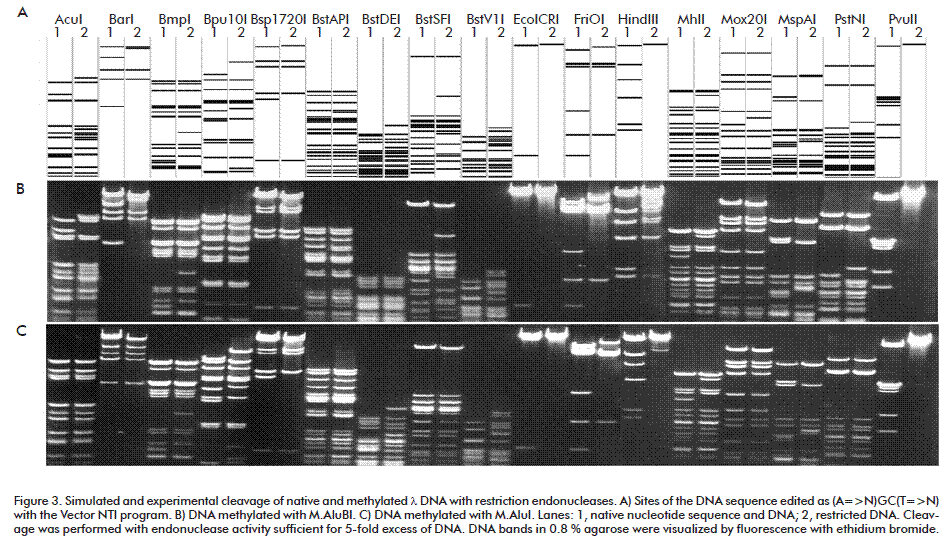
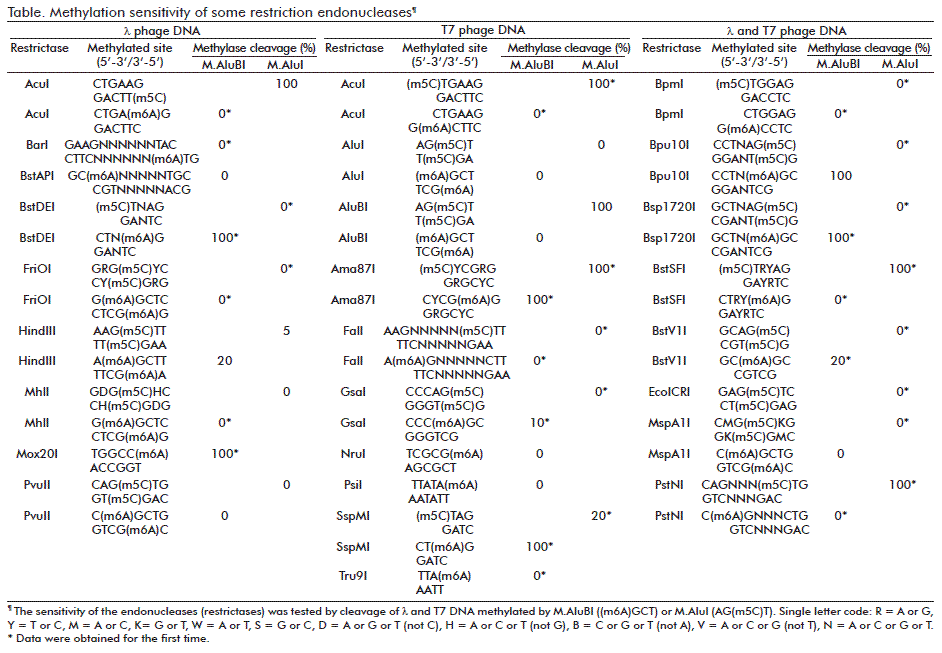
<body><![CDATA[<P   ><font size="2" face="Verdana, Arial, Helvetica, sans-serif">Thus, the results      show that M.AluBI produces 5&acute;- (m6A)GCT-3&acute; and belongs to adenine-(N6)-DNA      methyltransferases (EC 2.1.1.72) [1]. M.AluBI possesses a new specificity      among known analogs [2] and may be used in genetic engineering and molecular      biology. </font></P >       <P   ><font size="2" face="Verdana, Arial, Helvetica, sans-serif"><b>Methylation sensitivity      of restriction endonucleases </b></font></P >       <P   ><font size="2" face="Verdana, Arial, Helvetica, sans-serif">An essential characteristic      of restriction endonucleases is methylation sensitivity of these enzymes.      A number of endonucleases were tested for methylation sensitivity with <FONT color="#000000">l<FONT color="#211E1F">and      T7 DNAs methylated by M.AluBI or M.AluI with formation of (m6A)GCT or AG(m5C)T,      respectively. M.AluBI differs from the similar enzymes such as M.AluI forming      AG(m5C)T [5], or M.Mma5219II [2] and M.EsaBC1I [13] which form AG(m4C)T-3&acute;.      The model and experimental re-sults are shown in <a href="/img/revistas/bta/v32n3/f0303315.gif">Figure      3</a> and <a href="/img/revistas/bta/v32n3/f0403315.gif">Figure 4</a>      and are interpreted in the <a href="/img/revistas/bta/v32n3/t0103315.gif">Table</a>.      In some cases, the methylation of particular sequences was simulated as described      [12]. </font></font></font></P >   <FONT color="#000000"><FONT color="#211E1F">        
<P   ><font size="2" face="Verdana, Arial, Helvetica, sans-serif">Some results shown      in the <a href="/img/revistas/bta/v32n3/t0103315.gif">Table</a> confirm      known data about methylation sensitivity of restriction endonucleases [2].      Other results were obtained for the first time (* noted cleavage %). Methylation      sensitivity is one of characteristics of restriction endonucleases [2]. In      particular, this property is used in studying cancer. The obtained data expand      possibilities of restriction endonucleases for studying DNA methylation. </font></P >       
<P   >&nbsp;</P >       <P   ><font size="3" face="Verdana, Arial, Helvetica, sans-serif"><b>CONCLUSIONS </b></font></P >       <P   ><font size="2" face="Verdana, Arial, Helvetica, sans-serif">The gene of a new      DNA methyltransferase AluBI from bacterial strain Arthrobacter luteus B was      cloned in <I>E. coli</I>. A recombinant M.AluBI enzyme preparation was isolated      and it was shown that this MTase modified the adenine residue in the recognition      sequence AGCT producing 5&acute;-(m6A)GCT-3&acute;. M.AluBI differs from the      similar enzymes such as M.AluI forming AG(m5C)T or M.Mma5219II and M.EsaBC1I      [13] which form AG(m4C)T-3&rsquo;. The new data on sensitivity of different      restriction endonucleases to M.AluBI- and M.AluI-methylation have been obtained.      </font></P >       <P   >&nbsp;</P >       <P   ><font size="2" face="Verdana, Arial, Helvetica, sans-serif"><b><font size="3">ACKNOWLEDGEMENTS      </font> </b> </font></P >       <P   ><font size="2" face="Verdana, Arial, Helvetica, sans-serif">This work was carried      out with financial support from the Ministry of Education and Science of the      Russian Federation under the Agreement No. 14.576.21.0077 of 06.11.2014 (the      unique RFMEFI57614X0077 identifier), signed within the Federal Target Program      &ldquo;Research and Development in Priority Directions of Development of a      Scientific and Technological Complex of Russia for 2014-2020&rdquo;. </font></P >       ]]></body>
<body><![CDATA[<P   >&nbsp;</P >       <P   ><font size="2" face="Verdana, Arial, Helvetica, sans-serif"><b><font size="3">CONFLICT      OF INTEREST STATEMENT </font></b></font></P >       <P   ><font size="2" face="Verdana, Arial, Helvetica, sans-serif">The authors declare      that there are no conflicts of interest.</font></P >       <P   >&nbsp;</P >       <P   > </P >       <P   ><b><font size="3" face="Verdana, Arial, Helvetica, sans-serif">REFERENCES </font></b></P >       <!-- ref --><P   ><font size="2" color="#000000" face="Verdana, Arial, Helvetica, sans-serif">1.      Cheng X, Blumenthal RM. (Eds.). S-Adenosylmethionine-Dependent Methyltransferases.      Structures and Functions: Hong Kong: World Scientific Publishing Co. Pte.      Ltd.; 1999.     </font></P >   <FONT size="+1" color="#000000">        <P   ><font size="2" face="Verdana, Arial, Helvetica, sans-serif">2. REBASE. REBASE      - The restriction enzyme database; 2015 [cited 2015 Aug 18]. Available from:      <a href="http://rebase.neb.com" target="_blank">http://rebase.neb.com</a></font></P >       <!-- ref --><P   ><font size="2" face="Verdana, Arial, Helvetica, sans-serif">3. Arber, W, Dussoix,      D. Host specificity of DNA produced by <i>Escherichia coli</i>. I. Host controlled      modification of bacteriophage lambda. J Mol Biol. 1962;5:18-36.     </font></P >       <!-- ref --><P   ><font size="2" face="Verdana, Arial, Helvetica, sans-serif">4. Boyer HW. DNA      restriction and modification mechanisms in bacteria. Annu Rev Microbiol. 1971;25:153-76.          </font></P >       <!-- ref --><P   ><font size="2" face="Verdana, Arial, Helvetica, sans-serif">5. Kramarov VM, Smolyaninov      VV. DNA methylase from Arthrobacter luteus screens DNA from the action of      site-specific endonuclease AluI. Biokhimiia. 1981;46(8):1526-9.     </font></P >       <!-- ref --><P   ><font size="2" face="Verdana, Arial, Helvetica, sans-serif">6. Chernuhin VA,      Boltengagen AA, Tarasova GV, Dedkov VS, Degtjarjov SH. New restriction endonucleasa      AluBI from Arthrobacter luteus B - isoschizomer AluI, tolerant to presence      5-methilcytosin in the recognition site AGCT. Vestnik biotehnologii i fiziko-himicheskoj      biologii imeni Ju. A. Ovchinnikova. 2007;3(1):21-7.     </font></P >       <P   ><font size="2" face="Verdana, Arial, Helvetica, sans-serif">7. Sambrook J, Fritsch      EF, Maniatis, T. Molecular Cloning. A laboratory manual. 2nd ed. Cold Spring      Harbor, New York: Cold Spring Harbor Laboratory Press; 1989. </font></P >       <!-- ref --><P   ><font size="2" face="Verdana, Arial, Helvetica, sans-serif">8. Dedkov VS. Defining      specificity of DNA methyltransferase M. Bsc4I in cellular lysate by blocking      restriction endonucleases and computer modeling. Mol Gen Microbiol Virol.      2009;24(3):114-20.     </font></P >       ]]></body>
<body><![CDATA[<!-- ref --><P   ><font size="2" face="Verdana, Arial, Helvetica, sans-serif">9. Mann MB, Rao RN,      Smith HO. Cloning of restriction and modification genes in <i>E. coli</i>:      the HhaII system from Haemophilus haemolyticus. Gene. 1978;3:97-112.     </font></P >       <!-- ref --><P   ><font size="2" face="Verdana, Arial, Helvetica, sans-serif">10. Malone T, Blumenthal      RM, Cheng X. Structure-guided analysis reveals nine sequence motifs conserved      among DNA amino-methyltransferases, and suggests a catalytic mechanism for      these enzymes. J Mol Biol. 1995;253:618-32.     </font></P >       <!-- ref --><P   ><font size="2" face="Verdana, Arial, Helvetica, sans-serif">11. Chmuzh EV, Kashirina      YG, Tomilova YE, Chernukhin VA, Okhapkina SS, Gonchar DA, <i>et al</i>. The      Fsp4HI restriction-modification system: Gene cloning, comparison of protein      structures, and biochemical properties of recombinant DNA methyltransferase      M.Fsp4HI. Mol Biol. 2007;41(1):37-43.     </font></P >       <P   ><font size="2" face="Verdana, Arial, Helvetica, sans-serif">12. Dedkov VS. Novel      M.BstC8I methyltransferase forms 5&rsquo;-G(m5C)NNGC-3&rsquo;. Investigation      of restriction endonuclease sensitivity to M.BstC8I methylation. Mol Genet      Microbiol Virol. 2012;27:40-7. </font></P >       <P   ><font size="2" face="Verdana, Arial, Helvetica, sans-serif">13. Clark TA, Murray      IA, Morgan RD, Kislyuk AO, Spittle KE, Boitano M, <i>et al</i>. Characterization      of DNA methyltransferase specificities using single-molecule, real-time DNA      sequencing. Nucleic Acids Res. 2012;40(4):e29. </font></P >       <P   >&nbsp;</P >       <P   >&nbsp;</P >       ]]></body>
<body><![CDATA[<P   > </P >       <P   ><font size="2" color="#211E1F" face="Verdana, Arial, Helvetica, sans-serif">Received      in September 2015. </font><font size="2" face="Verdana, Arial, Helvetica, sans-serif">    <br>     Accepted in December 2015. </font></P >       <P   >&nbsp;</P >       <P   >&nbsp;</P >   <FONT size="+1" color="#211E1F">        <P   > </P >       <P   ><i><font size="2" face="Verdana, Arial, Helvetica, sans-serif">Danila Gonchar</font></i><font size="2" face="Verdana, Arial, Helvetica, sans-serif">.      LaborSibEnzyme Ltd., Ak. Timakov str. 2/12, Novosibirsk, 630117, Russia. E-mail:      <a href="mailto:%20gonchar@sibenzyme.ru">gonchar@sibenzyme.ru</a>.</font></P >   </font></font></font></font></font></font></font></font></font></font></font></font></font></font></font></font></font></font></font></font></font></font></font></font></font></font></font></font></font></font></font></font></font></font></font></font></font></font></font></font></font></font></font></font></font></font></font></font></font></font></font></font></DIV >      ]]></body><back>
<ref-list>
<ref id="B1">
<label>1</label><nlm-citation citation-type="book">
<person-group person-group-type="author">
<name>
<surname><![CDATA[Cheng]]></surname>
<given-names><![CDATA[X]]></given-names>
</name>
<name>
<surname><![CDATA[Blumenthal]]></surname>
<given-names><![CDATA[RM]]></given-names>
</name>
</person-group>
<source><![CDATA[S-Adenosylmethionine-Dependent Methyltransferases. Structures and Functions]]></source>
<year>1999</year>
<publisher-loc><![CDATA[Hong Kong ]]></publisher-loc>
<publisher-name><![CDATA[World Scientific Publishing Co. Pte. Ltd.]]></publisher-name>
</nlm-citation>
</ref>
<ref id="B2">
<label>2</label><nlm-citation citation-type="">
<collab>REBASE</collab>
<source><![CDATA[]]></source>
<year>2015</year>
</nlm-citation>
</ref>
<ref id="B3">
<label>3</label><nlm-citation citation-type="journal">
<person-group person-group-type="author">
<name>
<surname><![CDATA[Arber]]></surname>
<given-names><![CDATA[W]]></given-names>
</name>
<name>
<surname><![CDATA[Dussoix]]></surname>
<given-names><![CDATA[D]]></given-names>
</name>
</person-group>
<article-title xml:lang="en"><![CDATA[Host specificity of DNA produced by Escherichia coli. I. Host controlled modification of bacteriophage lambda]]></article-title>
<source><![CDATA[J Mol Biol]]></source>
<year>1962</year>
<volume>5</volume>
<page-range>18-36</page-range></nlm-citation>
</ref>
<ref id="B4">
<label>4</label><nlm-citation citation-type="journal">
<person-group person-group-type="author">
<name>
<surname><![CDATA[Boyer]]></surname>
<given-names><![CDATA[HW]]></given-names>
</name>
</person-group>
<article-title xml:lang="en"><![CDATA[DNA restriction and modification mechanisms in bacteria]]></article-title>
<source><![CDATA[Annu Rev Microbiol]]></source>
<year>1971</year>
<volume>25</volume>
<page-range>153-76</page-range></nlm-citation>
</ref>
<ref id="B5">
<label>5</label><nlm-citation citation-type="journal">
<person-group person-group-type="author">
<name>
<surname><![CDATA[Kramarov]]></surname>
<given-names><![CDATA[VM]]></given-names>
</name>
<name>
<surname><![CDATA[Smolyaninov]]></surname>
<given-names><![CDATA[VV]]></given-names>
</name>
</person-group>
<article-title xml:lang="en"><![CDATA[DNA methylase from Arthrobacter luteus screens DNA from the action of site-specific endonuclease AluI]]></article-title>
<source><![CDATA[Biokhimiia]]></source>
<year>1981</year>
<volume>46</volume>
<numero>8</numero>
<issue>8</issue>
<page-range>1526-9</page-range></nlm-citation>
</ref>
<ref id="B6">
<label>6</label><nlm-citation citation-type="journal">
<person-group person-group-type="author">
<name>
<surname><![CDATA[Chernuhin]]></surname>
<given-names><![CDATA[VA]]></given-names>
</name>
<name>
<surname><![CDATA[Boltengagen]]></surname>
<given-names><![CDATA[AA]]></given-names>
</name>
<name>
<surname><![CDATA[Tarasova]]></surname>
<given-names><![CDATA[GV]]></given-names>
</name>
<name>
<surname><![CDATA[Dedkov]]></surname>
<given-names><![CDATA[VS]]></given-names>
</name>
<name>
<surname><![CDATA[Degtjarjov]]></surname>
<given-names><![CDATA[SH]]></given-names>
</name>
</person-group>
<article-title xml:lang="en"><![CDATA[New restriction endonucleasa AluBI from Arthrobacter luteus B - isoschizomer AluI, tolerant to presence 5-methilcytosin in the recognition site AGCT]]></article-title>
<source><![CDATA[Vestnik biotehnologii i fiziko-himicheskoj biologii imeni Ju. AOvchinnikova]]></source>
<year>2007</year>
<volume>3</volume>
<numero>1</numero>
<issue>1</issue>
<page-range>21-7</page-range></nlm-citation>
</ref>
<ref id="B7">
<label>7</label><nlm-citation citation-type="book">
<person-group person-group-type="author">
<name>
<surname><![CDATA[Sambrook]]></surname>
<given-names><![CDATA[J]]></given-names>
</name>
<name>
<surname><![CDATA[Fritsch]]></surname>
<given-names><![CDATA[EF]]></given-names>
</name>
<name>
<surname><![CDATA[Maniatis]]></surname>
<given-names><![CDATA[T]]></given-names>
</name>
</person-group>
<source><![CDATA[Molecular Cloning. A laboratory manual]]></source>
<year>1989</year>
<edition>2</edition>
<publisher-loc><![CDATA[Cold Spring Harbor, New York ]]></publisher-loc>
<publisher-name><![CDATA[Cold Spring Harbor Laboratory Press]]></publisher-name>
</nlm-citation>
</ref>
<ref id="B8">
<label>8</label><nlm-citation citation-type="journal">
<person-group person-group-type="author">
<name>
<surname><![CDATA[Dedkov]]></surname>
<given-names><![CDATA[VS]]></given-names>
</name>
</person-group>
<article-title xml:lang="en"><![CDATA[Defining specificity of DNA methyltransferase M. Bsc4I in cellular lysate by blocking restriction endonucleases and computer modeling]]></article-title>
<source><![CDATA[Mol Gen Microbiol Virol]]></source>
<year>2009</year>
<volume>24</volume>
<numero>3</numero>
<issue>3</issue>
<page-range>114-20</page-range></nlm-citation>
</ref>
<ref id="B9">
<label>9</label><nlm-citation citation-type="journal">
<person-group person-group-type="author">
<name>
<surname><![CDATA[Mann]]></surname>
<given-names><![CDATA[MB]]></given-names>
</name>
<name>
<surname><![CDATA[Rao]]></surname>
<given-names><![CDATA[RN]]></given-names>
</name>
<name>
<surname><![CDATA[Smith]]></surname>
<given-names><![CDATA[HO]]></given-names>
</name>
</person-group>
<article-title xml:lang="en"><![CDATA[Cloning of restriction and modification genes in E. coli: the HhaII system from Haemophilus haemolyticus]]></article-title>
<source><![CDATA[Gene]]></source>
<year>1978</year>
<volume>3</volume>
<page-range>97-112</page-range></nlm-citation>
</ref>
<ref id="B10">
<label>10</label><nlm-citation citation-type="journal">
<person-group person-group-type="author">
<name>
<surname><![CDATA[Malone]]></surname>
<given-names><![CDATA[T]]></given-names>
</name>
<name>
<surname><![CDATA[Blumenthal]]></surname>
<given-names><![CDATA[RM]]></given-names>
</name>
<name>
<surname><![CDATA[Cheng]]></surname>
<given-names><![CDATA[X]]></given-names>
</name>
</person-group>
<article-title xml:lang="en"><![CDATA[Structure-guided analysis reveals nine sequence motifs conserved among DNA amino-methyltransferases, and suggests a catalytic mechanism for these enzymes]]></article-title>
<source><![CDATA[J Mol Biol]]></source>
<year>1995</year>
<volume>253</volume>
<page-range>618-32</page-range></nlm-citation>
</ref>
<ref id="B11">
<label>11</label><nlm-citation citation-type="journal">
<person-group person-group-type="author">
<name>
<surname><![CDATA[Chmuzh]]></surname>
<given-names><![CDATA[EV]]></given-names>
</name>
<name>
<surname><![CDATA[Kashirina]]></surname>
<given-names><![CDATA[YG]]></given-names>
</name>
<name>
<surname><![CDATA[Tomilova]]></surname>
<given-names><![CDATA[YE]]></given-names>
</name>
<name>
<surname><![CDATA[Chernukhin]]></surname>
<given-names><![CDATA[VA]]></given-names>
</name>
<name>
<surname><![CDATA[Okhapkina]]></surname>
<given-names><![CDATA[SS]]></given-names>
</name>
<name>
<surname><![CDATA[Gonchar]]></surname>
<given-names><![CDATA[DA]]></given-names>
</name>
</person-group>
<article-title xml:lang="en"><![CDATA[The Fsp4HI restriction-modification system: Gene cloning, comparison of protein structures, and biochemical properties of recombinant DNA methyltransferase M.Fsp4HI]]></article-title>
<source><![CDATA[Mol Biol]]></source>
<year>2007</year>
<volume>41</volume>
<numero>1</numero>
<issue>1</issue>
<page-range>37-43</page-range></nlm-citation>
</ref>
<ref id="B12">
<label>12</label><nlm-citation citation-type="journal">
<person-group person-group-type="author">
<name>
<surname><![CDATA[Dedkov]]></surname>
<given-names><![CDATA[VS]]></given-names>
</name>
</person-group>
<article-title xml:lang="en"><![CDATA[Novel M.BstC8I methyltransferase forms 5&#146;-G(m5C)NNGC-3&#146;. Investigation of restriction endonuclease sensitivity to M.BstC8I methylation]]></article-title>
<source><![CDATA[Mol Genet Microbiol Virol]]></source>
<year>2012</year>
<volume>27</volume>
<page-range>40-7</page-range></nlm-citation>
</ref>
<ref id="B13">
<label>13</label><nlm-citation citation-type="journal">
<person-group person-group-type="author">
<name>
<surname><![CDATA[Clark]]></surname>
<given-names><![CDATA[TA]]></given-names>
</name>
<name>
<surname><![CDATA[Murray]]></surname>
<given-names><![CDATA[IA]]></given-names>
</name>
<name>
<surname><![CDATA[Morgan]]></surname>
<given-names><![CDATA[RD]]></given-names>
</name>
<name>
<surname><![CDATA[Kislyuk]]></surname>
<given-names><![CDATA[AO]]></given-names>
</name>
<name>
<surname><![CDATA[Spittle]]></surname>
<given-names><![CDATA[KE]]></given-names>
</name>
<name>
<surname><![CDATA[Boitano]]></surname>
<given-names><![CDATA[M]]></given-names>
</name>
</person-group>
<article-title xml:lang="en"><![CDATA[Characterization of DNA methyltransferase specificities using single-molecule, real-time DNA sequencing]]></article-title>
<source><![CDATA[Nucleic Acids Res]]></source>
<year>2012</year>
<volume>40</volume>
<numero>4</numero>
<issue>4</issue>
<page-range>29</page-range></nlm-citation>
</ref>
</ref-list>
</back>
</article>