<?xml version="1.0" encoding="ISO-8859-1"?><article xmlns:mml="http://www.w3.org/1998/Math/MathML" xmlns:xlink="http://www.w3.org/1999/xlink" xmlns:xsi="http://www.w3.org/2001/XMLSchema-instance">
<front>
<journal-meta>
<journal-id>1027-2852</journal-id>
<journal-title><![CDATA[Biotecnología Aplicada]]></journal-title>
<abbrev-journal-title><![CDATA[Biotecnol Apl]]></abbrev-journal-title>
<issn>1027-2852</issn>
<publisher>
<publisher-name><![CDATA[Editorial Elfos Scientiae]]></publisher-name>
</publisher>
</journal-meta>
<article-meta>
<article-id>S1027-28522015000300005</article-id>
<title-group>
<article-title xml:lang="en"><![CDATA[Development of sandwich ELISA-based assays for screening Bordetella pertussis antigens expressed in the bacterial cell culture]]></article-title>
<article-title xml:lang="es"><![CDATA[Desarrollo de un ensayo ELISA sandwich para el pesquisaje de antígenos de Bordetella pertussis expresados en cultivos de células bacterianas]]></article-title>
</title-group>
<contrib-group>
<contrib contrib-type="author">
<name>
<surname><![CDATA[Lemos-Pérez]]></surname>
<given-names><![CDATA[Gilda]]></given-names>
</name>
<xref ref-type="aff" rid="A01"/>
</contrib>
<contrib contrib-type="author">
<name>
<surname><![CDATA[Delgado-Espina]]></surname>
<given-names><![CDATA[Maite]]></given-names>
</name>
<xref ref-type="aff" rid="A01"/>
</contrib>
<contrib contrib-type="author">
<name>
<surname><![CDATA[Quintana-Vazquez]]></surname>
<given-names><![CDATA[Diógenes]]></given-names>
</name>
<xref ref-type="aff" rid="A01"/>
</contrib>
<contrib contrib-type="author">
<name>
<surname><![CDATA[Coizeau-Rodríguez]]></surname>
<given-names><![CDATA[Edelgis]]></given-names>
</name>
<xref ref-type="aff" rid="A01"/>
</contrib>
<contrib contrib-type="author">
<name>
<surname><![CDATA[Carpio-Muñoz]]></surname>
<given-names><![CDATA[Emilio]]></given-names>
</name>
<xref ref-type="aff" rid="A02"/>
</contrib>
<contrib contrib-type="author">
<name>
<surname><![CDATA[Caballero-Menéndez]]></surname>
<given-names><![CDATA[Evelin]]></given-names>
</name>
<xref ref-type="aff" rid="A01"/>
</contrib>
<contrib contrib-type="author">
<name>
<surname><![CDATA[Alvarez-Acosta]]></surname>
<given-names><![CDATA[Anabel]]></given-names>
</name>
<xref ref-type="aff" rid="A01"/>
</contrib>
</contrib-group>
<aff id="A02">
<institution><![CDATA[,Centro de Ingeniería Genética y Biotecnología de Sancti Spíritus, CIGBSS  ]]></institution>
<addr-line><![CDATA[Sancti Spíritus ]]></addr-line>
<country>Cuba</country>
</aff>
<aff id="A01">
<institution><![CDATA[,Centro de Ingeniería Genética y Biotecnología, CIGB  ]]></institution>
<addr-line><![CDATA[La Habana ]]></addr-line>
<country>Cuba</country>
</aff>
<pub-date pub-type="pub">
<day>00</day>
<month>09</month>
<year>2015</year>
</pub-date>
<pub-date pub-type="epub">
<day>00</day>
<month>09</month>
<year>2015</year>
</pub-date>
<volume>32</volume>
<numero>3</numero>
<fpage>3311</fpage>
<lpage>3317</lpage>
<copyright-statement/>
<copyright-year/>
<self-uri xlink:href="http://scielo.sld.cu/scielo.php?script=sci_arttext&amp;pid=S1027-28522015000300005&amp;lng=en&amp;nrm=iso"></self-uri><self-uri xlink:href="http://scielo.sld.cu/scielo.php?script=sci_abstract&amp;pid=S1027-28522015000300005&amp;lng=en&amp;nrm=iso"></self-uri><self-uri xlink:href="http://scielo.sld.cu/scielo.php?script=sci_pdf&amp;pid=S1027-28522015000300005&amp;lng=en&amp;nrm=iso"></self-uri><kwd-group>
<kwd lng="en"><![CDATA[ELISA]]></kwd>
<kwd lng="en"><![CDATA[Bordetella pertussis]]></kwd>
<kwd lng="en"><![CDATA[pertussis toxin]]></kwd>
<kwd lng="en"><![CDATA[Pertactin 2]]></kwd>
<kwd lng="en"><![CDATA[filamentous hemagglutinin]]></kwd>
<kwd lng="en"><![CDATA[vaccine antigen]]></kwd>
<kwd lng="es"><![CDATA[ELISA]]></kwd>
<kwd lng="es"><![CDATA[Bordetella pertussis]]></kwd>
<kwd lng="es"><![CDATA[toxina pertúsica]]></kwd>
<kwd lng="es"><![CDATA[Pertactina 2]]></kwd>
<kwd lng="es"><![CDATA[hemaglutinina filamentosa]]></kwd>
<kwd lng="es"><![CDATA[antígeno vacunal]]></kwd>
</kwd-group>
</article-meta>
</front><body><![CDATA[ <DIV class="Part"   >        <P align="right"   ><font size="2" color="#000000" face="Verdana, Arial, Helvetica, sans-serif"><b>TECHNIQUE      </b></font></P >       <P align="right"   >&nbsp;</P >   <FONT size="+1" color="#000000">        <P   > </P >   <FONT size="+1">        <P   ><font size="4"><b><font color="#211E1F" face="Verdana, Arial, Helvetica, sans-serif">Development      of sandwich ELISA-based assays for screening <i>Bordetella pertussis</i> antigens      expressed in the bacterial cell culture</font></b></font></P >       <P   >&nbsp;</P >   <FONT size="+1" color="#211E1F"><B>        <P   ></P >   </B> <FONT size="+1" color="#000000">       <P   ><font size="3" color="#211E1F" face="Verdana, Arial, Helvetica, sans-serif"><B>Desarrollo      de un ensayo ELISA sandwich para el pesquisaje de ant&iacute;genos de </B><I><b>Bordetella      pertussis </b></I><B>expresados en cultivos de c&eacute;lulas bacterianas</b></font><font size="2" color="#211E1F" face="Verdana, Arial, Helvetica, sans-serif"><B>      </b></font></P >       <P   >&nbsp;</P >       <P   >&nbsp;</P >   <FONT size="+1" color="#211E1F"><B>        ]]></body>
<body><![CDATA[<P   ></P >   </B> <FONT size="+1" color="#000000">        <P   ><font size="2" color="#211E1F" face="Verdana, Arial, Helvetica, sans-serif"><b>Gilda      Lemos-P&eacute;rez<sup>1</sup>, Maite Delgado-Espina<sup>1</sup>, Di&oacute;genes      Quintana-Vazquez<sup>1</sup>, Edelgis Coizeau-Rodr&iacute;guez<sup>1</sup>,      Emilio Carpio-Mu&ntilde;oz<sup>2</sup>, Evelin Caballero-Men&eacute;ndez<sup>1</sup>,      Anabel Alvarez-Acosta<sup>1</sup> </b></font></P >   <FONT size="+1" color="#211E1F"><FONT size="+1"><FONT size="+1"><FONT size="+1"><FONT size="+1"><FONT size="+1"><FONT size="+1"><FONT size="+1"><FONT size="+1"><FONT size="+1"><FONT size="+1"><FONT size="+1"><FONT size="+1"><FONT size="+1">        <P   > </P >   <FONT size="+1" color="#000000">        <P   ><font size="2" color="#211E1F" face="Verdana, Arial, Helvetica, sans-serif"><sup>1</sup>      Centro de Ingenier&iacute;a Gen&eacute;tica y Biotecnolog&iacute;a, CIGB.      Ave. 31 e/ 158 y 190, Cubanac&aacute;n, Playa, CP 11600, La Habana, Cuba.          <br>     </font><font size="2" face="Verdana, Arial, Helvetica, sans-serif"><sup>2</sup>      Centro de Ingenier&iacute;a Gen&eacute;tica y Biotecnolog&iacute;a de Sancti      Sp&iacute;ritus, CIGBSS, Cuba. </font></P >       <P   >&nbsp;</P >       <P   >&nbsp;</P >   </font></font></font></font></font></font></font></font></font></font></font></font></font></font></font></font></font></font></font></font></font>   <hr>   <FONT size="+1" color="#000000"><FONT size="+1"><FONT size="+1" color="#211E1F"><FONT size="+1" color="#000000"><FONT size="+1" color="#211E1F"><FONT size="+1" color="#000000"><FONT size="+1" color="#211E1F"><FONT size="+1"><FONT size="+1"><FONT size="+1"><FONT size="+1"><FONT size="+1"><FONT size="+1"><FONT size="+1"><FONT size="+1"><FONT size="+1"><FONT size="+1"><FONT size="+1"><FONT size="+1"><FONT size="+1"><FONT size="+1" color="#000000">        <P   ><b><font size="2" color="#000000" face="Verdana, Arial, Helvetica, sans-serif">ABSTRACT      </font></b></P >   <FONT size="+1" color="#211E1F"><FONT size="+1"><FONT size="+1"><FONT size="+1"><FONT size="+1" color="#000000">        <P   ><font size="2" color="#211E1F" face="Verdana, Arial, Helvetica, sans-serif">Pertussis      is a highly contagious respiratory disease caused by <I>Bordetella pertussis</I>,      a Gram negative bacterium. Concerns about whole cell vaccine safety led to      the development of acellular pertussis vaccines with a lower frequency of      adverse reactions. But they require a quick and reliable method for antigen      detection, its quantification,or both. For this aim, a sensitive capture (sandwich)      enzyme-linked immunosorbent assay (ELISA) using monoclonal antibodies was      established, to identify and quantification the acellular pertussis vaccine      components: detoxified Pertussis toxin (Ptg), Pertactin 2 (Prn2) and filamentous      hemagglutinin (FHA). The Ptg-capture ELISA uses Fetuin in the solid phase,      and Mabs 2G3 and 6D4 against Ptg were evaluated as detection reagents, the      best results attained with Mab 2G3. The linearity range of the ELISA was 0.78-50      ng/mL. The Prn capture ELISA was established by evaluating Mabs 9C6 and 6B3      indistinctly as capture or detection reagents. The best combination was Mab      9C6 for capture and 6B3 for detection, with a linearity range 0.15-10 ng/mL.      For the evaluation of FHA, monoclonal antibodies 11E8, 437 and 5E12 were evaluated      indistinctly as capture or detection reagents, the optimal combination using      Mab 11E8 as capture and Mab 437 for detection, with a linearity range 3.25-200      ng/mL. Under optimized ELISA tests conditions, the limit of quantification      were 0.78, 0.07 ng/mL and 3.25 ng/mL for the Ptg, Prn2 and FHA proteins, respectively.      Given its performance, the ELISA tests developed could be efficaciously implemented      for process control during the production of these three <I>B. pertussis </I>vaccine      antigens. </font></P >   <FONT size="+1" color="#211E1F">        <P   ><font size="2" face="Verdana, Arial, Helvetica, sans-serif"><I><b>Keywords:</b>      </I>ELISA, <I>Bordetella pertussis</I>, pertussis toxin, Pertactin 2, filamentous      hemagglutinin, vaccine antigen. </font></P >   </font></font></font></font></font></font></font></font></font></font></font></font></font></font></font></font></font></font></font></font></font></font></font></font></font></font></font>   <hr>   <FONT size="+1" color="#000000"><FONT size="+1"><FONT size="+1" color="#211E1F"><FONT size="+1" color="#000000"><FONT size="+1" color="#211E1F"><FONT size="+1" color="#000000"><FONT size="+1" color="#211E1F"><FONT size="+1"><FONT size="+1"><FONT size="+1"><FONT size="+1"><FONT size="+1"><FONT size="+1"><FONT size="+1"><FONT size="+1"><FONT size="+1"><FONT size="+1"><FONT size="+1"><FONT size="+1"><FONT size="+1"><FONT size="+1" color="#000000"><FONT size="+1" color="#211E1F"><FONT size="+1"><FONT size="+1"><FONT size="+1"><FONT size="+1" color="#000000"><FONT size="+1" color="#211E1F">        ]]></body>
<body><![CDATA[<P   ><font size="2" color="#000000" face="Verdana, Arial, Helvetica, sans-serif"><b>RESUMEN      </b></font></P >   <FONT size="+1" color="#000000">        <P   > </P >   <FONT size="+1">        <P   ><font size="2" color="#211E1F" face="Verdana, Arial, Helvetica, sans-serif">La      pertusis o tosferina es una enfermedad respiratoria altamente contagiosa causada      por la bacteria Gram negativa <I>Bordetella pertussis</I>. Cuestionamientos      sobre la seguridad de las vacunas basadas en c&eacute;lulas completas han      conducido al desarrollo de vacunas acelulares que generan reacciones adversas      con menor frecuencia, pero que requieren de m&eacute;todos r&aacute;pidos      y confiables para la detecci&oacute;n de los ant&iacute;genos vacunales, su      cuantificaci&oacute;n, o ambas. Con tal prop&oacute;sito, se establecieron      ensayos ELISA de tipo s&aacute;ndwich con el uso de anticuerpos monoclonales      (Mabs) para la detecci&oacute;n de los componentes de una vacuna acelular:      la toxina pert&uacute;sica detoxificada (Ptg), la pertactina 2 (Prn2) y la      hemaglutinina filamentosa (FHA). El ELISA de captura contra Ptg emplea la      fetuina en fase s&oacute;lida, y se estableci&oacute; el Mab 2G3 contra Ptg      como reactivo de detecci&oacute;n con mejores resultados. La linealidad del      ensayo se mantuvo en el rango 0.78-50 ng/mL. Para el ELISA de captura de la      Prn2 se obtuvo como mejor combinaci&oacute;n la que emple&oacute; el Mab 9C6      para la captura y Mab 6B3 para la detecci&oacute;n, con una linealidad en      el rango 0.15-10 ng/mL. Para la FHA, la mejor combinaci&oacute;n se obtuvo      con el Mab 11E8 para la captura y el Mab 437 para la detecci&oacute;n, con      un rango de linealidad 3.25-200 ng/mL. Los l&iacute;mites de detecci&oacute;n      en las condiciones &oacute;ptimas de los ensayos fueron: Ptg </font><font size="2" face="Verdana, Arial, Helvetica, sans-serif">0.78      ng/mL, Prn2 0.07 ng/mL y FHA 3.25 ng/mL FHA. Estos ensayos ELISA se pueden      implementar eficazmente para el control de procesos durante la producci&oacute;n      de los tres ant&iacute;genos vacunales de <I>B. pertussis</I>. </font></P >   <FONT size="+1" color="#211E1F">        <P   > </P >   <FONT size="+1" color="#000000">        <P   ><font size="2" color="#211E1F" face="Verdana, Arial, Helvetica, sans-serif"><I><b>Palabras      clave:</b> </I>ELISA, <I>Bordetella pertussis</I>, toxina pert&uacute;sica,      Pertactina 2, hemaglutinina filamentosa, ant&iacute;geno vacunal.</font></P >   </font></font></font></font></font></font></font></font></font></font></font></font></font></font></font></font></font></font></font></font></font></font></font></font></font></font></font></font></font></font></font>   <hr>   <FONT size="+1" color="#000000"><FONT size="+1"><FONT size="+1" color="#211E1F"><FONT size="+1" color="#000000"><FONT size="+1" color="#211E1F"><FONT size="+1" color="#000000"><FONT size="+1" color="#211E1F"><FONT size="+1"><FONT size="+1"><FONT size="+1"><FONT size="+1"><FONT size="+1"><FONT size="+1"><FONT size="+1"><FONT size="+1"><FONT size="+1"><FONT size="+1"><FONT size="+1"><FONT size="+1"><FONT size="+1"><FONT size="+1" color="#000000"><FONT size="+1" color="#211E1F"><FONT size="+1"><FONT size="+1"><FONT size="+1"><FONT size="+1" color="#000000"><FONT size="+1" color="#211E1F"><FONT size="+1" color="#000000"><FONT size="+1"><FONT size="+1" color="#211E1F"><FONT size="+1" color="#000000">        <P   >&nbsp;</P >       <P   >&nbsp;</P >       <P   ><FONT size="+1" color="#211E1F"><font size="3" face="Verdana, Arial, Helvetica, sans-serif"><b>INTRODUCTION      </b></font> </font></P >   <FONT size="+1" color="#211E1F">        <P   > </P >   <FONT size="+1" color="#000000">        <P   ><font size="2" color="#211E1F" face="Verdana, Arial, Helvetica, sans-serif">Pertussis      or whooping cough is a highly contagious respiratory disease caused by <I>Bordetella      pertussis</I>, a Gram negative bacillus first described by Bordet and Gengou      in 1906 [1]. The disease still represents a major threat to public health.      Estimates suggest that, in 2008, about 16 million cases of pertussis occurred      worldwide and that about 195 000 children died from the disease, making pertussis      the fourth largest cause of vaccine-preventable death in children under five      years of age [2]. The bacterium is transmitted directly from human to human,      probably via aerosolized respiratory droplets. Severe pertussis can lead to      apnea, pneumonia, pulmonary hypertension, hypoxemic respiratory failure, and      ultimately death [3]. </font></P >   <FONT size="+1" color="#211E1F">        ]]></body>
<body><![CDATA[<P   ><font size="2" face="Verdana, Arial, Helvetica, sans-serif">Whole-cell pertussis      vaccine (wP), which is composed of a suspension of formalin-inactivated <I>B.      pertussis </I>cells, was used widely in clinical practice by the mid-1940s,      resulting in a rapid reduction in both the incidence of pertussis and the      number of deaths caused by the infection [4]. The vaccine is still in use      in most developing countries, as in Cuba. </font></P >       <P   ><font size="2" face="Verdana, Arial, Helvetica, sans-serif">In the late 1990s,      concerns about safety led to the development of more pure (i.e., acellular)      pertussis vaccines (aP), with successful clinical trials showing lower frequencies      of adverse reactions [5-8]. </font></P >       <P   ><font size="2" face="Verdana, Arial, Helvetica, sans-serif">Among the antigens      considered, pertussis toxin or Pt, filamentous hemagglutinin (FHA), pertactin      (Prn or P69k) and fimbriae induce antibodies contributing to protection in      an animal model, and the natural infection with <I>B. pertussis </I>in humans      induces antibodies to each of these antigens [9]. New formulations of acellular      <I>B.pertusis </I>vaccines containing protective antigens in different combinations      have been proved to be safer, less reactogenic and more reliable to introduce      in mass vaccination campaigns [10-13]. Also replacing the wP vaccine with      aP vaccines has resulted in an increase in pertussis vaccination coverage      in newborns and infants. </font></P >       <P   ><font size="2" face="Verdana, Arial, Helvetica, sans-serif">Nevertheless, the      number of pertussis cases has increased and epidemics returned in the acellular      vaccine era, especially in adolescents and adults, in spite of the effectiveness      attained with pertussis vaccination [2, 14]. It is unknown whether the re-emergence      of pertussis is due to the waning of vaccine-induced immunity and/or pathogen      adaptation [15], or to fundamental differences in the nature of the immune      responses induced by aP vaccines as compared with wP vaccines or with natural      infection [16]. </font></P >       <P   ><font size="2" face="Verdana, Arial, Helvetica, sans-serif">For these reasons,      vaccination strategies have changed during the past years and booster doses      have been implemented in national vaccination programs. The development of      new vaccines is aimed to improve control by increasing population coverage,      allowing more frequent boosters by the use of acellular pertussis-only vaccines,      or making the boosters unnecessary by inducing a more protective or long-lasting      immune response, for a better match to circulating strains, and/or allowing      the immunization of neonates. </font></P >       <P   ><font size="2" face="Verdana, Arial, Helvetica, sans-serif">Considering the antigens      used in acellular vaccines, Pt is the main toxin of <I>B. pertussis </I>and      one of the most important virulence factors [17]. This ADP-ribosylating protein      is a globular protein with a molecular weight of 117 kDa. Pt has several biological      activities and it is composed of five subunits, S1 to S5, which assemble into      two functionally distinct moieties [18]. The S1 subunit is responsible for      the enzymatic activity, while subunits S2 to S5 are involved in binding to      the target cell [19]. Previous experiments using monoclonal antibodies against      Pt have demonstrated that the antibody specific for the S1 subunit neutralized      the leukocyte-promoting and islet-activating activities of Pt and protected      against <i>B. pertussis</i> infection [20- 22]. Pt induces high levels of      antibody after infection or vaccination with classical whole cell vaccine,      and the toxin provides full protection against challenge in mouse models.      For this reason, inactivated Pt is considered the major protective antigen      in all the new acellular vaccines available today [23, 24]. </font></P >       <P   ><font size="2" face="Verdana, Arial, Helvetica, sans-serif">Regarding Prn, this      is an auto-transporter protein that undergoes auto-proteolytic processing      [25]. The protein is processed from a 93 kDa large precursor to a 69 kDa and      22 kDa proteins, located at the cell-surface and in the outer membrane, respectively      [26]. The 69 kDa product is used in aP vaccines. Prn contains an Arg-Gly-Asp      (RGD) motif involved in mediated attachment of <I>B. pertussis </I>to mammalian      cells [27], is a polymorphic protein and 13 variants (P.69 Prn1 to P.69 Prn13)      have been identified so far [28]. Variation is mainly limited to two regions,      designated region 1 and two, which are comprised of Gly-Gly- X-X-Pro (r1 repeat)      and Pro-Gln-Pro (r2 repeat) re-peats, respectively, more variation found in      region 1 near to the N-terminus and flanking the RGD sequence. Region 2 is      located towards the C-terminus. It is reported that the r1 repeat induces      type-specific antibodies which show little cross-reactivity between P.69 Prn1and      P.69 Prn2 [29]. </font></P >       <P   ><font size="2" face="Verdana, Arial, Helvetica, sans-serif">In the case of FHA,      this is a large and complex molecule [30, 31] that is synthesized as a 367-kDa      precursor (FHAB), translocated to the periplasm and exported through the outer      membrane [32-34]. N-terminal processing [33] and cleavage of the C-terminal      third of FHAB yield the 220-kDa mature FHA molecule [32, 34]. FHA is a multifunctional      adhesin that is both cell-associated and secreted into the external milieu.      FHA improves vaccine efficacy when included in multicomponent aP vaccines      and in animal models, FHA alone elicits protective immunity [35, 36]. </font></P >       <P   ><font size="2" face="Verdana, Arial, Helvetica, sans-serif">The variety of aP      vaccines formulations approved for human use, which is a distinctive feature      with respect to all other bacterial vaccines, should not be expected to confer      equal levels of efficacy and long-term protection. Formulations with two (Pt      and FHA) to five (Pt, FHA, pertactin, and fimbriae 1 and 2) immunizing antigens      have been licensed for human use [13, 37, 38]. </font></P >       <P   ><font size="2" face="Verdana, Arial, Helvetica, sans-serif">Specifically in Cuba,      efforts are been made to reduce the reactogenicity attained with the whole-cell      pertussis vaccine available, for use in booster doses in children aged above      five years and in pregnant women after the third month, included in the National      Immunization Program [39]. A new vaccine under development is an acellular      vaccine composed of antigens from a <I>B. pertussis </I>strain genetically      modified to produce a detoxified pertussis toxin (Ptg) and to express the      Prn2 protein as the most frequent variant in clinical isolates. Antigens Ptg      and FHA are isolated from the supernatant of the bacterial culture medium      and Prn2 is obtained from heat inactivated cells precipitate. </font></P >       ]]></body>
<body><![CDATA[<P   ><font size="2" face="Verdana, Arial, Helvetica, sans-serif">Hence, this work      was aimed to establish sensitive and simple capture (sandwich) enzyme-linked      immunosorbent assays (ELISA) for the screening of pertussis antigens and readily      transferable to process development units during the bioproduction scaling      process. The tests developed was effectively used to identify and quantify      the Ptg, Prn2 and FHA antigens, expressed by <I>B. pertussis </I>bacterium      as acellular pertussis vaccine components. </font></P >       <P   >&nbsp;</P >       <P   ><font size="3" face="Verdana, Arial, Helvetica, sans-serif"><b>MATERIALS AND      METHODS </b> </font></P >       <P   ><font size="2" face="Verdana, Arial, Helvetica, sans-serif"><I><b>B. pertussis      </b></I><b>culture</b> </font></P >       <P   ><font size="2" face="Verdana, Arial, Helvetica, sans-serif"><I>B. pertussis </I>strain      BpCNIC0311 is a derivative of Bp165 strain, genetically modified to produce      the pertussis toxoid PTg (<I>ptxA2</I>, 9K/129G) under the regulation of the      <I>ptxP1 </I>promoter and the pertactin 2 protein (prn2). The <I>fhaB </I>gene      encoding filamentous hemagglutinin (FHA) remained as a wild type [40]. Bacteria      was grown for 18 h in the defined THIJS medium as described by Thalen <I>et      al</I>. [41] and modified by the addition of aminoacids and 2,6-di-o-dimethyl-beta-cyclodextrin      (CDX). For monitoring the antigens expression by ELISA tests, three experimental      batches were produced in an INFORS HT bioreactor. Cultures were maintained      at 35 &deg;C with agitation from 100 to 150 rpm, at pH 7.3 and 20 &plusmn;      5 % oxygen. Samples were taken at 0, 3, 6, 9, 12, 15 and 18 h of culture.      </font></P >       <P   ><font size="2" face="Verdana, Arial, Helvetica, sans-serif"><b>Proteins and antibodies</b>      </font></P >       <P   ><font size="2" face="Verdana, Arial, Helvetica, sans-serif">Antigens were purified      as previously described by Quintana-Vazquez <I>et al</I>. [40]. Pt and FHA      were isolated from NaCl-washed cells and clarified culture medium supernatant.      Prn was obtained from heat-inactivated and precipitated bacterial cells by      Tris/NaCl extraction. Pertussis antigens were purified by sequential filtration,      salt-precipitation and/or extraction, ultrafiltration and ion exchange chromatography      [40]. </font></P >       <P   ><font size="2" face="Verdana, Arial, Helvetica, sans-serif">Mabs and peroxidase-conjugates      against pertussis antigens were supplied by the Center for Genetic Engineering      and Biotechnology of Sancti Spiritus (CIGBSS). The specificities of the Mabs      are the following: anti-Ptg: Mabs 6D4 and 2G3; anti-Prn2: Mabs 9C6 and 6B3;      anti-FHA: Mabs 11E8, 5E12 and 437. </font></P >       <P   ><font size="2" face="Verdana, Arial, Helvetica, sans-serif">Mabs were biotinylated      using EZ-Link&reg; Sulfo- NHS-LC-Biotin (Cat. # 21335, Pierce Biotechnology,      USA), according to manufacturer&rsquo;s specifications. Fetuin (Cat. # F3004)      and streptavidin-peroxidase were purchased from Sigma-Aldrich, USA. </font></P >       <P   ><font size="2" face="Verdana, Arial, Helvetica, sans-serif"><I><b>B. pertussis      </b></I><b>proteins reference standards </b></font></P >       ]]></body>
<body><![CDATA[<P   ><font size="2" face="Verdana, Arial, Helvetica, sans-serif">NIBSC reference proteins      were used as standards for the development of the ELISA tests: Pt (JNIH 90/518),      Prn (Prn1, NIBSC 90/520) and FHA (NIBSC 90/654). Ampoules were completely      dissolved in 500 &mu;L of distilled water (40 &micro;g/mL protein final concentration).      Aliquots were stored at &ndash;70 &ordm;C until use. </font></P >       <P   ><font size="2" face="Verdana, Arial, Helvetica, sans-serif"><b>Protein quantification      </b> </font></P >       <P   ><font size="2" face="Verdana, Arial, Helvetica, sans-serif">Total protein quantification      was determined with the BCA protein assay kit (Pierce/ThermoFisher, Rockford,      USA), using bovine serum albumin (BSA) as calibrator. The regression coefficient      (r<sup>2</sup>) was above 0.99. The concentration of purified antigens was      determined by the BCA and UV absorbance method [42] using the formula: Protein      (mg/mL) = 1.55 A<sub>280</sub> &ndash; 0.76 A<sub>260</sub>. </font></P >   <FONT size="+1"><FONT size="+1"><FONT size="+1"><FONT size="+1"><FONT size="+1"><FONT size="+1">        <P   ><font size="2" face="Verdana, Arial, Helvetica, sans-serif"><b>Sandwich ELISA      procedure </b> </font></P >       <P   ><font size="2" face="Verdana, Arial, Helvetica, sans-serif">ELISA tests were      established using a general sandwich-type procedure. Costar 3590 plates were      coated with 100 &micro;L of specific Mab or fetuin (this last for Pt-capture      ELISA) in coating buffer (0.1 M carbonate/bicarbonate buffer, pH 9.6). A modification      of Fetuin-capture method first described by Wong and Skelton for Pt capture      ELISA [43]. Plates were coated with 4 &mu;g of Fetuin per well, and incubated      for 1 h at 37 &deg;C. After washing three times with PBS (2.68 mM KCl, 1.47      mM KH<sub>2</sub>PO<sub>4</sub>, 136.89 mM NaCl, 8.1 mM Na<sub>2</sub>HPO<sub>4</sub>)      and 0.05 % Tween 20, plates were blocked with 200 &mu;L per well of blocking      solution (PBS, 1 % BSA w/v, and 0.1 % Tween 20) for 1 h at 37 &deg;C. Blocking      solution was discarded by tapping the plate and 100 &micro;L of test sample      were added per well at the desired dilution in Sample solution (PBS, 0.1 %      BSA w/v and 0.1 % Tween 20), and further incubated for 1 h at 37 &deg;C. Calibration      curves were prepared with purified proteins or NIBSC reference reagents in      Sample solution at the suitable concentrations for each test. Baseline controls      contained only Sample solution. After the washing step, the bound antigen      was detected using 100 &micro;L per well of a specific Mab, biotinylated or      conjugated to peroxidase in Sample solution. </font></P >   <FONT size="+1"><FONT size="+1"><FONT size="+1"><FONT size="+1"><FONT size="+1"><FONT size="+1"><FONT size="+1"><FONT size="+1">        <P   ><font size="2" face="Verdana, Arial, Helvetica, sans-serif">For ELISA setting      up, tested Mabs used for detection were biotinylated and used at 10 &micro;g/mL.      Once chosen the best detection Mab for each antigen, they were conjugated      and used as Mab-peroxidase conjugate. When Mab-biotin was used, after a washing      step, a 1/10000 diluted streptavidin-peroxidase (streptavidin-HRP) was added      followed by incubation for 30 min. After a final wash, 100 &mu;L of Substrate      solution (10 &mu;g/mL of TMB- 3,3&acute;,5,5&acute;-Tetramethyl-benzidine,      Cat. # Sigma-Aldrich, USA) was added per well in phosphate-citrate buffer      (0.2 M phosphate, 0.1 M citrate, pH 5.0), followed by 0.006 % hydrogen peroxide      and further incubated at room temperature for 10 min. The reaction was stopped      by adding Stop solution (2 M H<sub>2</sub>SO<sub>4</sub>). Microtiter plates      were read at a wavelength of 450 nm in a MultiScan microplate reader (SenseIdent      Scan, Sweden). </font></P >   <FONT size="+1"><FONT size="+1"><FONT size="+1"><FONT size="+1">        <P   ><font size="2" face="Verdana, Arial, Helvetica, sans-serif">Antigen was identified      by considering the antigen present if absorbance was equal to or higher than      2 standard deviations (SD) of the average absorbance of baseline controls,      regarded as the limit of detection (LD) of the test. </font></P >       <P   ><font size="2" face="Verdana, Arial, Helvetica, sans-serif">Antigen quantification      was analyzed by using the GraphPad Prism 6.1 software. The mean for each duplicate      or triplicate point of the calibration curve was computed and the obtained      values fit to a straight line using linear regression. The best adjustment      equation was determined and the regression coefficient (r<sup>2</sup>) should      be equal or above 0.98. The concentration of samples was calculated by interpolation      of the absorbance obtained for each sample, and further multiplied by their      dilution factor. </font></P >   <FONT size="+1"><FONT size="+1">        <P   ><font size="2" face="Verdana, Arial, Helvetica, sans-serif"><b>Indirect Ptg ELISA      procedure </b></font></P >       <P   ><font size="2" face="Verdana, Arial, Helvetica, sans-serif">Costar 3591 plates      were coated with 100 &micro;L of 10 &micro;g/ mL of purified Ptg in coating      buffer. The plates were incubated for 1 h at 37 &deg;C. After washing three      times with PBS and 0.05 % Tween 20, Mabs or Mab-conjugates were added at desired      concentrations or dilutions, respectively, in Sample solution and were incubated      for 1 h at 37 &deg;C. After a washing step, in the case of non-conjugated      Mabs, they were detected using 100 &micro;L per well of a secondary antibody      (1/10 000 dilution of mouse, Fc specific, goat peroxidase-conjugated (Cat.      # A2554, Sigma-Aldrich, USA), for 30 min at 37 &ordm;C. In both cases, after      the final washing step, 100 &micro;L per well of Substrate solution (TMB and      hydrogen peroxide) was added, followed by incubation at room temperature for      10 min. The reaction was stopped by adding Stop solution. Microtiter plates      were read at 450 nm. All solutions were the similar to the previously described      sandwich ELISA procedure. </font></P >       ]]></body>
<body><![CDATA[<P   ><font size="2" face="Verdana, Arial, Helvetica, sans-serif"><b>SDS-PAGE </b></font></P >       <P   ><font size="2" face="Verdana, Arial, Helvetica, sans-serif">Electrophoresis was      performed as described [44], on 15 % gels. Culture supernatant samples were      previously concentrated 10- to 18-fold by Centricon YM- 10 (Millipore, USA).      Samples were boiled at 100 &ordm;C for 10 min in the </font><font size="2" face="Verdana, Arial, Helvetica, sans-serif">Sample      buffer containing 2 % of 2-mercaptoethanol. Gels were visualized by the zinc-imidazole      reverse staining technique [45]. Protein expression levels were estimated      by densitometric analysis of images from SDS-PAGE stained gels. </font></P >       <P   >&nbsp;</P >       <P   ><font size="2" face="Verdana, Arial, Helvetica, sans-serif"><b><font size="3">RESULTS      </font></b></font></P >       <P   ><font size="2" face="Verdana, Arial, Helvetica, sans-serif"><b>Ptg-capture ELISA      </b> </font></P >       <P   ><font size="2" face="Verdana, Arial, Helvetica, sans-serif">Mabs 2G3 and 6D4      against Ptg were evaluated as detection reagents. In a previous western blot      analysis carried out under denaturing conditions, Mab 2G3 showed reactivity      against the S1 Pt subunit, whereas Mab 6D4 showed not reactivity at all (data      not shown). In indirect ELISA (Ptg-coated plates), Mab 6D4 exhibited more      sensitivity in ELISA (<a href="/img/revistas/bta/v32n3/f0105315.gif">Figure      1 A and B</a>) by using non-conjugated or peroxidase-conjugated Mab. On the      other hand, when Mabs and Mab-conjugates were tested in the sandwich ELISA      format (fetuin-coated plates), the outcome was completely different, with      Mab 2G3 showing the best performance as detection reagent (<a href="/img/revistas/bta/v32n3/f0105315.gif">Figure      1 C and D</a>). Therefore, the 2G3-HRP conjugate was further used for Ptg-capture      ELISA, and the titer was set up in the as 1:10 000 (results not shown). </font></P >       
<P   ><font size="2" face="Verdana, Arial, Helvetica, sans-serif">LD of the Pt antigen      using the modified Ptg-capture ELISA was determined with two-fold serial dilutions      of Pt reference protein (NIBSC) at an initial concentration of 100 ng/mL (<a href="/img/revistas/bta/v32n3/f0205315.gif">Figure      2</a>). Under optimized ELISA conditions, the LD of the Ptg protein was 0.78      ng/mL (<a href="/img/revistas/bta/v32n3/f0205315.gif">Figure 2A</a>),      and the linearity range of the Ptg-capture ELISA was obtained at the concentration      range 0.78 to 50 ng/mL. The resulting linear equation was Y = 0.02528 X +      0.1742, with a coefficient regression coefficient (r<sup>2</sup>) above 0.99.      The ELISA to identify and quantify the presence of Ptg in the supernatant      of <I>B. pertussis </I>culture was performed using two-fold serial dilutions      of Pt reference protein (NIBSC) as calibration curve. The minimum supernatant      dilution (100&times;) having optical density (OD) value within the dynamic      range was quantified as 0.055 &micro;g/mL. The LD of the test was established      as a 1/6400 dilution of the concentrated supernatant with a 0.17 OD<sub>450nm</sub>      value corresponding to 0.8 ng/mL (0.052 &micro;g/mL &times; 100/6400) of the      Ptg protein. Furthermore, the linear formula was similar to that of Ptg (<a href="/img/revistas/bta/v32n3/f0205315.gif">Figure      2C</a>). </font></P >   <FONT size="+1"><FONT size="+1">        
<P   ><font size="2" face="Verdana, Arial, Helvetica, sans-serif"><b>Prn-capture ELISA      </b> </font></P >       <P   ><font size="2" face="Verdana, Arial, Helvetica, sans-serif">To establish the      Prn capture ELISA, Mabs 9C6 and 6B3 were tested as capture or detection (biotin-conjugated)      reagents. To determine the best antibodies combination, a two-fold diluted      Prn1 (NIBSC reference protein) was used from 100 to 1.6 ng/mL, the best result      achieved by combining Mab 9C6 as capture and 6B3 as detection antibodies (<a href="/img/revistas/bta/v32n3/f0305315.gif">Figure      3</a>). Mab 6B3 was conjugated to peroxidase and the optimal titer determined      in ELISA as 1:10 000 (data not shown). When the recognition of Prn1 NIBSC      reference protein was compared against purified Prn2 by the established Prn-capture      ELISA (<a href="/img/revistas/bta/v32n3/f0405315.gif">Figure 4</a>),      the test showed higher sensitivity for capturing Prn2 antigen, with the NIBSC      antigen less recognized by the ELISA test. Then, to avoid inaccurate results,      the purified Prn2 antigen was further used to prepare the calibration curve.      </font></P >       
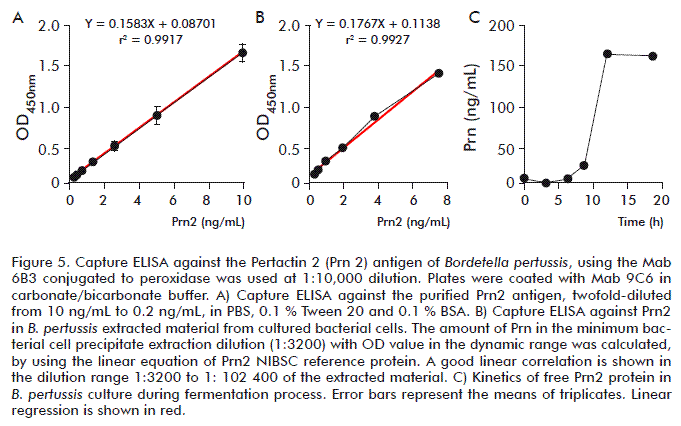
<P   ><font size="2" face="Verdana, Arial, Helvetica, sans-serif">Under optimized Prn-capture      ELISA conditions, the minimum detection of Prn2 protein was 0.07 ng/ mL and      the linearity range of the ELISA was obtained at concentrations 0.15 to 10      ng/mL. The resulting linear equation was Y = 0.1583 X + 0.08701, with a linear      regression coefficient (r<sup>2</sup>) above 0.99 (<a href="/img/revistas/bta/v32n3/f0505315.gif">Figure      5A</a>). To identify and quantify the presence of Prn2 in the <I>B. pertussis      </I>culture, the material extracted from the heat-inactivated bacterial cell      precipitate was diluted from 1:200 to 1:102 400 (<a href="/img/revistas/bta/v32n3/f0505315.gif">Figure      5B</a>). The lowest dilution of the extracted material (3200&times;) having      an OD value within the dynamic range was established at 7.5 ng/ mL. The LD      was a 1/102 400 dilution of the concentrated extraction material with a 0.121      OD450nm value corresponding to 0.23 ng/mL (7.5 ng/mL &times; 3200/102 400)      of the Prn2 protein. Although the majority of Prn protein is bacterial cell      surface-associated, the presence of free Prn2 was also monitored in the culture      supernatant during bacterial growth (<a href="/img/revistas/bta/v32n3/f0605315.gif">Figure      5C</a>). Samples obtained at different time points during bacterial fermentation      were evaluated by Prn-capture ELISA. At the end of the fermentation process      (18 h), the free Prn2 concentration in the supernatant was quantified as 150      ng/mL. These results indicate that Prn-capture ELISA is sensitive enough for      Prn2 detection in <I>B. pertussis </I>cultures, to monitor the expression      of this protein in the culture supernatant as well as in the bacterial cell      precipitate-extracted material. </font></P >   <FONT size="+1"><FONT size="+1"><FONT size="+1"><FONT size="+1">        
]]></body>
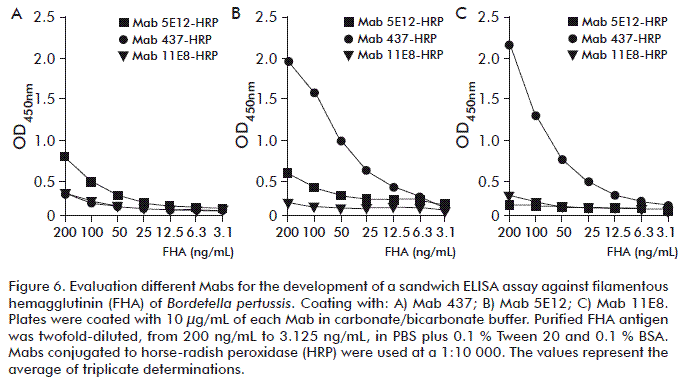
<body><![CDATA[<P   ><font size="2" face="Verdana, Arial, Helvetica, sans-serif"><b>FHA-capture ELISA      </b> </font></P >       <P   ><font size="2" face="Verdana, Arial, Helvetica, sans-serif">Monoclonal antibodies      11E8, 437 and 5E12 against FHA were evaluated as capture or detection reagents      (peroxidase-conjugated) to establish an FHA-capture ELISA (<a href="/img/revistas/bta/v32n3/f0605315.gif">Figure      6</a>). The best antibodies combination was determined by using a twofold      serial dilution of purified FHA in the range 200 to 3.12 ng/mL. Since FHA      protein (NIBSC reference) was not available at the time of setting up the      ELISA, purified FHA protein was used instead. The best ELISA results were      obtained with the combination of Mab 11E8 as capture and Mab 437 peroxidase-conjugated      as detection reagents (<a href="/img/revistas/bta/v32n3/f0605315.gif">Figure      6B</a>), with an optimal conjugate titer of 1:8000 (data not shown). </font></P >       
<P   ><font size="2" face="Verdana, Arial, Helvetica, sans-serif">When comparing the      recognition of NIBSC reference protein (FHA) and purified FHA by the established      FHA-capture ELISA (<a href="/img/revistas/bta/v32n3/f0705315.gif">Figure      7</a>), the NIBSC antigen was poorly recognized with an average absorbance      ratio (OD<sub>FHA</sub>/OD<sub>FHA</sub> </font><font size="2" face="Verdana, Arial, Helvetica, sans-serif">NIBSC)      of 5.1. Therefore, and to avoid inaccurate results, the purified FHA antigen      was further used to prepare the calibration curve. </font></P >   <FONT size="+1"><FONT size="+1"><FONT size="+1"><FONT size="+1">        
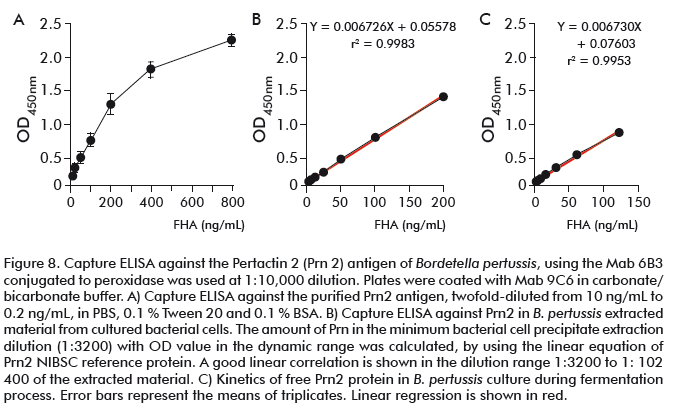
<P   ><font size="2" face="Verdana, Arial, Helvetica, sans-serif">Under optimized FHA-capture      ELISA conditions, the minimum detection of FHA protein was 3.25 ng/ mL and      the linearity range of the ELISA was obtained in the range 3.25 to 200 ng/mL.      The resulting linear equation was Y = 0.006726 X + 0.05578, with a regression      coefficient (r<sup>2</sup>) above 0.99 (<a href="/img/revistas/bta/v32n3/f0805315.gif">Figure      8A</a>). To identify and quantify the presence of FHA in the <I>B. pertussis      </I>culture, the supernatant was evaluated from non-diluted and a serial twofold      dilution up to 1:128. The non-diluted supernatant showed OD values within      the dynamic range of the assay and was quantified as 121 ng/mL. The LD was      a 1/128 dilution of culture supernatant, with a 0.06 OD<sub>450nm</sub> value      corresponding to 0.94 ng/mL (121 ng/mL/128) of the FHA protein. </font></P >   <FONT size="+1"><FONT size="+1"><FONT size="+1"><FONT size="+1">        
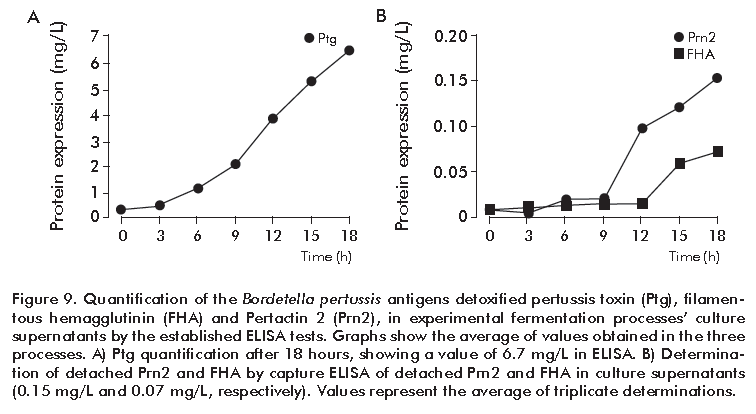
<P   ><font size="2" face="Verdana, Arial, Helvetica, sans-serif"><b>Monitoring of      <I>B. pertussis </I>antigens expression by ELISA </b></font></P >       <P   ><font size="2" face="Verdana, Arial, Helvetica, sans-serif">To assess the practical      functionality of developed ELISA tests, three experimental cultures of <I>B.      pertussis </I>were performed and samples were taken at three-hours intervals      (0, 3, 6, 9, 12, 15 and 18 h) for monitoring the expression of Ptg, Prn2 and      FHA bacterial antigens. The results (average) obtained in the three processes      is shown in <a href="/img/revistas/bta/v32n3/f0905315.gif">Figure 9</a>.      After 18 h, Ptg was detected by ELISA at 6.7 mg/L (<a href="/img/revistas/bta/v32n3/f0905315.gif">Figure      9A</a>). On the other hand, FHA exhibited values of 0.07 mg/L, not corresponding      with the amount of protein estimated by SDS-PAGE (<a href="/img/revistas/bta/v32n3/f1005315.gif">Figure      10</a>, lane 1). This result suggested the underestimation of FHA by the ELISA      test. The presence of aggregates was suspected and confirmed later on when      a denaturing agent such as urea (2 M, final concentration) was added to the      culture supernatant, the sample being further evaluated by FHA-capture ELISA.      The urea-treated supernatant exhibited FHA values of approximately 8 mg/L      in <I>B. pertussis </I>culture supernatants as determined by ELISA. </font></P >       
<P   ><font size="2" face="Verdana, Arial, Helvetica, sans-serif">In the case of the      Prn-capture ELISA, it was capable of detecting detached Prn2 in culture supernatants      at a 0.15 mg/L concentration. Additionally, Prn was also quantified in extracted      material since most of Prn2 was present in cells precipitate fraction (<a href="/img/revistas/bta/v32n3/f1005315.gif">Figure      10</a>, lane 2), the total amount of Prn2 in <i>B. pertussis</i> culture being      estimated as 3 mg/L by ELISA. </font></P >       
<P   >&nbsp;</P >       <P   ><font size="3" color="#000000" face="Verdana, Arial, Helvetica, sans-serif"><b>DISCUSSION      </b> </font></P >   <FONT size="+1" color="#000000">        <P   ><font size="2" color="#211E1F" face="Verdana, Arial, Helvetica, sans-serif">The      possibility of monitoring the expression of <I>B. pertussis </I>antigens during      bacterial growths or to measure their quantity through purification steps,      allows improving and making necessary modifications to the process to obtain      vaccine antigens and to achieve more accurate recovery values. So, it is important      to count with simple, specific and sensitive ELISA methods, capable of detecting      and quantifying small amounts of proteins present in bacterial cell cultures      and their results, which strengthened by methods like SDS-PAGE and total protein      quantification, altogether, are powerful analytical tools required for any      vaccine production process. </font></P >   <FONT size="+1" color="#211E1F">        ]]></body>
<body><![CDATA[<P   ><font size="2" face="Verdana, Arial, Helvetica, sans-serif">A previously reported      Fetuin-capture ELISA test was modified [43] and a sandwich ELISA test developed,      to identify and quantify Prn and FHA proteins from <I>B. pertussis</I>. In      fact, ELISA-based methods have been reported for rapid screening of different      antigens produced by <I>B. pertussis</I>, such as PT and FHA [46] or Prn and      Fim [46-49]. Those methods are reliable, fast and cheap, but their results      (expressed as OD) are not reproducible from culture to culture, and no antigen      quantification is really made. </font></P >       <P   ><font size="2" face="Verdana, Arial, Helvetica, sans-serif">Ptg-capture ELISA      showed good sensitivity and results, indicating that Ptg quantification in      <I>B. pertussis </I>supernatants was consistent to Pt reference protein (NIBSC)      quantification. FHA and Prn2 capture ELISA tests showed also good sensitivity,      but results did not correlate with NIBSC reference antigens, most probably      due to Mabs affinity, which is higher for BpCNIC0311 strain expressed antigens.      Besides, the Prn expressed antigen is a pertactin type 2 variant whereas the      Prn reference protein (NIBSC) is a pertactin 1. Moreover, Pt is a secreted      protein, whereas Prn and FHA are surface-associated proteins [46]. </font></P >       <P   ><font size="2" face="Verdana, Arial, Helvetica, sans-serif">Our results showed      that the presence of Ptg and Prn2 in a chemically defined medium did not affect      their quantification by ELISA. Moreover, the free Prn2 was quantified in the      supernatant and also successfully extracted from precipitated cells without      affecting its recognition by ELISA. </font></P >       <P   ><font size="2" face="Verdana, Arial, Helvetica, sans-serif">Nevertheless, FHA      expression in the supernatant was underestimated by ELISA. In spite of putting      CDX in the culture medium, FHA is a highly hydrophobic protein. Therefore,      it is unstable in low salt solution and forms aggregates easily; therefore,      hindering of Mabs specific epitopes is probably due to FHA-FHA or FHA-bacterial      surface interactions [50] or to the conformation adopted by the expressed      protein when bacteria is cultivated <I>in vitro </I>with chemically defined      medium, or both. All these could cause blocking of the epitopes recognized      by the Mab(s) used in the test. The possible presence of aggregates was corroborated      when 2 M urea was added to the culture supernatant, and the sample was further      evaluated by FHA-capture ELISA. At this urea molarity, the protein is not      denatured and its stability and recovery in the purification steps is improved      [14, 51]. So, accurate quantification of FHA in the supernatant by the established      ELISA was only possible when the protein was disaggregated. Therefore, the      ELISA should be used only for FHA identification in culture supernatants unless      supernatants will be pre-treated with urea. </font></P >       <P   >&nbsp;</P >       <P   ><font size="2" face="Verdana, Arial, Helvetica, sans-serif"><b><font size="3">CONCLUSIONS      </font></b></font></P >       <P   ><font size="2" face="Verdana, Arial, Helvetica, sans-serif">Easy, accurate and      sensitive sandwich ELISA tests were developed, capable of identifying, quantifying      or both the Pt, Prn and FHA antigens from <I>B. pertussis </I>in bacterial      cultures. Their use in other steps throughout the vaccine antigen production      process is under study. </font></P >       <P   >&nbsp;</P >       <P   ><font size="2" face="Verdana, Arial, Helvetica, sans-serif"><b><font size="3">REFERENCES      </font></b></font></P >       <!-- ref --><P   ><font size="2" color="#000000" face="Verdana, Arial, Helvetica, sans-serif">1.      Bordet J, Gengou D. Le microbe de la coqueluche. Ann Inst Pasteur. 1906;20:731.          </font></P >   <FONT size="+1" color="#000000">        <!-- ref --><P   ><font size="2" face="Verdana, Arial, Helvetica, sans-serif">2. Black RE, Cousens      S, Johnson HL, Lawn JE, Rudan I, Bassani DG, <i>et al</i>. Global, regional,      and national causes of child mortality in 2008: a systematic analysis. Lancet.      2010;375(9730):1969-87.     </font></P >       <P   > </P >       <P   ><font size="2" face="Verdana, Arial, Helvetica, sans-serif">3. Mata AF, Sarnaik      AA. Bronchoscopy with N-acetylcysteine lavage in severe respiratory failure      from pertussis infection. Pediatrics. 2013;132(5):e1418-23. </font></P >       <P   ><font size="2" face="Verdana, Arial, Helvetica, sans-serif">4. Edwards KM, Decker      MD. Pertussis vaccines. In: Plotkin SA, Orenstein WA, Offit PA, eds. Vaccines.      6th ed. Edinburgh, Scotland: Elsevier Saunders; 2013. p. 447-92. </font></P >       <!-- ref --><P   ><font size="2" face="Verdana, Arial, Helvetica, sans-serif">5. Greco D, Salmaso      S, Mastrantonio P, Giuliano M, Tozzi AE, Anemona A, <i>et al</i>. A controlled      trial of two acellular vaccines and one whole-cell vaccine against pertussis.      Progetto Pertosse Working Group. N Engl J Med. 1996;334(6):341-8.     </font></P >       <!-- ref --><P   ><font size="2" face="Verdana, Arial, Helvetica, sans-serif">6. Gustafsson L,      Hallander HO, Olin P, Reizenstein E, Storsaeter J. A controlled trial of a      two-component acellular, a five-component acellular, and a whole-cell pertussis      vaccine. N Engl J Med. 1996;334(6):349-55.     </font></P >       ]]></body>
<body><![CDATA[<!-- ref --><P   ><font size="2" face="Verdana, Arial, Helvetica, sans-serif">7. Simondon F, Preziosi      MP, Yam A, Kane CT, Chabirand L, Iteman I, <i>et al</i>. A randomized double-blind      trial comparing a two-component acellular to a whole-cell pertussis vaccine      in Senegal. Vaccine. 1997;15(15):1606-12.     </font></P >       <!-- ref --><P   ><font size="2" face="Verdana, Arial, Helvetica, sans-serif">8. Preston A, Maskell      DJ. A new era of research into<i> Bordetella pertussis</i> pathogenesis. J      Infect. 2002;44(1):13-6.     </font></P >       <!-- ref --><P   ><font size="2" face="Verdana, Arial, Helvetica, sans-serif">9. Klein DL. Multicenter      acellular pertussis vaccine trial: a National Institutes of Health perspective.      Pediatrics. 1995;96(3 Pt 2):547-8.     </font></P >       <P   ><font size="2" face="Verdana, Arial, Helvetica, sans-serif">10. Hewlett EL, Cherry      JD. New and improved vaccines against pertussis. In: Myron ML, Graeme CW,      James BK, Gary SC, editors. New generation vaccines 2nd Ed. New York: Marcel      Dekker; 1997. p. 387-416. </font></P >       <!-- ref --><P   ><font size="2" face="Verdana, Arial, Helvetica, sans-serif">11. Zhang L, Prietsch      SO, Axelsson I, Halperin SA. Acellular vaccines for preventing whooping cough      in children. Cochrane Database Syst Rev. 2011(1):CD001478.     </font></P >       <P   ><font size="2" face="Verdana, Arial, Helvetica, sans-serif">12. Farizo KM, Burns      DL, Finn TM, Gruber MF, Pratt RD. Clinical evaluation of pertussis vaccines:      US Food and Drug Administration regulatory considerations. J Infect Dis. 2014;209      Suppl 1:S28-31. </font></P >       ]]></body>
<body><![CDATA[<!-- ref --><P   ><font size="2" face="Verdana, Arial, Helvetica, sans-serif">13. Munoz FM, Bond      NH, Maccato M, Pinell P, Hammill HA, Swamy GK, <i>et al</i>. Safety and immunogenicity      of tetanus diphtheria and acellular pertussis (Tdap) immunization during pregnancy      in mothers and infants: a randomized clinical trial. Jama. 2014;311(17):1760-9.          </font></P >       <!-- ref --><P   ><font size="2" face="Verdana, Arial, Helvetica, sans-serif">14. Cherry JD. The      present and future control of pertussis. Clin Infect Dis. 2010;51(6):663-7.          </font></P >       <!-- ref --><P   ><font size="2" face="Verdana, Arial, Helvetica, sans-serif">15. van der Ark AA,      Hozbor DF, Boog CJ, Metz B, van den Dobbelsteen GP, van Els CA. Resurgence      of pertussis calls for re-evaluation of pertussis animal models. Expert review      of vaccines. 2012;11(9):1121-37.     </font></P >       <!-- ref --><P   ><font size="2" face="Verdana, Arial, Helvetica, sans-serif">16. Ausiello CM,      Cassone A. Acellular pertussis vaccines and pertussis resurgence: revise or      replace? MBio. 2014;5(3):e01339-14.     </font></P >       <!-- ref --><P   ><font size="2" face="Verdana, Arial, Helvetica, sans-serif">17. Melvin JA, Scheller      EV, Miller JF, Cotter PA. <i>Bordetella pertussis</i> pathogenesis: current      and future challenges. Nat Rev Microbiol. 2014;12(4):274-88.     </font></P >       ]]></body>
<body><![CDATA[<!-- ref --><P   ><font size="2" face="Verdana, Arial, Helvetica, sans-serif">18. Ozcengiz E, Kilinc      K, Buyuktanir O, Gunalp A. Rapid purification of pertussis toxin (PT) and      filamentous hemagglutinin (FHA) by cation-exchange chromatography. Vaccine.      2004;22(11-12):1570-5.     </font></P >       <P   > </P >       <!-- ref --><P   ><font size="2" face="Verdana, Arial, Helvetica, sans-serif">19. Locht C, Coutte      L, Mielcarek N. The ins and outs of pertussis toxin. FEBS J. 2011;278(23):4668-82.          </font></P >       <P   ><font size="2" face="Verdana, Arial, Helvetica, sans-serif">20. Bigio M, Rossi      R, Nucci D, Borri MG, Antoni G, Bartoloni A, <i>et al</i>. Monoclonal antibodies      against pertussis toxin subunits. FEMS Microbiol Lett. 1988;51:7-12. </font></P >       <!-- ref --><P   ><font size="2" face="Verdana, Arial, Helvetica, sans-serif">21. Sato H, Ito A,      Chiba J, Sato Y. Monoclonal antibody against pertussis toxin: effect on toxin      activity and pertussis infections. Infect Immun. 1984;46(2):422-8.     </font></P >       <!-- ref --><P   ><font size="2" face="Verdana, Arial, Helvetica, sans-serif">22. Sato H, Sato      Y. Protective activities in mice of monoclonal antibodies against pertussis      toxin. Infect Immun. 1990;58(10):3369-74.     </font></P >       ]]></body>
<body><![CDATA[<!-- ref --><P   ><font size="2" face="Verdana, Arial, Helvetica, sans-serif">23. Locht C. Molecular      aspects of <i>Bordetella pertussis</i> pathogenesis. Int Microbiol. 1999;2(3):137-44.          </font></P >       <!-- ref --><P   ><font size="2" face="Verdana, Arial, Helvetica, sans-serif">24. Robbins JB, Schneerson      R, Kubler-Kielb J, Keith JM, Trollfors B, Vinogradov E, <i>et al</i>. Toward      a new vaccine for pertussis. Proc Natl Acad Sci USA. 2014;111(9):3213-6.     </font></P >       <!-- ref --><P   ><font size="2" face="Verdana, Arial, Helvetica, sans-serif">25. Henderson IR,      Navarro-Garcia F, Nataro JP. The great escape: structure and function of the      autotransporter proteins. Trends Microbiol. 1998;6(9):370-8.     </font></P >       <!-- ref --><P   ><font size="2" face="Verdana, Arial, Helvetica, sans-serif">26. Hijnen M, van      Gageldonk PG, Berbers GA, van Woerkom T, Mooi FR. The <i>Bordetella pertussis</i>      virulence factor P.69 pertactin retains its immunological properties after      overproduction in Escherichia coli. Protein Expr Purif. 2005;41(1):106-12.          </font></P >       <!-- ref --><P   ><font size="2" face="Verdana, Arial, Helvetica, sans-serif">27. Leininger E,      Ewanowich CA, Bhargava A, Peppler MS, Kenimer JG, Brennan MJ. Comparative      roles of the Arg-Gly-Asp sequence present in the<i> Bordetella pertussis</i>      adhesins pertactin and filamentous hemagglutinin. Infect Immun. 1992;60(6):2380-5.          </font></P >       ]]></body>
<body><![CDATA[<!-- ref --><P   ><font size="2" face="Verdana, Arial, Helvetica, sans-serif">28. Leininger E,      Roberts M, Kenimer JG, Charles IG, Fairweather N, Novotny P, <i>et al</i>.      Pertactin, an Arg-Gly-Asp-containing <i>Bordetella pertussis</i> surface protein      that promotes adherence of mammalian cells. Proc Natl Acad Sci USA. 1991;88(2):345-9.          </font></P >       <!-- ref --><P   ><font size="2" face="Verdana, Arial, Helvetica, sans-serif">29. He Q, Makinen      J, Berbers G, Mooi FR, Viljanen MK, Arvilommi H, <i>et al</i>. <i>Bordetella      pertussis</i> protein pertactin induces type-specific antibodies: one possible      explanation for the emergence of antigenic variants? J Infect Dis. 2003;187(8):1200-5.          </font></P >       <!-- ref --><P   ><font size="2" face="Verdana, Arial, Helvetica, sans-serif">30. Locht C, Bertin      P, Menozzi FD, Renauld G. The filamentous haemagglutinin, a multifaceted adhesion      produced by virulent Bordetella spp. Mol Microbiol. 1993;9(4):653-60.     </font></P >       <!-- ref --><P   ><font size="2" face="Verdana, Arial, Helvetica, sans-serif">31. Makhov AM, Hannah      JH, Brennan MJ, Trus BL, Kocsis E, Conway JF, <i>et al</i>. Filamentous hemagglutinin      of <i>Bordetella pertussis</i>. A bacterial adhesin formed as a 50-nm monomeric      rigid rod based on a 19-residue repeat motif rich in beta strands and turns.      J Mol Biol. 1994;241(1):110-24.     </font></P >       <!-- ref --><P   ><font size="2" face="Verdana, Arial, Helvetica, sans-serif">32. Arico B, Nuti      S, Scarlato V, Rappuoli R. Adhesion of <i>Bordetella pertussis</i> to eukaryotic      cells requires a time-dependent export and maturation of filamentous hemagglutinin.      Proc Natl Acad Sci USA. 1993;90(19):9204-8.     </font></P >       ]]></body>
<body><![CDATA[<!-- ref --><P   ><font size="2" face="Verdana, Arial, Helvetica, sans-serif">33. Jacob-Dubuisson      F, Buisine C, Mielcarek N, Clement E, Menozzi FD, Locht C. Amino-terminal      maturation of the <i>Bordetella pertussis</i> filamentous haemagglutinin.      Mol Microbiol. 1996;19(1):65-78.     </font></P >       <P   > </P >       <!-- ref --><P   ><font size="2" face="Verdana, Arial, Helvetica, sans-serif">34. Renauld-Mongenie      G, Cornette J, Mielcarek N, Menozzi FD, Locht C. Distinct roles of the N-terminal      and C-terminal precursor domains in the biogenesis of the <i>Bordetella pertussis</i>      filamentous hemagglutinin. J Bacteriol. 1996;178(4):1053-60.     </font></P >       <P   ><font size="2" face="Verdana, Arial, Helvetica, sans-serif">35. Brennan MJ, Burns      DL, Meade BD, Shahin RD, Manclark CR. Recent advances in the development of      pertussis vaccines. In: Ellis R, editor. Vaccines: new approaches to immunological      problems. Shoreham, Mass: Butterworth; p. 23-52. </font></P >       <P   ><font size="2" face="Verdana, Arial, Helvetica, sans-serif">36. Brennan MJ, Shahin      RD. Pertussis antigens that abrogate bacterial adherence and elicit immunity.      Am J Respir Crit Care Med. 1996;154(4 Pt 2):S145-9. </font></P >       <P   ><font size="2" face="Verdana, Arial, Helvetica, sans-serif">37. Cherry JD. 2012.      Why do pertussis vaccines fail? Pediatrics. 129:968-70. </font></P >       <!-- ref --><P   ><font size="2" face="Verdana, Arial, Helvetica, sans-serif">38. Plotkin SA. The      pertussis problem. Clin Infect Dis. 2014;58(6):830-3.     </font></P >       ]]></body>
<body><![CDATA[<P   ><font size="2" face="Verdana, Arial, Helvetica, sans-serif">39. Reed G, Galindo      MA. Cuba&rsquo;s National Immunization Program. MEDICC Rev. 2007;9(1):5-7.      </font></P >       <P   > </P >       <P   ><font size="2" face="Verdana, Arial, Helvetica, sans-serif">40. Quintana-V&aacute;zquez      D, Delgado M, Lemos G, Coizeau E, Ramos Y, T&aacute;mbara Y, <i>et al</i>.      Assessment of the <i>Bordetella pertussis</i> BpCNIC0311 STRAIN as a producing      strain of genetically detoxified toxoid (PTg), filamentous hemagglutinin (FHA)      and type 2 Pertactin (Prn2). J Infect Dis Ther. 2015;3:8-20. </font></P >       <!-- ref --><P   ><font size="2" face="Verdana, Arial, Helvetica, sans-serif">41. Thalen M, van      der Ark A, van den Ijssel J, van Straaten I, Jansen D, Beuvery C, <i>et al</i>.      Improving the cellular pertussis vaccine: increased potency and consistency.      Vaccine. 2008;26(5):653-63.     </font></P >       <P   ><font size="2" face="Verdana, Arial, Helvetica, sans-serif">42. Layne E. Spectrophotometric      and turbidimetric methods for measuring proteins. Methods Enzymol. 1957;3:447-54.      </font></P >       <!-- ref --><P   ><font size="2" face="Verdana, Arial, Helvetica, sans-serif">43. Wong KH, Skelton      SK. New, practical approach to detecting antibody to pertussis toxin for public      health and clinical laboratories. J Clin Microbiol. 1988;26(7):1316-20.     </font></P >       <!-- ref --><P   ><font size="2" face="Verdana, Arial, Helvetica, sans-serif">44. Laemmli UK. Cleavage      of structural proteins during the assembly of the head of bacteriophage T4.      Nature. 1970;227(5259):680-5.     </font></P >       ]]></body>
<body><![CDATA[<!-- ref --><P   ><font size="2" face="Verdana, Arial, Helvetica, sans-serif">45. Fernandez-Patron      C, Castellanos-Serra L, Rodriguez P. Reverse staining of sodium dodecyl sulfate      polyacrylamide gels by imidazole-zinc salts: sensitive detection of unmodified      proteins. Biotechniques. 1992;12(4):564-73.     </font></P >       <P   ><font size="2" face="Verdana, Arial, Helvetica, sans-serif">46. Barkoff AM, Guiso      N, Guillot S, Xing D, Markey K, Berbers G, <i>et al</i>. A rapid ELISA-based      method for screening <i>Bordetella pertussis</i> strain production of antigens      included in current acellular pertussis vaccines. J Immunol Methods. 2014;408:142-8.      </font></P >       <!-- ref --><P   ><font size="2" face="Verdana, Arial, Helvetica, sans-serif">47. Tsang RS, Sill      ML, Advani A, Xing D, Newland P, Hallander H. Use of monoclonal antibodies      to serotype Bordetella pertussis isolates: comparison of results obtained      by indirect whole-cell enzyme-linked immunosorbent assay and bacterial microagglutination      methods. J Clin Microbiol. 2005;43(5):2449-51.     </font></P >       <P   ><font size="2" face="Verdana, Arial, Helvetica, sans-serif">48. Heikkinen E,      Xing DK, Olander RM, Hytonen J, Viljanen MK, Mertsola J, <i>et al</i>. <i>Bordetella      pertussis</i> isolates in Finland: serotype and fimbrial expression. BMC Microbiol.      2008;8:162. </font></P >       <!-- ref --><P   ><font size="2" face="Verdana, Arial, Helvetica, sans-serif">49. Barkoff AM, Mertsola      J, Guillot S, Guiso N, Berbers G, He Q. Appearance of <i>Bordetella pertussis</i>      strains not expressing the vaccine antigen pertactin in Finland. Clin Vaccine      Immunol. 2012;19(10):1703-4.     </font></P >       <!-- ref --><P   ><font size="2" face="Verdana, Arial, Helvetica, sans-serif">50. Menozzi FD, Boucher      PE, Riveau G, Gantiez C, Locht C. Surface-associated filamentous hemagglutinin      induces autoagglutination of <i>Bordetella pertussis</i>. Infect Immun. 1994;62(10):4261-9.          </font></P >       ]]></body>
<body><![CDATA[<!-- ref --><P   ><font size="2" face="Verdana, Arial, Helvetica, sans-serif">51. Wu T, Bi J, Huang      Y, Zhang Y, Sun L, Sun C, <i>et al</i>. Effect of solution environment on      the purification of pertussis toxin. Sheng Wu Gong Cheng Xue Bao. 2008;24(7):1279-84.    </font></P >       <P   >&nbsp;</P >       <P   >&nbsp;</P >       <P   > </P >       <P   > </P >   <FONT size="+1" color="#211E1F">        <P   > </P >       <P   ><font size="2" face="Verdana, Arial, Helvetica, sans-serif">Received in January,      2015.     <br>     Accepted in July, 2015.</font></P >       <P   >&nbsp;</P >       ]]></body>
<body><![CDATA[<P   >&nbsp;</P >   <FONT size="+1"><FONT size="+1">        <P   > </P >   <FONT size="+1" color="#000000">        <P   > </P >       <P   ><i><font size="2" color="#211E1F" face="Verdana, Arial, Helvetica, sans-serif">Gilda      Lemos-P&eacute;rez</font></i><font size="2" color="#211E1F" face="Verdana, Arial, Helvetica, sans-serif">.      Centro de Ingenier&iacute;a Gen&eacute;tica y Biotecnolog&iacute;a, CIGB.      Ave. 31 e/ 158 y 190, Cubanac&aacute;n, Playa, CP 11600, La Habana, Cuba.      E-mail: <a href="mailto:%20gilda.lemos@cigb.edu.cu">gilda.lemos@cigb.edu.cu</a>      </font></P >   </font></font></font></font></font></font></font></font></font></font></font></font></font></font></font></font></font></font></font></font></font></font></font></font></font></font></font></font></font></font></font></font></font></font></font></font></font></font></font></font></font></font></font></font></font></font></font></font></font></font></font></font></font></font></font></font></font></font></font></font></font></font></font></font></font></font></font></font></font></font></font></font></font></font></font></DIV >      ]]></body><back>
<ref-list>
<ref id="B1">
<label>1</label><nlm-citation citation-type="journal">
<person-group person-group-type="author">
<name>
<surname><![CDATA[Bordet]]></surname>
<given-names><![CDATA[J]]></given-names>
</name>
<name>
<surname><![CDATA[Gengou]]></surname>
<given-names><![CDATA[D]]></given-names>
</name>
</person-group>
<article-title xml:lang="fr"><![CDATA[Le microbe de la coqueluche]]></article-title>
<source><![CDATA[Ann Inst Pasteur]]></source>
<year>1906</year>
<volume>20</volume>
<page-range>731</page-range></nlm-citation>
</ref>
<ref id="B2">
<label>2</label><nlm-citation citation-type="journal">
<person-group person-group-type="author">
<name>
<surname><![CDATA[Black]]></surname>
<given-names><![CDATA[RE]]></given-names>
</name>
<name>
<surname><![CDATA[Cousens]]></surname>
<given-names><![CDATA[S]]></given-names>
</name>
<name>
<surname><![CDATA[Johnson]]></surname>
<given-names><![CDATA[HL]]></given-names>
</name>
<name>
<surname><![CDATA[Lawn]]></surname>
<given-names><![CDATA[JE]]></given-names>
</name>
<name>
<surname><![CDATA[Rudan]]></surname>
<given-names><![CDATA[I]]></given-names>
</name>
<name>
<surname><![CDATA[Bassani]]></surname>
<given-names><![CDATA[DG]]></given-names>
</name>
</person-group>
<article-title xml:lang="en"><![CDATA[Global, regional, and national causes of child mortality in 2008: a systematic analysis]]></article-title>
<source><![CDATA[Lancet]]></source>
<year>2010</year>
<volume>375</volume>
<numero>9730</numero>
<issue>9730</issue>
<page-range>1969-87</page-range></nlm-citation>
</ref>
<ref id="B3">
<label>3</label><nlm-citation citation-type="journal">
<person-group person-group-type="author">
<name>
<surname><![CDATA[Mata]]></surname>
<given-names><![CDATA[AF]]></given-names>
</name>
<name>
<surname><![CDATA[Sarnaik]]></surname>
<given-names><![CDATA[AA]]></given-names>
</name>
</person-group>
<article-title xml:lang="en"><![CDATA[Bronchoscopy with N-acetylcysteine lavage in severe respiratory failure from pertussis infection]]></article-title>
<source><![CDATA[Pediatrics]]></source>
<year>2013</year>
<volume>132</volume>
<numero>5</numero>
<issue>5</issue>
<page-range>1418-23</page-range></nlm-citation>
</ref>
<ref id="B4">
<label>4</label><nlm-citation citation-type="book">
<person-group person-group-type="author">
<name>
<surname><![CDATA[Edwards]]></surname>
<given-names><![CDATA[KM]]></given-names>
</name>
<name>
<surname><![CDATA[Decker]]></surname>
<given-names><![CDATA[MD]]></given-names>
</name>
</person-group>
<article-title xml:lang="en"><![CDATA[Pertussis vaccines]]></article-title>
<person-group person-group-type="editor">
<name>
<surname><![CDATA[Plotkin]]></surname>
<given-names><![CDATA[SA]]></given-names>
</name>
<name>
<surname><![CDATA[Orenstein]]></surname>
<given-names><![CDATA[WA]]></given-names>
</name>
<name>
<surname><![CDATA[Offit]]></surname>
<given-names><![CDATA[PA]]></given-names>
</name>
</person-group>
<source><![CDATA[Bronchoscopy with N-acetylcysteine lavage in severe respiratory failure from pertussis infection]]></source>
<year>2013</year>
<page-range>447-92</page-range><publisher-loc><![CDATA[Edinburgh, Scotland ]]></publisher-loc>
<publisher-name><![CDATA[Elsevier Saunders]]></publisher-name>
</nlm-citation>
</ref>
<ref id="B5">
<label>5</label><nlm-citation citation-type="journal">
<person-group person-group-type="author">
<name>
<surname><![CDATA[Greco]]></surname>
<given-names><![CDATA[D]]></given-names>
</name>
<name>
<surname><![CDATA[Salmaso]]></surname>
<given-names><![CDATA[S]]></given-names>
</name>
<name>
<surname><![CDATA[Mastrantonio]]></surname>
<given-names><![CDATA[P]]></given-names>
</name>
<name>
<surname><![CDATA[Giuliano]]></surname>
<given-names><![CDATA[M]]></given-names>
</name>
<name>
<surname><![CDATA[Tozzi]]></surname>
<given-names><![CDATA[AE]]></given-names>
</name>
<name>
<surname><![CDATA[Anemona]]></surname>
<given-names><![CDATA[A]]></given-names>
</name>
</person-group>
<article-title xml:lang="en"><![CDATA[A controlled trial of two acellular vaccines and one whole-cell vaccine against pertussis. Progetto Pertosse Working Group]]></article-title>
<source><![CDATA[N Engl J Med]]></source>
<year>1996</year>
<volume>334</volume>
<numero>6</numero>
<issue>6</issue>
<page-range>341-8</page-range></nlm-citation>
</ref>
<ref id="B6">
<label>6</label><nlm-citation citation-type="journal">
<person-group person-group-type="author">
<name>
<surname><![CDATA[Gustafsson]]></surname>
<given-names><![CDATA[L]]></given-names>
</name>
<name>
<surname><![CDATA[Hallander]]></surname>
<given-names><![CDATA[HO]]></given-names>
</name>
<name>
<surname><![CDATA[Olin]]></surname>
<given-names><![CDATA[P]]></given-names>
</name>
<name>
<surname><![CDATA[Reizenstein]]></surname>
<given-names><![CDATA[E]]></given-names>
</name>
<name>
<surname><![CDATA[Storsaeter]]></surname>
<given-names><![CDATA[J]]></given-names>
</name>
</person-group>
<article-title xml:lang="en"><![CDATA[A controlled trial of a two-component acellular, a five-component acellular, and a whole-cell pertussis vaccine]]></article-title>
<source><![CDATA[N Engl J Med]]></source>
<year>1996</year>
<volume>334</volume>
<numero>6</numero>
<issue>6</issue>
<page-range>349-55</page-range></nlm-citation>
</ref>
<ref id="B7">
<label>7</label><nlm-citation citation-type="journal">
<person-group person-group-type="author">
<name>
<surname><![CDATA[Simondon]]></surname>
<given-names><![CDATA[F]]></given-names>
</name>
<name>
<surname><![CDATA[Preziosi]]></surname>
<given-names><![CDATA[MP]]></given-names>
</name>
<name>
<surname><![CDATA[Yam]]></surname>
<given-names><![CDATA[A]]></given-names>
</name>
<name>
<surname><![CDATA[Kane]]></surname>
<given-names><![CDATA[CT]]></given-names>
</name>
<name>
<surname><![CDATA[Chabirand]]></surname>
<given-names><![CDATA[L]]></given-names>
</name>
<name>
<surname><![CDATA[Iteman]]></surname>
<given-names><![CDATA[I]]></given-names>
</name>
</person-group>
<article-title xml:lang="en"><![CDATA[A randomized double-blind trial comparing a two-component acellular to a whole-cell pertussis vaccine in Senegal]]></article-title>
<source><![CDATA[Vaccine]]></source>
<year>1997</year>
<volume>15</volume>
<numero>15</numero>
<issue>15</issue>
<page-range>1606-12</page-range></nlm-citation>
</ref>
<ref id="B8">
<label>8</label><nlm-citation citation-type="journal">
<person-group person-group-type="author">
<name>
<surname><![CDATA[Preston]]></surname>
<given-names><![CDATA[A]]></given-names>
</name>
<name>
<surname><![CDATA[Maskell]]></surname>
<given-names><![CDATA[DJ]]></given-names>
</name>
</person-group>
<article-title xml:lang="en"><![CDATA[A new era of research into Bordetella pertussis pathogenesis]]></article-title>
<source><![CDATA[J Infect]]></source>
<year>2002</year>
<volume>44</volume>
<numero>1</numero>
<issue>1</issue>
<page-range>13-6</page-range></nlm-citation>
</ref>
<ref id="B9">
<label>9</label><nlm-citation citation-type="journal">
<person-group person-group-type="author">
<name>
<surname><![CDATA[Klein]]></surname>
<given-names><![CDATA[DL]]></given-names>
</name>
</person-group>
<article-title xml:lang="en"><![CDATA[Multicenter acellular pertussis vaccine trial: a National Institutes of Health perspective]]></article-title>
<source><![CDATA[Pediatrics]]></source>
<year>1995</year>
<volume>96</volume>
<numero>3 Pt 2</numero>
<issue>3 Pt 2</issue>
<page-range>547-8</page-range></nlm-citation>
</ref>
<ref id="B10">
<label>10</label><nlm-citation citation-type="book">
<person-group person-group-type="author">
<name>
<surname><![CDATA[Hewlett]]></surname>
<given-names><![CDATA[EL]]></given-names>
</name>
<name>
<surname><![CDATA[Cherry]]></surname>
<given-names><![CDATA[JD]]></given-names>
</name>
</person-group>
<article-title xml:lang="en"><![CDATA[New and improved vaccines against pertussis]]></article-title>
<person-group person-group-type="editor">
<name>
<surname><![CDATA[Myron]]></surname>
<given-names><![CDATA[ML]]></given-names>
</name>
<name>
<surname><![CDATA[Graeme]]></surname>
<given-names><![CDATA[CW]]></given-names>
</name>
<name>
<surname><![CDATA[James]]></surname>
<given-names><![CDATA[BK]]></given-names>
</name>
<name>
<surname><![CDATA[Gary]]></surname>
<given-names><![CDATA[SC]]></given-names>
</name>
</person-group>
<source><![CDATA[Multicenter acellular pertussis vaccine trial: a National Institutes of Health perspective]]></source>
<year>1997</year>
<page-range>387-416</page-range><publisher-loc><![CDATA[New York ]]></publisher-loc>
<publisher-name><![CDATA[Marcel Dekker]]></publisher-name>
</nlm-citation>
</ref>
<ref id="B11">
<label>11</label><nlm-citation citation-type="journal">
<person-group person-group-type="author">
<name>
<surname><![CDATA[Zhang]]></surname>
<given-names><![CDATA[L]]></given-names>
</name>
<name>
<surname><![CDATA[Prietsch]]></surname>
<given-names><![CDATA[SO]]></given-names>
</name>
<name>
<surname><![CDATA[Axelsson]]></surname>
<given-names><![CDATA[I]]></given-names>
</name>
<name>
<surname><![CDATA[Halperin]]></surname>
<given-names><![CDATA[SA]]></given-names>
</name>
</person-group>
<article-title xml:lang="en"><![CDATA[Acellular vaccines for preventing whooping cough in children]]></article-title>
<source><![CDATA[Cochrane Database Syst Rev]]></source>
<year>2011</year>
<volume>1</volume>
<page-range>CD001478</page-range></nlm-citation>
</ref>
<ref id="B12">
<label>12</label><nlm-citation citation-type="journal">
<person-group person-group-type="author">
<name>
<surname><![CDATA[Farizo]]></surname>
<given-names><![CDATA[KM]]></given-names>
</name>
<name>
<surname><![CDATA[Burns]]></surname>
<given-names><![CDATA[DL]]></given-names>
</name>
<name>
<surname><![CDATA[Finn]]></surname>
<given-names><![CDATA[TM]]></given-names>
</name>
<name>
<surname><![CDATA[Gruber]]></surname>
<given-names><![CDATA[MF]]></given-names>
</name>
<name>
<surname><![CDATA[Pratt]]></surname>
<given-names><![CDATA[RD]]></given-names>
</name>
</person-group>
<article-title xml:lang="en"><![CDATA[Clinical evaluation of pertussis vaccines: US Food and Drug Administration regulatory considerations]]></article-title>
<source><![CDATA[J Infect Dis]]></source>
<year>2014</year>
<volume>209</volume>
<numero>^s1</numero>
<issue>^s1</issue>
<supplement>1</supplement>
<page-range>28-31</page-range></nlm-citation>
</ref>
<ref id="B13">
<label>13</label><nlm-citation citation-type="journal">
<person-group person-group-type="author">
<name>
<surname><![CDATA[Munoz]]></surname>
<given-names><![CDATA[FM]]></given-names>
</name>
<name>
<surname><![CDATA[Bond]]></surname>
<given-names><![CDATA[NH]]></given-names>
</name>
<name>
<surname><![CDATA[Maccato]]></surname>
<given-names><![CDATA[M]]></given-names>
</name>
<name>
<surname><![CDATA[Pinell]]></surname>
<given-names><![CDATA[P]]></given-names>
</name>
<name>
<surname><![CDATA[Hammill]]></surname>
<given-names><![CDATA[HA]]></given-names>
</name>
<name>
<surname><![CDATA[Swamy]]></surname>
<given-names><![CDATA[GK]]></given-names>
</name>
</person-group>
<article-title xml:lang="en"><![CDATA[Safety and immunogenicity of tetanus diphtheria and acellular pertussis (Tdap) immunization during pregnancy in mothers and infants: a randomized clinical trial]]></article-title>
<source><![CDATA[Jama]]></source>
<year>2014</year>
<volume>311</volume>
<numero>17</numero>
<issue>17</issue>
<page-range>1760-9</page-range></nlm-citation>
</ref>
<ref id="B14">
<label>14</label><nlm-citation citation-type="journal">
<person-group person-group-type="author">
<name>
<surname><![CDATA[Cherry]]></surname>
<given-names><![CDATA[JD]]></given-names>
</name>
</person-group>
<article-title xml:lang="en"><![CDATA[The present and future control of pertussis]]></article-title>
<source><![CDATA[Clin Infect Dis]]></source>
<year>2010</year>
<volume>51</volume>
<numero>6</numero>
<issue>6</issue>
<page-range>663-7</page-range></nlm-citation>
</ref>
<ref id="B15">
<label>15</label><nlm-citation citation-type="journal">
<person-group person-group-type="author">
<name>
<surname><![CDATA[van der Ark]]></surname>
<given-names><![CDATA[AA]]></given-names>
</name>
<name>
<surname><![CDATA[Hozbor]]></surname>
<given-names><![CDATA[DF]]></given-names>
</name>
<name>
<surname><![CDATA[Boog]]></surname>
<given-names><![CDATA[CJ]]></given-names>
</name>
<name>
<surname><![CDATA[Metz]]></surname>
<given-names><![CDATA[B]]></given-names>
</name>
<name>
<surname><![CDATA[van den Dobbelsteen]]></surname>
<given-names><![CDATA[GP]]></given-names>
</name>
<name>
<surname><![CDATA[van Els]]></surname>
<given-names><![CDATA[CA]]></given-names>
</name>
</person-group>
<article-title xml:lang="en"><![CDATA[Resurgence of pertussis calls for re-evaluation of pertussis animal models]]></article-title>
<source><![CDATA[Expert review of vaccines]]></source>
<year>2012</year>
<volume>11</volume>
<numero>9</numero>
<issue>9</issue>
<page-range>1121-37</page-range></nlm-citation>
</ref>
<ref id="B16">
<label>16</label><nlm-citation citation-type="journal">
<person-group person-group-type="author">
<name>
<surname><![CDATA[Ausiello]]></surname>
<given-names><![CDATA[CM]]></given-names>
</name>
<name>
<surname><![CDATA[Cassone]]></surname>
<given-names><![CDATA[A]]></given-names>
</name>
</person-group>
<article-title xml:lang="en"><![CDATA[Acellular pertussis vaccines and pertussis resurgence: revise or replace?]]></article-title>
<source><![CDATA[MBio]]></source>
<year>2014</year>
<volume>5</volume>
<numero>3</numero>
<issue>3</issue>
<page-range>e01339-14</page-range></nlm-citation>
</ref>
<ref id="B17">
<label>17</label><nlm-citation citation-type="journal">
<person-group person-group-type="author">
<name>
<surname><![CDATA[Melvin]]></surname>
<given-names><![CDATA[JA]]></given-names>
</name>
<name>
<surname><![CDATA[Scheller]]></surname>
<given-names><![CDATA[EV]]></given-names>
</name>
<name>
<surname><![CDATA[Miller]]></surname>
<given-names><![CDATA[JF]]></given-names>
</name>
<name>
<surname><![CDATA[Cotter]]></surname>
<given-names><![CDATA[PA]]></given-names>
</name>
</person-group>
<article-title xml:lang="en"><![CDATA[Bordetella pertussis pathogenesis: current and future challenges]]></article-title>
<source><![CDATA[Nat Rev Microbiol]]></source>
<year>2014</year>
<volume>12</volume>
<numero>4</numero>
<issue>4</issue>
<page-range>274-88</page-range></nlm-citation>
</ref>
<ref id="B18">
<label>18</label><nlm-citation citation-type="journal">
<person-group person-group-type="author">
<name>
<surname><![CDATA[Ozcengiz]]></surname>
<given-names><![CDATA[E]]></given-names>
</name>
<name>
<surname><![CDATA[Kilinc]]></surname>
<given-names><![CDATA[K]]></given-names>
</name>
<name>
<surname><![CDATA[Buyuktanir]]></surname>
<given-names><![CDATA[O]]></given-names>
</name>
<name>
<surname><![CDATA[Gunalp]]></surname>
<given-names><![CDATA[A]]></given-names>
</name>
</person-group>
<article-title xml:lang="en"><![CDATA[Rapid purification of pertussis toxin (PT) and filamentous hemagglutinin (FHA) by cation-exchange chromatography]]></article-title>
<source><![CDATA[Vaccine]]></source>
<year>2004</year>
<volume>22</volume>
<numero>11-12</numero>
<issue>11-12</issue>
<page-range>1570-5</page-range></nlm-citation>
</ref>
<ref id="B19">
<label>19</label><nlm-citation citation-type="journal">
<person-group person-group-type="author">
<name>
<surname><![CDATA[Locht]]></surname>
<given-names><![CDATA[C]]></given-names>
</name>
<name>
<surname><![CDATA[Coutte]]></surname>
<given-names><![CDATA[L]]></given-names>
</name>
<name>
<surname><![CDATA[Mielcarek]]></surname>
<given-names><![CDATA[N]]></given-names>
</name>
</person-group>
<article-title xml:lang="en"><![CDATA[The ins and outs of pertussis toxin]]></article-title>
<source><![CDATA[FEBS J]]></source>
<year>2011</year>
<volume>278</volume>
<numero>23</numero>
<issue>23</issue>
<page-range>4668-82</page-range></nlm-citation>
</ref>
<ref id="B20">
<label>20</label><nlm-citation citation-type="journal">
<person-group person-group-type="author">
<name>
<surname><![CDATA[Bigio]]></surname>
<given-names><![CDATA[M]]></given-names>
</name>
<name>
<surname><![CDATA[Rossi]]></surname>
<given-names><![CDATA[R]]></given-names>
</name>
<name>
<surname><![CDATA[Nucci]]></surname>
<given-names><![CDATA[D]]></given-names>
</name>
<name>
<surname><![CDATA[Borri]]></surname>
<given-names><![CDATA[MG]]></given-names>
</name>
<name>
<surname><![CDATA[Antoni]]></surname>
<given-names><![CDATA[G]]></given-names>
</name>
<name>
<surname><![CDATA[Bartoloni]]></surname>
<given-names><![CDATA[A]]></given-names>
</name>
</person-group>
<article-title xml:lang="en"><![CDATA[Monoclonal antibodies against pertussis toxin subunits]]></article-title>
<source><![CDATA[FEMS Microbiol Lett]]></source>
<year>1988</year>
<volume>51</volume>
<numero>^s1</numero>
<issue>^s1</issue>
<supplement>1</supplement>
<page-range>7-12</page-range></nlm-citation>
</ref>
<ref id="B21">
<label>21</label><nlm-citation citation-type="journal">
<person-group person-group-type="author">
<name>
<surname><![CDATA[Sato]]></surname>
<given-names><![CDATA[H]]></given-names>
</name>
<name>
<surname><![CDATA[Ito]]></surname>
<given-names><![CDATA[A]]></given-names>
</name>
<name>
<surname><![CDATA[Chiba]]></surname>
<given-names><![CDATA[J]]></given-names>
</name>
<name>
<surname><![CDATA[Sato]]></surname>
<given-names><![CDATA[Y]]></given-names>
</name>
</person-group>
<article-title xml:lang="en"><![CDATA[Monoclonal antibody against pertussis toxin: effect on toxin activity and pertussis infections]]></article-title>
<source><![CDATA[Infect Immun]]></source>
<year>1984</year>
<volume>46</volume>
<numero>2</numero>
<issue>2</issue>
<page-range>422-8</page-range></nlm-citation>
</ref>
<ref id="B22">
<label>22</label><nlm-citation citation-type="journal">
<person-group person-group-type="author">
<name>
<surname><![CDATA[Sato]]></surname>
<given-names><![CDATA[H]]></given-names>
</name>
<name>
<surname><![CDATA[Sato]]></surname>
<given-names><![CDATA[Y]]></given-names>
</name>
</person-group>
<article-title xml:lang="en"><![CDATA[Protective activities in mice of monoclonal antibodies against pertussis toxin]]></article-title>
<source><![CDATA[Infect Immun]]></source>
<year>1990</year>
<volume>58</volume>
<numero>10</numero>
<issue>10</issue>
<page-range>3369-74</page-range></nlm-citation>
</ref>
<ref id="B23">
<label>23</label><nlm-citation citation-type="journal">
<person-group person-group-type="author">
<name>
<surname><![CDATA[Locht]]></surname>
<given-names><![CDATA[C]]></given-names>
</name>
</person-group>
<article-title xml:lang="en"><![CDATA[Molecular aspects of Bordetella pertussis pathogenesis]]></article-title>
<source><![CDATA[Int Microbiol]]></source>
<year>1999</year>
<volume>2</volume>
<numero>3</numero>
<issue>3</issue>
<page-range>137-44</page-range></nlm-citation>
</ref>
<ref id="B24">
<label>24</label><nlm-citation citation-type="journal">
<person-group person-group-type="author">
<name>
<surname><![CDATA[Robbins]]></surname>
<given-names><![CDATA[JB]]></given-names>
</name>
<name>
<surname><![CDATA[Schneerson]]></surname>
<given-names><![CDATA[R]]></given-names>
</name>
<name>
<surname><![CDATA[Kubler-Kielb]]></surname>
<given-names><![CDATA[J]]></given-names>
</name>
<name>
<surname><![CDATA[Keith]]></surname>
<given-names><![CDATA[JM]]></given-names>
</name>
<name>
<surname><![CDATA[Trollfors]]></surname>
<given-names><![CDATA[B]]></given-names>
</name>
<name>
<surname><![CDATA[Vinogradov]]></surname>
<given-names><![CDATA[E]]></given-names>
</name>
</person-group>
<article-title xml:lang="en"><![CDATA[Toward a new vaccine for pertussis]]></article-title>
<source><![CDATA[Proc Natl Acad Sci USA]]></source>
<year>2014</year>
<volume>111</volume>
<numero>9</numero>
<issue>9</issue>
<page-range>3213-6</page-range></nlm-citation>
</ref>
<ref id="B25">
<label>25</label><nlm-citation citation-type="journal">
<person-group person-group-type="author">
<name>
<surname><![CDATA[Henderson]]></surname>
<given-names><![CDATA[IR]]></given-names>
</name>
<name>
<surname><![CDATA[Navarro-Garcia]]></surname>
<given-names><![CDATA[F]]></given-names>
</name>
<name>
<surname><![CDATA[Nataro]]></surname>
<given-names><![CDATA[JP]]></given-names>
</name>
</person-group>
<article-title xml:lang="en"><![CDATA[The great escape: structure and function of the autotransporter proteins]]></article-title>
<source><![CDATA[Trends Microbiol]]></source>
<year>1998</year>
<volume>6</volume>
<numero>9</numero>
<issue>9</issue>
<page-range>370-8</page-range></nlm-citation>
</ref>
<ref id="B26">
<label>26</label><nlm-citation citation-type="journal">
<person-group person-group-type="author">
<name>
<surname><![CDATA[Hijnen]]></surname>
<given-names><![CDATA[M]]></given-names>
</name>
<name>
<surname><![CDATA[van Gageldonk]]></surname>
<given-names><![CDATA[PG]]></given-names>
</name>
<name>
<surname><![CDATA[Berbers]]></surname>
<given-names><![CDATA[GA]]></given-names>
</name>
<name>
<surname><![CDATA[van Woerkom]]></surname>
<given-names><![CDATA[T]]></given-names>
</name>
<name>
<surname><![CDATA[Mooi]]></surname>
<given-names><![CDATA[FR]]></given-names>
</name>
</person-group>
<article-title xml:lang="en"><![CDATA[The Bordetella pertussis virulence factor P.69 pertactin retains its immunological properties after overproduction in Escherichia coli]]></article-title>
<source><![CDATA[Protein Expr Purif]]></source>
<year>2005</year>
<volume>41</volume>
<numero>1</numero>
<issue>1</issue>
<page-range>106-12</page-range></nlm-citation>
</ref>
<ref id="B27">
<label>27</label><nlm-citation citation-type="journal">
<person-group person-group-type="author">
<name>
<surname><![CDATA[Leininger]]></surname>
<given-names><![CDATA[E]]></given-names>
</name>
<name>
<surname><![CDATA[Ewanowich]]></surname>
<given-names><![CDATA[CA]]></given-names>
</name>
<name>
<surname><![CDATA[Bhargava]]></surname>
<given-names><![CDATA[A]]></given-names>
</name>
<name>
<surname><![CDATA[Peppler]]></surname>
<given-names><![CDATA[MS]]></given-names>
</name>
<name>
<surname><![CDATA[Kenimer]]></surname>
<given-names><![CDATA[JG]]></given-names>
</name>
<name>
<surname><![CDATA[Brennan]]></surname>
<given-names><![CDATA[MJ]]></given-names>
</name>
</person-group>
<article-title xml:lang="en"><![CDATA[Comparative roles of the Arg-Gly- Asp sequence present in the Bordetella pertussis adhesins pertactin and filamentous hemagglutinin]]></article-title>
<source><![CDATA[Infect Immun]]></source>
<year>1992</year>
<volume>60</volume>
<numero>6</numero>
<issue>6</issue>
<page-range>2380-5</page-range></nlm-citation>
</ref>
<ref id="B28">
<label>28</label><nlm-citation citation-type="journal">
<person-group person-group-type="author">
<name>
<surname><![CDATA[Leininger]]></surname>
<given-names><![CDATA[E]]></given-names>
</name>
<name>
<surname><![CDATA[Roberts]]></surname>
<given-names><![CDATA[M]]></given-names>
</name>
<name>
<surname><![CDATA[Kenimer]]></surname>
<given-names><![CDATA[JG]]></given-names>
</name>
<name>
<surname><![CDATA[Charles]]></surname>
<given-names><![CDATA[IG]]></given-names>
</name>
<name>
<surname><![CDATA[Fairweather]]></surname>
<given-names><![CDATA[N]]></given-names>
</name>
<name>
<surname><![CDATA[Novotny]]></surname>
<given-names><![CDATA[P]]></given-names>
</name>
</person-group>
<article-title xml:lang="en"><![CDATA[Pertactin, an Arg-Gly-Asp-containing Bordetella pertussis surface protein that promotes adherence of mammalian cells]]></article-title>
<source><![CDATA[Proc Natl Acad Sci USA]]></source>
<year>1991</year>
<volume>88</volume>
<numero>2</numero>
<issue>2</issue>
<page-range>345-9</page-range></nlm-citation>
</ref>
<ref id="B29">
<label>29</label><nlm-citation citation-type="journal">
<person-group person-group-type="author">
<name>
<surname><![CDATA[He]]></surname>
<given-names><![CDATA[Q]]></given-names>
</name>
<name>
<surname><![CDATA[Makinen]]></surname>
<given-names><![CDATA[J]]></given-names>
</name>
<name>
<surname><![CDATA[Berbers]]></surname>
<given-names><![CDATA[G]]></given-names>
</name>
<name>
<surname><![CDATA[Mooi]]></surname>
<given-names><![CDATA[FR]]></given-names>
</name>
<name>
<surname><![CDATA[Viljanen]]></surname>
<given-names><![CDATA[MK]]></given-names>
</name>
<name>
<surname><![CDATA[Arvilommi]]></surname>
<given-names><![CDATA[H]]></given-names>
</name>
</person-group>
<article-title xml:lang="en"><![CDATA[Bordetella pertussis protein pertactin induces type-specific antibodies: one possible explanation for the emergence of antigenic variants?]]></article-title>
<source><![CDATA[J Infect Dis]]></source>
<year>2003</year>
<volume>187</volume>
<numero>8</numero>
<issue>8</issue>
<page-range>1200-5</page-range></nlm-citation>
</ref>
<ref id="B30">
<label>30</label><nlm-citation citation-type="journal">
<person-group person-group-type="author">
<name>
<surname><![CDATA[Locht]]></surname>
<given-names><![CDATA[C]]></given-names>
</name>
<name>
<surname><![CDATA[Bertin]]></surname>
<given-names><![CDATA[P]]></given-names>
</name>
<name>
<surname><![CDATA[Menozzi]]></surname>
<given-names><![CDATA[FD]]></given-names>
</name>
<name>
<surname><![CDATA[Renauld]]></surname>
<given-names><![CDATA[G]]></given-names>
</name>
</person-group>
<article-title xml:lang="en"><![CDATA[The filamentous haemagglutinin, a multifaceted adhesion produced by virulent Bordetella spp]]></article-title>
<source><![CDATA[Mol Microbiol]]></source>
<year>1993</year>
<volume>9</volume>
<numero>4</numero>
<issue>4</issue>
<page-range>653-60</page-range></nlm-citation>
</ref>
<ref id="B31">
<label>31</label><nlm-citation citation-type="journal">
<person-group person-group-type="author">
<name>
<surname><![CDATA[Makhov]]></surname>
<given-names><![CDATA[AM]]></given-names>
</name>
<name>
<surname><![CDATA[Hannah]]></surname>
<given-names><![CDATA[JH]]></given-names>
</name>
<name>
<surname><![CDATA[Brennan]]></surname>
<given-names><![CDATA[MJ]]></given-names>
</name>
<name>
<surname><![CDATA[Trus]]></surname>
<given-names><![CDATA[BL]]></given-names>
</name>
<name>
<surname><![CDATA[Kocsis]]></surname>
<given-names><![CDATA[E]]></given-names>
</name>
<name>
<surname><![CDATA[Conway]]></surname>
<given-names><![CDATA[JF]]></given-names>
</name>
</person-group>
<article-title xml:lang="en"><![CDATA[Filamentous hemagglutinin of Bordetella pertussis. A bacterial adhesin formed as a 50-nm monomeric rigid rod based on a 19-residue repeat motif rich in beta strands and turns]]></article-title>
<source><![CDATA[J Mol Biol]]></source>
<year>1994</year>
<volume>241</volume>
<numero>1</numero>
<issue>1</issue>
<page-range>110-24</page-range></nlm-citation>
</ref>
<ref id="B32">
<label>32</label><nlm-citation citation-type="journal">
<person-group person-group-type="author">
<name>
<surname><![CDATA[Arico]]></surname>
<given-names><![CDATA[B]]></given-names>
</name>
<name>
<surname><![CDATA[Nuti]]></surname>
<given-names><![CDATA[S]]></given-names>
</name>
<name>
<surname><![CDATA[Scarlato]]></surname>
<given-names><![CDATA[V]]></given-names>
</name>
<name>
<surname><![CDATA[Rappuoli]]></surname>
<given-names><![CDATA[R]]></given-names>
</name>
</person-group>
<article-title xml:lang="en"><![CDATA[Adhesion of Bordetella pertussis to eukaryotic cells requires a time-dependent export and maturation of filamentous hemagglutinin]]></article-title>
<source><![CDATA[Proc Natl Acad Sci USA]]></source>
<year>1993</year>
<volume>90</volume>
<numero>19</numero>
<issue>19</issue>
<page-range>9204-8</page-range></nlm-citation>
</ref>
<ref id="B33">
<label>33</label><nlm-citation citation-type="journal">
<person-group person-group-type="author">
<name>
<surname><![CDATA[Jacob-Dubuisson]]></surname>
<given-names><![CDATA[F]]></given-names>
</name>
<name>
<surname><![CDATA[Buisine]]></surname>
<given-names><![CDATA[C]]></given-names>
</name>
<name>
<surname><![CDATA[Mielcarek]]></surname>
<given-names><![CDATA[N]]></given-names>
</name>
<name>
<surname><![CDATA[Clement]]></surname>
<given-names><![CDATA[E]]></given-names>
</name>
<name>
<surname><![CDATA[Menozzi]]></surname>
<given-names><![CDATA[FD]]></given-names>
</name>
<name>
<surname><![CDATA[Locht]]></surname>
<given-names><![CDATA[C]]></given-names>
</name>
</person-group>
<article-title xml:lang="en"><![CDATA[Amino-terminal maturation of the Bordetella pertussis filamentous haemagglutinin]]></article-title>
<source><![CDATA[Mol Microbiol]]></source>
<year>1996</year>
<volume>19</volume>
<numero>1</numero>
<issue>1</issue>
<page-range>65-78</page-range></nlm-citation>
</ref>
<ref id="B34">
<label>34</label><nlm-citation citation-type="journal">
<person-group person-group-type="author">
<name>
<surname><![CDATA[Renauld-Mongenie]]></surname>
<given-names><![CDATA[G]]></given-names>
</name>
<name>
<surname><![CDATA[Cornette]]></surname>
<given-names><![CDATA[J]]></given-names>
</name>
<name>
<surname><![CDATA[Mielcarek]]></surname>
<given-names><![CDATA[N]]></given-names>
</name>
<name>
<surname><![CDATA[Menozzi]]></surname>
<given-names><![CDATA[FD]]></given-names>
</name>
<name>
<surname><![CDATA[Locht]]></surname>
<given-names><![CDATA[C]]></given-names>
</name>
</person-group>
<article-title xml:lang="en"><![CDATA[Distinct roles of the N-terminal and C-terminal precursor domains in the biogenesis of the Bordetella pertussis filamentous hemagglutinin]]></article-title>
<source><![CDATA[J Bacteriol]]></source>
<year>1996</year>
<volume>178</volume>
<numero>4</numero>
<issue>4</issue>
<page-range>1053-60</page-range></nlm-citation>
</ref>
<ref id="B35">
<label>35</label><nlm-citation citation-type="">
<person-group person-group-type="author">
<name>
<surname><![CDATA[Brennan]]></surname>
<given-names><![CDATA[MJ]]></given-names>
</name>
<name>
<surname><![CDATA[Burns]]></surname>
<given-names><![CDATA[DL]]></given-names>
</name>
<name>
<surname><![CDATA[Meade]]></surname>
<given-names><![CDATA[BD]]></given-names>
</name>
<name>
<surname><![CDATA[Shahin]]></surname>
<given-names><![CDATA[RD]]></given-names>
</name>
<name>
<surname><![CDATA[Manclark]]></surname>
<given-names><![CDATA[CR]]></given-names>
</name>
</person-group>
<article-title xml:lang="en"><![CDATA[Recent advances in the development of pertussis vaccines]]></article-title>
<person-group person-group-type="editor">
<name>
<surname><![CDATA[Ellis]]></surname>
<given-names><![CDATA[R]]></given-names>
</name>
</person-group>
<source><![CDATA[Distinct roles of the N-terminal and C-terminal precursor domains in the biogenesis of the Bordetella pertussis filamentous hemagglutinin]]></source>
<year>1992</year>
<page-range>23-52</page-range><publisher-loc><![CDATA[Shoreham, Mass ]]></publisher-loc>
</nlm-citation>
</ref>
<ref id="B36">
<label>36</label><nlm-citation citation-type="journal">
<person-group person-group-type="author">
<name>
<surname><![CDATA[Brennan]]></surname>
<given-names><![CDATA[MJ]]></given-names>
</name>
<name>
<surname><![CDATA[Shahin]]></surname>
<given-names><![CDATA[RD]]></given-names>
</name>
</person-group>
<article-title xml:lang="en"><![CDATA[Pertussis antigens that abrogate bacterial adherence and elicit immunity]]></article-title>
<source><![CDATA[Am J Respir Crit Care Med]]></source>
<year>1996</year>
<volume>154</volume>
<numero>4 Pt 2</numero>
<issue>4 Pt 2</issue>
<page-range>145-9</page-range></nlm-citation>
</ref>
<ref id="B37">
<label>37</label><nlm-citation citation-type="journal">
<person-group person-group-type="author">
<name>
<surname><![CDATA[Cherry]]></surname>
<given-names><![CDATA[JD]]></given-names>
</name>
</person-group>
<article-title xml:lang="en"><![CDATA[Why do pertussis vaccines fail?]]></article-title>
<source><![CDATA[Pediatrics]]></source>
<year>2012</year>
<volume>129</volume>
<page-range>968-70</page-range></nlm-citation>
</ref>
<ref id="B38">
<label>38</label><nlm-citation citation-type="journal">
<person-group person-group-type="author">
<name>
<surname><![CDATA[Plotkin]]></surname>
<given-names><![CDATA[SA]]></given-names>
</name>
</person-group>
<article-title xml:lang="en"><![CDATA[The pertussis problem]]></article-title>
<source><![CDATA[Clin Infect Dis]]></source>
<year>2014</year>
<volume>58</volume>
<numero>6</numero>
<issue>6</issue>
<page-range>830-3</page-range></nlm-citation>
</ref>
<ref id="B39">
<label>39</label><nlm-citation citation-type="journal">
<person-group person-group-type="author">
<name>
<surname><![CDATA[Reed]]></surname>
<given-names><![CDATA[G]]></given-names>
</name>
<name>
<surname><![CDATA[Galindo]]></surname>
<given-names><![CDATA[MA]]></given-names>
</name>
</person-group>
<article-title xml:lang="en"><![CDATA[Cuba&#146;s National Immunization Program]]></article-title>
<source><![CDATA[MEDICC Rev]]></source>
<year>2007</year>
<volume>9</volume>
<numero>1</numero>
<issue>1</issue>
<page-range>5-7</page-range></nlm-citation>
</ref>
<ref id="B40">
<label>40</label><nlm-citation citation-type="journal">
<person-group person-group-type="author">
<name>
<surname><![CDATA[Quintana-Vázquez]]></surname>
<given-names><![CDATA[D]]></given-names>
</name>
<name>
<surname><![CDATA[Delgado]]></surname>
<given-names><![CDATA[M]]></given-names>
</name>
<name>
<surname><![CDATA[Lemos]]></surname>
<given-names><![CDATA[G]]></given-names>
</name>
<name>
<surname><![CDATA[Coizeau]]></surname>
<given-names><![CDATA[E]]></given-names>
</name>
<name>
<surname><![CDATA[Ramos]]></surname>
<given-names><![CDATA[Y]]></given-names>
</name>
<name>
<surname><![CDATA[Támbara]]></surname>
<given-names><![CDATA[Y]]></given-names>
</name>
</person-group>
<article-title xml:lang="en"><![CDATA[Assessment of the Bordetella pertussis BpCNIC0311 STRAIN as a producing strain of genetically detoxified toxoid (PTg), filamentous hemagglutinin (FHA) and type 2 Pertactin (Prn2)]]></article-title>
<source><![CDATA[J Infect Dis Ther]]></source>
<year>2015</year>
<volume>3</volume>
<numero>^s1</numero>
<issue>^s1</issue>
<supplement>1</supplement>
<page-range>8-20</page-range></nlm-citation>
</ref>
<ref id="B41">
<label>41</label><nlm-citation citation-type="journal">
<person-group person-group-type="author">
<name>
<surname><![CDATA[Thalen]]></surname>
<given-names><![CDATA[M]]></given-names>
</name>
<name>
<surname><![CDATA[van der Ark]]></surname>
<given-names><![CDATA[A]]></given-names>
</name>
<name>
<surname><![CDATA[van den Ijssel]]></surname>
<given-names><![CDATA[J]]></given-names>
</name>
<name>
<surname><![CDATA[van Straaten]]></surname>
<given-names><![CDATA[I]]></given-names>
</name>
<name>
<surname><![CDATA[Jansen]]></surname>
<given-names><![CDATA[D]]></given-names>
</name>
<name>
<surname><![CDATA[Beuvery]]></surname>
<given-names><![CDATA[C]]></given-names>
</name>
</person-group>
<article-title xml:lang="en"><![CDATA[Improving the cellular pertussis vaccine: increased potency and consistency]]></article-title>
<source><![CDATA[Vaccine]]></source>
<year>2008</year>
<volume>26</volume>
<numero>5</numero>
<issue>5</issue>
<page-range>653-63</page-range></nlm-citation>
</ref>
<ref id="B42">
<label>42</label><nlm-citation citation-type="journal">
<person-group person-group-type="author">
<name>
<surname><![CDATA[Layne]]></surname>
<given-names><![CDATA[E]]></given-names>
</name>
</person-group>
<article-title xml:lang="en"><![CDATA[Spectrophotometric and turbidimetric methods for measuring proteins]]></article-title>
<source><![CDATA[Methods Enzymol]]></source>
<year>1957</year>
<volume>3</volume>
<numero>^s1</numero>
<issue>^s1</issue>
<supplement>1</supplement>
<page-range>447-54</page-range></nlm-citation>
</ref>
<ref id="B43">
<label>43</label><nlm-citation citation-type="journal">
<person-group person-group-type="author">
<name>
<surname><![CDATA[Wong]]></surname>
<given-names><![CDATA[KH]]></given-names>
</name>
<name>
<surname><![CDATA[Skelton]]></surname>
<given-names><![CDATA[SK]]></given-names>
</name>
</person-group>
<article-title xml:lang="en"><![CDATA[New, practical approach to detecting antibody to pertussis toxin for public health and clinical laboratories]]></article-title>
<source><![CDATA[J Clin Microbiol]]></source>
<year>1988</year>
<volume>26</volume>
<numero>7</numero>
<issue>7</issue>
<page-range>1316-20</page-range></nlm-citation>
</ref>
<ref id="B44">
<label>44</label><nlm-citation citation-type="journal">
<person-group person-group-type="author">
<name>
<surname><![CDATA[Laemmli]]></surname>
<given-names><![CDATA[UK]]></given-names>
</name>
</person-group>
<article-title xml:lang="en"><![CDATA[Cleavage of structural proteins during the assembly of the head of bacteriophage T4]]></article-title>
<source><![CDATA[Nature]]></source>
<year>1970</year>
<volume>227</volume>
<numero>5259</numero>
<issue>5259</issue>
<page-range>680-5</page-range></nlm-citation>
</ref>
<ref id="B45">
<label>45</label><nlm-citation citation-type="journal">
<person-group person-group-type="author">
<name>
<surname><![CDATA[Fernandez-Patron]]></surname>
<given-names><![CDATA[C]]></given-names>
</name>
<name>
<surname><![CDATA[Castellanos-Serra]]></surname>
<given-names><![CDATA[L]]></given-names>
</name>
<name>
<surname><![CDATA[Rodriguez]]></surname>
<given-names><![CDATA[P]]></given-names>
</name>
</person-group>
<article-title xml:lang="en"><![CDATA[Reverse staining of sodium dodecyl sulfate polyacrylamide gels by imidazole-zinc salts: sensitive detection of unmodified proteins]]></article-title>
<source><![CDATA[Biotechniques]]></source>
<year>1992</year>
<volume>12</volume>
<numero>4</numero>
<issue>4</issue>
<page-range>564-73</page-range></nlm-citation>
</ref>
<ref id="B46">
<label>46</label><nlm-citation citation-type="journal">
<person-group person-group-type="author">
<name>
<surname><![CDATA[Barkoff]]></surname>
<given-names><![CDATA[AM]]></given-names>
</name>
<name>
<surname><![CDATA[Guiso]]></surname>
<given-names><![CDATA[N]]></given-names>
</name>
<name>
<surname><![CDATA[Guillot]]></surname>
<given-names><![CDATA[S]]></given-names>
</name>
<name>
<surname><![CDATA[Xing]]></surname>
<given-names><![CDATA[D]]></given-names>
</name>
<name>
<surname><![CDATA[Markey]]></surname>
<given-names><![CDATA[K]]></given-names>
</name>
<name>
<surname><![CDATA[Berbers]]></surname>
<given-names><![CDATA[G]]></given-names>
</name>
</person-group>
<article-title xml:lang="en"><![CDATA[A rapid ELISA-based method for screening Bordetella pertussis strain production of antigens included in current acellular pertussis vaccines]]></article-title>
<source><![CDATA[J Immunol Methods]]></source>
<year>2014</year>
<volume>408</volume>
<numero>^s1</numero>
<issue>^s1</issue>
<supplement>1</supplement>
<page-range>142-8</page-range></nlm-citation>
</ref>
<ref id="B47">
<label>47</label><nlm-citation citation-type="journal">
<person-group person-group-type="author">
<name>
<surname><![CDATA[Tsang]]></surname>
<given-names><![CDATA[RS]]></given-names>
</name>
<name>
<surname><![CDATA[Sill]]></surname>
<given-names><![CDATA[ML]]></given-names>
</name>
<name>
<surname><![CDATA[Advani]]></surname>
<given-names><![CDATA[A]]></given-names>
</name>
<name>
<surname><![CDATA[Xing]]></surname>
<given-names><![CDATA[D]]></given-names>
</name>
<name>
<surname><![CDATA[Newland]]></surname>
<given-names><![CDATA[P]]></given-names>
</name>
<name>
<surname><![CDATA[Hallander]]></surname>
<given-names><![CDATA[H]]></given-names>
</name>
</person-group>
<article-title xml:lang="en"><![CDATA[Use of monoclonal antibodies to serotype Bordetella pertussis isolates: comparison of results obtained by indirect whole-cell enzyme-linked immunosorbent assay and bacterial microagglutination methods]]></article-title>
<source><![CDATA[J Clin Microbiol]]></source>
<year>2005</year>
<volume>43</volume>
<numero>5</numero>
<issue>5</issue>
<page-range>2449-51</page-range></nlm-citation>
</ref>
<ref id="B48">
<label>48</label><nlm-citation citation-type="journal">
<person-group person-group-type="author">
<name>
<surname><![CDATA[Heikkinen]]></surname>
<given-names><![CDATA[E]]></given-names>
</name>
<name>
<surname><![CDATA[Xing]]></surname>
<given-names><![CDATA[DK]]></given-names>
</name>
<name>
<surname><![CDATA[Olander]]></surname>
<given-names><![CDATA[RM]]></given-names>
</name>
<name>
<surname><![CDATA[Hytonen]]></surname>
<given-names><![CDATA[J]]></given-names>
</name>
<name>
<surname><![CDATA[Viljanen]]></surname>
<given-names><![CDATA[MK]]></given-names>
</name>
<name>
<surname><![CDATA[Mertsola]]></surname>
<given-names><![CDATA[J]]></given-names>
</name>
</person-group>
<article-title xml:lang="en"><![CDATA[Bordetella pertussis isolates in Finland: serotype and fimbrial expression]]></article-title>
<source><![CDATA[BMC Microbiol]]></source>
<year>2008</year>
<volume>8</volume>
<numero>^s1</numero>
<issue>^s1</issue>
<supplement>1</supplement>
<page-range>162</page-range></nlm-citation>
</ref>
<ref id="B49">
<label>49</label><nlm-citation citation-type="journal">
<person-group person-group-type="author">
<name>
<surname><![CDATA[Barkoff]]></surname>
<given-names><![CDATA[AM]]></given-names>
</name>
<name>
<surname><![CDATA[Mertsola]]></surname>
<given-names><![CDATA[J]]></given-names>
</name>
<name>
<surname><![CDATA[Guillot]]></surname>
<given-names><![CDATA[S]]></given-names>
</name>
<name>
<surname><![CDATA[Guiso]]></surname>
<given-names><![CDATA[N]]></given-names>
</name>
<name>
<surname><![CDATA[Berbers]]></surname>
<given-names><![CDATA[G]]></given-names>
</name>
<name>
<surname><![CDATA[He]]></surname>
<given-names><![CDATA[Q]]></given-names>
</name>
</person-group>
<article-title xml:lang="en"><![CDATA[Appearance of Bordetella pertussis strains not expressing the vaccine antigen pertactin in Finland]]></article-title>
<source><![CDATA[Clin Vaccine Immunol]]></source>
<year>2012</year>
<volume>19</volume>
<numero>10</numero>
<issue>10</issue>
<page-range>1703-4</page-range></nlm-citation>
</ref>
<ref id="B50">
<label>50</label><nlm-citation citation-type="journal">
<person-group person-group-type="author">
<name>
<surname><![CDATA[Menozzi]]></surname>
<given-names><![CDATA[FD]]></given-names>
</name>
<name>
<surname><![CDATA[Boucher]]></surname>
<given-names><![CDATA[PE]]></given-names>
</name>
<name>
<surname><![CDATA[Riveau]]></surname>
<given-names><![CDATA[G]]></given-names>
</name>
<name>
<surname><![CDATA[Gantiez]]></surname>
<given-names><![CDATA[C]]></given-names>
</name>
<name>
<surname><![CDATA[Locht]]></surname>
<given-names><![CDATA[C]]></given-names>
</name>
</person-group>
<article-title xml:lang="en"><![CDATA[Surface-associated filamentous hemagglutinin induces autoagglutination of Bordetella pertussis]]></article-title>
<source><![CDATA[Infect Immun]]></source>
<year>1994</year>
<volume>62</volume>
<numero>10</numero>
<issue>10</issue>
<page-range>4261-9</page-range></nlm-citation>
</ref>
<ref id="B51">
<label>51</label><nlm-citation citation-type="journal">
<person-group person-group-type="author">
<name>
<surname><![CDATA[Wu]]></surname>
<given-names><![CDATA[T]]></given-names>
</name>
<name>
<surname><![CDATA[Bi]]></surname>
<given-names><![CDATA[J]]></given-names>
</name>
<name>
<surname><![CDATA[Huang]]></surname>
<given-names><![CDATA[Y]]></given-names>
</name>
<name>
<surname><![CDATA[Zhang]]></surname>
<given-names><![CDATA[Y]]></given-names>
</name>
<name>
<surname><![CDATA[Sun]]></surname>
<given-names><![CDATA[L]]></given-names>
</name>
<name>
<surname><![CDATA[Sun]]></surname>
<given-names><![CDATA[C]]></given-names>
</name>
</person-group>
<article-title xml:lang="en"><![CDATA[Effect of solution environment on the purification of pertussis toxin]]></article-title>
<source><![CDATA[Sheng Wu Gong Cheng Xue Bao]]></source>
<year>2008</year>
<volume>24</volume>
<numero>7</numero>
<issue>7</issue>
<page-range>1279-84</page-range></nlm-citation>
</ref>
</ref-list>
</back>
</article>