<?xml version="1.0" encoding="ISO-8859-1"?><article xmlns:mml="http://www.w3.org/1998/Math/MathML" xmlns:xlink="http://www.w3.org/1999/xlink" xmlns:xsi="http://www.w3.org/2001/XMLSchema-instance">
<front>
<journal-meta>
<journal-id>1027-2852</journal-id>
<journal-title><![CDATA[Biotecnología Aplicada]]></journal-title>
<abbrev-journal-title><![CDATA[Biotecnol Apl]]></abbrev-journal-title>
<issn>1027-2852</issn>
<publisher>
<publisher-name><![CDATA[Editorial Elfos Scientiae]]></publisher-name>
</publisher>
</journal-meta>
<article-meta>
<article-id>S1027-28522016000100001</article-id>
<title-group>
<article-title xml:lang="en"><![CDATA[A homologous DNA recombination pathway alternative to RecFOR and RecBCD induced by gamma irradiation in Salmonella typhimurium]]></article-title>
<article-title xml:lang="es"><![CDATA[Ruta de recombinación homóloga del ADN alternativa a RecFOR y RecBCD inducida por radiación gamma en Salmonella typhimurium]]></article-title>
</title-group>
<contrib-group>
<contrib contrib-type="author">
<name>
<surname><![CDATA[Cuétara]]></surname>
<given-names><![CDATA[Elizabeth]]></given-names>
</name>
<xref ref-type="aff" rid="A01"/>
</contrib>
<contrib contrib-type="author">
<name>
<surname><![CDATA[Sánchez-Lamar]]></surname>
<given-names><![CDATA[Angel]]></given-names>
</name>
<xref ref-type="aff" rid="A02"/>
</contrib>
<contrib contrib-type="author">
<name>
<surname><![CDATA[Montero-Montoya]]></surname>
<given-names><![CDATA[Regina]]></given-names>
</name>
<xref ref-type="aff" rid="A03"/>
</contrib>
<contrib contrib-type="author">
<name>
<surname><![CDATA[Espinosa-Aguirre]]></surname>
<given-names><![CDATA[Javier]]></given-names>
</name>
<xref ref-type="aff" rid="A03"/>
</contrib>
<contrib contrib-type="author">
<name>
<surname><![CDATA[Camacho-Carranza]]></surname>
<given-names><![CDATA[Rafael]]></given-names>
</name>
<xref ref-type="aff" rid="A03"/>
</contrib>
</contrib-group>
<aff id="A01">
<institution><![CDATA[,Instituto Nacional de Oncología y Radiobiología División de Investigaciones Departamento de Farmacología Clínica Experimental]]></institution>
<addr-line><![CDATA[La Habana ]]></addr-line>
<country>Cuba</country>
</aff>
<aff id="A02">
<institution><![CDATA[,Universidad de La Habana Facultad de Biología Laboratorio de Genética Toxicológica]]></institution>
<addr-line><![CDATA[La Habana ]]></addr-line>
<country>Cuba</country>
</aff>
<aff id="A03">
<institution><![CDATA[,Universidad Nacional Autónoma de México, UNAM Instituto de Investigaciones Biomédicas Departamento de Medicina Genómica y Toxicología Ambienta]]></institution>
<addr-line><![CDATA[ ]]></addr-line>
<country>México</country>
</aff>
<pub-date pub-type="pub">
<day>00</day>
<month>03</month>
<year>2016</year>
</pub-date>
<pub-date pub-type="epub">
<day>00</day>
<month>03</month>
<year>2016</year>
</pub-date>
<volume>33</volume>
<numero>1</numero>
<fpage>1201</fpage>
<lpage>1207</lpage>
<copyright-statement/>
<copyright-year/>
<self-uri xlink:href="http://scielo.sld.cu/scielo.php?script=sci_arttext&amp;pid=S1027-28522016000100001&amp;lng=en&amp;nrm=iso"></self-uri><self-uri xlink:href="http://scielo.sld.cu/scielo.php?script=sci_abstract&amp;pid=S1027-28522016000100001&amp;lng=en&amp;nrm=iso"></self-uri><self-uri xlink:href="http://scielo.sld.cu/scielo.php?script=sci_pdf&amp;pid=S1027-28522016000100001&amp;lng=en&amp;nrm=iso"></self-uri><kwd-group>
<kwd lng="en"><![CDATA[recombination]]></kwd>
<kwd lng="en"><![CDATA[Salmonella]]></kwd>
<kwd lng="en"><![CDATA[gamma rays]]></kwd>
<kwd lng="en"><![CDATA[DNA damage]]></kwd>
<kwd lng="es"><![CDATA[recombinación homóloga]]></kwd>
<kwd lng="es"><![CDATA[Salmonella]]></kwd>
<kwd lng="es"><![CDATA[rayos gamma]]></kwd>
<kwd lng="es"><![CDATA[daño en el ADN]]></kwd>
</kwd-group>
</article-meta>
</front><body><![CDATA[ <DIV class="Sect"   >        <P align="right"   ><font size="2" color="#000000" face="Verdana, Arial, Helvetica, sans-serif"><b>RESEARCH</b>      </font></P >       <P align="right"   >&nbsp;</P >   <FONT size="+1" color="#000000">        <P   > </P >       <P   ><b><font size="4" color="#211E1F" face="Verdana, Arial, Helvetica, sans-serif">A      homologous DNA recombination pathway alternative to RecFOR and RecBCD induced      by gamma irradiation in <i>Salmonella typhimurium</i></font></b></P >       <P   >&nbsp;</P >   <FONT size="+1" color="#211E1F">        <P   > </P >   <FONT color="#000000">        <P   ><font size="2" color="#211E1F" face="Verdana, Arial, Helvetica, sans-serif"><B><font size="3">Ruta      de recombinaci&oacute;n hom&oacute;loga del ADN alternativa a RecFOR y RecBCD      inducida por radiaci&oacute;n gamma en <I>Salmonella typhimurium</I> </font></B></font></P >       <P   >&nbsp;</P >       <P   >&nbsp;</P >   <FONT size="+1" color="#211E1F">        ]]></body>
<body><![CDATA[<P   ><font face="Verdana, Arial, Helvetica, sans-serif" size="2"><b>Elizabeth Cu&eacute;tara<sup>1</sup>,      Angel S&aacute;nchez-Lamar<sup>2</sup>, Regina Montero-Montoya<sup>3</sup>,      Javier Espinosa-Aguirre<sup>3</sup>, Rafael Camacho-Carranza<sup>3</sup></b>      </font></P >       <P   ><font face="Verdana, Arial, Helvetica, sans-serif" size="2"><sup>1</sup> Departamento      de Farmacolog&iacute;a Cl&iacute;nica Experimental, Divisi&oacute;n de Investigaciones,      Instituto Nacional de Oncolog&iacute;a y Radiobiolog&iacute;a. Ave 29 esq.      F, CP 10400, La Habana, Cuba.     <br>     </font><font face="Verdana, Arial, Helvetica, sans-serif" size="2"><sup>2</sup>      Laboratorio de Gen&eacute;tica Toxicol&oacute;gica, Facultad de Biolog&iacute;a,      Universidad de La Habana. Ave 25, No. 455. e/ J e I, Vedado, La Habana, Cuba.          <br>     </font><font face="Verdana, Arial, Helvetica, sans-serif" size="2"><sup>3</sup>      Departamento de Medicina Gen&oacute;mica y Toxicolog&iacute;a Ambiental, Instituto      de Investigaciones Biom&eacute;dicas, Universidad Nacional Aut&oacute;noma      de M&eacute;xico, UNAM. Apartado Postal 70228, D.F. 04510, M&eacute;xico.      </font></P >       <P   >&nbsp;</P >       <P   >&nbsp;</P >   </font></font></font></font>    <hr>   <FONT size="+1" color="#000000"><FONT size="+1" color="#211E1F"><FONT color="#000000"><FONT size="+1" color="#211E1F">        <P   ><font face="Verdana, Arial, Helvetica, sans-serif" size="2"><b>ABSTRACT </b></font></P >       <P   > </P >   <FONT size="+1" color="#000000">        <P   ><font size="2" color="#211E1F" face="Verdana, Arial, Helvetica, sans-serif">Understanding      how cells repair DNA damage is a key issue in molecular and cell biology.      Ionizing radiation induces DNA damage mainly repaired by a universal mechanism,      homologous recombination (HR). Since DNA is chemically the same in all organisms      and repair machinery is highly conserved, bacterial models are suitable for      assaying genotoxicity, due to their plasticity and low cost. Traditionally,      the assays that measure HR use double-strand ends to initiate the recombination      events, favoring the RecBCD pathway. The present work was aimed to evaluate      gamma rays-induced HR in <I>Salmonella typhimurium</I>, in terms of segregation      rates by means of the duplication-segregation assay (seg-dup), which does      not favor any particular DNA repair pathway. RecA-independent recombination      events were detected at high doses of gamma radiation (150 Gy), which were      partially dependent on RecB, SbcCD and RecQ. The seg-dup assay was efficient      to elucidate the proteins involved in repairing radiation induced injury.      Moreover, due to its simplicity, low costs and the versatility of <I>S. typhimurium      </I>strains available, it could be useful to assess the mechanism of action      of novel drugs that exert their action by interacting with cell HR machinery.      </font></P >   <FONT size="+1" color="#211E1F"><FONT size="+1">        <P   ><font size="2" face="Verdana, Arial, Helvetica, sans-serif"><I><b>Keywords:</b>      </I>recombination, <I>Salmonella</I>, gamma rays, DNA damage. </font></P >   </font></font></font></font></font></font></font>   <hr>   <FONT size="+1" color="#000000"><FONT size="+1" color="#211E1F"><FONT color="#000000"><FONT size="+1" color="#211E1F"><FONT size="+1" color="#000000"><FONT size="+1" color="#211E1F"><FONT size="+1"><FONT size="+1">        ]]></body>
<body><![CDATA[<P   > </P >       <P   ><b><font face="Verdana, Arial, Helvetica, sans-serif" size="2">RESUMEN</font></b><font face="Verdana, Arial, Helvetica, sans-serif" size="2">      </font></P >       <P   ><font face="Verdana, Arial, Helvetica, sans-serif" size="2">La comprensi&oacute;n      sobre c&oacute;mo las c&eacute;lulas reparan los da&ntilde;os en el ADN es      un aspecto esencial para la biolog&iacute;a molecular y celular. Los da&ntilde;os      inducidos por la radiaci&oacute;n ionizante se reparan a trav&eacute;s de      un mecanismo universal, conocido como recombinaci&oacute;n hom&oacute;loga      (RH). El ADN es qu&iacute;micamente homog&eacute;neo entre los organismos      y su maquinaria de reparaci&oacute;n es altamente conservada, por lo que los      modelos bacterianos son apropiados para estudiar la genotoxicidad, dada su      mayor plasticidad y bajo costo. Tradicionalmente, los ensayos que miden la      RH emplean segmentos terminales de doble cadena para iniciar los eventos recombinatorios,      y favorecen la ruta de RecBCD. En este trabajo se estudi&oacute; RH inducida      por radiaci&oacute;n gamma en <I>Salmonella typhimurium</I>, seg&uacute;n      su tasa de segregaci&oacute;n evaluada mediante el ensayo de segregaci&oacute;n-duplicaci&oacute;n      (seg-dup). Este ensayo no favorece a ninguna ruta de recombinaci&oacute;n.      Se detectaron eventos de recombinaci&oacute;n independientes de RecA, inducidos      por altas dosis de </font><font face="Verdana, Arial, Helvetica, sans-serif" size="2">radiaci&oacute;n      gamma (150 Gy), y parcialmente dependientes de recB SbcCD y RecQ. El ensayo      seg-dup dilucid&oacute; de forma eficiente cu&aacute;les fueron las prote&iacute;nas      involucradas en la reparaci&oacute;n del da&ntilde;o inducido por la radiaci&oacute;n.      Dada la simplicidad y los bajos costos del ensayo, y la versatilidad de las      cepas de <I>S. typhimurium </I>generadas, estas pudieran permitir la evaluaci&oacute;n      del mecanismo de acci&oacute;n de f&aacute;rmacos cuya acci&oacute;n est&eacute;      mediada por la interacci&oacute;n con la maquinaria celular de RH. </font></P >       <P   ><font face="Verdana, Arial, Helvetica, sans-serif" size="2"><I><b>Palabras clave:</b>      </I>recombinaci&oacute;n hom&oacute;loga, <I>Salmonella</I>, rayos gamma,      da&ntilde;o en el ADN. </font></P >   </font></font></font></font></font></font></font></font>    <hr>   <FONT size="+1" color="#000000"><FONT size="+1" color="#211E1F"><FONT color="#000000"><FONT size="+1" color="#211E1F"><FONT size="+1" color="#000000"><FONT size="+1" color="#211E1F"><FONT size="+1"><FONT size="+1">        <P   > </P >       <P   >&nbsp;</P >       <P   >&nbsp;</P >       <P   ><font size="3" face="Verdana, Arial, Helvetica, sans-serif"><b>INTRODUCTION </b></font></P >   <FONT size="+1">        <P   ><font size="2" face="Verdana, Arial, Helvetica, sans-serif">It is widely accepted      that homologous recombination (HR) is involved in the maintenance of genomic      integrity, the generation of genetic diversity, and the proper segregation      of chromosomes. The links between recombination and replication have been      appreciated for decades and it is now generally accepted that these two fundamental      aspects of DNA metabolism are inseparable: In fact, homologous recombination      is essential for completion of DNA replication and vice versa [1]. </font></P >   <FONT size="+1">        <P   ><font face="Verdana, Arial, Helvetica, sans-serif" size="2">In bacteria, the      process of homologous recombination is asymmetric in terms of the genetic      contributions made by donor and recipient cells, which contrast the well-studied      mechanism of crossing over in eukaryotic sexual reproduction, by which both      parental contribute equally [2]. Bacterial HR primary functions in the repair      of stalled or collapsed replication forks [3, 4]. At an inactivated replication      fork, the HR machinery remodels the forked structure, creating a recombination      intermediate recognized by PriA which recruits a replication restart complex;      this allows the successive assembly of the primosome and of the replisome      so that the fork restarts [5]. It is estimated that around 1 % of cells, in      a population growing under normal conditions, experience either a double strand      break (DSB) or a single strand break (SSB) due to impediments to replication      forks [6, 7]. HR has been traditionally studied by using bacteriophages, bacteria      and fungi. In these model organisms, many proteins participating in the process      were identified and several pathways proposed to explain their interactions      [8]. </font></P >   <FONT size="+1"><FONT size="+1">        ]]></body>
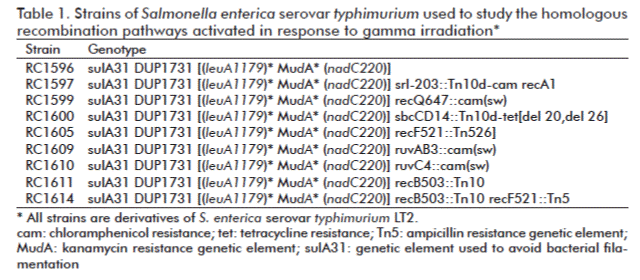
<body><![CDATA[<P   ><font face="Verdana, Arial, Helvetica, sans-serif" size="2">DNA damage is originated      mainly by endogenous sources, like reactive oxygen species (ROS: <sup>&bull;</sup>OH,      <sup>&bull;</sup>H, <sup>&bull;</sup>O<sub>2</sub><sup>-</sup> and H<sub>2</sub>O<sub>2</sub>)      and replication fork arrest, instead of exogenous agents which are a minor      and occasional threats [9]. There is increasing interest in radiation-induced      DNA damage due to the widespread use of radiation in clinical practice. Exposure      to ionizing radiation generates a random deposition of this kind of energy      and induces a wide spectrum of damage, by interacting with cell components      (lipids, proteins and DNA) directly or mediated by ROS generation [10- 12].      Due to the highly efficient nature of the multiple and overlapping DNA repair      mechanisms available to cells, the vast majority of the resultant DNA lesions      are accurately repaired and do not lead to mutations [13]. DSBs are a particularly      lethal form of DNA damage that prevents chromosome replication if not repaired      and, in most bacteria, HR is the dominant pathway for its repair [14], with      RecA protein playing a central role. At the beginning of a repair or recombination      process, a region of single stranded DNA (ssDNA) is formed at a DSB. This      incoming strand, is covered by a RecA protein forming a helical filament and      searches the genome for sequence homology by sampling DNA in three dimensions      and rapidly binding and unbinding to double-stranded DNA (dsDNA) until homology      is found [15,16]. </font></P >   <FONT size="+1"><FONT size="+1"><FONT size="+1"><FONT size="+1"><FONT size="+1"><FONT size="+1"><FONT size="+1"><FONT size="+1"><FONT size="+1"><FONT size="+1"><FONT size="+1"><FONT size="+1">        <P   ><font face="Verdana, Arial, Helvetica, sans-serif" size="2">Since the 1970&rsquo;s,      the bacterium <I>S. typhimurium </I>has been used as biological model to assay      genotoxicity [17] using the Ames&rsquo; test. Dr. Ames&rsquo; work was critical      in linking mutations in DNA to carcinogenesis. Most of the knowledge about      recombination was obtained from bacterial assays based on conjugation, transformation      and transduction. Zieg y Kushner [18], in 1977, designed an assay in <I>Escherichia      coli </I>K-12, with duplication (not in tandem) of two partially deleted Lac      Z operons. Since deletions did not overlap, the only way to obtain a Lac+      mutant was by recom-bination, detected by agar tetrazolium lactose platting      (white colonies in a red colonies background) [18]. In 1996, Miesel y Roth      used an assay base on phage P22 transduction with a small homology sequence      (approximately 3-kb long) flanked by markers [19]. Almost a decade after,      Fern&aacute;ndez-L&oacute;pez <I>et al</I>. developed in 2005 an automated      assay to measure conjugation by bioluminescence, using the plasmid R388 and      an <I>E. coli </I>strain [20]. However, all the assays had in common that      they initiated recombination using foreign DNA double strand ends, then favoring      the RecBCD pathway, which could have occluded any alternative pathway, if      present, mediating on HR. Advantageously, a non-sexual system was designed      in <I>S. typhimurium </I>by Galitski and Roth to study recombination, based      on phage transduction [21], which does not favor any HR pathway. </font></P >       <P   ><font face="Verdana, Arial, Helvetica, sans-serif" size="2">Therefore, this work      was aimed to evaluate gamma rays induced-homologous recombination in <I>S.      typhimurium</I>, in terms of segregation rates, using the duplication-segregation      assay (seg-dup) which does not favor any particular HR repair pathway and      reconsidering all the previous mechanistic knowledge on HR in this model species.      For this purpose, we used a collection of strains, proficient and deficient      in enzymatic activities related to different steps and pathways of recombination.      A RecA-independent pathway was identified in <I>S. typhimurium</I>, activated      in response to radiation injury. </font></P >       <P   >&nbsp;</P >       <P   ><font face="Verdana, Arial, Helvetica, sans-serif" size="3"><b>MATERIALS AND      METHODS </b> </font></P >       <P   ><font face="Verdana, Arial, Helvetica, sans-serif" size="2"><B>Strains obtainment      </b></font></P >       <P   ><font face="Verdana, Arial, Helvetica, sans-serif" size="2">Strains were obtained      by phage transduction as first described by Galitski and Roth [21]. The base      strain RC1596 (sty(LT2) <I>sulA31 </I>DUP1731 [(<I>leuA1179</I>)<I>*MudA*(nadC220)</I>]),      was constructed by using a strain of <I>S. enterica </I>serovar <I>typhimurium      </I>LT2 with a duplication (36.2 kb) and ampicillin resistance TT18931 as      recipient of transduction from the donor TT19027 strain. Mutations were introduced      in seven genes involved in HR in this base strain (<a href="/img/revistas/bta/v33n1/t0101116.gif">Table      1</a>), by using the same protocol, with the RC1596 strain as recipient and      &ldquo;TT&rdquo; strains as donors. </font></P >       
<P   ><font face="Verdana, Arial, Helvetica, sans-serif" size="2"><B>Reagents and culture      conditions </b></font></P >       <P   ><font face="Verdana, Arial, Helvetica, sans-serif" size="2">Culture media were      purchased from Difco. The chromogenic </font><font size="+1" color="#000000"><font size="+1" color="#211E1F"><font color="#000000"><font size="+1" color="#211E1F"><font size="+1" color="#000000"><font size="+1" color="#211E1F"><font size="+1"><font size="+1"><font size="+1"><font size="+1"><font size="+1"><font size="+1"><font face="Verdana, Arial, Helvetica, sans-serif" size="2">&beta;</font></font></font></font></font></font></font></font></font></font></font></font></font><font face="Verdana, Arial, Helvetica, sans-serif" size="2">-galactosidase      substrate X-gal (5-bromo- 4-chloro-3-indolyl-beta-D-galacto-pyranoside) and      its solvent N, N-Dimethylformamide were obtained from Sigma. </font></P >       <P   ><font face="Verdana, Arial, Helvetica, sans-serif" size="2">The complex medium      used was nutrient broth (NB), 8 g/L (Difco Laboratories) with NaCl (5 g/L).      Solid medium contained agar at 1.5 % (Merck). Phage plates used to score plaque      morphologies contained 1 % Bactotryptone (Difco), 0.8 % NaCl and 1.2 % agar      or 0.7 % for phage top agar. MacConkey Agar Base (40 g/L, Difco) was supplemented      with 1 % lactose. Antibiotics (Sigma Chemical, Co.) were used at the following      final concentrations: 30 mg/mL sodium ampicilin (Ap) for single-copy elements      (MudA), 20 mg/mL chloramphenicol (Cm), 20 mg/mL tetracycline hydrochloride      (Tc), 50 mg/mL kanamycin sulfate (Km). Sterile 0.85 % NaCl (saline) was used      to dilute cultures. All incubations were done at 37 &deg;C and liquid cultures      were shaken at 150 rpm. </font></P >       ]]></body>
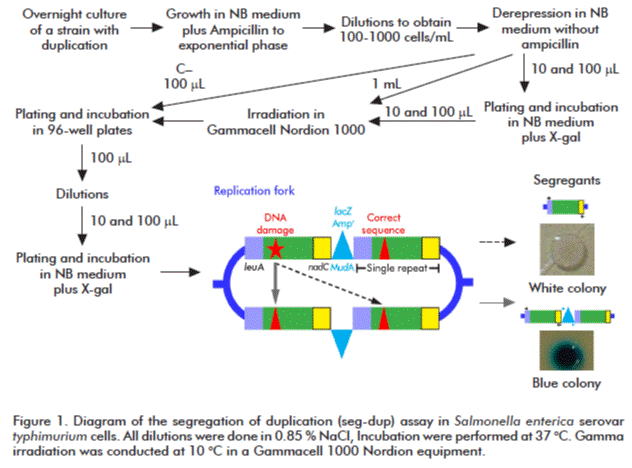
<body><![CDATA[<P   ><font face="Verdana, Arial, Helvetica, sans-serif" size="2"><B>Seg-dup assay      </b></font></P >       <P   ><font face="Verdana, Arial, Helvetica, sans-serif" size="2">The seg-dup assay      was performed exactly as described by Cu&eacute;tara <I>et al</I>.[22]. Briefly,      200 &mu;L of a bacterial overnight culture was inoculated in 10 mL of NB medium      supplemented with the corresponding antibiotics, and it was allowed to grow      until exponential phase (O.D. <sub>600 nm</sub> = 0.4). It was then diluted      1:10 000 in saline solution followed by a 1:10 dilution in fresh NB medium.      This sample was divided in two portions: one to determine spontaneous mutations      and the other, to be treated with ionizing radiation to determine induced      mutation. Two cultures per treatment (10 and 100 &mu;L each) were kept as      controls to guarantee the absence of mutants before radiation treatment. </font></P >   <FONT size="+1"><FONT size="+1">        <P   ><font face="Verdana, Arial, Helvetica, sans-serif" size="2">The experiments were      then set-up, with twenty independent cultures per treatment, by placing 100      &mu;L of cells in 96-well plates and incubating them for 16 h. Subsequently,      cells were diluted 1:1&times;10<sup>6</sup>, and 10 and 100 &mu;L of such      dilutions were plated in boxes that contained NB plus X-gal (40 &mu;g/mL),      and were allowed to grow until colonies with the different phenotypes appeared,      either blue or white, the white colonies being the segregants. Segregation      rates (<I>&mu;</I>) were established by calculating the blue/white colonies      ratios, by the Luria and Delbr&uuml;ck&rsquo;s method [23], further extended      by Espinosa-Aguirre <I>et al</I>. [24]. The estimator of the number of mutations      (<I>m</I>) was calculated by a maximum likelihood method [20], the variance      of m established according to the Lea and Coulson method [25]. To set <I>&mu;</I>,      the <I>m </I>obtained was divided by the final number of cells in the culture      minus the initial number of cells seeded. The standard deviation of <I>&mu;      </I>was the square root of the m variance divided by the final number of cells      in the culture minus the initial number of seeded cells. The 99 % confidence      intervals (CI 99 %) were further calculated for each estimate with tree times      the standard deviation of <I>&mu; </I>(<I>&mu; </I>&plusmn; 3s<I>&mu;</I>);      non-overlapping intervals were considered statistically different [23, 25]      (<a href="/img/revistas/bta/v33n1/f0101116.gif">Figure 1</a>). </font></P >   <FONT size="+1"><FONT size="+1"><FONT size="+1"><FONT size="+1">        
<P   ><font face="Verdana, Arial, Helvetica, sans-serif" size="2"><B>Irradiation with      gamma rays </b></font></P >       <P   ><font face="Verdana, Arial, Helvetica, sans-serif" size="2">One eppendorf tube      containing a milliliter of cells, corresponding to each point of every irradiation      doses, were placed in a circular rack that was adjusted to the irradiation      chamber. Irradiation was performed using a Gammacell 1000 Nordion equipment      (Nordion, Canada). The temperature inside the chamber was set to 10 &ordm;C.      </font></P >       <P   ><font face="Verdana, Arial, Helvetica, sans-serif" size="2">Two dose-response      curves (four independent experiments with five replicas each), were conducted      per strain (base strain and recA1 deficient) to characterize the response      of the base strain, the recA1 deficient strain the expected most sensitive      mutant. LD<sub>50</sub> was calculated, for both strains, from the curve of      better adjustment to the experimental data obtained by using the Origin version      7.0 (OriginLab<sup>(TM)</sup> NAS Software Partner). From those experiments,      it was decided to use 50 and 150 Gy for the strains that exhibited a spontaneous      segregation rate similar to that of the base strain and, to avoid lethality,      20 and 50 Gy for the mutants with spontaneous segregation rates an order below      the base strain. </font></P >       <P   >&nbsp;</P >   <FONT size="+1"><FONT size="+1"><FONT size="+1"><FONT size="+1">        <P   ><font face="Verdana, Arial, Helvetica, sans-serif" size="3"><b>RESULTS AND DISCUSSION      </b> </font></P >       <P   ><font face="Verdana, Arial, Helvetica, sans-serif" size="2"><B>Mutation in genes      related to HR affects seg-dup rates </b></font></P >       <P   ><font face="Verdana, Arial, Helvetica, sans-serif" size="2">Strain recA1 and      the double mutation (<I>recB-</I>, <I>recF-</I>) diminished in a significant      way the spontaneous segregation rate (<I>&mu;</I>) of <I>Salmonella </I>(1.9      &plusmn; 0.1 &times; 10<sup>-4</sup> and 3.2 &plusmn; 0.4 &times; 10<sup>-4</sup>,      respectively), in comparison with the base strain (7.0 &plusmn; 0.4 &times;      10<sup>-3</sup>). The effect of the <I>recQ </I>mutation was also significant,      diminishing the <I>&mu; </I>by 7.5 times. Such findings emphasize the important      role attributed to RecQ proteins in generating an initiating signal that can      recruit RecA for SOS induction and recombination at stalled replication forks,      which are required for resumption of DNA replication [26]. The <I>recF </I>mutation      significantly reduced in 2/3 the ability of <I>S. typhimurium </I>to recombine      (2.6 &plusmn; 0.2 &times; 10<sup>-3</sup>) while <I>recB </I>mutation significantly      increased it (1.5 &plusmn; 0.9 &times; 10<sup>-2</sup>). Mutations in enzymes      of the late steps of recombination distinctively affected the process: the      <I>ruvAB </I>mutants exhibited the maximal &mu; (1 &plusmn; 0.1 &times; 10<sup>-2</sup>),      while <I>ruvC </I>deletion significantly diminished <I>&mu; </I>(6.9 &plusmn;      4.2 &times; 10<sup>-4</sup>). The suppressor effect of the <I>sbcCD </I>mutation      was previously observed in <I>recBC </I>mutants restoring its recombination      ability [27, 28]. </font></P >   <FONT size="+1"><FONT size="+1"><FONT size="+1"><FONT size="+1"><FONT size="+1"><FONT size="+1"><FONT size="+1"><FONT size="+1"><FONT size="+1"><FONT size="+1"><FONT size="+1"><FONT size="+1"><FONT size="+1"><FONT size="+1">        ]]></body>
<body><![CDATA[<P   ><font face="Verdana, Arial, Helvetica, sans-serif" size="2">In our experiments,      the absence of SBCCD notoriously increased the ability of base strain cells      for recombination (9.7 &plusmn; 0.5 &times; 10<sup>-2</sup>). Ivan&#269;id-Bade      <I>et al</I>., [29] found that some recB mutants exhibited a constitutive      expression of the SOS regulon, probably as an adaptive mechanism to cope with      endogenous damage, mainly SSBs [29, 30]. They identified the existence of      a passive mechanism, independent of RecBCD and RecFOR, to load RecA in a RecB-background,      which included RecJ [31]. The mutant strains RecB- spontaneously segregate      at a rate of (1.5 &plusmn; 0.9 &times; 10<sup>-2</sup>). The seg-dup assay      supported the direct evaluation of multienzymatic complexes activities, as      for RecFOR and RuvABC. </font></P >   <FONT size="+1"><FONT size="+1"><FONT size="+1"><FONT size="+1"><FONT size="+1"><FONT size="+1"><FONT size="+1"><FONT size="+1">        <P   ><font face="Verdana, Arial, Helvetica, sans-serif" size="2"><B>HR mutants are      grouped in two classes attending to their resistance to radiation </b></font></P >       <P   ><font face="Verdana, Arial, Helvetica, sans-serif" size="2">A dose response curve      of base strain cells exposed to gamma rays is presented in <a href="/img/revistas/bta/v33n1/f0201116.gif">Figure      2A</a>. As can be observed, cell survival and the number of mutant colonies      were clearly affected, and radiation induced a significant number of mutant      colonies over the spontaneous value in a increasingly dose-dependent manner.      Our data fulfill Boltzmann&rsquo;s model, which is described by the equation:      y = 10 + (1220) / (1 + e<sup> ((x -144) / 23)</sup>) with a &chi;2/DoF adjustment      of 46.03644, r<sup><sup>2</sup></sup> = 0.97216, so LD<sup>50</sup> was established      at 140 Gy. Since the survival of the base strain cells treated with 150 Gy      was approximately 50 %, this dose and the 50 Gy were set as to assay the mutant      strains. </font></P >   <FONT size="+1"><FONT size="+1"><FONT size="+1"><FONT size="+1"><FONT size="+1"><FONT size="+1"><FONT size="+1"><FONT size="+1">        
<P   ><font face="Verdana, Arial, Helvetica, sans-serif" size="2">The same experiments      were conducted with a Rec&ndash; strain, but using a different dose range      (0-70 Gy) due to its sensitivity to gamma rays (<a href="/img/revistas/bta/v33n1/f0201116.gif">Figure      2 B</a>). RecA-cells evidenced an extreme behavior facing gamma ray irradiation.      In an analogous way, we proceeded for the calculation of LD50. In this case,      the Boltzmann&rsquo;s model equation was established as follows: y = &ndash;      98 + ((26565)/(1 + e <sup>((x+69) / 25)</sup>) with an adjustment of &chi;<sup>2</sup>/      DoF = 37.01293, r<sup>2</sup> = 0.98532 and LD<sub>50</sub> of 16 Gy. </font></P >   <FONT size="+1"><FONT size="+1"><FONT size="+1"><FONT size="+1"><FONT size="+1"><FONT size="+1"><FONT size="+1"><FONT size="+1"><FONT size="+1"><FONT size="+1"><FONT size="+1"><FONT size="+1">        
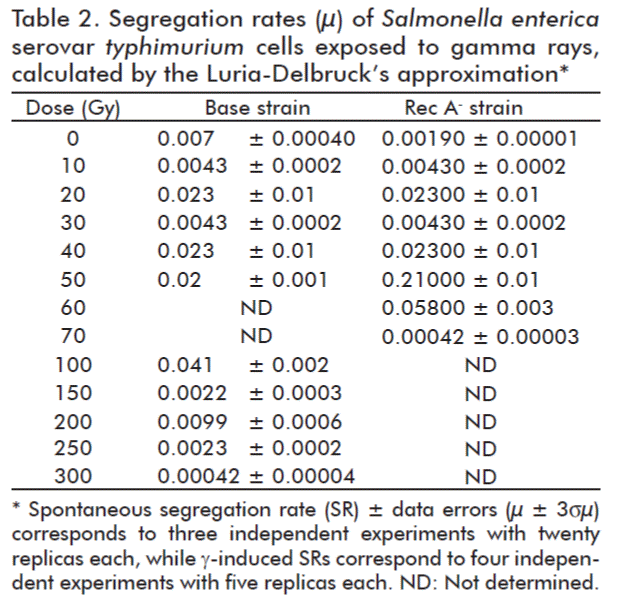
<P   ><font face="Verdana, Arial, Helvetica, sans-serif" size="2">On the other hand,      gamma induced segregation rate (<I>&mu;</I>) was calculated for both strains,      by using the Luria-Delbruck&rsquo;s approximation [23, 25] for each dose (<a href="/img/revistas/bta/v33n1/t0201116.gif">Table      2</a>). Base strain cells were treated with gamma rays, in four conditions      with five replicas each irradiation dose (20 samples), and for spontaneous      &mu; in three conditions with 20 replicas each (60 samples). </font></P >       
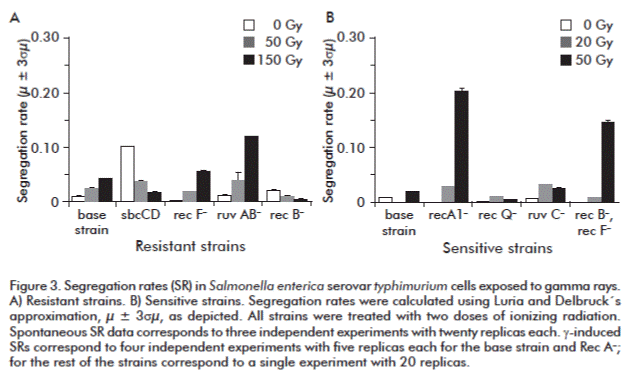
<P   ><font face="Verdana, Arial, Helvetica, sans-serif" size="2">Our results confirmed      the existence of a RecA-independent recombination pathway in <I>Salmonella</I>.      RecA-independent recombination was studied by Dutra <I>et al</I>. [32], using      different assays, all of them involving double strands ends as initiators      of recombination and different mutants defective in RecA and exonucleases.      In their experiments, spontaneous recombination rate was evaluated for smaller      homology lengths (&le; 0.4 kbp) than ours (36.2 kpb). In a RecA<sup>&ndash;</sup>      background, recombination rate was assayed in homology lengths below 0.1 kpb      and appeared increased as compared to the base strain, but their results were      similar to ours in the gene conversion </font><font face="Verdana, Arial, Helvetica, sans-serif" size="2">assay      when testing at larger lengths of homology (0.4 kbp), evidencing a recombination      rate more than an order of magnitude lower due to RecA deficiency. RecA-independent      homologous recombination systems have been regarded as contributing to generate      integrating conjugative elements diversity. Such elements are associated with      the spread of antibiotic resistance in bacteria and the systems are composed      by SSB proteins and an exonuclease [33]. </font></P >   <FONT size="+1"><FONT size="+1">        <P   ><font face="Verdana, Arial, Helvetica, sans-serif" size="2">In our experiments      it was found that different defects in HR pathways provide cells with variable      gamma rays-susceptibility. These results were in agreement with those of Kim      and Rose [34], who corroborated that the number of cells in the progeny of      strains treated with ionizing radiation correlated with the number of mutant      colonies in a dose dependent manner. </font></P >       <P   ><font face="Verdana, Arial, Helvetica, sans-serif" size="2">The gamma induced      segregation rates of resistant strain (base strain, SbcCD<sup>&ndash;</sup>,      RecF<sup>&ndash;</sup>, RecB<sup>&ndash;</sup> and RuvAB<sup>&ndash;</sup>)      are shown in <a href="/img/revistas/bta/v33n1/f0301116.gif">Figure 3A</a>. Base strain cells as well      as RecF<sup>&ndash;</sup> and RuvAB<sup>&ndash;</sup> cells showed a direct      dose-dependent increase in recombination, while SbcCD<sup>&ndash;</sup> and      RecB<sup>&ndash;</sup> cells behaved in the opposite way. </font></P >   <FONT size="+1"><FONT size="+1"><FONT size="+1"><FONT size="+1"><FONT size="+1"><FONT size="+1"><FONT size="+1"><FONT size="+1"><FONT size="+1"><FONT size="+1"><FONT size="+1"><FONT size="+1"><FONT size="+1"><FONT size="+1"><FONT size="+1"><FONT size="+1">        
<P   ><font face="Verdana, Arial, Helvetica, sans-serif" size="2">Dianov <I>et al</I>.,      [11] demonstrated that ionizing radiation induced clustered lesions, including      abasic sites (AP) and oxidized bases (50 to 80 % of total damage). Theoretically,      such lesions can arrive from multiple events or from a single impact [35].      The likelihood of occurrence of clusters increased with radiation density;      what could happen in our experiments. These lesions are generally impossible      to repair [36]. </font></P >       <P   ><font face="Verdana, Arial, Helvetica, sans-serif" size="2">Gamma rays were very      citotoxic to RuvAB<sup>-</sup> cells. Its population decreased in 75 % at      50 Gy and surviving cells exhibited a high ability to recombine, which increased      up to 10<sup>-1</sup> at the higher dose. <I>E. coli </I>Ruv&ndash; mutants      are sensitive to UV light, ionizing radiation and chemical mutagens. This      was evidenced by the formation of multinucleated filaments after exposure      to low doses of injuring agents [9, 37, 38]. Simple mutants in <I>ruv<sup>&ndash;</sup>      </I>were as efficient in recombination as the base strain cells [39, 40].      Our results disagree with those of other groups working with RuvAB&ndash;      cells, which are less sensitive to UV and gamma rays than the base strain      cells [41-43]. Nevertheless, determinations of mutation rates were focused      in point reversion of hisG4 (Oc) or isolation of Rifr colony forming units      (c.f.u.) by point mutations [41-43]. </font></P >   <FONT size="+1"><FONT size="+1"><FONT size="+1"><FONT size="+1"><FONT size="+1"><FONT size="+1"><FONT size="+1"><FONT size="+1"><FONT size="+1"><FONT size="+1">        ]]></body>
<body><![CDATA[<P   ><font face="Verdana, Arial, Helvetica, sans-serif" size="2">In fact, our recombination      results were mediated by long homology zones, in agreement with Donaldson      <I>et al</I>. [44]. They used RuvG<sup>&ndash;</sup> and RuvAB<sup>&ndash;</sup>      strains, and observed that the replication fork restoring kinetics in these      helicases-deficient strains was similar to the base strain. So, radiation      induces replication fork arrest among other mechanisms and the RuvAB activity      is non-limiting, with fork restoration releasing recombinogenic substrates      for segregation. Moreover, it was suggested by Harris <I>et al</I>. [45],      that certain changes in <I>ruvB </I>give the cells with selective advantage.      </font></P >   <FONT size="+1"><FONT size="+1"><FONT size="+1"><FONT size="+1">        <P   ><font face="Verdana, Arial, Helvetica, sans-serif" size="2">Opposite effects      were obtained in RecF<sup>&ndash;</sup> and RecB<sup>&ndash</sup>; cells.      RecF<sup>&ndash;</sup> cells increased recombination slightly over the base      strain, somewhat expected since RecBCD is recognized as the major pathway      to repair DSB, the lethal lesions induced by gamma rays [41]. RecB&ndash;      cells had the lowest levels of recombination at every dose assayed, remarking      the outstanding role of RecBCD pathway in processing DSBs induced by gamma      rays. This coincided with reports by Chedin and Kowalczykowski [46], who evidenced      that mutations in <I>recB </I>or <I>recC </I>caused a 2-fold decay in conju-gation,      these cell types being extremely sensitive to DNA damaging agents [47]. </font></P >   <FONT size="+1"><FONT size="+1"><FONT size="+1"><FONT size="+1"><FONT size="+1"><FONT size="+1"><FONT size="+1"><FONT size="+1">        <P   ><font face="Verdana, Arial, Helvetica, sans-serif" size="2">Our findings demonstrate      the deficiencies in SbcCD represent &ldquo;a stimulus&rdquo; for spontaneous      recombination but conversely a disadvantage to respond to radiation induced      injury. It has been evidenced that the inactivation of ExoI, the main <I>E.      coli </I>exonuclease, increases recombinogenic tails longevity [48]. We obtained      a similar effect for SbcCD null mutants, which classified as resistant. It      was described that exonuclease activity not only diminished the length of      the unwinding tail, but it also restored the SSB proteins exhausted pool,      allowing the repetitive joining of free SSB proteins to unwinding DNA [48].      The former could be an argument to explain the coupling of vigorous nuclease      activity with the fast and processive helicase activity of the RecBCD holoenzyme      [49]. SbcCD alterations block the RecBCD pathway, such alterations probably      explaining the decreased <I>&mu; </I>at high doses of gamma irradiation. </font></P >       <P   ><font face="Verdana, Arial, Helvetica, sans-serif" size="2">We also analyzed      the segregation rate of sensitive strains (RecA<sup>&ndash;</sup>, RuvC<sup>&ndash;</sup>,      RecQ<sup>&ndash;</sup> and RecB<sup>&ndash;</sup>/RecF<sup>&ndash;</sup>)      after gamma treatment (<a href="/img/revistas/bta/v33n1/f0301116.gif">Figure 3 B</a>). RecQ<sup>&ndash;</sup>      and RuvC<sup>&ndash;</sup> cells increase recombination after treatment with      20 Gy and decreased at 50 Gy due to the citotoxicity exerted by radiation      in these backgrounds. At this dose, Rec A<sup>&ndash;</sup> and the double      mutant seem to trigger highly mutagenic mechanisms to survive. Their segregation      rates were an order above that of the </font><font face="Verdana, Arial, Helvetica, sans-serif" size="2">base      strain. Similar results were obtained with these mutants after treatment with      ultraviolet light (10 J/cm<sup>2</sup>). It is also important to declare that      white colonies obtained at this dose were true segregants and did not derive      from point mutations in <I>lacZ </I>gene. We also corroborated this in previous      studies [22]. </font></P >   <FONT size="+1"><FONT size="+1"><FONT size="+1"><FONT size="+1"><FONT size="+1"><FONT size="+1"><FONT size="+1"><FONT size="+1"><FONT size="+1"><FONT size="+1"><FONT size="+1"><FONT size="+1"><FONT size="+1"><FONT size="+1"><FONT size="+1"><FONT size="+1"><FONT size="+1"><FONT size="+1">        
<P   ><font face="Verdana, Arial, Helvetica, sans-serif" size="2">It is notorious that      in RecQ<sup>&ndash;</sup> cells, segregation rate decreased in one order of      magnitude, probably due to the key role of this protein in the recovery of      DNA replication. RecQ helicases also prevents excessive recombination by suppressing      illegitimate recombination and by initiating HR via the RecF pathway [45].      Moreover, the concomitant action of the RecQ helicase and the RecJ exonuclease      at damaged replication forks allows the controlled resection of the lagging      strand, resulting in RecA loading by RecFOR and regression of the fork [50].      The regression of the fork allows the DNA lesion to be excised from duplex      DNA by the NER, although a significant proportion of recombination events      using the RecFOR pathway are RecQ-independent and can be initiated by RecJ      nuclease alone or associated with another non identified helicase. Buljuba&scaron;id      <I>et al</I>. [51], demonstrated that RecQ could be partially substituted      by UvrD helicase. Rec Q seems to be also important in SOS response. Hishida      <I>et al</I>. [52], proposed that prokaryotic and eukaryotic RecQ helicases      play a role in coordinating a cell cycle checkpoint response with recombination      and replication. Their model predicts that RecQ processes gapped forks into      DNA structures that serve to activate RecA and induce the SOS response, which      leads to a delay in cell growth, prevention of replication and chromosome      segregation, and to the expression of specific DNA repair genes [52]. </font></P >   <FONT size="+1"><FONT size="+1">        <P   ><font face="Verdana, Arial, Helvetica, sans-serif" size="2">It was recently demonstrated      that radiation induced DNA lesions generate fragmentation and require replication      events [53]. RuvABC proteins are also implicated in the resolution of Holliday      junctions originating from stalled replication forks. The absence of RuvC      could increase the lifetime of species susceptible to be transformed in recombinogenic      substrates that might generate the segregation of the duplicated region, explaining      the recombination events detected in the present work. Moreover, the lack      of a strand sliding apparatus could explain the poor survival and the increased      <I>&mu;</I>. Zahradka <I>et al</I>. [54], demonstrated that RuvABC is necessary      for the repair of radiation-induced lesions particularly in recBC<sup>&ndash;</sup>/sbcBC<sup>&ndash;</sup>      mutants, this background needed to observe the RecFOR system at work in previous      assays [54]. </font></P >   <FONT size="+1"><FONT size="+1"><FONT size="+1"><FONT size="+1">        <P   ><font face="Verdana, Arial, Helvetica, sans-serif" size="2">In the case of the      RecA<sup>&ndash;</sup> deficient strain and the double mutant RecB<sup>&ndash;</sup>/RecF<sup>&ndash;</sup>,      they dramatically decreased c.f.u. counts after gamma irradiation and increased      their segregation rate in three orders of magnitude (<a href="/img/revistas/bta/v33n1/f0301116.gif">Figure      3 B</a>). While the ability of the RecA-independent pathway to mediate changes      in the bacterial chromosome, Swingle <I>et al</I>. [55], observed low but      detectable recombination events between oligonucleotides and chromosomes of      <I>E. coli</I>, <I>S. typhimurium</I>, <I>Shigella flexneri </I>and <I>Pseudomonas      syringae </I>[55]. It seems that this mechanism is conserved in the gamma      subdivision of proteobacteria. Besides, Bierne <I>et al</I>. [56] studied      the recombination between consecutive repetitions in <I>E. coli </I>chromosome.      They inserted 624-bp long tandem repeats into the <I>lacZ </I>gene and compared      the efficiency of deletions of one repetition in RecA<sup>&ndash;</sup>, RecBC<sup>&ndash;</sup>,      RecF<sup>&ndash;</sup>, RuvA<sup>&ndash;</sup> and RuvA/RecG<sup>&ndash;</sup>      mutants, without detecting any relevant effect. They concluded that deleterious      events apparently do not happen via the RecBCD or RecF pathways. They also      found a new mutant able to recombine in a RecA-independent manner with a 15-fold      increased mutation rate [56]. This hyper-recombinogenicity was associated      with an Asp-to-Gly mutation in codon 133, of &alpha; subunit of polymerase      III encoded by the <I>dnaE </I>gene. Another mutation in this gene, dnaE486,      was assayed and shown to enhance RecA-independent recombination. They proposed      a slippage mechanism to explain such findings. It is known that RecA-independent      exchanges increase in the absence of Rep helicase, the replication delay facilitating      the strand slippage proposed [56]. </font></P >   <FONT size="+1"><FONT size="+1"><FONT size="+1"><FONT size="+1"><FONT size="+1"><FONT size="+1"><FONT size="+1"><FONT size="+1"><FONT size="+1"><FONT size="+1"><FONT size="+1"><FONT size="+1"><FONT size="+1"><FONT size="+1"><FONT size="+1"><FONT size="+1">        
<P   ><font face="Verdana, Arial, Helvetica, sans-serif" size="2">Analyzing the double      mutant, there are several mechanisms to be considered in duplication segregation      after irradiation. Given the lethality of DSB if they are not efficiently      repaired, organisms have developed DNA repair systems such as homologous recombination,      single strand annealing, illegitimate recombination and gap fulfilling by      translesion synthesis polymerases (TLS) with affected proofreading. Overexpression      of TLS by derepression of the DNA damage-inducible LexA regulon caused a 25-fold      increase in deletion rate [57]. </font></P >       <P   ><font face="Verdana, Arial, Helvetica, sans-serif" size="2">According to the      repair-dependent model of cell radiation survival, extended to include ionizing      radiation-induced transformations, the probability of transformation is assumed      to scale up with the number of potentially lethal damages that are repaired      in a surviving cell (of any kind) or the interactions of such damages. The      theory predicts that at high doses, corresponding to low survival, the transformed      to surviving cells ratio asymptotically approaches an upper limit. Regarding      transformation as equivalent to segregation, since both are forms of homologous      recombination that generates a mutant phenotype, then, we could explain the      high segregation values obtained for RecA<sup>&ndash;</sup> </font><font size="2" face="Verdana, Arial, Helvetica, sans-serif">and      the double mutant strain on the basis of the abovementioned theory. Curiously,      such a theory was also applied to neoplastic transformation in mammalian cells      by Sutherland [58]. </font></P >   <FONT size="+1"><FONT size="+1">        <P   ><font face="Verdana, Arial, Helvetica, sans-serif" size="2">We have to remind      that HR is a well conserved and regulated process, but when compromised, illegitimate      or aberrant recombination may occur between regions of limited or no homology      at all [59]. It has been proposed that some microorganisms use it as an adaptive      response to long periods of stationary phase, conditioned by adverse environmental      stimuli (e.g., nutritional deficiencies or aggressive environments), with      aberrant recombination systems probably acquired by horizontal gene transfer      in order to repair DNA when their genetic stability was at risk [60]. Besides,      in response to radiation injury, SOS induction can act as a backup system      for rescuing cell viability [18, 56]; although the repair route of choice      varies between species and even among cell lines of the same species [61].      </font></P >       ]]></body>
<body><![CDATA[<P   >&nbsp;</P >       <P   ><font face="Verdana, Arial, Helvetica, sans-serif" size="2"><b><font size="3">CONCLUSIONS      </font></b></font></P >       <P   ><font face="Verdana, Arial, Helvetica, sans-serif" size="2">In summary, our findings      suggest that RecA-independent recombinational events could be induced by gamma      irradiation. Such events seem to be partially dependent on RecB, SbcCD and      RecQ proteins. They also suggested the existence of alternative pathways of      recombination to RecFOR and RecBCD in <I>Salmonella</I>. </font></P >       <P   ><font face="Verdana, Arial, Helvetica, sans-serif" size="2">Since proteins that      comprise repair systems seem to be designed according to a Domain Lego principle      (by shuffling and recombining a limited repertoire of conserved domains),      in the three super-kingdoms of life. The nature of such domains dictates the      activities: DNA binding, cleavage, unwinding, ligation, polymerization and      molecular adaptors. RecA/Rad recombinases appear to be vertically transmitted      during evolution. The same happens with the SMC-ATPases SbcC protein and the      Holliday junction resolvase RuvAB [21]. Generally, a bacterial protein has      several structural and functional homologs in humans. Considering the above      mentioned, we propose the seg-dup assay and the strain collection presented      here as a simple, cheap and valuable alternative for studying the mechanisms      of action of physical and chemical agents (novel drugs) that interacts with      recombination machinery. </font></P >       <P   >&nbsp;</P >       <P   ><font face="Verdana, Arial, Helvetica, sans-serif" size="3"><b>ACKNOWLEDGEMENTS      </b> </font></P >       <P   ><font face="Verdana, Arial, Helvetica, sans-serif" size="2">We appreciate the      technical assistance of Biol. Sandra Hern&aacute;ndez Ojeda and Q.F.B. Carlos      Castellanos Barba. This work was partially supported by DGAPA (UNAM) IN204207;      IN207513 and CONACyT41469. </font></P >       <P   >&nbsp;</P >       <P   ><font face="Verdana, Arial, Helvetica, sans-serif" size="2"><b><font size="3">CONFLICT      OF INTEREST STATEMENT </font></b></font></P >       <P   ><font face="Verdana, Arial, Helvetica, sans-serif" size="2">The authors declare      that there are no conflicts of interest. </font></P >       ]]></body>
<body><![CDATA[<P   >&nbsp;</P >       <P   ><font face="Verdana, Arial, Helvetica, sans-serif" size="3"><b>REFERENCES </b></font></P >       <P   ><font face="Verdana, Arial, Helvetica, sans-serif" size="2">1. Syeda AH, Hawkins      M, McGlynn P. Recombination and replication. Cold Spring Harb Perspect Biol.      2014;6(11):a016550. </font></P >       <!-- ref --><P   ><font face="Verdana, Arial, Helvetica, sans-serif" size="2">2. Ansari MA, Didelot      X. Inference of the properties of the recombination process from whole bacterial      genomes. Genetics. 2014;196(1):253-65.     </font></P >       <!-- ref --><P   ><font face="Verdana, Arial, Helvetica, sans-serif" size="2">3. Cox MM. Historical      overview: searching for replication help in all of the rec places. Proc Natl      Acad Sci USA. 2001;98(15):8173-80.     </font></P >       <!-- ref --><P   ><font face="Verdana, Arial, Helvetica, sans-serif" size="2">4. Michel B, Grompone      G, Flores MJ, Bidnenko V. Multiple pathways process stalled replication forks.      Proc Natl Acad Sci USA. 2004;101(35):12783-8.     </font></P >       <!-- ref --><P   ><font face="Verdana, Arial, Helvetica, sans-serif" size="2">5. Costes A, Lambert      SA. Homologous recombination as a replication fork escort: fork-protection      and recovery. Biomolecules. 2012;3(1):39-71.     </font></P >       <!-- ref --><P   ><font face="Verdana, Arial, Helvetica, sans-serif" size="2">6. Dillingham MS,      Kowalczykowski SC. RecBCD enzyme and the repair of double-stranded DNA breaks.      Microbiol Mol Biol Rev. 2008;72(4):642-71.     </font></P >       <!-- ref --><P   ><font face="Verdana, Arial, Helvetica, sans-serif" size="2">7. Pennington JM,      Rosenberg SM. Spontaneous DNA breakage in single living <I>Escherichia coli      </I>cells. Nat Genet. 2007;39(6):797-802.     </font></P >       <!-- ref --><P   ><font face="Verdana, Arial, Helvetica, sans-serif" size="2">8. West SC. Molecular      views of recombination proteins and their control. Nat Rev Mol Cell Biol.      2003;4(6):435-45.     </font></P >       <!-- ref --><P   ><font face="Verdana, Arial, Helvetica, sans-serif" size="2">9. Otsuji N, Horiuchi      T, Nakata A, Kawamata J. Strains of <I>Escherichia coli </I>hypersensitive      to representative carcinostatic and carcinogenic agents. J Antibiot (Tokyo).      1978;31(8):794-6.     </font></P >       <!-- ref --><P   ><font face="Verdana, Arial, Helvetica, sans-serif" size="2">10. Kuipers GK, Poldervaart      HA, Slotman BJ, Lafleur MV. The influence of formamidopyrimidine-DNA glycosylase      on the spontaneous and gamma-radiation-induced mutation spectrum of the <I>lacZ      </I>alpha gene. Mutat Res. 1999;435(2):141-50.     </font></P >       <P   ><font face="Verdana, Arial, Helvetica, sans-serif" size="2">11. Dianov GL, O&rsquo;Neill      P, Goodhead DT. Securing genome stability by orchestrating DNA repair: removal      of radiation-induced clustered lesions in DNA. Bioessays. 2001;23(8):745-9.      </font></P >       <!-- ref --><P   ><font face="Verdana, Arial, Helvetica, sans-serif" size="2">12. Volkert MR, Elliott      NA, Housman DE. Functional genomics reveals a family of eukaryotic oxidation      protection genes. Proc Natl Acad Sci USA. 2000;97(26):14530-5.     </font></P >       <!-- ref --><P   ><font face="Verdana, Arial, Helvetica, sans-serif" size="2">13. Blackwood JK,      Rzechorzek NJ, Bray SM, Maman JD, Pellegrini L, Robinson NP. End-resection      at DNA double-strand breaks in the three domains of life. Biochem Soc Trans.      2013;41(1):314-20.     </font></P >       <!-- ref --><P   ><font face="Verdana, Arial, Helvetica, sans-serif" size="2">14. Wigley DB. Bacterial      DNA repair: recent insights into the mechanism of RecBCD, AddAB and AdnAB.      Nat Rev Microbiol. 2013;11(1):9-13.     </font></P >       <P   ><font face="Verdana, Arial, Helvetica, sans-serif" size="2">15. Hiom K. Homologous      recombination: how RecA finds the perfect partner. Curr Biol. 2012;22(8):R275-8.      </font></P >       <!-- ref --><P   ><font face="Verdana, Arial, Helvetica, sans-serif" size="2">16. Danilowicz C,      Peacock-Villada A, Vlassakis J, Facon A, Feinstein E, Kleckner N, <I>et al</I>.      The differential extension in dsDNA bound to Rad51 filaments may play important      roles in homology recognition and strand exchange. Nucleic Acids Res. 2014;42(1):526-33.          </font></P >       <!-- ref --><P   ><font face="Verdana, Arial, Helvetica, sans-serif" size="2">17. Ames BN, Durston      WE, Yamasaki E, Lee FD. Carcinogens are mutagens: a simple test system combining      liver homogenates for activation and bacteria for detection. Proc Natl Acad      Sci USA. 1973;70(8):2281-5.     </font></P >       <!-- ref --><P   ><font face="Verdana, Arial, Helvetica, sans-serif" size="2">18. Zieg J, Kushner      SR. Analysis of genetic recombination between two partially deleted lactose      operons of <I>Escherichia coli </I>K-12. J Bacteriol. 1977;131(1):123-32.          </font></P >       <!-- ref --><P   ><font face="Verdana, Arial, Helvetica, sans-serif" size="2">19. Miesel L, Roth      JR. Salmonella recD mutations increase recombination in a short sequence transduction      assay. J Bacteriol. 1994;176(13):4092-103.     </font></P >       <P   ><font face="Verdana, Arial, Helvetica, sans-serif" size="2">20. Fernandez-Lopez      R, Machon C, Longshaw CM, Martin S, Molin S, Zechner EL, <I>et al</I>. Unsaturated      fatty acids are inhibitors of bacterial conjugation. Microbiology. 2005;151(Pt      11):3517-26. </font></P >       <!-- ref --><P   ><font face="Verdana, Arial, Helvetica, sans-serif" size="2">21. Galitski T, Roth      JR. Pathways for homologous recombination between chromosomal direct repeats      in <I>Salmonella typhimurium</I>. Genetics. 1997;146(3):751- 67.     </font></P >       ]]></body>
<body><![CDATA[<!-- ref --><P   ><font face="Verdana, Arial, Helvetica, sans-serif" size="2">22. Cu&eacute;tara      EB, S&aacute;nchez-Lamar A, Hern&aacute;ndez-Guadarrama BE, Espinosa-Aguirre      JJ, Camacho-Carranza R. Collection of <I>Salmonella typhimurium </I>strains      for genotoxicologic and anti-genotoxicologic evaluation. Biotecnol Apl. 2014;31(4):278-84.          </font></P >       <!-- ref --><P   ><font face="Verdana, Arial, Helvetica, sans-serif" size="2">23. Luria SE, Delbruck      M. Mutations of bacteria from virus sensitivity to virus resistance. Genetics.      1943;28(6):491-511.     </font></P >       <!-- ref --><P   ><font face="Verdana, Arial, Helvetica, sans-serif" size="2">24. Espinosa-Aguirre      J, Barajas-Lemus C, Hernandez-Ojeda S, Govezensky T, Rubio J, Camacho-Carranza      R. RecBCD and RecFOR dependent induction of chromosomal deletions by sodium      selenite in Salmonella. Mutat Res. 2009;665(1-2):14-9.     </font></P >       <!-- ref --><P   ><font face="Verdana, Arial, Helvetica, sans-serif" size="2">25. Lea DE, Coulson      CA. The distribution of the numbers of mutants in bacterial populations. J      Genet. 1949;49(3):264-85.     </font></P >       <!-- ref --><P   ><font face="Verdana, Arial, Helvetica, sans-serif" size="2">26. Hishida T, Han      YW, Shibata T, Kubota Y, Ishino Y, Iwasaki H, <I>et al</I>. Role of the <I>Escherichia      coli </I>RecQ DNA helicase in SOS signaling and genome stabilization at stalled      replication forks. Genes Dev. 2004;18(15):1886-97.     </font></P >       ]]></body>
<body><![CDATA[<!-- ref --><P   ><font face="Verdana, Arial, Helvetica, sans-serif" size="2">27. Kushner SR, Nagaishi      H, Templin A, Clark AJ. Genetic recombination in <I>Escherichia coli</I>:      the role of exonuclease I. Proc Natl Acad Sci USA. 1971;68(4):824-7.     </font></P >       <!-- ref --><P   ><font face="Verdana, Arial, Helvetica, sans-serif" size="2">28. Lloyd RG, Buckman      C. Identification and genetic analysis of sbcC mutations in commonly used      recBC sbcB strains of <I>Escherichia coli </I>K-12. J Bacteriol. 1985;164(2):836-44.          </font></P >       <!-- ref --><P   ><font face="Verdana, Arial, Helvetica, sans-serif" size="2">29. Ivancic-Bace      I, Vlasic I, Salaj-Smic E, Brcic-Kostic K. Genetic evidence for the requirement      of RecA loading activity in SOS induction after UV irradiation in <I>Escherichia      coli</I>. J Bacteriol. 2006;188(14):5024-32.     </font></P >       <!-- ref --><P   ><font face="Verdana, Arial, Helvetica, sans-serif" size="2">30. McCool JD, Long      E, Petrosino JF, Sandler HA, Rosenberg SM, Sandler SJ. Measurement of SOS      expression in individual <I>Escherichia coli </I>K-12 cells using fluorescence      microscopy. Mol Microbiol. 2004;53(5):1343-57.     </font></P >       <!-- ref --><P   ><font face="Verdana, Arial, Helvetica, sans-serif" size="2">31. Jockovich ME,      Myers RS. Nuclease activity is essential for RecBCD recombination in <I>Escherichia      coli</I>. Mol Microbiol. 2001;41(4):949-62.     </font></P >       ]]></body>
<body><![CDATA[<!-- ref --><P   ><font face="Verdana, Arial, Helvetica, sans-serif" size="2">32. Dutra BE, Sutera      VA Jr., Lovett ST. RecA-independent recombination is efficient but limited      by exonucleases. Proc Natl Acad Sci USA. 2007;104(1):216-21.    </font></P >       <!-- ref --><P   ><font face="Verdana, Arial, Helvetica, sans-serif" size="2">33. Garriss G, Poulin-Laprade      D, Burrus V. DNA-damaging agents induce the RecA-independent homologous recombination      functions of integrating conjugative elements of the SXT/R391 family. J Bacteriol.      2013;195(9):1991-2003.     </font></P >       <!-- ref --><P   ><font face="Verdana, Arial, Helvetica, sans-serif" size="2">34. Kim JS, Rose      AM. The effect of gamma radiation on recombination frequency in <I>Caenorhabditis      elegans</I>. Genome. 1987;29(3):457-62.     </font></P >       <!-- ref --><P   ><font face="Verdana, Arial, Helvetica, sans-serif" size="2">35. Sutherland BM,      Bennett PV, Sidorkina O, Laval J. Clustered damages and total lesions induced      in DNA by ionizing radiation: oxidized bases and strand breaks. Biochemistry.      2000;39(27):8026-31.     </font></P >       <P   ><font face="Verdana, Arial, Helvetica, sans-serif" size="2">36. Trampuz A, Piper      KE, Steckelberg JM, Patel R. Effect of gamma irradiation on viability and      DNA of <I>Staphylococcus epidermidis </I>and <I>Escherichia coli</I>. J Med      Microbiol. 2006;55(Pt 9):1271-5. </font></P >       <!-- ref --><P   ><font face="Verdana, Arial, Helvetica, sans-serif" size="2">37. Otsuji N, Iyehara      H, Hideshima Y. Isolation and characterization of an <I>Escherichia coli ruv      </I>mutant which forms nonseptate filaments after low doses of ultraviolet      light irradiation. J Bacteriol. 1974;117(2):337-44.     </font></P >       <!-- ref --><P   ><font face="Verdana, Arial, Helvetica, sans-serif" size="2">38. Otsuji N, Iyehara-Ogawa      H. Thermoresistant revertants of an <I>Escherichia coli </I>strain carrying      tif-1 and ruv mutations: non-suppressibility of <I>ruv </I>by <I>sfi</I>.      J Bacteriol. 1979;138(1):1-6.     </font></P >       <!-- ref --><P   ><font face="Verdana, Arial, Helvetica, sans-serif" size="2">39. Lloyd RG, Benson      FE, Shurvinton CE. Effect of ruv mutations on recombination and DNA repair      in <I>Escherichia coli </I>K12. Mol Gen Genet. 1984;194(1-2):303-9.     </font></P >       <!-- ref --><P   ><font face="Verdana, Arial, Helvetica, sans-serif" size="2">40. Lloyd RG, Buckman      C, Benson FE. Genetic analysis of conjugational recombination in <I>Escherichia      coli </I>K12 strains deficient in RecBCD enzyme. J Gen Microbiol. 1987;133(9):2531-8.          </font></P >       <!-- ref --><P   ><font face="Verdana, Arial, Helvetica, sans-serif" size="2">41. Sargentini NJ,      Smith KC. Involvement of RecB-mediated (but not RecF-mediated) repair of DNA      double-strand breaks in the gamma-radiation production of long deletions in      <I>Escherichia coli</I>. Mutat Res. 1992;265(1):83-101.     </font></P >       <!-- ref --><P   ><font face="Verdana, Arial, Helvetica, sans-serif" size="2">42. Sargentini NJ,      Smith KC. Role of ruvAB genes in UV- and gamma-radiation and chemical mutagenesis      in <I>Escherichia coli</I>. Mutat Res. 1989;215(1):115-29.     </font></P >       <!-- ref --><P   ><font face="Verdana, Arial, Helvetica, sans-serif" size="2">43. Shiba T, Iwasaki      H, Nakata A, Shinagawa H. SOS-inducible DNA repair proteins, RuvA and RuvB,      of <I>Escherichia coli</I>: functional interactions between RuvA and RuvB      for ATP hydrolysis and renaturation of the cruciform structure in supercoiled      DNA. Proc Natl Acad Sci USA. 1991;88(19):8445-9.     </font></P >       <!-- ref --><P   ><font face="Verdana, Arial, Helvetica, sans-serif" size="2">44. Donaldson JR,      Courcelle CT, Courcelle J. RuvAB and RecG are not essential for the recovery      of DNA synthesis following UV-induced DNA damage in <I>Escherichia coli</I>.      Genetics. 2004;166(4):1631-40.     </font></P >       <!-- ref --><P   ><font face="Verdana, Arial, Helvetica, sans-serif" size="2">45. Harris DR, Pollock      SV, Wood EA, Goiffon RJ, Klingele AJ, Cabot EL, <I>et al</I>. Directed evolution      of ionizing radiation resistance in <I>Escherichia coli</I>. J Bacteriol.      2009;191(16):5240-52.     </font></P >       <!-- ref --><P   ><font face="Verdana, Arial, Helvetica, sans-serif" size="2">46. Chedin F, Kowalczykowski      SC. A novel family of regulated helicases/nucleases from Gram-positive bacteria:      insights into the initiation of DNA recombination. Mol Microbiol. 2002;43(4):823-34.          </font></P >       <!-- ref --><P   ><font face="Verdana, Arial, Helvetica, sans-serif" size="2">47. Bibikova M, Carroll      D, Segal DJ, Trautman JK, Smith J, Kim YG, <I>et al</I>. Stimulation of homologous      recombination through targeted cleavage by chimeric nucleases. Mol Cell Biol.      2001;21(1):289-97.     </font></P >       <!-- ref --><P   ><font face="Verdana, Arial, Helvetica, sans-serif" size="2">48. Lehman IR, Nussbaum      AL. The deoxyribonucleases of <I>Escherichia coli</I>. V. On the specificity      of Exonuclease I (phosphodiesterase). J Biol Chem. 1964;239:2628-36.     </font></P >       <P   ><font face="Verdana, Arial, Helvetica, sans-serif" size="2">49. Ivankovic S,      Dermic D. DNA end resection controls the balance between homologous and illegitimate      recombination in <I>Escherichia coli</I>. PLoS One. 2012;7(6):e39030. </font></P >       <!-- ref --><P   ><font face="Verdana, Arial, Helvetica, sans-serif" size="2">50. Bennett RJ, Keck      JL. Structure and function of RecQ DNA helicases. Crit Rev Biochem Mol Biol.      2004;39(2):79-97.     </font></P >       <!-- ref --><P   ><font face="Verdana, Arial, Helvetica, sans-serif" size="2">51. Buljubasic M,      Repar J, Zahradka K, Dermic D, Zahradka D. RecF recombination pathway in <I>Escherichia      coli </I>cells lacking RecQ, UvrD and HelD helicases. DNA Repair (Amst). 2012;11(4):419-30.          </font></P >       <!-- ref --><P   ><font face="Verdana, Arial, Helvetica, sans-serif" size="2">52. Hishida T, Han      YW, Shibata T, Kubota Y, Ishino Y, Iwasaki H, <I>et al</I>. Role of the <I>Escherichia      coli </I>RecQ DNA helicase in SOS signaling and genome stabilization at stalled      replication forks. Genes Dev. 2004;18(15):1886-97.     </font></P >       ]]></body>
<body><![CDATA[<!-- ref --><P   ><font face="Verdana, Arial, Helvetica, sans-serif" size="2">53. Khan SR, Kuzminov      A. Replication forks stalled at ultraviolet lesions are rescued via RecA and      RuvABC protein-catalyzed disintegration in <I>Escherichia coli</I>. J Biol      Chem. 2012;287(9):6250-65.     </font></P >       <!-- ref --><P   ><font face="Verdana, Arial, Helvetica, sans-serif" size="2">54. Zahradka D, Zahradka      K, Petranovic M, Dermic D, Brcic-Kostic K. The RuvABC resolvase is indispensable      for recombinational repair in sbcB15 mutants of <I>Escherichia coli</I>. J      Bacteriol. 2002;184(15):4141-7.     </font></P >       <!-- ref --><P   ><font face="Verdana, Arial, Helvetica, sans-serif" size="2">55. Swingle B, Markel      E, Costantino N, Bubunenko MG, Cartinhour S, Court DL. Oligonucleotide recombination      in Gram-negative bacteria. Mol Microbiol. 2010;75(1):138-48.     </font></P >       <!-- ref --><P   ><font face="Verdana, Arial, Helvetica, sans-serif" size="2">56. Bierne H, Vilette      D, Ehrlich SD, Michel B. Isolation of a dnaE mutation which enhances RecA-independent      homologous recombination in the <I>Escherichia coli </I>chromosome. Mol Microbiol.      1997;24(6):1225-34.     </font></P >       <!-- ref --><P   ><font face="Verdana, Arial, Helvetica, sans-serif" size="2">57. Koskiniemi S,      Andersson DI. Translesion DNA polymerases are required for spontaneous deletion      formation in <I>Salmonella typhimurium</I>. Proc Natl Acad Sci USA. 2009;106(25):10248-53.          </font></P >       ]]></body>
<body><![CDATA[<!-- ref --><P   ><font face="Verdana, Arial, Helvetica, sans-serif" size="2">58. Sutherland JC.      Repair-dependent cell radiation survival and transformation: an integrated      theory. Phys Med Biol. 2014; 59(17):5073-90.     </font></P >       <!-- ref --><P   ><font face="Verdana, Arial, Helvetica, sans-serif" size="2">59. Ikeda H, Shiraishi      K, Ogata Y. Illegitimate recombination mediated by double-strand break and      end-joining in E<I>scherichia coli</I>. Adv Biophys. 2004;38:3-20.     </font></P >       <P   ><font face="Verdana, Arial, Helvetica, sans-serif" size="2">60. Bowater R, Doherty      AJ. Making ends meet: repairing breaks in bacterial DNA by non-homologous      end-joining. PLoS Genet. 2006;2(2):e8. </font></P >       <!-- ref --><P   ><font face="Verdana, Arial, Helvetica, sans-serif" size="2">61. Brena-Valle M,      Serment-Guerrero J. SOS induction by gamma-radiation in <I>Escherichia coli      </I>strains defective in repair and/or recombination mechanisms. Mutagenesis.      1998;13(6):637-41.    </font></P >       <P   >&nbsp;</P >       <P   >&nbsp;</P >       <P   ><font face="Verdana, Arial, Helvetica, sans-serif" size="2">Received in March,      2016.     ]]></body>
<body><![CDATA[<br>     </font><font face="Verdana, Arial, Helvetica, sans-serif" size="2">Acepted      in May, 2016.</font></P >       <P   >&nbsp;</P >       <P   >&nbsp;</P >   <FONT size="+1"><FONT size="+1">        <P   ><font face="Verdana, Arial, Helvetica, sans-serif" size="2"><i>Rafael Camacho-Carranza</i>.      Departamento de Medicina Gen&oacute;mica y Toxicolog&iacute;a Ambiental, Instituto      de Investigaciones Biom&eacute;dicas, Universidad Nacional Aut&oacute;noma      de M&eacute;xico, UNAM. Apartado Postal 70228, D.F. 04510, M&eacute;xico.      E-mail: <A href="mailto:rcamacho@biomedicas.unam.mx"> <FONT color="#0000FF">rcamacho@biomedicas.unam.mx</font></A>      </font></P >   </font></font></font></font></font></font></font></font></font></font></font></font></font></font></font></font></font></font></font></font></font></font></font></font></font></font></font></font></font></font></font></font></font></font></font></font></font></font></font></font></font></font></font></font></font></font></font></font></font></font></font></font></font></font></font></font></font></font></font></font></font></font></font></font></font></font></font></font></font></font></font></font></font></font></font></font></font></font></font></font></font></font></font></font></font></font></font></font></font></font></font></font></font></font></font></font></font></font></font></font></font></font></font></font></font></font></font></font></font></font></font></font></font></font></font></font></font></font></font></font></font></font></font></font></font></font></font></font></font></font></font></font></font></font></font></font></font></font></font></font></font></font></font></font></font></font></font></font></font></font></font></font></font></font></font></font></font></font></font></font></DIV >      ]]></body><back>
<ref-list>
<ref id="B1">
<label>1</label><nlm-citation citation-type="journal">
<person-group person-group-type="author">
<name>
<surname><![CDATA[Syeda]]></surname>
<given-names><![CDATA[AH]]></given-names>
</name>
<name>
<surname><![CDATA[Hawkins]]></surname>
<given-names><![CDATA[M]]></given-names>
</name>
<name>
<surname><![CDATA[McGlynn]]></surname>
<given-names><![CDATA[P]]></given-names>
</name>
</person-group>
<article-title xml:lang="en"><![CDATA[Recombination and replication]]></article-title>
<source><![CDATA[Cold Spring Harb Perspect Biol]]></source>
<year>2014</year>
<volume>6</volume>
<numero>11</numero>
<issue>11</issue>
<page-range>016550</page-range></nlm-citation>
</ref>
<ref id="B2">
<label>2</label><nlm-citation citation-type="journal">
<person-group person-group-type="author">
<name>
<surname><![CDATA[Ansari]]></surname>
<given-names><![CDATA[MA]]></given-names>
</name>
<name>
<surname><![CDATA[Didelot]]></surname>
<given-names><![CDATA[X]]></given-names>
</name>
</person-group>
<article-title xml:lang="en"><![CDATA[Inference of the properties of the recombination process from whole bacterial genomes]]></article-title>
<source><![CDATA[Genetics]]></source>
<year>2014</year>
<volume>196</volume>
<numero>1</numero>
<issue>1</issue>
<page-range>253-65</page-range></nlm-citation>
</ref>
<ref id="B3">
<label>3</label><nlm-citation citation-type="journal">
<person-group person-group-type="author">
<name>
<surname><![CDATA[Cox]]></surname>
<given-names><![CDATA[MM]]></given-names>
</name>
</person-group>
<article-title xml:lang="en"><![CDATA[Historical overview: searching for replication help in all of the rec places]]></article-title>
<source><![CDATA[Proc Natl Acad Sci USA]]></source>
<year>2001</year>
<volume>98</volume>
<numero>15</numero>
<issue>15</issue>
<page-range>8173-80</page-range></nlm-citation>
</ref>
<ref id="B4">
<label>4</label><nlm-citation citation-type="journal">
<person-group person-group-type="author">
<name>
<surname><![CDATA[Michel]]></surname>
<given-names><![CDATA[B]]></given-names>
</name>
<name>
<surname><![CDATA[Grompone]]></surname>
<given-names><![CDATA[G]]></given-names>
</name>
<name>
<surname><![CDATA[Flores]]></surname>
<given-names><![CDATA[MJ]]></given-names>
</name>
<name>
<surname><![CDATA[Bidnenko]]></surname>
<given-names><![CDATA[V]]></given-names>
</name>
</person-group>
<article-title xml:lang="en"><![CDATA[Multiple pathways process stalled replication forks]]></article-title>
<source><![CDATA[Proc Natl Acad Sci USA]]></source>
<year>2004</year>
<volume>101</volume>
<numero>35</numero>
<issue>35</issue>
<page-range>12783-8</page-range></nlm-citation>
</ref>
<ref id="B5">
<label>5</label><nlm-citation citation-type="journal">
<person-group person-group-type="author">
<name>
<surname><![CDATA[Costes]]></surname>
<given-names><![CDATA[A]]></given-names>
</name>
<name>
<surname><![CDATA[Lambert]]></surname>
<given-names><![CDATA[SA]]></given-names>
</name>
</person-group>
<article-title xml:lang="en"><![CDATA[Homologous recombination as a replication fork escort: fork-protection and recovery]]></article-title>
<source><![CDATA[Biomolecules]]></source>
<year>2012</year>
<volume>3</volume>
<numero>1</numero>
<issue>1</issue>
<page-range>39-71</page-range></nlm-citation>
</ref>
<ref id="B6">
<label>6</label><nlm-citation citation-type="journal">
<person-group person-group-type="author">
<name>
<surname><![CDATA[Dillingham]]></surname>
<given-names><![CDATA[MS]]></given-names>
</name>
<name>
<surname><![CDATA[Kowalczykowski]]></surname>
<given-names><![CDATA[SC]]></given-names>
</name>
</person-group>
<article-title xml:lang="en"><![CDATA[RecBCD enzyme and the repair of double-stranded DNA breaks]]></article-title>
<source><![CDATA[Microbiol Mol Biol Rev]]></source>
<year>2008</year>
<volume>72</volume>
<numero>4</numero>
<issue>4</issue>
<page-range>642-71</page-range></nlm-citation>
</ref>
<ref id="B7">
<label>7</label><nlm-citation citation-type="journal">
<person-group person-group-type="author">
<name>
<surname><![CDATA[Pennington]]></surname>
<given-names><![CDATA[JM]]></given-names>
</name>
<name>
<surname><![CDATA[Rosenberg]]></surname>
<given-names><![CDATA[SM]]></given-names>
</name>
</person-group>
<article-title xml:lang="en"><![CDATA[Spontaneous DNA breakage in single living Escherichia coli cells]]></article-title>
<source><![CDATA[Nat Genet]]></source>
<year>2007</year>
<volume>39</volume>
<numero>6</numero>
<issue>6</issue>
<page-range>797-802</page-range></nlm-citation>
</ref>
<ref id="B8">
<label>8</label><nlm-citation citation-type="journal">
<person-group person-group-type="author">
<name>
<surname><![CDATA[West]]></surname>
<given-names><![CDATA[SC]]></given-names>
</name>
</person-group>
<article-title xml:lang="en"><![CDATA[Molecular views of recombination proteins and their control]]></article-title>
<source><![CDATA[Nat Rev Mol Cell Biol]]></source>
<year>2003</year>
<volume>4</volume>
<numero>6</numero>
<issue>6</issue>
<page-range>435-45</page-range></nlm-citation>
</ref>
<ref id="B9">
<label>9</label><nlm-citation citation-type="journal">
<person-group person-group-type="author">
<name>
<surname><![CDATA[Otsuji]]></surname>
<given-names><![CDATA[N]]></given-names>
</name>
<name>
<surname><![CDATA[Horiuchi]]></surname>
<given-names><![CDATA[T]]></given-names>
</name>
<name>
<surname><![CDATA[Nakata]]></surname>
<given-names><![CDATA[A]]></given-names>
</name>
<name>
<surname><![CDATA[Kawamata]]></surname>
<given-names><![CDATA[J]]></given-names>
</name>
</person-group>
<article-title xml:lang="en"><![CDATA[Strains of Escherichia coli hypersensitive to representative carcinostatic and carcinogenic agents]]></article-title>
<source><![CDATA[J Antibiot (Tokyo)]]></source>
<year>1978</year>
<volume>31</volume>
<numero>8</numero>
<issue>8</issue>
<page-range>794-6</page-range></nlm-citation>
</ref>
<ref id="B10">
<label>10</label><nlm-citation citation-type="journal">
<person-group person-group-type="author">
<name>
<surname><![CDATA[Kuipers]]></surname>
<given-names><![CDATA[GK]]></given-names>
</name>
<name>
<surname><![CDATA[Poldervaart]]></surname>
<given-names><![CDATA[HA]]></given-names>
</name>
<name>
<surname><![CDATA[Slotman]]></surname>
<given-names><![CDATA[BJ]]></given-names>
</name>
<name>
<surname><![CDATA[Lafleur]]></surname>
<given-names><![CDATA[MV]]></given-names>
</name>
</person-group>
<article-title xml:lang="en"><![CDATA[The influence of formamido-pyrimidine-DNA glycosylase on the spontaneous and gamma-radiation-induced mutation spectrum of the lacZ alpha gene]]></article-title>
<source><![CDATA[Mutat Res]]></source>
<year>1999</year>
<volume>435</volume>
<numero>2</numero>
<issue>2</issue>
<page-range>141-50</page-range></nlm-citation>
</ref>
<ref id="B11">
<label>11</label><nlm-citation citation-type="journal">
<person-group person-group-type="author">
<name>
<surname><![CDATA[Dianov]]></surname>
<given-names><![CDATA[GL]]></given-names>
</name>
<name>
<surname><![CDATA[O'Neill]]></surname>
<given-names><![CDATA[P]]></given-names>
</name>
<name>
<surname><![CDATA[Goodhead]]></surname>
<given-names><![CDATA[DT]]></given-names>
</name>
</person-group>
<article-title xml:lang="en"><![CDATA[Securing genome stability by orchestrating DNA repair: removal of radiation-induced clustered lesions in DNA]]></article-title>
<source><![CDATA[Bioessays]]></source>
<year>2001</year>
<volume>23</volume>
<numero>8</numero>
<issue>8</issue>
<page-range>745-9</page-range></nlm-citation>
</ref>
<ref id="B12">
<label>12</label><nlm-citation citation-type="journal">
<person-group person-group-type="author">
<name>
<surname><![CDATA[Volkert]]></surname>
<given-names><![CDATA[MR]]></given-names>
</name>
<name>
<surname><![CDATA[Elliott]]></surname>
<given-names><![CDATA[NA]]></given-names>
</name>
<name>
<surname><![CDATA[Housman]]></surname>
<given-names><![CDATA[DE]]></given-names>
</name>
</person-group>
<article-title xml:lang="en"><![CDATA[Functional genomics reveals a family of eukaryotic oxidation protection genes]]></article-title>
<source><![CDATA[Proc Natl Acad Sci USA]]></source>
<year>2000</year>
<volume>97</volume>
<numero>26</numero>
<issue>26</issue>
<page-range>14530-5</page-range></nlm-citation>
</ref>
<ref id="B13">
<label>13</label><nlm-citation citation-type="journal">
<person-group person-group-type="author">
<name>
<surname><![CDATA[Blackwood]]></surname>
<given-names><![CDATA[JK]]></given-names>
</name>
<name>
<surname><![CDATA[Rzechorzek]]></surname>
<given-names><![CDATA[NJ]]></given-names>
</name>
<name>
<surname><![CDATA[Bray]]></surname>
<given-names><![CDATA[SM]]></given-names>
</name>
<name>
<surname><![CDATA[Maman]]></surname>
<given-names><![CDATA[JD]]></given-names>
</name>
<name>
<surname><![CDATA[Pellegrini]]></surname>
<given-names><![CDATA[L]]></given-names>
</name>
<name>
<surname><![CDATA[Robinson]]></surname>
<given-names><![CDATA[NP]]></given-names>
</name>
</person-group>
<article-title xml:lang="en"><![CDATA[End-resection at DNA double-strand breaks in the three domains of life]]></article-title>
<source><![CDATA[Biochem Soc Trans]]></source>
<year>2013</year>
<volume>41</volume>
<numero>1</numero>
<issue>1</issue>
<page-range>314-20</page-range></nlm-citation>
</ref>
<ref id="B14">
<label>14</label><nlm-citation citation-type="journal">
<person-group person-group-type="author">
<name>
<surname><![CDATA[Wigley]]></surname>
<given-names><![CDATA[DB]]></given-names>
</name>
</person-group>
<article-title xml:lang="en"><![CDATA[Bacterial DNA repair: recent insights into the mechanism of RecBCD, AddAB and AdnAB]]></article-title>
<source><![CDATA[Nat Rev Microbiol]]></source>
<year>2013</year>
<volume>11</volume>
<numero>1</numero>
<issue>1</issue>
<page-range>9-13</page-range></nlm-citation>
</ref>
<ref id="B15">
<label>15</label><nlm-citation citation-type="journal">
<person-group person-group-type="author">
<name>
<surname><![CDATA[Hiom]]></surname>
<given-names><![CDATA[K]]></given-names>
</name>
</person-group>
<article-title xml:lang="en"><![CDATA[Homologous recombination: how RecA finds the perfect partner]]></article-title>
<source><![CDATA[Curr Biol]]></source>
<year>2012</year>
<volume>22</volume>
<numero>8</numero>
<issue>8</issue>
<page-range>275-8</page-range></nlm-citation>
</ref>
<ref id="B16">
<label>16</label><nlm-citation citation-type="journal">
<person-group person-group-type="author">
<name>
<surname><![CDATA[Danilowicz]]></surname>
<given-names><![CDATA[C]]></given-names>
</name>
<name>
<surname><![CDATA[Peacock-Villada]]></surname>
<given-names><![CDATA[A]]></given-names>
</name>
<name>
<surname><![CDATA[Vlassakis]]></surname>
<given-names><![CDATA[J]]></given-names>
</name>
<name>
<surname><![CDATA[Facon]]></surname>
<given-names><![CDATA[A]]></given-names>
</name>
<name>
<surname><![CDATA[Feinstein]]></surname>
<given-names><![CDATA[E]]></given-names>
</name>
<name>
<surname><![CDATA[Kleckner]]></surname>
<given-names><![CDATA[N]]></given-names>
</name>
</person-group>
<article-title xml:lang="en"><![CDATA[The differential extension in dsDNA bound to Rad51 filaments may play important roles in homology recognition and strand exchange]]></article-title>
<source><![CDATA[Nucleic Acids Res]]></source>
<year>2014</year>
<volume>42</volume>
<numero>1</numero>
<issue>1</issue>
<page-range>526-33</page-range></nlm-citation>
</ref>
<ref id="B17">
<label>17</label><nlm-citation citation-type="journal">
<person-group person-group-type="author">
<name>
<surname><![CDATA[Ames]]></surname>
<given-names><![CDATA[BN]]></given-names>
</name>
<name>
<surname><![CDATA[Durston]]></surname>
<given-names><![CDATA[WE]]></given-names>
</name>
<name>
<surname><![CDATA[Yamasaki]]></surname>
<given-names><![CDATA[E]]></given-names>
</name>
<name>
<surname><![CDATA[Lee]]></surname>
<given-names><![CDATA[FD]]></given-names>
</name>
</person-group>
<article-title xml:lang="en"><![CDATA[Carcinogens are mutagens: a simple test system combining liver homogenates for activation and bacteria for detection]]></article-title>
<source><![CDATA[Proc Natl Acad Sci USA]]></source>
<year>1973</year>
<volume>70</volume>
<numero>8</numero>
<issue>8</issue>
<page-range>2281-5</page-range></nlm-citation>
</ref>
<ref id="B18">
<label>18</label><nlm-citation citation-type="journal">
<person-group person-group-type="author">
<name>
<surname><![CDATA[Zieg]]></surname>
<given-names><![CDATA[J]]></given-names>
</name>
<name>
<surname><![CDATA[Kushner]]></surname>
<given-names><![CDATA[SR]]></given-names>
</name>
</person-group>
<article-title xml:lang="en"><![CDATA[Analysis of genetic recombination between two partially deleted lactose operons of Escherichia coli K-12]]></article-title>
<source><![CDATA[J Bacteriol]]></source>
<year>1977</year>
<volume>131</volume>
<numero>1</numero>
<issue>1</issue>
<page-range>123-32</page-range></nlm-citation>
</ref>
<ref id="B19">
<label>19</label><nlm-citation citation-type="journal">
<person-group person-group-type="author">
<name>
<surname><![CDATA[Miesel]]></surname>
<given-names><![CDATA[L]]></given-names>
</name>
<name>
<surname><![CDATA[Roth]]></surname>
<given-names><![CDATA[JR]]></given-names>
</name>
</person-group>
<article-title xml:lang="en"><![CDATA[Salmonella recD mutations increase recombination in a short sequence transduction assay]]></article-title>
<source><![CDATA[J Bacteriol]]></source>
<year>1994</year>
<volume>176</volume>
<numero>13</numero>
<issue>13</issue>
<page-range>4092-103</page-range></nlm-citation>
</ref>
<ref id="B20">
<label>20</label><nlm-citation citation-type="journal">
<person-group person-group-type="author">
<name>
<surname><![CDATA[Fernandez-Lopez]]></surname>
<given-names><![CDATA[R]]></given-names>
</name>
<name>
<surname><![CDATA[Machon]]></surname>
<given-names><![CDATA[C]]></given-names>
</name>
<name>
<surname><![CDATA[Longshaw]]></surname>
<given-names><![CDATA[CM]]></given-names>
</name>
<name>
<surname><![CDATA[Martin]]></surname>
<given-names><![CDATA[S]]></given-names>
</name>
<name>
<surname><![CDATA[Molin]]></surname>
<given-names><![CDATA[S]]></given-names>
</name>
<name>
<surname><![CDATA[Zechner]]></surname>
<given-names><![CDATA[EL]]></given-names>
</name>
</person-group>
<article-title xml:lang="en"><![CDATA[Unsaturated fatty acids are inhibitors of bacterial conjugation]]></article-title>
<source><![CDATA[Microbiology]]></source>
<year>2005</year>
<volume>151</volume>
<numero>3517 Pt 11</numero>
<issue>3517 Pt 11</issue>
<page-range>26</page-range></nlm-citation>
</ref>
<ref id="B21">
<label>21</label><nlm-citation citation-type="journal">
<person-group person-group-type="author">
<name>
<surname><![CDATA[Galitski]]></surname>
<given-names><![CDATA[T]]></given-names>
</name>
<name>
<surname><![CDATA[Roth]]></surname>
<given-names><![CDATA[JR]]></given-names>
</name>
</person-group>
<article-title xml:lang="en"><![CDATA[Pathways for homologous recombination between chromosomal direct repeats in Salmonella typhimurium]]></article-title>
<source><![CDATA[Genetics]]></source>
<year>1997</year>
<volume>146</volume>
<numero>3</numero>
<issue>3</issue>
<page-range>751-67</page-range></nlm-citation>
</ref>
<ref id="B22">
<label>22</label><nlm-citation citation-type="journal">
<person-group person-group-type="author">
<name>
<surname><![CDATA[Cuétara]]></surname>
<given-names><![CDATA[EB]]></given-names>
</name>
<name>
<surname><![CDATA[Sánchez-Lamar]]></surname>
<given-names><![CDATA[A]]></given-names>
</name>
<name>
<surname><![CDATA[Hernández-Guadarrama]]></surname>
<given-names><![CDATA[BE]]></given-names>
</name>
<name>
<surname><![CDATA[Espinosa-Aguirre]]></surname>
<given-names><![CDATA[JJ]]></given-names>
</name>
<name>
<surname><![CDATA[Camacho-Carranza]]></surname>
<given-names><![CDATA[R]]></given-names>
</name>
</person-group>
<article-title xml:lang="en"><![CDATA[Collection of Salmonella typhimurium strains for genotoxicologic and anti-genotoxicologic evaluation]]></article-title>
<source><![CDATA[Biotecnol Apl]]></source>
<year>2014</year>
<volume>31</volume>
<numero>4</numero>
<issue>4</issue>
<page-range>278-84</page-range></nlm-citation>
</ref>
<ref id="B23">
<label>23</label><nlm-citation citation-type="journal">
<person-group person-group-type="author">
<name>
<surname><![CDATA[Luria]]></surname>
<given-names><![CDATA[SE]]></given-names>
</name>
<name>
<surname><![CDATA[Delbruck]]></surname>
<given-names><![CDATA[M]]></given-names>
</name>
</person-group>
<article-title xml:lang="en"><![CDATA[Mutations of bacteria from virus sensitivity to virus resistance]]></article-title>
<source><![CDATA[Genetics]]></source>
<year>1943</year>
<volume>28</volume>
<numero>6</numero>
<issue>6</issue>
<page-range>491-511</page-range></nlm-citation>
</ref>
<ref id="B24">
<label>24</label><nlm-citation citation-type="journal">
<person-group person-group-type="author">
<name>
<surname><![CDATA[Espinosa-Aguirre]]></surname>
<given-names><![CDATA[J]]></given-names>
</name>
<name>
<surname><![CDATA[Barajas-Lemus]]></surname>
<given-names><![CDATA[C]]></given-names>
</name>
<name>
<surname><![CDATA[Hernandez-Ojeda]]></surname>
<given-names><![CDATA[S]]></given-names>
</name>
<name>
<surname><![CDATA[Govezensky]]></surname>
<given-names><![CDATA[T]]></given-names>
</name>
<name>
<surname><![CDATA[Rubio]]></surname>
<given-names><![CDATA[J]]></given-names>
</name>
<name>
<surname><![CDATA[Camacho-Carranza]]></surname>
<given-names><![CDATA[R]]></given-names>
</name>
</person-group>
<article-title xml:lang="en"><![CDATA[RecBCD and RecFOR dependent induction of chromosomal deletions by sodium selenite in Salmonella]]></article-title>
<source><![CDATA[Mutat Res]]></source>
<year>2009</year>
<volume>665</volume>
<numero>1</numero>
<issue>1</issue>
<page-range>2):14-9</page-range></nlm-citation>
</ref>
<ref id="B25">
<label>25</label><nlm-citation citation-type="journal">
<person-group person-group-type="author">
<name>
<surname><![CDATA[Lea]]></surname>
<given-names><![CDATA[DE]]></given-names>
</name>
<name>
<surname><![CDATA[Coulson]]></surname>
<given-names><![CDATA[CA]]></given-names>
</name>
</person-group>
<article-title xml:lang="en"><![CDATA[The distribution of the numbers of mutants in bacterial populations]]></article-title>
<source><![CDATA[J Genet]]></source>
<year>1949</year>
<volume>49</volume>
<numero>3</numero>
<issue>3</issue>
<page-range>264-85</page-range></nlm-citation>
</ref>
<ref id="B26">
<label>26</label><nlm-citation citation-type="journal">
<person-group person-group-type="author">
<name>
<surname><![CDATA[Hishida]]></surname>
<given-names><![CDATA[T]]></given-names>
</name>
<name>
<surname><![CDATA[Han]]></surname>
<given-names><![CDATA[YW]]></given-names>
</name>
<name>
<surname><![CDATA[Shibata]]></surname>
<given-names><![CDATA[T]]></given-names>
</name>
<name>
<surname><![CDATA[Kubota]]></surname>
<given-names><![CDATA[Y]]></given-names>
</name>
<name>
<surname><![CDATA[Ishino]]></surname>
<given-names><![CDATA[Y]]></given-names>
</name>
<name>
<surname><![CDATA[Iwasaki]]></surname>
<given-names><![CDATA[H]]></given-names>
</name>
</person-group>
<article-title xml:lang="en"><![CDATA[Role of the Escherichia coli RecQ DNA helicase in SOS signaling and genome stabilization at stalled replication forks]]></article-title>
<source><![CDATA[Genes Dev]]></source>
<year>2004</year>
<volume>18</volume>
<numero>15</numero>
<issue>15</issue>
<page-range>1886-97</page-range></nlm-citation>
</ref>
<ref id="B27">
<label>27</label><nlm-citation citation-type="journal">
<person-group person-group-type="author">
<name>
<surname><![CDATA[Kushner]]></surname>
<given-names><![CDATA[SR]]></given-names>
</name>
<name>
<surname><![CDATA[Nagaishi]]></surname>
<given-names><![CDATA[H]]></given-names>
</name>
<name>
<surname><![CDATA[Templin]]></surname>
<given-names><![CDATA[A]]></given-names>
</name>
<name>
<surname><![CDATA[Clark]]></surname>
<given-names><![CDATA[AJ]]></given-names>
</name>
</person-group>
<article-title xml:lang="en"><![CDATA[Genetic recombination in Escherichia coli: the role of exonuclease I]]></article-title>
<source><![CDATA[Proc Natl Acad Sci USA]]></source>
<year>1971</year>
<volume>68</volume>
<numero>4</numero>
<issue>4</issue>
<page-range>824-7</page-range></nlm-citation>
</ref>
<ref id="B28">
<label>28</label><nlm-citation citation-type="journal">
<person-group person-group-type="author">
<name>
<surname><![CDATA[Lloyd]]></surname>
<given-names><![CDATA[RG]]></given-names>
</name>
<name>
<surname><![CDATA[Buckman]]></surname>
<given-names><![CDATA[C]]></given-names>
</name>
</person-group>
<article-title xml:lang="en"><![CDATA[Identification and genetic analysis of sbcC mutations in commonly used recBC sbcB strains of Escherichia coli K-12]]></article-title>
<source><![CDATA[J Bacteriol]]></source>
<year>1985</year>
<volume>164</volume>
<numero>2</numero>
<issue>2</issue>
<page-range>836-44</page-range></nlm-citation>
</ref>
<ref id="B29">
<label>29</label><nlm-citation citation-type="journal">
<person-group person-group-type="author">
<name>
<surname><![CDATA[Ivancic-Bace]]></surname>
<given-names><![CDATA[I]]></given-names>
</name>
<name>
<surname><![CDATA[Vlasic]]></surname>
<given-names><![CDATA[I]]></given-names>
</name>
<name>
<surname><![CDATA[Salaj-Smic]]></surname>
<given-names><![CDATA[E]]></given-names>
</name>
<name>
<surname><![CDATA[Brcic-Kostic]]></surname>
<given-names><![CDATA[K]]></given-names>
</name>
</person-group>
<article-title xml:lang="en"><![CDATA[Genetic evidence for the requirement of RecA loading activity in SOS induction after UV irradiation in Escherichia coli]]></article-title>
<source><![CDATA[J Bacteriol]]></source>
<year>2006</year>
<volume>188</volume>
<numero>14</numero>
<issue>14</issue>
<page-range>5024-32</page-range></nlm-citation>
</ref>
<ref id="B30">
<label>30</label><nlm-citation citation-type="journal">
<person-group person-group-type="author">
<name>
<surname><![CDATA[McCool]]></surname>
<given-names><![CDATA[JD]]></given-names>
</name>
<name>
<surname><![CDATA[Long]]></surname>
<given-names><![CDATA[E]]></given-names>
</name>
<name>
<surname><![CDATA[Petrosino]]></surname>
<given-names><![CDATA[JF]]></given-names>
</name>
<name>
<surname><![CDATA[Sandler]]></surname>
<given-names><![CDATA[HA]]></given-names>
</name>
<name>
<surname><![CDATA[Rosenberg]]></surname>
<given-names><![CDATA[SM]]></given-names>
</name>
<name>
<surname><![CDATA[Sandler]]></surname>
<given-names><![CDATA[SJ]]></given-names>
</name>
</person-group>
<article-title xml:lang="en"><![CDATA[Measurement of SOS expression in individual Escherichia coli K-12 cells using fluorescence microscopy]]></article-title>
<source><![CDATA[Mol Microbiol]]></source>
<year>2004</year>
<volume>53</volume>
<numero>5</numero>
<issue>5</issue>
<page-range>1343-57</page-range></nlm-citation>
</ref>
<ref id="B31">
<label>31</label><nlm-citation citation-type="journal">
<person-group person-group-type="author">
<name>
<surname><![CDATA[Jockovich]]></surname>
<given-names><![CDATA[ME]]></given-names>
</name>
<name>
<surname><![CDATA[Myers]]></surname>
<given-names><![CDATA[RS]]></given-names>
</name>
</person-group>
<article-title xml:lang="en"><![CDATA[Nuclease activity is essential for RecBCD recombination in Escherichia coli]]></article-title>
<source><![CDATA[Mol Microbiol]]></source>
<year>2001</year>
<volume>41</volume>
<numero>4</numero>
<issue>4</issue>
<page-range>949-62</page-range></nlm-citation>
</ref>
<ref id="B32">
<label>32</label><nlm-citation citation-type="journal">
<person-group person-group-type="author">
<name>
<surname><![CDATA[Dutra]]></surname>
<given-names><![CDATA[BE]]></given-names>
</name>
<name>
<surname><![CDATA[Sutera]]></surname>
<given-names><![CDATA[VA Jr]]></given-names>
</name>
<name>
<surname><![CDATA[Lovett]]></surname>
<given-names><![CDATA[ST]]></given-names>
</name>
</person-group>
<article-title xml:lang="en"><![CDATA[RecA-independent recombination is efficient but limited by exonucleases]]></article-title>
<source><![CDATA[Proc Natl Acad Sci USA]]></source>
<year>2007</year>
<volume>104</volume>
<numero>1</numero>
<issue>1</issue>
<page-range>216-21</page-range></nlm-citation>
</ref>
<ref id="B33">
<label>33</label><nlm-citation citation-type="journal">
<person-group person-group-type="author">
<name>
<surname><![CDATA[Garriss]]></surname>
<given-names><![CDATA[G]]></given-names>
</name>
<name>
<surname><![CDATA[Poulin-Laprade]]></surname>
<given-names><![CDATA[D]]></given-names>
</name>
<name>
<surname><![CDATA[Burrus]]></surname>
<given-names><![CDATA[V]]></given-names>
</name>
</person-group>
<article-title xml:lang="en"><![CDATA[DNA-damaging agents induce the RecA-independent homologous recombination functions of integrating conjugative elements of the SXT/R391 family]]></article-title>
<source><![CDATA[J Bacteriol]]></source>
<year>2013</year>
<volume>195</volume>
<numero>9</numero>
<issue>9</issue>
<page-range>1991-2003</page-range></nlm-citation>
</ref>
<ref id="B34">
<label>34</label><nlm-citation citation-type="journal">
<person-group person-group-type="author">
<name>
<surname><![CDATA[Kim]]></surname>
<given-names><![CDATA[JS]]></given-names>
</name>
<name>
<surname><![CDATA[Rose]]></surname>
<given-names><![CDATA[AM]]></given-names>
</name>
</person-group>
<article-title xml:lang="en"><![CDATA[The effect of gamma radiation on recombination frequency in Caenorhabditis elegans]]></article-title>
<source><![CDATA[Genome]]></source>
<year>1987</year>
<volume>29</volume>
<numero>3</numero>
<issue>3</issue>
<page-range>457-62</page-range></nlm-citation>
</ref>
<ref id="B35">
<label>35</label><nlm-citation citation-type="journal">
<person-group person-group-type="author">
<name>
<surname><![CDATA[Sutherland]]></surname>
<given-names><![CDATA[BM]]></given-names>
</name>
<name>
<surname><![CDATA[Bennett]]></surname>
<given-names><![CDATA[PV]]></given-names>
</name>
<name>
<surname><![CDATA[Sidorkina]]></surname>
<given-names><![CDATA[O]]></given-names>
</name>
<name>
<surname><![CDATA[Laval]]></surname>
<given-names><![CDATA[J]]></given-names>
</name>
</person-group>
<article-title xml:lang="en"><![CDATA[Clustered damages and total lesions induced in DNA by ionizing radiation: oxidized bases and strand breaks]]></article-title>
<source><![CDATA[Biochemistry]]></source>
<year>2000</year>
<volume>39</volume>
<numero>27</numero>
<issue>27</issue>
<page-range>8026-31</page-range></nlm-citation>
</ref>
<ref id="B36">
<label>36</label><nlm-citation citation-type="journal">
<person-group person-group-type="author">
<name>
<surname><![CDATA[Trampuz]]></surname>
<given-names><![CDATA[A]]></given-names>
</name>
<name>
<surname><![CDATA[Piper]]></surname>
<given-names><![CDATA[KE]]></given-names>
</name>
<name>
<surname><![CDATA[Steckelberg]]></surname>
<given-names><![CDATA[JM]]></given-names>
</name>
<name>
<surname><![CDATA[Patel]]></surname>
<given-names><![CDATA[R]]></given-names>
</name>
</person-group>
<article-title xml:lang="en"><![CDATA[Effect of gamma irradiation on viability and DNA of Staphylococcus epidermidis and Escherichia coli]]></article-title>
<source><![CDATA[J Med Microbiol]]></source>
<year>2006</year>
<volume>55</volume>
<numero>1271 Pt 9</numero>
<issue>1271 Pt 9</issue>
<page-range>5</page-range></nlm-citation>
</ref>
<ref id="B37">
<label>37</label><nlm-citation citation-type="journal">
<person-group person-group-type="author">
<name>
<surname><![CDATA[Otsuji]]></surname>
<given-names><![CDATA[N]]></given-names>
</name>
<name>
<surname><![CDATA[Iyehara]]></surname>
<given-names><![CDATA[H]]></given-names>
</name>
<name>
<surname><![CDATA[Hideshima]]></surname>
<given-names><![CDATA[Y]]></given-names>
</name>
</person-group>
<article-title xml:lang="en"><![CDATA[Isolation and characterization of an Escherichia coli ruv mutant which forms nonseptate filaments after low doses of ultraviolet light irradiation]]></article-title>
<source><![CDATA[J Bacteriol]]></source>
<year>1974</year>
<volume>117</volume>
<numero>2</numero>
<issue>2</issue>
<page-range>337-44</page-range></nlm-citation>
</ref>
<ref id="B38">
<label>38</label><nlm-citation citation-type="journal">
<person-group person-group-type="author">
<name>
<surname><![CDATA[Otsuji]]></surname>
<given-names><![CDATA[N]]></given-names>
</name>
<name>
<surname><![CDATA[Iyehara-Ogawa]]></surname>
<given-names><![CDATA[H]]></given-names>
</name>
</person-group>
<article-title xml:lang="en"><![CDATA[Thermoresistant revertants of an Escherichia coli strain carrying tif-1 and ruv mutations: non-suppressibility of ruv by sfi]]></article-title>
<source><![CDATA[J Bacteriol]]></source>
<year>1979</year>
<volume>138</volume>
<numero>1</numero>
<issue>1</issue>
<page-range>1-6</page-range></nlm-citation>
</ref>
<ref id="B39">
<label>39</label><nlm-citation citation-type="journal">
<person-group person-group-type="author">
<name>
<surname><![CDATA[Lloyd]]></surname>
<given-names><![CDATA[RG]]></given-names>
</name>
<name>
<surname><![CDATA[Benson]]></surname>
<given-names><![CDATA[FE]]></given-names>
</name>
<name>
<surname><![CDATA[Shurvinton]]></surname>
<given-names><![CDATA[CE]]></given-names>
</name>
</person-group>
<article-title xml:lang="en"><![CDATA[Effect of ruv mutations on recombination and DNA repair in Escherichia coli K12]]></article-title>
<source><![CDATA[Mol Gen Genet]]></source>
<year>1984</year>
<volume>194</volume>
<numero>1</numero>
<issue>1</issue>
<page-range>2):303-9</page-range></nlm-citation>
</ref>
<ref id="B40">
<label>40</label><nlm-citation citation-type="journal">
<person-group person-group-type="author">
<name>
<surname><![CDATA[Lloyd]]></surname>
<given-names><![CDATA[RG]]></given-names>
</name>
<name>
<surname><![CDATA[Buckman]]></surname>
<given-names><![CDATA[C]]></given-names>
</name>
<name>
<surname><![CDATA[Benson]]></surname>
<given-names><![CDATA[FE]]></given-names>
</name>
</person-group>
<article-title xml:lang="en"><![CDATA[Genetic analysis of conjugational recombination in Escherichia coli K12 strains deficient in RecBCD enzyme]]></article-title>
<source><![CDATA[J Gen Microbiol]]></source>
<year>1987</year>
<volume>133</volume>
<numero>9</numero>
<issue>9</issue>
<page-range>2531-8</page-range></nlm-citation>
</ref>
<ref id="B41">
<label>41</label><nlm-citation citation-type="journal">
<person-group person-group-type="author">
<name>
<surname><![CDATA[Sargentini]]></surname>
<given-names><![CDATA[NJ]]></given-names>
</name>
<name>
<surname><![CDATA[Smith]]></surname>
<given-names><![CDATA[KC]]></given-names>
</name>
</person-group>
<article-title xml:lang="en"><![CDATA[Involvement of RecB-mediated (but not RecF-mediated) repair of DNA double-strand breaks in the gamma-radiation production of long deletions in Escherichia coli]]></article-title>
<source><![CDATA[Mutat Res]]></source>
<year>1992</year>
<volume>265</volume>
<numero>1</numero>
<issue>1</issue>
<page-range>83-101</page-range></nlm-citation>
</ref>
<ref id="B42">
<label>42</label><nlm-citation citation-type="journal">
<person-group person-group-type="author">
<name>
<surname><![CDATA[Sargentini]]></surname>
<given-names><![CDATA[NJ]]></given-names>
</name>
<name>
<surname><![CDATA[Smith]]></surname>
<given-names><![CDATA[KC]]></given-names>
</name>
</person-group>
<article-title xml:lang="en"><![CDATA[Role of ruvAB genes in UV- and gamma-radiation and chemical mutagenesis in Escherichia coli]]></article-title>
<source><![CDATA[Mutat Res]]></source>
<year>1989</year>
<volume>215</volume>
<numero>1</numero>
<issue>1</issue>
<page-range>115-29</page-range></nlm-citation>
</ref>
<ref id="B43">
<label>43</label><nlm-citation citation-type="journal">
<person-group person-group-type="author">
<name>
<surname><![CDATA[Shiba]]></surname>
<given-names><![CDATA[T]]></given-names>
</name>
<name>
<surname><![CDATA[Iwasaki]]></surname>
<given-names><![CDATA[H]]></given-names>
</name>
<name>
<surname><![CDATA[Nakata]]></surname>
<given-names><![CDATA[A]]></given-names>
</name>
<name>
<surname><![CDATA[Shinagawa]]></surname>
<given-names><![CDATA[H]]></given-names>
</name>
</person-group>
<article-title xml:lang="en"><![CDATA[SOS-inducible DNA repair proteins, RuvA and RuvB, of Escherichia coli: functional interactions between RuvA and RuvB for ATP hydrolysis and renaturation of the cruciform structure in supercoiled DNA]]></article-title>
<source><![CDATA[Proc Natl Acad Sci USA]]></source>
<year>1991</year>
<volume>88</volume>
<numero>19</numero>
<issue>19</issue>
<page-range>8445-9</page-range></nlm-citation>
</ref>
<ref id="B44">
<label>44</label><nlm-citation citation-type="journal">
<person-group person-group-type="author">
<name>
<surname><![CDATA[Donaldson]]></surname>
<given-names><![CDATA[JR]]></given-names>
</name>
<name>
<surname><![CDATA[Courcelle]]></surname>
<given-names><![CDATA[CT]]></given-names>
</name>
<name>
<surname><![CDATA[Courcelle]]></surname>
<given-names><![CDATA[J]]></given-names>
</name>
</person-group>
<article-title xml:lang="en"><![CDATA[RuvAB and RecG are not essential for the recovery of DNA synthesis following UV-induced DNA damage in Escherichia coli]]></article-title>
<source><![CDATA[Genetics]]></source>
<year>2004</year>
<volume>166</volume>
<numero>4</numero>
<issue>4</issue>
<page-range>1631-40</page-range></nlm-citation>
</ref>
<ref id="B45">
<label>45</label><nlm-citation citation-type="journal">
<person-group person-group-type="author">
<name>
<surname><![CDATA[Harris]]></surname>
<given-names><![CDATA[DR]]></given-names>
</name>
<name>
<surname><![CDATA[Pollock]]></surname>
<given-names><![CDATA[SV]]></given-names>
</name>
<name>
<surname><![CDATA[Wood]]></surname>
<given-names><![CDATA[EA]]></given-names>
</name>
<name>
<surname><![CDATA[Goiffon]]></surname>
<given-names><![CDATA[RJ]]></given-names>
</name>
<name>
<surname><![CDATA[Klingele]]></surname>
<given-names><![CDATA[AJ]]></given-names>
</name>
<name>
<surname><![CDATA[Cabot]]></surname>
<given-names><![CDATA[EL]]></given-names>
</name>
</person-group>
<article-title xml:lang="en"><![CDATA[Directed evolution of ionizing radiation resistance in Escherichia coli]]></article-title>
<source><![CDATA[J Bacteriol]]></source>
<year>2009</year>
<volume>191</volume>
<numero>16</numero>
<issue>16</issue>
<page-range>5240-52</page-range></nlm-citation>
</ref>
<ref id="B46">
<label>46</label><nlm-citation citation-type="journal">
<person-group person-group-type="author">
<name>
<surname><![CDATA[Chedin]]></surname>
<given-names><![CDATA[F]]></given-names>
</name>
<name>
<surname><![CDATA[Kowalczykowski]]></surname>
<given-names><![CDATA[SC]]></given-names>
</name>
</person-group>
<article-title xml:lang="en"><![CDATA[A novel family of regulated helicases/nucleases from Gram-positive bacteria: insights into the initiation of DNA recombination]]></article-title>
<source><![CDATA[Mol Microbiol]]></source>
<year>2002</year>
<volume>43</volume>
<numero>4</numero>
<issue>4</issue>
<page-range>823-34</page-range></nlm-citation>
</ref>
<ref id="B47">
<label>47</label><nlm-citation citation-type="journal">
<person-group person-group-type="author">
<name>
<surname><![CDATA[Bibikova]]></surname>
<given-names><![CDATA[M]]></given-names>
</name>
<name>
<surname><![CDATA[Carroll]]></surname>
<given-names><![CDATA[D]]></given-names>
</name>
<name>
<surname><![CDATA[Segal]]></surname>
<given-names><![CDATA[DJ]]></given-names>
</name>
<name>
<surname><![CDATA[Trautman]]></surname>
<given-names><![CDATA[JK]]></given-names>
</name>
<name>
<surname><![CDATA[Smith]]></surname>
<given-names><![CDATA[J]]></given-names>
</name>
<name>
<surname><![CDATA[Kim]]></surname>
<given-names><![CDATA[YG]]></given-names>
</name>
</person-group>
<article-title xml:lang="en"><![CDATA[Stimulation of homologous recombination through targeted cleavage by chimeric nucleases]]></article-title>
<source><![CDATA[Mol Cell Biol]]></source>
<year>2001</year>
<volume>21</volume>
<numero>1</numero>
<issue>1</issue>
<page-range>289-97</page-range></nlm-citation>
</ref>
<ref id="B48">
<label>48</label><nlm-citation citation-type="journal">
<person-group person-group-type="author">
<name>
<surname><![CDATA[Lehman]]></surname>
<given-names><![CDATA[IR]]></given-names>
</name>
<name>
<surname><![CDATA[Nussbaum]]></surname>
<given-names><![CDATA[AL]]></given-names>
</name>
</person-group>
<article-title xml:lang="en"><![CDATA[The deoxyribonucleases of Escherichia coli. V. On the specificity of Exonuclease I (phosphodiesterase)]]></article-title>
<source><![CDATA[J Biol Chem]]></source>
<year>1964</year>
<volume>239</volume>
<page-range>2628-36</page-range></nlm-citation>
</ref>
<ref id="B49">
<label>49</label><nlm-citation citation-type="journal">
<person-group person-group-type="author">
<name>
<surname><![CDATA[Ivankovic]]></surname>
<given-names><![CDATA[S]]></given-names>
</name>
<name>
<surname><![CDATA[Dermic]]></surname>
<given-names><![CDATA[D]]></given-names>
</name>
</person-group>
<article-title xml:lang="en"><![CDATA[DNA end resection controls the balance between homologous and illegitimate recombination in Escherichia coli]]></article-title>
<source><![CDATA[PLoS One]]></source>
<year>2012</year>
<volume>7</volume>
<numero>6</numero>
<issue>6</issue>
<page-range>39030</page-range></nlm-citation>
</ref>
<ref id="B50">
<label>50</label><nlm-citation citation-type="journal">
<person-group person-group-type="author">
<name>
<surname><![CDATA[Bennett]]></surname>
<given-names><![CDATA[RJ]]></given-names>
</name>
<name>
<surname><![CDATA[Keck]]></surname>
<given-names><![CDATA[JL]]></given-names>
</name>
</person-group>
<article-title xml:lang="en"><![CDATA[Structure and function of RecQ DNA helicases]]></article-title>
<source><![CDATA[Crit Rev Biochem Mol Biol]]></source>
<year>2004</year>
<volume>39</volume>
<numero>2</numero>
<issue>2</issue>
<page-range>79-97</page-range></nlm-citation>
</ref>
<ref id="B51">
<label>51</label><nlm-citation citation-type="journal">
<person-group person-group-type="author">
<name>
<surname><![CDATA[Buljubasic]]></surname>
<given-names><![CDATA[M]]></given-names>
</name>
<name>
<surname><![CDATA[Repar]]></surname>
<given-names><![CDATA[J]]></given-names>
</name>
<name>
<surname><![CDATA[Zahradka]]></surname>
<given-names><![CDATA[K]]></given-names>
</name>
<name>
<surname><![CDATA[Dermic]]></surname>
<given-names><![CDATA[D]]></given-names>
</name>
<name>
<surname><![CDATA[Zahradka]]></surname>
<given-names><![CDATA[D]]></given-names>
</name>
</person-group>
<article-title xml:lang="en"><![CDATA[RecF recombination pathway in Escherichia coli cells lacking RecQ, UvrD and HelD helicases]]></article-title>
<source><![CDATA[DNA Repair (Amst)]]></source>
<year>2012</year>
<volume>11</volume>
<numero>4</numero>
<issue>4</issue>
<page-range>419-30</page-range></nlm-citation>
</ref>
<ref id="B52">
<label>52</label><nlm-citation citation-type="journal">
<person-group person-group-type="author">
<name>
<surname><![CDATA[Hishida]]></surname>
<given-names><![CDATA[T]]></given-names>
</name>
<name>
<surname><![CDATA[Han]]></surname>
<given-names><![CDATA[YW]]></given-names>
</name>
<name>
<surname><![CDATA[Shibata]]></surname>
<given-names><![CDATA[T]]></given-names>
</name>
<name>
<surname><![CDATA[Kubota]]></surname>
<given-names><![CDATA[Y]]></given-names>
</name>
<name>
<surname><![CDATA[Ishino]]></surname>
<given-names><![CDATA[Y]]></given-names>
</name>
<name>
<surname><![CDATA[Iwasaki]]></surname>
<given-names><![CDATA[H]]></given-names>
</name>
</person-group>
<article-title xml:lang="en"><![CDATA[Role of the Escherichia coli RecQ DNA helicase in SOS signaling and genome stabilization at stalled replication forks]]></article-title>
<source><![CDATA[Genes Dev]]></source>
<year>2004</year>
<volume>18</volume>
<numero>15</numero>
<issue>15</issue>
<page-range>1886-97</page-range></nlm-citation>
</ref>
<ref id="B53">
<label>53</label><nlm-citation citation-type="journal">
<person-group person-group-type="author">
<name>
<surname><![CDATA[Khan]]></surname>
<given-names><![CDATA[SR]]></given-names>
</name>
<name>
<surname><![CDATA[Kuzminov]]></surname>
<given-names><![CDATA[A]]></given-names>
</name>
</person-group>
<article-title xml:lang="en"><![CDATA[Replication forks stalled at ultraviolet lesions are rescued via RecA and RuvABC protein-catalyzed disintegration in Escherichia coli]]></article-title>
<source><![CDATA[J Biol Chem]]></source>
<year>2012</year>
<volume>287</volume>
<numero>9</numero>
<issue>9</issue>
<page-range>6250-65</page-range></nlm-citation>
</ref>
<ref id="B54">
<label>54</label><nlm-citation citation-type="journal">
<person-group person-group-type="author">
<name>
<surname><![CDATA[Zahradka]]></surname>
<given-names><![CDATA[D]]></given-names>
</name>
<name>
<surname><![CDATA[Zahradka]]></surname>
<given-names><![CDATA[K]]></given-names>
</name>
<name>
<surname><![CDATA[Petranovic]]></surname>
<given-names><![CDATA[M]]></given-names>
</name>
<name>
<surname><![CDATA[Dermic]]></surname>
<given-names><![CDATA[D]]></given-names>
</name>
<name>
<surname><![CDATA[Brcic-Kostic]]></surname>
<given-names><![CDATA[K]]></given-names>
</name>
</person-group>
<article-title xml:lang="en"><![CDATA[The RuvABC resolvase is indispensable for recombinational repair in sbcB15 mutants of Escherichia coli]]></article-title>
<source><![CDATA[J Bacteriol]]></source>
<year>2002</year>
<volume>184</volume>
<numero>15</numero>
<issue>15</issue>
<page-range>4141-7</page-range></nlm-citation>
</ref>
<ref id="B55">
<label>55</label><nlm-citation citation-type="journal">
<person-group person-group-type="author">
<name>
<surname><![CDATA[Swingle]]></surname>
<given-names><![CDATA[B]]></given-names>
</name>
<name>
<surname><![CDATA[Markel]]></surname>
<given-names><![CDATA[E]]></given-names>
</name>
<name>
<surname><![CDATA[Costantino]]></surname>
<given-names><![CDATA[N]]></given-names>
</name>
<name>
<surname><![CDATA[Bubunenko]]></surname>
<given-names><![CDATA[MG]]></given-names>
</name>
<name>
<surname><![CDATA[Cartinhour]]></surname>
<given-names><![CDATA[S]]></given-names>
</name>
<name>
<surname><![CDATA[Court]]></surname>
<given-names><![CDATA[DL]]></given-names>
</name>
</person-group>
<article-title xml:lang="en"><![CDATA[Oligonucleotide recombination in Gram-negative bacteria]]></article-title>
<source><![CDATA[Mol Microbiol]]></source>
<year>2010</year>
<volume>75</volume>
<numero>1</numero>
<issue>1</issue>
<page-range>138-48</page-range></nlm-citation>
</ref>
<ref id="B56">
<label>56</label><nlm-citation citation-type="journal">
<person-group person-group-type="author">
<name>
<surname><![CDATA[Bierne]]></surname>
<given-names><![CDATA[H]]></given-names>
</name>
<name>
<surname><![CDATA[Vilette]]></surname>
<given-names><![CDATA[D]]></given-names>
</name>
<name>
<surname><![CDATA[Ehrlich]]></surname>
<given-names><![CDATA[SD]]></given-names>
</name>
<name>
<surname><![CDATA[Michel]]></surname>
<given-names><![CDATA[B]]></given-names>
</name>
</person-group>
<article-title xml:lang="en"><![CDATA[Isolation of a dnaE mutation which enhances RecA-independent homologous recombination in the Escherichia coli chromosome]]></article-title>
<source><![CDATA[Mol Microbiol]]></source>
<year>1997</year>
<volume>24</volume>
<numero>6</numero>
<issue>6</issue>
<page-range>1225-34</page-range></nlm-citation>
</ref>
<ref id="B57">
<label>57</label><nlm-citation citation-type="journal">
<person-group person-group-type="author">
<name>
<surname><![CDATA[Koskiniemi]]></surname>
<given-names><![CDATA[S]]></given-names>
</name>
<name>
<surname><![CDATA[Andersson]]></surname>
<given-names><![CDATA[DI]]></given-names>
</name>
</person-group>
<article-title xml:lang="en"><![CDATA[Translesion DNA polymerases are required for spontaneous deletion formation in Salmonella typhimurium]]></article-title>
<source><![CDATA[Proc Natl Acad Sci USA]]></source>
<year>2009</year>
<volume>106</volume>
<numero>25</numero>
<issue>25</issue>
<page-range>10248-53</page-range></nlm-citation>
</ref>
<ref id="B58">
<label>58</label><nlm-citation citation-type="journal">
<person-group person-group-type="author">
<name>
<surname><![CDATA[Sutherland]]></surname>
<given-names><![CDATA[JC]]></given-names>
</name>
</person-group>
<article-title xml:lang="en"><![CDATA[Repair-dependent cell radiation survival and transformation: an integrated theory]]></article-title>
<source><![CDATA[Phys Med Biol]]></source>
<year>2014</year>
<volume>59</volume>
<numero>17</numero>
<issue>17</issue>
<page-range>5073-90</page-range></nlm-citation>
</ref>
<ref id="B59">
<label>59</label><nlm-citation citation-type="journal">
<person-group person-group-type="author">
<name>
<surname><![CDATA[Ikeda]]></surname>
<given-names><![CDATA[H]]></given-names>
</name>
<name>
<surname><![CDATA[Shiraishi]]></surname>
<given-names><![CDATA[K]]></given-names>
</name>
<name>
<surname><![CDATA[Ogata]]></surname>
<given-names><![CDATA[Y]]></given-names>
</name>
</person-group>
<article-title xml:lang="en"><![CDATA[Illegitimate recombination mediated by double-strand break and end-joining in Escherichia coli]]></article-title>
<source><![CDATA[Adv Biophys]]></source>
<year>2004</year>
<volume>38</volume>
<page-range>3-20</page-range></nlm-citation>
</ref>
<ref id="B60">
<label>60</label><nlm-citation citation-type="journal">
<person-group person-group-type="author">
<name>
<surname><![CDATA[Bowater]]></surname>
<given-names><![CDATA[R]]></given-names>
</name>
<name>
<surname><![CDATA[Doherty]]></surname>
<given-names><![CDATA[AJ]]></given-names>
</name>
</person-group>
<article-title xml:lang="en"><![CDATA[Making ends meet: repairing breaks in bacterial DNA by non-homologous end-joining]]></article-title>
<source><![CDATA[PLoS Genet]]></source>
<year>2006</year>
<volume>2</volume>
<numero>2</numero>
<issue>2</issue>
<page-range>8</page-range></nlm-citation>
</ref>
<ref id="B61">
<label>61</label><nlm-citation citation-type="journal">
<person-group person-group-type="author">
<name>
<surname><![CDATA[Brena-Valle]]></surname>
<given-names><![CDATA[M]]></given-names>
</name>
<name>
<surname><![CDATA[Serment-Guerrero]]></surname>
<given-names><![CDATA[J]]></given-names>
</name>
</person-group>
<article-title xml:lang="en"><![CDATA[SOS induction by gamma-radiation in Escherichia coli strains defective in repair and/or recombination mechanisms]]></article-title>
<source><![CDATA[Mutagenesis]]></source>
<year>1998</year>
<volume>13</volume>
<numero>6</numero>
<issue>6</issue>
<page-range>637-41</page-range></nlm-citation>
</ref>
</ref-list>
</back>
</article>