<?xml version="1.0" encoding="ISO-8859-1"?><article xmlns:mml="http://www.w3.org/1998/Math/MathML" xmlns:xlink="http://www.w3.org/1999/xlink" xmlns:xsi="http://www.w3.org/2001/XMLSchema-instance">
<front>
<journal-meta>
<journal-id>1027-2852</journal-id>
<journal-title><![CDATA[Biotecnología Aplicada]]></journal-title>
<abbrev-journal-title><![CDATA[Biotecnol Apl]]></abbrev-journal-title>
<issn>1027-2852</issn>
<publisher>
<publisher-name><![CDATA[Editorial Elfos Scientiae]]></publisher-name>
</publisher>
</journal-meta>
<article-meta>
<article-id>S1027-28522017000300001</article-id>
<title-group>
<article-title xml:lang="en"><![CDATA[Assessment of the chromatographic resins Cellufine MAX Q-hv and Capto Q for r-HBsAg purification]]></article-title>
<article-title xml:lang="es"><![CDATA[Evaluación de las resinas cromatográficas Cellufine MAX Q-hv y Capto Q para la purificación del r-HBsAg]]></article-title>
</title-group>
<contrib-group>
<contrib contrib-type="author">
<name>
<surname><![CDATA[Domínguez Aldás]]></surname>
<given-names><![CDATA[Pedro]]></given-names>
</name>
<xref ref-type="aff" rid="A01"/>
</contrib>
<contrib contrib-type="author">
<name>
<surname><![CDATA[Zumalacárregui de Cárdenas]]></surname>
<given-names><![CDATA[Lourdes]]></given-names>
</name>
<xref ref-type="aff" rid="A02"/>
</contrib>
<contrib contrib-type="author">
<name>
<surname><![CDATA[Caballero]]></surname>
<given-names><![CDATA[Abel]]></given-names>
</name>
<xref ref-type="aff" rid="A01"/>
</contrib>
</contrib-group>
<aff id="A02">
<institution><![CDATA[,Universidad Tecnológica de La Habana José Antonio Echeverría Facultad de Ingeniería Química ]]></institution>
<addr-line><![CDATA[La Habana ]]></addr-line>
<country>Cuba</country>
</aff>
<aff id="A01">
<institution><![CDATA[,Centro de Ingeniería Genética y Biotecnología  ]]></institution>
<addr-line><![CDATA[La Habana ]]></addr-line>
<country>Cuba</country>
</aff>
<pub-date pub-type="pub">
<day>00</day>
<month>09</month>
<year>2017</year>
</pub-date>
<pub-date pub-type="epub">
<day>00</day>
<month>09</month>
<year>2017</year>
</pub-date>
<volume>34</volume>
<numero>3</numero>
<fpage>3201</fpage>
<lpage>3207</lpage>
<copyright-statement/>
<copyright-year/>
<self-uri xlink:href="http://scielo.sld.cu/scielo.php?script=sci_arttext&amp;pid=S1027-28522017000300001&amp;lng=en&amp;nrm=iso"></self-uri><self-uri xlink:href="http://scielo.sld.cu/scielo.php?script=sci_abstract&amp;pid=S1027-28522017000300001&amp;lng=en&amp;nrm=iso"></self-uri><self-uri xlink:href="http://scielo.sld.cu/scielo.php?script=sci_pdf&amp;pid=S1027-28522017000300001&amp;lng=en&amp;nrm=iso"></self-uri><kwd-group>
<kwd lng="en"><![CDATA[Anion exchange chromatography]]></kwd>
<kwd lng="en"><![CDATA[adsorption isotherms]]></kwd>
<kwd lng="en"><![CDATA[breakthrough curves]]></kwd>
<kwd lng="en"><![CDATA[r-HBsAg]]></kwd>
<kwd lng="es"><![CDATA[Cromatografía de intercambio aniónico]]></kwd>
<kwd lng="es"><![CDATA[isotermas de adsorción]]></kwd>
<kwd lng="es"><![CDATA[curvas de ruptura]]></kwd>
<kwd lng="es"><![CDATA[r-HBsAg]]></kwd>
</kwd-group>
</article-meta>
</front><body><![CDATA[ <DIV class="Sect"   >        <P align="right"   ><font size="2" color="#000000" face="Verdana, Arial, Helvetica, sans-serif"><b>RESEARCH      </b> </font></P >       <P   >&nbsp;</P >   <FONT size="+1" color="#000000">        <P   > </P >       <P   ><font size="4" face="Verdana, Arial, Helvetica, sans-serif"> <FONT color="#211E1F"><B>Assessment      of the chromatographic resins Cellufine MAX Q-hv and Capto Q for r-HBsAg purification</b></font></font></P >       <P   >&nbsp;</P >   <FONT size="+1"><FONT size="+1" color="#211E1F"><B>        <P   ></P >   </B> <FONT size="+1" color="#000000">       <P   ><font size="3" face="Verdana, Arial, Helvetica, sans-serif"> <FONT color="#211E1F"><B>Evaluaci&oacute;n      de las resinas cromatogr&aacute;ficas Cellufine MAX Q-hv y Capto Q para la      purificaci&oacute;n del r-HBsAg </b></font></font></P >       <P   >&nbsp;</P >       <P   >&nbsp;</P >   <FONT size="+1"><FONT size="+1" color="#211E1F">       ]]></body>
<body><![CDATA[<P   ></P >   <FONT size="+1" color="#000000">       <P   ><b><font size="2" face="Verdana, Arial, Helvetica, sans-serif"> <FONT color="#211E1F">Pedro      Dom&iacute;nguez Ald&aacute;s<sup>1</sup>, Lourdes Zumalac&aacute;rregui de      C&aacute;rdenas<sup>2</sup>, Abel Caballero<sup>1</sup></font></font></b><font size="2" face="Verdana, Arial, Helvetica, sans-serif"><FONT color="#211E1F">      </font></font></P >   <FONT size="+1"><FONT size="+1" color="#211E1F"><FONT size="+1"><FONT size="+1"><FONT size="+1"><FONT size="+1"><FONT size="+1">        <P   > </P >   <FONT size="+1" color="#000000">        <P   > <font size="2" color="#211E1F" face="Verdana, Arial, Helvetica, sans-serif"><sup>1</sup>      Centro de Ingenier&iacute;a Gen&eacute;tica y Biotecnolog&iacute;a, Ave 31      e/ 158 y 190, Cubanac&aacute;n, Playa, CP 11600, La Habana, Cuba.    <br>     </font><font size="2" face="Verdana, Arial, Helvetica, sans-serif"><sup>2</sup>      Facultad de Ingenier&iacute;a Qu&iacute;mica, Universidad Tecnol&oacute;gica      de La Habana Jos&eacute; Antonio Echeverr&iacute;a. Calle 114 No 11901 entre      Ciclov&iacute;a y Rotonda, CP 19390, La Habana, Cuba. </font></P >   <FONT size="+1" color="#211E1F"><FONT size="+1">        <P   >&nbsp;</P >       <P   >&nbsp;</P >   <FONT size="+1"><FONT size="+1">        <P   > </P >   </font></font></font></font></font></font></font></font></font></font></font></font></font></font></font></font></font></font></font>    <hr>   <FONT size="+1" color="#000000"><FONT size="+1"><FONT size="+1" color="#211E1F"><FONT size="+1" color="#000000"><FONT size="+1"><FONT size="+1" color="#211E1F"><FONT size="+1" color="#000000"><FONT size="+1"><FONT size="+1" color="#211E1F"><FONT size="+1"><FONT size="+1"><FONT size="+1"><FONT size="+1"><FONT size="+1"><FONT size="+1" color="#000000"><FONT size="+1" color="#211E1F"><FONT size="+1"><FONT size="+1"><FONT size="+1">       <P   ><b><font size="2" face="Verdana, Arial, Helvetica, sans-serif">ABSTRACT </font></b></P >       <P   ><font size="2" face="Verdana, Arial, Helvetica, sans-serif">A thermodynamic and      kinetic understanding of chromatographic separation is required for the design      of the chromatographic process&rsquo; operating system. In this work, the      anion exchange chromatographic resins Cellufine MAX Q-hv from JNC Corporation      (Japan) and Capto Q from GE Healthcare Life Science (USA) were evaluated for      the purification process of the recombinant hepatitis B surface antigen (r-HBsAg),      as active pharmaceutical ingredient. The highest r-HBsAg recoveries were obtained      with Capto Q resin (87.16 &plusmn; 1.34 %). This value was statistically different      (p &lt; 0.05) from that of Cellufine MAX Q-hv resin and statistically similar      (p &gt; 0.05) to that of TMAE anion resin (Merck), currently in use for the      industrial production process of the HeberBiovac HB&reg; vaccine. Cellufine      MAX Q-hv and Capto Q resins were assessed kinetically and thermodynamically,      and their the adsorption behavior of r-HBsAg were predicted by Langmuir isotherms      with a good adjustment (R<sup>2</sup> &gt; 90 %). The Capto Q resin had an      association constant 3.89 times higher than the Cellufine MAX Q-hv resin.      The maximum adsorption capacities of both resins were similar, with values      between 1.5 and 1.8 mg of r-HBsAg/mL of gel. The dynamic adsorption capacity      of Cellufine MAX Q-hv resin (1.5 mg r-HBsAg/mL of resin) was higher than that      for Capto Q (0.9 mg r-HBsAg/mL of resin), with more than 40 % of the chromatographic      bed of both resins used is inefficiently. Both resins can be introduced for      the industrial purification of the r-HBsAg, attending to process specifications.      </font></P >       ]]></body>
<body><![CDATA[<P   ><font size="2" face="Verdana, Arial, Helvetica, sans-serif"><i><b>Keywords:</b></i>      Anion exchange chromatography, adsorption isotherms, breakthrough curves,      r-HBsAg. </font></P >   </font></font></font></font></font></font></font></font></font></font></font></font></font></font></font></font></font></font></font>    <hr>   <FONT size="+1" color="#000000"><FONT size="+1"><FONT size="+1" color="#211E1F"><FONT size="+1" color="#000000"><FONT size="+1"><FONT size="+1" color="#211E1F"><FONT size="+1" color="#000000"><FONT size="+1"><FONT size="+1" color="#211E1F"><FONT size="+1"><FONT size="+1"><FONT size="+1"><FONT size="+1"><FONT size="+1"><FONT size="+1" color="#000000"><FONT size="+1" color="#211E1F"><FONT size="+1"><FONT size="+1"><FONT size="+1">       <P   > </P >       <P   ><b><font size="2" face="Verdana, Arial, Helvetica, sans-serif">RESUMEN </font></b></P >       <P   > </P >   <FONT size="+1" color="#000000">        <P   ><font size="2" face="Verdana, Arial, Helvetica, sans-serif"> <FONT color="#211E1F">Para      el dise&ntilde;o de las condiciones de operaci&oacute;n del proceso cromatogr&aacute;fico      se requiere una comprensi&oacute;n termodin&aacute;mica y cin&eacute;tica      de la separaci&oacute;n cromatogr&aacute;fica. En este trabajo, se evaluaron      dos resinas cromatogr&aacute;ficas de intercambio ani&oacute;nico en el proceso      de purificaci&oacute;n del ingrediente farmac&eacute;utico activo r-HBsAg:      Cellufine MAX Q-hv de la firma JNC Corporation (Jap&oacute;n) y Capto Q de      la firma GE Healthcare (EEUU). Los mayores recobrados de r-HBsAg se obtuvieron      con la resina Capto Q (87.16 &plusmn; 1.34 %). Este valor fue estad&iacute;sticamente      diferente (p &lt; 0.05) con respecto a la otra resina y similar estad&iacute;sticamente      (p &gt; 0.05) al alcanzado con la resina ani&oacute;nica actualmente utilizada      (TMAE, Merck) en el proceso industrial. Se evaluaron cin&eacute;tica y termodin&aacute;micamente      ambas resinas. La isoterma de Langmuir predijo, con un buen ajuste (R<sup>2</sup>      &gt; 90 %), el comportamiento de la adsorci&oacute;n del r-HBsAg en las resinas      ensayadas. La resina Capto Q present&oacute; una constante de asociaci&oacute;n      3.89 veces superior que la resina de Cellufine MAX Q-hv. Las capacidades m&aacute;ximas      de adsorci&oacute;n para las resinas fueron similares, con valores entre 1.5      y 1.8 mg de r-HBsAg/mL de gel. La capacidad din&aacute;mica de adsorci&oacute;n      de la resina Cellufine MAX Q-hv (1.5 mg r-HBsAg/mL de resina) fue mayor que      la obtenida para la resina Capto Q </font></font><font size="2" face="Verdana, Arial, Helvetica, sans-serif">(0.9      mg de resina r-HBsAg/mL de resina) y m&aacute;s del 40 % del lecho cromatogr&aacute;fico      para ambas resinas no se est&aacute; utilizando eficientemente. Ambas resinas      se pueden utilizar para la purificaci&oacute;n del r-HBsAg. </font></P >   <FONT size="+1"><FONT size="+1" color="#211E1F">        <P   ><font size="2" face="Verdana, Arial, Helvetica, sans-serif"><i><b>Palabras clave:</b></i>      Cromatograf&iacute;a de intercambio ani&oacute;nico, isotermas de adsorci&oacute;n,      curvas de ruptura, r-HBsAg. </font></P >   </font></font></font></font></font></font></font></font></font></font></font></font></font></font></font></font></font></font></font></font></font></font>    <hr>       <p>&nbsp;</p>       <p>&nbsp;</p>       <p><b><font size="3" face="Verdana, Arial, Helvetica, sans-serif">INTRODUCTION    </font></b><FONT size="+1" color="#000000"><FONT size="+1"><FONT size="+1" color="#211E1F"><FONT size="+1" color="#000000"><FONT size="+1"><FONT size="+1" color="#211E1F"><FONT size="+1" color="#000000"><FONT size="+1"><FONT size="+1" color="#211E1F"><FONT size="+1"><FONT size="+1"><FONT size="+1"><FONT size="+1"><FONT size="+1"><FONT size="+1" color="#000000"><FONT size="+1" color="#211E1F"><FONT size="+1"><FONT size="+1"><FONT size="+1"><FONT size="+1" color="#000000"><FONT size="+1"><FONT size="+1" color="#211E1F">    </font></font></font></font></font></font></font></font></font></font></font></font></font></font></font></font></font></font></font></font></font></font></p>   <FONT size="+1" color="#000000"><FONT size="+1"><FONT size="+1" color="#211E1F"><FONT size="+1" color="#000000"><FONT size="+1"><FONT size="+1" color="#211E1F"><FONT size="+1" color="#000000"><FONT size="+1"><FONT size="+1" color="#211E1F"><FONT size="+1"><FONT size="+1"><FONT size="+1"><FONT size="+1"><FONT size="+1"><FONT size="+1" color="#000000"><FONT size="+1" color="#211E1F"><FONT size="+1"><FONT size="+1"><FONT size="+1"><FONT size="+1" color="#000000"><FONT size="+1"><FONT size="+1" color="#211E1F">        <P   ><font size="2" face="Verdana, Arial, Helvetica, sans-serif">Hepatitis B is a      viral infection of the liver that can lead to both an acute setting and a      chronic illness. The virus is transmitted by contact with blood or other body      fluids from an infected person and can lead to liver failure, cirrhosis or      liver cancer. This disease is one of the main health problems worldwide, with      an estimated prevalence of two billion people and about 780 000 deaths each      year. In this setting, vaccination is the main pillar for the prevention of      this disease [1, 2]. </font></P >       ]]></body>
<body><![CDATA[<P   ><font size="2" face="Verdana, Arial, Helvetica, sans-serif">In 1989, the recombinant      Cuban anti-hepatitis B vaccine Heberbiovac HB&reg; was obtained at the Center      for Genetic Engineering and Biotechnology (CIGB), using a recombinant strain      of <I>Pichia pastoris </I>yeast. The active pharmaceutical ingredient (API)      for the hepatitis B vaccine, consisting on the recombinant hepatitis B virus      surface antigen (rHBsAg), has been manufactured industrially since 1990 and      the vaccine included in the national immunization program as the Heberbiovac      HB&reg; vaccine. This vaccine has proven effective for mass vaccination and      has allowed the prevention and has supported the gradual eradication of HBV      prevalence in Cuba [3, 4]. Moreover, the use of rHBsAg as API has been diversified,      with its inclusion as part of the vaccine HeberNasvac&reg; [5, 6] to treat      chronically infected HBV patients, and the pentavalent vaccine Heberpenta&reg;      against five different diseases in children [7]. </font></P >       <P   ><font size="2" face="Verdana, Arial, Helvetica, sans-serif">For their production,      chromatographic systems and their performance are key elements in demonstrating      the reproducibility of the industrial process. The increasing demand for pharmaceutical      products requires reproducible and consistent fractionation mechanisms providing      them high levels of purity and stability in a short time, at the lowest possible      cost and with the required quality [8, 9]. In this line, protein purification      schedules are designed to remove impurities from the final product, with as      few chromatographic methods and steps as possible to guarantee the best recovery      with throughput operability, and with optimal process performance at any scale      [8, 10, 11]. One of the most common fractionation and purification techniques      is Ion Exchange Chromatography, being applied to proteins, polypeptides, nucleic      acids, polynucleotides and other biomolecules. It has a high resolution capacity,      high load, simplicity and fine control method during the purification process      [12, 13]. </font></P >       <P   ><font size="2" face="Verdana, Arial, Helvetica, sans-serif">Although affordable      levels of process consistency and effectiveness have been attained and are      implemented at different production scales, process optimization could be      possible due to the availability of new resins with adequate properties for      better process performance. In this sense, new types of resins are being generated,      with adequate physico-chemical properties and complying with the most stringent      regulatory requirements for the industry. Moreover, a thermodynamic and kinetic      understanding of chromatographic separation and an adequate selection of the      chromatographic matrices is required for the design of the operating conditions      of the chromatographic process [14, 15]. There has been reported that up to      47 % of existing biopharmaceutical companies argued in favor of using new      chromatographic matrices with high adsorption capacities to eliminate bottlenecks      in purification processes [16]. As a result, the suppliers of chromatographic      matrices focus on the development of adsorbents with a structure that guarantees      better properties associated with mass transfer. </font></P >       <P   ><font size="2" face="Verdana, Arial, Helvetica, sans-serif">Therefore, in this      work, we studied the thermodynamic and kinetic assessment of two of those      new chromatographic resins, Cellufine MAX Q-hv (JNC Corporation, Japan) and      Capto Q (General Electric Healthcare Life Science, USA), for the purification      of the rHBsAg, in comparison with currently used TMAE resin (Merck, Germany).</font></P >       <P   >&nbsp;</P >       <P   > </P >       <P   ><b><font size="3" face="Verdana, Arial, Helvetica, sans-serif">MATERIALS AND      METHODS </font></b></P >       <P   ><font size="2" face="Verdana, Arial, Helvetica, sans-serif"><B>Materials and      reagents </b></font></P >       <P   ><font size="2" face="Verdana, Arial, Helvetica, sans-serif">All materials and      solutions were analytical grade, complying with standard specifications for      purification processes in the biopharmaceutical industry. Hydrochloric acid,      sodium chloride, sodium deoxycholate, ethylenediaminetetraacetic acid, sodium      hydroxide and hydroxymethylaminomethane were purchased from Merck, Germany,      and potassium thiocyanate from Rutgers, Germany. Ethanol was supplied by Cuba      Ron S.A and water for injection was produced at the CIGB manufacturing facility      (Havana, Cuba). </font></P >       <P   ><font size="2" face="Verdana, Arial, Helvetica, sans-serif"><B>Chromatographic      resins </b></font></P >       ]]></body>
<body><![CDATA[<P   ><font size="2" face="Verdana, Arial, Helvetica, sans-serif">Chromatographic resins      Cellufine MAX Q-hv (JNC Corporation, Japan) and Capto Q (General Electric      Healthcare Life Science, USA) were studied, following manufacturers&rsquo;      specifications as strong anion exchange matrices. Particles were spherical,      containing quaternary aminoethyl functional group (Q type), with a particle      diameters in the range 0.04 -0.13 mm for Cellufine MAX Q-hv and 0.09 mm for      Capto Q, as reported by the manufacturers. Their reported dynamic capacities      were 135 mg/mL (Cellufine MAX Q-hv) and 100 mg/mL (Capto Q), as determined      for the adsorption of Bovine Serum Albumin (BSA). Fragtogel EMD TMAE resin      (Merck, Germany) was used for comparison, as the matrix currently used for      the industrial purification process of the rHBsAg antigen; TMAE particles      were spherical, with a particle diameter in the range 0.04-0.09 mm. </font></P >       <P   ><font size="2" face="Verdana, Arial, Helvetica, sans-serif">The sanitizing solutions      used are in compliance with SOP 2.02.600.91 [18]. </font></P >       <P   ><font size="2" face="Verdana, Arial, Helvetica, sans-serif">The equipment used      in the chromatographic runs were: glass chromatographic column for XK-26/40      bioprocesses of 2.6 cm of internal diameter and 40 cm of height (GE Healthcare      Life Science, USA), microcomputer with data acquisition program (Biochrom,      CIGB, Version 3.0), piston pump (La Chrom, L-7150, Merck, Germany), UV detector      and optical unit UV-1 type (GE Healthcare Life Science, USA). </font></P >       <P   ><font size="2" face="Verdana, Arial, Helvetica, sans-serif"><B>Sampling and determination      of rHBsAg concentration </b></font></P >       <P   ><font size="2" face="Verdana, Arial, Helvetica, sans-serif">Samples of protein      material were taken from the industrial manufacturing process to perform the      assessments, and the different solutions were prepared following the standard      current procedure SOP 2.02.603.91 [14]. rHBsAg was quantitated in solution      by absorbance measurements at 280 nm, using a molar extinction coefficient      (&epsilon;<sub>M</sub>) of 5, in a 1-cm path-length optical cuvette according      to SOP 2.02.622.91 [19]. </font></P >   <FONT size="+1"><FONT size="+1">        <P   ><font size="2" face="Verdana, Arial, Helvetica, sans-serif"><b>Working procedure      for chromatographic runs </b></font></P >       <P   ><font size="2" face="Verdana, Arial, Helvetica, sans-serif">Chromatographic matrices      were evaluated for rHBsAg purification, following an operational similarity      criterion of keeping constant the residence time (rt) of the rHBsAg into contact      with the packed bed, from the experimental to the industrial scale processes      [11, 15, 20]. </font></P >       <P   ><font size="2" face="Verdana, Arial, Helvetica, sans-serif">Operational parameters      for the experimental scale were: 5.6 cm/h linear flow, 41 cm<sup>3</sup>/h      volumetric flow, 5.6 cm height of packed resin, 30 mL of packed resin and      0.7 h (42 min) rt of the adsorbate in the adsorbent. The scale ratio was 853.      The experimental scale represented 0.12 % of the gel volume and volumetric      flow of the industrial scale. </font></P >   <FONT size="+1"><FONT size="+1">        <P   ><font size="2" face="Verdana, Arial, Helvetica, sans-serif">The experimental      assessment of the chromatographic resins involved six steps: column packing,      column equilibration, application of protein material, resin wash, elution      and column regeneration. The main properties of each step were: </font></P >       <P   ><font size="2" face="Verdana, Arial, Helvetica, sans-serif"><I><b>Packing</b>      </I></font></P >       ]]></body>
<body><![CDATA[<P   ><font size="2" face="Verdana, Arial, Helvetica, sans-serif">The new chromatographic      resins were washed with five column volumes (CVs) of water for injection and      further packed up with the packaging solution designed for each resin (10      mmol/L NaCl for Cellufine MAX Q-hv and 1 mol/L NaCl for Capto Q) at a flow      rate of 0.06 L/h. Subsequently, the matrix was loaded with two CVs of 0.1      mol/L HCl, five CVs of water for injection, two CVs of NaOH 0.2 mol/L and      five CVs of water for injection were applied. </font></P >       <P   ><font size="2" face="Verdana, Arial, Helvetica, sans-serif"><I><b>Column equilibration      </b> </I></font></P >       <P   ><font size="2" face="Verdana, Arial, Helvetica, sans-serif">Three CVs of each      equilibration solution were applied in two subsequent equilibration steps:      1) 200 mmol/L Tris-HCl, EDTA 30 mmol/L, pH 7.2; and 2) 200 mmol/L Tris-HCl,      3 mmol/L, pH 7.2 EDTA. </font></P >       <P   ><font size="2" face="Verdana, Arial, Helvetica, sans-serif"><I><b>Application      of protein material </b></I> </font></P >       <P   ><font size="2" face="Verdana, Arial, Helvetica, sans-serif">The rHBsAg protein      was applied at a protein mass (mg) per resin volume (mL) ration in the range      0.9-1.3. </font></P >       <P   ><font size="2" face="Verdana, Arial, Helvetica, sans-serif"><I><b>Resin wash      </b></I> </font></P >       <P   ><font size="2" face="Verdana, Arial, Helvetica, sans-serif">After the application      of the protein material to the packed bed was completed, one CV of the second      equilibration solution was added, followed by three CVs of the wash solution      (20 mmol/L Tris-HCl, 3 mmol/L EDTA, 50 mmol/L NaCl, pH 7.2). </font></P >       <P   ><font size="2" face="Verdana, Arial, Helvetica, sans-serif"><I><b>Elution </b></I>      </font></P >       <P   ><font size="2" face="Verdana, Arial, Helvetica, sans-serif">The eluate was collected      since the start of chromatogram signal increase until the signal reached 5      % of the peak height from baseline. For this step, the elution solution was      used with the following composition: Tris-HCl 20 mmol/L, 3 mmol/L EDTA, 600      mmol/L NaCl, 0.05 % sodium deoxycholate; pH 7.2. </font></P >       <P   ><font size="2" face="Verdana, Arial, Helvetica, sans-serif"><I><b>Resin regeneration      </b> </I> </font></P >       ]]></body>
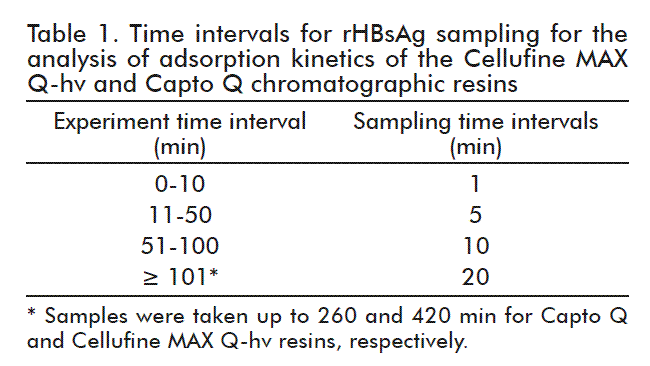
<body><![CDATA[<P   ><font size="2" face="Verdana, Arial, Helvetica, sans-serif">Two CVs of the regeneration      solution corresponding to each resin were applied for this step (20 mmol/L      Tris- HCl, 3 mol/L KSCN, pH 7.6, for Cellufine Max Q-hv; 20 mmol/L Tris, 3      mmol/L EDTA, 2 mol/L NaCl, pH 7.2, for Capto Q). Chromatographic runs were      performed at a 0.04 L/h flow rate of. The Biocrom program (CIGB, Version 3.0)      was used for recording and acquiring the UV detector&rsquo;s signal, at a      wavelength of 280 nm. All runs were performed at room temperature (22 &plusmn;      1 &deg;C) and in triplicate for each resin. </font></P >       <P   ><font size="2" face="Verdana, Arial, Helvetica, sans-serif">The recovery of the      anion exchange chromatography was determined by using the following formula:      </font></P >       <P align="center"   ><font size="2" face="Verdana, Arial, Helvetica, sans-serif"><img src="img/revistas/bta/v34n3/fr0101317.gif" width="488" height="42">      </font></P >       <P   ><font size="2" face="Verdana, Arial, Helvetica, sans-serif">Where: </font></P >       <P   ><font size="2" face="Verdana, Arial, Helvetica, sans-serif">RIE: recovery from      the ion exchange step. </font></P >       <P   ><font size="2" face="Verdana, Arial, Helvetica, sans-serif">rHBsAgIE: mass of      rHBsAg in the eluate of the ion exchange chromatography. </font></P >   <FONT size="+1"><FONT size="+1">        <P   ><font size="2" face="Verdana, Arial, Helvetica, sans-serif">rHBsAgInput: mass      of rHBsAg applied to the ion exchange chromatography. </font></P >   <FONT size="+1"><FONT size="+1">        <P   ><font size="2" face="Verdana, Arial, Helvetica, sans-serif"><B>Determination      of adsorption kinetics </b></font></P >       <P   ><font size="2" face="Verdana, Arial, Helvetica, sans-serif">The adsorption kinetics      of the Cellufine MAX Q-hv and Capto Q chromatographic resins was determined      by considering 2 mg of rHBsAg/mL of gel to be adsorbed. For this, 25 mL of      each resin, previously equilibrated with a solution from the second equilibration      step, were added to a sample of 251 mL of protein material. The mixing process      was performed under agitation with a magnetic stirrer at a speed to keep the      chromatographic resin suspended while preventing the formation of a vortex      on the liquid surface. Sampling started once the resin was completely added,      with 1.5 mL-samples taken from the suspension at predefined time intervals      (<a href="/img/revistas/bta/v34n3/t0101317.gif">Table 1</a>) until the concentration of the adsorbent      in the liquid phase remained constant. </font></P >       
<P   ><font size="2" face="Verdana, Arial, Helvetica, sans-serif">Afterwards, samples      were centrifuged at 9390 &times; <I>g </I>for 1 min. The supernatant was used      to determine rHBsAg concentration by optical density (OD). The experiments      were performed in duplicate at a temperature of 22 &plusmn; 1 &deg;C. The      program CurvaExpert (version 1.3) was used to adjust the curves. </font></P >       ]]></body>
<body><![CDATA[<P   ><font size="2" face="Verdana, Arial, Helvetica, sans-serif"><b>Determination      of adsorption isotherm </b></font></P >       <P   ><font size="2" face="Verdana, Arial, Helvetica, sans-serif">Adsorption isotherms      were constructed for evaluating the adsorptive capacity of the Cellufine MAX      Q-hv and Capto Q resins. For this purpose, 13 reaction vials of 1.5 mL were      prepared, containing 0.4 mL of the chromatographic resin previously equilibrated      with the solution of the second equilibration step and a given calculated      volume of the protein material. The initial rHBsAg concentration ranged from      0.24 to 2.3 mg per milliliter of gel (0.8, 1.2, 1.6, 2.0, 2.4, 2.8, 3.2, 3.6,      4.0, 4.4, 6.0, 7.0 and 8.0 mg rHBsAg/mL gel). Vials were stirred in the bascule      stirrer, for the minimum contact time as previously determined in the adsorption      kinetics experiment. Afterwards, the reaction vials were centrifuged at 9391      &times; </font><i><font size="+1" color="#000000"><font size="+1"><font size="+1" color="#211E1F"><font size="+1" color="#000000"><font size="+1"><font size="+1" color="#211E1F"><font size="+1" color="#000000"><font size="+1"><font size="+1" color="#211E1F"><font size="+1"><font size="+1"><font size="+1"><font size="+1"><font size="+1"><font size="+1" color="#000000"><font size="+1" color="#211E1F"><font size="+1"><font size="+1"><font size="+1"><font size="+1" color="#000000"><font size="+1"><font size="+1" color="#211E1F"><font size="+1"><font size="+1"><font size="+1"><font size="+1"><font size="+1"><font size="+1"><font size="+1"><font size="+1"><font size="2" face="Verdana, Arial, Helvetica, sans-serif">g</font></font></font></font></font></font></font></font></font></font></font></font></font></font></font></font></font></font></font></font></font></font></font></font></font></font></font></font></font></font></font></i><font size="2" face="Verdana, Arial, Helvetica, sans-serif">      for 1 min. The supernatant was then collected for determining the rHBsAg concentration      by OD. </font></P >       <P   ><font size="2" face="Verdana, Arial, Helvetica, sans-serif">The final concentration      of the adsorbate was set as the solute concentration in the liquid phase in      equilibrium. The solute concentration in equilibrium in the solid phase was      determined by mass balance between the solid phase and the liquid phase. The      Statgraphics centurion XVI.II program was used to represent the adsorption      behavior. These experiments were performed in duplicate at 22 &plusmn; 1 &deg;C.      </font></P >       <P   ><font size="2" face="Verdana, Arial, Helvetica, sans-serif"><b>Determination      of gel breakthrough curve </b></font></P >       <P   ><font size="2" face="Verdana, Arial, Helvetica, sans-serif">The protein material      was applied to the chromatographic column packed either with Cellufine MAX      Q-hv or Capto Q resins until rHBsAg concentrations of the starting material      and the column effluent were the same. It was established from the chart obtained      that the breakthrough time corresponded to an output concentration/input concentration      ratio of 0.05. Likewise, saturation time was set as the time required for      the output concentration of the chromatographic bed to equal the input concentration.      </font></P >       <P   ><font size="2" face="Verdana, Arial, Helvetica, sans-serif"><b>Statistical analysis</b>      </font></P >       <P   ><font size="2" face="Verdana, Arial, Helvetica, sans-serif">The statistical analysis      was performed for a single factor using the Statgraphics Centurion XVI.II      program. Significance analysis was done by running an ANOVA F-test for a confidence      level of 95 %, with previous analysis of the normal distribution of the response      variable.</font></P >       <P   >&nbsp;</P >       <P   > </P >       <P   ><b><font size="2" face="Verdana, Arial, Helvetica, sans-serif">RESULTS AND DISCUSSION      </font></b></P >       ]]></body>
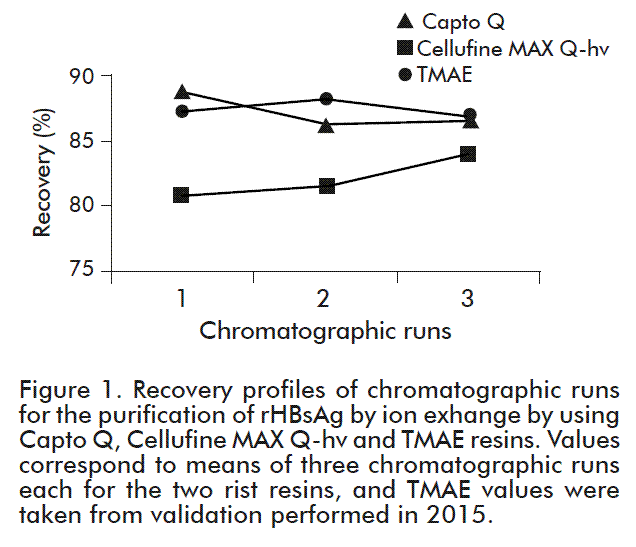
<body><![CDATA[<P   ><font size="2" face="Verdana, Arial, Helvetica, sans-serif"><b>Assessment of      the anion exchange step for Cellufine MAX Q-hv, Capto Q and TMAE chromatographic      resins </b></font></P >       <P   ><font size="2" face="Verdana, Arial, Helvetica, sans-serif">The protein material      eluted from an anion exchange step during the industrial scale purification      of proteins is of high added value, due to the high purity attained. Therefore,      recovery is an essential parameter for productivity assessment during the      technological process and a control parameter during the purification of the      rHBsAg at industrial scale. In this regard, the lower control limit for recovery      of rHBsAg after TMAE anion exchange in the established industrial process      is set at 65 %, according to SOP 2.02.630.91 [21]. Thus, it was first determined      rHBsAg recovery by using Cellufine MAX Q-hv and Capto Q chromatographic matrices.      </font></P >       <P   ><font size="2" face="Verdana, Arial, Helvetica, sans-serif">Recovery values for      these two resins are shown in <a href="/img/revistas/bta/v34n3/f0101317.gif">figure 1</a>, corresponding      to three chromatographic runs each, together with the value of rHBsAg recovery      obtained by using the TMAE resin during validation as performed in 2015 (87.48      &plusmn; 0.6 %). Mean values of recovered samples were: 82.07 &plusmn; 1.76      % for Cellufine MAX Q-hv and 87.16 &plusmn; 1.34 % Capto Q. As can be observed,      these values are far above the standard lower limit set for the industrial      process (65 %), even for TMAE (<a href="/img/revistas/bta/v34n3/f0101317.gif">Figure 1</a>). </font></P >       
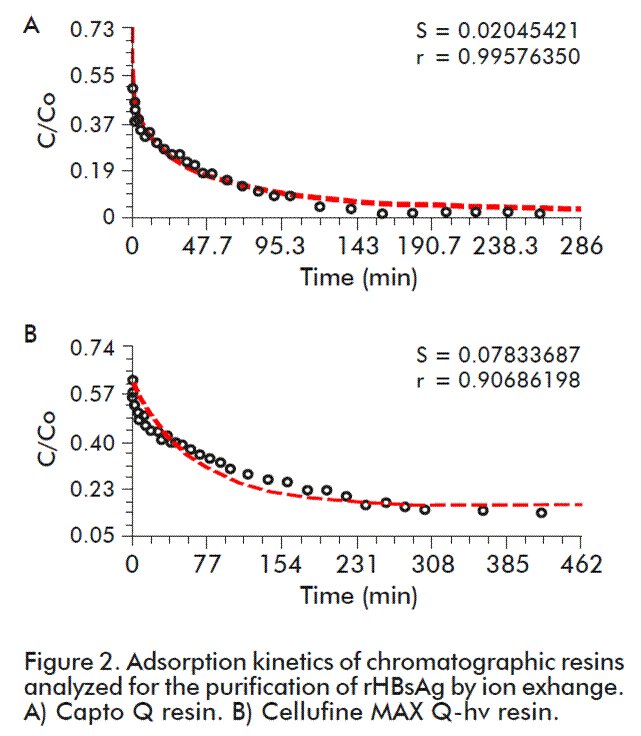
<P   ><font size="2" face="Verdana, Arial, Helvetica, sans-serif">The multiple-range      test showed statistically significant differences between the recoveries of      Cellufine MAX Q-hv and Capto Q resins, the latter having the highest mean      recovery of rHBsAg. There were also no statistically significant differences      between the recovery obtained for Capto Q and that of the TMAE resin (industrial      process). Hence, attending only to this parameter, the Capto Q resin would      be the best substitute of the TMAE resin. However, the Cellufine MAX Q-hv      resin also complies with the required recovery value as established for the      indus-trial process. </font></P >       <P   ><font size="2" face="Verdana, Arial, Helvetica, sans-serif"><b>Adsorption kinetics      </b> </font></P >       <P   ><font size="2" face="Verdana, Arial, Helvetica, sans-serif">The adsorption kinetics      describes the adsorption rate of the adsorbate in the adsorbent and determines      the time at which equilibrium is reached. For this, it was represented the      ratio between the final and initial concentrations (C/Co) of the rHBsAg in      the adsorbate against the adsorption time (t). Samples were run in duplicate      for each resin [22]. </font></P >       <P   ><font size="2" face="Verdana, Arial, Helvetica, sans-serif">As shown in <a href="/img/revistas/bta/v34n3/f0201317.gif">figure      2</a>, the adsorption kinetics of rHBsAg for both resins followed the same      profile. For Cellufine MAX Q-hv, C/Co ratio slowly decreased from 1 down to      0.15, lasting nearly 300 min to reach the equilibrium state of the resin and      remaining constant afterwards at 0.15. It was estimated that a contact time      between the rHBsAg and the gel around of about 5 h are required to saturate      the chromatographic resin. In the case of Capto Q resin, the C/Co ratio also      declined starting at 1 until reaching the equilibrium state at 0.03, but in      about 200 min, faster than for Cellufine MAX Q-hv. Thus, it takes about 4      h to saturate the resin with the rHBsAg resin. Consequently, attending to      the shorter contact time required to saturate the resin, the Capto Q resin      is more advantageous than Cellufine MAX Q-hv. </font></P >       
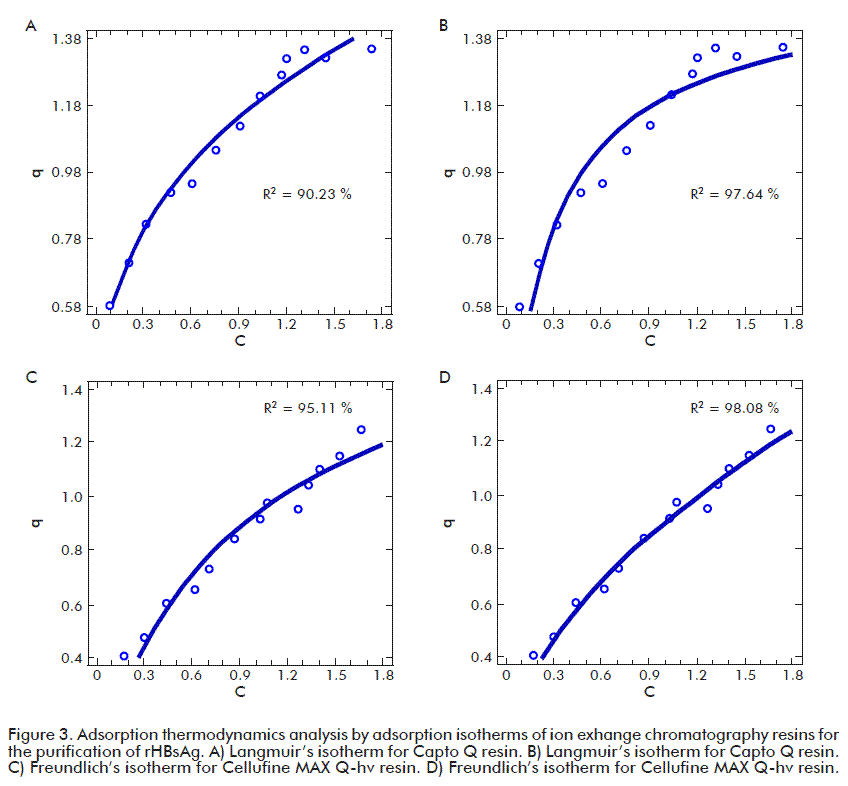
<P   ><font size="2" face="Verdana, Arial, Helvetica, sans-serif"><b>Adsorption thermodynamics      analysis by adsorption isotherms </b></font></P >       <P   ><font size="2" face="Verdana, Arial, Helvetica, sans-serif">Isotherms were performed      with samples of pure adsorbate at a high concentration. Langmuir and Freundlich&rsquo;s      models were established to describe the amount of solute adsorbed by adsorbent      (q) and solute concentration in solution (C) [23-25]. Both types of models      are shown in <a href="/img/revistas/bta/v34n3/f0301317.gif">Figure 3</a>. These models were adjusted      using nonlinear regression models by the Marquardt estimation method. </font></P >       
<P   ><font size="2" face="Verdana, Arial, Helvetica, sans-serif"><I><b>Capto Q resin      </b> </I> </font></P >       ]]></body>
<body><![CDATA[<P   ><font size="2" face="Verdana, Arial, Helvetica, sans-serif">Langmuir and Freundlich&rsquo;s      models showed R<sup>2</sup> values of 90.23 and 97.64 %, and standard deviation      of the residues of 0.0848 and 0.04173, respectively (<a href="/img/revistas/bta/v34n3/f0301317.gif">Figure      3 A and B</a>). Although Freundlich&rsquo;s model had a better fit, it has      as limitation that it does not predict saturation of the adsorption surface      and the equation that describes its performance is mainly empirical. On the      other hand, Langmuir&rsquo;s equation allows determining the maximum adsorption      capacity (q* <sub>max</sub>) and the rHBsAg association constant (K<sub>A</sub>)      for the resin. This model is supported by an equation with theoretical basis,      also including several considerations for its application, such as: monolayer      and reversible adsorption, homogeneous adsorption surface and the lack of      interaction between the adsorbed molecules. It is reported in literature that      Langmuir&rsquo;s isotherm is an excellent approximation to the adsorption      equilibrium of a single component and it is recommended its application when      there is a strong specific interaction between the </font><font size="2" face="Verdana, Arial, Helvetica, sans-serif">solute      and the adsorbent to be studied. In this regard, the ion exchange and affinity      adsorption processes can generally be described by the Langmuir&rsquo;s isotherm      [25]. The adjusted model equation resulted in: </font></P >   <FONT size="+1"><FONT size="+1"><FONT size="+1"><FONT size="+1"><FONT size="+1"><FONT size="+1">        
<P align="center"   ><font size="2" face="Verdana, Arial, Helvetica, sans-serif"><img src="img/revistas/bta/v34n3/fr0201317.gif" width="561" height="176">      </font></P >       <P   ><font size="2" face="Verdana, Arial, Helvetica, sans-serif">There were found      qmax and KA values of 1.514 mg HBsAg/mL resin and 3.952mL/mg, respectively,      by comparing the model with the equation. </font></P >   <FONT size="+1"><FONT size="+1"><FONT size="+1"><FONT size="+1">        <P   ><font size="2" face="Verdana, Arial, Helvetica, sans-serif"><I><b>Cellufine MAX      Q-hv Resin </b></I> </font></P >       <P   ><font size="2" face="Verdana, Arial, Helvetica, sans-serif"><a href="/img/revistas/bta/v34n3/f0301317.gif">Figures      3C and 3D</a> show Langmuir and Freundlich&rsquo;s adjusted models, respectively,      to describe the interaction between q and C. These models were fitted using      nonlinear regression models. Langmuir and Freundlich&rsquo;s models show R<sub>2</sub>      values of 95.11 and 98.08 %, respectively, and standard deviation of the residues      of 0.0609 and 0.0382. As for the Capto Q resin, the Freundlich&rsquo;s model      had a better fit. Nevertheless, Langmuir&rsquo;s model was selected to determine      q<sub>max</sub> and K<sub>A</sub>, since the Freundlich&rsquo;s model is unable      to predict the saturation of the adsorption surface. The equation of the adjusted      model resulted in: </font></P >   <FONT size="+1"><FONT size="+1"><FONT size="+1"><FONT size="+1">        
<P align="center"   ><font size="2" face="Verdana, Arial, Helvetica, sans-serif"><img src="img/revistas/bta/v34n3/fr0301317.gif" width="496" height="136">      </font></P >       <P   ><font size="2" face="Verdana, Arial, Helvetica, sans-serif">From this equation      q<sub>max</sub> and K<sub>A</sub> were obtained, with values of 1.854 mg HBsAg/mL      resin and 1.014 mL/mg, respectively. </font></P >   <FONT size="+1"><FONT size="+1">        <P   ><font size="2" face="Verdana, Arial, Helvetica, sans-serif">The Capto Q resin      had an binding association constant 3.9 times higher than the Cellufine MAX      Q-hv resin. The highest KA value for the Capto Q resin matched the shorter      time required to reach equilibrium in kinetic studies, since K<sub>A</sub>      is the ratio between the adsorption and desorption reactions rate constants.      Additionally, the maximum adsorption capacities showed similar values for      both chromatographic matrices. </font></P >   <FONT size="+1"><FONT size="+1"><FONT size="+1"><FONT size="+1">        <P   ><font size="2" face="Verdana, Arial, Helvetica, sans-serif">From the theoretical      physico-chemical point of view, a determination of adsorption isotherm requires      its realization in a thermodynamic equilibrium state, which is more rigorously      guaranteed in batch or stationary conditions, once the adsorption kinetics      has been studied, to establish the time necessary to achieve the equilibrium      state. Nevertheless, stationary do not fully resemble all the operating conditions      in which the purification process is performed, since they provide a large      specific surface and, therefore, the maximum possibility of adsorption. Besides,      it can be considered that the flow is null, a condition that unmet in a column.      Yet, Guiochon <I>et al</I>. showed that when the experiments are performed      correctly, the isotherms obtained by stationary and frontal methods yield      comparable results [25]. </font></P >       <P   ><font size="2" face="Verdana, Arial, Helvetica, sans-serif">The good fit of the      Langmuir model allows considering that a homogeneous monolayer adsorption      occurs. On the other hand, the K<sub>A</sub> value obtained for both resins      meet the criterion reported by Kumar <I>et al</I>. [26], according to which      the dissociation constant (the inverse of the association constant) for ion      exchange resins must have values in the range 10<sup>-8</sup>-10<sup>-4</sup>      mol/L. Given the molar mass reported for rHBsAg [27, 28], these values corresponded      to 1.04 &times; 10<sup>-7</sup> mol/L and 4.1 &times; 10<sup>-7</sup> mol/L      for Capto Q and Cellufine MAX Q-hv, respectively. </font></P >   <FONT size="+1"><FONT size="+1"><FONT size="+1"><FONT size="+1"><FONT size="+1"><FONT size="+1"><FONT size="+1"><FONT size="+1"><FONT size="+1"><FONT size="+1">        ]]></body>
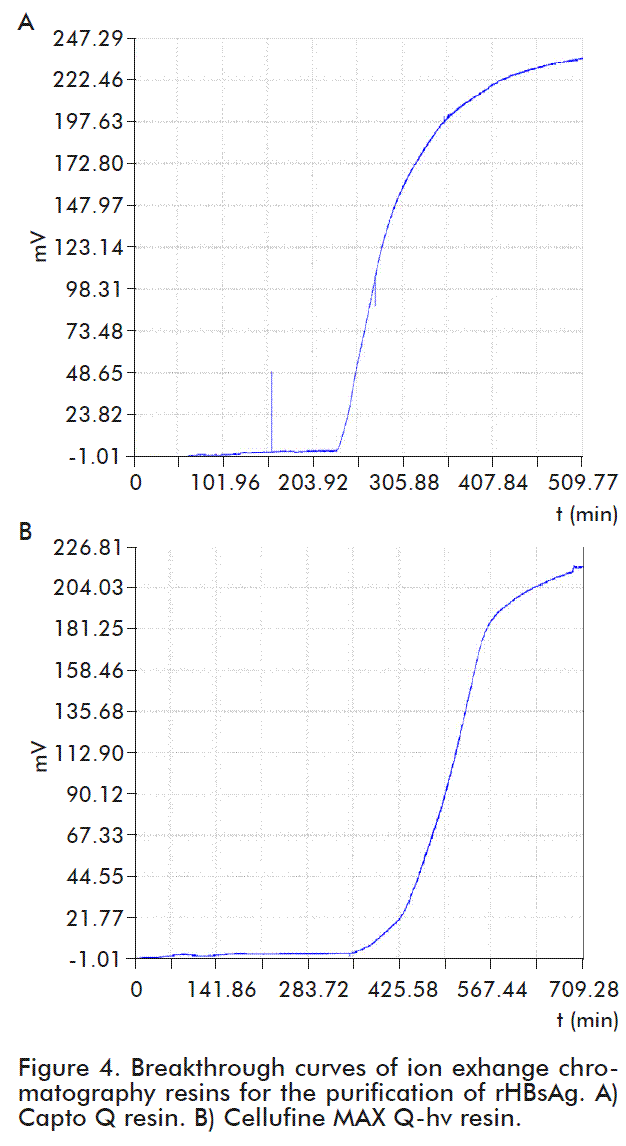
<body><![CDATA[<P   ><font size="2" face="Verdana, Arial, Helvetica, sans-serif"><b>Determination      of the dynamic capacity of resins </b></font></P >       <P   ><font size="2" face="Verdana, Arial, Helvetica, sans-serif">The dynamic adsorption      capacity of the Cellufine MAX Q-hv and Capto Q chromatographic resins was      determined by obtaining the breakthrough curve of each matrix. This experiment      was aimed to determine how the concentration of solute varies over time at      the chromatography outlet. The residence time of the adsorbate in the adsorbent      was set to 0.7 h, equal to that used in the industrial process. The dynamic      capacity or useful capacity of the chromatographic bed (q) was determined      assuming as 0.05 the C/Co criterion at the bed outlet (breakthrough point      determination) [11, 29]. The breakthrough curves obtained for the Cellufine      MAX Q-hv and Capto Q chromatographic resins are similar to each other (<a href="/img/revistas/bta/v34n3/f0401317.gif">Figure      4</a>). The mass transfer zone for both resins is relatively narrow. </font></P >       
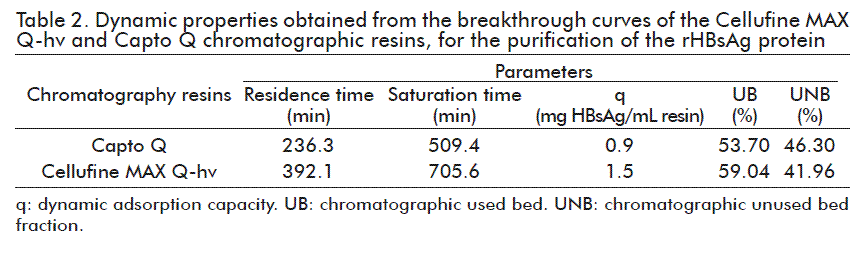
<P   ><font size="2" face="Verdana, Arial, Helvetica, sans-serif">The dynamic properties      obtained from the breakthrough curves for both resins are shown in <a href="/img/revistas/bta/v34n3/t0201317.gif">Table      2</a>. The adsorption capacity of Cellufine MAX Q-hv resin (1.5 mg rHBsAg/mL      of resin) was higher than that obtained for Capto Q resin (0.9 mg rHBsAg/mL      of resin). These values are approximately 100 times lower than those reported      by manufacturers for BSA model ratings. Even though the matrix exclusion limits      are not available, when comparing the molar masses of rHBsAg (2400 kDa, theoretical      value calculated for the original native viral particle of HBV consists of      100 monomers) [30] and BSA (66.38 kDa), shows that the former is 36 times      greater than the second. Therefore, this difference in the dynamic capacity      can be explained by considering that the rHBsAg molecule purified as a virus-like      particle does not diffuse into the pore, thereby, the surface effective for      the adsorption is significantly reduced. Cellufine MAX Q-hv breakthrough times      are higher than those obtained for the Capto Q matrix. The bed fraction used      (UBF) for Cellufine MAX Q-hv and Capto Q resins showed values of 59.04 and      53.7 %, respectively (<a href="/img/revistas/bta/v34n3/t0201317.gif">Table 2</a>). </font></P >       
<P   ><font size="2" face="Verdana, Arial, Helvetica, sans-serif">Overall, under the      operating conditions described for this experiment, more than 40 % of the      chromatographic bed for both resins is not being used efficiently. This indicates      it would be possible to find new operating conditions that increase efficiency      in the use of the column. </font></P >       <P   ><font size="2" face="Verdana, Arial, Helvetica, sans-serif">According to the      results of the <a href="/img/revistas/bta/v34n3/t0201317.gif">table</a>, the greater dynamic capacity      achieved for the Cellufine MAX Q-hv resin would lead to the use of a smaller      volume of resin to process the same amount of rHBsAg, at a higher bed usage.      These aspects would be advantage for this resin, if the useful life times      of both were similar. This point required further investigation. </font></P >       
<P   >&nbsp;</P >       <P   > </P >   <FONT size="+1" color="#000000">        <P   ><font size="3" face="Verdana, Arial, Helvetica, sans-serif"><b>CONCLUSIONS </b></font></P >       <P   ><font size="2" color="#211E1F" face="Verdana, Arial, Helvetica, sans-serif">The      chromatographic resins studied showed rHBsAg recoveries above the lower limit      of industrial process control. There were statistically significant differences      between the recovery values of both commercial Cellufine MAX Q-hv and Capto      Q resins, with the Capto Q matrix showing the highest protein recovery (87.16      %). Their binding association constants were 1.014 for Cellufine MAX Q-hv      and 3.952 mL/mg for Capto Q, with similar maximum adsorption capacities, 1.85      and 1.51 mg HBsAg/mL of resin, respectively. Conversely, the Cellufine MAX      resin Q-hv displayed the highest dynamic adsorption capacity (1.5 mg rHBsAg/mL      of resin) as compared to Capto Q (0.9 mg rHBsAg/mL of resin). Overall, these      results support the replacement of the TMAE matrix by one of these two new      anion exchange matrices for the purification of the rHBsAg at industrial scale.      The choice will depend on the design and performance of the implemented purification      process. </font></P >       <P   >&nbsp;</P >   <FONT size="+1" color="#211E1F">        ]]></body>
<body><![CDATA[<P   > </P >       <P   ><font size="3"><b><font face="Verdana, Arial, Helvetica, sans-serif">REFERENCES      </font></b></font></P >       <P   > </P >   <FONT size="+1" color="#000000">        <!-- ref --><P   ><font size="2" color="#211E1F" face="Verdana, Arial, Helvetica, sans-serif">1.      Trepo C, Chan HL, Lok A. Hepatitis B virus infection. Lancet. 2014;384(9959):2053-63.          </font></P >   <FONT size="+1" color="#211E1F">        <P   ><font size="2" face="Verdana, Arial, Helvetica, sans-serif">2. Organizaci&oacute;n      Mundial de la Salud. Nota descriptiva #204, Hepatitis B. OMS, Julio 2015.      </font></P >       <P   ><font size="2" face="Verdana, Arial, Helvetica, sans-serif">3. Flaquet PP. Aportes      a la evaluaci&oacute;n de la vacuna recombinante cubana contra la hepatitis      B. CubaEditorial universitaria; 2009. </font></P >       <!-- ref --><P   ><font size="2" face="Verdana, Arial, Helvetica, sans-serif">4. Franco E, Bagnato      B, Marino MG, Meleleo C, Serino L, Zaratti L. Hepatitis B: Epidemiology and      prevention in developing countries. World J Hepatol. 2012;4(3):74-80.     </font></P >       <!-- ref --><P   ><font size="2" face="Verdana, Arial, Helvetica, sans-serif">5. Aguilar A, Gonz&aacute;lez      CA, Cinza Z, Cabrera J, Veliz G, Moreno SR, <I>et al</I>. Phase I clinical      trial in healthy adults of a nasal vaccine candidate containing recombinant      hepatitis B surface and core antigens. Int J Infect Dis. 2007;11:394-401.          </font></P >       <!-- ref --><P   ><font size="2" face="Verdana, Arial, Helvetica, sans-serif">6. Al-Mahtab M, Akbar      SM, Aguilar JC, Uddin MH, Khan MS, Rahman S. Therapeutic potential of a combined      hepatitis B virus surface and core antigen vaccine in patients with chronic      hepatitis B. Hepatol Int 2013;7:981-9.     </font></P >       <P   ><font size="2" face="Verdana, Arial, Helvetica, sans-serif">7. Mart&iacute;nez      E, Exp&oacute;sito N, Muzio V, Vega JL, Herrera-Mart&iacute;nez L. Desarrollo      de vacunas combinadas. In: Rojas Ochoa F, editor. Vacunas. Cuba 1959-2008.      La Habana: Editorial Ciencias M&eacute;dicas; 2011. p. 185-90. </font></P >       <!-- ref --><P   ><font size="2" face="Verdana, Arial, Helvetica, sans-serif">8. Doran PM. Bioprocess      engineering principles. Amsterdam: Elsevier Science &amp; Technology Books;      1995.     </font></P >       <!-- ref --><P   ><font size="2" face="Verdana, Arial, Helvetica, sans-serif">9. Scopes RK. Protein      purification: principles and practice. Dordrecht: Springer Science &amp; Business      Media; 2013.     </font></P >       <P   ><font size="2" face="Verdana, Arial, Helvetica, sans-serif">10. Gu T. Mathematical      modeling and scale-up of liquid chromatography: With application examples.      Springer; 2015. </font></P >       <!-- ref --><P   ><font size="2" face="Verdana, Arial, Helvetica, sans-serif">11. Hagel L, Jagschies      G, Sofer G. Handbook of process chromatography. The Netherlands: Academic      Press; 2008.     </font></P >       <!-- ref --><P   ><font size="2" face="Verdana, Arial, Helvetica, sans-serif">12. Asenjo JA, Andrews      BA. Protein purification using chromatography: selection of type, modelling      and optimization of operating conditions. J Mol Recognit. 2009;22(2):65-76.          </font></P >       <!-- ref --><P   ><font size="2" face="Verdana, Arial, Helvetica, sans-serif">13. Fekete S, Beck      A, Veuthey JL, Guillarme D. Ion-exchange chromatography for the characterization      of biopharmaceuticals. J Pharm Biomed Anal. 2015;113:43-55.     </font></P >       <!-- ref --><P   ><font size="2" face="Verdana, Arial, Helvetica, sans-serif">14. Foo K, Hameed      B. Insights into the modeling of adsorption isotherm systems. Chem Eng J.      2010;156(1):2-10.     </font></P >       <!-- ref --><P   ><font size="2" face="Verdana, Arial, Helvetica, sans-serif">15. Hagel L, Jagschies      G, Sofer G. Handbook of process chromatography: development, manufacturing,      validation and economics. London: Academic Press; 2008.     </font></P >       <!-- ref --><P   ><font size="2" face="Verdana, Arial, Helvetica, sans-serif">16. Bergander T,      Nilsson-Valimaa K, Oberg K, Lacki KM. High-throughput process development:      determination of dynamic binding capacity using microtiter filter plates filled      with chromatography resin. Biotechnol Prog. 2008;24(3):632-9.     </font></P >       <!-- ref --><P   ><font size="2" face="Verdana, Arial, Helvetica, sans-serif">17. Madruga YA Cromatograf&iacute;a      de Intercambio I&oacute;nico (1). PPO 2.02.610.91 CIGB. 2015.     </font></P >       <!-- ref --><P   ><font size="2" face="Verdana, Arial, Helvetica, sans-serif">18. Madruga YA. Cromatografia      de Afinidad con Anticuerpos Monoclonales anti- HBsAg. PPO 2.02.615.91. CIGB.      2016.     </font></P >       <!-- ref --><P   ><font size="2" face="Verdana, Arial, Helvetica, sans-serif">19. Madruga YA. Determinaci&oacute;n      de absorbancia como control de proceso de la etapa de purificaci&oacute;n      del r-HBsAg. PPO 2.02.622.91 CIGB; 2008.     </font></P >       <!-- ref --><P   ><font size="2" face="Verdana, Arial, Helvetica, sans-serif">20. Smith I. Chromatography.      The Netherlands Elsevier; 2013.     </font></P >       <!-- ref --><P   ><font size="2" face="Verdana, Arial, Helvetica, sans-serif">21. Madruga YA Cromatograf&iacute;a      de intercambio i&oacute;nico positivo. PPO 2.02.630.91 CIGB; 2008.     </font></P >       <!-- ref --><P   ><font size="2" face="Verdana, Arial, Helvetica, sans-serif">22. Rathore A, Krishnan      R, Tozer S, Smiley D Rausch S, Seely J. Scaling down of biopharmaceutical      unit operations: Part 2: Chromatography and filtration. Biopharm International.      2005;18(4):58-64.     </font></P >       <!-- ref --><P   ><font size="2" face="Verdana, Arial, Helvetica, sans-serif">23. Nugent P, Belmabkhout      Y, Burd SD, Cairns AJ, Luebke R, Forrest K, <I>et al</I>. Porous materials      with optimal adsorption thermodynamics and kinetics for CO2 separation. Nature.      2013;495(7439):80-4.     </font></P >   <FONT size="+1"><FONT size="+1">        <!-- ref --><P   ><font size="2" face="Verdana, Arial, Helvetica, sans-serif">24. Tang H, Zhou      W, Zhang L. Adsorption isotherms and kinetics studies of malachite green on      chitin hydrogels. J Hazard Mater. 2012;209-210:218-25.     </font></P >       <!-- ref --><P   ><font size="2" face="Verdana, Arial, Helvetica, sans-serif">25. Guiochon G, Felinger      A, Shirazi D, Katti A. Fundamentals of preparatives and nonlinear chromatography.      The Netherlands: Elsevier Academic Press; 2006.     </font></P >       <!-- ref --><P   ><font size="2" face="Verdana, Arial, Helvetica, sans-serif">26. Kumar P, Lau      PW, Kale S, Johnson S, Pareek V, Utikar R, <I>et al</I>. Kafirin adsorption      on ion-exchange resins: isotherm and kinetic studies. J Chromatogr A. 2014;1356:105-16.          </font></P >       <P   ><font size="2" face="Verdana, Arial, Helvetica, sans-serif">27. Dom&iacute;nguez      P. Evaluaci&oacute;n de las resinas cromatogr&aacute;ficas Cellufine MAX Q-h,      MAX Q-hv, Capto Q ImpRes y Capto Q en la purificaci&oacute;n del r-HBsAg.      Tesis de Maestr&iacute;a en Ingenier&iacute;a de los procesos biotecnol&oacute;gicos:      Universidad Tecnol&oacute;giga de La Habana; 2016. </font></P >       <P   ><font size="2" face="Verdana, Arial, Helvetica, sans-serif">28. Yan L, Jinxiu      B,Weibin Z, Yongdong H, Lijing S, An-Ping Z, <I>et.al</I>. Characterization      of the large size aggregation of Hepatitis B surface antigen (HBsAg) formed      in ultrafilration process. Process Biochemestry. 2007;42:315-9. </font></P >       <!-- ref --><P   ><font size="2" face="Verdana, Arial, Helvetica, sans-serif">29. Ghosh R. Principles      of bioseparations engineering. Singapore: World Scientific; 2006.     </font></P >       <!-- ref --><P   ><font size="2" face="Verdana, Arial, Helvetica, sans-serif">30. Agraz A, Quinones      Y, Exposito N, Brena F, Madruga J, Penton E, et al. Adsorption-desorption      of recombinant hepatitis B surface antigen (r-HBsAg) from <I>P. pastoris </I>on      a diatomaceous earth matrix: Optimization of parameters for purification.      Biotechnol Bioeng. 1993;42(10):1238-44.     </font></P >       <P   >&nbsp;</P >       <P   >&nbsp;</P >   <FONT size="+1">        <P   ><font size="2" face="Verdana, Arial, Helvetica, sans-serif">Received in August,      2016.     ]]></body>
<body><![CDATA[<br>     Accepted in April, 2017.</font></P >       <P   >&nbsp;</P >       <P   >&nbsp;</P >       <P   > </P >   <FONT size="+1" color="#000000">        <P   > </P >   <FONT size="+1">        <P   ><font size="2" color="#211E1F" face="Verdana, Arial, Helvetica, sans-serif"><I>Pedro      Dom&iacute;nguez Ald&aacute;s</I>. Centro de Ingenier&iacute;a Gen&eacute;tica      y Biotecnolog&iacute;a, Ave 31 e/ 158 y 190, Cubanac&aacute;n, Playa, CP 11600,      La Habana, Cuba. E-mail: <A href="mailto:pedro.dominguez@cigb.edu.cu"> <FONT color="#0000FF">pedro.dominguez@cigb.edu.cu</font></A><FONT color="#0000FF">.</font></font></P >   </font></font></font></font></font></font></font></font></font></font></font></font></font></font></font></font></font></font></font></font></font></font></font></font></font></font></font></font></font></font></font></font></font></font></font></font></font></font></font></font></font></font></font></font></font></font></font></font></font></font></font></font></font></font></font></font></font></font></font></font></font></font></font></font></font></font></font></font></font></DIV >      ]]></body><back>
<ref-list>
<ref id="B1">
<label>1</label><nlm-citation citation-type="journal">
<person-group person-group-type="author">
<name>
<surname><![CDATA[Trepo]]></surname>
<given-names><![CDATA[C]]></given-names>
</name>
<name>
<surname><![CDATA[Chan]]></surname>
<given-names><![CDATA[HL]]></given-names>
</name>
<name>
<surname><![CDATA[Lok]]></surname>
<given-names><![CDATA[A]]></given-names>
</name>
</person-group>
<article-title xml:lang="en"><![CDATA[Hepatitis B virus infection]]></article-title>
<source><![CDATA[Lancet]]></source>
<year>2014</year>
<volume>384</volume>
<numero>9959</numero>
<issue>9959</issue>
<page-range>2053-63</page-range></nlm-citation>
</ref>
<ref id="B2">
<label>2</label><nlm-citation citation-type="book">
<collab>Organización Mundial de la Salud</collab>
<source><![CDATA[Nota descriptiva #204, Hepatitis B]]></source>
<year>Juli</year>
<month>o,</month>
<day> 2</day>
<publisher-loc><![CDATA[Geneva ]]></publisher-loc>
<publisher-name><![CDATA[OMS]]></publisher-name>
</nlm-citation>
</ref>
<ref id="B3">
<label>3</label><nlm-citation citation-type="book">
<person-group person-group-type="author">
<name>
<surname><![CDATA[Flaquet]]></surname>
<given-names><![CDATA[PP]]></given-names>
</name>
</person-group>
<source><![CDATA[Aportes a la evaluación de la vacuna recombinante cubana contra la hepatitis B]]></source>
<year>2009</year>
<publisher-loc><![CDATA[La Habana ]]></publisher-loc>
<publisher-name><![CDATA[Editorial universitaria]]></publisher-name>
</nlm-citation>
</ref>
<ref id="B4">
<label>4</label><nlm-citation citation-type="journal">
<person-group person-group-type="author">
<name>
<surname><![CDATA[Franco]]></surname>
<given-names><![CDATA[E]]></given-names>
</name>
<name>
<surname><![CDATA[Bagnato]]></surname>
<given-names><![CDATA[B]]></given-names>
</name>
<name>
<surname><![CDATA[Marino]]></surname>
<given-names><![CDATA[MG]]></given-names>
</name>
<name>
<surname><![CDATA[Meleleo]]></surname>
<given-names><![CDATA[C]]></given-names>
</name>
<name>
<surname><![CDATA[Serino]]></surname>
<given-names><![CDATA[L]]></given-names>
</name>
<name>
<surname><![CDATA[Zaratti]]></surname>
<given-names><![CDATA[L]]></given-names>
</name>
</person-group>
<article-title xml:lang="en"><![CDATA[Hepatitis B: Epidemiology and prevention in developing countries]]></article-title>
<source><![CDATA[World J Hepatol]]></source>
<year>2012</year>
<volume>4</volume>
<numero>3</numero>
<issue>3</issue>
<page-range>74-80</page-range></nlm-citation>
</ref>
<ref id="B5">
<label>5</label><nlm-citation citation-type="journal">
<person-group person-group-type="author">
<name>
<surname><![CDATA[Aguilar]]></surname>
<given-names><![CDATA[A]]></given-names>
</name>
<name>
<surname><![CDATA[González]]></surname>
<given-names><![CDATA[CA]]></given-names>
</name>
<name>
<surname><![CDATA[Cinza]]></surname>
<given-names><![CDATA[Z]]></given-names>
</name>
<name>
<surname><![CDATA[Cabrera]]></surname>
<given-names><![CDATA[J]]></given-names>
</name>
<name>
<surname><![CDATA[Veliz]]></surname>
<given-names><![CDATA[G]]></given-names>
</name>
<name>
<surname><![CDATA[Moreno]]></surname>
<given-names><![CDATA[SR]]></given-names>
</name>
</person-group>
<article-title xml:lang="en"><![CDATA[Phase I clinical trial in healthy adults of a nasal vaccine candidate containing recombinant hepatitis B surface and core antigens]]></article-title>
<source><![CDATA[Int J Infect Dis]]></source>
<year>2007</year>
<volume>11</volume>
<page-range>394-401</page-range></nlm-citation>
</ref>
<ref id="B6">
<label>6</label><nlm-citation citation-type="journal">
<person-group person-group-type="author">
<name>
<surname><![CDATA[Al-Mahtab]]></surname>
<given-names><![CDATA[M]]></given-names>
</name>
<name>
<surname><![CDATA[Akbar]]></surname>
<given-names><![CDATA[SM]]></given-names>
</name>
<name>
<surname><![CDATA[Aguilar]]></surname>
<given-names><![CDATA[JC]]></given-names>
</name>
<name>
<surname><![CDATA[Uddin]]></surname>
<given-names><![CDATA[MH]]></given-names>
</name>
<name>
<surname><![CDATA[Khan]]></surname>
<given-names><![CDATA[MS]]></given-names>
</name>
<name>
<surname><![CDATA[Rahman]]></surname>
<given-names><![CDATA[S]]></given-names>
</name>
</person-group>
<article-title xml:lang="en"><![CDATA[Therapeutic potential of a combined hepatitis B virus surface and core antigen vaccine in patients with chronic hepatitis B]]></article-title>
<source><![CDATA[Hepatol Int]]></source>
<year>2013</year>
<volume>7</volume>
<page-range>981-9</page-range></nlm-citation>
</ref>
<ref id="B7">
<label>7</label><nlm-citation citation-type="book">
<person-group person-group-type="author">
<name>
<surname><![CDATA[Martínez]]></surname>
<given-names><![CDATA[E]]></given-names>
</name>
<name>
<surname><![CDATA[Expósito]]></surname>
<given-names><![CDATA[N]]></given-names>
</name>
<name>
<surname><![CDATA[Muzio]]></surname>
<given-names><![CDATA[V]]></given-names>
</name>
<name>
<surname><![CDATA[Vega]]></surname>
<given-names><![CDATA[JL]]></given-names>
</name>
<name>
<surname><![CDATA[Herrera-Martínez]]></surname>
<given-names><![CDATA[L]]></given-names>
</name>
</person-group>
<article-title xml:lang="en"><![CDATA[Desarrollo de vacunas combinadas]]></article-title>
<person-group person-group-type="editor">
<name>
<surname><![CDATA[Rojas Ochoa]]></surname>
<given-names><![CDATA[F]]></given-names>
</name>
</person-group>
<source><![CDATA[Vacunas. Cuba 1959-2008]]></source>
<year>2011</year>
<page-range>185-90</page-range><publisher-loc><![CDATA[La Habana ]]></publisher-loc>
<publisher-name><![CDATA[Editorial Ciencias Médicas]]></publisher-name>
</nlm-citation>
</ref>
<ref id="B8">
<label>8</label><nlm-citation citation-type="book">
<person-group person-group-type="author">
<name>
<surname><![CDATA[Doran]]></surname>
<given-names><![CDATA[PM]]></given-names>
</name>
</person-group>
<source><![CDATA[Bioprocess engineering principles]]></source>
<year>1995</year>
<publisher-loc><![CDATA[Amsterdam ]]></publisher-loc>
<publisher-name><![CDATA[Elsevier Science & Technology Books]]></publisher-name>
</nlm-citation>
</ref>
<ref id="B9">
<label>9</label><nlm-citation citation-type="book">
<person-group person-group-type="author">
<name>
<surname><![CDATA[Scopes]]></surname>
<given-names><![CDATA[RK]]></given-names>
</name>
</person-group>
<source><![CDATA[Protein purification: principles and practice]]></source>
<year>2013</year>
<publisher-loc><![CDATA[Dordrecht ]]></publisher-loc>
<publisher-name><![CDATA[Springer Science & Business Media]]></publisher-name>
</nlm-citation>
</ref>
<ref id="B10">
<label>10</label><nlm-citation citation-type="book">
<person-group person-group-type="author">
<name>
<surname><![CDATA[Gu]]></surname>
<given-names><![CDATA[T]]></given-names>
</name>
</person-group>
<source><![CDATA[Mathematical modeling and scale-up of liquid chromatography: With application examples]]></source>
<year>2015</year>
<publisher-loc><![CDATA[Dordrecht ]]></publisher-loc>
<publisher-name><![CDATA[Springer]]></publisher-name>
</nlm-citation>
</ref>
<ref id="B11">
<label>11</label><nlm-citation citation-type="book">
<person-group person-group-type="author">
<name>
<surname><![CDATA[Hagel]]></surname>
<given-names><![CDATA[L]]></given-names>
</name>
<name>
<surname><![CDATA[Jagschies]]></surname>
<given-names><![CDATA[G]]></given-names>
</name>
<name>
<surname><![CDATA[Sofer]]></surname>
<given-names><![CDATA[G]]></given-names>
</name>
</person-group>
<source><![CDATA[Handbook of process chromatography]]></source>
<year>2008</year>
<publisher-loc><![CDATA[The Netherlands ]]></publisher-loc>
<publisher-name><![CDATA[Academic Press]]></publisher-name>
</nlm-citation>
</ref>
<ref id="B12">
<label>12</label><nlm-citation citation-type="journal">
<person-group person-group-type="author">
<name>
<surname><![CDATA[Asenjo]]></surname>
<given-names><![CDATA[JA]]></given-names>
</name>
<name>
<surname><![CDATA[Andrews]]></surname>
<given-names><![CDATA[BA]]></given-names>
</name>
</person-group>
<article-title xml:lang="en"><![CDATA[Protein purification using chromatography: selection of type, modelling and optimization of operating conditions]]></article-title>
<source><![CDATA[J Mol Recognit]]></source>
<year>2009</year>
<volume>22</volume>
<numero>2</numero>
<issue>2</issue>
<page-range>65-76</page-range></nlm-citation>
</ref>
<ref id="B13">
<label>13</label><nlm-citation citation-type="journal">
<person-group person-group-type="author">
<name>
<surname><![CDATA[Fekete]]></surname>
<given-names><![CDATA[S]]></given-names>
</name>
<name>
<surname><![CDATA[Beck]]></surname>
<given-names><![CDATA[A]]></given-names>
</name>
<name>
<surname><![CDATA[Veuthey]]></surname>
<given-names><![CDATA[JL]]></given-names>
</name>
<name>
<surname><![CDATA[Guillarme]]></surname>
<given-names><![CDATA[D]]></given-names>
</name>
</person-group>
<article-title xml:lang="en"><![CDATA[Ion-exchange chromatography for the characterization of biopharmaceuticals]]></article-title>
<source><![CDATA[J Pharm Biomed Anal]]></source>
<year>2015</year>
<volume>113</volume>
<page-range>43-55</page-range></nlm-citation>
</ref>
<ref id="B14">
<label>14</label><nlm-citation citation-type="journal">
<person-group person-group-type="author">
<name>
<surname><![CDATA[Foo]]></surname>
<given-names><![CDATA[K]]></given-names>
</name>
<name>
<surname><![CDATA[Hameed]]></surname>
<given-names><![CDATA[B]]></given-names>
</name>
</person-group>
<article-title xml:lang="en"><![CDATA[Insights into the modeling of adsorption isotherm systems]]></article-title>
<source><![CDATA[Chem Eng J]]></source>
<year>2010</year>
<volume>156</volume>
<numero>1</numero>
<issue>1</issue>
<page-range>2-10</page-range></nlm-citation>
</ref>
<ref id="B15">
<label>15</label><nlm-citation citation-type="book">
<person-group person-group-type="author">
<name>
<surname><![CDATA[Hagel]]></surname>
<given-names><![CDATA[L]]></given-names>
</name>
<name>
<surname><![CDATA[Jagschies]]></surname>
<given-names><![CDATA[G]]></given-names>
</name>
<name>
<surname><![CDATA[Sofer]]></surname>
<given-names><![CDATA[G]]></given-names>
</name>
</person-group>
<source><![CDATA[Handbook of process chromatography: development, manufacturing, validation and economics]]></source>
<year>2008</year>
<publisher-loc><![CDATA[London ]]></publisher-loc>
<publisher-name><![CDATA[Academic Press]]></publisher-name>
</nlm-citation>
</ref>
<ref id="B16">
<label>16</label><nlm-citation citation-type="journal">
<person-group person-group-type="author">
<name>
<surname><![CDATA[Bergander]]></surname>
<given-names><![CDATA[T]]></given-names>
</name>
<name>
<surname><![CDATA[Nilsson-Valimaa]]></surname>
<given-names><![CDATA[K]]></given-names>
</name>
<name>
<surname><![CDATA[Oberg]]></surname>
<given-names><![CDATA[K]]></given-names>
</name>
<name>
<surname><![CDATA[Lacki]]></surname>
<given-names><![CDATA[KM]]></given-names>
</name>
</person-group>
<article-title xml:lang="en"><![CDATA[High-throughput process development: determination of dynamic binding capacity using microtiter filter plates filled with chromatography resin]]></article-title>
<source><![CDATA[Biotechnol Prog]]></source>
<year>2008</year>
<volume>24</volume>
<numero>3</numero>
<issue>3</issue>
<page-range>632-9</page-range></nlm-citation>
</ref>
<ref id="B17">
<label>17</label><nlm-citation citation-type="">
<person-group person-group-type="author">
<name>
<surname><![CDATA[Madruga]]></surname>
<given-names><![CDATA[YA]]></given-names>
</name>
</person-group>
<source><![CDATA[Cromatografía de Intercambio Iónico (1). PPO 2.02.610.91 CIGB]]></source>
<year>2015</year>
</nlm-citation>
</ref>
<ref id="B18">
<label>18</label><nlm-citation citation-type="">
<person-group person-group-type="author">
<name>
<surname><![CDATA[Madruga]]></surname>
<given-names><![CDATA[YA]]></given-names>
</name>
</person-group>
<source><![CDATA[Cromatografia de Afinidad con Anticuerpos Monoclonales anti- HBsAg. PPO 2.02.615.91. CIGB]]></source>
<year>2016</year>
</nlm-citation>
</ref>
<ref id="B19">
<label>19</label><nlm-citation citation-type="">
<person-group person-group-type="author">
<name>
<surname><![CDATA[Madruga]]></surname>
<given-names><![CDATA[YA]]></given-names>
</name>
</person-group>
<source><![CDATA[Determinación de absorbancia como control de proceso de la etapa de purificación del r-HBsAg. PPO 2.02.622.91 CIGB]]></source>
<year>2008</year>
</nlm-citation>
</ref>
<ref id="B20">
<label>20</label><nlm-citation citation-type="book">
<person-group person-group-type="author">
<name>
<surname><![CDATA[Smith]]></surname>
<given-names><![CDATA[I]]></given-names>
</name>
</person-group>
<source><![CDATA[Chromatography]]></source>
<year>2013</year>
<publisher-loc><![CDATA[The Netherlands ]]></publisher-loc>
<publisher-name><![CDATA[Elsevier]]></publisher-name>
</nlm-citation>
</ref>
<ref id="B21">
<label>21</label><nlm-citation citation-type="">
<person-group person-group-type="author">
<name>
<surname><![CDATA[Madruga]]></surname>
<given-names><![CDATA[YA]]></given-names>
</name>
</person-group>
<source><![CDATA[Cromatografía de intercambio iónico positivo. PPO 2.02.630.91 CIGB]]></source>
<year>2008</year>
</nlm-citation>
</ref>
<ref id="B22">
<label>22</label><nlm-citation citation-type="journal">
<person-group person-group-type="author">
<name>
<surname><![CDATA[Rathore]]></surname>
<given-names><![CDATA[A]]></given-names>
</name>
<name>
<surname><![CDATA[Krishnan]]></surname>
<given-names><![CDATA[R]]></given-names>
</name>
<name>
<surname><![CDATA[Tozer]]></surname>
<given-names><![CDATA[S]]></given-names>
</name>
<name>
<surname><![CDATA[Smiley D Rausch]]></surname>
<given-names><![CDATA[S]]></given-names>
</name>
<name>
<surname><![CDATA[Seely]]></surname>
<given-names><![CDATA[J]]></given-names>
</name>
</person-group>
<article-title xml:lang="en"><![CDATA[Scaling down of biopharmaceutical unit operations: Part 2: Chromatography and filtration]]></article-title>
<source><![CDATA[Biopharm International]]></source>
<year>2005</year>
<volume>18</volume>
<numero>4</numero>
<issue>4</issue>
<page-range>58-64</page-range></nlm-citation>
</ref>
<ref id="B23">
<label>23</label><nlm-citation citation-type="journal">
<person-group person-group-type="author">
<name>
<surname><![CDATA[Nugent]]></surname>
<given-names><![CDATA[P]]></given-names>
</name>
<name>
<surname><![CDATA[Belmabkhout]]></surname>
<given-names><![CDATA[Y]]></given-names>
</name>
<name>
<surname><![CDATA[Burd]]></surname>
<given-names><![CDATA[SD]]></given-names>
</name>
<name>
<surname><![CDATA[Cairns]]></surname>
<given-names><![CDATA[AJ]]></given-names>
</name>
<name>
<surname><![CDATA[Luebke]]></surname>
<given-names><![CDATA[R]]></given-names>
</name>
<name>
<surname><![CDATA[Forrest]]></surname>
<given-names><![CDATA[K]]></given-names>
</name>
</person-group>
<article-title xml:lang="en"><![CDATA[Porous materials with optimal adsorption thermodynamics and kinetics for CO2 separation]]></article-title>
<source><![CDATA[Nature]]></source>
<year>2013</year>
<volume>495</volume>
<numero>7439</numero>
<issue>7439</issue>
<page-range>80-4</page-range></nlm-citation>
</ref>
<ref id="B24">
<label>24</label><nlm-citation citation-type="journal">
<person-group person-group-type="author">
<name>
<surname><![CDATA[Tang]]></surname>
<given-names><![CDATA[H]]></given-names>
</name>
<name>
<surname><![CDATA[Zhou]]></surname>
<given-names><![CDATA[W]]></given-names>
</name>
<name>
<surname><![CDATA[Zhang]]></surname>
<given-names><![CDATA[L]]></given-names>
</name>
</person-group>
<article-title xml:lang="en"><![CDATA[Adsorption isotherms and kinetics studies of malachite green on chitin hydrogels]]></article-title>
<source><![CDATA[J Hazard Mater]]></source>
<year>2012</year>
<volume>209-210</volume>
<page-range>218-25</page-range></nlm-citation>
</ref>
<ref id="B25">
<label>25</label><nlm-citation citation-type="book">
<person-group person-group-type="author">
<name>
<surname><![CDATA[Guiochon]]></surname>
<given-names><![CDATA[G]]></given-names>
</name>
<name>
<surname><![CDATA[Felinger]]></surname>
<given-names><![CDATA[A]]></given-names>
</name>
<name>
<surname><![CDATA[Shirazi]]></surname>
<given-names><![CDATA[D]]></given-names>
</name>
<name>
<surname><![CDATA[Katti]]></surname>
<given-names><![CDATA[A]]></given-names>
</name>
</person-group>
<source><![CDATA[Fundamentals of preparatives and nonlinear chromatography]]></source>
<year>2006</year>
<publisher-loc><![CDATA[The Netherlands ]]></publisher-loc>
<publisher-name><![CDATA[Elsevier Academic Press]]></publisher-name>
</nlm-citation>
</ref>
<ref id="B26">
<label>26</label><nlm-citation citation-type="journal">
<person-group person-group-type="author">
<name>
<surname><![CDATA[Kumar]]></surname>
<given-names><![CDATA[P]]></given-names>
</name>
<name>
<surname><![CDATA[Lau]]></surname>
<given-names><![CDATA[PW]]></given-names>
</name>
<name>
<surname><![CDATA[Kale]]></surname>
<given-names><![CDATA[S]]></given-names>
</name>
<name>
<surname><![CDATA[Johnson]]></surname>
<given-names><![CDATA[S]]></given-names>
</name>
<name>
<surname><![CDATA[Pareek]]></surname>
<given-names><![CDATA[V]]></given-names>
</name>
<name>
<surname><![CDATA[Utikar]]></surname>
<given-names><![CDATA[R]]></given-names>
</name>
</person-group>
<article-title xml:lang="en"><![CDATA[Kafirin adsorption on ion-exchange resins: isotherm and kinetic studies]]></article-title>
<source><![CDATA[J Chromatogr A]]></source>
<year>2014</year>
<volume>1356</volume>
<page-range>105-16</page-range></nlm-citation>
</ref>
<ref id="B27">
<label>27</label><nlm-citation citation-type="">
<person-group person-group-type="author">
<name>
<surname><![CDATA[Domínguez]]></surname>
<given-names><![CDATA[P]]></given-names>
</name>
</person-group>
<source><![CDATA[Evaluación de las resinas cromatográficas Cellufine MAX Q-h, MAX Q-hv, Capto Q ImpRes y Capto Q en la purificación del r-HBsAg]]></source>
<year></year>
</nlm-citation>
</ref>
<ref id="B28">
<label>28</label><nlm-citation citation-type="journal">
<person-group person-group-type="author">
<name>
<surname><![CDATA[Yan]]></surname>
<given-names><![CDATA[L]]></given-names>
</name>
<name>
<surname><![CDATA[Jinxiu]]></surname>
<given-names><![CDATA[B]]></given-names>
</name>
<name>
<surname><![CDATA[Weibin]]></surname>
<given-names><![CDATA[Z]]></given-names>
</name>
<name>
<surname><![CDATA[Yongdong]]></surname>
<given-names><![CDATA[H]]></given-names>
</name>
<name>
<surname><![CDATA[Lijing]]></surname>
<given-names><![CDATA[S]]></given-names>
</name>
<name>
<surname><![CDATA[An-Ping]]></surname>
<given-names><![CDATA[Z]]></given-names>
</name>
</person-group>
<article-title xml:lang="en"><![CDATA[Characterization of the large size aggregation of Hepatitis B surface antigen (HBsAg) formed in ultrafiltration process]]></article-title>
<source><![CDATA[Process Biochemestry]]></source>
<year>2007</year>
<volume>42</volume>
<page-range>315-9</page-range></nlm-citation>
</ref>
<ref id="B29">
<label>29</label><nlm-citation citation-type="book">
<person-group person-group-type="author">
<name>
<surname><![CDATA[Ghosh]]></surname>
<given-names><![CDATA[R]]></given-names>
</name>
</person-group>
<source><![CDATA[Principles of bioseparations engineering]]></source>
<year>2006</year>
<publisher-loc><![CDATA[Singapore ]]></publisher-loc>
<publisher-name><![CDATA[World Scientific]]></publisher-name>
</nlm-citation>
</ref>
<ref id="B30">
<label>30</label><nlm-citation citation-type="journal">
<person-group person-group-type="author">
<name>
<surname><![CDATA[Agraz]]></surname>
<given-names><![CDATA[A]]></given-names>
</name>
<name>
<surname><![CDATA[Quinones]]></surname>
<given-names><![CDATA[Y]]></given-names>
</name>
<name>
<surname><![CDATA[Exposito]]></surname>
<given-names><![CDATA[N]]></given-names>
</name>
<name>
<surname><![CDATA[Brena]]></surname>
<given-names><![CDATA[F]]></given-names>
</name>
<name>
<surname><![CDATA[Madruga]]></surname>
<given-names><![CDATA[J]]></given-names>
</name>
<name>
<surname><![CDATA[Penton]]></surname>
<given-names><![CDATA[E]]></given-names>
</name>
</person-group>
<article-title xml:lang="en"><![CDATA[Adsorption-desorption of recombinant hepatitis B surface antigen (r-HBsAg) from P. pastoris on a diatomaceous earth matrix: Optimization of parameters for purification]]></article-title>
<source><![CDATA[Biotechnol Bioeng]]></source>
<year>1993</year>
<volume>42</volume>
<numero>10</numero>
<issue>10</issue>
<page-range>1238-44</page-range></nlm-citation>
</ref>
</ref-list>
</back>
</article>