<?xml version="1.0" encoding="ISO-8859-1"?><article xmlns:mml="http://www.w3.org/1998/Math/MathML" xmlns:xlink="http://www.w3.org/1999/xlink" xmlns:xsi="http://www.w3.org/2001/XMLSchema-instance">
<front>
<journal-meta>
<journal-id>1027-2852</journal-id>
<journal-title><![CDATA[Biotecnología Aplicada]]></journal-title>
<abbrev-journal-title><![CDATA[Biotecnol Apl]]></abbrev-journal-title>
<issn>1027-2852</issn>
<publisher>
<publisher-name><![CDATA[Editorial Elfos Scientiae]]></publisher-name>
</publisher>
</journal-meta>
<article-meta>
<article-id>S1027-28522017000300004</article-id>
<title-group>
<article-title xml:lang="en"><![CDATA[Somatic embryogenesis in papaya cultivar &lsquo;Maradol Roja&rsquo; as an alternative for its propagation and genetic improvement]]></article-title>
<article-title xml:lang="es"><![CDATA[Embriogénesis somática en papaya cultivar &lsquo;Maradol Roja&rsquo;: una alternativa para la propagación y el mejoramiento genético]]></article-title>
</title-group>
<contrib-group>
<contrib contrib-type="author">
<name>
<surname><![CDATA[Posada Pérez]]></surname>
<given-names><![CDATA[Laisyn]]></given-names>
</name>
<xref ref-type="aff" rid="A01"/>
</contrib>
<contrib contrib-type="author">
<name>
<surname><![CDATA[Gómez Kosky]]></surname>
<given-names><![CDATA[Rafael]]></given-names>
</name>
<xref ref-type="aff" rid="A01"/>
</contrib>
<contrib contrib-type="author">
<name>
<surname><![CDATA[Padrón Montesinos]]></surname>
<given-names><![CDATA[Yenny]]></given-names>
</name>
<xref ref-type="aff" rid="A01"/>
</contrib>
<contrib contrib-type="author">
<name>
<surname><![CDATA[González Olmedo]]></surname>
<given-names><![CDATA[Justo]]></given-names>
</name>
<xref ref-type="aff" rid="A02"/>
</contrib>
<contrib contrib-type="author">
<name>
<surname><![CDATA[Rodríguez Sánchez]]></surname>
<given-names><![CDATA[Romelio]]></given-names>
</name>
<xref ref-type="aff" rid="A02"/>
</contrib>
</contrib-group>
<aff id="A02">
<institution><![CDATA[,Universidad de Ciego de Ávila Centro de Bioplantas ]]></institution>
<addr-line><![CDATA[Ciego de Ávila ]]></addr-line>
<country>Cuba</country>
</aff>
<aff id="A01">
<institution><![CDATA[,Universidad Central &ldquo;Marta Abreu&rdquo; de Las Villas Instituto de Biotecnología de las Plantas ]]></institution>
<addr-line><![CDATA[Santa Clara ]]></addr-line>
<country>Cuba</country>
</aff>
<pub-date pub-type="pub">
<day>00</day>
<month>09</month>
<year>2017</year>
</pub-date>
<pub-date pub-type="epub">
<day>00</day>
<month>09</month>
<year>2017</year>
</pub-date>
<volume>34</volume>
<numero>3</numero>
<fpage>3501</fpage>
<lpage>3504</lpage>
<copyright-statement/>
<copyright-year/>
<self-uri xlink:href="http://scielo.sld.cu/scielo.php?script=sci_arttext&amp;pid=S1027-28522017000300004&amp;lng=en&amp;nrm=iso"></self-uri><self-uri xlink:href="http://scielo.sld.cu/scielo.php?script=sci_abstract&amp;pid=S1027-28522017000300004&amp;lng=en&amp;nrm=iso"></self-uri><self-uri xlink:href="http://scielo.sld.cu/scielo.php?script=sci_pdf&amp;pid=S1027-28522017000300004&amp;lng=en&amp;nrm=iso"></self-uri><kwd-group>
<kwd lng="en"><![CDATA[Somatic embryos]]></kwd>
<kwd lng="en"><![CDATA[rooting]]></kwd>
<kwd lng="en"><![CDATA[Floroglucinol]]></kwd>
<kwd lng="en"><![CDATA[photoautotrophism]]></kwd>
<kwd lng="en"><![CDATA[in vitro acclimatization]]></kwd>
<kwd lng="en"><![CDATA[zeolite]]></kwd>
<kwd lng="es"><![CDATA[Embriones somáticos]]></kwd>
<kwd lng="es"><![CDATA[enraizamiento]]></kwd>
<kwd lng="es"><![CDATA[Floroglucinol]]></kwd>
<kwd lng="es"><![CDATA[fotoautotrófismo]]></kwd>
<kwd lng="es"><![CDATA[aclimatización in vitro]]></kwd>
<kwd lng="es"><![CDATA[zeolita]]></kwd>
</kwd-group>
</article-meta>
</front><body><![CDATA[ <DIV class="Sect"   >        <P align="right"   ><font size="2" color="#000000" face="Verdana, Arial, Helvetica, sans-serif"><b>REPORT      </b> </font></P >       <P align="right"   >&nbsp;</P >   <FONT size="+1" color="#000000">        <P   ></P >       <P   > </P >   <FONT size="+1">       <P   ><font size="4" color="#211E1F" face="Verdana, Arial, Helvetica, sans-serif"><B>Somatic      embryogenesis in papaya cultivar &lsquo;Maradol Roja&rsquo; as an alternative      for its propagation and genetic improvement </b></font></P >       <P   >&nbsp;</P >   <FONT size="+1" color="#211E1F"><B>        <P   ></P >   </B> <FONT size="+1" color="#000000">       <P   ><font size="3" color="#211E1F" face="Verdana, Arial, Helvetica, sans-serif"><B>Embriog&eacute;nesis      som&aacute;tica en papaya cultivar &lsquo;Maradol Roja&rsquo;: una alternativa      para la propagaci&oacute;n y el me-joramiento gen&eacute;tico </b></font></P >   <FONT size="+1" color="#211E1F">       <P   >&nbsp;</P >       ]]></body>
<body><![CDATA[<P   >&nbsp;</P >   <FONT size="+1" color="#000000">        <P   ><font size="2" color="#211E1F" face="Verdana, Arial, Helvetica, sans-serif"><b>Laisyn      Posada P&eacute;rez<sup>1</sup>, Rafael G&oacute;mez Kosky<sup>1</sup>, Yenny      Padr&oacute;n Montesinos<sup>1</sup>, Justo Gonz&aacute;lez Olmedo<sup>2</sup>,      Romelio Rodr&iacute;guez S&aacute;nchez<sup>2</sup> </b></font></P >   <FONT size="+1" color="#211E1F"><FONT size="+1"><FONT size="+1"><FONT size="+1"><FONT size="+1"><FONT size="+1"><FONT size="+1"><FONT size="+1"><FONT size="+1"><FONT size="+1">        <P   ><font size="2" face="Verdana, Arial, Helvetica, sans-serif"><sup>1</sup> Instituto      de Biotecnolog&iacute;a de las Plantas, Universidad Central &ldquo;Marta Abreu&rdquo;      de Las Villas. Carretera a Camajuan&iacute; km 5.5, Santa Clara, CP 54830,      Cuba.    <br>     </font><font size="2" face="Verdana, Arial, Helvetica, sans-serif"><sup>2</sup>      Centro de Bioplantas, Universidad de Ciego de &Aacute;vila. Carretera a Mor&oacute;n      km 9, Ciego de &Aacute;vila, Cuba.</font></P >   <FONT size="+1"><FONT size="+1">        <P   >&nbsp;</P >       <P   >&nbsp;</P >   <FONT size="+1"><FONT size="+1"> </font></font></font></font></font></font></font></font></font></font></font></font></font></font></font></font></font></font></font></font>    <hr>   <FONT size="+1" color="#000000"><FONT size="+1"><FONT size="+1" color="#211E1F"><FONT size="+1" color="#000000"><FONT size="+1" color="#211E1F"><FONT size="+1" color="#000000"><FONT size="+1" color="#211E1F"><FONT size="+1"><FONT size="+1"><FONT size="+1"><FONT size="+1"><FONT size="+1"><FONT size="+1"><FONT size="+1"><FONT size="+1"><FONT size="+1"><FONT size="+1"><FONT size="+1"><FONT size="+1"><FONT size="+1">       <P   ><font size="2" face="Verdana, Arial, Helvetica, sans-serif"><b>ABSTRACT</b></font></P >       <P   ><font size="2" face="Verdana, Arial, Helvetica, sans-serif">In papaya, the low      rooting capacity of <I>in vitro </I>cultivated plants increases their mortality      rates during <I>ex vitro </I>acclimatization, further limiting the exploitation      of this plant regeneration system, especially for the elite cultivar &lsquo;Maradol      Roja&rsquo;. Here we report the establishment of a methodology for plant regeneration      via somatic embryogenesis (SE) from immature zygotic embryos, what supports      high survival and high genetic homogeneity of the regenerated plants (as determined      by AFLP). It was demonstrated the expression of <I>AUX/LAX </I>and <I>PIN      </I>genes coding for auxin polar transporters at different stages of SE, a      novel aspect for this crop. We also report the first studies in papaya under      photoautotrophic conditions during the rooting phase, critical for the <I>in      vitro </I>culture of this crop. The use of growth regulators Pectimorf&reg;      and phloroglucinol, zeolite as support, and culture flasks with increased      ventilation for rooting and <I>in vitro </I>acclimatization, derived in positive      effects on <I>ex vitro </I>acclimatization. The incorporation of the RITA&reg;      temporary immersion system to the methodology guarantees the high efficiency      of the SE system. These are novel and promising findings which make more efficient      the <I>in vitro </I>regeneration system. The results are also unprecedented      in papaya, particularly for the &lsquo;Maradol Roja&rsquo; cultivar of high      commercial value. This work granted the Annual Award of the National Academy      of Sciences of Cuba for the year 2016. </font></P >       <P   ><font size="2" face="Verdana, Arial, Helvetica, sans-serif"><b><i>Keywords:</i></b>      Somatic embryos, rooting, Floroglucinol, photoautotrophism, <I>in vitro </I>acclimatization,      zeolite. </font></P >   </font></font></font></font></font></font></font></font></font></font></font></font></font></font></font></font></font></font></font></font>    <hr>   <FONT size="+1" color="#000000"><FONT size="+1"><FONT size="+1" color="#211E1F"><FONT size="+1" color="#000000"><FONT size="+1" color="#211E1F"><FONT size="+1" color="#000000"><FONT size="+1" color="#211E1F"><FONT size="+1"><FONT size="+1"><FONT size="+1"><FONT size="+1"><FONT size="+1"><FONT size="+1"><FONT size="+1"><FONT size="+1"><FONT size="+1"><FONT size="+1"><FONT size="+1"><FONT size="+1"><FONT size="+1">       <P   > </P >       ]]></body>
<body><![CDATA[<P   ><b><font size="2" face="Verdana, Arial, Helvetica, sans-serif">RESUMEN</font></b></P >       <P   ><font size="2" face="Verdana, Arial, Helvetica, sans-serif">La baja capacidad      de enraizamiento de las plantas de papaya durante su cultivo <I>in vitro </I>incrementa      la mortalidad durante su aclimatizaci&oacute;n <I>ex vitro</I>, y ha limitado      la explotaci&oacute;n de este sistema de regeneraci&oacute;n con el cultivar      &eacute;lite &lsquo;Maradol Roja&rsquo;. En este trabajo se estableci&oacute;      una metodolog&iacute;a de regeneraci&oacute;n v&iacute;a embriog&eacute;nesis      som&aacute;tica (ES) a partir de embriones cig&oacute;ticos inmaduros, con      la cual se logra una elevada supervivencia y una alta homogeneidad gen&eacute;tica      de las plantas regeneradas, determinada esta &uacute;ltima por AFLP. Se demostr&oacute;      la expresi&oacute;n de los genes <I>AUX/LAX </I>y <I>PIN </I>que codifican      para transportadores polares de auxinas en las diferentes etapas de la ES,      aspecto novedoso para este cultivo. Se informa adem&aacute;s sobre los primeros      estudios del cultivo en condiciones fotoau-totr&oacute;ficas en la fase de      enraizamiento, considerada cr&iacute;tica para el cultivo <I>in vitro </I>de      papaya. La metodolog&iacute;a propuesta incluy&oacute; el tratamiento con      los reguladores del crecimiento Pectimorf&reg; y floroglucinol, el uso de      zeolita como soporte, frascos de cultivo con incremento de la ventilaci&oacute;n      para el enraizamiento y la aclimatizaci&oacute;n <I>in vitro</I>, lo cual      aument&oacute; la supervivencia durante la aclimatizaci&oacute;n <I>ex vitro</I>.      La incorporaci&oacute;n de los sistemas de inmersi&oacute;n temporal tipo      RITA&reg; incrementan la eficiencia del sistema de ES. Tales procederes son      novedosos para este cultivo y garantizan sistemas de regeneraci&oacute;n <I>in      vitro </I>m&aacute;s eficientes. Estos resultados no tienen equivalentes en      el mundo, y en particular para el cultivar &lsquo;Maradol Roja&rsquo;, de      inter&eacute;s comercial. Este trabajo mereci&oacute; el Premio Anual de la      Academia de Ciencias de Cuba para el a&ntilde;o 2016. </font></P >       <P   ><font size="2" face="Verdana, Arial, Helvetica, sans-serif"><b><i>Palabras clave:</i></b>      Embriones som&aacute;ticos, enraizamiento, Floroglucinol, fotoautotr&oacute;fismo,      aclimatizaci&oacute;n <I>in vitro</I>, zeolita. </font></P >   </font></font></font></font></font></font></font></font></font></font></font></font></font></font></font></font></font></font></font></font>    <hr>   <FONT size="+1" color="#000000"><FONT size="+1"><FONT size="+1" color="#211E1F"><FONT size="+1" color="#000000"><FONT size="+1" color="#211E1F"><FONT size="+1" color="#000000"><FONT size="+1" color="#211E1F"><FONT size="+1"><FONT size="+1"><FONT size="+1"><FONT size="+1"><FONT size="+1"><FONT size="+1"><FONT size="+1"><FONT size="+1"><FONT size="+1"><FONT size="+1"><FONT size="+1"><FONT size="+1"><FONT size="+1">       <P   >&nbsp;</P >       <P   >&nbsp;</P >       <P   ></P >       <P   > </P >       <P   ><b><font size="3" face="Verdana, Arial, Helvetica, sans-serif">INTRODUCTION</font></b><font size="2" face="Verdana, Arial, Helvetica, sans-serif">      </font></P >       <P   ><font size="2" face="Verdana, Arial, Helvetica, sans-serif">Papaya (<I>Carica      papaya </I>L.) is a plant widely distributed among geographic tropical and      tropical regions, and it is one of the main fruit crops for human consumption      and a profitable source of exports in India, Brazil, Nigeria and Mexico. The      high nutritional value of papaya is the basis for a variety of food and medicinal      applications [1]. </font></P >       <P   ><font size="2" face="Verdana, Arial, Helvetica, sans-serif">In Cuba, the main      marketable papaya cultivar is &lsquo;Maradol Roja&rsquo;, which is also cultivated      in several Latin American countries as in Mexico, Nicaragua and Venezuela.      In Cuba, in 2015 this crop provided yields of 105 562 tons, with a cultivated      surface of 5396 ha [2]. </font></P >       ]]></body>
<body><![CDATA[<P   ><font size="2" face="Verdana, Arial, Helvetica, sans-serif">This species is essentially      obtained by cross-polynization and propagated by seeds. However, previous      treatment of seeds is required for its direct use, since they are not able      to keep some of the characteristics of starting genetic material (for instance,      genetic segregation properties). Such changes generate variations in the quality      and size of fruits, influencing crop yields. </font></P >       <P   ><font size="2" face="Verdana, Arial, Helvetica, sans-serif">Another problem comes      from the difficulties for determining the sex of seeds, since papaya is a      trioecious plant and sex cannot be determined until flowering, having to wait      for up to two or three months since planting. There are three types of plants      according to the sex of the inflorescence: female, male and hermaphrodite,      the last one providing the fruits of the highest marketable quality. In this      sense, two or three seeds have to be planted per planting spot in order to      generate a full hermaphrodite plantation, also having to eliminate the other      two undesired phenotypes at flowering. Such practice normally raises production      costs by increasing the number of planted seedlings and their cultivation      until removal [3]. </font></P >       <P   ><font size="2" face="Verdana, Arial, Helvetica, sans-serif">One strategy effective      to circumvent these problems is the use of <I>in vitro </I>culture techniques,      either to produce a high number of plants (high quality vegetal material to      be planted) or to support genetic improvement programs and the commercial      introduction of new or hybrid cultivars. In fact, the massive propagation      by organogenesis or somatic embryogenesis (SE) is justified for this crop      due to its superior quality and uniformity of the plants obtained, despite      its associated costs in comparison to seed propagation techniques [4]. </font></P >       <P   ><font size="2" face="Verdana, Arial, Helvetica, sans-serif">Another technical      difficulty comes from the relative nature of papaya as refractive to tissue      culture, with low percentages of <I>in vitro </I>establishment, low multiplication      rates and the presence of endogenous bacteria when propagated from cultures      under controlled conditions. This is further amplified by difficulties in      rooting due to the lack of a basal callus, what hamper or limit the direct      connection of roots with the stem, ultimately causing high losses during acclimatization      by limited <I>ex vitro </I>rooting. </font></P >       <P   ><font size="2" face="Verdana, Arial, Helvetica, sans-serif">All this has led      to the preferential use of SE for papaya propagation and its genetic improvement.      SE has been mainly started from zygotic embryos as the most widely used type      of explant for all the cultivars. Nevertheless, a high number of works report      callus formation prior to the generation of the somatic embryos, even in the      case of using tissues with embryogenic-predetermined cells (zygotic embryos),      thereby increasing the risks of genetic variability in the plants obtained      [5]. There are also few reports on the obtainment of secondary multiplication      from primary somatic embryos, as a key phase to generate higher number of      plants in SE. Besides, somatic embryo germination is affected by hyperhydricity      and callus formation at the base of the explant, leading to incomplete germination      [6], and having the <I>in vitro </I>shoots to be passed to a culture medium      for rooting. Ultimately, this reduces root formation as in organogenesis,      something that increases mortality rates of the explants during the <I>ex      vitro </I>acclimatization phase, above 70 %. All this constitutes the main      problem of tissue culture for this species [7]. </font></P >       <P   ><font size="2" face="Verdana, Arial, Helvetica, sans-serif">Other difficulties      come from the influence of environmental factors on the resulting plants,      which influence on the growth, development and morphogenesis of shoots and      plants generated <I>in vitro </I>mainly during the trophic phase. According      to Kozai [8], <I>in vitro </I>photoautotrophism can be induced by excluding      carbohydrates from the culture medium and by increasing gas exchange in the      culture vessel. Photoautotrophic culture provides several advantages, including      growth and photosynthesis stimulation, high percentage of survival during      the <I>in vitro </I>to <I>ex vitro </I>transition, the correction of physiological      and morphological disorders in the cultured plants, avoids callus formation      at the base of the explant what increases rooting, and reduces the losses      due to microbial contamination. All these could provide an alternative for      papaya cultivation, in order to circumvent the plant losses during the <I>ex      vitro </I>acclimatization phase. </font></P >       <P   ><font size="2" face="Verdana, Arial, Helvetica, sans-serif">So far, there was      found a single report on the papaya tissue culture <I>in vitro </I>by using      photoautotrophic conditions [9], but no details were referred about the most      critical phase: rooting. Specifically for SE, there were no reports on the      use of zeolite as substrate for shoots or <I>in vitro </I>plants, or by using      the culture flask with increase aeration. Another alternative considers the      potential introduction of biologically active substances of national production      and available for crop improvement in the in vitro regeneration process of      papaya, in order to improve rooting <I>in vitro</I>, while substituting the      import of equivalent foreign products. One of such substances is the bioregulator      Pectimorf&reg;, a mix of pectic oligosaccharides of 9-16 polymerization degree.      It is produced by the enzymatic hydrolysis of pectic acid extracted from Persian      lime (<I>Citrus latifolia </I>Tanaka) [10]. It is able to induce and develop      rooting and to notably increase the development and vigor of plants <I>in      vitro </I>in several crops. </font></P >       <P   ><font size="2" face="Verdana, Arial, Helvetica, sans-serif">Another product to      be considered is phloroglucinol (PG), a phenolic compound obtained by degrading      floridcin and a precursor in the synthetic pathway of lignin. It has been      demonstrated to display vegetal growth promotion activity, with positive effects      in the lignification of <I>in vitro plants</I>, the elimination of callus      formation at the base of explants obtained from somatic embryos, and in the      rooting phase [11]. </font></P >       <P   ><font size="2" face="Verdana, Arial, Helvetica, sans-serif">In addition, current      morphologic, cytological, isoenzymatic and phenol contents analysis techniques      are unable to determine plant sex in papaya seeds or seedlings [11]. Most      systems do not distinguish hermaphrodite plants and are not suitable for screening      a high number of samples. This has led to the implementation of strategies      using molecular markers for sex determination in this species, particularly      techniques based on PCR amplification of molecular markers to determine the      sex at early stages of development under field conditions [12]. So far, neither      had been implemented for in vitro cultured plants, nor tested in the &lsquo;Maradol      Roja&rsquo; cultivar. </font></P >       <P   ><font size="2" face="Verdana, Arial, Helvetica, sans-serif">Hence, the aim of      this work was to develop a study for obtaining 100 % hermaphrodite papaya      plants of the &lsquo;Maradol Roja&rsquo; cultivar as the main papaya cultivar      in Cuba, through a SE plant regeneration methodology of high survival under      <I>ex vitro </I>conditions. This work was granted with the Annual Award of      the National Academy of Sciences of Cuba for the year 2016.</font></P >       ]]></body>
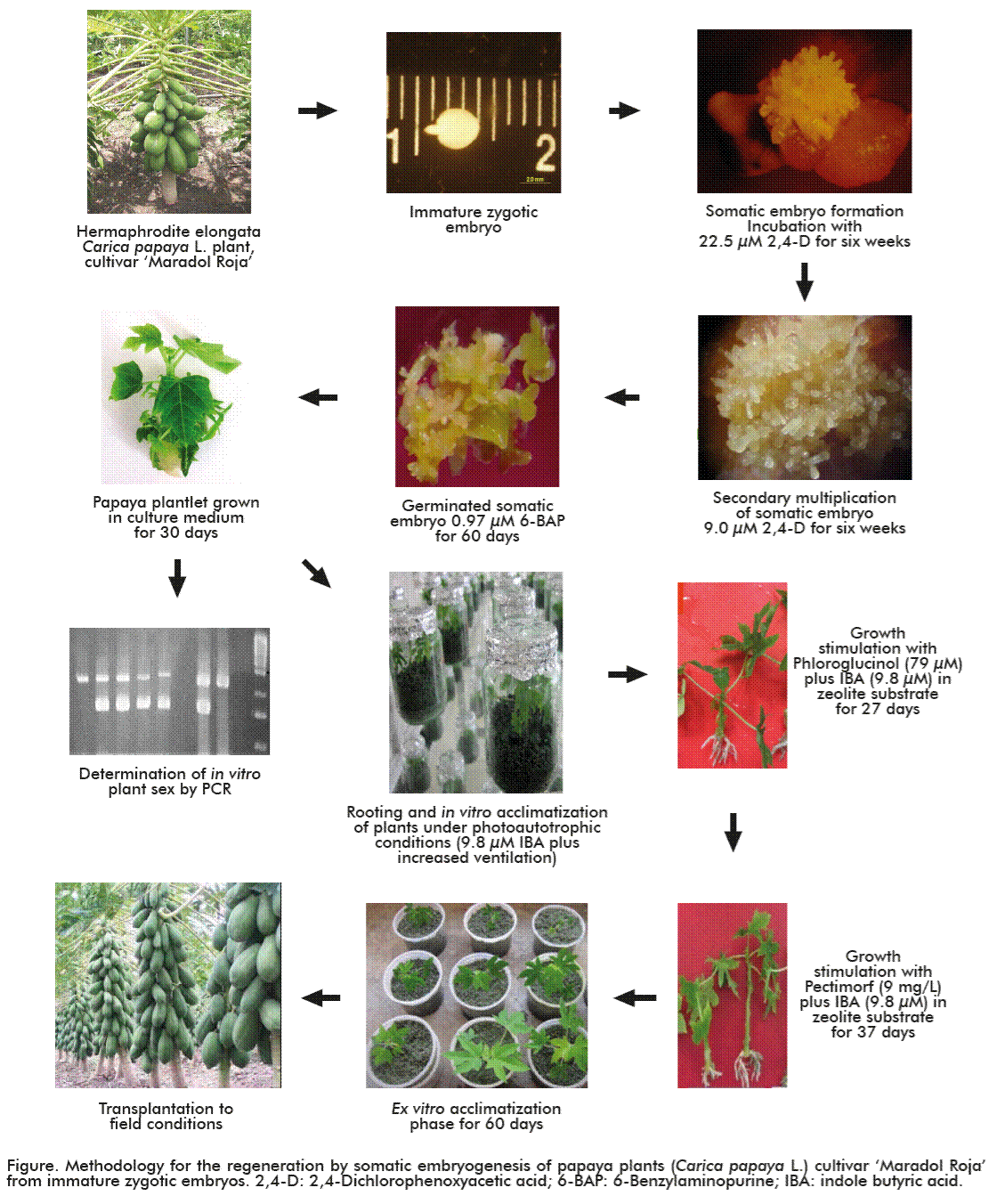
<body><![CDATA[<P   >&nbsp;</P >       <P   > </P >       <P   ><b><font size="3" face="Verdana, Arial, Helvetica, sans-serif">RESULTS AND DISCUSSION      </font></b></P >       <P   ><font size="2" face="Verdana, Arial, Helvetica, sans-serif"><B>Methodology for      the regeneration of 100 % hermaphrodite papaya plants of the Cuban cultivar      &lsquo;Maradol Roja&rsquo; obtained by SE </b></font></P >       <P   ><font size="2" face="Verdana, Arial, Helvetica, sans-serif">Here we described      the development of a methodology for the regeneration by SE of papaya plants      cultivar &lsquo;Maradol Roja&rsquo; from immature zygotic embryos (<a href="/img/revistas/bta/v34n3/f0104317.gif">Figure</a>).      Consistent with an strategy aimed to circumvent the high mortality rates <I>in      vitro </I>during the <I>ex vitro </I>acclimatization phase due to difficulties      for root development, a high <I>ex vitro </I>survival rate was obtained, and      regenerated plants displayed a high genetic homology. Several work report      callus formation for other papaya cultivars prior to the formation of somatic      embryos, despite of starting from zygotic embryo tissues with embryogenic      predetermined cells which ultimately lead to an increase in genetic variability      risks. Conversely, few reports are available on the secondary multiplication      of primary somatic embryos, a phase considered crucial for high multiplication      rates in SE. </font></P >       
<P   ><font size="2" face="Verdana, Arial, Helvetica, sans-serif">The methodology developed      was supported by histology and electron microscopy studies, and provides a      consistent tool to increase the efficiency of the propagation process. The      incorporation of RITA&reg; temporary immersion system for the germination      of somatic embryos guarantee a high efficiency for the established SE system.      It was demonstrated for the first time the expression of the genes <I>AUX/LAX      </I>and <I>PIN </I>coding for the polar transporters of auxins in papaya somatic      embryos. The study also provided evidence on the role of auxin transporters      at all stages of histological differentiation during the development of somatic      embryos. It was determined that there is a lower or higher expression of <I>PIN      </I>genes and expression of <I>AUX/LAX</I>, except for LAX3 which was not      expressed in somatic embryos at globular stage [13-16]. </font></P >       <P   ><font size="2" face="Verdana, Arial, Helvetica, sans-serif"><B>Photoautotrophic      micropropagation for rooting and increased <I>ex vitro </I>survival rates      </b></font></P >       <P   ><font size="2" face="Verdana, Arial, Helvetica, sans-serif">The photoautotrophic      culture has several advantages, such as stimulating plant growth and photosynthesis,      together with an increase in survival rates during the <I>in vitro</I>-<I>ex      vitro </I>transition. Our results of <I>in vitro </I>cultivation of papaya      showed that the methodology developed was able to preserve somatic embryos      from death during the <I>ex vitro </I>acclimatization phase. This was possible      due to the increased ventilation of culture vessels, by capping them with      metallic foil paper with two holes. By these means, the relative humidity      decreased inside the vessels to 68-72 %. Also, the flow of photosynthetic      photons estabilized in the range of 48.0-62.5 &mu;mol/m<sup>2</sup> &middot;      s<sup>-1</sup> by placing the vessels in cultivation chambers under sunlight.      </font></P >   <FONT size="+1"><FONT size="+1"><FONT size="+1"><FONT size="+1"><FONT size="+1">        <P   ><font size="2" face="Verdana, Arial, Helvetica, sans-serif">Simultaneously, the      CO<sub>2</sub> concentration was stabilized to normal levels within the flasks      to 350 &mu;mol/ mol. This was also complemented with the use of zeolite as      substrate for plant in vitro cultivation, resulting in higher photosynthesis      rates, the correction of morpho-physiological disorders, the prevention of      basal callus formation, which combined with indole butyric acid treatment      in the culture medium supported high percentages of rooting. This work also      provided the first report, up to our knowledge, on the use of zeolite as substrate      for the cultivation of shoots <I>in vitro, </I>in combination with increased      ventilation as it was carried out. This procedure allowed us to improve the      quality of the plants obtained with a better <I>ex vitro </I>acclimatization      of in vitro obtained explants, and higher survival rates. These results also      accounted for the pioneering studies on the photoautotrophic culture conditions      in Cuba for this plant species [17]. </font></P >   <FONT size="+1"><FONT size="+1">        <P   > </P >       ]]></body>
<body><![CDATA[<P   ><font size="2" face="Verdana, Arial, Helvetica, sans-serif"><B>Using plant growth      regulators to improve rooting and explant <I>ex vitro </I>survival </b></font></P >       <P   ><font size="2" face="Verdana, Arial, Helvetica, sans-serif">The addition of Pectimorf&reg;      and PG promoted a positive effect in synergy with auxin IBA, when added to      the culture medium under photoautotrophic conditions. Increased rooting to      84.2 % was achieved 37 days after the addition of </font><font size="2" face="Verdana, Arial, Helvetica, sans-serif">Pectimorf&reg;      (9 mg/L) and IBA (9.8 &mu;M), and 76 % of <i>ex vitro</i> survival. The effect      attained with PG (79 &mu;M) in combination with IBA (9.8 &mu;M) was even higher,      providing 100 % rooting in just 27 days and 96.5 % of survival under <i>ex      vitro</i> acclimatization conditions. PG treatment also improved the morpho-physiological      parameters of the plants obtained. So far, these were the first reports on      using these growth regulators for the improvements of papaya <I>in vitro </I>cultivation      during the most critical phase (rooting) [18, 19].</font></P >       <P   >&nbsp;</P >       <P   > </P >       <P   ><font size="3" face="Verdana, Arial, Helvetica, sans-serif"><B>SCIENTIFIC RELEVANCE      OF THE STUDY </b></font></P >       <P   ><font size="2" face="Verdana, Arial, Helvetica, sans-serif">A new methodology      using SE for plant regeneration was obtained, for the cultivation of the Cuban      cultivar &lsquo;Maradol Roja&rsquo;, the morphoagronomic characterization      of somatic embryos at different ontogenic developmental phases and a high      survival for the plants obtained under <I>ex vitro </I>conditions. Moreover,      the application of the PCR technique to determine plant sex from leaves samples      in vitro guaranteed the selection of a 100 % hermaphrodite population. Molecular      studies demonstrated for the first time the expression behavior of auxin polar      transport for <I>AUX/ LAX </I>and <I>PIN </I>at the different developmental      stages for somatic embryos. These were also the first studies in Cuba assessing      the cultivation of the &lsquo;Maradol Roja&rsquo; cultivar under photoautotrophic      conditions, also including the use of plant growth regulators (Pectimorf&reg;      and PG) and zeolite as planting substrate during rooting and acclimatization      in vitro and acclimatization <I>ex vitro</I>. Particularly, the inclusion      of Pectimorf&reg; treatment is an economically attractive alternative due      to its national production. </font></P >       <P   ><font size="2" face="Verdana, Arial, Helvetica, sans-serif">The methodology established      can be implemented in commercial laboratories (biofactories) in Cuba and abroad.      It is expected that these results could have a positive impact on the propagation      of this commercially relevant crop in Cuba in the short time, also setting      guidelines for future research on the genetic regulation during SE in papaya      species.</font></P >       <P   >&nbsp;</P >       <P   > </P >       <P   ><font size="3" face="Verdana, Arial, Helvetica, sans-serif"><B>ACKNOWLEDGEMENTS      </b></font></P >       ]]></body>
<body><![CDATA[<P   ><font size="2" face="Verdana, Arial, Helvetica, sans-serif">The authors thanks      the contribution and colaboration during the conduction of the study to the      following colleagues: Maritza Reyes Vega, Alexis Rodr&iacute;guez Concepci&oacute;n,      Ortelio Hurtado Ribalta, Ra&uacute;l Barb&oacute;n Rodr&iacute;guez, Luis      Rojas Mart&iacute;nez and Milady Le&oacute;n Quintana, from the Instituto      de Biotecnolog&iacute;a de las Plantas Universidad Central &ldquo;Marta Abreu&rdquo;      de Las Villas, Cuba; Rene Carlos Rodr&iacute;guez Escriba, from Centro de      Bioplantas, Universidad de Ciego de &Aacute;vila; Osvaldo Norman Montenegro,      Centro de Bioactivos Qu&iacute;micos (CBQ), also at the UCLV; and Diosdada      G&aacute;lvez Guerra from the Instituto Nacional de Investigaciones en Viandas      Tropicales (INIVIT).</font></P >       <P   >&nbsp;</P >       <P   > </P >       <P   ><b><font size="3" face="Verdana, Arial, Helvetica, sans-serif">REFERENCES </font></b></P >       <!-- ref --><P   ><font size="2" face="Verdana, Arial, Helvetica, sans-serif">1. Zhang J, Shen      W, Yan P, Li X, Zhou P. Factors that influence the yield and viability of      protoplasts from <I>Carica papaya </I>L. Afr J Biotechnol. 2011;10:5137-42.    </font></P >   <FONT size="+1">        <!-- ref --><P   ><font size="2" face="Verdana, Arial, Helvetica, sans-serif">2. Ministerio de      la Agricultura. Estad&iacute;sticas oficiales del Ministerio de la Agricultura.      Cierre de 2015. La Habana: MINAG; 2016.    </font></P >       <!-- ref --><P   ><font size="2" face="Verdana, Arial, Helvetica, sans-serif">3. Vegas A, Sandrea      Y, Gonz&aacute;lez O, D&iacute;az A, Albarr&aacute;n J, Schmidt A, <I>et al</I>.      Micropropagaci&oacute;n de plantas de lechosa en recipientes de inmersi&oacute;n      temporal a partir de brotes axilares. Rev Colombiana Biotecnol. 2015;XVII(1):70-8.    </font></P >       ]]></body>
<body><![CDATA[<!-- ref --><P   ><font size="2" face="Verdana, Arial, Helvetica, sans-serif">4. Homhuan S, Kijwijan      B, Wangsomnuk P, Bodhipadma K, Leung DWM. Variation of plants derived from      indirect somatic embryogenesis in cotyledon explants of papaya. Science Asia.      2008;34:347-52.    </font></P >       <!-- ref --><P   ><font size="2" face="Verdana, Arial, Helvetica, sans-serif">5. Bukhori M, Song      Ch, Khalid N, Pillai V, Abd Rahman N. Improved protocol for high frequency      plant regeneration through somatic embryogenesis in <I>Carica papaya</I>.      Res Biotechnol. 2013;4(5):9-19.    </font></P >       <!-- ref --><P   ><font size="2" face="Verdana, Arial, Helvetica, sans-serif">6. Sekeli R, Abdullah      JO, Namasivayam P, Muda P, Abu Bakar UK. Better rooting procedure to enhance      survival of field growth Malaysian Eksotika papaya transformed with 1-aminocyclopropane-1-carboxylic      acid oxidase gene. ISRN Biotechnology. 2013;1-10.    </font></P >       <!-- ref --><P   ><font size="2" face="Verdana, Arial, Helvetica, sans-serif">7. Dhekney SA, Kandel      R, Bergey DR, Sitther V, Soorianathasundaram Litz RE Advances in papaya biotechnology.      Biocatal Agric Biotechnol. 2016;5:133-42.     </font></P >       <!-- ref --><P   ><font size="2" face="Verdana, Arial, Helvetica, sans-serif">8. Kozai T. Photoautotrophic      micropropagation-environmental control for promoting photosynthesis. Propag      Ornamental Plants. 2010;10:88-204.     </font></P >       ]]></body>
<body><![CDATA[<!-- ref --><P   ><font size="2" face="Verdana, Arial, Helvetica, sans-serif">9. Teixeira da Silva      JA. Photoauto- ,Photohetero-and Photomixotrophic in vitro propagation of papaya      (<I>Carica papaya </I>L.) and response of seed and seedlings to light-emitting      diodes. Thammasat Int J Sci Technol. 2014;19(1):57-71.     </font></P >       <P   ><font size="2" face="Verdana, Arial, Helvetica, sans-serif">10. Cabrera JC, G&oacute;mez      RK, Diosdado E, Hormaza JV, Iglesias R, Guti&eacute;rrez AE, <I>et al</I>.      Procedimiento de obtenci&oacute;n de una mezcla de oligosac&aacute;ridos p&eacute;cticos      estimuladora del enraizamiento vegetal. Oficina Cubana de la Propiedad Industrial.      Patente de invenci&oacute;n 22859, Instituto Nacional de Ciencias Agr&iacute;colas,      Cuba. 2003. </font></P >       <!-- ref --><P   ><font size="2" face="Verdana, Arial, Helvetica, sans-serif">11. Teixeira da Silva      JA, J Dobr&aacute;nszki J, Ross S. Phloroglucinol in plant tissue culture.      In Vitro Cell Dev Biol Plant. 2013;49:1-16.    </font></P >       <!-- ref --><P   ><font size="2" face="Verdana, Arial, Helvetica, sans-serif">12. Chaves G, Nu&ntilde;ez      V. A SCAR marker for the sex determination in Colombian genotypes of <I>Carica      papaya</I>. Euphytica. 2007;153:215-20.    </font></P >       <P   ><font size="2" face="Verdana, Arial, Helvetica, sans-serif">13. Posada-P&eacute;rez      L, G&oacute;mez-Kosky R, Reyes VM Embriog&eacute;nesis som&aacute;tica en      <I>Carica papaya </I>L. var. &lsquo;Maradol Roja&rsquo;. Biotecnol Veg. 2007;7(3):131-38.</font></P >       <!-- ref --><P   ><font size="2" face="Verdana, Arial, Helvetica, sans-serif">14. Rodr&iacute;guez      AG, Posada-P&eacute;rez L, G&oacute;mez-Kosky R, Reyes VM, Tejeda MR. Aclimatizaci&oacute;n      de plantas de papaya var. `Maradol roja&acute; obtenidas por embriog&eacute;nesis      som&aacute;tica. Biotecnol Veg. 2009;9(2):91-7.    </font></P >       ]]></body>
<body><![CDATA[<P   ><font size="2" face="Verdana, Arial, Helvetica, sans-serif">15. Posada-P&eacute;rez      L, Rodr&iacute;guez AG, G&oacute;mez- Kosky R, Reyes VM, Tejeda MR. Influencia      de la &eacute;poca del a&ntilde;o y el tipo de frasco en la embriog&eacute;nesis      som&aacute;tica en papaya var. &lsquo;Maradol roja&rsquo;. Biotecnol Veg.      2009;9(1):33-40.</font></P >       <P   ><font size="2" face="Verdana, Arial, Helvetica, sans-serif">16. Posada-P&eacute;rez      L, G&oacute;mez-Kosky R, Le&oacute;n MR, Rojas LS, Padr&oacute;n YM Identificaci&oacute;n      mediante PCR del sexo de plantas de <I>Carica papaya </I>L. variedad </font><font size="+1" color="#000000"><font size="+1"><font size="+1" color="#211E1F"><font size="+1" color="#000000"><font size="+1" color="#211E1F"><font size="+1" color="#000000"><font size="+1" color="#211E1F"><font size="+1"><font size="+1"><font size="+1"><font size="+1"><font size="+1"><font size="+1"><font size="+1"><font size="+1"><font size="+1"><font size="+1"><font size="+1"><font size="+1"><font size="+1"><font size="+1"><font size="+1"><font size="+1"><font size="+1"><font size="+1"><font size="+1"><font size="+1"><font size="+1"><font size="2" face="Verdana, Arial, Helvetica, sans-serif">&rsquo;</font></font></font></font></font></font></font></font></font></font></font></font></font></font></font></font></font></font></font></font></font></font></font></font></font></font></font></font></font><font size="2" face="Verdana, Arial, Helvetica, sans-serif">Maradol      Roja&rsquo; obtenidas v&iacute;a embriog&eacute;nesis som&aacute;tica. Biotecnol      Veg. 2015;15(1):47-51.</font></P >       <!-- ref --><P   ><font size="2" face="Verdana, Arial, Helvetica, sans-serif">17. Posada-P&eacute;rez      L, Padr&oacute;n YM, Gonz&aacute;lez JO, Barb&oacute;n RR, Hurtado OR, Rodr&iacute;guez      RS, <i>et al</i>. Effects of different culture conditions (photoautotrophic,      photomixotrophic) and the auxin indole-butyric acid on the in vitro acclimatization      of papaya (<I>Carica papaya </I>L. var. Red Maradol) plants using zeolite      as support. Afr J Biotechnol. 2015;14(35):2622-35.    </font></P >       <!-- ref --><P   ><font size="2" face="Verdana, Arial, Helvetica, sans-serif">18. Posada-P&eacute;rez      L, Padr&oacute;n YM, Gonz&aacute;lez JO, Barb&oacute;n RR, Rodr&iacute;guez      RS, Norman OM, <i>et al</i>. Efecto del Pectimorf en el enraizamiento y la      aclimatizaci&oacute;n <I>in vitro </I>de brotes de papaya (<I>Carica papaya      </I>L.) cultivar Maradol Roja. Cult Trop. 2016;37(3):50-9.    </font></P >       <!-- ref --><P   ><font size="2" face="Verdana, Arial, Helvetica, sans-serif">19. Posada-P&eacute;rez      L, Padr&oacute;n YM, Gonz&aacute;lez JO, Barb&oacute;n RR, Rodr&iacute;guez      RS, Norman OM, <i>et al</i>. Effect of phloroglucinol on rooting and in vitro      acclimatization of papaya (<I>Carica papaya </I>L. var. Maradol Roja). In      Vitro Cell Develop Biol Plant. 2016;52(2):196-203.    </font></P >       <P   >&nbsp;</P >       <P   >&nbsp;</P >       ]]></body>
<body><![CDATA[<P   ><font size="2" face="Verdana, Arial, Helvetica, sans-serif">Received in October,      2016.     <br>     </font><font size="2" face="Verdana, Arial, Helvetica, sans-serif">Accepted      in March, 2017. </font></P >       <P   >&nbsp;</P >       <P   >&nbsp;</P >   <FONT size="+1">        <P   > </P >       <P   ><i><font size="2" face="Verdana, Arial, Helvetica, sans-serif">Laisyn Posada      P&eacute;rez</font><font size="2" face="Verdana, Arial, Helvetica, sans-serif"></font></i><font size="2" face="Verdana, Arial, Helvetica, sans-serif">.      Instituto de Biotecnolog&iacute;a de las Plantas, Universidad Central &ldquo;Marta      Abreu&rdquo; de Las Villas. Carretera a Camajuan&iacute; km 5.5, Santa Clara,      CP 54830, Cuba. E-mail: <a href="mailto:laisyn@ibp.co.cu">laisyn@ibp.co.cu</a>.</font></P >   </font></font></font></font></font></font></font></font></font></font></font></font></font></font></font></font></font></font></font></font></font></font></font></font></font></font></font></font></font></DIV >      ]]></body><back>
<ref-list>
<ref id="B1">
<label>1</label><nlm-citation citation-type="journal">
<person-group person-group-type="author">
<name>
<surname><![CDATA[Zhang]]></surname>
<given-names><![CDATA[J]]></given-names>
</name>
<name>
<surname><![CDATA[Shen]]></surname>
<given-names><![CDATA[W]]></given-names>
</name>
<name>
<surname><![CDATA[Yan]]></surname>
<given-names><![CDATA[P]]></given-names>
</name>
<name>
<surname><![CDATA[Li]]></surname>
<given-names><![CDATA[X]]></given-names>
</name>
<name>
<surname><![CDATA[Zhou]]></surname>
<given-names><![CDATA[P]]></given-names>
</name>
</person-group>
<article-title xml:lang="en"><![CDATA[Factors that influence the yield and viability of protoplasts from Carica papaya L]]></article-title>
<source><![CDATA[Afr J Biotechnol]]></source>
<year>2011</year>
<volume>10</volume>
<page-range>5137-42</page-range></nlm-citation>
</ref>
<ref id="B2">
<label>2</label><nlm-citation citation-type="book">
<collab>Ministerio de la Agricultura</collab>
<source><![CDATA[Estadísticas oficiales del Ministerio de la Agricultura. Cierre de 2015]]></source>
<year>2016</year>
<publisher-loc><![CDATA[La Habana ]]></publisher-loc>
<publisher-name><![CDATA[MINAG]]></publisher-name>
</nlm-citation>
</ref>
<ref id="B3">
<label>3</label><nlm-citation citation-type="journal">
<person-group person-group-type="author">
<name>
<surname><![CDATA[Vegas]]></surname>
<given-names><![CDATA[A]]></given-names>
</name>
<name>
<surname><![CDATA[Sandrea]]></surname>
<given-names><![CDATA[Y]]></given-names>
</name>
<name>
<surname><![CDATA[González]]></surname>
<given-names><![CDATA[O]]></given-names>
</name>
<name>
<surname><![CDATA[Díaz]]></surname>
<given-names><![CDATA[A]]></given-names>
</name>
<name>
<surname><![CDATA[Albarrán]]></surname>
<given-names><![CDATA[J]]></given-names>
</name>
<name>
<surname><![CDATA[Schmidt]]></surname>
<given-names><![CDATA[A]]></given-names>
</name>
</person-group>
<article-title xml:lang="es"><![CDATA[Micropropagación de plantas de lechosa en recipientes de inmersión temporal a partir de brotes axilares]]></article-title>
<source><![CDATA[Rev Colombiana Biotecnol]]></source>
<year>2015</year>
<volume>XVII</volume>
<numero>1</numero>
<issue>1</issue>
<page-range>70-8</page-range></nlm-citation>
</ref>
<ref id="B4">
<label>4</label><nlm-citation citation-type="journal">
<person-group person-group-type="author">
<name>
<surname><![CDATA[Homhuan]]></surname>
<given-names><![CDATA[S]]></given-names>
</name>
<name>
<surname><![CDATA[Kijwijan]]></surname>
<given-names><![CDATA[B]]></given-names>
</name>
<name>
<surname><![CDATA[Wangsomnuk]]></surname>
<given-names><![CDATA[P]]></given-names>
</name>
<name>
<surname><![CDATA[Bodhipadma]]></surname>
<given-names><![CDATA[K]]></given-names>
</name>
<name>
<surname><![CDATA[Leung]]></surname>
<given-names><![CDATA[DWM]]></given-names>
</name>
</person-group>
<article-title xml:lang="en"><![CDATA[Variation of plants derived from indirect somatic embryogenesis in cotyledon explants of papaya]]></article-title>
<source><![CDATA[Science Asia]]></source>
<year>2008</year>
<volume>34</volume>
<page-range>347-52</page-range></nlm-citation>
</ref>
<ref id="B5">
<label>5</label><nlm-citation citation-type="journal">
<person-group person-group-type="author">
<name>
<surname><![CDATA[Bukhori]]></surname>
<given-names><![CDATA[M]]></given-names>
</name>
<name>
<surname><![CDATA[Song]]></surname>
<given-names><![CDATA[Ch]]></given-names>
</name>
<name>
<surname><![CDATA[Khalid]]></surname>
<given-names><![CDATA[N]]></given-names>
</name>
<name>
<surname><![CDATA[Pillai]]></surname>
<given-names><![CDATA[V]]></given-names>
</name>
<name>
<surname><![CDATA[Abd Rahman]]></surname>
<given-names><![CDATA[N]]></given-names>
</name>
</person-group>
<article-title xml:lang="en"><![CDATA[Improved protocol for high frequency plant regeneration through somatic embryogenesis in Carica papaya]]></article-title>
<source><![CDATA[Res Biotechnol]]></source>
<year>2013</year>
<volume>4</volume>
<numero>5</numero>
<issue>5</issue>
<page-range>9-19</page-range></nlm-citation>
</ref>
<ref id="B6">
<label>6</label><nlm-citation citation-type="journal">
<person-group person-group-type="author">
<name>
<surname><![CDATA[Sekeli]]></surname>
<given-names><![CDATA[R]]></given-names>
</name>
<name>
<surname><![CDATA[Abdullah]]></surname>
<given-names><![CDATA[JO]]></given-names>
</name>
<name>
<surname><![CDATA[Namasivayam]]></surname>
<given-names><![CDATA[P]]></given-names>
</name>
<name>
<surname><![CDATA[Muda]]></surname>
<given-names><![CDATA[P]]></given-names>
</name>
<name>
<surname><![CDATA[Abu Bakar]]></surname>
<given-names><![CDATA[UK]]></given-names>
</name>
</person-group>
<article-title xml:lang="en"><![CDATA[Better rooting procedure to enhance survival of field growth Malaysian Eksotika papaya transformed with 1-aminocyclopropane-1-carboxylic acid oxidase gene]]></article-title>
<source><![CDATA[ISRN Biotechnology]]></source>
<year>2013</year>
<volume>1</volume>
<page-range>10</page-range></nlm-citation>
</ref>
<ref id="B7">
<label>7</label><nlm-citation citation-type="journal">
<person-group person-group-type="author">
<name>
<surname><![CDATA[Dhekney]]></surname>
<given-names><![CDATA[SA]]></given-names>
</name>
<name>
<surname><![CDATA[Kandel]]></surname>
<given-names><![CDATA[R]]></given-names>
</name>
<name>
<surname><![CDATA[Bergey]]></surname>
<given-names><![CDATA[DR]]></given-names>
</name>
<name>
<surname><![CDATA[Sitther]]></surname>
<given-names><![CDATA[V]]></given-names>
</name>
<name>
<surname><![CDATA[Soorianathasundaram Litz]]></surname>
<given-names><![CDATA[RE]]></given-names>
</name>
</person-group>
<article-title xml:lang="en"><![CDATA[Advances in papaya biotechnology]]></article-title>
<source><![CDATA[Biocatal Agric Biotechnol]]></source>
<year>2016</year>
<volume>5</volume>
<page-range>133-42</page-range></nlm-citation>
</ref>
<ref id="B8">
<label>8</label><nlm-citation citation-type="journal">
<person-group person-group-type="author">
<name>
<surname><![CDATA[Kozai]]></surname>
<given-names><![CDATA[T]]></given-names>
</name>
</person-group>
<article-title xml:lang="en"><![CDATA[Photoautotrophic micropropagation-environmental control for promoting photosynthesis]]></article-title>
<source><![CDATA[Propag Ornamental Plants]]></source>
<year>2010</year>
<volume>10</volume>
<page-range>88-204</page-range></nlm-citation>
</ref>
<ref id="B9">
<label>9</label><nlm-citation citation-type="journal">
<person-group person-group-type="author">
<name>
<surname><![CDATA[Teixeira da Silva]]></surname>
<given-names><![CDATA[JA]]></given-names>
</name>
</person-group>
<article-title xml:lang="en"><![CDATA[Photoauto- ,Photohetero-and Photomixotrophic in vitro propagation of papaya (Carica papaya L.) and response of seed and seedlings to light-emitting diodes]]></article-title>
<source><![CDATA[Thammasat Int J Sci Technol]]></source>
<year>2014</year>
<volume>19</volume>
<numero>1</numero>
<issue>1</issue>
<page-range>57-71</page-range></nlm-citation>
</ref>
<ref id="B10">
<label>10</label><nlm-citation citation-type="">
<person-group person-group-type="author">
<name>
<surname><![CDATA[Cabrera]]></surname>
<given-names><![CDATA[JC]]></given-names>
</name>
<name>
<surname><![CDATA[Gómez]]></surname>
<given-names><![CDATA[RK]]></given-names>
</name>
<name>
<surname><![CDATA[Diosdado]]></surname>
<given-names><![CDATA[E]]></given-names>
</name>
<name>
<surname><![CDATA[Hormaza]]></surname>
<given-names><![CDATA[JV]]></given-names>
</name>
<name>
<surname><![CDATA[Iglesias]]></surname>
<given-names><![CDATA[R]]></given-names>
</name>
<name>
<surname><![CDATA[Gutiérrez]]></surname>
<given-names><![CDATA[AE]]></given-names>
</name>
</person-group>
<source><![CDATA[Procedimiento de obtención de una mezcla de oligosacáridos pécticos estimuladora del enraizamiento vegetal]]></source>
<year></year>
</nlm-citation>
</ref>
<ref id="B11">
<label>11</label><nlm-citation citation-type="journal">
<person-group person-group-type="author">
<name>
<surname><![CDATA[Teixeira da Silva]]></surname>
<given-names><![CDATA[JA]]></given-names>
</name>
<name>
<surname><![CDATA[J Dobránszki]]></surname>
<given-names><![CDATA[J]]></given-names>
</name>
<name>
<surname><![CDATA[Ross]]></surname>
<given-names><![CDATA[S]]></given-names>
</name>
</person-group>
<article-title xml:lang="en"><![CDATA[Phloroglucinol in plant tissue culture]]></article-title>
<source><![CDATA[In Vitro Cell Dev Biol Plant]]></source>
<year>2013</year>
<volume>49</volume>
<page-range>1-16</page-range></nlm-citation>
</ref>
<ref id="B12">
<label>12</label><nlm-citation citation-type="journal">
<person-group person-group-type="author">
<name>
<surname><![CDATA[Chaves]]></surname>
<given-names><![CDATA[G]]></given-names>
</name>
<name>
<surname><![CDATA[Nuñez]]></surname>
<given-names><![CDATA[V]]></given-names>
</name>
</person-group>
<article-title xml:lang="en"><![CDATA[A SCAR marker for the sex determination in Colombian genotypes of Carica papaya]]></article-title>
<source><![CDATA[Euphytica]]></source>
<year>2007</year>
<volume>153</volume>
<page-range>215-20</page-range></nlm-citation>
</ref>
<ref id="B13">
<label>13</label><nlm-citation citation-type="journal">
<person-group person-group-type="author">
<name>
<surname><![CDATA[Posada-Pérez]]></surname>
<given-names><![CDATA[L]]></given-names>
</name>
<name>
<surname><![CDATA[Gómez-Kosky]]></surname>
<given-names><![CDATA[R]]></given-names>
</name>
<name>
<surname><![CDATA[Reyes VM Embriogénesis somática en Carica papaya]]></surname>
<given-names><![CDATA[L]]></given-names>
</name>
</person-group>
<article-title xml:lang="en"><![CDATA[var. 'Maradol Roja']]></article-title>
<source><![CDATA[Biotecnol Veg]]></source>
<year>2007</year>
<volume>7</volume>
<numero>3</numero>
<issue>3</issue>
<page-range>131-38</page-range></nlm-citation>
</ref>
<ref id="B14">
<label>14</label><nlm-citation citation-type="journal">
<person-group person-group-type="author">
<name>
<surname><![CDATA[Rodríguez]]></surname>
<given-names><![CDATA[AG]]></given-names>
</name>
<name>
<surname><![CDATA[Posada-Pérez]]></surname>
<given-names><![CDATA[L]]></given-names>
</name>
<name>
<surname><![CDATA[Gómez- Kosky]]></surname>
<given-names><![CDATA[R]]></given-names>
</name>
<name>
<surname><![CDATA[Reyes]]></surname>
<given-names><![CDATA[VM]]></given-names>
</name>
<name>
<surname><![CDATA[Tejeda]]></surname>
<given-names><![CDATA[MR]]></given-names>
</name>
</person-group>
<article-title xml:lang="es"><![CDATA[Aclimatización de plantas de papaya var. `Maradol roja´ obtenidas por embriogénesis somática]]></article-title>
<source><![CDATA[Biotecnol Veg]]></source>
<year>2009</year>
<volume>9</volume>
<numero>2</numero>
<issue>2</issue>
<page-range>91-7</page-range></nlm-citation>
</ref>
<ref id="B15">
<label>15</label><nlm-citation citation-type="journal">
<person-group person-group-type="author">
<name>
<surname><![CDATA[Posada-Pérez]]></surname>
<given-names><![CDATA[L]]></given-names>
</name>
<name>
<surname><![CDATA[Rodríguez]]></surname>
<given-names><![CDATA[AG]]></given-names>
</name>
<name>
<surname><![CDATA[Gómez-Kosky]]></surname>
<given-names><![CDATA[R]]></given-names>
</name>
<name>
<surname><![CDATA[Reyes]]></surname>
<given-names><![CDATA[VM]]></given-names>
</name>
<name>
<surname><![CDATA[Tejeda]]></surname>
<given-names><![CDATA[MR]]></given-names>
</name>
</person-group>
<article-title xml:lang="es"><![CDATA[Influencia de la época del año y el tipo de frasco en la embriogénesis somática en papaya var. 'Maradol roja']]></article-title>
<source><![CDATA[Biotecnol Veg]]></source>
<year>2009</year>
<volume>9</volume>
<numero>1</numero>
<issue>1</issue>
<page-range>33-40</page-range></nlm-citation>
</ref>
<ref id="B16">
<label>16</label><nlm-citation citation-type="journal">
<person-group person-group-type="author">
<name>
<surname><![CDATA[Posada-Pérez]]></surname>
<given-names><![CDATA[L]]></given-names>
</name>
<name>
<surname><![CDATA[Gómez-Kosky]]></surname>
<given-names><![CDATA[R]]></given-names>
</name>
<name>
<surname><![CDATA[León]]></surname>
<given-names><![CDATA[MR]]></given-names>
</name>
<name>
<surname><![CDATA[Rojas]]></surname>
<given-names><![CDATA[LS]]></given-names>
</name>
<name>
<surname><![CDATA[Padrón]]></surname>
<given-names><![CDATA[YM]]></given-names>
</name>
</person-group>
<article-title xml:lang="es"><![CDATA[Identificación mediante PCR del sexo de plantas de Carica papaya L. variedad 'Maradol Roja' obtenidas vía embriogénesis somática]]></article-title>
<source><![CDATA[Biotecnol Veg]]></source>
<year>2015</year>
<volume>15</volume>
<numero>1</numero>
<issue>1</issue>
<page-range>47-51</page-range></nlm-citation>
</ref>
<ref id="B17">
<label>17</label><nlm-citation citation-type="journal">
<person-group person-group-type="author">
<name>
<surname><![CDATA[Posada-Pérez]]></surname>
<given-names><![CDATA[L]]></given-names>
</name>
<name>
<surname><![CDATA[Padrón]]></surname>
<given-names><![CDATA[YM]]></given-names>
</name>
<name>
<surname><![CDATA[González]]></surname>
<given-names><![CDATA[JO]]></given-names>
</name>
<name>
<surname><![CDATA[Barbón]]></surname>
<given-names><![CDATA[RR]]></given-names>
</name>
<name>
<surname><![CDATA[Hurtado]]></surname>
<given-names><![CDATA[OR]]></given-names>
</name>
<name>
<surname><![CDATA[Rodríguez]]></surname>
<given-names><![CDATA[RS]]></given-names>
</name>
</person-group>
<article-title xml:lang="en"><![CDATA[Effects of different culture conditions (photoautotrophic, photomixotrophic) and the auxin indole-butyric acid on the in vitro acclimatization of papaya (Carica papaya L. var. Red Maradol) plants using zeolite as support]]></article-title>
<source><![CDATA[Afr J Biotechnol]]></source>
<year>2015</year>
<volume>14</volume>
<numero>35</numero>
<issue>35</issue>
<page-range>2622-35</page-range></nlm-citation>
</ref>
<ref id="B18">
<label>18</label><nlm-citation citation-type="journal">
<person-group person-group-type="author">
<name>
<surname><![CDATA[Posada-Pérez]]></surname>
<given-names><![CDATA[L]]></given-names>
</name>
<name>
<surname><![CDATA[Padrón]]></surname>
<given-names><![CDATA[YM]]></given-names>
</name>
<name>
<surname><![CDATA[González]]></surname>
<given-names><![CDATA[JO]]></given-names>
</name>
<name>
<surname><![CDATA[Barbón]]></surname>
<given-names><![CDATA[RR]]></given-names>
</name>
<name>
<surname><![CDATA[Rodríguez]]></surname>
<given-names><![CDATA[RS]]></given-names>
</name>
<name>
<surname><![CDATA[Norman]]></surname>
<given-names><![CDATA[OM]]></given-names>
</name>
</person-group>
<article-title xml:lang="es"><![CDATA[Efecto del Pectimorf en el enraizamiento y la aclimatización in vitro de brotes de papaya (Carica papaya L.) cultivar Maradol Roja]]></article-title>
<source><![CDATA[Cult Trop]]></source>
<year>2016</year>
<volume>37</volume>
<numero>3</numero>
<issue>3</issue>
<page-range>50-9</page-range></nlm-citation>
</ref>
<ref id="B19">
<label>19</label><nlm-citation citation-type="journal">
<person-group person-group-type="author">
<name>
<surname><![CDATA[Posada-Pérez]]></surname>
<given-names><![CDATA[L]]></given-names>
</name>
<name>
<surname><![CDATA[Padrón]]></surname>
<given-names><![CDATA[YM]]></given-names>
</name>
<name>
<surname><![CDATA[González]]></surname>
<given-names><![CDATA[JO]]></given-names>
</name>
<name>
<surname><![CDATA[Barbón]]></surname>
<given-names><![CDATA[RR]]></given-names>
</name>
<name>
<surname><![CDATA[Rodríguez]]></surname>
<given-names><![CDATA[RS]]></given-names>
</name>
<name>
<surname><![CDATA[Norman]]></surname>
<given-names><![CDATA[OM]]></given-names>
</name>
</person-group>
<article-title xml:lang="en"><![CDATA[Effect of phloroglucinol on rooting and in vitro acclimatization of papaya (Carica papaya L. var. Maradol Roja)]]></article-title>
<source><![CDATA[In Vitro Cell Develop Biol Plant]]></source>
<year>2016</year>
<volume>52</volume>
<numero>2</numero>
<issue>2</issue>
<page-range>196-203</page-range></nlm-citation>
</ref>
</ref-list>
</back>
</article>