<?xml version="1.0" encoding="ISO-8859-1"?><article xmlns:mml="http://www.w3.org/1998/Math/MathML" xmlns:xlink="http://www.w3.org/1999/xlink" xmlns:xsi="http://www.w3.org/2001/XMLSchema-instance">
<front>
<journal-meta>
<journal-id>1028-4796</journal-id>
<journal-title><![CDATA[Revista Cubana de Plantas Medicinales]]></journal-title>
<abbrev-journal-title><![CDATA[Rev Cubana Plant Med]]></abbrev-journal-title>
<issn>1028-4796</issn>
<publisher>
<publisher-name><![CDATA[ECIMED]]></publisher-name>
</publisher>
</journal-meta>
<article-meta>
<article-id>S1028-47962009000400009</article-id>
<title-group>
<article-title xml:lang="es"><![CDATA[Colaboración cubana con el Programa para la Investigación Aplicada y la Difusión de Plantas Medicinales en el Caribe (TRAMIL)]]></article-title>
<article-title xml:lang="en"><![CDATA[Cuban collaboration with the Program for Applied Research and Diffusion of Medicinal Plants in the Caribbean (TRAMIL)]]></article-title>
</title-group>
<contrib-group>
<contrib contrib-type="author">
<name>
<surname><![CDATA[Morón Rodríguez]]></surname>
<given-names><![CDATA[Francisco]]></given-names>
</name>
<xref ref-type="aff" rid="A01"/>
</contrib>
<contrib contrib-type="author">
<name>
<surname><![CDATA[Robineau-Germosén]]></surname>
<given-names><![CDATA[ILionel]]></given-names>
</name>
<xref ref-type="aff" rid="A02"/>
</contrib>
</contrib-group>
<aff id="A01">
<institution><![CDATA[,Central Pharmacological Research Unit  ]]></institution>
<addr-line><![CDATA[Havana City ]]></addr-line>
<country>Cuba</country>
</aff>
<aff id="A02">
<institution><![CDATA[,University of Antigua & Guyana  ]]></institution>
<addr-line><![CDATA[Guadalupe ]]></addr-line>
<country>France</country>
</aff>
<pub-date pub-type="pub">
<day>00</day>
<month>12</month>
<year>2009</year>
</pub-date>
<pub-date pub-type="epub">
<day>00</day>
<month>12</month>
<year>2009</year>
</pub-date>
<volume>14</volume>
<numero>4</numero>
<fpage>0</fpage>
<lpage>0</lpage>
<copyright-statement/>
<copyright-year/>
<self-uri xlink:href="http://scielo.sld.cu/scielo.php?script=sci_arttext&amp;pid=S1028-47962009000400009&amp;lng=en&amp;nrm=iso"></self-uri><self-uri xlink:href="http://scielo.sld.cu/scielo.php?script=sci_abstract&amp;pid=S1028-47962009000400009&amp;lng=en&amp;nrm=iso"></self-uri><self-uri xlink:href="http://scielo.sld.cu/scielo.php?script=sci_pdf&amp;pid=S1028-47962009000400009&amp;lng=en&amp;nrm=iso"></self-uri></article-meta>
</front><body><![CDATA[ <P align="right">      <P align="right"><font face="Verdana" size="2"><B>ART&Iacute;CULO ORIGINAL</B></font>     <P align="right">&nbsp;      <P>      <P>      <P><b><font face="Verdana" size="4">Cuban collaboration with the Program for Applied    Research and Diffusion of Medicinal Plants in the Caribbean (TRAMIL) </font></b>     <P>&nbsp;      <P>      <P><font face="Verdana" size="2"><b><font size="3">Colaboraci&oacute;n cubana    con el Programa para la Investigaci&oacute;n Aplicada y la Difusi&oacute;n de    Plantas Medicinales en el Caribe (TRAMIL) </font></b></font>     <P>&nbsp;     ]]></body>
<body><![CDATA[<P>&nbsp;      <P>      <P><b><font face="Verdana" size="2">Francisco Mor&oacute;n Rodr&iacute;guez;<SUP>I</SUP>    Lionel Robineau-Germos&eacute;n<SUP>II</SUP></font> </b>     <P><sup><font size="2" face="Verdana">I</font></sup><font size="2" face="Verdana">    MD. PhD. Professor in Pharmacology. Medical Sciences University of Havana. Central    Pharmacological Research Unit. Havana City, Cuba.    <br>   </font><font size="2" face="Verdana"><sup>II</sup> MD. MSc. University of Antigua    &amp; Guyana, Guadalupe, France. </font>      <P><SUP><font face="Verdana" size="2">    <br>   </font></SUP>      <p>&nbsp;</p>     <p>&nbsp; </p> <hr size="1" noshade>     <p><font face="Verdana" size="2"><B>RESUMEN </B></font></p>     ]]></body>
<body><![CDATA[<p><font face="Verdana" size="2"><B>INTRODUCCI&Oacute;N</b>: las personas emplean    ampliamente las plantas medicinales para solucionar problemas de salud primarios    en los pa&iacute;ses caribe&ntilde;os. Nuestra unidad de investigaci&oacute;n-desarrollo    ha mantenido una colaboraci&oacute;n estrecha con TRAMIL (Programa para la Investigaci&oacute;n    Aplicada y la Difusi&oacute;n de Plantas Medicinales en el Caribe), desde el    III Taller Cient&iacute;fico TRAMIL celebrado en La Habana en 1988. Se ha coordinado    tambi&eacute;n el Programa Cubano de Investigaciones de Plantas Medicinales    (1988-2004) para incorporar plantas medicinales en el Sistema Nacional de Salud.    La investigaci&oacute;n farmacol&oacute;gica y toxicol&oacute;gica aplicada    para validar usos tradicionales de plantas medicinales tiene algunas caracter&iacute;sticas    y retos. <B>    <br>   OBJETIVOS</B>: exponer nuestra experiencia durante 20 a&ntilde;os. <B>    <br>   M&Eacute;TODOS</B>: se revisaron los principales impactos, as&iacute; como los    resultados publicados y los incluidos en la Farmacopea Vegetal Caribe&ntilde;a    de TRAMIL desde 1988 hasta 2008. <B>    <br>   RESULTADOS</B>: se expone el Programa y nuestra colaboraci&oacute;n, los usos    de plantas cient&iacute;ficamente validados que han sido incorporados al Sistema    Nacional de Salud de Cuba y los resultados en los estudios farmacol&oacute;gicos    y toxicol&oacute;gicos en 30 especies. La mayor&iacute;a de los experimentos    toxicol&oacute;gicos indicaron que los usos tradicionales eran seguros y un    elevado n&uacute;mero de ellos fueron valorados en modelos experimentales precl&iacute;nicos.    <B>    <br>   CONCLUSIONES</B>: nuestros datos indican que TRAMIL es una red cient&iacute;fica    regional bien establecida, la cual puede ser &uacute;til para los sistemas de    salud y las universidades m&eacute;dicas, as&iacute; como que existe un elevado    porcentaje de usos tradicionales de plantas medicinales que pueden ser respaldados    por evaluaciones precl&iacute;nicas. </font> </p> <B></B>      <P>      <P><font face="Verdana" size="2"><B>Palabras clave</B>: plantas medicinales, investigaci&oacute;n,    colaboraci&oacute;n regional, Cuba, Caribe.</font> <hr size="1" noshade>     <p><font face="Verdana" size="2"><B>ABSTRACT </B></font></p>     <p><font face="Verdana" size="2"><B>INTRODUCTION</b>: people use widely medicinal    plants to solve primary health problems in Caribbean countries. Our research    unit has kept a close collaboration with TRAMIL (Program for Applied Research    and Diffusion of Medicinal Plants in the Caribbean) since the III TRAMIL Scientific    Workshop was held in Havana in 1988. We also have coordinated the Medicinal    Plant Cuban Research Program (1988-2004) to incorporate medicinal plants in    our National Health System. Pharmacological and toxicological applied research    to validate traditional medicinal uses has some characteristics and challenges.    <B>    <br>   OBJECTIVE</B>: The aim of this lecture is to expose our experience during 20    years. <B>    ]]></body>
<body><![CDATA[<br>   METHODS</B>: it was reviewed the main impacts as well as our published results    and those included in TRAMIL&#180;s Caribbean Herbal Pharmacopoeia during 1988-2008.    <B>    <br>   RESULTS</B>: it is shown the Program and our collaboration, the scientific-validated    medicinal plant uses which has been incorporated to Cuban National Health System    and our results in pharmacological and toxicological studies in 30 different    species. Most of toxicological experiments indicated that traditional uses were    safe and a high number of them were validated in preclinical experimental models.    <B>    <br>   CONCLUSIONS</B>: our data indicate that TRAMIL is a well established regional    scientific network which may be useful for health systems and medical universities    and there are a high percentage of traditional medicinal plant uses which may    be supported with preclinical evaluation. </font> </p> <B></B>      <P>      <P><font face="Verdana" size="2"><B>Key words</B>: medicinal plants, research,    regional collaboration, Cuba, Caribbean. </font> <hr size="1" noshade>     <P>      <P>      <P>&nbsp;     <P>&nbsp;     <P><font face="Verdana" size="2"><B><font size="3">INTRODUCTION</font></B> </font>      ]]></body>
<body><![CDATA[<P>      <P><font face="Verdana" size="2">The main form of traditional medicine in Cuba    involves the popular use of plants as a means to resolve health problems. The    roots of these practices are found in the historical and social development    that resulted in the rise of the Cuban nation. The first reference to our medicinal    plants occurred within ten days after the Spaniards arrival on the north coast    of Holgu&iacute;n Province, in Cuba's eastern region. Under the date of November    5, 1492, Christopher Columbus' diary notes: &quot;It is remarked that an Indian    said, by sign, that <I>alm&aacute;ciga </I>is good for problems of the stomach&quot;.<SUP>1</SUP>    </font>      <P><font face="Verdana" size="2">This entry leads one to believe that the same    plant currently known as <I>alm&aacute;cigo</I> (<I>Bursera simaruba</I> (L.)    Sarg.), a native species found mainly in coastal and wooded zones was used by    the Cuban aboriginal population to treat stomachaches and diarrhea. These same    uses continue today, through decoction of the plant's leaves, bark, roots or    resin. However, the recent arrivals erred in naming the species showed to them    by the aboriginals after a medicinal plant found in Spain: <I>alm&aacute;ciga</I>    or <I>alm&aacute;cigo</I> (<I>Pistacia lentiscus</I> L.), which has certain    similarities but is a different tree. Erroneous common names were often given    to our species by the Spaniards, Africans and Chinese as part of the process    of trans-cultural assimilation. </font>     <P><font face="Verdana" size="2">Our traditional medicine is a result of the integration    of aboriginal cultures with the Spanish, African, Chinese and Yucatecan cultures    that came successively to the Island after its discovery on October 27, 1942.    At that time, the indigenous population totaled approximately 100,000, having    established themselves some four millennia before the Spaniards' arrival. Cuban    aborigines arrived by means of different migratory patterns. It seems that the    first arrived via the Strait of Florida and the last descendents of the Arawak    Indians, called &quot;Ta&iacute;nos&quot; by the Spaniards arrived via the archipelago    of the Antilles. </font>      <P><font face="Verdana" size="2">The latter immigrants left an imprint that would    shape Cuban medical historiography. Aboriginal medicine in Cuba survived its    own people as a legacy for the colonizers up to the eighteenth century. One    historical event involved the concession by the Santiago de Cuba Town Council,    in 1609, of a license to practice medicine to the indigenous healer Mariana    Nava, the first women to exercise this profession in such a legal manner.<SUP>2</SUP>    </font>     <P><font face="Verdana" size="2">The development of traditional Cuban herbal medicine    shares more similarities than differences with the experiences of other countries    in the Caribbean basin. From colonial times to the present, many investigators    have dedicated efforts to the study of Cuban medicinal plants. One of the most    renowned, eminent Cuban botanist Juan Tom&aacute;s Roig Mesa (1877-1971), wrote    the following in the prologue to his book <I>Plantas medicinales, arom&aacute;ticas    o venenosas de Cuba</I> [Medicinal, Aromatic or Poisonous Plants of Cuba] in    1945: </font>     <P>      <blockquote>        <p><font face="Verdana" size="2">We have sought to encourage our men of science      to study these plants, verifying whether the virtues attributed to them are      certain, so that they may then be used scientifically, thus removing the trade      of these drugs from the amateurs'hands <font face="Symbol">&#190;</font>if      not charlatans<font face="Symbol">&#190;</font> whose recommendations have      more than once produced fatal results.<SUP>3</SUP> </font> </p> </blockquote>     <P>      ]]></body>
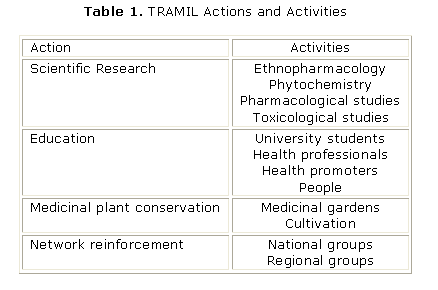
<body><![CDATA[<P><font face="Verdana" size="2">Roig's idea of promoting the systematic study    of our medicinal plants by Cuban scientists was followed only by some individuals    and exceptional institutions. Increasing scientific activity in this field did    not begin until the 1980s, motivated to a great degree by the World Health Organization's    recommendation that member countries promote the use of traditional medicinal    resources in their health systems. In 1984 and 1985, a national ethnomedical    survey was carried out in order to identify plants, plant parts, their uses    and how they are applied by the population. The study was designed and executed    mainly by young university professors and students, advised by more experienced    researchers. This national collective named itself the Juan Tom&aacute;s Roig    Group, in honor of the late botanist.<SUP>4</SUP> </font>     <P><font face="Verdana" size="2">Two years previously, the TRAMIL Program (Applied    Research and Education Program of Traditional Medicinal Plants in the Caribbean)    had begun and was implementing surveys according to a new methodology on the    neighboring island of <I>La Espa&ntilde;ola</I> [Hispaniola], shared by Haiti    and the Dominican Republic. </font>      <P><font face="Verdana" size="2">The implementation of ethnomedical surveys according    to different methodologies does not allow for the extrapolation of results.    However, both investigations enabled Cubans involved in this field to verify    the coincidence between species or plant parts and uses found to be significant    by TRAMIL and those identified in the Cuban survey and other studies carried    out in Cuba during the 1980s. </font>     <P>      <P><font face="Verdana" size="2"><I>TRAMIL Program</I> </font>     <P>      <P><font face="Verdana" size="2">It was born out of a common effort from the Caribbean    Regional Office of the International Organization for the Environment and Development    in the Third World (enda-caribe), the Laboratory of the Natural Substances of    the University of Medicine and Pharmacy, Port-au-Prince, the Federation of Rural    Associations of Zambrana-Chacuey, Dominican Republic, and the Clinic SOE of    Thomonde, in the Central plain of Haiti in 1982. It aim was to improve and rationalize    the popular medical practices based on the use of medicinal plants. </font>     <P><font face="Verdana" size="2">In the Central America and Caribbean regions,    it has been shown that medical herbs are not only part of cultural heritage    but also that their use represents an important tool and support in primary    health cares when scientifically validated. Ministries of Health and Universities    of the region have shown their interest to carry out joint efforts in order    to obtain regional agreements, to obtain benefits from scientifically validated    medical herbs and to promote health care policies able to integrate this resource.    </font>     <P><font face="Verdana" size="2">During 27 years, TRAMIL has been combining efforts    of researchers and institutions working in the field of Central America and    Caribbean medical herbs, in a multidisciplinary way. Ethnobotany studies, identification    of species, chemical, pharmacological and toxicological studies of medical herbs    used and broadcasting of information to communities are all part of this effort    (table 1). This program integrates collaborators and specialists from different    fields and they come from: Antigua, Belize, Bolivia, Brazil, Costa Rica, Colombia,    Cuba, Dominica, France, Grenada, Guadeloupe, Guatemala, French Guyana, Haiti,    Honduras, Martinique, Mexico, Nicaragua, Panama, Puerto Rico, Dominican Republic,    Saint Lucia, Trinidad and Tobago and Venezuela.<I> </I>(<U><FONT COLOR="#0000ff"><a href="http://www.funredes.org/endacaribe/Repertorio/english/carte.html">http://www.funredes.org/endacaribe/Repertorio/english/carte.html</a></FONT></U>    )<I> </I> </font>      <P><font face="Verdana" size="2">Since 1982, TRAMIL and its collaborators have    been working in a common objective: medical herb use under scientific criteria    of security and efficacy (<a href="/img/revistas/pla/v14n4/t0109409.gif" target="_blank">table 1</a>).    </font>     
]]></body>
<body><![CDATA[<P align="center"><a href="/img/revistas/pla/v14n4/t0109409.gif" target="_blank"><img src="/img/revistas/pla/v14n4/t0109409.gif" width="438" height="290" border="0"></a>     
<P>&nbsp;      <P>      <P>      <P><font face="Verdana" size="2"><I>Beginning of Collaboration with TRAMIL</I>    </font>     <P>      <P><font face="Verdana" size="2">Cuba's process of integration into and collaboration    with the TRAMIL Program began gradually. The first participant from the Vice    Ministry of Science and Technology, under the Ministry of Public Health of Cuba    (MINSAP) attended the Second Scientific Workshop held in Santo Domingo, Dominican    Republic, in November, 1986. </font>     <P><font face="Verdana" size="2">In 1987, the Cuban Minister of Health started    to organize its first medicinal plant research program. It was organized a national    program of pharmacological and toxicological validation, with the medicinal    plants most commonly used by the Cuban population according to data provided    by the Juan Tom&aacute;s Roig Group survey. </font>     <P><font face="Verdana" size="2">In December 1987, at the Medical Sciences University    of Santiago de Cuba, it was held a national meeting with professors and investigators    from the main groups that were studying medicinal plants in medical universities    (including one from each faculty of medical sciences in each province) and in    research centers. It was formed a Cuban Medicinal Plant Research Network, composed    of 30 groups.<SUP>5</SUP> </font>     <P><font face="Verdana" size="2">Between November 27 and December 3, 1988, we    held the Third TRAMIL Scientific Workshop in the city of Havana, organized jointly    by enda-caribe and the Ministry of Public Health of Cuba (MINSAP). Twenty-three    delegates from Germany (former FRG), Brazil, Colombia, Chile, Dominica, the    Dominican Republic, France, Guadalupe, Guatemala, Honduras, Martinique, Peru    and Sweden, together with 16 Cuban researchers<SUP>6</SUP> spent long, intense    days analyzing targeted species. We established the first validation commitments    (scientific research to validate TRAMIL&#180;s significant plant part/preparation/use    or TRIGs), and participants shared all of their results with the group, thus    complementing the scientific information available on the discussed plants.    </font>      ]]></body>
<body><![CDATA[<P><font face="Verdana" size="2">This event helped us to learn more about TRAMIL    and its methodology, to promote scientific exchange, and to consolidate our    collaboration. </font>     <P><font face="Verdana" size="2">TRAMIL and Cuban medicinal plant networks were    interested in studying a lot of same species, so the need for collaboration    between both programs became marked soon. </font>     <P>&nbsp;      <P>      <P><font face="Verdana" size="2"><I>Results and Impacts</I> </font>     <P>      <P><font face="Verdana" size="2">One of the first results was the implementation    of a survey using the TRAMIL methodology in Casilda, a village in the province    of Sancti Spiritus on the southern coast of Cuba's central region, in 1990.    It was the only investigation of this type to have been completed in the country.    Some of the species (parts/uses) that were found to be significant were then    validated within the context of program cooperation and are now in the Caribbean    Plant Pharmacopoeia. </font>     <P><font face="Verdana" size="2">That year, it became evident that a profound    economic crisis would soon affect Cuba, resulting from the abrupt loss of economic    and commercial relations with the former socialist countries of Eastern Europe.    This problem was aggravated by the intensification of the United States' economic,    financial and commercial blockade. One of the activities that would suffer severe    resource limitations was public health and the provision of medicines to the    Cuban population. For this reason, we hurriedly began to search for information    and to analyze which phytotherapeutic resources could alleviate the medicine    shortage that would soon occur. The three main sources of information were:    published or unpublished results of national investigations, pharmacopoeias,    and the drafts of plant monographs from the Fourth TRAMIL Seminar held in Tela,    Honduras, in November 1989 and which later would become the book <I>Hacia una    Farmacopea Caribe&ntilde;a</I> [Toward a Caribbean Pharmacopoeia],<SUP>7</SUP>    which we had received as program collaborators. </font>     <P><font face="Verdana" size="2">The group of multidisciplinary Cuban specialists    from different sectors proposed 51 plants, their parts, preparation and uses,    with sufficient validation of their safety and effects, and with the understanding    that their availability in the country would enable their use within the national    health system. This recommendation became the <I>Ministry of Public Health Directive    for the Legalization of Medicinal Plant Use in the National Health System</I>,    signed on May 5, 1990.<SUP>8,9</SUP> </font>     <P><font face="Verdana" size="2">Of the 51 species approved by the Ministerial    Directive, 33 (64.5%) were from TRAMIL. Nine more were subsequently incorporated    into the National Traditional and Natural Medicine Program (<a href="/img/revistas/pla/v14n4/t0209409.gif" target="_blank">table    2</a>), and 41 of these species were listed in the first edition of the <I>Caribbean    Herbal Pharmacopoeia</I>.<SUP>10</SUP> </font>      
]]></body>
<body><![CDATA[<P><font face="Verdana" size="2">In addition, a group of experts was formed and    would become MINSAP's National Commission on Medicinal Plants in 1992, under    the Vice Ministry of Science and Technology. The group began to prepare an informative    publication on medicinal plants entitled <I>FITOMED</I>, first covering the    species from the above-mentioned Ministerial Directive but later preparing monographs    of more than 150 plants.<SUP>11-14</SUP> </font>     <P><font face="Verdana" size="2">We also prepared a publication on plants that    are potentially toxic or that have reported adverse effects, entitled <I>FITOTOX</I>.<SUP>15</SUP>    These materials were oriented mainly toward health professionals, but they were    also an essential reference of the Cuban press and other media for dissemination    to the population. In all of these dissemination efforts, TRAMIL monographs    on different species were a vital source because of the quality of information    they contained. </font>     <P><font face="Verdana" size="2">The diffusion of medicinal plants including those    of TRAMIL has been carried out permanently in higher medical education centers.    The main national actions have included: </font>     <P>      <P><font face="Verdana" size="2">&#151; Incorporation into the study programs    of courses in the fields of Medicine, Stomatology, and Nursing since 1993.    <br>   </font><font face="Verdana" size="2">&#151; Incorporation into medical residency    programs and, in particular, that of Integral General Medicine.    <br>   </font><font face="Verdana" size="2">&#151; Graduate courses.    <br>   </font><font face="Verdana" size="2">&#151; Master's degree program in Traditional    and Natural Medicine.<SUP>16</SUP> </font>      <P>      <P><font face="Verdana" size="2">Other local actions have included the following:    </font>     ]]></body>
<body><![CDATA[<P>      <P><font face="Verdana" size="2">&#151; Dissemination material on TRAMIL species    common to Haiti and Cuba for the first group of collaborating physicians (Nov.    2000).    <br>   </font><font face="Verdana" size="2">&#151; University extension efforts such    as the grandparents' circle (La Lisa, Havana) developed by the Central Laboratory    of Pharmacology (LCF) of the Medical University of Havana. </font>      <P>      <P><font face="Verdana" size="2">The Central Laboratory of Pharmacology (LCF)    is an entity focusing on scientific and technological development. Since its    founding in 1988, its mission has been to coordinate research and teaching about    medicinal plants in MINSAP. It has maintained close collaboration with TRAMIL    since its inception, signing an official collaboration agreement in 2000. Cooperation    has been mutually advantageous, and both parties are willing to maintain and    increase their collaboration to the fullest possible extent. </font>     <P><font face="Verdana" size="2">We plan to continue validation studies of common    species, to strengthen dissemination efforts, to prepare teaching materials,    and to update plants and their uses in the national health system based on the    second edition of the Caribbean Herbal Pharmacopoeia. </font>     <P><font face="Verdana" size="2">All of this has contributed to the fact that    physicians and stomatologists, as professionals who make prescriptions within    the health system, use traditional and natural medicine (including medicinal    plants) for therapeutic purposes and in their clinical instructions. In 2005,    for example, out of a total of 39,206,257 medical instructions or orders from    external consultations, 28 % were treatments with different procedures that    have been incorporated into healthcare, such as medicinal plants, acupuncture,    homeopathy and others.<SUP>17</SUP> </font>     <P><font face="Verdana" size="2">We believe that, in order for health professionals    to use medicines rationally <font face="Symbol">&#190;</font> including medicinal    plants, they must receive appropriate knowledge and skills as part of their    educational curriculum, during residency as specialists, and in graduate studies    (master's and other degrees and courses.) </font>      <P><font face="Verdana" size="2">The Medical Sciences University of Havana, the    largest in Cuba, is responsible for preparing and perfecting the courses of    study of the five programs (medicine, stomatology, nursery, health technology    and psychology) and of the 60 medical and stomatological residencies. These    are national-level courses applied in all higher centers of medical education.    </font>      <P><font face="Verdana" size="2">Within all of the programs, the pharmacology    class covers contents (uses, parts, preparation, dosage, adverse effects and    warnings) and skills (selecting the most appropriate medicine for each patient)    with respect to scientifically validated medicinal plants. Most of this involves    the uses of scientifically validated plant parts that appear in the Caribbean    Plant Pharmacopoeia, towards which we have collaborated actively, especially    since 1999. </font>     ]]></body>
<body><![CDATA[<P><font face="Verdana" size="2">We are making efforts to perfect the medical    studies program. Monographs on plants in the Caribbean Plant Pharmacopoeia (TRAMIL)    and approved for use by MINSAP have been incorporated in the complementary bibliography    for students. </font>     <P><font face="Verdana" size="2">Similarly, the graduate level of studies includes:    </font>     <P>      <P><font face="Verdana" size="2">a) The study of medicinal plants in medical residency    programs, especially important in the residency for General Integral Medicine    since these will be the specialists who provide primary healthcare services.    <br>   </font><font face="Verdana" size="2">b) A master's degree in Traditional and    Natural Medicine, which may be taken by all health professionals in Cuba or    those working as collaborators in 74 other countries.<SUP>18</SUP> </font>      <P>      <P><font face="Verdana" size="2">In both graduate programs, the supporting bibliographies    on medicinal plants include monographs from the above-mentioned pharmacopoeia.    In addition, we are working on one publication for students and health professionals    and another for the general population, covering the uses of plant parts validated    by TRAMIL. </font>     <P><font face="Verdana" size="2">Collaboration with TRAMIL <font face="Symbol">&#190;    </font>as well as the support of projects such as TRAMIL-CA (Phase III) with    the International Development Research Center (IDRC) of Canada from 1999 to    2002; enda-europe / Ministry of Foreign Affairs of France (MAE) / TRAMIL (involving    the European office of the NGO Environment and Development in the Third World,    the Ministry of Foreign Affairs of France, and TRAMIL), an effort that initiated    in 2003 and will conclude this year; and with the Association for the Research    and Valorization of Natural Resources of Martinique (ARVARNAM)<font face="Symbol">&#190;</font>    has been mutually beneficial and has contributed notably to the progress of    our efforts in research, teaching and dissemination among the population (<a href="/img/revistas/pla/v14n4/t0309409.gif" target="_blank">table    3</a>). </font>      
<P>      <P>      ]]></body>
<body><![CDATA[<P><font face="Verdana" size="2">Now, we can ask ourselves: is it necessary ethopharmacological    research to validate traditional plant uses? </font>     <P><font face="Verdana" size="2">Yes, because: </font>     <P>      <P><font face="Verdana" size="2">&#151; 80 % of health problems are treated in    Primary Medical Care.    <br>   </font><font face="Verdana" size="2">&#151; Most of people use, at least, few    traditional plant remedies as first treatment.    <br>   </font><font face="Verdana" size="2">&#151; People use medicinal plants according    to culture and it does not depend on official health care accessibility and    quality. </font>      <P>      <P><font face="Verdana" size="2">We must not conclude without a brief comment    about the sustainability of our work. We believe that our efforts will continue.    Research, validation and the dissemination of medicinal plants with scientifically-validated    uses, both among students and professionals and among the population, are health    needs that have been fully identified by MINSAP and by our university. </font>     <P>&nbsp;      <P>      ]]></body>
<body><![CDATA[<P><font face="Verdana" size="3"><B>REFERENCES</B> </font>      <!-- ref --><P><font face="Verdana" size="2">1. Fuentes V. Las Plantas Medicinales en Cuba    [Tesis presentada en opci&oacute;n al grado cient&iacute;fico de Doctor en Ciencias    Biol&oacute;gicas]. La Habana: Estaci&oacute;n Experimental de Plantas Medicinales;    1988. </font>    <!-- ref --><P><font face="Verdana" size="2">2. L&oacute;pez M. &#191;Existi&oacute; medicina    aborigen en el archipi&eacute;lago cubano?, Universidad Virtual de Salud, INFOMED,    La Habana, 2004 [citado 26 Jun 2009]. Disponible en: <a href="http://uvirtual.sld.cu/actualizacion/showarticle.php?id=14">http://uvirtual.sld.cu/actualizacion/showarticle.php?id=14</a>    </font>    <!-- ref --><P><font face="Verdana" size="2">3. Roig JT. Plantas medicinales, arom&aacute;ticas    o venenosas de Cuba. 2da ed., La Habana: Editorial Cient&iacute;fico-T&eacute;cnica;    1988. p. 1125. </font>    <!-- ref --><P><font face="Verdana" size="2">4. Sierra P, Mor&oacute;n F, Vill&aacute;n J,    Mart&iacute;nez M. Programa de Medicina Tradicional Herbolaria en Cuba. Rev    Cubana Med Gen Integral. 1989;5(2):249-53. </font>    <!-- ref --><P><font face="Verdana" size="2">5. Lage A, Molina JR, Basc&oacute; EL, Mor&oacute;n    F, O'farril E. La investigaci&oacute;n en salud como elemento integrador entre    la universidad y los servicios de salud. Rev Cubana Educ Med Sup. 1995;9(1-2):24-49.    </font>    <P><font face="Verdana" size="2">6. Weniger B., Robineau L. TRAMIL. Elementos    para una Farmacopea Caribe&ntilde;a. Seminario TRAMIL III, La Habana, 1988.    Enda-Caribe y Ministerio de Salud P&uacute;blica de Cuba, Santo Domingo, Rep&uacute;blica    Dominicana; 1989. p. 318. </font>     <!-- ref --><P><font face="Verdana" size="2">7. Robineau L. TRAMIL. Hacia una Farmacopea Caribe&ntilde;a.    Enda-Caribe y Universidad Nacional Aut&oacute;noma de Honduras, Editorial Santo    Domingo, Santo Domingo, Rep&uacute;blica Dominicana; 1991. p. 474. </font>    <!-- ref --><P><font face="Verdana" size="2">8. Mor&oacute;n F, Sierra P, Vill&aacute;n J,    Mart&iacute;nez M. Programa de Medicina Tradicional Herbolaria en Cuba: Las    Plantas Medicinales en la terap&eacute;utica. Rev Cubana Med Gen Integral. 1991;7(3):276-84.    </font>    <!-- ref --><P><font face="Verdana" size="2">9. MINSAP. Indicaci&oacute;n del Ministro de    Salud P&uacute;blica para la legalizaci&oacute;n de la utilizaci&oacute;n de    Plantas Medicinales en el Sistema Nacional de Salud. La Habana: Ministerio de    Salud P&uacute;blica; 1990. </font>    <P><font face="Verdana" size="2">10. TRAMIL. Farmacopea Vegetal Caribe&ntilde;a.    Edici&oacute;n Universitaria. (Robineau L. ed.), Editorial Universitaria UNAN-Le&oacute;n,    Le&oacute;n, Nicaragua. 1998. 363 pp. </font>     <!-- ref --><P><font face="Verdana" size="2">11. MINSAP. Plantas Medicinales: FITOMED I. La    Habana: ECIMED; 1991. p. 130. </font>    <!-- ref --><P><font face="Verdana" size="2">12. MINSAP. Plantas Medicinales: FITOMED II.    La Habana: ECIMED; 1993. p. 117. </font>    <!-- ref --><P><font face="Verdana" size="2">13. MINSAP. Plantas Medicinales: FITOMED III.    La Habana: ECIMED; 1994. p. 69. </font>    <!-- ref --><P><font face="Verdana" size="2">14. MINSAP. Plantas Medicinales: FITOMED IV.    La Habana: ECIMED; 1995. p. 60. </font>    <!-- ref --><P><font face="Verdana" size="2">15. MINSAP. Plantas medicinales potencialmente    t&oacute;xicas: FITOTOX. La Habana: ECIMED;1995. p. 75. </font>    <!-- ref --><P><font face="Verdana" size="2">16. Mor&oacute;n F, Jardines JB. La medicina    tradicional en las universidades m&eacute;dicas. Rev Cubana Plant Med. 1997;1(1):35-9.    </font>    <!-- ref --><P><font face="Verdana" size="2">17. MINSAP. Anuario Estad&iacute;stico 2005.    La Habana: Ministerio de Salud P&uacute;blica, 2005[citado 10 Jul 2009]. Disponible    en: <U><FONT COLOR="#0000ff"><a href="http://bvs.sld.cu/cgi-bin/wxis/anuario/?IsisScript=anuario%20/iah.xis&tag5003=anuario&tag5021=e&tag6000=B&tag5013=GUEST&tag5022=2005">http://bvs.sld.cu/cgi-bin/wxis/anuario/?IsisScript=anuario    /iah.xis&amp;tag5003=anuario&amp;tag5021=e&amp;tag6000=B&amp;tag5013=GUEST&amp;tag5022=2005</a></FONT></U></font>    <!-- ref --><P><font face="Verdana" size="2">18. MINSAP. Anuario Estad&iacute;stico 2008.    La Habana: Ministerio de Salud P&uacute;blica, 2008. Disponible en: <U><FONT COLOR="#0000ff"><a href="http://www.sld.cu/galerias/pdf/sitios/dne/anuario_2008_3e.pdf%20bajado%2010%20Jul.%202009">http://www.sld.cu/galerias/pdf/sitios/dne/anuario_2008_3e.pdf    bajado 10 Jul. 2009</a></FONT></U></font>    <!-- ref --><P><font face="Verdana" size="2">19. TRAMIL. Farmacopea Vegetal Caribe&ntilde;a.    2da ed. Le&oacute;n, Nicaragua: Editorial Universitaria UNAN-Le&oacute;n; 2005.    p. 486. ISBN 99924-56-25-6. </font>    <!-- ref --><P><font face="Verdana" size="2">20. Robineau L, Delens M, Garc&iacute;a-Gonz&aacute;lez    M, Herrera J, Mor&oacute;n F, S&aacute;enz-Campos D, et al. TRAMIL. Pharmacop&eacute;e    V&eacute;g&eacute;tal Carib&eacute;enne. 2me ed. Buenos Aires: Enda-Caribe;    2005. ISBN 987-22237-0-X. </font>    <!-- ref --><P><font face="Verdana" size="2">21. Robineau L, Delens M, Garc&iacute;a-Gonz&aacute;lez    M, Herrera J, Mor&oacute;n F, S&aacute;enz-Campos D, et al. TRAMIL. Caribean    Herbal Pharmacopoeia. 2nd ed. Buenos Aires: Enda-Caribe; 2007. </font>    <P><font face="Verdana" size="2">22. Boucourt E, L&oacute;pez M, Mart&iacute;nez    MJ, Morej&oacute;n Z, Victoria MC, Costaguta M, et al. TRAMIL. Plantas Medicinales    Caribe&ntilde;as para la Atenci&oacute;n Primaria. La Habana: ECIMED; 2007.    p. 117. ISBN 978-959-212-250-5. </font>      <!-- ref --><P><font face="Verdana" size="2">23. Boucourt E, L&oacute;pez M, Mart&iacute;nez    MJ, Morej&oacute;n Z, Victoria MC, Costaguta M, et al. TRAMIL. Plantas Medicinales    Caribe&ntilde;as para la Atenci&oacute;n Primaria. Fort de France: Pub Editions;    2008. p. 117. ISBN 978-2-35365-021-7. </font>    <!-- ref --><P><font face="Verdana" size="2">24. Rim&egrave;d R. Liv pratik. In: Boucourt    E, L&oacute;pez M, Mart&iacute;nez MJ, Morej&oacute;n Z, Victoria MC, Costaguta    M, et al, editors. Point &aacute; Pitre; 2008. p. 117. </font>    <P><font face="Verdana" size="2">25. Mor&oacute;n F. Introducci&oacute;n a la    Fitoterapia. Tema III. En: En: Mor&oacute;n F, editor. Farmacolog&iacute;a General    [CD-ROM]. Ciudad de La Habana; 2006. </font>     <!-- ref --><P><font face="Verdana" size="2">26. Mor&oacute;n F. Medicamentos capaces de actuar    sobre el sistema digestivo. Tema VI. En: Mor&oacute;n F, editor. Farmacolog&iacute;a    Cl&iacute;nica [CD-ROM]. Ciudad de La Habana; 2006. </font>    <!-- ref --><P><font face="Verdana" size="2">27. Mor&oacute;n F. Curso de Fitoterapia Cl&iacute;nica.    En: Maestr&iacute;a Bioenerg&eacute;tica y Natural en la Atenci&oacute;n Primaria    [CD-ROM]. Ciudad de La Habana; 2005. </font>    <P>&nbsp;      <P>&nbsp;     ]]></body>
<body><![CDATA[<P>      <P><font face="Verdana" size="2">Recibido: 3 de noviembre de 2009.    <br>   </font><font face="Verdana" size="2">Aprobado: 2 de diciembre de 2009. </font>     <P>&nbsp;     <P>&nbsp;      <P><font face="Verdana" size="2">Prof. <I>Francisco Mor&oacute;n Rodr&iacute;guez</I>.    Central Pharmacological Research Unit. Faculty of Medical Sciences &quot;Dr.    Salvador Allende&quot;. Carvajal s/n entre Agua Dulce y A, Cerro, Havana City    12000, Cuba. E-mail: <U><FONT  COLOR="#0000ff"><a href="mailto:moron@infomed.sld.cu">moron@infomed.sld.cu</a></FONT></U>    </font>       ]]></body><back>
<ref-list>
<ref id="B1">
<label>1</label><nlm-citation citation-type="book">
<person-group person-group-type="author">
<name>
<surname><![CDATA[Fuentes]]></surname>
<given-names><![CDATA[V]]></given-names>
</name>
</person-group>
<source><![CDATA[Las Plantas Medicinales en Cuba]]></source>
<year>1988</year>
<publisher-name><![CDATA[Estación Experimental de Plantas Medicinales]]></publisher-name>
</nlm-citation>
</ref>
<ref id="B2">
<label>2</label><nlm-citation citation-type="book">
<person-group person-group-type="author">
<name>
<surname><![CDATA[López]]></surname>
<given-names><![CDATA[M]]></given-names>
</name>
</person-group>
<source><![CDATA[Existió medicina aborigen en el archipiélago cubano]]></source>
<year>2004</year>
<publisher-loc><![CDATA[La Habana ]]></publisher-loc>
<publisher-name><![CDATA[Universidad Virtual de Salud, INFOMED]]></publisher-name>
</nlm-citation>
</ref>
<ref id="B3">
<label>3</label><nlm-citation citation-type="book">
<person-group person-group-type="author">
<name>
<surname><![CDATA[Roig]]></surname>
<given-names><![CDATA[JT]]></given-names>
</name>
</person-group>
<source><![CDATA[Plantas medicinales, aromáticas o venenosas de Cuba]]></source>
<year>1988</year>
<edition>2da ed</edition>
<page-range>1125</page-range><publisher-loc><![CDATA[La Habana ]]></publisher-loc>
<publisher-name><![CDATA[Editorial Científico-Técnica]]></publisher-name>
</nlm-citation>
</ref>
<ref id="B4">
<label>4</label><nlm-citation citation-type="journal">
<person-group person-group-type="author">
<name>
<surname><![CDATA[Sierra]]></surname>
<given-names><![CDATA[P]]></given-names>
</name>
<name>
<surname><![CDATA[Morón]]></surname>
<given-names><![CDATA[F]]></given-names>
</name>
<name>
<surname><![CDATA[Villán]]></surname>
<given-names><![CDATA[J]]></given-names>
</name>
<name>
<surname><![CDATA[Martínez]]></surname>
<given-names><![CDATA[M]]></given-names>
</name>
</person-group>
<article-title xml:lang="es"><![CDATA[Programa de Medicina Tradicional Herbolaria en Cuba]]></article-title>
<source><![CDATA[Rev Cubana Med Gen Integral.]]></source>
<year>1989</year>
<volume>5</volume>
<numero>2</numero>
<issue>2</issue>
<page-range>249-53</page-range></nlm-citation>
</ref>
<ref id="B5">
<label>5</label><nlm-citation citation-type="journal">
<person-group person-group-type="author">
<name>
<surname><![CDATA[Lage]]></surname>
<given-names><![CDATA[A]]></given-names>
</name>
<name>
<surname><![CDATA[Molina]]></surname>
<given-names><![CDATA[JR]]></given-names>
</name>
<name>
<surname><![CDATA[Bascó]]></surname>
<given-names><![CDATA[EL]]></given-names>
</name>
<name>
<surname><![CDATA[Morón]]></surname>
<given-names><![CDATA[F]]></given-names>
</name>
<name>
<surname><![CDATA[O'farril]]></surname>
<given-names><![CDATA[E]]></given-names>
</name>
</person-group>
<article-title xml:lang="es"><![CDATA[La investigación en salud como elemento integrador entre la universidad y los servicios de salud]]></article-title>
<source><![CDATA[Rev Cubana Educ Med Sup.]]></source>
<year>1995</year>
<volume>9</volume>
<numero>1-2</numero>
<issue>1-2</issue>
<page-range>24-49</page-range></nlm-citation>
</ref>
<ref id="B6">
<label>6</label><nlm-citation citation-type="confpro">
<person-group person-group-type="author">
<name>
<surname><![CDATA[Weniger]]></surname>
<given-names><![CDATA[B]]></given-names>
</name>
<name>
<surname><![CDATA[Robineau]]></surname>
<given-names><![CDATA[L]]></given-names>
</name>
</person-group>
<source><![CDATA[TRAMIL: Elementos para una Farmacopea Caribeña]]></source>
<year>1989</year>
<conf-name><![CDATA[III Seminario TRAMIL]]></conf-name>
<conf-date>1988</conf-date>
<conf-loc>La HabanaSanto Domingo </conf-loc>
<page-range>318</page-range><publisher-name><![CDATA[Enda-Caribe y Ministerio de Salud Pública de Cuba]]></publisher-name>
</nlm-citation>
</ref>
<ref id="B7">
<label>7</label><nlm-citation citation-type="book">
<person-group person-group-type="author">
<name>
<surname><![CDATA[Robineau]]></surname>
<given-names><![CDATA[L]]></given-names>
</name>
</person-group>
<source><![CDATA[TRAMIL: Hacia una Farmacopea Caribeña]]></source>
<year>1991</year>
<page-range>474</page-range><publisher-loc><![CDATA[Santo Domingo ]]></publisher-loc>
<publisher-name><![CDATA[Enda-Caribe y Universidad Nacional Autónoma de Honduras, Editorial Santo Domingo]]></publisher-name>
</nlm-citation>
</ref>
<ref id="B8">
<label>8</label><nlm-citation citation-type="journal">
<person-group person-group-type="author">
<name>
<surname><![CDATA[Morón]]></surname>
<given-names><![CDATA[F]]></given-names>
</name>
<name>
<surname><![CDATA[Sierra]]></surname>
<given-names><![CDATA[P]]></given-names>
</name>
<name>
<surname><![CDATA[Villán]]></surname>
<given-names><![CDATA[J]]></given-names>
</name>
<name>
<surname><![CDATA[Martínez]]></surname>
<given-names><![CDATA[M]]></given-names>
</name>
</person-group>
<article-title xml:lang="es"><![CDATA[Programa de Medicina Tradicional Herbolaria en Cuba: Las Plantas Medicinales en la terapéutica]]></article-title>
<source><![CDATA[Rev Cubana Med Gen Integral.]]></source>
<year>1991</year>
<volume>7</volume>
<numero>3</numero>
<issue>3</issue>
<page-range>276-84</page-range></nlm-citation>
</ref>
<ref id="B9">
<label>9</label><nlm-citation citation-type="book">
<collab>MINSAP</collab>
<source><![CDATA[Indicación del Ministro de Salud Pública para la legalización de la utilización de Plantas Medicinales en el Sistema Nacional de Salud]]></source>
<year>1990</year>
<publisher-loc><![CDATA[La Habana ]]></publisher-loc>
<publisher-name><![CDATA[Ministerio de Salud Pública]]></publisher-name>
</nlm-citation>
</ref>
<ref id="B10">
<label>10</label><nlm-citation citation-type="book">
<source><![CDATA[TRAMIL: Farmacopea Vegetal Caribeña]]></source>
<year>1998</year>
<page-range>363</page-range><publisher-loc><![CDATA[León ]]></publisher-loc>
<publisher-name><![CDATA[Editorial Universitaria UNAN-León]]></publisher-name>
</nlm-citation>
</ref>
<ref id="B11">
<label>11</label><nlm-citation citation-type="book">
<collab>MINSAP</collab>
<source><![CDATA[Plantas Medicinales: FITOMED I]]></source>
<year>1991</year>
<page-range>130</page-range><publisher-loc><![CDATA[La Habana ]]></publisher-loc>
<publisher-name><![CDATA[ECIMED]]></publisher-name>
</nlm-citation>
</ref>
<ref id="B12">
<label>12</label><nlm-citation citation-type="book">
<collab>MINSAP</collab>
<source><![CDATA[Plantas Medicinales: FITOMED II]]></source>
<year>1993</year>
<page-range>117</page-range><publisher-loc><![CDATA[La Habana ]]></publisher-loc>
<publisher-name><![CDATA[ECIMED]]></publisher-name>
</nlm-citation>
</ref>
<ref id="B13">
<label>13</label><nlm-citation citation-type="book">
<collab>MINSAP</collab>
<source><![CDATA[Plantas Medicinales: FITOMED III]]></source>
<year>1994</year>
<page-range>69</page-range><publisher-loc><![CDATA[La Habana ]]></publisher-loc>
<publisher-name><![CDATA[ECIMED]]></publisher-name>
</nlm-citation>
</ref>
<ref id="B14">
<label>14</label><nlm-citation citation-type="book">
<collab>MINSAP</collab>
<source><![CDATA[Plantas Medicinales: FITOMED IV]]></source>
<year>1995</year>
<page-range>60</page-range><publisher-loc><![CDATA[La Habana ]]></publisher-loc>
<publisher-name><![CDATA[ECIMED]]></publisher-name>
</nlm-citation>
</ref>
<ref id="B15">
<label>15</label><nlm-citation citation-type="book">
<collab>MINSAP</collab>
<source><![CDATA[Plantas medicinales potencialmente tóxicas: FITOTOX]]></source>
<year>1995</year>
<page-range>75</page-range><publisher-loc><![CDATA[La Habana ]]></publisher-loc>
<publisher-name><![CDATA[ECIMED]]></publisher-name>
</nlm-citation>
</ref>
<ref id="B16">
<label>16</label><nlm-citation citation-type="journal">
<person-group person-group-type="author">
<name>
<surname><![CDATA[Morón]]></surname>
<given-names><![CDATA[F]]></given-names>
</name>
<name>
<surname><![CDATA[Jardines]]></surname>
<given-names><![CDATA[JB]]></given-names>
</name>
</person-group>
<article-title xml:lang="es"><![CDATA[La medicina tradicional en las universidades médicas]]></article-title>
<source><![CDATA[Rev Cubana Plant Med.]]></source>
<year>1997</year>
<volume>1</volume>
<numero>1</numero>
<issue>1</issue>
<page-range>35-9</page-range></nlm-citation>
</ref>
<ref id="B17">
<label>17</label><nlm-citation citation-type="book">
<collab>MINSAP</collab>
<source><![CDATA[Anuario Estadístico 2005]]></source>
<year>2005</year>
<publisher-loc><![CDATA[La Habana ]]></publisher-loc>
<publisher-name><![CDATA[Ministerio de Salud Pública]]></publisher-name>
</nlm-citation>
</ref>
<ref id="B18">
<label>18</label><nlm-citation citation-type="book">
<collab>MINSAP</collab>
<source><![CDATA[Anuario Estadístico 2008]]></source>
<year>2008</year>
<publisher-loc><![CDATA[La Habana ]]></publisher-loc>
<publisher-name><![CDATA[Ministerio de Salud Pública]]></publisher-name>
</nlm-citation>
</ref>
<ref id="B19">
<label>19</label><nlm-citation citation-type="book">
<source><![CDATA[TRAMIL: Farmacopea Vegetal Caribeña]]></source>
<year>2005</year>
<edition>2da ed</edition>
<page-range>486</page-range><publisher-loc><![CDATA[León ]]></publisher-loc>
<publisher-name><![CDATA[Editorial Universitaria UNAN-León]]></publisher-name>
</nlm-citation>
</ref>
<ref id="B20">
<label>20</label><nlm-citation citation-type="book">
<person-group person-group-type="author">
<name>
<surname><![CDATA[Robineau]]></surname>
<given-names><![CDATA[L]]></given-names>
</name>
<name>
<surname><![CDATA[Delens]]></surname>
<given-names><![CDATA[M]]></given-names>
</name>
<name>
<surname><![CDATA[García-González]]></surname>
<given-names><![CDATA[M]]></given-names>
</name>
<name>
<surname><![CDATA[Herrera]]></surname>
<given-names><![CDATA[J]]></given-names>
</name>
<name>
<surname><![CDATA[Morón]]></surname>
<given-names><![CDATA[F]]></given-names>
</name>
<name>
<surname><![CDATA[Sáenz-Campos]]></surname>
<given-names><![CDATA[D]]></given-names>
</name>
</person-group>
<source><![CDATA[TRAMIL: Pharmacopée Végétal Caribéenne]]></source>
<year>2005</year>
<edition>2me ed</edition>
<publisher-loc><![CDATA[Buenos Aires ]]></publisher-loc>
<publisher-name><![CDATA[Enda-Caribe]]></publisher-name>
</nlm-citation>
</ref>
<ref id="B21">
<label>21</label><nlm-citation citation-type="book">
<person-group person-group-type="author">
<name>
<surname><![CDATA[Robineau]]></surname>
<given-names><![CDATA[L]]></given-names>
</name>
<name>
<surname><![CDATA[Delens]]></surname>
<given-names><![CDATA[M]]></given-names>
</name>
<name>
<surname><![CDATA[García-González]]></surname>
<given-names><![CDATA[M]]></given-names>
</name>
<name>
<surname><![CDATA[Herrera]]></surname>
<given-names><![CDATA[J]]></given-names>
</name>
<name>
<surname><![CDATA[Morón]]></surname>
<given-names><![CDATA[F]]></given-names>
</name>
<name>
<surname><![CDATA[Sáenz-Campos]]></surname>
<given-names><![CDATA[D]]></given-names>
</name>
</person-group>
<source><![CDATA[TRAMIL: Caribean Herbal Pharmacopoeia]]></source>
<year>2007</year>
<edition>2nd ed</edition>
<publisher-loc><![CDATA[Buenos Aires ]]></publisher-loc>
<publisher-name><![CDATA[Enda-Caribe]]></publisher-name>
</nlm-citation>
</ref>
<ref id="B22">
<label>22</label><nlm-citation citation-type="book">
<person-group person-group-type="author">
<name>
<surname><![CDATA[Boucourt]]></surname>
<given-names><![CDATA[E]]></given-names>
</name>
<name>
<surname><![CDATA[López]]></surname>
<given-names><![CDATA[M]]></given-names>
</name>
<name>
<surname><![CDATA[Martínez]]></surname>
<given-names><![CDATA[MJ]]></given-names>
</name>
<name>
<surname><![CDATA[Morejón]]></surname>
<given-names><![CDATA[Z]]></given-names>
</name>
<name>
<surname><![CDATA[Victoria]]></surname>
<given-names><![CDATA[MC]]></given-names>
</name>
<name>
<surname><![CDATA[Costaguta]]></surname>
<given-names><![CDATA[M]]></given-names>
</name>
</person-group>
<source><![CDATA[TRAMIL: Plantas Medicinales Caribeñas para la Atención Primaria]]></source>
<year>2007</year>
<page-range>117</page-range><publisher-loc><![CDATA[La Habana ]]></publisher-loc>
<publisher-name><![CDATA[ECIMED]]></publisher-name>
</nlm-citation>
</ref>
<ref id="B23">
<label>23</label><nlm-citation citation-type="book">
<person-group person-group-type="author">
<name>
<surname><![CDATA[Boucourt]]></surname>
<given-names><![CDATA[E]]></given-names>
</name>
<name>
<surname><![CDATA[López]]></surname>
<given-names><![CDATA[M]]></given-names>
</name>
<name>
<surname><![CDATA[Martínez]]></surname>
<given-names><![CDATA[MJ]]></given-names>
</name>
<name>
<surname><![CDATA[Morejón]]></surname>
<given-names><![CDATA[Z]]></given-names>
</name>
<name>
<surname><![CDATA[Victoria]]></surname>
<given-names><![CDATA[MC]]></given-names>
</name>
<name>
<surname><![CDATA[Costaguta]]></surname>
<given-names><![CDATA[M]]></given-names>
</name>
</person-group>
<source><![CDATA[TRAMIL: Plantas Medicinales Caribeñas para la Atención Primaria]]></source>
<year>2008</year>
<page-range>117</page-range><publisher-loc><![CDATA[Fort de France ]]></publisher-loc>
<publisher-name><![CDATA[Pub Editions]]></publisher-name>
</nlm-citation>
</ref>
<ref id="B24">
<label>24</label><nlm-citation citation-type="">
<person-group person-group-type="author">
<name>
<surname><![CDATA[Rimèd]]></surname>
<given-names><![CDATA[R]]></given-names>
</name>
</person-group>
<article-title xml:lang="fr"><![CDATA[Liv pratik]]></article-title>
<person-group person-group-type="editor">
<name>
<surname><![CDATA[Boucourt]]></surname>
<given-names><![CDATA[E]]></given-names>
</name>
<name>
<surname><![CDATA[López]]></surname>
<given-names><![CDATA[M]]></given-names>
</name>
<name>
<surname><![CDATA[Martínez]]></surname>
<given-names><![CDATA[MJ]]></given-names>
</name>
<name>
<surname><![CDATA[Morejón]]></surname>
<given-names><![CDATA[Z]]></given-names>
</name>
<name>
<surname><![CDATA[Victoria]]></surname>
<given-names><![CDATA[MC]]></given-names>
</name>
<name>
<surname><![CDATA[Costaguta]]></surname>
<given-names><![CDATA[M]]></given-names>
</name>
</person-group>
<source><![CDATA[Point á Pitre]]></source>
<year>2008</year>
<page-range>117</page-range></nlm-citation>
</ref>
<ref id="B25">
<label>25</label><nlm-citation citation-type="">
<person-group person-group-type="author">
<name>
<surname><![CDATA[Morón]]></surname>
<given-names><![CDATA[F]]></given-names>
</name>
</person-group>
<article-title xml:lang="es"><![CDATA[Introducción a la Fitoterapia: Tema III]]></article-title>
<person-group person-group-type="editor">
<name>
<surname><![CDATA[Morón]]></surname>
<given-names><![CDATA[F]]></given-names>
</name>
</person-group>
<source><![CDATA[Farmacología General]]></source>
<year>2006</year>
<publisher-loc><![CDATA[Ciudad de La Habana ]]></publisher-loc>
</nlm-citation>
</ref>
<ref id="B26">
<label>26</label><nlm-citation citation-type="">
<person-group person-group-type="author">
<name>
<surname><![CDATA[Morón]]></surname>
<given-names><![CDATA[F]]></given-names>
</name>
</person-group>
<article-title xml:lang="es"><![CDATA[Medicamentos capaces de actuar sobre el sistema digestivo: Tema VI]]></article-title>
<person-group person-group-type="editor">
<name>
<surname><![CDATA[Morón]]></surname>
<given-names><![CDATA[F]]></given-names>
</name>
</person-group>
<source><![CDATA[Farmacología Clínica]]></source>
<year>2006</year>
<publisher-loc><![CDATA[Ciudad de La Habana ]]></publisher-loc>
</nlm-citation>
</ref>
<ref id="B27">
<label>27</label><nlm-citation citation-type="">
<person-group person-group-type="author">
<name>
<surname><![CDATA[Morón]]></surname>
<given-names><![CDATA[F]]></given-names>
</name>
</person-group>
<article-title xml:lang="es"><![CDATA[Curso de Fitoterapia Clínica]]></article-title>
<source><![CDATA[Maestría Bioenergética y Natural en la Atención Primaria]]></source>
<year>2005</year>
<publisher-loc><![CDATA[Ciudad de La Habana ]]></publisher-loc>
</nlm-citation>
</ref>
</ref-list>
</back>
</article>
