<?xml version="1.0" encoding="ISO-8859-1"?><article xmlns:mml="http://www.w3.org/1998/Math/MathML" xmlns:xlink="http://www.w3.org/1999/xlink" xmlns:xsi="http://www.w3.org/2001/XMLSchema-instance">
<front>
<journal-meta>
<journal-id>1028-4796</journal-id>
<journal-title><![CDATA[Revista Cubana de Plantas Medicinales]]></journal-title>
<abbrev-journal-title><![CDATA[Rev Cubana Plant Med]]></abbrev-journal-title>
<issn>1028-4796</issn>
<publisher>
<publisher-name><![CDATA[ECIMED]]></publisher-name>
</publisher>
</journal-meta>
<article-meta>
<article-id>S1028-47962010000100003</article-id>
<title-group>
<article-title xml:lang="es"><![CDATA[Genotoxic assessment of aqueous extract of Rhizophora mangle L. (mangle rojo) by spermatozoa head assay]]></article-title>
<article-title xml:lang="en"><![CDATA[Evaluación genotóxica del extracto acuoso de Rhizophora mangle L. (mangle rojo) mediante el ensayo de la cabeza del espermatozoide]]></article-title>
</title-group>
<contrib-group>
<contrib contrib-type="author">
<name>
<surname><![CDATA[Carnesoltas Lázaro]]></surname>
<given-names><![CDATA[Deyanira]]></given-names>
</name>
<xref ref-type="aff" rid="A01"/>
</contrib>
<contrib contrib-type="author">
<name>
<surname><![CDATA[Izquierdo López]]></surname>
<given-names><![CDATA[Yanisey]]></given-names>
</name>
<xref ref-type="aff" rid="A01"/>
</contrib>
<contrib contrib-type="author">
<name>
<surname><![CDATA[Frías Vázquez]]></surname>
<given-names><![CDATA[Ana Iris]]></given-names>
</name>
<xref ref-type="aff" rid="A02"/>
</contrib>
<contrib contrib-type="author">
<name>
<surname><![CDATA[Domínguez Odio]]></surname>
<given-names><![CDATA[Anibal]]></given-names>
</name>
<xref ref-type="aff" rid="A03"/>
</contrib>
<contrib contrib-type="author">
<name>
<surname><![CDATA[González]]></surname>
<given-names><![CDATA[Jorge Ernesto]]></given-names>
</name>
<xref ref-type="aff" rid="A04"/>
</contrib>
<contrib contrib-type="author">
<name>
<surname><![CDATA[Sánchez]]></surname>
<given-names><![CDATA[Luz María]]></given-names>
</name>
<xref ref-type="aff" rid="A05"/>
</contrib>
<contrib contrib-type="author">
<name>
<surname><![CDATA[García Delgado]]></surname>
<given-names><![CDATA[Neivys]]></given-names>
</name>
<xref ref-type="aff" rid="A02"/>
</contrib>
</contrib-group>
<aff id="A02">
<institution><![CDATA[,Departamento de Biología Animal y Humana Facultad de Biología Universidad de La Habana]]></institution>
<addr-line><![CDATA[Ciudad de La Habana ]]></addr-line>
<country>Cuba</country>
</aff>
<aff id="A03">
<institution><![CDATA[,Centro de Toxicología Médica  ]]></institution>
<addr-line><![CDATA[Santiago de Cuba ]]></addr-line>
<country>Cuba</country>
</aff>
<aff id="A04">
<institution><![CDATA[,Centro para la Protección e Higiene de las Radiaciones Pedro Pí  ]]></institution>
<addr-line><![CDATA[La Habana ]]></addr-line>
<country>Cuba</country>
</aff>
<aff id="A05">
<institution><![CDATA[,Departamento de Farmacología Centro Nacional de Sanidad Agropecuaria ]]></institution>
<addr-line><![CDATA[San José ]]></addr-line>
<country>Cuba</country>
</aff>
<aff id="A01">
<institution><![CDATA[,Departamento de Farmacología Instituto Nacional de Oncología y Radiobiología ]]></institution>
<addr-line><![CDATA[Ciudad de La Habana ]]></addr-line>
<country>Cuba</country>
</aff>
<pub-date pub-type="pub">
<day>00</day>
<month>03</month>
<year>2010</year>
</pub-date>
<pub-date pub-type="epub">
<day>00</day>
<month>03</month>
<year>2010</year>
</pub-date>
<volume>15</volume>
<numero>1</numero>
<fpage>0</fpage>
<lpage>0</lpage>
<copyright-statement/>
<copyright-year/>
<self-uri xlink:href="http://scielo.sld.cu/scielo.php?script=sci_arttext&amp;pid=S1028-47962010000100003&amp;lng=en&amp;nrm=iso"></self-uri><self-uri xlink:href="http://scielo.sld.cu/scielo.php?script=sci_abstract&amp;pid=S1028-47962010000100003&amp;lng=en&amp;nrm=iso"></self-uri><self-uri xlink:href="http://scielo.sld.cu/scielo.php?script=sci_pdf&amp;pid=S1028-47962010000100003&amp;lng=en&amp;nrm=iso"></self-uri><abstract abstract-type="short" xml:lang="en"><p><![CDATA[INTRODUCTION: the aqueous extract bark of Rhizophora mangle L. (red mangrove) has traditionally been used in Cuban folk medicine due to its wide array of curative properties: astringent, haemostatic, febrifuge and antifungal. Previous chemical characterization studies of the liophylized aqueous extract bark, revealed that tannins are the main components, although the presence of other compounds such as epicatechin, catechin, clorogenic, gallic and ellagic acids, as well as galotannins have been also described. OBJECTIVE: this work was designed to determine if any components of the extracts has the ability to produce genotoxic effects in germ cells of Cenp:NMRI mouse models using the abnormal shape of spermatozoa test. METHODS: the lyophilized aqueous extract bark was given by oral gavages (500, 1000 and 2000 mg of total solids /kg bw) in three series of the classical protocol of Wyrobeck and Bruce, in intervals of 24 hrs for 5 days. RESULTS: in series I, the animals were sacrificed on day 4 after starting the administration. In series II the animals were sacrificed on day 21 while in series III the day of sacrificed was the 35th. CONCLUSIONS: no cytotoxic effect was observed in the 3 series and in all doses proved and only the highest dose of the extract in the series I provoked a slight genotoxic effect when increase the percentage in the number of abnormal spermatozoa.]]></p></abstract>
<abstract abstract-type="short" xml:lang="es"><p><![CDATA[INTRODUCCIÓN: el extracto acuoso de Rhizophora mangle L. (mangle rojo), se ha usado tradicionalmente en Cuba por su amplio espectro de propiedades curativas: como astringente, hemostático, febrífugo y antifúngico. Los estudios previos de caracterización química del extracto acuoso liofilizado de la corteza de la planta revelaron que los taninos son los componentes principales, aunque también se ha descrito la presencia de otros compuestos como las epicatequinas, el ácido clorogénico, ácido gálico y ácido elágico, así como galotaninos. OBJETIVO: el presente estudio fue diseñado para determinar si alguno de los componentes del extracto tiene la capacidad para producir efectos genotóxicos en células germinales de ratones Cenp:NMRI utilizando el ensayo de anormalidades de la cabeza del espermatozoide. MÉTODOS: el extracto liofilizado fue administrado por vía oral (500, 1 000 y 2 000 mg de material vegetal/kg) en 3 series del protocolo clásico de Wyrobeck y Bruce, en intervalos de 24 h por 5 d consecutivos. RESULTADOS: en la serie I los animales fueron sacrificados el dia 4 después de iniciada la administración. En la serie II los animales fueron sacrificados el día 21, mientras que en la serie III fueron sacrificados el día 35. CONCLUSIONES: no se observó efecto citotóxico en las 3 series y en todas las dosis probadas, y solamente la dosis mayor del extracto en la serie I provocó un ligero efecto genotóxico al incrementar el porcentaje de espermatozoides anormales.]]></p></abstract>
<kwd-group>
<kwd lng="en"><![CDATA[Rhizophora mangle L.]]></kwd>
<kwd lng="en"><![CDATA[red mangrove]]></kwd>
<kwd lng="en"><![CDATA[germinal cell test]]></kwd>
<kwd lng="en"><![CDATA[plant extract]]></kwd>
<kwd lng="en"><![CDATA[genotoxicity]]></kwd>
<kwd lng="es"><![CDATA[Rhizophora mangle L.]]></kwd>
<kwd lng="es"><![CDATA[mangle rojo]]></kwd>
<kwd lng="es"><![CDATA[ensayo en célula germinal]]></kwd>
<kwd lng="es"><![CDATA[extracto de planta]]></kwd>
<kwd lng="es"><![CDATA[genotoxicidad]]></kwd>
</kwd-group>
</article-meta>
</front><body><![CDATA[ <div align="right">       <p><font face="Verdana" size="2"><B>ART&Iacute;CULO ORIGINAL</B></font></p>       <p>&nbsp;</p>       <p align="left"><b><font face="Verdana" size="4">Genotoxic assessment of aqueous      extract of <I>Rhizophora mangle</I> L. (mangle rojo) by spermatozoa head assay</font>      </b> </p> </div>     <div align="left"><B></B> </div>     <P>&nbsp;  <b></b>      <P>      <P><font size="3"><b><font face="Verdana">Evaluaci&oacute;n genot&oacute;xica    del extracto acuoso de <I>Rhizophora mangle</I> L. (mangle rojo) mediante el    ensayo de la cabeza del espermatozoide</font></b></font>     <P>&nbsp;     <P>&nbsp;     ]]></body>
<body><![CDATA[<P>     <P>      <P><b><font face="Verdana" size="2">Deyanira Carnesoltas L&aacute;zaro<SUP>I</SUP>;    Yanisey Izquierdo L&oacute;pez<SUP>II</SUP>; Ana Iris Fr&iacute;as V&aacute;zquez<SUP>III</SUP>;    Anibal Dom&iacute;nguez Odio<SUP>IV</SUP>; Jorge Ernesto Gonz&aacute;lez<SUP>V</SUP>;    Luz Mar&iacute;a S&aacute;nchez<SUP>VI</SUP>; Neivys Garc&iacute;a Delgado</font><font face="Verdana" size="2"><SUP>VII    </SUP></font></b>      <P><SUP> </SUP><font face="Verdana" size="2"><SUP>I</sup>Licenciada en Ciencias    Farmac&eacute;uticas. M&aacute;ster en Farmacolog&iacute;a. Investigadora Auxiliar.    Profesora Auxiliar. Departamento de Farmacolog&iacute;a, Instituto Nacional    de Oncolog&iacute;a y Radiobiolog&iacute;a. Ciudad de La Habana, Cuba. </font>        <br>   <font face="Verdana" size="2"><SUP>II</SUP>Licenciada en Bioqu&iacute;mica.    Aspirante a Investigadora. Laboratorio de Inmunolog&iacute;a, Instituto Nacional    de Oncolog&iacute;a y Radiobiolog&iacute;a. Ciudad de La Habana, Cuba.    <br>   </font><font face="Verdana" size="2"><SUP>III</SUP>Licenciada en Biolog&iacute;a.    M&aacute;ster en Farmacolog&iacute;a. Profesora Auxiliar.<B> </B>Departamento    de Biolog&iacute;a Animal y Humana,<B> </B>Facultad de Biolog&iacute;a, Universidad    de La Habana. Ciudad de La Habana, Cuba.    <br>   </font><font face="Verdana" size="2"><SUP>IV</SUP>Doctor en Medicina Veterinaria.    Investigador Agregado. Asistente. Centro de Toxicolog&iacute;a M&eacute;dica.    Santiago de Cuba, Cuba.    <br>   </font><font face="Verdana" size="2"><SUP>V</SUP>Licenciado en Ciencias Farmac&eacute;uticas.    M&aacute;ster en Toxicolog&iacute;a. Investigador Agregado. Centro para la Protecci&oacute;n    e Higiene de las Radiaciones, Pedro P&iacute;. La Habana, Cuba.    <br>   </font><font face="Verdana" size="2"><SUP>VI</SUP>Doctor en Medicina Veterinaria.    Investigador Auxiliar. Departamento de Farmacolog&iacute;a, Centro Nacional    de Sanidad Agropecuaria. San Jos&eacute;, La Habana, Cuba.    <br>   </font><font face="Verdana" size="2"><SUP>VII</SUP>Licenciada en Microbiolog&iacute;a.    Reserva cient&iacute;fica. Departamento de Biolog&iacute;a Animal y Humana,    Facultad de Biolog&iacute;a, Universidad de La Habana. Ciudad de La Habana,    Cuba.</font>      ]]></body>
<body><![CDATA[<P>&nbsp;     <P>&nbsp;     <P>&nbsp;  <hr size="1" noshade>     <p><font face="Verdana" size="2"><B>ABSTRACT </B></font></p>     <p><font face="Verdana" size="2"><B>INTRODUCTION</b>: the aqueous extract bark    of <I>Rhizophora mangle</I> L. (red mangrove) has traditionally been used in    Cuban folk medicine due to its wide array of curative properties: astringent,    haemostatic, febrifuge and antifungal. Previous chemical characterization studies    of the liophylized aqueous extract bark, revealed that tannins are the main    components, although the presence of other compounds such as epicatechin, catechin,    clorogenic, gallic and ellagic acids, as well as galotannins have been also    described. <B>    <br>   OBJECTIVE</B>: this work was designed to determine if any components of the    extracts has the ability to produce genotoxic effects in germ cells of Cenp:NMRI    mouse models using the abnormal shape of spermatozoa test. <B>    <br>   METHODS</B>: the lyophilized aqueous extract bark was given by oral gavages    (500, 1000 and 2000 mg of total solids /kg bw) in three series of the classical    protocol of Wyrobeck and Bruce, in intervals of 24 hrs for 5 days. <B>    <br>   RESULTS</B>: in series I, the animals were sacrificed on day 4 after starting    the administration. In series II the animals were sacrificed on day 21 while    in series III the day of sacrificed was the 35<SUP>th</SUP>. <B>    <br>   CONCLUSIONS</B>: no cytotoxic effect was observed in the 3 series and in all    doses proved and only the highest dose of the extract in the series I provoked    a slight genotoxic effect when increase the percentage in the number of abnormal    spermatozoa. </font> </p> <B></B>      <P>      ]]></body>
<body><![CDATA[<P><font face="Verdana" size="2"><B>Key words: </B><I>Rhizophora mangle</I> L.,    red mangrove, germinal cell test, plant extract, genotoxicity. </font> <hr size="1" noshade>     <p><font face="Verdana" size="2"><B>RESUMEN </B></font></p>     <p><font face="Verdana" size="2"><B>INTRODUCCI&Oacute;N</b>: el extracto acuoso    de <I>Rhizophora mangle</I> L. (mangle rojo), se ha usado tradicionalmente en    Cuba por su amplio espectro de propiedades curativas: como astringente, hemost&aacute;tico,    febr&iacute;fugo y antif&uacute;ngico. Los estudios previos de caracterizaci&oacute;n    qu&iacute;mica del extracto acuoso liofilizado de la corteza de la planta revelaron    que los taninos son los componentes principales, aunque tambi&eacute;n se ha    descrito la presencia de otros compuestos como las epicatequinas, el &aacute;cido    clorog&eacute;nico, &aacute;cido g&aacute;lico y &aacute;cido el&aacute;gico,    as&iacute; como galotaninos. <B>    <br>   OBJETIVO</B>: el presente estudio fue dise&ntilde;ado para determinar si alguno    de los componentes del extracto tiene la capacidad para producir efectos genot&oacute;xicos    en c&eacute;lulas germinales de ratones Cenp:NMRI utilizando el ensayo de anormalidades    de la cabeza del espermatozoide. <B>    <br>   M&Eacute;TODOS</B>: el extracto liofilizado fue administrado por v&iacute;a    oral (500, 1 000 y 2 000 mg de material vegetal/kg) en 3 series del protocolo    cl&aacute;sico de <I>Wyrobeck</I> y <I>Bruce</I>, en intervalos de 24 h por    5 d consecutivos.     <br>   <b>RESULTADOS</b>: en la serie I los animales fueron sacrificados el dia 4 despu&eacute;s    de iniciada la administraci&oacute;n. En la serie II los animales fueron sacrificados    el d&iacute;a 21, mientras que en la serie III fueron sacrificados el d&iacute;a    35. <B>    <br>   CONCLUSIONES</B>: no se observ&oacute; efecto citot&oacute;xico en las 3 series    y en todas las dosis probadas, y solamente la dosis mayor del extracto en la    serie I provoc&oacute; un ligero efecto genot&oacute;xico al incrementar el    porcentaje de espermatozoides anormales. </font> </p> <B></B>      <P>      <P><font face="Verdana" size="2"><B>Palabras clave</B>: <I>Rhizophora mangle</I>    L., mangle rojo, ensayo en c&eacute;lula germinal, extracto de planta, genotoxicidad.    </font> <hr size="1" noshade>     <P>&nbsp;     ]]></body>
<body><![CDATA[<P><font face="Verdana" size="2"> </font>      <P>      <P>      <P><font face="Verdana" size="3"><B>INTRODUCTION</B> </font>      <P>      <P><font face="Verdana" size="2">The introduction in the clinical practice of    newly discovered drugs from natural sources should be submitted to pharmacological    as well as toxicological studies prior to clinical trials. Therefore, in order    to estimate the risk associated to the use of natural products, the study of    genotoxicity, embriotoxicity and/or teratogenicity should be conducted, together    with conventional toxicological evaluation. Although natural products have generally    been regarded as a safe choice for the treatment of different pathologies, some    of them have been demonstrated to display mutagenic effects. In this direction,    it<SUP> </SUP>has described the induction of mutagenic effects in <I>Salmonella    typhimuriun</I> strains, by the aqueous or methanolic extracts obtained from    <I>Brosimum gaudichaudii</I>.<SUP>1</SUP> Using the same assay, has similarly    demonstrated the occurrence of mutagenicity after exposure to a stem bark extract    from <I>Schinus terebinthifoliusi</I>.<SUP>2</SUP> Also, it have been showed    that the hydroalcoholic extract of <I>Punica granatum </I>(Punicaceae) whole    fruits, used in Cuban traditional medicine as an effective drug for the treatment    of respiratory diseases, is genotoxic when tested both <I>in vitro</I> and <I>in    vivo</I> assays that detect DNA damage at different expression levels.<SUP>3</SUP>    </font>     <P><font face="Verdana" size="2">In general, genotoxicity tests are carried out    in order to identify if specific compounds have the ability to interact with    nucleic acids at low concentrations and thus able to modify certain hereditary    characteristics. These interactions may cause a direct or indirect toxicity    in the genetic materials of sexual cells, probably via liver metabolism, which    could in turn trigger a chain of events leading to carcinogenicity or genetic    alterations in successive generations.<SUP>4</SUP> </font>     <P><font face="Verdana" size="2">Red mangrove, <I>Rhizophora mangle</I> L., is    a widely distributed tree in some low, muddy and swamp areas of the Caribbean    region. This specie has traditionally been used in Cuban folk medicine due to    its wide array of curative properties: astringent, haemostatic, febrifuge and    antifungal.<SUP>5</SUP> Particularly, the aqueous extract obtained from this    plant has been demonstrated to exhibit antibacterial, wound healing, antioxidant    and gastric anti-ulcer activity and mouth mucosa healing properties.<SUP>6-10</SUP>    Another study has shown a remarkable COX-2 and sPLA2 inhibitory <I>in vitro</I>    activity in the aqueous extract and polyphenols of this plant.<SUP>11</SUP>    The chemical characterization studies of the extract, tannins have revealed    that are the main components, although the presence of other compounds such    as epicatechin, catechin, clorogenic, gallic and elagic acids, as well as galotannins    have been also described. Moreover, this extract also appears to contain bound    carbohydrates such as xilose, ramnose, fucose, arabinose, mannose and galactose    as well as saturated and unsaturated long-chain fatty acids, essential oils    and fitosterols.<SUP>12</SUP> </font>     <P><font face="Verdana" size="2">Taking in account all the above considerations,    the aim of current paper was to carry out a genotoxicity evaluation of the aqueous    extract obtained from <I>R. mangle </I>in male mice germ cells assay, using    morphological criteria as toxicity endpoint. </font>     <P>&nbsp;      ]]></body>
<body><![CDATA[<P>      <P> <font face="Verdana" size="3"><B>METHODS</B></font> <B>     <P><font face="Verdana" size="2">Animals </font>  </B>      <P>      <P>      <P><font face="Verdana" size="2">Experiments were performed using 8-12 weeks,    Cenp:NMRI out bred, male mice, provided by <I>Centro para la Producci&oacute;n    de Animales de Laboratorio</I> (CENPALAB), Havana, Cuba. Animals were kept at    room temperature and room relative humidity and exposed to the natural light-dark    cycle. They were randomly distributed in groups of 6 animals per dose in each    treatment, and the standard rodent diet and tap water were <I>ad libitum</I>.    All the animal procedures reported here, were carried out in accordance with    the Cuban regulations on the protection of animals.<SUP>13</SUP> The experimental    protocol was also revised by ethical committee and conducted humanely.</font>     <P>      <P><font face="Verdana" size="2"><B>Plant extract preparation</B> </font>     <P>      <P><font face="Verdana" size="2"><I>R. mangle</I> specimens were authenticated    by Department of Botany, National Center of Animal Health (CENSA), Cuba, and    a voucher sample 6539, HAJB<B> </B>was deposited at the Herbarium of this Institution.    The extract was gently supply by Dr. Luz Mar&iacute;a Sanchez from Pharmacology    Department of National Center of Animal Health (CENSA), and the quality of each    batch was carefully monitored by Quality Assurance Department of CENSA.</font>      ]]></body>
<body><![CDATA[<P>      <P><font face="Verdana" size="2"><I>Experimental design</I> </font>     <P>      <P><font face="Verdana" size="2">Three different experimental series (referred    as I, II and III) were designed to evaluate the possible genotoxic effect of    the aqueous extract of <I>R. mangle</I>. In all cases, the extract was dissolved    in saline solution (NaCl 0.9%) and given by oral administration using 3 different    dose levels (500, 1000 and 2000 mg of total solids/kg b.w.). An equal volume    of saline solution was considered as a negative control group in all experimental    series. In series I, the extract was administered during 3 days within 24 hours-time    interval and the animals were humanely sacrificed on day 4 after starting the    administrations. In series II, the extract was also given once per day, but    the treatments lasted 5 days and the animals were sacrificed on day 21. In series    III, the administrations of the extract were conducted as in series II, but    the animals were sacrificed on day 35.</font>     <P>      <P><font face="Verdana" size="2"><B>Sperm Morphology Test</B> </font>     <P>      <P><font face="Verdana" size="2">The test was performed according to the method    described by <i>Wyrobek</i> and <i>Bruce</i><SUP>14</SUP> and <i>Dobrzyriska</i>    and <i>Gajewski</i>.<SUP>15</SUP> The animals were sacrificed by cervical dislocation    on days 4, 21 and 35 after the first injection, according to the different series    detailed previously. Both caudal epididymus were removed and placed in a Petri    plaque containing 1 mL of saline solution. The sperms were released after mechanical    disruption and washing of the epididymus. The sperms concentrations in each    sample were determined by spermatic counts on Newbauer chamber (DDR, Germany).    In addition, an aliquot of the sperm suspension was stained by 0.1 % eosin.    Briefly, a drop was taken and smeared on a clean slide, and 1000 spermatozoa    of each mouse were analyzed in a DMLS microscope (Leyca, Germany) with 100x    amplification. The following abnormalities were scored: lacking hook, amorphous    and banana-shaped head.</font>     <P>      <P><font face="Verdana" size="2"><B>Statistical analysis</B> </font>     ]]></body>
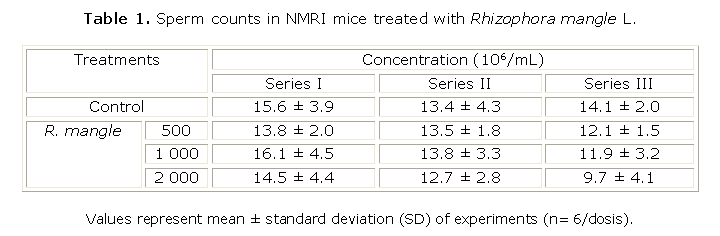
<body><![CDATA[<P>      <P><font face="Verdana" size="2">Results of sperm count and morphology are presented    as the mean &#177; standard deviation (SD). Data of normal distribution and    variance homogeneity were studied by Kolmogorov-Smirnov and Bartlet tests, respectively.    Treatments were compared using ANOVA and Dunney&#180;s <I>post</I> test. p<I>    </I>&lt; 0.05 was considered significant. </font>     <P>&nbsp;      <P>      <P><font face="Verdana" size="2"><B><font size="3">RESULTS</font></B> </font>      <P>      <P><font face="Verdana" size="2">The effect of the oral administration of the    aqueous extract of <I>R. mangle</I> in terms of germ cells viability is presented    in <a href="/img/revistas/pla/v15n1/t0103110.gif">table 1</a>. The spermatic count was statistically    similar in control animals and animals treated with the different dose (500;    1 000; 2 000 mg/kg b.w.) of <I>R. mangle</I> aqueous extract. </font>      
<P><font face="Verdana" size="2">Results of the sperm morphology test, conducted    in the three different experimental series are shown in <a href="/img/revistas/pla/v15n1/t0203110.gif">table    2</a>. In experimental series I, the exposure to the highest dose of the plant    extract (2 000 mg/kg b.w.) produced an increase of anomalous sperms, with prevalence    of hook and banana type cells. However, the effect was not observed after exposure    to the lower dose of the plant extract (500 and 1 000 mg/kg). On the other hand,    in experimental series II and III, no increment in the frequency of appearance    of anomalous head was registered after exposure to the plant extract. </font>      
<P><font face="Verdana" size="2">On the other hand, in series II and III we appreciated    that none of the doses of the aqueous extract (500, 1 000 and 2 000 mg/kg b.w.)    induced variations in the percentage of appearance of anomalous sperms when    it is compared with the values in the control group of mice treated with saline    solution (NaCl 0,9 %). </font>      <P>&nbsp;      ]]></body>
<body><![CDATA[<P>      <P><font face="Verdana" size="2"><B><font size="3">DISCUSSION</font></B> </font>      <P>      <P><font face="Verdana" size="2">From ancient times, plants have been used for    medicinal purposes. Nowadays, primary health care in 80 % of the world population    basically relies on plant and plant-derived products,<SUP>16</SUP> mainly due    to medicinal plants constitute the base of health care systems in many societies    and because the recovery of the knowledge and practices associated with these    plant resources are part of an important health strategy in discovery of new    medicines.<SUP>17</SUP> However, plants compounds can also have toxic effects    in the human body, as they markedly differ from endogenous substances.<SUP>18</SUP>    </font>     <P><font face="Verdana" size="2">When evaluating the effect of the aqueous extract    of <I>R. mangle</I> over the germinal cells viability it was shown that it does    not induce cytotoxicity on the sperm tides that are in differentiation roads    to sperms (spermatogenesis phase) or on the sperms that are already formed at    4, 21 or 35 days, corresponding to experimental series I, II and III respectively.    Altogether, these results reveal that the plant extract does not affect neither    the viability of the primary and secondary spermatocytes (meiosis phase) nor    the viability of the spermatogonium (mitosis phase). </font>     <P><font face="Verdana" size="2">The absence of toxicity observed in germinal    cells after exposure to the aqueous extract of the bark of <I>R. mangle</I>    can be explained on the basis of its chemical components. No toxic effects on    <I>in vivo</I> models have been attributed to condensed and hydrolysable tannins,    phytosterols, semi volatile compounds and fatty acids, which are constituents    of <I>R. mangle</I> aqueous extract.<SUP>12</SUP> Similarly, it has reported    no toxic effects on germs cells viability after exposure to limit dose of the    extracts of caisim&oacute;n of anis (<I>Piper auritum</I> H.B.K) and majagua    (<I>Hibiscus elatus</I> Sw), which also contain tannins in their chemical composition.<SUP>    19</SUP> In addition, no toxic effects have been found for high doses (1000    and 2000 mg/kg) of the aqueous extract of <I>Mangifera indica</I> L, which contains    an important amount of polyphenolic compounds.<SUP>20</SUP> </font>     <P><font face="Verdana" size="2">However, a significant increase in abnormal spermatozoa    was observed in the group administered with the higher dose of the plant extract    within the experimental series I, pointing out to a genotoxic effect on the    germ cells, particularly at the spermatogenesis phase. The finding could be    related to certain components of the extract such as hydrolysable tannins (e.g.    gallic and ellagic acids) or its metabolites able of exert toxicity particularly    during the spermatogenesis process. </font>     <P><font face="Verdana" size="2">Researchers have documented the <I>in vitro</I>    cytotoxicity and genotoxicity induced by ellagic and gallic acid (15-240 mM    concentration range) as measured in culture of B14 cell line.<SUP>21</SUP> The    results of this study showed that tannins could decrease the viability of cells    and their cytotoxicity was highest at the concentration of 60 mM. Also the data    obtained from the Comet assay also supported the ability of both compounds to    contribute to formation of DNA single-strand breaks. Although, both chemical    entities could be at least partially responsible for the mutagenic effect of    the <I>R. mangle</I> extract at high doses, we thinks that in this case we must    be cautious and careful because these elements are common in our diets. </font>     <P><font face="Verdana" size="2">On the other hand, the mutagenic effect of the    extract could be also related to the lacking of effective cell repair mechanisms    at this stage or to the nature of the damage, as in some cases no endogenous    mechanism exists for its reparation. In any case, the values of anomalous sperms    observed at the higher dose of 2000 mg/kg fall below the values reported in    similar studies by,<SUP>19</SUP> even though they are significant when compared    to control group. Consequently, above results generates questions that should    be corroborated and discussed in further studies. </font>     <P><font face="Verdana" size="2">Current results show biggest susceptibility in    the sperm tides cells, in disagreement with previous approaches in which the    late spermatogonial cells and/or early primary spermatocytes appear to be the    most susceptible.<SUP>14,22</SUP> But in support of our finding, researchers    have also found the late sperm tides undergoing differentiation process and    the sperms already formed as preferable targets of the genotoxicity, exerted    by the independent and combined treatment of acryl amide and X-rays on the germinal    and somatic cells.<SUP>15</SUP> </font>     ]]></body>
<body><![CDATA[<P><font face="Verdana" size="2">The exposure to <I>R. mangle</I> aqueous extract    lasting 21 and 35 days did not increase the frequency of appearance of anomalous    sperms, according to the data in experimental series II<B> </B>and III. One    line of thoughts, guided by results of <I>Wyrobek</I> and <I>Bruce</I>,<SUP>22</SUP>    could lead us to conclude that <I>R. mangle</I> aqueous extract does not induce    DNA damage in germ cells on mitosis and meiosis stages. But, a second view should    be also considered, as certain genotoxicity of the extract was observed in experimental    series I<B> </B>at high doses. Therefore, it can be speculated the occurrence    of genotoxicity after exposure to <I>R. mangle</I> extract, which could be generally    repaired, except during certain conditions, such as those observed in experimental    series I. Above considerations could be perfectly permissible as strong genetic    cellular control exists in the organism designed to allow the minimal quantity    of mutations to be transmitted to progeny cells. </font>     <P><font face="Verdana" size="2"><I>R. mangle </I>(red mangrove) represents an    ethno botanically relevant plant in Cuba, traditionally used for different biomedical    applications.<SUP>5</SUP> It's variety of empirical uses with different doses,    frequencies of administration and duration of treatments, make necessity to    perform a complete set of toxicity studies. Current investigation gives one    step towards this general purpose and demonstrates the occurrence of moderate    genotoxic effects at doses 4 times higher than maximum therapeutic dose.</font>     <P>&nbsp;      <P>      <P><font face="Verdana" size="2"><B><font size="3">ACKNOWLEDGEMENTS</font></B>    </font>      <P>      <P><font face="Verdana" size="2">The authors thank Dr. Adyari Fallarero for her    helpful discussion and pertinent advice.</font>     <P>&nbsp;      <P>      <P><font face="Verdana" size="2"><B><font size="3">REFERENCES </font></B> </font>      ]]></body>
<body><![CDATA[<P>      <!-- ref --><P><font face="Verdana" size="2">1. Varanda EA, Pozetti GL, Lourenco MV, Vilegas    W, Raddi MS. Genotoxicity of <I>Brosimun gaudichaudii</I> measured by the <I>Salmonella</I>/microsome    assay and chromosomal aberration in CHO cells. J Ethnopharmacol. 2002;81(2):257-64.    </font>    <!-- ref --><P><font face="Verdana" size="2">2. Carvalho MC, Barca FN, Agnez, LF, Medeiros    SR. Evaluation of mutagenic activity in an extract of pepper tree stem bark.    Environ Mol Mutagen. 2003;42(3):185-91. </font>    <!-- ref --><P><font face="Verdana" size="2">3. S&aacute;nchez-Lamar A, Fonseca G, Fuentes    JL, Cozzi R, Cundari E, Fiore M, et al. Assessment of the genotoxic risk of    <I>Punica granatum</I> L. (Punicaceae) whole fruit extracts. J Ethnopharmacol.    2008;12;115(3):416-22. </font>    <!-- ref --><P><font face="Verdana" size="2">4. Wallace, Hayes A. Principles and Methods of    Toxicology. Chapter 6. 2nd ed. New York: Raven Press, Ltd; 1989. </font>    <!-- ref --><P><font face="Verdana" size="2">5. Roig JT. Plantas medicinales, arom&aacute;ticas    y venenosas de Cuba. Ciudad de La Habana: Editorial Cient&iacute;fico-T&eacute;cnica;    1988. </font>    <!-- ref --><P><font face="Verdana" size="2">6. Rojas N, Coto O. Propiedades antimicrobianas    de extractos de<B> </B><I>Rhizophora mangle</I> L.<B> </B>Rev Cubana Med Trop.    1978;30(3):181-7. </font>    <!-- ref --><P><font face="Verdana" size="2">7. S&aacute;nchez L, Melchor G, &Aacute;lvarez    S, Bulnes C. Caracterizaci&oacute;n qu&iacute;mica y toxicol&oacute;gica de    una formulaci&oacute;n cicatrizante de <I>Rhizophora mangle</I> L. Rev. Salud    Anim. 1998;20:69-72. </font>    <!-- ref --><P><font face="Verdana" size="2">8. S&aacute;nchez L, Ruedas D, G&oacute;mez,    BC. Gastric antiulcer effect of <I>Rhizophora mangle</I> L. J Ethnopharmacol.    2001;77:1-3. </font>    <!-- ref --><P><font face="Verdana" size="2">9. Berenguer B, S&aacute;nchez LM, Qu&iacute;lez    A, L&oacute;pez-Barreiro M, de Haro O, G&aacute;lvez J, et al. Protective and    antioxidant effects of <I>Rhizophora mangle</I> L. against NSAID-induced gastric    ulcers. J Ethnopharmacol. 2006;103(2):194-200. </font>    <!-- ref --><P><font face="Verdana" size="2">10. De Armas E, Sarracent Y, Marrero E, Fern&aacute;ndez    O, Branford-White C. Efficacy of <I>Rhizophora mangle</I> aqueous bark extract    (RMABE) in the treatment of aphthous ulcers: a pilot study. Curr Med Res Opin.    2005;21(11):1711-5. </font>    <!-- ref --><P><font face="Verdana" size="2">11. Marrero E, S&aacute;nchez J, de Armas E,    Escobar A, Melchor G, Abad MJ, et al. COX-2 and sPLA2 inhibitory activity of    aqueous extract and polyphenols of <I>Rhizophora mangle</I> (red mangrove).    Fitoterapia. 2006;77(4):313-5. </font>    <!-- ref --><P><font face="Verdana" size="2">12. Fernandez O, Capdevila JZ, Dalla G, Melchor    G. Efficacy of <I>Rhizophora mangle</I> aqueous bark extract in the healing    of open surgical wounds. Fitoter. 2002;73:564-68. </font>    <!-- ref --><P><font face="Verdana" size="2">13. CENPALAB. C&oacute;digo Pr&aacute;ctico para    el Uso de los Animales de Laboratorio. La Habana: CENPALAB; 1992. </font>    <!-- ref --><P><font face="Verdana" size="2">14. Wyrobek A, Bruce W. Chemical induction of    sperm abnormalities in mice. Proc Natl Acad Sci (USA). 1975;72:4425-9. </font>    <!-- ref --><P><font face="Verdana" size="2">15. Dobrzyriska M, Gajewski A. Induction of micronuclei    in Bone Marrow and Sperm Head Abnormalities after combined exposure of mice    to low doses of X-rays and acrylamide. Terat Carcinog Mutag. 2000;20:133-40.    </font>    <!-- ref --><P><font face="Verdana" size="2">16. Schuster BG. A new integrated program for    natural product development and the value of an ethnomedical approach. J Altern    Complement Med. 2001;7(Suppl 1):S61-72. </font>    <!-- ref --><P><font face="Verdana" size="2">17. Alviano DS, Alviano CS. Plant extracts: search    for new alternatives to treat microbial diseases. Curr Pharm Biotechnol. 2009;10(1):106-21.    </font>    <!-- ref --><P><font face="Verdana" size="2">18. Vidal A, Fallarero A, Vuorela P. Toxicological    evaluation of plant extracts: is it necessary? Recent progress in Medicinal    Plants- Reviews series. Phytotherapeutics. 2005;10:1-13. </font>    <!-- ref --><P><font face="Verdana" size="2">19. Remigio A. Evaluaci&oacute;n genot&oacute;xica    de seis extractos de plantas medicinales, mediante ensayos in vivo en ratones    [Tesis de Maestr&iacute;a]. Ciudad de La Habana: Facultad de Farmacia y Alimentos,    Universidad de La Habana; 2002. </font>    <!-- ref --><P><font face="Verdana" size="2">20. Cancino L, Leiva A, Garrido G, Cossio A,    Prieto E. Vimang: los efectos antigenot&oacute;xico y modulador de las enzimas    glutati&oacute;n peroxidasa y glutati&oacute;n-S-transferasa. Rev Cubana Invest    Biomed. 2001;20(1):48-53. </font>    <!-- ref --><P><font face="Verdana" size="2">21. Labieniec M, GabryelakT. Effects of tannins    on Chinese hamster cell line B14. Mutat Res. 2003;39(1-2):127-35. </font>    <!-- ref --><P><font face="Verdana" size="2">22. Wyrobek AJ, Bruce WR. The induction of sperm    shape abnormalities in mice and humans. Chemical Mutagens: Principles and Methods    for their detection. New York: A Hollander and FH de Serres Plenum Press; 1978.    p. 257-85. </font>    <P>&nbsp;     <P>&nbsp;     <P>      <P><font face="Verdana" size="2">Recibido: 30 de mayo de 2009.     <br>   Aprobado: 15 de enero de 2010. </font>     <P>&nbsp;     <P>&nbsp;      ]]></body>
<body><![CDATA[<P>      <P><font face="Verdana" size="2">MSc. <I>Deyanira Carnesoltas</I>. Departamento    de Farmacolog&iacute;a, Instituto Nacional de Oncolog&iacute;a y Radiobiolog&iacute;a.    29 y E, Vedado, CP 10400, Ciudad de La Habana, Cuba. Correo electr&oacute;nico:    <U><FONT  COLOR="#0000ff"><a href="mailto:deya@infomed.sld.cu">deya@infomed.sld.cu</a></FONT></U>;    <U><FONT  COLOR="#0000ff"><a href="mailto:neivys@fbio.uh.cu">neivys@fbio.uh.cu</a></FONT></U>    </font>       ]]></body><back>
<ref-list>
<ref id="B1">
<label>1</label><nlm-citation citation-type="journal">
<person-group person-group-type="author">
<name>
<surname><![CDATA[Varanda]]></surname>
<given-names><![CDATA[EA]]></given-names>
</name>
<name>
<surname><![CDATA[Pozetti]]></surname>
<given-names><![CDATA[GL]]></given-names>
</name>
<name>
<surname><![CDATA[Lourenco]]></surname>
<given-names><![CDATA[MV]]></given-names>
</name>
<name>
<surname><![CDATA[Vilegas]]></surname>
<given-names><![CDATA[W]]></given-names>
</name>
<name>
<surname><![CDATA[Raddi]]></surname>
<given-names><![CDATA[MS]]></given-names>
</name>
</person-group>
<article-title xml:lang="en"><![CDATA[Genotoxicity of Brosimun gaudichaudii measured by the Salmonella/microsome assay and chromosomal aberration in CHO cells]]></article-title>
<source><![CDATA[J Ethnopharmacol.]]></source>
<year>2002</year>
<volume>81</volume>
<numero>2</numero>
<issue>2</issue>
<page-range>257-64</page-range></nlm-citation>
</ref>
<ref id="B2">
<label>2</label><nlm-citation citation-type="journal">
<person-group person-group-type="author">
<name>
<surname><![CDATA[Carvalho]]></surname>
<given-names><![CDATA[MC]]></given-names>
</name>
<name>
<surname><![CDATA[Barca]]></surname>
<given-names><![CDATA[FN]]></given-names>
</name>
<name>
<surname><![CDATA[Agnez]]></surname>
<given-names><![CDATA[LF]]></given-names>
</name>
<name>
<surname><![CDATA[Medeiros]]></surname>
<given-names><![CDATA[SR]]></given-names>
</name>
</person-group>
<article-title xml:lang="en"><![CDATA[Evaluation of mutagenic activity in an extract of pepper tree stem bark]]></article-title>
<source><![CDATA[Environ Mol Mutagen.]]></source>
<year>2003</year>
<volume>42</volume>
<numero>3</numero>
<issue>3</issue>
<page-range>185-91</page-range></nlm-citation>
</ref>
<ref id="B3">
<label>3</label><nlm-citation citation-type="journal">
<person-group person-group-type="author">
<name>
<surname><![CDATA[Sánchez-Lamar]]></surname>
<given-names><![CDATA[A]]></given-names>
</name>
<name>
<surname><![CDATA[Fonseca]]></surname>
<given-names><![CDATA[G]]></given-names>
</name>
<name>
<surname><![CDATA[Fuentes]]></surname>
<given-names><![CDATA[JL]]></given-names>
</name>
<name>
<surname><![CDATA[Cozzi]]></surname>
<given-names><![CDATA[R]]></given-names>
</name>
<name>
<surname><![CDATA[Cundari]]></surname>
<given-names><![CDATA[E]]></given-names>
</name>
<name>
<surname><![CDATA[Fiore]]></surname>
<given-names><![CDATA[M]]></given-names>
</name>
</person-group>
<article-title xml:lang="en"><![CDATA[Assessment of the genotoxic risk of Punica granatum L: (Punicaceae) whole fruit extracts]]></article-title>
<source><![CDATA[J Ethnopharmacol.]]></source>
<year>2008</year>
<volume>12;115</volume>
<numero>3</numero>
<issue>3</issue>
<page-range>416-22</page-range></nlm-citation>
</ref>
<ref id="B4">
<label>4</label><nlm-citation citation-type="book">
<person-group person-group-type="author">
<name>
<surname><![CDATA[Wallace]]></surname>
</name>
<name>
<surname><![CDATA[Hayes]]></surname>
<given-names><![CDATA[A.]]></given-names>
</name>
</person-group>
<source><![CDATA[Principles and Methods of Toxicology.]]></source>
<year>1989</year>
<edition>2nd ed</edition>
<publisher-loc><![CDATA[New York ]]></publisher-loc>
<publisher-name><![CDATA[Raven Press, Ltd]]></publisher-name>
</nlm-citation>
</ref>
<ref id="B5">
<label>5</label><nlm-citation citation-type="book">
<person-group person-group-type="author">
<name>
<surname><![CDATA[Roig]]></surname>
<given-names><![CDATA[JT.]]></given-names>
</name>
</person-group>
<source><![CDATA[Plantas medicinales, aromáticas y venenosas de Cuba.]]></source>
<year>1988</year>
<publisher-loc><![CDATA[Ciudad de La Habana ]]></publisher-loc>
<publisher-name><![CDATA[Editorial Científico-Técnica]]></publisher-name>
</nlm-citation>
</ref>
<ref id="B6">
<label>6</label><nlm-citation citation-type="journal">
<person-group person-group-type="author">
<name>
<surname><![CDATA[Rojas]]></surname>
<given-names><![CDATA[N]]></given-names>
</name>
<name>
<surname><![CDATA[Coto]]></surname>
<given-names><![CDATA[O]]></given-names>
</name>
</person-group>
<article-title xml:lang="es"><![CDATA[Propiedades antimicrobianas de extractos de Rhizophora mangle L]]></article-title>
<source><![CDATA[Rev Cubana Med Trop.]]></source>
<year>1978</year>
<volume>30</volume>
<numero>3</numero>
<issue>3</issue>
<page-range>181-7</page-range></nlm-citation>
</ref>
<ref id="B7">
<label>7</label><nlm-citation citation-type="journal">
<person-group person-group-type="author">
<name>
<surname><![CDATA[Sánchez]]></surname>
<given-names><![CDATA[L]]></given-names>
</name>
<name>
<surname><![CDATA[Melchor]]></surname>
<given-names><![CDATA[G]]></given-names>
</name>
<name>
<surname><![CDATA[Álvarez]]></surname>
<given-names><![CDATA[S]]></given-names>
</name>
<name>
<surname><![CDATA[Bulnes]]></surname>
<given-names><![CDATA[C]]></given-names>
</name>
</person-group>
<article-title xml:lang="es"><![CDATA[Caracterización química y toxicológica de una formulación cicatrizante de Rhizophora mangle L: Rev]]></article-title>
<source><![CDATA[Salud Anim.]]></source>
<year>1998</year>
<volume>20</volume>
<page-range>69-72</page-range></nlm-citation>
</ref>
<ref id="B8">
<label>8</label><nlm-citation citation-type="journal">
<person-group person-group-type="author">
<name>
<surname><![CDATA[Sánchez]]></surname>
<given-names><![CDATA[L]]></given-names>
</name>
<name>
<surname><![CDATA[Ruedas]]></surname>
<given-names><![CDATA[D]]></given-names>
</name>
<name>
<surname><![CDATA[Gómez]]></surname>
<given-names><![CDATA[BC]]></given-names>
</name>
</person-group>
<article-title xml:lang="en"><![CDATA[Gastric antiulcer effect of Rhizophora mangle L]]></article-title>
<source><![CDATA[J Ethnopharmacol.]]></source>
<year>2001</year>
<volume>77</volume>
<page-range>1-3</page-range></nlm-citation>
</ref>
<ref id="B9">
<label>9</label><nlm-citation citation-type="journal">
<person-group person-group-type="author">
<name>
<surname><![CDATA[Berenguer]]></surname>
<given-names><![CDATA[B]]></given-names>
</name>
<name>
<surname><![CDATA[Sánchez]]></surname>
<given-names><![CDATA[LM]]></given-names>
</name>
<name>
<surname><![CDATA[Quílez]]></surname>
<given-names><![CDATA[A]]></given-names>
</name>
<name>
<surname><![CDATA[López-Barreiro]]></surname>
<given-names><![CDATA[M]]></given-names>
</name>
<name>
<surname><![CDATA[de Haro]]></surname>
<given-names><![CDATA[O]]></given-names>
</name>
<name>
<surname><![CDATA[Gálvez]]></surname>
<given-names><![CDATA[J]]></given-names>
</name>
</person-group>
<article-title xml:lang="en"><![CDATA[Protective and antioxidant effects of Rhizophora mangle L: against NSAID-induced gastric ulcers]]></article-title>
<source><![CDATA[J Ethnopharmacol.]]></source>
<year>2006</year>
<volume>103</volume>
<numero>2</numero>
<issue>2</issue>
<page-range>194-200</page-range></nlm-citation>
</ref>
<ref id="B10">
<label>10</label><nlm-citation citation-type="journal">
<person-group person-group-type="author">
<name>
<surname><![CDATA[De Armas]]></surname>
<given-names><![CDATA[E]]></given-names>
</name>
<name>
<surname><![CDATA[Sarracent]]></surname>
<given-names><![CDATA[Y]]></given-names>
</name>
<name>
<surname><![CDATA[Marrero]]></surname>
<given-names><![CDATA[E]]></given-names>
</name>
<name>
<surname><![CDATA[Fernández]]></surname>
<given-names><![CDATA[O]]></given-names>
</name>
<name>
<surname><![CDATA[Branford-White]]></surname>
<given-names><![CDATA[C]]></given-names>
</name>
</person-group>
<article-title xml:lang="en"><![CDATA[Efficacy of Rhizophora mangle aqueous bark extract (RMABE) in the treatment of aphthous ulcers: a pilot study]]></article-title>
<source><![CDATA[Curr Med Res Opin.]]></source>
<year>2005</year>
<volume>21</volume>
<numero>11</numero>
<issue>11</issue>
<page-range>1711-5</page-range></nlm-citation>
</ref>
<ref id="B11">
<label>11</label><nlm-citation citation-type="journal">
<person-group person-group-type="author">
<name>
<surname><![CDATA[Marrero]]></surname>
<given-names><![CDATA[E]]></given-names>
</name>
<name>
<surname><![CDATA[Sánchez]]></surname>
<given-names><![CDATA[J]]></given-names>
</name>
<name>
<surname><![CDATA[de Armas]]></surname>
<given-names><![CDATA[E]]></given-names>
</name>
<name>
<surname><![CDATA[Escobar]]></surname>
<given-names><![CDATA[A]]></given-names>
</name>
<name>
<surname><![CDATA[Melchor]]></surname>
<given-names><![CDATA[G]]></given-names>
</name>
<name>
<surname><![CDATA[Abad]]></surname>
<given-names><![CDATA[MJ]]></given-names>
</name>
</person-group>
<article-title xml:lang="en"><![CDATA[COX-2 and sPLA2 inhibitory activity of aqueous extract and polyphenols of Rhizophora mangle (red mangrove)]]></article-title>
<source><![CDATA[Fitoterapia.]]></source>
<year>2006</year>
<volume>77</volume>
<numero>4</numero>
<issue>4</issue>
<page-range>313-5</page-range></nlm-citation>
</ref>
<ref id="B12">
<label>12</label><nlm-citation citation-type="journal">
<person-group person-group-type="author">
<name>
<surname><![CDATA[Fernandez]]></surname>
<given-names><![CDATA[O]]></given-names>
</name>
<name>
<surname><![CDATA[Capdevila]]></surname>
<given-names><![CDATA[JZ]]></given-names>
</name>
<name>
<surname><![CDATA[Dalla]]></surname>
<given-names><![CDATA[G]]></given-names>
</name>
<name>
<surname><![CDATA[Melchor]]></surname>
<given-names><![CDATA[G]]></given-names>
</name>
</person-group>
<article-title xml:lang="en"><![CDATA[Efficacy of Rhizophora mangle aqueous bark extract in the healing of open surgical wounds]]></article-title>
<source><![CDATA[Fitoter.]]></source>
<year>2002</year>
<volume>73</volume>
<page-range>564-68</page-range></nlm-citation>
</ref>
<ref id="B13">
<label>13</label><nlm-citation citation-type="book">
<collab>CENPALAB.</collab>
<source><![CDATA[Código Práctico para el Uso de los Animales de Laboratorio.]]></source>
<year>1992</year>
<publisher-loc><![CDATA[La Habana ]]></publisher-loc>
<publisher-name><![CDATA[CENPALAB]]></publisher-name>
</nlm-citation>
</ref>
<ref id="B14">
<label>14</label><nlm-citation citation-type="journal">
<person-group person-group-type="author">
<name>
<surname><![CDATA[Wyrobek]]></surname>
<given-names><![CDATA[A]]></given-names>
</name>
<name>
<surname><![CDATA[Bruce]]></surname>
<given-names><![CDATA[W]]></given-names>
</name>
</person-group>
<article-title xml:lang="en"><![CDATA[Chemical induction of sperm abnormalities in mice]]></article-title>
<source><![CDATA[Proc Natl Acad Sci (USA).]]></source>
<year>1975</year>
<volume>72</volume>
<page-range>4425-9</page-range></nlm-citation>
</ref>
<ref id="B15">
<label>15</label><nlm-citation citation-type="journal">
<person-group person-group-type="author">
<name>
<surname><![CDATA[Dobrzyriska]]></surname>
<given-names><![CDATA[M]]></given-names>
</name>
<name>
<surname><![CDATA[Gajewski]]></surname>
<given-names><![CDATA[A]]></given-names>
</name>
</person-group>
<article-title xml:lang="en"><![CDATA[Induction of micronuclei in Bone Marrow and Sperm Head Abnormalities after combined exposure of mice to low doses of X-rays and acrylamide]]></article-title>
<source><![CDATA[Terat Carcinog Mutag.]]></source>
<year>2000</year>
<volume>20</volume>
<page-range>133-40</page-range></nlm-citation>
</ref>
<ref id="B16">
<label>16</label><nlm-citation citation-type="journal">
<person-group person-group-type="author">
<name>
<surname><![CDATA[Schuster]]></surname>
<given-names><![CDATA[BG.]]></given-names>
</name>
</person-group>
<article-title xml:lang="en"><![CDATA[A new integrated program for natural product development and the value of an ethnomedical approach.]]></article-title>
<source><![CDATA[J Altern Complement Med]]></source>
<year>2001</year>
<volume>7</volume>
<numero>^sSuppl 1</numero>
<issue>^sSuppl 1</issue>
<supplement>Suppl 1</supplement>
<page-range>S61-72</page-range></nlm-citation>
</ref>
<ref id="B17">
<label>17</label><nlm-citation citation-type="journal">
<person-group person-group-type="author">
<name>
<surname><![CDATA[Alviano]]></surname>
<given-names><![CDATA[DS]]></given-names>
</name>
<name>
<surname><![CDATA[Alviano]]></surname>
<given-names><![CDATA[CS]]></given-names>
</name>
</person-group>
<article-title xml:lang="en"><![CDATA[Plant extracts: search for new alternatives to treat microbial diseases]]></article-title>
<source><![CDATA[Curr Pharm Biotechnol.]]></source>
<year>2009</year>
<volume>10</volume>
<numero>1</numero>
<issue>1</issue>
<page-range>106-21</page-range></nlm-citation>
</ref>
<ref id="B18">
<label>18</label><nlm-citation citation-type="journal">
<person-group person-group-type="author">
<name>
<surname><![CDATA[Vidal]]></surname>
<given-names><![CDATA[A]]></given-names>
</name>
<name>
<surname><![CDATA[Fallarero]]></surname>
<given-names><![CDATA[A]]></given-names>
</name>
<name>
<surname><![CDATA[Vuorela]]></surname>
<given-names><![CDATA[P.]]></given-names>
</name>
</person-group>
<article-title xml:lang="en"><![CDATA[Toxicological evaluation of plant extracts:: is it necessary? Recent progress in Medicinal Plants. Reviews series.]]></article-title>
<source><![CDATA[Phytotherapeutics]]></source>
<year>2005</year>
<volume>10</volume>
<page-range>1-13</page-range></nlm-citation>
</ref>
<ref id="B19">
<label>19</label><nlm-citation citation-type="book">
<person-group person-group-type="author">
<name>
<surname><![CDATA[Remigio]]></surname>
<given-names><![CDATA[A.]]></given-names>
</name>
</person-group>
<source><![CDATA[Evaluación genotóxica de seis extractos de plantas medicinales, mediante ensayos in vivo en ratones]]></source>
<year>2002</year>
<publisher-loc><![CDATA[Ciudad de La Habana ]]></publisher-loc>
<publisher-name><![CDATA[Facultad de Farmacia y Alimentos, Universidad de La Habana]]></publisher-name>
</nlm-citation>
</ref>
<ref id="B20">
<label>20</label><nlm-citation citation-type="journal">
<person-group person-group-type="author">
<name>
<surname><![CDATA[Cancino]]></surname>
<given-names><![CDATA[L]]></given-names>
</name>
<name>
<surname><![CDATA[Leiva]]></surname>
<given-names><![CDATA[A]]></given-names>
</name>
<name>
<surname><![CDATA[Garrido]]></surname>
<given-names><![CDATA[G]]></given-names>
</name>
<name>
<surname><![CDATA[Cossio]]></surname>
<given-names><![CDATA[A]]></given-names>
</name>
<name>
<surname><![CDATA[Prieto]]></surname>
<given-names><![CDATA[E]]></given-names>
</name>
</person-group>
<article-title xml:lang="es"><![CDATA[Vimang: los efectos antigenotóxico y modulador de las enzimas glutatión peroxidasa y glutatión-S-transferasa]]></article-title>
<source><![CDATA[Rev Cubana Invest Biomed.]]></source>
<year>2001</year>
<volume>20</volume>
<numero>1</numero>
<issue>1</issue>
<page-range>48-53</page-range></nlm-citation>
</ref>
<ref id="B21">
<label>21</label><nlm-citation citation-type="journal">
<person-group person-group-type="author">
<name>
<surname><![CDATA[Labieniec]]></surname>
<given-names><![CDATA[M]]></given-names>
</name>
<name>
<surname><![CDATA[Gabryelak]]></surname>
<given-names><![CDATA[T.]]></given-names>
</name>
</person-group>
<article-title xml:lang="en"><![CDATA[Effects of tannins on Chinese hamster cell line B14]]></article-title>
<source><![CDATA[Mutat Res.]]></source>
<year>2003</year>
<volume>39</volume>
<numero>1-2</numero>
<issue>1-2</issue>
<page-range>127-35</page-range></nlm-citation>
</ref>
<ref id="B22">
<label>22</label><nlm-citation citation-type="book">
<person-group person-group-type="author">
<name>
<surname><![CDATA[Wyrobek]]></surname>
<given-names><![CDATA[AJ]]></given-names>
</name>
<name>
<surname><![CDATA[Bruce]]></surname>
<given-names><![CDATA[WR.]]></given-names>
</name>
</person-group>
<source><![CDATA[The induction of sperm shape abnormalities in mice and humans.: Chemical Mutagens: Principles and Methods for their detection.]]></source>
<year>1978</year>
<page-range>p. 257-85</page-range><publisher-loc><![CDATA[New York ]]></publisher-loc>
<publisher-name><![CDATA[A Hollander and FH de Serres Plenum Press]]></publisher-name>
</nlm-citation>
</ref>
</ref-list>
</back>
</article>