<?xml version="1.0" encoding="ISO-8859-1"?><article xmlns:mml="http://www.w3.org/1998/Math/MathML" xmlns:xlink="http://www.w3.org/1999/xlink" xmlns:xsi="http://www.w3.org/2001/XMLSchema-instance">
<front>
<journal-meta>
<journal-id>1028-4796</journal-id>
<journal-title><![CDATA[Revista Cubana de Plantas Medicinales]]></journal-title>
<abbrev-journal-title><![CDATA[Rev Cubana Plant Med]]></abbrev-journal-title>
<issn>1028-4796</issn>
<publisher>
<publisher-name><![CDATA[ECIMED]]></publisher-name>
</publisher>
</journal-meta>
<article-meta>
<article-id>S1028-47962011000400006</article-id>
<title-group>
<article-title xml:lang="es"><![CDATA[Caracterización del triterpeno cicloartanol aislado del extracto de dicloromentano de Pedilanthus tithymaloides]]></article-title>
<article-title xml:lang="en"><![CDATA[Characterization of cycloartanol triterpene isolated from dichloromethane extract of Pedilanthus tithymaloides]]></article-title>
</title-group>
<contrib-group>
<contrib contrib-type="author">
<name>
<surname><![CDATA[Cabrera Suárez]]></surname>
<given-names><![CDATA[Hirán]]></given-names>
</name>
<xref ref-type="aff" rid="A01"/>
</contrib>
<contrib contrib-type="author">
<name>
<surname><![CDATA[Cuellar Cuellar]]></surname>
<given-names><![CDATA[Armando]]></given-names>
</name>
<xref ref-type="aff" rid="A02"/>
</contrib>
<contrib contrib-type="author">
<name>
<surname><![CDATA[Pita]]></surname>
<given-names><![CDATA[Roberto Carlo]]></given-names>
</name>
<xref ref-type="aff" rid="A03"/>
</contrib>
</contrib-group>
<aff id="A01">
<institution><![CDATA[,Central Laboratory of Pharmacology (LCF) Medical Sciences Faculty Dr Salvador Allende ]]></institution>
<addr-line><![CDATA[La Habana ]]></addr-line>
<country>Cuba</country>
</aff>
<aff id="A02">
<institution><![CDATA[,Pharmacy and Food Institute Havana University ]]></institution>
<addr-line><![CDATA[La Habana ]]></addr-line>
<country>Cuba</country>
</aff>
<aff id="A03">
<institution><![CDATA[,Synthetic Antigen Center Havana University ]]></institution>
<addr-line><![CDATA[La Habana ]]></addr-line>
<country>Cuba</country>
</aff>
<pub-date pub-type="pub">
<day>00</day>
<month>12</month>
<year>2011</year>
</pub-date>
<pub-date pub-type="epub">
<day>00</day>
<month>12</month>
<year>2011</year>
</pub-date>
<volume>16</volume>
<numero>4</numero>
<fpage>347</fpage>
<lpage>353</lpage>
<copyright-statement/>
<copyright-year/>
<self-uri xlink:href="http://scielo.sld.cu/scielo.php?script=sci_arttext&amp;pid=S1028-47962011000400006&amp;lng=en&amp;nrm=iso"></self-uri><self-uri xlink:href="http://scielo.sld.cu/scielo.php?script=sci_abstract&amp;pid=S1028-47962011000400006&amp;lng=en&amp;nrm=iso"></self-uri><self-uri xlink:href="http://scielo.sld.cu/scielo.php?script=sci_pdf&amp;pid=S1028-47962011000400006&amp;lng=en&amp;nrm=iso"></self-uri><abstract abstract-type="short" xml:lang="en"><p><![CDATA[Introduction: Pedilanthus tithymaloides is known as ítamo real and it has been previously reported as an alternative to treatment of oral cavity virus infections. Objective: to explain procedures to characterize one of the major compounds isolated from dichloromethane extracts of Pedilanthus tithymaloides (L.) Poit (leaves). Methods: it was obtained cycloartanol from dichloromethane extract modifying polarity of the solvents with methanol and by increasing polarity to extract, they were used chromatography technique and spectroscopic of nuclear magnetic resonance H+ and 13C to characterize this compounds. Results: phytochemical studies showed quality parameters that were similar to average limits in the use of majority of medicinal plants except total ashes assay (13 %), qualitative determination assay suggest presence of reducers compounds, quinone, phenols and/or tannins, triterpene and/or steroids. And they were compared spectrum carbon 13 (13C) of the substance obtained from extract of this plant with other reported in literature to cycloartanol and found coincidence in majority of carbons compared. Conclusions: cycloartanol triterpene was one of main compounds of dichloromethane extract of Pedilanthus tithymaloides (L) Poit leaves.]]></p></abstract>
<abstract abstract-type="short" xml:lang="es"><p><![CDATA[Introducción: Pedilanthus tithymaloides es conocido como ítamo real y se han publicado algunas de sus propiedades, entre ellas, el uso en estomatología para el tratamiento de infecciones bucales. Objetivo: explicar los procedimientos empleados para caracterizar uno de los compuestos mayoritarios aislado del extracto de diclorometano a partir de las hojas de Pedilanthus tithymaloides (L.) Poit. Métodos: el cicloartanol se obtuvo mediante la modificación de la polaridad del disolvente orgánico, con el empleo de metanol e incrementándose la polaridad y como consecuencia la aparición de un precipitado. Se utilizó la técnica de cromatografía de placa delgada, la cromatografía de columna, así como espectroscopia de resonancia magnética nuclear protónica y de carbono 13. Resultados: el estudio fitoquímico mostró parámetros de calidad acorde a lo que se sugiere para el uso de plantas medicinales, excepto las cenizas totales que presentaron 13 %; se comparó el espectro de carbono13 practicado al compuesto obtenido con otros reportes en la literatura y se encontró coincidencia con lo que se describe para el triterpeno cicloartanol. Conclusiones: cicloartanol es uno de los compuestos mayoritario presente en el extracto de dicloromentano obtenido a partir de hojas de Pedilanthus tithymaloides.]]></p></abstract>
<kwd-group>
<kwd lng="en"><![CDATA[Pedilanthus tithymaloides]]></kwd>
<kwd lng="en"><![CDATA[Cycloartanol]]></kwd>
<kwd lng="en"><![CDATA[Triterpene]]></kwd>
<kwd lng="en"><![CDATA[Itamo real]]></kwd>
<kwd lng="en"><![CDATA[Phytochemistry]]></kwd>
<kwd lng="es"><![CDATA[cicloartanol]]></kwd>
<kwd lng="es"><![CDATA[Pedilanthus tithymaloides]]></kwd>
<kwd lng="es"><![CDATA[ítamo real]]></kwd>
<kwd lng="es"><![CDATA[triterpenos]]></kwd>
<kwd lng="es"><![CDATA[fitoquímica]]></kwd>
</kwd-group>
</article-meta>
</front><body><![CDATA[ <div align="right">       <p><font size="2" face="Verdana"><B>ART&Iacute;CULO ORIGINAL</B></font></p>       <p>&nbsp; </p> </div>     <P><b><font face="Verdana" size="4">C</font></b><font size="4"><b><font face="Verdana">haracterization    of cycloartanol triterpene isolated from dichloromethane extract of <i>Pedilanthus    tithymaloides</i></font></b></font>     <P>     <P><font size="4" face="Verdana"><b><font size="3">Caracterizaci&oacute;n del    triterpeno cicloartanol aislado del extracto de dicloromentano de <I>Pedilanthus    tithymaloides</I> </font></b></font>      <P>     <P>     <P>      <P>      ]]></body>
<body><![CDATA[<P><b><font size="2" face="Verdana">MSc. Hir&aacute;n Cabrera Su&aacute;rez,<SUP>I</SUP>    Dr. C. Armando Cuellar Cuellar,<SUP>II </SUP>MSc. Roberto Carlo Pita<SUP>III    </SUP></font></b>      <P><SUP></SUP><font face="Verdana" size="2"><SUP>I </sup>Central Laboratory of    Pharmacology (LCF), Medical Sciences Faculty &quot;Dr Salvador Allende&quot;.    La Habana, Cuba. </font>    <br>   <font size="2" face="Verdana"><SUP>II </SUP>Pharmacy and Food Institute, Havana    University. La Habana, Cuba.    <br>   </font><font size="2" face="Verdana"><SUP>III </SUP>Synthetic Antigen Center,    Havana University. La Habana, Cuba. </font>     <P>     <P> <hr size="1" noshade> <font size="2" face="Verdana"><B>ABSTRACT</B></font><B></B>      <P><font size="2" face="Verdana"><B>Introduction</b>: <I>Pedilanthus tithymaloides</I>    is known as <I>&iacute;tamo real</I> and it has been previously reported as    an alternative to treatment of oral cavity virus infections. <B>    <br>   Objective</B>: to explain procedures to characterize one of the major compounds    isolated from dichloromethane extracts of <I>Pedilanthus tithymaloides</I> (L.)    Poit (leaves). <B>    <br>   Methods</B>: it was obtained cycloartanol from dichloromethane extract modifying    polarity of the solvents with methanol and by increasing polarity to extract,    they were used chromatography technique and spectroscopic of nuclear magnetic    resonance H<SUP>+</SUP> and <SUP>13</SUP>C to characterize this compounds. <B>    <br>   Results</B>: phytochemical studies showed quality parameters that were similar    to average limits in the use of majority of medicinal plants except total ashes    assay (13 %), qualitative determination assay suggest presence of reducers compounds,    quinone, phenols and/or tannins, triterpene and/or steroids. And they were compared    spectrum carbon 13 (<SUP>13</SUP>C) of the substance obtained from extract of    this plant with other reported in literature to cycloartanol and found coincidence    in majority of carbons compared. <B>    ]]></body>
<body><![CDATA[<br>   Conclusions</B>: cycloartanol triterpene was one of main compounds of dichloromethane    extract of <I>Pedilanthus tithymaloides</I> (L) Poit leaves. </font>      <P><font size="2" face="Verdana"><B>Key words</B>: <I>Pedilanthus tithymaloides</I>,    Cycloartanol, Triterpene, Itamo real, Phytochemistry. </font>  <hr size="1" noshade> <font size="2" face="Verdana"><B>RESUMEN</B></font>      <p><B> </B><font size="2" face="Verdana"><B>Introducci&oacute;n</b>: <I>Pedilanthus    tithymaloides</I> es conocido como &iacute;tamo real y se han publicado algunas    de sus propiedades, entre ellas, el uso en estomatolog&iacute;a para el tratamiento    de infecciones bucales. <B>    <br>   Objetivo</B>: explicar los procedimientos empleados para caracterizar uno de    los compuestos mayoritarios aislado del extracto de diclorometano a partir de    las hojas de <I>Pedilanthus tithymaloides</I> (L.) Poit. <B>    <br>   M&eacute;todos</B>: el cicloartanol se obtuvo mediante la modificaci&oacute;n    de la polaridad del disolvente org&aacute;nico, con el empleo de metanol e increment&aacute;ndose    la polaridad y como consecuencia la aparici&oacute;n de un precipitado. Se utiliz&oacute;    la t&eacute;cnica de cromatograf&iacute;a de placa delgada, la cromatograf&iacute;a    de columna, as&iacute; como espectroscopia de resonancia magn&eacute;tica nuclear    prot&oacute;nica y de carbono 13. <B>    <br>   Resultados</B>: el estudio fitoqu&iacute;mico mostr&oacute; par&aacute;metros    de calidad acorde a lo que se sugiere para el uso de plantas medicinales, excepto    las cenizas totales que presentaron 13 %; se compar&oacute; el espectro de carbono<SUP>13</SUP>    practicado al compuesto obtenido con otros reportes en la literatura y se encontr&oacute;    coincidencia con lo que se describe para el triterpeno cicloartanol. <B>    <br>   Conclusiones</B>: cicloartanol es uno de los compuestos mayoritario presente    en el extracto de dicloromentano obtenido a partir de hojas de<B> </B><I>Pedilanthus    tithymaloides</I> </font></p>     <P>      <P><font size="2" face="Verdana"><B>Palabras clave</B>: cicloartanol, <I>Pedilanthus    tithymaloides</I>, &iacute;tamo real, triterpenos, fitoqu&iacute;mica. </font> <hr size="1" noshade>     <p>&nbsp;</p>     ]]></body>
<body><![CDATA[<p>&nbsp;</p>     <P>      <P>      <P><font size="3" face="Verdana"><B>INTRODUCTION</B> </font>     <P>      <P><font size="2" face="Verdana">Secondary metabolites obtained from natural sources    are very important to treat several human diseases. </font>      <P><font size="2" face="Verdana"><I>Pedilanthus tithymaloides </I>(L.) Poit. (Euphorbiaceae)    has been reported to have a wide range of properties, namely as emetic, antiinflammatory,    antibody, antiseptic, antitumoral, and abortive effects.<SUP>1-4</SUP> </font>     <P><font size="2" face="Verdana">Some preclinical studies to evaluate the neurosedative    effect of dichloromethane extract obtained from <I>Pedilanthus tithymaloides    </I>(L.) Poit. leaves, showed results of several tests that indicate a depressing    effect on the central nervous system.<SUP>5</SUP> </font>      <P><font size="2" face="Verdana">There were found some reports about neurosedative    effects related with triterpene compounds<SUP>6-9</SUP> and phytochemical studies    have reported triterpenes in organic extract of <I>P. </I>tithymaloides.<SUP>10</SUP>    </font>      <P><font size="2" face="Verdana">Today, there are few reports about the chemical    composition of this plant; therefore, this review was aimed at explaining procedures    to characterize one of majority compounds isolated from dichloromethane extracts    of <I>Pedilanthus tithymaloides</I> (L) Poit leaves.</font>      ]]></body>
<body><![CDATA[<P>     <P>      <P><font size="3" face="Verdana"><B>METHODS</B> </font>     <P>      <P><font size="2" face="Verdana">The plant leaves were collected in the orchard    of medicinal plants of Pharmacy and Food Institute of Havana University. It    was authenticated by Ph.D. M&oacute;nica Sakaraqui of University of Maringa,    Paran&aacute;, Brazil, with number of herbarium 6104 </font>      <P>      <P><font size="2" face="Verdana"><I>Extracts preparation</I> </font>     <P>      <P><font size="2" face="Verdana">It was carried out by continuous extraction (Soxhlet)    with 500 mL of dichloromethane and 100 g of the vegetable material dried in    the stove and fractional previously (5 mm), it was processed during 10 hours.    </font>     <P>      ]]></body>
<body><![CDATA[<P><font size="2" face="Verdana"><I>Obtaining cycloartanol triterpene </I> </font>     <P>      <P><font size="2" face="Verdana">Each gram of extract dried was dissolved in 5    mL of chloroform and 20 mL of methanol, this process allowed obtaining a greenish-yellow    solid precipitate; they were recovered and separated by filtration from an oily    consistency mother solution (T<SUB>0</SUB>S). The greenish yellow solid was    processed to purification by successive washing with acetone and a white solid    (T<SUP>0</SUP>) was obtained, and it was characterized by NMR H<SUP>+</SUP>    and NMR <SUP>13</SUP>C.<B> </B> </font>      <P>      <P><font size="2" face="Verdana"><I>Chromatographic studies</I> </font>     <P><font size="2" face="Verdana">The qualitative analysis based on chromatography    it was carried out through thin plates of silica gel (G-60, F-254) to thin layer    chromatography (TLC). Some 50 % sulfuric acid and heat or ultraviolet light    (UV) 254 nm werw used to visualize spots. </font>      <P>      <P><font size="2" face="Verdana"><I>Spectral analysis</I> </font>     <P>      <P><font size="2" face="Verdana">The spectrum of magnetic resonance of H<SUP>+</SUP>    and <SUP>13</SUP>C were carried out in a Brucker ac. 250 MHz equipment with    chloroform deuterium and tetramethilsilane as internal reference. </font>      ]]></body>
<body><![CDATA[<P>     <P>      <P><font size="3" face="Verdana"><B>RESULTS</B> </font>     <P>      <P><font size="2" face="Verdana">The dichloromethane extract presents an intense    green color. It was a 2 % of weight, respect of vegetable material (leaves).    </font>     <P><font size="2" face="Verdana">Dried process in stove lasted 3 days and 83 %    of water was extracted from it. Relative humidity was 12 %. The total ashes    were 13,02 %, while the value of ashes was 11,83 % this agreed with alkaline    metals. Qualitative determination suggested to presence of quinone, reducing    compounds, phenol and/or tannin, triterpene and/or steroids.</font>      <P>     <P>      <P><font size="2" face="Verdana"><I>Spectroscopic datas </I> </font>     <P>      ]]></body>
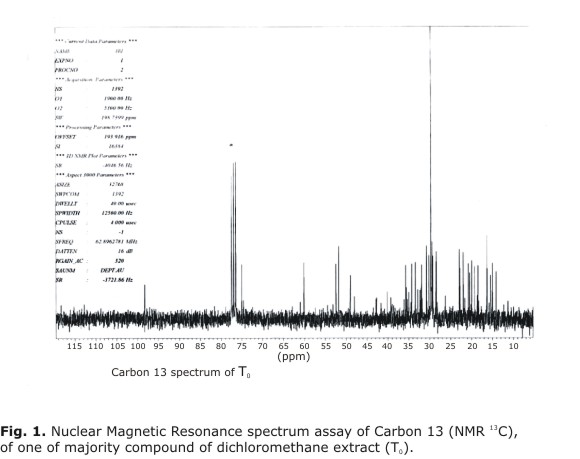
<body><![CDATA[<P><font size="2" face="Verdana">NMR H<SUP>+</SUP> (CDCl<SUB>3</SUB>, 250 MHz).    4,2 ppm (OH), 3,3 ppm (C 3), 2,3 ppm, 2,1 ppm, 1,3 ppm. 0,9 ppm </font>     <P><font size="2" face="Verdana">The most important signals were located between    0,5 ppm and 2,4 ppm in correspondence with nucleus of triterpene, spectrum showed    others signals next to 4 ppm in correspondence with OH to C 3 and 3,3 related    to H of C 3. All of this data was not enough to characterized this molecule,    so it was necessary to analyse spectrum of NMR <SUP>13</SUP>C. </font>      <P><font size="2" face="Verdana"><i>NMR <SUP>13</SUP>C (T0) (CDCl<SUB>3</SUB>,    250 MHz)</i>: 14.79 ppm (C-30), 15.69 ppm (C-31),16.07 ppm (C-27),16.95 ppm    (C-18), 17.02 ppm (C-21),19.89 ppm (C-21), 19.89 ppm (C-9), 20.62 ppm (C-26),    21.14 ppm (C-6), 21.39 ppm (C-11), 23.57 ppm (C 29), 26.89 ppm (C 16), 29.07    ppm (C 7), 29.90 ppm (C 19), 30.05 ppm (C 2), 30.86 ppm (C 25), 31.45 ppm (C    23), 32.61 ppm (C 1), 32.78 ppm (C 15), 34.10 ppm (C 22), 34.98 ppm (12), 36.26    ppm (10), 36.28 ppm (20), 39.96 ppm (C 24), 40.84 ppm (C 13), 43.54 ppm (C 8),    48.75 ppm (C14), 49.70 ppm (C 5), 52.48 ppm (C 17), 75.77 ppm (C 3) (<a href="#fig1">Fig.    1</a>). </font>     <P>     <P align="center">     <P align="center">     <P align="center"><img src="/img/revistas/pla/v16n4/f0106411.jpg" width="580" height="459"><a name="fig1"></a>      
<P>      <P>      <P>     ]]></body>
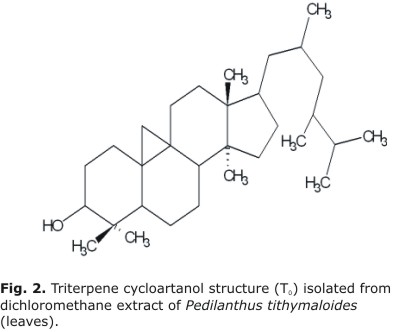
<body><![CDATA[<P><font size="2" face="Verdana">Carbon 13 spectrum of T<SUB>0</SUB> was compared    with others reported in literature and they were found coincidence with C<SUP>13</SUP>    spectrum of cycloartanol. </font>      <P>      <P><font size="2" face="Verdana"><i>NMR 13C cycloartanol (CDCl3, 250 MHz)</i>:    14 ppm (C-30), 15.5 ppm (C-31),17.6 ppm (C-27),17.9 ppm (C-18), 18.4 ppm (C-21),    20 ppm (C-21),20.05 ppm (C-9),21.1 ppm (C-26),21.1 ppm (C-6), 21.4 ppm (C-11),    25.24 ppm (C 29), 26.5 ppm (C 16), 28.8 ppm (C 7), 29.6 ppm (C 19), 30.33 ppm    (C 2), 30.9 ppm (C 25), 31.4 ppm (C 23), 31.9 ppm (C 1), 32.9 ppm (C 15), 33.9    ppm (C 22), 35.5 ppm (12), 36.0 ppm (10), 36.5 ppm (20), 39.0 ppm (C 24), 40.1    ppm (C 13), 43.8 ppm (C 8), 48.7 ppm (C14), 50.1 ppm (C 5), 52.1 ppm (C 17),    78.5 ppm (C 3). </font>     <P><font size="2" face="Verdana">Only carbons 18, 21, 27 have different 1 ppm    but it is acceptable according to reports of Wehrli and Varian in 1978 (<a href="#fig2">Fig.    2</a>).</font>     <P>      <P align="center"><img src="/img/revistas/pla/v16n4/f0206411.jpg" width="420" height="332"><a name="fig2"></a>     
<P>     <P>     <P>     <P>      ]]></body>
<body><![CDATA[<P>      <P>      <P>     <P>      <P><font size="3" face="Verdana"><B>DISCUSSION</B> </font>     <P>      <P><font size="2" face="Verdana">Triterpenes are widely distributed in the plants    and animals and they can be classified as not cyclic, tetracyclic and pentacyclic,    these compounds can be extract from plant using organic solvents.<SUP>11</SUP>    </font>      <P><font size="2" face="Verdana">There are different methods described by literature    to isolate triterpenes from extracts, one of them is modifying polarity of the    solvents, other methods use preparative chromatography techniques by means of    thin layer (TLC) and preparative chromatography techniques by means of column    among others techniques.<SUP>11-13</SUP> </font>     <P><font size="2" face="Verdana">Nuclear magnetic resonance (NMR) is based in    magnetic properties of atomic nucleus, transition produced by an external magnetic    field and it can be detected as a weak signal of absorption.<SUP>14,15</SUP>    </font>     <P><font size="2" face="Verdana">Nuclear magnetic resonance (NMR) is an indispensable    analytical technique to identify drug metabolites, to determine degradation    products of a drug, and to elucidate impurities in a drug substance, although    it is generally considered an expensive and insensitive technique and that is    why it is more advisable to use, high performance liquid chromatography (HPLC),    gas chromatography-mass spectrometry (GC-MS), or liquid chromatography-mass    spectrometry (LC-MS) methods, to monitor the clearance of small-molecule impurities.<SUP>14,15</SUP>    </font>      ]]></body>
<body><![CDATA[<P><font size="2" face="Verdana">Since the discovery more than 50 years ago, nuclear    magnetic resonance (NMR) spectroscopy has been an important analytical method    for chemists. The introduction of FT (fourier transform) NMR techniques made    it even more powerful and widely used. NMR is undoubtedly one of the most valuable    tools in the discovery stage of pharmaceutical product development.<SUP>14,15</SUP>    </font>      <P><font size="2" face="Verdana">Each spectrum are in correspondence with an specific    molecule, so it is acceptable to compare spectrum and relation their common    characteristics in order to try to know compounds isolated from extracts or    synthesized.<SUP>14,15</SUP> </font>     <P><font size="2" face="Verdana">Therefore they were reporting to triterpene cycloartanol    as one of major compound isolated from dichloromethane extract of <I>P. tithymaloides</I>    leaves. </font>      <P>     <P>      <P><font size="3" face="Verdana"><B>REFERENCES</B> </font>     <P>      <!-- ref --><P><font size="2" face="Verdana">1. Cuba. Ministerio de Salud P&uacute;blica.    Plantas Medicinales (Fitomed III). La Habana: Editorial Ciencias M&eacute;dicas;    1994. p. 34-5.     </font>     <!-- ref --><P><font size="2" face="Verdana">2. Roig JT. Diccionario bot&aacute;nico de nombres    vulgares cubanos. La Habana: Editorial Cient&iacute;fico-T&eacute;cnica; 1974.        </font>     <!-- ref --><P><font size="2" face="Verdana">3. Beltr&aacute;n A, Cuellar A. Evaluaci&oacute;n    antitumoral del l&aacute;tex de la planta &iacute;tamo real </font><font size="2" face="Verdana">[Tesis    de Diploma]. IFAL: Universidad de La Habana; 1999.     </font>     <!-- ref --><P><font size="2" face="Verdana">4. Roig JT. Diccionario bot&aacute;nico de nombres    vulgares cubanos. 3ra ed. La </font><font size="2" face="Verdana">Habana; 1962.    p. 1092-3.     </font>     <!-- ref --><P><font size="2" face="Verdana">5. Cabrera Su&aacute;rez H, N&uacute;&ntilde;ez    Figueredo. Efecto sedante del triterpeno cicloartanol obtenido de las hojas    de <I>Pedilanthus tithymaloides</I> (L.) Poit.<I> </I>Rev Cubana Plant Med [online].    2010[citado 21 May 2011];15(3):96-104 . Disponible en: <U><FONT  COLOR="#0000ff"><a href="http://scielo.sld.cu/scielo.php?script=sci_arttext&pid=S1028-47962010000300001&lng=es&nrm=iso" target="_blank">http://scielo.sld.cu/scielo.php?script=sci_arttext&amp;pid=S1028-47962010000300001&amp;lng=es&amp;nrm=iso</a></FONT></U>    ISSN 1028-4796.     </font>     <!-- ref --><P><font size="2" face="Verdana">6. Rojas G, Aranda E, Navarro V, Zamilpa A, Tortoriello    J. <I>In vitro </I>propagation of <I>Galphimia glauca </I>and content of the    sedative compound galphimine-B in wild and micropropagated plants. Planta Med.    2005;71(11):1076-8.     </font>     <!-- ref --><P><font size="2" face="Verdana">7. Amos S, Orisadipe A, Binda L, Emeje M, Adesomoju    A, Okogun J, et al. </font><font size="2" face="Verdana">Behavioural effects    in rodents of methyl angolensate: a triterpenoid isolated from </font><font size="2" face="Verdana"><I>Entandrophragma    angolense</I>. Pharmacol Toxicol. 2002;91(2):71-6.     </font>     <!-- ref --><P><font size="2" face="Verdana">8. Osuna L, Pereda-Miranda R, Tortoriello J,    Villarreal ML. Production of the sedative triterpene galphimine B in <I>Galphimia    glauca </I>tissue culture. Planta Med. </font><font size="2" face="Verdana">1999;65(2):149-52.        </font>     <!-- ref --><P><font size="2" face="Verdana">9. Tortoriello J, Ortega A. Sedative effect of    galphimine B, a nor-seco-triterpenoid </font><font size="2" face="Verdana">from    <I>Galphimia glauca</I>. Planta Med. 1993;59(5):398-400.     </font>     <!-- ref --><P><font size="2" face="Verdana">10. S&aacute;nchez Gov&iacute;n E, P&eacute;rez    Lamas AM, Ch&aacute;vez Figueredo D, Hechevarr&iacute;a Sosa I. Caracterizaci&oacute;n    farmacogn&oacute;stica de <I>Pedilanthus tithymaloides</I> L. Poit. Rev Cubana    Plant Med [serie en Internet]. 2005 Abr [citado 02 Oct 2011];10(1). Disponible    en: <U><FONT  COLOR="#0000ff"><a href="http://scielo.sld.cu/scielo.php?script=sci_arttext&pid=S1028-47962005000100004&lng=es" target="_blank">http://scielo.sld.cu/scielo.php?script=sci_arttext&amp;pid=S1028-47962005000100004&amp;lng=es</a></FONT></U>    </font>     <!-- ref --><P><font size="2" face="Verdana">11. Cuellar A, Miranda M. Farmacognosia y productos    naturales. La Habana: Editorial F&eacute;lix Varela; 2001. p. 207-13.     </font>     <!-- ref --><P><font size="2" face="Verdana">12. Satyajit D. Sarker, Zahid Latif, Alexander    I. Gray<B> </B>Natural Products Isolation 2<SUP>nd</SUP> ed. New Jersey: Human    Press Inc.; 2006. ISBN 1-59259-955-9 </font>     <!-- ref --><P><font size="2" face="Verdana">13. Bhakuni DS, Rawat DS. Bioactive Marine Natural    Products. New York: Ed. Springer; 2005. p. 64-13. ISBN 1-4020-3484-9 (e-book).        </font>     <!-- ref --><P><font size="2" face="Verdana">14. Wehr T, Rodriguez Diaz R, Tuck S. Analytical    techniques for biopharmaceutical development. New York: Ed. Marcel Dekker; 2005.        </font>     <!-- ref --><P><font size="2" face="Verdana">15. Breitmaier E. Structure Elucidation by NMR    in Organic Chemistry: A Practical Guide. 3<SUP>rd</SUP> ed. England: John Wiley    &amp; Sons, Ltd.; 2002.     </font>     <P>     <P>     <P>      <P><font size="2" face="Verdana">Recibido: 5 de julio de 2011.     <br>   Aprobado: 26 de septiembre de 2011. </font>     ]]></body>
<body><![CDATA[<P>     <P>     <P>      <P>      <P><font size="2" face="Verdana"><I>Hir&aacute;n Cabrera Su&aacute;rez</I>. Central    Laboratory of Pharmacology (LCF), Medical Sciences Faculty &quot;Dr Salvador    Allende&quot;. Carvajal s/n and Agua Dulce, Cerro, La Habana, Cuba. E-mail:    <U><FONT COLOR="#0000ff"><a href="mailto:irancs@infomed.sld.cu">irancs@infomed.sld.cu</a></FONT></U>    </font>       ]]></body><back>
<ref-list>
<ref id="B1">
<label>1</label><nlm-citation citation-type="book">
<collab>Ministerio de Salud Pública</collab>
<source><![CDATA[Plantas Medicinales (Fitomed III)]]></source>
<year>1994</year>
<page-range>34-5</page-range><publisher-loc><![CDATA[La Habana ]]></publisher-loc>
<publisher-name><![CDATA[Editorial Ciencias Médicas]]></publisher-name>
</nlm-citation>
</ref>
<ref id="B2">
<label>2</label><nlm-citation citation-type="book">
<person-group person-group-type="author">
<name>
<surname><![CDATA[Roig]]></surname>
<given-names><![CDATA[JT]]></given-names>
</name>
</person-group>
<source><![CDATA[Diccionario botánico de nombres vulgares cubanos]]></source>
<year>1974</year>
<publisher-loc><![CDATA[La Habana ]]></publisher-loc>
<publisher-name><![CDATA[Editorial Científico-Técnica]]></publisher-name>
</nlm-citation>
</ref>
<ref id="B3">
<label>3</label><nlm-citation citation-type="book">
<person-group person-group-type="author">
<name>
<surname><![CDATA[Beltrán]]></surname>
<given-names><![CDATA[A]]></given-names>
</name>
<name>
<surname><![CDATA[Cuellar]]></surname>
<given-names><![CDATA[A]]></given-names>
</name>
</person-group>
<source><![CDATA[Evaluación antitumoral del látex de la planta ítamo real]]></source>
<year>1999</year>
<publisher-name><![CDATA[Universidad de La Habana]]></publisher-name>
</nlm-citation>
</ref>
<ref id="B4">
<label>4</label><nlm-citation citation-type="">
<person-group person-group-type="author">
<name>
<surname><![CDATA[Roig]]></surname>
<given-names><![CDATA[JT]]></given-names>
</name>
</person-group>
<source><![CDATA[Diccionario botánico de nombres vulgares cubanos]]></source>
<year>1962</year>
<edition>3</edition>
<page-range>1092-3</page-range><publisher-loc><![CDATA[La Habana ]]></publisher-loc>
</nlm-citation>
</ref>
<ref id="B5">
<label>5</label><nlm-citation citation-type="journal">
<person-group person-group-type="author">
<name>
<surname><![CDATA[Cabrera Suárez]]></surname>
<given-names><![CDATA[H]]></given-names>
</name>
<name>
<surname><![CDATA[Núñez]]></surname>
<given-names><![CDATA[Figueredo]]></given-names>
</name>
</person-group>
<article-title xml:lang="es"><![CDATA[Efecto sedante del triterpeno cicloartanol obtenido de las hojas de Pedilanthus tithymaloides (L.) Poit]]></article-title>
<source><![CDATA[Rev Cubana Plant Med]]></source>
<year>2010</year>
<volume>15</volume>
<numero>3</numero>
<issue>3</issue>
<page-range>96-104</page-range></nlm-citation>
</ref>
<ref id="B6">
<label>6</label><nlm-citation citation-type="journal">
<person-group person-group-type="author">
<name>
<surname><![CDATA[Rojas]]></surname>
<given-names><![CDATA[G]]></given-names>
</name>
<name>
<surname><![CDATA[Aranda]]></surname>
<given-names><![CDATA[E]]></given-names>
</name>
<name>
<surname><![CDATA[Navarro]]></surname>
<given-names><![CDATA[V]]></given-names>
</name>
<name>
<surname><![CDATA[Zamilpa]]></surname>
<given-names><![CDATA[A]]></given-names>
</name>
<name>
<surname><![CDATA[Tortoriello]]></surname>
<given-names><![CDATA[J]]></given-names>
</name>
</person-group>
<article-title xml:lang="en"><![CDATA[In vitro propagation of Galphimia glauca and content of the sedative compound galphimine-B in wild and micropropagated plants]]></article-title>
<source><![CDATA[Planta Med.]]></source>
<year>2005</year>
<volume>71</volume>
<numero>11</numero>
<issue>11</issue>
<page-range>1076-8</page-range></nlm-citation>
</ref>
<ref id="B7">
<label>7</label><nlm-citation citation-type="journal">
<person-group person-group-type="author">
<name>
<surname><![CDATA[Amos]]></surname>
<given-names><![CDATA[S]]></given-names>
</name>
<name>
<surname><![CDATA[Orisadipe]]></surname>
<given-names><![CDATA[A]]></given-names>
</name>
<name>
<surname><![CDATA[Binda]]></surname>
<given-names><![CDATA[L]]></given-names>
</name>
<name>
<surname><![CDATA[Emeje]]></surname>
<given-names><![CDATA[M]]></given-names>
</name>
<name>
<surname><![CDATA[Adesomoju]]></surname>
<given-names><![CDATA[A]]></given-names>
</name>
<name>
<surname><![CDATA[Okogun]]></surname>
<given-names><![CDATA[J]]></given-names>
</name>
</person-group>
<article-title xml:lang="en"><![CDATA[Behavioural effects in rodents of methyl angolensate: a triterpenoid isolated from Entandrophragma angolense]]></article-title>
<source><![CDATA[Pharmacol Toxicol.]]></source>
<year>2002</year>
<volume>91</volume>
<numero>2</numero>
<issue>2</issue>
<page-range>71-6</page-range></nlm-citation>
</ref>
<ref id="B8">
<label>8</label><nlm-citation citation-type="journal">
<person-group person-group-type="author">
<name>
<surname><![CDATA[Osuna]]></surname>
<given-names><![CDATA[L]]></given-names>
</name>
<name>
<surname><![CDATA[Pereda-Miranda]]></surname>
<given-names><![CDATA[R]]></given-names>
</name>
<name>
<surname><![CDATA[Tortoriello]]></surname>
<given-names><![CDATA[J]]></given-names>
</name>
<name>
<surname><![CDATA[Villarreal]]></surname>
<given-names><![CDATA[ML]]></given-names>
</name>
</person-group>
<article-title xml:lang="en"><![CDATA[Production of the sedative triterpene galphimine B in Galphimia glauca tissue culture]]></article-title>
<source><![CDATA[Planta Med.]]></source>
<year>1999</year>
<volume>65</volume>
<numero>2</numero>
<issue>2</issue>
<page-range>149-52</page-range></nlm-citation>
</ref>
<ref id="B9">
<label>9</label><nlm-citation citation-type="journal">
<person-group person-group-type="author">
<name>
<surname><![CDATA[Tortoriello]]></surname>
<given-names><![CDATA[J]]></given-names>
</name>
<name>
<surname><![CDATA[Ortega]]></surname>
<given-names><![CDATA[A]]></given-names>
</name>
</person-group>
<article-title xml:lang="en"><![CDATA[Sedative effect of galphimine B, a nor-seco-triterpenoid from Galphimia glauca]]></article-title>
<source><![CDATA[Planta Med.]]></source>
<year>1993</year>
<volume>59</volume>
<numero>5</numero>
<issue>5</issue>
<page-range>398-400</page-range></nlm-citation>
</ref>
<ref id="B10">
<label>10</label><nlm-citation citation-type="journal">
<person-group person-group-type="author">
<name>
<surname><![CDATA[Sánchez Govín]]></surname>
<given-names><![CDATA[E]]></given-names>
</name>
<name>
<surname><![CDATA[Pérez Lamas]]></surname>
<given-names><![CDATA[AM]]></given-names>
</name>
<name>
<surname><![CDATA[Chávez Figueredo]]></surname>
<given-names><![CDATA[D]]></given-names>
</name>
<name>
<surname><![CDATA[Hechevarría Sosa]]></surname>
<given-names><![CDATA[I]]></given-names>
</name>
</person-group>
<article-title xml:lang="es"><![CDATA[Caracterización farmacognóstica de Pedilanthus tithymaloides L. Poit]]></article-title>
<source><![CDATA[Rev Cubana Plant Med]]></source>
<year>2005</year>
<month> A</month>
<day>br</day>
<volume>10</volume>
<numero>1</numero>
<issue>1</issue>
</nlm-citation>
</ref>
<ref id="B11">
<label>11</label><nlm-citation citation-type="book">
<person-group person-group-type="author">
<name>
<surname><![CDATA[Cuellar]]></surname>
<given-names><![CDATA[A]]></given-names>
</name>
<name>
<surname><![CDATA[Miranda]]></surname>
<given-names><![CDATA[M]]></given-names>
</name>
</person-group>
<source><![CDATA[Farmacognosia y productos naturales]]></source>
<year>2001</year>
<page-range>207-13</page-range><publisher-loc><![CDATA[La Habana ]]></publisher-loc>
<publisher-name><![CDATA[Editorial Félix Varela]]></publisher-name>
</nlm-citation>
</ref>
<ref id="B12">
<label>12</label><nlm-citation citation-type="book">
<person-group person-group-type="author">
<name>
<surname><![CDATA[Satyajit]]></surname>
<given-names><![CDATA[D]]></given-names>
</name>
<name>
<surname><![CDATA[Sarker Zahid]]></surname>
<given-names><![CDATA[Latif]]></given-names>
</name>
<name>
<surname><![CDATA[Alexander]]></surname>
<given-names><![CDATA[I]]></given-names>
</name>
</person-group>
<source><![CDATA[Gray Natural Products Isolation]]></source>
<year>2006</year>
<edition>2</edition>
<publisher-loc><![CDATA[New Jersey ]]></publisher-loc>
<publisher-name><![CDATA[Human Press Inc]]></publisher-name>
</nlm-citation>
</ref>
<ref id="B13">
<label>13</label><nlm-citation citation-type="book">
<person-group person-group-type="author">
<name>
<surname><![CDATA[Bhakuni]]></surname>
<given-names><![CDATA[DS]]></given-names>
</name>
<name>
<surname><![CDATA[Rawat]]></surname>
<given-names><![CDATA[DS]]></given-names>
</name>
</person-group>
<source><![CDATA[Bioactive Marine Natural Products]]></source>
<year>2005</year>
<page-range>64-13</page-range><publisher-loc><![CDATA[New York ]]></publisher-loc>
<publisher-name><![CDATA[Ed. Springer]]></publisher-name>
</nlm-citation>
</ref>
<ref id="B14">
<label>14</label><nlm-citation citation-type="book">
<person-group person-group-type="author">
<name>
<surname><![CDATA[Wehr]]></surname>
<given-names><![CDATA[T]]></given-names>
</name>
<name>
<surname><![CDATA[Rodriguez Diaz]]></surname>
<given-names><![CDATA[R]]></given-names>
</name>
<name>
<surname><![CDATA[Tuck]]></surname>
<given-names><![CDATA[S]]></given-names>
</name>
</person-group>
<source><![CDATA[Analytical techniques for biopharmaceutical development]]></source>
<year>2005</year>
<publisher-loc><![CDATA[New York ]]></publisher-loc>
<publisher-name><![CDATA[Ed. Marcel Dekker]]></publisher-name>
</nlm-citation>
</ref>
<ref id="B15">
<label>15</label><nlm-citation citation-type="book">
<person-group person-group-type="author">
<name>
<surname><![CDATA[Breitmaier]]></surname>
<given-names><![CDATA[E]]></given-names>
</name>
</person-group>
<source><![CDATA[Structure Elucidation by NMR in Organic Chemistry: A Practical Guide]]></source>
<year>2002</year>
<edition>3</edition>
<publisher-loc><![CDATA[England ]]></publisher-loc>
<publisher-name><![CDATA[John Wiley & Sons, Ltd]]></publisher-name>
</nlm-citation>
</ref>
</ref-list>
</back>
</article>