<?xml version="1.0" encoding="ISO-8859-1"?><article xmlns:mml="http://www.w3.org/1998/Math/MathML" xmlns:xlink="http://www.w3.org/1999/xlink" xmlns:xsi="http://www.w3.org/2001/XMLSchema-instance">
<front>
<journal-meta>
<journal-id>1028-4796</journal-id>
<journal-title><![CDATA[Revista Cubana de Plantas Medicinales]]></journal-title>
<abbrev-journal-title><![CDATA[Rev Cubana Plant Med]]></abbrev-journal-title>
<issn>1028-4796</issn>
<publisher>
<publisher-name><![CDATA[ECIMED]]></publisher-name>
</publisher>
</journal-meta>
<article-meta>
<article-id>S1028-47962013000200013</article-id>
<title-group>
<article-title xml:lang="en"><![CDATA[Quantification, chemical and biological characterization of the saponosides material from Sida cordifolia L. (escobilla)]]></article-title>
<article-title xml:lang="es"><![CDATA[Cuantificación, caracterización química y biológica del contenido saponósido de Sida cordifolia L. (escobilla)]]></article-title>
</title-group>
<contrib-group>
<contrib contrib-type="author">
<name>
<surname><![CDATA[Velásquez Ballesteros]]></surname>
<given-names><![CDATA[Oscar Julián]]></given-names>
</name>
<xref ref-type="aff" rid="A01"/>
</contrib>
<contrib contrib-type="author">
<name>
<surname><![CDATA[Murillo Perea]]></surname>
<given-names><![CDATA[Elizabeth]]></given-names>
</name>
<xref ref-type="aff" rid="A01"/>
</contrib>
<contrib contrib-type="author">
<name>
<surname><![CDATA[Jairo Méndez]]></surname>
<given-names><![CDATA[John]]></given-names>
</name>
<xref ref-type="aff" rid="A01"/>
</contrib>
<contrib contrib-type="author">
<name>
<surname><![CDATA[Murillo Arango]]></surname>
<given-names><![CDATA[Walter]]></given-names>
</name>
<xref ref-type="aff" rid="A01"/>
</contrib>
<contrib contrib-type="author">
<name>
<surname><![CDATA[Noreña]]></surname>
<given-names><![CDATA[Diana Alexandra]]></given-names>
</name>
<xref ref-type="aff" rid="A01"/>
</contrib>
</contrib-group>
<aff id="A01">
<institution><![CDATA[,Universidad de Tolima Departamento de Biología Grupo de Investigación en Productos Naturales]]></institution>
<addr-line><![CDATA[ ]]></addr-line>
<country>Colombia</country>
</aff>
<pub-date pub-type="pub">
<day>00</day>
<month>06</month>
<year>2013</year>
</pub-date>
<pub-date pub-type="epub">
<day>00</day>
<month>06</month>
<year>2013</year>
</pub-date>
<volume>18</volume>
<numero>2</numero>
<fpage>298</fpage>
<lpage>314</lpage>
<copyright-statement/>
<copyright-year/>
<self-uri xlink:href="http://scielo.sld.cu/scielo.php?script=sci_arttext&amp;pid=S1028-47962013000200013&amp;lng=en&amp;nrm=iso"></self-uri><self-uri xlink:href="http://scielo.sld.cu/scielo.php?script=sci_abstract&amp;pid=S1028-47962013000200013&amp;lng=en&amp;nrm=iso"></self-uri><self-uri xlink:href="http://scielo.sld.cu/scielo.php?script=sci_pdf&amp;pid=S1028-47962013000200013&amp;lng=en&amp;nrm=iso"></self-uri><abstract abstract-type="short" xml:lang="en"><p><![CDATA[Introduction: Sida cordifolia L. (Malvaceae) is a weed about which not much is known in Colombia. This plant is used in folk medicine to treat oral mucosa, blennorrhea, asthma and bronchitis.In Brazil it finds application as an anti-inflammatory,while in Colombia its "baba" is used for treating hair loss, constipation and internal fever, among other ailments. Objectives: to quantify the saponoside content and evaluate its antioxidant and antifungal functionality. Methods: we prepared organic, aqueous and hydroalcoholic extracts from the aerial section of the plant. The saponoside material was quantified by the DNS and p-anisaldehyde methods. The most concentrated extracts were selected for antioxidant and antifungal assays. Results: it was found that Sida cordifolia, collected in Ibague-Colombia, is a good source of saponins with diverse chemical structures, mainly of steroidal nature, some of which may be hecogenin, diosgenin or a homologue. Conclusions: these factors may contribute, at least in part, to the antioxidant and antifungal functionality of Sida cordifolia L., but this capacity may be modified if these saponins act independently or together with some other metabolites of the plant such as tannins, flavonoids steroids, and alkaloids among others.]]></p></abstract>
<abstract abstract-type="short" xml:lang="es"><p><![CDATA[Introducción: Sida cordifolia L. (Malvaceae) es una hierba de la cual se tiene un conocimiento limitado en Colombia. Se utiliza en la medicina popular para el tratamiento de la mucosa oral, la blenorragia, el asma y la bronquitis. En Brasil encuentra aplicación como antiinflamatorio, mientras que en Colombia su "baba" se utiliza para tratar la pérdida del cabello, el estreñimiento, y la fiebre interna, entre otros padecimientos. Objetivos: cuantificar el contenido saponósido y evaluar sus propiedades antioxidantes y funcionalidad antifúngica. Métodos: se prepararon extractos orgánicos, acuosos e hidroalcohólicos de la parte aérea de la planta. El material de saponósidos se cuantificó por los métodos del DNS (dinitrosalicylic acid reagent) y de p-anisaldehído. Los extractos más concentrados se seleccionaron para los ensayos antioxidante y antifúngico. Resultados: estos mostraron que Sida cordifolia, colectada en Ibague-Colombia, es una buena fuente de saponinas con diversas estructuras químicas, principalmente de naturaleza esteroidal, algunas de las cuales pueden ser hecogenina, diosgenina o un homólogo. Conclusiones: estos factores pueden contribuir, al menos en parte, en la funcionalidad antioxidante y antifúngica de Sida cordifolia L., pero su capacidad se puede modificar si esas saponinas actúan de forma independiente o en conjunto con otros metabolitos de la planta, como taninos, esteroides flavonoides, alcaloides, entre otros.]]></p></abstract>
<kwd-group>
<kwd lng="en"><![CDATA[Sida cordifolia]]></kwd>
<kwd lng="en"><![CDATA[saponins]]></kwd>
<kwd lng="en"><![CDATA[weed]]></kwd>
<kwd lng="en"><![CDATA[antioxidant]]></kwd>
<kwd lng="en"><![CDATA[p-anisaldhyde]]></kwd>
<kwd lng="es"><![CDATA[Sida cordifolia]]></kwd>
<kwd lng="es"><![CDATA[saponinas]]></kwd>
<kwd lng="es"><![CDATA[hierba]]></kwd>
<kwd lng="es"><![CDATA[antioxidante]]></kwd>
<kwd lng="es"><![CDATA[p-anisaldehído]]></kwd>
</kwd-group>
</article-meta>
</front><body><![CDATA[ <div align="right">     <p><font face="Verdana" size="2"><B>ART&Iacute;CULO ORIGINAL</B></font></p>    <p>&nbsp;</p></div><B>      <P>     <P> </B>     <P><b><font face="Verdana" size="4">Quantification, chemical and  biological characterization of the saponosides material from <I>Sida cordifolia  </I>L. (escobilla)</font></b>     <P>&nbsp; <B>     <P><font face="Verdana" size="3">Cuantificaci&oacute;n,  caracterizaci&oacute;n qu&iacute;mica y biol&oacute;gica del contenido sapon&oacute;sido  de <I>Sida cordifolia </I>L. (escobilla) </font>     <P>&nbsp;     <P>&nbsp;     ]]></body>
<body><![CDATA[<P>     <P>     <P><font face="Verdana" size="2">Biol.  Oscar Juli&aacute;n Vel&aacute;squez Ballesteros, MSc. Elizabeth Murillo Perea,  Dr. John Jairo M&eacute;ndez, Dr. Walter Murillo Arango, Biol. Diana Alexandra  Nore&ntilde;a</font> </B>     <P>     <P><font face="Verdana" size="2">Universidad del  Tolima. Colombia. </font>     <P>&nbsp;     <P>&nbsp; <hr size="1" noshade> <font face="Verdana" size="2"><B>ABSTRACT</B></font>      <p><B> </B><font face="Verdana" size="2"><B>Introduction:</b> <I>Sida cordifolia</I>  L. (Malvaceae) is a weed about which not much is known in Colombia. This plant  is used in folk medicine to treat oral mucosa, blennorrhea, asthma and bronchitis.<SUP>  </SUP>In Brazil it finds application as an anti-inflammatory,<SUP> </SUP>while  in Colombia its &quot;baba&quot; is used for treating hair loss, constipation  and internal fever, among other ailments. <B>    <br> Objectives:</B> to quantify  the saponoside content and evaluate its antioxidant and antifungal functionality.  <B>    <br> Methods:</B> we prepared organic, aqueous and hydroalcoholic extracts  from the aerial section of the plant. The saponoside material was quantified by  the DNS and p-anisaldehyde methods. The most concentrated extracts were selected  for antioxidant and antifungal assays. <B>    ]]></body>
<body><![CDATA[<br> Results:</B> it was found that  <I>Sida cordifolia</I>, collected in Ibague-Colombia, is a good source of saponins  with diverse chemical structures, mainly of steroidal nature, some of which may  be hecogenin, diosgenin or a homologue. <B>    <br> Conclusions:</B> these factors  may contribute, at least in part, to the antioxidant and antifungal functionality  of<I> Sida cordifolia</I> L., but this capacity may be modified if these saponins  act independently or together with some other metabolites of the plant such as  tannins, flavonoids steroids, and alkaloids among others. </font> </p><B></B>      <P>     <P><font face="Verdana" size="2"><B>Key words:</B> <I>Sida cordifolia</I>,  saponins, weed, antioxidant, p-anisaldhyde. </font> <hr size="1" noshade> <font face="Verdana" size="2"><B>RESUMEN</B></font><B></B>      <P><font face="Verdana" size="2"><B>Introducci&oacute;n:</b> <I>Sida cordifolia</I>  L. (Malvaceae) es una hierba de la cual se tiene un conocimiento limitado en Colombia.  Se utiliza en la medicina popular para el tratamiento de la mucosa oral, la blenorragia,  el asma y la bronquitis. En Brasil encuentra aplicaci&oacute;n como antiinflamatorio,  mientras que en Colombia su &quot;baba&quot; se utiliza para tratar la p&eacute;rdida  del cabello, el estre&ntilde;imiento, y la fiebre interna, entre otros padecimientos.  <B>    <br> Objetivos</B>: cuantificar el contenido sapon&oacute;sido y evaluar sus  propiedades antioxidantes y funcionalidad antif&uacute;ngica. <B>    <br> M&eacute;todos:</B>  se prepararon extractos org&aacute;nicos, acuosos e hidroalcoh&oacute;licos de  la parte a&eacute;rea de la planta. El material de sapon&oacute;sidos se cuantific&oacute;  por los m&eacute;todos del DNS (<I>dinitrosalicylic acid reagent)</I> y de p-anisaldeh&iacute;do.  Los extractos m&aacute;s concentrados se seleccionaron para los ensayos antioxidante  y antif&uacute;ngico. <B>    <br> Resultados:</B> estos mostraron que <I>Sida cordifolia</I>,  colectada en Ibague-Colombia, es una buena fuente de saponinas con diversas estructuras  qu&iacute;micas, principalmente de naturaleza esteroidal, algunas de las cuales  pueden ser hecogenina, diosgenina o un hom&oacute;logo. <B>    <br> Conclusiones:</B>  estos factores pueden contribuir, al menos en parte, en la funcionalidad antioxidante  y antif&uacute;ngica de <I>Sida cordifolia</I> L., pero su capacidad se puede  modificar si esas saponinas act&uacute;an de forma independiente o en conjunto  con otros metabolitos de la planta, como taninos, esteroides flavonoides, alcaloides,  entre otros. </font>     <P><font face="Verdana" size="2"><B>Palabras clave:</B> <I>Sida  cordifolia</I>, saponinas, hierba, antioxidante, p-anisaldeh&iacute;do. </font>  <hr size="1" noshade>     ]]></body>
<body><![CDATA[<P>&nbsp;     <P>&nbsp;     <P>     <P>     <P><font face="Verdana" size="3"><B>INTRODUCTION</B>  </font>     <P>     <P><font face="Verdana" size="2">Specialized botany identifies a group  of medium sized plants (50-70 cm), such as arvense, brushwood or weed, plants  which grow with considerable vigor and great ability to spread in areas controlled  by humans, because in most cases they are endemic species highly adapted to the  environment. They can establish competition with improved pastures in terms of  living space, nutrients, water, sunlight and CO<SUB>2</SUB>.<SUP>1 </SUP></font>      <P><font face="Verdana" size="2">The scientific world has shown scarce interest  for those plants. Attention has been generally oriented to macro-morphological  description<SUP>2-4 </SUP>or to counting the weeds that accompany beneficial commercial  crops species,<SUP>1,5</SUP><SUP> </SUP>many of wich are useful in many parts  of the world as food (<I>Arctium lappa</I>), herbal medicine (<I>Taraxacum officinale</I>)  and a large number of them as ornamentals.<SUP>6</SUP> Recent studies have focused  on some weeds as a sources of secondary metabolites with pharmacological,<SUP>7</SUP>  antimicrobial<SUP>8</SUP> and antioxidant uses.<SUP>9</SUP> </font>     <P>     <P><font face="Verdana" size="2"><I>Sida  cordifolia </I>L. (Malvaceae) is a weed about which not much is known in most  Latin American countries including Colombia. Commonly called malva blanca, s&aacute;nalo  todo (Argentina), escobilla, escoba babosa (Colombia), puchana, sinchi pichana  (Peru), escoba acorazonada (Puerto Rico), escobillo, escoba negra (Spain) and  bala (India), it is a widespread species throughout the tropics (North, Central  and South America), and is also prevalent in Africa, Asia and Oceania. </font>      ]]></body>
<body><![CDATA[<P>     <P><font face="Verdana" size="2">This plant is used in folk medicine to treat  oral mucosa, blennorrhea, asthmatic bronchitis and nasal congestion.<SUP>10 </SUP>In  Brazil finds application as an anti-inflammatory,<SUP>11 </SUP>while in Colombia  its &quot;baba&quot; is used for treating hair loss, constipation and internal  fever, among other ailments. Some studies have shown the presence in its leaves  of sympathomimetic amines and alkaloids such as ephedrine, pseudoephedrine, vasicinone  and vasicine.<SUP>12</SUP> The antioxidant capacity of the plant and the use of  aqueous extracts from its leaves for liver regeneration have been revealed.<SUP>13,14</SUP>  </font>     <P><font size="2" face="Verdana">Furthermore, saponins are a specific  class of secondary metabolites widely distributed in the plant kingdom. They are  constituted by a triterpenic or steroidal skeleton attached to one (monodesmosidic)  or more (bidesmosidic) sugar chains. These chemical compounds are of various biosynthetic  origins, hence their great structural diversity. It is estimated that more than  half of land plants contain saponins.<sup>15</sup> Their biological and pharmacological  functionality (hemolytic, anti-tumor, anti-inflammatory, molluscicidal, etc.)  is a consequence of their chemical diversity.<sup>16</sup> </font>     <p><font size="2" face="Verdana">This  study was carried out in compliance with biodiversity rights, using the aerial  section as a raw material to prepare aqueous and hydroalcoholic extracts. The  saponoside material was quantified by two spectrophotometric methods. The most  concentrated extracts were selected and antioxidant activity was evaluated with  the purpose of correlating this biological functionality with the saponin content  of the plant. </font>     <P>&nbsp;     <P>     <P><font face="Verdana" size="3"><B>METHODS</B>  </font>     <P>     <P><font size="2" face="Verdana"><i>Collection, sample conditioning  and extract preparation </i> </font>     <p><font size="2" face="Verdana">Plant material  (leaves and inflorescences) was collected in optimum phytosanitary and vegetative  development condition (August 16, 2010) in the Ibagu&eacute; suburban zone (22  &#186;C, 57 % RH) and identified at the TOLI herbarium in Tolima University (Colombia)  with the 7083-reference code. The sample was cleaned, dried (48 h, 45 &#186;C),  crushed and degreased (Soxhlet, n-hexane). This treated material was stirred mechanically  (5 h), using water, methanol, methanol-water (95:5), ethanol-water (95:5) and  ethanol (1 g:10 mL plant/solvent) until the sample was depleted. Crude extracts  were filtered and concentrated at reduced pressure in a B&ucirc;chi R114 rotary  evaporator and stored (4 &#186;C). Extracts were identified as: Aqueous extract  (AE), hydromethanolic extract (HME), methanol extract (ME), hydroethanolic extract  (HEE) and ethanolic extract (EE). </font>     ]]></body>
<body><![CDATA[<p>     <p><font size="2" face="Verdana"><i>Preliminary  assays for saponin<strike>s</strike> recognition </i> </font>     <p><font size="2" face="Verdana">The  presence of saponosides in extracts was verified with several scientifically recognized  qualitative tests for preliminary evidence of secondary metabolites: the foam  test (based on the surfactant capacity of saponins), the Rosenthaler test (violet  colors are obtained with pentacyclic saponins) and the Liebermann-Burchard test  (pink or red colors for triterpenic genins and blue or green for steroidal). </font>      <p><font size="2" face="Verdana">These tests were supplemented by a thin layer  chromatography analysis (TLC). Different chromatographic conditions were tested,  but the best ones were silica gel 60 F-254 as stationary phase and chloroform/ethanol/water  (8:2:0.5) as eluent. To visualize the spots, plates were sprayed with various  chromogenic agents (p-anisaldehyde, vanillin, antimony trichloride, silver nitrate  and iodine vapors) and put on heat. Digitonin, hecogenin, diosgenin, cholesterol,  and glucose were used as positive reference standards (1 mg/mL). </font>     <p><font size="2" face="Verdana">  Presence of the carbohydrate fraction attached to the genins was evident on 60  F-254 chromatography plates (stationary phase) and ethyl acetate/acetic acid/methanol/water  (10:4:4:2) as mobile phase. Spots were visualized by spraying a diphenylamine/aniline/phosphoric  acid/acetone mixture (4 g:4 mL:20 mL:200 mL). </font>     <p>     <p><font size="2" face="Verdana"><i>Phytochemical  screening</i> </font>     <p><font size="2" face="Verdana">Phytochemical screening  was performed with the ethanolic extract of the plant using Molish (carbohydrates),  foam, Rosenthaler, hemolysis (saponins), Folin-Ciocalteu (polyphenols), chloride  ferric salt gelatin (tannins), ammonia vapors, Shinoda (flavonoids), Arnow (phenylpropanoids),  Borntr&auml;ger (anthraquinone), Lieberman-Burchard, Salkowski (terpenes/steroids),  vanillin/HCl (iridoids), Dragendroff, Mayer, Wagner, Tanred, Erhlic, Reineckato,  Valser (alkaloids), Baljet, Kedde, m-dinitrobenzene (cardiotonic agents), NaOH/heat/UV  light (coumarins), m-dinitrobenzene, Raymond, Mathoud and CCD (terpene lactones)  tests. The crosses system was used to specify qualification of secondary metabolites.  </font>     <p><font size="2" face="Verdana"><i>Indirect quantification of saponosides</i>  </font>     <p><font size="2" face="Verdana">Prior analytical determination, an acid  hydrolysis process with HCl 2.5 N was performed (95 &#186;C, 3h with constant  agitation). The hydrolyzed material was neutralized with sodium bicarbonate and  the Dinitrosalicylic Acid reagent (DNS) was combined with each extract (1:1).  The mixture was vigorously stirred, heated in a water bath (100 &#186;C, 5 min)  and cooled in an ice-water bath. Distilled water was then added (5 mL), and absorbance  was read at 540 nm in a Helyos-Gama spectrophotometer and interpolated on a calibration  curve prepared with glucose (50-1600 &micro;g/mL).<sup>17</sup> </font>     ]]></body>
<body><![CDATA[<p><font size="2" face="Verdana"><i>  Direct quantification of saponosides</i> </font>     <p><font size="2" face="Verdana">The  methodology followed was the one proposed by <i>Hata et al.</i>,<sup>18 </sup>with  some modifications: 2 mL of each extract (AE, HME, ME, HEE, EE), 1 mL of A reagent  (p-anisaldehyde 0.5 % in ethyl acetate) and 1 mL of B reagent (H<sub>2</sub>SO<sub>4</sub>  in 50 % ethyl acetate) were mixed and homogenized in a vortex. The mixture was  immediately heated in a water bath (60 &#186;C, 20 min), and then each tube was  placed in a room temperature water bath and protected from light during the reaction.  Optical density of samples was determined at 430 nm and interpolated into a calibration  curve using digitonin (20-1 200 &micro;g/mL). </font>     <p><font size="2" face="Verdana"><i>  Structural identification of saponins</i> </font>     <p><font size="2" face="Verdana">For  this purpose, each sample was taken to total dryness and mixed with two drops  of SbCl<sub>3</sub> in 60 % perchloric acid. Digitonin, hecogenin, diosgenin and  60 % HClO<sub>4</sub> in the absence of SbCl<sub>3</sub> were used as controls.  </font>     <p>     <p><font size="2" face="Verdana"><i>Spectrophotometric analysis</i>  </font>     <p><font size="2" face="Verdana">Infrared spectra of samples were performed  in Nicolet FT-IR 380 equipment. The UV-VIS spectra were measured in an Evolution  600 spectrophotometer, with 1 cm cell width, and a wavelength between 380-700  nm.<strike> </strike> </font>     <p>     <p><font size="2" face="Verdana"><i>Hemolytic  activity </i> </font>     <p><font size="2" face="Verdana">Human erythrocytes (O+)  were collected with sodium citrate, washed twice with isotonic phosphate buffer  (10 mM, pH 7.4) and centrifuged (500 g x 5 minutes). The pellet was resuspended  to 40 % with the same solution. 500 &#181;L of each sample and 9 &#181;L of cell  suspension were placed in a vial and incubated at 37 &#186;C for 20 minutes. The  samples were then centrifuged (500 g x 5 minutes) and the supernatant transferred  to a quartz cell. The free hemoglobin amount was spectrophotometrically determined  at 540 nm.<sup>19 </sup>An isotonic solution (150 mM NaCl) was used as a basal  hemolysis control and Tween 20 as a maximum absorbance control. The hemolysis  percentage was calculated using the equation: Hemolysis percentage = [(A<sub>samle</sub>-A<sub>NaCl</sub>)/(A<sub>tween</sub>-A<sub>NaCl</sub>  )]*100 </font>     ]]></body>
<body><![CDATA[<p>     <p> <font size="2" face="Verdana"><i>Antioxidant activity </i></font>      <p><i><font size="2" face="Verdana">2,2-diphenyl-1-picrylhydrazyl radical stabilizer  activity (DPPH)</font> </i>     <p><font size="2" face="Verdana">Samples were placed  on silica gel chromatography plates (60 F-254) using a chloroform/ethanol/water  (8:2:0.5) mixture as mobile phase. A 0.2 % radical solution was used as chromogenic  agent. The same procedure was performed in parallel, but spraying the plate with  sulfuric acid/acetic acid/water (80:10:10), exclusively to reveal saponins. </font>      <p>     <p><font size="2" face="Verdana"><i>2,2'-azino-bis(3-ethylbenzothiazoline-6-sulphonic  acid) cation radical inhibitory activity (ABTS<sup>*+</sup>)</i> </font>     <p><font size="2" face="Verdana">Plant  material was dissolved in phosphate buffer (2 mL, 50 mM, pH 7.5) and ethyl acetate  (5 mL). The mixture was mechanically stirred and transferred to a separatory funnel.  The solid residue (totally colorless) was discarded. The aqueous and organic phases  were collected separately to evaluate respectively the hydrophilic and lipophilic  activity of the plant.<sup>20</sup> </font>     <p><font size="2" face="Verdana">ABTS<sup>*+</sup>  radical (7 mM) was prepared with ammonium persulfate (4.9 mM) mixed 1:1. The mixture  was kept in the dark (16h) and then diluted with ethanol (96 %) until reaching  0.7 absorbance (&#177; 0.02) at 754 nm (maximum absorption wavelength). Sample  was added (100 &#181;L) to 3.9 mL of radical with a quick stir and the change  in optical density was measured at 754 nm during 8 minutes.<sup>21 </sup> Absorbance  values were interpolated in a calibration curve prepared with ascorbic acid (50-500  &micro;g/mL). ABTS<sup>*+</sup> stabilization capacity was determined using the  equation ABTSSC= [A<sub>ABTS</sub><sup>.+</sup>- A<sub>8min</sub>/ A<sub> ABTS</sub><sup>.+</sup>]&#215;100  </font>     <P><font face="Verdana" size="2">Where: </font>     <P>     ]]></body>
<body><![CDATA[<P><font face="Verdana" size="2">ABTSSC:  ABTS radical stabilization capacity, expressed as a percentage    <br> </font><font face="Verdana" size="2">A<SUB>ABTS</SUB><SUP>*+</SUP>:  ABTS absorbance before adding the sample    <br> </font><font face="Verdana" size="2">A<SUB>8min</SUB>:  absorbance of mixture at 8 minutes </font>     <P>     <P><font face="Verdana" size="2">The  functionality of samples was compared with that of BHT (Butylated hydroxytoluene)  [10, 15 and 20 &#181;L/mL] and quercetin [50 &#181;L/mL]. </font>     <P><font size="2" face="Verdana"><i>Reducing  power measurement</i> </font>     <p><font size="2" face="Verdana">Reducing power  was determined following the methodology described by <i>P&eacute;rez et al</i>.,<sup>22</sup><sup>  </sup>with some modifications. One milliliter of each extract was mixed with phosphate  buffer (2.5 mL, 0.2 M, pH 6.6), potassium ferricyanide (2.5 mL, 1 %), and incubated  at constant temperature (50 &#186;C, 20 minutes). Trichloroacetic acid (2.5 mL,  10 %) was then added. The mixture was centrifuged (3 500 r.p.m., 10 min). A supernatant  aliquot was dissolved in an equal amount of distilled water and ferric chloride  was immediately added (0.5 mL, 0.1 %). Absorbance was determined at 700 nm, using  ascorbic acid as a positive control (50 and 100 &micro;g/mL). In this assay, the  reducing power of the extracts was directly related to absorbance values. </font>      <p>     <p><font size="2" face="Verdana"><i>Total antioxidant capacity (TAC)</i> </font>      <p><font size="2" face="Verdana"> A reagent was prepared by mixing H<sub>2</sub>SO<sub>4</sub>  (0.6 M), Na<sub>3</sub>PO<sub>4</sub> (28 mM) and (NH<sub>4</sub>).Mo<sub>7</sub>.4H<sub>2</sub>O  in a 1:1:1 proportion. 3 mL were mixed with 0.3 mL of each extract and incubated  at 95 &#186;C for 90 minutes. Absorbance was measured at 696nm and the results  were expressed as milligrams of ascorbic acid equivalents per gram of dry material  (AA Emg/DMg).<sup>23 </sup> </font>     ]]></body>
<body><![CDATA[<p>     <p><font size="2" face="Verdana"><i>Elisa  test</i> </font>     <p><font size="2" face="Verdana">Before measuring in vitro susceptibility  of <i>Fusarium oxysporum</i> and <i>Rhizopus oryzae</i>, a smear of each colony  was transferred to test tubes that contained sterile distilled water (10 mL).  5 x 10<sup>6</sup> colony forming units were counted with an Improved Neubauer  chamber and used in each case. 100 &#181;L of Sabouraud liquid agar were mixed  with a sample aliquot (12 to 50 &#181;L) and enough water to obtain 200 &#181;L  in order to reach concentrations of 1 000, 2 000, 4 000, 6 000 and 8 000 (&#181;g/mL).  Each treatment was performed 4 times and absorbance measured at 490 nm during  5 days in an Elisa reader (ELX800G DIAREADER).<sup>24</sup> Digitonin, diosgenin  and hecogenin (2500 mg/mL) were used as standards. </font>     <p>     <p><font size="2" face="Verdana"><i>Statistical  analyses </i> </font>     <p><font size="2" face="Verdana">All data, except those  from the Elisa test (n= 4 &#177; SD), are expressed as the mean of three determinations  (n= 3 &#177; SD). A Kolmogorov-Smirnov test was used to determine the normal distribution  of absorbance values, and a linear regression analysis was performed to validate  both quantification methods using two statistical programs: STATGRAPHICS Centurion  XV 15.2.05 version and Info Stat student version. Data from the quantification  of saponoside material and about antioxidant and antifungal activity were subjected  to linear regression, variance and principal component analysis. In all cases  the correlation between variables was verified with a 95 % significance level  </font><font face="Verdana" size="2">(p</font><font face="Symbol">&#163;</font><font face="Verdana" size="2">  0.05).</font>     <P>&nbsp;     <P>     <P><font face="Verdana" size="3"><B>RESULTS </B></font><font face="Verdana" size="2">  </font>     <P><font size="2" face="Verdana">A transverse cut of the leaves from <i>Sida  cordifolia</i> revealed an anomocytic stomata pattern in which guard cells are  undifferentiated from each other in shape and size and are not surrounded by any  subsidiary cell (common in Cucurbitaceae, Malvaceae, Tamariaceae and Papaveraceae).  Primary xylem with metaxylem (with thick helicoidal elements) branched unicellular  trichomes and glandular pili were also found. </font>     ]]></body>
<body><![CDATA[<p><font size="2" face="Verdana">Some  pharmacognostic indexes determined in the <i>Sida cordifolia</i> aerial section  (leaves and flowers) revealed 37.3 &#177; 0.09 % of dry matter, 10.9 &#177; 0.09  % of ash, dark green and brown extracts with fresh grass smell, 0.8 to 0.98 (g/cm<sup>3</sup>)  density, and total solids between 1.12 and 2.2 %.<strike> </strike> </font>     <p><font size="2" face="Verdana">Results  obtained from qualitative tests performed for recognition of the presence of saponins  in <i>Sida cordifolia</i> organic extracts are shown in <a href="/img/revistas/pla/v18n2/t0113213.gif">Table  1</a>. </font>     
<p>     <p><font size="2" face="Verdana">The table above shows that  methanol (ME) and hydromethanolic (HME) extracts had the most outstanding responses  in all assays. It is important to mention that foaming activity is higher in those  bidesmosidic saponins, and this property may increase with the glycosidic chain  length in monodesmosidic saponins. The table also shows the highest hemolysis  percentages for HME and ME, and the best eluent selected for thin layer chromatography.  </font>     <p>     <p><font size="2" face="Verdana"><i>Phytochemical screening</i> </font>      <p><font size="2" face="Verdana">Phytochemical analysis revealed the diversity  of secondary metabolites, such as polyphenols, tannins, flavonoids, phenylpropanoids,  anthraquinones and alkaloids, among others. As was expected, tests for saponins,  terpenes/steroids and reducing carbohydrates were unquestionable.<strike> </strike>  </font>     <p>     <p><font size="2" face="Verdana"><i>Thin layer chromatographic analysis  (TLC) </i> </font>     <p><font size="2" face="Verdana">A chromatography plate revealed  with p-anisaldehyde/sulfuric acid/acetic acid and heat (0.5:9:0.5:0.1 mL, 10 min,  100 &#176;C) showed abundant spots (0.3 -0.7 RFs), including some violet and purple  hues. Using vanillin as chromogenic agent (2 % in ethanol, 5 min, 90 &#176;C)  and spraying again with acetic anhydride/sulfuric acid (12:1; 85-90 &#176;C),  revealed yellow-gray and blue-violet spots (indicative of saponins). Meanwhile,  the plate revealed with silver nitrate in acetone (12:400 mL), dried and sprayed  with NaOH (0.5 M in ethanol), showed reducing sugars (dark brown spots on a light  background). Another plate was incubated in a glass chamber saturated with iodine  vapor. In this case saponins appeared as yellow-brown spots. Steroidal saponins  were observed at visible as yellow spots on a white-cream background. When a plate  was sprayed with antimony trichloride (10 % in chloroform, 70-90 &#176;C, and  40 min), saponins were observed as blue fluorescent spots at UV light. </font>      ]]></body>
<body><![CDATA[<p><font size="2" face="Verdana">Specific chromatographic analysis for carbohydrates  showed stains with similar to those from reference standards, and enabled identification  of glucose, arabinose, galactose (carbohydrates commonly found associated with  saponins), fructose and sorbose (reported as companions of saponins in plants).  </font>     <p>     <p><font size="2" face="Verdana"><i>Identification of saponins </i>  </font>     <p><font size="2" face="Verdana">Some reagents, such as SbCl<sub>3</sub>,  form specific stainings when reacting with saponins (with some functional groups  of the steroidal nucleus). HME and ME were used as models for identifying the  structure of saponins. <a href="/img/revistas/pla/v18n2/t0213213.gif">Table  2</a> shows the typical stainings obtained in each sample and the standards. </font>      
<p>     <p>     <p><font size="2" face="Verdana"><i>Spectrophotometric analysis</i> </font>      <p><font size="2" face="Verdana"> As a complement to chromatographic analysis,  IR and UV-VIS spectra were determined for ME and HME extracts and some standars.  In IR spectra, several bands were observed from -OH valence vibration (3 400 cm<sup>-1</sup>),  C=O and C=C groups (1 550-1 700 cm<sup>-1</sup>), C-O-C asymmetric tension (1  050 cm<sup>-1</sup>), and pyran and furan tensions. </font>     <p><font size="2" face="Verdana">For  the UV-VIS spectrum, spectrophotometric scanning from 380 to 700 nm showed the  highest absorbance at 430 nm &#177; 2 in all cases. </font>     <p>     ]]></body>
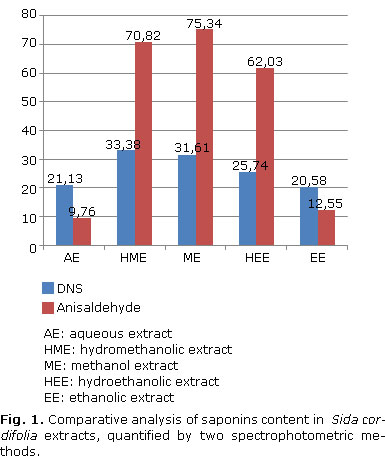
<body><![CDATA[<p><i><font size="2" face="Verdana">Quantification  of saponosides</font> </i>     <p><font size="2" face="Verdana">The following equations:  Abs= 0.000508865*C-0, 0168209 (R<sup>2</sup> = 99.947) for DNS and Abs= 0.000417649*C+0.110798  (R<sup>2</sup>= 98.6459) for p-anisaldehyde, were the basis for the quantification  of saponoside material. <a href="#fig1">Figure 1</a> was developed to compare  saponin concentrations. </font> <font face="Verdana" size="2"> </font>     <p align="center"><img src="/img/revistas/pla/v18n2/f0113213.jpg" width="385" height="467"><a name="fig1"></a>      
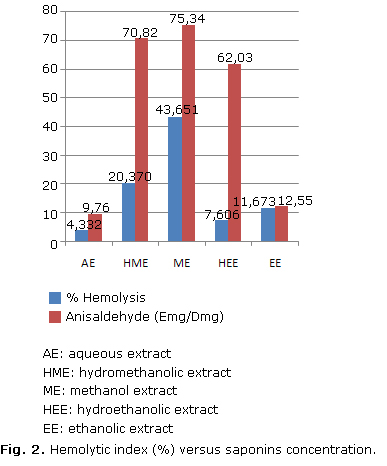
<p>     <p>&nbsp;     <p><font size="2" face="Verdana"><i>Hemolytic action of saponins</i> </font>      <p><font size="2" face="Verdana">On the basis of the values obtained, a comparative  analysis was carried out of the hemolytic index and saponoside<strike>s</strike>  content of extracts. The results are shown in </font> <font face="Verdana" size="2"><a href="#fig2">Figure  2 </a>reveals the results.</font>     <p align="center"><img src="/img/revistas/pla/v18n2/f0213213.jpg" width="387" height="466"><a name="fig2"></a>      
<p>     <p><font size="2" face="Verdana"> As shown in the figure, ME exhibits the  highest hemolytic activity (44 %), followed by HME (20 %), EE (16 %), HEE (8 %)  and AE (4 %). Except for EE, there is a direct correspondence with saponin content.  </font>     ]]></body>
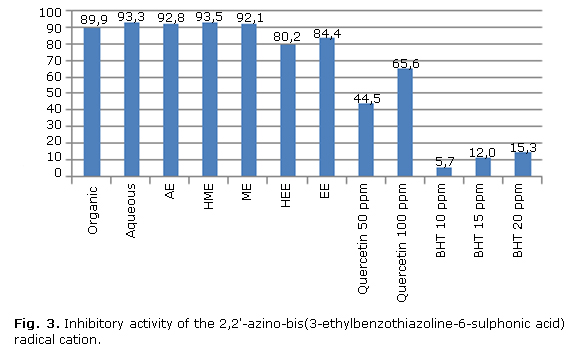
<body><![CDATA[<p>     <p><font size="2" face="Verdana"><i>Antioxidant activity</i> </font>      <p><font size="2" face="Verdana">Results from DPPH<sup>.+</sup> radical discoloration  were compared with the spots of another chromatography plate run under the same  conditions, but revealed with p-anisaldehyde. </font>     <p><font size="2" face="Verdana">Violet  spots generated from the saponoside material, and yellow-green stainings produced  by antioxidant compounds were observed. There is a coincidence in some of the  bands of both chromatography plates, revealing the highest concentration of compounds  with antiradical activity against DPPH, mainly with low RFs (~0.3) and some high  (~1.0). </font>     <p><font size="2" face="Verdana">Performance of standards and  extracts against ABTS radical is shown in <a href="#fig3">Figure 3</a>. <u>A</u>  comparable action is observed in polar and non-polar phytocompounds (aqueous and  organic phase) with respect to those present in ME and HME, which are in turn  more active than BHT and quercetin. </font>     <p align="center"><img src="/img/revistas/pla/v18n2/f0313213.jpg" width="580" height="350">  <a name="fig3"></a>     
<p>     <p><font size="2" face="Verdana">The figure shows that  organic (89.9 %) and aqueous phase (93.3 %), aqueous (92.8 %), hydromethanolic  (93.5 %), methanolic (92.1 %), hydroethanolic (80.2 %), and ethanolic extracts  (84.4 %) had inhibition percentages above 50 %, being more active than, one of  the synthetic antioxidants most widely used in the food industry, and even exceeded  theactivity of quercetin, the most abundant natural flavonoid. Applied linear  regression analysis yielded the following equation: ABTS= 77.2046-0.308919* [anisaldehyde]  (p= 0.8765). </font>     <p>     <p><font size="2" face="Verdana">Another method used  for measuring antioxidant activity was FRAP. In this assay methanol and ethanol,  either pure or mixed with water (HME, HEE), can remove from the plant compounds  with greater reductant ability than that of ascorbic acid (50 and 100 &micro;g/mL).  The ratio between FRAP and saponin<strike>s</strike> content is expressed by the  equation: Reducing power = 0.714907-0.00300223*anisaldehyde (p= 0.7698). </font>      ]]></body>
<body><![CDATA[<p><font size="2" face="Verdana">The TAC variability of ascorbic acid prepared  at different concentrations (40-640 mg/mL) and used as reference, was expressed  by the calibration curve: Absorbance=0.003839[AA]-0.16805. HEE, EE and ME action  seems comparable to the antiradical activity evidenced by themselves. </font>      <p>     <p><font size="2" face="Verdana"><i>Antifungal activity</i> </font>     <p><font size="2" face="Verdana">No  activity against <i>F. oxysporum</i> and <i>R. oryzae</i> was observed in the  extracts. However, some of their fractions showed activity in all the concentrations  tested (data not shown)</font>.     <P>     <P>&nbsp;     <P>     <P><font face="Verdana" size="3"><B>DISCUSSION</B>  </font>     <P>     <P><font size="2" face="Verdana">The micro<strike> </strike> morphological  characteristics observed are consistent with those described for the Malvaceae  family, which immediately allows placement of <i>Sida cordifolia</i> in a specific  taxon based on some specific physical parameters. The pharmacognostic indexes  determined are an <strike> </strike> indication of the expected content of bioactive  ingredients in each extract<strike>s</strike>. The dry matter content leads to  pondering the capacity of the plant to store a considerable amount of water (62.7  &#177; 0.9 %), although the collection site is located on the edge of a road,  with low humidity, high air flow, high temperature and plenty of light. This is  an &quot;edge effect&quot; which directly affects the physiology of the plant,  forcing it to respond to stressful conditions by storing a lot of water as a survival  mechanism. </font>     ]]></body>
<body><![CDATA[<p><font size="2" face="Verdana">The scientific world acknowledges  the presence of saponins mainly through the foam test and hemolytic index. The  former is based on the persistent, abundant and relatively stable foam appearing  when aqueous solutions are shaken, which results from the ability of these compounds  to decrease water surface tension and form micelles as detergents do.<sup>25</sup>  </font>     <p><font size="2" face="Verdana">Secondary nuclei evidence from phytochemical  screening could be a consequence, partial as it may be, of the environmental stress  to which the plant is subjected due to the high anthropogenic impact on its ecological  niche (near a national road), and would justify some of the ethnomedical uses  given to the plant: bronchial disorders, aphrodisiac and central nervous system  stimulant (alkaloids), slimming and syphilis treatment (saponins), and external  wound healing because of its flavonoids.<sup>14,26</sup> </font>     <p><font size="2" face="Verdana">  Chromatographic analysis showed that chemical constituents exhibiting high foaming  activity, increased hemolytic index and the highest reliability in TLC are to  be found in ME and HME. Use of some reference standards for sapogenins and carbohydrates  not only confirmed previous assays, but also suggested that the plant contains  steroidal saponins, some of which may be hecogenin, diosgenin or a homolog of  them. </font>     <p><font size="2" face="Verdana"> The carbohydrates attached to  the sapogenins from <i>Sida cordifolia</i> are probably those commonly reported  for other saponins. It should be noted that the number of carbons attached to  the genina may be in a 1:1 ratio, but this is not the most frequent situation.  The sugar portion of the glycoside is generally constituted by 1-2 linear or branched  oligosaccharides, the molecule may contain up to 11 carbons (3 to 5 is common),  and the link between the carbohydrate and the sapogenin may be either ether or  ester.<sup>27</sup> </font>     <p><font size="2" face="Verdana">Some authors affirm  that a red color (<a href="/img/revistas/pla/v18n2/t0213213.gif">Table 2</a>)  is associated with the <font face="Symbol">D</font><sup>5</sup> double bound of  25<font face="Symbol">a</font> or 25&szlig;-3: 5-spirostan diene sapogenins. Loss  of that double bond is directly related to red colour disappearance.<sup>28</sup>  </font>     
<p><font size="2" face="Verdana">Besides absorption bands characteristic  of steroidal substances (3650-3590 and 1055 cm<sup>-1</sup> for -OH bonded to  a secondary carbon, 2960-2850 and 1485-1445 cm<sup>-1</sup> for -CH stretching  and -CH<sub>2</sub> bending, etc), the spectroscopic analysis also revealed several  bands generated from C-O pyran and furan rings tensions, which are located around  850, 900, 920 and 987 cm<sup>-1 </sup>(steroidal saponin fingerprint).<strike>  </strike> </font>     <p><font size="2" face="Verdana">The presence of phytosterols  seems to constitute interference in the IR spectrum and greatly reduces the intensity  of bands, preventing their occurrence or shifting their position<u>,</u> for example  the 1125 cm<sup>-1</sup> band, a fact not observed in standards (pure compounds).  On the other hand, the band observed in all extracts at UV (430 nm &#177; 2) is  typical of steroidal saponins.<sup>29,30</sup> However, rings A and B, their substituents  and stereochemistry, play no role in chromophore training or in maximum absorption  (&euml;<sub>max</sub>), due to saturated sapogenins, such as tigogenin or gitogenin,  which react similarly to hecogenin acetate, yonogenin and tokorogenina triacetate,  among others. Additionally, the hydroxyl groups at 3 position seem to participate  in the absorption process of UV radiation.<sup>31</sup> </font>     <p><font size="2" face="Verdana">  Results in <a href="#fig3">Figure</a><a href="#fig3"> 3</a> clearly show that  water was less able to extract the metabolite of interest, while methanol or its  mixture with water showed greater extracting ability. It is also observed that  the DNS seems to be less sensitive than the p-anisaldehyde method. According to  some authors this last spectrophotometric method allows to determine all sapogenins,  regardless of their structure.<sup>18,31,32</sup> </font>     <p><font size="2" face="Verdana">The  low correlation observed between saponoside<strike>s</strike> content and hemolytic  activity has its origin in the biochemical nature of the saponins (steroidal and  triterpene), the number of glycosidic substituents (monodesmosidic, bidesmosidic,  etc.), and their degree of complexity, as well as blood type and Rh factor. Therefore,  those with the highest hemolysis percentages may have a higher ratio of monodesmosidic  steroidal saponins (more active) than those with low percentages, which may have  both steroidal and triterpenic bidesmosdic types.<sup>25,31</sup> </font>     <p><font size="2" face="Verdana">Numerous  biological effects of saponins have been justified by its action on the cell membrane.  It is believed that the injuries caused by these metabolites result from the formation  of micelles arising from their interaction with cholesterol on the membrane plane,  a bond which is possibly made between the hydrophobic fraction of saponin and  cholesterol located on the outside perimeter. To achieve that union, the saponin  molecule must dispose as a ring for others. However, the interaction may be more  complex.<sup>25</sup> </font>     ]]></body>
<body><![CDATA[<p><font size="2" face="Verdana">TLC against DPPH  radical test results indicate that <i>S. cordifolia</i> has a rich content of  antioxidant compounds, mostly saponins. On the other hand, the ABTS<sup>*-</sup>  test determines the capacity of saponins to decrease the potential energy of radicals  in an aqueous medium. In this way the ABTS<sup>*-</sup> assay gives credence to  the determination of the <i> </i> antioxidant capacity of <i>S. cordifolia</i>,  indicating that the results observed through the DPPH qualitative assay are not  due to confusion or misperception<strike>s</strike>. It should be noted that the  chromophore formed was read at 754 nm, not interfering with the absorption of  the complex formed by the saponins and p-anisaldehyde reagents (430 nm &#177;  2). </font>     <p><font size="2" face="Verdana">The moderate antioxidant activity  expressed by the saponins from <i>S. cordifolia</i> against ABTS*- could result  from the fact that this radical is thermodynamically reduced by reducing compounds  which have a lower redox potential than itself (0.68 V), as is the case with phenols.<sup>33</sup>  In turn, the FRAP assay cannot detect compounds that act by transferring H<sup>+</sup>,  particularly thiols and proteins. In this way, the FRAP test becomes a reasonable  procedure to measure the ability to maintain a redox status in cells or tissues.<sup>34</sup>  It should be noted that although there may be several compounds with antioxidant  properties in a plant sample, each one exhibits its own activity and kinetic characteristics,  depending on the presence of one, two or more kinds of components. </font>     <p><font size="2" face="Verdana">  Measurement of the entire buffer system capacity of a natural product can give  an idea of the antioxidant joint action of a pro-oxidant system against oxidative  stress. The response depends on the fluid, tissue or cell studied. It must be  born in mind that each environment has different antioxidant systems and different  combinations (heterogeneous, an important, determining factor when results are  evaluated and analyzed.<sup>35</sup> </font>     <p><font size="2" face="Verdana">Results  indicate that antioxidants in the plant contribute differently to total antioxidant  capacity, depending on the method applied. Regression analysis of the correlated  variables did not show a good fit to the linear model, which suggests that the  participation of saponins is low, in contrast with the joint action of metabolites  (flavonoids, phenylpropanoids, tannins, alkaloids, etc.). In order to supplement  the knowledge about antioxidant activity, a principal components analysis was  performed (ABTS, CATH, reducing power, DNS, anisaldehyde and hemolysis), which  revealed that only CATH is correlated with saponin content. </font>     <p><font size="2" face="Verdana">Some  researchers interested in studying the biological activity of saponins from plants  have found a moderate correlation between antioxidant activity and the total saponin<strike>s</strike>  fraction quantified by HPLC-DAD.<sup>16,34,36 </sup>This antioxidant functionality  of <i>S. cordifolia</i> has also attracted the interest of a few scientists from  different regions except Colombia.<sup>37,38</sup> </font>     <p><font size="2" face="Verdana">The  chemical nature of components with antioxidant capacity is different, and so are  their polar nature and their mode of action, which is also associated with molecular  size, structural conformation, number, type and position of available substituents  in the molecule, solubility characteristics, etc.<sup>39</sup> It depends not  only on the physicochemical characteristics of metabolites, but also on the way  oxidation is induced and the assay type used.<sup>40</sup> </font>     <p><font size="2" face="Verdana">  The low correlation between antioxidant activity and saponin<strike>s</strike>  content found in this study might be due, at least in part, to the size of saponin  molecules, which would hinder their interaction with reagents, or perhaps the  poor availability of nucleophilic groups (ex. -OH,-C=O) in their structure, which  may be locked by forming glycosidic linkages, especially the carbonyl group (-C=O),  whose presence increases the acidity of the hydrogen atoms attached to the alpha  carbon, allowing them to be released as protons (H <sup>+</sup>) and stabilizing  reactive oxygen species. </font>     <p><font size="2" face="Verdana">Although the  antioxidant action of <i>S. cordifolia</i> is not fully revealed in the study,  this activity is not viewed as negligible. Instead, it constitutes an incentive  to continue proposing tests that shed light on the matter.</font>     <p> <font size="2" face="Verdana">  Results show that the aerial section of <i>Sida cordifolia</i> is a good source  of saponins with various chemical structures, mainly of the monodesmosidic steroidal  type, and its bioactivity could be modified if its saponins acted independently  or in conjunction with the tannins, flavonoids, phenylpropanoids, anthraquinones  and alkaloids of the plant. </font>     <p><font size="2" face="Verdana"> The study  also showed that the combination of FTIR with chromatographic techniques such  as TLC, is a valuable tool to reveal the chemical nature of saponins from a natural  product, leading to the development of a simple, rapid, specific and sensitive  methodology for their study, adaptable to any laboratory conditions, mainly those  with a limited availability of infrastructure. The study also revealed a promising  future for <i>Sida cordifolia</i>, an unknown weed scarcely studied in Colombia,  and constitutes the first research work into this topic conducted in our country.  </font>     ]]></body>
<body><![CDATA[<P>&nbsp;     <P>     <P>     <P><font face="Verdana" size="3"><B>REFERENCES</B> </font>      <P>     <!-- ref --><P><font face="Verdana" size="2">1. Sardi&ntilde;as Y, Padilla C, Herrera  RS, Torres, V, Noda A, Fraga N. Indicadores del crecimiento y desarrollo de <I>Sporobolus  indicus</I> (L.) R. Br. (espartillo) en un agroecosistema de <I>Panicum m&aacute;ximum  </I>vc. Likoni. Rev Cubana Ciencia Agr&iacute;cola. 2010;44:421-5.     </font>     <!-- ref --><P><font face="Verdana" size="2">2.  Guevara LI, Ramia M. Anatom&iacute;a foliar de <I>Panicum </I>L., secci&oacute;n  Parvifolia (Poaceae, Paniceae) en Venezuela. Rodrigu&eacute;sia. 2006;58(1):73-83.      </font>     <!-- ref --><P><font face="Verdana" size="2">3. Teillier S. <I>Leucheria Landbecki</I>  (Phil.) Reiche (Asteraceae) es sin&oacute;nima de leucheria runcinata D. Don.  Rev Chilena Flor y Veg [serie en internet]. 2010 [citado 16 Ene 2012]; a&ntilde;o  12(2). Disponible en: <U><FONT  COLOR="#0000ff"><a href="http://www.chlorischile.cl/leucheriaruncinataweb/leucheriaruncinata.htm" target="_blank">http://www.chlorischile.cl/leucheriaruncinataweb/leucheriaruncinata.htm</a></FONT></U>  </font>     <!-- ref --><P><font face="Verdana" size="2">4. Marchessi JE, Subils R, Scaramuzzino  RL, Crosta HN, Eseiza MF, Saint Andr&eacute; HM, Juan VF. Presencia de <I>Euphorbia  davidii</I> Subils (Euphorbiaceae) en la provincia de Buenos Aires: morfolog&iacute;a  y anatom&iacute;a de la especie. Kurtziana.<I> </I>2011;36:45-53.     </font>     <!-- ref --><P><font face="Verdana" size="2">5.  Orde&ntilde;ana DM, Tapia LJ. Comportamiento de arvenses en el cultivo de ma&iacute;z  (<I>Zea mays</I> L.) variedad NB-6, bajo dos sistemas de producci&oacute;n, convencional  y org&aacute;nico en la finca El Plantel, Masaya 2008 [Trabajo de Grado]. Managua,  Nicaragua: Universidad Nacional Agraria, Facultad de Agronom&iacute;a, Departamento  de Producci&oacute;n Vegetal; 2009.     </font>     <!-- ref --><P><font face="Verdana" size="2">6.  P&eacute;rez ML, Nava RF. Plantas del estado de Quer&eacute;taro con potencia  para uso ornamental. Red de Revistas Cient&iacute;ficas de Am&eacute;rica Latina  y el Caribe, Espa&ntilde;a y Portugal. 2007;24:83-115.     </font>     <!-- ref --><P><font face="Verdana" size="2">7.  Murillo E, Vi&ntilde;a A, P&eacute;rez CA, Ruiz VH. Actividad alelop&aacute;tica  de las arvenses asociadas al cultivo de arroz (<I>Oryza sativa</I> L.) en el Tolima-Colombia.  Informaci&oacute;n Tecnol&oacute;gica. 2006;17(2):15-24.     </font>     <!-- ref --><P><font face="Verdana" size="2">8.  Toribio MS, Oriani DS, Skiliar MI. Actividad antimicrobiana de <I>Centaurea solstitialis</I>  y <I>Centaurea calcitrapa</I>. Ars Pharmaceutica.<I> </I>2004;45:335-41.     </font>      ]]></body>
<body><![CDATA[<P><font face="Verdana" size="2">9. Guti&eacute;rrez DM, Ortiz CA, Mendoza AM.  Medici&oacute;n de fenoles y actividad antioxidante en malezas usadas para alimentaci&oacute;n  animal [serie en internet]. 2008 [citado 6 Mar 2012) Simposio Metrolog&iacute;a,  220(1018):1-5. Disponible en: <U><FONT  COLOR="#0000ff"><a href="http://www.cenam.mx/simposio2008/sm_2008/memorias/M2/SM2008-M220-1108.pdf" target="_blank">http://www.cenam.mx/simposio2008/sm_2008/memorias/M2/SM2008-M220-1108.pdf</a></FONT></U>  </font>     <!-- ref --><P><font face="Verdana" size="2">10. Franzotti EM, Santos CV, Rodrigues  HM, Mour&atilde;o RH, Andrade MR, Antoniolli AR. Anti-inflammatory, analgesic  activity and acute toxicity of <I>Sida cordifolia</I> L. (Malva-branca). J Ethnopharmacol.  2000;72:273-7.     </font>     <!-- ref --><P><font face="Verdana" size="2">11. Almeida JRGA, Silva-Filho  RN, Nunes XP, Dias CS, Pereira FO, Lima EO. Antimicrobial activity of the essential  oil of <I>Sida cordifolia</I> L. Rev Brasileira Farmacognosia. 2006;16:642-4.      </font>     <!-- ref --><P><font face="Verdana" size="2">12. Sutradhar RK, Rahman AM, Ahmad M,  Bachar SC, Saha A, Guha SK. Bioactive alkaloid from <I>Sida cordifolia</I> Linn.  with analgesic and anti-inflammatory activities. Iranian J Pharmacol Therapeutics.  2006;5:175-8.     </font>     <!-- ref --><P><font face="Verdana" size="2">13. Dhalwal K, Deshpande  YS, Purohit AP, Kadam SS. Evaluation of the antioxidant activity of <I>Sida cordifolia</I>.  Pharmaceutical Biology. 2005;43:754-61.     </font>     <!-- ref --><P><font face="Verdana" size="2">14.  Lemos RL, de Melo GB, de Melo VA, Antoniolli AR, Teixeira PR, Zucoloto S, et al.  Effect of the aqueous extract of <I>Sida cordifolia</I> on liver regeneration  after partial hepatectomy. Acta Cirurgica Brasileira. 2006;21:37-9.     </font>     <!-- ref --><P><font face="Verdana" size="2">15.  Gauthier C, Legault J, Girard-Lalancette K, Mshvildadze V, Pichette A. Haemolytic  activity, cytotoxicity and membrane cell permeabilization of semi-synthetic and  natural lupane-and oleanane-type saponins. Bioorganic Medicinal Chemistry. 2009;17:2002-8.      </font>     <!-- ref --><P><font face="Verdana" size="2">16. Sparg SG, Light ME, Van Staden J.  Biological activities and distribution of plant saponins. J Ethnopharmacol. 2004;94:219-43.      </font>     <!-- ref --><P><font face="Verdana" size="2">17. Casarrubias E. Estudio del efecto  de la composici&oacute;n del medio de cultivo y de variables fisicoqu&iacute;micas  seleccionadas sobre la producci&oacute;n de invertasa por la levadura MPIIIa [Tesis  doctoral]. Lardiz&aacute;bal, M&eacute;xico: Instituto Polit&eacute;cnico Nacional  Tepetitla de Lardiz&aacute;bal; 2005.     </font>     <!-- ref --><P><font face="Verdana" size="2">18.  Hata Y, Reguero MT, de Garc&iacute;a LA, Buitrago G, &Aacute;lvarez A. Evaluaci&oacute;n  del contenido de sapogeninas en variedades nativas de &ntilde;ame (<I>Dioscoreas  </I>sp.), provenientes de la colecci&oacute;n de la Universidad de C&oacute;rdoba.  Rev Colombiana Ciencias Qu&iacute;mico-Farmac&eacute;utica. 2003;32:149-57.     </font>      <!-- ref --><P><font face="Verdana" size="2">19. Zhu QY, Schramm DD, Gross HB, Holt RR, Kim  SH, Yamaguchi T, et al. Influence of cocoa flavanols and procyanidins on free  radical-induced human erythrocyte hemolysis. Clinical Developmental Immunology.  2005;12(1):27-34.     </font>     <!-- ref --><P><font face="Verdana" size="2">20. Arnao MB. Some  methodological problems in the determination of antioxidant activity using chromogen  radicals: a practical case. Trends in Food Science Technology. 2000;11:419-21.      </font>     <!-- ref --><P><font face="Verdana" size="2">21. Marquina V, Araujo L, Ru&iacute;z  J, Rodr&iacute;guez-Malaver A, Vit P. Composici&oacute;n qu&iacute;mica y capacidad  antioxidante en fruta, pulpa y mermelada de guayaba (<I>Psidium guajava</I> L.).  Archivos Latinoamericanos de Nutrici&oacute;n. 2008;58:98-102.     </font>     <!-- ref --><P><font face="Verdana" size="2">22.  P&eacute;rez RM, Vargas R, Mart&iacute;nez FJ, Garc&iacute;a EV, Hern&aacute;ndez  B. Actividad antioxidante de los alcaloides de <I>Bocconia arborea</I>. Estudio  sobre seis m&eacute;todos de an&aacute;lisis. Ars Pharmaceutica. 2003;44:5-21.      </font>     <!-- ref --><P><font face="Verdana" size="2">23. Abbasi MA, Raza A, Riaz T, Shahzadi  T, Aziz-ur-Rehman, Jahangir M, et al. Investigation on the volatile constituents  of <I>Junglans regia</I> and their <I>in vitro</I> antioxidant potential. Proceedings  Royal Society Queensland. 2010;47:137-41.     </font>     <!-- ref --><P><font face="Verdana" size="2">24.  Barile E, Bonanomi G, Antignani V, Zolfaghari B, Sajjadi SE, Scala F, et al. Saponins  from <I>Allium minutiflorum</I> with antifungal activity. Phytochemistry. 2007;68:596-603.      </font>     <!-- ref --><P><font face="Verdana" size="2">25. Francis G, Kerem Z, Makkar HPS, Becker  K. The biological action of saponins in animal systems: a review. British J Nut.  2002;88:587-605.     </font>     <!-- ref --><P><font face="Verdana" size="2">26. Jain A, Choubey  S, Singour PK, Rajak H, Pawar RS. <I>Sida cordifolia</I> (Linn)-An overview. J  Applied Pharmaceutical Science. 2011;1:23-31.     </font>     <!-- ref --><P><font face="Verdana" size="2">27.  Bruneton J. Farmacognosia Fitoqu&iacute;mica Plantas Medicinales. Triterpenos  y esteroides. Zaragoza-Espa&ntilde;a: Acribia; 2001. p. 668-9.     </font>     <!-- ref --><P><font face="Verdana" size="2">28.  Hardman NJ, Wright RJ, Phillips AD, Philip P. Structures, bonding, and reaction  chemistry of the neutral organogallium (I) compounds (GaAr) n (n= 1 or 2) (Ar=  terphenyl or related ligand): An experimental investigation of Ga-Ga multiple  bonding. J Am Chemical Society. 2003;125:2667-79.     </font>     <!-- ref --><P><font face="Verdana" size="2">29.  Garcia M, Castellanos MC. Evaluaci&oacute;n del efecto sanitizante de un extracto  biodegradable obtenido de la especie <I>Solanum marginatum</I>, de uso etnobot&aacute;nico  en Boyac&aacute;. Luna Azul. 2011;32:10-5.     </font>     <!-- ref --><P><font face="Verdana" size="2">30.  Silverstein RM, Bassler GC, Morril TC. Infrared spectroscopy.<I> </I>Spectrometric  identification of organic compounds. New York: John Wiley &amp; Sons; 1991. p.  72-108.     </font>     <!-- ref --><P><font face="Verdana" size="2">31. Baccou JC, Lambert F, Sauvaire  Y. Spectrophotometric method for the determination of total steroidal sapogenin.  Analyst. 1997;102:458-65.     </font>     <!-- ref --><P><font face="Verdana" size="2">32. Fuentes  JM, Jaramillo S, Rodr&iacute;guez G, Rodr&iacute;guez-Arcos R, Fern&aacute;ndez  J, Guill&eacute;n R, et al. Effect of the extraction method on phytochemical composition  and antioxidant activity of high dietary fiber powders obtained from asparagus  by-products. Food Chemistry. 2009;116:484-90.     </font>     <!-- ref --><P><font face="Verdana" size="2">33.  Navarro-Marfil R. Par&aacute;metros de calidad y componentes con inter&eacute;s  nutricional del aceite de arg&aacute;n<I> (Argania spinosa)</I> [Tesis doctoral].  Espa&ntilde;a: Facultad de Farmacia, Universidad de Granada; 2008.     </font>     <!-- ref --><P><font face="Verdana" size="2">34.  Dini I, Tenore GC, Dini A. Saponins in <I>Ipomoea batatas</I> tubers: Isolation,  characterization, quantification and antioxidant properties. Food Chemistry. 2009;113:411-9.      </font>     <!-- ref --><P><font face="Verdana" size="2">35. Escorza MAQ, Salinas JVC. La capacidad  antioxidante total. Bases y aplicaciones. Rev Educaci&oacute;n Bioqu&iacute;mica.  2009;28:89-101.     </font>     <!-- ref --><P><font face="Verdana" size="2">36. G&uuml;l&ccedil;in  I, Mshvildadze V, Gepdiremen A, Elias R. Antioxidant activity of saponins isolated  from ivy: alpha-hederin, hederasaponin-C, hederacolchiside-E and hederacolchiside-F.  Planta Med. 2004;70:561-3.     </font>     <!-- ref --><P><font face="Verdana" size="2">37. Auddy  B, Ferreira M, Blasina F, Lafon L, Arredondo F, Dajas F, et al. Screening of antioxidant  activity of three Indian medicinal plants, traditionally used for the management  of neurodegenerative diseases. J Ethnopharmacol. 2003;84:131-8.     </font>     <!-- ref --><P><font face="Verdana" size="2">38.  Surveswaran S, Cai YZ, Corke H, Sun M. Systematic evaluation of natural phenolic  antioxidants from 133 Indian medicinal plants. Food Chemistry. 2007;102:938-53.      </font>     <!-- ref --><P><font face="Verdana" size="2">39. Mathew S, Abraham TE. <I>In vitro</I>  antioxidant activity and scavenging effects of <I>Cinnamomum verum</I> leaf extract  assayed by different methodologies. Food Chemical Toxicology. 2006;44:198-206.      </font>     <!-- ref --><P><font face="Verdana" size="2">40. Puertas M, Hillebrand S, Stashenko  E, Winterhalter P. <I>In vitro</I> radical scavenging activity of essential oils  from Columbian plants and fractions from oregano (<I>Origanum vulgare</I> L.)  essential oil. Flavour Fragance J. 2002;17:380-4.    </font>     <P>&nbsp;     <P>&nbsp;     <P>     <P><font face="Verdana" size="2">Recibido:  30 de mayo de 2012.     <br> Aprobado: 30 de diciembre de 2012. </font>     <P>&nbsp;     <P>&nbsp;     ]]></body>
<body><![CDATA[<P>      <P><font face="Verdana" size="2"><I>Oscar Juli&aacute;n Vel&aacute;squez Ballesteros</I>.  Departamento de Biolog&iacute;a. Grupo de Investigaci&oacute;n en Productos Naturales.  Universidad del Tolima. Colombia. Correo electr&oacute;nico: <U><FONT  COLOR="#0000ff"><a href="mailto:ojvb@live.com">ojvb@live.com</a></FONT></U> </font>       ]]></body><back>
<ref-list>
<ref id="B1">
<label>1</label><nlm-citation citation-type="journal">
<person-group person-group-type="author">
<name>
<surname><![CDATA[Sardiñas]]></surname>
<given-names><![CDATA[Y]]></given-names>
</name>
<name>
<surname><![CDATA[Padilla]]></surname>
<given-names><![CDATA[C]]></given-names>
</name>
<name>
<surname><![CDATA[Herrera]]></surname>
<given-names><![CDATA[RS]]></given-names>
</name>
<name>
<surname><![CDATA[Torres]]></surname>
<given-names><![CDATA[V]]></given-names>
</name>
<name>
<surname><![CDATA[Noda]]></surname>
<given-names><![CDATA[A]]></given-names>
</name>
<name>
<surname><![CDATA[Fraga]]></surname>
<given-names><![CDATA[N]]></given-names>
</name>
</person-group>
<article-title xml:lang="es"><![CDATA[Indicadores del crecimiento y desarrollo de Sporobolus indicus (L.) R. Br. (espartillo) en un agroecosistema de Panicum máximum vc. Likoni]]></article-title>
<source><![CDATA[Rev Cubana Ciencia Agrícola]]></source>
<year>2010</year>
<volume>44</volume>
<page-range>421-5</page-range></nlm-citation>
</ref>
<ref id="B2">
<label>2</label><nlm-citation citation-type="journal">
<person-group person-group-type="author">
<name>
<surname><![CDATA[Guevara]]></surname>
<given-names><![CDATA[LI]]></given-names>
</name>
<name>
<surname><![CDATA[Ramia]]></surname>
<given-names><![CDATA[M]]></given-names>
</name>
</person-group>
<article-title xml:lang="es"><![CDATA[Anatomía foliar de Panicum L., sección Parvifolia (Poaceae, Paniceae) en Venezuela]]></article-title>
<source><![CDATA[Rodriguésia.]]></source>
<year>2006</year>
<volume>58</volume>
<numero>1</numero>
<issue>1</issue>
<page-range>73-83</page-range></nlm-citation>
</ref>
<ref id="B3">
<label>3</label><nlm-citation citation-type="journal">
<person-group person-group-type="author">
<name>
<surname><![CDATA[Teillier]]></surname>
<given-names><![CDATA[S]]></given-names>
</name>
</person-group>
<article-title xml:lang="es"><![CDATA[Leucheria Landbecki (Phil.) Reiche (Asteraceae) es sinónima de leucheria runcinata D. Don]]></article-title>
<source><![CDATA[Rev Chilena Flor y Veg]]></source>
<year>2010</year>
<volume>12</volume>
<numero>2</numero>
<issue>2</issue>
</nlm-citation>
</ref>
<ref id="B4">
<label>4</label><nlm-citation citation-type="journal">
<person-group person-group-type="author">
<name>
<surname><![CDATA[Marchessi]]></surname>
<given-names><![CDATA[JE]]></given-names>
</name>
<name>
<surname><![CDATA[Subils]]></surname>
<given-names><![CDATA[R]]></given-names>
</name>
<name>
<surname><![CDATA[Scaramuzzino]]></surname>
<given-names><![CDATA[RL]]></given-names>
</name>
<name>
<surname><![CDATA[Crosta]]></surname>
<given-names><![CDATA[HN]]></given-names>
</name>
<name>
<surname><![CDATA[Eseiza]]></surname>
<given-names><![CDATA[MF]]></given-names>
</name>
<name>
<surname><![CDATA[Saint André]]></surname>
<given-names><![CDATA[HM]]></given-names>
</name>
<name>
<surname><![CDATA[Juan]]></surname>
<given-names><![CDATA[VF]]></given-names>
</name>
</person-group>
<article-title xml:lang="es"><![CDATA[Presencia de Euphorbia davidii Subils (Euphorbiaceae) en la provincia de Buenos Aires: morfología y anatomía de la especie]]></article-title>
<source><![CDATA[Kurtziana.]]></source>
<year>2011</year>
<volume>36</volume>
<page-range>45-53</page-range></nlm-citation>
</ref>
<ref id="B5">
<label>5</label><nlm-citation citation-type="book">
<person-group person-group-type="author">
<name>
<surname><![CDATA[Ordeñana]]></surname>
<given-names><![CDATA[DM]]></given-names>
</name>
<name>
<surname><![CDATA[Tapia]]></surname>
<given-names><![CDATA[LJ]]></given-names>
</name>
</person-group>
<source><![CDATA[Comportamiento de arvenses en el cultivo de maíz (Zea mays L.) variedad NB-6, bajo dos sistemas de producción, convencional y orgánico en la finca El Plantel, Masaya 2008]]></source>
<year>2009</year>
<publisher-loc><![CDATA[Managua ]]></publisher-loc>
<publisher-name><![CDATA[Universidad Nacional Agraria, Facultad de Agronomía, Departamento de Producción Vegetal]]></publisher-name>
</nlm-citation>
</ref>
<ref id="B6">
<label>6</label><nlm-citation citation-type="journal">
<person-group person-group-type="author">
<name>
<surname><![CDATA[Pérez]]></surname>
<given-names><![CDATA[ML]]></given-names>
</name>
<name>
<surname><![CDATA[Nava]]></surname>
<given-names><![CDATA[RF]]></given-names>
</name>
</person-group>
<article-title xml:lang="es"><![CDATA[Plantas del estado de Querétaro con potencia para uso ornamental]]></article-title>
<source><![CDATA[Red de Revistas Científicas de América Latina y el Caribe, España y Portugal]]></source>
<year>2007</year>
<volume>24</volume>
<page-range>83-115</page-range></nlm-citation>
</ref>
<ref id="B7">
<label>7</label><nlm-citation citation-type="journal">
<person-group person-group-type="author">
<name>
<surname><![CDATA[Murillo]]></surname>
<given-names><![CDATA[E]]></given-names>
</name>
<name>
<surname><![CDATA[Viña]]></surname>
<given-names><![CDATA[A]]></given-names>
</name>
<name>
<surname><![CDATA[Pérez]]></surname>
<given-names><![CDATA[CA]]></given-names>
</name>
<name>
<surname><![CDATA[Ruiz]]></surname>
<given-names><![CDATA[VH]]></given-names>
</name>
</person-group>
<article-title xml:lang="es"><![CDATA[Actividad alelopática de las arvenses asociadas al cultivo de arroz (Oryza sativa L.) en el Tolima-Colombia]]></article-title>
<source><![CDATA[Información Tecnológica.]]></source>
<year>2006</year>
<volume>17</volume>
<numero>2</numero>
<issue>2</issue>
<page-range>15-24</page-range></nlm-citation>
</ref>
<ref id="B8">
<label>8</label><nlm-citation citation-type="journal">
<person-group person-group-type="author">
<name>
<surname><![CDATA[Toribio]]></surname>
<given-names><![CDATA[MS]]></given-names>
</name>
<name>
<surname><![CDATA[Oriani]]></surname>
<given-names><![CDATA[DS]]></given-names>
</name>
<name>
<surname><![CDATA[Skiliar]]></surname>
<given-names><![CDATA[MI]]></given-names>
</name>
</person-group>
<article-title xml:lang="es"><![CDATA[Actividad antimicrobiana de Centaurea solstitialis y Centaurea calcitrapa]]></article-title>
<source><![CDATA[Ars Pharmaceutica.]]></source>
<year>2004</year>
<volume>45</volume>
<page-range>335-41</page-range></nlm-citation>
</ref>
<ref id="B9">
<label>9</label><nlm-citation citation-type="journal">
<person-group person-group-type="author">
<name>
<surname><![CDATA[Gutiérrez]]></surname>
<given-names><![CDATA[DM]]></given-names>
</name>
<name>
<surname><![CDATA[Ortiz]]></surname>
<given-names><![CDATA[CA]]></given-names>
</name>
<name>
<surname><![CDATA[Mendoza]]></surname>
<given-names><![CDATA[AM]]></given-names>
</name>
</person-group>
<article-title xml:lang="es"><![CDATA[Medición de fenoles y actividad antioxidante en malezas usadas para alimentación animal]]></article-title>
<source><![CDATA[Simposio Metrología]]></source>
<year>2008</year>
<volume>220</volume>
<numero>1018</numero>
<issue>1018</issue>
<page-range>1-5</page-range></nlm-citation>
</ref>
<ref id="B10">
<label>10</label><nlm-citation citation-type="journal">
<person-group person-group-type="author">
<name>
<surname><![CDATA[Franzotti]]></surname>
<given-names><![CDATA[EM]]></given-names>
</name>
<name>
<surname><![CDATA[Santos]]></surname>
<given-names><![CDATA[CV]]></given-names>
</name>
<name>
<surname><![CDATA[Rodrigues]]></surname>
<given-names><![CDATA[HM]]></given-names>
</name>
<name>
<surname><![CDATA[Mourão]]></surname>
<given-names><![CDATA[RH]]></given-names>
</name>
<name>
<surname><![CDATA[Andrade]]></surname>
<given-names><![CDATA[MR]]></given-names>
</name>
<name>
<surname><![CDATA[Antoniolli]]></surname>
<given-names><![CDATA[AR]]></given-names>
</name>
</person-group>
<article-title xml:lang="en"><![CDATA[Anti-inflammatory, analgesic activity and acute toxicity of Sida cordifolia L. (Malva-branca)]]></article-title>
<source><![CDATA[J Ethnopharmacol.]]></source>
<year>2000</year>
<volume>72</volume>
<page-range>273-7</page-range></nlm-citation>
</ref>
<ref id="B11">
<label>11</label><nlm-citation citation-type="journal">
<person-group person-group-type="author">
<name>
<surname><![CDATA[Almeida]]></surname>
<given-names><![CDATA[JRGA]]></given-names>
</name>
<name>
<surname><![CDATA[Silva-Filho]]></surname>
<given-names><![CDATA[RN]]></given-names>
</name>
<name>
<surname><![CDATA[Nunes]]></surname>
<given-names><![CDATA[XP]]></given-names>
</name>
<name>
<surname><![CDATA[Dias]]></surname>
<given-names><![CDATA[CS]]></given-names>
</name>
<name>
<surname><![CDATA[Pereira]]></surname>
<given-names><![CDATA[FO]]></given-names>
</name>
<name>
<surname><![CDATA[Lima]]></surname>
<given-names><![CDATA[EO]]></given-names>
</name>
</person-group>
<article-title xml:lang="en"><![CDATA[Antimicrobial activity of the essential oil of Sida cordifolia L]]></article-title>
<source><![CDATA[Rev Brasileira Farmacognosia.]]></source>
<year>2006</year>
<volume>16</volume>
<page-range>642-4</page-range></nlm-citation>
</ref>
<ref id="B12">
<label>12</label><nlm-citation citation-type="journal">
<person-group person-group-type="author">
<name>
<surname><![CDATA[Sutradhar]]></surname>
<given-names><![CDATA[RK]]></given-names>
</name>
<name>
<surname><![CDATA[Rahman]]></surname>
<given-names><![CDATA[AM]]></given-names>
</name>
<name>
<surname><![CDATA[Ahmad]]></surname>
<given-names><![CDATA[M]]></given-names>
</name>
<name>
<surname><![CDATA[Bachar]]></surname>
<given-names><![CDATA[SC]]></given-names>
</name>
<name>
<surname><![CDATA[Saha]]></surname>
<given-names><![CDATA[A]]></given-names>
</name>
<name>
<surname><![CDATA[Guha]]></surname>
<given-names><![CDATA[SK]]></given-names>
</name>
</person-group>
<article-title xml:lang="en"><![CDATA[Bioactive alkaloid from Sida cordifolia Linn. with analgesic and anti-inflammatory activities]]></article-title>
<source><![CDATA[Iranian J Pharmacol Therapeutics.]]></source>
<year>2006</year>
<volume>5</volume>
<page-range>175-8</page-range></nlm-citation>
</ref>
<ref id="B13">
<label>13</label><nlm-citation citation-type="journal">
<person-group person-group-type="author">
<name>
<surname><![CDATA[Dhalwal]]></surname>
<given-names><![CDATA[K]]></given-names>
</name>
<name>
<surname><![CDATA[Deshpande]]></surname>
<given-names><![CDATA[YS]]></given-names>
</name>
<name>
<surname><![CDATA[Purohit]]></surname>
<given-names><![CDATA[AP]]></given-names>
</name>
<name>
<surname><![CDATA[Kadam]]></surname>
<given-names><![CDATA[SS]]></given-names>
</name>
</person-group>
<article-title xml:lang="en"><![CDATA[Evaluation of the antioxidant activity of Sida cordifolia]]></article-title>
<source><![CDATA[Pharmaceutical Biology.]]></source>
<year>2005</year>
<volume>43</volume>
<page-range>754-61</page-range></nlm-citation>
</ref>
<ref id="B14">
<label>14</label><nlm-citation citation-type="journal">
<person-group person-group-type="author">
<name>
<surname><![CDATA[Lemos]]></surname>
<given-names><![CDATA[RL]]></given-names>
</name>
<name>
<surname><![CDATA[de Melo]]></surname>
<given-names><![CDATA[GB]]></given-names>
</name>
<name>
<surname><![CDATA[de Melo]]></surname>
<given-names><![CDATA[VA]]></given-names>
</name>
<name>
<surname><![CDATA[Antoniolli]]></surname>
<given-names><![CDATA[AR]]></given-names>
</name>
<name>
<surname><![CDATA[Teixeira]]></surname>
<given-names><![CDATA[PR]]></given-names>
</name>
<name>
<surname><![CDATA[Zucoloto]]></surname>
<given-names><![CDATA[S]]></given-names>
</name>
</person-group>
<article-title xml:lang="en"><![CDATA[Effect of the aqueous extract of Sida cordifolia on liver regeneration after partial hepatectomy]]></article-title>
<source><![CDATA[Acta Cirurgica Brasileira.]]></source>
<year>2006</year>
<volume>21</volume>
<page-range>37-9</page-range></nlm-citation>
</ref>
<ref id="B15">
<label>15</label><nlm-citation citation-type="journal">
<person-group person-group-type="author">
<name>
<surname><![CDATA[Gauthier]]></surname>
<given-names><![CDATA[C]]></given-names>
</name>
<name>
<surname><![CDATA[Legault]]></surname>
<given-names><![CDATA[J]]></given-names>
</name>
<name>
<surname><![CDATA[Girard-Lalancette]]></surname>
<given-names><![CDATA[K]]></given-names>
</name>
<name>
<surname><![CDATA[Mshvildadze]]></surname>
<given-names><![CDATA[V]]></given-names>
</name>
<name>
<surname><![CDATA[Pichette]]></surname>
<given-names><![CDATA[A]]></given-names>
</name>
</person-group>
<article-title xml:lang="en"><![CDATA[Haemolytic activity, cytotoxicity and membrane cell permeabilization of semi-synthetic and natural lupane-and oleanane-type saponins]]></article-title>
<source><![CDATA[Bioorganic Medicinal Chemistry.]]></source>
<year>2009</year>
<volume>17</volume>
<page-range>2002-8</page-range></nlm-citation>
</ref>
<ref id="B16">
<label>16</label><nlm-citation citation-type="journal">
<person-group person-group-type="author">
<name>
<surname><![CDATA[Sparg]]></surname>
<given-names><![CDATA[SG]]></given-names>
</name>
<name>
<surname><![CDATA[Light]]></surname>
<given-names><![CDATA[ME]]></given-names>
</name>
<name>
<surname><![CDATA[Van Staden]]></surname>
<given-names><![CDATA[J]]></given-names>
</name>
</person-group>
<article-title xml:lang="en"><![CDATA[Biological activities and distribution of plant saponins]]></article-title>
<source><![CDATA[J Ethnopharmacol.]]></source>
<year>2004</year>
<volume>94</volume>
<page-range>219-43</page-range></nlm-citation>
</ref>
<ref id="B17">
<label>17</label><nlm-citation citation-type="book">
<person-group person-group-type="author">
<name>
<surname><![CDATA[Casarrubias]]></surname>
<given-names><![CDATA[E]]></given-names>
</name>
</person-group>
<source><![CDATA[Estudio del efecto de la composición del medio de cultivo y de variables fisicoquímicas seleccionadas sobre la producción de invertasa por la levadura MPIIIa]]></source>
<year>2005</year>
<publisher-loc><![CDATA[Lardizábal^eMéxico México]]></publisher-loc>
<publisher-name><![CDATA[Instituto Politécnico Nacional Tepetitla de Lardizábal]]></publisher-name>
</nlm-citation>
</ref>
<ref id="B18">
<label>18</label><nlm-citation citation-type="journal">
<person-group person-group-type="author">
<name>
<surname><![CDATA[Hata]]></surname>
<given-names><![CDATA[Y]]></given-names>
</name>
<name>
<surname><![CDATA[Reguero]]></surname>
<given-names><![CDATA[MT]]></given-names>
</name>
<name>
<surname><![CDATA[de García]]></surname>
<given-names><![CDATA[LA]]></given-names>
</name>
<name>
<surname><![CDATA[Buitrago]]></surname>
<given-names><![CDATA[G]]></given-names>
</name>
<name>
<surname><![CDATA[Álvarez]]></surname>
<given-names><![CDATA[A]]></given-names>
</name>
</person-group>
<article-title xml:lang="es"><![CDATA[Evaluación del contenido de sapogeninas en variedades nativas de ñame (Dioscoreas sp.), provenientes de la colección de la Universidad de Córdoba]]></article-title>
<source><![CDATA[Rev Colombiana Ciencias Químico-Farmacéutica.]]></source>
<year>2003</year>
<volume>32</volume>
<page-range>149-57</page-range></nlm-citation>
</ref>
<ref id="B19">
<label>19</label><nlm-citation citation-type="journal">
<person-group person-group-type="author">
<name>
<surname><![CDATA[Zhu]]></surname>
<given-names><![CDATA[QY]]></given-names>
</name>
<name>
<surname><![CDATA[Schramm]]></surname>
<given-names><![CDATA[DD]]></given-names>
</name>
<name>
<surname><![CDATA[Gross]]></surname>
<given-names><![CDATA[HB]]></given-names>
</name>
<name>
<surname><![CDATA[Holt]]></surname>
<given-names><![CDATA[RR]]></given-names>
</name>
<name>
<surname><![CDATA[Kim]]></surname>
<given-names><![CDATA[SH]]></given-names>
</name>
<name>
<surname><![CDATA[Yamaguchi]]></surname>
<given-names><![CDATA[T]]></given-names>
</name>
</person-group>
<article-title xml:lang="en"><![CDATA[Influence of cocoa flavanols and procyanidins on free radical-induced human erythrocyte hemolysis]]></article-title>
<source><![CDATA[Clinical Developmental Immunology.]]></source>
<year>2005</year>
<volume>12</volume>
<numero>1</numero>
<issue>1</issue>
<page-range>27-34</page-range></nlm-citation>
</ref>
<ref id="B20">
<label>20</label><nlm-citation citation-type="journal">
<person-group person-group-type="author">
<name>
<surname><![CDATA[Arnao]]></surname>
<given-names><![CDATA[MB]]></given-names>
</name>
</person-group>
<article-title xml:lang="en"><![CDATA[Some methodological problems in the determination of antioxidant activity using chromogen radicals: a practical case]]></article-title>
<source><![CDATA[Trends in Food Science Technology.]]></source>
<year>2000</year>
<volume>11</volume>
<page-range>419-21</page-range></nlm-citation>
</ref>
<ref id="B21">
<label>21</label><nlm-citation citation-type="journal">
<person-group person-group-type="author">
<name>
<surname><![CDATA[Marquina]]></surname>
<given-names><![CDATA[V]]></given-names>
</name>
<name>
<surname><![CDATA[Araujo]]></surname>
<given-names><![CDATA[L]]></given-names>
</name>
<name>
<surname><![CDATA[Ruíz]]></surname>
<given-names><![CDATA[J]]></given-names>
</name>
<name>
<surname><![CDATA[Rodríguez-Malaver]]></surname>
<given-names><![CDATA[A]]></given-names>
</name>
<name>
<surname><![CDATA[Vit]]></surname>
<given-names><![CDATA[P]]></given-names>
</name>
</person-group>
<article-title xml:lang="es"><![CDATA[Composición química y capacidad antioxidante en fruta, pulpa y mermelada de guayaba (Psidium guajava L.)]]></article-title>
<source><![CDATA[Archivos Latinoamericanos de Nutrición.]]></source>
<year>2008</year>
<volume>58</volume>
<page-range>98-102</page-range></nlm-citation>
</ref>
<ref id="B22">
<label>22</label><nlm-citation citation-type="journal">
<person-group person-group-type="author">
<name>
<surname><![CDATA[Pérez]]></surname>
<given-names><![CDATA[RM]]></given-names>
</name>
<name>
<surname><![CDATA[Vargas]]></surname>
<given-names><![CDATA[R]]></given-names>
</name>
<name>
<surname><![CDATA[Martínez]]></surname>
<given-names><![CDATA[FJ]]></given-names>
</name>
<name>
<surname><![CDATA[García]]></surname>
<given-names><![CDATA[EV]]></given-names>
</name>
<name>
<surname><![CDATA[Hernández]]></surname>
<given-names><![CDATA[B]]></given-names>
</name>
</person-group>
<article-title xml:lang="es"><![CDATA[Actividad antioxidante de los alcaloides de Bocconia arborea: Estudio sobre seis métodos de análisis]]></article-title>
<source><![CDATA[Ars Pharmaceutica.]]></source>
<year>2003</year>
<volume>44</volume>
<page-range>5-21</page-range></nlm-citation>
</ref>
<ref id="B23">
<label>23</label><nlm-citation citation-type="journal">
<person-group person-group-type="author">
<name>
<surname><![CDATA[Abbasi]]></surname>
<given-names><![CDATA[MA]]></given-names>
</name>
<name>
<surname><![CDATA[Raza]]></surname>
<given-names><![CDATA[A]]></given-names>
</name>
<name>
<surname><![CDATA[Riaz]]></surname>
<given-names><![CDATA[T]]></given-names>
</name>
<name>
<surname><![CDATA[Shahzadi]]></surname>
<given-names><![CDATA[T]]></given-names>
</name>
<name>
<surname><![CDATA[Aziz-ur-Rehman]]></surname>
</name>
<name>
<surname><![CDATA[Jahangir]]></surname>
<given-names><![CDATA[M]]></given-names>
</name>
</person-group>
<article-title xml:lang="en"><![CDATA[Investigation on the volatile constituents of Junglans regia and their in vitro antioxidant potential]]></article-title>
<source><![CDATA[Proceedings Royal Society Queensland]]></source>
<year>2010</year>
<volume>47</volume>
<page-range>137-41</page-range></nlm-citation>
</ref>
<ref id="B24">
<label>24</label><nlm-citation citation-type="journal">
<person-group person-group-type="author">
<name>
<surname><![CDATA[Barile]]></surname>
<given-names><![CDATA[E]]></given-names>
</name>
<name>
<surname><![CDATA[Bonanomi]]></surname>
<given-names><![CDATA[G]]></given-names>
</name>
<name>
<surname><![CDATA[Antignani]]></surname>
<given-names><![CDATA[V]]></given-names>
</name>
<name>
<surname><![CDATA[Zolfaghari]]></surname>
<given-names><![CDATA[B]]></given-names>
</name>
<name>
<surname><![CDATA[Sajjadi]]></surname>
<given-names><![CDATA[SE]]></given-names>
</name>
<name>
<surname><![CDATA[Scala]]></surname>
<given-names><![CDATA[F]]></given-names>
</name>
</person-group>
<article-title xml:lang="en"><![CDATA[Saponins from Allium minutiflorum with antifungal activity]]></article-title>
<source><![CDATA[Phytochemistry.]]></source>
<year>2007</year>
<volume>68</volume>
<page-range>596-603</page-range></nlm-citation>
</ref>
<ref id="B25">
<label>25</label><nlm-citation citation-type="journal">
<person-group person-group-type="author">
<name>
<surname><![CDATA[Francis]]></surname>
<given-names><![CDATA[G]]></given-names>
</name>
<name>
<surname><![CDATA[Kerem]]></surname>
<given-names><![CDATA[Z]]></given-names>
</name>
<name>
<surname><![CDATA[Makkar]]></surname>
<given-names><![CDATA[HPS]]></given-names>
</name>
<name>
<surname><![CDATA[Becker]]></surname>
<given-names><![CDATA[K]]></given-names>
</name>
</person-group>
<article-title xml:lang="en"><![CDATA[The biological action of saponins in animal systems: a review]]></article-title>
<source><![CDATA[British J Nut.]]></source>
<year>2002</year>
<volume>88</volume>
<page-range>587-605</page-range></nlm-citation>
</ref>
<ref id="B26">
<label>26</label><nlm-citation citation-type="journal">
<person-group person-group-type="author">
<name>
<surname><![CDATA[Jain]]></surname>
<given-names><![CDATA[A]]></given-names>
</name>
<name>
<surname><![CDATA[Choubey]]></surname>
<given-names><![CDATA[S]]></given-names>
</name>
<name>
<surname><![CDATA[Singour]]></surname>
<given-names><![CDATA[PK]]></given-names>
</name>
<name>
<surname><![CDATA[Rajak]]></surname>
<given-names><![CDATA[H]]></given-names>
</name>
<name>
<surname><![CDATA[Pawar]]></surname>
<given-names><![CDATA[RS]]></given-names>
</name>
</person-group>
<article-title xml:lang="en"><![CDATA[Sida cordifolia (Linn)-An overview]]></article-title>
<source><![CDATA[J Applied Pharmaceutical Science.]]></source>
<year>2011</year>
<volume>1</volume>
<page-range>23-31</page-range></nlm-citation>
</ref>
<ref id="B27">
<label>27</label><nlm-citation citation-type="book">
<person-group person-group-type="author">
<name>
<surname><![CDATA[Bruneton]]></surname>
<given-names><![CDATA[J]]></given-names>
</name>
</person-group>
<source><![CDATA[Farmacognosia Fitoquímica Plantas Medicinales: Triterpenos y esteroides]]></source>
<year>2001</year>
<page-range>668-9</page-range><publisher-loc><![CDATA[Zaragoza ]]></publisher-loc>
<publisher-name><![CDATA[Acribia]]></publisher-name>
</nlm-citation>
</ref>
<ref id="B28">
<label>28</label><nlm-citation citation-type="journal">
<person-group person-group-type="author">
<name>
<surname><![CDATA[Hardman]]></surname>
<given-names><![CDATA[NJ]]></given-names>
</name>
<name>
<surname><![CDATA[Wright]]></surname>
<given-names><![CDATA[RJ]]></given-names>
</name>
<name>
<surname><![CDATA[Phillips]]></surname>
<given-names><![CDATA[AD]]></given-names>
</name>
<name>
<surname><![CDATA[Philip]]></surname>
<given-names><![CDATA[P]]></given-names>
</name>
</person-group>
<article-title xml:lang="en"><![CDATA[Structures, bonding, and reaction chemistry of the neutral organogallium (I) compounds (GaAr) n (n= 1 or 2) (Ar= terphenyl or related ligand): An experimental investigation of Ga-Ga multiple bonding]]></article-title>
<source><![CDATA[J Am Chemical Society.]]></source>
<year>2003</year>
<volume>125</volume>
<page-range>2667-79</page-range></nlm-citation>
</ref>
<ref id="B29">
<label>29</label><nlm-citation citation-type="journal">
<person-group person-group-type="author">
<name>
<surname><![CDATA[Garcia]]></surname>
<given-names><![CDATA[M]]></given-names>
</name>
<name>
<surname><![CDATA[Castellanos]]></surname>
<given-names><![CDATA[MC]]></given-names>
</name>
</person-group>
<article-title xml:lang="es"><![CDATA[Evaluación del efecto sanitizante de un extracto biodegradable obtenido de la especie Solanum marginatum, de uso etnobotánico en Boyacá]]></article-title>
<source><![CDATA[Luna Azul.]]></source>
<year>2011</year>
<volume>32</volume>
<page-range>10-5</page-range></nlm-citation>
</ref>
<ref id="B30">
<label>30</label><nlm-citation citation-type="book">
<person-group person-group-type="author">
<name>
<surname><![CDATA[Silverstein]]></surname>
<given-names><![CDATA[RM]]></given-names>
</name>
<name>
<surname><![CDATA[Bassler]]></surname>
<given-names><![CDATA[GC]]></given-names>
</name>
<name>
<surname><![CDATA[Morril]]></surname>
<given-names><![CDATA[TC]]></given-names>
</name>
</person-group>
<source><![CDATA[Infrared spectroscopy: Spectrometric identification of organic compounds]]></source>
<year>1991</year>
<page-range>72-108</page-range><publisher-loc><![CDATA[New York ]]></publisher-loc>
<publisher-name><![CDATA[John Wiley & Sons]]></publisher-name>
</nlm-citation>
</ref>
<ref id="B31">
<label>31</label><nlm-citation citation-type="journal">
<person-group person-group-type="author">
<name>
<surname><![CDATA[Baccou]]></surname>
<given-names><![CDATA[JC]]></given-names>
</name>
<name>
<surname><![CDATA[Lambert]]></surname>
<given-names><![CDATA[F]]></given-names>
</name>
<name>
<surname><![CDATA[Sauvaire]]></surname>
<given-names><![CDATA[Y]]></given-names>
</name>
</person-group>
<article-title xml:lang="en"><![CDATA[Spectrophotometric method for the determination of total steroidal sapogenin]]></article-title>
<source><![CDATA[Analyst.]]></source>
<year>1997</year>
<volume>102</volume>
<page-range>458-65</page-range></nlm-citation>
</ref>
<ref id="B32">
<label>32</label><nlm-citation citation-type="journal">
<person-group person-group-type="author">
<name>
<surname><![CDATA[Fuentes]]></surname>
<given-names><![CDATA[JM]]></given-names>
</name>
<name>
<surname><![CDATA[Jaramillo]]></surname>
<given-names><![CDATA[S]]></given-names>
</name>
<name>
<surname><![CDATA[Rodríguez]]></surname>
<given-names><![CDATA[G]]></given-names>
</name>
<name>
<surname><![CDATA[Rodríguez-Arcos]]></surname>
<given-names><![CDATA[R]]></given-names>
</name>
<name>
<surname><![CDATA[Fernández]]></surname>
<given-names><![CDATA[J]]></given-names>
</name>
<name>
<surname><![CDATA[Guillén]]></surname>
<given-names><![CDATA[R]]></given-names>
</name>
</person-group>
<article-title xml:lang="en"><![CDATA[Effect of the extraction method on phytochemical composition and antioxidant activity of high dietary fiber powders obtained from asparagus by-products]]></article-title>
<source><![CDATA[Food Chemistry.]]></source>
<year>2009</year>
<volume>116</volume>
<page-range>484-90</page-range></nlm-citation>
</ref>
<ref id="B33">
<label>33</label><nlm-citation citation-type="book">
<person-group person-group-type="author">
<name>
<surname><![CDATA[Navarro-Marfil]]></surname>
<given-names><![CDATA[R]]></given-names>
</name>
</person-group>
<source><![CDATA[Parámetros de calidad y componentes con interés nutricional del aceite de argán (Argania spinosa)]]></source>
<year>2008</year>
<publisher-loc><![CDATA[^eEspaña España]]></publisher-loc>
<publisher-name><![CDATA[Facultad de Farmacia, Universidad de Granada]]></publisher-name>
</nlm-citation>
</ref>
<ref id="B34">
<label>34</label><nlm-citation citation-type="journal">
<person-group person-group-type="author">
<name>
<surname><![CDATA[Dini]]></surname>
<given-names><![CDATA[I]]></given-names>
</name>
<name>
<surname><![CDATA[Tenore]]></surname>
<given-names><![CDATA[GC]]></given-names>
</name>
<name>
<surname><![CDATA[Dini]]></surname>
<given-names><![CDATA[A]]></given-names>
</name>
</person-group>
<article-title xml:lang="en"><![CDATA[Saponins in Ipomoea batatas tubers: Isolation, characterization, quantification and antioxidant properties]]></article-title>
<source><![CDATA[Food Chemistry.]]></source>
<year>2009</year>
<volume>113</volume>
<page-range>411-9</page-range></nlm-citation>
</ref>
<ref id="B35">
<label>35</label><nlm-citation citation-type="journal">
<person-group person-group-type="author">
<name>
<surname><![CDATA[Escorza]]></surname>
<given-names><![CDATA[MAQ]]></given-names>
</name>
<name>
<surname><![CDATA[Salinas]]></surname>
<given-names><![CDATA[JVC]]></given-names>
</name>
</person-group>
<article-title xml:lang="es"><![CDATA[La capacidad antioxidante total: Bases y aplicaciones]]></article-title>
<source><![CDATA[Rev Educación Bioquímica.]]></source>
<year>2009</year>
<volume>28</volume>
<page-range>89-101</page-range></nlm-citation>
</ref>
<ref id="B36">
<label>36</label><nlm-citation citation-type="journal">
<person-group person-group-type="author">
<name>
<surname><![CDATA[Gülçin]]></surname>
<given-names><![CDATA[I]]></given-names>
</name>
<name>
<surname><![CDATA[Mshvildadze]]></surname>
<given-names><![CDATA[V]]></given-names>
</name>
<name>
<surname><![CDATA[Gepdiremen]]></surname>
<given-names><![CDATA[A]]></given-names>
</name>
<name>
<surname><![CDATA[Elias]]></surname>
<given-names><![CDATA[R]]></given-names>
</name>
</person-group>
<article-title xml:lang="en"><![CDATA[Antioxidant activity of saponins isolated from ivy: alpha-hederin, hederasaponin-C, hederacolchiside-E and hederacolchiside-F]]></article-title>
<source><![CDATA[Planta Med.]]></source>
<year>2004</year>
<volume>70</volume>
<page-range>561-3</page-range></nlm-citation>
</ref>
<ref id="B37">
<label>37</label><nlm-citation citation-type="journal">
<person-group person-group-type="author">
<name>
<surname><![CDATA[Auddy]]></surname>
<given-names><![CDATA[B]]></given-names>
</name>
<name>
<surname><![CDATA[Ferreira]]></surname>
<given-names><![CDATA[M]]></given-names>
</name>
<name>
<surname><![CDATA[Blasina]]></surname>
<given-names><![CDATA[F]]></given-names>
</name>
<name>
<surname><![CDATA[Lafon]]></surname>
<given-names><![CDATA[L]]></given-names>
</name>
<name>
<surname><![CDATA[Arredondo]]></surname>
<given-names><![CDATA[F]]></given-names>
</name>
<name>
<surname><![CDATA[Dajas]]></surname>
<given-names><![CDATA[F]]></given-names>
</name>
</person-group>
<article-title xml:lang="en"><![CDATA[Screening of antioxidant activity of three Indian medicinal plants, traditionally used for the management of neurodegenerative diseases]]></article-title>
<source><![CDATA[J Ethnopharmacol.]]></source>
<year>2003</year>
<volume>84</volume>
<page-range>131-8</page-range></nlm-citation>
</ref>
<ref id="B38">
<label>38</label><nlm-citation citation-type="journal">
<person-group person-group-type="author">
<name>
<surname><![CDATA[Surveswaran]]></surname>
<given-names><![CDATA[S]]></given-names>
</name>
<name>
<surname><![CDATA[Cai]]></surname>
<given-names><![CDATA[YZ]]></given-names>
</name>
<name>
<surname><![CDATA[Corke]]></surname>
<given-names><![CDATA[H]]></given-names>
</name>
<name>
<surname><![CDATA[Sun]]></surname>
<given-names><![CDATA[M]]></given-names>
</name>
</person-group>
<article-title xml:lang="en"><![CDATA[Systematic evaluation of natural phenolic antioxidants from 133 Indian medicinal plants]]></article-title>
<source><![CDATA[Food Chemistry.]]></source>
<year>2007</year>
<volume>102</volume>
<page-range>938-53</page-range></nlm-citation>
</ref>
<ref id="B39">
<label>39</label><nlm-citation citation-type="journal">
<person-group person-group-type="author">
<name>
<surname><![CDATA[Mathew]]></surname>
<given-names><![CDATA[S]]></given-names>
</name>
<name>
<surname><![CDATA[Abraham]]></surname>
<given-names><![CDATA[TE]]></given-names>
</name>
</person-group>
<article-title xml:lang="en"><![CDATA[In vitro antioxidant activity and scavenging effects of Cinnamomum verum leaf extract assayed by different methodologies]]></article-title>
<source><![CDATA[Food Chemical Toxicology.]]></source>
<year>2006</year>
<volume>44</volume>
<page-range>198-206</page-range></nlm-citation>
</ref>
<ref id="B40">
<label>40</label><nlm-citation citation-type="journal">
<person-group person-group-type="author">
<name>
<surname><![CDATA[Puertas]]></surname>
<given-names><![CDATA[M]]></given-names>
</name>
<name>
<surname><![CDATA[Hillebrand]]></surname>
<given-names><![CDATA[S]]></given-names>
</name>
<name>
<surname><![CDATA[Stashenko]]></surname>
<given-names><![CDATA[E]]></given-names>
</name>
<name>
<surname><![CDATA[Winterhalter]]></surname>
<given-names><![CDATA[P]]></given-names>
</name>
</person-group>
<article-title xml:lang="en"><![CDATA[In vitro radical scavenging activity of essential oils from Columbian plants and fractions from oregano (Origanum vulgare L.) essential oil]]></article-title>
<source><![CDATA[Flavour Fragance J.]]></source>
<year>2002</year>
<volume>17</volume>
<page-range>380-4</page-range></nlm-citation>
</ref>
</ref-list>
</back>
</article>