<?xml version="1.0" encoding="ISO-8859-1"?><article xmlns:mml="http://www.w3.org/1998/Math/MathML" xmlns:xlink="http://www.w3.org/1999/xlink" xmlns:xsi="http://www.w3.org/2001/XMLSchema-instance">
<front>
<journal-meta>
<journal-id>1028-4796</journal-id>
<journal-title><![CDATA[Revista Cubana de Plantas Medicinales]]></journal-title>
<abbrev-journal-title><![CDATA[Rev Cubana Plant Med]]></abbrev-journal-title>
<issn>1028-4796</issn>
<publisher>
<publisher-name><![CDATA[ECIMED]]></publisher-name>
</publisher>
</journal-meta>
<article-meta>
<article-id>S1028-47962013000400005</article-id>
<title-group>
<article-title xml:lang="en"><![CDATA[Effects of spermicidal extracts of Ananas comosus (pineapple) and Sapindus saponaria (jaboncillo) on cell viability, cytotoxicity and apoptosis]]></article-title>
<article-title xml:lang="es"><![CDATA[Efecto del extracto espermicida de Ananas comosus y Sapindus saponaria sobre la viabilidad, la citotoxicidad y la apoptosis celular]]></article-title>
</title-group>
<contrib-group>
<contrib contrib-type="author">
<name>
<surname><![CDATA[Ospina Medina]]></surname>
<given-names><![CDATA[Luisa]]></given-names>
</name>
<xref ref-type="aff" rid="A01"/>
</contrib>
<contrib contrib-type="author">
<name>
<surname><![CDATA[Álvarez Gómez]]></surname>
<given-names><![CDATA[Ángela]]></given-names>
</name>
<xref ref-type="aff" rid="A01"/>
</contrib>
<contrib contrib-type="author">
<name>
<surname><![CDATA[Cortés Mancera]]></surname>
<given-names><![CDATA[Fabian]]></given-names>
</name>
<xref ref-type="aff" rid="A02"/>
</contrib>
<contrib contrib-type="author">
<name>
<surname><![CDATA[Cadavid Jaramillo]]></surname>
<given-names><![CDATA[Ángela]]></given-names>
</name>
<xref ref-type="aff" rid="A01"/>
</contrib>
<contrib contrib-type="author">
<name>
<surname><![CDATA[Cardona Maya]]></surname>
<given-names><![CDATA[Walter]]></given-names>
</name>
<xref ref-type="aff" rid="A01"/>
</contrib>
</contrib-group>
<aff id="A01">
<institution><![CDATA[,University of Antioquia  ]]></institution>
<addr-line><![CDATA[Medellín ]]></addr-line>
<country>Colombia</country>
</aff>
<aff id="A02">
<institution><![CDATA[,Metropolitan Institute of Technology  ]]></institution>
<addr-line><![CDATA[Medellín ]]></addr-line>
<country>Colombia</country>
</aff>
<pub-date pub-type="pub">
<day>00</day>
<month>12</month>
<year>2013</year>
</pub-date>
<pub-date pub-type="epub">
<day>00</day>
<month>12</month>
<year>2013</year>
</pub-date>
<volume>18</volume>
<numero>4</numero>
<fpage>534</fpage>
<lpage>542</lpage>
<copyright-statement/>
<copyright-year/>
<self-uri xlink:href="http://scielo.sld.cu/scielo.php?script=sci_arttext&amp;pid=S1028-47962013000400005&amp;lng=en&amp;nrm=iso"></self-uri><self-uri xlink:href="http://scielo.sld.cu/scielo.php?script=sci_abstract&amp;pid=S1028-47962013000400005&amp;lng=en&amp;nrm=iso"></self-uri><self-uri xlink:href="http://scielo.sld.cu/scielo.php?script=sci_pdf&amp;pid=S1028-47962013000400005&amp;lng=en&amp;nrm=iso"></self-uri><abstract abstract-type="short" xml:lang="en"><p><![CDATA[Introduction: there are natural products from different fruits and plants that are effective as spermicides, but it is important that they should have little or no cytotoxic effect on epithelial cells. Currently available spermicides with nonoxynol-9 cause vaginal irritation and damage to the vaginal mucosa, the uterine epithelium, and the microbial flora of the vagina. Objective: to elucidate the effect on cell viability, cytotoxicity and apoptosis of spermicidal extracts of Ananas comosus (L.) Merr. and Sapindus saponaria L. over HeLa cell line. Methods: both extracts were evaluated on HeLa cell line using the novel ApoTox-Glo&#8482; Triplex Assay to determine whether cell viability, cytotoxicity and apoptosis were affected. Results: it was determined that treatment with Sapindus saponaria and Ananas comosus extracts initially affected cell viability, but the latter tended to be restored. There was a sign of cell apoptosis that also tended to decrease over time. Conclusions: extracts of Sapindus saponaria and Ananas comosus may affect the survival of cells at the beginning, but these can continue replicating over time. There was a sign of cell apoptosis that also tended to decrease over time. Something similar happened to cell cytotoxicity, indicating that although the extracts may affect the survival of cells at the beginning (6 hours of treatment), these can continue dividing over time.]]></p></abstract>
<abstract abstract-type="short" xml:lang="es"><p><![CDATA[Introducción: diversos compuestos de procedencia natural como frutos y plantas son altamente efectivos como espermicidas, pero es necesario que estos no tengan efecto citotóxico sobre las células epiteliales. Los espermicidas disponibles actualmente sobre la base de nonoxinol-9, causan irritación y daño en la mucosa, el epitelio uterino y la flora microbiana de la vagina. Objetivo: determinar el efecto sobre la viabilidad, citotoxicidad y apoptosis celular de extractos con actividad espermicida de Ananas comosus (L.) Merr. y Sapindus saponaria L. sobre la línea celular HeLa. Métodos: ambos extractos se evaluaron sobre la línea celular HeLa para determinar el efecto en la viabilidad, la citotoxicidad y la apoptosis celular, utilizando el novedoso ensayo triple ApoTox-Glo&#8482;. Resultados: inicialmente el tratamiento con los extractos de Sapindus saponaria y Ananas comosus afectaron la viabilidad celular; sin embargo, esta tendió a restablecerse y mantenerse en el tiempo. Asimismo, la señal de apoptosis celular tendió a disminuir a través de los tiempos de tratamiento. Conclusiones: los extractos de Sapindus saponaria y Ananas comosus podrían afectar la viabilidad celular inicialmente; sin embargo, estas continúan incrementándose con el paso del tiempo. Al mismo tiempo la señal de apoptosis celular disminuyó a través del tiempo y algo similar sucedió con la citotoxicidad celular, indicando que con el paso de las horas los extractos pueden afectar la proliferación celular al inicio (6 h de tratamiento), pero continúan proliferando.]]></p></abstract>
<kwd-group>
<kwd lng="en"><![CDATA[natural compounds]]></kwd>
<kwd lng="en"><![CDATA[spermicides]]></kwd>
<kwd lng="en"><![CDATA[cell cytotoxicity]]></kwd>
<kwd lng="en"><![CDATA[cell viability]]></kwd>
<kwd lng="en"><![CDATA[cell apoptosis]]></kwd>
<kwd lng="en"><![CDATA[Ananas comosus]]></kwd>
<kwd lng="en"><![CDATA[Sapindus saponaria]]></kwd>
<kwd lng="es"><![CDATA[compuestos naturales]]></kwd>
<kwd lng="es"><![CDATA[espermicidas]]></kwd>
<kwd lng="es"><![CDATA[citotoxicidad celular]]></kwd>
<kwd lng="es"><![CDATA[viabilidad celular]]></kwd>
<kwd lng="es"><![CDATA[apoptosis celular]]></kwd>
<kwd lng="es"><![CDATA[Ananas comosus]]></kwd>
<kwd lng="es"><![CDATA[Sapindus saponaria]]></kwd>
</kwd-group>
</article-meta>
</front><body><![CDATA[ <div align="right">       <p><font size="2" face="Verdana"><B>ART&Iacute;CULO ORIGINAL</B> </font> </p>       <p>&nbsp;</p> </div>     <P>      <P><font size="4" face="Verdana"><b>Effects of spermicidal extracts of <I>Ananas    comosus</I> (pineapple)<I> </I>and <I>Sapindus saponaria</I> (jaboncillo) on    cell viability, cytotoxicity and apoptosis </b></font>     <P>&nbsp;     <P>      <P><b><font size="3" face="Verdana">Efecto del extracto espermicida de <I>Ananas    comosus </I>y <I>Sapindus saponaria</I> sobre la viabilidad, la citotoxicidad    y la apoptosis celular </font></b>     <P>&nbsp;     <P>&nbsp;     ]]></body>
<body><![CDATA[<P><b><font size="2" face="Verdana">Mblga.</font></b> <b><font size="2" face="Verdana">Luisa    Ospina Medina,<SUP>I </SUP>MSc. &Aacute;ngela &Aacute;lvarez G&oacute;mez,<SUP>I</SUP>    MSc. Fabian Cort&eacute;s Mancera,<SUP>II </SUP>MD. &Aacute;ngela Cadavid Jaramillo,<SUP>I</SUP>    Prof. Walter Cardona Maya<SUP>I</SUP> </font></b>      <P>      <P><font size="2" face="Verdana"><SUP>I</SUP> University of Antioquia, Medell&iacute;n,    Colombia.    <br>   </font><font size="2" face="Verdana"><SUP>II </SUP>Metropolitan Institute of    Technology. Medell&iacute;n, Colombia.</font>     <P>&nbsp;     <P>&nbsp; <hr size="1" noshade> <font size="2" face="Verdana"><B>ABSTRACT</B></font>      <p><B> </B><font size="2" face="Verdana"><B>Introduction:</b> there are natural    products from different fruits and plants that are effective as spermicides,    but it is important that they should have little or no cytotoxic effect on epithelial    cells. Currently available spermicides with nonoxynol-9 cause vaginal irritation    and damage to the vaginal mucosa, the uterine epithelium, and the microbial    flora of the vagina. <B>    <br>   Objective:</B> to elucidate the effect on cell viability, cytotoxicity and apoptosis    of spermicidal extracts of <I>Ananas comosus </I>(L.) Merr. and <I>Sapindus    saponaria</I> L. over HeLa cell line. <B>    <br>   Methods:</B> both extracts were evaluated on HeLa cell line using the novel    ApoTox-Glo&#153; Triplex Assay to determine whether cell viability, cytotoxicity    and apoptosis were affected. <B>    <br>   Results</B>: it was determined that treatment with <I>Sapindus saponaria</I>    and <I>Ananas comosus</I> extracts initially affected cell viability, but the    latter tended to be restored. There was a sign of cell apoptosis that also tended    to decrease over time. <B>    ]]></body>
<body><![CDATA[<br>   Conclusions:</B> extracts of <I>Sapindus saponaria</I> and <I>Ananas comosus</I>    may affect the survival of cells at the beginning, but these can continue replicating    over time. There was a sign of cell apoptosis that also tended to decrease over    time. Something similar happened to cell cytotoxicity, indicating that although    the extracts may affect the survival of cells at the beginning (6 hours of treatment),    these can continue dividing over time. </font></p> <B></B>      <P>      <P><font size="2" face="Verdana"><B>Key words:</B> natural compounds, spermicides,    cell cytotoxicity, cell viability, cell apoptosis, <I>Ananas comosus, Sapindus    saponaria.</I></font> <hr size="1" noshade> <font size="2" face="Verdana"><B>RESUMEN </B></font>      <p><font size="2" face="Verdana"><B>Introducci&oacute;n: </b>diversos compuestos    de procedencia natural como frutos y plantas son altamente efectivos como espermicidas,    pero es necesario que estos no tengan efecto citot&oacute;xico sobre las c&eacute;lulas    epiteliales. Los espermicidas disponibles actualmente sobre la base de nonoxinol-9,    causan irritaci&oacute;n y da&ntilde;o en la mucosa, el epitelio uterino y la    flora microbiana de la vagina. <B>    <br>   Objetivo: </B>determinar el efecto sobre la viabilidad, citotoxicidad y apoptosis    celular de extractos con actividad espermicida de <I>Ananas comosus </I>(L.)    Merr. y <I>Sapindus saponaria</I> L. sobre la l&iacute;nea celular HeLa. <B>    <br>   M&eacute;todos: </B>ambos extractos se evaluaron sobre la l&iacute;nea celular    HeLa para determinar el efecto en la viabilidad, la citotoxicidad y la apoptosis    celular, utilizando el novedoso ensayo triple ApoTox-Glo&#153;. <B>    <br>   Resultados</B>: inicialmente el tratamiento con los extractos de <I>Sapindus    saponaria</I> y <I>Ananas comosus </I>afectaron la viabilidad celular; sin embargo,    esta tendi&oacute; a restablecerse y mantenerse en el tiempo. Asimismo, la se&ntilde;al    de apoptosis celular tendi&oacute; a disminuir a trav&eacute;s de los tiempos    de tratamiento. <B>    <br>   Conclusiones: </B>los extractos de <I>Sapindus saponaria</I> y <I>Ananas comosus</I>    podr&iacute;an afectar la viabilidad celular inicialmente; sin embargo, estas    contin&uacute;an increment&aacute;ndose con el paso del tiempo. Al mismo tiempo    la se&ntilde;al de apoptosis celular disminuy&oacute; a trav&eacute;s del tiempo    y algo similar sucedi&oacute; con la citotoxicidad celular, indicando que con    el paso de las horas los extractos pueden afectar la proliferaci&oacute;n celular    al inicio (6 h de tratamiento), pero contin&uacute;an proliferando. </font></p> <B></B>      <P>      <P><font size="2" face="Verdana"><B>Palabras clave: </B>compuestos naturales,    espermicidas, citotoxicidad celular, viabilidad celular, apoptosis celular,    <I>Ananas comosus, Sapindus saponaria</I>.</font> <hr size="1" noshade>     ]]></body>
<body><![CDATA[<P>&nbsp;     <P><font size="2" face="Verdana"> </font>     <P>      <P><font size="3" face="Verdana"><B>INTRODUCTION</B> </font>     <P>      <P><font size="2" face="Verdana">Among the many existing contraception methods,    spermicides are one of the most interesting options due to advantages such as    low cost, management by women and easy <FONT  COLOR="#222222">accessibility.<SUP>1,2</SUP></FONT> There are natural products    from different fruits and plants that are effective as spermicides that can    kill or immobilize sperm cells.<SUP>3-13 </SUP>New spermicides should have little    or no cytotoxic effect on epithelial cells and may act as microbiocides against    pathogens. These aspects are a priority for future investigations because spermicides    with nonoxynol-9 cause vaginal irritation and damage to the vaginal mucosa,    the uterine epithelium,<SUP>14-18</SUP> and the microbial flora of the vagina.<SUP>19</SUP>    </font>     <P><font size="2" face="Verdana">After a review of the literature about the possible    use of spermicides from Colombian plants,<SUP>20</SUP> some studies have been    carried out by our group where the effect of some of them has been reported.<SUP>3-5,13,21</SUP>    Using <I>Passiflora edulis</I> Sims (passion fruit), an immediate spermicidal    effect and no cytotoxic effect were found on VERO and MDBK cells.<SUP>3</SUP>    In the case of <I>Sapindus saponaria</I> L. extract an immobilizing effect was    found at five minutes without any cytotoxic effect on HeLa cells.<SUP>13</SUP>    Finally, sperm motility was affected after five minutes of incubation with <I>Ananas    comosus</I> (pineapple) (L.) Merr. extract<I>.</I><SUP>5</SUP> </font>      <P><font size="2" face="Verdana">The aim of this study was to test cell viability,    cytotoxicity and apoptosis on HeLa cells after treatment with <I>Ananas comosus    </I>and <I>Sapindus saponaria </I>extracts using ApoTox-Glo&#153; Triplex Assay.    </font>     <P>&nbsp;     <P>      ]]></body>
<body><![CDATA[<P><font size="3" face="Verdana"><B>METHODS</B></font>     <P>      <P><font size="2" face="Verdana">HeLa cells were plated in 96-well micro plates    (3 x 10<SUP>3</SUP> cells/well)<SUP>22</SUP> in RPMI-1640 medium (GIBCO<SUP>&#174;</SUP>,    USA) with L-glutamine, supplemented with Fetal Bovine Serum 10 %, (FBS, GIBCO<SUP>&#174;</SUP>,    USA), penicillin streptomycin 1 % (GIBCO<SUP>&#174;</SUP>, USA) and gentamicin    1 % (GENFAR<SUP>&#174;</SUP>, Colombia), and incubated for 12 h, 37 &#176;C,    5 % CO<SUB>2</SUB>. </font>     <P><font size="2" face="Verdana">Cells were stimulated with the polar extract    of <I>S. saponaria</I> at 50 %,<SUP>13</SUP> and the <I>A. comosus </I>extract    at 50 % as the most spermicidal fraction and 12.5 %, which promoted a hyperactivation    process on sperm cells<SUP>5</SUP>. Hydrogen peroxide 30 % (J. T. Baker<FONT  COLOR="#1a1a1a"> Inc., Phillipsburg. N.J. USA</FONT>) was used as a positive control    of cytotoxicity and promoter of cellular apoptosis. RPMI without FBS was used    as a negative control. </font>     <P><font size="2" face="Verdana">The cells were incubated for 6, 12, and 24 h    at 37 &#176;C, 5 % CO<SUB>2</SUB>, and then 10 &micro;L of viability/cytotoxicity    reagent containing both glycylphenylalanyl-aminofluorocoumarin (GF-AFC) substrate    and bis-alanylalanyl-phenylalanyl-rhodamine 110 (bis-AAF-R110) substrate were    added to all wells. After one hour of incubation at 37 &#176;C the Relative    Fluorescence Units for each signal were determined (505 nm excitation/400 nm    emission for cell viability and 520 nm excitation/485 nm emission for cytotoxicity).    Then, 10 &micro;L of caspase reagent were added, and the Relative Luminiscence    Units from the caspase activation were measured after 30 min of incubation.    In all cases the GloMax-Multi Detection System (Promega) equipment was used.    Each test of viability, cytotoxicity and apoptosis was run in triplicate. </font>      <P><font size="2" face="Verdana">The ApoTox-Glo&#153; Triplex Assay technique    is based on the combination of three Promega assay chemistries to assess cell    viability, cytotoxicity and caspase activation in a single assay well. The viable    and metabolically active protease synthesizes a protease molecule of living    cells specific to this cell type. If the molecule reaches the extracellular    environment by loss of membrane integrity it reverts to its inactive state.    This can be determined by applying the peptide substrate GF-AFC. When it enters    the cell it is then cleaved by an enzyme reaction generating a fluorescence    signal proportional to the number of viable cells. On the other hand, cells    in a cytotoxic environment synthesize the dead cell protease that is found in    the extracellular environment when the cells lose membrane integrity. This can    also be determined or measured by applying the peptide substrate bis-AAF-R110.    When the enzyme reaction occurs it generates a product that can also be measured    by fluorescence. Both substrates and products are different and can be measured    simultaneously. In the case of cells that are in a pro-apoptotic environment,    activation of caspase 3/7 is determined by the addition of a substrate containing    a tetrapeptide sequence DEVD. When the enzymatic reaction occurs, a luminescence    signal forms that is directly proportional to the amount of caspase 3/7 produced    in the cell (Promega Corporation. ApoTox-Glo&#153; Triplex Assay. Instructions    for the use of products G6320 and G6321. Madison, USA).<SUP>23</SUP> </font>     <P>      <P><font size="2" face="Verdana"><I>Statistical analysis</I> </font>     <P>      <P><font size="2" face="Verdana">Mean values for each measurement of viability,    cytotoxicity and apoptosis were calculated. Results are expressed in Relative    Fluorescence Units (RFU) for viability and cytotoxicity, and in Relative Luminescence    Units (RLU) for cell apoptosis. The data were analyzed using Microsoft Excel    and Prism<SUP>&#174;</SUP> software. </font>     ]]></body>
<body><![CDATA[<P>&nbsp;     <P>      <P><font size="3" face="Verdana"><B>RESULTS</B> </font>     <P>      <P><font color="#1a1a1a" size="2" face="Verdana">Fluorescence and luminescence    signals in the plates that contain treated cells with hydrogen peroxide -positive    control for cytotoxicity and apoptosis- were higher than the values expressed    by cells treated with other stimuli, e.g. RPMI. In the case of viability, the    fluorescence signal was weaker than the minimum values expressed by cells treated    with other stimuli, e.g. RPMI and extracts.</font>      <P><font size="2" face="Verdana">Under the treatment with the extract of <I>S.    saponaria</I>, the signal of cell viability increased over the hours while the    signal of apoptosis only increased until 12 h of treatment and then decreased    at 24 h. On the other hand, the signal of fluorescence for cytotoxicity decreased    after 12 h of treatment but it increased at 24 h (<a href="#fig1">Fig. 1</a>).    </font>     <P>&nbsp;     <P align="center"><img src="/img/revistas/pla/v18n4/f0105413.jpg" width="580" height="596"><a name="fig1"></a>     <P>&nbsp;     <P><font size="2" face="Verdana">Treatment of cells with the supernatant of the    extract of <I>A. comosus<B> </B></I>affected cell viability at 6 and 12 h post-treatment    but then at 24 h it tended to stabilize. The fluorescence signal, indicative    of cytotoxicity, decreased at 12 h of treatment and then remained constant<FONT  COLOR="#ff0000"> </FONT>until 24 h. Cell viability decreased in this case due    to the apoptotic effect of the plant extract. This was evidenced by the increase    in Luminescence Relative Units at 6 and 12 h of treatment (<a href="#fig2">Fig.    2</a>). </font>     ]]></body>
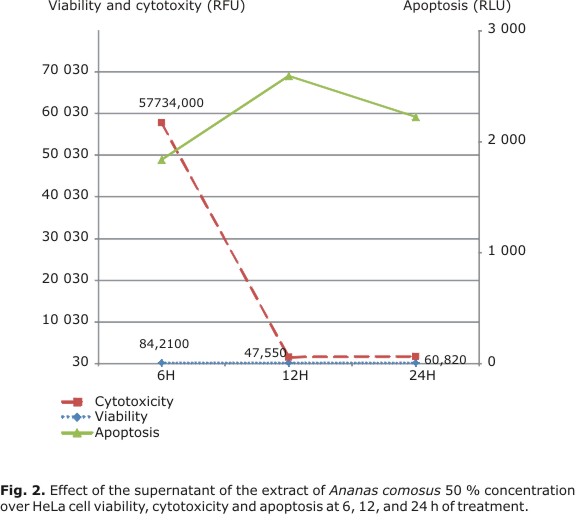
<body><![CDATA[<P>&nbsp;     <P align="center"><img src="/img/revistas/pla/v18n4/f0205413.jpg" width="580" height="523"><a name="fig2"></a>     <P>&nbsp;     <P><font size="2" face="Verdana">In the case of the treatment with the extract    of <I>A. </I>comosus 12.5 %, the signal of cell cytotoxicity was very similar    over time. For cell apoptosis the strongest signal was at 12 h post-treatment    and declined after 24 h. Similar results were found for cell viability (<a href="#fig3">Fig.    3</a>).</font>     <P>&nbsp;     <P align="center"><img src="/img/revistas/pla/v18n4/f0305413.jpg" width="580" height="529"><a name="fig3"></a>     <P>&nbsp;     <P>&nbsp;     <P>      <P><font size="3" face="Verdana"><B>DISCUSSION</B></font>     ]]></body>
<body><![CDATA[<P>      <P><font size="2" face="Verdana">The test using <I>in vitro</I> assay cell models    has become very important and its use is currently on the increase. Even cultures    from vaginal or cervical tissues have been used as tools to determine the toxicity    of some products, including spermicides.<SUP>23</SUP> Therefore, our group chose    to use a HeLa cell model in this study to determine the effect of the different    plant extracts. </font>     <P><font size="2" face="Verdana">The results of this study are in line with those    previously described regarding the treatment of HeLa cells with the extract    of <I>S. saponaria</I> and <I>A. comosus</I> using the MTS assay, in which a    compound of tretrazolium is added and biologically reduced to formazan by metabolically    active cells, a soluble compound in the cell medium that is equal or proportional    to the number of viable cells (Promega Corporation. CellTiter 96&#174; AQueous    Non-Radioactive Cell Proliferation Assay). In that case, it was only determined    whether the cells entered into a cytotoxic environment due to any stimulus.    Although that assay contributed very important results to this study, we determined    whether cell viability was affected by a pro-apoptotic or cytotoxic process    using the ApoTox-Glo&#153; Triplex Assay, which allowed a more complete understanding    of what could happen <I>in vivo</I>. This way we could complement the results    previously reported. As mentioned above, in these trials it was determined that    treatment with <I>S. saponaria</I> and <I>A. comosus </I>extracts initially    affected cell viability, but the latter tended to be restored. At the same time,    there was a sign of cell apoptosis that also tended to decrease over time. Something    similar happened to cell cytotoxicity, indicating that although the extracts    of plants may affect the survival of cells at the beginning (6 h of treatment),    these can continue replicating over time. </font>     <P><font size="2" face="Verdana">The use of techniques like the one presented    in this study, which combines various reagents and measures three aspects of    cellular activity, can mimic the complex cellular systems<SUP>24</SUP> and can    also give results based on what would happen <I>in vivo</I>. </font>      <P>&nbsp;     <P>      <P><font size="3" face="Verdana"><B>ACKNOWLEDGEMENTS</B></font>     <P>      <P><font size="2" face="Verdana">This study was supported by the University of    Antioquia (Sustainability 2011-2012) and the Metropolitan Institute of Technology    (ITM), Medell&iacute;n, Colombia. LOM, AAG and WCM were supported by a fellowship    from Colciencias, Colombia. </font>     <P>&nbsp;     ]]></body>
<body><![CDATA[<P>      <P><font size="3" face="Verdana"><B>REFERENCES</B></font>     <P>      <!-- ref --><P><font size="2" face="Verdana">1. French RS, Cowan FM. Contraception for adolescents.    Best Pract Res Clin Obstet Gynaecol. 2009;23(2):233-47.     </font>     <!-- ref --><P><font size="2" face="Verdana">2. Uribe-Clavijo M, Ospina-Medina L, &Aacute;lvarez    G&oacute;mez AM, Cortes-Mancera FM, Cadavid Jaramillo A, Cardona Maya W. Espermicidas:    una alternativa de anticoncepcion para considerar. Tecnol&oacute;gicas. 2012;28:129-45.        </font>      <!-- ref --><P><font size="2" face="Verdana">3. &Aacute;lvarez G&oacute;mez AM, Cardona Maya    W, Forero J, Cadavid A. Human Spermicidal Activity of Passiflora edulis Extract.    J Reproduction Contraception. 2010;21(2):95-100 </font>     <!-- ref --><P><font size="2" face="Verdana">4. Gallego G, Dubier H, Ospina L, Alvarez Gomez    A, Arango V, Cardona Maya W, et al. Efecto de cinco extractos de plantas colombianas    sobre espermatozoides humanos. Rev Cubana Plant Med. 2012;17(1):84-92.     </font>     ]]></body>
<body><![CDATA[<!-- ref --><P><font size="2" face="Verdana">5. Uribe-Clavijo M, Alvarez Gomez A, Arango V,    Cortes-Mancera FM, Cadavid Jaramillo A, Cardona Maya W. Efecto <I>in vitro</I>    del extracto vegetal de <I>Ananas comosus</I> sobre espermatozoides humanos.    Tecnol&oacute;gicas. 2012;28:55-70.     </font>     <!-- ref --><P><font size="2" face="Verdana">6. Tso W, Lee C. Cottonseed oil as a vaginal    contraceptive. Arch Androl. 1982;8(1):11-4.     </font>     <!-- ref --><P><font size="2" face="Verdana">7. Rajasekaran M, Nair AG, Hellstrom WJ, Sikka    SC. Spermicidal activity of an antifungal saponin obtained from the tropical    herb <I>Mollugo pentaphylla</I>. Contraception. 1993;47(4):401-12.     </font>     <!-- ref --><P><font size="2" face="Verdana">8. Souad K, Ali S, Mounir A, Mounir TM. Spermicidal    activity of extract from <I>Cestrum parqui</I>. Contraception. 2007;75(2):152-6.        </font>     <!-- ref --><P><font size="2" face="Verdana">9. Kumar S, Chatterjee R, Dolai S, Adak S, Kabir    SN, Banerjee S, et al. <I>Chenopodium album</I> seed extract-induced sperm cell    death: exploration of a plausible pathway. Contraception. 2008;77(6):456-62.        </font>     ]]></body>
<body><![CDATA[<!-- ref --><P><font size="2" face="Verdana">10. Saha P, Majumdar S, Pal D, Pal BC, Kabir    SN. Evaluation of spermicidal activity of MI-saponin A. Reprod Sci. 2010;17(5):454-64.        </font>     <!-- ref --><P><font size="2" face="Verdana">11. Anuja MM, Nithya RS, Swathy SS, Rajamanickam    C, Indira M. Spermicidal action of a protein isolated from ethanolic root extracts    of <I>Achyranthes aspera</I>: an <I>in vitro</I> study. Phytomedicine. international    j phytotherapy phytopharmacology. 2011;18(8-9):776-82.     </font>     <!-- ref --><P><font size="2" face="Verdana">12. Paul S, Kang SC. <I>In vitro</I> determination    of the contraceptive spermicidal activity of essential oil of <I>Trachyspermum    ammi</I> (L.) Sprague ex Turrill fruits. New biotechnology. 2011;28(6):684-90.        </font>     <!-- ref --><P><font size="2" face="Verdana">13. Ospina L, &Aacute;lvarez-Gomez A, Arango    V, Cadavid A, Cardona-Maya W. Evaluaci&oacute;n de la actividad espermicida    y citot&oacute;xica del extracto de <I>Sapindus saponaria </I>L. (jaboncillo).    Rev Cubana Plant Med. 2013;18(2).     </font>     <!-- ref --><P><font size="2" face="Verdana">14. Halpern V, Rountree W, Raymond EG, Law M.    The effects of spermicides containing nonoxynol-9 on cervical cytology. Contraception.    2008;77(3):191-4.     </font>     ]]></body>
<body><![CDATA[<!-- ref --><P><font size="2" face="Verdana">15. Jain JK, Li A, Minoo P, Nucatola DL, Felix    JC. The effect of nonoxynol-9 on human endometrium. Contraception. 2005;71(2):137-42.        </font>     <!-- ref --><P><font size="2" face="Verdana">16. Jain JK, Li A, Nucatola DL, Minoo P, Felix    JC. Nonoxynol-9 induces apoptosis of endometrial explants by both caspase-dependent    and -independent apoptotic pathways. Biol Reprod. 2005;73(2):382-8.     </font>     <!-- ref --><P><font size="2" face="Verdana">17. Stafford M, Ward H, Flanagan A. Safety study    of N-9 as a vaginal microbicide: evidence of adverse effects. J Acquir Immune    Defic Syndr Hum Retrovirol. 1998;17:327-31.     </font>     <!-- ref --><P><font size="2" face="Verdana">18. Watts DH, Rabe L, Krohn MA, Aura J, Hillier    SL. The effects of three nonoxynol-9 preparations on vaginal flora and epithelium.    J Infect Dis. 1999;180(2):426-37.     </font>     <!-- ref --><P><font size="2" face="Verdana">19. Ojha P, Maikhuri JP, Gupta G. Effect of spermicides    on <I>Lactobacillus acidophilus</I> <I>in vitro</I>-nonoxynol-9 vs. <I>Sapindus    saponins</I>. Contraception. 2003;68(2):135-8.     </font>     ]]></body>
<body><![CDATA[<!-- ref --><P><font size="2" face="Verdana">20. &Aacute;lvarez G&oacute;mez A, Cardona Maya    W, Castro &Aacute;lvarez J, Jimenez S, Cadavid A. Nuevas opciones en anticoncepci&oacute;n:    posible uso espermicida de plantas colombianas. Actas Urol Esp. 2007;31(4):372-81.        </font>     <!-- ref --><P><font size="2" face="Verdana">21. Puerta Su&aacute;rez J, Cardona Duque D,    &Aacute;lvarez G&oacute;mez A, Arango V, Cadavid A, Cardona Maya W. Efecto del    extracto de <I>Anethum graveolens</I>, <I>Melissa officinalis</I> y <I>Calendula    officinalis</I> sobre espermatozoides humanos. Rev Cubana Plant Med. 2012;17(4):420-30.        </font>     <!-- ref --><P><font size="2" face="Verdana">22. Sadeghi Aliabadi H, Ghasemi N, Kohi M. Cytotoxic    effect of <I>Convolvulus arvensis</I> extracts on human cancerous cell line.    Research Pharmaceutical Sciences. 2008;3(1):31-4.     </font>     <!-- ref --><P><font size="2" face="Verdana">23. Ayehunie S, Cannon C, Larosa K, Pudney J,    Anderson DJ, Klausner M. Development of an <I>in vitro</I> alternative assay    method for vaginal irritation. Toxicology. 2011;279(1-3):130-8.     </font>     <!-- ref --><P><font size="2" face="Verdana">24. Niles A, Moravec R, Eric Hesselberth P, Scurria    M, Daily W, Riss T. A homogeneous assay to measure live and dead cells in the    same sample by detecting different protease markers. Anal Biochem. 2007;366(2):197-206.        </font>     ]]></body>
<body><![CDATA[<P>&nbsp;     <P>&nbsp;     <P>      <P><font size="2" face="Verdana">Recibido: 10 de septiembre de 2012.     <br>   Aprobado: 23 de marzo de 2013. </font>     <P>&nbsp;     <P>&nbsp;     <P><font size="2" face="Verdana"><I>Walter Cardona Maya</I>. Grupo Reproducci&oacute;n,    Facultad de Medicina, Universidad de Antioquia, Calle 52 # 61-30, Laboratorio    534. Phone: (574) 2196476. E-mail: <U><FONT COLOR="#0000ff"><a href="mailto:wdcmaya@medicina.udea.edu.co">wdcmaya@medicina.udea.edu.co</a></FONT></U>;    <U><FONT COLOR="#0000ff"><a href="mailto:wdcmaya@gmail.com">wdcmaya@gmail.com</a></FONT></U>    </font>      ]]></body><back>
<ref-list>
<ref id="B1">
<label>1</label><nlm-citation citation-type="journal">
<person-group person-group-type="author">
<name>
<surname><![CDATA[French]]></surname>
<given-names><![CDATA[RS]]></given-names>
</name>
<name>
<surname><![CDATA[Cowan]]></surname>
<given-names><![CDATA[FM]]></given-names>
</name>
</person-group>
<article-title xml:lang="en"><![CDATA[Contraception for adolescents]]></article-title>
<source><![CDATA[Best Pract Res Clin Obstet Gynaecol]]></source>
<year>2009</year>
<volume>23</volume>
<numero>2</numero>
<issue>2</issue>
<page-range>233-47</page-range></nlm-citation>
</ref>
<ref id="B2">
<label>2</label><nlm-citation citation-type="journal">
<person-group person-group-type="author">
<name>
<surname><![CDATA[Uribe-Clavijo]]></surname>
<given-names><![CDATA[M]]></given-names>
</name>
<name>
<surname><![CDATA[Ospina-Medina]]></surname>
<given-names><![CDATA[L]]></given-names>
</name>
<name>
<surname><![CDATA[Álvarez Gómez]]></surname>
<given-names><![CDATA[AM]]></given-names>
</name>
<name>
<surname><![CDATA[Cortes-Mancera]]></surname>
<given-names><![CDATA[FM]]></given-names>
</name>
<name>
<surname><![CDATA[Cadavid Jaramillo]]></surname>
<given-names><![CDATA[A]]></given-names>
</name>
<name>
<surname><![CDATA[Cardona Maya]]></surname>
<given-names><![CDATA[W]]></given-names>
</name>
</person-group>
<article-title xml:lang="es"><![CDATA[Espermicidas: una alternativa de anticoncepcion para considerar]]></article-title>
<source><![CDATA[Tecnológicas.]]></source>
<year>2012</year>
<volume>28</volume>
<page-range>129-45</page-range></nlm-citation>
</ref>
<ref id="B3">
<label>3</label><nlm-citation citation-type="journal">
<person-group person-group-type="author">
<name>
<surname><![CDATA[Álvarez Gómez]]></surname>
<given-names><![CDATA[AM]]></given-names>
</name>
<name>
<surname><![CDATA[Cardona Maya]]></surname>
<given-names><![CDATA[W]]></given-names>
</name>
<name>
<surname><![CDATA[Forero]]></surname>
<given-names><![CDATA[J]]></given-names>
</name>
<name>
<surname><![CDATA[Cadavid]]></surname>
<given-names><![CDATA[A]]></given-names>
</name>
</person-group>
<article-title xml:lang="en"><![CDATA[Human Spermicidal Activity of Passiflora edulis Extract]]></article-title>
<source><![CDATA[J Reproduction Contraception.]]></source>
<year>2010</year>
<volume>21</volume>
<numero>2</numero>
<issue>2</issue>
<page-range>95-100</page-range></nlm-citation>
</ref>
<ref id="B4">
<label>4</label><nlm-citation citation-type="journal">
<person-group person-group-type="author">
<name>
<surname><![CDATA[Gallego]]></surname>
<given-names><![CDATA[G]]></given-names>
</name>
<name>
<surname><![CDATA[Dubier]]></surname>
<given-names><![CDATA[H]]></given-names>
</name>
<name>
<surname><![CDATA[Ospina]]></surname>
<given-names><![CDATA[L]]></given-names>
</name>
<name>
<surname><![CDATA[Alvarez Gomez]]></surname>
<given-names><![CDATA[A]]></given-names>
</name>
<name>
<surname><![CDATA[Arango]]></surname>
<given-names><![CDATA[V]]></given-names>
</name>
<name>
<surname><![CDATA[Cardona Maya]]></surname>
<given-names><![CDATA[W]]></given-names>
</name>
</person-group>
<article-title xml:lang="es"><![CDATA[Efecto de cinco extractos de plantas colombianas sobre espermatozoides humanos]]></article-title>
<source><![CDATA[Rev Cubana Plant Med.]]></source>
<year>2012</year>
<volume>17</volume>
<numero>1</numero>
<issue>1</issue>
<page-range>84-92</page-range></nlm-citation>
</ref>
<ref id="B5">
<label>5</label><nlm-citation citation-type="journal">
<person-group person-group-type="author">
<name>
<surname><![CDATA[Uribe-Clavijo]]></surname>
<given-names><![CDATA[M]]></given-names>
</name>
<name>
<surname><![CDATA[Alvarez Gomez]]></surname>
<given-names><![CDATA[A]]></given-names>
</name>
<name>
<surname><![CDATA[Arango]]></surname>
<given-names><![CDATA[V]]></given-names>
</name>
<name>
<surname><![CDATA[Cortes-Mancera]]></surname>
<given-names><![CDATA[FM]]></given-names>
</name>
<name>
<surname><![CDATA[Cadavid Jaramillo]]></surname>
<given-names><![CDATA[A]]></given-names>
</name>
<name>
<surname><![CDATA[Cardona Maya]]></surname>
<given-names><![CDATA[W]]></given-names>
</name>
</person-group>
<article-title xml:lang="es"><![CDATA[Efecto in vitro del extracto vegetal de Ananas comosus sobre espermatozoides humanos]]></article-title>
<source><![CDATA[Tecnológicas.]]></source>
<year>2012</year>
<volume>28</volume>
<page-range>55-70</page-range></nlm-citation>
</ref>
<ref id="B6">
<label>6</label><nlm-citation citation-type="journal">
<person-group person-group-type="author">
<name>
<surname><![CDATA[Tso]]></surname>
<given-names><![CDATA[W]]></given-names>
</name>
<name>
<surname><![CDATA[Lee]]></surname>
<given-names><![CDATA[C]]></given-names>
</name>
</person-group>
<article-title xml:lang="en"><![CDATA[Cottonseed oil as a vaginal contraceptive]]></article-title>
<source><![CDATA[Arch Androl.]]></source>
<year>1982</year>
<volume>8</volume>
<numero>1</numero>
<issue>1</issue>
<page-range>11-4</page-range></nlm-citation>
</ref>
<ref id="B7">
<label>7</label><nlm-citation citation-type="journal">
<person-group person-group-type="author">
<name>
<surname><![CDATA[Rajasekaran]]></surname>
<given-names><![CDATA[M]]></given-names>
</name>
<name>
<surname><![CDATA[Nair]]></surname>
<given-names><![CDATA[AG]]></given-names>
</name>
<name>
<surname><![CDATA[Hellstrom]]></surname>
<given-names><![CDATA[WJ]]></given-names>
</name>
<name>
<surname><![CDATA[Sikka]]></surname>
<given-names><![CDATA[SC]]></given-names>
</name>
</person-group>
<article-title xml:lang="en"><![CDATA[Spermicidal activity of an antifungal saponin obtained from the tropical herb Mollugo pentaphylla]]></article-title>
<source><![CDATA[Contraception.]]></source>
<year>1993</year>
<volume>47</volume>
<numero>4</numero>
<issue>4</issue>
<page-range>401-12</page-range></nlm-citation>
</ref>
<ref id="B8">
<label>8</label><nlm-citation citation-type="journal">
<person-group person-group-type="author">
<name>
<surname><![CDATA[Souad]]></surname>
<given-names><![CDATA[K]]></given-names>
</name>
<name>
<surname><![CDATA[Ali]]></surname>
<given-names><![CDATA[S]]></given-names>
</name>
<name>
<surname><![CDATA[Mounir]]></surname>
<given-names><![CDATA[A]]></given-names>
</name>
<name>
<surname><![CDATA[Mounir]]></surname>
<given-names><![CDATA[TM]]></given-names>
</name>
</person-group>
<article-title xml:lang="en"><![CDATA[Spermicidal activity of extract from Cestrum parqui]]></article-title>
<source><![CDATA[Contraception.]]></source>
<year>2007</year>
<volume>75</volume>
<numero>2</numero>
<issue>2</issue>
<page-range>152-6</page-range></nlm-citation>
</ref>
<ref id="B9">
<label>9</label><nlm-citation citation-type="journal">
<person-group person-group-type="author">
<name>
<surname><![CDATA[Kumar]]></surname>
<given-names><![CDATA[S]]></given-names>
</name>
<name>
<surname><![CDATA[Chatterjee]]></surname>
<given-names><![CDATA[R]]></given-names>
</name>
<name>
<surname><![CDATA[Dolai]]></surname>
<given-names><![CDATA[S]]></given-names>
</name>
<name>
<surname><![CDATA[Adak]]></surname>
<given-names><![CDATA[S]]></given-names>
</name>
<name>
<surname><![CDATA[Kabir]]></surname>
<given-names><![CDATA[SN]]></given-names>
</name>
<name>
<surname><![CDATA[Banerjee]]></surname>
<given-names><![CDATA[S]]></given-names>
</name>
</person-group>
<article-title xml:lang="en"><![CDATA[Chenopodium album seed extract-induced sperm cell death: exploration of a plausible pathway]]></article-title>
<source><![CDATA[Contraception.]]></source>
<year>2008</year>
<volume>77</volume>
<numero>6</numero>
<issue>6</issue>
<page-range>456-62</page-range></nlm-citation>
</ref>
<ref id="B10">
<label>10</label><nlm-citation citation-type="journal">
<person-group person-group-type="author">
<name>
<surname><![CDATA[Saha]]></surname>
<given-names><![CDATA[P]]></given-names>
</name>
<name>
<surname><![CDATA[Majumdar]]></surname>
<given-names><![CDATA[S]]></given-names>
</name>
<name>
<surname><![CDATA[Pal]]></surname>
<given-names><![CDATA[D]]></given-names>
</name>
<name>
<surname><![CDATA[Pal]]></surname>
<given-names><![CDATA[BC]]></given-names>
</name>
<name>
<surname><![CDATA[Kabir]]></surname>
<given-names><![CDATA[SN]]></given-names>
</name>
</person-group>
<article-title xml:lang="en"><![CDATA[Evaluation of spermicidal activity of MI-saponin A]]></article-title>
<source><![CDATA[Reprod Sci.]]></source>
<year>2010</year>
<volume>17</volume>
<numero>5</numero>
<issue>5</issue>
<page-range>454-64</page-range></nlm-citation>
</ref>
<ref id="B11">
<label>11</label><nlm-citation citation-type="journal">
<person-group person-group-type="author">
<name>
<surname><![CDATA[Anuja]]></surname>
<given-names><![CDATA[MM]]></given-names>
</name>
<name>
<surname><![CDATA[Nithya]]></surname>
<given-names><![CDATA[RS]]></given-names>
</name>
<name>
<surname><![CDATA[Swathy]]></surname>
<given-names><![CDATA[SS]]></given-names>
</name>
<name>
<surname><![CDATA[Rajamanickam]]></surname>
<given-names><![CDATA[C]]></given-names>
</name>
<name>
<surname><![CDATA[Indira]]></surname>
<given-names><![CDATA[M]]></given-names>
</name>
</person-group>
<article-title xml:lang="en"><![CDATA[Spermicidal action of a protein isolated from ethanolic root extracts of Achyranthes aspera: an in vitro study]]></article-title>
<source><![CDATA[Phytomedicine. international j phytotherapy phytopharmacology.]]></source>
<year>2011</year>
<volume>18</volume>
<numero>8-9</numero>
<issue>8-9</issue>
<page-range>776-82</page-range></nlm-citation>
</ref>
<ref id="B12">
<label>12</label><nlm-citation citation-type="journal">
<person-group person-group-type="author">
<name>
<surname><![CDATA[Paul]]></surname>
<given-names><![CDATA[S]]></given-names>
</name>
<name>
<surname><![CDATA[Kang]]></surname>
<given-names><![CDATA[SC]]></given-names>
</name>
</person-group>
<article-title xml:lang="en"><![CDATA[In vitro determination of the contraceptive spermicidal activity of essential oil of Trachyspermum ammi (L.) Sprague ex Turrill fruits]]></article-title>
<source><![CDATA[New biotechnology.]]></source>
<year>2011</year>
<volume>28</volume>
<numero>6</numero>
<issue>6</issue>
<page-range>684-90</page-range></nlm-citation>
</ref>
<ref id="B13">
<label>13</label><nlm-citation citation-type="journal">
<person-group person-group-type="author">
<name>
<surname><![CDATA[Ospina]]></surname>
<given-names><![CDATA[L]]></given-names>
</name>
<name>
<surname><![CDATA[Álvarez-Gomez]]></surname>
<given-names><![CDATA[A]]></given-names>
</name>
<name>
<surname><![CDATA[Arango]]></surname>
<given-names><![CDATA[V]]></given-names>
</name>
<name>
<surname><![CDATA[Cadavid]]></surname>
<given-names><![CDATA[A]]></given-names>
</name>
<name>
<surname><![CDATA[Cardona-Maya]]></surname>
<given-names><![CDATA[W]]></given-names>
</name>
</person-group>
<article-title xml:lang="es"><![CDATA[Evaluación de la actividad espermicida y citotóxica del extracto de Sapindus saponaria L. (jaboncillo)]]></article-title>
<source><![CDATA[Rev Cubana Plant Med]]></source>
<year>2013</year>
<volume>18</volume>
<numero>2</numero>
<issue>2</issue>
</nlm-citation>
</ref>
<ref id="B14">
<label>14</label><nlm-citation citation-type="journal">
<person-group person-group-type="author">
<name>
<surname><![CDATA[Halpern]]></surname>
<given-names><![CDATA[V]]></given-names>
</name>
<name>
<surname><![CDATA[Rountree]]></surname>
<given-names><![CDATA[W]]></given-names>
</name>
<name>
<surname><![CDATA[Raymond]]></surname>
<given-names><![CDATA[EG]]></given-names>
</name>
<name>
<surname><![CDATA[Law]]></surname>
<given-names><![CDATA[M]]></given-names>
</name>
</person-group>
<article-title xml:lang="en"><![CDATA[The effects of spermicides containing nonoxynol-9 on cervical cytology]]></article-title>
<source><![CDATA[Contraception.]]></source>
<year>2008</year>
<volume>77</volume>
<numero>3</numero>
<issue>3</issue>
<page-range>191-4</page-range></nlm-citation>
</ref>
<ref id="B15">
<label>15</label><nlm-citation citation-type="journal">
<person-group person-group-type="author">
<name>
<surname><![CDATA[Jain]]></surname>
<given-names><![CDATA[JK]]></given-names>
</name>
<name>
<surname><![CDATA[Li]]></surname>
<given-names><![CDATA[A]]></given-names>
</name>
<name>
<surname><![CDATA[Minoo]]></surname>
<given-names><![CDATA[P]]></given-names>
</name>
<name>
<surname><![CDATA[Nucatola]]></surname>
<given-names><![CDATA[DL]]></given-names>
</name>
<name>
<surname><![CDATA[Felix]]></surname>
<given-names><![CDATA[JC]]></given-names>
</name>
</person-group>
<article-title xml:lang="en"><![CDATA[The effect of nonoxynol-9 on human endometrium]]></article-title>
<source><![CDATA[Contraception.]]></source>
<year>2005</year>
<volume>71</volume>
<numero>2</numero>
<issue>2</issue>
<page-range>137-42</page-range></nlm-citation>
</ref>
<ref id="B16">
<label>16</label><nlm-citation citation-type="journal">
<person-group person-group-type="author">
<name>
<surname><![CDATA[Jain]]></surname>
<given-names><![CDATA[JK]]></given-names>
</name>
<name>
<surname><![CDATA[Li]]></surname>
<given-names><![CDATA[A]]></given-names>
</name>
<name>
<surname><![CDATA[Nucatola]]></surname>
<given-names><![CDATA[DL]]></given-names>
</name>
<name>
<surname><![CDATA[Minoo]]></surname>
<given-names><![CDATA[P]]></given-names>
</name>
<name>
<surname><![CDATA[Felix]]></surname>
<given-names><![CDATA[JC]]></given-names>
</name>
</person-group>
<article-title xml:lang="en"><![CDATA[Nonoxynol-9 induces apoptosis of endometrial explants by both caspase-dependent and -independent apoptotic pathways]]></article-title>
<source><![CDATA[Biol Reprod.]]></source>
<year>2005</year>
<volume>73</volume>
<numero>2</numero>
<issue>2</issue>
<page-range>382-8</page-range></nlm-citation>
</ref>
<ref id="B17">
<label>17</label><nlm-citation citation-type="journal">
<person-group person-group-type="author">
<name>
<surname><![CDATA[Stafford]]></surname>
<given-names><![CDATA[M]]></given-names>
</name>
<name>
<surname><![CDATA[Ward]]></surname>
<given-names><![CDATA[H]]></given-names>
</name>
<name>
<surname><![CDATA[Flanagan]]></surname>
<given-names><![CDATA[A]]></given-names>
</name>
</person-group>
<article-title xml:lang="en"><![CDATA[Safety study of N-9 as a vaginal microbicide: evidence of adverse effects]]></article-title>
<source><![CDATA[J Acquir Immune Defic Syndr Hum Retrovirol]]></source>
<year>1998</year>
<volume>17</volume>
<page-range>327-31</page-range></nlm-citation>
</ref>
<ref id="B18">
<label>18</label><nlm-citation citation-type="journal">
<person-group person-group-type="author">
<name>
<surname><![CDATA[Watts]]></surname>
<given-names><![CDATA[DH]]></given-names>
</name>
<name>
<surname><![CDATA[Rabe]]></surname>
<given-names><![CDATA[L]]></given-names>
</name>
<name>
<surname><![CDATA[Krohn]]></surname>
<given-names><![CDATA[MA]]></given-names>
</name>
<name>
<surname><![CDATA[Aura]]></surname>
<given-names><![CDATA[J]]></given-names>
</name>
<name>
<surname><![CDATA[Hillier]]></surname>
<given-names><![CDATA[SL]]></given-names>
</name>
</person-group>
<article-title xml:lang="en"><![CDATA[The effects of three nonoxynol-9 preparations on vaginal flora and epithelium]]></article-title>
<source><![CDATA[J Infect Dis.]]></source>
<year>1999</year>
<volume>180</volume>
<numero>2</numero>
<issue>2</issue>
<page-range>426-37</page-range></nlm-citation>
</ref>
<ref id="B19">
<label>19</label><nlm-citation citation-type="journal">
<person-group person-group-type="author">
<name>
<surname><![CDATA[Ojha]]></surname>
<given-names><![CDATA[P]]></given-names>
</name>
<name>
<surname><![CDATA[Maikhuri]]></surname>
<given-names><![CDATA[JP]]></given-names>
</name>
<name>
<surname><![CDATA[Gupta]]></surname>
<given-names><![CDATA[G]]></given-names>
</name>
</person-group>
<article-title xml:lang="en"><![CDATA[Effect of spermicides on Lactobacillus acidophilus in vitro-nonoxynol-9 vs. Sapindus saponins]]></article-title>
<source><![CDATA[Contraception.]]></source>
<year>2003</year>
<volume>68</volume>
<numero>2</numero>
<issue>2</issue>
<page-range>135-8</page-range></nlm-citation>
</ref>
<ref id="B20">
<label>20</label><nlm-citation citation-type="journal">
<person-group person-group-type="author">
<name>
<surname><![CDATA[Álvarez Gómez]]></surname>
<given-names><![CDATA[A]]></given-names>
</name>
<name>
<surname><![CDATA[Cardona Maya]]></surname>
<given-names><![CDATA[W]]></given-names>
</name>
<name>
<surname><![CDATA[Castro Álvarez]]></surname>
<given-names><![CDATA[J]]></given-names>
</name>
<name>
<surname><![CDATA[Jimenez]]></surname>
<given-names><![CDATA[S]]></given-names>
</name>
<name>
<surname><![CDATA[Cadavid]]></surname>
<given-names><![CDATA[A]]></given-names>
</name>
</person-group>
<article-title xml:lang="es"><![CDATA[Nuevas opciones en anticoncepción: posible uso espermicida de plantas colombianas]]></article-title>
<source><![CDATA[Actas Urol Esp.]]></source>
<year>2007</year>
<volume>31</volume>
<numero>4</numero>
<issue>4</issue>
<page-range>372-81</page-range></nlm-citation>
</ref>
<ref id="B21">
<label>21</label><nlm-citation citation-type="journal">
<person-group person-group-type="author">
<name>
<surname><![CDATA[Puerta Suárez]]></surname>
<given-names><![CDATA[J]]></given-names>
</name>
<name>
<surname><![CDATA[Cardona Duque]]></surname>
<given-names><![CDATA[D]]></given-names>
</name>
<name>
<surname><![CDATA[Álvarez Gómez]]></surname>
<given-names><![CDATA[A]]></given-names>
</name>
<name>
<surname><![CDATA[Arango]]></surname>
<given-names><![CDATA[V]]></given-names>
</name>
<name>
<surname><![CDATA[Cadavid]]></surname>
<given-names><![CDATA[A]]></given-names>
</name>
<name>
<surname><![CDATA[Cardona Maya]]></surname>
<given-names><![CDATA[W]]></given-names>
</name>
</person-group>
<article-title xml:lang="es"><![CDATA[Efecto del extracto de Anethum graveolens, Melissa officinalis y Calendula officinalis sobre espermatozoides humanos]]></article-title>
<source><![CDATA[Rev Cubana Plant Med.]]></source>
<year>2012</year>
<volume>17</volume>
<numero>4</numero>
<issue>4</issue>
<page-range>420-30</page-range></nlm-citation>
</ref>
<ref id="B22">
<label>22</label><nlm-citation citation-type="journal">
<person-group person-group-type="author">
<name>
<surname><![CDATA[Sadeghi Aliabadi]]></surname>
<given-names><![CDATA[H]]></given-names>
</name>
<name>
<surname><![CDATA[Ghasemi]]></surname>
<given-names><![CDATA[N]]></given-names>
</name>
<name>
<surname><![CDATA[Kohi]]></surname>
<given-names><![CDATA[M]]></given-names>
</name>
</person-group>
<article-title xml:lang="en"><![CDATA[Cytotoxic effect of Convolvulus arvensis extracts on human cancerous cell line]]></article-title>
<source><![CDATA[Research Pharmaceutical Sciences.]]></source>
<year>2008</year>
<volume>3</volume>
<numero>1</numero>
<issue>1</issue>
<page-range>31-4</page-range></nlm-citation>
</ref>
<ref id="B23">
<label>23</label><nlm-citation citation-type="journal">
<person-group person-group-type="author">
<name>
<surname><![CDATA[Ayehunie]]></surname>
<given-names><![CDATA[S]]></given-names>
</name>
<name>
<surname><![CDATA[Cannon]]></surname>
<given-names><![CDATA[C]]></given-names>
</name>
<name>
<surname><![CDATA[Larosa]]></surname>
<given-names><![CDATA[K]]></given-names>
</name>
<name>
<surname><![CDATA[Pudney]]></surname>
<given-names><![CDATA[J]]></given-names>
</name>
<name>
<surname><![CDATA[Anderson]]></surname>
<given-names><![CDATA[DJ]]></given-names>
</name>
<name>
<surname><![CDATA[Klausner]]></surname>
<given-names><![CDATA[M]]></given-names>
</name>
</person-group>
<article-title xml:lang="en"><![CDATA[Development of an in vitro alternative assay method for vaginal irritation]]></article-title>
<source><![CDATA[Toxicology.]]></source>
<year>2011</year>
<volume>279</volume>
<numero>1-3</numero>
<issue>1-3</issue>
<page-range>130-8</page-range></nlm-citation>
</ref>
<ref id="B24">
<label>24</label><nlm-citation citation-type="journal">
<person-group person-group-type="author">
<name>
<surname><![CDATA[Niles]]></surname>
<given-names><![CDATA[A]]></given-names>
</name>
<name>
<surname><![CDATA[Moravec]]></surname>
<given-names><![CDATA[R]]></given-names>
</name>
<name>
<surname><![CDATA[Eric Hesselberth]]></surname>
<given-names><![CDATA[P]]></given-names>
</name>
<name>
<surname><![CDATA[Scurria]]></surname>
<given-names><![CDATA[M]]></given-names>
</name>
<name>
<surname><![CDATA[Daily]]></surname>
<given-names><![CDATA[W]]></given-names>
</name>
<name>
<surname><![CDATA[Riss]]></surname>
<given-names><![CDATA[T]]></given-names>
</name>
</person-group>
<article-title xml:lang="en"><![CDATA[A homogeneous assay to measure live and dead cells in the same sample by detecting different protease markers]]></article-title>
<source><![CDATA[Anal Biochem.]]></source>
<year>2007</year>
<volume>366</volume>
<numero>2</numero>
<issue>2</issue>
<page-range>197-206</page-range></nlm-citation>
</ref>
</ref-list>
</back>
</article>