<?xml version="1.0" encoding="ISO-8859-1"?><article xmlns:mml="http://www.w3.org/1998/Math/MathML" xmlns:xlink="http://www.w3.org/1999/xlink" xmlns:xsi="http://www.w3.org/2001/XMLSchema-instance">
<front>
<journal-meta>
<journal-id>1028-4796</journal-id>
<journal-title><![CDATA[Revista Cubana de Plantas Medicinales]]></journal-title>
<abbrev-journal-title><![CDATA[Rev Cubana Plant Med]]></abbrev-journal-title>
<issn>1028-4796</issn>
<publisher>
<publisher-name><![CDATA[ECIMED]]></publisher-name>
</publisher>
</journal-meta>
<article-meta>
<article-id>S1028-47962013000400006</article-id>
<title-group>
<article-title xml:lang="en"><![CDATA[Obtention of dry extract from aqueous extracts of Justicia pectoralis Jacq. (tilo)]]></article-title>
<article-title xml:lang="es"><![CDATA[Obtención de extractos secos a partir de extractos acuosos de Justicia pectoralis (tilo)]]></article-title>
</title-group>
<contrib-group>
<contrib contrib-type="author">
<name>
<surname><![CDATA[Rodríguez Chanfrau]]></surname>
<given-names><![CDATA[Jorge Enrique]]></given-names>
</name>
<xref ref-type="aff" rid="A01"/>
</contrib>
<contrib contrib-type="author">
<name>
<surname><![CDATA[López Hernández]]></surname>
<given-names><![CDATA[Orestes Dario]]></given-names>
</name>
<xref ref-type="aff" rid="A01"/>
</contrib>
<contrib contrib-type="author">
<name>
<surname><![CDATA[Núñez Figueredo]]></surname>
<given-names><![CDATA[Yanier]]></given-names>
</name>
<xref ref-type="aff" rid="A01"/>
</contrib>
<contrib contrib-type="author">
<name>
<surname><![CDATA[Rodríguez Ferrada]]></surname>
<given-names><![CDATA[Carlos]]></given-names>
</name>
<xref ref-type="aff" rid="A01"/>
</contrib>
<contrib contrib-type="author">
<name>
<surname><![CDATA[Nogueira Mendoza]]></surname>
<given-names><![CDATA[Antonio]]></given-names>
</name>
<xref ref-type="aff" rid="A01"/>
</contrib>
</contrib-group>
<aff id="A01">
<institution><![CDATA[,Center for Drug Research and Development  ]]></institution>
<addr-line><![CDATA[Havana ]]></addr-line>
<country>Cuba</country>
</aff>
<pub-date pub-type="pub">
<day>00</day>
<month>12</month>
<year>2013</year>
</pub-date>
<pub-date pub-type="epub">
<day>00</day>
<month>12</month>
<year>2013</year>
</pub-date>
<volume>18</volume>
<numero>4</numero>
<fpage>543</fpage>
<lpage>554</lpage>
<copyright-statement/>
<copyright-year/>
<self-uri xlink:href="http://scielo.sld.cu/scielo.php?script=sci_arttext&amp;pid=S1028-47962013000400006&amp;lng=en&amp;nrm=iso"></self-uri><self-uri xlink:href="http://scielo.sld.cu/scielo.php?script=sci_abstract&amp;pid=S1028-47962013000400006&amp;lng=en&amp;nrm=iso"></self-uri><self-uri xlink:href="http://scielo.sld.cu/scielo.php?script=sci_pdf&amp;pid=S1028-47962013000400006&amp;lng=en&amp;nrm=iso"></self-uri><abstract abstract-type="short" xml:lang="en"><p><![CDATA[Introduction: Justicia pectoralis Jacq. (Acanthaceae), is a medicinal species native to the American tropics. In Cuba it is used in folk medicine in the treatment of nervous disorders. The Cuban Pharmaceutical Industry is working on the development of technological processes for the obtention of pharmaceutical quality raw materials from natural products. Objectives: develop a technological process to obtain dry extract from aqueous extracts of J. pectoralis. Methods: a process to obtain dry extract by spray drying from aqueous extract of J. pectoralis was developed. The influence of solid-liquid r ratio and extraction time on coumarin content was evaluated by applying a response surface methodology (RSM). The drying process and later pharmacological evaluation of the dry powder were studied. Results: results show that solid-liquid ratio was the statistically significant main effect, having a strong positive influence on coumarin extraction in our working conditions. Extraction time and interaction between both factors were not significant for regression models. On the other hand, evaluation of the influence of inert additives on drying s showed that the best results were obtained with the use of 30 % soluble starch, which did not affect sedative activity. Conclusions: a solid-liquid ratio of 1:20 and an extraction time of 15 minutes were suggested as optimum parameters for coumarin extraction.]]></p></abstract>
<abstract abstract-type="short" xml:lang="es"><p><![CDATA[Introducción: Justicia pectoralis Jacq. (Acanthaceae) es una especie medicinal nativa de la América tropical. En Cuba es usada en la medicina tradicional en el tratamiento de afecciones nerviosas. La industria farmacéutica cubana trabaja en el desarrollo de procesos tecnológicos para la obtención de materias primas de calidad farmacéutica a partir de productos naturales. Objetivo: desarrollar un proceso tecnológico para la obtención de extractos secos a partir de extractos acuosos de Justicia pectoralis. Métodos: se desarrolló un proceso para la obtención de extracto seco por spray drying a partir de extracto acuoso de Justicia pectoralis. La influencia que sobre el contenido de cumarina tenían la relación sólido-líquido y el tiempo de extracción fue estudiada aplicando un diseño superficie respuesta. Se estudió el proceso de secado y la posterior evaluación farmacológica del polvo seco. Resultados: estos mostraron que la relación sólido-líquido tenía una fuerte influencia estadísticamente significativa sobre la extracción de la cumarina en las condiciones de trabajo experimentadas. El tiempo de extracción y la interacción entre ambos factores no fueron significativos para el modelo de regresión estudiado. Por otro lado, la evaluación de la influencia de aditivos inertes en el proceso de secado mostró que los mejores rendimientos se alcanzaban cuando se empleaba almidón soluble 30 %, y no se afectaba la actividad sedante del producto. Conclusiones: una relación sólido-líquido de 1:20 y un tiempo de extracción de 15 min resultaron las condiciones óptimas para la extracción de cumarina.]]></p></abstract>
<kwd-group>
<kwd lng="en"><![CDATA[aqueous extract]]></kwd>
<kwd lng="en"><![CDATA[coumarin]]></kwd>
<kwd lng="en"><![CDATA[Justicia pectoralis Jacq.]]></kwd>
<kwd lng="en"><![CDATA[response surface methodology]]></kwd>
<kwd lng="en"><![CDATA[pharmacological evaluation]]></kwd>
<kwd lng="en"><![CDATA[sedative activity]]></kwd>
<kwd lng="en"><![CDATA[spray drying]]></kwd>
<kwd lng="es"><![CDATA[extracto acuoso]]></kwd>
<kwd lng="es"><![CDATA[cumarina]]></kwd>
<kwd lng="es"><![CDATA[Justicia pectoralis Jacq.]]></kwd>
<kwd lng="es"><![CDATA[metodología superficie respuesta]]></kwd>
<kwd lng="es"><![CDATA[evaluación farmacológica]]></kwd>
<kwd lng="es"><![CDATA[actividad sedante]]></kwd>
<kwd lng="es"><![CDATA[spray drying]]></kwd>
</kwd-group>
</article-meta>
</front><body><![CDATA[ <div align="right">       <p><font size="2" face="Verdana"><B>ART&Iacute;CULO ORIGINAL</B> </font></p>       <p>&nbsp; </p> </div>     <P>      <P><font size="4"><b><font face="Verdana">Obtention of dry extract from aqueous    extracts<I> </I>of<I> Justicia pectoralis </I>Jacq. (tilo) </font></b></font>     <P>&nbsp;     <P>      <P><font size="3"><b><font face="Verdana">Obtenci&oacute;n de extractos secos    a partir de extractos acuosos de <I>Justicia pectoralis </I>(tilo)</font></b></font>     <P>&nbsp;     <P>&nbsp;     ]]></body>
<body><![CDATA[<P><b><font size="2" face="Verdana">PhD.</font></b> <b><font size="2" face="Verdana">Jorge    Enrique Rodr&iacute;guez Chanfrau, PhD. Orestes Dario L&oacute;pez Hern&aacute;ndez,    MSc. Yanier N&uacute;&ntilde;ez Figueredo, Tech. Carlos Rodr&iacute;guez Ferrada,    Tech. Antonio Nogueira Mendoza<STRIKE> </STRIKE></font></b><font size="2" face="Verdana">    </font>      <P>      <P><font size="2" face="Verdana">Center for Drug Research and Development. Havana,    Cuba.</font>     <P>&nbsp;     <P>&nbsp; <hr size="1" noshade> <font size="2" face="Verdana"><b>ABSTRACT</b></font>      <P>      <P><font size="2" face="Verdana"><b>Introduction:<I> </I></b><I>Justicia pectoralis    </I>Jacq. (Acanthaceae)<STRIKE>,</STRIKE> is a medicinal species native to the    American tropics. In Cuba it is used in folk medicine in the treatment of nervous    disorders. The Cuban Pharmaceutical Industry is working on the development of    technological processes for the obtention of pharmaceutical quality raw materials    from natural products. <b>    <br>   Objectives:</b> develop a technological process to obtain dry extract from aqueous    extracts<I> </I>of<I> J. pectoralis. </I><b>    <br>   Methods:</b> a process to obtain dry extract by spray drying from aqueous extract    of <I>J.</I> <I>pectoralis</I> was developed. The influence of solid-liquid    <STRIKE>r</STRIKE> ratio and extraction time on coumarin content was evaluated    by applying <STRIKE>a </STRIKE> response surface methodology (RSM). The drying    process and later pharmacological evaluation of the dry powder were studied.    <b>    <br>   Results:</b> results show that solid-liquid ratio was the statistically significant    main effect, having a strong positive influence on coumarin extraction in our    working conditions. Extraction time and interaction between both factors were    not significant for regression models. On the other hand, evaluation of the    influence of inert additives on drying <STRIKE>s</STRIKE> showed that the best    results were obtained with the use of 30 % soluble starch, which did not affect    sedative activity. <b>    ]]></body>
<body><![CDATA[<br>   Conclusions:</b> a solid-liquid ratio of 1:20 and an extraction time of 15 minutes    were suggested as optimum parameters for coumarin extraction. </font>     <P>      <P><font size="2" face="Verdana"><b>Key words:</b> aqueous extract, coumarin,    <I>Justicia pectoralis</I> Jacq., response surface methodology, pharmacological    evaluation, sedative activity, spray drying. </font> <hr size="1" noshade> <b><font size="2" face="Verdana">RESUMEN</font></b>     <P>      <P><b><font size="2" face="Verdana">Introducci&oacute;n:</font></b><font size="2" face="Verdana"><B><I>    </I></B><I>Justicia pectoralis</I> Jacq. (Acanthaceae) es una especie medicinal    nativa de la Am&eacute;rica tropical. En Cuba es usada en la medicina tradicional    en el tratamiento de afecciones nerviosas. La industria farmac&eacute;utica    cubana trabaja en el desarrollo de procesos tecnol&oacute;gicos para la obtenci&oacute;n    de materias primas de calidad farmac&eacute;utica a partir de productos naturales.    <b>    <br>   Objetivo:</b> desarrollar un proceso tecnol&oacute;gico para la obtenci&oacute;n    de extractos secos a partir de extractos acuosos de <I>Justicia pectoralis.    </I><b>    <br>   M&eacute;todos:</b> se desarroll&oacute; un proceso para la obtenci&oacute;n    de extracto seco por <I>spray drying</I> a partir de extracto acuoso de <I>Justicia    pectoralis</I>. La influencia que sobre el contenido de cumarina ten&iacute;an    la relaci&oacute;n s&oacute;lido-l&iacute;quido y el tiempo de extracci&oacute;n    fue estudiada aplicando un dise&ntilde;o superficie respuesta. Se estudi&oacute;    el proceso de secado y la posterior evaluaci&oacute;n farmacol&oacute;gica del    polvo seco. <b>    <br>   Resultados:</b> estos mostraron que la relaci&oacute;n s&oacute;lido-l&iacute;quido    ten&iacute;a una fuerte influencia estad&iacute;sticamente significativa sobre    la extracci&oacute;n de la cumarina en las condiciones de trabajo experimentadas.    El tiempo de extracci&oacute;n y la interacci&oacute;n entre ambos factores    no fueron significativos para el modelo de regresi&oacute;n estudiado. Por otro    lado, la evaluaci&oacute;n de la influencia de aditivos inertes en el proceso    de secado mostr&oacute; que los mejores rendimientos se alcanzaban cuando se    empleaba almid&oacute;n soluble 30 %, y no se afectaba la actividad sedante    del producto. <b>    <br>   Conclusiones:</b> una relaci&oacute;n s&oacute;lido-l&iacute;quido de 1:20 y    un tiempo de extracci&oacute;n de 15 min resultaron las condiciones &oacute;ptimas    para la extracci&oacute;n de cumarina. </font>     <P>      ]]></body>
<body><![CDATA[<P><b><font size="2" face="Verdana">Palabras clave:</font></b><font size="2" face="Verdana">    extracto acuoso, cumarina, <I>Justicia pectoralis</I> Jacq., metodolog&iacute;a    superficie respuesta, evaluaci&oacute;n farmacol&oacute;gica, actividad sedante,    <I>spray drying.</I> </font> <hr size="1" noshade>     <P>&nbsp;     <P>&nbsp;      <P>      <p><font size="3" face="Verdana"><b>INTRODUCTION</b> </font>      <P>      <P><font size="2" face="Verdana">Illnesses related to the Central Nervous System    are a health problem in the world. Natural products have been used for the treatment    and control of illnesses related to this pathology. </font>     <P><font size="2" face="Verdana"><I>Justicia pectoralis </I>Jacq. (Acanthaceae),    known as Tilo, is a medicinal species native to the American tropics. It is    used in folk medicine for its curative properties. In Cuba it is used in the    treatment of alterations of the nervous system.<SUP>1</SUP> Various studies    have revealed the presence of betaine, coumarin, 7<STRIKE> </STRIKE> hydroxycoumarin,    flavonoids (apigenin, swertisin and swertiajaponin), lignans and more than 15    amino acids.<SUP>2-4</SUP> </font>     <P><font size="2" face="Verdana">Coumarins belong to a group of compounds known    as benzopyrones, which is the main constituent responsible for the aromatic    fragrance of dried leaves of <I>Justicia pectoralis</I>.<SUP>5 </SUP>Pharmacological    activities of coumarin, for example anti-inflammatory, antioxidant, antiallergic,    hepatoprotective, antithrombotic, antiviral, sedative and anticarcinogenic activities<SUP>    </SUP>have been described.<SUP>4,6,7</SUP> </font>     <P><font size="2" face="Verdana">Nowadays, the Cuban Pharmaceutical Industry is    working on the development of technological processes for the obtention of pharmaceutical    quality raw materials from natural products. Spray drying is a simple and effective    method to obtain dry powder with <FONT  COLOR="#191919">attractive physical </FONT>characteristics, <FONT  COLOR="#191919">excellent flow and packing properties that greatly facilitate    handling and transport.<SUP>8,9</SUP></FONT></font>      ]]></body>
<body><![CDATA[<P><font size="2" face="Verdana">In Cuba, the established process for <I>Justicia    pectoralis</I> extract obtention is hydroalcoholic repercolation.<SUP>10</SUP>    This procedure requires a lengthy extraction time (4 days) and a long ethanol    evaporation time. On the other hand, drying studies carried out by <i>Rodriguez    et al</i>, have demonstrated loss by adhesion of the product to the walls of    the chamber during the drying process, resulting in poor product recovery.<SUP>11</SUP>    </font>     <P><font size="2" face="Verdana">A process to obtain aqueous extract of <I>Justicia    pectoralis</I> was developed. Extraction temperature was 100 &#186;C. The influence    of solid-liquid ratio and extraction time on coumarin content was evaluated    by applying response surface methodology (RSM). The drying process and later    pharmacological evaluation of the dry powder was studied.</font>     <P>&nbsp;     <P>      <p><font size="3" face="Verdana"><b>METHODS</b></font>     <P><B> </B> <B>    <P>      <P><font size="2" face="Verdana">Plant material </font> </B>      <P>      <P><font size="2" face="Verdana">The sample of <I>Justicia pectoralis</I> Jacq.    (var. pectoralis) was collected at Dr. Juan Tom&aacute;s Roig Medicinal Plants    Experimental Station<STRIKE> </STRIKE> in Artemisa, Cuba. Herbarium specimens,    voucher ROIG 4636, have been deposited in herbaria at the Experimental Station.    </font>     ]]></body>
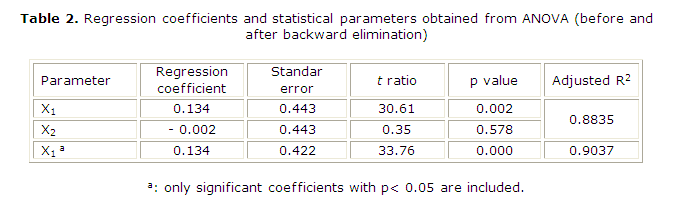
<body><![CDATA[<P><font size="2" face="Verdana">The aerial parts of <I>J. pectoralis</I> were    washed with H<SUB>2</SUB>O and 2 % sodium hypochlorite solution, and were dried    at 45 &#186;C. After drying, the material obtained was stored in plastic bags    until usage. In parallel, quality control was carried out according to the method    described.<SUP>12</SUP><STRIKE> </STRIKE> </font>      <P>      <P><b><font size="2" face="Verdana">Establishment of the technological process    </font></b>     <P>      <P><font size="2" face="Verdana"><I>Experimental design</I> </font>     <P>      <P><font size="2" face="Verdana">Response Surface Methodology (RSM) with a 3<SUP>2</SUP>    central composed experimental design (Statgraphics plus 5.1, USA) was applied    to evaluate the effects of extraction time (ET) and solid<STRIKE> </STRIKE>    liquid ratio (SLR) on coumarin content (%). The coded independent variables    used are listed in <a href="/img/revistas/pla/v18n4/t0106413.gif">Table 1</a>. The levels of independent    parameters were based on preliminary experimental results. </font>     <P>      <P><font size="2" face="Verdana"><I>Drying process</I> </font>     <P>      ]]></body>
<body><![CDATA[<P><font size="2" face="Verdana">The preliminary study showed loss by adhesion    of the product to the walls of the chamber during the drying process, making    it necessary to employ inert additives. The inert additives used in our study    were 10 DE Maltodextrin (Arancia-cpc, Mexico) and Soluble Starch (Riedel de    Ha&euml;n, Germany) at concentrations between 10 and 30 % versus the dry weight    of liquid extract content. </font>     <P><font size="2" face="Verdana">The carried solution was prepared by dissolving    the additive in 1000 mL of aqueous extract under constant stirring before spray    drying. The aqueous extracts were spray dried in a B&uuml;chi B 191 model spray    dryer (Switzerland). Inlet air temperature (140 &#176;C) and outlet air temperature    (80 &#176;C) were carried out according to the method described by <I>Rodr&iacute;guez    et al</I>.<SUP>11 </SUP>The product was fed into the spray dryer at room temperature    600 L/h: the rate was varied to regulate exit air temperature at the desired    value. After cooling to room temperature, the powder was placed in plastic bags    and stored until analysis. </font>     <P><font size="2" face="Verdana">Drying efficiency was assessed by determining    the total powder content obtained in the process and comparing it with the theoretical    powder content that can be obtained. Three batches (5 liter scale) with the    best inert additive were prepared and drying efficiency was determined. </font>     <P>      <P><font size="2" face="Verdana"><I>Aqueous extract and drying powder analysis</I>    </font>     <P>      <P><font size="2" face="Verdana">Coumarin content in the aqueous extract was determined    by HPLC using an Aluspher<SUP>&#174;</SUP> 100 (RP-select B 5 mm) pre-column    and a Lichrospher<SUP>&#174;</SUP> 100, RP 18 column (250 x 4 mm, 5 &micro;m).    The mobile phase used was methanol-water (60:40 v/v). Chromatography conditions    were mobile phase flow 1 ml/min, UV detector <font face="Symbol">l</font>= 274    nm, and injection volume 20 &micro;L. </font>      <P><font size="2" face="Verdana">Coumarin content in the drying powder was determined    according to the method described by <I>Rodr&iacute;guez et al</I>.<SUP>13</SUP>    </font>     <P><font size="2" face="Verdana">Dry matter content, pH and organoleptic characteristics    in the aqueous extract were determined according to NRSP with some modifications.<SUP>14</SUP>    </font>     <P>      ]]></body>
<body><![CDATA[<P><font size="2" face="Verdana"><B>Pharmacological studies </B> </font>     <P>      <P><font size="2" face="Verdana">Our interest was to know whether the technological    process developed affected the sedative activity of the product. A pharmacological    evaluation (Open field activity method) was conducted of samples obtained from    the inert additives study. Later, a pharmacological evaluation was carried out    of samples obtained in 5 liter scale. </font>     <P>      <P><font size="2" face="Verdana"><I>Animals</I> </font>     <P>      <P><font size="2" face="Verdana">Male albino mice (Swiss, 1822 g) in thiopental-induced    sleep, open field activity and aggressive behavior test. All animals were housed    in groups of five under standard laboratory conditions of temperature, humidity    and lighting (12:12-h light/dark). Animals had free access to food and water,    except during the experiment. They were deprived of food but not of water 6    h before drug administration. Each group consisted of ten animals. All experiments    were carried out between 8:00 am to 11:00 am in accordance with the Institutional    Animal Ethical Committee which approved the study. Animal care was in conformity    with Canadian Council for Animal Care guidelines. </font>     <P>      <P>      <P><font size="2" face="Verdana"><I>Evaluation of the influence on pharmacological    activity</I> </font>     ]]></body>
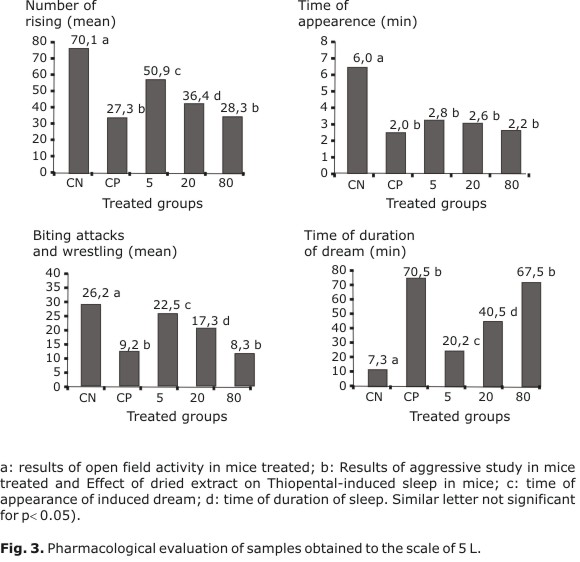
<body><![CDATA[<P>      <P><font size="2" face="Verdana">In the inert additives study for the evaluation    of their influence on pharmacological activity, animals were divided into four    groups: Distilled water-<STRIKE> </STRIKE> treated group (NC), Spray dried hydroalcoholic    extract (20 mg/kg)-treated group (PC) obtained according to <I>Rodriguez et    al</I>.,<SUP>11</SUP> Spray dried aqueous extract without inert additives (20    mg/kg)-treated group (TG), and Spray dried aqueous extract with inert additives    (20 mg/kg)-treated group (TGIA). </font>     <P>      <P><font size="2" face="Verdana"><I>Pharmacological evaluation of samples obtained    to the scale of 5 liters</I> </font>     <P>      <P><font size="2" face="Verdana">Animals were divided into five groups: Distilled    water<STRIKE> </STRIKE> treated group (NC), Diazepam (1 mg/kg)-treated group    (PC), and Spray dried aqueous extract with inert additives (5, 20 and 80 mg/kg)-treated    groups. </font>      <P>      <P><font size="2" face="Verdana"><I>Open field activity</I> </font>     <P>      <P><font size="2" face="Verdana">Open field activity was carried out according    to a previously reported method with some modifications.<SUP>15,16</SUP> Thirty    minutes after administration of vehicle or test compound a mouse was placed    in the centre of a round open field 30 cm in diameter and 25 cm in height, and    open field activity was measured during 6 minutes, recording how many times    the animal stayed in the centre of the cage and the number of risings. </font>     ]]></body>
<body><![CDATA[<P>      <P><font size="2" face="Verdana"><I>Aggressive behavior</I> </font>     <P>      <P><font size="2" face="Verdana">This study was conducted according to the method    described by <I>Pinna et al</I>.<SUP>17</SUP> A group of animals were isolated    in individual cages during six weeks, while another group remained together.    Thirty minutes after administration of vehicle or test compound, aggressive    behavior was evaluated by the introduction of an intruder mouse into the isolated    mice's home cage. Aggressive activity (biting attacks and wrestling) by isolated    mice was measured as total fighting time during a 20 min period. </font>      <P>      <P><font size="2" face="Verdana"><I>Thiopental-induced sleep</I> </font>     <P>      <P><font size="2" face="Verdana">The Thiopental-induced sleep study was conducted    according to the method described by <i>Fernandez et al</i>.<SUP>18</SUP> Thiopental    Sodium (50 mg/kg) was injected intraperitoneally 30 min after administration    of distilled water or test compound. An animal was placed on its back on a warmed    (35 &#186;C) pad. The number of sleeping animals and the duration of loss of    righting reflex were recorded. The time elapsed from loss of righting reflex    until a mouse regained its righting reflex was measured. </font>      <P>      <P><font size="2" face="Verdana"><B>Statistical analysis</B> </font>     ]]></body>
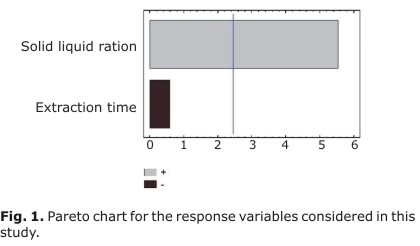
<body><![CDATA[<P>      <P><font size="2" face="Verdana">Experimental design, data analysis and optimization    procedure were performed using Statgraphic plus 5.1. All pharmacologically obtained    results were expressed as mean &#177; standard deviation (SD) and assessed by    analysis of variance (ANOVA) followed by Duncan's test. Results were considered    significant when p&lt; 0.05. </font>     <P>&nbsp;     <P><font size="3" face="Verdana"><b>RESULTS</b> </font>      <P>      <P><font size="2" face="Verdana"><I>Technological studies</I> </font>     <P>      <P><font size="2" face="Verdana">The dried plant material complies with the quality    specifications established by the method of analysis.<SUP>12</SUP> </font>     <P><font size="2" face="Verdana">Maximum coumarin content (4.3 %) was recorded    under the following experimental conditions: solid-liquid ratio 1:20 and extraction    time 15 min. Analysis of variance (ANOVA) was used to evaluate the significance    of coefficients in the models. <a href="/img/revistas/pla/v18n4/t0206413.gif">Table 2</a> shows the    regression coefficient values of equation and statistical parameters obtained    from ANOVA. The p values were used to evaluate the importance of each coefficient    and the interactions among the variables. To obtain a simple and yet realistic    model, insignificant terms (p &gt; 0.05) are eliminated from model through a    backward elimination process. The statistical parameters obtained from the ANOVA    for the reduced models are given in <a href="/img/revistas/pla/v18n4/t0206413.gif">Table 2</a>. <a href="#fig1">Figure    1</a> shows the Pareto chart for the response variable. </font>     <P>&nbsp;     ]]></body>
<body><![CDATA[<P align="center"><img src="/img/revistas/pla/v18n4/f0106413.jpg" width="420" height="246"><a name="fig1"></a>     <P>&nbsp;     <P><font size="2" face="Verdana">A transparent liquid of brownish gray color and    characteristic fragrance was obtained. Dry matter content in the extract was    3.27 &#177; 1.11 and pH was 5.41 &#177; 1.14. </font>     <P><font size="2" face="Verdana"><a href="#fig2">Figure 2a</a> shows the results    of the influence of both inert additives on the drying of the aqueous extract    of <I>Justicia pectoralis</I>. The best results were obtained with the use of    the 30 % soluble starch (drying efficiency above 65 % considered appropriate    for the working scale). On the other hand, no loss by adhesion of the product    to the walls of the chamber during the drying process was observed, which favors    product recovery.</font>     <P>&nbsp;     <P align="center"><img src="/img/revistas/pla/v18n4/f0206413.jpg" width="420" height="669"><a name="fig2"></a>      <P>&nbsp;     <P><font size="2" face="Verdana">A fine and amorphous powder of brown color was    obtained. Coumarin content was more than 7.0 mg/g of dried powder. These results    are similar to those reported by <I>Rodriguez et al</I>.<SUP>18</SUP> in studies    of drying of hydroalcoholic extracts of <I>Justicia pectoralis</I> by spray    drying. Results of analysis of batches with 30 % soluble starch and an exit    air temperature of 80 &#186;C were that those conditions were optimal to obtain    dry powder from aqueous extract of <I>Justicia pectoralis</I> with a recovery    greater than 70 %, considered appropriate for the working scale. </font>     <P>      <P><font size="2" face="Verdana"><I>Pharmacological studies</I> </font>     ]]></body>
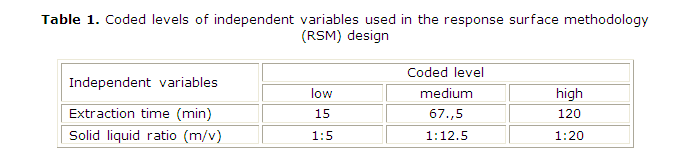
<body><![CDATA[<P><font size="2" face="Verdana">Evaluation of the influence of inert additives    on pharmacological activity (Open field activity method) showed no significant    differences (p&lt; 0.05) between the spray dried hydroalcoholic extract treated    group (PC), the spray dried aqueous extract without inert additives treated    group, and the spray dried aqueous extract with 30 % soluble starch treated    group (<a href="#fig2">Fig. 2b</a>).<B> </B> </font>     <P><font size="2" face="Verdana">In the pharmacological evaluation of samples    obtained to the scale of 5 liters, the open field activity<B> </B>study (<a href="#fig3">Fig.    3a</a>) found that dried extract (5, 20 and 80 mg/kg, po.) reduced spontaneous    locomotor<STRIKE>s</STRIKE> activity and rearing in a dose-dependent manner    during the observation period. <a href="#fig3">Figure 3b</a> shows the effects    of test compound on aggressive behavior in isolated mice. Test compound reduces    aggressive behavior in a dose-dependent manner.</font>     <P>&nbsp;     <P align="center"><img src="/img/revistas/pla/v18n4/f0306413.jpg" width="580" height="562"><a name="fig3"></a>      <P>&nbsp;     <P><font size="2" face="Verdana">The time of appearance of induced sleep in animals    treated with the different doses of dry extract was significantly shorter (p&lt;    0.05) than that obtained <STRIKE>f</STRIKE> in the negative control group (<a href="#fig3">Fig.    3c</a>). All test compound<I> </I>doses increased the number of sleeping animals    compared with the control. Doses of 20 and 80 mg/kg caused sleep in all animals.    Test compound 80 mg/kg and diazepam 1 mg/kg prolonged thiopental-induced sleep    in a similar manner (<a href="#fig3">Fig. 3d</a>). </font>     <P>&nbsp;     <P>      <p><font size="3" face="Verdana"><b>DISCUSSION</b></font>      <P><B> </B> <B>    ]]></body>
<body><![CDATA[<P>  </B>     <P><font size="2" face="Verdana"><I>Experimental design</I> </font>     <P>      <P><font size="2" face="Verdana">The process of optimization by RSM is advantageous    because this method saves time, space and raw materials. Application of this    method allowed us to study the main and possible effects of extraction time    and solid-liquid ratio on coumarin content.<STRIKE> </STRIKE> </font>     <P><font size="2" face="Verdana">Results show that the different indicators of    the process did not exhibit the same pattern. Solid-liquid ratio showed the    statistically significant main effect, having a strong positive influence on    coumarin extraction in our working conditions. Extraction time and the interaction    between the two factors were not significant for regression models. </font>     <P><font size="2" face="Verdana">With respect to numerical optimization, a solid-liquid    ratio of 1:20 and an extraction time of 15 minutes were suggested as optimum    parameters for coumarin extraction from <I>J. pectoralis</I>. Suitability of    the model equation for predicting optimum response values was tested under these<STRIKE>s</STRIKE>    conditions and was validated experimentally. A mean value of 4.32 % of coumarin,    obtained from real experiments (4.35 % value predicted), demonstrated the validity    of the RSM model, indicating that the model was adequate for the extraction    process.</font>      <P>      <P><font size="2" face="Verdana"><I>Evaluation of the influence of inert additives    on drying</I> </font>     <P>      <P><font size="2" face="Verdana">The presence of water in solid-state systems    has a significant impact on the stability of drugs not only by causing hydrolysis,    but also because it affects other properties such as plasticity and ductility,    film forming ability, and stickiness.<SUP>19</SUP> </font>     ]]></body>
<body><![CDATA[<P><font size="2" face="Verdana">Spray drying is a simple and effective method    to obtain dry powder. The presence of some amorphous compounds<STRIKE>,</STRIKE>    with high contents of water causes adhesion of the product to the walls of the    drying chamber during the process, resulting in poor product recovery. This    situation is solved using excipients (inert additives) that absorb water improving    the drying process.<SUP>19</SUP> The amorphous state is the most reactive, and    can be a source of stability problems<STRIKE>,</STRIKE> upon process scale-up.    Each product has a different glass transition temperature (Tg), resulting in    differences in physical and chemical stability. One of the most important parameters    characterizing an amorphous form is its low glass transition temperature, which    is correlated with properties such as plasticity and ductility, film forming    ability, and stickiness. Therefore, inert additives are contributory to drying,    favoring recovery by increasing the glass transition temperature. It has been    reported that when individual indexes of drying (IID) are greater than 1 (therefore    a high Tg value), the products are dried without any difficulty. However, when    individual indexes of drying are smaller than 1, the products are dried with    difficulty, sticking to the inner surfaces of the dryer, which results in poor    product recovery.<SUP>20</SUP> </font>     <P><font size="2" face="Verdana">The inert additives used in our studies have    individual indexes of drying greater than 1 and a high Tg value (Tg: 160 and    IID: 1.6 for 10 DE Maltodextrin, Tg: 243 and IID: 2.4 for Soluble Starch), appropriate    to improve the drying process. However, the glass transition temperature (Tg)    of the aqueous extract of <I>Justicia pectoralis</I> was 59.6 &#186;C and the    sticking temperature (Ta) was 79.7 &#186;C. Additionally, it was estimated that    the glass transition temperature and the sticking temperature of the aqueous    extract of <I>Justicia pectoralis</I> with soluble starch inert additive were    72.1 &#186;C and 92.1 &#186;C, respectively.<SUP>21</SUP> This result is important    because the fixed exit air temperature (80 &#176;C) in the technological process,    which is smaller than the sticking temperature of the aqueous extract/inert    additive mixture (92.1 &#186;C), prevents sticking during the drying process,    increasing product recovery. Results show that the technological process developed    was suitable to obtain a pharmaceutical quality raw material.<STRIKE> </STRIKE>    </font>     <P>      <P><font size="2" face="Verdana"><I>Pharmacological studies </I> </font>     <P>      <P><font size="2" face="Verdana">Results on the influence of inert additives on    pharmacological activity suggest that the addition of 30 % soluble starch does    not affect the sedative activity of <I>J. pectoralis</I>. </font>     <P>      <P><font size="2" face="Verdana"><I>Pharmacological evaluation of samples obtained    to the scale of 5 liters</I> </font>     <P>      <P><font size="2" face="Verdana">The open field activity study of samples obtained    to the scale of 5 L showed that dried extract reduced spontaneous locomotor<STRIKE>s</STRIKE>    activity and rearing in a dose-dependent manner during the observation period.    Rodents usually show exploratory behavior when they are placed in a new environment.    However, if the animals are pre-treated with depressant drugs, locomotive activity    is decreased. Doses of 80 mg/kg of test compound showed similar behavior to    diazepam 1 mg/kg (standard anxiolytic drugs). This result is typical of sedative    drugs. </font>     ]]></body>
<body><![CDATA[<P><font size="2" face="Verdana">A result similar to that of the open field test    between 80 mg/kg of dried powder and diazepam 1 mg/kg doses was obtained for    aggressive behavior. This behavior was reported by <I>Valzelli</I> as a classic    sign of depressed central nervous system.<SUP>22</SUP> </font>     <P><font size="2" face="Verdana">Dried extract obtained from aqueous extract of    <I>J. pectoralis</I><B> </B>as well as diazepam, a standard reference drug,    increased the number of sleeping animals and prolonged thiopental-induced sleep    time in mice. </font>     <P><font size="2" face="Verdana">Social isolation induces aggressive behavior    in several strains of mice. Isolation-induced aggression is considered to be    useful as an animal model for assessing inhibitory activity of the central nervous    system. Different neurotransmitters such as serotonin, noradrenalin, dopamine    and gamma aminobutyric acid (GABA) are considered to be involved in mediating    aggressive behavior, with conflicting results on brain neurotransmitter metabolism.<SUP>23,24</SUP>    In a recent study (not published) we were unable to demonstrate anxiolytic-like    activity in the test compound using the elevated plus-maze test in mice. Therefore,    the sedative effect of the powder extract obtained from aqueous extracts of    <I>Justicia pectoralis</I> Jacq. is not mediated via the GABA or Glycine systems.    </font>     <P><font size="2" face="Verdana">Our results show anti-aggressive behavior in    powder extract-treated mice. This result can be mediated by inhibitory effects    on brain biogenic amines action or excitatory neurotransmitter release, and    suggests an inhibitory effect on the central nervous system. This suggestion    was strengthened by the increase in sleeping time in the test-compound treated    groups over that in the control group in the thiopental-induced sleep model.    </font>     <P><font size="2" face="Verdana">In summary, it was found that solid-liquid ratio    was the most significant factor affecting coumarin extraction. On the other    hand, evaluation of the influence of inert additives on drying shows that the    best results were obtained with the use of 30 % soluble starch, not affecting    the sedative activity of <I>J. pectoralis</I>. Results show that the technological    process developed was suitable to obtain a pharmaceutical quality raw material    from aqueous extract of <I>J. pectoralis</I> by spray drying.</font>     <P>&nbsp;     <P>      <p><font size="3" face="Verdana"><b>REFERENCES</b></font>      <P><font size="2" face="Verdana"> </font>     <P>      ]]></body>
<body><![CDATA[<!-- ref --><P><font size="2" face="Verdana">1. Rivero Martinez R, Rodr&iacute;guez Chanfrau    J<STRIKE>. </STRIKE> E. <I>Justicia pectoralis </I>Jacq<I>. </I>Some aspects    about the chemical composition, pharmacology and toxicology (Review article).    Rev Mex Ciencias Farmac&eacute;uticas. 2000;30(2):15-9 </font>     <!-- ref --><P><font size="2" face="Verdana">2. M&eacute;ndez Arteaga J, Murillo Perea E,    Yara Var&oacute;n E, Suesc&uacute;n Ospina W, Ni&ntilde;o Osorio J, Mosquera    Mart&iacute;nez O. Climate influence on chemical composition and antioxidant    activity of <I>Justicia pectoralis </I>Jacq. Rev Cubana Farm. 2011;45(1):88-100    </font>     <!-- ref --><P><font size="2" face="Verdana">3. La Serna B, Amor A, Mart&iacute;nez M. Preliminary    chemical characterization of <I>Justicia pectoralis</I>. Rev Cubana Farm. 1989;23(3):256-64    </font>     <!-- ref --><P><font size="2" face="Verdana">4. Lino C, Traveira M, Viana G, Matos J. Analgesic    and antiinflammatory activities of <I>Justicia pectoralis</I> Jacq. and its    main constituents: coumarin and umbelliferone. Phytoter Res. 1997;11(3):211-5    </font>     <!-- ref --><P><font size="2" face="Verdana">5. O'Kennedy R, Douglas R. Coumarins. Biology,    applications and mode of action. England: John Wiley and Sons Ltd.; 1997. p.    22-66.     </font>     <!-- ref --><P><font size="2" face="Verdana">6. Ritschel W, Hardt T. Pharmacokinetics of coumarin,    7<STRIKE> </STRIKE> -hydroxycoumarin and -hydroxycoumarin glucuronide in the    blood and brain of gerbils following intraperitoneal administration of coumarin.    Drug Res. 1983;33:1254-8 </font>     <!-- ref --><P><font size="2" face="Verdana">7. Mac Rae W, Towers G. <I>Justicia pectoralis</I>:    a study of the basis for its use as a hallucinogenic snuff ingredient. J Ethnopharmacol.    1984;12:93-111 </font>     <!-- ref --><P><font size="2" face="Verdana">8. Hickey A, Gunderton D. Pharmaceutical Process    Engineering. New York: Marcel Dekker Inc.; 2001. p. 86-109.     </font>     ]]></body>
<body><![CDATA[<!-- ref --><P><font size="2" face="Verdana">9. Swami Handa S, Singh Khanuja S, Longo G, Rakesh    D. Extraction technologies for medicinal and aromatic plants. Trieste: International    Centre for Science and High Technology; 2008. p. 30-1.     </font>     <!-- ref --><P><font size="2" face="Verdana">10. NRSP 311. Fluid extracts. Technological processes.    La Habana: Ministry of Health Publishers; 1992.     </font>     <!-- ref --><P><font size="2" face="Verdana">11. Rodr&iacute;guez Chanfrau JE, L&oacute;pez    Hern&aacute;ndez OD, N&uacute;&ntilde;ez Y, Rodr&iacute;guez C, Carrillo C,    Gil Apan J, et al. Obtention of pharmaceutical quality raw material from <I>Justicia    pectoralis </I>Jacq. extracts by spray drying. Technology Development from a    30% hydroalcoholic extract. Latin American J Pharmacy. 2008;27(3):333-8.     </font>     <!-- ref --><P><font size="2" face="Verdana">12. NRSP 309. Vegetable Material<I>. </I>Assay<STRIKE>s</STRIKE>    methods<I>.</I> La Habana: Ministry of Health Publishers; 1992.     </font>     <!-- ref --><P><font size="2" face="Verdana">13. Rodr&iacute;guez Chanfrau JE, L&oacute;pez    Hern&aacute;ndez OD, Gil Apan JM. M&eacute;todo para la cuantificaci&oacute;n    de cumarina en extracto seco a partir de extractos de <I>Justicia pectoralis    </I>Jacq. Rev Cubana Plant Med [revista en la Internet]. 2008 Sep [citado Abr    26 2011]; 13(3). Disponible en: <FONT  COLOR="#0000ff"><a href="http://scielo.sld.cu/scielo.php?script=sci_arttext&pid=S1028-47962008000300004&lng=es" target="_blank">http://scielo.sld.cu/scielo.php?script=sci_arttext&amp;pid=S1028-    47962008000300004&amp;lng=es</a></FONT></font>      <!-- ref --><P><font size="2" face="Verdana">14. NRSP 315. Medications of Vegetable Origin.    Fluid extracts of <I>Justicia pectoralis</I> Jacq. La Habana: Ministry of Health    Publishers; 1992.     </font>     <!-- ref --><P><font size="2" face="Verdana">15. Archer J. Sex differences in the emotional    behavior of laboratory mice. Br J Psychol. 1977;68(1):125-31.     </font>     <!-- ref --><P><font size="2" face="Verdana">16. Walsh RN, Cummins RA. The Open-Field Test:    a critical review. Psychol Bull. 1976;83(3):482-504.     </font>     <!-- ref --><P><font size="2" face="Verdana">17. Pinna G, Agis-Balboa R, Pibiri F, Nelson    M, Guidotti A, Costa E. Neurosteroid biosynthesis regulates sexually dimorphic    fear and aggressive behavior in mice. Neurochem Res. 2008;33(10):1990-2007.        </font>     <!-- ref --><P><font size="2" face="Verdana">18. Fern&aacute;ndez S, Wasowski C, Paladini    A, Marder M. Synergistic interaction between hesperidin, a natural flavonoid,    and diazepam. Eur J Pharmacol. 2005;512(2-3):189-98.     </font>     <!-- ref --><P><font size="2" face="Verdana">19. Brady J, D&uuml;rig T, Shang S. Developing    solid oral dosage forms: pharmaceutical theory and practice. New York: Elservier    Inc.; 2009. p. 187-217.     </font>     <!-- ref --><P><font size="2" face="Verdana">20. Roos Y, Karel M. Water and molecular weight    effects on glass transitions in amorphous carbohydrates and carbohydrate solutions.    J Food Science. 1991;56(1):1676-81.     </font>     <!-- ref --><P><font size="2" face="Verdana">21. L&oacute;pez Hern&aacute;ndez OD, Martinez    &Aacute;lvarez L. Design tools for vegetable extract spray drying processes    for pharmaceutical use. Rev Cubana Plant Med. 2010;15(3):152-6.     </font>     <!-- ref --><P><font size="2" face="Verdana">22. Valzelli L. The &quot;isolation syndrome&quot;    in mice. Psychopharmacology. 1973;31:305-20.     </font>     <!-- ref --><P><font size="2" face="Verdana">23. Matsuda T, Sakaue M, Ago Y, Sakamoto Y, Koyama    Y, Baba A. Functional alteration of brain dopaminergic system in isolated aggressive    mice. Japan J Neuropsychopharmacol. 2001;21:71-6.     </font>     <!-- ref --><P><font size="2" face="Verdana">24. Sakaue M, Ago Y, Murakami C, Sowa C, Sakamoto    Y, Koyama Y, et al. Involvement of benzodiazepine binding sites in an antiaggressive    effect by 5-HT1A receptor activation in isolated mice. European J Pharmacology.    2001;432:163-6.     </font>     <P>&nbsp;     <P>&nbsp;     <P>      <P><font size="2" face="Verdana">Recibido: 20 febrero de 2013.     <br>   Aprobado: 30 de junio de 2013. </font>     <P>&nbsp;     <P>&nbsp;     <P><font size="2" face="Verdana"><I>Jorge Enrique Rodr&iacute;guez Chanfrau</I>.    Centro de Investigaciones y Desarrollo de Medicamentos. Ave 26 No. 1605. Nuevo    Vedado. La Habana. CP 10600. Cuba. E-mail: <FONT COLOR="#0000ff"><a href="mailto:jorge.rodriguez@infomed.sld.cu">jorge.rodriguez@infomed.sld.cu</a></FONT></font>       ]]></body><back>
<ref-list>
<ref id="B1">
<label>1</label><nlm-citation citation-type="journal">
<person-group person-group-type="author">
<name>
<surname><![CDATA[Rivero Martinez]]></surname>
<given-names><![CDATA[R]]></given-names>
</name>
<name>
<surname><![CDATA[Rodríguez Chanfrau]]></surname>
<given-names><![CDATA[J. E]]></given-names>
</name>
</person-group>
<article-title xml:lang="en"><![CDATA[Justicia pectoralis Jacq: Some aspects about the chemical composition, pharmacology and toxicology (Review article)]]></article-title>
<source><![CDATA[Rev Mex Ciencias Farmacéuticas.]]></source>
<year>2000</year>
<volume>30</volume>
<numero>2</numero>
<issue>2</issue>
<page-range>15-9</page-range></nlm-citation>
</ref>
<ref id="B2">
<label>2</label><nlm-citation citation-type="journal">
<person-group person-group-type="author">
<name>
<surname><![CDATA[Méndez Arteaga]]></surname>
<given-names><![CDATA[J]]></given-names>
</name>
<name>
<surname><![CDATA[Murillo Perea]]></surname>
<given-names><![CDATA[E]]></given-names>
</name>
<name>
<surname><![CDATA[Yara Varón]]></surname>
<given-names><![CDATA[E]]></given-names>
</name>
<name>
<surname><![CDATA[Suescún Ospina]]></surname>
<given-names><![CDATA[W]]></given-names>
</name>
<name>
<surname><![CDATA[Niño Osorio]]></surname>
<given-names><![CDATA[J]]></given-names>
</name>
<name>
<surname><![CDATA[Mosquera Martínez]]></surname>
<given-names><![CDATA[O]]></given-names>
</name>
</person-group>
<article-title xml:lang="en"><![CDATA[Climate influence on chemical composition and antioxidant activity of Justicia pectoralis Jacq]]></article-title>
<source><![CDATA[Rev Cubana Farm.]]></source>
<year>2011</year>
<volume>45</volume>
<numero>1</numero>
<issue>1</issue>
<page-range>88-100</page-range></nlm-citation>
</ref>
<ref id="B3">
<label>3</label><nlm-citation citation-type="journal">
<person-group person-group-type="author">
<name>
<surname><![CDATA[La Serna]]></surname>
<given-names><![CDATA[B]]></given-names>
</name>
<name>
<surname><![CDATA[Amor]]></surname>
<given-names><![CDATA[A]]></given-names>
</name>
<name>
<surname><![CDATA[Martínez]]></surname>
<given-names><![CDATA[M]]></given-names>
</name>
</person-group>
<article-title xml:lang="en"><![CDATA[Preliminary chemical characterization of Justicia pectoralis]]></article-title>
<source><![CDATA[Rev Cubana Farm.]]></source>
<year>1989</year>
<volume>23</volume>
<numero>3</numero>
<issue>3</issue>
<page-range>256-64</page-range></nlm-citation>
</ref>
<ref id="B4">
<label>4</label><nlm-citation citation-type="journal">
<person-group person-group-type="author">
<name>
<surname><![CDATA[Lino]]></surname>
<given-names><![CDATA[C]]></given-names>
</name>
<name>
<surname><![CDATA[Traveira]]></surname>
<given-names><![CDATA[M]]></given-names>
</name>
<name>
<surname><![CDATA[Viana]]></surname>
<given-names><![CDATA[G]]></given-names>
</name>
<name>
<surname><![CDATA[Matos]]></surname>
<given-names><![CDATA[J]]></given-names>
</name>
</person-group>
<article-title xml:lang="en"><![CDATA[Analgesic and antiinflammatory activities of Justicia pectoralis Jacq. and its main constituents: coumarin and umbelliferone]]></article-title>
<source><![CDATA[Phytoter Res.]]></source>
<year>1997</year>
<volume>11</volume>
<numero>3</numero>
<issue>3</issue>
<page-range>211-5</page-range></nlm-citation>
</ref>
<ref id="B5">
<label>5</label><nlm-citation citation-type="book">
<person-group person-group-type="author">
<name>
<surname><![CDATA[O'Kennedy]]></surname>
<given-names><![CDATA[R]]></given-names>
</name>
<name>
<surname><![CDATA[Douglas]]></surname>
<given-names><![CDATA[R]]></given-names>
</name>
</person-group>
<source><![CDATA[Coumarins: Biology, applications and mode of action]]></source>
<year>1997</year>
<page-range>22-66</page-range><publisher-loc><![CDATA[England ]]></publisher-loc>
<publisher-name><![CDATA[John Wiley and Sons Ltd]]></publisher-name>
</nlm-citation>
</ref>
<ref id="B6">
<label>6</label><nlm-citation citation-type="journal">
<person-group person-group-type="author">
<name>
<surname><![CDATA[Ritschel]]></surname>
<given-names><![CDATA[W]]></given-names>
</name>
<name>
<surname><![CDATA[Hardt]]></surname>
<given-names><![CDATA[T]]></given-names>
</name>
</person-group>
<article-title xml:lang="en"><![CDATA[Pharmacokinetics of coumarin, 7 -hydroxycoumarin and -hydroxycoumarin glucuronide in the blood and brain of gerbils following intraperitoneal administration of coumarin]]></article-title>
<source><![CDATA[Drug Res.]]></source>
<year>1983</year>
<volume>33</volume>
<page-range>1254-8</page-range></nlm-citation>
</ref>
<ref id="B7">
<label>7</label><nlm-citation citation-type="journal">
<person-group person-group-type="author">
<name>
<surname><![CDATA[Mac Rae]]></surname>
<given-names><![CDATA[W]]></given-names>
</name>
<name>
<surname><![CDATA[Towers]]></surname>
<given-names><![CDATA[G]]></given-names>
</name>
</person-group>
<article-title xml:lang="en"><![CDATA[Justicia pectoralis: a study of the basis for its use as a hallucinogenic snuff ingredient]]></article-title>
<source><![CDATA[J Ethnopharmacol.]]></source>
<year>1984</year>
<volume>12</volume>
<page-range>93-111</page-range></nlm-citation>
</ref>
<ref id="B8">
<label>8</label><nlm-citation citation-type="book">
<person-group person-group-type="author">
<name>
<surname><![CDATA[Hickey]]></surname>
<given-names><![CDATA[A]]></given-names>
</name>
<name>
<surname><![CDATA[Gunderton]]></surname>
<given-names><![CDATA[D]]></given-names>
</name>
</person-group>
<source><![CDATA[Pharmaceutical Process Engineering]]></source>
<year>2001</year>
<page-range>86-109</page-range><publisher-loc><![CDATA[New York ]]></publisher-loc>
<publisher-name><![CDATA[Marcel Dekker Inc]]></publisher-name>
</nlm-citation>
</ref>
<ref id="B9">
<label>9</label><nlm-citation citation-type="book">
<person-group person-group-type="author">
<name>
<surname><![CDATA[Swami Handa]]></surname>
<given-names><![CDATA[S]]></given-names>
</name>
<name>
<surname><![CDATA[Singh Khanuja]]></surname>
<given-names><![CDATA[S]]></given-names>
</name>
<name>
<surname><![CDATA[Longo]]></surname>
<given-names><![CDATA[G]]></given-names>
</name>
<name>
<surname><![CDATA[Rakesh]]></surname>
<given-names><![CDATA[D]]></given-names>
</name>
</person-group>
<source><![CDATA[Extraction technologies for medicinal and aromatic plants]]></source>
<year>2008</year>
<page-range>30-1</page-range><publisher-loc><![CDATA[Trieste ]]></publisher-loc>
<publisher-name><![CDATA[International Centre for Science and High Technology]]></publisher-name>
</nlm-citation>
</ref>
<ref id="B10">
<label>10</label><nlm-citation citation-type="book">
<source><![CDATA[NRSP 311: Fluid extracts. Technological processes]]></source>
<year>1992</year>
<publisher-loc><![CDATA[La Habana ]]></publisher-loc>
<publisher-name><![CDATA[Ministry of Health Publishers]]></publisher-name>
</nlm-citation>
</ref>
<ref id="B11">
<label>11</label><nlm-citation citation-type="journal">
<person-group person-group-type="author">
<name>
<surname><![CDATA[Rodríguez Chanfrau]]></surname>
<given-names><![CDATA[JE]]></given-names>
</name>
<name>
<surname><![CDATA[López Hernández]]></surname>
<given-names><![CDATA[OD]]></given-names>
</name>
<name>
<surname><![CDATA[Núñez]]></surname>
<given-names><![CDATA[Y]]></given-names>
</name>
<name>
<surname><![CDATA[Rodríguez]]></surname>
<given-names><![CDATA[C]]></given-names>
</name>
<name>
<surname><![CDATA[Carrillo]]></surname>
<given-names><![CDATA[C]]></given-names>
</name>
<name>
<surname><![CDATA[Gil Apan]]></surname>
<given-names><![CDATA[J]]></given-names>
</name>
</person-group>
<article-title xml:lang="en"><![CDATA[Obtention of pharmaceutical quality raw material from Justicia pectoralis Jacq. extracts by spray drying: Technology Development from a 30% hydroalcoholic extract]]></article-title>
<source><![CDATA[Latin American J Pharmacy.]]></source>
<year>2008</year>
<volume>27</volume>
<numero>3</numero>
<issue>3</issue>
<page-range>333-8</page-range></nlm-citation>
</ref>
<ref id="B12">
<label>12</label><nlm-citation citation-type="book">
<source><![CDATA[NRSP 309: Vegetable Material. Assays methods]]></source>
<year>1992</year>
<publisher-loc><![CDATA[La Habana ]]></publisher-loc>
<publisher-name><![CDATA[Ministry of Health Publishers]]></publisher-name>
</nlm-citation>
</ref>
<ref id="B13">
<label>13</label><nlm-citation citation-type="journal">
<person-group person-group-type="author">
<name>
<surname><![CDATA[Rodríguez Chanfrau]]></surname>
<given-names><![CDATA[JE]]></given-names>
</name>
<name>
<surname><![CDATA[López Hernández]]></surname>
<given-names><![CDATA[OD]]></given-names>
</name>
<name>
<surname><![CDATA[Gil Apan]]></surname>
<given-names><![CDATA[JM]]></given-names>
</name>
</person-group>
<article-title xml:lang="es"><![CDATA[Método para la cuantificación de cumarina en extracto seco a partir de extractos de Justicia pectoralis Jacq]]></article-title>
<source><![CDATA[Rev Cubana Plant Med]]></source>
<year>2008</year>
<month> S</month>
<day>ep</day>
<volume>13</volume>
<numero>3</numero>
<issue>3</issue>
</nlm-citation>
</ref>
<ref id="B14">
<label>14</label><nlm-citation citation-type="book">
<source><![CDATA[NRSP 315: Medications of Vegetable Origin. Fluid extracts of Justicia pectoralis Jacq]]></source>
<year>1992</year>
<publisher-loc><![CDATA[La Habana ]]></publisher-loc>
<publisher-name><![CDATA[Ministry of Health Publishers]]></publisher-name>
</nlm-citation>
</ref>
<ref id="B15">
<label>15</label><nlm-citation citation-type="journal">
<person-group person-group-type="author">
<name>
<surname><![CDATA[Archer]]></surname>
<given-names><![CDATA[J]]></given-names>
</name>
</person-group>
<article-title xml:lang="en"><![CDATA[Sex differences in the emotional behavior of laboratory mice]]></article-title>
<source><![CDATA[Br J Psychol.]]></source>
<year>1977</year>
<volume>68</volume>
<numero>1</numero>
<issue>1</issue>
<page-range>125-31</page-range></nlm-citation>
</ref>
<ref id="B16">
<label>16</label><nlm-citation citation-type="journal">
<person-group person-group-type="author">
<name>
<surname><![CDATA[Walsh]]></surname>
<given-names><![CDATA[RN]]></given-names>
</name>
<name>
<surname><![CDATA[Cummins]]></surname>
<given-names><![CDATA[RA]]></given-names>
</name>
</person-group>
<article-title xml:lang="en"><![CDATA[The Open-Field Test: a critical review]]></article-title>
<source><![CDATA[Psychol Bull.]]></source>
<year>1976</year>
<volume>83</volume>
<numero>3</numero>
<issue>3</issue>
<page-range>482-504</page-range></nlm-citation>
</ref>
<ref id="B17">
<label>17</label><nlm-citation citation-type="journal">
<person-group person-group-type="author">
<name>
<surname><![CDATA[Pinna]]></surname>
<given-names><![CDATA[G]]></given-names>
</name>
<name>
<surname><![CDATA[Agis-Balboa]]></surname>
<given-names><![CDATA[R]]></given-names>
</name>
<name>
<surname><![CDATA[Pibiri]]></surname>
<given-names><![CDATA[F]]></given-names>
</name>
<name>
<surname><![CDATA[Nelson]]></surname>
<given-names><![CDATA[M]]></given-names>
</name>
<name>
<surname><![CDATA[Guidotti]]></surname>
<given-names><![CDATA[A]]></given-names>
</name>
<name>
<surname><![CDATA[Costa]]></surname>
<given-names><![CDATA[E]]></given-names>
</name>
</person-group>
<article-title xml:lang="en"><![CDATA[Neurosteroid biosynthesis regulates sexually dimorphic fear and aggressive behavior in mice]]></article-title>
<source><![CDATA[Neurochem Res.]]></source>
<year>2008</year>
<volume>33</volume>
<numero>10</numero>
<issue>10</issue>
<page-range>1990-2007</page-range></nlm-citation>
</ref>
<ref id="B18">
<label>18</label><nlm-citation citation-type="journal">
<person-group person-group-type="author">
<name>
<surname><![CDATA[Fernández]]></surname>
<given-names><![CDATA[S]]></given-names>
</name>
<name>
<surname><![CDATA[Wasowski]]></surname>
<given-names><![CDATA[C]]></given-names>
</name>
<name>
<surname><![CDATA[Paladini]]></surname>
<given-names><![CDATA[A]]></given-names>
</name>
<name>
<surname><![CDATA[Marder]]></surname>
<given-names><![CDATA[M]]></given-names>
</name>
</person-group>
<article-title xml:lang="en"><![CDATA[Synergistic interaction between hesperidin, a natural flavonoid, and diazepam]]></article-title>
<source><![CDATA[Eur J Pharmacol.]]></source>
<year>2005</year>
<volume>512</volume>
<numero>2-3</numero>
<issue>2-3</issue>
<page-range>189-98</page-range></nlm-citation>
</ref>
<ref id="B19">
<label>19</label><nlm-citation citation-type="book">
<person-group person-group-type="author">
<name>
<surname><![CDATA[Brady]]></surname>
<given-names><![CDATA[J]]></given-names>
</name>
<name>
<surname><![CDATA[Dürig]]></surname>
<given-names><![CDATA[T]]></given-names>
</name>
<name>
<surname><![CDATA[Shang]]></surname>
<given-names><![CDATA[S]]></given-names>
</name>
</person-group>
<source><![CDATA[Developing solid oral dosage forms: pharmaceutical theory and practice]]></source>
<year>2009</year>
<page-range>187-217</page-range><publisher-loc><![CDATA[New York ]]></publisher-loc>
<publisher-name><![CDATA[Elservier Inc]]></publisher-name>
</nlm-citation>
</ref>
<ref id="B20">
<label>20</label><nlm-citation citation-type="journal">
<person-group person-group-type="author">
<name>
<surname><![CDATA[Roos]]></surname>
<given-names><![CDATA[Y]]></given-names>
</name>
<name>
<surname><![CDATA[Karel]]></surname>
<given-names><![CDATA[M]]></given-names>
</name>
</person-group>
<article-title xml:lang="en"><![CDATA[Water and molecular weight effects on glass transitions in amorphous carbohydrates and carbohydrate solutions]]></article-title>
<source><![CDATA[J Food Science.]]></source>
<year>1991</year>
<volume>56</volume>
<numero>1</numero>
<issue>1</issue>
<page-range>1676-81</page-range></nlm-citation>
</ref>
<ref id="B21">
<label>21</label><nlm-citation citation-type="journal">
<person-group person-group-type="author">
<name>
<surname><![CDATA[López Hernández]]></surname>
<given-names><![CDATA[OD]]></given-names>
</name>
<name>
<surname><![CDATA[Martinez Álvarez]]></surname>
<given-names><![CDATA[L]]></given-names>
</name>
</person-group>
<article-title xml:lang="en"><![CDATA[Design tools for vegetable extract spray drying processes for pharmaceutical use]]></article-title>
<source><![CDATA[Rev Cubana Plant Med.]]></source>
<year>2010</year>
<volume>15</volume>
<numero>3</numero>
<issue>3</issue>
<page-range>152-6</page-range></nlm-citation>
</ref>
<ref id="B22">
<label>22</label><nlm-citation citation-type="journal">
<person-group person-group-type="author">
<name>
<surname><![CDATA[Valzelli]]></surname>
<given-names><![CDATA[L]]></given-names>
</name>
</person-group>
<article-title xml:lang="en"><![CDATA[The "isolation syndrome" in mice]]></article-title>
<source><![CDATA[Psychopharmacology.]]></source>
<year>1973</year>
<volume>31</volume>
<page-range>305-20</page-range></nlm-citation>
</ref>
<ref id="B23">
<label>23</label><nlm-citation citation-type="journal">
<person-group person-group-type="author">
<name>
<surname><![CDATA[Matsuda]]></surname>
<given-names><![CDATA[T]]></given-names>
</name>
<name>
<surname><![CDATA[Sakaue]]></surname>
<given-names><![CDATA[M]]></given-names>
</name>
<name>
<surname><![CDATA[Ago]]></surname>
<given-names><![CDATA[Y]]></given-names>
</name>
<name>
<surname><![CDATA[Sakamoto]]></surname>
<given-names><![CDATA[Y]]></given-names>
</name>
<name>
<surname><![CDATA[Koyama]]></surname>
<given-names><![CDATA[Y]]></given-names>
</name>
<name>
<surname><![CDATA[Baba]]></surname>
<given-names><![CDATA[A]]></given-names>
</name>
</person-group>
<article-title xml:lang="en"><![CDATA[Functional alteration of brain dopaminergic system in isolated aggressive mice]]></article-title>
<source><![CDATA[Japan J Neuropsychopharmacol.]]></source>
<year>2001</year>
<volume>21</volume>
<page-range>71-6</page-range></nlm-citation>
</ref>
<ref id="B24">
<label>24</label><nlm-citation citation-type="journal">
<person-group person-group-type="author">
<name>
<surname><![CDATA[Sakaue]]></surname>
<given-names><![CDATA[M]]></given-names>
</name>
<name>
<surname><![CDATA[Ago]]></surname>
<given-names><![CDATA[Y]]></given-names>
</name>
<name>
<surname><![CDATA[Murakami]]></surname>
<given-names><![CDATA[C]]></given-names>
</name>
<name>
<surname><![CDATA[Sowa]]></surname>
<given-names><![CDATA[C]]></given-names>
</name>
<name>
<surname><![CDATA[Sakamoto]]></surname>
<given-names><![CDATA[Y]]></given-names>
</name>
<name>
<surname><![CDATA[Koyama]]></surname>
<given-names><![CDATA[Y]]></given-names>
</name>
</person-group>
<article-title xml:lang="en"><![CDATA[Involvement of benzodiazepine binding sites in an antiaggressive effect by 5-HT1A receptor activation in isolated mice]]></article-title>
<source><![CDATA[European J Pharmacology.]]></source>
<year>2001</year>
<volume>432</volume>
<page-range>163-6</page-range></nlm-citation>
</ref>
</ref-list>
</back>
</article>