<?xml version="1.0" encoding="ISO-8859-1"?><article xmlns:mml="http://www.w3.org/1998/Math/MathML" xmlns:xlink="http://www.w3.org/1999/xlink" xmlns:xsi="http://www.w3.org/2001/XMLSchema-instance">
<front>
<journal-meta>
<journal-id>1028-4796</journal-id>
<journal-title><![CDATA[Revista Cubana de Plantas Medicinales]]></journal-title>
<abbrev-journal-title><![CDATA[Rev Cubana Plant Med]]></abbrev-journal-title>
<issn>1028-4796</issn>
<publisher>
<publisher-name><![CDATA[ECIMED]]></publisher-name>
</publisher>
</journal-meta>
<article-meta>
<article-id>S1028-47962013000400011</article-id>
<title-group>
<article-title xml:lang="en"><![CDATA[In vitro determination of the antioxidant capacity of extracts and phenolic compounds from Ugni molinae Turcz. leaves]]></article-title>
<article-title xml:lang="es"><![CDATA[Determinación in vitro de la capacidad antioxidante de extractos y compuestos fenólicos de hojas de Ugni molinae Turcz.]]></article-title>
</title-group>
<contrib-group>
<contrib contrib-type="author">
<name>
<surname><![CDATA[Avello Lorca]]></surname>
<given-names><![CDATA[Marcia]]></given-names>
</name>
<xref ref-type="aff" rid="A01"/>
</contrib>
<contrib contrib-type="author">
<name>
<surname><![CDATA[Pastene Navarrete]]></surname>
<given-names><![CDATA[Edgar]]></given-names>
</name>
<xref ref-type="aff" rid="A01"/>
</contrib>
<contrib contrib-type="author">
<name>
<surname><![CDATA[González Riquelme]]></surname>
<given-names><![CDATA[Margarita]]></given-names>
</name>
<xref ref-type="aff" rid="A01"/>
</contrib>
<contrib contrib-type="author">
<name>
<surname><![CDATA[Bittner Berner]]></surname>
<given-names><![CDATA[Magalis]]></given-names>
</name>
<xref ref-type="aff" rid="A01"/>
</contrib>
<contrib contrib-type="author">
<name>
<surname><![CDATA[Becerra Allende]]></surname>
<given-names><![CDATA[José]]></given-names>
</name>
<xref ref-type="aff" rid="A01"/>
</contrib>
</contrib-group>
<aff id="A01">
<institution><![CDATA[,University of Concepción  ]]></institution>
<addr-line><![CDATA[Concepción ]]></addr-line>
<country>Chile</country>
</aff>
<pub-date pub-type="pub">
<day>00</day>
<month>12</month>
<year>2013</year>
</pub-date>
<pub-date pub-type="epub">
<day>00</day>
<month>12</month>
<year>2013</year>
</pub-date>
<volume>18</volume>
<numero>4</numero>
<fpage>596</fpage>
<lpage>608</lpage>
<copyright-statement/>
<copyright-year/>
<self-uri xlink:href="http://scielo.sld.cu/scielo.php?script=sci_arttext&amp;pid=S1028-47962013000400011&amp;lng=en&amp;nrm=iso"></self-uri><self-uri xlink:href="http://scielo.sld.cu/scielo.php?script=sci_abstract&amp;pid=S1028-47962013000400011&amp;lng=en&amp;nrm=iso"></self-uri><self-uri xlink:href="http://scielo.sld.cu/scielo.php?script=sci_pdf&amp;pid=S1028-47962013000400011&amp;lng=en&amp;nrm=iso"></self-uri><abstract abstract-type="short" xml:lang="en"><p><![CDATA[Introduction: Ugni molinae Turcz., (Myrtaceae) is a plant that is distributed in central-southern of Chile, including Juan Fernández Islands. The leaves have been used in folk medicine for diarrhea and oral infections due to their astringent and antiseptic properties. Objective: antioxidant activity of two extracts (ethyl acetate and methanol) from U. molinae leaves was assessed in several assays. Methods: HPLC (high performance liquid chromatography) for chemical analysis and in vitro antioxidant methods. Results: HPLC profiling of both extracts showed the presence of flavan-3-ols (catechin) and gallic acid, flavonoids and caffeic acid derivates as main constituents. These extracts showed significant activity on 2,2-diphenyl-1-picrylhydrazyl (DPPH), cupric ion reducing antioxidant capacity (CUPRAC) and hydroxyl radical assays. It is noteworthy that bleaching of b-carotene-linoleate liposomes and copper-induced oxidation of human LDL were prevented by both extracts. Conclusions: results suggest that polyphenol-rich extracts of U. molinae could slow down lipid peroxidation and limit free radical damage.]]></p></abstract>
<abstract abstract-type="short" xml:lang="es"><p><![CDATA[Introducción: Ugni molinae Turcz. (Myrtaceae) es una planta que se distribuye en el centro-sur de Chile, incluido el archipiélago de Juan Fernández. Las hojas se han utilizado en medicina popular para diarreas e infecciones bucales, por sus propiedades astringentes y antisépticas. Objetivo: la actividad antioxidante de los dos extractos (acetato de etilo y metanólicol) de las hojas de Ugni molinae se evaluó mediante diferentes ensayos. Métodos: HPLC (high performance liquid chromatography) para el análisis químico y los métodos antioxidantes in vitro. Resultados: los perfiles HPLC de ambos extractos mostraron la presencia de flavan-3-oles (catequinas) y ácido gálico, flavonoides y derivados del ácido cafeico como constituyentes principales. Estos extractos mostraron actividad significativa frente a 2,2-difenil-1-picrilhidrazilo (DPPH), capacidad reductora del ión cobre (CUPRAC) y ensayos frente al radical hidroxilo. Es importante destacar que el blanqueamiento de liposomas de b-caroteno-linoleato y la oxidación producida por cobre de LDL (low density lipoprotein) humana fueron evitados por ambos extractos. Conclusiones: los resultados sugieren que los extractos de Ugni molinae ricos en polifenoles podrían evitar la peroxidación lipídica y el daño de radicales libres.]]></p></abstract>
<kwd-group>
<kwd lng="en"><![CDATA[antioxidant capacity]]></kwd>
<kwd lng="en"><![CDATA[lipid peroxidation]]></kwd>
<kwd lng="en"><![CDATA[Ugni molinae.]]></kwd>
<kwd lng="es"><![CDATA[capacidad antioxidante]]></kwd>
<kwd lng="es"><![CDATA[peroxidación lipídica]]></kwd>
<kwd lng="es"><![CDATA[Ugni molinae.]]></kwd>
</kwd-group>
</article-meta>
</front><body><![CDATA[ <p align="right"><font face="Verdana" size="2"><b>ART&Iacute;CULO ORIGINAL</b></font></p>     <p align="right">&nbsp;</p>     <p><font face="Verdana" size="2"><I><b><font size="4">In vitro </font></b></I><font size="4"><b>determination    of the antioxidant capacity of extracts and phenolic compounds from<I> Ugni    molinae </I>Turcz.<I> </I>leaves </b></font></font></p>     <p>&nbsp; </p>     <P><b><font face="Verdana" size="3">Determinaci&oacute;n <I>in vitro</I> de la    capacidad antioxidante de extractos y compuestos fen&oacute;licos de hojas de    <I>Ugni molinae </I>Turcz. </font></b>     <P>&nbsp;     <P>&nbsp;     <P><b><font face="Verdana" size="2">PhD.</font></b> <b><font face="Verdana" size="2">Marcia    Avello Lorca, PhD. Edgar Pastene Navarrete, MSc. Margarita Gonz&aacute;lez Riquelme,    PhD. Magalis Bittner Berner, PhD. Jos&eacute; Becerra Allende</font></b>      <P>      <P><font face="Verdana" size="2">University of Concepci&oacute;n. Concepci&oacute;n,    Chile.</font>     ]]></body>
<body><![CDATA[<P>&nbsp;      <P>      <P>&nbsp;  <hr size="1" noshade> <font face="Verdana" size="2"><B>ABSTRACT</B></font>      <P><font face="Verdana" size="2"><B>Introduction: </b><I>Ugni molinae </I>Turcz.,    (Myrtaceae) is a plant that is distributed in central-southern of Chile, including    Juan Fern&aacute;ndez Islands. The leaves have been used in folk medicine for    diarrhea and oral infections due to their astringent and antiseptic properties.    <B>    <br>   Objective:</B> antioxidant activity of two extracts (ethyl acetate and methanol)    from <I>U. molinae</I> leaves was assessed<I> </I>in several assays. <B>    <br>   Methods:</B> HPLC (<I>high performance liquid chromatography</I>) for chemical    analysis and <I>in vitro </I>antioxidant methods<I>. </I><B>    <br>   Results:</B> HPLC profiling of both extracts showed the presence of flavan-3-ols    (catechin) and gallic acid, flavonoids and caffeic acid derivates as main constituents.    These extracts showed significant activity on 2,2-diphenyl-1-picrylhydrazyl    (DPPH), cupric ion reducing antioxidant capacity (CUPRAC) and hydroxyl radical    assays. It is noteworthy that bleaching of b-carotene-linoleate liposomes and<I>    </I>copper-induced<I> </I>oxidation of human<I> </I>LDL were prevented by both    extracts. <B>    <br>   Conclusions:</B> results suggest that polyphenol-rich extracts of <I>U. molinae</I>    could slow down lipid peroxidation and limit free radical damage. </font>  <B></B>      <P>      <P><b><font face="Verdana" size="2">Key words:</font></b><font face="Verdana" size="2">    antioxidant capacity,<I> </I>lipid peroxidation,<I> Ugni molinae.</I></font>  <hr size="1" noshade> <font face="Verdana" size="2"><b>RESUMEN</b></font>      ]]></body>
<body><![CDATA[<p><font face="Verdana" size="2"><b>Introducci&oacute;n:</b> <I>Ugni molinae</I>    Turcz. (Myrtaceae) es una planta que se distribuye en el centro-sur de Chile,    incluido el archipi&eacute;lago de Juan Fern&aacute;ndez. Las hojas se han utilizado    en medicina popular para diarreas e infecciones bucales, por sus propiedades    astringentes y antis&eacute;pticas. <b>    <br>   Objetivo:</b> la actividad antioxidante de los dos extractos (acetato de etilo    y metan&oacute;licol) de las hojas de <I>Ugni molinae</I> se evalu&oacute; mediante    diferentes ensayos. <b>    <br>   M&eacute;todos:</b> HPLC (<I>high performance liquid chromatography</I>) para    el an&aacute;lisis qu&iacute;mico y los m&eacute;todos antioxidantes <I>in vitro.</I>    <b>    <br>   Resultados:</b> los perfiles HPLC de ambos extractos mostraron la presencia    de flavan-3-oles (catequinas) y &aacute;cido g&aacute;lico, flavonoides y derivados    del &aacute;cido cafeico como constituyentes principales. Estos extractos mostraron    actividad significativa frente a 2,2-difenil-1-picrilhidrazilo (DPPH), capacidad    reductora del i&oacute;n cobre (CUPRAC) y ensayos frente al radical hidroxilo.    Es importante destacar que el blanqueamiento de liposomas de b-caroteno-linoleato    y la oxidaci&oacute;n producida por cobre de LDL (<I>low density lipoprotein</I>)    humana fueron evitados por ambos extractos. <b>    <br>   Conclusiones:</b> los resultados sugieren que los extractos de <I>Ugni molinae</I>    ricos en polifenoles podr&iacute;an evitar la peroxidaci&oacute;n lip&iacute;dica    y el da&ntilde;o de radicales libres. </font> </p>     <P>      <P><b><font face="Verdana" size="2">Palabras clave:</font></b> <font face="Verdana" size="2">    capacidad antioxidante,<I> </I>peroxidaci&oacute;n lip&iacute;dica,<I> Ugni    molinae.</I></font>  <hr size="1" noshade>     <p>&nbsp;</p>     <p>&nbsp;</p>     <p><font face="Verdana" size="2"><b><font size="3">INTRODUCTION</font></b></font>  </p> <B></B>      ]]></body>
<body><![CDATA[<P>      <P><font face="Verdana" size="2">Various medicinal properties have been ascribed    to natural herbs.<SUP>1</SUP> <I>Ugni molinae</I> Turcz. (Myrtaceae), also known    as &#171;Murta&#187;, &#171;Murtilla&#187; or Chilean Guava, is a plant that    grows in the south of Chile. Infusions of <I>U. molinae</I> leaves have long    been used in traditional native herbal medicine to treat diarrhea and dysenteries.<SUP>2</SUP>    Studies of the chemical composition of the leaves indicate the presence of phenolic    compounds like phenolic acids, flavonoids, triterpenes and tannins.<SUP>3</SUP>    These compounds can display antioxidant and anti-inflammatory properties with    low toxicity.<SUP>4</SUP> About 2 % of the oxygen used by normal cells is estimated    to form reactive oxygen species (ROS).<SUP>5</SUP> When ROS production overwhelms    the numerous endogenous antioxidant defenses, a range of cellular structures    and functions are damaged. This process, known as oxidative stress, leads to    pathologies such as atherosclerosis, cancer and, ultimately, cell death.<SUP>6</SUP>    The main ROS are superoxide anion (O<SUB>2</SUB><SUP>.-</SUP>) and hydroxyl    radicals, which react with cell molecules such as lipids, proteins, carbohydrates,    DNA, and lipoproteins.<SUP>7</SUP> Regarding the latter, high plasma low density    lipoprotein (LDL) levels are strongly linked to atherosclerosis, the major cause    of coronary heart disease. Some studies have further demonstrated that atherosclerosis    involves endothelial dysfunctions, monocyte infiltration, monophage activation,    and smooth muscle cell proliferation.<SUP>8,9</SUP> Moreover, oxidative modification    of LDL plays a key role in triggering the molecular pathogenesis of atherosclerosis.    Unlike intact LDL, which is metabolized through the receptor-mediated pathway,    oxidized LDL (ox-LDL) appears in the circulation and tends to infiltrate the    aortic endothelium.<SUP>10</SUP> It is further oxidized in the intima until    finally being taken up by macrophages. Thus, antioxidants able to inhibit LDL    oxidation may reduce early atherogenesis and slow down the progression to more    advanced stages.<SUP>11,12</SUP> Antioxidants can limit the formation of free    radicals in cells ameliorating their damage. The potential use of <I>U. molinae</I>    extracts as antioxidants has been considered elsewhere.<SUP>13 </SUP>The molecular    mechanisms underlying antioxidant effects of polyphenols have not yet been fully    elucidated and are still a matter of considerable debate. However, it has been    suggested that increased lipophilicity and subsequent cell partitioning result    in restriction on membrane fluidity that could sterically hinder diffusion of    free radicals, thereby decreasing the kinetics of free radical reactions.<SUP>14</SUP>    Thus, the antioxidant capacity of polyphenolic-rich beverages could be assessed    using the rate of bleaching of stable free radicals, like 1,1-diphenyl-2-picryl-hidrazyl    (DPPH) or 2,2'-azino-bis(3-ethylbenzthiazoline-6-sulphonic acid (ABTS), allowing    us to evaluate the nonspecific free radical scavenging capacity.<SUP>15</SUP>    The aim of the present study was to investigate the antioxidant capacity of    two <I>U. molinae</I> polyphenol-rich extracts using <I>in vitro</I> free-radical    generating systems, lipid peroxidation assay, and protection of LDL against    its oxidative modification induced by copper. </font>     <P>&nbsp;      <P>      <P><font face="Verdana" size="3"><B>METHODS</B> </font>      <P>      <P> <font face="Verdana" size="2"><I>Plant material </I></font><I>     <P>  </I>      <P><font face="Verdana" size="2"><I>Ugni molinae</i> leaves were collected from    the areas surrounding Concepci&oacute;n, Chile, in April 2005, and were identified    by Dr. Roberto Rodriguez of the Department of Botany, University of Concepci&oacute;n;    a voucher specimen was deposited in the Herbarium under catalogue number CONC    146511. Leaves of <I>U. molinae</I> were washed, air-dried, and ground to a    fine powder. </font>     <P>      ]]></body>
<body><![CDATA[<P><font face="Verdana" size="2"><I>Extraction</I> </font>     <P>      <P><font face="Verdana" size="2">Powdered <I>U. molinae</I> leaves (1.5 kg) were    extracted in a Soxhlet apparatus successively with ethyl acetate (EAE) and methanol    (ME). The extracts were filtered and concentrated under vacuum at 40 &#186;C,    and dried under vacuum at room temperature. General phytochemical screening    was conducted of both extracts to identify chemical entities with potential    antioxidant activities, such as tannins and flavonoids.<SUP>16,17</SUP> </font>     <P>      <P><font face="Verdana" size="2"><I>Total polyphenol content</I> </font>     <P>      <P><font face="Verdana" size="2">Total polyphenol contents were spectrophotometrically    determined according to <I>Velioglu et al</I>.<SUP>18</SUP> using the Folin-Ciocalteu    reagent (Sigma, MO, USA). Briefly, aliquots of test samples (0.5 mL) were mixed    with 25 mL water, 2.5 mL Folin-Ciocalteu reagent, 10 mL 20 % Na<SUB>2</SUB>CO<SUB>3</SUB>,    and completed to 50 mL with water, shaken for 30 min, and allowed to stand for    30 min. Absorbance of samples were registered at 765 nm using gallic acid as    standard for calibration. Total polyphenol contents were expressed as mg of    gallic acid equivalents per gram of extract.<SUP>19</SUP> </font>     <P>      <P><font face="Verdana" size="2"><I>High performance liquid chromatography-ultraviolet    (HPLC-UV) analysis</I> </font>     <P>      ]]></body>
<body><![CDATA[<P><font face="Verdana" size="2">HPLC profiles of extracts were performed by HPLC    according <I>Motamed et al</I>.<SUP>20 </SUP>using a system equipped with a    LiChrospher 100 RP-18 column (5 mm, 125-4 mm). Elution was conducted under gradient    with solvent A: 96 % ultrapure water, 3 % acetic acid, and 1 % acetonitrile,    and B: 72 % ultrapure water, 3 % acetic acid and 25 % acetonitrile. The gradient    started from 100 % A up to 100 % B (0-10 min), then 100 % B was maintained for    40 min, and finally the column was brought to initial conditions in 5 min (100    % A). Total running time was 55 min. Flow rate was 0.8 mL/min and detection    was performed at 280 nm. The reagents used for analysis were all HPLC grade    (Merck, Germany). Peak assignments were done by comparison of their t<I><SUB>R</SUB></I>    with those of pure standard substances (gallic acid, catechin and caffeic acid),    all purchased from Sigma. </font>     <P>      <P> <i><font face="Verdana" size="2">2,2-diphenyl-1-picrylhydrazyl (DPPH) assay    </font></i>     <P><font face="Verdana" size="2">Antioxidant capacity was assessed using reduction    of 1,1-diphenyl-2-picryl-hidrazyl (DPPH, Sigma , USA) according to <I>Navarro    et al</I>.<SUP>21</SUP> Aliquots of 750 mL of EAE and ME solutions (equivalent    to 2- 200 mM GAE) were mixed with 1.5 mL of ethanol solution of DPPH (20 mg/mL).    Absorbance was determined after 5 min at 517 nm in a spectrophotometer (Shimadzu    UV-VIS 1601). Results were expressed as a percentage of DPPH reduction and Trolox    Equivalent Antioxidant Capacity (TEAC) per gram of extract. Gallic acid and    Trolox were used as standards.</font>  <B></B>      <P>      <P><font face="Verdana" size="2">Cupric ion reducing antioxidant capacity (CUPRAC)    <I>assay</I> </font>     <P>      <P><font face="Verdana" size="2">CUPRAC indexes were determined according to <I>Apak    et al.</I><SUP>22</SUP> For this purpose CuCl<SUB>2</SUB> solution, 1.0 x 10<SUP>-2</SUP>    M, was prepared by dissolving 0.4262 g CuCl<SUB>2</SUB> x 2H<SUB>2</SUB>O in    water, and diluting to 250 mL. Ammonium acetate buffer 1.0 M at pH 7 was prepared    by dissolving 19.27 g NH<SUB>4</SUB>Ac in water and diluting to 250 mL. Neocuproine    (Nc) solution, 7.5 x 10<SUP>-3</SUP> M, was prepared daily by dissolving 0.039    g Nc in 96 % ethanol, and diluting to 25 mL with ethanol. Trolox, 1.0 x 10<SUP>-3</SUP>    M, was prepared in 96 % ethanol. The assay was performed adding 1 mL 10<SUP>-2</SUP>    M Cu<SUP>2+</SUP> + 1mL 7.5 x 10<SUP>-3</SUP> M neocuproine + 1 mL 1 M NH<SUB>4</SUB>Ac    + x mL 10<SUP>-3</SUP> M antioxidant neutral solution + (1.1- x) H<SUB>2</SUB>O;    total volume = 4.1 mL; measure final absorbance at 450 nm. </font>     <P>      <P><font face="Verdana" size="2"><I>Hydroxyl Radical (OH<SUP>&#183;</SUP>) Scavenging    Assay</I> </font>     ]]></body>
<body><![CDATA[<P>      <P><font face="Verdana" size="2">Scavenging of the hydroxyl radical (OH<SUP>&#183;</SUP>)    was measured by the deoxyribose method.<SUP>23,24</SUP> Hydroxyl radicals were    generated by reacting 50 mL of Fe<SUP>+3</SUP> (20 mM) with 50 mL of H<SUB>2</SUB>O<SUB>2</SUB>    (42 mM) and 10 mL of ascorbate (50 mM). Then, 10 mL of either EAE or ME extracts    (equivalent to 2 - 200 mM GAE) and 100 mL of deoxyribose (2.8 mM) in PBS buffer    (10 mM, pH 7.4) were added. The corresponding mixtures were incubated at 37    &#186;C for 1 h. Then 1 mL of trichloroacetic acid (2.8 %) and 1 mL of thiobarbituric    acid (TBA) were added and heated at 100 &#186;C for 15 min. After cooling, absorbance    of reddish adducts was measured at 532 nm using a spectrophotometer (Shimadzu    UV-VIS 1601). Results were expressed as a percentage of OH<SUP>&#183;</SUP>    inhibition. Gallic acid was used as the standard. </font>     <P>      <P><font face="Verdana" size="2"><I>b-Carotene-Linoleate Bleaching Assay</I> </font>     <P>      <P><font face="Verdana" size="2">The effect of <I>U. molinae</I> extracts on the    oxidation of b-carotene and linoleic acid charged liposomes was determined according    to the method of <I>Velioglu et al</I>.<SUP>18 </SUP>with slight modifications.<FONT  COLOR="#ff0000"> </FONT>0.5 mL of b-carotene (Sigma, USA) (2 mg/mL) in chloroform    was added to a 10 mL aliquot of linoleic acid (Sigma, USA) and 100 mL of the    tensoactive agent Tween 80; afterwards EAE and ME fractions were added. After    evaporation and drying under vacuum at room temperature, 25 mL of oxygenated    water were added and shaken for 1 min. Liposomes were then subjected to thermal    oxidation at 50 &#186;C in a thermoregulated cuvette in a spectrophotometer    (Shimadzu UV-VIS 1601) for 70 min. Absorbance was recorded at 470 nm every 5    min. Results were expressed as a percentage of b-carotene and linoleic acid    protection. Gallic acid was used as a standard. </font>     <P>      <P><font face="Verdana" size="2"><I>Protective Effects on LDL Oxidation by Cu<SUP>2+</SUP></I>    </font>     <P>      <P><font face="Verdana" size="2">Blood samples were collected from young healthy    donors after fasting overnight for 12 hours. EDTA (5 mM) was used as an anticoagulant.    Blood was centrifuged at 800 x g at 4 &#186;C for 15 min. Human LDL (d=1.019-1.063    g/mL) was prepared from the separated plasma by sequential flotation ultracentrifugation    at 4 &#186;C as described by <I>Schumaker</I> and <I>Puppione</I>.<SUP>25</SUP>    Prior to the oxidation experiences, LDL was dialyzed overnight against PBS.    Aliquots of LDL (6.82 mg/mL) were incubated with Cu<SUP>+2</SUP> (7 mM) at 37    &#186;C to induce lipid peroxidation according to <I>Gugliucci</I>.<SUP>26</SUP>    LDL was pre-incubated with the extracts for 10 min before adding Cu<SUP>2+</SUP>.    Incubation was carried out at 37 &#186;C for 24 h. At this time, oxidation was    stopped by cooling on ice and by the addition of butylated hydroxytoluene (BHT,    40 mM), a radical-trapping antioxidant, and EDTA (1 mM). Rutin was used as a    control. Formation of diene conjugates was determined by UV absorption at 234    nm,<SUP>27</SUP> using a spectrophotometer (Shimadzu UV-VIS 1601). Fluorescence    was measured at an excitation wavelength of 360 nm and an emission of 410 nm,    as previously described by <I>Steinbrecher</I>,<SUP>28</SUP> using a spectrofluorophotometer    (Shimadzu RF-5301 PC). Electrophoretic mobility<I> </I>assay was determined    on 1 % agarose gels in barbital buffer (pH 8.6) and by staining with Coomassie    Brilliant Blue (Sigma B0149, USA), according to <I>Noble</I>.<SUP>29</SUP> Electrophoresis    was carried out in a horizontal chamber (30 mA, 2 hours) (Merck, Darmstadt,    Germany). </font>     ]]></body>
<body><![CDATA[<P>      <P><font face="Verdana" size="2"><I>Statistical Analysis</I> </font>     <P>      <P><font face="Verdana" size="2">Statistical analyses were performed using one-way    analysis of variance (ANOVA) followed by Dunnett's <I>t</I>-test for multiple    comparisons. Differences were considered significant at p&lt; 0.05.</font>     <P>&nbsp;      <P>      <P><font face="Verdana" size="3"><B>RESULTS </B></font><font face="Verdana" size="2">    </font>      <P>      <P><font face="Verdana" size="2"><I>Total Polyphenol Content and HPLC-UV Analysis</I>    </font>     <P>      ]]></body>
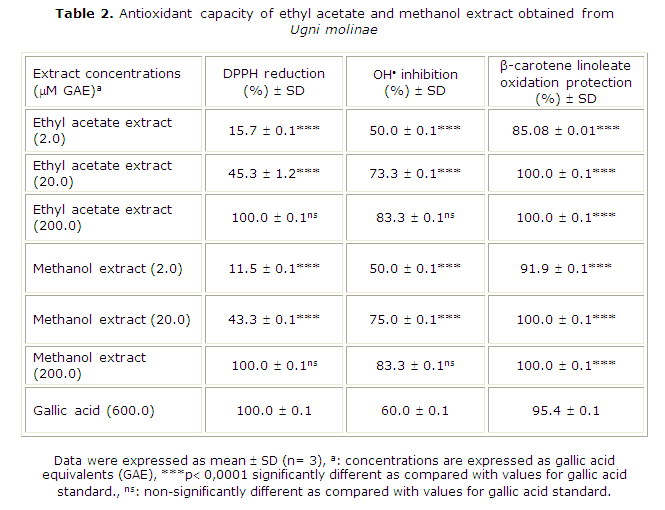
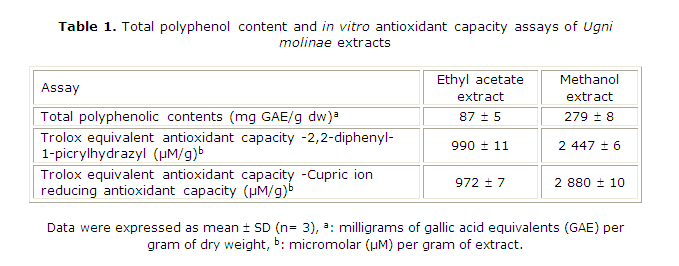
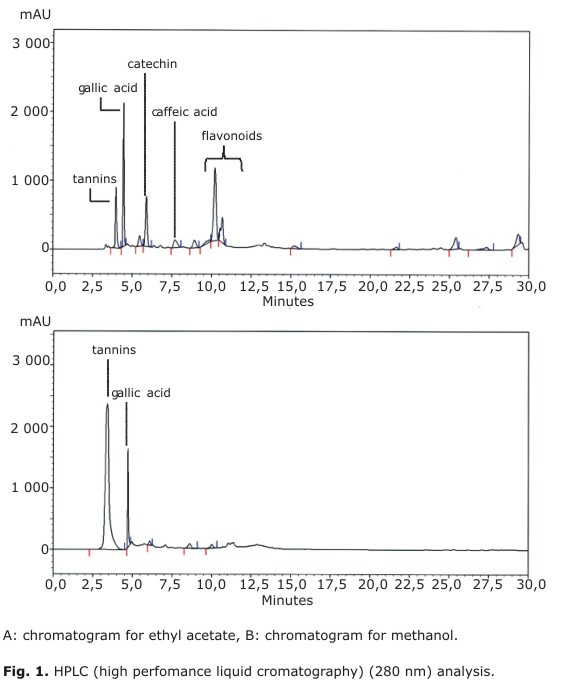
<body><![CDATA[<P><font face="Verdana" size="2">Total polyphenolic contents (TPC, <a href="/img/revistas/pla/v18n4/t0111413.gif">Table    1</a>) in EAE and ME were 87 and 279 mg GAE/g, respectively. However, as shown    in <a href="#fig1">Figures 1A</a> and <a href="#fig1">1B</a> both extracts displayed    a different HPLC profile. In EAE, it was possible to identify catechin, caffeic    acid and traces of free gallic acid as in previous studies.<SUP>4</SUP> In fact,    gallic acid was concentrated in ME along with other polyphenols, which presumably    could be a complex moiety of gallotannins. In our HPLC system, these compounds    elute as an unresolved peak around t<I><SUB>R</SUB></I>= 3.4 min. As expected,    flavan-3-ols, and some flavonoid glycosides were concentrated in EAE. The latter    compounds elute between t<I><SUB>R</SUB></I>= 9.0-12.0 min and present a second    absorption band at 350 nm (data not shown). Neither procyanidins nor unbound    flavonoids were detected in the extracts. To complement the chemical information,<I>    </I>Aguirre and colleagues have recently identified assiatic, corosolic, oleanolic,    betulinic and ursolic acids in <I>U. molinae </I>leaf extracts.<SUP>3,30</SUP>    </font>     <P align="center"><img src="/img/revistas/pla/v18n4/f0111413.jpg" width="580" height="691"><a name="fig1"></a>      <P>      <P><font face="Verdana" size="2"><I>DPPH Assay</I> </font>     <P>      <P><font face="Verdana" size="2">The antioxidant capacity of EAE and ME prepared    from <I>U. molinae</I> was evaluated using different assays. Both extracts were    able to decolorize the stable DPPH probe. As shown in <a href="/img/revistas/pla/v18n4/t0211413.gif">Table    2</a>, <I>U. molinae</I> extracts stabilized DPPH in a concentration-dependent    manner. Thus, 100 % DPPH stabilization was reached with 200 &#181;M GAE of EAE    and ME. For gallic acid (pure standard), 100 % scavenging activity was reached    with a concentration of 600 &#181;M, suggesting that <I>U. molinae</I> possesses    other antioxidant molecules acting synergistically. As shown in <a href="/img/revistas/pla/v18n4/t0111413.gif">Table    1</a>, TEAC-DPPH values for EAE and ME were 990 and 2447 &#181;mol Trolox equivalents    per gram, respectively. </font>      <P>      <P><font face="Verdana" size="2"><I>CUPRAC Assay</I> </font>     <P>      <P><font face="Verdana" size="2">Values were similar to those obtained by CUPRAC    assay (972 and 2880 for EAE and ME, respectively). These TEAC indexes indicate    that ME possesses almost 2.5-3 times more antioxidant activity than EAE extract.    The same relationship could be observed for total polyphenolic contents (3.2    times), which suggests that these compounds would explain a great part of the    antioxidant potential of both extracts. In the case of EAE, polyphenols represent    8.7 % of the total weight, while in ME this value was 27.9 %. </font>     ]]></body>
<body><![CDATA[<P>      <P><font face="Verdana" size="2"><I>Hydroxyl Radical (OH<SUP>&#183;</SUP>) Scavenging    Assay</I> </font>     <P>      <P><font face="Verdana" size="2">Scavenging of hydroxyl radical was concentration-dependent    also (<a href="/img/revistas/pla/v18n4/t0211413.gif">Table 2</a>). The same concentration of extracts    (200 &#181;M GAE) inhibited the hydroxyl radical formation at 83.3 %, while    gallic acid it does up to 60 %. </font>      <P>      <P><font face="Verdana" size="2"><I>b-Carotene-Linoleate Bleaching Assay</I> </font>     <P>      <P><font face="Verdana" size="2">Results suggest that these extracts would protect    polyunsaturated fatty acids (PUFAs), which lose hydrogen atoms in the initial    phase of peroxidation.<SUP>31</SUP> In order to evaluate those lipid peroxidation    preventive properties, we used the &szlig;-carotene linoleate bleaching assay.    The results of this assay are shown in <a href="/img/revistas/pla/v18n4/t0211413.gif">Table 2</a>, where    it is clearly seen that <I>U. molinae</I> extract effectively protected the    &szlig;-carotene linoleate charged liposomes against O<SUB>2</SUB>/temperature    induced oxidation. At equal concentrations, both EAE and ME effectively protected    liposomes from oxidative damage up to 85.1 % and 91.9 %, respectively. Protection    of &szlig;-carotene linoleate charged liposomes was observed with gallic acid    concentrations over 600 &#181;M (95.4 %). </font>      <P>      <P><font face="Verdana" size="2"><I>Protective Effects on LDL Oxidation by Cu<SUP>2+</SUP></I>    </font>     ]]></body>
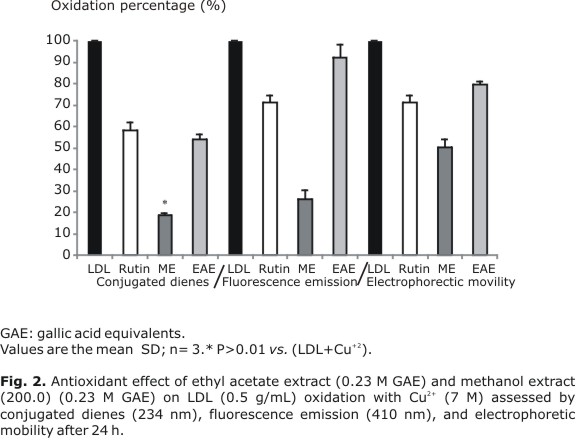
<body><![CDATA[<P>      <P><font face="Verdana" size="2">In the present study, copper-induced LDL oxidation    was inhibited by <I>U. molinae</I> extracts. As shown in <a href="#fig2">Figure    2</a>, this protection was assessed through conjugated dienes, fluorescence    emission, and electrophoretic mobility assays. In our experimental conditions,    ME (0.23 &#181;M GAE) was more effective against copper-induced LDL oxidation    than EAE (0.23 &#181;M GAE). Compared with the untreated control (copper + LDL),    the levels of conjugated dienes at 24 hours were decreased about 83 % with ME.    When EAE was used, only 52 % LDL protection was observed. Fluorescence emission    at 24 hours decreased (75 %) with ME. Again, EAE attained a poor level of LDL    protection (7 %). </font>     <P>&nbsp;     <P align="center"><img src="/img/revistas/pla/v18n4/f0211413.jpg" width="580" height="441"><a name="fig2"></a>     <P><font face="Verdana" size="2">As shown in<B> </B><a href="#fig2">Figure 2</a>,<B>    </B>when LDL was incubated with ME, its electrophoretic mobility at 24 hours    was 50 % of the oxidized LDL mobility. On the other hand, the observed LDL protection    with EAE was 18 % whereas for rutin (flavonol glycoside) it ranged between 30    and 40 %.</font>     <P align="center">&nbsp;     <P>&nbsp;      <P>      <P><font face="Verdana" size="3"><B>DISCUSSION </B></font><font face="Verdana" size="2">    </font>      <P><font face="Verdana" size="2">The above-mentioned results could evidence the    hydrogen/electron donating properties associated to the polyphenols contained    in <I>U. molinae</I> extracts (DPPH, CUPRAC and hydroxyl radical assays). </font>     ]]></body>
<body><![CDATA[<P><font face="Verdana" size="2">The oxidation process observed in the &szlig;-carotene    linoleate system could be summarized in three steps: hydrogen loss, molecular    reordering, and a chain reaction that generates lipid peroxidation by severing    bonds in the lipophilic medium. The fact that polar antioxidants such as those    found in <I>U. molinae</I> are more effective in lipidic systems was previously    observed for other plant sources.<SUP>32</SUP> Such a phenomenon is based on    the protective effect exerted by the air-lipidic-water interface created between    the lipid system and the hydrophilic extract. In this interface, where lipid    oxidation is initiated, polyphenols exert their effects against air-contact    oxidation. In contrast, when this protection is absent, oxidation processes    could continue leading to lipoperoxidation.<SUP>33,34</SUP> </font>      <P><font face="Verdana" size="2">Tissue injury observed in certain pathologies    (atherosclerosis, cancer, liver disease, and the aging process) has been associated    to oxidative stress. The reactive oxygen intermediaries generated during this    process could modify lipids and proteins. In fact, it is thought that oxidative    LDL modification plays a central role in the pathogenesis of atherosclerosis    and coronary heart disease.<SUP>35</SUP> Therefore, limiting LDL modification    through the intake of natural antioxidants from foods and other vegetal sources    could prevent such complications. LDL oxidation could lead to a reduction of    the LDL surface charge density. Oxidized cholesterol esters and triglycerides    are more polar and amphipathic than their precursors; therefore, it would be    energetically less stable for them to remain in the hydrophobic region of LDL.    Migration of these oxidized molecules from the hydrophobic region near the surface    of LDL, reduces particle surface charge density and thus the surface electric    potential of lipoproteins, leading to their aggregation. Regarding the latter,    PUFA molecules may play a leading role in such surface charge density reduction.    Thus, the aldehydes, derived from breakage of the nonpolar side of the fatty    acid ethyl bond, migrate to the surface of the LDL because of the polarity of    the aldehyde group and its ability to form hydrogen bonds. Hydroxyl -or peroxyl-    fatty acids reposition themselves so that both the hydroxyl or peroxyl group    and the carboxyl group reside in the polar and charged head-group region.<SUP>36,37</SUP>    Arrival of these aldehyde, hydroxyl, and peroxyl group at the head-group region    would occupy more space without additional charges and thus reduce charge density.    </font>     <P><font face="Verdana" size="2">LDL results revealed that ME and EAE extracts    decreased diene formation through the stabilization of double bonds that inhibit    molecular reordering. Fluorescence emission results indicated that unsaturated    lipid oxidation end-products were not formed and LDL proteins remained unchanged.    These results differ significantly from those observed for the untreated control    (copper + LDL). The electrophoretic mobility assay allows to register certain    changes in the electric charges of the lipoprotein because lipoprotein oxidation    is manifested as changes in electrical charges and, consequently, higher electrophoretic    mobility. Therefore, our results suggest that <I>U. molinae</I> extracts limit    these changes by slowing LDL oxidation. It must be pointed out that the results    of this last assay could be in part associated with the chelating ability of    gallotannins and not necessarily with direct scavenging properties upon radicals    generated within the LDL particle. Thus, as radicals go deeper into the interior    of the LDL particle, the efficacy of hydrophilic polyphenols becomes smaller.    <I>U. molinae</I> has ursolic, oleanolic, betulinic, assiatic and corosolic    acids.<SUP>3,30</SUP> Antioxidant properties of these pentacyclic triterpene    acids have been reported elsewhere, and their presence in <I>U. molinae</I>    extracts could explain in part the protection of LDL by scavenge radicals located    near the hydrophobic core of this lipoparticle.<SUP>38</SUP> The chemistry of    LDL oxidation has been studied extensively. Many small molecules inside LDL,    including those in the hydrophobic<SUP> </SUP>core, are vulnerable to oxidants.    The following oxidation reactions<SUP> </SUP>have been observed: &szlig;-carotene    to retinol and retinoic acid; alpha-tocopherol<SUP> </SUP>to? alpha-tocopherol    hydroquinone; PUFA to hydroxy- and peroxy-fatty<SUP> </SUP>acids and other derivatives,    including malondialdehyde and other<SUP> </SUP>short-chain aldehydes; ubiquinol    to ubiquinone; and cholesterol<SUP> </SUP>to cholesterol oxides. The<SUP> </SUP>aldehydes    formed could react with amine in apoB and lead to cross-linking<SUP> </SUP>of    lysine residues in different regions of apoB. This type of<SUP> </SUP>lipid/protein    conjugation has been detected for 4-hydroxy-2-nonenal-modified<SUP> </SUP>histidine,    lysine, and cysteine residues by amino acid analysis<SUP> </SUP>of oxidized    LDL.<SUP>39</SUP> All the modifications affect<SUP> </SUP>the integrity of the    LDL structure and lead to a change in<SUP> </SUP>the LDL surface electric property    that is often the cause of protein<SUP> </SUP>aggregation. </font>     <P><font face="Verdana" size="2">The results observed for EAE and ME extracts    could be originated in their different phytochemical composition. The concentrations    of the extracts used in the assays were chosen in terms of the sensitivity of    each method. Therefore, these results are just an <I>in vitro </I>approximation    to assess the potential antioxidant activity of this phytocomplex. A large part    of the <I>U. molinae</I> gallotannins could potentially release gallic acid    in the gastrointestinal ambient. Regarding the latter, it is clear that the    intent to predict the antioxidant activities of such compounds using <I>in vitro</I>    data, requires more studies. For instance, the bio-accessibility of hydrolizable    polyphenols has been evaluated using <I>in vitro</I> simulated gastrointestinal    models.<SUP>40</SUP> The authors investigated the <I>in vitro</I> bio-accessibility    of polyphenols present in the Spanish Mediterranean diet. They estimated that    about 48 % of dietary polyphenols are bioaccessible in the small intestine,    while 42 % become bioaccessible in the large intestine. Previously, we observed    that acute administration of <I>U. molinae</I> infusions to seven healthy volunteers    produced positive changes in their plasma antioxidant capacity (ORAC) after    three days of oral administration. </font>     <P><font face="Verdana" size="2">In our research, two <I>U. molinae</I> extract    fractions were separately evaluated in order to dissect the underlying the protective    effects against lipid peroxidation and free radical damage. Both extracts are    rich in polyphenols, though different in their chemical nature. Nevertheless,    at least in part, such composition underlies the benefits described in folk    medicine. <I>In vivo</I> studies are currently underway to verify whether these    properties are homogeneous in <I>U. molinae</I> samples extracted from different    geographic locations. </font>     <P>&nbsp;      <P>      <P><font face="Verdana" size="3"><B>REFERENCES</B> </font>      <!-- ref --><P><font face="Verdana" size="2">1. Ivanova D, Gerova D, Chervenkov T, Yankova    T. Polyphenols and antioxidant capacity of Bulgarian medicinal plants.<I> </I>J    Ethnopharmacol. 2005;96:145-50.     </font>     ]]></body>
<body><![CDATA[<!-- ref --><P><font face="Verdana" size="2">2. Hoffmann A. Flora silvestre de Chile, zona    Araucana. Chile: Fundaci&oacute;n Claudio Gay; 1991. p. 160.     </font>     <!-- ref --><P><font face="Verdana" size="2">3. Aguirre MC, Delporte C, Backhouse N, Erazo    S, Letelier ME, Cassels BK, et al. Topical anti-inflammatory activity of 2 alpha-hydroxy    pentacyclic triterpene acids from the leaves of <I>Ugni molinae</I>. Bioorganic    Medicinal Chemistry<I>.</I> 2006;14:5673-7.     </font>     <!-- ref --><P><font face="Verdana" size="2">4. Rubilar M, Pinelo M, Ihl M, Scheuermann E,    Sineiro J, Nu&ntilde;ez MJ. Murta leaves (<I>Ugni molinae</I> Turcz.) as a source    of antioxidant polyphenols. J Agricultural Food Chemistry<I>.</I> 2006;54:59-64.        </font>     <!-- ref --><P><font face="Verdana" size="2">5. Devany S, Adams-Huet B, Jialal I. Comparison    of rr-alpha-tocopherol and all-racemic alpha-tocopherol on LDL oxidation. Arteriosclerosis,    Thrombosis, Vascular Biology.<I> </I>1997;17:2273-9.     </font>     <!-- ref --><P><font face="Verdana" size="2">6. Chance B, Sies H, Boveris A. Hydroperoxide    metabolism in mammalian organism.<I> </I>Physiological Reviews. 1979;59<I>:</I>527-605.        </font>     ]]></body>
<body><![CDATA[<!-- ref --><P><font face="Verdana" size="2">7. McCall MR, Frei B. Can antioxidant vitamins    materially reduce oxidative damage in humans? Free Radical Research Communications.    1999;26:1034-53.     </font>     <!-- ref --><P><font face="Verdana" size="2">8. Sohal RS, Weindruch R. Oxidative stress, caloric    restriction and aging.<I> </I>Science<I>.</I> 1996;273:59-63.     </font>     <!-- ref --><P><font face="Verdana" size="2">9. Steinbrecher UP. Beyond cholesterol: modification    of low density lipoprotein that increases its atherogenicity. J Biological Chemistry<I>.</I>    1987;262:3603-10.     </font>     <!-- ref --><P><font face="Verdana" size="2">10. Ross R. The pathogenesis of atherosclerosis:    a perspective for the 1990s<I>. </I>Nature. 1993;362:801-9.     </font>     <!-- ref --><P><font face="Verdana" size="2">11. Palinski W, Rosenfeld ME, Yla-Hertuala S,    Gurther GC, Socher SA, Butler SW, et al. Proceedings of the National Academy    of Sciences of the United States of America<I>. </I>1989;86:1372-6.     </font>     ]]></body>
<body><![CDATA[<!-- ref --><P><font face="Verdana" size="2">12. Parthasarathy S, Satinberg D, Witztum JL.    The role of oxidized low density lipoproteins in the pathogenesis of atherosclerosis<I>.    </I>Annual Review Medicine<I>.</I> 1992;43:219-25.     </font>     <!-- ref --><P><font face="Verdana" size="2">13. Avello M, Pastene E. Actividad antioxidante    de infusos de <I>Ugni molinae</I> Turcz. (Murtilla). Bolet&iacute;n Latinoamericano    y del Caribe de Plantas Medicinales y Arom&aacute;ticas<I>.</I> 2005;4:33-9.        </font>     <!-- ref --><P><font face="Verdana" size="2">14. Arora A, Nair MG, Strasbur M. Structure-activity    relationships for antioxidant activities of a series of flavonoids in a liposomal    system<I>. </I>Free Radical Research Communications.<I> </I>1998;24:1355-60.        </font>     <!-- ref --><P><font face="Verdana" size="2">15. Ellnain-Wojtaszek M, Kruczynski Z, Kasprzak    J. Investigation of the free radical scavenging activity of <I>Ginkgo biloba</I>    L. leaves<I>. </I>Fitoterapia<I>.</I> 2003;74:1-6.     </font>     <!-- ref --><P><font face="Verdana" size="2">16. Dom&iacute;nguez X. M&eacute;todos de investigaci&oacute;n    fitoqu&iacute;mica. M&eacute;xico: Limusa; 1973. p. 81-149.     </font>     ]]></body>
<body><![CDATA[<!-- ref --><P><font face="Verdana" size="2">17. Shinoda J. A new biologically active flavone    glycoside from the roots of <I>Cassia fistula </I>Linn<I>. </I>J Pharmaceutical    Society Japan<I>. </I>1928;48:214.     </font>     <!-- ref --><P><font face="Verdana" size="2">18. Velioglu YS, Mazza G, Gao L, Oomah BD. Antioxidant    activity and total phenolics in selected fruits, vegetables and grain products.    J Agricultural Food Chemistry. 1998;46:4113-7.     </font>     <!-- ref --><P><font face="Verdana" size="2">19. Singleton VL, Rossi JA. Colorimetry of total    phenolics with phosphomolybdic-phosphotungstic acid reagents. American J Enology    Viticultur<I>.</I> 1965;16:144-58.     </font>     <!-- ref --><P><font face="Verdana" size="2">20. Motamed B, Bohm JL, Hennequin D, Texier H,    Mosrati R, Barillier D. Development of an HPLC method for the determination    of phenolic by-products: optimization of the separation by means of the experimental    designs methodology. European J Analytical Chemistry<I>.</I> 2000;28:592-9.        </font>      <!-- ref --><P><font face="Verdana" size="2">21. Navarro MP, Montilla A, Mar&iacute;n J, Jim&eacute;nez    MP. Free radical scavenger and antihepatotoxic activity of <I>Rosmarinus tomentosus.    </I>Planta Medica<I>.</I> 1993;59:312-3.     </font>     ]]></body>
<body><![CDATA[<!-- ref --><P><font face="Verdana" size="2">22. Apak R, G&uuml;cl&uuml; K, Demirata BM, &Ouml;zy&uuml;rek    SE, Celik B, Bektasoglu K, et al. Comparative evaluation of various total antioxidant    capacity assays applied to phenolic compounds with the CUPRAC assay<I>. </I>Molecules.    2007;12:1496-547.     </font>     <!-- ref --><P><font face="Verdana" size="2">23. Halliwell B, Gutteridge J, Aruoma OI. The    deoxyribose method: a simple &#171;test-tube&#187; assay for determination of    rate constants for reactions of hydroxyl radicals<I>. </I>Analytical Biochemistry<I>.</I>    1987;165:215-9.     </font>     <!-- ref --><P><font face="Verdana" size="2">24. Winterbourn CC, Sutton H. Iron and xanthine    oxidase catalyze formation of an oxidant species distinguishable from OH: comparison    with the Haber-Weiss reaction. Biochemical Biophysical Research Communications<I>.</I>    1986;244:227-341.     </font>     <!-- ref --><P><font face="Verdana" size="2">25. Schumaker VN, Puppione D. Sequential flotation    ultracentrifugation<I>. </I>Methods Enzymology. 1986;128:155-70.     </font>     <!-- ref --><P><font face="Verdana" size="2">26. Gugliucci A. Antioxidant effects of <I>Ilex    paraguariensis</I>: induction of decreased oxidability of human LDL <I>in vivo.    </I>Biochemical Biophysical Research Communications. 1996;224:338-44.     </font>      ]]></body>
<body><![CDATA[<!-- ref --><P><font face="Verdana" size="2">27. Esterbauer H, Striegl G, Puhl H, Rotheneder    M. Continuous monitoring of <I>in vitro</I> oxidation of human low density lipoprotein.    Free Radical Biology Medicine. 1989;6:67-75.     </font>     <!-- ref --><P><font face="Verdana" size="2">28. Steinberg D, Parthasarathy S, Carew TE, Khoo    JC, Witztum JL. Beyond cholesterol: modification of low density lipoproteins    that increase its atherogenicity. New England J Medicine. 1989;320:915-24.     </font>     <!-- ref --><P><font face="Verdana" size="2">29. Noble RP. Electrophoretic separation of plasma    lipoproteins in agarose gel<I>. </I>J Lipid Research. 1968;9:693-700.     </font>     <!-- ref --><P><font face="Verdana" size="2">30. Delporte C, Backhouse N, Inostroza V, Aguirre    MC, Peredo N, Silva X, et al. Analgesic activity of <I>Ugni molinae</I> (murtilla)    in mice models of acute pain. J Ethnopharmacol. 2007;112:162-5.     </font>     <!-- ref --><P><font face="Verdana" size="2">31. Belinky PA, Aviram M, Fuhrman B, Rosenblat    M, Vaya J. The antioxidative effects of the isoflavan glabridin on endogenous    constituents of LDL during its oxidation<I>. </I>Atherosclerosis.<I> </I>1998;137:49-61.        </font>     ]]></body>
<body><![CDATA[<!-- ref --><P><font face="Verdana" size="2">32. Khan MA, Shahidi F. Oxidative stability of    stripped and nonstripped borage and evening primrose oils and their emulsions    in water<I>. </I>J American Oil Chemists' Society. 2000;77:963-8.     </font>     <!-- ref --><P><font face="Verdana" size="2">33.<B> </B>Frankel E. Food antioxidants and phytochemicals:    Present and future perspectives<I>. </I>European J Lipid Science Technology.    1999;101:450-5.     </font>     <!-- ref --><P><font face="Verdana" size="2">34. Porter WL. Paradoxical behavior of antioxidants    in food and biological systems. Toxicology Industrial Health<I>.</I> 1993;9:93-122.        </font>     <!-- ref --><P><font face="Verdana" size="2">35. Cox DA, Cohen ML. Effects of oxidized low-density    lipoprotein on vascular contraction and relaxation: clinical and pharmacological    implications in atherosclerosis. Pharmacological Reviews<I>.</I> 1996;48:3-19.        </font>     <!-- ref --><P><font face="Verdana" size="2">36. Kellner BM, Cadenhead DA. Monolayer studies    of hydroxyhexadecanoic acids<I>. </I>J Colloid Interface Science<I>.</I> 1977;63:452-60.        </font>     ]]></body>
<body><![CDATA[<!-- ref --><P><font face="Verdana" size="2">37. Kellner BM, Cadenhead DA. Monolayer studies    of methylhydroydecanoates. Chemistry Physics Lipids<I>.</I> 1978;23:41-8.     </font>     <!-- ref --><P><font face="Verdana" size="2">38. Niki E. Assessment of antioxidant capacity    <I>in vitro</I> and <I>in vivo</I>. Free Radical Biology Medicine<I>.<B> </B></I>2010;49:503-15.        </font>     <!-- ref --><P><font face="Verdana" size="2">39. Uchida K, Toyokuni S, Nishikawa K, Kawakishi    S, Oda H, Hiai H, et al. Michael addition-type 4-hydroxy-2-nonenal adducts in    modified low-density lipoproteins: markers for atherosclerosis. Biochemistry<I>.</I>    1994;33:12487-94.     </font>     <!-- ref --><P><font face="Verdana" size="2">40. Saura-Calixto F, Serrano J, Go&ntilde;i I.    Intake and bioaccessibility of total polyphenols in a whole diet. Food Chemistry<I>.</I>    2007;101:492-501.    </font>     <P>&nbsp;     <P>&nbsp;      ]]></body>
<body><![CDATA[<P>      <P><font face="Verdana" size="2">Recibido: 14 de marzo de 2013.     <br>   Aprobado: 30 de mayo de 2013. </font>     <P>&nbsp;     <P>&nbsp;      <P><font face="Verdana" size="2"><I>Marcia Avello Lorca</I>. Faculty of Pharmacy,    University of Concepci&oacute;n. Casilla 237, Concepci&oacute;n, Chile. Fax:    (56-41) 2207086. Correo electr&oacute;nico: <U><FONT  COLOR="#0000ff"><a href="mailto:maavello@udec.cl">maavello@udec.cl</a></FONT></U>    </font>       ]]></body><back>
<ref-list>
<ref id="B1">
<label>1</label><nlm-citation citation-type="journal">
<person-group person-group-type="author">
<name>
<surname><![CDATA[Ivanova]]></surname>
<given-names><![CDATA[D]]></given-names>
</name>
<name>
<surname><![CDATA[Gerova]]></surname>
<given-names><![CDATA[D]]></given-names>
</name>
<name>
<surname><![CDATA[Chervenkov]]></surname>
<given-names><![CDATA[T]]></given-names>
</name>
<name>
<surname><![CDATA[Yankova]]></surname>
<given-names><![CDATA[T]]></given-names>
</name>
</person-group>
<article-title xml:lang="en"><![CDATA[Polyphenols and antioxidant capacity of Bulgarian medicinal plants]]></article-title>
<source><![CDATA[J Ethnopharmacol.]]></source>
<year>2005</year>
<volume>96</volume>
<page-range>145-50</page-range></nlm-citation>
</ref>
<ref id="B2">
<label>2</label><nlm-citation citation-type="book">
<person-group person-group-type="author">
<name>
<surname><![CDATA[Hoffmann]]></surname>
<given-names><![CDATA[A]]></given-names>
</name>
</person-group>
<source><![CDATA[Flora silvestre de Chile, zona Araucana]]></source>
<year>1991</year>
<page-range>160</page-range><publisher-loc><![CDATA[^eChile Chile]]></publisher-loc>
<publisher-name><![CDATA[Fundación Claudio Gay]]></publisher-name>
</nlm-citation>
</ref>
<ref id="B3">
<label>3</label><nlm-citation citation-type="journal">
<person-group person-group-type="author">
<name>
<surname><![CDATA[Aguirre]]></surname>
<given-names><![CDATA[MC]]></given-names>
</name>
<name>
<surname><![CDATA[Delporte]]></surname>
<given-names><![CDATA[C]]></given-names>
</name>
<name>
<surname><![CDATA[Backhouse]]></surname>
<given-names><![CDATA[N]]></given-names>
</name>
<name>
<surname><![CDATA[Erazo]]></surname>
<given-names><![CDATA[S]]></given-names>
</name>
<name>
<surname><![CDATA[Letelier]]></surname>
<given-names><![CDATA[ME]]></given-names>
</name>
<name>
<surname><![CDATA[Cassels]]></surname>
<given-names><![CDATA[BK]]></given-names>
</name>
</person-group>
<article-title xml:lang="en"><![CDATA[Topical anti-inflammatory activity of 2 alpha-hydroxy pentacyclic triterpene acids from the leaves of Ugni molinae]]></article-title>
<source><![CDATA[Bioorganic Medicinal Chemistry.]]></source>
<year>2006</year>
<volume>14</volume>
<page-range>5673-7</page-range></nlm-citation>
</ref>
<ref id="B4">
<label>4</label><nlm-citation citation-type="journal">
<person-group person-group-type="author">
<name>
<surname><![CDATA[Rubilar]]></surname>
<given-names><![CDATA[M]]></given-names>
</name>
<name>
<surname><![CDATA[Pinelo]]></surname>
<given-names><![CDATA[M]]></given-names>
</name>
<name>
<surname><![CDATA[Ihl]]></surname>
<given-names><![CDATA[M]]></given-names>
</name>
<name>
<surname><![CDATA[Scheuermann]]></surname>
<given-names><![CDATA[E]]></given-names>
</name>
<name>
<surname><![CDATA[Sineiro]]></surname>
<given-names><![CDATA[J]]></given-names>
</name>
<name>
<surname><![CDATA[Nuñez]]></surname>
<given-names><![CDATA[MJ]]></given-names>
</name>
</person-group>
<article-title xml:lang="en"><![CDATA[Murta leaves (Ugni molinae Turcz.) as a source of antioxidant polyphenols]]></article-title>
<source><![CDATA[J Agricultural Food Chemistry.]]></source>
<year>2006</year>
<volume>54</volume>
<page-range>59-64</page-range></nlm-citation>
</ref>
<ref id="B5">
<label>5</label><nlm-citation citation-type="journal">
<person-group person-group-type="author">
<name>
<surname><![CDATA[Devany]]></surname>
<given-names><![CDATA[S]]></given-names>
</name>
<name>
<surname><![CDATA[Adams-Huet]]></surname>
<given-names><![CDATA[B]]></given-names>
</name>
<name>
<surname><![CDATA[Jialal]]></surname>
<given-names><![CDATA[I]]></given-names>
</name>
</person-group>
<article-title xml:lang="en"><![CDATA[Comparison of rr-alpha-tocopherol and all-racemic alpha-tocopherol on LDL oxidation]]></article-title>
<source><![CDATA[Arteriosclerosis, Thrombosis, Vascular Biology.]]></source>
<year>1997</year>
<volume>17</volume>
<page-range>2273-9</page-range></nlm-citation>
</ref>
<ref id="B6">
<label>6</label><nlm-citation citation-type="journal">
<person-group person-group-type="author">
<name>
<surname><![CDATA[Chance]]></surname>
<given-names><![CDATA[B]]></given-names>
</name>
<name>
<surname><![CDATA[Sies]]></surname>
<given-names><![CDATA[H]]></given-names>
</name>
<name>
<surname><![CDATA[Boveris]]></surname>
<given-names><![CDATA[A]]></given-names>
</name>
</person-group>
<article-title xml:lang="en"><![CDATA[Hydroperoxide metabolism in mammalian organism]]></article-title>
<source><![CDATA[Physiological Reviews.]]></source>
<year>1979</year>
<volume>59</volume>
<page-range>527-605</page-range></nlm-citation>
</ref>
<ref id="B7">
<label>7</label><nlm-citation citation-type="journal">
<person-group person-group-type="author">
<name>
<surname><![CDATA[McCall]]></surname>
<given-names><![CDATA[MR]]></given-names>
</name>
<name>
<surname><![CDATA[Frei]]></surname>
<given-names><![CDATA[B]]></given-names>
</name>
</person-group>
<article-title xml:lang="en"><![CDATA[Can antioxidant vitamins materially reduce oxidative damage in humans?]]></article-title>
<source><![CDATA[Radical Research Communications]]></source>
<year>1999</year>
<volume>26</volume>
<page-range>1034-53</page-range></nlm-citation>
</ref>
<ref id="B8">
<label>8</label><nlm-citation citation-type="journal">
<person-group person-group-type="author">
<name>
<surname><![CDATA[Sohal]]></surname>
<given-names><![CDATA[RS]]></given-names>
</name>
<name>
<surname><![CDATA[Weindruch]]></surname>
<given-names><![CDATA[R]]></given-names>
</name>
</person-group>
<article-title xml:lang="en"><![CDATA[Oxidative stress, caloric restriction and aging]]></article-title>
<source><![CDATA[Science.]]></source>
<year>1996</year>
<volume>273</volume>
<page-range>59-63</page-range></nlm-citation>
</ref>
<ref id="B9">
<label>9</label><nlm-citation citation-type="journal">
<person-group person-group-type="author">
<name>
<surname><![CDATA[Steinbrecher]]></surname>
<given-names><![CDATA[UP]]></given-names>
</name>
</person-group>
<article-title xml:lang="en"><![CDATA[Beyond cholesterol: modification of low density lipoprotein that increases its atherogenicity]]></article-title>
<source><![CDATA[J Biological Chemistry.]]></source>
<year>1987</year>
<volume>262</volume>
<page-range>3603-10</page-range></nlm-citation>
</ref>
<ref id="B10">
<label>10</label><nlm-citation citation-type="journal">
<person-group person-group-type="author">
<name>
<surname><![CDATA[Ross]]></surname>
<given-names><![CDATA[R]]></given-names>
</name>
</person-group>
<article-title xml:lang="en"><![CDATA[The pathogenesis of atherosclerosis: a perspective for the 1990s]]></article-title>
<source><![CDATA[Nature.]]></source>
<year>1993</year>
<volume>362</volume>
<page-range>801-9</page-range></nlm-citation>
</ref>
<ref id="B11">
<label>11</label><nlm-citation citation-type="">
<person-group person-group-type="author">
<name>
<surname><![CDATA[Palinski]]></surname>
<given-names><![CDATA[W]]></given-names>
</name>
<name>
<surname><![CDATA[Rosenfeld]]></surname>
<given-names><![CDATA[ME]]></given-names>
</name>
<name>
<surname><![CDATA[Yla-Hertuala]]></surname>
<given-names><![CDATA[S]]></given-names>
</name>
<name>
<surname><![CDATA[Gurther]]></surname>
<given-names><![CDATA[GC]]></given-names>
</name>
<name>
<surname><![CDATA[Socher]]></surname>
<given-names><![CDATA[SA]]></given-names>
</name>
<name>
<surname><![CDATA[Butler]]></surname>
<given-names><![CDATA[SW]]></given-names>
</name>
</person-group>
<article-title xml:lang="en"><![CDATA[Proceedings of the National Academy of Sciences of the United States of America]]></article-title>
<source><![CDATA[]]></source>
<year></year>
</nlm-citation>
</ref>
<ref id="B12">
<label>12</label><nlm-citation citation-type="journal">
<person-group person-group-type="author">
<name>
<surname><![CDATA[Parthasarathy]]></surname>
<given-names><![CDATA[S]]></given-names>
</name>
<name>
<surname><![CDATA[Satinberg]]></surname>
<given-names><![CDATA[D]]></given-names>
</name>
<name>
<surname><![CDATA[Witztum]]></surname>
<given-names><![CDATA[JL]]></given-names>
</name>
</person-group>
<article-title xml:lang="en"><![CDATA[The role of oxidized low density lipoproteins in the pathogenesis of atherosclerosis]]></article-title>
<source><![CDATA[Annual Review Medicine.]]></source>
<year>1992</year>
<volume>43</volume>
<page-range>219-25</page-range></nlm-citation>
</ref>
<ref id="B13">
<label>13</label><nlm-citation citation-type="journal">
<person-group person-group-type="author">
<name>
<surname><![CDATA[Avello]]></surname>
<given-names><![CDATA[M]]></given-names>
</name>
<name>
<surname><![CDATA[Pastene]]></surname>
<given-names><![CDATA[E]]></given-names>
</name>
</person-group>
<article-title xml:lang="es"><![CDATA[Actividad antioxidante de infusos de Ugni molinae Turcz. (Murtilla)]]></article-title>
<source><![CDATA[Boletín Latinoamericano y del Caribe de Plantas Medicinales y Aromáticas]]></source>
<year>2005</year>
<volume>4</volume>
<page-range>33-9</page-range></nlm-citation>
</ref>
<ref id="B14">
<label>14</label><nlm-citation citation-type="journal">
<person-group person-group-type="author">
<name>
<surname><![CDATA[Arora]]></surname>
<given-names><![CDATA[A]]></given-names>
</name>
<name>
<surname><![CDATA[Nair]]></surname>
<given-names><![CDATA[MG]]></given-names>
</name>
<name>
<surname><![CDATA[Strasbur]]></surname>
<given-names><![CDATA[M]]></given-names>
</name>
</person-group>
<article-title xml:lang="en"><![CDATA[Structure-activity relationships for antioxidant activities of a series of flavonoids in a liposomal system]]></article-title>
<source><![CDATA[Free Radical Research Communications.]]></source>
<year>1998</year>
<volume>24</volume>
<page-range>1355-60</page-range></nlm-citation>
</ref>
<ref id="B15">
<label>15</label><nlm-citation citation-type="journal">
<person-group person-group-type="author">
<name>
<surname><![CDATA[Ellnain-Wojtaszek]]></surname>
<given-names><![CDATA[M]]></given-names>
</name>
<name>
<surname><![CDATA[Kruczynski]]></surname>
<given-names><![CDATA[Z]]></given-names>
</name>
<name>
<surname><![CDATA[Kasprzak]]></surname>
<given-names><![CDATA[J]]></given-names>
</name>
</person-group>
<article-title xml:lang="en"><![CDATA[Investigation of the free radical scavenging activity of Ginkgo biloba L. leaves]]></article-title>
<source><![CDATA[Fitoterapia.]]></source>
<year>2003</year>
<volume>74</volume>
<page-range>1-6</page-range></nlm-citation>
</ref>
<ref id="B16">
<label>16</label><nlm-citation citation-type="book">
<person-group person-group-type="author">
<name>
<surname><![CDATA[Domínguez]]></surname>
<given-names><![CDATA[X]]></given-names>
</name>
</person-group>
<source><![CDATA[Métodos de investigación fitoquímica]]></source>
<year>1973</year>
<page-range>81-149</page-range><publisher-loc><![CDATA[^eMéxico México]]></publisher-loc>
<publisher-name><![CDATA[Limusa]]></publisher-name>
</nlm-citation>
</ref>
<ref id="B17">
<label>17</label><nlm-citation citation-type="journal">
<person-group person-group-type="author">
<name>
<surname><![CDATA[Shinoda]]></surname>
<given-names><![CDATA[J]]></given-names>
</name>
</person-group>
<article-title xml:lang="en"><![CDATA[A new biologically active flavone glycoside from the roots of Cassia fistula Linn]]></article-title>
<source><![CDATA[J Pharmaceutical Society Japan.]]></source>
<year>1928</year>
<volume>48</volume>
<page-range>214</page-range></nlm-citation>
</ref>
<ref id="B18">
<label>18</label><nlm-citation citation-type="journal">
<person-group person-group-type="author">
<name>
<surname><![CDATA[Velioglu]]></surname>
<given-names><![CDATA[YS]]></given-names>
</name>
<name>
<surname><![CDATA[Mazza]]></surname>
<given-names><![CDATA[G]]></given-names>
</name>
<name>
<surname><![CDATA[Gao]]></surname>
<given-names><![CDATA[L]]></given-names>
</name>
<name>
<surname><![CDATA[Oomah]]></surname>
<given-names><![CDATA[BD]]></given-names>
</name>
</person-group>
<article-title xml:lang="en"><![CDATA[Antioxidant activity and total phenolics in selected fruits, vegetables and grain products]]></article-title>
<source><![CDATA[J Agricultural Food Chemistry.]]></source>
<year>1998</year>
<volume>46</volume>
<page-range>4113-7</page-range></nlm-citation>
</ref>
<ref id="B19">
<label>19</label><nlm-citation citation-type="journal">
<person-group person-group-type="author">
<name>
<surname><![CDATA[Singleton]]></surname>
<given-names><![CDATA[VL]]></given-names>
</name>
<name>
<surname><![CDATA[Rossi]]></surname>
<given-names><![CDATA[JA]]></given-names>
</name>
</person-group>
<article-title xml:lang="en"><![CDATA[Colorimetry of total phenolics with phosphomolybdic-phosphotungstic acid reagents]]></article-title>
<source><![CDATA[American J Enology Viticultur.]]></source>
<year>1965</year>
<volume>16</volume>
<page-range>144-58</page-range></nlm-citation>
</ref>
<ref id="B20">
<label>20</label><nlm-citation citation-type="journal">
<person-group person-group-type="author">
<name>
<surname><![CDATA[Motamed]]></surname>
<given-names><![CDATA[B]]></given-names>
</name>
<name>
<surname><![CDATA[Bohm]]></surname>
<given-names><![CDATA[JL]]></given-names>
</name>
<name>
<surname><![CDATA[Hennequin]]></surname>
<given-names><![CDATA[D]]></given-names>
</name>
<name>
<surname><![CDATA[Texier]]></surname>
<given-names><![CDATA[H]]></given-names>
</name>
<name>
<surname><![CDATA[Mosrati]]></surname>
<given-names><![CDATA[R]]></given-names>
</name>
<name>
<surname><![CDATA[Barillier]]></surname>
<given-names><![CDATA[D]]></given-names>
</name>
</person-group>
<article-title xml:lang="en"><![CDATA[Development of an HPLC method for the determination of phenolic by-products: optimization of the separation by means of the experimental designs methodology]]></article-title>
<source><![CDATA[European J Analytical Chemistry.]]></source>
<year>2000</year>
<volume>28</volume>
<page-range>592-9</page-range></nlm-citation>
</ref>
<ref id="B21">
<label>21</label><nlm-citation citation-type="journal">
<person-group person-group-type="author">
<name>
<surname><![CDATA[Navarro]]></surname>
<given-names><![CDATA[MP]]></given-names>
</name>
<name>
<surname><![CDATA[Montilla]]></surname>
<given-names><![CDATA[A]]></given-names>
</name>
<name>
<surname><![CDATA[Marín]]></surname>
<given-names><![CDATA[J]]></given-names>
</name>
<name>
<surname><![CDATA[Jiménez]]></surname>
<given-names><![CDATA[MP]]></given-names>
</name>
</person-group>
<article-title xml:lang="en"><![CDATA[Free radical scavenger and antihepatotoxic activity of Rosmarinus tomentosus]]></article-title>
<source><![CDATA[Planta Medica.]]></source>
<year>1993</year>
<volume>59</volume>
<page-range>312-3</page-range></nlm-citation>
</ref>
<ref id="B22">
<label>22</label><nlm-citation citation-type="journal">
<person-group person-group-type="author">
<name>
<surname><![CDATA[Apak]]></surname>
<given-names><![CDATA[R]]></given-names>
</name>
<name>
<surname><![CDATA[Güclü]]></surname>
<given-names><![CDATA[K]]></given-names>
</name>
<name>
<surname><![CDATA[Demirata]]></surname>
<given-names><![CDATA[BM]]></given-names>
</name>
<name>
<surname><![CDATA[Özyürek]]></surname>
<given-names><![CDATA[SE]]></given-names>
</name>
<name>
<surname><![CDATA[Celik]]></surname>
<given-names><![CDATA[B]]></given-names>
</name>
<name>
<surname><![CDATA[Bektasoglu]]></surname>
<given-names><![CDATA[K]]></given-names>
</name>
</person-group>
<article-title xml:lang="en"><![CDATA[Comparative evaluation of various total antioxidant capacity assays applied to phenolic compounds with the CUPRAC assay]]></article-title>
<source><![CDATA[Molecules.]]></source>
<year>2007</year>
<volume>12</volume>
<page-range>1496-547</page-range></nlm-citation>
</ref>
<ref id="B23">
<label>23</label><nlm-citation citation-type="journal">
<person-group person-group-type="author">
<name>
<surname><![CDATA[Halliwell]]></surname>
<given-names><![CDATA[B]]></given-names>
</name>
<name>
<surname><![CDATA[Gutteridge]]></surname>
<given-names><![CDATA[J]]></given-names>
</name>
<name>
<surname><![CDATA[Aruoma]]></surname>
<given-names><![CDATA[OI]]></given-names>
</name>
</person-group>
<article-title xml:lang="en"><![CDATA[The deoxyribose method: a simple «test-tube» assay for determination of rate constants for reactions of hydroxyl radicals]]></article-title>
<source><![CDATA[Analytical Biochemistry.]]></source>
<year>1987</year>
<volume>165</volume>
<page-range>215-9</page-range></nlm-citation>
</ref>
<ref id="B24">
<label>24</label><nlm-citation citation-type="journal">
<person-group person-group-type="author">
<name>
<surname><![CDATA[Winterbourn]]></surname>
<given-names><![CDATA[CC]]></given-names>
</name>
<name>
<surname><![CDATA[Sutton]]></surname>
<given-names><![CDATA[H]]></given-names>
</name>
</person-group>
<article-title xml:lang="en"><![CDATA[Iron and xanthine oxidase catalyze formation of an oxidant species distinguishable from OH: comparison with the Haber-Weiss reaction]]></article-title>
<source><![CDATA[Biochemical Biophysical Research Communications.]]></source>
<year>1986</year>
<volume>244</volume>
<page-range>227-341</page-range></nlm-citation>
</ref>
<ref id="B25">
<label>25</label><nlm-citation citation-type="journal">
<person-group person-group-type="author">
<name>
<surname><![CDATA[Schumaker]]></surname>
<given-names><![CDATA[VN]]></given-names>
</name>
<name>
<surname><![CDATA[Puppione]]></surname>
<given-names><![CDATA[D]]></given-names>
</name>
</person-group>
<article-title xml:lang="en"><![CDATA[Sequential flotation ultracentrifugation]]></article-title>
<source><![CDATA[Methods Enzymology.]]></source>
<year>1986</year>
<volume>128</volume>
<page-range>155-70</page-range></nlm-citation>
</ref>
<ref id="B26">
<label>26</label><nlm-citation citation-type="journal">
<person-group person-group-type="author">
<name>
<surname><![CDATA[Gugliucci]]></surname>
<given-names><![CDATA[A]]></given-names>
</name>
</person-group>
<article-title xml:lang="en"><![CDATA[Antioxidant effects of Ilex paraguariensis: induction of decreased oxidability of human LDL in vivo]]></article-title>
<source><![CDATA[Biochemical Biophysical Research Communications.]]></source>
<year>1996</year>
<volume>224</volume>
<page-range>338-44</page-range></nlm-citation>
</ref>
<ref id="B27">
<label>27</label><nlm-citation citation-type="journal">
<person-group person-group-type="author">
<name>
<surname><![CDATA[Esterbauer]]></surname>
<given-names><![CDATA[H]]></given-names>
</name>
<name>
<surname><![CDATA[Striegl]]></surname>
<given-names><![CDATA[G]]></given-names>
</name>
<name>
<surname><![CDATA[Puhl]]></surname>
<given-names><![CDATA[H]]></given-names>
</name>
<name>
<surname><![CDATA[Rotheneder]]></surname>
<given-names><![CDATA[M]]></given-names>
</name>
</person-group>
<article-title xml:lang="en"><![CDATA[Continuous monitoring of in vitro oxidation of human low density lipoprotein]]></article-title>
<source><![CDATA[Free Radical Biology Medicine.]]></source>
<year>1989</year>
<volume>6</volume>
<page-range>67-75</page-range></nlm-citation>
</ref>
<ref id="B28">
<label>28</label><nlm-citation citation-type="journal">
<person-group person-group-type="author">
<name>
<surname><![CDATA[Steinberg]]></surname>
<given-names><![CDATA[D]]></given-names>
</name>
<name>
<surname><![CDATA[Parthasarathy]]></surname>
<given-names><![CDATA[S]]></given-names>
</name>
<name>
<surname><![CDATA[Carew]]></surname>
<given-names><![CDATA[TE]]></given-names>
</name>
<name>
<surname><![CDATA[Khoo]]></surname>
<given-names><![CDATA[JC]]></given-names>
</name>
<name>
<surname><![CDATA[Witztum]]></surname>
<given-names><![CDATA[JL]]></given-names>
</name>
</person-group>
<article-title xml:lang="en"><![CDATA[Beyond cholesterol: modification of low density lipoproteins that increase its atherogenicity]]></article-title>
<source><![CDATA[New England J Medicine.]]></source>
<year>1989</year>
<volume>320</volume>
<page-range>915-24</page-range></nlm-citation>
</ref>
<ref id="B29">
<label>29</label><nlm-citation citation-type="journal">
<person-group person-group-type="author">
<name>
<surname><![CDATA[Noble]]></surname>
<given-names><![CDATA[RP]]></given-names>
</name>
</person-group>
<article-title xml:lang="en"><![CDATA[Electrophoretic separation of plasma lipoproteins in agarose gel]]></article-title>
<source><![CDATA[J Lipid Research.]]></source>
<year>1968</year>
<volume>9</volume>
<page-range>693-700</page-range></nlm-citation>
</ref>
<ref id="B30">
<label>30</label><nlm-citation citation-type="journal">
<person-group person-group-type="author">
<name>
<surname><![CDATA[Delporte]]></surname>
<given-names><![CDATA[C]]></given-names>
</name>
<name>
<surname><![CDATA[Backhouse]]></surname>
<given-names><![CDATA[N]]></given-names>
</name>
<name>
<surname><![CDATA[Inostroza]]></surname>
<given-names><![CDATA[V]]></given-names>
</name>
<name>
<surname><![CDATA[Aguirre]]></surname>
<given-names><![CDATA[MC]]></given-names>
</name>
<name>
<surname><![CDATA[Peredo]]></surname>
<given-names><![CDATA[N]]></given-names>
</name>
<name>
<surname><![CDATA[Silva]]></surname>
<given-names><![CDATA[X]]></given-names>
</name>
</person-group>
<article-title xml:lang="en"><![CDATA[Analgesic activity of Ugni molinae (murtilla) in mice models of acute pain]]></article-title>
<source><![CDATA[J Ethnopharmacol.]]></source>
<year>2007</year>
<volume>112</volume>
<page-range>162-5</page-range></nlm-citation>
</ref>
<ref id="B31">
<label>31</label><nlm-citation citation-type="journal">
<person-group person-group-type="author">
<name>
<surname><![CDATA[Belinky]]></surname>
<given-names><![CDATA[PA]]></given-names>
</name>
<name>
<surname><![CDATA[Aviram]]></surname>
<given-names><![CDATA[M]]></given-names>
</name>
<name>
<surname><![CDATA[Fuhrman]]></surname>
<given-names><![CDATA[B]]></given-names>
</name>
<name>
<surname><![CDATA[Rosenblat]]></surname>
<given-names><![CDATA[M]]></given-names>
</name>
<name>
<surname><![CDATA[Vaya]]></surname>
<given-names><![CDATA[J]]></given-names>
</name>
</person-group>
<article-title xml:lang="en"><![CDATA[The antioxidative effects of the isoflavan glabridin on endogenous constituents of LDL during its oxidation]]></article-title>
<source><![CDATA[Atherosclerosis.]]></source>
<year>1998</year>
<volume>137</volume>
<page-range>49-61</page-range></nlm-citation>
</ref>
<ref id="B32">
<label>32</label><nlm-citation citation-type="journal">
<person-group person-group-type="author">
<name>
<surname><![CDATA[Khan]]></surname>
<given-names><![CDATA[MA]]></given-names>
</name>
<name>
<surname><![CDATA[Shahidi]]></surname>
<given-names><![CDATA[F]]></given-names>
</name>
</person-group>
<article-title xml:lang="en"><![CDATA[Oxidative stability of stripped and nonstripped borage and evening primrose oils and their emulsions in water]]></article-title>
<source><![CDATA[J American Oil Chemists' Society.]]></source>
<year>2000</year>
<volume>77</volume>
<page-range>963-8</page-range></nlm-citation>
</ref>
<ref id="B33">
<label>33</label><nlm-citation citation-type="journal">
<person-group person-group-type="author">
<name>
<surname><![CDATA[Frankel]]></surname>
<given-names><![CDATA[E]]></given-names>
</name>
</person-group>
<article-title xml:lang="en"><![CDATA[Food antioxidants and phytochemicals: Present and future perspectives]]></article-title>
<source><![CDATA[European J Lipid Science Technology.]]></source>
<year>1999</year>
<volume>101</volume>
<page-range>450-5</page-range></nlm-citation>
</ref>
<ref id="B34">
<label>34</label><nlm-citation citation-type="journal">
<person-group person-group-type="author">
<name>
<surname><![CDATA[Porter]]></surname>
<given-names><![CDATA[WL]]></given-names>
</name>
</person-group>
<article-title xml:lang="en"><![CDATA[Paradoxical behavior of antioxidants in food and biological systems]]></article-title>
<source><![CDATA[Toxicology Industrial Health.]]></source>
<year>1993</year>
<volume>9</volume>
<page-range>93-122</page-range></nlm-citation>
</ref>
<ref id="B35">
<label>35</label><nlm-citation citation-type="journal">
<person-group person-group-type="author">
<name>
<surname><![CDATA[Cox]]></surname>
<given-names><![CDATA[DA]]></given-names>
</name>
<name>
<surname><![CDATA[Cohen]]></surname>
<given-names><![CDATA[ML]]></given-names>
</name>
</person-group>
<article-title xml:lang="en"><![CDATA[Effects of oxidized low-density lipoprotein on vascular contraction and relaxation: clinical and pharmacological implications in atherosclerosis]]></article-title>
<source><![CDATA[Pharmacological Reviews.]]></source>
<year>1996</year>
<volume>48</volume>
<page-range>3-19</page-range></nlm-citation>
</ref>
<ref id="B36">
<label>36</label><nlm-citation citation-type="journal">
<person-group person-group-type="author">
<name>
<surname><![CDATA[Kellner]]></surname>
<given-names><![CDATA[BM]]></given-names>
</name>
<name>
<surname><![CDATA[Cadenhead]]></surname>
<given-names><![CDATA[DA]]></given-names>
</name>
</person-group>
<article-title xml:lang="en"><![CDATA[Monolayer studies of hydroxyhexadecanoic acids]]></article-title>
<source><![CDATA[J Colloid Interface Science.]]></source>
<year>1977</year>
<volume>63</volume>
<page-range>452-60</page-range></nlm-citation>
</ref>
<ref id="B37">
<label>37</label><nlm-citation citation-type="journal">
<person-group person-group-type="author">
<name>
<surname><![CDATA[Kellner]]></surname>
<given-names><![CDATA[BM]]></given-names>
</name>
<name>
<surname><![CDATA[Cadenhead]]></surname>
<given-names><![CDATA[DA]]></given-names>
</name>
</person-group>
<article-title xml:lang="en"><![CDATA[Monolayer studies of methylhydroydecanoates]]></article-title>
<source><![CDATA[Chemistry Physics Lipids.]]></source>
<year>1978</year>
<volume>23</volume>
<page-range>41-8</page-range></nlm-citation>
</ref>
<ref id="B38">
<label>38</label><nlm-citation citation-type="journal">
<person-group person-group-type="author">
<name>
<surname><![CDATA[Niki]]></surname>
<given-names><![CDATA[E]]></given-names>
</name>
</person-group>
<article-title xml:lang="en"><![CDATA[Assessment of antioxidant capacity in vitro and in vivo]]></article-title>
<source><![CDATA[Free Radical Biology Medicine.]]></source>
<year>2010</year>
<volume>49</volume>
<page-range>503-15</page-range></nlm-citation>
</ref>
<ref id="B39">
<label>39</label><nlm-citation citation-type="journal">
<person-group person-group-type="author">
<name>
<surname><![CDATA[Uchida]]></surname>
<given-names><![CDATA[K]]></given-names>
</name>
<name>
<surname><![CDATA[Toyokuni]]></surname>
<given-names><![CDATA[S]]></given-names>
</name>
<name>
<surname><![CDATA[Nishikawa]]></surname>
<given-names><![CDATA[K]]></given-names>
</name>
<name>
<surname><![CDATA[Kawakishi]]></surname>
<given-names><![CDATA[S]]></given-names>
</name>
<name>
<surname><![CDATA[Oda]]></surname>
<given-names><![CDATA[H]]></given-names>
</name>
<name>
<surname><![CDATA[Hiai]]></surname>
<given-names><![CDATA[H]]></given-names>
</name>
</person-group>
<article-title xml:lang="en"><![CDATA[Michael addition-type 4-hydroxy-2-nonenal adducts in modified low-density lipoproteins: markers for atherosclerosis]]></article-title>
<source><![CDATA[Biochemistry.]]></source>
<year>1994</year>
<volume>33</volume>
<page-range>12487-94</page-range></nlm-citation>
</ref>
<ref id="B40">
<label>40</label><nlm-citation citation-type="journal">
<person-group person-group-type="author">
<name>
<surname><![CDATA[Saura-Calixto]]></surname>
<given-names><![CDATA[F]]></given-names>
</name>
<name>
<surname><![CDATA[Serrano]]></surname>
<given-names><![CDATA[J]]></given-names>
</name>
<name>
<surname><![CDATA[Goñi]]></surname>
<given-names><![CDATA[I]]></given-names>
</name>
</person-group>
<article-title xml:lang="en"><![CDATA[Intake and bioaccessibility of total polyphenols in a whole diet]]></article-title>
<source><![CDATA[Food Chemistry.]]></source>
<year>2007</year>
<volume>101</volume>
<page-range>492-501</page-range></nlm-citation>
</ref>
</ref-list>
</back>
</article>