<?xml version="1.0" encoding="ISO-8859-1"?><article xmlns:mml="http://www.w3.org/1998/Math/MathML" xmlns:xlink="http://www.w3.org/1999/xlink" xmlns:xsi="http://www.w3.org/2001/XMLSchema-instance">
<front>
<journal-meta>
<journal-id>1028-4796</journal-id>
<journal-title><![CDATA[Revista Cubana de Plantas Medicinales]]></journal-title>
<abbrev-journal-title><![CDATA[Rev Cubana Plant Med]]></abbrev-journal-title>
<issn>1028-4796</issn>
<publisher>
<publisher-name><![CDATA[ECIMED]]></publisher-name>
</publisher>
</journal-meta>
<article-meta>
<article-id>S1028-47962014000100005</article-id>
<title-group>
<article-title xml:lang="en"><![CDATA[Preclinical validation of antinociceptive, antiinflammatory, and antipyretic activities of Cordia martinicensis leave decoction]]></article-title>
<article-title xml:lang="es"><![CDATA[Validación preclínica de las actividades antinociceptiva, antiinflamatoria y antipirética de decocción de hojas de Cordia martinicensis]]></article-title>
</title-group>
<contrib-group>
<contrib contrib-type="author">
<name>
<surname><![CDATA[Martínez Hormaza]]></surname>
<given-names><![CDATA[Ioanna]]></given-names>
</name>
<xref ref-type="aff" rid="A01"/>
</contrib>
<contrib contrib-type="author">
<name>
<surname><![CDATA[Victoria Amador]]></surname>
<given-names><![CDATA[María del Carmen]]></given-names>
</name>
<xref ref-type="aff" rid="A01"/>
</contrib>
<contrib contrib-type="author">
<name>
<surname><![CDATA[Brito Álvarez]]></surname>
<given-names><![CDATA[Gisselle]]></given-names>
</name>
<xref ref-type="aff" rid="A01"/>
</contrib>
<contrib contrib-type="author">
<name>
<surname><![CDATA[Morón Rodríguez]]></surname>
<given-names><![CDATA[Francisco]]></given-names>
</name>
<xref ref-type="aff" rid="A01"/>
</contrib>
<contrib contrib-type="author">
<name>
<surname><![CDATA[López Barreiro]]></surname>
<given-names><![CDATA[Marisol]]></given-names>
</name>
<xref ref-type="aff" rid="A01"/>
</contrib>
<contrib contrib-type="author">
<name>
<surname><![CDATA[García Hernández]]></surname>
<given-names><![CDATA[Ana Ibis]]></given-names>
</name>
<xref ref-type="aff" rid="A01"/>
</contrib>
<contrib contrib-type="author">
<name>
<surname><![CDATA[Duménigo González]]></surname>
<given-names><![CDATA[Abel]]></given-names>
</name>
<xref ref-type="aff" rid="A01"/>
</contrib>
<contrib contrib-type="author">
<name>
<surname><![CDATA[Morejón Rodríguez]]></surname>
<given-names><![CDATA[Zulema]]></given-names>
</name>
<xref ref-type="aff" rid="A01"/>
</contrib>
<contrib contrib-type="author">
<name>
<surname><![CDATA[Bacallao Elguea]]></surname>
<given-names><![CDATA[Yunier]]></given-names>
</name>
<xref ref-type="aff" rid="A01"/>
</contrib>
<contrib contrib-type="author">
<name>
<surname><![CDATA[Nossin]]></surname>
<given-names><![CDATA[Emmanuel]]></given-names>
</name>
<xref ref-type="aff" rid="A02"/>
</contrib>
</contrib-group>
<aff id="A01">
<institution><![CDATA[,Faculty of Medical Sciences Central Pharmacology Laboratory Dr. Salvador Allende ]]></institution>
<addr-line><![CDATA[. Havana ]]></addr-line>
<country>Cuba</country>
</aff>
<aff id="A02">
<institution><![CDATA[,TRAMIL  ]]></institution>
<addr-line><![CDATA[Martinique ]]></addr-line>
<country>France</country>
</aff>
<pub-date pub-type="pub">
<day>00</day>
<month>03</month>
<year>2014</year>
</pub-date>
<pub-date pub-type="epub">
<day>00</day>
<month>03</month>
<year>2014</year>
</pub-date>
<volume>19</volume>
<numero>1</numero>
<fpage>29</fpage>
<lpage>39</lpage>
<copyright-statement/>
<copyright-year/>
<self-uri xlink:href="http://scielo.sld.cu/scielo.php?script=sci_arttext&amp;pid=S1028-47962014000100005&amp;lng=en&amp;nrm=iso"></self-uri><self-uri xlink:href="http://scielo.sld.cu/scielo.php?script=sci_abstract&amp;pid=S1028-47962014000100005&amp;lng=en&amp;nrm=iso"></self-uri><self-uri xlink:href="http://scielo.sld.cu/scielo.php?script=sci_pdf&amp;pid=S1028-47962014000100005&amp;lng=en&amp;nrm=iso"></self-uri><abstract abstract-type="short" xml:lang="en"><p><![CDATA[Introduction: leave decoction of Cordia martinicensis (Jacq.) Roem. & Schult. is commonly used in Dominica, Martinique and St. Lucia to relieve thoracic pain and fever. Objectives: to validate the antiinflammatory, antinociceptive (analgesic), and antipyretic ethnobotanical uses of Cordia martinicensis in experimental animal models. Methods: 30 % aqueous extract of Cordia martinicensis dry leaves was prepared just before use. Analgesic activity was assayed by writhing and tail flick, and antiinflammatory activity by the ear oedema test, both in mice. Finally, antipyretic activity was tested by inducing pyrexia with brewer's yeast in rats. Results: decoction of Cordia martinicensis significantly decreased the number of abdominal stretchings by 44.4 %, but it didn't produce a significant antinociceptive response to thermal stimuli. It also displayed strong antiinflammatory activity, the percentage of inhibition was near 60 %, and a dose of 5 mg/kg showed significant antipyretic activity. Cordia martinicensis reacted positively to alkaloids, flavonoids, tannins, and anthocyanidines, and did not show any signs of toxicity. Conclusions: this is the first report on the activity of Cordia martinicensis directly related to its popular use, and it provides pharmacological validation for the relief of fever, inflammation and pain. Further studies should be done to identify the active principles responsible for the biological activity of the plant.]]></p></abstract>
<abstract abstract-type="short" xml:lang="es"><p><![CDATA[Introducción: la decocción de hojas de Cordia martinicensis (Jacq.) Roem. & Schult. muestra un uso tradicional significativo para el alivio del dolor torácico y la fiebre, por parte de la población de Dominica, Martinica y Santa Lucía. Objetivos: validar el uso etnobotánico de Cordia martinicensis en esta región, como antiinflamatorio, antinociceptivo (analgésico) y antipirético, en modelos experimentales en animales. Métodos: el extracto acuoso al 30 % de hojas secas de Cordia martinicensis se preparó justo antes de ser usado. La actividad analgésica fue estudiada mediante el modelo de contorciones abdominales y retirada de la cola en ratones. El efecto antiinflamatorio se evaluó sobre el edema en la oreja del ratón inducido por aceite de Croton. Finalmente, la actividad antipirética del extracto se evaluó mediante la inducción de fiebre en ratas por levadura de cerveza. Resultados: la decocción de Cordia martinicensis disminuyó significativamente el número de contorciones abdominales en 44.4 %, pero no la respuesta al estímulo térmico; en edema en la oreja inhibió la inflamación 60 %, tanto tópico como oral. Resultó capaz de disminuir la fiebre a dosis de 5 mg/kg. Cordia martinicensis contiene alcaloides, flavonoides, taninos, y antocyanidinas y no mostró señales de toxicidad. Conclusiones: constituye el primer estudio de validación del uso tradicional de Cordia martinicensis, avalando el uso farmacológico en procesos de fiebre, dolor e inflamación. Es necesario continuar los estudios fitoquímicos para determinar los principios activos responsables de su actividad biológica.]]></p></abstract>
<kwd-group>
<kwd lng="en"><![CDATA[Cordia martinicensis]]></kwd>
<kwd lng="en"><![CDATA[analgesic]]></kwd>
<kwd lng="en"><![CDATA[antiinflammatory]]></kwd>
<kwd lng="en"><![CDATA[antipyretic]]></kwd>
<kwd lng="es"><![CDATA[Cordia martinicensis]]></kwd>
<kwd lng="es"><![CDATA[analgesia]]></kwd>
<kwd lng="es"><![CDATA[antiinflamatorio]]></kwd>
<kwd lng="es"><![CDATA[antipirético]]></kwd>
</kwd-group>
</article-meta>
</front><body><![CDATA[ <div align="right">       <p><font face="Verdana" size="2"><B>ART&Iacute;CULO ORIGINAL</B></font></p>       <p>&nbsp;</p> </div> <B>     <P>      <P><font face="Verdana" size="4">Preclinical validation of antinociceptive, antiinflammatory,    and antipyretic activities of <I>Cordia martinicensis </I>leave decoction </font>      <P>&nbsp;      <P>      <P><font face="Verdana" size="3">Validaci&oacute;n precl&iacute;nica de las actividades    antinociceptiva, antiinflamatoria y antipir&eacute;tica de decocci&oacute;n    de hojas de <I>Cordia martinicensis</I> </font>      <P>&nbsp;      <P>&nbsp;      ]]></body>
<body><![CDATA[<P>  </B>      <P><b><font face="Verdana" size="2">MSc. Ioanna Mart&iacute;nez Hormaza,<SUP>I</SUP>    MSc. Mar&iacute;a del Carmen Victoria Amador,<SUP>I</SUP> BA. Gisselle Brito    &Aacute;lvarez,<SUP>I</SUP> PhD. Francisco Mor&oacute;n Rodr&iacute;guez&#134;,<SUP>I</SUP>    BA. Marisol L&oacute;pez Barreiro,<SUP>I </SUP>MSc. Ana Ibis Garc&iacute;a Hern&aacute;ndez,<SUP>I</SUP>    BA. Abel Dum&eacute;nigo Gonz&aacute;lez,<SUP>I</SUP> BA. Zulema Morej&oacute;n    Rodr&iacute;guez,<SUP>I</SUP> Tech. Yunier Bacallao Elguea,<SUP>I</SUP> PhD.    Emmanuel Nossin,<SUP>II </SUP></font> </b>      <P>      <P><font face="Verdana" size="2"><SUP>I</SUP> Central Pharmacology Laboratory    &quot;Dr. Salvador Allende&quot; Faculty of Medical Sciences. Havana, Cuba    <br>   </font><font face="Verdana" size="2"><SUP>II</SUP> TRAMIL. Martinique, France.</font>     <P>&nbsp;     <P>&nbsp;  <hr size="1" noshade> <font face="Verdana" size="2"><B>ABSTRACT</B></font>      <P><font face="Verdana" size="2"><B>Introduction:</b> leave decoction of<B> </B><I>Cordia    martinicensis (</I>Jacq.) Roem. &amp; Schult. is commonly used in Dominica,    Martinique and St. Lucia to relieve thoracic pain and fever. <B>    <br>   Objectives:</B> to validate the antiinflammatory, antinociceptive (analgesic),    and antipyretic ethnobotanical uses of <I>Cordia martinicensis </I>in experimental    animal models. <B>    <br>   Methods:</B> 30 % aqueous extract of <I>Cordia martinicensis</I> dry leaves    was prepared just before use. Analgesic activity was assayed by writhing and    tail flick, and antiinflammatory activity by the ear oedema test, both in mice.    Finally, antipyretic activity was tested by inducing pyrexia with brewer's yeast    in rats. <B>    ]]></body>
<body><![CDATA[<br>   Results:</B> decoction of <I>Cordia martinicensis</I> significantly decreased    the number of abdominal stretchings by 44.4 %, but it didn't produce a significant    antinociceptive response to thermal stimuli. It also displayed strong antiinflammatory    activity, the percentage of inhibition was near 60 %, and a dose of 5 mg/kg    showed significant antipyretic activity. <I>Cordia martinicensis</I> reacted    positively to alkaloids, flavonoids, tannins, and anthocyanidines, and did not    show any signs of toxicity. <B>    <br>   Conclusions:</B> this is the first report on the activity of <I>Cordia martinicensis    </I>directly related to its popular use, and it provides pharmacological validation    for the relief of fever, inflammation and pain. Further studies should be done    to identify the active principles responsible for the biological activity of    the plant. </font>  <B></B>      <P>      <P><font face="Verdana" size="2"><B>Key words:</B> <I>Cordia martinicensis, </I>analgesic,    antiinflammatory, antipyretic.</font> <hr size="1" noshade> <font face="Verdana" size="2"><B>RESUMEN</B></font>      <P> <font face="Verdana" size="2"><B>Introducci&oacute;n:</b> la decocci&oacute;n    de hojas de <I>Cordia martinicensis</I> (Jacq.) Roem. &amp; Schult. muestra    un uso tradicional significativo para el alivio del dolor tor&aacute;cico y    la fiebre, por parte de la poblaci&oacute;n de Dominica, Martinica y Santa Luc&iacute;a.    <B>    <br>   Objetivos:</B> validar el uso etnobot&aacute;nico de <I>Cordia martinicensis</I>    en esta regi&oacute;n, como antiinflamatorio, antinociceptivo (analg&eacute;sico)    y antipir&eacute;tico, en modelos experimentales en animales. <B>    <br>   M&eacute;todos:</B> el extracto acuoso al 30 % de hojas secas de <I>Cordia martinicensis</I>    se prepar&oacute; justo antes de ser usado. La actividad analg&eacute;sica fue    estudiada mediante el modelo de contorciones abdominales y retirada de la cola    en ratones. El efecto antiinflamatorio se evalu&oacute; sobre el edema en la    oreja del rat&oacute;n inducido por aceite de <I>Croton</I>.<B> </B>Finalmente,    la actividad antipir&eacute;tica del extracto se evalu&oacute; mediante la inducci&oacute;n    de fiebre en ratas por levadura de cerveza. <B>    <br>   Resultados:</B> la decocci&oacute;n de <I>Cordia martinicensis</I> disminuy&oacute;    significativamente el n&uacute;mero de contorciones abdominales en 44.4 %, pero    no la respuesta al est&iacute;mulo t&eacute;rmico; en edema en la oreja inhibi&oacute;    la inflamaci&oacute;n 60 %, tanto t&oacute;pico como oral. Result&oacute; capaz    de disminuir la fiebre a dosis de 5 mg/kg. <I>Cordia martinicensis</I> contiene    alcaloides, flavonoides, taninos, y antocyanidinas y no mostr&oacute; se&ntilde;ales    de toxicidad. <B>    <br>   Conclusiones:</B> constituye el primer estudio de validaci&oacute;n del uso    tradicional de <I>Cordia martinicensis</I>, avalando el uso farmacol&oacute;gico    en procesos de fiebre, dolor e inflamaci&oacute;n. Es necesario continuar los    estudios fitoqu&iacute;micos para determinar los principios activos responsables    de su actividad biol&oacute;gica. </font>  <B></B>      <P>      ]]></body>
<body><![CDATA[<P><font face="Verdana" size="2"><B>Palabras clave:</B> <I>Cordia martinicensis,    </I>analgesia, antiinflamatorio, antipir&eacute;tico.<STRIKE> </STRIKE></font> <hr size="1" noshade>     <P><font size="2" face="Verdana"><b>    <br>       <br>   </b></font><font size="3" face="Verdana"></font>      <P>      <P><font face="Verdana" size="3"><B>INTRODUCTION</B></font>      <P>      <P><font face="Verdana" size="2"><I>Cordia</I> is a genus of trees or shrubs,    sometimes subscandent in the borage family Boraginaceae. About 300 species have    been identified, generally in tropical regions, frequently growing in gardens    with beautiful flowers. It has been used as a wound healing agent, as astringent,    antiinflammatory, anthelminthic, antimalarial, diuretic, febrifuge, appetite    suppressant, cough suppressant, and to treat urinary infections, lung diseases,    and leprosy in traditional medicine.<SUP>1,2</SUP> </font>     <P><font face="Verdana" size="2">An ethnobotanical survey conducted as part of    the Program for Applied Research and Diffusion of Traditional Plant Uses in    the Caribbean (TRAMIL), found that leave decoction of <I>Cordia martinicensis    (</I>Jacq.) Roem. &amp; Schult. was commonly used by local populations to relieve    thoracic pain and fever. This species is native to the Lesser Antilles and is    distributed in Dominica, Martinique and St. Lucia. It is popularly known as    Black sage, <I>mahaut noir</I>, <I>maho nwe</I>, <I>mahot noir</I>.<SUP>3,4</SUP><STRIKE>    </STRIKE> </font>      <P><font face="Verdana" size="2">The aim of the present research was to validate    the antiinflammatory, antinociceptive (analgesic), and antipyretic ethnobotanical    uses in this region by means of experimental animal models. </font>      ]]></body>
<body><![CDATA[<P>&nbsp;     <P>      <P><font face="Verdana" size="3"><B>METHODS</B></font>      <P>      <P><font face="Verdana" size="2">Analgesic and antiinflammatory activity was assayed    using two antinociception models (writhing and tail flick tests) and an acute    inflammation model (ear oedema test) in mice. Finally, antipyretic activity    was tested by inducing pyrexia with brewer's yeast in rats. </font>     <P>      <P> <font face="Verdana" size="2"><I>Plant materials </I></font>     <P><font face="Verdana" size="2"><I>Cordia martinicensis (</i>Jacq.) Roem. &amp;    Schult. leaves were collected from <I>Le Pr&ecirc;cheur</I>, Martinique, and    authenticated by Dr. Emmanuel Nossin in Martinique. A voucher, under number    LN-14, was deposited at <I>Herbier l'Association pour la Valorisation des Plantes    M&eacute;dicinales de la Cara&iuml;be</I> (HAVPMC). </font>  <I></I>      <P>      <P><font face="Verdana" size="2"><I>Preparation of the extract</I> </font>     ]]></body>
<body><![CDATA[<P>      <P><font face="Verdana" size="2">Leaves were carefully washed and disinfected.    They were dried in a naturally ventilated room in the shade. Aqueous extracts    (decoction) of <I>Cordia martinicensis</I> were prepared just before use, boiling    dry leaves in distilled water on a low flame for 10 min, followed by fast paper    filtration. </font>     <P>      <P><font face="Verdana" size="2"><I>Phytochemical screening</I> </font>     <P>      <P><font face="Verdana" size="2">Phytochemical analysis was performed on 30 %    decoction through various tests, mainly chemical reaction identification by    color change or precipitated formations, determining the presence of secondary    metabolites: &ucirc;avonoids (<I>Shinoda</I>), phenolic and tannin compounds    (ferric chloride FeCl<SUB>3</SUB>), alkaloids (<I>Dragendorff </I>and <I>Mayer</I>),    triterpenes and steroids (<I>Liebermann</I>-<I>Buchard</I>), quinones (<I>Bortrager</I>),    lactonic compounds and coumarins (<I>Baljet</I>), amino acids (ninhidrine),    anthocyanidines (<I>Rosenhein</I>) and reducing sugar (<I>Fehling)</I>, saponines    (foam), starch (lugol).<SUP>5</SUP> </font>     <P>      <P><font face="Verdana" size="2"><I>Animals</I> </font>     <P>      <P><font face="Verdana" size="2">Animals were obtained from the National Center    for Experimental Animals Production (CENPALAB, Havana, Cuba). They were kept    under controlled conditions, 23 &#177; 0.5 <SUP>o</SUP>C, relative humidity    50-60 %, in a 12 h:12 h alternate light-dark cycle, food and water ad libitum.    All experimental protocols were approved by the Institutional Animal Care and    Ethical Committee at the Central Pharmacological Research Unit of the Medical    Sciences University of Havana, following the &quot;Principles of Laboratory    Animal Care&quot;. Prior to each experiment animals were fasted for 12 h with    free access to water.<SUP>6,7</SUP> </font>      ]]></body>
<body><![CDATA[<P>      <P><font face="Verdana" size="2"><B>Acute toxicity tests</B> </font>     <P>      <P><font face="Verdana" size="2"><I>Acute toxic class method </I> </font>     <P>      <P><font face="Verdana" size="2">Six non isogenic Wistar rats (3 per sex) weighing    between 200-250 g were used in the study. Aqueous leave extract of <I>Cordia    martinicensis</I> (50 %) was administered by orogastric gavages. Due to the    low concentrations of total solids in the decoction (2.6 %), animals were administered    the maximum allowable volume (equivalent to 520 mg/kg of body weight). After    a single dose animals were constantly observed during the first 24 h, and then    once a day, recording the weight and any clinical sign.<SUP>8,9</SUP> </font>     <P>      <P><font face="Verdana" size="2"><I>Acute oral repeated dose toxicity</I> </font>     <P>      <P><font face="Verdana" size="2">Decoction of <I>Cordia martinicensis</I> (50    %), dose 1 000 mg/kg, was administered during five consecutive days to 10 Wistar    rats (5 per sex) weighing between 200-250 g. <I>Cordia martinicensis</I> was    given in 2 administrations which were separated 4 h. Animals were constantly    observed during the first 12 h and every 24 h for 14 days, recording the weight    and any clinical sign. </font>     ]]></body>
<body><![CDATA[<P><font face="Verdana" size="2">In both methods, on day 14 the animals were sacrificed    by inhalation of ether and a macroscopic study of entire organs was performed.<SUP>10</SUP>    </font>     <P>      <P><font face="Verdana" size="2"><I>Analgesic activity</I> </font>     <P>      <P><font face="Verdana" size="2">Analgesic effect of <I>Cordia martinicensis</I>    decoction (30 %) was evaluated using two different models: writhing and tail-flick    test. Ten non-isogenic male OF-1 mice (20-25 g) were used in each group. In    both test, animals were treated 1 h before the trial by orogastric means with    doses of 0.5, 1, and 5 g/kg of <I>Cordia martinicensis</I>, while the negative    control group received distilled water. The positive control group received    indomethacin (10 mg/kg) dissolved in sodium bicarbonate 4 %.<SUP>11</SUP> </font>      <P><font face="Verdana" size="2"><I>Writhing test</I> </font>     <P><font face="Verdana" size="2">The test was performed with some modifications    according to the method described by <I>Koster</I> et al. One hour after receiving    the corresponding treatment, acetic acid 0.75 % was injected (0.1 mL/10 g i.p).    The number of writhes or stretches was counted during 15 min.<SUP>11</SUP> </font>     <P>      <P><font face="Verdana" size="2"><B>Tail flick test </B> </font>     <P>      ]]></body>
<body><![CDATA[<P><font face="Verdana" size="2">Nociceptive stimuli were induced by a heat stimulus    (water at 55 &#176;C) on the tail as previously described by <i>Janssen</i>    et al. After 60 min of receiving the corresponding treatment, animals were placed    in a box with the tail sticking out and the latter proceeded to be immersed    in the water (55 &#176;C). The animal's reaction to the heat was quantified    as latency of the tail flick response. Time was measured with a chronometer    in seconds.<SUP>11</SUP><STRIKE> </STRIKE> </font>      <P>      <P>     <p><font face="Verdana" size="2"><B>Antiinflammatory activity </B></font></p>     <p><i><font face="Verdana" size="2">Croton oil-induced ear oedema </font></i></p>     <P>      <P><font face="Verdana" size="2">The procedure was conducted according to <i>Schiantarelli</i>    et al. Ear edema was provoked by topical application of Croton oil. Eight non-isogenic    male OF-1 mice (20-25 g) were divided into groups of treatment. Each mouse received    10 &#181;L of Croton oil dissolved in 2.5 mL of acetone (75 &#181;g/per ear).    10 &#181;L of the irritant were applied to the anterior and posterior surfaces    of the right ear. The left ear (control) received the same volume of solvent.    4 h after administration, animals were killed by cervical dislocation and discs    6 mm in diameter were removed from each ear and weighed.<SUP>11</SUP> Edema    was expressed as the difference between the right and left ears. Consequently,    the percentage of inflammation inhibition due to the administration of extracts    was expressed as a reduction of edema with respect to the control group, according    to the expression: </font>     <P><font face="Verdana" size="2">% Inhibition = (<img src="/img/revistas/pla/v19n1/fo10414.gif" width="9" height="15" align="absbottom">Pc    - <img src="/img/revistas/pla/v19n1/fo10414.gif" width="9" height="15" align="absbottom">Pt) / 100 x    <img src="/img/revistas/pla/v19n1/fo10414.gif" width="9" height="15" align="absbottom">Pc </font>      <P> <font face="Verdana" size="2">where: <img src="/img/revistas/pla/v19n1/fo10414.gif" width="9" height="15" align="absbottom">Pc    &#151; mean weight variation in the control group; <img src="/img/revistas/pla/v19n1/fo10414.gif" width="9" height="15" align="absbottom">Pt    &#151; mean weight variation in the treated group. </font>      <P>      ]]></body>
<body><![CDATA[<P><i><font face="Verdana" size="2">Topical activity </font></i>     <P>      <P><font face="Verdana" size="2">Immediately after administration of irritant    and solvent, different doses (6, 3, 1.5 mg/ear) of aqueous extract of <i>Cordia    martinicensis</i> were applied in the right ear. Dexamethasone (0.5 mg/ear)<SUP>12</SUP>    was used as reference drug. </font>     <P>      <P><i><font face="Verdana" size="2">Oral activity</font></i><font face="Verdana" size="2">    </font>     <P>      <P><font face="Verdana" size="2">One hour before the procedure, animals were administered    decoction of <i>Cordia martinicensis</i> (10, 5, 1 g/kg p.o.). Indomethacin    (10 mg/kg p.o.) was used as reference drug. The negative control group received    distilled water.<STRIKE> </STRIKE> </font>      <P>      <P> <i><font face="Verdana" size="2">Antipyretic activity </font></i>      <P>      ]]></body>
<body><![CDATA[<P><font face="Verdana" size="2">Non-febrile male Sprague Dawley rats weighing    between 200-300 g were used in the study. Antipyretic activity of <i>Cordia    martinicensis</i> was measured by slightly modifying the method described by    <i>Winder</i> et al. Rats were fasted overnight with water before the experiments.    Rectal temperature of each rat was measured with a digital thermometer before    inducing pyrexia by subcutaneously injecting 15 % (1 mL/100 g s.c.) brewer's    yeast suspension into the animal's dorsum region. Eighteen hours after the injection    rats that showed an increase in temperature of at least 0.8 <STRIKE> </STRIKE><SUP>o</SUP>C    were used in the experiments.<SUP>13</SUP> Test agent, cosolvent and positive    control (acetaminophen, 150 mg/kg)<SUP>14</SUP> were administered orally and    the temperature was measured 1, 2, 3, and 4 h after drug administration. </font>      <P>      <P><font face="Verdana" size="2"><I>Statistical analysis<STRIKE> </STRIKE> </I>    </font>     <P>      <P><font face="Verdana" size="2">Data were expressed as mean &#177; SD. Statistical    significance of the results was determined using one-way analysis of variance.    Differences between two mean values were compared using unpaired Student's <I>t</I>-test.    Data were considered different at the level of p&lt; 0.05.</font>     <P>&nbsp;      <P>      <P>      <p><font face="Verdana" size="3"><B>RESULTS</B></font></p>     <p><font face="Verdana" size="2"><b>Phytochemistry </b></font></p> <B></B>      ]]></body>
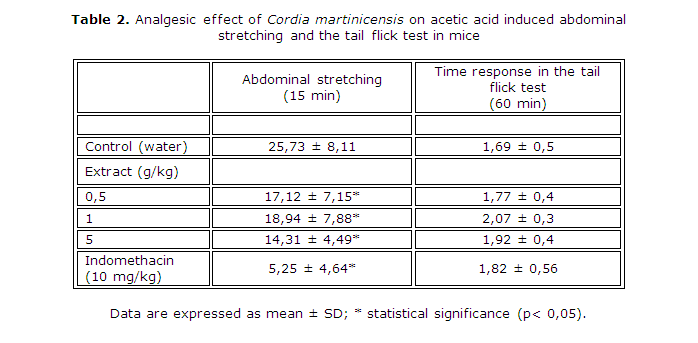
<body><![CDATA[<P>      <P><font face="Verdana" size="2">Phytochemical analysis of 30 % decoction of <I>Cordia    martinicensis</I> found a positive reaction to alkaloids, flavonoids, tannins,    and anthocyanidines (<a href="/img/revistas/pla/v19n1/t0105114.gif">table 1</a>).<STRIKE> </STRIKE>    </font>      <P>      <P><font face="Verdana" size="2"><B>Toxicity </B> </font>     <P>      <P><font face="Verdana" size="2">Administration of <I>Cordia martinicensis</I>    did not show any signs or symptoms of toxicity. Twenty-four hours later a softening    of grounds was observed, but it disappeared the next day. Body weight behaved    according to the growth curve for this species and no abnormalities appeared    in the organs studied. </font>     <P>      <P><font face="Verdana" size="2"><B>Analgesic activity </B> </font>     <P>      <P><font face="Verdana" size="2"><I>Writhing test</I> </font>     ]]></body>
<body><![CDATA[<P>      <P><font face="Verdana" size="2">The acetic acid induced writhing test was used    for detecting peripheral analgesia. Administration of <I>Cordia martinicensis</I>    significantly reduced the number of writhes after acetic acid (0.75 %) injection,    in all doses. The highest dose produced the most significant (p&lt; 0.05) effect,    decreasing the number of abdominal stretching to 14.31 &#177; 4.49, representing    an inhibition of 44.4 %.</font>      <P><font face="Verdana" size="2"><i>Tail flick test</i> </font>      <P>     <P><i><font face="Verdana" size="2">Cordia martinicensis </font></i><font face="Verdana" size="2">administration    at all doses did not produce a significant antinociceptive response to thermal    stimuli compared to the control group. Data from both experiments are shown    in <a href="/img/revistas/pla/v19n1/t0205114.gif">table 2</a>.<STRIKE> </STRIKE></font>      <P>      <P> <font face="Verdana" size="2"><B>Antiinflammatory activity </B></font>     <P>      <P><i><font face="Verdana" size="2">Croton oil-induced ear oedema </font></i>     <P>      ]]></body>
<body><![CDATA[<P><font face="Verdana" size="2">Antiinflammatory activities of <i>Cordia martinicensis</i>    extracts are shown in <a href="/img/revistas/pla/v19n1/t0305114.gif">table 3</a>. They were measured    in mice's ears using Croton oil as oedema inducer. Results show a significant    inhibition (p&lt; 0.05) of oedema compared to the control when the extract was    administered orally at 10 and 5 g/kg, with a percentage of inhibition of 60.9    and 56.9 %, respectively. However, topical administration of <i>Cordia martinicensis</i>    extract only had a significant anti-inflammatory effect at 6 mg/ear with 62.9    % of inhibition.</font>      <P>      <P><font face="Verdana" size="2"><I>Antipyretic activity</I> </font>     <P>      <P><font face="Verdana" size="2">Hyperthermia induced by brewer's yeast developed    during the eighteen hours following injection of the suspension. The dose of    <I>Cordia martinicensis</I> extracts (5 mg/kg) showed significant antipyretic    activity (p&lt; 0.05) from hour 1 to hour 4, similar to the control with acetaminophen    (<a href="/img/revistas/pla/v19n1/t0405114.gif">table 4</a>).</font>      <P>&nbsp;      <P>      <P><font face="Verdana" size="3"><B>DISCUSSION</B></font>      <P>      <P><font face="Verdana" size="2">The aim of the present research was to validate    the ethnobotanical uses of <I>C. martinicensis</I> as an analgesic, antiinflammatory,    and antipyretic agent. </font>     ]]></body>
<body><![CDATA[<P><font face="Verdana" size="2"><I>Cordia martinicensis</I> extracts do not show    acute oral toxicity even at high doses, so they are potentially safe for consumption.    Effects on the softening of grounds may be related to activity on the digestive    system attributed to other species like <I>Cordia latifolia</I> Roxb., <I>Cordia    globosa</I> <I>(</I>Jacq.) Kunth, and <I>Cordia dichotoma</I> G. Forst.,<SUP>1</SUP>    which could be present in <I>C. martinicensis</I>.<STRIKE> </STRIKE> </font>     <P><font face="Verdana" size="2">The writhing and tail flick tests are widely    used for analgesic screening to study a possible pain mechanism. The writhing    test is used to determine the peripheral activity of analgesic drugs, especially    non-steroidal drugs. Acetic acid administration produced pain by releasing endogenous    substances such as serotonin, histamine, prostaglandins, bradykinins and substance    P, which stimulate nerve endings and local peritoneal receptors.<SUP>14</SUP>    However, the tail flick test acts via the central nervous system along a pathway    at spinal level.<SUP>15</SUP> 30 % decoctions of <I>Cordia martinicensis</I>    inhibited abdominal constriction response statistically at all doses used in    the study, but not the thermic painful stimuli. These results suggest that the    antinociceptive action of the active compounds in decoction of <I>Cordia martinicensis</I>    may be mediated through peripheral but not central mechanisms, in a way similar    to AINES drugs.<STRIKE> </STRIKE> </font>     <P><font face="Verdana" size="2">Decoction of <I>Cordia martinicensis</I> also    displayed strong anti-inflammatory activity. The croton oil-induced ear oedema    test triggers many enzymatic cascades and stimulates vascular permeability,    vasodilation and polymorphonuclear leukocyte migration. This is one of the most    commonly used models of acute inflammation.<SUP>16-18</SUP> We tested two types    of administration: topical and oral. In both <I>Cordia martinicensis</I> decoction    was able to inhibit inflammation processes at higher doses, 6 mg/ear (62.9 %)    and 10 mg/kg (60.9 %). </font>     <P><font face="Verdana" size="2">Fever induced by yeast in rats may enhance the    formation of cytokines which increase the synthesis of prostaglandin E<SUB>2</SUB>,    and thus the hypothalamus will raise body temperature.<SUP>19</SUP> <I>Cordia    martinicensis</I> decoction lowered the fever induced by yeast, and was able    to keep the temperature low during the 4 h of the experiment, in the same way    as acetaminophen. Therefore, it is possible that active metabolites for antipyretic    action may inhibit some mediators involved in the generation of fever.<STRIKE>    </STRIKE> </font>     <P><font face="Verdana" size="2">Phytochemical screening revealed the existence    of tannins and flavonoids in the extract. These compounds are known to possess    antiinflammatory, analgesic and antipyretic effects due to their inhibitory    effect on enzymes involved in the production of mediators of inflammation activity.<SUP>20</SUP>    Finally, the results of the study confirm the potent antiinflammatory and antipyretic    activity of <I>Cordia martinicensis</I>, and show an analgesic activity similar    to AINES. <I>C. martinicensis</I> has been studied before as analgesic and antiinflammatory    by <I>Ficarra R</I>. et al., without positive results<SUP>21</SUP>. This is    the first report on the activity of <I>C. martinicensis</I> directly related    to its popular use and provides pharmacological validation of its use to relieve    fever, inflammation and pain. There is a need for further studies to isolate    the active ingredients in the plant which are responsible for its biological    activity, and to elucidate the mechanism of action of these active ingredients.    </font>      <P>&nbsp;     <P>      <P> <font face="Verdana" size="3"><B>REFERENCES </B></font>     <!-- ref --><P><font face="Verdana" size="2">1. Thirupathi K, Sathesh Kumar S, Raju VS, Ravikumar    B, Krishna DR, Krishna Mohan G. A review of medicinal plants of the genus <I>Cordia</I>:    Their chemistry and pharmacological uses. J Natural Remedies. 2008;8(1):1-10.        </font>      ]]></body>
<body><![CDATA[<!-- ref --><P><font face="Verdana" size="2">2. Missouri Botanical Garden -w3TROPICOS. <I>Cordia    martinicensis </I>(Jacq.) Roem. &amp; Schult. Nomenclatural Data Base [en l&iacute;nea].    [Citada 28 Jun 2013]. Disponible en: <U><FONT  COLOR="#0000ff"><a href="http://www.tropicos.org/Name/50089912" target="_blank">http://www.tropicos.org/Name/50089912</a></FONT></U>    </font>      <!-- ref --><P><font face="Verdana" size="2">3. TRAMIL. <I>Cordia martinicensis</I>. Nomenclatural    Data Base [en l&iacute;nea]. [Citada 28 Jun 2013]. Disponible en: <U><FONT COLOR="#0000ff"><a href="http://www.tramil.net/fototeca/imageDisplay.php?id_elem=144&rec=cordia" target="_blank">http://www.tramil.net/fototeca/imageDisplay.php?id_elem=144&amp;rec=cordia</a></FONT></U>    </font>      <!-- ref --><P><font face="Verdana" size="2">4. The University of the West Indies, Cave Hill    Campus, Barbados. Plants of the Eastern Caribbean. Cordia martinicensis (Jacq.).    Nomenclatural Data Base [en l&iacute;nea]. [Citada 28 Jun 2013]. Disponible    en: <U><FONT  COLOR="#0000ff"><a href="http://ecflora.cavehill.uwi.edu/plantdetails.php?pid=385&sn=Cordia%2Bmartinicensis&cn=Black%2Bsage%2C%2Bmahaut%2Bnoir%2C%2Bmaho%2Bnwe%2C%2Bmahot%2Bnoir&gh=shrub%20" target="_blank">http://ecflora.cavehill.uwi.edu/plantdetails.php?pid=385&amp;sn=Cordia+martinicensis&amp;cn=Black+sage%2C+mahaut+noir%2C+maho+nwe%2C+mahot+noir&amp;gh=shrub</a></FONT></U>    </font>      <!-- ref --><P><font face="Verdana" size="2">5. Miranda M, Cuellar A. Manual de Pr&aacute;cticas    de Laboratorio. Farmacognosia y Productos Naturales. Instituto de Farmacia y    Alimentos. La Habana: Editorial F&eacute;lix Varela; 2000. p. 44-9.     </font>     <!-- ref --><P><font face="Verdana" size="2">6. Cuba. Para la Protecci&oacute;n de la Salud    P&uacute;blica. Principios de las Buenas Pr&aacute;cticas de Laboratorio no    Cl&iacute;nico de Seguridad Sanitaria y Medioambiental: Regulaci&oacute;n 39/2004.    La Habana: El Bur&oacute; Regulatorio; 2004.     </font>     <!-- ref --><P><font face="Verdana" size="2">7. EE. UU. National Research Council. Guide for    the care and use of laboratory animals. Washington DC: National Academy Press;    2001. p. 21-79.     </font>     <!-- ref --><P><font face="Verdana" size="2">8. Schlede E, Mischke V, Roll R, Kayser D. A    national validation study of the acute-toxic-class method an alternative to    the LD 50 test. Arch Toxicol. 1992;66:455-70.     </font>     <!-- ref --><P><font face="Verdana" size="2">9. Mart&iacute;nez MJ, Betancour J, Ram&iacute;rez    MR, Barcel&oacute; H, Meneses R, Lainez A. Evaluaci&oacute;n toxicol&oacute;gica    aguda de los extractos fluidos al 30 y 80 % de Cymbopogon citratus (D.C.) Staff.    (ca&ntilde;a santa). Rev Cubana Plant Med. 2000;5(3):97-101.     </font>     <!-- ref --><P><font face="Verdana" size="2">10. Manual de Ensayos Toxicol&oacute;gicos in    vivo. Toxicidad aguda a dosis repetidas. PRONAPLAMED. Ciencias M&eacute;dicas.    Lima: Editorial UNICAMP; 1994.     </font>     <!-- ref --><P><font face="Verdana" size="2">11. Programa Iberoamericano de Ciencia y Tecnolog&iacute;a    para el desarrollo. RIVAPLAMED, Red de Validaci&oacute;n de Plantas Medicinales.    M&eacute;todos de evaluaci&oacute;n de la actividad farmacol&oacute;gica de    plantas medicinales. Lima: Editorial CYTED; 2002.     </font>     <!-- ref --><P><font face="Verdana" size="2">12. V&aacute;zquez AI, S&aacute;nchez C, Delgado    N, Alfonso A, Ortega Y, S&aacute;nchez H. Antiinflammatory and analgesic activities    of red seaweed Dichotomaria obtusata. Brazilian J Pharmaceutical Sciences. 2011;47(1):111-8.        </font>      <!-- ref --><P><font face="Verdana" size="2">13. Esther O, Oluwole A, Ajidahun A. Analgesic,    antiinflammatory and antipyretic effects of dried root ethanolic extract of    Strophanthus sarmentosusp. DC (Apocynaceae). International Research J Pharm    Pharmacol. 2011;1(4):62-9.     </font>      <!-- ref --><P><font face="Verdana" size="2">14. Mwonjoria JK, Kariuki HN, Waweru FN. The    antinociceptive antipyretic effects of Solanum incanum (Linneaus) in animal    models. International J Phytopharmacol. 2011;2(1):22-6.     </font>     <!-- ref --><P><font face="Verdana" size="2">15. Mwangi PW, Wambugu S, Kariuki DK, Mbugua    PM, Kanui TI. Antinociceptive activities of the ethanolic extracts of Ocimum    kilimandscharicum baker ex g&uuml;rke and Ocimum kenyense Ayob. Ex A.J. paton    leaves. International J Phytopharmacol. 2012;3(1):1-4.     </font>     <!-- ref --><P><font face="Verdana" size="2">16. Oweyele VB, Oloriegbe YY, Balogun EA, Soladoye    AO. Analgesic and antiinflammatory activities of Nelsonia canescencs leaf extract.    J Ethnopharmacol. 2005;99(1):153-6.     </font>      <!-- ref --><P><font face="Verdana" size="2">17. Saraiva RA, Araruna MK, Oliveira RC, Menezes    KD, Leite GO, Kerntopf MR, et al. Topical antiinflammatory effect of Caryocar    coriaceum Wittm. (Caryocaraceae) fruit pulp fixed oil on mice ear edema induced    by different irritant agents. J Ethnopharmacol. 2011;136(3):504-10.     </font>      <!-- ref --><P><font face="Verdana" size="2">18. Mitul P, Murugananthan S, Gowda KP. In vivo    animal models in preclinical evaluation of antiinflammatory activity<U> </U>-    a review. International J Pharmaceutical Research Allied Sciences. 2012;1(2):1-5    </font>      <!-- ref --><P><font face="Verdana" size="2">19. Reanmongkol W, Itharat A. Antipyretic activity    of the extracts of Hibiscus sabdariffa calyces L. in experimental animals. Songklanakarin    J Sci Technol. 2007;29(1):29-38.     </font>     <!-- ref --><P><font face="Verdana" size="2">20. Sawadogo R, Lompo M, Som&eacute; N, Guissou    IP, Nacoulma-Ouedraogo OG. Antiinflammatory, analgesic and antipyretic effects    of Lepidagathis anobrya nees (Acanthaceae). Afr J Tradit Complement Altern Med.    2011;8(4):420-4.     </font>      <!-- ref --><P><font face="Verdana" size="2">21. Ficarra R, Ficarra P, Tommasini S, Calabr&ograve;    ML, Ragusa S, Barbera R, et al. Leaf extracts of some Cordia species: analgesic    and antiinflammatory activities as well as their chromatographic analysis. Farmaco.    1995;50(4):245-56.     </font>      <P>&nbsp;     <P>&nbsp;     <P>      <P><font face="Verdana" size="2">Recibido: 12 de julio de 2013.    ]]></body>
<body><![CDATA[<br>   Aprobado: 2 de agosto de 2013.</font>     <P>&nbsp;     <P>&nbsp;      <P>      <P><font face="Verdana" size="2"><I>Ioanna Mart&iacute;nez Hormaza</I>. Laboratorio    Central de Farmacolog&iacute;a, Facultad de Ciencias M&eacute;dicas &quot;Dr.    Salvador Allende&quot;. Carvajal entre Agua Dulce y A. Cerro, La Habana. CP    12000. E-mail: <U><FONT COLOR="#0000ff"><a href="mailto:ioanna@infomed.sld.cu">ioanna@infomed.sld.cu</a></FONT></U>    </font>       ]]></body><back>
<ref-list>
<ref id="B1">
<label>1</label><nlm-citation citation-type="journal">
<person-group person-group-type="author">
<name>
<surname><![CDATA[Thirupathi]]></surname>
<given-names><![CDATA[K]]></given-names>
</name>
<name>
<surname><![CDATA[Sathesh Kumar]]></surname>
<given-names><![CDATA[S]]></given-names>
</name>
<name>
<surname><![CDATA[Raju]]></surname>
<given-names><![CDATA[VS]]></given-names>
</name>
<name>
<surname><![CDATA[Ravikumar]]></surname>
<given-names><![CDATA[B]]></given-names>
</name>
<name>
<surname><![CDATA[Krishna]]></surname>
<given-names><![CDATA[DR]]></given-names>
</name>
<name>
<surname><![CDATA[Krishna Mohan]]></surname>
<given-names><![CDATA[G]]></given-names>
</name>
</person-group>
<article-title xml:lang="en"><![CDATA[A review of medicinal plants of the genus Cordia: Their chemistry and pharmacological uses]]></article-title>
<source><![CDATA[J Natural Remedies.]]></source>
<year>2008</year>
<volume>8</volume>
<numero>1</numero>
<issue>1</issue>
<page-range>1-10</page-range></nlm-citation>
</ref>
<ref id="B2">
<label>2</label><nlm-citation citation-type="">
<collab>Missouri Botanical Garden -w3TROPICOS</collab>
<source><![CDATA[Cordia martinicensis (Jacq.)]]></source>
<year></year>
</nlm-citation>
</ref>
<ref id="B3">
<label>3</label><nlm-citation citation-type="">
<collab>TRAMIL</collab>
<source><![CDATA[Cordia martinicensis]]></source>
<year></year>
</nlm-citation>
</ref>
<ref id="B4">
<label>4</label><nlm-citation citation-type="">
<collab>The University of the West Indies, Cave Hill Campus, Barbados</collab>
<source><![CDATA[Plants of the Eastern Caribbean: Cordia martinicensis (Jacq.)]]></source>
<year></year>
</nlm-citation>
</ref>
<ref id="B5">
<label>5</label><nlm-citation citation-type="book">
<person-group person-group-type="author">
<name>
<surname><![CDATA[Miranda]]></surname>
<given-names><![CDATA[M]]></given-names>
</name>
<name>
<surname><![CDATA[Cuellar]]></surname>
<given-names><![CDATA[A]]></given-names>
</name>
</person-group>
<source><![CDATA[Manual de Prácticas de Laboratorio: Farmacognosia y Productos Naturales]]></source>
<year>2000</year>
<page-range>44-9</page-range><publisher-loc><![CDATA[La Habana ]]></publisher-loc>
<publisher-name><![CDATA[Editorial Félix Varela]]></publisher-name>
</nlm-citation>
</ref>
<ref id="B6">
<label>6</label><nlm-citation citation-type="book">
<source><![CDATA[Para la Protección de la Salud Pública: Principios de las Buenas Prácticas de Laboratorio no Clínico de Seguridad Sanitaria y Medioambiental: Regulación 39/2004]]></source>
<year>2004</year>
<publisher-loc><![CDATA[La Habana ]]></publisher-loc>
<publisher-name><![CDATA[El Buró Regulatorio]]></publisher-name>
</nlm-citation>
</ref>
<ref id="B7">
<label>7</label><nlm-citation citation-type="book">
<collab>National Research Council</collab>
<source><![CDATA[Guide for the care and use of laboratory animals]]></source>
<year>2001</year>
<page-range>21-79</page-range><publisher-loc><![CDATA[Washington DC ]]></publisher-loc>
<publisher-name><![CDATA[National Academy Press]]></publisher-name>
</nlm-citation>
</ref>
<ref id="B8">
<label>8</label><nlm-citation citation-type="journal">
<person-group person-group-type="author">
<name>
<surname><![CDATA[Schlede]]></surname>
<given-names><![CDATA[E]]></given-names>
</name>
<name>
<surname><![CDATA[Mischke]]></surname>
<given-names><![CDATA[V]]></given-names>
</name>
<name>
<surname><![CDATA[Roll]]></surname>
<given-names><![CDATA[R]]></given-names>
</name>
<name>
<surname><![CDATA[Kayser]]></surname>
<given-names><![CDATA[D]]></given-names>
</name>
</person-group>
<article-title xml:lang="en"><![CDATA[A national validation study of the acute-toxic-class method an alternative to the LD 50 test]]></article-title>
<source><![CDATA[Arch Toxicol.]]></source>
<year>1992</year>
<volume>66</volume>
<page-range>455-70</page-range></nlm-citation>
</ref>
<ref id="B9">
<label>9</label><nlm-citation citation-type="journal">
<person-group person-group-type="author">
<name>
<surname><![CDATA[Martínez]]></surname>
<given-names><![CDATA[MJ]]></given-names>
</name>
<name>
<surname><![CDATA[Betancour]]></surname>
<given-names><![CDATA[J]]></given-names>
</name>
<name>
<surname><![CDATA[Ramírez]]></surname>
<given-names><![CDATA[MR]]></given-names>
</name>
<name>
<surname><![CDATA[Barceló]]></surname>
<given-names><![CDATA[H]]></given-names>
</name>
<name>
<surname><![CDATA[Meneses]]></surname>
<given-names><![CDATA[R]]></given-names>
</name>
<name>
<surname><![CDATA[Lainez]]></surname>
<given-names><![CDATA[A]]></given-names>
</name>
</person-group>
<article-title xml:lang="es"><![CDATA[Evaluación toxicológica aguda de los extractos fluidos al 30 y 80 % de Cymbopogon citratus (D.C.) Staff. (caña santa)]]></article-title>
<source><![CDATA[Rev Cubana Plant Med]]></source>
<year>2000</year>
<volume>5</volume>
<numero>3</numero>
<issue>3</issue>
<page-range>97-101</page-range></nlm-citation>
</ref>
<ref id="B10">
<label>10</label><nlm-citation citation-type="book">
<source><![CDATA[Manual de Ensayos Toxicológicos in vivo: Toxicidad aguda a dosis repetidas]]></source>
<year>1994</year>
<publisher-loc><![CDATA[Lima ]]></publisher-loc>
<publisher-name><![CDATA[Editorial UNICAMP]]></publisher-name>
</nlm-citation>
</ref>
<ref id="B11">
<label>11</label><nlm-citation citation-type="book">
<collab>Programa Iberoamericano de Ciencia y Tecnología para el desarrollo</collab>
<source><![CDATA[RIVAPLAMED, Red de Validación de Plantas Medicinales: Métodos de evaluación de la actividad farmacológica de plantas medicinales]]></source>
<year>2002</year>
<publisher-loc><![CDATA[Lima ]]></publisher-loc>
<publisher-name><![CDATA[Editorial CYTED]]></publisher-name>
</nlm-citation>
</ref>
<ref id="B12">
<label>12</label><nlm-citation citation-type="journal">
<person-group person-group-type="author">
<name>
<surname><![CDATA[Vázquez]]></surname>
<given-names><![CDATA[AI]]></given-names>
</name>
<name>
<surname><![CDATA[Sánchez]]></surname>
<given-names><![CDATA[C]]></given-names>
</name>
<name>
<surname><![CDATA[Delgado]]></surname>
<given-names><![CDATA[N]]></given-names>
</name>
<name>
<surname><![CDATA[Alfonso]]></surname>
<given-names><![CDATA[A]]></given-names>
</name>
<name>
<surname><![CDATA[Ortega]]></surname>
<given-names><![CDATA[Y]]></given-names>
</name>
<name>
<surname><![CDATA[Sánchez]]></surname>
<given-names><![CDATA[H]]></given-names>
</name>
</person-group>
<article-title xml:lang="en"><![CDATA[Antiinflammatory and analgesic activities of red seaweed Dichotomaria obtusata]]></article-title>
<source><![CDATA[Brazilian J Pharmaceutical Sciences.]]></source>
<year>2011</year>
<volume>47</volume>
<numero>1</numero>
<issue>1</issue>
<page-range>111-8</page-range></nlm-citation>
</ref>
<ref id="B13">
<label>13</label><nlm-citation citation-type="journal">
<person-group person-group-type="author">
<name>
<surname><![CDATA[Esther]]></surname>
<given-names><![CDATA[O]]></given-names>
</name>
<name>
<surname><![CDATA[Oluwole]]></surname>
<given-names><![CDATA[A]]></given-names>
</name>
<name>
<surname><![CDATA[Ajidahun]]></surname>
<given-names><![CDATA[A]]></given-names>
</name>
</person-group>
<article-title xml:lang="en"><![CDATA[Analgesic, antiinflammatory and antipyretic effects of dried root ethanolic extract of Strophanthus sarmentosusp DC. (Apocynaceae)]]></article-title>
<source><![CDATA[International Research J Pharm Pharmacol.]]></source>
<year>2011</year>
<volume>1</volume>
<numero>4</numero>
<issue>4</issue>
<page-range>62-9</page-range></nlm-citation>
</ref>
<ref id="B14">
<label>14</label><nlm-citation citation-type="journal">
<person-group person-group-type="author">
<name>
<surname><![CDATA[Mwonjoria]]></surname>
<given-names><![CDATA[JK]]></given-names>
</name>
<name>
<surname><![CDATA[Kariuki]]></surname>
<given-names><![CDATA[HN]]></given-names>
</name>
<name>
<surname><![CDATA[Waweru]]></surname>
<given-names><![CDATA[FN]]></given-names>
</name>
</person-group>
<article-title xml:lang="en"><![CDATA[The antinociceptive antipyretic effects of Solanum incanum (Linneaus) in animal models]]></article-title>
<source><![CDATA[International J Phytopharmacol.]]></source>
<year>2011</year>
<volume>2</volume>
<numero>1</numero>
<issue>1</issue>
<page-range>22-6</page-range></nlm-citation>
</ref>
<ref id="B15">
<label>15</label><nlm-citation citation-type="journal">
<person-group person-group-type="author">
<name>
<surname><![CDATA[Mwangi]]></surname>
<given-names><![CDATA[PW]]></given-names>
</name>
<name>
<surname><![CDATA[Wambugu]]></surname>
<given-names><![CDATA[S]]></given-names>
</name>
<name>
<surname><![CDATA[Kariuki]]></surname>
<given-names><![CDATA[DK]]></given-names>
</name>
<name>
<surname><![CDATA[Mbugua]]></surname>
<given-names><![CDATA[PM]]></given-names>
</name>
<name>
<surname><![CDATA[Kanui]]></surname>
<given-names><![CDATA[TI]]></given-names>
</name>
</person-group>
<article-title xml:lang="en"><![CDATA[Antinociceptive activities of the ethanolic extracts of Ocimum kilimandscharicum baker ex gürke and Ocimum kenyense Ayob. Ex A.J paton leaves]]></article-title>
<source><![CDATA[International J Phytopharmacol.]]></source>
<year>2012</year>
<volume>3</volume>
<numero>1</numero>
<issue>1</issue>
<page-range>1-4</page-range></nlm-citation>
</ref>
<ref id="B16">
<label>16</label><nlm-citation citation-type="journal">
<person-group person-group-type="author">
<name>
<surname><![CDATA[Oweyele]]></surname>
<given-names><![CDATA[VB]]></given-names>
</name>
<name>
<surname><![CDATA[Oloriegbe]]></surname>
<given-names><![CDATA[YY]]></given-names>
</name>
<name>
<surname><![CDATA[Balogun]]></surname>
<given-names><![CDATA[EA]]></given-names>
</name>
<name>
<surname><![CDATA[Soladoye]]></surname>
<given-names><![CDATA[AO]]></given-names>
</name>
</person-group>
<article-title xml:lang="en"><![CDATA[Analgesic and antiinflammatory activities of Nelsonia canescencs leaf extract]]></article-title>
<source><![CDATA[J Ethnopharmacol.]]></source>
<year>2005</year>
<volume>99</volume>
<numero>1</numero>
<issue>1</issue>
<page-range>153-6</page-range></nlm-citation>
</ref>
<ref id="B17">
<label>17</label><nlm-citation citation-type="journal">
<person-group person-group-type="author">
<name>
<surname><![CDATA[Saraiva]]></surname>
<given-names><![CDATA[RA]]></given-names>
</name>
<name>
<surname><![CDATA[Araruna]]></surname>
<given-names><![CDATA[MK]]></given-names>
</name>
<name>
<surname><![CDATA[Oliveira]]></surname>
<given-names><![CDATA[RC]]></given-names>
</name>
<name>
<surname><![CDATA[Menezes]]></surname>
<given-names><![CDATA[KD]]></given-names>
</name>
<name>
<surname><![CDATA[Leite]]></surname>
<given-names><![CDATA[GO]]></given-names>
</name>
<name>
<surname><![CDATA[Kerntopf]]></surname>
<given-names><![CDATA[MR]]></given-names>
</name>
</person-group>
<article-title xml:lang="en"><![CDATA[Topical antiinflammatory effect of Caryocar coriaceum Wittm: (Caryocaraceae) fruit pulp fixed oil on mice ear edema induced by different irritant agents]]></article-title>
<source><![CDATA[J Ethnopharmacol.]]></source>
<year>2011</year>
<volume>136</volume>
<numero>3</numero>
<issue>3</issue>
<page-range>504-10</page-range></nlm-citation>
</ref>
<ref id="B18">
<label>18</label><nlm-citation citation-type="journal">
<person-group person-group-type="author">
<name>
<surname><![CDATA[Mitul]]></surname>
<given-names><![CDATA[P]]></given-names>
</name>
<name>
<surname><![CDATA[Murugananthan]]></surname>
<given-names><![CDATA[S]]></given-names>
</name>
<name>
<surname><![CDATA[Gowda]]></surname>
<given-names><![CDATA[KP]]></given-names>
</name>
</person-group>
<article-title xml:lang="en"><![CDATA[In vivo animal models in preclinical evaluation of antiinflammatory activity - a review]]></article-title>
<source><![CDATA[International J Pharmaceutical Research Allied Sciences]]></source>
<year>2012</year>
<volume>1</volume>
<numero>2</numero>
<issue>2</issue>
<page-range>1-5</page-range></nlm-citation>
</ref>
<ref id="B19">
<label>19</label><nlm-citation citation-type="journal">
<person-group person-group-type="author">
<name>
<surname><![CDATA[Reanmongkol]]></surname>
<given-names><![CDATA[W]]></given-names>
</name>
<name>
<surname><![CDATA[Itharat]]></surname>
<given-names><![CDATA[A]]></given-names>
</name>
</person-group>
<article-title xml:lang="en"><![CDATA[Antipyretic activity of the extracts of Hibiscus sabdariffa calyces L. in experimental animals]]></article-title>
<source><![CDATA[Songklanakarin J Sci Technol.]]></source>
<year>2007</year>
<volume>29</volume>
<numero>1</numero>
<issue>1</issue>
<page-range>29-38</page-range></nlm-citation>
</ref>
<ref id="B20">
<label>20</label><nlm-citation citation-type="journal">
<person-group person-group-type="author">
<name>
<surname><![CDATA[Sawadogo]]></surname>
<given-names><![CDATA[R]]></given-names>
</name>
<name>
<surname><![CDATA[Lompo]]></surname>
<given-names><![CDATA[M]]></given-names>
</name>
<name>
<surname><![CDATA[Somé]]></surname>
<given-names><![CDATA[N]]></given-names>
</name>
<name>
<surname><![CDATA[Guissou]]></surname>
<given-names><![CDATA[IP]]></given-names>
</name>
<name>
<surname><![CDATA[Nacoulma-Ouedraogo]]></surname>
<given-names><![CDATA[OG]]></given-names>
</name>
</person-group>
<article-title xml:lang="en"><![CDATA[Antiinflammatory, analgesic and antipyretic effects of Lepidagathis anobrya nees (Acanthaceae)]]></article-title>
<source><![CDATA[Afr J Tradit Complement Altern Med]]></source>
<year>2011</year>
<volume>8</volume>
<numero>4</numero>
<issue>4</issue>
<page-range>420-4</page-range></nlm-citation>
</ref>
<ref id="B21">
<label>21</label><nlm-citation citation-type="journal">
<person-group person-group-type="author">
<name>
<surname><![CDATA[Ficarra]]></surname>
<given-names><![CDATA[R]]></given-names>
</name>
<name>
<surname><![CDATA[Ficarra]]></surname>
<given-names><![CDATA[P]]></given-names>
</name>
<name>
<surname><![CDATA[Tommasini]]></surname>
<given-names><![CDATA[S]]></given-names>
</name>
<name>
<surname><![CDATA[Calabrò]]></surname>
<given-names><![CDATA[ML]]></given-names>
</name>
<name>
<surname><![CDATA[Ragusa]]></surname>
<given-names><![CDATA[S]]></given-names>
</name>
<name>
<surname><![CDATA[Barbera]]></surname>
<given-names><![CDATA[R]]></given-names>
</name>
</person-group>
<article-title xml:lang="en"><![CDATA[Leaf extracts of some Cordia species: analgesic and antiinflammatory activities as well as their chromatographic analysis]]></article-title>
<source><![CDATA[Farmaco.]]></source>
<year>1995</year>
<volume>50</volume>
<numero>4</numero>
<issue>4</issue>
<page-range>245-56</page-range></nlm-citation>
</ref>
</ref-list>
</back>
</article>