<?xml version="1.0" encoding="ISO-8859-1"?><article xmlns:mml="http://www.w3.org/1998/Math/MathML" xmlns:xlink="http://www.w3.org/1999/xlink" xmlns:xsi="http://www.w3.org/2001/XMLSchema-instance">
<front>
<journal-meta>
<journal-id>1028-4796</journal-id>
<journal-title><![CDATA[Revista Cubana de Plantas Medicinales]]></journal-title>
<abbrev-journal-title><![CDATA[Rev Cubana Plant Med]]></abbrev-journal-title>
<issn>1028-4796</issn>
<publisher>
<publisher-name><![CDATA[ECIMED]]></publisher-name>
</publisher>
</journal-meta>
<article-meta>
<article-id>S1028-47962016000400011</article-id>
<title-group>
<article-title xml:lang="en"><![CDATA[Inhibitory effect of Persea cordata Mez. (pau-andrade) bark extracts against Clostridium perfringens causing gangrenous mastitis]]></article-title>
<article-title xml:lang="es"><![CDATA[Efecto inhibitorio de extractos de corteza de Persea cordata Mez. (pau-andrade) contra Clostridium perfringens causa de mastitis gangrenosa]]></article-title>
</title-group>
<contrib-group>
<contrib contrib-type="author">
<name>
<surname><![CDATA[Schlemper]]></surname>
<given-names><![CDATA[Valfredo]]></given-names>
</name>
<xref ref-type="aff" rid="A01"/>
</contrib>
<contrib contrib-type="author">
<name>
<surname><![CDATA[de Mello Schlemper]]></surname>
<given-names><![CDATA[Susana Regina]]></given-names>
</name>
<xref ref-type="aff" rid="A01"/>
</contrib>
<contrib contrib-type="author">
<name>
<surname><![CDATA[Sousa de Mello]]></surname>
<given-names><![CDATA[Denise Maria]]></given-names>
</name>
<xref ref-type="aff" rid="A01"/>
</contrib>
</contrib-group>
<aff id="A01">
<institution><![CDATA[,Universidade Federal da Fronteira Sul  ]]></institution>
<addr-line><![CDATA[Campus Realeza PR]]></addr-line>
<country>Brazil</country>
</aff>
<pub-date pub-type="pub">
<day>00</day>
<month>12</month>
<year>2016</year>
</pub-date>
<pub-date pub-type="epub">
<day>00</day>
<month>12</month>
<year>2016</year>
</pub-date>
<volume>21</volume>
<numero>4</numero>
<fpage>1</fpage>
<lpage>14</lpage>
<copyright-statement/>
<copyright-year/>
<self-uri xlink:href="http://scielo.sld.cu/scielo.php?script=sci_arttext&amp;pid=S1028-47962016000400011&amp;lng=en&amp;nrm=iso"></self-uri><self-uri xlink:href="http://scielo.sld.cu/scielo.php?script=sci_abstract&amp;pid=S1028-47962016000400011&amp;lng=en&amp;nrm=iso"></self-uri><self-uri xlink:href="http://scielo.sld.cu/scielo.php?script=sci_pdf&amp;pid=S1028-47962016000400011&amp;lng=en&amp;nrm=iso"></self-uri><kwd-group>
<kwd lng="en"><![CDATA[medicinal plants]]></kwd>
<kwd lng="en"><![CDATA[Persea cordata]]></kwd>
<kwd lng="en"><![CDATA[antimicrobial]]></kwd>
<kwd lng="en"><![CDATA[Clostridium perfringens]]></kwd>
<kwd lng="en"><![CDATA[mastitis]]></kwd>
<kwd lng="es"><![CDATA[plantas medicinales]]></kwd>
<kwd lng="es"><![CDATA[Persea cordata]]></kwd>
<kwd lng="es"><![CDATA[antimicrobiano]]></kwd>
<kwd lng="es"><![CDATA[Clostridium perfringens]]></kwd>
<kwd lng="es"><![CDATA[mastitis]]></kwd>
</kwd-group>
</article-meta>
</front><body><![CDATA[ <p align="right"><font size="2"><b><font face="Verdana, Arial, Helvetica, sans-serif">ART&Iacute;CULO    ORGINAL</font></b></font></p>     <p>&nbsp;</p>     <p><font face="Verdana, Arial, Helvetica, sans-serif" size="2"><b><font size="4">Inhibitory    effect of <i>Persea cordata</i> Mez.<i> </i>(pau-andrade) bark extracts against    <i>Clostridium perfringens </i>causing gangrenous mastitis</font></b></font></p>     <p>&nbsp;</p>     <p><font face="Verdana, Arial, Helvetica, sans-serif" size="2"> <b><font size="3">Efecto    inhibitorio de extractos de corteza de <i>Persea cordata </i>Mez. (pau-andrade)    contra <i>Clostridium perfringens</i> causa de mastitis gangrenosa</font></b></font></p>     <p>&nbsp;</p>     <p>&nbsp;</p>     <p><font face="Verdana, Arial, Helvetica, sans-serif" size="2"><b>Valfredo Schlemper,    Susana Regina de Mello Schlemper, Denise Maria Sousa de Mello</b></font></p>     <p><font face="Verdana, Arial, Helvetica, sans-serif" size="2"> Universidade Federal    da Fronteira Sul (UFFS), Campus Realeza, PR, Brazil.</font></p>     <p>&nbsp;</p>     ]]></body>
<body><![CDATA[<p>&nbsp;</p> <hr>     <p><font face="Verdana, Arial, Helvetica, sans-serif" size="2"><b>ABSTRACT</b>    </font></p>     <p> <font face="Verdana, Arial, Helvetica, sans-serif" size="2"><b>Introduction:</b>    Gangrenous mastitis is a special clinical presentation of mastitis in cattle    and small ruminants. The bark of the tree Persea cordata Mez. is used in Brazilian    ethnoveterinary medicine to treat wounds in farm animals.    <br>   <b>Objectives: </b>Examine in vitro antimicrobial action of apolar fractions    of P. cordata bark against a wild strain of C. perfringens isolated from the    udder of a cow with gangrenous mastitis, and against a reference strain.    <br>   <b>Methods:</b> A milk sample was collected from the udder, aliquots were diluted    and Gram-stained smears were performed. The aliquots were inoculated in broth    and planted in blood agar, and then incubated in anaerobiosis at 37oC / 24h.    Biochemical identification was based on bacterial isolation. In vitro inhibitory    activity of apolar fractions of P. cordata was evaluated by agar diffusion and    MIC (minimum inhibitory concentration) using the agar dilution method.     <br>   <b>Results:</b> In both tests the plant extracts displayed significant in vitro    inhibitory activity against the clinical and reference strains of C. perfringens    assayed.    <br>   <b>Conclusion: </b>The study is the first demonstration of the inhibitory effect    of P. cordata on C. perfringens, due to its antimicrobial properties, which    serves as evidence supporting its folk use. The extracts could be used as coadjuvants    in the treatment of gangrenous mastitis.    <br>   </font></p>     <p><font face="Verdana, Arial, Helvetica, sans-serif" size="2"><b>Keywords:</b>    medicinal plants; <i>Persea cordata</i>; antimicrobial; <i>Clostridium perfringens</i>;    mastitis</font>.    <br> </p> <hr>     ]]></body>
<body><![CDATA[<p><font face="Verdana, Arial, Helvetica, sans-serif" size="2"><b>RESUMEN</b>    </font></p>     <p> <font face="Verdana, Arial, Helvetica, sans-serif" size="2"><b>Introducci&#243;n:</b>    la mastitis gangrenosa es una presentaci&#243;n cl&#237;nica especial de mastitis    en el ganado y peque&#241;os rumiantes. <i>Persea cordata</i> Mez. <i>,</i>    es un &#225;rbol conocido en la etnoveterinaria brasile&#241;a, cuya corteza    se utiliza en la curaci&#243;n de heridas en animales de granja. </font>    <br>   <font face="Verdana, Arial, Helvetica, sans-serif" size="2"><b>Objetivos: </b>    investigar el efecto antimicrobiano <i>in vitro</i> de fracciones apolares de    la corteza de <i>P. cordata</i> contra una cepa salvaje de <i>C. perfringens</i>,    aislada de la ubre de una vaca con mastitis gangrenosa y una cepa de referencia.    </font>    <br>   <font face="Verdana, Arial, Helvetica, sans-serif" size="2"><b>M&#233;todos:</b>    Se recogi&#243; una muestra de leche de la ubre, se diluyeron al&#237;cuotas,    y se realizaron frotis te&#241;idos por Gram. Las al&#237;cuotas fueron inoculadas    en caldo y sembradas en agar sangre, y posteriormente incubados en anaerobiosis    a 37<sup> o</sup>C/24h. La identificaci&#243;n bioqu&#237;mica fue realizada    a partir del aislamiento bacteriano. La actividad inhibitoria <i>in vitro</i>    de las fracciones apolares de <i>P. cordata</i> fue evaluada utilizando la t&#233;cnica    de difusi&#243;n en agar y la CMI (concentraci&#243;n minima inhibitoria) mediante    el m&#233;todo de diluci&#243;n en agar. </font>    <br>   <font face="Verdana, Arial, Helvetica, sans-serif" size="2"><b>Resultados:</b>    los extractos de la planta, en ambas pruebas, presentaron significativa actividad    inhibitoria <i>in vitro</i> contra las cepas cl&#237;nica y de referencia de    <i>C. perfringens </i>ensayadas<i>.</i> </font>    <br>   <font face="Verdana, Arial, Helvetica, sans-serif" size="2"><b>Conclusi&#243;n:</b>    se concluy&#243; que, por primera vez, se demuestra un efecto inhibitorio de    <i>P. cordata</i> sobre <i>C. perfringens,</i> reforzando el uso popular, debido    a sus propiedades antimicrobianas. Los extractos podr&#225;n ser utilizados    como coadyuvantes en el tratamiento de la mastitis gangrenosa. </font></p>     <p> <font face="Verdana, Arial, Helvetica, sans-serif" size="2"><b>Palabras clave:    </b> plantas medicinales; <i>Persea cordata</i>; antimicrobiano; <i>Clostridium</i><b>    </b><i>perfringens</i>; mastitis.</font></p> <hr>     <p>&nbsp;</p>     <p>&nbsp;</p>     <p> <font face="Verdana, Arial, Helvetica, sans-serif" size="2"><b><font size="3">INTRODUCTION</font></b>    </font></p>     ]]></body>
<body><![CDATA[<p><font face="Verdana, Arial, Helvetica, sans-serif" size="2"> Mastitis is the    inflammation of breast tissue caused by bacteria, viruses, algae and fungi,<sup>1    </sup>enzootic in bovine what causes important loss to the milk-production chain.    Gangrenous mastitis is a special clinic feature of mastitis in bovine, caused    mainly by <i> Staphylococcus aureus, Mannheimia haemolytica, Escherichia coli,    Clostridium perfringens </i> and <i>Arcanobacterium pyogenes.</i><sup>2</sup>    Published reports about the occurrence of gangrenous mastitis by <i>C. perfringens<b>    </b></i>are relatively old.<sup>3-5 </sup>In Brazil, the descriptions of gangrenous    mastitis by <i>C. perfringens </i>in bovine are<i> </i>rare. Most of the studies    have described the illness in small ruminants.<sup>6-8</sup> Baldassi<sup>9</sup>    related the occurrence of gangrenous mastitis in bovine caused by <i>Clostridium    species </i>and Gon&#231;alves<sup>10</sup> published the first gangrenous mastitis    clinical case in Brazil caused <i>C. perfringens </i>in bovine. Although most    of bacterial mastitis are caused by aerobic ones,<sup>11</sup> there is growing    concern of the involvement of anaerobic organisms in those pathological processes.    The main reason for the limited number of published studies on the involvement    of <i>Clostridium </i>sp in mastitis is due to the difficulty of microorganisms    growing.<sup>12</sup> Gangrenous mastitis by <i>C. perfringens</i> is caused,    predominantly, by the upward contamination of the teat canal, because a bacterium    is frequently isolated of faeces from healthy animals<sup>13</sup> and the environmental    contamination supported by weather conditions and organic matter accumulation    in areas where animals live can propitiate upward contamination of breast papillae.    Moreover, before the estimated date of birth, cows show weakened immune system    due to colostrogenesis and the release of endogenous corticoids,<sup>14</sup>    features which can support contamination and installment of the infectious process.    Local alterations, as lack of oxygen in injuries and digestive tract, so propitiating    tissues invasions and their proliferation.<sup>15</sup> Clinically, it is characterized    by mammary gland redness and necrosis of parenchyma accompanied with bloody,    foul-smelling milk. </font></p>     <p><font face="Verdana, Arial, Helvetica, sans-serif" size="2"> In searching for    therapeutic alternatives against bacteria, medicinal plants have been standing    out as potential sources of active ingredients able to control infectious processes.    To that end, given the occurrence of gangrenous mastitis in bovine in Southwest    Paran&#225;, this study was based on the search for plants with ethnopharmacological    indicatives for infections in animals. </font></p>     <p> <font face="Verdana, Arial, Helvetica, sans-serif" size="2"><i>Persea cordata</i>    (Vell.) Mez. (Lauraceae)<b> </b>a common big tree in Araucaria Forest, also    known as "pau-andrade", "abacateiro do mato", "ma&#231;aranduba" or "canela    rosada"<sup>16</sup> in popular medicine, has its bark used as plaster for wound    healing.<sup>17-18</sup> It is common, in farms in the South Brazil, to find    <i>P. cordata</i> with their barks removed carefully in order to treat some    diseases in animals. Some biological activities attributed to<i>P. cordata</i>    barks have already been proved experimentally<i>in vivo</i> and <i>in vitro</i>    such, antibacterial and antifungal,<sup>19,17 </sup>antispasmodic.<sup>20,21    </sup>neuroprotector<sup>22</sup> and as antiedematogenic<sup>18</sup> actions.    <i>P. cordata </i>healing action was described from the use of an ointment made    of its barks,<sup>23</sup> so indicating a beneficial effect on granulation    tissue evolution, facilitating the newly epithelial tissue and reducing time    of wounds mobilization. Possibly, contributing with its healing action, it was    found its polar fraction of ethyl acetate showed antimicrobial activity against    <i>Staphylococcus aureus </i>and <i>Streptococcus pyogenes</i>, which corroborate    with its popular use in rural areas for treating infected wounds of animals.<sup>19,23</sup>    </font></p>     <p> <font face="Verdana, Arial, Helvetica, sans-serif" size="2"> Antibacterial    activity of the plant was related against Gram-positive <i>S. aureus, S. epidermidis    </i>and<i> Bacillus cereus </i>bacteria, and against Gram-negative<i>Pseudomonas    aeruginosa, Klebsiella pneumoniae, Escherichia coli</i>,<i>Shigella dysenteriae</i>,<i>    Proteus vulgaris </i>and <i> Salmonella typhimurium.</i><sup>19,23 </sup>The    objective of this study was to evaluate the inhibitory activity of <i>P. cordata</i>    semi-purified extracts <i>in vitro </i>on the growing of <i>C. perfringens</i>,    an anaerobic bacteria causing gangrenous mastitis. </font></p>     <p>&nbsp; </p>     <p><font face="Verdana, Arial, Helvetica, sans-serif" size="2"><b><font size="3">METHODS    </font></b> </font></p>     <p> <font face="Verdana, Arial, Helvetica, sans-serif" size="2"><b>Botanical material</b></font></p>     <p> <font face="Verdana, Arial, Helvetica, sans-serif" size="2"><i> P. cordata</i>    barks were collected in Fazenda Leny, Bom Retiro, Santa Catarina, according    to the agreement of the farmer and where it was inserted the legal forest reserve.    Intervention in the natural environment was minimal and did not cause risk for    the integrity of the trees. For the barks collection, the project was registered    in Plataforma Chico Mendes (SISBIO) under the number 34821-1. The botanical    material was identified by Dr. Roseli Botoluzzi (Agronomy Graduation Course/    CAV/ UDESC, Lages - SC) and a dried specimen was set in the herbarium of the    Centro Agroveterin&#225;rio, Lages, under the number 045. </font></p>     <p> <font face="Verdana, Arial, Helvetica, sans-serif" size="2"> <b>    <br>   Extract and fractions collection</b> </font></p>     ]]></body>
<body><![CDATA[<p><font face="Verdana, Arial, Helvetica, sans-serif" size="2"> Barks were dried    at room temperature (22-28 °C), grinded and macerated in 50 % methanol during    10 days, in order to obtain the hydroalcoholic extract. With the evaporation    of the solvent under vacuum using a rotary evaporator at 50 &#186;C, it resulted    a crude extract which was partitioned with hexane, dichloromethane, ethyl acetate    and butanol solvents, generating different solid semi-purified fractions. All    fractions were dissolved in 5 % dimethyl sulfoxide (DMSO) and subsequently diluted    in phosphate buffer solution (PBS) until the desired concentration for using.    </font></p>     <p> <font face="Verdana, Arial, Helvetica, sans-serif" size="2"><b>    <br>   Phytochemical screening</b> </font></p>     <p><font face="Verdana, Arial, Helvetica, sans-serif" size="2"> Chromatographic    profile of <i>P. cordata</i> methanolic extract was evaluated through thin-layer    chromatography (TLC) using aluminum chromatographic plates, pre-coated with    thin layers of silica (Merck, 200 &#181;m thickness) with different solvent    systems. The research of bioactive secondary metabolites was performed through    Liebermann-Buchard reaction for terpenes and steroids, Keller-Kelianni and Baljet    reactions for aglycone and total sugars detection, Mayer and Bertrand, Bouchardat    and Dragendorff reactions for alkaloids.<sup>24,25</sup> </font></p>     <p>    <br>   <font face="Verdana, Arial, Helvetica, sans-serif" size="2"><b> Microorganisms,    isolation and identification</b> </font></p>     <p><font face="Verdana, Arial, Helvetica, sans-serif" size="2"> Bacterial samples    used in the study were: a strain of the material collected from the udder of    a Holstein cow, 4 years-old, with clinical history of gangrenous mastitis; and    a standard <i>C. perfringens</i> strain (ATCC 13124) used as reference. </font></p>     <p><font face="Verdana, Arial, Helvetica, sans-serif" size="2"> At clinical examination,    the veterinarian who attended the animal related that it showed sudden lactation    drop, anorexia, hyperthermia, continuous decubitus and melena. The front right    quarter of the udder was swollen, touch-sensitive and blackened, and the milk    secretion showed serous fluid with yellowish flocculation and bloody striations.    Milk samples from the affected udder quarter were aseptically collected in sterile    tubes with screw caps. At laboratory, aliquots were diluted in 0.5 mL of 0.9    % saline solution and from those it was performed stained smears by Gram technique.    </font></p>     <p><font face="Verdana, Arial, Helvetica, sans-serif" size="2"> Both samples (collected    material and standard one) were inoculated in tubes with Cooked Meat Medium    (CMM, Difco). Tubes were previously heated at 80 &#186;C during 15 min in water    bath and quickly cooled in tap water, and they were incubated at 37 &#186;C    for 24-48 h. An aliquot of each sample was inoculated by pouring into petri    dishes with 5 % sheep blood agar, and incubated under aerobiosis and strict    anaerobiosis in McIntosh <i>&amp;</i> Fields jars at 37 &#186;C during 24-48    h. After incubation, the colonies were observed in appearance, coloring and    haemolysis. Samples showing doubled-halo, smooth, rounded and umbilical hemolytic    colonies were submitted to Gram stain, and in sequence they were inoculated    in CMM and incubated at 37 &#186;C for 24-48 h. </font></p>     <p><font face="Verdana, Arial, Helvetica, sans-serif" size="2"> With the resulting    growth of the broth it was performed standard biochemical assays in order to    identify the species: sugars fermentation (glucose, lactose, sucrose, maltose,    salicin and mannitol), lipase and urease activity, indole production, hydrolysis    gelatin, casein digestion, nitrate reduction and iron-milk reaction,<sup>8,26,27</sup>    Additionally, it was made subcultures into blood agar plates and agar base tryptose    sulfite cycloserin (TSC) plus 5 % egg-yolk selective-indicator media to demonstrate    double zone of beta hemolysis and lecithinase reaction, respectively, and incubated    at 37 &#186;C for 18-24 h. </font></p>     ]]></body>
<body><![CDATA[<p><font face="Verdana, Arial, Helvetica, sans-serif" size="2">    <br>   <b>ANTIBACTERIAL ACTIVITY</b></font></p>     <p> <font face="Verdana, Arial, Helvetica, sans-serif" size="2"><b> Preliminary    screening</b> </font></p>     <p><font face="Verdana, Arial, Helvetica, sans-serif" size="2"> The inhibitory    activity of semi-purified hexane and dichloromethane fractions from <i>P. cordata</i>    barks was tested against standard and collected strains through agar diffusion    method.<sup>8</sup> Strains were activated into thioglycollate broth and a 10<sup>6</sup>    CFU/mL final inoculum had its density adjusted by 530 nm spectrophotometer.    In the sequence, they were inoculated into 5 % sheep blood agar plates where    previously it was made wells at 6 mm diameter into a circular layout parallel    to the edge of the plates with a cylindrical metal device, sterilized and with    sharp edges. Wells were filled with 50 &#181;L <i>P. cordata</i> extracts in    500, 1000 and 2000 &#181;g/mL concentrations. Then, plates were incubated at    37 &#186;C for 48 h in bacteriological incubator under anaerobiosis. After that,    plates were examined for the increase of colonies. Results were collected according    to Bauer <i>et al</i>,<sup>28</sup> and growth inhibition was analyzed through    measurement of halos with pachymeter. Antibacterial activity was expressed through    concentration-response curves of bacterial growth inhibition. As a positive    control it was used commercial antibiotics in liquid form, as penicillin (10    &#181;g/mL). Plates were incubated for 24-48 h at 37 &#186;C into anaerobic    chamber. </font></p>     <p> <font face="Verdana, Arial, Helvetica, sans-serif" size="2"><b>     <br>   Minimum inhibitory concentration</b> </font></p>     <p><font face="Verdana, Arial, Helvetica, sans-serif" size="2"> Minimum inhibitory    concentration (MIC) of <i>P. cordata</i> crude extract and semi-purified fractions    on <i>C. perfringens </i>growing was determined through broth macrodilution    method protocol<sup>29</sup> in tubes with Reinforced Clostridial Medium (RCM)    (Labor M443). MIC was defined as the smallest concentration of each extract    which visibly inhibited bacterial growing. To this end, a battery of tests using    9 tubes with different concentrations of each extract fraction and crude extract    (1 a 256 &#181;g/mL) was prepared in final volume from 1 to 2 mL per tube. An    inoculum-control tube was prepared as well. Tubes with extract fractions were    inoculated with a 5 &times; 10<sup>6 </sup>UFC/mL standard bacterial medium.    Final cell concentration was adjusted using spectrophotometer. After 24-48 hours    of incubation in anaerobiosis chamber, it was performed the turbidimetry process    according to Daguet and Chabbert<sup>30</sup> technique. The determination of    penicillin MIC for the reference strain was done as collateral control for the    validation of the methodology. </font></p>     <p>    <br>   <font face="Verdana, Arial, Helvetica, sans-serif" size="2"><b>Statistical analysis</b>    </font></p>     <p><font face="Verdana, Arial, Helvetica, sans-serif" size="2"> The results were    contained with the average of the experiments &#177; standard error of the averages,    except IC<sub>50s</sub> (i.e. the concentration of the extracts requested to    inhibit the bacteria growth 50 % in relation to answer controls), which are    presented as geometric means accompanied by their respective 95 % confidence    intervals. The statistical analyses were obtained by the ANOVA test, followed    by the Dunnett's test when necessary. <i>p&lt; 0.05</i> or <i>p&lt; 0.01</i>    was considered significant. The IC<sub>50</sub>s were obtained using the GraphPad    Prism 7.0 program. </font></p>     ]]></body>
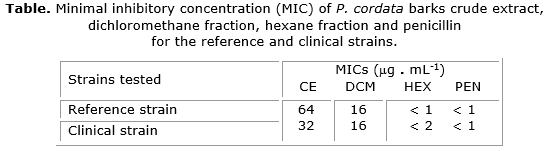
<body><![CDATA[<p>&nbsp; </p>     <p> <font face="Verdana, Arial, Helvetica, sans-serif" size="2"><b><font size="3">RESULTS</font></b>    </font></p>     <p><font face="Verdana, Arial, Helvetica, sans-serif" size="2">Milk aliquots smear    from collected samples showed short gram-positive bacilli. On blood-agar under    anaerobiosis, colonies were gray-white color, big, smooth, rounded, regular    convex, surrounded by a typical zone of &#946;-haemolysis, and stained smear    showed gram-positive bacillus. In biochemical tests were founded: fermentation    of sugars (positive for glucose, lactose, sucrose, maltose and salicin; negative    for mannitol, a negative activity on lipase and urease, no indol production,    gelatin hydrolysis, casein digestion, reduction of nitrates in nitrites and    promotion of stormy clot.<sup>8</sup> Additional cultivation in blood agar and    TSC agar showed double haemolysis zone and lecithinase positive reaction, respectively.    Based on phenotypic and biochemical characteristics, the isolated microorganism    was identified as <i>C. perfringens</i>. </font></p>     <p><font face="Verdana, Arial, Helvetica, sans-serif" size="2"> When examined    in agar-diffusion test, it was observed both hexane (f<a href="#fig">ig. 1A</a>    and <a href="#1B">1B</a>) and dichloromethane (<a href="#fig">fig. 1C</a> and    <a href="#1B">1D</a>) fractions of <i>P. cordata </i> caused significant and    dependent-concentration inhibition halos as for control strains as for the collected    ones in relation to control groups. It was calculated fractions potencies based    on two triplicate samples for each experimental protocol. IC<sub>50</sub>s obtained    from hexane fraction were 1560 (1270/1866) &#181;g/mL for each reference strain    (f<a href="#fig">ig. 1A</a>) and 467(444/509) &#181;g/mL for collected strain    (<a href="#fig">fig. 1B</a>). For dichloromethane fraction, IC<sub>50</sub>s    potencies ranged 648 (591/689) &#181;g/mL for reference strain (<a href="#fig">fig.    1C</a>) and 482 (433/499) &#181;g/mL for collected strain (f<a href="#fig">ig.    1D</a>). For experiments using hexane and dichloromethane fractions for reference    strain, the greatest tested concentration (2000 &#181;g/mL) had inhibition efficacy    up to the concentration of positive control (G penicillin, 10 &#181;g/mL), and    for the collected strain there was a greater efficacy for dichloromethane fraction    in relation to positive control. </font></p>     <p><font face="Verdana, Arial, Helvetica, sans-serif" size="2"> In broth macrodilution    test, the semi-purified fraction of hexane showed moderate bacteriostatic activity    with MIC values in an interval of 0.5 to 2 &#181;g/mL<sup> </sup>against reference    and collected strains (<a href="#tab1_11">table</a>). For dichloromethane fraction,    MIC values ranged around 16 &#181;g/mL for both strains. But the crude extract    was less potent than semi-purified fractions showing MIC values of 32 &#181;g/mL<sup>    </sup>for clinical strain and 64 &#181;g/mL for reference one.</font></p>     <p align="center"><a name="tab1_11"></a><img src="/img/revistas/pla/v21n4/t0111416.gif" width="547" height="151"></p>     <p align="center"><a name="1B"></a><img src="/img/revistas/pla/v21n4/f0111416.jpg" width="580" height="498"></p>     <p>&nbsp; </p>     <p><font face="Verdana, Arial, Helvetica, sans-serif" size="2"><b><font size="3">DISCUSSION</font></b>    </font></p>     <p><font face="Verdana, Arial, Helvetica, sans-serif" size="2"> Infectious diseases    caused by <i>Clostridium </i>sp. have a broad range of clinical severity that    varies greatly. Among clostridium, <i>C. perfringens </i>has been associated    with sudden death, toxicity, bleeding and gastrointestinal diseases.<sup>31,32,33</sup>    However, mastitis caused by <i>C. perfringens </i>is a disease that generally    shows a dramatic clinical condition with irreversible damage to mammary gland    of female bovine and ovine in high dairy production.<sup>24,34</sup> There is    a huge quantity of publications about antibacterial activity of medicinal plants    around the world,<sup>35-37</sup> and a lot of plants have been researched due    their biological activity against <i>C. perfringens</i>,<sup>38-41</sup> including    clinical strains from isolated infections of hospitalized humans<sup>42,43</sup>    or <i>C. perfringens </i>isolated from commercial broiler chickens diagnosed    with necrotic enteritis,<sup>44,45 </sup>but not with clinical pathogenic strains    isolated from udder infection of lactating dairy cows. Researches performed    with crude extracts of several plants and fungi showed, in a sorting of 238    extracts, 25 ones showing antimicrobial activity against <i>C. perfringens</i>.<sup>40</sup>    Bento <i>et al</i>.<sup>45</sup> analyzed the synergism of essential oils of    oregano, rosemary and thyme and its bactericidal effect to confront <i>C. perfringens    </i>from standard strains. Jimoh <i>et al</i>.<sup>46</sup> obtained important    results with garlic against <i>C. perfringens</i> from caeca of broiler chickens.    Until now, there is no reference in the literature regarding the use of <i>P.    cordata</i> extracts or fractions against <i>C. perfringens</i>. </font></p>     ]]></body>
<body><![CDATA[<p> <font face="Verdana, Arial, Helvetica, sans-serif" size="2"><i>P. cordata</i>    is a Brazilian tree from Araucaria Forest bioma which has ethno-indication as    medicinal plant for treating dermatological infection and inflammation, probably    due its action against anaerobic and aerobic skin bacteria as <i>C. perfringens</i>.    While we were performing experiments with <i>P. cordata</i> against bacterial    strains of veterinary interest, we had the opportunity to receive a clinical    material of mammary infection which was confirmed clinically and microbiologically    as gangrenous mastitis by <i>C. perfringens</i>. In this study, for the first    time, it was demonstrated a significant inhibitory effect of <i>P. cordata</i>    fractions against wild anaerobic microorganisms that usually have high resistance    to conventional antibiotics.<sup>47</sup> </font></p>     <p><font face="Verdana, Arial, Helvetica, sans-serif" size="2"> There was proposed    a classification for the antimicrobial activity of vegetal materials, based    on CIM results, as follow: strong inhibitor - CIM until 0.5 mg/mL; moderate    inhibitor - CIM between 0.6 and 1.5 mg/mL; light inhibitor - CIM up to 1.6 mg/mL.<sup>48    </sup>In other studies the inhibition of vegetal concentrations until 2 mg/mL    characterized the extracts as potentially antimicrobial.<sup>49</sup> </font></p>     <p><font face="Verdana, Arial, Helvetica, sans-serif" size="2"> In relation to    the tests utilized, the hexane extract of <i>P. cordata</i> in broth macrodilution    test, for all dilutions showed inhibitory effect in concentrations smaller than    1 &#181;g/mL for standard strain and smaller than 2 &#181;g/mL for clinical    strain of <i>C. perfringens</i>. Dichloromethane extract inhibited bacterial    growing significantly, reducing turbidity in the concentration of 16 &#181;g/mL    for both samples. Turbidity inhibition with the crude extract was around 32    &#181;g/mL for collected sample and 64 &#181;g/mL for standard sample, so demonstrating    less power than semi-purified fractions. </font></p>     <p><font face="Verdana, Arial, Helvetica, sans-serif" size="2"> Phytochemical    studies by Sieben<sup>50</sup> showed among secondary metabolites obtained through    hexane and dichloromethane fractions founded in <i>P. major</i> barks (<i>P.    cordata</i>) are pointed out terpenoids, steroids, aglycons and total sugars,    coinciding with we found in our fractions with thin-layer chromatography. Among    them, triterpenes and steroids are predominant in the plant and they are highlighted    as traditional phytochemical compounds with a well-established antimicrobial    activity in other medicinal plants and which are efficient against different    gram-positive and gram-negative microorganisms<sup>51,52 </sup> including <i>Clostridium    </i>spp.<sup>53,54</sup> As those steroids and triterpenes are predominant in    less polar fractions as hexane and ethyl acetate fraction to a lesser extent,    antibacterial actions of the plant could be attributed to those active principles.    </font></p>     <p><font face="Verdana, Arial, Helvetica, sans-serif" size="2"> Within the classification    proposed, hexane extract of <i>P. cordata</i> barks showed antimicrobial action    with a strong inhibitor against C <i>. perfringens</i>, in contrast to the reference    antibiotic used (penicillin). The findings have suggested that less polar <i>P.    cordata</i> fractions show efficient phytochemical compounds for inhibiting    the growth of <i>C. perfringens</i>, this way justifying the popular use of    the plant to treat infirmities caused by that microorganism. </font></p>     <p><font face="Verdana, Arial, Helvetica, sans-serif" size="2"> We have demonstrated    an important antiedematogenic effect of <i>P. cordata</i> polar fractions,<sup>18</sup>    that in connection with its antibacterial effect<sup>17</sup> could contribute    to the healing actions of the plant<sup>23</sup> according to ethnopharmacological    findings from popular medicine. Thus, as a phytotherapic product, <i>P. cordata</i>    barks can be a multifunctional medicine to treat skin wounds of animals, including    infected ones. The studied <i>P. cordata</i> showed inhibitory activity for    the anaerobic bacteria <i>C. perfringens</i> which causes several infectious    pathologies associated to necrosis and hemorrhagic signs on the udder skin.<sup>55</sup>    Despite being a fecal indicator of food contamination, it can be isolated after    previous contamination to a distant source due to its ability to transform itself    from a vegetative state into a microorganism which produces resistant spores,    depending on environmental conditions.<sup>56</sup> Plants with antibacterial    activity can potentially be used to treat diseases caused by bacterial infections.    In popular medicine, the treatment of infected wounds is an indicative of that    activity. Due to the growing of <i>C. perfringens</i> strains more resistant    to conventional drugs, new antibiotics will be needed for the therapy of animal    infections in the future. There is an ecological rationality that antibacterial    cytotoxic products should be synthesized in plants again after microbial attack    in order to protect plants from pathogens.<sup>47</sup> Thus, antimicrobial    compounds naturally derived from plants can be a new prospect to fight against    multi-drug resistant pathogens. </font></p>     <p><font face="Verdana, Arial, Helvetica, sans-serif" size="2"> We have concluded    that, for the first time, it was demonstrated an inhibitory effect of <i>P.    cordata</i> extracts on <i>C. perfringens</i>, reinforcing the popular use of    <i>P. cordata</i> due to its antimicrobial properties. Thus the extracts may    be used as coadjuvants in the treatment of gangrenous mastitis. </font></p>     <p><font face="Verdana, Arial, Helvetica, sans-serif" size="2"><b>    <br>   ACKNOWLEDGEMENTS</b> </font></p>     <p><font face="Verdana, Arial, Helvetica, sans-serif" size="2">The authors thank    PIBIC-CNPq for financial support. Authors are grateful to Dr. Alan Lara Nenmaier    for technical support and provision of milk sample. </font></p>     ]]></body>
<body><![CDATA[<p> <font face="Verdana, Arial, Helvetica, sans-serif" size="2"><b>    <br>   CONFLICT OF INTEREST </b> </font></p>     <p><font face="Verdana, Arial, Helvetica, sans-serif" size="2"> The author has    no conflicts of interest. </font></p>     <p>&nbsp; </p>     <p> <font face="Verdana, Arial, Helvetica, sans-serif" size="2"><b><font size="3">REFERENCES</font></b>    </font></p>     <!-- ref --><p><font face="Verdana, Arial, Helvetica, sans-serif" size="2"> 1. Watts JL. Etiological    agents of bovine mastitis. Vet Microbiol. 1988;16(1):41-66. <a         href="http://ac.els-cdn.com/0378113588901265/1-s2.0-0378113588901265-main.%20pdf?tid=c4c1af1e-5731-11e5-ac2b-00000aab0f27&amp;acdnat=1441830877_" target="_blank"     > http://ac.els-cdn.com/0378113588901265/1-s2.0-0378113588901265-main. pdf?tid=c4c1af1e-5731-11e5-ac2b-00000aab0f27&amp;acdnat=1441830877    <u>771e 34a 6b39f6082c9e5301a771e251f</u></a><u> </u> </font><!-- ref --><p><font face="Verdana, Arial, Helvetica, sans-serif" size="2"> 2. Schalm OW,    Carrol EJ, Jain NC. Origin, development and evolution of the mammary glands.    In: Idem Bovine Mastitis. 1<sup>st</sup> ed., Philadelphia: Lea and Febiger;    1971.     </font></p>     <!-- ref --><p><font face="Verdana, Arial, Helvetica, sans-serif" size="2"> 3. Renk W. Etiology,    pathogenesis and morphology of bovine mastitis. Vet Med Review. 1967;1:3-21.    <a         href="http://www.scielo.br/scielo.php?script=scinlinks&amp;ref=%200000%2051&amp;pid=S0103-8478200600040004900011&amp;lng=es" target="_blank"     > http://www.scielo.br/scielo.php?script=scinlinks&amp;ref= 0000 51&amp;pid=S0103-8478200600040004900011&amp;lng=es</a></font><!-- ref --><p><font face="Verdana, Arial, Helvetica, sans-serif" size="2"> 4. Giesecke WH,    Tustin RC, Malan C. Bovine mastitis due to <i>Clostridium perfringens </i>type    A and <i>Bacillus cereus</i>. J South Afr Vet Assoc. 1969;40(4):342. <a         href="http://www.scielo.br/scielo.php?script=sci_nlinks&amp;ref=000046&amp;pid=S0103-8478%20200600040004900006&amp;lng=en" target="_blank"     > http://www.scielo.br/scielo.php?script=sci_nlinks&amp;ref=000046&amp;pid=S0103-8478    200600040004900006&amp;lng=en </a> </font><!-- ref --><p><font face="Verdana, Arial, Helvetica, sans-serif" size="2"> 5. Johnston AM.    A successfully treated case of mastitis in the bovine associated with <i>Clostridium    perfringens</i> type A. Vet Rec. 1986;118(26):728-9. <a href="http://%20www.ncbi.nlm.nih.gov/pubmed/2426858" target="_blank">http://    www.ncbi.nlm.nih.gov/pubmed/2426858</a> </font><!-- ref --><p><font face="Verdana, Arial, Helvetica, sans-serif" size="2"> 6. Bergonier D,    De Cr&#233;moux R, Rupp R, Lagriffoul J, Berthelot X. Mastitis of dairy small    ruminants. Vet Res. 2003;34(5):689-16. <a href="http://www.vetres.org/articles/%20vetres/pdf/2003/05/V3511.pdf" target="_blank">    http://www.vetres.org/articles/ vetres/pdf/2003/05/V3511.pdf </a> </font><!-- ref --><p><font face="Verdana, Arial, Helvetica, sans-serif" size="2"> 7. Ribeiro MG,    Lara GHB, Bicudo SD, Souza AVG, Salerno T, Siqueira AK, <i>et al</i>. An unusual    gangrenous goat mastitis caused by<i>Staphylococcus aureus, Clostridium perfringens    </i>and <i>Escherichia coli</i> co-infection<i>. </i>Arq Bras Med Vet Zootec.    2007;59(3):810-2. <a href="http://www.scielo.br/pdf/abmvz/v59n3/a37%20v59n3.pdf" target="_blank">    http://www.scielo.br/pdf/abmvz/v59n3/a37 v59n3.pdf </a> </font><!-- ref --><p><font face="Verdana, Arial, Helvetica, sans-serif" size="2"> 8. Quinn PJ, Markey    BK, Leonard FC, Fitzpatrick ES, Fanning S, Hartigan PJ. Veterinary microbiology    and microbial disease 2th ed., West Sussex: Wiley-Blackwell; 2011.     </font></p>     <!-- ref --><p><font face="Verdana, Arial, Helvetica, sans-serif" size="2"> 9. Baldassi L,    Calil EMB, Portugal MASC. Mastite gangrenosa bovina causada por agentes do g&#234;nero    <i>Clostridium</i>. Arq Inst Biol. 1995;62(1-2),15-20. <a href="http://www.fmvz.unesp.br/rvz/index.php/rvz/article/download/452/345" target="_blank">http://www.fmvz.unesp.br/rvz/index.php/rvz/article/download/452/345</a></font><!-- ref --><p><font face="Verdana, Arial, Helvetica, sans-serif" size="2"> 10. Gon&#231;alves    LA, Freitas TD, Assis RA, Facury-Filho EJ, Lobato FCF. Primeiro relato no Brasil    de mastite necr&#243;tica bovina por <i>Clostridium perfringens </i>tipo A.    Cienc Rural. 2006;36(4):1331-3. <a href="http://www.scielo.br/pdf/cr/v36n4/a49v36%20n4.pdf" target="_blank">    http://www.scielo.br/pdf/cr/v36n4/a49v36 n4.pdf </a> </font><!-- ref --><p><font face="Verdana, Arial, Helvetica, sans-serif" size="2"> 11. Costa EO,    Coutinho SD, Castilho W, Teixeira CM, Gambale W, Gandra CRP. Etiologia bacteriana    da mastite bovina, no Estado de S&#227;o Paulo, Brasil. Rev Microbiol. 1986;17(2):107-12.    <a         href="http://bases.bireme.br/cgi-bin/wxislind.exe/iah/%20online/?IsisScript=iah/iah.xis&amp;nextAction=lnk&amp;base=LILACS&amp;exprSearch=57584&amp;indexSearch=ID&amp;lang=p" target="_blank"     > http://bases.bireme.br/cgi-bin/wxislind.exe/iah/ online/?IsisScript=iah/iah.xis&amp;nextAction=lnk&amp;base=LILACS&amp;exprSearch=57584&amp;indexSearch=ID&amp;lang=p    </a> </font><!-- ref --><p><font face="Verdana, Arial, Helvetica, sans-serif" size="2"> 12. Du Preez JH.    The role of anaerobic bacteria in bovine mastitis: a review. J South Afr Vet    Assoc. 1989;60(3):159-68. <a href="http://www.ncbi.nlm.nih.gov/pub%20med/2699500" target="_blank">    http://www.ncbi.nlm.nih.gov/pub med/2699500 </a> </font><!-- ref --><p><font face="Verdana, Arial, Helvetica, sans-serif" size="2"> <font color="#000000">13.</font>    Niilo L. <i>Clostridium perfringens<b> </b></i>in animal disease: a review of    current knowledge. Can Vet J. 1980;21(5):141-8. <a href="http://www.ncbi.nlm.nih.gov/pmc/%20articles/PMC1789702/">    http://www.ncbi.nlm.nih.gov/pmc/ articles/PMC1789702/ </a> </font><!-- ref --><p><font face="Verdana, Arial, Helvetica, sans-serif" size="2"> 14. Mallard BA,    Dekkers JC, Ireland MJ, Leslie KE, Sharif S, Vankampen C L, Wagter L, Wilkie    BN. Alteration in immune responsiveness during the peripartum period and its    ramification on dairy cow and calf health. J Dairy Sci., 1998;81(2):585-95.    <a         href="http://www.sciencedirect.com/science/article/pii/S0022030298756127" target="_blank"     > http://www.sciencedirect.com/science/article/pii/S0022030298756127 </a>    </font><!-- ref --><p><font face="Verdana, Arial, Helvetica, sans-serif" size="2"> 15. Rood JI, McClane    BA, Songer JG, Titball RW. The clostridia: molecular biology and pathogenesis.    1st ed., San Diego: Academic Press; 1997.     </font></p>     <!-- ref --><p><font face="Verdana, Arial, Helvetica, sans-serif" size="2"> 16. Corr&#234;a    MP.<b> </b>Dicion&#225;rio das plantas &#250;teis do Brasil e das ex&#243;ticas    cultivadas. 3th ed. Rio de Janeiro: IBDF/MA; 1984.     </font></p>     <!-- ref --><p><font face="Verdana, Arial, Helvetica, sans-serif" size="2"> 17. Schlemper    SRM, Schlemper V, Da Silva D, Cordeiro F, Cruz AB, Oliveira E, Cechinel Filho    V. Antibacterial activity of <i>Persea cordata</i> stem barks. Fitoterapia,    2001;72(1):73-5. <a         href="http://www.sciencedirect.com/science/article/pii/S0367326X%2000002550" target="_blank"     > http://www.sciencedirect.com/science/article/pii/S0367326X 00002550 </a>    </font><p><font face="Verdana, Arial, Helvetica, sans-serif" size="2"> 18. Schlemper,    V., Schlemper, S.R., Zampirolo, J.A. 2013. Antiedematogenic effects of the polar    fractions of <i>Persea cordata</i> Mez. (<i>Lauraceae</i>) on microvascular    extravasation in rat skin.<b> </b>J. Ethnopharmacol., 150;244-51. <a href="http://www.ncbi.nlm.nih.gov/pubmed/23993911" target="_blank">    http://www.ncbi.nlm.nih.gov/pubmed/23993911 </a> </font></p>     <!-- ref --><p><font face="Verdana, Arial, Helvetica, sans-serif" size="2"> 19. Schlemper    SRM, Silva D, Cechinel-Filho V, Floriani AE. Avalia&#231;&#227;o da atividade    antimicrobiana de extratos de plantas da flora catarinense: <i>Persea cordata</i>    (<i>Laureacea</i>) e <i>Alternanthera brasiliana </i>(Amaranthaceae). Alcance.    1998;2(5):31-5.     </font></p>     <!-- ref --><p><font face="Verdana, Arial, Helvetica, sans-serif" size="2"> 20. Cechinel Filho    V, Zampirolo JA, Stulzer HK, Schlemper V. Antispasmodic effects of <i>Persea    cordata</i> bark fractions on guinea pig ileum. Fitoterapia. 2007;78(2):125-8.    <a href="http://www.ncbi.nlm.nih.gov/pubmed/17174038" target="_blank"> http://www.ncbi.nlm.nih.gov/pubmed/17174038    </a> </font><!-- ref --><p><font face="Verdana, Arial, Helvetica, sans-serif" size="2"> 21. Zampirolo    JA, Stulzer HK, Tagliari MP, Schlemper V, Cechinel Filho V.Antispasmodic Activity    of <i>Persea cordata</i> Vell. Mez. (<i>Lauraceae</i>) Fractions on Guinea Pig    Ileum Induced by 5-Hydroxytryptamine and Bradykinin. American. J Pharmacol Toxicol.,    2008;3(4):229-33. <a href="http://thescipub.com/PDF/ajptsp.%202008.229.233.pdf" target="_top">    http://thescipub.com/PDF/ajptsp. 2008.229.233.pdf </a> </font><!-- ref --><p><font face="Verdana, Arial, Helvetica, sans-serif" size="2"> 22. Fedalto ML,    Ludka FK, Tasca CI, Molz S.<b> </b>Neuroprotection of <i>Persea major</i> extract    against oxygen and glucose deprivation in hippocampal slice involves increased    glutamate uptake and modulation of A<sub>1</sub> and A<sub>2A</sub> adenosine    receptors. Rev Bras Farmacogn. 2013;23(5):789-95. <a         href="http://www.scielo.br/pdf/%20rbfar/v23n5/0102-695x-rbfar-23-05-0789.pdf" target="_blank"     > http://www.scielo.br/pdf/ rbfar/v23n5/0102-695x-rbfar-23-05-0789.pdf </a>    </font><!-- ref --><p><font face="Verdana, Arial, Helvetica, sans-serif" size="2"> 23. Vieira SC,    Krause GA, Zampirolo JA, Lucinda RM, Schlemper V, Schlemper SRM. Efeito cicatrizante    da pomada de <i>Persea cordata</i> Mez. (Lauraceae) em feridas cut&#226;neas    de cobaias. Rev Bras Pl Med. 2001;3(2):31-5. <a href="http://www.sbpmed.org.br/download/issn_01/artigo_6_v3_n2.pdf" target="_blank">    http://www.sbpmed.org.br/download/issn_01/artigo_6_v3_n2.pdf </a> </font><!-- ref --><p><font face="Verdana, Arial, Helvetica, sans-serif" size="2"> 24. Marini-Bett&#243;lo    GB, Nicoletti M, Patamia M, Galeffi C, Messana I. Plant screening by chemical    and chromatographic procedures under field conditions. J Chromatogr. 1981;213(1):113-27.    <a         href="http://www.sciencedirect.com/science/%20article/pii/S0021967300806391" target="_blank"     > http://www.sciencedirect.com/science/ article/pii/S0021967300806391 </a>    </font><!-- ref --><p><font face="Verdana, Arial, Helvetica, sans-serif" size="2"> 25. Harborne JB.    Phytochemical methods: a guide to modern techniques of plant analysis. 2nd ed.,    London-New York: Chapman and Hall; 1984.     </font></p>     <!-- ref --><p><font face="Verdana, Arial, Helvetica, sans-serif" size="2"> 26. Cato EP, George    WL, Finegold SM. <i>Genus Clostridium</i>. In: Sneath, P.H.A. (1<sup>st</sup>    Ed.) Bergey's Manual of Systematic Bacteriology. Baltimore: Willians and Wilkins;    1986. p. 1141-1200.     </font></p>     <!-- ref --><p><font face="Verdana, Arial, Helvetica, sans-serif" size="2"> 27. Rhodehame    J, Harmon SM. <i>Clostridium perfringens</i>. In: Bennet, R. W. (8<sup>th</sup>    Ed.), FDA Bacteriological Manual, Gaithersburg: AOAC International; 1998. p.    16.01-16.06.     </font></p>     ]]></body>
<body><![CDATA[<!-- ref --><p><font face="Verdana, Arial, Helvetica, sans-serif" size="2"> 28. Bauer AW,    Kirby WMM, Sherris JC, Turck M. Antibiotic susceptibility testing by a standardized    single disk method. Am J Clin Pathol. 1966;45(4):493-6. <a href="http://www.ncbi.nlm.nih.gov/pubmed/5325707">    http://www.ncbi.nlm.nih.gov/pubmed/5325707 </a> </font><!-- ref --><p><font face="Verdana, Arial, Helvetica, sans-serif" size="2"> 29. Cavalieri    SJ, Harbeck RJ, McCarter YS, Ortez JH, Rankin ID, Sautter RL, Sharp SE, Spiegel    CA. Manual of antimicrobial susceptibility testing. Washington DC: American    Society for Microbiology; 2005.     </font></p>     <p><font face="Verdana, Arial, Helvetica, sans-serif" size="2"> 30. Daguet, G.I.,    Chabbert, Y.A. 1977. (1<sup>st</sup> Ed.), Serolog&#237;a bacteriana. Antibi&#243;ticos    en bacteriolog&#237;a m&#233;dica. In: T&#233;cnicas en bacteriolog&#237;a III,    Jims, Barcelona. </font></p>     <!-- ref --><p><font face="Verdana, Arial, Helvetica, sans-serif" size="2"> 31. Costa GM,    Assis RA, Lobato SCF. Diarr&#233;ia em leit&#245;es lactentes por <i>Clostridium    perfringens</i> tipo A em granjas tecnificadas nos Estados de Minas Gerais e    S&#227;o Paulo. Arq Bras Med Vet Zootec. 2004;56(3):401-4. <a href="http://www.scielo.br/pdf/abmvz/v56n3/v56n3a18.pdf" target="_blank">    http://www.scielo.br/pdf/abmvz/v56n3/v56n3a18.pdf </a> </font><!-- ref --><p><font face="Verdana, Arial, Helvetica, sans-serif" size="2"> 32. Siragusa GR,    Haas GJ, Matthews PD, Smith RJ, Buhr RJ, Dale NM, Wise MG. Antimicrobial activity    of lupulone against <i>Clostridium perfringens</i> in the chicken intestinal    tract jejunum and caecum. J Antimicrob Chemother. 2008;61(4):853-8. <a href="http://jac.oxfordjournals.org/content/61/4/853.short">    http://jac.oxfordjournals.org/content/61/4/853.short </a> </font><!-- ref --><p><font face="Verdana, Arial, Helvetica, sans-serif" size="2"> 33. Savic B, Prodanovic    R, Ivetic V, Radanovic O, Bojkovski J. Enteritis associated with <i>Clostridium    perfringens</i> type A in 9-month-old calves. Can Vet J. 2012;53(2):174-6. <a href="http://www.ncbi.nlm.nih.gov/pubmed/22851779" target="_blank">    http://www.ncbi.nlm.nih.gov/pubmed/22851779 </a> </font><!-- ref --><p><font face="Verdana, Arial, Helvetica, sans-serif" size="2"> 34. Maboni F,    Skorei MR, Rocha RX, Vargas AC, Cecim M. Mastite gangrenosa bovina por <i>Clostridium    perfringens</i>. Vet Zootec. 2008;15(3):456-9. <a href="http://www.fmvz.unesp.br/rvz/index.php/rvz/article/view/452" target="_blank">    http://www.fmvz.unesp.br/rvz/index.php/rvz/article/view/452 </a> </font><!-- ref --><p><font face="Verdana, Arial, Helvetica, sans-serif" size="2"> 35. Silva NCC,    Fernades J&#250;nior A. Biological properties of medicinal plants: a review    of their antimicrobial activity. J Venom Anim Toxins Include Trop Dis. 2010;16(3):402-13.    <a href="http://www.scielo.br/pdf/jvatitd/v16n3/a06v16n3.pdf" target="_blank">    http://www.scielo.br/pdf/jvatitd/v16n3/a06v16n3.pdf </a> </font><!-- ref --><p><font face="Verdana, Arial, Helvetica, sans-serif" size="2"> 36. Livermore    DM. Discovery research: the scientific challenge of finding new antibiotics.    J Antimicrob Chemother. 2011;66(9):1941-4. <a href="http://jac.%20Oxfordjour%20nals.org/content/early/2011/06/22/jac.dkr262.full.pdf%2Bhtml" target="_blank">http://jac.    Oxfordjour nals.org/content/early/2011/06/22/jac.dkr262.full.pdf+html</a> </font><!-- ref --><p><font face="Verdana, Arial, Helvetica, sans-serif" size="2"> 37. Goel A, Sharma    K. Plant extracts and phytochemicals as herbal medicines and antimicrobials.    Int J Biol Med Res. 2014;5(1): 3940-6. <a href="http://www.biomedscidirect.com/journalfiles/IJBMRF20131443/plant_extracts_and_phytochemicals_as_herbal_medicines_and_antimicrobials.pdf" target="_blank">http://www.biomedscidirect.com/journalfiles/IJBMRF20131443/plant_extracts_and_phytochemicals_as_herbal_medicines_and_antimicrobials.pdf</a>    </font><!-- ref --><p><font face="Verdana, Arial, Helvetica, sans-serif" size="2"> 38. Ahn Y-J, Lee    C-O, Kweon J-H, Ahn J-W, Park J-H. Growth-inhibitory effects of <i>Galla rhois</i>-derived    tannins on intestinal bacteria. J Appl Microbiol. 1998;84(3):439-443. <a         href="http://onlinelibrary.wiley.com/doi/10.1046/j.1365-2672.1998.003%2063.x/epdf" target="_blank"     > http://onlinelibrary.wiley.com/doi/10.1046/j.1365-2672.1998.003 63.x/epdf    </a> </font><!-- ref --><p><font face="Verdana, Arial, Helvetica, sans-serif" size="2"> 39. Lee H-S, Beon    M-S, Kim M-K. Selective Growth Inhibitor toward Human Intestinal Bacteria Derived    from <i>Pulsatilla cernua</i> root. J Agric Food Chem. 2001;49(10):4656-4661.    <a href="http://pubs.acs.org/doi/abs/10.1021/jf010609z" target="_blank"> http://pubs.acs.org/doi/abs/10.1021/jf010609z    </a> </font><!-- ref --><p><font face="Verdana, Arial, Helvetica, sans-serif" size="2"> 40. Larson TR.    Screening various plant and and fungal extracts against <i>Clostridium perfringens</i>    for antimicrobial activity. UW-L J Undergrad Res. 2007;X:1-3. <a href="http://www.uwlax.edu/urc/JUR-online/PDF/2007/larson.pdf" target="_blank">    http://www.uwlax.edu/urc/JUR-online/PDF/2007/larson.pdf </a> </font><!-- ref --><p><font face="Verdana, Arial, Helvetica, sans-serif" size="2"> 41. Dzomba P,    Muchanyereyi N. Potential antimicrobial plant extract based therapeutics from    <i>Temnocalyx obovatus</i> roots. Eur J Med Plants. 2012;2(3):209-15. DOI:10.9734/EJMP/2012/1293    </font><!-- ref --><p><font face="Verdana, Arial, Helvetica, sans-serif" size="2"> 42. Gadhi CA,    Weber M, Mory F, Benharref A, Lion C, Jana M, Lozniewski A. Antibacterial activity    of <i>Aristolochia paucinervis</i> Pomel. J Ethnopharmacol. 1999;67(1):87-92.    <a         href="http://digilib.buse.ac.zw:8090/xmlui/bitstream/handle/11196/595/%20Potential%20antimicrobial%20dzomba.pdf?sequence=1" target="_blank"     > http://digilib.buse.ac.zw:8090/xmlui/bitstream/handle/11196/595/ Potential%20antimicrobial%20dzomba.pdf?sequence=1    </a> </font><!-- ref --><p><font face="Verdana, Arial, Helvetica, sans-serif" size="2"> 43. Lee H-S, Beon    M-S, Kim M-K. Selective Growth Inhibitor toward Human Intestinal Bacteria Derived    from <i>Pulsatilla cernua</i> Root. J Agric Food Chem. 2001;49(10):4656-61.    <a href="http://pubs.acs.org/doi/pdf/10.1021/jf010609z" target="_blank"> http://pubs.acs.org/doi/pdf/10.1021/jf010609z    </a> </font><!-- ref --><p><font face="Verdana, Arial, Helvetica, sans-serif" size="2"> 44. Bona TDMM,    Pickler L, Miglino LB, Kuritza LN, Vasconcelos SP, Santin E. &#211;leo essencial    de or&#233;gano, alecrim, canela e extrato de pimenta no controle de <i>Salmonella</i>,    <i>Eimeria</i> e <i>Clostridium</i> em frangos de corte. Pesq Vet Bras. 2012;32(5):411-8.    <a href="http://www.scielo.br/pdf/pvb/v32n5/a09v32n5.pdf"> http://www.scielo.br/pdf/pvb/v32n5/a09v32n5.pdf    </a> </font><!-- ref --><p><font face="Verdana, Arial, Helvetica, sans-serif" size="2"> 45. Bento MHL,    Ouwehand AC, Tiihonen K, Lahtinen S, Nurminen P., Saarinen MT, Schulze H, Mygind    T, Fischer J. Essential oils and their use in animal feeds for monogastric animals-effects    on feed quality, gut microbiota, growth performance and food safety: a review.    Vet Med. 2013;58(9):449-58. <a href="http://vri.cz/docs/vetmed/58-9-449.pdf" target="_blank">    http://vri.cz/docs/vetmed/58-9-449.pdf </a> </font><!-- ref --><p><font face="Verdana, Arial, Helvetica, sans-serif" size="2"> 46. Jimoh AA,    Ibitoye EB, Dabay YU, Garba S. <i>In vivo</i> antimicrobial potentials of garlic    against <i>Clostridium perfringens</i> and its promotant effects on performance    of broilers chickens. Pak J Biol Sci. 2013;16(24):1978-84. <a href="http://www.ncbi.%20nlm.nih.gov/pubmed/24517015" target="_blank">http://www.ncbi.    nlm.nih.gov/pubmed/24517015</a> </font><!-- ref --><p><font face="Verdana, Arial, Helvetica, sans-serif" size="2"> 47. Gibbons S.    Plants as a source of bacterial resistance modulators and anti-infective agents.    Phytochem Rev. 2005;4(1):63-78. <a href="http://link.springer.com/%20article/10.1007%2Fs11101-005-2494-9" target="_blank">    http://link.springer.com/ article/10.1007%2Fs11101-005-2494-9 </a> </font><!-- ref --><p><font face="Verdana, Arial, Helvetica, sans-serif" size="2"> 48. Aligiannis    N, Kalpoutzakis E, Mitaku S, Chinou IB. Composition and antimicrobial activity    of the essential oil of two Origanum species. J Agric Food Chem. 2001;49(9):4168-70.    <a         href="http://pubs.acs.org/doi/abs/10.1021/%20jf001494m?%20journalCode=jafcau" target="_blank"     > http://pubs.acs.org/doi/abs/10.1021/ jf001494m? journalCode=jafcau </a>    </font><!-- ref --><p><font face="Verdana, Arial, Helvetica, sans-serif" size="2"> 49. Duarte MCT,    Figueira GM, Sartoratto A, Rehder VL, Delarmelina C. Anti-<i>Candida</i> activity    of Brazilian medicinal plants. J Ethnopharmacol. 2005;97(2):305-11. <a         href="http://www.sciencedirect.com/science/article/pii/S0378874104005781" target="_blank"     > http://www.sciencedirect.com/science/article/pii/S0378874104005781 </a>    </font><!-- ref --><p><font face="Verdana, Arial, Helvetica, sans-serif" size="2"> 50. Sieben PG.    Composi&#231;&#227;o fitoqu&#237;mica de cascas de <i>Persea major </i>(MEISN.)    L. E. KOPP (Lauraceae), desenvolvimento e avalia&#231;&#227;o preliminar de    formas farmac&#234;uticas para uso t&#243;pico. [Master&#180;s dissertation].    Curitiba(PR): Universidade Federal do Paran&#225;. 2012. Portuguese. <a         href="http://dspace.c3sl.ufpr.br/dspace/bitstream/%20handle/1884/28368/R%25" target="_blank"     > http://dspace.c3sl.ufpr.br/dspace/bitstream/ handle/1884/28368/R% </a> </font><!-- ref --><p><font face="Verdana, Arial, Helvetica, sans-serif" size="2"> 51. Miranda RRS,    Silva GDF, Duarte LP, Fortes ICP, Viera-Filho SA. Structural determination of    3&#946;-stearyloxy-urs-12-ene from <i>Maytenus salicifolia</i> by 1D and 2D    NMR and quantitative 13C NMR spectroscopy. Magn Res Chem. 2006;44(2):127-31.    <a href="http://onlinelibrary.wiley.com/doi/10.1002/mrc.1734/pdf" target="_blank">    http://onlinelibrary.wiley.com/doi/10.1002/mrc.1734/pdf </a> </font><!-- ref --><p><font face="Verdana, Arial, Helvetica, sans-serif" size="2"> 52. Ahameethunisa    AR, Hopper W. <i>In vitro</i> antimicrobial activity on clinical microbial strains    and antioxidant properties of <i>Artemisia parviflora</i>. Ann Clin Microbiol    antimicrob. 2012;11(30):30-7. <a href="http://www.ann-clinmicrob.com/%20content/pdf/1476-0711-11-30.pdf" target="_blank">    http://www.ann-clinmicrob.com/ content/pdf/1476-0711-11-30.pdf </a> </font><!-- ref --><p><font face="Verdana, Arial, Helvetica, sans-serif" size="2"> 53. Motlhanka    D, Houghton P, Miljkovic-Brake A, Habtemarian S. A novel pentacyclic triterpene    glycoside from a resin of <i>Commiphora glandulosa</i> from Botswana. Afr J    Pharm Pharmacol. 2010;4(8):549-54. <a         href="http://www.academicjournals.org/article/article1380785906_Motlhanka%20et%20al.pdf" target="_blank"     > http://www.academicjournals.org/article/article1380785906_Motlhanka%20et%20al.pdf    </a> </font><!-- ref --><p><font face="Verdana, Arial, Helvetica, sans-serif" size="2"> 54. Dzomba P,    Togarepi E, Musekiva WA. Phytochemicals antioxidant and antibacterial properties    of a lichen species <i>Cladonia digitata</i>. Afr J Biotechnol. 2012;11(31):7995-9.    <a href="http://www.ajol.info/index.php/ajb/article/view/103303/93%20515" target="_blank">    http://www.ajol.info/index.php/ajb/article/view/103303/93 515 </a> </font><!-- ref --><p><font face="Verdana, Arial, Helvetica, sans-serif" size="2"> 55. El Deeb WM.    Clinicobiochemical investigations of gangrenous mastitis in does: Immunological    responses and oxidative stress biomarkers. J Zhejiang Univ Sci B. 2013;14(1):33-9.    <a         href="http://www.ncbi.nlm.nih.gov/pmc/articles/PMC%203542956/pdf/JZUSB14-0033.pdf" target="_blank"     > http://www.ncbi.nlm.nih.gov/pmc/articles/PMC 3542956/pdf/JZUSB14-0033.pdf    </a> </font><!-- ref --><p><font face="Verdana, Arial, Helvetica, sans-serif" size="2"> 56. Fotou K, Tzora    A, Voidarou CH, Alexopoulos A, Plessas S, Avgeris I, Bezirtzoglou E, Akrida-Deemertzi    K, Demertzis PG. Isolation of microbial pathogens of subclinical mastitis from    raw chip`s milk of Epirus (Greece) and their role in its hygiene. Anaer. 2011;17(6):315-9.    <a href="http://www.sciencedirect.%20com/science/article/pii/S1075996411000837" target="_blank">http://www.sciencedirect.    com/science/article/pii/S1075996411000837</a> </font><p>&nbsp;</p>     <p>&nbsp;</p>     <p><font face="Verdana, Arial, Helvetica, sans-serif" size="2">Recibido: 11 de    septiembre de 2015. </font>    <br>   <font face="Verdana, Arial, Helvetica, sans-serif" size="2">Aprobado: 4 de noviembre    de 2016. </font></p>     <p>&nbsp; </p>     <p>&nbsp;</p>     <p><font face="Verdana, Arial, Helvetica, sans-serif" size="2"><i>Valfredo Schlemper.</i>    Universidade Federal da Fronteira Sul, Brazil. Correo electr&#243;nico: <a href="mailto:valfredo.schlemper@uffs.edu.br">valfredo.schlemper@uffs.edu.br</a>    </font></p>        ]]></body><back>
<ref-list>
<ref id="B1">
<label>1</label><nlm-citation citation-type="journal">
<person-group person-group-type="author">
<name>
<surname><![CDATA[Watts]]></surname>
<given-names><![CDATA[JL]]></given-names>
</name>
</person-group>
<article-title xml:lang="en"><![CDATA[Etiological agents of bovine mastitis]]></article-title>
<source><![CDATA[Vet Microbiol]]></source>
<year>1988</year>
<volume>16</volume>
<numero>1</numero>
<issue>1</issue>
<page-range>41-66</page-range></nlm-citation>
</ref>
<ref id="B2">
<label>2</label><nlm-citation citation-type="book">
<person-group person-group-type="author">
<name>
<surname><![CDATA[Schalm]]></surname>
<given-names><![CDATA[OW]]></given-names>
</name>
<name>
<surname><![CDATA[Carrol]]></surname>
<given-names><![CDATA[EJ]]></given-names>
</name>
<name>
<surname><![CDATA[Jain]]></surname>
<given-names><![CDATA[NC]]></given-names>
</name>
</person-group>
<article-title xml:lang="en"><![CDATA[Origin, development and evolution of the mammary glands]]></article-title>
<source><![CDATA[Idem Bovine Mastitis]]></source>
<year>1971</year>
<edition>1st</edition>
<publisher-loc><![CDATA[Philadelphia ]]></publisher-loc>
<publisher-name><![CDATA[Lea and Febiger]]></publisher-name>
</nlm-citation>
</ref>
<ref id="B3">
<label>3</label><nlm-citation citation-type="journal">
<person-group person-group-type="author">
<name>
<surname><![CDATA[Renk]]></surname>
<given-names><![CDATA[W]]></given-names>
</name>
</person-group>
<article-title xml:lang="en"><![CDATA[Etiology, pathogenesis and morphology of bovine mastitis]]></article-title>
<source><![CDATA[Vet Med Review]]></source>
<year>1967</year>
<volume>1</volume>
<page-range>3-21</page-range></nlm-citation>
</ref>
<ref id="B4">
<label>4</label><nlm-citation citation-type="journal">
<person-group person-group-type="author">
<name>
<surname><![CDATA[Giesecke]]></surname>
<given-names><![CDATA[WH]]></given-names>
</name>
<name>
<surname><![CDATA[Tustin]]></surname>
<given-names><![CDATA[RC]]></given-names>
</name>
<name>
<surname><![CDATA[Malan]]></surname>
<given-names><![CDATA[C]]></given-names>
</name>
</person-group>
<article-title xml:lang="en"><![CDATA[Bovine mastitis due to Clostridium perfringens type A and Bacillus cereus]]></article-title>
<source><![CDATA[J South Afr Vet Assoc]]></source>
<year>1969</year>
<volume>40</volume>
<numero>4</numero>
<issue>4</issue>
<page-range>342</page-range></nlm-citation>
</ref>
<ref id="B5">
<label>5</label><nlm-citation citation-type="journal">
<person-group person-group-type="author">
<name>
<surname><![CDATA[Johnston]]></surname>
<given-names><![CDATA[AM]]></given-names>
</name>
</person-group>
<article-title xml:lang="en"><![CDATA[A successfully treated case of mastitis in the bovine associated with Clostridium perfringens type A]]></article-title>
<source><![CDATA[Vet Rec]]></source>
<year>1986</year>
<volume>118</volume>
<numero>26</numero>
<issue>26</issue>
<page-range>728-9</page-range></nlm-citation>
</ref>
<ref id="B6">
<label>6</label><nlm-citation citation-type="journal">
<person-group person-group-type="author">
<name>
<surname><![CDATA[Bergonier]]></surname>
<given-names><![CDATA[D]]></given-names>
</name>
<name>
<surname><![CDATA[De Crémoux]]></surname>
<given-names><![CDATA[R]]></given-names>
</name>
<name>
<surname><![CDATA[Rupp]]></surname>
<given-names><![CDATA[R]]></given-names>
</name>
<name>
<surname><![CDATA[Lagriffoul]]></surname>
<given-names><![CDATA[J]]></given-names>
</name>
<name>
<surname><![CDATA[Berthelot]]></surname>
<given-names><![CDATA[X]]></given-names>
</name>
</person-group>
<article-title xml:lang="en"><![CDATA[Mastitis of dairy small ruminants]]></article-title>
<source><![CDATA[Vet Res]]></source>
<year>2003</year>
<volume>34</volume>
<numero>5</numero>
<issue>5</issue>
<page-range>689-16</page-range></nlm-citation>
</ref>
<ref id="B7">
<label>7</label><nlm-citation citation-type="journal">
<person-group person-group-type="author">
<name>
<surname><![CDATA[Ribeiro]]></surname>
<given-names><![CDATA[MG]]></given-names>
</name>
<name>
<surname><![CDATA[Lara]]></surname>
<given-names><![CDATA[GHB]]></given-names>
</name>
<name>
<surname><![CDATA[Bicudo]]></surname>
<given-names><![CDATA[SD]]></given-names>
</name>
<name>
<surname><![CDATA[Souza]]></surname>
<given-names><![CDATA[AVG]]></given-names>
</name>
<name>
<surname><![CDATA[Salerno]]></surname>
<given-names><![CDATA[T]]></given-names>
</name>
<name>
<surname><![CDATA[Siqueira]]></surname>
<given-names><![CDATA[AK]]></given-names>
</name>
</person-group>
<article-title xml:lang="en"><![CDATA[An unusual gangrenous goat mastitis caused byStaphylococcus aureus, Clostridium perfringens and Escherichia coli co-infection]]></article-title>
<source><![CDATA[Arq Bras Med Vet Zootec]]></source>
<year>2007</year>
<volume>59</volume>
<numero>3</numero>
<issue>3</issue>
<page-range>810-2</page-range></nlm-citation>
</ref>
<ref id="B8">
<label>8</label><nlm-citation citation-type="book">
<person-group person-group-type="author">
<name>
<surname><![CDATA[Quinn]]></surname>
<given-names><![CDATA[PJ]]></given-names>
</name>
<name>
<surname><![CDATA[Markey]]></surname>
<given-names><![CDATA[BK]]></given-names>
</name>
<name>
<surname><![CDATA[Leonard]]></surname>
<given-names><![CDATA[FC]]></given-names>
</name>
<name>
<surname><![CDATA[Fitzpatrick]]></surname>
<given-names><![CDATA[ES]]></given-names>
</name>
<name>
<surname><![CDATA[Fanning]]></surname>
<given-names><![CDATA[S]]></given-names>
</name>
<name>
<surname><![CDATA[Hartigan]]></surname>
<given-names><![CDATA[PJ]]></given-names>
</name>
</person-group>
<source><![CDATA[Veterinary microbiology and microbial disease]]></source>
<year>2011</year>
<edition>2th</edition>
<publisher-loc><![CDATA[West Sussex ]]></publisher-loc>
<publisher-name><![CDATA[Wiley-Blackwell]]></publisher-name>
</nlm-citation>
</ref>
<ref id="B9">
<label>9</label><nlm-citation citation-type="journal">
<person-group person-group-type="author">
<name>
<surname><![CDATA[Baldassi]]></surname>
<given-names><![CDATA[L]]></given-names>
</name>
<name>
<surname><![CDATA[Calil]]></surname>
<given-names><![CDATA[EMB]]></given-names>
</name>
<name>
<surname><![CDATA[Portugal]]></surname>
<given-names><![CDATA[MASC]]></given-names>
</name>
</person-group>
<article-title xml:lang="pt"><![CDATA[Mastite gangrenosa bovina causada por agentes do gênero Clostridium]]></article-title>
<source><![CDATA[Arq Inst Biol]]></source>
<year>1995</year>
<volume>62</volume>
<numero>1-2</numero>
<issue>1-2</issue>
<page-range>15-20</page-range></nlm-citation>
</ref>
<ref id="B10">
<label>10</label><nlm-citation citation-type="journal">
<person-group person-group-type="author">
<name>
<surname><![CDATA[Gonçalves]]></surname>
<given-names><![CDATA[LA]]></given-names>
</name>
<name>
<surname><![CDATA[Freitas]]></surname>
<given-names><![CDATA[TD]]></given-names>
</name>
<name>
<surname><![CDATA[Assis]]></surname>
<given-names><![CDATA[RA]]></given-names>
</name>
<name>
<surname><![CDATA[Facury-Filho]]></surname>
<given-names><![CDATA[EJ]]></given-names>
</name>
<name>
<surname><![CDATA[Lobato]]></surname>
<given-names><![CDATA[FCF]]></given-names>
</name>
</person-group>
<article-title xml:lang="pt"><![CDATA[Primeiro relato no Brasil de mastite necrótica bovina por Clostridium perfringens tipo A]]></article-title>
<source><![CDATA[Cienc Rural]]></source>
<year>2006</year>
<volume>36</volume>
<numero>4</numero>
<issue>4</issue>
<page-range>1331-3</page-range></nlm-citation>
</ref>
<ref id="B11">
<label>11</label><nlm-citation citation-type="journal">
<person-group person-group-type="author">
<name>
<surname><![CDATA[Costa]]></surname>
<given-names><![CDATA[EO]]></given-names>
</name>
<name>
<surname><![CDATA[Coutinho]]></surname>
<given-names><![CDATA[SD]]></given-names>
</name>
<name>
<surname><![CDATA[Castilho]]></surname>
<given-names><![CDATA[W]]></given-names>
</name>
<name>
<surname><![CDATA[Teixeira]]></surname>
<given-names><![CDATA[CM]]></given-names>
</name>
<name>
<surname><![CDATA[Gambale]]></surname>
<given-names><![CDATA[W]]></given-names>
</name>
<name>
<surname><![CDATA[Gandra]]></surname>
<given-names><![CDATA[CRP]]></given-names>
</name>
</person-group>
<article-title xml:lang="pt"><![CDATA[Etiologia bacteriana da mastite bovina, no Estado de São Paulo, Brasil]]></article-title>
<source><![CDATA[Rev Microbiol]]></source>
<year>1986</year>
<volume>17</volume>
<numero>2</numero>
<issue>2</issue>
<page-range>107-12</page-range></nlm-citation>
</ref>
<ref id="B12">
<label>12</label><nlm-citation citation-type="journal">
<person-group person-group-type="author">
<name>
<surname><![CDATA[Du Preez]]></surname>
<given-names><![CDATA[JH]]></given-names>
</name>
</person-group>
<article-title xml:lang="en"><![CDATA[The role of anaerobic bacteria in bovine mastitis: a review]]></article-title>
<source><![CDATA[J South Afr Vet Assoc]]></source>
<year>1989</year>
<volume>60</volume>
<numero>3</numero>
<issue>3</issue>
<page-range>159-68</page-range></nlm-citation>
</ref>
<ref id="B13">
<label>13</label><nlm-citation citation-type="journal">
<person-group person-group-type="author">
<name>
<surname><![CDATA[Niilo]]></surname>
<given-names><![CDATA[L]]></given-names>
</name>
</person-group>
<article-title xml:lang="en"><![CDATA[Clostridium perfringens in animal disease: a review of current knowledge]]></article-title>
<source><![CDATA[Can Vet J]]></source>
<year>1980</year>
<volume>21</volume>
<numero>5</numero>
<issue>5</issue>
<page-range>141-8</page-range></nlm-citation>
</ref>
<ref id="B14">
<label>14</label><nlm-citation citation-type="journal">
<person-group person-group-type="author">
<name>
<surname><![CDATA[Mallard]]></surname>
<given-names><![CDATA[BA]]></given-names>
</name>
<name>
<surname><![CDATA[Dekkers]]></surname>
<given-names><![CDATA[JC]]></given-names>
</name>
<name>
<surname><![CDATA[Ireland]]></surname>
<given-names><![CDATA[MJ]]></given-names>
</name>
<name>
<surname><![CDATA[Leslie]]></surname>
<given-names><![CDATA[KE]]></given-names>
</name>
<name>
<surname><![CDATA[Sharif]]></surname>
<given-names><![CDATA[S]]></given-names>
</name>
<name>
<surname><![CDATA[Vankampen]]></surname>
<given-names><![CDATA[C L]]></given-names>
</name>
<name>
<surname><![CDATA[Wagter]]></surname>
<given-names><![CDATA[L]]></given-names>
</name>
<name>
<surname><![CDATA[Wilkie]]></surname>
<given-names><![CDATA[BN]]></given-names>
</name>
</person-group>
<article-title xml:lang="en"><![CDATA[Alteration in immune responsiveness during the peripartum period and its ramification on dairy cow and calf health]]></article-title>
<source><![CDATA[J Dairy Sci]]></source>
<year>1998</year>
<volume>81</volume>
<numero>2</numero>
<issue>2</issue>
<page-range>585-95</page-range></nlm-citation>
</ref>
<ref id="B15">
<label>15</label><nlm-citation citation-type="book">
<person-group person-group-type="author">
<name>
<surname><![CDATA[Rood]]></surname>
<given-names><![CDATA[JI]]></given-names>
</name>
<name>
<surname><![CDATA[McClane]]></surname>
<given-names><![CDATA[BA]]></given-names>
</name>
<name>
<surname><![CDATA[Songer]]></surname>
<given-names><![CDATA[JG]]></given-names>
</name>
<name>
<surname><![CDATA[Titball]]></surname>
<given-names><![CDATA[RW]]></given-names>
</name>
</person-group>
<source><![CDATA[The clostridia: molecular biology and pathogenesis]]></source>
<year>1997</year>
<edition>1st</edition>
<publisher-loc><![CDATA[San Diego ]]></publisher-loc>
<publisher-name><![CDATA[Academic Press]]></publisher-name>
</nlm-citation>
</ref>
<ref id="B16">
<label>16</label><nlm-citation citation-type="book">
<person-group person-group-type="author">
<name>
<surname><![CDATA[Corrêa]]></surname>
<given-names><![CDATA[MP]]></given-names>
</name>
</person-group>
<source><![CDATA[Dicionário das plantas úteis do Brasil e das exóticas cultivadas]]></source>
<year>1984</year>
<edition>3th</edition>
<publisher-loc><![CDATA[Rio de Janeiro ]]></publisher-loc>
<publisher-name><![CDATA[IBDF/MA]]></publisher-name>
</nlm-citation>
</ref>
<ref id="B17">
<label>17</label><nlm-citation citation-type="journal">
<person-group person-group-type="author">
<name>
<surname><![CDATA[Schlemper]]></surname>
<given-names><![CDATA[SRM]]></given-names>
</name>
<name>
<surname><![CDATA[Schlemper]]></surname>
<given-names><![CDATA[V]]></given-names>
</name>
<name>
<surname><![CDATA[Da Silva]]></surname>
<given-names><![CDATA[D]]></given-names>
</name>
<name>
<surname><![CDATA[Cordeiro]]></surname>
<given-names><![CDATA[F]]></given-names>
</name>
<name>
<surname><![CDATA[Cruz]]></surname>
<given-names><![CDATA[AB]]></given-names>
</name>
<name>
<surname><![CDATA[Oliveira]]></surname>
<given-names><![CDATA[E]]></given-names>
</name>
<name>
<surname><![CDATA[Cechinel Filho]]></surname>
<given-names><![CDATA[V]]></given-names>
</name>
</person-group>
<article-title xml:lang="en"><![CDATA[Antibacterial activity of Persea cordata stem barks]]></article-title>
<source><![CDATA[Fitoterapia]]></source>
<year>2001</year>
<volume>72</volume>
<numero>1</numero>
<issue>1</issue>
<page-range>73-5</page-range></nlm-citation>
</ref>
<ref id="B18">
<label>18</label><nlm-citation citation-type="journal">
<person-group person-group-type="author">
<name>
<surname><![CDATA[Schlemper]]></surname>
<given-names><![CDATA[V]]></given-names>
</name>
<name>
<surname><![CDATA[Schlemper]]></surname>
<given-names><![CDATA[S.R]]></given-names>
</name>
<name>
<surname><![CDATA[Zampirolo]]></surname>
<given-names><![CDATA[J.A]]></given-names>
</name>
</person-group>
<article-title xml:lang="en"><![CDATA[Antiedematogenic effects of the polar fractions of Persea cordata Mez. (Lauraceae) on microvascular extravasation in rat skin]]></article-title>
<source><![CDATA[J. Ethnopharmacol]]></source>
<year>2013</year>
<volume>150</volume>
<page-range>244-51</page-range></nlm-citation>
</ref>
<ref id="B19">
<label>19</label><nlm-citation citation-type="journal">
<person-group person-group-type="author">
<name>
<surname><![CDATA[Schlemper]]></surname>
<given-names><![CDATA[SRM]]></given-names>
</name>
<name>
<surname><![CDATA[Silva]]></surname>
<given-names><![CDATA[D]]></given-names>
</name>
<name>
<surname><![CDATA[Cechinel-Filho]]></surname>
<given-names><![CDATA[V]]></given-names>
</name>
<name>
<surname><![CDATA[Floriani]]></surname>
<given-names><![CDATA[AE]]></given-names>
</name>
</person-group>
<article-title xml:lang="pt"><![CDATA[Avaliação da atividade antimicrobiana de extratos de plantas da flora catarinense: Persea cordata (Laureacea) e Alternanthera brasiliana (Amaranthaceae)]]></article-title>
<source><![CDATA[Alcance]]></source>
<year>1998</year>
<volume>2</volume>
<numero>5</numero>
<issue>5</issue>
<page-range>31-5</page-range></nlm-citation>
</ref>
<ref id="B20">
<label>20</label><nlm-citation citation-type="journal">
<person-group person-group-type="author">
<name>
<surname><![CDATA[Cechinel Filho]]></surname>
<given-names><![CDATA[V]]></given-names>
</name>
<name>
<surname><![CDATA[Zampirolo]]></surname>
<given-names><![CDATA[JA]]></given-names>
</name>
<name>
<surname><![CDATA[Stulzer]]></surname>
<given-names><![CDATA[HK]]></given-names>
</name>
<name>
<surname><![CDATA[Schlemper]]></surname>
<given-names><![CDATA[V]]></given-names>
</name>
</person-group>
<article-title xml:lang="en"><![CDATA[Antispasmodic effects of Persea cordata bark fractions on guinea pig ileum]]></article-title>
<source><![CDATA[Fitoterapia]]></source>
<year>2007</year>
<volume>78</volume>
<numero>2</numero>
<issue>2</issue>
<page-range>125-8</page-range></nlm-citation>
</ref>
<ref id="B21">
<label>21</label><nlm-citation citation-type="journal">
<person-group person-group-type="author">
<name>
<surname><![CDATA[Zampirolo]]></surname>
<given-names><![CDATA[JA]]></given-names>
</name>
<name>
<surname><![CDATA[Stulzer]]></surname>
<given-names><![CDATA[HK]]></given-names>
</name>
<name>
<surname><![CDATA[Tagliari]]></surname>
<given-names><![CDATA[MP]]></given-names>
</name>
<name>
<surname><![CDATA[Schlemper]]></surname>
<given-names><![CDATA[V]]></given-names>
</name>
<name>
<surname><![CDATA[Cechinel Filho]]></surname>
<given-names><![CDATA[V]]></given-names>
</name>
</person-group>
<article-title xml:lang="en"><![CDATA[Antispasmodic Activity of Persea cordata Vell. Mez. (Lauraceae) Fractions on Guinea Pig Ileum Induced by 5-Hydroxytryptamine and Bradykinin]]></article-title>
<source><![CDATA[American. J Pharmacol Toxicol]]></source>
<year>2008</year>
<volume>3</volume>
<numero>4</numero>
<issue>4</issue>
<page-range>229-33</page-range></nlm-citation>
</ref>
<ref id="B22">
<label>22</label><nlm-citation citation-type="journal">
<person-group person-group-type="author">
<name>
<surname><![CDATA[Fedalto]]></surname>
<given-names><![CDATA[ML]]></given-names>
</name>
<name>
<surname><![CDATA[Ludka]]></surname>
<given-names><![CDATA[FK]]></given-names>
</name>
<name>
<surname><![CDATA[Tasca]]></surname>
<given-names><![CDATA[CI]]></given-names>
</name>
<name>
<surname><![CDATA[Molz]]></surname>
<given-names><![CDATA[S]]></given-names>
</name>
</person-group>
<article-title xml:lang="en"><![CDATA[Neuroprotection of Persea major extract against oxygen and glucose deprivation in hippocampal slice involves increased glutamate uptake and modulation of A1 and A2A adenosine receptors]]></article-title>
<source><![CDATA[Rev Bras Farmacogn]]></source>
<year>2013</year>
<volume>23</volume>
<numero>5</numero>
<issue>5</issue>
<page-range>789-95</page-range></nlm-citation>
</ref>
<ref id="B23">
<label>23</label><nlm-citation citation-type="journal">
<person-group person-group-type="author">
<name>
<surname><![CDATA[Vieira]]></surname>
<given-names><![CDATA[SC]]></given-names>
</name>
<name>
<surname><![CDATA[Krause]]></surname>
<given-names><![CDATA[GA]]></given-names>
</name>
<name>
<surname><![CDATA[Zampirolo]]></surname>
<given-names><![CDATA[JA]]></given-names>
</name>
<name>
<surname><![CDATA[Lucinda]]></surname>
<given-names><![CDATA[RM]]></given-names>
</name>
<name>
<surname><![CDATA[Schlemper]]></surname>
<given-names><![CDATA[V]]></given-names>
</name>
<name>
<surname><![CDATA[Schlemper]]></surname>
<given-names><![CDATA[SRM]]></given-names>
</name>
</person-group>
<article-title xml:lang="pt"><![CDATA[Efeito cicatrizante da pomada de Persea cordata Mez. (Lauraceae) em feridas cutâneas de cobaias]]></article-title>
<source><![CDATA[Rev Bras Pl Med]]></source>
<year>2001</year>
<volume>3</volume>
<numero>2</numero>
<issue>2</issue>
<page-range>31-5</page-range></nlm-citation>
</ref>
<ref id="B24">
<label>24</label><nlm-citation citation-type="journal">
<person-group person-group-type="author">
<name>
<surname><![CDATA[Marini-Bettólo]]></surname>
<given-names><![CDATA[GB]]></given-names>
</name>
<name>
<surname><![CDATA[Nicoletti]]></surname>
<given-names><![CDATA[M]]></given-names>
</name>
<name>
<surname><![CDATA[Patamia]]></surname>
<given-names><![CDATA[M]]></given-names>
</name>
<name>
<surname><![CDATA[Galeffi]]></surname>
<given-names><![CDATA[C]]></given-names>
</name>
<name>
<surname><![CDATA[Messana]]></surname>
<given-names><![CDATA[I]]></given-names>
</name>
</person-group>
<article-title xml:lang="en"><![CDATA[Plant screening by chemical and chromatographic procedures under field conditions]]></article-title>
<source><![CDATA[J Chromatogr]]></source>
<year>1981</year>
<volume>213</volume>
<numero>1</numero>
<issue>1</issue>
<page-range>113-27</page-range></nlm-citation>
</ref>
<ref id="B25">
<label>25</label><nlm-citation citation-type="book">
<person-group person-group-type="author">
<name>
<surname><![CDATA[Harborne]]></surname>
<given-names><![CDATA[JB]]></given-names>
</name>
</person-group>
<source><![CDATA[Phytochemical methods: a guide to modern techniques of plant analysis]]></source>
<year>1984</year>
<edition>2nd</edition>
<publisher-loc><![CDATA[London-New York ]]></publisher-loc>
<publisher-name><![CDATA[Chapman and Hall]]></publisher-name>
</nlm-citation>
</ref>
<ref id="B26">
<label>26</label><nlm-citation citation-type="book">
<person-group person-group-type="author">
<name>
<surname><![CDATA[Cato]]></surname>
<given-names><![CDATA[EP]]></given-names>
</name>
<name>
<surname><![CDATA[George]]></surname>
<given-names><![CDATA[WL]]></given-names>
</name>
<name>
<surname><![CDATA[Finegold]]></surname>
<given-names><![CDATA[SM]]></given-names>
</name>
</person-group>
<article-title xml:lang="la"><![CDATA[Genus Clostridium]]></article-title>
<person-group person-group-type="editor">
<name>
<surname><![CDATA[Sneath]]></surname>
<given-names><![CDATA[P.H.A]]></given-names>
</name>
</person-group>
<source><![CDATA[Bergey's Manual of Systematic Bacteriology]]></source>
<year>1986</year>
<edition>1st</edition>
<page-range>1141-1200</page-range><publisher-loc><![CDATA[Baltimore ]]></publisher-loc>
<publisher-name><![CDATA[Willians and Wilkins]]></publisher-name>
</nlm-citation>
</ref>
<ref id="B27">
<label>27</label><nlm-citation citation-type="book">
<person-group person-group-type="author">
<name>
<surname><![CDATA[Rhodehame]]></surname>
<given-names><![CDATA[J]]></given-names>
</name>
<name>
<surname><![CDATA[Harmon]]></surname>
<given-names><![CDATA[SM]]></given-names>
</name>
</person-group>
<article-title xml:lang="la"><![CDATA[Clostridium perfringens]]></article-title>
<person-group person-group-type="editor">
<name>
<surname><![CDATA[Bennet]]></surname>
<given-names><![CDATA[R. W]]></given-names>
</name>
</person-group>
<source><![CDATA[FDA Bacteriological Manual]]></source>
<year>1998</year>
<edition>8th</edition>
<page-range>16.01-16.06</page-range><publisher-loc><![CDATA[Gaithersburg ]]></publisher-loc>
<publisher-name><![CDATA[AOAC International]]></publisher-name>
</nlm-citation>
</ref>
<ref id="B28">
<label>28</label><nlm-citation citation-type="journal">
<person-group person-group-type="author">
<name>
<surname><![CDATA[Bauer]]></surname>
<given-names><![CDATA[AW]]></given-names>
</name>
<name>
<surname><![CDATA[Kirby]]></surname>
<given-names><![CDATA[WMM]]></given-names>
</name>
<name>
<surname><![CDATA[Sherris]]></surname>
<given-names><![CDATA[JC]]></given-names>
</name>
<name>
<surname><![CDATA[Turck]]></surname>
<given-names><![CDATA[M]]></given-names>
</name>
</person-group>
<article-title xml:lang="en"><![CDATA[Antibiotic susceptibility testing by a standardized single disk method]]></article-title>
<source><![CDATA[Am J Clin Pathol]]></source>
<year>1966</year>
<volume>45</volume>
<numero>4</numero>
<issue>4</issue>
<page-range>493-6</page-range></nlm-citation>
</ref>
<ref id="B29">
<label>29</label><nlm-citation citation-type="book">
<person-group person-group-type="author">
<name>
<surname><![CDATA[Cavalieri]]></surname>
<given-names><![CDATA[SJ]]></given-names>
</name>
<name>
<surname><![CDATA[Harbeck]]></surname>
<given-names><![CDATA[RJ]]></given-names>
</name>
<name>
<surname><![CDATA[McCarter]]></surname>
<given-names><![CDATA[YS]]></given-names>
</name>
<name>
<surname><![CDATA[Ortez]]></surname>
<given-names><![CDATA[JH]]></given-names>
</name>
<name>
<surname><![CDATA[Rankin]]></surname>
<given-names><![CDATA[ID]]></given-names>
</name>
<name>
<surname><![CDATA[Sautter]]></surname>
<given-names><![CDATA[RL]]></given-names>
</name>
<name>
<surname><![CDATA[Sharp]]></surname>
<given-names><![CDATA[SE]]></given-names>
</name>
<name>
<surname><![CDATA[Spiegel]]></surname>
<given-names><![CDATA[CA]]></given-names>
</name>
</person-group>
<source><![CDATA[Manual of antimicrobial susceptibility testing]]></source>
<year>2005</year>
<publisher-loc><![CDATA[Washington DC ]]></publisher-loc>
<publisher-name><![CDATA[American Society for Microbiology]]></publisher-name>
</nlm-citation>
</ref>
<ref id="B30">
<label>30</label><nlm-citation citation-type="book">
<person-group person-group-type="author">
<name>
<surname><![CDATA[Daguet]]></surname>
<given-names><![CDATA[GI]]></given-names>
</name>
<name>
<surname><![CDATA[Chabbert]]></surname>
<given-names><![CDATA[YA]]></given-names>
</name>
</person-group>
<article-title xml:lang="es"><![CDATA[Serología bacteriana: Antibióticos en bacteriología médica]]></article-title>
<source><![CDATA[Técnicas en bacteriología III]]></source>
<year>1977</year>
<edition>1st</edition>
<publisher-loc><![CDATA[Barcelona ]]></publisher-loc>
<publisher-name><![CDATA[Jims]]></publisher-name>
</nlm-citation>
</ref>
<ref id="B31">
<label>31</label><nlm-citation citation-type="journal">
<person-group person-group-type="author">
<name>
<surname><![CDATA[Costa]]></surname>
<given-names><![CDATA[GM]]></given-names>
</name>
<name>
<surname><![CDATA[Assis]]></surname>
<given-names><![CDATA[RA]]></given-names>
</name>
<name>
<surname><![CDATA[Lobato]]></surname>
<given-names><![CDATA[SCF]]></given-names>
</name>
</person-group>
<article-title xml:lang="pt"><![CDATA[Diarréia em leitões lactentes por Clostridium perfringens tipo A em granjas tecnificadas nos Estados de Minas Gerais e São Paulo]]></article-title>
<source><![CDATA[Arq Bras Med Vet Zootec]]></source>
<year>2004</year>
<volume>56</volume>
<numero>3</numero>
<issue>3</issue>
<page-range>401-4</page-range></nlm-citation>
</ref>
<ref id="B32">
<label>32</label><nlm-citation citation-type="journal">
<person-group person-group-type="author">
<name>
<surname><![CDATA[Siragusa]]></surname>
<given-names><![CDATA[GR]]></given-names>
</name>
<name>
<surname><![CDATA[Haas]]></surname>
<given-names><![CDATA[GJ]]></given-names>
</name>
<name>
<surname><![CDATA[Matthews]]></surname>
<given-names><![CDATA[PD]]></given-names>
</name>
<name>
<surname><![CDATA[Smith]]></surname>
<given-names><![CDATA[RJ]]></given-names>
</name>
<name>
<surname><![CDATA[Buhr]]></surname>
<given-names><![CDATA[RJ]]></given-names>
</name>
<name>
<surname><![CDATA[Dale]]></surname>
<given-names><![CDATA[NM]]></given-names>
</name>
<name>
<surname><![CDATA[Wise]]></surname>
<given-names><![CDATA[MG]]></given-names>
</name>
</person-group>
<article-title xml:lang="en"><![CDATA[Antimicrobial activity of lupulone against Clostridium perfringens in the chicken intestinal tract jejunum and caecum]]></article-title>
<source><![CDATA[J Antimicrob Chemother]]></source>
<year>2008</year>
<volume>61</volume>
<numero>4</numero>
<issue>4</issue>
<page-range>853-8</page-range></nlm-citation>
</ref>
<ref id="B33">
<label>33</label><nlm-citation citation-type="journal">
<person-group person-group-type="author">
<name>
<surname><![CDATA[Savic]]></surname>
<given-names><![CDATA[B]]></given-names>
</name>
<name>
<surname><![CDATA[Prodanovic]]></surname>
<given-names><![CDATA[R]]></given-names>
</name>
<name>
<surname><![CDATA[Ivetic]]></surname>
<given-names><![CDATA[V]]></given-names>
</name>
<name>
<surname><![CDATA[Radanovic]]></surname>
<given-names><![CDATA[O]]></given-names>
</name>
<name>
<surname><![CDATA[Bojkovski]]></surname>
<given-names><![CDATA[J]]></given-names>
</name>
</person-group>
<article-title xml:lang="en"><![CDATA[Enteritis associated with Clostridium perfringens type A in 9-month-old calves]]></article-title>
<source><![CDATA[Can Vet J]]></source>
<year>2012</year>
<volume>53</volume>
<numero>2</numero>
<issue>2</issue>
<page-range>174-6</page-range></nlm-citation>
</ref>
<ref id="B34">
<label>34</label><nlm-citation citation-type="journal">
<person-group person-group-type="author">
<name>
<surname><![CDATA[Maboni]]></surname>
<given-names><![CDATA[F]]></given-names>
</name>
<name>
<surname><![CDATA[Skorei]]></surname>
<given-names><![CDATA[MR]]></given-names>
</name>
<name>
<surname><![CDATA[Rocha]]></surname>
<given-names><![CDATA[RX]]></given-names>
</name>
<name>
<surname><![CDATA[Vargas]]></surname>
<given-names><![CDATA[AC]]></given-names>
</name>
<name>
<surname><![CDATA[Cecim]]></surname>
<given-names><![CDATA[M]]></given-names>
</name>
</person-group>
<article-title xml:lang="es"><![CDATA[Mastite gangrenosa bovina por Clostridium perfringens]]></article-title>
<source><![CDATA[Vet Zootec]]></source>
<year>2008</year>
<volume>15</volume>
<numero>3</numero>
<issue>3</issue>
<page-range>456-9</page-range></nlm-citation>
</ref>
<ref id="B35">
<label>35</label><nlm-citation citation-type="journal">
<person-group person-group-type="author">
<name>
<surname><![CDATA[Silva]]></surname>
<given-names><![CDATA[NCC]]></given-names>
</name>
<name>
<surname><![CDATA[Fernades Júnior]]></surname>
<given-names><![CDATA[A]]></given-names>
</name>
</person-group>
<article-title xml:lang="en"><![CDATA[Biological properties of medicinal plants: a review of their antimicrobial activity]]></article-title>
<source><![CDATA[J Venom Anim Toxins Include Trop Dis]]></source>
<year>2010</year>
<volume>16</volume>
<numero>3</numero>
<issue>3</issue>
<page-range>402-13</page-range></nlm-citation>
</ref>
<ref id="B36">
<label>36</label><nlm-citation citation-type="journal">
<person-group person-group-type="author">
<name>
<surname><![CDATA[Livermore]]></surname>
<given-names><![CDATA[DM]]></given-names>
</name>
</person-group>
<article-title xml:lang="en"><![CDATA[Discovery research: the scientific challenge of finding new antibiotics]]></article-title>
<source><![CDATA[J Antimicrob Chemother]]></source>
<year>2011</year>
<volume>66</volume>
<numero>9</numero>
<issue>9</issue>
<page-range>1941-4</page-range></nlm-citation>
</ref>
<ref id="B37">
<label>37</label><nlm-citation citation-type="journal">
<person-group person-group-type="author">
<name>
<surname><![CDATA[Goel]]></surname>
<given-names><![CDATA[A]]></given-names>
</name>
<name>
<surname><![CDATA[Sharma]]></surname>
<given-names><![CDATA[K]]></given-names>
</name>
</person-group>
<article-title xml:lang="en"><![CDATA[Plant extracts and phytochemicals as herbal medicines and antimicrobials]]></article-title>
<source><![CDATA[Int J Biol Med Res]]></source>
<year>2014</year>
<volume>5</volume>
<numero>1</numero>
<issue>1</issue>
<page-range>3940-6</page-range></nlm-citation>
</ref>
<ref id="B38">
<label>38</label><nlm-citation citation-type="journal">
<person-group person-group-type="author">
<name>
<surname><![CDATA[Ahn]]></surname>
<given-names><![CDATA[Y-J]]></given-names>
</name>
<name>
<surname><![CDATA[Lee]]></surname>
<given-names><![CDATA[C-O]]></given-names>
</name>
<name>
<surname><![CDATA[Kweon]]></surname>
<given-names><![CDATA[J-H]]></given-names>
</name>
<name>
<surname><![CDATA[Ahn]]></surname>
<given-names><![CDATA[J-W]]></given-names>
</name>
<name>
<surname><![CDATA[Park]]></surname>
<given-names><![CDATA[J-H]]></given-names>
</name>
</person-group>
<article-title xml:lang="en"><![CDATA[Growth-inhibitory effects of Galla rhois-derived tannins on intestinal bacteria]]></article-title>
<source><![CDATA[J Appl Microbiol]]></source>
<year>1998</year>
<volume>84</volume>
<numero>3</numero>
<issue>3</issue>
<page-range>439-443</page-range></nlm-citation>
</ref>
<ref id="B39">
<label>39</label><nlm-citation citation-type="journal">
<person-group person-group-type="author">
<name>
<surname><![CDATA[Lee]]></surname>
<given-names><![CDATA[H-S]]></given-names>
</name>
<name>
<surname><![CDATA[Beon]]></surname>
<given-names><![CDATA[M-S]]></given-names>
</name>
<name>
<surname><![CDATA[Kim]]></surname>
<given-names><![CDATA[M-K]]></given-names>
</name>
</person-group>
<article-title xml:lang="en"><![CDATA[Selective Growth Inhibitor toward Human Intestinal Bacteria Derived from Pulsatilla cernua root]]></article-title>
<source><![CDATA[J Agric Food Chem]]></source>
<year>2001</year>
<volume>49</volume>
<numero>10</numero>
<issue>10</issue>
<page-range>4656-4661</page-range></nlm-citation>
</ref>
<ref id="B40">
<label>40</label><nlm-citation citation-type="journal">
<person-group person-group-type="author">
<name>
<surname><![CDATA[Larson]]></surname>
<given-names><![CDATA[TR]]></given-names>
</name>
</person-group>
<article-title xml:lang="en"><![CDATA[Screening various plant and and fungal extracts against Clostridium perfringens for antimicrobial activity]]></article-title>
<source><![CDATA[UW-L J Undergrad Res]]></source>
<year>2007</year>
<volume>X</volume>
<page-range>1-3</page-range></nlm-citation>
</ref>
<ref id="B41">
<label>41</label><nlm-citation citation-type="journal">
<person-group person-group-type="author">
<name>
<surname><![CDATA[Dzomba]]></surname>
<given-names><![CDATA[P]]></given-names>
</name>
<name>
<surname><![CDATA[Muchanyereyi]]></surname>
<given-names><![CDATA[N]]></given-names>
</name>
</person-group>
<article-title xml:lang="en"><![CDATA[Potential antimicrobial plant extract based therapeutics from Temnocalyx obovatus roots]]></article-title>
<source><![CDATA[Eur J Med Plants]]></source>
<year>2012</year>
<volume>2</volume>
<numero>3</numero>
<issue>3</issue>
<page-range>209-15</page-range></nlm-citation>
</ref>
<ref id="B42">
<label>42</label><nlm-citation citation-type="journal">
<person-group person-group-type="author">
<name>
<surname><![CDATA[Gadhi]]></surname>
<given-names><![CDATA[CA]]></given-names>
</name>
<name>
<surname><![CDATA[Weber]]></surname>
<given-names><![CDATA[M]]></given-names>
</name>
<name>
<surname><![CDATA[Mory]]></surname>
<given-names><![CDATA[F]]></given-names>
</name>
<name>
<surname><![CDATA[Benharref]]></surname>
<given-names><![CDATA[A]]></given-names>
</name>
<name>
<surname><![CDATA[Lion]]></surname>
<given-names><![CDATA[C]]></given-names>
</name>
<name>
<surname><![CDATA[Jana]]></surname>
<given-names><![CDATA[M]]></given-names>
</name>
<name>
<surname><![CDATA[Lozniewski]]></surname>
<given-names><![CDATA[A]]></given-names>
</name>
</person-group>
<article-title xml:lang="en"><![CDATA[Antibacterial activity of Aristolochia paucinervis Pomel]]></article-title>
<source><![CDATA[J Ethnopharmacol]]></source>
<year>1999</year>
<volume>67</volume>
<numero>1</numero>
<issue>1</issue>
<page-range>87-92</page-range></nlm-citation>
</ref>
<ref id="B43">
<label>43</label><nlm-citation citation-type="journal">
<person-group person-group-type="author">
<name>
<surname><![CDATA[Lee]]></surname>
<given-names><![CDATA[H-S]]></given-names>
</name>
<name>
<surname><![CDATA[Beon]]></surname>
<given-names><![CDATA[M-S]]></given-names>
</name>
<name>
<surname><![CDATA[Kim]]></surname>
<given-names><![CDATA[M-K]]></given-names>
</name>
</person-group>
<article-title xml:lang="en"><![CDATA[Selective Growth Inhibitor toward Human Intestinal Bacteria Derived from Pulsatilla cernua Root]]></article-title>
<source><![CDATA[J Agric Food Chem]]></source>
<year>2001</year>
<volume>49</volume>
<numero>10</numero>
<issue>10</issue>
<page-range>4656-61</page-range></nlm-citation>
</ref>
<ref id="B44">
<label>44</label><nlm-citation citation-type="journal">
<person-group person-group-type="author">
<name>
<surname><![CDATA[Bona]]></surname>
<given-names><![CDATA[TDMM]]></given-names>
</name>
<name>
<surname><![CDATA[Pickler]]></surname>
<given-names><![CDATA[L]]></given-names>
</name>
<name>
<surname><![CDATA[Miglino]]></surname>
<given-names><![CDATA[LB]]></given-names>
</name>
<name>
<surname><![CDATA[Kuritza]]></surname>
<given-names><![CDATA[LN]]></given-names>
</name>
<name>
<surname><![CDATA[Vasconcelos]]></surname>
<given-names><![CDATA[SP]]></given-names>
</name>
<name>
<surname><![CDATA[Santin]]></surname>
<given-names><![CDATA[E]]></given-names>
</name>
</person-group>
<article-title xml:lang="es"><![CDATA[Óleo essencial de orégano, alecrim, canela e extrato de pimenta no controle de Salmonella, Eimeria e Clostridium em frangos de corte]]></article-title>
<source><![CDATA[Pesq Vet Bras]]></source>
<year>2012</year>
<volume>32</volume>
<numero>5</numero>
<issue>5</issue>
<page-range>411-8</page-range></nlm-citation>
</ref>
<ref id="B45">
<label>45</label><nlm-citation citation-type="journal">
<person-group person-group-type="author">
<name>
<surname><![CDATA[Bento]]></surname>
<given-names><![CDATA[MHL]]></given-names>
</name>
<name>
<surname><![CDATA[Ouwehand]]></surname>
<given-names><![CDATA[AC]]></given-names>
</name>
<name>
<surname><![CDATA[Tiihonen]]></surname>
<given-names><![CDATA[K]]></given-names>
</name>
<name>
<surname><![CDATA[Lahtinen]]></surname>
<given-names><![CDATA[S]]></given-names>
</name>
<name>
<surname><![CDATA[Nurminen]]></surname>
<given-names><![CDATA[P]]></given-names>
</name>
<name>
<surname><![CDATA[Saarinen]]></surname>
<given-names><![CDATA[MT]]></given-names>
</name>
<name>
<surname><![CDATA[Schulze]]></surname>
<given-names><![CDATA[H]]></given-names>
</name>
<name>
<surname><![CDATA[Mygind]]></surname>
<given-names><![CDATA[T]]></given-names>
</name>
<name>
<surname><![CDATA[Fischer]]></surname>
<given-names><![CDATA[J]]></given-names>
</name>
</person-group>
<article-title xml:lang="en"><![CDATA[Essential oils and their use in animal feeds for monogastric animals-effects on feed quality, gut microbiota, growth performance and food safety: a review]]></article-title>
<source><![CDATA[Vet Med]]></source>
<year>2013</year>
<volume>58</volume>
<numero>9</numero>
<issue>9</issue>
<page-range>449-58</page-range></nlm-citation>
</ref>
<ref id="B46">
<label>46</label><nlm-citation citation-type="journal">
<person-group person-group-type="author">
<name>
<surname><![CDATA[Jimoh]]></surname>
<given-names><![CDATA[AA]]></given-names>
</name>
<name>
<surname><![CDATA[Ibitoye]]></surname>
<given-names><![CDATA[EB]]></given-names>
</name>
<name>
<surname><![CDATA[Dabay]]></surname>
<given-names><![CDATA[YU]]></given-names>
</name>
<name>
<surname><![CDATA[Garba]]></surname>
<given-names><![CDATA[S]]></given-names>
</name>
</person-group>
<article-title xml:lang="en"><![CDATA[In vivo antimicrobial potentials of garlic against Clostridium perfringens and its promotant effects on performance of broilers chickens]]></article-title>
<source><![CDATA[Pak J Biol Sci]]></source>
<year>2013</year>
<volume>16</volume>
<numero>24</numero>
<issue>24</issue>
<page-range>1978-84</page-range></nlm-citation>
</ref>
<ref id="B47">
<label>47</label><nlm-citation citation-type="journal">
<person-group person-group-type="author">
<name>
<surname><![CDATA[Gibbons]]></surname>
<given-names><![CDATA[S]]></given-names>
</name>
</person-group>
<article-title xml:lang="en"><![CDATA[Plants as a source of bacterial resistance modulators and anti-infective agents]]></article-title>
<source><![CDATA[Phytochem Rev]]></source>
<year>2005</year>
<volume>4</volume>
<numero>1</numero>
<issue>1</issue>
<page-range>63-78</page-range></nlm-citation>
</ref>
<ref id="B48">
<label>48</label><nlm-citation citation-type="journal">
<person-group person-group-type="author">
<name>
<surname><![CDATA[Aligiannis]]></surname>
<given-names><![CDATA[N]]></given-names>
</name>
<name>
<surname><![CDATA[Kalpoutzakis]]></surname>
<given-names><![CDATA[E]]></given-names>
</name>
<name>
<surname><![CDATA[Mitaku]]></surname>
<given-names><![CDATA[S]]></given-names>
</name>
<name>
<surname><![CDATA[Chinou]]></surname>
<given-names><![CDATA[IB]]></given-names>
</name>
</person-group>
<article-title xml:lang="en"><![CDATA[Composition and antimicrobial activity of the essential oil of two Origanum species]]></article-title>
<source><![CDATA[J Agric Food Chem]]></source>
<year>2001</year>
<volume>49</volume>
<numero>9</numero>
<issue>9</issue>
<page-range>4168-70</page-range></nlm-citation>
</ref>
<ref id="B49">
<label>49</label><nlm-citation citation-type="journal">
<person-group person-group-type="author">
<name>
<surname><![CDATA[Duarte]]></surname>
<given-names><![CDATA[MCT]]></given-names>
</name>
<name>
<surname><![CDATA[Figueira]]></surname>
<given-names><![CDATA[GM]]></given-names>
</name>
<name>
<surname><![CDATA[Sartoratto]]></surname>
<given-names><![CDATA[A]]></given-names>
</name>
<name>
<surname><![CDATA[Rehder]]></surname>
<given-names><![CDATA[VL]]></given-names>
</name>
<name>
<surname><![CDATA[Delarmelina]]></surname>
<given-names><![CDATA[C]]></given-names>
</name>
</person-group>
<article-title xml:lang="en"><![CDATA[Anti-Candida activity of Brazilian medicinal plants]]></article-title>
<source><![CDATA[J Ethnopharmacol]]></source>
<year>2005</year>
<volume>97</volume>
<numero>2</numero>
<issue>2</issue>
<page-range>305-11</page-range></nlm-citation>
</ref>
<ref id="B50">
<label>50</label><nlm-citation citation-type="">
<person-group person-group-type="author">
<name>
<surname><![CDATA[Sieben]]></surname>
<given-names><![CDATA[PG]]></given-names>
</name>
</person-group>
<source><![CDATA[Composição fitoquímica de cascas de Persea major (MEISN.) L. E. KOPP (Lauraceae), desenvolvimento e avaliação preliminar de formas farmacêuticas para uso tópico]]></source>
<year></year>
</nlm-citation>
</ref>
<ref id="B51">
<label>51</label><nlm-citation citation-type="journal">
<person-group person-group-type="author">
<name>
<surname><![CDATA[Miranda]]></surname>
<given-names><![CDATA[RRS]]></given-names>
</name>
<name>
<surname><![CDATA[Silva]]></surname>
<given-names><![CDATA[GDF]]></given-names>
</name>
<name>
<surname><![CDATA[Duarte]]></surname>
<given-names><![CDATA[LP]]></given-names>
</name>
<name>
<surname><![CDATA[Fortes]]></surname>
<given-names><![CDATA[ICP]]></given-names>
</name>
<name>
<surname><![CDATA[Viera-Filho]]></surname>
<given-names><![CDATA[SA]]></given-names>
</name>
</person-group>
<article-title xml:lang="en"><![CDATA[Structural determination of 3&#946;-stearyloxy-urs-12-ene from Maytenus salicifolia by 1D and 2D NMR and quantitative 13C NMR spectroscopy]]></article-title>
<source><![CDATA[Magn Res Chem]]></source>
<year>2006</year>
<volume>44</volume>
<numero>2</numero>
<issue>2</issue>
<page-range>127-31</page-range></nlm-citation>
</ref>
<ref id="B52">
<label>52</label><nlm-citation citation-type="journal">
<person-group person-group-type="author">
<name>
<surname><![CDATA[Ahameethunisa]]></surname>
<given-names><![CDATA[AR]]></given-names>
</name>
<name>
<surname><![CDATA[Hopper]]></surname>
<given-names><![CDATA[W]]></given-names>
</name>
</person-group>
<article-title xml:lang="en"><![CDATA[In vitro antimicrobial activity on clinical microbial strains and antioxidant properties of Artemisia parviflora]]></article-title>
<source><![CDATA[Ann Clin Microbiol antimicrob]]></source>
<year>2012</year>
<volume>11</volume>
<numero>30</numero>
<issue>30</issue>
<page-range>30-7</page-range></nlm-citation>
</ref>
<ref id="B53">
<label>53</label><nlm-citation citation-type="journal">
<person-group person-group-type="author">
<name>
<surname><![CDATA[Motlhanka]]></surname>
<given-names><![CDATA[D]]></given-names>
</name>
<name>
<surname><![CDATA[Houghton]]></surname>
<given-names><![CDATA[P]]></given-names>
</name>
<name>
<surname><![CDATA[Miljkovic-Brake]]></surname>
<given-names><![CDATA[A]]></given-names>
</name>
<name>
<surname><![CDATA[Habtemarian]]></surname>
<given-names><![CDATA[S]]></given-names>
</name>
</person-group>
<article-title xml:lang="en"><![CDATA[A novel pentacyclic triterpene glycoside from a resin of Commiphora glandulosa from Botswana]]></article-title>
<source><![CDATA[Afr J Pharm Pharmacol]]></source>
<year>2010</year>
<volume>4</volume>
<numero>8</numero>
<issue>8</issue>
<page-range>549-54</page-range></nlm-citation>
</ref>
<ref id="B54">
<label>54</label><nlm-citation citation-type="journal">
<person-group person-group-type="author">
<name>
<surname><![CDATA[Dzomba]]></surname>
<given-names><![CDATA[P]]></given-names>
</name>
<name>
<surname><![CDATA[Togarepi]]></surname>
<given-names><![CDATA[E]]></given-names>
</name>
<name>
<surname><![CDATA[Musekiva]]></surname>
<given-names><![CDATA[WA]]></given-names>
</name>
</person-group>
<article-title xml:lang="en"><![CDATA[Phytochemicals antioxidant and antibacterial properties of a lichen species Cladonia digitata]]></article-title>
<source><![CDATA[Afr J Biotechnol]]></source>
<year>2012</year>
<volume>11</volume>
<numero>31</numero>
<issue>31</issue>
<page-range>7995-9</page-range></nlm-citation>
</ref>
<ref id="B55">
<label>55</label><nlm-citation citation-type="journal">
<person-group person-group-type="author">
<name>
<surname><![CDATA[El Deeb]]></surname>
<given-names><![CDATA[WM]]></given-names>
</name>
</person-group>
<article-title xml:lang="en"><![CDATA[Clinicobiochemical investigations of gangrenous mastitis in does: Immunological responses and oxidative stress biomarkers]]></article-title>
<source><![CDATA[J Zhejiang Univ Sci B]]></source>
<year>2013</year>
<volume>14</volume>
<numero>1</numero>
<issue>1</issue>
<page-range>33-9</page-range></nlm-citation>
</ref>
<ref id="B56">
<label>56</label><nlm-citation citation-type="journal">
<person-group person-group-type="author">
<name>
<surname><![CDATA[Fotou]]></surname>
<given-names><![CDATA[K]]></given-names>
</name>
<name>
<surname><![CDATA[Tzora]]></surname>
<given-names><![CDATA[A]]></given-names>
</name>
<name>
<surname><![CDATA[Voidarou]]></surname>
<given-names><![CDATA[CH]]></given-names>
</name>
<name>
<surname><![CDATA[Alexopoulos]]></surname>
<given-names><![CDATA[A]]></given-names>
</name>
<name>
<surname><![CDATA[Plessas]]></surname>
<given-names><![CDATA[S]]></given-names>
</name>
<name>
<surname><![CDATA[Avgeris]]></surname>
<given-names><![CDATA[I]]></given-names>
</name>
<name>
<surname><![CDATA[Bezirtzoglou]]></surname>
<given-names><![CDATA[E]]></given-names>
</name>
<name>
<surname><![CDATA[Akrida-Deemertzi]]></surname>
<given-names><![CDATA[K]]></given-names>
</name>
<name>
<surname><![CDATA[Demertzis]]></surname>
<given-names><![CDATA[PG]]></given-names>
</name>
</person-group>
<article-title xml:lang="en"><![CDATA[Isolation of microbial pathogens of subclinical mastitis from raw chip`s milk of Epirus (Greece) and their role in its hygiene]]></article-title>
<source><![CDATA[Anaer]]></source>
<year>2011</year>
<volume>17</volume>
<numero>6</numero>
<issue>6</issue>
<page-range>315-9</page-range></nlm-citation>
</ref>
</ref-list>
</back>
</article>
