<?xml version="1.0" encoding="ISO-8859-1"?><article xmlns:mml="http://www.w3.org/1998/Math/MathML" xmlns:xlink="http://www.w3.org/1999/xlink" xmlns:xsi="http://www.w3.org/2001/XMLSchema-instance">
<front>
<journal-meta>
<journal-id>1560-4381</journal-id>
<journal-title><![CDATA[Correo Científico Médico]]></journal-title>
<abbrev-journal-title><![CDATA[ccm]]></abbrev-journal-title>
<issn>1560-4381</issn>
<publisher>
<publisher-name><![CDATA[Universidad Ciencias Médicas de Holguín]]></publisher-name>
</publisher>
</journal-meta>
<article-meta>
<article-id>S1560-43812016000300004</article-id>
<title-group>
<article-title xml:lang="en"><![CDATA[Modifiable Risk Factors in Uncontrolled High Blood Pressure Patients of Banjul, Gambia]]></article-title>
<article-title xml:lang="es"><![CDATA[Factores de riesgo modificables en pacientes hipertensos no controlados de Banjul, La Gambia]]></article-title>
</title-group>
<contrib-group>
<contrib contrib-type="author">
<name>
<surname><![CDATA[Vega Abascal]]></surname>
<given-names><![CDATA[Jorge]]></given-names>
</name>
<xref ref-type="aff" rid="A01"/>
</contrib>
<contrib contrib-type="author">
<name>
<surname><![CDATA[Garcés Hernandez]]></surname>
<given-names><![CDATA[Yodalis]]></given-names>
</name>
<xref ref-type="aff" rid="A02"/>
</contrib>
<contrib contrib-type="author">
<name>
<surname><![CDATA[Almaguer Mederos]]></surname>
<given-names><![CDATA[Luis Enrique]]></given-names>
</name>
<xref ref-type="aff" rid="A01"/>
</contrib>
<contrib contrib-type="author">
<name>
<surname><![CDATA[Vega Caballero]]></surname>
<given-names><![CDATA[Yulennis]]></given-names>
</name>
<xref ref-type="aff" rid="A03"/>
</contrib>
</contrib-group>
<aff id="A01">
<institution><![CDATA[,School of Medicine and Allied Health Sciences, University of the Gambia  ]]></institution>
<addr-line><![CDATA[Banjul ]]></addr-line>
<country>The Gambia</country>
</aff>
<aff id="A02">
<institution><![CDATA[,Edward Francis Small Teaching Hospital  ]]></institution>
<addr-line><![CDATA[Banjul ]]></addr-line>
<country>The Gambia</country>
</aff>
<aff id="A03">
<institution><![CDATA[,José Ávila Serrano Polyclinic, Velasco, municipality Gibara  ]]></institution>
<addr-line><![CDATA[Holguín ]]></addr-line>
<country>Cuba</country>
</aff>
<pub-date pub-type="pub">
<day>00</day>
<month>09</month>
<year>2016</year>
</pub-date>
<pub-date pub-type="epub">
<day>00</day>
<month>09</month>
<year>2016</year>
</pub-date>
<volume>20</volume>
<numero>3</numero>
<fpage>479</fpage>
<lpage>489</lpage>
<copyright-statement/>
<copyright-year/>
<self-uri xlink:href="http://scielo.sld.cu/scielo.php?script=sci_arttext&amp;pid=S1560-43812016000300004&amp;lng=en&amp;nrm=iso"></self-uri><self-uri xlink:href="http://scielo.sld.cu/scielo.php?script=sci_abstract&amp;pid=S1560-43812016000300004&amp;lng=en&amp;nrm=iso"></self-uri><self-uri xlink:href="http://scielo.sld.cu/scielo.php?script=sci_pdf&amp;pid=S1560-43812016000300004&amp;lng=en&amp;nrm=iso"></self-uri><abstract abstract-type="short" xml:lang="en"><p><![CDATA[Introduction: high blood pressure is a risk factor that could lead to cardiovascular disease and stroke. Objective: to assess the prevalence and association of the modifiable risk factors with uncontrolled blood pressure among hypertensive patients in Medical Outpatient Department in Edward Francis Small Teaching Hospital, Banjul, The Gambia. Methods: a cross-sectional survey was carried out during November 2013; the sample comprised 146 hypertensive patients, after receiving informed consent, hypertensive patients were interviewed about modifiable risk factors. Patients' blood pressure and body mass index were checked, the data was coded and processed using the Statistical Package for Social Sciences (version 15), a multiple logistic regression model was used to estimate the simultaneous effect of several determinants. Results: the study showed that 52% of patients had uncontrolled blood pressure, 43.8% were overweight, 56.2% had unhealthy diet and 74.7% had physical inactivity, the predicted risk factors for uncontrolled high blood pressure, using univariate analysis were: unhealthy diet (p=0.000) and uncontrolled diabetes (p=0.007), the multivariate stepwise logistic regression analysis showed that for uncontrolled blood pressure the variables included as predictors: physical inactivity(p=0.793), overweight(p=0.631), unhealthy diet (p=0.170) and uncontrolled diabetes (p=0.28) were not significantly associated for uncontrolled blood pressure, the 78.9% of uncontrolled blood pressure had two or more modifiable risk factors, the number of modifiable risk factors were significantly associate with the control of blood pressure (Pearson X2 = 22.667, p= 0.000) Conclusions: the half of hypertensive patient were uncontrolled, the majority of patients had two or more modifiable risk factors.]]></p></abstract>
<abstract abstract-type="short" xml:lang="es"><p><![CDATA[Introducción: la hipertensión arterial es un factor de riesgo que puede provocar enfermedad cardio y cerebrovascular. Objetivo: evaluar la prevalencia y la asociación de factores de riesgo modificables con la hipertensión arterial no controlada, en pacientes hipertensos del Departamento de Consulta Externa del Edward Francis Small Teaching Hospital, en Banjul, La Gambia. Métodos: se realizó un estudio descriptivo durante noviembre de 2013, la muestra estuvo conformada 146 pacientes hipertensos, después de obtener el consentimiento informado. Cada paciente fue entrevistado acerca de factores de riesgo modificables y se les determinó la tensión arterial y el índice de masa corporal, los datos fueron codificados y procesados usando el Statistical Package for Social Sciences (versión 15). Para estimar el efecto simultáneo de las variables predictores fue usado un modelo de regresión logística múltiple. Resultados: el estudio mostró que el 52% de los hipertensos estaban no controlados, el 43,8% presentaban sobrepeso, el 56,2% seguían una dieta no saludable y el 74,7% inactividad física. Los factores de riesgo predictores en hipertensos no controlados (usando el modelo univariado) fueron: la dieta no saludable (p=0,000) y la diabetes no controlada (p=0,007). El análisis de regresión logística multivariada por pasos, mostró que las variables incluidas como predictores: inactividad física (p=0, 793), sobrepeso (p=0,631), dieta no saludable (p=0,170) y diabetes mellitus no controlada (p=0,28) no estaban asociadas a la hipertensión no controlada, el 78,9% de los hipertensos no controlados tenía dos o más factores de riesgo modificables, el número de factores de riesgo modificables se asoció significativamente con la hipertensión no controlada (Pearson X2 = 22.667, p= 0.000). Conclusiones: la mitad de los pacientes hipertensos estaban no controlados, la mayoría tenía dos o más factores de riesgo modificables.]]></p></abstract>
<kwd-group>
<kwd lng="en"><![CDATA[high blood pressure]]></kwd>
<kwd lng="en"><![CDATA[risk factors]]></kwd>
<kwd lng="en"><![CDATA[delivery health care]]></kwd>
<kwd lng="en"><![CDATA[prevention and control]]></kwd>
<kwd lng="es"><![CDATA[hipertensión arterial]]></kwd>
<kwd lng="es"><![CDATA[factores de riesgo]]></kwd>
<kwd lng="es"><![CDATA[servicios de cuidados de salud]]></kwd>
<kwd lng="es"><![CDATA[prevención y control]]></kwd>
</kwd-group>
</article-meta>
</front><body><![CDATA[ <p align="right"><font face="Verdana, Arial, Helvetica, sans-serif"><strong><font size="2">ORIGINAL ARTICLE</font></strong></font></p>     <p align="justify">&nbsp;</p>     <p align="justify"><font size="4" face="Verdana, Arial, Helvetica, sans-serif"><strong>Modifiable Risk Factors in Uncontrolled High Blood  Pressure Patients of Banjul, Gambia</strong></font></p>     <p align="justify">&nbsp;</p>     <p align="justify"><font size="3" face="Verdana, Arial, Helvetica, sans-serif"><strong>Factores  de riesgo modificables en pacientes hipertensos no controlados de Banjul, La  Gambia</strong></font></p>     <p align="justify">&nbsp;</p>     <p align="justify">&nbsp;</p>     <p align="justify"><font size="2" face="Verdana, Arial, Helvetica, sans-serif"><strong>Jorge Vega Abascal<sup> 1</sup>,  Yodalis Garc&eacute;s Hernandez<sup> 2</sup>, Luis Enrique Almaguer Mederos<sup> 3</sup>,  Yulennis Vega Caballero<sup> 4</sup></strong></font></p>     <p align="justify"><font size="2" face="Verdana, Arial, Helvetica, sans-serif">1. Master Degree  in Medical Urgencies. Specialist in Internal Medicine. Associate Professor.&nbsp; Edward Francis Small Teaching Hospital.  School of Medicine and Allied Health Sciences, University of the Gambia.  Banjul. The Gambia.<br />   2.  Specialist in Community Medicine. Edward Francis Small Teaching Hospital,  Banjul.&nbsp; The Gambia.<br />   3. Philosophy  Doctor.&nbsp; Bachelor of Biology. Associate Professor.  School of Medicine and Allied Health Sciences, University of the Gambia.  Banjul, The Gambia.<br />   4. Specialist  in Community Medicine. Jos&eacute; &Aacute;vila Serrano Polyclinic, Velasco, municipality Gibara, Holgu&iacute;n, Cuba.</font></p>     <p align="justify">&nbsp;</p>     ]]></body>
<body><![CDATA[<p align="justify">&nbsp;</p>   <hr size="2" width="100%" align="JUSTIFY" />     <p align="justify"><font size="2" face="Verdana, Arial, Helvetica, sans-serif"><strong>ABSTRACT</strong></font></p>     <p align="justify"><font size="2" face="Verdana, Arial, Helvetica, sans-serif"><strong>Introduction</strong>: high blood pressure is a risk factor that could  lead to cardiovascular disease and stroke. <br />     <strong>Objective: </strong>to assess the prevalence &nbsp;and association of the modifiable risk factors  with uncontrolled blood pressure among hypertensive patients in Medical  Outpatient Department in Edward Francis Small Teaching Hospital, Banjul, The  Gambia.<br />     <strong>Methods: </strong>a cross-sectional survey was carried out during  November 2013; the sample comprised 146 hypertensive patients, after receiving  informed consent, hypertensive patients were interviewed about modifiable risk  factors. Patients' blood pressure and body mass index were checked, the data  was coded and processed using the Statistical Package for Social Sciences (version  15), a multiple logistic regression model was used to estimate the simultaneous  effect of several determinants. <br />     <strong>Results: </strong>the study showed that 52% of patients had  uncontrolled blood pressure, 43.8% were overweight, 56.2% had unhealthy diet  and 74.7% had&nbsp; physical inactivity, the  predicted risk factors for uncontrolled high blood pressure, using univariate  analysis were: unhealthy diet (p=0.000) and uncontrolled diabetes (p=0.007),  the multivariate stepwise logistic regression analysis showed that for  uncontrolled blood pressure the variables included as predictors:&nbsp; physical inactivity(p=0.793),  overweight(p=0.631), unhealthy diet (p=0.170) and uncontrolled diabetes  (p=0.28) were not significantly associated&nbsp;  for uncontrolled blood pressure, the 78.9% of uncontrolled blood  pressure had two or more modifiable risk factors, the number of modifiable risk  factors were significantly associate with the control of blood pressure  (Pearson X2 = 22.667, p= 0.000) <br />     <strong>Conclusions: </strong>the half of hypertensive patient were uncontrolled,  the majority of patients had two or more modifiable risk factors. </font></p>     <p align="justify"><font size="2" face="Verdana, Arial, Helvetica, sans-serif"><strong>Keywords: </strong>high blood pressure<strong>, </strong>risk factors, delivery health care, prevention and control. </font></p>   <hr size="2" width="100%" align="JUSTIFY" />     <p align="justify"><font size="2" face="Verdana, Arial, Helvetica, sans-serif"><strong>RESUMEN</strong></font></p>     <p align="justify"><font size="2" face="Verdana, Arial, Helvetica, sans-serif"><strong>Introducci&oacute;n</strong>: la hipertensi&oacute;n arterial es  un factor de riesgo que puede provocar enfermedad cardio y cerebrovascular.<br />     <strong>Objetivo: </strong>evaluar la prevalencia y la  asociaci&oacute;n de factores de riesgo modificables con la hipertensi&oacute;n arterial no  controlada, en pacientes hipertensos del Departamento de Consulta Externa del  Edward Francis Small Teaching Hospital, en Banjul, La Gambia.<br />     <strong>M&eacute;todos: </strong>se realiz&oacute; un estudio  descriptivo durante noviembre de 2013, la muestra estuvo conformada 146 pacientes  hipertensos, despu&eacute;s de obtener el consentimiento informado. Cada paciente fue  entrevistado acerca de factores de riesgo modificables y se les determin&oacute; la  tensi&oacute;n arterial y el &iacute;ndice de masa corporal, los datos fueron codificados y  procesados usando el Statistical Package for Social Sciences (versi&oacute;n 15). Para  estimar el efecto simult&aacute;neo de las variables predictores fue usado un modelo  de regresi&oacute;n log&iacute;stica m&uacute;ltiple. <br />     <strong>Resultados: </strong>el estudio mostr&oacute; que el 52%  de los hipertensos estaban no controlados, el 43,8% presentaban sobrepeso, el  56,2% segu&iacute;an una dieta no saludable y el 74,7% inactividad f&iacute;sica. Los  factores de riesgo predictores en hipertensos no controlados (usando el modelo  univariado) fueron: la dieta no saludable (p=0,000) y la diabetes no controlada  (p=0,007). El an&aacute;lisis de regresi&oacute;n log&iacute;stica multivariada por pasos, mostr&oacute;  que las variables incluidas como predictores: &nbsp;inactividad f&iacute;sica (p=0, 793), sobrepeso  (p=0,631), dieta no saludable (p=0,170) y diabetes mellitus no controlada (p=0,28)  no estaban asociadas a la hipertensi&oacute;n no controlada, el 78,9% de los  hipertensos no controlados ten&iacute;a dos o m&aacute;s factores de riesgo modificables, el  n&uacute;mero de factores de riesgo modificables se asoci&oacute; significativamente con la  hipertensi&oacute;n no controlada (Pearson X2 = 22.667, p= 0.000).<br />     <strong>Conclusiones: </strong>la mitad de los pacientes  hipertensos estaban no controlados, la mayor&iacute;a ten&iacute;a dos o m&aacute;s factores de  riesgo modificables.</font></p>     <p align="justify"><font size="2" face="Verdana, Arial, Helvetica, sans-serif"><strong>Palabras clave</strong>: hipertensi&oacute;n arterial,  factores de riesgo, servicios de cuidados de salud, prevenci&oacute;n y control.</font></p>   <hr size="2" width="100%" align="JUSTIFY" />       <p>&nbsp;</p>       <p>&nbsp;</p>       <p><font size="3" face="Verdana, Arial, Helvetica, sans-serif"><strong>INTRODUCTION</strong></font>      </p>     ]]></body>
<body><![CDATA[<p align="justify"><font size="2" face="Verdana, Arial, Helvetica, sans-serif">Heart  disease is the leading cause of death in the United States<sup> 1</sup>. High  blood pressure, high cholesterol, and smoking are all risk factors that could  lead to cardiovascular disease and stroke. There are two types of risk factors:  controllable or modifiable and uncontrollable. Some risk factors, such as high  blood pressure, unhealthy diet, obesity and smoking, can be controlled by  medication or lifestyle changes. Other risk factors, such as age and race,  cannot be changed<sup> 2</sup>.</font></p>     <p align="justify"><font size="2" face="Verdana, Arial, Helvetica, sans-serif">The  recently announced Million Hearts Initiative is aimed at preventing one million  heart attacks and strokes over the next five years<sup> 3</sup>. About 60  million people in the United States have hypertension, or high blood pressure,  making it the most common heart disease risk factor, nearly one of three adults  has systolic blood pressure over 140, and/or diastolic blood pressure over 90,  which is the definition of hypertension<sup> 4</sup>, like cholesterol, blood  pressure interpretation and treatment should be individualized, taking into account  the patient entire risk profile, control blood pressure  through diet, exercise, weight management, and if needed, medications. </font></p>     <p align="justify"><font size="2" face="Verdana, Arial, Helvetica, sans-serif">The human,  social and economic consequences of Non Communicable Diseases (NCDs), including  hypertension, are felt by all countries but are particularly devastating in  poor and vulnerable populations<sup> 5</sup>. </font></p>     <p align="justify"><font size="2" face="Verdana, Arial, Helvetica, sans-serif">Reducing  the global burden of NCDs is an overriding priority and a necessary condition  for sustainable development, as the leading cause of death globally, NCDs were  responsible for 38 million (68%) of the world&rsquo;s 56 million deaths in 2012, more  than 40% of them (16 million) were premature deaths under age 70 years, almost  three quarters of all NCD deaths (28 million), and the majority of premature  deaths (82%), occur in low- and middle-income countries<sup> 5</sup> as The  Gambia.</font></p>     <p align="justify"><font size="2" face="Verdana, Arial, Helvetica, sans-serif">  The aim of  this study was to assess the prevalence and association of the modifiable risk  factors with uncontrolled blood pressure among hypertensive patients in Medical  Outpatient Department (MOPD)</font></p>     <p align="justify">&nbsp;</p>     <p align="justify"><font size="3" face="Verdana, Arial, Helvetica, sans-serif"><strong>METHODS</strong></font></p>     <p align="justify"><font size="2" face="Verdana, Arial, Helvetica, sans-serif">A  cross-sectional survey was carried out during November 2013, in a sample of 146  hypertensive patients of Medical Outpatient Department at Edward Francis Small  Teaching Hospital in Banjul, The Gambia, West Africa, after receiving informed  consent, hypertensive patients were interviewed about age, diet, physical  activity, history of diabetes mellitus and&nbsp;&nbsp;  measurement of patients' blood pressure and body mass index was checked.  Height was measured without shoes, and weight was recorded while wearing indoor  clothing. Body mass index (BMI) (weight in Kg, divided by the square of the  height in m<sup>2</sup>) was calculated, in diabetic patients was taken a  sample of fasting glucose, the blood pressure was measured three times with an interval  of five minutes among measurement &nbsp;and the value average was used. Uncontrolled high  blood pressure was considered an average systolic blood pressure of 140 mm Hg or more, or a  diastolic blood pressure of 90   mm Hg or more<sup> 4</sup>; persons defined as having  uncontrolled high blood pressure may or may not have been taking medication,  unhealthy diet when the intake of salt was more than five g/daily ( 2g of  sodium daily ), and they had an &nbsp;ingestion  &nbsp;of soda beverage almost daily , physical  inactivity when the patient had sedentary lives, exercising infrequently&nbsp; less than 30 minutes daily or not at all,  overweight patients with&nbsp; body mass index  was more than 25 kg/m<sup>2</sup> and uncontrolled diabetes is defined as having a consistent blood  sugar level of over 7.2 mmol/l.</font></p>     <p align="justify"><font size="2" face="Verdana, Arial, Helvetica, sans-serif">The data  was coded and processed using the Statistical Package for Social Sciences (version  15), descriptive analysis, using standard statistical methods was performed,  Chi-square tests were used to determine the association between the outcome  variables, a multiple logistic regression model with backward selection  (criterion: p-value to remove &ge; 0.10) was used to estimate the simultaneous  effect of several determinants of uncontrolled high blood pressure among the  sample population, the variables included as predictors were: unhealthy diet,  physical inactivity, overweight and uncontrolled diabetes.</font></p>     <p align="justify"><font size="2" face="Verdana, Arial, Helvetica, sans-serif">The study  followed the recommendations of the Clinical Research Ethics Committee (CEIC)  of our hospital.</font></p>     ]]></body>
<body><![CDATA[<p align="justify">&nbsp;</p>     <p align="justify"><font size="3" face="Verdana, Arial, Helvetica, sans-serif"><strong>RESULTS </strong></font></p>     <p align="justify"><font size="2" face="Verdana, Arial, Helvetica, sans-serif">The  characteristic of the study population with means age of 52&plusmn;16 years, 71, 2%  females, 52% had uncontrolled blood pressure, 43.8% were overweight, 56.2% had  unhealthy diet, 74.7 % had physical inactivity and 52 % had uncontrolled  diabetes (<a href="#t1">table I</a>).</font></p>     <p align="center"><font size="2" face="Verdana, Arial, Helvetica, sans-serif"><a name="t1" id="t1"></a><strong>Table I. </strong>Characteristic of the study population. MOPD. 2013</font></p>   <table width="580" border="1" align="center" cellpadding="0" cellspacing="0">     <tr>       <td width="50%">    <p align="center"><font size="2" face="Verdana, Arial, Helvetica, sans-serif">        Variable </font></p></td>       <td width="16%">    <p align="center"><font size="2" face="Verdana, Arial, Helvetica, sans-serif">n<br />         (146)</font></p></td>       <td width="32%">    <p align="center"><font size="2" face="Verdana, Arial, Helvetica, sans-serif">Percentage</font></p></td>     </tr>     <tr>       <td width="50%">    <p align="center"><font size="2" face="Verdana, Arial, Helvetica, sans-serif">Age (years)</font></p></td>       <td width="16%">    <p align="center"><font size="2" face="Verdana, Arial, Helvetica, sans-serif">-</font></p></td>       <td width="32%">    <p align="center"><font size="2" face="Verdana, Arial, Helvetica, sans-serif">52&plusmn;16*</font></p></td>     </tr>     <tr>       <td width="50%">    ]]></body>
<body><![CDATA[<p align="center"><font size="2" face="Verdana, Arial, Helvetica, sans-serif">Age &lt; 65 y<strong>ea</strong>rs</font></p></td>       <td width="16%">    <p align="center"><font size="2" face="Verdana, Arial, Helvetica, sans-serif">38</font></p></td>       <td width="32%">    <p align="center"><font size="2" face="Verdana, Arial, Helvetica, sans-serif">26 %</font></p></td>     </tr>     <tr>       <td width="50%">    <p align="center"><font size="2" face="Verdana, Arial, Helvetica, sans-serif">Female sex</font></p></td>       <td width="16%">    <p align="center"><font size="2" face="Verdana, Arial, Helvetica, sans-serif">104</font></p></td>       <td width="32%">    <p align="center"><font size="2" face="Verdana, Arial, Helvetica, sans-serif">71.2 %</font></p></td>     </tr>     <tr>       <td width="50%">    <p align="center"><font size="2" face="Verdana, Arial, Helvetica, sans-serif">Diabetes Mellitus</font></p></td>       <td width="16%">    <p align="center"><font size="2" face="Verdana, Arial, Helvetica, sans-serif">80</font></p></td>       <td width="32%">    <p align="center"><font size="2" face="Verdana, Arial, Helvetica, sans-serif">54.8 %</font></p></td>     </tr>     <tr>       <td width="50%">    <p align="center"><font size="2" face="Verdana, Arial, Helvetica, sans-serif">Overweight</font></p></td>       <td width="16%">    ]]></body>
<body><![CDATA[<p align="center"><font size="2" face="Verdana, Arial, Helvetica, sans-serif">64</font></p></td>       <td width="32%">    <p align="center"><font size="2" face="Verdana, Arial, Helvetica, sans-serif">43.8 %</font></p></td>     </tr>     <tr>       <td width="50%">    <p align="center"><font size="2" face="Verdana, Arial, Helvetica, sans-serif">Unhealthy diet</font></p></td>       <td width="16%">    <p align="center"><font size="2" face="Verdana, Arial, Helvetica, sans-serif">82</font></p></td>       <td width="32%">    <p align="center"><font size="2" face="Verdana, Arial, Helvetica, sans-serif">56.2 %</font></p></td>     </tr>     <tr>       <td width="50%">    <p align="center"><font size="2" face="Verdana, Arial, Helvetica, sans-serif">Physical inactivity</font></p></td>       <td width="16%">    <p align="center"><font size="2" face="Verdana, Arial, Helvetica, sans-serif">109</font></p></td>       <td width="32%">    <p align="center"><font size="2" face="Verdana, Arial, Helvetica, sans-serif">74.7 %</font></p></td>     </tr>     <tr>       <td width="50%">    <p align="center"><font size="2" face="Verdana, Arial, Helvetica, sans-serif">SBP (mm Hg)</font></p></td>       <td width="16%">    <p align="center"><font size="2" face="Verdana, Arial, Helvetica, sans-serif">-</font></p></td>       <td width="32%">    ]]></body>
<body><![CDATA[<p align="center"><font size="2" face="Verdana, Arial, Helvetica, sans-serif">148.6&plusmn;19.5*</font></p></td>     </tr>     <tr>       <td width="50%">    <p align="center"><font size="2" face="Verdana, Arial, Helvetica, sans-serif">DBP (mm Hg)</font></p></td>       <td width="16%">    <p align="center"><font size="2" face="Verdana, Arial, Helvetica, sans-serif">-</font></p></td>       <td width="32%">    <p align="center"><font size="2" face="Verdana, Arial, Helvetica, sans-serif">98.4&plusmn;4.6*</font></p></td>     </tr>     <tr>       <td width="50%">    <p align="center"><font size="2" face="Verdana, Arial, Helvetica, sans-serif">Glycemia( mmol/l)**</font></p></td>       <td width="16%">    <p align="center"><font size="2" face="Verdana, Arial, Helvetica, sans-serif">-</font></p></td>       <td width="32%">    <p align="center"><font size="2" face="Verdana, Arial, Helvetica, sans-serif">9.8&plusmn;4.6*</font></p></td>     </tr>     <tr>       <td width="50%">    <p align="center"><font size="2" face="Verdana, Arial, Helvetica, sans-serif">Uncontrolled BP</font></p></td>       <td width="16%">    <p align="center"><font size="2" face="Verdana, Arial, Helvetica, sans-serif">76</font></p></td>       <td width="32%">    <p align="center"><font size="2" face="Verdana, Arial, Helvetica, sans-serif">52 %</font></p></td>     </tr>   </table>     ]]></body>
<body><![CDATA[<p align="center"><font size="2" face="Verdana, Arial, Helvetica, sans-serif">* (mean &plusmn;SD)&nbsp;&nbsp;&nbsp;&nbsp;&nbsp;&nbsp;&nbsp;&nbsp; ** Only in diabetic patients</font></p>     <p align="justify"><font size="2" face="Verdana, Arial, Helvetica, sans-serif">The  predicted risk factors using univariate analysis: unhealthy diet (p=0.000) and  uncontrolled diabetes (p=0.007) were significantly associated for uncontrolled  blood pressure (<a href="#t2">table II</a>). </font></p>     <p align="center"><font size="2" face="Verdana, Arial, Helvetica, sans-serif"><a name="t2" id="t2"></a><strong>Table II</strong>. Uncontrolled high blood pressure in relation with  modifiable risk factors.<br /> MOPD.2013</font></p>   <table width="580" border="1" align="center" cellpadding="0" cellspacing="0">     <tr>       <td width="29%" colspan="2">    <p align="center"><font size="2" face="Verdana, Arial, Helvetica, sans-serif">        Variable </font></p></td>       <td width="26%">    <p align="center"><font size="2" face="Verdana, Arial, Helvetica, sans-serif">Uncontrolled Blood Pressure (n=76)</font></p></td>       <td width="24%">    <p align="center"><font size="2" face="Verdana, Arial, Helvetica, sans-serif">Controlled Blood Pressure (n=70)</font></p></td>       <td width="11%">    <p align="center"><font size="2" face="Verdana, Arial, Helvetica, sans-serif">Pearson X2</font></p></td>       <td width="8%">    <p align="center"><font size="2" face="Verdana, Arial, Helvetica, sans-serif">P value</font></p></td>     </tr>     <tr>       <td width="24%" rowspan="2">    <p align="center"><font size="2" face="Verdana, Arial, Helvetica, sans-serif">Overweight</font></p></td>       <td width="5%">    <p align="center"><font size="2" face="Verdana, Arial, Helvetica, sans-serif">Yes</font></p></td>       <td width="26%">    ]]></body>
<body><![CDATA[<p align="center"><font size="2" face="Verdana, Arial, Helvetica, sans-serif">31</font></p></td>       <td width="24%">    <p align="center"><font size="2" face="Verdana, Arial, Helvetica, sans-serif">33</font></p></td>       <td width="11%" rowspan="2">    <p align="center"><font size="2" face="Verdana, Arial, Helvetica, sans-serif">0.597</font></p></td>       <td width="8%" rowspan="2">    <p align="center"><font size="2" face="Verdana, Arial, Helvetica, sans-serif">0.122</font></p></td>     </tr>     <tr>       <td width="5%">    <p align="center"><font size="2" face="Verdana, Arial, Helvetica, sans-serif">No</font></p></td>       <td width="26%">    <p align="center"><font size="2" face="Verdana, Arial, Helvetica, sans-serif">45</font></p></td>       <td width="24%">    <p align="center"><font size="2" face="Verdana, Arial, Helvetica, sans-serif">37</font></p></td>     </tr>     <tr>       <td width="24%" rowspan="2">    <p align="center"><font size="2" face="Verdana, Arial, Helvetica, sans-serif">Unhealthy Diet</font></p></td>       <td width="5%">    <p align="center"><font size="2" face="Verdana, Arial, Helvetica, sans-serif">Yes</font></p></td>       <td width="26%">    <p align="center"><font size="2" face="Verdana, Arial, Helvetica, sans-serif">31</font></p></td>       <td width="24%">    ]]></body>
<body><![CDATA[<p align="center"><font size="2" face="Verdana, Arial, Helvetica, sans-serif">51</font></p></td>       <td width="11%" rowspan="2">    <p align="center"><font size="2" face="Verdana, Arial, Helvetica, sans-serif">15.220</font></p></td>       <td width="8%" rowspan="2">    <p align="center"><font size="2" face="Verdana, Arial, Helvetica, sans-serif">0.000</font></p></td>     </tr>     <tr>       <td width="5%">    <p align="center"><font size="2" face="Verdana, Arial, Helvetica, sans-serif">No</font></p></td>       <td width="26%">    <p align="center"><font size="2" face="Verdana, Arial, Helvetica, sans-serif">45</font></p></td>       <td width="24%">    <p align="center"><font size="2" face="Verdana, Arial, Helvetica, sans-serif">19</font></p></td>     </tr>     <tr>       <td width="24%" rowspan="2">    <p align="center"><font size="2" face="Verdana, Arial, Helvetica, sans-serif">Physical Inactivity</font></p></td>       <td width="5%">    <p align="center"><font size="2" face="Verdana, Arial, Helvetica, sans-serif">Yes</font></p></td>       <td width="26%">    <p align="center"><font size="2" face="Verdana, Arial, Helvetica, sans-serif">22</font></p></td>       <td width="24%">    <p align="center"><font size="2" face="Verdana, Arial, Helvetica, sans-serif">15</font></p></td>       <td width="11%" rowspan="2">    ]]></body>
<body><![CDATA[<p align="center"><font size="2" face="Verdana, Arial, Helvetica, sans-serif">1.089</font></p></td>       <td width="8%" rowspan="2">    <p align="center"><font size="2" face="Verdana, Arial, Helvetica, sans-serif">0.297</font></p></td>     </tr>     <tr>       <td width="5%">    <p align="center"><font size="2" face="Verdana, Arial, Helvetica, sans-serif">No</font></p></td>       <td width="26%">    <p align="center"><font size="2" face="Verdana, Arial, Helvetica, sans-serif">54</font></p></td>       <td width="24%">    <p align="center"><font size="2" face="Verdana, Arial, Helvetica, sans-serif">55</font></p></td>     </tr>     <tr>       <td width="24%" rowspan="2">    <p align="center"><font size="2" face="Verdana, Arial, Helvetica, sans-serif">Uncontrolled Diabetes Mellitus*</font></p></td>       <td width="5%">    <p align="center"><font size="2" face="Verdana, Arial, Helvetica, sans-serif">Yes</font></p></td>       <td width="26%">    <p align="center"><font size="2" face="Verdana, Arial, Helvetica, sans-serif">17</font></p></td>       <td width="24%">    <p align="center"><font size="2" face="Verdana, Arial, Helvetica, sans-serif">29</font></p></td>       <td width="11%" rowspan="2">    <p align="center"><font size="2" face="Verdana, Arial, Helvetica, sans-serif">7.21</font></p></td>       <td width="8%" rowspan="2">    ]]></body>
<body><![CDATA[<p align="center"><font size="2" face="Verdana, Arial, Helvetica, sans-serif">0.007</font></p></td>     </tr>     <tr>       <td width="5%">    <p align="center"><font size="2" face="Verdana, Arial, Helvetica, sans-serif">No</font></p></td>       <td width="26%">    <p align="center"><font size="2" face="Verdana, Arial, Helvetica, sans-serif">22</font></p></td>       <td width="24%">    <p align="center"><font size="2" face="Verdana, Arial, Helvetica, sans-serif">12</font></p></td>     </tr>   </table>     <p align="center"><font size="2" face="Verdana, Arial, Helvetica, sans-serif">*  Only was calculated in diabetic patients</font></p>     <p align="justify"><font size="2" face="Verdana, Arial, Helvetica, sans-serif"><br />   The  multivariate stepwise logistic regression analysis showed that for uncontrolled  blood pressure the variables included as predictors:&nbsp; physical inactivity (p=0.793), overweight  (p=0.631), unhealthy diet (p=0.170) and uncontrolled diabetes (p=0.28) were not  significantly associated for uncontrolled blood pressure (<a href="#t3">table  III</a>).</font></p>     <p align="center"><font size="2" face="Verdana, Arial, Helvetica, sans-serif"><a name="t3" id="t3"></a><strong>Table III.</strong> Multivariate analysis of risk factors for  hypertensive patients.MOPD.2013</font></p>   <table width="580" border="1" align="center" cellpadding="0" cellspacing="0">     <tr>       <td width="35%">    <p align="center"><font size="2" face="Verdana, Arial, Helvetica, sans-serif">        Variable </font></p></td>       <td width="25%">    <p align="center"><font size="2" face="Verdana, Arial, Helvetica, sans-serif">Regression coefficient</font></p></td>       <td width="9%">    <p align="center"><font size="2" face="Verdana, Arial, Helvetica, sans-serif">P value</font></p></td>       <td width="29%">    ]]></body>
<body><![CDATA[<p align="center"><font size="2" face="Verdana, Arial, Helvetica, sans-serif">95 % Confidence Interval</font></p></td>     </tr>     <tr>       <td width="35%">    <p align="center"><font size="2" face="Verdana, Arial, Helvetica, sans-serif">Overweight</font></p></td>       <td width="25%">    <p align="center"><font size="2" face="Verdana, Arial, Helvetica, sans-serif">-0.343</font></p></td>       <td width="9%">    <p align="center"><font size="2" face="Verdana, Arial, Helvetica, sans-serif">0.631</font></p></td>       <td width="29%">    <p align="center"><font size="2" face="Verdana, Arial, Helvetica, sans-serif">0.175-2.86</font></p></td>     </tr>     <tr>       <td width="35%">    <p align="center"><font size="2" face="Verdana, Arial, Helvetica, sans-serif">Unhealthy Diet</font></p></td>       <td width="25%">    <p align="center"><font size="2" face="Verdana, Arial, Helvetica, sans-serif">-0.778</font></p></td>       <td width="9%">    <p align="center"><font size="2" face="Verdana, Arial, Helvetica, sans-serif">0.170</font></p></td>       <td width="29%">    <p align="center"><font size="2" face="Verdana, Arial, Helvetica, sans-serif">0.15-1.39</font></p></td>     </tr>     <tr>       <td width="35%">    <p align="center"><font size="2" face="Verdana, Arial, Helvetica, sans-serif">Physical inactivity</font></p></td>       <td width="25%">    ]]></body>
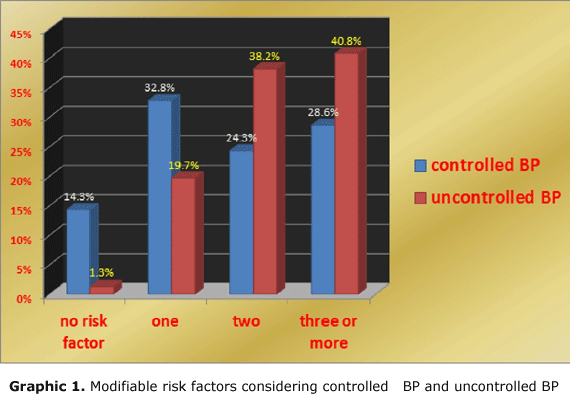
<body><![CDATA[<p align="center"><font size="2" face="Verdana, Arial, Helvetica, sans-serif">-0.169</font></p></td>       <td width="9%">    <p align="center"><font size="2" face="Verdana, Arial, Helvetica, sans-serif">0.793</font></p></td>       <td width="29%">    <p align="center"><font size="2" face="Verdana, Arial, Helvetica, sans-serif">0.240-2.968</font></p></td>     </tr>     <tr>       <td width="35%">    <p align="center"><font size="2" face="Verdana, Arial, Helvetica, sans-serif">Uncontrolled Diabetes mellitus*</font></p></td>       <td width="25%">    <p align="center"><font size="2" face="Verdana, Arial, Helvetica, sans-serif">-1.263</font></p></td>       <td width="9%">    <p align="center"><font size="2" face="Verdana, Arial, Helvetica, sans-serif">0.28</font></p></td>       <td width="29%">    <p align="center"><font size="2" face="Verdana, Arial, Helvetica, sans-serif">0.92-8.70</font></p></td>     </tr>   </table>     <p align="center"><font size="2" face="Verdana, Arial, Helvetica, sans-serif">*  only was calculated in diabetic patients</font></p>     <p align="justify"><font size="2" face="Verdana, Arial, Helvetica, sans-serif">Of 146 hypertensive  patients, 97 of them (66.7%) had two or more modifiable risk factors and 78.9%  of the 76 uncontrolled blood pressure patients ,60 of them had two or more  modifiable risk factors the number of modifiable risk factors, (<a href="#f1">graphic  1</a>) were significantly associate with the control of blood pressure (Pearson  X2 = 22.667, p=0.000) (<a href="#t4">table IV</a>)</font></p>     <p align="center"><font size="2" face="Verdana, Arial, Helvetica, sans-serif"><a name="f1" id="f1"><img src="/img/revistas/ccm/v20n3/f0104316.gif" alt="Graphic 1. Modifiable risk factors considering controlled&nbsp;BP and uncontrolled BP" width="570" height="397" /></a></font></p>     
]]></body>
<body><![CDATA[<p align="center"><font size="2" face="Verdana, Arial, Helvetica, sans-serif"><strong><a name="t4" id="t4"></a>Table IV.</strong> Number of modifiable risk factors according to  control of BP. MOPD.2013</font></p>   <table width="580" border="1" align="center" cellpadding="0" cellspacing="0">     <tr>       <td width="29%" rowspan="2">    <p align="center"><font size="2" face="Verdana, Arial, Helvetica, sans-serif">        Number of risk factors </font></p></td>       <td width="33%" colspan="2">    <p align="center"><font size="2" face="Verdana, Arial, Helvetica, sans-serif">Controlled Blood Pressure</font></p></td>       <td width="36%" colspan="2">    <p align="center"><font size="2" face="Verdana, Arial, Helvetica, sans-serif">Uncontrolled Blood Pressure</font></p></td>     </tr>     <tr>       <td width="14%">    <p align="center"><font size="2" face="Verdana, Arial, Helvetica, sans-serif">No</font></p></td>       <td width="19%">    <p align="center"><font size="2" face="Verdana, Arial, Helvetica, sans-serif">%</font></p></td>       <td width="15%">    <p align="center"><font size="2" face="Verdana, Arial, Helvetica, sans-serif">No</font></p></td>       <td width="21%">    <p align="center"><font size="2" face="Verdana, Arial, Helvetica, sans-serif">%</font></p></td>     </tr>     <tr>       <td width="29%">    <p align="center"><font size="2" face="Verdana, Arial, Helvetica, sans-serif">No</font></p></td>       <td width="14%">    <p align="center"><font size="2" face="Verdana, Arial, Helvetica, sans-serif">10</font></p></td>       <td width="19%">    ]]></body>
<body><![CDATA[<p align="center"><font size="2" face="Verdana, Arial, Helvetica, sans-serif">14.3</font></p></td>       <td width="15%">    <p align="center"><font size="2" face="Verdana, Arial, Helvetica, sans-serif">1</font></p></td>       <td width="21%">    <p align="center"><font size="2" face="Verdana, Arial, Helvetica, sans-serif">1.3</font></p></td>     </tr>     <tr>       <td width="29%">    <p align="center"><font size="2" face="Verdana, Arial, Helvetica, sans-serif">One</font></p></td>       <td width="14%">    <p align="center"><font size="2" face="Verdana, Arial, Helvetica, sans-serif">23</font></p></td>       <td width="19%">    <p align="center"><font size="2" face="Verdana, Arial, Helvetica, sans-serif">32.8</font></p></td>       <td width="15%">    <p align="center"><font size="2" face="Verdana, Arial, Helvetica, sans-serif">15</font></p></td>       <td width="21%">    <p align="center"><font size="2" face="Verdana, Arial, Helvetica, sans-serif">19.7</font></p></td>     </tr>     <tr>       <td width="29%">    <p align="center"><font size="2" face="Verdana, Arial, Helvetica, sans-serif">Two</font></p></td>       <td width="14%">    <p align="center"><font size="2" face="Verdana, Arial, Helvetica, sans-serif">17</font></p></td>       <td width="19%">    ]]></body>
<body><![CDATA[<p align="center"><font size="2" face="Verdana, Arial, Helvetica, sans-serif">24.3</font></p></td>       <td width="15%">    <p align="center"><font size="2" face="Verdana, Arial, Helvetica, sans-serif">29</font></p></td>       <td width="21%">    <p align="center"><font size="2" face="Verdana, Arial, Helvetica, sans-serif">38.2</font></p></td>     </tr>     <tr>       <td width="29%">    <p align="center"><font size="2" face="Verdana, Arial, Helvetica, sans-serif">Three or more</font></p></td>       <td width="14%">    <p align="center"><font size="2" face="Verdana, Arial, Helvetica, sans-serif">20</font></p></td>       <td width="19%">    <p align="center"><font size="2" face="Verdana, Arial, Helvetica, sans-serif">28.6</font></p></td>       <td width="15%">    <p align="center"><font size="2" face="Verdana, Arial, Helvetica, sans-serif">31</font></p></td>       <td width="21%">    <p align="center"><font size="2" face="Verdana, Arial, Helvetica, sans-serif">40.8</font></p></td>     </tr>   </table>     <p align="center"><font size="2" face="Verdana, Arial, Helvetica, sans-serif">BP:  blood pressure&nbsp;&nbsp; &nbsp;&nbsp;&nbsp;&nbsp;&nbsp;&nbsp;&nbsp;&nbsp; Pearson X2&nbsp;&nbsp;&nbsp; 22.667&nbsp;&nbsp;  p 0.000</font></p>     <p align="justify">&nbsp;</p>     ]]></body>
<body><![CDATA[<p align="justify"><font size="3" face="Verdana, Arial, Helvetica, sans-serif"><strong>DISCUSSION</strong></font></p>     <p align="justify"><font size="2" face="Verdana, Arial, Helvetica, sans-serif">Raised  blood pressure is estimated to have caused 9.4 million deaths and 7% of disease  burden as measured in 2010. If left uncontrolled, hypertension causes stroke,  myocardial infarction, cardiac failure, dementia, renal failure and blindness<sup> 5</sup>.</font></p>     <p align="justify"><font size="2" face="Verdana, Arial, Helvetica, sans-serif">Many  modifiable factors contribute to the high prevalence rates of hypertension.  They include eating food containing too much salt and fat, inadequate intake of  fruits and vegetables, overweight and obesity, harmful use of alcohol, physical  inactivity, psychological stress, socioeconomic determinants, and inadequate  access to health care<sup> 5-7</sup></font></p>     <p align="justify"><font size="2" face="Verdana, Arial, Helvetica, sans-serif">Shortcomings  in public health policies to address intake of salt and fruits and vegetables,  physical inactivity, and overweight and obesity have resulted in rising trends  in blood pressure in low and middle-income countries and the number of people  with undetected and uncontrolled hypertension has increased worldwide because  of population growth and ageing. Hypertension is not an inevitable consequence  of ageing. In the majority of cases, the exact cause of hypertension is  unknown, but the presence of several of the above factors, increase the risk of  developing the condition. Most of these above factors are modifiable<sup> 5, 7, 8</sup></font></p>     <p align="justify"><font size="2" face="Verdana, Arial, Helvetica, sans-serif">Regular  physical activity reduces the risk of ischemic heart disease, stroke, diabetes  and breast and colon cancer. Additionally, regular physical activity is a key  determinant of energy expenditure and is therefore fundamental to energy  balance, weight control and prevention of obesity, across all regions; women  were less active than men, with differences in prevalence between men and women  of 10%<sup> 9</sup>.</font></p>     <p align="justify"><font size="2" face="Verdana, Arial, Helvetica, sans-serif">Excess  consumption of dietary sodium is associated with increased risk of hypertension  and cardiovascular disease. It has been estimated that excess sodium intake was  responsible for 1.7 million deaths from cardiovascular causes globally in 2010<sup> 3</sup>.  The main dietary source of sodium worldwide is salt, considerable evidence  shows that lowering sodium consumption can reduce blood pressure and it is also  associated with cardiovascular disease events in persons who consume more than  3.5 g/day of sodium<sup> 10, 11</sup></font></p>     <p align="justify"><font size="2" face="Verdana, Arial, Helvetica, sans-serif">It is  widely accepted that Cardiovascular Diseases (CVDs) constitute a major public  health problem worldwide, the lifetime risk of CVD is substantial, and the  condition is often silent or may strike without warning, underscoring the  importance of prevention<sup> 5, 12, 13</sup></font></p>     <p align="justify"><font size="2" face="Verdana, Arial, Helvetica, sans-serif">The  evidence of risks of high blood pressure and the consistent reduction of such  risks by clinical trials of blood pressure-lowering agents are robust proofs of  the concept that high blood pressure is a major cardiovascular risk. Top  priority should be accorded to implementation of public health policies to  reduce exposure to modifiable risk factors, there is strong scientific evidence  of the health benefits of lowering blood pressure through population-wide and  individual (behavioral and pharmacological) interventions<sup> 5</sup></font></p>     <p align="justify"><font size="2" face="Verdana, Arial, Helvetica, sans-serif">  First heart  attacks and strokes can be prevented if high-risk individuals are detected  early and treated, these interventions can be delivered to persons with raised  cardiovascular risk, including those with hypertension, diabetes and other  cardiovascular risk factors with medium-to-high cardiovascular risk, through  integrated primary care programmes<sup> 5, 14</sup>.</font></p>     <p align="justify"><font size="2" face="Verdana, Arial, Helvetica, sans-serif">Investments  are needed to improve health-service infrastructure and human and financial  resources, to create a health-care system that is capable of deploying and  sustaining equitable and quality-assured programs for addressing cardiovascular  risk</font></p>     ]]></body>
<body><![CDATA[<p align="justify"><font size="2" face="Verdana, Arial, Helvetica, sans-serif">Integrated  Non Communicable Diseases (NCDs) programs can be established at the primary  care level, using Word Health Organization (WHO) guidelines and tools. One objective  of an integrated program is to reduce total cardiovascular risk to prevent  heart attack, stroke, kidney failure and other complications of hypertension  and diabetes<sup> 15, 16</sup></font></p>     <p align="justify"><font size="2" face="Verdana, Arial, Helvetica, sans-serif">Preventable  deaths from heart disease, stroke, and hypertensive disease could be prevented  by more effective public health measures, lifestyle changes, or medical care<sup> 17, 18</sup></font></p>     <p align="justify"><font size="2" face="Verdana, Arial, Helvetica, sans-serif">This study  has limitations: the findings were based on a small population, those patients  that came to the hospital, the time period of analysis was relatively short,  the majority of the patients were from urban region. Therefore the results  cannot be generalized for the general population. The study was not  economically supported.</font></p>     <p align="justify"><font size="2" face="Verdana, Arial, Helvetica, sans-serif">The health  providers should encourage healthy habits at every patient visit, including not  smoking, increasing physical activity, eating a healthy diet, maintaining a  healthy weight, and taking medicines as prescribed.</font></p>     <p align="justify">&nbsp;</p>     <p align="justify"><font size="3" face="Verdana, Arial, Helvetica, sans-serif"><strong>CONCLUSIONS</strong></font></p>     <p align="justify"><font size="2" face="Verdana, Arial, Helvetica, sans-serif">The half of  hypertensive patients were uncontrolled, the majority of patients had two or  more modifiable cardiovascular risk factors.</font></p>     <p align="justify">&nbsp;</p>     <p align="justify"><font size="2" face="Verdana, Arial, Helvetica, sans-serif"><strong>Acknowledgments</strong></font></p>     <p align="justify"><font size="2" face="Verdana, Arial, Helvetica, sans-serif">Our  grateful to the Professor M Kha, Vice-chancellor of the University of The  Gambia, to the Professor Dr .Ousman Nyan, Provost of School of Medicine and  Allied Health Sciences (SMAHS), to the Professor Dr. MI Khalil, Chief of the  Management Board and the Professor Dr. M. Al Jaafari, Chief Medical  Director&nbsp;&nbsp; of the Edward Francis Small  Teaching Hospital (EFSTH), to the staff of SMAHS and EFSTH and our Gambian  patients.</font></p>     ]]></body>
<body><![CDATA[<p align="justify">&nbsp;</p>     <p align="justify"><font size="2" face="Verdana, Arial, Helvetica, sans-serif"><strong>Disclosure</strong></font></p>     <p align="justify"><font size="2" face="Verdana, Arial, Helvetica, sans-serif">The authors  report no conflicts of interest in this work.</font></p>     <p align="justify">&nbsp;</p>     <p align="justify"><font size="3" face="Verdana, Arial, Helvetica, sans-serif"><strong>REFERENCES</strong></font></p>     <!-- ref --><p align="justify"><font size="2" face="Verdana, Arial, Helvetica, sans-serif">1. Mini&ntilde;o AM, Murphy SL. &nbsp;Death in the United States, 2010. NCHS data brief.2012 [citado 3 mar 2016];99:1-8.Disponible  en: <a href="http://citeseerx.ist.psu.edu/viewdoc/download?doi=10.1.1.259.8617&amp;rep=rep1&amp;type=pdf" target="_blank">http://citeseerx.ist.psu.edu/viewdoc/download?doi=10.1.1.259.8617&amp;rep=rep1&amp;type=pdf</a></font><p align="justify"><font size="2" face="Verdana, Arial, Helvetica, sans-serif">2. Narain JP. Integrating  services for non-communicable diseases prevention and control: Use of primary  health care approach. Indian J Community Med. 2011[citado 12 ene 2015]; 36(Suppl1):  67-71. Disponible en: <a href="http://www.ncbi.nlm.nih.gov/pmc/articles/PMC3354898/" target="_blank">http://www.ncbi.nlm.nih.gov/pmc/articles/PMC3354898/</a>. </font></p>     <!-- ref --><p align="justify"><font size="2" face="Verdana, Arial, Helvetica, sans-serif">3. Centers for Disease Control  and Prevention (CDC). Million hearts: strategies to reduce the prevalence of  leading cardiovascular disease risk factors--United States, 2011. MMWR Morb Mortal Wkly Rep. 2011[citado 1 mar 2016];  60(36): 1248-1251. Disponible en: <a href="http://www.ncbi.nlm.nih.gov/pubmed/21918495" target="_blank">http://www.ncbi.nlm.nih.gov/pubmed/21918495</a>.     </font></p>     <p align="justify"><font size="2" face="Verdana, Arial, Helvetica, sans-serif">4.  Chobanian AV, Bakris GL, Black HR, Cushman WC, Green LA, Izzo JL , <em>et al.</em> Seventh report of the Joint  National Committee on Prevention, Detection, Evaluation, and Treatment of High  Blood Pressure. Hypertension. 2003[citado 10 jun 2010]; 42(6):1206&ndash;1252. Disponible en: <a href="https://hyper.ahajournals.org/content/42/6/1206.full" target="_blank">https://hyper.ahajournals.org/content/42/6/1206.full</a> </font></p>     ]]></body>
<body><![CDATA[<!-- ref --><p align="justify"><font size="2" face="Verdana, Arial, Helvetica, sans-serif">5.  WHO. Global status report on noncommunicable diseases 2014. Geneva: WHO; 2014 [citado 11 jun 2015]. Disponible  en: <a href="http://www.who.int/nmh/publications/ncd-status-report-2014/en/" target="_blank">http://www.who.int/nmh/publications/ncd-status-report-2014/en/</a> </font><p align="justify"><font size="2" face="Verdana, Arial, Helvetica, sans-serif">6. D'Agostino RB, Vasan RS, Pencina MJ, Wolf PA, Cobain M, Massaro JM, <em>et al</em>. General cardiovascular risk profile for use in  primary care. The Framingham Heart Study. Circulation. 2008 [cited 2010 Jan  10]; 117(6):743-753. Disponible en: <a href="http://circ.ahajournals.org/cgi/content/full/117/6/743" target="_blank">http://circ.ahajournals.org/cgi/content/full/117/6/743</a> </font></p>     <p align="justify"><font size="2" face="Verdana, Arial, Helvetica, sans-serif">7.  Fuchs FD, Costa Fuchs S, Beltrami Moreira L, Gus M. Proof of concept in  cardiovascular risk: the paradoxical findings in blood pressure and lipid  abnormalities. Vasc Health Risk Manag. 2012[citado 12 jun 2015]; 8: 437&ndash;442. Disponible en: <a href="http://www.ncbi.nlm.nih.gov/pmc/articles/PMC3411330/pdf/vhrm-8-437.pdf" target="_blank">http://www.ncbi.nlm.nih.gov/pmc/articles/PMC3411330/pdf/vhrm-8-437.pdf</a> </font></p>     <!-- ref --><p align="justify"><font size="2" face="Verdana, Arial, Helvetica, sans-serif">8.  Hutcheson R, Rocic P. The Metabolic Syndrome, Oxidative Stress, Environment,  and Cardiovascular Disease: The Great Exploration. Exp Diabetes Res. 2012[citado  15 jun 2015]; 2012:271028.Disponible en: <a href="http://www.ncbi.nlm.nih.gov/pmc/articles/PMC3399393/" target="_blank">http://www.ncbi.nlm.nih.gov/pmc/articles/PMC3399393/</a> </font><!-- ref --><p align="justify"><font size="2" face="Verdana, Arial, Helvetica, sans-serif">9. WHO. Global recommendations on physical activity for  health. Geneva: WHO;2010 [citado 15 jun 2015]. Disponible  en: <a href="http://apps.who.int/iris/bitstream/10665/44399/1/9789241599979_eng.pdf" target="_blank">http://apps.who.int/iris/bitstream/10665/44399/1/9789241599979_eng.pdf</a></font><!-- ref --><p align="justify"><font size="2" face="Verdana, Arial, Helvetica, sans-serif">10. WHO. Diet, nutrition and  the prevention of chronic diseases. Report of a Joint WHO/FAO Expert  Consultation. Geneva: WHO;2003 [citado 15  jun 2015].Disponible en: <a href="http://www.who.int/dietphysicalactivity/publications/trs916/en/gsfao_introduction.pdf" target="_blank">http://www.who.int/dietphysicalactivity/publications/trs916/en/gsfao_introduction.pdf</a> </font><!-- ref --><p align="justify"><font size="2" face="Verdana, Arial, Helvetica, sans-serif">11.WHO.  Effect of reduced sodium intake on blood pressure, renal function, blood lipids  and other potential adverse effects. Geneva: WHO; 2012[citado 15 jun 2012]. Disponible en: <a href="http://apps.who.int/iris/bitstream/10665/79325/1/9789241504911_eng.pdf" target="_blank">http://apps.who.int/iris/bitstream/10665/79325/1/9789241504911_eng.pdf</a> </font><p align="justify"><font size="2" face="Verdana, Arial, Helvetica, sans-serif">12.  Charakida M,&nbsp; Masi S, Deanfield JE.  The Year in Cardiology 2012:  focus on cardiovascular disease prevention. Eur Heart J.2013 [citado 13 jun 2015]; 34(4):  314&ndash;317. Disponible  en: <a href="http://eurheartj.oxfordjournals.org/content/ehj/early/2013/01/02/eurheartj.ehs429.full.pdf" target="_blank">http://eurheartj.oxfordjournals.org/content/ehj/early/2013/01/02/eurheartj.ehs429.full.pdf</a></font></p>     <!-- ref --><p align="justify"><font size="2" face="Verdana, Arial, Helvetica, sans-serif">  13. Tarrag&oacute; E, Miguel Soca PE, Cruz L, Santiesteban Y. Factores de riesgo y  prevenci&oacute;n de la cardiopat&iacute;a isqu&eacute;mica. CCM. 2012 [citado 20 nov 2013]; 16(2). Disponible  en : <a href="http://www.revcocmed.sld.cu/index.php/cocmed/article/view/505" target="_blank">http://www.revcocmed.sld.cu/index.php/cocmed/article/view/505</a> </font><!-- ref --><p align="justify"><font size="2" face="Verdana, Arial, Helvetica, sans-serif">14.  Vega J, Guimar&aacute; M, Vega L. Cardiovascular risk, a useful tool for prevention  of    cardiovascular diseases. Rev Cubana Med Gen Integr. 2011[citado 13 dic  2015];27(1):91-7. Disponible en: <a href="http://scielo.sld.cu/pdf/mgi/v27n1/mgi10111.pdf" target="_blank">http://scielo.sld.cu/pdf/mgi/v27n1/mgi10111.pdf</a> </font><!-- ref --><p align="justify"><font size="2" face="Verdana, Arial, Helvetica, sans-serif">15.  WHO. Implementation tools: package of essential non communicable (PEN) disease  interventions for primary health care in low-resource settings. Geneva:  WHO;2013. [citado 5 nov 2013]. Disponible  en: &nbsp;<a href="http://www.who.int/cardiovascular_diseases/publications/implementation_tools_WHO_PEN/en/" target="_blank">http://www.who.int/cardiovascular_diseases/publications/implementation_tools_WHO_PEN/en/</a>.     </font></p>     <!-- ref --><p align="justify"><font size="2" face="Verdana, Arial, Helvetica, sans-serif">16. Nordet P, Mendis M, Due&ntilde;as A, de la Noval R, Armas N, de la Noval IL ,<em>et al</em>. Total cardiovascular risk assessment and management  using two prediction tools, with and without blood cholesterol. MEDICC Rev. 2013 [citado 26  nov 201];15(4):36-40. Disponible en: <a href="http://www.ncbi.nlm.nih.gov/pubmed/24253349" target="_blank">http://www.ncbi.nlm.nih.gov/pubmed/24253349</a> </font><!-- ref --><p align="justify"><font size="2" face="Verdana, Arial, Helvetica, sans-serif">17. Vega J, Guimara M, Garces Y, Garcia Y, Vega L. High sensitivity c  reactive protein and cardiovascular disease risk. CCM.2015 [citado 27 nov  2015];19(2):190-201. Disponible en: <a href="http://www.revcocmed.sld.cu/index.php/cocmed/article/download/978/620" target="_blank">http://www.revcocmed.sld.cu/index.php/cocmed/article/download/978/620</a> </font><!-- ref --><p align="justify"><font size="2" face="Verdana, Arial, Helvetica, sans-serif">18.  Vega J, Guimara M, Garces Y, Vega L, Rivas M. Prediction of coronary and  cardiovascular global risk in primary health care. CCM.2015 [citado 27 nov 2015];19(2):202-211.  Disponible en: <a href="http://www.revcocmed.sld.cu/index.php/cocmed/article/download/979/622">http://www.revcocmed.sld.cu/index.php/cocmed/article/download/979/622</a> </font><p align="justify">&nbsp;</p>     <p align="justify">&nbsp;</p>     <p align="justify"><font size="2" face="Verdana, Arial, Helvetica, sans-serif">Recibido: 18 de mayo de 2015<br />   Aprobado: 1 de marzo de 2016</font></p>     <p align="justify">&nbsp;</p>     <p align="justify">&nbsp;</p>     ]]></body>
<body><![CDATA[<p align="justify"><font size="2" face="Verdana, Arial, Helvetica, sans-serif">Corresponding  Author: Jorge Vega Abascal. Edward Francis Small Teaching Hospital. School of  Medicine and Allied Health Sciences, University of the Gambia. Banjul. The Gambia.<br />   Email: <a href="mailto:vegabascal@gibara.hlg.sld.cu">vegabascal@gibara.hlg.sld.cu</a></font></p>      ]]></body><back>
<ref-list>
<ref id="B1">
<label>1</label><nlm-citation citation-type="journal">
<person-group person-group-type="author">
<name>
<surname><![CDATA[Miniño]]></surname>
<given-names><![CDATA[AM]]></given-names>
</name>
<name>
<surname><![CDATA[Murphy]]></surname>
<given-names><![CDATA[SL]]></given-names>
</name>
</person-group>
<article-title xml:lang="en"><![CDATA[Death in the United States, 2010]]></article-title>
<source><![CDATA[NCHS data brief]]></source>
<year>2012</year>
<volume>99</volume>
<page-range>1-8</page-range></nlm-citation>
</ref>
<ref id="B2">
<label>2</label><nlm-citation citation-type="journal">
<person-group person-group-type="author">
<name>
<surname><![CDATA[Narain]]></surname>
<given-names><![CDATA[JP]]></given-names>
</name>
</person-group>
<article-title xml:lang="en"><![CDATA[Integrating services for non-communicable diseases prevention and control: Use of primary health care approach]]></article-title>
<source><![CDATA[Indian J Community Med]]></source>
<year>2011</year>
<volume>36</volume>
<numero>^s1</numero>
<issue>^s1</issue>
<supplement>1</supplement>
<page-range>67-71</page-range></nlm-citation>
</ref>
<ref id="B3">
<label>3</label><nlm-citation citation-type="journal">
<collab>Centers for Disease Control and Prevention (CDC)</collab>
<article-title xml:lang="en"><![CDATA[Million hearts: strategies to reduce the prevalence of leading cardiovascular disease risk factors--United States, 2011]]></article-title>
<source><![CDATA[MMWR Morb Mortal Wkly Rep]]></source>
<year>2011</year>
<volume>60</volume>
<numero>36</numero>
<issue>36</issue>
<page-range>1248-1251</page-range></nlm-citation>
</ref>
<ref id="B4">
<label>4</label><nlm-citation citation-type="journal">
<person-group person-group-type="author">
<name>
<surname><![CDATA[Chobanian]]></surname>
<given-names><![CDATA[AV]]></given-names>
</name>
<name>
<surname><![CDATA[Bakris]]></surname>
<given-names><![CDATA[GL]]></given-names>
</name>
<name>
<surname><![CDATA[Black]]></surname>
<given-names><![CDATA[HR]]></given-names>
</name>
<name>
<surname><![CDATA[Cushman]]></surname>
<given-names><![CDATA[WC]]></given-names>
</name>
<name>
<surname><![CDATA[Green]]></surname>
<given-names><![CDATA[LA]]></given-names>
</name>
<name>
<surname><![CDATA[Izzo]]></surname>
<given-names><![CDATA[JL]]></given-names>
</name>
</person-group>
<article-title xml:lang="en"><![CDATA[Seventh report of the Joint National Committee on Prevention, Detection, Evaluation, and Treatment of High Blood Pressure]]></article-title>
<source><![CDATA[Hypertension]]></source>
<year>2003</year>
<volume>42</volume>
<numero>6</numero>
<issue>6</issue>
<page-range>1206-1252</page-range></nlm-citation>
</ref>
<ref id="B5">
<label>5</label><nlm-citation citation-type="book">
<collab>WHO</collab>
<source><![CDATA[Global status report on noncommunicable diseases 2014]]></source>
<year>2014</year>
<publisher-loc><![CDATA[Geneva ]]></publisher-loc>
<publisher-name><![CDATA[WHO]]></publisher-name>
</nlm-citation>
</ref>
<ref id="B6">
<label>6</label><nlm-citation citation-type="journal">
<person-group person-group-type="author">
<name>
<surname><![CDATA[D'Agostino]]></surname>
<given-names><![CDATA[RB]]></given-names>
</name>
<name>
<surname><![CDATA[Vasan]]></surname>
<given-names><![CDATA[RS]]></given-names>
</name>
<name>
<surname><![CDATA[Pencina]]></surname>
<given-names><![CDATA[MJ]]></given-names>
</name>
<name>
<surname><![CDATA[Wolf]]></surname>
<given-names><![CDATA[PA]]></given-names>
</name>
<name>
<surname><![CDATA[Cobain]]></surname>
<given-names><![CDATA[M]]></given-names>
</name>
<name>
<surname><![CDATA[Massaro]]></surname>
<given-names><![CDATA[JM]]></given-names>
</name>
</person-group>
<article-title xml:lang="en"><![CDATA[General cardiovascular risk profile for use in primary care. The Framingham Heart Study]]></article-title>
<source><![CDATA[Circulation]]></source>
<year>2008</year>
<volume>117</volume>
<numero>6</numero>
<issue>6</issue>
<page-range>743-753</page-range></nlm-citation>
</ref>
<ref id="B7">
<label>7</label><nlm-citation citation-type="journal">
<person-group person-group-type="author">
<name>
<surname><![CDATA[Fuchs]]></surname>
<given-names><![CDATA[FD]]></given-names>
</name>
<name>
<surname><![CDATA[Costa Fuchs]]></surname>
<given-names><![CDATA[S]]></given-names>
</name>
<name>
<surname><![CDATA[Beltrami Moreira]]></surname>
<given-names><![CDATA[L]]></given-names>
</name>
<name>
<surname><![CDATA[Gus]]></surname>
<given-names><![CDATA[M]]></given-names>
</name>
</person-group>
<article-title xml:lang="en"><![CDATA[Proof of concept in cardiovascular risk: the paradoxical findings in blood pressure and lipid abnormalities]]></article-title>
<source><![CDATA[Vasc Health Risk Manag]]></source>
<year>2012</year>
<volume>8</volume>
<page-range>437-442</page-range></nlm-citation>
</ref>
<ref id="B8">
<label>8</label><nlm-citation citation-type="journal">
<person-group person-group-type="author">
<name>
<surname><![CDATA[Hutcheson]]></surname>
<given-names><![CDATA[R]]></given-names>
</name>
<name>
<surname><![CDATA[Rocic]]></surname>
<given-names><![CDATA[P]]></given-names>
</name>
</person-group>
<article-title xml:lang="en"><![CDATA[The Metabolic Syndrome, Oxidative Stress, Environment, and Cardiovascular Disease: The Great Exploration]]></article-title>
<source><![CDATA[Exp Diabetes Res]]></source>
<year>2012</year>
<volume>2012</volume>
<page-range>271028</page-range></nlm-citation>
</ref>
<ref id="B9">
<label>9</label><nlm-citation citation-type="book">
<collab>WHO</collab>
<source><![CDATA[Global recommendations on physical activity for health]]></source>
<year>2010</year>
<publisher-loc><![CDATA[Geneva ]]></publisher-loc>
<publisher-name><![CDATA[WHO]]></publisher-name>
</nlm-citation>
</ref>
<ref id="B10">
<label>10</label><nlm-citation citation-type="book">
<collab>WHO</collab>
<source><![CDATA[Diet, nutrition and the prevention of chronic diseases. Report of a Joint WHO/FAO Expert Consultation]]></source>
<year>2003</year>
<publisher-loc><![CDATA[Geneva ]]></publisher-loc>
<publisher-name><![CDATA[WHO]]></publisher-name>
</nlm-citation>
</ref>
<ref id="B11">
<label>11</label><nlm-citation citation-type="book">
<collab>WHO</collab>
<source><![CDATA[Effect of reduced sodium intake on blood pressure, renal function, blood lipids and other potential adverse effects]]></source>
<year>2012</year>
<publisher-loc><![CDATA[Geneva ]]></publisher-loc>
<publisher-name><![CDATA[WHO]]></publisher-name>
</nlm-citation>
</ref>
<ref id="B12">
<label>12</label><nlm-citation citation-type="journal">
<person-group person-group-type="author">
<name>
<surname><![CDATA[Charakida]]></surname>
<given-names><![CDATA[M]]></given-names>
</name>
<name>
<surname><![CDATA[Masi]]></surname>
<given-names><![CDATA[S]]></given-names>
</name>
<name>
<surname><![CDATA[Deanfield]]></surname>
<given-names><![CDATA[JE]]></given-names>
</name>
</person-group>
<article-title xml:lang="en"><![CDATA[The Year in Cardiology 2012: focus on cardiovascular disease prevention]]></article-title>
<source><![CDATA[Eur Heart J]]></source>
<year>2013</year>
<volume>34</volume>
<numero>4</numero>
<issue>4</issue>
<page-range>314-317</page-range></nlm-citation>
</ref>
<ref id="B13">
<label>13</label><nlm-citation citation-type="journal">
<person-group person-group-type="author">
<name>
<surname><![CDATA[Tarragó]]></surname>
<given-names><![CDATA[E]]></given-names>
</name>
<name>
<surname><![CDATA[Miguel Soca]]></surname>
<given-names><![CDATA[PE]]></given-names>
</name>
<name>
<surname><![CDATA[Cruz]]></surname>
<given-names><![CDATA[L]]></given-names>
</name>
<name>
<surname><![CDATA[Santiesteban]]></surname>
<given-names><![CDATA[Y]]></given-names>
</name>
</person-group>
<article-title xml:lang="es"><![CDATA[Factores de riesgo y prevención de la cardiopatía isquémica]]></article-title>
<source><![CDATA[CCM]]></source>
<year>2012</year>
<volume>16</volume>
<numero>2</numero>
<issue>2</issue>
</nlm-citation>
</ref>
<ref id="B14">
<label>14</label><nlm-citation citation-type="journal">
<person-group person-group-type="author">
<name>
<surname><![CDATA[Vega]]></surname>
<given-names><![CDATA[J]]></given-names>
</name>
<name>
<surname><![CDATA[Guimará]]></surname>
<given-names><![CDATA[M]]></given-names>
</name>
<name>
<surname><![CDATA[Vega]]></surname>
<given-names><![CDATA[L]]></given-names>
</name>
</person-group>
<article-title xml:lang="en"><![CDATA[Cardiovascular risk, a useful tool for prevention of cardiovascular diseases]]></article-title>
<source><![CDATA[Rev Cubana Med Gen Integr]]></source>
<year>2011</year>
<volume>27</volume>
<numero>1</numero>
<issue>1</issue>
<page-range>91-7</page-range></nlm-citation>
</ref>
<ref id="B15">
<label>15</label><nlm-citation citation-type="book">
<collab>WHO</collab>
<source><![CDATA[Implementation tools: package of essential non communicable (PEN) disease interventions for primary health care in low-resource settings]]></source>
<year>2013</year>
<publisher-loc><![CDATA[Geneva ]]></publisher-loc>
<publisher-name><![CDATA[WHO]]></publisher-name>
</nlm-citation>
</ref>
<ref id="B16">
<label>16</label><nlm-citation citation-type="journal">
<person-group person-group-type="author">
<name>
<surname><![CDATA[Nordet]]></surname>
<given-names><![CDATA[P]]></given-names>
</name>
<name>
<surname><![CDATA[Mendis]]></surname>
<given-names><![CDATA[M]]></given-names>
</name>
<name>
<surname><![CDATA[Dueñas]]></surname>
<given-names><![CDATA[A]]></given-names>
</name>
<name>
<surname><![CDATA[de la Noval]]></surname>
<given-names><![CDATA[R]]></given-names>
</name>
<name>
<surname><![CDATA[Armas]]></surname>
<given-names><![CDATA[N]]></given-names>
</name>
<name>
<surname><![CDATA[de la Noval]]></surname>
<given-names><![CDATA[IL]]></given-names>
</name>
</person-group>
<article-title xml:lang="en"><![CDATA[Total cardiovascular risk assessment and management using two prediction tools, with and without blood cholesterol]]></article-title>
<source><![CDATA[MEDICC Rev]]></source>
<year>2013</year>
<volume>15</volume>
<numero>4</numero>
<issue>4</issue>
<page-range>36-40</page-range></nlm-citation>
</ref>
<ref id="B17">
<label>17</label><nlm-citation citation-type="journal">
<person-group person-group-type="author">
<name>
<surname><![CDATA[Vega]]></surname>
<given-names><![CDATA[J]]></given-names>
</name>
<name>
<surname><![CDATA[Guimara]]></surname>
<given-names><![CDATA[M]]></given-names>
</name>
<name>
<surname><![CDATA[Garces]]></surname>
<given-names><![CDATA[Y]]></given-names>
</name>
<name>
<surname><![CDATA[Garcia]]></surname>
<given-names><![CDATA[Y]]></given-names>
</name>
<name>
<surname><![CDATA[Vega]]></surname>
<given-names><![CDATA[L]]></given-names>
</name>
</person-group>
<article-title xml:lang="en"><![CDATA[High sensitivity c reactive protein and cardiovascular disease risk]]></article-title>
<source><![CDATA[CCM]]></source>
<year>2015</year>
<month>  </month>
<volume>19</volume>
<numero>2</numero>
<issue>2</issue>
<page-range>190-201</page-range></nlm-citation>
</ref>
<ref id="B18">
<label>18</label><nlm-citation citation-type="journal">
<person-group person-group-type="author">
<name>
<surname><![CDATA[Vega]]></surname>
<given-names><![CDATA[J]]></given-names>
</name>
<name>
<surname><![CDATA[Guimara]]></surname>
<given-names><![CDATA[M]]></given-names>
</name>
<name>
<surname><![CDATA[Garces]]></surname>
<given-names><![CDATA[Y]]></given-names>
</name>
<name>
<surname><![CDATA[Vega]]></surname>
<given-names><![CDATA[L]]></given-names>
</name>
<name>
<surname><![CDATA[Rivas]]></surname>
<given-names><![CDATA[M]]></given-names>
</name>
</person-group>
<article-title xml:lang="en"><![CDATA[Prediction of coronary and cardiovascular global risk in primary health care]]></article-title>
<source><![CDATA[CCM]]></source>
<year>2015</year>
<volume>19</volume>
<numero>2</numero>
<issue>2</issue>
<page-range>202-211</page-range></nlm-citation>
</ref>
</ref-list>
</back>
</article>
