
<?xml version="1.0" encoding="ISO-8859-1"?><article xmlns:mml="http://www.w3.org/1998/Math/MathML" xmlns:xlink="http://www.w3.org/1999/xlink" xmlns:xsi="http://www.w3.org/2001/XMLSchema-instance">
<front>
<journal-meta>
<journal-id>1684-1859</journal-id>
<journal-title><![CDATA[Revista Cubana de Informática Médica]]></journal-title>
<abbrev-journal-title><![CDATA[RCIM]]></abbrev-journal-title>
<issn>1684-1859</issn>
<publisher>
<publisher-name><![CDATA[Universidad de Ciencias Médicas de La Habana]]></publisher-name>
</publisher>
</journal-meta>
<article-meta>
<article-id>S1684-18592017000100004</article-id>
<title-group>
<article-title xml:lang="en"><![CDATA[Heart Rate Variability analysis as a tool for assessing the effects of chi meditation on cardiovascular regulation]]></article-title>
<article-title xml:lang="es"><![CDATA[El análisis de la variabilidad de frecuencia cardiaca como una herramienta para evaluar los efectos de la meditación chi sobre la regulación cardiovascular]]></article-title>
</title-group>
<contrib-group>
<contrib contrib-type="author">
<name>
<surname><![CDATA[Kindelán Cira]]></surname>
<given-names><![CDATA[Eligio]]></given-names>
</name>
<xref ref-type="aff" rid="A01"/>
</contrib>
<contrib contrib-type="author">
<name>
<surname><![CDATA[H Syed]]></surname>
<given-names><![CDATA[Emmanuel]]></given-names>
</name>
<xref ref-type="aff" rid="A02"/>
</contrib>
<contrib contrib-type="author">
<name>
<surname><![CDATA[Sánchez-Hechavarría]]></surname>
<given-names><![CDATA[Miguel Enrique]]></given-names>
</name>
<xref ref-type="aff" rid="A03"/>
</contrib>
<contrib contrib-type="author">
<name>
<surname><![CDATA[Hernández-Cáceres]]></surname>
<given-names><![CDATA[José Luis]]></given-names>
</name>
<xref ref-type="aff" rid="A04"/>
</contrib>
</contrib-group>
<aff id="A01">
<institution><![CDATA[,Jose Antonio Echevarría Polytechnical University  ]]></institution>
<addr-line><![CDATA[Havana ]]></addr-line>
<country>Cuba</country>
</aff>
<aff id="A02">
<institution><![CDATA[,University of The Gambia (UTG) Division of Physical and Natural Sciences, School of Arts and Sciences Physics Department]]></institution>
<addr-line><![CDATA[Brikama ]]></addr-line>
<country>The Gambia</country>
</aff>
<aff id="A03">
<institution><![CDATA[,Medical Sciences University of Santiago de Cuba Medical Faculty #1 Biomedical Basics Sciences Deparment]]></institution>
<addr-line><![CDATA[ ]]></addr-line>
<country>Cuba</country>
</aff>
<aff id="A04">
<institution><![CDATA[,Havana Medical Sciences University Diez de Octubre, Medical Faculty ]]></institution>
<addr-line><![CDATA[Havana ]]></addr-line>
<country>Cuba</country>
</aff>
<pub-date pub-type="pub">
<day>00</day>
<month>06</month>
<year>2017</year>
</pub-date>
<pub-date pub-type="epub">
<day>00</day>
<month>06</month>
<year>2017</year>
</pub-date>
<volume>9</volume>
<numero>1</numero>
<fpage>30</fpage>
<lpage>43</lpage>
<copyright-statement/>
<copyright-year/>
<self-uri xlink:href="http://scielo.sld.cu/scielo.php?script=sci_arttext&amp;pid=S1684-18592017000100004&amp;lng=en&amp;nrm=iso"></self-uri><self-uri xlink:href="http://scielo.sld.cu/scielo.php?script=sci_abstract&amp;pid=S1684-18592017000100004&amp;lng=en&amp;nrm=iso"></self-uri><self-uri xlink:href="http://scielo.sld.cu/scielo.php?script=sci_pdf&amp;pid=S1684-18592017000100004&amp;lng=en&amp;nrm=iso"></self-uri><abstract abstract-type="short" xml:lang="en"><p><![CDATA[Approximately 30 indices have been proposed for assessing heart rate variability (HRV). Some are mathematically identical or very closely related to each other, and results can be interpreted from completely different viewpoints. Comparing various indices from a tachogram, and combining statistical significance with physiological plausibility could improve the result&#8217;s interpretation. Using the "KubiosHRV" package, we studied the "chi-meditation" R-R database available at "Physionet.org", addressing the following questions: i) Which HRV indices are the most suitable for describing meditation effects? ii) Are the effects of meditation beneficial, harmful or insubstantial? iii) Which are the most likely physiological events associated to meditation? It was concluded that power spectrum low frequency component (LF), LF/HF ratio, and nonlinear indices &#945; 1 and &#945; 2, recurrence rate and Shannon entropy performed the best (p<0.05). Observed changes suggest that they harmonize with changes observed in other health-pursuing circumstances as physical training, stress combating; whereas they are in the opposite tendency of changes associated to aging, heavy smoking, high blood glucose levels, autonomic heart denervation and congestive heart failure. Changes induced by chi meditation seem to be associated to increases in respiratory component around0.04 Hz, lower entropy and reduced long-term correlation with higher cardio vascular complexity.]]></p></abstract>
<abstract abstract-type="short" xml:lang="es"><p><![CDATA[Alrededor de 30 índices han sido propuestos para evaluar la Variabilidad de la Frecuencia Cardiaca. Algunos de esos índices son matemáticamente idénticos o muy semejantes a otros y los resultados pueden ser interpretados desde puntos de vista completamente distintos. Al comparar varios índices estimados a partir de un tacograma y combinando la significación estadística con la plausibilidad biológica pudiera mejorarse la interpretación de los resultados. Utilizando el paquete de análisis "KubiosHRV" estudiamos la base de datos de señales R-R "Chi meditation", disponible en el portal "Physionet.org", centrándonos en las interrogantes siguientes: i) ¿cuáles índices son los más adecuados para describir los efectos de la meditación? ii) ¿son los efectos de la meditación beneficiosos, nocivos o insustanciales? iii) ¿cuáles son los eventos fisiológicos asociados a la meditación? Se concluye que el componente de baja frecuencia del espectro de potencia (LF), la relación LF/HF y los índices no lineales &#945; 1 y&#945; 2, la razón de recurrencia y la entropía de Shannon, fueron los indicadores más apropiados (p < 0.05). Los cambios observados parecen armonizar con cambios observados en otras acciones promotoras de salud como entrenamiento físico, combatir el estrés, mientras que exhiben una tendencia opuesta a los cambios asociados al envejecimiento, hábito de fumar, elevados niveles de glucosa, denervación cardiaca, e insuficiencia cardiaca congestiva. Los cambios inducidos por la meditación chi parecen estar asociados a incrementos en el componente respiratorio próximo a los 0.04 hertzios, a una menor entropía y una menor correlación a largo término combinadas a una mayor complejidad cardiovascular.]]></p></abstract>
<kwd-group>
<kwd lng="en"><![CDATA[heart Rate variability]]></kwd>
<kwd lng="en"><![CDATA[cardiovascular complexity]]></kwd>
<kwd lng="en"><![CDATA[chi meditation]]></kwd>
<kwd lng="en"><![CDATA[heart rhythm modulation by respiration]]></kwd>
<kwd lng="es"><![CDATA[variabilidad de la frecuencia cardiaca]]></kwd>
<kwd lng="es"><![CDATA[complejidad cardiovascular]]></kwd>
<kwd lng="es"><![CDATA[meditación chi]]></kwd>
<kwd lng="es"><![CDATA[modulación del ritmo cardiaco por la respiración]]></kwd>
</kwd-group>
</article-meta>
</front><body><![CDATA[ <p align="right" style='line&#45;height:normal'><font size="2" face="Verdana"><b>ART&Iacute;CULO    ORIGINAL</b></font></p>     <p align="right" style='line&#45;height:normal'>&nbsp;</p>     <p align="left" style='line&#45;height:normal'><font face="Verdana" size="4"><b>Heart    Rate Variability analysis as a tool for assessing the effects of chi meditation    on cardiovascular regulation</b></font></p>     <p align="left" style='line&#45;height:normal'>&nbsp;</p>     <p align="left" style='line&#45;height:normal'><font face="verdana" size="2"><b><font size="3">El    an&aacute;lisis de la variabilidad de frecuencia cardiaca como una herramienta    para evaluar los efectos de la meditaci&oacute;n chi sobre la regulaci&oacute;n    cardiovascular</font></b></font></p>     <p align="left" style='line&#45;height:normal'>&nbsp;</p>     <p align="left" style='line&#45;height:normal'>&nbsp;</p>     <p align="left" style='line&#45;height:normal'><strong><font face="verdana" size="2">Eligio    Kindel&aacute;n Cira,<sup>I</sup> Emmanuel H Syed,<sup>II</sup> Miguel Enrique    S&aacute;nchez&#45;Hechavarr&iacute;a,<sup>III</sup> Jos&eacute;&nbsp; Luis&nbsp;    Hern&aacute;ndez&#45;C&aacute;ceres<sup>IV</sup></font></strong></p>     <p style='line&#45;height:normal'><font face="verdana" size="2">I Jose Antonio    Echevarr&iacute;a Polytechnical University, Havana, Cuba.    <br>   II Physics Department, Division of Physical and Natural Sciences, School of    Arts and Sciences, University of The Gambia (UTG), Brikama, The Gambia.    ]]></body>
<body><![CDATA[<br>   III Biomedical Basics Sciences Deparment, Medical Faculty #1, Medical Sciences    University of Santiago de Cuba, Cuba.    <br>   IV "Diez de Octubre," Medical &nbsp;Faculty, Havana Medical Sciences University,    Havana, Cuba. E-mail: <a href="mailto:cacerjlh@infomed.sld.cu">cacerjlh@infomed.sld.cu</a></font></p>     <p style='line&#45;height:normal'>&nbsp;</p>     <p style='line&#45;height:normal'>&nbsp;</p> <hr> <font face="verdana" size="2"><b>ABSTRACT</b></font>     <p align="justify" style='line&#45;height:normal'><font face="verdana" size="2">Approximately    30 indices have been proposed for assessing heart rate variability (HRV). Some    are mathematically identical or very closely related to each other, and results    can be interpreted from completely different viewpoints. Comparing various indices    from a tachogram, and combining statistical significance with physiological    plausibility could improve the result&rsquo;s interpretation. Using the "KubiosHRV"    package, we studied the "<i>chi</i>&#45;meditation" R&#45;R database available    at "Physionet.org", addressing the following questions: i) Which HRV indices    are the most suitable for describing meditation effects? ii) Are the effects    of meditation beneficial, harmful or insubstantial? iii) Which are the most    likely physiological events associated to meditation? It was concluded that    power spectrum low frequency component (LF), LF/HF ratio, and nonlinear indices    &#945; 1 and &#945; 2, recurrence rate and Shannon entropy performed the best    (p&lt;0.05). Observed changes suggest that they harmonize with changes observed    in other health&#45;pursuing circumstances as physical training, stress combating;    whereas they are in the opposite tendency of changes associated to aging, heavy    smoking, high blood glucose levels, autonomic heart denervation and congestive    heart failure. Changes induced by <i>chi</i> meditation seem to be associated    to increases in respiratory component around0.04 Hz, lower entropy and reduced    long&#45;term correlation with higher cardio vascular complexity.</font></p>     <p align="justify" style='line&#45;height:normal'><font face="verdana" size="2"><strong>Keywords</strong>:    heart Rate variability, cardiovascular complexity, <i>chi</i> meditation, heart    rhythm modulation by respiration.</font></p> <hr align="JUSTIFY">     <div align="justify"><font size="2" face="Verdana"><strong>RESUMEN</strong></font><font face="verdana" size="2"></font>  </div>     <p align="justify" style='line&#45;height:normal'><font face="verdana" size="2">Alrededor    de 30 &iacute;ndices han sido propuestos para evaluar la Variabilidad de la    Frecuencia Cardiaca. Algunos de esos &iacute;ndices son matem&aacute;ticamente    id&eacute;nticos o muy semejantes a otros y los resultados pueden ser interpretados    desde puntos de vista completamente distintos. Al comparar varios &iacute;ndices    estimados a partir de un tacograma y combinando la significaci&oacute;n estad&iacute;stica    con la plausibilidad biol&oacute;gica pudiera mejorarse la interpretaci&oacute;n    de los resultados. Utilizando el paquete de an&aacute;lisis "KubiosHRV" estudiamos    la base de datos de se&ntilde;ales R&#45;R "Chi meditation", disponible en el    portal "Physionet.org", centr&aacute;ndonos en las interrogantes siguientes:    i) &iquest;cu&aacute;les &iacute;ndices son los m&aacute;s adecuados para describir    los efectos de la meditaci&oacute;n? ii) &iquest;son los efectos de la meditaci&oacute;n    beneficiosos, nocivos o insustanciales? iii) &iquest;cu&aacute;les son los eventos    fisiol&oacute;gicos asociados a la meditaci&oacute;n? Se concluye que el componente    de baja frecuencia del espectro de potencia (LF), la relaci&oacute;n LF/HF y    los &iacute;ndices no lineales&nbsp; &#945; 1 y&#945; 2, la raz&oacute;n de    recurrencia y la entrop&iacute;a de Shannon, fueron los indicadores m&aacute;s    apropiados (p &lt; 0.05). Los cambios observados parecen armonizar con cambios    observados en otras acciones promotoras de salud como entrenamiento f&iacute;sico,    combatir el estr&eacute;s, mientras que exhiben una tendencia opuesta a los    cambios asociados al envejecimiento, h&aacute;bito de fumar, elevados niveles    de glucosa, denervaci&oacute;n cardiaca, e insuficiencia cardiaca congestiva.    Los cambios inducidos por la meditaci&oacute;n chi parecen estar asociados a    incrementos en el componente respiratorio pr&oacute;ximo a los 0.04 hertzios,    a una menor entrop&iacute;a y una menor correlaci&oacute;n a largo t&eacute;rmino    combinadas a una mayor complejidad cardiovascular.</font></p>     <p align="justify" style='line&#45;height:normal'><font face="verdana" size="2"><strong>Palabras    Claves:</strong> variabilidad de la frecuencia cardiaca, complejidad cardiovascular,    meditaci&oacute;n chi, modulaci&oacute;n del ritmo cardiaco por la respiraci&oacute;n.</font></p> <hr align="JUSTIFY">     <p align="justify">&nbsp;</p>     ]]></body>
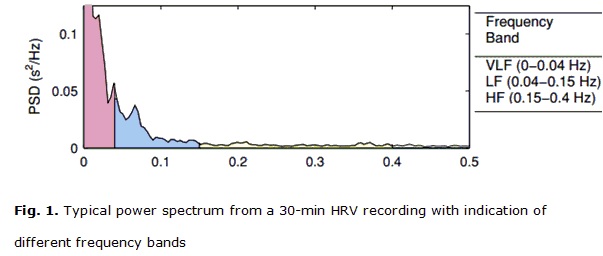
<body><![CDATA[<p align="justify">&nbsp;</p>     <p align="justify"><font size="3" face="Verdana"><strong>INTRODUCTION</strong></font></p>     <p align="justify"><font face="verdana" size="2">Meditation refers to a family    of mental training practices that is designed to familiarize the practitioner    with specific types of mental processes.<sup>1</sup> In addition, meditation    is considered an ancient spiritual practice that has potential benefit on health    and well&#45;being.<sup>2,3</sup> It is a complex physiological process, which    affects neural, psychological, behavioral, and autonomic functions.<sup>4</sup>&nbsp;</font></p>     <p align="justify" style='line&#45;height:normal'><font face="verdana" size="2">With    advances in multivariate statistics, nonlinear science, Bayesian methods, pattern    recognition and other approaches, extracting meaningful information from complex    physiological signals is becoming a tangible possibility. For some signals (e.    g. electrocardiograms), visual inspection by trained experts still remains the    main diagnostic criterion. For others, automated analysis emerging from a set    of indices obtained from a complex physiological signal is becoming a weighty    contribution into the diagnostic practice, as happens with quantitative electroencephalography    (EEG) or heart rate variability (HRV) analysis.</font></p>     <p align="justify" style='line&#45;height:normal'><font face="verdana" size="2">In    the case of HRV, at least 28 indices have been proposed, not mentioning other    specific suggestions made by different authors in the last 30 years. These indices    can be grouped into three broad divisions: "time domain", "frequency domain"    and "nonlinear".<sup>5</sup></font></p>     <p align="justify" style='line&#45;height:normal'><font face="verdana" size="2">Researchers    are still striving to find possible correspondence between the different indices    and physiologically interpretable activity. In this regard, frequency domain    indices (<a href="/img/revistas/rcim/v9n1/f0104117.jpg">figure 1</a>), are illustrative.    Traditionally there has been agreement that the area under the power spectrum    in the low frequency (LF) band (LF, 0.04 &#45; 0.15 Hz) is associated with both    sympathetic and parasympathetic activities; on the other hand the high frequency    (HF) power (HF, 0.15 &#45; 0.4 Hz) is associated with parasympathetic activity.    Accordingly, the ratio LF/HF is regarded as a measure of sympatho&#45;vagal    balance. The abrupt downhill power decline in the very low frequency (VLF) band    (VLF, 0&#45;0.04Hz) suggests the presence of nonlinear self&#45;organizing mechanisms    on the long&#45;range time scale, and justifies the introduction of different    indices purportedly assessing the nonlinear phenomena underlying HRV. Depending    on respiration rate, both LF and VLF may convey an important respiration&#45;related    component.<sup>6</sup></font></p>     <p align="justify" style='line&#45;height:normal'><font face="verdana" size="2">However,    a brief review of literature suggests that some of those indices to which different    physiological roles were attributed; can be numerically derived from others    and may become redundant and physiologically misleading. Moreover, some of the    previously coined indices referring to "sympathetic", "parasympathetic", "sympatho&#45;vagal    balance", etc., have been put into doubt in light of recent research.<sup>7</sup>    Thus, it has been shown that frequency domain "total power" is highly correlated    with the square power of Standard Deviation of Normal to Normal (SDNN), as expected    from the definition of power spectrum. Percentage of differences between adjacent    normal R&#45;R intervals &gt;50 milliseconds (pNN50) was found to be highly    correlated with the power spectrum HF component (as expected from the parasympathetic    nature of pNN50 proportion of successive decelerations of the heart rhythm),    but also has proven to be of little use when heart rate variability is either    too high or too low.<sup>8</sup> Poincare plot is reminiscent of the phase portrait,    a key concept associated to the Takens theorem, and thus has been viewed as    a reflection of chaotic nonlinear processes in cardiac rhythmogenesis. Simple    mathematical manipulations reveal that Poincare&rsquo;s SD1 exactly abides to    equation.<sup>1</sup></font></p>     <p align="justify" style='line&#45;height:normal'><img src="/img/revistas/rcim/v9n1/e0304117.jpg" width="137" height="25"></p>     <p align="justify" style='line&#45;height:normal'><font face="verdana" size="2">As    is widely known, "Root Mean Square of Successive Differences" (RMSSD) has never    been associated with nonlinear processes. A similar derivation is found for    SD2.<sup>9</sup></font></p>     <p align="justify" style='line&#45;height:normal'><font face="verdana" size="2">Special    relevance finds the demonstration that parameters derived from Detrended Fluctuation    Analysis (DFA) can be theoretically derived from a combination of VLF, LF, and    HF.<sup>10</sup></font></p>     ]]></body>
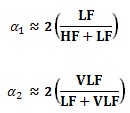
<body><![CDATA[<p align="justify" style='line&#45;height:normal'><img src="/img/revistas/rcim/v9n1/e0104117.jpg" width="130" height="113"></p>     <p align="justify" style='line&#45;height:normal'><font face="verdana" size="2">Being    the different spectral bands consensually associated to autonomic nerve system    (ANS) activity and in light of the conception that power spectrum retain information    about linear processes only, the validity of DFA as a reliable way of exploring&nbsp;    fractal properties of cardiovascular dynamics might be questionable.</font></p>     <p align="justify" style='line&#45;height:normal'><font face="verdana" size="2">As    it can be expected,&nbsp; there is still no golden rule suggesting which are    the best indices to use in different HRV studies; moreover, in light of discrepancies    about physiological bases of different indices obstacles appear when it comes    to interpreting results.</font></p>     <p align="justify" style='line&#45;height:normal'><font face="verdana" size="2">We    hope that applying publicly available and well standardized estimation packages    and testing them with publicly available datasets is a good way to come to a    better agreement on the diagnostic value of different HRV indices.</font></p>     <p align="justify" style='line&#45;height:normal'><font face="verdana" size="2">Here    we use the "Kubios HRV" analysis package developed at the University of Eastern    Finland to analyze the data set of HRV changes induced by c<i>hi</i> meditation    in a group of healthy young adults; original HRV data are available at the Physionet.org    portal.</font></p>     <p align="justify" style='line&#45;height:normal'><font face="verdana" size="2">Qigong    or Chi meditation is a practice of aligning breath, movement, and awareness    for exercise, healing, and meditation. With roots in Chinese medicine, martial    arts, and philosophy, qigong is traditionally viewed as a practice to balance    qi (Chi) or what has been translated as "intrinsic life energy."&nbsp; Typically    a qigong practice involves rhythmic breathing, coordinated with slow stylized    repetition of fluid movement, and a calm mindful state.<sup>11</sup>The <i>chi</i>    meditation data set is particularly curious. On one hand, it is among the best    documented evidence of physiologic changes induced by meditation. In light of    scarcity of scientific evidences for such changes this can be regarded as a    valuable set. On the other hand, the authors of the original publication associated    with this dataset reported the presence of prominent heart rate oscillations    associated with slow breathing during meditation. The lack of any reference    to nonlinear phenomena may be interpreted as a non&#45;finding of interesting    results on this area. Since nonlinear measures have dealt with non&#45;periodic    components of HRV this might bring to light the presence of a mechanism independent    from respiration&#45;associated changes. Another report suggests that HRV complexity    of trained <i>Zen</i> meditation practitioners is drastically reduced when compared    to beginners.<sup>12</sup> We hope that the present study can help in understanding    changes induced by <i>chi</i> meditation upon the basic physiological mechanisms    of HRV. Perhaps our approach can be useful for other HRV studies as well.</font></p>     <p align="justify" style='line&#45;height:normal'><font face="verdana" size="2">Here    we are trying to approach the following three questions:</font><font face="verdana" size="2">&nbsp;&nbsp;&nbsp;        <br>   1. Which indices are the most predictable for describing the effect of meditation    on HRV?    <br>   </font><font face="verdana" size="2">2. On the basis of observed changes, are    the effects of meditation beneficial, harmful or insubstantial?&nbsp;    <br>   3. Which are the most likely physiological events associated to meditation?</font></p>     ]]></body>
<body><![CDATA[<p align="justify" style='line&#45;height:normal'><font face="verdana" size="2"><strong>Methods    HRV data</strong></font></p>     <p align="justify" style='line&#45;height:normal'><font face="verdana" size="2">Heart    Rate Variability data were downloaded from the "Physionet" portal at <a href="http://www.physionet.org/physiobank/database/" target="_blank">http://www.physionet.org/physiobank/database/#rr</a>.    The data set (8 sujects) corresponds to the recordings on <i>Chi</i> meditation    mentioned by Peng et al.<sup>13</sup> Subjects were at an advanced level of    meditation training. All Chi meditators,&nbsp; were graduate and post&#45;doctoral    students. In addition, they were relative novices in Chi meditation, most of    them having begun their practice in meditation about 1&#45;3 months before the    data collection. The subjects were in good general health and did not follow    any specific exercise routines. The eight Chi meditators, five women and three    men (age range 26&#45;35, mean 29 years), wore a Holter recorder for about 10    h and did their ordinary daily activities. Roughly 5 h in the recording, each    subject practiced 1 h of meditation. Meditation&rsquo;s beginning and ending    times were delineated with event marks. During these sessions, the Chi meditators    were asked to sit quietly and listen to the taped guidance of the Master. The    meditators were instructed to breathe spontaneously while visualizing the opening    and closing of a perfect lotus in their stomach. The meditation session lasted    about 1 h. The sampling rate was 360 Hz. Analysis was performed offline and    meditations&rsquo; beginning and ending times were determined with event marks.    Each original data file in ASCII format is presented as a two&#45;column array    (time vs. duration, in hundredths of second, of R&#45;R intervals). The first    30mins of the recording (about 20,000 data points), were saved for further analysis.    For standard presentation, R&#45;R intervals were expressed in milliseconds.</font></p>     <p align="justify"><font face="verdana" size="2"><strong>Signal Analysis</strong></font></p>     <p align="justify" style='line&#45;height:normal'><font face="verdana" size="2">For    signal processing, we used the Kubios HRV 2.2 analysis software,<sup>14</sup>    developed by Biosignal Analysis and Medical Imaging Group (BSAMIG)), at the    Department of Applied Physics, University of Eastern Finland, Kuopio, and freely    available at <a href="http://kubios.uef.fi/" target="_blank">http://kubios.uef.fi</a>.    Before processing, data were corrected with a 3rd order detrending algorithm    in the software.</font></p>     <p align="justify"><font face="verdana" size="2"><strong>Indices used Time Domain    Indices</strong></font></p>     <p align="justify" style='line&#45;height:normal'><font face="verdana" size="2">pNN50<i>.</i>    The percentage of differences between successive R&#45;R intervals over the    recording time that are longer than 50ms. It has been proposed that pNN50 reflects    alterations in autonomic function that are primarily vagally mediated.</font></p>     <p align="justify" style='line&#45;height:normal'><font face="verdana" size="2">Triangular    Index<i>.</i> The integral of the density distribution. Triangular index expresses    overall HRV and is more influenced by the lower than by the higher frequencies.</font></p>     <p align="justify" style='line&#45;height:normal'><font face="verdana" size="2">RMSSD.    The square root of the mean squared differences of successive R&#45;R intervals.    RMSSD is related to high&#45;frequency variations in heart rate and is often    interpreted as an estimate of parasympathetic regulation of the heart. RMSSD    is measured in milliseconds.</font></p>     <p align="justify"><font face="verdana" size="2"><strong>Frequency Domain Indices</strong></font></p>     <p align="justify" style='line&#45;height:normal'><font face="verdana" size="2">Total    Power. An estimate of the total power of power spectral density in the range    of frequencies between 0 and 0.5 Hz. This measure is sometimes interpreted as    overall autonomic activity where sympathetic activity is a primary contributor.    Total Power is calculated in milliseconds squared (ms2). Mathematically it is    identical to the standard deviation of RR intervals (SDNN).</font></p>     ]]></body>
<body><![CDATA[<p align="justify" style='line&#45;height:normal'><font face="verdana" size="2">Very    Low Frequency (VLF). Corresponds to the integral of power spectrum in a frequency    band from 0.00 to 0.04 Hz. Generally it is agreed that this parameter reflects    overall activity of various slow mechanisms of sympathetic function. At the    same time, it is associated with some purportedly nonlinear processes, given    its fractal&#45;like &lsquo;1/f&rsquo; behavior. Very Low Frequency band is    calculated in milliseconds squared (ms<sup>2</sup>).</font></p>     <p align="justify" style='line&#45;height:normal'><font face="verdana" size="2">Low    Frequency (LF). A band of power spectrum range between 0.04 and 0.15 Hz. This    measure is confirmed by both sympathetic and parasympathetic influences, but    generally it is regarded as an indicator of sympathetic activity. Parasympathetic    influence is represented by LF when respiration rate is lower than 7 breaths    per minute or during taking a deep breath. Accordingly, when subject is in the    state of relaxation with a slow and even breathing, the LF values can be very    high indicating increased parasympathetic activity rather than increase of sympathetic    regulation.<sup>15,16</sup> Low Frequency band is calculated in milliseconds    squared (ms<sup>2</sup>).</font></p>     <p align="justify" style='line&#45;height:normal'><font face="verdana" size="2">High    Frequency (HF). A band of power spectrum range between 0.15 and 0.5Hz usually    associated to parasympathetic (vagal) activity. HF is also known as a &lsquo;respiratory&rsquo;    band because it corresponds to the RR variations caused by respiration (respiratory    sinus arrhythmia (RSA)). Heart rate is increased during inhalation and dropped    during exhalation. High Frequency band is calculated in milliseconds squared    (ms<sup>2</sup>).</font></p>     <p align="justify" style='line&#45;height:normal'><font face="verdana" size="2">LF/HF    ratio. The ratio between the power of Low Frequency and High Frequency bands.    This measure could indicate overall balance between sympathetic and parasympathetic    systems. Higher values reflect domination of the sympathetic system, while lower    ones &#45;domination of the parasympathetic system. This ratio can be used to    help quantify the overall balance between the sympathetic and parasympathetic    systems. This measure minimizes an effect of changes in Very Low Frequency power    and emphasizes changes in sympathetic regulation. Normalized LF is calculated    in percentile units. Recent research stresses the serious limitations of LF/HF    as a synonym of Sympatho&#45;vagal balance.<sup>7</sup></font></p>     <p align="justify"><font face="verdana" size="2"><strong>Nonlinear Indices</strong></font></p>     <p align="justify" style='line&#45;height:normal'><font face="verdana" size="2">&#945;1    and &#945; 2<i>.</i> DFA indices were obtained from linear fits to log&#45;log    plots of F (n) versus n in the range 4 &lt; n &lt;16 for &#945; 1 and the range    16 &lt; n &lt;64 for &#945;2</font></p>     <p align="justify" style='line&#45;height:normal;background:white'><font face="verdana" size="2">Hurst    Exponent (H).Closely related to &#945; 2, H quantifies the loss of order in    the R&#45;R sequence. H indicates whether an increase in the value of a measure    taken now is likely to be followed by an increase or a decrease in that measure    taken later. When H = 0.5, the measurements are not correlated.&nbsp; When H    &gt; 0.5, the measurements are positively correlated.&nbsp; This is called persistence.&nbsp;    An increase now is more likely followed by an increase at all&#45;time scales    later.&nbsp; When H &lt; 0.5, the measurements are negatively correlated.&nbsp;    This is called anti&#45; persistence. Parameter &#945; 2 from DFA is directly    related to the self&#45;similarity scaling Hurst exponent.<sup>17</sup></font></p>     <p align="justify" style='line&#45;height:normal'><font face="verdana" size="2">Recurrent    Plot Analysis (RPA<i>).</i>The following indices were computed: Recurrence rate,    Percent of determinism and Shannon entropy.<sup>18</sup></font></p>     <p align="justify" style='line&#45;height:normal'><font face="verdana" size="2">SD1    and SD2<i>.</i>Derived from Poincare plot were estimated<i>.</i> The Poincare    Plot Analysis (PPA) is a quantitative visual technique, whereby the shape of    the plot is categorized into functional classes and provides detailed beat&#45;to&#45;beat    information on the behavior of the heart. Usually, Poincare plots are applied    for a two&#45;dimensional graphical and quantitative representation (scatter    plots), where n<sup>th</sup> R&#45;R interval (R&#45;R<sub>n</sub>) is plotted    against the following one (R&#45;R<sub>n+1</sub>). Generally, three indices    are calculated from Poincare plots: the standard deviation of the short&#45;term    R&#45;R interval variability (minor axis of the cloud, SD1), the standard deviation    of the long&#45;term R&#45;Rinterval variability (major axis of the cloud, SD2)    and the axes ratio (SD1/SD2). For the healthy heart, the PPA graph shows a cigar&#45;shaped    cloud of points oriented along the line of identity. These indices are mathematically    identical to certain combinations of time domain indices. At the same time,    Laitio et al<sup>19</sup> showed that an increased SD1/SD2 ratio was the most    powerful predictor of post&#45;operative ischemia.</font></p>     <p align="justify" style='line&#45;height:normal'><font face="verdana" size="2">Correlation    Dimension (D2) and Approximate Entropy (ApEnt). Correlation dimension is a theoretically    sound concept for low&#45;dimensional deterministic chaotic systems. Since HRV    can be viewed as a fractal motion with uncorrelated noise plus periodic perturbances,    correlation dimension values in HRV studies cannot be taken at face value. ApEnt    is a measure that quantifies the amount of overall regularity or predictability    in time&#45;series data. Lower ApEnt values indicate a more regular signal;    higher values indicate more irregularity at the same time theoretical studies    revealed that Fractal dimension and entropy exhibit a negative correlation.<sup>20</sup></font></p>     ]]></body>
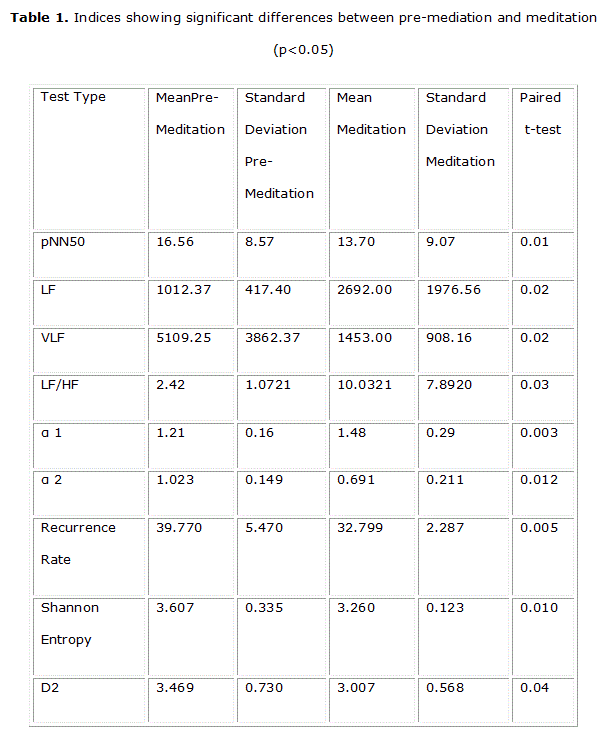
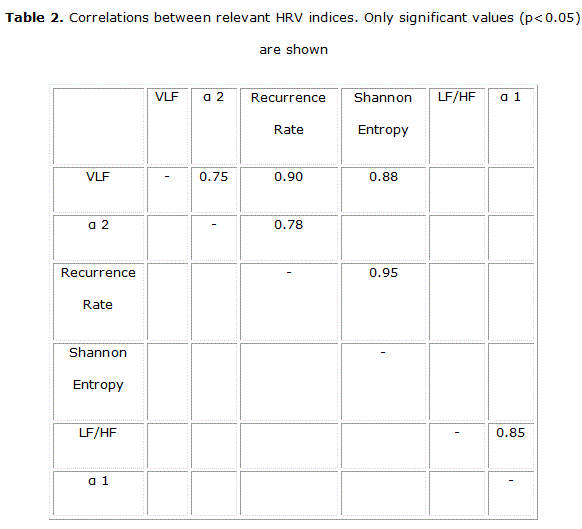
<body><![CDATA[<p align="justify" style='line&#45;height:normal'><font face="verdana" size="2">Details    about computation algorithms for each index are described in the Kubios technical    manual.<sup>20</sup></font></p>     <p align="justify"><font face="verdana" size="2"><strong>Statistical processing</strong></font></p>     <p align="justify" style='line&#45;height:normal'><font face="verdana" size="2">&nbsp;For    comparing effects induced by meditation, paired t&#45;test was applied; correlation    coefficients were also obtained for assessing between different HRV indices.</font></p>     <p align="justify" style='line&#45;height:normal'>&nbsp;</p>     <p align="justify" style='line&#45;height:normal'><font size="3" face="verdana"><strong>RESULTS</strong></font></p>     <p align="justify"><font face="verdana" size="2">Comparison of pre&#45;meditation    and meditation recordings revealed that significant changes were observed in    nine of the seventeen indices explored (p&lt;0.05, paired t&#45;test, <a href="/img/revistas/rcim/v9n1/t0104117.gif">table    1</a>)</font></p>     <p align="justify" style='line&#45;height:normal'><font face="verdana" size="2">As    it can be noticed, significant changes were found in 5 nonlinear measures, (&#945;    1, &#945; 2, Recurrence Rate, Shannon entropy and correlation dimension (D2)).</font></p>     <p align="justify" style='line-height:normal'><font face="verdana" size="2">Correlation    between variables, of the 9 variables that changed significantly with meditation,    five of them exhibited significant correlations with others. In <a href="/img/revistas/rcim/v9n1/t0204117.gif">table    2</a> there were included those indices that changed significantly with meditation,    as well as those that exhibited significant correlation to other indices.</font></p>     <p align="justify" style='line-height:normal'>&nbsp;</p>     <p align="justify" style='line-height:normal'><font size="3" face="verdana"><strong>DISCUSSION</strong></font></p>     ]]></body>
<body><![CDATA[<p align="justify" style='line&#45;height:normal'><font face="verdana" size="2">For    the sake of reproducibility, it seems plausible to apply a publicly available    software to the study of a publicly available dataset. Also, the comparison    of the two conditions with a broad assortment of time&#45;domain frequency domain    and nonlinear indices seems advisable and, considering today&rsquo;s computer    and software capabilities, easy to perform. Perhaps one of the major drawbacks    of the majority of published reports on HRV is that they are centered on the    estimation of a few indices.</font></p>     <p align="justify" style='line&#45;height:normal'><font face="verdana" size="2">We    obtained that among <i>chi</i> meditation beginners, this condition induces    changes in 9 indices, five of them belonging to "nonlinear analysis" category.</font></p>     <p align="justify" style='line&#45;height:normal'><font face="verdana" size="2">A    relevant question pertains to the reliability of obtained results, considering    that artifacts can arise either from software hitches or data quality issues.    Mounting evidence indicates that previous commonly accepted assertions&nbsp;    as "LF/HF being associated to sympatho&#45;vagal balance" and "pNN50 associated    to parasympathetic activity " cannot be taken as true in all cases.</font></p>     <p align="justify" style='line&#45;height:normal'><font face="verdana" size="2">Hoshiyama    and Hoshiyama<sup>12</sup> compared HRV indices from meditating beginning and    trained Zen practitioners. Comparison of trained vs. beginners obtained by these    authors parallels the results of comparing premeditation and <i>chi</i> meditation    results obtained from present study. Similar to our results, trained Zen meditators    exhibited increased LF, whereas pNN50, VLH, and &#945; 2 were reduced.<sup>12</sup>    No contradicting results were found among both studies. We interpret the outcome    of this comparison as a support for consistency of these two meditation techniques    as well as a confirmation of the adequacy of Kubios HRV as a tool for assessing    HRV.</font></p>     <p align="justify" style='line&#45;height:normal'><font face="verdana" size="2">Interpretation    of our results can be made through comparison with pathology and health&#45;seeking    actions associated changes, as well as in light of present knowledge about physiological    bases of these indices.</font></p>     <p align="justify" style='line&#45;height:normal'><font face="verdana" size="2">Thus,    unlike meditation, pNN50 is increased among trained skiers and reduced among    diabetes patients; otherwise, and similar to meditation, LF/HF is increased    during stress combating actions as well as among athletes.<sup>22</sup> LF is    increased in stress reduction maneuvers and among&nbsp; vigorous exercise practitioners,    while reduced in diabetes, poor diet, low job control, among smokers, among    high alcohol consumers and in old age, in presence of image&#45;confirmed cardiac    sympathetic denervation as well as experimentally induced congestive heart failure    in dogs.</font></p>     <p align="justify" style='line&#45;height:normal'><font face="verdana" size="2">Contrary    to observedchanges with meditation, Shannon entropy is increased among elderly    healthy persons<sup>8</sup> and exhibit increases linearly associated to blood    glucose levels.<sup>18</sup></font></p>     <p align="justify" style='line&#45;height:normal'><font face="verdana" size="2">&nbsp;Similar    to the effect of meditation, VLF is decreased among the elderly, whereas it    is increased among patients suffering from obstructive sleep apnea. DFA index    &#945; 1, contrary to meditation, is reduced in elderly persons, as well as    in diabetes mellitus and atrial fibrillation whereas &#945; 2 is increased with    age.</font></p>     <p align="justify" style='line&#45;height:normal'><font face="verdana" size="2">Recurrence    rate, oppose to meditation, is increased among the elderly.<sup>8</sup> Finally,    similar to meditation, but contrary to expected, is reduced after cardiac transplant    and is slowly recovered with tears after transplant.<sup>23</sup></font></p>     <p align="justify" style='line&#45;height:normal'><font face="verdana" size="2">Taken    together, these comparison suggests that meditation seems to bring cardiovascular    system away from changes associated to different pathological conditions</font></p>     ]]></body>
<body><![CDATA[<p align="justify" style='line&#45;height:normal'><font face="verdana" size="2">&nbsp;A    fundamental question looms regarding physiological interpretation of our results.    Thus, for example, Peng et al,<sup>13</sup> working with this dataset remarked    that observed changes in LF are greatly influenced by the respiration component    associated to <i>chi</i> meditation.<sup>13</sup> This could also be true for    &#945;1, given the observed high correlation with LF/HF (see equation 1 above)    as well as the observed excellent correlation we found between &#945;1 and the    theoretically predicted ratio using this data set.</font></p>     <p align="justify" style='line&#45;height:normal'><font face="verdana" size="2"><img src="/img/revistas/rcim/v9n1/e0204117.jpg" width="243" height="34">&nbsp;&nbsp;&nbsp;&nbsp;&nbsp;&nbsp;&nbsp;&nbsp;&nbsp;&nbsp;&nbsp;&nbsp;&nbsp;&nbsp;&nbsp;&nbsp;&nbsp;&nbsp;&nbsp;&nbsp;&nbsp;&nbsp;&nbsp;&nbsp;&nbsp;&nbsp;&nbsp;&nbsp;&nbsp;    </font></p>     <p align="justify" style='line&#45;height:normal'><font face="verdana" size="2">The    pNN50 index, despite its widespreaduse and proven predictive capacity, can be    flawed when HRV is very high, as in the case of <i>chi</i> meditation. Accordingly,    in present study&rsquo;s context, suggestions about associated physiological    changes can be misleading (24Garcia and Pallas 2001).</font></p>     <p align="justify" style='line&#45;height:normal'><font face="verdana" size="2">Nonlinear    measures are worthy of special mention, taking into account that nonlinear indices    performed nicely in discriminating between pre&#45; and meditation states. Literature    suggests that indices such as power law spectral slope beta (positively correlated    to &#945; 2), &#945; 1 and recurrent plot analysis indices exhibit the higher    discrimination power in a group of conditions.<sup>8</sup></font></p>     <p align="justify" style='line&#45;height:normal'><font face="verdana" size="2">Even    when nonlinear indices are recognized to perform better, whether this is due    to technical aspects or reflect processes that are inherent to nonlinear dynamical    systems and/or fractal time series remains an open question.</font></p>     <p align="justify" style='line&#45;height:normal'><font face="verdana" size="2">Thus    the better performance of nonlinear indices has been attributed to the potential    of capturing non&#45;periodic aspects of heart rate generation,<sup>8</sup>    as well as to their capability of excluding respiration&#45;related influences.<sup>12</sup>    After showing that DFA indices may be derived from the power spectrum, provide    the following physiological interpretation of them: "We can now understand fractal    manifestations of physiological abnormalities: depressed baroreflex sensitivity    implies low LF/HF which implies low LF/(HF + LF) resultingin low&nbsp; &#945;    1 , while periodic breathing implies high VLF/LF which implies high VLF/(LF    + VLF) resulting in high &#945; 2. Prognostic associations of alpha are no longer    mysterious.".<sup>10</sup> Nevertheless, we consider that at least a part of    HRV is associated to scale&#45;invariant nonlinear phenomena intervening in    cardiac rhythm conformation.</font></p>     <p align="justify" style='line&#45;height:normal'><font face="verdana" size="2">As    is known, the HRV series is not a pure fractal. DFA analysis woks properly for    pure fractals, not for signals with non&#45;fractal components. However, there    are indications that DFA analysis is quite robust respect to the presence of    non&#45;fractal influences.<sup>25</sup></font></p>     <p align="justify" style='line&#45;height:normal'><font face="verdana" size="2">The    presence of long term correlations (as indicated by &#945; 2) is regarded as    a hallmark of self&#45;organized criticality.</font></p>     <p align="justify" style='line&#45;height:normal'><font face="verdana" size="2">As    Riley and &nbsp;Van Orden<sup>17</sup> state, "Self&#45;organization implies    global emergence.&nbsp; Global emergence is collective behavior that depends    on the interdependence among a system&rsquo;s parts.&nbsp; Interdependence implies    that each part may reflect something of the behavior of the whole; the behavior    of the whole is present, in some sense, in each of its parts". In heart rhythm    regulation, self&#45;organized behavior has been found at different spatial    and time scales, including ion channels, calcium release mechanisms, isolated    hearts, and innervated hearts. Heart rate has shown scale independence fat second,    minute, hour and circadian time scales.</font></p>     <p align="justify" style='line&#45;height:normal'><font face="verdana" size="2">Thus    taken together, this study suggests that <i>chi</i> meditation leads to a reduction    in long&#45;range correlation, a reduction in entropy and a reduction in correlation    dimension. These changes are in the opposite direction to those observed in    a group of pathological conditions, suggesting a beneficial effect on cardiovascular    dynamics.</font></p>     ]]></body>

<body><![CDATA[<p align="justify" style='line&#45;height:normal'>&nbsp;</p>     <p align="justify" style='line&#45;height:normal'><font size="3" face="verdana"><strong>CONCLUSION</strong></font></p>     <p align="justify"><font face="verdana" size="2">We would answer the above&#45;posed    questions as follows.    <br>   </font><font face="verdana" size="2">&nbsp;&nbsp;&nbsp;&nbsp;&nbsp;&nbsp; I.    Power spectrum low frequency component (LF), LF/HF ratio, and the nonlinear    indices &#945; 1and &#945; 2, recurrence rate and Shannon Entropy are the most    information&#45;carrying indices.&nbsp; Due to well&#45;known limitations as    well as due to incongruences with literature reported changes, pNN50 and D2    areincluded into the list.    <br>   </font><font face="verdana" size="2">&nbsp;&nbsp;&nbsp;&nbsp;&nbsp; II. Observed    changes with above&#45;mentioned indices&nbsp; suggest that they harmonize with    changes observed in other&nbsp; health&#45; pursuing circumstances as&nbsp;    physical training, stress combating strategies; whereas they are in the opposite    direction of old age, poor job management, heavy smoking,&nbsp; diabetes, blood    glucose levels, autonomic denervation of the heart, congestive heart failure.    Thus meditation induced changes "drive" the human body away from disease/deterioration    associated changes, and, accordingly, they are mainly beneficial. The question    of sustainability of these changes cannot be assessed from this dataset.    <br>   </font><font face="verdana" size="2">&nbsp;&nbsp;&nbsp;&nbsp;&nbsp; III. Observed    changes seem to be associated to an increase in respiratory influences around    F=0.04 Hz, a reduction in system&rsquo;s entropy and a reduction in the strength    of long&#45;term correlation with a concomitant increase in cardio vascular    system&rsquo;s complexity.</font></p>     <p align="justify">&nbsp;</p>     <p align="justify"><strong><font size="3" face="Verdana">ACKNOWLEDGEMENTS</font></strong>        <br>       <br>   <font size="2" face="verdana">Authors would like to express their gratitude    to Professor Alicia Juarrero, for critical revision and encouragement.</font>  </p>     ]]></body>
<body><![CDATA[<p align="justify">&nbsp;</p>     <p align="justify"><font size="2" face="verdana"><font size="3"><strong> REFERENCES</strong></font></font>  </p>     <!-- ref --><p align="justify" style='margin&#45;right:&#45;11.7pt;line&#45;height:normal'><font face="verdana" size="2">1.    Brefczynski&#45;Lewis JA., Lutz A., Schaefer HS, Levinson DB, Davidson RJ. Neural    correlates of attentional expertise in long&#45;term meditation practitioners.    PNAS 2007; 104: 11483&#45;11488.    <br>       <!-- ref --><br>   2. Baer RA. Mindfulness training as a clinical intervention: A conceptual and    empirical review. <i>Clin. Psychol. Sci. Pract.</i> 2003; <i>10:</i> 125&#45;143.    <br>       <!-- ref --><br>   </font><font face="verdana" size="2">3. Ospina MB, Bond K, Karkhaneh M, Tjosvold    L, Vandermeer B, Liang Y,&nbsp; Klassen T P. Meditation practices for health:    state of the research. Evid Rep Technol Assess (Full Rep). 2007; 155(155): 1&#45;263.    </font></p>     <!-- ref --><p align="justify" style='margin&#45;right:&#45;11.7pt;line&#45;height:normal'><font face="verdana" size="2">4.    Dey A, Bhattacha D K, Tibarewala DN, Dey N, Ashour AS, Le D N, Gospodinov M.Chinese&#45;chi    and Kundalini yoga Meditations Effects on the Autonomic Nervous System: Comparative    Study. International Journal of Interactive Multimedia and Artificial 5&#45;Force    T.     </font></p>     ]]></body>
<body><![CDATA[<!-- ref --><p align="justify" style='margin&#45;right:&#45;11.7pt;line&#45;height:normal'><font face="verdana" size="2">5.    Task Force of the European Society of Cardiology and the North American Society    of Pacing and Electrophysiology. Heart rate variability: standards of measurement,    physiological interpretation and clinical use. Circulation. 1996; 93(5): 1043&#45;1065.    </font></p>     <!-- ref --><p align="justify" style='margin&#45;right:&#45;11.7pt;line&#45;height:normal'><font face="verdana" size="2">6.    Bernardi L, Porta C, Gabutti A, Spicuzza L,&nbsp; Sleight P. Modulatory effects    of respiration. <i>Auton. Neurosci.</i> 2001; <i>90 (1&#45;2):</i> 47&#45;56.    </font></p>     <!-- ref --><p align="justify" style='margin&#45;right:&#45;11.7pt;line&#45;height:normal'><font face="verdana" size="2">7.    Billman GE. The LF/HF ratio does not accurately measure cardiac sympatho&#45;vagal    balance. <i>Front Phys.</i> 2013; <i>4(26):</i> 1&#45;5.    </font></p>     <!-- ref --><p align="justify" style='margin&#45;right:&#45;11.7pt;line&#45;height:normal'><font face="verdana" size="2">8.    Giuliani A, Piccirillo G, Marigliano V, Colosimo A. A nonlinear explanation    of aging&#45;induced changes in heartbeat dynamics. <i>Am. J. Physiol</i>. 1998;&nbsp;    275 (4): 1455&#45;1.    </font></p>     <!-- ref --><p align="justify" style='margin&#45;right:&#45;11.7pt;line&#45;height:normal'><font face="verdana" size="2">9.    Brennan M, Palaniswami M, Kamen P. Do existing measures of Poincare plot geometry    reflect nonlinear features of heart rate variability? <i>IEEE Trans. Biomed.    Eng.</i> 2001;. 48(11): 342&#45;47.    </font></p>     ]]></body>
<body><![CDATA[<!-- ref --><p align="justify" style='margin&#45;right:&#45;11.7pt;line&#45;height:normal'><font face="verdana" size="2">10.    Francis DP, Willson K, Georgiadou P, Wensel R, Davies LC, Coats A,&nbsp; Piepoli    M. Physiological basis of fractal complexity properties of heart rate variability    in man. <i>J. Phys</i> 2002;&nbsp; 542(2):&nbsp; 619&#150;29.    </font></p>     <!-- ref --><p align="justify" style='margin&#45;right:&#45;11.7pt;line&#45;height:normal'><font face="verdana" size="2">11.    Goshvarpour A, Goshvarpour A. Chaotic Behavior of Heart Rate Signals during    Chi and Kundalini Meditation I.J. Image, Graphics and Signal Processing. 2012;    2: 23&#45;29.    </font></p>     <!-- ref --><p align="justify" style='margin&#45;right:&#45;11.7pt;line&#45;height:normal'><font face="verdana" size="2">12.    Hoshiyama M, Hoshiyama A. Heart rate variability associated with experienced    zen meditation <i>Comp. Cardiol.</i> 2008; 35<b>:</b> 569&#8722;72.    </font></p>     <!-- ref --><p align="justify" style='margin&#45;right:&#45;11.7pt;line&#45;height:normal'><font face="verdana" size="2">13.    Peng CK, Mietus J E, Liu Y, Khalsa G, Douglas P S, Benson H, Goldberger A L.    Exaggerated heart rate oscillations during two meditation techniques. International    journal of cardiology.1999; 70(2): 101&#45;107.    </font></p>     <!-- ref --><p align="justify" style='margin&#45;right:&#45;11.7pt;line&#45;height:normal'><font face="verdana" size="2">14.    Niskanen JP, Tarvainen MP, Ranta&#45;aho PO, Karjalainen PA. Software for advanced    HRV analysis. <i>Comp. Meth. Programs Biomed.</i> 2004; 76(1): 73&#45;81.    </font></p>     ]]></body>
<body><![CDATA[<!-- ref --><p align="justify" style='margin&#45;right:&#45;11.7pt;line&#45;height:normal'><font face="verdana" size="2">15.    Hopf HB, Skyschally A, Heusch G, Peters J. Low&#45;frequency spectral power    of heart rate variability is not a specific marker of cardiac sympathetic modulation.    <i>Anesthesiology.</i> 1995; 82(3): 609&#150;19.    </font></p>     <!-- ref --><p align="justify" style='margin&#45;right:&#45;11.7pt;line&#45;height:normal'><font face="verdana" size="2">16.    Pikkuj&auml;ms&auml; SM, M&auml;kikallio T H, Sourander L B, R&auml;ih&auml;    I J, Puukka P, Skytt&auml; J, Huikuri H V. Cardiac interbeat interval dynamics    from childhood to senescence comparison of conventional and new measures based    on fractals and chaos theory. Circulation. 1999;. 100(4): 393&#45;399.    </font></p>     <!-- ref --><p align="justify" style='margin&#45;right:&#45;11.7pt;line&#45;height:normal'><font face="verdana" size="2">17.    Riley, M.A &amp; Van, G.C. (2005) <i>Tutorial in contemporary nonlinear methods    for the behavioral sciences.</i> retrieved March 1<sup>st</sup> from National    Science Foundation. Disponible en: <a href="http://www.nsf.gov/sbe/bcs/pac/nmbs/nmbs.jsp" target="_blank">http://www.nsf.gov/sbe/bcs/pac/nmbs/nmbs.jsp</a></font><!-- ref --><p align="justify" style='margin&#45;right:&#45;11.7pt;line&#45;height:normal'><font face="verdana" size="2">18.    Tarvainen MP, Cornforth DJ, Kuoppa P, Lipponen J.A, Jelinek HF. <i>Complexity    of Heart Rate Variability in Type 2 Diabetes &#45; Effect of Hyperglycemia.</i>    <i>35th</i> Conf. Proc. IEEE. Eng. Med. Biol. Soc. 2013; :5558&#45;5561.    </font></p>     <!-- ref --><p align="justify" style='margin&#45;right:&#45;11.7pt;line&#45;height:normal'><font face="verdana" size="2">19.    Laitio T.T. &amp; et al.&nbsp; (2002). Relation of heart rate dynamics to the    occurrence of myocardial ischemia after coronary artery bypass grafting. <i>Am.    J. Cardiol</i>. 89(10)1176&#150;81.    </font></p>     <!-- ref --><p align="justify" style='margin&#45;right:&#45;11.7pt;line&#45;height:normal'><font face="verdana" size="2">20.    Claps P, Mand F, Oliveto G. Informational entropy of fractal river networks.    <i>J.Hydrol.</i> 1996; 87(1): 145&#45;56.    </font></p>     <!-- ref --><p align="justify" style='margin&#45;right:&#45;11.7pt;line&#45;height:normal'><font face="verdana" size="2">21.    Tarvainen MP. (2014). <i>Kubios HRV version 2.2 User's Guide University of Eastern    Finland Kuopio, Finland.    </i></font></p>     <!-- ref --><p align="justify" style='margin&#45;right:&#45;11.7pt;line&#45;height:normal'><font face="verdana" size="2">22.    Perini R, Veicsteinas A. Heart rate variability and autonomic activity at rest    and during exercise in various physiological conditions. <i>Eur. J. Appl. Phys.</i>    2003; 90: 317&#45;25.    </font></p>     <!-- ref --><p align="justify" style='margin&#45;right:&#45;11.7pt;line&#45;height:normal'><font face="verdana" size="2">23.    Kresh JY, Izrailtyan I. Evolution in functional complexity of heart rate dynamics:    a measure of cardiac allograft adaptability. <i>Am. J. Physiol.</i> 1998; 275(3    Pt. 2): R7</font><font face="verdana" size="2">20&#45;7.    </font></p>     <!-- ref --><p align="justify" style='margin&#45;right:&#45;11.7pt;line&#45;height:normal'><font face="verdana" size="2">24.    Garcia MA, Pallas R. A novel robust index to assess beat&#45;to&#45;beat variability    in heart rate time&#45;series analysis. <i>IEEE Trans. Biomed. Eng.</i> 2001;    <i>&nbsp;</i>48(6): 617&#45;21.    </font></p>     <!-- ref --><p align="justify" style='margin&#45;right:&#45;11.7pt;line&#45;height:normal'><font face="verdana" size="2">25.    Hernandez&#45;Caceres JL, Foyaca&#45;Sibat H, Hong R, Garcia L, Sautie M, Namugowa    V. Towards the estimation of the fractal dimension of heart rate variability.    data <i>Rev Electron Biomed / Electron J Biomed</i>. 2004; <i>&nbsp;</i>1: 4&#45;15.    </font></p>     <p align="justify" style='margin&#45;right:&#45;11.7pt;line&#45;height:normal'>&nbsp;</p>     <p align="justify" style='margin&#45;right:&#45;11.7pt;line&#45;height:normal'>&nbsp;</p>     <p align="justify" style='margin&#45;right:&#45;11.7pt;line&#45;height:normal'><font size="2" face="Verdana">Recibido:    24 de noviembre de 2016.    <br>   Aprobado: 12 de marzo de 2017.</font><font face="verdana" size="2"><b>&nbsp;</b></font></p>      ]]></body><back>
<ref-list>
<ref id="B1">
<label>1</label><nlm-citation citation-type="">
<person-group person-group-type="author">
<name>
<surname><![CDATA[Brefczynski-Lewis]]></surname>
<given-names><![CDATA[JA]]></given-names>
</name>
<name>
<surname><![CDATA[Lutz]]></surname>
<given-names><![CDATA[A]]></given-names>
</name>
<name>
<surname><![CDATA[Schaefer]]></surname>
<given-names><![CDATA[HS]]></given-names>
</name>
<name>
<surname><![CDATA[Levinson]]></surname>
<given-names><![CDATA[DB]]></given-names>
</name>
<name>
<surname><![CDATA[Davidson]]></surname>
<given-names><![CDATA[RJ]]></given-names>
</name>
</person-group>
<source><![CDATA[Neural correlates of attentional expertise in long-term meditation practitioners]]></source>
<year>2007</year>
<volume>104</volume>
<page-range>11483-11488</page-range></nlm-citation>
</ref>
<ref id="B2">
<label>2</label><nlm-citation citation-type="journal">
<person-group person-group-type="author">
<name>
<surname><![CDATA[Baer]]></surname>
<given-names><![CDATA[RA]]></given-names>
</name>
</person-group>
<article-title xml:lang="en"><![CDATA[Mindfulness training as a clinical intervention: A conceptual and empirical review]]></article-title>
<source><![CDATA[Clin. Psychol. Sci. Pract]]></source>
<year>2003</year>
<volume>10</volume>
<page-range>125-143</page-range></nlm-citation>
</ref>
<ref id="B3">
<label>3</label><nlm-citation citation-type="journal">
<person-group person-group-type="author">
<name>
<surname><![CDATA[Ospina]]></surname>
<given-names><![CDATA[MB]]></given-names>
</name>
<name>
<surname><![CDATA[Bond]]></surname>
<given-names><![CDATA[K]]></given-names>
</name>
<name>
<surname><![CDATA[Karkhaneh]]></surname>
<given-names><![CDATA[M]]></given-names>
</name>
<name>
<surname><![CDATA[Tjosvold]]></surname>
<given-names><![CDATA[L]]></given-names>
</name>
<name>
<surname><![CDATA[Vandermeer]]></surname>
<given-names><![CDATA[B]]></given-names>
</name>
<name>
<surname><![CDATA[Liang]]></surname>
<given-names><![CDATA[Y]]></given-names>
</name>
<name>
<surname><![CDATA[Klassen]]></surname>
<given-names><![CDATA[T P]]></given-names>
</name>
</person-group>
<article-title xml:lang="en"><![CDATA[Meditation practices for health: state of the research]]></article-title>
<source><![CDATA[Evid Rep Technol Assess (Full Rep)]]></source>
<year>2007</year>
<volume>155</volume>
<numero>155</numero>
<issue>155</issue>
<page-range>1-263</page-range></nlm-citation>
</ref>
<ref id="B4">
<label>4</label><nlm-citation citation-type="journal">
<person-group person-group-type="author">
<name>
<surname><![CDATA[Dey]]></surname>
<given-names><![CDATA[A]]></given-names>
</name>
<name>
<surname><![CDATA[Bhattacha]]></surname>
<given-names><![CDATA[D K]]></given-names>
</name>
<name>
<surname><![CDATA[Tibarewala]]></surname>
<given-names><![CDATA[DN]]></given-names>
</name>
<name>
<surname><![CDATA[Dey]]></surname>
<given-names><![CDATA[N]]></given-names>
</name>
<name>
<surname><![CDATA[Ashour]]></surname>
<given-names><![CDATA[AS]]></given-names>
</name>
<name>
<surname><![CDATA[Le]]></surname>
<given-names><![CDATA[D]]></given-names>
</name>
<name>
<surname><![CDATA[Gospodinov]]></surname>
<given-names><![CDATA[M]]></given-names>
</name>
</person-group>
<article-title xml:lang="en"><![CDATA[Chinese-chi and Kundalini yoga Meditations Effects on the Autonomic Nervous System: Comparative Study]]></article-title>
<source><![CDATA[International Journal of Interactive Multimedia and Artificial 5-Force T]]></source>
<year></year>
</nlm-citation>
</ref>
<ref id="B5">
<label>5</label><nlm-citation citation-type="journal">
<collab>Task Force of the European Society of Cardiology and the North American Society of Pacing and Electrophysiology</collab>
<article-title xml:lang="en"><![CDATA[Heart rate variability: standards of measurement, physiological interpretation and clinical use]]></article-title>
<source><![CDATA[Circulation]]></source>
<year>1996</year>
<volume>93</volume>
<numero>5</numero>
<issue>5</issue>
<page-range>1043-1065</page-range></nlm-citation>
</ref>
<ref id="B6">
<label>6</label><nlm-citation citation-type="journal">
<person-group person-group-type="author">
<name>
<surname><![CDATA[Bernardi]]></surname>
<given-names><![CDATA[L]]></given-names>
</name>
<name>
<surname><![CDATA[Porta]]></surname>
<given-names><![CDATA[C]]></given-names>
</name>
<name>
<surname><![CDATA[Gabutti]]></surname>
<given-names><![CDATA[A]]></given-names>
</name>
<name>
<surname><![CDATA[Spicuzza]]></surname>
<given-names><![CDATA[L]]></given-names>
</name>
<name>
<surname><![CDATA[Sleight]]></surname>
<given-names><![CDATA[P]]></given-names>
</name>
</person-group>
<article-title xml:lang="en"><![CDATA[Modulatory effects of respiration]]></article-title>
<source><![CDATA[Auton. Neurosci]]></source>
<year>2001</year>
<volume>90</volume>
<numero>1-2</numero>
<issue>1-2</issue>
<page-range>47-56</page-range></nlm-citation>
</ref>
<ref id="B7">
<label>7</label><nlm-citation citation-type="journal">
<person-group person-group-type="author">
<name>
<surname><![CDATA[Billman]]></surname>
<given-names><![CDATA[GE]]></given-names>
</name>
</person-group>
<article-title xml:lang="en"><![CDATA[The LF/HF ratio does not accurately measure cardiac sympatho-vagal balance]]></article-title>
<source><![CDATA[Front Phys]]></source>
<year>2013</year>
<volume>4</volume>
<numero>26</numero>
<issue>26</issue>
<page-range>1-5</page-range></nlm-citation>
</ref>
<ref id="B8">
<label>8</label><nlm-citation citation-type="journal">
<person-group person-group-type="author">
<name>
<surname><![CDATA[Giuliani]]></surname>
<given-names><![CDATA[A]]></given-names>
</name>
<name>
<surname><![CDATA[Piccirillo]]></surname>
<given-names><![CDATA[G]]></given-names>
</name>
<name>
<surname><![CDATA[Marigliano]]></surname>
<given-names><![CDATA[V]]></given-names>
</name>
<name>
<surname><![CDATA[Colosimo]]></surname>
<given-names><![CDATA[A]]></given-names>
</name>
</person-group>
<article-title xml:lang="en"><![CDATA[A nonlinear explanation of aging-induced changes in heartbeat dynamics]]></article-title>
<source><![CDATA[Am. J. Physiol]]></source>
<year>1998</year>
<volume>275</volume>
<numero>4</numero>
<issue>4</issue>
<page-range>1455-1</page-range></nlm-citation>
</ref>
<ref id="B9">
<label>9</label><nlm-citation citation-type="journal">
<person-group person-group-type="author">
<name>
<surname><![CDATA[Brennan]]></surname>
<given-names><![CDATA[M]]></given-names>
</name>
<name>
<surname><![CDATA[Palaniswami]]></surname>
<given-names><![CDATA[M]]></given-names>
</name>
<name>
<surname><![CDATA[Kamen]]></surname>
<given-names><![CDATA[P]]></given-names>
</name>
</person-group>
<article-title xml:lang="en"><![CDATA[Do existing measures of Poincare plot geometry reflect nonlinear features of heart rate variability? IEEE Trans]]></article-title>
<source><![CDATA[Biomed. Eng]]></source>
<year>2001</year>
<volume>48</volume>
<numero>11</numero>
<issue>11</issue>
<page-range>342-47</page-range></nlm-citation>
</ref>
<ref id="B10">
<label>10</label><nlm-citation citation-type="journal">
<person-group person-group-type="author">
<name>
<surname><![CDATA[Francis]]></surname>
<given-names><![CDATA[DP]]></given-names>
</name>
<name>
<surname><![CDATA[Willson]]></surname>
<given-names><![CDATA[K]]></given-names>
</name>
<name>
<surname><![CDATA[Georgiadou]]></surname>
<given-names><![CDATA[P]]></given-names>
</name>
<name>
<surname><![CDATA[Wensel]]></surname>
<given-names><![CDATA[R]]></given-names>
</name>
<name>
<surname><![CDATA[Davies]]></surname>
<given-names><![CDATA[LC]]></given-names>
</name>
<name>
<surname><![CDATA[Coats]]></surname>
<given-names><![CDATA[A]]></given-names>
</name>
<name>
<surname><![CDATA[Piepoli]]></surname>
<given-names><![CDATA[M]]></given-names>
</name>
</person-group>
<article-title xml:lang="en"><![CDATA[Physiological basis of fractal complexity properties of heart rate variability in man]]></article-title>
<source><![CDATA[J. Phys]]></source>
<year>2002</year>
<volume>542</volume>
<numero>2</numero>
<issue>2</issue>
<page-range>619-29</page-range></nlm-citation>
</ref>
<ref id="B11">
<label>11</label><nlm-citation citation-type="journal">
<person-group person-group-type="author">
<name>
<surname><![CDATA[Goshvarpour]]></surname>
<given-names><![CDATA[A]]></given-names>
</name>
<name>
<surname><![CDATA[Goshvarpour]]></surname>
<given-names><![CDATA[A]]></given-names>
</name>
</person-group>
<article-title xml:lang="en"><![CDATA[Chaotic Behavior of Heart Rate Signals during Chi and Kundalini Meditation I]]></article-title>
<source><![CDATA[J. Image, Graphics and Signal Processing]]></source>
<year>2012</year>
<volume>2</volume>
<page-range>23-29</page-range></nlm-citation>
</ref>
<ref id="B12">
<label>12</label><nlm-citation citation-type="journal">
<person-group person-group-type="author">
<name>
<surname><![CDATA[Hoshiyama]]></surname>
<given-names><![CDATA[M]]></given-names>
</name>
<name>
<surname><![CDATA[Hoshiyama]]></surname>
<given-names><![CDATA[A]]></given-names>
</name>
</person-group>
<article-title xml:lang="en"><![CDATA[Heart rate variability associated with experienced zen meditation Comp]]></article-title>
<source><![CDATA[Cardiol]]></source>
<year>2008</year>
<volume>35</volume>
<page-range>569&#8722;72</page-range></nlm-citation>
</ref>
<ref id="B13">
<label>13</label><nlm-citation citation-type="journal">
<person-group person-group-type="author">
<name>
<surname><![CDATA[Peng]]></surname>
<given-names><![CDATA[CK]]></given-names>
</name>
<name>
<surname><![CDATA[Mietus]]></surname>
<given-names><![CDATA[J E]]></given-names>
</name>
<name>
<surname><![CDATA[Liu]]></surname>
<given-names><![CDATA[Y]]></given-names>
</name>
<name>
<surname><![CDATA[Khalsa]]></surname>
<given-names><![CDATA[G]]></given-names>
</name>
<name>
<surname><![CDATA[Douglas]]></surname>
<given-names><![CDATA[P S]]></given-names>
</name>
<name>
<surname><![CDATA[Benson]]></surname>
<given-names><![CDATA[H]]></given-names>
</name>
<name>
<surname><![CDATA[Goldberger]]></surname>
<given-names><![CDATA[A L]]></given-names>
</name>
</person-group>
<article-title xml:lang="en"><![CDATA[Exaggerated heart rate oscillations during two meditation techniques]]></article-title>
<source><![CDATA[International journal of cardiology]]></source>
<year>1999</year>
<volume>70</volume>
<numero>2</numero>
<issue>2</issue>
<page-range>101-107</page-range></nlm-citation>
</ref>
<ref id="B14">
<label>14</label><nlm-citation citation-type="journal">
<person-group person-group-type="author">
<name>
<surname><![CDATA[Niskanen]]></surname>
<given-names><![CDATA[JP]]></given-names>
</name>
<name>
<surname><![CDATA[Tarvainen]]></surname>
<given-names><![CDATA[MP]]></given-names>
</name>
<name>
<surname><![CDATA[Ranta-aho]]></surname>
<given-names><![CDATA[PO]]></given-names>
</name>
<name>
<surname><![CDATA[Karjalainen]]></surname>
<given-names><![CDATA[PA]]></given-names>
</name>
</person-group>
<article-title xml:lang="en"><![CDATA[Software for advanced HRV analysis]]></article-title>
<source><![CDATA[Comp. Meth. Programs Biomed]]></source>
<year>2004</year>
<volume>76</volume>
<numero>1</numero>
<issue>1</issue>
<page-range>73-81</page-range></nlm-citation>
</ref>
<ref id="B15">
<label>15</label><nlm-citation citation-type="journal">
<person-group person-group-type="author">
<name>
<surname><![CDATA[Hopf]]></surname>
<given-names><![CDATA[HB]]></given-names>
</name>
<name>
<surname><![CDATA[Skyschally]]></surname>
<given-names><![CDATA[A]]></given-names>
</name>
<name>
<surname><![CDATA[Heusch]]></surname>
<given-names><![CDATA[G]]></given-names>
</name>
<name>
<surname><![CDATA[Peters]]></surname>
<given-names><![CDATA[J]]></given-names>
</name>
</person-group>
<article-title xml:lang="en"><![CDATA[Low-frequency spectral power of heart rate variability is not a specific marker of cardiac sympathetic modulation]]></article-title>
<source><![CDATA[Anesthesiology]]></source>
<year>1995</year>
<volume>82</volume>
<numero>3</numero>
<issue>3</issue>
<page-range>609-19</page-range></nlm-citation>
</ref>
<ref id="B16">
<label>16</label><nlm-citation citation-type="journal">
<person-group person-group-type="author">
<name>
<surname><![CDATA[Pikkujämsä]]></surname>
<given-names><![CDATA[SM]]></given-names>
</name>
<name>
<surname><![CDATA[Mäkikallio]]></surname>
<given-names><![CDATA[T H]]></given-names>
</name>
<name>
<surname><![CDATA[Sourander]]></surname>
<given-names><![CDATA[L B]]></given-names>
</name>
<name>
<surname><![CDATA[Räihä]]></surname>
<given-names><![CDATA[I J]]></given-names>
</name>
<name>
<surname><![CDATA[Puukka]]></surname>
<given-names><![CDATA[P]]></given-names>
</name>
<name>
<surname><![CDATA[Skyttä]]></surname>
<given-names><![CDATA[J]]></given-names>
</name>
<name>
<surname><![CDATA[Huikuri]]></surname>
<given-names><![CDATA[H V]]></given-names>
</name>
</person-group>
<article-title xml:lang="en"><![CDATA[Cardiac interbeat interval dynamics from childhood to senescence comparison of conventional and new measures based on fractals and chaos theory]]></article-title>
<source><![CDATA[Circulation]]></source>
<year>1999</year>
<volume>100</volume>
<numero>4</numero>
<issue>4</issue>
<page-range>393-399</page-range></nlm-citation>
</ref>
<ref id="B17">
<label>17</label><nlm-citation citation-type="">
<person-group person-group-type="author">
<name>
<surname><![CDATA[Riley]]></surname>
<given-names><![CDATA[M.A]]></given-names>
</name>
<name>
<surname><![CDATA[Van]]></surname>
<given-names><![CDATA[G.C]]></given-names>
</name>
</person-group>
<source><![CDATA[Tutorial in contemporary nonlinear methods for the behavioral sciences]]></source>
<year>2005</year>
</nlm-citation>
</ref>
<ref id="B18">
<label>18</label><nlm-citation citation-type="confpro">
<person-group person-group-type="author">
<name>
<surname><![CDATA[Tarvainen]]></surname>
<given-names><![CDATA[MP]]></given-names>
</name>
<name>
<surname><![CDATA[Cornforth]]></surname>
<given-names><![CDATA[DJ]]></given-names>
</name>
<name>
<surname><![CDATA[Kuoppa]]></surname>
<given-names><![CDATA[P]]></given-names>
</name>
<name>
<surname><![CDATA[Lipponen]]></surname>
<given-names><![CDATA[J.A]]></given-names>
</name>
<name>
<surname><![CDATA[Jelinek]]></surname>
<given-names><![CDATA[HF]]></given-names>
</name>
</person-group>
<source><![CDATA[Complexity of Heart Rate Variability in Type 2 Diabetes - Effect of Hyperglycemia]]></source>
<year></year>
<conf-name><![CDATA[35 Conf. Proc. IEEE. Eng. Med. Biol. Soc.]]></conf-name>
<conf-date>2013</conf-date>
<conf-loc> </conf-loc>
</nlm-citation>
</ref>
<ref id="B19">
<label>19</label><nlm-citation citation-type="journal">
<person-group person-group-type="author">
<name>
<surname><![CDATA[Laitio]]></surname>
<given-names><![CDATA[T.T]]></given-names>
</name>
</person-group>
<article-title xml:lang="en"><![CDATA[Relation of heart rate dynamics to the occurrence of myocardial ischemia after coronary artery bypass grafting]]></article-title>
<source><![CDATA[Am. J. Cardiol]]></source>
<year></year>
<volume>89</volume>
<numero>10</numero>
<issue>10</issue>
<page-range>1176-81</page-range></nlm-citation>
</ref>
<ref id="B20">
<label>20</label><nlm-citation citation-type="journal">
<person-group person-group-type="author">
<name>
<surname><![CDATA[Claps]]></surname>
<given-names><![CDATA[P]]></given-names>
</name>
<name>
<surname><![CDATA[Mand]]></surname>
<given-names><![CDATA[F]]></given-names>
</name>
<name>
<surname><![CDATA[Oliveto]]></surname>
<given-names><![CDATA[G]]></given-names>
</name>
</person-group>
<article-title xml:lang="en"><![CDATA[Informational entropy of fractal river networks]]></article-title>
<source><![CDATA[J.Hydrol]]></source>
<year>1996</year>
<volume>87</volume>
<numero>1</numero>
<issue>1</issue>
<page-range>145-56</page-range></nlm-citation>
</ref>
<ref id="B21">
<label>21</label><nlm-citation citation-type="">
<person-group person-group-type="author">
<name>
<surname><![CDATA[Tarvainen]]></surname>
<given-names><![CDATA[MP]]></given-names>
</name>
</person-group>
<source><![CDATA[Kubios HRV version 2.2 User's Guide University of Eastern Finland Kuopio]]></source>
<year>2014</year>
<publisher-loc><![CDATA[Finland ]]></publisher-loc>
</nlm-citation>
</ref>
<ref id="B22">
<label>22</label><nlm-citation citation-type="journal">
<person-group person-group-type="author">
<name>
<surname><![CDATA[Perini]]></surname>
<given-names><![CDATA[R]]></given-names>
</name>
<name>
<surname><![CDATA[Veicsteinas]]></surname>
<given-names><![CDATA[A]]></given-names>
</name>
</person-group>
<article-title xml:lang="en"><![CDATA[Heart rate variability and autonomic activity at rest and during exercise in various physiological conditions]]></article-title>
<source><![CDATA[Eur. J. Appl. Phys]]></source>
<year>2003</year>
<volume>90</volume>
<page-range>317-25</page-range></nlm-citation>
</ref>
<ref id="B23">
<label>23</label><nlm-citation citation-type="journal">
<person-group person-group-type="author">
<name>
<surname><![CDATA[Kresh]]></surname>
<given-names><![CDATA[JY]]></given-names>
</name>
<name>
<surname><![CDATA[Izrailtyan]]></surname>
<given-names><![CDATA[I]]></given-names>
</name>
</person-group>
<article-title xml:lang="en"><![CDATA[Evolution in functional complexity of heart rate dynamics: a measure of cardiac allograft adaptability]]></article-title>
<source><![CDATA[Am. J. Physiol]]></source>
<year>1998</year>
<volume>275</volume>
<page-range>R720-7</page-range></nlm-citation>
</ref>
<ref id="B24">
<label>24</label><nlm-citation citation-type="journal">
<person-group person-group-type="author">
<name>
<surname><![CDATA[Garcia]]></surname>
<given-names><![CDATA[MA]]></given-names>
</name>
<name>
<surname><![CDATA[Pallas]]></surname>
<given-names><![CDATA[R]]></given-names>
</name>
</person-group>
<article-title xml:lang="en"><![CDATA[A novel robust index to assess beat-to-beat variability in heart rate time-series analysis]]></article-title>
<source><![CDATA[IEEE Trans. Biomed. Eng.]]></source>
<year>2001</year>
<volume>48</volume>
<numero>6</numero>
<issue>6</issue>
<page-range>617-21</page-range></nlm-citation>
</ref>
<ref id="B25">
<label>25</label><nlm-citation citation-type="journal">
<person-group person-group-type="author">
<name>
<surname><![CDATA[Hernandez-Caceres]]></surname>
<given-names><![CDATA[JL]]></given-names>
</name>
<name>
<surname><![CDATA[Foyaca-Sibat]]></surname>
<given-names><![CDATA[H]]></given-names>
</name>
<name>
<surname><![CDATA[Hong]]></surname>
<given-names><![CDATA[R]]></given-names>
</name>
<name>
<surname><![CDATA[Garcia]]></surname>
<given-names><![CDATA[L]]></given-names>
</name>
<name>
<surname><![CDATA[Sautie]]></surname>
<given-names><![CDATA[M]]></given-names>
</name>
<name>
<surname><![CDATA[Namugowa]]></surname>
<given-names><![CDATA[V]]></given-names>
</name>
</person-group>
<article-title xml:lang="en"><![CDATA[Towards the estimation of the fractal dimension of heart rate variability data]]></article-title>
<source><![CDATA[Rev Electron Biomed / Electron J Biomed]]></source>
<year>2004</year>
<volume>1</volume>
<page-range>4-15</page-range></nlm-citation>
</ref>
</ref-list>
</back>
</article>