<?xml version="1.0" encoding="ISO-8859-1"?><article xmlns:mml="http://www.w3.org/1998/Math/MathML" xmlns:xlink="http://www.w3.org/1999/xlink" xmlns:xsi="http://www.w3.org/2001/XMLSchema-instance">
<front>
<journal-meta>
<journal-id>1729-519X</journal-id>
<journal-title><![CDATA[Revista Habanera de Ciencias Médicas]]></journal-title>
<abbrev-journal-title><![CDATA[Rev haban cienc méd]]></abbrev-journal-title>
<issn>1729-519X</issn>
<publisher>
<publisher-name><![CDATA[Universidad de Ciencias Médicas de la Habana]]></publisher-name>
</publisher>
</journal-meta>
<article-meta>
<article-id>S1729-519X2017000200007</article-id>
<title-group>
<article-title xml:lang="es"><![CDATA[Coinfección virus de inmunodeficiencia humana-virus de la Hepatitis C: hacia un nuevo escenario terapéutico]]></article-title>
<article-title xml:lang="en"><![CDATA[Human Immunodeficiency Virus-Hepatitis C virus coinfection: towards a new therapeutic scenario]]></article-title>
</title-group>
<contrib-group>
<contrib contrib-type="author">
<name>
<surname><![CDATA[García-Bustos]]></surname>
<given-names><![CDATA[Víctor]]></given-names>
</name>
<xref ref-type="aff" rid="A01"/>
</contrib>
<contrib contrib-type="author">
<name>
<surname><![CDATA[Vicente Esplugues-Mota]]></surname>
<given-names><![CDATA[Juan]]></given-names>
</name>
<xref ref-type="aff" rid="A02"/>
</contrib>
<contrib contrib-type="author">
<name>
<surname><![CDATA[Martí-Rodrigo]]></surname>
<given-names><![CDATA[Alberto]]></given-names>
</name>
<xref ref-type="aff" rid="A03"/>
</contrib>
</contrib-group>
<aff id="A01">
<institution><![CDATA[,Universidad de Valencia Departamento de Farmacología Facultad de Medicina]]></institution>
<addr-line><![CDATA[Valencia ]]></addr-line>
<country>España</country>
</aff>
<aff id="A02">
<institution><![CDATA[,Universidad de Valencia Departamnto de Farmacología Facultad de Medicina]]></institution>
<addr-line><![CDATA[Valencia ]]></addr-line>
<country>España</country>
</aff>
<aff id="A03">
<institution><![CDATA[,Universidad de Valencia Departamnto de Farmacología Facultad de Medicina]]></institution>
<addr-line><![CDATA[Valencia ]]></addr-line>
<country>España</country>
</aff>
<pub-date pub-type="pub">
<day>00</day>
<month>04</month>
<year>2017</year>
</pub-date>
<pub-date pub-type="epub">
<day>00</day>
<month>04</month>
<year>2017</year>
</pub-date>
<volume>16</volume>
<numero>2</numero>
<fpage>199</fpage>
<lpage>216</lpage>
<copyright-statement/>
<copyright-year/>
<self-uri xlink:href="http://scielo.sld.cu/scielo.php?script=sci_arttext&amp;pid=S1729-519X2017000200007&amp;lng=en&amp;nrm=iso"></self-uri><self-uri xlink:href="http://scielo.sld.cu/scielo.php?script=sci_abstract&amp;pid=S1729-519X2017000200007&amp;lng=en&amp;nrm=iso"></self-uri><self-uri xlink:href="http://scielo.sld.cu/scielo.php?script=sci_pdf&amp;pid=S1729-519X2017000200007&amp;lng=en&amp;nrm=iso"></self-uri><abstract abstract-type="short" xml:lang="es"><p><![CDATA[Introducción: Las terapias contra el virus de la Hepatitis C han evolucionado vertiginosamente con el desarrollo de los antivirales de acción directa (AADs). Los nuevos regímenes han conseguido igualar las tasas de respuesta al tratamiento en los monoinfectados y los coinfectados con VIH, una población tradicionalmente difícil de tratar debido a la elevada morbimortalidad hepática y sistémica, reacciones adversas e interacciones medicamentosas. Objetivo: Analizar las opciones farmacoterapéuticas más modernas disponibles para los pacientes coinfectados con VIH y VHC, con énfasis en los nuevos antivirales de acción directa, a fin de ofrecer una herramienta útil en el abordaje terapéutico en estos pacientes. Material y métodos: Se revisaron artículos originales, ensayos clínicos y revisiones sistemáticas hasta septiembre de 2016, bases de datos internacionales de interacciones medicamentosas y Guías de Práctica Clínica actualizadas. Desarrollo: Las terapias contra el virus de la Hepatitis C (VHC) han evolucionado vertiginosamente con el desarrollo de los antivirales de acción directa (AADs). Los nuevos regímenes han conseguido igualar las tasas de respuesta al tratamiento en los monoinfectados y los coinfectados con VIH, una población tradicionalmente difícil de tratar que, además, asociaba una elevada morbimortalidad hepática y sistémica, más reacciones adversas y complejas interacciones medicamentosas. Conclusiones: En este nuevo escenario es fundamental dedicar esfuerzos a identificar el elevado porcentaje de infectados no diagnosticados, potenciales interacciones, especialmente con fármacos para patologías asociadas al envejecimiento de los pacientes, reacciones adversas a medio-largo plazos y desarrollo de resistencias, además de garantizar la cobertura universal en todos los contextos clínicos.]]></p></abstract>
<abstract abstract-type="short" xml:lang="en"><p><![CDATA[Introduction:Therapies for hepatitis C virus (HCV) have rapidly evolved with the development of direct-acting antiviral agents. New regimens, achieve an equate response rates to treatment in cases of HCV mono-infected and HIV/HCV co-infected; a population traditionally difficult to treat due to a high hepatic and systemic morbidity-mortality, adverse reactions and drug interactions. Objective: To analyse the current Pharma-therapeutic options available for co-infected HIV-HCV patients, with emphasis I the new direct-acting antiviral agents, in order to offer a useful tool for the therapeutic approach in these patients. Material and Methods: Original articles, clinical studies and systematic reviews until September 2016 were carried out, as well as international drug interactions databases and updated Practical Guidelines. Development: Therapies for hepatitis C virus (HCV) have rapidly evolved with the development of direct-acting antiviral agents. New regimens achieve an equate response rates to treatment in HCV mono-infected and HIV/HCV co-infected; a population traditionally difficult to treat, which also associate a high hepatic and systemic morbidity-mortality, adverse reactions and complex drug interactions. Conclusions: In this new scenario efforts must be addressed to identify the high percentage of undiagnosed patients; potential interactions, especially with drugs related with patient&#8217;s aging; medium and long-term adverse reactions and development of drug resistances, as well as to guarantee universal coverage in all clinical contexts.]]></p></abstract>
<kwd-group>
<kwd lng="es"><![CDATA[Coinfección VIH/VHC]]></kwd>
<kwd lng="es"><![CDATA[Tratamiento VIH/VHC]]></kwd>
<kwd lng="es"><![CDATA[Hepatitis C]]></kwd>
<kwd lng="es"><![CDATA[VIH]]></kwd>
<kwd lng="es"><![CDATA[Antivirales de acción directa]]></kwd>
<kwd lng="es"><![CDATA[AAD]]></kwd>
<kwd lng="en"><![CDATA[HIV/HCV coinfection]]></kwd>
<kwd lng="en"><![CDATA[HIV/HCV treatment]]></kwd>
<kwd lng="en"><![CDATA[Hepatitis C]]></kwd>
<kwd lng="en"><![CDATA[HIV]]></kwd>
<kwd lng="en"><![CDATA[Direct-acting antiviral agents]]></kwd>
<kwd lng="en"><![CDATA[DAA]]></kwd>
</kwd-group>
</article-meta>
</front><body><![CDATA[ <p align="right"><font color="#000000" size="3" face="verdana"><strong>CIENCIAS    CL&Iacute;NICAS Y PATOL&Oacute;GICAS</strong></font></p>     <p style="margin-bottom: 0cm">&nbsp;</p>     <p style="margin-bottom: 0cm">&nbsp;</p>     <p style="margin-bottom: 0cm"><font color="#000000" size="2" face="verdana">Universidad    de Valencia, Espa&ntilde;a    <br>   Facultad de Medicina. Departamento de Farmacolog&iacute;a</font></p>     <p style='margin-bottom:0cm;margin-bottom:.0001pt;line-height: 150%'>&nbsp;</p>     <p style='margin-bottom:0cm;margin-bottom:.0001pt;line-height: 150%'>&nbsp;</p>     <p style='margin-bottom:0cm;margin-bottom:.0001pt;line-height: 150%'><font color="#000000" size="4" face="verdana"><b>Coinfecci&oacute;n    virus de inmunodeficiencia humana&#45;virus de la Hepatitis C: hacia un nuevo escenario terap&eacute;utico</b></font></p>     <p style='margin-bottom:0cm;margin-bottom:.0001pt;line-height: 150%'>&nbsp;</p>     <p style='margin-bottom:0cm;margin-bottom:.0001pt;line-height: 150%'>&nbsp;</p>     ]]></body>
<body><![CDATA[<p style='margin-bottom:0cm;margin-bottom:.0001pt;line-height: 150%'><font color="#000000" size="2" face="verdana"><b><font size="3">Human    Immunodeficiency Virus&#150;Hepatitis C virus coinfection: </font></b></font><font color="#000000" size="3" face="verdana"><b>towards    a new therapeutic scenario</b></font></p>     <p style='margin&#45;bottom:0cm;margin&#45;bottom:.0001pt;text&#45;align: justify;text&#45;justify:inter&#45;ideograph;line&#45;height:150%'><font color="#000000" size="2" face="verdana">&nbsp;</font></p>     <p style='margin&#45;bottom:0cm;margin&#45;bottom:.0001pt;text&#45;align: justify;text&#45;justify:inter&#45;ideograph;line&#45;height:normal'><font color="#000000" size="2" face="verdana"><b>V&iacute;ctor    Garc&iacute;a&#45;Bustos<sup>I</sup>, Juan Vicente Esplugues&#45;Mota<sup>II</sup>,    Alberto Mart&iacute;&#45;Rodrigo<sup>III</sup></b></font></p>     <p style='margin&#45;bottom:0cm;margin&#45;bottom:.0001pt;text&#45;align: justify;text&#45;justify:inter&#45;ideograph;line&#45;height:150%'><font color="#000000" size="2" face="verdana"><sup>&nbsp;</sup></font></p>     <p style='margin-bottom:0cm;margin-bottom:.0001pt;text-align: justify;text-justify:inter-ideograph;line-height:150%'><font color="#000000" size="2" face="verdana"><sup>I</sup>M&eacute;dico.    Graduado en Medicina por la Universidad de Valencia. Departamento de Farmacolog&iacute;a,    Facultad de Medicina. Universidad de Valencia, Espa&ntilde;a. <a href="mailto:bustos@alumni.uv.es">bustos@alumni.uv.es    <br>   </a><sup>II</sup>M&eacute;dico. Catedr&aacute;tico de la Universidad de Valencia    en el Departamento de Farmacolog&iacute;a, Facultad de Medicina. Universidad    de Valencia, Espa&ntilde;a. Miembro Cient&iacute;fico de la Fundaci&oacute;n    para el Fomento de la Investigaci&oacute;n Sanitaria y Biom&eacute;dica de la    Comunidad Valenciana (FISABIO). Hospital Universitario "Dr.Peset", Valencia,    Espa&ntilde;a. Investigador Principal del Centro de Investigaci&oacute;n Biom&eacute;dica    en Red Enfermedades hep&aacute;ticas y digestivas,&nbsp; CIBERehd, Valencia,    Espa&ntilde;a. <a href="mailto:juan.v.esplugues@uv.es">juan.v.esplugues@uv.es    <br>   </a></font><font color="#000000" size="2" face="verdana"><sup>III</sup>Farmac&eacute;utico.    M&aacute;ster en Investigaci&oacute;n y Uso Racional de Medicamento. Personal    docente e investigador. Departamento de Farmacolog&iacute;a, Facultad de Medicina.    Universidad de Valencia, Espa&ntilde;a. <a href="mailto:alberto.marti&#45;rodrigo@uv.es">alberto.marti&#45;rodrigo@uv.es</a></font></p>     <p style='margin-bottom:0cm;margin-bottom:.0001pt;text-align: justify;text-justify:inter-ideograph;line-height:150%'>&nbsp;</p>     <p style='margin-bottom:0cm;margin-bottom:.0001pt;text-align: justify;text-justify:inter-ideograph;line-height:150%'>&nbsp;</p> <hr> <font color="#000000" size="2" face="verdana"><b>RESUMEN</b></font>     <p style='margin-bottom:0cm;margin-bottom:.0001pt;text-align: justify;text-justify:inter-ideograph;line-height:150%'><font color="#000000" size="2" face="verdana"><b>Introducci&oacute;n:</b>    Las terapias contra el virus de la Hepatitis C han evolucionado vertiginosamente    con el desarrollo de los antivirales de acci&oacute;n directa (AADs). Los nuevos    reg&iacute;menes han conseguido igualar las tasas de respuesta al tratamiento    en los monoinfectados y los coinfectados con VIH, una poblaci&oacute;n tradicionalmente    dif&iacute;cil de tratar debido a la elevada morbimortalidad hep&aacute;tica    y sist&eacute;mica, reacciones adversas e interacciones medicamentosas.    ]]></body>
<body><![CDATA[<br>   </font><font color="#000000" size="2" face="verdana"><b>Objetivo:</b> Analizar    las opciones farmacoterap&eacute;uticas m&aacute;s modernas disponibles para    los pacientes coinfectados con VIH y VHC, con &eacute;nfasis en los nuevos antivirales    de acci&oacute;n directa, a fin de ofrecer una herramienta &uacute;til en el    abordaje terap&eacute;utico en estos pacientes.    <br>   </font><font color="#000000" size="2" face="verdana"><b>Material y m&eacute;todos:</b>    Se revisaron art&iacute;culos originales, ensayos cl&iacute;nicos y revisiones    sistem&aacute;ticas hasta septiembre de 2016, bases de datos internacionales    de interacciones medicamentosas y <i>Gu&iacute;as de Pr&aacute;ctica Cl&iacute;nica</i>    actualizadas.    <br>   </font><font color="#000000" size="2" face="verdana"><b>Desarrollo:</b> Las    terapias contra el virus de la Hepatitis C (VHC) han evolucionado vertiginosamente    con el desarrollo de los antivirales de acci&oacute;n directa (AADs). Los nuevos    reg&iacute;menes han conseguido igualar las tasas de respuesta al tratamiento    en los monoinfectados y los coinfectados con VIH, una poblaci&oacute;n tradicionalmente    dif&iacute;cil de tratar que, adem&aacute;s, asociaba una elevada morbimortalidad    hep&aacute;tica y sist&eacute;mica, m&aacute;s reacciones adversas y complejas    interacciones medicamentosas.    <br>   </font><font color="#000000" size="2" face="verdana"><b>Conclusiones:</b> En    este nuevo escenario es fundamental dedicar esfuerzos a identificar el elevado    porcentaje de infectados no diagnosticados, potenciales interacciones, especialmente    con f&aacute;rmacos para patolog&iacute;as asociadas al envejecimiento de los    pacientes, reacciones adversas a medio&#45;largo plazos y desarrollo de resistencias,    adem&aacute;s de garantizar la cobertura universal en todos los contextos cl&iacute;nicos.</font></p>     <p style='margin-bottom:0cm;margin-bottom:.0001pt;text-align: justify;text-justify:inter-ideograph;line-height:150%'><font color="#000000" size="2" face="verdana"><b>Palabras    claves:</b> Coinfecci&oacute;n VIH/VHC, Tratamiento VIH/VHC, Hepatitis C, VIH,    Antivirales de acci&oacute;n directa, AAD.</font></p>     <p style='margin-bottom:0cm;margin-bottom:.0001pt;text-align: justify;text-justify:inter-ideograph;line-height:150%'>&nbsp;</p> <hr> <font color="#000000" size="2" face="verdana"><b>ABSTRACT</b></font>      <p style='margin-bottom:0cm;margin-bottom:.0001pt;text-align: justify;text-justify:inter-ideograph;line-height:150%'><font color="#000000" size="2" face="verdana"><b>Introduction:</b>Therapies    for hepatitis C virus (HCV) have rapidly evolved with the development of direct&#45;acting    antiviral agents. New regimens, achieve an equate response rates to treatment    in cases of HCV mono&#45;infected and HIV/HCV co&#45;infected; a population    traditionally difficult to treat due to a high hepatic and systemic morbidity&#45;mortality,    adverse reactions and drug interactions.    <br>   </font><font color="#000000" size="2" face="verdana"><b>Objective:</b> To analyse    the current Pharma&#45;therapeutic options available for co&#45;infected HIV&#45;HCV    patients, with emphasis I the new direct&#45;acting antiviral agents, in order    to offer a useful tool for the therapeutic approach in these patients.    <br>   </font><font color="#000000" size="2" face="verdana"><b>Material and Methods:</b>    Original articles, clinical studies and systematic reviews until September 2016    were carried out, as well as international drug interactions databases and updated    Practical Guidelines.    <br>   </font><font color="#000000" size="2" face="verdana"><b>Development:</b> Therapies    for hepatitis C virus (HCV) have rapidly evolved with the development of direct&#45;acting    antiviral agents. New regimens achieve an equate response rates to treatment    in HCV mono&#45;infected and HIV/HCV co&#45;infected; a population traditionally    difficult to treat, which also associate a high hepatic and systemic morbidity&#45;mortality,    adverse reactions and complex drug interactions.    ]]></body>
<body><![CDATA[<br>   </font><font color="#000000" size="2" face="verdana"><b>Conclusions:</b> In    this new scenario efforts must be addressed to identify the high percentage    of undiagnosed patients; potential interactions, especially with drugs related    with patient&rsquo;s aging; medium and long&#45;term adverse reactions and development    of drug resistances, as well as to guarantee universal coverage in all clinical    contexts.</font></p>     <p style='margin-bottom:0cm;margin-bottom:.0001pt;text-align: justify;text-justify:inter-ideograph;line-height:150%'><font color="#000000" size="2" face="verdana"><b>&nbsp;</b></font><font color="#000000" size="2" face="verdana"><b>Keywords:</b>    HIV/HCV coinfection, HIV/HCV treatment, Hepatitis C, HIV, Direct&#45;acting    antiviral agents, DAA.</font></p>     <p style='margin-bottom:0cm;margin-bottom:.0001pt;text-align: justify;text-justify:inter-ideograph;line-height:150%'>&nbsp;</p> <hr>     <p style='margin-bottom:0cm;margin-bottom:.0001pt;text-align: justify;text-justify:inter-ideograph;line-height:150%'>&nbsp;</p>     <p style='margin&#45;bottom:0cm;margin&#45;bottom:.0001pt;line&#45;height: 150%'><font color="#000000" size="2" face="verdana"><b>&nbsp;</b></font></p>     <p align="justify"><font color="#000000" size="3" face="verdana"><strong>INTRODUCCI&Oacute;N</strong></font></p>     <p style='margin&#45;bottom:0cm;margin&#45;bottom:.0001pt;text&#45;align: justify;text&#45;justify:inter&#45;ideograph;line&#45;height:150%'><font color="#000000" size="2" face="verdana">Se    estima que el virus de la inmunodeficiencia humana (VIH) afecta actualmente    a 36,7 millones de personas<sup>1</sup> y que 185 millones viven infectadas    por el virus de la Hepatitis C (VHC).<sup>2, 3</sup> Debido a que ambos virus    comparten rutas similares de transmisi&oacute;n, de 10 a 30% de los infectados    por VIH se encuentran coinfectados por el virus de la Hepatitis C. La coinfecci&oacute;n    cobra una gran relevancia cl&iacute;nica y farmacoterap&eacute;utica puesto    que los pacientes coinfectados tienen, tradicionalmente, mayor riesgo de sufrir    progresi&oacute;n acelerada de la enfermedad hep&aacute;tica, cirrosis, fallo    hep&aacute;tico y hepatocarcinoma; adem&aacute;s de presentar una menor efectividad    de los tratamientos, mayor incidencia de reacciones adversas e interacciones    farmacol&oacute;gicas, lo que dificulta el cumplimiento terap&eacute;utico.<sup>4&#45;9</sup>    En el caso del virus de la Hepatitis C, con el desarrollo de los nuevos antivirales    de acci&oacute;n directa (AAD), en los &uacute;ltimos meses el escenario cl&iacute;nico&#45;terap&eacute;utico    en esta enfermedad ha cambiado vertiginosamente,<sup>3, 6, 7</sup> y se ha alcanzado    la eliminaci&oacute;n del virus en porcentajes cercanos a 100%. Por su parte,    tambi&eacute;n se ha avanzado en las &uacute;ltimas d&eacute;cadas en las terapias    anti&#45;VIH, convertido el SIDA en una enfermedad cr&oacute;nica. Con f&aacute;rmacos    menos hepatot&oacute;xicos, hoy est&aacute; indicado tratar precozmente a todos    los pacientes independientemente de la cifra de linfocitos CD4.<sup>10</sup></font></p>     <p style='margin&#45;bottom:0cm;margin&#45;bottom:.0001pt;text&#45;align: justify;text&#45;justify:inter&#45;ideograph;line&#45;height:150%'><font color="#000000" size="2" face="verdana"><b>&nbsp;</b></font></p>     <p style='margin&#45;bottom:0cm;margin&#45;bottom:.0001pt;text&#45;align: justify;text&#45;justify:inter&#45;ideograph;line&#45;height:150%'><font color="#000000" size="3" face="verdana"><b>OBJETIVO</b></font></p>     <p style='margin-bottom:0cm;margin-bottom:.0001pt;text-align: justify;text-justify:inter-ideograph;line-height:150%'><font color="#000000" size="2" face="verdana">El    objetivo de esta revisi&oacute;n es analizar los paradigmas preexistentes, reevaluar    los dogmas de la evidencia cient&iacute;fica disponible y actualizarla a este    nuevo escenario </font><font color="#000000" size="2" face="verdana">cl&iacute;nico    y social para este grupo de pacientes.</font></p>     ]]></body>
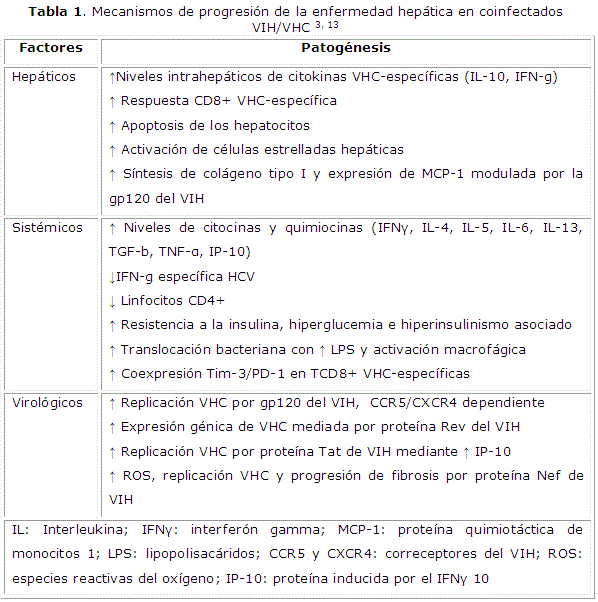
<body><![CDATA[<p style='margin-bottom:0cm;margin-bottom:.0001pt;text-align: justify;text-justify:inter-ideograph;line-height:150%'><b><strong></strong></b></p>     <p style='margin-bottom:0cm;margin-bottom:.0001pt;text-align: justify;text-justify:inter-ideograph;line-height:150%'><font color="#000000" size="2" face="verdana"><b>&nbsp;</b></font><font color="#000000" size="3" face="verdana"><b>MATERIAL    Y M&Eacute;TODOS</b></font></p>     <p style='margin-bottom:0cm;margin-bottom:.0001pt;text-align: justify;text-justify:inter-ideograph;line-height:150%'><font color="#000000" size="2" face="verdana">Se    realizaron b&uacute;squedas sistem&aacute;ticas en la base de datos MEDLINE    de informaci&oacute;n biom&eacute;dica a trav&eacute;s del motor PubMed. Se    incluyeron en la selecci&oacute;n cl&iacute;nicos ensayos, resultados de investigaciones    originales y revisiones sistem&aacute;ticas hasta septiembre de 2016. Se utiliz&oacute;,    adem&aacute;s, la biblioteca m&eacute;dica UpToDate &reg; para acceder a las    <i>Gu&iacute;as de Pr&aacute;ctica Cl&iacute;nica</i> en el contexto de coinfecci&oacute;n    por VIH/VHC; as&iacute; como las <i>Gu&iacute;as AEEH/SEIMC</i> de manejo de    la Hepatitis C (Asociaci&oacute;n Espa&ntilde;ola para el estudio del H&iacute;gado    y Sociedad Espa&ntilde;ola de Enfermedades Infecciosas y Microbiolog&iacute;a    Cl&iacute;nica) y las <i>Gu&iacute;as de Hepatitis C</i> <i>de la American Association    for the Study of Liver Diseases,</i> ambas con actualizaci&oacute;n de julio    de 2016. En materia de interacciones medicamentosas se accedi&oacute; a las    bases de datos de la Universidad de Liverpool mediante la plataforma www.hep&#45;druginteractions.org,    con &uacute;ltima actualizaci&oacute;n de evidencia cient&iacute;fica el 26    de noviembre de 2015. &nbsp; </font></p>     <p style='margin-bottom:0cm;margin-bottom:.0001pt;text-align: justify;text-justify:inter-ideograph;line-height:150%'>&nbsp;</p>     <p style='margin-bottom:0cm;margin-bottom:.0001pt;text-align: justify;text-justify:inter-ideograph;line-height:150%'><font color="#000000" size="3" face="verdana"><strong>DESARROLLO</strong>    </font></p>     <p style='margin-bottom:0cm;margin-bottom:.0001pt;text-align: justify;text-justify:inter-ideograph;line-height:150%'><font color="#000000" size="2" face="verdana"><strong>VHC    y VIH: mecanismos de interacci&oacute;n y comorbilidad</strong></font></p>     <p align="justify" style="margin-bottom: 0cm"><font color="#000000" size="2" face="verdana"><b><i>Progresi&oacute;n    del VIH en el contexto de coinfecci&oacute;n VHC</i></b></font></p>     <p style='margin&#45;bottom:0cm;margin&#45;bottom:.0001pt;text&#45;align: justify;text&#45;justify:inter&#45;ideograph;line&#45;height:150%'><font color="#000000" size="2" face="verdana">Hoy    todav&iacute;a est&aacute; en entredicho el papel que tiene el VHC en la progresi&oacute;n    del VIH y la mayor&iacute;a de estudios no ha demostrado relevancia cl&iacute;nica.<sup>3,5,11&#45;13</sup>    Se postula que la activaci&oacute;n continua de los linfocitos T podr&iacute;a    limitar la respuesta inmunol&oacute;gica. Adem&aacute;s, la infecci&oacute;n    extrahep&aacute;tica de los linfocitos CD4 por el VHC podr&iacute;a derivar    en interacciones virol&oacute;gicas directas que influyeran en la recuperaci&oacute;n    de los CD4. Las prote&iacute;nas NS3/NS4A del virus C promueven la transcripci&oacute;n    del VIH, mientras que la del Core activa la replicaci&oacute;n.<sup>14,15</sup></font></p>     <p style='margin-bottom:0cm;margin-bottom:.0001pt; line-height:150%'><font color="#000000" size="2" face="verdana"><b><i>&nbsp;</i></b></font><font color="#000000" size="2" face="verdana"><b><i>Progresi&oacute;n    del VHC en el contexto de coinfecci&oacute;n VIH</i></b></font></p>     <p style='margin-bottom:.0001pt;text-align: justify;text-justify:inter-ideograph;line-height:150%'><font color="#000000" size="2" face="verdana">El    VIH tiene un importante impacto en el ciclo del virus C y en su historia natural.    Los coinfectados tienen menor tasa de eliminaci&oacute;n del VHC y progresi&oacute;n    acelerada hacia enfermedad hep&aacute;tica sintom&aacute;tica, terminal, cirrosis    y carcinoma hepatocelular.<sup>3, 16, 17</sup> Los mecanismos etiopatog&eacute;nicos    implicados se detallan en la <a href="/img/revistas/rhcm/v16n2/t0107217.gif">Tabla1</a>.</font></p>     ]]></body>
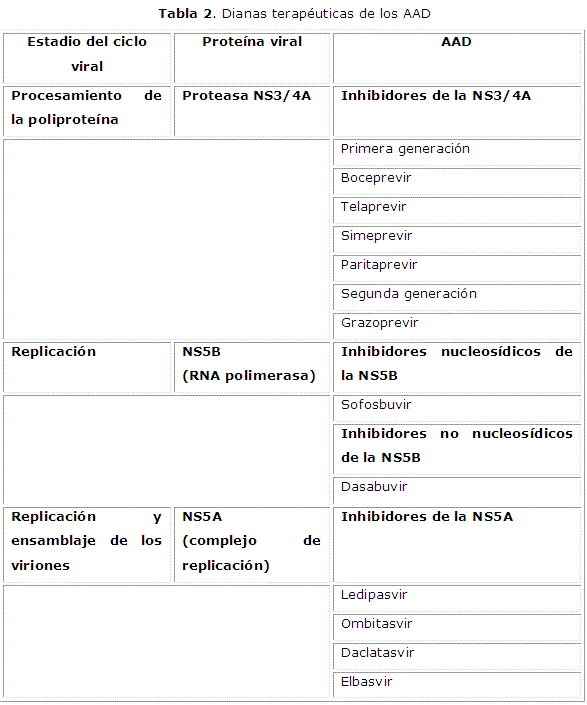
<body><![CDATA[<p style='margin-bottom:.0001pt;text-align: justify;text-justify:inter-ideograph;line-height:150%'><font color="#000000" size="2" face="verdana">La    primera causa de muerte en los pacientes coinfectados tratados con terapia antirretroviral    era la enfermedad hep&aacute;tica terminal.<sup>3</sup> Este incremento se debe,    en parte, al aumento de la esperanza de vida y al descenso de la mortalidad    asociada a las complicaciones del SIDA en pacientes tratados.<sup>10</sup> Sin    embargo, seg&uacute;n la evidencia m&aacute;s actual, con los nuevos reg&iacute;menes    de tratamiento con AAD se podr&iacute;a llegar a igualar la progresi&oacute;n    de la fibrosis en ambas subpoblaciones.<sup>10</sup> Por otra parte, tambi&eacute;n    es necesario recalcar el mayor n&uacute;mero observado de reinfecciones por    VHC en los individuos coinfectados, debido, posiblemente, a la permanencia de    los factores de riesgo.</font></p>     <p style='margin&#45;bottom:0cm;margin&#45;bottom:.0001pt;line&#45;height: 150%'><font color="#000000" size="2" face="verdana"><b><i>Otras    complicaciones de la coinfecci&oacute;n</i></b></font></p>     <p style='margin&#45;bottom:0cm;margin&#45;bottom:.0001pt;text&#45;align: justify;text&#45;justify:inter&#45;ideograph;line&#45;height:150%'><font color="#000000" size="2" face="verdana">Con    la disminuci&oacute;n de la mortalidad por SIDA y el envejecimiento de los pacientes,    la inflamaci&oacute;n cr&oacute;nica se asociaba a mayor riesgo de morbimortalidad    cardiovascular debido a la disfunci&oacute;n endotelial.<sup>18</sup> Adem&aacute;s,    en individuos con una larga historia de seropositividad VIH, se observa un incremento    significativo del riesgo relativo de enfermedad renal por VIH.<sup>19</sup>    Por otro lado, la coinfecci&oacute;n aumenta la incidencia de neuropat&iacute;a    motora perif&eacute;rica, da&ntilde;o cognitivo y empeoramiento de la demencia    asociada a VIH<sup>5,9</sup> y asocia mayor riesgo de <i>Diabetes Mellitus</i>    independientemente del da&ntilde;o hep&aacute;tico.<sup>3,20</sup> En los &uacute;ltimos    a&ntilde;os se ha definido que tanto el riesgo de fracturas como de osteoporosis    se encuentran significativamente elevados.<sup>21</sup> </font></p>     <p style='margin&#45;bottom:0cm;margin&#45;bottom:.0001pt;text&#45;align: justify;text&#45;justify:inter&#45;ideograph;line&#45;height:150%'><font color="#000000" size="2" face="verdana"><b><i>Prop&oacute;sitos    de la terapia</i></b></font></p>     <p style='margin&#45;bottom:0cm;margin&#45;bottom:.0001pt;text&#45;align: justify;text&#45;justify:inter&#45;ideograph;line&#45;height:150%'><font color="#000000" size="2" face="verdana">La    curaci&oacute;n del VHC se asume en base a la respuesta virol&oacute;gica sostenida    (RVS), que asocia a reducciones sustanciales de la morbimortalidad hep&aacute;tica:    se frena, enlentece o mejora la progresi&oacute;n de la fibrosis y la necroinflamaci&oacute;n    y disminuye la tasa de carcinoma hepatocelular, adem&aacute;s de desaparecer    los efectos adversos de la pluriterapia y las interacciones farmacol&oacute;gicas.<sup>22</sup>    Con los nuevos AAD, se considera RVS una carga viral indetectable 12 semanas    tras el tratamiento. La RVS4, sin ser un par&aacute;metro definitorio de curaci&oacute;n,    se considera buen factor de predicci&oacute;n.<sup>23&#45;25</sup></font></p>     <p style='margin&#45;bottom:0cm;margin&#45;bottom:.0001pt;text&#45;align: justify;text&#45;justify:inter&#45;ideograph;line&#45;height:150%'><font color="#000000" size="2" face="verdana"><b><i>Opciones    terap&eacute;uticas contra el VHC en el contexto particular de la coinfecci&oacute;n    VIH/VHC</i></b></font></p>     <p style='margin&#45;bottom:0cm;margin&#45;bottom:.0001pt;text&#45;align: justify;text&#45;justify:inter&#45;ideograph;line&#45;height:150%'><font color="#000000" size="2" face="verdana">Con    los AAD no parecen existir diferencias en tasas de curaci&oacute;n y tolerabilidad    entre pacientes mono y coinfectados, al contrario de lo que ocurr&iacute;a con    la biterapia cl&aacute;sica y la triple terapia de primera generaci&oacute;n.    De tal manera, el tratamiento antiviral de la Hepatitis C tiene, en las &uacute;ltimas    gu&iacute;as, las mismas indicaciones y reg&iacute;menes que en monoinfectados.<sup>6,7,10,23</sup>    Para el desarrollo de estos f&aacute;rmacos ha sido fundamental el conocimiento    del ciclo viral<sup>3</sup> y sus dianas terap&eacute;uticas se detallan en    la <a href="/img/revistas/rhcm/v16n2/t0207217.gif">Tabla2</a>. La coinfecci&oacute;n VIH/VHC proporciona    mayor prioridad en cuanto al tratamiento del VHC incluso en estadios tempranos    de fibrosis (F0/F1) y se aboga por un tratamiento precoz.<sup>7</sup> La elecci&oacute;n    del r&eacute;gimen terap&eacute;utico depende del genotipo, el estadio de lafibrosis    hep&aacute;tica, la historia de previo tratamiento o la elegibilidad de reg&iacute;menes    con interfer&oacute;n en algunos casos. Sin embargo, en los pacientes coinfectados,    las interacciones medicamentosas suponen una limitaci&oacute;n al tratamiento    que no debe ser obviada.<sup>3,9,25</sup></font></p>     <p style='margin&#45;bottom:0cm;margin&#45;bottom:.0001pt;text&#45;align: justify;text&#45;justify:inter&#45;ideograph;line&#45;height:150%'><font color="#000000" size="2" face="verdana"><b><i>Interacciones    farmacol&oacute;gicas</i></b></font></p>     <p></p>     <p style='margin&#45;bottom:0cm;margin&#45;bottom:.0001pt;text&#45;align: justify;text&#45;justify:inter&#45;ideograph;line&#45;height:150%'><font color="#000000" size="2" face="verdana">La    necesidad de pluriterapia para evitar resistencias aumenta la posibilidad de    interacciones que alteren el equilibrio riesgo/beneficio entre los efectos adversos    del tratamiento y su efectividad terap&eacute;utica, am&eacute;n de la crucial    cumplimentaci&oacute;n. Por ello, encontrar una pauta individualizada carente    de interacciones que repercutan negativamente sobre el <i>cursusmorbi</i> y    sobre s&iacute; mismos supone todo un reto en la pr&aacute;ctica cl&iacute;nica.<sup>7,9</sup></font></p>     ]]></body>
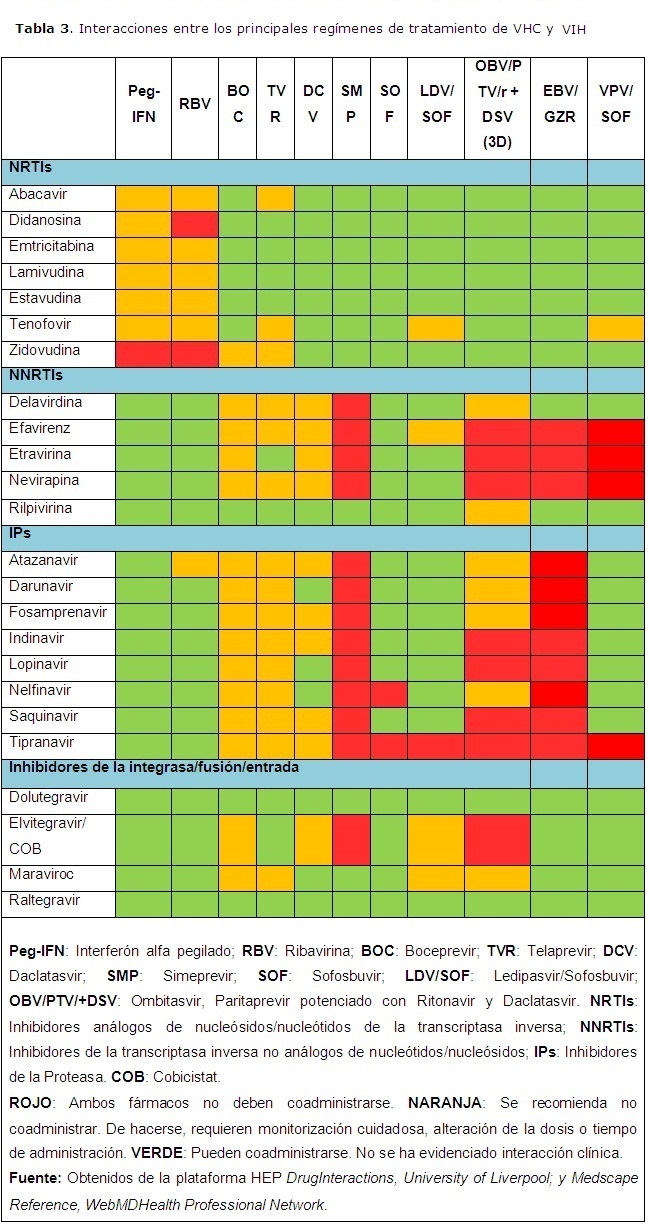
<body><![CDATA[<p style='margin&#45;bottom:0cm;margin&#45;bottom:.0001pt;text&#45;align: justify;text&#45;justify:inter&#45;ideograph;line&#45;height:150%'><font color="#000000" size="2" face="verdana"><b><i>Interacciones    con los nuevos AAD</i></b></font></p>     <p style='margin&#45;bottom:0cm;margin&#45;bottom:.0001pt;text&#45;align: justify;text&#45;justify:inter&#45;ideograph;line&#45;height:150%'><font color="#000000" size="2" face="verdana">Muchos    son sustratos del CYP3A4 o de la p&#45;gp, lo que puede contraindicar su coadministraci&oacute;n    con inhibidores no nucle&oacute;sidos de la transcriptasa inversa (NNRTIs) o    inhibidores de la proteasa (IPs). Las contraindicaciones con inhibidores de    la integrasa son escasas. La relevancia cl&iacute;nica se encuentra gradada    en la <a href="/img/revistas/rhcm/v16n2/t0307217.jpg">Tabla3</a>.</font></p>     <p style='margin&#45;bottom:0cm;margin&#45;bottom:.0001pt;text&#45;align: justify;text&#45;justify:inter&#45;ideograph;line&#45;height:150%'><font color="#000000" size="2" face="verdana"><b>a.    Sofosbuvir:</b> Una de las grandes ventajas de este f&aacute;rmaco es la ausencia    de interacciones farmacol&oacute;gicas cl&iacute;nicamente significativas con    los antirretrovirales y su efecto pan&#45;genot&iacute;pico.<sup>26</sup> No    se aconseja la coadministraci&oacute;n con Tipranavir, puesto que se postula    que este podr&iacute;a disminuir su eficacia e inducir la glicoprote&iacute;na    P.<sup>27</sup></font></p>     <p style='margin&#45;bottom:0cm;margin&#45;bottom:.0001pt;text&#45;align: justify;text&#45;justify:inter&#45;ideograph;line&#45;height:150%'><font color="#000000" size="2" face="verdana"><b>b.    Daclatasvir:</b> No ha mostrado interacci&oacute;n alguna con los inhibidores    nucle&oacute;sidos de la transcriptasa inversa (NRTIs). En el grupo de los NNRTIs    solo se ha demostrado su interacci&oacute;n con el Efavirenz, que obliga a aumentar    la dosis del primero. Se estima que la inhibici&oacute;n del CYP3A4 por la Nevirapina,    la Etravirina y la Delavirdina; y por Tipranavir, Saquinavir, Indinavir, Ritonavir,    Fosamprenavir y Cobicistat&nbsp; pueda incrementar sus concentraciones. Debe    reducirse su dosis a la mitad en cotratamiento con Atazanavir/Ritonavir.<sup>27</sup></font></p>     <p style='margin&#45;bottom:0cm;margin&#45;bottom:.0001pt;text&#45;align: justify;text&#45;justify:inter&#45;ideograph;line&#45;height:150%'><font color="#000000" size="2" face="verdana"><b>c.    Simeprevir:</b> No se esperan interacciones farmacol&oacute;gicas cl&iacute;nicamente    significativas con la coadministraci&oacute;n de Simeprevir con los NRTIs. Al    ser sustrato del CYP3A4 est&aacute; contraindicado con todos los IPs. Tampoco    se recomienda la administraci&oacute;n conjunta de Delavirdina, Efavirenz, Etravirina    y Nevirapina, siendo la Rilpivirina el &uacute;nico NNRTI que no asocia ninguna    interacci&oacute;n significativa.<sup>27</sup></font></p>     <p style='margin&#45;bottom:0cm;margin&#45;bottom:.0001pt;text&#45;align: justify;text&#45;justify:inter&#45;ideograph;line&#45;height:150%'><font color="#000000" size="2" face="verdana"><b>d.    Ledipasvir (Ledipasvir/Sofosbuvir):</b> El Ledipasvir se asocia en la pr&aacute;ctica    cl&iacute;nica al Sofosbuvir por lo que no se recomienda la coadministraci&oacute;n    con Tipranavir. No tiene interacci&oacute;n con ning&uacute;n otro IP del VIH.    Respecto a los NRTIs, la coadministraci&oacute;n con Tenofovir incrementa la    exposici&oacute;n de este f&aacute;rmaco, especialmente si se asocia a Elvitegravir,    Cobicistat o Emtricitabina, y hace recomendable la monitorizaci&oacute;n cuidadosa    de la funci&oacute;n renal. En el grupo de NNRTIs, se estudi&oacute; la interacci&oacute;n    farmacol&oacute;gica en pacientes tratados con los reg&iacute;menes Ledipasvir/Sofosbuvir    y Tenofovir/Emtricitabina/Efavirenz. En este grupo se increment&oacute; el AUC    del Tenofovir 98% y disminuy&oacute; la del Ledipasvir 34%. No se recomienda    ajuste de dosis, pero s&iacute; monitorizar la funci&oacute;n renal por el riesgo    de toxicidad del Tenofovir.<sup>28</sup></font></p>     <p style='margin-bottom:.0001pt;margin-bottom:.0001pt;text-align: justify;text-justify:inter-ideograph;line-height:150%'><font color="#000000" size="2" face="verdana"><b>e.    Combinaci&oacute;n de Ombitasvir/Paritaprevir potenciado con Ritonavir y Ombitasvir/Paritaprevir/r    y Dasabuvir (r&eacute;gimen 3D):</b> No existen interacciones cl&iacute;nicamente    significativas con los NRTIs, pero s&iacute; con los NNRTIs debido, mayormente,    al efecto sobre el citocromo p450 del Ritonavir. Est&aacute; contraindicado    administrarse con Efavirenz, Etravirina o Nevirapina. La Rilpivirina puede coadministrarse    pero tiene interacciones potenciales. Tambi&eacute;n con los IP. Se contraindica    su coadministraci&oacute;n con Indinavir, Lopinavir y Saquinavir por su inhibici&oacute;n    del CYP3A4. La coadministraci&oacute;n de este r&eacute;gimen con Atazanavir,    Darunavir, Fosamprenavir y Nelfinavir no se recomienda, pero en caso de utilizarse    debe ser monitorizada cuidadosamente, alterar las dosis o el tiempo de administraci&oacute;n.    No se observan interacciones significativas con el Raltegravir o el Dolutegravir.    Elvitegravir se combina con Cobicistat, que podr&iacute;a incrementar su concentraci&oacute;n    por inhibici&oacute;n del CYP3A4.<sup>27,29</sup></font></p>     <p style='margin-bottom:.0001pt;margin-bottom:.0001pt;text-align: justify;text-justify:inter-ideograph;line-height:150%'><font color="#000000" size="2" face="verdana"><b>f.    Grazoprevir/Elbasvir:</b> Ambos son sustratos del CY3A4 y la p&#45;gp. El Grazoprevir    tambi&eacute;n lo es de OATP1B1. Por ello, no pueden ser administrados con los    inhibidores de la proteasa o con NNRTIs inductores del citocromo como el Efavirenz,    la Etravirina o la Nevirapina. No existe interacci&oacute;n con los NRTIs o    inhibidores de la integrasa.<sup>23,27</sup></font></p>     <p style='margin-bottom:.0001pt;margin-bottom:.0001pt;text-align: justify;text-justify:inter-ideograph;line-height:150%'><font color="#000000" size="2" face="verdana"><b>g.    Velpatasvir (Velpatasvir/Sofosbuvir):</b> El Velpatasvir se metaboliza por el    CYP3A4 y es sustrato de la p&#45;gp, pero solo se ha evidenciado interacci&oacute;n    con el Tipranavir, Efavirenz, Etravirina y Nevirapina. La funci&oacute;n renal    debe vigilarse, especialmente en combinaci&oacute;n con Tenofovir. No interaccionan    con los inhibidores de la integrasa y con el resto de ARV.<sup>23,27</sup></font></p>     <p style='margin&#45;bottom:0cm;margin&#45;bottom:.0001pt;text&#45;align: justify;text&#45;justify:inter&#45;ideograph;line&#45;height:150%'><font color="#000000" size="2" face="verdana"><b><em>Efecto    del VIH en la respuesta al tratamiento del VHC y hepatotoxicidad de los antirretrovirales</em></b></font></p>     ]]></body>
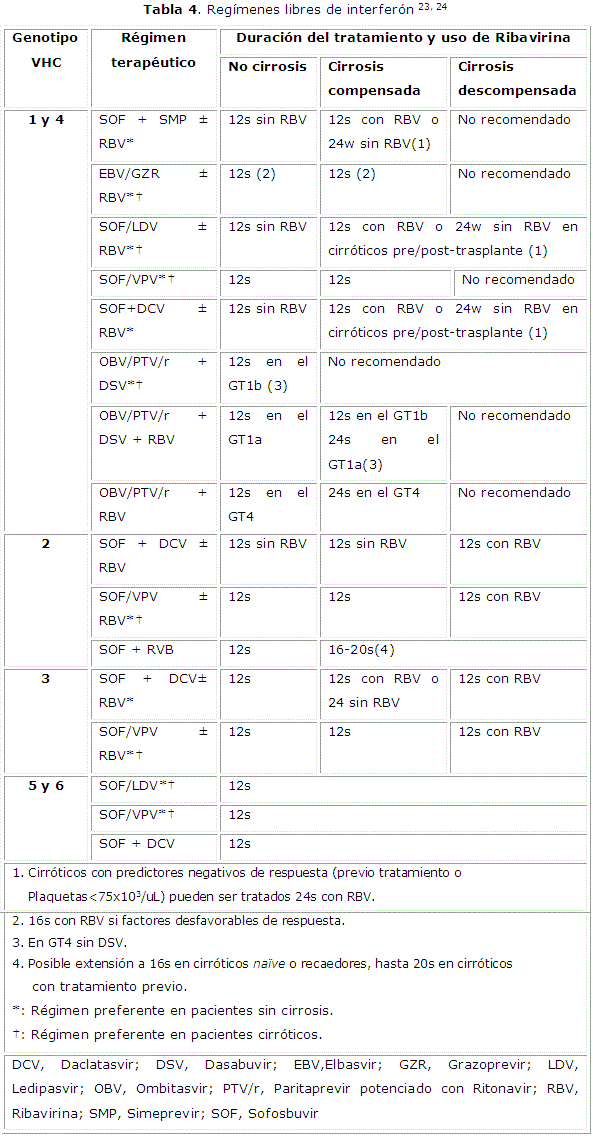
<body><![CDATA[<p style='margin&#45;bottom:0cm;margin&#45;bottom:.0001pt;text&#45;align: justify;text&#45;justify:inter&#45;ideograph;line&#45;height:150%'><font color="#000000" size="2" face="verdana">Los    pacientes coinfectados respond&iacute;an peor a la biterapia: la RVS en el genotipo    1 del VHC descend&iacute;a para situarse en rangos variables desde 14 a 35%,    en comparaci&oacute;n con 42 a 46% de los monoinfectados.<sup>30</sup></font></p>     <p style='margin&#45;bottom:0cm;margin&#45;bottom:.0001pt;text&#45;align: justify;text&#45;justify:inter&#45;ideograph;line&#45;height:150%'><font color="#000000" size="2" face="verdana">Uno    de los principales problemas lo constituye la hepatotoxicidad del tratamiento    antirretroviral, cuya incidencia es heterog&eacute;nea (3&#45;18%),<sup>31</sup>    debido a la variabilidad en sus manifestaciones. Las m&aacute;s graves son m&aacute;s    frecuentes en pacientes infectados por VHB o VHC, particularmente en el GT3    del VHC, que no asocia respuestas terap&eacute;uticas tan elevadas como otros    genotipos del virus.<sup>25,32</sup> Son factores de riesgo el grado de fibrosis    previa, GT3, el sexo femenino, duraci&oacute;n elevada del tratamiento antirretroviral,    alcohol y tratamiento con nevirapina o con IPs.<sup>32</sup> Los mecanismos    son variables. Por un lado, se ha demostrado que las interacciones mediadas    por el CYP3A4 comentadas en el punto anterior son causa de hepatotoxicidad,    generalmente debida a acumulaci&oacute;n de NNRTIs e IPs o sus metabolitos y    generaci&oacute;n de especies reactivas del ox&iacute;geno.<sup>31,32</sup>    La Didanosina o la Estavudina pueden inhibir la DNA polimerasa gamma, que resulta    en acumulaci&oacute;n de &aacute;cidos grasos libres y esteatosis hep&aacute;tica    y causar toxicidad mitocondrial que puede llevar a fallo hep&aacute;tico agudo.    Otro factor a considerar son las alteraciones metab&oacute;licas; la resistencia    a la insulina y la esteatohepatitis podr&iacute;an incrementar el riesgo.</font></p>     <p style='margin&#45;bottom:0cm;margin&#45;bottom:.0001pt;text&#45;align: justify;text&#45;justify:inter&#45;ideograph;line&#45;height:150%'><font color="#000000" size="2" face="verdana">La    heterogeneidad de las series y la combinaci&oacute;n farmacol&oacute;gica dificultan    la determinaci&oacute;n precisa de esta hepatotoxicidad. Dentro de los IPs,    el Ritonavir a dosis completa parece ser el m&aacute;s t&oacute;xico, junto    con el Indinavir y el Saquinavir.<sup>32</sup> En un estudio con 1 052 pacientes    que compar&oacute; Ritonavir, Indinavir, Amprenavir, Saquinavir y Nelfinavir    se observ&oacute; que este &uacute;ltimo era el menos perjudicial.<sup>33</sup>    El Lopinavir y el Atazanavir potenciados con dosis bajas de Ritonavir tambi&eacute;n    tienen buenos perfiles de seguridad. Otro estudio observacional concluy&oacute;    que un cambio a Raltegravir y la Rilpivirina frente a Efavirenz mejora la hepatotoxicidad    asociada, con un mismo perfil de efectividad.<sup>34</sup></font></p>     <p style='margin-bottom:.0001pt;margin-bottom:.0001pt;text-align: justify;text-justify:inter-ideograph;line-height:150%'><font color="#000000" size="2" face="verdana"><b><em>R&eacute;gimen    actual de tratamiento del VHC en pacientes coinfectados</em></b></font></p>     <p style='margin&#45;bottom:0cm;margin&#45;bottom:.0001pt;text&#45;align: justify;text&#45;justify:inter&#45;ideograph;line&#45;height:150%'><font color="#000000" size="2" face="verdana">Los    reg&iacute;menes libres de interfer&oacute;n basados en AAD deben ser considerados    como tratamiento est&aacute;ndar para infecci&oacute;n cr&oacute;nica por VHC    tanto en el contexto de la mono como la coinfecci&oacute;n VIH, y los reg&iacute;menes    con interfer&oacute;n solamente se recomiendan en infecciones por el genotipo    3 que no hayan respondido a previo tratamiento con Sofosbuvir + Daclatasvir    o Sofosbuvir/Velpatasvir.<sup>23,24</sup></font></p>     <p style='margin&#45;bottom:0cm;margin&#45;bottom:.0001pt;text&#45;align: justify;text&#45;justify:inter&#45;ideograph;line&#45;height:150%'><font color="#000000" size="2" face="verdana">El    tratamiento y su duraci&oacute;n dependen del genotipo viral, de la presencia    de cirrosis compensada o descompensada y el previo tratamiento con AADs. Los    reg&iacute;menes terap&eacute;uticos libres de IFN para pacientes <i>na&iuml;ve</i>    a AADs y las opciones con IFN se definen en las tablas <a href="/img/revistas/rhcm/v16n2/t0407217.gif">4</a>    y <a href="/img/revistas/rhcm/v16n2/t0507217.gif">5</a>, respectivamente.</font></p>     <p style='margin&#45;bottom:0cm;margin&#45;bottom:.0001pt;text&#45;align: justify;text&#45;justify:inter&#45;ideograph;line&#45;height:150%'><font color="#000000" size="2" face="verdana"><b><em>Evidencia    cl&iacute;nica de las combinaciones en coinfectados VIH/VHC</em></b></font></p>     <p style='margin-bottom:.0001pt;margin-bottom:.0001pt;text-align: justify;text-justify:inter-ideograph;line-height:150%'><font color="#000000" size="2" face="verdana"><b><i>Reg&iacute;menes    sin interfer&oacute;n</i></b></font></p>     <p style='margin&#45;bottom:0cm;margin&#45;bottom:.0001pt;text&#45;align: justify;text&#45;justify:inter&#45;ideograph;line&#45;height:150%'><font color="#000000" size="2" face="verdana"><b>a.    Simeprevir y Sofosbuvir</b>: Un estudio con 50 pacientes coinfectados con marcadores    negativos de respuesta encontr&oacute; una RVS24 de 82% asociando Ribavirina.<sup>35</sup>    El estudio COSMOS randomizado que evalu&oacute; la eficacia y la seguridad de    esta combinaci&oacute;n en 167 pacientes, sin embargo, no evalu&oacute; los    coinfectados por VIH.<sup>36&#45;38</sup></font></p>     <p style='margin&#45;bottom:0cm;margin&#45;bottom:.0001pt;text&#45;align: justify;text&#45;justify:inter&#45;ideograph;line&#45;height:150%'><font color="#000000" size="2" face="verdana"><b>b.    Sofosbuvir y Ledipasvir</b>: Un ensayo de fase 2b en 50 pacientes no tratados,    sin cirrosis, infectados por el GT1, demostr&oacute; una RVS de 98% a 12 semanas.<sup>28</sup>    El ensayo NAIAD ERADICATE estudi&oacute; 50 pacientes <i>na&iuml;ve</i> divididos    en dos grupos: uno, con tratamiento ARV con Tenofovir/Emtricitabina asociados    a Efavirenz, Rilpivirina o Raltegravir y otro ARV <i>na&iuml;ve</i>, con mayor&iacute;a    (74%) de infectados por el GT1b. Las RVS fueron 98% y 100%, respectivamente,    a 12 semanas.<sup>39</sup> El ION 4 sigui&oacute; a 355 pacientes con esta combinaci&oacute;n    con GT 1 y 4 y 12 semanas de esta combinaci&oacute;n. Globalmente, 96% alcanz&oacute;    la RVS12, 96% en los genotipos 1a y 1b y 100% en el GT4, y no fue significativa    la presencia de cirrosis o previo tratamiento.<sup>40</sup> La <i>German Hepatitis    C Cohort</i> (GECCO) evalu&oacute; la respuesta en coinfectados tratados con    Ledipasvir&#45;Sofosbuvir durante 8 semanas. De 148 pacientes, 28 ten&iacute;an    coinfecci&oacute;n VIH/VHC y estaban infectados por el GT1 del VHC. En este    grupo, la respuesta viral en la semana 4 y la RVS12 fue de 100%. Los efectos    adversos relacionados con el tratamiento fueron leves y poco frecuentes.<sup>41</sup>    En ning&uacute;n caso hubo discontinuaciones por efectos adversos.</font></p>     ]]></body>
<body><![CDATA[<p style='margin&#45;bottom:0cm;margin&#45;bottom:.0001pt;text&#45;align: justify;text&#45;justify:inter&#45;ideograph;line&#45;height:150%'><font color="#000000" size="2" face="verdana"><b>c.    Daclatasvir y Sofosbuvir</b>: Un estudio con 151 pacientes <i>na&iuml;ve</i>    y 52 tratados, con GT del 1 al 4 (GT1 83%) demostr&oacute; unas RVS12 de 96,    4% 97,7%&nbsp; respectivamente, en el GT1. La RVS global fue de 97% y la cirrosis    no fue un factor determinante. No hubo discontinuaciones por reacciones adversas.<sup>42</sup>    Cabe mencionar que en pacientes monoinfectados, s&iacute; existe respuesta sub&oacute;ptima    en pacientes cirr&oacute;ticos, por lo que podr&iacute;a considerarse extrapolable    a los coinfectados.<sup>43</sup></font></p>     <p style='margin&#45;bottom:0cm;margin&#45;bottom:.0001pt;text&#45;align: justify;text&#45;justify:inter&#45;ideograph;line&#45;height:150%'><font color="#000000" size="2" face="verdana"><b>d.    Ombitasvir, Paritaprevir/r y Dasabuvir asociados a Ribavirina, o r&eacute;gimen    3D</b>: El estudio TURQUOISE&#45;I parte 1a analiz&oacute; esta combinaci&oacute;n    en 63 pacientes coinfectados, con el GT1, <i>na&iuml;ve</i> o con fallo terap&eacute;utico    con biterapia, incluyendo pacientes con cirrosis. Las RVS12 y RVS24 fueron de    94% y 91%, respectivamente, sin que hubiera discontinuaciones por efectos adversos.<sup>44</sup>    Seg&uacute;n resultados preliminares, la parte 1b del estudio evalu&oacute;    un total de 22 pacientes divididos en dos brazos, seg&uacute;n toma &uacute;nica    diaria o dividida en dos dosis. La respuesta viral en la semana 4 y la RVS12    fue de 100%. No hubo efectos adversos graves relacionados con f&aacute;rmacos    ni alteraciones cl&iacute;nico&#45;anal&iacute;ticas relacionadas con el Darunavir.    La parte 2 del estudio contin&uacute;a evaluando el r&eacute;gimen 3D en coinfectados,    con el GT1 y el GT4 en un ensayo multic&eacute;ntrico global con 230 pacientes.<sup>44</sup></font></p>     <p style='margin&#45;bottom:0cm;margin&#45;bottom:.0001pt;text&#45;align: justify;text&#45;justify:inter&#45;ideograph;line&#45;height:150%'><font color="#000000" size="2" face="verdana"><b>e.    Sofosbuvir y Ribavirina</b>: El estudio PHOTON&#45;2<sup>45</sup> analiz&oacute;    esta combinaci&oacute;n en 274 pacientes de los genotipos 1, 2, 3 y 4; durante    12 semanas en los pacientes <i>na&iuml;ve</i> infectados por el GT2 y durante    24 en el resto. Las RVS12 globales fueron de 85% en el GT1, 88% en el GT2, 89%    en el GT3 y 84% en el GT4. Las respuestas en pacientes <i>na&iuml;ve</i> con    GT 2 y 3 comparadas con las de aquellos que hab&iacute;an recibido tratamiento    fueron similares (89% y 91% <i>vs</i> 83% y 86%, respectivamente. Seis pacientes    discontinuaron el tratamiento por efectos adversos.</font></p>     <p style='margin&#45;bottom:0cm;margin&#45;bottom:.0001pt;text&#45;align: justify;text&#45;justify:inter&#45;ideograph;line&#45;height:150%'><font color="#000000" size="2" face="verdana"><b>f.    Grazoprevir/Elbasvir:</b> El estudio C&#45;WORTHY, un ensayo cl&iacute;nico    multic&eacute;ntrico, aleatorizado y controlado de fase 2, evalu&oacute; la    eficacia y la seguridad del Grazoprevir y dos dosis de Elbasvir, asociado o    no a Ribavirina, en pacientes monoinfectados por el VHC y en coinfectados <i>na&iuml;ve</i>    VIH/VHC con GT1 durante 12 semanas. De los 218 pacientes del estudio, 59 eran    coinfectados. La RVS12 en este grupo fue de 87% sin Ribavirina y de 97% con    Ribavirina, frente a 98% y 93%, respectivamente, en el grupo de los monoinfectados.    El perfil de seguridad fue similar en ambos grupos y ning&uacute;n paciente    discontinu&oacute; debido a efectos adversos o anormalidad anal&iacute;tica.<sup>46</sup>    Por otra parte, el estudio C&#45;EDGE CO&#45;INFECTION, un ensayo de fase 3    multic&eacute;ntrico, estudi&oacute;, particularmente en un grupo de 218 pacientes    coinfectados VIH/VHC con los genotipos 1, 4 y 6, y entre los que se inclu&iacute;an    tanto cirr&oacute;ticos como pacientes sin cirrosis, la eficacia, la seguridad    y la tolerabilidad del r&eacute;gimen Grazoprevir + Elbasvir durante 12 semanas.    Si bien no es un ensayo aleatorizado y controlado, se consigui&oacute; la RVS12    en 96% de los pacientes, de los cuales uno no la alcanz&oacute; por motivo no    virol&oacute;gico. Las reacciones adversas fueron leves y poco frecuentes, y    todos completaron el estudio.<sup>47</sup></font></p>     <p style='margin&#45;bottom:0cm;margin&#45;bottom:.0001pt;text&#45;align: justify;text&#45;justify:inter&#45;ideograph;line&#45;height:150%'><font color="#000000" size="2" face="verdana"><b>g.    Velpatasvir/Sofosbuvir:</b> Todav&iacute;a no existe evidencia publicada en    coinfectados. Est&aacute; en marcha un estudio de fase 3, el ASTRAL&#45;5, con    106 pacientes coinfectados con Gt1&#45;4, de los cuales 18% tiene cirrosis compensada.    Los resultados preliminares informan una RVS12 de 95%.<sup>48</sup> Los estudios    ASTRAL de fase 3 (ASTRAL&#45;1, ASTRAL&#45;2, ASTRAL&#45;3 y ASTRAL&#45;4) han    estudiado un total de 1 302 pacientes monoinfectados bajo este r&eacute;gimen    durante 12 semanas&#150;24 semanas en cirrosis descompensada&#45; y, salvo en    este caso, en el que las RVS fueron de 83&#45;86%, en todos los genotipos se    alcanz&oacute; RVS&gt;95%, incluido el GT3.<sup>49&#45;51</sup></font></p>     <p style='margin&#45;bottom:0cm;margin&#45;bottom:.0001pt;text&#45;align: justify;text&#45;justify:inter&#45;ideograph;line&#45;height:150%'><font color="#000000" size="2" face="verdana">Las    reacciones adversas con los nuevos AAD son menores, leves, principalmente comunes    a todos ellos e inespec&iacute;ficas. Las m&aacute;s frecuentes incluyen fatiga    (en torno a 20% de los pacientes, salvo en el r&eacute;gimen 3D, que asciende    a 48%), cefalea (16&#45;25%),<sup>38&#45;40,42,43,46</sup> n&aacute;usea (15&#45;18%)<sup>28,38,43,46,47</sup>    y diarrea en algunos casos (10&#45;11%).<sup>39, 40</sup> Otros efectos menores    son la congesti&oacute;n nasal y la mialgia con el Ledipasvir (16% y 14% respectivamente),<sup>28</sup>    o insomnio en el r&eacute;gimen 3D (19%).<sup>36</sup> Ninguno repercute en    el seguimiento. Si se administran con Ribavirina, esta superpone sus efectos    secundarios, si bien su tolerancia sigue siendo mejor que la del IFN.</font></p>     <p style='margin&#45;bottom:0cm;margin&#45;bottom:.0001pt;text&#45;align: justify;text&#45;justify:inter&#45;ideograph;line&#45;height:150%'><font color="#000000" size="2" face="verdana"><b><i>Reg&iacute;menes    con interfer&oacute;n</i></b></font></p>     <p style='margin&#45;bottom:0cm;margin&#45;bottom:.0001pt;text&#45;align: justify;text&#45;justify:inter&#45;ideograph;line&#45;height:150%'><font color="#000000" size="2" face="verdana"><b>a.    pegIFN &#45; Ribavirina m&aacute;s Rimeprevir</b>: En un estudio, 106 pacientes    recibieron Simeprevir asociado a la biterapia cl&aacute;sica. No cirr&oacute;ticos    <i>na&iuml;ve</i> y recaedores previos lo recibieron guiado por la respuesta    durante 24&#45;48 semanas, y los cirr&oacute;ticos, los no respondedores y los    respondedores parciales durante 48 semanas. Las tasas de SVR12 fueron 79.2%    en los pacientes <i>na&iuml;ve</i>, 57,1% en los no respondedores, 86,7% en    los recaedores y de 70% en los respondedores parciales. Las reacciones adversas,    ocurridas en 5,7% de los pacientes, ninguna fatal, fueron las atribuibles a    la biterapia.<sup>52</sup></font></p>     <p style='margin-bottom:.0001pt;text-align: justify;text-justify:inter-ideograph;line-height:150%'><font color="#000000" size="2" face="verdana"><b>b.    PegIFN &#150; Ribavirina m&aacute;s Telaprevir o Boceprevir</b>: Un ensayo de    fase 2 en 69 pacientes infectados &#150;excluyendo cirr&oacute;ticos y no respondedores&#45;    por el genotipo 1 y con tratamiento antirretroviral con Tenofovir, Emtricitabina,    Efavirenz, Atazanavir, y Raltegravir como ARV permitidos recibi&oacute; biterapia    asociada a Telaprevir,y se obtuvo una RVS24 de 80%. Sin embargo, 20% de los    pacientes discontinu&oacute; el tratamiento por efectos adversos, y dos pacientes    murieron durante el estudio. No hubo alteraci&oacute;n en el control del VIH.<sup>53</sup>    Otro estudio se dedic&oacute; a estudiar las diferencias en la tasa de respuesta    de 134 pacientes coinfectados por VIH&nbsp; tratados con biterapia frente a    la asociaci&oacute;n de esta con inhibidores de la proteasa durante 48 semanas    &#150;triple terapia durante 8 semanas y biterapia hasta finalizar las 48&#150;.    En el genotipo 1 se obtuvo una tasa de RVS de 50% (frente a 33,3% de la biterapia).</font></p>     <p style='margin-bottom:.0001pt;text-align: justify;text-justify:inter-ideograph;line-height:150%'><font color="#000000" size="2" face="verdana"><b>Nuevos    tratamientos contra el virus C en pacientes coinfectados</b></font></p>     ]]></body>
<body><![CDATA[<p style='margin&#45;bottom:0cm;margin&#45;bottom:.0001pt;text&#45;align: justify;text&#45;justify:inter&#45;ideograph;line&#45;height:150%'><font color="#000000" size="2" face="verdana">Algunos    autores cuestionan la necesidad de nuevos f&aacute;rmacos contra el VHC.<sup>6</sup>    Se afirma que en una situaci&oacute;n en la que se consiguen tasas de RVS de    m&aacute;s de 90% con los nuevos reg&iacute;menes disponibles, la investigaci&oacute;n    tanto farmacol&oacute;gica como cl&iacute;nica debe centrarse en las &aacute;reas    que quedan sin resolver, a saber: RVS sub&oacute;ptimas; cirrosis compensada    y descompensada; cargas virales asociadas a peor pron&oacute;stico (&gt;6000000    copias/mL), as&iacute; como abogar por una cobertura mayor en los sistemas de    salud que persiga la universalidad en el acceso al tratamiento en los pacientes    con VHC. Adem&aacute;s, con los nuevos ensayos cl&iacute;nicos y las precoces    RVS, se est&aacute;n evaluando pautas m&aacute;s cortas de tratamiento con resultados    variables<sup>7,43</sup> que todav&iacute;a deben ser evaluados.</font></p>     <p style='margin&#45;bottom:0cm;margin&#45;bottom:.0001pt;text&#45;align: justify;text&#45;justify:inter&#45;ideograph;line&#45;height:150%'><font color="#000000" size="2" face="verdana">Pese    a la diversidad de posturas, emergen AAD de segunda generaci&oacute;n, haciendo    que las gu&iacute;as terap&eacute;uticas y las recomendaciones cl&iacute;nicas    cambien r&aacute;pidamente.<sup>54</sup> Los nuevos inhibidores de la NS3/4A    (como el Sovaprevir, ABT&#45;493 o GS&#45;9857) y NS5A (Samatasvir, GS&#45;5816,    MK&#45;8408 o ABT&#45;530) presentar&aacute;n una mejor barrera de resistencia    y efecto pangenot&iacute;pico. Adem&aacute;s, eludir&aacute;n el problema de    las variantes asociadas a resistencia (RAV), como ya se ha demostrado con el    ABT&#45;530 o el ABT&#45;493. Se prev&eacute; incluso que se acorte la duraci&oacute;n    del tratamiento.</font></p>     <p style='margin&#45;bottom:0cm;margin&#45;bottom:.0001pt;text&#45;align: justify;text&#45;justify:inter&#45;ideograph;line&#45;height:150%'><font color="#000000" size="2" face="verdana"><b>&nbsp;</b></font></p>     <p style='margin&#45;bottom:0cm;margin&#45;bottom:.0001pt;text&#45;align: justify;text&#45;justify:inter&#45;ideograph;line&#45;height:150%'><font color="#000000" size="3" face="verdana"><b>CONCLUSIONES</b></font></p>     <p style='margin&#45;bottom:0cm;margin&#45;bottom:.0001pt;text&#45;align: justify;text&#45;justify:inter&#45;ideograph;line&#45;height:150%'><font color="#000000" size="2" face="verdana">La    coinfecci&oacute;n VIH/VHC ha sufrido una revoluci&oacute;n que ha sacudido    los paradigmas previos y acerca la erradicaci&oacute;n del VHC. Para conseguirlo    cabr&aacute; adem&aacute;s atajar el problema del elevado porcentaje de infectados    no diagnosticados. Con los AAD se ha salvado la brecha que les separaba de los    pacientes monoinfectados y les condenaba a menores tasas de respuesta terap&eacute;utica,    las interacciones y la toxicidad farmacol&oacute;gica que pon&iacute;a en riesgo    la cumplimentaci&oacute;n, y a una mayor morbimortalidad hep&aacute;tica. Con    esta nueva etapa se abren nuevos retos: debido al aluvi&oacute;n de nuevas mol&eacute;culas    debemos estar alerta ante potenciales interacciones farmacol&oacute;gicas, especialmente    con f&aacute;rmacos asociados a patolog&iacute;as prevalentes asociadas al envejecimiento,    reacciones adversas a medio&#45;largo plazos, am&eacute;n de la aparici&oacute;n    de resistencias. Finalmente, es imprescindible dedicar esfuerzos a los grupos    de respuesta sub&oacute;ptima, a aumentar la detecci&oacute;n de casos sin diagnosticar,    sobre todo, en las poblaciones ocultas, y a garantizar la transparencia y la    cobertura universal en todos los contextos cl&iacute;nicos.</font></p>     <p style='margin&#45;bottom:0cm;margin&#45;bottom:.0001pt;text&#45;align: justify;text&#45;justify:inter&#45;ideograph;line&#45;height:150%'><font color="#000000" size="2" face="verdana"><b>&nbsp;</b></font></p>     <p style='margin&#45;bottom:0cm;margin&#45;bottom:.0001pt;text&#45;align: justify;text&#45;justify:inter&#45;ideograph;line&#45;height:150%'><font color="#000000" size="3" face="verdana"><b>REFERENCIAS    BIBLIOGR&Aacute;FICAS</b></font></p>     <!-- ref --><p style='margin&#45;top:0cm;margin&#45;right:0cm; margin&#45;bottom:0cm;margin&#45;left:32.2pt;margin&#45;bottom:.0001pt;text&#45;align:justify; text&#45;justify:inter&#45;ideograph;text&#45;indent:&#45;18.0pt;line&#45;height:150%'><font color="#000000" size="2" face="verdana">1.&nbsp;&nbsp;Global    AIDS Update 2016. UNAIDS Report. Joint United Nations Programme on HIV/AIDS.    &#91;Internet&#93;. Who.int. 2016. Consultado: 13 de diciembre 2016. Disponible    en: <a href="http://www.who.int/hiv/pub/arv/global&#45;AIDS&#45;update&#45;2016_en.pdf?ua=1" target="_blank">http://www.who.int/hiv/pub/arv/global&#45;AIDS&#45;update&#45;2016_en.pdf?ua=1</a></font><p style='margin&#45;top:0cm;margin&#45;right:0cm; margin&#45;bottom:0cm;margin&#45;left:14.2pt;margin&#45;bottom:.0001pt;text&#45;align:justify; text&#45;justify:inter&#45;ideograph;line&#45;height:150%'><font color="#000000" size="2" face="verdana">&nbsp;</font></p>     <!-- ref --><p style='margin&#45;top:0cm;margin&#45;right:0cm; margin&#45;bottom:0cm;margin&#45;left:32.2pt;margin&#45;bottom:.0001pt;text&#45;align:justify; text&#45;justify:inter&#45;ideograph;text&#45;indent:&#45;18.0pt;line&#45;height:150%'><font color="#000000" size="2" face="verdana">2.&nbsp;&nbsp;Messina    J, Humphreys I, Flaxman A, Brown A, Cooke G, Pybus O, <i>et al</i>. Global distribution    and prevalence of hepatitis C virus genotypes. Hepatology. 2014;61(1):77&#45;87.    </font></p>     <p style='margin&#45;top:0cm;margin&#45;right:0cm; margin&#45;bottom:0cm;margin&#45;left:14.2pt;margin&#45;bottom:.0001pt;text&#45;align:justify; text&#45;justify:inter&#45;ideograph;line&#45;height:150%'><font color="#000000" size="2" face="verdana">&nbsp;</font></p>     <!-- ref --><p style='margin&#45;top:0cm;margin&#45;right:0cm; margin&#45;bottom:0cm;margin&#45;left:32.2pt;margin&#45;bottom:.0001pt;text&#45;align:justify; text&#45;justify:inter&#45;ideograph;text&#45;indent:&#45;18.0pt;line&#45;height:150%'><font color="#000000" size="2" face="verdana">3.&nbsp;&nbsp;Kang    W, Tong H, Sun Y, Lu Y. Hepatitis C virus infection in patients with HIV&#45;1:    epidemiology, natural history and management. Expert Rev Gastroenterol Hepatol.    2014;8(3):247&#45;266.    </font></p>     <p style='margin&#45;top:0cm;margin&#45;right:0cm; margin&#45;bottom:0cm;margin&#45;left:14.2pt;margin&#45;bottom:.0001pt;text&#45;align:justify; text&#45;justify:inter&#45;ideograph;line&#45;height:150%'><font color="#000000" size="2" face="verdana">&nbsp;</font></p>     <!-- ref --><p style='margin&#45;top:0cm;margin&#45;right:0cm; margin&#45;bottom:0cm;margin&#45;left:32.2pt;margin&#45;bottom:.0001pt;text&#45;align:justify; text&#45;justify:inter&#45;ideograph;text&#45;indent:&#45;18.0pt;line&#45;height:150%'><font color="#000000" size="2" face="verdana">4.&nbsp;    Ka&#378;mierczak J, Pawe&#322;czyk A, Cortes K, Radkowski M. Seronegative Hepatitis    C Virus Infection. Arch Immunol Ther Exp. 2013;62(2):145&#45;151.    </font></p>     <p style='margin&#45;top:0cm;margin&#45;right:0cm; margin&#45;bottom:0cm;margin&#45;left:14.2pt;margin&#45;bottom:.0001pt;text&#45;align:justify; text&#45;justify:inter&#45;ideograph;line&#45;height:150%'><font color="#000000" size="2" face="verdana">&nbsp;</font></p>     <!-- ref --><p style='margin&#45;top:0cm;margin&#45;right:0cm; margin&#45;bottom:0cm;margin&#45;left:32.2pt;margin&#45;bottom:.0001pt;text&#45;align:justify; text&#45;justify:inter&#45;ideograph;text&#45;indent:&#45;18.0pt;line&#45;height:150%'><font color="#000000" size="2" face="verdana">5.&nbsp;Operskalski    EKovacs A. HIV/HCV Co&#45;infection: Pathogenesis, Clinical Complications, Treatment,    and New Therapeutic Technologies. Curr HIV/AIDS Rep. 2011;8(1):12&#45;22.    </font></p>     ]]></body>
<body><![CDATA[<p style='margin&#45;top:0cm;margin&#45;right:0cm; margin&#45;bottom:0cm;margin&#45;left:14.2pt;margin&#45;bottom:.0001pt;text&#45;align:justify; text&#45;justify:inter&#45;ideograph;line&#45;height:150%'><font color="#000000" size="2" face="verdana">&nbsp;</font></p>     <!-- ref --><p style='margin&#45;top:0cm;margin&#45;right:0cm; margin&#45;bottom:0cm;margin&#45;left:32.2pt;margin&#45;bottom:.0001pt;text&#45;align:justify; text&#45;justify:inter&#45;ideograph;text&#45;indent:&#45;18.0pt;line&#45;height:150%'><font color="#000000" size="2" face="verdana">6.&nbsp;Petta    SCrax&igrave; A. Current and future HCV therapy: do we still need other anti&#45;HCV    drugs? Liver Int. 2014;35:4&#45;10.    </font></p>     <p style='margin:0cm;margin&#45;bottom:.0001pt; text&#45;align:justify;text&#45;justify:inter&#45;ideograph;line&#45;height:150%'><font color="#000000" size="2" face="verdana">&nbsp;</font></p>     <p style='margin&#45;top:0cm;margin&#45;right:0cm; margin&#45;bottom:0cm;margin&#45;left:32.2pt;margin&#45;bottom:.0001pt;text&#45;align:justify; text&#45;justify:inter&#45;ideograph;text&#45;indent:&#45;18.0pt;line&#45;height:150%'><font color="#000000" size="2" face="verdana">7.&nbsp;&nbsp;Sulkowski    M. HCV&#45;HIV co&#45;infected patients: no longer a &lsquo;special&rsquo; population?    Liver Int. 2016;36:43&#45;46.</font></p>     <p style='margin&#45;top:0cm;margin&#45;right:0cm; margin&#45;bottom:0cm;margin&#45;left:14.2pt;margin&#45;bottom:.0001pt;text&#45;align:justify; text&#45;justify:inter&#45;ideograph;line&#45;height:150%'><font color="#000000" size="2" face="verdana">&nbsp;</font></p>     <!-- ref --><p style='margin&#45;top:0cm;margin&#45;right:0cm; margin&#45;bottom:0cm;margin&#45;left:32.2pt;margin&#45;bottom:.0001pt;text&#45;align:justify; text&#45;justify:inter&#45;ideograph;text&#45;indent:&#45;18.0pt;line&#45;height:150%'><font color="#000000" size="2" face="verdana">8.&nbsp;&nbsp;Wyles    D. Regimens for Patients Coinfected with Human Immunodeficiency Virus. Clin    Liver Dis. 2015;19(4):689&#45;706.    </font></p>     <p style='margin&#45;top:0cm;margin&#45;right:0cm; margin&#45;bottom:0cm;margin&#45;left:14.2pt;margin&#45;bottom:.0001pt;text&#45;align:justify; text&#45;justify:inter&#45;ideograph;line&#45;height:150%'><font color="#000000" size="2" face="verdana">&nbsp;</font></p>     <!-- ref --><p style='margin&#45;top:0cm;margin&#45;right:0cm; margin&#45;bottom:0cm;margin&#45;left:32.2pt;margin&#45;bottom:.0001pt;text&#45;align:justify; text&#45;justify:inter&#45;ideograph;text&#45;indent:&#45;18.0pt;line&#45;height:150%'><font color="#000000" size="2" face="verdana">9.&nbsp;&nbsp;Silverstein    P, Kumar S, Kumar A. HIV&#45;1, HCV and Alcohol in the CNS: Potential Interactions    and Effects on Neuroinflammation. Curr HIV Res. 2014;12(4):282&#45;292.    </font></p>     <p style='margin&#45;top:0cm;margin&#45;right:0cm; margin&#45;bottom:0cm;margin&#45;left:14.2pt;margin&#45;bottom:.0001pt;text&#45;align:justify; text&#45;justify:inter&#45;ideograph;line&#45;height:150%'><font color="#000000" size="2" face="verdana">&nbsp;</font></p>     <!-- ref --><p style='margin&#45;top:0cm;margin&#45;right:0cm; margin&#45;bottom:0cm;margin&#45;left:32.2pt;margin&#45;bottom:.0001pt;text&#45;align:justify; text&#45;justify:inter&#45;ideograph;text&#45;indent:&#45;18.0pt;line&#45;height:150%'><font color="#000000" size="2" face="verdana">10.&nbsp;Arends    J, Lieveld F, Boeijen L, de Kanter C, van Erpecum K, Salmon D <i>et al.</i>    Natural history and treatment of HCV/HIV coinfection: Is it time to change paradigms?    J Hepatol. 2015;63(5):1254&#45;1262.    </font></p>     <p style='margin:0cm;margin&#45;bottom:.0001pt; text&#45;align:justify;text&#45;justify:inter&#45;ideograph;line&#45;height:150%'><font color="#000000" size="2" face="verdana">&nbsp;</font></p>     <!-- ref --><p style='margin&#45;top:0cm;margin&#45;right:0cm; margin&#45;bottom:0cm;margin&#45;left:32.2pt;margin&#45;bottom:.0001pt;text&#45;align:justify; text&#45;justify:inter&#45;ideograph;text&#45;indent:&#45;18.0pt;line&#45;height:150%'><font color="#000000" size="2" face="verdana">11.&nbsp;Sullivan    P, Hanson D, Teshale E, Wotring L, Brooks J. Effect of hepatitis C infection    on progression of HIV disease and early response to initial antiretroviral therapy.    AIDS. 2006;20(8):1171&#45;1179.    </font></p>     <p style='margin:0cm;margin&#45;bottom:.0001pt; text&#45;align:justify;text&#45;justify:inter&#45;ideograph;line&#45;height:150%'><font color="#000000" size="2" face="verdana">&nbsp;</font></p>     <!-- ref --><p style='margin&#45;top:0cm;margin&#45;right:0cm; margin&#45;bottom:0cm;margin&#45;left:32.2pt;margin&#45;bottom:.0001pt;text&#45;align:justify; text&#45;justify:inter&#45;ideograph;text&#45;indent:&#45;18.0pt;line&#45;height:150%'><font color="#000000" size="2" face="verdana">12.&nbsp;Chen    T, Ding E, Seage III G, Kim A. Meta&#8208;Analysis: Increased Mortality Associated    with Hepatitis C in HIV&#8208;Infected Persons Is Unrelated to HIV Disease Progression.    Clin Infect Dis. 2009;49(10):1605&#45;1615.    </font></p>     ]]></body>
<body><![CDATA[<p style='margin&#45;bottom:0cm;margin&#45;bottom:.0001pt; line&#45;height:normal'><font color="#000000" size="2" face="verdana">&nbsp;</font></p>     <!-- ref --><p style='margin&#45;top:0cm;margin&#45;right:0cm; margin&#45;bottom:0cm;margin&#45;left:32.2pt;margin&#45;bottom:.0001pt;text&#45;align:justify; text&#45;justify:inter&#45;ideograph;text&#45;indent:&#45;18.0pt;line&#45;height:150%'><font color="#000000" size="2" face="verdana">13.&nbsp;Liberto    M, Zicca E, Pavia G, Quirino A, Marascio N, Torti C, <i>et al.</i> Virological    Mechanisms in the Coinfection between HIV and HCV. Mediators of Inflammation.    2015;2015:1&#45;7.    </font></p>     <p style='margin&#45;top:0cm;margin&#45;right:0cm; margin&#45;bottom:0cm;margin&#45;left:14.2pt;margin&#45;bottom:.0001pt;text&#45;align:justify; text&#45;justify:inter&#45;ideograph;line&#45;height:150%'><font color="#000000" size="2" face="verdana">&nbsp;</font></p>     <!-- ref --><p style='margin&#45;top:0cm;margin&#45;right:0cm; margin&#45;bottom:0cm;margin&#45;left:32.2pt;margin&#45;bottom:.0001pt;text&#45;align:justify; text&#45;justify:inter&#45;ideograph;text&#45;indent:&#45;18.0pt;line&#45;height:150%'><font color="#000000" size="2" face="verdana">14.&nbsp;Kang    L, Luo Z, Li Y, Zhang W, Sun W, Li W, <i>et al</i>. Association of Vpu with    hepatitis C virus NS3/4A stimulates transcription of type 1 human immunodeficiency    virus. Virus Research. 2012;163(1):74&#45;81.    </font></p>     <p style='margin:0cm;margin&#45;bottom:.0001pt; text&#45;align:justify;text&#45;justify:inter&#45;ideograph;line&#45;height:150%'><font color="#000000" size="2" face="verdana">&nbsp;</font></p>     <!-- ref --><p style='margin&#45;top:0cm;margin&#45;right:0cm; margin&#45;bottom:0cm;margin&#45;left:32.2pt;margin&#45;bottom:.0001pt;text&#45;align:justify; text&#45;justify:inter&#45;ideograph;text&#45;indent:&#45;18.0pt;line&#45;height:150%'><font color="#000000" size="2" face="verdana">15.&nbsp;Swaminathan    G, Pascual D, Rival G, Perales&#45;Linares R, Mart&iacute;n&#45;Garc&iacute;a    J, Navas&#45;Mart&iacute;n S. Hepatitis C virus core protein enhances HIV&#45;1    replication in human macrophages through TLR2, JNK, and MEK1/2&#45;dependent    upregulation of TNF&#45;&#945; and IL&#45;6. FEBS Letters. 2014;588(18):3501&#45;3510.    </font></p>     <p style='margin&#45;top:0cm;margin&#45;right:0cm; margin&#45;bottom:0cm;margin&#45;left:14.2pt;margin&#45;bottom:.0001pt;text&#45;align:justify; text&#45;justify:inter&#45;ideograph;line&#45;height:150%'><font color="#000000" size="2" face="verdana">&nbsp;</font></p>     ]]></body>
<body><![CDATA[<!-- ref --><p style='margin&#45;top:0cm;margin&#45;right:0cm; margin&#45;bottom:0cm;margin&#45;left:32.2pt;margin&#45;bottom:.0001pt;text&#45;align:justify; text&#45;justify:inter&#45;ideograph;text&#45;indent:&#45;18.0pt;line&#45;height:150%'><font color="#000000" size="2" face="verdana">16.&nbsp;Merchante    N, Merino E, L&oacute;pez&#45;Aldeguer J, Jover F, Delgado&#45;Fern&aacute;ndez    M, Galindo M, <i>et al</i>. Increasing Incidence of Hepatocellular Carcinoma    in HIV&#45;Infected Patients in Spain. Clin Infect Dis. 2012;56(1):143&#45;150.    </font></p>     <p style='margin:0cm;margin&#45;bottom:.0001pt; text&#45;align:justify;text&#45;justify:inter&#45;ideograph;line&#45;height:150%'><font color="#000000" size="2" face="verdana">&nbsp;</font></p>     <!-- ref --><p style='margin&#45;top:0cm;margin&#45;right:0cm; margin&#45;bottom:0cm;margin&#45;left:32.2pt;margin&#45;bottom:.0001pt;text&#45;align:justify; text&#45;justify:inter&#45;ideograph;text&#45;indent:&#45;18.0pt;line&#45;height:150%'><font color="#000000" size="2" face="verdana">17.&nbsp;Limketkai    B, Mehta S, Sutcliffe C, Higgins Y, Torbenson M, Brinkley S, <i>et al</i>. Relationship    of Liver Disease Stage and Antiviral Therapy With Liver&#45;Related Events and    Death in Adults Coinfected With HIV/HCV. JAMA. 2012;308(4).    </font></p>     <p style='margin&#45;top:0cm;margin&#45;right:0cm; margin&#45;bottom:0cm;margin&#45;left:14.2pt;margin&#45;bottom:.0001pt;text&#45;align:justify; text&#45;justify:inter&#45;ideograph;line&#45;height:150%'><font color="#000000" size="2" face="verdana">&nbsp;</font></p>     <!-- ref --><p style='margin&#45;top:0cm;margin&#45;right:0cm; margin&#45;bottom:0cm;margin&#45;left:32.2pt;margin&#45;bottom:.0001pt;text&#45;align:justify; text&#45;justify:inter&#45;ideograph;text&#45;indent:&#45;18.0pt;line&#45;height:150%'><font color="#000000" size="2" face="verdana">18.    De Castro I, Micheloud D, Berenguer J, Guzm&aacute;n&#45;Fulgencio M, Catal&aacute;n    P, Miralles P, <i>et al</i>. Hepatitis C virus infection is associated with    endothelial dysfunction in HIV/hepatitis C virus coinfected patients. AIDS.    2010;24(13):2059&#45;2067.    </font></p>     <p style='margin&#45;top:0cm;margin&#45;right:0cm; margin&#45;bottom:0cm;margin&#45;left:14.2pt;margin&#45;bottom:.0001pt;text&#45;align:justify; text&#45;justify:inter&#45;ideograph;line&#45;height:150%'><font color="#000000" size="2" face="verdana">&nbsp;</font></p>     <!-- ref --><p style='margin&#45;top:0cm;margin&#45;right:0cm; margin&#45;bottom:0cm;margin&#45;left:32.2pt;margin&#45;bottom:.0001pt;text&#45;align:justify; text&#45;justify:inter&#45;ideograph;text&#45;indent:&#45;18.0pt;line&#45;height:150%'><font color="#000000" size="2" face="verdana">19.&nbsp;Wyatt    C, Malvestutto C, Coca S, Klotman P, Parikh C. The impact of hepatitis C virus    coinfection on HIV&#45;related kidney disease: a systematic review and meta&#45;analysis.    AIDS. 2008;22(14):1799&#45;1807.    </font></p>     <p style='margin&#45;top:0cm;margin&#45;right:0cm; margin&#45;bottom:0cm;margin&#45;left:14.2pt;margin&#45;bottom:.0001pt;text&#45;align:justify; text&#45;justify:inter&#45;ideograph;line&#45;height:150%'><font color="#000000" size="2" face="verdana">&nbsp;</font></p>     <!-- ref --><p style='margin&#45;top:0cm;margin&#45;right:0cm; margin&#45;bottom:0cm;margin&#45;left:32.2pt;margin&#45;bottom:.0001pt;text&#45;align:justify; text&#45;justify:inter&#45;ideograph;text&#45;indent:&#45;18.0pt;line&#45;height:150%'><font color="#000000" size="2" face="verdana">20.&nbsp;Marks    K, Kitch D, Chung R, Hadigan C, Andersen J, Tien P, <i>et al</i>. Pilot Study    of Pioglitazone Before HCV Retreatment in HIV/HCV Genotype 1&#150;Infected Subjects    With Insulin Resistance and Previous Nonresponse to Peginterferon and Ribavirin    Therapy. J Acquir Immune Defic Syndr. 2014;65(3):345&#45;349.    </font></p>     <p style='margin&#45;top:0cm;margin&#45;right:0cm; margin&#45;bottom:0cm;margin&#45;left:14.2pt;margin&#45;bottom:.0001pt;text&#45;align:justify; text&#45;justify:inter&#45;ideograph;line&#45;height:150%'><font color="#000000" size="2" face="verdana">&nbsp;</font></p>     <!-- ref --><p style='margin&#45;top:0cm;margin&#45;right:0cm; margin&#45;bottom:0cm;margin&#45;left:32.2pt;margin&#45;bottom:.0001pt;text&#45;align:justify; text&#45;justify:inter&#45;ideograph;text&#45;indent:&#45;18.0pt;line&#45;height:150%'><font color="#000000" size="2" face="verdana">21.    Dong H, Cort&eacute;s Y, Shiau S, Yin M. Osteoporosis and fractures in HIV/hepatitis    C virus coinfection. AIDS. 2014;28(14):2119&#45;2131.    </font></p>     <p style='margin:0cm;margin&#45;bottom:.0001pt; text&#45;align:justify;text&#45;justify:inter&#45;ideograph;line&#45;height:150%'><font color="#000000" size="2" face="verdana">&nbsp;</font></p>     <!-- ref --><p style='margin&#45;top:0cm;margin&#45;right:0cm; margin&#45;bottom:0cm;margin&#45;left:32.2pt;margin&#45;bottom:.0001pt;text&#45;align:justify; text&#45;justify:inter&#45;ideograph;text&#45;indent:&#45;18.0pt;line&#45;height:150%'><font color="#000000" size="2" face="verdana">22.&nbsp;Mira    J, Rivero&#45;Ju&aacute;rez A, L&oacute;pez&#45;Cort&eacute;s L, Gir&oacute;n&#45;Gonz&aacute;lez    J, T&eacute;llez F, Santos&#45;Gil I, <i>et al.</i> Benefits From Sustained    Virologic Response to Pegylated Interferon Plus Ribavirin in HIV/Hepatitis C    Virus&#45;Coinfected Patients With Compensated Cirrhosis. Clin Infect Dis. 2013;56(11):1646&#45;1653.    </font></p>     ]]></body>
<body><![CDATA[<p style='margin&#45;top:0cm;margin&#45;right:0cm; margin&#45;bottom:0cm;margin&#45;left:14.2pt;margin&#45;bottom:.0001pt;text&#45;align:justify; text&#45;justify:inter&#45;ideograph;line&#45;height:150%'><font color="#000000" size="2" face="verdana">&nbsp;</font></p>     <p style='margin&#45;top:0cm;margin&#45;right:0cm; margin&#45;bottom:0cm;margin&#45;left:32.2pt;margin&#45;bottom:.0001pt;text&#45;indent:&#45;18.0pt; line&#45;height:150%'><font color="#000000" size="2" face="verdana">23.&nbsp;AASLD-IDSA.    HCV Guidance: Recommendations for Testing, Managing, and Treating Hepatitis    C. February 2016. [Internet];. Consultado: 13 diciembre 2016. &#91;Internet&#93;.    Consultado: 13 diciembre 2016. Disponible en: <a href="http://hcvguidelines.org/sites/default/files/HCV&#45;guidance_February_2016_a1.pdfGuidance_February_2016_a1.pdf" target="_blank">http://hcvguidelines.org/sites/default/files/HCV&#45;guidance_February_2016_a1.pdfGuidance_February_2016_a1.pdf</a></font></p>     <p style='margin:0cm;margin&#45;bottom:.0001pt; text&#45;align:justify;text&#45;justify:inter&#45;ideograph;line&#45;height:150%'><font color="#000000" size="2" face="verdana">&nbsp;</font></p>     <!-- ref --><p style='margin&#45;top:0cm;margin&#45;right:0cm; margin&#45;bottom:0cm;margin&#45;left:32.2pt;margin&#45;bottom:.0001pt;text&#45;indent:&#45;18.0pt; line&#45;height:150%'><font color="#000000" size="2" face="verdana">24.&nbsp;Sociedad    Espa&ntilde;ola de Enfermedades Infecciosas y Microbiolog&iacute;a Cl&iacute;nica.    Asociaci&oacute;n Espa&ntilde;ola para el estudio del H&iacute;gado. Gu&iacute;as    AEEH/SEIMC de manejo de la Hepatitis C. Julio 2016 &#91;Internet&#93;. Consultado:    13 diciembre 2016. Disponible en: <a href="https://www.seimc.org/contenidos/documentoscientificos/guiasclinicas/seimc&#45;clinicasclinicas&#45;2016&#45;Manejo_HepatitisC.pdf" target="_blank">https://www.seimc.org/contenidos/documentoscientificos/guiasclinicas/seimc&#45;clinicasclinicas&#45;2016&#45;Manejo_HepatitisC.pdf</a></font><p style='margin&#45;top:0cm;margin&#45;right:0cm; margin&#45;bottom:0cm;margin&#45;left:14.2pt;margin&#45;bottom:.0001pt;text&#45;align:justify; text&#45;justify:inter&#45;ideograph;line&#45;height:150%'><font color="#000000" size="2" face="verdana">&nbsp;</font></p>     <!-- ref --><p style='margin&#45;top:0cm;margin&#45;right:0cm; margin&#45;bottom:0cm;margin&#45;left:32.2pt;margin&#45;bottom:.0001pt;text&#45;align:justify; text&#45;justify:inter&#45;ideograph;text&#45;indent:&#45;18.0pt;line&#45;height:150%'><font color="#000000" size="2" face="verdana">25.&nbsp;Webster    D, Klenerman P, Dusheiko G. Hepatitis C. Lancet. 2015;385 (9973):1124&#45;1135.    </font></p>     <p style='margin:0cm;margin&#45;bottom:.0001pt; text&#45;align:justify;text&#45;justify:inter&#45;ideograph;line&#45;height:150%'><font color="#000000" size="2" face="verdana">&nbsp;</font></p>     <!-- ref --><p style='margin&#45;top:0cm;margin&#45;right:0cm; margin&#45;bottom:0cm;margin&#45;left:32.2pt;margin&#45;bottom:.0001pt;text&#45;align:justify; text&#45;justify:inter&#45;ideograph;text&#45;indent:&#45;18.0pt;line&#45;height:150%'><font color="#000000" size="2" face="verdana">26.&nbsp;Naggie    SKim A. PHOTON&#45;2: hope for patients with HIV and HCV co&#45;infection? Lancet.    2015;385(9973):1052&#45;1054.    </font></p>     ]]></body>
<body><![CDATA[<p style='margin:0cm;margin&#45;bottom:.0001pt; text&#45;align:justify;text&#45;justify:inter&#45;ideograph;line&#45;height:150%'><font color="#000000" size="2" face="verdana">&nbsp;</font></p>     <!-- ref --><p style='margin&#45;top:0cm;margin&#45;right:0cm; margin&#45;bottom:0cm;margin&#45;left:32.2pt;margin&#45;bottom:.0001pt;text&#45;align:justify; text&#45;justify:inter&#45;ideograph;text&#45;indent:&#45;18.0pt;line&#45;height:150%'><font color="#000000" size="2" face="verdana">27.    University of Liverpool. Hep&#45;Drug Interactions, &#91;Internet&#93;. Disponible    en: <a href="http://www.hep&#45;druginteractions.org/" target="_blank">http://www.hep&#45;druginteractions.org</a></font><p style='margin&#45;top:0cm;margin&#45;right:0cm; margin&#45;bottom:0cm;margin&#45;left:14.2pt;margin&#45;bottom:.0001pt;text&#45;align:justify; text&#45;justify:inter&#45;ideograph;line&#45;height:150%'><font color="#000000" size="2" face="verdana">&nbsp;</font></p>     <!-- ref --><p style='margin&#45;top:0cm;margin&#45;right:0cm; margin&#45;bottom:0cm;margin&#45;left:32.2pt;margin&#45;bottom:.0001pt;text&#45;align:justify; text&#45;justify:inter&#45;ideograph;text&#45;indent:&#45;18.0pt;line&#45;height:150%'><font color="#000000" size="2" face="verdana">28.&nbsp;Osinusi    A, Townsend K, Kohli A, Nelson A, Seamon C, Meissner E, <i>et al</i>. Virologic    Response Following Combined Ledipasvir and Sofosbuvir Administration in Patients    With HCV Genotype 1 and HIV Co&#45;infection. JAMA. 2015;313(12):1232.    </font></p>     <p style='margin:0cm;margin&#45;bottom:.0001pt; text&#45;align:justify;text&#45;justify:inter&#45;ideograph;line&#45;height:150%'><font color="#000000" size="2" face="verdana">&nbsp;</font></p>     <!-- ref --><p style='margin&#45;top:0cm;margin&#45;right:0cm; margin&#45;bottom:0cm;margin&#45;left:32.2pt;margin&#45;bottom:.0001pt;text&#45;align:justify; text&#45;justify:inter&#45;ideograph;text&#45;indent:&#45;18.0pt;line&#45;height:150%'><font color="#000000" size="2" face="verdana">29.&nbsp;Nelson    D, Cooper J, Lalezari J, Lawitz E, Pockros P, Gitlin N, <i>et al</i>. All&#45;oral    12&#45;week treatment with daclatasvir plus sofosbuvir in patients with hepatitis    C virus genotype 3 infection: ALLY&#45;3 phase III study. Hepatology. 2015;61(4):1127&#45;1135.    </font></p>     <p style='margin&#45;top:0cm;margin&#45;right:0cm; margin&#45;bottom:0cm;margin&#45;left:14.2pt;margin&#45;bottom:.0001pt;text&#45;align:justify; text&#45;justify:inter&#45;ideograph;line&#45;height:150%'><font color="#000000" size="2" face="verdana">&nbsp;</font></p>     <!-- ref --><p style='margin&#45;top:0cm;margin&#45;right:0cm; margin&#45;bottom:0cm;margin&#45;left:32.2pt;margin&#45;bottom:.0001pt;text&#45;align:justify; text&#45;justify:inter&#45;ideograph;text&#45;indent:&#45;18.0pt;line&#45;height:150%'><font color="#000000" size="2" face="verdana">30.&nbsp;Torriani    F, Rodr&iacute;guez&#45;Torres M, Rockstroh J, Lissen E, Gonz&aacute;lez&#45;Garc&iacute;a    J, Lazzarin A, <i>et al.</i> Peginterferon Alfa&#45;2a plus Ribavirin for Chronic    Hepatitis C Virus Infection in HIV&#45;Infected Patients. N Engl J Med. 2004;351(5):438&#45;450.    </font></p>     <p style='margin:0cm;margin&#45;bottom:.0001pt; text&#45;align:justify;text&#45;justify:inter&#45;ideograph;line&#45;height:150%'><font color="#000000" size="2" face="verdana">&nbsp;</font></p>     <!-- ref --><p style='margin&#45;top:0cm;margin&#45;right:0cm; margin&#45;bottom:0cm;margin&#45;left:32.2pt;margin&#45;bottom:.0001pt;text&#45;align:justify; text&#45;justify:inter&#45;ideograph;text&#45;indent:&#45;18.0pt;line&#45;height:150%'><font color="#000000" size="2" face="verdana">31.&nbsp;N&uacute;&ntilde;ez    M. Clinical syndromes and consequences of antiretroviral&#45;related hepatotoxicity.    Hepatology. 2010;52(3):1143&#45;1155.    </font></p>     <p style='margin:0cm;margin&#45;bottom:.0001pt; text&#45;align:justify;text&#45;justify:inter&#45;ideograph;line&#45;height:150%'><font color="#000000" size="2" face="verdana">&nbsp;</font></p>     <!-- ref --><p style='margin&#45;top:0cm;margin&#45;right:0cm; margin&#45;bottom:0cm;margin&#45;left:32.2pt;margin&#45;bottom:.0001pt;text&#45;align:justify; text&#45;justify:inter&#45;ideograph;text&#45;indent:&#45;18.0pt;line&#45;height:150%'><font color="#000000" size="2" face="verdana">32.&nbsp;Surgers    Lacombe K. Hepatoxicity of new antiretrovirals: A systematic review. Clin Res    Hepatol Gastroenterol. 2013;37(2):126&#45;133.    </font></p>     <p style='margin&#45;top:0cm;margin&#45;right:0cm; margin&#45;bottom:0cm;margin&#45;left:14.2pt;margin&#45;bottom:.0001pt;text&#45;align:justify; text&#45;justify:inter&#45;ideograph;line&#45;height:150%'><font color="#000000" size="2" face="verdana">&nbsp;</font></p>     <!-- ref --><p style='margin&#45;top:0cm;margin&#45;right:0cm; margin&#45;bottom:0cm;margin&#45;left:32.2pt;margin&#45;bottom:.0001pt;text&#45;align:justify; text&#45;justify:inter&#45;ideograph;text&#45;indent:&#45;18.0pt;line&#45;height:150%'><font color="#000000" size="2" face="verdana">33.&nbsp;Rodr&iacute;guez&#45;Rosado    R, Garc&iacute;a&#45;Samaniego J, Soriano V. Hepatotoxicity after introduction    of highly active antiretroviral therapy. AIDS. 1998;12(10):1256.    </font></p>     ]]></body>
<body><![CDATA[<p style='margin:0cm;margin&#45;bottom:.0001pt; text&#45;align:justify;text&#45;justify:inter&#45;ideograph;line&#45;height:150%'><font color="#000000" size="2" face="verdana">&nbsp;</font></p>     <!-- ref --><p style='margin&#45;top:0cm;margin&#45;right:0cm; margin&#45;bottom:0cm;margin&#45;left:32.2pt;margin&#45;bottom:.0001pt;text&#45;align:justify; text&#45;justify:inter&#45;ideograph;text&#45;indent:&#45;18.0pt;line&#45;height:150%'><font color="#000000" size="2" face="verdana">34.&nbsp;Cevik    M, Katsarolis I, Singh G, Nelson M. A switch to Raltegravir improves antiretroviral    associated hepatotoxicity in individuals co&#45;infected with HIV and hepatitis    C. J Infect. 2014;69(2):190&#45;193.    </font></p>     <p style='margin:0cm;margin&#45;bottom:.0001pt; text&#45;align:justify;text&#45;justify:inter&#45;ideograph;line&#45;height:150%'><font color="#000000" size="2" face="verdana">&nbsp;</font></p>     <!-- ref --><p style='margin&#45;top:0cm;margin&#45;right:0cm; margin&#45;bottom:0cm;margin&#45;left:32.2pt;margin&#45;bottom:.0001pt;text&#45;align:justify; text&#45;justify:inter&#45;ideograph;text&#45;indent:&#45;18.0pt;line&#45;height:150%'><font color="#000000" size="2" face="verdana">35.&nbsp;Basu    P, Shah N, Brown R. P0819: Simeprevir and sofosbuvir with modified doses of    ribavirin (RBV) therapy on telaprevir experienced co infected (with HIV) cirrhotics    with chronic hepatitis C (CHC). A randomized open label clinical pilot study:    Stop C. J Hepatol. 2015;62:S643.    </font></p>     <p style='margin&#45;top:0cm;margin&#45;right:0cm; margin&#45;bottom:0cm;margin&#45;left:14.2pt;margin&#45;bottom:.0001pt;text&#45;align:justify; text&#45;justify:inter&#45;ideograph;line&#45;height:150%'><font color="#000000" size="2" face="verdana">&nbsp;</font></p>     <!-- ref --><p style='margin&#45;top:0cm;margin&#45;right:0cm; margin&#45;bottom:0cm;margin&#45;left:32.2pt;margin&#45;bottom:.0001pt;text&#45;align:justify; text&#45;justify:inter&#45;ideograph;text&#45;indent:&#45;18.0pt;line&#45;height:150%'><font color="#000000" size="2" face="verdana">36.&nbsp;Lawitz    E, Sulkowski M, Ghalib R, Rodr&iacute;guez&#45;Torres M, Younossi Z, Corregidor    A<i>, et al.</i> Simeprevir plus sofosbuvir, with or without ribavirin, to treat    chronic infection with hepatitis C virus genotype 1 in non&#45;responders to    pegylated interferon and ribavirin and treatment&#45;naive patients: the COSMOS    randomised study. Lancet. 2014;384(9956):1756&#45;1765.    </font></p>     <p style='margin:0cm;margin&#45;bottom:.0001pt; text&#45;align:justify;text&#45;justify:inter&#45;ideograph;line&#45;height:150%'><font color="#000000" size="2" face="verdana">&nbsp;</font></p>     ]]></body>
<body><![CDATA[<!-- ref --><p style='margin&#45;top:0cm;margin&#45;right:0cm; margin&#45;bottom:0cm;margin&#45;left:32.2pt;margin&#45;bottom:.0001pt;text&#45;align:justify; text&#45;justify:inter&#45;ideograph;text&#45;indent:&#45;18.0pt;line&#45;height:150%'><font color="#000000" size="2" face="verdana">37.&nbsp;Sulkowski    MBenhamou Y. Therapeutic issues in HIV/HCV&#45;coinfected patients. J Viral    Hepat. 2007;14(6):371&#45;386.    </font></p>     <p style='margin&#45;top:0cm;margin&#45;right:0cm; margin&#45;bottom:0cm;margin&#45;left:14.2pt;margin&#45;bottom:.0001pt;text&#45;align:justify; text&#45;justify:inter&#45;ideograph;line&#45;height:150%'><font color="#000000" size="2" face="verdana">&nbsp;</font></p>     <!-- ref --><p style='margin&#45;top:0cm;margin&#45;right:0cm; margin&#45;bottom:0cm;margin&#45;left:32.2pt;margin&#45;bottom:.0001pt;text&#45;align:justify; text&#45;justify:inter&#45;ideograph;text&#45;indent:&#45;18.0pt;line&#45;height:150%'><font color="#000000" size="2" face="verdana">38.&nbsp;Sulkowski    M, Eron J, Wyles D, Trinh R, Lalezari J, Wang C, <i>et al</i>. Ombitasvir, Paritaprevir    Co&#45;dosed With Ritonavir, Dasabuvir and Ribavirin for Hepatitis C in Patients    Co&#45;infected With HIV&#45;1. JAMA. 2015;313(12):1223.    </font></p>     <p style='margin:0cm;margin&#45;bottom:.0001pt; text&#45;align:justify;text&#45;justify:inter&#45;ideograph;line&#45;height:150%'><font color="#000000" size="2" face="verdana">&nbsp;</font></p>     <!-- ref --><p style='margin&#45;top:0cm;margin&#45;right:0cm; margin&#45;bottom:0cm;margin&#45;left:32.2pt;margin&#45;bottom:.0001pt;text&#45;align:justify; text&#45;justify:inter&#45;ideograph;text&#45;indent:&#45;18.0pt;line&#45;height:150%'><font color="#000000" size="2" face="verdana">39.&nbsp;Kumari    R, Nguyen M. Fixed&#45;dose combination of sofosbuvir and ledipasvir for the    treatment of chronic hepatitis C genotype 1. Expert Opin Pharmacother. 2015;16(5):739&#45;748.    </font></p>     <p style='margin&#45;top:0cm;margin&#45;right:0cm; margin&#45;bottom:0cm;margin&#45;left:14.2pt;margin&#45;bottom:.0001pt;text&#45;align:justify; text&#45;justify:inter&#45;ideograph;line&#45;height:150%'><font color="#000000" size="2" face="verdana">&nbsp;</font></p>     <!-- ref --><p style='margin&#45;top:0cm;margin&#45;right:0cm; margin&#45;bottom:0cm;margin&#45;left:32.2pt;margin&#45;bottom:.0001pt;text&#45;align:justify; text&#45;justify:inter&#45;ideograph;text&#45;indent:&#45;18.0pt;line&#45;height:150%'><font color="#000000" size="2" face="verdana">40.    Naggie S, Cooper C, Saag M, Workowski K, Ruane P, Towner W, <i>et al.</i> Ledipasvir    and Sofosbuvir for HCV in Patients Co&#45;infected with HIV&#45;1. N Engl J    Med. 2015;373(8):705&#45;713.    </font></p>     <p style='margin:0cm;margin&#45;bottom:.0001pt; text&#45;align:justify;text&#45;justify:inter&#45;ideograph;line&#45;height:150%'><font color="#000000" size="2" face="verdana">&nbsp;</font></p>     <!-- ref --><p style='margin&#45;top:0cm;margin&#45;right:0cm; margin&#45;bottom:0cm;margin&#45;left:32.2pt;margin&#45;bottom:.0001pt;text&#45;align:justify; text&#45;justify:inter&#45;ideograph;text&#45;indent:&#45;18.0pt;line&#45;height:150%'><font color="#000000" size="2" face="verdana">41.&nbsp;Ingiliz    P. Sofosbuvir Plus Ledipasvir for 8 Weeks in HCV&#45;mono&#45; and HIV&#45;HCV&#45;co&#45;infected    Patients. Results from the German Hepatitis C Cohort (GECCO). 15th European    AIDS Conference. Oct 23, 2015.    </font></p>     <p style='margin&#45;top:0cm;margin&#45;right:0cm; margin&#45;bottom:0cm;margin&#45;left:14.2pt;margin&#45;bottom:.0001pt;text&#45;align:justify; text&#45;justify:inter&#45;ideograph;line&#45;height:150%'><font color="#000000" size="2" face="verdana">&nbsp;</font></p>     <!-- ref --><p style='margin&#45;top:0cm;margin&#45;right:0cm; margin&#45;bottom:0cm;margin&#45;left:32.2pt;margin&#45;bottom:.0001pt;text&#45;align:justify; text&#45;justify:inter&#45;ideograph;text&#45;indent:&#45;18.0pt;line&#45;height:150%'><font color="#000000" size="2" face="verdana">42.&nbsp;Wyles    D, Ruane P, Sulkowski M, Dieterich D, Luetkemeyer A, Morgan T <i>et al</i>.    Daclatasvir plus Sofosbuvir for HCV in Patients Co&#45;infected with HIV&#45;1.    N Engl J Med.2015;373(8):714&#45;725.    </font></p>     <p style='margin:0cm;margin&#45;bottom:.0001pt; text&#45;align:justify;text&#45;justify:inter&#45;ideograph;line&#45;height:150%'><font color="#000000" size="2" face="verdana">&nbsp;</font></p>     <!-- ref --><p style='margin&#45;top:0cm;margin&#45;right:0cm; margin&#45;bottom:0cm;margin&#45;left:32.2pt;margin&#45;bottom:.0001pt;text&#45;align:justify; text&#45;justify:inter&#45;ideograph;text&#45;indent:&#45;18.0pt;line&#45;height:150%'><font color="#000000" size="2" face="verdana">43.&nbsp;Nelson    D, Cooper J, Lalezari J, Lawitz E, Pockros P, Gitlin N, <i>et al</i>. All&#45;oral    12&#45;week treatment with daclatasvir plus sofosbuvir in patients with hepatitis    C virus genotype 3 infection: ALLY&#45;3 phase III study. Hepatology. 2015;61(4):1127&#45;1135.    </font></p>     ]]></body>
<body><![CDATA[<p style='margin&#45;top:0cm;margin&#45;right:0cm; margin&#45;bottom:0cm;margin&#45;left:14.2pt;margin&#45;bottom:.0001pt;text&#45;align:justify; text&#45;justify:inter&#45;ideograph;line&#45;height:150%'><font color="#000000" size="2" face="verdana">&nbsp;</font></p>     <!-- ref --><p style='margin&#45;top:0cm;margin&#45;right:0cm; margin&#45;bottom:0cm;margin&#45;left:32.2pt;margin&#45;bottom:.0001pt;text&#45;align:justify; text&#45;justify:inter&#45;ideograph;text&#45;indent:&#45;18.0pt;line&#45;height:150%'><font color="#000000" size="2" face="verdana">44.&nbsp;Trinh    R. TURQUOISE&#45;I Study: Use of Ombitasvir/Paritaprevir/Ritonavir + Dasabuvir    + Ribavirin in Patients with HCV/HIV&#45;1 Co&#45;infection on Stable Darunavir&#45;containing    Antiretroviral Therapy. 15th European AIDS Conference. Oct 23, 2015.    </font></p>     <p style='margin&#45;top:0cm;margin&#45;right:0cm; margin&#45;bottom:0cm;margin&#45;left:14.2pt;margin&#45;bottom:.0001pt;text&#45;align:justify; text&#45;justify:inter&#45;ideograph;line&#45;height:150%'><font color="#000000" size="2" face="verdana">&nbsp;</font></p>     <!-- ref --><p style='margin&#45;top:0cm;margin&#45;right:0cm; margin&#45;bottom:0cm;margin&#45;left:32.2pt;margin&#45;bottom:.0001pt;text&#45;align:justify; text&#45;justify:inter&#45;ideograph;text&#45;indent:&#45;18.0pt;line&#45;height:150%'><font color="#000000" size="2" face="verdana">45.&nbsp;Molina    J, Orkin C, Iser D, Zamora F, Nelson M, Stephan C, <i>et al.</i> Sofosbuvir    plus Ribavirin for treatment of hepatitis C virus in patients co&#45;infected    with HIV (PHOTON&#45;2): a multicentre, open&#45;label, non&#45;randomised,    phase 3 study. Lancet. 2015;385(9973):1098&#45;1106.    </font></p>     <p style='margin&#45;top:0cm;margin&#45;right:0cm; margin&#45;bottom:0cm;margin&#45;left:14.2pt;margin&#45;bottom:.0001pt;text&#45;align:justify; text&#45;justify:inter&#45;ideograph;line&#45;height:150%'><font color="#000000" size="2" face="verdana">&nbsp;</font></p>     <!-- ref --><p style='margin&#45;top:0cm;margin&#45;right:0cm; margin&#45;bottom:0cm;margin&#45;left:32.2pt;margin&#45;bottom:.0001pt;text&#45;align:justify; text&#45;justify:inter&#45;ideograph;text&#45;indent:&#45;18.0pt;line&#45;height:150%'><font color="#000000" size="2" face="verdana">46.&nbsp;Sulkowski    M, Hezode C, Gerstoft J, Vierling J, Mallolas J, Pol S, <i>et al</i>. Efficacy    and safety of 8 weeks versus 12 weeks of treatment with Grazoprevir (MK&#45;5172)    and Elbasvir (MK&#45;8742) with or without ribavirin in patients with hepatitis    C virus genotype 1 mono&#45;infection and HIV/hepatitis C virus co&#45;infection    (C&#45;WORTHY): a randomised, open&#45;label phase 2 trial. Lancet. 2015;385(9973):1087&#45;1097.    </font></p>     <p style='margin:0cm;margin&#45;bottom:.0001pt; text&#45;align:justify;text&#45;justify:inter&#45;ideograph;line&#45;height:150%'><font color="#000000" size="2" face="verdana">&nbsp;</font></p>     ]]></body>
<body><![CDATA[<!-- ref --><p style='margin&#45;top:0cm;margin&#45;right:0cm; margin&#45;bottom:0cm;margin&#45;left:32.2pt;margin&#45;bottom:.0001pt;text&#45;align:justify; text&#45;justify:inter&#45;ideograph;text&#45;indent:&#45;18.0pt;line&#45;height:150%'><font color="#000000" size="2" face="verdana">47.&nbsp;Rockstroh    J, Nelson M, Katlama C, Lalezari J, Mallolas J, Bloch M, <i>et al.</i> Efficacy    and safety of grazoprevir (MK&#45;5172) and elbasvir (MK&#45;8742) in patients    with hepatitis C virus and HIV co&#45;infection (C&#45;EDGE CO&#45;INFECTION):    a non&#45;randomised, open&#45;label trial. Lancet HIV. 2015;2(8):e319&#45;e327.    </font></p>     <p style='margin&#45;top:0cm;margin&#45;right:0cm; margin&#45;bottom:0cm;margin&#45;left:14.2pt;margin&#45;bottom:.0001pt;text&#45;align:justify; text&#45;justify:inter&#45;ideograph;line&#45;height:150%'><font color="#000000" size="2" face="verdana">&nbsp;</font></p>     <p style='margin&#45;top:0cm;margin&#45;right:0cm; margin&#45;bottom:0cm;margin&#45;left:32.2pt;margin&#45;bottom:.0001pt;text&#45;align:justify; text&#45;justify:inter&#45;ideograph;text&#45;indent:&#45;18.0pt;line&#45;height:150%'><font color="#000000" size="2" face="verdana">48.&nbsp;Wyles    D, Brau N, Kottilil S, Daar E, Workowski K, Luetkemeyer A, <i>et al.</i> Sofosbuvir/Velpatasvir    Fixed Dose Combination for 12 Weeks in Patients Co&#45;Infected with HCV and    HIV&#45;1: The Phase 3 Astral&#45;5 Study. April 2016. Barcelona. Espa&ntilde;a.</font></p>     <p style='margin:0cm;margin&#45;bottom:.0001pt; text&#45;align:justify;text&#45;justify:inter&#45;ideograph;line&#45;height:150%'><font color="#000000" size="2" face="verdana">&nbsp;</font></p>     <!-- ref --><p style='margin&#45;top:0cm;margin&#45;right:0cm; margin&#45;bottom:0cm;margin&#45;left:32.2pt;margin&#45;bottom:.0001pt;text&#45;align:justify; text&#45;justify:inter&#45;ideograph;text&#45;indent:&#45;18.0pt;line&#45;height:150%'><font color="#000000" size="2" face="verdana">49.&nbsp;Feld    J, Jacobson I, H&eacute;zode C, Asselah T, Ruane P, Gruener N, <i>et al.</i>    Sofosbuvir and Velpatasvir for HCV Genotype 1, 2, 4, 5, and 6 Infection. N Engl    J Med. 2015;373(27):2599&#45;2607.    </font></p>     <p style='margin&#45;top:0cm;margin&#45;right:0cm; margin&#45;bottom:0cm;margin&#45;left:14.2pt;margin&#45;bottom:.0001pt;text&#45;align:justify; text&#45;justify:inter&#45;ideograph;line&#45;height:150%'><font color="#000000" size="2" face="verdana">&nbsp;</font></p>     <!-- ref --><p style='margin&#45;top:0cm;margin&#45;right:0cm; margin&#45;bottom:0cm;margin&#45;left:32.2pt;margin&#45;bottom:.0001pt;text&#45;align:justify; text&#45;justify:inter&#45;ideograph;text&#45;indent:&#45;18.0pt;line&#45;height:150%'><font color="#000000" size="2" face="verdana">50.&nbsp;Foster    G, Afdhal N, Roberts S, Br&auml;u N, Gane E, Pianko S, <i>et al.</i> Sofosbuvir    and Velpatasvir for HCV Genotype 2 and 3 Infection. N Engl J Med. 2015;373(27):2608&#45;2617.    </font></p>     ]]></body>
<body><![CDATA[<p style='margin&#45;top:0cm;margin&#45;right:0cm; margin&#45;bottom:0cm;margin&#45;left:14.2pt;margin&#45;bottom:.0001pt;text&#45;align:justify; text&#45;justify:inter&#45;ideograph;line&#45;height:150%'><font color="#000000" size="2" face="verdana">&nbsp;</font></p>     <p style='margin&#45;top:0cm;margin&#45;right:0cm; margin&#45;bottom:0cm;margin&#45;left:32.2pt;margin&#45;bottom:.0001pt;text&#45;align:justify; text&#45;justify:inter&#45;ideograph;text&#45;indent:&#45;18.0pt;line&#45;height:150%'><font color="#000000" size="2" face="verdana">51.&nbsp;Curry    M, O&rsquo;Leary J, Bzowej N, Muir A, Korenblat K, Fenkel J <i>et al.</i> Sofosbuvir    and Velpatasvir for HCV in Patients with Decompensated Cirrhosis. N Engl J Med.    2015;373(27):2618&#45;2628.</font></p>     <p style='margin&#45;top:0cm;margin&#45;right:0cm; margin&#45;bottom:0cm;margin&#45;left:14.2pt;margin&#45;bottom:.0001pt;text&#45;align:justify; text&#45;justify:inter&#45;ideograph;line&#45;height:150%'><font color="#000000" size="2" face="verdana">&nbsp;</font></p>     <!-- ref --><p style='margin&#45;top:0cm;margin&#45;right:0cm; margin&#45;bottom:0cm;margin&#45;left:32.2pt;margin&#45;bottom:.0001pt;text&#45;align:justify; text&#45;justify:inter&#45;ideograph;text&#45;indent:&#45;18.0pt;line&#45;height:150%'><font color="#000000" size="2" face="verdana">52.&nbsp;Dieterich    D, Rockstroh J, Orkin C, Guti&eacute;rrez F, Klein M, Reynes J, <i>et al.</i>    Simeprevir (TMC435) With Pegylated Interferon/Ribavirin in Patients Coinfected    With HCV Genotype 1 and HIV&#45;1: A Phase 3 Study. Clin Infect Dis. 2014;59(11):1579&#45;1587.    </font></p>     <p style='margin:0cm;margin&#45;bottom:.0001pt; text&#45;align:justify;text&#45;justify:inter&#45;ideograph;line&#45;height:150%'><font color="#000000" size="2" face="verdana">&nbsp;</font></p>     <!-- ref --><p style='margin&#45;top:0cm;margin&#45;right:0cm; margin&#45;bottom:0cm;margin&#45;left:32.2pt;margin&#45;bottom:.0001pt;text&#45;align:justify; text&#45;justify:inter&#45;ideograph;text&#45;indent:&#45;18.0pt;line&#45;height:150%'><font color="#000000" size="2" face="verdana">53.&nbsp;Cotte    L, Braun J, Lascoux&#45;Combe C, Vincent C, Valantin M, Sogni P<i>, et al.</i>    Telaprevir for HIV/Hepatitis C Virus&#45;Coinfected Patients Failing Treatment    With Pegylated Interferon/Ribavirin (ANRS HC26 TelapreVIH): An Open&#45;Label,    Single&#45;Arm, Phase 2 Trial. Clin Infect Dis. 2014;59(12):1768&#45;1776.    </font></p>     <p style='margin&#45;top:0cm;margin&#45;right:0cm; margin&#45;bottom:0cm;margin&#45;left:14.2pt;margin&#45;bottom:.0001pt;text&#45;align:justify; text&#45;justify:inter&#45;ideograph;line&#45;height:150%'><font color="#000000" size="2" face="verdana">&nbsp;</font></p>     <!-- ref --><p style='margin&#45;top:0cm;margin&#45;right:0cm; margin&#45;bottom:0cm;margin&#45;left:32.2pt;margin&#45;bottom:.0001pt;text&#45;align:justify; text&#45;justify:inter&#45;ideograph;text&#45;indent:&#45;18.0pt;line&#45;height:150%'><font color="#000000" size="2" face="verdana">54.&nbsp;    Zopf S, Kremer AE, Neurath MF, Siebler J. Advances in hepatitis C therapy: What    is the current state &#45; what come's next? World J Hepatol. 2016;8(3):139&#45;47.    </font></p>     <p style='margin&#45;bottom:0cm;margin&#45;bottom:.0001pt;text&#45;align: justify;text&#45;justify:inter&#45;ideograph;line&#45;height:150%'><font color="#000000" size="2" face="verdana">&nbsp;</font></p>     <p style='margin&#45;bottom:0cm;margin&#45;bottom:.0001pt;text&#45;align: justify;text&#45;justify:inter&#45;ideograph;line&#45;height:150%'><font color="#000000" size="2" face="verdana">&nbsp;</font></p>     <p style='margin&#45;bottom:0cm;margin&#45;bottom:.0001pt;text&#45;align: justify;text&#45;justify:inter&#45;ideograph;line&#45;height:150%'>&nbsp;</p>     <p style='margin-bottom:0cm;margin-bottom:.0001pt;text-align: justify;text-justify:inter-ideograph;line-height:normal'><font color="#000000" size="2" face="verdana">Recibido:    20 de septiembre de 2016</font><font color="#000000">.</font>    <br>   <font color="#000000" size="2" face="verdana">Aprobado: 6 de febrero de 2017.</font></p>      ]]></body><back>
<ref-list>
<ref id="B1">
<label>1.</label><nlm-citation citation-type="">
<collab>Global AIDS Update 2016</collab>
<source><![CDATA[UNAIDS Report. Joint United Nations Programme on HIV/AIDS]]></source>
<year>2016</year>
</nlm-citation>
</ref>
<ref id="B2">
<label>2.</label><nlm-citation citation-type="journal">
<person-group person-group-type="author">
<name>
<surname><![CDATA[Messina]]></surname>
<given-names><![CDATA[J]]></given-names>
</name>
<name>
<surname><![CDATA[Humphreys]]></surname>
<given-names><![CDATA[I]]></given-names>
</name>
<name>
<surname><![CDATA[Flaxman]]></surname>
<given-names><![CDATA[A]]></given-names>
</name>
<name>
<surname><![CDATA[Brown]]></surname>
<given-names><![CDATA[A]]></given-names>
</name>
<name>
<surname><![CDATA[Cooke]]></surname>
<given-names><![CDATA[G]]></given-names>
</name>
<name>
<surname><![CDATA[Pybus]]></surname>
<given-names><![CDATA[O]]></given-names>
</name>
</person-group>
<source><![CDATA[Global distribution and prevalence of hepatitis C virus genotypes. Hepatology.]]></source>
<year>2014</year>
<volume>61</volume>
<numero>1</numero>
<issue>1</issue>
<page-range>77-87</page-range></nlm-citation>
</ref>
<ref id="B3">
<label>3.</label><nlm-citation citation-type="journal">
<person-group person-group-type="author">
<name>
<surname><![CDATA[Kang]]></surname>
<given-names><![CDATA[W]]></given-names>
</name>
<name>
<surname><![CDATA[Tong]]></surname>
<given-names><![CDATA[H]]></given-names>
</name>
<name>
<surname><![CDATA[Sun]]></surname>
<given-names><![CDATA[Y]]></given-names>
</name>
<name>
<surname><![CDATA[Lu]]></surname>
<given-names><![CDATA[Y]]></given-names>
</name>
</person-group>
<article-title xml:lang="en"><![CDATA[Hepatitis C virus infection in patients with HIV-1: epidemiology, natural history and management]]></article-title>
<source><![CDATA[Expert Rev Gastroenterol Hepatol]]></source>
<year>2014</year>
<volume>8</volume>
<numero>3</numero>
<issue>3</issue>
<page-range>247-266</page-range></nlm-citation>
</ref>
<ref id="B4">
<label>4.</label><nlm-citation citation-type="journal">
<person-group person-group-type="author">
<name>
<surname><![CDATA[Ka&#378;mierczak]]></surname>
<given-names><![CDATA[J]]></given-names>
</name>
<name>
<surname><![CDATA[Pawe&#322;czyk]]></surname>
<given-names><![CDATA[A]]></given-names>
</name>
<name>
<surname><![CDATA[Cortes]]></surname>
<given-names><![CDATA[K]]></given-names>
</name>
<name>
<surname><![CDATA[Radkowski]]></surname>
<given-names><![CDATA[M]]></given-names>
</name>
</person-group>
<article-title xml:lang="en"><![CDATA[Seronegative Hepatitis C Virus Infection]]></article-title>
<source><![CDATA[Arch Immunol Ther Exp]]></source>
<year>2013</year>
<volume>62</volume>
<numero>2</numero>
<issue>2</issue>
<page-range>145-151</page-range></nlm-citation>
</ref>
<ref id="B5">
<label>5.</label><nlm-citation citation-type="journal">
<person-group person-group-type="author">
<name>
<surname><![CDATA[Operskalski EKovacs]]></surname>
<given-names><![CDATA[A]]></given-names>
</name>
</person-group>
<article-title xml:lang="en"><![CDATA[HIV/HCV Co-infection: Pathogenesis, Clinical Complications, Treatment, and New Therapeutic Technologies]]></article-title>
<source><![CDATA[Curr HIV/AIDS Rep]]></source>
<year>2011</year>
<volume>8</volume>
<numero>1</numero>
<issue>1</issue>
<page-range>12-22</page-range></nlm-citation>
</ref>
<ref id="B6">
<label>6.</label><nlm-citation citation-type="journal">
<person-group person-group-type="author">
<name>
<surname><![CDATA[Petta SCraxì]]></surname>
<given-names><![CDATA[A]]></given-names>
</name>
</person-group>
<article-title xml:lang="en"><![CDATA[Current and future HCV therapy: do we still need other anti-HCV drugs?]]></article-title>
<source><![CDATA[Liver Int]]></source>
<year>2014</year>
<volume>35</volume>
<page-range>4-10</page-range></nlm-citation>
</ref>
<ref id="B7">
<label>7.</label><nlm-citation citation-type="journal">
<person-group person-group-type="author">
<name>
<surname><![CDATA[Sulkowski]]></surname>
<given-names><![CDATA[M]]></given-names>
</name>
</person-group>
<article-title xml:lang="en"><![CDATA[HCV-HIV co-infected patients: no longer a &#8216;special&#8217; population?]]></article-title>
<source><![CDATA[Liver Int]]></source>
<year>2016</year>
<volume>36</volume>
<page-range>43-46</page-range></nlm-citation>
</ref>
<ref id="B8">
<label>8.</label><nlm-citation citation-type="journal">
<person-group person-group-type="author">
<name>
<surname><![CDATA[Wyles]]></surname>
<given-names><![CDATA[D]]></given-names>
</name>
</person-group>
<article-title xml:lang="en"><![CDATA[Regimens for Patients Coinfected with Human Immunodeficiency Virus]]></article-title>
<source><![CDATA[Clin Liver Dis]]></source>
<year>2015</year>
<volume>19</volume>
<numero>4</numero>
<issue>4</issue>
<page-range>689-706</page-range></nlm-citation>
</ref>
<ref id="B9">
<label>9.</label><nlm-citation citation-type="journal">
<person-group person-group-type="author">
<name>
<surname><![CDATA[Silverstein]]></surname>
<given-names><![CDATA[P]]></given-names>
</name>
<name>
<surname><![CDATA[Kumar]]></surname>
<given-names><![CDATA[S]]></given-names>
</name>
<name>
<surname><![CDATA[Kumar]]></surname>
<given-names><![CDATA[A]]></given-names>
</name>
</person-group>
<article-title xml:lang="en"><![CDATA[HIV-1, HCV and Alcohol in the CNS: Potential Interactions and Effects on Neuroinflammation]]></article-title>
<source><![CDATA[Curr HIV Res]]></source>
<year></year>
<volume>12</volume>
<numero>4</numero>
<issue>4</issue>
<page-range>2014</page-range><page-range>282-292</page-range></nlm-citation>
</ref>
<ref id="B10">
<label>10.</label><nlm-citation citation-type="journal">
<person-group person-group-type="author">
<name>
<surname><![CDATA[Arends]]></surname>
<given-names><![CDATA[J]]></given-names>
</name>
<name>
<surname><![CDATA[Lieveld]]></surname>
<given-names><![CDATA[F]]></given-names>
</name>
<name>
<surname><![CDATA[Boeijen]]></surname>
<given-names><![CDATA[L]]></given-names>
</name>
<name>
<surname><![CDATA[de Kanter]]></surname>
<given-names><![CDATA[C]]></given-names>
</name>
<name>
<surname><![CDATA[van Erpecum]]></surname>
<given-names><![CDATA[K]]></given-names>
</name>
<name>
<surname><![CDATA[Salmon]]></surname>
<given-names><![CDATA[D]]></given-names>
</name>
</person-group>
<article-title xml:lang="en"><![CDATA[Natural history and treatment of HCV/HIV coinfection: Is it time to change paradigms?]]></article-title>
<source><![CDATA[Hepatol]]></source>
<year></year>
<volume>63</volume>
<numero>5</numero>
<issue>5</issue>
<page-range>2015</page-range><page-range>1254-1262</page-range></nlm-citation>
</ref>
<ref id="B11">
<label>11.</label><nlm-citation citation-type="journal">
<person-group person-group-type="author">
<name>
<surname><![CDATA[Sullivan]]></surname>
<given-names><![CDATA[P]]></given-names>
</name>
<name>
<surname><![CDATA[Hanson]]></surname>
<given-names><![CDATA[D]]></given-names>
</name>
<name>
<surname><![CDATA[Teshale]]></surname>
<given-names><![CDATA[E]]></given-names>
</name>
<name>
<surname><![CDATA[Wotring]]></surname>
<given-names><![CDATA[L]]></given-names>
</name>
<name>
<surname><![CDATA[Brooks]]></surname>
<given-names><![CDATA[J]]></given-names>
</name>
</person-group>
<article-title xml:lang="en"><![CDATA[Effect of hepatitis C infection on progression of HIV disease and early response to initial antiretroviral therapy]]></article-title>
<source><![CDATA[AIDS]]></source>
<year>2006</year>
<volume>20</volume>
<numero>8</numero>
<issue>8</issue>
<page-range>1171-1179</page-range></nlm-citation>
</ref>
<ref id="B12">
<label>12.</label><nlm-citation citation-type="journal">
<person-group person-group-type="author">
<name>
<surname><![CDATA[Chen]]></surname>
<given-names><![CDATA[T]]></given-names>
</name>
<name>
<surname><![CDATA[Ding]]></surname>
<given-names><![CDATA[E]]></given-names>
</name>
<name>
<surname><![CDATA[Seage III]]></surname>
<given-names><![CDATA[G]]></given-names>
</name>
<name>
<surname><![CDATA[Kim]]></surname>
<given-names><![CDATA[A]]></given-names>
</name>
</person-group>
<article-title xml:lang="en"><![CDATA[Meta&#8208;Analysis: Increased Mortality Associated with Hepatitis C in HIV&#8208;Infected Persons Is Unrelated to HIV Disease Progression]]></article-title>
<source><![CDATA[Clin Infect Dis]]></source>
<year></year>
<volume>49</volume>
<numero>10</numero>
<issue>10</issue>
<page-range>2009</page-range><page-range>1605-1615</page-range></nlm-citation>
</ref>
<ref id="B13">
<label>13.</label><nlm-citation citation-type="journal">
<person-group person-group-type="author">
<name>
<surname><![CDATA[Liberto]]></surname>
<given-names><![CDATA[M]]></given-names>
</name>
<name>
<surname><![CDATA[Zicca]]></surname>
<given-names><![CDATA[E]]></given-names>
</name>
<name>
<surname><![CDATA[Pavia]]></surname>
<given-names><![CDATA[G]]></given-names>
</name>
<name>
<surname><![CDATA[Quirino]]></surname>
<given-names><![CDATA[A]]></given-names>
</name>
<name>
<surname><![CDATA[Marascio]]></surname>
<given-names><![CDATA[N]]></given-names>
</name>
<name>
<surname><![CDATA[Torti]]></surname>
<given-names><![CDATA[C]]></given-names>
</name>
</person-group>
<source><![CDATA[Mediators of Inflammation]]></source>
<year>2015</year>
<page-range>2015</page-range><page-range>1-7</page-range></nlm-citation>
</ref>
<ref id="B14">
<label>14.</label><nlm-citation citation-type="journal">
<person-group person-group-type="author">
<name>
<surname><![CDATA[Kang]]></surname>
<given-names><![CDATA[L]]></given-names>
</name>
<name>
<surname><![CDATA[Luo]]></surname>
<given-names><![CDATA[Z]]></given-names>
</name>
<name>
<surname><![CDATA[Li]]></surname>
<given-names><![CDATA[Y]]></given-names>
</name>
<name>
<surname><![CDATA[Zhang]]></surname>
<given-names><![CDATA[W]]></given-names>
</name>
<name>
<surname><![CDATA[Sun]]></surname>
<given-names><![CDATA[W]]></given-names>
</name>
<name>
<surname><![CDATA[Li]]></surname>
<given-names><![CDATA[W]]></given-names>
</name>
</person-group>
<article-title xml:lang="en"><![CDATA[Association of Vpu with hepatitis C virus NS3/4A stimulates transcription of type 1 human immunodeficiency virus]]></article-title>
<source><![CDATA[Virus Research]]></source>
<year>2012</year>
<volume>163</volume>
<numero>1</numero>
<issue>1</issue>
<page-range>74-81</page-range></nlm-citation>
</ref>
<ref id="B15">
<label>15.</label><nlm-citation citation-type="journal">
<person-group person-group-type="author">
<name>
<surname><![CDATA[Swaminathan]]></surname>
<given-names><![CDATA[G]]></given-names>
</name>
<name>
<surname><![CDATA[Pascual]]></surname>
<given-names><![CDATA[D]]></given-names>
</name>
<name>
<surname><![CDATA[Rival]]></surname>
<given-names><![CDATA[G]]></given-names>
</name>
<name>
<surname><![CDATA[Perales-Linares]]></surname>
<given-names><![CDATA[R]]></given-names>
</name>
<name>
<surname><![CDATA[Martín-García]]></surname>
<given-names><![CDATA[J]]></given-names>
</name>
<name>
<surname><![CDATA[Navas-Martín]]></surname>
<given-names><![CDATA[S]]></given-names>
</name>
</person-group>
<article-title xml:lang="en"><![CDATA[Hepatitis C virus core protein enhances HIV-1 replication in human macrophages through TLR2, JNK, and MEK1/2-dependent upregulation of TNF-&#945; and IL-6.]]></article-title>
<source><![CDATA[FEBS Letters]]></source>
<year>2014</year>
<volume>588</volume>
<numero>18</numero>
<issue>18</issue>
<page-range>3501-3510</page-range></nlm-citation>
</ref>
<ref id="B16">
<label>16.</label><nlm-citation citation-type="journal">
<person-group person-group-type="author">
<name>
<surname><![CDATA[Merchante]]></surname>
<given-names><![CDATA[N]]></given-names>
</name>
<name>
<surname><![CDATA[Merino]]></surname>
<given-names><![CDATA[E]]></given-names>
</name>
<name>
<surname><![CDATA[López-Aldeguer]]></surname>
<given-names><![CDATA[J]]></given-names>
</name>
<name>
<surname><![CDATA[Jover]]></surname>
<given-names><![CDATA[F]]></given-names>
</name>
<name>
<surname><![CDATA[Delgado-Fernández]]></surname>
<given-names><![CDATA[M]]></given-names>
</name>
<name>
<surname><![CDATA[Galindo]]></surname>
<given-names><![CDATA[M]]></given-names>
</name>
</person-group>
<article-title xml:lang="en"><![CDATA[Increasing Incidence of Hepatocellular Carcinoma in HIV-Infected Patients in Spain]]></article-title>
<source><![CDATA[Clin Infect Dis]]></source>
<year>2012</year>
<volume>56</volume>
<numero>1</numero>
<issue>1</issue>
<page-range>143-150</page-range></nlm-citation>
</ref>
<ref id="B17">
<label>17.</label><nlm-citation citation-type="journal">
<person-group person-group-type="author">
<name>
<surname><![CDATA[Limketkai]]></surname>
<given-names><![CDATA[B]]></given-names>
</name>
<name>
<surname><![CDATA[Mehta]]></surname>
<given-names><![CDATA[S]]></given-names>
</name>
<name>
<surname><![CDATA[Sutcliffe]]></surname>
<given-names><![CDATA[C]]></given-names>
</name>
<name>
<surname><![CDATA[Higgins]]></surname>
<given-names><![CDATA[Y]]></given-names>
</name>
<name>
<surname><![CDATA[Torbenson]]></surname>
<given-names><![CDATA[M]]></given-names>
</name>
<name>
<surname><![CDATA[Brinkley]]></surname>
<given-names><![CDATA[S]]></given-names>
</name>
</person-group>
<article-title xml:lang="en"><![CDATA[Relationship of Liver Disease Stage and Antiviral Therapy With Liver-Related Events and Death in Adults Coinfected With HIV/HCV]]></article-title>
<source><![CDATA[JAMA]]></source>
<year>2012</year>
<volume>308</volume>
<numero>4</numero>
<issue>4</issue>
</nlm-citation>
</ref>
<ref id="B18">
<label>18.</label><nlm-citation citation-type="journal">
<person-group person-group-type="author">
<name>
<surname><![CDATA[De Castro]]></surname>
<given-names><![CDATA[I]]></given-names>
</name>
<name>
<surname><![CDATA[Micheloud]]></surname>
<given-names><![CDATA[D]]></given-names>
</name>
<name>
<surname><![CDATA[Berenguer]]></surname>
<given-names><![CDATA[J]]></given-names>
</name>
<name>
<surname><![CDATA[Guzmán-Fulgencio]]></surname>
<given-names><![CDATA[M]]></given-names>
</name>
<name>
<surname><![CDATA[Catalán]]></surname>
<given-names><![CDATA[P]]></given-names>
</name>
<name>
<surname><![CDATA[Miralles]]></surname>
<given-names><![CDATA[P]]></given-names>
</name>
</person-group>
<article-title xml:lang="en"><![CDATA[Hepatitis C virus infection is associated with endothelial dysfunction in HIV/hepatitis C virus coinfected patients]]></article-title>
<source><![CDATA[AIDS]]></source>
<year>2010</year>
<volume>24</volume>
<numero>13</numero>
<issue>13</issue>
<page-range>2059-2067</page-range></nlm-citation>
</ref>
<ref id="B19">
<label>19.</label><nlm-citation citation-type="journal">
<person-group person-group-type="author">
<name>
<surname><![CDATA[Wyatt]]></surname>
<given-names><![CDATA[C]]></given-names>
</name>
<name>
<surname><![CDATA[Malvestutto]]></surname>
<given-names><![CDATA[C]]></given-names>
</name>
<name>
<surname><![CDATA[Coca]]></surname>
<given-names><![CDATA[S]]></given-names>
</name>
<name>
<surname><![CDATA[Klotman]]></surname>
<given-names><![CDATA[P]]></given-names>
</name>
<name>
<surname><![CDATA[Parikh]]></surname>
<given-names><![CDATA[C]]></given-names>
</name>
</person-group>
<article-title xml:lang="en"><![CDATA[The impact of hepatitis C virus coinfection on HIV-related kidney disease: a systematic review and meta-analysis]]></article-title>
<source><![CDATA[AIDS]]></source>
<year>2008</year>
<volume>22</volume>
<numero>14</numero>
<issue>14</issue>
<page-range>1799-1807</page-range></nlm-citation>
</ref>
<ref id="B20">
<label>20.</label><nlm-citation citation-type="journal">
<person-group person-group-type="author">
<name>
<surname><![CDATA[Marks]]></surname>
<given-names><![CDATA[K]]></given-names>
</name>
<name>
<surname><![CDATA[Kitch]]></surname>
<given-names><![CDATA[D]]></given-names>
</name>
<name>
<surname><![CDATA[Chung]]></surname>
<given-names><![CDATA[R]]></given-names>
</name>
<name>
<surname><![CDATA[Hadigan]]></surname>
<given-names><![CDATA[C]]></given-names>
</name>
<name>
<surname><![CDATA[Andersen]]></surname>
<given-names><![CDATA[J]]></given-names>
</name>
<name>
<surname><![CDATA[Tien]]></surname>
<given-names><![CDATA[P]]></given-names>
</name>
</person-group>
<article-title xml:lang="en"><![CDATA[Pilot Study of Pioglitazone Before HCV Retreatment in HIV/HCV Genotype 1-Infected Subjects With Insulin Resistance and Previous Nonresponse to Peginterferon and Ribavirin Therapy]]></article-title>
<source><![CDATA[J Acquir Immune Defic Syndr]]></source>
<year>2014</year>
<volume>65</volume>
<numero>3</numero>
<issue>3</issue>
<page-range>345-349</page-range></nlm-citation>
</ref>
<ref id="B21">
<label>21.</label><nlm-citation citation-type="journal">
<person-group person-group-type="author">
<name>
<surname><![CDATA[Dong]]></surname>
<given-names><![CDATA[H]]></given-names>
</name>
<name>
<surname><![CDATA[Cortés]]></surname>
<given-names><![CDATA[Y]]></given-names>
</name>
<name>
<surname><![CDATA[Shiau]]></surname>
<given-names><![CDATA[S]]></given-names>
</name>
<name>
<surname><![CDATA[Yin]]></surname>
<given-names><![CDATA[M]]></given-names>
</name>
</person-group>
<article-title xml:lang="en"><![CDATA[Osteoporosis and fractures in HIV/hepatitis C virus coinfection]]></article-title>
<source><![CDATA[AIDS]]></source>
<year>2014</year>
<volume>28</volume>
<numero>14</numero>
<issue>14</issue>
<page-range>2119-2131</page-range></nlm-citation>
</ref>
<ref id="B22">
<label>22.</label><nlm-citation citation-type="journal">
<person-group person-group-type="author">
<name>
<surname><![CDATA[Mira]]></surname>
<given-names><![CDATA[J]]></given-names>
</name>
<name>
<surname><![CDATA[Rivero-Juárez]]></surname>
<given-names><![CDATA[A]]></given-names>
</name>
<name>
<surname><![CDATA[López-Cortés]]></surname>
<given-names><![CDATA[L]]></given-names>
</name>
<name>
<surname><![CDATA[Girón-González]]></surname>
<given-names><![CDATA[J]]></given-names>
</name>
<name>
<surname><![CDATA[Téllez]]></surname>
<given-names><![CDATA[F]]></given-names>
</name>
<name>
<surname><![CDATA[Santos-Gil]]></surname>
<given-names><![CDATA[I]]></given-names>
</name>
</person-group>
<article-title xml:lang="en"><![CDATA[Benefits From Sustained Virologic Response to Pegylated Interferon Plus Ribavirin in HIV/Hepatitis C Virus-Coinfected Patients With Compensated Cirrhosis]]></article-title>
<source><![CDATA[Clin Infect Dis]]></source>
<year>2013</year>
<volume>56</volume>
<numero>11</numero>
<issue>11</issue>
<page-range>1646-1653</page-range></nlm-citation>
</ref>
<ref id="B23">
<label>23.</label><nlm-citation citation-type="">
<collab>AASLD-IDSA</collab>
<source><![CDATA[HCV Guidance: Recommendations for Testing, Managing, and Treating Hepatitis C]]></source>
<year>Febr</year>
<month>ua</month>
<day>ry</day>
</nlm-citation>
</ref>
<ref id="B24">
<label>24.</label><nlm-citation citation-type="">
<collab>Sociedad Española de Enfermedades Infecciosas y Microbiología Clínica^dAsociación Española para el estudio del Hígado</collab>
<source><![CDATA[Guías AEEH/SEIMC de manejo de la Hepatitis C]]></source>
<year>Juli</year>
<month>o </month>
<day>20</day>
</nlm-citation>
</ref>
<ref id="B25">
<label>25.</label><nlm-citation citation-type="journal">
<person-group person-group-type="author">
<name>
<surname><![CDATA[Webster]]></surname>
<given-names><![CDATA[D]]></given-names>
</name>
<name>
<surname><![CDATA[Klenerman]]></surname>
<given-names><![CDATA[P]]></given-names>
</name>
<name>
<surname><![CDATA[Dusheiko]]></surname>
<given-names><![CDATA[G]]></given-names>
</name>
</person-group>
<article-title xml:lang="es"><![CDATA[Hepatitis C]]></article-title>
<source><![CDATA[Lancet]]></source>
<year>2015</year>
<volume>385</volume>
<numero>9973</numero>
<issue>9973</issue>
<page-range>1124-1135</page-range></nlm-citation>
</ref>
<ref id="B26">
<label>26.</label><nlm-citation citation-type="journal">
<person-group person-group-type="author">
<name>
<surname><![CDATA[Naggie SKim]]></surname>
<given-names><![CDATA[A]]></given-names>
</name>
</person-group>
<article-title xml:lang="en"><![CDATA[PHOTON-2: hope for patients with HIV and HCV co-infection?]]></article-title>
<source><![CDATA[Lancet]]></source>
<year>2015</year>
<volume>385</volume>
<numero>9973</numero>
<issue>9973</issue>
<page-range>1052-1054</page-range></nlm-citation>
</ref>
<ref id="B27">
<label>27.</label><nlm-citation citation-type="">
<collab>University of Liverpool</collab>
<source><![CDATA[HEP-Drug Interactions]]></source>
<year></year>
</nlm-citation>
</ref>
<ref id="B28">
<label>28.</label><nlm-citation citation-type="journal">
<person-group person-group-type="author">
<name>
<surname><![CDATA[Osinusi]]></surname>
<given-names><![CDATA[A]]></given-names>
</name>
<name>
<surname><![CDATA[Townsend]]></surname>
<given-names><![CDATA[K]]></given-names>
</name>
<name>
<surname><![CDATA[Kohli]]></surname>
<given-names><![CDATA[A]]></given-names>
</name>
<name>
<surname><![CDATA[Nelson]]></surname>
<given-names><![CDATA[A]]></given-names>
</name>
<name>
<surname><![CDATA[Seamon]]></surname>
<given-names><![CDATA[C]]></given-names>
</name>
<name>
<surname><![CDATA[Meissner]]></surname>
<given-names><![CDATA[E]]></given-names>
</name>
</person-group>
<article-title xml:lang="en"><![CDATA[Virologic Response Following Combined Ledipasvir and Sofosbuvir Administration in Patients With HCV Genotype 1 and HIV Co-infection]]></article-title>
<source><![CDATA[JAMA]]></source>
<year>2015</year>
<volume>313</volume>
<numero>12</numero>
<issue>12</issue>
<page-range>1232</page-range></nlm-citation>
</ref>
<ref id="B29">
<label>29.</label><nlm-citation citation-type="journal">
<person-group person-group-type="author">
<name>
<surname><![CDATA[Nelson]]></surname>
<given-names><![CDATA[D]]></given-names>
</name>
<name>
<surname><![CDATA[Cooper]]></surname>
<given-names><![CDATA[J]]></given-names>
</name>
<name>
<surname><![CDATA[Lalezari]]></surname>
<given-names><![CDATA[J]]></given-names>
</name>
<name>
<surname><![CDATA[Lawitz]]></surname>
<given-names><![CDATA[E]]></given-names>
</name>
<name>
<surname><![CDATA[Pockros]]></surname>
<given-names><![CDATA[P]]></given-names>
</name>
<name>
<surname><![CDATA[Gitlin]]></surname>
<given-names><![CDATA[N]]></given-names>
</name>
</person-group>
<article-title xml:lang="en"><![CDATA[All-oral 12-week treatment with daclatasvir plus sofosbuvir in patients with hepatitis C virus genotype 3 infection: ALLY-3 phase III study]]></article-title>
<source><![CDATA[Hepatology]]></source>
<year>2015</year>
<volume>61</volume>
<numero>4</numero>
<issue>4</issue>
<page-range>1127-1135</page-range></nlm-citation>
</ref>
<ref id="B30">
<label>30.</label><nlm-citation citation-type="journal">
<person-group person-group-type="author">
<name>
<surname><![CDATA[Torriani]]></surname>
<given-names><![CDATA[F]]></given-names>
</name>
<name>
<surname><![CDATA[Rodríguez-Torres]]></surname>
<given-names><![CDATA[M]]></given-names>
</name>
<name>
<surname><![CDATA[Rockstroh]]></surname>
<given-names><![CDATA[J]]></given-names>
</name>
<name>
<surname><![CDATA[Lissen]]></surname>
<given-names><![CDATA[E]]></given-names>
</name>
<name>
<surname><![CDATA[González-García]]></surname>
<given-names><![CDATA[J]]></given-names>
</name>
<name>
<surname><![CDATA[Lazzarin]]></surname>
<given-names><![CDATA[A]]></given-names>
</name>
</person-group>
<article-title xml:lang="en"><![CDATA[Peginterferon Alfa-2a plus Ribavirin for Chronic Hepatitis C Virus Infection in HIV-Infected Patients]]></article-title>
<source><![CDATA[N Engl J Med]]></source>
<year>2004</year>
<volume>351</volume>
<numero>5</numero>
<issue>5</issue>
<page-range>438-450</page-range></nlm-citation>
</ref>
<ref id="B31">
<label>31.</label><nlm-citation citation-type="journal">
<person-group person-group-type="author">
<name>
<surname><![CDATA[Núñez]]></surname>
<given-names><![CDATA[M]]></given-names>
</name>
</person-group>
<article-title xml:lang="en"><![CDATA[Clinical syndromes and consequences of antiretroviral-related hepatotoxicity]]></article-title>
<source><![CDATA[Hepatology]]></source>
<year>2010</year>
<volume>52</volume>
<numero>3</numero>
<issue>3</issue>
<page-range>1143-1155</page-range></nlm-citation>
</ref>
<ref id="B32">
<label>32.</label><nlm-citation citation-type="journal">
<person-group person-group-type="author">
<name>
<surname><![CDATA[Surgers Lacombe]]></surname>
<given-names><![CDATA[K]]></given-names>
</name>
</person-group>
<article-title xml:lang="en"><![CDATA[Hepatoxicity of new antiretrovirals: A systematic review]]></article-title>
<source><![CDATA[Clin Res Hepatol Gastroenterol]]></source>
<year>2013</year>
<volume>37</volume>
<numero>2</numero>
<issue>2</issue>
<page-range>126-133</page-range></nlm-citation>
</ref>
<ref id="B33">
<label>33.</label><nlm-citation citation-type="journal">
<person-group person-group-type="author">
<name>
<surname><![CDATA[Rodríguez-Rosado]]></surname>
<given-names><![CDATA[R]]></given-names>
</name>
<name>
<surname><![CDATA[García-Samaniego]]></surname>
<given-names><![CDATA[J]]></given-names>
</name>
<name>
<surname><![CDATA[Soriano]]></surname>
<given-names><![CDATA[V]]></given-names>
</name>
</person-group>
<article-title xml:lang="en"><![CDATA[Hepatotoxicity after introduction of highly active antiretroviral therapy]]></article-title>
<source><![CDATA[AIDS]]></source>
<year>1998</year>
<volume>12</volume>
<numero>10</numero>
<issue>10</issue>
<page-range>1256</page-range></nlm-citation>
</ref>
<ref id="B34">
<label>34.</label><nlm-citation citation-type="journal">
<person-group person-group-type="author">
<name>
<surname><![CDATA[Cevik]]></surname>
<given-names><![CDATA[M]]></given-names>
</name>
<name>
<surname><![CDATA[Katsarolis]]></surname>
<given-names><![CDATA[I]]></given-names>
</name>
<name>
<surname><![CDATA[Singh]]></surname>
<given-names><![CDATA[G]]></given-names>
</name>
<name>
<surname><![CDATA[Nelson]]></surname>
<given-names><![CDATA[M]]></given-names>
</name>
</person-group>
<article-title xml:lang="en"><![CDATA[A switch to Raltegravir improves antiretroviral associated hepatotoxicity in individuals co-infected with HIV and hepatitis C]]></article-title>
<source><![CDATA[J Infect.]]></source>
<year>2014</year>
<volume>69</volume>
<numero>2</numero>
<issue>2</issue>
<page-range>190-193</page-range></nlm-citation>
</ref>
<ref id="B35">
<label>35.</label><nlm-citation citation-type="journal">
<person-group person-group-type="author">
<name>
<surname><![CDATA[Basu]]></surname>
<given-names><![CDATA[P]]></given-names>
</name>
<name>
<surname><![CDATA[Shah]]></surname>
<given-names><![CDATA[N]]></given-names>
</name>
<name>
<surname><![CDATA[Brown]]></surname>
<given-names><![CDATA[R]]></given-names>
</name>
</person-group>
<article-title xml:lang="en"><![CDATA[P0819: Simeprevir and sofosbuvir with modified doses of ribavirin (RBV) therapy on telaprevir experienced co infected (with HIV) cirrhotics with chronic hepatitis C (CHC). A randomized open label clinical pilot study: Stop C]]></article-title>
<source><![CDATA[J Hepatol]]></source>
<year>2015</year>
<volume>62</volume>
<numero>^s643</numero>
<issue>^s643</issue>
<supplement>643</supplement>
</nlm-citation>
</ref>
<ref id="B36">
<label>36.</label><nlm-citation citation-type="journal">
<person-group person-group-type="author">
<name>
<surname><![CDATA[Lawitz]]></surname>
<given-names><![CDATA[E]]></given-names>
</name>
<name>
<surname><![CDATA[Sulkowski]]></surname>
<given-names><![CDATA[M]]></given-names>
</name>
<name>
<surname><![CDATA[Ghalib]]></surname>
<given-names><![CDATA[R]]></given-names>
</name>
<name>
<surname><![CDATA[Rodríguez-Torres]]></surname>
<given-names><![CDATA[M]]></given-names>
</name>
<name>
<surname><![CDATA[Younossi]]></surname>
<given-names><![CDATA[Z]]></given-names>
</name>
<name>
<surname><![CDATA[Corregidor]]></surname>
<given-names><![CDATA[A]]></given-names>
</name>
</person-group>
<article-title xml:lang="en"><![CDATA[Simeprevir plus sofosbuvir, with or without ribavirin, to treat chronic infection with hepatitis C virus genotype 1 in non-responders to pegylated interferon and ribavirin and treatment-naive patients: the COSMOS randomised study]]></article-title>
<source><![CDATA[Lancet]]></source>
<year>2014</year>
<volume>384</volume>
<numero>9956</numero>
<issue>9956</issue>
<page-range>1756-1765</page-range></nlm-citation>
</ref>
<ref id="B37">
<label>37.</label><nlm-citation citation-type="journal">
<person-group person-group-type="author">
<name>
<surname><![CDATA[Sulkowski MBenhamou]]></surname>
<given-names><![CDATA[Y]]></given-names>
</name>
</person-group>
<article-title xml:lang="en"><![CDATA[Therapeutic issues in HIV/HCV-coinfected patients]]></article-title>
<source><![CDATA[J Viral Hepat]]></source>
<year>2007</year>
<volume>14</volume>
<numero>6</numero>
<issue>6</issue>
<page-range>371-386</page-range></nlm-citation>
</ref>
<ref id="B38">
<label>38.</label><nlm-citation citation-type="journal">
<person-group person-group-type="author">
<name>
<surname><![CDATA[Sulkowski]]></surname>
<given-names><![CDATA[M]]></given-names>
</name>
<name>
<surname><![CDATA[Eron]]></surname>
<given-names><![CDATA[J]]></given-names>
</name>
<name>
<surname><![CDATA[Wyles]]></surname>
</name>
<name>
<surname><![CDATA[Trinh]]></surname>
<given-names><![CDATA[R]]></given-names>
</name>
<name>
<surname><![CDATA[Lalezari]]></surname>
<given-names><![CDATA[J]]></given-names>
</name>
<name>
<surname><![CDATA[Wang]]></surname>
<given-names><![CDATA[C]]></given-names>
</name>
</person-group>
<article-title xml:lang="en"><![CDATA[Ombitasvir, Paritaprevir Co-dosed With Ritonavir, Dasabuvir and Ribavirin for Hepatitis C in Patients Co-infected With HIV-1]]></article-title>
<source><![CDATA[JAMA]]></source>
<year>2015</year>
<volume>313</volume>
<numero>12</numero>
<issue>12</issue>
<page-range>1223</page-range></nlm-citation>
</ref>
<ref id="B39">
<label>39.</label><nlm-citation citation-type="journal">
<person-group person-group-type="author">
<name>
<surname><![CDATA[Kumari]]></surname>
<given-names><![CDATA[R]]></given-names>
</name>
<name>
<surname><![CDATA[Nguyen]]></surname>
<given-names><![CDATA[M]]></given-names>
</name>
</person-group>
<article-title xml:lang="en"><![CDATA[Fixed-dose combination of sofosbuvir and ledipasvir for the treatment of chronic hepatitis C genotype 1]]></article-title>
<source><![CDATA[Expert Opin Pharmacother]]></source>
<year>2015</year>
<volume>16</volume>
<numero>5</numero>
<issue>5</issue>
<page-range>739-748</page-range></nlm-citation>
</ref>
<ref id="B40">
<label>40.</label><nlm-citation citation-type="journal">
<person-group person-group-type="author">
<name>
<surname><![CDATA[Naggie]]></surname>
<given-names><![CDATA[S]]></given-names>
</name>
<name>
<surname><![CDATA[Cooper]]></surname>
<given-names><![CDATA[C]]></given-names>
</name>
<name>
<surname><![CDATA[Saag]]></surname>
<given-names><![CDATA[M]]></given-names>
</name>
<name>
<surname><![CDATA[Workowski]]></surname>
<given-names><![CDATA[K]]></given-names>
</name>
<name>
<surname><![CDATA[Ruane]]></surname>
<given-names><![CDATA[P]]></given-names>
</name>
<name>
<surname><![CDATA[Towner]]></surname>
<given-names><![CDATA[W]]></given-names>
</name>
</person-group>
<article-title xml:lang="en"><![CDATA[Ledipasvir and Sofosbuvir for HCV in Patients Co-infected with HIV-1]]></article-title>
<source><![CDATA[N Engl J Med]]></source>
<year>2015</year>
<volume>373</volume>
<numero>8</numero>
<issue>8</issue>
<page-range>705-713</page-range></nlm-citation>
</ref>
<ref id="B41">
<label>41.</label><nlm-citation citation-type="confpro">
<person-group person-group-type="author">
<name>
<surname><![CDATA[Ingiliz]]></surname>
<given-names><![CDATA[P]]></given-names>
</name>
</person-group>
<source><![CDATA[]]></source>
<year></year>
<conf-name><![CDATA[ Sofosbuvir Plus Ledipasvir for 8 Weeks in HCV-mono- and HIV-HCV-co-infected Patients. Results from the German Hepatitis C Cohort (GECCO). 15th European AIDS Conference.]]></conf-name>
<conf-date>Oct 23, 2015</conf-date>
<conf-loc> </conf-loc>
</nlm-citation>
</ref>
<ref id="B42">
<label>42.</label><nlm-citation citation-type="journal">
<person-group person-group-type="author">
<name>
<surname><![CDATA[Wyles]]></surname>
<given-names><![CDATA[D]]></given-names>
</name>
<name>
<surname><![CDATA[Ruane]]></surname>
<given-names><![CDATA[P]]></given-names>
</name>
<name>
<surname><![CDATA[Sulkowski]]></surname>
<given-names><![CDATA[M]]></given-names>
</name>
<name>
<surname><![CDATA[Dieterich]]></surname>
<given-names><![CDATA[D]]></given-names>
</name>
<name>
<surname><![CDATA[Luetkemeyer]]></surname>
<given-names><![CDATA[A]]></given-names>
</name>
<name>
<surname><![CDATA[Morgan]]></surname>
<given-names><![CDATA[T]]></given-names>
</name>
</person-group>
<article-title xml:lang="es"><![CDATA[Daclatasvir plus Sofosbuvir for HCV in Patients Co-infected with HIV-1]]></article-title>
<source><![CDATA[N Engl J Med]]></source>
<year>2015</year>
<volume>373</volume>
<numero>8</numero>
<issue>8</issue>
<page-range>714-725</page-range></nlm-citation>
</ref>
<ref id="B43">
<label>43.</label><nlm-citation citation-type="journal">
<person-group person-group-type="author">
<name>
<surname><![CDATA[Nelson]]></surname>
<given-names><![CDATA[D]]></given-names>
</name>
<name>
<surname><![CDATA[Cooper]]></surname>
<given-names><![CDATA[J]]></given-names>
</name>
<name>
<surname><![CDATA[Lalezari]]></surname>
<given-names><![CDATA[J]]></given-names>
</name>
<name>
<surname><![CDATA[Lawitz]]></surname>
<given-names><![CDATA[E]]></given-names>
</name>
<name>
<surname><![CDATA[Pockros]]></surname>
<given-names><![CDATA[P]]></given-names>
</name>
<name>
<surname><![CDATA[Gitlin]]></surname>
<given-names><![CDATA[N]]></given-names>
</name>
</person-group>
<article-title xml:lang="en"><![CDATA[All-oral 12-week treatment with daclatasvir plus sofosbuvir in patients with hepatitis C virus genotype 3 infection: ALLY-3 phase III study]]></article-title>
<source><![CDATA[Hepatology]]></source>
<year>2015</year>
<volume>61</volume>
<numero>4</numero>
<issue>4</issue>
<page-range>1127-1135</page-range></nlm-citation>
</ref>
<ref id="B44">
<label>44.</label><nlm-citation citation-type="confpro">
<person-group person-group-type="author">
<name>
<surname><![CDATA[Trinh]]></surname>
<given-names><![CDATA[R]]></given-names>
</name>
</person-group>
<source><![CDATA[TURQUOISE-I Study: Use of Ombitasvir/Paritaprevir/Ritonavir + Dasabuvir + Ribavirin in Patients with HCV/HIV-1 Co-infection on Stable Darunavir-containing Antiretroviral Therapy]]></source>
<year></year>
<conf-name><![CDATA[15 European AIDS Conference.]]></conf-name>
<conf-date>Oct 23, 2015</conf-date>
<conf-loc> </conf-loc>
</nlm-citation>
</ref>
<ref id="B45">
<label>45.</label><nlm-citation citation-type="journal">
<person-group person-group-type="author">
<name>
<surname><![CDATA[Molina]]></surname>
<given-names><![CDATA[J]]></given-names>
</name>
<name>
<surname><![CDATA[Orkin]]></surname>
<given-names><![CDATA[C]]></given-names>
</name>
<name>
<surname><![CDATA[Iser]]></surname>
<given-names><![CDATA[D]]></given-names>
</name>
<name>
<surname><![CDATA[Zamora]]></surname>
<given-names><![CDATA[F]]></given-names>
</name>
<name>
<surname><![CDATA[Nelson]]></surname>
<given-names><![CDATA[M]]></given-names>
</name>
<name>
<surname><![CDATA[Stephan]]></surname>
<given-names><![CDATA[C]]></given-names>
</name>
</person-group>
<article-title xml:lang="en"><![CDATA[Sofosbuvir plus Ribavirin for treatment of hepatitis C virus in patients co-infected with HIV (PHOTON-2): a multicentre, open-label, non-randomised, phase 3 study]]></article-title>
<source><![CDATA[Lancet]]></source>
<year>2015</year>
<volume>385</volume>
<numero>9973</numero>
<issue>9973</issue>
<page-range>1098-1106</page-range></nlm-citation>
</ref>
<ref id="B46">
<label>46.</label><nlm-citation citation-type="journal">
<person-group person-group-type="author">
<name>
<surname><![CDATA[Sulkowski]]></surname>
<given-names><![CDATA[M]]></given-names>
</name>
<name>
<surname><![CDATA[Hezode]]></surname>
<given-names><![CDATA[C]]></given-names>
</name>
<name>
<surname><![CDATA[Gerstoft]]></surname>
<given-names><![CDATA[J]]></given-names>
</name>
<name>
<surname><![CDATA[Vierling]]></surname>
<given-names><![CDATA[J]]></given-names>
</name>
<name>
<surname><![CDATA[Mallolas]]></surname>
<given-names><![CDATA[J]]></given-names>
</name>
<name>
<surname><![CDATA[Pol]]></surname>
<given-names><![CDATA[S]]></given-names>
</name>
</person-group>
<article-title xml:lang="en"><![CDATA[Efficacy and safety of 8 weeks versus 12 weeks of treatment with Grazoprevir (MK-5172) and Elbasvir (MK-8742) with or without ribavirin in patients with hepatitis C virus genotype 1 mono-infection and HIV/hepatitis C virus co-infection (C-WORTHY): a randomised, open-label phase 2 trial]]></article-title>
<source><![CDATA[Lancet]]></source>
<year>2015</year>
<volume>385</volume>
<numero>9973</numero>
<issue>9973</issue>
<page-range>1087-1097</page-range></nlm-citation>
</ref>
<ref id="B47">
<label>47.</label><nlm-citation citation-type="journal">
<person-group person-group-type="author">
<name>
<surname><![CDATA[Rockstroh]]></surname>
<given-names><![CDATA[J]]></given-names>
</name>
<name>
<surname><![CDATA[Nelson]]></surname>
<given-names><![CDATA[M]]></given-names>
</name>
<name>
<surname><![CDATA[Katlama]]></surname>
<given-names><![CDATA[C]]></given-names>
</name>
<name>
<surname><![CDATA[Lalezari]]></surname>
<given-names><![CDATA[J]]></given-names>
</name>
<name>
<surname><![CDATA[Mallolas]]></surname>
<given-names><![CDATA[J]]></given-names>
</name>
<name>
<surname><![CDATA[Bloch]]></surname>
<given-names><![CDATA[M]]></given-names>
</name>
</person-group>
<article-title xml:lang="en"><![CDATA[Efficacy and safety of grazoprevir (MK-5172) and elbasvir (MK-8742) in patients with hepatitis C virus and HIV co-infection (C-EDGE CO-INFECTION): a non-randomised, open-label trial]]></article-title>
<source><![CDATA[Lancet HIV]]></source>
<year>2015</year>
<volume>2</volume>
<numero>8</numero>
<issue>8</issue>
<page-range>e319-e327</page-range></nlm-citation>
</ref>
<ref id="B48">
<label>48.</label><nlm-citation citation-type="confpro">
<person-group person-group-type="author">
<name>
<surname><![CDATA[Wyles]]></surname>
<given-names><![CDATA[D]]></given-names>
</name>
<name>
<surname><![CDATA[Brau]]></surname>
<given-names><![CDATA[N]]></given-names>
</name>
<name>
<surname><![CDATA[Kottilil]]></surname>
<given-names><![CDATA[S]]></given-names>
</name>
<name>
<surname><![CDATA[Daar]]></surname>
<given-names><![CDATA[E]]></given-names>
</name>
<name>
<surname><![CDATA[Workowski]]></surname>
<given-names><![CDATA[K]]></given-names>
</name>
<name>
<surname><![CDATA[Luetkemeyer]]></surname>
<given-names><![CDATA[A]]></given-names>
</name>
</person-group>
<source><![CDATA[]]></source>
<year></year>
<conf-name><![CDATA[ Sofosbuvir/Velpatasvir Fixed Dose Combination for 12 Weeks in Patients Co-Infected with HCV and HIV-1: The Astral-5 Study]]></conf-name>
<conf-date>2016 April</conf-date>
<conf-loc>Barcelona </conf-loc>
</nlm-citation>
</ref>
<ref id="B49">
<label>49.</label><nlm-citation citation-type="journal">
<person-group person-group-type="author">
<name>
<surname><![CDATA[Feld]]></surname>
<given-names><![CDATA[J]]></given-names>
</name>
<name>
<surname><![CDATA[Jacobson]]></surname>
<given-names><![CDATA[I]]></given-names>
</name>
<name>
<surname><![CDATA[Hézode]]></surname>
<given-names><![CDATA[C]]></given-names>
</name>
<name>
<surname><![CDATA[Asselah]]></surname>
<given-names><![CDATA[T]]></given-names>
</name>
<name>
<surname><![CDATA[Ruane]]></surname>
<given-names><![CDATA[P]]></given-names>
</name>
<name>
<surname><![CDATA[Gruener]]></surname>
<given-names><![CDATA[N]]></given-names>
</name>
</person-group>
<article-title xml:lang="en"><![CDATA[Sofosbuvir and Velpatasvir for HCV Genotype 1, 2, 4, 5, and 6 Infection]]></article-title>
<source><![CDATA[N Engl J Med]]></source>
<year>2015</year>
<volume>373</volume>
<numero>27</numero>
<issue>27</issue>
<page-range>2599-2607</page-range></nlm-citation>
</ref>
<ref id="B50">
<label>50.</label><nlm-citation citation-type="journal">
<person-group person-group-type="author">
<name>
<surname><![CDATA[Foster]]></surname>
<given-names><![CDATA[G]]></given-names>
</name>
<name>
<surname><![CDATA[Afdhal]]></surname>
<given-names><![CDATA[N]]></given-names>
</name>
<name>
<surname><![CDATA[Roberts]]></surname>
<given-names><![CDATA[S]]></given-names>
</name>
<name>
<surname><![CDATA[Bräu]]></surname>
<given-names><![CDATA[N]]></given-names>
</name>
<name>
<surname><![CDATA[Gane]]></surname>
<given-names><![CDATA[E]]></given-names>
</name>
<name>
<surname><![CDATA[Pianko]]></surname>
<given-names><![CDATA[S]]></given-names>
</name>
</person-group>
<article-title xml:lang="en"><![CDATA[Sofosbuvir and Velpatasvir for HCV Genotype 2 and 3 Infection]]></article-title>
<source><![CDATA[N Engl J Med]]></source>
<year>2015</year>
<volume>373</volume>
<numero>27</numero>
<issue>27</issue>
<page-range>2608-2617</page-range></nlm-citation>
</ref>
<ref id="B51">
<label>51.</label><nlm-citation citation-type="journal">
<person-group person-group-type="author">
<name>
<surname><![CDATA[Curry]]></surname>
<given-names><![CDATA[M]]></given-names>
</name>
<name>
<surname><![CDATA[O&#8217;Leary]]></surname>
<given-names><![CDATA[J]]></given-names>
</name>
<name>
<surname><![CDATA[Bzowej]]></surname>
<given-names><![CDATA[N]]></given-names>
</name>
<name>
<surname><![CDATA[Muir]]></surname>
<given-names><![CDATA[A]]></given-names>
</name>
<name>
<surname><![CDATA[Korenblat]]></surname>
<given-names><![CDATA[K]]></given-names>
</name>
<name>
<surname><![CDATA[Fenkel]]></surname>
<given-names><![CDATA[J]]></given-names>
</name>
</person-group>
<article-title xml:lang="en"><![CDATA[Sofosbuvir and Velpatasvir for HCV in Patients with Decompensated Cirrhosis]]></article-title>
<source><![CDATA[N Engl J Med]]></source>
<year>2015</year>
<volume>373</volume>
<numero>27</numero>
<issue>27</issue>
<page-range>2618-2628</page-range></nlm-citation>
</ref>
<ref id="B52">
<label>52.</label><nlm-citation citation-type="journal">
<person-group person-group-type="author">
<name>
<surname><![CDATA[Dieterich]]></surname>
<given-names><![CDATA[D]]></given-names>
</name>
<name>
<surname><![CDATA[Rockstroh]]></surname>
<given-names><![CDATA[J]]></given-names>
</name>
<name>
<surname><![CDATA[Orkin]]></surname>
<given-names><![CDATA[C]]></given-names>
</name>
<name>
<surname><![CDATA[Gutiérrez]]></surname>
<given-names><![CDATA[F]]></given-names>
</name>
<name>
<surname><![CDATA[Klein]]></surname>
<given-names><![CDATA[M]]></given-names>
</name>
<name>
<surname><![CDATA[Reynes]]></surname>
<given-names><![CDATA[J]]></given-names>
</name>
</person-group>
<article-title xml:lang="en"><![CDATA[Simeprevir (TMC435) With Pegylated Interferon/Ribavirin in Patients Coinfected With HCV Genotype 1 and HIV-1: A Phase 3 Study]]></article-title>
<source><![CDATA[Clin Infect Dis]]></source>
<year>2014</year>
<volume>59</volume>
<numero>11</numero>
<issue>11</issue>
<page-range>1579-1587</page-range></nlm-citation>
</ref>
<ref id="B53">
<label>53.</label><nlm-citation citation-type="journal">
<person-group person-group-type="author">
<name>
<surname><![CDATA[Cotte]]></surname>
<given-names><![CDATA[L]]></given-names>
</name>
<name>
<surname><![CDATA[Braun]]></surname>
<given-names><![CDATA[J]]></given-names>
</name>
<name>
<surname><![CDATA[Lascoux-Combe]]></surname>
<given-names><![CDATA[C]]></given-names>
</name>
<name>
<surname><![CDATA[Vincent]]></surname>
<given-names><![CDATA[C]]></given-names>
</name>
<name>
<surname><![CDATA[Valantin]]></surname>
<given-names><![CDATA[M]]></given-names>
</name>
<name>
<surname><![CDATA[Sogni]]></surname>
<given-names><![CDATA[P]]></given-names>
</name>
</person-group>
<article-title xml:lang="en"><![CDATA[Telaprevir for HIV/Hepatitis C Virus-Coinfected Patients Failing Treatment With Pegylated Interferon/Ribavirin (ANRS HC26 TelapreVIH): An Open-Label, Single-Arm, Phase 2 Trial]]></article-title>
<source><![CDATA[Clin Infect Dis]]></source>
<year>2014</year>
<volume>59</volume>
<numero>12</numero>
<issue>12</issue>
<page-range>1768-1776</page-range></nlm-citation>
</ref>
<ref id="B54">
<label>54.</label><nlm-citation citation-type="journal">
<person-group person-group-type="author">
<name>
<surname><![CDATA[Zopf]]></surname>
<given-names><![CDATA[S]]></given-names>
</name>
<name>
<surname><![CDATA[Kremer]]></surname>
<given-names><![CDATA[AE]]></given-names>
</name>
<name>
<surname><![CDATA[Neurath]]></surname>
<given-names><![CDATA[MF]]></given-names>
</name>
<name>
<surname><![CDATA[Siebler]]></surname>
<given-names><![CDATA[J]]></given-names>
</name>
</person-group>
<article-title xml:lang="en"><![CDATA[Advances in hepatitis C therapy: What is the current state - what come's next?]]></article-title>
<source><![CDATA[World J Hepatol]]></source>
<year>2016</year>
<volume>8</volume>
<numero>3</numero>
<issue>3</issue>
<page-range>139-47</page-range></nlm-citation>
</ref>
</ref-list>
</back>
</article>