The hour equivalent solar pick. Definition and interpretation
La hora solar pico equivalente. Definición e interpretación
MSc. Maykop–Pérez Martínez1, MSc. Idalberto Clemente–Morales Rodríguez1, MSc. Elio Castro2
1 Polytechnic School of the University Mandume and Ndemufayo, Moçâmedes, Angola. ]]> 2 Centro de Investigaciones de Pruebas Electroenergética, CIPEL, Facultad de Ingeniería Eléctrica, Universidad Tecnológica de la Habana "José Antonio Echeverría", Cujae, La Habana, Cuba.
ABSTRACT
Photovoltaic solar energy takes advantage of the light energy of the sun to produce electricity through semiconductor plates that are altered by solar radiation, these systems are called Photovoltaic Solar Panels (PSP). In order to calculate the energy absorbed by these PSPs, it is necessary to use technical terms that are a little difficult to interpret, for those less experienced in the subject, above all because of the ambiguity, the level of abstraction required in their understanding and the variety of ways of expressing very similar ideas without offering a clear and unique definition. The main term to which this article is dedicated is the Hour Solar Pick (HSP), which in the experiences of the authors has generated strong discussions about its interpretation. In order to arrive at the desired term, it is necessary to start with others, so the aim is to propose a definition and physical and mathematical interpretation to clarify the meaning of this term.
Key Works: hour solar pick, photovoltaic solar energy, panels photovoltaic.
RESUMEN
La energía solar fotovoltaica aprovecha la energía lumínica del sol para producir electricidad mediante placas de semiconductores que se alteran con la radiación solar, estos sistemas se llaman Paneles Solares Fotovoltaicos (PFV). Para calcular la energía absorbida por estos PFV es preciso usar términos técnicos un poco difíciles de interpretar, aunque sea para los menos avezados en el tema, sobre todo por la ambigüedad, el nivel de abstracción exigida en su comprensión y la variedad de formas de expresar ideas muy parecidas sin ofrecer una definición clara y única. El término principal al que se dedica este artículo es el de Hora Solar Pico (HSP), el que en vivencias de los autores ha generado fuertes discusiones en torno a su interpretación. Para llegar al término deseado es necesario comenzar por otros, por lo que el objetivo perseguido es proponer una definición e interpretación física y matemática que permita esclarecer el significado de este término.
Palabras clave: horas pico solar, energía solar fotovoltaica, paneles fotovoltaicos.
]]>
INTRODUCCIÓN
Photovoltaic solar energy presents a feasible economic and environmental alternative for the provision of energy to remote rural communities and for the expansion of installed electrical capacity, either by isolated systems or by projects connected to the electric grid. In addition, this technology can reduce environmental pollution, caused by the emission of gases from conventional systems, which use fossil fuels, such as coal and petroleum products.
These gases contribute to the greenhouse effect and global warming of our planet. In general, photovoltaic systems can have the same applications as any electricity generating system. However, the amounts of power and energy that can be obtained from a photovoltaic system are limited by the capacity of generation and storage of the installed equipment, especially of the modules and the battery respectively. In order to calculate the energy absorbed by these PSPs it is necessary to use technical terms that are a little difficult to interpret, even if only for those less experienced in the subject, above all because of the ambiguity, the level of abstraction required in their understanding and the variety of forms of Express very similar ideas without offering a clear and unique definition. The main term to which this article is dedicated is the peak Solar Hour (SHP), which in the experiences of the authors has generated strong discussions about its interpretation. To reach the desired term it is necessary to start with others. In this way, throughout the article different analyzes and/or interpretations will be carried out around this term with the objective of finally arriving at a clearer and more comprehensive definition.
For that the I articulate it will be structured in the following way a first section where they will be revised and analyzed the definitions of different specialists with the objective of clarifying the ambiguities that exist around HSP, a second section where it will be explained the interpretations of the two components (physics and mathematics) that possesses the term in study, it stops at the end, in the third section, based on the analysis of all the definitions and interpretations of the bibliographical mentioned references to propose a concept more wide and clear that is free ambiguities to understand of the authors, the proposed concept will have implicit the two interpretations before mentioned and will be added the word equivalent being finally as the hour equivalent solar pick.
MATERIALS AND METHODS
In order to write this article, the authors consulted 36 papers published in high visibility journals and highly prestigious authors, many of which were not cited, but they were useful in understanding and apprehending enough culture in the topic of discussion. The analysis and synthesis of each revised publication was the basic principle in the search for the fundamental elements of interest that were used through citations of 13 works of the total mentioned, from which the ideas of the writers were developed.
DISCUSSION AND RESULTS
In this section some definitions of different specialists about the term and the clarifications were analyzed and/or suggestions were made. Also the use, by way of an example, of the HSP when selecting a photovoltaic panel, and finally a physical-mathematical interpretation is made, emphasizing the interrelation between them to propose a definition.
]]> Before starting to study and / or analyze what has been proposed by different authors on the subject, it is important for the understanding of this article to conceptualize what radiation and irradiance mean, according to the National Aeronautics and Space Administration, better known as NASA:Irradiance: is the magnitude used to describe the incident power per area unit of all types of electromagnetic radiation and is measured in W/m2.
Solar radiation: is the electromagnetic energy emitted by the sun. The magnitude that measures the solar radiation that reaches the earth is the irradiance, which measures the energy per unit of time and area, which reaches the earth. So the units of measuring solar radiation are W/m2.
According to [1], the insolation “is the radiant energy that impinges on a surface of known area in a given time interval. Its unit of measure is Watts-hour per square meter Wh/m2 Sunshine is also expressed in terms of peak solar hours” and the same author then expresses that “One hour (solar peak) energy is equivalent to the energy received for one hour at an average irradiance of 1 000 W/m2, which in the opinion of the authors, is measured kWh/m2, which does not mean that 1 HSP is a normal hour and it is necessary to clarify further that these conditions of irradiance are hypothetical. It is understood, according to NASA, insolation as the amount of energy in the form of solar radiation that reaches a place of the earth on a specific day (daytime insolation) or a year (annual insolation), so insolation is equal to radiation.
For [2], HSP is a unit that measures solar irradiation and it is defined as the time in hours of a hypothetical solar irradiation constant of 1 000 W/m2. A peak solar hour is equal to 3,6 MJ/m2 or equivalent to 1 kWh/m2. Note that it measures irradiation and it is defined as time in hours, which seems somewhat contradictory, although it is not.
On the other hand, Watt peak (Wp) according to [3] is defined as the unit of measurement (power) of a solar photovoltaic module, which means the maximum amount of power that the module can generate (solar photovoltaic) (1 000 W/m2), 25 °C and 1,5 air mass) so it can be understood that if this power is expressed for hours in the mentioned conditions the units of measurements would be kWph/m2, or would be equal to HSP.
]]> In order to facilitate the calculations, [4] considers the hypothetical case of a “sun that achieves a constant irradiance of 1 000 W/m2, for a relatively short time, but in such a way that the total energy that impinges on the square meter considered, is equal to that produced by the true sun”, throughout the day and He states later that “The time required for that hypothetical sun of 1 000 W/m2, will be the peak solar hour number [n (HSP)]”.For his part [5], express that the availability of solar energy is “the amount of total solar radiation that affects the solar modules per day and it is expressed in kWh/m2 . [Hours of maximum sun or hours of sunshine peak (HSP)] , It should be clearly understood that the availability of solar energy in kWh/m2 does not mean that it is the hours of actual solar exposure of the PSP in a day, but the time in hours required for a Hypothetical sun, at a constant irradiance of 1 kW/m2, to supply to the PSP all the energy that the real sun generates throughout the day. That real sun does not radiate steadily, most of the time radiates less.
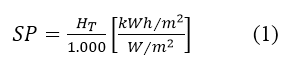
For [6], the number of hours of Full Sun (SP) is equivalent to the total daily incident energy on the inclined surface in kWh/m² and can be calculated by means of equation (1), [7].
If we analyze the definitions given by [1], [5] and [6], solar insolation, availability of solar energy and number of hours of full sun respectively, we observe that all are defined as the energy emitted by the sun, so they are considered synonymous, in other words all these concepts refer to solar radiations so that to gain clarity should be used only the latter term.
It could be expressed a priori that the availability of solar energy mathematically coincides with the "X" HSP multiplied by 1 kW/m2 of constant radiation from a hypothetical sun which delivers the same energy as the real sun on a full day with all its variations, so it is correct to say that 1 HSP is equal to 1 kWh/m2.
Another interpretation that could be valid, in the first instance, is that the availability of solar energy in HSP is the energy absorbed by each m2 of PSP during a real day, assuming that the sun has a constant irradiance of 1 kW/m2, which equals the energy that a real sun delivers in a full day of irradiation and is expressed in kWh/m2.
It can also be interpreted that the solar energy availability of a PSP is the energy generated by the sun during a day, at a hypothetical constant average irradiance of 1 kW/m2for which a determined time much less than the hours used by the normal sun to generate it, which justifies that it is much easier to use the time to express that energy, but in that case you cannot lose sight of the assumption of irradiance that conditions it and therefore are equivalent hours as expresses [8] and not simply hours or you can also talk about Equivalent Solar Hour.
Other authors also use the term “equivalent”, but in different forms, [9] for example, says that “one hour (Solar Peak) of energy is equivalent to the energy received during one hour, at an average irradiance of 1 000 W/m2”. On the other hand [10] considers that “this magnitude (HSP) reflects the number of hours in which the solar irradiance must remain constant and equal to 1 kW/m2, so that the resulting energy is equivalent to the energy made available by the sun for a study place, accumulated over a given day”. So that several authors use the equivalent term, then why not generalize it as Equivalent Peak Solar Hour?
One can then ask What is an Equivalent Peak Solar Hour? In the opinion of the authors, the answer to this question would contribute significantly to the clarification of the term under discussion, reason why the authors risk to propose a definition that can be improved or rejected in the future by the scientific community. Before, we must consider the resistance of the community to abandon the term already coined as HSP and can be added an E, of equivalent, to be HSPE.
]]> In this way, it could be stated that an Equivalent Peak Solar Hour (1 HSPE) mathematically coincides with the time required by a hypothetical sun so that a PSP receives 1 kW/m2of constant irradiance, depending on the irradiance variations of the real sun and should be expressed in kWh/m2. This analysis prevents matching the normal time to the HSP or what would now be Solar Hour Peak Equivalent (HSPE) since it would take more or less time to receive 1 kW/m2 radiant energy, depending on the irradiance of the real sun in each measurement period.For example, if we consider that 6 HSPE (6 kWh/m2) were accumulated, the hypothetical sun radiating 1 kW/m2 should be interpreted as requiring 6 hours (equivalent) to accumulate energy radiated by the real sun for a day, so it follows that 1 HSPE = 1 kWh/m2.
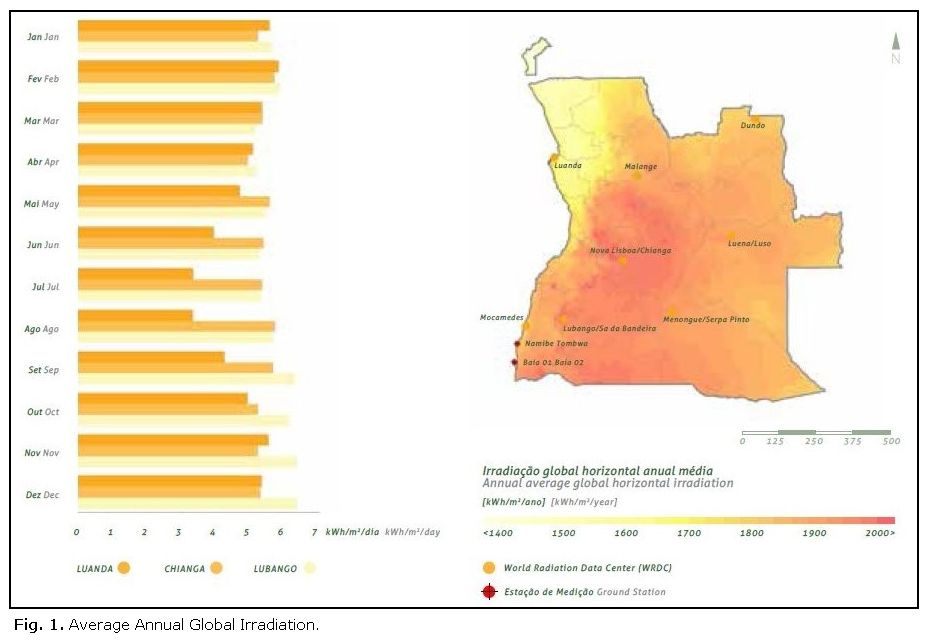
Figure 1, for example, shows the solar potential of Angola that was collected and analyzed from global solar radiation data from 8 weather stations made available by the World Radiation Data Center and complemented with information from 4 measurement stations at the province of Lumbago, published by [11] with the Ministry of Energy and Water of Angola.
It is clear that it is a practice of the companies in charge of this matter, although not defined, to take the HSP as the energy delivered by the sun to a PSP measured in kWh/m2. From figure 1 the average HPSE, according to equation (2), can be obtained as:
These 5,9 HSPE are conditioned by a hypothetical irradiance sun of 1 kW/m2, with HSPE being measured in kWh/m2, which means that to obtain hours as a unit of measure, it would be necessary to divide the value obtained by 1 kW/m2, as it does [10] and is shown in equation (3), so that HSPE can be expressed, as the accumulated radiation by a PSP, measured in kWh/m2, coinciding numerically with the energy delivery times of a hypothetical sun of constant irradiance of 1 kW/m2.
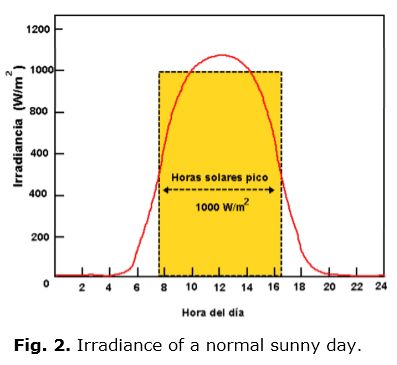
As it can be seen in figure 2, the real sun begins to radiate at six o'clock and ends at 18 o'clock, i.e. a period of approximately 12 real hours’ times, but only accumulates approximately 8 HSPE, from 8 to 16 o'clock. So it is clear that 1 HSPE is not equal to a real hour of irradiation.
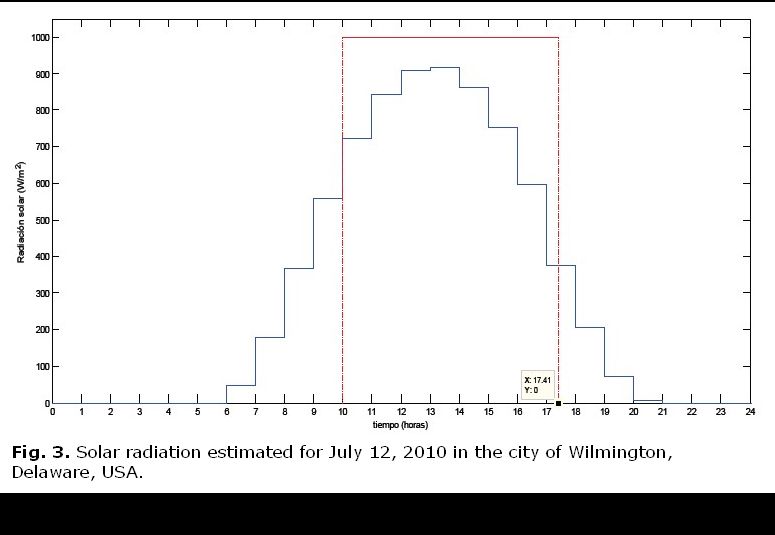
A way of corroborating, as already mentioned, by way of example, in figure 3 we can see the solar radiation estimated for July 12, 2010 in the city of Wilmington, Delaware, USA. The data are freely available on the internet by the National Renewable Energy Laboratory (NREL) [8]. The area under the blue curve in figure 3 is equal to the area under the red line. Therefore, in this particular case, it is as if the sun came out fully at 10 a. m and was instantly hidden at 5:41 p.m., which is numerically equivalent to 7,5 peak hours of sunshine, as it physically represents that this day, the sun irradiated an energy of approximately 7,5 kWh/m2.
We conclude that an HSPE is the energy accumulated by each of a PSP, delivered by a hypothetical constant radiation sun of 1 kWh/m2 for which the real sun usually takes more time, depending on the variations of irradiance on the day in question, as explained in the previous paragraph.
]]> What is this (HSPE) term used for?The process of calculating the number of photovoltaic modules and number of batteries is called the dimensioning of a photovoltaic system. Before starting the process of dimensioning an installation it is necessary to know the climatological data in order to know the irradiation that is available.
For the calculations it is important to obtain the HPSE values, which will depend on the geographical area, being measured in kWh/m2.
Knowing the current that consumes the installation in question and the characteristics of the PSP module to be used, the energy generated by the photovoltaic system, according to [12; 13], can be calculated as (equation (4):
Where is the nominal power of the solar module or panel expressed in peak watts, HSPE indicates the number of equivalent peak solar hours, and ղ is the panel output, the solar hours are calculated by equation 3, as it was already shown.
Physical and mathematical interpretation
This analysis will be based on figure 3, referenced above. The objective is to demonstrate that from the mathematical point of view, the area under the red curve (representing the energy emitted by that hypothetical sun of constant irradiance of 1 kW/m2 is equal to area under the blue curve (which represents the variation of the irradiance during a day of real sun), from which it can be concluded that the HSPE, coincide numerically with the equivalent time in hours that that hypothetical sun must be connected to deliver the same energy than the real sun with all its variations during a day.
Matching both areas:
]]>
area under the red curve = area under the blue curve (equation (5))
resolving HSPE (equation (6)):
It should be clarified that this result (7,5 hours) is purely mathematical and coincides with the definitions of HSP as time given by [2],[4], [5], [8], [10] and it is precisely these definitions which have caused the controversy on the subject, because physically, thanks to the assumption that this hypothetical sun is 1 kW/m2 of constant irradiance, HSPE is the energy accumulated by of solar panel, measured in kWh/m2, in this example it can be interpreted that during that day, the sun irradiated an energy approximately equal to 7,5 kWh/m2 or 7,5 HSPE. That´s why it can be stated that HSPE have two components, one physical and one mathematical.
CONCLUSIONS
Based on this analysis and the possible interpretations presented throughout the article, it is considered as the most complete definition of equivalent peak solar hours:
“The energy delivered by a hypothetical sun of constant irradiance of 1 kW/m2 that coincides with the energy delivered by the real sun with all its variations during a day of normal irradiation, being measured in kWh/m2, coinciding mathematically with the hours that this hypothetical sun of 1 kW/m2 must be “connected” to deliver the same energy as the real sun with all its variations in a day of normal irradiation.”
REFERENCIAS
]]>1. Simec Chile S.A. Diseño de un Sistema de Ilumionación Alimentado por Paneles Fotovoltaicos, Utilizando Ampolletas LED. [En línea] 2014. ISSN: 1682-0908. [Citado el: 20 de Octubre de 2016.] https://www.unglobalcompact.org/what-is-gc/participants/12551-Simec-Chile-SRL#company-information.
2. Silva Alex de Lima, Demonti Rogers. Dimensionamento de um Sistema Fotovoltaico. [En linea]. Brasil : s.n., Julho de 2013; 8(91):10-16. ISSN 1809-3957.
3. Orbegozo Carlos, Arivilca Roberto. Energía Solar Fotovoltaica. Manual técnico para instalaciones domiciliarias. [En línea] 2010. http://deltavolt.pe/documentos/Manual-ES-termica.pdf. CEP 89820-000.
4. Sera Antonio Sarmiento. Una unidad de medida que comienzan a conocer los cubanos beneficiados con instalaciones solares fotovoltaicas. Habana : s.n., 2003;22(s.n). ISSN 1028-9925.
5. Arenas Danny Andres, Sánchez y Zapata Castaño Hodman Steven. Libro Interactivo Sobre Energía Solar y Sus Apliciones. Universidad Tecnológica de Pereira, Colombia. [En línea] 2011. http://repositorio.utp.edu.co/dspace/bitstream/handle/11059/2369/62131244A681.pdf?sequence=1. ISSN 2344-7214.
]]>6. Melo Olivia B., Oliverira Rafael D y Vieira M. José C. Análise Económica da Implantaçäo de Geradores Fotovoltaicos em Ccomparaçäo Com a Expansäo da Rede Eléctrica para Atender Localidades Isoladas. [En línea] 2012. http://cba21012.dec.ufcg.edu.br. CEP 13566-970; ISBN 978-85-8001-069-5.
7. Pereira M. Collares y Rabls A. The average distribution of solar radiation correlations between diffuse and hemispherical and between daily and hourly insolation values. Solar Energy. 1979;22(2):155-164. DOI 10.1016/0038-092X(79)90100-2 .
8. Sepúlveda Sergio. Radiación Solar: Factor Clave para el Diseño. [on line]. Universidad Francisco de Paula Santander: Grupo de Investigación y Desarrollo en Microelectrónica Aplicada, GIDMA, 19 de Diciembre de 2014; 8:60-61. ISSN 2216-0353; E-ISSN: 2216-0388.
9. González, César Ugalde. Aplicaciones residenciales y comerciales de la energía fotovoltaica. Universidad de Costa Rica,Escuela de Ingeniería Eléctrica. [En línea] 2010. http://eie.ucr.ac.cr/uploads/file/proybach/pb2010/pb2010_002.pdf. ISSN: 22152644.
10. Pinho, Joâo Tavares y Galdino, Marco Antonio. Manual de Engenharia para Sitemas Fotovoltaicos. Rio de Janeiro. [En línea] 2014. [Citado el: 24 de octubre de 2016.] www.portal-energia.com/.../livro-manual-de-engenharia-sistemas-fotovoltaicos-2014.pd. . CEP 21941-590 .
]]>11. World Radiation Data Center. RENOVÁVEIS-SOLAR. angolaenergia. [En línea] 2015. [Citado el: 30 de octubre de 2016.] http://www.angolaenergia2025.com/pt-pt/conteudo/renovaveis-solar.
12. López, Yuri Ulianov. Análisis de Recurso Solar y Eólico en Colombia. Caso Valle del Cauca. [En línea] 14 de julio-diciembre de 2011. http://www.redalyc.org/src/inicio/ArtPdfRed.jsp?iCve=47821607006. ISSN 0121-0777.
13. Aparicio Miguel Pareja. Energí Solar Fotovoltaica. Cálculo de una instalación aislada. [En línea] Segunda edición, 2010. ISBN 978-84-267-1618-7. [Citado el: 10 de octubre de 2016.] www.marcombo.com.
Recibido: octubre de 2016
Aprobado: febrero de 2017
AUTOR
Maykop Pérez Martínez. Electrical Engineer, Master in Electrical Engineer, Assistant Professor, Department of Electrical Engineering, Namibe Polytechnic School of the University Mandume and Ndemufayo, Moçâmedes, Angola. E-mail: maykop@electrica.cujae.edu.cu and maykop1982@gmail.com.
]]>