<?xml version="1.0" encoding="ISO-8859-1"?><article xmlns:mml="http://www.w3.org/1998/Math/MathML" xmlns:xlink="http://www.w3.org/1999/xlink" xmlns:xsi="http://www.w3.org/2001/XMLSchema-instance">
<front>
<journal-meta>
<journal-id>1815-5928</journal-id>
<journal-title><![CDATA[Ingeniería Electrónica, Automática y Comunicaciones]]></journal-title>
<abbrev-journal-title><![CDATA[EAC]]></abbrev-journal-title>
<issn>1815-5928</issn>
<publisher>
<publisher-name><![CDATA[Universidad Tecnológica de La Habana José Antonio Echeverría, Cujae]]></publisher-name>
</publisher>
</journal-meta>
<article-meta>
<article-id>S1815-59282018000200001</article-id>
<title-group>
<article-title xml:lang="en"><![CDATA[Assessment of the real public exposure to base stations over a day from instantaneous measurement]]></article-title>
<article-title xml:lang="es"><![CDATA[Evaluación de la exposición pública real a las estaciones base durante un día a partir de una medición instantánea]]></article-title>
</title-group>
<contrib-group>
<contrib contrib-type="author">
<name>
<surname><![CDATA[Infante Moreira]]></surname>
<given-names><![CDATA[Pedro Severo]]></given-names>
</name>
<xref ref-type="aff" rid="A01"/>
</contrib>
<contrib contrib-type="author">
<name>
<surname><![CDATA[Gilart]]></surname>
<given-names><![CDATA[Fidel]]></given-names>
</name>
<xref ref-type="aff" rid="A02"/>
</contrib>
</contrib-group>
<aff id="A01">
<institution><![CDATA[,Escuela Superior Politécnica de Chimborazo Escuela de Ingeniería Electrónica en Telecomunicaciones y Redes ]]></institution>
<addr-line><![CDATA[Chimborazo Riobamba]]></addr-line>
<country>Ecuador</country>
</aff>
<aff id="A02">
<institution><![CDATA[,Centro Nacional de Electromagnetismo Aplicado  ]]></institution>
<addr-line><![CDATA[ Santiago de Cuba]]></addr-line>
<country>Cuba</country>
</aff>
<pub-date pub-type="pub">
<day>00</day>
<month>08</month>
<year>2018</year>
</pub-date>
<pub-date pub-type="epub">
<day>00</day>
<month>08</month>
<year>2018</year>
</pub-date>
<volume>39</volume>
<numero>2</numero>
<fpage>1</fpage>
<lpage>9</lpage>
<copyright-statement/>
<copyright-year/>
<self-uri xlink:href="http://scielo.sld.cu/scielo.php?script=sci_arttext&amp;pid=S1815-59282018000200001&amp;lng=en&amp;nrm=iso"></self-uri><self-uri xlink:href="http://scielo.sld.cu/scielo.php?script=sci_abstract&amp;pid=S1815-59282018000200001&amp;lng=en&amp;nrm=iso"></self-uri><self-uri xlink:href="http://scielo.sld.cu/scielo.php?script=sci_pdf&amp;pid=S1815-59282018000200001&amp;lng=en&amp;nrm=iso"></self-uri><abstract abstract-type="short" xml:lang="en"><p><![CDATA[The assessment of the real public exposure to signals emitted by base station antennas of mobile telephony over a day from an instantaneous measurementperformed any time during the day is investigated. The considered RF &#64257;eld sources were the mobile communication GSM850 and GSM1900 downlink far-field signals received in an outdoor &#64257;xed site in an urban environment. Two traffic channels were analyzed: Ch133 (870.2 MHz), corresponding to the GSM850 and Ch674 (1962.6 MHz), corresponding to the GSM1900. A mathematical model, based on the mean value &#274;(t) and the standard deviation &#963;E (t) of the instantaneous electric field intensity E(t), was proposed for predicting the maximum electric field exposure Emax over a day for a week starting from an instantaneous measurement. The results of assessment of the maximum electric field exposure using this method were compared with those obtained using another method recently proposed by other authors, and it was shown that they can be more realistic.]]></p></abstract>
<abstract abstract-type="short" xml:lang="es"><p><![CDATA[En este trabajo se investiga la evaluación de la exposición pública diaria real a las señales emitidas por las antenas de las estaciones base de telefonía celular a partir de una medición instantánea realizada en cualquier momento durante el día. Las señales de RF consideradas son las de campo lejano de los enlaces descendientes GSM850 y GSM1900 de las comunicaciones móviles en un lugar exterior fijo en un medio urbano. Se analizaron dos canales de tráfico: Ch133 (870.2 MHz), correspondiente a la GSM850 y Ch674 (1962.6 MHz) correspondiente a la GSM1900. Se propuso un modelo matemático basado en el valor medio &#274;(t) y la desviación estándar &#963;E (t)de la intensidad del campo eléctrico instantánea E(t) para predecir la máxima exposición diaria al campo eléctrico Emax para una semana a partir de una medición instantánea. Los resultados de la evaluación de la máxima exposición al campo eléctrico usando este método fueron comparados con los obtenidos usando otro método propuesto recientemente por otros autores y se demostró que ellos pueden ser más realistas.]]></p></abstract>
<kwd-group>
<kwd lng="en"><![CDATA[electromagnetic measurement]]></kwd>
<kwd lng="en"><![CDATA[long term RF exposure of general public]]></kwd>
<kwd lng="es"><![CDATA[mediciones electromagnéticas]]></kwd>
<kwd lng="es"><![CDATA[exposición de RF de largo plazo del público general]]></kwd>
</kwd-group>
</article-meta>
</front><body><![CDATA[ <p align="right"><font face="verdana" size="2"><b>ORIGINAL ARTICLE</b></font></p>     <p align="justify">&nbsp;</p>     <p align="justify"><font face="verdana" size="4"><b>Assessment of the real public exposure to base stations over a day from instantaneous measurement </b></font></p>     <p align="justify">&nbsp;</p>     <p align="justify"><font face="verdana" size="3"><b>Evaluaci&oacute;n de la exposici&oacute;n p&uacute;blica real a las estaciones base durante un d&iacute;a a partir de una medici&oacute;n instant&aacute;nea</b></font></p>     <p align="justify">&nbsp;</p>     <p align="justify">&nbsp;</p>     <p align="justify"><font face="verdana" size="2"><b>Pedro Severo Infante Moreira<sup>I</sup></b><b>, Fidel Gilart<sup>II</sup></b></font></p>     <p align="justify"><font face="verdana" size="2"><sup>I</sup>Escuela de Ingenier&iacute;a Electr&oacute;nica en Telecomunicaciones y Redes, Escuela Superior Polit&eacute;cnica de Chimborazo, Riobamba, Ecuador.</font></p>     <p align="justify"><font face="verdana" size="2"><sup>II</sup>Centro Nacional de Electromagnetismo Aplicado, Santiago de Cuba, Cuba.</font></p>     ]]></body>
<body><![CDATA[<p align="justify">&nbsp;</p>     <p align="justify">&nbsp;</p> <hr />     <p align="justify"><font face="verdana" size="2"><b>ABSTRACT</b></font></p>     <p align="justify"><font face="verdana" size="2">The assessment of the real public exposure to signals emitted by base station antennas of mobile telephony over a day from an instantaneous measurementperformed any time during the day is investigated. The considered RF &#64257;eld sources were the mobile communication GSM850 and GSM1900 downlink far-field signals received in an outdoor &#64257;xed site in an urban environment. Two traffic channels were analyzed: Ch133 (870.2 MHz), corresponding to the GSM850 and Ch674 (1962.6 MHz), corresponding to the GSM1900. A mathematical model, based on the mean value <i>&#274;(t)</i> and the standard deviation <i>&sigma;<sub>E</sub> (t)</i> of the instantaneous electric field intensity <i>E(t)</i>, was proposed for predicting the maximum electric field exposure <i>E<sub>max</sub></i> over a day for a week starting from an instantaneous measurement. The results of assessment of the maximum electric field exposure using this method were compared with those obtained using another method recently proposed by other authors, and it was shown that they can be more realistic.</font></p>     <p align="justify"><font face="verdana" size="2"><b>Key words:</b> electromagnetic measurement; long term RF exposure of general public.</font></p> <hr />     <p align="justify"><font face="verdana" size="2"><b>RESUMEN</b></font></p>     <p align="justify"><font face="verdana" size="2">En este trabajo se investiga la evaluaci&oacute;n de la exposici&oacute;n p&uacute;blica diaria real a las se&ntilde;ales emitidas por las antenas de las estaciones base de telefon&iacute;a celular a partir de una medici&oacute;n instant&aacute;nea realizada en cualquier momento durante el d&iacute;a. Las se&ntilde;ales de RF consideradas son las de campo lejano de los enlaces descendientes GSM850 y GSM1900 de las comunicaciones m&oacute;viles en un lugar exterior fijo en un medio urbano. Se analizaron dos canales de tr&aacute;fico: Ch133 (870.2 MHz), correspondiente a la GSM850 y Ch674 (1962.6 MHz) correspondiente a la GSM1900. Se propuso un modelo matem&aacute;tico basado en el valor medio <i>&#274;(t)</i> y la desviaci&oacute;n est&aacute;ndar <i>&sigma;</i><i><sub>E</sub></i><i> (t)</i>de la intensidad del campo el&eacute;ctrico instant&aacute;nea <i>E(t)</i> para predecir la m&aacute;xima exposici&oacute;n diaria al campo el&eacute;ctrico <i>E<sub>max</sub></i>para una semana a partir de una medici&oacute;n instant&aacute;nea. Los resultados de la evaluaci&oacute;n de la m&aacute;xima exposici&oacute;n al campo el&eacute;ctrico usando este m&eacute;todo fueron comparados con los obtenidos usando otro m&eacute;todo propuesto recientemente por otros autores y se demostr&oacute; que ellos pueden ser m&aacute;s realistas.</font></p>     <p align="justify"><font face="verdana" size="2"><b>Palabras claves:</b> mediciones electromagn&eacute;ticas; exposici&oacute;n de RF de largo plazo del p&uacute;blico general.</font></p> <hr />     <p align="justify">&nbsp;</p>     <p align="justify">&nbsp;</p>     ]]></body>
<body><![CDATA[<p align="justify"><font face="verdana" size="3"><b>1. INTRODUCTION</b></font></p>     <p align="justify"><font face="verdana" size="2">In recent years, there has been an increasing public concern about possible health hazards due to exposure to radiofrequency (RF) electromagnetic fields. Accordingly, many international protection organizations and regulatory agencies have proposed safety standards for exposure to such fields. These standards are based on the SAR, a measure of the electromagnetic power absorbed in the tissue, which is proportional to the square of the internal electric field intensity and depends, among other factors, on the incident electric field intensity and frequency.In this context, characterizing and regulating RF human exposure to signals emitted by base station antennas (BSA) of mobile communication systems has reached a great interest from environmental and epidemiological points of view. These signals have a great variability in time depending on the amount of communication traffic, on the radio propagation conditions and on some specific functionalities such as the power control. It has been shown [1] that a measurement at a certain time instance or a measurement in a &#64257;xed position in space may not be representative for time or spatially averaged exposure, or for the maximum exposure assessment of BSA emissions. However, up to now most of the exposure assessment was made on the short term, as shown by Joseph et al. [2] and by Genc et al. [3].</font></p>     <p align="justify"><font face="verdana" size="2">In exposure standards [4, 5] the &#64257;eld-level variability in the vicinityof base stations is solved by simply extrapolating the &#64257;eld in the pilot channel (BCCH for GSM, and CPICH for UMTS and HSDPA) for all transmitters (worst-case scenario) of a base station. The worst-case assessment is adopted by some countries intending to ensure reliable and reproducible exposure assessments in varying traf&#64257;c conditions, which guarantees the compliance. But this method, besides leading to consistent overestimation of the electromagnetic &#64257;eld level throughout the downlink spectrum, does not take in consideration the fluctuations of the signals and does not allowdetermining the electric-&#64257;eld exposure at a time instant from the electric-&#64257;eld measurements at another time instant.</font></p>     <p align="justify"><font face="verdana" size="2">Several authors recently investigated the temporal variations of the signals emitted by cellular BSA [6-23] and some proposed measurement procedures that allow extrapolations of maximum exposure from measurement results obtained over short time periods [6&ndash;8, 10, 11, 16].</font></p>     <p align="justify"><font face="verdana" size="2">In [6, 7], a method was proposed to calculate the maximum electric &#64257;eld intensity during 24 h (1 d) from the momentary total measured electric-&#64257;eld value (pilot signal and traf&#64257;c signals together) using the corresponding Erlang data (average traf&#64257;c intensity or channel occupancy) for GSM. It was shown that the exposure over 24 h is highly variable, being maximum between 9 am and 8 pm and minimum between 12 am and 6 am. They also showed that there are differences between weekdays and weekends regarding exposure levels. This method has the following weaknesses: (1) - the application of the procedure requires information on traf&#64257;c values (Erlang values) from the GSM operators directly, which is disadvantageous, (2) - the extrapolation factors based on the Erlang data are insensible to the effects of the multipath fading of the radio-link on the detected signals, (3) - the predicted values of the maximal electric &#64257;eld intensity over a day starting from different instantaneous measurements are different, (4) - the divergences between the expected and the predicted values of the maximum exposure increase with the range of temporal variationsthroughout the day, (5) -the time interval for which the extrapolation factors can be calculated corresponds to typical working hours during which control agencies can make their measurements.</font></p>     <p align="justify"><font face="verdana" size="2">In [9] the problem of time-variability of GSM signals was approached. Based on measurements performed during 1-d periods in different locations of France and Poland, authors demonstrated that for the 50% of all the measurements in urban areas and for the 100% of all the measurements in the rural areas the distribution of the signals can be modeled by a mixture of three Gaussians, representing the night hours, work hours and rush hours. In this respect, the authors of [15] reported that the validation of three Gaussians model by theirs results for an urban location in Romania failed.</font></p>     <p align="justify"><font face="verdana" size="2">In [10, 11, 16] a method with two variants was presented for estimating the maximum electric field exposure during a day starting from an instantaneous measurement using two types of extrapolation factors. The first variant of the method is based on the measurement of the pilot signal (BCCH or CPICH) and uses an extrapolation factor called the number of equivalent transmitters and defined as the ratio between the electric field intensity (power density) corresponding to all the traf&#64257;c channels and the electric field intensity (power density) of the pilot channel. The second variant of the method is based on the measurement of the traffic signal and uses an extrapolation factor defined as the ratio between the maximum electric field intensity (power density) over a day and the instantaneous value of the electric field intensity (power density). For each of the time intervals representing the night hours, work hours and rush hours in the three Gaussians model, probability density functions (PDF) were established for traf&#64257;c &#64258;uctuations, in order to &#64257;nally predict the maximal electric field exposure during one day starting from an instantaneous measurement, using the first variant of the method. It was reported that the instantaneous combined power density from a cell varies by &plusmn; 4.5 dB throughout the day as a result of traf&#64257;c variation. Based on the maximal number of equivalent transmitters they demonstrated that for GSM and UMTS systems in a realistic environment a full traf&#64257;c situation is never reached in reality, and that in this case the safety standards that have been developed to check the compliance with safety limits overestimate the real exposure. This method has the following weaknesses: (1) - the predicted values of the maximal electric &#64257;eld intensity over a day starting from different instantaneous measurements are different, (2) - the divergences between the expected and the predicted values of the maximum exposure increase with the range of temporal variations throughout the day, (3) - the complex time-variability of the electric field over 24 h is modeled in a very simple way using four line segments, (4) the distribution of the signals not always can be modeled by a mixture of three Gaussians.</font></p>     <p align="justify"><font face="verdana" size="2">In conclusion, the existing methods for estimating the maximum electric field exposure during a day from a measurement accomplished over a short time period have deficiencies that prevent the obtaining of more realistic results. The objective of this paper is to present an alternative method that can lead to better results.</font></p>     <p align="justify">&nbsp;</p>     <p align="justify"><font face="verdana" size="3"><b>2. MATERIALS AND METHODS</b></font></p>     ]]></body>
<body><![CDATA[<p align="justify"><font face="verdana" size="2">The electric &#64257;elds were measured using a Narda SRM 3000 Selective Radiation Meter. The sensor was a tri-axial isotropic antenna from Narda (dynamic range of 0.25 mV/m to 200 V/m and a frequency range of 75 MHz to 3 GHz). The basic unit of this meter contains a spectrum analyzer for the 100 kHz to 3 GHz frequency range. For the considered setup, the measurement expanded uncertainty, evaluated using a con&#64257;dence interval of 95%, was +2.4/-3.3 dB.</font></p>     <p align="justify"><font face="verdana" size="2">The considered RF &#64257;eld sources were the mobile communication GSM850 and GSM1900 downlink far-field signals received in an outdoor &#64257;xed site in an urban environment. Two traffic channels were analyzed: Ch133 (870.2 MHz), corresponding to the GSM850 and Ch674 (1962.6 MHz), corresponding to the GSM1900. For the whole measurement campaign, the receiver antenna was positioned and &#64257;xed at a height of 1.5 m above the ground, in the line of sight with the BSA. The meter was operated in the spectrum analyzer mode with a resolution bandwidth (RBW) of 30 kHz and the measurements were done every 10 s using the RMS detector. An averaging time of 6 minutes was applied to all measurements. Each channel was monitored/measured continuously during two successive weeks.</font></p>     <p align="justify">&nbsp;</p>     <p align="justify"><font face="verdana" size="3"><b>3. RESULTS AND DISCUSSION</b></font></p>     <p align="justify"><font face="verdana" size="2">The mean value and the standard deviation of the instantaneous electric field intensity <i>E(t)</i> were determined and the resulting data vectors were smoothed using the moving average method. After this, a Fourier series with 7 harmonics was fitted to the smoothed data and the obtained vectors were represented as <i>&#274;(t)</i> and <i>&sigma;<sub>E</sub>(t)</i>. For the electric field intensity and its standard deviation the following extrapolation factors were defined:</font></p>     <p align="center"><font face="verdana" size="2"><b><a name="e1" id="e1"></a><img src="/img/revistas/eac/v39n2/e0101218.gif" width="102" height="38" longdesc="/img/revistas/eac/v39n2/e0101218.gif" /></b>(1)</font></p>     
<p align="center"><font face="verdana" size="2"><b><a name="e2" id="e2"></a><img src="/img/revistas/eac/v39n2/e0201218.gif" width="103" height="31" longdesc="/img/revistas/eac/v39n2/e0201218.gif" /></b>(2)</font></p>     
<p align="center"><font face="verdana" size="2"><b><a name="e3" id="e3"></a></b><img src="/img/revistas/eac/v39n2/e0301218.gif" width="114" height="32" longdesc="/img/revistas/eac/v39n2/e0301218.gif" />(3)</font></p>     
<p align="center"><font face="verdana" size="2"><b><a name="e4" id="e4"></a><img src="/img/revistas/eac/v39n2/e0401218.gif" width="114" height="34" longdesc="/img/revistas/eac/v39n2/e0401218.gif" /></b>(4)</font></p>     
<p align="center"><font face="verdana" size="2"><b><a name="e5" id="e5"></a><img src="/img/revistas/eac/v39n2/e0501218.gif" width="124" height="36" longdesc="/img/revistas/eac/v39n2/e0501218.gif" /></b>(5)</font></p>     
]]></body>
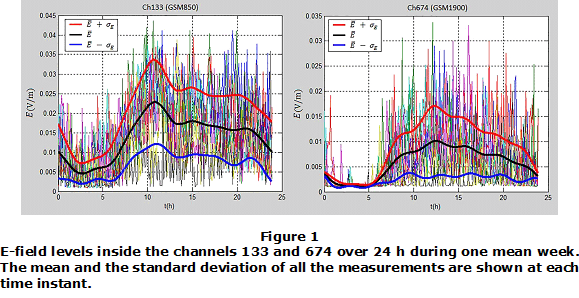
<body><![CDATA[<p align="justify"><font face="verdana" size="2">where <i>E<sub>mp</sub> (t)</i> is the most probable value of the <i>E(t)</i> for a given day of the week.</font></p>     <p align="justify"><font face="verdana" size="2">The maximum value of the electric field intensity over a day for a week can be expressed as (see <a href="#f1">Figure 1</a>):</font></p>     <p align="center"><font face="verdana" size="2"><b><a name="e6" id="e6"></a><img src="/img/revistas/eac/v39n2/e0601218.gif" width="169" height="27" longdesc="/img/revistas/eac/v39n2/e0601218.gif" /></b>(6)</font></p>     
<p align="center"><a name="f1" id="f1"></a></p>     <p align="center"><img src="/img/revistas/eac/v39n2/f0101218.gif" alt="Figure 1. E-field levels inside the channels 133 and 674 over 24 h during one mean week. The mean and the standard deviation of all the measurements are shown at each time instant." width="579" height="298" longdesc="/img/revistas/eac/v39n2/f0101218.gif" /></p>     
<p align="justify"><font face="verdana" size="2">Combining <a href="#e1">(1)</a>, <a href="#e3">(3)</a> and <a href="#e6">(6)</a> we obtain</font></p>     <p align="center"><font face="verdana" size="2"><b><a name="e7" id="e7"></a><img src="/img/revistas/eac/v39n2/e0701218.gif" width="203" height="34" longdesc="/img/revistas/eac/v39n2/e0701218.gif" /></b>(7)</font></p>     
<p align="justify"><font face="verdana" size="2">This leads, with the aid of <a href="#e5">(5)</a>, to</font></p>     <p align="center"><font face="verdana" size="2"><b><a name="e8" id="e8"></a><img src="/img/revistas/eac/v39n2/e0801218.gif" width="250" height="27" longdesc="/img/revistas/eac/v39n2/e0801218.gif" /></b>(8)</font></p>     
<p align="justify"><font face="verdana" size="2">where <i>E<sub>mp</sub> (t)</i> was replaced with <i>E(t)</i>.</font></p>     ]]></body>
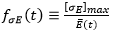
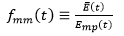
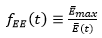
<body><![CDATA[<p align="justify"><font face="verdana" size="2">From <a href="#e8">(8)</a> it is inferred that, if for a given signal the <i>&fnof;<sub>mm</sub> (t)</i>, <i>&fnof;</i><i><sub>EE</sub></i><i> (t)</i> and <i>&fnof;</i><i><sub>&sigma;E</sub></i><i> (t)</i> extrapolation factors are known, it is possible to predict for that signal the maximum electric field exposure <i>E<sub>max</sub></i> over a day from a measurement of <i>E(t)</i>. From (1) it is inferred that, if the <i>&fnof;</i><i><sub>EE</sub></i><i> (t)</i> extrapolation factor and <i>E<sub>max</sub></i> are known, it is possible to predict <i>&#274;(t)</i>. Finally, from <a href="#e2">(2)</a> it is inferred that, if the <i>&fnof;<sub>E&sigma;</sub> (t)</i> extrapolation factor and <i>E<sub>max</sub></i> are known, it is possible to predict <i>&sigma;<sub>E</sub> (t)</i>.</font></p>     <p align="justify"><font face="verdana" size="2">The <a href="#e8">expressions (8)</a>, <a href="#e1">(1)</a> and <a href="#e2">(2)</a> constitute the basis of the mathematical model developed in this work for the prediction of the long term public exposure starting from the short term measurement of the field. Using the definitions of <i>&fnof;<sub>EE</sub> (t)</i>, <i>&fnof;</i><i><sub>E&sigma;</sub></i><i> (t), </i><i>&fnof;</i><i><sub>&sigma;E</sub></i><i> (t)</i> and <i>&fnof;</i><i><sub>&sigma;&sigma;</sub></i><i> (t)</i> it can be shown that</font></p>     <p align="center"><font face="verdana" size="2"><b><a name="e9" id="e9"></a><img src="/img/revistas/eac/v39n2/e0901218.gif" width="193" height="38" longdesc="/img/revistas/eac/v39n2/e0901218.gif" /></b>(9)</font></p>     
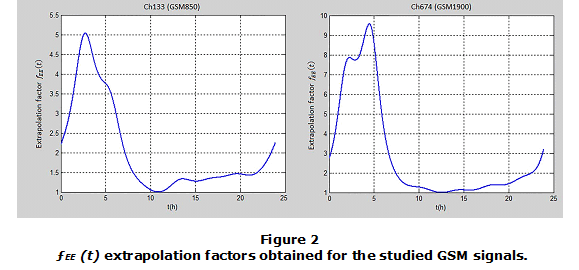
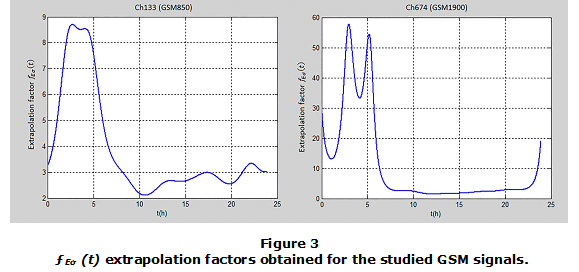
<p align="justify"><font face="verdana" size="2">For the measured GSM850 signal <i>c=</i>2,1047, whereas for the measured GSM1900 signal <i>c=</i>1,4797.</font></p>     <p align="justify"><font face="verdana" size="2"><a href="#f1">Figure 1</a> shows the variation of the electric field intensity <i>E(t) </i>over 24 h for the channels 133 and 674 due to variations in traf&#64257;c. It can be clearly seen that during the night there is only little active traf&#64257;c while during the day both the variability and traf&#64257;c are higher.</font></p>     <p align="justify"><font face="verdana" size="2">From the perspective of the traf&#64257;c habits, four time intervals that are repetitive during a week can be separated in the graphs: night hours (01:00 - 06:00), early-morning hours (06:00 - 09:00), work hours (09:00 - 21:00) and rest hours (21:00 - 01:00). None of our measurements showed an exceeding of the limits given in [24] for human protection, furthermore they were far beyond those limits. Our footprints of the field-levels over 24 h are very similar in shape to those obtained by other authors [9, 11, 13-15, 17, 19].</font></p>     <p align="justify"><font face="verdana" size="2">In <a href="#f2">Figures 2</a>, <a href="#f3">3</a>, <a href="#f4">4</a> three of the defined extrapolation factors for the studied GSM signals are shown. Taking into account the small size of the <i>E(t) </i>gathered samples in this work for the same day of the week, when calculating the <i>&fnof;</i><i><sub>mm</sub></i><i> (t)</i> extrapolation factors the most probable value <i>E<sub>mp</sub> (t)</i> was considered equal to the mean value of <i>E(t) </i>for the given day.</font></p>     <p align="center"><a name="f2" id="f2"></a></p>     <p align="center"><img src="/img/revistas/eac/v39n2/f0201218.gif" alt="Figure 2. &#55349;&#56455;&#55349;&#56428;&#55349;&#56428;(&#55349;&#56469;) extrapolation factors obtained for the studied GSM signals." width="579" height="270" longdesc="/img/revistas/eac/v39n2/f0201218.gif" /></p>     
<p align="center"><a name="f3" id="f3"></a></p>     ]]></body>
<body><![CDATA[<p align="center"><img src="/img/revistas/eac/v39n2/f0301218.gif" alt="Figure 3. &#55349;&#56455;&#55349;&#56428;&#55349;&#57160;(&#55349;&#56469;) extrapolation factors obtained for the studied GSM signals." width="579" height="272" longdesc="/img/revistas/eac/v39n2/f0301218.gif" /></p>     
<p align="center"><a name="f4" id="f4"></a></p>     <p align="center"><img src="/img/revistas/eac/v39n2/f0401218.gif" alt="Figure 4. [&#55349;&#56455;&#55349;&#56462;&#55349;&#56462;(&#55349;&#56469;)]&#55349;&#56472;&#55349;&#56454;&#55349;&#56453; extrapolation factors corresponding to Wednesday obtained for the studied GSM signals." width="579" height="288" longdesc="/img/revistas/eac/v39n2/f0401218.gif" /></p>     
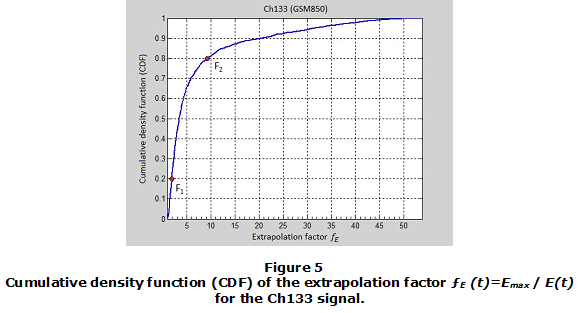
<p align="justify"><font face="verdana" size="2">The curves shown in <a href="#f4">Figure 4</a> were smoothed using the moving average method. In the case of bigger <i>E(t)</i> samples for the same day of the week, <i>E<sub>mp</sub> (t) </i>could be determined from the probability density function (PDF) of <i>E(t)</i>, and the daily variations of the <i>&fnof;</i><i><sub>mm</sub></i><i> (t)</i> extrapolation factors would be smoother.</font></p>     <p align="justify"><font face="verdana" size="2">Due to the environmental changes, to the operative and/or technological changes in the base stations, as well as to the changes in the local human communication habits, the valid extrapolation factors <i>&fnof;</i><i><sub>mm</sub></i><i> (t), </i><i>&fnof;</i><i><sub>EE</sub></i><i> (t), </i><i>&fnof;</i><i><sub>E&sigma;</sub></i><i> (t), </i><i>&fnof;</i><i><sub>&sigma;E</sub></i><i> (t)</i> and <i>&fnof;</i><i><sub>&sigma;&sigma;</sub></i><i> (t) </i>for a given location and signal must be updated every so often.</font></p>     <p align="justify"><font face="verdana" size="2">Next, using the results of the measurements of the electric field intensity carried out in this work, the second variant of the method proposed in [10, 11, 16], based on the measurement of the traffic signal, and the method based on the mathematical model proposed here for the prediction of the maximum electric field exposure during a day from the momentary electric field value will be compared.</font></p>     <p align="justify"><font face="verdana" size="2">In <a href="#f5">Figure 5</a> cumulative density function (CDF) of the extrapolation factor <i>&fnof;</i><i><sub>E</sub></i><i> (t)</i>&equiv;<i>E<sub>max</sub>&frasl;E(t)</i>, obtained from the processing of the <i>E(t) </i>data, corresponding to the channel 133 (GSM850), is shown.</font></p>     <p align="center"><a name="f5" id="f5"></a></p>     <p align="center"><img src="/img/revistas/eac/v39n2/f0501218.gif" alt="Figure 5. Cumulative density function (CDF) of the extrapolation factor &#55349;&#56455;&#55349;&#56428;(&#55349;&#56469;)&equiv;&#55349;&#56428;&#55349;&#56462;&#55349;&#56450;&#55349;&#56473;/&#55349;&#56428;(&#55349;&#56469;) for the Ch133 signal." width="579" height="313" longdesc="/img/revistas/eac/v39n2/f0501218.gif" /></p>     
<p align="justify"><font face="verdana" size="2">The extrapolation factor corresponding to the point F<sub>1</sub> [<i>&fnof;</i><i><sub>E1</sub></i><i>=</i>1.9629] was determined from <i>&fnof;</i><i><sub>E1</sub></i><i>=E<sub>max</sub>/E<sub>p80</sub></i>, where <i>E<sub>p80</sub></i>is the 80<sup>th</sup> percentile of the <i>E(t) </i>data, whereas the extrapolation factor corresponding to the point F<sub>2</sub> [<i>&fnof;</i><i><sub>E2</sub></i><i>=</i>9.2695] was determined from <i>&fnof;</i><i><sub>E2</sub></i><i>=E<sub>max</sub>/E<sub>p20</sub></i>, where <i>E<sub>p20</sub></i> is the 20<sup>th</sup> percentile of the mentioned data.</font></p>     ]]></body>
<body><![CDATA[<p align="justify"><font face="verdana" size="2">In <a href="#f6">Figure 6</a> the corresponding model for the daily temporal variation of the extrapolation factor <i>&fnof;</i><i><sub>E</sub></i><i> (t)</i>, using only the two selected limiting values <i>&fnof;</i><i><sub>E1</sub></i> and <i>&fnof;</i><i><sub>E2</sub></i> is shown.</font></p>     <p align="center"><a name="f6" id="f6"></a></p>     <p align="center"><img src="/img/revistas/eac/v39n2/f0601218.gif" alt="Figure 6. &#55349;&#56455;&#55349;&#56428;(&#55349;&#56469;) extrapolation factor for the Ch133 signal, based on the prediction method proposed in [10, 11, 16]." width="579" height="297" longdesc="/img/revistas/eac/v39n2/f0601218.gif" /></p>     
<p align="justify"><font face="verdana" size="2">According to the method proposed in [10, 11, 16], the expected maximum value of the electric field intensity for a week in a given location can be predicted from an instantaneous measurement of the electric field intensity, accomplished on any day of that week in the same location, using</font></p>     <p align="center"><font face="verdana" size="2"><a name="e10" id="e10"></a><img src="/img/revistas/eac/v39n2/e1001218.gif" width="125" height="20" longdesc="/img/revistas/eac/v39n2/e1001218.gif" />(10)</font></p>     
<p align="justify"><font face="verdana" size="2">where, in this case, <i>&fnof;</i><i><sub>E</sub></i><i> (t) </i>would take the value <i>&fnof;</i><i><sub>E2</sub></i><i>=</i>9.2695 between the 00:00 h and the 06:00 h, and the value <i>&fnof;</i><i><sub>E1</sub></i>=1.9629 between the 12:00 h and the 21:00 h, as it is shown in <a href="#f6">Figure 6</a>.</font></p>     <p align="justify"><font face="verdana" size="2">In <a href="#f7">Figure 7</a> the temporal variation over 24 h of the measured Ch133 signal, as well as the real value of <i>E<sub>max</sub></i> and the predicted one, derived from the measured values of <i>E(t) </i>with a step of one hour during two different days of the week (Wednesday and Friday) and the application of the method proposed in [10, 11, 16] are shown.</font></p>     <p align="center"><a name="f7" id="f7"></a></p>     <p align="center"><img src="/img/revistas/eac/v39n2/f0701218.gif" alt="Figure 7. Measured Ch133 signal and comparison of the real value of &#55349;&#56428;&#55349;&#56462;&#55349;&#56450;&#55349;&#56473; with the predicted one by the method proposed in [10, 11, 16], using the values of &#55349;&#56428;(&#55349;&#56469;) measured during two different days of the week (Wednesday and Friday)." width="543" height="313" longdesc="/img/revistas/eac/v39n2/f0701218.gif" /></p>     
<p align="justify"><font face="verdana" size="2">It can be seen, that the best prediction of <i>E<sub>max</sub></i> are achieved when the measurements of the electric field intensity are accomplished between the 12:00 h and the 21:00 h (high traffic hours). Since in the method proposed in [10, 11, 16] the measurements of the field level may be accomplished on any day of the week and on any time instant during the 24 hours of the day, it is inferred that the prediction of the maximum exposure by this method can be unrealistic.</font></p>     ]]></body>
<body><![CDATA[<p align="justify"><font face="verdana" size="2">In <a href="#f8">Figure 8</a> the temporal variations over 24 h of the measured Ch133 signal, as well as the predicted values of <i>E<sub>max</sub></i> for a week from the measured values of <i>E(t) </i>on Wednesday by means of the application of the method proposed in this work are shown. In this case the predicted value of <i>E<sub>max</sub></i> for a week has a mean of 0.0228 V/m and it is included between 0.0120 V/m and 0.0337 V/m, as determined by the standard deviation.</font></p>     <p align="center"><a name="f8" id="f8"></a></p>     <p align="center"><img src="/img/revistas/eac/v39n2/f0801218.gif" alt="Figure 8. Comparison of the levels of the measured Ch133 signal with the predicted values of &#55349;&#56428;&#55349;&#56462;&#55349;&#56450;&#55349;&#56473; for a week, obtained from measurements of &#55349;&#56428;(&#55349;&#56469;) on Wednesday by means of the application of the method proposed in this work." width="543" height="344" longdesc="/img/revistas/eac/v39n2/f0801218.gif" /></p>     
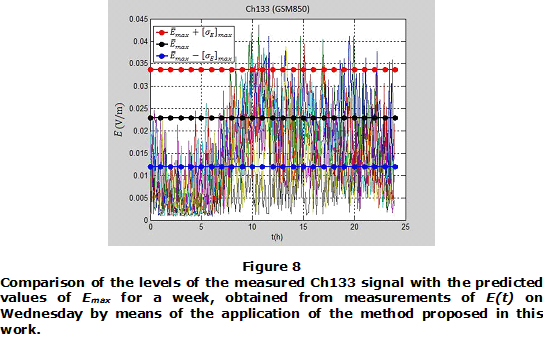
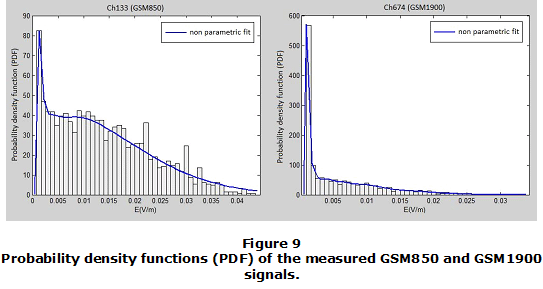
<p align="justify"><font face="verdana" size="2">It should be noticed that, contrary to the method proposed in [10, 11, 16], in the method proposed in this work the predicted value of <i>E<sub>max</sub></i> for a week is independent of the day of the week and of the time instant at which the measurements of <i>E(t) </i>are carried out. Besides, the specification of the maximum exposure is done by means of the mean value of <i>E<sub>max</sub></i> for a week and the corresponding standard deviation, which has a bigger statistical value than when this is done by means of the absolute value of <i>E<sub>max</sub></i> for one day or for one week.</font></p>     <p align="justify"><font face="verdana" size="2">The comparison of the two considered prediction methods using the data of the measured Ch674 (GSM1900) signal, leads to similar results.</font></p>     <p align="justify"><font face="verdana" size="2">Besides modeling the characteristic footprint of the temporary variation of the field over 24 h in a very simplified way using four line segments, another important disadvantage of the method proposed in [10, 11, 16] is that the result of the prediction is very sensitive to the data dispersion and to the shape of the distribution of the signals.</font></p>     <p align="justify"><font face="verdana" size="2">An important result of this work is that the daily temporal variability of the measured electric field intensity [20&times;log(<i>E<sub>max</sub></i>&frasl;<i>E<sub>min</sub></i>)] for the studied GSM 850 and GSM 1900 signals was &plusmn; 34,6 dB and &plusmn; 30,7 dB, respectively, values that are much higher that others reported in the literature for measurements carried out in mobile telephony networks of other countries (&plusmn; 9,0 dB for a GSM 900 signal in France [11], &plusmn; 5,1 dB for a GSM 900 signal and &plusmn; 9,9 dB for a GSM 1800 signal in Belgium [19], &plusmn; 21,6 dB for a GSM 900 signal in Romania [14]). This enhances the advantage of the prediction method proposed here, a method that allows predicting the long term public exposure starting from the short term measurements of the field level more realistically, in comparison with that proposed in [10, 11, 16].</font></p>     <p align="justify"><font face="verdana" size="2">Another result of this work is that the probability density functions (PDF) of the measured GSM850 and GSM1900 signals cannot be modeled by a mixture of three Gaussians, as it can be seen from <a href="#f9">Figure 9</a>.This disables the application of the first variant of the prediction method proposed in [10, 11, 16], based on the measurement of the pilot signal (BCCH or CPICH). As in [25], here the measured <i>E(t) </i>levels were statistically different with respect to days of the week and their distribution was best modeled with non-parametric fits.</font></p>     <p align="center"><a name="f9" id="f9"></a></p>     <p align="center"><img src="/img/revistas/eac/v39n2/f0901218.gif" alt="Figure 9. Probability density functions (PDF) of the measured GSM850 and GSM1900 signals." width="543" height="289" longdesc="/img/revistas/eac/v39n2/f0901218.gif" /></p>     
]]></body>
<body><![CDATA[<p align="justify"><font face="verdana" size="3"><b>4. CONCLUSIONS AND FUTURE WORK</b></font></p>     <p align="justify"><font face="verdana" size="2">A mathematical model, based on the mean value <i>&#274;(t)</i> and the standard deviation <i>&sigma;<sub>E</sub> (t)</i> of the instantaneous electric field intensity <i>E(t)</i>, was proposed for predicting the maximum electric field exposure <i>E<sub>max</sub></i> over a day for a week starting from an instantaneous measurement. The results of the assessment of the real public exposure to base stations emissions over a day from instantaneous measurement using this method were compared with those obtained using another method recently proposed by other authors, and it was shown that they can be more realistic.</font></p>     <p align="justify"><font face="verdana" size="2">This work is of interest for elaborating standards of exposure based on measurements in operating systems to assess the real long term human exposure to cellular networks.</font></p>     <p align="justify"><font face="verdana" size="2">In a future work the effects of the <i>f<sub>mm</sub> (t)</i> extrapolation factors on the prediction results will be deeply investigated.</font></p>     <p align="justify">&nbsp;</p>     <p align="justify"><font face="verdana" size="3"><b>5. REFERENCES</b></font></p>     <p align="justify"><font face="verdana" size="2">1. Bornkessel C, Schubert M, Wuschek M and Schmidt P. &ldquo;Measurement and calculation of general public electromagnetic exposure around GSM and UMTS cellular base stations.&rdquo; In: Proceedings of Second International ITG Conference on Antennas INICA&rsquo;07. INICA, 2007, p. 225-229.</font></p>     <p align="justify"><font face="verdana" size="2">2. Joseph W, Verloock L, Tanghe E and Martens L. &ldquo;In-situ measurement procedures for temporal RF electro-magnetic &#64257;eld exposure of the general public&rdquo;. Health Phys. 2009; 96:529 -542.</font></p>     <!-- ref --><p align="justify"><font face="verdana" size="2">3. Genc O, Bayrak M and Yaldiz E. Analysis of the effects of GSM bands to the electromagnetic pollution in the RF spectrum. Progress in Electromagnetics Research. 2010; 101:17-32.    </font></p>     ]]></body>
<body><![CDATA[<p align="justify"><font face="verdana" size="2">4. EN 50492-2008 (R2014). &ldquo;Basic standard for the in-situ measurement of electromagnetic field strength related to human exposure in the vicinity of base stations,&rdquo; European Committee for Electrotechnical Standardization (CENELEC), Brussels.</font></p>     <p align="justify"><font face="verdana" size="2">5. Electronic Communications Committee (ECC) 2004. &ldquo;Measuring non-ionizing electromagnetic radiation 99 kHz&ndash;300 GHz.&rdquo; Proc. European Conf. of Postal and Telecommunications Administrations (Copenhagen) Recommendation 02(04).</font></p>     <p align="justify"><font face="verdana" size="2">6. Joseph W, Verloock L, Tanghe E, Martens L. &ldquo;In-situ measurement procedures for temporal RF electromagnetic field exposure of the general public,&rdquo; Health physics. 2009; 96(5):529-42.</font></p>     <p align="justify"><font face="verdana" size="2">7. Joseph W, Verloock L. &ldquo;Influence of mobile phone traffic on base station exposure of the general public,&rdquo; Health Physics. 2010; 99:631-638.</font></p>     <p align="justify"><font face="verdana" size="2">8. Joseph W, Verloock L, Goeminne F, Vermeeren G, Martens L. &ldquo;Assessment of general public exposure to LTE and RF sources present in an urban environment&rdquo;, Bioelectromagnetics. 2010; 31(7):576-579.</font></p>     <p align="justify"><font face="verdana" size="2">9. Mahfouz Z, &ldquo;Statistical Analysis of Real Radiofrequencies Exposure in a Realistic Environment,&rdquo; Published in: Microwave Symposium (MMS), 2010 Mediterranean, Publisher: IEEE, DOI: 10.1109/MMW.2010.5605158.</font></p>     <p align="justify"><font face="verdana" size="2">10. Mahfouz Z, Gati A, Lautru D, Wiart J, and Hanna VF. &ldquo;Assessment of the Real Life Exposure to 2G and 3G Base Stations Over a Day from Instantaneous Measurement,&rdquo; Published in: General Assembly and Scientific Symposium, 2011 XXXth URSI, Publisher: IEEE, DOI: 10.1109/URSIGASS.2011.</font></p>     <p align="justify"><font face="verdana" size="2">11. Mahfouz Z, Gati A, Lautru D, Man-Fai Wong, Wiart J, and Hanna VF, &ldquo;Influence of Traffic Variations on Exposure to Wireless Signals in Realistic Environments,&rdquo; Bioelectromagnetics. 2012; 33:288-297.</font></p>     <p align="justify"><font face="verdana" size="2">12. Manassas A, Boursianis A, Samaras T and Sahalos JN. &ldquo;Continuous electromagnetic radiation monitoring in the environment: analysis of the results in Greece,&rdquo; Radiation Protection Dosimetry. 2012; 151(3):437-442.</font></p>     <p align="justify"><font face="verdana" size="2">13. Bechet P and Miclaus S. &ldquo;An improved procedure to accurately assess the variability of the exposure to electromagnetic radiation emitted by GSM base station antennas,&rdquo; Measurement Science &amp; Technology. 2013; 24(015003):1-9.</font></p>     ]]></body>
<body><![CDATA[<p align="justify"><font face="verdana" size="2">14. Miclaus S, Bechet P and Gheorghevici M. &ldquo;Long-term exposure to mobile communication radiation: an analysis of time-variability of electric field level in gsm900 downlink channels,&rdquo; Radiation Protection Dosimetry. 2013; 154(2):164-173.</font></p>     <p align="justify"><font face="verdana" size="2">15. Miclaus S, Bechet P and Iftode C. &ldquo;The application of a channel-individualized method for assessing long-term, realistic exposure to radiofrequency radiation emitted by mobile communication base station antennas,&rdquo; Measurement. 2013; 46:1355-1362.</font></p>     <p align="justify"><font face="verdana" size="2">16. Mahfouz Z, Verloock L, Joseph W, Tanghe E, Gati A, Wiart J, et al. &ldquo;Comparison of temporal realistic telecommunication base station exposure with worst-case estimation in two countries,&rdquo; Radiation Protection Dosimetry. 2013; 157(3):331-338.</font></p>     <p align="justify"><font face="verdana" size="2">17. Vermeeren G, Markakis I, Goeminne F, Samaras T, Martens L, Joseph W. &ldquo;Spatial and Temporal RF Electromagnetic Field Exposure of Children and Adults in Indoor Micro Environments in Belgium and Greece,&rdquo; Progress in Biophysics and Molecular Biology. 2013; 113(2):254-263, DOI: http://dx.doi.org/10.1016/j.pbiomolbio.2013.07.002.</font></p>     <p align="justify"><font face="verdana" size="2">18. Colombi D, Thors B, Wir&eacute;n N, Larsson LE, and T&ouml;rnevik C. &ldquo;Measurements of downlink power level distributions in LTE networks,&rdquo; in Proc. Int. Conf. Electromagn. Adv. Appl. (ICEAA), Turin, Italy, Sep. 2013, p. 98-101.</font></p>     <p align="justify"><font face="verdana" size="2">19. Verloock L, Joseph W, Goeminne F, Martens L, Verlaek M, and Constandt Kim. &ldquo;Temporal 24-hour Assessment of Radio Frequency Exposure in Schools and Homes,&rdquo; Measurements. 2014; 56:50-57.</font></p>     <p align="justify"><font face="verdana" size="2">20. B&uuml;rgi A, Scanferla D, and Lehmann H. &ldquo;Time averaged transmitter power and exposure to electromagnetic fields from mobile phone base stations,&rdquo; International Journal of Environmental Research. Public Health. 2014; 11(8):8025-8037.</font></p>     <p align="justify"><font face="verdana" size="2">21. Strappini M, Angelucci M, Vecchiocattivi M, Gianola P, Scotti R, Villani V, et al. &ldquo;A Procedure for Estimation on the Electromagnetic Field Exposure Levels,&rdquo; XX Riunione Nazionale di Elettromagnetismo (RINEM), Padova, 15-18 settembre 2014.</font></p>     <p align="justify"><font face="verdana" size="2">22. Qing Qing He, Wan Chun Yang, and Yan Xia Hu. &ldquo;Accurate Method to Estimate EM Radiation from a GSM Base Station,&rdquo; Progress In Electromagnetics Research M. 2014; 34:19-27.</font></p>     <p align="justify"><font face="verdana" size="2">23. Joshi P, Agrawal M, Thors B, Colombi D, Kumar A, and T&ouml;rnevik Ch. &ldquo;Power Level Distributions of Radio Base Station Equipment and User Devices in a 3G Mobile Communication Network in India and the Impact on Assessments of Realistic RF EMF Exposure,&rdquo; IEEE Access. 2015; 3:1051-1059.</font></p>     ]]></body>
<body><![CDATA[<p align="justify"><font face="verdana" size="2">24. ICNIRP, &ldquo;Guidelines for limiting exposure to time-varying electric, magnetic, and electromagnetic fields (up to 300 GHz),&rdquo; Health Physics. 1998; 74(4):494-522.</font></p>     <p align="justify"><font face="verdana" size="2">25. Engiz BK and Kurnaz C. &ldquo;Long-term electromagnetic field measurement and assessment for a shopping mall&rdquo;, Radiation Protection Dosimetry. 2016:1-9,DOI:10.1093/rpd/ncw34 3.</font></p>     <p align="justify">&nbsp;</p>     <p align="justify">&nbsp;</p>     <p align="justify"><font face="verdana" size="2">Received: 16/10/2017</font></p>     <p align="justify"><font face="verdana" size="2">Approved: 5/2/2018</font></p>     <p align="justify">&nbsp;</p>     <p align="justify">&nbsp;</p>     <p align="justify"><font face="verdana" size="2"><i>Pedro Severo Infante Moreira,</i> Electronic Engineer from the Escuela Superior Polit&eacute;cnica del Litoral, Guayaquil Ecuador, Professor, Escuela de Ingenier&iacute;a Electr&oacute;nica en Telecomunicaciones y Redes, Escuela Superior Polit&eacute;cnica de Chimborazo, Riobamba, Ecuador, E-mail: <a href="mailto:pinfante@espoch.edu.ec">pinfante@espoch.edu.ec</a>.His main research interests are in the interaction between nonionizing electromagnetic radiation and biological systems.</font></p>      ]]></body><back>
<ref-list>
<ref id="B1">
<label>1</label><nlm-citation citation-type="book">
<person-group person-group-type="author">
<name>
<surname><![CDATA[Bornkessel]]></surname>
<given-names><![CDATA[C]]></given-names>
</name>
<name>
<surname><![CDATA[Schubert]]></surname>
<given-names><![CDATA[M]]></given-names>
</name>
<name>
<surname><![CDATA[Wuschek]]></surname>
<given-names><![CDATA[M]]></given-names>
</name>
<name>
<surname><![CDATA[Schmidt]]></surname>
<given-names><![CDATA[P]]></given-names>
</name>
</person-group>
<article-title xml:lang="en"><![CDATA[Measurement and calculation of general public electromagnetic exposure around GSM and UMTS cellular base stations]]></article-title>
<source><![CDATA[Proceedings of Second International ITG Conference on Antennas INICA’07]]></source>
<year>2007</year>
<page-range>225-229</page-range><publisher-name><![CDATA[INICA]]></publisher-name>
</nlm-citation>
</ref>
<ref id="B2">
<label>2</label><nlm-citation citation-type="">
<person-group person-group-type="author">
<name>
<surname><![CDATA[Joseph]]></surname>
<given-names><![CDATA[W]]></given-names>
</name>
<name>
<surname><![CDATA[Verloock]]></surname>
<given-names><![CDATA[L]]></given-names>
</name>
<name>
<surname><![CDATA[Tanghe]]></surname>
<given-names><![CDATA[E]]></given-names>
</name>
<name>
<surname><![CDATA[Martens]]></surname>
<given-names><![CDATA[L]]></given-names>
</name>
</person-group>
<article-title xml:lang="en"><![CDATA[In-situ measurement procedures for temporal RF electro-magnetic &#64257;eld exposure of the general public]]></article-title>
<source><![CDATA[]]></source>
<year>2009</year>
<volume>96</volume>
<page-range>529 -542</page-range></nlm-citation>
</ref>
<ref id="B3">
<label>3</label><nlm-citation citation-type="">
<person-group person-group-type="author">
<name>
<surname><![CDATA[Genc]]></surname>
<given-names><![CDATA[O]]></given-names>
</name>
<name>
<surname><![CDATA[Bayrak]]></surname>
<given-names><![CDATA[M]]></given-names>
</name>
<name>
<surname><![CDATA[Yaldiz]]></surname>
<given-names><![CDATA[E]]></given-names>
</name>
</person-group>
<article-title xml:lang="en"><![CDATA[Analysis of the effects of GSM bands to the electromagnetic pollution in the RF spectrum]]></article-title>
<source><![CDATA[]]></source>
<year>2010</year>
<volume>101</volume>
<page-range>17-32</page-range></nlm-citation>
</ref>
<ref id="B4">
<label>4</label><nlm-citation citation-type="book">
<collab>EN 50492-2008</collab>
<source><![CDATA[Basic standard for the in-situ measurement of electromagnetic field strength related to human exposure in the vicinity of base stations]]></source>
<year>2014</year>
<publisher-loc><![CDATA[^eBrussels Brussels]]></publisher-loc>
<publisher-name><![CDATA[European Committee for Electrotechnical Standardization (CENELEC)]]></publisher-name>
</nlm-citation>
</ref>
<ref id="B5">
<label>5</label><nlm-citation citation-type="">
<collab>Electronic Communications Committee</collab>
<article-title xml:lang="en"><![CDATA[Measuring non-ionizing electromagnetic radiation 99 kHz-300 GHz]]></article-title>
<source><![CDATA[Proc. European Conf. of Postal and Telecommunications Administrations]]></source>
<year></year>
<publisher-loc><![CDATA[^eCopenhagen Copenhagen]]></publisher-loc>
</nlm-citation>
</ref>
<ref id="B6">
<label>6</label><nlm-citation citation-type="">
<person-group person-group-type="author">
<name>
<surname><![CDATA[Joseph]]></surname>
<given-names><![CDATA[W]]></given-names>
</name>
<name>
<surname><![CDATA[Verloock]]></surname>
<given-names><![CDATA[L]]></given-names>
</name>
<name>
<surname><![CDATA[Tanghe]]></surname>
<given-names><![CDATA[E]]></given-names>
</name>
<name>
<surname><![CDATA[Martens]]></surname>
<given-names><![CDATA[L]]></given-names>
</name>
</person-group>
<article-title xml:lang="en"><![CDATA[In-situ measurement procedures for temporal RF electromagnetic field exposure of the general public]]></article-title>
<source><![CDATA[]]></source>
<year>2009</year>
<volume>96</volume>
<numero>5</numero>
<issue>5</issue>
<page-range>529-42</page-range></nlm-citation>
</ref>
<ref id="B7">
<label>7</label><nlm-citation citation-type="">
<person-group person-group-type="author">
<name>
<surname><![CDATA[Joseph]]></surname>
<given-names><![CDATA[W]]></given-names>
</name>
<name>
<surname><![CDATA[Verloock]]></surname>
<given-names><![CDATA[L]]></given-names>
</name>
</person-group>
<article-title xml:lang="en"><![CDATA[Influence of mobile phone traffic on base station exposure of the general public]]></article-title>
<source><![CDATA[]]></source>
<year>2010</year>
<volume>99</volume>
<page-range>631-638</page-range></nlm-citation>
</ref>
<ref id="B8">
<label>8</label><nlm-citation citation-type="">
<person-group person-group-type="author">
<name>
<surname><![CDATA[Joseph]]></surname>
<given-names><![CDATA[W]]></given-names>
</name>
<name>
<surname><![CDATA[Verloock]]></surname>
<given-names><![CDATA[L]]></given-names>
</name>
<name>
<surname><![CDATA[Goeminne]]></surname>
<given-names><![CDATA[F]]></given-names>
</name>
<name>
<surname><![CDATA[Vermeeren]]></surname>
<given-names><![CDATA[G]]></given-names>
</name>
<name>
<surname><![CDATA[Martens]]></surname>
<given-names><![CDATA[L]]></given-names>
</name>
</person-group>
<article-title xml:lang="en"><![CDATA[Assessment of general public exposure to LTE and RF sources present in an urban environm]]></article-title>
<source><![CDATA[]]></source>
<year>2010</year>
<volume>31</volume>
<numero>7</numero>
<issue>7</issue>
<page-range>576-579</page-range></nlm-citation>
</ref>
<ref id="B9">
<label>9</label><nlm-citation citation-type="book">
<person-group person-group-type="author">
<name>
<surname><![CDATA[Mahfouz]]></surname>
<given-names><![CDATA[Z]]></given-names>
</name>
</person-group>
<article-title xml:lang="en"><![CDATA[Statistical Analysis of Real Radiofrequencies Exposure in a Realistic Environment]]></article-title>
<source><![CDATA[Microwave Symposium]]></source>
<year>2010</year>
<publisher-name><![CDATA[IEEE]]></publisher-name>
</nlm-citation>
</ref>
<ref id="B10">
<label>10</label><nlm-citation citation-type="book">
<person-group person-group-type="author">
<name>
<surname><![CDATA[Mahfouz]]></surname>
<given-names><![CDATA[Z]]></given-names>
</name>
<name>
<surname><![CDATA[Gati]]></surname>
<given-names><![CDATA[A]]></given-names>
</name>
<name>
<surname><![CDATA[Lautru]]></surname>
<given-names><![CDATA[D]]></given-names>
</name>
<name>
<surname><![CDATA[Wiart]]></surname>
<given-names><![CDATA[J]]></given-names>
</name>
<name>
<surname><![CDATA[Hanna]]></surname>
<given-names><![CDATA[VF]]></given-names>
</name>
</person-group>
<article-title xml:lang="en"><![CDATA[Assessment of the Real Life Exposure to 2G and 3G Base Stations Over a Day from Instantaneous Measurement]]></article-title>
<source><![CDATA[General Assembly and Scientific Symposium]]></source>
<year>2011</year>
<publisher-name><![CDATA[IEEE]]></publisher-name>
</nlm-citation>
</ref>
<ref id="B11">
<label>11</label><nlm-citation citation-type="">
<person-group person-group-type="author">
<name>
<surname><![CDATA[Mahfouz]]></surname>
<given-names><![CDATA[Z]]></given-names>
</name>
<name>
<surname><![CDATA[Gati]]></surname>
<given-names><![CDATA[A]]></given-names>
</name>
<name>
<surname><![CDATA[Lautru]]></surname>
<given-names><![CDATA[D]]></given-names>
</name>
<name>
<surname><![CDATA[Wong]]></surname>
<given-names><![CDATA[Man-Fai]]></given-names>
</name>
<name>
<surname><![CDATA[Wiart]]></surname>
<given-names><![CDATA[J]]></given-names>
</name>
<name>
<surname><![CDATA[Hanna]]></surname>
<given-names><![CDATA[VF]]></given-names>
</name>
</person-group>
<article-title xml:lang="en"><![CDATA[Influence of Traffic Variations on Exposure to Wireless Signals in Realistic Environments]]></article-title>
<source><![CDATA[]]></source>
<year>2012</year>
<volume>33</volume>
<page-range>288-297</page-range></nlm-citation>
</ref>
<ref id="B12">
<label>12</label><nlm-citation citation-type="">
<person-group person-group-type="author">
<name>
<surname><![CDATA[Manassas]]></surname>
<given-names><![CDATA[A]]></given-names>
</name>
<name>
<surname><![CDATA[Boursianis]]></surname>
<given-names><![CDATA[A]]></given-names>
</name>
<name>
<surname><![CDATA[Samaras]]></surname>
<given-names><![CDATA[T]]></given-names>
</name>
<name>
<surname><![CDATA[Sahalos]]></surname>
<given-names><![CDATA[JN]]></given-names>
</name>
</person-group>
<article-title xml:lang="en"><![CDATA[Continuous electromagnetic radiation monitoring in the environment: analysis of the results in Greece]]></article-title>
<source><![CDATA[]]></source>
<year>2012</year>
<volume>151</volume>
<numero>3</numero>
<issue>3</issue>
<page-range>437-442</page-range></nlm-citation>
</ref>
<ref id="B13">
<label>13</label><nlm-citation citation-type="">
<person-group person-group-type="author">
<name>
<surname><![CDATA[Bechet]]></surname>
<given-names><![CDATA[P]]></given-names>
</name>
<name>
<surname><![CDATA[Miclaus]]></surname>
<given-names><![CDATA[S]]></given-names>
</name>
</person-group>
<article-title xml:lang="en"><![CDATA[An improved procedure to accurately assess the variability of the exposure to electromagnetic radiation emitted by GSM base station antennas]]></article-title>
<source><![CDATA[]]></source>
<year>2013</year>
<volume>24</volume>
<numero>015003</numero>
<issue>015003</issue>
<page-range>1-9</page-range></nlm-citation>
</ref>
<ref id="B14">
<label>14</label><nlm-citation citation-type="">
<person-group person-group-type="author">
<name>
<surname><![CDATA[Miclaus]]></surname>
<given-names><![CDATA[S]]></given-names>
</name>
<name>
<surname><![CDATA[Bechet]]></surname>
<given-names><![CDATA[P]]></given-names>
</name>
<name>
<surname><![CDATA[Gheorghevici]]></surname>
<given-names><![CDATA[M]]></given-names>
</name>
</person-group>
<article-title xml:lang="en"><![CDATA[Long-term exposure to mobile communication radiation: an analysis of time-variability of electric field level in gsm900 downlink channels]]></article-title>
<source><![CDATA[]]></source>
<year>2013</year>
<volume>154</volume>
<numero>2</numero>
<issue>2</issue>
<page-range>164-173</page-range></nlm-citation>
</ref>
<ref id="B15">
<label>15</label><nlm-citation citation-type="">
<person-group person-group-type="author">
<name>
<surname><![CDATA[Miclaus]]></surname>
<given-names><![CDATA[S]]></given-names>
</name>
<name>
<surname><![CDATA[Bechet]]></surname>
<given-names><![CDATA[P]]></given-names>
</name>
<name>
<surname><![CDATA[Iftode]]></surname>
<given-names><![CDATA[C]]></given-names>
</name>
</person-group>
<article-title xml:lang="en"><![CDATA[The application of a channel-individualized method for assessing long-term, realistic exposure to radiofrequency radiation emitted by mobile communication base station antennas]]></article-title>
<source><![CDATA[]]></source>
<year>2013</year>
<volume>46</volume>
<page-range>1355-1362</page-range></nlm-citation>
</ref>
<ref id="B16">
<label>16</label><nlm-citation citation-type="">
<person-group person-group-type="author">
<name>
<surname><![CDATA[Mahfouz]]></surname>
<given-names><![CDATA[Z]]></given-names>
</name>
<name>
<surname><![CDATA[Verloock]]></surname>
<given-names><![CDATA[L]]></given-names>
</name>
<name>
<surname><![CDATA[Joseph]]></surname>
<given-names><![CDATA[W]]></given-names>
</name>
<name>
<surname><![CDATA[Tanghe]]></surname>
<given-names><![CDATA[E]]></given-names>
</name>
<name>
<surname><![CDATA[Gati]]></surname>
<given-names><![CDATA[A]]></given-names>
</name>
<name>
<surname><![CDATA[Wiart]]></surname>
<given-names><![CDATA[J]]></given-names>
</name>
</person-group>
<article-title xml:lang="en"><![CDATA[Comparison of temporal realistic telecommunication base station exposure with worst-case estimation in two countries]]></article-title>
<source><![CDATA[]]></source>
<year>2013</year>
<volume>157</volume>
<numero>3</numero>
<issue>3</issue>
<page-range>331-338</page-range></nlm-citation>
</ref>
<ref id="B17">
<label>17</label><nlm-citation citation-type="">
<person-group person-group-type="author">
<name>
<surname><![CDATA[Vermeeren]]></surname>
<given-names><![CDATA[G]]></given-names>
</name>
<name>
<surname><![CDATA[Markakis]]></surname>
<given-names><![CDATA[I]]></given-names>
</name>
<name>
<surname><![CDATA[Goeminne]]></surname>
<given-names><![CDATA[F]]></given-names>
</name>
<name>
<surname><![CDATA[Samaras]]></surname>
<given-names><![CDATA[T]]></given-names>
</name>
<name>
<surname><![CDATA[Martens]]></surname>
<given-names><![CDATA[L]]></given-names>
</name>
<name>
<surname><![CDATA[Joseph]]></surname>
<given-names><![CDATA[W]]></given-names>
</name>
</person-group>
<article-title xml:lang="en"><![CDATA[Spatial and Temporal RF Electromagnetic Field Exposure of Children and Adults in Indoor Micro Environments in Belgium and Greece]]></article-title>
<source><![CDATA[]]></source>
<year>2013</year>
<volume>113</volume>
<numero>2</numero>
<issue>2</issue>
<page-range>254-263</page-range></nlm-citation>
</ref>
<ref id="B18">
<label>18</label><nlm-citation citation-type="">
<person-group person-group-type="author">
<name>
<surname><![CDATA[Colombi]]></surname>
<given-names><![CDATA[D]]></given-names>
</name>
<name>
<surname><![CDATA[Thors]]></surname>
<given-names><![CDATA[B]]></given-names>
</name>
<name>
<surname><![CDATA[Wirén]]></surname>
<given-names><![CDATA[N]]></given-names>
</name>
<name>
<surname><![CDATA[Larsson]]></surname>
<given-names><![CDATA[LE]]></given-names>
</name>
<name>
<surname><![CDATA[Törnevik]]></surname>
<given-names><![CDATA[C]]></given-names>
</name>
</person-group>
<article-title xml:lang="en"><![CDATA[Measurements of downlink power level distributions in LTE networks]]></article-title>
<source><![CDATA[Proc. Int. Conf. Electromagn. Adv. Appl. (ICEAA)]]></source>
<year>2013</year>
<page-range>98-101</page-range><publisher-loc><![CDATA[^eTurin Turin]]></publisher-loc>
</nlm-citation>
</ref>
<ref id="B19">
<label>19</label><nlm-citation citation-type="">
<person-group person-group-type="author">
<name>
<surname><![CDATA[Verloock]]></surname>
<given-names><![CDATA[L]]></given-names>
</name>
<name>
<surname><![CDATA[Joseph]]></surname>
<given-names><![CDATA[W]]></given-names>
</name>
<name>
<surname><![CDATA[Goeminne]]></surname>
<given-names><![CDATA[F]]></given-names>
</name>
<name>
<surname><![CDATA[Martens]]></surname>
<given-names><![CDATA[L]]></given-names>
</name>
<name>
<surname><![CDATA[Verlaek]]></surname>
<given-names><![CDATA[M]]></given-names>
</name>
<name>
<surname><![CDATA[Kim]]></surname>
<given-names><![CDATA[Constandt]]></given-names>
</name>
</person-group>
<article-title xml:lang="en"><![CDATA[Temporal 24-hour Assessment of Radio Frequency Exposure in Schools and Homes]]></article-title>
<source><![CDATA[]]></source>
<year>2014</year>
<volume>56</volume>
<page-range>50-57</page-range></nlm-citation>
</ref>
<ref id="B20">
<label>20</label><nlm-citation citation-type="">
<person-group person-group-type="author">
<name>
<surname><![CDATA[Bürgi]]></surname>
<given-names><![CDATA[A]]></given-names>
</name>
<name>
<surname><![CDATA[Scanferla]]></surname>
<given-names><![CDATA[D]]></given-names>
</name>
<name>
<surname><![CDATA[Lehmann]]></surname>
<given-names><![CDATA[H]]></given-names>
</name>
</person-group>
<article-title xml:lang="en"><![CDATA[Time averaged transmitter power and exposure to electromagnetic fields from mobile phone base stations]]></article-title>
<source><![CDATA[]]></source>
<year>2014</year>
<volume>11</volume>
<numero>8</numero>
<issue>8</issue>
<page-range>8025-8037</page-range></nlm-citation>
</ref>
<ref id="B21">
<label>21</label><nlm-citation citation-type="">
<person-group person-group-type="author">
<name>
<surname><![CDATA[Strappini]]></surname>
<given-names><![CDATA[M]]></given-names>
</name>
<name>
<surname><![CDATA[Angelucci]]></surname>
<given-names><![CDATA[M]]></given-names>
</name>
<name>
<surname><![CDATA[Vecchiocattivi]]></surname>
<given-names><![CDATA[M]]></given-names>
</name>
<name>
<surname><![CDATA[Gianola]]></surname>
<given-names><![CDATA[P]]></given-names>
</name>
<name>
<surname><![CDATA[Scotti]]></surname>
<given-names><![CDATA[R]]></given-names>
</name>
<name>
<surname><![CDATA[Villani]]></surname>
<given-names><![CDATA[V]]></given-names>
</name>
</person-group>
<article-title xml:lang="en"><![CDATA[A Procedure for Estimation on the Electromagnetic Field Exposure Levels]]></article-title>
<source><![CDATA[XX Riunione Nazionale di Elettromagnetismo (RINEM)]]></source>
<year>2014</year>
<publisher-loc><![CDATA[Padova ]]></publisher-loc>
</nlm-citation>
</ref>
<ref id="B22">
<label>22</label><nlm-citation citation-type="">
<person-group person-group-type="author">
<name>
<surname><![CDATA[Qing Qing]]></surname>
<given-names><![CDATA[He]]></given-names>
</name>
<name>
<surname><![CDATA[Yang]]></surname>
<given-names><![CDATA[Wan Chun]]></given-names>
</name>
<name>
<surname><![CDATA[Hu]]></surname>
<given-names><![CDATA[Yan Xia]]></given-names>
</name>
</person-group>
<article-title xml:lang="en"><![CDATA[Accurate Method to Estimate EM Radiation from a GSM Base Station]]></article-title>
<source><![CDATA[]]></source>
<year>2014</year>
<volume>34</volume>
<page-range>19-27</page-range></nlm-citation>
</ref>
<ref id="B23">
<label>23</label><nlm-citation citation-type="">
<person-group person-group-type="author">
<name>
<surname><![CDATA[Joshi]]></surname>
<given-names><![CDATA[P]]></given-names>
</name>
<name>
<surname><![CDATA[Agrawal]]></surname>
<given-names><![CDATA[M]]></given-names>
</name>
<name>
<surname><![CDATA[Thors]]></surname>
<given-names><![CDATA[B]]></given-names>
</name>
<name>
<surname><![CDATA[Colombi]]></surname>
<given-names><![CDATA[D]]></given-names>
</name>
<name>
<surname><![CDATA[Kumar]]></surname>
<given-names><![CDATA[A]]></given-names>
</name>
<name>
<surname><![CDATA[Ch]]></surname>
<given-names><![CDATA[Törnevik]]></given-names>
</name>
</person-group>
<article-title xml:lang="en"><![CDATA[Power Level Distributions of Radio Base Station Equipment and User Devices in a 3G Mobile Communication Network in India and the Impact on Assessments of Realistic RF EMF Exposure]]></article-title>
<source><![CDATA[]]></source>
<year>2015</year>
<volume>3</volume>
<page-range>1051-1059</page-range></nlm-citation>
</ref>
<ref id="B24">
<label>24</label><nlm-citation citation-type="">
<collab>ICNIRP</collab>
<article-title xml:lang="en"><![CDATA[Guidelines for limiting exposure to time-varying electric, magnetic, and electromagnetic fields (up to 300 GHz)]]></article-title>
<source><![CDATA[]]></source>
<year></year>
<volume>1998</volume><volume>74</volume>
<numero>4</numero>
<issue>4</issue>
<page-range>494-522</page-range></nlm-citation>
</ref>
<ref id="B25">
<label>25</label><nlm-citation citation-type="">
<person-group person-group-type="author">
<name>
<surname><![CDATA[Engiz]]></surname>
<given-names><![CDATA[BK]]></given-names>
</name>
<name>
<surname><![CDATA[Kurnaz]]></surname>
<given-names><![CDATA[C]]></given-names>
</name>
</person-group>
<article-title xml:lang="en"><![CDATA[Long-term electromagnetic field measurement and assessment for a shopping mall]]></article-title>
<source><![CDATA[]]></source>
<year>2016</year>
<page-range>1-9</page-range></nlm-citation>
</ref>
</ref-list>
</back>
</article>