<?xml version="1.0" encoding="ISO-8859-1"?><article xmlns:mml="http://www.w3.org/1998/Math/MathML" xmlns:xlink="http://www.w3.org/1999/xlink" xmlns:xsi="http://www.w3.org/2001/XMLSchema-instance">
<front>
<journal-meta>
<journal-id>1815-5944</journal-id>
<journal-title><![CDATA[Ingeniería Mecánica]]></journal-title>
<abbrev-journal-title><![CDATA[Ingeniería Mecánica]]></abbrev-journal-title>
<issn>1815-5944</issn>
<publisher>
<publisher-name><![CDATA[Facultad de Ingeniería Mecánica. Instituto Superior Politécnico "José Antonio Echeverría"]]></publisher-name>
</publisher>
</journal-meta>
<article-meta>
<article-id>S1815-59442014000300009</article-id>
<title-group>
<article-title xml:lang="en"><![CDATA[Validation of a smooth configuration surface for compact heat exchangers using a numerical method]]></article-title>
<article-title xml:lang="es"><![CDATA[Validación de la superficie de un intercambiador de calor compacto en configuración lisa utilizando un método numérico]]></article-title>
</title-group>
<contrib-group>
<contrib contrib-type="author">
<name>
<surname><![CDATA[Leiro-Garrido]]></surname>
<given-names><![CDATA[José-L.]]></given-names>
</name>
<xref ref-type="aff" rid="A01"/>
</contrib>
<contrib contrib-type="author">
<name>
<surname><![CDATA[Borrajo-Pérez]]></surname>
<given-names><![CDATA[Rubén]]></given-names>
</name>
<xref ref-type="aff" rid="A01"/>
</contrib>
<contrib contrib-type="author">
<name>
<surname><![CDATA[González-Bayón]]></surname>
<given-names><![CDATA[Juan-José]]></given-names>
</name>
<xref ref-type="aff" rid="A01"/>
</contrib>
<contrib contrib-type="author">
<name>
<surname><![CDATA[Reyes-Béquer]]></surname>
<given-names><![CDATA[Nelson]]></given-names>
</name>
<xref ref-type="aff" rid="A01"/>
</contrib>
</contrib-group>
<aff id="A01">
<institution><![CDATA[,Instituto Superior Politécnico José Antonio Echeverría Centro de Estudios de Tecnologías Energéticas Renovables ]]></institution>
<addr-line><![CDATA[La Habana ]]></addr-line>
<country>Cuba</country>
</aff>
<pub-date pub-type="pub">
<day>00</day>
<month>12</month>
<year>2014</year>
</pub-date>
<pub-date pub-type="epub">
<day>00</day>
<month>12</month>
<year>2014</year>
</pub-date>
<volume>17</volume>
<numero>3</numero>
<fpage>273</fpage>
<lpage>280</lpage>
<copyright-statement/>
<copyright-year/>
<self-uri xlink:href="http://scielo.sld.cu/scielo.php?script=sci_arttext&amp;pid=S1815-59442014000300009&amp;lng=en&amp;nrm=iso"></self-uri><self-uri xlink:href="http://scielo.sld.cu/scielo.php?script=sci_abstract&amp;pid=S1815-59442014000300009&amp;lng=en&amp;nrm=iso"></self-uri><self-uri xlink:href="http://scielo.sld.cu/scielo.php?script=sci_pdf&amp;pid=S1815-59442014000300009&amp;lng=en&amp;nrm=iso"></self-uri><abstract abstract-type="short" xml:lang="en"><p><![CDATA[This work determines the thermo hydraulics behavior of smooth configuration surface for a compact heat exchanger by means of numerical simulation. The objective is to use the results as baseline for research in the enhancement of heat transfer and drag reduction, directed to reduce the energy consumption and diminish the environmental impact. The fin tube heat exchanger models described. The constraints used in the implementation of the equation solver are announced. The average heat transfer coefficient and pressure drop obtained from numerical simulation are compare to experimental results presented in literature for models with the same dimensions and configuration. A good agreement between numerical and experimental results is reached. Local mechanisms responsible for the heat transfer and pressure drop are detailed. The study is conducted inside the laminar regime for frontal velocities ranging between 0.5 and 6 m/s.]]></p></abstract>
<abstract abstract-type="short" xml:lang="es"><p><![CDATA[Este trabajo determina el comportamiento termo hidráulico de una superficie perteneciente a un intercambiador de calor compacto en configuración lisa utilizando un método de simulación numérica. El objetivo es caracterizar la superficie para poder utilizarla como una referencia en las comparaciones con superficies de intercambio de calor intensificadas. Los datos obtenidos se utilizaran en la determinación de los valores relativos de intensificación de la transferencia de calor y el arrastre intentando reducir el consumo energético y su impacto ambiental. Se describe el modelo de intercambiador de calor con tubos aletados. Los resultados numéricos obtenidos presentan un buen ajuste con los valores experimentales. Los resultados del coeficiente de transferencia de calor global y la caída de presión son explicados a partir de las particularidades locales del campo de velocidad y temperatura. El estudio es conducido en régimen laminar con velocidades a la entrada del modelo entre 0.5 and 6 m/s.]]></p></abstract>
<kwd-group>
<kwd lng="en"><![CDATA[compact heat exchanger]]></kwd>
<kwd lng="en"><![CDATA[heat transfer coefficient]]></kwd>
<kwd lng="en"><![CDATA[numerical simulation]]></kwd>
<kwd lng="en"><![CDATA[pressure drop]]></kwd>
<kwd lng="es"><![CDATA[intercambiadores de calor compactos]]></kwd>
<kwd lng="es"><![CDATA[coeficiente de transferencia de calor]]></kwd>
<kwd lng="es"><![CDATA[simulación numérica]]></kwd>
<kwd lng="es"><![CDATA[caída de presión]]></kwd>
</kwd-group>
</article-meta>
</front><body><![CDATA[ <p align="right"><font face="Verdana" size="2"><b>ORIGINAL ARTICLE</b></font></p>     <p>&nbsp;</p>     <p><font face="Verdana" size="4"><b>Validation of a smooth configuration surface    for compact heat exchangers using a numerical method </b></font></p>     <p>&nbsp;</p>     <P>      <P><font face="Verdana" size="3"><b>Validaci&oacute;n de la superficie de un intercambiador    de calor compacto en configuraci&oacute;n lisa utilizando un m&eacute;todo num&eacute;rico    </b></font>     <P>&nbsp;     <P>&nbsp;     <P>      <P><b><font face="Verdana" size="2">Jos&eacute;-L. Leiro-Garrido, Rub&eacute;n    Borrajo-P&eacute;rez, Juan-Jos&eacute; Gonz&aacute;lez-Bay&oacute;n, Nelson    Reyes-B&eacute;quer </font></b>     ]]></body>
<body><![CDATA[<P>      <P><font face="Verdana" size="2">Instituto Superior Polit&eacute;cnico Jos&eacute;    Antonio Echeverr&iacute;a. Centro de Estudios de Tecnolog&iacute;as Energ&eacute;ticas    Renovables. La Habana. Cuba</font>      <P>&nbsp;     <P>&nbsp; <hr> <font face="Verdana" size="2"><b>ABSTRACT</b></font>     <P>     <P>      <P><font face="Verdana" size="2">This work determines the thermo hydraulics behavior    of smooth configuration surface for a compact heat exchanger by means of numerical    simulation. The objective is to use the results as baseline for research in    the enhancement of heat transfer and drag reduction, directed to reduce the    energy consumption and diminish the environmental impact. The fin tube heat    exchanger models described. The constraints used in the implementation of the    equation solver are announced. The average heat transfer coefficient and pressure    drop obtained from numerical simulation are compare to experimental results    presented in literature for models with the same dimensions and configuration.    A good agreement between numerical and experimental results is reached. Local    mechanisms responsible for the heat transfer and pressure drop are detailed.    The study is conducted inside the laminar regime for frontal velocities ranging    between 0.5 and 6 m/s. </font>     <P>      <P><b><font face="Verdana" size="2">Keywords:</font></b><font face="Verdana" size="2">    compact heat exchanger, heat transfer coefficient, numerical simulation, pressure    drop. </font>  <hr> <b><font face="Verdana" size="2">RESUMEN</font></b>     <P><font face="Verdana" size="2">Este trabajo determina el comportamiento termo    hidr&aacute;ulico de una superficie perteneciente a un intercambiador de calor    compacto en configuraci&oacute;n lisa utilizando un m&eacute;todo de simulaci&oacute;n    num&eacute;rica. El objetivo es caracterizar la superficie para poder utilizarla    como una referencia en las comparaciones con superficies de intercambio de calor    intensificadas. Los datos obtenidos se utilizaran en la determinaci&oacute;n    de los valores relativos de intensificaci&oacute;n de la transferencia de calor    y el arrastre intentando reducir el consumo energ&eacute;tico y su impacto ambiental.    Se describe el modelo de intercambiador de calor con tubos aletados. Los resultados    num&eacute;ricos obtenidos presentan un buen ajuste con los valores experimentales.    Los resultados del coeficiente de transferencia de calor global y la ca&iacute;da    de presi&oacute;n son explicados a partir de las particularidades locales del    campo de velocidad y temperatura. El estudio es conducido en r&eacute;gimen    laminar con velocidades a la entrada del modelo entre 0.5 and 6 m/s. </font>     ]]></body>
<body><![CDATA[<P>      <P><b><font face="Verdana" size="2">Palabras claves:</font></b><font face="Verdana" size="2">    intercambiadores de calor compactos, coeficiente de transferencia de calor,    simulaci&oacute;n num&eacute;rica, ca&iacute;da de presi&oacute;n. </font>      <P>      <P>  <hr>     <P>&nbsp;     <P><font face="Verdana" size="2"><b><font size="3">INTRODUCTION</font></b></font>     <P>      <P><font face="Verdana" size="2">Compact heat exchangers are used intensively    at industrial and domestic applications. Among its principal characteristic    heat exchangers presents higher values of heat transfer area in a relative small    volume. The enhancement of heat transfer in finned surfaces is critical to improve    the overall performance of heat exchangers Lei, <i>et al.</i> [1]. Extended    surface are added to tubes, generally in form of fins, with objective of improve    the total heat transfer exchange. The fins in its basic configuration are smooth    but several configurations have been created looking for a higher performance.    The enhancement of heat transfer on the fin surface is reached using several    physical mechanisms. An interrupted boundary layer is employed in offset fins    configuration, while vortex generation is the solution when wavy fin are used.    Vortex generators punched or attached on the fin are a promissory technique    used for the enhancement of heat transfer on fin surface [2, 3]. A baseline    in smooth configuration will be needed to comparing purposes with results obtained    in heat transfer and drop pressure for enhanced configurations. </font>     <P><font face="Verdana" size="2">Not only circular tubes have been studied but    also elliptical and oval tubes. Brauer a pud Webb [4] was the first investigating    this kind of geometry and compare it to circular. Bordalo &amp; Saboya [5] focused    its work in the hydraulic performance of heat exchangers having one and two    rows of elliptical tubes. Sohal and O&#180;Brien [6] developed an experimental    and numerical work where oval and circular tubes were investigated; they presented    a local and an average film heat transfer coefficient for fin in smooth configuration.    Focusing in elliptical tube Perez, <i>et al</i>. [7], have reported a group    of four correlations, valid for isothermal fin, for j and f and smooth fin as    a function of Reynolds number, rows number and tube pitches. </font>     <P><font face="Verdana" size="2">Rich [8] made a group of experiments with heat    exchangers having four rows where the fin pitches and fin thickness were studied.    He concluded that the fin pitch did not affect the heat transfer coefficient    and friction factor Wang, <i>et al</i>. [9] reported about the same effect than    the previous work. At the same time, they found the fin thickness without any    significance on the Colburn and friction factor. Wang &amp; Chi [10] revealed    higher values of j and f when the fin pitch is smaller. They work with pin pitch    ranging from 1,4 to 2.0 mm. The reason for these contradictory results could    be the dissimilar geometries studied and the measurement uncertainness. </font>     ]]></body>
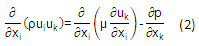
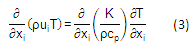
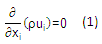
<body><![CDATA[<P><font face="Verdana" size="2">Numerical methods have become in a powerful tool    in forecast of velocity and temperature field in compact heat exchanger with    the objective of know its thermo hydraulics performance. Using this tool have    been studied several geometries of tube. Chen, <i>et al</i> [11] compare the    local numerical result of a heat exchanger having three rows of flat tubes with    experimental results obtained by means of naphthalenes ublimation. The numerical    method employed was able to reproduce the local Nusselts number in isothermal    condition. </font>     <P><font face="Verdana" size="2">Different experimental techniques are used in    compact heat exchanger analysis. Stasiek <i>et al</i>. [12] used liquid crystal    thermography and particle image velocimetry. These are among the most precise    tools to obtain temperature and velocity fields governing the thermal and hydraulic    performance of heat exchangers. </font>      <P><font face="Verdana" size="2">The influence of several transversal pitches    for one longitudinal pitch tube was studied in Burkov, <i>et al</i>. [13] for    six rows of tubes. A higher heat transfer coefficient was found when transversal    pitch is lower. The Reynolds numbers was in turbulent regime. </font>     <P><font face="Verdana" size="2">The heat transfer enhancement of compact heat    exchanger is an important matter in the scientific literature at present. Experimental    methods are expensive and difficult to be implemented. Numerical methods are    being used for predictions of thermo hydraulics behavior of heat exchanger with    enhancement technique implemented as in He, Y.,<i> et al</i> [14]. In some cases,    have been used combined enhancement techniques as in Huisseune, <i>et al</i>    [15]. The combination have been considered as a new generations in the enhancement    heat transfer area. Not only in compact heat exchangers but also in solar collector    for air heating the enhancement heat transfer have been applied. Modifications    of boundary layer created by natural convection and interrupted by means of    vortex generators was the cause of enhancement heat transfer in this area as    can be found in Bekele, <i>et al</i>. [16] </font>      <P><font face="Verdana" size="2">The confidence of both methods, experimental    or numerical is high as was concluded in Biswas, <i>et al</i> [17]. However    every researcher need establish its own numerical models prove it and validate    it before begin to study geometries that are more complex and enhancement technique.    </font>      <P><font face="Verdana" size="2">This work is about the numerical modeling of    a compact heat exchanger having a row of circular tubes with air flowing outside    the tubes in laminar regime. The objective is to validate the numerical model    and the method employed, focusing the use of results as a baseline in future    investigations related to the enhancement of heat transfer. A validated computational    fluid dynamics model can provide flow and temperature field information at lower    cost. </font>     <P>&nbsp;     <P><font face="Verdana" size="2"><b><font size="3">MATERIALS AND METHOD</font></b></font>     <P><font face="Verdana" size="2">The governing equations, which describe the physical    phenomenon of the fluid inside the heat exchanger, are: the continuity, momentum,    energy equations and the ideal gas equation of state as equations follow 1,    2, 3 and 4: </font>     <P><img src="/img/revistas/im/v17n3/e0109314.gif" width="102" height="44" alt="Equation 1">      
]]></body>
<body><![CDATA[<P><img src="/img/revistas/im/v17n3/e0209314.gif" width="199" height="46" alt="Ecuaci&oacute;n 2">      
<P><img src="/img/revistas/im/v17n3/e0309314.gif" width="195" height="47" alt="Ecuaci&oacute;n 3">      
<P><img src="/img/revistas/im/v17n3/e0409314.gif" width="82" height="29" alt="Ecuaci&oacute;n 4">      
<P>     <P>      <P><font face="Verdana" size="2">In the equations above u was reserved for velocity    and x for coordinates. As subscript for its components and directions were used    i and k. Was reserved K for thermal conductivity, cp is the isobaric specific    heat and &#961; is the density. In equation of state, the terms used are <i>R</i>    for the gas constant of air, <i>p</i>, <i>v</i> and <i>T</i> are the pressure,    specific volume and temperature respectively. </font>      <P><font face="Verdana" size="2">The validation of the numerical model by means    of comparison with the published experimental result will be obtained applying    the governing equations on the physical model of a heat exchanger. The selected    physical model shall have exactly the same size than the model tested by Wang    &amp; Chi [10] having a row of circular tubes. The dimensions of this model    are 19,05 mm for longitudinal pitch, 25,4 mm for transversal pitch, a fin pitch    of 2,04 mm and a tube collar diameter of 8,51 mm. During the simulation was    considered a symmetrical domain in the transversal direction. The <a href="/img/revistas/im/v17n3/f0109314.jpg">figure    1</a> shows the plant and lateral views of the computational domain and its    dimensions. The model was extended ten millimeters in the exit direction avoiding    reversal flow and permitting an outflow boundary condition. The coordinate x    is in the span wise direction and the y coordinate is the main flow direction.    The flow channel is limited at top and the bottom by the two fins. </font>     
<P><font face="Verdana" size="2">The channel height (coordinate z) is the characteristic    dimension selected for Reynolds number determinations while the frontal was    the selected velocity. A flow laminar, steady, incompressible, with constant    properties and tridimensional was considered. A segregated model was employed    and conjugate heat transfer in the region of contact solid-fluid was applied.    </font>      <P><font face="Verdana" size="2">The operational conditions selected were: a constant    temperature of the tube wall (276 K), the inflow having a constant temperature    of 300 K and an atmospheric pressure equal to 101,325kPa. The velocity inlet    was varied from 0.3 to 6 m/s where only velocity component in the y direction    is possible. Additional boundary condition such an adiabatic wall for each fin    edge in the front and back region were considered. The fin edge and laterals    were considered symmetrical. A non-slip condition over every solid surface was    applied. For the heat transfer coefficient calculate was selected an average    temperature between the inlet temperature and a mass average temperature in    the exit section. </font>     <P><font face="Verdana" size="2">The mesh was constructed in Gambit. The solution    was first obtained for isothermal flow and then was added the energy equation    for the final solution. During the solution were monitored the convergence of    the scaled residual up to 10-7 for energy and 10-4 for momentum equations. Several    mesh adaption processes were implemented refining the cells having higher values    of gradient of velocity, temperature and surface heat transfer coefficient.    During the adaption processes the surface heat transfer coefficient and the    drop pressure was monitored until its values were unchanged. </font>     ]]></body>
<body><![CDATA[<P>&nbsp;     <P><font face="Verdana" size="2"><font size="3"><b>RESULTS AND DISCUCCIONS</b></font></font>     <P><font face="Verdana" size="2">The results of the model simulation were processed    and the average heat transfer coefficient (h) and the drop pressure ( p) through    the model were obtained as was explained. In the figure 2, are presented the    values of both, the mentioned parameters calculated by means of the present    model and the experimental results published by Wang &amp; Chi [10] as a function    of the frontal velocity (Vfr). </font>     <P><font face="Verdana" size="2">The agreement between the experimental and the    numerical values is high presenting almost a perfect match. The differences,    in the worst cases, are ranging about 9 % for the heat transfer coefficient    and 8 % for the drop pressure. These discrepancies are acceptable if the experimental    uncertainty is considered. The authors consider validated the numerical model    used here. </font>     <P align="center"><a name="f2"></a><img src="/img/revistas/im/v17n3/f0209314.jpg" width="325" height="393" alt="Fig. 2. Experimental results of Wang &amp; Chi [10] and numerical results of the present work">      
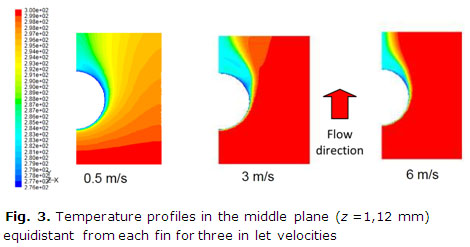
<P>     <P>      <P><font face="Verdana" size="2">The variation of the frontal velocity produces    an important effect on the heat transfer and pressure drop. Following in the    figure 3 are presented three temperature profiles in the middle plane (z =1,12    mm) equidistant from each fin for the velocities corresponding with 0,5, 3 and    6 m/s. When the velocity of the flow is increasing can be noted how the temperature    of the middle plane is approaching to the inlet temperature. Higher velocities    produce an important convection instead of the governing conduction phenomenon    manifested at lower velocities. When the flow is in laminar regime the only    mechanism able to change the temperature of the successive adjacent fluid layer    is the heat conduction. </font>     <P align="center"><a name="f3"></a><img src="/img/revistas/im/v17n3/f0309314.jpg" width="470" height="247" alt="Fig. 3. Temperature profiles in the middle plane (z =1,12 mm) equidistant from each fin for three in let velocities">      
<P>      ]]></body>
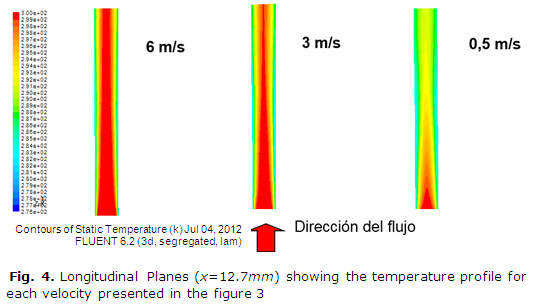
<body><![CDATA[<P><font face="Verdana" size="2">The boundary layer growing for the same velocities    previously studied is shown in the figure 4. Can be noted how the models having    the higher velocities is presenting a thinner thermal boundary layer while the    model having lower velocity has a thicker thermal boundary layer cause of a    lower energy transport by convection. </font>     <P align="center"><a name="f4"></a><img src="/img/revistas/im/v17n3/f0409314.jpg" width="534" height="304" alt="Fig. 4. Longitudinal Planes (x=12.7mm) showing the temperature profile for each  velocity presented in the figure 3">      
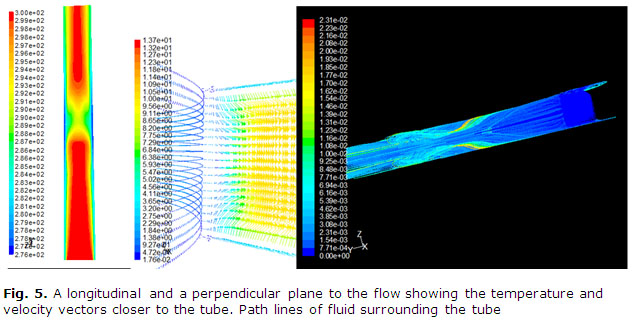
<P>      <P><font face="Verdana" size="2">The previous explanation is, of course, for a    longitudinal plane far from the tube and exactly in the middle point between    two consecutive tubes. If a similar plane, closer to the tube will be show then    the horseshoe vortices created in the front of the tube will have modified the    flow structure. The presence of these vortices produces the mixing of the cold    fluid, close to the fin, with the hottest fluid in the free stream. The mixing    in addition to the thinner of the boundary layer, caused by the momentum transported    to the fluid layers flowing close to the fin, are responsible for the improve    of the heat transfer occurring when the velocity is augmented. The composition    on <a href="/img/revistas/im/v17n3/f0509314.jpg">figure 5</a>    is showing a graphical explanation to the phenomenon mentioned before. </font>      
<P><font face="Verdana" size="2">A longitudinal plane created in the near of the    tube surface (x=4,8 mm) show the vortex effect on the perturbed area characterized    by a green-yellow color. The velocity vectors, in blue color, close to the tube    surface are showing perfectly the vortex formation. As confirmation of the vortex    presence and the capacity of the model for capturing it are shown the path line    of flow surrounding the tube. The view shown is longitudinal and the perpendicular    to the figure is coincident with the radial direction from inside to outside    of the tube </font>     <P><font face="Verdana" size="2">In the figure 6 is noted which are the two mechanisms    responsible for the heat transfer in a compact heat exchanger having smooth    fins. The first is the developing boundary layer on the inlet of the fin and    the other the horseshoe vortex created in front of the tube. In the contours    of velocity are noted the vortex presence and the effect of acceleration produced    by the flow area reduction in the center of the model. Is significant the larger    wake tube region presented in models with the lower velocity, because of the    dislocating of the separation point of the boundary layer to a backward direction.    </font>     <P align="center"><a name="f6"></a><img src="/img/revistas/im/v17n3/f0609314.jpg" width="514" height="421" alt="Fig. 6. Velocity profile in the midlle plane of the model (left) and local heat transfer ">      
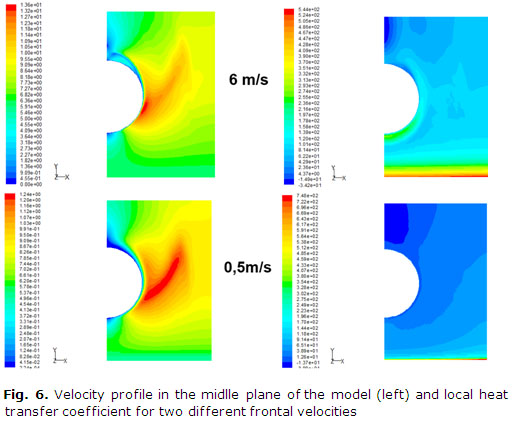
<P>      <P><font face="Verdana" size="2">The Nusselt in the spanwise direction was calculated.    A peak of heat transfer coefficient was obtained for every model in the inlet    region, coinciding with the developing boundary layer. When the velocity inlet    is higher a small peak begins to appear in front of the tube as can be observed    in the figure 7. In the picture the location of the tube is indicated. Even    for higher velocities, the maximum of the heat transfer coefficient is obtained    in the leading edge of the fin. </font>     <P>      ]]></body>
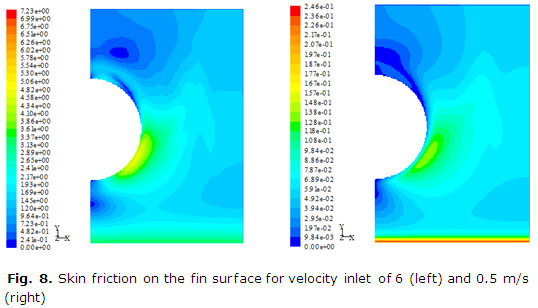
<body><![CDATA[<P><font face="Verdana" size="2">Finally in the figure 8 the skin friction on    the fin surface was found with a behavior very similar to the shown for the    heat transfer coefficient. Improve in heat transfer should be penalty with higher    drop pressure in agreement with the Colburn's analogy as can be observed. The    color scale of the skin friction is not the same for each graphic. </font>     <P align="center"><a name="f7"></a><img src="/img/revistas/im/v17n3/f0709314.jpg" width="415" height="352" alt="Fig. 7. Average heat transfer coefficient in the spanwise direction">      
<P align="center"><a name="f8"></a><img src="/img/revistas/im/v17n3/f0809314.jpg" width="538" height="308" alt="Fig. 8. Skin friction on the fin surface for velocity inlet of 6 (left) and 0.5 m/s (right)">     
<P>      <P>&nbsp;     <P><font face="Verdana" size="2"><font size="3"><b>CONCLUSIONS</b></font></font>     <P><font face="Verdana" size="2">A baseline for future comparison of model having    enhancement heat transfer techniques applied with model in smooth configuration    is available now. The results were obtained by means of gradient mesh refinement    avoiding a higher cell number produced when the cell size is diminished looking    for a mesh independent solution. </font>     <P>      <P><font face="Verdana" size="2">The numerical model employed to simulate the    heat and transfer performance of a compact heat exchanger having a fin tube    was validated. The agreement between experimental and numerical was high, presenting    almost a perfect match. The comparison was made using the average heat transfer    coefficient and drop pressure through the model and the experimental result    published in the scientific literature. </font>     <P>      ]]></body>
<body><![CDATA[<P><font face="Verdana" size="2">Dimensionless numbers were not employed because    the compared models have similar dimensions. As expected, a correspondence between    the skin friction and the values of the heat transfer coefficient was observed.    </font>     <P>      <P><font face="Verdana" size="2">The mechanism responsible for the heat transfer    in a compact heat exchanger with a row of tube having fin in smooth configuration    were confirmed having the same phenomenology than the elucidated in the literature.    Heat transfer coefficient integrated in the spanwise direction is presented,    supporting the previous conclusion. </font>     <P>&nbsp;     <P><b><font face="Verdana" size="2"><font size="3">REFERENCES</font></font></b>     <P>      <!-- ref --><P><font face="Verdana" size="2"> 1. Lei, Y., He, Y. y Tian, L. &quot;Hydrodynamics    and Heat Transfer Characteristics of a Novel Heat Exchanger with Delta-winglet    Vortex Generators&quot;. <i>Chemical Engineering Science</i>. 2010, vol. 65,    n&ordm;. 5, p. 1551-1562. ISSN 0009-2509. DOI 10.1016/j.ces.2009.10.017</font>      <!-- ref --><P><font face="Verdana" size="2">2. Aider, J., Beaudoin, J. y Wesfreid, J. &quot;Drag    and Lift Reduction of a 3D Bluff-body using Active Vortex Generators&quot;.    <i>Experiments in Fluid</i>. 2010, vol. 48, p. 771-789. ISSN 0723-4864. DOI    10.1007/s00348-009-0770-y</font>      <!-- ref --><P><font face="Verdana" size="2">3. Henze, M., Wolfersdorf, J. V. y Weigand, B.    &quot;Flow and Heat Transfer Characteristics Behind Vortex Generators-A Benchmark    Dataset&quot;. <i>International Journal of Heat and Fluid Flow</i>. 2011, vol.    32, n&ordm;. 1, p. 318-328. ISSN 0142-727X. DOI 10.1016/j.ijheatfluidflow.2010.07.005</font>      <!-- ref --><P><font face="Verdana" size="2">4. Webb, R. L. <i>Principles of Enhanced Heat    Transfer</i>. First ed. New York, USA: John Wiley &amp; Sons, 1994. ISBN 100471577782.    </font>     <!-- ref --><P><font face="Verdana" size="2">5. Bordalo, S. y Saboya, F. E. &quot;Pressure    Drop Coefficient for Elliptical and Circular Sections in one, two and three-Row    Arrangements of Plate Fin and Tube Heat Exchangers&quot;. <i>Journal of Brazilian    Society of Mechanical Science</i>. 1999, vol. 21, n&ordm;. 4, p. 600-610. ISSN    1678-5878.    </font>      <!-- ref --><P><font face="Verdana" size="2">6. Sohal, M. S. y Obrien, J. E. &quot;Improving    Air-Cooled Condenser Performance Using Winglets and Oval Tubes in a Geothermal    Power Plant&quot;. <i>Geothermal Resources Council Transactions</i>. 2001, vol.    25, p. 1-7. ISSN 0193-5933.     </font>      <!-- ref --><P><font face="Verdana" size="2">7. Perez, R. B., Yanagihara, J. I. y Bay&oacute;n,    J. G. &quot;Thermal and Friction Drop Characteristic of Heat Exchangers with    Elliptical Tubes and Smooth Fins&quot;. <i>Ingenier&iacute;a Mec&aacute;nica</i>.    2012, vol. 15, n&ordm;. 3, p. 243-253. ISSN 1815-5944.     </font>      <!-- ref --><P><font face="Verdana" size="2">8. Rich, D. G. &quot;The Effect of Fin Spacing    on the Heat Transfer and Friction Performance of Multirow, Smooth Plate Fin    and Tube Heat Exchangers&quot;. <i>ASHRAE Transactions</i>. 1973, vol. 79, n&ordm;.    2, p. 135-145. ISSN 0001-2505.     </font>      <!-- ref --><P><font face="Verdana" size="2">9. Wang, C., Lee, W. y Sheu, W. A. &quot;Comparative    Study of Compact Enhanced Fin and Tube Heat Exchangers&quot;. <i>International    Journal of Heat and Mass Transfer</i>. 2001, vol. 44, p. 3565-3573. ISSN 0017-9310.        </font>      <!-- ref --><P><font face="Verdana" size="2">10. Wang, C. y Chi, K. &quot;Heat Transfer and    Friction Characteristics of Plain Fin-and-tube Heat Exchangers, Part I: New    Experimental Data&quot;. <i>International Journal of Heat and Mass Transfer</i>.    2000, vol. 43, p. 7-10. ISSN 0017-9310.     </font>      <!-- ref --><P><font face="Verdana" size="2">11. Chen, Y., Song, K. y Wang, L. &quot;Comparisons    of Local Experimental Results with Numerical Results of Heat Transfer Enhancement    of a Flat Tube Bank Fin with Vortex Generators&quot;. <i>Numerical Heat Transfer.    Part A</i>. 2009, vol. 55, p. 144-162. ISSN 1040-7782. DOI 10.1080/10407780802603204</font>      <!-- ref --><P><font face="Verdana" size="2">12. Stasiek, J., Stasiek, A. y Mikielewicz, D.    The use of Liquid Crystal Thermography and Particle Image Velocimetry in the    Exploration of Heat Transfer Measurements. En: <i>The 6th Symposium on Turbulence,    Heat and Mass Transfer</i>. Rome, Italy. 2010. p. 1-11. ISBN 978-1-56700-262-1.    </font>      <!-- ref --><P><font face="Verdana" size="2">13. Burkov, V. K., Medvedskii, V. P. y Kochegarova,    I. Y. &quot;Studies of Heat Transfer and Aerodynamics&quot;. <i>Thermal engineering</i>.    2010, vol. 57, n&ordm;. 3, p. 227-231. ISSN 0040-6015. DOI 10.1134/S0040601510030067</font>      <!-- ref --><P><font face="Verdana" size="2">14. He, Y. L., Han, H. y Tao, W. &quot;Numerical    study of heat-transfer enhancement by punched winglet-type vortex generator    arrays in fin-and-tube heat exchangers&quot;. <i>International Journal of Heat    and Mass Transfer</i>. 2012, vol. 55, p. 5449-5458. ISSN 0017-9310. DOI 10.1016/j.ijheatmasstransfer.2012.04.059</font>      <!-- ref --><P><font face="Verdana" size="2">15. Huisseune, H., Tjoen, C. y Dejaeger, P. &quot;Performance    Enhancement of a Louvered fin Heat Exchanger by Using Delta Winglet Vortex Generators&quot;.    <i>International Journal of Heat and Mass Transfer</i>. 2013, vol. 56, p. 457-487.    ISSN 0017-9310. DOI 10.1016/j.ijheatmasstransfer.2012.09.004</font>      <!-- ref --><P><font face="Verdana" size="2">16. Bekele, A., Mishra, M. y Dutta, S. &quot;Heat    transfer augmentation in solar air heater using delta-shaped obstacles mounted    on the absorber plate&quot;. <i>International Journal of Sustainable Energy</i>.    2013, vol. 32, n&ordm;. 1, p. 53-69. ISSN 1478-6451. DOI 10.1080/14786451.2011.598637</font>      <!-- ref --><P><font face="Verdana" size="2">17. Biswas, G., Chattopadhyay, H. y Sinha, A.    &quot;Augmentation of Heat Transfer by Creation of Streamwise Longitudinal Vortices    Using Vortex Generators&quot;. <i>Heat Transfer Engineering</i>. 2012, vol.    33, n&ordm;. 4-5, p. 406-424. ISSN 0145-7632. DOI 10.1080/01457632.2012.614150</font>      <P>&nbsp;     <P>&nbsp;     <P><font face="Verdana" size="2">Recibido: 6 de marzo de 2014.    <br>   Aceptado: 16 de junio de 2014.</font>     <P>&nbsp;     <P>&nbsp;     <P><font face="Verdana" size="2"><i>Jos&eacute;-L. Leiro-Garrido</i>. Instituto    Superior Polit&eacute;cnico Jos&eacute; Antonio Echeverr&iacute;a. Centro de    Estudios de Tecnolog&iacute;as Energ&eacute;ticas Renovables. La Habana. Cuba.        <br>   Correo electr&oacute;nico:<a href="mailto:jleiro@mecamail.cujae.edu.cu">jleiro@mecamail.cujae.edu.cu</a>    </font>      ]]></body><back>
<ref-list>
<ref id="B1">
<label>1</label><nlm-citation citation-type="journal">
<person-group person-group-type="author">
<name>
<surname><![CDATA[Lei]]></surname>
<given-names><![CDATA[Y.]]></given-names>
</name>
<name>
<surname><![CDATA[He]]></surname>
<given-names><![CDATA[Y.]]></given-names>
</name>
<name>
<surname><![CDATA[Tian]]></surname>
<given-names><![CDATA[L.]]></given-names>
</name>
</person-group>
<article-title xml:lang="en"><![CDATA[Hydrodynamics and Heat Transfer Characteristics of a Novel Heat Exchanger with Delta-winglet Vortex Generators]]></article-title>
<source><![CDATA[Chemical Engineering Science]]></source>
<year>2010</year>
<volume>65</volume>
<numero>5</numero>
<issue>5</issue>
<page-range>1551-1562</page-range></nlm-citation>
</ref>
<ref id="B2">
<label>2</label><nlm-citation citation-type="journal">
<person-group person-group-type="author">
<name>
<surname><![CDATA[Aider]]></surname>
<given-names><![CDATA[J.]]></given-names>
</name>
<name>
<surname><![CDATA[Beaudoin]]></surname>
<given-names><![CDATA[J.]]></given-names>
</name>
<name>
<surname><![CDATA[Wesfreid]]></surname>
<given-names><![CDATA[J.]]></given-names>
</name>
</person-group>
<article-title xml:lang="en"><![CDATA[Drag and Lift Reduction of a 3D Bluff-body using Active Vortex Generators]]></article-title>
<source><![CDATA[Experiments in Fluid]]></source>
<year>2010</year>
<volume>48</volume>
<page-range>771-789</page-range></nlm-citation>
</ref>
<ref id="B3">
<label>3</label><nlm-citation citation-type="journal">
<person-group person-group-type="author">
<name>
<surname><![CDATA[Henze]]></surname>
<given-names><![CDATA[M.]]></given-names>
</name>
<name>
<surname><![CDATA[Wolfersdorf]]></surname>
<given-names><![CDATA[J. V.]]></given-names>
</name>
<name>
<surname><![CDATA[Weigand]]></surname>
<given-names><![CDATA[B.]]></given-names>
</name>
</person-group>
<article-title xml:lang="en"><![CDATA[Flow and Heat Transfer Characteristics Behind Vortex Generators-A Benchmark Dataset]]></article-title>
<source><![CDATA[International Journal of Heat and Fluid Flow]]></source>
<year>2011</year>
<volume>32</volume>
<numero>1</numero>
<issue>1</issue>
<page-range>318-328</page-range></nlm-citation>
</ref>
<ref id="B4">
<label>4</label><nlm-citation citation-type="book">
<person-group person-group-type="author">
<name>
<surname><![CDATA[Webb]]></surname>
<given-names><![CDATA[R. L.]]></given-names>
</name>
</person-group>
<source><![CDATA[Principles of Enhanced Heat Transfer]]></source>
<year>1994</year>
<edition>First</edition>
<publisher-loc><![CDATA[New York ]]></publisher-loc>
<publisher-name><![CDATA[John Wiley & Sons]]></publisher-name>
</nlm-citation>
</ref>
<ref id="B5">
<label>5</label><nlm-citation citation-type="journal">
<person-group person-group-type="author">
<name>
<surname><![CDATA[Bordalo]]></surname>
<given-names><![CDATA[S.]]></given-names>
</name>
<name>
<surname><![CDATA[Saboya]]></surname>
<given-names><![CDATA[F. E.]]></given-names>
</name>
</person-group>
<article-title xml:lang="en"><![CDATA[Pressure Drop Coefficient for Elliptical and Circular Sections in one, two and three-Row Arrangements of Plate Fin and Tube Heat Exchangers]]></article-title>
<source><![CDATA[Journal of Brazilian Society of Mechanical Science]]></source>
<year>1999</year>
<volume>21</volume>
<numero>4</numero>
<issue>4</issue>
<page-range>600-610</page-range></nlm-citation>
</ref>
<ref id="B6">
<label>6</label><nlm-citation citation-type="journal">
<person-group person-group-type="author">
<name>
<surname><![CDATA[Sohal]]></surname>
<given-names><![CDATA[M. S.]]></given-names>
</name>
<name>
<surname><![CDATA[Obrien]]></surname>
<given-names><![CDATA[J. E.]]></given-names>
</name>
</person-group>
<article-title xml:lang="en"><![CDATA[Improving Air-Cooled Condenser Performance Using Winglets and Oval Tubes in a Geothermal Power Plant]]></article-title>
<source><![CDATA[Geothermal Resources Council Transactions]]></source>
<year>2001</year>
<volume>25</volume>
<page-range>1-7</page-range></nlm-citation>
</ref>
<ref id="B7">
<label>7</label><nlm-citation citation-type="journal">
<person-group person-group-type="author">
<name>
<surname><![CDATA[Perez]]></surname>
<given-names><![CDATA[R. B.]]></given-names>
</name>
<name>
<surname><![CDATA[Yanagihara]]></surname>
<given-names><![CDATA[J. I.]]></given-names>
</name>
<name>
<surname><![CDATA[Bayón]]></surname>
<given-names><![CDATA[J. G.]]></given-names>
</name>
</person-group>
<article-title xml:lang="en"><![CDATA[Thermal and Friction Drop Characteristic of Heat Exchangers with Elliptical Tubes and Smooth Fins]]></article-title>
<source><![CDATA[Ingeniería Mecánica]]></source>
<year>2012</year>
<volume>15</volume>
<numero>3</numero>
<issue>3</issue>
<page-range>243-253</page-range></nlm-citation>
</ref>
<ref id="B8">
<label>8</label><nlm-citation citation-type="journal">
<person-group person-group-type="author">
<name>
<surname><![CDATA[Rich]]></surname>
<given-names><![CDATA[D. G.]]></given-names>
</name>
</person-group>
<article-title xml:lang="en"><![CDATA[The Effect of Fin Spacing on the Heat Transfer and Friction Performance of Multirow, Smooth Plate Fin and Tube Heat Exchangers]]></article-title>
<source><![CDATA[ASHRAE Transactions]]></source>
<year>1973</year>
<volume>79</volume>
<numero>2</numero>
<issue>2</issue>
<page-range>135-145</page-range></nlm-citation>
</ref>
<ref id="B9">
<label>9</label><nlm-citation citation-type="journal">
<person-group person-group-type="author">
<name>
<surname><![CDATA[Wang]]></surname>
<given-names><![CDATA[C.]]></given-names>
</name>
<name>
<surname><![CDATA[Lee]]></surname>
<given-names><![CDATA[W.]]></given-names>
</name>
<name>
<surname><![CDATA[Sheu]]></surname>
<given-names><![CDATA[W. A.]]></given-names>
</name>
</person-group>
<article-title xml:lang="en"><![CDATA[Comparative Study of Compact Enhanced Fin and Tube Heat Exchangers]]></article-title>
<source><![CDATA[International Journal of Heat and Mass Transfer]]></source>
<year>2001</year>
<volume>44</volume>
<page-range>3565-3573</page-range></nlm-citation>
</ref>
<ref id="B10">
<label>10</label><nlm-citation citation-type="journal">
<person-group person-group-type="author">
<name>
<surname><![CDATA[Wang]]></surname>
<given-names><![CDATA[C.]]></given-names>
</name>
<name>
<surname><![CDATA[Chi]]></surname>
<given-names><![CDATA[K.]]></given-names>
</name>
</person-group>
<article-title xml:lang="en"><![CDATA[Heat Transfer and Friction Characteristics of Plain Fin-and-tube Heat Exchangers: Part I: New Experimental Data]]></article-title>
<source><![CDATA[International Journal of Heat and Mass Transfer]]></source>
<year>2000</year>
<volume>43</volume>
<page-range>7-10</page-range></nlm-citation>
</ref>
<ref id="B11">
<label>11</label><nlm-citation citation-type="journal">
<person-group person-group-type="author">
<name>
<surname><![CDATA[Chen]]></surname>
<given-names><![CDATA[Y.]]></given-names>
</name>
<name>
<surname><![CDATA[Song]]></surname>
<given-names><![CDATA[K.]]></given-names>
</name>
<name>
<surname><![CDATA[Wang]]></surname>
<given-names><![CDATA[L.]]></given-names>
</name>
</person-group>
<article-title xml:lang="en"><![CDATA[Comparisons of Local Experimental Results with Numerical Results of Heat Transfer Enhancement of a Flat Tube Bank Fin with Vortex Generators]]></article-title>
<source><![CDATA[Numerical Heat Transfer. Part A]]></source>
<year>2009</year>
<volume>55</volume>
<page-range>144-162</page-range></nlm-citation>
</ref>
<ref id="B12">
<label>12</label><nlm-citation citation-type="">
<person-group person-group-type="author">
<name>
<surname><![CDATA[Stasiek]]></surname>
<given-names><![CDATA[J.]]></given-names>
</name>
<name>
<surname><![CDATA[Stasiek]]></surname>
<given-names><![CDATA[A.]]></given-names>
</name>
<name>
<surname><![CDATA[Mikielewicz]]></surname>
<given-names><![CDATA[D.]]></given-names>
</name>
</person-group>
<article-title xml:lang="en"><![CDATA[The use of Liquid Crystal Thermography and Particle Image Velocimetry in the Exploration of Heat Transfer Measurements]]></article-title>
<source><![CDATA[The 6th Symposium on Turbulence, Heat and Mass Transfer]]></source>
<year>2010</year>
<page-range>1-11</page-range><publisher-loc><![CDATA[Rome ]]></publisher-loc>
</nlm-citation>
</ref>
<ref id="B13">
<label>13</label><nlm-citation citation-type="journal">
<person-group person-group-type="author">
<name>
<surname><![CDATA[Burkov]]></surname>
<given-names><![CDATA[V. K.]]></given-names>
</name>
<name>
<surname><![CDATA[Medvedskii]]></surname>
<given-names><![CDATA[V. P.]]></given-names>
</name>
<name>
<surname><![CDATA[Kochegarova]]></surname>
<given-names><![CDATA[I. Y.]]></given-names>
</name>
</person-group>
<article-title xml:lang="en"><![CDATA[Studies of Heat Transfer and Aerodynamics]]></article-title>
<source><![CDATA[Thermal engineering]]></source>
<year>2010</year>
<volume>57</volume>
<numero>3</numero>
<issue>3</issue>
<page-range>227-231</page-range></nlm-citation>
</ref>
<ref id="B14">
<label>14</label><nlm-citation citation-type="journal">
<person-group person-group-type="author">
<name>
<surname><![CDATA[He]]></surname>
<given-names><![CDATA[Y. L.]]></given-names>
</name>
<name>
<surname><![CDATA[Han]]></surname>
<given-names><![CDATA[H.]]></given-names>
</name>
<name>
<surname><![CDATA[Tao]]></surname>
<given-names><![CDATA[W.]]></given-names>
</name>
</person-group>
<article-title xml:lang="en"><![CDATA[Numerical study of heat-transfer enhancement by punched winglet-type vortex generator arrays in fin-and-tube heat exchangers]]></article-title>
<source><![CDATA[International Journal of Heat and Mass Transfer]]></source>
<year>2012</year>
<volume>55</volume>
<page-range>5449-5458</page-range></nlm-citation>
</ref>
<ref id="B15">
<label>15</label><nlm-citation citation-type="journal">
<person-group person-group-type="author">
<name>
<surname><![CDATA[Huisseune]]></surname>
<given-names><![CDATA[H.]]></given-names>
</name>
<name>
<surname><![CDATA[Tjoen]]></surname>
<given-names><![CDATA[C.]]></given-names>
</name>
<name>
<surname><![CDATA[Dejaeger]]></surname>
<given-names><![CDATA[P.]]></given-names>
</name>
</person-group>
<article-title xml:lang="en"><![CDATA[Performance Enhancement of a Louvered fin Heat Exchanger by Using Delta Winglet Vortex Generators]]></article-title>
<source><![CDATA[International Journal of Heat and Mass Transfer]]></source>
<year>2013</year>
<volume>56</volume>
<page-range>457-487</page-range></nlm-citation>
</ref>
<ref id="B16">
<label>16</label><nlm-citation citation-type="journal">
<person-group person-group-type="author">
<name>
<surname><![CDATA[Bekele]]></surname>
<given-names><![CDATA[A.]]></given-names>
</name>
<name>
<surname><![CDATA[Mishra]]></surname>
<given-names><![CDATA[M.]]></given-names>
</name>
<name>
<surname><![CDATA[Dutta]]></surname>
<given-names><![CDATA[S.]]></given-names>
</name>
</person-group>
<article-title xml:lang="en"><![CDATA[Heat transfer augmentation in solar air heater using delta-shaped obstacles mounted on the absorber plate]]></article-title>
<source><![CDATA[International Journal of Sustainable Energy]]></source>
<year>2013</year>
<volume>32</volume>
<numero>1</numero>
<issue>1</issue>
<page-range>53-69</page-range></nlm-citation>
</ref>
<ref id="B17">
<label>17</label><nlm-citation citation-type="journal">
<person-group person-group-type="author">
<name>
<surname><![CDATA[Biswas]]></surname>
<given-names><![CDATA[G.]]></given-names>
</name>
<name>
<surname><![CDATA[Chattopadhyay]]></surname>
<given-names><![CDATA[H.]]></given-names>
</name>
<name>
<surname><![CDATA[Sinha]]></surname>
<given-names><![CDATA[A.]]></given-names>
</name>
</person-group>
<article-title xml:lang="en"><![CDATA[Augmentation of Heat Transfer by Creation of Streamwise Longitudinal Vortices Using Vortex Generators]]></article-title>
<source><![CDATA[Heat Transfer Engineering]]></source>
<year>2012</year>
<volume>33</volume>
<numero>4-5</numero>
<issue>4-5</issue>
<page-range>406-424</page-range></nlm-citation>
</ref>
</ref-list>
</back>
</article>