<?xml version="1.0" encoding="ISO-8859-1"?><article xmlns:mml="http://www.w3.org/1998/Math/MathML" xmlns:xlink="http://www.w3.org/1999/xlink" xmlns:xsi="http://www.w3.org/2001/XMLSchema-instance">
<front>
<journal-meta>
<journal-id>2071-0054</journal-id>
<journal-title><![CDATA[Revista Ciencias Técnicas Agropecuarias]]></journal-title>
<abbrev-journal-title><![CDATA[Rev Cie Téc Agr]]></abbrev-journal-title>
<issn>2071-0054</issn>
<publisher>
<publisher-name><![CDATA[Universidad Agraria de La Habana]]></publisher-name>
</publisher>
</journal-meta>
<article-meta>
<article-id>S2071-00542013000300002</article-id>
<title-group>
<article-title xml:lang="en"><![CDATA[Formulation of a frictional-cohesive soil model by the Discrete Element method]]></article-title>
<article-title xml:lang="es"><![CDATA[Formulación de un modelo friccionante-cohesivo de suelo por el método de elementos discretos]]></article-title>
</title-group>
<contrib-group>
<contrib contrib-type="author">
<name>
<surname><![CDATA[López Bravo]]></surname>
<given-names><![CDATA[Elvis]]></given-names>
</name>
<xref ref-type="aff" rid="A01"/>
</contrib>
<contrib contrib-type="author">
<name>
<surname><![CDATA[Herrera Suárez]]></surname>
<given-names><![CDATA[Miguel]]></given-names>
</name>
<xref ref-type="aff" rid="A01"/>
</contrib>
<contrib contrib-type="author">
<name>
<surname><![CDATA[Gonzalez Cueto]]></surname>
<given-names><![CDATA[Omar]]></given-names>
</name>
<xref ref-type="aff" rid="A01"/>
</contrib>
<contrib contrib-type="author">
<name>
<surname><![CDATA[Tijskens]]></surname>
<given-names><![CDATA[Engelbert]]></given-names>
</name>
<xref ref-type="aff" rid="A02"/>
</contrib>
<contrib contrib-type="author">
<name>
<surname><![CDATA[Ramon]]></surname>
<given-names><![CDATA[Herman]]></given-names>
</name>
<xref ref-type="aff" rid="A02"/>
</contrib>
</contrib-group>
<aff id="A01">
<institution><![CDATA[,Universidad Central de Las Villas Departamento Ing. Agrícola ]]></institution>
<addr-line><![CDATA[ ]]></addr-line>
<country>Cuba</country>
</aff>
<aff id="A02">
<institution><![CDATA[,Universidad de Leuven Departamento Bioestadistica y Sensores ]]></institution>
<addr-line><![CDATA[ ]]></addr-line>
<country>Bélgica</country>
</aff>
<pub-date pub-type="pub">
<day>00</day>
<month>09</month>
<year>2013</year>
</pub-date>
<pub-date pub-type="epub">
<day>00</day>
<month>09</month>
<year>2013</year>
</pub-date>
<volume>22</volume>
<numero>3</numero>
<fpage>12</fpage>
<lpage>17</lpage>
<copyright-statement/>
<copyright-year/>
<self-uri xlink:href="http://scielo.sld.cu/scielo.php?script=sci_arttext&amp;pid=S2071-00542013000300002&amp;lng=en&amp;nrm=iso"></self-uri><self-uri xlink:href="http://scielo.sld.cu/scielo.php?script=sci_abstract&amp;pid=S2071-00542013000300002&amp;lng=en&amp;nrm=iso"></self-uri><self-uri xlink:href="http://scielo.sld.cu/scielo.php?script=sci_pdf&amp;pid=S2071-00542013000300002&amp;lng=en&amp;nrm=iso"></self-uri><abstract abstract-type="short" xml:lang="en"><p><![CDATA[Friction and cohesion in efforts that take place during soil deformation calculations. Para interactions are considered normal force, tangential cohesive friction. The maximum shear is governed by the criterion of Mohr-Coulomb failure. Model calibration is performed by obtaining the relationship between micro and macroscopic parameters used in the model. The calibration of the friction was carried out by simulating the direct shear test of a sample of soil micro different friction coefficients. To calibrate cohesion used different values &#8203;&#8203;of cohesion at the micro and the relationship was obtained by modifying the micro friction values &#8203;&#8203;by simulating the biaxial compression test. The friction results showed a linear relationship regarding the variation of the micro value. Instead cohesion was linearly affected by the change inthe quadratic micro-cohesion and friction over micro.]]></p></abstract>
<abstract abstract-type="short" xml:lang="es"><p><![CDATA[En el presente trabajo se propone un modelo de elementos discretos que incluye el efecto de la fricción y la cohesión en los esfuerzos que tienen lugar durante la deformación del suelo. Para los cálculos se consideran las interacciones entre la fuerza normal, tangencial, cohesiva y friccionante. El valor máximo de fuerza cortante es regulado mediante el criterio de falla de Mohr-Coulomb. La calibración del modelo se realizó mediante la obtención de la relación existente entre los parámetros micro y macroscópicos usados en el modelo. La calibración de la fricción se realizó por medio de la simulación del ensayo de corte directo de una muestra de suelo a diferentes valores de fricción micro. Para calibrar la cohesión se utilizaron diferentes valores de cohesión a escala micro y se obtuvo la relación existente al modificar los valores de fricción micro mediante la simulación del ensayo de compresión biaxial. Los resultados de la fricción mostraron una relación lineal respecto a la variación de su valor micro. En cambio la cohesión estuvo afectada de forma lineal por la variación en la micro-cohesión y cuadrática respecto a la fricción micro.]]></p></abstract>
<kwd-group>
<kwd lng="en"><![CDATA[simulation]]></kwd>
<kwd lng="en"><![CDATA[tillage]]></kwd>
<kwd lng="en"><![CDATA[modeling]]></kwd>
<kwd lng="en"><![CDATA[discrete element method]]></kwd>
<kwd lng="en"><![CDATA[draft force]]></kwd>
<kwd lng="es"><![CDATA[simulación]]></kwd>
<kwd lng="es"><![CDATA[labranza]]></kwd>
<kwd lng="es"><![CDATA[modelos]]></kwd>
<kwd lng="es"><![CDATA[método de elementos discretos]]></kwd>
<kwd lng="es"><![CDATA[fuerza de tiro]]></kwd>
</kwd-group>
</article-meta>
</front><body><![CDATA[ <p class="MsoNormal" align="right" style="text-align: right"> <font face="Verdana, Arial, Helvetica, sans-serif" size="2"><b><span style="font-size: 10.0pt">ARTÍCULO  ORIGINAL</span></b></font></p>    <P>&nbsp;     <P><font face="Verdana, Arial, Helvetica, sans-serif" size="2"><b><span lang="EN-GB"><font size="4">Formulation  of a frictional</font></span><font size="4"><span lang="EN-US">-</span><span lang="EN-GB">cohesive  soil model by the Discrete Element method</span></font></b></font>     <p class="MsoNormal">&nbsp;</p>    <p class="MsoNormal"><font face="Verdana, Arial, Helvetica, sans-serif" size="2"><b><span lang="EN-GB"><b><span lang="ES"><font size="3">Formulación  de un modelo friccionante-cohesivo de suelo por el método de elementos discretos</font></span></b></span></b></font></p>    <p class="MsoNormal">&nbsp;</p>    <p class="MsoNormal">&nbsp;</p>    <p class="MsoNormal" style="text-align: justify"><font face="Verdana, Arial, Helvetica, sans-serif" size="2"><b>  <span lang="EN-US" style="font-size: 10.0pt">Dr. C. Elvis López Bravo<sup> I</sup>,  Dr. C. Miguel Herrera Suárez<sup> I</sup>, Dr. C. Omar Gonzalez Cueto<sup> I</sup>,  PhD. </span><span style="font-size: 10.0pt">Engelbert Tijskens<sup> II</sup>,  PhD. Herman Ramon<sup>II</sup></span></b></font></p>    <p class="MsoNormal" style="text-align: justify"><font face="Verdana, Arial, Helvetica, sans-serif" size="2"><b><span style="font-size: 10.0pt"></span></b><sup><span lang="ES-TRAD" style="font-size: 10.0pt; font-weight: normal">I</span></sup><span lang="ES-TRAD" style="font-size: 10.0pt; font-weight: normal">  Universidad Central de Las Villas. Departamento Ing. Agrícola, Villa Clara, Cuba.    <br>  </span><sup><span lang="ES-TRAD" style="font-size: 10.0pt; font-weight: normal">II</span></sup><span lang="ES-TRAD" style="font-size: 10.0pt; font-weight: normal">  Universidad de Leuven,&nbsp; Departamento Bioestadistica y Sensores, Bélgica.</span></font></p>    ]]></body>
<body><![CDATA[<p class="TtuloArtCOMNI" style="text-align: justify; margin-bottom: .0001pt">&nbsp;</p>    <p class="TtuloArtCOMNI" style="text-align: justify; margin-bottom: .0001pt">&nbsp;</p>    <P><hr>      <P><font face="Verdana, Arial, Helvetica, sans-serif" size="2"><b><span lang="EN-US" style="font-size: 10.0pt">ABSTRACT</span></b></font>      <p class="MsoNormal" style="text-align: justify"><font face="Verdana, Arial, Helvetica, sans-serif" size="2"><span class="hps"><span lang="EN-US" style="font-size: 10.0pt; color: #333333">Friction</span></span><span lang="EN-US" style="font-size: 10.0pt; color: #333333">  <span class="hps">and cohesion</span> <span class="hps">in efforts</span> <span class="hps">that  take place during</span> <span class="hps">soil deformation</span> <span class="hps">calculations.  Para</span> <span class="hps"> interactions</span> <span class="hps">are considered</span>  <span class="hps"> normal force</span>, <span class="hps">tangential</span> <span class="hps">  cohesive</span> </span><span class="hps"> <span lang="EN-US" style="font-size: 10.0pt; font-family: Verdana; color: #333333">  friction</span></span><span lang="EN-US" style="font-size: 10.0pt; color: #333333"><span class="hps">.</span>  <span class="hps">The</span> <span class="hps">maximum</span> <span class="hps">  shear is</span> <span class="hps">governed</span> <span class="hps">by the criterion</span>  <span class="hps">of</span> <span class="hps">Mohr-Coulomb</span> <span class="hps">failure</span>.  <span class="hps">Model calibration</span> <span class="hps">is</span> <span class="hps">performed</span>  <span class="hps"> by obtaining</span> <span class="hps">the relationship between</span>  <span class="hps">micro</span> <span class="hps">and macroscopic</span> <span class="hps">parameters</span>  <span class="hps">used in the model</span>. <span class="hps">The calibration</span>  <span class="hps">of</span> <span class="hps">the</span> <span class="hps">friction</span>  <span class="hps"> was carried out</span> <span class="hps">by</span> <span class="hps">simulating  the</span> <span class="hps">direct</span> <span class="hps">shear test</span>  <span class="hps">of a sample</span> <span class="hps">of</span> <span class="hps">soil</span>  <span class="hps">micro</span> <span class="hps"> different friction coefficients</span>.  <span class="hps">To calibrate</span> <span class="hps">cohesion</span> <span class="hps">used  different</span> <span class="hps">values</span> </span><span class="hps"> <span lang="EN-US" style="font-size: 10.0pt; font-family: Verdana; color: #333333">  &#8203;&#8203;</span><span lang="EN-US" style="font-size: 10.0pt; color: #333333">of  cohesion</span></span><span lang="EN-US" style="font-size: 10.0pt; color: #333333">  <span class="hps">at the micro</span> <span class="hps">and</span> <span class="hps">the  relationship</span> <span class="hps">was obtained</span> <span class="hps">by  modifying</span> <span class="hps">the</span> <span class="hps">micro</span> <span class="hps">friction  values</span> </span> <span class="hps"> <span lang="EN-US" style="font-size: 10.0pt; font-family: Verdana; color: #333333">  &#8203;&#8203;</span><span lang="EN-US" style="font-size: 10.0pt; color: #333333">by  simulating the</span></span><span lang="EN-US" style="font-size: 10.0pt; color: #333333">  <span class="hps">biaxial</span> <span class="hps">compression test</span>. <span class="hps">The</span>  <span class="hps">friction</span> <span class="hps"> results</span> <span class="hps">showed  a</span> <span class="hps">linear</span> <span class="hps">relationship</span>  <span class="hps">regarding</span> <span class="hps">the</span> <span class="hps">variation</span>  <span class="hps">of</span> <span class="hps">the</span> <span class="hps">micro</span>  <span class="hps">value</span>. <span class="hps">Instead</span> <span class="hps">cohesion</span>  <span class="hps">was</span> <span class="hps"> linearly</span> <span class="hps">affected</span>  <span class="hps">by the change</span> <span class="hps">inthe</span> <span class="hps">quadratic</span>  <span class="hps">micro</span><span class="atn">-</span>cohesion and <span class="hps">friction</span>  <span class="hps">over</span> <span class="hps">micro</span>.</span></font></p>    <p class="TtuloArtCOMNI" style="text-align: justify; margin-bottom: .0001pt">  <font face="Verdana, Arial, Helvetica, sans-serif" size="2"><span lang="EN-US" style="font-size: 10.0pt; color: black">  <b>Keywords</b>: </span> <span lang="EN-US" style="font-size: 10.0pt; font-weight: normal">simulation,  tillage, modeling, discrete element method, draft force.</span></font></p>    <P><hr>      <P><font face="Verdana, Arial, Helvetica, sans-serif" size="2"><span lang="EN-US" style="font-size: 10.0pt; color: black; font-weight:700">RESUMEN</span></font>      <p class="TtuloArtCOMNI" style="text-align: justify; margin-bottom: .0001pt"><font face="Verdana, Arial, Helvetica, sans-serif" size="2"><span lang="ES" style="font-size: 10.0pt; color: black; font-weight: normal">En  el presente trabajo se propone un modelo de elementos discretos&nbsp; que incluye  el efecto de la fricción y la cohesión en los esfuerzos que tienen lugar durante  la deformación del suelo. Para los cálculos se consideran las interacciones entre  la fuerza normal, tangencial, cohesiva y friccionante. El valor máximo de fuerza  cortante es regulado mediante el criterio de falla de Mohr</span><span lang="ES-MX" style="font-size: 10.0pt; color: black; font-weight: normal">-Coulomb.</span><span lang="ES" style="font-size: 10.0pt; color: black; font-weight: normal">  La calibración del modelo se realizó mediante la obtención de la relación existente  entre los parámetros micro y macroscópicos usados en el modelo. La calibración  de la fricción se realizó por medio de la simulación del ensayo de corte directo  de una muestra de suelo a diferentes valores de fricción micro. Para calibrar  la cohesión se utilizaron diferentes valores de cohesión a escala micro y se obtuvo  la relación existente al modificar los valores de fricción micro mediante la simulación  del ensayo de compresión biaxial. Los resultados de la fricción mostraron una  relación lineal respecto a la variación de su valor micro. En cambio la cohesión  estuvo afectada de forma lineal por la variación en la micro</span><span lang="ES-MX" style="font-size: 10.0pt; color: black; font-weight: normal">-</span><span lang="ES" style="font-size: 10.0pt; color: black; font-weight: normal">cohesión  y cuadrática respecto a la fricción micro. </span></font></p>    <p class="TtuloArtCOMNI" style="text-align: justify; margin-bottom: .0001pt">  <font face="Verdana, Arial, Helvetica, sans-serif" size="2"><span lang="ES" style="font-size: 10.0pt; color: black">  <b>Palabras clave</b>:</span><span lang="ES" style="font-size: 10.0pt; color: black; font-weight: normal">  </span><span lang="ES-MX" style="font-size: 10.0pt; font-weight: normal"> simulación,  labranza, modelos, m&eacute;todo de elementos discretos, fuerza de tiro.</span></font></p>    ]]></body>
<body><![CDATA[<P><hr>      <p class="TtuloArtCOMNI" style="text-align: justify; margin-bottom: .0001pt">&nbsp;</p>    <p class="MsoNormal" style="text-align: justify">&nbsp;</p>    <p class="MsoNormal" style="text-align: justify"><font face="Verdana, Arial, Helvetica, sans-serif" size="2">  <b><font size="3">INTRODUCTION</font></b></font></p>    <p class="MsoNormal" style="text-align: justify"><font size="2" face="Verdana, Arial, Helvetica, sans-serif">  <b>    <br> </b>Soil in a discontinuous model is commonly represented by assemble  of spherical particles with bonds that can break up and reform under external  loading. Developed by (Cundall, 1971), the method was developed for simulated  the rock slope stability and soil structures. When suitable contact force models  are used and microscopic model parameters are carefully selected, the DEM procedure  can offer a realistic description of soil mechanical behavior. </font></p>    <p class="MsoNormal" style="text-align: justify"><font size="2" face="Verdana, Arial, Helvetica, sans-serif">However,  as a real soil is composed of a huge number of small particles with complex shapes,  it is inevitable to represent such a granular material as an assembly of larger  idealized particles. Micro-macro parameter relationships resolve the difference  in particles sizes and shapes, but introduce more complexity into the method (Asaf  <i>et al.,</i> 2007).</font></p>    <p class="MsoNormal" style="text-align: justify"><font size="2" face="Verdana, Arial, Helvetica, sans-serif">Simulations  of soil mechanical behaviour generally showed good qualitative agreement with  experimental tests, but accurate quantitative results were not yet obtained (Shmulevich,  2010). The differences were related to the differences between the size and shape  of the soil particles with those in the model.</font></p>    <p class="MsoNormal" style="text-align: justify"><font size="2" face="Verdana, Arial, Helvetica, sans-serif">Considering  the characteristics of the clay soil obtained by (Lopez <i>et al.</i>, 2012),  especially its considerable cohesion, the present study is focused on the virtual  tests to calibrate the model.To obtain the relationship between soil micro-macro  friction and cohesion the simulation of direct shear and biaxial compression test  were performed in the standard configuration.</font></p>    <p class="MsoNormal" style="text-align: justify">&nbsp;</p>    ]]></body>
<body><![CDATA[<p class="MsoNormal" style="text-align: justify"><font face="Verdana, Arial, Helvetica, sans-serif" size="2"><b><font size="3">METHODS</font></b></font></p>    <p class="MsoNormal" style="text-align: justify"><font size="2" face="Verdana, Arial, Helvetica, sans-serif"><b>Model  formulation</b></font></p>    <p class="MsoNormal" style="text-align: justify"><font size="2" face="Verdana, Arial, Helvetica, sans-serif">The  soil-tillage tool interaction dynamics were implemented in the DEMeter++ Software  (Tijskens <i>et al.,</i> 2003). This program provides tools for building and computing  the interaction between simple and complex bodies, including contact detections,  relative bodies’ velocities, contact force calculation, time integration, etc.  Written in C++ this software has the possibility to utilise open source libraries,  compile own applications and create executable files. The output of the calculations  can be saved according to the kind of application providing easy and comfortable  management of the entire system. The Mohr-Coulomb criterion of shear failure is  used to regulate the force in tangential direction: <a href="/img/revistas/rcta/v22n3/e0102313.gif">equation  1</a> </font></p>    
<p class="MsoNormal" style="text-align: justify"><font face="Verdana, Arial, Helvetica, sans-serif" size="2"><span lang="EN-US" style="font-size: 10.0pt">where:</span></font></p>    <p style="text-align: justify; text-indent: 31.5pt"><span class="MsoNormal"><font face="Verdana, Arial, Helvetica, sans-serif" size="2">  F</font></span><font face="Verdana, Arial, Helvetica, sans-serif" size="2"><sup>t</sup></font><span class="MsoNormal"><font face="Verdana, Arial, Helvetica, sans-serif" size="2"><sub>ma</sub>  <span lang="EN-US" style="font-size: 10.0pt">= tangential force limit [N],</span></font></span></p>    <p class="MsoNormal" style="text-align: justify; text-indent: 31.5pt">  <font face="Verdana, Arial, Helvetica, sans-serif" size="2"><i><span lang="FR" style="font-size: 10.0pt">F<sub>n</sub></span></i><span lang="FR" style="font-size: 10.0pt">=  normal force [N],</span></font></p>    <p class="MsoNormal" style="text-align: justify; text-indent: 31.5pt">  <font face="Verdana, Arial, Helvetica, sans-serif" size="2"><span lang="EN-US" style="font-size: 10.0pt; font-family: Verdana">f<sub>m</sub>  = </span><span lang="FR" style="font-size: 10.0pt"> micro-friction angle [°],</span></font></p>    <p class="MsoNormal" style="text-align: justify; text-indent: 31.5pt">  <font face="Verdana, Arial, Helvetica, sans-serif" size="2"><i><span lang="FR" style="font-size: 10.0pt">c</span></i><span lang="EN-US" style="font-size: 10.0pt; font-family: Verdana"><sub>m</sub></span><span lang="FR" style="font-size: 10.0pt">  = micro-</span><span lang="EN-GB" style="font-size: 10.0pt">cohesion</span><span lang="FR" style="font-size: 10.0pt">  [N].</span></font></p>    <p class="MsoNormal" style="text-align: justify"><font face="Verdana, Arial, Helvetica, sans-serif" size="2"><span lang="EN-US" style="font-size: 10.0pt">The  variation in normal force </span><i> <span lang="EN-US" style="font-size: 10.0pt; font-family: Verdana">D</span><span lang="EN-US" style="font-size: 10.0pt">F<sub>n</sub></span></i><span lang="EN-US" style="font-size: 10.0pt">  at the contact point has elastic and a viscous component:<a href="/img/revistas/rcta/v22n3/e0202313.gif">equation  2</a></span></font></p>    
<p class="MsoNormal" style="text-align: justify"><font face="Verdana, Arial, Helvetica, sans-serif" size="2"><span lang="EN-US" style="font-size: 10.0pt">where:</span></font></p>    ]]></body>
<body><![CDATA[<p class="MsoNormal" style="text-align: justify"><font face="Verdana, Arial, Helvetica, sans-serif" size="2"><i>  <span lang="EN-US" style="font-size: 10.0pt">k<sub>n</sub></span></i><span lang="EN-US" style="font-size: 10.0pt">=  normal stiffness [N/m],</span></font></p>    <p class="MsoNormal" style="text-align: justify"><font face="Verdana, Arial, Helvetica, sans-serif" size="2"><i>  <span lang="FR" style="font-size: 10.0pt">u<sub>n</sub></span></i><span lang="FR" style="font-size: 10.0pt">  = normal </span><span lang="EN-GB" style="font-size: 10.0pt">displacement</span><span lang="FR" style="font-size: 10.0pt">  [mm], </span></font></p>    <p class="MsoNormal" style="text-align: justify"><font face="Verdana, Arial, Helvetica, sans-serif" size="2"><i>  <span lang="EN-US" style="font-size: 10.0pt; font-family: Verdana">h<sub>n</sub></span></i><span lang="EN-US" style="font-size: 10.0pt">  = viscous damping coefficient [kg/s],</span></font></p>    <p class="MsoNormal" style="text-align: justify"><font face="Verdana, Arial, Helvetica, sans-serif" size="2"><i>  <span lang="EN-US" style="font-size: 10.0pt; font-family: Verdana">D</span><span lang="EN-US" style="font-size: 10.0pt">t</span></i><span lang="EN-US" style="font-size: 10.0pt">  = time step [s].</span></font></p>    <p class="MsoNormal" style="text-align: justify"><font face="Verdana, Arial, Helvetica, sans-serif" size="2">The  stiffness parameter is calculated by the model proposed by Liao (1997) based on  the stress-strain relationship. To obtainthe values of the dimensionless parameters  (a<sub>k</sub>=2.65, &#61538;&#61547;= 0.65, &#61543;&#61547;=1.0) in the Liao  model, a set of compression tests was carried out by Hentz <i>et al.</i>(2004).  The model was also verified in a mathematical study by Feng et al.(2007)with the  purpose of validating the DEM prediction capacity. From this modelthe stiffness  in normal direction was determined as:<a href="/img/revistas/rcta/v22n3/e0302313.gif">equation  3 </a></font></p>    
<p class="MsoNormal" style="text-align: justify"><font face="Verdana, Arial, Helvetica, sans-serif" size="2"><span lang="EN-US" style="font-size: 10.0pt">where:</span></font></p>    <p class="MsoNormal" style="text-align: justify; text-indent: 31.5pt">  <font face="Verdana, Arial, Helvetica, sans-serif" size="2"><i><span lang="EN-US" style="font-size: 10.0pt">E<sub>ab</sub></span></i><span lang="EN-US" style="font-size: 10.0pt">=  equivalent Young’s modulus of the materials in contact [Pa];</span></font></p>    <p class="MsoNormal" style="text-align: justify; text-indent: 31.5pt">  <font face="Verdana, Arial, Helvetica, sans-serif" size="2"><i><span lang="EN-US" style="font-size: 10.0pt">A<sub>int</sub></span></i><span lang="EN-US" style="font-size: 10.0pt">=  interaction surface [m<sup>2</sup>]:</span></font></p>    <p class="MsoNormal" style="text-align: justify; text-indent: 31.5pt">  <font face="Verdana, Arial, Helvetica, sans-serif" size="2"><i><span lang="EN-US" style="font-size: 10.0pt">D<sub>eq</sub></span></i><span lang="EN-US" style="font-size: 10.0pt">=  equivalent distance between the two particles [m];</span></font></p>    <p class="MsoNormal" style="text-align: justify; text-indent: 31.5pt"><font face="Verdana, Arial, Helvetica, sans-serif" size="2"><i>  <span lang="EN-US" style="font-size: 10.0pt; font-family: Verdana">n</span></i><span lang="EN-US" style="font-size: 10.0pt">=  Poison’s&nbsp; ratio;</span></font></p>    ]]></body>
<body><![CDATA[<p class="MsoNormal" style="text-align: justify; text-indent: 31.5pt"><font face="Verdana, Arial, Helvetica, sans-serif" size="2"><i>  <span lang="EN-US" style="font-size: 10.0pt; font-family: Verdana">a</span><sub><span lang="EN-US" style="font-size: 10.0pt">k</span></sub></i><span lang="EN-US" style="font-size: 10.0pt">,=  loading path;</span></font></p>    <p class="MsoNormal" style="text-align: justify; text-indent: 31.5pt"><font face="Verdana, Arial, Helvetica, sans-serif" size="2"><i>  <span lang="EN-US" style="font-size: 10.0pt; font-family: Verdana">b</span><sub><span lang="EN-US" style="font-size: 10.0pt">k</span></sub></i><span lang="EN-US" style="font-size: 10.0pt">,  = softening factor;</span></font></p>    <p class="MsoNormal" style="text-align: justify; text-indent: 31.5pt"><font face="Verdana, Arial, Helvetica, sans-serif" size="2"><i>  <span lang="EN-US" style="font-size: 10.0pt; font-family: Verdana">g</span><sub><span lang="EN-US" style="font-size: 10.0pt">k&nbsp;  </span></sub></i> <span lang="EN-US" style="font-size: 10.0pt">=interaction range.  </span></font> </p>    <p class="MsoNormal" style="text-align: justify; text-indent: 31.5pt">  <font face="Verdana, Arial, Helvetica, sans-serif" size="2"></font><font face="Verdana, Arial, Helvetica, sans-serif" size="2"><span lang="EN-US" style="font-size: 10.0pt">Similar  to the normal force, the variation of tangential force </span><i> <span lang="EN-US" style="font-size: 10.0pt; font-family: Verdana">D</span><span lang="EN-US" style="font-size: 10.0pt">F<sub>s</sub></span></i><span lang="EN-US" style="font-size: 10.0pt">  was calculated considering the elastic and plastic effects:<a href="/img/revistas/rcta/v22n3/e0402313.gif">equation  4 </a></span></font></p>    
<p class="MsoNormal" style="text-align: justify"><font face="Verdana, Arial, Helvetica, sans-serif" size="2"><span lang="EN-US" style="font-size: 10.0pt">where:</span></font></p>    <p class="MsoNormal" style="text-align: justify; text-indent: 31.5pt">  <font face="Verdana, Arial, Helvetica, sans-serif" size="2"><i><span lang="EN-US" style="font-size: 10.0pt">k<sub>s</sub></span></i><span lang="EN-US" style="font-size: 10.0pt">=  tangential stiffness [N/m];</span></font></p>    <p class="MsoNormal" style="text-align: justify; text-indent: 31.5pt"><font face="Verdana, Arial, Helvetica, sans-serif" size="2"><i>  <span lang="EN-US" style="font-size: 10.0pt; font-family: Verdana">D</span><span lang="EN-US" style="font-size: 10.0pt">u<sub>s</sub></span></i><span lang="EN-US" style="font-size: 10.0pt">=  increment of tangential overlapping [m];</span></font></p>    <p class="MsoNormal" style="text-align: justify; text-indent: 31.5pt"><font face="Verdana, Arial, Helvetica, sans-serif" size="2"><i>  <span lang="EN-US" style="font-size: 10.0pt; font-family: Verdana">h</span><sub><span lang="EN-US" style="font-size: 10.0pt">s</span></sub></i><span lang="EN-US" style="font-size: 10.0pt">=  viscous damping coefficient in tangential direction [kg/s].</span></font></p>    <p class="MsoNormal" style="text-align: justify"><font face="Verdana, Arial, Helvetica, sans-serif" size="2">  The magnitude of the tangential stiffness also depends on the value of the normal  one Hentz <i>et al.</i>, (2004) and is calculated by the following equation:<a href="/img/revistas/rcta/v22n3/e0502313.gif">equation  5 </a></font></p>    
<p align="justify"><font face="Verdana, Arial, Helvetica, sans-serif" size="2"><span lang="en-us">The  viscous damping is obtained as: <a href="/img/revistas/rcta/v22n3/e0602313.gif">equation  6 </a></span></font></p>    
]]></body>
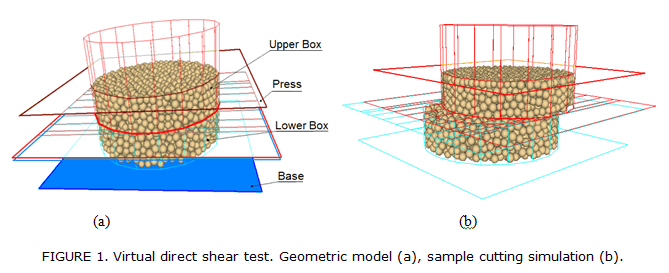
<body><![CDATA[<p class="MsoNormal" style="text-align: justify"><font face="Verdana, Arial, Helvetica, sans-serif" size="2">  <span lang="EN-US" style="font-size: 10.0pt">where:</span></font></p>    <blockquote>      <p class="MsoNormal" style="text-align: justify"><font face="Verdana, Arial, Helvetica, sans-serif" size="2"><i>  <span lang="EN-US" style="font-size: 10.0pt">i</span></i><span lang="EN-US" style="font-size: 10.0pt">  = right subscript representing normal and tangential direction;</span></font></p></blockquote>    <p class="MsoNormal" style="text-align: justify; text-indent: 31.5pt"><font face="Verdana, Arial, Helvetica, sans-serif" size="2"><i>  <span lang="EN-US" style="font-size: 10.0pt; font-family: Verdana">b </span></i>  <span lang="EN-US" style="font-size: 10.0pt">&nbsp;= coefficient of viscous damping;</span></font></p>    <p class="MsoNormal" style="text-align: justify; text-indent: 31.5pt">  <font face="Verdana, Arial, Helvetica, sans-serif" size="2"><i><span lang="EN-US" style="font-size: 10.0pt">m<sub>a</sub>,  m<sub>b</sub></span></i><span lang="EN-US" style="font-size: 10.0pt"> = mass of  the objects in contact [kg]. </span></font></p>    <p class="MsoNormal" style="text-align: justify"><font face="Verdana, Arial, Helvetica, sans-serif" size="2">  </font><font face="Verdana, Arial, Helvetica, sans-serif" size="2"><span lang="EN-US" style="font-size: 10.0pt">Finally,  the equations to calculate the model parameters of micro-friction </span></font>  <font face="Verdana, Arial, Helvetica, sans-serif" size="2"><span lang="EN-US" style="font-size: 10.0pt; font-family: Verdana">f<sub>m</sub></span><span lang="EN-US" style="font-size: 10.0pt">  and micro-cohesion <i>c</i><sub>&#61549;</sub> are obtained by modeling the soil  macro-</span><span lang="EN-GB" style="font-size: 10.0pt">behaviour during the  simulation of biaxial compression test and direct shear test.</span></font></p>    <p class="MsoNormal" style="text-align: justify"><font face="Verdana, Arial, Helvetica, sans-serif" size="2"><b><span lang="EN-GB" style="font-size: 10.0pt">Geometrical  model of virtual shear test </span></b></font></p>    <p class="MsoNormal" style="text-align: justify"><font face="Verdana, Arial, Helvetica, sans-serif" size="2"><span lang="EN-GB" style="font-size: 10.0pt">In  order to reproduce the direct shear test with a DEM model a virtual reproduction  of the direct shear test apparatus (<a href="/img/revistas/rcta/v22n3/f0102313.gif">Figure  1</a>) was made. A set of samples for the simulation were also generated by spherical  particles to test the micro-friction </span></font> <font face="Verdana, Arial, Helvetica, sans-serif" size="2"><span lang="EN-GB" style="font-size: 10.0pt; font-family: Verdana">f<sub>m</sub></span><span lang="EN-GB" style="font-size: 10.0pt">  effect over macro samples strength. The geometrical setup for the simulation (<a href="/img/revistas/rcta/v22n3/f0102313.gif">Figure  1a</a>) was divided in two main sections: upper and lower box; each one with a  cylindrical cavity at the centre.</span></font></p>    
<p class="MsoNormal" style="text-align: justify"><font face="Verdana, Arial, Helvetica, sans-serif" size="2"><span lang="EN-GB" style="font-size: 10.0pt">The  soil specimen is obtained by sequential steps, starting with spheres generated  inside the cylindrical cavity of the shear apparatus following a hexagonal compacted  spatial distribution. The centre of each particle is obtained by assigning an  independent position in the (<i>x, y, z</i>) axes for an initial number of 4,000  particles. Dimensions of the particles were calculated by random distribution  of the radii between 1.0 to 1.5 mm. In the next step the particles falling under  the action of the gravity force.    <br>     ]]></body>
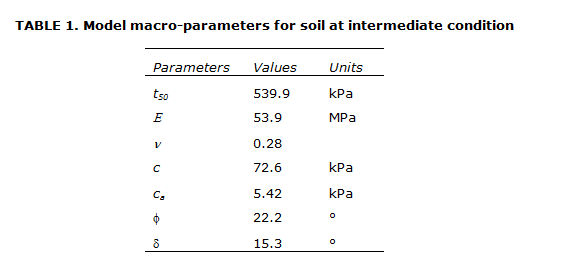
<body><![CDATA[<br> </span><span lang="en-us">The particles  number is fixed at 3,680 to obtain the desire height of the sample. The generated  soil sample has a cylindrical shape of 70 mm diameter by 60 mm height. From this  point, the geometrical model is ready for simulation of direct shear test. The  model macro-parameters (<a href="#t1">Table 1</a>) were calculated by means of  the regression equations defined by Lopez <i>et al.</i> (2012) at the soil intermediate  physical condition according to soil moisture w = 21.3% and dry bulk density&#61472;&#61554;d=  1.18 g/cm3.</span></font></p>    <p class="MsoNormal" align="center" style="text-align: center"><font face="Verdana, Arial, Helvetica, sans-serif" size="2"><a name="t1"></a>  <img border="0" src="/img/revistas/rcta/v22n3/t0102313.gif" width="574" height="263"></font></p>    
<p class="MsoNormal" style="text-align: justify"><font face="Verdana, Arial, Helvetica, sans-serif" size="2"><span lang="EN-GB" style="font-size: 10.0pt">During  the simulation the sample is cutting in the transversal direction as shown in  <a href="/img/revistas/rcta/v22n3/f0102313.gif">Figure 1b</a>.The shear operation  takes place moving the upper box over a length of 20 mm at a constant velocity  of 1.3 mm/s. The press surface ensures that shear take places at different normal  load.</span></font></p>    
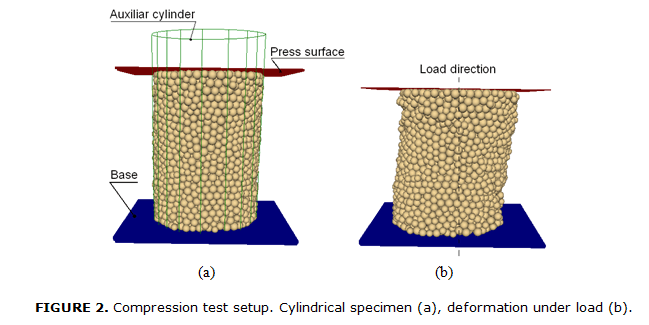
<p class="MsoNormal" style="text-align: justify"><font face="Verdana, Arial, Helvetica, sans-serif" size="2"><span lang="EN-GB" style="font-size: 10.0pt">The  relationship between micro and macro friction was obtained by changing the value  of the micro-friction angle in several tests computed with the same soil parameters  defined on the <a href="#t1">Table 1</a>. </span><span lang="EN-US" style="font-size: 10.0pt">Accordingly</span><span lang="EN-GB" style="font-size: 10.0pt">,  four values of </span></font> <font face="Verdana, Arial, Helvetica, sans-serif" size="2"><span lang="EN-GB" style="font-size: 10.0pt; font-family: Verdana">f<sub>m  </sub> </span><span lang="EN-GB" style="font-size: 10.0pt">were tested (2, 4.2,  6.4 and 8.6°), each one at a normal pressure of 30, 50, 70 and 90 kPa resulting  in a total of sixteen simulation tests. </span></font></p>    <p class="MsoNormal" style="text-align: justify"><font face="Verdana, Arial, Helvetica, sans-serif" size="2">  <b><span lang="EN-GB" style="font-size: 10.0pt">Geometrical model of biaxial compression  test</span></b></font></p>    <p class="MsoNormal" style="text-align: justify"><font face="Verdana, Arial, Helvetica, sans-serif" size="2">  <span lang="EN-GB" style="font-size: 10.0pt">Soil by nature is a frictional and  cohesive material; its strength is a result of both contributions. This behaviour  is introduced in the model by the micro-friction and micro-cohesion parameters  acting at the particle level.</span></font></p>    <p class="MsoNormal" style="text-align: justify"><font face="Verdana, Arial, Helvetica, sans-serif" size="2"><span lang="EN-GB" style="font-size: 10.0pt">By  means of the simulation of biaxial compression test the relationship between real  soil cohesion and micro-cohesion for the model is obtained. In order to find the  variation of soil cohesion the simulation is carried out in unconfined conditions,  which means without lateral pressure. </span></font></p>    <p class="MsoNormal" style="text-align: justify"><font face="Verdana, Arial, Helvetica, sans-serif" size="2"><span lang="EN-GB" style="font-size: 10.0pt">With  the compression-displacement curve resulting from the test, the cohesion calibration  procedure is made following the Mohr-Coulomb criterion of failure.</span></font></p>    <p class="MsoNormal" style="text-align: justify"><font face="Verdana, Arial, Helvetica, sans-serif" size="2">  <span lang="EN-GB" style="font-size: 10.0pt">The procedure to form the virtual  samples was the same as the one used for direct shear test, i.e. coordinates generation,  particles falling, compression, and decompression. An auxiliary cylinder of 50  mm diameter is used as a mould (<a href="/img/revistas/rcta/v22n3/f0202313.gif">Figure  2a</a>) for a virtual sample made by 5,500 spherical particles. Before running  the compression test the cylinder (mould) is removed from the installation and  a total of 5,350 particles form the final sample after the height is fixed. The  particles follow a random radius distribution between 1.5 to 2 mm, sized at 50  mm diameter by 100 mm height.</span></font></p>    
<p class="MsoNormal" style="text-align: justify"><font face="Verdana, Arial, Helvetica, sans-serif" size="2"><span lang="EN-GB" style="font-size: 10.0pt">Finally,  the geometrical model of the biaxial compression test is composed by the press  surface, the base, and the soil sample (<a href="/img/revistas/rcta/v22n3/f0202313.gif">Figure  2a</a>). In the experiment the press surface is moved at a constant velocity of  1 mm/min in a downward direction (<a href="/img/revistas/rcta/v22n3/f0202313.gif">Figure  2b</a>). The reaction forces are computed until the sample reaches a deformation  of 20% in vertical direction.</span></font></p>    
]]></body>
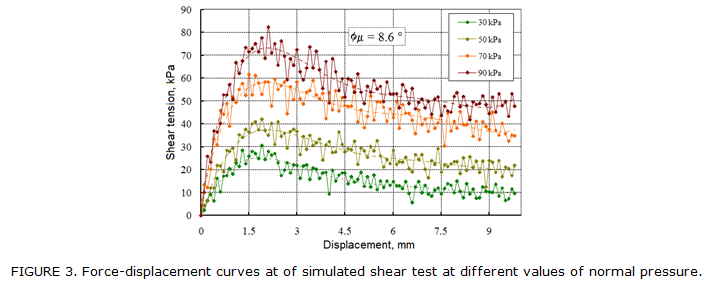
<body><![CDATA[<p class="MsoNormal" style="text-align: justify"><font face="Verdana, Arial, Helvetica, sans-serif" size="2">The  micro-macro relationship for the cohesion parameter is obtained by testing the  compression virtual model at three different values of micro-friction <i>c</i><sub>&#61549;</sub>=  40, 80 and 120 kPa; </font></p>    <p class="MsoNormal" style="text-align: justify"><font face="Verdana, Arial, Helvetica, sans-serif" size="2"><span lang="EN-GB" style="font-size: 10.0pt">To  analyse the effect of particle friction over micro-cohesion&nbsp; the&nbsp; biaxial  compression test was executed four&nbsp; times&nbsp; changing only&nbsp; the micro-friction  angle at </span></font> <font face="Verdana, Arial, Helvetica, sans-serif" size="2"><span lang="EN-GB" style="font-size: 10.0pt; font-family: Verdana">f<sub>m</sub>  </span><span lang="EN-GB" style="font-size: 10.0pt">= (2, 4.2, 6.4 and 8.6°) and  keeping constant the inter-particle cohesion. </span> </font></p>    <p class="MsoNormal" style="text-align: justify">&nbsp;</p>    <p class="MsoNormal" style="text-align: justify"><font face="Verdana, Arial, Helvetica, sans-serif" size="2"><b><span lang="EN-GB"><font size="3">RESULTS  AND DISCUSSION</font></span></b></font></p>    <p class="MsoNormal"><font face="Verdana, Arial, Helvetica, sans-serif" size="2"><b><span lang="EN-GB" style="font-size: 10.0pt">Macro  and micro-friction relationship</span></b></font></p>    <p class="MsoNormal"><font face="Verdana, Arial, Helvetica, sans-serif" size="2"><span lang="EN-GB" style="font-size: 10.0pt">The  shear strength at failure is selected as the maximum tension reached during the  test. After this point the sample strength decreases. When the normal pressure  increases, a new value of shear strength is attained; the results for each combination  are plotted in the shear-normal plane as shown in <a href="/img/revistas/rcta/v22n3/f0302313.gif">Figure  3</a>.</span></font></p>    
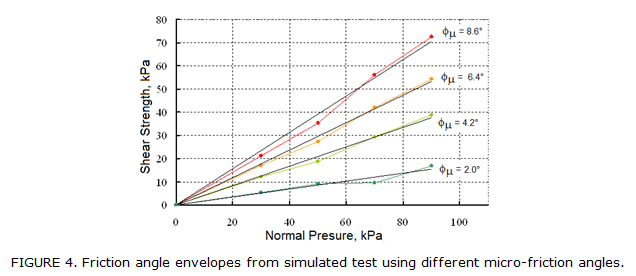
<p class="MsoNormal"><font face="Verdana, Arial, Helvetica, sans-serif" size="2"><span lang="EN-GB" style="font-size: 10.0pt; font-family: Verdana">Shear  strength at failure increases linearly with respect to normal pressure (<a href="/img/revistas/rcta/v22n3/f0402313.gif">Figure  4</a>), in agreement with the laboratory experiments. In addition, an increment  in the micro-friction parameter enhances the values of shear tension.</span></font></p>    
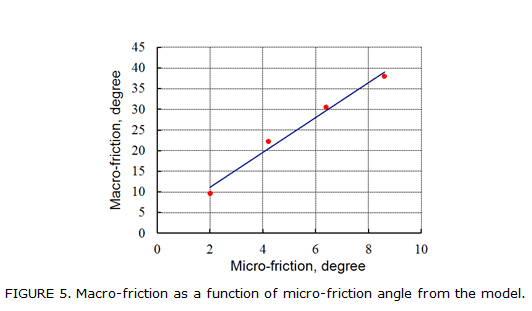
<p class="MsoNormal"><font face="Verdana, Arial, Helvetica, sans-serif" size="2"><span lang="EN-GB" style="font-size: 10.0pt">The  slope of the regression line of shear strengths gives the internal friction angle  of the material corresponding with the micro-friction tested in the model. The  relationship between macro and micro friction is obtained from the regression  line describing by the soil internal friction angle versus the micro-friction  parameter (<a href="#f5">Figure 5</a>).</span></font></p>    <p class="MsoNormal" style="text-align: justify">&nbsp;</p>    <p class="MsoNormal" align="center" style="text-align: center"><font face="Verdana, Arial, Helvetica, sans-serif" size="2"><a name="f5"></a><img border="0" src="/img/revistas/rcta/v22n3/f0502313.gif" width="532" height="311"></font></p>    
]]></body>
<body><![CDATA[<p class="MsoNormal" style="text-align: justify"><font face="Verdana, Arial, Helvetica, sans-serif" size="2">  </font></p>    <p class="MsoNormal" style="text-align: justify"><font face="Verdana, Arial, Helvetica, sans-serif" size="2">  <span lang="EN-GB" style="font-size: 10.0pt">The linear regression equation characterises  the particular condition tested, influenced mainly by the particles size distribution  and sample porosity. The equation to define the relationship between internal  friction</span><span lang="EN-GB" style="font-size: 10.0pt; font-family: Verdana">f</span><span lang="EN-GB" style="font-size: 10.0pt">  and micro-friction</span><span lang="EN-GB" style="font-size: 10.0pt; font-family: Verdana">f<sub>m</sub>  </span><span lang="EN-GB" style="font-size: 10.0pt">is written as:<a href="/img/revistas/rcta/v22n3/e0702313.gif">ecuacion  7</a>     
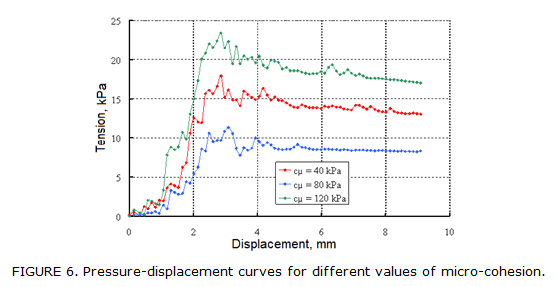
<br>     <br> By this equation the values of inter-particles friction </span></font>  <font face="Verdana, Arial, Helvetica, sans-serif" size="2"><span lang="EN-GB" style="font-size: 10.0pt; font-family: Verdana">f<sub>m</sub></span><span lang="EN-GB" style="font-size: 10.0pt">  in the DEM model can be calculated as a function of the real soil internal friction  angle </span></font> <font face="Verdana, Arial, Helvetica, sans-serif" size="2"><span lang="EN-GB" style="font-size: 10.0pt; font-family: Verdana">f.  </span></font></p>    <p class="MsoNormal" style="text-align: justify"> <font face="Verdana, Arial, Helvetica, sans-serif" size="2"><span lang="EN-GB" style="font-size: 10.0pt">The  model should be able to reproduce the soil shear strength according to the normal  pressure applied.</span></font></p>    <p class="MsoNormal" style="text-align: justify"><font face="Verdana, Arial, Helvetica, sans-serif" size="2"><span lang="en-gb">Macro  and micro cohesion relationship</span></font></p>    <p class="MsoNormal" style="text-align: justify"><font face="Verdana, Arial, Helvetica, sans-serif" size="2"><span lang="en-gb">Shear  strength at failure is localized in the compression-displacement curve as the  maximum value achieved during the test. Particle accommodation takes place at  the start of the test without substantial increases in forces (<a href="#f6">Figure  6</a>). After the first millimetre of deformation the sample strength increases  until reaches the maximum value. After this point the tension gradually decreases.  These results are in agree with those obtained in clay soils by experimental mechanical  tests (Herrera <i>et al., </i>2008; Gonzalez, 2011).</span></font></p>    <p class="MsoNormal" style="text-align: justify">&nbsp;</p>    <p class="MsoNormal" align="center"><font face="Verdana, Arial, Helvetica, sans-serif" size="2"><span lang="en-gb">  <span lang="en-gb"><span lang="en-gb"><span lang="en-gb"><span lang="en-gb"><span lang="en-gb"><span lang="en-gb"><span lang="en-gb"><a name="f6"></a></span></span></span></span><img border="0" src="/img/revistas/rcta/v22n3/f0602313.gif" width="558" height="287"></span></span></span>    
<br>  &nbsp;</span></font></p>    ]]></body>
<body><![CDATA[<p class="MsoNormal"><font face="Verdana, Arial, Helvetica, sans-serif" size="2"><span lang="en-gb">The  relationship between micro and macro cohesion for different incremental values  of internal friction is shown in <a href="/img/revistas/rcta/v22n3/f0702313.gif">Figure  7</a>.</span></font></p>    
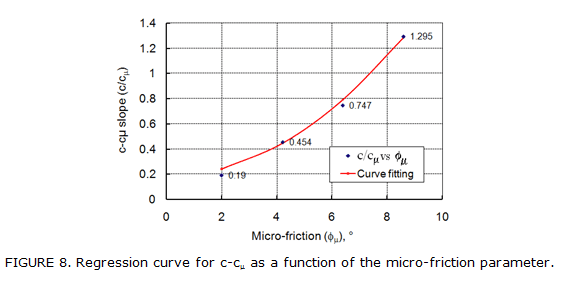
<p class="MsoNormal"><font face="Verdana, Arial, Helvetica, sans-serif" size="2"><span lang="en-gb">Increasing  soil micro-cohesion results in a linear increment of soil cohesion determined  by the slope in the regression equation obtained for each value of micro-friction  under test. In order to find an equation to involve both parameters of soil strength,  the slope of c-c<sub>&#956;</sub> versus the corresponding values of micro-friction  are plotted.</span></font></p>    <p class="MsoNormal"><font face="Verdana, Arial, Helvetica, sans-serif" size="2"><span lang="en-gb">As  shown in <a href="#f8">Figure 8</a>, non-linear behaviour distinguishes this relationship.  As the slope of c-c increases, the micro-friction angle increases too. The regression  equation is written as:</span></font></p>    <p class="MsoNormal" style="text-align: center"><font face="Verdana, Arial, Helvetica, sans-serif" size="2"><img border="0" src="/img/revistas/rcta/v22n3/f0802313.gif" width="566" height="283"><a name="f8"></a></font></p>    
<p class="MsoNormal" style="text-align: justify"><font face="Verdana, Arial, Helvetica, sans-serif" size="2">  <span lang="EN-GB" style="font-size: 10.0pt">As shown in <a href="#f8">Figure  8</a>, non-linear behaviour distinguishes this relationship. As the slope of&nbsp;&nbsp;  c-c<sub>&#61549;&#61472; </sub>increases, the micro-friction angle increases too.  The regression equation is written as: <a href="/img/revistas/rcta/v22n3/e0802313.gif">equation  8 </a></span></font></p><span lang="EN-GB" style="font-size: 10.0pt">     
<p class="MsoNormal" style="text-align: justify"><font face="Verdana, Arial, Helvetica, sans-serif" size="2">  <span lang="EN-GB" style="font-size: 10.0pt">where:</span></font></p>    <p class="MsoNormal" style="text-align: justify; text-indent: 31.5pt">  <font face="Verdana, Arial, Helvetica, sans-serif" size="2"><span lang="EN-GB" style="font-size: 10.0pt; font-family: Verdana">f<sub>m</sub>  </span><span lang="EN-GB" style="font-size: 10.0pt">= micro-friction [°]:</span></font></p>    <p class="MsoNormal" style="text-align: justify; text-indent: 31.5pt">  <font face="Verdana, Arial, Helvetica, sans-serif" size="2"><span lang="EN-GB" style="font-size: 10.0pt">a  =&nbsp; 0.15;</span></font></p>    <p class="MsoNormal" style="text-align: justify; text-indent: 31.5pt">  <font face="Verdana, Arial, Helvetica, sans-serif" size="2"><span lang="EN-GB" style="font-size: 10.0pt">b  = &nbsp;0.18[ ].</span></font></p>    <p class="MsoNormal" style="text-align: justify"><font face="Verdana, Arial, Helvetica, sans-serif" size="2"><span lang="en-gb">As  shown in the <a href="/img/revistas/rcta/v22n3/e0802313.gif">equation 8</a>,  the magnitude of macro-cohesion resulting from the model increases proportionally  with the increment of inter-particles cohesion and friction angle, a quadratic  relationship was also found to respect of micro-friction angle &#61542;&#61549;.  This results agree with those obtained by Delenne (2004) in a study of the influence  of the friction parameter in a cohesive bonds.</span></font></p>    
]]></body>
<body><![CDATA[<p class="MsoNormal" style="text-align: justify">&nbsp;</p>    <p class="MsoNormal" style="text-align: justify"><font face="Verdana, Arial, Helvetica, sans-serif" size="2"><span lang="en-gb"><b><font size="3">CONCLUSIONS</font></b></span></font></p>    <p class="MsoNormal" style="text-align: justify"><font face="Verdana, Arial, Helvetica, sans-serif" size="2"><span lang="en-gb">  To calculate the mechanical response of a cohesive soil at particle level in the  DEM model the system forcescan be formed by normal force, shear force, friction  force, cohesion force and gravity force. Shear force at failure is defined by  the Mohr-Coulomb criterion.</span></font></p>    <p class="MsoNormal" style="text-align: justify"><font face="Verdana, Arial, Helvetica, sans-serif" size="2"><span lang="en-gb">Using  the geometrical elements from DEMeter++ software a virtual reproduction of the  direct shear test and compression was made. The strength obtained in the virtual  soil samples during the simulation are used to find the relationship between micro  and macro parameters.</span></font></p>    <p class="MsoNormal" style="text-align: justify"><font face="Verdana, Arial, Helvetica, sans-serif" size="2"><span lang="en-gb">The  shear strength at failure during the simulation of shear test was found to increases  linearly with respect to the normal pressure. The same behaviour is shown as the  micro-friction parameter increase. A linear regression equation characterises  the relationship between micro-friction and macro-friction, influenced by factors  associated to particles size distribution and sample porosity.</span></font></p>    <p class="MsoNormal" style="text-align: justify"><font face="Verdana, Arial, Helvetica, sans-serif" size="2"><span lang="en-gb">Alinear  increment in soil macro-cohesion was the result of increases micro-cohesion parameter  in the model. However a quadratic behaviour was found as the micro-friction increase.</span></font></p>    <p class="MsoNormal" style="text-align: justify"><font face="Verdana, Arial, Helvetica, sans-serif" size="2"><span lang="en-gb">The  statistical equations obtained through the simulation allow calculating the micro  values for the DEM model started from the macro-parameters of the soil valid for  soil models with the same configuration of particle arrangement and force system.</span></font></p>    <p class="MsoNormal" style="text-align: justify">&nbsp;</p>    <p class="MsoNormal" style="text-align: justify">&nbsp;</p>    <p class="MsoNormal" style="text-align: justify"><font face="Verdana, Arial, Helvetica, sans-serif" size="2"><span lang="en-gb"><b><font size="3">REFERENCES</font></b></span></font></p>    ]]></body>
<body><![CDATA[<p class="MsoNormal" style="text-align: justify"><font face="Verdana, Arial, Helvetica, sans-serif" size="2"><span lang="en-gb">  1. ASAF, Z.; D. RUBINSTEIN y I. SHMULEVICH: &quot;Determination of discrete element  model parameters required for soil tillage&quot;, Soil and Tillage Research, 92(1-2):  227-242, 2007.</span></font></p>    <p class="MsoNormal" style="text-align: justify"><font face="Verdana, Arial, Helvetica, sans-serif" size="2"><span lang="en-gb">2.  CUNDALL, P. A.: &quot;A computer model for simulating progressive, large-scale  movements in blocky rock systems &quot;, Pro. Symp. Int. Soc. Rock Mech, Nancy  2(8): 1971.</span></font></p>    <!-- ref --><p class="MsoNormal" style="text-align: justify"><font face="Verdana, Arial, Helvetica, sans-serif" size="2"><span lang="en-gb">3.  FENG, C.; E. C. DRUMM y G. GUIOCHON: &quot;Prediction/Verification of Particle  Motion in One Dimension with the Discrete-Element Method&quot;, International  Journal of Geomechanics, 7(5): 344-352, 2007.    </span></font></p>    <!-- ref --><p class="MsoNormal" style="text-align: justify"><font face="Verdana, Arial, Helvetica, sans-serif" size="2"><span lang="en-gb">4.  GONZÁLEZ, O.: Modelación de la Compactación Provocada por el Tráfico de Neumáticos  de los Vehículos Agrícolas en Suelos en Condiciones de Laboratorio, 209pp., Tesis  (en opción al grado científico de Doctor en Ciencias Técnicas Agropecuarias),  Universidad Agraria de La Habana, La Habana, Cuba, 2011.    </span></font></p>    <!-- ref --><p class="MsoNormal" style="text-align: justify"><font face="Verdana, Arial, Helvetica, sans-serif" size="2"><span lang="en-gb">5.  HENTZ, S. B.; L. DAUDEVILLE y F. D. R. V. DONZE: &quot;Identification and Validation  of a Discrete Element Model for Concrete&quot;, Journal of Engineering Mechanics,  130(6): 709-719, 2004.    </span></font></p>    <!-- ref --><p class="MsoNormal" style="text-align: justify"><font face="Verdana, Arial, Helvetica, sans-serif" size="2"><span lang="en-gb">6.  HERRERA, M.; C. E. IGLESIAS; O. GONZÁLEZ; E. LÓPEZ y A. L. SÁNCHEZ: &quot;Simulación  mediante el Método de Elementos Finitos de la respuesta mecánica de un Oxisol&quot;,  Revista Ciencias Técnicas Agropecuarias, 16(4): 55-61, 2008.    </span></font></p>    ]]></body>
<body><![CDATA[<!-- ref --><p class="MsoNormal" style="text-align: justify"><font face="Verdana, Arial, Helvetica, sans-serif" size="2"><span lang="en-gb">7.  JEAN-YVES DELENNE, M. S. E. Y. F. C. J. C. B.: &quot;Mechanical behaviour and  failure of cohesive granular materials&quot;, <i>International Journal for Numerical  and Analytical Methods in Geomechanics</i>, 28(15): 1577-1594, 2004.    </span></font></p>    <!-- ref --><p class="MsoNormal" style="text-align: justify"><font face="Verdana, Arial, Helvetica, sans-serif" size="2"><span lang="en-gb">8.  LIAO, C. L.; T. P. CHANG; D. H. YOUNG y C. S. CHANG: &quot;Stress-strain relationship  for granular materials based on the hypothesis of best fit&quot;, International  Journal of Solids and Structures, 34(31-32): 4087-4100, 1997.    </span></font></p>    <!-- ref --><p class="MsoNormal" style="text-align: justify"><font face="Verdana, Arial, Helvetica, sans-serif" size="2"><span lang="en-gb">9.  LÓPEZ, E.; M. HERRERA; O. GONZALEZ; E. TIJSKENS y H. RAMON: &quot;Determination  of basics mechanical properties in a tropical clay soil as a function of dry bulk  density and moisture&quot;, Technic Sciences in Agriculture, 21(3): 12-16, 2012.    </span></font></p>    <!-- ref --><p class="MsoNormal" style="text-align: justify"><font face="Verdana, Arial, Helvetica, sans-serif" size="2"><span lang="en-gb">10.  SHMULEVICH, I.: &quot;State of the art modeling of soil-tillage interaction using  discrete element method&quot;, Soil and Tillage Research, 111(1): 41-53, 2010.    </span></font></p>    <!-- ref --><p class="MsoNormal" style="text-align: justify"><font face="Verdana, Arial, Helvetica, sans-serif" size="2"><span lang="en-gb">11.  TIJSKENS, E.; H. RAMON y J. D. BAERDEMAEKER: &quot;Discrete element modelling  for process simulation in agriculture&quot;, Journal of Sound and Vibration, 266  493-514, 2003.    </span></font></p>    ]]></body>
<body><![CDATA[<p class="MsoNormal" style="text-align: justify">&nbsp;</p>    <p class="MsoNormal" style="text-align: justify">&nbsp;</p>    <p class="MsoNormal" style="text-align: justify"><font face="Verdana, Arial, Helvetica, sans-serif" size="2"><span lang="en-gb"><b>Recibido:</b>  10 de septiembre 2012.    <br> <b>Aprobado:</b> 14 de junio de 2013</span></font></p>    <p class="MsoNormal" style="text-align: justify">&nbsp;</p>    <p class="MsoNormal" style="text-align: justify">&nbsp;</p>    <p class="MsoNormal" style="text-align: justify"><font face="Verdana, Arial, Helvetica, sans-serif" size="2"><span lang="en-gb"><i>Elvis  López Bravo, </i>Universidad Central de Las Villas, Dpto. Ing. Agrícola, Villa  Clara, Cuba, CP 54830, Correo electrónico; <a href="mailto:elvislb@uclv.edu.cu">elvislb@uclv.edu.cu</a></span></font></p></span>       ]]></body><back>
<ref-list>
<ref id="B1">
<label>1.</label><nlm-citation citation-type="journal">
<person-group person-group-type="author">
<name>
<surname><![CDATA[ASAF]]></surname>
<given-names><![CDATA[Z.]]></given-names>
</name>
<name>
<surname><![CDATA[RUBINSTEIN]]></surname>
<given-names><![CDATA[D.]]></given-names>
</name>
<name>
<surname><![CDATA[SHMULEVICH]]></surname>
<given-names><![CDATA[I.]]></given-names>
</name>
</person-group>
<article-title xml:lang="en"><![CDATA[Determination of discrete element model parameters required for soil tillage]]></article-title>
<source><![CDATA[Soil and Tillage Research]]></source>
<year>2007</year>
<volume>92</volume>
<numero>1-2</numero>
<issue>1-2</issue>
<page-range>227-242</page-range></nlm-citation>
</ref>
<ref id="B2">
<label>2.</label><nlm-citation citation-type="journal">
<person-group person-group-type="author">
<name>
<surname><![CDATA[CUNDALL]]></surname>
<given-names><![CDATA[P. A.]]></given-names>
</name>
</person-group>
<article-title xml:lang="en"><![CDATA[A computer model for simulating progressive, large-scale movements in blocky rock systems]]></article-title>
<source><![CDATA[Proc. Symp. Int. Soc. Rock Mech, Nancy]]></source>
<year>1971</year>
<volume>2</volume>
<numero>8</numero>
<issue>8</issue>
</nlm-citation>
</ref>
<ref id="B3">
<label>3.</label><nlm-citation citation-type="journal">
<person-group person-group-type="author">
<name>
<surname><![CDATA[FENG]]></surname>
<given-names><![CDATA[C.]]></given-names>
</name>
<name>
<surname><![CDATA[DRUMM]]></surname>
<given-names><![CDATA[E. C.]]></given-names>
</name>
<name>
<surname><![CDATA[GUIOCHON]]></surname>
<given-names><![CDATA[G.]]></given-names>
</name>
</person-group>
<article-title xml:lang="en"><![CDATA[Prediction/Verification of Particle Motion in One Dimension with the Discrete-Element Method]]></article-title>
<source><![CDATA[International Journal of Geomechanics]]></source>
<year>2007</year>
<volume>7</volume>
<numero>5</numero>
<issue>5</issue>
<page-range>344-352</page-range></nlm-citation>
</ref>
<ref id="B4">
<label>4.</label><nlm-citation citation-type="book">
<person-group person-group-type="author">
<name>
<surname><![CDATA[GONZÁLEZ]]></surname>
<given-names><![CDATA[O.]]></given-names>
</name>
</person-group>
<source><![CDATA[Modelación de la Compactación Provocada por el Tráfico de Neumáticos de los Vehículos Agrícolas en Suelos en Condiciones de Laboratorio]]></source>
<year>2011</year>
<publisher-loc><![CDATA[La Habana ]]></publisher-loc>
<publisher-name><![CDATA[Universidad Agraria de La Habana]]></publisher-name>
</nlm-citation>
</ref>
<ref id="B5">
<label>5.</label><nlm-citation citation-type="journal">
<person-group person-group-type="author">
<name>
<surname><![CDATA[HENTZ]]></surname>
<given-names><![CDATA[S. B.]]></given-names>
</name>
<name>
<surname><![CDATA[DAUDEVILLE]]></surname>
<given-names><![CDATA[L.]]></given-names>
</name>
<name>
<surname><![CDATA[DONZE]]></surname>
<given-names><![CDATA[F. D. R. V.]]></given-names>
</name>
</person-group>
<article-title xml:lang="en"><![CDATA[Identification and Validation of a Discrete Element Model for Concrete]]></article-title>
<source><![CDATA[Journal of Engineering Mechanics]]></source>
<year>2004</year>
<volume>130</volume>
<numero>6</numero>
<issue>6</issue>
<page-range>709-719</page-range></nlm-citation>
</ref>
<ref id="B6">
<label>6.</label><nlm-citation citation-type="journal">
<person-group person-group-type="author">
<name>
<surname><![CDATA[HERRERA]]></surname>
<given-names><![CDATA[M.]]></given-names>
</name>
<name>
<surname><![CDATA[IGLESIAS]]></surname>
<given-names><![CDATA[C. E.]]></given-names>
</name>
<name>
<surname><![CDATA[GONZÁLEZ]]></surname>
<given-names><![CDATA[O.]]></given-names>
</name>
<name>
<surname><![CDATA[LÓPEZ]]></surname>
<given-names><![CDATA[E.]]></given-names>
</name>
<name>
<surname><![CDATA[SÁNCHEZ]]></surname>
<given-names><![CDATA[A. L.]]></given-names>
</name>
</person-group>
<article-title xml:lang="es"><![CDATA[Simulación mediante el Método de Elementos Finitos de la respuesta mecánica de un Oxisol]]></article-title>
<source><![CDATA[Revista Ciencias Técnicas Agropecuarias]]></source>
<year>2008</year>
<volume>16</volume>
<numero>4</numero>
<issue>4</issue>
<page-range>55-61</page-range></nlm-citation>
</ref>
<ref id="B7">
<label>7.</label><nlm-citation citation-type="journal">
<person-group person-group-type="author">
<name>
<surname><![CDATA[JEAN-YVES DELENNE]]></surname>
<given-names><![CDATA[M. S. E. Y. F. C. J. C. B.]]></given-names>
</name>
</person-group>
<article-title xml:lang="en"><![CDATA[Mechanical behaviour and failure of cohesive granular materials]]></article-title>
<source><![CDATA[International Journal for Numerical and Analytical Methods in Geomechanics]]></source>
<year>2004</year>
<volume>28</volume>
<numero>15</numero>
<issue>15</issue>
<page-range>1577-1594</page-range></nlm-citation>
</ref>
<ref id="B8">
<label>8.</label><nlm-citation citation-type="journal">
<person-group person-group-type="author">
<name>
<surname><![CDATA[LIAO]]></surname>
<given-names><![CDATA[C. L.]]></given-names>
</name>
<name>
<surname><![CDATA[CHANG]]></surname>
<given-names><![CDATA[T. P.]]></given-names>
</name>
<name>
<surname><![CDATA[YOUNG]]></surname>
<given-names><![CDATA[D. H.]]></given-names>
</name>
<name>
<surname><![CDATA[CHANG]]></surname>
<given-names><![CDATA[C. S.]]></given-names>
</name>
</person-group>
<article-title xml:lang="en"><![CDATA[Stress-strain relationship for granular materials based on the hypothesis of best fit]]></article-title>
<source><![CDATA[International Journal of Solids and Structures]]></source>
<year>1997</year>
<volume>34</volume>
<numero>31-32</numero>
<issue>31-32</issue>
<page-range>4087-4100</page-range></nlm-citation>
</ref>
<ref id="B9">
<label>9.</label><nlm-citation citation-type="journal">
<person-group person-group-type="author">
<name>
<surname><![CDATA[LÓPEZ]]></surname>
<given-names><![CDATA[E.]]></given-names>
</name>
<name>
<surname><![CDATA[HERRERA]]></surname>
<given-names><![CDATA[M.]]></given-names>
</name>
<name>
<surname><![CDATA[GONZALEZ]]></surname>
<given-names><![CDATA[O.]]></given-names>
</name>
<name>
<surname><![CDATA[TIJSKENS]]></surname>
<given-names><![CDATA[E.]]></given-names>
</name>
<name>
<surname><![CDATA[RAMON]]></surname>
<given-names><![CDATA[H.]]></given-names>
</name>
</person-group>
<article-title xml:lang="en"><![CDATA[Determination of basics mechanical properties in a tropical clay soil as a function of dry bulk density and moisture]]></article-title>
<source><![CDATA[Technic Sciences in Agriculture]]></source>
<year>2012</year>
<volume>21</volume>
<numero>3</numero>
<issue>3</issue>
<page-range>12-16</page-range></nlm-citation>
</ref>
<ref id="B10">
<label>10.</label><nlm-citation citation-type="journal">
<person-group person-group-type="author">
<name>
<surname><![CDATA[SHMULEVICH]]></surname>
<given-names><![CDATA[I.]]></given-names>
</name>
</person-group>
<article-title xml:lang="en"><![CDATA[State of the art modeling of soil-tillage interaction using discrete element method]]></article-title>
<source><![CDATA[Soil and Tillage Research]]></source>
<year>2010</year>
<volume>111</volume>
<numero>1</numero>
<issue>1</issue>
<page-range>41-53</page-range></nlm-citation>
</ref>
<ref id="B11">
<label>11.</label><nlm-citation citation-type="journal">
<person-group person-group-type="author">
<name>
<surname><![CDATA[TIJSKENS]]></surname>
<given-names><![CDATA[E.]]></given-names>
</name>
<name>
<surname><![CDATA[RAMON]]></surname>
<given-names><![CDATA[H.]]></given-names>
</name>
<name>
<surname><![CDATA[BAERDEMAEKER]]></surname>
<given-names><![CDATA[J. D.]]></given-names>
</name>
</person-group>
<article-title xml:lang="en"><![CDATA[Discrete element modelling for process simulation in agriculture]]></article-title>
<source><![CDATA[Journal of Sound and Vibration]]></source>
<year>2003</year>
<volume>266</volume>
<page-range>493-514</page-range></nlm-citation>
</ref>
</ref-list>
</back>
</article>