<?xml version="1.0" encoding="ISO-8859-1"?><article xmlns:mml="http://www.w3.org/1998/Math/MathML" xmlns:xlink="http://www.w3.org/1999/xlink" xmlns:xsi="http://www.w3.org/2001/XMLSchema-instance">
<front>
<journal-meta>
<journal-id>2071-0054</journal-id>
<journal-title><![CDATA[Revista Ciencias Técnicas Agropecuarias]]></journal-title>
<abbrev-journal-title><![CDATA[Rev Cie Téc Agr]]></abbrev-journal-title>
<issn>2071-0054</issn>
<publisher>
<publisher-name><![CDATA[Universidad Agraria de La Habana]]></publisher-name>
</publisher>
</journal-meta>
<article-meta>
<article-id>S2071-00542014000200009</article-id>
<title-group>
<article-title xml:lang="en"><![CDATA[Performance of a UASB reactor treating coffee wet wastewater]]></article-title>
<article-title xml:lang="es"><![CDATA[Digestión anaerobia, aguas residuales de café, reactor UASB]]></article-title>
</title-group>
<contrib-group>
<contrib contrib-type="author">
<name>
<surname><![CDATA[Guardia Puebla]]></surname>
<given-names><![CDATA[Yans]]></given-names>
</name>
<xref ref-type="aff" rid="A01"/>
</contrib>
<contrib contrib-type="author">
<name>
<surname><![CDATA[Rodríguez Pérez]]></surname>
<given-names><![CDATA[Suyén]]></given-names>
</name>
<xref ref-type="aff" rid="A02"/>
</contrib>
<contrib contrib-type="author">
<name>
<surname><![CDATA[Jiménez Hernández]]></surname>
<given-names><![CDATA[Janet]]></given-names>
</name>
<xref ref-type="aff" rid="A03"/>
</contrib>
<contrib contrib-type="author">
<name>
<surname><![CDATA[Sánchez Girón]]></surname>
<given-names><![CDATA[Víctor]]></given-names>
</name>
<xref ref-type="aff" rid="A04"/>
</contrib>
</contrib-group>
<aff id="A01">
<institution><![CDATA[,Universidad de Granma (UDG) Departamento de Ciencias Técnicas ]]></institution>
<addr-line><![CDATA[Bayamo ]]></addr-line>
<country>Cuba</country>
</aff>
<aff id="A02">
<institution><![CDATA[,Universidad de Oriente (UO) Centro de Estudios de Biotecnología Industrial (CEBI) ]]></institution>
<addr-line><![CDATA[Santiago de Cuba ]]></addr-line>
<country>Cuba</country>
</aff>
<aff id="A03">
<institution><![CDATA[,Universidad de Sancti Spíritus Centro de Estudios de Energía y Procesos Industriales ]]></institution>
<addr-line><![CDATA[Sancti Spíritus ]]></addr-line>
<country>Cuba</country>
</aff>
<aff id="A04">
<institution><![CDATA[,Universidad Politécnica de Madrid (UPM) Escuela Técnica Superior de Ingenieros Agrónomos (ETSIA) ]]></institution>
<addr-line><![CDATA[Madrid ]]></addr-line>
<country>España</country>
</aff>
<pub-date pub-type="pub">
<day>00</day>
<month>06</month>
<year>2014</year>
</pub-date>
<pub-date pub-type="epub">
<day>00</day>
<month>06</month>
<year>2014</year>
</pub-date>
<volume>23</volume>
<numero>2</numero>
<fpage>50</fpage>
<lpage>56</lpage>
<copyright-statement/>
<copyright-year/>
<self-uri xlink:href="http://scielo.sld.cu/scielo.php?script=sci_arttext&amp;pid=S2071-00542014000200009&amp;lng=en&amp;nrm=iso"></self-uri><self-uri xlink:href="http://scielo.sld.cu/scielo.php?script=sci_abstract&amp;pid=S2071-00542014000200009&amp;lng=en&amp;nrm=iso"></self-uri><self-uri xlink:href="http://scielo.sld.cu/scielo.php?script=sci_pdf&amp;pid=S2071-00542014000200009&amp;lng=en&amp;nrm=iso"></self-uri><abstract abstract-type="short" xml:lang="en"><p><![CDATA[The present work shows the results obtained in the anaerobic digestion process of coffee wet wastewater processing. An UASB anaerobic reactor was operated in single-stage in mesophilic temperature controlled conditions (37±1ºC). The effect of both organic loading rate (OLR) and hydraulic retention time (HRT) in the anaerobic digestion of coffee wet wastewater was investigated. The OLR values considered in the single-stage UASB reactor varied in a range of 3,6-4,1 kgCOD m-3 d-1 and the HRT stayed in a range of 21,5-15,5 hours. The evaluation results show that the best performance of UASB reactor in single-stage was obtained at OLR of 3,6 kg COD m-3 d-1 with an average value of total and soluble COD removal of 77,2% and 83,4%, respectively, and average methane concentration in biogas of 61%. The present study suggests that the anaerobic digestion is suitable to treating coffee wet wastewater.]]></p></abstract>
<abstract abstract-type="short" xml:lang="es"><p><![CDATA[El siguiente trabajo muestra los resultados alcanzados en el proceso de digestión anaerobia de las aguas residuales del beneficiado húmedo de café. Un reactor anaerobio UASB fue operado en una etapa en condiciones controladas de temperatura mesofílica (37±1ºC). Se investigó el efecto de la carga orgánica volumétrica (COV) y el tiempo de retención hidráulico (TRH) sobre el proceso de digestión anaerobia de las aguas residuales del beneficiado húmedo de café. Los valores de COV considerados en el sistema UASB en una etapa variaron en un intervalo de 3,6-4,1 kgCOD m-3 d-1 y los de TRH estuvieron en un intervalo de 21,1-15,5 horas. Los resultados de la valuación mostraron que el mejor funcionamiento fue alcanzado a una COV de 3,6 kg COD m-3 d-1 con un valor promedio de eficiencia de eliminación de DQO total y soluble de 77,2% and 83,4%, respectivamente, y un concentración de metano en el biogás de 61%. El actual estudio demuestra que la digestión anaerobia es adecuada para tratar las aguas residuales del beneficiado húmedo de café.]]></p></abstract>
<kwd-group>
<kwd lng="en"><![CDATA[residual treatment of water]]></kwd>
<kwd lng="en"><![CDATA[anaerobic reactor]]></kwd>
<kwd lng="es"><![CDATA[tratamiento de aguas residuales]]></kwd>
<kwd lng="es"><![CDATA[reactor anaeróbico]]></kwd>
</kwd-group>
</article-meta>
</front><body><![CDATA[ <div align="right">       <p><font face="Verdana, Arial, Helvetica, sans-serif" size="2"><B>ART&Iacute;CULO      ORIGINAL </B></font></p>       <p>&nbsp;</p> </div> <B>     <P>      <P>      <P><font face="Verdana, Arial, Helvetica, sans-serif" size="4">Performance of a UASB reactor treating coffee wet wastewater </font>     <P>&nbsp;      <P>      <P><font face="Verdana, Arial, Helvetica, sans-serif" size="3">Digestión anaerobia, aguas residuales de café,  reactor UASB </font>      <P>&nbsp;     ]]></body>
<body><![CDATA[<P>&nbsp; </B>     <P>      <P>      <P><b><font face="Verdana, Arial, Helvetica, sans-serif" size="2">Dr.C. Yans Guardia    Puebla<sup>I</sup>, Dr.C. Suyén Rodríguez Pérez<sup>II</sup>, M.Sc. Janet Jiménez    Hernández<sup>III</sup>, Dr. Víctor Sánchez Girón<sup>IV</sup> </font></b>      <P><font face="Verdana, Arial, Helvetica, sans-serif" size="2"><sup>I</sup> Universidad    de Granma (UDG), Departamento de Ciencias Técnicas, Bayamo, Cuba.    <br>   </font><font face="Verdana, Arial, Helvetica, sans-serif" size="2"><sup>II</sup>    Universidad de Oriente (UO), Centro de Estudios de Biotecnología Industrial    (CEBI), Santiago de Cuba, Cuba.    <br>   <sup>III</sup> Universidad de Sancti Spíritus, Centro de Estudios de Energía    y Procesos Industriales, Sancti Spíritus, Cuba.     <br>   <sup>IV</sup> Universidad Politécnica de Madrid (UPM), Escuela Técnica Superior    de Ingenieros Agrónomos (ETSIA), Madrid, España. </font>      <P>&nbsp;     <P>&nbsp; <hr>     ]]></body>
<body><![CDATA[<P>      <P>      <P> <font face="Verdana, Arial, Helvetica, sans-serif" size="2"><B>ABSTRACT </B></font>      <p><font face="Verdana, Arial, Helvetica, sans-serif" size="2">The present work shows the results obtained in the anaerobic digestion process of coffee wet wastewater processing. An UASB anaerobic reactor was operated in single-stage in mesophilic temperature controlled conditions  (37±1ºC). The effect of both organic loading rate  (OLR) and hydraulic retention time  (HRT) in the anaerobic digestion of coffee wet wastewater was investigated. The OLR values considered in the single-stage UASB reactor varied in a range of 3,6-4,1 kgCOD m-3 d-1 and the HRT stayed in a range of 21,5-15,5 hours. The evaluation results show that the best performance of UASB reactor in single-stage was obtained at OLR of 3,6 kg COD m-3 d-1 with an average value of total and soluble COD removal of 77,2% and 83,4%, respectively, and average methane concentration in biogas of 61%. The present study suggests that the anaerobic digestion is suitable to treating coffee wet wastewater. </font></p>     <p><font face="Verdana, Arial, Helvetica, sans-serif" size="2"><b>Key words:</b>    residual treatment of water, anaerobic reactor. </font></p> <hr>      <P> <font face="Verdana, Arial, Helvetica, sans-serif" size="2"><B>RESUMEN </B></font>      <P><font face="Verdana, Arial, Helvetica, sans-serif" size="2">El siguiente trabajo muestra los resultados alcanzados en el proceso de digestión anaerobia de las aguas residuales del beneficiado húmedo de café. Un reactor anaerobio UASB fue operado en una etapa en condiciones controladas de temperatura mesofílica  (37±1ºC). Se investigó el efecto de la carga orgánica volumétrica  (COV) y el tiempo de retención hidráulico  (TRH) sobre el proceso de digestión anaerobia de las aguas residuales del beneficiado húmedo de café. Los valores de COV considerados en el sistema UASB en una etapa variaron en un intervalo de 3,6-4,1 kgCOD m-3 d-1 y los de TRH estuvieron en un intervalo de 21,1-15,5 horas. Los resultados de la valuación mostraron que el mejor funcionamiento fue alcanzado a una COV de 3,6 kg COD m-3 d-1 con un valor promedio de eficiencia de eliminación de DQO total y soluble de 77,2% and 83,4%, respectivamente, y un concentración de metano en el biogás de 61%. El actual estudio demuestra que la digestión anaerobia es adecuada para tratar las aguas residuales del beneficiado húmedo de café. </font>      <p><font face="Verdana, Arial, Helvetica, sans-serif" size="2"> <b>Palabras clave:</b>    tratamiento de aguas residuales, reactor anaeróbico.</font> </p> <hr>      <P>      <P>&nbsp;     ]]></body>
<body><![CDATA[<P>&nbsp;     <P><font face="Verdana, Arial, Helvetica, sans-serif" size="3"><B>INTRODUCTION</B>    </font>      <P><font face="Verdana, Arial, Helvetica, sans-serif" size="2">World coffee production    reached the Figure of 7 900 000 tons in 2010 and it is major economic activity    in several tropical countries. The coffee bean, which is the portion of the    cherry useful for human consumption, represents 20% of the total volume of the    cherry. The bean extraction process is called in Latin America “Beneficio”,    and generates waste accounting for 80% of total raw volume processed (Orozco    et al., 2005). There are two types of processing: dry and wet. Wet processing    is the most widely used treatment method in coffee producing countries. The    method emerged as an alternative to solve the problem of rapid and excessive    fermentation of the cherries in tropical regions. After the harvest, the external    components of the cherry are removed and the beans are placed in fermentation    tanks to release the mucilage by hydrolysis. The process consumes large amounts    of water that are sometimes poured without any adequate treatment to the surface    waters. This situation causes a significant environmental impact since these    wastewaters have high organic contamination ranging from 2400 to 21900 mgCOD    L<sup>-1</sup>, large amount of suspended solids, and their turbidity results    in unpleasant odors and in a loss of visual quality (Bello-Mendoza and Castillo-Rivera,    1998, Houbron et al., 2003, Narasimba et al., 2004, Devi et al., 2008, Selvamurugan    et al., 2010a, Fia et al., 2012). Since coffee wastewaters have high carbohydrate    concentration biological processes, either aerobic or anaerobic digestion, are    suitable for their treatment. </font>      <P><font face="Verdana, Arial, Helvetica, sans-serif" size="2">Anaerobic treatment    has some advantages over conventional aerobic treatment such as: greater removal    efficiency of the chemical oxygen demand (COD), reduced sludge production, low    power consumption, reduced space requirements, a relatively simple construction,    low nutrient requirements and generation of a gas with a high calorific power    (methane). However, some other aspects like long start-up, low nutrient and    pathogen removal, possible generation of odors and the need for a post-treatment    have had a negative impact on the implementation of the anaerobic process (Ward    et al., 2008). </font>     <P><font face="Verdana, Arial, Helvetica, sans-serif" size="2">High-rate anaerobic    reactors have the ability to handle high organic loading rates (OLR), high up-flow    velocities, and low hydraulic retention times (HRT). Therefore, a reactor of    smaller volume is required even to produce large amounts of biogas. Upflow anaerobic    sludge blanket (UASB) reactor and the upflow anaerobic filter (UAF) reactor    are examples of high-rate reactors that have been used in the treatment of several    types of wastewater. </font>     <P><font face="Verdana, Arial, Helvetica, sans-serif" size="2">Some experiments    conducted with several types of coffee wastewaters have faced difficulties in    obtaining a stable performance of the anaerobic digestion due to the acidity    and low alkalinity of these wastewaters, and the presence in the latter of the    inhibitory compounds of the process (Hajipakkos, 1992, Fernández and Foster,    1993, Dinsdale et al., 1997a, Dinsdale et al., 1996, Dinsdale et al., 1997b,    Neves et al., 2006, Guardia-Puebla et al., 2010). Furthermore, the coffee wet    wastewaters have large amounts of organic matter of easy hydrolysis that causes    a high VFA production. An accumulation of VFA in the reactor affects negatively    the methanogenic bacteria due to a pH drop (Bouallagui et al., 2004). </font>     <P><font face="Verdana, Arial, Helvetica, sans-serif" size="2">The literature    suggests that the anaerobic digestion of the coffee wet wastewaters is possible.    The main aim of this study was to evaluate the potential of a UASB reactor treating    coffee wet wastewaters. The behavior of UASB system was assessed considering    five variables: total and soluble COD removal efficiencies, VFA concentration,    biogas production and methane concentration. </font>      <P>&nbsp;      <P>      <P><font face="Verdana, Arial, Helvetica, sans-serif" size="3"><B>METHODS</B></font><font face="Verdana, Arial, Helvetica, sans-serif" size="2"><B>    </B> </font>      ]]></body>
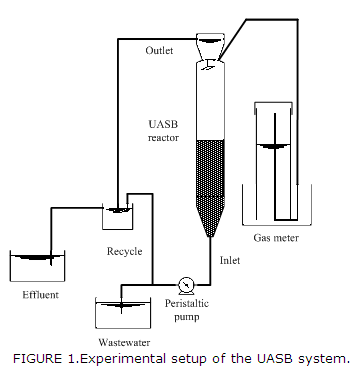
<body><![CDATA[<P><font face="Verdana, Arial, Helvetica, sans-serif" size="2"><b>Reactor</b>    </font>     <P><font face="Verdana, Arial, Helvetica, sans-serif" size="2"><a href="#F1">Figure    1</a> shows a scheme of the configurations of the laboratory scale anaerobic    system that were used, which consisted of a UASB reactor. The reactor was kept    at mesophilic temperature (37±1ºC) in a constant-temperature room. UASB system    consisted on a glass cylindrical reactor of 0,40 m of height and 0.09 m of diameter,    with a nominal volume of 2,5 L. It was equipped with a Masterflex® L/S® variable-speed    modular drive (model HV-07553-75, 6-600 rpm), which provided a variable flow    for the residual income and the effluent recycle.</font>     <P align="center"><img src="/img/revistas/rcta/v23n2/f0109214.gif" width="352" height="367"><a name="F1"></a>      
<P><font face="Verdana, Arial, Helvetica, sans-serif" size="2"><b>Feed and seed    </b></font>     <P><font face="Verdana, Arial, Helvetica, sans-serif" size="2">The inoculum used    was granular sludge coming from an industrial scale UASB reactor that processed    canned juice wastewaters having a volatile suspended solid (VSS) concentration    of 73,5 g L<sup>-1</sup>. The laboratory reactor was fed with coffee wet processing    wastewater, located in Ixhuatlán community, Veracruz, Mexico. The composition    of the wastewater is shown in <a href="#T1">Table 1</a>. As the coffee wet processing    wastewater was acid its pH had to be adjusted using sodium bicarbonate (NaHCO<sub>3</sub>).    </font>     <P align="center"><img src="/img/revistas/rcta/v23n2/t0109214.gif" width="516" height="259"><a name="T1"></a>      
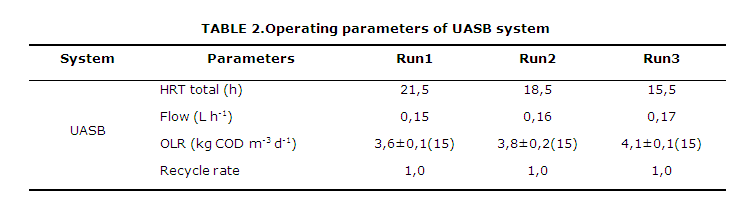
<P><font face="Verdana, Arial, Helvetica, sans-serif" size="2"><b>Experimental    procedure </b> </font>     <P><font face="Verdana, Arial, Helvetica, sans-serif" size="2">UASB system was    inoculated with 0,4 L of granular sludge. The start-up procedure was carried    out by the OLR gradual rise, increasing weekly the COD concentration from influent    until the evaluation conditions. This process was continuously carried out for    four weeks. The system evaluation was analyzed when the start-up of the reactor    finished. Pseudo-steady-state condition was considered attained when finished    the week four. The OLR was subsequently step increased to the next higher rate    through shortening of HRT. The OLR evaluated in each system (calls Run1, Run2    and Run3) are detailed in <a href="/img/revistas/rcta/v23n2/t0209214.gif">Table    2</a>. The evaluation periods from each OLR used were three weeks. The recycle    internal rate (recycle of the effluent to the inlet stream) applied to the UASB    in a stage throughout the period of experimentation was 1,0.</font>      
<P><font face="Verdana, Arial, Helvetica, sans-serif" size="2"><b>Analytical methods    </b> </font>     <P><font face="Verdana, Arial, Helvetica, sans-serif" size="2">Total suspended    solids (TSS), volatile suspended solids (VSS), pH and alkalinity were determined    according to the Standard Methods for the Examination of Water and Wastewater    (APHA, 1995). The alpha index was calculated as the quotient of partial alkalinity    at pH 5,75 and total alkalinity at pH 4,30. Total and soluble chemical oxygen    demand (COD) analyses were carried out using a HACH COD reactor (digestion at    150ºC for 2 h) according to the closed reflux colorimetric method described    in Standard Methods for the Examination of Water and Wastewater (APHA, 1995).    </font>     ]]></body>
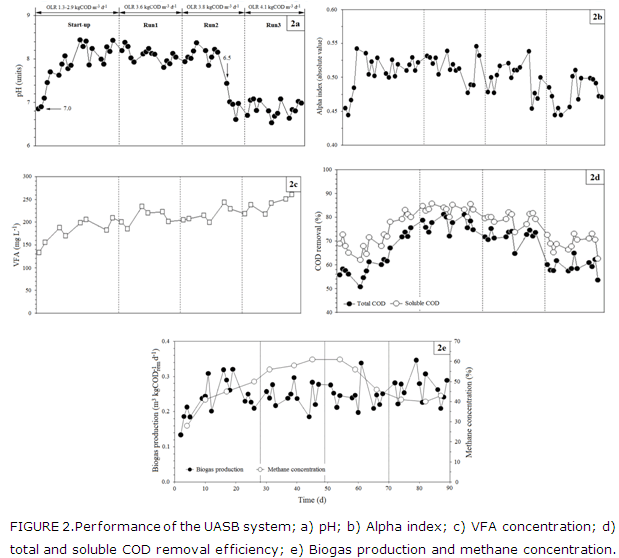
<body><![CDATA[<P><font face="Verdana, Arial, Helvetica, sans-serif" size="2">Volatile Fatty    Acids (VFA) were analyzed with a gas chromatograph (Chromatograph SRI 8610 model,    with a flame detector, Zebron column, and Helium gas carrier to 30 psi). Two    millilitres samples were taken from the reactor with a syringe and deposited    in the Eppendorf tube, and two drops of hydrochlorate acid were added (solution    1:1). The samples were centrifuged by half an hour at a 3500 rpm in a micro-centrifuge    Eppendorf. The supernatant were filtered through Wathman paper (0,22 µm), and    conserved at 4°C until being used. </font>     <P><font face="Verdana, Arial, Helvetica, sans-serif" size="2">The biogas production    was daily quantified by displacement of the liquid column placed in each of    the reactors gas meters. The methane concentration in biogas was measured by    gas chromatography (Chromatograph Fisher Gas Partitioner Model 1200, equipped    with a detector of thermal conductivity, double column Porapack Q and mesh molecular    SA, with Helium gas carrier flow of 25 mL min-1). Molar fractions of methane    from analyzed samples were determined by comparing the peak areas of the component    with pure methane. </font>      <P>&nbsp;      <P>      <P><font face="Verdana, Arial, Helvetica, sans-serif" size="3"><B>RESULTS AND DISCUSSION</B></font>     <P><font face="Verdana, Arial, Helvetica, sans-serif" size="2"><b>pH and alpha    index </b> </font>     <P><font face="Verdana, Arial, Helvetica, sans-serif" size="2">The pH behavior    observed during the evaluation period of the UASB reactor can be seen in <a href="/img/revistas/rcta/v23n2/f0209214.gif">Figure    2a</a>. When the inflow wastewater pH was adjusted at 7,0, the UASB reactor    showed a stable performance, with a pH interval of 7,8-8,4 and an average value    of 8,1±0,15. Occurrence of the anaerobic digestion requires a pH interval of    6,5-8,2 (Speece, 1996). Values of this parameter below 6,5 favor acidification,    especially in this type of wastewater with pH values <4,0. This fact inhibits    the methanogenic population and, therefore, the efficiency of the anaerobic    treatment is reduced. Considering the alkaline values of the effluent and the    cost incurred in the neutralization of the wastewater with sodium bicarbonate,    a pH adjustment to a value of 6,5 was done in the wastewater to treat from day    64 onwards (i.e. in the course of Run 2). These new conditions favored pH values    of the effluent in the interval 6,5-7,1, with an average value of 6,9±0,2, until    the end of the experiment. Given the characteristics of this coffee wastewater,    and even though the pH values stayed within in the appropriate interval, it    is recommendable, in order to prevent possible destabilizations in the reactor,    to reach values of the pH near to those measured in Run1, which were obtained    after adjusting to pH 7,0 the wastewater to treat. </font>      
<P><font face="Verdana, Arial, Helvetica, sans-serif" size="2">An aspect related    to pH is alkalinity, where the alpha index indicates the absorbing capacity    of the system to any abrupt pH change in the reactor. In this study a quick    increase in the alkalinity from 1612 and 2192 mgCaCO<sub>3</sub> L<sup>-1</sup>    was observed in the start-up stage. A similar behavior was observed when the    pH in the inflow wastewater was kept constant and equal to 7,0, with an alkalinity    average value of 1935±128 mgCaCO<sub>3</sub> L<sup>-1</sup>. Therefore, pH increases    above the optimal interval were observed although the wastewater to treat had    been neutralized. When the pH was readjusted to 6,5, the alkalinity decreased    to a value of 1355±67 mgCaCO<sub>3</sub> L<sup>-1</sup>. Whenever the pH value    of the wastewater was 7,0 and its average alkalinity 1935±128 mgCaCO<sub>3</sub>    L<sup>-1</sup>, the reactor behavior was similar to that observed in the start-up    stage. Similarly, this so high value of the alkalinity favored increases of    the pH above the optimal interval even though the wastewater to be treated had    been neutralized. </font>      <P><font face="Verdana, Arial, Helvetica, sans-serif" size="2">Some authors have    suggested that the larger the alpha index value the better the buffering capacity    of the system. Jenkins et al. (1983), recommended that the alpha index values    should be larger than 0,5. As a rule of thumb, this figure shows a good performance    of the reactor. As it can be seen in <a href="/img/revistas/rcta/v23n2/f0209214.gif">Figure    2b</a>, the alpha index reached an average value very close to the optimal,    0,51±0,02, after the first week of the start-up stage. However, when the pH    in the inflow was adjusted to 6,5 the average alpha value decreased to 0,48±0,02.    This decrease in the alpha value with the pH is associated to an accumulation    of acid species in the reactor that could cause system instability. pH is not    a sensitive indicator, since it could conceal the increase of the H+ concentration    even though it could show suitable values. Therefore, to carry out a continuous    monitoring of an anaerobic processes, and even to make decisions, the alpha    index is a better option (Pérez & Torres, 2008). </font>      
<P><font face="Verdana, Arial, Helvetica, sans-serif" size="2">One of the main    problems of the anaerobic biological degradation of this type of wastewater    is the high content of easily fermentable organic matter. Organic matter compounds    cause a fast acidification of the wastewater that results in a high production    of VFA & therefore, it is necessary the addition of an alkaline substance to    increase the pH. In order to prevent the accumulation of VFA, it is advisable    to recycle the treated effluent with the aim of re-use the alkalinity of the    anaerobic process to reduce the consumption alkaline substances (Romli et al.,    1994). In addition, the recycle can be used to maintain a suitable hydraulic    load in the anaerobic reactors when high concentrated wastewaters are being    treated (Lier, 2008). </font>     ]]></body>
<body><![CDATA[<P><font face="Verdana, Arial, Helvetica, sans-serif" size="2"><b>VFA concentration    </b> </font>     <P><font face="Verdana, Arial, Helvetica, sans-serif" size="2">Total VFA concentration    was considered as the sum of the acetic, propionic and butyric acids concentrations.    It was observed a tendency to increase VFA concentrations in the effluent with    increasing OLR values (<a href="/img/revistas/rcta/v23n2/f0209214.gif">Figure    2c</a>). In an overloaded anaerobic system it can be observed an accumulation    of VFA because the methanogenic bacteria can not remove the hydrogen and VFA    produced (Nagao et al., 2012). </font>      
<P><font face="Verdana, Arial, Helvetica, sans-serif" size="2">Therefore, the    VFA increase in the effluent reveals an increase in the load applied to the    system. As expected, Run 1 resulted in the lowest VFA concentration in the effluent,    with an average value of 220±18 mg L<sup>-1</sup>, although not significant    differences were observed between Run 1 and Run 2. However, <a href="/img/revistas/rcta/v23n2/f0209214.gif">Figure    2c</a> shows that in Run 2 the concentration of these acids increased. These    results indicated that the HRT did not affect the relative composition of the    organic acids in the effluent, but their concentration increased when the OLR    increased. Acetic acid reached the higher proportion (60%) followed by propionic    acid (28%) and butyric acid (12%), with concentrations of 131±10 mg L<sup>-1</sup>,    63±7 mg L<sup>-1</sup> and 26±2 mg L<sup>-1</sup>, respectively. These percentages    reveal an adequate proportion of these acids in the effluent that avoids the    inhibition of the anaerobic digestion by VFA (Speece, 1996). </font>      
<P><font face="Verdana, Arial, Helvetica, sans-serif" size="2"><b>Total and soluble    COD removal efficiency </b></font>     <P><font face="Verdana, Arial, Helvetica, sans-serif" size="2">Total COD removal    efficiency with the increase in the applied OLR can be seen in <a href="/img/revistas/rcta/v23n2/f0209214.gif">Figure    2d</a>. Significant differences were observed between the efficiencies in all    the treatments compared, with average values of 77,2%, 72,1% and 59,2% for Run    1, Run 2 and Run 3, respectively (p-value>0,05). These results confirm that    when the load applied to the system increases, the methanogenic bacteria can    not completely degrade the VFA produced; therefore the efficiency and stability    of the reactor are affected negatively (Wang et al., 2009). For the first OLR    evaluated (Run 1), the soluble COD removal efficiency exhibited a high value    (83,4%), indicating a successful treatment of the wastewater in study. </font>      
<P><font face="Verdana, Arial, Helvetica, sans-serif" size="2">Biogas production    and methane concentration generated in the UASB system are shown in <a href="/img/revistas/rcta/v23n2/f0209214.gif">Figure    2e</a>. The largest biogas productions were obtained in Run 1. Although, significant    differences (p-value<0,05) were observed between the biogas obtained in Run1    and Run 2, their respective average values were similar. The total biogas production    fluctuated in the range of 0,186-0,346 m<sup>3</sup> kgCOD<sup>-1</sup><sub>rem</sub>    d<sup>-1</sup>, revealing that the effect of the HRT in the conversion of the    organic residual to biogas was not significant. According to Lin et al. (1986),    the biogas production is independent of the HRT and the substrate concentration.    </font>      
<P><font face="Verdana, Arial, Helvetica, sans-serif" size="2"><b>Biogas production    and methane concentration </b></font>     <P><font face="Verdana, Arial, Helvetica, sans-serif" size="2">Methane concentration    decreased in Run 3. The highest methane concentration values were achieved both    in Run 1 and Run 2 (61%) This circumstance indicated an indirect correlation    between the VFA concentration and methane concentration because methane production    decreased when the VFA concentration increased. These results coincide with    those reported by Dogan et al. (2005), who studied the effect of the variety    and concentration of the VFA in a UASB reactor, and concluded that these factors    have a significant effect on the methanogenic activity, besides their synergy    with other products. Nevertheless, the main factor affecting the single-stage    system was the pH, because when it was adjusted to 6,5 in the wastewater to    treat (day 64) a decrease in the methane concentration values were observed.    Other authors have also reported an increase in the CO2 concentration in the    biogas with a pH drop (Chen et al., 2008, Leitão et al., 2006, Singh and Prerna,    2009, Bengtsson et al., 2008). </font>     <P><font face="Verdana, Arial, Helvetica, sans-serif" size="2"><b>Final discussion    </b> </font>     <P><font face="Verdana, Arial, Helvetica, sans-serif" size="2"><a href="/img/revistas/rcta/v23n2/t0309214.gif">Table    3</a> shows a summary of the results of multiple range analysis test (Duncan).    In UASB system, the VFA concentration in the treated effluent increased slightly,    and not significantly, with OLR increase. In Run1, total and soluble COD removal    efficiencies were higher (above 75%). The effect of the OLR in the UASB system    was no significant in the biogas production; therefore increasing the OLR did    not imply any increase in the amount of biogas produced. However, significant    differences were observed in the methane concentration. </font>      
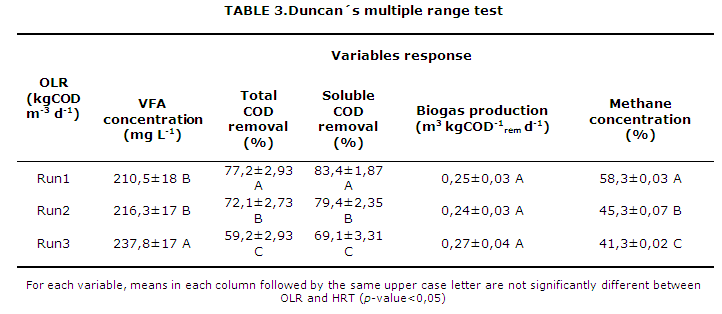
]]></body>
<body><![CDATA[<P><font face="Verdana, Arial, Helvetica, sans-serif" size="2">A summary of publications    related to the anaerobic treatment of coffee processing wastewaters is presented    in <a href="/img/revistas/rcta/v23n2/t0409214.gif">Table    4</a>. In our study, a UASB reactor, operated at an OLR of 3,6 kgCOD m<sup>-3</sup>    d<sup>-1</sup>, achieved a total and soluble COD removal efficiency of 77,2±2,9%    and 83,5±1,87%, respectively, and a methane concentration of 58±2,5%. These    results are comparable with those reported by other authors. Fernández and Foster    (1993), operating two anaerobic filters at 37°C and 55°C, with an OLR of 4,0    kgCOD m<sup>-3</sup> d<sup>-1</sup>, observed a COD removal efficiency of 63%,    treating a synthetic wastewater made up of coffee bean extract. Silva and Campos    (2005) studied the feasibility of a laboratory scale UASB reactor that was used    to treat coffee wet wastewater. The wastewater pollutant load was 3250 mg L<sup>-1</sup>,    the system operating conditions were adjusted to an HRT of 69 hours and an OLR    of 0,59 kgCODm<sup>-3</sup> d<sup>-1</sup>, and the COD removal efficiency achieved    was 78%, Recently, Fia et al. (2012) evaluated three different support materials    in an AFBR anaerobic reactor and the largest COD removal efficiency, 80%, was    obtained at an OLR of 4,4 kgCOD m<sup>-3</sup> d<sup>-1</sup>. </font>      
<P>&nbsp;      <P>      <P><font face="Verdana, Arial, Helvetica, sans-serif" size="3"><B>CONCLUSIONS</B></font><font face="Verdana, Arial, Helvetica, sans-serif" size="2">    </font>      <P><font face="Verdana, Arial, Helvetica, sans-serif" size="2">&#149; Coffee wet    wastewaters were successfully treated in a single-stage UASB reactor. Both total    and soluble COD removal efficiencies observed were higher than 75% and 80%,    respectively, at an OLR of 3,6 kgCOD m<sup>-3</sup> d<sup>-1</sup>, whereas    the methane concentration was in a range of 56-61%, with aptitudes of being    used like power source by the conversion to electrical energy. On the basis    of this study we reached that an anaerobic UASB reactor is a suitable system    of treat wastewaters of coffee wet processing. </font>      <P>&nbsp;     <P>&nbsp;      <P>     <P>     <P>      ]]></body>
<body><![CDATA[<P><font face="Verdana, Arial, Helvetica, sans-serif" size="3"><B>REFERENCES</B></font><font face="Verdana, Arial, Helvetica, sans-serif" size="2">    </font>      <!-- ref --><P><font face="Verdana, Arial, Helvetica, sans-serif" size="2">1. APHA: <i>Standard    methods for examination of water and wastewater</i>, Nineteenth ed. American    Public Health Association, Washington D.C., USA., 1995.     </font>      <!-- ref --><P><font face="Verdana, Arial, Helvetica, sans-serif" size="2">2. BELLO-MENDOZA,    R. y CASTILLO-RIVERA, M.: “Start-up of an anaerobic hybrid (UASB/Filter) reactor    treating wastewater from a coffee processing plant”. <i>Anaerobe</i>, No.4:    219-225, 1998.     </font>      <!-- ref --><P><font face="Verdana, Arial, Helvetica, sans-serif" size="2">3. BENGTSSON, S.,    HALLQUIST, J., WERKER, A. y WELANDER, T.: “Acidogenic fermentation of industrial    wastewater: Effect of chemostat retention time and pH on volatile acids production”.    <i>J. Environ. Eng.</i>, No.40: 492-499, 2008.     </font>      <!-- ref --><P><font face="Verdana, Arial, Helvetica, sans-serif" size="2">4. BOUALLAGUI,    H., TORRIJOS, M., GODON, J., MOLCTTA, R., CHEIKH, R., TOUHAMI, Y., DELGENES,    J. y HAMDI, M.: “Two-phase anaerobic digestion of fruit and vegetable wastes:    Bioreactors performance”. <i>J. Biochem. Eng.</i>, No.21: 193-197, 2004.     </font>      <!-- ref --><P><font face="Verdana, Arial, Helvetica, sans-serif" size="2">5. CALIL, M., MONTENEGRO,    C. y FERREIRA, J.: “Estudo da variaçäo da concentraçäo de metano no biogás produzido    a partir das águas residuárias do café”. <i>Ciënc. Agrotec. Lavras</i>, No.34:    475-484, 2010.     </font>      <!-- ref --><P><font face="Verdana, Arial, Helvetica, sans-serif" size="2">6. CHEN, Y., CHENG,    J. y CREAMER, K.: “Inhibition of anaerobic digestion process: A review”. <i>Bioresour.    Technol</i>, No.99: 4044-4064, 2008.     </font>      <!-- ref --><P><font face="Verdana, Arial, Helvetica, sans-serif" size="2">7. DEVI, R., SINGH,    V. y KUMAR, A.: “COD and BOD reduction from coffee processing wastewater using    Acavado pell carbon”. <i>Bioresour. Technol.</i>, No.99: 1853-1860, 2008.     </font>      <!-- ref --><P><font face="Verdana, Arial, Helvetica, sans-serif" size="2">8. DINSDALE, R.,    HAWKES, F. y HAWKES, D.: “The mesophilic and termophilic anaerobic digestion    of coffee waste containing coffee grounds”. <i>Wat. Res</i>, No.30: 371-377,    1996.     </font>      <!-- ref --><P><font face="Verdana, Arial, Helvetica, sans-serif" size="2">9. DINSDALE, R.,    HAWKES, F. y HAWKES, D.: “Comparision of mesophilic and thermophilic UASB reactors    treating instant coffee production wastewater”. <i>Wat. Res.</i>, No.31: 163-169,    1997a.     </font>      <!-- ref --><P><font face="Verdana, Arial, Helvetica, sans-serif" size="2">10. DINSDALE, R.,    HAWKES, F. y HAWKES, D.: “Mesophilic and thermophilic anaerobic digestion with    thermophilic pre-acidification of instant coffee production wastewater”. <i>Wat.    Res.</i>, No.31: 1931-1938, 1997b.     </font>      <!-- ref --><P><font face="Verdana, Arial, Helvetica, sans-serif" size="2">11. DOGAN, T.,    INCE, O., OZ, N. y INCE, B.: “Inhibition of volatile fatty acid production in    granular sludge from a UASB reactor”. <i>Environ. Technol.</i>, No.40: 633-644,    2005.     </font>      <!-- ref --><P><font face="Verdana, Arial, Helvetica, sans-serif" size="2">12. FERNÁNDEZ,    N. y FOSTER, C.: “A study of the operation of mesophilic and thermophilic anaerobic    filters treating a syntetic coffee waste”. <i>Bioresour. Technol.</i>, No.45:    223-227, 1993.    </font>      <!-- ref --><P><font face="Verdana, Arial, Helvetica, sans-serif" size="2">13. FIA, F., MATOS,    A., BORGES, A., FIA, R. y CECON, P.: “Treatment of wastewater from coffee bean    processing in anaerobic fixed bed reactors with different support materials:    performance and kinetics modeling”. <i>J. Environ. Managem.</i>, No.108: 14-21,    2012.     </font>      <!-- ref --><P><font face="Verdana, Arial, Helvetica, sans-serif" size="2">14. GUARDIA-PUEBLA,    Y., NOYOLA, A. y MORGAN-SAGASTUME, J.: &quot;Two-stage anaerobic digestion treating    wastewater from wet processing of coffee&quot;. En: <i>12th World Congress on    Anaerobic Digestion, International Water Association (IWA), Specialist Conferences</i>,    october 31st - november 4th, 2010. Guadalajara, Jalisco, México.     </font>      <!-- ref --><P><font face="Verdana, Arial, Helvetica, sans-serif" size="2">15. HAJIPAKKOS,    C.: “The application of a full-scale UASB plant for the treatment of coffee    waste”. <i>Wat. Sci. Tech.</i>, No.25: 17-22, 1992.     </font>      <!-- ref --><P><font face="Verdana, Arial, Helvetica, sans-serif" size="2">16. HOUBRON, E.,    LARRINAGA, A. y RUSTRIAN, E.: “Liquefaction and methanization of solid and liquid    coffee wastes by two phase anaerobic digestion process”. <i>Wat. Sci. Tech.</i>,    No.48: 255-262, 2003.     </font>      <!-- ref --><P><font face="Verdana, Arial, Helvetica, sans-serif" size="2">17. JENKINS, S.,    MORGAN, J. y SAWYER, C.: “Measuring anaerobic sludge digestion and growth by    a simple alkalimetric tritation”. <i>Journal of the Water Pollution Control    Federation</i>, No.55: 448-453, 1983.     </font>      <!-- ref --><P><font face="Verdana, Arial, Helvetica, sans-serif" size="2">18. LEITÃO, R.,    HAANDEL, A. V., ZEEMAN, G. y LETTINGA, G.: “The effects of operational and environmental    variations on anaerobic wastewater treatment system: A review”. <i>Bioresour.    Technol.</i>, No.97: 1105-1118, 2006.     </font>      <!-- ref --><P><font face="Verdana, Arial, Helvetica, sans-serif" size="2">19. LIER, J. V.:    “High rate anaerobic wastewater treatment: diversifying from end of the pipe    treatment to resource oriented conversion techniques”. <i>Water Sci. Technol.</i>,    No.57: 1137-1147, 2008.     </font>      <!-- ref --><P><font face="Verdana, Arial, Helvetica, sans-serif" size="2">20. LIN, C., SATO,    K., NOIKE, T. y MATSUMOTO, J.: “Methanogenic digestion using mixed substrate    of acetic, propionic and butyric acids”. <i>Wat. Res.</i>, No.20: 385-394, 1986.        </font>      <!-- ref --><P><font face="Verdana, Arial, Helvetica, sans-serif" size="2">21. MCDOUGALL,    F., ANDERSON, G. y EVISON, L.: &quot;Two-phase anaerobic digestion of coffee    wastewater&quot;, En: <i>48th Purdue Industrial Waste Conference Proceedings</i>,    p.677-683, 1993.     </font>      <!-- ref --><P><font face="Verdana, Arial, Helvetica, sans-serif" size="2">22. NAGAO, N.,    TAJIMA, N., KAWAI, M., NIWA, C., KUROSAWA, N., MATSUYAMA, T., YUSOFF, F. y TODA,    T.: “Maximun organic loading rate for the single-stage wet anaerobic digestion    of foof waste”. <i>Bioresour. Technol</i>, No.118: 210-218, 2012.     </font>      <!-- ref --><P><font face="Verdana, Arial, Helvetica, sans-serif" size="2">23. NARASIMBA,    K., D´SA, A. y KAPUR, G.: “An effluent treatment-cum-electricity generation    at coffee estates: is it financially feasible?” En: <i>International Energy    Iniciative</i>, 2004.     </font>      <!-- ref --><P><font face="Verdana, Arial, Helvetica, sans-serif" size="2">24. NEVES, L.,    OLIVEIRA, R. y ALVES, M.: “Anaerobic co-digestion of coffee waste and sewage    sludge”. <i>Waste Management.</i>, No.26: 176-181, 2006.     </font>      <!-- ref --><P><font face="Verdana, Arial, Helvetica, sans-serif" size="2">25. OROZCO, C.,    BARRIENTOS, H., LÓPEZLENA, A., CRUZ, J., SELVAS, C., OSORIO, E., OSORIO, E.,    CHÁVEZ, R., MIRANDA, J., ARELLANO, J. y GIESSEMAN, B.: “Evaluación de una planta    piloto de tratamiento de aguas residuales del procesamiento del café: características    químicas”. <i>Hig. Sanid. Ambient.</i>, No.5: 123-131, 2005.     </font>      <!-- ref --><P><font face="Verdana, Arial, Helvetica, sans-serif" size="2">26. PÉREZ, A. y    TORRES, P.: “Índices de alcalinidad para el control del tratamiento anaerobio    de las aguas residuales fácilmente acidificables”. <i>Ingeniería Sanitaria</i>,    No.10: 41-52, 2008.     </font>      <!-- ref --><P><font face="Verdana, Arial, Helvetica, sans-serif" size="2">27. ROMLI, M.,    GREENFIELD, P. y LEE, P.: “Effect of recycle on a two-phase high-rate anaerobic    wastewater treatment system”. <i>Wat. Res.</i>, No.28: 475-482, 1994.     </font>      <!-- ref --><P><font face="Verdana, Arial, Helvetica, sans-serif" size="2">28. SELVAMURUGAN,    M., DORAISAMY, P. y MAHESWARI, M.: “An integrated treatment system for coffee    processing wastewater using anaerobic and aerobic process”. <i>Ecological Engineering</i>,    No.36: 1686-1960, 2010a.     </font>      <!-- ref --><P><font face="Verdana, Arial, Helvetica, sans-serif" size="2">29. SELVAMURUGAN,    M., DORAISAMY, P., MAHESWARI, M. y NANDAKUMAR, N. B.: “High rate anaerobic treatment    of coffee processing wastewater using upflow anaerobic hybrid reactor”. <i>J.    Environ. Health Sci. Eng.</i>, No.7: 129-136, 2010b.     </font>      <!-- ref --><P><font face="Verdana, Arial, Helvetica, sans-serif" size="2">30. SILVA, B. y    CAMPOS, C.: &quot;Tratamento anaeróbio de efluentes líquidos gerados no beneficiamento    úmido do café&quot;. En: <i>Congresso Brasileiro de Engenharia Agrícola</i>.    Canoas: Associaçâo Brasileira de Engenharia Agrícola, 2005.     </font>      <!-- ref --><P><font face="Verdana, Arial, Helvetica, sans-serif" size="2">31. SINGH, S. y    PRERNA, P.: “Review of recent advances in anaerobic packed-bed biogas reactor”.    <i>Renewable and Sustainable Energy Reviews</i>, No.13: 1569-1575, 2009.     </font>      <!-- ref --><P><font face="Verdana, Arial, Helvetica, sans-serif" size="2">32. SPEECE, R.    <i>Anaerobic biotechnology for industrial wastewaters</i>, Ed. Archea Press,    Nashvile, Tennessee, USA, 1996.     </font>      <!-- ref --><P><font face="Verdana, Arial, Helvetica, sans-serif" size="2">33. WANG, Y., ZHANG,    Y., WANG, J. y MENG, L.: “Effects of volatile fatty acid concentrations on methane    yield and methanogenic bacteria”. <i>Biomass & Bioenergy</i>, No.33: 848-853,    2009.     </font>      <!-- ref --><P><font face="Verdana, Arial, Helvetica, sans-serif" size="2">34. WARD, A., HOBBS,    P., HOLLIMAN, P. y JONES, D.: “Optimization of the anaerobic digestion of agricultural    resources”. <i>Bioresour. Technol.</i>, No.99: 7928-7940, 2008.     </font>      <P>&nbsp;     ]]></body>
<body><![CDATA[<P>&nbsp;      <P>     <P>     <P>      <P>      <P><font face="Verdana, Arial, Helvetica, sans-serif" size="2"><b>Recibido: </b>13 de noviembre de 2012.     <BR>   <b>Aprobado: </b>28 de enero de 2014. </font>      <P>&nbsp;     <P>&nbsp;      <P>     ]]></body>
<body><![CDATA[<P>     <P>      <P>      <P><font face="Verdana, Arial, Helvetica, sans-serif" size="2"><I>Yans Guardia Puebla. </I>Universidad de Granma  (UDG), Departamento de Ciencias Técnicas, Carretera Manzanillo, km 17 ½, Peralejo, Bayamo, CP 85100, Cuba. Correo electr&oacute;nico: <U><FONT COLOR="#0000ff"><a href="mailto:yguardiap@udg.co.cu ">yguardiap@udg.co.cu </a></FONT></U>    </font>      <P><font face="Verdana, Arial, Helvetica, sans-serif" size="2"><b>Nota:</b> La mención de marcas comerciales de equipos, instrumentos o materiales específicos obedece a propósitos de identificación, no existiendo ningún compromiso promocional con relación a los mismos, ni por los autores ni por el editor</font>      ]]></body><back>
<ref-list>
<ref id="B1">
<label>1</label><nlm-citation citation-type="book">
<collab>APHA</collab>
<source><![CDATA[Standard methods for examination of water and wastewater]]></source>
<year>1995</year>
<edition>Nineteenth</edition>
<publisher-loc><![CDATA[Washington D.C. ]]></publisher-loc>
<publisher-name><![CDATA[American Public Health Association]]></publisher-name>
</nlm-citation>
</ref>
<ref id="B2">
<label>2</label><nlm-citation citation-type="journal">
<person-group person-group-type="author">
<name>
<surname><![CDATA[BELLO-MENDOZA]]></surname>
<given-names><![CDATA[R.]]></given-names>
</name>
<name>
<surname><![CDATA[CASTILLO-RIVERA]]></surname>
<given-names><![CDATA[M.]]></given-names>
</name>
</person-group>
<article-title xml:lang="en"><![CDATA[Start-up of an anaerobic hybrid (UASB/Filter) reactor treating wastewater from a coffee processing plant]]></article-title>
<source><![CDATA[Anaerobe]]></source>
<year>1998</year>
<numero>4</numero>
<issue>4</issue>
<page-range>219-225</page-range></nlm-citation>
</ref>
<ref id="B3">
<label>3</label><nlm-citation citation-type="journal">
<person-group person-group-type="author">
<name>
<surname><![CDATA[BENGTSSON]]></surname>
<given-names><![CDATA[S.]]></given-names>
</name>
<name>
<surname><![CDATA[HALLQUIST]]></surname>
<given-names><![CDATA[J.]]></given-names>
</name>
<name>
<surname><![CDATA[WERKER]]></surname>
<given-names><![CDATA[A.]]></given-names>
</name>
<name>
<surname><![CDATA[WELANDER]]></surname>
<given-names><![CDATA[T.]]></given-names>
</name>
</person-group>
<article-title xml:lang="en"><![CDATA[Acidogenic fermentation of industrial wastewater: Effect of chemostat retention time and pH on volatile acids production]]></article-title>
<source><![CDATA[J. Environ. Eng.]]></source>
<year>2008</year>
<numero>40</numero>
<issue>40</issue>
<page-range>492-499</page-range></nlm-citation>
</ref>
<ref id="B4">
<label>4</label><nlm-citation citation-type="journal">
<person-group person-group-type="author">
<name>
<surname><![CDATA[BOUALLAGUI]]></surname>
<given-names><![CDATA[H.]]></given-names>
</name>
<name>
<surname><![CDATA[TORRIJOS]]></surname>
<given-names><![CDATA[M.]]></given-names>
</name>
<name>
<surname><![CDATA[GODON]]></surname>
<given-names><![CDATA[J.]]></given-names>
</name>
<name>
<surname><![CDATA[MOLCTTA]]></surname>
<given-names><![CDATA[R.]]></given-names>
</name>
<name>
<surname><![CDATA[CHEIKH]]></surname>
<given-names><![CDATA[R.]]></given-names>
</name>
<name>
<surname><![CDATA[TOUHAMI]]></surname>
<given-names><![CDATA[Y.]]></given-names>
</name>
<name>
<surname><![CDATA[DELGENES]]></surname>
<given-names><![CDATA[J.]]></given-names>
</name>
<name>
<surname><![CDATA[HAMDI]]></surname>
<given-names><![CDATA[M.]]></given-names>
</name>
</person-group>
<article-title xml:lang="en"><![CDATA[Two-phase anaerobic digestion of fruit and vegetable wastes: Bioreactors performance]]></article-title>
<source><![CDATA[J. Biochem. Eng.]]></source>
<year>2004</year>
<numero>21</numero>
<issue>21</issue>
<page-range>193-197</page-range></nlm-citation>
</ref>
<ref id="B5">
<label>5</label><nlm-citation citation-type="journal">
<person-group person-group-type="author">
<name>
<surname><![CDATA[CALIL]]></surname>
<given-names><![CDATA[M.]]></given-names>
</name>
<name>
<surname><![CDATA[MONTENEGRO]]></surname>
<given-names><![CDATA[C.]]></given-names>
</name>
<name>
<surname><![CDATA[FERREIRA]]></surname>
<given-names><![CDATA[J.]]></given-names>
</name>
</person-group>
<article-title xml:lang="pt"><![CDATA[Estudo da variaçäo da concentraçäo de metano no biogás produzido a partir das águas residuárias do café]]></article-title>
<source><![CDATA[Ciënc. Agrotec. Lavras]]></source>
<year>2010</year>
<numero>34</numero>
<issue>34</issue>
<page-range>475-484</page-range></nlm-citation>
</ref>
<ref id="B6">
<label>6</label><nlm-citation citation-type="journal">
<person-group person-group-type="author">
<name>
<surname><![CDATA[CHEN]]></surname>
<given-names><![CDATA[Y.]]></given-names>
</name>
<name>
<surname><![CDATA[CHENG]]></surname>
<given-names><![CDATA[J.]]></given-names>
</name>
<name>
<surname><![CDATA[CREAMER]]></surname>
<given-names><![CDATA[K.]]></given-names>
</name>
</person-group>
<article-title xml:lang="en"><![CDATA[Inhibition of anaerobic digestion process: A review]]></article-title>
<source><![CDATA[Bioresour. Technol]]></source>
<year>2008</year>
<numero>99</numero>
<issue>99</issue>
<page-range>4044-4064</page-range></nlm-citation>
</ref>
<ref id="B7">
<label>7</label><nlm-citation citation-type="journal">
<person-group person-group-type="author">
<name>
<surname><![CDATA[DEVI]]></surname>
<given-names><![CDATA[R.]]></given-names>
</name>
<name>
<surname><![CDATA[SINGH]]></surname>
<given-names><![CDATA[V.]]></given-names>
</name>
<name>
<surname><![CDATA[KUMAR]]></surname>
<given-names><![CDATA[A.]]></given-names>
</name>
</person-group>
<article-title xml:lang="en"><![CDATA[COD and BOD reduction from coffee processing wastewater using Acavado pell carbon]]></article-title>
<source><![CDATA[Bioresour. Technol.]]></source>
<year>2008</year>
<numero>99</numero>
<issue>99</issue>
<page-range>1853-1860</page-range></nlm-citation>
</ref>
<ref id="B8">
<label>8</label><nlm-citation citation-type="journal">
<person-group person-group-type="author">
<name>
<surname><![CDATA[DINSDALE]]></surname>
<given-names><![CDATA[R.]]></given-names>
</name>
<name>
<surname><![CDATA[HAWKES]]></surname>
<given-names><![CDATA[F.]]></given-names>
</name>
<name>
<surname><![CDATA[HAWKES]]></surname>
<given-names><![CDATA[D.]]></given-names>
</name>
</person-group>
<article-title xml:lang="en"><![CDATA[The mesophilic and termophilic anaerobic digestion of coffee waste containing coffee grounds]]></article-title>
<source><![CDATA[Wat. Res]]></source>
<year>1996</year>
<numero>30</numero>
<issue>30</issue>
<page-range>371-377</page-range></nlm-citation>
</ref>
<ref id="B9">
<label>9</label><nlm-citation citation-type="journal">
<person-group person-group-type="author">
<name>
<surname><![CDATA[HAWKES]]></surname>
<given-names><![CDATA[D.]]></given-names>
</name>
<name>
<surname><![CDATA[HAWKES]]></surname>
<given-names><![CDATA[F.]]></given-names>
</name>
<name>
<surname><![CDATA[DINSDALE]]></surname>
<given-names><![CDATA[R.]]></given-names>
</name>
</person-group>
<article-title xml:lang="en"><![CDATA[Comparision of mesophilic and thermophilic UASB reactors treating instant coffee production wastewater]]></article-title>
<source><![CDATA[Wat. Res.]]></source>
<year>1997</year>
<numero>31</numero>
<issue>31</issue>
<page-range>163-169</page-range></nlm-citation>
</ref>
<ref id="B10">
<label>10</label><nlm-citation citation-type="journal">
<person-group person-group-type="author">
<name>
<surname><![CDATA[DINSDALE]]></surname>
<given-names><![CDATA[R.]]></given-names>
</name>
<name>
<surname><![CDATA[HAWKES]]></surname>
<given-names><![CDATA[F.]]></given-names>
</name>
<name>
<surname><![CDATA[HAWKES]]></surname>
<given-names><![CDATA[D.]]></given-names>
</name>
</person-group>
<article-title xml:lang="en"><![CDATA[Mesophilic and thermophilic anaerobic digestion with thermophilic pre-acidification of instant coffee production wastewater]]></article-title>
<source><![CDATA[Wat. Res.]]></source>
<year>1997</year>
<numero>31</numero>
<issue>31</issue>
<page-range>1931-1938</page-range></nlm-citation>
</ref>
<ref id="B11">
<label>11</label><nlm-citation citation-type="journal">
<person-group person-group-type="author">
<name>
<surname><![CDATA[DOGAN]]></surname>
<given-names><![CDATA[T.]]></given-names>
</name>
<name>
<surname><![CDATA[INCE]]></surname>
<given-names><![CDATA[O.]]></given-names>
</name>
<name>
<surname><![CDATA[OZ]]></surname>
<given-names><![CDATA[N.]]></given-names>
</name>
<name>
<surname><![CDATA[INCE]]></surname>
<given-names><![CDATA[B.]]></given-names>
</name>
</person-group>
<article-title xml:lang="en"><![CDATA[Inhibition of volatile fatty acid production in granular sludge from a UASB reactor]]></article-title>
<source><![CDATA[Environ. Technol.]]></source>
<year>2005</year>
<numero>40</numero>
<issue>40</issue>
<page-range>633-644</page-range></nlm-citation>
</ref>
<ref id="B12">
<label>12</label><nlm-citation citation-type="journal">
<person-group person-group-type="author">
<name>
<surname><![CDATA[FERNÁNDEZ]]></surname>
<given-names><![CDATA[N.]]></given-names>
</name>
<name>
<surname><![CDATA[FOSTER]]></surname>
<given-names><![CDATA[C.]]></given-names>
</name>
</person-group>
<article-title xml:lang="en"><![CDATA[A study of the operation of mesophilic and thermophilic anaerobic filters treating a syntetic coffee waste]]></article-title>
<source><![CDATA[Bioresour. Technol.]]></source>
<year>1993</year>
<numero>45</numero>
<issue>45</issue>
<page-range>223-227</page-range></nlm-citation>
</ref>
<ref id="B13">
<label>13</label><nlm-citation citation-type="journal">
<person-group person-group-type="author">
<name>
<surname><![CDATA[FIA]]></surname>
<given-names><![CDATA[F.]]></given-names>
</name>
<name>
<surname><![CDATA[MATOS]]></surname>
<given-names><![CDATA[A.]]></given-names>
</name>
<name>
<surname><![CDATA[BORGES]]></surname>
<given-names><![CDATA[A.]]></given-names>
</name>
<name>
<surname><![CDATA[FIA]]></surname>
<given-names><![CDATA[R.]]></given-names>
</name>
<name>
<surname><![CDATA[CECON]]></surname>
<given-names><![CDATA[P.]]></given-names>
</name>
</person-group>
<article-title xml:lang="en"><![CDATA[Treatment of wastewater from coffee bean processing in anaerobic fixed bed reactors with different support materials: performance and kinetics modeling]]></article-title>
<source><![CDATA[J. Environ. Managem.]]></source>
<year>2012</year>
<numero>108</numero>
<issue>108</issue>
<page-range>14-21</page-range></nlm-citation>
</ref>
<ref id="B14">
<label>14</label><nlm-citation citation-type="">
<person-group person-group-type="author">
<name>
<surname><![CDATA[GUARDIA-PUEBLA]]></surname>
<given-names><![CDATA[Y.]]></given-names>
</name>
<name>
<surname><![CDATA[NOYOLA]]></surname>
<given-names><![CDATA[A.]]></given-names>
</name>
<name>
<surname><![CDATA[MORGAN-SAGASTUME]]></surname>
<given-names><![CDATA[J.]]></given-names>
</name>
</person-group>
<article-title xml:lang="en"><![CDATA[Two-stage anaerobic digestion treating wastewater from wet processing of coffee]]></article-title>
<source><![CDATA[12th World Congress on Anaerobic Digestion, International Water Association (IWA), Specialist Conferences]]></source>
<year>octo</year>
<month>be</month>
<day>r </day>
<publisher-loc><![CDATA[Guadalajara^eJalisco Jalisco]]></publisher-loc>
</nlm-citation>
</ref>
<ref id="B15">
<label>15</label><nlm-citation citation-type="journal">
<person-group person-group-type="author">
<name>
<surname><![CDATA[HAJIPAKKOS]]></surname>
<given-names><![CDATA[C.]]></given-names>
</name>
</person-group>
<article-title xml:lang="en"><![CDATA[The application of a full-scale UASB plant for the treatment of coffee waste]]></article-title>
<source><![CDATA[Wat. Sci. Tech.]]></source>
<year>1992</year>
<numero>25</numero>
<issue>25</issue>
<page-range>17-22</page-range></nlm-citation>
</ref>
<ref id="B16">
<label>16</label><nlm-citation citation-type="journal">
<person-group person-group-type="author">
<name>
<surname><![CDATA[HOUBRON]]></surname>
<given-names><![CDATA[E.]]></given-names>
</name>
<name>
<surname><![CDATA[LARRINAGA]]></surname>
<given-names><![CDATA[A.]]></given-names>
</name>
<name>
<surname><![CDATA[RUSTRIAN]]></surname>
<given-names><![CDATA[E.]]></given-names>
</name>
</person-group>
<article-title xml:lang="en"><![CDATA[Liquefaction and methanization of solid and liquid coffee wastes by two phase anaerobic digestion process]]></article-title>
<source><![CDATA[Wat. Sci. Tech.]]></source>
<year>2003</year>
<numero>48</numero>
<issue>48</issue>
<page-range>255-262</page-range></nlm-citation>
</ref>
<ref id="B17">
<label>17</label><nlm-citation citation-type="journal">
<person-group person-group-type="author">
<name>
<surname><![CDATA[JENKINS]]></surname>
<given-names><![CDATA[S.]]></given-names>
</name>
<name>
<surname><![CDATA[MORGAN]]></surname>
<given-names><![CDATA[J.]]></given-names>
</name>
<name>
<surname><![CDATA[SAWYER]]></surname>
<given-names><![CDATA[C.]]></given-names>
</name>
</person-group>
<article-title xml:lang="en"><![CDATA[Measuring anaerobic sludge digestion and growth by a simple alkalimetric tritation]]></article-title>
<source><![CDATA[Journal of the Water Pollution Control Federation]]></source>
<year>1983</year>
<numero>55</numero>
<issue>55</issue>
<page-range>448-453</page-range></nlm-citation>
</ref>
<ref id="B18">
<label>18</label><nlm-citation citation-type="journal">
<person-group person-group-type="author">
<name>
<surname><![CDATA[LEITÃO]]></surname>
<given-names><![CDATA[R.]]></given-names>
</name>
<name>
<surname><![CDATA[HAANDEL]]></surname>
<given-names><![CDATA[A. V.]]></given-names>
</name>
<name>
<surname><![CDATA[ZEEMAN]]></surname>
<given-names><![CDATA[G.]]></given-names>
</name>
<name>
<surname><![CDATA[LETTINGA]]></surname>
<given-names><![CDATA[G.]]></given-names>
</name>
</person-group>
<article-title xml:lang="en"><![CDATA[The effects of operational and environmental variations on anaerobic wastewater treatment system: A review]]></article-title>
<source><![CDATA[Bioresour. Technol.]]></source>
<year>2006</year>
<numero>97</numero>
<issue>97</issue>
<page-range>1105-1118</page-range></nlm-citation>
</ref>
<ref id="B19">
<label>19</label><nlm-citation citation-type="journal">
<person-group person-group-type="author">
<name>
<surname><![CDATA[LIER]]></surname>
<given-names><![CDATA[J. V.]]></given-names>
</name>
</person-group>
<article-title xml:lang="en"><![CDATA[High rate anaerobic wastewater treatment: diversifying from end of the pipe treatment to resource oriented conversion techniques]]></article-title>
<source><![CDATA[Water Sci. Technol.]]></source>
<year>2008</year>
<numero>57</numero>
<issue>57</issue>
<page-range>1137-1147</page-range></nlm-citation>
</ref>
<ref id="B20">
<label>20</label><nlm-citation citation-type="journal">
<person-group person-group-type="author">
<name>
<surname><![CDATA[LIN]]></surname>
<given-names><![CDATA[C.]]></given-names>
</name>
<name>
<surname><![CDATA[SATO]]></surname>
<given-names><![CDATA[K.]]></given-names>
</name>
<name>
<surname><![CDATA[NOIKE]]></surname>
<given-names><![CDATA[T.]]></given-names>
</name>
<name>
<surname><![CDATA[MATSUMOTO]]></surname>
<given-names><![CDATA[J.]]></given-names>
</name>
</person-group>
<article-title xml:lang="en"><![CDATA[Methanogenic digestion using mixed substrate of acetic, propionic and butyric acids]]></article-title>
<source><![CDATA[Wat. Res.]]></source>
<year>1986</year>
<numero>20</numero>
<issue>20</issue>
<page-range>385-394</page-range></nlm-citation>
</ref>
<ref id="B21">
<label>21</label><nlm-citation citation-type="">
<person-group person-group-type="author">
<name>
<surname><![CDATA[MCDOUGALL]]></surname>
<given-names><![CDATA[F.]]></given-names>
</name>
<name>
<surname><![CDATA[ANDERSON]]></surname>
<given-names><![CDATA[G.]]></given-names>
</name>
<name>
<surname><![CDATA[EVISON]]></surname>
<given-names><![CDATA[L.]]></given-names>
</name>
</person-group>
<article-title xml:lang="en"><![CDATA[Two-phase anaerobic digestion of coffee wastewater]]></article-title>
<source><![CDATA[48th Purdue Industrial Waste Conference Proceedings]]></source>
<year>1993</year>
<page-range>677-683</page-range></nlm-citation>
</ref>
<ref id="B22">
<label>22</label><nlm-citation citation-type="journal">
<person-group person-group-type="author">
<name>
<surname><![CDATA[NAGAO]]></surname>
<given-names><![CDATA[N.]]></given-names>
</name>
<name>
<surname><![CDATA[TAJIMA]]></surname>
<given-names><![CDATA[N.]]></given-names>
</name>
<name>
<surname><![CDATA[KAWAI]]></surname>
<given-names><![CDATA[M.]]></given-names>
</name>
<name>
<surname><![CDATA[NIWA]]></surname>
<given-names><![CDATA[C.]]></given-names>
</name>
<name>
<surname><![CDATA[KUROSAWA]]></surname>
<given-names><![CDATA[N.]]></given-names>
</name>
<name>
<surname><![CDATA[MATSUYAMA]]></surname>
<given-names><![CDATA[T.]]></given-names>
</name>
<name>
<surname><![CDATA[YUSOFF]]></surname>
<given-names><![CDATA[F.]]></given-names>
</name>
<name>
<surname><![CDATA[TODA]]></surname>
<given-names><![CDATA[T.]]></given-names>
</name>
</person-group>
<article-title xml:lang="en"><![CDATA[Maximun organic loading rate for the single-stage wet anaerobic digestion of foof waste]]></article-title>
<source><![CDATA[Bioresour. Technol]]></source>
<year>2012</year>
<numero>118</numero>
<issue>118</issue>
<page-range>210-218</page-range></nlm-citation>
</ref>
<ref id="B23">
<label>23</label><nlm-citation citation-type="">
<person-group person-group-type="author">
<name>
<surname><![CDATA[NARASIMBA]]></surname>
<given-names><![CDATA[K.]]></given-names>
</name>
<name>
<surname><![CDATA[D´SA]]></surname>
<given-names><![CDATA[A.]]></given-names>
</name>
<name>
<surname><![CDATA[KAPUR]]></surname>
<given-names><![CDATA[G.]]></given-names>
</name>
</person-group>
<article-title xml:lang="en"><![CDATA[An effluent treatment-cum-electricity generation at coffee estates: is it financially feasible]]></article-title>
<source><![CDATA[International Energy Iniciative]]></source>
<year>2004</year>
</nlm-citation>
</ref>
<ref id="B24">
<label>24</label><nlm-citation citation-type="journal">
<person-group person-group-type="author">
<name>
<surname><![CDATA[NEVES]]></surname>
<given-names><![CDATA[L.]]></given-names>
</name>
<name>
<surname><![CDATA[OLIVEIRA]]></surname>
<given-names><![CDATA[R.]]></given-names>
</name>
<name>
<surname><![CDATA[ALVES]]></surname>
<given-names><![CDATA[M.]]></given-names>
</name>
</person-group>
<article-title xml:lang="en"><![CDATA[Anaerobic co-digestion of coffee waste and sewage sludge]]></article-title>
<source><![CDATA[Waste Management.]]></source>
<year>2006</year>
<numero>26</numero>
<issue>26</issue>
<page-range>176-181</page-range></nlm-citation>
</ref>
<ref id="B25">
<label>25</label><nlm-citation citation-type="journal">
<person-group person-group-type="author">
<name>
<surname><![CDATA[OROZCO]]></surname>
<given-names><![CDATA[C.]]></given-names>
</name>
<name>
<surname><![CDATA[BARRIENTOS]]></surname>
<given-names><![CDATA[H.]]></given-names>
</name>
<name>
<surname><![CDATA[LÓPEZLENA]]></surname>
<given-names><![CDATA[A.]]></given-names>
</name>
<name>
<surname><![CDATA[CRUZ]]></surname>
<given-names><![CDATA[J.]]></given-names>
</name>
<name>
<surname><![CDATA[SELVAS]]></surname>
<given-names><![CDATA[C.]]></given-names>
</name>
<name>
<surname><![CDATA[OSORIO]]></surname>
<given-names><![CDATA[E.]]></given-names>
</name>
<name>
<surname><![CDATA[OSORIO]]></surname>
<given-names><![CDATA[E.]]></given-names>
</name>
<name>
<surname><![CDATA[CHÁVEZ]]></surname>
<given-names><![CDATA[R.]]></given-names>
</name>
<name>
<surname><![CDATA[MIRANDA]]></surname>
<given-names><![CDATA[J.]]></given-names>
</name>
<name>
<surname><![CDATA[ARELLANO]]></surname>
<given-names><![CDATA[J.]]></given-names>
</name>
<name>
<surname><![CDATA[GIESSEMAN]]></surname>
<given-names><![CDATA[B.]]></given-names>
</name>
</person-group>
<article-title xml:lang="es"><![CDATA[Evaluación de una planta piloto de tratamiento de aguas residuales del procesamiento del café: características químicas]]></article-title>
<source><![CDATA[Hig. Sanid. Ambient.]]></source>
<year>2005</year>
<numero>5</numero>
<issue>5</issue>
<page-range>123-131</page-range></nlm-citation>
</ref>
<ref id="B26">
<label>26</label><nlm-citation citation-type="journal">
<person-group person-group-type="author">
<name>
<surname><![CDATA[PÉREZ]]></surname>
<given-names><![CDATA[A.]]></given-names>
</name>
<name>
<surname><![CDATA[TORRES]]></surname>
<given-names><![CDATA[P.]]></given-names>
</name>
</person-group>
<article-title xml:lang="es"><![CDATA[Índices de alcalinidad para el control del tratamiento anaerobio de las aguas residuales fácilmente acidificables]]></article-title>
<source><![CDATA[Ingeniería Sanitaria]]></source>
<year>2008</year>
<numero>10</numero>
<issue>10</issue>
<page-range>41-52</page-range></nlm-citation>
</ref>
<ref id="B27">
<label>27</label><nlm-citation citation-type="journal">
<person-group person-group-type="author">
<name>
<surname><![CDATA[ROMLI]]></surname>
<given-names><![CDATA[M.]]></given-names>
</name>
<name>
<surname><![CDATA[GREENFIELD]]></surname>
<given-names><![CDATA[P.]]></given-names>
</name>
<name>
<surname><![CDATA[LEE]]></surname>
<given-names><![CDATA[P.]]></given-names>
</name>
</person-group>
<article-title xml:lang="en"><![CDATA[Effect of recycle on a two-phase high-rate anaerobic wastewater treatment system]]></article-title>
<source><![CDATA[Wat. Res.]]></source>
<year>1994</year>
<numero>28</numero>
<issue>28</issue>
<page-range>475-482</page-range></nlm-citation>
</ref>
<ref id="B28">
<label>28</label><nlm-citation citation-type="journal">
<person-group person-group-type="author">
<name>
<surname><![CDATA[SELVAMURUGAN]]></surname>
<given-names><![CDATA[M.]]></given-names>
</name>
<name>
<surname><![CDATA[DORAISAMY]]></surname>
<given-names><![CDATA[P.]]></given-names>
</name>
<name>
<surname><![CDATA[MAHESWARI]]></surname>
<given-names><![CDATA[M.]]></given-names>
</name>
</person-group>
<article-title xml:lang="en"><![CDATA[An integrated treatment system for coffee processing wastewater using anaerobic and aerobic process]]></article-title>
<source><![CDATA[Ecological Engineering]]></source>
<year>2010</year>
<numero>36</numero>
<issue>36</issue>
<page-range>1686-1960</page-range></nlm-citation>
</ref>
<ref id="B29">
<label>29</label><nlm-citation citation-type="journal">
<person-group person-group-type="author">
<name>
<surname><![CDATA[MAHESWARI]]></surname>
<given-names><![CDATA[M.]]></given-names>
</name>
<name>
<surname><![CDATA[DORAISAMY]]></surname>
<given-names><![CDATA[P.]]></given-names>
</name>
<name>
<surname><![CDATA[SELVAMURUGAN]]></surname>
<given-names><![CDATA[M.]]></given-names>
</name>
<name>
<surname><![CDATA[NANDAKUMAR]]></surname>
<given-names><![CDATA[N. B.]]></given-names>
</name>
</person-group>
<article-title xml:lang="en"><![CDATA[High rate anaerobic treatment of coffee processing wastewater using upflow anaerobic hybrid reactor]]></article-title>
<source><![CDATA[J. Environ. Health Sci. Eng.]]></source>
<year>2010</year>
<numero>7</numero>
<issue>7</issue>
<page-range>129-136</page-range></nlm-citation>
</ref>
<ref id="B30">
<label>30</label><nlm-citation citation-type="book">
<person-group person-group-type="author">
<name>
<surname><![CDATA[SILVA]]></surname>
<given-names><![CDATA[B.]]></given-names>
</name>
<name>
<surname><![CDATA[CAMPOS]]></surname>
<given-names><![CDATA[C.]]></given-names>
</name>
</person-group>
<article-title xml:lang="pt"><![CDATA[Tratamento anaeróbio de efluentes líquidos gerados no beneficiamento úmido do café]]></article-title>
<source><![CDATA[Congresso Brasileiro de Engenharia Agrícola.]]></source>
<year>2005</year>
<publisher-loc><![CDATA[Canoas ]]></publisher-loc>
<publisher-name><![CDATA[Associaçâo Brasileira de Engenharia Agrícola]]></publisher-name>
</nlm-citation>
</ref>
<ref id="B31">
<label>31</label><nlm-citation citation-type="journal">
<person-group person-group-type="author">
<name>
<surname><![CDATA[SINGH]]></surname>
<given-names><![CDATA[S.]]></given-names>
</name>
<name>
<surname><![CDATA[PRERNA]]></surname>
<given-names><![CDATA[P.]]></given-names>
</name>
</person-group>
<article-title xml:lang="en"><![CDATA[Review of recent advances in anaerobic packed-bed biogas reactor]]></article-title>
<source><![CDATA[Renewable and Sustainable Energy Reviews]]></source>
<year>2009</year>
<numero>13</numero>
<issue>13</issue>
<page-range>1569-1575</page-range></nlm-citation>
</ref>
<ref id="B32">
<label>32</label><nlm-citation citation-type="book">
<person-group person-group-type="author">
<name>
<surname><![CDATA[SPEECE]]></surname>
<given-names><![CDATA[R.]]></given-names>
</name>
</person-group>
<source><![CDATA[Anaerobic biotechnology for industrial wastewaters]]></source>
<year>1996</year>
<publisher-loc><![CDATA[Nashvile^eTennessee Tennessee]]></publisher-loc>
<publisher-name><![CDATA[Ed. Archea Press]]></publisher-name>
</nlm-citation>
</ref>
<ref id="B33">
<label>33</label><nlm-citation citation-type="journal">
<person-group person-group-type="author">
<name>
<surname><![CDATA[WANG]]></surname>
<given-names><![CDATA[Y.]]></given-names>
</name>
<name>
<surname><![CDATA[ZHANG]]></surname>
<given-names><![CDATA[Y.]]></given-names>
</name>
<name>
<surname><![CDATA[WANG]]></surname>
<given-names><![CDATA[J.]]></given-names>
</name>
<name>
<surname><![CDATA[MENG]]></surname>
<given-names><![CDATA[L.]]></given-names>
</name>
</person-group>
<article-title xml:lang="en"><![CDATA[Effects of volatile fatty acid concentrations on methane yield and methanogenic bacteria]]></article-title>
<source><![CDATA[Biomass & Bioenergy]]></source>
<year>2009</year>
<numero>33</numero>
<issue>33</issue>
<page-range>848-853</page-range></nlm-citation>
</ref>
<ref id="B34">
<label>34</label><nlm-citation citation-type="journal">
<person-group person-group-type="author">
<name>
<surname><![CDATA[WARD]]></surname>
<given-names><![CDATA[A.]]></given-names>
</name>
<name>
<surname><![CDATA[HOBBS]]></surname>
<given-names><![CDATA[P.]]></given-names>
</name>
<name>
<surname><![CDATA[HOLLIMAN]]></surname>
<given-names><![CDATA[P.]]></given-names>
</name>
<name>
<surname><![CDATA[JONES]]></surname>
<given-names><![CDATA[D.]]></given-names>
</name>
</person-group>
<article-title xml:lang="en"><![CDATA[Optimization of the anaerobic digestion of agricultural resources]]></article-title>
<source><![CDATA[Bioresour. Technol.]]></source>
<year>2008</year>
<numero>99</numero>
<issue>99</issue>
<page-range>7928-7940</page-range></nlm-citation>
</ref>
</ref-list>
</back>
</article>