<?xml version="1.0" encoding="ISO-8859-1"?><article xmlns:mml="http://www.w3.org/1998/Math/MathML" xmlns:xlink="http://www.w3.org/1999/xlink" xmlns:xsi="http://www.w3.org/2001/XMLSchema-instance">
<front>
<journal-meta>
<journal-id>2071-0054</journal-id>
<journal-title><![CDATA[Revista Ciencias Técnicas Agropecuarias]]></journal-title>
<abbrev-journal-title><![CDATA[Rev Cie Téc Agr]]></abbrev-journal-title>
<issn>2071-0054</issn>
<publisher>
<publisher-name><![CDATA[Universidad Agraria de La Habana]]></publisher-name>
</publisher>
</journal-meta>
<article-meta>
<article-id>S2071-00542014000400003</article-id>
<title-group>
<article-title xml:lang="en"><![CDATA[Use of an artisan Solar Grain Dryer to dry soybeans and black beans grains]]></article-title>
<article-title xml:lang="es"><![CDATA[Uso de una secadora solar de granos artesanal para secar granos de soya y frijol negro]]></article-title>
</title-group>
<contrib-group>
<contrib contrib-type="author">
<name>
<surname><![CDATA[Morejón Mesa]]></surname>
<given-names><![CDATA[Yanoy]]></given-names>
</name>
<xref ref-type="aff" rid="A01"/>
</contrib>
<contrib contrib-type="author">
<name>
<surname><![CDATA[Domínguez Calvo]]></surname>
<given-names><![CDATA[Gemma]]></given-names>
</name>
<xref ref-type="aff" rid="A01"/>
</contrib>
<contrib contrib-type="author">
<name>
<surname><![CDATA[Rodríguez Gago]]></surname>
<given-names><![CDATA[Yoel]]></given-names>
</name>
<xref ref-type="aff" rid="A01"/>
</contrib>
<contrib contrib-type="author">
<name>
<surname><![CDATA[León Martínez]]></surname>
<given-names><![CDATA[Javier A.]]></given-names>
</name>
<xref ref-type="aff" rid="A01"/>
</contrib>
</contrib-group>
<aff id="A01">
<institution><![CDATA[,Universidad Agraria de La Habana Facultad de Ciencias Técnicas ]]></institution>
<addr-line><![CDATA[Mayabeque San José de las Lajas]]></addr-line>
<country>Cuba</country>
</aff>
<pub-date pub-type="pub">
<day>00</day>
<month>12</month>
<year>2014</year>
</pub-date>
<pub-date pub-type="epub">
<day>00</day>
<month>12</month>
<year>2014</year>
</pub-date>
<volume>23</volume>
<numero>4</numero>
<fpage>17</fpage>
<lpage>20</lpage>
<copyright-statement/>
<copyright-year/>
<self-uri xlink:href="http://scielo.sld.cu/scielo.php?script=sci_arttext&amp;pid=S2071-00542014000400003&amp;lng=en&amp;nrm=iso"></self-uri><self-uri xlink:href="http://scielo.sld.cu/scielo.php?script=sci_abstract&amp;pid=S2071-00542014000400003&amp;lng=en&amp;nrm=iso"></self-uri><self-uri xlink:href="http://scielo.sld.cu/scielo.php?script=sci_pdf&amp;pid=S2071-00542014000400003&amp;lng=en&amp;nrm=iso"></self-uri><abstract abstract-type="short" xml:lang="en"><p><![CDATA[The drying process in grains is a principal activity in postharvest operations; with the goal of economizing on energy sources and reducing pollution of the environment, it is possible to develop solar grain dryers. For that reason, the fabrication and testing of a solar grain dryer was done. The following show the main results for the grains of soybeans and black beans: the average moisture content before the drying of the soybeans was 15% and after the process it was 10, 24%. In the case of black beans the average moisture content before their drying was 16% and after the process it was 12,15%, being the moisture content reduction rate 1,58%/h and 0,54%/h for both grains soybeans and black beans respectively. Before drying, the mass of soybeans was 116 kg and after the drying process, it was 104 kg, therefore 12 kg of water were removed; in the case of black beans the initial mass was 150 kg and after, it was 142 kg, therefore 8 kg of water were removed; the fuel consumption was null as well the emission of gas. The structural shape of this prototype supports the loads, and the heat transference laws validate that the prototype have characteristics of drying machines. It was also determined the operation cost being of 2,71 peso/h.]]></p></abstract>
<abstract abstract-type="short" xml:lang="es"><p><![CDATA[El proceso de secado de granos es una actividad principal en las operaciones de poscosecha, con el objetivo de economizar en fuentes de energía y reducir la contaminación del medio ambiente es posible desarrollar secadoras solares de granos. Por esta razón se fabricó y evaluó un prototipo para el secado solar de granos. Los principales resultados obtenidos para granos de soya y frijol negro fueron los siguientes: el contenido medio de humedad antes del secado de la soya fue 15% y después del proceso fue 10,24%, en el caso del frijol negro el contenido medio de humedad antes del secado fue 16% y después fue 12,15%, siendo la tasa de reducción de humedad 1,58%/ h y 0,54%/ h para ambos granos respectivamente, antes del secado la masa de soya fue de 116 kg y después fue 1 04 kg, por lo tanto fueron separados 12 kg de agua; en el caso del frijol negro la masa inicial fue de 150 kg y después fue 142 kg, por lo tanto se separaron 8 kg de agua; el consumo de combustible fósil fue nulo, así como la emisión de gases productos de la combustión; este prototipo resiste las cargas a las que se somete y las leyes de transferencia de calor validan que el mismo cumple con las características que deben tener las máquinas secadoras, también se determinó el costo de explotación el cual fue de 2,71 peso/h.]]></p></abstract>
<kwd-group>
<kwd lng="en"><![CDATA[solar grain dryer]]></kwd>
<kwd lng="en"><![CDATA[moisture content]]></kwd>
<kwd lng="en"><![CDATA[handmade solar dryers]]></kwd>
<kwd lng="es"><![CDATA[secador solar de granos]]></kwd>
<kwd lng="es"><![CDATA[contenido de humedad]]></kwd>
<kwd lng="es"><![CDATA[secadores solares artesanales]]></kwd>
</kwd-group>
</article-meta>
</front><body><![CDATA[ <div align="right">       <p><font face="Verdana, Arial, Helvetica, sans-serif" size="2"><B>ART&Iacute;CULO      ORIGINAL </B></font></p>       <p>&nbsp;</p> </div> <B>     <P>      <P>      <P><font face="Verdana, Arial, Helvetica, sans-serif" size="4">Use of an artisan Solar Grain Dryer to dry soybeans  and black beans grains  </font>     <P>&nbsp;      <P>      <P><font face="Verdana, Arial, Helvetica, sans-serif" size="3">Uso de una secadora solar de granos artesanal para secar granos de soya y frijol negro </font>      <P>&nbsp;     ]]></body>
<body><![CDATA[<P>&nbsp; </B>     <P>      <P>      <P><font face="Verdana, Arial, Helvetica, sans-serif" size="2"><b>M.Sc. Yanoy Morejón Mesa, Ing. Gemma Domínguez Calvo, Ing. Yoel Rodríguez Gago, Ing. Javier A. León Martínez </b></font>      <P><font face="Verdana, Arial, Helvetica, sans-serif" size="2">Universidad Agraria    de La Habana, Facultad de Ciencias Técnicas, San José de las Lajas, Mayabeque,    Cuba.</font>      <P>&nbsp;     <P>&nbsp; <hr>     <P>      <P>      <P> <font face="Verdana, Arial, Helvetica, sans-serif" size="2"><B>ABSTRACT</B></font>      ]]></body>
<body><![CDATA[<p><font face="Verdana, Arial, Helvetica, sans-serif" size="2"> The drying process    in grains is a principal activity in postharvest operations; with the goal of    economizing on energy sources and reducing pollution of the environment, it    is possible to develop solar grain dryers. For that reason, the fabrication    and testing of a solar grain dryer was done. The following show the main results    for the grains of soybeans and black beans: the average moisture content before    the drying of the soybeans was 15% and after the process it was 10, 24%. In    the case of black beans the average moisture content before their drying was    16% and after the process it was 12,15%, being the moisture content reduction    rate 1,58%/h and 0,54%/h for both grains soybeans and black beans respectively.    Before drying, the mass of soybeans was 116 kg and after the drying process,    it was 104 kg, therefore 12 kg of water were removed; in the case of black beans    the initial mass was 150 kg and after, it was 142 kg, therefore 8 kg of water    were removed; the fuel consumption was null as well the emission of gas. The    structural shape of this prototype supports the loads, and the heat transference    laws validate that the prototype have characteristics of drying machines. It    was also determined the operation cost being of 2,71 peso/h. </font></p>     <p><font face="Verdana, Arial, Helvetica, sans-serif" size="2"><b>Key words:</b>    solar grain dryer, moisture content, handmade solar dryers. </font></p> <hr>      <P> <font face="Verdana, Arial, Helvetica, sans-serif" size="2"><B>RESUMEN </B></font>      <P><font face="Verdana, Arial, Helvetica, sans-serif" size="2">El proceso de secado    de granos es una actividad principal en las operaciones de poscosecha, con el    objetivo de economizar en fuentes de energía y reducir la contaminación del    medio ambiente es posible desarrollar secadoras solares de granos. Por esta    razón se fabricó y evaluó un prototipo para el secado solar de granos. Los principales    resultados obtenidos para granos de soya y frijol negro fueron los siguientes:    el contenido medio de humedad antes del secado de la soya fue 15% y después    del proceso fue 10,24%, en el caso del frijol negro el contenido medio de humedad    antes del secado fue 16% y después fue 12,15%, siendo la tasa de reducción de    humedad 1,58%/ h y 0,54%/ h para ambos granos respectivamente, antes del secado    la masa de soya fue de 116 kg y después fue 104 kg, por lo tanto fueron separados    12 kg de agua; en el caso del frijol negro la masa inicial fue de 150 kg y después    fue 142 kg, por lo tanto se separaron 8 kg de agua; el consumo de combustible    fósil fue nulo, así como la emisión de gases productos de la combustión; este    prototipo resiste las cargas a las que se somete y las leyes de transferencia    de calor validan que el mismo cumple con las características que deben tener    las máquinas secadoras, también se determinó el costo de explotación el cual    fue de 2,71 peso/h. </font>      <p><font face="Verdana, Arial, Helvetica, sans-serif" size="2"><b>Palabras clave:</b>    secador solar de granos, contenido de humedad, secadores solares artesanales. </font> </p> <hr>      <P>      <P>&nbsp;     <P>&nbsp;     <P><font face="Verdana, Arial, Helvetica, sans-serif" size="3"><B>INTRODUCTION</B></font>      <P><font face="Verdana, Arial, Helvetica, sans-serif" size="2">Since ancient times    the drying of medicinal plants, grains and meats have been a habitual practice    of conservation to keep them during all the year. At present, the drying of    the agricultural products offer a productive and commercial alternative to the    national and international market. The actual tendency is the increasing of    consumption rates of healthy and natural products, considering the quality standards    established (Soliva, 2002). </font>     ]]></body>
<body><![CDATA[<P><font face="Verdana, Arial, Helvetica, sans-serif" size="2">Post-harvest systems    are made of a series of processes that have an influence in the product qualities.    The drying process have a great importance, because the moisture content is    the physical property most important to determine if the agricultural product    can deteriorate and/or have microbiological and biochemical changes during the    storage (Morejón, 2011a). </font>     <P><font face="Verdana, Arial, Helvetica, sans-serif" size="2">The drying process    is carried out to inhibit the seeds germination and reduce the moisture content    with the goal of preventing the mushroom from growing. Various authors define    this process as: “Universal method to prepare the grains by the water removal    until a level that gives the possibility of leverage with the environment air,    so that it preserves their features, nutritious characteristics and seed viability    (Morejón, 2011b). </font>     <P><font face="Verdana, Arial, Helvetica, sans-serif" size="2">In underdeveloped    countries where the majority of the people depend on agriculture to live is    difficult to acquire conventional systems to dry, because they are very expensive,    for that reason it is important the use of machines of easy construction and    lower operation cost, besides that gives the possibility to use renewable energy    sources. About this kind of machines to dry grains Shove (1977), developed researches.    </font>     <P><font face="Verdana, Arial, Helvetica, sans-serif" size="2">The world tendency    is attempting to reduce the use of conventional energy sources because the effect    of the exhaustion of natural energy resources (hydrocarbons), being necessary    the use of renewable energy sources, like the biomass, eolics, solar, among    others. In the specific case of the solar energy, it is very important the availability    of solar radiation that can be used (Buelow, 1958; Buchinger, 2001). Because    of, the geographic situation, the climatic conditions and the annual solar intensity    radiation average, which makes Cuba a suitable place for the use of solar technology.    </font>     <P><font face="Verdana, Arial, Helvetica, sans-serif" size="2">The drying traditional    methods used at present by the Cuban small scale farmers are producing considerable    losses before and after storage. Among the principal causes it is possible to    mention the impossibility to achieve a moisture content suitable for the storage;    as a result, they carry out the drying on the fields or over lower traffic streets,    therefore the product is exposed to the insects, birds and several climatic    changes, that have a direct influence in the losses and in the contamination    of grains. For that reason, the main goal of this research is to evaluate the    drying process of soybeans and black beans grains using an artisan Solar Grain    Dryer. </font>     <P>&nbsp;      <P>      <P><font face="Verdana, Arial, Helvetica, sans-serif" size="3"><B>METHODS</B></font>     <P><font face="Verdana, Arial, Helvetica, sans-serif" size="2"><b> Methodology    for the evaluation of the drying process </b></font>     <P><font face="Verdana, Arial, Helvetica, sans-serif" size="2">To remove water    content from the grains it is important to have dry air circulating; this is    possible by fan or extractor, for that reason it is important to know the air    flow that circulates between the grains. </font>     ]]></body>
<body><![CDATA[<P align="center"><img src="/img/revistas/rcta/v23n4/e0103414.gif" width="450" height="30">      
<P><font face="Verdana, Arial, Helvetica, sans-serif" size="2"> where:     <br>   S- Stands for wind speed, m/s; A- Cross sectional area of duct, m<sup>2</sup>.    </font>      <P><font face="Verdana, Arial, Helvetica, sans-serif" size="2">It is very important    to know that products with high moisture content will not be kept for long periods    in storage. The moisture content is a feature of the quality of the product    and can be expressed on either a wet or dry basis. Also, this parameter is possible    to be determined by a moisture meter (Sato, 1994; Klaassen, 1983; Ohshita, 1995;    ASAE, 1972). </font>     <P align="center"><img src="/img/revistas/rcta/v23n4/e0203414.gif" width="164" height="35">      
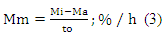
<P><font face="Verdana, Arial, Helvetica, sans-serif" size="2"> where:     <br>   W- Water content, kg; Wa- Weight after drying, kg. </font>     <P><font face="Verdana, Arial, Helvetica, sans-serif" size="2">The degree of grain    moisture is measured every one hour to observe changes in moisture content.    In general, it is called moisture reduction rate per hour.</font>      <P align="center"><img src="/img/revistas/rcta/v23n4/e0303414.gif" width="164" height="35">     
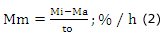
<P><font face="Verdana, Arial, Helvetica, sans-serif" size="2"> where:     ]]></body>
<body><![CDATA[<br>   Ma- Moisture content after drying, %; Mi- Initial moisture content,%; to- Operating    hours, h. </font>     <P><font face="Verdana, Arial, Helvetica, sans-serif" size="2">The mass of grains    after drying may be exactly measured because it is not difficult to take out    all grains from a sheet punched metal; for this reason, it is possible to use    a balance, if there is no balance it is possible to use the following expression:    </font>     <P align="center"><img src="/img/revistas/rcta/v23n4/e0403414.gif" width="432" height="30">      
<P><font face="Verdana, Arial, Helvetica, sans-serif" size="2"> where:     <br>   Wa- weight after drying, kg; Wb- weight before drying, kg;     <br>   Ma- Moisture Content after drying,%; Mi- Moisture Content before drying, %.    </font>     <P><font face="Verdana, Arial, Helvetica, sans-serif" size="2"><b>Materials </b></font>     <P><font face="Verdana, Arial, Helvetica, sans-serif" size="2">&#149; Moisture    meter (SAMAP); </font>      <P><font face="Verdana, Arial, Helvetica, sans-serif" size="2">&#149; Thermometers; </font>     <P><font face="Verdana, Arial, Helvetica, sans-serif" size="2">&#149; Anemometer (PROVA,    AVM-05); </font>     ]]></body>
<body><![CDATA[<P><font face="Verdana, Arial, Helvetica, sans-serif" size="2">&#149; Lux-meter (Lux-meter    0500); </font>     <P><font face="Verdana, Arial, Helvetica, sans-serif" size="2">&#149; Mechanical Balance    (certificate by PEXAC); </font>     <P><font face="Verdana, Arial, Helvetica, sans-serif" size="2">&#149; Recipients to take    sample. </font>     <P><font face="Verdana, Arial, Helvetica, sans-serif" size="2"><b>Methodology    for the economical evaluation of the process </b></font>     <P><font face="Verdana, Arial, Helvetica, sans-serif" size="2">To determine the    operation cost of the prototype (C<sub>exp</sub>), it is necessary to determinate    the fixed costs (C<sub>f</sub>) and the variable costs (C<sub>v</sub>), (Iglesias,    2002; Hunt, 1983; Ulloa, 1981; Aguilar. et al., 1989; Muñante, 2002; Iglesias.et    al, 1999): </font>      <P align="center"><img src="/img/revistas/rcta/v23n4/e0503414.gif" width="268" height="23">      
<P><font face="Verdana, Arial, Helvetica, sans-serif" size="2"> Fixed Cost (C<sub>f</sub>).    Don’t depend on the machinery use, but consider the depreciation cost (C<sub>d</sub>).    </font>      <P><font face="Verdana, Arial, Helvetica, sans-serif" size="2">Variable Cost (C<sub>v</sub>).    Depend on the utilization level of the machinery and its use. They include:    fuel cost (C<sub>c</sub>), lubricant cost (C<sub>l</sub>), maintenance cost    (C<sub>m</sub>), reparation cost (C<sub>r</sub>) and salary cost (C<sub>s</sub>).    </font>      <P><font face="Verdana, Arial, Helvetica, sans-serif" size="2">Specific cost (C<sub>esp</sub>).    Are the cost in peso per every unit of work carried out, it is expressed in    peso/t: </font>      <P align="center"><img src="/img/revistas/rcta/v23n4/e0603414.gif" width="174" height="30">      

]]></body>
<body><![CDATA[<P>&nbsp;      <P>      <P><font face="Verdana, Arial, Helvetica, sans-serif" size="3"><B>RESULTS AND DISCUSSION</B></font>      <P><font face="Verdana, Arial, Helvetica, sans-serif" size="2"><b> Results of    the drying process evaluation </b></font>     <P><font face="Verdana, Arial, Helvetica, sans-serif" size="2">The evaluation    of the prototype was carried out on April 3<sup>rd</sup> and 23<sup>rd</sup>,    2013, using grains of soybeans L1S1P10 and black beans Secano 7 INCA respectively.    This study was carried out in the Technical Sciences Faculty areas, Agraria    University of Havana, Mayabeque, Cuba, having good climatic conditions for developing    the drying process. </font>      <P><font face="Verdana, Arial, Helvetica, sans-serif" size="2">Before starting    the drying process, it was determined the initial mass and the moisture content    as shown in <a href="/img/revistas/rcta/v23n4/t0103414.gif">Table 1</a>.    </font>      
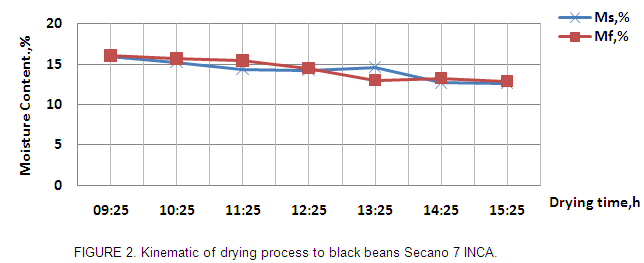
<P><font face="Verdana, Arial, Helvetica, sans-serif" size="2">Another variable    checked during the evaluation of the prototype was the air speed, which goes    from the dry chamber until the extractor crossing a punched metal of 1,71 m<sup>2</sup>,    with 1 500 000 holes of 1,2 mm of diameter, obtaining an average speed of 4,67    m/s; and having a duct area of 0,3 m<sup>2</sup>, it was possible to determine    the air flow with a value of 1,40 m3/s. </font>      <P><font face="Verdana, Arial, Helvetica, sans-serif" size="2">With the objective    of evaluating the drying process, it was determined it’s kinematic in the surface    and bottom of the dry chamber, as it shows <a href="/img/revistas/rcta/v23n4/f0103414.gif">Figures    1</a> and <a href="/img/revistas/rcta/v23n4/f0203414.gif">2</a>. </font>      
<P><font face="Verdana, Arial, Helvetica, sans-serif" size="2">In the <a href="/img/revistas/rcta/v23n4/f0103414.gif">Figure    1</a> is shown that the moisture content of soybeans was reduced of 15% until    10,24% in 3 h, without necessity of turning over the grains because the drying    process was homogeneous. </font>      
<P><font face="Verdana, Arial, Helvetica, sans-serif" size="2">In the <a href="/img/revistas/rcta/v23n4/f0203414.gif">Figure    2</a> is shown that the moisture content of black beans was reduced 16% until    12,15% in a time period of 6 h; with the objective of getting a homogeneous    drying the grain was turned over after 4 hours of operation (13:25 h). </font>      
]]></body>
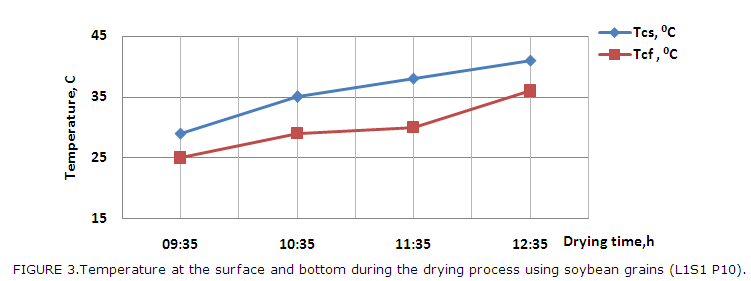
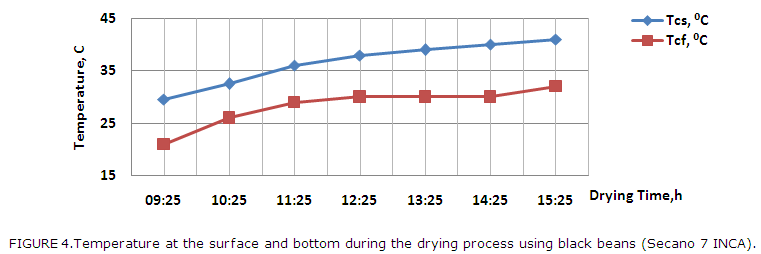
<body><![CDATA[<P><font face="Verdana, Arial, Helvetica, sans-serif" size="2">Using the expression    (3) it was determined the moisture reduction rate, having values of 1,58%/ h    y 0,54%/ h, for soybeans and black beans grains respectively. </font>     <P><font face="Verdana, Arial, Helvetica, sans-serif" size="2">Another important    result is the mass of grains obtained after the drying process, being of 104    kg and 142 kg for soybeans and black beans, removing 12 kg and 8 kg of water    in both grains respectively. </font>     <P><font face="Verdana, Arial, Helvetica, sans-serif" size="2">To evaluate the    performance of the prototype, it was controlled its temperature in the drying    chamber on the surface and the bottom, showing that in the surface was higher    than the environment temperature but the bottom temperature was almost the same    to the environment, is because the drying direction is oriented from the surface    to bottom, demonstrating that the prototype gathers the requirements of drying    machines, as shown in the <a href="/img/revistas/rcta/v23n4/f0303414.gif">Figures    3</a> and <a href="/img/revistas/rcta/v23n4/f0403414.gif">4</a>. </font>      
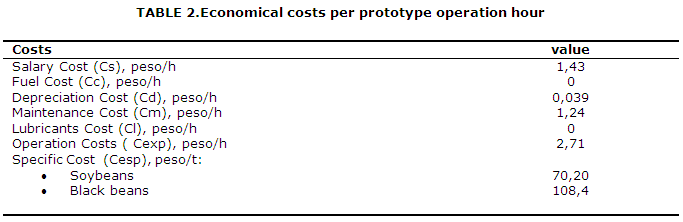
<P><font face="Verdana, Arial, Helvetica, sans-serif" size="2"><b>Results of the    economical evaluation </b></font>     <P><font face="Verdana, Arial, Helvetica, sans-serif" size="2">Operation cost    was determined with the expression (5) and its values, as shown in the <a href="/img/revistas/rcta/v23n4/t0203414.gif">Table    2</a>. </font>      
<P><font face="Verdana, Arial, Helvetica, sans-serif" size="2">Salary cost, has    a basis the current minimum salary in the country which is 275 peso, as well    as the work carried out per hour. The cost in fuel and lubricants are null because    the prototype doesn’t need any for functioning. Depreciation cost has a value    of 0,039 peso/h, being the prototype initial price of 379 peso, and considering    a annual percent of 15% of depreciation and a annual use of 180 days working    8 hours a day. </font>     <P><font face="Verdana, Arial, Helvetica, sans-serif" size="2">The battery is    the only part in the prototype that requires maintenance, and considering the    annual demand and the charge duration in this device that was 13 hours working    continually with a maximum demand of the velocity regulator devices of 4 A of    electrical current intensity, was obtained that the quantity of maintenance    required was 111, and knowing the electricity price for the maintenance is 0.09    peso (0-100 kWh) during 8 hours of maintenance, it is obtained a cost of 1,24    peso/h. The reparation cost is not considered because the devices that have    the prototype are not reparable; therefore they must be replaced when they break    down. </font>     <P><font face="Verdana, Arial, Helvetica, sans-serif" size="2">The specific cost    to dry a ton of soybeans is 70, 20 peso/t and 108,4 peso/t for black beans,    to obtain these results it was determined the prototype productivity for both    grains, being of 38,6 kg/h and 25 kg/h for soybeans and black beans respectively.    </font>     <P>&nbsp;      <P>      ]]></body>
<body><![CDATA[<P><font face="Verdana, Arial, Helvetica, sans-serif" size="3"><B>CONCLUSIONS</B></font>     <P><font face="Verdana, Arial, Helvetica, sans-serif" size="2">&#149; The prototype    fabricate have a weight of 115 kg, its geometrical dimensions are 1 900 x 900x    870 mm, it doesn’t need conventional fuels to work, it doesn’t emit products    from combustion, resist structurally the load. </font>     <P><font face="Verdana, Arial, Helvetica, sans-serif" size="2">&#149; The average    speed of extracted humid air was 4,67 m/s, and as the duct area is 0,3 m<sup>2</sup>,    the average air flow was 1,40 m3/s. </font>      <P><font face="Verdana, Arial, Helvetica, sans-serif" size="2">&#149; The moisture content    of soybeans was reduced from 15% to 10, 24% in 3 hours, being the reduction    moisture rate of 1,58%/h. </font>     <P><font face="Verdana, Arial, Helvetica, sans-serif" size="2">&#149; The moisture content    of black beans was reduced from16% to 12, 15% in 3 hours, being the reduction    moisture rate of 0,54%/h. </font>     <P><font face="Verdana, Arial, Helvetica, sans-serif" size="2">&#149; The initial mass    of soybeans and black beans was 116 kg and 150 kg respectively and the obtained    after the drying process was of 104 kg and 142 kg, removing 12 kg and 8 kg of    water for both grains. </font>     <P><font face="Verdana, Arial, Helvetica, sans-serif" size="2">&#149; The temperatures    obtained on the surface were higher than the environmental temperatures, and    at the bottom they were almost the same as the environment temperature, because    the drying orientation occurs from surface to bottom. </font>     <P>&nbsp;     <P>&nbsp;      <P>     ]]></body>
<body><![CDATA[<P>     <P>      <P><font face="Verdana, Arial, Helvetica, sans-serif" size="3"><B>REFERENCES</B></font>     <!-- ref --><P><font face="Verdana, Arial, Helvetica, sans-serif" size="2"> 1. AGUILAR, V.    A.: <I>Administración agropecuaria</i>, Editorial Limusa, México, 1989.     </font>      <!-- ref --><P><font face="Verdana, Arial, Helvetica, sans-serif" size="2">2. AMERICAN SOCIETY    OF AGRICULTURAL ENGINEERING (ASAE): <I>Yearbook</i>, St. Joseph. Mich. USA,    1972.     </font>      <P><font face="Verdana, Arial, Helvetica, sans-serif" size="2">3. BUCHINGER, J.;    W. WEISS: <i>Solar Drying</i> Ed. Institute for Sustainable Technologies, E-mail:    <a href="mailto:office@aee.at" target="_blank">office@aee.at</a>. Austria, 2001.    </font>      <!-- ref --><P><font face="Verdana, Arial, Helvetica, sans-serif" size="2">4. BUELOW, F.H.:    &quot;Drying grain with solar energy&quot;, Mich. State Univ., <i>Agric. Exp.    Stn Q. Bull</i> 41(2): 421-429, 1958.     </font>      ]]></body>
<body><![CDATA[<!-- ref --><P><font face="Verdana, Arial, Helvetica, sans-serif" size="2">5. HUNT, D.: &quot;Maquinaria    agrícola, rendimiento económico, costos, operaciones, potencia y selección de    equipo&quot;, En: <i>Manual de laboratorio y cuaderno de trabajo</i>, Editorial    Limusa, México, 1983.     </font>      <!-- ref --><P><font face="Verdana, Arial, Helvetica, sans-serif" size="2">6. IGLESIAS, C.E.:    <i>Administración de la maquinaria agrícola (apuntes para un libro de texto)</i>,    500pp., Universidad Autónoma Chapingo (UACh), México, 2002.     </font>      <!-- ref --><P><font face="Verdana, Arial, Helvetica, sans-serif" size="2">7. IGLESIAS, C.E.,    P. PANEQUE, L. SHKILIOVA: <i>Evaluación y prueba de tractores y máquinas agrícolas</i>,    485pp., Universidad Autónoma Chapingo (UACh), México, 1999.     </font>      <!-- ref --><P><font face="Verdana, Arial, Helvetica, sans-serif" size="2">8. KLAASSEN, G.:    <i>Seed drying. International course on seed technology for vegetable crops</i>.    University of the Philippines at los Baños the Philippines, 1983.     </font>      <!-- ref --><P><font face="Verdana, Arial, Helvetica, sans-serif" size="2">9. MOREJÓN, Y.:    “Fabrication and evaluation of a Solar Grain Dryer”, <i>Revista Ciencias Técnicas    Agropecuarias</i>, 20(3): 68-72, 2011.     </font>      ]]></body>
<body><![CDATA[<!-- ref --><P><font face="Verdana, Arial, Helvetica, sans-serif" size="2">10. MOREJÓN, Y.:    <i>Tecnologías de secado de granos</i>, (Notas de conferencia especializada    sobre poscosecha). Ed. Universidad Agraria de La Habana (UNAH), Mayabeque, Cuba,    2011.     </font>      <!-- ref --><P><font face="Verdana, Arial, Helvetica, sans-serif" size="2">11. MUÑANTE, P.    D.: <i>Formulación y evaluación de proyectos</i>, (Apuntes para el curso), Ed.    Centro de Educación Continua y Servicios Universitarios, Universidad autónoma    Chapingo, México, (impreso), 2002.     </font>      <!-- ref --><P><font face="Verdana, Arial, Helvetica, sans-serif" size="2">12. OHSHITA, S.:    <i>Solar grain drying</i>, Group training course in post-harvest rice processing,    Ed. Department of Agricultural Engineering, Faculty of Agriculture, University    of Tokyo, Japan, 1995.     </font>      <!-- ref --><P><font face="Verdana, Arial, Helvetica, sans-serif" size="2">13. SATO, J.: <i>Solar    grain dryer</i>, Lecture Textbooks fourth edition, Farm Mechanization Course,    Farm Machinery Design Course, Tsukuba, International Agricultural Training Centre,    Japan International Cooperation Agency, Japan, 1994.     </font>      <!-- ref --><P><font face="Verdana, Arial, Helvetica, sans-serif" size="2">14. SHOVE, G. C.:    &quot;Solar Grain Drying&quot;, En: <i>Conf. Proc., Jan.</i> University of Illinois,    Urbana-Champaign, USA, 1977.     </font>      ]]></body>
<body><![CDATA[<!-- ref --><P><font face="Verdana, Arial, Helvetica, sans-serif" size="2">15. SOLIVA-FORTUNY:    “Effect of minimum processing on the texture properties of fresh-cut pears”,    <i>SCI Food Agric</i>. (82): 1688-1862, 2002.     </font>      <!-- ref --><P><font face="Verdana, Arial, Helvetica, sans-serif" size="2">16. ULLOA, T. O.:    <i>Maquinaria agrícola II</i> (apuntes de clases), Ed. Dpto. de Fitotecnia,    Universidad autónoma Chapingo, Texcoco, México, 1981.     </font>      <P>&nbsp;     <P>&nbsp;      <P>     <P>     <P>      <P>      ]]></body>
<body><![CDATA[<P><font face="Verdana, Arial, Helvetica, sans-serif" size="2"><b>Recibido:</b>    15 de diciembre de 2013.    <BR>   <b>Aprobado:</b> <font face="Verdana, Arial, Helvetica, sans-serif" size="2">20 de marzo de 2014</font>. </font>      <P>&nbsp;     <P>&nbsp;      <P>     <P>     <P>      <P>      <P><font face="Verdana, Arial, Helvetica, sans-serif" size="2"><I>Yanoy Morejón    Mesa</I>. Universidad Agraria de La Habana, Facultad de Ciencias Técnicas, San    José de las Lajas, Mayabeque, Cuba, CP: 32700. Correo electr&oacute;nico: <U><FONT COLOR="#0000ff"><a href="mailto:ymm@unah.edu.cu">ymm@unah.edu.cu</a></FONT></U>    </font>     <P>&nbsp;     ]]></body>
<body><![CDATA[<P><font face="Verdana, Arial, Helvetica, sans-serif" size="2"><b>Nota:</b> La    mención de marcas comerciales de equipos, instrumentos o materiales específicos    obedece a propósitos de identificación, no existiendo ningún compromiso promocional    con relación a los mismos, ni por los autores ni por el editor.</font>       ]]></body><back>
<ref-list>
<ref id="B1">
<label>1</label><nlm-citation citation-type="book">
<person-group person-group-type="author">
<name>
<surname><![CDATA[AGUILAR]]></surname>
<given-names><![CDATA[V. A.]]></given-names>
</name>
</person-group>
<source><![CDATA[Administración agropecuaria]]></source>
<year>1989</year>
<publisher-name><![CDATA[Editorial Limusa]]></publisher-name>
</nlm-citation>
</ref>
<ref id="B2">
<label>2</label><nlm-citation citation-type="">
<collab>AMERICAN SOCIETY OF AGRICULTURAL ENGINEERING (ASAE)</collab>
<source><![CDATA[Yearbook,]]></source>
<year>1972</year>
<publisher-loc><![CDATA[St. Joseph^eMich Mich]]></publisher-loc>
</nlm-citation>
</ref>
<ref id="B3">
<label>3</label><nlm-citation citation-type="book">
<person-group person-group-type="author">
<name>
<surname><![CDATA[BUCHINGER]]></surname>
<given-names><![CDATA[J.]]></given-names>
</name>
<name>
<surname><![CDATA[WEISS]]></surname>
<given-names><![CDATA[W.]]></given-names>
</name>
</person-group>
<source><![CDATA[Solar Drying]]></source>
<year>2001</year>
<publisher-loc><![CDATA[Austria ]]></publisher-loc>
<publisher-name><![CDATA[Ed. Institute for Sustainable Technologies]]></publisher-name>
</nlm-citation>
</ref>
<ref id="B4">
<label>4</label><nlm-citation citation-type="journal">
<person-group person-group-type="author">
<name>
<surname><![CDATA[BUELOW]]></surname>
<given-names><![CDATA[F.H.]]></given-names>
</name>
</person-group>
<article-title xml:lang="en"><![CDATA[Drying grain with solar energy]]></article-title>
<source><![CDATA[Mich. State Univ., Agric. Exp. Stn Q. Bull]]></source>
<year>1958</year>
<volume>41</volume>
<numero>2</numero>
<issue>2</issue>
<page-range>421-429</page-range></nlm-citation>
</ref>
<ref id="B5">
<label>5</label><nlm-citation citation-type="book">
<person-group person-group-type="author">
<name>
<surname><![CDATA[HUNT]]></surname>
<given-names><![CDATA[D.]]></given-names>
</name>
</person-group>
<article-title xml:lang="es"><![CDATA[Maquinaria agrícola, rendimiento económico, costos, operaciones, potencia y selección de equipo]]></article-title>
<source><![CDATA[Manual de laboratorio y cuaderno de trabajo]]></source>
<year>1983</year>
<publisher-name><![CDATA[Editorial Limusa]]></publisher-name>
</nlm-citation>
</ref>
<ref id="B6">
<label>6</label><nlm-citation citation-type="book">
<person-group person-group-type="author">
<name>
<surname><![CDATA[IGLESIAS]]></surname>
<given-names><![CDATA[C.E.]]></given-names>
</name>
</person-group>
<source><![CDATA[Administración de la maquinaria agrícola (apuntes para un libro de texto)]]></source>
<year>2002</year>
<page-range>500</page-range><publisher-name><![CDATA[Universidad Autónoma Chapingo (UACh)]]></publisher-name>
</nlm-citation>
</ref>
<ref id="B7">
<label>7</label><nlm-citation citation-type="book">
<person-group person-group-type="author">
<name>
<surname><![CDATA[IGLESIAS]]></surname>
<given-names><![CDATA[C.E.]]></given-names>
</name>
</person-group>
<person-group person-group-type="editor">
<name>
</name>
<name>
<surname><![CDATA[PANEQUE]]></surname>
<given-names><![CDATA[P.]]></given-names>
</name>
<name>
<surname><![CDATA[SHKILIOVA]]></surname>
<given-names><![CDATA[L.]]></given-names>
</name>
</person-group>
<source><![CDATA[Evaluación y prueba de tractores y máquinas agrícolas]]></source>
<year>1999</year>
<page-range>485</page-range><publisher-name><![CDATA[Universidad Autónoma Chapingo (UACh)]]></publisher-name>
</nlm-citation>
</ref>
<ref id="B8">
<label>8</label><nlm-citation citation-type="book">
<person-group person-group-type="author">
<name>
<surname><![CDATA[KLAASSEN]]></surname>
<given-names><![CDATA[G.]]></given-names>
</name>
</person-group>
<source><![CDATA[Seed drying. International course on seed technology for vegetable crops.]]></source>
<year>1983</year>
<publisher-loc><![CDATA[los Baños ]]></publisher-loc>
<publisher-name><![CDATA[University of the Philippines]]></publisher-name>
</nlm-citation>
</ref>
<ref id="B9">
<label>9</label><nlm-citation citation-type="journal">
<person-group person-group-type="author">
<name>
<surname><![CDATA[MOREJÓN]]></surname>
<given-names><![CDATA[Y.]]></given-names>
</name>
</person-group>
<article-title xml:lang="en"><![CDATA[Fabrication and evaluation of a Solar Grain Dryer]]></article-title>
<source><![CDATA[Revista Ciencias Técnicas Agropecuarias]]></source>
<year>2011</year>
<volume>20</volume>
<numero>3</numero>
<issue>3</issue>
<page-range>68-72</page-range></nlm-citation>
</ref>
<ref id="B10">
<label>10</label><nlm-citation citation-type="book">
<person-group person-group-type="author">
<name>
<surname><![CDATA[MOREJÓN]]></surname>
<given-names><![CDATA[Y.]]></given-names>
</name>
</person-group>
<person-group person-group-type="editor">
<name>
</name>
</person-group>
<source><![CDATA[Tecnologías de secado de granos]]></source>
<year>2011</year>
<publisher-loc><![CDATA[Mayabeque ]]></publisher-loc>
<publisher-name><![CDATA[Ed. Universidad Agraria de La Habana (UNAH)]]></publisher-name>
</nlm-citation>
</ref>
<ref id="B11">
<label>11</label><nlm-citation citation-type="book">
<person-group person-group-type="author">
<name>
<surname><![CDATA[MUÑANTE]]></surname>
<given-names><![CDATA[P. D.]]></given-names>
</name>
</person-group>
<source><![CDATA[Formulación y evaluación de proyectos]]></source>
<year>2002</year>
<publisher-name><![CDATA[Ed. Centro de Educación Continua y Servicios UniversitariosUniversidad autónoma Chapingo]]></publisher-name>
</nlm-citation>
</ref>
<ref id="B12">
<label>12</label><nlm-citation citation-type="book">
<person-group person-group-type="author">
<name>
<surname><![CDATA[OHSHITA]]></surname>
<given-names><![CDATA[S.]]></given-names>
</name>
</person-group>
<source><![CDATA[Solar grain drying]]></source>
<year>1995</year>
<publisher-name><![CDATA[Group training course in post-harvest rice processingEd. Department of Agricultural Engineering, Faculty of Agriculture, University of Tokyo]]></publisher-name>
</nlm-citation>
</ref>
<ref id="B13">
<label>13</label><nlm-citation citation-type="book">
<person-group person-group-type="author">
<name>
<surname><![CDATA[SATO]]></surname>
<given-names><![CDATA[J.]]></given-names>
</name>
</person-group>
<source><![CDATA[Solar grain dryer]]></source>
<year>1994</year>
<edition>fourth</edition>
<publisher-loc><![CDATA[Tsukuba ]]></publisher-loc>
<publisher-name><![CDATA[Farm Mechanization CourseInternational Agricultural Training CentreJapan International Cooperation Agency]]></publisher-name>
</nlm-citation>
</ref>
<ref id="B14">
<label>14</label><nlm-citation citation-type="book">
<person-group person-group-type="author">
<name>
<surname><![CDATA[SHOVE]]></surname>
<given-names><![CDATA[G. C.]]></given-names>
</name>
</person-group>
<article-title xml:lang="en"><![CDATA[Solar Grain Drying]]></article-title>
<source><![CDATA[Conf. Proc., Jan.]]></source>
<year>1977</year>
<publisher-loc><![CDATA[Urbana-Champaign ]]></publisher-loc>
<publisher-name><![CDATA[University of Illinois]]></publisher-name>
</nlm-citation>
</ref>
<ref id="B15">
<label>15</label><nlm-citation citation-type="journal">
<collab>SOLIVA-FORTUNY</collab>
<article-title xml:lang="en"><![CDATA[Effect of minimum processing on the texture properties of fresh-cut pears]]></article-title>
<source><![CDATA[SCI Food Agric.]]></source>
<year>2002</year>
<numero>82</numero>
<issue>82</issue>
<page-range>1688-1862</page-range></nlm-citation>
</ref>
<ref id="B16">
<label>16</label><nlm-citation citation-type="book">
<person-group person-group-type="author">
<name>
<surname><![CDATA[ULLOA]]></surname>
<given-names><![CDATA[T. O.]]></given-names>
</name>
</person-group>
<source><![CDATA[Maquinaria agrícola II]]></source>
<year>1981</year>
<publisher-loc><![CDATA[Texcoco ]]></publisher-loc>
<publisher-name><![CDATA[Ed. Dpto. de FitotecniaUniversidad autónoma Chapingo]]></publisher-name>
</nlm-citation>
</ref>
</ref-list>
</back>
</article>