<?xml version="1.0" encoding="ISO-8859-1"?><article xmlns:mml="http://www.w3.org/1998/Math/MathML" xmlns:xlink="http://www.w3.org/1999/xlink" xmlns:xsi="http://www.w3.org/2001/XMLSchema-instance">
<front>
<journal-meta>
<journal-id>2071-0054</journal-id>
<journal-title><![CDATA[Revista Ciencias Técnicas Agropecuarias]]></journal-title>
<abbrev-journal-title><![CDATA[Rev Cie Téc Agr]]></abbrev-journal-title>
<issn>2071-0054</issn>
<publisher>
<publisher-name><![CDATA[Universidad Agraria de La Habana]]></publisher-name>
</publisher>
</journal-meta>
<article-meta>
<article-id>S2071-00542015000100007</article-id>
<title-group>
<article-title xml:lang="en"><![CDATA[Development of a citation style language CSL to describe the formatting of citations, notes and bibliographies of agricultural scientific articles]]></article-title>
<article-title xml:lang="es"><![CDATA[Desarrollo de un lenguaje de estilo de citas CSL para asentar citas, notas y bibliografía de artículos científicos agropecuarios]]></article-title>
</title-group>
<contrib-group>
<contrib contrib-type="author">
<name>
<surname><![CDATA[Cervantes Beyra]]></surname>
<given-names><![CDATA[Rafael]]></given-names>
</name>
<xref ref-type="aff" rid="A01"/>
</contrib>
<contrib contrib-type="author">
<name>
<surname><![CDATA[Ponce de León]]></surname>
<given-names><![CDATA[Daniel]]></given-names>
</name>
<xref ref-type="aff" rid="A01"/>
</contrib>
<contrib contrib-type="author">
<name>
<surname><![CDATA[Fernández Valdés]]></surname>
<given-names><![CDATA[Daybelis]]></given-names>
</name>
<xref ref-type="aff" rid="A01"/>
</contrib>
<contrib contrib-type="author">
<name>
<surname><![CDATA[Balmaseda Espinosa]]></surname>
<given-names><![CDATA[Carlos]]></given-names>
</name>
<xref ref-type="aff" rid="A02"/>
</contrib>
<contrib contrib-type="author">
<name>
<surname><![CDATA[Ocampo Ramírez]]></surname>
<given-names><![CDATA[Arturo]]></given-names>
</name>
<xref ref-type="aff" rid="A03"/>
</contrib>
</contrib-group>
<aff id="A01">
<institution><![CDATA[,Universidad Agraria de La Habana  ]]></institution>
<addr-line><![CDATA[Mayabeque San José de las Lajas]]></addr-line>
<country>Cuba</country>
</aff>
<aff id="A02">
<institution><![CDATA[,Universidad Estatal Península de Santa Elena  ]]></institution>
<addr-line><![CDATA[ ]]></addr-line>
<country>Ecuador</country>
</aff>
<aff id="A03">
<institution><![CDATA[,Instituto Politécnico Nacional Escuela Superior de Ingeniería Mecánica y Eléctrica Unidad Zacatenco]]></institution>
<addr-line><![CDATA[México ]]></addr-line>
<country>México</country>
</aff>
<pub-date pub-type="pub">
<day>00</day>
<month>03</month>
<year>2015</year>
</pub-date>
<pub-date pub-type="epub">
<day>00</day>
<month>03</month>
<year>2015</year>
</pub-date>
<volume>24</volume>
<numero>1</numero>
<fpage>51</fpage>
<lpage>58</lpage>
<copyright-statement/>
<copyright-year/>
<self-uri xlink:href="http://scielo.sld.cu/scielo.php?script=sci_arttext&amp;pid=S2071-00542015000100007&amp;lng=en&amp;nrm=iso"></self-uri><self-uri xlink:href="http://scielo.sld.cu/scielo.php?script=sci_abstract&amp;pid=S2071-00542015000100007&amp;lng=en&amp;nrm=iso"></self-uri><self-uri xlink:href="http://scielo.sld.cu/scielo.php?script=sci_pdf&amp;pid=S2071-00542015000100007&amp;lng=en&amp;nrm=iso"></self-uri><abstract abstract-type="short" xml:lang="en"><p><![CDATA[The development of files of citation styles that could be connected to reference management softwares is a viable option to reduce the errors in form of the articles sent to the agricultural journals. Sometimes, the publishing house committees do tedious works of bibliographical correction that often end with the return of numerous documents for this reason. The styles CSL (processors of citation, notes and bibliographies) describe the formatting of citations and bibliographies according to the styles of every journal and can be loaded by a wide range of citation programs; therefore constitute a powerful and indispensable tool in the making of scientific article. For that reason, the objective of this work was to development a citation style language CSL based on the guidelines ISO 690:2010 to describe the formatting of citations, notes and bibliographies of the agricultural scientific articles of the Revista Ciencias Tecnicas Agropecuarias (RCTA). For it, was used the CSL scheme v1.0, with complex XML based language, character encoding utf-8 and formatting of citations in text author-date. The operations of edition and validate were realized with the text editor Notepad ++ v4.7.5, the Visual (on-line) Publishing CSL and the (on-line) Validator.nu. As result, was obtain a file CSL that is supported by 25 reference managers that allows formatting the citations, notes and bibliographies of the agricultural scientific articles through of the style of the journal RCTA, according to the guidelines ISO 690:2010.]]></p></abstract>
<abstract abstract-type="short" xml:lang="es"><p><![CDATA[El desarrollo de ficheros de estilos bibliográficos que puedan ser acoplados a gestores de información científica, es una opción viable para reducir los errores en forma de los artículos que se presentan en las revistas de corte agropecuario. En ocasiones, los comités editoriales se ven envueltos en tediosos trabajos de corrección bibliográfica que muchas veces terminan con la devolución de numerosos documentos por este motivo. Los estilos CSL (procesadores de citas, notas y bibliografías) permiten realizar el asentamiento automático de las referencias utilizadas según las exigencias de cada revista y pueden ser cargados por una amplia gama gestores de reconocida preferencia; por lo que constituyen una potente e indispensable herramienta en la elaboración de documentos científicos. Es por ello que el objetivo de este trabajo fue confeccionar un lenguaje de estilo de citas CSL basado en la norma ISO 690:2010 para asentar la bibliografía de los artículos presentados en la Revista Ciencias Técnicas Agropecuarias (RCTA). Para la confección del mismo se utilizó el esquema CSL v1.0, con lenguaje XML, formato de codificación de caracteres utf-8 y tipo de citas en texto autor-año. Las operaciones de edición y validación se realizaron a través del editor de texto plano Notepad++ v4.7.5, el Visual CSL Editor (online) y el Validator.nu (online). Como resultado se obtuvo un fichero CSL compatible con 25 gestores bibliográficos que permite asentar de manera automática la bibliografía de los artículos científicos agropecuarios de RCTA, según las directrices de la norma ISO 690:2010.]]></p></abstract>
<kwd-group>
<kwd lng="en"><![CDATA[reference manager]]></kwd>
<kwd lng="en"><![CDATA[citation style language]]></kwd>
<kwd lng="en"><![CDATA[agricultural scientific articles]]></kwd>
<kwd lng="es"><![CDATA[procesador bibliográfico]]></kwd>
<kwd lng="es"><![CDATA[lenguaje de estilo de citas]]></kwd>
<kwd lng="es"><![CDATA[artículos científicos agropecuarios]]></kwd>
</kwd-group>
</article-meta>
</front><body><![CDATA[ <div align="right">       <p><font face="Verdana, Arial, Helvetica, sans-serif" size="2"><B>ART&Iacute;CULO      ORIGINAL </B></font></p>       <p>&nbsp;</p> </div> <B>     <P>      <P>      <P><font face="Verdana, Arial, Helvetica, sans-serif" size="4">Development of a citation style language CSL  to describe the formatting of citations, notes  and bibliographies of agricultural scientific articles</font>      <P>&nbsp;      <P>      <P><font face="Verdana, Arial, Helvetica, sans-serif" size="3">Desarrollo de un lenguaje de estilo de citas CSL para asentar citas, notas y bibliografía de artículos científicos agropecuarios</font>      <P>&nbsp;     ]]></body>
<body><![CDATA[<P>&nbsp; </B>     <P>      <P>      <P><b><font face="Verdana, Arial, Helvetica, sans-serif" size="2">M.Sc. Rafael    Cervantes Beyra,<sup>I</sup> Dr.C. Daniel Ponce de León,<sup>I</sup> Ing. Daybelis    Fernández Valdés,<sup>I</sup> Dr.C. Carlos Balmaseda Espinosa,<sup>II</sup>    M.Sc. Arturo Ocampo Ramírez<sup>III</sup> </font></b>      <P><font face="Verdana, Arial, Helvetica, sans-serif" size="2"><sup>I</sup> Universidad    Agraria de La Habana, San José de las Lajas, Mayabeque, Cuba.     <br>   <sup>II</sup> Universidad Estatal Península de Santa Elena, Ecuador.     <br>   <sup>III</sup> Instituto Politécnico Nacional, Escuela Superior de Ingeniería    Mecánica y Eléctrica, Unidad Zacatenco, Cuidad de México, México. </font>      <P>&nbsp;     <P>&nbsp; <hr>     <P>      ]]></body>
<body><![CDATA[<P>      <P> <font face="Verdana, Arial, Helvetica, sans-serif" size="2"><B>ABSTRACT</B></font>      <p><font face="Verdana, Arial, Helvetica, sans-serif" size="2">The development    of files of citation styles that could be connected to reference management    softwares is a viable option to reduce the errors in form of the articles sent    to the agricultural journals. Sometimes, the publishing house committees do    tedious works of bibliographical correction that often end with the return of    numerous documents for this reason. The styles CSL (processors of citation,    notes and bibliographies) describe the formatting of citations and bibliographies    according to the styles of every journal and can be loaded by a wide range of    citation programs; therefore constitute a powerful and indispensable tool in    the making of scientific article. For that reason, the objective of this work    was to development a citation style language CSL based on the guidelines ISO    690:2010 to describe the formatting of citations, notes and bibliographies of    the agricultural scientific articles of the Revista Ciencias Tecnicas Agropecuarias    (RCTA). For it, was used the CSL scheme v1.0, with complex XML based language,    character encoding utf-8 and formatting of citations in text author-date. The    operations of edition and validate were realized with the text editor Notepad    ++ v4.7.5, the Visual (on-line) Publishing CSL and the (on-line) Validator.nu.    As result, was obtain a file CSL that is supported by 25 reference managers    that allows formatting the citations, notes and bibliographies of the agricultural    scientific articles through of the style of the journal RCTA, according to the    guidelines ISO 690:2010. </font></p>     <p><font face="Verdana, Arial, Helvetica, sans-serif" size="2"> <b>Key words:</b>    reference manager, citation style language, agricultural scientific articles.</font></p> <hr>      <P> <font face="Verdana, Arial, Helvetica, sans-serif" size="2"><B>RESUMEN</B></font>      <P><font face="Verdana, Arial, Helvetica, sans-serif" size="2">El desarrollo de    ficheros de estilos bibliográficos que puedan ser acoplados a gestores de información    científica, es una opción viable para reducir los errores en forma de los artículos    que se presentan en las revistas de corte agropecuario. En ocasiones, los comités    editoriales se ven envueltos en tediosos trabajos de corrección bibliográfica    que muchas veces terminan con la devolución de numerosos documentos por este    motivo. Los estilos CSL (procesadores de citas, notas y bibliografías) permiten    realizar el asentamiento automático de las referencias utilizadas según las    exigencias de cada revista y pueden ser cargados por una amplia gama gestores    de reconocida preferencia; por lo que constituyen una potente e indispensable    herramienta en la elaboración de documentos científicos. Es por ello que el    objetivo de este trabajo fue confeccionar un lenguaje de estilo de citas CSL    basado en la norma ISO 690:2010 para asentar la bibliografía de los artículos    presentados en la Revista Ciencias Técnicas Agropecuarias (RCTA). Para la confección    del mismo se utilizó el esquema CSL v1.0, con lenguaje XML, formato de codificación    de caracteres utf-8 y tipo de citas en texto autor-año. Las operaciones de edición    y validación se realizaron a través del editor de texto plano Notepad++ v4.7.5,    el Visual CSL Editor (online) y el Validator.nu (online). Como resultado se    obtuvo un fichero CSL compatible con 25 gestores bibliográficos que permite    asentar de manera automática la bibliografía de los artículos científicos agropecuarios    de RCTA, según las directrices de la norma ISO 690:2010. </font>      <p><font face="Verdana, Arial, Helvetica, sans-serif" size="2"> <b>Palabras clave:</b>    procesador bibliográfico, lenguaje de estilo de citas, artículos científicos    agropecuarios. </font> </p> <hr>      <P>      <P>&nbsp;     <P>&nbsp;     ]]></body>
<body><![CDATA[<P><font face="Verdana, Arial, Helvetica, sans-serif" size="3"><B>INTRODUCTION</B>    </font>      <P><font face="Verdana, Arial, Helvetica, sans-serif" size="2">There are known    the frequent errors that are committed in the use of the bibliography of the    different scientific works, as for example: incomplete reference; omission of    elements of obligatory filling as the year of the publication, authors, ISSN,    ISBN, pages, publishing houses; there are not put the references that are cited    in the article, there are reference of cited that not appear in the text and    especially that the filling of the chapter Bibliography is not carried out in    a uniform way and under the parameters of form established by the bibliographical    styles (way of presenting the used documents) of the journal (Osca-Lluch et al.,    2009; Revista Fitotecnia Mexicana, 2012; Jabulani, 2014; Nixon, 2014). </font>     <P><font face="Verdana, Arial, Helvetica, sans-serif" size="2">In this sense,    the reference management softwares (programs that carry out the establishment    of the bibliography) realize in an automatic way the harvest and organization    of the scientific information, from the metadata of the documents index-linked    in the different international databases (Sánchez, 2014). These programs are    free and they work under mutual compatibility standards with open source that    allows the integration between them and the design of bibliographical styles    adjusted at the requirements and desires of the thousands of users that develop    them. </font>     <P><font face="Verdana, Arial, Helvetica, sans-serif" size="2">The styles (processors    of citation, notes and bibliographies) that use these programs to generate the    information, are contained in files of type CSL (Citation Style Language) based    on language XML, under format of codification of characters utf-8. They are    completely edited and of use shared for a wide range of reference managers of    recognized international importance like Zotero (Ansorge y Kratochvíl, 2013;    Watkins, 2013; Courraud, 2014), Mendeley, Papers, and others<sup><a href="#n1">1</a><a name="n1a"></a></sup>.    These characteristics have done that the autonomous creation of bibliographical    styles for publishing houses and centers of publications of all kinds have been    in increase and today more than 7000 of them are exhibited in places as <a href="https://www.zotero.org/styles/" target="_blank">https://www.zotero.org/styles/</a>    and <a href="https://github.com/citation-style-language/styles/" target="_blank">https://github.com/citation-style-language/styles/</a>    of access free for the whole international scientific community. </font>      <P><font face="Verdana, Arial, Helvetica, sans-serif" size="2">The styles development    is an advantage that the journal present to increase its visibility because    the automatic standardization of the bibliographical requirements (principally    of the documents index-linked in databases), allow the location and not omission    of authors, terms, dates, titles; that constitute trailing elements for the    systems of position of the databases and as result increases the recognition    and visibility of the works (Giles et al., 1998; Freysteinson, 2013; Castolo    et al., 2014). </font>     <P><font face="Verdana, Arial, Helvetica, sans-serif" size="2">Is in the establishment    and organization of citation, notes and bibliographies where its main advantage    has. The styles CSL allow better handling of the information sources scientist    for the international community and it is considered very beneficial for the    journals because its form requirements are fulfilled by major facility and relevancy.    This is something that has attracted attention of authors, publishers, journals,    universities, research centers, associations; who have found in the styles of    type CSL a viable opportunity to humanize the management of the bibliography,    reduce the errors and avoid the constant documents return for this motive (Mengxion,    2014).</font>     <P><font face="Verdana, Arial, Helvetica, sans-serif" size="2"> The way of presenting    the references, as well as the information in them, change according to the    needs and the nature of the bibliography. For it, the publishing houses in its    style norms, usually give guidelines on the dispositions that they consider    to be more suitable<sup><a href="#n2">2</a><a name="n2a"></a></sup>, (Quir, 2014; Rivera, 2014). From each of them dissimilar    styles CSL have developed for orientate the authors and assure the of the bibliographical    requirements established by every center of publication. </font>     <P><font face="Verdana, Arial, Helvetica, sans-serif" size="2">Every time there    are more the styles that adopt the norm ISO 690:2010, or partly of it, because    allow a good grade of unit (exempt of the localisms), at the time that it allows    the necessary flexibility to adapt itself to diverse situations; nevertheless,    the manual creation of the bibliographical references is a bothersome work that    provokes repeated errors that end with the rejection of the articles presented    in the journal. For that reason, the objective of this work was to development    a citation style language CSL based on the guidelines ISO 690:2010 to describe    the formatting of citations, notes and bibliographies of the agricultural scientific    articles of the Revista Ciencias Tecnicas Agropecuarias (RCTA). </font>     <P>&nbsp;      <P>      ]]></body>
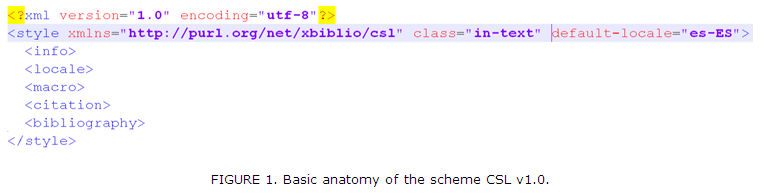
<body><![CDATA[<P><font face="Verdana, Arial, Helvetica, sans-serif" size="3"><B>METHODS</B></font>     <P><font face="Verdana, Arial, Helvetica, sans-serif" size="2"><b>General descriptions    </b></font>      <P><font face="Verdana, Arial, Helvetica, sans-serif" size="2">The style belongs    to the Revista Ciencias Tecnicas Agropecuarias. The same one presents ISSN 1010-2760    and it is index-linked in different international directories as SciELO Citation    Index of the Web of Science. The norm ISO 690:2010 was used of guide for the    presentation of the bibliography because its guidelines make possible major    grade of unit and adjustment of the requisites established by the publishing    committee of RCTA. One worked under the License Creative Commons<sup><a href="#n3">3</a><a name="n3a"></a></sup> because allow    copying, redistributing in diverse ways or formats, adapting, updating and transforming    the material for any purpose. Recognize the personal responsibility of the original    version, as well as of the updates because are ruled by the same license.</font>     <P><font face="Verdana, Arial, Helvetica, sans-serif" size="2"><b> Basic anatomy    of the style. Elements definition </b></font>     <P><font face="Verdana, Arial, Helvetica, sans-serif" size="2">The scheme CSL    1.0 was used for the shape of the style of RCTA<sup><a href="#n4">4</a><a name="n4a"></a></sup>;    where, cs:style was the biggest class of the root, inside were defined and characterized    the different elements, terms, variables and items (<a href="/img/revistas/rcta/v24n1/f0107115.gif">Figure    1</a>) that described the wished bibliographical behavior. </font>      
<P><font face="Verdana, Arial, Helvetica, sans-serif" size="2">&#149; In the design    of the style five elements was established subordinated to the class cs:style,    that were used to gather the general information, define terms and variables,    characterize the type of citation in the text, and represent the format and    composition of the bibliography. These elements are constituted for: </font>     <P><font face="Verdana, Arial, Helvetica, sans-serif" size="2">&#149; cs:info, is the    first element of the root of the style and provides information reference the    CSL (I metadata of the CSL) like title, date of the last update, URL of the    CSL and of the document of instruction of the journal, authors, category of    the format of citation and of the field of the journal, ISSN and eISSN, bibliographic    standard used in the style, version and rights of license. </font>     <P><font face="Verdana, Arial, Helvetica, sans-serif" size="2">&#149; cs:locale, locates    automatically terms, miscellaneous and punctuation in the CSL, and codifies    the exit of these elements fallowing the parameters of form of the style RCTA.    </font>     <P><font face="Verdana, Arial, Helvetica, sans-serif" size="2">&#149; cs:macro, contains    basically 42 macros in relation to the quantity of terms and variables used.    It contains instructions of structure of some elements that facilitate the understanding;    establishes the existence of rolls, variables that are edited and used in cs:citation    and cs:bibliography. </font>     <P><font face="Verdana, Arial, Helvetica, sans-serif" size="2">&#149; cs:citation, describes    the characteristics, format and creation of the citation in the text and in    the notes. Also, it was used to specify like the citation will be organized    inside the citation process. </font>     ]]></body>
<body><![CDATA[<P><font face="Verdana, Arial, Helvetica, sans-serif" size="2">&#149; cs:bibliography,    establishes the general parameters of creation and the types of items that will    be edited by the style RCTA; as well as the instructions of structure and organization    of terms and variables declared in cs:macro, inside every bibliographical reference.    </font>     <P><font face="Verdana, Arial, Helvetica, sans-serif" size="2"><b>Terms, variables    and types of items used</b></font>      <P><font face="Verdana, Arial, Helvetica, sans-serif" size="2"> For the creation    of the CSL was used a set of elements that allowed establish persons categories    and miscellaneous, compose the bibliographies and define the characteristics    of the types of documents allowed by RCTA. One of these elements constitutes    it cs:term, that was used like linkage particle between authors names in the    citation, to differ between singular and plural, to place names of variables    in the short form, to define distinctive symbols and to place numerical variables    in ordinal form, they were: </font>     <P><font face="Verdana, Arial, Helvetica, sans-serif" size="2">&#149; cs:term: issue,    note, page, section, line, part, accessed, anonymous, edition, et-al, from,    in, interview, online, retrieved, volume, ordinal, no date, day, month, year,    author, editor, interviewer y translator. </font>     <P><font face="Verdana, Arial, Helvetica, sans-serif" size="2">&#149; Other elements    named variables were used to register the information of each sources of different    nature (standard, numerical, date and name) located in the bibliographies and    in the notes. These were put previously inside cs:macro, where some of them    (date and name) were described to generalize its characteristics in all the    items. The variables defined according to the style of RCTA, were: </font>     <P><font face="Verdana, Arial, Helvetica, sans-serif" size="2">&#149; Variables: abstract,    archive, archive_location, collection-title, container-title, DOI, event, event-place,    genre, ISBN, ISSN, jurisdiction, locator, medium, original-publisher, publisher,    publisher-place, scale, section, title, title-short, URL, version, collection-number,    edition, number and number-of-pages. </font>     <P><font face="Verdana, Arial, Helvetica, sans-serif" size="2">&#149; The items are subordinate    to cs:bibliography and define the different types of documents that are accepted    by RCTA for the creation of the scientific articles. In these were represented    all the necessary elements (metadata); in each one of the cases, for that the    indexed material could be identified and found. The objective is provided with    a wide information status to increase the visibility and the recognition for    the systems of position that establish, across different indicators, the index    of citation of RCTA and the impact of its publications (De Bellis, 2009). </font>     <P><font face="Verdana, Arial, Helvetica, sans-serif" size="2">&#149; Items: book, program-computer,    map, article-journal, article, article-magazine, article-newspaper, chapter,    entry, entry-encyclopedia, entry-dictionary, paper-conference, thesis, post,    webpage, post-weblog, report, patent and interview </font>     <P><font face="Verdana, Arial, Helvetica, sans-serif" size="2"><b>Software used    for the edition and validation </b></font>     <P><font face="Verdana, Arial, Helvetica, sans-serif" size="2">For the creation    of the style CSL were used like software Visual CSL Editor (on-line)<sup><a href="#n5">5</a><a name="n5a"></a></sup> and the    editor of plain text for Windows Notepad ++ v4.7.5 because it presents edition    support for XML, automatic identity, closing of tags and checkup of the scheme    CSL. After constructed the anatomy, was checked the setting of the style of    RCTA using Zotero Preview pane<sup><a href="#n6">6</a><a name="n6a"></a></sup>,    that generates a sight previous to the form of exit of the citation and the    bibliography of the different documents. To detect possible errors in the writing    XML and in the scheme CSL v1,0, was used Validator.nu (On-line)<sup><a href="#n7">7</a><a name="n7a"></a></sup> and then a    personal review (webmasters CSL). After that, was up the style in the repository    of zotero<sup><a href="#n8">8</a><a name="n8a"></a></sup> according to the indications established for these cases. Of this    way, was validated its compatibility whit 25 reference managers so that the    author can select their favorite tools (Zhang, 2012; Fenner et al., 2014), how:    </font>      ]]></body>
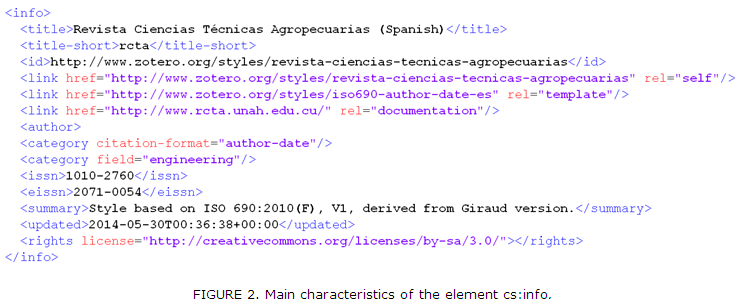
<body><![CDATA[<P><font face="Verdana, Arial, Helvetica, sans-serif" size="2">&#149; ACS ChemWorx Desktop,    BibSonomy, Bielefeld University Library’s Katalog.plus!, Cite This For Me, colwiz,    CrossRef, digi-libris Reader, Docear, Drupal, Fidus Writer, Islandora, Jekyll,    Logos, Mendeley, Multilingual Zotero, pandoc, Paperpile, Papers, Qiqqa, ReadCube,    Refeus, Talis Aspire, WordPress (KCite and Zotpress plugins), and Zotero. </font>     <P>&nbsp;      <P>      <P><font face="Verdana, Arial, Helvetica, sans-serif" size="3"><B>RESULTS AND DISCUSSION</B></font><font face="Verdana, Arial, Helvetica, sans-serif" size="2"><B>    </B> </font>     <P><font face="Verdana, Arial, Helvetica, sans-serif" size="2">Defined the parameters    of the profile based on the guideline ISO 690:2010, was made the style CSL called    “Revista Ciencias Técnicas Agropecuarias (Spanish)”, using the version 1.0 and    location language in Spanish (es-Es). The same one, constitutes an independent    style because contains its own instructions of form of citation, notes and bibliographies    declared in the instruction to the authors. Author-date was class of style of    cites in-text selected, so that the responsibility and the year could be identified    inside the reading without having to go to the references. There was established    the field of the knowledge to belongs RCTA (engineering), as well as its international    standard serial number (ISSN-eISSN) (<a href="/img/revistas/rcta/v24n1/f0207115.gif">Figure    2</a>). </font>      
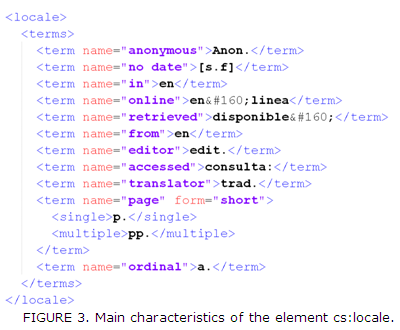
<P><font face="Verdana, Arial, Helvetica, sans-serif" size="2">The terms definitions    are necessary to identify some variables inside the bibliography once generated    by the reference managers. This way it is possible to distinguish between personages    like author, publisher, translator; establish the differentiation between singular    and plural; contract variables and declare symbols. For it, these terminologies    are registered inside cs:locale (<a href="#F3">Figure 3</a>), in addition to    others like “Anon.” and “[s.f]” that appear if the person or the year of publication    not appear inside the citation in-text. It is valid to clarify that any item    of RCTA can be used without these elements. </font>      <P align="center"><img src="/img/revistas/rcta/v24n1/f0307115.gif" width="400" height="330"><a name="F3"></a>      
<P><font face="Verdana, Arial, Helvetica, sans-serif" size="2">In this sense,    was changed the representation of the terms “in”, “online“, “retrieved”, “accessed”    and “from” (established by default), for “en”, “en línea”, “disponible”, “consulta”    and “en”; because those elements are represented inside of the bibliography    and must be in relation with the language of location defined in the style (Spanish).    To differ between the different rolls of the persons that take part in the dressmaking    of an item were assigned the prefixes “edit.” and “trad.” to the variables “publisher“    and “translator”; while to generate the number of edition of an ordinal way    and to define the number of pages was used “a.”, “p.”, “pp.” respectively. </font>     <P><font face="Verdana, Arial, Helvetica, sans-serif" size="2">Another important    element in the definition of the wished characteristics of the style was cs:macro.    It was used principally to declare the variables that were used and characterized    in an individual way in cs:bibliography. It allowed having more control of the    particular characteristics of the items and it made possible to improve the    edition process because grouped in every type of document the set of variables    to be used and the peculiarities of form of each one, these were: </font>     <P><font face="Verdana, Arial, Helvetica, sans-serif" size="2">&#149; Event, title, container-title,    médium, genre, publisher-place, issue, volume, publisher, archive, archive_location,    page, number-of-pages, abstract, note, jurisdiction, original-publisher, number,    version and section. </font>     ]]></body>
<body><![CDATA[<P><font face="Verdana, Arial, Helvetica, sans-serif" size="2">&#149; Nevertheless, there    is another group of variables that present a similar behavior in each one of    the items of the style RCTA, therefore does not have sense declare it inside    cs:macro and characterize it again in each types of documents that appear. Because    that, was declare its forms structures inside every corresponding macro, so    that the element always present the same behavior independently of the item    inside which it was declared, these were: </font>     <P><font face="Verdana, Arial, Helvetica, sans-serif" size="2">&#149; Author, editor,    translator, interviewer, responsability, author-citation, container-author,    collection-editor, container-responsibility, year-date, year-date-responsibility,    date, date-responsibility, edition, accessed, collection, isbn, issn, doi, url,    online and scale. </font>     <P><font face="Verdana, Arial, Helvetica, sans-serif" size="2">This allows that    in all the types of documents the authors to be generated in capital letters    and of the short form, where is set the first surname of the main author and    then the initial of the name and of the second surname. Between the surname    and the initial is put a comma and the same procedure follows for the rest of    the authors. The separation between authors is by a semicolon, and two points    are placed after initial of the last author (<a href="/img/revistas/rcta/v24n1/f0407115.gif">Figure    4</a>). </font>      
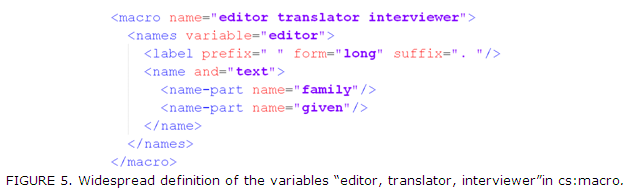
<P><font face="Verdana, Arial, Helvetica, sans-serif" size="2"> For other rolls    like publisher, translator and interviewer, the names are established after    the title and the long form. These names are set at first continued of the first    and second surname. The first letter of the name and the surnames are placed    in capital letter without separation element between them. In the cases that    some of these rolls contains more than one person is set “,” to separate them    and “y” before the last author (<a href="/img/revistas/rcta/v24n1/f0507115.gif">Figure    5</a>).</font>      
<P><font face="Verdana, Arial, Helvetica, sans-serif" size="2">Of same way, other    variables used to establish dates (year-date, year-date-responsibility, date,    date-responsibility) has the same behavior in each item. These represent dates    of creation and consultation of the documents, and contain in turn the parts    “day”, “month” and “year”; because some documents make use of a part of it.    Thus the macro “date” or “year-date” are declared in the different types of    documents in cs:bibliography according to the part of the date that it wants    to place. To separate each parts of “date” is set the preposition “de” (<a href="#F6">Figure    6</a>). </font>      <P align="center"><img src="/img/revistas/rcta/v24n1/f0607114.gif" width="580" height="326"><a name="F6"></a>     
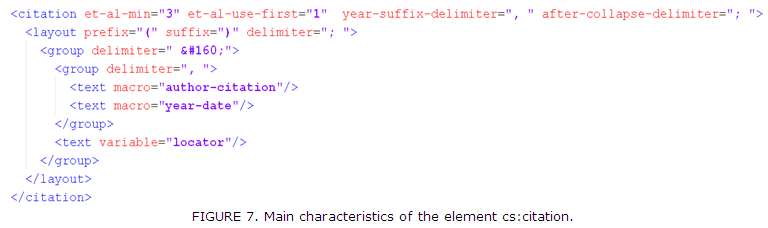
<P><font face="Verdana, Arial, Helvetica, sans-serif" size="2">Inside the text,    the citation is rendering of the form author-date (e.g. Cervantes, 2014). If    they are two authors there is placed the first surname of each one separated    for “y”, and next “, year” (e.g. Cervantes y Fernández, 2014). In the cases    that the authors are more than two it is put “<i>et al.</i>” after the surname of the    main author fallowing of “, year” (e.g. Cervantes <i>et al.</i>, 2014). If the citation    belongs to multiple sources, each one will be separate by “;” (e.g. Cervantes,    2014; Cervantes y Fernández, 2014; Cervantes <i>et al.</i>, 2014). If the year of publication    is the same for several citations that present the same responsibility, it is    will differ with the letters a, b, c, etc., (<a href="/img/revistas/rcta/v24n1/f0707115.gif">Figure    7</a>). </font>      
<P><font face="Verdana, Arial, Helvetica, sans-serif" size="2">Finally, in cs:bibliography    was established that the reference, with discharging between lines and between    item of one (&lt;bibliography entry-spacing = “1” line-spacing = “1”&gt;), is    organized alphabetically from the first letters of the surname of the main author    and is continued with the date and the title (&lt;sort&gt;), (<a href="#F8">Figure    8</a>). Every part of the items will be separated by comma and point will be    placed only after the year that will always appear in the end. The title of    chapters of books, encyclopedias, articles in conference, newspapers and article    of journal will be placed between quotation marks (&lt;text macro = “title”    prefix = “¨” suffix = “¨,”/&gt;) and for the rest of the documents will settle    without quotation marks and in italics (&lt;text variable = “title” font-style    = “italic”/&gt;). The names of the article of journal, newspapers, encyclopedias,    web pages, congresses, symposiums, seminars, workshops and events are placed    of the original form (without abbreviate) respecting the original grammar and    in italics. </font>     <P align="center"><img src="/img/revistas/rcta/v24n1/f0807114.gif" width="446" height="144"><a name="F8"></a>      
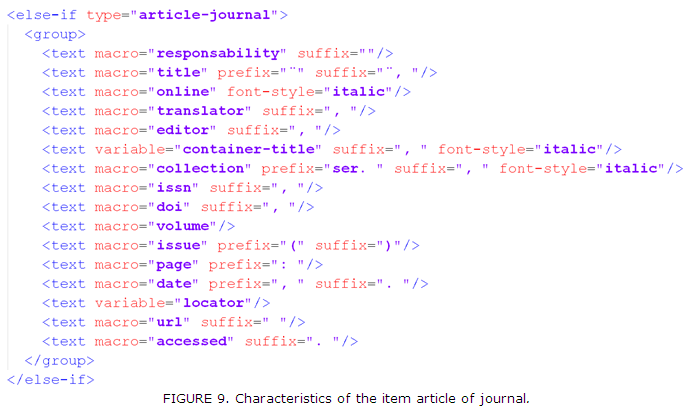
<P><font face="Verdana, Arial, Helvetica, sans-serif" size="2">Miscellaneous of    variables and personages were defined in cs:bibliography to differentiate them    inside the bibliography. It was indicated that in front of the interviewer,    publisher of the series, author of the book when is cited a section of this,    publishing house, series and date of exit of norms and patents, should be placed    the prefixes “entr.”, “edit. ser.”, “en”, “Ed.”, “ser.” and “Vig.” respectively    (e.g. &lt;text macro=”publisher” prefix=”Ed. “ suffix=”,/&gt;). In the cases    that it corresponds, next of the number of edition will put “ed.” and in front    of the number of volume “vol.” except for the articles of journal that they    are not placed (<a href="/img/revistas/rcta/v24n1/f0907115.gif">Figure    9</a>). The notes on the foot of page continue the same guidelines established    by the style, only that are not placed in the references, but rather is set    at the end of the page where was indicated.</font>      
]]></body>
<body><![CDATA[<P><font face="Verdana, Arial, Helvetica, sans-serif" size="2">Of this way, in    layout was completed all type of documents that are frequently used by the author    that writer for the journal. It is the container for all rendering elements    in citations or bibliographies (it, and its content, contains all the layout    rules), and is itself a rendering element (<a href="/img/revistas/rcta/v24n1/f1007115.gif">Figure    10</a>). So the structure of the layout has not only the items allowed in the    journal; but other types that can be used for written other documents in different    academics works. These types are established in “else” until complete 35 kind    of different items, these were: </font>      
<P><font face="Verdana, Arial, Helvetica, sans-serif" size="2">Article, article-magazine,    article-newspaper, article-journal, bill, book, broadcast, chapter, dataset,    entry, entry-dictionary, entry-encyclopedia, figure, graphic, interview, legislation,    legal_case, manuscript, map, motion_picture, musical_score, pamphlet, paper-conference,    patent, post, post-weblog, personal_communication, report, review, review-book,    song, speech, thesis, treaty and webpage.</font>     <P>&nbsp;      <P>      <P><font face="Verdana, Arial, Helvetica, sans-serif" size="3"><B>CONCLUSIONS</B></font><font face="Verdana, Arial, Helvetica, sans-serif" size="2">    </font>      <P><font face="Verdana, Arial, Helvetica, sans-serif" size="2">&#149; Was developed    a multiplatform file CSL supported by 25 reference managers that set, in an    automatic way, the bibliography of the agricultural scientific articles of RCTA.    The style is based on the guideline ISO 690: 2010, cite in-text as the form    author-date and organizes the bibliography alphabetically. It takes as distinctive    features that in the bibliography the authors are put of the short form, after    the authors there is placed two points (:), the elements are separated by comma    and the year always appears in the end. It is capable of recognizing, organizing    and filling correctly 35 types of different items and can be used for the management    of the scientific information of any type of work.</font>     <P>&nbsp;      <p>      <p class="justificar"><b><font face="Verdana, Arial, Helvetica, sans-serif" size="2">Notas    al pie</font></b>      <P><font face="Verdana, Arial, Helvetica, sans-serif" size="2"><sup><a href="#n1a">1</a><a name="n1"></a></sup>    CitationStyles.org | The Citation Style Language - open and free citation styles,    [en línea] Disponible en: <a href="http://citationstyles.org/" target="_blank">http://citationstyles.org/</a>    [Consulta: 3 de junio de 2014]. </font>      ]]></body>
<body><![CDATA[<P><font face="Verdana, Arial, Helvetica, sans-serif" size="2"><sup><a href="#n2a">2</a><a name="n2"></a></sup>    Cómo citar la bibliografía en los trabajos académicos, [en línea] Universidad    Politécnica de Valéncia, España, 2014. Disponible en: <a href="https://www.upv.es/entidades/ADE/infoweb/fade/info/U0655397.pdf">https://www.upv.es/entidades/ADE/infoweb/fade/info/U0655397.pdf</a>    [Consulta: 15 de agosto de 2014]. </font>      <P><font face="Verdana, Arial, Helvetica, sans-serif" size="2"><sup><a href="#n3a">3</a><a name="n3"></a></sup>    CC BY-SA: Attribution-ShareAlike 3.0 Unported, [en línea] Disponible en: <a href="http://creativecommons.org/licenses/by-sa/3.0/" target="_blank">http://creativecommons.org/licenses/by-sa/3.0/</a>    [Consulta: 16 de junio de 2014]. </font>      <P><font face="Verdana, Arial, Helvetica, sans-serif" size="2"><sup><a href="#n4a">4</a><a name="n4"></a></sup>    ZELLE, R.M.: Citation Style Language 1.0.1 Language Specification, [en línea]    3 de septiembre de 2012, Disponible en: <a href="http://citationstyles.org/downloads/specification-csl101-20120903.html" target="_blank">http://citationstyles.org/downloads/specification-csl101-20120903.html</a></font>      <P><font face="Verdana, Arial, Helvetica, sans-serif" size="2"><sup><a href="#n5a">5</a><a name="n5"></a></sup>    CSL style editor, [en línea] Disponible en: <a href="http://editor.citationstyles.org/" target="_blank">http://editor.citationstyles.org/</a>    [Consulta: 19 de junio de 2014]. </font>      <P><font face="Verdana, Arial, Helvetica, sans-serif" size="2"><sup><a href="#n6a">6</a><a name="n6"></a></sup> Zotero Preview    pane, [en línea] Disponible en: chrome://zotero/content/tools/cslpreview.xul    [Consulta: 19 de junio de 2014]. </font>     <P><font face="Verdana, Arial, Helvetica, sans-serif" size="2"><sup><a href="#n7a">7</a><a name="n7"></a></sup>    Validator.nu, [en línea] Disponible en: <a href="http://validator.nu" target="_blank">http://validator.nu</a>    [Consulta: 19 de junio de 2014]. </font>      <P><font face="Verdana, Arial, Helvetica, sans-serif" size="2"><sup><a href="#n8a">8</a><a name="n8"></a></sup>    Zotero Style Repository, [en línea] Disponible en: <a href="https://www.zotero.org/styles/" target="_blank">https://www.zotero.org/styles/</a>    [Consulta: 6 de junio de 2014]. </font> .      <P>&nbsp;     <P>&nbsp;      <P>     ]]></body>
<body><![CDATA[<P>     <P>      <P><font face="Verdana, Arial, Helvetica, sans-serif" size="3"><B>REFERENCES</B></font><font face="Verdana, Arial, Helvetica, sans-serif" size="2">    </font>      <!-- ref --><P><font face="Verdana, Arial, Helvetica, sans-serif" size="2"> 1. ANSORGE, L.;    KRATOCHVÍL, J.: “A Description of the Template ISO 690:2011 in the CSL Language    for the Reference Manager Zotero”, <i>ProInflow: asopis pro informaní vdy</i>,    [en línea] ISSN-1804 -2406, 5 (2), 2013. Disponible en: <a href="http://pro.inflow.cz/sites/default/files/pdfclanky/Kratochvil_Ansorge_Sablona_0.pdf" target="_blank">http://pro.inflow.cz/sites/default/files/pdfclanky/Kratochvil_Ansorge_Sablona_0.pdf</a>    </font>      <!-- ref --><P><font face="Verdana, Arial, Helvetica, sans-serif" size="2"> 2. CASTOLO, M.C.;    ROMERO, G.F.; DÍAZ, L.M.M.J.; GÓMEZ, A.A.P.; GONZÁLEZ, C.S.; EGAN, L.A.V.: “Indicadores    bibliométricos de la Revista CONAMED, 2008-2012.”, <i>Revista CONAMED</i>, ISSN-1405-6704,    19 (2): 59–66, 2014.     </font>      <!-- ref --><P><font face="Verdana, Arial, Helvetica, sans-serif" size="2">3. COURRAUD, J.:    “Zotero: A free and open-source reference manager”, <i>Medical Writing</i>,    [en línea] ISSN-2047-4806, DOI-<a href="http://dx.doi.org/10.1179/2047480614Z.000000000190" target="_blank">http://dx.doi.org/10.1179/2047480614Z.000000000190</a>,    23 (1): 46–48, 2014.     </font>      <!-- ref --><P><font face="Verdana, Arial, Helvetica, sans-serif" size="2">4. DE BELLIS, N.:    Bibliometrics and Citation Analysis. From the Science Citation Index to Cybermetrics,    Ed. Scarecrow Press, Inc, ISBN-13: 978-0-8108-6713-0, United States of America,    2009.    </font>      ]]></body>
<body><![CDATA[<P><font face="Verdana, Arial, Helvetica, sans-serif" size="2"> 5. DON, H.: <i>Notepad++</i>,    (Versión v4.7.5), [en línea] [Windows], Ed. Free Software Foundation, USA, 14    de enero de 2008. Disponible en: <a href="http://notepad-plus.sourceforge.net/" target="_blank">http://notepad-plus.sourceforge.net/</a>    </font>      <!-- ref --><P><font face="Verdana, Arial, Helvetica, sans-serif" size="2">6. FENNER, M.;    SCHELIGA, K.; BARTLING, S.: “Reference Management”, En: <i>Opening Science.    The Evolving Guide on How the Internet is Changing Research</i>, [en línea]    Collaboration and Scholarly Publishing, ISBN-978-3-319-00025-1, pp. 125–137,    Ed. Springer, 2014. Disponible en: <a href="http://link.springer.com/chapter/10.1007/978-3-319-00026-8_8" target="_blank">http://link.springer.com/chapter/10.1007/978-3-319-00026-8_8</a>    [Consulta: 27 de agosto de 2014].     </font>      <!-- ref --><P><font face="Verdana, Arial, Helvetica, sans-serif" size="2">7. FREYSTEINSON,    W.M.: “The language of scholarship for novice writers.”,<i> Journal of continuing    education in nursing</i>, [en línea] ISSN-0022-0124, DOI-10.3928/00220124-20131121-13,    44 (12): 533–534, 2013.     </font>      <!-- ref --><P><font face="Verdana, Arial, Helvetica, sans-serif" size="2">8. GILES, C.L.;    BOLLACKER, K.D.; LAWRENCE, S.: “CiteSeer: An Automatic Citation Indexing System”,    [en línea] ser. DL ’98, ISBN-0-89791-965-3, DOI-10.1145/276675.276685, pp. 89–98,    New York, NY, USA, 1998. Disponible en: <a href="http://doi.acm.org/10.1145/276675.276685" target="_blank">http://doi.acm.org/10.1145/276675.276685</a>    </font>      <!-- ref --><P><font face="Verdana, Arial, Helvetica, sans-serif" size="2">9. INTERNATIONAL    STANDARD ORGANIZATION: <i>Information and documentation — Guidelines for bibliographic    references and citations to information resources</i>, [en línea] ser. ISO 690,    Ed. Switzerland, 3a. ed., pp. 40, Geneva, 2010. Disponible en: <a href="http://www.iso.org" target="_blank">http://www.iso.org</a>    </font>      <!-- ref --><P><font face="Verdana, Arial, Helvetica, sans-serif" size="2">10. JABULANI, S.:    “An analysis of the language of attribution in university students’ academic    essays”, <i>South African Journal of Education</i>, ISSN-0256-0100, 34 (3):    1–10, 2014.     </font>      <!-- ref --><P><font face="Verdana, Arial, Helvetica, sans-serif" size="2">11. MENGXION, L.:    “Progress in documentation the complexities of citation practice: A review of    citation studies”, <i>Journal of Documentation</i>, [en línea] ISSN-0022-0418,    DOI-10.1108/eb026920, 49 (4): 370 - 408, 2014.     </font>      <!-- ref --><P><font face="Verdana, Arial, Helvetica, sans-serif" size="2">12. NIXON, K.:    “Our Common Pedagogical Dilemma: Designing Literary Essay Assignments Not Easily    Bought or «Found»”, <i>Journal of Language and Cultural Education</i>, ISSN-1339    - 4045, (2): 2, 2014.     </font>      <!-- ref --><P><font face="Verdana, Arial, Helvetica, sans-serif" size="2">13. OSCA-LLUCH,    J.; MOLLÁ, C.C.; ORTEGA, M.P.: “Consecuencias de los errores en las referencias    bibliográficas. El caso de la revista Psicothema”, <i>Psicothema</i>, ISSN-0214-9915,    21 (2): 300–303, 2009.     </font>      <!-- ref --><P><font face="Verdana, Arial, Helvetica, sans-serif" size="2">14. QUIR, R.E.M.:    “Recomendaciones para redactar, diseñar y estructurar una publicación de caso    clínico”, <i>Revista de Especialidades Médico-Quirúrgicas</i>, ISSN-1665-7330,    19 (2): 229–235, 2014.     </font>      <!-- ref --><P><font face="Verdana, Arial, Helvetica, sans-serif" size="2">15. REVISTA FITOTECNIA    MEXICANA: “Guía de Autores (Versión 2013-2015)”, <i>Revista Fitotecnia Mexicana</i>,    ISSN-0187-7380, 35 (4): 355- 363, 2012.     </font>      <!-- ref --><P><font face="Verdana, Arial, Helvetica, sans-serif" size="2">16. RIVERA, R.:    “Normativa de presentación de artículos de la Revista Perspectivas Rurales.    Nueva época.”, <i>Perspectivas Rurales Nueva Época</i>, ISSN-1409-3251, (24):    137–139, 2014.     </font>      <!-- ref --><P><font face="Verdana, Arial, Helvetica, sans-serif" size="2">17. SÁNCHEZ, G.M.:    “Global Library of ozone, a tool for research”, <i>Revista Española de Ozonoterapia</i>,    ISSN-2174-3215, 4 (1): 79–82, 2014.    </font>      <!-- ref --><P><font face="Verdana, Arial, Helvetica, sans-serif" size="2"> 18. WATKINS, A.:    “Zotero for Personal Image Management”, <i>Art Documentation: Journal of the    Art Libraries Society of North America</i>, ISSN-0730-7187, 32 (2): 301–313,    2013.     </font>      <P><font face="Verdana, Arial, Helvetica, sans-serif" size="2">20. ZHANG, Y.:    “Comparison of select reference management tools&quot;, <i>Medical reference    services quarterly</i>, [en línea] ISSN-0276-3869, DOI-10.1080/02763869.2012.641841,    31 (1): 45–60, 2012.</font>      <P>&nbsp;     <P>&nbsp;      <P>     <P>     ]]></body>
<body><![CDATA[<P>      <P>      <P><font face="Verdana, Arial, Helvetica, sans-serif" size="2"><b>Recibido:</b>    19 de febrero de 2014.    <BR>   <b>Aprobado:</b> <font face="Verdana, Arial, Helvetica, sans-serif" size="2">22 de septiembre de 2014</font>.</font>      <P>&nbsp;     <P>&nbsp;      <P>     <P>     <P>      <P>      ]]></body>
<body><![CDATA[<P><font face="Verdana, Arial, Helvetica, sans-serif" size="2"><I>Rafael Cervantes    Beyra</I>. Universidad Agraria de La Habana. Facultad de Agronomía. San José    de las Lajas, Mayabeque, Cuba. Correo electr&oacute;nico: <U><FONT COLOR="#0000ff"><a href="mailto:cervantes@unah.edu.cu">cervantes@unah.edu.cu</a></FONT></U>    </font>      ]]></body><back>
<ref-list>
<ref id="B1">
<label>1</label><nlm-citation citation-type="journal">
<person-group person-group-type="author">
<name>
<surname><![CDATA[ANSORGE]]></surname>
<given-names><![CDATA[L.]]></given-names>
</name>
<name>
<surname><![CDATA[KRATOCHVÍL]]></surname>
<given-names><![CDATA[J.]]></given-names>
</name>
</person-group>
<article-title xml:lang="en"><![CDATA[A Description of the Template ISO 690:2011 in the CSL Language for the Reference Manager Zotero]]></article-title>
<source><![CDATA[ProInflow: asopis pro informaní vdy]]></source>
<year>2013</year>
<volume>5</volume>
<numero>2</numero>
<issue>2</issue>
</nlm-citation>
</ref>
<ref id="B2">
<label>2</label><nlm-citation citation-type="journal">
<person-group person-group-type="author">
<name>
<surname><![CDATA[CASTOLO]]></surname>
<given-names><![CDATA[M.C.]]></given-names>
</name>
<name>
<surname><![CDATA[ROMERO]]></surname>
<given-names><![CDATA[G.F.]]></given-names>
</name>
<name>
<surname><![CDATA[DÍAZ]]></surname>
<given-names><![CDATA[L.M.M.J.]]></given-names>
</name>
<name>
<surname><![CDATA[GÓMEZ]]></surname>
<given-names><![CDATA[A.A.P.]]></given-names>
</name>
<name>
<surname><![CDATA[GONZÁLEZ]]></surname>
<given-names><![CDATA[C.S.]]></given-names>
</name>
<name>
<surname><![CDATA[EGAN]]></surname>
<given-names><![CDATA[L.A.V.]]></given-names>
</name>
</person-group>
<article-title xml:lang="es"><![CDATA[Indicadores bibliométricos de la Revista CONAMED, 2008-2012]]></article-title>
<source><![CDATA[Revista CONAMED]]></source>
<year>2014</year>
<volume>19</volume>
<numero>2</numero>
<issue>2</issue>
<page-range>59-66</page-range></nlm-citation>
</ref>
<ref id="B3">
<label>3</label><nlm-citation citation-type="journal">
<person-group person-group-type="author">
<name>
<surname><![CDATA[COURRAUD]]></surname>
<given-names><![CDATA[J.]]></given-names>
</name>
</person-group>
<article-title xml:lang="en"><![CDATA[Zotero: A free and open-source reference manager]]></article-title>
<source><![CDATA[Medical Writing]]></source>
<year>2014</year>
<volume>23</volume>
<numero>1</numero>
<issue>1</issue>
<page-range>46-48</page-range></nlm-citation>
</ref>
<ref id="B4">
<label>4</label><nlm-citation citation-type="book">
<person-group person-group-type="author">
<name>
<surname><![CDATA[DE BELLIS]]></surname>
<given-names><![CDATA[N.]]></given-names>
</name>
</person-group>
<source><![CDATA[Bibliometrics and Citation Analysis. From the Science Citation Index to Cybermetrics]]></source>
<year>2009</year>
<publisher-name><![CDATA[Ed. Scarecrow Press, Inc]]></publisher-name>
</nlm-citation>
</ref>
<ref id="B5">
<label>5</label><nlm-citation citation-type="book">
<person-group person-group-type="author">
<name>
<surname><![CDATA[DON]]></surname>
<given-names><![CDATA[H.]]></given-names>
</name>
</person-group>
<source><![CDATA[Notepad++]]></source>
<year>14 d</year>
<month>e </month>
<day>en</day>
<edition>Versión v4.7.5</edition>
<publisher-name><![CDATA[Ed. Free Software Foundation]]></publisher-name>
</nlm-citation>
</ref>
<ref id="B6">
<label>6</label><nlm-citation citation-type="book">
<person-group person-group-type="author">
<name>
<surname><![CDATA[FENNER]]></surname>
<given-names><![CDATA[M.]]></given-names>
</name>
<name>
<surname><![CDATA[SCHELIGA]]></surname>
<given-names><![CDATA[K.]]></given-names>
</name>
<name>
<surname><![CDATA[BARTLING]]></surname>
<given-names><![CDATA[S.]]></given-names>
</name>
</person-group>
<article-title xml:lang="en"><![CDATA[Reference Management]]></article-title>
<source><![CDATA[Opening Science. The Evolving Guide on How the Internet is Changing Research]]></source>
<year>2014</year>
<page-range>125-137</page-range><publisher-name><![CDATA[Collaboration and Scholarly PublishingEd. Springer]]></publisher-name>
</nlm-citation>
</ref>
<ref id="B7">
<label>7</label><nlm-citation citation-type="journal">
<person-group person-group-type="author">
<name>
<surname><![CDATA[FREYSTEINSON]]></surname>
<given-names><![CDATA[W.M.]]></given-names>
</name>
</person-group>
<article-title xml:lang="en"><![CDATA[The language of scholarship for novice writers]]></article-title>
<source><![CDATA[Journal of continuing education in nursing]]></source>
<year>2013</year>
<volume>44</volume>
<numero>12</numero>
<issue>12</issue>
<page-range>533-534</page-range></nlm-citation>
</ref>
<ref id="B8">
<label>8</label><nlm-citation citation-type="">
<person-group person-group-type="author">
<name>
<surname><![CDATA[GILES]]></surname>
<given-names><![CDATA[C.L.]]></given-names>
</name>
<name>
<surname><![CDATA[BOLLACKER]]></surname>
<given-names><![CDATA[K.D.]]></given-names>
</name>
<name>
<surname><![CDATA[LAWRENCE]]></surname>
<given-names><![CDATA[S.]]></given-names>
</name>
</person-group>
<source><![CDATA[CiteSeer: An Automatic Citation Indexing System]]></source>
<year>1998</year>
<page-range>89-98</page-range><publisher-loc><![CDATA[New York^eNY NY]]></publisher-loc>
</nlm-citation>
</ref>
<ref id="B9">
<label>9</label><nlm-citation citation-type="book">
<collab>INTERNATIONAL STANDARD ORGANIZATION</collab>
<source><![CDATA[Information and documentation - Guidelines for bibliographic references and citations to information resources]]></source>
<year>2010</year>
<edition>3</edition>
<page-range>40</page-range><publisher-loc><![CDATA[Geneva ]]></publisher-loc>
<publisher-name><![CDATA[Ed. Switzerland]]></publisher-name>
</nlm-citation>
</ref>
<ref id="B10">
<label>10</label><nlm-citation citation-type="journal">
<person-group person-group-type="author">
<name>
<surname><![CDATA[JABULANI]]></surname>
<given-names><![CDATA[S.]]></given-names>
</name>
</person-group>
<article-title xml:lang="en"><![CDATA[An analysis of the language of attribution in university students’ academic essays]]></article-title>
<source><![CDATA[South African Journal of Education]]></source>
<year>2014</year>
<volume>34</volume>
<numero>3</numero>
<issue>3</issue>
<page-range>1-10</page-range></nlm-citation>
</ref>
<ref id="B11">
<label>11</label><nlm-citation citation-type="journal">
<person-group person-group-type="author">
<name>
<surname><![CDATA[MENGXION]]></surname>
<given-names><![CDATA[L.]]></given-names>
</name>
</person-group>
<article-title xml:lang="en"><![CDATA[Progress in documentation the complexities of citation practice: A review of citation studies]]></article-title>
<source><![CDATA[Journal of Documentation]]></source>
<year>2014</year>
<volume>49</volume>
<numero>4</numero>
<issue>4</issue>
<page-range>370 - 408</page-range></nlm-citation>
</ref>
<ref id="B12">
<label>12</label><nlm-citation citation-type="journal">
<person-group person-group-type="author">
<name>
<surname><![CDATA[NIXON]]></surname>
<given-names><![CDATA[K.]]></given-names>
</name>
</person-group>
<article-title xml:lang="en"><![CDATA[Our Common Pedagogical Dilemma: Designing Literary Essay Assignments Not Easily Bought or «Found]]></article-title>
<source><![CDATA[Journal of Language and Cultural Education]]></source>
<year>2014</year>
<numero>2</numero>
<issue>2</issue>
<page-range>2</page-range></nlm-citation>
</ref>
<ref id="B13">
<label>13</label><nlm-citation citation-type="journal">
<person-group person-group-type="author">
<name>
<surname><![CDATA[OSCA-LLUCH]]></surname>
<given-names><![CDATA[J.]]></given-names>
</name>
<name>
<surname><![CDATA[MOLLÁ]]></surname>
<given-names><![CDATA[C.C.]]></given-names>
</name>
<name>
<surname><![CDATA[ORTEGA]]></surname>
<given-names><![CDATA[M.P.]]></given-names>
</name>
</person-group>
<article-title xml:lang="es"><![CDATA[Consecuencias de los errores en las referencias bibliográficas. El caso de la revista Psicothema]]></article-title>
<source><![CDATA[Psicothema]]></source>
<year>2009</year>
<volume>21</volume>
<numero>2</numero>
<issue>2</issue>
<page-range>300-303</page-range></nlm-citation>
</ref>
<ref id="B14">
<label>14</label><nlm-citation citation-type="journal">
<person-group person-group-type="author">
<name>
<surname><![CDATA[QUIR]]></surname>
<given-names><![CDATA[R.E.M.]]></given-names>
</name>
</person-group>
<article-title xml:lang="es"><![CDATA[Recomendaciones para redactar, diseñar y estructurar una publicación de caso clínico]]></article-title>
<source><![CDATA[Revista de Especialidades Médico-Quirúrgicas]]></source>
<year>2014</year>
<volume>19</volume>
<numero>2</numero>
<issue>2</issue>
<page-range>229-235</page-range></nlm-citation>
</ref>
<ref id="B15">
<label>15</label><nlm-citation citation-type="journal">
<collab>REVISTA FITOTECNIA MEXICANA</collab>
<article-title xml:lang="es"><![CDATA[Guía de Autores (Versión 2013-2015)]]></article-title>
<source><![CDATA[Revista Fitotecnia Mexicana]]></source>
<year>2012</year>
<volume>35</volume>
<numero>4</numero>
<issue>4</issue>
<page-range>355- 363</page-range></nlm-citation>
</ref>
<ref id="B16">
<label>16</label><nlm-citation citation-type="journal">
<person-group person-group-type="author">
<name>
<surname><![CDATA[RIVERA]]></surname>
<given-names><![CDATA[R.]]></given-names>
</name>
</person-group>
<article-title xml:lang="es"><![CDATA[Normativa de presentación de artículos de la Revista Perspectivas Rurales. Nueva época]]></article-title>
<source><![CDATA[Perspectivas Rurales Nueva Época]]></source>
<year>2014</year>
<numero>24</numero>
<issue>24</issue>
<page-range>137-139</page-range></nlm-citation>
</ref>
<ref id="B17">
<label>17</label><nlm-citation citation-type="journal">
<person-group person-group-type="author">
<name>
<surname><![CDATA[SÁNCHEZ]]></surname>
<given-names><![CDATA[G.M.]]></given-names>
</name>
</person-group>
<article-title xml:lang="en"><![CDATA[Global Library of ozone, a tool for research]]></article-title>
<source><![CDATA[Revista Española de Ozonoterapia]]></source>
<year>2014</year>
<volume>4</volume>
<numero>1</numero>
<issue>1</issue>
<page-range>79-82</page-range></nlm-citation>
</ref>
<ref id="B18">
<label>18</label><nlm-citation citation-type="journal">
<person-group person-group-type="author">
<name>
<surname><![CDATA[WATKINS]]></surname>
<given-names><![CDATA[A.]]></given-names>
</name>
</person-group>
<article-title xml:lang="en"><![CDATA[Zotero for Personal Image Management]]></article-title>
<source><![CDATA[Art Documentation: Journal of the Art Libraries Society of North America]]></source>
<year>2013</year>
<volume>32</volume>
<numero>2</numero>
<issue>2</issue>
<page-range>301-313</page-range></nlm-citation>
</ref>
<ref id="B19">
<label>19</label><nlm-citation citation-type="journal">
<person-group person-group-type="author">
<name>
<surname><![CDATA[ZHANG]]></surname>
<given-names><![CDATA[Y.]]></given-names>
</name>
</person-group>
<article-title xml:lang="en"><![CDATA[Comparison of select reference management tools]]></article-title>
<source><![CDATA[Medical reference services quarterly]]></source>
<year>2012</year>
<volume>31</volume>
<numero>1</numero>
<issue>1</issue>
<page-range>45-60</page-range></nlm-citation>
</ref>
</ref-list>
</back>
</article>