<?xml version="1.0" encoding="ISO-8859-1"?><article xmlns:mml="http://www.w3.org/1998/Math/MathML" xmlns:xlink="http://www.w3.org/1999/xlink" xmlns:xsi="http://www.w3.org/2001/XMLSchema-instance">
<front>
<journal-meta>
<journal-id>2079-3480</journal-id>
<journal-title><![CDATA[Cuban Journal of Agricultural Science]]></journal-title>
<abbrev-journal-title><![CDATA[Cuban J. Agric. Sci.]]></abbrev-journal-title>
<issn>2079-3480</issn>
<publisher>
<publisher-name><![CDATA[Editorial del Instituto de Ciencia Animal]]></publisher-name>
</publisher>
</journal-meta>
<article-meta>
<article-id>S2079-34802015000100010</article-id>
<title-group>
<article-title xml:lang="en"><![CDATA[Chemical composition and in vitro digestibility of silages of taro (Colocasia esculenta (L.) Schott) tubers for feeding pigs]]></article-title>
<article-title xml:lang="es"><![CDATA[Composición química y digestibilidad in vitro de ensilados de tubérculos de papa china (Colocasia esculenta (L.) Schott) destinados a la alimentación de cerdos]]></article-title>
</title-group>
<contrib-group>
<contrib contrib-type="author">
<name>
<surname><![CDATA[Caicedo]]></surname>
<given-names><![CDATA[W]]></given-names>
</name>
<xref ref-type="aff" rid="A01"/>
</contrib>
<contrib contrib-type="author">
<name>
<surname><![CDATA[Rodríguez]]></surname>
<given-names><![CDATA[R]]></given-names>
</name>
<xref ref-type="aff" rid="A02"/>
</contrib>
<contrib contrib-type="author">
<name>
<surname><![CDATA[Lezcano]]></surname>
<given-names><![CDATA[P]]></given-names>
</name>
<xref ref-type="aff" rid="A03"/>
</contrib>
<contrib contrib-type="author">
<name>
<surname><![CDATA[Ly]]></surname>
<given-names><![CDATA[J]]></given-names>
</name>
<xref ref-type="aff" rid="A03"/>
</contrib>
<contrib contrib-type="author">
<name>
<surname><![CDATA[Valle]]></surname>
<given-names><![CDATA[S]]></given-names>
</name>
<xref ref-type="aff" rid="A01"/>
</contrib>
<contrib contrib-type="author">
<name>
<surname><![CDATA[Flores]]></surname>
<given-names><![CDATA[L]]></given-names>
</name>
<xref ref-type="aff" rid="A04"/>
</contrib>
<contrib contrib-type="author">
<name>
<surname><![CDATA[Ferreira]]></surname>
<given-names><![CDATA[F.N.A]]></given-names>
</name>
<xref ref-type="aff" rid="A05"/>
</contrib>
</contrib-group>
<aff id="A01">
<institution><![CDATA[,Secretaria Nacional de Educación Superior Ciencia Tecnología e Innovación  ]]></institution>
<addr-line><![CDATA[ Quito]]></addr-line>
<country>Ecuador</country>
</aff>
<aff id="A02">
<institution><![CDATA[,Universidad de Granma Centro de Estudios de Producción Anima ]]></institution>
<addr-line><![CDATA[Bayamo ]]></addr-line>
<country>Cuba</country>
</aff>
<aff id="A03">
<institution><![CDATA[,Instituto de Ciencia Animal  ]]></institution>
<addr-line><![CDATA[San José de las Lajas Mayabeque]]></addr-line>
<country>Cuba</country>
</aff>
<aff id="A04">
<institution><![CDATA[,Escuela Superior Politécnica de Chimborazo  ]]></institution>
<addr-line><![CDATA[Riobamba ]]></addr-line>
<country>Ecuador</country>
</aff>
<aff id="A05">
<institution><![CDATA[,Universidad Federal Minas Gerais  ]]></institution>
<addr-line><![CDATA[ Belo Horizonte]]></addr-line>
<country>Brasil</country>
</aff>
<pub-date pub-type="pub">
<day>00</day>
<month>03</month>
<year>2015</year>
</pub-date>
<pub-date pub-type="epub">
<day>00</day>
<month>03</month>
<year>2015</year>
</pub-date>
<volume>49</volume>
<numero>1</numero>
<fpage>59</fpage>
<lpage>64</lpage>
<copyright-statement/>
<copyright-year/>
<self-uri xlink:href="http://scielo.sld.cu/scielo.php?script=sci_arttext&amp;pid=S2079-34802015000100010&amp;lng=en&amp;nrm=iso"></self-uri><self-uri xlink:href="http://scielo.sld.cu/scielo.php?script=sci_abstract&amp;pid=S2079-34802015000100010&amp;lng=en&amp;nrm=iso"></self-uri><self-uri xlink:href="http://scielo.sld.cu/scielo.php?script=sci_pdf&amp;pid=S2079-34802015000100010&amp;lng=en&amp;nrm=iso"></self-uri><abstract abstract-type="short" xml:lang="en"><p><![CDATA[To assess chemical composition and in vitro digestibility of silages of taro tubers (Colocasia esculenta (L.) Schott), for feeding pigs, four silages with waste tubers were carried out. A completely randomized design with a 4x6 factorial arrangement to analyze the chemical composition was applied. Natural yogurt (-1NY), whey (-2W), whey with 5%of molasses (-3WM5) and whey with 10% of molasses (-4WM10) were evaluated as silage components. The silages time were 0, 15, 30, 60, 90 and 180 days. The in vitro digestibility of DM and OM with 15d of silages elaboration was investigated by means of simple classification design. The interactions treatments per day were significant (P < 0.05).The silage four in the 180th day show higher DM content (33.61%).The highest CP(N x 6.25) concentration(8.83%) was evidenced in silage two, in the 90th day. The lowest CF was determined in silage two in the 0 (2.85) and 60th (2.84) days. The GE was high in silage one in the 0 day (4.40 kcal g DM-1).The highest in vitro digestibility coefficient of DM (74.65 %) and OM (76.76 %) was found in silage two. The conservation of taro tubers, between 0 and 180 d, by means of the addition of variables levels of natural yogurt, whey and sugar cane molasses, create different products with good DM, CP, GE content and low CF concentration, capable to be used in feeding pigs]]></p></abstract>
<abstract abstract-type="short" xml:lang="es"><p><![CDATA[Para valorar la composición química y digestibilidad in vitro de ensilados de tubérculos de papa china (Colocasia esculenta (L.) Schott), destinados a la alimentación de cerdos, se realizaron cuatro ensilados con tubérculos de desecho. Para analizar la composición química, se aplicó un diseño completamente aleatorizado, con arreglo factorial (4 x 6). Se evaluó el yogurt natural (-1YN), suero de leche (-2SL), suero de leche con 5 % de miel (-3SLMB5) y suero de leche con 10 % de miel (-4SLMB10) como componentes de los ensilados. Los tiempos de ensilado fueron 0, 15, 30, 60, 90 y 180 d. La digestibilidad in vitro de la MS y MO se investigó con ensilados de 15 d de elaboración mediante un diseño de clasificación simple. Las interacciones tratamientos por día resultaron significativas (P < 0.05). El ensilado cuatro en el día 180 presentó mayor contenido de MS (33.61%). La concentración de PB (N x 6.25) más elevada (8.83 %) se evidenció en el ensilado dos, en el día 90. El menor tenor de FB se determinó en el ensilado dos en los días 0 (2.85 %) y 60 (2.84 %). El contenido de EB fue alto en el ensilado uno en el día 0 (4.40 kcal g MS-1). El mayor coeficiente (P < 0.05) de digestibilidad in vitro de la MS (74.65 %) y MO (76.76 %) lo tuvo el ensilado dos. La conservación de tubérculos de papa china, entre 0 y 180 d, mediante la adición de niveles variables de yogurt natural, suero de leche y melaza de caña de azúcar, originan distintos productos que tienen buen contenido de MS, PB, EB y baja concentración de FB, aptos para ser utilizados en la alimentación de ganado porcino]]></p></abstract>
<kwd-group>
<kwd lng="en"><![CDATA[by-products]]></kwd>
<kwd lng="en"><![CDATA[fermentation]]></kwd>
<kwd lng="en"><![CDATA[digestibility]]></kwd>
<kwd lng="en"><![CDATA[preservation]]></kwd>
<kwd lng="es"><![CDATA[subproductos]]></kwd>
<kwd lng="es"><![CDATA[fermentación]]></kwd>
<kwd lng="es"><![CDATA[digestibilidad]]></kwd>
<kwd lng="es"><![CDATA[conservación]]></kwd>
</kwd-group>
</article-meta>
</front><body><![CDATA[ <p align="right"><font size="2" face="Verdana, Arial, Helvetica, sans-serif"><b>ORIGINAL ARTICLE</b></font></p>     <p>&nbsp;</p>     <p><font size="4" face="Verdana, Arial, Helvetica, sans-serif"><strong>Chemical composition and <i>in vitro</i> digestibility of silages of taro (<em>Colocasia esculenta </em>(L.) Schott) tubers for feeding pigs</strong></font></p>     <p>&nbsp;</p>     <p><font size="3" face="Verdana, Arial, Helvetica, sans-serif"><strong>Composición química y digestibilidad <i>in vitro</i> de ensilados de tubérculos de papa china (<em>Colocasia esculenta</em> (L.) Schott) destinados a la alimentación de cerdos   </strong> </font></p>     <p>&nbsp;</p>     <p>&nbsp;</p>     <p><font size="2" face="Verdana, Arial, Helvetica, sans-serif"><strong>W. Caicedo,</strong><sup><strong>I</strong></sup><strong> R. Rodríguez,</strong><sup><strong>II</strong></sup><strong> P. Lezcano,</strong><sup><strong>III</strong></sup><strong> J. Ly,</strong><sup><strong>III</strong></sup><strong> S. Valle,</strong><sup><strong>I</strong></sup><strong> L. Flores,</strong><sup><strong>IV</strong></sup><strong> F.N.A. Ferreira,</strong><sup><strong>V</strong></sup></font></p>     <p><font size="2" face="Verdana, Arial, Helvetica, sans-serif"><strong> </strong></font><font size="2" face="Verdana, Arial, Helvetica, sans-serif"><sup>I</sup>Secretaria Nacional de Educación Superior Ciencia Tecnología e Innovación, Quito, Ecuador.    <br>   <sup>II</sup>Universidad de Granma, Centro de Estudios de Producción Animal, Bayamo, Cuba.     ]]></body>
<body><![CDATA[<br>   <sup>III</sup>Instituto de Ciencia Animal, Apartado Postal 24, San José de las Lajas, Mayabeque, Cuba.    <br>   <sup>I</sup><sup>V</sup>Escuela Superior Politécnica de Chimborazo, Riobamba, Ecuador.    <br> <sup>V</sup>Universidad Federal Minas Gerais, Belo Horizonte, Brasil.</font></p>     <p>&nbsp;</p>     <p>&nbsp;</p> <hr>     <p><font size="2" face="Verdana, Arial, Helvetica, sans-serif"><strong>ABSTRACT</strong></font></p>     <p align="justify"><font size="2" face="Verdana, Arial, Helvetica, sans-serif">To assess chemical composition and <em>in vitro</em> digestibility of silages of taro tubers   (<em>Colocasia esculenta</em> (L.) Schott), for feeding pigs, four silages   with waste tubers were carried out. A completely randomized design with   a 4x6 factorial arrangement to analyze the chemical composition was   applied. Natural   yogurt (-1NY), whey (-2W), whey with 5%of molasses (-3WM5) and whey with   10% of molasses (-4WM10) were evaluated as silage components. The   silages time were 0, 15, 30, 60, 90 and 180 days. The <em>in vitro</em> digestibility of DM and OM with 15d of silages   elaboration was investigated by means of   simple classification design. The interactions treatments per day were   significant (P &lt; 0.05).The silage four in the 180th day show higher   DM content (33.61%).The highest CP(N x 6.25)  concentration(8.83%) was   evidenced in silage two, in the 90th day. The lowest CF was determined   in silage two in the 0 (2.85)   and 60th (2.84) days. The GE was high in silage one in the 0 day (4.40   kcal g   DM<sup>-1</sup>).The highest <em>in vitro</em> digestibility coefficient   of DM (74.65 %) and OM (76.76 %) was found in silage two. The   conservation of taro tubers, between 0 and 180 d, by means of the   addition of variables levels of natural yogurt,   whey and sugar cane molasses, create different products with good DM,   CP, GE content and low CF concentration, capable to be used in feeding   pigs.</font></p>    <p><font size="2" face="Verdana, Arial, Helvetica, sans-serif"><strong>Key words:</strong> by-products, fermentation, digestibility, preservation.</font></p> <hr>     <p><font size="2" face="Verdana, Arial, Helvetica, sans-serif"><strong>RESUMEN</strong></font></p>     <p align="justify"><font size="2" face="Verdana, Arial, Helvetica, sans-serif">Para valorar la composici&oacute;n qu&iacute;mica y digestibilidad <em>in vitro</em> de ensilados de tub&eacute;rculos de papa china   (<em>Colocasia esculenta</em> (L.) Schott), destinados a la alimentaci&oacute;n   de cerdos, se realizaron cuatro ensilados con tub&eacute;rculos de desecho.   Para analizar la composici&oacute;n qu&iacute;mica, se aplic&oacute; un dise&ntilde;o   completamente aleatorizado, con arreglo factorial (4 x 6). Se evalu&oacute; el   yogurt natural (-1YN), suero de leche (-2SL), suero de leche con 5 % de   miel (-3SLMB5) y suero de leche con 10 % de miel (-4SLMB10) como   componentes de los ensilados. Los tiempos de ensilado fueron 0, 15, 30,   60, 90 y 180 d. La   digestibilidad <em>in vitro</em> de la MS y MO se investig&oacute; con ensilados   de 15 d de elaboraci&oacute;n mediante un  dise&ntilde;o de clasificaci&oacute;n simple. Las   interacciones tratamientos por d&iacute;a resultaron significativas (P &lt;   0.05). El ensilado cuatro en el d&iacute;a 180 present&oacute; mayor contenido de MS   (33.61%). La concentraci&oacute;n de PB (N x   6.25) m&aacute;s elevada (8.83 %) se evidenci&oacute; en el ensilado dos, en el d&iacute;a   90. El menor tenor de FB se determin&oacute; en el ensilado dos en los d&iacute;as 0   (2.85 %) y 60 (2.84 %). El contenido de EB fue alto en el ensilado uno   en el d&iacute;a 0 (4.40 kcal g   MS<sup>-1</sup>). El mayor coeficiente (P &lt; 0.05) de digestibilidad <em>in vitro</em> de la MS (74.65 %) y MO (76.76 %) lo tuvo el ensilado   dos. La conservaci&oacute;n de tub&eacute;rculos de papa china, entre 0 y 180 d,   mediante la adici&oacute;n de niveles variables de yogurt natural, suero de   leche y melaza de ca&ntilde;a de az&uacute;car, originan distintos productos que   tienen buen contenido de MS, PB, EB y baja concentraci&oacute;n de   FB, aptos para ser utilizados en la alimentaci&oacute;n de ganado porcino.</font></p>     ]]></body>
<body><![CDATA[<p><font size="2" face="Verdana, Arial, Helvetica, sans-serif"><strong>Palabras    clave:</strong>    subproductos, fermentaci&oacute;n, digestibilidad, conservaci&oacute;n.</font></p> <hr>     <p>&nbsp;</p>     <p>&nbsp;</p>     <p><font size="2" face="Verdana, Arial, Helvetica, sans-serif"><strong><font size="3">INTRODUCTION</font></strong></font></p> <font size="2" face="Verdana, Arial, Helvetica, sans-serif">    <p align="JUSTIFY">The efficient production of agricultural resources in   tropical and subtropical areas, and the necessity to find, in a   sustainable way, alternative sources for animal feeding are conditions   that facilitate the use of silages in animal feeding (Guzm&aacute;n 2010).By   means of a   simple and appropriate procedure, silages allows to preserve citrus   residues (Llano <em>et al.</em> 2008), pineapple (Herrera <em>et   al.</em> 2009) and mango (Rego <em>et al.</em> 2010),between other wastes, useful for animals intake. </p>     <p align="JUSTIFY">In Ecuador, according to Caicedo <em>et al.</em> (2013a) there are a wide variety of feasible resources to feeding pigs, between them it is the taro   (<em>Colocasia esculenta</em> (L.) Schott) .Tubers are recognized as a cheap carbohydrates source of low cost, regarding to cereals and   other crops. They also present, high starch digestibility, that can reach up to 98% (Ezedinma 1987). </p>     <p align="JUSTIFY">The use of <em>in vivo</em> conventional methods to   measure of foods digestibility and ingredients that are used in diets   formulation is too expensive and requires long periods to obtain   evaluative results. Consequently, have been developed <em>in vitro</em> methods that have the advantage of being simple, fast   and allows evaluating a great number of samples at the same time and at   low cost (Boisen and Fern&aacute;ndez 1995 and Ramos 1995). </p>     <p align="JUSTIFY">The objective of this study was to evaluate the  chemical composition and <em>in vitro</em> digestibility of silages of taro   (<em>Colocasia esculenta</em> (L.) Schott) tubers for feeding pigs.</p> </font>     <p>&nbsp;</p>     <p><font size="3" face="Verdana, Arial, Helvetica, sans-serif"> <strong>MATERIALS AND METHODS</strong> </font></p> <font size="2" face="Verdana, Arial, Helvetica, sans-serif">    ]]></body>
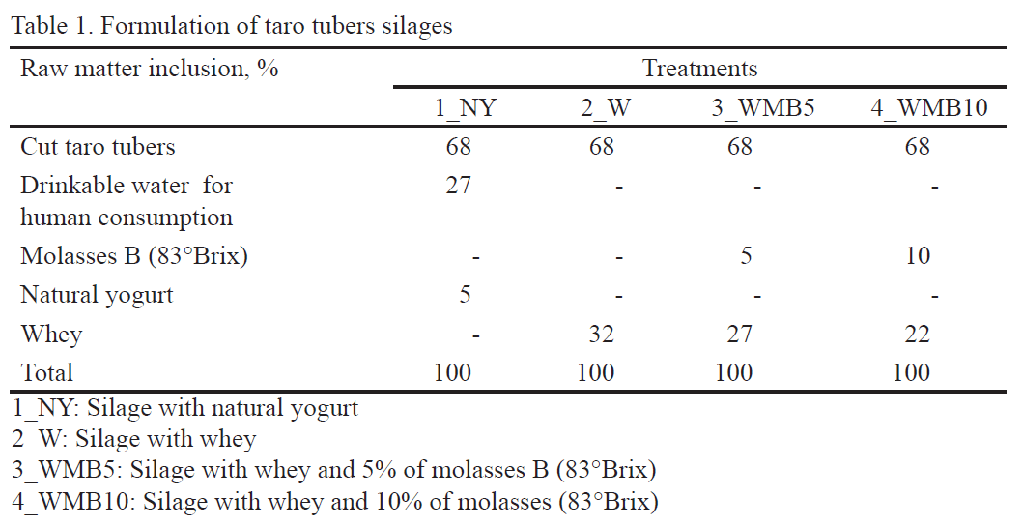
<body><![CDATA[<p align="JUSTIFY">This study was carried out in the facilities of the   taro producer corporation of Pastaza, belonging to "Teniente Hugo Ortiz"   parish, in Pastaza province, Ecuador. The weather in this area is   semi-warm or humid sub-tropical, with precipitations between   4.000 and 4500 mm annually. It is located to an altitude of 950 m o.s.l, with average relative humidity of   87% and average minimum and maximum temperature of 18 to 26 &ordm;C. Soils   are classified as inceptisols, oxisols and entisols (INAMI 2013). </p>     <p align="JUSTIFY">To formulate the silos, Caicedo <em>et al.</em> (2013b) recommendations were fallowed (<a href="/img/revistas/cjas/v49n1/t0110115.gif">table1</a>).The micro - silos were prepared with tubers waste   that, for its physical appearance, they do not fulfill the requirements   established by national and international markets to use them in human   feeding. Tubers were washed and milled in fresh way, in mix mill with   blades   and a sieve of 2.5cm, with the purpose of obtaining uniform particles. </p>     
<p align="JUSTIFY">For silages formulation, raw matters were weighed   in a CAMRY digital balance, and were placed in four clean plastic   tanks, with 400kg each. Ingredients were added in the fallowing order:   silage1) cut tubers, natural yogurt and drinkable water for human   consumption (1_NY) 2) cut tubers and whey (2_W); 3) cut tubers, molasses   B (83&ordm; Brix) 5% and whey (3_MB5) and cut tubers, molasses B (83&ordm; Brix)   10 % and whey (4_MB10). </p>     <p align="JUSTIFY">The ingredients were mixed in a homogeneous way,   manually, with a wooden spatula, during15 min, at room temperature of 24   &ordm;C. Then, the silages mixtures were introduced in polyethylene bags, at   a rate of 5kg.The bags were compacted and closed hermetically   with a vacuum pump to guarantee their preservation. The micro-silos were   stored under roof and protected of the sun light. They were opened at   0, 15, 30, 60, 90 and 180 d after silage. </p>     <p align="JUSTIFY">The material was analyzed for DM, CF, ash, CP (N x   6.25) content, EE and NFE, according to AOAC (2005) .The levels of NDF,   ADF and lignin were measured according to van Soest <em>et al.</em> (1991).It was considered that the OM concentration was   equal to the   difference 100- ash percent. However, the hemicellulose was the result   of the subtraction NDF-ADF, as well as the cellulose (ADF-lignin). Both   expressed in percent (van Soest and Robertson 1975). The GE was    determined in a Parr adiabatic calorimetric pump, model   1241.The <em>in vitro</em> digestibility of the DM (IVDMD) and OM (IVOMD)   was carried out by pepsin-pancreatin-viscozime, according to Boisen and   Fern&aacute;ndez (1991). </p>     <p align="JUSTIFY">A completely randomized design with a 4x6   factorial arrangement for chemical characterization was applied,   corresponding to four silage types (<a href="/img/revistas/cjas/v49n1/t0110115.gif">table1</a>) and six conservations time   (0, 15, 30, 60, 90 and180 d). <em>In vitro</em> digestibility was asses by means of a   completely randomized design and analysis of simple variance was   applied, with silage of 15 elaboration days. Three replications per each   treatment were carried out. All determinations were made in triplicate.   The means were contrasted by the analysis of variance   technique, according to the recommendations of Steel <em>et al.</em> (1997).Where significant differences (P &lt; 0.05) were   found, they were compared with Duncan (1995) test. The analyses were   carried out with the application of the Infostat statistical program (Di   Rienzo <em>et al.</em> 2012).</p> </font>     
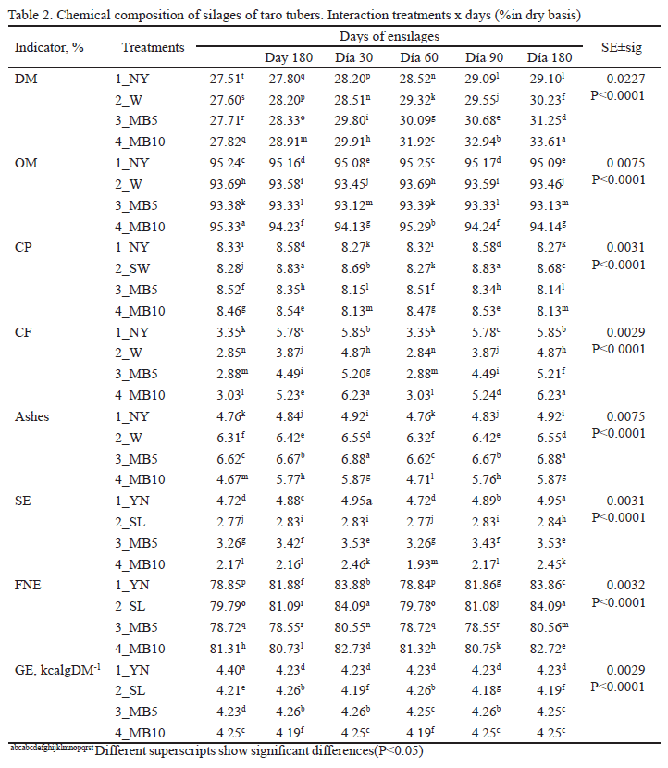
<p>&nbsp;</p>     <p><font size="3" face="Verdana, Arial, Helvetica, sans-serif"><strong>RESULTS AND DISCUSSION</strong></font></p> <font size="2" face="Verdana, Arial, Helvetica, sans-serif">    <p align="JUSTIFY">During the conservation process, the average   temperature was of 22 &ordm;C. When opening the micro-silos, the presence of   alcohol or any symptom of ensilaged materials decomposition was never   found. All of them had a sweet smell. </p>     <p align="JUSTIFY">The result of the interactions studied for chemical indexes is shown in <a href="/img/revistas/cjas/v49n1/t0210115.gif">table 2</a> and <a href="/img/revistas/cjas/v49n1/t0310115.gif">3</a>.The interactions treatments per day were significant (P &lt; 0.05)   for all chemical indexes evaluated:DM,OM,CP,CF, ash,   EE,NFE,GE,NDF,ADF,lignin,hemicelluloses and cellulose. </p>     
]]></body>
<body><![CDATA[<p align="JUSTIFY">The DM content was significantly (P &lt; 0.05)   higher in silage four in the 80th day (33.61%).While the highest OM   concentration (P &lt; 0.05) was determined in silage four in the 0 day   (95.33%).The CF value (P &lt; 0.05) was higher in silage two, in the   90th day (8.83   %).The lower CF content was determined in silage two in the 0 (2.85 %) and 60th (2.84%) days, respectively. </p>     <p align="JUSTIFY">Silage four in the 0 day (4.67 %) showed the lower ash concentration. The higher EE content (P &lt; 0.05) showed silage one, in the 30th (4.95 %) and 180th (4.95 %) days. The higher NFE concentration was   evident in silage two, in the 30th (84.09 %) and180th (84.09 %) days.   The GE content was shown high in all the studied variants. However, was   significantly (P &lt; 0.05) high in silage one, in the 0 day (18.30 kJ   gDM<sup>-1</sup>). </p>     <p align="JUSTIFY">The NDF (<a href="/img/revistas/cjas/v49n1/t0310115.gif">table 3</a>) was high (P &lt; 0.05) in   silage one in the 30th (18.21 %) and 180th (18.19 %) days. The lower ADF   concentration (P &lt; 0.05) have it silage two, in the 0 (2.55 %) and   60th (2.54 %) days. The higher lignin content (P &lt; 0.05) was   determined in   silage four, in the 30th (2.46 %) day. The hemicelluloses decreased (P &lt; 0.05) in silage four, in the 15th (9.48%)   and 60th (9.48 %) days, and the cellulose increased (P &lt; 0.05) in   silage one, in the 30th (6.20%) and 180 th (6.19 %) days. </p>     
<p align="JUSTIFY">The results of the digestibility study, of the four taro silages are showed in <a href="/img/revistas/cjas/v49n1/t0410115.gif">table 4</a>.In the evaluation of DM and OM <em>in vitro</em> digestibility was showed that there were significant differences (P &lt;0.05). </p>     
<p align="JUSTIFY">The higher IVDMD (P &lt; 0.05) coefficient had it   silage two (74.65 %).In silage one, the IVDMD was lower (63.83%).   Relate to IVOMD, silage two showed the higher digestibility (76.76 %)   coefficient (P &lt; 0.05). Similarly, silage one had the lower   digestibility coefficient (65.08 %).</p>  <font size="2" face="Verdana, Arial, Helvetica, sans-serif">     <p align="JUSTIFY"><em>Chemical composition</em>. The concentration of DM in the silages was in the recommended level (25-35 %) to characterized a silage of appropriate quality (McCullough 1975).In this regard, McDonald <em>et al.</em> (1981) suggested that 30% of DM was a minimum level to   reduce the undesirable  growth of clostridia that worse the product. The   DM content of silages,   until the 180th  day of evaluation, were between 29.10 and   33.61%.Consequently, they can be considered good quality products for   their use in animal feeding. </font>     <p align="JUSTIFY">Regarding the CP content, the data of this   research were in a concentration from 8.13 to 8.83%. Similar CP values   informed Marrero <em>et al.</em> (1984) in silages of taro tubers of six months (8.5 %). Ogunlakin <em>et al.</em> (2012) referred higher results in tubers in natural way   (4.93 to 5.17 %), Fetuga and Oluyemi (1976) found 3.1% in studies with   cooked tubers . Apparently, by means of silage process the CP content is   increased regarding to tubers in natural and cooked way. The silages CF   in the four variants showed low content (2.84 to   6.23%).In researches carried out with ensiled tubers, Marrero <em>et al.</em> (1984) determined 13.4% of CF. This wide variation in CF   content could be due to the used ingredients in silages formulation.   Also, the nutritional composition of roots and tubers vary according to   climatic conditions, cultured varieties, soil conditions and time in   which the crop is made (FAO 1990 and Onwueme 1999). </p>     <p align="JUSTIFY">The NFE (78.55 to 84.09 %) and ash (4.67 to 6.88 %) concentration in silages showed higher content, regarding to that referred by Olajide <em>et al.</em> (2011) in fermented and dryings tubers. These authors   informed 73.50 % for NFE and 0.88 % for ashes. Nevertheless, in relation   to the EE content (2.63 %) referred   by these researches, silages showed a similar performance to this   nutrient (1.93 to 4.95%).The variation in NFE values could be due to    the amount of fermented carbohydrates  that the silages had in this   experiment. </p>     <p align="JUSTIFY">In this study, the GE content in silages was high, with values between 17.47 and 18.39 kJ   gDM<sup>-1</sup> Abdulrashid and Agwunobi (2009), in tubers meal, informed 3.21 kcal g DM<sup>-1</sup> (13.42   kJ.gDM<sup>-1</sup>),lower figures to those verified  in this research.   Apparently, the caloric content of ensiled tubers was increased by the   energy contribution of natural yogurt, whey and molasses B. </p>     <p align="JUSTIFY">In general, silages showed variation in NDF   content (13.57 to 18.21%), ADF (2.55 to7.56%), lignin (0.81 to 2.46%),   hemicellulose (9.48 to13.16%) and cellulose (1.42 to 6.19%). These   variations can be associated to the lack or presence of molasses in the   fermented material (Guzm&aacute;n <em>et al.</em> 2012). </p>     ]]></body>
<body><![CDATA[<p align="JUSTIFY"><em>In vitro</em> <em>digestibility</em>. In researchers developed by Ly and Delgado (2005), related to <em>in vitro</em> digestibility of DM and OM, with pancreatine pepsin, in   fresh and dry taro tubers, informed that DM digestibility increased when   tubers were dry (66.90%). Not happened   this way when they were fresh (31.50 %). Likewise, the <em>in vitro</em> digestibility of OM was higher in the dry ones (76 %), in relation to the fresh ones (38.30 %). </p>     <p align="JUSTIFY">It has been carried out several <em>in vitro</em> digestibility researches of DM and OM in other types of tubers in natural way.   Ly <em>et al.</em> (2010) informed in cassava tubers values of 66 % of DM and 68.7 % of OM. In studies made with sweet potato, Ly <em>et al.</em> (1999) informed contents of 54.5 % of DM and 62.5 % of OM.   These results were lower to those obtained in the study of the four   silages variants. Apparently, the ensiled process and the digestibility   method applied increased the <em>in vitro</em> digestibility coefficients of DM (63.83 to 74.65   %) and OM (65.08 to 76.76 %). </p>     <p align="JUSTIFY">From the point of view of the OM <em>in vitro</em> digestibility, the ensiled taro tubers seem to be   slightly better than other tropical tubers; due to in the ensiled   process by means of anaerobic fermentation, lactic acid is produced and,   in presence of this one, can be recover   some wastes components, like protein, minerals and lipids (L&oacute;pez <em>et al.</em> 2006). </p>     <p align="JUSTIFY">The conservation of taro tubers, between 0 and   180d, by means of the addition of variables levels of natural yogurt,   whey and sugar cane molasses originates different products that have   good content of DM, CP, GE and low concentration of CF, suitable for it   use   in feeding pigs.</p></font>     <p>&nbsp;</p>     <p><font size="3" face="Verdana, Arial, Helvetica, sans-serif"><strong>ACKNOWLEDGEMENTS</strong></font></p>     <p><font size="2" face="Verdana, Arial, Helvetica, sans-serif">Thanks to the National Secretary of Higher Education, Science, Technology and Innovation (SENESCYT) of Ecuador for financing this research.</font></p>     <p>&nbsp;</p>     <p><font size="2" face="Verdana, Arial, Helvetica, sans-serif"><font size="3"><strong>BIBLIOGRAPHY</strong></font></font></p> <font size="2" face="Verdana, Arial, Helvetica, sans-serif">     <!-- ref --><p align="JUSTIFY">Abdulrashid M., Agwunobi L. N. &amp; others. 2009. ``Taro cocoyam (Colocasia esculenta) meal as feed ingredient in poultry''. <em>Pakistan Journal of Nutrition</em>, 8 (5), pp. 668-673.     </p>     <!-- ref --><p align="JUSTIFY">AOAC. 2005. <em>Official Methods of   Analysis</em>. 18th ed., Gaithersburg, MD., USA: Association of Official Analytical Chemists Inc.     </p>     <!-- ref --><p align="JUSTIFY">Boisen S., Ferna J. A. &amp; others. 1995.   ``Prediction of the apparent ileal digestibility of protein and amino   acids in feedstuffs and feed mixtures for pigs by in vitro analyses''. <em>Animal Feed Science and Technology</em>, 51 (1), pp. 29-43.     </p>     <p align="JUSTIFY">Boisen S. &amp; Fern&aacute;ndez J. A. 1991. ``In vitro   digestibility of energy and amino acids in pig feeds''. In: Verstegen M.   W. A., Huisman J. &amp; den Hartzog L. A. (eds.), <em>Digestive Physiology in Pigs</em>, Netherlands: EAAP Publication, p.   23l-236, Available:   &lt;<a href="http://agris.fao.org/agris-search/search.do?recordID=NL9200846" target="_blank">http://agris.fao.org/agris-search/search.do?recordID=NL9200846</a>&gt;,   [Accessed:&nbsp;November 14, 2014]. </p>     <p align="JUSTIFY">Caicedo S. W., Rodr&iacute;guez B. R., Lezcano P.,   Vargas B. J. C., Ly J. &amp; Valle S. 2013a. ``Efecto de inocuidad del   ensilado biol&oacute;gico de tub&eacute;rculos de papa China (Colocasia esculenta   (L.) Schott) para la alimentaci&oacute;n de cerdos''. <em>Revista Amaz&oacute;nica Ciencia y   Tecnolog&iacute;a</em>, 2 (3), pp. 162-171. </p>     <p align="JUSTIFY">Caicedo W. O., Rodr&iacute;guez R., Lezcano P. &amp; Ly   J. 2013b. ``Estudios de composici&oacute;n qu&iacute;mica de ensilados de papa china   (Colocasia esculenta L. Schott) destinados a la   alimentaci&oacute;n porcina''. In: <em>XXIII Reuni&oacute;n de la Asociaci&oacute;n Latinoamericana de Producci&oacute;n   Animal</em>, La Habana, Cuba, ISBN: 978-950-7171-492. </p>     <!-- ref --><p align="JUSTIFY">Di Rienzo J. A., Casanoves F., Balzarini M. G., Gonz&aacute;lez L. &amp; Robledo C. W. 2012. <em>InfoStat</em>. version 2012, [Windows], Universidad Nacional de C&oacute;rdoba, Argentina: Grupo   InfoStat, Available: &lt;<a href="http://www.infostat.com.ar/" target="_blank">http://www.infostat.com.ar/</a>&gt;    . </p>     ]]></body>
<body><![CDATA[<!-- ref --><p align="JUSTIFY">Duncan D. B. 1955. ``Multiple range and multiple F tests''. <em>Biometrics</em>, 11 (1), pp. 142.     </p>     <!-- ref --><p align="JUSTIFY">Ezedinma F. O. 1987. ``Response of Taro   (Colocasia esculenta) to water management, plot preparation and   population. 3rd Intl''. In: <em>III Symp. Trop. Root Crops. Ibadan</em>, Nigeria.     </p>     <!-- ref --><p align="JUSTIFY">FAO. 1990. <em>Roots, tubers, plantain and bananas in human nutrition. Effect of processing on nutritive   values</em>. Rome: Food and Agriculture Organization of the United Nations.     </p>     <!-- ref --><p align="JUSTIFY">Fetuga B. L. &amp; Oluyemi J. A. 1976. ``The metabolizable energy of some tropical tuber meals for chicks''. <em>Poultry Science</em>, 55 (3), pp. 868-873.     </p>     <!-- ref --><p align="JUSTIFY">Guzm&aacute;n O. 2010. <em>Estudio de conservaci&oacute;n de desechos de mango (Mangifera indica L.) para la alimentaci&oacute;n de ovinos en el Estado de   Nayarit</em>. Master Thesis, Universidad Aut&oacute;noma   de Nayarit, Tepic. M&eacute;xico, 87 p.     </p>     ]]></body>
<body><![CDATA[<!-- ref --><p align="JUSTIFY">Guzm&aacute;n O., Lemus C., Mart&iacute;nez S., Bonilla J.,   Plasencia A. &amp; Ly J. 2012. ``Chemical characteristics of silages of   mango (Mangifera indica L.) by products for animal feeding''. <em>Cuban J. Agric. Sci</em>, 46, p. 369.     </p>     <p align="JUSTIFY">Herrera M. L., WingChing-Jones R. &amp;   Rojas-Bourrill&oacute;n A. 2008. ``Caracter&iacute;sticas fermentativas y   nutricionales del ensilaje de rastrojo de pi&ntilde;a (Ananas comosus)''. <em>Agronom&iacute;a Costarricense</em>, 33 (1), Available: &lt;<a href="http://revistas.ucr.ac.cr/index.php/agrocost/article/view/6731" target="_blank">http://revistas.ucr.ac.cr/index.php/agrocost/article/view/6731</a>&gt;, [Accessed:&nbsp;November 14, 2014]. </p>     <!-- ref --><p align="JUSTIFY">INAMHI. 2013. <em>Reportes Clim&aacute;ticos del   Ecuador</em>. Instituto Nacional Meteorol&oacute;gico H&iacute;drico, pp. 20-25.     </p>     <!-- ref --><p align="JUSTIFY">Llano D., L&oacute;pez D. &amp; Mora F. 2008. ``Potencial del ensilaje de desechos de naranja (Citrus sinensis)''. <em>Rev. Ciencias T&eacute;cnicas Agropecuarias</em>, 17, p. 41.     </p>     <!-- ref --><p align="JUSTIFY">L&oacute;pez J., S&aacute;nchez D. I. &amp; Rosas J. A. 2006.   ``Analysis of free amino acids in fermented shrimp waste by   high-performance liquid chromatography''. <em>Journal of Chromatography A</em>, 1105 (1), pp. 106-110.     </p>     <p align="JUSTIFY">Ly J., Almaguel R., Delgado E., Car&oacute;n M. &amp;   Cruz E. 2010. ``Estudios de digestibilidad in vitro   (pepsina/pancreatina) de ra&iacute;ces de yuca para alimentar cerdos''. <em>Revista Computadorizada de Producci&oacute;n Porcina   Volumen</em>, 17 (4), Available: &lt;<a href="http://www.iip.co.cu/rcpp/174/174_06artjly.pdf" target="_blank">http://www.iip.co.cu/rcpp/174/174_06artjly.pdf</a>&gt;, [Accessed:&nbsp;November 14, 2014]. </p>     ]]></body>
<body><![CDATA[<!-- ref --><p align="JUSTIFY">Ly J., Caron M. &amp; Delgado E. 1999. ``A note   on in vitro digestibility of sweet potato tubers (Ipomoea batatas (Lam)   L) for pigs''. <em>Cuban Journal of Agricultural Science</em>, 33, p. 179.     </p>     <!-- ref --><p align="JUSTIFY">Ly J. &amp; Delgado E. 2005. ``A note on in vitro   (pepsin/ pancreatine) digestibility of taro (Xanthosoma sagitifolia   spp) and cocoyam (Colocasia esculenta spp) for pigs''. <em>Revista Computadorizada de Producci&oacute;n   Porcina</em>, 12, p. 90.     </p>     <!-- ref --><p align="JUSTIFY">Marrero L., Vargas S. &amp; Contreras F. 1984.   ``Ensilado de malanga japonesa (Colocasia esculenta) en la alimentaci&oacute;n   de cerdos en ceba''. <em>Cienc. T&eacute;c. Agric. Ganado Porcino</em>, 7 (4), pp.   85-93.     </p>     <!-- ref --><p align="JUSTIFY">McCullough M. E. 1975. ``Nuevas tendencias en ensilaje de forrajes''. <em>Rev. Mundial de Zootecnia</em>, 15, p. 44.     </p>     <p align="JUSTIFY">McDonald P., Henderson A. R. &amp; Heron S. J. E. 1981. <em>The biochemistry of silage</em>. 2nd ed., Marlow, Chalcombe: John Wiley &amp; Sons, Ltd., 340 p., Available:   &lt;<a href="http://www.cabdirect.org/abstracts/19811424455.html" target="_blank">http://www.cabdirect.org/abstracts/19811424455.html</a>&gt;, [Accessed:&nbsp;November 14, 2014]. </p>     <!-- ref --><p align="JUSTIFY">Ogunlakin G. O., Oke M. O., Babarinde G. O. &amp;   Olatunbosun D. G. 2012. ``Effect of drying methods on proximate   composition and physico-chemical properties of cocoyam flour''. <em>Am. J. Food Technol</em>, 7 (4), pp. 245-250.     </p>     <!-- ref --><p align="JUSTIFY">Olajide R., Akinsoyinu A. O., Babayemi O. J.,   Omojola A. B., Abu A. O. &amp; Afolabi K. D. 2011. ``Effect of   processing on energy values, nutrient and anti-nutrient components of   wild cocoyam (Colocasia esculenta (L.) Schott) corm''. <em>Pakistan journal of nutrition</em>, 10 (1), pp. 29-34.     </p>     <!-- ref --><p align="JUSTIFY">Onwueme I. 1999. ``Taro cultivation in Asia and the Pacific''. <em>Rap Publication</em>, 16, pp. 19.     </p>     <!-- ref --><p align="JUSTIFY">Ramos M. 1995. <em>Aplicaci&oacute;n de t&eacute;cnicas enzim&aacute;ticas de digesti&oacute;n in vitro a la valoraci&oacute;n nutritiva de piensos de   conejos</em>. PhD Thesis, Facultad de Veterinaria, Departamento de   Nutrici&oacute;n y Bromatolog&iacute;a, Universidad Complutense de Madrid, Madrid, Espa&ntilde;a.     </p>     <!-- ref --><p align="JUSTIFY">R&ecirc;go M. M. T., Neiva J. N. M., R&ecirc;go A. C. do,   C&acirc;ndido M. J. D., Carneiro M. S. de S. &amp; L&ocirc;bo R. N. B. 2010.   ``Chemical and bromatological characteristics of elephant grass silages   with the addition of dried cashew stalk''. <em>Revista Brasileira de   Zootecnia</em>, 39 (2), pp. 255-261.     </p>     <p align="JUSTIFY">Steel R. G., Dickey M. &amp; Torrie J. H. 1997. <em>Principles and Procedures of Statistics. A Biometrical   Approach</em>. 3rd ed., New York, USA: MacGraw-Hill Book Company In   Company, 666   p., Available:   &lt;<a href="http://www.sidalc.net/cgi-bin/wxis.exe/?IsisScript=ORTON.xis&B1=Buscar&formato=1&cantidad=50&expresion=Torrie,%20J.H." target="_blank">http://www.sidalc.net/cgi-bin/wxis.exe/?IsisScript=ORTON.xis&amp;B1=Buscar&amp;formato=1&amp;cantidad=50&amp;expresion=Torrie,%20J.H.</a>&gt;,   [Accessed:&nbsp;November 14, 2014]. </p>     ]]></body>
<body><![CDATA[<!-- ref --><p align="JUSTIFY">Van Soest P. J. &amp; Robertson J. B. 1975. <em>Analysis of forages and fibrous foods</em>. New York, USA: Cornell University Press, 165 p.     </p>     <!-- ref --><p align="JUSTIFY">Van Soest P. van, Robertson J. B. &amp; Lewis B. A. 1991. ``Methods for dietary fiber, neutral detergent fiber, and   nonstarch polysaccharides in relation to animal nutrition''. <em>Journal of dairy science</em>, 74 (10), pp. 3583-3597.    </p></font>     <p align="JUSTIFY">&nbsp;</p>     <p align="JUSTIFY">&nbsp;</p>     <p><font size="2" face="Verdana, Arial, Helvetica, sans-serif">Received: November 14, 2014    <br> Accepted: December 1, 2014</font></p>     <p>&nbsp;</p>     <p>&nbsp;</p>     ]]></body>
<body><![CDATA[<p><font size="2" face="Verdana, Arial, Helvetica, sans-serif"><em>W. Caicedo,</em> Secretaria Nacional de Educación Superior Ciencia Tecnología e Innovación, Quito, Ecuador.  Email: <a href="mailto:orlando.caicedo@yahoo.es">orlando.caicedo@yahoo.es</a></font></p>      ]]></body><back>
<ref-list>
<ref id="B1">
<nlm-citation citation-type="journal">
<person-group person-group-type="author">
<name>
<surname><![CDATA[Abdulrashid]]></surname>
<given-names><![CDATA[M.]]></given-names>
</name>
<name>
<surname><![CDATA[Agwunobi]]></surname>
<given-names><![CDATA[L. N.]]></given-names>
</name>
</person-group>
<article-title xml:lang="nd"><![CDATA[Taro cocoyam (Colocasia esculenta) meal as feed ingredient in poultry]]></article-title>
<source><![CDATA[Pakistan Journal of Nutrition]]></source>
<year>2009</year>
<volume>8</volume>
<numero>5</numero>
<issue>5</issue>
<page-range>668–673</page-range></nlm-citation>
</ref>
<ref id="B2">
<nlm-citation citation-type="book">
<person-group person-group-type="author">
<name>
<surname><![CDATA[AOAC]]></surname>
</name>
</person-group>
<source><![CDATA[Official Methods of Analysis]]></source>
<year>2005</year>
<edition>18th</edition>
<publisher-loc><![CDATA[Gaithersburg, MD., USA ]]></publisher-loc>
<publisher-name><![CDATA[Association of Official Analytical Chemists Inc.]]></publisher-name>
</nlm-citation>
</ref>
<ref id="B3">
<nlm-citation citation-type="journal">
<person-group person-group-type="author">
<name>
<surname><![CDATA[Boisen]]></surname>
<given-names><![CDATA[S.]]></given-names>
</name>
<name>
<surname><![CDATA[Ferna]]></surname>
<given-names><![CDATA[J. A.]]></given-names>
</name>
</person-group>
<article-title xml:lang="nd"><![CDATA[Prediction of the apparent ileal digestibility of protein and amino acids in feedstuffs and feed mixtures for pigs by in vitro analyses]]></article-title>
<source><![CDATA[Animal Feed Science and Technology]]></source>
<year>1995</year>
<volume>51</volume>
<numero>1</numero>
<issue>1</issue>
<page-range>29–43</page-range></nlm-citation>
</ref>
<ref id="B4">
<nlm-citation citation-type="book">
<person-group person-group-type="author">
<name>
<surname><![CDATA[Boisen]]></surname>
<given-names><![CDATA[S.]]></given-names>
</name>
<name>
<surname><![CDATA[Fernández]]></surname>
<given-names><![CDATA[J. A.]]></given-names>
</name>
</person-group>
<article-title xml:lang="nd"><![CDATA[In vitro digestibility of energy and amino acids in pig feeds]]></article-title>
<person-group person-group-type="editor">
<name>
<surname><![CDATA[Verstegen]]></surname>
<given-names><![CDATA[M. W. A.]]></given-names>
</name>
<name>
<surname><![CDATA[Huisman]]></surname>
<given-names><![CDATA[J.]]></given-names>
</name>
<name>
<surname><![CDATA[den Hartzog]]></surname>
<given-names><![CDATA[L. A.]]></given-names>
</name>
</person-group>
<source><![CDATA[Digestive Physiology in Pigs]]></source>
<year>1991</year>
<page-range>23l–236</page-range><publisher-loc><![CDATA[Netherlands ]]></publisher-loc>
<publisher-name><![CDATA[EAAP Publication]]></publisher-name>
</nlm-citation>
</ref>
<ref id="B5">
<nlm-citation citation-type="journal">
<person-group person-group-type="author">
<name>
<surname><![CDATA[Caicedo]]></surname>
<given-names><![CDATA[S. W.]]></given-names>
</name>
<name>
<surname><![CDATA[Rodríguez]]></surname>
<given-names><![CDATA[B. R.]]></given-names>
</name>
<name>
<surname><![CDATA[Lezcano]]></surname>
<given-names><![CDATA[P.]]></given-names>
</name>
<name>
<surname><![CDATA[Vargas]]></surname>
<given-names><![CDATA[B. J. C.]]></given-names>
</name>
<name>
<surname><![CDATA[Ly]]></surname>
<given-names><![CDATA[J.]]></given-names>
</name>
<name>
<surname><![CDATA[Valle]]></surname>
<given-names><![CDATA[S.]]></given-names>
</name>
</person-group>
<article-title xml:lang="nd"><![CDATA[Efecto de inocuidad del ensilado biológico de tubérculos de papa China (Colocasia esculenta (L.) Schott) para la alimentación de cerdos]]></article-title>
<source><![CDATA[Revista Amazónica Ciencia y Tecnología]]></source>
<year>2013</year>
<volume>2</volume>
<numero>3</numero>
<issue>3</issue>
<page-range>162–171</page-range></nlm-citation>
</ref>
<ref id="B6">
<nlm-citation citation-type="">
<person-group person-group-type="author">
<name>
<surname><![CDATA[Caicedo]]></surname>
<given-names><![CDATA[W. O.]]></given-names>
</name>
<name>
<surname><![CDATA[Rodríguez]]></surname>
<given-names><![CDATA[R.]]></given-names>
</name>
<name>
<surname><![CDATA[Lezcano]]></surname>
<given-names><![CDATA[P.]]></given-names>
</name>
<name>
<surname><![CDATA[Ly]]></surname>
<given-names><![CDATA[J.]]></given-names>
</name>
</person-group>
<article-title xml:lang="nd"><![CDATA[Estudios de composición química de ensilados de papa china (Colocasia esculenta L. Schott) destinados a la alimentación porcina]]></article-title>
<source><![CDATA[]]></source>
<year>2013</year>
<publisher-loc><![CDATA[La Habana, Cuba ]]></publisher-loc>
</nlm-citation>
</ref>
<ref id="B7">
<nlm-citation citation-type="book">
<person-group person-group-type="author">
<name>
<surname><![CDATA[Di Rienzo]]></surname>
<given-names><![CDATA[J. A.]]></given-names>
</name>
<name>
<surname><![CDATA[Casanoves]]></surname>
<given-names><![CDATA[F.]]></given-names>
</name>
<name>
<surname><![CDATA[Balzarini]]></surname>
<given-names><![CDATA[M. G.]]></given-names>
</name>
<name>
<surname><![CDATA[González]]></surname>
<given-names><![CDATA[L.]]></given-names>
</name>
<name>
<surname><![CDATA[Robledo]]></surname>
<given-names><![CDATA[C. W.]]></given-names>
</name>
</person-group>
<source><![CDATA[InfoStat]]></source>
<year>2012</year>
<publisher-loc><![CDATA[Universidad Nacional de Córdoba, Argentina ]]></publisher-loc>
<publisher-name><![CDATA[Grupo InfoStat]]></publisher-name>
</nlm-citation>
</ref>
<ref id="B8">
<nlm-citation citation-type="journal">
<person-group person-group-type="author">
<name>
<surname><![CDATA[Duncan]]></surname>
<given-names><![CDATA[D. B.]]></given-names>
</name>
</person-group>
<article-title xml:lang="nd"><![CDATA[Multiple range and multiple F tests]]></article-title>
<source><![CDATA[Biometrics]]></source>
<year>1955</year>
<volume>11</volume>
<numero>1</numero>
<issue>1</issue>
<page-range>1–42</page-range></nlm-citation>
</ref>
<ref id="B9">
<nlm-citation citation-type="">
<person-group person-group-type="author">
<name>
<surname><![CDATA[Ezedinma]]></surname>
<given-names><![CDATA[F. O.]]></given-names>
</name>
</person-group>
<article-title xml:lang="nd"><![CDATA[Response of Taro (Colocasia esculenta) to water management, plot preparation and population. 3rd Intl]]></article-title>
<source><![CDATA[]]></source>
<year>1987</year>
<publisher-loc><![CDATA[Nigeria ]]></publisher-loc>
</nlm-citation>
</ref>
<ref id="B10">
<nlm-citation citation-type="book">
<person-group person-group-type="author">
<name>
<surname><![CDATA[FAO]]></surname>
</name>
</person-group>
<source><![CDATA[Roots, tubers, plantain and bananas in human nutrition. Effect of processing on nutritive values]]></source>
<year>1990</year>
<publisher-loc><![CDATA[Rome ]]></publisher-loc>
<publisher-name><![CDATA[Food and Agriculture Organization of the United Nations]]></publisher-name>
</nlm-citation>
</ref>
<ref id="B11">
<nlm-citation citation-type="journal">
<person-group person-group-type="author">
<name>
<surname><![CDATA[Fetuga]]></surname>
<given-names><![CDATA[B. L.]]></given-names>
</name>
<name>
<surname><![CDATA[Oluyemi]]></surname>
<given-names><![CDATA[J. A.]]></given-names>
</name>
</person-group>
<article-title xml:lang="nd"><![CDATA[The metabolizable energy of some tropical tuber meals for chicks]]></article-title>
<source><![CDATA[Poultry Science]]></source>
<year>1976</year>
<volume>55</volume>
<numero>3</numero>
<issue>3</issue>
<page-range>868–873</page-range></nlm-citation>
</ref>
<ref id="B12">
<nlm-citation citation-type="book">
<person-group person-group-type="author">
<name>
<surname><![CDATA[Guzmán]]></surname>
<given-names><![CDATA[O.]]></given-names>
</name>
</person-group>
<source><![CDATA[Estudio de conservación de desechos de mango (Mangifera indica L.) para la alimentación de ovinos en el Estado de Nayarit]]></source>
<year>2010</year>
<page-range>87</page-range><publisher-loc><![CDATA[Tepic. México ]]></publisher-loc>
<publisher-name><![CDATA[Universidad Autónoma de Nayarit]]></publisher-name>
</nlm-citation>
</ref>
<ref id="B13">
<nlm-citation citation-type="journal">
<person-group person-group-type="author">
<name>
<surname><![CDATA[Guzmán]]></surname>
<given-names><![CDATA[O.]]></given-names>
</name>
<name>
<surname><![CDATA[Lemus]]></surname>
<given-names><![CDATA[C.]]></given-names>
</name>
<name>
<surname><![CDATA[Martínez]]></surname>
<given-names><![CDATA[S.]]></given-names>
</name>
<name>
<surname><![CDATA[Bonilla]]></surname>
<given-names><![CDATA[J.]]></given-names>
</name>
<name>
<surname><![CDATA[Plasencia]]></surname>
<given-names><![CDATA[A.]]></given-names>
</name>
<name>
<surname><![CDATA[Ly]]></surname>
<given-names><![CDATA[J.]]></given-names>
</name>
</person-group>
<article-title xml:lang="nd"><![CDATA[Chemical characteristics of silages of mango (Mangifera indica L.) by products for animal feeding]]></article-title>
<source><![CDATA[Cuban J. Agric. Sci]]></source>
<year>2012</year>
<volume>46</volume>
<page-range>369</page-range></nlm-citation>
</ref>
<ref id="B14">
<nlm-citation citation-type="journal">
<person-group person-group-type="author">
<name>
<surname><![CDATA[Herrera]]></surname>
<given-names><![CDATA[M. L.]]></given-names>
</name>
<name>
<surname><![CDATA[WingChing-Jones]]></surname>
<given-names><![CDATA[R.]]></given-names>
</name>
<name>
<surname><![CDATA[Rojas-Bourrillón]]></surname>
<given-names><![CDATA[A.]]></given-names>
</name>
</person-group>
<article-title xml:lang="nd"><![CDATA[Características fermentativas y nutricionales del ensilaje de rastrojo de piña (Ananas comosus)]]></article-title>
<source><![CDATA[Agronomía Costarricense]]></source>
<year>2008</year>
<volume>33</volume>
<numero>1</numero>
<issue>1</issue>
</nlm-citation>
</ref>
<ref id="B15">
<nlm-citation citation-type="book">
<person-group person-group-type="author">
<name>
<surname><![CDATA[INAMHI]]></surname>
</name>
</person-group>
<source><![CDATA[Reportes Climáticos del Ecuador]]></source>
<year>2013</year>
<page-range>20–25</page-range><publisher-name><![CDATA[Instituto Nacional Meteorológico Hídrico]]></publisher-name>
</nlm-citation>
</ref>
<ref id="B16">
<nlm-citation citation-type="journal">
<person-group person-group-type="author">
<name>
<surname><![CDATA[Llano]]></surname>
<given-names><![CDATA[D.]]></given-names>
</name>
<name>
<surname><![CDATA[López]]></surname>
<given-names><![CDATA[D.]]></given-names>
</name>
<name>
<surname><![CDATA[Mora]]></surname>
<given-names><![CDATA[F.]]></given-names>
</name>
</person-group>
<article-title xml:lang="nd"><![CDATA[Potencial del ensilaje de desechos de naranja (Citrus sinensis)]]></article-title>
<source><![CDATA[Rev. Ciencias Técnicas Agropecuarias]]></source>
<year>2008</year>
<volume>17</volume>
<page-range>41</page-range></nlm-citation>
</ref>
<ref id="B17">
<nlm-citation citation-type="journal">
<person-group person-group-type="author">
<name>
<surname><![CDATA[López]]></surname>
<given-names><![CDATA[J.]]></given-names>
</name>
<name>
<surname><![CDATA[Sánchez]]></surname>
<given-names><![CDATA[D. I.]]></given-names>
</name>
<name>
<surname><![CDATA[Rosas]]></surname>
<given-names><![CDATA[J. A.]]></given-names>
</name>
</person-group>
<article-title xml:lang="nd"><![CDATA[Analysis of free amino acids in fermented shrimp waste by high-performance liquid chromatography]]></article-title>
<source><![CDATA[Journal of Chromatography A]]></source>
<year>2006</year>
<volume>1105</volume>
<numero>1</numero>
<issue>1</issue>
<page-range>106–110</page-range></nlm-citation>
</ref>
<ref id="B18">
<nlm-citation citation-type="journal">
<person-group person-group-type="author">
<name>
<surname><![CDATA[Ly]]></surname>
<given-names><![CDATA[J.]]></given-names>
</name>
<name>
<surname><![CDATA[Almaguel]]></surname>
<given-names><![CDATA[R.]]></given-names>
</name>
<name>
<surname><![CDATA[Delgado]]></surname>
<given-names><![CDATA[E.]]></given-names>
</name>
<name>
<surname><![CDATA[Carón]]></surname>
<given-names><![CDATA[M.]]></given-names>
</name>
<name>
<surname><![CDATA[Cruz]]></surname>
<given-names><![CDATA[E.]]></given-names>
</name>
</person-group>
<article-title xml:lang="nd"><![CDATA[Estudios de digestibilidad in vitro (pepsina/pancreatina) de raíces de yuca para alimentar cerdos]]></article-title>
<source><![CDATA[Revista Computadorizada de Producción Porcina Volumen]]></source>
<year>2010</year>
<volume>17</volume>
<numero>4</numero>
<issue>4</issue>
</nlm-citation>
</ref>
<ref id="B19">
<nlm-citation citation-type="journal">
<person-group person-group-type="author">
<name>
<surname><![CDATA[Ly]]></surname>
<given-names><![CDATA[J.]]></given-names>
</name>
<name>
<surname><![CDATA[Caron]]></surname>
<given-names><![CDATA[M.]]></given-names>
</name>
<name>
<surname><![CDATA[Delgado]]></surname>
<given-names><![CDATA[E.]]></given-names>
</name>
</person-group>
<article-title xml:lang="nd"><![CDATA[A note on in vitro digestibility of sweet potato tubers (Ipomoea batatas (Lam) L) for pigs]]></article-title>
<source><![CDATA[Cuban Journal of Agricultural Science]]></source>
<year>1999</year>
<volume>33</volume>
<page-range>179</page-range></nlm-citation>
</ref>
<ref id="B20">
<nlm-citation citation-type="journal">
<person-group person-group-type="author">
<name>
<surname><![CDATA[Ly]]></surname>
<given-names><![CDATA[J.]]></given-names>
</name>
<name>
<surname><![CDATA[Delgado]]></surname>
<given-names><![CDATA[E.]]></given-names>
</name>
</person-group>
<article-title xml:lang="nd"><![CDATA[A note on in vitro (pepsin/ pancreatine) digestibility of taro (Xanthosoma sagitifolia spp) and cocoyam (Colocasia esculenta spp) for pigs]]></article-title>
<source><![CDATA[Revista Computadorizada de Producción Porcina]]></source>
<year>2005</year>
<volume>12</volume>
<page-range>90</page-range></nlm-citation>
</ref>
<ref id="B21">
<nlm-citation citation-type="journal">
<person-group person-group-type="author">
<name>
<surname><![CDATA[Marrero]]></surname>
<given-names><![CDATA[L.]]></given-names>
</name>
<name>
<surname><![CDATA[Vargas]]></surname>
<given-names><![CDATA[S.]]></given-names>
</name>
<name>
<surname><![CDATA[Contreras]]></surname>
<given-names><![CDATA[F.]]></given-names>
</name>
</person-group>
<article-title xml:lang="nd"><![CDATA[Ensilado de malanga japonesa (Colocasia esculenta) en la alimentación de cerdos en ceba]]></article-title>
<source><![CDATA[Cienc. Téc. Agric. Ganado Porcino]]></source>
<year>1984</year>
<volume>7</volume>
<numero>4</numero>
<issue>4</issue>
<page-range>85–93</page-range></nlm-citation>
</ref>
<ref id="B22">
<nlm-citation citation-type="journal">
<person-group person-group-type="author">
<name>
<surname><![CDATA[McCullough]]></surname>
<given-names><![CDATA[M. E.]]></given-names>
</name>
</person-group>
<article-title xml:lang="nd"><![CDATA[Nuevas tendencias en ensilaje de forrajes]]></article-title>
<source><![CDATA[Rev. Mundial de Zootecnia]]></source>
<year>1975</year>
<volume>15</volume>
<page-range>44</page-range></nlm-citation>
</ref>
<ref id="B23">
<nlm-citation citation-type="book">
<person-group person-group-type="author">
<name>
<surname><![CDATA[McDonald]]></surname>
<given-names><![CDATA[P.]]></given-names>
</name>
<name>
<surname><![CDATA[Henderson]]></surname>
<given-names><![CDATA[A. R.]]></given-names>
</name>
<name>
<surname><![CDATA[Heron]]></surname>
<given-names><![CDATA[S. J. E.]]></given-names>
</name>
</person-group>
<source><![CDATA[The biochemistry of silage]]></source>
<year>1981</year>
<edition>2nd</edition>
<page-range>340</page-range><publisher-loc><![CDATA[Marlow, Chalcombe ]]></publisher-loc>
<publisher-name><![CDATA[John Wiley & Sons, Ltd.]]></publisher-name>
</nlm-citation>
</ref>
<ref id="B24">
<nlm-citation citation-type="journal">
<person-group person-group-type="author">
<name>
<surname><![CDATA[Ogunlakin]]></surname>
<given-names><![CDATA[G. O.]]></given-names>
</name>
<name>
<surname><![CDATA[Oke]]></surname>
<given-names><![CDATA[M. O.]]></given-names>
</name>
<name>
<surname><![CDATA[Babarinde]]></surname>
<given-names><![CDATA[G. O.]]></given-names>
</name>
<name>
<surname><![CDATA[Olatunbosun]]></surname>
<given-names><![CDATA[D. G.]]></given-names>
</name>
</person-group>
<article-title xml:lang="nd"><![CDATA[Effect of drying methods on proximate composition and physico-chemical properties of cocoyam flour]]></article-title>
<source><![CDATA[Am. J. Food Technol]]></source>
<year>2012</year>
<volume>7</volume>
<numero>4</numero>
<issue>4</issue>
<page-range>245–250</page-range></nlm-citation>
</ref>
<ref id="B25">
<nlm-citation citation-type="journal">
<person-group person-group-type="author">
<name>
<surname><![CDATA[Olajide]]></surname>
<given-names><![CDATA[R.]]></given-names>
</name>
<name>
<surname><![CDATA[Akinsoyinu]]></surname>
<given-names><![CDATA[A. O.]]></given-names>
</name>
<name>
<surname><![CDATA[Babayemi]]></surname>
<given-names><![CDATA[O. J.]]></given-names>
</name>
<name>
<surname><![CDATA[Omojola]]></surname>
<given-names><![CDATA[A. B.]]></given-names>
</name>
<name>
<surname><![CDATA[Abu]]></surname>
<given-names><![CDATA[A. O.]]></given-names>
</name>
<name>
<surname><![CDATA[Afolabi]]></surname>
<given-names><![CDATA[K. D.]]></given-names>
</name>
</person-group>
<article-title xml:lang="nd"><![CDATA[Effect of processing on energy values, nutrient and anti-nutrient components of wild cocoyam (Colocasia esculenta (L.) Schott) corm]]></article-title>
<source><![CDATA[Pakistan journal of nutrition]]></source>
<year>2011</year>
<volume>10</volume>
<numero>1</numero>
<issue>1</issue>
<page-range>29–34</page-range></nlm-citation>
</ref>
<ref id="B26">
<nlm-citation citation-type="journal">
<person-group person-group-type="author">
<name>
<surname><![CDATA[Onwueme]]></surname>
<given-names><![CDATA[I.]]></given-names>
</name>
</person-group>
<article-title xml:lang="nd"><![CDATA[Taro cultivation in Asia and the Pacific]]></article-title>
<source><![CDATA[Rap Publication]]></source>
<year>1999</year>
<volume>16</volume>
<page-range>1–9</page-range></nlm-citation>
</ref>
<ref id="B27">
<nlm-citation citation-type="book">
<person-group person-group-type="author">
<name>
<surname><![CDATA[Ramos]]></surname>
<given-names><![CDATA[M.]]></given-names>
</name>
</person-group>
<source><![CDATA[Aplicación de técnicas enzimáticas de digestión in vitro a la valoración nutritiva de piensos de conejos]]></source>
<year>1995</year>
<publisher-loc><![CDATA[Madrid, España ]]></publisher-loc>
<publisher-name><![CDATA[Facultad de Veterinaria, Departamento de Nutrición y Bromatología, Universidad Complutense de Madrid]]></publisher-name>
</nlm-citation>
</ref>
<ref id="B28">
<nlm-citation citation-type="journal">
<person-group person-group-type="author">
<name>
<surname><![CDATA[Rêgo]]></surname>
<given-names><![CDATA[M. M. T.]]></given-names>
</name>
<name>
<surname><![CDATA[Neiva]]></surname>
<given-names><![CDATA[J. N. M.]]></given-names>
</name>
<name>
<surname><![CDATA[Rêgo]]></surname>
<given-names><![CDATA[A. C. do]]></given-names>
</name>
<name>
<surname><![CDATA[Cândido]]></surname>
<given-names><![CDATA[M. J. D.]]></given-names>
</name>
<name>
<surname><![CDATA[Carneiro]]></surname>
<given-names><![CDATA[M. S. de S.]]></given-names>
</name>
<name>
<surname><![CDATA[Lôbo]]></surname>
<given-names><![CDATA[R. N. B.]]></given-names>
</name>
</person-group>
<article-title xml:lang="nd"><![CDATA[Chemical and bromatological characteristics of elephant grass silages with the addition of dried cashew stalk]]></article-title>
<source><![CDATA[Revista Brasileira de Zootecnia]]></source>
<year>2010</year>
<volume>39</volume>
<numero>2</numero>
<issue>2</issue>
<page-range>255–261</page-range></nlm-citation>
</ref>
<ref id="B29">
<nlm-citation citation-type="book">
<person-group person-group-type="author">
<name>
<surname><![CDATA[Steel]]></surname>
<given-names><![CDATA[R. G.]]></given-names>
</name>
<name>
<surname><![CDATA[Dickey]]></surname>
<given-names><![CDATA[M.]]></given-names>
</name>
<name>
<surname><![CDATA[Torrie]]></surname>
<given-names><![CDATA[J. H.]]></given-names>
</name>
</person-group>
<source><![CDATA[Principles and Procedures of Statistics. A Biometrical Approach]]></source>
<year>1997</year>
<edition>3rd</edition>
<page-range>666</page-range><publisher-loc><![CDATA[New York, USA ]]></publisher-loc>
<publisher-name><![CDATA[MacGraw-Hill Book Company In Company]]></publisher-name>
</nlm-citation>
</ref>
<ref id="B30">
<nlm-citation citation-type="book">
<person-group person-group-type="author">
<name>
<surname><![CDATA[Van Soest]]></surname>
<given-names><![CDATA[P. J.]]></given-names>
</name>
<name>
<surname><![CDATA[Robertson]]></surname>
<given-names><![CDATA[J. B.]]></given-names>
</name>
</person-group>
<source><![CDATA[Analysis of forages and fibrous foods]]></source>
<year>1975</year>
<page-range>165</page-range><publisher-loc><![CDATA[New York, USA ]]></publisher-loc>
<publisher-name><![CDATA[Cornell University Press]]></publisher-name>
</nlm-citation>
</ref>
<ref id="B31">
<nlm-citation citation-type="journal">
<person-group person-group-type="author">
<name>
<surname><![CDATA[Van Soest]]></surname>
<given-names><![CDATA[P. van]]></given-names>
</name>
<name>
<surname><![CDATA[Robertson]]></surname>
<given-names><![CDATA[J. B.]]></given-names>
</name>
<name>
<surname><![CDATA[Lewis]]></surname>
<given-names><![CDATA[B. A.]]></given-names>
</name>
</person-group>
<article-title xml:lang="nd"><![CDATA[Methods for dietary fiber, neutral detergent fiber, and nonstarch polysaccharides in relation to animal nutrition]]></article-title>
<source><![CDATA[Journal of dairy science]]></source>
<year>1991</year>
<volume>74</volume>
<numero>10</numero>
<issue>10</issue>
<page-range>3583–3597</page-range></nlm-citation>
</ref>
</ref-list>
</back>
</article>