<?xml version="1.0" encoding="ISO-8859-1"?><article xmlns:mml="http://www.w3.org/1998/Math/MathML" xmlns:xlink="http://www.w3.org/1999/xlink" xmlns:xsi="http://www.w3.org/2001/XMLSchema-instance">
<front>
<journal-meta>
<journal-id>2079-3480</journal-id>
<journal-title><![CDATA[Cuban Journal of Agricultural Science]]></journal-title>
<abbrev-journal-title><![CDATA[Cuban J. Agric. Sci.]]></abbrev-journal-title>
<issn>2079-3480</issn>
<publisher>
<publisher-name><![CDATA[Editorial del Instituto de Ciencia Animal]]></publisher-name>
</publisher>
</journal-meta>
<article-meta>
<article-id>S2079-34802015000100014</article-id>
<title-group>
<article-title xml:lang="en"><![CDATA[Nutritive value improvement of seasonal legumes Vigna unguiculata, Canavalia ensiformis, Stizolobium niveum, Lablab purpureus, through processing their grains with Trichoderma viride M5-2]]></article-title>
<article-title xml:lang="es"><![CDATA[Mejora del valor nutritivo de las leguminosas temporales Vigna unguiculata, Canavalia ensiformis, Stizolobium niveum, Lablab purpureus mediante el procesamiento de sus granos con Trichoderma viride M5-2]]></article-title>
</title-group>
<contrib-group>
<contrib contrib-type="author">
<name>
<surname><![CDATA[Valiño]]></surname>
<given-names><![CDATA[Elaine]]></given-names>
</name>
<xref ref-type="aff" rid="A01"/>
</contrib>
<contrib contrib-type="author">
<name>
<surname><![CDATA[Savón]]></surname>
<given-names><![CDATA[Lourdes]]></given-names>
</name>
<xref ref-type="aff" rid="A01"/>
</contrib>
<contrib contrib-type="author">
<name>
<surname><![CDATA[Elías]]></surname>
<given-names><![CDATA[A]]></given-names>
</name>
<xref ref-type="aff" rid="A01"/>
</contrib>
<contrib contrib-type="author">
<name>
<surname><![CDATA[Rodriguez]]></surname>
<given-names><![CDATA[Marleny]]></given-names>
</name>
<xref ref-type="aff" rid="A02"/>
</contrib>
<contrib contrib-type="author">
<name>
<surname><![CDATA[Albelo]]></surname>
<given-names><![CDATA[Nereyda]]></given-names>
</name>
<xref ref-type="aff" rid="A01"/>
</contrib>
</contrib-group>
<aff id="A01">
<institution><![CDATA[,Instituto de Ciencia Animal  ]]></institution>
<addr-line><![CDATA[San José de las Lajas Mayabeque]]></addr-line>
<country>Cuba</country>
</aff>
<aff id="A02">
<institution><![CDATA[,Universidad de La Habana Instituto de Materiales y Reactivos para la electrónica (IMRE) ]]></institution>
<addr-line><![CDATA[ ]]></addr-line>
<country>Cuba</country>
</aff>
<pub-date pub-type="pub">
<day>00</day>
<month>03</month>
<year>2015</year>
</pub-date>
<pub-date pub-type="epub">
<day>00</day>
<month>03</month>
<year>2015</year>
</pub-date>
<volume>49</volume>
<numero>1</numero>
<fpage>81</fpage>
<lpage>89</lpage>
<copyright-statement/>
<copyright-year/>
<self-uri xlink:href="http://scielo.sld.cu/scielo.php?script=sci_arttext&amp;pid=S2079-34802015000100014&amp;lng=en&amp;nrm=iso"></self-uri><self-uri xlink:href="http://scielo.sld.cu/scielo.php?script=sci_abstract&amp;pid=S2079-34802015000100014&amp;lng=en&amp;nrm=iso"></self-uri><self-uri xlink:href="http://scielo.sld.cu/scielo.php?script=sci_pdf&amp;pid=S2079-34802015000100014&amp;lng=en&amp;nrm=iso"></self-uri><abstract abstract-type="short" xml:lang="en"><p><![CDATA[In order to improve the nutritive value of seasonal legumes through processing their grains with Trichoderma viride M5-2, several experiments were conducted at laboratory scale for producing inocula of this mutant cell, without adding nitrogen and minerals sources for different fermentation variants. Completely randomized designs with 4x6 and 4x2 factorial arrangement and three repetitions were used. Factors varied depending on the variant analysis. Factors were fermentation substrates (Vigna unguiculata, Canavalia ensiformis, Stizolobium niveum, and Lablab purpureus) and fermentation times (0, 24, 48, 72, 96 and 120 h). The experiments were conducted in erlenmeyer flasks of 500 mL with 10g of samples at 70% humidity. Samplings were conducted every 24 h to determine cellulolitic activity (endo â1-4 glucanase and exo â1-4 glucanase), mineral composition (Ca, Mg, P, K, ash), and bromatological composition (CP, TP, NDF, ADF, cellulose and lignin). The pH variation and humidity in each substrate were determined, as well as the amino acidic composition. The fermentation effectiveness was tested by infrared spectroscopy. Changes in the physico-chemical and mineral characteristics occurred in the legumes studied with remarkable increase of CP and TP, and a decrease of NDF. In the enzymatic kinetics, there was interaction in every factor (P< 00.1) for the four legumes. Maximum endo âD1-4 glucanase and exo âD1-4 glucanase values were reached in Vigna unguiculata, with 18.10 and 12.71 IU/mL at 72h and 24 h, respectively. The amino acidic pattern totally differed in content for the final fermented products. The analysis with infrared spectroscopy in Vigna unguiculata showed differences in bands intensity (1660-1100cm-1), due to fermentation. The strain T. viride M5-2 allowed the development of a biologically feasible fermentation process with meals of legume grains under study to improve its nutritional value, allowing the inclusion of these formulations on diets of monogastric animals. Furthermore, the results show the possibility of obtaining an inoculum without the addition of other nutrients in the medium, which is very important for the process of scaling]]></p></abstract>
<abstract abstract-type="short" xml:lang="es"><p><![CDATA[Para mejorar el valor nutritivo de leguminosas temporales mediante el procesamiento de sus granos con Trichoderma viride M5-2, se realizaron varios experimentos a escala de laboratorio con esta cepa mutante, sin adición de fuentes de nitrógeno ni minerales para distintas variantes de fermentación. Se utilizaron diseños completamente aleatorizados, con arreglo factorial 4 x 6 y tres repeticiones. Los factores variaron según la variante de análisis a utilizar y fueron los sustratos de Vigna unguiculata (vigna), Canavalia ensiformis (canavalia), Stizolobium niveum (mucuna) y Lablab purpureus (dólico), y los tiempos de fermentación (0, 24, 48,72, 96 y 120 h). Se realizaron muestreos cada 24 h para las determinaciones de actividad celulolítica (endo â1-4 glucanasa y exo â1-4 glucanasa), composición mineral (Ca, Mg, P, cenizas) y composición bromatológica (PB, PV, FND, FAD, celulosa y lignina). Se determinó la variación del pH y comportamiento de la humedad en cada sustrato, así como la composición aminoacídica y se comprobó la efectividad de la fermentación por FT-IR. Se produjeron cambios en las propiedades físico-químicas y minerales de las leguminosas estudiadas, con notable incremento de la PB, PV y disminución de la FND. En la cinética enzimática, para las cuatro leguminosas, hubo interacción en todos los factores (P < 00.1). Se alcanzaron valores máximos de enzimas endo âD1-4 glucanasa y exo âD1-4 glucanasa en Vigna unguiculata, de 18.10 y 12.71 UI/mL a las 72 h y 24 h, respectivamente. El patrón aminoacídico difirió totalmente en su contenido para los productos finales fermentados. El análisis por espectroscopía infrarroja en Vigna unguiculata mostró diferencias en la intensidad de las bandas (1660-1100 cm-1), debido a la fermentación. La cepa T. viride M5-2 permitió desarrollar un proceso fermentativo biológicamente factible con las harinas de granos de las leguminosas en estudio, al mejorar su valor nutritivo. Esto permitiría la incorporación de estas formulaciones en las dietas de animales monogástricos. Además, los resultados demuestran que es posible obtener un inoculo sin adición de otros nutrientes en el medio, aspecto de gran importancia para el proceso de escalado]]></p></abstract>
<kwd-group>
<kwd lng="en"><![CDATA[seasonal legumes]]></kwd>
<kwd lng="en"><![CDATA[Trichoderma viride]]></kwd>
<kwd lng="en"><![CDATA[fermentation]]></kwd>
<kwd lng="en"><![CDATA[fungi]]></kwd>
<kwd lng="es"><![CDATA[leguminosas temporales]]></kwd>
<kwd lng="es"><![CDATA[Trichoderma viride]]></kwd>
<kwd lng="es"><![CDATA[fermentación]]></kwd>
<kwd lng="es"><![CDATA[hongos]]></kwd>
</kwd-group>
</article-meta>
</front><body><![CDATA[ <p align="right"><font size="2" face="Verdana, Arial, Helvetica, sans-serif"><b>ORIGINAL ARTICLE</b></font></p>     <p>&nbsp;</p>     <p><font size="4" face="Verdana, Arial, Helvetica, sans-serif"><strong>Nutritive value improvement of seasonal legumes <em>Vigna unguiculata, Canavalia ensiformis, Stizolobium niveum, Lablab purpureus</em>, through processing their grains with <em>Trichoderma viride</em> M5-2</strong></font></p>     <p>&nbsp;</p>     <p><font size="3" face="Verdana, Arial, Helvetica, sans-serif"><strong>Mejora del valor nutritivo de las leguminosas temporales <em>Vigna unguiculata, Canavalia ensiformis, Stizolobium niveum, Lablab purpureus</em> mediante el procesamiento de sus granos con <em>Trichoderma  viride</em> M5-2   </strong> </font></p>     <p>&nbsp;</p>     <p>&nbsp;</p>     <p><font size="2" face="Verdana, Arial, Helvetica, sans-serif"><strong>Elaine Valiño,</strong><sup><strong>I</strong></sup><strong> Lourdes Savón,</strong><sup><strong>I</strong></sup><strong> A. Elías,</strong><sup><strong>I</strong></sup><strong> Marleny Rodriguez,</strong><sup><strong>II</strong></sup><strong> Nereyda Albelo,</strong><sup><strong>I</strong></sup></font></p>     <p><font size="2" face="Verdana, Arial, Helvetica, sans-serif"><strong> </strong></font><font size="2" face="Verdana, Arial, Helvetica, sans-serif"><sup>I</sup>Instituto de Ciencia Animal, Apartado Postal 24, San José de las Lajas, Mayabeque, Cuba.    <br>   <sup>II</sup>Instituto de Materiales y Reactivos para la electrónica (IMRE), Universidad de La Habana, Cuba.  </font></p>     ]]></body>
<body><![CDATA[<p>&nbsp;</p>     <p>&nbsp;</p> <hr>     <p><font size="2" face="Verdana, Arial, Helvetica, sans-serif"><strong>ABSTRACT</strong></font></p>     <p align="justify"><font size="2" face="Verdana, Arial, Helvetica, sans-serif">In order to improve the nutritive value of seasonal legumes through processing their grains with <em>Trichoderma viride</em> M5-2, several experiments were conducted at   laboratory scale for producing inocula of this mutant cell, without   adding nitrogen and minerals sources for different fermentation   variants.   Completely randomized designs with 4x6 and 4x2 factorial arrangement and   three repetitions were used. Factors varied depending on the variant   analysis. Factors were fermentation substrates   (<em>Vigna unguiculata</em>, <em>Canavalia   ensiformis</em>, <em>Stizolobium niveum</em>, and <em>Lablab   purpureus</em>) and fermentation times (0, 24, 48, 72, 96 and 120   h). The experiments were conducted in erlenmeyer flasks of 500 mL with   10g of samples at 70% humidity. Samplings were conducted every 24 h to   determine cellulolitic activity (endo   &acirc;1-4 glucanase and exo &acirc;1-4 glucanase), mineral composition (Ca, Mg, P,   K, ash), and bromatological composition (CP, TP, NDF,   ADF, cellulose and lignin). The pH variation and humidity in each   substrate were determined, as well as the amino acidic composition. The   fermentation effectiveness was tested by infrared spectroscopy. Changes   in the physico-chemical and mineral characteristics occurred in the   legumes studied with remarkable increase   of CP and TP, and a decrease of NDF. In the enzymatic kinetics, there   was interaction in every factor (P&lt; 00.1) for the four legumes.   Maximum endo   &acirc;D1-4 glucanase and exo &acirc;D1-4 glucanase values were reached in <em>Vigna unguiculata</em>, with 18.10 and 12.71 IU/mL at 72h and 24 h, respectively. The amino acidic pattern   totally differed in content for the final fermented products. The analysis with infrared spectroscopy in <em>Vigna unguiculata</em> showed differences in bands intensity   (1660-1100cm<sup>-1</sup>), due to fermentation. The strain <em>T. viride</em> M5-2 allowed the development of a biologically feasible   fermentation process with meals of legume grains   under study to improve its nutritional value, allowing the inclusion of   these formulations on diets of monogastric animals. Furthermore, the   results show the possibility of obtaining an inoculum without the   addition of other nutrients in the medium, which is very important for   the process of scaling.</font></p>     <p><font size="2" face="Verdana, Arial, Helvetica, sans-serif"><strong>Key words:</strong> seasonal legumes, <em>Trichoderma viride</em>, fermentation, fungi.</font></p> <hr>     <p><font size="2" face="Verdana, Arial, Helvetica, sans-serif"><strong>RESUMEN</strong></font></p> <font size="2" face="Verdana, Arial, Helvetica, sans-serif">     <p align="JUSTIFY">Para mejorar el valor nutritivo de leguminosas temporales mediante el procesamiento de sus granos con Trichoderma   v<em>iride </em>M5-2, se realizaron varios experimentos a escala de   laboratorio con esta cepa mutante, sin adici&oacute;n de fuentes de nitr&oacute;geno   ni minerales para distintas variantes de fermentaci&oacute;n. Se    utilizaron dise&ntilde;os completamente aleatorizados, con arreglo factorial  4   x 6 y tres repeticiones. Los factores variaron seg&uacute;n la variante de   an&aacute;lisis a utilizar y fueron los sustratos de <em>Vigna unguiculata</em> (vigna), <em>Canavalia   ensiformis</em> (canavalia), <em>Stizolobium   niveum</em> (mucuna) y <em>Lablab purpureus</em> (d&oacute;lico), y   los tiempos de fermentaci&oacute;n (0, 24, 48,72, 96 y 120 h). Se realizaron   muestreos cada 24 h para las determinaciones de actividad celulol&iacute;tica   (endo   &acirc;1-4 glucanasa y exo &acirc;1-4 glucanasa), composici&oacute;n mineral (Ca, Mg, P,    cenizas) y composici&oacute;n bromatol&oacute;gica (PB, PV, FND, FAD, celulosa y   lignina). Se   determin&oacute; la variaci&oacute;n del pH y comportamiento de la humedad en cada   sustrato, as&iacute; como la composici&oacute;n aminoac&iacute;dica y se comprob&oacute; la   efectividad de la fermentaci&oacute;n por FT-IR. Se produjeron cambios en las   propiedades f&iacute;sico-qu&iacute;micas y minerales de las leguminosas estudiadas,   con notable incremento de la   PB, PV y disminuci&oacute;n de la FND. En la cin&eacute;tica enzim&aacute;tica, para las   cuatro leguminosas, hubo interacci&oacute;n en todos los factores (P &lt; 00.1). Se alcanzaron valores m&aacute;ximos de enzimas endo   &acirc;D1-4 glucanasa y exo &acirc;D1-4 glucanasa en <em>Vigna unguiculata</em>, de 18.10 y 12.71  UI/mL a las 72 h y 24 h, respectivamente.   El patr&oacute;n aminoac&iacute;dico difiri&oacute; totalmente en su contenido para los   productos finales fermentados. El an&aacute;lisis por espectroscop&iacute;a infrarroja   en <em>Vigna unguiculata</em> mostr&oacute; diferencias en la intensidad de las bandas (1660-1100 cm<sup>-1</sup>), debido a la fermentaci&oacute;n. La cepa <em>T. viride</em> M5-2  permiti&oacute; desarrollar un proceso fermentativo   biol&oacute;gicamente factible con las harinas de granos de las leguminosas en   estudio, al mejorar su valor nutritivo. Esto permitir&iacute;a la incorporaci&oacute;n   de estas  formulaciones en las dietas de   animales monog&aacute;stricos. Adem&aacute;s, los resultados demuestran que es posible   obtener un inoculo sin adici&oacute;n de otros nutrientes en el medio, aspecto   de gran importancia para el proceso de escalado.</p> </font>     <p><font size="2" face="Verdana, Arial, Helvetica, sans-serif"><strong>Palabras    clave:</strong>    leguminosas temporales, <em>Trichoderma viride</em>, fermentaci&oacute;n, hongos.</font></p> <hr>     <p>&nbsp;</p>     <p>&nbsp;</p>     ]]></body>
<body><![CDATA[<p><font size="2" face="Verdana, Arial, Helvetica, sans-serif"><strong><font size="3">INTRODUCTION</font></strong></font></p> <font size="2" face="Verdana, Arial, Helvetica, sans-serif">    <p align="JUSTIFY">Seasonal legumes are species that adapt to a wide   range of soil texture and fertility. They are nitrogen fixer plants that   may be planted purely or associated with different soil rotation   systems. From the nutritional point of view, their grains are   characterized by a high protein and energy content, together with a   considerable contribution of feeding fiber, vitamins and minerals. </p>     <p align="JUSTIFY">The presence of toxic or anti-nutritional   compounds on these legumes is the main nutritional limitation for their   use in animal feeding, mainly in monogastric species, due to the   morphological and physiological characteristics of their   gastrointestinal tract. Findings of Diaz <em>et al.</em> (2003) and Mart&iacute;n-Cabrejas <em>et al.</em> (2008) about the content of antinutritional factors (ANFs)   in these legumes showed several factors of different chemical nature   and   location in their grains like proteases inhibitors, lectins, phytates   and tannins. However, a proper biotechnological process of their grains   or meals, due to the action of <em>Trichoderma viride</em> M5-2, strain of a mutant fungi hyper-producer   of cellulase and polyphenoloxidase enzymes, resistant to catabolic   repression, could eliminate or reduce the presence of such   antinutritional compounds and then increase the nutrients   bioavailability in the gastrointestinal tract.   The effectiveness of this fungus has been confirmed for degrading native   and crystalline sugarcane bagasse cellulose with the cellulolitic   complex it produces and segregates (Vali&ntilde;o <em>et al.</em> 2004). This would allow the increase of inclusion levels of <em>Vigna unguiculata</em> on diets for monogastric species and the   obtaining of a superior productive response. Canavalia, dolicho and   mucuna could be included as new sources of non-conventional feeds. </p>     <p align="JUSTIFY">This biotechnological process (Zang y Lynd 2006, faria <em>et al.</em> 2008, Sipos <em>et al.</em> 2010 and Hurt <em>et al.</em> 2014) generates biochemical and structural modifications   that allow to eliminate great part of these components with a consequent   increase of the nutritive value of the resulting product. For that, the   enzymatic activity is needed to carry out the hydrolysis of the   &acirc; 1-4 glycosidic bonds, in a sequence operation and synergic action of   the cellulase   enzymes. They have different types of bonds due to the complex nature of   the cellulose, which, besides, is included in a matrix of   hemicellulose, pectin and lignin (Ericsson and Bermek, 2009). The mayor   compound of hemicellulose is the mannan and contains sugars like   mannose, galactose and glucose. The composition is variable and includes   galactomannan and galactoglucomannan, and, in the case of pectin, the   largest component is the galacturonic acid and   includes ramnose, galactose, fucose and apiose (Willats <em>et al.</em> 2009). The composition of several lignocellulosic materials has been reported in the literature (Cianchetta <em>et al.</em> 2012, van Dyk and Pletschke 2012 and Hasunuma <em>et al.</em> 2013) and varies substantially depending on the source. </p>     <p align="JUSTIFY">The objective of this study was to improve the nutritive value of the seasonal legumes <em>Vigna unguiculata</em>, <em>Canavalia   ensiformis</em>, <em>Stizolobium niveum</em> and <em>Lablab   purpureus</em> through processing their grains with <em>Trichoderma viride</em> M5-2, to obtain new products destined to animal feeding, as an alternative of conventional protein sources.</p> </font>     <p>&nbsp;</p>     <p><font size="3" face="Verdana, Arial, Helvetica, sans-serif"> <strong>MATERIALS AND METHODS</strong> </font></p> <font size="2" face="Verdana, Arial, Helvetica, sans-serif">    <p align="JUSTIFY"><em>Microorganism</em>. A mutant strain of the lignocellulolitic fungus <em>Trichoderma viride</em> M5-2, belonging to the strain bank of the   Institute of Animal Science, was used. This strain produces   phenoloxidase and cellulase enzymes, has hydrolytic activity in highly   fibrous substrates, assessed through fermentation in solid state (Vali&ntilde;o <em>et al.</em> 2004). </p>     <p align="JUSTIFY"><em>Fermentation substrates</em>. Grains of seasonal legumes <em>Vigna unguiculata</em> var. Habana 82 (cowpea), <em>Lablab purpureus</em> (dolicho) <em>Canavalia   ensiformis</em> (canavalia), and <em>Stizolobium   niveum</em> (mucuna) were used. </p>     <p align="JUSTIFY"><em>Preparation of meals with legume   grains</em>. Legumes were sown in spring on a typical red ferralitic soil (Hern&aacute;ndez <em>et al. </em>1999), and harvested after completing the process of seed   maturation, when 95% of pods were dried. After completing the process of   threshing-benefit, the grains were sun-dried for two days until   reaching humidity between 14 and 12%. Later, they were stored between 6   and 10 &deg;C, with a relative humidity below 85%. For the   fungal growth test and the fermentation experiment, legume beans were   dried in an oven at 60 &deg;C and ground in a hammer mill until reaching a particle size of 0.5 mm &plusmn; 0.2 mm. </p>     ]]></body>
<body><![CDATA[<p align="JUSTIFY"><em>Fermentation process</em>. Erlenmeyer flasks of   500 mL were used, with 10 g of each type of legume grains. They were   humidified with distilled water up to 70 % and no nutrients were added. The humid substrates were sterilized in an autoclave for 20 min. As inoculum, 1 cm<sup>2</sup> of malt agar was used with the   cultivated strain at 30 &ordm;C for 7 days. The mixture was homogenized and   the flasks were placed in an incubator at 30 &ordm;C for 120 h. Samplings were performed every 24 hours, to conduct the corresponding chemical and enzymatic analysis. </p>     <p align="JUSTIFY"><em>Chemical and enzymatic   analysis</em>. An amount of 5g of the fermented solid material was taken   at 0, 24, 48, 72, 96, and 120 h. A total of 45 mL of distilled water   were added, and  agitated in a sieve at 150 rpm for 30 min and, then, filtered to obtain the   enzymatic extract, to which the pH was measured and the corresponding   enzymatic analyses were conducted. The enzymes determinate were: </p>     <p align="JUSTIFY">1.     Endo 1, 4 &szlig; glucanase (CMCase) that shows the hydrolytic activity over the carboxymetylcellulose. </p>     <p align="JUSTIFY">2.     Exo 1, 4 &szlig;-D glucanase (PFase) or   cellulase filter paper that shows hydrolytic activity in the presence of   crystalline cellulose. </p>     <p align="JUSTIFY">The activities of endo 1,4 &szlig;- glucanase and exo   1,4 &szlig; glucanase were determined, calculated and expressed in   International Units per milliliters (IU/mL). This activity refers the   glucose micromoles released per minute of reaction under the conditions   of activity assay test (Mandels and   Andreotti1976). </p>     <p align="JUSTIFY"><em>Bromatological analysis</em>. Studied   indicators were dry matter (DM), ash and crude protein (CP), according   to AOAC (1995), true protein (TP) according to the method of Berstein   (cited by Meir 1986), neutral detergent fiber (NDF), acid detergent   fiber (ADF), lignin (LIG), and cellulose (CEL) according to Goering and   Van Soest <em>et al.</em> (1991). Ca, P and Mg were measured by atomic absorption. </p>     <p align="JUSTIFY"><em>Amino acid analysis</em>. For the analysis of   the amino acidic pattern, all samples were previously degreased by the   extraction under reflux in petroleum ether. Subsequently, the samples   were treated with HCl 6N under reflux conditions, at 110 &deg;C, in order to   cleave the peptide chain and guarantee the presence of amino acids as   free molecules in solution to be analyzed. The hydrolyzed materials were   processed in the amino acid analyzer ALPHA PLUS   II. The general requirements for developing standard operating   procedures (PNO AC. 01. 001. 94 in Spanish) and for determining total   amino acids (PNO ID. 05. 002. 95 in Spanish) were considered. Three   samples were analyzed for <em>Vigna unguiculata</em>. </p>     <p align="JUSTIFY"><em>Analysis using Fourier Transformed-Infrared Spectroscopy   (FT-IR)</em>. The solid fermented samples were selected for FT-IR   analysis, obtaining the maximum cellulolitic activity. The equipment   used was an ATI Mattson Genesis Series FT-IR spectrometer, with a   special device for solid samples, adjusted to total attenuated   reflectance in pieces of potassium bromide (KBr). This allowed measuring   the IR spectrum in the solid samples without   previous preparation. The spectra were obtained in form of   transmittance, in a wave longitude range of 4,000-600   cm<sup>-1</sup>, averaging 100 impulses over the particles of legume grain meal   (&euml;/cm). </p>     <p align="JUSTIFY"><em>Statistical analysis</em>. A completely randomized design was used, with a 4x6 factorial arrangement and three repetitions  of four substrates   [<em>Vigna unguiculata</em> (cowpea), <em>Canavalia   ensiformis</em> (canavalia), <em>Stizolobium   niveum</em> (mucuna), and <em>Lablab purpureus</em> (dolicho)] and six   sampling times (0, 24, 72, 48, 96, 120 h) for enzymes, pH and DM. For   minerals and bromatological composition, two sampling times were used (0   and 120 h). Each Erlenmeyer was considered as an   experimental unit. For enzymatic and bromatological analysis, the   statistical package INFOSTAT, version 1.0 (Di Rienzo <em>et al.</em> 2012), from the National University of Cordova, Argentina   was used. The differences between means were established for the   necessary cases, according to Duncan (1955).</p> </font>     <p>&nbsp;</p>     ]]></body>
<body><![CDATA[<p><font size="3" face="Verdana, Arial, Helvetica, sans-serif"><strong>RESULTS AND DISCUSSION</strong></font></p> <font size="2" face="Verdana, Arial, Helvetica, sans-serif">    <p align="JUSTIFY"><a href="/img/revistas/cjas/v49n1/t0114115.gif">Table 1</a>shows, the <em>Trichoderma   viride</em> M5 -2 fungus grew in the four legumes studied without   addition of nutrients and only with the appropriate humidity level for   their development. The observed differences in growth were confirmed   after the sporulation of the fungus. Mycelial growth started after 24   hours of inoculation in cowpea and dolicho substrates. After 72 hours of fermentation, both substrates were   completely covered in spores, which may promote greater cellulolitic   activity. Besides, this factor makes the fungus more competitive for   reducing the antinutritional factors during fermentation. The particle   size also favored greater attack of the fungus, when to contact surface   increased (Chundawat <em>et al.</em> 2007, Alvira <em>et al.</em> 2010 and Fitzpatrick <em>et al.</em> 2010). According to Sav&oacute;n <em>et   al.</em> (2002), the reduction to particle size or in volume decreases   the flow speed of digesta in the gastrointestinal tract of monogastric   animals and allows a higher action of digestive enzymes and,   consequently, a better utilization of nutrients by the animal. </p>     
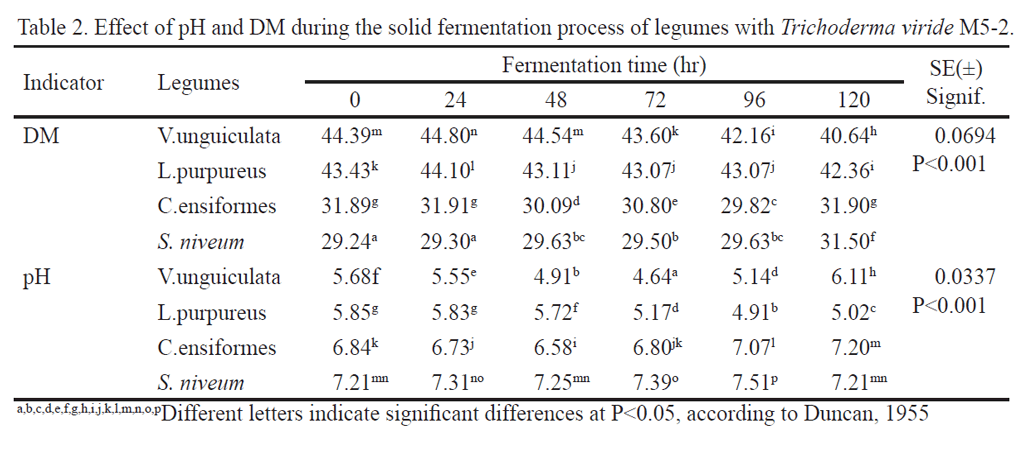
<p align="JUSTIFY">The growth in <em>Canavalia   ensiformes</em> started after 48 h, and was completely covered with   bright green sporulation at 72 h. However, mucuna growth was different,   with a pink coloration in the spores. Further studies should analyze the   possible relation of morphological variations, which is a result from   compounds contained in the mucuna grain that favor these changes in   color. </p>     <p align="JUSTIFY">Out of this result, an experiment in solid state   fermentation was performed to determine the changes in chemical,   physical and enzymatic indicators and assess the potential of meals of   tropical legume grains for feeding monogastric species. </p>     <p align="JUSTIFY"><a href="/img/revistas/cjas/v49n1/t0214115.gif">Table 2</a> shows the fermentation process of the   four legumes used in pH and DM, where interaction of factors in study   occurred. Values of pH under 6 (P &lt; 0.001) were observed for <em>Lablab purpureus</em> and <em>Vigna   unguiculata</em>. This coincides with the action range of cellulolitic   enzymes in highly fibrous substrates like sugarcane because it is known   that the initial optimum pH for hydrolytic action of cellulases are   between 5 and 6 (Mandels <em>et al.</em> 1982 and Leuchmann, 1996) depending on the substrate to be   fermented and growth temperature of each microorganism, although the   strain used is   resistant to catabolic repression and cellulolitic action range is   between 5 and 7 (Vali&ntilde;o <em>et al.</em> 2004 and Vali&ntilde;o <em>et al.</em> 2011). In the case of <em>Canavalia ensiformes</em> and <em>Stizolobium   niveum</em>, pH was above 6, up to values of 7.39. This could be related to groups   &aacute; amino that, when dissolved in water, are ionized and a proton of amino group that could act as base is removed (Bover-Cid <em>et al.</em> 2014), although this condition did not affect the growth of the fungus. </p>     
<p align="JUSTIFY">There are differences in the performance of   humidity in fermentation times studied (<a href="/img/revistas/cjas/v49n1/t0214115.gif">table 2</a>). The dry matter   decreased in 3.45 percentage units in the grain meal of <em>Vigna unguiculata</em>. However, <em>Lablab   purpureus</em> decreased only 1.12%, a feature to be considered for   escalation processes. Around 30% remained in other legumes. The humidity   level for fermentation should not exceed the water retention level,   taken as the upper limit to 80% of   humidity. Moreover, if the humidity content in the substrate is very   high, oxygen level and gas volume between the particles decrease. This   decreases the interchanging effect and increases the risk of bacterial   contamination (Pandey 2001 and Dustet and Izquierdo 2004). Likewise,   humidity determines physical and chemical changes like composition of   soluble carbohydrates, amount of phytate and alkaloids, changes   modifying the nutritional value and,   consequently, the character of legumes as functional food. Although   humidity did not adversely affect the development of fermentation in   this study, it is recommended to determine it for each species and,   probably, for each strain, depending on the productive process. </p>     
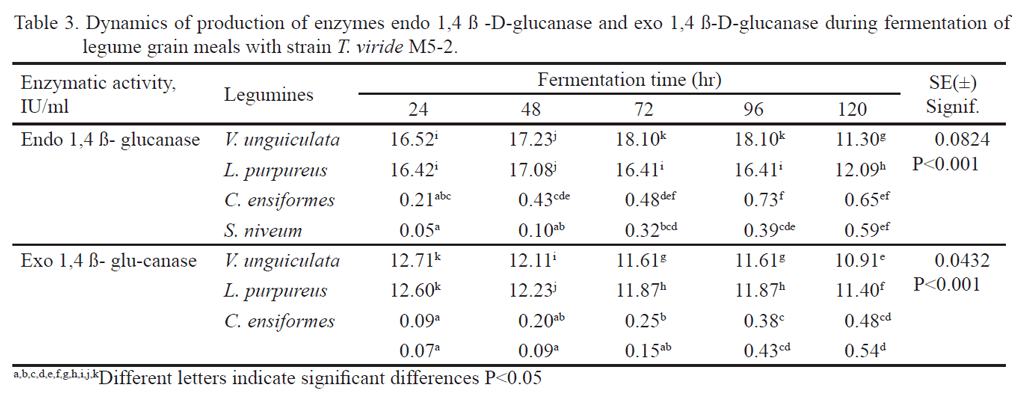
<p align="JUSTIFY">In fermentation processes, the hydrolysis of   antinutritional compounds depends on the type of legume and the type of   fermentation process. Biotransformations occurring to innocuous   compounds are the result of the combined effect of the action of   internal enzymes within grains and of microorganisms responsible for   fermentation (Seena <em>et al.</em> 2006 and Sreerama <em>et al.</em> 2012). </p>     <p align="JUSTIFY">The analysis of the enzyme production dynamics   showed that there was interaction between the factors studied (P   &lt;0.001) for the enzyme activities (endo   &acirc;1-4 glucanase and exo &acirc;1-4 glucanase). Also, there was higher   cellulolitic activity in <em>Vigna unguiculata</em> in a shorter fermentation time with <em>Trichoderma viride</em> strain M5-2. The cellulolitic activity began to increase between 0-24 hours in correspondence to mycelial growth. In <em>Vigna unguiculata</em>, the highest values were obtained at 72 and 96 h with 18.10 IU/mL of CMCase and 12.71 IU/mL PFasa at 24h. In <em>Lablab purpureus</em>, maximum production of CMCase was obtained at 48 h, with 17.08 IU/mL, and at 24 h for PFasa with 12.6 IU / mL with <em>T.   viride</em> M5-2, and were in the range between 10 and 18 IU/mL (<a href="/img/revistas/cjas/v49n1/t0314115.gif">table 3</a>). However, for <em>Canavalia ensiformes</em> and <em>Stizolobium   niveum</em>, these enzymes values were very low and do not correspond to the results of the fungus growth during fermentation. </p>     
<p align="JUSTIFY">This performance is due to, according to Andersen <em>et al.</em> 2008, the relation between the two enzymes and the   individual sum of the hydrolytic action on the substrate, which favors   the synergy degree that may increase the improvement percentage of the   enzymatic activity (Gottschalk <em>et al.</em> 2010 and Yoon 2014). The synergy degree is the   quantification of the capacity of two or more enzymes for their action   on the substrate. In this experiment,   neither the enzyme &acirc; glucosidase nor xylanase were determined, only   those with higher weight on hydrolytic activity of the crystalline and   amorphous cellulase were quantified. In agreement with Andersen <em>et al.</em> (2008), this synergy degree could be based on the product   formation, substrate conversion or reaction degree. This way,   information about the substrate degradation and action mechanisms can be   given (Gao <em>et al.</em> 2011 and Moscon <em>et al.</em> 2014). </p>     <p align="JUSTIFY">To include grain meals, fermented in the diets of   monogastric animals, it is necessary to characterize the fiber   fraction. This includes the chemical composition and the structure of   their cell walls, origin and nature, which helps to determine the   quality of fibrous foods and predicts their effects on gastrointestinal   and metabolic functions of the animal organism. <a href="/img/revistas/cjas/v49n1/t0414115.gif">Table 4</a> shows the effect   of the fermentation process on the fibrous and protein content of   grain meals of the studied temporary legumes. The short adaptation   period and good growth of this strain in the four legumes demonstrated   their valuable potential in the biotransformation of substrates, because   protein indicators increased and NDF decreased. In the fermented <em>Vigna unguiculata</em>, there was an increase of CP in 6.27 percentage   units and of TP in 5.11 percentage units, with the highest decrease of   NDF (12.73%) during the process regarding the   rest of the legume. However, the value increased for the other fiber   (ADF and lignin). Cellulose showed no changes, taking into account the   main effects of legumes and fermentation time with cellulolitic action. </p>     
]]></body>
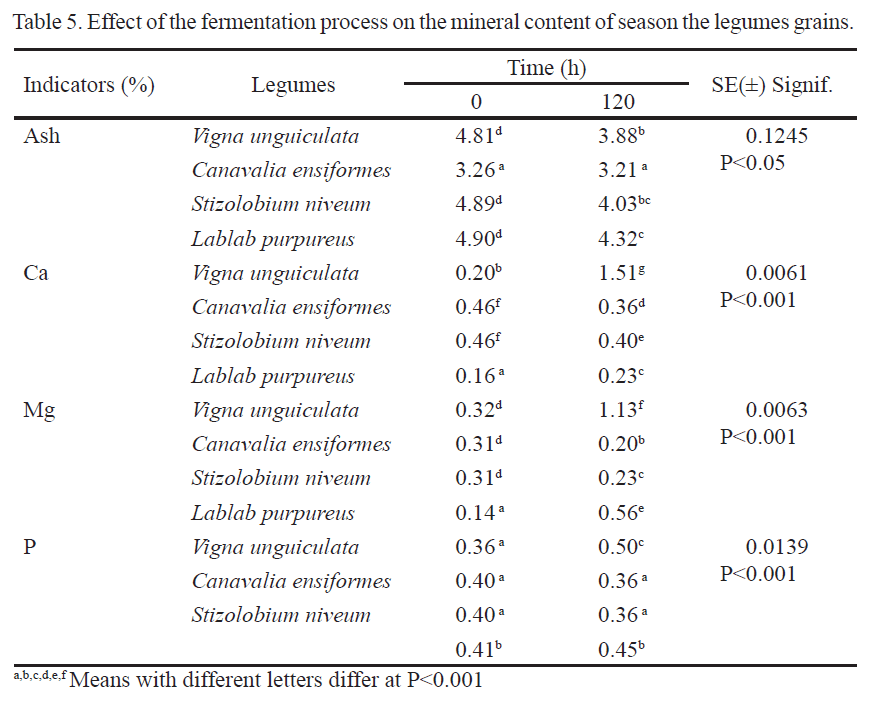
<body><![CDATA[<p align="JUSTIFY">These results coincide with studies of Diaz <em>et al.</em> (2003), Savon <em>et al.</em> (2000) and Sav&oacute;n (2005) where   these unconventional unfermented legumes showed higher content of   insoluble fiber (hemicellulose and lignin), from 303 to 399 mg   kg<sup>-1</sup> DM, regarding soluble fiber (pectin, gums, mucilage and polysaccharides). Cellulose showed high variability, <em>Vigna unguiculata</em> had the lowest content of the insoluble fraction, while <em>Stizolobium niveum</em> showed the highest contents. Therefore, the   changes that occurred involve changes in the physical and chemical   properties of these legumes, so fermentation can be considered as an   effective method to improve its nutritional value, depending on the   species and on the conditions under which the procedure is conducted, as   well as age and other related environmental conditions (season and   temperature) that can modify the nutritional value of fibrous fractions   in   grain meals. </p>     <p align="JUSTIFY">During the process of solid state fermentation, there were increases of Ca, Mg and P in <em>Vigna unguiculata</em> and <em>Lablab   purpureus</em>, even when no mineral or nitrogen source was added (<a href="/img/revistas/cjas/v49n1/t0514115.gif">table   5</a>). On the other hand, ash diminished, probably due to the   volatilization process of compounds like ammonia during fermentation,   very significant aspect according to the composition of these plant   materials. On the contrary, these minerals diminished in <em>Canavalia ensiformes</em> and <em>Stizolobium   niveum</em>, apparently associated to the own nature of these substrates,   which  have higher content of antinutritional factors and to the growth   process of the used fungi and its transformation into TP. Regarding   mineral availability, it has been demonstrated that, after a germination   process, availability of phosphorous, potassium, magnesium, zinc, and   copper increases as a direct consequence of the activation of phytase   enzyme,   which causes a decrease of inositols phosphates hexa and penta   phosphorilates to less phosphorilated shapes (Ragab <em>et al.</em> 2004, Adebowale <em>et al.</em> 2005 and Belane and Dakora 2011). </p>     
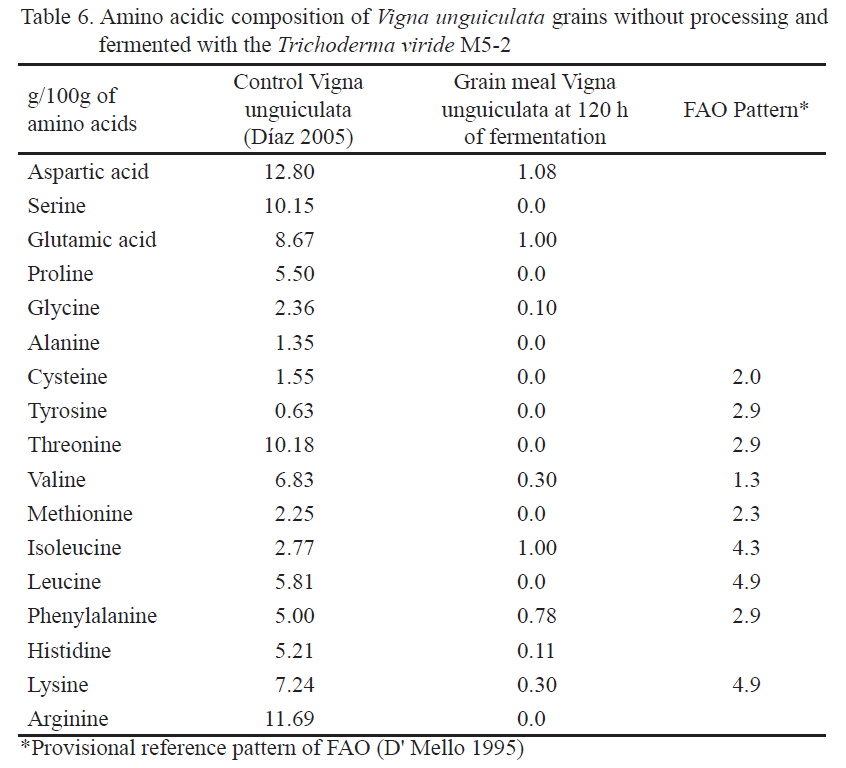
<p align="JUSTIFY"> From the results achieved in the cellulolitic activity, CP, TP and NDF of <em>Vigna unguiculata</em>, amino acid composition and molecular structure   of this variety were studied. Besides, the variety Habana 82 has the   highest agro-productive potential, according to D&iacute;az <em>et al.</em> (2002). </p>     <p align="JUSTIFY"> Changes of amino acidic patterns of <em>Vigna unguiculata</em> were observed during the fermentation. The   essential amino acids (threonine, leucine, and arginine) and the non   essential ones (serine, glycine, alanine, cysteine, and thyroxin) had   the highest variation, because they were not present at the end of the   fermentation (<a href="/img/revistas/cjas/v49n1/t0614115.gif">table 6</a>).  The rest diminished considerably, which could   be related to the activities of the cellulolitic enzymes, endo 1, 4 &szlig;-   glucanase and exo 1, 4 &szlig; glucanase, excreted by the fungi for degrading   the substrate. These enzymes can join to <em>Vigna unguiculata</em> through its active site or aminoacids sequences   (carbohydrates bond module, CBM) involved in recognizing bonds of   polysaccharides, allowing its union with the substrate while hydrolysis   of these chains occurs (Boraston <em>et al.</em> 2004), in function of the increase in the unicellular   protein, contrary to that occurring with germination.    However, this legume, without processing, showed a good amino acidic   balance, with concentrations of essential amino acids, similar or   superior to those established as reference pattern by FAO (D&iacute;az <em>et al.</em> 2002 and D&iacute;az <em>et al.</em> 2007). Non essential amino   acids explain the highest variability percentage among species and other   legume varieties related to this study, and not in the fermentative   process. </p>     
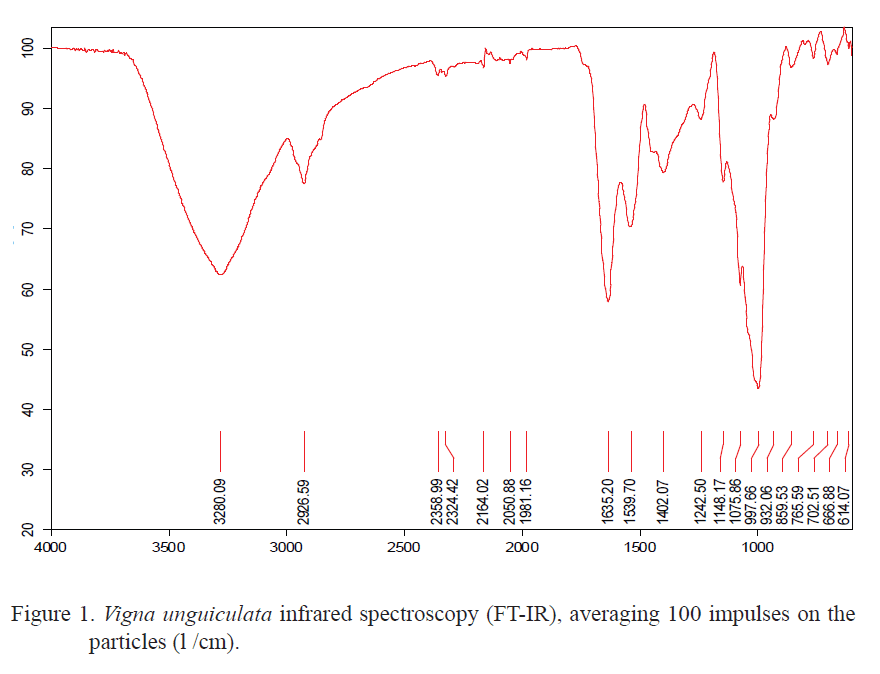
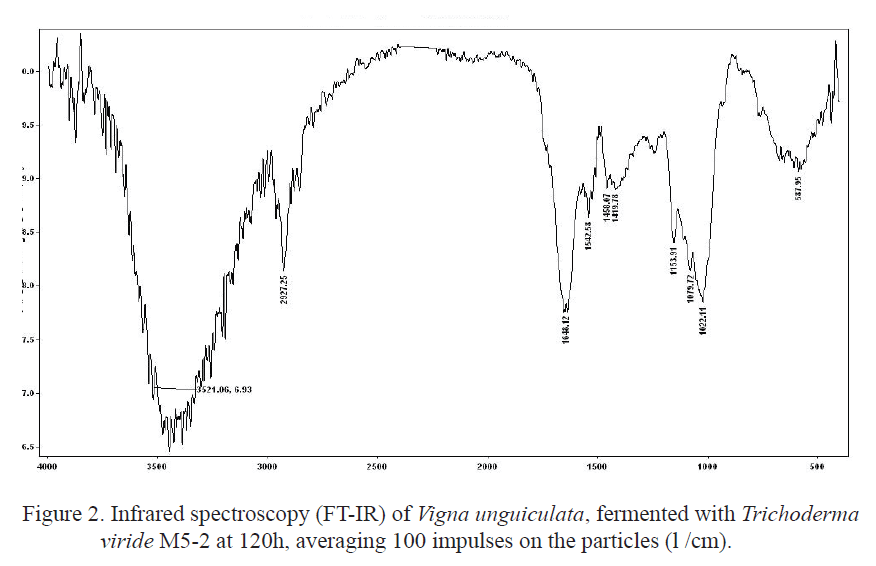
<p align="JUSTIFY">It is necessary to deepen on the effect of legume   fermentation by fungi producers of cellulase on the amino acidic   composition, to obtain more information about nutritional value, and   validate its nature as functional food acquired by the grains of these   legumes, after going through this biological process.  Further studies   on protein fractioning and proteolytic activity during fermentation   should be performed It is important to analyze the molecular structure of the variety <em>Vigna unguiculata</em>. For this purpose, the infrared spectroscopy   was used, which is one of the most commonly used techniques to detect   the presence of a compound of functional groups. Although the infrared   spectrum characterizes each compound, certain atomic clusters always   result in bands in certain range of frequencies, apart from the nature   of the rest of the molecule. </p>     <p align="JUSTIFY"><a href="/img/revistas/cjas/v49n1/f0114115.gif">Figure 1</a> and <a href="/img/revistas/cjas/v49n1/f0214115.gif">2</a> shows the corresponding spectrum of the fermented and unprocessed <em>Vigna unguiculata</em> samples. The solid samples, in general, have   well defined bands and of good resolution. The difference between the   samples of unprocessed <em>Vigna unguiculata</em> and fermented <em>Vigna   unguiculata</em> is evident, in the range between 2.000 and 1.400   cm<sup>-1</sup>. In this last, the bands are more opened. In the range 3.270-3.420   cm<sup>-1</sup>, there is an intense band of valence vibration of the O-H y OH. This band results from   the polymeric association of the OH group of carbohydrates. In 2,930   cm<sup>-1</sup>, the band has mid intensity, according to the valence   vibration of the C-H y CH bond of alkyl groups from the same   carbohydrates chain. </p>     
<p align="JUSTIFY">The characteristic band of carbonyl groups present in amides of 1665-1640   cm<sup>-1</sup>, intense band of valence vibration from the C=O y C=O   carbonyl group, appears slightly unfolded in two, so the presence of   amino acids or proteins in the samples is   inferred. This band has such intensity that it is unlikely to associate   it with any other bond, which could be explained by legume proteins. In   this case, <em>Vigna unguiculata</em> has an inferior protein quality to that of casein, but very superior to that of dolicho (Sav&oacute;n 2005   and D&iacute;az <em>et al.</em> 2007). The fermentation process of <em>Vigna unguiculata</em> meal demonstrated the effectiveness of the analysis developed in the biological indicators. However, between 1.445 and 1.390   cm<sup>-1</sup>, the formation bands of the OH in carbohydrates have   low intensity, unlike the range between 1.161 and 1.025   cm<sup>-1</sup> that are very intense and correspond to valence   vibration of the C-O bond, present in carbohydrates, esters and phenols.   These data obtained by FT-IR in fermented <em>Vigna unguiculata</em> do not coincide with those obtained in the bromatological analysis of these samples by <em>T. viride</em> M5-2 when observing a lignin concentration of 2.73% and   2.4% of the cellulose on DM basis. This suggests that the   lingocellulosic composition of plant materials may vary,   according to the methods of analysis   (Vali&ntilde;o<em> et al</em>. 2004 and Foyle <em>et   al.</em> 2007), considering also the differences confirmed in these indicators during the harvest periods of the crops (Himmel <em>et al.</em>2007). </p>     <p align="JUSTIFY">The technique demonstrated that, during the solid state fermentation with the strain of conidial fungus in <em>Vigna unguiculata</em>, oxidations of aromatic structures of lignin   occur, which lead to the increase of O-H phenolic groups. Their rupture   leads to   the formation of alkene, carbonyl and carboxyl groups, as well as   alcohol, carbonyl and carboxyl bonds, derived from biodegradation of   carbohydrates that cannot be detected by other means. </p>     <p align="JUSTIFY">The strain <em>T. viride</em> M5-2 allowed the   development of a biologically feasible fermentation process with grain   meals of legumes under study, when improving their nutritional value.   This allows the inclusion of these diet formulations for monogastric   animals. Furthermore, the results demonstrated the possibility of   obtaining an inoculum without addition of other nutrients to the medium,   which is important to the scaling of these fermentation processes. </p> </font>     <p>&nbsp;</p> <font size="2" face="Verdana, Arial, Helvetica, sans-serif">    ]]></body>
<body><![CDATA[<p><font size="2" face="Verdana, Arial, Helvetica, sans-serif"><font size="3"><strong>BIBLIOGRAPHY</strong></font></font></p>     <p align="justify">Adebowale Y. A., Adeyemi A. &amp; Oshodi A. A. 2005. &lsquo;&lsquo;Variability in the  physicochemical, nutritional and antinutritional attributes of six Mucuna  species&rsquo;&rsquo;. <em>Food Chemistry</em>, 89 (1), pp. 37&ndash;48.    <br>       <br>   Adebowale Y. A., Adeyemi I. A., Oshodi A. A. &amp; Niranjan K. 2007.  &lsquo;&lsquo;Isolation, fractionation and characterisation of proteins from Mucuna bean&rsquo;&rsquo;. <em>Food Chemistry</em>, 104 (1), pp. 287&ndash;299.    <br>       <br>   Alvira P.,  Tom&aacute;s-Pej&oacute; E., Ballesteros M. &amp; Negro M. J. 2010. &lsquo;&lsquo;Pretreatment  technologies for an efficient bioethanol production process based on enzymatic  hydrolysis: a review&rsquo;&rsquo;. <em>Bioresource technology</em>, 101 (13), pp. 4851&ndash;4861.    <br>       <br>   Andersen N., Johansen K. S., Michelsen M., Stenby E. H., Krogh K. B. &amp;  Olsson L. 2008. &lsquo;&lsquo;Hydrolysis of cellulose using mono-component enzymes shows  synergy during hydrolysis of phosphoric acid swollen cellulose (PASC), but  competition on Avicel&rsquo;&rsquo;. <em>Enzyme and Microbial Technology</em>, 42 (4), pp.  362&ndash;370.    <br>       <!-- ref --><br>   AOAC. 1995. <em>Official Methods of Analysis</em>. 16th ed., Washington:  Assoc. Off. Agric. Chem.    <br> Belane A. K. &amp; Dakora F. D. 2011. &lsquo;&lsquo;Levels of nutritionally-important  trace elements and macronutrients in edible leaves and grain of 27 nodulated  cowpea (Vigna unguiculata L. Walp.) genotypes grown in the Upper West Region of  Ghana&rsquo;&rsquo;. <em>Food Chemistry</em>, 125 (1), pp. 99&ndash;105.    <br>     <br> Boraston A. B., Bolam D. N., Gilbert H. J. &amp; Davies G. J. 2004.  &lsquo;&lsquo;Carbohydrate-binding modules: fine-tuning polysaccharide recognition&rsquo;&rsquo;. <em>Biochemical  Journal</em>, 382 (3), pp. 769&ndash;781.    <br> Bover-Cid S., Latorre-Moratalla M. L., Veciana-Nogu&eacute;s M. T. &amp;  Vidal-Carou M. C. 2014. &lsquo;&lsquo;Processing contaminants: biogenic amines&rsquo;&rsquo;. In: <em>Encyclopedia  of Food Safety</em>, vol. 2, pp. 381&ndash;391.    <br>     <br> Chundawat S. P., Venkatesh B. &amp; Dale B. E. 2007. &lsquo;&lsquo;Effect of particle  size based separation of milled corn stover on AFEX pretreatment and enzymatic  digestibility&rsquo;&rsquo;. <em>Biotechnology and bioengineering</em>, 96 (2), pp. 219&ndash;231.    <br>     <br> Cianchetta S., Galletti S., Burzi P. L. &amp; Cerato C. 2012. &lsquo;&lsquo;Hydrolytic  potential of Trichoderma sp. strains evaluated by microplate-based screening  followed by switchgrass saccharification&rsquo;&rsquo;. <em>Enzyme and microbial technology</em>, 50 (6), pp. 304&ndash;310.    <br>     <br> D&iacute;az M. F.,  Gonz&aacute;lez A., Padilla C. &amp; Curbelo F. 2002. &lsquo;&lsquo;Caracterizaci&oacute;n bromatol&oacute;gica  de granos y forrajes de las leguminosas temporales Canavalia ensiformis, Lablab  purpureus y Stizolobium niveum sembradas a finales de la estaci&oacute;n lluviosa&rsquo;&rsquo;. <em>Rev.  cubana Cienc. agr&iacute;c</em>, 36 (4), p. 409.    ]]></body>
<body><![CDATA[<br>     <br> Diaz M. F.,  Martin-Cabrejas M. A., Gonzalez A., Torres V. &amp; Noda A. 2007. &lsquo;&lsquo;Biotransformation of Vigna unguiculata during the germination process&rsquo;&rsquo;. <em>Cuban  Journal of Agricultural Science</em>, 41 (2), pp. 161&ndash;165.    <br>     <br> D&iacute;az M. F.,  Padilla C., Torres V., Gonz&aacute;lez A. &amp; Noda A. 2003. &lsquo;&lsquo;Caracterizaci&oacute;n  bromatol&oacute;gica de especies y variedades de leguminosas temporales con  posibilidades en la alimentaci&oacute;n animal&rsquo;&rsquo;. <em>Cuban J.  Agric. Sci</em>, 37 (4), Available: &lt;<a href="http://repositoriodigital.academica.mx/jspui/handle/987654321/386998" target="_blank">http://repositoriodigital.academica.mx/jspui/handle/987654321/386998</a>&gt;,  [Accessed:&nbsp;November 3, 2014].    <br>     <!-- ref --><br> Di Rienzo J.  A., Casanoves F., Balzarini M. G., Gonz&aacute;lez L. &amp; Robledo C. W. 2012. <em>InfoStat</em>.  version 2012, [Windows], Universidad Nacional de C&oacute;rdoba, Argentina: Grupo InfoStat,  Available: &lt;<a href="http://www.infostat.com.ar/" target="_blank">http://www.infostat.com.ar/</a>&gt;    .    <br>     <br> D&rsquo;Mello J.  P. F. &amp; Devendra C. 1995. &lsquo;&lsquo;Leguminous leaf meals in  non-ruminant nutrition&rsquo;&rsquo;. In: <em>Tropical legumes in animal nutrition</em>,  Wallinford, UK: CAB International, pp. 247&ndash;282, Available: &lt;<a href="http://www.cabdirect.org/abstracts/19951408994.html" target="_blank">http://www.cabdirect.org/abstracts/19951408994.html</a>&gt;,  [Accessed:&nbsp;November 3, 2014].    <br>     ]]></body>
<body><![CDATA[<br> Dustet M. J.  C. &amp; Izquierdo K. E. 2004. &lsquo;&lsquo;Aplicaci&oacute;n de balances de masa y energ&iacute;a al  proceso de fermentaci&oacute;n en estado s&oacute;lido de bagazo de ca&ntilde;a de az&uacute;car con  Aspergillus niger&rsquo;&rsquo;. <em>Biotecnolog&iacute;a Aplicada</em>, 21 (2), pp. 85&ndash;91.    <br>     <br> Eriksson  K.-E. &amp; Bermek H. 2009. &lsquo;&lsquo;Lignin, lignocelluloses, ligninase&rsquo;&rsquo;. <em>Appl. Microbiol. Industrial</em>, pp. 373&ndash;384.    <br>     <br> Faria L. F., Kolling D., Camassola M., Dillon A. J. P. &amp; Ramos L. P.  2008. &lsquo;&lsquo;Comparison of Penicillium echinulatum and Trichoderma reesei cellulases  in relation to their activity against various cellulosic substrates&rsquo;&rsquo;. <em>Bioresource  Technology</em>, 99 (5), pp. 1417&ndash;1424.    <br>     <br> FitzPatrick M., Champagne P., Cunningham M. F. &amp; Whitney R. A. 2010.  &lsquo;&lsquo;A biorefinery processing perspective: treatment of lignocellulosic materials  for the production of value-added products&rsquo;&rsquo;. <em>Bioresource technology</em>,  101 (23), pp. 8915&ndash;8922.    <br>     <br> Foyle T., Jennings L. &amp; Mulcahy P. 2007. &lsquo;&lsquo;Compositional analysis of  lignocellulosic materials: Evaluation of methods used for sugar analysis of  waste paper and straw&rsquo;&rsquo;. <em>Bioresource Technology</em>, 98 (16), pp. 3026&ndash;3036.    <br>     ]]></body>
<body><![CDATA[<br> Gao D., Uppugundla N., Chundawat S. P., Yu X., Hermanson S., Gowda K.,  Brumm P., Mead D., Balan V. &amp; Dale B. E. 2011. &lsquo;&lsquo;Hemicellulases and  auxiliary enzymes for improved conversion of lignocellulosic biomass to  monosaccharides&rsquo;&rsquo;. <em>Biotechnology for biofuels</em>, 4 (1), p. 1.    <br>     <!-- ref --><br> Goering H. &amp; Van Soest J. P. 1970. <em>Forage fiber analysis</em>. (ser.  Agricultural Hand book, no. ser. 379), Washington, USA: US Dept. Agriculture.    <br>     <br> Gottschalk  L. M., Oliviera R. A. &amp; Da Silva Bon E. . 2010. &lsquo;&lsquo;Cellulase,  Xylanases, &beta;Glucanasa and acid ferulic, acid estearease produced by Trichoderma and  Aspergillus act synergistically in the hydrolysis of sugar cane bagasse&rsquo;&rsquo;. <em>Bioresource  Technol</em>, 51, p. 72.    <br>     <br> Hasunuma T., Okazaki F., Okai N., Hara K. Y., Ishii J. &amp; Kondo A. 2013.  &lsquo;&lsquo;A review of enzymes and microbes for lignocellulosic biorefinery and the  possibility of their application to consolidated bioprocessing technology&rsquo;&rsquo;. <em>Bioresource  technology</em>, 135, pp. 513&ndash;522.    <br>     <br> Himmel M. E., Ding S.-Y., Johnson D. K., Adney W. S., Nimlos M. R., Brady  J. W. &amp; Foust T. D. 2007. &lsquo;&lsquo;Biomass recalcitrance: engineering plants and  enzymes for biofuels production&rsquo;&rsquo;. <em>science</em>, 315 (5813), pp. 804&ndash;807.    <br>     ]]></body>
<body><![CDATA[<br> Hur S. J., Lee S. Y., Kim Y.-C., Choi I. &amp; Kim G.-B. 2014. &lsquo;&lsquo;Effect of  fermentation on the antioxidant activity in plant-based foods&rsquo;&rsquo;. <em>Food  chemistry</em>, 160, pp. 346&ndash;356.    <br>     <br> Leuchtmann A., Petrini O. &amp; Samuels G. J. 1996. &lsquo;&lsquo;Isozyme subgroups in  Trichoderma section Longibrachiatum&rsquo;&rsquo;. <em>Mycologia</em>, 88, pp. 384&ndash;394.    <br>     <br> Mandels, M. 1982. &lsquo;&lsquo;Cellulases&rsquo;&rsquo;. <em>Anual Reports on Fermentation Process</em>,  5, p. 78.    <br>     <br> Mandels M., Andreotti R. E. &amp; Roche C. 1976. &lsquo;&lsquo;Measurement of  scarifying cellulose&rsquo;&rsquo;. In: <em>Biotechnol. </em><em>Bioeng. Symp</em>, vol. 6, p. 1471.    <br>     <br> Mart&iacute;n-Cabrejas  M. A., D&iacute;az M. F., Aguilera Y., Ben&iacute;tez V., Moll&aacute; E. &amp; Esteban R. M. 2008. &lsquo;&lsquo;Influence of germination on the soluble carbohydrates and dietary fibre  fractions in non-conventional legumes&rsquo;&rsquo;. <em>Food Chemistry</em>, 107 (3), pp.  1045&ndash;1052.    <br>     ]]></body>
<body><![CDATA[<br> Meir H. 1986. &lsquo;&lsquo;Laborpraktikure. Tierernahurungund, futtermittelm f&uuml;r  Tierproduzenten&rsquo;&rsquo;. <em>Biotech. Tech</em>, 2 (1).    <br>     <br> Moscon J. M., Priamo W. L., Bilibio D., Silva J. R., Souza M., Lunelli F.,  Foletto E. L., Kuhn R. C., Cancelier A. &amp; Mazutti M. A. 2014. &lsquo;&lsquo;Comparison  of conventional and alternative technologies for the enzymatic hydrolysis of  rice hulls to obtain fermentable sugars&rsquo;&rsquo;. <em>Biocatalysis and Agricultural  Biotechnology</em>, 3 (4), pp. 149&ndash;154.    <br>     <br> Pandey A. 1991. &lsquo;&lsquo;Aspects of fermenter design for solid-state  fermentations&rsquo;&rsquo;. <em>Process Biochemistry</em>, 26 (6), pp. 355&ndash;361.    <br>     <br> Ragab D. M., Babiker E. E. &amp; Eltinay A. H. 2004. &lsquo;&lsquo;Fractionation,  solubility and functional properties of cowpea (Vigna unguiculata) proteins as  affected by pH and/or salt concentration&rsquo;&rsquo;. <em>Food chemistry</em>, 84 (2), pp.  207&ndash;212.    <br>     <br> Rangel A., Saraiva K., Schwengber P., Narciso M. S., Domont G. B., Ferreira  S. T. &amp; Pedrosa C. 2004. &lsquo;&lsquo;Biological evaluation of a protein isolate from  cowpea (Vigna unguiculata) seeds&rsquo;&rsquo;. <em>Food Chemistry</em>, 87 (4), pp. 491&ndash;499.    <br>     ]]></body>
<body><![CDATA[<br> Sav&oacute;n L.  2002. &lsquo;&lsquo;Alimentos altos en fibra para especies monog&aacute;stricas. Caracterizaci&oacute;n  de la matriz fibrosa y sus efectos en la fisiolog&iacute;a digestiva&rsquo;&rsquo;. <em>Revista  Cubana de Ciencia Agr&iacute;cola</em>, 36 (2), pp. 91&ndash;102.    <br>     <br> Sav&oacute;n L.  2005. &lsquo;&lsquo;Alimentos fibrosos tropicales y su efecto en la fisiolog&iacute;a digestiva de  especies monog&aacute;stricas&rsquo;&rsquo;. <em>Rev. Cubana Cienc. Agr&iacute;c</em>, 39, p. 475.    <br>     <br> Sav&oacute;n L.,  Leyva O. &amp; Gonz&aacute;lez T. 2000. &lsquo;&lsquo;Caracterizaci&oacute;n f&iacute;sico qu&iacute;mica de la  fracci&oacute;n fibrosa de cinco variedades de harina de forraje de Vigna unguiculata  para especies monog&aacute;stricas&rsquo;&rsquo;. <em>Rev. Cubana Cienc. Agr&iacute;c</em>, 34, p. 137.    <br>     <br> Seena S.,  Sridhar K. R. &amp; Jung K. 2006. &lsquo;&lsquo;Nutritional and  antinutritional evaluation of raw and processed seeds of a wild legume,  Canavalia cathartica of coastal sand dunes of India&rsquo;&rsquo;. <em>Food chemistry</em>,  92 (3), pp. 465&ndash;472.    <br>     <br> Sipos B., Benk\Ho Z., Dienes D., R&eacute;czey K., Viikari L. &amp; Siika-aho M.  2010. &lsquo;&lsquo;Characterisation of specific activities and hydrolytic properties of  cell-wall-degrading enzymes produced by Trichoderma reesei Rut C30 on different  carbon sources&rsquo;&rsquo;. <em>Applied biochemistry and biotechnology</em>, 161 (1-8), pp.  347&ndash;364.    <br>     ]]></body>
<body><![CDATA[<br> Sreerama Y. N., Sashikala V. B., Pratape V. M. &amp; Singh V. 2012.  &lsquo;&lsquo;Nutrients and antinutrients in cowpea and horse gram flours in comparison to  chickpea flour: Evaluation of their flour functionality&rsquo;&rsquo;. <em>Food Chemistry</em>, 131 (2), pp. 462&ndash;468.    <br>     <br> Valino E.  C., El&iacute;as A., Torres V., Carrasco T., Albelo N. &amp; others. 2004. &lsquo;&lsquo;Improvement of sugarcane bagasse composition by the strain  Trichoderma viride M5-2 in a solid-state fermentation bioreactor.&rsquo;&rsquo;. <em>Cuban  Journal of Agricultural Science</em>, 38 (2), pp. 143&ndash;150.    <br>     <br> Van Dyk J. S. &amp; Pletschke B. I. 2012. &lsquo;&lsquo;A review of lignocellulose  bioconversion using enzymatic hydrolysis and synergistic cooperation between  enzymes&mdash;factors affecting enzymes, conversion and synergy&rsquo;&rsquo;. <em>Biotechnology  advances</em>, 30 (6), pp. 1458&ndash;1480.    <br>     <br> Willats W. G., Knox J. P. &amp; Mikkelsen J. D. 2009. &lsquo;&lsquo;Pectin: new  insights into an old polymer are starting to gel&rsquo;&rsquo;. <em>Trends in Food Science  &amp; Technology</em>, 17 (3), pp. 97&ndash;104.    <br>     <br> Wilson D. B. 2011. &lsquo;&lsquo;Microbial diversity of cellulose hydrolysis&rsquo;&rsquo;. <em>Current  opinion in microbiology</em>, 14 (3), pp. 259&ndash;263.    <br>     ]]></body>
<body><![CDATA[<br> Yoon L. W., Ang T. N., Ngoh G. C. &amp; Chua A. S. M. 2014. &lsquo;&lsquo;Fungal  solid-state fermentation and various methods of enhancement in cellulase  production&rsquo;&rsquo;. <em>Biomass and Bioenergy</em>, 67, pp. 319&ndash;338.    <br>     <br> Zhang Y.-H.  P. &amp; Lynd L. R. 2006. &lsquo;&lsquo;A functionally based model for hydrolysis of  cellulose by fungal cellulase&rsquo;&rsquo;. <em>Biotechnology and Bioengineering</em>, 94 (5), pp. 888&ndash;898.</p></font>     <p align="justify">&nbsp;</p>     <p align="justify">&nbsp;</p>     <p><font size="2" face="Verdana, Arial, Helvetica, sans-serif">Received: November 3, 2014    <br> Accepted: December 1, 2014</font></p>     <p>&nbsp;</p>     <p>&nbsp;</p>     <p><font size="2" face="Verdana, Arial, Helvetica, sans-serif"><em>Elaine Valiño,</em> Instituto de Ciencia Animal, Apartado Postal 24, San José de las Lajas, Mayabeque, Cuba.    Email: <a href="mailto:evalino@ica.co.cu">evalino@ica.co.cu</a></font></p>     ]]></body>
<body><![CDATA[ ]]></body><back>
<ref-list>
<ref id="B1">
<nlm-citation citation-type="journal">
<person-group person-group-type="author">
<name>
<surname><![CDATA[Adebowale]]></surname>
<given-names><![CDATA[Y. A.]]></given-names>
</name>
<name>
<surname><![CDATA[Adeyemi]]></surname>
<given-names><![CDATA[A.]]></given-names>
</name>
<name>
<surname><![CDATA[Oshodi]]></surname>
<given-names><![CDATA[A. A.]]></given-names>
</name>
</person-group>
<article-title xml:lang="nd"><![CDATA[Variability in the physicochemical, nutritional and antinutritional attributes of six Mucuna species]]></article-title>
<source><![CDATA[Food Chemistry]]></source>
<year>2005</year>
<volume>89</volume>
<numero>1</numero>
<issue>1</issue>
<page-range>37–48</page-range></nlm-citation>
</ref>
<ref id="B2">
<nlm-citation citation-type="journal">
<person-group person-group-type="author">
<name>
<surname><![CDATA[Adebowale]]></surname>
<given-names><![CDATA[Y. A.]]></given-names>
</name>
<name>
<surname><![CDATA[Adeyemi]]></surname>
<given-names><![CDATA[I. A.]]></given-names>
</name>
<name>
<surname><![CDATA[Oshodi]]></surname>
<given-names><![CDATA[A. A.]]></given-names>
</name>
<name>
<surname><![CDATA[Niranjan]]></surname>
<given-names><![CDATA[K.]]></given-names>
</name>
</person-group>
<article-title xml:lang="nd"><![CDATA[Isolation, fractionation and characterisation of proteins from Mucuna bean]]></article-title>
<source><![CDATA[Food Chemistry]]></source>
<year>2007</year>
<volume>104</volume>
<numero>1</numero>
<issue>1</issue>
<page-range>287–299</page-range></nlm-citation>
</ref>
<ref id="B3">
<nlm-citation citation-type="journal">
<person-group person-group-type="author">
<name>
<surname><![CDATA[Alvira]]></surname>
<given-names><![CDATA[P.]]></given-names>
</name>
<name>
<surname><![CDATA[Tomás-Pejó]]></surname>
<given-names><![CDATA[E.]]></given-names>
</name>
<name>
<surname><![CDATA[Ballesteros]]></surname>
<given-names><![CDATA[M.]]></given-names>
</name>
<name>
<surname><![CDATA[Negro]]></surname>
<given-names><![CDATA[M. J.]]></given-names>
</name>
</person-group>
<article-title xml:lang="nd"><![CDATA[Pretreatment technologies for an efficient bioethanol production process based on enzymatic hydrolysis: a review]]></article-title>
<source><![CDATA[Bioresource technology]]></source>
<year>2010</year>
<volume>101</volume>
<numero>13</numero>
<issue>13</issue>
<page-range>4851–4861</page-range></nlm-citation>
</ref>
<ref id="B4">
<nlm-citation citation-type="journal">
<person-group person-group-type="author">
<name>
<surname><![CDATA[Andersen]]></surname>
<given-names><![CDATA[N.]]></given-names>
</name>
<name>
<surname><![CDATA[Johansen]]></surname>
<given-names><![CDATA[K. S.]]></given-names>
</name>
<name>
<surname><![CDATA[Michelsen]]></surname>
<given-names><![CDATA[M.]]></given-names>
</name>
<name>
<surname><![CDATA[Stenby]]></surname>
<given-names><![CDATA[E. H.]]></given-names>
</name>
<name>
<surname><![CDATA[Krogh]]></surname>
<given-names><![CDATA[K. B.]]></given-names>
</name>
<name>
<surname><![CDATA[Olsson]]></surname>
<given-names><![CDATA[L.]]></given-names>
</name>
</person-group>
<article-title xml:lang="nd"><![CDATA[Hydrolysis of cellulose using mono-component enzymes shows synergy during hydrolysis of phosphoric acid swollen cellulose (PASC), but competition on Avicel]]></article-title>
<source><![CDATA[Enzyme and Microbial Technology]]></source>
<year>2008</year>
<volume>42</volume>
<numero>4</numero>
<issue>4</issue>
<page-range>362–370</page-range></nlm-citation>
</ref>
<ref id="B5">
<nlm-citation citation-type="book">
<person-group person-group-type="author">
<name>
<surname><![CDATA[AOAC]]></surname>
</name>
</person-group>
<source><![CDATA[Official Methods of Analysis]]></source>
<year>1995</year>
<edition>16th</edition>
<publisher-loc><![CDATA[Washington ]]></publisher-loc>
<publisher-name><![CDATA[Assoc. Off. Agric. Chem.]]></publisher-name>
</nlm-citation>
</ref>
<ref id="B6">
<nlm-citation citation-type="journal">
<person-group person-group-type="author">
<name>
<surname><![CDATA[Belane]]></surname>
<given-names><![CDATA[A. K.]]></given-names>
</name>
<name>
<surname><![CDATA[Dakora]]></surname>
<given-names><![CDATA[F. D.]]></given-names>
</name>
</person-group>
<article-title xml:lang="nd"><![CDATA[Levels of nutritionally-important trace elements and macronutrients in edible leaves and grain of 27 nodulated cowpea (Vigna unguiculata L. Walp.) genotypes grown in the Upper West Region of Ghana]]></article-title>
<source><![CDATA[Food Chemistry]]></source>
<year>2011</year>
<volume>125</volume>
<numero>1</numero>
<issue>1</issue>
<page-range>99–105</page-range></nlm-citation>
</ref>
<ref id="B7">
<nlm-citation citation-type="journal">
<person-group person-group-type="author">
<name>
<surname><![CDATA[Boraston]]></surname>
<given-names><![CDATA[A. B.]]></given-names>
</name>
<name>
<surname><![CDATA[Bolam]]></surname>
<given-names><![CDATA[D. N.]]></given-names>
</name>
<name>
<surname><![CDATA[Gilbert]]></surname>
<given-names><![CDATA[H. J.]]></given-names>
</name>
<name>
<surname><![CDATA[Davies]]></surname>
<given-names><![CDATA[G. J.]]></given-names>
</name>
</person-group>
<article-title xml:lang="nd"><![CDATA[Carbohydrate-binding modules: fine-tuning polysaccharide recognition]]></article-title>
<source><![CDATA[Biochemical Journal]]></source>
<year>2004</year>
<volume>382</volume>
<numero>3</numero>
<issue>3</issue>
<page-range>769–781</page-range></nlm-citation>
</ref>
<ref id="B8">
<nlm-citation citation-type="">
<person-group person-group-type="author">
<name>
<surname><![CDATA[Bover-Cid]]></surname>
<given-names><![CDATA[S.]]></given-names>
</name>
<name>
<surname><![CDATA[Latorre-Moratalla]]></surname>
<given-names><![CDATA[M. L.]]></given-names>
</name>
<name>
<surname><![CDATA[Veciana-Nogués]]></surname>
<given-names><![CDATA[M. T.]]></given-names>
</name>
<name>
<surname><![CDATA[Vidal-Carou]]></surname>
<given-names><![CDATA[M. C.]]></given-names>
</name>
</person-group>
<article-title xml:lang="nd"><![CDATA[Processing contaminants: biogenic amines]]></article-title>
<source><![CDATA[Encyclopedia of Food Safety]]></source>
<year>2014</year>
<volume>2</volume>
<page-range>381–391</page-range></nlm-citation>
</ref>
<ref id="B9">
<nlm-citation citation-type="journal">
<person-group person-group-type="author">
<name>
<surname><![CDATA[Chundawat]]></surname>
<given-names><![CDATA[S. P.]]></given-names>
</name>
<name>
<surname><![CDATA[Venkatesh]]></surname>
<given-names><![CDATA[B.]]></given-names>
</name>
<name>
<surname><![CDATA[Dale]]></surname>
<given-names><![CDATA[B. E.]]></given-names>
</name>
</person-group>
<article-title xml:lang="nd"><![CDATA[Effect of particle size based separation of milled corn stover on AFEX pretreatment and enzymatic digestibility]]></article-title>
<source><![CDATA[Biotechnology and bioengineering]]></source>
<year>2007</year>
<volume>96</volume>
<numero>2</numero>
<issue>2</issue>
<page-range>219–231</page-range></nlm-citation>
</ref>
<ref id="B10">
<nlm-citation citation-type="journal">
<person-group person-group-type="author">
<name>
<surname><![CDATA[Cianchetta]]></surname>
<given-names><![CDATA[S.]]></given-names>
</name>
<name>
<surname><![CDATA[Galletti]]></surname>
<given-names><![CDATA[S.]]></given-names>
</name>
<name>
<surname><![CDATA[Burzi]]></surname>
<given-names><![CDATA[P. L.]]></given-names>
</name>
<name>
<surname><![CDATA[Cerato]]></surname>
<given-names><![CDATA[C.]]></given-names>
</name>
</person-group>
<article-title xml:lang="nd"><![CDATA[Hydrolytic potential of Trichoderma sp. strains evaluated by microplate-based screening followed by switchgrass saccharification]]></article-title>
<source><![CDATA[Enzyme and microbial technology]]></source>
<year>2012</year>
<volume>50</volume>
<numero>6</numero>
<issue>6</issue>
<page-range>304–310</page-range></nlm-citation>
</ref>
<ref id="B11">
<nlm-citation citation-type="journal">
<person-group person-group-type="author">
<name>
<surname><![CDATA[Díaz]]></surname>
<given-names><![CDATA[M. F.]]></given-names>
</name>
<name>
<surname><![CDATA[González]]></surname>
<given-names><![CDATA[A.]]></given-names>
</name>
<name>
<surname><![CDATA[Padilla]]></surname>
<given-names><![CDATA[C.]]></given-names>
</name>
<name>
<surname><![CDATA[Curbelo]]></surname>
<given-names><![CDATA[F.]]></given-names>
</name>
</person-group>
<article-title xml:lang="nd"><![CDATA[Caracterización bromatológica de granos y forrajes de las leguminosas temporales Canavalia ensiformis, Lablab purpureus y Stizolobium niveum sembradas a finales de la estación lluviosa]]></article-title>
<source><![CDATA[Rev. cubana Cienc. agríc]]></source>
<year>2002</year>
<volume>36</volume>
<numero>4</numero>
<issue>4</issue>
<page-range>409</page-range></nlm-citation>
</ref>
<ref id="B12">
<nlm-citation citation-type="journal">
<person-group person-group-type="author">
<name>
<surname><![CDATA[Diaz]]></surname>
<given-names><![CDATA[M. F.]]></given-names>
</name>
<name>
<surname><![CDATA[Martin-Cabrejas]]></surname>
<given-names><![CDATA[M. A.]]></given-names>
</name>
<name>
<surname><![CDATA[Gonzalez]]></surname>
<given-names><![CDATA[A.]]></given-names>
</name>
<name>
<surname><![CDATA[Torres]]></surname>
<given-names><![CDATA[V.]]></given-names>
</name>
<name>
<surname><![CDATA[Noda]]></surname>
<given-names><![CDATA[A.]]></given-names>
</name>
</person-group>
<article-title xml:lang="nd"><![CDATA[Biotransformation of Vigna unguiculata during the germination process]]></article-title>
<source><![CDATA[Cuban Journal of Agricultural Science]]></source>
<year>2007</year>
<volume>41</volume>
<numero>2</numero>
<issue>2</issue>
<page-range>161–165</page-range></nlm-citation>
</ref>
<ref id="B13">
<nlm-citation citation-type="journal">
<person-group person-group-type="author">
<name>
<surname><![CDATA[Díaz]]></surname>
<given-names><![CDATA[M. F.]]></given-names>
</name>
<name>
<surname><![CDATA[Padilla]]></surname>
<given-names><![CDATA[C.]]></given-names>
</name>
<name>
<surname><![CDATA[Torres]]></surname>
<given-names><![CDATA[V.]]></given-names>
</name>
<name>
<surname><![CDATA[González]]></surname>
<given-names><![CDATA[A.]]></given-names>
</name>
<name>
<surname><![CDATA[Noda]]></surname>
<given-names><![CDATA[A.]]></given-names>
</name>
</person-group>
<article-title xml:lang="nd"><![CDATA[Caracterización bromatológica de especies y variedades de leguminosas temporales con posibilidades en la alimentación animal]]></article-title>
<source><![CDATA[Cuban J. Agric. Sci]]></source>
<year>2003</year>
<volume>37</volume>
<numero>4</numero>
<issue>4</issue>
</nlm-citation>
</ref>
<ref id="B14">
<nlm-citation citation-type="book">
<person-group person-group-type="author">
<name>
<surname><![CDATA[Di Rienzo]]></surname>
<given-names><![CDATA[J. A.]]></given-names>
</name>
<name>
<surname><![CDATA[Casanoves]]></surname>
<given-names><![CDATA[F.]]></given-names>
</name>
<name>
<surname><![CDATA[Balzarini]]></surname>
<given-names><![CDATA[M. G.]]></given-names>
</name>
<name>
<surname><![CDATA[González]]></surname>
<given-names><![CDATA[L.]]></given-names>
</name>
<name>
<surname><![CDATA[Robledo]]></surname>
<given-names><![CDATA[C. W.]]></given-names>
</name>
</person-group>
<source><![CDATA[InfoStat]]></source>
<year>2012</year>
<publisher-loc><![CDATA[Universidad Nacional de Córdoba, Argentina ]]></publisher-loc>
<publisher-name><![CDATA[Grupo InfoStat]]></publisher-name>
</nlm-citation>
</ref>
<ref id="B15">
<nlm-citation citation-type="book">
<person-group person-group-type="author">
<name>
<surname><![CDATA[D’Mello]]></surname>
<given-names><![CDATA[J. P. F.]]></given-names>
</name>
<name>
<surname><![CDATA[Devendra]]></surname>
<given-names><![CDATA[C.]]></given-names>
</name>
</person-group>
<article-title xml:lang="nd"><![CDATA[Leguminous leaf meals in non-ruminant nutrition]]></article-title>
<source><![CDATA[Tropical legumes in animal nutrition]]></source>
<year>1995</year>
<page-range>247–282</page-range><publisher-loc><![CDATA[Wallinford, UK ]]></publisher-loc>
<publisher-name><![CDATA[CAB International]]></publisher-name>
</nlm-citation>
</ref>
<ref id="B16">
<nlm-citation citation-type="journal">
<person-group person-group-type="author">
<name>
<surname><![CDATA[Dustet]]></surname>
<given-names><![CDATA[M. J. C.]]></given-names>
</name>
<name>
<surname><![CDATA[Izquierdo]]></surname>
<given-names><![CDATA[K. E.]]></given-names>
</name>
</person-group>
<article-title xml:lang="nd"><![CDATA[Aplicación de balances de masa y energía al proceso de fermentación en estado sólido de bagazo de caña de azúcar con Aspergillus niger]]></article-title>
<source><![CDATA[Biotecnología Aplicada]]></source>
<year>2004</year>
<volume>21</volume>
<numero>2</numero>
<issue>2</issue>
<page-range>85–91</page-range></nlm-citation>
</ref>
<ref id="B17">
<nlm-citation citation-type="journal">
<person-group person-group-type="author">
<name>
<surname><![CDATA[Eriksson]]></surname>
<given-names><![CDATA[K.-E.]]></given-names>
</name>
<name>
<surname><![CDATA[Bermek]]></surname>
<given-names><![CDATA[H.]]></given-names>
</name>
</person-group>
<article-title xml:lang="nd"><![CDATA[Lignin, lignocelluloses, ligninase]]></article-title>
<source><![CDATA[Appl. Microbiol. Industrial]]></source>
<year>2009</year>
<page-range>373–384</page-range></nlm-citation>
</ref>
<ref id="B18">
<nlm-citation citation-type="journal">
<person-group person-group-type="author">
<name>
<surname><![CDATA[Faria]]></surname>
<given-names><![CDATA[L. F.]]></given-names>
</name>
<name>
<surname><![CDATA[Kolling]]></surname>
<given-names><![CDATA[D.]]></given-names>
</name>
<name>
<surname><![CDATA[Camassola]]></surname>
<given-names><![CDATA[M.]]></given-names>
</name>
<name>
<surname><![CDATA[Dillon]]></surname>
<given-names><![CDATA[A. J. P.]]></given-names>
</name>
<name>
<surname><![CDATA[Ramos]]></surname>
<given-names><![CDATA[L. P.]]></given-names>
</name>
</person-group>
<article-title xml:lang="nd"><![CDATA[Comparison of Penicillium echinulatum and Trichoderma reesei cellulases in relation to their activity against various cellulosic substrates]]></article-title>
<source><![CDATA[Bioresource Technology]]></source>
<year>2008</year>
<volume>99</volume>
<numero>5</numero>
<issue>5</issue>
<page-range>1417–1424</page-range></nlm-citation>
</ref>
<ref id="B19">
<nlm-citation citation-type="journal">
<person-group person-group-type="author">
<name>
<surname><![CDATA[FitzPatrick]]></surname>
<given-names><![CDATA[M.]]></given-names>
</name>
<name>
<surname><![CDATA[Champagne]]></surname>
<given-names><![CDATA[P.]]></given-names>
</name>
<name>
<surname><![CDATA[Cunningham]]></surname>
<given-names><![CDATA[M. F.]]></given-names>
</name>
<name>
<surname><![CDATA[Whitney]]></surname>
<given-names><![CDATA[R. A.]]></given-names>
</name>
</person-group>
<article-title xml:lang="nd"><![CDATA[A biorefinery processing perspective: treatment of lignocellulosic materials for the production of value-added products]]></article-title>
<source><![CDATA[Bioresource technology]]></source>
<year>2010</year>
<volume>101</volume>
<numero>23</numero>
<issue>23</issue>
<page-range>8915–8922</page-range></nlm-citation>
</ref>
<ref id="B20">
<nlm-citation citation-type="journal">
<person-group person-group-type="author">
<name>
<surname><![CDATA[Foyle]]></surname>
<given-names><![CDATA[T.]]></given-names>
</name>
<name>
<surname><![CDATA[Jennings]]></surname>
<given-names><![CDATA[L.]]></given-names>
</name>
<name>
<surname><![CDATA[Mulcahy]]></surname>
<given-names><![CDATA[P.]]></given-names>
</name>
</person-group>
<article-title xml:lang="nd"><![CDATA[Compositional analysis of lignocellulosic materials: Evaluation of methods used for sugar analysis of waste paper and straw]]></article-title>
<source><![CDATA[Bioresource Technology]]></source>
<year>2007</year>
<volume>98</volume>
<numero>16</numero>
<issue>16</issue>
<page-range>3026–3036</page-range></nlm-citation>
</ref>
<ref id="B21">
<nlm-citation citation-type="journal">
<person-group person-group-type="author">
<name>
<surname><![CDATA[Gao]]></surname>
<given-names><![CDATA[D.]]></given-names>
</name>
<name>
<surname><![CDATA[Uppugundla]]></surname>
<given-names><![CDATA[N.]]></given-names>
</name>
<name>
<surname><![CDATA[Chundawat]]></surname>
<given-names><![CDATA[S. P.]]></given-names>
</name>
<name>
<surname><![CDATA[Yu]]></surname>
<given-names><![CDATA[X.]]></given-names>
</name>
<name>
<surname><![CDATA[Hermanson]]></surname>
<given-names><![CDATA[S.]]></given-names>
</name>
<name>
<surname><![CDATA[Gowda]]></surname>
<given-names><![CDATA[K.]]></given-names>
</name>
<name>
<surname><![CDATA[Brumm]]></surname>
<given-names><![CDATA[P.]]></given-names>
</name>
<name>
<surname><![CDATA[Mead]]></surname>
<given-names><![CDATA[D.]]></given-names>
</name>
<name>
<surname><![CDATA[Balan]]></surname>
<given-names><![CDATA[V.]]></given-names>
</name>
<name>
<surname><![CDATA[Dale]]></surname>
<given-names><![CDATA[B. E.]]></given-names>
</name>
</person-group>
<article-title xml:lang="nd"><![CDATA[Hemicellulases and auxiliary enzymes for improved conversion of lignocellulosic biomass to monosaccharides]]></article-title>
<source><![CDATA[Biotechnology for biofuels]]></source>
<year>2011</year>
<volume>4</volume>
<numero>1</numero>
<issue>1</issue>
<page-range>1</page-range></nlm-citation>
</ref>
<ref id="B22">
<nlm-citation citation-type="book">
<person-group person-group-type="author">
<name>
<surname><![CDATA[Goering]]></surname>
<given-names><![CDATA[H.]]></given-names>
</name>
<name>
<surname><![CDATA[Van Soest]]></surname>
<given-names><![CDATA[J. P.]]></given-names>
</name>
</person-group>
<source><![CDATA[Forage fiber analysis]]></source>
<year>1970</year>
<publisher-loc><![CDATA[Washington, USA ]]></publisher-loc>
<publisher-name><![CDATA[US Dept. Agriculture]]></publisher-name>
</nlm-citation>
</ref>
<ref id="B23">
<nlm-citation citation-type="journal">
<person-group person-group-type="author">
<name>
<surname><![CDATA[Gottschalk]]></surname>
<given-names><![CDATA[L. M.]]></given-names>
</name>
<name>
<surname><![CDATA[Oliviera]]></surname>
<given-names><![CDATA[R. A.]]></given-names>
</name>
<name>
<surname><![CDATA[Da Silva Bon]]></surname>
<given-names><![CDATA[E. .]]></given-names>
</name>
</person-group>
<article-title xml:lang="nd"><![CDATA[Cellulase, Xylanases, ßGlucanasa and acid ferulic, acid estearease produced by Trichoderma and Aspergillus act synergistically in the hydrolysis of sugar cane bagasse]]></article-title>
<source><![CDATA[Bioresource Technol]]></source>
<year>2010</year>
<volume>51</volume>
<page-range>72</page-range></nlm-citation>
</ref>
<ref id="B24">
<nlm-citation citation-type="journal">
<person-group person-group-type="author">
<name>
<surname><![CDATA[Hasunuma]]></surname>
<given-names><![CDATA[T.]]></given-names>
</name>
<name>
<surname><![CDATA[Okazaki]]></surname>
<given-names><![CDATA[F.]]></given-names>
</name>
<name>
<surname><![CDATA[Okai]]></surname>
<given-names><![CDATA[N.]]></given-names>
</name>
<name>
<surname><![CDATA[Hara]]></surname>
<given-names><![CDATA[K. Y.]]></given-names>
</name>
<name>
<surname><![CDATA[Ishii]]></surname>
<given-names><![CDATA[J.]]></given-names>
</name>
<name>
<surname><![CDATA[Kondo]]></surname>
<given-names><![CDATA[A.]]></given-names>
</name>
</person-group>
<article-title xml:lang="nd"><![CDATA[A review of enzymes and microbes for lignocellulosic biorefinery and the possibility of their application to consolidated bioprocessing technology]]></article-title>
<source><![CDATA[Bioresource technology]]></source>
<year>2013</year>
<volume>135</volume>
<page-range>513–522</page-range></nlm-citation>
</ref>
<ref id="B25">
<nlm-citation citation-type="journal">
<person-group person-group-type="author">
<name>
<surname><![CDATA[Himmel]]></surname>
<given-names><![CDATA[M. E.]]></given-names>
</name>
<name>
<surname><![CDATA[Ding]]></surname>
<given-names><![CDATA[S.-Y.]]></given-names>
</name>
<name>
<surname><![CDATA[Johnson]]></surname>
<given-names><![CDATA[D. K.]]></given-names>
</name>
<name>
<surname><![CDATA[Adney]]></surname>
<given-names><![CDATA[W. S.]]></given-names>
</name>
<name>
<surname><![CDATA[Nimlos]]></surname>
<given-names><![CDATA[M. R.]]></given-names>
</name>
<name>
<surname><![CDATA[Brady]]></surname>
<given-names><![CDATA[J. W.]]></given-names>
</name>
<name>
<surname><![CDATA[Foust]]></surname>
<given-names><![CDATA[T. D.]]></given-names>
</name>
</person-group>
<article-title xml:lang="nd"><![CDATA[Biomass recalcitrance: engineering plants and enzymes for biofuels production]]></article-title>
<source><![CDATA[science]]></source>
<year>2007</year>
<volume>315</volume>
<numero>5813</numero>
<issue>5813</issue>
<page-range>804–807</page-range></nlm-citation>
</ref>
<ref id="B26">
<nlm-citation citation-type="journal">
<person-group person-group-type="author">
<name>
<surname><![CDATA[Hur]]></surname>
<given-names><![CDATA[S. J.]]></given-names>
</name>
<name>
<surname><![CDATA[Lee]]></surname>
<given-names><![CDATA[S. Y.]]></given-names>
</name>
<name>
<surname><![CDATA[Kim]]></surname>
<given-names><![CDATA[Y.-C.]]></given-names>
</name>
<name>
<surname><![CDATA[Choi]]></surname>
<given-names><![CDATA[I.]]></given-names>
</name>
<name>
<surname><![CDATA[Kim]]></surname>
<given-names><![CDATA[G.-B.]]></given-names>
</name>
</person-group>
<article-title xml:lang="nd"><![CDATA[Effect of fermentation on the antioxidant activity in plant-based foods]]></article-title>
<source><![CDATA[Food chemistry]]></source>
<year>2014</year>
<volume>160</volume>
<page-range>346–356</page-range></nlm-citation>
</ref>
<ref id="B27">
<nlm-citation citation-type="journal">
<person-group person-group-type="author">
<name>
<surname><![CDATA[Leuchtmann]]></surname>
<given-names><![CDATA[A.]]></given-names>
</name>
<name>
<surname><![CDATA[Petrini]]></surname>
<given-names><![CDATA[O.]]></given-names>
</name>
<name>
<surname><![CDATA[Samuels]]></surname>
<given-names><![CDATA[G. J.]]></given-names>
</name>
</person-group>
<article-title xml:lang="nd"><![CDATA[Isozyme subgroups in Trichoderma section Longibrachiatum]]></article-title>
<source><![CDATA[Mycologia]]></source>
<year>1996</year>
<volume>88</volume>
<page-range>384–394</page-range></nlm-citation>
</ref>
<ref id="B28">
<nlm-citation citation-type="journal">
<person-group person-group-type="author">
<name>
<surname><![CDATA[Mandels,]]></surname>
<given-names><![CDATA[M.]]></given-names>
</name>
</person-group>
<article-title xml:lang="nd"><![CDATA[Cellulases]]></article-title>
<source><![CDATA[Anual Reports on Fermentation Process]]></source>
<year>1982</year>
<volume>5</volume>
<page-range>78</page-range></nlm-citation>
</ref>
<ref id="B29">
<nlm-citation citation-type="">
<person-group person-group-type="author">
<name>
<surname><![CDATA[Mandels]]></surname>
<given-names><![CDATA[M.]]></given-names>
</name>
<name>
<surname><![CDATA[Andreotti]]></surname>
<given-names><![CDATA[R. E.]]></given-names>
</name>
<name>
<surname><![CDATA[Roche]]></surname>
<given-names><![CDATA[C.]]></given-names>
</name>
</person-group>
<article-title xml:lang="nd"><![CDATA[Measurement of scarifying cellulose]]></article-title>
<source><![CDATA[Biotechnol. Bioeng. Symp]]></source>
<year>1976</year>
<volume>6</volume>
<page-range>1471</page-range></nlm-citation>
</ref>
<ref id="B30">
<nlm-citation citation-type="journal">
<person-group person-group-type="author">
<name>
<surname><![CDATA[Martín-Cabrejas]]></surname>
<given-names><![CDATA[M. A.]]></given-names>
</name>
<name>
<surname><![CDATA[Díaz]]></surname>
<given-names><![CDATA[M. F.]]></given-names>
</name>
<name>
<surname><![CDATA[Aguilera]]></surname>
<given-names><![CDATA[Y.]]></given-names>
</name>
<name>
<surname><![CDATA[Benítez]]></surname>
<given-names><![CDATA[V.]]></given-names>
</name>
<name>
<surname><![CDATA[Mollá]]></surname>
<given-names><![CDATA[E.]]></given-names>
</name>
<name>
<surname><![CDATA[Esteban]]></surname>
<given-names><![CDATA[R. M.]]></given-names>
</name>
</person-group>
<article-title xml:lang="nd"><![CDATA[Influence of germination on the soluble carbohydrates and dietary fibre fractions in non-conventional legumes]]></article-title>
<source><![CDATA[Food Chemistry]]></source>
<year>2008</year>
<volume>107</volume>
<numero>3</numero>
<issue>3</issue>
<page-range>1045–1052</page-range></nlm-citation>
</ref>
<ref id="B31">
<nlm-citation citation-type="journal">
<person-group person-group-type="author">
<name>
<surname><![CDATA[Meir]]></surname>
<given-names><![CDATA[H.]]></given-names>
</name>
</person-group>
<article-title xml:lang="nd"><![CDATA[Laborpraktikure. Tierernahurungund, futtermittelm für Tierproduzenten]]></article-title>
<source><![CDATA[Biotech. Tech]]></source>
<year>1986</year>
<volume>2</volume>
<numero>1</numero>
<issue>1</issue>
</nlm-citation>
</ref>
<ref id="B32">
<nlm-citation citation-type="journal">
<person-group person-group-type="author">
<name>
<surname><![CDATA[Moscon]]></surname>
<given-names><![CDATA[J. M.]]></given-names>
</name>
<name>
<surname><![CDATA[Priamo]]></surname>
<given-names><![CDATA[W. L.]]></given-names>
</name>
<name>
<surname><![CDATA[Bilibio]]></surname>
<given-names><![CDATA[D.]]></given-names>
</name>
<name>
<surname><![CDATA[Silva]]></surname>
<given-names><![CDATA[J. R.]]></given-names>
</name>
<name>
<surname><![CDATA[Souza]]></surname>
<given-names><![CDATA[M.]]></given-names>
</name>
<name>
<surname><![CDATA[Lunelli]]></surname>
<given-names><![CDATA[F.]]></given-names>
</name>
<name>
<surname><![CDATA[Foletto]]></surname>
<given-names><![CDATA[E. L.]]></given-names>
</name>
<name>
<surname><![CDATA[Kuhn]]></surname>
<given-names><![CDATA[R. C.]]></given-names>
</name>
<name>
<surname><![CDATA[Cancelier]]></surname>
<given-names><![CDATA[A.]]></given-names>
</name>
<name>
<surname><![CDATA[Mazutti]]></surname>
<given-names><![CDATA[M. A.]]></given-names>
</name>
</person-group>
<article-title xml:lang="nd"><![CDATA[Comparison of conventional and alternative technologies for the enzymatic hydrolysis of rice hulls to obtain fermentable sugars]]></article-title>
<source><![CDATA[Biocatalysis and Agricultural Biotechnology]]></source>
<year>2014</year>
<volume>3</volume>
<numero>4</numero>
<issue>4</issue>
<page-range>149–154</page-range></nlm-citation>
</ref>
<ref id="B33">
<nlm-citation citation-type="journal">
<person-group person-group-type="author">
<name>
<surname><![CDATA[Pandey]]></surname>
<given-names><![CDATA[A.]]></given-names>
</name>
</person-group>
<article-title xml:lang="nd"><![CDATA[Aspects of fermenter design for solid-state fermentations]]></article-title>
<source><![CDATA[Process Biochemistry]]></source>
<year>1991</year>
<volume>26</volume>
<numero>6</numero>
<issue>6</issue>
<page-range>355–361</page-range></nlm-citation>
</ref>
<ref id="B34">
<nlm-citation citation-type="journal">
<person-group person-group-type="author">
<name>
<surname><![CDATA[Ragab]]></surname>
<given-names><![CDATA[D. M.]]></given-names>
</name>
<name>
<surname><![CDATA[Babiker]]></surname>
<given-names><![CDATA[E. E.]]></given-names>
</name>
<name>
<surname><![CDATA[Eltinay]]></surname>
<given-names><![CDATA[A. H.]]></given-names>
</name>
</person-group>
<article-title xml:lang="nd"><![CDATA[Fractionation, solubility and functional properties of cowpea (Vigna unguiculata) proteins as affected by pH and/or salt concentration]]></article-title>
<source><![CDATA[Food chemistry]]></source>
<year>2004</year>
<volume>84</volume>
<numero>2</numero>
<issue>2</issue>
<page-range>207–212</page-range></nlm-citation>
</ref>
<ref id="B35">
<nlm-citation citation-type="journal">
<person-group person-group-type="author">
<name>
<surname><![CDATA[Rangel]]></surname>
<given-names><![CDATA[A.]]></given-names>
</name>
<name>
<surname><![CDATA[Saraiva]]></surname>
<given-names><![CDATA[K.]]></given-names>
</name>
<name>
<surname><![CDATA[Schwengber]]></surname>
<given-names><![CDATA[P.]]></given-names>
</name>
<name>
<surname><![CDATA[Narciso]]></surname>
<given-names><![CDATA[M. S.]]></given-names>
</name>
<name>
<surname><![CDATA[Domont]]></surname>
<given-names><![CDATA[G. B.]]></given-names>
</name>
<name>
<surname><![CDATA[Ferreira]]></surname>
<given-names><![CDATA[S. T.]]></given-names>
</name>
<name>
<surname><![CDATA[Pedrosa]]></surname>
<given-names><![CDATA[C.]]></given-names>
</name>
</person-group>
<article-title xml:lang="nd"><![CDATA[Biological evaluation of a protein isolate from cowpea (Vigna unguiculata) seeds]]></article-title>
<source><![CDATA[Food Chemistry]]></source>
<year>2004</year>
<volume>87</volume>
<numero>4</numero>
<issue>4</issue>
<page-range>491–499</page-range></nlm-citation>
</ref>
<ref id="B36">
<nlm-citation citation-type="journal">
<person-group person-group-type="author">
<name>
<surname><![CDATA[Savón]]></surname>
<given-names><![CDATA[L.]]></given-names>
</name>
</person-group>
<article-title xml:lang="nd"><![CDATA[Alimentos altos en fibra para especies monogástricas. Caracterización de la matriz fibrosa y sus efectos en la fisiología digestiva]]></article-title>
<source><![CDATA[Revista Cubana de Ciencia Agrícola]]></source>
<year>2002</year>
<volume>36</volume>
<numero>2</numero>
<issue>2</issue>
<page-range>91–102</page-range></nlm-citation>
</ref>
<ref id="B37">
<nlm-citation citation-type="journal">
<person-group person-group-type="author">
<name>
<surname><![CDATA[Savón]]></surname>
<given-names><![CDATA[L.]]></given-names>
</name>
</person-group>
<article-title xml:lang="nd"><![CDATA[Alimentos fibrosos tropicales y su efecto en la fisiología digestiva de especies monogástricas]]></article-title>
<source><![CDATA[Rev. Cubana Cienc. Agríc]]></source>
<year>2005</year>
<volume>39</volume>
<page-range>475</page-range></nlm-citation>
</ref>
<ref id="B38">
<nlm-citation citation-type="journal">
<person-group person-group-type="author">
<name>
<surname><![CDATA[Savón]]></surname>
<given-names><![CDATA[L.]]></given-names>
</name>
<name>
<surname><![CDATA[Leyva]]></surname>
<given-names><![CDATA[O.]]></given-names>
</name>
<name>
<surname><![CDATA[González]]></surname>
<given-names><![CDATA[T.]]></given-names>
</name>
</person-group>
<article-title xml:lang="nd"><![CDATA[Caracterización físico química de la fracción fibrosa de cinco variedades de harina de forraje de Vigna unguiculata para especies monogástricas]]></article-title>
<source><![CDATA[Rev. Cubana Cienc. Agríc]]></source>
<year>2000</year>
<volume>34</volume>
<page-range>137</page-range></nlm-citation>
</ref>
<ref id="B39">
<nlm-citation citation-type="journal">
<person-group person-group-type="author">
<name>
<surname><![CDATA[Seena]]></surname>
<given-names><![CDATA[S.]]></given-names>
</name>
<name>
<surname><![CDATA[Sridhar]]></surname>
<given-names><![CDATA[K. R.]]></given-names>
</name>
<name>
<surname><![CDATA[Jung]]></surname>
<given-names><![CDATA[K.]]></given-names>
</name>
</person-group>
<article-title xml:lang="nd"><![CDATA[Nutritional and antinutritional evaluation of raw and processed seeds of a wild legume, Canavalia cathartica of coastal sand dunes of India]]></article-title>
<source><![CDATA[Food chemistry]]></source>
<year>2006</year>
<volume>92</volume>
<numero>3</numero>
<issue>3</issue>
<page-range>465–472</page-range></nlm-citation>
</ref>
<ref id="B40">
<nlm-citation citation-type="journal">
<person-group person-group-type="author">
<name>
<surname><![CDATA[Sipos]]></surname>
<given-names><![CDATA[B.]]></given-names>
</name>
<name>
<surname><![CDATA[Benk\Ho]]></surname>
<given-names><![CDATA[Z.]]></given-names>
</name>
<name>
<surname><![CDATA[Dienes]]></surname>
<given-names><![CDATA[D.]]></given-names>
</name>
<name>
<surname><![CDATA[Réczey]]></surname>
<given-names><![CDATA[K.]]></given-names>
</name>
<name>
<surname><![CDATA[Viikari]]></surname>
<given-names><![CDATA[L.]]></given-names>
</name>
<name>
<surname><![CDATA[Siika-aho]]></surname>
<given-names><![CDATA[M.]]></given-names>
</name>
</person-group>
<article-title xml:lang="nd"><![CDATA[Characterisation of specific activities and hydrolytic properties of cell-wall-degrading enzymes produced by Trichoderma reesei Rut C30 on different carbon sources]]></article-title>
<source><![CDATA[Applied biochemistry and biotechnology]]></source>
<year>2010</year>
<volume>161</volume>
<numero>1-8</numero>
<issue>1-8</issue>
<page-range>347–364</page-range></nlm-citation>
</ref>
<ref id="B41">
<nlm-citation citation-type="journal">
<person-group person-group-type="author">
<name>
<surname><![CDATA[Sreerama]]></surname>
<given-names><![CDATA[Y. N.]]></given-names>
</name>
<name>
<surname><![CDATA[Sashikala]]></surname>
<given-names><![CDATA[V. B.]]></given-names>
</name>
<name>
<surname><![CDATA[Pratape]]></surname>
<given-names><![CDATA[V. M.]]></given-names>
</name>
<name>
<surname><![CDATA[Singh]]></surname>
<given-names><![CDATA[V.]]></given-names>
</name>
</person-group>
<article-title xml:lang="nd"><![CDATA[Nutrients and antinutrients in cowpea and horse gram flours in comparison to chickpea flour: Evaluation of their flour functionality]]></article-title>
<source><![CDATA[Food Chemistry]]></source>
<year>2012</year>
<volume>131</volume>
<numero>2</numero>
<issue>2</issue>
<page-range>462–468</page-range></nlm-citation>
</ref>
<ref id="B42">
<nlm-citation citation-type="journal">
<person-group person-group-type="author">
<name>
<surname><![CDATA[Valino]]></surname>
<given-names><![CDATA[E. C.]]></given-names>
</name>
<name>
<surname><![CDATA[Elías]]></surname>
<given-names><![CDATA[A.]]></given-names>
</name>
<name>
<surname><![CDATA[Torres]]></surname>
<given-names><![CDATA[V.]]></given-names>
</name>
<name>
<surname><![CDATA[Carrasco]]></surname>
<given-names><![CDATA[T.]]></given-names>
</name>
<name>
<surname><![CDATA[Albelo]]></surname>
<given-names><![CDATA[N.]]></given-names>
</name>
</person-group>
<article-title xml:lang="nd"><![CDATA[Improvement of sugarcane bagasse composition by the strain Trichoderma viride M5-2 in a solid-state fermentation bioreactor.]]></article-title>
<source><![CDATA[Cuban Journal of Agricultural Science]]></source>
<year>2004</year>
<volume>38</volume>
<numero>2</numero>
<issue>2</issue>
<page-range>143–150</page-range></nlm-citation>
</ref>
<ref id="B43">
<nlm-citation citation-type="journal">
<person-group person-group-type="author">
<name>
<surname><![CDATA[Van Dyk]]></surname>
<given-names><![CDATA[J. S.]]></given-names>
</name>
<name>
<surname><![CDATA[Pletschke]]></surname>
<given-names><![CDATA[B. I.]]></given-names>
</name>
</person-group>
<article-title xml:lang="nd"><![CDATA[A review of lignocellulose bioconversion using enzymatic hydrolysis and synergistic cooperation between enzymes—factors affecting enzymes, conversion and synergy]]></article-title>
<source><![CDATA[Biotechnology advances]]></source>
<year>2012</year>
<volume>30</volume>
<numero>6</numero>
<issue>6</issue>
<page-range>1458–1480</page-range></nlm-citation>
</ref>
<ref id="B44">
<nlm-citation citation-type="journal">
<person-group person-group-type="author">
<name>
<surname><![CDATA[Willats]]></surname>
<given-names><![CDATA[W. G.]]></given-names>
</name>
<name>
<surname><![CDATA[Knox]]></surname>
<given-names><![CDATA[J. P.]]></given-names>
</name>
<name>
<surname><![CDATA[Mikkelsen]]></surname>
<given-names><![CDATA[J. D.]]></given-names>
</name>
</person-group>
<article-title xml:lang="nd"><![CDATA[Pectin: new insights into an old polymer are starting to gel]]></article-title>
<source><![CDATA[Trends in Food Science & Technology]]></source>
<year>2009</year>
<volume>17</volume>
<numero>3</numero>
<issue>3</issue>
<page-range>97–104</page-range></nlm-citation>
</ref>
<ref id="B45">
<nlm-citation citation-type="journal">
<person-group person-group-type="author">
<name>
<surname><![CDATA[Wilson]]></surname>
<given-names><![CDATA[D. B.]]></given-names>
</name>
</person-group>
<article-title xml:lang="nd"><![CDATA[Microbial diversity of cellulose hydrolysis]]></article-title>
<source><![CDATA[Current opinion in microbiology]]></source>
<year>2011</year>
<volume>14</volume>
<numero>3</numero>
<issue>3</issue>
<page-range>259–263</page-range></nlm-citation>
</ref>
<ref id="B46">
<nlm-citation citation-type="journal">
<person-group person-group-type="author">
<name>
<surname><![CDATA[Yoon]]></surname>
<given-names><![CDATA[L. W.]]></given-names>
</name>
<name>
<surname><![CDATA[Ang]]></surname>
<given-names><![CDATA[T. N.]]></given-names>
</name>
<name>
<surname><![CDATA[Ngoh]]></surname>
<given-names><![CDATA[G. C.]]></given-names>
</name>
<name>
<surname><![CDATA[Chua]]></surname>
<given-names><![CDATA[A. S. M.]]></given-names>
</name>
</person-group>
<article-title xml:lang="nd"><![CDATA[Fungal solid-state fermentation and various methods of enhancement in cellulase production]]></article-title>
<source><![CDATA[Biomass and Bioenergy]]></source>
<year>2014</year>
<volume>67</volume>
<page-range>319–338</page-range></nlm-citation>
</ref>
<ref id="B47">
<nlm-citation citation-type="journal">
<person-group person-group-type="author">
<name>
<surname><![CDATA[Zhang]]></surname>
<given-names><![CDATA[Y.-H. P.]]></given-names>
</name>
<name>
<surname><![CDATA[Lynd]]></surname>
<given-names><![CDATA[L. R.]]></given-names>
</name>
</person-group>
<article-title xml:lang="nd"><![CDATA[A functionally based model for hydrolysis of cellulose by fungal cellulase]]></article-title>
<source><![CDATA[Biotechnology and Bioengineering]]></source>
<year>2006</year>
<volume>94</volume>
<numero>5</numero>
<issue>5</issue>
<page-range>888–898</page-range></nlm-citation>
</ref>
</ref-list>
</back>
</article>