<?xml version="1.0" encoding="ISO-8859-1"?><article xmlns:mml="http://www.w3.org/1998/Math/MathML" xmlns:xlink="http://www.w3.org/1999/xlink" xmlns:xsi="http://www.w3.org/2001/XMLSchema-instance">
<front>
<journal-meta>
<journal-id>2079-3480</journal-id>
<journal-title><![CDATA[Cuban Journal of Agricultural Science]]></journal-title>
<abbrev-journal-title><![CDATA[Cuban J. Agric. Sci.]]></abbrev-journal-title>
<issn>2079-3480</issn>
<publisher>
<publisher-name><![CDATA[Editorial del Instituto de Ciencia Animal]]></publisher-name>
</publisher>
</journal-meta>
<article-meta>
<article-id>S2079-34802015000300001</article-id>
<title-group>
<article-title xml:lang="en"><![CDATA[Physiological aspects of the use of non-traditional feeds for non-ruminant species]]></article-title>
<article-title xml:lang="es"><![CDATA[Aspectos fisiológicos de la utilización de alimentos no tradicionales en especies monogástricas]]></article-title>
</title-group>
<contrib-group>
<contrib contrib-type="author">
<name>
<surname><![CDATA[Savón Valdés]]></surname>
<given-names><![CDATA[Lourdes]]></given-names>
</name>
<xref ref-type="aff" rid="A01"/>
</contrib>
</contrib-group>
<aff id="A01">
<institution><![CDATA[,Instituto de Ciencia Animal  ]]></institution>
<addr-line><![CDATA[San José de las Lajas Mayabeque]]></addr-line>
<country>Cuba</country>
</aff>
<pub-date pub-type="pub">
<day>00</day>
<month>09</month>
<year>2015</year>
</pub-date>
<pub-date pub-type="epub">
<day>00</day>
<month>09</month>
<year>2015</year>
</pub-date>
<volume>49</volume>
<numero>3</numero>
<fpage>251</fpage>
<lpage>278</lpage>
<copyright-statement/>
<copyright-year/>
<self-uri xlink:href="http://scielo.sld.cu/scielo.php?script=sci_arttext&amp;pid=S2079-34802015000300001&amp;lng=en&amp;nrm=iso"></self-uri><self-uri xlink:href="http://scielo.sld.cu/scielo.php?script=sci_abstract&amp;pid=S2079-34802015000300001&amp;lng=en&amp;nrm=iso"></self-uri><self-uri xlink:href="http://scielo.sld.cu/scielo.php?script=sci_pdf&amp;pid=S2079-34802015000300001&amp;lng=en&amp;nrm=iso"></self-uri><abstract abstract-type="short" xml:lang="en"><p><![CDATA[This paper summarizes the studies carried out for 50 years at the Institute of Animal Science, on the use of non-traditional feeds in non-ruminant species and its effect on the physiology of the animal. The results were analyzed in two stages: the first took into account the digestive and metabolic effect of by-products of sugar cane on poultry and pigs; the second studied the influence of the inclusion of bio-transformed feeds, subjected to biotechnological methods, such as solid state fermentation, in the digestive and metabolic processes of non-ruminant species. The effect of using forages composed by grasses, grains and legume forages on the digestive physiology of birds, pigs and rabbits was studied. Other physiological researches were analyzed with protein, energy and mineral sources of national origin and their impact on feeding poultry, pigs and rabbits]]></p></abstract>
<abstract abstract-type="short" xml:lang="es"><p><![CDATA[Se resumen los estudios realizados durante 50 años en el Instituto de Ciencia Animal, acerca de la utilización de alimentos no tradicionales en especies monogástricas y su efecto en la fisiología del animal. Los resultados se analizaron en dos etapas: la primera tuvo en cuenta el efecto digestivo y metabólico de los subproductos de la caña de azúcar en el ganado avícola y porcino; la segunda estudió la influencia de la inclusión de alimentos bio-transformados, sometidos a métodos biotecnológicos, como la fermentación en estado sólido, en los procesos digestivos y metabólicos de especies monogástricas Se estudió el efecto de la utilización de forrajes de gramíneas, granos y forrajes de leguminosas en la fisiología digestiva de aves, cerdos y conejos. Se analizan otras investigaciones fisiológicas con fuentes proteicas, energéticas y minerales de origen nacional y su repercusión en la alimentación de aves, cerdos y conejos]]></p></abstract>
<kwd-group>
<kwd lng="en"><![CDATA[non-conventional feeds]]></kwd>
<kwd lng="en"><![CDATA[digestive processes]]></kwd>
<kwd lng="en"><![CDATA[metabolism]]></kwd>
<kwd lng="en"><![CDATA[non-ruminant species]]></kwd>
<kwd lng="es"><![CDATA[alimentos no convencionales]]></kwd>
<kwd lng="es"><![CDATA[procesos digestivos]]></kwd>
<kwd lng="es"><![CDATA[metabolismo]]></kwd>
<kwd lng="es"><![CDATA[especies monogástricas]]></kwd>
</kwd-group>
</article-meta>
</front><body><![CDATA[ <p align="right"><font size="2" face="Verdana, Arial, Helvetica,   sans-serif"><b>REVIEW</b></font></p>     <p>&nbsp;</p>     <p align="justify"><font size="4" face="Verdana, Arial, Helvetica, sans-serif"><b>Physiological aspects of the use of non-traditional feeds for non-ruminant species</b></font></p>     <p align="justify">&nbsp;</p>     <p align="justify"><font size="3" face="Verdana, Arial, Helvetica, sans-serif"><b>Aspectos fisiológicos de la utilización de alimentos no tradicionales  en especies monogástricas</b></font></p>     <p align="justify">&nbsp;</p>     <p align="justify">&nbsp;</p>     <p align="justify"><font size="2" face="Verdana, Arial, Helvetica, sans-serif"><b>Lourdes Savón Valdés,</b><sup><b>I</b></sup></font></p>     <p align="justify"><font size="2" face="Verdana, Arial, Helvetica, sans-serif"><sup>I</sup>Instituto de Ciencia Animal, Apartado Postal 24, San José de las Lajas, Mayabeque, Cuba.</font></p>     <p align="justify">&nbsp;</p>     ]]></body>
<body><![CDATA[<p align="justify">&nbsp;</p> <hr align="JUSTIFY">     <p align="justify"><font size="2" face="Verdana, Arial, Helvetica, sans-serif"><b>ABSTRACT</b></font></p>     <p align="justify"><font size="2" face="Verdana, Arial, Helvetica, sans-serif">This paper summarizes the studies carried out for 50 years at the Institute of Animal Science, on the use of non-traditional feeds in non-ruminant species and its effect on the physiology of the animal. The results were analyzed in two stages: the first took into account the digestive and metabolic effect of by-products of sugar cane on poultry and pigs; the second studied the influence of the inclusion of bio-transformed feeds, subjected to biotechnological methods, such as solid state fermentation, in the digestive and metabolic processes of non-ruminant species. The effect of using forages composed by grasses, grains and legume forages on the digestive physiology of birds, pigs and rabbits was studied. Other physiological researches were analyzed with protein, energy and mineral sources of national origin and their impact on feeding poultry, pigs and rabbits.</font></p>     <p align="justify"><font size="2" face="Verdana, Arial, Helvetica, sans-serif"><b>Key words:</b> non-conventional feeds, digestive processes, metabolism, non-ruminant species.</font></p> <hr align="JUSTIFY">     <p align="justify"><font size="2" face="Verdana, Arial, Helvetica, sans-serif"><b>RESUMEN</b></font></p>     <p align="justify"><font size="2" face="Verdana, Arial, Helvetica, sans-serif">Se resumen los estudios realizados durante 50 años en el Instituto de Ciencia Animal,  acerca de la utilización de alimentos no tradicionales en especies monogástricas y su efecto en la fisiología del animal. Los resultados se analizaron en dos etapas: la primera  tuvo en cuenta el efecto digestivo y metabólico de los subproductos de la caña de azúcar en el ganado avícola y porcino; la segunda estudió la influencia de la inclusión de alimentos bio-transformados, sometidos a métodos biotecnológicos, como la fermentación en estado sólido, en los procesos digestivos y metabólicos de  especies monogástricas  Se estudió el efecto de la utilización de forrajes de gramíneas, granos y forrajes de leguminosas en la fisiología digestiva de aves, cerdos y conejos. Se analizan otras investigaciones fisiológicas con fuentes proteicas, energéticas y minerales de origen nacional y su repercusión en la alimentación de aves, cerdos y conejos.</font></p>     <p align="justify"><font size="2" face="Verdana, Arial, Helvetica, sans-serif"><b>Palabras    clave:</b>  alimentos no convencionales, procesos digestivos, metabolismo, especies monogástricas.</font></p> <hr align="JUSTIFY">     <p align="justify">&nbsp;</p>     <p align="justify">&nbsp;</p>     <p align="justify"><font size="2" face="Verdana, Arial, Helvetica, sans-serif"><strong><font size="3">INTRODUCTION</font></strong></font></p>     ]]></body>
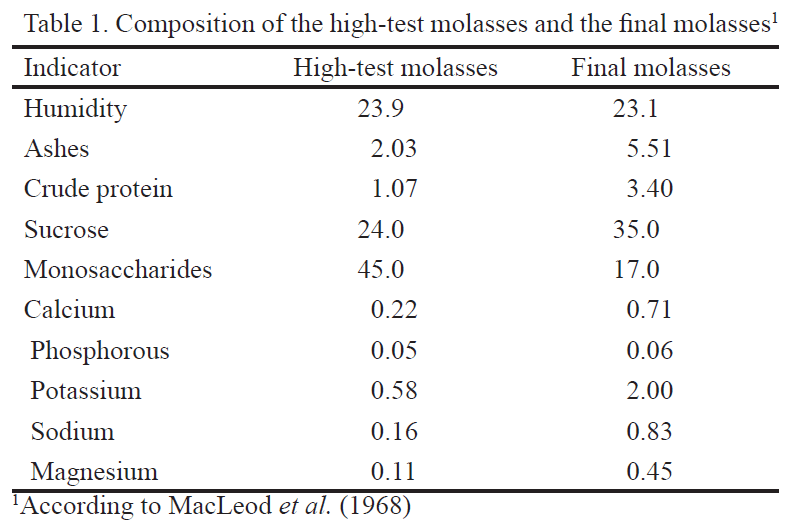
<body><![CDATA[<p align="justify"><font size="2" face="Verdana, Arial, Helvetica, sans-serif">It is known that Cuba,  tropical developing country, has a great biodiversity, with incalculable  potential of non-traditional feeds that could be used to feed non-ruminant  species. Among these feeds, the by-products of sugar cane (cane molasses, juice  or cane juice and sugar) and yeasts like Saccharomyces and torula, were  provided for two decades to pigs and poultry at the Institute of Animal  Science, in accordance with the policy of import substitution of energy and  protein sources, which included the use of maize and soy bean, respectively. </font></p>     <p align="justify"><font size="2" face="Verdana, Arial, Helvetica, sans-serif">At the end of the 80&acute;s and  early 90&acute;s, the prices of industrial by-products, like sugar cane molasses,  increased, so their use was not feasible in the preparation of diets for pigs  and poultry. Under these conditions, alternatives were searched, such as the  use of sugar cane meal and other local resources, like meals of legume  foliages, foliages and forages of tree and shrub species with good nutritional  content, especially protein, but they showed two problems: high fiber levels  and occasional representation of secondary metabolites that diminished its  nutritional value and affected the digestive and metabolic processes of  poultry, pigs and rabbits. All this affected the productive performance of  birds, which, due to the nature of their digestive tract, are more sensitive to  the effects of fibrous feeds.</font></p>     <p align="justify"><font size="2" face="Verdana, Arial, Helvetica, sans-serif">In order to achieve an  increase in the nutritional quality of these feeds, simple biotechnological  processes such as solid state fermentation (SSF) were tested, and the epiphytic  flora of the sugar cane was used, with the addition of urea and mineral  pre-mixture (El&iacute;as <em>et al.</em> 1990), the SSF of temporary legume grains and  foliages with strains of cellulolitic fungi (Vali&ntilde;o <em>et al.</em> 2004), and  the germination of legume grains (D&iacute;az <em>et al.</em> 2004). </font></p>     <p align="justify"><font size="2" face="Verdana, Arial, Helvetica, sans-serif">This review deals with the studies on the physiological  effect of the use of non-traditional feeds on non-ruminant species, which have  been carried out for 50 years at the Institute of Animal Science, designed  according to the policy of import substitution that prevailed in Cuba, with the  objective of achieving a sustainable animal husbandry.</font></p>     <p align="justify">&nbsp;</p>     <p align="justify"><strong><font size="3" face="Verdana, Arial, Helvetica, sans-serif">DIGESTIVE AND METABOLIC ASPECTS OF  THE USE OF BY-PRODUCTS FROM THE SUGAR INDUSTRY IN POULTRY AND PIGS</font></strong></p>     <p align="justify"><font size="2" face="Verdana, Arial, Helvetica, sans-serif">In tropical countries, sugar cane is a food with great  economic advantages, because it has no competition with any other crop  cultivated by man, from the point of view of efficiency of solar energy collection  per surface unit, in an annual cycle for its transformation into carbohydrates.</font></p>     <p align="justify"><font size="2" face="Verdana, Arial, Helvetica, sans-serif">From the point of view of its industrial exploitation, sugar cane, as a raw material, provides different  products such as sugar and sugar cane juice, from which the molasses are  obtained: high-test molasses (which contains all its sugars), integral molasses  (similar to the previous one, but without eliminating impurities), A and B  intermediate molasses (with 75 and 70% of sugar, respectively) and final  molasses or C molasses, which only have 58% of sugar, when it is not possible  to extract more sucrose. <a href="/img/revistas/cjas/v49n3/t0101315.gif">Table 1</a> shows the composition of the high-test  molasses and the final molasses that, from the point of view of their digestive  and metabolic utilization, have been the most studied in non-ruminant species.</font></p>     
<p align="justify"><font size="2" face="Verdana, Arial, Helvetica, sans-serif">Initial researches were directed to study digestion and  metabolism of carbohydrates in molasses diets for pigs. Several researches were  conducted to compare these aspects in growing pigs who received a diet based on  high-test molasses (Ly 1971) and on torula yeast respectively, as the only  source of protein (Carrillo 1971 and Carrillo and Benavides 1971) in relation  to a conventional diet of cereals.</font></p>     <p align="justify"><font size="2" face="Verdana, Arial, Helvetica, sans-serif">As the most relevant result, it was confirmed that maize  was progressively digested in the small intestine and it provided the available  glucose to the animal in small amounts during a relatively long period. In  contrast, a very different digestion pattern was found when pigs were fed diets  based on high-test molasses. A large amount of carbohydrates were available for  the animals in a short period of time. This situation was also confirmed  indirectly in the peripheral blood by Ly and Vel&aacute;zquez (1970). However, a part  of dietary carbohydrates, fructose but not sucrose, escaped from absorption in  the small intestine, due to the increased speed of digesta passage.</font></p>     ]]></body>
<body><![CDATA[<p align="justify"><font size="2" face="Verdana, Arial, Helvetica, sans-serif">Ly (1975, 1977ab) studied  the characteristics of the digesta and the destination of carbohydrates in the  stomach and intestinal phases, respectively, in pigs receiving diets of  high-test molasses or maize meal. The author confirmed that, in the stomach  phase, the proportion water intake: organic matter was higher for high-test  molasses, regarding the maize meal. The percent of DM was superior for maize,  compared to the high-test molasses along the gastrointestinal tract, so the  relatively fast intestinal passage caused the virtual accumulation of dietary  carbohydrates in the caecum of the pigs fed high-test molasses. This  demonstrated that the regulating function of the stomach in the passage of  digesta was not efficient to prevent the arrival of dietary carbohydrates to  the large intestine, at least during the stomach phase of digestion, when  growing pigs were fed a diet based on high-test molasses. </font></p>     <p align="justify"><font size="2" face="Verdana, Arial, Helvetica, sans-serif">In the intestinal phase (6  hours after the meal), there was a higher retention of DM for maize (46.1%)  compared to the high-test molasses (29.9%). The prececal disappearance of  carbohydrates with the diet of high-test molasses (1.99g/kg LW/h) was higher  than with maize (0.51 g/kg LW/h). The digest was more humid in all sections of  the GIT of pigs fed with high-test molasses, indicating a different digestive  pattern regarding maize. Dilution of digesta should be considered by the  presence of hypertonic solutions, which can cause certain functional disability  in the small intestine, although this organ tends to equalize the osmotic  pressure of digesta. Besides the water absorption effect, a higher peristaltic  activity could occur. All this confirmed the presence of certain amount of carbohydrates  in the caecum, according to Ly (1974). </font></p>     <p align="justify"><font size="2" face="Verdana, Arial, Helvetica, sans-serif">Boucourt and Ly (1975) found a large microbial  population, constituted by lactobacilli, streptococci, yeasts, Clostridia and<em> E. colli</em>, in the stomach and small intestine of pigs, which was associated  with large amounts of organic acids, when animals consumed diets based on  molasses, with respect to a diet with    maize. </font></p>     <p align="justify"><font size="2" face="Verdana, Arial, Helvetica, sans-serif">Ly and Boucourt (1975)  researched the fermentation pattern of organic acids present in the  gastrointestinal tract of pigs fed with two carbohydrate sources and found  marked differences between them. The colon had the highest content of  fermentation products for maize diet, while the high-test molasses produced an  unexpected increase in the function of the stomach as virtual fermentation area.  The amount of organic acids found in the first part of the tract (stomach and  small intestine) exceeded the second (caecum and large intestine). Compared to  the diet with maize, the pattern was different. The acetic acid was predominant  in the diet of maize in all organs, while the diet with high-test molasses  determined a higher proportion of butyric acid.</font></p>     <p align="justify"><font size="2" face="Verdana, Arial, Helvetica, sans-serif">Ly (1974), after studying  the caecal function, confirmed that the levels of short chain fatty acids  (SCFA) were higher in a diet with high-test molasses (2mmol/g OM) than in one  with maize    (0.9mmol/g OM). Therefore, it was inferred fermentation was caused by materials  that escaped to digestion in the small intestine (a fraction of dietary  fructose and sucrose). The lowest available energy for the host could explain  the difference in production and growth indicators (Di&eacute;guez and Menchaca 1973),  verified among pigs consuming high-test molasses and    maize.&nbsp;&nbsp; </font></p>     <p align="justify"><font size="2" face="Verdana, Arial, Helvetica, sans-serif">Final molasses is another  widely used by-product for feeding pigs. Its use has been limited from the  nutritional point of view, due to two simultaneous events: the worsening of  performance traits and the occurrence of diarrheas in animals, when it was used  at levels greater than 30%. In contrast, the high-test molasses did not  determine any laxative effect on recently weaned animals or during growth and  fattening stages. At the same time, there was an evident improvement in the  performance traits of economic interest (Ly and Castro 1984), when compared  with the final molasses. </font></p>     <p align="justify"><font size="2" face="Verdana, Arial, Helvetica, sans-serif">Several hypotheses were stated to explain the phenomena  of liquid feces or diarrhea. Some were attributed to the high content of ashes  in the final molasses or to the large amounts of potassium (Vel&aacute;zquez and  Preston 1970).&nbsp;&nbsp; </font></p>     <p align="justify"><font size="2" face="Verdana, Arial, Helvetica, sans-serif">Ly (1985a) studied the status of Na and K in the large intestine  of pigs and demonstrated that the fecal emission, with high or low liquid  concentration, could not be interpreted from the presence of Na and K in it.  This confirms unsuccessful attempts to demonstrate that high levels of these  electrolytes in the diet can provoke diarrhea in pigs or birds. To know exactly  the factors involved in the regulatory processes of material exchange between  the intestinal lumen and the internal medium, it would be necessary to explore  other areas, such as nerve or hormone regulation.</font></p>     <p align="justify"><font size="2" face="Verdana, Arial, Helvetica, sans-serif">A more coherent hypothesis,  regarding the laxative properties of final molasses, was supported on its  chemical composition, but it was centered on the fraction of organic matter,  which is neither protein nor carbohydrate, and it is been called  &ldquo;non-identified organic substances&rdquo;, according to Figueroa and Mac&iacute;as (1988).  These authors suggested that this fraction could be constituted by compounds  similar to pectin, which is not very digestible, so they should be highly  hydrophilic compounds, and their permanence in the intestinal lumen demands a  very large water flow. This would explain, together with the emission of watery  feces, the excessive thirst of pigs that makes them drink a lot of water  (Marrero and Ly 1977), besides presenting a determined intake pattern (Ly and  Castro 1984). Summarizing, the intestine of pigs receiving final molasses loses  its ability to retain digesta, decreases the ability of water absorption, with  the following liquid fecal emission. According to Ly (1985b), this is accompanied  by an excessively fast digestive flow, like the one verified in the pre-caecal  areas.</font></p>     <p align="justify"><font size="2" face="Verdana, Arial, Helvetica, sans-serif">Regarding the speed of production of SCFA, Ly (1986)  confirmed that the determining factor on the fermentative activity in the large  intestine was the permanence time of the digestive content in this region of  the GIT. It was evident that the SCFA, produced in the large intestine of pigs  fed with high-test molasses, had the highest contribution to the energy  metabolism of animals. This contribution was lower with maize diet, and  significantly smaller with final molasses.</font></p>     ]]></body>
<body><![CDATA[<p align="justify"><font size="2" face="Verdana, Arial, Helvetica, sans-serif">The highest or lowest daily production of SCFA in diets  with high-test molasses or final molasses coincides with the highest daily  absorption of water in the caecum and colon found in other studies (Ly 1985 b).  Later, there was interdependence of the absorption of SCFA and water in the  large intestine. </font></p>     <p align="justify"><font size="2" face="Verdana, Arial, Helvetica, sans-serif">As a conclusion, it was considered that the excessive  intake of water with the diet of final molasses led to an accelerated flow of  digesta in the ileum (Ly 1985a), and determined the inefficiency in water  absorption in the large intestine, due to the absence of production of SCFA in  the caecum and colon and, therefore, its poor absorption.&nbsp; </font></p>     <p align="justify"><font size="2" face="Verdana, Arial, Helvetica, sans-serif">Ly and Mollineda (1983) found changes in the morphology of  the large intestine in diets with final molasses that could explain the lowest  digestive use in pigs fed with this feed. </font></p>     <p align="justify"><font size="2" face="Verdana, Arial, Helvetica, sans-serif">In order to improve the use  of nutrients in diets with high amounts of final molasses, Brito <em>et al.</em> (1985) and D&iacute;az and Rodr&iacute;guez (1987) tested on growth-fattening pigs and  pregnant sows, respectively, the addition of different levels of filter cake  mud oil (by-product extracted from the process for obtaining cake from sugar  cane), which is an energy source, but they did not obtained the expected  benefits. Sav&oacute;n (1984) and Rodr&iacute;guez <em>et al.</em> (1988) the use of meal of  bermuda (<em>Cynodon dactylon</em>) hay. These authors obtained that the addition  of 5 % of this fiber source decreased the flow speed, favored the water  absorption at the level of large intestine and prevented the release of soft  feces, which is a characteristic of this diets, without affecting the use of  dry matter, nitrogen and    energy. </font></p>     <p align="justify"><font size="2" face="Verdana, Arial, Helvetica, sans-serif">Another important aspect to analyze is that, due to the  ingestion of high levels of final molasses and the intrinsic characteristics of  this by-product (high content of soluble sugars, low fiber content and  excessive content of minerals), some changes in the acid-basic homeostasis  could be produced, mainly because of the nature of the products resulting from  the metabolic processes. The previous information was studied by Sav&oacute;n (1984)  and Sav&oacute;n <em>et al.</em> (1987), who found that high levels of final molasses  (up to 71 %) in the diets for growing pigs did not provoke changes in the  acid-basic homeostasis until around 8 h after the ingestion, despite the high  concentration of dietary magnesium, potassium and carbohydrates.&nbsp;&nbsp; </font></p>     <p align="justify"><font size="2" face="Verdana, Arial, Helvetica, sans-serif">Sav&oacute;n <em>et al.</em> (1989) discovered that the  homeostatic capacity of pigs is able to regulate the serum profile of  electrolytes like potassium and magnesium, despite the pigs ingested several  times their requirements in diets with high levels of final molasses. After  supplementing the diets of final molasses with phosphorous and zinc, the  apparent absorption and retention of calcium, potassium and sodium was not  affected. However, the absorption of phosphorous and magnesium increased and  the water excretion decreased. </font></p>     <p align="justify"><font size="2" face="Verdana, Arial, Helvetica, sans-serif">Taking into account these  results, the cited authors demonstrated that, in fattening of pigs with final  molasses at 30 % or more, it is only necessary to adjust the mineral  supplementation to the requirements of zinc and phosphorous, without presenting  changes in the indicators of health and blood biochemistry, like total  proteins, albumin, hemoglobin, hematocrit, total leukocytes and differential  counting. This represents a considerable saving of currency to the    country.&nbsp;&nbsp; </font></p>     <p align="justify"><font size="2" face="Verdana, Arial, Helvetica, sans-serif">In poultry, studies were focused on the different  factors that limit the use of final molasses in the formulation of diets for  broilers, which influenced on their poor productive performance.</font></p>     <p align="justify"><font size="2" face="Verdana, Arial, Helvetica, sans-serif">&Aacute;lvarez and Ly (1975) conducted preliminary studies to  analyze the effect of including different proportions of final molasses/maize,  up to replace 54.7% of the DM of the diet by final molasses in the active  degradation of the energy components of the ration by the micro-flora within in  the pre (crop) and post gastric (caecum) areas of the gastrointestinal tract.  Among the most interesting results, it was confirmed that final molasses  induced a better flow of digesta in animals receiving this feed, so the crop  lost its capacity as reserve organ. The pH values showed differences between  crop and caeca, being these last the ones that showed the highest values. In  both organs, diets with higher content of final molasses determined higher  concentrations of SCFA and lactic acid. In the caeca, mainly, there was an  increase of the fermentative activity due to the increase of the unexpected  lactate, which could come from pre-caecal areas. This may be a result from the  fast flow of digesta reaching these organs, and exceeds the amount that they  can absorb or evacuate.</font></p>     <p align="justify"><font size="2" face="Verdana, Arial, Helvetica, sans-serif">Similar to the observed in  pigs, &Aacute;lvarez (1976a) found that the inclusion of final molasses in diets for  broilers caused an increase on the passage speed of digesta through the  gastrointestinal tract of animals, with maximum values maximum for the diets  with higher percentage of substitution of maize for final molasses. The increase  was attributed to some intrinsic factors of the molasses composition (Gonz&aacute;lez  and Iba&ntilde;ez 1973ab), which originated a higher water intake and generated a  decrease of metabolizable energy, as the level of final molasses increased in  the ration. In addition, another factor that could influence was the  fermentation activity in the crops and caeca of poultry (Alvarez 1975), because  high concentrations of lactic acid in the crops affects the intake of    animals.</font></p>     ]]></body>
<body><![CDATA[<p align="justify"><font size="2" face="Verdana, Arial, Helvetica, sans-serif">&Aacute;lvarez (1976b) also analyzed the influence of including  different proportions of maize /final molasses on morphological indicators  (weight and size) of the digestive organs of birds, to achieve high levels    (66.5 % of dietary DM) in rations for broilers. This author found an increase  of organs, with an increase of the level of final molasses in diets, while the  gizzard showed an opposite performance. In the case of the gizzard, the  semi-liquid nature of final molasses decreased, largely, its shredder function,  which affects the muscular development of the organ. Absolute areas of crops  and caeca increased significantly in the diets of final molasses as a result of  the fermentation activity, due to the levels of SCFA and lactic acid.</font></p>     <p align="justify"><font size="2" face="Verdana, Arial, Helvetica, sans-serif">Iba&ntilde;ez and Gonz&aacute;lez (1981)  analyzed the effect of the inclusion of different levels of final molasses, in  the relation between different organs from the digestive tract and weight of  the birds (relative weight) and confirmed the previous results. Functional  modifications were observed, which were induced by final molasses in the  digestive tract of birds. These changes could influence on digestibility and  other digestive indicators. </font></p>     <p align="justify"><font size="2" face="Verdana, Arial, Helvetica, sans-serif">&Aacute;lvarez (1982)  proposed that the lower digestibility of diets with final molasses, combined to  a low feed efficiency of birds that consumed this by-product, were the factors  that determined the decrease of the apparent retentions of DM, OM and N, as  well as low values obtained for the ME of this type of diet (&Aacute;lvarez&nbsp; 1977). Thus, the animal is able to metabolize  66% of the GE in the diet, where final molasses is the&nbsp;&nbsp; main energy source, compared to 80% obtained  with the maize diet. This seems to be determined by the high fecal humidity and  high ash content of feces, as well as the laxative effect observed in animals  consuming final molasses.</font></p>     <p align="justify"><font size="2" face="Verdana, Arial, Helvetica, sans-serif">These results suggested the  use of certain additives like formaldehyde and sodium sulfite (Brito and  &Aacute;lvarez 1982) to improve the utilization of dietary energy caused by a higher  fermentation in the GIT of birds consuming the highest levels of final  molasses. This could contribute to improving the poor conversion and gain  values obtained in nutritional experiments, after providing final molasses to  the poultry. </font></p>     <p align="justify"><font size="2" face="Verdana, Arial, Helvetica, sans-serif">In order to reduce the  laxative effect of final molasses diets, it was subjected to a thermal  treatment and centrifugation, to try to reduce the high ash content (&Aacute;lvarez  1980), but there was no favorable effect. Final molasses were treated also with  sulfuric acid and zeolite at 3 % (Sav&oacute;n <em>et al.</em> 1983), also to reduce its  laxative effect. The levels of sodium, potassium and magnesium in the ileum and  caeca of birds consuming treated and untreated molasses showed no significant  differences. The same occurred with the dry matter from excretions.</font></p>     <p align="justify"><font size="2" face="Verdana, Arial, Helvetica, sans-serif">Previously, Sav&oacute;n and  &Aacute;lvarez (1982) studied the effect of mineral composition of different levels of  a product called dehydrated final molasses (DFM) on the humidity of excretions,  excretions of minerals, serum profile of macro-elements and its content in the  ashes of the tibias. The product was obtained from drying final molasses with  calcium oxide. There was a decrease of the serum profile of Ca, Mg and K with  the increase of dehydrated final molasses, while Na and P values showed no  significant differences. </font></p>     <p align="justify"><font size="2" face="Verdana, Arial, Helvetica, sans-serif">There was an increase of Ca, Mg and K excretion in  poultry consuming the highest levels of DFM (30, 40 and 50% of DM). The authors  recommended not to use high levels of this product in the diet for birds,  despite the decrease of humidity in the excretions, because the animals  presented bone fragility and disorders due to the excess of consumed calcium.  In addition, there are low values of ME in diets with high amount of DFM,  associated to ash content, primarily calcium, which is high in the DFM.</font></p>     <p align="justify"><font size="2" face="Verdana, Arial, Helvetica, sans-serif">The low content of protein  on diets based on sugar cane molasses favored the search for alternative  protein sources, as a supplement to these diets, in poultry and pigs. There  were Saccharomyces (alcohol distillery by-product) and torula yeasts (developed  in final molasses), allowing considerable savings of protein sources. </font></p>     <p align="justify"><font size="2" face="Verdana, Arial, Helvetica, sans-serif">&nbsp;The first researches on the use of torula  yeast, as the only protein source, were conducted by Carillo and Benavides  (1971). These authors studied the digestibility and rate of passage through the  gastrointestinal tract of pigs consuming diets based on torula/high-test  molasses. They found that, although the molasses, as it is known, induces the  passage of a large volume of digesta through ileum, this did not affect  apparent digestibility of DM and N, probably due to the osmotic effect. </font></p>     <p align="justify"><font size="2" face="Verdana, Arial, Helvetica, sans-serif">This finding was confirmed  when Carrillo (1973) analyzed the proteolysis of Saccharomyces and torula  yeasts, for two tests were conducted with pigs provided with a reentrant  cannula in the first part of the duodenum and a single cannula in the stomach.  The results of both experiences showed evidence of poor digestion of yeasts,  and suggested that the favorable effect expected for molasses, after  diminishing the speed of stomach emptying due to its osmolarity, was  counteracted because of its high buffering ability. The previous results did  not allow the pepsin to achieve its optimal pH for yeast proteolysis in the  stomach and that around 80% of the ingested nitrogen passed into the small  intestine. </font></p>     ]]></body>
<body><![CDATA[<p align="justify"><font size="2" face="Verdana, Arial, Helvetica, sans-serif">Boucourt (1979) analyzed the effect of live or dead  yeast on the fermentation indexes in different sections of the digestive tract  of pigs fed a diet of high-test molasses. This author recommended not using  live yeasts as a protein supplement, because they affect the energy content of  the diet because they compete with the host, to produce high levels of alcohol.  In addition, their digestibility is low because their wall remains intact  (Carrillo and Boucourt 1971).</font></p>     <p align="justify"><font size="2" face="Verdana, Arial, Helvetica, sans-serif">Studies on protein digestion in torula yeast, in diets  based on high levels of final molasses as an energy component, were conducted  by Boucourt (1982). For this, the effect of bonding the pancreas to pigs over  11 weeks old that received these diets was analyzed. It demonstrated that pigs  are able to digest 60% of dietary protein, despite the lack of pancreatic  juice. This percentage of digestibility represented 81% of the real potential  of this indicator for this diet.</font></p>     <p align="justify"><font size="2" face="Verdana, Arial, Helvetica, sans-serif">As for the amino acid and  protein digestibility of torula yeast in pigs fed final molasses, Boucourt  (1982) found lower digestibility than those reported for traditional diets.  This author also determined the effect of digestibility of protein, amino acids  and dry matter in the ileum and feces of pigs consuming torula yeast and  molasses. DM, protein and amino acids, except methionine, showed higher  digestibility in feces. This may suggest the need to supplement methionine when  torula yeast was included as a protein source in diets of final molasses for  pigs. However, this author found that the protein digestibility of torula yeast  did not increase with the DL-methionine    supplementation. </font></p>     <p align="justify"><font size="2" face="Verdana, Arial, Helvetica, sans-serif">&Aacute;lvarez (1976c) determined the nutritional value of  Cuban torula yeast and stated that it was variable and depended on the  substrate of the used strain, but not on the industrial processing. Thus, he  found that the nutritional quality did not vary with the drying method (spray  or drum). In this sense, the comparative study of lysine availability, suitable  indicator for determining its quality, indicated no significant difference  among the yeasts produced in different factories of the country (Till&aacute;n and  &Aacute;lvarez 1983).</font></p>     <p align="justify"><font size="2" face="Verdana, Arial, Helvetica, sans-serif">Valdivi&eacute; (1976) analyzed different levels of inclusion  of torula yeast on indicators of productive performance of broilers with  potential slow growth, and suggested levels of up to 20%, because higher values  deteriorated gain and feed conversion, plus the humidity and sticky consistency  presented by the excretions. Precisely, &Aacute;lvarez (1976c) stipulated that an  aspect to be taken into account for including torula in poultry rations was its  high content of NPN (12% of Nt expressed as nucleic acids) and its low  biological value. Regarding the former, the nitrogen of purine bases is not  used by the animal, and uric acid is the final product of catabolism, so when  its concentration in blood increases, the bird increases water intake and  kidney activity, releases the excess of uric acid. The final result is higher  humidity in the excretions when torula is included with more than 20% of DM of  the diet and decrease of the performance of production indicators.</font></p>     <p align="justify"><font size="2" face="Verdana, Arial, Helvetica, sans-serif">&Aacute;lvarez and Valdivi&eacute; (1980), to confirm the previous  results, determined the effect of the inclusion of 0, 10, 20 and 30% of torula  yeast in ME and apparent retention of DM and N in broilers. They found no  significant differences of ME among treatments. However, apparent retentions of  DM and N decreased from 20% of torula inclusion.</font></p>     <p align="justify"><font size="2" face="Verdana, Arial, Helvetica, sans-serif">These results differ from  those previously stated by Valdivi&eacute; (1976). The low use of nitrogen from 20% of  yeast inclusion could be caused by the already mentioned high content of  nucleic acids. Another limiting factor could be not to use DL-methionine as  supplement, which is a deficient amino acid in torula yeast, as in the case of  diets formulated by &Aacute;lvarez and Valdivi&eacute; (1980), in contrast to the positive  response to supplementation obtained by Valdivi&eacute; (1976). However, this last was  discarded in researches of Till&aacute;n <em>et al.</em> (1984), who found that enzyme  activities of protease and trypsin were similar, with DL-methionine  supplementation or not in broilers. Apparently methionine deficiency in these  diets of torula yeast does not affect the production of proteolytic enzymes. Therefore,  differences in N digestibility in diets with high levels of torula are mainly  caused by inner characteristics of this protein source. It is important to  point out that the nitrogen from the wall remains in a medium resistant to  enzyme action (Carrillo 1971), and the nitrogen from nucleic acids is less  digestible than the one from protein. </font></p>     <p align="justify"><font size="2" face="Verdana, Arial, Helvetica, sans-serif">Studies conducted in poultry did not allow to determine  the real use of nitrogen in this species. Therefore, Till&aacute;n <em>et al.</em> (1986) studied the apparent digestibility of N and DM in diets with the  inclusion of 0, 10, 20 and 27% of torula yeast, for replacing soy bean. As a  result, they found that the digestibility of these indicators decreased  significantly after 10% of yeast in the diet, which could be related to the  high water intake of the birds that received high levels of torula yeast. These  authors also found a high relation (r=0.83) between water intake and urine  excretion. This supports the studies of Lon-Wo and Valdivi&eacute; (1981), who found a  negative relationship between water intake and DM percentage in the excretions. </font></p>     <p align="justify"><font size="2" face="Verdana, Arial, Helvetica, sans-serif">Considering the increase of prices of sugar cane  molasses and its derivative products in the market, researchers evaluated the  possibility of using fresh and ground sugar cane meal, without processing, for  feeding pigs, in substitution of cereals. Nutritional studies were conducted by  Lamazares <em>et al.</em> (1988) and demonstrated that the inclusion of up to 30%  of dehydrated sugar cane meal in the diets for pre-fattening pigs for replacing  cereals could be feasible, without changing the productive indicators or feed  costs per increased kilogram. Sugar cane meal was obtained by steam dehydration  method.&nbsp; Before that, the clean sugar  cane was grinded in a mill, without any straw or bud, dried for 6 to 8 h, and,  finally, it was grinded.</font></p>     <p align="justify"><font size="2" face="Verdana, Arial, Helvetica, sans-serif">Undoubtedly, the inclusion of fibrous feeds on diets for  pigs, especially in the pre-fattening stage, raises questions as to their  effect on the digestive physiology. Thus, researches on the pattern index of  intake (Rodr&iacute;guez <em>et al.</em> 1989) were performed in the fifth week after  weaning, and digestive indexes (Rodr&iacute;guez <em>et al.</em> 1991), from five to  nine weeks after weaning, in pre-fattening pigs receiving 0, 20 and 40% of  dehydrated sugar cane meal in diets. As a result, intake, speed and frequency  of ingestion decreased significantly with the highest level of inclusion of  dehydrated sugar cane meal. The level of ingestion and energy dilution were  interrelated (r = 0.71, P &lt; 0.001). The inclusion of 20% of dehydrated sugar  cane meal did not influence on the intake pattern of pigs. The analysis of  digestive indexes (digesta distribution, pH and fermentation of SCFA) in pigs  of nine weeks after weaning, receiving 20 and 40% of sugar cane meal in place  of cereals in the diet, indicated a faster pre-caecal evolution with the  ingestion of sugar cane meal. It also suggested that the inclusion of 20 and  40% of sugar cane meal did not affect the level of fermentation in the tract,  nor apparently caused changes in the pH of the digestive content. The previous  information confirmed the results of Lamazares <em>et al.</em> (1988) with an  inferior level (20%) of dehydrated sugar cane meal in the diets of  pre-fattening pigs, and adequate productive performance was achieved.</font></p>     ]]></body>
<body><![CDATA[<p align="justify"><font size="2" face="Verdana, Arial, Helvetica, sans-serif">Dihigo <em>et al.</em> (2001) analyzed the effect of the  inclusion of sugar cane meal (0, 15, 30 and 45%) with a control diet based on  alfalfa-maize-soy bean, which covered the requirements in the morphometric  aspects of the gastrointestinal tract, internal organs and digestive content of  the stomachs and caeca of rabbits. It was concluded that the inclusion of sugar  cane meal on the diet had a negative effect on the caecal contents, and that  the inclusion of more than 15% of sugar cane meal negatively influenced on the  weight of stomach and liver.</font></p>     <p align="justify">&nbsp;</p>     <p align="justify"><strong><font size="3" face="Verdana, Arial, Helvetica, sans-serif">DIGESTIVE AND METABOLIC ASPECTS OF  THE USE OF NEW FEEDS DERIVED FROM SUGAR CANE AND ITS BY-PRODUCTS, SUBJECT TO  BIOTECHNOLOGICAL PROCESSES</font></strong></p>     <p align="justify"><font size="2" face="Verdana, Arial, Helvetica, sans-serif">From the 90&acute;s of last  century, the economic crisis in Cuba worsened and became more difficult the  acquisition of raw materials for feed production, mainly for non-ruminant  species, which, due to their digestive physiology, need cereals such as maize  and proteins like soy bean, in order to achieve appropriate growth rates.  Therefore, the development of feed resources with domestic alternatives was  very important. El&iacute;as <em>et al.</em> (1990), considering the abundant amount of  nutritional elements within sugar cane and its by-products, developed a  technology based on solid state self-fermentation of sugar cane, with the  addition of urea and mineral salts. The process consisted on transforming the  food energy source in a product enriched with available carbohydrates and  nitrogen precipitating to tri-chloride acetic acid (TCA), through a physical  and biological process where the microorganisms of sugarcane had an important  function. The result was a new protein-energy food, called Saccharina. </font></p>     <p align="justify"><font size="2" face="Verdana, Arial, Helvetica, sans-serif">As the most relevant aspects of its bromatological  composition, these authors found that the product reached between 11 and 16% of  CP, superior to the values of cereals such as maize or wheat, and    16 MJ/kg DM of gross energy. The levels of CF ranged between 24 and 25% of the  product and most of the CF consisted on cellulose and hemicellulose. This  fact&nbsp; led to nutritional studies, where  levels of inclusion were valued as a replacement of cereals in different  species: 30% in the feed for post-weaning piglets (Lezcano <em>et al.</em> 1990),  60% of cereals from the supplement in diets based on&nbsp; B molasses for pigs (Castro <em>et al.</em> 1990), 100% of the cereals for pregnant sows (D&iacute;az <em>et al</em>.1991), 30% in  starter diets for geese, and between 40 and 60% in finishing diets for replacing  cereals (Valdivi&eacute; <em>et al.</em> 1990a), and 10% of Saccharina as the limit of  inclusion in feed for broilers from 28 to 54 d (Valdivi&eacute; <em>et al.</em> 1990b). </font></p>     <p align="justify"><font size="2" face="Verdana, Arial, Helvetica, sans-serif">The first physiological  studies were conducted by Ly <em>et al.</em> (1991), in order to determine the  nitrogen and energy balance in pigs fed with variables levels of Saccharina (0,  20, 40 and 60% of the diet under dry basis) include on cereal diets. These  authors found that, with the increase of Saccharina in the diet, energy and N  digestibility, as well as nitrogen retention and energy, expressed as intake  percentage, significantly decreased (P &lt;0.001). However, retention expressed  as a digestion percentage had less importance for nitrogen (P &lt;0.05) and  none for energy. The decrease of nitrogen and energy digestibility is related  to the increase of cell wall content. It is known that fiber decreases  digestive utilization of energy, which is the immediate cause of these results.  The fact that there was no effect of treatment on digested energy retention  suggests that the main difference in the energy balance, between cereal and  Saccharina diets, lies on its digestive use. This fact implied a change of  starch (cereals) per sucrose and cell wall (Saccharina), which modifies the  extent and location of fermentation of different types of carbohydrates, with  an increase of their function in the large intestine and the native micro-flora  in the digestion of different fiber    fractions. </font></p>     <p align="justify"><font size="2" face="Verdana, Arial, Helvetica, sans-serif">The analysis of the previous  results suggests that the N digestibility and energy could be the main  nutritional limiting aspect for including large amounts of Saccharina on cereal  diets for pigs. This was confirmed by D&iacute;az <em>et al.</em> (1992), who assessed  the digestibility of energy after replacing feedstuff wheat by 20, 40 and 60%  of Saccharina, but in a feeding system that included B molasses as an energy  source for developing females. These authors observed the negative effect of  Saccharina on energy digestibility, so they recommended the increase of the  energy level of diets, when more than 20% of feedstuff wheat is replaced by  Saccharina. </font></p>     <p align="justify"><font size="2" face="Verdana, Arial, Helvetica, sans-serif">Subsequently, Ly and Castro  (1995) studied the effect of replacing 20% of wheat meal diets (control) for  different types of Saccharina, obtained under pilot plant conditions, b) from  sugar cane stems, c) or industrially, from return bagasse pith and sugar cane  juice, and d) or with unfermented sugarcane meal, in the balance of N and  energy of growing pigs. Energy digestibility was superior in the control, while  this indicator did not differ among Saccharina treatments. There was also no  effect of treatment on nitrogen balance, retention expressed as intake  percentage and digestion. The results of energy balance confirm the previously  obtained by Ly <em>et al.</em> (1991). Regarding the status of N, like the  results of the authors, there was a redistribution of the routes for removing  nitrogen, probably due to differences among treatments regarding the level of  dietary fiber. It was concluded that the inclusion of Saccharina on the diet  has more influence on the digestive use of energy than in the dietary N for  pigs, if the inclusion of this product reaches 20% of the food. </font></p>     <p align="justify"><font size="2" face="Verdana, Arial, Helvetica, sans-serif">In order to determine  protein quality and energy value on diets containing Saccharina for pigs, Ly  (1999) performed two experiments. The first experiment was conducted with  ileo-rectomized animals and the other with intact animals, which were fed with  Saccharina (0, 10 and 20%). This author noted a significant reduction in ileal  and total nutrient digestibility, and energy with the increase of Saccharina on  the diet. The reduction of nitrogen digestibility in the digestive tract is  possibly caused by the increased of bacterial protein synthesis in the caecum  and colon. This implies a reduction of non-amino acid nitrogen absorption in  the large intestine, which is not useful to the host. </font></p>     <p align="justify"><font size="2" face="Verdana, Arial, Helvetica, sans-serif">A relevant aspect is that  Saccharina caused reduction in the contribution of the large intestine to the  total digestion of crude fiber. This means that the biotransformation process,  carried out in the stems of sugar cane, had a positive influence on the use of  cellulose during pre-caecal digestion, although it is known that fiber  degradation does not normally occur in the small intestine of pigs. In  addition, the reduction of ileal and total digestibility was accompanied by a  tendency towards the increase of daily ileal flow digesta and feces, together  with ileal and fecal flow of short chain fatty acids and ammonia, which is a  phenomenon attributed to the level of crude fiber in the diet for pigs. It is  important to mention the high microbial activity determined by Saccharina in  the digestive tract of these animals. In this regard, Rodr&iacute;guez <em>et al.</em> (2000) found that cellulolitic activity in the caecum of pigs depends on the  fiber level and its physical and chemical composition, and it caused by the  cellulolitic fungi, and not by bacteria. It means that high levels of fiber in  diets that include Saccharina, affect the counts of caecal cellulolitic fungi  and the specific activity of cellulase enzyme complex in pigs. Rodr&iacute;guez <em>et  al.</em> (2001) confirmed this statement in further     ]]></body>
<body><![CDATA[<br>   studies. </font></p>     <p align="justify"><font size="2" face="Verdana, Arial, Helvetica, sans-serif">The results confirmed the need for low levels of  Saccharina in pig diets, in order to avoid a negative effect on nutrient  digestibility, which is more remarkable, from an energy point of view, than  that of nitrogen in the entire process of digestion of Saccharina in pig diets.</font></p>     <p align="justify"><font size="2" face="Verdana, Arial, Helvetica, sans-serif">Marrero <em>et al.</em> (1995)  and Marrero (1998) analyzed the implications of the use a food with high fiber  content, as Saccharina, on poultry physiology. So, these authors determined  apparent retentions of DM, N, energy and cell wall components of the plant in  broilers consuming different levels (0, 5, 10 and 15%) of industrial Saccharina  for replacing maize in diets. Apparent retention of dry matter (ARDM) and  apparent retention of neutral detergent fiber (ARNDF) decreased in the diet  with 15%, compared to the remaining treatments, while the highest value was  obtained in 10% of inclusion of Saccharina. Similar to the results in pigs, the  apparent retention of nitrogen (ARN) did not differ among treatments, but the  ME decreased as the fiber increased in the diet. The results suggest the use of  up to 10% of Saccharina in the ration, so the apparent retentions of nutrients  are not affected. </font></p>     <p align="justify"><font size="2" face="Verdana, Arial, Helvetica, sans-serif">Rodr&iacute;guez <em>et al.</em> (1996) isolated cellulolitic fungi  in the caecum of broilers consuming different levels of fiber provided by  Saccharina. This discovery is very important because, until that moment, the  main difference between ruminal and caecal flora, and the functioning of both  organs, was the absence of fungi and protozoa in non-ruminant species.</font></p>     <p align="justify"><font size="2" face="Verdana, Arial, Helvetica, sans-serif">The finding of these microbial species in the large  intestine completes the possibilities of fiber digestion at this level, which  could be important for performing specific nutritional approximations, and for  achieving the accurate interpretation of phenomena taking place in the  ecosystem.</font></p>     <p align="justify"><font size="2" face="Verdana, Arial, Helvetica, sans-serif">Marrero <em>et al.</em> (1998)  evaluated the possibility of using fecal contents of pigs to determine <em>in  vitro</em> digestibility of total dietary fiber in poultry diets. There was an  underestimation of the digestibility of CP, DM and energy, when compared to the  values obtained <em>in vivo</em>. The apparent digestibilities of NDF were  similar to those obtained by Marrero <em>et al.</em> (1995) in broilers. The  error was very small among the methods, only 0.99 for NDF digestibility and 69%  of the values were similar. The results showed that it was possible to use pig  fecal inoculum for simulating digestion studies of dietary fiber in broilers.  This is probably caused by the similarity between the fecal ecosystem of pigs  and poultry caecum. In addition, this <em>in vitro</em> method was cheaper, when  practical conditions do not allow the work with animals. </font></p>     <p align="justify">&nbsp;</p>     <p align="justify"><strong><font size="3" face="Verdana, Arial, Helvetica, sans-serif">PROTEIN SUGAR CANE JUICE AND  HOMEMADE PROTEIN MOLASSES&nbsp; </font></strong></p>     <p align="justify"><font size="2" face="Verdana, Arial, Helvetica, sans-serif">Previous studies have stated  that pig production in Cuba mainly depends on the application of feeding  systems with a high proportion of national products, and, specially, with the  use of low cost protein    sources.&nbsp; </font></p>     <p align="justify"><font size="2" face="Verdana, Arial, Helvetica, sans-serif">In order to fulfill these  needs, El&iacute;as <em>et al.</em> (1990) reported the feasibility of obtaining new protein  sources from the fermentation of sugar cane and its juice, or from sugar cane  molasses (B molasses), with the addition of 2 % of urea and mineral  pre-mixture. The products were called protein sugar cane juice &ldquo;Guarapr&oacute;&rdquo; (GP)  and homemade protein molasses (MPC), respectively. </font></p>     ]]></body>
<body><![CDATA[<p align="justify"><font size="2" face="Verdana, Arial, Helvetica, sans-serif">The first studies on the  effect of GP on morphometric indicators of digestive organs from the  gastrointestinal tract and pig accessories during the first period of  pre-fattening (post-weaning) were conducted by Sav&oacute;n <em>et al.</em> (1993).  These authors found that the inclusion of up to 30% of protein sugar cane juice  on DM of the diet during the initial period of pre-fattening (up to four weeks  after weaning), did not cause significant changes on the morphometric  indicators of reserve organs and accessories of the gastrointestinal tract.  This fact confirmed the recommendations of D&iacute;az <em>et al.</em> (1992), who  suggested to provide up to 30% of GP to pigs during the&nbsp; first stage after weaning, with no  differences on production indicators such as daily mean gain (g) and conversion  (kg DM/kg of    gain). </font></p>     <p align="justify"><font size="2" face="Verdana, Arial, Helvetica, sans-serif">Sav&oacute;n <em>et al.</em> (1995a) conducted several studies to  understand the implications of ingesting diets with a high inclusion of an  unconventional food on nitrogen metabolism of growing pigs. Therefore, these  authors replaced 0, 50 and 75% of the protein in feedstuffs for homemade  protein molasses and increased fecal nitrogen compounds, leading to low  digestive utilization of nitrogen. An interesting fact is that nitrogen  retention, from a metabolic point of view, had no variations among treatments.  After analyzing the urinary excretion, it increased with the inclusion of  homemade protein molasses, which corresponded with the increase of dietary  nitrogen intake. The increase of homemade protein molasses in the ration  provoked a lower contribution of available protein. As a conclusion, the  authors suggested that it is possible to increase the use efficiency of  digested nitrogen in growing pigs consuming low levels of available protein, as  the one provided by this product.&nbsp; </font></p>     <p align="justify"><font size="2" face="Verdana, Arial, Helvetica, sans-serif">However, the protein digested in the large intestine does  not contribute to protein synthesis within the animal, so the analysis of  digestibility in the ileum is suggested, because it provides better prediction  of the value of final use of the protein than fecal data. Considering this  fact, Sav&oacute;n and Gonz&aacute;lez (1995) evaluated the digestive process and efficiency  use of DM and N in the ileum and feces in pigs fed homemade protein molasses as  a substitute for soybean in a B molasses system plus feedstuff. As a result,  the homemade protein molasses generated an increase of the flow of digesta in  the ileum, which determines a lower digestive use of DM and N. Likewise, Sav&oacute;n  and Gonz&aacute;lez (1996) also analyzed the digestion of other nutrients, such as OM  and ashes, and found that the homemade protein molasses generated an increase  of OM flow, and, to a less extent, of ashes, while the digestive utilization  could diminish in the large intestine.</font></p>     <p align="justify"><font size="2" face="Verdana, Arial, Helvetica, sans-serif">In other study, Sav&oacute;n <em>et al.</em> (1997) evaluated the  use efficiency of MPC and molasses-urea-superphosphate mixture without fermentation,  using blood and biological performance of protein metabolism in pigs. Results  suggested that the use of molasses-urea-superphosphate mixture without  fermentation was not advisable for pigs, and that there was no effect on the  productive performance and on blood figures of protein metabolism, when it was  replaced by half of the protein provided by soy bean, per homemade protein  molasses in a system that included B molasses as energy source. An interesting  fact is that these authors observed a remarkable increase (almost the double)  of serum urea concentration after replacing half of soy bean by homemade  protein molasses without differences among treatments.</font></p>     <p align="justify"><font size="2" face="Verdana, Arial, Helvetica, sans-serif">The previous results led Sav&oacute;n <em>et al.</em> (1999a) to  study the protein quality of homemade protein molasses. Therefore, these  authors analyzed different indicators of N metabolism, such as apparent  biological value of protein, retained N/digested N, urea concentration in serum  and fractioning of urinary nitrogen, which contributes to a better interpretation  of these results, when a product of microbial origin was included on the diet.  This way, after evaluating 0, 25, 50 and 75 % of substitution of soy bean  protein for MPC in a feeding system with raw sugar as energy source, digested  nitrogen and nitrogen retention had no differences among treatments, while  there was a square regression (r = 0.98 P&lt;0.001) between retained N/digested  N (biological value) and the levels of homemade protein molasses. The analysis  of urine nitrogen fractions did not show differences among fractions (g/d) for  creatinine-N, alpha amino-N, ammonia-N, while the ureic-N increased    (P &lt; 0.001) with the level of MPC. A similar response was obtained with the  concentration of serum urea.</font></p>     <p align="justify"><font size="2" face="Verdana, Arial, Helvetica, sans-serif">According to these results, the partial substitution of  soy bean protein for that provided by homemade protein molasses generates a  decrease of the (apparent) biological value and, therefore, of the quality of  this nutrient in rations based on raw sugar.</font></p>     <p align="justify">&nbsp;</p>     <p align="justify"><strong><font size="3" face="Verdana, Arial, Helvetica, sans-serif">PHYSIOLOGICAL ASPECTS OF THE USE OF  GRAINS AND FORAGES OF SHRUBS, TREES AND TEMPORARY LEGUMES</font></strong></p>     <p align="justify"><font size="2" face="Verdana, Arial, Helvetica, sans-serif">At the end of the 90&acute;s, D&iacute;az  and Padilla (1998) and D&iacute;az (2000) started agronomical researches with  temporary legumes, which were based on the scarcity of protein sources and on  competence with human consumption, as well as on the increased content of  protein and high yields of forages and grains. However, there is a high  representation of antinutritional factors so the massive use of these plants is  not possible. Some of the studied legumes were <em>Vigna unguiculata</em> (vigna), <em>Lablab purpureus</em> (dolicho), <em>Stizolobium aterrimun</em> (mucuna) and <em>Canavalia ensiformis</em> (canavalia). </font></p>     <p align="justify"><font size="2" face="Verdana, Arial, Helvetica, sans-serif">In this sense, D&iacute;az <em>et al.</em> (2001, 2002ab)  compared the potential of producing forage meals, integral forages and grain  meal in varieties of <em>V. unguiculata</em> of grouped maturation (INIFAT 93,  Cubanita 666, and Tr&oacute;pico 782) and non-grouped maturation (Habana 82 and  Vi&ntilde;ales 144A), and determined their bromatological composition and content of  antinutritional factors (trypsin inhibitors and tannins). These authors  suggested the use of INIFAT 93, among the grouped varieties, and Habana 82,  among the non-grouped ones, for running physiological and nutritional studies,  with the objective of offering them as non-conventional animal feed under Cuban    conditions.</font></p>     ]]></body>
<body><![CDATA[<p align="justify"><font size="2" face="Verdana, Arial, Helvetica, sans-serif">Physiological studies with grain legumes were performed  by Aguirre <em>et al.</em> (1998). A negative aspect in these legumes is the  instability of their amino acid composition, mainly in sulfur amino acids  (Mart&iacute;nez <em>et al.</em> 1995). According to this fact, these researchers  evaluated the protein quality of three raw grain meals of legumes: <em>Glycine  maximun</em> (soy bean), canavalia and vigna, regarding casein as control. They  also considered a diet based on albumin as control of the endogenous secretion.  As a result, these authors found that protein quality was appropriate, which  were determined by different indicators (biological value, true digestibility,  use of net protein, used protein, rate of protein efficiency and retained  nitrogen regarding the consumed one) of soy bean and raw vinga. On the other  hand, the results with raw canavalia were not positive, so these researchers  recommended further studies on these two protein sources.</font></p>     <p align="justify"><font size="2" face="Verdana, Arial, Helvetica, sans-serif">Aguirre <em>et al.</em> (1999) evaluated the protein  quality of five varieties of meals of vigna raw grains in growing rats, which  received isoprotein and isoenergetic diets. These authors found no differences  among them. In addition, the protein quality was similar to that of soy bean  grain meal.</font></p>     <p align="justify"><font size="2" face="Verdana, Arial, Helvetica, sans-serif">The previous results were  later confirmed by Lon-Wo <em>et al.</em> (2001), when, in isoprotein diets for  broilers, they substituted up to 30 % of protein, at expense of wheat and soy  bean, for a meal of raw grains of <em>V. unguiculata</em> var. 93. In its  formulation, these researches substituted up to 60 % of soy bean, with  favorable economic benefits (Cino <em>et al.</em> 1999). Castro <em>et al.</em> (2002) proposed to substitute up to 20 % of soy bean meal (25 % of the protein  of this legume) in growing pigs with up to 30 kg, which implied a decrease  of&nbsp; feeding costs per ton of increase, without  having negative effects of antinutritional aspects of the untreated grain. </font></p>     <p align="justify"><font size="2" face="Verdana, Arial, Helvetica, sans-serif">Aguirre <em>et al.</em> (2002a) evaluated the physiological response of growing rats to the intake of  meal of <em>V. unguiculata</em> var. INIFAT-93 raw grains (20, 40, 60, 80 and  100%) in substitution for the meal of commercial soy bean cake, in the  morphometry and histology of digestive and accessory organs of the  gastrointestinal tract. As a conclusion, these authors stated that it was  possible to substitute, physiologically, up to 60 % of commercial soy bean cake  for meal of <em>V. unguiculata</em> var. INIFAT-93 raw grains, without affecting  the organs related to protein metabolism. A similar response was obtained  (Aguirre <em>et al.</em> 2002b) after analyzing the state of protein conversion  in these animals through the indicators of blood biochemistry related to this  nutrient (total protein, albumin, globulin,&nbsp;  alanine aminotransferase (ALT), and other indicators like serum  cholesterol, hemoglobin, hematocrit, and total and differential  leucocytes).&nbsp; &nbsp;</font></p>     <p align="justify"><font size="2" face="Verdana, Arial, Helvetica, sans-serif">It can be concluded that meal of <em>V. unguiculata</em> var. INIFAT-93 raw grains is a promising source for its use in diets for  broilers and growing pigs up to    30 kg, as a substitute for soy bean cake with economic    advantages. </font></p>     <p align="justify"><font size="2" face="Verdana, Arial, Helvetica, sans-serif">D&iacute;az <em>et al.</em> (2002c) also stated the need of  performing physiological and nutritional studies with foliage meal, forage or  integral forage meals of temporary legumes. An important aspect of these  sources is their high fiber content. Therefore, in order to conduct these  researches, Sav&oacute;n (2002) analyzed the characteristics of the fiber matrix of  these highly fibrous sources. These characteristics included origin, chemical  composition, physical properties (particle size, solubility, volume, surface  properties like capacity of water adsorption, capacity of cationic exchange and  buffer capacity), and others like fermentability and viscosity, and their  impact on the digestive physiology of animals consuming them. The use of  suitable analytic techniques for studying chemical composition is also important  and, in fact, it is a challenge for physiologists to reach a better  understanding of fiber function on non-ruminant    species.</font></p>     <p align="justify"><font size="2" face="Verdana, Arial, Helvetica, sans-serif">This author defined the concept of &ldquo;dietary fiber&rdquo;, from  the nutritional point of view, as a heterogeneous fraction, where the  components are resistant to enzyme activity of the digestive tract. There are  five main components among them. There are structural polysaccharides,  constituting the cell wall of plants (homo-polysaccharides like cellulose and  hetero-polysaccharides like hemicellulose and pectin) and forming insoluble  carbohydrates or non-starched polysaccharides, gums, which are reserve  polysaccharides and lignin, with a phenolic nature and bonds the previous  groups. There are also small amounts of other compounds like dextran, inulin,  polyphenols and starch. Anyway, fiber is not a simple sum of isolated  compounds, but a biological unit. According to the type of plant or feed, their  presence will vary, as well as the proportion in which they are combined with  their intrinsic properties, which, at the same time, will have a great  influence on the digestive physiology of    animals.&nbsp; </font></p>     <p align="justify"><font size="2" face="Verdana, Arial, Helvetica, sans-serif">Sav&oacute;n <em>et al.</em> (2000) characterized, through the  chemical composition and physical properties, the fiber fraction of five  varieties of <em>V. unguiculata</em> foliage meal for feeding non-ruminant  species. Three of them have grouped maturation (INIFAT 93, Cubanita 666 and  Tr&oacute;pico) and two have non-grouped maturation (Habana 82 and Vi&ntilde;ales 144 A). As  a result, INIFAT 93 showed the highest digestive potentiality due to the low  content of cell wall (NDF) and lignin, the lowest solubility of its fiber  fraction and low packing volume regarding the other varieties.</font></p>     <p align="justify"><font size="2" face="Verdana, Arial, Helvetica, sans-serif">Another important aspect for  including forage meals in diets of non-ruminant species is the determination of  digestibility of its fiber fractions. Mart&iacute;nez <em>et al.</em> (2003) analyzed  the possibility of including <em>V. unguiculata</em> var. Blanca on poultry  diets. Therefore, these authors determined <em>in vitro</em> total apparent  digestibility of nutrients during a specific time, by means of fecal inoculum  of pigs. Foliage meal of <em>V. unguiculata</em> var. Blanca was recommended by  D&iacute;az (2000), after considering its bromatological composition and good agronomical  yield. However, results showed that 32.54 g of this variety could be included  on poultry diets, which represents 5.46 g of the protein. This suggests the  increase of nutritional values through the use of physical, chemical or  biotechnological methods. </font></p>     <p align="justify"><font size="2" face="Verdana, Arial, Helvetica, sans-serif">Using the method of  Verveaker <em>et al.</em> (1989), Dihigo (2004) performed an <em>in vitro</em> simulation of DM digestibility of foliage meal of <em>V. unguiculata</em> var.  Habana 82 in the stomach of rabbits, and compared it to other fiber sources  like sugar cane meal, and citric meal, as well as citro&iacute;na, which is a result  from the solid state fermentation of citric meal with <em>Aspergillus niger</em>.  As a result, this author discovered that Habana 82 foliage meal had lower  nutritional quality for its degradation in the stomach of rabbits than other  foliage meals. Later, Dihigo <em>et al.</em> (2004) used caecal inoculum of  rabbits and, according to the methodology proposed by Pascual <em>et al.</em> (2000), analyzed <em>in vitro</em> digestibility of DM and NDF of four forage  plants (<em>Neonotonia wightii</em>, <em>Pennisetum purpurteum</em>, and <em>Lippia  dulcis</em>), and compared it to <em>V. unguiculata</em> var. Habana 82.&nbsp; These researchers also found that vigna  showed lower degradability by caecal microorganisms of rabbits, and suggested  further studies of biological performance to demonstrate the results. </font></p>     ]]></body>
<body><![CDATA[<p align="justify"><font size="2" face="Verdana, Arial, Helvetica, sans-serif">Although <em>V. unguiculata</em> is a promissing legume due to its adequate protein and mineral content, the  existence of antinutritional factors may affect the efficient use of nutrients,  as well the productive potentialities of animals. Phenolic compounds are some  of the most abundant toxic substances in legumes. In this group, condensed  tannins are the most harmful of all, from a nutritional point of view, because  they reduce growth and digestibility of proteins and amino acids, provoke  changes in sugar absorption, inhibit digestive enzymes and form strong and  selective complexes with proteins and other macro-molecules. </font></p>     <p align="justify"><font size="2" face="Verdana, Arial, Helvetica, sans-serif">Regarding the previous, Scull and Sav&oacute;n (2003)  determined the content of total polyphenols and condensed tannins of four  varieties of <em>V. unguiculata</em> (Habana 85, Cubanita 666, Tr&oacute;pico 762 and  Vi&ntilde;ales 144a). Habana 82 had the lowest content of total polyphenols (0.332 %)  and condensed tannins    (0.10 %), but all of the varieties showed potentialities for animal feeding due  to the composition of phenolic    compounds.</font></p>     <p align="justify"><font size="2" face="Verdana, Arial, Helvetica, sans-serif">The physical and chemical  characteristics of fiber fraction of other foliage meals of temporary legumes (<em>C.  ensiformis</em>, <em>L. purpureus</em> and <em>S.aterrimun</em>), a shrub (<em>Trichantera  gigantea</em>) and a tree (<em>Morus alba</em>) were determined by Sav&oacute;n <em>et al.</em> (2004), and Sav&oacute;n (2005) analyzed the intrinsic factors (antinutritional  factors and dietary fiber) that, according to their chemical nature, source and  origin, may have an effect on voluntary intake, flow speed, intestinal  morphometry and fermentation, which influence on digestive use of nutrients.  Other important factors are the extrinsic ones (fiber level and feeding system,  digestion place, species, age, breed and physiological conditions). <a href="/img/revistas/cjas/v49n3/t0201315.gif">Table 2</a> shows some studies conducted with different fiber sources.&nbsp; </font></p>     
<p align="justify"><font size="2" face="Verdana, Arial, Helvetica, sans-serif">Sav&oacute;n <em>et al.</em> (2007) also suggested the  possibility of using temporary legumes (canavalia, mucuna and dolicho) in the  phenological state&nbsp; of integral foliage  for poultry feeding, taking into account the nutritional quality of its fiber  fraction, because mucuna integral foliage meal, unlike foliage meal of this  temporary legume, contains no alkaloids.</font></p>     <p align="justify"><font size="2" face="Verdana, Arial, Helvetica, sans-serif">In order to diminish  antinutritional factors and improve the quality of fiber fraction, D&iacute;az <em>et  al.</em> (2004, 2007) proposed a simple biotechnological method: germination, in  the case of legumes, in the phenological state of grains. Meanwhile, Vali&ntilde;o <em>et  al.</em> (2004, 2014) indicated the SSF with inoculation of strains of <em>T.  viride</em> (M5-2 and 137MCX.1), for legumes in the phonological states of  foliages and integral foliages. </font></p>     <p align="justify"><font size="2" face="Verdana, Arial, Helvetica, sans-serif">Regarding this aspect,  physiological studies with germinated grains of <em>C. ensiformis</em> and <em>V.  unguiculata</em>, offered to broilers, were conducted by Sav&oacute;n <em>et al.</em> (2013) and Mart&iacute;nez <em>et al.</em> (2013), respectively. These researchers  concluded that the process of germination in both legumes provides the grain  meals with superior nutritional quality to the raw one, so these are more  digestible and useable for broilers.</font></p>     <p align="justify"><font size="2" face="Verdana, Arial, Helvetica, sans-serif">It is necessary to continue the evaluation of these  bio-transformed products in other poultry categories and other species like  pigs and rabbits.</font></p>     <p align="justify">&nbsp;</p>     <p align="justify"><strong><font size="3" face="Verdana, Arial, Helvetica, sans-serif">OTHER PHYSIOLOGICAL RESEARCHES ON  MINERAL, ENERGY AND PROTEIN SOURCES    OF NATIONAL ORIGIN</font></strong></p>     <p align="justify"><font size="2" face="Verdana, Arial, Helvetica, sans-serif">During 50 years of development in the Cuban Journal of  Agricultural Science, there have also been publications on physiological  researchers with other protein energy and mineral sources of national origin,  in poultry and pigs. </font></p>     ]]></body>
<body><![CDATA[<p align="justify"><font size="2" face="Verdana, Arial, Helvetica, sans-serif">&Aacute;lvarez and Sans (1976) found that the inclusion of high  levels of rice powder (more than 30 %), for substituting maize in broilers,  created a decrease of DM retention. Later, &Aacute;lvarez and Sans (1984) found an  increase of passage speed of digesta, which is apart from the specific activity  of maltase and sucrase, and can explain the poor productive performance of these  animals, after substituting maize for high levels of rice powder (Sans 1977).</font></p>     <p align="justify"><font size="2" face="Verdana, Arial, Helvetica, sans-serif">Royal palm nut was another  evaluated source. Ly (2000) and Ly <em>et al.</em> (2000) determined its  nutritional value for growing pigs, and suggested that this feed has more  values as energy component than as protein source, due to its high digestive  usage of ether    extract. </font></p>     <p align="justify"><font size="2" face="Verdana, Arial, Helvetica, sans-serif">Regarding protein sources, Hardy and El&iacute;as (1974)  developed a method for ensilaging bovine excretions with final molasses and  urea. This product was evaluated as protein source in experiments with  fattening pigs and female reproducers (Lezcano <em>et al.</em> 1977 and D&iacute;az <em>et  al.</em> 1979), together with its nutritional value.&nbsp; From a biological point of view, it is  possible to provide    25 % of manure silage to growing and fattening pigs, in substitution of protein  sources. Before gestation, sows cannot receive high levels of manure silage  because it produces a delay on growth and on reproductive traits. There have  been anatomical and pathological disorders in the liver and kidneys of pigs  receiving high levels of manure silage. </font></p>     <p align="justify"><font size="2" face="Verdana, Arial, Helvetica, sans-serif">Another protein source,  evaluated in growing pigs, was fleshing (Garc&iacute;a and Lezcano 1987), which is a  mixture of fat and meat tissue, separated from bovine skins using the tanning  process. These researchers substituted protein of diets for fleshing (0, 34, 66  and 100 %) and determined the digestive use of N and its efficiency. As a  result, there was a decrease of N retention while the fleshing is unstable in  essential amino acids. Therefore, it should be used with quality sources and  supplemented with synthetic amino    acids. </font></p>     <p align="justify"><font size="2" face="Verdana, Arial, Helvetica, sans-serif">The aerial part of banana (<em>Musa spp.</em>) is a very  abundant residue in tropical areas, where it is usually used as a protein  source for feeding pigs and rabbits. Ly <em>et al.</em> (1998) found that ileal  digestibility of nutrients decreased with the increase of foliar residues in  the feeds. The inclusion of up to 20 % of these residues on molasses diets for  pigs had no effect on ileal digestibility of nutrients, although the N usage of  this type of biomass is not high.</font></p>     <p align="justify"><font size="2" face="Verdana, Arial, Helvetica, sans-serif">Alberto <em>et al.</em> (2011) evaluated distillery  vinasse as a partial substitute of the protein source for growing pigs. These  authors found that it was possible to include 30 % of distillary vinasse on  diets for growing pigs without affecting its physiological and metabolic    composition.</font></p>     <p align="justify"><font size="2" face="Verdana, Arial, Helvetica, sans-serif">Regarding mineral sources, Delgado <em>et al.</em> (1988)  determined the state of macroelements (Ca, Mg and P) within the blood plasma  and bones of broilers, and concluded that it was possible to completely  substitute calcium carbonate for entire or ground sea shells    (0.2 cm2) on the diets formulated for these birds.</font></p>     <p align="justify"><font size="2" face="Verdana, Arial, Helvetica, sans-serif">Ly <em>et al.</em> (1996) also  analyzed the effect of different deposits of natural zeolite in the country  (Tasajeras, La Pita, Chorrillo, Piojillo and San Andr&eacute;s) and found a beneficial  effect of this mineral source on energy and N balance in growing pigs. Zeolite,  regardless of the deposit, produced an increase of energy retention and,  mainly, of N retention in feed, which could be explained by a low production of  ammonia in the intestinal lumen and, mainly, by a low    absorption. </font></p>     <p align="justify"><font size="2" face="Verdana, Arial, Helvetica, sans-serif">In Cuba, salts of Cu and Fe have been obtained as a  by-product of the mineral and metallurgic industry, and Sav&oacute;n <em>et al.</em> (1999) evaluated copper and iron sulfates for replacing imported sources in  diets for pre-fattening pigs. These authors found that national sources had a  high availability of nutrients.</font></p>     <p align="justify"><font size="2" face="Verdana, Arial, Helvetica, sans-serif">Acosta <em>et al.</em> (2009)&nbsp; determined the relative availability of  phosphorous from Trinidad de Guedes phosphoric rock (a national source of this  mineral) and stated that it was similar to a high quality dicalcium phosphate.  As an availability criteria, these authors measured ashes from the tibia of  broilers.&nbsp; </font></p>     ]]></body>
<body><![CDATA[<p align="justify">&nbsp;</p>     <p align="justify"><strong><font size="3" face="Verdana, Arial, Helvetica, sans-serif">FINAL CONSIDERATIONS&nbsp; </font></strong></p>     <p align="justify"><font size="2" face="Verdana, Arial, Helvetica, sans-serif">According  to the results, the suggestions are the following:</font></p>     <p align="justify"><font size="2" face="Verdana, Arial, Helvetica, sans-serif">-&nbsp; Perform an  inventory on non-traditional sources existing in each region of the country,  which could be included as feed on rations for non-ruminant species, in order  to guarantee a sustainable production system.</font></p>     <p align="justify"><font size="2" face="Verdana, Arial, Helvetica, sans-serif">-&nbsp; Consider the availability of sources to be  used as an important aspect. </font></p>     <p align="justify"><font size="2" face="Verdana, Arial, Helvetica, sans-serif">-&nbsp; Characterize its nutritional content, taking  into account the advantages and disadvantages of this feed</font></p>     <p align="justify"><font size="2" face="Verdana, Arial, Helvetica, sans-serif">-&nbsp; Consider the  role of intrinsic (inherent to feed), such as antinutritional factors and high  content of cell wall, and extrinsic factors (inherent to the animal) like sex  age and feeding system, which influence on the digestive and metabolic use of  tropical fiber sources.</font></p>     <p align="justify"><font size="2" face="Verdana, Arial, Helvetica, sans-serif">-&nbsp; It is necessary to increase the nutritional  value of non-conventional feeds through simple biotechnological processes like  solid state fermentation (SSF) and germination, which produce biological  changes leading to a more efficient use of feeds.</font></p>     <p align="justify"><font size="2" face="Verdana, Arial, Helvetica, sans-serif">-&nbsp; It is essential to perform researches that  analyze not only the effect of use of biotransformed or not non-conventional  feeds on digestive physiology of non-ruminant species, but also to evaluate  metabolic aspects that influence on its use. </font></p>     <p align="justify">&nbsp;</p>       ]]></body>
<body><![CDATA[<p align="justify"><strong><font size="3" face="Verdana, Arial, Helvetica, sans-serif"><span lang="EN-US">REFERENCES</span></font></strong></p>       <p align="justify"><font size="2" face="Verdana, Arial, Helvetica, sans-serif">Acosta, A., Lon-Wo,  E., Cardenas, M., Febles, M., Dieppa,  O. &amp; Almeida, M. 2009. <span lang="EN-US">&lsquo;&lsquo;Determination of relative  phosphorus bioavailability in phosphorite from the  Trinidad de Guedes deposit through tests of growth  and bone mineralization in chickens and laying hens&rsquo;&rsquo;. <em>Cuban Journal of  Agricultural Science</em>, 43 (1): 53&ndash;57.</span></font></p>       <p align="justify"><font size="2" face="Verdana, Arial, Helvetica, sans-serif"><span lang="EN-US">Aguirre, L. A., Savon, L., Dihigo, L. E. &amp;  Santos, Y. 1999. &lsquo;&lsquo;Protein quality of raw grain meal of five <em>Vigna unguiculata</em> varieties in growing rats&rsquo;&rsquo;. <em>Cuban Journal of Agricultural Science</em>, 33  (4): 395&ndash;399.</span></font></p>       <p align="justify"><font size="2" face="Verdana, Arial, Helvetica, sans-serif"><span lang="EN-US">Aguirre, L. A., Savon, L., Santos, Y. &amp; Dihigo,  L. E. 2002a. &lsquo;&lsquo;Physiological response in rats consuming crude cowpea (<em>Vigna unguiculata</em>)  grains as substitute for commercial soybean cake. Morphometry  and histological analysis of the digesitive organs&rsquo;&rsquo;. <em>Cuban Journal of Agricultural Science</em>, 37 (1): 27&ndash;31.</span></font></p>       <p align="justify"><font size="2" face="Verdana, Arial, Helvetica, sans-serif">Aguirre, L. A., Savon,  L., Santos, Y. &amp; Dihigo, L. E. 2002b. <span lang="EN-US">&lsquo;&lsquo;Physiological response in rats consuming crude cowpea (<em>Vigna unguiculata</em>)  grains meal as substitute for commercial soybean. Blood indices&rsquo;&rsquo;. <em>Cuban  Journal of Agricultural Science</em>, 37 (1): 33&ndash;35.</span></font></p>       <p align="justify"><font size="2" face="Verdana, Arial, Helvetica, sans-serif"><span lang="EN-US">Aguirre, L., Savon, L. &amp; Oramas, A. 1998.  &lsquo;&lsquo;Protein quality of raw soybean (<em>Glycine max</em>), vigna  (<em>Vigna unguiculata</em>)  and canavalia (<em>Canavalia gladiata</em>) meal in growing rats&rsquo;&rsquo;. <em>Cuban  Journal of Agricultural Science</em>, 32: 75.</span></font></p>       <p align="justify"><font size="2" face="Verdana, Arial, Helvetica, sans-serif"><span lang="EN-US">Alberto, M., Sav&oacute;n, L., Mart&iacute;nez,  O., Mora, L. &amp; Mac&iacute;as, M. 2011. &lsquo;&lsquo;Balance and  digestibility of nitrogen, when using distiller&rsquo;s vinasse  as partial substitute of the protein source in growing-fattening swine&rsquo;&rsquo;. </span><em>Cuban Journal  of Agricultural Science</em>, 45 (2): 155.</font></p>       <!-- ref --><p align="justify"><font size="2" face="Verdana, Arial, Helvetica, sans-serif">&Aacute;lvarez, R. 1975. <em>Algunos  aspectos bioqu&iacute;micos y fisiol&oacute;gicos que afectan la utilizaci&oacute;n de altos niveles  de miel final en pollos de ceba</em>. Ph.D. Thesis, Universidad de La Habana, La Habana, Cuba.    </font></p>       <p align="justify"><font size="2" face="Verdana, Arial, Helvetica, sans-serif"><span lang="EN-US">&Aacute;lvarez, R. J. 1976a. &lsquo;&lsquo;A note on the rate of passage  of the digesta in chickens fed different levels of  final molasses&rsquo;&rsquo;. <em>Cuban Journal of Agricultural Science</em>, 10: 169.</span></font></p>       ]]></body>
<body><![CDATA[<p align="justify"><font size="2" face="Verdana, Arial, Helvetica, sans-serif"><span lang="EN-US">&Aacute;lvarez, R. J. 1976b. &lsquo;&lsquo;Morphologic traits of the  digestive tract of chickens fed final molasses diets&rsquo;&rsquo;. </span><em>Cuban Journal  of Agricultural Science</em>, 10 (3): 305&ndash;314.</font></p>       <p align="justify"><font size="2" face="Verdana, Arial, Helvetica, sans-serif">&Aacute;lvarez, R. J. 1976c. &lsquo;&lsquo;Valor  biol&oacute;gico y digestibilidad de la prote&iacute;na de la levadura torula  cubana secada por diferentes m&eacute;todos. II Jornada Experimental Porcina&rsquo;&rsquo;. <em>La  Habana</em>.</font></p>       <p align="justify"><font size="2" face="Verdana, Arial, Helvetica, sans-serif">&Aacute;lvarez, R. J. 1977. &lsquo;&lsquo;Metabolizable energy in final molasses diets for broilers&rsquo;&rsquo;. <em><span lang="EN-US">Cuban Journal of Agricultural Science</span></em><span lang="EN-US">, 11: 75.</span></font></p>       <p align="justify"><font size="2" face="Verdana, Arial, Helvetica, sans-serif"><span lang="EN-US">&Aacute;lvarez, R. J. 1980. &lsquo;&lsquo;A note on the effect of molasses  treated with heat and/or centrifugation in poultry diarrhea&rsquo;&rsquo;. <em>Cuban Journal  of Agricultural Science</em>, 14: 53.</span></font></p>       <p align="justify"><font size="2" face="Verdana, Arial, Helvetica, sans-serif"><span lang="EN-US">&Aacute;lvarez, R. J. 1982. &lsquo;&lsquo;Apparent retention of dry  matter, organic matter and N in chickens fed final molasses. Preliminary  data&rsquo;&rsquo;. <em>Cuban Journal of Agricultural Science</em>, 16 (1): 85&ndash;90.</span></font></p>       <p align="justify"><font size="2" face="Verdana, Arial, Helvetica, sans-serif"><span lang="EN-US">&Aacute;lvarez, R. J. &amp; Ly, J. 1975. &lsquo;&lsquo;Some fermentative  parameters in crop and caeca of chickens fed on maize or final molasses.  Preliminary data&rsquo;&rsquo;. <em>Cuban Journal of Agricultural Science</em>, 9: 49.</span></font></p>       <p align="justify"><font size="2" face="Verdana, Arial, Helvetica, sans-serif"><span lang="EN-US">&Aacute;lvarez, R. J. &amp; Sanz, M.  1976. </span>&lsquo;&lsquo;Estudio de  algunos par&aacute;metros digestivos de pollos alimentados con dietas a base de polvo  de arroz. III&rsquo;&rsquo;. In: La Habana, Cuba: Instituto de Ciencia Animal.</font></p>       <p align="justify"><font size="2" face="Verdana, Arial, Helvetica, sans-serif">&Aacute;lvarez, R. J. &amp; Sanz, M. 1984. <span lang="EN-US">&lsquo;&lsquo;The effect of rice polishings diets on the rate  of passage and intestinal disaccharidase activity of  broilers&rsquo;&rsquo;. <em>Cuban Journal of Agricultural Science</em>, 18: 173.</span></font></p>       <p align="justify"><font size="2" face="Verdana, Arial, Helvetica, sans-serif"><span lang="EN-US">&Aacute;lvarez, R. J. &amp; Valdivi&eacute;,  M. 1980. &lsquo;&lsquo;Metabolizable energy and nitrogen  retention in torula yeast diets for broilers&rsquo;&rsquo;. <em>Cuban  Journal of Agricultural Science</em>, 14: 57.</span></font></p>       <p align="justify"><font size="2" face="Verdana, Arial, Helvetica, sans-serif"><span lang="EN-US">Boucourt, R. 1979. &lsquo;&lsquo;Protein supplementation with yeast  in live or dead forms in final molasses diets for growing-finishing pigs. 1.  Effect on fermentative indices&rsquo;&rsquo;. <em>Cuban Journal of Agricultural Science</em>,  13 (2): 149&ndash;153.</span></font></p>       ]]></body>
<body><![CDATA[<!-- ref --><p align="justify"><font size="2" face="Verdana, Arial, Helvetica, sans-serif"><span lang="EN-US">Boucourt, R. 1982. </span><em>Digestibilidad de la prote&iacute;na de la levadura torula en cerdos alimentados con dietas a base de miel  final de ca&ntilde;a</em>. <span lang="EN-US">Ph.D. Thesis, ISCAH, La Habana, Cuba.    </span></font></p>       <p align="justify"><font size="2" face="Verdana, Arial, Helvetica, sans-serif"><span lang="EN-US">Boucourt, R. &amp; Ly, J. 1975. &lsquo;&lsquo;Microflora  and fermentation in the gastrointestinal tract of the young pig. 1. Levels of  organic acids&rsquo;&rsquo;. <em>Cuban Journal of Agricultural Science</em>, 9: 163.</span></font></p>       <p align="justify"><font size="2" face="Verdana, Arial, Helvetica, sans-serif"><span lang="EN-US">Brito, L. &amp; &Aacute;lvarez, R.  J. 1982. &lsquo;&lsquo;The effect of sodium sulfite and formaldehyde on the fermentative  activity in the crop and caeca of chickens fed final molasses&rsquo;&rsquo;. <em>Cuban  Journal of Agricultural Science</em>, 16: 195.</span></font></p>       <p align="justify"><font size="2" face="Verdana, Arial, Helvetica, sans-serif"><span lang="EN-US">Brito, L., &Aacute;lvarez, R. J.  &amp; Castro, M. 1985. &lsquo;&lsquo;Apparent digestibility of fat and dry matter in pigs  fed crude filter cake mud oil and final molasses&rsquo;&rsquo;. </span><em>Cuban Journal  of Agricultural Science</em>, 19: 193.</font></p>       <!-- ref --><p align="justify"><font size="2" face="Verdana, Arial, Helvetica, sans-serif">Caro, Y. 2008. <em>Estudio del efecto  de dietas de integrales de follajes de leguminosa temporales (</em>Labblab purpureus<em> y </em>Stizolobium niveum<em>) en indicadores  nutricionales y morfofisiol&oacute;gico del conejo</em>. Graduated Thesis, Univ. Agraria  de la Habana, La Habana, Cuba.    </font></p>       <!-- ref --><p align="justify"><font size="2" face="Verdana, Arial, Helvetica, sans-serif"><span lang="EN-US">Carrillo, O. 1971. <em>Yeast digestion in pigs</em>. </span>M.Sc. Thesis,  Universidad de la Habana, La Habana, Cuba.    </font></p>       <p align="justify"><font size="2" face="Verdana, Arial, Helvetica, sans-serif"><span lang="EN-US">Carrillo, O. 1973. &lsquo;&lsquo;Proteolysis of yeast in the stomach of pigs&rsquo;&rsquo;. <em>Cuban  Journal of Agricultural Science</em>, 7: 75&ndash;81.</span></font></p>       ]]></body>
<body><![CDATA[<p align="justify"><font size="2" face="Verdana, Arial, Helvetica, sans-serif"><span lang="EN-US">Carrillo, O. &amp; Benavides, M. C. 1971. &lsquo;&lsquo;Digestibility and rate of  passage through the gastrointestinal tract of torula/molasses  in pig diets&rsquo;&rsquo;. <em>Cuban Journal of Agricultural Science</em>, 5 (3): 331&ndash;339.</span></font></p>       <p align="justify"><font size="2" face="Verdana, Arial, Helvetica, sans-serif"><span lang="EN-US">Carrillo, O. &amp; Bocourt, R. 1971. &lsquo;&lsquo;Influence  of the cell wall on the digestibility of baker&rsquo;s yeast&rsquo;&rsquo;. </span><em>Cuban Journal  of Agricultural Science</em>, 5 (3): 341&ndash;346.</font></p>       <p align="justify"><font size="2" face="Verdana, Arial, Helvetica, sans-serif">Castro, M., D&iacute;az, J., Casta&ntilde;eda, J.,  B&aacute;ez, L., Diaz, M. F., Ly, J., Diaz, C., Cabrera, J.  &amp; Cino, D. M. 2002. <span lang="EN-US">&lsquo;&lsquo;A national  alternative as protein source for growing pigs: <em>Vigna unguiculata</em> ev  INIFAT-93&rsquo;&rsquo;. <em>Cuban Journal of Agricultural Science</em>, 36 (4): 337&ndash;340.</span></font></p>       <p align="justify"><font size="2" face="Verdana, Arial, Helvetica, sans-serif"><span lang="EN-US">Castro, M., Diaz, J., Lezcano, P., Elias, A.,  Iglesias, M. &amp; others. 1990. &lsquo;&lsquo;Feeding systems for fattening pigs fed  molasses B diets and Saccharina feed&rsquo;&rsquo;. <em>Cuban  Journal of Agricultural Science</em>, 24 (1): 93&ndash;97.</span></font></p>       <p align="justify"><font size="2" face="Verdana, Arial, Helvetica, sans-serif"><span lang="EN-US">Cino, D. M., Diaz, M. F., Lon-Wo,  E. &amp; Gonzalez, A. 1999. &lsquo;&lsquo;Economical evaluation of raw legume grain meals  and their potential use in poultry feeding&rsquo;&rsquo;. </span><em>Cuban Journal of Agricultural Science</em>, 33: 121.</font></p>       <p align="justify"><font size="2" face="Verdana, Arial, Helvetica, sans-serif">Delgado, D. C., Fundora,  O., &Aacute;lvarez, R. J. &amp; Gonz&aacute;lez, T. 1988. <span lang="EN-US">&lsquo;&lsquo;Substitution  of calcium carbonate by sea shell in broiler diets. Some biochemical and  physiological aspects&rsquo;&rsquo;. <em>Cuban Journal of Agricultural Science</em>, 22 (3):  297&ndash;302.</span></font></p>       <p align="justify"><font size="2" face="Verdana, Arial, Helvetica, sans-serif">D&iacute;az, C. P., Lezcano, P. &amp; Elias, A. 1979. <span lang="EN-US">&lsquo;&lsquo;Cattle manure and final  molasses silage in pig feeding. 2: Substitution of a maize-based diet by manure  silage for growing pigs&rsquo;&rsquo;. <em>Cuban Journal of Agricultural Science</em>, 13:  33.</span></font></p>       <p align="justify"><font size="2" face="Verdana, Arial, Helvetica, sans-serif"><span lang="EN-US">D&iacute;az, J., Lezcano, P., El&igrave;as, A., Casta&ntilde;eda, S. &amp; D&iacute;az, N. 1991. &lsquo;&lsquo;Saccharina  levels in feeds for sows&rsquo;&rsquo;. <em>Cuban Journal of Agricultural Science</em>, 25:  61.</span></font></p>       <p align="justify"><font size="2" face="Verdana, Arial, Helvetica, sans-serif"><span lang="EN-US">D&iacute;az, J. &amp; Rodr&iacute;guez, R. A. 1987.  &lsquo;&lsquo;Digestibility of final molasses diets supplemented with two levels of sugar  cane filter cake mud oil for pregnant sows&rsquo;&rsquo;. </span><em>Cuban Journal of Agricultural Science</em>, 21: 63.</font></p>       <!-- ref --><p align="justify"><font size="2" face="Verdana, Arial, Helvetica, sans-serif">D&iacute;az, M. F. 2000. <em>Producci&oacute;n y  caracterizaci&oacute;n de forrajes y granos de leguminosas temporales para la  alimentaci&oacute;n animal</em>. Ph.D. Thesis,  Instituto de Ciencia Animal, La Habana, Cuba.    </font></p>       <p align="justify"><font size="2" face="Verdana, Arial, Helvetica, sans-serif">D&iacute;az, M. F., Gonz&aacute;lez, A., Padilla,  C. &amp; Curbelo, F. 2002a. <span lang="EN-US">&lsquo;&lsquo;Bromatological characterization of grains and forages from  the seasonal legumes <em>Canavalia ensiformis, Lablab purpureus</em> and <em>Stizolobium niveum</em> sown at the end of the rainy season&rsquo;&rsquo;. </span><em>Cuban Journal of Agricultural Science</em>, 36 (4): 395&ndash;401.</font></p>       <p align="justify"><font size="2" face="Verdana, Arial, Helvetica, sans-serif">D&iacute;az, M. F., Mart&iacute;n-Cabrejas, M. A., Gonz&aacute;lez, A., Torres, V. &amp; Noda, A. 2007. <span lang="EN-US">&lsquo;&lsquo;Biotransformation of <em>Vigna unguiculata</em> during the germination process&rsquo;&rsquo;. <em>Cuban Journal of Agricultural Science</em>,  41 (2): 161&ndash;165.</span></font></p>       <p align="justify"><font size="2" face="Verdana, Arial, Helvetica, sans-serif">D&iacute;az, M. F. &amp; Padilla, C. 1998. <span lang="EN-US">&lsquo;&lsquo;Agronomy of seasonal legumes under tropical conditions&rsquo;&rsquo;. <em>Cuban  Journal of Agricultural Science</em>, 32: 305.</span></font></p>       <p align="justify"><font size="2" face="Verdana, Arial, Helvetica, sans-serif"><span lang="EN-US">D&iacute;az, M. F., Padilla, C., Gonz&aacute;lez, A. &amp; Curbelo, F. 2001. &lsquo;&lsquo;Agronomical features and nutritional  indicators of grains in grouped maturity varieties of <em>Vigna unguiculata</em>&rsquo;&rsquo;. <em>Cuban Journal of Agricultural  Science</em>, 35 (3): 271&ndash;278.</span></font></p>       <p align="justify"><font size="2" face="Verdana, Arial, Helvetica, sans-serif"><span lang="EN-US">D&iacute;az, M. F., Padilla, C., Gonz&aacute;lez, A. &amp; Curbelo, F. 2002b. &lsquo;&lsquo;Bromatological  characterization of grains and forages in non-grouped maturity <em>Vigna unguiculata</em> varieties&rsquo;&rsquo;. <em>Cuban Journal of Agricultural Science</em>, 36 (2): 185&ndash;191.</span></font></p>       <p align="justify"><font size="2" face="Verdana, Arial, Helvetica, sans-serif"><span lang="EN-US">D&iacute;az, M. F., Padilla, C., Gonz&aacute;lez, A. &amp; Curbelo, F. 2002c. &lsquo;&lsquo;Performance of grains and forages of  three non-grouped maturity <em>Vigna unguiculata</em> varieties&rsquo;&rsquo;. <em>Cuban Journal of  Agricultural Science</em>, 36 (1): 67&ndash;71.</span></font></p>       <p align="justify"><font size="2" face="Verdana, Arial, Helvetica, sans-serif"><span lang="EN-US">D&iacute;az, M. F., Torres, V., Gonz&aacute;lez, A. &amp; Noda, A.  2004. &lsquo;&lsquo;Biotransformations in the germination of <em>Vigna unguiculata</em>&rsquo;&rsquo;. <em>Cuban Journal of Agricultural Science</em>, 38 (1): 87&ndash;92.</span></font></p>       <p align="justify"><font size="2" face="Verdana, Arial, Helvetica, sans-serif"><span lang="EN-US">Dieguez, F. &amp; Menchaca,  M. 1973. &lsquo;&lsquo;Performance test on pigs fed maize or high -test molasses as the  energy source. 1. Interrelationships among growth traits&rsquo;&rsquo;. <em>Cuban Journal of  Agricultural Science</em>, 7: 277.</span></font></p>       <p align="justify"><font size="2" face="Verdana, Arial, Helvetica, sans-serif"><span lang="EN-US">Dihigo, L. E. 2004. &lsquo;&lsquo;Effect of the roughage source  for rabbits and the incubation time on <em>in vitro</em> dry matter  digestibility&rsquo;&rsquo;. <em>Cuban Journal of Agricultural Science</em>, 38 (2): 179&ndash;182.</span></font></p>       ]]></body>
<body><![CDATA[<p align="justify"><font size="2" face="Verdana, Arial, Helvetica, sans-serif"><span lang="EN-US">Dihigo, L. E., Sav&oacute;n, L.  &amp; Rosabal, Y. 2004. &lsquo;&lsquo;Determination of the <em>in  vitro</em> digestibility of dry matter and neutral detergent fiber in five  forage plants using the rabbit cecal inoculum&rsquo;&rsquo;. <em>Cuban  Journal of Agricultural Science</em>, 38 (3): 287&ndash;290.</span></font></p>       <p align="justify"><font size="2" face="Verdana, Arial, Helvetica, sans-serif"><span lang="EN-US">Dihigo, L. E., Sav&oacute;n, L.  &amp; Sierra, F. 2001. &lsquo;&lsquo;Morphometric studies of the gastrointestinal tract and  internal organs of rabbits consuming sugarcane meals&rsquo;&rsquo;. <em>Cuban Journal of  Agricultural science</em>, 35 (4): 337&ndash;341.</span></font></p>       <p align="justify"><font size="2" face="Verdana, Arial, Helvetica, sans-serif"><span lang="EN-US">El&iacute;as, A., Lezcano, O., Lezcano, P., Cordero, J., Quintana, L. &amp; others. 1990.  &lsquo;&lsquo;A review on the development of a protein sugar cane enrichment technology  through solid state fermentation (Saccharina)&rsquo;&rsquo;. <em>Cuban  Journal of Agricultural Science</em>, 24 (1): 1&ndash;13.</span></font></p>       <p align="justify"><font size="2" face="Verdana, Arial, Helvetica, sans-serif"><span lang="EN-US">Figueroa, V. &amp; Mac&iacute;a, M. 1988. &lsquo;&lsquo;The  isolation of a non-sugar fraction from sugar cane molasses and its effect when  included in rat diets&rsquo;&rsquo;. <em>Cuban Journal of Agricultural Science</em>, 22: 165.</span></font></p>       <p align="justify"><font size="2" face="Verdana, Arial, Helvetica, sans-serif"><span lang="EN-US">Garc&iacute;a, H. &amp; Lezcano, P. 1987. &lsquo;&lsquo;Biological  evaluation of some nutrients of the fleshings used as  a protein source for growing pigs&rsquo;&rsquo;. </span><em>Cuban Journal of Agricultural Science</em>, 21: 153.</font></p>       <p align="justify"><font size="2" face="Verdana, Arial, Helvetica, sans-serif">Gonz&aacute;lez, C. I. &amp; Iba&ntilde;ez, R. S. 1973. &lsquo;&lsquo;La miel final de ca&ntilde;a en la  alimentaci&oacute;n de las aves&rsquo;&rsquo;. <em><span lang="EN-US">Cuban Journal of Agricultural  Science</span></em><span lang="EN-US">, 2: 27.</span></font></p>       <p align="justify"><font size="2" face="Verdana, Arial, Helvetica, sans-serif"><span lang="EN-US">Hardy, C. &amp; Elias, A. 1974. &lsquo;&lsquo;A note on some chemical characteristics  of <em>in vitro</em> manure/molasses silage&rsquo;&rsquo;. <em>Cuban Journal of Agricultural  Science</em>, 8: 285.</span></font></p>       <p align="justify"><font size="2" face="Verdana, Arial, Helvetica, sans-serif"><span lang="EN-US">Ibanez, R. S. &amp; Gonzalez, C. T. 1981. &lsquo;&lsquo;Functional modifications  induced by sugar-cane final molasses in the digestive tract of poultry. Some  observations&rsquo;&rsquo;. <em>Cuban Journal of Agricultural Science</em>, 15: 59.</span></font></p>       <p align="justify"><font size="2" face="Verdana, Arial, Helvetica, sans-serif"><span lang="EN-US">Lamazares, E., Lezcano, P.,  Elias, A. &amp; Valdes, E. A. 1988. &lsquo;&lsquo;Partial substitution of cereals by  dehydrated sugar cane meal for pre-fattening pigs&rsquo;&rsquo;. <em>Cuban Journal of  Agricultural Science</em>, 22: 183.</span></font></p>       <p align="justify"><font size="2" face="Verdana, Arial, Helvetica, sans-serif"><span lang="EN-US">Lezcano, P., Elias, A. &amp; Hardy, C. 1977. &lsquo;&lsquo;Use of  bovine ensiled manure and final molasses as a new feeding source for fattening  pigs&rsquo;&rsquo;. <em>Cuban Journal of Agricultural Science</em>, 11: 289.</span></font></p>       ]]></body>
<body><![CDATA[<p align="justify"><font size="2" face="Verdana, Arial, Helvetica, sans-serif"><span lang="EN-US">Lezcano, P., El&iacute;as, A., Lamazares, E., Achan, J. &amp;  others. 1990. &lsquo;&lsquo;Saccharina inclusion levels in feed  for pre-fattening pigs&rsquo;&rsquo;. <em>Cuban Journal of Agricultural Science</em>, 24 (1):  87&ndash;91.</span></font></p>       <p align="justify"><font size="2" face="Verdana, Arial, Helvetica, sans-serif"><span lang="EN-US">Long-Wo, E., Rodr&iacute;guez, B. &amp; Dieppa, O. 2001. &lsquo;&lsquo;Economic and biological evaluation of vigna (<em>Vigna unguiculata</em>) meals in isoprotein  diets for broiler&rsquo;&rsquo;. <em>Cuban Journal of Agricultural Science</em>, 35 (1):  23&ndash;26.</span></font></p>       <p align="justify"><font size="2" face="Verdana, Arial, Helvetica, sans-serif"><span lang="EN-US">Lon-Wo, E. &amp; Valdivi&eacute;,  M. 1981. </span>&lsquo;&lsquo;Levadura torula y su efecto en la humedad de las excretas&rsquo;&rsquo;. In: <em>13.  Reuni&oacute;n de la Asociaci&oacute;n de T&eacute;cnicos Azucareros Cubanos (ATAC) y II Asociaci&oacute;n  de T&eacute;cnicos Azucareros Latinoamericanos (AT LAC)</em>, Ciudad Habana, Cuba.</font></p>       <!-- ref --><p align="justify"><font size="2" face="Verdana, Arial, Helvetica, sans-serif">Ly, J. 1971. <em>Contribuci&oacute;n al  estudio de la digesti&oacute;n de mieles en el cerdo joven</em>. M.Sc.  Thesis, Universidad de la Habana, La Habana, Cuba.    </font></p>       <p align="justify"><font size="2" face="Verdana, Arial, Helvetica, sans-serif"><span lang="EN-US">Ly, J. 1974. &lsquo;&lsquo;Peripheral circulation of hexoses during the digestion of hi  gh-test molasses in the pig&rsquo;&rsquo;. <em>Cuban Journal of  Agricultural Science</em>, 8: 53.</span></font></p>       <p align="justify"><font size="2" face="Verdana, Arial, Helvetica, sans-serif"><span lang="EN-US">Ly, J. 1975. &lsquo;&lsquo;Caecal function in the pig; daily  variation of caecal parameters in pigs fed on  molasses diets&rsquo;&rsquo;. <em>Cuban Journal of Agricultural Science</em>, 9: 39.</span></font></p>       <p align="justify"><font size="2" face="Verdana, Arial, Helvetica, sans-serif"><span lang="EN-US">Ly, J. 1977a. &lsquo;&lsquo;Some aspects of digestibility up to the caecum and faeces in pigs fed on maize or high-test molasses-based  diets&rsquo;&rsquo;. <em>Cuban Journal of Agricultural Science</em>, 11: 63&ndash;74.</span></font></p>       <p align="justify"><font size="2" face="Verdana, Arial, Helvetica, sans-serif"><span lang="EN-US">Ly, J. 1977b. &lsquo;&lsquo;Studies on the digesta  distribution along the GIT of pigs high-test molasses  or maize. 2. Intestinal stage&rsquo;&rsquo;. <em>Cuban Journal of Agricultural Science</em>,  11: 47.</span></font></p>       <p align="justify"><font size="2" face="Verdana, Arial, Helvetica, sans-serif"><span lang="EN-US">Ly, J. 1985a. &lsquo;&lsquo;Large intestine digestion of pigs fed molasses. 2. Passage  of digesta&rsquo;&rsquo;. <em>Cuban Journal of Agricultural  Science</em>, 19 (1): 35&ndash;44.</span></font></p>       ]]></body>
<body><![CDATA[<p align="justify"><font size="2" face="Verdana, Arial, Helvetica, sans-serif"><span lang="EN-US">Ly, J. 1985b. &lsquo;&lsquo;Large intestine digestion of pigs fed molasses. 3. Water  status&rsquo;&rsquo;. <em>Cuban Journal of Agricultural Science</em>, 19: 45.</span></font></p>       <p align="justify"><font size="2" face="Verdana, Arial, Helvetica, sans-serif"><span lang="EN-US">Ly, J. 1986. &lsquo;&lsquo;Large intestine digestion of pigs fed molasses. 5. VFA  production.&rsquo;&rsquo;. <em>Cuban Journal of Agricultural Science</em>, 20 (1): 41&ndash;53.</span></font></p>       <p align="justify"><font size="2" face="Verdana, Arial, Helvetica, sans-serif"><span lang="EN-US">Ly, J. 1999. &lsquo;&lsquo;Evaluation of protein and energy values of Saccharina using ileorrectostomized  pigs&rsquo;&rsquo;. <em>Cuban Journal of Agricultural Science</em>, 33: 53.</span></font></p>       <p align="justify"><font size="2" face="Verdana, Arial, Helvetica, sans-serif"><span lang="EN-US">Ly, J. 2000. &lsquo;&lsquo;A note on the digestive indices of pigs fed ad libitum  intact or ground royal palm nut&rsquo;&rsquo;. <em>Cuban Journal of Agricultural Science</em>,  34 (2): 129&ndash;131.</span></font></p>       <p align="justify"><font size="2" face="Verdana, Arial, Helvetica, sans-serif"><span lang="EN-US">Ly, J. &amp; Boucourt, R. 1975. &lsquo;&lsquo;Microflora and fermentation in the gastrointestinal tract  of the young pig. 1. Levels of organic acids&rsquo;&rsquo;. <em>Cuban journal of  agricultural science</em>, 9: 149.</span></font></p>       <p align="justify"><font size="2" face="Verdana, Arial, Helvetica, sans-serif"><span lang="EN-US">Ly, J. &amp; Castro, M. 1984. &lsquo;&lsquo;Pig fattening with sugar-cane molasses. 1.  Performance traits and consumption pattern&rsquo;&rsquo;. <em>Cuban Journal of Agricultural  Science</em>, 18 (1): 35&ndash;42.</span></font></p>       <p align="justify"><font size="2" face="Verdana, Arial, Helvetica, sans-serif"><span lang="EN-US">Ly, J. &amp; Castro, M. 1995. &lsquo;&lsquo;Studies on the utilization of different  types of Saccharina for pigs. N and energy balance&rsquo;&rsquo;. <em>Cuban Journal of Agricultural Science</em>, 29 (2): 191&ndash;195.</span></font></p>       <p align="justify"><font size="2" face="Verdana, Arial, Helvetica, sans-serif"><span lang="EN-US">Ly, J., Lezcano, P., Castro, M., D&iacute;az, C. P., D&iacute;az, J. &amp;  others. 1991. &lsquo;&lsquo;Levels of Saccharina and N and energy  balance in pigs fed cereal diets.&rsquo;&rsquo;. <em>Cuban Journal of Agricultural Science</em>,  25 (2): 177&ndash;181.</span></font></p>       <p align="justify"><font size="2" face="Verdana, Arial, Helvetica, sans-serif"><span lang="EN-US">Ly, J., LonWo, E. &amp; Castro, M. 1996. &lsquo;&lsquo;N and  energy balance in pigs fed sugar cane molasses diets and natural zeolites from  different deposits&rsquo;&rsquo;. <em>Cuban Journal of Agricultural Science</em>, 30 (3):  287&ndash;293.</span></font></p>       <p align="justify"><font size="2" face="Verdana, Arial, Helvetica, sans-serif"><span lang="EN-US">Ly, J., Macias, M., Martinez, R. &amp; Garcia, A. 1998. &lsquo;&lsquo;Plantain foliar  residues for pig diets. Ileal digestibility of  nutrients&rsquo;&rsquo;. <em>Cuban Journal of Agricultural Science</em>, 32: 153.</span></font></p>       ]]></body>
<body><![CDATA[<p align="justify"><font size="2" face="Verdana, Arial, Helvetica, sans-serif"><span lang="EN-US">Ly, J. &amp; Mollineda, A. 1983. &lsquo;&lsquo;Large  intestine digestion of pigs fed molasses. 1. Morphologic aspects&rsquo;&rsquo;. <em>Cuban  Journal of Agricultural Science</em>, 17 (3): 285&ndash;297.</span></font></p>       <p align="justify"><font size="2" face="Verdana, Arial, Helvetica, sans-serif"><span lang="EN-US">Ly, J., Santana, I. &amp; Mac&iacute;as, M. 2000.  &lsquo;&lsquo;Studies on the digestibility of royal palm nut in Cuban creole pigs&rsquo;&rsquo;. <em>Cuban  Journal of Agricultural Science</em>, 34 (4): 315&ndash;322.</span></font></p>       <p align="justify"><font size="2" face="Verdana, Arial, Helvetica, sans-serif"><span lang="EN-US">Ly, J. &amp; Vel&aacute;zquez, M. 1970. &lsquo;&lsquo;Some observations on blood glucose  levels in pigs given diets based on final molasses and sugar, high-test  molasses or grain.&rsquo;&rsquo;. <em>Cuban Journal of Agricultural Science</em>, 4: 195&ndash;199.</span></font></p>       <p align="justify"><font size="2" face="Verdana, Arial, Helvetica, sans-serif"><span lang="EN-US">Marrero, A., Dihigo, L. &amp; Savon, L. 1998.  &lsquo;&lsquo;The utilization of the faecal content of pigs to  determine in vitro digestion of fibre diets for  broilers&rsquo;&rsquo;. </span><em>Cuban Journal of Agricultural Science</em>, 32: 165.</font></p>       <!-- ref --><p align="justify"><font size="2" face="Verdana, Arial, Helvetica, sans-serif">Marrero, A. I. 1998. <em>Contribuci&oacute;n  al estudio de la utilizaci&oacute;n de la fibra dietaria en gallinaceas</em>. Ph.D. Thesis, Instituto de Ciencia Animal, La Habana, Cuba.    </font></p>       <p align="justify"><font size="2" face="Verdana, Arial, Helvetica, sans-serif">Marrero, A. I., &Aacute;lvarez, R. J. &amp;  C&aacute;rdenas, G. 1995. <span lang="EN-US">&lsquo;&lsquo;Effect of the level industrial Sccharina on the apparent nutrient retention in broilers&rsquo;&rsquo;. <em>Cuban Journal of Agricultural Science</em>, 29: 209.</span></font></p>       <p align="justify"><font size="2" face="Verdana, Arial, Helvetica, sans-serif"><span lang="EN-US">Marrero, L. I. &amp; Ly, J. 1977. &lsquo;&lsquo;An approach to water metabolism in pigs  fed sugar cane final molasses. 1. Main routes of water excretion and  digestibility of the proximal nutrients&rsquo;&rsquo;. <em>Cuban Journal of Agricultural  Science</em>, 11: 39.</span></font></p>       <p align="justify"><font size="2" face="Verdana, Arial, Helvetica, sans-serif"><span lang="EN-US">Mart&iacute;nez, J. A., Marcos, R., Macarulla,  M. T. &amp; Larralde, J. 1995. &lsquo;&lsquo;Growth, hormonal  status and protein turnover in rats fed on a diet containing peas (<em>Pisum sativum</em> L.)  as the source of protein&rsquo;&rsquo;. <em>Plant Foods for Human Nutrition</em>, 47 (3):  211&ndash;220.</span></font></p>       <p align="justify"><font size="2" face="Verdana, Arial, Helvetica, sans-serif"><span lang="EN-US">Mart&iacute;nez, M., D&iacute;az, M. F.,  Hern&aacute;ndez, Y., Sarmiento, M. &amp; Dorvigny, F. 2013. </span>&lsquo;&lsquo;Estudio  del valor nutritivo de granos de DPS leguminosas (<em>Glycine max</em> y <em>Vigna unguiculata</em>)  germinadas para pollos de ceba&rsquo;&rsquo;. In: <em>XXV Congreso Asociaci&oacute;n  Latinoamericana de Producci&oacute;n Animal (ALPA)</em>, La Habana, Cuba.</font></p>       ]]></body>
<body><![CDATA[<p align="justify"><font size="2" face="Verdana, Arial, Helvetica, sans-serif">Mart&iacute;nez, M., Sarmiento, L., Savon, L., Santos, R. &amp; Ku,  J. 2007. <span lang="EN-US">&lsquo;&lsquo;Apparent digestibility of the protein and energy in broilers consuming <em>Stizolobium deeringiana</em> foliage meal&rsquo;&rsquo;. <em>Cuban Journal of Agricultural Science</em>, 41 (1): 65&ndash;68.</span></font></p>       <p align="justify"><font size="2" face="Verdana, Arial, Helvetica, sans-serif"><span lang="EN-US">Mart&iacute;nez, M., Savon, L. &amp; Dihigo,  L. E. 2003. &lsquo;&lsquo;<em>In vitro</em> digestibility of cowpea (<em>Vigna unguiculata</em> cv white) forage meal in poultry. </span>Technical note&rsquo;&rsquo;. <em>Cuban Journal of Agricultural Science</em>, 37 (3): 295&ndash;297.</font></p>       <p align="justify"><font size="2" face="Verdana, Arial, Helvetica, sans-serif">Mart&iacute;nez, M., Sav&oacute;n,  L., Dihigo, L. E., Rodr&iacute;guez, R., Orta, M.,  Hern&aacute;ndez, Y., Rodr&iacute;guez, V., Dom&iacute;nguez, M. &amp; Sarduy,  L. 2008. <span lang="EN-US">&lsquo;&lsquo;Morphometric indicators of the gastrointestinal treat and accesories organs with the inclusion of <em>L. purpureus</em> foliage on broilers rations&rsquo;&rsquo;. <em>Cuban  Journal of Agricultural Science</em>, 42: 91.</span></font></p>       <p align="justify"><font size="2" face="Verdana, Arial, Helvetica, sans-serif"><span lang="EN-US">Rodr&iacute;guez, N., Bocourt, R., Lamazares,  E. &amp; Larduet, R. 1989. &lsquo;&lsquo;Feed intake pattern in  piglets fed sugar cane meal diets&rsquo;&rsquo;. <em>Cuban Journal of Agricultural Science</em>,  23: 311.</span></font></p>       <p align="justify"><font size="2" face="Verdana, Arial, Helvetica, sans-serif"><span lang="EN-US">Rodr&iacute;guez, N., Bocourt, R. &amp; River&iacute;, S. 1988. &lsquo;&lsquo;Digestive indicators in pigs consuming  high final molasses levels with the addition of fibre.  1. Apparent digestibility&rsquo;&rsquo;. <em>Cuban Journal of Agricultural Science</em>, 22:  75.</span></font></p>       <p align="justify"><font size="2" face="Verdana, Arial, Helvetica, sans-serif"><span lang="EN-US">Rodr&iacute;guez, N., Boucourt, R., Terry, I. &amp; Elizarde, S. 1991. &lsquo;&lsquo;Digestive indices of the  gastrointestinal tract of weaned pigs consuming dehydrated sugar cane meal&rsquo;&rsquo;. <em>Cuban  Journal of Agricultural Science</em>, 25: 45.</span></font></p>       <p align="justify"><font size="2" face="Verdana, Arial, Helvetica, sans-serif"><span lang="EN-US">Rodr&iacute;guez, Z., El&iacute;as, A., Boucourt,  R. &amp; N&uacute;&ntilde;ez, O. 2001. &lsquo;&lsquo;Effect of urea nitrogen on  protein synthesis during fermentation of sugar cane (<em>Saccharum officinarum</em>) and sweet potatoes (<em>Ipomoea batata</em> Lam.) mixtures&rsquo;&rsquo;. <em>Cuban Journal of  Agricultural Science</em>, 35 (1): 27&ndash;33.</span></font></p>       <p align="justify"><font size="2" face="Verdana, Arial, Helvetica, sans-serif"><span lang="EN-US">Rodr&iacute;guez, Z., Galindo, J. &amp; Marrero, A. 1996. &lsquo;&lsquo;A note on the  isolation of anaerobic cellulolytic fungi in the caecum of broilers&rsquo;&rsquo;. <em>Cuban  Journal of Agricultural Science</em>, 30: 195.</span></font></p>       <p align="justify"><font size="2" face="Verdana, Arial, Helvetica, sans-serif"><span lang="EN-US">Rodr&iacute;guez, Z., L&oacute;pez, A. &amp; River&iacute;, Z. 2000. &lsquo;&lsquo;Effect of fiber on the number and  activity of the cellulolitic microflora  in the caecum of pigs&rsquo;&rsquo;. </span><em>Cuban Journal of Agricultural  Science</em>, 34: 47.</font></p>       <!-- ref --><p align="justify"><font size="2" face="Verdana, Arial, Helvetica, sans-serif">Sanz, M. 1977. <em>Uso del polvo de  arroz como fuente energ&eacute;tica en la formaci&oacute;n de piensos av&iacute;colas para la  producci&oacute;n de carne</em>. Ph.D. Thesis,  Instituto de Ciencia Animal, La Habana, Cuba.    </font></p>       <!-- ref --><p align="justify"><font size="2" face="Verdana, Arial, Helvetica, sans-serif">Sav&oacute;n, L. 1984. <em>Algunos aspectos del  metabolismo mineral en cerdos alimentados con miel final de ca&ntilde;a</em>. Ph.D. Thesis, Instituto de  Ciencia Animal, La Habana, Cuba.    </font></p>       <p align="justify"><font size="2" face="Verdana, Arial, Helvetica, sans-serif"><span lang="EN-US">Sav&oacute;n, L. 2002. &lsquo;&lsquo;High fibrous feed for monogastrics. Characterization of the fibrous matrix and  its effects on the digestive physiology&rsquo;&rsquo;. <em>Cuban Journal of Agricultural  Science</em>, 36 (2): 89&ndash;99.</span></font></p>       <p align="justify"><font size="2" face="Verdana, Arial, Helvetica, sans-serif"><span lang="EN-US">Sav&oacute;n, L. 2005. &lsquo;&lsquo;Tropical roughages and their effect  on the digestive physiology of monogastric species&rsquo;&rsquo;. </span><em>Cuban Journal of Agricultural Science</em>, 39: 463&ndash;474.</font></p>       <!-- ref --><p align="justify"><font size="2" face="Verdana, Arial, Helvetica, sans-serif">Sav&oacute;n, L. 2010. <em>Harinas de follajes  tropicales. Fuentes potenciales para la alimentaci&oacute;n de especies monog&aacute;stricas</em>. Ph.D. Thesis, Instituto de Ciencia Animal, La Habana, Cuba.    </font></p>       <p align="justify"><font size="2" face="Verdana, Arial, Helvetica, sans-serif">Sav&oacute;n, L. &amp; &Aacute;lvarez, R. J. 1982. <span lang="EN-US">&lsquo;&lsquo;Effect of dehydrated final molasses feeding (DFM) on mineral excretion in  broilers&rsquo;&rsquo;. <em>Cuban Journal of Agricultural Science</em>, 16 (2): 201&ndash;210.</span></font></p>       <p align="justify"><font size="2" face="Verdana, Arial, Helvetica, sans-serif"><span lang="EN-US">Sav&oacute;n, L., &Aacute;lvarez, R. J., D&iacute;az, C. P., Mart&iacute;nez, G. &amp;  Iglesias, M. 1989. &lsquo;&lsquo;Blood electrolytes in pigs fed final molasses and a  modified mineral premix during the fattening period&rsquo;&rsquo;. <em>Cuban Journal of  Agricultural Science</em>, 23 (2): 181&ndash;190.</span></font></p>       <p align="justify"><font size="2" face="Verdana, Arial, Helvetica, sans-serif"><span lang="EN-US">Sav&oacute;n, L., &Aacute;lvarez, R. J., Elizalde, S. &amp; Mart&iacute;nez, G.  1983. &lsquo;&lsquo;Some physiological aspects affecting the diarrhea of chickens fed  molasses&rsquo;&rsquo;. <em>Cuban Journal of Agricultural Science</em>, 17 (1): 83&ndash;92.</span></font></p>       ]]></body>
<body><![CDATA[<p align="justify"><font size="2" face="Verdana, Arial, Helvetica, sans-serif"><span lang="EN-US">Sav&oacute;n, L., &Aacute;lvarez, R. J., Larduet, R. &amp; Mart&iacute;nez, G.  1987. &lsquo;&lsquo;Blood electrolytic composition and acid base balance in pigs fed high  levels of sugar cane final molasses&rsquo;&rsquo;. <em>Cuban Journal of Agricultural Science</em>,  21: 273.</span></font></p>       <p align="justify"><font size="2" face="Verdana, Arial, Helvetica, sans-serif"><span lang="EN-US">Sav&oacute;n, L., Cortan, N. &amp;  Gonz&aacute;lez, T. 1999a. &lsquo;&lsquo;The biological assessment of nitrogen in homemade protein  molasses (HPM) for growing pigs&rsquo;&rsquo;. <em>Cuban Journal of Agricultural Science</em>,  33 (3): 287&ndash;294.</span></font></p>       <p align="justify"><font size="2" face="Verdana, Arial, Helvetica, sans-serif"><span lang="EN-US">Sav&oacute;n, L., D&iacute;az, C., Bocourt, R., Gonz&aacute;lez, T. &amp; Garc&iacute;a, L. 1997. &lsquo;&lsquo;Homemade  protein molasses (HPM) and a non-fermented mixture  (molasses-urea-superphosphate) for pig fattening. Biological performance and  blood indicators&rsquo;&rsquo;. <em>Cuban Journal of Agricultural Science</em>, 31: 303.</span></font></p>       <p align="justify"><font size="2" face="Verdana, Arial, Helvetica, sans-serif">Sav&oacute;n, L., D&iacute;az, C. P., El&iacute;as, A., Ortiz,  M. &amp; Achang, J. 1993. <span lang="EN-US">&lsquo;&lsquo;Effect of  two levels of protein sugar cane juice (Guarapr&oacute;) on  the morphometric indices of the gastrointestinal tract of piglets at 4 weeks  after weaning&rsquo;&rsquo;. <em>Cuban Journal of Agricultural Science</em>, 27: 171.</span></font></p>       <p align="justify"><font size="2" face="Verdana, Arial, Helvetica, sans-serif"><span lang="EN-US">Sav&oacute;n, L., D&iacute;az, C. P.,  P&eacute;rez, C. &amp; Rodr&iacute;guez, Y. 1995. &lsquo;&lsquo;A note on the digestive and metabolic  nitrogen utilization in growing pigs fed homemade protein molasses (HPM)&rsquo;&rsquo;. </span><em>Cuban Journal  of Agricultural Science</em>, 29 (3): 317&ndash;320.</font></p>       <p align="justify"><font size="2" face="Verdana, Arial, Helvetica, sans-serif">Sav&oacute;n, L., D&iacute;az, M. F., Hern&aacute;ndez, Y.,  Sarmiento, M. &amp; Sierra, F. 2013. &lsquo;&lsquo;Valor nutritivo de harina de granos de <em>C.  ensiformis</em> germinada para pollos de ceba&rsquo;&rsquo;. In: <em>XXV  Congreso Asociaci&oacute;n Latinoamericana de Producci&oacute;n Animal (ALPA)</em>, La Habana,  Cuba.</font></p>       <p align="justify"><font size="2" face="Verdana, Arial, Helvetica, sans-serif"><span lang="EN-US">Sav&oacute;n, L. &amp; Gonz&aacute;lez, T. 1995. &lsquo;&lsquo;Ileal flow and precaecal and caecal digestibility of nutrients in pigs fed homemade  protein molasses. 1. Dry matter and N&rsquo;&rsquo;. <em>Cuban Journal of Agricultural  Science</em>, 29 (3): 321&ndash;327.</span></font></p>       <p align="justify"><font size="2" face="Verdana, Arial, Helvetica, sans-serif"><span lang="EN-US">Sav&oacute;n, L. &amp; Gonz&aacute;lez, T. 1996. &lsquo;&lsquo;Ileal flow and pre-caecal and caecal digestibility of nutrients in pigs fed homemade  protein molasses. 2. Organic matter and ash&rsquo;&rsquo;. <em>Cuban Journal of Agricultural  Science</em>, 30: 47.</span></font></p>       <p align="justify"><font size="2" face="Verdana, Arial, Helvetica, sans-serif"><span lang="EN-US">Sav&oacute;n, L., Leyva, O. &amp; Gonz&aacute;lez, T. 2000.  &lsquo;&lsquo;Physical and chemical characterization of the fibrous fraction of five  varieties of <em>Vigna unguiculata</em> foliage meal for monogastric animals.&rsquo;&rsquo;. <em>Cuban  Journal of Agricultural Science</em>, 34 (2): 133&ndash;137.</span></font></p>       <p align="justify"><font size="2" face="Verdana, Arial, Helvetica, sans-serif"><span lang="EN-US">Sav&oacute;n, L., Nam, P. C. &amp; Gonz&aacute;lez, T. 1999b.  &lsquo;&lsquo;Biological availability of Cuban copper and iron sulphate  sources for pre-fattening pigs&rsquo;&rsquo;. </span><em>Cuban Journal of Agricultural Science</em>, 33 (4): 387&ndash;393.</font></p>       ]]></body>
<body><![CDATA[<p align="justify"><font size="2" face="Verdana, Arial, Helvetica, sans-serif">Sav&oacute;n, L., Scull,  I., Orta, M. &amp; Mart&iacute;nez, M. 2007. <span lang="EN-US">&lsquo;&lsquo;Integral foliage meals of  three tropical legumes for poultry feeding. Chemical composition, physical  properties and phytochemical screening&rsquo;&rsquo;. <em>Cuban Journal of Agricultural  Science</em>, 41 (4): 339&ndash;341.</span></font></p>       <p align="justify"><font size="2" face="Verdana, Arial, Helvetica, sans-serif">Sav&oacute;n, L., Scull,  I., Orta, M. &amp; Torres, V. 2004. <span lang="EN-US">&lsquo;&lsquo;Physicochemical characterization  of the fibrous fraction of five tropical foliage meals for monogastric  species&rsquo;&rsquo;. </span><em>Cuban Journal of Agricultural Science</em>, 38 (3): 281&ndash;286.</font></p>       <p align="justify"><font size="2" face="Verdana, Arial, Helvetica, sans-serif"><span lang="EN-US">Scull, I. &amp; Sav&oacute;n, L. 2003. &lsquo;&lsquo;Determination  of total polyphenols and condensed tannins in forage meal of four <em>Vigna unguiculata</em> varieties&rsquo;&rsquo;. <em>Cuban Journal of Agricultural Science</em>, 37 (4): 397&ndash;401.</span></font></p>       <p align="justify"><font size="2" face="Verdana, Arial, Helvetica, sans-serif"><span lang="EN-US">Tillan, J., &Aacute;lvarez, R. J.  &amp; Herrera, F. 1984. &lsquo;&lsquo;Proteolytic activity of the  intestinal contents of chickens fed torula yeast.&rsquo;&rsquo;. <em>Cuban  Journal of Agricultural Science</em>, 18 (2): 179&ndash;184.</span></font></p>       <p align="justify"><font size="2" face="Verdana, Arial, Helvetica, sans-serif"><span lang="EN-US">Till&aacute;n, J., &Aacute;lvarez, R. J.  &amp; Herrera, F. R. 1986. &lsquo;&lsquo;Apparent N and DM digestibility of coloctomized chickens fed different levels of torula yeast&rsquo;&rsquo;. </span><em>Cuban Journal of Agricultural Science</em>, 20 (1): 55&ndash;60.</font></p>       <!-- ref --><p align="justify"><font size="2" face="Verdana, Arial, Helvetica, sans-serif">Valdivi&eacute;, M. 1976. <em>Utilizaci&oacute;n de  levadura torula, harina de colza y harina de girasol  en dietas para pollos de engorde</em>. Ph.D. Thesis, Instituto Superior de Ciencias Agropecuarias de La  Habana, La Habana, Cuba.    </font></p>       <p align="justify"><font size="2" face="Verdana, Arial, Helvetica, sans-serif">Valdivi&eacute;, M., El&iacute;as, A., &Aacute;lvarez, R. J.  &amp; Dieppa, O. 1990a. <span lang="EN-US">&lsquo;&lsquo;The  utilization of Saccharina in broiler feeds&rsquo;&rsquo;. <em>Cuban  Journal of Agricultural Science</em>, 24 (1): 111&ndash;115.</span></font></p>       <p align="justify"><font size="2" face="Verdana, Arial, Helvetica, sans-serif"><span lang="EN-US">Valdivi&eacute;, M., El&iacute;as, A. &amp; Dieppa, O. 1990b. &lsquo;&lsquo;Feeding of geese with Saccharina. 1. Fattening stage.&rsquo;&rsquo;. <em>Cuban Journal of  Agricultural Science</em>, 24 (1): 99&ndash;103.</span></font></p>       <p align="justify"><font size="2" face="Verdana, Arial, Helvetica, sans-serif"><span lang="EN-US">Vali&ntilde;o, E., Garc&iacute;a, R. &amp; Albelo,  N. 2004. &lsquo;&lsquo;Effect of the inoculation of the <em>Trichoderma viride</em> 137 MCX1 strain on mixtures of Vigna unguiculata and sugarcane  bagasse for reducing antinutritional factors&rsquo;&rsquo;. </span><em>Cuban Journal  of Agricultural Science</em>, 38 (1): 61&ndash;68.</font></p>       ]]></body>
<body><![CDATA[<p align="justify"><font size="2" face="Verdana, Arial, Helvetica, sans-serif">Vali&ntilde;o, E., Sav&oacute;n,  L., El&iacute;as, A., Ibarra, A. &amp; Albelo, N. 2014. &lsquo;&lsquo;Biotransformaci&oacute;n de las harinas de follaje de d&oacute;licho y nucuna por la cepa <em>Trichoderma viride</em> M-2&rsquo;&rsquo;. In: <em>XXIV Congreso Panamericano de Ciencias Veterinarias</em>, La  Habana, Cuba.</font></p>       <p align="justify"><font size="2" face="Verdana, Arial, Helvetica, sans-serif">Vel&aacute;zquez,  M. &amp; Preston, T. R. 1970. <span lang="EN-US">&lsquo;&lsquo;High-test and integral  molasses as energy sources for growing pigs&rsquo;&rsquo;. </span><em>Cuban Journal  of Agricultural Science</em>, 4 (1): 55&ndash;58.</font></p>       <p align="justify">&nbsp;</p>     <p align="justify">&nbsp;</p>     <p align="justify"><font size="2" face="Verdana, Arial, Helvetica, sans-serif">Received: August 4, 2015    <br>   Accepted: October 7, 2015</font></p>     <p align="justify">&nbsp;</p>     <p align="justify">&nbsp;</p>     <p align="justify"><font size="2" face="Verdana, Arial, Helvetica, sans-serif"><i>Lourdes Savón Valdés,</i> Instituto de Ciencia Animal, Apartado Postal 24, San José de las Lajas, Mayabeque, Cuba.    Email: <a href="mailto:lsavon@ica.co.cu">lsavon@ica.co.cu</a></font></p>      ]]></body><back>
<ref-list>
<ref id="B1">
<nlm-citation citation-type="journal">
<person-group person-group-type="author">
<name>
<surname><![CDATA[Acosta]]></surname>
<given-names><![CDATA[A.]]></given-names>
</name>
<name>
<surname><![CDATA[Lon-Wo]]></surname>
<given-names><![CDATA[E.]]></given-names>
</name>
<name>
<surname><![CDATA[Cardenas]]></surname>
<given-names><![CDATA[M.]]></given-names>
</name>
<name>
<surname><![CDATA[Febles]]></surname>
<given-names><![CDATA[M.]]></given-names>
</name>
<name>
<surname><![CDATA[Dieppa]]></surname>
<given-names><![CDATA[O.]]></given-names>
</name>
<name>
<surname><![CDATA[Almeida]]></surname>
<given-names><![CDATA[M.]]></given-names>
</name>
</person-group>
<article-title xml:lang="nd"><![CDATA[Determination of relative phosphorus bioavailability in phosphorite from the Trinidad de Guedes deposit through tests of growth and bone mineralization in chickens and laying hens]]></article-title>
<source><![CDATA[Cuban Journal of Agricultural Science]]></source>
<year>2009</year>
<volume>43</volume>
<numero>1</numero>
<issue>1</issue>
<page-range>53-57</page-range></nlm-citation>
</ref>
<ref id="B2">
<nlm-citation citation-type="journal">
<person-group person-group-type="author">
<name>
<surname><![CDATA[Aguirre]]></surname>
<given-names><![CDATA[L.]]></given-names>
</name>
<name>
<surname><![CDATA[Savon]]></surname>
<given-names><![CDATA[L.]]></given-names>
</name>
<name>
<surname><![CDATA[Oramas]]></surname>
<given-names><![CDATA[A.]]></given-names>
</name>
</person-group>
<article-title xml:lang="nd"><![CDATA[Protein quality of raw soybean (Glycine max), vigna (Vigna unguiculata) and canavalia (Canavalia gladiata) meal in growing rats]]></article-title>
<source><![CDATA[Cuban Journal of Agricultural Science]]></source>
<year>1998</year>
<volume>32</volume>
<page-range>75</page-range></nlm-citation>
</ref>
<ref id="B3">
<nlm-citation citation-type="journal">
<person-group person-group-type="author">
<name>
<surname><![CDATA[Aguirre]]></surname>
<given-names><![CDATA[L. A.]]></given-names>
</name>
<name>
<surname><![CDATA[Savon]]></surname>
<given-names><![CDATA[L.]]></given-names>
</name>
<name>
<surname><![CDATA[Dihigo]]></surname>
<given-names><![CDATA[L. E.]]></given-names>
</name>
<name>
<surname><![CDATA[Santos]]></surname>
<given-names><![CDATA[Y.]]></given-names>
</name>
</person-group>
<article-title xml:lang="nd"><![CDATA[Protein quality of raw grain meal of five Vigna unguiculata varieties in growing rats]]></article-title>
<source><![CDATA[Cuban Journal of Agricultural Science]]></source>
<year>1999</year>
<volume>33</volume>
<numero>4</numero>
<issue>4</issue>
<page-range>395-399</page-range></nlm-citation>
</ref>
<ref id="B4">
<nlm-citation citation-type="journal">
<person-group person-group-type="author">
<name>
<surname><![CDATA[Aguirre]]></surname>
<given-names><![CDATA[L. A.]]></given-names>
</name>
<name>
<surname><![CDATA[Savon]]></surname>
<given-names><![CDATA[L.]]></given-names>
</name>
<name>
<surname><![CDATA[Santos]]></surname>
<given-names><![CDATA[Y.]]></given-names>
</name>
<name>
<surname><![CDATA[Dihigo]]></surname>
<given-names><![CDATA[L. E.]]></given-names>
</name>
</person-group>
<article-title xml:lang="nd"><![CDATA[Physiological response in rats consuming crude cowpea (Vigna unguiculata) grains as substitute for commercial soybean cake. Morphometry and histological analysis of the digesitive organs]]></article-title>
<source><![CDATA[Cuban Journal of Agricultural Science]]></source>
<year>2002</year>
<volume>37</volume>
<numero>1</numero>
<issue>1</issue>
<page-range>27-31</page-range></nlm-citation>
</ref>
<ref id="B5">
<nlm-citation citation-type="journal">
<person-group person-group-type="author">
<name>
<surname><![CDATA[Aguirre]]></surname>
<given-names><![CDATA[L. A.]]></given-names>
</name>
<name>
<surname><![CDATA[Savon]]></surname>
<given-names><![CDATA[L.]]></given-names>
</name>
<name>
<surname><![CDATA[Santos]]></surname>
<given-names><![CDATA[Y.]]></given-names>
</name>
<name>
<surname><![CDATA[Dihigo]]></surname>
<given-names><![CDATA[L. E.]]></given-names>
</name>
</person-group>
<article-title xml:lang="nd"><![CDATA[Physiological response in rats consuming crude cowpea (Vigna unguiculata) grains meal as substitute for commercial soybean. Blood indices]]></article-title>
<source><![CDATA[Cuban Journal of Agricultural Science]]></source>
<year>2002</year>
<volume>37</volume>
<numero>1</numero>
<issue>1</issue>
<page-range>33-35</page-range></nlm-citation>
</ref>
<ref id="B6">
<nlm-citation citation-type="journal">
<person-group person-group-type="author">
<name>
<surname><![CDATA[Alberto]]></surname>
<given-names><![CDATA[M.]]></given-names>
</name>
<name>
<surname><![CDATA[Savón]]></surname>
<given-names><![CDATA[L.]]></given-names>
</name>
<name>
<surname><![CDATA[Martínez]]></surname>
<given-names><![CDATA[O.]]></given-names>
</name>
<name>
<surname><![CDATA[Mora]]></surname>
<given-names><![CDATA[L.]]></given-names>
</name>
<name>
<surname><![CDATA[Macías]]></surname>
<given-names><![CDATA[M.]]></given-names>
</name>
</person-group>
<article-title xml:lang="nd"><![CDATA[Balance and digestibility of nitrogen, when using distiller’s vinasse as partial substitute of the protein source in growing-fattening swine]]></article-title>
<source><![CDATA[Cuban Journal of Agricultural Science]]></source>
<year>2011</year>
<volume>45</volume>
<numero>2</numero>
<issue>2</issue>
<page-range>155</page-range></nlm-citation>
</ref>
<ref id="B7">
<nlm-citation citation-type="book">
<person-group person-group-type="author">
<name>
<surname><![CDATA[Álvarez]]></surname>
<given-names><![CDATA[R.]]></given-names>
</name>
</person-group>
<source><![CDATA[Algunos aspectos bioquímicos y fisiológicos que afectan la utilización de altos niveles de miel final en pollos de ceba]]></source>
<year>1975</year>
<publisher-loc><![CDATA[La Habana, Cuba ]]></publisher-loc>
<publisher-name><![CDATA[Universidad de La Habana]]></publisher-name>
</nlm-citation>
</ref>
<ref id="B8">
<nlm-citation citation-type="journal">
<person-group person-group-type="author">
<name>
<surname><![CDATA[Álvarez]]></surname>
<given-names><![CDATA[R. J.]]></given-names>
</name>
</person-group>
<article-title xml:lang="nd"><![CDATA[A note on the rate of passage of the digesta in chickens fed different levels of final molasses]]></article-title>
<source><![CDATA[Cuban Journal of Agricultural Science]]></source>
<year>1976</year>
<volume>10</volume>
<page-range>169</page-range></nlm-citation>
</ref>
<ref id="B9">
<nlm-citation citation-type="journal">
<person-group person-group-type="author">
<name>
<surname><![CDATA[Álvarez]]></surname>
<given-names><![CDATA[R. J.]]></given-names>
</name>
</person-group>
<article-title xml:lang="nd"><![CDATA[Morphologic traits of the digestive tract of chickens fed final molasses diets]]></article-title>
<source><![CDATA[Cuban Journal of Agricultural Science]]></source>
<year>1976</year>
<volume>10</volume>
<numero>3</numero>
<issue>3</issue>
<page-range>305-314</page-range></nlm-citation>
</ref>
<ref id="B10">
<nlm-citation citation-type="journal">
<person-group person-group-type="author">
<name>
<surname><![CDATA[Álvarez]]></surname>
<given-names><![CDATA[R. J.]]></given-names>
</name>
</person-group>
<article-title xml:lang="nd"><![CDATA[Valor biológico y digestibilidad de la proteína de la levadura torula cubana secada por diferentes métodos. II Jornada Experimental Porcina]]></article-title>
<source><![CDATA[La Habana]]></source>
<year>1976</year>
</nlm-citation>
</ref>
<ref id="B11">
<nlm-citation citation-type="journal">
<person-group person-group-type="author">
<name>
<surname><![CDATA[Álvarez]]></surname>
<given-names><![CDATA[R. J.]]></given-names>
</name>
</person-group>
<article-title xml:lang="nd"><![CDATA[Metabolizable energy in final molasses diets for broilers]]></article-title>
<source><![CDATA[Cuban Journal of Agricultural Science]]></source>
<year>1977</year>
<volume>11</volume>
<page-range>75</page-range></nlm-citation>
</ref>
<ref id="B12">
<nlm-citation citation-type="journal">
<person-group person-group-type="author">
<name>
<surname><![CDATA[Álvarez]]></surname>
<given-names><![CDATA[R. J.]]></given-names>
</name>
</person-group>
<article-title xml:lang="nd"><![CDATA[A note on the effect of molasses treated with heat and/or centrifugation in poultry diarrhea]]></article-title>
<source><![CDATA[Cuban Journal of Agricultural Science]]></source>
<year>1980</year>
<volume>14</volume>
<page-range>53</page-range></nlm-citation>
</ref>
<ref id="B13">
<nlm-citation citation-type="journal">
<person-group person-group-type="author">
<name>
<surname><![CDATA[Álvarez]]></surname>
<given-names><![CDATA[R. J.]]></given-names>
</name>
</person-group>
<article-title xml:lang="nd"><![CDATA[Apparent retention of dry matter, organic matter and N in chickens fed final molasses. Preliminary data]]></article-title>
<source><![CDATA[Cuban Journal of Agricultural Science]]></source>
<year>1982</year>
<volume>16</volume>
<numero>1</numero>
<issue>1</issue>
<page-range>85-90</page-range></nlm-citation>
</ref>
<ref id="B14">
<nlm-citation citation-type="journal">
<person-group person-group-type="author">
<name>
<surname><![CDATA[Álvarez]]></surname>
<given-names><![CDATA[R. J.]]></given-names>
</name>
<name>
<surname><![CDATA[Ly]]></surname>
<given-names><![CDATA[J.]]></given-names>
</name>
</person-group>
<article-title xml:lang="nd"><![CDATA[Some fermentative parameters in crop and caeca of chickens fed on maize or final molasses. Preliminary data]]></article-title>
<source><![CDATA[Cuban Journal of Agricultural Science]]></source>
<year>1975</year>
<volume>9</volume>
<page-range>49</page-range></nlm-citation>
</ref>
<ref id="B15">
<nlm-citation citation-type="book">
<person-group person-group-type="author">
<name>
<surname><![CDATA[Álvarez]]></surname>
<given-names><![CDATA[R. J.]]></given-names>
</name>
<name>
<surname><![CDATA[Sanz]]></surname>
<given-names><![CDATA[M.]]></given-names>
</name>
</person-group>
<article-title xml:lang="nd"><![CDATA[Estudio de algunos parámetros digestivos de pollos alimentados con dietas a base de polvo de arroz. III]]></article-title>
<source><![CDATA[]]></source>
<year>1976</year>
<publisher-loc><![CDATA[La Habana, Cuba ]]></publisher-loc>
<publisher-name><![CDATA[Instituto de Ciencia Animal]]></publisher-name>
</nlm-citation>
</ref>
<ref id="B16">
<nlm-citation citation-type="journal">
<person-group person-group-type="author">
<name>
<surname><![CDATA[Álvarez]]></surname>
<given-names><![CDATA[R. J.]]></given-names>
</name>
<name>
<surname><![CDATA[Sanz]]></surname>
<given-names><![CDATA[M.]]></given-names>
</name>
</person-group>
<article-title xml:lang="nd"><![CDATA[The effect of rice polishings diets on the rate of passage and intestinal disaccharidase activity of broilers]]></article-title>
<source><![CDATA[Cuban Journal of Agricultural Science]]></source>
<year>1984</year>
<volume>18</volume>
<page-range>173</page-range></nlm-citation>
</ref>
<ref id="B17">
<nlm-citation citation-type="journal">
<person-group person-group-type="author">
<name>
<surname><![CDATA[Álvarez]]></surname>
<given-names><![CDATA[R. J.]]></given-names>
</name>
<name>
<surname><![CDATA[Valdivié]]></surname>
<given-names><![CDATA[M.]]></given-names>
</name>
</person-group>
<article-title xml:lang="nd"><![CDATA[Metabolizable energy and nitrogen retention in torula yeast diets for broilers]]></article-title>
<source><![CDATA[Cuban Journal of Agricultural Science]]></source>
<year>1980</year>
<volume>14</volume>
<page-range>57</page-range></nlm-citation>
</ref>
<ref id="B18">
<nlm-citation citation-type="journal">
<person-group person-group-type="author">
<name>
<surname><![CDATA[Boucourt]]></surname>
<given-names><![CDATA[R.]]></given-names>
</name>
</person-group>
<article-title xml:lang="nd"><![CDATA[Protein supplementation with yeast in live or dead forms in final molasses diets for growing-finishing pigs. 1. Effect on fermentative indices]]></article-title>
<source><![CDATA[Cuban Journal of Agricultural Science]]></source>
<year>1979</year>
<volume>13</volume>
<numero>2</numero>
<issue>2</issue>
<page-range>149-153</page-range></nlm-citation>
</ref>
<ref id="B19">
<nlm-citation citation-type="book">
<person-group person-group-type="author">
<name>
<surname><![CDATA[Boucourt]]></surname>
<given-names><![CDATA[R.]]></given-names>
</name>
</person-group>
<source><![CDATA[Digestibilidad de la proteína de la levadura torula en cerdos alimentados con dietas a base de miel final de caña]]></source>
<year>1982</year>
<publisher-loc><![CDATA[La Habana, Cuba ]]></publisher-loc>
<publisher-name><![CDATA[ISCAH]]></publisher-name>
</nlm-citation>
</ref>
<ref id="B20">
<nlm-citation citation-type="journal">
<person-group person-group-type="author">
<name>
<surname><![CDATA[Boucourt]]></surname>
<given-names><![CDATA[R.]]></given-names>
</name>
<name>
<surname><![CDATA[Ly]]></surname>
<given-names><![CDATA[J.]]></given-names>
</name>
</person-group>
<article-title xml:lang="nd"><![CDATA[Microflora and fermentation in the gastrointestinal tract of the young pig. 1. Levels of organic acids]]></article-title>
<source><![CDATA[Cuban Journal of Agricultural Science]]></source>
<year>1975</year>
<volume>9</volume>
<page-range>163</page-range></nlm-citation>
</ref>
<ref id="B21">
<nlm-citation citation-type="journal">
<person-group person-group-type="author">
<name>
<surname><![CDATA[Brito]]></surname>
<given-names><![CDATA[L.]]></given-names>
</name>
<name>
<surname><![CDATA[Álvarez]]></surname>
<given-names><![CDATA[R. J.]]></given-names>
</name>
</person-group>
<article-title xml:lang="nd"><![CDATA[The effect of sodium sulfite and formaldehyde on the fermentative activity in the crop and caeca of chickens fed final molasses]]></article-title>
<source><![CDATA[Cuban Journal of Agricultural Science]]></source>
<year>1982</year>
<volume>16</volume>
<page-range>195</page-range></nlm-citation>
</ref>
<ref id="B22">
<nlm-citation citation-type="journal">
<person-group person-group-type="author">
<name>
<surname><![CDATA[Brito]]></surname>
<given-names><![CDATA[L.]]></given-names>
</name>
<name>
<surname><![CDATA[Álvarez]]></surname>
<given-names><![CDATA[R. J.]]></given-names>
</name>
<name>
<surname><![CDATA[Castro]]></surname>
<given-names><![CDATA[M.]]></given-names>
</name>
</person-group>
<article-title xml:lang="nd"><![CDATA[Apparent digestibility of fat and dry matter in pigs fed crude filter cake mud oil and final molasses]]></article-title>
<source><![CDATA[Cuban Journal of Agricultural Science]]></source>
<year>1985</year>
<volume>19</volume>
<page-range>193</page-range></nlm-citation>
</ref>
<ref id="B23">
<nlm-citation citation-type="book">
<person-group person-group-type="author">
<name>
<surname><![CDATA[Caro]]></surname>
<given-names><![CDATA[Y.]]></given-names>
</name>
</person-group>
<source><![CDATA[Estudio del efecto de dietas de integrales de follajes de leguminosa temporales (Labblab purpureus y Stizolobium niveum) en indicadores nutricionales y morfofisiológico del conejo]]></source>
<year>2008</year>
<publisher-loc><![CDATA[La Habana, Cuba ]]></publisher-loc>
<publisher-name><![CDATA[Univ. Agraria de la Habana]]></publisher-name>
</nlm-citation>
</ref>
<ref id="B24">
<nlm-citation citation-type="book">
<person-group person-group-type="author">
<name>
<surname><![CDATA[Carrillo]]></surname>
<given-names><![CDATA[O.]]></given-names>
</name>
</person-group>
<source><![CDATA[Yeast digestion in pigs]]></source>
<year>1971</year>
<publisher-loc><![CDATA[La Habana, Cuba ]]></publisher-loc>
<publisher-name><![CDATA[Universidad de la Habana]]></publisher-name>
</nlm-citation>
</ref>
<ref id="B25">
<nlm-citation citation-type="journal">
<person-group person-group-type="author">
<name>
<surname><![CDATA[Carrillo]]></surname>
<given-names><![CDATA[O.]]></given-names>
</name>
</person-group>
<article-title xml:lang="nd"><![CDATA[Proteolysis of yeast in the stomach of pigs]]></article-title>
<source><![CDATA[Cuban Journal of Agricultural Science]]></source>
<year>1973</year>
<volume>7</volume>
<page-range>75-81</page-range></nlm-citation>
</ref>
<ref id="B26">
<nlm-citation citation-type="journal">
<person-group person-group-type="author">
<name>
<surname><![CDATA[Carrillo]]></surname>
<given-names><![CDATA[O.]]></given-names>
</name>
<name>
<surname><![CDATA[Benavides]]></surname>
<given-names><![CDATA[M. C.]]></given-names>
</name>
</person-group>
<article-title xml:lang="nd"><![CDATA[Digestibility and rate of passage through the gastrointestinal tract of torula/molasses in pig diets]]></article-title>
<source><![CDATA[Cuban Journal of Agricultural Science]]></source>
<year>1971</year>
<volume>5</volume>
<numero>3</numero>
<issue>3</issue>
<page-range>331-339</page-range></nlm-citation>
</ref>
<ref id="B27">
<nlm-citation citation-type="journal">
<person-group person-group-type="author">
<name>
<surname><![CDATA[Carrillo]]></surname>
<given-names><![CDATA[O.]]></given-names>
</name>
<name>
<surname><![CDATA[Bocourt]]></surname>
<given-names><![CDATA[R.]]></given-names>
</name>
</person-group>
<article-title xml:lang="nd"><![CDATA[Influence of the cell wall on the digestibility of baker’s yeast]]></article-title>
<source><![CDATA[Cuban Journal of Agricultural Science]]></source>
<year>1971</year>
<volume>5</volume>
<numero>3</numero>
<issue>3</issue>
<page-range>341-346</page-range></nlm-citation>
</ref>
<ref id="B28">
<nlm-citation citation-type="journal">
<person-group person-group-type="author">
<name>
<surname><![CDATA[Castro]]></surname>
<given-names><![CDATA[M.]]></given-names>
</name>
<name>
<surname><![CDATA[Díaz]]></surname>
<given-names><![CDATA[J.]]></given-names>
</name>
<name>
<surname><![CDATA[Castañeda]]></surname>
<given-names><![CDATA[J.]]></given-names>
</name>
<name>
<surname><![CDATA[Báez]]></surname>
<given-names><![CDATA[L.]]></given-names>
</name>
<name>
<surname><![CDATA[Diaz]]></surname>
<given-names><![CDATA[M. F.]]></given-names>
</name>
<name>
<surname><![CDATA[Ly]]></surname>
<given-names><![CDATA[J.]]></given-names>
</name>
<name>
<surname><![CDATA[Diaz]]></surname>
<given-names><![CDATA[C.]]></given-names>
</name>
<name>
<surname><![CDATA[Cabrera]]></surname>
<given-names><![CDATA[J.]]></given-names>
</name>
<name>
<surname><![CDATA[Cino]]></surname>
<given-names><![CDATA[D. M.]]></given-names>
</name>
</person-group>
<article-title xml:lang="nd"><![CDATA[A national alternative as protein source for growing pigs: Vigna unguiculata ev INIFAT-93]]></article-title>
<source><![CDATA[Cuban Journal of Agricultural Science]]></source>
<year>2002</year>
<volume>36</volume>
<numero>4</numero>
<issue>4</issue>
<page-range>337-340</page-range></nlm-citation>
</ref>
<ref id="B29">
<nlm-citation citation-type="journal">
<person-group person-group-type="author">
<name>
<surname><![CDATA[Castro]]></surname>
<given-names><![CDATA[M.]]></given-names>
</name>
<name>
<surname><![CDATA[Diaz]]></surname>
<given-names><![CDATA[J.]]></given-names>
</name>
<name>
<surname><![CDATA[Lezcano]]></surname>
<given-names><![CDATA[P.]]></given-names>
</name>
<name>
<surname><![CDATA[Elias]]></surname>
<given-names><![CDATA[A.]]></given-names>
</name>
<name>
<surname><![CDATA[Iglesias]]></surname>
<given-names><![CDATA[M.]]></given-names>
</name>
</person-group>
<article-title xml:lang="nd"><![CDATA[Feeding systems for fattening pigs fed molasses B diets and Saccharina feed]]></article-title>
<source><![CDATA[Cuban Journal of Agricultural Science]]></source>
<year>1990</year>
<volume>24</volume>
<numero>1</numero>
<issue>1</issue>
<page-range>93-97</page-range></nlm-citation>
</ref>
<ref id="B30">
<nlm-citation citation-type="journal">
<person-group person-group-type="author">
<name>
<surname><![CDATA[Cino]]></surname>
<given-names><![CDATA[D. M.]]></given-names>
</name>
<name>
<surname><![CDATA[Diaz]]></surname>
<given-names><![CDATA[M. F.]]></given-names>
</name>
<name>
<surname><![CDATA[Lon-Wo]]></surname>
<given-names><![CDATA[E.]]></given-names>
</name>
<name>
<surname><![CDATA[Gonzalez]]></surname>
<given-names><![CDATA[A.]]></given-names>
</name>
</person-group>
<article-title xml:lang="nd"><![CDATA[Economical evaluation of raw legume grain meals and their potential use in poultry feeding]]></article-title>
<source><![CDATA[Cuban Journal of Agricultural Science]]></source>
<year>1999</year>
<volume>33</volume>
<page-range>121</page-range></nlm-citation>
</ref>
<ref id="B31">
<nlm-citation citation-type="journal">
<person-group person-group-type="author">
<name>
<surname><![CDATA[Delgado]]></surname>
<given-names><![CDATA[D. C.]]></given-names>
</name>
<name>
<surname><![CDATA[Fundora]]></surname>
<given-names><![CDATA[O.]]></given-names>
</name>
<name>
<surname><![CDATA[Álvarez]]></surname>
<given-names><![CDATA[R. J.]]></given-names>
</name>
<name>
<surname><![CDATA[González]]></surname>
<given-names><![CDATA[T.]]></given-names>
</name>
</person-group>
<article-title xml:lang="nd"><![CDATA[Substitution of calcium carbonate by sea shell in broiler diets. Some biochemical and physiological aspects]]></article-title>
<source><![CDATA[Cuban Journal of Agricultural Science]]></source>
<year>1988</year>
<volume>22</volume>
<numero>3</numero>
<issue>3</issue>
<page-range>297-302</page-range></nlm-citation>
</ref>
<ref id="B32">
<nlm-citation citation-type="journal">
<person-group person-group-type="author">
<name>
<surname><![CDATA[Díaz]]></surname>
<given-names><![CDATA[C. P.]]></given-names>
</name>
<name>
<surname><![CDATA[Lezcano]]></surname>
<given-names><![CDATA[P.]]></given-names>
</name>
<name>
<surname><![CDATA[Elias]]></surname>
<given-names><![CDATA[A.]]></given-names>
</name>
</person-group>
<article-title xml:lang="nd"><![CDATA[Cattle manure and final molasses silage in pig feeding. 2: Substitution of a maize-based diet by manure silage for growing pigs]]></article-title>
<source><![CDATA[Cuban Journal of Agricultural Science]]></source>
<year>1979</year>
<volume>13</volume>
<page-range>33</page-range></nlm-citation>
</ref>
<ref id="B33">
<nlm-citation citation-type="journal">
<person-group person-group-type="author">
<name>
<surname><![CDATA[Díaz]]></surname>
<given-names><![CDATA[J.]]></given-names>
</name>
<name>
<surname><![CDATA[Lezcano]]></surname>
<given-names><![CDATA[P.]]></given-names>
</name>
<name>
<surname><![CDATA[Elìas]]></surname>
<given-names><![CDATA[A.]]></given-names>
</name>
<name>
<surname><![CDATA[Castañeda]]></surname>
<given-names><![CDATA[S.]]></given-names>
</name>
<name>
<surname><![CDATA[Díaz]]></surname>
<given-names><![CDATA[N.]]></given-names>
</name>
</person-group>
<article-title xml:lang="nd"><![CDATA[Saccharina levels in feeds for sows]]></article-title>
<source><![CDATA[Cuban Journal of Agricultural Science]]></source>
<year>1991</year>
<volume>25</volume>
<page-range>61</page-range></nlm-citation>
</ref>
<ref id="B34">
<nlm-citation citation-type="journal">
<person-group person-group-type="author">
<name>
<surname><![CDATA[Díaz]]></surname>
<given-names><![CDATA[J.]]></given-names>
</name>
<name>
<surname><![CDATA[Rodríguez]]></surname>
<given-names><![CDATA[R. A.]]></given-names>
</name>
</person-group>
<article-title xml:lang="nd"><![CDATA[Digestibility of final molasses diets supplemented with two levels of sugar cane filter cake mud oil for pregnant sows]]></article-title>
<source><![CDATA[Cuban Journal of Agricultural Science]]></source>
<year>1987</year>
<volume>21</volume>
<page-range>63</page-range></nlm-citation>
</ref>
<ref id="B35">
<nlm-citation citation-type="book">
<person-group person-group-type="author">
<name>
<surname><![CDATA[Díaz]]></surname>
<given-names><![CDATA[M. F.]]></given-names>
</name>
</person-group>
<source><![CDATA[Producción y caracterización de forrajes y granos de leguminosas temporales para la alimentación animal]]></source>
<year>2000</year>
<publisher-loc><![CDATA[La Habana, Cuba ]]></publisher-loc>
<publisher-name><![CDATA[Instituto de Ciencia Animal]]></publisher-name>
</nlm-citation>
</ref>
<ref id="B36">
<nlm-citation citation-type="journal">
<person-group person-group-type="author">
<name>
<surname><![CDATA[Díaz]]></surname>
<given-names><![CDATA[M. F.]]></given-names>
</name>
<name>
<surname><![CDATA[González]]></surname>
<given-names><![CDATA[A.]]></given-names>
</name>
<name>
<surname><![CDATA[Padilla]]></surname>
<given-names><![CDATA[C.]]></given-names>
</name>
<name>
<surname><![CDATA[Curbelo]]></surname>
<given-names><![CDATA[F.]]></given-names>
</name>
</person-group>
<article-title xml:lang="nd"><![CDATA[Bromatological characterization of grains and forages from the seasonal legumes Canavalia ensiformis, Lablab purpureus and Stizolobium niveum sown at the end of the rainy season]]></article-title>
<source><![CDATA[Cuban Journal of Agricultural Science]]></source>
<year>2002</year>
<volume>36</volume>
<numero>4</numero>
<issue>4</issue>
<page-range>395-401</page-range></nlm-citation>
</ref>
<ref id="B37">
<nlm-citation citation-type="journal">
<person-group person-group-type="author">
<name>
<surname><![CDATA[Díaz]]></surname>
<given-names><![CDATA[M. F.]]></given-names>
</name>
<name>
<surname><![CDATA[Martín-Cabrejas]]></surname>
<given-names><![CDATA[M. A.]]></given-names>
</name>
<name>
<surname><![CDATA[González]]></surname>
<given-names><![CDATA[A.]]></given-names>
</name>
<name>
<surname><![CDATA[Torres]]></surname>
<given-names><![CDATA[V.]]></given-names>
</name>
<name>
<surname><![CDATA[Noda]]></surname>
<given-names><![CDATA[A.]]></given-names>
</name>
</person-group>
<article-title xml:lang="nd"><![CDATA[Biotransformation of Vigna unguiculata during the germination process]]></article-title>
<source><![CDATA[Cuban Journal of Agricultural Science]]></source>
<year>2007</year>
<volume>41</volume>
<numero>2</numero>
<issue>2</issue>
<page-range>161-165</page-range></nlm-citation>
</ref>
<ref id="B38">
<nlm-citation citation-type="journal">
<person-group person-group-type="author">
<name>
<surname><![CDATA[Díaz]]></surname>
<given-names><![CDATA[M. F.]]></given-names>
</name>
<name>
<surname><![CDATA[Padilla]]></surname>
<given-names><![CDATA[C.]]></given-names>
</name>
</person-group>
<article-title xml:lang="nd"><![CDATA[Agronomy of seasonal legumes under tropical conditions]]></article-title>
<source><![CDATA[Cuban Journal of Agricultural Science]]></source>
<year>1998</year>
<volume>32</volume>
<page-range>305</page-range></nlm-citation>
</ref>
<ref id="B39">
<nlm-citation citation-type="journal">
<person-group person-group-type="author">
<name>
<surname><![CDATA[Díaz]]></surname>
<given-names><![CDATA[M. F.]]></given-names>
</name>
<name>
<surname><![CDATA[Padilla]]></surname>
<given-names><![CDATA[C.]]></given-names>
</name>
<name>
<surname><![CDATA[González]]></surname>
<given-names><![CDATA[A.]]></given-names>
</name>
<name>
<surname><![CDATA[Curbelo]]></surname>
<given-names><![CDATA[F.]]></given-names>
</name>
</person-group>
<article-title xml:lang="nd"><![CDATA[Agronomical features and nutritional indicators of grains in grouped maturity varieties of Vigna unguiculata]]></article-title>
<source><![CDATA[Cuban Journal of Agricultural Science]]></source>
<year>2001</year>
<volume>35</volume>
<numero>3</numero>
<issue>3</issue>
<page-range>271-278</page-range></nlm-citation>
</ref>
<ref id="B40">
<nlm-citation citation-type="journal">
<person-group person-group-type="author">
<name>
<surname><![CDATA[Díaz]]></surname>
<given-names><![CDATA[M. F.]]></given-names>
</name>
<name>
<surname><![CDATA[Padilla]]></surname>
<given-names><![CDATA[C.]]></given-names>
</name>
<name>
<surname><![CDATA[González]]></surname>
<given-names><![CDATA[A.]]></given-names>
</name>
<name>
<surname><![CDATA[Curbelo]]></surname>
<given-names><![CDATA[F.]]></given-names>
</name>
</person-group>
<article-title xml:lang="nd"><![CDATA[Bromatological characterization of grains and forages in non-grouped maturity Vigna unguiculata varieties]]></article-title>
<source><![CDATA[Cuban Journal of Agricultural Science]]></source>
<year>2002</year>
<volume>36</volume>
<numero>2</numero>
<issue>2</issue>
<page-range>185-191</page-range></nlm-citation>
</ref>
<ref id="B41">
<nlm-citation citation-type="journal">
<person-group person-group-type="author">
<name>
<surname><![CDATA[Díaz]]></surname>
<given-names><![CDATA[M. F.]]></given-names>
</name>
<name>
<surname><![CDATA[Padilla]]></surname>
<given-names><![CDATA[C.]]></given-names>
</name>
<name>
<surname><![CDATA[González]]></surname>
<given-names><![CDATA[A.]]></given-names>
</name>
<name>
<surname><![CDATA[Curbelo]]></surname>
<given-names><![CDATA[F.]]></given-names>
</name>
</person-group>
<article-title xml:lang="nd"><![CDATA[Performance of grains and forages of three non-grouped maturity Vigna unguiculata varieties]]></article-title>
<source><![CDATA[Cuban Journal of Agricultural Science]]></source>
<year>2002</year>
<volume>36</volume>
<numero>1</numero>
<issue>1</issue>
<page-range>67-71</page-range></nlm-citation>
</ref>
<ref id="B42">
<nlm-citation citation-type="journal">
<person-group person-group-type="author">
<name>
<surname><![CDATA[Díaz]]></surname>
<given-names><![CDATA[M. F.]]></given-names>
</name>
<name>
<surname><![CDATA[Torres]]></surname>
<given-names><![CDATA[V.]]></given-names>
</name>
<name>
<surname><![CDATA[González]]></surname>
<given-names><![CDATA[A.]]></given-names>
</name>
<name>
<surname><![CDATA[Noda]]></surname>
<given-names><![CDATA[A.]]></given-names>
</name>
</person-group>
<article-title xml:lang="nd"><![CDATA[Biotransformations in the germination of Vigna unguiculata]]></article-title>
<source><![CDATA[Cuban Journal of Agricultural Science]]></source>
<year>2004</year>
<volume>38</volume>
<numero>1</numero>
<issue>1</issue>
<page-range>87-92</page-range></nlm-citation>
</ref>
<ref id="B43">
<nlm-citation citation-type="journal">
<person-group person-group-type="author">
<name>
<surname><![CDATA[Dieguez]]></surname>
<given-names><![CDATA[F.]]></given-names>
</name>
<name>
<surname><![CDATA[Menchaca]]></surname>
<given-names><![CDATA[M.]]></given-names>
</name>
</person-group>
<article-title xml:lang="nd"><![CDATA[Performance test on pigs fed maize or high -test molasses as the energy source. 1. Interrelationships among growth traits]]></article-title>
<source><![CDATA[Cuban Journal of Agricultural Science]]></source>
<year>1973</year>
<volume>7</volume>
<page-range>277</page-range></nlm-citation>
</ref>
<ref id="B44">
<nlm-citation citation-type="journal">
<person-group person-group-type="author">
<name>
<surname><![CDATA[Dihigo]]></surname>
<given-names><![CDATA[L. E.]]></given-names>
</name>
</person-group>
<article-title xml:lang="nd"><![CDATA[Effect of the roughage source for rabbits and the incubation time on in vitro dry matter digestibility]]></article-title>
<source><![CDATA[Cuban Journal of Agricultural Science]]></source>
<year>2004</year>
<volume>38</volume>
<numero>2</numero>
<issue>2</issue>
<page-range>179-182</page-range></nlm-citation>
</ref>
<ref id="B45">
<nlm-citation citation-type="journal">
<person-group person-group-type="author">
<name>
<surname><![CDATA[Dihigo]]></surname>
<given-names><![CDATA[L. E.]]></given-names>
</name>
<name>
<surname><![CDATA[Savón]]></surname>
<given-names><![CDATA[L.]]></given-names>
</name>
<name>
<surname><![CDATA[Rosabal]]></surname>
<given-names><![CDATA[Y.]]></given-names>
</name>
</person-group>
<article-title xml:lang="nd"><![CDATA[Determination of the in vitro digestibility of dry matter and neutral detergent fiber in five forage plants using the rabbit cecal inoculum]]></article-title>
<source><![CDATA[Cuban Journal of Agricultural Science]]></source>
<year>2004</year>
<volume>38</volume>
<numero>3</numero>
<issue>3</issue>
<page-range>287-290</page-range></nlm-citation>
</ref>
<ref id="B46">
<nlm-citation citation-type="journal">
<person-group person-group-type="author">
<name>
<surname><![CDATA[Dihigo]]></surname>
<given-names><![CDATA[L. E.]]></given-names>
</name>
<name>
<surname><![CDATA[Savón]]></surname>
<given-names><![CDATA[L.]]></given-names>
</name>
<name>
<surname><![CDATA[Sierra]]></surname>
<given-names><![CDATA[F.]]></given-names>
</name>
</person-group>
<article-title xml:lang="nd"><![CDATA[Morphometric studies of the gastrointestinal tract and internal organs of rabbits consuming sugarcane meals]]></article-title>
<source><![CDATA[Cuban Journal of Agricultural science]]></source>
<year>2001</year>
<volume>35</volume>
<numero>4</numero>
<issue>4</issue>
<page-range>337-341</page-range></nlm-citation>
</ref>
<ref id="B47">
<nlm-citation citation-type="journal">
<person-group person-group-type="author">
<name>
<surname><![CDATA[Elías]]></surname>
<given-names><![CDATA[A.]]></given-names>
</name>
<name>
<surname><![CDATA[Lezcano]]></surname>
<given-names><![CDATA[O.]]></given-names>
</name>
<name>
<surname><![CDATA[Lezcano]]></surname>
<given-names><![CDATA[P.]]></given-names>
</name>
<name>
<surname><![CDATA[Cordero]]></surname>
<given-names><![CDATA[J.]]></given-names>
</name>
<name>
<surname><![CDATA[Quintana]]></surname>
<given-names><![CDATA[L.]]></given-names>
</name>
</person-group>
<article-title xml:lang="nd"><![CDATA[A review on the development of a protein sugar cane enrichment technology through solid state fermentation (Saccharina)]]></article-title>
<source><![CDATA[Cuban Journal of Agricultural Science]]></source>
<year>1990</year>
<volume>24</volume>
<numero>1</numero>
<issue>1</issue>
<page-range>1-13</page-range></nlm-citation>
</ref>
<ref id="B48">
<nlm-citation citation-type="journal">
<person-group person-group-type="author">
<name>
<surname><![CDATA[Figueroa]]></surname>
<given-names><![CDATA[V.]]></given-names>
</name>
<name>
<surname><![CDATA[Macía]]></surname>
<given-names><![CDATA[M.]]></given-names>
</name>
</person-group>
<article-title xml:lang="nd"><![CDATA[The isolation of a non-sugar fraction from sugar cane molasses and its effect when included in rat diets]]></article-title>
<source><![CDATA[Cuban Journal of Agricultural Science]]></source>
<year>1988</year>
<volume>22</volume>
<page-range>165</page-range></nlm-citation>
</ref>
<ref id="B49">
<nlm-citation citation-type="journal">
<person-group person-group-type="author">
<name>
<surname><![CDATA[García]]></surname>
<given-names><![CDATA[H.]]></given-names>
</name>
<name>
<surname><![CDATA[Lezcano]]></surname>
<given-names><![CDATA[P.]]></given-names>
</name>
</person-group>
<article-title xml:lang="nd"><![CDATA[Biological evaluation of some nutrients of the fleshings used as a protein source for growing pigs]]></article-title>
<source><![CDATA[Cuban Journal of Agricultural Science]]></source>
<year>1987</year>
<volume>21</volume>
<page-range>153</page-range></nlm-citation>
</ref>
<ref id="B50">
<nlm-citation citation-type="journal">
<person-group person-group-type="author">
<name>
<surname><![CDATA[González]]></surname>
<given-names><![CDATA[C. I.]]></given-names>
</name>
<name>
<surname><![CDATA[Ibañez]]></surname>
<given-names><![CDATA[R. S.]]></given-names>
</name>
</person-group>
<article-title xml:lang="nd"><![CDATA[La miel final de caña en la alimentación de las aves]]></article-title>
<source><![CDATA[Cuban Journal of Agricultural Science]]></source>
<year>1973</year>
<volume>2</volume>
<page-range>27</page-range></nlm-citation>
</ref>
<ref id="B51">
<nlm-citation citation-type="journal">
<person-group person-group-type="author">
<name>
<surname><![CDATA[Hardy]]></surname>
<given-names><![CDATA[C.]]></given-names>
</name>
<name>
<surname><![CDATA[Elias]]></surname>
<given-names><![CDATA[A.]]></given-names>
</name>
</person-group>
<article-title xml:lang="nd"><![CDATA[A note on some chemical characteristics of in vitro manure/molasses silage]]></article-title>
<source><![CDATA[Cuban Journal of Agricultural Science]]></source>
<year>1974</year>
<volume>8</volume>
<page-range>285</page-range></nlm-citation>
</ref>
<ref id="B52">
<nlm-citation citation-type="journal">
<person-group person-group-type="author">
<name>
<surname><![CDATA[Ibanez]]></surname>
<given-names><![CDATA[R. S.]]></given-names>
</name>
<name>
<surname><![CDATA[Gonzalez]]></surname>
<given-names><![CDATA[C. T.]]></given-names>
</name>
</person-group>
<article-title xml:lang="nd"><![CDATA[Functional modifications induced by sugar-cane final molasses in the digestive tract of poultry. Some observations]]></article-title>
<source><![CDATA[Cuban Journal of Agricultural Science]]></source>
<year>1981</year>
<volume>15</volume>
<page-range>59</page-range></nlm-citation>
</ref>
<ref id="B53">
<nlm-citation citation-type="journal">
<person-group person-group-type="author">
<name>
<surname><![CDATA[Lamazares]]></surname>
<given-names><![CDATA[E.]]></given-names>
</name>
<name>
<surname><![CDATA[Lezcano]]></surname>
<given-names><![CDATA[P.]]></given-names>
</name>
<name>
<surname><![CDATA[Elias]]></surname>
<given-names><![CDATA[A.]]></given-names>
</name>
<name>
<surname><![CDATA[Valdes]]></surname>
<given-names><![CDATA[E. A.]]></given-names>
</name>
</person-group>
<article-title xml:lang="nd"><![CDATA[Partial substitution of cereals by dehydrated sugar cane meal for pre-fattening pigs]]></article-title>
<source><![CDATA[Cuban Journal of Agricultural Science]]></source>
<year>1988</year>
<volume>22</volume>
<page-range>183</page-range></nlm-citation>
</ref>
<ref id="B54">
<nlm-citation citation-type="journal">
<person-group person-group-type="author">
<name>
<surname><![CDATA[Lezcano]]></surname>
<given-names><![CDATA[P.]]></given-names>
</name>
<name>
<surname><![CDATA[Elias]]></surname>
<given-names><![CDATA[A.]]></given-names>
</name>
<name>
<surname><![CDATA[Hardy]]></surname>
<given-names><![CDATA[C.]]></given-names>
</name>
</person-group>
<article-title xml:lang="nd"><![CDATA[Use of bovine ensiled manure and final molasses as a new feeding source for fattening pigs]]></article-title>
<source><![CDATA[Cuban Journal of Agricultural Science]]></source>
<year>1977</year>
<volume>11</volume>
<page-range>289</page-range></nlm-citation>
</ref>
<ref id="B55">
<nlm-citation citation-type="journal">
<person-group person-group-type="author">
<name>
<surname><![CDATA[Lezcano]]></surname>
<given-names><![CDATA[P.]]></given-names>
</name>
<name>
<surname><![CDATA[Elías]]></surname>
<given-names><![CDATA[A.]]></given-names>
</name>
<name>
<surname><![CDATA[Lamazares]]></surname>
<given-names><![CDATA[E.]]></given-names>
</name>
<name>
<surname><![CDATA[Achan]]></surname>
<given-names><![CDATA[J.]]></given-names>
</name>
</person-group>
<article-title xml:lang="nd"><![CDATA[Saccharina inclusion levels in feed for pre-fattening pigs]]></article-title>
<source><![CDATA[Cuban Journal of Agricultural Science]]></source>
<year>1990</year>
<volume>24</volume>
<numero>1</numero>
<issue>1</issue>
<page-range>87-91</page-range></nlm-citation>
</ref>
<ref id="B56">
<nlm-citation citation-type="journal">
<person-group person-group-type="author">
<name>
<surname><![CDATA[Long-Wo]]></surname>
<given-names><![CDATA[E.]]></given-names>
</name>
<name>
<surname><![CDATA[Rodríguez]]></surname>
<given-names><![CDATA[B.]]></given-names>
</name>
<name>
<surname><![CDATA[Dieppa]]></surname>
<given-names><![CDATA[O.]]></given-names>
</name>
</person-group>
<article-title xml:lang="nd"><![CDATA[Economic and biological evaluation of vigna (Vigna unguiculata) meals in isoprotein diets for broiler]]></article-title>
<source><![CDATA[Cuban Journal of Agricultural Science]]></source>
<year>2001</year>
<volume>35</volume>
<numero>1</numero>
<issue>1</issue>
<page-range>23-26</page-range></nlm-citation>
</ref>
<ref id="B57">
<nlm-citation citation-type="">
<person-group person-group-type="author">
<name>
<surname><![CDATA[Lon-Wo]]></surname>
<given-names><![CDATA[E.]]></given-names>
</name>
<name>
<surname><![CDATA[Valdivié]]></surname>
<given-names><![CDATA[M.]]></given-names>
</name>
</person-group>
<article-title xml:lang="nd"><![CDATA[Levadura torula y su efecto en la humedad de las excretas]]></article-title>
<source><![CDATA[]]></source>
<year>1981</year>
<publisher-loc><![CDATA[Ciudad Habana, Cuba ]]></publisher-loc>
</nlm-citation>
</ref>
<ref id="B58">
<nlm-citation citation-type="book">
<person-group person-group-type="author">
<name>
<surname><![CDATA[Ly]]></surname>
<given-names><![CDATA[J.]]></given-names>
</name>
</person-group>
<source><![CDATA[Contribución al estudio de la digestión de mieles en el cerdo joven]]></source>
<year>1971</year>
<publisher-loc><![CDATA[La Habana, Cuba ]]></publisher-loc>
<publisher-name><![CDATA[Universidad de la Habana]]></publisher-name>
</nlm-citation>
</ref>
<ref id="B59">
<nlm-citation citation-type="journal">
<person-group person-group-type="author">
<name>
<surname><![CDATA[Ly]]></surname>
<given-names><![CDATA[J.]]></given-names>
</name>
</person-group>
<article-title xml:lang="nd"><![CDATA[Peripheral circulation of hexoses during the digestion of hi gh-test molasses in the pig]]></article-title>
<source><![CDATA[Cuban Journal of Agricultural Science]]></source>
<year>1974</year>
<volume>8</volume>
<page-range>53</page-range></nlm-citation>
</ref>
<ref id="B60">
<nlm-citation citation-type="journal">
<person-group person-group-type="author">
<name>
<surname><![CDATA[Ly]]></surname>
<given-names><![CDATA[J.]]></given-names>
</name>
</person-group>
<article-title xml:lang="nd"><![CDATA[Caecal function in the pig; daily variation of caecal parameters in pigs fed on molasses diets]]></article-title>
<source><![CDATA[Cuban Journal of Agricultural Science]]></source>
<year>1975</year>
<volume>9</volume>
<page-range>39</page-range></nlm-citation>
</ref>
<ref id="B61">
<nlm-citation citation-type="journal">
<person-group person-group-type="author">
<name>
<surname><![CDATA[Ly]]></surname>
<given-names><![CDATA[J.]]></given-names>
</name>
</person-group>
<article-title xml:lang="nd"><![CDATA[Some aspects of digestibility up to the caecum and faeces in pigs fed on maize or high-test molasses-based diets]]></article-title>
<source><![CDATA[Cuban Journal of Agricultural Science]]></source>
<year>1977</year>
<volume>11</volume>
<page-range>63-74</page-range></nlm-citation>
</ref>
<ref id="B62">
<nlm-citation citation-type="journal">
<person-group person-group-type="author">
<name>
<surname><![CDATA[Ly]]></surname>
<given-names><![CDATA[J.]]></given-names>
</name>
</person-group>
<article-title xml:lang="nd"><![CDATA[Studies on the digesta distribution along the GIT of pigs high-test molasses or maize. 2. Intestinal stage]]></article-title>
<source><![CDATA[Cuban Journal of Agricultural Science]]></source>
<year>1977</year>
<volume>11</volume>
<page-range>47</page-range></nlm-citation>
</ref>
<ref id="B63">
<nlm-citation citation-type="journal">
<person-group person-group-type="author">
<name>
<surname><![CDATA[Ly]]></surname>
<given-names><![CDATA[J.]]></given-names>
</name>
</person-group>
<article-title xml:lang="nd"><![CDATA[Large intestine digestion of pigs fed molasses. 2. Passage of digesta]]></article-title>
<source><![CDATA[Cuban Journal of Agricultural Science]]></source>
<year>1985</year>
<volume>19</volume>
<numero>1</numero>
<issue>1</issue>
<page-range>35-44</page-range></nlm-citation>
</ref>
<ref id="B64">
<nlm-citation citation-type="journal">
<person-group person-group-type="author">
<name>
<surname><![CDATA[Ly]]></surname>
<given-names><![CDATA[J.]]></given-names>
</name>
</person-group>
<article-title xml:lang="nd"><![CDATA[Large intestine digestion of pigs fed molasses. 3. Water status]]></article-title>
<source><![CDATA[Cuban Journal of Agricultural Science]]></source>
<year>1985</year>
<volume>19</volume>
<page-range>45</page-range></nlm-citation>
</ref>
<ref id="B65">
<nlm-citation citation-type="journal">
<person-group person-group-type="author">
<name>
<surname><![CDATA[Ly]]></surname>
<given-names><![CDATA[J.]]></given-names>
</name>
</person-group>
<article-title xml:lang="nd"><![CDATA[Large intestine digestion of pigs fed molasses. 5. VFA production.]]></article-title>
<source><![CDATA[Cuban Journal of Agricultural Science]]></source>
<year>1986</year>
<volume>20</volume>
<numero>1</numero>
<issue>1</issue>
<page-range>41-53</page-range></nlm-citation>
</ref>
<ref id="B66">
<nlm-citation citation-type="journal">
<person-group person-group-type="author">
<name>
<surname><![CDATA[Ly]]></surname>
<given-names><![CDATA[J.]]></given-names>
</name>
</person-group>
<article-title xml:lang="nd"><![CDATA[Evaluation of protein and energy values of Saccharina using ileorrectostomized pigs]]></article-title>
<source><![CDATA[Cuban Journal of Agricultural Science]]></source>
<year>1999</year>
<volume>33</volume>
<page-range>53</page-range></nlm-citation>
</ref>
<ref id="B67">
<nlm-citation citation-type="journal">
<person-group person-group-type="author">
<name>
<surname><![CDATA[Ly]]></surname>
<given-names><![CDATA[J.]]></given-names>
</name>
</person-group>
<article-title xml:lang="nd"><![CDATA[A note on the digestive indices of pigs fed ad libitum intact or ground royal palm nut]]></article-title>
<source><![CDATA[Cuban Journal of Agricultural Science]]></source>
<year>2000</year>
<volume>34</volume>
<numero>2</numero>
<issue>2</issue>
<page-range>129-131</page-range></nlm-citation>
</ref>
<ref id="B68">
<nlm-citation citation-type="journal">
<person-group person-group-type="author">
<name>
<surname><![CDATA[Ly]]></surname>
<given-names><![CDATA[J.]]></given-names>
</name>
<name>
<surname><![CDATA[Boucourt]]></surname>
<given-names><![CDATA[R.]]></given-names>
</name>
</person-group>
<article-title xml:lang="nd"><![CDATA[Microflora and fermentation in the gastrointestinal tract of the young pig. 1. Levels of organic acids]]></article-title>
<source><![CDATA[Cuban journal of agricultural science]]></source>
<year>1975</year>
<volume>9</volume>
<page-range>149</page-range></nlm-citation>
</ref>
<ref id="B69">
<nlm-citation citation-type="journal">
<person-group person-group-type="author">
<name>
<surname><![CDATA[Ly]]></surname>
<given-names><![CDATA[J.]]></given-names>
</name>
<name>
<surname><![CDATA[Castro]]></surname>
<given-names><![CDATA[M.]]></given-names>
</name>
</person-group>
<article-title xml:lang="nd"><![CDATA[Pig fattening with sugar-cane molasses. 1. Performance traits and consumption pattern]]></article-title>
<source><![CDATA[Cuban Journal of Agricultural Science]]></source>
<year>1984</year>
<volume>18</volume>
<numero>1</numero>
<issue>1</issue>
<page-range>35-42</page-range></nlm-citation>
</ref>
<ref id="B70">
<nlm-citation citation-type="journal">
<person-group person-group-type="author">
<name>
<surname><![CDATA[Ly]]></surname>
<given-names><![CDATA[J.]]></given-names>
</name>
<name>
<surname><![CDATA[Castro]]></surname>
<given-names><![CDATA[M.]]></given-names>
</name>
</person-group>
<article-title xml:lang="nd"><![CDATA[Studies on the utilization of different types of Saccharina for pigs. N and energy balance]]></article-title>
<source><![CDATA[Cuban Journal of Agricultural Science]]></source>
<year>1995</year>
<volume>29</volume>
<numero>2</numero>
<issue>2</issue>
<page-range>191-195</page-range></nlm-citation>
</ref>
<ref id="B71">
<nlm-citation citation-type="journal">
<person-group person-group-type="author">
<name>
<surname><![CDATA[Ly]]></surname>
<given-names><![CDATA[J.]]></given-names>
</name>
<name>
<surname><![CDATA[Lezcano]]></surname>
<given-names><![CDATA[P.]]></given-names>
</name>
<name>
<surname><![CDATA[Castro]]></surname>
<given-names><![CDATA[M.]]></given-names>
</name>
<name>
<surname><![CDATA[Díaz]]></surname>
<given-names><![CDATA[C. P.]]></given-names>
</name>
<name>
<surname><![CDATA[Díaz]]></surname>
<given-names><![CDATA[J.]]></given-names>
</name>
</person-group>
<article-title xml:lang="nd"><![CDATA[Levels of Saccharina and N and energy balance in pigs fed cereal diets.]]></article-title>
<source><![CDATA[Cuban Journal of Agricultural Science]]></source>
<year>1991</year>
<volume>25</volume>
<numero>2</numero>
<issue>2</issue>
<page-range>177-181</page-range></nlm-citation>
</ref>
<ref id="B72">
<nlm-citation citation-type="journal">
<person-group person-group-type="author">
<name>
<surname><![CDATA[Ly]]></surname>
<given-names><![CDATA[J.]]></given-names>
</name>
<name>
<surname><![CDATA[LonWo]]></surname>
<given-names><![CDATA[E.]]></given-names>
</name>
<name>
<surname><![CDATA[Castro]]></surname>
<given-names><![CDATA[M.]]></given-names>
</name>
</person-group>
<article-title xml:lang="nd"><![CDATA[N and energy balance in pigs fed sugar cane molasses diets and natural zeolites from different deposits]]></article-title>
<source><![CDATA[Cuban Journal of Agricultural Science]]></source>
<year>1996</year>
<volume>30</volume>
<numero>3</numero>
<issue>3</issue>
<page-range>287-293</page-range></nlm-citation>
</ref>
<ref id="B73">
<nlm-citation citation-type="journal">
<person-group person-group-type="author">
<name>
<surname><![CDATA[Ly]]></surname>
<given-names><![CDATA[J.]]></given-names>
</name>
<name>
<surname><![CDATA[Macias]]></surname>
<given-names><![CDATA[M.]]></given-names>
</name>
<name>
<surname><![CDATA[Martinez]]></surname>
<given-names><![CDATA[R.]]></given-names>
</name>
<name>
<surname><![CDATA[Garcia]]></surname>
<given-names><![CDATA[A.]]></given-names>
</name>
</person-group>
<article-title xml:lang="nd"><![CDATA[Plantain foliar residues for pig diets. Ileal digestibility of nutrients]]></article-title>
<source><![CDATA[Cuban Journal of Agricultural Science]]></source>
<year>1998</year>
<volume>32</volume>
<page-range>153</page-range></nlm-citation>
</ref>
<ref id="B74">
<nlm-citation citation-type="journal">
<person-group person-group-type="author">
<name>
<surname><![CDATA[Ly]]></surname>
<given-names><![CDATA[J.]]></given-names>
</name>
<name>
<surname><![CDATA[Mollineda]]></surname>
<given-names><![CDATA[A.]]></given-names>
</name>
</person-group>
<article-title xml:lang="nd"><![CDATA[Large intestine digestion of pigs fed molasses. 1. Morphologic aspects]]></article-title>
<source><![CDATA[Cuban Journal of Agricultural Science]]></source>
<year>1983</year>
<volume>17</volume>
<numero>3</numero>
<issue>3</issue>
<page-range>285-297</page-range></nlm-citation>
</ref>
<ref id="B75">
<nlm-citation citation-type="journal">
<person-group person-group-type="author">
<name>
<surname><![CDATA[Ly]]></surname>
<given-names><![CDATA[J.]]></given-names>
</name>
<name>
<surname><![CDATA[Santana]]></surname>
<given-names><![CDATA[I.]]></given-names>
</name>
<name>
<surname><![CDATA[Macías]]></surname>
<given-names><![CDATA[M.]]></given-names>
</name>
</person-group>
<article-title xml:lang="nd"><![CDATA[Studies on the digestibility of royal palm nut in Cuban creole pigs]]></article-title>
<source><![CDATA[Cuban Journal of Agricultural Science]]></source>
<year>2000</year>
<volume>34</volume>
<numero>4</numero>
<issue>4</issue>
<page-range>315-322</page-range></nlm-citation>
</ref>
<ref id="B76">
<nlm-citation citation-type="journal">
<person-group person-group-type="author">
<name>
<surname><![CDATA[Ly]]></surname>
<given-names><![CDATA[J.]]></given-names>
</name>
<name>
<surname><![CDATA[Velázquez]]></surname>
<given-names><![CDATA[M.]]></given-names>
</name>
</person-group>
<article-title xml:lang="nd"><![CDATA[Some observations on blood glucose levels in pigs given diets based on final molasses and sugar, high-test molasses or grain.]]></article-title>
<source><![CDATA[Cuban Journal of Agricultural Science]]></source>
<year>1970</year>
<volume>4</volume>
<page-range>195-199</page-range></nlm-citation>
</ref>
<ref id="B77">
<nlm-citation citation-type="journal">
<person-group person-group-type="author">
<name>
<surname><![CDATA[Marrero]]></surname>
<given-names><![CDATA[A.]]></given-names>
</name>
<name>
<surname><![CDATA[Dihigo]]></surname>
<given-names><![CDATA[L.]]></given-names>
</name>
<name>
<surname><![CDATA[Savon]]></surname>
<given-names><![CDATA[L.]]></given-names>
</name>
</person-group>
<article-title xml:lang="nd"><![CDATA[The utilization of the faecal content of pigs to determine in vitro digestion of fibre diets for broilers]]></article-title>
<source><![CDATA[Cuban Journal of Agricultural Science]]></source>
<year>1998</year>
<volume>32</volume>
<page-range>165</page-range></nlm-citation>
</ref>
<ref id="B78">
<nlm-citation citation-type="book">
<person-group person-group-type="author">
<name>
<surname><![CDATA[Marrero]]></surname>
<given-names><![CDATA[A. I.]]></given-names>
</name>
</person-group>
<source><![CDATA[Contribución al estudio de la utilización de la fibra dietaria en gallinaceas]]></source>
<year>1998</year>
<publisher-loc><![CDATA[La Habana, Cuba ]]></publisher-loc>
<publisher-name><![CDATA[Instituto de Ciencia Animal]]></publisher-name>
</nlm-citation>
</ref>
<ref id="B79">
<nlm-citation citation-type="journal">
<person-group person-group-type="author">
<name>
<surname><![CDATA[Marrero]]></surname>
<given-names><![CDATA[A. I.]]></given-names>
</name>
<name>
<surname><![CDATA[Álvarez]]></surname>
<given-names><![CDATA[R. J.]]></given-names>
</name>
<name>
<surname><![CDATA[Cárdenas]]></surname>
<given-names><![CDATA[G.]]></given-names>
</name>
</person-group>
<article-title xml:lang="nd"><![CDATA[Effect of the level industrial Sccharina on the apparent nutrient retention in broilers]]></article-title>
<source><![CDATA[Cuban Journal of Agricultural Science]]></source>
<year>1995</year>
<volume>29</volume>
<page-range>209</page-range></nlm-citation>
</ref>
<ref id="B80">
<nlm-citation citation-type="journal">
<person-group person-group-type="author">
<name>
<surname><![CDATA[Marrero]]></surname>
<given-names><![CDATA[L. I.]]></given-names>
</name>
<name>
<surname><![CDATA[Ly]]></surname>
<given-names><![CDATA[J.]]></given-names>
</name>
</person-group>
<article-title xml:lang="nd"><![CDATA[An approach to water metabolism in pigs fed sugar cane final molasses. 1. Main routes of water excretion and digestibility of the proximal nutrients]]></article-title>
<source><![CDATA[Cuban Journal of Agricultural Science]]></source>
<year>1977</year>
<volume>11</volume>
<page-range>39</page-range></nlm-citation>
</ref>
<ref id="B81">
<nlm-citation citation-type="journal">
<person-group person-group-type="author">
<name>
<surname><![CDATA[Martínez]]></surname>
<given-names><![CDATA[J. A.]]></given-names>
</name>
<name>
<surname><![CDATA[Marcos]]></surname>
<given-names><![CDATA[R.]]></given-names>
</name>
<name>
<surname><![CDATA[Macarulla]]></surname>
<given-names><![CDATA[M. T.]]></given-names>
</name>
<name>
<surname><![CDATA[Larralde]]></surname>
<given-names><![CDATA[J.]]></given-names>
</name>
</person-group>
<article-title xml:lang="nd"><![CDATA[Growth, hormonal status and protein turnover in rats fed on a diet containing peas (Pisum sativum L.) as the source of protein]]></article-title>
<source><![CDATA[Plant Foods for Human Nutrition]]></source>
<year>1995</year>
<volume>47</volume>
<numero>3</numero>
<issue>3</issue>
<page-range>211-220</page-range></nlm-citation>
</ref>
<ref id="B82">
<nlm-citation citation-type="">
<person-group person-group-type="author">
<name>
<surname><![CDATA[Martínez]]></surname>
<given-names><![CDATA[M.]]></given-names>
</name>
<name>
<surname><![CDATA[Díaz]]></surname>
<given-names><![CDATA[M. F.]]></given-names>
</name>
<name>
<surname><![CDATA[Hernández]]></surname>
<given-names><![CDATA[Y.]]></given-names>
</name>
<name>
<surname><![CDATA[Sarmiento]]></surname>
<given-names><![CDATA[M.]]></given-names>
</name>
<name>
<surname><![CDATA[Dorvigny]]></surname>
<given-names><![CDATA[F.]]></given-names>
</name>
</person-group>
<article-title xml:lang="nd"><![CDATA[Estudio del valor nutritivo de granos de DPS leguminosas (Glycine max y Vigna unguiculata) germinadas para pollos de ceba]]></article-title>
<source><![CDATA[]]></source>
<year>2013</year>
<publisher-loc><![CDATA[La Habana, Cuba ]]></publisher-loc>
</nlm-citation>
</ref>
<ref id="B83">
<nlm-citation citation-type="journal">
<person-group person-group-type="author">
<name>
<surname><![CDATA[Martínez]]></surname>
<given-names><![CDATA[M.]]></given-names>
</name>
<name>
<surname><![CDATA[Sarmiento]]></surname>
<given-names><![CDATA[L.]]></given-names>
</name>
<name>
<surname><![CDATA[Savon]]></surname>
<given-names><![CDATA[L.]]></given-names>
</name>
<name>
<surname><![CDATA[Santos]]></surname>
<given-names><![CDATA[R.]]></given-names>
</name>
<name>
<surname><![CDATA[Ku]]></surname>
<given-names><![CDATA[J.]]></given-names>
</name>
</person-group>
<article-title xml:lang="nd"><![CDATA[Apparent digestibility of the protein and energy in broilers consuming Stizolobium deeringiana foliage meal]]></article-title>
<source><![CDATA[Cuban Journal of Agricultural Science]]></source>
<year>2007</year>
<volume>41</volume>
<numero>1</numero>
<issue>1</issue>
<page-range>65-68</page-range></nlm-citation>
</ref>
<ref id="B84">
<nlm-citation citation-type="journal">
<person-group person-group-type="author">
<name>
<surname><![CDATA[Martínez]]></surname>
<given-names><![CDATA[M.]]></given-names>
</name>
<name>
<surname><![CDATA[Savon]]></surname>
<given-names><![CDATA[L.]]></given-names>
</name>
<name>
<surname><![CDATA[Dihigo]]></surname>
<given-names><![CDATA[L. E.]]></given-names>
</name>
</person-group>
<article-title xml:lang="nd"><![CDATA[In vitro digestibility of cowpea (Vigna unguiculata cv white) forage meal in poultry. Technical note]]></article-title>
<source><![CDATA[Cuban Journal of Agricultural Science]]></source>
<year>2003</year>
<volume>37</volume>
<numero>3</numero>
<issue>3</issue>
<page-range>295-297</page-range></nlm-citation>
</ref>
<ref id="B85">
<nlm-citation citation-type="journal">
<person-group person-group-type="author">
<name>
<surname><![CDATA[Martínez]]></surname>
<given-names><![CDATA[M.]]></given-names>
</name>
<name>
<surname><![CDATA[Savón]]></surname>
<given-names><![CDATA[L.]]></given-names>
</name>
<name>
<surname><![CDATA[Dihigo]]></surname>
<given-names><![CDATA[L. E.]]></given-names>
</name>
<name>
<surname><![CDATA[Rodríguez]]></surname>
<given-names><![CDATA[R.]]></given-names>
</name>
<name>
<surname><![CDATA[Orta]]></surname>
<given-names><![CDATA[M.]]></given-names>
</name>
<name>
<surname><![CDATA[Hernández]]></surname>
<given-names><![CDATA[Y.]]></given-names>
</name>
<name>
<surname><![CDATA[Rodríguez]]></surname>
<given-names><![CDATA[V.]]></given-names>
</name>
<name>
<surname><![CDATA[Domínguez]]></surname>
<given-names><![CDATA[M.]]></given-names>
</name>
<name>
<surname><![CDATA[Sarduy]]></surname>
<given-names><![CDATA[L.]]></given-names>
</name>
</person-group>
<article-title xml:lang="nd"><![CDATA[Morphometric indicators of the gastrointestinal treat and accesories organs with the inclusion of L. purpureus foliage on broilers rations]]></article-title>
<source><![CDATA[Cuban Journal of Agricultural Science]]></source>
<year>2008</year>
<volume>42</volume>
<page-range>91</page-range></nlm-citation>
</ref>
<ref id="B86">
<nlm-citation citation-type="journal">
<person-group person-group-type="author">
<name>
<surname><![CDATA[Rodríguez]]></surname>
<given-names><![CDATA[N.]]></given-names>
</name>
<name>
<surname><![CDATA[Bocourt]]></surname>
<given-names><![CDATA[R.]]></given-names>
</name>
<name>
<surname><![CDATA[Lamazares]]></surname>
<given-names><![CDATA[E.]]></given-names>
</name>
<name>
<surname><![CDATA[Larduet]]></surname>
<given-names><![CDATA[R.]]></given-names>
</name>
</person-group>
<article-title xml:lang="nd"><![CDATA[Feed intake pattern in piglets fed sugar cane meal diets]]></article-title>
<source><![CDATA[Cuban Journal of Agricultural Science]]></source>
<year>1989</year>
<volume>23</volume>
<page-range>311</page-range></nlm-citation>
</ref>
<ref id="B87">
<nlm-citation citation-type="journal">
<person-group person-group-type="author">
<name>
<surname><![CDATA[Rodríguez]]></surname>
<given-names><![CDATA[N.]]></given-names>
</name>
<name>
<surname><![CDATA[Bocourt]]></surname>
<given-names><![CDATA[R.]]></given-names>
</name>
<name>
<surname><![CDATA[Riverí]]></surname>
<given-names><![CDATA[S.]]></given-names>
</name>
</person-group>
<article-title xml:lang="nd"><![CDATA[Digestive indicators in pigs consuming high final molasses levels with the addition of fibre. 1. Apparent digestibility]]></article-title>
<source><![CDATA[Cuban Journal of Agricultural Science]]></source>
<year>1988</year>
<volume>22</volume>
<page-range>75</page-range></nlm-citation>
</ref>
<ref id="B88">
<nlm-citation citation-type="journal">
<person-group person-group-type="author">
<name>
<surname><![CDATA[Rodríguez]]></surname>
<given-names><![CDATA[N.]]></given-names>
</name>
<name>
<surname><![CDATA[Boucourt]]></surname>
<given-names><![CDATA[R.]]></given-names>
</name>
<name>
<surname><![CDATA[Terry]]></surname>
<given-names><![CDATA[I.]]></given-names>
</name>
<name>
<surname><![CDATA[Elizarde]]></surname>
<given-names><![CDATA[S.]]></given-names>
</name>
</person-group>
<article-title xml:lang="nd"><![CDATA[Digestive indices of the gastrointestinal tract of weaned pigs consuming dehydrated sugar cane meal]]></article-title>
<source><![CDATA[Cuban Journal of Agricultural Science]]></source>
<year>1991</year>
<volume>25</volume>
<page-range>45</page-range></nlm-citation>
</ref>
<ref id="B89">
<nlm-citation citation-type="journal">
<person-group person-group-type="author">
<name>
<surname><![CDATA[Rodríguez]]></surname>
<given-names><![CDATA[Z.]]></given-names>
</name>
<name>
<surname><![CDATA[Elías]]></surname>
<given-names><![CDATA[A.]]></given-names>
</name>
<name>
<surname><![CDATA[Boucourt]]></surname>
<given-names><![CDATA[R.]]></given-names>
</name>
<name>
<surname><![CDATA[Núñez]]></surname>
<given-names><![CDATA[O.]]></given-names>
</name>
</person-group>
<article-title xml:lang="nd"><![CDATA[Effect of urea nitrogen on protein synthesis during fermentation of sugar cane (Saccharum officinarum) and sweet potatoes (Ipomoea batata Lam.) mixtures]]></article-title>
<source><![CDATA[Cuban Journal of Agricultural Science]]></source>
<year>2001</year>
<volume>35</volume>
<numero>1</numero>
<issue>1</issue>
<page-range>27-33</page-range></nlm-citation>
</ref>
<ref id="B90">
<nlm-citation citation-type="journal">
<person-group person-group-type="author">
<name>
<surname><![CDATA[Rodríguez]]></surname>
<given-names><![CDATA[Z.]]></given-names>
</name>
<name>
<surname><![CDATA[Galindo]]></surname>
<given-names><![CDATA[J.]]></given-names>
</name>
<name>
<surname><![CDATA[Marrero]]></surname>
<given-names><![CDATA[A.]]></given-names>
</name>
</person-group>
<article-title xml:lang="nd"><![CDATA[A note on the isolation of anaerobic cellulolytic fungi in the caecum of broilers]]></article-title>
<source><![CDATA[Cuban Journal of Agricultural Science]]></source>
<year>1996</year>
<volume>30</volume>
<page-range>195</page-range></nlm-citation>
</ref>
<ref id="B91">
<nlm-citation citation-type="journal">
<person-group person-group-type="author">
<name>
<surname><![CDATA[Rodríguez]]></surname>
<given-names><![CDATA[Z.]]></given-names>
</name>
<name>
<surname><![CDATA[López]]></surname>
<given-names><![CDATA[A.]]></given-names>
</name>
<name>
<surname><![CDATA[Riverí]]></surname>
<given-names><![CDATA[Z.]]></given-names>
</name>
</person-group>
<article-title xml:lang="nd"><![CDATA[Effect of fiber on the number and activity of the cellulolitic microflora in the caecum of pigs]]></article-title>
<source><![CDATA[Cuban Journal of Agricultural Science]]></source>
<year>2000</year>
<volume>34</volume>
<page-range>47</page-range></nlm-citation>
</ref>
<ref id="B92">
<nlm-citation citation-type="book">
<person-group person-group-type="author">
<name>
<surname><![CDATA[Sanz]]></surname>
<given-names><![CDATA[M.]]></given-names>
</name>
</person-group>
<source><![CDATA[Uso del polvo de arroz como fuente energética en la formación de piensos avícolas para la producción de carne]]></source>
<year>1977</year>
<publisher-loc><![CDATA[La Habana, Cuba ]]></publisher-loc>
<publisher-name><![CDATA[Instituto de Ciencia Animal]]></publisher-name>
</nlm-citation>
</ref>
<ref id="B93">
<nlm-citation citation-type="book">
<person-group person-group-type="author">
<name>
<surname><![CDATA[Savón]]></surname>
<given-names><![CDATA[L.]]></given-names>
</name>
</person-group>
<source><![CDATA[Algunos aspectos del metabolismo mineral en cerdos alimentados con miel final de caña]]></source>
<year>1984</year>
<publisher-loc><![CDATA[La Habana, Cuba ]]></publisher-loc>
<publisher-name><![CDATA[Instituto de Ciencia Animal]]></publisher-name>
</nlm-citation>
</ref>
<ref id="B94">
<nlm-citation citation-type="journal">
<person-group person-group-type="author">
<name>
<surname><![CDATA[Savón]]></surname>
<given-names><![CDATA[L.]]></given-names>
</name>
</person-group>
<article-title xml:lang="nd"><![CDATA[High fibrous feed for monogastrics. Characterization of the fibrous matrix and its effects on the digestive physiology]]></article-title>
<source><![CDATA[Cuban Journal of Agricultural Science]]></source>
<year>2002</year>
<volume>36</volume>
<numero>2</numero>
<issue>2</issue>
<page-range>89-99</page-range></nlm-citation>
</ref>
<ref id="B95">
<nlm-citation citation-type="journal">
<person-group person-group-type="author">
<name>
<surname><![CDATA[Savón]]></surname>
<given-names><![CDATA[L.]]></given-names>
</name>
</person-group>
<article-title xml:lang="nd"><![CDATA[Tropical roughages and their effect on the digestive physiology of monogastric species]]></article-title>
<source><![CDATA[Cuban Journal of Agricultural Science]]></source>
<year>2005</year>
<volume>39</volume>
<page-range>463-474</page-range></nlm-citation>
</ref>
<ref id="B96">
<nlm-citation citation-type="book">
<person-group person-group-type="author">
<name>
<surname><![CDATA[Savón]]></surname>
<given-names><![CDATA[L.]]></given-names>
</name>
</person-group>
<source><![CDATA[Harinas de follajes tropicales. Fuentes potenciales para la alimentación de especies monogástricas]]></source>
<year>2010</year>
<publisher-loc><![CDATA[La Habana, Cuba ]]></publisher-loc>
<publisher-name><![CDATA[Instituto de Ciencia Animal]]></publisher-name>
</nlm-citation>
</ref>
<ref id="B97">
<nlm-citation citation-type="journal">
<person-group person-group-type="author">
<name>
<surname><![CDATA[Savón]]></surname>
<given-names><![CDATA[L.]]></given-names>
</name>
<name>
<surname><![CDATA[Álvarez]]></surname>
<given-names><![CDATA[R. J.]]></given-names>
</name>
</person-group>
<article-title xml:lang="nd"><![CDATA[Effect of dehydrated final molasses feeding (DFM) on mineral excretion in broilers]]></article-title>
<source><![CDATA[Cuban Journal of Agricultural Science]]></source>
<year>1982</year>
<volume>16</volume>
<numero>2</numero>
<issue>2</issue>
<page-range>201-210</page-range></nlm-citation>
</ref>
<ref id="B98">
<nlm-citation citation-type="journal">
<person-group person-group-type="author">
<name>
<surname><![CDATA[Savón]]></surname>
<given-names><![CDATA[L.]]></given-names>
</name>
<name>
<surname><![CDATA[Álvarez]]></surname>
<given-names><![CDATA[R. J.]]></given-names>
</name>
<name>
<surname><![CDATA[Díaz]]></surname>
<given-names><![CDATA[C. P.]]></given-names>
</name>
<name>
<surname><![CDATA[Martínez]]></surname>
<given-names><![CDATA[G.]]></given-names>
</name>
<name>
<surname><![CDATA[Iglesias]]></surname>
<given-names><![CDATA[M.]]></given-names>
</name>
</person-group>
<article-title xml:lang="nd"><![CDATA[Blood electrolytes in pigs fed final molasses and a modified mineral premix during the fattening period]]></article-title>
<source><![CDATA[Cuban Journal of Agricultural Science]]></source>
<year>1989</year>
<volume>23</volume>
<numero>2</numero>
<issue>2</issue>
<page-range>181-190</page-range></nlm-citation>
</ref>
<ref id="B99">
<nlm-citation citation-type="journal">
<person-group person-group-type="author">
<name>
<surname><![CDATA[Savón]]></surname>
<given-names><![CDATA[L.]]></given-names>
</name>
<name>
<surname><![CDATA[Álvarez]]></surname>
<given-names><![CDATA[R. J.]]></given-names>
</name>
<name>
<surname><![CDATA[Elizalde]]></surname>
<given-names><![CDATA[S.]]></given-names>
</name>
<name>
<surname><![CDATA[Martínez,]]></surname>
<given-names><![CDATA[G.]]></given-names>
</name>
</person-group>
<article-title xml:lang="nd"><![CDATA[Some physiological aspects affecting the diarrhea of chickens fed molasses]]></article-title>
<source><![CDATA[Cuban Journal of Agricultural Science]]></source>
<year>1983</year>
<volume>17</volume>
<numero>1</numero>
<issue>1</issue>
<page-range>83-92</page-range></nlm-citation>
</ref>
<ref id="B100">
<nlm-citation citation-type="journal">
<person-group person-group-type="author">
<name>
<surname><![CDATA[Savón]]></surname>
<given-names><![CDATA[L.]]></given-names>
</name>
<name>
<surname><![CDATA[Álvarez]]></surname>
<given-names><![CDATA[R. J.]]></given-names>
</name>
<name>
<surname><![CDATA[Larduet]]></surname>
<given-names><![CDATA[R.]]></given-names>
</name>
<name>
<surname><![CDATA[Martínez]]></surname>
<given-names><![CDATA[G.]]></given-names>
</name>
</person-group>
<article-title xml:lang="nd"><![CDATA[Blood electrolytic composition and acid base balance in pigs fed high levels of sugar cane final molasses]]></article-title>
<source><![CDATA[Cuban Journal of Agricultural Science]]></source>
<year>1987</year>
<volume>21</volume>
<page-range>273</page-range></nlm-citation>
</ref>
<ref id="B101">
<nlm-citation citation-type="journal">
<person-group person-group-type="author">
<name>
<surname><![CDATA[Savón]]></surname>
<given-names><![CDATA[L.]]></given-names>
</name>
<name>
<surname><![CDATA[Cortan]]></surname>
<given-names><![CDATA[N.]]></given-names>
</name>
<name>
<surname><![CDATA[González]]></surname>
<given-names><![CDATA[T.]]></given-names>
</name>
</person-group>
<article-title xml:lang="nd"><![CDATA[The biological assessment of nitrogen in homemade protein molasses (HPM) for growing pigs]]></article-title>
<source><![CDATA[Cuban Journal of Agricultural Science]]></source>
<year>1999</year>
<volume>33</volume>
<numero>3</numero>
<issue>3</issue>
<page-range>287-294</page-range></nlm-citation>
</ref>
<ref id="B102">
<nlm-citation citation-type="journal">
<person-group person-group-type="author">
<name>
<surname><![CDATA[Savón]]></surname>
<given-names><![CDATA[L.]]></given-names>
</name>
<name>
<surname><![CDATA[Díaz]]></surname>
<given-names><![CDATA[C.]]></given-names>
</name>
<name>
<surname><![CDATA[Bocourt]]></surname>
<given-names><![CDATA[R.]]></given-names>
</name>
<name>
<surname><![CDATA[González]]></surname>
<given-names><![CDATA[T.]]></given-names>
</name>
<name>
<surname><![CDATA[García]]></surname>
<given-names><![CDATA[L.]]></given-names>
</name>
</person-group>
<article-title xml:lang="nd"><![CDATA[Homemade protein molasses (HPM) and a non-fermented mixture (molasses-urea-superphosphate) for pig fattening. Biological performance and blood indicators]]></article-title>
<source><![CDATA[Cuban Journal of Agricultural Science]]></source>
<year>1997</year>
<volume>31</volume>
<page-range>303</page-range></nlm-citation>
</ref>
<ref id="B103">
<nlm-citation citation-type="journal">
<person-group person-group-type="author">
<name>
<surname><![CDATA[Savón]]></surname>
<given-names><![CDATA[L.]]></given-names>
</name>
<name>
<surname><![CDATA[Díaz]]></surname>
<given-names><![CDATA[C. P.]]></given-names>
</name>
<name>
<surname><![CDATA[Elías]]></surname>
<given-names><![CDATA[A.]]></given-names>
</name>
<name>
<surname><![CDATA[Ortiz]]></surname>
<given-names><![CDATA[M.]]></given-names>
</name>
<name>
<surname><![CDATA[Achang]]></surname>
<given-names><![CDATA[J.]]></given-names>
</name>
</person-group>
<article-title xml:lang="nd"><![CDATA[Effect of two levels of protein sugar cane juice (Guarapró) on the morphometric indices of the gastrointestinal tract of piglets at 4 weeks after weaning]]></article-title>
<source><![CDATA[Cuban Journal of Agricultural Science]]></source>
<year>1993</year>
<volume>27</volume>
<page-range>171</page-range></nlm-citation>
</ref>
<ref id="B104">
<nlm-citation citation-type="journal">
<person-group person-group-type="author">
<name>
<surname><![CDATA[Savón]]></surname>
<given-names><![CDATA[L.]]></given-names>
</name>
<name>
<surname><![CDATA[Díaz]]></surname>
<given-names><![CDATA[C. P.]]></given-names>
</name>
<name>
<surname><![CDATA[Pérez]]></surname>
<given-names><![CDATA[C.]]></given-names>
</name>
<name>
<surname><![CDATA[Rodríguez]]></surname>
<given-names><![CDATA[Y.]]></given-names>
</name>
</person-group>
<article-title xml:lang="nd"><![CDATA[A note on the digestive and metabolic nitrogen utilization in growing pigs fed homemade protein molasses (HPM)]]></article-title>
<source><![CDATA[Cuban Journal of Agricultural Science]]></source>
<year>1995</year>
<volume>29</volume>
<numero>3</numero>
<issue>3</issue>
<page-range>317-320</page-range></nlm-citation>
</ref>
<ref id="B105">
<nlm-citation citation-type="">
<person-group person-group-type="author">
<name>
<surname><![CDATA[Savón]]></surname>
<given-names><![CDATA[L.]]></given-names>
</name>
<name>
<surname><![CDATA[Díaz]]></surname>
<given-names><![CDATA[M. F.]]></given-names>
</name>
<name>
<surname><![CDATA[Hernández]]></surname>
<given-names><![CDATA[Y.]]></given-names>
</name>
<name>
<surname><![CDATA[Sarmiento]]></surname>
<given-names><![CDATA[M.]]></given-names>
</name>
<name>
<surname><![CDATA[Sierra]]></surname>
<given-names><![CDATA[F.]]></given-names>
</name>
</person-group>
<article-title xml:lang="nd"><![CDATA[Valor nutritivo de harina de granos de C. ensiformis germinada para pollos de ceba]]></article-title>
<source><![CDATA[]]></source>
<year>2013</year>
<publisher-loc><![CDATA[La Habana, Cuba ]]></publisher-loc>
</nlm-citation>
</ref>
<ref id="B106">
<nlm-citation citation-type="journal">
<person-group person-group-type="author">
<name>
<surname><![CDATA[Savón]]></surname>
<given-names><![CDATA[L.]]></given-names>
</name>
<name>
<surname><![CDATA[González]]></surname>
<given-names><![CDATA[T.]]></given-names>
</name>
</person-group>
<article-title xml:lang="nd"><![CDATA[Ileal flow and precaecal and caecal digestibility of nutrients in pigs fed homemade protein molasses. 1. Dry matter and N]]></article-title>
<source><![CDATA[Cuban Journal of Agricultural Science]]></source>
<year>1995</year>
<volume>29</volume>
<numero>3</numero>
<issue>3</issue>
<page-range>321-327</page-range></nlm-citation>
</ref>
<ref id="B107">
<nlm-citation citation-type="journal">
<person-group person-group-type="author">
<name>
<surname><![CDATA[Savón]]></surname>
<given-names><![CDATA[L.]]></given-names>
</name>
<name>
<surname><![CDATA[González]]></surname>
<given-names><![CDATA[T.]]></given-names>
</name>
</person-group>
<article-title xml:lang="nd"><![CDATA[Ileal flow and pre-caecal and caecal digestibility of nutrients in pigs fed homemade protein molasses. 2. Organic matter and ash]]></article-title>
<source><![CDATA[Cuban Journal of Agricultural Science]]></source>
<year>1996</year>
<volume>30</volume>
<page-range>47</page-range></nlm-citation>
</ref>
<ref id="B108">
<nlm-citation citation-type="journal">
<person-group person-group-type="author">
<name>
<surname><![CDATA[Savón]]></surname>
<given-names><![CDATA[L.]]></given-names>
</name>
<name>
<surname><![CDATA[Leyva]]></surname>
<given-names><![CDATA[O.]]></given-names>
</name>
<name>
<surname><![CDATA[González]]></surname>
<given-names><![CDATA[T.]]></given-names>
</name>
</person-group>
<article-title xml:lang="nd"><![CDATA[Physical and chemical characterization of the fibrous fraction of five varieties of Vigna unguiculata foliage meal for monogastric animals.]]></article-title>
<source><![CDATA[Cuban Journal of Agricultural Science]]></source>
<year>2000</year>
<volume>34</volume>
<numero>2</numero>
<issue>2</issue>
<page-range>133-137</page-range></nlm-citation>
</ref>
<ref id="B109">
<nlm-citation citation-type="journal">
<person-group person-group-type="author">
<name>
<surname><![CDATA[Savón]]></surname>
<given-names><![CDATA[L.]]></given-names>
</name>
<name>
<surname><![CDATA[Nam]]></surname>
<given-names><![CDATA[P. C.]]></given-names>
</name>
<name>
<surname><![CDATA[González]]></surname>
<given-names><![CDATA[T.]]></given-names>
</name>
</person-group>
<article-title xml:lang="nd"><![CDATA[Biological availability of Cuban copper and iron sulphate sources for pre-fattening pigs]]></article-title>
<source><![CDATA[Cuban Journal of Agricultural Science]]></source>
<year>1999</year>
<volume>33</volume>
<numero>4</numero>
<issue>4</issue>
<page-range>387-393</page-range></nlm-citation>
</ref>
<ref id="B110">
<nlm-citation citation-type="journal">
<person-group person-group-type="author">
<name>
<surname><![CDATA[Savón]]></surname>
<given-names><![CDATA[L.]]></given-names>
</name>
<name>
<surname><![CDATA[Scull]]></surname>
<given-names><![CDATA[I.]]></given-names>
</name>
<name>
<surname><![CDATA[Orta]]></surname>
<given-names><![CDATA[M.]]></given-names>
</name>
<name>
<surname><![CDATA[Martínez]]></surname>
<given-names><![CDATA[M.]]></given-names>
</name>
</person-group>
<article-title xml:lang="nd"><![CDATA[Integral foliage meals of three tropical legumes for poultry feeding. Chemical composition, physical properties and phytochemical screening]]></article-title>
<source><![CDATA[Cuban Journal of Agricultural Science]]></source>
<year>2007</year>
<volume>41</volume>
<numero>4</numero>
<issue>4</issue>
<page-range>339-341</page-range></nlm-citation>
</ref>
<ref id="B111">
<nlm-citation citation-type="journal">
<person-group person-group-type="author">
<name>
<surname><![CDATA[Savón]]></surname>
<given-names><![CDATA[L.]]></given-names>
</name>
<name>
<surname><![CDATA[Scull]]></surname>
<given-names><![CDATA[I.]]></given-names>
</name>
<name>
<surname><![CDATA[Orta]]></surname>
<given-names><![CDATA[M.]]></given-names>
</name>
<name>
<surname><![CDATA[Torres]]></surname>
<given-names><![CDATA[V.]]></given-names>
</name>
</person-group>
<article-title xml:lang="nd"><![CDATA[Physicochemical characterization of the fibrous fraction of five tropical foliage meals for monogastric species]]></article-title>
<source><![CDATA[Cuban Journal of Agricultural Science]]></source>
<year>2004</year>
<volume>38</volume>
<numero>3</numero>
<issue>3</issue>
<page-range>281-286</page-range></nlm-citation>
</ref>
<ref id="B112">
<nlm-citation citation-type="journal">
<person-group person-group-type="author">
<name>
<surname><![CDATA[Scull]]></surname>
<given-names><![CDATA[I.]]></given-names>
</name>
<name>
<surname><![CDATA[Savón]]></surname>
<given-names><![CDATA[L.]]></given-names>
</name>
</person-group>
<article-title xml:lang="nd"><![CDATA[Determination of total polyphenols and condensed tannins in forage meal of four Vigna unguiculata varieties]]></article-title>
<source><![CDATA[Cuban Journal of Agricultural Science]]></source>
<year>2003</year>
<volume>37</volume>
<numero>4</numero>
<issue>4</issue>
<page-range>397-401</page-range></nlm-citation>
</ref>
<ref id="B113">
<nlm-citation citation-type="journal">
<person-group person-group-type="author">
<name>
<surname><![CDATA[Tillan]]></surname>
<given-names><![CDATA[J.]]></given-names>
</name>
<name>
<surname><![CDATA[Álvarez]]></surname>
<given-names><![CDATA[R. J.]]></given-names>
</name>
<name>
<surname><![CDATA[Herrera]]></surname>
<given-names><![CDATA[F.]]></given-names>
</name>
</person-group>
<article-title xml:lang="nd"><![CDATA[Proteolytic activity of the intestinal contents of chickens fed torula yeast.]]></article-title>
<source><![CDATA[Cuban Journal of Agricultural Science]]></source>
<year>1984</year>
<volume>18</volume>
<numero>2</numero>
<issue>2</issue>
<page-range>179-184</page-range></nlm-citation>
</ref>
<ref id="B114">
<nlm-citation citation-type="journal">
<person-group person-group-type="author">
<name>
<surname><![CDATA[Tillán]]></surname>
<given-names><![CDATA[J.]]></given-names>
</name>
<name>
<surname><![CDATA[Álvarez]]></surname>
<given-names><![CDATA[R. J.]]></given-names>
</name>
<name>
<surname><![CDATA[Herrera]]></surname>
<given-names><![CDATA[F. R.]]></given-names>
</name>
</person-group>
<article-title xml:lang="nd"><![CDATA[Apparent N and DM digestibility of coloctomized chickens fed different levels of torula yeast]]></article-title>
<source><![CDATA[Cuban Journal of Agricultural Science]]></source>
<year>1986</year>
<volume>20</volume>
<numero>1</numero>
<issue>1</issue>
<page-range>55-60</page-range></nlm-citation>
</ref>
<ref id="B115">
<nlm-citation citation-type="book">
<person-group person-group-type="author">
<name>
<surname><![CDATA[Valdivié]]></surname>
<given-names><![CDATA[M.]]></given-names>
</name>
</person-group>
<source><![CDATA[Utilización de levadura torula, harina de colza y harina de girasol en dietas para pollos de engorde]]></source>
<year>1976</year>
<publisher-loc><![CDATA[La Habana, Cuba ]]></publisher-loc>
<publisher-name><![CDATA[Instituto Superior de Ciencias Agropecuarias de La Habana]]></publisher-name>
</nlm-citation>
</ref>
<ref id="B116">
<nlm-citation citation-type="journal">
<person-group person-group-type="author">
<name>
<surname><![CDATA[Valdivié]]></surname>
<given-names><![CDATA[M.]]></given-names>
</name>
<name>
<surname><![CDATA[Elías]]></surname>
<given-names><![CDATA[A.]]></given-names>
</name>
<name>
<surname><![CDATA[Álvarez]]></surname>
<given-names><![CDATA[R. J.]]></given-names>
</name>
<name>
<surname><![CDATA[Dieppa]]></surname>
<given-names><![CDATA[O.]]></given-names>
</name>
</person-group>
<article-title xml:lang="nd"><![CDATA[The utilization of Saccharina in broiler feeds]]></article-title>
<source><![CDATA[Cuban Journal of Agricultural Science]]></source>
<year>1990</year>
<volume>24</volume>
<numero>1</numero>
<issue>1</issue>
<page-range>111-115</page-range></nlm-citation>
</ref>
<ref id="B117">
<nlm-citation citation-type="journal">
<person-group person-group-type="author">
<name>
<surname><![CDATA[Valdivié]]></surname>
<given-names><![CDATA[M.]]></given-names>
</name>
<name>
<surname><![CDATA[Elías]]></surname>
<given-names><![CDATA[A.]]></given-names>
</name>
<name>
<surname><![CDATA[Dieppa]]></surname>
<given-names><![CDATA[O.]]></given-names>
</name>
</person-group>
<article-title xml:lang="nd"><![CDATA[Feeding of geese with Saccharina. 1. Fattening stage.]]></article-title>
<source><![CDATA[Cuban Journal of Agricultural Science]]></source>
<year>1990</year>
<volume>24</volume>
<numero>1</numero>
<issue>1</issue>
<page-range>99-103</page-range></nlm-citation>
</ref>
<ref id="B118">
<nlm-citation citation-type="journal">
<person-group person-group-type="author">
<name>
<surname><![CDATA[Valiño]]></surname>
<given-names><![CDATA[E.]]></given-names>
</name>
<name>
<surname><![CDATA[García]]></surname>
<given-names><![CDATA[R.]]></given-names>
</name>
<name>
<surname><![CDATA[Albelo]]></surname>
<given-names><![CDATA[N.]]></given-names>
</name>
</person-group>
<article-title xml:lang="nd"><![CDATA[Effect of the inoculation of the Trichoderma viride 137 MCX1 strain on mixtures of Vigna unguiculata and sugarcane bagasse for reducing antinutritional factors]]></article-title>
<source><![CDATA[Cuban Journal of Agricultural Science]]></source>
<year>2004</year>
<volume>38</volume>
<numero>1</numero>
<issue>1</issue>
<page-range>61-68</page-range></nlm-citation>
</ref>
<ref id="B119">
<nlm-citation citation-type="">
<person-group person-group-type="author">
<name>
<surname><![CDATA[Valiño]]></surname>
<given-names><![CDATA[E.]]></given-names>
</name>
<name>
<surname><![CDATA[Savón]]></surname>
<given-names><![CDATA[L.]]></given-names>
</name>
<name>
<surname><![CDATA[Elías]]></surname>
<given-names><![CDATA[A.]]></given-names>
</name>
<name>
<surname><![CDATA[Ibarra]]></surname>
<given-names><![CDATA[A.]]></given-names>
</name>
<name>
<surname><![CDATA[Albelo]]></surname>
<given-names><![CDATA[N.]]></given-names>
</name>
</person-group>
<article-title xml:lang="nd"><![CDATA[Biotransformación de las harinas de follaje de dólicho y nucuna por la cepa Trichoderma viride M-2]]></article-title>
<source><![CDATA[]]></source>
<year>2014</year>
<publisher-loc><![CDATA[La Habana, Cuba ]]></publisher-loc>
</nlm-citation>
</ref>
<ref id="B120">
<nlm-citation citation-type="journal">
<person-group person-group-type="author">
<name>
<surname><![CDATA[Velázquez]]></surname>
<given-names><![CDATA[M.]]></given-names>
</name>
<name>
<surname><![CDATA[Preston]]></surname>
<given-names><![CDATA[T. R.]]></given-names>
</name>
</person-group>
<article-title xml:lang="nd"><![CDATA[High-test and integral molasses as energy sources for growing pigs]]></article-title>
<source><![CDATA[Cuban Journal of Agricultural Science]]></source>
<year>1970</year>
<volume>4</volume>
<numero>1</numero>
<issue>1</issue>
<page-range>55-58</page-range></nlm-citation>
</ref>
</ref-list>
</back>
</article>