<?xml version="1.0" encoding="ISO-8859-1"?><article xmlns:mml="http://www.w3.org/1998/Math/MathML" xmlns:xlink="http://www.w3.org/1999/xlink" xmlns:xsi="http://www.w3.org/2001/XMLSchema-instance">
<front>
<journal-meta>
<journal-id>2079-3480</journal-id>
<journal-title><![CDATA[Cuban Journal of Agricultural Science]]></journal-title>
<abbrev-journal-title><![CDATA[Cuban J. Agric. Sci.]]></abbrev-journal-title>
<issn>2079-3480</issn>
<publisher>
<publisher-name><![CDATA[Editorial del Instituto de Ciencia Animal]]></publisher-name>
</publisher>
</journal-meta>
<article-meta>
<article-id>S2079-34802015000300002</article-id>
<title-group>
<article-title xml:lang="en"><![CDATA[Historical, mathematical and nutritional bases of Pearson Square as a fit method for ruminant rations]]></article-title>
<article-title xml:lang="es"><![CDATA[Bases matemático-nutricionales e históricas del Cuadro de Pearson como método de ajuste de raciones para rumiantes]]></article-title>
</title-group>
<contrib-group>
<contrib contrib-type="author">
<name>
<surname><![CDATA[Santana]]></surname>
<given-names><![CDATA[A.A]]></given-names>
</name>
<xref ref-type="aff" rid="A01"/>
</contrib>
<contrib contrib-type="author">
<name>
<surname><![CDATA[Pernía]]></surname>
<given-names><![CDATA[L.A]]></given-names>
</name>
<xref ref-type="aff" rid="A01"/>
</contrib>
<contrib contrib-type="author">
<name>
<surname><![CDATA[Santana]]></surname>
<given-names><![CDATA[D.A]]></given-names>
</name>
<xref ref-type="aff" rid="A02"/>
</contrib>
</contrib-group>
<aff id="A01">
<institution><![CDATA[,Universidad de Granma  ]]></institution>
<addr-line><![CDATA[Bayamo Granma]]></addr-line>
<country>Cuba</country>
</aff>
<aff id="A02">
<institution><![CDATA[,Centro Universitario Municipal de Campechuela  ]]></institution>
<addr-line><![CDATA[ Granma]]></addr-line>
<country>Cuba</country>
</aff>
<pub-date pub-type="pub">
<day>00</day>
<month>09</month>
<year>2015</year>
</pub-date>
<pub-date pub-type="epub">
<day>00</day>
<month>09</month>
<year>2015</year>
</pub-date>
<volume>49</volume>
<numero>3</numero>
<fpage>279</fpage>
<lpage>288</lpage>
<copyright-statement/>
<copyright-year/>
<self-uri xlink:href="http://scielo.sld.cu/scielo.php?script=sci_arttext&amp;pid=S2079-34802015000300002&amp;lng=en&amp;nrm=iso"></self-uri><self-uri xlink:href="http://scielo.sld.cu/scielo.php?script=sci_abstract&amp;pid=S2079-34802015000300002&amp;lng=en&amp;nrm=iso"></self-uri><self-uri xlink:href="http://scielo.sld.cu/scielo.php?script=sci_pdf&amp;pid=S2079-34802015000300002&amp;lng=en&amp;nrm=iso"></self-uri><abstract abstract-type="short" xml:lang="en"><p><![CDATA[To analyze the historical evolution and the mathematical and nutritional bases of Pearson square, as fit method for ruminant rations, with the objective of proposing a faster and more professional substitute way, a documental research was performed and theoretical methods of research were also applied. It was possible to conclude that the method is old, simple in its procedure and, because of its mathematical basis, exact and adaptable to the rations formulation for ruminants, adjusting a nutrient and the dry matter required with two feeds, but it can be substituted by a simple equation stated at the end of the research, which allows to save time and steps with more professionalism]]></p></abstract>
<abstract abstract-type="short" xml:lang="es"><p><![CDATA[Para analizar la evolución histórica y las bases matemáticas y nutricionales del Cuadro de Pearson, como método de ajuste para raciones destinadas a rumiantes, con el propósito de proponer una vía sustitutiva más rápida y profesional, se efectuó una investigación documental y se aplicaron además, métodos teóricos de investigación. Fue factible concluir que el método es antiguo, sencillo en su proceder y, por su basamento matemático, exacto y adaptable a la formulación de raciones para rumiantes, ajustando un nutriente y la materia seca requeridos con dos alimentos; pero que puede sustituirse por una ecuación simple que se propone al final del trabajo la cual permite ahorrar tiempo y pasos con más profesionalidad]]></p></abstract>
<kwd-group>
<kwd lng="en"><![CDATA[Pearson square]]></kwd>
<kwd lng="en"><![CDATA[method]]></kwd>
<kwd lng="en"><![CDATA[rations]]></kwd>
<kwd lng="en"><![CDATA[formulations]]></kwd>
<kwd lng="en"><![CDATA[equations]]></kwd>
<kwd lng="es"><![CDATA[Cuadro de Pearson]]></kwd>
<kwd lng="es"><![CDATA[método]]></kwd>
<kwd lng="es"><![CDATA[raciones]]></kwd>
<kwd lng="es"><![CDATA[formulación]]></kwd>
<kwd lng="es"><![CDATA[ecuaciones]]></kwd>
</kwd-group>
</article-meta>
</front><body><![CDATA[ <p align="right"><font size="2" face="Verdana, Arial, Helvetica,   sans-serif"><b>ORIGINAL ARTICLE</b></font></p>     <p>&nbsp;</p>     <p align="justify"><font size="4" face="Verdana, Arial, Helvetica, sans-serif"><b>Historical, mathematical and nutritional bases of Pearson Square as a fit method for ruminant rations</b></font></p>     <p align="justify">&nbsp;</p>     <p align="justify"><font size="3" face="Verdana, Arial, Helvetica, sans-serif"><b>Bases matemático-nutricionales e históricas del Cuadro de Pearson como método de ajuste de raciones para rumiantes</b></font></p>     <p align="justify">&nbsp;</p>     <p align="justify">&nbsp;</p>     <p align="justify"><font size="2" face="Verdana, Arial, Helvetica, sans-serif"><b>A.A. Santana,</b><sup><b>I</b></sup><b> L.A Pernía,</b><sup><b>I</b></sup><b> D.A Santana,</b><sup><b>II</b></sup></font></p>     <p align="justify"><font size="2" face="Verdana, Arial, Helvetica, sans-serif"> <sup>I</sup>Universidad de Granma, Bayamo, Granma, Cuba.</font>    <br>   <font size="2" face="Verdana, Arial, Helvetica, sans-serif"><sup>II</sup>Centro Universitario Municipal de Campechuela, Granma, Cuba.</font></p>     ]]></body>
<body><![CDATA[<p align="justify">&nbsp;</p>     <p align="justify">&nbsp;</p> <hr align="JUSTIFY">     <p align="justify"><font size="2" face="Verdana, Arial, Helvetica, sans-serif"><b>ABSTRACT</b></font></p>     <p align="justify"><font size="2" face="Verdana, Arial, Helvetica, sans-serif">To analyze the historical evolution and the mathematical and nutritional bases of Pearson square, as fit method for ruminant rations, with the objective of proposing a faster and more professional substitute way, a documental research was performed and theoretical methods of research were also applied. It was possible to conclude that the method is old, simple in its procedure and, because of its mathematical basis, exact and adaptable to the rations formulation for ruminants, adjusting a nutrient and the dry matter required with two feeds, but it can be substituted by a simple equation stated at the end of the research, which allows to save time and steps with more professionalism.</font></p>     <p align="justify"><font size="2" face="Verdana, Arial, Helvetica, sans-serif"><b>Key words:</b> Pearson square, method, rations, formulations,  equations.</font></p> <hr align="JUSTIFY">     <p align="justify"><font size="2" face="Verdana, Arial, Helvetica, sans-serif"><b>RESUMEN</b></font></p>     <p align="justify"><font size="2" face="Verdana, Arial, Helvetica, sans-serif">Para analizar la evolución histórica y las bases matemáticas y nutricionales del Cuadro de Pearson, como método de ajuste para raciones destinadas a rumiantes, con el propósito de proponer una vía sustitutiva más rápida y profesional, se efectuó una investigación documental y se aplicaron además, métodos teóricos de investigación. Fue factible concluir que el método es antiguo, sencillo en su proceder y, por su basamento matemático, exacto y adaptable a la formulación de raciones para rumiantes, ajustando un nutriente y la materia seca requeridos con dos alimentos; pero que puede sustituirse por una ecuación simple que se propone al final del trabajo la cual permite ahorrar tiempo y pasos con más profesionalidad.</font></p>     <p align="justify"><font size="2" face="Verdana, Arial, Helvetica, sans-serif"><b>Palabras    clave:</b>  Cuadro de Pearson, método, raciones, formulación, ecuaciones.</font></p> <hr align="JUSTIFY">     <p align="justify">&nbsp;</p>     <p align="justify">&nbsp;</p>     ]]></body>
<body><![CDATA[<p align="justify"><strong><font size="3" face="Verdana, Arial, Helvetica, sans-serif"><font size="3">INTRODUCTION</font></font></strong></p>     <p align="justify"><font size="2" face="Verdana, Arial, Helvetica, sans-serif">The current situation of the tropical  livestock forces professionals and technicians to optimize the use of all their  resources. Today, it has been decreed that the implementation of reasoning and  mathematical means in the biological sciences must transform them in next  decades (NRC2005). In this process, the ration formulation for animals is very  important, because the feeds represent the highest cost of the animal  production. &nbsp;</font></p>     <p align="justify"><font size="2" face="Verdana, Arial, Helvetica, sans-serif">The understanding and control of the  calculation methods is very important for this end, since the knowledge level  of those who formulate the rations may influence on the use efficiency of this  material resource. The researches that have been carried out on nutritious  valuation of feeds have made possible that, at present, ruminant rations  adjusted on the basis of many nutrients and, mainly, from different divisions.  As a consequence, there has been an evolution from the classic adjustments of  dry mater intake (DMI), crude protein (CP), total of digestible nutrients  (TDN), metabolizable energy (ME), until the most current adjustments of net  energy (NE), metabolizable protein (MP), digestible protein in the intestine  (DPI), essential amino acids (EAA) and neutral detergent fiber (NDF) (Garc&iacute;a  and C&aacute;ceres 1984, Lanzas <em>et al </em>2008 and van Amburgh <em>et al.</em> 2009). </font></p>     <p align="justify"><font size="2" face="Verdana, Arial, Helvetica, sans-serif">In spite of it, regardless of which and  how many nutrients are wanted to adjust, the calculation procedures will be the  same, except that while more control you has of them, more easier, faster and  with more precision&nbsp; and&nbsp; conveniently the rations formulas will be  fitted. </font></p>     <p align="justify"><font size="2" face="Verdana, Arial, Helvetica, sans-serif">Considering the above, the objective of this study was to analyzed  the historical evolution of the mathematical and nutritional bases that allow  to use necessarily and appropriately the Pearson Square (PS), as fit method of  ruminants rations, so that allows to propose&nbsp;  a substitute way more faster and professional.</font></p>     <p align="justify">&nbsp;</p>     <p align="justify"><strong><font size="3" face="Verdana, Arial, Helvetica, sans-serif">MATERIALS AND METHODS</font></strong></p>     <p align="justify"><font size="2" face="Verdana, Arial, Helvetica, sans-serif">A methodological combination, consistent with the logical necessity  of the subject matter was anticipated. A documentary research was firstly  carried out, in which the current principles were considered&nbsp;&nbsp; (Denzin and Lincoln 2005 and Corbin and  Strauss 2008) and the inquiry categories centered in Pearson Square and its homologous  Cruz de Cobenze were checked,&nbsp; as search  descriptors, in internet and in printed documents from&nbsp; scientific institution libraries (Universidad  de Granma, Universidad de Oriente, Instituto de Ciencia Animal, Estaci&oacute;n  Experimental de Pastos y Forrajes &ldquo;Indio Hatuey&rdquo;, Instituto de Investigaciones  &ldquo;Jorge Dimitrov&rdquo;),&nbsp; production entities  (Complejo Agroindustrial &ldquo;Enidio D&iacute;az Machado&rdquo;, located at Campechuela  municipality, Granma province), and in others that belong to several  specialists of the field. </font></p>     <p align="justify"><font size="2" face="Verdana, Arial, Helvetica, sans-serif">The search of publications with more  edition time was prioritized, because it is of interest to study the  chronological evolution of methods. From the triangulation process and  references convergence, the information was systematized and categorized,  according to opinions that facilitated the sources contrast, allowing  chronologically organizes and select documents of more scientific rigor. Join  to it, there were also carried out some confirmation interviews to highlight  the relevance criteria of the Pearson or Cruz de Cobenze method, so as to confirm  that they were always important in the sectors and they are use for many years. </font></p>     <p align="justify"><font size="2" face="Verdana, Arial, Helvetica, sans-serif">The documents editorials were also  valued, as criteria to approach the documental sources authenticity. </font></p>     ]]></body>
<body><![CDATA[<p align="justify"><font size="2" face="Verdana, Arial, Helvetica, sans-serif">As it was necessary, the research theoretical methods were also used  (analytic- synthetic, inductive- deductive, historical- logical) to carry out  the documental research phases, and to guarantee the propositions and  recommendation novelty, according to Hern&aacute;ndez-Sampier (2003).</font></p>     <p align="justify">&nbsp;</p>     <p align="justify"><strong><font size="3" face="Verdana, Arial, Helvetica, sans-serif">RESULTS AND DISCUSSION</font></strong></p>     <p align="justify"><font size="2" face="Verdana, Arial, Helvetica, sans-serif">The Simple Pearson Square is one of the most used methods to  formulate rations. This is because it is simple, it can mechanically learn by  the less educated, without knowing their mathematic bases, and allows to adjust  with two foods (or food mixtures) exactly the amount of dry matter and of a  nutrient that requires an animal that, as is refers in the literature, and for  what the practice has shown, it is preferred the energy or the protein, in  expression form. Authors as Afolayan and Afolayan (2008) and Omidiora <em>et al.</em> (2013) showed this way, to mention some.</font></p>     <p align="justify"><font size="2" face="Verdana, Arial, Helvetica, sans-serif">It is recognized in all consulted publications that if it is needed  to adjust a ration so that it contains 10.5% of CP (need N) with a food &ldquo;A&rdquo;,  that has 7.8%( concentration in A, C<sub>A</sub>) and one &ldquo;B&rdquo; of 16.0%(C<sub>B</sub>),  then must take into account the requirements and carried out the steps and  following calculation:</font></p>     <p align="justify"><font size="2" face="Verdana, Arial, Helvetica, sans-serif">1. To verify that all units in which the composition and need (%)  are expressed be equals.</font></p>     <p align="justify"><font size="2" face="Verdana, Arial, Helvetica, sans-serif">2. To guarantee that one of the two foods contain a value higher to  the need and lower in the other one. This is decisive to choose the two foods  with those the nutrient will be adjusted or to notice if the available foods  (or mixtures) can be used to adjust the need by means of this method. </font></p>     <p align="justify"><font size="2" face="Verdana, Arial, Helvetica, sans-serif">3. To draw a square or rectangle, in which are written down in the  left angles the values of the relative contributions (C<sub>A</sub> and C<sub>B</sub>)  of the two foods and in the center, the wanted concentration (N). It can also  make a cross.</font></p>     <p align="justify"><font size="2" face="Verdana, Arial, Helvetica, sans-serif">4. To  calculate the absolute differences (d<sub>1</sub> and d<sub>2</sub>) of both  contributions with the need</font></p>     <p align="center"><font size="2" face="Verdana, Arial, Helvetica, sans-serif">d<sub>1</sub>-|C<sub>B</sub>-N|; d<sub>2</sub>=|C<sub>A</sub>-N|</font></p>       ]]></body>
<body><![CDATA[<p align="justify"><font size="2" face="Verdana, Arial, Helvetica, sans-serif">5. To add the two differences (<a href="#f1">d<sub>1</sub> + d<sub>2</sub></a>).</font></p>       <p align="center"><a name="f1"></a></p>     <p align="center"><img src="../img/revistas/cjas/v49n3/f0102315.gif" width="300" height="172" longdesc="/img/revistas/cjas/v49n3/f0102315.gif"></p>   <font size="2" face="Verdana, Arial, Helvetica, sans-serif">    
<p align="justify">From these two absolute differences (5.5 and 2.7) and the sum (8.2), the inferences that are bellow can be made. Also notice that C<sub>A</sub>-C<sub>B</sub>= d<sub>1</sub>&nbsp;&nbsp; d<sub>2</sub></p>       <p align="justify">&bull; The ration DM consists on 5.5 (d<sub>1</sub>)  parts of the food &ldquo;A&rdquo; and 2.7 (d<sub>2</sub>) of &ldquo;B&rdquo;.</p>       <p align="justify">&bull; For each kg of the ration DM, should be use 0.6707 kg of DM of &ldquo;A&rdquo; (5.5/8.2) and 0.3293 kg of MS of &ldquo;B&rdquo; (2.7/8.2), which is the rest.</p>     <p align="justify">&bull; The remaining DM of the ration will have 67.07 % of  &ldquo;A&rdquo;     <br>     ( [d<sub>1</sub>/d<sub>1</sub>+d<sub>2</sub>]x100 = [5.5x100/8.2] ) and 32.93 % of  &ldquo;B&rdquo;&nbsp; ( [d<sub>2</sub>/d<sub>1</sub>+d<sub>2</sub>]x100 = [2.7x100/8.2] ).</p>   </font>   <font size="2" face="Verdana, Arial, Helvetica, sans-serif"></font>    <p align="justify"><font size="2" face="Verdana, Arial, Helvetica, sans-serif">With the calculations carried out in any of the three previous ways,  it must obtain a combination of A and B, so CP is 10.5%.</font></p>       <p align="justify"><font size="2" face="Verdana, Arial, Helvetica, sans-serif">For these reasons, Person square is simple, and assures that there  is precision in a nutrient and in the dry matter of the ration. However, they  are always imposed several logical questioning, when the method is described to  beginners, students and to the onlookers or autodidacts: to explain that the  difference between the food contribution and the need are written down in the  square opposed diagonal, and it generate the proportion that should be used of  the other food.</font></p>       ]]></body>
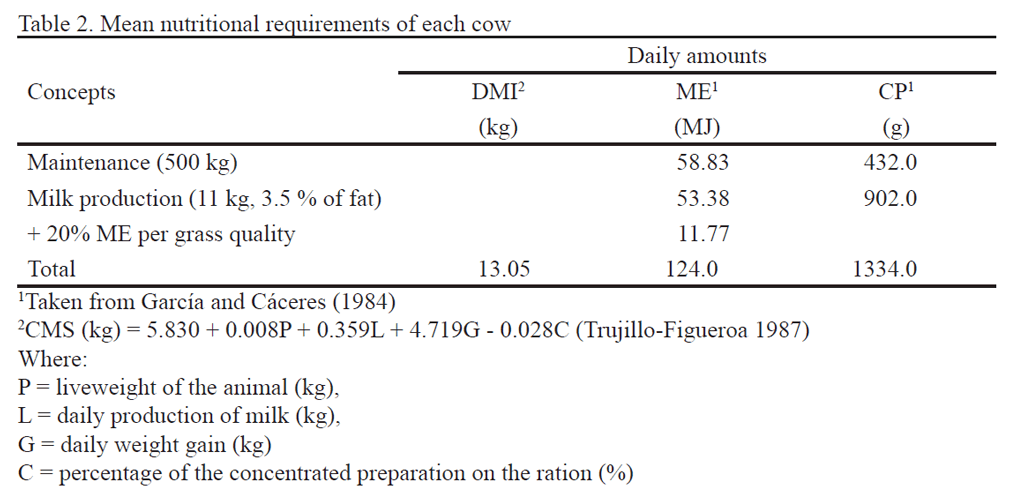
<body><![CDATA[<p align="justify"><font size="2" face="Verdana, Arial, Helvetica, sans-serif">It is suppose that if a ration for cows  of 500 kg weight is adjusted, in milk production (11 kg/d with 3.5 % of fat),  and star grass (<em>Cynodon nlemfuensis</em>), of regular quality, with the  possibility of also given, as average 1.506 kg of commercial concentrate per  animal, as well as sugar molasses and leucaena foliage (<em>Leucaena  leucocephala</em>).Of previous measures, it was obtained that the star grass  availability was of      24.25 kg per animal. </font></p>       <p align="justify"><font size="2" face="Verdana, Arial, Helvetica, sans-serif">It is necessary to explain that as PS  allows to obtain two quantities of food that cannot vary, and if you has four  foods, of which two are fixed (24.25 kg of star grass and 1.516 kg of  concentrate),then with the other two is that is intended to adjust the ME or  the CP. This explains one of the method limitations and, in turn, the need of  always combine it with others, so, to exactly satisfy the need of the adjusted  nutrient, the two proportions or obtained percentages are invariable, unique,  and could happen that the achieved values are not convenient for physiological  and economical reasons, as it can be the higher concentrate relation: forage.  It is suggested, therefore, to calculate the nutrients contributions of the two  first foods, to compare them with the nutritious requirements and to adjust the  difference with the use of molasses and leucaena. </font></p>       <p align="justify"><font size="2" face="Verdana, Arial, Helvetica, sans-serif">After knowing the nutritional benefits  of the amounts of star grass and concentrated preparation, an adjustment to the  difference in a nutrient (ME or CP) and DM was performed, with the two feeds  available for it (molasses and leucaena), which is possible with PS. The  difference obtained shows that there are still missing 51.18 MJ of ME and 399 g  of CP to provide to the animal, at a maximum of 5.245 kg of DM, which is the  remaining of the DMI. Then, these three values need to be adjusted.</font></p>       <p align="justify"><font size="2" face="Verdana, Arial, Helvetica, sans-serif">As a preference of who formulates the diet, choosing between ME and  CP could be subtracted to apply Pearson. But the needs (51.18 MJ and 399 g) are  expressed in units, different to the contributions of ME (MJ/kg) and PB (%) of  feed (<a href="/img/revistas/cjas/v49n3/t0102315.gif">table 1</a> and <a href="/img/revistas/cjas/v49n3/t0202315.gif">2</a>). And this is where emerges a big difference in the application  of the method on rations for ruminants, regarding its use to formulate  industrial mixtures, which is resolved by transforming the needs of units from  quantity to density in the remaining DM (5.245 kg). Therefore, one of the  demands to apply the square is fulfilled.</font></p>       
<p align="justify"><font size="2" face="Verdana, Arial, Helvetica, sans-serif">This calculation should be performed to know if the two feeds chosen  to complete the difference (molasses and leucaena) meet the condition that one  possesses higher density than necessity, and the other is lower (<a href="/img/revistas/cjas/v49n3/t0102315.gif">table 1</a>), for  the nutrient to be adjusted using the square or, what is the same, available  feed that could be selected in case of having several of them. In addition, it  is also useful for expressing the EM and PB of the square, and the needs in the  same units, as required by the method.</font></p>       
<p align="justify"><font size="2" face="Verdana, Arial, Helvetica, sans-serif">Molasses and leucaena meet this requirement for both nutrients.  Therefore, PS can be used to adjust the remaining ME or CP to complete the  ration.</font></p>       <p align="justify"><font size="2" face="Verdana, Arial, Helvetica, sans-serif">For feeding ruminants, the most logical aspect is to adjust ME  because this is the nutrient that regulates the DMI (NRC 1987, Minson 1990 and  Illius and Jessop 1996).&nbsp;&nbsp; </font></p>       <p align="justify"><font size="2" face="Verdana, Arial, Helvetica, sans-serif">     The ME of ration should be adjusted as follows:</font></p>     <p align="center"><a name="f2"></a></p>       <p align="center"><img src="../img/revistas/cjas/v49n3/f0202315.gif" width="500" height="175" longdesc="/img/revistas/cjas/v49n3/f0202315.gif"></p>   <font size="2" face="Verdana, Arial, Helvetica, sans-serif"></font>     
]]></body>
<body><![CDATA[<p align="justify"><font size="2" face="Verdana, Arial, Helvetica, sans-serif">With this proportions, the remaining ME      (9.758 MJ/kg or 51.18 MJ) should be adjusted, as it appears when the amounts DM  of each feed are calculated, according to the previous proportions and later,  the contributions of this nutrient. From the total amount of DM    (5.245 kg), 0.786 kg came from molasses and 4.459 kg from leucaena.</font></p>     <p align="justify"><font size="2" face="Verdana, Arial, Helvetica, sans-serif">Finally, the ME of the ration is adjusted with the two selected  feeds for it, and the total ration is composed by 24.25 kg of star grass, 1.516  kg of concentrated, 14.86 kg of leucaena foliage and 1.064 kg sugar cane  molasses (<a href="/img/revistas/cjas/v49n3/t0402315.gif">table 4</a>).</font></p>     
<p align="justify"><font size="2" face="Verdana, Arial, Helvetica, sans-serif">During the historical evolution of  ration formulation, it is known that, up to 1987, the original reference to PS  has not been found, which name, according to Benson Institute (2005), comes  from the author. However, important authors are cited, who referred its use  since 1961 (Trujillo-Figueroa 1987), but, in 1948, the square method was used  to mix dairy products up to the desired percentage of fat (Morrison 1948).  Kellem and Church (1998), Jurgen and Bregendhal (2007) and Chiba (2014) also  recognize the use of this method for this purpose. This way it was confirmed  that, dates after 1961, the &ldquo;last name&rdquo; of Pearson could be added to this  method. </font></p>     <p align="justify"><font size="2" face="Verdana, Arial, Helvetica, sans-serif">There are reports about the existence of a former method, which is  identical to the PS, called Cobenze Diagram, used for producing sugar since the  end of 1800&acute;s. To this end, it is used in the sugar cane factory because of the  need to obtain a molasses, with certain purity, from two molasses of different  purity, according to the findings of Spencer and Meade (1917), which is the  eighth edition of the original text, edited for the first time in 1889 (it was  also cited later in Spencer 1918, Meade 1963 and Clark and Garc&iacute;a-L&oacute;pez 1963),  and it is currently used (Dom&iacute;nguez 2001 and Garc&iacute;a <em>et al.</em> 2014).</font></p>     <p align="justify"><font size="2" face="Verdana, Arial, Helvetica, sans-serif">Regarding the mathematical bases of the  two methods, Trujillo-Figueroa (1987) stated that there were no answers  regarding the procedures of the method, and needed to make his own approach,  which could be or not in correspondence with those considered by Pearson.  Before the questioning of why the differences are noted in the opposite corner  or why they are added, this author proposes an explanation through the  construction, in a coordinate axis, of a triangle that encloses the solution.</font></p>     <p align="justify"><font size="2" face="Verdana, Arial, Helvetica, sans-serif">It is also true that if they  are included in a numerical axis, as fragments, the values involved in the  initial statement of PS, considering, as an example, the need of fitting (N)  9.758 MJ/kg DM with leucaena (A), with a concentration of 9.412 MJ/kg DM (CA)  plus molasses (B) of 11.72 MJ/kg DM (CB), the origin of the method could be  deduced (<a href="/img/revistas/cjas/v49n3/f0302315.gif">figure 1</a>): </font></p>     
<p align="justify"><font size="2" face="Verdana, Arial, Helvetica, sans-serif">This representation also shows the need of a feed to contain a  concentration of the nutrient under the level of necessity, and another over  it. The value of N may range between CA and CB, without  affecting the solution of the problem. However, if the need to fit is inferior  to CA or superior to CB, there will be no possible    solution. </font></p>     <p align="justify"><font size="2" face="Verdana, Arial, Helvetica, sans-serif">Taking  into account the calculations of A and B proportions, expressed in percentage,  the following can be stated:</font></p> <font size="2" face="Verdana, Arial, Helvetica, sans-serif"></font>       <p align="center"><font size="2" face="Verdana, Arial, Helvetica, sans-serif">1. A= d<sub>1</sub>/d<sub>1</sub>+d<sub>2</sub>)x100 and B=(d<sub>2</sub>/d<sub>1</sub>+d<sub>2</sub>)x100</font></p>     <p align="justify"><font size="2" face="Verdana, Arial, Helvetica, sans-serif">Demonstration</font><font size="2" face="Verdana, Arial, Helvetica, sans-serif">:</font></p>     ]]></body>
<body><![CDATA[<p align="justify"><font size="2" face="Verdana, Arial, Helvetica, sans-serif">  From the nature of the problem, two equations can be stated:</font></p>     <p align="center"><font size="2" face="Verdana, Arial, Helvetica, sans-serif">  2. [(C<sub>A</sub>/100)xA]+ [(C<sub>B</sub>/100)xB]=N &nbsp;&nbsp;&nbsp;(I)</font></p>     <p align="center"><font size="2" face="Verdana, Arial, Helvetica, sans-serif"> 3. A +&nbsp; B&nbsp; = 100&nbsp;&nbsp;&nbsp;&nbsp;&nbsp;  &nbsp;&nbsp;&nbsp;  &nbsp;&nbsp;        &nbsp;&nbsp;&nbsp;&nbsp;&nbsp;&nbsp;&nbsp;&nbsp;&nbsp;&nbsp;&nbsp;&nbsp;&nbsp;&nbsp;&nbsp;&nbsp;&nbsp;&nbsp;  (II)</font></p>     <p align="justify"><font size="2" face="Verdana, Arial, Helvetica, sans-serif">  After multiplicating (I) by 100, the result is:</font></p>     <p align="center"><font size="2" face="Verdana, Arial, Helvetica, sans-serif">  4. C<sub>A</sub> A + C<sub>B</sub> B = 100 N</font></p>     <p align="center"><font size="2" face="Verdana, Arial, Helvetica, sans-serif"> 5. A&nbsp; +&nbsp;  B = 100&nbsp;&nbsp;&nbsp;&nbsp;&nbsp; &nbsp;&nbsp;&nbsp;&nbsp;</font></p>     <p align="justify"><font size="2" face="Verdana, Arial, Helvetica, sans-serif">  After multiplicating (I) by, the result is:</font></p>     <p align="center"><font size="2" face="Verdana, Arial, Helvetica, sans-serif">  6.[(-C<sub>A</sub>/C<sub>B</sub>)xA-B=(-100/C<sub>B</sub>)xN</font></p>     <p align="center"><font size="2" face="Verdana, Arial, Helvetica, sans-serif"> A + B = 100&nbsp; </font></p>     <p align="justify"><font size="2" face="Verdana, Arial, Helvetica, sans-serif">  If both equations are summed:</font></p>     ]]></body>
<body><![CDATA[<p align="center"><font size="2" face="Verdana, Arial, Helvetica, sans-serif">  A-[(C<sub>A</sub>/C<sub>B</sub>)xA]+B-B-100-(100/C<sub>B</sub>) x N&nbsp;&nbsp;(III), are removed</font></p>     <p align="justify"><font size="2" face="Verdana, Arial, Helvetica, sans-serif">  Multiplying (III) by C<sub>B</sub> , the result is:</font></p>     <p align="center"><font size="2" face="Verdana, Arial, Helvetica, sans-serif">  8. C<sub>B</sub>A-C<sub>A</sub>A=C<sub>B</sub>100-100N</font></p>     <p align="justify"><font size="2" face="Verdana, Arial, Helvetica, sans-serif">  The common factor in both sides is determined:</font></p>     <p align="center"><font size="2" face="Verdana, Arial, Helvetica, sans-serif">  9. A (C<sub>B</sub>-C<sub>A</sub>) = 100 (C<sub>B </sub>-N)</font></p>     <p align="center"><font size="2" face="Verdana, Arial, Helvetica, sans-serif"> 10. A-[(C<sub>B</sub>-N)/(C<sub>B</sub>-C<sub>A</sub>)]x100</font></p>     <p align="justify"><font size="2" face="Verdana, Arial, Helvetica, sans-serif">  Knowing that  C<sub>B</sub>-N=d<sub>1 </sub>and that  C<sub>B</sub>-C<sub>A</sub>=d<sub>1</sub>+d<sub>2</sub>,  then:</font></p>     <p align="center"><font size="2" face="Verdana, Arial, Helvetica, sans-serif">  11. A=(d<sub>1</sub>/d<sub>1</sub>+d<sub>2</sub>)x100 </font></p> <font size="2" face="Verdana, Arial, Helvetica, sans-serif">    <p align="justify">This way, it was demonstrated that the original mathematic source of the ideas of Pearson square, or of the cited Cobenze Diagram, and that the square simply emerge as didactic resources to solve problems of this type in a mechanical way, without many mathematical abstractions. </p>       <p align="justify">Considering all the previous explanations on the functioning and mathematical basement of PS, as a mathematical method for adjusting rations for ruminants, the interpretation of the meaning of the two equations is interpreted and the information on the square is used, which, as an example, has been stated previously to adjust ME. Then, the following equation may be stated: </p>       ]]></body>
<body><![CDATA[<p align="center">11.72 M  + 9.412 L = 9.758&nbsp;&nbsp;&nbsp;&nbsp;&nbsp;&nbsp;&nbsp;&nbsp;&nbsp;&nbsp;&nbsp;&nbsp;&nbsp; 1</p>       <p align="center">M + L&nbsp; = 1&nbsp;&nbsp;&nbsp;&nbsp;&nbsp;&nbsp;&nbsp;&nbsp;&nbsp;&nbsp;&nbsp;&nbsp;&nbsp;&nbsp;&nbsp;&nbsp;&nbsp;&nbsp;&nbsp;&nbsp;&nbsp; &nbsp;&nbsp;&nbsp;&nbsp;&nbsp;&nbsp;&nbsp;&nbsp;&nbsp;&nbsp;&nbsp;&nbsp;&nbsp;&nbsp;&nbsp;2</p>       <p align="justify">Then:</p>       <p align="center">L = 1 &ndash; M </p>       <p align="justify">1 is substituted in,</p>       <p align="center">11.72 M + 9.412 (1 - M) = 9.758&nbsp;&nbsp; (R)</p>       <p align="center">11.72 M + 9.412 &ndash; 9.412 M = 9.758</p>       <p align="center">2.308 M =  9.758 &ndash; 9.412</p>       <p align="center">2.308 M = 0.356</p>       <p align="center">M =  (0.356/2.308) = 0.1499, so L= 0.8501</p>       ]]></body>
<body><![CDATA[<p align="justify">It is confirmed that the same proportions of Pearson are obtained. However, the most important practical recommendation is to establish directly this equation (R), because it allows to avoid all the Pearson procedure. In addition, it is more professional for those with superior levels of instruction. </p>       <p align="justify">This equation, which puts the calculation of the two in function of a single variable, can be stated directly, since it is known that the amount of the second feed is always the sum of both minus the first one. Then it can also be stated as “11.72 (1 - L) + 9.412 L = 9.412 L”, which allows to calculate the amount of L instead of  M.&nbsp;&nbsp;&nbsp;&nbsp;&nbsp;&nbsp;&nbsp;&nbsp;&nbsp;&nbsp; </p>       <p align="justify">It is faster if an equation (R)* is stated, which is works with the need expressed in quantity, because it is possible to obtain directly the amount of DM of both feeds to fit the desired nutrient, which is faster and advantageous for reaching the same final results reported in <a href="/img/revistas/cjas/v49n3/t0402315.gif">table 4</a> y <a href="/img/revistas/cjas/v49n3/t0502315.gif">5</a>.</p>       
<p align="justify"><a href="/img/revistas/cjas/v49n3/t0302315.gif">Table 3</a> shows the need to adjust, in 5.245 kg DM, the 51.18 MJ remaining to complete with molasses (M) and leucaena (L).</p>       
<p align="center">11.72 M + 9.412 (5.245 - M) = 51.18 (R)*</p>       <p align="center">11.72 M + 49.37 &ndash; 9.412 M = 51.18</p>       <p align="center">&nbsp;2.308 M =  51.18 &ndash; 49.366</p>       <p align="center">2.308 M = 1.814</p>       <p align="center">M =&nbsp;(1.814/2.308) = 0.786 kg MS; then, L= 5.245 &ndash; 0.786 = 4.459 kg MS </p>       <p align="justify">A similar result to that of <a href="/img/revistas/cjas/v49n3/t0302315.gif">table 3</a> is obtained when stating  &ldquo;11.72 (5.245 - L) + 9.412 L= 51.18. </p>       
]]></body>
<body><![CDATA[<p align="justify">It can be concluded that PS is a method for formulating rations, which could have come from a similar method used in the sugar and/or dairy industry, exact to its mathematical basement, which can be adapted to ruminant rations expressed in quantity, but it can be replaced due to the highest speed and professionalism, simple equation (as those cited (R)* and (R)*) and obtain the same results. </p>     <p align="justify">In any of the previous cases, there is an inflexibility of the procedures of the methods, which limits them, and may give unacceptable amounts of feeds, from zoo-technical, economical and nutritional points of view. </p>       <p align="justify">This paper may help to increase the culture of professional ethics, precision, and creativity among those in charge of formulating rations for animals.</p>       <p align="justify">&nbsp;</p>     <p align="justify"><font size="3" face="Verdana, Arial, Helvetica, sans-serif"><strong>REFERENCES</strong></font></p>     <p align="justify">Afolayan, M. O. &amp; Afolayan,  M. 2008. <span lang="EN-US">&lsquo;&lsquo;Nigeria oriented poultry feed formulation software requirements&rsquo;&rsquo;. <em>Journal  of applied Science Research</em>, 4 (11): 1596.</span></p>     <p align="justify"><span lang="EN-US">Chiba, L. I. 2014. &lsquo;&lsquo;Diet  Formulation &amp; Feed Ingredients&rsquo;&rsquo;. In: <em>Animal Nutrition Handbook</em>, 2nd  ed., Boca Raton, USA: CRC Press, pp. 575&ndash;633.</span></p>     <p align="justify">Clark, J. A. &amp; Garc&iacute;a, L. F. 1963. &lsquo;&lsquo;Empleo de la  Cruz de Cobenze en los c&aacute;lculos sobre mezclas de  distintas purezas&rsquo;&rsquo;. In: <em>El proceso de fabricaci&oacute;n de az&uacute;car crudo en los  tachos</em>, La Habana, Cuba: Ciencia y T&eacute;cnica, Instituto Cubano del Libro, pp.  263&ndash;296.</p>     <!-- ref --><p align="justify"><span lang="EN-US">Corbin, J. &amp; Strauss, A.  2008. <em>Basics of qualitative research</em>. 3rd ed., CA, USA: Thousand Oaks,  25-48 p.    </span></p>     ]]></body>
<body><![CDATA[<!-- ref --><p align="justify">Denzin, N. K. &amp; Lincoln, Y. S. 2005. <em><span lang="EN-US">The Sage handbook of qualitative research</span></em><span lang="EN-US">. 3rd ed.,  CA, USA: Thousand Oaks, 1-32 p.    </span></p>     <p align="justify"><span lang="EN-US">Dom&iacute;nguez, F. J. 2001. </span><em>Modelaci&oacute;n, Simulaci&oacute;n y Optimizaci&oacute;n del Proceso de  Transferencia de Masa que ocurre en la cristalizaci&oacute;n de az&uacute;car por  enfriamiento a nivel industrial</em>. Ph.D. Thesis,  Universidad de Matanzas &lsquo;Camilo Cienfuegos&rsquo;, Matanzas, Cuba, 45-82 p.</p>     <p align="justify">Garc&iacute;a, T. R. &amp; C&aacute;ceres, O. 1984. <em>Nuevos  sistemas para expresar el valor nutritivo de los alimentos y el requerimiento y  racionamiento de los rumiantes</em>. Matanzas, Cuba: EEPF &lsquo;Indio Hatuey&rsquo;, 44 p.</p>     <p align="justify">Garc&iacute;a, Y., L&oacute;pez, Y. &amp; Ben&iacute;tez, A. 2014.  &lsquo;&lsquo;Optimizaci&oacute;n del sistema energ&eacute;tico de un central azucarero para maximizar el  excedente de bagazo&rsquo;&rsquo;. <em>Rev Avanzada  Cient&iacute;fica</em>, 17 (1): 00&ndash;00.</p>     <p align="justify">Hern&aacute;ndez, S. R. 2003. <em>Metodolog&iacute;a de la  investigaci&oacute;n</em>. vol. 1&ndash;2, La Habana, Cuba: F&eacute;lix  Varela.</p>     <p align="justify"><span lang="EN-US">Illius, A. W. &amp; Jessop, N. S. 1996. &lsquo;&lsquo;Metabolic constraints  on voluntary intake in ruminants&rsquo;&rsquo;. </span><em>J Anim Sci.</em>, 74: 3052.</p>     <!-- ref --><p align="justify">Instituto Benson. 2005. <em>Formulaci&oacute;n  de raciones</em>. , Available:  &lt;<a href="http://benson.byu.edu/Publication/Lessons/Spanish/Lessons/ Animal/Raciones.htm" target="_blank">http://benson.byu.edu/Publication/Lessons/Spanish/Lessons/  Animal/Raciones.htm</a>&gt;, [Consulted:&nbsp;December 12, 2005].    </p>     <!-- ref --><p align="justify"><span lang="EN-US">Jurgens, M. H. &amp; Bregendahl,  K. 2007. <em>Animal feeding and nutrition</em>. 10th ed., Dubuque, IA, USA:  Kendall/Hunt Publishing Co., 62-82 p.    </span></p>     <!-- ref --><p align="justify"><span lang="EN-US">Kellems, R. O. &amp; Church, D. C. 1998. <em>Livestock  feeds and feeding</em>. 4th ed., Upper Saddle River, NJ, USA: Prentice_Hall, Inc., 35-49 p.    </span></p>     <p align="justify"><span lang="EN-US">Lanzas, C., Broderick, G. A. &amp; Fox, D. G. 2008.  &lsquo;&lsquo;Improved feed protein fractionation schemes for formulating rations with the  Cornell net carbohydrate and protein system&rsquo;&rsquo;. </span><em>J Dairy Sci.</em>, 91: 4881.</p>     <!-- ref --><p align="justify">Meade, G. P. 1963. <em>Spencer-Meade Manual de fabricaci&oacute;n de az&uacute;car de ca&ntilde;a y qu&iacute;micos  especializados</em>. Barcelona, Espa&ntilde;a: Montaner y Sim&oacute;n S.A., 769-771 p.,  Traducido por Mario Garc&iacute;a Menocal.    </p>     <!-- ref --><p align="justify"><span lang="EN-US">Minson, J. D. 1990. <em>Forage in ruminant nutrition</em>.  San Diego, CA, USA: Academic Press, 34-47 p.    </span></p>     <!-- ref --><p align="justify"><span lang="EN-US">Morrison, F. B. 1948. <em>Feeds  and Feeding: A handbook for the student and stockman</em>. 21st ed., NY, USA:  The Morrison Publishing Company, 238-239 p.    </span></p>     ]]></body>
<body><![CDATA[<!-- ref --><p align="justify"><span lang="EN-US">NRC. 1987. <em>Predicting feed  intake of food-producing animals</em>. Subcommittee on Feed Intake, Committee on  Animal Nutrition, National Research Council, USA, Available:  &lt;<a href="www.nap.edu/catalog/950.html" target="_blank">www.nap.edu/catalog/950.html</a>&gt;, [Consulted:&nbsp;December 12, 2012].    </span></p>     <p align="justify"><span lang="EN-US">NRC. 2005. <em>Mathematics and  21st Century Biology</em>. Committee on Mathematical Sciences Research for DOE&rsquo;s  Computational Biology, USA, Available: &lt;<a href="http://www.nap.edu/catalog/11315.html" target="_blank">http://www.nap.edu/catalog/11315.html</a>&gt;,  [Consulted:&nbsp;December 12, 2012].</span></p>     <p align="justify">Omidiora, E. O., Adegoke,  B. O. &amp; Aderounmu, G. A. 2013. <span lang="EN-US">&lsquo;&lsquo;Review of livestock formulation techniques&rsquo;&rsquo;. </span><em>Journal of Biology,  Agriculture and Helathcare</em>, 3 (4): 69.</p>     <!-- ref --><p align="justify">Spencer, G. L. 1918. <em>Manual de fabricaci&oacute;n de  az&uacute;car de ca&ntilde;a y qu&iacute;micos azucareros</em>. <span lang="EN-US">7th ed., New  York: John Willey &amp; Sons, Inc., 445-446 p.    </span></p>     <!-- ref --><p align="justify"><span lang="EN-US">Spencer, G. L. &amp; Meade, G.  P. 1917. <em>Cane sugar handbook. A manual for cane sugar manufacturers and  their chemists</em>. 8th ed., New York: John Willey &amp; Sons, Inc., 638-640 p.    </span></p>     <!-- ref --><p align="justify"><span lang="EN-US">Trujillo, F. V. 1987. </span><em>M&eacute;todos matem&aacute;ticos en la nutrici&oacute;n  animal</em>. <span lang="EN-US">McGraw-Hill, 240 p.    </span></p>     ]]></body>
<body><![CDATA[<p align="justify"><span lang="EN-US">van Amburgh, M. E., Overton, T. R., Chase, L. E.,  Ross, D. A. &amp; Recktenwald, E. B. 2009. &lsquo;&lsquo;The  Cornell Net Carbohydrate and Protein System: current and future approaches for  balancing of amino acids&rsquo;&rsquo;. In: <em>71st Meeting, Proceedings of the Cornell  Nutrition Conference for Feed Manufacturers</em>, East Syracuse, New York, USA, pp. 28&ndash;37</span><font size="2" face="Verdana, Arial, Helvetica, sans-serif">.</font></p></font>     <p align="justify">&nbsp;</p>     <p align="justify">&nbsp;</p>     <p align="justify"><font size="2" face="Verdana, Arial, Helvetica, sans-serif">Received: January 13,  2015    <br>   Accepted: July 16,  2015</font></p>     <p align="justify">&nbsp;</p>     <p align="justify">&nbsp;</p>     <p align="justify"><font size="2" face="Verdana, Arial, Helvetica, sans-serif"><i>A.A. Santana,</i> Universidad de Granma, Bayamo, Granma, Cuba.    Email: <a href="mailto:santana@udg.co.cu">santana@udg.co.cu</a></font></p>      ]]></body><back>
<ref-list>
<ref id="B1">
<nlm-citation citation-type="journal">
<person-group person-group-type="author">
<name>
<surname><![CDATA[Afolayan]]></surname>
<given-names><![CDATA[M. O.]]></given-names>
</name>
<name>
<surname><![CDATA[Afolayan]]></surname>
<given-names><![CDATA[M.]]></given-names>
</name>
</person-group>
<article-title xml:lang="nd"><![CDATA[Nigeria oriented poultry feed formulation software requirements]]></article-title>
<source><![CDATA[Journal of applied Science Research]]></source>
<year>2008</year>
<volume>4</volume>
<numero>11</numero>
<issue>11</issue>
<page-range>1596</page-range></nlm-citation>
</ref>
<ref id="B2">
<nlm-citation citation-type="book">
<person-group person-group-type="author">
<name>
<surname><![CDATA[Chiba]]></surname>
<given-names><![CDATA[L. I.]]></given-names>
</name>
</person-group>
<article-title xml:lang="nd"><![CDATA[Diet Formulation & Feed Ingredients]]></article-title>
<source><![CDATA[Animal Nutrition Handbook]]></source>
<year>2014</year>
<edition>2nd</edition>
<page-range>575-633</page-range><publisher-loc><![CDATA[Boca Raton, USA ]]></publisher-loc>
<publisher-name><![CDATA[CRC Press]]></publisher-name>
</nlm-citation>
</ref>
<ref id="B3">
<nlm-citation citation-type="book">
<person-group person-group-type="author">
<name>
<surname><![CDATA[Clark]]></surname>
<given-names><![CDATA[J. A.]]></given-names>
</name>
<name>
<surname><![CDATA[García]]></surname>
<given-names><![CDATA[L. F.]]></given-names>
</name>
</person-group>
<article-title xml:lang="nd"><![CDATA[Empleo de la Cruz de Cobenze en los cálculos sobre mezclas de distintas purezas]]></article-title>
<source><![CDATA[El proceso de fabricación de azúcar crudo en los tachos]]></source>
<year>1963</year>
<page-range>263-296</page-range><publisher-loc><![CDATA[La Habana, Cuba ]]></publisher-loc>
<publisher-name><![CDATA[Ciencia y Técnica, Instituto Cubano del Libro]]></publisher-name>
</nlm-citation>
</ref>
<ref id="B4">
<nlm-citation citation-type="book">
<person-group person-group-type="author">
<name>
<surname><![CDATA[Corbin]]></surname>
<given-names><![CDATA[J.]]></given-names>
</name>
<name>
<surname><![CDATA[Strauss]]></surname>
<given-names><![CDATA[A.]]></given-names>
</name>
</person-group>
<source><![CDATA[Basics of qualitative research]]></source>
<year>2008</year>
<edition>3rd</edition>
<page-range>25-48</page-range><publisher-loc><![CDATA[CA, USA ]]></publisher-loc>
<publisher-name><![CDATA[Thousand Oaks]]></publisher-name>
</nlm-citation>
</ref>
<ref id="B5">
<nlm-citation citation-type="book">
<person-group person-group-type="author">
<name>
<surname><![CDATA[Denzin]]></surname>
<given-names><![CDATA[N. K.]]></given-names>
</name>
<name>
<surname><![CDATA[Lincoln]]></surname>
<given-names><![CDATA[Y. S.]]></given-names>
</name>
</person-group>
<source><![CDATA[The Sage handbook of qualitative research]]></source>
<year>2005</year>
<edition>3rd</edition>
<page-range>1-32</page-range><publisher-loc><![CDATA[CA, USA ]]></publisher-loc>
<publisher-name><![CDATA[Thousand Oaks]]></publisher-name>
</nlm-citation>
</ref>
<ref id="B6">
<nlm-citation citation-type="book">
<person-group person-group-type="author">
<name>
<surname><![CDATA[Domínguez]]></surname>
<given-names><![CDATA[F. J.]]></given-names>
</name>
</person-group>
<source><![CDATA[Modelación, Simulación y Optimización del Proceso de Transferencia de Masa que ocurre en la cristalización de azúcar por enfriamiento a nivel industrial]]></source>
<year>2001</year>
<page-range>45-82</page-range><publisher-loc><![CDATA[Matanzas, Cuba ]]></publisher-loc>
<publisher-name><![CDATA[Universidad de Matanzas ‘Camilo Cienfuegos’]]></publisher-name>
</nlm-citation>
</ref>
<ref id="B7">
<nlm-citation citation-type="book">
<person-group person-group-type="author">
<name>
<surname><![CDATA[García]]></surname>
<given-names><![CDATA[T. R.]]></given-names>
</name>
<name>
<surname><![CDATA[Cáceres]]></surname>
<given-names><![CDATA[O.]]></given-names>
</name>
</person-group>
<source><![CDATA[Nuevos sistemas para expresar el valor nutritivo de los alimentos y el requerimiento y racionamiento de los rumiantes]]></source>
<year>1984</year>
<page-range>44</page-range><publisher-loc><![CDATA[Matanzas, Cuba ]]></publisher-loc>
<publisher-name><![CDATA[EEPF ‘Indio Hatuey’]]></publisher-name>
</nlm-citation>
</ref>
<ref id="B8">
<nlm-citation citation-type="journal">
<person-group person-group-type="author">
<name>
<surname><![CDATA[García]]></surname>
<given-names><![CDATA[Y.]]></given-names>
</name>
<name>
<surname><![CDATA[López]]></surname>
<given-names><![CDATA[Y.]]></given-names>
</name>
<name>
<surname><![CDATA[Benítez]]></surname>
<given-names><![CDATA[A.]]></given-names>
</name>
</person-group>
<article-title xml:lang="nd"><![CDATA[Optimización del sistema energético de un central azucarero para maximizar el excedente de bagazo]]></article-title>
<source><![CDATA[Rev Avanzada Científica]]></source>
<year>2014</year>
<volume>17</volume>
<numero>1</numero>
<issue>1</issue>
<page-range>00-00</page-range></nlm-citation>
</ref>
<ref id="B9">
<nlm-citation citation-type="book">
<person-group person-group-type="author">
<name>
<surname><![CDATA[Hernández]]></surname>
<given-names><![CDATA[S. R.]]></given-names>
</name>
</person-group>
<source><![CDATA[Metodología de la investigación]]></source>
<year>2003</year>
<volume>1</volume><volume>2</volume>
<publisher-loc><![CDATA[La Habana, Cuba ]]></publisher-loc>
<publisher-name><![CDATA[Félix Varela]]></publisher-name>
</nlm-citation>
</ref>
<ref id="B10">
<nlm-citation citation-type="journal">
<person-group person-group-type="author">
<name>
<surname><![CDATA[Illius]]></surname>
<given-names><![CDATA[A. W.]]></given-names>
</name>
<name>
<surname><![CDATA[Jessop]]></surname>
<given-names><![CDATA[N. S.]]></given-names>
</name>
</person-group>
<article-title xml:lang="nd"><![CDATA[Metabolic constraints on voluntary intake in ruminants]]></article-title>
<source><![CDATA[J Anim Sci.]]></source>
<year>1996</year>
<volume>74</volume>
<page-range>3052</page-range></nlm-citation>
</ref>
<ref id="B11">
<nlm-citation citation-type="">
<person-group person-group-type="author">
<name>
<surname><![CDATA[Instituto Benson]]></surname>
</name>
</person-group>
<source><![CDATA[Formulación de raciones]]></source>
<year>2005</year>
</nlm-citation>
</ref>
<ref id="B12">
<nlm-citation citation-type="book">
<person-group person-group-type="author">
<name>
<surname><![CDATA[Jurgens]]></surname>
<given-names><![CDATA[M. H.]]></given-names>
</name>
<name>
<surname><![CDATA[Bregendahl]]></surname>
<given-names><![CDATA[K.]]></given-names>
</name>
</person-group>
<source><![CDATA[Animal feeding and nutrition]]></source>
<year>2007</year>
<edition>10th</edition>
<page-range>62-82</page-range><publisher-loc><![CDATA[Dubuque, IA, USA ]]></publisher-loc>
<publisher-name><![CDATA[Kendall/Hunt Publishing Co.]]></publisher-name>
</nlm-citation>
</ref>
<ref id="B13">
<nlm-citation citation-type="book">
<person-group person-group-type="author">
<name>
<surname><![CDATA[Kellems]]></surname>
<given-names><![CDATA[R. O.]]></given-names>
</name>
<name>
<surname><![CDATA[Church]]></surname>
<given-names><![CDATA[D. C.]]></given-names>
</name>
</person-group>
<source><![CDATA[Livestock feeds and feeding]]></source>
<year>1998</year>
<edition>4th</edition>
<page-range>35-49</page-range><publisher-loc><![CDATA[Upper Saddle River, NJ, USA ]]></publisher-loc>
<publisher-name><![CDATA[Prentice_Hall, Inc.]]></publisher-name>
</nlm-citation>
</ref>
<ref id="B14">
<nlm-citation citation-type="journal">
<person-group person-group-type="author">
<name>
<surname><![CDATA[Lanzas]]></surname>
<given-names><![CDATA[C.]]></given-names>
</name>
<name>
<surname><![CDATA[Broderick]]></surname>
<given-names><![CDATA[G. A.]]></given-names>
</name>
<name>
<surname><![CDATA[Fox]]></surname>
<given-names><![CDATA[D. G.]]></given-names>
</name>
</person-group>
<article-title xml:lang="nd"><![CDATA[Improved feed protein fractionation schemes for formulating rations with the Cornell net carbohydrate and protein system]]></article-title>
<source><![CDATA[J Dairy Sci.]]></source>
<year>2008</year>
<volume>91</volume>
<page-range>4881</page-range></nlm-citation>
</ref>
<ref id="B15">
<nlm-citation citation-type="book">
<person-group person-group-type="author">
<name>
<surname><![CDATA[Meade]]></surname>
<given-names><![CDATA[G. P.]]></given-names>
</name>
</person-group>
<source><![CDATA[Spencer-Meade Manual de fabricación de azúcar de caña y químicos especializados]]></source>
<year>1963</year>
<page-range>769-771</page-range><publisher-loc><![CDATA[Barcelona, España ]]></publisher-loc>
<publisher-name><![CDATA[Montaner y Simón S.A.]]></publisher-name>
</nlm-citation>
</ref>
<ref id="B16">
<nlm-citation citation-type="book">
<person-group person-group-type="author">
<name>
<surname><![CDATA[Minson]]></surname>
<given-names><![CDATA[J. D.]]></given-names>
</name>
</person-group>
<source><![CDATA[Forage in ruminant nutrition]]></source>
<year>1990</year>
<page-range>34-47</page-range><publisher-loc><![CDATA[San Diego, CA, USA ]]></publisher-loc>
<publisher-name><![CDATA[Academic Press]]></publisher-name>
</nlm-citation>
</ref>
<ref id="B17">
<nlm-citation citation-type="book">
<person-group person-group-type="author">
<name>
<surname><![CDATA[Morrison]]></surname>
<given-names><![CDATA[F. B.]]></given-names>
</name>
</person-group>
<source><![CDATA[Feeds and Feeding: A handbook for the student and stockman]]></source>
<year>1948</year>
<edition>21st</edition>
<page-range>238-239</page-range><publisher-loc><![CDATA[NY, USA ]]></publisher-loc>
<publisher-name><![CDATA[The Morrison Publishing Company]]></publisher-name>
</nlm-citation>
</ref>
<ref id="B18">
<nlm-citation citation-type="">
<person-group person-group-type="author">
<name>
<surname><![CDATA[NRC]]></surname>
</name>
</person-group>
<source><![CDATA[Predicting feed intake of food-producing animals]]></source>
<year>1987</year>
</nlm-citation>
</ref>
<ref id="B19">
<nlm-citation citation-type="">
<person-group person-group-type="author">
<name>
<surname><![CDATA[NRC]]></surname>
</name>
</person-group>
<source><![CDATA[Mathematics and 21st Century Biology]]></source>
<year>2005</year>
</nlm-citation>
</ref>
<ref id="B20">
<nlm-citation citation-type="journal">
<person-group person-group-type="author">
<name>
<surname><![CDATA[Omidiora]]></surname>
<given-names><![CDATA[E. O.]]></given-names>
</name>
<name>
<surname><![CDATA[Adegoke]]></surname>
<given-names><![CDATA[B. O.]]></given-names>
</name>
<name>
<surname><![CDATA[Aderounmu]]></surname>
<given-names><![CDATA[G. A.]]></given-names>
</name>
</person-group>
<article-title xml:lang="nd"><![CDATA[Review of livestock formulation techniques]]></article-title>
<source><![CDATA[Journal of Biology, Agriculture and Helathcare]]></source>
<year>2013</year>
<volume>3</volume>
<numero>4</numero>
<issue>4</issue>
<page-range>69</page-range></nlm-citation>
</ref>
<ref id="B21">
<nlm-citation citation-type="book">
<person-group person-group-type="author">
<name>
<surname><![CDATA[Spencer]]></surname>
<given-names><![CDATA[G. L.]]></given-names>
</name>
</person-group>
<source><![CDATA[Manual de fabricación de azúcar de caña y químicos azucareros]]></source>
<year>1918</year>
<edition>7th</edition>
<page-range>445-446</page-range><publisher-loc><![CDATA[New York ]]></publisher-loc>
<publisher-name><![CDATA[John Willey & Sons, Inc.]]></publisher-name>
</nlm-citation>
</ref>
<ref id="B22">
<nlm-citation citation-type="book">
<person-group person-group-type="author">
<name>
<surname><![CDATA[Spencer]]></surname>
<given-names><![CDATA[G. L.]]></given-names>
</name>
<name>
<surname><![CDATA[Meade]]></surname>
<given-names><![CDATA[G. P.]]></given-names>
</name>
</person-group>
<source><![CDATA[Cane sugar handbook. A manual for cane sugar manufacturers and their chemists]]></source>
<year>1917</year>
<edition>8th</edition>
<page-range>638-640</page-range><publisher-loc><![CDATA[New York ]]></publisher-loc>
<publisher-name><![CDATA[John Willey & Sons, Inc.]]></publisher-name>
</nlm-citation>
</ref>
<ref id="B23">
<nlm-citation citation-type="book">
<person-group person-group-type="author">
<name>
<surname><![CDATA[Trujillo]]></surname>
<given-names><![CDATA[F. V.]]></given-names>
</name>
</person-group>
<source><![CDATA[Métodos matemáticos en la nutrición animal]]></source>
<year>1987</year>
<page-range>240</page-range><publisher-name><![CDATA[McGraw-Hill]]></publisher-name>
</nlm-citation>
</ref>
<ref id="B24">
<nlm-citation citation-type="">
<person-group person-group-type="author">
<name>
<surname><![CDATA[van Amburgh]]></surname>
<given-names><![CDATA[M. E.]]></given-names>
</name>
<name>
<surname><![CDATA[Overton]]></surname>
<given-names><![CDATA[T. R.]]></given-names>
</name>
<name>
<surname><![CDATA[Chase]]></surname>
<given-names><![CDATA[L. E.]]></given-names>
</name>
<name>
<surname><![CDATA[Ross]]></surname>
<given-names><![CDATA[D. A.]]></given-names>
</name>
<name>
<surname><![CDATA[Recktenwald]]></surname>
<given-names><![CDATA[E. B.]]></given-names>
</name>
</person-group>
<article-title xml:lang="nd"><![CDATA[The Cornell Net Carbohydrate and Protein System: current and future approaches for balancing of amino acids]]></article-title>
<source><![CDATA[]]></source>
<year>2009</year>
<page-range>28-37</page-range><publisher-loc><![CDATA[East Syracuse, New York, USA, ]]></publisher-loc>
</nlm-citation>
</ref>
</ref-list>
</back>
</article>