<?xml version="1.0" encoding="ISO-8859-1"?><article xmlns:mml="http://www.w3.org/1998/Math/MathML" xmlns:xlink="http://www.w3.org/1999/xlink" xmlns:xsi="http://www.w3.org/2001/XMLSchema-instance">
<front>
<journal-meta>
<journal-id>2079-3480</journal-id>
<journal-title><![CDATA[Cuban Journal of Agricultural Science]]></journal-title>
<abbrev-journal-title><![CDATA[Cuban J. Agric. Sci.]]></abbrev-journal-title>
<issn>2079-3480</issn>
<publisher>
<publisher-name><![CDATA[Editorial del Instituto de Ciencia Animal]]></publisher-name>
</publisher>
</journal-meta>
<article-meta>
<article-id>S2079-34802015000300011</article-id>
<title-group>
<article-title xml:lang="en"><![CDATA[Effects of a microbial preparation, a probiotic and commercial antibiotic on the productive performance and pigs health in post-weaning period]]></article-title>
<article-title xml:lang="es"><![CDATA[Efectos de un preparado microbiano, un probiótico y un antibiótico comercial en el comportamiento productivo y en la salud de los cerdos en etapa posdestete]]></article-title>
</title-group>
<contrib-group>
<contrib contrib-type="author">
<name>
<surname><![CDATA[Flores]]></surname>
<given-names><![CDATA[L]]></given-names>
</name>
<xref ref-type="aff" rid="A01"/>
</contrib>
<contrib contrib-type="author">
<name>
<surname><![CDATA[Elías]]></surname>
<given-names><![CDATA[A]]></given-names>
</name>
<xref ref-type="aff" rid="A02"/>
</contrib>
<contrib contrib-type="author">
<name>
<surname><![CDATA[Proaño]]></surname>
<given-names><![CDATA[F]]></given-names>
</name>
<xref ref-type="aff" rid="A01"/>
</contrib>
<contrib contrib-type="author">
<name>
<surname><![CDATA[Granizo]]></surname>
<given-names><![CDATA[G]]></given-names>
</name>
<xref ref-type="aff" rid="A01"/>
</contrib>
<contrib contrib-type="author">
<name>
<surname><![CDATA[Medina]]></surname>
<given-names><![CDATA[Yolaine]]></given-names>
</name>
<xref ref-type="aff" rid="A02"/>
</contrib>
<contrib contrib-type="author">
<name>
<surname><![CDATA[López]]></surname>
<given-names><![CDATA[Sandra]]></given-names>
</name>
<xref ref-type="aff" rid="A01"/>
</contrib>
<contrib contrib-type="author">
<name>
<surname><![CDATA[Herrera]]></surname>
<given-names><![CDATA[F]]></given-names>
</name>
<xref ref-type="aff" rid="A02"/>
</contrib>
<contrib contrib-type="author">
<name>
<surname><![CDATA[Caicedo]]></surname>
<given-names><![CDATA[W]]></given-names>
</name>
<xref ref-type="aff" rid="A03"/>
</contrib>
</contrib-group>
<aff id="A01">
<institution><![CDATA[,Escuela Superior Politécnica de Chimborazo  ]]></institution>
<addr-line><![CDATA[Riobamba ]]></addr-line>
<country>Ecuador</country>
</aff>
<aff id="A02">
<institution><![CDATA[,Instituto de Ciencia Animal  ]]></institution>
<addr-line><![CDATA[San José de las Lajas Mayabeque]]></addr-line>
<country>Cuba</country>
</aff>
<aff id="A03">
<institution><![CDATA[,Universidad Estatal Amazónica  ]]></institution>
<addr-line><![CDATA[Pastaza ]]></addr-line>
<country>Ecuador</country>
</aff>
<pub-date pub-type="pub">
<day>00</day>
<month>09</month>
<year>2015</year>
</pub-date>
<pub-date pub-type="epub">
<day>00</day>
<month>09</month>
<year>2015</year>
</pub-date>
<volume>49</volume>
<numero>3</numero>
<fpage>357</fpage>
<lpage>365</lpage>
<copyright-statement/>
<copyright-year/>
<self-uri xlink:href="http://scielo.sld.cu/scielo.php?script=sci_arttext&amp;pid=S2079-34802015000300011&amp;lng=en&amp;nrm=iso"></self-uri><self-uri xlink:href="http://scielo.sld.cu/scielo.php?script=sci_abstract&amp;pid=S2079-34802015000300011&amp;lng=en&amp;nrm=iso"></self-uri><self-uri xlink:href="http://scielo.sld.cu/scielo.php?script=sci_pdf&amp;pid=S2079-34802015000300011&amp;lng=en&amp;nrm=iso"></self-uri><abstract abstract-type="short" xml:lang="en"><p><![CDATA[To measure the influence of a Stafac (Virginiamycin at 2%, 1 kg.t-1) commercial antibiotic, a ML 100 E (1kg.t-1) commercial probiotic and a (15 mL.kg LW -1) microbial preparation in the productive performance and health of post weaning pigs, an experiment by a complete randomized design, with three treatments and four repetitions was conducted. A total of 120 barrow pigs were used, from Landrace x Large White cross, with Belga x Pietrain sire at finishing stage, of 28d of age, 6.85 kg average weight and± 0.25 kg. In pigs feed concentrates to those that the microbial preparation was added, the higher final weight and the best gain of total weight and daily (P < 0.05): 25.85 kg, 18.97 kg and 440.75 g was determined, respectively. The most efficient values, as feed conversion, protein and energy, were obtained in the treatment to which the microbial preparation 1.66 kg DM.kg LW-1, 347.35 g.kg LW-1 of CP and 22.71 MJ.kg LW-1 was added, respectively. The less digestive problems presence (number of diarrhea) was registered in the group of animals fed with concentrate plus microbial preparation, with incidence of 13.With the addition of the microbial preparation, at 15 mL.kg LW-1,it can improve the concentrates nutritional quality and obtain better productive and health parameters in post-weaning pigs, without using antibiotics]]></p></abstract>
<abstract abstract-type="short" xml:lang="es"><p><![CDATA[Para medir la influencia de un antibiótico comercial Stafac (Virginiamicina al 2 %, 1 kg.t-1), un probiótico comercial ML 100 E (1kg.t-1) y un preparado microbiano (15 mL.kg PV-1) en el comportamiento productivo y en la salud de cerdos postdestete, se condujo un experimento mediante diseño completamente aleatorizado, con tres tratamientos y cuatro repeticiones. Se utilizaron 120 cerdos castrados, del cruce Landrace x Large White, con padre finalizador Blanco Belga x Pietrain, de 28 d de edad, 6.85 kg de peso promedio y ± 0.25 kg. En los cerdos alimentados con concentrados a los que se agregó el preparado microbiano, se determinó el mayor peso final y la mejor ganancia de peso total y diaria (P < 0.05): 25.85 kg, 18.97 kg y 440.75 g, respectivamente. Los valores más eficientes, en cuanto a conversión alimentaria, proteína y energía, se obtuvieron en el tratamiento al que se adicionó el preparado microbiano: 1.66 kg MS.kg PV-1, 347.35 g.kg PV-1 de PB y 22.71 MJ.kg PV-1, respectivamente. La menor presencia de problemas digestivos (número de diarreas) se registró en el grupo de animales alimentados con concentrado más preparado microbiano, con incidencia de 13. Con la adición del preparado microbiano, a razón de 15 mL.kg PV-1, se puede mejorar la calidad nutricional de los concentrados y obtener mejores indicadores productivos y de salud en cerdos en posdestete, sin utilizar antibióticos]]></p></abstract>
<kwd-group>
<kwd lng="en"><![CDATA[microbial preparation]]></kwd>
<kwd lng="en"><![CDATA[commercial antibiotic]]></kwd>
<kwd lng="en"><![CDATA[post- weaning pigs]]></kwd>
<kwd lng="en"><![CDATA[whey]]></kwd>
<kwd lng="es"><![CDATA[preparado microbiano]]></kwd>
<kwd lng="es"><![CDATA[antibiótico comercial]]></kwd>
<kwd lng="es"><![CDATA[cerdos posdestete]]></kwd>
<kwd lng="es"><![CDATA[suero de leche]]></kwd>
</kwd-group>
</article-meta>
</front><body><![CDATA[ <p align="right"><font size="2" face="Verdana, Arial, Helvetica,   sans-serif"><b>ORIGINAL ARTICLE</b></font></p>     <p>&nbsp;</p>     <p align="justify"><font size="4" face="Verdana, Arial, Helvetica, sans-serif"><b>Effects of a microbial preparation, a probiotic and commercial antibiotic on the productive performance and pigs health in post-weaning period</b></font></p>     <p align="justify">&nbsp;</p>     <p align="justify"><font size="3" face="Verdana, Arial, Helvetica, sans-serif"><b>Efectos de un preparado microbiano, un probiótico y un antibiótico comercial en el comportamiento productivo y en la salud de los cerdos en etapa posdestete</b></font></p>     <p align="justify">&nbsp;</p>     <p align="justify">&nbsp;</p>     <p align="justify"><font size="2" face="Verdana, Arial, Helvetica, sans-serif"><b>L. Flores,</b><sup><b>I</b></sup><b> A. Elías,</b><sup><b>II</b></sup><b> F. Proaño,</b><sup><b>I</b></sup><b> G. Granizo,</b><sup><b>I</b></sup><b> Yolaine Medina,</b><sup><b>II</b></sup><b> Sandra López,</b><sup><b>I</b></sup><b> F. Herrera,</b><sup><b>II</b></sup><b> W. Caicedo,</b><sup><b>III</b></sup></font></p>     <p align="justify"><font size="2" face="Verdana, Arial, Helvetica, sans-serif"><sup>I</sup>Escuela Superior Politécnica de Chimborazo. Panamericana Sur km. 1 1/2, Riobamba, Ecuador.</font><font size="2" face="Verdana, Arial, Helvetica, sans-serif"><sup>    <br>   II</sup>Instituto de Ciencia Animal, Apartado Postal 24, San José de las Lajas, Mayabeque, Cuba.    ]]></body>
<body><![CDATA[<br>   </font><font size="2" face="Verdana, Arial, Helvetica, sans-serif"><sup>III</sup>Universidad Estatal Amazónica, Km 2 ½ Vía a Napo, Pastaza, Ecuador.</font></p>     <p align="justify">&nbsp;</p>     <p align="justify">&nbsp;</p> <hr align="JUSTIFY">     <p align="justify"><font size="2" face="Verdana, Arial, Helvetica, sans-serif"><b>ABSTRACT</b></font></p>     <p align="justify"><font size="2" face="Verdana, Arial, Helvetica, sans-serif">To  measure the influence of a Stafac (Virginiamycin at 2%, 1 kg.t<sup>-1</sup>) commercial  antibiotic, a&nbsp; ML 100 E (1kg.t<sup>-1</sup>)  commercial probiotic and a (15 mL.kg LW <sup>-1</sup>)&nbsp; microbial preparation in the productive  performance and health of post weaning pigs, an experiment by a complete  randomized design, with three treatments and four repetitions was conducted. A  total of 120 barrow pigs were used, from Landrace x Large White cross, with  Belga x Pietrain sire at finishing stage, of 28d of age, 6.85 kg average weight  and&plusmn; 0.25 kg. In pigs feed concentrates to those that the microbial preparation  was added, the higher final weight and the best gain of total weight and daily  (P &lt; 0.05): 25.85 kg, 18.97 kg and 440.75 g was determined, respectively.  The most efficient values, as feed conversion, protein and energy, were  obtained in the treatment to which the microbial preparation 1.66 kg DM.kg LW<sup>-1</sup>,  347.35 g.kg LW<sup>-1</sup> of CP and 22.71 MJ.kg LW<sup>-1</sup> was added,  respectively. The less digestive problems presence (number of diarrhea) was  registered in the group of animals fed with concentrate plus microbial  preparation, with incidence of 13.With the addition of the microbial  preparation, at 15 mL.kg LW<sup>-1</sup>,it can improve the concentrates  nutritional quality and obtain&nbsp; better  productive and health parameters in post-weaning pigs, without using  antibiotics.</font></p>     <p align="justify"><font size="2" face="Verdana, Arial, Helvetica, sans-serif"><b>Key words:</b> microbial preparation, commercial antibiotic, post- weaning pigs, whey.</font></p> <hr align="JUSTIFY">     <p align="justify"><font size="2" face="Verdana, Arial, Helvetica, sans-serif"><b>RESUMEN</b></font></p>     <p align="justify"><font size="2" face="Verdana, Arial, Helvetica, sans-serif">Para medir la influencia de un antibi&oacute;tico comercial  Stafac (Virginiamicina al 2 %, 1 kg.t<sup>-1</sup>), un probi&oacute;tico comercial ML  100 E (1kg.t<sup>-1</sup>) y un preparado microbiano (15 mL.kg PV<sup>-1</sup>)  en el comportamiento productivo y en la salud de cerdos postdestete, se condujo  un experimento mediante dise&ntilde;o completamente aleatorizado, con tres  tratamientos y cuatro repeticiones. Se&nbsp;  utilizaron 120 cerdos castrados, del cruce&nbsp; Landrace x Large White, con padre finalizador  Blanco Belga x Pietrain, de 28 d de edad, 6.85 kg de peso promedio y &plusmn; 0.25 kg.  En los cerdos alimentados con concentrados a los que se agreg&oacute; el preparado  microbiano, se determin&oacute; el mayor peso final y la mejor ganancia de peso total  y diaria&nbsp; (P &lt; 0.05): 25.85 kg,  18.97 kg y 440.75 g, respectivamente. Los valores m&aacute;s eficientes, en cuanto a  conversi&oacute;n alimentaria, prote&iacute;na y energ&iacute;a, se obtuvieron en el tratamiento al  que se adicion&oacute; el preparado microbiano: 1.66 kg MS.kg PV<sup>-1</sup>, 347.35  g.kg PV<sup>-1</sup> de PB y 22.71 MJ.kg PV<sup>-1</sup>, respectivamente. La  menor presencia de problemas digestivos (n&uacute;mero de diarreas) se registr&oacute; en el  grupo de animales alimentados con concentrado m&aacute;s preparado microbiano, con  incidencia de 13. Con la adici&oacute;n del preparado microbiano, a raz&oacute;n de 15 mL.kg  PV<sup>-1</sup>, se puede mejorar la calidad nutricional de los concentrados y  obtener mejores indicadores productivos y de salud en cerdos en posdestete, sin  utilizar antibi&oacute;ticos.</font></p>     <p align="justify"><font size="2" face="Verdana, Arial, Helvetica, sans-serif"><b>Palabras    clave:</b>    preparado microbiano, antibiótico comercial, cerdos posdestete, suero de leche.</font></p> <hr align="JUSTIFY">     <p align="justify">&nbsp;</p>     ]]></body>
<body><![CDATA[<p align="justify">&nbsp;</p>     <p align="justify"><strong><font size="3" face="Verdana, Arial, Helvetica, sans-serif">INTRODUCTION</font></strong></p>     <p align="justify"><font size="2" face="Verdana, Arial, Helvetica, sans-serif">The antibiotics or  antimicrobial have played an important function in the growth and development  of the pork industry for more than 50 years. Its effectiveness, in terms of  influencing in the growth rate increases, when improving food use and reduces  mortality result of clinic illnesses, is well documented (Cromwell 2002).  However, worries related with the bacterial strains development increase at  present time, potentially resistant to antibiotics, that are related to the  genes that influences in human health (Heo <em>et al.</em> 2012). Recently the  current politicians about the use of antimicrobials in European Union and its  effect on animal production have been checked. State and federal proposals have  also been formulated, guided to restrict or drastically reduce the  antimicrobials used as feed additives in United States (Clark <em>et al.</em> 2012). </font></p>     <p align="justify"><font size="2" face="Verdana, Arial, Helvetica, sans-serif">The probiotics has  consolidated as one of the natural alternatives to the use of antibiotics  promoters of growth in animals, because they do not produce collateral effects  and produce better digestibility, gain in weight and higher index of alimentary  conversion (Guti&eacute;rrez <em>et al.</em>  2013). Probiotics, as live microbial additives, provides benefits to the  animal health, because they improve their microbial intestinal balance. Its  application in the feeding of weaning sucking piglets has allowed improving the  zootechnical parameters alimentary conversion, final liveweight gain and immune  response (Jurado <em>et al.</em> 2013). Vitafert has been developed in Cuba and  applied on feeding different animal species and categoties (El&iacute;as y Herrera  2008) </font></p>     <p align="justify"><font size="2" face="Verdana, Arial, Helvetica, sans-serif">In Ecuador, there have been  used microbial preparation with excellent probiotic activity, based on whey,  sugar cane juice and pigs feces as bio-accelerated. These, being rich products  in organic and lactic acids and yeasts, improved the bio-preparation quality  (D&iacute;az 2011). </font></p>     <p align="justify"><font size="2" face="Verdana, Arial, Helvetica, sans-serif">The objectives of this research were characterize  chemical and microbiological, the microbial preparation, to compare the nutrients  content of experimental diets and to evaluate the productive performance and  health during the post-weaning period. </font></p>     <p align="justify">&nbsp;</p>     <p align="justify"><strong><font size="3" face="Verdana, Arial, Helvetica, sans-serif">MATERIALS AND METHODS</font></strong></p>     <p align="justify"><font size="2" face="Verdana, Arial, Helvetica, sans-serif"><em>Experiment location</em>. The  experiment was developed in the Biotechnology and Animal Nutrition laboratories  and in the Academic Pork Unit, belonging to Cattle Sciences Faculty (CSF) of  the Chimborazo Higher Polytechnic School, in Ecuador (CHHPS).</font></p>     <p align="justify"><font size="2" face="Verdana, Arial, Helvetica, sans-serif"><em>Experimental period 1</em>. <em>Preparation and characterization of the microbial  preparation.</em> This period lasted nine days. In plastic tanks, of 220 L  capacity, fresh whey, molasses, urea, mineral salt and water were mixed,  according to Diaz (2013) recommendations (<a href="#t1">table 1</a>). </font></p>     ]]></body>
<body><![CDATA[<p align="center"><a name="t1"></a></p>     <p align="center"><img src="../img/revistas/cjas/v49n3/t0111315.gif" width="300" height="284" longdesc="/img/revistas/cjas/v49n3/t0111315.gif"></p>     
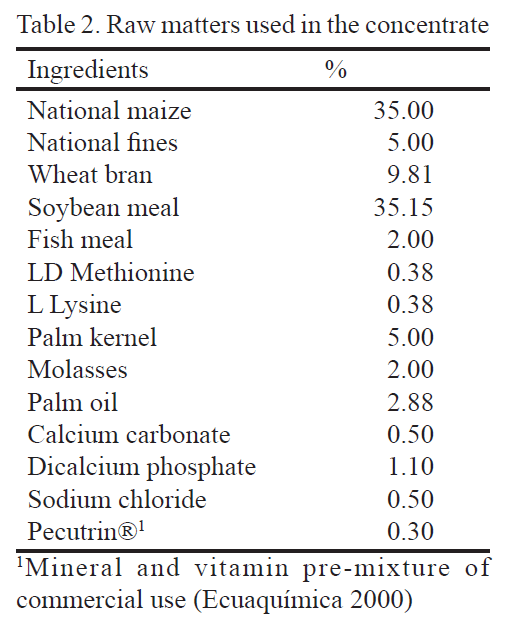
<p align="justify"><font size="2" face="Verdana, Arial, Helvetica, sans-serif">The whey was taken from the CSF industrial dairy, CHHPS.  The molasses contained 85 Brix degrees. The urea contained 46% of nitrogen. The  mineral salt was composed by 9% of calcium and 10% of phosphorous. Both were  obtain in commercial way. The human consumption water was used and it was two  hours rest before its use.</font></p>     <p align="justify"><font size="2" face="Verdana, Arial, Helvetica, sans-serif">The mixture components were homogenized and were stayed  with hermetic cover during 96h, at room temperature. For the product  characterization, five samples were taken (200 mL).There were determined pH  (WPA portable potentiometer); organic acids content, according to the technique  propose by Erwin <em>et al.</em> (1961) and microorganisms recount: lactic  bacteria, fungi and yeasts, according with Merck (2005) procedure. </font></p>     <p align="justify"><font size="2" face="Verdana, Arial, Helvetica, sans-serif">For the microbial preparation, the statistic descriptive  was used; the Infostat (2012) program was specifically applied.</font></p>     <p align="justify"><font size="2" face="Verdana, Arial, Helvetica, sans-serif"><em>Experimental period 2</em>.<em>Comparison of diets  nutrients content</em>. This period lasted 30 d. A concentrate in which was  considered as basic diet (<a href="/img/revistas/cjas/v49n3/t0211315.gif">table 2</a>) the one that maintain the same raw matter for the post-weaning period was formulated, due to the animals nutritionals requirements, according NRC (1998). <a href="#t3">Table 3</a> shows the nutritional contribution of the diet.</font></p>     
<p align="center"><a name="t3"></a></p>     <p align="center"><img src="../img/revistas/cjas/v49n3/t0311315.gif" width="330" height="350" longdesc="/img/revistas/cjas/v49n3/t0311315.gif"></p>     
<p align="justify"><font size="2" face="Verdana, Arial, Helvetica, sans-serif">To estimate the nutritional influence that may cause the  addition of the microbial preparation made by Diaz (2013), regarding the  addition of an antibiotic cited by Cromwell (2001) and a probiotic referred by  Allen <em>et al.</em> (2013), laboratory analysis were carried out for three  treatments:</font></p>     <p align="justify"><font size="2" face="Verdana, Arial, Helvetica, sans-serif">1- Concentrate&nbsp;  +&nbsp; commercial antibiotic (Stafac  is the trademark for Virginiamicina) </font></p>     ]]></body>
<body><![CDATA[<p align="justify"><font size="2" face="Verdana, Arial, Helvetica, sans-serif">2- Concentrate + commercial  probiotic    (ML100 E).The commercial probiotic (More Yeast 100 E) is a combination of yeast  culture with live cells of <em>Saccharomyces cerevisiae</em>, <em>Bacillus  subtilis</em> and digestive enzymes (proteases, lipases, amylases and  cellulaces).</font></p>     <p align="justify"><font size="2" face="Verdana, Arial, Helvetica, sans-serif">3- Basic&nbsp; concentrate + microbial preparation    (15 mL.kg LW<sup>-1</sup>)</font></p>     <p align="justify"><font size="2" face="Verdana, Arial, Helvetica, sans-serif">All treatments were subjected to proximal analysis,  according to AOAC (2005).The <em>in vitro</em> digestibility of crude protein was  determined by pancreatine pepsin technique (Dierick <em>et al.</em>1985) and  true protein, according to Bernstein (1983).For the comparison of the nutrients  content of experimental diets, means of each treatments were used, after  analyzing the five    samples. </font></p>     <p align="justify"><font size="2" face="Verdana, Arial, Helvetica, sans-serif"><em>Experimental period 3</em>. <em>Evaluation  of productive indexes in fattening pigs</em>. The initial weight, final weight,  total weight gain, daily weight gain, dry matter conversion, protein conversion  and energy conversion were evaluated, according to the treatments conception of  the second stage.&nbsp; </font></p>     <p align="justify"><font size="2" face="Verdana, Arial, Helvetica, sans-serif"><em>Experimental procedure</em>. A total of 120 barrows pigs were used,  Landrace-Large White x Belga-Pietrain cross, of 28d of age, with 6.85 kg &plusmn; 0.25  kg. Each experimental unit was composed of 10 pigs, housed in 2 x 2.25 m  collective pens, with density of a pig for    0.45 m<sup>2</sup>.The animals received three experimental treatments. The food  was offered every 24h during the morning 8:00 a.m. The water was <em>ad libitum</em> in nipple waterers. </font></p>     <p align="justify"><font size="2" face="Verdana, Arial, Helvetica, sans-serif"><em>Statistical analysis</em>. For  productive performance the co- variable analysis in the variables final weight,  total weight gain, daily weight gain, dry matter conversion, protein conversion  and energy conversion was carried out. The initial weight was took as  concomitant variable, which not influence in the mentioned variables,&nbsp; that is why variance analysis according to  totally randomized design was carried out, according InfoStat (2012),with three  treatments and four repetitions per treatment. Duncan (1955) test for (P &lt;  0.05) was applied when it was necessary.</font></p>     <p align="justify"><font size="2" face="Verdana, Arial, Helvetica, sans-serif">The theoretical suppositions of the variance analysis  for number of diarrheas variable were analyzed. Shapiro and Wilk (1965) test  for errors normality was used. The Levene (1960) test for the homogeneity  variance that fulfill this suppositions was applied, which was not necessary to  carry out its transformation (&radic;x) by the statistical Software StatSoft, Inc.  (2003). Later on, variance analysis was made, according to initially foreseen  design. </font></p>     <p align="justify">&nbsp;</p>     <p align="justify"><strong><font size="3" face="Verdana, Arial, Helvetica, sans-serif">RESULTS AND DISCUSSION</font></strong></p>     <p align="justify"><font size="2" face="Verdana, Arial, Helvetica, sans-serif">The microbial preparation had 3.8 of pH, after 96 h of  fermentation. The lactic acid content was of    0.122 mg.mL<sup>-1</sup>, that of propionic 0.00367 mg.mL<sup>-1</sup> and that  of butyric 0.00037 mg.mL<sup>-1</sup>.The titratable acidity as lactic acid was  of 3.26 %.The dry matter content, total nitrogen, protein and ammoniac, was of  21.23, 1.383, 0.953 and l0.184 %, respectively. That of CP,    8.64 %.</font></p>     ]]></body>
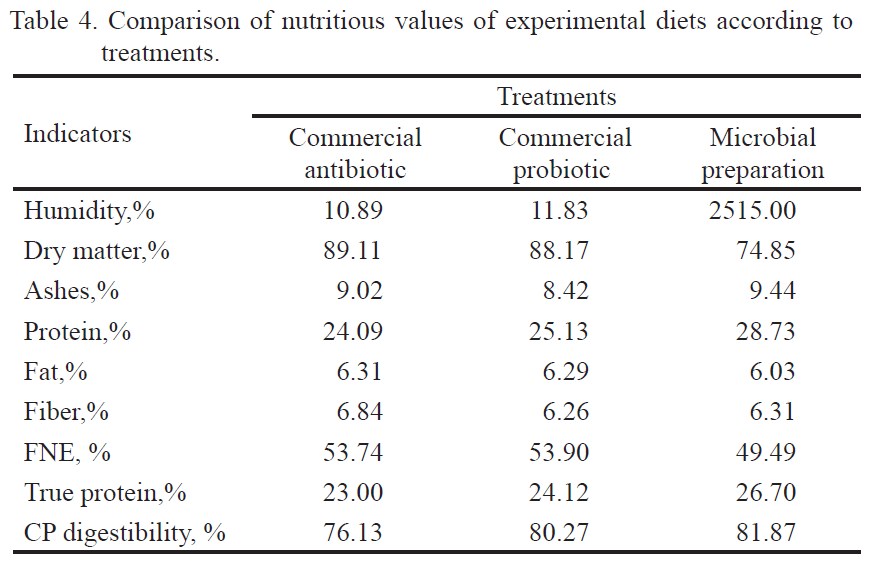
<body><![CDATA[<p align="justify"><font size="2" face="Verdana, Arial, Helvetica, sans-serif">There was total absence of totals salmonellas and  coliforms. The molds and yeasts content was in384 x 10<sup>3</sup> ufc.mL<sup>-1</sup>,  8.9 Brix degrees, and that of acid lactic bacteria 43.12 x10<sup>3</sup> ufc.mL<sup>-1</sup>.&nbsp; </font></p>     <p align="justify"><font size="2" face="Verdana, Arial, Helvetica, sans-serif">When comparing the microbial preparation with a  biological lactic bacteria (mixed culture of&nbsp; <em>Lactobacillus acidophillus</em> and <em>Streptococcus termophillus</em>),  developed on a substrate that was elaborated by means of the homogenization of  a mixture composed by final molasses, dry torula yeast and water, certain  similarity was found. The bacteria concentration in the final product was  between 10<sup>8</sup> and 10<sup>9</sup> ufc.mL<sup>-1</sup> (Rodr&iacute;guez <em>et  al.</em> 2009).</font></p>     <p align="justify"><font size="2" face="Verdana, Arial, Helvetica, sans-serif">The results of comparing the  nutritious value of the experimental diets are showed in <a href="/img/revistas/cjas/v49n3/t0411315.gif">table 4</a>.The humidity  higher value was obtained with the inclusion of the microbial preparation. The  commercial antibiotic showed higher DM content (P &lt; 0.05).In relation to  other treatments, the lower DM content was obtained by the microbial  preparation addition, possibly due to the DM content of this latter, that was  lower    (21.23 %).Added to this, mainly, the hydrolytic activity of lactic acid  bacteria and yeasts with CO<sub>2</sub> and H<sub>2</sub>O production, as there  were informed in other foods Asku <em>et al.</em> (2004), Nkosi (2009) and  Weinberg <em>et al.</em> (2009). </font></p>     
<p align="justify"><font size="2" face="Verdana, Arial, Helvetica, sans-serif">The higher values in the ash content were obtained with  the microbial preparation, followed by the commercial antibiotic and probiotic.  The reduction in NFE was directly related with the dispersion effect produced  by the crude protein increase (CP) (<a href="/img/revistas/cjas/v49n3/t0411315.gif">table 4</a>). Likewise, true protein reached  its higher value with the microbial preparation, in which, join to the  aforementioned hydrolytic effect, was could produce the protein synthesis, due  to the microbial growth. To this respect, El&iacute;as <em>et al.</em> (1990) showed  that the efficiency for the true protein synthesis in the soluble carbohydrates  conversion (contents in the NFE) was of 0.6 units.&nbsp;&nbsp; </font></p>     
<p align="justify"><font size="2" face="Verdana, Arial, Helvetica, sans-serif">The concentrate plus commercial antibiotic, followed by  the commercial probiotic and microbial preparation, was the one with higher fat  content. As for the crude fiber content, the highest percent corresponded to  the commercial antibiotic, followed by the microbial preparation and the  commercial probiotic.</font></p>     <p align="justify"><font size="2" face="Verdana, Arial, Helvetica, sans-serif">Regarding the variation obtained in the CP  digestibility, <a href="/img/revistas/cjas/v49n3/t0411315.gif">table 4</a> shows that the most efficient value was for the  concentrate plus the microbial preparation, followed by the concentrate plus  the probiotic and the commercial antibiotic. The digestibility of the  concentrate plus the microbial preparation increased in 1.6 regarding the  concentrate plus probiotic and in 5.74 percentiles in relation to the  commercial antibiotic. This reflects the enzymatic activity of the microbial  preparation, according to that informed by D&iacute;az (2013). </font></p>     
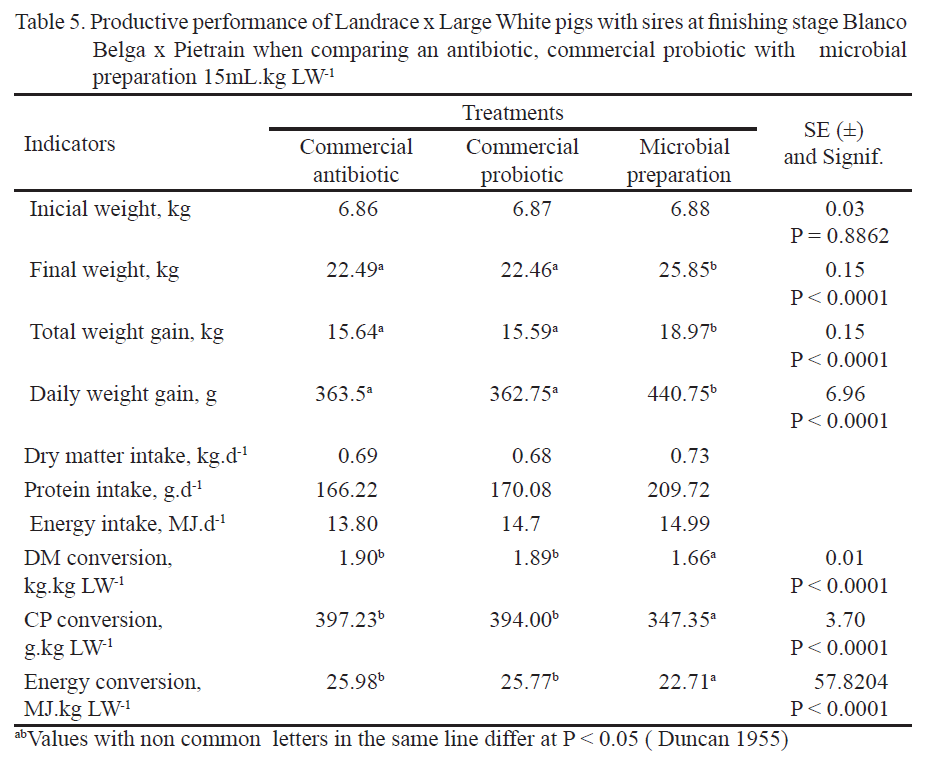
<p align="justify"><font size="2" face="Verdana, Arial, Helvetica, sans-serif"><em>Productive performance</em>.  The results obtained during the experiment regarding the final weight are  showed in <a href="/img/revistas/cjas/v49n3/t0511315.gif">table 5</a>. It was verified that there were significant differences (P  &lt; 0.05) between the microbial preparation and the remaining treatments. The  treatment with the inclusion of microbial preparation produced weight  difference of    3.38 kg of LW regarding the probiotic group, and 3.36 kg in relation to the  concentrate plus commercial antibiotic.</font></p>     
<p align="justify"><font size="2" face="Verdana, Arial, Helvetica, sans-serif">Regarding the total weight  gain and the daily weight gain, significant differences (P &lt; 0.05) occurred  during the experimental period (28-70 d) between the microbial preparation  treatment and that of antibiotic and probiotic, without existing divergences  between these last two, with daily LW gain above 77.25 and 78 g. </font></p>     <p align="justify"><font size="2" face="Verdana, Arial, Helvetica, sans-serif">In the variables daily dry matter intake, daily protein  intake and daily energy intake, it was not carried out statistical analysis  because there was not intra-treatments variability. Only the each treatment  means were presented. The higher dry matter, protein and energy intake was for  the microbial preparation. In <a href="/img/revistas/cjas/v49n3/t0511315.gif">table 5</a> is highlight that the best dry matter,  protein and energy conversion was achieved with the microbial preparation  addition. There were significant differences (P &lt; 0.05) in relation to the  commercial probiotic and    antibiotic.</font></p>     
<p align="justify"><font size="2" face="Verdana, Arial, Helvetica, sans-serif">The obtained results in the  experimental period agree with researches carried out by other authors, when  increasing the daily mean gain (DMG) with the use of bacterial culture and  yeasts (Prieto <em>et al.</em> 2014).In pigs, the sea <em>B. pumillus</em> strain  is a fiable probiotic to be use in weaned pigs and shows its potential for its  application as alternative in feeding, specifically to replace antibiotics.  Tabasum <em>et al.</em> (2014) indicated that the supplementation of the diet  with probiotics based on Lactobacillus possibility affects in weight gain and  food intake, while the conversion index improved by probiotics based on  Bacillus. Suo <em>et al.</em> (2012) determined better values for daily weight  gain and alimentary conversion by <em>Lactobacillus plantarum</em> ZJ316 effect. </font></p>     ]]></body>
<body><![CDATA[<p align="justify"><font size="2" face="Verdana, Arial, Helvetica, sans-serif">The number of diarrheas in the 43 d of study is showed  in <a href="/img/revistas/cjas/v49n3/t0611315.gif">table 6</a>. Significant differences between treatments were showed. The lower  number of diarrhea corresponded to the treatment which the microbial  preparation was added. </font></p>     
<p align="justify"><font size="2" face="Verdana, Arial, Helvetica, sans-serif">For the number of deaths indicator, a variance analysis  could not carried out, since there was not intra- treatments variability. In  the treatments in those that there was a great number of diarrhea deaths were  caused. The results of this research coincide with the informed by Alonso and  Cacique (2002), whose explained that enteric illnesses decrease the daily  weight gain and the alimentary conversion, they increase the mortality, wastes  number and animals with lower weights to the average. Also, they do not favor  the increase in weight. Vrotniakien&#279; and Jatkauskas (2013) stated that the  animals treated with probiotics were able to defend against <em>E.coli</em> and  diarrheas. Also, they produced higher growth rate and alimentary efficiency  regarding to those that were not treated. B&uuml;sing and Zeyner (2014) showed that  the <em>E. faecium</em>, DMS 10663 and NCIMB 10415 probiotics, control diarrheas  and the sucking piglets yield. According to Suo <em>et al.</em> (2012), the  diarrheas percent of sucking piglets decrease 7.06 % with the use of an  antibiotic at 2.17 %, due to the effect of the <em>L. plantarum</em> ZJ316 use.</font></p>     <p align="justify"><font size="2" face="Verdana, Arial, Helvetica, sans-serif">&nbsp;It is possible that the results obtained in  this research are directly related with the use of probiotics in pigs diets.  During the first stages of life, these have beneficial effects on the  improvement of the nutrients absorption in the small intestine, which is  reflected in better zootechnical parameters and in diarrheas decrease, as  Cort&eacute;s and G&oacute;mez (2011) refers. </font></p>     <p align="justify"><font size="2" face="Verdana, Arial, Helvetica, sans-serif">The obtained results in the  experimental period agree with other authors that used bacterial cultures.  Rodr&iacute;guez <em>et al.</em> (2009) obtained better results in growth pigs, when  using a <em>Lactobacillus acidophillus</em> and <em>Streptococcus termophillus</em> biological&nbsp; preparation. P&eacute;rez (2008)  considered that the inclusion of yogurt mixed strain (<em>Lactobacillus  bulgaricus</em>/<em>Streptococus thermophylus</em>) for piglets under commercial  pork production conditions improve the productive parameters of pigs at 70d of  age. Roj&aacute;n (2009) found better response when evaluating the effect of a  biological active product (Vitafert) on productive indicators and of health in  pork pre- fattening. </font></p>     <p align="justify"><font size="2" face="Verdana, Arial, Helvetica, sans-serif">It is concluded that the  microbial preparation, when having organic acids of short chain, lactic acid  bacteria and yeasts, improve the concentrates nutritional value, increase the  CP digestibility, besides to improve the productive parameters and decrease the  number of diarrhea in pigs during the pot- weaning     <br>   period. </font></p>     <p align="justify"><font size="2" face="Verdana, Arial, Helvetica, sans-serif">  From these results, it is  recommended to continue the research about the action of this microbial  preparation in other pigs categories, especially in fattening. </font></p>     <p align="justify">&nbsp;</p>     <p align="justify"><font size="3" face="Verdana, Arial, Helvetica, sans-serif"><strong>REFERENCES</strong></font></p>     <p align="justify"><font size="2" face="Verdana, Arial, Helvetica, sans-serif">Aksu, T., Baytok, E. &amp;  Bolat, D. 2004. &lsquo;&lsquo;Effects of a bacterial silage inoculant on corn silage  fermentation and nutrient digestibility&rsquo;&rsquo;. <em>Small Ruminant Res.</em>, 55: 249.</font></p>     ]]></body>
<body><![CDATA[<p align="justify"><font size="2" face="Verdana, Arial, Helvetica, sans-serif">Allen, H., Levine, U., Looft,  T., Bandrick, M. &amp; Casey, T. 2013. &lsquo;&lsquo;Treatment, promotion, commotion:  antibiotic alternatives in food-producing animals&rsquo;&rsquo;. <em>Trends Microbiology</em>,  21: 114.</font></p>     <!-- ref --><p align="justify"><font size="2" face="Verdana, Arial, Helvetica, sans-serif">Alonso, M. &amp; Cacique, S. 2002. <em>Diarrea en sus  lechones. Animal Health</em>. ,  Available: &lt;<a href="http://www.info@.ppca.com.ve" target="_blank">http://www.info@.ppca.com.ve</a>&gt;, [Consulted:&nbsp;November 17,  2014].    </font></p>     <!-- ref --><p align="justify"><font size="2" face="Verdana, Arial, Helvetica, sans-serif">AOAC 2005. <em>Official Methods  of Analysis</em>. 18th ed., Gaithersburg, MD, USA: Assoc. Off. Agric. Anal.  Chem. Inc.    </font></p>     <!-- ref --><p align="justify"><font size="2" face="Verdana, Arial, Helvetica, sans-serif">Bernstein, L. 1983. <em>An&aacute;lisis  de alimento</em>. Wintra A. L.  &amp; Wintro K. B. (eds.), vol. 1, Pueblo y Educaci&oacute;n, 84 p.    </font></p>     <p align="justify"><font size="2" face="Verdana, Arial, Helvetica, sans-serif">B&uuml;sing, K. &amp; Zeyner, A.  2014. &lsquo;&lsquo;Effects of oral Enterococcus faecium straim DSM 10663 NCIMB 10415 on  diarrhea patterns and performance of sucking piglets&rsquo;&rsquo;. <em>Wageningen Academic  Publishers</em>, 6: 41.</font></p>     <p align="justify"><font size="2" face="Verdana, Arial, Helvetica, sans-serif">Clark, S., Daly, R., Jord&aacute;n,  E., Lee, J., Mathew, A. &amp; Ebner, P. 2012. &lsquo;&lsquo;The future of biosecurity and  antimicrobial use in livestock production in the United States and the role of  extension&rsquo;&rsquo;. <em>J. Anim.  Sci.</em>, 90: 2861.</font></p>     <p align="justify"><font size="2" face="Verdana, Arial, Helvetica, sans-serif">Cort&eacute;s, L. &amp; G&oacute;mez, F. 2011. &lsquo;&lsquo;Eficiencia de  microorganismos (EM) en el mejoramiento del sistema digestivo de cerdos en fase  pre levante&rsquo;&rsquo;. <em>Spei Domus.</em>, 7: 31.</font></p>     ]]></body>
<body><![CDATA[<p align="justify"><font size="2" face="Verdana, Arial, Helvetica, sans-serif">Cromwell, G. L. 2001.  &lsquo;&lsquo;Antimicrobial and promicrobial agents&rsquo;&rsquo;. In: Lewis A. J. &amp; Shoulthern L.  L. (eds.), <em>Swine Nutrition</em>, 2nd ed., Boca Raton, FL: CRC Press, pp.  421&ndash;426.</font></p>     <p align="justify"><font size="2" face="Verdana, Arial, Helvetica, sans-serif">Cromwell, G. L. 2002. &lsquo;&lsquo;Why  and how antibiotics are used in swine production&rsquo;&rsquo;. <em>Anim Biotechnol.</em>, 13: 7.</font></p>     <p align="justify"><font size="2" face="Verdana, Arial, Helvetica, sans-serif">D&iacute;az, B. 2011. &lsquo;&lsquo;Aprovechamiento biotecnol&oacute;gico de  residuos agroindustriales para alimentaci&oacute;n de animales zoot&eacute;cnicos&rsquo;&rsquo;. <em>Rev. Colombiana de Ciencias Pecuarias</em>, 4: 145.</font></p>     <p align="justify"><font size="2" face="Verdana, Arial, Helvetica, sans-serif">D&iacute;az, B. 2013. &lsquo;&lsquo;Nutritional  and economical efficiency of three biosilages from agroindustrial wastes in  beef cattle&rsquo;&rsquo;. <em>Cuban Journal of Agricultural Science</em>, 47: 143.</font></p>     <p align="justify"><font size="2" face="Verdana, Arial, Helvetica, sans-serif">Dierick, M. A., Decuypere, J.  &amp; Henderichx, H. 1985. &lsquo;&lsquo;Protein digestion in pig measured <em>in vivo</em>&rsquo;&rsquo;.  In: Just A., Jorgensen H. &amp; Fern&aacute;ndez J. (eds.), <em>Proceedings of the 3rd  International Seminar on Digestive Physiology in the Pig</em>, pp. 239&ndash;332.</font></p>     <!-- ref --><p align="justify"><font size="2" face="Verdana, Arial, Helvetica, sans-serif">Di Rienzo, J. A., Casanoves, F., Balzarini, M. G.,  Gonz&aacute;lez, L., Tablada, M. &amp; Robledo, C. W. 2012. <em>InfoStat</em>. version  2012, (Windows), Universidad Nacional de C&oacute;rdoba, Argentina: Grupo InfoStat,  Available: &lt;<a href="http://www.infostat.com.ar/" target="_blank">http://www.infostat.com.ar/</a>&gt;    .</font></p>     <p align="justify"><font size="2" face="Verdana, Arial, Helvetica, sans-serif">Duncan, D. B. 1955. &lsquo;&lsquo;Multiple  range and multiple F tests&rsquo;&rsquo;. <em>Biometrics</em>, 11: 1.</font></p>     <!-- ref --><p align="justify"><font size="2" face="Verdana, Arial, Helvetica, sans-serif">ECUAQUIMICA 2000. <em>Pecutrin&reg; saborizado. Minerales +  Vitaminas A, D3, E. Suplemento mineral m&aacute;s vitaminas ADE</em>. no.  1AB-630-AGROCALIDAD, Available:  &lt;<a href="http://www.ecuaquimica.com/pdf_ganaderia/Pecutrin.pdf" target="_blank">http://www.ecuaquimica.com/pdf_ganaderia/Pecutrin.pdf</a>&gt;,  [Consulted:&nbsp;February 1, 2015].    </font></p>     ]]></body>
<body><![CDATA[<p align="justify"><font size="2" face="Verdana, Arial, Helvetica, sans-serif">El&iacute;as, A., Lezcano, O., Lezcano, P., Cordero, J. &amp;  Quintana, L. 1990. &lsquo;&lsquo;A review on the development of a protein sugar  cane enrichment technology through solid state fermentation (Saccharina)&rsquo;&rsquo;. <em>Cuban  Journal of Agricultural Science</em>, 24: 1.</font></p>     <p align="justify"><font size="2" face="Verdana, Arial, Helvetica, sans-serif">Erwin, E., Marco, G. &amp;  Emery, E. 1961. &lsquo;&lsquo;Volatile fatty acid analysis of blood and rumen fluid by gas  chromatography&rsquo;&rsquo;. <em>J. Dairy  Sci.</em>, 44: 1788.</font></p>     <p align="justify"><font size="2" face="Verdana, Arial, Helvetica, sans-serif">Guti&eacute;rrez, L., Montoya, O. &amp; V&eacute;lez, J. 2013.  &lsquo;&lsquo;Probi&oacute;ticos: Una alternativa de producci&oacute;n limpia y de reemplazo a los  antibi&oacute;ticos promotores de crecimiento en la alimentaci&oacute;n animal&rsquo;&rsquo;. <em>Producci&oacute;n  + limpia</em>, 8: 135.</font></p>     <p align="justify"><font size="2" face="Verdana, Arial, Helvetica, sans-serif">Heo, J., Opapeju, F., Pluske, J., Kim, J., Hampson, D.  &amp; Nyachoti, C. 2012. &lsquo;&lsquo;Gastrointestinal health and  function in weaned pigs: a review of feeding strategies to control post-weaning  diarrhea without using in-feed antimicrobial compounds&rsquo;&rsquo;. <em>J. Animal Physiology and Animal  Nutrition</em>, 97: 207.</font></p>     <p align="justify"><font size="2" face="Verdana, Arial, Helvetica, sans-serif">Jurado, H., Ram&iacute;rez, C. &amp; Mart&iacute;nez, J. 2013.  &lsquo;&lsquo;Evaluaci&oacute;n <em>in vivo</em> de <em>Lactobacillus plantarum</em> como alternativa  al uso de antibi&oacute;ticos en lechones&rsquo;&rsquo;. <em>MVZ C&oacute;rdoba</em>, 18: 3649.</font></p>     <!-- ref --><p align="justify"><font size="2" face="Verdana, Arial, Helvetica, sans-serif">Levene, H. 1960. <em>Robust  tests for the equality of variance. Contributions to Probability and Statistics</em>.  Stanford  University Press, 278-292 p.    </font></p>     <!-- ref --><p align="justify"><font size="2" face="Verdana, Arial, Helvetica, sans-serif">Merk 2005. <em>Cat&aacute;logo de productos, t&eacute;cnicas y  servicios en medios de cultivo para microbiolog&iacute;a</em>. Alemania,  45-49 p.    </font></p>     <p align="justify"><font size="2" face="Verdana, Arial, Helvetica, sans-serif">Nkosi, B. D., Meeske, R.,  Palic, D., Langa, T., Leeuro, K. J. &amp; Gtoenewald, J. B. 2009. &lsquo;&lsquo;Effects of  ensiling whole crop maize with bacterial inoculants on the fermentation,  aerobic stability, and growth performance of lambs&rsquo;&rsquo;. <em>Anim. Feed. Sci. Tech.</em>,  154: 193.</font></p>     ]]></body>
<body><![CDATA[<!-- ref --><p align="justify"><font size="2" face="Verdana, Arial, Helvetica, sans-serif">NRC 1998. <em>Nutrient  Requirement of Domestic Animal. Nutrient Requirement of swine</em>. Washington  D.C.: Nat. Acad. Sci.,  85-90 p.    </font></p>     <p align="justify"><font size="2" face="Verdana, Arial, Helvetica, sans-serif">Per&eacute;z, Y. 2008. &lsquo;&lsquo;Evaluaci&oacute;n del efecto probi&oacute;tico de  una cepa mixta de yogurt (<em>Lactobacillus bulgaricus/ Streptoccocus thermophylus</em>)  para cerditos en condiciones de producci&oacute;n porcina comercial&rsquo;&rsquo;. <em>Rev.  Computarizada de Producci&oacute;n Porcina</em>, 15: 4.</font></p>     <p align="justify"><font size="2" face="Verdana, Arial, Helvetica, sans-serif">Prieto, M., O&rsquo; Sullivan, L., Pin, S., McLoughlin, P.,  Hughes, H., O&rsquo;Donovan, Rea, M., Kent, R., Kent, R., Cassidy, J., Gardiner, G. &amp;  Lawlor, P. 2014. &lsquo;&lsquo;Evaluation of the Efficacy and Safety of a  Marine-Derived Bacillus Strain for Use as an In-Feed Probiotic for Newly Weaned  Pigs&rsquo;&rsquo;. <em>PLoS ONE</em>, 9: 1&ndash;12.</font></p>     <p align="justify"><font size="2" face="Verdana, Arial, Helvetica, sans-serif">Rodriguez, J., Carmenate, M., Hern&aacute;ndez, J., Guerra,  A., Calero, I., &Aacute;lvarez, J., Mart&iacute;n, E. &amp; Su&aacute;rez, M. 2009. &lsquo;&lsquo;Evaluaci&oacute;n del  suministro de un preparado biol&oacute;gico de Lactobacillus acidophillus y  Streptococcus termophillus en cerdos en crecimiento&rsquo;&rsquo;. <em>Revista  Computadorizada de Producci&oacute;n Porcina</em>, 16: 54.</font></p>     <!-- ref --><p align="justify"><font size="2" face="Verdana, Arial, Helvetica, sans-serif">Roj&aacute;n, L. 2009. <em>Efecto de un producto  biol&oacute;gicamente activo (Vitafer) en indicadores productivos y de salud en  preceba porcina</em>. M.Sc. Thesis, Instituto de Ciencia Animal, La Habana,  Cuba.    </font></p>     <p align="justify"><font size="2" face="Verdana, Arial, Helvetica, sans-serif">Shapiro, S. &amp; Wilk, B.  1965. &lsquo;&lsquo;An analysis of variance test for normality (complete samples)&rsquo;&rsquo;. <em>Biometrika</em>,  52: 602.</font></p>     <!-- ref --><p align="justify"><font size="2" face="Verdana, Arial, Helvetica, sans-serif">StatSoft Inc. 2003. <em>STATISTICA  (data analysis software system)</em>. version 7.    </font></p>     ]]></body>
<body><![CDATA[<p align="justify"><font size="2" face="Verdana, Arial, Helvetica, sans-serif">Suo, C., Yin, Y., Wang, X.,  Lou, X., Song, D., Wang, X. &amp; Gu, Q. 2012. &lsquo;&lsquo;Effects of Lactobacillus  plantarum ZJ316 on pig growth and pork quality&rsquo;&rsquo;. <em>BMC Veterinary Res.</em>,  8: 89.</font></p>     <p align="justify"><font size="2" face="Verdana, Arial, Helvetica, sans-serif">Tabasum, S., Hoon, J., Mun, H.  &amp; Yang, C. 2014. &lsquo;&lsquo;Evaluation of Lactobacillus and Bacillus-based  probiotics as alternatives to antibiotics in enteric microbial challenged  weaned piglets&rsquo;&rsquo;. <em>African J. Microbiology Res.</em>, 8: 96.</font></p>     <p align="justify"><font size="2" face="Verdana, Arial, Helvetica, sans-serif">Vrotniakien&#279;, V. &amp; Jatkauskas,  J. 2013. &lsquo;&lsquo;Effects of probiotics dietary supplementation on diarrhea incidence,  fecal shedding of Escherichia coli and growth performance in post-weaned  piglets&rsquo;&rsquo;. <em>Veterinarija Ir Zootechnika</em>, 62: 81.</font></p>     <p align="justify"><font size="2" face="Verdana, Arial, Helvetica, sans-serif">  Weinberg, Z., Shatz, O., Chen, Y., Yosef, E.,  Nikbahat, M., Ben Ghedalia, D. &amp; Miron, J. 2009. &lsquo;&lsquo;Effect of lactic acid  bacteria inoculants on in vitro digestibility of wheat and corn silages&rsquo;&rsquo;. <em>J. Dairy Sci.</em>, 90: 4754.</font> </p>     <p align="justify">&nbsp;</p>     <p align="justify">&nbsp;</p>     <p align="justify"><font size="2" face="Verdana, Arial, Helvetica, sans-serif">Received: December 9, 2014    <br> Accepted: March 23, 2015</font></p>     <p align="justify">&nbsp;</p>     <p align="justify">&nbsp;</p>     ]]></body>
<body><![CDATA[<p align="justify"><font size="2" face="Verdana, Arial, Helvetica, sans-serif"><i>L. Flores,</i> Escuela Superior Politécnica de Chimborazo. Panamericana Sur km. 1 1/2, Riobamba, Ecuador.    Email: <a href="mailto:luisgerardofloresmancheno@yahoo.es">luisgerardofloresmancheno@yahoo.es</a></font></p>      ]]></body><back>
<ref-list>
<ref id="B1">
<nlm-citation citation-type="journal">
<person-group person-group-type="author">
<name>
<surname><![CDATA[Aksu]]></surname>
<given-names><![CDATA[T.]]></given-names>
</name>
<name>
<surname><![CDATA[Baytok]]></surname>
<given-names><![CDATA[E.]]></given-names>
</name>
<name>
<surname><![CDATA[Bolat]]></surname>
<given-names><![CDATA[D.]]></given-names>
</name>
</person-group>
<article-title xml:lang="nd"><![CDATA[Effects of a bacterial silage inoculant on corn silage fermentation and nutrient digestibility]]></article-title>
<source><![CDATA[Small Ruminant Res.]]></source>
<year>2004</year>
<volume>55</volume>
<page-range>249</page-range></nlm-citation>
</ref>
<ref id="B2">
<nlm-citation citation-type="journal">
<person-group person-group-type="author">
<name>
<surname><![CDATA[Allen]]></surname>
<given-names><![CDATA[H.]]></given-names>
</name>
<name>
<surname><![CDATA[Levine]]></surname>
<given-names><![CDATA[U.]]></given-names>
</name>
<name>
<surname><![CDATA[Looft]]></surname>
<given-names><![CDATA[T.]]></given-names>
</name>
<name>
<surname><![CDATA[Bandrick]]></surname>
<given-names><![CDATA[M.]]></given-names>
</name>
<name>
<surname><![CDATA[Casey]]></surname>
<given-names><![CDATA[T.]]></given-names>
</name>
</person-group>
<article-title xml:lang="nd"><![CDATA[Treatment, promotion, commotion: antibiotic alternatives in food-producing animals]]></article-title>
<source><![CDATA[Trends Microbiology]]></source>
<year>2013</year>
<volume>21</volume>
<page-range>114</page-range></nlm-citation>
</ref>
<ref id="B3">
<nlm-citation citation-type="">
<person-group person-group-type="author">
<name>
<surname><![CDATA[Alonso]]></surname>
<given-names><![CDATA[M.]]></given-names>
</name>
<name>
<surname><![CDATA[Cacique]]></surname>
<given-names><![CDATA[S.]]></given-names>
</name>
</person-group>
<source><![CDATA[Diarrea en sus lechones. Animal Health]]></source>
<year>2002</year>
</nlm-citation>
</ref>
<ref id="B4">
<nlm-citation citation-type="book">
<person-group person-group-type="author">
<name>
<surname><![CDATA[AOAC]]></surname>
</name>
</person-group>
<source><![CDATA[Official Methods of Analysis]]></source>
<year>2005</year>
<edition>18th</edition>
<publisher-loc><![CDATA[Gaithersburg, MD, USA ]]></publisher-loc>
<publisher-name><![CDATA[Assoc. Off. Agric. Anal. Chem. Inc.]]></publisher-name>
</nlm-citation>
</ref>
<ref id="B5">
<nlm-citation citation-type="book">
<person-group person-group-type="author">
<name>
<surname><![CDATA[Bernstein]]></surname>
<given-names><![CDATA[L.]]></given-names>
</name>
<name>
<surname><![CDATA[Wintra]]></surname>
<given-names><![CDATA[A. L.]]></given-names>
</name>
<name>
<surname><![CDATA[Wintro]]></surname>
<given-names><![CDATA[K. B.]]></given-names>
</name>
</person-group>
<source><![CDATA[Análisis de alimento]]></source>
<year>1983</year>
<volume>1</volume>
<page-range>84</page-range><publisher-name><![CDATA[Pueblo y Educación]]></publisher-name>
</nlm-citation>
</ref>
<ref id="B6">
<nlm-citation citation-type="journal">
<person-group person-group-type="author">
<name>
<surname><![CDATA[Büsing]]></surname>
<given-names><![CDATA[K.]]></given-names>
</name>
<name>
<surname><![CDATA[Zeyner]]></surname>
<given-names><![CDATA[A.]]></given-names>
</name>
</person-group>
<article-title xml:lang="nd"><![CDATA[Effects of oral Enterococcus faecium straim DSM 10663 NCIMB 10415 on diarrhea patterns and performance of sucking piglets]]></article-title>
<source><![CDATA[Wageningen Academic Publishers]]></source>
<year>2014</year>
<volume>6</volume>
<page-range>41</page-range></nlm-citation>
</ref>
<ref id="B7">
<nlm-citation citation-type="journal">
<person-group person-group-type="author">
<name>
<surname><![CDATA[Clark]]></surname>
<given-names><![CDATA[S.]]></given-names>
</name>
<name>
<surname><![CDATA[Daly]]></surname>
<given-names><![CDATA[R.]]></given-names>
</name>
<name>
<surname><![CDATA[Jordán]]></surname>
<given-names><![CDATA[E.]]></given-names>
</name>
<name>
<surname><![CDATA[Lee]]></surname>
<given-names><![CDATA[J.]]></given-names>
</name>
<name>
<surname><![CDATA[Mathew]]></surname>
<given-names><![CDATA[A.]]></given-names>
</name>
<name>
<surname><![CDATA[Ebner]]></surname>
<given-names><![CDATA[P.]]></given-names>
</name>
</person-group>
<article-title xml:lang="nd"><![CDATA[The future of biosecurity and antimicrobial use in livestock production in the United States and the role of extension]]></article-title>
<source><![CDATA[J. Anim. Sci.]]></source>
<year>2012</year>
<volume>90</volume>
<page-range>2861</page-range></nlm-citation>
</ref>
<ref id="B8">
<nlm-citation citation-type="journal">
<person-group person-group-type="author">
<name>
<surname><![CDATA[Cortés]]></surname>
<given-names><![CDATA[L.]]></given-names>
</name>
<name>
<surname><![CDATA[Gómez]]></surname>
<given-names><![CDATA[F.]]></given-names>
</name>
</person-group>
<article-title xml:lang="nd"><![CDATA[Eficiencia de microorganismos (EM) en el mejoramiento del sistema digestivo de cerdos en fase pre levante]]></article-title>
<source><![CDATA[Spei Domus.]]></source>
<year>2011</year>
<volume>7</volume>
<page-range>31</page-range></nlm-citation>
</ref>
<ref id="B9">
<nlm-citation citation-type="book">
<person-group person-group-type="author">
<name>
<surname><![CDATA[Cromwell]]></surname>
<given-names><![CDATA[G. L.]]></given-names>
</name>
</person-group>
<article-title xml:lang="nd"><![CDATA[Antimicrobial and promicrobial agents]]></article-title>
<person-group person-group-type="editor">
<name>
<surname><![CDATA[Lewis]]></surname>
<given-names><![CDATA[A. J.]]></given-names>
</name>
<name>
<surname><![CDATA[Shoulthern]]></surname>
<given-names><![CDATA[L. L.]]></given-names>
</name>
</person-group>
<source><![CDATA[Swine Nutrition]]></source>
<year>2001</year>
<edition>2nd</edition>
<page-range>421-426</page-range><publisher-loc><![CDATA[Boca Raton, FL ]]></publisher-loc>
<publisher-name><![CDATA[CRC Press]]></publisher-name>
</nlm-citation>
</ref>
<ref id="B10">
<nlm-citation citation-type="journal">
<person-group person-group-type="author">
<name>
<surname><![CDATA[Cromwell]]></surname>
<given-names><![CDATA[G. L.]]></given-names>
</name>
</person-group>
<article-title xml:lang="nd"><![CDATA[Why and how antibiotics are used in swine production]]></article-title>
<source><![CDATA[Anim Biotechnol.]]></source>
<year>2002</year>
<volume>13</volume>
<page-range>7</page-range></nlm-citation>
</ref>
<ref id="B11">
<nlm-citation citation-type="journal">
<person-group person-group-type="author">
<name>
<surname><![CDATA[Díaz]]></surname>
<given-names><![CDATA[B.]]></given-names>
</name>
</person-group>
<article-title xml:lang="nd"><![CDATA[Aprovechamiento biotecnológico de residuos agroindustriales para alimentación de animales zootécnicos]]></article-title>
<source><![CDATA[Rev. Colombiana de Ciencias Pecuarias]]></source>
<year>2011</year>
<volume>4</volume>
<page-range>145</page-range></nlm-citation>
</ref>
<ref id="B12">
<nlm-citation citation-type="journal">
<person-group person-group-type="author">
<name>
<surname><![CDATA[Díaz]]></surname>
<given-names><![CDATA[B.]]></given-names>
</name>
</person-group>
<article-title xml:lang="nd"><![CDATA[Nutritional and economical efficiency of three biosilages from agroindustrial wastes in beef cattle]]></article-title>
<source><![CDATA[Cuban Journal of Agricultural Science]]></source>
<year>2013</year>
<volume>47</volume>
<page-range>143</page-range></nlm-citation>
</ref>
<ref id="B13">
<nlm-citation citation-type="">
<person-group person-group-type="author">
<name>
<surname><![CDATA[Dierick]]></surname>
<given-names><![CDATA[M. A.]]></given-names>
</name>
<name>
<surname><![CDATA[Decuypere]]></surname>
<given-names><![CDATA[J.]]></given-names>
</name>
<name>
<surname><![CDATA[Henderichx]]></surname>
<given-names><![CDATA[H.]]></given-names>
</name>
</person-group>
<article-title xml:lang="nd"><![CDATA[Protein digestion in pig measured in vivo]]></article-title>
<person-group person-group-type="editor">
<name>
<surname><![CDATA[Just]]></surname>
<given-names><![CDATA[A.]]></given-names>
</name>
<name>
<surname><![CDATA[Jorgensen]]></surname>
<given-names><![CDATA[H.]]></given-names>
</name>
<name>
<surname><![CDATA[Fernández]]></surname>
<given-names><![CDATA[J.]]></given-names>
</name>
</person-group>
<source><![CDATA[]]></source>
<year>1985</year>
<page-range>239-332</page-range></nlm-citation>
</ref>
<ref id="B14">
<nlm-citation citation-type="book">
<person-group person-group-type="author">
<name>
<surname><![CDATA[Di Rienzo]]></surname>
<given-names><![CDATA[J. A.]]></given-names>
</name>
<name>
<surname><![CDATA[Casanoves]]></surname>
<given-names><![CDATA[F.]]></given-names>
</name>
<name>
<surname><![CDATA[Balzarini]]></surname>
<given-names><![CDATA[M. G.]]></given-names>
</name>
<name>
<surname><![CDATA[González]]></surname>
<given-names><![CDATA[L.]]></given-names>
</name>
<name>
<surname><![CDATA[Tablada]]></surname>
<given-names><![CDATA[M.]]></given-names>
</name>
<name>
<surname><![CDATA[Robledo]]></surname>
<given-names><![CDATA[C. W.]]></given-names>
</name>
</person-group>
<source><![CDATA[InfoStat]]></source>
<year>2012</year>
<publisher-loc><![CDATA[Universidad Nacional de Córdoba, Argentina ]]></publisher-loc>
<publisher-name><![CDATA[Grupo InfoStat]]></publisher-name>
</nlm-citation>
</ref>
<ref id="B15">
<nlm-citation citation-type="journal">
<person-group person-group-type="author">
<name>
<surname><![CDATA[Duncan]]></surname>
<given-names><![CDATA[D. B.]]></given-names>
</name>
</person-group>
<article-title xml:lang="nd"><![CDATA[Multiple range and multiple F tests]]></article-title>
<source><![CDATA[Biometrics]]></source>
<year>1955</year>
<volume>11</volume>
<page-range>1</page-range></nlm-citation>
</ref>
<ref id="B16">
<nlm-citation citation-type="">
<person-group person-group-type="author">
<name>
<surname><![CDATA[ECUAQUIMICA]]></surname>
</name>
</person-group>
<source><![CDATA[Pecutrin® saborizado. Minerales + Vitaminas A, D3, E. Suplemento mineral más vitaminas ADE]]></source>
<year>2000</year>
</nlm-citation>
</ref>
<ref id="B17">
<nlm-citation citation-type="journal">
<person-group person-group-type="author">
<name>
<surname><![CDATA[Elías]]></surname>
<given-names><![CDATA[A.]]></given-names>
</name>
<name>
<surname><![CDATA[Lezcano]]></surname>
<given-names><![CDATA[O.]]></given-names>
</name>
<name>
<surname><![CDATA[Lezcano]]></surname>
<given-names><![CDATA[P.]]></given-names>
</name>
<name>
<surname><![CDATA[Cordero]]></surname>
<given-names><![CDATA[J.]]></given-names>
</name>
<name>
<surname><![CDATA[Quintana]]></surname>
<given-names><![CDATA[L.]]></given-names>
</name>
</person-group>
<article-title xml:lang="nd"><![CDATA[A review on the development of a protein sugar cane enrichment technology through solid state fermentation (Saccharina)]]></article-title>
<source><![CDATA[Cuban Journal of Agricultural Science]]></source>
<year>1990</year>
<volume>24</volume>
<page-range>1</page-range></nlm-citation>
</ref>
<ref id="B18">
<nlm-citation citation-type="journal">
<person-group person-group-type="author">
<name>
<surname><![CDATA[Erwin]]></surname>
<given-names><![CDATA[E.]]></given-names>
</name>
<name>
<surname><![CDATA[Marco]]></surname>
<given-names><![CDATA[G.]]></given-names>
</name>
<name>
<surname><![CDATA[Emery]]></surname>
<given-names><![CDATA[E.]]></given-names>
</name>
</person-group>
<article-title xml:lang="nd"><![CDATA[Volatile fatty acid analysis of blood and rumen fluid by gas chromatography]]></article-title>
<source><![CDATA[J. Dairy Sci.]]></source>
<year>1961</year>
<volume>44</volume>
<page-range>1788</page-range></nlm-citation>
</ref>
<ref id="B19">
<nlm-citation citation-type="journal">
<person-group person-group-type="author">
<name>
<surname><![CDATA[Gutiérrez]]></surname>
<given-names><![CDATA[L.]]></given-names>
</name>
<name>
<surname><![CDATA[Montoya]]></surname>
<given-names><![CDATA[O.]]></given-names>
</name>
<name>
<surname><![CDATA[Vélez]]></surname>
<given-names><![CDATA[J.]]></given-names>
</name>
</person-group>
<article-title xml:lang="nd"><![CDATA[Probióticos: Una alternativa de producción limpia y de reemplazo a los antibióticos promotores de crecimiento en la alimentación animal]]></article-title>
<source><![CDATA[Producción + limpia]]></source>
<year>2013</year>
<volume>8</volume>
<page-range>135</page-range></nlm-citation>
</ref>
<ref id="B20">
<nlm-citation citation-type="journal">
<person-group person-group-type="author">
<name>
<surname><![CDATA[Heo]]></surname>
<given-names><![CDATA[J.]]></given-names>
</name>
<name>
<surname><![CDATA[Opapeju]]></surname>
<given-names><![CDATA[F.]]></given-names>
</name>
<name>
<surname><![CDATA[Pluske]]></surname>
<given-names><![CDATA[J.]]></given-names>
</name>
<name>
<surname><![CDATA[Kim]]></surname>
<given-names><![CDATA[J.]]></given-names>
</name>
<name>
<surname><![CDATA[Hampson]]></surname>
<given-names><![CDATA[D.]]></given-names>
</name>
<name>
<surname><![CDATA[Nyachoti]]></surname>
<given-names><![CDATA[C.]]></given-names>
</name>
</person-group>
<article-title xml:lang="nd"><![CDATA[Gastrointestinal health and function in weaned pigs: a review of feeding strategies to control post-weaning diarrhea without using in-feed antimicrobial compounds]]></article-title>
<source><![CDATA[J. Animal Physiology and Animal Nutrition]]></source>
<year>2012</year>
<volume>97</volume>
<page-range>207</page-range></nlm-citation>
</ref>
<ref id="B21">
<nlm-citation citation-type="journal">
<person-group person-group-type="author">
<name>
<surname><![CDATA[Jurado]]></surname>
<given-names><![CDATA[H.]]></given-names>
</name>
<name>
<surname><![CDATA[Ramírez]]></surname>
<given-names><![CDATA[C.]]></given-names>
</name>
<name>
<surname><![CDATA[Martínez]]></surname>
<given-names><![CDATA[J.]]></given-names>
</name>
</person-group>
<article-title xml:lang="nd"><![CDATA[Evaluación in vivo de Lactobacillus plantarum como alternativa al uso de antibióticos en lechones]]></article-title>
<source><![CDATA[MVZ Córdoba]]></source>
<year>2013</year>
<volume>18</volume>
<page-range>3649</page-range></nlm-citation>
</ref>
<ref id="B22">
<nlm-citation citation-type="book">
<person-group person-group-type="author">
<name>
<surname><![CDATA[Levene]]></surname>
<given-names><![CDATA[H.]]></given-names>
</name>
</person-group>
<source><![CDATA[Robust tests for the equality of variance. Contributions to Probability and Statistics]]></source>
<year>1960</year>
<page-range>278-292</page-range><publisher-name><![CDATA[Stanford University Press]]></publisher-name>
</nlm-citation>
</ref>
<ref id="B23">
<nlm-citation citation-type="">
<person-group person-group-type="author">
<name>
<surname><![CDATA[Merk]]></surname>
</name>
</person-group>
<source><![CDATA[Catálogo de productos, técnicas y servicios en medios de cultivo para microbiología]]></source>
<year>2005</year>
<page-range>45-49</page-range><publisher-loc><![CDATA[Alemania ]]></publisher-loc>
</nlm-citation>
</ref>
<ref id="B24">
<nlm-citation citation-type="journal">
<person-group person-group-type="author">
<name>
<surname><![CDATA[Nkosi]]></surname>
<given-names><![CDATA[B. D.]]></given-names>
</name>
<name>
<surname><![CDATA[Meeske]]></surname>
<given-names><![CDATA[R.]]></given-names>
</name>
<name>
<surname><![CDATA[Palic]]></surname>
<given-names><![CDATA[D.]]></given-names>
</name>
<name>
<surname><![CDATA[Langa]]></surname>
<given-names><![CDATA[T.]]></given-names>
</name>
<name>
<surname><![CDATA[Leeuro]]></surname>
<given-names><![CDATA[K. J.]]></given-names>
</name>
<name>
<surname><![CDATA[Gtoenewald]]></surname>
<given-names><![CDATA[J. B.]]></given-names>
</name>
</person-group>
<article-title xml:lang="nd"><![CDATA[Effects of ensiling whole crop maize with bacterial inoculants on the fermentation, aerobic stability, and growth performance of lambs]]></article-title>
<source><![CDATA[Anim. Feed. Sci. Tech.]]></source>
<year>2009</year>
<volume>154</volume>
<page-range>193</page-range></nlm-citation>
</ref>
<ref id="B25">
<nlm-citation citation-type="book">
<person-group person-group-type="author">
<name>
<surname><![CDATA[NRC]]></surname>
</name>
</person-group>
<source><![CDATA[Nutrient Requirement of Domestic Animal. Nutrient Requirement of swine]]></source>
<year>1998</year>
<page-range>85-90</page-range><publisher-loc><![CDATA[Washington D.C. ]]></publisher-loc>
<publisher-name><![CDATA[Nat. Acad. Sci.]]></publisher-name>
</nlm-citation>
</ref>
<ref id="B26">
<nlm-citation citation-type="journal">
<person-group person-group-type="author">
<name>
<surname><![CDATA[Peréz]]></surname>
<given-names><![CDATA[Y.]]></given-names>
</name>
</person-group>
<article-title xml:lang="nd"><![CDATA[Evaluación del efecto probiótico de una cepa mixta de yogurt (Lactobacillus bulgaricus/ Streptoccocus thermophylus) para cerditos en condiciones de producción porcina comercial]]></article-title>
<source><![CDATA[Rev. Computarizada de Producción Porcina]]></source>
<year>2008</year>
<volume>15</volume>
<page-range>4</page-range></nlm-citation>
</ref>
<ref id="B27">
<nlm-citation citation-type="journal">
<person-group person-group-type="author">
<name>
<surname><![CDATA[Prieto]]></surname>
<given-names><![CDATA[M.]]></given-names>
</name>
<name>
<surname><![CDATA[O’ Sullivan]]></surname>
<given-names><![CDATA[L.]]></given-names>
</name>
<name>
<surname><![CDATA[Pin]]></surname>
<given-names><![CDATA[S.]]></given-names>
</name>
<name>
<surname><![CDATA[McLoughlin]]></surname>
<given-names><![CDATA[P.]]></given-names>
</name>
<name>
<surname><![CDATA[Hughes]]></surname>
<given-names><![CDATA[H.]]></given-names>
</name>
<name>
<surname><![CDATA[O’Donovan]]></surname>
</name>
<name>
<surname><![CDATA[Rea]]></surname>
<given-names><![CDATA[M.]]></given-names>
</name>
<name>
<surname><![CDATA[Kent]]></surname>
<given-names><![CDATA[R.]]></given-names>
</name>
<name>
<surname><![CDATA[Kent]]></surname>
<given-names><![CDATA[R.]]></given-names>
</name>
<name>
<surname><![CDATA[Cassidy]]></surname>
<given-names><![CDATA[J.]]></given-names>
</name>
<name>
<surname><![CDATA[Gardiner]]></surname>
<given-names><![CDATA[G.]]></given-names>
</name>
<name>
<surname><![CDATA[Lawlor]]></surname>
<given-names><![CDATA[P.]]></given-names>
</name>
</person-group>
<article-title xml:lang="nd"><![CDATA[Evaluation of the Efficacy and Safety of a Marine-Derived Bacillus Strain for Use as an In-Feed Probiotic for Newly Weaned Pigs]]></article-title>
<source><![CDATA[PLoS ONE]]></source>
<year>2014</year>
<volume>9</volume>
<page-range>1-12</page-range></nlm-citation>
</ref>
<ref id="B28">
<nlm-citation citation-type="journal">
<person-group person-group-type="author">
<name>
<surname><![CDATA[Rodriguez]]></surname>
<given-names><![CDATA[J.]]></given-names>
</name>
<name>
<surname><![CDATA[Carmenate]]></surname>
<given-names><![CDATA[M.]]></given-names>
</name>
<name>
<surname><![CDATA[Hernández]]></surname>
<given-names><![CDATA[J.]]></given-names>
</name>
<name>
<surname><![CDATA[Guerra]]></surname>
<given-names><![CDATA[A.]]></given-names>
</name>
<name>
<surname><![CDATA[Calero]]></surname>
<given-names><![CDATA[I.]]></given-names>
</name>
<name>
<surname><![CDATA[Álvarez]]></surname>
<given-names><![CDATA[J.]]></given-names>
</name>
<name>
<surname><![CDATA[Martín]]></surname>
<given-names><![CDATA[E.]]></given-names>
</name>
<name>
<surname><![CDATA[Suárez]]></surname>
<given-names><![CDATA[M.]]></given-names>
</name>
</person-group>
<article-title xml:lang="nd"><![CDATA[Evaluación del suministro de un preparado biológico de Lactobacillus acidophillus y Streptococcus termophillus en cerdos en crecimiento]]></article-title>
<source><![CDATA[Revista Computadorizada de Producción Porcina]]></source>
<year>2009</year>
<volume>16</volume>
<page-range>54</page-range></nlm-citation>
</ref>
<ref id="B29">
<nlm-citation citation-type="book">
<person-group person-group-type="author">
<name>
<surname><![CDATA[Roján]]></surname>
<given-names><![CDATA[L.]]></given-names>
</name>
</person-group>
<source><![CDATA[Efecto de un producto biológicamente activo (Vitafer) en indicadores productivos y de salud en preceba porcina]]></source>
<year>2009</year>
<publisher-loc><![CDATA[La Habana, Cuba ]]></publisher-loc>
<publisher-name><![CDATA[Instituto de Ciencia Animal]]></publisher-name>
</nlm-citation>
</ref>
<ref id="B30">
<nlm-citation citation-type="journal">
<person-group person-group-type="author">
<name>
<surname><![CDATA[Shapiro]]></surname>
<given-names><![CDATA[S.]]></given-names>
</name>
<name>
<surname><![CDATA[Wilk]]></surname>
<given-names><![CDATA[B.]]></given-names>
</name>
</person-group>
<article-title xml:lang="nd"><![CDATA[An analysis of variance test for normality (complete samples)]]></article-title>
<source><![CDATA[Biometrika]]></source>
<year>1965</year>
<volume>52</volume>
<page-range>602</page-range></nlm-citation>
</ref>
<ref id="B31">
<nlm-citation citation-type="">
<person-group person-group-type="author">
<name>
<surname><![CDATA[StatSoft Inc.]]></surname>
</name>
</person-group>
<source><![CDATA[STATISTICA (data analysis software system)]]></source>
<year>2003</year>
</nlm-citation>
</ref>
<ref id="B32">
<nlm-citation citation-type="journal">
<person-group person-group-type="author">
<name>
<surname><![CDATA[Suo]]></surname>
<given-names><![CDATA[C.]]></given-names>
</name>
<name>
<surname><![CDATA[Yin]]></surname>
<given-names><![CDATA[Y.]]></given-names>
</name>
<name>
<surname><![CDATA[Wang]]></surname>
<given-names><![CDATA[X.]]></given-names>
</name>
<name>
<surname><![CDATA[Lou]]></surname>
<given-names><![CDATA[X.]]></given-names>
</name>
<name>
<surname><![CDATA[Song]]></surname>
<given-names><![CDATA[D.]]></given-names>
</name>
<name>
<surname><![CDATA[Wang]]></surname>
<given-names><![CDATA[X.]]></given-names>
</name>
<name>
<surname><![CDATA[Gu]]></surname>
<given-names><![CDATA[Q.]]></given-names>
</name>
</person-group>
<article-title xml:lang="nd"><![CDATA[Effects of Lactobacillus plantarum ZJ316 on pig growth and pork quality]]></article-title>
<source><![CDATA[BMC Veterinary Res.]]></source>
<year>2012</year>
<volume>8</volume>
<page-range>89</page-range></nlm-citation>
</ref>
<ref id="B33">
<nlm-citation citation-type="journal">
<person-group person-group-type="author">
<name>
<surname><![CDATA[Tabasum]]></surname>
<given-names><![CDATA[S.]]></given-names>
</name>
<name>
<surname><![CDATA[Hoon]]></surname>
<given-names><![CDATA[J.]]></given-names>
</name>
<name>
<surname><![CDATA[Mun]]></surname>
<given-names><![CDATA[H.]]></given-names>
</name>
<name>
<surname><![CDATA[Yang]]></surname>
<given-names><![CDATA[C.]]></given-names>
</name>
</person-group>
<article-title xml:lang="nd"><![CDATA[Evaluation of Lactobacillus and Bacillus-based probiotics as alternatives to antibiotics in enteric microbial challenged weaned piglets]]></article-title>
<source><![CDATA[African J. Microbiology Res.]]></source>
<year>2014</year>
<volume>8</volume>
<page-range>96</page-range></nlm-citation>
</ref>
<ref id="B34">
<nlm-citation citation-type="journal">
<person-group person-group-type="author">
<name>
<surname><![CDATA[Vrotniakiene]]></surname>
<given-names><![CDATA[V.]]></given-names>
</name>
<name>
<surname><![CDATA[Jatkauskas]]></surname>
<given-names><![CDATA[J.]]></given-names>
</name>
</person-group>
<article-title xml:lang="nd"><![CDATA[Effects of probiotics dietary supplementation on diarrhea incidence, fecal shedding of Escherichia coli and growth performance in post-weaned piglets]]></article-title>
<source><![CDATA[Veterinarija Ir Zootechnika]]></source>
<year>2013</year>
<volume>62</volume>
<page-range>81</page-range></nlm-citation>
</ref>
<ref id="B35">
<nlm-citation citation-type="journal">
<person-group person-group-type="author">
<name>
<surname><![CDATA[Weinberg]]></surname>
<given-names><![CDATA[Z.]]></given-names>
</name>
<name>
<surname><![CDATA[Shatz]]></surname>
<given-names><![CDATA[O.]]></given-names>
</name>
<name>
<surname><![CDATA[Chen]]></surname>
<given-names><![CDATA[Y.]]></given-names>
</name>
<name>
<surname><![CDATA[Yosef]]></surname>
<given-names><![CDATA[E.]]></given-names>
</name>
<name>
<surname><![CDATA[Nikbahat]]></surname>
<given-names><![CDATA[M.]]></given-names>
</name>
<name>
<surname><![CDATA[Ben Ghedalia]]></surname>
<given-names><![CDATA[D.]]></given-names>
</name>
<name>
<surname><![CDATA[Miron]]></surname>
<given-names><![CDATA[J.]]></given-names>
</name>
</person-group>
<article-title xml:lang="nd"><![CDATA[Effect of lactic acid bacteria inoculants on in vitro digestibility of wheat and corn silages]]></article-title>
<source><![CDATA[J. Dairy Sci.]]></source>
<year>2009</year>
<volume>90</volume>
<page-range>4754</page-range></nlm-citation>
</ref>
</ref-list>
</back>
</article>