<?xml version="1.0" encoding="ISO-8859-1"?><article xmlns:mml="http://www.w3.org/1998/Math/MathML" xmlns:xlink="http://www.w3.org/1999/xlink" xmlns:xsi="http://www.w3.org/2001/XMLSchema-instance">
<front>
<journal-meta>
<journal-id>2079-3480</journal-id>
<journal-title><![CDATA[Cuban Journal of Agricultural Science]]></journal-title>
<abbrev-journal-title><![CDATA[Cuban J. Agric. Sci.]]></abbrev-journal-title>
<issn>2079-3480</issn>
<publisher>
<publisher-name><![CDATA[Editorial del Instituto de Ciencia Animal]]></publisher-name>
</publisher>
</journal-meta>
<article-meta>
<article-id>S2079-34802015000400006</article-id>
<title-group>
<article-title xml:lang="en"><![CDATA[Identification of genomic regions related to lipid and cholesterol content in beef]]></article-title>
<article-title xml:lang="es"><![CDATA[Identificación de las regiones genómicas relacionadas con el contenido de lípidos y colesterol en bovinos]]></article-title>
</title-group>
<contrib-group>
<contrib contrib-type="author">
<name>
<surname><![CDATA[Rezende]]></surname>
<given-names><![CDATA[F.M]]></given-names>
</name>
<xref ref-type="aff" rid="A01"/>
</contrib>
<contrib contrib-type="author">
<name>
<surname><![CDATA[Oliveira Junior]]></surname>
<given-names><![CDATA[G.A.]]></given-names>
</name>
<xref ref-type="aff" rid="A02"/>
</contrib>
<contrib contrib-type="author">
<name>
<surname><![CDATA[Carvalho]]></surname>
<given-names><![CDATA[M.E]]></given-names>
</name>
<xref ref-type="aff" rid="A02"/>
</contrib>
<contrib contrib-type="author">
<name>
<surname><![CDATA[Ventura]]></surname>
<given-names><![CDATA[R.V.]]></given-names>
</name>
<xref ref-type="aff" rid="A03"/>
</contrib>
<contrib contrib-type="author">
<name>
<surname><![CDATA[Ferraz]]></surname>
<given-names><![CDATA[J.B.S]]></given-names>
</name>
<xref ref-type="aff" rid="A02"/>
</contrib>
<contrib contrib-type="author">
<name>
<surname><![CDATA[Eler]]></surname>
<given-names><![CDATA[J.P.]]></given-names>
</name>
<xref ref-type="aff" rid="A02"/>
</contrib>
</contrib-group>
<aff id="A01">
<institution><![CDATA[,Federal University of Uberlandia  ]]></institution>
<addr-line><![CDATA[Uberlandia MG]]></addr-line>
<country>Brazil</country>
</aff>
<aff id="A02">
<institution><![CDATA[,Biotechnology and Transgenesis of the University of Sao Paulo/FZEA Research Center of Animal Breeding ]]></institution>
<addr-line><![CDATA[ ]]></addr-line>
<country>Brazil</country>
</aff>
<aff id="A03">
<institution><![CDATA[,Beef Improvement Opportunities  ]]></institution>
<addr-line><![CDATA[Guelph Ontario]]></addr-line>
<country>Canada</country>
</aff>
<pub-date pub-type="pub">
<day>00</day>
<month>12</month>
<year>2015</year>
</pub-date>
<pub-date pub-type="epub">
<day>00</day>
<month>12</month>
<year>2015</year>
</pub-date>
<volume>49</volume>
<numero>4</numero>
<fpage>471</fpage>
<lpage>475</lpage>
<copyright-statement/>
<copyright-year/>
<self-uri xlink:href="http://scielo.sld.cu/scielo.php?script=sci_arttext&amp;pid=S2079-34802015000400006&amp;lng=en&amp;nrm=iso"></self-uri><self-uri xlink:href="http://scielo.sld.cu/scielo.php?script=sci_abstract&amp;pid=S2079-34802015000400006&amp;lng=en&amp;nrm=iso"></self-uri><self-uri xlink:href="http://scielo.sld.cu/scielo.php?script=sci_pdf&amp;pid=S2079-34802015000400006&amp;lng=en&amp;nrm=iso"></self-uri><abstract abstract-type="short" xml:lang="en"><p><![CDATA[The aim of this study was to identify genomic regions that potentially have association with lipid and cholesterol content in Nellore cattle meat. Phenotypes of 615 Nellore bulls were obtained according to the methods described by Bligh and Dyer (1959) and Saldanha et al. (2004). Data of 658 genotyped Nellore bulls were used for association studies through the ssGWAS method. Those animals were genotyped with the Illumina Bovine HD® Beadchip (777 962 SNP) or Gene Seek GGPi (74,153 SNP). Based on another Nellore population genotyped for Illumina Bovine HD® Beadchip, genotypes were determined using the FImpute software. After quality control (MAF <2% and call rate <90%), 535 824 SNP in autosomal chromosomes were used in the association analyses. Single step analyses were performed using a pedigree composed by 4065 animals by the BLUPf90 program considering windows of 10 markers to estimate their effects. This procedure enables the identification of regions associated with lipid and cholesterol content by chromosome. Results of this research showed regions on chromosomes 5, 10, 12, 23 and 29 related to lipid content and on chromosomes 3, 10, 11, 12 13, 17 and 18 associated with cholesterol deposition]]></p></abstract>
<abstract abstract-type="short" xml:lang="es"><p><![CDATA[El objetivo de este estudio fue identificar las regiones genómicas que tienen asociación potencial con el contenido de lípidos y colesterol de la carne de ganado vacuno Nellore. Se obtuvieron fenotipos de 615 toros Nellore, de acuerdo con los métodos descritos por Bligh y Dyer (1959) y Saldanhaet al. (2004). Los datos de 658 toros Nellore genotipados se utilizaron para estudios de asociación a través del método ssGWAS. Estos animales se genotiparon con Illumina Bovine beadchip HD® (777 962 SNP) o GeneSeek GGPi (74 153 SNP).Sobre la base de otra población de Nellore genotipada por Illumina beadchip BovineHD®, los genotipos se determinaron con el software FImpute. Después del control de calidad (MAF <2% y call rate <90%), se utilizaron 535 824 SNP en cromosomas autosomales para el análisis de asociación. Los análisis de paso simple se realizaron utilizando un pedigrí compuesto por 4065 animales con el programa BLUPf90, considerando ventanas de 10 indicadores para estimar sus efectos. Este procedimiento posibilita la identificación de regiones asociadas al contenido de colesterol y lípidos por cromosoma. Los resultados de esta investigación demostraron regiones en los cromosomas 5, 10, 12, 23 y 29 relacionadas con el contenido de lípidos, y regiones en los cromosomas 3, 10, 11, 12 13, 17 y 18 relacionadas a la deposición de colesterol]]></p></abstract>
<kwd-group>
<kwd lng="en"><![CDATA[GWAS]]></kwd>
<kwd lng="en"><![CDATA[Nellore]]></kwd>
<kwd lng="en"><![CDATA[meat quality]]></kwd>
<kwd lng="en"><![CDATA[SNP]]></kwd>
<kwd lng="es"><![CDATA[GWAS]]></kwd>
<kwd lng="es"><![CDATA[Nellore]]></kwd>
<kwd lng="es"><![CDATA[calidad de la carne]]></kwd>
<kwd lng="es"><![CDATA[SNP]]></kwd>
</kwd-group>
</article-meta>
</front><body><![CDATA[ <p align="right"><font size="2" face="Verdana, Arial, Helvetica,   sans-serif"><b>ORIGINAL ARTICLE</b></font></p>     <p>&nbsp;</p>     <p align="justify"><font size="4" face="Verdana, Arial, Helvetica, sans-serif"><b>Identification of genomic regions related to lipid and cholesterol    content in beef</b></font></p>     <p align="justify">&nbsp;</p>     <p align="justify"><font size="3" face="Verdana, Arial, Helvetica, sans-serif"><b>Identificación de las regiones genómicas relacionadas con el contenido de lípidos y colesterol en bovinos</b></font></p>     <p align="justify">&nbsp;</p>     <p align="justify">&nbsp;</p>     <p align="justify"><font size="2" face="Verdana, Arial, Helvetica, sans-serif"><b>F.M. Rezende,</b><sup><b>I</b></sup><b> G.A. Oliveira Junior,</b><sup><b>II</b></sup><b> M.E. Carvalho,</b><sup><b>II</b></sup><b> R.V. Ventura,</b><sup><b>II-III</b></sup><b> J.B.S. Ferraz,</b><sup><b>II</b></sup><b> J.P. Eler,</b><sup><b>II</b></sup></font></p>     <p align="justify"><font size="2" face="Verdana, Arial, Helvetica, sans-serif"><b> </b></font><font size="2" face="Verdana, Arial, Helvetica, sans-serif"><sup>I</sup>Federal University of Uberlandia, Uberlandia, MG, Brazil.    <br>   <sup>II</sup>Research Center of Animal Breeding, Biotechnology and Transgenesis of the University of Sao Paulo/FZEA Brazil.     ]]></body>
<body><![CDATA[<br>   <sup>III</sup>Beef Improvement Opportunities, Guelph, Ontario, Canada. </font></p>     <p align="justify">&nbsp;</p>     <p align="justify">&nbsp;</p> <hr align="JUSTIFY">     <p align="justify"><font size="2" face="Verdana, Arial, Helvetica, sans-serif"><b>ABSTRACT</b></font></p>     <p align="justify"><font size="2" face="Verdana, Arial, Helvetica, sans-serif"><span style="line-height:120%; font-family:'Verdana','sans-serif'; font-size:10.0pt; ">The  aim of this study was to identify genomic regions that potentially have  association with lipid and cholesterol content in Nellore cattle meat.  Phenotypes of 615 Nellore bulls were obtained according to the methods  described by Bligh and Dyer (1959) and Saldanha <em>et al.</em> (2004). Data of  658 genotyped Nellore bulls were used for association studies through the  ssGWAS method. Those animals were genotyped with the Illumina Bovine HD&reg;  Beadchip (777 962 SNP) or Gene Seek GGPi (74,153 SNP). Based on another Nellore  population genotyped for Illumina Bovine HD&reg; Beadchip, genotypes were  determined using the FImpute software. After quality control    (MAF &lt;2% and call rate &lt;90%), 535 824 SNP in autosomal chromosomes were  used in the association analyses. Single step analyses were performed using a  pedigree composed by 4065 animals by the BLUPf90 program considering windows of  10 markers to estimate their effects. This procedure enables the identification  of regions associated with lipid and cholesterol content by chromosome. Results  of this research showed regions on chromosomes 5, 10, 12, 23 and 29 related to  lipid content and on chromosomes 3, 10, 11, 12 13, 17 and 18 associated with  cholesterol deposition</span>.</font></p>     <p align="justify"><font size="2" face="Verdana, Arial, Helvetica, sans-serif"><b>Key words:</b><span style="line-height:120%; font-family:'Verdana','sans-serif'; font-size:10.0pt; "> GWAS, Nellore, meat quality, SNP</span>.</font></p> <hr align="JUSTIFY">     <p align="justify"><font size="2" face="Verdana, Arial, Helvetica, sans-serif"><b>RESUMEN</b></font></p>     <p align="justify"><font size="2" face="Verdana, Arial, Helvetica, sans-serif"><span style="line-height:120%; letter-spacing:-.35pt; font-family:'Verdana','sans-serif'; font-size:10.0pt; ">El objetivo de este estudio fue identificar las  regiones gen&oacute;micas que tienen asociaci&oacute;n potencial con el contenido de l&iacute;pidos  y colesterol de la carne de ganado vacuno Nellore. Se obtuvieron fenotipos de  615 toros Nellore, de acuerdo con los m&eacute;todos descritos por Bligh y Dyer (1959)  y Saldanha<em>et al.</em> (2004). Los datos de 658 toros Nellore genotipados se  utilizaron para estudios de asociaci&oacute;n a trav&eacute;s del m&eacute;todo ssGWAS. Estos  animales se genotiparon con Illumina Bovine beadchip HD&reg; (777 962 SNP) o  GeneSeek GGPi (74 153 SNP).Sobre la base de otra poblaci&oacute;n de Nellore  genotipada por Illumina beadchip BovineHD&reg;, los genotipos se determinaron con  el software FImpute. Despu&eacute;s del control de calidad (MAF &lt;2% y call rate  &lt;90%), se utilizaron 535 824 SNP en cromosomas autosomales para el an&aacute;lisis  de asociaci&oacute;n. Los an&aacute;lisis de paso simple se realizaron utilizando un pedigr&iacute;  compuesto por 4065 animales con el programa BLUPf90, considerando ventanas de  10 indicadores para estimar sus efectos. Este procedimiento posibilita la  identificaci&oacute;n de regiones asociadas al contenido de colesterol y l&iacute;pidos por  cromosoma. Los resultados de esta investigaci&oacute;n demostraron regiones en los  cromosomas 5, 10, 12, 23 y 29 relacionadas con el contenido de l&iacute;pidos, y  regiones en los cromosomas 3, 10, 11, 12 13, 17 y 18 relacionadas a la  deposici&oacute;n de colesterol</span>.</font></p>     <p align="justify"><font size="2" face="Verdana, Arial, Helvetica, sans-serif"><b>Palabras    clave: </b><span style="line-height:120%; font-family:'Verdana','sans-serif'; font-size:10.0pt; ">GWAS, Nellore, calidad de la carne, SNP</span>.</font></p> <hr align="JUSTIFY">     <p align="justify">&nbsp;</p>     ]]></body>
<body><![CDATA[<p align="justify">&nbsp;</p>        <p align="justify"><font size="2" face="Verdana, Arial, Helvetica, sans-serif"><b><font size="3">INTRODUCTION</font></b></font></p>       <p align="justify"><font size="2" face="Verdana, Arial, Helvetica, sans-serif"><span style="letter-spacing:.1pt; font-family:'Verdana','sans-serif'; font-size:10.0pt; ">The localization of genomic regions related to the expression of  quantitative traits allows identifying genes and their pathways that provides a  better comprehension of their genetic control. Lipid and cholesterol contents  are becoming major concerns to consumers because of excessive consumption of  high density calorie food has harmful effects on human health mainly on  increasing cardiovascular diseases. Therefore, the aim of this study was to  research on genomic association methods that allow the use of pedigree and  genomic information for the identification of chromosomal regions that  potentially have association with lipid and cholesterol content in Nellore beef</span>.</font></p>       <p align="justify">&nbsp;</p>       <p align="justify"><font size="3" face="Verdana, Arial, Helvetica, sans-serif"> <b>MATERIALS AND METHODS</b> </font></p>       <p align="justify" class="Cuerpodetexto"><em><span style="line-height:120%; font-family:'Verdana','sans-serif'; font-size:10.0pt; ">Animals</span></em><span style="font-family:'Verdana','sans-serif'; font-size:10.0pt; ">.  Nellore young bulls raised under pasture conditions until 18 months of age and,  after, fed in feedlots, were slaughtered between 21 and 27 months of age in six  different dates, what makes them standardized. All animals are progenies of  bulls selected for production and reproduction traits.</span></p>       <p align="justify" class="Cuerpodetexto"><em><span style="line-height:120%; letter-spacing:.2pt; font-family:'Verdana','sans-serif'; font-size:10.0pt; ">Phenotypic traits</span></em><span style="font-family:'Verdana','sans-serif'; font-size:10.0pt; ">. <em>Longissimus dorsi</em> sample was collected,  individually identified and, after 7 days of ageing, kept frozen at -18&#730;C till  the analyses. The determination of total lipids was based on methodology  described by Bligh and Dyer (1959). Cholesterol extraction and quantification  was made according to method described by Saldanha <em>et al.</em> (2004).</span><span style="font-family:'Verdana','sans-serif'; font-size:10.0pt; "> </span></p>       <p align="justify" class="Cuerpodetexto"><em><span style="font-family:'Verdana','sans-serif'; font-size:10.0pt; ">Animal genotyping</span></em><span style="font-family:'Verdana','sans-serif'; font-size:10.0pt; ">. Animals were genotyped with Illumina Bovine Beadchip HD&reg;  (777962 SNP, N = 449 animals) or Illumina Gene Seek SNP Beadchips Bovine  GGP-HDi (74153 SNP, N = 209 animals) technologies, according to the  manufacturer protocols. After animal genotyping, the data from the lower density  panel were imputed using the software FImpute, for panel Illumina Bovine HD&reg;.  The accuracy of imputation was determined by cross validation for each animal,  and the concordance rate between the imputed and the real genotype was higher  than 97.51%.The quality control of markers SNP was made, excluding those with  unknown genomic position, placed in sexual chromosomes, with minor allele  frequency (MAF) of 2%, markers that presented call rate lower than 90% and  markers with heterozygous genotype excess. After quality control 658 animals  samples and 535824 SNP remained to be analyzed.</span><span style="font-family:'Verdana','sans-serif'; font-size:10.0pt; "> </span></p>       <p align="justify" class="Cuerpodetexto"><em><span style="font-family:'Verdana','sans-serif'; font-size:10.0pt; ">Association analysis</span></em><span style="font-family:'Verdana','sans-serif'; font-size:10.0pt; ">. Analyses were performed using a pedigree composed by  4,065 animals. Single step analyses were realized by BLUPf90 program  considering windows of 10 SNP to estimate their effects, this procedure enables  the identification of regions associated with lipid and cholesterol content  along the chromosomes. The animal model considered as fixed effects slaughter  group and analysis date, besides, as covariates, slaughter age and backfat and,  as random effects, animal and residual effects. The variance components and  genetic parameters were estimated using the Bayesian inference (Gianola </span><span style="line-height:120%; letter-spacing:-.1pt; font-family:'Verdana','sans-serif'; font-size:10.0pt; ">and Fernando</span><span style="font-family:'Verdana','sans-serif'; font-size:10.0pt; "> 1986), considering a linear animal model, and the GIBBS2F90 and ssGWAS computer  programs were used (Misztal <em>et al.</em> 2002 and Aguilar <em>et al.</em> 2011).  Chains with size of 100 000 interactions, with a burn in criteria of the first  1000 interactions were generated. For the estimation of parameters, the samples  were stored every 100 cycles, forming samples with 990 data. The data  convergence was verified with the graphic evaluation of the values sampled  versus interaction the according to Heidelberger and Welch (1983) and Raftery  and Lewis (1992) by package of analysis Bayesian Output Analysis (BOA) of  software R 2.9.0 (The R Development Core Team,      2009).</span><span style="font-family:'Verdana','sans-serif'; font-size:10.0pt; "> </span></p>       <p align="justify"><em><span style="line-height:120%; font-family:'Verdana','sans-serif'; font-size:10.0pt; ">Genomic region prospecting</span></em><span style="font-family:'Verdana','sans-serif'; font-size:10.0pt; ">. The gene identification  was realized with BioMart from Ensembl Genome Browser tool. It was possible to  make the identification of gene association analyses for lipid and cholesterol  content</span><font size="2" face="Verdana, Arial, Helvetica, sans-serif">.</font></p>       ]]></body>
<body><![CDATA[<p align="justify">&nbsp;</p>       <p align="justify"><font size="3" face="Verdana, Arial, Helvetica, sans-serif"><b>RESULTS AND DISCUSSION</b></font></p>       <p align="justify" class="Cuerpodetexto"><span style="line-height:120%; letter-spacing:.2pt; font-family:'Verdana','sans-serif'; font-size:10.0pt; ">The residual and the additive variance and heritability  were 0.06, 0.34, 0.17 and 5.54, 31.98, 0.17 for lipid and cholesterol content,  respectively. In <a href="/img/revistas/cjas/v49n4/t0106415.gif">table 1</a> were presented statistics description of analyzed  data. </span></p>       
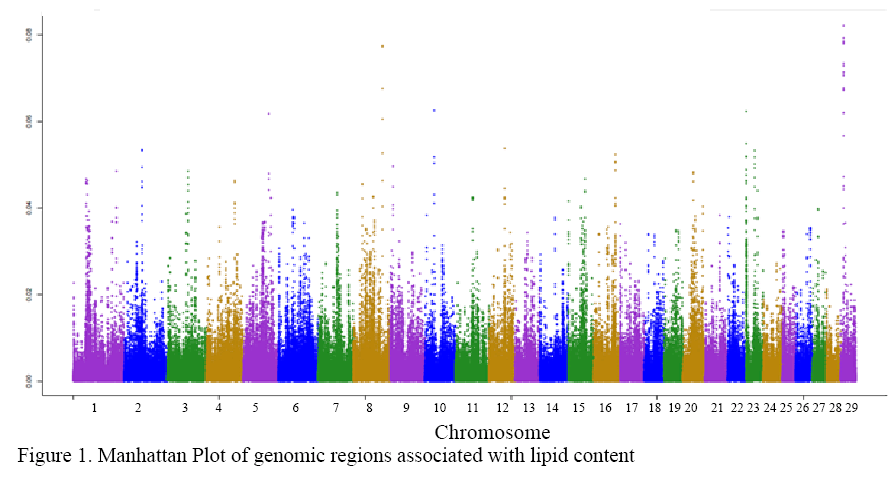
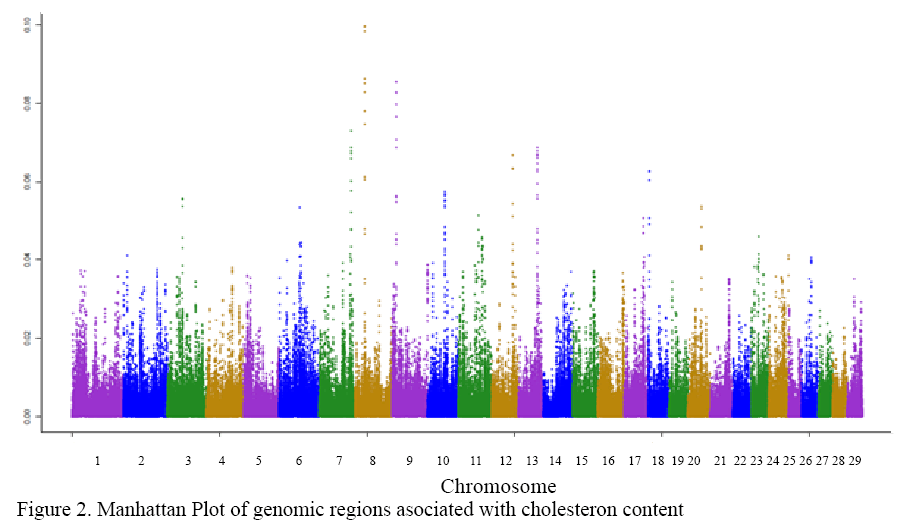
<p align="justify"><span style="line-height:120%; letter-spacing:.2pt; font-family:'Verdana','sans-serif'; font-size:10.0pt; "><a href="/img/revistas/cjas/v49n4/f0106415.gif">Figures  1</a> and <a href="/img/revistas/cjas/v49n4/f0206415.gif">2</a> contain genomic regions and the percentage of variance explained by  chromosome by windows of 10 SNP adjacent for lipid and cholesterol content,  respectively.</span></p>       
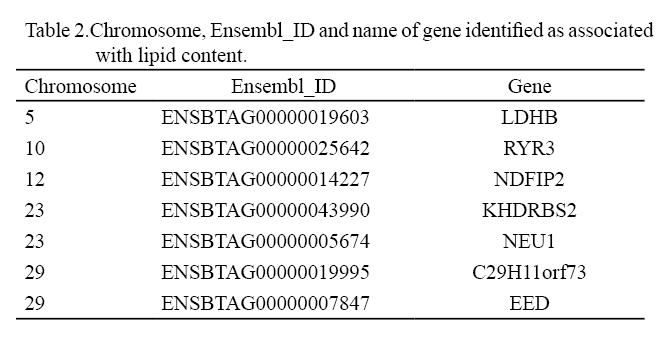
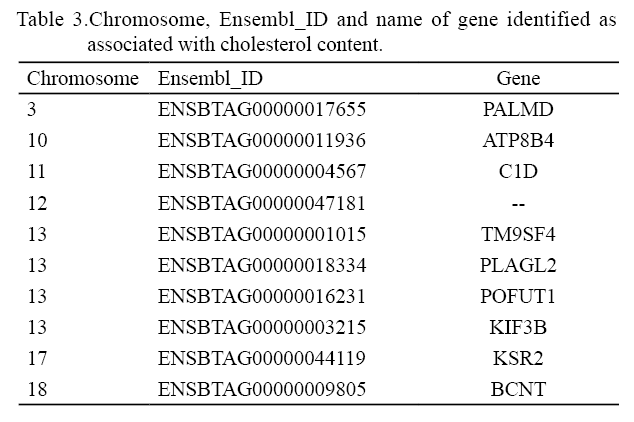
<p align="justify"><font size="2" face="Verdana, Arial, Helvetica, sans-serif"><span style="line-height:120%; font-family:'Verdana','sans-serif'; font-size:10.0pt; ">A  total of 7 and 10 associated genomic regions, distributed in 5 and 7 different  chromosomes were obtained for lipid and cholesterol content, respectively. In  these regions, 7 and 9 genes were identified for each trait in this order  (<a href="/img/revistas/cjas/v49n4/t0206415.gif">tables 2</a> and <a href="/img/revistas/cjas/v49n4/t0306415.gif">3</a>)</span>.</font></p>       
<p align="justify"><font size="2" face="Verdana, Arial, Helvetica, sans-serif"><span style="line-height:120%; letter-spacing:.2pt; font-family:'Verdana','sans-serif'; font-size:10.0pt; ">With ssGWAS method, using a high density panel, it was possible to  identify regions related to lipid and cholesterol content in Nellore beef.  Posteriorly, those genes and their pathways will be researched to evaluate  their then importance for meat quality      traits</span>.</font></p>     <p align="justify">&nbsp;</p>      <p align="justify"><font size="2" face="Verdana, Arial, Helvetica, sans-serif"><font size="3"><b>REFERENCES</b></font></font></p>     <p align="justify" class="MsoNormal" style="text-indent:0.0pt;line-height:normal;"><span style="font-family:'Verdana','sans-serif'; font-size:10.0pt; ">Aguilar, I., Misztal, I., Legarra, A. &amp; Tsuruta, S. 2011. </span><span style="font-family:'Verdana','sans-serif'; font-size:10.0pt; ">&ldquo;Efficient computation of the  genomic relationship matrix and other matrices used in single-step evaluation&rdquo;. <em>Journal of Animal Breeding and Genetics</em>, 128 (6): 422&ndash;428.</span></p>     <p align="justify" class="MsoNormal" style="text-indent:0.0pt;line-height:normal;"><span style="font-family:'Verdana','sans-serif'; font-size:10.0pt; ">Bligh, E. G. &amp; Dyer, W. J.  1959. &ldquo;A rapid method of total lipid extraction and purification&rdquo;. <em>Canadian  journal of biochemistry and physiology</em>, 37 (8): 911&ndash;917.</span></p>     ]]></body>
<body><![CDATA[<p align="justify" class="MsoNormal" style="text-indent:0.0pt;line-height:normal;"><span style="font-family:'Verdana','sans-serif'; font-size:10.0pt; ">Gianola, D. &amp; Fernando, R.  L. 1986. &ldquo;Bayesian methods in animal breeding theory&rdquo;. <em>Journal of Animal  Science</em>, 63 (1): 217&ndash;244.</span></p>     <p align="justify" class="MsoNormal" style="text-indent:0.0pt;line-height:normal;"><span style="font-family:'Verdana','sans-serif'; font-size:10.0pt; ">Heidelberger, P. &amp; Welch,  P. D. 1983. &ldquo;Simulation run length control in the presence of an initial  transient&rdquo;. <em>Operations Research</em>, 31 (6): 1109&ndash;1144.</span></p>     <p align="justify" class="MsoNormal" style="text-indent:0.0pt;line-height:normal;"><span style="font-family:'Verdana','sans-serif'; font-size:10.0pt; ">Misztal, I., Tsuruta, S.,  Strabebl, T., Auvray, B., Drueta, T. &amp; Lee, D. H. 2002. &ldquo;Proceedings of the  7th World Congress on Genetics Applied to Livestock Production&rdquo;. In: vol. 28,  Montpellier: INRA, p. 21.</span></p>     <p align="justify" class="MsoNormal" style="text-indent:0.0pt;line-height:normal;"><span style="font-family:'Verdana','sans-serif'; font-size:10.0pt; ">Raftery, A. E. &amp; Lewis, S.  M. 1992. &ldquo;Comment on &lsquo;The Gibbs sampler and Markov chain Monte Carlo&rsquo;&rdquo;. <em>Statistical  Science</em>, 7: 499&ndash;501.</span></p>     <!-- ref --><p align="justify" class="MsoNormal" style="text-indent:0.0pt;line-height:normal;"><span style="font-family:'Verdana','sans-serif'; font-size:10.0pt; ">R Development Core Teamn.d. <em>R:  A language and environment for statistical computing</em>. Vienna, Austria: R  Foundation for Statistical Computing, ISBN: 3-900051-07-0, Available:  &lt;<a href="http://www.R-project.org" target="_blank">http://www.R-project.org</a>&gt;    .</span></p>     <p align="justify" class="MsoNormal" style="text-indent:0.0pt;line-height:normal;"><span style="font-family:'Verdana','sans-serif'; font-size:10.0pt; ">Saldanha, T., Mazalli, M. R. &amp; Bragagnolo, N. 2004. &ldquo;Avalia&ccedil;&atilde;o  comparativa entre dois m&eacute;todos para determina&ccedil;&atilde;o do colesterol em carnes e  leite&rdquo;. <em>Ci&ecirc;ncia e Tecnologia de Alimentos</em>, 24 (1): 109&ndash;113.</span></p>     <!-- ref --><p align="justify" class="MsoNormal" style="margin-bottom:.0001pt;text-indent:0.0pt;line-height:normal;"><span style="font-family:'Verdana','sans-serif'; font-size:10.0pt; ">WTSI &amp; EMBL-EBI. 2016. <em>Ensembl genome browser  84</em>. , Available: &lt;<a href="http://www.ensembl.org/index.html" target="_blank">http://www.ensembl.org/index.html</a>&gt;,  [Consulted:&nbsp;May 5, 2016]</span><font size="2" face="Verdana,     Arial, Helvetica, sans-serif">.</font></p>     <p align="justify">&nbsp;</p>     ]]></body>
<body><![CDATA[<p align="justify">&nbsp;</p>     <p align="justify"><font size="2" face="Verdana, Arial, Helvetica, sans-serif">Received: November 26, 2015    <br>   Accepted: January 6, 2016</font></p>     <p align="justify">&nbsp;</p>     <p align="justify">&nbsp;</p>     <p align="justify"><font size="2" face="Verdana, Arial, Helvetica, sans-serif"><i>F.M. Rezende,</i> Federal University of Uberlandia, Uberlandia, MG, Brazil.    Email: <a href="mailto:frezende@ingeb.ufu.br">frezende@ingeb.ufu.br</a></font></p>      ]]></body><back>
<ref-list>
<ref id="B1">
<nlm-citation citation-type="journal">
<person-group person-group-type="author">
<name>
<surname><![CDATA[Aguilar]]></surname>
<given-names><![CDATA[I.]]></given-names>
</name>
<name>
<surname><![CDATA[Misztal]]></surname>
<given-names><![CDATA[I.]]></given-names>
</name>
<name>
<surname><![CDATA[Legarra]]></surname>
<given-names><![CDATA[A.]]></given-names>
</name>
<name>
<surname><![CDATA[Tsuruta]]></surname>
<given-names><![CDATA[S.]]></given-names>
</name>
</person-group>
<article-title xml:lang="nd"><![CDATA[Efficient computation of the genomic relationship matrix and other matrices used in single-step evaluation]]></article-title>
<source><![CDATA[Journal of Animal Breeding and Genetics]]></source>
<year>2011</year>
<volume>128</volume>
<numero>6</numero>
<issue>6</issue>
<page-range>422–428</page-range></nlm-citation>
</ref>
<ref id="B2">
<nlm-citation citation-type="journal">
<person-group person-group-type="author">
<name>
<surname><![CDATA[Bligh]]></surname>
<given-names><![CDATA[E. G.]]></given-names>
</name>
<name>
<surname><![CDATA[Dyer]]></surname>
<given-names><![CDATA[W. J.]]></given-names>
</name>
</person-group>
<article-title xml:lang="nd"><![CDATA[A rapid method of total lipid extraction and purification]]></article-title>
<source><![CDATA[Canadian journal of biochemistry and physiology]]></source>
<year>1959</year>
<volume>37</volume>
<numero>8</numero>
<issue>8</issue>
<page-range>911–917</page-range></nlm-citation>
</ref>
<ref id="B3">
<nlm-citation citation-type="journal">
<person-group person-group-type="author">
<name>
<surname><![CDATA[Gianola]]></surname>
<given-names><![CDATA[D.]]></given-names>
</name>
<name>
<surname><![CDATA[Fernando]]></surname>
<given-names><![CDATA[R. L.]]></given-names>
</name>
</person-group>
<article-title xml:lang="nd"><![CDATA[Bayesian methods in animal breeding theory]]></article-title>
<source><![CDATA[Journal of Animal Science]]></source>
<year>1986</year>
<volume>63</volume>
<numero>1</numero>
<issue>1</issue>
<page-range>217–244</page-range></nlm-citation>
</ref>
<ref id="B4">
<nlm-citation citation-type="journal">
<person-group person-group-type="author">
<name>
<surname><![CDATA[Heidelberger]]></surname>
<given-names><![CDATA[P.]]></given-names>
</name>
<name>
<surname><![CDATA[Welch]]></surname>
<given-names><![CDATA[P. D.]]></given-names>
</name>
</person-group>
<article-title xml:lang="nd"><![CDATA[Simulation run length control in the presence of an initial transient]]></article-title>
<source><![CDATA[Operations Research]]></source>
<year>1983</year>
<volume>31</volume>
<numero>6</numero>
<issue>6</issue>
<page-range>1109–1144</page-range></nlm-citation>
</ref>
<ref id="B5">
<nlm-citation citation-type="book">
<person-group person-group-type="author">
<name>
<surname><![CDATA[Misztal]]></surname>
<given-names><![CDATA[I.]]></given-names>
</name>
<name>
<surname><![CDATA[Tsuruta]]></surname>
<given-names><![CDATA[S.]]></given-names>
</name>
<name>
<surname><![CDATA[Strabebl]]></surname>
<given-names><![CDATA[T.]]></given-names>
</name>
<name>
<surname><![CDATA[Auvray]]></surname>
<given-names><![CDATA[B.]]></given-names>
</name>
<name>
<surname><![CDATA[Drueta]]></surname>
<given-names><![CDATA[T.]]></given-names>
</name>
<name>
<surname><![CDATA[Lee]]></surname>
<given-names><![CDATA[D. H.]]></given-names>
</name>
</person-group>
<article-title xml:lang="nd"><![CDATA[Proceedings of the 7th World Congress on Genetics Applied to Livestock Production]]></article-title>
<source><![CDATA[]]></source>
<year>2002</year>
<volume>28</volume>
<page-range>21</page-range><publisher-loc><![CDATA[Montpellier ]]></publisher-loc>
<publisher-name><![CDATA[INRA]]></publisher-name>
</nlm-citation>
</ref>
<ref id="B6">
<nlm-citation citation-type="journal">
<person-group person-group-type="author">
<name>
<surname><![CDATA[Raftery]]></surname>
<given-names><![CDATA[A. E.]]></given-names>
</name>
<name>
<surname><![CDATA[Lewis]]></surname>
<given-names><![CDATA[S. M.]]></given-names>
</name>
</person-group>
<article-title xml:lang="nd"><![CDATA[Comment on ‘The Gibbs sampler and Markov chain Monte Carlo’]]></article-title>
<source><![CDATA[Statistical Science]]></source>
<year>1992</year>
<volume>7</volume>
<page-range>499–501</page-range></nlm-citation>
</ref>
<ref id="B7">
<nlm-citation citation-type="book">
<person-group person-group-type="author">
<name>
<surname><![CDATA[R Development Core Team]]></surname>
</name>
</person-group>
<source><![CDATA[R: A language and environment for statistical computing]]></source>
<year></year>
<publisher-loc><![CDATA[Vienna, Austria ]]></publisher-loc>
<publisher-name><![CDATA[R Foundation for Statistical Computing]]></publisher-name>
</nlm-citation>
</ref>
<ref id="B8">
<nlm-citation citation-type="journal">
<person-group person-group-type="author">
<name>
<surname><![CDATA[Saldanha]]></surname>
<given-names><![CDATA[T.]]></given-names>
</name>
<name>
<surname><![CDATA[Mazalli]]></surname>
<given-names><![CDATA[M. R.]]></given-names>
</name>
<name>
<surname><![CDATA[Bragagnolo]]></surname>
<given-names><![CDATA[N.]]></given-names>
</name>
</person-group>
<article-title xml:lang="nd"><![CDATA[Avaliação comparativa entre dois métodos para determinação do colesterol em carnes e leite]]></article-title>
<source><![CDATA[Ciência e Tecnologia de Alimentos]]></source>
<year>2004</year>
<volume>24</volume>
<numero>1</numero>
<issue>1</issue>
<page-range>109–113</page-range></nlm-citation>
</ref>
<ref id="B9">
<nlm-citation citation-type="">
<person-group person-group-type="author">
<name>
<surname><![CDATA[WTSI]]></surname>
</name>
<name>
<surname><![CDATA[EMBL-EBI]]></surname>
</name>
</person-group>
<source><![CDATA[Ensembl genome browser 84]]></source>
<year>2016</year>
</nlm-citation>
</ref>
</ref-list>
</back>
</article>