<?xml version="1.0" encoding="ISO-8859-1"?><article xmlns:mml="http://www.w3.org/1998/Math/MathML" xmlns:xlink="http://www.w3.org/1999/xlink" xmlns:xsi="http://www.w3.org/2001/XMLSchema-instance">
<front>
<journal-meta>
<journal-id>2079-3480</journal-id>
<journal-title><![CDATA[Cuban Journal of Agricultural Science]]></journal-title>
<abbrev-journal-title><![CDATA[Cuban J. Agric. Sci.]]></abbrev-journal-title>
<issn>2079-3480</issn>
<publisher>
<publisher-name><![CDATA[Editorial del Instituto de Ciencia Animal]]></publisher-name>
</publisher>
</journal-meta>
<article-meta>
<article-id>S2079-34802015000400008</article-id>
<title-group>
<article-title xml:lang="en"><![CDATA[Effect of hCG application on day 12 post-mating on the reproductive efficiency and plasmatic concentrations of progesterone in hair ewes]]></article-title>
<article-title xml:lang="es"><![CDATA[Efecto de la aplicación de hCG en el día 12 post-servicio sobre la eficiencia reproductiva y las concentraciones plasmáticas de progesterona en ovejas de pelo]]></article-title>
</title-group>
<contrib-group>
<contrib contrib-type="author">
<name>
<surname><![CDATA[Quintero]]></surname>
<given-names><![CDATA[J]]></given-names>
</name>
<xref ref-type="aff" rid="A01"/>
</contrib>
<contrib contrib-type="author">
<name>
<surname><![CDATA[Olguín]]></surname>
<given-names><![CDATA[H]]></given-names>
</name>
<xref ref-type="aff" rid="A01"/>
</contrib>
<contrib contrib-type="author">
<name>
<surname><![CDATA[Quezada]]></surname>
<given-names><![CDATA[A]]></given-names>
</name>
<xref ref-type="aff" rid="A01"/>
</contrib>
<contrib contrib-type="author">
<name>
<surname><![CDATA[Janacua]]></surname>
<given-names><![CDATA[H]]></given-names>
</name>
<xref ref-type="aff" rid="A01"/>
</contrib>
<contrib contrib-type="author">
<name>
<surname><![CDATA[Rivas]]></surname>
<given-names><![CDATA[R]]></given-names>
</name>
<xref ref-type="aff" rid="A01"/>
</contrib>
<contrib contrib-type="author">
<name>
<surname><![CDATA[Macías]]></surname>
<given-names><![CDATA[U]]></given-names>
</name>
<xref ref-type="aff" rid="A02"/>
</contrib>
</contrib-group>
<aff id="A01">
<institution><![CDATA[,Universidad Autónoma de Ciudad Juárez Departamento de Ciencias Veterinarias ]]></institution>
<addr-line><![CDATA[ ]]></addr-line>
</aff>
<aff id="A02">
<institution><![CDATA[,Universidad Autónoma de Baja California  ]]></institution>
<addr-line><![CDATA[Mexicali Baja California]]></addr-line>
<country>México</country>
</aff>
<pub-date pub-type="pub">
<day>00</day>
<month>12</month>
<year>2015</year>
</pub-date>
<pub-date pub-type="epub">
<day>00</day>
<month>12</month>
<year>2015</year>
</pub-date>
<volume>49</volume>
<numero>4</numero>
<fpage>487</fpage>
<lpage>490</lpage>
<copyright-statement/>
<copyright-year/>
<self-uri xlink:href="http://scielo.sld.cu/scielo.php?script=sci_arttext&amp;pid=S2079-34802015000400008&amp;lng=en&amp;nrm=iso"></self-uri><self-uri xlink:href="http://scielo.sld.cu/scielo.php?script=sci_abstract&amp;pid=S2079-34802015000400008&amp;lng=en&amp;nrm=iso"></self-uri><self-uri xlink:href="http://scielo.sld.cu/scielo.php?script=sci_pdf&amp;pid=S2079-34802015000400008&amp;lng=en&amp;nrm=iso"></self-uri><abstract abstract-type="short" xml:lang="en"><p><![CDATA[The application of human chorionic gonadotropin on day 12 post-mating on the reproductive efficiency and plasmatic concentrations of progesterone in hair ewes submitted to an estrus synchronization program was assessed. Twenty four hair ewes were treated with vaginal sponges for 12 d and one application of 200 IU of PMSG at sponge removal. On day 12 post-estrus, ewes were injected with a saline solution (control group) or 300 IU of hCG (hCG group). Hormonal concentrations were determined in each female group. Blood samples were collected 2 h before and 0, 2, 4, 6, 8, 24 and 48 h after the beginning of the hCG application for the P4 analysis. The pregnancy diagnostic was realized 30 d post-mating. The pregnancy rate, lambing and fertility rates were analyzed through X² and an analysis of variance was used for prolificacy. Treatment effects on plasmatic concentrations of P4 were determined by the analysis of repeated measurements using the SAS (2004) program. The hCG increased pregnancy rate compared to the control group (81.8 vs. 63.6 %; P < 0.001) and in the same way fertility was favored with hCG application (81.8 vs. 54.6 %; P < 0.001). There was significant difference (P < 0.001) in P4 plasmatic concentrations between treatments, being higher in ewes treated with hCG. Considering the results conclusions can be drawn that hCG administered on day 12 post-mating increases pregnancy rate, besides increasing the fertility of the treated ewes. The hCG also provokes significant increases in the progesterone plasmatic concentrations (P4) of female sheep]]></p></abstract>
<abstract abstract-type="short" xml:lang="es"><p><![CDATA[Se evaluó la aplicación de (Gonadotropina cariónica humana) en el día 12 post-servicio en la eficiencia reproductiva y concentraciones plasmáticas de progesterona en ovejas de pelo sometidas a un programa de sincronización de estros. Se utilizaron 24 ovejas de pelo, tratadas con esponjas vaginales durante 12 d y una aplicación de 200 UI de PMSG al momento del retiro de la esponja. En el día 12 post-estro, las ovejas fueron inyectadas con una solución salina (grupo testigo) o300 UI de hCG (grupo hCG). Las concentraciones hormonales fueron determinadas en cada grupo de hembras. Las muestras sanguíneas fueron colectadas 2 horas antes y 0, 2, 4, 6, 8, 24 y 48 horas después del inicio de la aplicación de hCG para el análisis de P4. El diagnóstico de gestación se realizó 30 d después del servicio. La tasa de gestación, tasa de partos y fertilidad se analizaron con X² y para la prolificidad se utilizó un análisis de varianza. Los efectos de los tratamientos en las concentraciones plasmáticas de la P4 se determinaron por el análisis de medidas repetidas utilizando el programa SAS (2004). La hCG incrementó la tasa de gestación en comparación al grupo control (81.8 vs 63.6%; P&#706;0.001) y de igual manera la fertilidad se vio favorecida con la aplicación de hCG (81.8 vs 54.6%; P&#706;0.001). Hubo diferencia significativa (P&#706;0.001) en las concentraciones plasmáticas de P4 entre los tratamientos, siendo altas en las ovejas tratadas con hCG. En consideración a los resultados se puede concluir que la administración de hCG en el día 12 post-servicio incrementa la tasa de gestación, además de aumentar la fertilidad de las ovejas tratadas. La hCG además provoca aumentos significativos en las concentraciones plasmáticas de progesterona (P4) en hembras ovinas]]></p></abstract>
<kwd-group>
<kwd lng="en"><![CDATA[hCG]]></kwd>
<kwd lng="en"><![CDATA[ewes]]></kwd>
<kwd lng="en"><![CDATA[progesterone]]></kwd>
<kwd lng="en"><![CDATA[fertility]]></kwd>
<kwd lng="es"><![CDATA[hCG]]></kwd>
<kwd lng="es"><![CDATA[ovejas]]></kwd>
<kwd lng="es"><![CDATA[progesterona]]></kwd>
<kwd lng="es"><![CDATA[fertilidad]]></kwd>
</kwd-group>
</article-meta>
</front><body><![CDATA[ <p align="right"><font size="2" face="Verdana, Arial, Helvetica,   sans-serif"><b>ORIGINAL ARTICLE</b></font></p>     <p>&nbsp;</p>     <p align="justify"><font size="4" face="Verdana, Arial, Helvetica, sans-serif"><b>Effect of hCG application on day 12 post-mating on the reproductive efficiency and plasmatic concentrations of progesterone in hair ewes</b></font></p>     <p align="justify">&nbsp;</p>     <p align="justify"><font size="3" face="Verdana, Arial, Helvetica, sans-serif"><b>Efecto de la aplicación de hCG en el día 12 post-servicio sobre la eficiencia reproductiva y las concentraciones plasmáticas de progesterona en ovejas de pelo</b></font></p>     <p align="justify">&nbsp;</p>     <p align="justify">&nbsp;</p>     <p align="justify"><font size="2" face="Verdana, Arial, Helvetica, sans-serif"><b>J. Quintero,</b><sup><b>I</b></sup><b> H. Olguín,</b><sup><b>I</b></sup><b> A. Quezada,</b><sup><b>I</b></sup><b> H. Janacua,</b><sup><b>I</b></sup><b> R. Rivas,</b><sup><b>I</b></sup><b> U. Macías,</b><sup><b>II</b></sup></font></p>     <p align="justify"><font size="2" face="Verdana, Arial, Helvetica, sans-serif"><b> </b></font><font size="2" face="Verdana, Arial, Helvetica, sans-serif"><sup>I</sup>Universidad Autónoma de Ciudad Juárez. C.P. 32310. Anillo Envolvente del Pronaf  S/N. Departamento de Ciencias Veterinarias.    <br>   <sup>II</sup>ICA, Universidad Autónoma de Baja California. C.P. 21705. Mexicali, Baja California, México. </font></p>     ]]></body>
<body><![CDATA[<p align="justify">&nbsp;</p>     <p align="justify">&nbsp;</p> <hr align="JUSTIFY">     <p align="justify"><font size="2" face="Verdana, Arial, Helvetica, sans-serif"><b>ABSTRACT</b></font></p>     <p align="justify"><font size="2" face="Verdana, Arial, Helvetica, sans-serif"><span style=" font-family:'Verdana','sans-serif'; font-size:10.0pt; ">The  application of human chorionic gonadotropin on day 12 post-mating on the  reproductive efficiency and plasmatic concentrations of progesterone in hair  ewes submitted to an estrus synchronization program was assessed.&nbsp; Twenty four hair ewes were treated with  vaginal sponges for 12 d and one application of 200 IU of PMSG at sponge  removal.&nbsp; On day 12 post-estrus, ewes  were injected with a saline solution (control group) or 300 IU of hCG (hCG  group).&nbsp; Hormonal concentrations were  determined in each female group.&nbsp; Blood  samples were collected 2 h before and 0, 2, 4, 6, 8, 24 and 48 h after the  beginning of the hCG application for the P4 analysis.&nbsp; The pregnancy diagnostic was realized  30 d post-mating.&nbsp; The pregnancy rate,  lambing and fertility rates were analyzed through X<sup>2</sup> and an analysis  of variance was used for prolificacy.&nbsp;  Treatment effects on plasmatic concentrations of P4 were determined by  the analysis of repeated measurements using the SAS (2004) program.&nbsp; The hCG increased pregnancy rate compared to  the control group (81.8 vs. 63.6 %; P &lt; 0.001) and in the same way fertility  was favored with hCG application (81.8 vs. 54.6 %;  P &lt; 0.001). There was significant difference (P &lt; 0.001) in P4 plasmatic  concentrations between treatments, being higher in ewes treated with hCG.&nbsp; Considering the results conclusions can be  drawn that hCG administered on day 12 post-mating increases pregnancy rate,  besides increasing the fertility of the treated ewes.&nbsp; The hCG also provokes significant increases  in the progesterone plasmatic concentrations (P4) of female sheep</span>.</font></p>     <p align="justify"><font size="2" face="Verdana, Arial, Helvetica, sans-serif"><b>Key words:</b> hCG; ewes, progesterone, fertility.</font></p> <hr align="JUSTIFY">     <p align="justify"><font size="2" face="Verdana, Arial, Helvetica, sans-serif"><b>RESUMEN</b></font></p>     <p align="justify"><font size="2" face="Verdana, Arial, Helvetica, sans-serif"><span style="; letter-spacing:-.2pt; font-family:'Verdana','sans-serif'; font-size:10.0pt; ">Se evalu&oacute; la aplicaci&oacute;n de (Gonadotropina cari&oacute;nica  humana) en el d&iacute;a 12 post-servicio en la eficiencia reproductiva y  concentraciones plasm&aacute;ticas de progesterona en ovejas de pelo sometidas a un  programa de sincronizaci&oacute;n de estros. Se utilizaron 24 ovejas de pelo, tratadas  con esponjas vaginales durante 12 d y una aplicaci&oacute;n de 200 UI de PMSG al  momento del retiro de la esponja. En el d&iacute;a 12 post-estro, las ovejas fueron  inyectadas con una soluci&oacute;n salina (grupo testigo) o300 UI de hCG (grupo hCG).  Las concentraciones hormonales fueron determinadas en cada grupo de hembras.  Las muestras sangu&iacute;neas fueron colectadas  2 horas antes y 0, 2, 4, 6, 8, 24 y 48 horas despu&eacute;s del inicio de la  aplicaci&oacute;n de hCG para el an&aacute;lisis de P4. El diagn&oacute;stico de gestaci&oacute;n se  realiz&oacute; 30 d despu&eacute;s del servicio. La tasa de gestaci&oacute;n, tasa de partos y fertilidad se  analizaron con X<sup>2</sup> y para la prolificidad se utiliz&oacute; un an&aacute;lisis de  varianza. Los efectos de los tratamientos en las concentraciones plasm&aacute;ticas de  la P4 se determinaron por el an&aacute;lisis de medidas repetidas utilizando el  programa SAS (2004). La hCG increment&oacute; la tasa de gestaci&oacute;n en comparaci&oacute;n al  grupo control (81.8 vs 63.6%; P</span><span style="; letter-spacing:-.2pt; font-family:'Arial','sans-serif'; font-size:10.0pt; ">&#706;</span><span style="font-family:'Verdana','sans-serif'; font-size:10.0pt; ">0.001)  y de igual manera la fertilidad se vio favorecida con la aplicaci</span><span style="font-family:'Verdana','sans-serif'; font-size:10.0pt; ">&oacute;</span><span style="font-family:'Verdana','sans-serif'; font-size:10.0pt; ">n de hCG (81.8 vs 54.6%; P</span><span style="font-family:'Arial','sans-serif'; font-size:10.0pt; ">&#706;</span><span style="font-family:'Verdana','sans-serif'; font-size:10.0pt; ">0.001).  Hubo diferencia significativa (P</span><span style="font-family:'Arial','sans-serif'; font-size:10.0pt; ">&#706;</span><span style="font-family:'Verdana','sans-serif'; font-size:10.0pt; ">0.001)  en las concentraciones plasm</span><span style="font-family:'Verdana','sans-serif'; font-size:10.0pt; ">&aacute;</span><span style="font-family:'Verdana','sans-serif'; font-size:10.0pt; ">ticas  de P4 entre los tratamientos, siendo altas en las ovejas tratadas con hCG. En  consideraci</span><span style="font-family:'Verdana','sans-serif'; font-size:10.0pt; ">&oacute;</span><span style="font-family:'Verdana','sans-serif'; font-size:10.0pt; ">n a  los resultados se puede concluir que la administraci</span><span style="font-family:'Verdana','sans-serif'; font-size:10.0pt; ">&oacute;</span><span style="font-family:'Verdana','sans-serif'; font-size:10.0pt; ">n de hCG en el d</span><span style="font-family:'Verdana','sans-serif'; font-size:10.0pt; ">&iacute;</span><span style="font-family:'Verdana','sans-serif'; font-size:10.0pt; ">a 12 post-servicio  incrementa la tasa de gestaci&oacute;n, adem&aacute;s de aumentar la fertilidad de las ovejas  tratadas. La hCG adem&aacute;s provoca&nbsp; aumentos  significativos en las concentraciones plasm&aacute;ticas de progesterona (P4) en  hembras ovinas</span>.</font></p>     <p align="justify"><font size="2" face="Verdana, Arial, Helvetica, sans-serif"><b>Palabras    clave:</b>  hCG, ovejas, progesterona, fertilidad.</font></p> <hr align="JUSTIFY">     <p align="justify">&nbsp;</p>     <p align="justify">&nbsp;</p>     ]]></body>
<body><![CDATA[<p align="justify"><font size="2" face="Verdana, Arial, Helvetica, sans-serif"><b><font size="3">INTRODUCTION</font></b></font></p>       <p align="justify" class="Cuerpodetexto"><span style="letter-spacing:.2pt; font-family:'Verdana','sans-serif'; font-size:10.0pt; ">High temperatures affect negatively sheep fertility,  provoking failures in the hormonal system, and consequently a deficient  embryonic development. In this regard, some studies have found deficiencies in  the luteal function and low progesterone concentrations during the first  pregnancy stages (Khan <em>et al.</em> 2009) provoking early embryonic  deaths.&nbsp; Some of these research studies  have been focused to decreasing the incidence of embryonic deaths in ewes,  through progesterone and gonadotropin supplementation during early pregnancy.  Recently, human chorionic gonadotropin is used (hCG; Khan <em>et al.</em> 2009  and Lashari and Tasawar 2010) for improving the luteal function and favoring  luteinization of development follicles for the formation of accessory luteal  bodies that would increase the progesterone plasmatic concentrations (necessary  for the maintenance of gestation), which will help stimulate the growth of the  conceptus in the uterus, assuring with the best placentation and consequently  an increase in the conception rate. Hormonal treatments with hCG are utilized  for increasing progesterone production on day 12 post-mating for preventing  luteolysis in the luteal body and prostaglandin F2&alpha; (PGF2&alpha;) secretions. In view  of the above mentioned, the purpose of this study was to study the effect of  the treatment with hCG in hair ewes on day 12 post-mating on reproductive  efficiency and embryonic and fetal      development.</span></p>       <p align="justify" class="Cuerpodetexto" style=""><span style=" font-family:'Verdana','sans-serif'; font-size:10.0pt; ">&nbsp;</span></p>       <p align="justify" class="subtitulo" style=""><strong><span style="font-family:'Verdana','sans-serif'; font-size=3">MATERIALS AND  METHODS</span></strong></p>       <p align="justify" class="Cuerpodetexto" style=""><span style="font-family:'Verdana','sans-serif'; font-size:10.0pt; ">The experiment was carried out at the Ranch of the  Autonomous University of Ju&aacute;rez City, located in Ju&aacute;rez Valley, Praxedis G.  Guerrero, Chihuahua.&nbsp; Twenty four adult  hair ewes were randomly separated in two groups (12 ewes/group).&nbsp; Estrus was synchronized in all ewes using  vaginal sponges impregnated with progestogens (Chronogest&reg;Intervet&reg;) for 12 d.  At sponge removal each ewe was injected with a dosage of 200 IU of PMSG  (Follig&oacute;n&reg;Intervet&reg;). To the synchronized estrus, ewes were served 48 h after  sponge removal through the system of direct natural mating.&nbsp; On day 12 post-estrus, ewes were injected  intramuscularly with a saline solution (control group) or 300 IU of hCG  (Chorul&oacute;n&reg;Intervet&reg;; hCG group).&nbsp; Two  hours before and at 0, 2, 4, 6, 8, 24 and 48 hours after the application of  hCG, blood samples were taken by jugular puncture.&nbsp; After collection, the blood samples were  centrifuged for separating the plasma which was stored at -20&ordm; C until its  later hormonal analysis. Sheep P4 determination was carried out using the  technique defined by Law <em>et al.</em> (1992). Pregnancy diagnostic was made 30  d after service with ultrasonography equipment. The effect of the hCG (300 IU)  application on the reproductive efficiency (pregnancy rate and lambing,  fertility and prolificacy rates) and on the plasmatic concentrations of  progesterone were evaluated.&nbsp; Pregnancy  rates and lambing and fertility rates were analyzed through the procedure PROC  FREQ. and prolificacy was by PROX MIXED of the SAS (2004) package. Mean  comparison for prolificacy was made using Tukey test for &alpha; = 0.05. Treatment  effects on plasmatic P4 concentrations were determined by the analysis of  repeated measurements using SAS (2004)      program.</span></p>       <p align="justify" class="Cuerpodetexto" style=""><span style="font-family:'Verdana','sans-serif'; font-size:10.0pt; ">&nbsp;</span></p>       <p align="justify" class="subtitulo" style=""><strong><span style="font-family:'Verdana','sans-serif'; font-size=3">RESULTS AND  DISCUSSION</span></strong></p>       <p align="justify" class="Cuerpodetexto" style=""><span style="font-family:'Verdana','sans-serif'; font-size:10.0pt; ">The percentage of pregnant ewes, lambed ewes, fertility  and prolificacy for the hCG groups (day 12 post-mating) and the control are shown  in <a href="/img/revistas/cjas/v49n4/t0108415.gif">table 1</a>.&nbsp; Results of this study  confirm the hypothesis that the gonadotropin supplementation on the 12 d of  pregnancy in the ewe improves the fertility through conceptus and placentation  assurance. When hCG was applied there was a significant effect on the variables  pregnancy and fertility rates, coinciding with Cam and Kuran (2004) who report  an increase in the pregnancy rate in ewes treated with hCG      (84.1 %) regarding the control group (62.2 %) the same as prolificacy which was  improved with hCG application (1.5 vs. 1.12 litters). In the same way, Khan <em>et  al.</em> (2009) obtained a higher lambing percentage in ewes treated with hCG  regarding the untreated (57 vs.      50 %), the same as prolificacy (2.0 vs. 1.8 litters). All these results  indicate that hCG administered before the maternal pregnancy examination  improves the gestation rate, lambing percentage and prolificacy.&nbsp;&nbsp; The effect is attributed to hCG, which  increases progesterone production and uterine secretions which are of  embryotrophic origin.</span></p>       
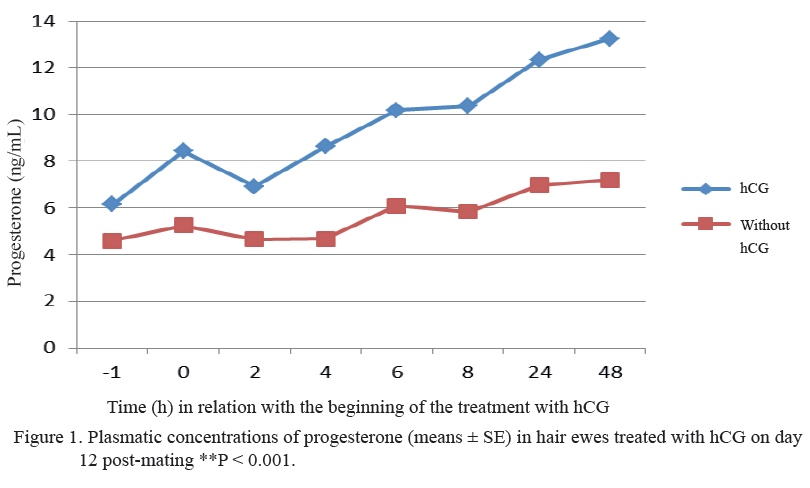
<p align="justify" class="Cuerpodetexto" style=""><span style="font-family:'Verdana','sans-serif'; font-size:10.0pt; ">Mean progesterone concentrations in plasma were  significantly (P &lt; 0.001) high in the group of ewes treated with hCG  compared to the control group (<a href="/img/revistas/cjas/v49n4/f0108415.gif">figure 1</a>).&nbsp;  It was observed that 2 hours after hCG application the plasmatic P4  concentrations increased until reaching its maximum concentration between 24  and 48 h after its application regarding the control group.&nbsp; The increase in the progesterone  concentration in ewes treated with hCG noticed in this study is similar to that  obtained by Khan <em>et al.</em> (2007), who estimate that these high  concentrations of progesterone as a consequence of hCG administration are  considered as responsible of the rapid growth of the blastocyst resulting in a  greater interferon IFN-r secretion and thus an increase in embryonic survival,  bringing about increase in the number of pregnant females and ultimately  improvement in ewe fertility.</span></p>       
<p align="justify"><span style=" font-family:'Verdana','sans-serif'; font-size:10.0pt; ">Results of this study  demonstrate that luteal function during the beginning of pregnancy is  significantly high in ewes treated with hCG, which stimulates conceptus growth,  due to the considerable increase of the plasmatic concentrations of  progesterone.&nbsp; The hCG application on the  day 12 post-mating improves the reproductive efficiency by increasing pregnancy  rate and fertility in hair ewes</span><font size="2" face="Verdana, Arial, Helvetica, sans-serif">.</font></p>     ]]></body>
<body><![CDATA[<p align="justify">&nbsp;</p>      <p align="justify"><font size="2" face="Verdana, Arial, Helvetica, sans-serif"><font size="3"><b>REFERENCES</b></font></font></p>     <p align="justify" class="MsoNormal" style="line-height:normal;"><span style="font-family:'Verdana','sans-serif'; font-size:10.0pt; ">Cam, M. A.  &amp; Kuran, M. 2004. </span><span style="font-family:'Verdana','sans-serif'; font-size:10.0pt; ">&ldquo;Effects of a single injection of hCG or GnRH agonist on day 12 post mating  on fetal growth and reproductive performance of sheep&rdquo;. <em>Animal reproduction  science</em>, 80 (1): 81&ndash;90.</span></p>     <p align="justify" class="MsoNormal" style="line-height:normal;"><span style="font-family:'Verdana','sans-serif'; font-size:10.0pt; ">Khan, T. H., Beck, N. F. G. &amp; Khalid, M.  2007. &ldquo;The effects of GnRH analogue (buserelin) or hCG (Chorulon) on Day 12 of  pregnancy on ovarian function, plasma hormone concentrations, conceptus growth  and placentation in ewes and ewe lambs&rdquo;. <em>Animal reproduction science</em>,  102 (3): 247&ndash;257.</span></p>     <p align="justify" class="MsoNormal" style="line-height:normal;"><span style="font-family:'Verdana','sans-serif'; font-size:10.0pt; ">Khan, T. H., Beck, N. F. G. &amp; Khalid, M.  2009. &ldquo;The effect of hCG treatment on Day 12 post-mating on ovarian function  and reproductive performance of ewes and ewe lambs&rdquo;. <em>Animal reproduction  science</em>, 116 (1): 162&ndash;168.</span></p>     <p align="justify" class="MsoNormal" style="line-height:normal;"><span style="font-family:'Verdana','sans-serif'; font-size:10.0pt; ">Lashari, M. H. &amp; Tasawar, Z. 2010. &ldquo;The  effect of hCG given on day 12 post-mating on ovarian function and embryo  survival in Beetal goats in southern Punjab, Pakistan&rdquo;. <em>Turkish Journal of  Veterinary and Animal Sciences</em>, 34 (6): 513&ndash;517.</span></p>     <p align="justify" class="MsoNormal" style="line-height:normal;"><span style="font-family:'Verdana','sans-serif'; font-size:10.0pt; ">Law, A. S., Baxter, G., Logue, D. N., O&rsquo;shea, T.  &amp; Webb, R. 1992. &ldquo;Evidence for the action of bovine follicular fluid factor  (s) other than inhibin in suppressing follicular development and delaying  oestrus in heifers&rdquo;. <em>Journal of Reproduction and Fertility</em>, 96 (2):  603&ndash;616.</span></p>     <!-- ref --><p align="justify" class="MsoNormal" style="margin-bottom:.0001pt;line-height:normal;"><span style="font-family:'Verdana','sans-serif'; font-size:10.0pt; ">SAS 2004. <em>SAS/STAT, users  guide software released</em>. version 9.12, Cary, NC: SAS Institute Inc.    </span></p>     <p align="justify">&nbsp;</p>     ]]></body>
<body><![CDATA[<p align="justify">&nbsp;</p>     <p align="justify"><font size="2" face="Verdana, Arial, Helvetica, sans-serif">Received: November 25, 2015    <br>   Accepted: January 25, 2016</font></p>     <p align="justify">&nbsp;</p>     <p align="justify">&nbsp;</p>     <p align="justify"><font size="2" face="Verdana, Arial, Helvetica, sans-serif"><i>J. Quintero,</i> Universidad Autónoma de Ciudad Juárez. C.P. 32310. Anillo Envolvente del Pronaf  S/N. Departamento de Ciencias Veterinarias.    Email: <a href="mailto:juan.quintero@uacj.mx">juan.quintero@uacj.mx</a></font></p>      ]]></body><back>
<ref-list>
<ref id="B1">
<nlm-citation citation-type="journal">
<person-group person-group-type="author">
<name>
<surname><![CDATA[Cam]]></surname>
<given-names><![CDATA[M. A.]]></given-names>
</name>
<name>
<surname><![CDATA[Kuran]]></surname>
<given-names><![CDATA[M.]]></given-names>
</name>
</person-group>
<article-title xml:lang="nd"><![CDATA[Effects of a single injection of hCG or GnRH agonist on day 12 post mating on fetal growth and reproductive performance of sheep]]></article-title>
<source><![CDATA[Animal reproduction science]]></source>
<year>2004</year>
<volume>80</volume>
<numero>1</numero>
<issue>1</issue>
<page-range>81–90</page-range></nlm-citation>
</ref>
<ref id="B2">
<nlm-citation citation-type="journal">
<person-group person-group-type="author">
<name>
<surname><![CDATA[Khan]]></surname>
<given-names><![CDATA[T. H.]]></given-names>
</name>
<name>
<surname><![CDATA[Beck]]></surname>
<given-names><![CDATA[N. F. G.]]></given-names>
</name>
<name>
<surname><![CDATA[Khalid]]></surname>
<given-names><![CDATA[M.]]></given-names>
</name>
</person-group>
<article-title xml:lang="nd"><![CDATA[The effects of GnRH analogue (buserelin) or hCG (Chorulon) on Day 12 of pregnancy on ovarian function, plasma hormone concentrations, conceptus growth and placentation in ewes and ewe lambs]]></article-title>
<source><![CDATA[Animal reproduction science]]></source>
<year>2007</year>
<volume>102</volume>
<numero>3</numero>
<issue>3</issue>
<page-range>247–257</page-range></nlm-citation>
</ref>
<ref id="B3">
<nlm-citation citation-type="journal">
<person-group person-group-type="author">
<name>
<surname><![CDATA[Khan]]></surname>
<given-names><![CDATA[T. H.]]></given-names>
</name>
<name>
<surname><![CDATA[Beck]]></surname>
<given-names><![CDATA[N. F. G.]]></given-names>
</name>
<name>
<surname><![CDATA[Khalid]]></surname>
<given-names><![CDATA[M.]]></given-names>
</name>
</person-group>
<article-title xml:lang="nd"><![CDATA[The effect of hCG treatment on Day 12 post-mating on ovarian function and reproductive performance of ewes and ewe lambs]]></article-title>
<source><![CDATA[Animal reproduction science]]></source>
<year>2009</year>
<volume>116</volume>
<numero>1</numero>
<issue>1</issue>
<page-range>162–168</page-range></nlm-citation>
</ref>
<ref id="B4">
<nlm-citation citation-type="journal">
<person-group person-group-type="author">
<name>
<surname><![CDATA[Lashari]]></surname>
<given-names><![CDATA[M. H.]]></given-names>
</name>
<name>
<surname><![CDATA[Tasawar]]></surname>
<given-names><![CDATA[Z.]]></given-names>
</name>
</person-group>
<article-title xml:lang="nd"><![CDATA[The effect of hCG given on day 12 post-mating on ovarian function and embryo survival in Beetal goats in southern Punjab, Pakistan]]></article-title>
<source><![CDATA[Turkish Journal of Veterinary and Animal Sciences]]></source>
<year>2010</year>
<volume>34</volume>
<numero>6</numero>
<issue>6</issue>
<page-range>513–517</page-range></nlm-citation>
</ref>
<ref id="B5">
<nlm-citation citation-type="journal">
<person-group person-group-type="author">
<name>
<surname><![CDATA[Law]]></surname>
<given-names><![CDATA[A. S.]]></given-names>
</name>
<name>
<surname><![CDATA[Baxter]]></surname>
<given-names><![CDATA[G.]]></given-names>
</name>
<name>
<surname><![CDATA[Logue]]></surname>
<given-names><![CDATA[D. N.]]></given-names>
</name>
<name>
<surname><![CDATA[O’shea]]></surname>
<given-names><![CDATA[T.]]></given-names>
</name>
<name>
<surname><![CDATA[Webb]]></surname>
<given-names><![CDATA[R.]]></given-names>
</name>
</person-group>
<article-title xml:lang="nd"><![CDATA[Evidence for the action of bovine follicular fluid factor (s) other than inhibin in suppressing follicular development and delaying oestrus in heifers]]></article-title>
<source><![CDATA[Journal of Reproduction and Fertility]]></source>
<year>1992</year>
<volume>96</volume>
<numero>2</numero>
<issue>2</issue>
<page-range>603–616</page-range></nlm-citation>
</ref>
<ref id="B6">
<nlm-citation citation-type="book">
<person-group person-group-type="author">
<name>
<surname><![CDATA[SAS]]></surname>
</name>
</person-group>
<source><![CDATA[SAS/STAT, users guide software released]]></source>
<year>2004</year>
<publisher-loc><![CDATA[Cary, NC ]]></publisher-loc>
<publisher-name><![CDATA[SAS Institute Inc.]]></publisher-name>
</nlm-citation>
</ref>
</ref-list>
</back>
</article>