<?xml version="1.0" encoding="ISO-8859-1"?><article xmlns:mml="http://www.w3.org/1998/Math/MathML" xmlns:xlink="http://www.w3.org/1999/xlink" xmlns:xsi="http://www.w3.org/2001/XMLSchema-instance">
<front>
<journal-meta>
<journal-id>2079-3480</journal-id>
<journal-title><![CDATA[Cuban Journal of Agricultural Science]]></journal-title>
<abbrev-journal-title><![CDATA[Cuban J. Agric. Sci.]]></abbrev-journal-title>
<issn>2079-3480</issn>
<publisher>
<publisher-name><![CDATA[Editorial del Instituto de Ciencia Animal]]></publisher-name>
</publisher>
</journal-meta>
<article-meta>
<article-id>S2079-34802015000400009</article-id>
<title-group>
<article-title xml:lang="en"><![CDATA[Valuation activity of Public Institutions in northeastern Lavalle (Mendoza, Argentina), according to goat producers]]></article-title>
<article-title xml:lang="es"><![CDATA[Valoración de la actividad de las Instituciones Públicas en el Noreste de Lavalle (Mendoza, Argentina), según los productores del sector caprino]]></article-title>
</title-group>
<contrib-group>
<contrib contrib-type="author">
<name>
<surname><![CDATA[Dayenoff]]></surname>
<given-names><![CDATA[P]]></given-names>
</name>
<xref ref-type="aff" rid="A01"/>
</contrib>
<contrib contrib-type="author">
<name>
<surname><![CDATA[Schiarrone]]></surname>
<given-names><![CDATA[C]]></given-names>
</name>
<xref ref-type="aff" rid="A02"/>
</contrib>
<contrib contrib-type="author">
<name>
<surname><![CDATA[Accorinti]]></surname>
<given-names><![CDATA[C]]></given-names>
</name>
<xref ref-type="aff" rid="A03"/>
</contrib>
<contrib contrib-type="author">
<name>
<surname><![CDATA[Morales]]></surname>
<given-names><![CDATA[M]]></given-names>
</name>
<xref ref-type="aff" rid="A01"/>
</contrib>
<contrib contrib-type="author">
<name>
<surname><![CDATA[Pizarro]]></surname>
<given-names><![CDATA[J]]></given-names>
</name>
<xref ref-type="aff" rid="A01"/>
</contrib>
</contrib-group>
<aff id="A01">
<institution><![CDATA[,Universidad Juna Agustín Maza  ]]></institution>
<addr-line><![CDATA[ ]]></addr-line>
</aff>
<aff id="A02">
<institution><![CDATA[,INTA Rama Caída  ]]></institution>
<addr-line><![CDATA[ ]]></addr-line>
</aff>
<aff id="A03">
<institution><![CDATA[,CONICET-IADIZA  ]]></institution>
<addr-line><![CDATA[ ]]></addr-line>
</aff>
<pub-date pub-type="pub">
<day>00</day>
<month>12</month>
<year>2015</year>
</pub-date>
<pub-date pub-type="epub">
<day>00</day>
<month>12</month>
<year>2015</year>
</pub-date>
<volume>49</volume>
<numero>4</numero>
<fpage>491</fpage>
<lpage>495</lpage>
<copyright-statement/>
<copyright-year/>
<self-uri xlink:href="http://scielo.sld.cu/scielo.php?script=sci_arttext&amp;pid=S2079-34802015000400009&amp;lng=en&amp;nrm=iso"></self-uri><self-uri xlink:href="http://scielo.sld.cu/scielo.php?script=sci_abstract&amp;pid=S2079-34802015000400009&amp;lng=en&amp;nrm=iso"></self-uri><self-uri xlink:href="http://scielo.sld.cu/scielo.php?script=sci_pdf&amp;pid=S2079-34802015000400009&amp;lng=en&amp;nrm=iso"></self-uri><abstract abstract-type="short" xml:lang="en"><p><![CDATA[The objective of this research was to know how the goat producer perceives the public institutions linked to rural development processes of arid of La Asunción, Lavalle Department, Mendoza Northeast, Argentina. For this, a descriptive - exploratory study of cross cutting was developed, through a survey of 29 producers of a total of 40 residents. The public entities analyzed were: Dirección de Ganadería, CONICET, INTA Lavalle, Lavalle Municipality, Secretaría de Agricultura Familiar and Universidad Nacional de Cuyo. The survey results showed the INTA Lavalle as the best known entity in the area (92.9% of the producers), followed by the Municipality and the Secretariat with 75.86%. As for the institutional participation in specific goat production advice, the Dirección de Ganadería is that of higher participation with talks and specific meetings in the goat theme, covering the 38.52% of participation, followed by the Secretariat (21.26% ), and Lavalle Municipality (16.09%) and being the most appropriate themes feeding (25,29%) and facilities (16.67%). As for the institution acceptance, the Municipality showed the highest producers accordance with 48.28%, being the foundation, the subsidy provisions and tools without refund, added to that the institution is in constant contact with the population and in many cases, producer relatives works in it. It is stresses that 10.34% of the producers showed dissatisfaction with all. In the case of Dirección de Ganadería , the acceptance was only 3.45%, being the producers justification that is an organism that requires the loans refund, which does not provide subsidies, controls the animals moving, requires own register of marks and signals, is responsible for mandatory vaccinations, among others]]></p></abstract>
<abstract abstract-type="short" xml:lang="es"><p><![CDATA[El objetivo del presente trabajo fue conocer como percibe el productor caprino a las instituciones públicas vinculadas a procesos de desarrollo rural de árido de La Asunción, Departamento de Lavalle, Noreste de Mendoza, Argentina. Para ello se desarrolló un estudio de tipo descriptivo - exploratorio de corte transversal, a través de una encuesta realizada a 29 productores de un total de 40 residentes. Las entidades públicas analizadas fueron: Dirección de Ganadería, CONICET, INTA Lavalle, Municipalidad de Lavalle, Secretaría de Agricultura Familiar y la Universidad Nacional de Cuyo. Los resultados de la encuesta mostraron al INTA Lavalle como la entidad más conocida en la zona (92.9% de los productores), seguida de la Municipalidad y la Secretaría con 75.86%. En cuanto a la participación institucional en asesoramiento en producción caprina específica, la Dirección de Ganadería es la de mayor participación con charlas y reuniones específicas en la temática caprina, cubriendo el 38,52% de participación, seguido de la Secretaria (21,26%), y la Municipalidad de Lavalle (16,09%) y siendo las temáticas más abordada alimentación (25.29%) e instalaciones (16.67%). En cuanto a la aceptación de la institución, la Municipalidad mostró la mayor conformidad de los productores con 48.28%, siendo el fundamento, la provisión de subsidios y herramientas sin devolución, sumado a que la institución se encuentra en permanente contacto con la población y en muchos casos, familiares de los productores trabajan en ella. Se destaca que 10.34% de los productores mostraron disconformidad con todas. En el caso de la Dirección de Ganadería, la aceptación fue solo de 3.45%, siendo la justificación de los productores que es un organismo que obliga a la devolución de créditos, que no entrega subsidios, controla el tránsito de animales, obliga a poseer padrón de marcas y señales, es responsable de la vacunación obligatoria, entre otras]]></p></abstract>
<kwd-group>
<kwd lng="en"><![CDATA[goat production]]></kwd>
<kwd lng="en"><![CDATA[goat producers]]></kwd>
<kwd lng="en"><![CDATA[public institutions]]></kwd>
<kwd lng="en"><![CDATA[advice]]></kwd>
<kwd lng="es"><![CDATA[producción caprina]]></kwd>
<kwd lng="es"><![CDATA[productores caprinos]]></kwd>
<kwd lng="es"><![CDATA[instituciones públicas]]></kwd>
<kwd lng="es"><![CDATA[asesoramiento]]></kwd>
</kwd-group>
</article-meta>
</front><body><![CDATA[ <p align="right"><font size="2" face="Verdana, Arial, Helvetica,   sans-serif"><b>ORIGINAL ARTICLE</b></font></p>     <p>&nbsp;</p>     <p align="justify"><font size="4" face="Verdana, Arial, Helvetica, sans-serif"><b>Valuation activity of Public Institutions in northeastern Lavalle (Mendoza, Argentina), according to goat producers</b></font></p>     <p align="justify">&nbsp;</p>     <p align="justify"><font size="3" face="Verdana, Arial, Helvetica, sans-serif"><b>Valoración de la actividad de las Instituciones Públicas en el Noreste de Lavalle (Mendoza, Argentina), según los productores del sector caprino</b></font></p>     <p align="justify">&nbsp;</p>     <p align="justify">&nbsp;</p>     <p align="justify"><font size="2" face="Verdana, Arial, Helvetica, sans-serif"><b>Dayenoff, P.,</b><sup><b>I,II</b></sup><b> Schiarrone, C.,</b><sup><b>II</b></sup><b> Accorinti, C.,</b><sup><b>I,III</b></sup><b> Morales, M.,</b><sup><b>I</b></sup><b> Pizarro, J.,</b><sup><b>I</b></sup></font></p>     <p align="justify"><font size="2" face="Verdana, Arial, Helvetica, sans-serif"><b> </b></font><font size="2" face="Verdana, Arial, Helvetica, sans-serif"><sup>I</sup>Universidad Juna Agustín Maza.    <br>   <sup>II</sup>INTA Rama Caída.     ]]></body>
<body><![CDATA[<br>   <sup>III</sup>CONICET-IADIZA. </font></p>     <p align="justify">&nbsp;</p>     <p align="justify">&nbsp;</p> <hr align="JUSTIFY">     <p align="justify"><font size="2" face="Verdana, Arial, Helvetica, sans-serif"><b>ABSTRACT</b></font></p>     <p align="justify"><font size="2" face="Verdana, Arial, Helvetica, sans-serif"><span style="font-family:'Verdana','sans-serif'; font-size:10.0pt; ">The  objective of this research was to know how the goat producer perceives the  public institutions linked to rural development processes of arid of La  Asunci&oacute;n, Lavalle Department, Mendoza Northeast, Argentina. For this, a descriptive  - exploratory study of cross cutting was developed, through a survey of 29  producers of a total of 40 residents. The public entities analyzed were:  Direcci&oacute;n de Ganader&iacute;a, CONICET, INTA Lavalle, Lavalle Municipality, Secretar&iacute;a  de Agricultura Familiar and Universidad Nacional de Cuyo. The survey results  showed the INTA Lavalle as the best known entity in the area (92.9% of the  producers), followed by the Municipality and the Secretariat with 75.86%. As  for the institutional participation in specific goat production advice, the  Direcci&oacute;n de Ganader&iacute;a is that of&nbsp;  higher&nbsp; participation with talks  and specific meetings in the goat theme, covering the 38.52% of participation,  followed by the Secretariat (21.26% ), and Lavalle Municipality (16.09%) and  being the most appropriate themes feeding (25,29%) and facilities (16.67%). As  for the institution acceptance, the Municipality showed the highest producers  accordance with 48.28%, being the foundation, the subsidy provisions and tools  without refund, added to that the institution is in constant contact with the  population and in many cases, producer relatives works in it. It is stresses  that 10.34% of the producers showed dissatisfaction with all. In the case of  Direcci&oacute;n de Ganader&iacute;a , the acceptance was only 3.45%, being&nbsp; the producers justification that is an  organism that requires the loans refund, which does not provide subsidies,  controls the animals moving, requires own register of marks and signals, is  responsible for mandatory vaccinations, among  others</span>.</font></p>     <p align="justify"><font size="2" face="Verdana, Arial, Helvetica, sans-serif"><b>Key words:</b> goat production, goat producers, public institutions, advice.</font></p> <hr align="JUSTIFY">     <p align="justify"><font size="2" face="Verdana, Arial, Helvetica, sans-serif"><b>RESUMEN</b></font></p>     <p align="justify"><font size="2" face="Verdana, Arial, Helvetica, sans-serif"><span style="letter-spacing:-.3pt; font-family:'Verdana','sans-serif'; font-size:10.0pt; ">El objetivo del presente trabajo fue conocer como  percibe el productor caprino a las instituciones p&uacute;blicas vinculadas a procesos  de desarrollo rural de &aacute;rido de La Asunci&oacute;n, Departamento de Lavalle, Noreste  de Mendoza, Argentina. Para ello se desarroll&oacute; un estudio de tipo descriptivo -  exploratorio de corte transversal, a trav&eacute;s de una encuesta realizada a 29  productores de&nbsp; un total de 40  residentes. Las entidades p&uacute;blicas analizadas fueron: Direcci&oacute;n de Ganader&iacute;a,  CONICET, INTA Lavalle, Municipalidad de Lavalle, Secretar&iacute;a de Agricultura  Familiar y la Universidad Nacional de Cuyo. Los resultados de la encuesta  mostraron al INTA Lavalle como la entidad m&aacute;s conocida en la zona (92.9% de los  productores), seguida de la Municipalidad y la Secretar&iacute;a con 75.86%. En cuanto  a la participaci&oacute;n institucional en asesoramiento en producci&oacute;n caprina  espec&iacute;fica, la Direcci&oacute;n de Ganader&iacute;a es la de mayor participaci&oacute;n con charlas  y reuniones espec&iacute;ficas en la tem&aacute;tica caprina, cubriendo el 38,52% de  participaci&oacute;n, seguido de la Secretaria (21,26%), y la Municipalidad de Lavalle  (16,09%) y siendo las tem&aacute;ticas m&aacute;s abordada alimentaci&oacute;n (25.29%) e  instalaciones (16.67%). En cuanto a la aceptaci&oacute;n de la instituci&oacute;n, la  Municipalidad mostr&oacute; la mayor conformidad de los productores con 48.28%, siendo  el fundamento, la provisi&oacute;n de subsidios y herramientas sin devoluci&oacute;n, sumado  a que la instituci&oacute;n se encuentra en permanente contacto con la poblaci&oacute;n y en  muchos casos, familiares de los productores trabajan en ella. Se destaca que  10.34% de los productores mostraron disconformidad con todas. En el caso de la  Direcci&oacute;n de Ganader&iacute;a, la aceptaci&oacute;n fue solo de 3.45%, siendo la  justificaci&oacute;n de los productores que es un organismo que obliga a la devoluci&oacute;n  de cr&eacute;ditos, que no entrega subsidios, controla el tr&aacute;nsito de animales, obliga  a poseer padr&oacute;n de marcas y se&ntilde;ales, es responsable de la vacunaci&oacute;n  obligatoria, entre otras</span>.</font></p>     <p align="justify"><font size="2" face="Verdana, Arial, Helvetica, sans-serif"><b>Palabras    clave:</b>    producción caprina, productores caprinos, instituciones públicas, asesoramiento.</font></p> <hr align="JUSTIFY">     <p align="justify">&nbsp;</p>     ]]></body>
<body><![CDATA[<p align="justify">&nbsp;</p>     <p align="justify"><font size="2" face="Verdana, Arial, Helvetica, sans-serif"><b><font size="3">INTRODUCTION</font></b></font></p>       <p align="justify" class="Cuerpodetexto"><span style="font-family:'Verdana','sans-serif'; font-size:10.0pt; ">The  goat production system in northeastern Lavalle, Mendoza, is in the small  producers hands, rural residents averaged about 60 goats / establishment, in an  empirical model of natural grassland exploitation in an arid area, mostly  without application of technology standards that increases the efficiency of  animals husbandries and responding, in all cases, to a subsistence&nbsp; model so as social, environmental and  productive (Torres 2008), in a region with advanced desertification state,  scarce water resources, lack of infrastructure and high UBN levels in the  population.</span></p>       <p align="justify" class="Cuerpodetexto"><span style="letter-spacing:.2pt; font-family:'Verdana','sans-serif'; font-size:10.0pt; ">Many public and private organizations operating in the  area, with the argument of&nbsp; improving the  life quality of the goat producer (Hocsman 2003), developing programs of  technical and training assistance, subsidies outlay, credits, building  materials, some inputs such as grain corn, among others.</span></p>       <p align="justify" class="Cuerpodetexto"><span style="font-family:'Verdana','sans-serif'; font-size:10.0pt; ">&nbsp;The objective of this study was to know how  the goat producer perceives the public institutions that operating in the La  Asunci&oacute;n area, Lavalle, Mendoza,      Argentina.</span></p>       <p align="justify" class="Cuerpodetexto"><span style="font-family:'Verdana','sans-serif'; font-size:10.0pt; ">&nbsp;</span></p>       <p align="justify" class="subtitulo"><strong><span style="font-family:'Verdana','sans-serif'; font-size=3">MATERIALS AND METHODS</span></strong></p>       <p align="justify" class="Cuerpodetexto"><span style="font-family:'Verdana','sans-serif'; font-size:10.0pt; ">La  Asunci&oacute;n is located in the northeast of Mendoza province, in a subtropical arid  region, with summer precipitations not exceeding 120 mm per year, high  temperatures reaching 43 &deg;C, in summer, with permanent loss of plant cover, by  indiscriminate logging and overgrazing, and its geographical position 32&ordm;  33.34&rsquo; 93'' South latitude and 68&ordm; 15.54' 15'' West longitude, distant 35 km  from the Lavalle city and 70 km from Mendoza city.</span></p>       <p align="justify" class="Cuerpodetexto"><span style="font-family:'Verdana','sans-serif'; font-size:10.0pt; ">In  La Asunci&oacute;n live 40 families whose main commercial activity is goat production,  with an average herd of 60 goats, approximately, in an empirical production  model, with use of natural grassland in an advanced state of degradation by  indiscriminate logging and effect of over animal stocking rate, without  application of technological standards that make the goat production system  more efficient without investment capacity, without credit access, with poor  infrastructure, with high UBN levels, in a subsistence model and high poverty  levels.</span></p>       <p align="justify" class="Cuerpodetexto"><span style="font-family:'Verdana','sans-serif'; font-size:10.0pt; ">For  this, a descriptive - exploratory study of cross cutting was developed, through  a survey of 29 producers of a total of 40 residents.</span></p>       ]]></body>
<body><![CDATA[<p align="justify" class="Cuerpodetexto"><span style="font-family:'Verdana','sans-serif'; font-size:10.0pt; ">The  survey includes the following questions:&nbsp; </span></p>       <p align="justify" class="Cuerpodetexto"><span style="font-family:'Verdana','sans-serif'; font-size:10.0pt; ">&bull;&nbsp;&nbsp;&nbsp;&nbsp; Do you know the institution?</span></p>       <p align="justify" class="Cuerpodetexto"><span style="font-family:'Verdana','sans-serif'; font-size:10.0pt; ">&bull;&nbsp;&nbsp;&nbsp;&nbsp; Do you works with?</span></p>       <p align="justify" class="Cuerpodetexto"><span style="font-family:'Verdana','sans-serif'; font-size:10.0pt; ">&bull;&nbsp;&nbsp;&nbsp;&nbsp; Do you receive advice? </span></p>       <p align="justify" class="Cuerpodetexto"><span style="font-family:'Verdana','sans-serif'; font-size:10.0pt; ">&bull;&nbsp;&nbsp;&nbsp;&nbsp; Do you was invited to an event by the  institution? </span></p>       <p align="justify" class="Cuerpodetexto"><span style="font-family:'Verdana','sans-serif'; font-size:10.0pt; ">&bull;&nbsp;&nbsp;&nbsp;&nbsp; Do you have some tool?</span></p>       <p align="justify" class="Cuerpodetexto"><span style="font-family:'Verdana','sans-serif'; font-size:10.0pt; ">&bull;&nbsp;&nbsp;&nbsp;&nbsp; Do you increase your production level?&nbsp; </span></p>       <p align="justify" class="Cuerpodetexto"><span style="font-family:'Verdana','sans-serif'; font-size:10.0pt; ">&bull;&nbsp;&nbsp;&nbsp;&nbsp; Do you improve your productive activity? </span></p>       <p align="justify" class="Cuerpodetexto"><span style="font-family:'Verdana','sans-serif'; font-size:10.0pt; ">&bull;&nbsp;&nbsp;&nbsp;&nbsp; Why do you know the institution?</span></p>       <p align="justify" class="Cuerpodetexto"><span style="font-family:'Verdana','sans-serif'; font-size:10.0pt; ">&bull;&nbsp;&nbsp;&nbsp;&nbsp; What tools were given to you?</span></p>       ]]></body>
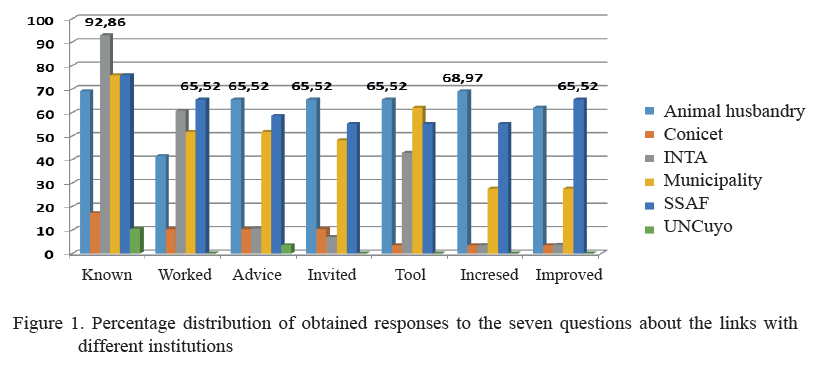
<body><![CDATA[<p align="justify" class="Cuerpodetexto"><span style="font-family:'Verdana','sans-serif'; font-size:10.0pt; ">&bull;&nbsp;&nbsp;&nbsp;&nbsp; Did you was advised on goat production? </span></p>       <p align="justify" class="Cuerpodetexto"><span style="font-family:'Verdana','sans-serif'; font-size:10.0pt; ">&bull;&nbsp;&nbsp;&nbsp;&nbsp; What acceptance level has each institution?</span></p>       <p align="justify" class="Cuerpodetexto"><span style="letter-spacing:.1pt; font-family:'Verdana','sans-serif'; font-size:10.0pt; ">The evaluated public institutions that takes place in the  region are:&nbsp; Complejo Ganader&iacute;a, with  Direcci&oacute;n de Ganader&iacute;a de Mendoza, Fundaci&oacute;n Coprosamen and La Unidad Ejecutara  de la Ley Caprina, Complejo Comisi&oacute;n Nacional de Investigaciones Cient&iacute;ficas  and Tecnol&oacute;gicas- Instituto Argentino de Desarrollo de Zonas &Aacute;ridas  (CONICET-IADIZA), Instituto Nacional de Tecnolog&iacute;a Agropecuaria-Agencia de  Extensi&oacute;n Rural Lavalle (INTA Lavalle), Municipalidad de Lavalle,&nbsp; Secretar&iacute;a de Agricultura Familiar and  Facultad de Agronom&iacute;a de la Universidad Nacional de Cuyo. </span><span style="font-family:'Verdana','sans-serif'; font-size:10.0pt; "> </span></p>       <p align="justify" class="Cuerpodetexto"><span style="font-family:'Verdana','sans-serif'; font-size:10.0pt; ">For the statistical analysis of the obtained data an  analysis of variance with Tukey test was applied for means differentiation, on  the quantitative information. The ANOVA proposed by Siegel (1973) for the  evaluation of qualitative variables was used which allow comparing the hopes of  2 or more distributions without making the assumption that the error terms are  normally distributed. For making the mentioned statistical analysis the  software package InfoStat 2.0 (InfoStat 2002) was used, and the graph of the  results was performed using the software package Microsoft Office Excel 2007.</span></p>       <p align="justify" class="Cuerpodetexto"><span style="font-family:'Verdana','sans-serif'; font-size:10.0pt; ">&nbsp;</span></p>       <p align="justify" class="subtitulo"><strong><span style="font-family:'Verdana','sans-serif'; font-size=3">RESULTS</span></strong></p>       <p align="justify" class="Cuerpodetexto"><span style="font-family:'Verdana','sans-serif'; font-size:10.0pt; ">The results of the seven initial questions showed that  57.3% of goat producers from the La Asunci&oacute;n know any of the six public  institutions operating in the region, 38.5% worked with some entity, 38.1%  received a tool, 33.9% received advice, 27.6% considered that their quality of  life improved, and only 27.1% responded to their increased productivity     <br>     goats</span><span style="font-family:'Verdana','sans-serif'; font-size:10.0pt; ">.</span></p>       <p align="justify" class="Cuerpodetexto"><span style="font-family:'Verdana','sans-serif'; font-size:10.0pt; ">In  turn, detailing the responses by institution, the responses of goat producers  are showed in <a href="/img/revistas/cjas/v49n4/f0109415.gif">figure 1</a> and it is observed that the INTA Lavalle&nbsp; is know by the&nbsp; 92.86% of the producers; in terms of the work  variable, Secretar&iacute;a de Agricultura Familiar led the survey with the  participation of 65.52% of goat producer from&nbsp;  La&nbsp; Asunci&oacute;n.</span></p>       
<p align="justify" class="Cuerpodetexto"><span style="font-family:'Verdana','sans-serif'; font-size:10.0pt; ">Regarding  with if receives specific advice, leads the survey with participation of  65.52%; likewise, consulting if was invited, the same institution was the most  referenced by goat producers     ]]></body>
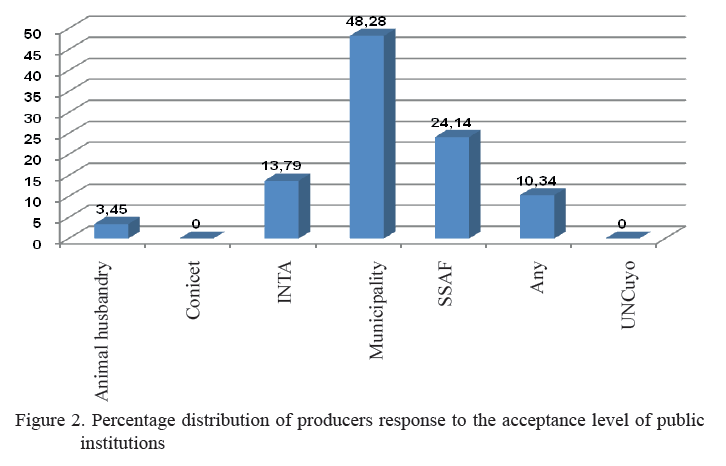
<body><![CDATA[<br>     (65.52%).</span></p>       <p align="justify" class="Cuerpodetexto"><span style="font-family:'Verdana','sans-serif'; font-size:10.0pt; ">To  consider if received any tool, animal husbandry was the most mentioned with  65.52% of the responses and increased to 68.97% positive responses as public  entity that favors to increases goat production.</span></p>       <p align="justify" class="Cuerpodetexto"><span style="font-family:'Verdana','sans-serif'; font-size:10.0pt; ">Regarding  whether improved their quality of life, the best positioned institution was  Secretar&iacute;a de Agricultura Familar, with 65.52% of positive opinions.</span></p>       <p align="justify" class="Cuerpodetexto"><span style="font-family:'Verdana','sans-serif'; font-size:10.0pt; ">Moreover,  the percentage of producers who received specific advice on goat production, as  the participation of each institution, 38.51% of respondents received Animal  husbandry advices, 21.26 % of SAF and 16.09% of Municipality, while the  technical recommendations of IADIZA, INTA and UNCuyo were zero.</span></p>       <p align="justify" class="Cuerpodetexto"><span style="font-family:'Verdana','sans-serif'; font-size:10.0pt; ">With  respect to the participation of specific advice on goat production,  Municipalidad animal husbandry collaborated in 50.76% of the opportunities, the  Municipality in the 28.03% and Municipalidad Secretar&iacute;a 21.21% of the events,  showing a significant statistical difference (P &lt; 0.05) between these  entities.</span></p>       <p align="justify" class="Cuerpodetexto"><span style="font-family:'Verdana','sans-serif'; font-size:10.0pt; ">Also,  the themes in which were more advised goats producers of La Asunci&oacute;n were:  feeding in 50.57% of cases, facilities 33.33% , reproduction 31.18%, health in  29.89% and finally , genetics with only 10.44% of the assists, showing  significant statistical difference (P &lt; 0.05) between these entities.</span></p>       <p align="justify" class="Cuerpodetexto"><span style="font-family:'Verdana','sans-serif'; font-size:10.0pt; ">When evaluating the acceptation level described by goat  producers for each institution and independently from the advice on goat  production that had received, <a href="/img/revistas/cjas/v49n4/f0209415.gif">figure 2</a> show that the Municipalidad<span style="letter-spacing:.2pt; "> have assessment of 48.28%, followed by the  Secretar&iacute;a with 24.14%, INTA Lavalle, with 13.79%, Ganader&iacute;a animal husbandry  with 3.45% and finally, Conicet and the University of Cuyo with zero percent  acceptance. It is highlights that 10.34% of the goat producers from the La  Asunci&oacute;n did not accept any public institutions that work in the region.</span></span></p>       
<p align="justify" class="Cuerpodetexto"><span style="font-family:'Verdana','sans-serif'; font-size:10.0pt; ">&nbsp;</span></p>       <p align="justify" class="subtitulo"><strong><span style="font-family:'Verdana','sans-serif'; font-size=3">DISCUSSION </span></strong></p>       <p align="justify" class="Cuerpodetexto"><span style="font-family:'Verdana','sans-serif'; font-size:10.0pt; ">The  survey result showed that despite of the nearness of La Asunci&oacute;n to Lavalle  city, head of the Department and Mendoza city (head of the province) and that  six public institutions that promote rural development are operating in the  region, only 50% of the goat producers in the region know or get any of them,  similar situation to that described by Bedotti, <em>et al.</em> (2005) and  Valerio Cabrera <em>et al.</em> (2009) and only three (animal husbandry,  Municipalidad and Secretar&iacute;a), all of a political nature, work in counseling  directly linked with goat production; in a different way the entities related  to science and technology as INTA, CONICET and the National University of Cuyo.</span></p>       ]]></body>
<body><![CDATA[<p align="justify" class="Cuerpodetexto"><span style="font-family:'Verdana','sans-serif'; font-size:10.0pt; ">Likewise,  as expected, the topic feeding was the most requested by the goat producers  (50.57%), considering that animal nutrition is based exclusively on the use of  natural grassland, a situation very similar to goat producers from Malarg&uuml;e  (Macario and Dayenoff (2013).</span></p>       <p align="justify" class="Cuerpodetexto"><span style="font-family:'Verdana','sans-serif'; font-size:10.0pt; ">On the acceptance level of each institution, animal  husbandry which is the most contributor in counseling only&nbsp; has 3.45%, being the producers justification  that is an organism which requires the loans refund, which does not provide  subsidies, controls the animals moving, requires own register of marks and  signs, is responsible for mandatory vaccinations, among others; while the </span><span style="font-family:'Verdana','sans-serif'; font-size:10.0pt; ">Municipalidad has an acceptance about 48%, the subsidy  provisions and tools without refund, added to that the institution is in  permanent contact with the population and in many cases,&nbsp; producers relatives working in it. Notably, over  10% of the producers showed dissatisfaction with all public institutions  operating in the region of La      Asunci&oacute;n.</span></p>       <P align="justify"><span style="font-family:'Verdana','sans-serif'; font-size:10.0pt; ">It is concluded that  despite of the number of public entities operating in the northeastern Lavalle  in rural development programs, the goat producers of the region showed no accordance  with their actions</span><font size="2" face="Verdana, Arial, Helvetica, sans-serif">.</font></P>     <p align="justify">&nbsp;</p>      <p align="justify"><font size="2" face="Verdana, Arial, Helvetica, sans-serif"><font size="3"><b>REFERENCES</b></font></font></p>     <p align="justify" class="MsoNormal" style="line-height:normal;"><span style="font-family:'Verdana','sans-serif'; font-size:10.0pt; ">Bedotti, D.,  G&oacute;mez, C. A., S&aacute;nchez, R. M. E., Garc&iacute;a, M. A. &amp; Martos, P. J. 2005.  &ldquo;Aspectos sociol&oacute;gicos de los sistemas de producci&oacute;n caprina en el oeste  Pampeano (Argentina)&rdquo;. <em>Archivos de zootecnia</em>, 54 (208): 599&ndash;608.</span></p>     <!-- ref --><p align="justify" class="MsoNormal" style="line-height:normal;"><span style="font-family:'Verdana','sans-serif'; font-size:10.0pt; ">Hocsman, L.  2003. <em>Reproducci&oacute;n Social Campesina: tierra, trabajo y parentesco en el  Chaco &Aacute;rido Serrano</em>. Argentina: Centro de Estudios Avanzados, Universidad  Nacional de C&oacute;rdoba.    </span></p>     <!-- ref --><p align="justify" class="MsoNormal" style="line-height:normal;"><span style="font-family:'Verdana','sans-serif'; font-size:10.0pt; ">InfoStat 2002. <em>InfoStat,  versi&oacute;n 1.1. Manual del Usuario</em>. 1st ed., C&oacute;rdoba, Argentina: Brujas  Argentina.    </span></p>     ]]></body>
<body><![CDATA[<p align="justify" class="MsoNormal" style="line-height:normal;"><span style="font-family:'Verdana','sans-serif'; font-size:10.0pt; ">Macario, J.  &amp; Dayenoff, P. 2013. &ldquo;An&aacute;lisis temporal de la percepci&oacute;n del productor  caprino malarg&uuml;ino sobre aspectos ligados a la alimentaci&oacute;n animal&rdquo;. In: <em>Primer  Congreso Argentino de Producci&oacute;n Caprina</em>, vol. 1, La Rioja: Gobierno de La  Rioja. INTA. UMaza. IPAF Cuyo. Universidad Nacional de La Pampa, pp. 341&ndash;345.</span></p>     <!-- ref --><p align="justify" class="MsoNormal" style="line-height:normal;"><span style="font-family:'Verdana','sans-serif'; font-size:10.0pt; ">Siegel, S. 1973. <em>Nonparametric Statistics for  the Behavioral Sciences</em>. </span><span style="font-family:'Verdana','sans-serif'; font-size:10.0pt; ">Student ed., McGraw-Hill  International, 312 p.    </span></p>     <P align="justify"><span style="font-family:'Verdana','sans-serif'; font-size:10.0pt; ">Torres,  L. M. 2008. &ldquo;Hilos de agua, lazos de sangre: enfrentando la escasez en el  desierto de Lavalle (Mendoza, Argentina)&rdquo;. <em>Revista Ecosistemas</em>, 17 (1),  Available:  &lt;<a href="http://www.revistaecosistemas.net/index.php/ecosistemas/article/view/110" target="_blank">http://www.revistaecosistemas.net/index.php/ecosistemas/article/view/110</a>&gt;,  [Consulted:&nbsp;May 5, 2016]</span><font size="2" face="Verdana, Arial, Helvetica, sans-serif">.</font></P>     <p align="justify">&nbsp;</p>     <p align="justify">&nbsp;</p>     <p align="justify"><font size="2" face="Verdana, Arial, Helvetica, sans-serif">Received: November 26, 2015    <br>   Accepted: February 6, 2016</font></p>     <p align="justify">&nbsp;</p>     <p align="justify">&nbsp;</p>     ]]></body>
<body><![CDATA[<p align="justify"><font size="2" face="Verdana, Arial, Helvetica, sans-serif"><i>Dayenoff, P.,</i> Universidad Juna Agustín Maza.    Email: <a href="mailto:patriciodayenoff@yahoo.com.ar">patriciodayenoff@yahoo.com.ar</a></font></p>      ]]></body><back>
<ref-list>
<ref id="B1">
<nlm-citation citation-type="journal">
<person-group person-group-type="author">
<name>
<surname><![CDATA[Bedotti]]></surname>
<given-names><![CDATA[D.]]></given-names>
</name>
<name>
<surname><![CDATA[Gómez]]></surname>
<given-names><![CDATA[C. A.]]></given-names>
</name>
<name>
<surname><![CDATA[Sánchez]]></surname>
<given-names><![CDATA[R. M. E.]]></given-names>
</name>
<name>
<surname><![CDATA[García]]></surname>
<given-names><![CDATA[M. A.]]></given-names>
</name>
<name>
<surname><![CDATA[Martos]]></surname>
<given-names><![CDATA[P. J.]]></given-names>
</name>
</person-group>
<article-title xml:lang="nd"><![CDATA[Aspectos sociológicos de los sistemas de producción caprina en el oeste Pampeano (Argentina)]]></article-title>
<source><![CDATA[Archivos de zootecnia]]></source>
<year>2005</year>
<volume>54</volume>
<numero>208</numero>
<issue>208</issue>
<page-range>599–608</page-range></nlm-citation>
</ref>
<ref id="B2">
<nlm-citation citation-type="book">
<person-group person-group-type="author">
<name>
<surname><![CDATA[Hocsman]]></surname>
<given-names><![CDATA[L.]]></given-names>
</name>
</person-group>
<source><![CDATA[Reproducción Social Campesina: tierra, trabajo y parentesco en el Chaco Árido Serrano]]></source>
<year>2003</year>
<publisher-loc><![CDATA[Argentina ]]></publisher-loc>
<publisher-name><![CDATA[Centro de Estudios Avanzados, Universidad Nacional de Córdoba]]></publisher-name>
</nlm-citation>
</ref>
<ref id="B3">
<nlm-citation citation-type="book">
<person-group person-group-type="author">
<name>
<surname><![CDATA[InfoStat]]></surname>
</name>
</person-group>
<source><![CDATA[InfoStat, versión 1.1. Manual del Usuario]]></source>
<year>2002</year>
<edition>1st</edition>
<publisher-loc><![CDATA[Córdoba, Argentina ]]></publisher-loc>
<publisher-name><![CDATA[Brujas Argentina]]></publisher-name>
</nlm-citation>
</ref>
<ref id="B4">
<nlm-citation citation-type="book">
<person-group person-group-type="author">
<name>
<surname><![CDATA[Macario]]></surname>
<given-names><![CDATA[J.]]></given-names>
</name>
<name>
<surname><![CDATA[Dayenoff]]></surname>
<given-names><![CDATA[P.]]></given-names>
</name>
</person-group>
<article-title xml:lang="nd"><![CDATA[Análisis temporal de la percepción del productor caprino malargüino sobre aspectos ligados a la alimentación animal]]></article-title>
<source><![CDATA[]]></source>
<year>2013</year>
<volume>1</volume>
<page-range>341–345</page-range><publisher-loc><![CDATA[La Rioja ]]></publisher-loc>
<publisher-name><![CDATA[Gobierno de La Rioja. INTA. UMaza. IPAF Cuyo. Universidad Nacional de La Pampa]]></publisher-name>
</nlm-citation>
</ref>
<ref id="B5">
<nlm-citation citation-type="book">
<person-group person-group-type="author">
<name>
<surname><![CDATA[Siegel]]></surname>
<given-names><![CDATA[S.]]></given-names>
</name>
</person-group>
<source><![CDATA[Nonparametric Statistics for the Behavioral Sciences]]></source>
<year>1973</year>
<edition>Student</edition>
<page-range>312</page-range><publisher-name><![CDATA[McGraw-Hill International]]></publisher-name>
</nlm-citation>
</ref>
<ref id="B6">
<nlm-citation citation-type="journal">
<person-group person-group-type="author">
<name>
<surname><![CDATA[Torres]]></surname>
<given-names><![CDATA[L. M.]]></given-names>
</name>
</person-group>
<article-title xml:lang="nd"><![CDATA[Hilos de agua, lazos de sangre: enfrentando la escasez en el desierto de Lavalle (Mendoza, Argentina)]]></article-title>
<source><![CDATA[Revista Ecosistemas]]></source>
<year>2008</year>
<volume>17</volume>
<numero>1</numero>
<issue>1</issue>
</nlm-citation>
</ref>
<ref id="B7">
<nlm-citation citation-type="journal">
<person-group person-group-type="author">
<name>
<surname><![CDATA[Valerio]]></surname>
<given-names><![CDATA[D.]]></given-names>
</name>
<name>
<surname><![CDATA[García]]></surname>
<given-names><![CDATA[A.]]></given-names>
</name>
<name>
<surname><![CDATA[Perea]]></surname>
<given-names><![CDATA[J.]]></given-names>
</name>
<name>
<surname><![CDATA[Acero]]></surname>
<given-names><![CDATA[R.]]></given-names>
</name>
<name>
<surname><![CDATA[Gómez]]></surname>
<given-names><![CDATA[C. A. G.]]></given-names>
</name>
</person-group>
<article-title xml:lang="nd"><![CDATA[Caracterización social y comercial de los sistemas ovinos y caprinos de la región noroeste de República Dominicana]]></article-title>
<source><![CDATA[Interciencia: Revista de ciencia y tecnología de América]]></source>
<year>2009</year>
<volume>34</volume>
<numero>9</numero>
<issue>9</issue>
<page-range>637–644</page-range></nlm-citation>
</ref>
</ref-list>
</back>
</article>