<?xml version="1.0" encoding="ISO-8859-1"?><article xmlns:mml="http://www.w3.org/1998/Math/MathML" xmlns:xlink="http://www.w3.org/1999/xlink" xmlns:xsi="http://www.w3.org/2001/XMLSchema-instance">
<front>
<journal-meta>
<journal-id>2079-3480</journal-id>
<journal-title><![CDATA[Cuban Journal of Agricultural Science]]></journal-title>
<abbrev-journal-title><![CDATA[Cuban J. Agric. Sci.]]></abbrev-journal-title>
<issn>2079-3480</issn>
<publisher>
<publisher-name><![CDATA[Editorial del Instituto de Ciencia Animal]]></publisher-name>
</publisher>
</journal-meta>
<article-meta>
<article-id>S2079-34802015000400010</article-id>
<title-group>
<article-title xml:lang="en"><![CDATA[Evaluation of a probiotic mixture in the started birds feeding of heavy pure breeds B4 in a production unit]]></article-title>
<article-title xml:lang="es"><![CDATA[Evaluación de una mezcla probiótica en la alimentación de aves de inicio de líneas puras pesadas B4 en una unidad de producción]]></article-title>
</title-group>
<contrib-group>
<contrib contrib-type="author">
<name>
<surname><![CDATA[Rodríguez]]></surname>
<given-names><![CDATA[Marlen]]></given-names>
</name>
<xref ref-type="aff" rid="A01"/>
</contrib>
<contrib contrib-type="author">
<name>
<surname><![CDATA[Milián]]></surname>
<given-names><![CDATA[Grethel]]></given-names>
</name>
<xref ref-type="aff" rid="A01"/>
</contrib>
<contrib contrib-type="author">
<name>
<surname><![CDATA[Rondón]]></surname>
<given-names><![CDATA[Ana J]]></given-names>
</name>
<xref ref-type="aff" rid="A01"/>
</contrib>
<contrib contrib-type="author">
<name>
<surname><![CDATA[Bocourt]]></surname>
<given-names><![CDATA[R]]></given-names>
</name>
<xref ref-type="aff" rid="A02"/>
</contrib>
<contrib contrib-type="author">
<name>
<surname><![CDATA[Beruvidez]]></surname>
<given-names><![CDATA[A]]></given-names>
</name>
<xref ref-type="aff" rid="A01"/>
</contrib>
<contrib contrib-type="author">
<name>
<surname><![CDATA[Crespo]]></surname>
<given-names><![CDATA[Elayne]]></given-names>
</name>
<xref ref-type="aff" rid="A03"/>
</contrib>
</contrib-group>
<aff id="A01">
<institution><![CDATA[,Universidad de Matanzas Centro de Estudios Biotecnológicos ]]></institution>
<addr-line><![CDATA[ ]]></addr-line>
<country>Cuba</country>
</aff>
<aff id="A02">
<institution><![CDATA[,Instituto de Ciencia Animal  ]]></institution>
<addr-line><![CDATA[San José de las Lajas Mayabeque]]></addr-line>
<country>Cuba</country>
</aff>
<aff id="A03">
<institution><![CDATA[,Empresa Genética Avícola y Pie de Cría  ]]></institution>
<addr-line><![CDATA[Matanzas ]]></addr-line>
<country>Cuba</country>
</aff>
<pub-date pub-type="pub">
<day>00</day>
<month>12</month>
<year>2015</year>
</pub-date>
<pub-date pub-type="epub">
<day>00</day>
<month>12</month>
<year>2015</year>
</pub-date>
<volume>49</volume>
<numero>4</numero>
<fpage>497</fpage>
<lpage>502</lpage>
<copyright-statement/>
<copyright-year/>
<self-uri xlink:href="http://scielo.sld.cu/scielo.php?script=sci_arttext&amp;pid=S2079-34802015000400010&amp;lng=en&amp;nrm=iso"></self-uri><self-uri xlink:href="http://scielo.sld.cu/scielo.php?script=sci_abstract&amp;pid=S2079-34802015000400010&amp;lng=en&amp;nrm=iso"></self-uri><self-uri xlink:href="http://scielo.sld.cu/scielo.php?script=sci_pdf&amp;pid=S2079-34802015000400010&amp;lng=en&amp;nrm=iso"></self-uri><abstract abstract-type="short" xml:lang="en"><p><![CDATA[In order to evaluate the effect of the inclusion of a probiotic mixture (bio-preparation) based on Lactobacillus salivariusC65 and Bacillus subtilis E44 strains on the diet of started birds of heavy pure breeds, a research was conducted at the Unidad Genética Avícola “Granma” from Pedro Betancourt municipality, Matanzas. The study was carried out in a period of 35 days, between December2013 and January 2014.The design was completely randomized and two treatments were evaluated: T1) basal diet (control) and T2) basal diet plus bio-preparations mixture, in ratio 1:1. A total of 600 heavy pure breeds B4 birds were used, (300 per treatment) with an average weight of 42 grams at birth. They stayed on floor under similar management and feeding conditions. The liveweight, intake, conversion in weight per kilogram of intake food, mortality and birds viability was determined. The animals that received the probiotic mixture had a high liveweight during the rearing, except in the first two weeks, in which there were not differences between treatments. There were differences (P<0. 05) in the conversion per bird and the mortality percentage and viability, in favor of the treatment with the probiotic mixture. It concludes that it is possible to use this bio -preparation in the started birds feeding of heavy pure breeds, since the best biometric results were found in the group of birds treated with the animal additive]]></p></abstract>
<abstract abstract-type="short" xml:lang="es"><p><![CDATA[Para evaluar el efecto de inclusión de una mezcla probiótica (biopreparado) basada en las cepas Lactobacillus salivarius C65 y Bacillus subtilis E44, en la dieta de aves de inicio de líneas puras pesadas, se realizó una investigación en la Unidad Genética Avícola “Granma”, del municipio Pedro Betancourt, Matanzas, en un período de 35 d, entre diciembre de 2013 y enero de 2014. El diseño fue completamente aleatorizado y se evaluaron dos tratamientos: T1) dieta basal (control) y T2) dieta basal más la mezcla de biopreparados, en proporción 1:1. Se utilizaron 600 aves de la línea Pura Pesada B4, (300 por tratamiento) con peso promedio de 42 g al nacer. Se alojaron en piso, en similares condiciones de manejo y alimentación. Se determinó el peso vivo, el consumo, la conversión en peso por kilogramo de alimento consumido, la mortalidad y la viabilidad de las aves. Los animales que recibieron la mezcla probiótica tuvieron mayor peso vivo en toda la crianza, excepto en las primeras dos semanas, en la que no se manifestaron diferencias entre tratamientos. Hubo diferencias (P < 0.05) en la conversión por ave, el porcentaje de mortalidad y viabilidad, a favor del tratamiento con la mezcla probiótica. Se concluye que es posible utilizar este biopreparado en la alimentación de aves de inicio de líneas puras pesadas, ya que los mejores resultados se encontraron en el grupo de aves tratadas con el aditivo zootécnico]]></p></abstract>
<kwd-group>
<kwd lng="en"><![CDATA[probiotic mixture]]></kwd>
<kwd lng="en"><![CDATA[heavy pure breeds]]></kwd>
<kwd lng="es"><![CDATA[mezcla probiótica]]></kwd>
<kwd lng="es"><![CDATA[líneas puras pesadas]]></kwd>
</kwd-group>
</article-meta>
</front><body><![CDATA[ <p align="right"><font size="2" face="Verdana, Arial, Helvetica,   sans-serif"><b>ORIGINAL ARTICLE</b></font></p>     <p>&nbsp;</p>     <p align="justify"><font size="4" face="Verdana, Arial, Helvetica, sans-serif"><b>Evaluation of a probiotic mixture in the started birds feeding of    heavy pure breeds B<sub>4</sub> in a production unit</b></font></p>     <p align="justify">&nbsp;</p>     <p align="justify"><font size="3" face="Verdana, Arial, Helvetica, sans-serif"><b>Evaluación de una mezcla probiótica en la alimentación de aves de inicio de líneas  puras pesadas B<sub>4</sub>  en una unidad de producción</b></font></p>     <p align="justify">&nbsp;</p>     <p align="justify">&nbsp;</p>     <p align="justify"><font size="2" face="Verdana, Arial, Helvetica, sans-serif"><b>Marlen Rodríguez,</b><sup><b>I</b></sup><b> Grethel Milián,</b><sup><b>I</b></sup><b> Ana J. Rondón,</b><sup><b>I</b></sup><b> R. Bocourt,</b><sup><b>II</b></sup><b> A., Beruvidez,</b><sup><b>I</b></sup><b> Elayne Crespo,</b><sup><b>III</b></sup></font></p>     <p align="justify"><font size="2" face="Verdana, Arial, Helvetica, sans-serif"><b> </b></font><font size="2" face="Verdana, Arial, Helvetica, sans-serif"><sup>I</sup>Centro de Estudios Biotecnológicos, Universidad de Matanzas, Matanzas, C.P. 44740, Cuba.    <br>   <sup>II</sup>Instituto de Ciencia Animal, San José de las Lajas, Mayabeque, C.P. 3200, Cuba.     ]]></body>
<body><![CDATA[<br>   <sup>III</sup>Empresa Genética Avícola y Pie de Cría, Matanzas, C.P. 10400, Cuba. </font></p>     <p align="justify">&nbsp;</p>     <p align="justify">&nbsp;</p> <hr align="JUSTIFY">     <p align="justify"><font size="2" face="Verdana, Arial, Helvetica, sans-serif"><b>ABSTRACT</b></font></p>     <p align="justify"><font size="2" face="Verdana, Arial, Helvetica, sans-serif"><span style="letter-spacing:.1pt; font-family:'Verdana','sans-serif'; font-size:10.0pt; ">In order to evaluate the effect of the inclusion of a probiotic mixture  (bio-preparation) based on <em>Lactobacillus salivarius</em>C65 and <em>Bacillus  subtilis</em> E44 strains on the diet of started birds of heavy pure breeds, a  research was conducted at the Unidad Gen&eacute;tica Av&iacute;cola &ldquo;Granma&rdquo; from Pedro  Betancourt municipality, Matanzas. The study was carried out in a period of 35  days, between December2013 and January 2014.The design was completely  randomized and two treatments were evaluated: T1) basal diet (control) and T2)  basal diet plus bio-preparations mixture, in ratio 1:1. A total of    600 heavy pure breeds B<sub>4</sub> birds were used, (300 per treatment) with  an average weight of 42 grams at birth. They stayed on floor under similar  management and feeding conditions. The liveweight, intake, conversion in weight  per kilogram of intake food, mortality and birds viability was determined. The  animals that received the probiotic mixture had a high liveweight during the  rearing, except in the first two weeks, in which there were not differences  between treatments. There were differences (P&lt;0. 05) in the conversion per  bird and the mortality percentage and viability, in favor of the treatment with  the probiotic mixture. It concludes that it is possible to use this bio  -preparation in the started birds feeding of heavy pure breeds, since the best  biometric results were found in the group of birds treated with the animal  additive</span>.</font></p>     <p align="justify"><font size="2" face="Verdana, Arial, Helvetica, sans-serif"><b>Key words:</b> probiotic mixture, heavy pure breeds.</font></p> <hr align="JUSTIFY">     <p align="justify"><font size="2" face="Verdana, Arial, Helvetica, sans-serif"><b>RESUMEN</b></font></p>     <p align="justify"><font size="2" face="Verdana, Arial, Helvetica, sans-serif"><span style="font-family:'Verdana','sans-serif'; font-size:10.0pt; ">Para  evaluar el efecto de inclusi&oacute;n de una mezcla probi&oacute;tica (biopreparado) basada  en las cepas <em>Lactobacillus salivarius</em> C65 y <em>Bacillus subtilis </em>E44,  en la dieta de aves de inicio de l&iacute;neas puras pesadas,&nbsp; se realiz&oacute; una investigaci&oacute;n en la Unidad  Gen&eacute;tica Av&iacute;cola &ldquo;Granma&rdquo;, del municipio Pedro Betancourt, Matanzas, en un  per&iacute;odo de 35 d, entre diciembre de 2013 y enero de 2014. El dise&ntilde;o fue  completamente aleatorizado y se evaluaron dos tratamientos: T1) dieta basal  (control) y T2) dieta basal m&aacute;s la mezcla de biopreparados, en proporci&oacute;n 1:1.  Se utilizaron 600 aves de la l&iacute;nea Pura Pesada B<sub>4</sub>, (300 por  tratamiento) con peso promedio de 42 g al nacer. Se&nbsp; alojaron en piso, en similares condiciones de  manejo y alimentaci&oacute;n. Se determin&oacute; el peso vivo, el consumo, la conversi&oacute;n en  peso por kilogramo de alimento consumido, la mortalidad y la viabilidad de las  aves. Los animales que recibieron la mezcla probi&oacute;tica tuvieron&nbsp; mayor peso vivo en toda la crianza, excepto  en las primeras dos semanas, en la que no se manifestaron diferencias entre  tratamientos. Hubo diferencias (P &lt; 0.05) en la conversi&oacute;n por ave, el  porcentaje de mortalidad y viabilidad, a favor del tratamiento con la mezcla  probi&oacute;tica. Se concluye que es posible utilizar este biopreparado en la  alimentaci&oacute;n de aves de inicio de l&iacute;neas puras pesadas, ya que los mejores  resultados se encontraron en el grupo de aves tratadas con el aditivo  zoot&eacute;cnico</span>.</font></p>     <p align="justify"><font size="2" face="Verdana, Arial, Helvetica, sans-serif"><b>Palabras    clave:</b> mezcla probiótica, líneas puras pesadas.</font></p> <hr align="JUSTIFY">     <p align="justify">&nbsp;</p>     ]]></body>
<body><![CDATA[<p align="justify">&nbsp;</p>        <p align="justify"><font size="2" face="Verdana, Arial, Helvetica, sans-serif"><b><font size="3">INTRODUCTION</font></b></font></p>       <p align="justify" class="Cuerpodetexto"><span style="font-family:'Verdana','sans-serif'; font-size:10.0pt; ">The  introduction of new products and technologies for the obtaining of healthy  foods, which allows high productions with an appropriate sustainability, is a  priority in the politics for animal production in Cuba. In this context, many  authors agree in that the probiotics could be useful in the improvement of  zootechnical indicators in animals of economic interest (P&eacute;rez <em>et al.</em> 2012 and Mili&aacute;n <em>et al.</em> 2014).</span></p>       <p align="justify" class="Cuerpodetexto"><span style="font-family:'Verdana','sans-serif'; font-size:10.0pt; ">The  microorganisms more used as probiotics are the lactic acid bacteria (especially  Lactobacillus and Bifidobacterium), yeasts (mainly the Saccharomyces genus) and  bacteria from Bacillus genus and their endospores. All of them are part of  bio-preparations that are in the international market (Gonz&aacute;lez-N&uacute;&ntilde;ez <em>et al.</em> 2013 and Carro <em>et al.</em> 2014).</span></p>       <p align="justify" class="Cuerpodetexto"><span style="font-family:'Verdana','sans-serif'; font-size:10.0pt; ">The  probiotic mixtures are constituted by two or more of these microorganisms,  generally isolated from the digestive tract of healthy adult animals (Brizuela,  2011).Today it is recognized the importance and possible effectiveness of  biotic therapy( probiotics and prebiotics) as medical tool in animal  production(Garcia <em>et al.</em> 2012).</span></p>       <p align="justify" class="Cuerpodetexto"><span style="font-family:'Verdana','sans-serif'; font-size:10.0pt; ">In  Cuba, the Empresa Gen&eacute;tica y Pie de Cr&iacute;a has as main social object the  maintenance and improvement of the heavy pure breeds. With its production  guarantees the replacement of all basic birds from the national system and  prevents the country has to invest to import replacement regularly. This allows  guaranteeing poultry genetic basis and the existing breeds, besides to favor  the raising of meat and eggs yield, as well as the production and marketing of  the heavy foundation stock in Poultry Enterprises (God&iacute;nez      2012).&nbsp; </span></p>       <p align="justify" class="Cuerpodetexto"><span style="font-family:'Verdana','sans-serif'; font-size:10.0pt; ">&nbsp;The objective of this research was to evaluate  the effect of the inclusion of a probiotic mixture (bio-preparation) based on <em>Lactobacillus  salivarius </em>C65 and <em>Bacillus subtilis</em> E44 strains on the diet of  started birds of heavy pure breeds, B<sub>4</sub>.</span></p>       <p align="justify" class="Cuerpodetexto"><span style="font-family:'Verdana','sans-serif'; font-size:10.0pt; ">&nbsp;</span></p>       <p align="justify" class="subtitulo"><strong><span style="font-family:'Verdana','sans-serif'; font-size=3">MATERIALS AND METHODS</span></strong></p>       <p align="justify" class="Cuerpodetexto"><em><span style="letter-spacing:.2pt; font-family:'Verdana','sans-serif'; font-size:10.0pt; ">Preparation of the bacterial bio-preparation</span></em><span style="font-family:'Verdana','sans-serif'; font-size:10.0pt; ">. From the <em>Lactobacillus salivarius</em>C65 and <em>Bacillus  subtilis </em>E44 strains, 20L of probiotic mixture were elaborated. For these  flasks with 1L of Mann, Rogosa, Sharper (MRS) media and nutrient medium for  Lactobacillus and Bacillus were prepared, respectively. They were inoculated  and cultured at 37 &ordm;C during 18h.Then, was added 250 mL of inoculums in four  Erlenmeyer of 6L, which contained 5L of medium for <em>Lactobacillus salivarius</em> or MCLs growth (Rond&oacute;n 2009). For Bacillus growth the <em>Bacillus subtilis </em>(MCBs)  growth medium described by Milian (2009) was used. Both cultures were stayed at  37 &ordm;C during 20h, under static conditions for Lactobacillus and with agitation  at      250 rpm for Bacillus. After this time, viable counts and pH measure were  carried out, to check the bio-preparation quality. They were packaged in  sterile flasks of 1L, with rubber top and were conserved at      5 &ordm;C until their use. The cultures were mixed into equal parts at the time of  the application</span><span style="font-family:'Verdana','sans-serif'; font-size:10.0pt; ">.</span></p>       ]]></body>
<body><![CDATA[<p align="justify" class="Cuerpodetexto"><em><span style="letter-spacing:.1pt; font-family:'Verdana','sans-serif'; font-size:10.0pt; ">Experimental conditions. Treatments</span></em><span style="font-family:'Verdana','sans-serif'; font-size:10.0pt; ">. The experiment was conducted at the Unidad Gen&eacute;tica  Av&iacute;cola &ldquo;Granma&rdquo; from Pedro Betancourt municipality, Matanzas. The evaluation  of the <em>in vivo</em> bio-preparation was carried out during 35 days between  December/2013 and January/2014. The design was completely randomized with two  treatments: T1) basal diet (control) and T2) basal diet plus bio-preparations  mixture, in ratio 1:1.A total of 600 heavy pure breeds B<sub>4</sub> birds were  used, distributed in 300 birds per     <br>     treatment.</span><span style="font-family:'Verdana','sans-serif'; font-size:10.0pt; "> </span></p>       <p align="justify" class="Cuerpodetexto"><em><span style="font-family:'Verdana','sans-serif'; font-size:10.0pt; ">Birds  management.</span></em><span style="font-family:'Verdana','sans-serif'; font-size:10.0pt; "> The animals management was  homogeneous in both groups, coinciding with the stated in the Technical  Instructive No 7 UCAN -IIA (1998) for the evaluated species and category. The  bio-preparation was given in the ration of the T2 group, in the morning twice a  week. It was manually mixed with the diet, at a concentration of 10<sup>9</sup> UFC.mL<sup>-1</sup>, which is equivalent to 10<sup>9</sup> endospores of  Bacillus g<sup>-1</sup> concentrate. The dose was fitted according to the  criteria proposed by Mutus <em>et al.</em> (2006) and Mili&aacute;n (2009).</span></p>       <p align="justify" class="Cuerpodetexto"><em><span style="font-family:'Verdana','sans-serif'; font-size:10.0pt; ">Evaluation of the bio-preparation effect on started birds  from heavy pure breeds B<sub>4</sub>, under production conditions</span></em><span style="font-family:'Verdana','sans-serif'; font-size:10.0pt; ">. To evaluate the <em>in vivo</em> probiotic effect of the  microbial biopreparation, the average liveweight of birds per treatment was  determined weekly. The food intake and the conversion in weight per kilogram of  food intake were determined. The mortality percentage was also calculated  during the weeks of the experiment. It was also taking into account all  parameters evaluated as a result of the biometric performed at 35 days. These  indicators were calculated as described in the Technical Instructive for  broiler rearing (UCAN- IIA, 1998). </span><span style="font-family:'Verdana','sans-serif'; font-size:10.0pt; "> </span></p>       <p align="justify" class="Cuerpodetexto"><em><span style="font-family:'Verdana','sans-serif'; font-size:10.0pt; ">Statistical  processing of the in vivo evaluation</span></em><span style="font-family:'Verdana','sans-serif'; font-size:10.0pt; ">.  To analyze the results, the statistical Software INFOSTAT version 1 was used  (Balzarini <em>et al.</em> 2001). For the statistical treatment of data variance  analysis with completely randomized design were carried out and to verify  significant differences between treatments the Duncan (1995) comparison test  was used for a 95% reliability. The mortality and viability values were  transformed to   <sub><span style="letter-spacing:.2pt; "><a name="e1"></a><img src="../img/revistas/cjas/v49n4/e0110415.gif" width="198" height="46" longdesc="/img/revistas/cjas/v49n4/e0110415.gif"></span></sub></span></p>       
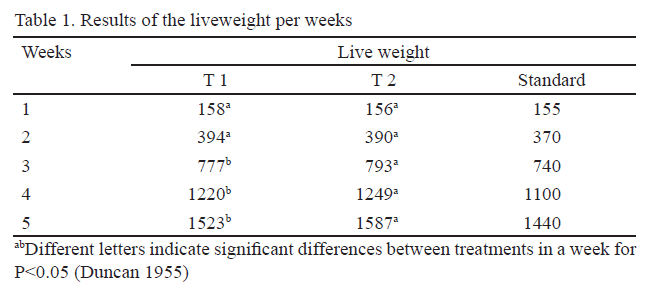
<p align="justify" class="Cuerpodetexto"><span style="font-family:'Verdana','sans-serif'; font-size:10.0pt; ">&nbsp;</span></p>       <p align="justify" class="subtitulo"><strong><span style="font-family:'Verdana','sans-serif'; font-size=3">RESULTS AND DISCUSSION </span></strong></p>       <p align="justify" class="Cuerpodetexto"><span style="font-family:'Verdana','sans-serif'; font-size:10.0pt; ">The  liveweight variation per week of rearing with the use of probiotic mixture is  showed in <a href="/img/revistas/cjas/v49n4/t0110415.gif">table 1</a>.</span></p>       
<p align="justify" class="Cuerpodetexto"><span style="font-family:'Verdana','sans-serif'; font-size:10.0pt; ">The  birds that received the additive in diet exceed those of the control treatment  in this indicator. There were significant differences (P&lt;0.01) in favor of  this treatment (T2), from the third evaluated week.</span></p>       <p align="justify" class="Cuerpodetexto"><span style="font-family:'Verdana','sans-serif'; font-size:10.0pt; ">When  probiotics are incorporated in the food as additive, an eubiosis state occurs  and promotes a physiological effect on the organism, more than its nutritive  value (Khasefidi and Goorchi 2006).The probiotics positive effects not only  occur at the gastrointestinal tract (GIT), but are reflected in animal results  as liveweight gain and the feed conversion improvement (Gil and Gil- Turnes  2005).</span></p>       ]]></body>
<body><![CDATA[<p align="justify" class="Cuerpodetexto"><span style="font-family:'Verdana','sans-serif'; font-size:10.0pt; ">Khaksefidi  and Ghoorchi (2006) obtained weight increase in chickens after supplying in  diets, <em>Bacillus subtilis </em>cultures at 50 mg.Kg<sup>-1 </sup>of  concentrate. These authors refers that differences (P&lt;0.01) in the animals  daily liveweight were presented.</span></p>       <p align="justify" class="Cuerpodetexto"><span style="font-family:'Verdana','sans-serif'; font-size:10.0pt; ">When  performing the corresponding biometric at      35 days of age, significant differences between treatments were observed (<a href="/img/revistas/cjas/v49n4/t0210415.gif">table 2</a>).</span></p>       
<p align="justify" class="Cuerpodetexto"><span style="font-family:'Verdana','sans-serif'; font-size:10.0pt; ">The  use of <em>L. salivarius</em> and <em>B. subtilis</em> mixture in birds diets  represented an improvement in all the evaluated indicators. The liveweight at  the end of the rearing and meat conversion per each kilogram of food intake,  was better regarding the animals that did not received this microbial mixture.</span></p>       <p align="justify" class="Cuerpodetexto"><span style="font-family:'Verdana','sans-serif'; font-size:10.0pt; ">The indicators evaluated in both groups are above the  technical instructive indicators, used as comparison criteria. This supposed a  positive control under very controlled conditions for the facilities of the Uni&oacute;n  de Empresas del Combinado Av&iacute;cola Nacional (UECAN).</span></p>       <p align="justify" class="Cuerpodetexto"><span style="font-family:'Verdana','sans-serif'; font-size:10.0pt; ">The viability of birds was one of the parameters taken  into account in health indicators during the experimental stage. In this case,  the higher viability percentage corresponds to the birds treated with the  bio-preparation. The group of birds that did not intake the probiotic mixture,  not only resulted with lower viability, but they were not able to reach the  percentage required by the standard line. According to Kizerwetter-Swida and  Binek (2009), probiotics microorganisms, when acting, maintain a beneficial  microflora in the animal and exclude those potentially pathogenic  microorganisms. This supposes to be the cause for which the group of treated  birds reaches better results. </span><span style="font-family:'Verdana','sans-serif'; font-size:10.0pt; "> </span></p>       <p align="justify" class="Cuerpodetexto"><span style="font-family:'Verdana','sans-serif'; font-size:10.0pt; ">Lan <em>et al.</em> (2003) informed that the supply of  probiotic bacteria (<em>L. salivarius</em> and <em>L. agilis</em>) produce an  increase of broilers liveweight. Other authors as Mohan <em>et al.</em> (1996),  Zulkifli <em>et al.</em> (2000) and Balevi <em>et al.</em> (2001) also observed  improvements in weight increase of the birds that were treated with probiotics.</span><span style="font-family:'Verdana','sans-serif'; font-size:10.0pt; "> </span></p>       <p align="justify" class="Cuerpodetexto"><span style="font-family:'Verdana','sans-serif'; font-size:10.0pt; ">Mili&aacute;n  (2009) and Rond&oacute;n (2009) evaluated the effect of different strains of <em>Bacillus  subtilis </em>and <em>Lactobacillus salivarius</em> respectively, on productive indicators  of broilers. These authors observed a better productive response in the treated  animals regarding those of the control group. These results refers that  probiotics, when stabilizing the microbiological system in the digestive tract,  improve the nutrients digestibility and provide a range of higher absorption,  when introducing an anabolism that promotes body weight gain with decreasing  feed conversion.</span></p>       <p align="justify" class="Cuerpodetexto"><span style="font-family:'Verdana','sans-serif'; font-size:10.0pt; ">Years later, a <em>Bacillus subtilis</em> E44 (subtilprobio)  strains was evaluated in birds of heavy pure breeds E1 (Gonz&aacute;lez 2012) and, a <em>Lactobacillus  salivarius</em>(Probiolactil) strain in birds of heavy pure breeds P8 (Suarez,  2013). As a result it was observed that the birds which ingested probiotic  bacteria had better productive results than the control animals. This result  agrees with those reached in this research, but in birds of heavy pure breeds B<sub>4</sub>,  treated with the mixture of probiotic strains previously      mentioned. </span><span style="font-family:'Verdana','sans-serif'; font-size:10.0pt; "> </span></p>       <p align="justify" class="Cuerpodetexto"><span style="font-family:'Verdana','sans-serif'; font-size:10.0pt; ">These results could be related to the benefits provided by  probiotic microorganisms when favoring digestion, absorption and nutrients use.  The use of probiotics bio-preparation in broilers is a routine practice in  modern poultry production which provides favorable results (Lima 2007) and  coincides with those of this research. </span><span style="font-family:'Verdana','sans-serif'; font-size:10.0pt; "> </span></p>       <p align="justify" class="Cuerpodetexto"><span style="font-family:'Verdana','sans-serif'; font-size:10.0pt; ">A naturalistic and update approach of probiotics conceives  them as natural products which are used as growth promoters in animals, so that  its use allows to obtain higher yields, higher immune resistant, reduced or non  amount of pathogens in the GIT and lower antibiotic residues and other  substances in the final      products.</span><span style="font-family:'Verdana','sans-serif'; font-size:10.0pt; "> </span></p>       ]]></body>
<body><![CDATA[<p align="justify"><span style="letter-spacing:.2pt; font-family:'Verdana','sans-serif'; font-size:10.0pt; ">The  bio-preparation that was used in the experiment could influence in the  improvement of liveweight, conversion, uniformity and the higher number of  selected birds, according to the standard    criteria</span><font size="2" face="Verdana, Arial, Helvetica, sans-serif">.</font></p>       <p align="justify">&nbsp;</p>     <p align="justify"><font size="2" face="Verdana, Arial, Helvetica, sans-serif"><font size="3"><b>REFERENCES</b></font></font></p>     <p align="justify" class="MsoNormal" style="line-height:normal;"><span style="font-family:'Verdana','sans-serif'; font-size:10.0pt; ">Balevi, T.,  Ucan, U. S., Co&#351;un, B., Kurto&#287;u, V. &amp; Ceting&uuml;l, I. S. 2001. </span><span style="font-family:'Verdana','sans-serif'; font-size:10.0pt; ">&ldquo;Effect of dietary probiotic  on performance and humoral immune response in layer hens&rdquo;. </span><em><span style="font-family:'Verdana','sans-serif'; font-size:10.0pt; ">British poultry science</span></em><span style="font-family:'Verdana','sans-serif'; font-size:10.0pt; ">, 42 (4): 456&ndash;461.</span></p>     <!-- ref --><p align="justify" class="MsoNormal" style="line-height:normal;"><span style="font-family:'Verdana','sans-serif'; font-size:10.0pt; ">Balzarini, M.  G., Casanoves, F., Di Rienzo, J. A., Gonz&aacute;lez, L. A. &amp; Robledo, C. W. 2001. <em>INFOSTAT</em>. version 1, C&oacute;rdoba, Argentina.    </span></p>     <p align="justify" class="MsoNormal" style="line-height:normal;"><span style="font-family:'Verdana','sans-serif'; font-size:10.0pt; ">Brizuela, M.  2011. &ldquo;Desarrollo de productos probi&oacute;ticos y mezclas simbi&oacute;ticas para su empleo  en alimentaci&oacute;n y salud animal&rdquo;. In: <em>Seminario Internacional de Sanidad  Agropecuaria</em>, La Habana, Cuba.</span></p>     <p align="justify" class="MsoNormal" style="line-height:normal;"><span style="font-family:'Verdana','sans-serif'; font-size:10.0pt; ">Carro, T. M.  D., Saro, H. C., Mateos, &Aacute;. I., D&iacute;az, R. A. &amp; Garc&iacute;a, M. J. R. 2014.  &ldquo;Empleo de probi&oacute;ticos en la alimentaci&oacute;n de rumiantes&rdquo;. <em>Ganader&iacute;a</em>,  (93): 42&ndash;49.</span></p>     <p align="justify" class="MsoNormal" style="line-height:normal;"><span style="font-family:'Verdana','sans-serif'; font-size:10.0pt; ">Duncan, D. B.  1955. </span><span style="font-family:'Verdana','sans-serif'; font-size:10.0pt; ">&ldquo;Multiple range and multiple F  tests&rdquo;. </span><em><span style="font-family:'Verdana','sans-serif'; font-size:10.0pt; ">Biometrics</span></em><span style="font-family:'Verdana','sans-serif'; font-size:10.0pt; ">, 11 (1): 1&ndash;42.</span></p>     <!-- ref --><p align="justify" class="MsoNormal" style="line-height:normal;"><span style="font-family:'Verdana','sans-serif'; font-size:10.0pt; ">Garc&iacute;a, M.,  Sorrondegui, Y., L&oacute;pez, Y. &amp; Carcass&eacute;s, A. 2012. <em>Empleo de probi&oacute;ticos  en los animales</em>. Engormix. Sitio argentino de Producci&oacute;n Animal, Available:  &lt;<a href="www.produccion-animal.com.a" target="_blank">www.produccion-animal.com.a</a>&gt;    .</span></p>     <p align="justify" class="MsoNormal" style="line-height:normal;"><span style="font-family:'Verdana','sans-serif'; font-size:10.0pt; ">Gil de los  Santos, J. R. &amp; Gil-Turnes, C. 2005. </span><span style="font-family:'Verdana','sans-serif'; font-size:10.0pt; ">&ldquo;Probiotics in aviculture&rdquo;. <em>Ci&ecirc;ncia Rural</em>,  35 (3): 741&ndash;747.</span></p>     <!-- ref --><p align="justify" class="MsoNormal" style="line-height:normal;"><span style="font-family:'Verdana','sans-serif'; font-size:10.0pt; ">Gonz&aacute;lez, E. O.  2012. <em>Evaluaci&oacute;n del SUBTILPROBIO en aves de l&iacute;neas puras pesadas en la  Unidad Gen&eacute;tica Av&iacute;cola de Torriente</em>. Graduated Thesis, Universidad de  Matanzas, Cuba.    </span></p>     <p align="justify" class="MsoNormal" style="line-height:normal;"><span style="font-family:'Verdana','sans-serif'; font-size:10.0pt; ">Gonz&aacute;lez-N&uacute;&ntilde;ez,  D. H., Piad, B. R. &amp; Reyes-S&aacute;nchez, N. 2013. &ldquo;Comportamiento productivo de  pollos de engorde suplementados con un pcl-glucano de producci&oacute;n nacional&rdquo;. </span><em><span style="font-family:'Verdana','sans-serif'; font-size:10.0pt; ">La Calera</span></em><span style="font-family:'Verdana','sans-serif'; font-size:10.0pt; ">, 13 (21): 82&ndash;87.</span></p>     <p align="justify" class="MsoNormal" style="line-height:normal;"><span style="font-family:'Verdana','sans-serif'; font-size:10.0pt; ">Khaksefidi, A. &amp; Ghoorchi, T. 2006. &ldquo;Effect  of probiotic on performance and immunocompetence in broiler chicks&rdquo;. <em>The  Journal of Poultry Science</em>, 43 (3): 296&ndash;300.</span></p>     <p align="justify" class="MsoNormal" style="line-height:normal;"><span style="font-family:'Verdana','sans-serif'; font-size:10.0pt; ">Kizerwetter-Swida, M. &amp; Binek, M. 2009.  &ldquo;Protective effect of potentially probiotic Lactobacillus strain on infection  with pathogenic bacteria in chickens&rdquo;. <em>Pol. J. Vet. Sci</em>, 12: 15&ndash;20.</span></p>     <p align="justify" class="MsoNormal" style="line-height:normal;"><span style="font-family:'Verdana','sans-serif'; font-size:10.0pt; ">Lan, N. P. T., Binh, L. T. &amp; Benno, Y. 2003.  &ldquo;Impact of two probiotic Lactobacillus strains feeding on fecal lactobacilli  and weight gains in chicken&rdquo;. <em>The Journal of general and applied  microbiology</em>, 49 (1): 29&ndash;36.</span></p>     <p align="justify" class="MsoNormal" style="line-height:normal;"><span style="font-family:'Verdana','sans-serif'; font-size:10.0pt; ">Lima, E. T., Andreatti Filho, R. L., Okamoto, A.  S., Noujaim, J. C., Barros, M. R. &amp; Crocci, A. J. 2007. &ldquo;Evaluation <em>in  vitro</em> of the antagonistic substances produced by <em>Lactobacillus</em> spp.  isolated from chickens&rdquo;. </span><em><span style="font-family:'Verdana','sans-serif'; font-size:10.0pt; ">Canadian journal of veterinary  research</span></em><span style="font-family:'Verdana','sans-serif'; font-size:10.0pt; ">, 71 (2): 103.</span></p>     <!-- ref --><p align="justify" class="MsoNormal" style="line-height:normal;"><span style="font-family:'Verdana','sans-serif'; font-size:10.0pt; ">Mili&aacute;n, G.  2009. <em>Obtenci&oacute;n de cultivos de Bacillus spp. y sus endosporas. Evaluaci&oacute;n de  su actividad probi&oacute;tica en pollos (Gallusgallusdomesticus)</em>. Ph.D. Thesis,  Instituto de Ciencia Animal, La Habana, Cuba.    </span></p>     <p align="justify" class="MsoNormal" style="line-height:normal;"><span style="font-family:'Verdana','sans-serif'; font-size:10.0pt; ">Mili&aacute;n, G.,  Rond&oacute;n, A. J., P&eacute;rez, M., Samaniego, L. M., Ria&ntilde;o, J., Bocourt, R., Ranilla, M.  J., Carro, M. D., Rodr&iacute;guez, M. &amp; Laurencio, M. 2014. </span><span style="font-family:'Verdana','sans-serif'; font-size:10.0pt; ">&ldquo;Isolation and identification  of strains of Bacillus spp. in different ecosystems, with probiotic purposes,  and their use in animals&rdquo;. <em>Cuban Journal of Agricultural Science</em>, 48  (4): 347.</span></p>     <p align="justify" class="MsoNormal" style="line-height:normal;"><span style="font-family:'Verdana','sans-serif'; font-size:10.0pt; ">Mohan, B., Kadirvel, R., Natarajan, A. &amp;  Bhaskaran, M. 1996. &ldquo;Effect of probiotic supplementation on growth, nitrogen  utilisation and serum cholesterol in broilers&rdquo;. <em>British poultry science</em>,  37 (2): 395&ndash;401.</span></p>     <p align="justify" class="MsoNormal" style="line-height:normal;"><span style="font-family:'Verdana','sans-serif'; font-size:10.0pt; ">Mutu&#351;, R., Kocaba</span><span style="font-size: 10.0pt">g</span><span style="font-family:'Verdana','sans-serif'; font-size:10.0pt; ">li, N., Alp, M., Acar, N., Eren, M. &amp; Gezen, </span><span style="font-family:'Verdana','sans-serif'; font-size:10.0pt; ">&#350;</span><span style="font-family:'Verdana','sans-serif'; font-size:10.0pt; ">. 2006. </span><span style="font-family:'Verdana','sans-serif'; font-size:10.0pt; ">&ldquo;</span><span style="font-family:'Verdana','sans-serif'; font-size:10.0pt; ">The effect of dietary probiotic supplementation on tibial bone  characteristics and strength in broilers&rdquo;. </span><em><span style="font-family:'Verdana','sans-serif'; font-size:10.0pt; ">Poultry science</span></em><span style="font-family:'Verdana','sans-serif'; font-size:10.0pt; ">, 85 (9): 1621&ndash;1625.</span></p>     <p align="justify" class="MsoNormal" style="line-height:normal;"><span style="font-family:'Verdana','sans-serif'; font-size:10.0pt; ">P&eacute;rez, M.,  Laurencio, M., Mili&aacute;n, G., Rond&oacute;n, A. J., Arteaga, F., Rodr&iacute;guez, M. &amp;  Borges, Y. 2012. &ldquo;Evaluaci&oacute;n de una mezcla probi&oacute;tica en la alimentaci&oacute;n de  gallinas ponedoras en una unidad de producci&oacute;n comercial&rdquo;. <em>Pastos y Forrajes</em>,  35 (3): 311&ndash;320.</span></p>     <!-- ref --><p align="justify" class="MsoNormal" style="line-height:normal;"><span style="font-family:'Verdana','sans-serif'; font-size:10.0pt; ">Rond&oacute;n, A.  2009. <em>Obtenci&oacute;n de biopreparados a partir de lactobacilos aut&oacute;ctonos del  tracto digestivo de pollos y evaluaci&oacute;n integral de las respuestas de tipo  probi&oacute;ticas provocadas en estos animales</em>. Ph.D. Thesis, Instituto de  Ciencia Animal, La Habana, Cuba.    </span></p>     <!-- ref --><p align="justify" class="MsoNormal" style="line-height:normal;"><span style="font-family:'Verdana','sans-serif'; font-size:10.0pt; ">Su&aacute;rez, M. I.  2013. <em>Evaluaci&oacute;n a escala de producci&oacute;n del efecto probi&oacute;tico del  bio-preparado Probiolactil en pollos de inicio de reproductor pesado</em>.  Graduated Thesis, Universidad de Matanzas, La Habana, Cuba.    </span></p>     <!-- ref --><p align="justify" class="MsoNormal" style="line-height:normal;"><span style="font-family:'Verdana','sans-serif'; font-size:10.0pt; ">UCAN-IIA 1998. <em>Instructivo  T&eacute;cnico. Producci&oacute;n av&iacute;cola. Pollos de engorde. Tecnolog&iacute;a de crianza y  regulaciones sanitarias generales</em>. Cuba.    </span></p>     <p align="justify"><span style="font-family:'Verdana','sans-serif'; font-size:10.0pt; ">Zulkifli,  I., Abdullah, N., Azrin, N. M. &amp; Ho, Y. W. 2000. </span><span style="font-family:'Verdana','sans-serif'; font-size:10.0pt; ">&ldquo;Growth  performance and immune response of two commercial broiler strains fed diets  containing Lactobacillus cultures and oxytetracycline under heat stress  conditions&rdquo;. </span><em><span style="font-family:'Verdana','sans-serif'; font-size:10.0pt; ">British poultry science</span></em><span style="font-family:'Verdana','sans-serif'; font-size:10.0pt; ">, 41 (5):  593&ndash;597</span><font size="2" face="Verdana, Arial, Helvetica, sans-serif">.</font> </p>     <p align="justify">&nbsp;</p>     <p align="justify">&nbsp;</p>     <p align="justify"><font size="2" face="Verdana, Arial, Helvetica, sans-serif">Received: November 25, 2015    <br>   Accepted: January 6, 2016</font></p>     <p align="justify">&nbsp;</p>     <p align="justify">&nbsp;</p>     <p align="justify"><font size="2" face="Verdana, Arial, Helvetica, sans-serif"><i>Marlen Rodríguez,</i> Centro de Estudios Biotecnológicos, Universidad de Matanzas, Matanzas, C.P. 44740, Cuba.    Email: <a href="mailto:marlen.rodriguez@umcc.cu">marlen.rodriguez@umcc.cu</a></font></p>      ]]></body><back>
<ref-list>
<ref id="B1">
<nlm-citation citation-type="journal">
<person-group person-group-type="author">
<name>
<surname><![CDATA[Balevi]]></surname>
<given-names><![CDATA[T.]]></given-names>
</name>
<name>
<surname><![CDATA[Ucan]]></surname>
<given-names><![CDATA[U. S.]]></given-names>
</name>
<name>
<surname><![CDATA[Cosun]]></surname>
<given-names><![CDATA[B.]]></given-names>
</name>
<name>
<surname><![CDATA[Kurtogu]]></surname>
<given-names><![CDATA[V.]]></given-names>
</name>
<name>
<surname><![CDATA[Cetingül]]></surname>
<given-names><![CDATA[I. S.]]></given-names>
</name>
</person-group>
<article-title xml:lang="nd"><![CDATA[Effect of dietary probiotic on performance and humoral immune response in layer hens]]></article-title>
<source><![CDATA[British poultry science]]></source>
<year>2001</year>
<volume>42</volume>
<numero>4</numero>
<issue>4</issue>
<page-range>456–461</page-range></nlm-citation>
</ref>
<ref id="B2">
<nlm-citation citation-type="">
<person-group person-group-type="author">
<name>
<surname><![CDATA[Balzarini]]></surname>
<given-names><![CDATA[M. G.]]></given-names>
</name>
<name>
<surname><![CDATA[Casanoves]]></surname>
<given-names><![CDATA[F.]]></given-names>
</name>
<name>
<surname><![CDATA[Di Rienzo]]></surname>
<given-names><![CDATA[J. A.]]></given-names>
</name>
<name>
<surname><![CDATA[González]]></surname>
<given-names><![CDATA[L. A.]]></given-names>
</name>
<name>
<surname><![CDATA[Robledo]]></surname>
<given-names><![CDATA[C. W.]]></given-names>
</name>
</person-group>
<source><![CDATA[INFOSTAT]]></source>
<year>2001</year>
<publisher-loc><![CDATA[Córdoba, Argentina ]]></publisher-loc>
</nlm-citation>
</ref>
<ref id="B3">
<nlm-citation citation-type="">
<person-group person-group-type="author">
<name>
<surname><![CDATA[Brizuela]]></surname>
<given-names><![CDATA[M.]]></given-names>
</name>
</person-group>
<article-title xml:lang="nd"><![CDATA[Desarrollo de productos probióticos y mezclas simbióticas para su empleo en alimentación y salud animal]]></article-title>
<source><![CDATA[]]></source>
<year>2011</year>
<publisher-loc><![CDATA[La Habana, Cuba ]]></publisher-loc>
</nlm-citation>
</ref>
<ref id="B4">
<nlm-citation citation-type="journal">
<person-group person-group-type="author">
<name>
<surname><![CDATA[Carro]]></surname>
<given-names><![CDATA[T. M. D.]]></given-names>
</name>
<name>
<surname><![CDATA[Saro]]></surname>
<given-names><![CDATA[H. C.]]></given-names>
</name>
<name>
<surname><![CDATA[Mateos]]></surname>
<given-names><![CDATA[Á. I.]]></given-names>
</name>
<name>
<surname><![CDATA[Díaz]]></surname>
<given-names><![CDATA[R. A.]]></given-names>
</name>
<name>
<surname><![CDATA[García]]></surname>
<given-names><![CDATA[M. J. R.]]></given-names>
</name>
</person-group>
<article-title xml:lang="nd"><![CDATA[Empleo de probióticos en la alimentación de rumiantes]]></article-title>
<source><![CDATA[Ganadería]]></source>
<year>2014</year>
<numero>93</numero>
<issue>93</issue>
<page-range>42–49</page-range></nlm-citation>
</ref>
<ref id="B5">
<nlm-citation citation-type="journal">
<person-group person-group-type="author">
<name>
<surname><![CDATA[Duncan]]></surname>
<given-names><![CDATA[D. B.]]></given-names>
</name>
</person-group>
<article-title xml:lang="nd"><![CDATA[Multiple range and multiple F tests]]></article-title>
<source><![CDATA[Biometrics]]></source>
<year>1955</year>
<volume>11</volume>
<numero>1</numero>
<issue>1</issue>
<page-range>1–42</page-range></nlm-citation>
</ref>
<ref id="B6">
<nlm-citation citation-type="">
<person-group person-group-type="author">
<name>
<surname><![CDATA[García]]></surname>
<given-names><![CDATA[M.]]></given-names>
</name>
<name>
<surname><![CDATA[Sorrondegui]]></surname>
<given-names><![CDATA[Y.]]></given-names>
</name>
<name>
<surname><![CDATA[López]]></surname>
<given-names><![CDATA[Y.]]></given-names>
</name>
<name>
<surname><![CDATA[Carcassés]]></surname>
<given-names><![CDATA[A.]]></given-names>
</name>
</person-group>
<source><![CDATA[Empleo de probióticos en los animales]]></source>
<year>2012</year>
</nlm-citation>
</ref>
<ref id="B7">
<nlm-citation citation-type="journal">
<person-group person-group-type="author">
<name>
<surname><![CDATA[Gil de los Santos]]></surname>
<given-names><![CDATA[J. R.]]></given-names>
</name>
<name>
<surname><![CDATA[Gil-Turnes]]></surname>
<given-names><![CDATA[C.]]></given-names>
</name>
</person-group>
<article-title xml:lang="nd"><![CDATA[Probiotics in aviculture]]></article-title>
<source><![CDATA[Ciência Rural]]></source>
<year>2005</year>
<volume>35</volume>
<numero>3</numero>
<issue>3</issue>
<page-range>741–747</page-range></nlm-citation>
</ref>
<ref id="B8">
<nlm-citation citation-type="book">
<person-group person-group-type="author">
<name>
<surname><![CDATA[González]]></surname>
<given-names><![CDATA[E. O.]]></given-names>
</name>
</person-group>
<source><![CDATA[Evaluación del SUBTILPROBIO en aves de líneas puras pesadas en la Unidad Genética Avícola de Torriente]]></source>
<year>2012</year>
<publisher-loc><![CDATA[Cuba ]]></publisher-loc>
<publisher-name><![CDATA[Universidad de Matanzas]]></publisher-name>
</nlm-citation>
</ref>
<ref id="B9">
<nlm-citation citation-type="journal">
<person-group person-group-type="author">
<name>
<surname><![CDATA[González-Núñez]]></surname>
<given-names><![CDATA[D. H.]]></given-names>
</name>
<name>
<surname><![CDATA[Piad]]></surname>
<given-names><![CDATA[B. R.]]></given-names>
</name>
<name>
<surname><![CDATA[Reyes-Sánchez]]></surname>
<given-names><![CDATA[N.]]></given-names>
</name>
</person-group>
<article-title xml:lang="nd"><![CDATA[Comportamiento productivo de pollos de engorde suplementados con un pcl-glucano de producción nacional]]></article-title>
<source><![CDATA[La Calera]]></source>
<year>2013</year>
<volume>13</volume>
<numero>21</numero>
<issue>21</issue>
<page-range>82–87</page-range></nlm-citation>
</ref>
<ref id="B10">
<nlm-citation citation-type="journal">
<person-group person-group-type="author">
<name>
<surname><![CDATA[Khaksefidi]]></surname>
<given-names><![CDATA[A.]]></given-names>
</name>
<name>
<surname><![CDATA[Ghoorchi]]></surname>
<given-names><![CDATA[T.]]></given-names>
</name>
</person-group>
<article-title xml:lang="nd"><![CDATA[Effect of probiotic on performance and immunocompetence in broiler chicks]]></article-title>
<source><![CDATA[The Journal of Poultry Science]]></source>
<year>2006</year>
<volume>43</volume>
<numero>3</numero>
<issue>3</issue>
<page-range>296–300</page-range></nlm-citation>
</ref>
<ref id="B11">
<nlm-citation citation-type="journal">
<person-group person-group-type="author">
<name>
<surname><![CDATA[Kizerwetter-Swida]]></surname>
<given-names><![CDATA[M.]]></given-names>
</name>
<name>
<surname><![CDATA[Binek]]></surname>
<given-names><![CDATA[M.]]></given-names>
</name>
</person-group>
<article-title xml:lang="nd"><![CDATA[Protective effect of potentially probiotic Lactobacillus strain on infection with pathogenic bacteria in chickens]]></article-title>
<source><![CDATA[Pol. J. Vet. Sci]]></source>
<year>2009</year>
<volume>12</volume>
<page-range>15–20</page-range></nlm-citation>
</ref>
<ref id="B12">
<nlm-citation citation-type="journal">
<person-group person-group-type="author">
<name>
<surname><![CDATA[Lan]]></surname>
<given-names><![CDATA[N. P. T.]]></given-names>
</name>
<name>
<surname><![CDATA[Binh]]></surname>
<given-names><![CDATA[L. T.]]></given-names>
</name>
<name>
<surname><![CDATA[Benno]]></surname>
<given-names><![CDATA[Y.]]></given-names>
</name>
</person-group>
<article-title xml:lang="nd"><![CDATA[Impact of two probiotic Lactobacillus strains feeding on fecal lactobacilli and weight gains in chicken]]></article-title>
<source><![CDATA[The Journal of general and applied microbiology]]></source>
<year>2003</year>
<volume>49</volume>
<numero>1</numero>
<issue>1</issue>
<page-range>29–36</page-range></nlm-citation>
</ref>
<ref id="B13">
<nlm-citation citation-type="journal">
<person-group person-group-type="author">
<name>
<surname><![CDATA[Lima]]></surname>
<given-names><![CDATA[E. T.]]></given-names>
</name>
<name>
<surname><![CDATA[Andreatti Filho]]></surname>
<given-names><![CDATA[R. L.]]></given-names>
</name>
<name>
<surname><![CDATA[Okamoto]]></surname>
<given-names><![CDATA[A. S.]]></given-names>
</name>
<name>
<surname><![CDATA[Noujaim]]></surname>
<given-names><![CDATA[J. C.]]></given-names>
</name>
<name>
<surname><![CDATA[Barros]]></surname>
<given-names><![CDATA[M. R.]]></given-names>
</name>
<name>
<surname><![CDATA[Crocci]]></surname>
<given-names><![CDATA[A. J.]]></given-names>
</name>
</person-group>
<article-title xml:lang="nd"><![CDATA[Evaluation in vitro of the antagonistic substances produced by Lactobacillus spp. isolated from chickens]]></article-title>
<source><![CDATA[Canadian journal of veterinary research]]></source>
<year>2007</year>
<volume>71</volume>
<numero>2</numero>
<issue>2</issue>
<page-range>103</page-range></nlm-citation>
</ref>
<ref id="B14">
<nlm-citation citation-type="book">
<person-group person-group-type="author">
<name>
<surname><![CDATA[Milián]]></surname>
<given-names><![CDATA[G.]]></given-names>
</name>
</person-group>
<source><![CDATA[Obtención de cultivos de Bacillus spp. y sus endosporas. Evaluación de su actividad probiótica en pollos (Gallusgallusdomesticus)]]></source>
<year>2009</year>
<publisher-loc><![CDATA[La Habana, Cuba ]]></publisher-loc>
<publisher-name><![CDATA[Instituto de Ciencia Animal]]></publisher-name>
</nlm-citation>
</ref>
<ref id="B15">
<nlm-citation citation-type="journal">
<person-group person-group-type="author">
<name>
<surname><![CDATA[Milián]]></surname>
<given-names><![CDATA[G.]]></given-names>
</name>
<name>
<surname><![CDATA[Rondón]]></surname>
<given-names><![CDATA[A. J.]]></given-names>
</name>
<name>
<surname><![CDATA[Pérez]]></surname>
<given-names><![CDATA[M.]]></given-names>
</name>
<name>
<surname><![CDATA[Samaniego]]></surname>
<given-names><![CDATA[L. M.]]></given-names>
</name>
<name>
<surname><![CDATA[Riaño]]></surname>
<given-names><![CDATA[J.]]></given-names>
</name>
<name>
<surname><![CDATA[Bocourt]]></surname>
<given-names><![CDATA[R.]]></given-names>
</name>
<name>
<surname><![CDATA[Ranilla]]></surname>
<given-names><![CDATA[M. J.]]></given-names>
</name>
<name>
<surname><![CDATA[Carro]]></surname>
<given-names><![CDATA[M. D.]]></given-names>
</name>
<name>
<surname><![CDATA[Rodríguez]]></surname>
<given-names><![CDATA[M.]]></given-names>
</name>
<name>
<surname><![CDATA[Laurencio]]></surname>
<given-names><![CDATA[M.]]></given-names>
</name>
</person-group>
<article-title xml:lang="nd"><![CDATA[Isolation and identification of strains of Bacillus spp. in different ecosystems, with probiotic purposes, and their use in animals]]></article-title>
<source><![CDATA[Cuban Journal of Agricultural Science]]></source>
<year>2014</year>
<volume>48</volume>
<numero>4</numero>
<issue>4</issue>
<page-range>347</page-range></nlm-citation>
</ref>
<ref id="B16">
<nlm-citation citation-type="journal">
<person-group person-group-type="author">
<name>
<surname><![CDATA[Mohan]]></surname>
<given-names><![CDATA[B.]]></given-names>
</name>
<name>
<surname><![CDATA[Kadirvel]]></surname>
<given-names><![CDATA[R.]]></given-names>
</name>
<name>
<surname><![CDATA[Natarajan]]></surname>
<given-names><![CDATA[A.]]></given-names>
</name>
<name>
<surname><![CDATA[Bhaskaran]]></surname>
<given-names><![CDATA[M.]]></given-names>
</name>
</person-group>
<article-title xml:lang="nd"><![CDATA[Effect of probiotic supplementation on growth, nitrogen utilisation and serum cholesterol in broilers]]></article-title>
<source><![CDATA[British poultry science]]></source>
<year>1996</year>
<volume>37</volume>
<numero>2</numero>
<issue>2</issue>
<page-range>395–401</page-range></nlm-citation>
</ref>
<ref id="B17">
<nlm-citation citation-type="journal">
<person-group person-group-type="author">
<name>
<surname><![CDATA[Mutus]]></surname>
<given-names><![CDATA[R.]]></given-names>
</name>
<name>
<surname><![CDATA[Kocabagli]]></surname>
<given-names><![CDATA[N.]]></given-names>
</name>
<name>
<surname><![CDATA[Alp]]></surname>
<given-names><![CDATA[M.]]></given-names>
</name>
<name>
<surname><![CDATA[Acar]]></surname>
<given-names><![CDATA[N.]]></given-names>
</name>
<name>
<surname><![CDATA[Eren]]></surname>
<given-names><![CDATA[M.]]></given-names>
</name>
<name>
<surname><![CDATA[Gezen]]></surname>
<given-names><![CDATA[S.]]></given-names>
</name>
</person-group>
<article-title xml:lang="nd"><![CDATA[The effect of dietary probiotic supplementation on tibial bone characteristics and strength in broilers]]></article-title>
<source><![CDATA[Poultry science]]></source>
<year>2006</year>
<volume>85</volume>
<numero>9</numero>
<issue>9</issue>
<page-range>1621–1625</page-range></nlm-citation>
</ref>
<ref id="B18">
<nlm-citation citation-type="journal">
<person-group person-group-type="author">
<name>
<surname><![CDATA[Pérez]]></surname>
<given-names><![CDATA[M.]]></given-names>
</name>
<name>
<surname><![CDATA[Laurencio]]></surname>
<given-names><![CDATA[M.]]></given-names>
</name>
<name>
<surname><![CDATA[Milián]]></surname>
<given-names><![CDATA[G.]]></given-names>
</name>
<name>
<surname><![CDATA[Rondón]]></surname>
<given-names><![CDATA[A. J.]]></given-names>
</name>
<name>
<surname><![CDATA[Arteaga]]></surname>
<given-names><![CDATA[F.]]></given-names>
</name>
<name>
<surname><![CDATA[Rodríguez]]></surname>
<given-names><![CDATA[M.]]></given-names>
</name>
<name>
<surname><![CDATA[Borges]]></surname>
<given-names><![CDATA[Y.]]></given-names>
</name>
</person-group>
<article-title xml:lang="nd"><![CDATA[Evaluación de una mezcla probiótica en la alimentación de gallinas ponedoras en una unidad de producción comercial]]></article-title>
<source><![CDATA[Pastos y Forrajes]]></source>
<year>2012</year>
<volume>35</volume>
<numero>3</numero>
<issue>3</issue>
<page-range>311–320</page-range></nlm-citation>
</ref>
<ref id="B19">
<nlm-citation citation-type="book">
<person-group person-group-type="author">
<name>
<surname><![CDATA[Rondón]]></surname>
<given-names><![CDATA[A.]]></given-names>
</name>
</person-group>
<source><![CDATA[Obtención de biopreparados a partir de lactobacilos autóctonos del tracto digestivo de pollos y evaluación integral de las respuestas de tipo probióticas provocadas en estos animales]]></source>
<year>2009</year>
<publisher-loc><![CDATA[La Habana, Cuba ]]></publisher-loc>
<publisher-name><![CDATA[Instituto de Ciencia Animal]]></publisher-name>
</nlm-citation>
</ref>
<ref id="B20">
<nlm-citation citation-type="book">
<person-group person-group-type="author">
<name>
<surname><![CDATA[Suárez]]></surname>
<given-names><![CDATA[M. I.]]></given-names>
</name>
</person-group>
<source><![CDATA[Evaluación a escala de producción del efecto probiótico del bio-preparado Probiolactil en pollos de inicio de reproductor pesado]]></source>
<year>2013</year>
<publisher-loc><![CDATA[La Habana, Cuba ]]></publisher-loc>
<publisher-name><![CDATA[Universidad de Matanzas]]></publisher-name>
</nlm-citation>
</ref>
<ref id="B21">
<nlm-citation citation-type="">
<person-group person-group-type="author">
<name>
<surname><![CDATA[UCAN-IIA]]></surname>
</name>
</person-group>
<source><![CDATA[Instructivo Técnico. Producción avícola. Pollos de engorde. Tecnología de crianza y regulaciones sanitarias generales]]></source>
<year>1998</year>
<publisher-loc><![CDATA[Cuba ]]></publisher-loc>
</nlm-citation>
</ref>
<ref id="B22">
<nlm-citation citation-type="journal">
<person-group person-group-type="author">
<name>
<surname><![CDATA[Zulkifli]]></surname>
<given-names><![CDATA[I.]]></given-names>
</name>
<name>
<surname><![CDATA[Abdullah]]></surname>
<given-names><![CDATA[N.]]></given-names>
</name>
<name>
<surname><![CDATA[Azrin]]></surname>
<given-names><![CDATA[N. M.]]></given-names>
</name>
<name>
<surname><![CDATA[Ho]]></surname>
<given-names><![CDATA[Y. W.]]></given-names>
</name>
</person-group>
<article-title xml:lang="nd"><![CDATA[Growth performance and immune response of two commercial broiler strains fed diets containing Lactobacillus cultures and oxytetracycline under heat stress conditions]]></article-title>
<source><![CDATA[British poultry science]]></source>
<year>2000</year>
<volume>41</volume>
<numero>5</numero>
<issue>5</issue>
<page-range>593–597</page-range></nlm-citation>
</ref>
</ref-list>
</back>
</article>