<?xml version="1.0" encoding="ISO-8859-1"?><article xmlns:mml="http://www.w3.org/1998/Math/MathML" xmlns:xlink="http://www.w3.org/1999/xlink" xmlns:xsi="http://www.w3.org/2001/XMLSchema-instance">
<front>
<journal-meta>
<journal-id>2079-3480</journal-id>
<journal-title><![CDATA[Cuban Journal of Agricultural Science]]></journal-title>
<abbrev-journal-title><![CDATA[Cuban J. Agric. Sci.]]></abbrev-journal-title>
<issn>2079-3480</issn>
<publisher>
<publisher-name><![CDATA[Editorial del Instituto de Ciencia Animal]]></publisher-name>
</publisher>
</journal-meta>
<article-meta>
<article-id>S2079-34802015000400012</article-id>
<title-group>
<article-title xml:lang="en"><![CDATA[Determination of the germination temperature of Moringa oleifera seeds with support of vigor tests]]></article-title>
<article-title xml:lang="es"><![CDATA[Determinación de la temperatura de germinación de las semillas de Moringa oleifera con apoyo de las pruebas de vigor]]></article-title>
</title-group>
<contrib-group>
<contrib contrib-type="author">
<name>
<surname><![CDATA[Navarro]]></surname>
<given-names><![CDATA[Marlen]]></given-names>
</name>
<xref ref-type="aff" rid="A01"/>
</contrib>
<contrib contrib-type="author">
<name>
<surname><![CDATA[Cicero]]></surname>
<given-names><![CDATA[S. M]]></given-names>
</name>
<xref ref-type="aff" rid="A02"/>
</contrib>
<contrib contrib-type="author">
<name>
<surname><![CDATA[Gomes-Junior]]></surname>
<given-names><![CDATA[F. G]]></given-names>
</name>
<xref ref-type="aff" rid="A02"/>
</contrib>
</contrib-group>
<aff id="A01">
<institution><![CDATA[,Universidad de Matanzas Estación Experimental de pastos y Forrajes Indio Hatuey ]]></institution>
<addr-line><![CDATA[ Matanzas]]></addr-line>
<country>Cuba</country>
</aff>
<aff id="A02">
<institution><![CDATA[,Universidade de São Paulo Escola Superior de Agricultura Luiz de Queiroz ]]></institution>
<addr-line><![CDATA[ ]]></addr-line>
<country>Brasil</country>
</aff>
<pub-date pub-type="pub">
<day>00</day>
<month>12</month>
<year>2015</year>
</pub-date>
<pub-date pub-type="epub">
<day>00</day>
<month>12</month>
<year>2015</year>
</pub-date>
<volume>49</volume>
<numero>4</numero>
<fpage>509</fpage>
<lpage>514</lpage>
<copyright-statement/>
<copyright-year/>
<self-uri xlink:href="http://scielo.sld.cu/scielo.php?script=sci_arttext&amp;pid=S2079-34802015000400012&amp;lng=en&amp;nrm=iso"></self-uri><self-uri xlink:href="http://scielo.sld.cu/scielo.php?script=sci_abstract&amp;pid=S2079-34802015000400012&amp;lng=en&amp;nrm=iso"></self-uri><self-uri xlink:href="http://scielo.sld.cu/scielo.php?script=sci_pdf&amp;pid=S2079-34802015000400012&amp;lng=en&amp;nrm=iso"></self-uri><abstract abstract-type="short" xml:lang="en"><p><![CDATA[Samples from six seeds lots of Moringa oleifera cv. Supergenius were used with the objective of determing the optimum temperature for the germination test of this species. The temperatures 25°C; 30°C and 20-30°C were evaluated. The used vigor tests were: germination test (G), germination rate index (GRI), electric conductivity test (EC) and the plantlet computerize analysis through the SVIS software and the indexes that are automatically generated. All variables were subjected to analysis of variance, differences were declared significant according to Tukey test (P&#8804;0.05) with the help of the statistical package SPSS 22.0.The EC values showed better seed quality in the lots two and four. For G and FGC, the lot four showed the highest value for the evaluated temperatures. Although for FGC the lot four at 30°C did not differ from lots one, two and six. The best GRI performances were for the lots one, two, four, five and six at 30°C.For the indexes generated by the SVIS, the vigor index (VI) in lot four at 30°C was higher, as for the growth index (GI).The analysis of the uniformity index (UI) for temperatures showed differences for the lots two, four and five; always with the highest values for 30°C.For plantlets length (PL) lots one, five and six showed the best performance at 30°C without differ from 25°C. Neither differ lot one for25 and 30°C. While lot four showed higher performance for PL at 30°C in relation to other temperatures. In a general way, the study results showed the best performance of moringa seeds at 30°C]]></p></abstract>
<abstract abstract-type="short" xml:lang="es"><p><![CDATA[Se utilizaron muestras de seis lotes de semillas de Moringa oleifera cv. Supergenius con el objetivo de determinar la temperatura óptima para el test de germinación de esta especie. Se evaluaron las temperaturas: 25°C; 30°C y 20-30°C. Las pruebas de vigor empleadas fueron: test de germinación (G), índice de velocidad de germinación (IVG), test de conductividad eléctrica (CE) y análisis computadorizado de plántulas a través del software SVIS y los índices que se generan automáticamente. Todas las variables se sometieron a análisis de varianzas, las diferencias se declararon significativas según el test de Tukey (P &#8804; 0.05) con auxilio del paquete estadístico SPSS 22.0. Los valores de CE indicaron mejor calidad de las semillas en los lotes 2 y 4. Para G y PCG, el lote 4 exhibió el valor más alto para las temperaturas evaluadas, aunque para PCG el lote 4 a 30 °C no difirió de los lotes 1, 2 y 6. Los mejores comportamientos de IVG fueron para los lotes 1, 2, 4, 5 y 6 a los 30 °C. Para los índices generados por el SVIS, el índice de vigor (IV) en el lote 4 a 30°C fue superior, al igual que para el índice de crecimiento (IC). El análisis del índice de uniformidad (IU) para las temperaturas mostró diferencias para los lotes 2, 4 y 5, siempre con los valores más altos para 30 °C. Para la longitud de las plántulas (LP), los lotes 1, 5 y 6 exhibieron el mejor desempeño en 30 °C, sin diferir de 25°C. Tampoco difirió el lote 1 para 25 y 30°C. Mientras que el lote 4 mostró desempeño superior para LP a 30 °C con relación a las demás temperaturas. De manera general, los resultados del estudio indicaron el mejor desempeño de las semillas de moringa a 30°C]]></p></abstract>
<kwd-group>
<kwd lng="en"><![CDATA[moringa]]></kwd>
<kwd lng="en"><![CDATA[germination]]></kwd>
<kwd lng="en"><![CDATA[SVIS]]></kwd>
<kwd lng="en"><![CDATA[vigor]]></kwd>
<kwd lng="es"><![CDATA[moringa]]></kwd>
<kwd lng="es"><![CDATA[germinación]]></kwd>
<kwd lng="es"><![CDATA[SVIS]]></kwd>
<kwd lng="es"><![CDATA[vigor]]></kwd>
</kwd-group>
</article-meta>
</front><body><![CDATA[ <p align="right"><font size="2" face="Verdana, Arial, Helvetica,   sans-serif"><b>ORIGINAL ARTICLE</b></font></p>     <p>&nbsp;</p>     <p align="justify"><font size="4" face="Verdana, Arial, Helvetica, sans-serif"><b>Determination of the germination temperature of <em>Moringa oleifera</em> seeds with support of vigor tests</b></font></p>     <p align="justify">&nbsp;</p>     <p align="justify"><font size="3" face="Verdana, Arial, Helvetica, sans-serif"><b>Determinación de la temperatura de germinación de las semillas de <em>Moringa oleifera</em> con apoyo de las pruebas de vigor</b></font></p>     <p align="justify">&nbsp;</p>     <p align="justify">&nbsp;</p>     <p align="justify"><font size="2" face="Verdana, Arial, Helvetica, sans-serif"><b>Marlen Navarro,</b><sup><b>I</b></sup><b> S. M. Cicero,</b><sup><b>II</b></sup><b> F. G. Gomes-Junior,</b><sup><b>II</b></sup></font></p>     <p align="justify"><font size="2" face="Verdana, Arial, Helvetica, sans-serif"><b> </b></font><font size="2" face="Verdana, Arial, Helvetica, sans-serif"><sup>I</sup>Estación Experimental de pastos y Forrajes “Indio Hatuey”. Universidad de Matanzas.    Central España Republicana. CP44280. Matanzas, Cuba.    <br>   <sup>II</sup>Escola Superior de Agricultura “Luiz de Queiroz”. Universidade de São Paulo. Brasil. </font></p>     ]]></body>
<body><![CDATA[<p align="justify">&nbsp;</p>     <p align="justify">&nbsp;</p> <hr align="JUSTIFY">     <p align="justify"><font size="2" face="Verdana, Arial, Helvetica, sans-serif"><b>ABSTRACT</b></font></p>     <p align="justify"><font size="2" face="Verdana, Arial, Helvetica, sans-serif"><span style="font-family:'Verdana','sans-serif'; font-size:10.0pt; ">Samples  from six seeds lots of <em>Moringa oleifera</em> cv. Supergenius were used with  the objective of determing the optimum temperature for the germination test of  this species. The temperatures 25&deg;C; 30&deg;C and 20-30&deg;C were evaluated. The used  vigor tests were: germination test (G), germination rate index (GRI), electric  conductivity test (EC) and the plantlet computerize analysis through the SVIS  software and the indexes that are automatically generated. All variables were  subjected to analysis of variance, differences were declared significant  according to Tukey test (P&le;0.05) with the help of the statistical package SPSS  22.0.The EC values showed better seed quality in the lots two and four. For G  and FGC, the lot four showed the highest value for the evaluated temperatures.  Although for FGC the lot four at 30&deg;C did not differ from lots one, two and  six. The best GRI performances were for the&nbsp;  lots one, two, four, five and six at 30&deg;C.For the indexes generated by the  SVIS, the vigor index (VI) in lot four at 30&deg;C was higher, as for the growth  index (GI).The analysis of the uniformity index (UI) for temperatures showed  differences for the lots two, four and five; always with the highest values for  30&deg;C.For plantlets length (PL) lots one, five and six showed the best  performance at 30&deg;C without differ from 25&deg;C. Neither differ lot one for25 and  30&deg;C. While lot four showed higher performance for PL at 30&deg;C in relation to  other temperatures. In a general way, the study results showed the best  performance of moringa seeds at 30&deg;C</span>.</font></p>     <p align="justify"><font size="2" face="Verdana, Arial, Helvetica, sans-serif"><b>Key words:</b> moringa, germination, SVIS®, vigor.</font></p> <hr align="JUSTIFY">     <p align="justify"><font size="2" face="Verdana, Arial, Helvetica, sans-serif"><b>RESUMEN</b></font></p>     <p align="justify"><font size="2" face="Verdana, Arial, Helvetica, sans-serif"><span style="letter-spacing:-.2pt; font-family:'Verdana','sans-serif'; font-size:10.0pt; ">Se utilizaron muestras de seis lotes de semillas de <em>Moringa  oleifera</em> cv. Supergenius con el objetivo de determinar la temperatura  &oacute;ptima para el test de germinaci&oacute;n de esta especie. Se evaluaron las  temperaturas: 25&deg;C; 30&deg;C y 20-30&deg;C. Las pruebas de vigor empleadas fueron: test  de germinaci&oacute;n (G), &iacute;ndice de velocidad de germinaci&oacute;n (IVG), test de  conductividad el&eacute;ctrica (CE) y an&aacute;lisis computadorizado de pl&aacute;ntulas a trav&eacute;s  del software SVIS y los &iacute;ndices que se generan autom&aacute;ticamente. Todas las  variables se sometieron a an&aacute;lisis de varianzas, las diferencias se declararon  significativas seg&uacute;n el test de Tukey (P &le; 0.05) con auxilio del paquete  estad&iacute;stico SPSS 22.0. Los valores de CE indicaron mejor calidad de las  semillas en los lotes 2 y 4. Para G y PCG, el lote 4 exhibi&oacute; el valor m&aacute;s alto  para las temperaturas evaluadas, aunque para PCG el lote 4 a    30 &deg;C no difiri&oacute; de los lotes 1, 2 y 6. Los mejores comportamientos de IVG  fueron para los lotes 1, 2, 4, 5 y 6 a los 30 &deg;C. Para los &iacute;ndices generados  por el SVIS, el &iacute;ndice de vigor (IV) en el lote 4 a 30&deg;C fue superior, al igual  que para el &iacute;ndice de crecimiento (IC). El an&aacute;lisis del &iacute;ndice de uniformidad  (IU) para las temperaturas mostr&oacute; diferencias para los lotes 2, 4 y 5, siempre  con los valores m&aacute;s altos para 30 &deg;C. Para la longitud de las pl&aacute;ntulas (LP),  los lotes 1, 5 y 6 exhibieron el mejor desempe&ntilde;o en 30 &deg;C, sin diferir de 25&deg;C.  Tampoco difiri&oacute; el lote 1 para 25 y 30&deg;C. Mientras que el lote 4 mostr&oacute;  desempe&ntilde;o superior para LP a 30 &deg;C con relaci&oacute;n a las dem&aacute;s temperaturas. De  manera general, los resultados del estudio indicaron el mejor desempe&ntilde;o de las  semillas de moringa a 30&deg;C</span>.</font></p>     <p align="justify"><font size="2" face="Verdana, Arial, Helvetica, sans-serif"><b>Palabras    clave:</b> moringa, germinación, SVIS®, vigor .</font></p> <hr align="JUSTIFY">     <p align="justify">&nbsp;</p>     <p align="justify">&nbsp;</p>        ]]></body>
<body><![CDATA[<p align="justify"><font size="2" face="Verdana, Arial, Helvetica, sans-serif"><b><font size="3">INTRODUCTION</font></b></font></p>       <p align="justify" class="Cuerpodetexto"><span style="font-family:'Verdana','sans-serif'; font-size:10.0pt; ">Under  controlled conditions, when humidity does not limit, the rate and germination  percentage are controlled by temperature (Bewley and Black, 1984).For each  species there is a temperature range within which the germination process can  be completed in a reasonable time.</span></p>       <p align="justify" class="Cuerpodetexto"><span style="font-family:'Verdana','sans-serif'; font-size:10.0pt; ">The  process of seeds germination involves a series of metabolic activities, during  which a sequence of chemical reactions occur with own demands in terms of  temperature (Marcos Filho, 2005). Similarly, the temperature is essential for  germination, because it acts on the water absorption rate and in biochemical  reactions that determine the whole process (Bewley and Black, 1984); in  consequence, it affects the rate and the uniformity of the total germination  (Carvalho and Nakagawa, 2012).Therefore, temperature is a factor of vital  importance in the germination, emergence and vigor expression.</span></p>       <p align="justify" class="Cuerpodetexto"><span style="font-family:'Verdana','sans-serif'; font-size:10.0pt; ">For  the analysis of moringa seeds, the germination test is not still standardized.  There are few studies related with the optimal conditions of light, temperature  and substrate for germination. From the growing interest in this species, the  objective of this research was to determine the optimal germination temperature  of <em>Moringa oleifera</em> seeds, with the purpose of contributing to the  analysis of seeds of this species and the standardization of the germination  test.</span></p>       <p align="justify" class="Cuerpodetexto"><span style="font-family:'Verdana','sans-serif'; font-size:10.0pt; ">&nbsp;</span></p>       <p align="justify" class="subtitulo"><strong><span style="font-family:'Verdana','sans-serif'; font-size=3">MATERIALS AND METHODS</span></strong></p>       <p align="justify" class="Cuerpodetexto"><span style="font-family:'Verdana','sans-serif'; font-size:10.0pt; ">Seeds  from six lots of <em>Moringa oleifera</em> cv. Supergenius were used and three  options of temperature were evaluated:&nbsp;  25&deg;C; 30&deg;C and 20-30&deg;C. </span></p>       <p align="justify" class="Cuerpodetexto"><em><span style="font-family:'Verdana','sans-serif'; font-size:10.0pt; ">Germination  test.</span></em><span style="font-family:'Verdana','sans-serif'; font-size:10.0pt; "> Four repetitions of 25 seeds from each lot  were used for each temperature. The test was performed in substrate of paper  towel humidified with distilled water in the ratio 1:2. 5 (paper: water).The  rolls were kept in the germinator according to the evaluation temperature until  14 days after sowing.</span></p>       <p align="justify" class="Cuerpodetexto"><em><span style="letter-spacing:.2pt; font-family:'Verdana','sans-serif'; font-size:10.0pt; ">Germination rate index. </span></em><span style="font-family:'Verdana','sans-serif'; font-size:10.0pt; ">It was calculated during the germination test and the  counts were performed daily at the same time, from the sowing. For the  calculation the formula proposed by Maguire (1962) was used.</span><span style="font-family:'Verdana','sans-serif'; font-size:10.0pt; "> </span></p>       <p align="justify" class="Cuerpodetexto"><em><span style="font-family:'Verdana','sans-serif'; font-size:10.0pt; ">Electric  conductivity test</span></em><span style="font-family:'Verdana','sans-serif'; font-size:10.0pt; ">. Four repetitions of 25  seeds for each lot were used, which were weighed and placed in a container with  75mL of deionized water and kept in the germinator at 25 &plusmn; 1&deg;C, for 24 h in  dark (ISTA 2009).The electrical conductivity readings were performed in a  DIGIMED equipment DM-31.The readings values were divided between the seeds  weight and the results expressed in &mu;S.cm<sup>-1</sup>.g<sup>-1</sup>.</span></p>       ]]></body>
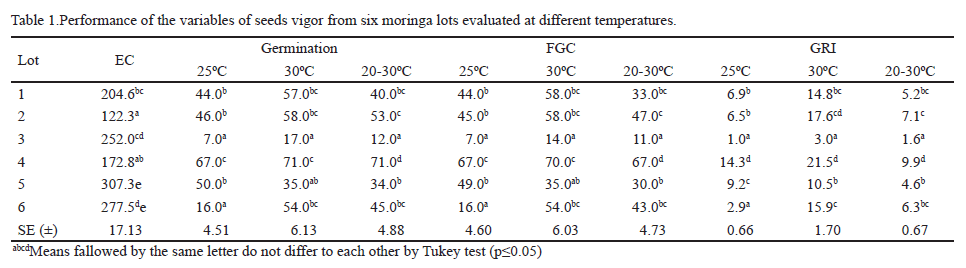
<body><![CDATA[<p align="justify" class="Cuerpodetexto"><em><span style="font-family:'Verdana','sans-serif'; font-size:10.0pt; ">SVIS&reg;.</span></em><span style="font-family:'Verdana','sans-serif'; font-size:10.0pt; "> The plantlets were obtained from 10 repetitions of 20 seeds for each lot in  each temperature. The procedure was similar to that described for the  germination test. The rolls were kept in three germinators regulated at  20-30&deg;C, 25&deg;C and 30&deg;C during seven days in dark. The general procedures for  working with the software were: (i) the scanner resolution was 100 dpi and (ii)  the plantlets size was 4.0; 5.0 and 6.0 inches for 20-30&deg;C; 25&deg;C and 30&deg;C;  according to the results of preliminary tests.</span></p>       <p align="justify" class="Cuerpodetexto"><span style="font-family:'Verdana','sans-serif'; font-size:10.0pt; ">&nbsp;</span></p>       <p align="justify" class="subtitulo"><strong><span style="font-family:'Verdana','sans-serif'; font-size=3">RESULTS AND DISCUSSION </span></strong></p>       <p align="justify" class="Cuerpodetexto"><span style="font-family:'Verdana','sans-serif'; font-size:10.0pt; ">The  germination test is not sufficient to detect differences in the physiological  potential of seeds, especially when these are exposed to different  temperatures. Therefore the vigor tests are considered important tools in seed  testing laboratories. </span></p>       <p align="justify" class="Cuerpodetexto"><span style="font-family:'Verdana','sans-serif'; font-size:10.0pt; ">The  conductivity values expressed in &mu;S.cm<sup>-1</sup>.g<sup>-1</sup> (<a href="/img/revistas/cjas/v49n4/t0112415.gif">table 1</a>)  showed better quality in lots two and four, while lots five and six were those  of lower vigor. </span></p>       
<p align="justify" class="Cuerpodetexto"><span style="font-family:'Verdana','sans-serif'; font-size:10.0pt; ">The  principle of the electric conductivity test states that the less vigorous seeds  (more deteriorate) have lower rate of restoring the integrity of cell membranes  during the imbibitions and therefore release higher amounts of solutes for the  external environment (Hepburn <em>et al.</em>, 1984).</span></p>       <p align="justify" class="Cuerpodetexto"><span style="font-family:'Verdana','sans-serif'; font-size:10.0pt; ">For  germination, the lot four showed the highest value for the evaluated  temperatures (<a href="/img/revistas/cjas/v49n4/t0112415.gif">table 1</a>).This performance was associated to the results obtained  in the electric conductivity test and shows that vigor is directly related&nbsp; to the cell membranes integrity (Marcos  Filho, 2005). For 30&deg;C,the lot four did not statistically differ from lots one,  two and six. The worst performance of germination was for lot three. </span></p>       
<p align="justify" class="Cuerpodetexto"><span style="font-family:'Verdana','sans-serif'; font-size:10.0pt; ">According  to the data of <a href="/img/revistas/cjas/v49n4/t0112415.gif">table 1</a>, the germination process was markedly affected in lot  six when seeds germinated at 25&deg;C.This could be associated to high values of  electric conductivity that were recorded in this lot. According to Carvalho and  Nakagawa (2012), in the low vigor seeds are high disorganization in the cell  membranes structure and thus prevent the reconstitution of metabolic functions  for the star and completion of germination stage.</span></p>       
<p align="justify" class="Cuerpodetexto"><span style="font-family:'Verdana','sans-serif'; font-size:10.0pt; ">For the first germination count (<a href="/img/revistas/cjas/v49n4/t0112415.gif">table 1</a>) the lot four  showed the highest values for the temperatures 20&deg;C, 30&deg;C and 20-30&deg;C. It is  important to highlight that for 30&deg;C lot four did not differ from lots one, two  and six. Similar performance was verified for the germination test. The  analysis of temperature for lots showed the highest value at 30&deg;C in lots one,  two and six while the FGC value in lot five was similar for 25&deg;C and 30&deg;C, also  30&deg;C did not show differences at      20-30&deg;C.</span><span style="font-family:'Verdana','sans-serif'; font-size:10.0pt; "> </span></p>       
<p align="justify" class="Cuerpodetexto"><span style="font-family:'Verdana','sans-serif'; font-size:10.0pt; ">Lot  four showed the highest values for the germination rate index (<a href="/img/revistas/cjas/v49n4/t0112415.gif">table 1</a>),  although the same lot did not differ from lot two at 30&deg;C. For lots according  to the evaluated temperatures, the best performances were for lots one, two,  four, five and six at 30&deg;C.The germination rate in lot three was the lowest in  the three evaluated temperatures, which is attributed to the low vigor shown by  the seeds through the electric conductivity readings. As shown in <a href="/img/revistas/cjas/v49n4/t0112415.gif">table 1</a>, the  GRI was significantly higher at 30&deg;C in relation to the other temperatures. </span></p>       
]]></body>
<body><![CDATA[<p align="justify" class="Cuerpodetexto"><span style="font-family:'Verdana','sans-serif'; font-size:10.0pt; ">The results for the tests related with the germination  process (G, FGC and GRI) showed the superiority of lot four in the evaluated  temperatures. According to Marcos Filho (2005) the optimal temperature should  allow maximum germination in the lower time possible. In general way the  analysis of lots per temperatures showed the best performance of moringa seeds  at 30&deg;C. According to Carvalho and Nakagawa (2012) the optimal temperature  allows the most efficient combination of percentage and germination rate.</span><span style="font-family:'Verdana','sans-serif'; font-size:10.0pt; "> </span></p>       <p align="justify" class="Cuerpodetexto"><span style="font-family:'Verdana','sans-serif'; font-size:10.0pt; ">&nbsp;The integration of automated systems with the  vigor tests considered traditional in the evaluation of seeds quality may  contribute to the development of methodologies that allow the standardization  of vigor tests (Marcos Filho, 2010).</span></p>       <p align="justify" class="Cuerpodetexto"><span style="font-family:'Verdana','sans-serif'; font-size:10.0pt; ">The  results of the evaluation of physiological potential of moringa seeds are  showed on <a href="/img/revistas/cjas/v49n4/t0212415.gif">table 2</a>, evaluated in different germination temperatures through  computer analysis of plantlets with seven days of age, analyzed by the SVIS&reg;  software.</span></p>       
<p align="justify" class="Cuerpodetexto"><span style="font-family:'Verdana','sans-serif'; font-size:10.0pt; ">For  vigor index (VI), it was verified that the lot four was higher for 25&deg;C and  30&deg;C, while at 20-30&deg;C lot four did not show differences with lots one and two.  In lot four, the VI value for 30&deg;C was higher in high degree relative to 25&deg;C  and 20-30&deg;C.While lot five was statistically similar at 25&deg;C and 30&deg;C, and  higher for 20-30&deg;C.</span></p>       <p align="justify" class="Cuerpodetexto"><span style="font-family:'Verdana','sans-serif'; font-size:10.0pt; ">For the plantlets length index (GI), the results for 25  and 30&deg;C showed better performance of lot four. For 30&deg;C, the highest GI values  were for lots one, two and four. Lot two was highlighted, although without  significant differences with lots one and four. Among the evaluated  temperatures, the Tukey test reported differences in lots four and five. For  lot four, the highest value was at 30&deg;C. Otherwise ,the GI of lot five for 25  and 30&deg;C was statistically similar and differed from the performance for  20-30&deg;C.The same performance for the vigor index (VI) was      identified. </span><span style="font-family:'Verdana','sans-serif'; font-size:10.0pt; "> </span></p>       <p align="justify" class="Cuerpodetexto"><span style="font-family:'Verdana','sans-serif'; font-size:10.0pt; ">The  uniformity index (UI) identified the best performance for 25&deg;C (without  statistical differences) of lots one, two and four. For 30&deg;C were the lots two  and four, and for 20-30&deg;C were the lots one, two, four, five and six. The  analysis for temperatures showed differences for lots two, four and five.  Always with the highest values for 30&deg;C, althought lots two and five did not  differ for 25 and 30&deg;C.</span></p>       <p align="justify" class="Cuerpodetexto"><span style="letter-spacing:.35pt; font-family:'Verdana','sans-serif'; font-size:10.0pt; ">For the individual plantlets length (PL) at 25&deg;C and 30&deg;C  temperatures, the highest values were for lot four. While for 20-30&deg;C, there  were not significant differences for lots one, two, four and five. In the  temperatures analysis, lots one, five and six showed the best performance at  30&deg;C, without differing from 25&deg;C.Nor it differed lot one for 25 and 30&deg;C.Lot  four showed higher performance in plantlets length at 30&deg;C, in relation to the  other temperatures</span><span style="font-family:'Verdana','sans-serif'; font-size:10.0pt; ">.</span></p>       <p align="justify" class="Cuerpodetexto"><span style="font-family:'Verdana','sans-serif'; font-size:10.0pt; ">The  use of SVIS&reg; allowed to evaluate the seeds vigor and to determine the  contribution of plantlets performance in the different evaluated temperatures.  Marcos Filho (2010) stated that as added value the SVIS&reg; make possible to  reduce subjectivity, human interference and the necessary period for conducing  the vigor tests.</span></p>       <p align="justify"><span style="font-family:'Verdana','sans-serif'; font-size:10.0pt; ">For the parameters related  with vigor and those generated by the SVIS&reg;, the results showed higher  performance for 30&deg;C, intermediate performance for 25&deg;C and the worst  performance for 20-30&deg;C.So it is recommended to use&nbsp; 30&deg;C as optimal temperature for the assembly  of the germination standard test of moringa seeds</span><font size="2" face="Verdana, Arial, Helvetica, sans-serif">.</font></p>        <p align="justify">&nbsp;</p>     ]]></body>
<body><![CDATA[<p align="justify"><font size="2" face="Verdana, Arial, Helvetica, sans-serif"><font size="3"><b>REFERENCES</b></font></font></p>     <!-- ref --><p align="justify" class="MsoNormal" style="line-height:normal;"><span style="font-family:'Verdana','sans-serif'; font-size:10.0pt; ">Bewley, D. D. &amp; Black, M. 1994. <em>Seeds:  physiology of development and germination</em>. New York: Plenum, 467 p.    </span></p>     <!-- ref --><p align="justify" class="MsoNormal" style="line-height:normal;"><span style="font-family:'Verdana','sans-serif'; font-size:10.0pt; ">Carvalho, N. M. &amp; Nakagawa, J. 2012. <em>Sementes:  ci&ecirc;ncia, tecnologia e produ&ccedil;&atilde;o</em>. 5th ed., Jaboticabal: FUNEP, 590 p.    </span></p>     <!-- ref --><p align="justify" class="MsoNormal" style="line-height:normal;"><span style="font-family:'Verdana','sans-serif'; font-size:10.0pt; ">ISTA 2009. <em>International Rules for Seed  Testing</em>. Seed Science and Technology, 333 p.    </span></p>     <p align="justify" class="MsoNormal" style="line-height:normal;"><span style="font-family:'Verdana','sans-serif'; font-size:10.0pt; ">Maguire, J. D. 1962. &ldquo;Speed of germination&mdash;aid  in selection and evaluation for seedling emergence and vigor&rdquo;. </span><em><span style="font-family:'Verdana','sans-serif'; font-size:10.0pt; ">Crop science</span></em><span style="font-family:'Verdana','sans-serif'; font-size:10.0pt; ">, 2 (2): 176&ndash;177.</span></p>     <!-- ref --><p align="justify" class="MsoNormal" style="line-height:normal;"><span style="font-family:'Verdana','sans-serif'; font-size:10.0pt; ">Marcos Filho,  J. 2005. <em>Fisiologia de sementes de plantas cultivadas</em>. FEALQ, 495 p.    </span></p>     ]]></body>
<body><![CDATA[<p align="justify"><span style="font-family:'Verdana','sans-serif'; font-size:10.0pt; ">Marcos-Filho,  J. 2010. &ldquo;Sistema computadorizado de an&aacute;lise de imagens de pl&acirc;ntulas (SVIS&reg;)  para avalia&ccedil;&atilde;o do vigor de sementes&rdquo;. <em>Informativo ABRATES</em>, 20: 40</span><font size="2" face="Verdana, Arial, Helvetica, sans-serif">.</font> </p>     <p align="justify">&nbsp;</p>     <p align="justify">&nbsp;</p>     <p align="justify"><font size="2" face="Verdana, Arial, Helvetica, sans-serif">Received: November 24, 2015    <br>   Accepted: February 5, 2016</font></p>     <p align="justify">&nbsp;</p>     <p align="justify">&nbsp;</p>     <p align="justify"><font size="2" face="Verdana, Arial, Helvetica, sans-serif"><i>Marlen Navarro,</i> Estación Experimental de pastos y Forrajes “Indio Hatuey”. Universidad de Matanzas.  Central España Republicana. CP44280. Matanzas, Cuba.    Email: <a href="mailto:boulandier@ihatuey.cu">boulandier@ihatuey.cu</a></font></p>      ]]></body><back>
<ref-list>
<ref id="B1">
<nlm-citation citation-type="book">
<person-group person-group-type="author">
<name>
<surname><![CDATA[Bewley]]></surname>
<given-names><![CDATA[D. D.]]></given-names>
</name>
<name>
<surname><![CDATA[Black]]></surname>
<given-names><![CDATA[M.]]></given-names>
</name>
</person-group>
<source><![CDATA[Seeds: physiology of development and germination]]></source>
<year>1994</year>
<page-range>467</page-range><publisher-loc><![CDATA[New York ]]></publisher-loc>
<publisher-name><![CDATA[Plenum]]></publisher-name>
</nlm-citation>
</ref>
<ref id="B2">
<nlm-citation citation-type="book">
<person-group person-group-type="author">
<name>
<surname><![CDATA[Carvalho]]></surname>
<given-names><![CDATA[N. M.]]></given-names>
</name>
<name>
<surname><![CDATA[Nakagawa]]></surname>
<given-names><![CDATA[J.]]></given-names>
</name>
</person-group>
<source><![CDATA[Sementes: ciência, tecnologia e produção]]></source>
<year>2012</year>
<edition>5th</edition>
<page-range>590</page-range><publisher-loc><![CDATA[Jaboticabal ]]></publisher-loc>
<publisher-name><![CDATA[FUNEP]]></publisher-name>
</nlm-citation>
</ref>
<ref id="B3">
<nlm-citation citation-type="book">
<person-group person-group-type="author">
<name>
<surname><![CDATA[ISTA]]></surname>
</name>
</person-group>
<source><![CDATA[International Rules for Seed Testing]]></source>
<year>2009</year>
<page-range>333</page-range><publisher-name><![CDATA[Seed Science and Technology]]></publisher-name>
</nlm-citation>
</ref>
<ref id="B4">
<nlm-citation citation-type="journal">
<person-group person-group-type="author">
<name>
<surname><![CDATA[Maguire]]></surname>
<given-names><![CDATA[J. D.]]></given-names>
</name>
</person-group>
<article-title xml:lang="nd"><![CDATA[Speed of germination—aid in selection and evaluation for seedling emergence and vigor]]></article-title>
<source><![CDATA[Crop science]]></source>
<year>1962</year>
<volume>2</volume>
<numero>2</numero>
<issue>2</issue>
<page-range>176–177</page-range></nlm-citation>
</ref>
<ref id="B5">
<nlm-citation citation-type="book">
<person-group person-group-type="author">
<name>
<surname><![CDATA[Marcos Filho]]></surname>
<given-names><![CDATA[J.]]></given-names>
</name>
</person-group>
<source><![CDATA[Fisiologia de sementes de plantas cultivadas]]></source>
<year>2005</year>
<page-range>495</page-range><publisher-name><![CDATA[FEALQ]]></publisher-name>
</nlm-citation>
</ref>
<ref id="B6">
<nlm-citation citation-type="journal">
<person-group person-group-type="author">
<name>
<surname><![CDATA[Marcos-Filho]]></surname>
<given-names><![CDATA[J.]]></given-names>
</name>
</person-group>
<article-title xml:lang="nd"><![CDATA[Sistema computadorizado de análise de imagens de plântulas (SVIS®) para avaliação do vigor de sementes]]></article-title>
<source><![CDATA[Informativo ABRATES]]></source>
<year>2010</year>
<volume>20</volume>
<page-range>40</page-range></nlm-citation>
</ref>
</ref-list>
</back>
</article>