<?xml version="1.0" encoding="ISO-8859-1"?><article xmlns:mml="http://www.w3.org/1998/Math/MathML" xmlns:xlink="http://www.w3.org/1999/xlink" xmlns:xsi="http://www.w3.org/2001/XMLSchema-instance">
<front>
<journal-meta>
<journal-id>2079-3480</journal-id>
<journal-title><![CDATA[Cuban Journal of Agricultural Science]]></journal-title>
<abbrev-journal-title><![CDATA[Cuban J. Agric. Sci.]]></abbrev-journal-title>
<issn>2079-3480</issn>
<publisher>
<publisher-name><![CDATA[Editorial del Instituto de Ciencia Animal]]></publisher-name>
</publisher>
</journal-meta>
<article-meta>
<article-id>S2079-34802015000400013</article-id>
<title-group>
<article-title xml:lang="en"><![CDATA[Clones of Pennisetum purpureum for different ecosystems and productive purposes]]></article-title>
<article-title xml:lang="es"><![CDATA[Clones de Pennisetum purpureum para diferentes ecosistemas y propósitos productivos]]></article-title>
</title-group>
<contrib-group>
<contrib contrib-type="author">
<name>
<surname><![CDATA[Herrera]]></surname>
<given-names><![CDATA[R. S]]></given-names>
</name>
<xref ref-type="aff" rid="A01"/>
</contrib>
</contrib-group>
<aff id="A01">
<institution><![CDATA[,Instituto de Ciencia Animal  ]]></institution>
<addr-line><![CDATA[San José de las Lajas Mayabeque]]></addr-line>
<country>Cuba</country>
</aff>
<pub-date pub-type="pub">
<day>00</day>
<month>12</month>
<year>2015</year>
</pub-date>
<pub-date pub-type="epub">
<day>00</day>
<month>12</month>
<year>2015</year>
</pub-date>
<volume>49</volume>
<numero>4</numero>
<fpage>515</fpage>
<lpage>519</lpage>
<copyright-statement/>
<copyright-year/>
<self-uri xlink:href="http://scielo.sld.cu/scielo.php?script=sci_arttext&amp;pid=S2079-34802015000400013&amp;lng=en&amp;nrm=iso"></self-uri><self-uri xlink:href="http://scielo.sld.cu/scielo.php?script=sci_abstract&amp;pid=S2079-34802015000400013&amp;lng=en&amp;nrm=iso"></self-uri><self-uri xlink:href="http://scielo.sld.cu/scielo.php?script=sci_pdf&amp;pid=S2079-34802015000400013&amp;lng=en&amp;nrm=iso"></self-uri><abstract abstract-type="short" xml:lang="en"><p><![CDATA[This study reports the results of four experiments, with a minimum duration of two years, carried out in typical red ferrallitic soils and using random blocks design with five replications, in order to establish the influence of strategic fertilization with N on Pennisetum purpureum clones, tolerant to drought, and determine the differences among others that could be used forage production or grazing. Several drought tolerant clones showed their superiority during dry period (CT-601, CT-602, CT-604, CT-605, CT-608 and CT-609) regarding CT-115, when they were fertilized during rainy period. Other clones (14, 18, 19, 20 and 21) showed ability to produce forage during the dry season, while 41 and 43 showed characteristics for grazing. Basic and chemical composition studies are recommended, which will allow to explain the differences among clones, as well as experiments in grazing with promising clones. It is also suggested the introduction of the best clones, which are drought tolerant and strategically fertilized with N during rainy season, to social practices]]></p></abstract>
<abstract abstract-type="short" xml:lang="es"><p><![CDATA[Se informan los resultados de cuatro experimentos, con duración mínima de dos años, realizados en suelo ferralítico rojo típico, mediante diseños de bloques al azar con cinco réplicas, para establecer la influencia de la fertilización estratégica con N en los clones de Pennisetum purpureum tolerantes a la sequía y determinar las diferencias entre otros que pudieran ser empleados para la producción de forraje o el pastoreo. Varios clones tolerantes a la sequía mostraron su superioridad en el período poco lluvioso (CT-601, CT-602, CT-604, CT-605, CT-608 y CT-609) con respecto al CT-115, cuando se fertilizaron en el período lluvioso. Otros clones (14, 18, 19, 20 y 21) mostraron capacidad para producir forraje en la etapa poco lluviosa, mientras que el 41 y 43 manifestaron características para el pastoreo. Se sugiere llevar a cabo estudios básicos y de composición química, que permitan explicar las diferencias entre los clones, así como experimentos en pastoreo con los clones promisorios. Se propone además, comenzar la introducción en la práctica social de los clones destacados, tolerantes a la sequía que se fertilizan estratégicamente con N en el período lluvioso]]></p></abstract>
<kwd-group>
<kwd lng="en"><![CDATA[clones]]></kwd>
<kwd lng="en"><![CDATA[Pennisetum]]></kwd>
<kwd lng="en"><![CDATA[forage]]></kwd>
<kwd lng="en"><![CDATA[grazing]]></kwd>
<kwd lng="es"><![CDATA[clones]]></kwd>
<kwd lng="es"><![CDATA[Pennisetum]]></kwd>
<kwd lng="es"><![CDATA[forraje]]></kwd>
<kwd lng="es"><![CDATA[pastoreo]]></kwd>
</kwd-group>
</article-meta>
</front><body><![CDATA[ <p align="right"><font size="2" face="Verdana, Arial, Helvetica,   sans-serif"><b>ORIGINAL ARTICLE</b></font></p>     <p>&nbsp;</p>     <p align="justify"><font size="4" face="Verdana, Arial, Helvetica, sans-serif"><b>Clones of <em>Pennisetum purpureum</em> for different ecosystems and productive purposes</b></font></p>     <p align="justify">&nbsp;</p>     <p align="justify"><font size="3" face="Verdana, Arial, Helvetica, sans-serif"><b>Clones de <em>Pennisetum purpureum</em> para diferentes ecosistemas y propósitos productivos</b></font></p>     <p align="justify">&nbsp;</p>     <p align="justify">&nbsp;</p>     <p align="justify"><font size="2" face="Verdana, Arial, Helvetica, sans-serif"><b>R. S. Herrera,</b><sup><b>I</b></sup></font></p>     <p align="justify"><font size="2" face="Verdana, Arial, Helvetica, sans-serif"><b> </b></font><font size="2" face="Verdana, Arial, Helvetica, sans-serif"><sup>I</sup>Instituto de Ciencia Animal, Apartado Postal 24, San José de las Lajas, Mayabeque, Cuba. </font></p>     <p align="justify">&nbsp;</p>     ]]></body>
<body><![CDATA[<p align="justify">&nbsp;</p> <hr align="JUSTIFY">     <p align="justify"><font size="2" face="Verdana, Arial, Helvetica, sans-serif"><b>ABSTRACT</b></font></p>     <p align="justify"><font size="2" face="Verdana, Arial, Helvetica, sans-serif"><span style="font-family:'Verdana','sans-serif'; font-size:10.0pt; ">This  study reports the results of four experiments, with a minimum duration of two  years, carried out in typical red ferrallitic soils and using random blocks  design with five replications, in order to establish the influence of strategic  fertilization with N on <em>Pennisetum purpureum</em> clones, tolerant to  drought, and determine the differences among others that could be used forage  production or grazing. Several drought tolerant clones showed their superiority  during dry period (CT-601, CT-602, CT-604, CT-605, CT-608 and CT-609) regarding  CT-115, when they were fertilized during rainy period. Other clones (14, 18,  19, 20 and 21) showed ability to produce forage during the dry season, while 41  and 43 showed characteristics for grazing. Basic and chemical composition  studies are recommended, which will allow to explain the differences among  clones, as well as experiments in grazing with promising clones. It is also  suggested the introduction of the best clones, which are drought tolerant and  strategically fertilized with N during rainy season, to social practices</span>.</font></p>     <p align="justify"><font size="2" face="Verdana, Arial, Helvetica, sans-serif"><b>Key words:</b> clones, <em>Pennisetum</em>, forage, grazing .</font></p> <hr align="JUSTIFY">     <p align="justify"><font size="2" face="Verdana, Arial, Helvetica, sans-serif"><b>RESUMEN</b></font></p>     <p align="justify"><font size="2" face="Verdana, Arial, Helvetica, sans-serif"><span style="letter-spacing:-.35pt; font-family:'Verdana','sans-serif'; font-size:10.0pt; ">Se informan los resultados de cuatro experimentos, con  duraci&oacute;n m&iacute;nima de dos a&ntilde;os, realizados en suelo ferral&iacute;tico rojo t&iacute;pico,  mediante dise&ntilde;os de bloques al azar con cinco r&eacute;plicas, para establecer la  influencia de la fertilizaci&oacute;n estrat&eacute;gica con N en los clones de <em>Pennisetum  purpureum</em> tolerantes a la sequ&iacute;a y determinar las diferencias entre otros  que pudieran ser empleados para la producci&oacute;n de forraje o el pastoreo. Varios  clones tolerantes a la sequ&iacute;a mostraron su superioridad en el per&iacute;odo poco  lluvioso (CT-601, CT-602, CT-604, CT-605, CT-608 y CT-609) con respecto al  CT-115, cuando se fertilizaron en el per&iacute;odo lluvioso. Otros clones (14, 18,  19, 20 y 21) mostraron capacidad para producir forraje en la etapa poco  lluviosa, mientras que el 41 y 43 manifestaron caracter&iacute;sticas para el  pastoreo. Se sugiere llevar a cabo estudios b&aacute;sicos y de composici&oacute;n qu&iacute;mica,  que permitan explicar las diferencias entre los clones, as&iacute; como experimentos  en pastoreo con los clones promisorios. Se propone adem&aacute;s, comenzar la  introducci&oacute;n en la pr&aacute;ctica social de los clones destacados, tolerantes a la  sequ&iacute;a que se fertilizan estrat&eacute;gicamente con N en el per&iacute;odo lluvioso</span>.</font></p>     <p align="justify"><font size="2" face="Verdana, Arial, Helvetica, sans-serif"><b>Palabras    clave:</b> clones, <em>Pennisetum</em>, forraje, pastoreo.</font></p> <hr align="JUSTIFY">     <p align="justify">&nbsp;</p>     <p align="justify">&nbsp;</p>        <p align="justify"><font size="2" face="Verdana, Arial, Helvetica, sans-serif"><b><font size="3">INTRODUCTION</font></b></font></p>       ]]></body>
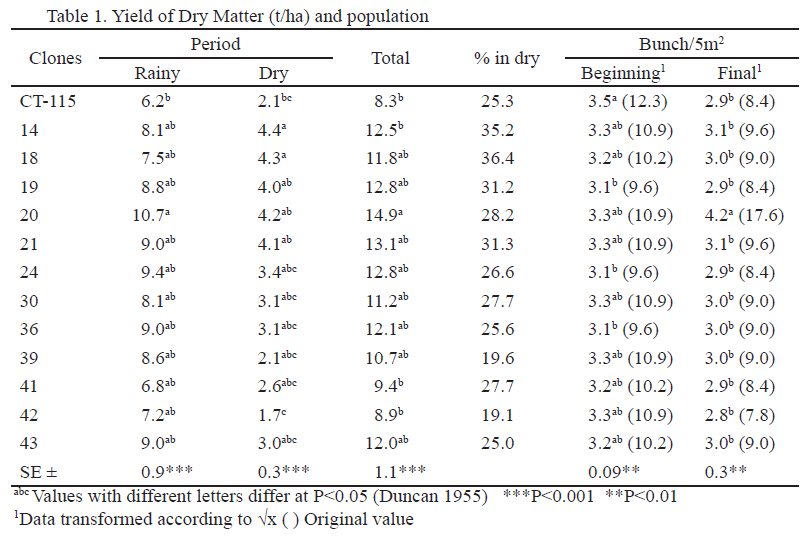
<body><![CDATA[<p align="justify" class="Cuerpodetexto"><em><span style="font-family:'Verdana','sans-serif'; font-size:10.0pt; ">Pennisetum  purpureum</span></em><span style="font-family:'Verdana','sans-serif'; font-size:10.0pt; "> and its varieties have evidenced its  ecological plasticity, expressed through its ability to transform light energy  into biomass, adapt to several types of soil, have acceptable values of  chemical composition (Herrera and Ramos 2006) and respond to mineral and  organic fertilization (Crespo 2006).<span style="letter-spacing:.1pt; "> </span></span></p>       <p align="justify" class="Cuerpodetexto"><span style="font-family:'Verdana','sans-serif'; font-size:10.0pt; ">The  Instituto de Ciencia Animal (ICA) developed a program for improvement this  species, obtaining clones like Cuba CT-115 and Cuba CT-169 (Herrera and  Mart&iacute;nez 2006), extended to commercial production areas from Cuba and other  countries. These clones show characteristics for grazing and forage production,  respectively. In order to continue this program, new clones were obtained, with  tolerance to drought and salinity (Herrera <em>et al.</em> 2003), as well as  characteristics that surpass their progenitor (Herrera 2010).</span></p>       <p align="justify" class="Cuerpodetexto"><span style="font-family:'Verdana','sans-serif'; font-size:10.0pt; ">The  objective of this paper is to offer information on the evaluation of these new  clones</span></p>       <p align="justify" class="Cuerpodetexto"><span style="font-family:'Verdana','sans-serif'; font-size:10.0pt; ">&nbsp;</span></p>       <p align="justify" class="subtitulo"><strong><span style="font-family:'Verdana','sans-serif'; font-size=3">MATERIALS AND METHODS</span></strong></p>       <p align="justify" class="Cuerpodetexto"><span style="letter-spacing:.1pt; font-family:'Verdana','sans-serif'; font-size:10.0pt; ">Four experiments were performed at Estaci&oacute;n de Pastos  &ldquo;Miguel Sistachs Naya&rdquo; from the Instituto de Ciencia Animal, in a typical red  ferrallitic soil (Hern&aacute;ndez <em>et al.</em> 1998) and a minimum duration of two  years. In every case, random block designs were used with five replications.  Soil was conventionally prepared, using plant seeds of five months old. The  same amount of buds was planted in each plot of      25 m<sup>2</sup>, after the rains were stable in June. At the end of the  establishment period (150 d), the establishment cut was performed, with 98 % of  population. Samplings were carried out every 90 and 60 d during the dry and  rainy periods, respectively. Strategic fertilization with N (150 kg/ha in the  rainy period) was only applied in one experiment. Irrigation was not used in  any case during dry period. Analysis of variance was carried out according to  the experimental design in each season. Mean values were compared through  Duncan test (1955).</span></p>       <p align="justify" class="Cuerpodetexto"><span style="font-family:'Verdana','sans-serif'; font-size:10.0pt; ">&nbsp;</span></p>       <p align="justify" class="subtitulo"><strong><span style="font-family:'Verdana','sans-serif'; font-size=3">RESULTS AND DISCUSSION</span></strong></p>       <p align="justify" class="Cuerpodetexto"><span style="font-family:'Verdana','sans-serif'; font-size:10.0pt; ">There  was variation (P&lt;0.001) in the yield of clones. Number 14 and 18 surpassed  the control (Cuba      CT-115, progenitor) in the dry period and produced 35 and 36 % of total yield,  respectively. Nevertheless, clones 19, 20 and 21, despite not differing from  the control, produced two tons more than the control. Differences were less  marked during the rainy period. Population (tiller/5m<sup>2</sup>) also  differed among clones. CT-115 decreased its population at the end of the  experimental stage, while clone 20 was the only one to increase its population  (<a href="/img/revistas/cjas/v49n4/t0113415.gif">table 1</a>).&nbsp; </span></p>       
<p align="justify" class="Cuerpodetexto"><span style="letter-spacing:.2pt; font-family:'Verdana','sans-serif'; font-size:10.0pt; ">Clones 41 and 43 showed, at first sight, certain qualities  that made them suitable for their use in grazing. Therefore, their growth  curves were studied (yield and leaf percentage), showing the best performance  up to 76 d of regrowth regarding CT-115 (<a href="/img/revistas/cjas/v49n4/f0113415.gif">figure 1</a>).</span> </p>       
]]></body>
<body><![CDATA[<p align="justify" class="Cuerpodetexto"><span style="font-family:'Verdana','sans-serif'; font-size:10.0pt; ">Drought  tolerant clones showed different performance in the Western region regarding  the Eastern areas (Herrera 2013). Therefore, a research was performed in the  western part of the country for three years, with the application of strategic  fertilization with N during the rainy period.</span></p>       <p align="justify" class="Cuerpodetexto"><span style="font-family:'Verdana','sans-serif'; font-size:10.0pt; ">At  the end of the second year, without the use of fertilizer and, specially, in  the dry period, only CT-608 surpassed (P &lt; 0.001) the control yield,  although CT-600, CT-603 and CT-607, which had no differences with the control,  obtained superior yields. This influenced on the annual yield, making it  superior (10.75, 4.98, 4.49, 4.81 and 3.50 tDM/ha for CT-608, CT-600, CT-603,  CT-607 and CT-115, respectively). However, using the fertilization, clones  CT-601, CT-602, CT-604, CT-605, CT-608 and CT-609 had higher yield than the  control CT-115 (4.7, 4.4, 4.5, 5.0, 5.6, 5.3 and 3.4 tDM/ha, respectively) in  the dry period and in the annual total (<a href="/img/revistas/cjas/v49n4/t0213415.gif">table 2</a>).</span></p>       
<p align="justify" class="Cuerpodetexto"><span style="font-family:'Verdana','sans-serif'; font-size:10.0pt; ">As it was evident, the clones obtained by <em>in vitro</em> tissue culture showed their biological individuality, expressed through the  different performance among them and regarding their progenitor in both  seasonal periods. However, it is important to focus on the results of dry  season, because biomass production decreases in this period, which is mainly  determined by low temperatures and precipitations. There is also less duration  and intensity of light.</span></p>       <p align="justify" class="Cuerpodetexto"><span style="font-family:'Verdana','sans-serif'; font-size:10.0pt; ">This performance of clones is closely related to climate  characteristics in which they develop. Ram&iacute;rez <em>et al.</em> (2011) found, in <em>Pennisetum  purpureum</em> cv. Cuba CT-169, correlations between yield and temperatures,  rains and rainy days. Similar results were found by Herrera <em>et al.</em> (2013) in six grass varieties. These researchers stated that each variety  showed a specific correlation coefficient. &Aacute;lvarez <em>et al.</em> (2013) found  multiple linear equations between yield and temperatures, rains and rainy days,  and these were specific for each studied clone of Pennisetum. These previous  facts demonstrate that each grass is a biological entity that has a specific  and individual response to climate factors.</span><span style="font-family:'Verdana','sans-serif'; font-size:10.0pt; ">&nbsp;&nbsp; </span></p>       <p align="justify" class="Cuerpodetexto"><span style="font-family:'Verdana','sans-serif'; font-size:10.0pt; ">Clones like 14, 18, 19, 20 and 21 showed their superiority  compared to CT-115 (control). In addition, two of them (41 and 43) showed good  qualities for grazing. After the clones CT-601, CT-602,      CT-604, CT-605, CT-608 and CT-609 were fertilized during the rainy period, they  expressed better tolerance to drought than their progenitor (CT-115),  determined by the highest yield obtained during dry      period.&nbsp;&nbsp; </span><span style="font-family:'Verdana','sans-serif'; font-size:10.0pt; "> </span></p>       <P align="justify"><span style="font-family:'Verdana','sans-serif'; font-size:10.0pt; ">The results evidenced the  usefulness of an <em>in vitro</em> tissue culture as a tool for improving <em>Pennisetum  purpureum</em>, to obtain clones that surpasses their progenitor. In addition,  basic and chemical composition studies are recommended, which will allow to  explain the differences among the studied clones, as well as experiments in  grazing with promising clones (41 and 43). It is also suggested the introduction  of the best clones, which are drought tolerant and strategically fertilized  with N during rainy season, to social practices</span><font size="2" face="Verdana, Arial, Helvetica, sans-serif">.</font></P>        <p align="justify">&nbsp;</p>     <p align="justify"><font size="2" face="Verdana, Arial, Helvetica, sans-serif"><font size="3"><b>REFERENCES</b></font></font></p>     <p align="justify" class="MsoNormal" style="line-height:normal;"><span style="font-family:'Verdana','sans-serif'; font-size:10.0pt; ">&Aacute;lvarez, A.,  Herrera, R. S., D&iacute;az, L. &amp; Noda, A. 2013. </span><span style="font-family:'Verdana','sans-serif'; font-size:10.0pt; ">&ldquo;Influence of rainfall and temperature on  biomass production of <em>Pennisetum purpureum</em> clones&rdquo;. </span><em><span style="font-family:'Verdana','sans-serif'; font-size:10.0pt; ">Cuban Journal of Agricultural Science</span></em><span style="font-family:'Verdana','sans-serif'; font-size:10.0pt; ">, 47 (4): 413.</span></p>     <!-- ref --><p align="justify" class="MsoNormal" style="line-height:normal;"><span style="font-family:'Verdana','sans-serif'; font-size:10.0pt; ">Anon, A. 1999. <em>Nueva  versi&oacute;n de clasificaci&oacute;n gen&eacute;tica de los suelos de Cuba</em>. La Habana, Cuba:  AGROINFOR, 64 p.    </span></p>     <p align="justify" class="MsoNormal" style="line-height:normal;"><span style="font-family:'Verdana','sans-serif'; font-size:10.0pt; ">Crespo, G.  2006. &ldquo;Utilizaci&oacute;n de la materia org&aacute;nica&rdquo;. In: Herrera R. S., Febles G. &amp;  Crespo G., <em>Pennisetum purpureum para la ganader&iacute;a tropical</em>, La Habana,  Cuba: EDICA, p. 127.</span></p>     <p align="justify" class="MsoNormal" style="line-height:normal;"><span style="font-family:'Verdana','sans-serif'; font-size:10.0pt; ">Duncan, D. B. 1955. &ldquo;Multiple Range and Multiple  F Tests&rdquo;. </span><em><span style="font-family:'Verdana','sans-serif'; font-size:10.0pt; ">Biometrics</span></em><span style="font-family:'Verdana','sans-serif'; font-size:10.0pt; ">, 11 (1): 1&ndash;42,  ISSN: 0006-341X, DOI: 10.2307/3001478.</span></p>     <!-- ref --><p align="justify" class="MsoNormal" style="line-height:normal;"><span style="font-family:'Verdana','sans-serif'; font-size:10.0pt; ">Herrera, R. S.  2010. <em>Nuevos clones de </em>Pennisetum purpureum<em> con mejores caracter&iacute;sticas  agron&oacute;micas y de calidad</em>. Project Final Report, Mayabeque, Cuba: CITMA-ICA.    </span></p>     <p align="justify" class="MsoNormal" style="line-height:normal;"><span style="font-family:'Verdana','sans-serif'; font-size:10.0pt; ">Herrera, R. S.  2013. &ldquo;Clones de <em>Pennisetum purpureum</em> tolerantes a la sequ&iacute;a y  salinidad&rdquo;. In: <em>XXIII Reuni&oacute;n de la Asociaci&oacute;n Latinoamericana de Producci&oacute;n  Animal y IV Congreso Internacional de Producci&oacute;n Animal Tropical</em>, La  Habana, Cuba, p. 5.</span></p>     <p align="justify" class="MsoNormal" style="line-height:normal;"><span style="font-family:'Verdana','sans-serif'; font-size:10.0pt; ">Herrera, R. S.,  Chaple, Z., Cruz, A. M., Romero, A. &amp; Garcia, M. 2003. </span><span style="font-family:'Verdana','sans-serif'; font-size:10.0pt; ">&ldquo;Obtainment of <em>Pennisetum  purpureum</em> plantlets resistant to drought and salinity. </span><span style="font-family:'Verdana','sans-serif'; font-size:10.0pt; ">Technical note&rdquo;. <em>Cuban Journal of Agricultural Science</em>, 37 (2):  187&ndash;189.</span></p>     <p align="justify" class="MsoNormal" style="line-height:normal;"><span style="font-family:'Verdana','sans-serif'; font-size:10.0pt; ">Herrera, R. S.,  Garc&iacute;a, M., Cruz, A. M. &amp; Romero, A. 2013. &ldquo;Relaci&oacute;n entre algunos factores  clim&aacute;ticos y el rendimiento de seis variedades de pastos&rdquo;. In: <em>XXIII Reuni&oacute;n  de la Asociaci&oacute;n Latinoamericana de Producci&oacute;n Animal y IV Congreso  Internacional de Producci&oacute;n Animal Tropical</em>, La Habana, Cuba, p. 4.</span></p>     <p align="justify" class="MsoNormal" style="line-height:normal;"><span style="font-family:'Verdana','sans-serif'; font-size:10.0pt; ">Herrera, R. S.  &amp; Mart&iacute;nez, R. O. 2006. &ldquo;Mejoramiento gen&eacute;tico por v&iacute;as no cl&aacute;sicas&rdquo;. In:  Herrera R. S., Febles G. &amp; Crespo G. (eds.), <em>Pennisetum purpureum para  la ganader&iacute;a tropical</em>, La Habana, Cuba: EDICA, p. 15.</span></p>     <p align="justify" class="MsoNormal" style="line-height:normal;"><span style="font-family:'Verdana','sans-serif'; font-size:10.0pt; ">Herrera, R. S.  &amp; Ramos, N. 2006. &ldquo;Factores que influyen en la producci&oacute;n de biomasa y la  calidad&rdquo;. In: Herrera R. S., Febles G. &amp; Crespo G. (eds.), <em>Pennisetum  purpureum para la ganader&iacute;a tropical</em>, La Habana, Cuba: EDICA, p. 79.</span></p>     ]]></body>
<body><![CDATA[<P align="justify"><span style="font-family:'Verdana','sans-serif'; font-size:10.0pt; ">Ram&iacute;rez,  J. L., Herrera, R. S., Leonard, I., Cisneros, M., Verdecia, D. &amp; &Aacute;lvarez,  Y. 2011. </span><span style="font-family:'Verdana','sans-serif'; font-size:10.0pt; ">&ldquo;Relation between climatic factors, yield, and  quality of <em>Pennisetum purpureum</em> cv. Cuba CT-169 in the Cauto Valley,  Cuba&rdquo;. <em>Cuban Journal of Agricultural Science</em>, 45: 293</span><font size="2" face="Verdana, Arial, Helvetica, sans-serif">.</font> </P>     <p align="justify">&nbsp;</p>     <p align="justify">&nbsp;</p>     <p align="justify"><font size="2" face="Verdana, Arial, Helvetica, sans-serif">Received: November 26, 2015    <br>   Accepted: January 5, 2016</font></p>     <p align="justify">&nbsp;</p>     <p align="justify">&nbsp;</p>     <p align="justify"><font size="2" face="Verdana, Arial, Helvetica, sans-serif"><i>R. S. Herrera,</i> Instituto de Ciencia Animal, Apartado Postal 24, San José de las Lajas, Mayabeque, Cuba.    Email: <a href="mailto:rherrera@ica.co.cu">rherrera@ica.co.cu</a></font></p>      ]]></body><back>
<ref-list>
<ref id="B1">
<nlm-citation citation-type="journal">
<person-group person-group-type="author">
<name>
<surname><![CDATA[Álvarez]]></surname>
<given-names><![CDATA[A.]]></given-names>
</name>
<name>
<surname><![CDATA[Herrera]]></surname>
<given-names><![CDATA[R. S.]]></given-names>
</name>
<name>
<surname><![CDATA[Díaz]]></surname>
<given-names><![CDATA[L.]]></given-names>
</name>
<name>
<surname><![CDATA[Noda]]></surname>
<given-names><![CDATA[A.]]></given-names>
</name>
</person-group>
<article-title xml:lang="nd"><![CDATA[Influence of rainfall and temperature on biomass production of Pennisetum purpureum clones]]></article-title>
<source><![CDATA[Cuban Journal of Agricultural Science]]></source>
<year>2013</year>
<volume>47</volume>
<numero>4</numero>
<issue>4</issue>
<page-range>413</page-range></nlm-citation>
</ref>
<ref id="B2">
<nlm-citation citation-type="book">
<person-group person-group-type="author">
<name>
<surname><![CDATA[Anon]]></surname>
<given-names><![CDATA[A.]]></given-names>
</name>
</person-group>
<source><![CDATA[Nueva versión de clasificación genética de los suelos de Cuba]]></source>
<year>1999</year>
<page-range>64</page-range><publisher-loc><![CDATA[La Habana, Cuba ]]></publisher-loc>
<publisher-name><![CDATA[AGROINFOR]]></publisher-name>
</nlm-citation>
</ref>
<ref id="B3">
<nlm-citation citation-type="book">
<person-group person-group-type="author">
<name>
<surname><![CDATA[Crespo]]></surname>
<given-names><![CDATA[G.]]></given-names>
</name>
</person-group>
<article-title xml:lang="nd"><![CDATA[Utilización de la materia orgánica]]></article-title>
<source><![CDATA[Pennisetum purpureum para la ganadería tropical]]></source>
<year>2006</year>
<page-range>127</page-range><publisher-loc><![CDATA[La Habana, Cuba ]]></publisher-loc>
<publisher-name><![CDATA[EDICA]]></publisher-name>
</nlm-citation>
</ref>
<ref id="B4">
<nlm-citation citation-type="journal">
<person-group person-group-type="author">
<name>
<surname><![CDATA[Duncan]]></surname>
<given-names><![CDATA[D. B.]]></given-names>
</name>
</person-group>
<article-title xml:lang="nd"><![CDATA[Multiple Range and Multiple F Tests]]></article-title>
<source><![CDATA[Biometrics]]></source>
<year>1955</year>
<volume>11</volume>
<numero>1</numero>
<issue>1</issue>
<page-range>1–42</page-range></nlm-citation>
</ref>
<ref id="B5">
<nlm-citation citation-type="book">
<person-group person-group-type="author">
<name>
<surname><![CDATA[Herrera]]></surname>
<given-names><![CDATA[R. S.]]></given-names>
</name>
</person-group>
<source><![CDATA[Nuevos clones de Pennisetum purpureum con mejores características agronómicas y de calidad]]></source>
<year>2010</year>
<publisher-loc><![CDATA[Mayabeque, Cuba ]]></publisher-loc>
<publisher-name><![CDATA[CITMA-ICA]]></publisher-name>
</nlm-citation>
</ref>
<ref id="B6">
<nlm-citation citation-type="">
<person-group person-group-type="author">
<name>
<surname><![CDATA[Herrera]]></surname>
<given-names><![CDATA[R. S.]]></given-names>
</name>
</person-group>
<article-title xml:lang="nd"><![CDATA[Clones de Pennisetum purpureum tolerantes a la sequía y salinidad]]></article-title>
<source><![CDATA[]]></source>
<year>2013</year>
<page-range>5</page-range><publisher-loc><![CDATA[La Habana, Cuba ]]></publisher-loc>
</nlm-citation>
</ref>
<ref id="B7">
<nlm-citation citation-type="journal">
<person-group person-group-type="author">
<name>
<surname><![CDATA[Herrera]]></surname>
<given-names><![CDATA[R. S.]]></given-names>
</name>
<name>
<surname><![CDATA[Chaple]]></surname>
<given-names><![CDATA[Z.]]></given-names>
</name>
<name>
<surname><![CDATA[Cruz]]></surname>
<given-names><![CDATA[A. M.]]></given-names>
</name>
<name>
<surname><![CDATA[Romero]]></surname>
<given-names><![CDATA[A.]]></given-names>
</name>
<name>
<surname><![CDATA[Garcia]]></surname>
<given-names><![CDATA[M.]]></given-names>
</name>
</person-group>
<article-title xml:lang="nd"><![CDATA[Obtainment of Pennisetum purpureum plantlets resistant to drought and salinity. Technical note]]></article-title>
<source><![CDATA[Cuban Journal of Agricultural Science]]></source>
<year>2003</year>
<volume>37</volume>
<numero>2</numero>
<issue>2</issue>
<page-range>187–189</page-range></nlm-citation>
</ref>
<ref id="B8">
<nlm-citation citation-type="">
<person-group person-group-type="author">
<name>
<surname><![CDATA[Herrera]]></surname>
<given-names><![CDATA[R. S.]]></given-names>
</name>
<name>
<surname><![CDATA[García]]></surname>
<given-names><![CDATA[M.]]></given-names>
</name>
<name>
<surname><![CDATA[Cruz]]></surname>
<given-names><![CDATA[A. M.]]></given-names>
</name>
<name>
<surname><![CDATA[Romero]]></surname>
<given-names><![CDATA[A.]]></given-names>
</name>
</person-group>
<article-title xml:lang="nd"><![CDATA[Relación entre algunos factores climáticos y el rendimiento de seis variedades de pastos]]></article-title>
<source><![CDATA[]]></source>
<year>2013</year>
<page-range>4</page-range><publisher-loc><![CDATA[La Habana, Cuba ]]></publisher-loc>
</nlm-citation>
</ref>
<ref id="B9">
<nlm-citation citation-type="book">
<person-group person-group-type="author">
<name>
<surname><![CDATA[Herrera]]></surname>
<given-names><![CDATA[R. S.]]></given-names>
</name>
<name>
<surname><![CDATA[Martínez]]></surname>
<given-names><![CDATA[R. O.]]></given-names>
</name>
</person-group>
<article-title xml:lang="nd"><![CDATA[Mejoramiento genético por vías no clásicas]]></article-title>
<person-group person-group-type="editor">
<name>
<surname><![CDATA[Herrera]]></surname>
<given-names><![CDATA[R. S.]]></given-names>
</name>
<name>
<surname><![CDATA[Febles]]></surname>
<given-names><![CDATA[G.]]></given-names>
</name>
<name>
<surname><![CDATA[Crespo]]></surname>
<given-names><![CDATA[G.]]></given-names>
</name>
</person-group>
<source><![CDATA[Pennisetum purpureum para la ganadería tropical]]></source>
<year>2006</year>
<page-range>15</page-range><publisher-loc><![CDATA[La Habana, Cuba ]]></publisher-loc>
<publisher-name><![CDATA[EDICA]]></publisher-name>
</nlm-citation>
</ref>
<ref id="B10">
<nlm-citation citation-type="book">
<person-group person-group-type="author">
<name>
<surname><![CDATA[Herrera]]></surname>
<given-names><![CDATA[R. S.]]></given-names>
</name>
<name>
<surname><![CDATA[Ramos]]></surname>
<given-names><![CDATA[N.]]></given-names>
</name>
</person-group>
<article-title xml:lang="nd"><![CDATA[Factores que influyen en la producción de biomasa y la calidad]]></article-title>
<person-group person-group-type="editor">
<name>
<surname><![CDATA[Herrera]]></surname>
<given-names><![CDATA[R. S.]]></given-names>
</name>
<name>
<surname><![CDATA[Febles]]></surname>
<given-names><![CDATA[G.]]></given-names>
</name>
<name>
<surname><![CDATA[Crespo]]></surname>
<given-names><![CDATA[G.]]></given-names>
</name>
</person-group>
<source><![CDATA[Pennisetum purpureum para la ganadería tropical]]></source>
<year>2006</year>
<page-range>79</page-range><publisher-loc><![CDATA[La Habana, Cuba ]]></publisher-loc>
<publisher-name><![CDATA[EDICA]]></publisher-name>
</nlm-citation>
</ref>
<ref id="B11">
<nlm-citation citation-type="journal">
<person-group person-group-type="author">
<name>
<surname><![CDATA[Ramírez]]></surname>
<given-names><![CDATA[J. L.]]></given-names>
</name>
<name>
<surname><![CDATA[Herrera]]></surname>
<given-names><![CDATA[R. S.]]></given-names>
</name>
<name>
<surname><![CDATA[Leonard]]></surname>
<given-names><![CDATA[I.]]></given-names>
</name>
<name>
<surname><![CDATA[Cisneros]]></surname>
<given-names><![CDATA[M.]]></given-names>
</name>
<name>
<surname><![CDATA[Verdecia]]></surname>
<given-names><![CDATA[D.]]></given-names>
</name>
<name>
<surname><![CDATA[Álvarez]]></surname>
<given-names><![CDATA[Y.]]></given-names>
</name>
</person-group>
<article-title xml:lang="nd"><![CDATA[Relation between climatic factors, yield, and quality of Pennisetum purpureum cv. Cuba CT-169 in the Cauto Valley, Cuba]]></article-title>
<source><![CDATA[Cuban Journal of Agricultural Science]]></source>
<year>2011</year>
<volume>45</volume>
<page-range>293</page-range></nlm-citation>
</ref>
</ref-list>
</back>
</article>