<?xml version="1.0" encoding="ISO-8859-1"?><article xmlns:mml="http://www.w3.org/1998/Math/MathML" xmlns:xlink="http://www.w3.org/1999/xlink" xmlns:xsi="http://www.w3.org/2001/XMLSchema-instance">
<front>
<journal-meta>
<journal-id>2079-3480</journal-id>
<journal-title><![CDATA[Cuban Journal of Agricultural Science]]></journal-title>
<abbrev-journal-title><![CDATA[Cuban J. Agric. Sci.]]></abbrev-journal-title>
<issn>2079-3480</issn>
<publisher>
<publisher-name><![CDATA[Editorial del Instituto de Ciencia Animal]]></publisher-name>
</publisher>
</journal-meta>
<article-meta>
<article-id>S2079-34802015000400014</article-id>
<title-group>
<article-title xml:lang="en"><![CDATA[Pennisetum purpureum cv. Cuba CT-115 used as biomass bank.Morphophysiological indicators]]></article-title>
<article-title xml:lang="es"><![CDATA[Pennisetum purpureum vc. Cuba CT-115 utilizado como banco de biomasa. Indicadores morfofisiológicos]]></article-title>
</title-group>
<contrib-group>
<contrib contrib-type="author">
<name>
<surname><![CDATA[Fortes]]></surname>
<given-names><![CDATA[Dayleni]]></given-names>
</name>
<xref ref-type="aff" rid="A01"/>
</contrib>
<contrib contrib-type="author">
<name>
<surname><![CDATA[Herrera]]></surname>
<given-names><![CDATA[R.S.]]></given-names>
</name>
<xref ref-type="aff" rid="A01"/>
</contrib>
<contrib contrib-type="author">
<name>
<surname><![CDATA[García]]></surname>
<given-names><![CDATA[M]]></given-names>
</name>
<xref ref-type="aff" rid="A01"/>
</contrib>
<contrib contrib-type="author">
<name>
<surname><![CDATA[Cruz]]></surname>
<given-names><![CDATA[Ana M]]></given-names>
</name>
<xref ref-type="aff" rid="A01"/>
</contrib>
<contrib contrib-type="author">
<name>
<surname><![CDATA[Romero]]></surname>
<given-names><![CDATA[Aida]]></given-names>
</name>
<xref ref-type="aff" rid="A01"/>
</contrib>
</contrib-group>
<aff id="A01">
<institution><![CDATA[,Instituto de Ciencia Animal  ]]></institution>
<addr-line><![CDATA[San José de la Lajas Mayabeque]]></addr-line>
<country>Cuba</country>
</aff>
<pub-date pub-type="pub">
<day>00</day>
<month>12</month>
<year>2015</year>
</pub-date>
<pub-date pub-type="epub">
<day>00</day>
<month>12</month>
<year>2015</year>
</pub-date>
<volume>49</volume>
<numero>4</numero>
<fpage>521</fpage>
<lpage>527</lpage>
<copyright-statement/>
<copyright-year/>
<self-uri xlink:href="http://scielo.sld.cu/scielo.php?script=sci_arttext&amp;pid=S2079-34802015000400014&amp;lng=en&amp;nrm=iso"></self-uri><self-uri xlink:href="http://scielo.sld.cu/scielo.php?script=sci_abstract&amp;pid=S2079-34802015000400014&amp;lng=en&amp;nrm=iso"></self-uri><self-uri xlink:href="http://scielo.sld.cu/scielo.php?script=sci_pdf&amp;pid=S2079-34802015000400014&amp;lng=en&amp;nrm=iso"></self-uri><abstract abstract-type="short" xml:lang="en"><p><![CDATA[This research was carried out with the objective of studying the performance of some morphophysiological indicators after grazing P. purpureum cv. Cuba CT-115 used as biomass bank. A completely randomized sampling was used and a total of 15 tufts were collected (experimental unit) immediately after grazing and every 15 days until to complete each growth cycle. The treatments consisted on the age of the grass regrowth from the moment the animals exit the paddock (zero time) and according to the biomass bank technology. During the first year and for each resting cycle the regrowth age influenced (P<0.001) on the plant height. For more of the cycles the length and width of leaves, and the leaf area increased (P<0.001) with the age and the higher values were in the cycles with more favorable climatic conditions for growth and leaf expansion, reaching the leaf area values of 246 cm² for the fourth cycle of the first year and 204 cm² for the fifth cycle of the second year. It was also determined the total yield performance with the regrowth age and growth indexes as Culture Growth Rate (CGR) and Net Assimilation Rate (NAR).The results showed that the growth cycles of the studied crop have an specific response pattern in function of the regrowth age and climatic characteristics. The CGR and the NAR have specific response for each cycle and are appropriate indicators for the analysis and characterization of grass growth. It was also proven that the increase of dry matter yield is done with low efficiency (NAR) from the high Culture Growth Rate is reached. It is recommended to incorporate the growth indexes studied in this research as novel tool for the management of other grasses and forage species]]></p></abstract>
<abstract abstract-type="short" xml:lang="es"><p><![CDATA[Este trabajo se realizó con el objetivo de estudiar el comportamiento de algunos indicadores morfofisiológicos después del pastoreo de P. purpureum vc. Cuba CT-115 empleado como banco de biomasa. Se empleó un muestreo completamente aleatorizado y se tomaron 15 macollas (unidad experimental) inmediatamente después del pastoreo y cada 15 días hasta completar cada ciclo de crecimiento Los tratamientos consistieron en la edad de rebrote del pasto a partir del momento de salida de los animales del potrero (tiempo cero) y de acuerdo con la tecnología de banco de biomasa. Durante el primer año y para cada ciclo de reposo la edad de rebrote influyó (P<0.001) en la altura de la planta. Para la mayoría de los ciclos el largo y ancho de las hojas, y el área foliar se incrementaron (P<0.001) con la edad y los mayores valores se presentaron en los ciclos con condiciones climáticas más favorables para el crecimiento y la expansión foliar, alcanzando el área foliar valores de 246 cm² para el ciclo cuatro del primer año y 204 cm² para el ciclo cinco del segundo año. También se determinó el comportamiento del rendimiento total con la edad de rebrote y de índices de crecimiento como la Tasa de crecimiento del Cultivo (TCC) y la Tasa de Asimilación Neta (TAN). Los resultados mostraron que los ciclos de crecimiento del cultivo estudiado tienen un patrón de respuesta específico en función de la edad de rebrote y de las características climáticas. La TCC y la TAN tienen respuesta específica para cada ciclo y son indicadores adecuados para el análisis y caracterización del crecimiento del pasto. Además se comprobó que el incremento del rendimiento de materia seca se realiza con una menor eficiencia (TAN) a partir de que se alcanza la máxima Tasa de Crecimiento del Cultivo. Se recomienda incorporar los índices de crecimiento estudiados en este trabajo como herramienta novedosa para el manejo de otras especies de pastos y forrajes]]></p></abstract>
<kwd-group>
<kwd lng="en"><![CDATA[P. purpureum cv]]></kwd>
<kwd lng="en"><![CDATA[Cuba CT-115]]></kwd>
<kwd lng="en"><![CDATA[morphophysiological indicators]]></kwd>
<kwd lng="en"><![CDATA[biomass bank]]></kwd>
<kwd lng="es"><![CDATA[P. purpureum vc]]></kwd>
<kwd lng="es"><![CDATA[Cuba CT-115]]></kwd>
<kwd lng="es"><![CDATA[indicadores morfofisiológicos]]></kwd>
<kwd lng="es"><![CDATA[banco de biomasa]]></kwd>
</kwd-group>
</article-meta>
</front><body><![CDATA[ <p align="right"><font size="2" face="Verdana, Arial, Helvetica,   sans-serif"><b>ORIGINAL ARTICLE</b></font></p>     <p>&nbsp;</p>     <p align="justify"><font size="4" face="Verdana, Arial, Helvetica, sans-serif"><b><em>Pennisetum purpureum</em> cv. Cuba CT-115 used as biomass bank.Morphophysiological indicators</b></font></p>     <p align="justify">&nbsp;</p>     <p align="justify"><font size="3" face="Verdana, Arial, Helvetica, sans-serif"><b><em>Pennisetum purpureum</em> vc. Cuba CT-115 utilizado como banco de biomasa. Indicadores morfofisiológicos</b></font></p>     <p align="justify">&nbsp;</p>     <p align="justify">&nbsp;</p>     <p align="justify"><font size="2" face="Verdana, Arial, Helvetica, sans-serif"><b>Dayleni Fortes,</b><sup><b>I</b></sup><b> R.S. Herrera,</b><sup><b>I</b></sup><b> M. García,</b><sup><b>I</b></sup><b> Ana M. Cruz,</b><sup><b>I</b></sup><b> Aida Romero,</b><sup><b>I</b></sup></font></p>     <p align="justify"><font size="2" face="Verdana, Arial, Helvetica, sans-serif"><b> </b></font><font size="2" face="Verdana, Arial, Helvetica, sans-serif"><sup>I</sup>Instituto de Ciencia Animal. Aptdo. 24 San José de la Lajas, Mayabeque, Cuba. </font></p>     <p align="justify">&nbsp;</p>     ]]></body>
<body><![CDATA[<p align="justify">&nbsp;</p> <hr align="JUSTIFY">     <p align="justify"><font size="2" face="Verdana, Arial, Helvetica, sans-serif"><b>ABSTRACT</b></font></p>     <p align="justify"><font size="2" face="Verdana, Arial, Helvetica, sans-serif"><span style="letter-spacing:.1pt; font-family:'Verdana','sans-serif'; font-size:10.0pt; ">This research was carried out with the objective of studying the  performance of some morphophysiological indicators after grazing <em>P.  purpureum</em> cv. Cuba CT-115 used as biomass bank. A completely randomized  sampling was used and a total of 15 tufts were collected (experimental unit)  immediately after grazing and every 15 days until to complete each growth  cycle. The treatments consisted on the age of the grass regrowth from the  moment the animals exit the paddock (zero time) and according to the biomass  bank technology. During the first year and for each resting cycle the regrowth  age influenced (P&lt;0.001) on the plant height. For more of the cycles the  length and width of leaves, and the leaf area increased (P&lt;0.001) with the  age and the higher values were in the cycles with more favorable climatic  conditions for growth and leaf expansion, reaching the leaf area values of 246  cm<sup>2</sup> for the fourth cycle of the first year and 204 cm<sup>2</sup> for the fifth cycle of the second year. It was also determined the total yield  performance with the regrowth age and growth indexes as Culture Growth Rate  (CGR) and Net Assimilation Rate (NAR).The results showed that the growth cycles  of the studied crop have an specific response pattern in function of the  regrowth age and climatic characteristics. The CGR and the NAR have specific  response for each cycle and are appropriate indicators for the analysis and  characterization of grass growth. It was also proven that the increase of dry  matter yield is done with low efficiency (NAR) from the high Culture Growth  Rate is reached. It is recommended to incorporate the growth indexes studied in  this research as novel tool for the management of other grasses and forage  species</span>.</font></p>     <p align="justify"><font size="2" face="Verdana, Arial, Helvetica, sans-serif"><b>Key words:</b> <em>P. purpureum</em> cv. Cuba CT-115, morphophysiological indicators, biomass bank.</font></p> <hr align="JUSTIFY">     <p align="justify"><font size="2" face="Verdana, Arial, Helvetica, sans-serif"><b>RESUMEN</b></font></p>     <p align="justify"><font size="2" face="Verdana, Arial, Helvetica, sans-serif"><span style="letter-spacing:-.2pt; font-family:'Verdana','sans-serif'; font-size:10.0pt; ">Este trabajo se realiz&oacute; con el objetivo de estudiar el  comportamiento de algunos indicadores&nbsp;  morfofisiol&oacute;gicos despu&eacute;s del pastoreo de <em>P. purpureum</em> vc. Cuba  CT-115 empleado como banco de biomasa. Se emple&oacute; un muestreo completamente aleatorizado  y se tomaron 15 macollas (unidad experimental) inmediatamente despu&eacute;s del  pastoreo y cada 15 d&iacute;as hasta completar cada ciclo de crecimiento Los  tratamientos consistieron en la edad de rebrote del pasto a partir del momento  de salida de los animales del potrero (tiempo cero) y de acuerdo con la  tecnolog&iacute;a de banco de biomasa. Durante el primer a&ntilde;o y para cada ciclo de  reposo la edad de rebrote influy&oacute; (P&lt;0.001) en&nbsp; la altura de la planta. Para la mayor&iacute;a de  los ciclos el largo y ancho de las hojas, y el &aacute;rea foliar se incrementaron  (P&lt;0.001) con la edad y los mayores valores se presentaron en los ciclos con  condiciones clim&aacute;ticas m&aacute;s favorables para el crecimiento y la expansi&oacute;n  foliar, alcanzando el &aacute;rea foliar valores de 246 cm<sup>2</sup> para el ciclo  cuatro del primer a&ntilde;o y 204 cm<sup>2</sup> para el ciclo cinco del segundo a&ntilde;o.  Tambi&eacute;n se determin&oacute; el comportamiento del rendimiento total con la edad de  rebrote y de &iacute;ndices de crecimiento como la Tasa de crecimiento del Cultivo  (TCC) y la Tasa de Asimilaci&oacute;n Neta (TAN). Los resultados mostraron que los  ciclos de crecimiento del cultivo estudiado tienen un patr&oacute;n de respuesta  espec&iacute;fico en funci&oacute;n de la edad de rebrote y de las caracter&iacute;sticas  clim&aacute;ticas. La TCC y la TAN tienen respuesta espec&iacute;fica para cada ciclo y son  indicadores adecuados para el an&aacute;lisis y caracterizaci&oacute;n del crecimiento del  pasto. Adem&aacute;s se comprob&oacute; que el incremento del rendimiento de materia seca se  realiza con una menor eficiencia (TAN) a partir de que se alcanza la m&aacute;xima  Tasa de Crecimiento del Cultivo. Se recomienda incorporar los &iacute;ndices de  crecimiento estudiados en este trabajo como herramienta novedosa para el manejo  de otras especies de pastos y forrajes</span>.</font></p>     <p align="justify"><font size="2" face="Verdana, Arial, Helvetica, sans-serif"><b>Palabras    clave:</b>    <em>P. purpureum</em> vc. Cuba CT-115, indicadores morfofisiológicos, banco de biomasa.</font></p> <hr align="JUSTIFY">     <p align="justify">&nbsp;</p>     <p align="justify">&nbsp;</p>     <p align="justify"><font size="2" face="Verdana, Arial, Helvetica, sans-serif"><b><font size="3">INTRODUCTION</font></b></font></p>       ]]></body>
<body><![CDATA[<p align="justify" class="Cuerpodetexto"><span style="font-family:'Verdana','sans-serif'; font-size:10.0pt; ">The  growth potential and grasses production is determined by the metabolic way used  to conduct photosynthesis, as well as its relation with respiration (Herrera  2006). </span></p>       <p align="justify" class="Cuerpodetexto"><span style="letter-spacing:.2pt; font-family:'Verdana','sans-serif'; font-size:10.0pt; ">Moreover, it is stated that the biomass accumulation in  grasslands is the result of complex interactions between genetic attributes,  environmental, physiological process and morphological characteristics that  determine the grassland productivity (Pedreira 2006).In this context, it is  necessary to know the morphophysiological and structural characteristics of  grasses to understand the dynamic of grassland production and their relations  within the animal production system in grazing.</span><span style="font-family:'Verdana','sans-serif'; font-size:10.0pt; "> </span></p>       <p align="justify" class="Cuerpodetexto"><span style="font-family:'Verdana','sans-serif'; font-size:10.0pt; ">That  is why, the objective of this research was to study the performance of some  morphophysiological indicators after grazing Cuba CT-115 used as biomass bank.</span></p>       <p align="justify" class="Cuerpodetexto"><span style="font-family:'Verdana','sans-serif'; font-size:10.0pt; ">&nbsp;</span></p>       <p align="justify" class="subtitulo"><strong><span style="font-family:'Verdana','sans-serif'; font-size=3">MATERIALS AND METHODS </span></strong></p>       <p align="justify" class="Cuerpodetexto"><em><span style="font-family:'Verdana','sans-serif'; font-size:10.0pt; ">Location  and soil</span></em><span style="font-family:'Verdana','sans-serif'; font-size:10.0pt; ">. The studies were conducted in the B dairy  unit from the Instituto de Ciencia Animal, San Jos&eacute; de las Lajas, Mayabeque.  The soil was classified as Brown gray springy soil (Hern&aacute;ndez <em>et al.</em> 1999) with slightly acid pH and relatively low contents of N      and K. </span></p>       <p align="justify" class="Cuerpodetexto"><em><span style="font-family:'Verdana','sans-serif'; font-size:10.0pt; ">Treatment and design</span></em><span style="font-family:'Verdana','sans-serif'; font-size:10.0pt; ">. The treatments consisted on the regrowth age or grass  rest from the moment the animals exit the paddock (zero time) and according to  the biomass bank technology (Mart&iacute;nez and Herrera 2006). The duration of the  rest cycles or growth is defined according to the biomass bank      technology.</span><span style="font-family:'Verdana','sans-serif'; font-size:10.0pt; "> </span></p>       <p align="justify" class="Cuerpodetexto"><em><span style="font-family:'Verdana','sans-serif'; font-size:10.0pt; ">Procedure</span></em><span style="font-family:'Verdana','sans-serif'; font-size:10.0pt; ">.  In a paddock of 0.68 ha a completely randomized sampling was used and a total  of 15 tufts were collected (experimental unit) immediately after grazing and  every 15 days up to complete each growth cycle according to Fortes <em>et al.</em> (2007).</span></p>       <p align="justify" class="Cuerpodetexto"><em><span style="letter-spacing:.1pt; font-family:'Verdana','sans-serif'; font-size:10.0pt; ">Measures.</span></em><span style="font-family:'Verdana','sans-serif'; font-size:10.0pt; "> The determined indicators were height, total dry matter yield, as well as the  percentage of leaves, stems and dead matter according to Herrera (2006).</span><span style="font-family:'Verdana','sans-serif'; font-size:10.0pt; "> </span></p>       <p align="justify" class="Cuerpodetexto"><span style="font-family:'Verdana','sans-serif'; font-size:10.0pt; ">To determine the area of each leaf the expression used was  (Fortes <em>et al.</em> 2007, unpublished data):     ]]></body>
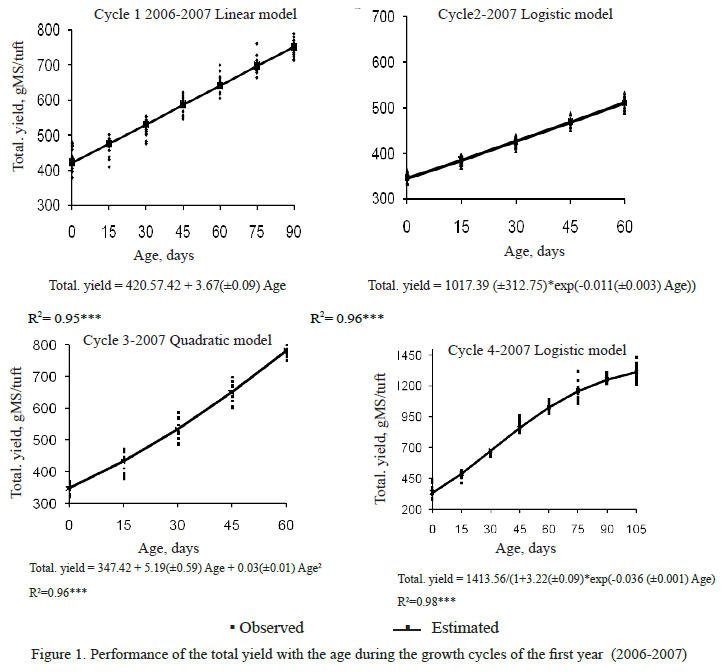
<body><![CDATA[<br>     AH= 11.41 + 0.89 (&plusmn;0.09) L*A R<sup>2</sup>=95.06**      SE= &plusmn;1.76, where: AH: foliar area, L: leaf length, cm (from the ligule to the  apex) and A: leaf width (longitudinal middle point). The Culture Growth Rate  (CGR) and the Net Assimilation Rate (NAR) were quantified according to Hunt  (1990), starting from the dry mass, foliar area and time (regrowth age after  grazing). The age corresponding to the highest CGR was established when making  the first derivative from the regression equation equal zero (Ross 2009).</span><span style="font-family:'Verdana','sans-serif'; font-size:10.0pt; "> </span></p>       <p align="justify" class="Cuerpodetexto"><span style="font-family:'Verdana','sans-serif'; font-size:10.0pt; "><em>Statistical  analysis</em>. Variance analysis was made according to completely randomized  design with SPSS version 5.0 (Visauta 2007) and Duncan (1955) test was used for  means comparison in necessary cases. Linear models were proved (linear,  quadratic and cubic) and non linear (logistic and Gompertz) to study the  relation between the regrowth age and yields.</span></p>       <p align="justify" class="Cuerpodetexto"><span style="font-family:'Verdana','sans-serif'; font-size:10.0pt; ">&nbsp;</span></p>       <p align="justify" class="subtitulo"><strong><span style="font-family:'Verdana','sans-serif'; font-size=3">RESULTS AND DISCUSSION</span></strong></p>       <p align="justify" class="Cuerpodetexto"><span style="font-family:'Verdana','sans-serif'; font-size:10.0pt; ">In all growth cycles the tuft height decreased after  grazing. During the first and second year and for each rest cycle the regrowth  age influenced (P&lt;0.001) on the plant height. In most of the cycles the  reduction in the tuft height promoted by grazing, was not compensated by the  growth during the grassland rest time. This is due in part, to the different  duration of the rest cycles and another to the environmental variations imposed  by the climate factors in each growth period. In this study the first three rest  cycles which are in the dry season, were the most affected since, the maximum  temperatures in these months not exceeded 25 &ordm;C and the number of rainy days  was always below five days. Nevertheless, it is important to highlight that in  the rest cycles of more duration the plant had great possibilities to reach  high      height</span><span style="font-family:'Verdana','sans-serif'; font-size:10.0pt; ">.</span></p>       <p align="justify" class="Cuerpodetexto"><span style="letter-spacing:.3pt; font-family:'Verdana','sans-serif'; font-size:10.0pt; ">For most of the cycles the length and width of leaves, and  the leaf area were increased (P&lt;0.001) with the age and the highest values  were in the cycles with more favorable climatic conditions for growth and leaf  expansion, reaching the leaf area values of 246 cm<sup>2</sup> for the fourth  cycle of the first year and      204 cm<sup>2</sup> for the fifth cycle of the second year. These results are  correspond with those found in the same grass by Fern&aacute;ndez (2009), who found  significant differences between&nbsp; periods,  with higher values for the rainy period. Gardner <em>et al.</em> (2000) reported  that the increase of the leaf area with the regrowth age becomes constant from  the moment it starts flowering and in turn, referred that when plants are  efficient tend to invest most of their early growth in expanding its leaf area,  resulting better use of solar      radiation.&nbsp; </span></p>       <p align="justify" class="Cuerpodetexto"><span style="font-family:'Verdana','sans-serif'; font-size:10.0pt; ">The  previously mentioned could contribute to explain the performance of the leaf  area in this research, since in most of the cycles, especially in those of more  duration, this indicator remained constant to the highest regrowth ages.&nbsp;&nbsp;&nbsp; </span></p>       <p align="justify" class="Cuerpodetexto"><span style="font-family:'Verdana','sans-serif'; font-size:10.0pt; ">The  regrowth age influenced (P&lt;0.05) on the performance of the content of leaf,  stem and dead material (DM). The stem percentages were always higher than  leaves and DM with 83.0 % as higher value in the third cycle of the first year.  This pattern was in several rest cycles in which the stem values were high. The  leaves content increased with the regrowth age up to 60 days and from there it  was stabilized. The DM percentage was also high and decreased, generally, with  the regrowth age.</span></p>       <p align="justify" class="Cuerpodetexto"><span style="font-family:'Verdana','sans-serif'; font-size:10.0pt; ">Immediately after grazing (zero time) leaf values did not  exceeded 10%, as it is the first fraction the animal intake, whenever  sufficient availability exits for it (Gomide <em>et al.</em> 2001).This residual  percentage of leaves after grazing has great importance for the plant  restoration because it is one the most important elements for the regrowth as  photosynthetic source required for the forage growth. From that moment, the  leaves percentage with the rest age was increased, in an specific way for each  cycle, without exceeding 40%, although the higher increases were recorded up to      60 days, due to, maybe, to the internal positive balance between photosynthesis  and respiration achieved by the plant.</span><span style="font-family:'Verdana','sans-serif'; font-size:10.0pt; "> </span></p>       <p align="justify" class="Cuerpodetexto"><span style="font-family:'Verdana','sans-serif'; font-size:10.0pt; ">The total biomass production was increased with the  regrowth age (<a href="/img/revistas/cjas/v49n4/f0114415.gif">figure 1</a>) and in accordance with the established equations, only  in the four cycle of the first year, this indicator was stabilized with the  regrowth age, which could indicate, that from 90 regrowth days starts the third  growth period named senescense or aging period where growth slows caused,  mainly, by internal factors that limit it (P&eacute;rez and Mart&iacute;nez      1994)</span><span style="font-family:'Verdana','sans-serif'; font-size:10.0pt; ">.&nbsp; </span></p>       
]]></body>
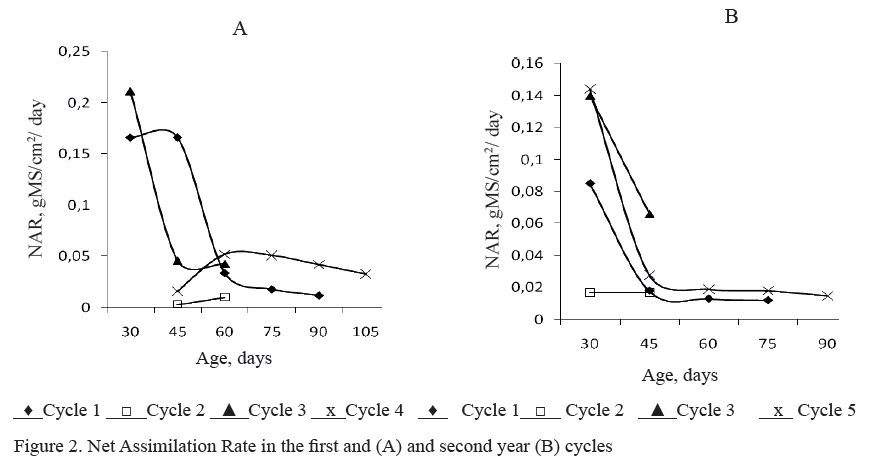
<body><![CDATA[<p align="justify" class="Cuerpodetexto"><span style="font-family:'Verdana','sans-serif'; font-size:10.0pt; ">It is interesting to point out that the dry matter yields  showed similar tendency with the regrowth age to the tuft height performance,  that is to say that both indicators were increased with the age. Probably the  most important characteristic that determines&nbsp;  the&nbsp; ability of the plant to compete  for light is the height, since, little differences in its height can generate  effects on the superposition of some leaves in the others and consequently in  the dry matter      production. </span><span style="font-family:'Verdana','sans-serif'; font-size:10.0pt; "> </span></p>       <p align="justify" class="Cuerpodetexto"><span style="font-family:'Verdana','sans-serif'; font-size:10.0pt; ">The  Culture Growth Rate was characterized, in general, for their gradual increase  from 15 days of age up to reaching the maxim growth rate, from that moment  began to descend, this could indicate that from the referred ages the biomass  accumulation is not biologically efficient, so it could be a negative balance  between photosynthesis and respiration.&nbsp; </span></p>       <p align="justify" class="Cuerpodetexto"><span style="font-family:'Verdana','sans-serif'; font-size:10.0pt; ">The highest CGR during the first year was reached at 71,  57 and 61 regrowth days for the cycles one, two and four, respectively; the  higher grassland productivity was recorded in the rest cycles within the rainy  season</span><span style="font-family:'Verdana','sans-serif'; font-size:10.0pt; ">.</span></p>       <p align="justify" class="Cuerpodetexto"><span style="font-family:'Verdana','sans-serif'; font-size:10.0pt; ">Several  studies showed that the forage growth rate could be limited by  photo-assimilates supply, by the plant reserves, or by the number, size and  activity of the meristem (Perez <em>et al.</em> 2004). All these factors that  influence on the CGR are determined, in turn, by climatic factors.</span></p>       <p align="justify" class="Cuerpodetexto"><span style="font-family:'Verdana','sans-serif'; font-size:10.0pt; ">The linear equations obtained for the CGR in the cycles  three of the first year, it could attributed to that cycles lasted 60 days and  as Cuba CT-115 is a perennial plant of long growth cycle, in this age the plant  is under completely conditions for its growth, especially that coincide with  the rainy season in which climatic conditions are favorable for its growth,  these cycles are characterized by the&nbsp;  rapid dry matter </span><span style="font-family:'Verdana','sans-serif'; font-size:10.0pt; ">accumulation from the  first weeks until the 60 days      end.</span></p>       <p align="justify" class="Cuerpodetexto"><span style="letter-spacing:.35pt; font-family:'Verdana','sans-serif'; font-size:10.0pt; ">At the beginning of growth the plant leaf area is  constituted, mainly, of young leaves with high photosynthetic capacity and high  fixation efficiency of atmospheric CO<sub>2</sub>. As the plant is developing,  the leaf senescence processes are intensified, the leaf photosynthetic  efficiency is reduced and the plant respiratory loss increased, which  compromises the Net Assimilation Rate and the Leaf Area Rate and, consequently,  the CGR. This helps to explain the reductions that were in CGR in all the rest  cycles from the specific characteristics of each of them.</span><span style="font-family:'Verdana','sans-serif'; font-size:10.0pt; "> </span></p>       <p align="justify" class="Cuerpodetexto"><span style="font-family:'Verdana','sans-serif'; font-size:10.0pt; ">The Net Assimilation Rate (NAR) showed particular  performance in each cycle, as well as the pattern that fallowed regarding the  regrowth age. The NAR practically did not vary during the first year in cycle  one, between 30 and 45&nbsp; regrowth days  but, from this moment it drastically decreased up to 60 days to continue its  descend up to 90 days (<a href="/img/revistas/cjas/v49n4/f0214415.gif">figure 2 A</a>). The same response pattern was presented in  cycle three up to 60 days and it seems that the photo-assimilates production  was not enough to replace the plant demands for growth and development.  Nevertheless, in cycle two the NAR showed a slight increase which was  interrupted by the short growth period.&nbsp;  In cycle four, with the rapid growth that occurs between 45 and 60 days  it was tried to replace the assimilates needs,&nbsp;  that which was not achieved&nbsp;  because from 60 days decreased. This performance occurred, maybe, at the  expense of the leaf area increase with the regrowth age but with reductions of  the Specific Leaf Area and the Leaf Area Duration. </span><span style="font-family:'Verdana','sans-serif'; font-size:10.0pt; ">&nbsp;</span></p>       
<p align="justify" class="Cuerpodetexto"><span style="font-family:'Verdana','sans-serif'; font-size:10.0pt; ">During  the second year there was an intense decrease between 45 and 60 days of  regrowth during cycles one and five and from that moment on this indicator was  stabilized with low values. In cycle three it also decreased while in cycle 2  it was constant (<a href="/img/revistas/cjas/v49n4/f0214415.gif">figure 2B</a>). In general, during this year the lowest values  compared to the first year were obtained.&nbsp;</span></p>       
<p align="justify" class="Cuerpodetexto"><span style="font-family:'Verdana','sans-serif'; font-size:10.0pt; ">In general, the NAR was reduced at the highest regrowth  ages in all cycles, probably because the increase of the leaf age, joined to  the self-shadowing of the plant inferior leafs reduces the photosynthetic  efficiency. In that respect, Andrade <em>et al.</em> (2005) reported that the  reduction of NAR with the development is owed to a decrease in the  photosynthetic rates more than to the increase of the plant respiratory loss.  In this research the CGR was reduced at high regrowth ages, however the plant  yields are increased but this is carried out with a lower biological  efficiency.</span><span style="font-family:'Verdana','sans-serif'; font-size:10.0pt; "> </span></p>       <p align="justify" class="Cuerpodetexto"><span style="font-family:'Verdana','sans-serif'; font-size:10.0pt; ">It  was proven that the growth cycles of the studied crop have an specific response  pattern in function of the regrowth age and climatic characteristics. The CGR  and NAR have specific response for each cycle and are appropriate indicators  for the analysis and characterization of the grass growth. The increase of the  dry matter yield is done with less efficiency (NAR) from the high Culture  Growth Rate is reached. </span></p>       ]]></body>
<body><![CDATA[<p align="justify"><span style="letter-spacing:.2pt; font-family:'Verdana','sans-serif'; font-size:10.0pt; ">It is  recommended to&nbsp; incorporate the growth  indexes studied in this research as novel tool for the management of others  grasses and forages species, as well as in future researches to deepen in the  aspects that integrate elements of morphology and plant physiology and their  expressions in the growth and development of grasses and forages dedicated to  animal feeding</span><font size="2" face="Verdana, Arial, Helvetica, sans-serif">.</font></p>     <p align="justify">&nbsp;</p>      <p align="justify"><font size="2" face="Verdana, Arial, Helvetica, sans-serif"><font size="3"><b>REFERENCES</b></font></font></p>     <p align="justify" class="MsoNormal" style="line-height:normal;"><span style="font-family:'Verdana','sans-serif'; font-size:10.0pt; ">Andrade, A. C.,  Fonseca, D. M., Lopes, R. S., Nascimento J&uacute;nior, D., Cecon, P. R., Queiroz, D.  S., Pereira, D. H. &amp; Reis, S. T. 2005. &ldquo;An&aacute;lise de crescimento do  capim-elefante napier adubado e irrigado&rdquo;. <em>Ci&ecirc;ncia e agrotecnologia</em>, 29  (2): 415&ndash;423.</span></p>     <!-- ref --><p align="justify" class="MsoNormal" style="line-height:normal;"><span style="font-family:'Verdana','sans-serif'; font-size:10.0pt; ">Anon, A. 1999. <em>Nueva  versi&oacute;n de clasificaci&oacute;n gen&eacute;tica de los suelos de Cuba</em>. La Habana, Cuba:  AGROINFOR, 64 p.    </span></p>     <!-- ref --><p align="justify" class="MsoNormal" style="line-height:normal;"><span style="font-family:'Verdana','sans-serif'; font-size:10.0pt; ">Fern&aacute;ndez, A.  2009. <em>Evaluaci&oacute;n de Pennisetum purpureum vc. Cuba CT-115 en el Valle del  Cauto</em>. M.Sc. Thesis, Universidad de Granma, Cuba.    </span></p>     <p align="justify" class="MsoNormal" style="line-height:normal;"><span style="font-family:'Verdana','sans-serif'; font-size:10.0pt; ">Fortes, D.,  Herrera, R. S., Torres, V., Garc&iacute;a, M., Cruz, A. M., Romero, A., Noda, A. &amp;  Gonz&aacute;lez, S. 2007. </span><span style="font-family:'Verdana','sans-serif'; font-size:10.0pt; ">&ldquo;Determination  of a sampling method for the morphophysiological study of grazing <em>Pennisetum  purpureum</em> cv. </span><span style="font-family:'Verdana','sans-serif'; font-size:10.0pt; ">Cuba CT-115&rdquo;. <em>Cuban Journal of Agricultural Science</em>,  41: 381.</span></p>     <p align="justify" class="MsoNormal" style="line-height:normal;"><span style="font-family:'Verdana','sans-serif'; font-size:10.0pt; ">Gardner, F. P., Brent Pearce, R. &amp; Mitchel,  R. L. 2000. &ldquo;Carbon fixation by crop canopies&rdquo;. In: <em>Physiology of Crop  Plants</em>, Iowa State University Press, p. 31.</span></p>     ]]></body>
<body><![CDATA[<p align="justify" class="MsoNormal" style="line-height:normal;"><span style="font-family:'Verdana','sans-serif'; font-size:10.0pt; ">Gomide, J. A., Wendling, I. J. &amp; Bras, S. P.  2001. </span><span style="font-family:'Verdana','sans-serif'; font-size:10.0pt; ">&ldquo;Consumo e produ&ccedil;&atilde;o de leite de vacas mesti&ccedil;as em  pastagem de <em>Brachiaria decumbens</em> manejada sob duas ofertas di&aacute;rias de  forragem&rdquo;. <em>Revista Brasileira de Zootecnia</em>, 30 (4): 1194&ndash;1199.</span></p>     <!-- ref --><p align="justify" class="MsoNormal" style="line-height:normal;"><span style="font-family:'Verdana','sans-serif'; font-size:10.0pt; ">Herrera, R. S.  2006. <em>Ecofisiolog&iacute;a. Su relaci&oacute;n con la producci&oacute;n de pastos</em>. </span><span style="font-family:'Verdana','sans-serif'; font-size:10.0pt; ">Colombia: Universidad de  Nari&ntilde;o, 134 p.    </span></p>     <!-- ref --><p align="justify" class="MsoNormal" style="line-height:normal;"><span style="font-family:'Verdana','sans-serif'; font-size:10.0pt; ">Hunt, R. 1990. <em>Basic growth analysis: plant  growth analysis for beginners</em>. </span><span style="font-family:'Verdana','sans-serif'; font-size:10.0pt; ">London: Unwin  Hyman, 112 p.    </span></p>     <p align="justify" class="MsoNormal" style="line-height:normal;"><span style="font-family:'Verdana','sans-serif'; font-size:10.0pt; ">Mart&iacute;nez, R. O.  &amp; Herrera, R. S. 2006. &ldquo;Empleo del Cuba CT-115 para solucionar el d&eacute;ficit  de alimentos durante la seca&rdquo;. In: Velasco M. E., Hern&aacute;ndez A., Perezgrovas R.  A. &amp; S&aacute;nchez B. (eds.), <em>Producci&oacute;n y manejo de los recursos forrajeros  tropicales</em>, M&eacute;xico: Univ. Aut&oacute;noma de Chiapas, p. 75.</span></p>     <!-- ref --><p align="justify" class="MsoNormal" style="line-height:normal;"><span style="font-family:'Verdana','sans-serif'; font-size:10.0pt; ">Pedreira, B. C.  2006. <em>Intercepta&ccedil;&atilde;o de luz, arquitetura e assimila&ccedil;&atilde;o de carbono em doss&eacute;is  de capim xara&eacute;s (Brachiaria brizantha (A. Rich.) Stapf.cv. Xara&eacute;s) submetidos a  estrat&eacute;gias de pastejo rotacionado</em>. M.Sc. Thesis, ESALQ, Piracicaba, 86 p.    </span></p>     <p align="justify" class="MsoNormal" style="line-height:normal;"><span style="font-family:'Verdana','sans-serif'; font-size:10.0pt; ">P&eacute;rez, A. J.  A., Garc&iacute;a, M. E., Enr&iacute;quez, Q. J. F., Quero, C. A. R., P&eacute;rez, P. J. &amp;  Hern&aacute;ndez, G. A. 2004. &ldquo;An&aacute;lisis de crecimiento, &aacute;rea foliar espec&iacute;fica y  concentraci&oacute;n de nitr&oacute;geno en hojas de pasto &lsquo;mulato&rsquo;(<em>Brachiaria h&iacute;brido</em>,  cv.)&rdquo;. <em>T&eacute;c. Pecu. M&eacute;x.</em>, 42 (3): 447&ndash;458.</span></p>     <!-- ref --><p align="justify" class="MsoNormal" style="line-height:normal;"><span style="font-family:'Verdana','sans-serif'; font-size:10.0pt; ">P&eacute;rez, F. &amp;  Mart&iacute;nez, J. B. 1994. <em>Introducci&oacute;n a la Fisiolog&iacute;a Vegetal</em>. </span><span style="font-family:'Verdana','sans-serif'; font-size:10.0pt; ">Madrid: Mundi-Prensa, 217 p.    </span></p>     <p align="justify" class="MsoNormal" style="line-height:normal;"><span style="font-family:'Verdana','sans-serif'; font-size:10.0pt; ">Ross, D. 2009. &ldquo;The Derivative&rdquo;. In: <em>Master  Math: Calculus</em>, 2nd ed., p. 344.</span></p>     <!-- ref --><p align="justify"><span style="font-family:'Verdana','sans-serif'; font-size:10.0pt; ">Visauta,  B. 2007. <em>An&aacute;lisis estad&iacute;stico con SPSS 14. Estad&iacute;stica b&aacute;sica</em>. 3rd ed.,  Espa&ntilde;a: McGrawHill/Interamericana, 358 p</span><font size="2" face="Verdana,     Arial, Helvetica, sans-serif">.</font> </p>     <p align="justify">&nbsp;</p>     <p align="justify">&nbsp;</p>     <p align="justify"><font size="2" face="Verdana, Arial, Helvetica, sans-serif">Received: November 24, 2015    <br>   Accepted: December 28, 2015</font></p>     <p align="justify">&nbsp;</p>     <p align="justify">&nbsp;</p>     ]]></body>
<body><![CDATA[<p align="justify"><font size="2" face="Verdana, Arial, Helvetica, sans-serif"><i>Dayleni Fortes,</i> Instituto de Ciencia Animal. Aptdo. 24 San José de la Lajas, Mayabeque, Cuba.    Email: <a href="mailto:dfortes@ica.co.cu">dfortes@ica.co.cu</a></font></p>      ]]></body><back>
<ref-list>
<ref id="B1">
<nlm-citation citation-type="journal">
<person-group person-group-type="author">
<name>
<surname><![CDATA[Andrade]]></surname>
<given-names><![CDATA[A. C.]]></given-names>
</name>
<name>
<surname><![CDATA[Fonseca]]></surname>
<given-names><![CDATA[D. M.]]></given-names>
</name>
<name>
<surname><![CDATA[Lopes]]></surname>
<given-names><![CDATA[R. S.]]></given-names>
</name>
<name>
<surname><![CDATA[Nascimento Júnior]]></surname>
<given-names><![CDATA[D.]]></given-names>
</name>
<name>
<surname><![CDATA[Cecon]]></surname>
<given-names><![CDATA[P. R.]]></given-names>
</name>
<name>
<surname><![CDATA[Queiroz]]></surname>
<given-names><![CDATA[D. S.]]></given-names>
</name>
<name>
<surname><![CDATA[Pereira]]></surname>
<given-names><![CDATA[D. H.]]></given-names>
</name>
<name>
<surname><![CDATA[Reis]]></surname>
<given-names><![CDATA[S. T.]]></given-names>
</name>
</person-group>
<article-title xml:lang="nd"><![CDATA[Análise de crescimento do capim-elefante napier adubado e irrigado]]></article-title>
<source><![CDATA[Ciência e agrotecnologia]]></source>
<year>2005</year>
<volume>29</volume>
<numero>2</numero>
<issue>2</issue>
<page-range>415–423</page-range></nlm-citation>
</ref>
<ref id="B2">
<nlm-citation citation-type="book">
<person-group person-group-type="author">
<name>
<surname><![CDATA[Anon]]></surname>
<given-names><![CDATA[A.]]></given-names>
</name>
</person-group>
<source><![CDATA[Nueva versión de clasificación genética de los suelos de Cuba]]></source>
<year>1999</year>
<page-range>64</page-range><publisher-loc><![CDATA[La Habana, Cuba ]]></publisher-loc>
<publisher-name><![CDATA[AGROINFOR]]></publisher-name>
</nlm-citation>
</ref>
<ref id="B3">
<nlm-citation citation-type="book">
<person-group person-group-type="author">
<name>
<surname><![CDATA[Fernández]]></surname>
<given-names><![CDATA[A.]]></given-names>
</name>
</person-group>
<source><![CDATA[Evaluación de Pennisetum purpureum vc. Cuba CT-115 en el Valle del Cauto]]></source>
<year>2009</year>
<publisher-loc><![CDATA[Cuba ]]></publisher-loc>
<publisher-name><![CDATA[Universidad de Granma]]></publisher-name>
</nlm-citation>
</ref>
<ref id="B4">
<nlm-citation citation-type="journal">
<person-group person-group-type="author">
<name>
<surname><![CDATA[Fortes]]></surname>
<given-names><![CDATA[D.]]></given-names>
</name>
<name>
<surname><![CDATA[Herrera]]></surname>
<given-names><![CDATA[R. S.]]></given-names>
</name>
<name>
<surname><![CDATA[Torres]]></surname>
<given-names><![CDATA[V.]]></given-names>
</name>
<name>
<surname><![CDATA[García]]></surname>
<given-names><![CDATA[M.]]></given-names>
</name>
<name>
<surname><![CDATA[Cruz]]></surname>
<given-names><![CDATA[A. M.]]></given-names>
</name>
<name>
<surname><![CDATA[Romero]]></surname>
<given-names><![CDATA[A.]]></given-names>
</name>
<name>
<surname><![CDATA[Noda]]></surname>
<given-names><![CDATA[A.]]></given-names>
</name>
<name>
<surname><![CDATA[González]]></surname>
<given-names><![CDATA[S.]]></given-names>
</name>
</person-group>
<article-title xml:lang="nd"><![CDATA[Determination of a sampling method for the morphophysiological study of grazing Pennisetum purpureum cv. Cuba CT-115]]></article-title>
<source><![CDATA[Cuban Journal of Agricultural Science]]></source>
<year>2007</year>
<volume>41</volume>
<page-range>381</page-range></nlm-citation>
</ref>
<ref id="B5">
<nlm-citation citation-type="book">
<person-group person-group-type="author">
<name>
<surname><![CDATA[Gardner]]></surname>
<given-names><![CDATA[F. P.]]></given-names>
</name>
<name>
<surname><![CDATA[Brent Pearce]]></surname>
<given-names><![CDATA[R.]]></given-names>
</name>
<name>
<surname><![CDATA[Mitchel]]></surname>
<given-names><![CDATA[R. L.]]></given-names>
</name>
</person-group>
<article-title xml:lang="nd"><![CDATA[Carbon fixation by crop canopies]]></article-title>
<source><![CDATA[Physiology of Crop Plants]]></source>
<year>2000</year>
<page-range>31</page-range><publisher-name><![CDATA[Iowa State University Press]]></publisher-name>
</nlm-citation>
</ref>
<ref id="B6">
<nlm-citation citation-type="journal">
<person-group person-group-type="author">
<name>
<surname><![CDATA[Gomide]]></surname>
<given-names><![CDATA[J. A.]]></given-names>
</name>
<name>
<surname><![CDATA[Wendling]]></surname>
<given-names><![CDATA[I. J.]]></given-names>
</name>
<name>
<surname><![CDATA[Bras]]></surname>
<given-names><![CDATA[S. P.]]></given-names>
</name>
</person-group>
<article-title xml:lang="nd"><![CDATA[Consumo e produção de leite de vacas mestiças em pastagem de Brachiaria decumbens manejada sob duas ofertas diárias de forragem]]></article-title>
<source><![CDATA[Revista Brasileira de Zootecnia]]></source>
<year>2001</year>
<volume>30</volume>
<numero>4</numero>
<issue>4</issue>
<page-range>1194–1199</page-range></nlm-citation>
</ref>
<ref id="B7">
<nlm-citation citation-type="book">
<person-group person-group-type="author">
<name>
<surname><![CDATA[Herrera]]></surname>
<given-names><![CDATA[R. S.]]></given-names>
</name>
</person-group>
<source><![CDATA[Ecofisiología. Su relación con la producción de pastos]]></source>
<year>2006</year>
<page-range>134</page-range><publisher-loc><![CDATA[Colombia ]]></publisher-loc>
<publisher-name><![CDATA[Universidad de Nariño]]></publisher-name>
</nlm-citation>
</ref>
<ref id="B8">
<nlm-citation citation-type="book">
<person-group person-group-type="author">
<name>
<surname><![CDATA[Hunt]]></surname>
<given-names><![CDATA[R.]]></given-names>
</name>
</person-group>
<source><![CDATA[Basic growth analysis: plant growth analysis for beginners]]></source>
<year>1990</year>
<page-range>112</page-range><publisher-loc><![CDATA[London ]]></publisher-loc>
<publisher-name><![CDATA[Unwin Hyman]]></publisher-name>
</nlm-citation>
</ref>
<ref id="B9">
<nlm-citation citation-type="book">
<person-group person-group-type="author">
<name>
<surname><![CDATA[Martínez]]></surname>
<given-names><![CDATA[R. O.]]></given-names>
</name>
<name>
<surname><![CDATA[Herrera]]></surname>
<given-names><![CDATA[R. S.]]></given-names>
</name>
</person-group>
<article-title xml:lang="nd"><![CDATA[Empleo del Cuba CT-115 para solucionar el déficit de alimentos durante la seca]]></article-title>
<person-group person-group-type="editor">
<name>
<surname><![CDATA[Velasco]]></surname>
<given-names><![CDATA[M. E.]]></given-names>
</name>
<name>
<surname><![CDATA[Hernández]]></surname>
<given-names><![CDATA[A.]]></given-names>
</name>
<name>
<surname><![CDATA[Perezgrovas]]></surname>
<given-names><![CDATA[R. A.]]></given-names>
</name>
<name>
<surname><![CDATA[Sánchez]]></surname>
<given-names><![CDATA[B.]]></given-names>
</name>
</person-group>
<source><![CDATA[Producción y manejo de los recursos forrajeros tropicales]]></source>
<year>2006</year>
<page-range>75</page-range><publisher-loc><![CDATA[México ]]></publisher-loc>
<publisher-name><![CDATA[Univ. Autónoma de Chiapas]]></publisher-name>
</nlm-citation>
</ref>
<ref id="B10">
<nlm-citation citation-type="book">
<person-group person-group-type="author">
<name>
<surname><![CDATA[Pedreira]]></surname>
<given-names><![CDATA[B. C.]]></given-names>
</name>
</person-group>
<source><![CDATA[Interceptação de luz, arquitetura e assimilação de carbono em dosséis de capim xaraés (Brachiaria brizantha (A. Rich.) Stapf.cv. Xaraés) submetidos a estratégias de pastejo rotacionado]]></source>
<year>2006</year>
<page-range>86</page-range><publisher-loc><![CDATA[Piracicaba ]]></publisher-loc>
<publisher-name><![CDATA[ESALQ]]></publisher-name>
</nlm-citation>
</ref>
<ref id="B11">
<nlm-citation citation-type="journal">
<person-group person-group-type="author">
<name>
<surname><![CDATA[Pérez]]></surname>
<given-names><![CDATA[A. J. A.]]></given-names>
</name>
<name>
<surname><![CDATA[García]]></surname>
<given-names><![CDATA[M. E.]]></given-names>
</name>
<name>
<surname><![CDATA[Enríquez]]></surname>
<given-names><![CDATA[Q. J. F.]]></given-names>
</name>
<name>
<surname><![CDATA[Quero]]></surname>
<given-names><![CDATA[C. A. R.]]></given-names>
</name>
<name>
<surname><![CDATA[Pérez]]></surname>
<given-names><![CDATA[P. J.]]></given-names>
</name>
<name>
<surname><![CDATA[Hernández]]></surname>
<given-names><![CDATA[G. A.]]></given-names>
</name>
</person-group>
<article-title xml:lang="nd"><![CDATA[Análisis de crecimiento, área foliar específica y concentración de nitrógeno en hojas de pasto ‘mulato’(Brachiaria híbrido, cv.)]]></article-title>
<source><![CDATA[Téc. Pecu. Méx.]]></source>
<year>2004</year>
<volume>42</volume>
<numero>3</numero>
<issue>3</issue>
<page-range>447–458</page-range></nlm-citation>
</ref>
<ref id="B12">
<nlm-citation citation-type="book">
<person-group person-group-type="author">
<name>
<surname><![CDATA[Pérez]]></surname>
<given-names><![CDATA[F.]]></given-names>
</name>
<name>
<surname><![CDATA[Martínez]]></surname>
<given-names><![CDATA[J. B.]]></given-names>
</name>
</person-group>
<source><![CDATA[Introducción a la Fisiología Vegetal]]></source>
<year>1994</year>
<page-range>217</page-range><publisher-loc><![CDATA[Madrid ]]></publisher-loc>
<publisher-name><![CDATA[Mundi-Prensa]]></publisher-name>
</nlm-citation>
</ref>
<ref id="B13">
<nlm-citation citation-type="">
<person-group person-group-type="author">
<name>
<surname><![CDATA[Ross]]></surname>
<given-names><![CDATA[D.]]></given-names>
</name>
</person-group>
<article-title xml:lang="nd"><![CDATA[The Derivative]]></article-title>
<source><![CDATA[Master Math: Calculus]]></source>
<year>2009</year>
<edition>2nd</edition>
<page-range>344</page-range></nlm-citation>
</ref>
<ref id="B14">
<nlm-citation citation-type="book">
<person-group person-group-type="author">
<name>
<surname><![CDATA[Visauta]]></surname>
<given-names><![CDATA[B.]]></given-names>
</name>
</person-group>
<source><![CDATA[Análisis estadístico con SPSS 14. Estadística básica]]></source>
<year>2007</year>
<edition>3rd</edition>
<page-range>358</page-range><publisher-loc><![CDATA[España ]]></publisher-loc>
<publisher-name><![CDATA[McGrawHill/Interamericana]]></publisher-name>
</nlm-citation>
</ref>
</ref-list>
</back>
</article>