<?xml version="1.0" encoding="ISO-8859-1"?><article xmlns:mml="http://www.w3.org/1998/Math/MathML" xmlns:xlink="http://www.w3.org/1999/xlink" xmlns:xsi="http://www.w3.org/2001/XMLSchema-instance">
<front>
<journal-meta>
<journal-id>2079-3480</journal-id>
<journal-title><![CDATA[Cuban Journal of Agricultural Science]]></journal-title>
<abbrev-journal-title><![CDATA[Cuban J. Agric. Sci.]]></abbrev-journal-title>
<issn>2079-3480</issn>
<publisher>
<publisher-name><![CDATA[Editorial del Instituto de Ciencia Animal]]></publisher-name>
</publisher>
</journal-meta>
<article-meta>
<article-id>S2079-34802015000400016</article-id>
<title-group>
<article-title xml:lang="en"><![CDATA[Management of arbuscular mycorrhizal inoculation for the establishment, maintenance and recovery of grasslands]]></article-title>
<article-title xml:lang="es"><![CDATA[Manejo de la inoculación micorrízica arbuscular para el establecimiento, mantenimiento y recuperación de pastizales]]></article-title>
</title-group>
<contrib-group>
<contrib contrib-type="author">
<name>
<surname><![CDATA[González]]></surname>
<given-names><![CDATA[P. J]]></given-names>
</name>
<xref ref-type="aff" rid="A01"/>
</contrib>
<contrib contrib-type="author">
<name>
<surname><![CDATA[Ramírez]]></surname>
<given-names><![CDATA[J. F]]></given-names>
</name>
<xref ref-type="aff" rid="A02"/>
</contrib>
<contrib contrib-type="author">
<name>
<surname><![CDATA[Rivera]]></surname>
<given-names><![CDATA[R]]></given-names>
</name>
<xref ref-type="aff" rid="A01"/>
</contrib>
<contrib contrib-type="author">
<name>
<surname><![CDATA[Hernández]]></surname>
<given-names><![CDATA[A]]></given-names>
</name>
<xref ref-type="aff" rid="A01"/>
</contrib>
<contrib contrib-type="author">
<name>
<surname><![CDATA[Plana]]></surname>
<given-names><![CDATA[R]]></given-names>
</name>
<xref ref-type="aff" rid="A01"/>
</contrib>
<contrib contrib-type="author">
<name>
<surname><![CDATA[Crespo]]></surname>
<given-names><![CDATA[G]]></given-names>
</name>
<xref ref-type="aff" rid="A01"/>
</contrib>
<contrib contrib-type="author">
<name>
<surname><![CDATA[Rosales]]></surname>
<given-names><![CDATA[P. R]]></given-names>
</name>
<xref ref-type="aff" rid="A01"/>
</contrib>
</contrib-group>
<aff id="A01">
<institution><![CDATA[,Instituto Nacional de Ciencias Agrícolas (INCA)  ]]></institution>
<addr-line><![CDATA[San José de las Lajas Mayabeque]]></addr-line>
</aff>
<aff id="A02">
<institution><![CDATA[,Estación Experimental de Pastos y Forrajes de Villa Clara  ]]></institution>
<addr-line><![CDATA[ Villa Clara]]></addr-line>
</aff>
<pub-date pub-type="pub">
<day>00</day>
<month>12</month>
<year>2015</year>
</pub-date>
<pub-date pub-type="epub">
<day>00</day>
<month>12</month>
<year>2015</year>
</pub-date>
<volume>49</volume>
<numero>4</numero>
<fpage>535</fpage>
<lpage>540</lpage>
<copyright-statement/>
<copyright-year/>
<self-uri xlink:href="http://scielo.sld.cu/scielo.php?script=sci_arttext&amp;pid=S2079-34802015000400016&amp;lng=en&amp;nrm=iso"></self-uri><self-uri xlink:href="http://scielo.sld.cu/scielo.php?script=sci_abstract&amp;pid=S2079-34802015000400016&amp;lng=en&amp;nrm=iso"></self-uri><self-uri xlink:href="http://scielo.sld.cu/scielo.php?script=sci_pdf&amp;pid=S2079-34802015000400016&amp;lng=en&amp;nrm=iso"></self-uri><abstract abstract-type="short" xml:lang="en"><p><![CDATA[The inclusion of arbuscular mycorrhizal fungi (AMF) on fertilization systems for grasses and forage crops may be considered as an effective alternative to improve their productivity and nutritional value and, at the same time, to reduce the use of fertilizers. Starting from this condition, a research program was carried out for implementing an integral technology for the effective management of inoculation with AMF on these crops. This program included the selection of efficient strains of AMF, definition of mineral fertilizer dosages for establishment, maintenance and recovery of inoculated grasses, and determination of doses and frequency of inoculation for maintaining an effective mycorrhizal functioning of these crops. There was a high compatibility between the strain efficiency and type of soil on the response of grasses to inoculation with AMF. Type of soil, as well as grass species and its management, influenced on the permanence of the introduced strain, but, in all cases, inoculated grasses required lower doses of fertilizers than those with no inoculation, in order to reach adequate biomass yield and nutritional values. Inoculation with doses lower than 4x10(5) spores ha-1 of the efficient strain of AMF, every one or two years, depending on the duration of the effect of initial inoculation, guaranteed the permanence of an effective mycorrhizal functioning on established grasses. The introduction, at production scale, of fertilization systems, based on the inoculation of an effective strain of AMF and the application of complementary levels of mineral or organic fertilizers, contributed to save up to 50% of fertilizer doses recommended for these crops, without reducing yield or nutritional value of biomass]]></p></abstract>
<abstract abstract-type="short" xml:lang="es"><p><![CDATA[La inclusión de hongos micorrízicos arbusculares (HMA) en los sistemas de fertilización para los pastos y cultivos forrajeros puede constituir una vía efectiva para mejorar su productividad y valor nutritivo y, a su vez, reducir el uso de fertilizantes. A partir de esta condición, se ejecutó un programa de investigación para disponer de una tecnología integral para el manejo efectivo de la inoculación con HMA en estos cultivos. El programa abarcó la selección de cepas eficientes de HMA, la definición de dosis de fertilizantes minerales y orgánicos para el establecimiento, mantenimiento y recuperación de los pastos inoculados y la determinación de las dosis y frecuencia de inoculación para mantener un funcionamiento micorrízico efectivo en estos cultivos. Se encontró alta compatibilidad entre la eficiencia de la cepa y el tipo de suelo en la respuesta de los pastos a la inoculación con HMA. El tipo de suelo, así como la especie de pasto y su manejo, influyeron en la permanencia del efecto de la cepa introducida, pero en todos los casos los pastos inoculados requirieron dosis menores de fertilizantes que los no inoculados para alcanzar adecuados rendimientos de biomasa y valor nutritivo. La reinoculación con dosis no mayores de 4 x 10(5) esporas ha-1 de la cepa eficiente de HMA, cada uno o dos años, en dependencia de la duración del efecto de la inoculación inicial, garantizó la permanencia de un funcionamiento micorrízico efectivo en los pastos establecidos. La introducción, a escala de producción, de sistemas de fertilización basados en la inoculación de una cepa eficiente de HMA y la aplicación de niveles complementarios de fertilizantes minerales u orgánicos, contribuyó al ahorro de hasta 50% de las dosis de fertilizantes que se recomiendan para estos cultivos, sin reducir el rendimiento ni el valor nutritivo de la biomasa]]></p></abstract>
<kwd-group>
<kwd lng="en"><![CDATA[mycorrhizae]]></kwd>
<kwd lng="en"><![CDATA[mineral fertilization]]></kwd>
<kwd lng="en"><![CDATA[organic fertilization]]></kwd>
<kwd lng="en"><![CDATA[grasses]]></kwd>
<kwd lng="es"><![CDATA[micorrizas]]></kwd>
<kwd lng="es"><![CDATA[fertilización mineral]]></kwd>
<kwd lng="es"><![CDATA[fertilización orgánica]]></kwd>
<kwd lng="es"><![CDATA[pastos]]></kwd>
</kwd-group>
</article-meta>
</front><body><![CDATA[ <p align="right"><font size="2" face="Verdana, Arial, Helvetica,   sans-serif"><b>ORIGINAL ARTICLE</b></font></p>     <p>&nbsp;</p>     <p align="justify"><font size="4" face="Verdana, Arial, Helvetica, sans-serif"><b>Management of arbuscular mycorrhizal inoculation for the establishment, maintenance and recovery of grasslands</b></font></p>     <p align="justify">&nbsp;</p>     <p align="justify"><font size="3" face="Verdana, Arial, Helvetica, sans-serif"><b>Manejo de la inoculación micorrízica arbuscular para el establecimiento, mantenimiento y recuperación de pastizales</b></font></p>     <p align="justify">&nbsp;</p>     <p align="justify">&nbsp;</p>     <p align="justify"><font size="2" face="Verdana, Arial, Helvetica, sans-serif"><b>P. J. González,</b><sup><b>I</b></sup><b> J. F. Ramírez,</b><sup><b>II</b></sup><b> R.Rivera,</b><sup><b>I</b></sup><b> A. Hernández,</b><sup><b>I</b></sup><b> R. Plana,</b><sup><b>I</b></sup><b> G. Crespo,</b><sup><b>I</b></sup><b> P. R. Rosales,</b><sup><b>I</b></sup></font></p>     <p align="justify"><font size="2" face="Verdana, Arial, Helvetica, sans-serif"><b> </b></font><font size="2" face="Verdana, Arial, Helvetica, sans-serif"><sup>I</sup>Instituto Nacional de Ciencias Agrícolas (INCA). Gaveta Postal No.1, San José de las Lajas, Mayabeque.    <br>   <sup>II</sup>Estación Experimental de Pastos y Forrajes de Villa Clara. Crucero Digna, Cascajal, Santo Domingo, Villa Clara. </font></p>     ]]></body>
<body><![CDATA[<p align="justify">&nbsp;</p>     <p align="justify">&nbsp;</p> <hr align="JUSTIFY">     <p align="justify"><font size="2" face="Verdana, Arial, Helvetica, sans-serif"><b>ABSTRACT</b></font></p>     <p align="justify"><font size="2" face="Verdana, Arial, Helvetica, sans-serif"><span style="letter-spacing:.1pt; font-family:'Verdana','sans-serif'; font-size:10.0pt; ">The inclusion of arbuscular mycorrhizal fungi (AMF) on fertilization  systems for grasses and forage crops may be considered as an effective  alternative to improve their productivity and nutritional value and, at the  same time, to reduce the use of fertilizers. Starting from this condition, a  research program was carried out for implementing an integral technology for  the effective management of inoculation with AMF on these crops. This program  included the selection of efficient strains of AMF, definition of mineral  fertilizer dosages for establishment, maintenance and recovery of inoculated  grasses, and determination of doses and frequency of inoculation for  maintaining an effective mycorrhizal functioning of these crops. There was a  high compatibility between the strain efficiency and type of soil on the  response of grasses to inoculation with AMF. Type of soil, as well as grass  species and its management, influenced on the permanence of the introduced  strain, but, in all cases, inoculated grasses required lower doses of  fertilizers than those with no inoculation, in order to reach adequate biomass  yield and nutritional values. Inoculation with doses lower than 4x10<sup>5</sup> spores ha<sup>-1</sup> of the efficient strain of AMF, every one or two years,  depending on the duration of the effect of initial inoculation, guaranteed the  permanence of an effective mycorrhizal functioning on established grasses. The  introduction, at production scale, of fertilization systems, based on the  inoculation of an effective strain of AMF and the application of complementary  levels of mineral or organic fertilizers, contributed to save up to 50% of  fertilizer doses recommended for these crops, without reducing yield or  nutritional value of biomass</span>.</font></p>     <p align="justify"><font size="2" face="Verdana, Arial, Helvetica, sans-serif"><b>Key words:</b> mycorrhizae, mineral fertilization, organic fertilization, grasses.</font></p> <hr align="JUSTIFY">     <p align="justify"><font size="2" face="Verdana, Arial, Helvetica, sans-serif"><b>RESUMEN</b></font></p>     <p align="justify"><font size="2" face="Verdana, Arial, Helvetica, sans-serif"><span style="letter-spacing:-.2pt; font-family:'Verdana','sans-serif'; font-size:10.0pt; ">La inclusi&oacute;n de hongos micorr&iacute;zicos arbusculares (HMA)  en los sistemas de fertilizaci&oacute;n para los pastos y cultivos forrajeros puede  constituir una v&iacute;a efectiva para mejorar su productividad y valor nutritivo y,  a su vez, reducir el uso de fertilizantes. A partir de esta condici&oacute;n, se ejecut&oacute;  un programa de investigaci&oacute;n para disponer de una tecnolog&iacute;a integral para el  manejo efectivo de la inoculaci&oacute;n con HMA en estos cultivos. El programa abarc&oacute;  la selecci&oacute;n de cepas eficientes de HMA, la definici&oacute;n de dosis de  fertilizantes minerales y org&aacute;nicos para el establecimiento, mantenimiento y  recuperaci&oacute;n de los pastos inoculados y la determinaci&oacute;n de las dosis y  frecuencia de inoculaci&oacute;n para mantener un funcionamiento micorr&iacute;zico efectivo  en estos cultivos. Se encontr&oacute; alta compatibilidad entre la eficiencia de la  cepa y el tipo de suelo en la respuesta de los pastos a la inoculaci&oacute;n con HMA.  El tipo de suelo, as&iacute; como la especie de pasto y su manejo, influyeron en la  permanencia del efecto de la cepa introducida, pero en todos los casos los pastos  inoculados requirieron dosis menores de fertilizantes que los no inoculados  para alcanzar adecuados rendimientos de biomasa y valor nutritivo. La  reinoculaci&oacute;n con dosis no mayores de 4 x 10<sup>5</sup> esporas ha<sup>-1</sup> de la cepa eficiente de HMA, cada uno o dos a&ntilde;os, en dependencia de la duraci&oacute;n  del efecto de la inoculaci&oacute;n inicial, garantiz&oacute; la permanencia de un  funcionamiento micorr&iacute;zico efectivo en los pastos establecidos. La  introducci&oacute;n, a escala de producci&oacute;n, de sistemas de fertilizaci&oacute;n basados en  la inoculaci&oacute;n de una cepa eficiente de HMA y la aplicaci&oacute;n de niveles  complementarios de fertilizantes minerales u org&aacute;nicos, contribuy&oacute; al ahorro de  hasta 50% de las dosis de fertilizantes que se recomiendan para estos cultivos,  sin reducir el rendimiento ni el valor nutritivo de la biomasa</span>.</font></p>     <p align="justify"><font size="2" face="Verdana, Arial, Helvetica, sans-serif"><b>Palabras    clave:</b>    micorrizas, fertilización mineral, fertilización orgánica, pastos.</font></p> <hr align="JUSTIFY">     <p align="justify">&nbsp;</p>     <p align="justify">&nbsp;</p>     ]]></body>
<body><![CDATA[<p align="justify"><font size="2" face="Verdana, Arial, Helvetica, sans-serif"><b><font size="3">INTRODUCTION</font></b></font></p>       <p align="justify" class="Cuerpodetexto"><span style="letter-spacing:.2pt; font-family:'Verdana','sans-serif'; font-size:10.0pt; ">The inclusion of AMF on fertilization systems for grasses  and forage crops may be considered as an effective alternative to improve their  yield and nutritional value and, at the same time, to reduce the use of  fertilizers, because the benefits of these microorganisms on grassland  agroecosystems are very related to the increase of the absorption surface of  roots and, consequently, to the improvement of use efficiency of nutrients by  plants (Verbrugen <em>et al.</em> 2012)</span><span style="font-family:'Verdana','sans-serif'; font-size:10.0pt; ">.&nbsp; </span></p>       <p align="justify" class="Cuerpodetexto"><span style="font-family:'Verdana','sans-serif'; font-size:10.0pt; ">In  Cuba, there has been a progressive advance in researches on the use and  management of AMF on a wide range of crops. The results of these researches  have led to obtaining high yields through the use of inoculation of efficient  strains, substituting between 30 and 50 % of the organic and mineral fertilizers,  depending on crop, soil and availability of nutrients (Rivera and Fern&aacute;ndez  2007). However, there is scarce information related to grasses. </span></p>       <p align="justify" class="Cuerpodetexto"><span style="font-family:'Verdana','sans-serif'; font-size:10.0pt; ">Taking into consideration these premises, as well as the  need of improving food production for cattle and reducing the use of inputs, a  research program was carried out in order to implement an integral technology  for the effective management of arbuscular mycorrhizal fungi for the  establishment, maintenance and recovery of grasslands. This paper presents the  main results from the implementation of this research program.</span></p>       <p align="justify" class="Cuerpodetexto">&nbsp;</p>       <p align="justify" class="Cuerpodetexto"><strong><span style="font-family:'Verdana','sans-serif'; font-size=3">MATERIALS AND METHODS</span></strong></p>       <p align="justify" class="Cuerpodetexto"><span style="font-family:'Verdana','sans-serif'; font-size:10.0pt; ">The  program was implemented on cattle agroecosystems from Artemisa, La Habana and  Villa Clara. The types of soil were lixiviated red ferrallitic, vertisol pelic  gley and ferruginous nodular gley (Anon 1999). This study included the  implementation of the following experiments:</span></p>       <p align="justify" class="Cuerpodetexto"><em><span style="letter-spacing:.1pt; font-family:'Verdana','sans-serif'; font-size:10.0pt; ">Selection of AMF strains, efficient per type of soil and  grass species</span></em><span style="font-family:'Verdana','sans-serif'; font-size:10.0pt; ">. The inoculation  effect of&nbsp; Glomus cubense, Funneliformis  mosseae and Rhizoglomus intraradices AMF strains was evaluated in each soil, as  well as a control without inoculation, in <em>Brachiaria decumbens</em> cv.  Basilisk, <em>Brachiaria brizantha</em> cv. Marand&uacute;, <em>B. hibrido</em> cv. Mulato  II (CIAT 36061) and <em>Panicum maximum</em> cv. Likoni grasses. A random block  design, with factorial arrangement and four replications, was used in every  case. The experiments lasted two years.</span><span style="font-family:'Verdana','sans-serif'; font-size:10.0pt; "> </span></p>       <p align="justify" class="Cuerpodetexto"><em><span style="font-family:'Verdana','sans-serif'; font-size:10.0pt; ">Determination of optimal doses of mineral and organic  fertilizers for grasses inoculated with efficient strains of AMF</span></em><span style="font-family:'Verdana','sans-serif'; font-size:10.0pt; ">. Two experiment groups were implemented. The first was  carried out on a lixiviated red ferrallitic and vertisol pelic gley soil,  evaluating doses of N (0, 100, 200 and 300 kg ha<sup>-1</sup> year<sup>-1</sup>),  P<sub>2</sub>O<sub>5 </sub>(0, 30, 60 and 90 kg ha<sup>-1</sup>) and K<sub>2</sub>O  (0, 50, 100 and 150 kg ha<sup>-1</sup>), alone and combined with the  inoculation of the most efficient HMA strain, according to the results of the  experiments from the previous group, for the establishment and maintenance of  Brachiaria species, cultivated under an intensive cut regime. The second experiment  was performed on a lixiviated red ferrallitic and ferruginous nodular gley  soils, and doses of cattle manure (0, 15 and 30 t ha<sup>-1</sup>) were  evaluated, alone or together with applications of N, and combined to the  inoculation of the most efficient AMF strain, for the establishment and  maintenance of <em>B. hibrido</em>, under a less intensive cut regime, and for  the rehabilitation of <em>P. maximum</em>. A random block design, with factorial  arrangement, was used in every case, and the experiments lasted from three to  six years.</span><span style="font-family:'Verdana','sans-serif'; font-size:10.0pt; "> </span></p>       <p align="justify" class="Cuerpodetexto"><em><span style="font-family:'Verdana','sans-serif'; font-size:10.0pt; ">Determination  of doses and frequency of application of mychorrizal inoculation for  maintaining an effective mychorrizal functioning on grasses</span></em><span style="font-family:'Verdana','sans-serif'; font-size:10.0pt; ">.  Doses of the mychorrizal inoculant were evaluated, which provided from 0 to 10  x10<sup>5</sup> spores ha<sup>-1</sup> of AMF strain, efficient for each type  of soil, on <em>B. decumbens</em> cultivated in a lixiviated red ferrallitic soil  and on <em>P. maximum</em>, cultivated on ferruginous nodular gley soil. A random  block design, with four replications, was used in both cases, and the experiments  lasted from two to three years.</span></p>       ]]></body>
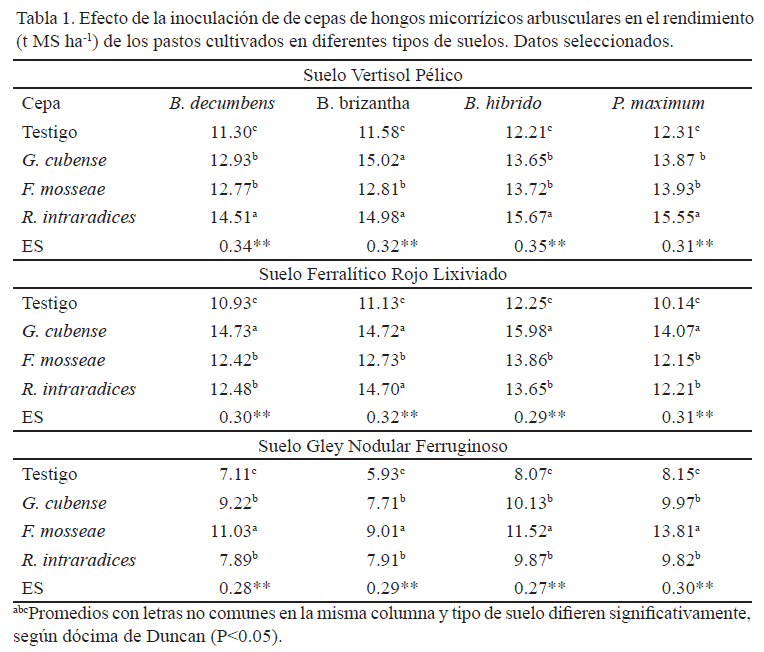
<body><![CDATA[<p align="justify" class="Cuerpodetexto"><em><span style="font-family:'Verdana','sans-serif'; font-size:10.0pt; ">Validation  of experimental results</span></em><span style="font-family:'Verdana','sans-serif'; font-size:10.0pt; ">. Results were validated  in production areas of permanent forage from the Empresa Pecuaria Gen&eacute;tica  (EPG) &ldquo;Ni&ntilde;a Bonita&rdquo;, in Artemisa, and in areas of degraded grasslands from Empresa  Agropecuaria (EA) &ldquo;Santo Domingo&rdquo;, Villa Clara. The research program used these  two places for implementing the experiments.</span></p>       <p align="justify" class="Cuerpodetexto"><em><span style="font-family:'Verdana','sans-serif'; font-size:10.0pt; ">General procedure.</span></em><span style="font-family:'Verdana','sans-serif'; font-size:10.0pt; "> In the case the grasses were sown, the sowing was  performed in furrows separated at 70 cm and at steady flow, with doses of 6-8  kg of total seed ha<sup>-1</sup>(1 kg ha<sup>-1</sup> of germinable pure seed).  The inoculation of AMF strains was performed in the sowing moment by the method  of seed covering, with an amount of inoculant equivalent to 10 % of its weight.  For established grasses, a suspension of mycorrhizal inoculant and water was  prepared, at a proportion of 1:10. It was applied over the grass surface after  a cut and at the beginning of rainy season. The EcoMic&reg; mycorrhizal inoculant,  produced in INCA, was used in every case, with a concentration of 30-35 spores  g<sup>-1</sup> of inoculant. Cut frequency depended on availability of inputs  from each unit. </span></p>       <p align="justify" class="Cuerpodetexto">&nbsp;</p>       <p align="justify" class="subtitulo"><strong><span style="font-family:'Verdana','sans-serif'; font-size=3">RESULTS AND DISCUSSION</span></strong></p>       <p align="justify" class="Cuerpodetexto"><span style="font-family:'Verdana','sans-serif'; font-size:10.0pt; ">There  was a positive response of grasses to inoculation in every case because AMF  strains increased yield, regarding the non inoculated control (<a href="/img/revistas/cjas/v49n4/t0116415.gif">table 1</a>).  Nevertheless, per each type of soil, there was a strain that produced the  highest effects. The strain with the best performance for cultivated grasses in  pelic vertisol soil was <em>R. intraradices</em>, while <em>G. cubense</em> and <em>F.  mosseae</em> were the best for those cultivated in lixiviated red ferrallitic  and ferruginous nodular gley soils, respectively. It was demonstrated the high  mycorrhizal dependence of these species and the existence of high degree of  compatibility between soil type and strain efficiency in the response of  grasses to AMF inoculation.&nbsp; </span></p>       
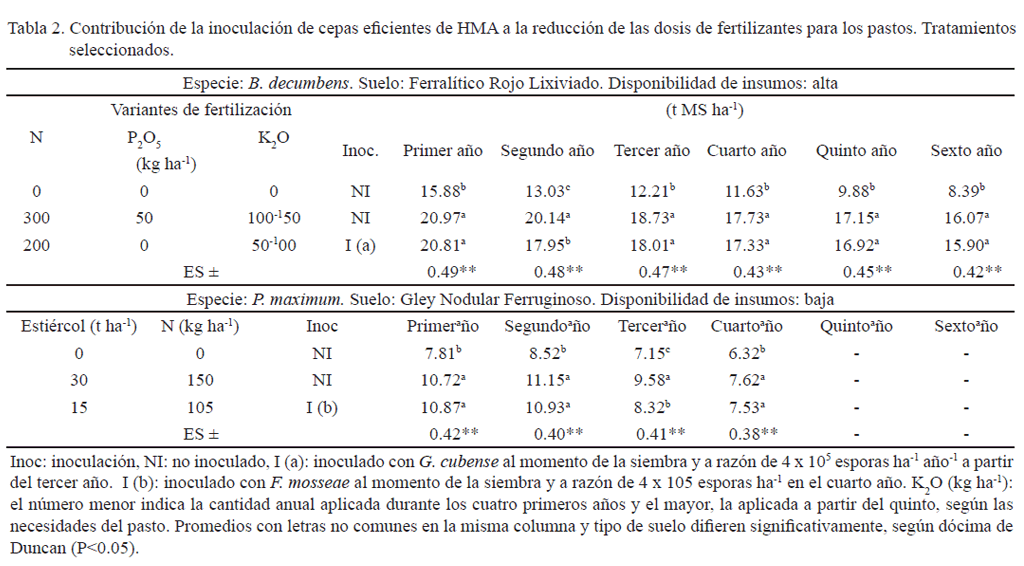
<p align="justify" class="Cuerpodetexto"><span style="font-family:'Verdana','sans-serif'; font-size:10.0pt; ">These  results revealed a higher effectiveness of the introduced strains, regarding  the resident AMF, to increase grass yield. They indicated that the management  of arbuscular mycorrhizal symbiosis, through inoculation, could be assumed as  an effective agronomic practice to improve the productivity of forage species,  which coincides with the findings of Oliveira <em>et al.</em> (2014).</span></p>       <p align="justify" class="Cuerpodetexto"><span style="font-family:'Verdana','sans-serif'; font-size:10.0pt; ">After  selecting the most efficient AMF strain for each edaphic condition, the most  suitable doses of mineral or organic fertilizers for the establishment,  maintenance and recovery of inoculated grasses are defined, as well as the  doses and frequency of application of mycorrhizal inoculant, needed to maintain  an effective mycorrhizal functioning of these crops. <a href="/img/revistas/cjas/v49n4/t0216415.gif">Table 2</a> shows the obtained  results.</span></p>       
<p align="justify" class="Cuerpodetexto"><span style="font-family:'Verdana','sans-serif'; font-size:10.0pt; ">Inoculation at the moment of sowing, together with the  application of doses of mineral or organic fertilizers, adjusted to the need of  the inoculated grass, produced, during the first one or two years, similar  yields to those reached with fertilizer doses needed to achieve the highest  yields in the absence of inoculation. The permanence of the initial inoculation  effect depended on the type of soil, grass species and its management.</span><span style="font-family:'Verdana','sans-serif'; font-size:10.0pt; "> </span></p>       <p align="justify" class="Cuerpodetexto"><span style="font-family:'Verdana','sans-serif'; font-size:10.0pt; ">In <em>B. decumbens</em>, cultivated in lixiviated red  ferrallitic soil, under conditions of high inputs (high doses of mineral  fertilizers and with irrigation availability), the effect was maintained only  during the first year. In <em>P. maximum</em>, cultivated in the ferruginous  nodular gley soils and under low input conditions (low availability of mineral  fertilizers and without irrigation), the effect was maintained during the first  two years.</span><span style="font-family:'Verdana','sans-serif'; font-size:10.0pt; "> </span></p>       <p align="justify" class="Cuerpodetexto"><span style="font-family:'Verdana','sans-serif'; font-size:10.0pt; ">The experiments evaluating doses and frequency of application  of the inoculant (not shown data) showed that the application of 4x10<sup>5</sup> spores ha<sup>-1</sup> of the most efficient strain for each edaphic condition,  was enough to achieve an effective mycorrhizal functioning cash in grasses  grown in lixiviated red ferrallitic soil and ferruginous nodular gley soil. In  addition, they demonstrated that the duration of inoculation effectiveness was  similar to that observed when they were inoculated using the method of seed      covering.</span></p>       ]]></body>
<body><![CDATA[<p align="justify" class="Cuerpodetexto"><span style="font-family:'Verdana','sans-serif'; font-size:10.0pt; ">Taking  into account these results, <em>B. decumbens</em> was annually reinoculated after  the third year, and <em>P. maximum</em> after the forth, with mycorrhizal  inoculant that provided 4x10<sup>5</sup> spores ha<sup>-1</sup> of <em>G.  cubense</em> and <em>F. mosseae</em> strains, respectively. This table also shows  that, in both cases, reinoculation allowed to maintain the reduction levels of  fertilizer doses, reached with the initial inoculation, without yield decrease.</span></p>       <p align="justify" class="Cuerpodetexto"><span style="font-family:'Verdana','sans-serif'; font-size:10.0pt; ">The  positive effect of arbuscular mycorrhizal inoculation on the reduction of  fertilizer doses was related to its contribution to the improvement of use  efficiency of nutrients. The fact that with the use of AMF strains, which were  more effective in each edaphic condition plus the application of lower doses of  fertilizers, similar yield levels to those with higher fertilizer doses were  achieved in absence of inoculation, indicates that plants had a better access  to soil resources. This contributed to the increase of yield (Castillo <em>et  al.</em> 2014).</span></p>       <p align="justify"><span style="letter-spacing:.1pt; font-family:'Verdana','sans-serif'; font-size:10.0pt; ">Experimental  results were validated at production scale, in 300 ha cultivated with <em>B.  hibrido</em> cv. Mulato at the EPG &ldquo;Ni&ntilde;a Bonita&rdquo; and 20 ha of guinea grass (<em>P.  maximum</em> cv. Likoni), with a high degree of degradation, at the EA &ldquo;Santo  Domingo&rdquo;, which were inoculated with the AMF strain recommended for each  edaphic condition and fertilized with doses of mineral and organic fertilizers,  respectively, which were more adequate to inoculated grasses. The EPG &ldquo;Ni&ntilde;a  Bonita&rdquo; saved 300 kg ha<sup>-1</sup> year<sup>-1</sup> of balanced fertilizer  (9-13-17 formula) and 132 kg ha<sup>-1</sup> year<sup>-1</sup> of urea. This  meant a saving of 230 Cuban pesos ha<sup>-1</sup> year<sup>-1</sup>. The EA  &ldquo;Santo Domingo&rdquo; saved 15 t ha<sup>-1</sup> year<sup>-1</sup> of cattle manure  and, consequently, 120 Cuban pesos t ha<sup>-1</sup> year<sup>-1</sup>, due to  the reduction of manure doses, traditionally used for grassland rehabilitation</span><font size="2" face="Verdana, Arial, Helvetica, sans-serif">.</font></p>     <p align="justify">&nbsp;</p>      <p align="justify"><font size="2" face="Verdana, Arial, Helvetica, sans-serif"><font size="3"><b>REFERENCES</b></font></font></p>     <!-- ref --><p align="justify" class="MsoNormal" style="line-height:normal;"><span style="font-family:'Verdana','sans-serif'; font-size:10.0pt; ">Anon, A. 1999. <em>Nueva  versi&oacute;n de clasificaci&oacute;n gen&eacute;tica de los suelos de Cuba</em>. La Habana, Cuba:  AGROINFOR, 64 p.    </span></p>     <p align="justify" class="MsoNormal" style="line-height:normal;"><span style="font-family:'Verdana','sans-serif'; font-size:10.0pt; ">Castillo, C.,  Fredericksen, C., Koch, R. &amp; Sieverding, E. 2014. </span><span style="font-family:'Verdana','sans-serif'; font-size:10.0pt; ">&ldquo;Effect of seed treatment with natural products  on early arbuscular mycorrhizal colonization of wheat by <em>Claroideoglomus  claroideum</em>&rdquo;. <em>Journal of Applied Botany and Food Quality</em>, 87: 117.</span></p>     <p align="justify" class="MsoNormal" style="line-height:normal;"><span style="font-family:'Verdana','sans-serif'; font-size:10.0pt; ">Oliveira, T. B., de Mello, A. H. &amp; Ferreira,  L. A. 2014. </span><span style="font-family:'Verdana','sans-serif'; font-size:10.0pt; ">&ldquo;Influ&ecirc;ncia da inocula&ccedil;&atilde;o de fungos micorr&iacute;zicos em  amendoim forrageiro (<em>Arachis pintoi</em>) em pastagens no projeto de  assentamento Belo Horizonte I em S&atilde;o Domingos do Araguaia-Pa&rdquo;. <em>Enciclop&eacute;dia  Biosfera</em>, 10 (18): 1988.</span></p>     <p align="justify" class="MsoNormal" style="line-height:normal;"><span style="font-family:'Verdana','sans-serif'; font-size:10.0pt; ">Rivera, R.,  Fern&aacute;ndez, F., Fern&aacute;ndez, K., Ruiz, L., S&aacute;nchez, C. &amp; Riera, M. 2007. </span><span style="font-family:'Verdana','sans-serif'; font-size:10.0pt; ">&ldquo;Advances in the management of  effective arbuscular mycorrhizal symbiosis in tropical ecosystesm&rdquo;. In: Hamel  C. &amp; Plenchette C. (eds.), <em>Mycorrhizae in Crop Production</em>,  Binghamton, N. Y.: Haworth Press, pp. 151&ndash;196, ISBN: 978-1-56022-306-1.</span></p>     ]]></body>
<body><![CDATA[<p align="justify"><span style="font-family:'Verdana','sans-serif'; font-size:10.0pt; ">Verbruggen,  E., van der Heijden, M. G. A., Weedon, J. T., Kowalchuk, G. A. &amp; R&ouml;ling, W.  2012. &ldquo;Community assembly, species richness and nestedness of arbuscular  mycorrhizal fungi in agricultural soils&rdquo;. </span><em><span style="font-family:'Verdana','sans-serif'; font-size:10.0pt; ">Molecular Ecology</span></em><span style="font-family:'Verdana','sans-serif'; font-size:10.0pt; ">, 21  (10): 2341&ndash;2353</span><font size="2" face="Verdana, Arial, Helvetica, sans-serif">.</font> </p>     <p align="justify">&nbsp;</p>     <p align="justify">&nbsp;</p>     <p align="justify"><font size="2" face="Verdana, Arial, Helvetica, sans-serif">Received: November 24, 2015    <br>   Accepted: January 11, 2016</font></p>     <p align="justify">&nbsp;</p>     <p align="justify">&nbsp;</p>     <p align="justify"><font size="2" face="Verdana, Arial, Helvetica, sans-serif"><i>P. J. González,</i> Instituto Nacional de Ciencias Agrícolas (INCA). Gaveta Postal No.1, San José de las Lajas, Mayabeque.  Email: <a href="mailto:pgonzalez@inca.edu.cu">pgonzalez@inca.edu.cu</a></font></p>      ]]></body><back>
<ref-list>
<ref id="B1">
<nlm-citation citation-type="book">
<person-group person-group-type="author">
<name>
<surname><![CDATA[Anon]]></surname>
<given-names><![CDATA[A.]]></given-names>
</name>
</person-group>
<source><![CDATA[Nueva versión de clasificación genética de los suelos de Cuba]]></source>
<year>1999</year>
<page-range>64</page-range><publisher-loc><![CDATA[La Habana, Cuba ]]></publisher-loc>
<publisher-name><![CDATA[AGROINFOR]]></publisher-name>
</nlm-citation>
</ref>
<ref id="B2">
<nlm-citation citation-type="journal">
<person-group person-group-type="author">
<name>
<surname><![CDATA[Castillo]]></surname>
<given-names><![CDATA[C.]]></given-names>
</name>
<name>
<surname><![CDATA[Fredericksen]]></surname>
<given-names><![CDATA[C.]]></given-names>
</name>
<name>
<surname><![CDATA[Koch]]></surname>
<given-names><![CDATA[R.]]></given-names>
</name>
<name>
<surname><![CDATA[Sieverding]]></surname>
<given-names><![CDATA[E.]]></given-names>
</name>
</person-group>
<article-title xml:lang="nd"><![CDATA[Effect of seed treatment with natural products on early arbuscular mycorrhizal colonization of wheat by Claroideoglomus claroideum]]></article-title>
<source><![CDATA[Journal of Applied Botany and Food Quality]]></source>
<year>2014</year>
<volume>87</volume>
<page-range>117</page-range></nlm-citation>
</ref>
<ref id="B3">
<nlm-citation citation-type="journal">
<person-group person-group-type="author">
<name>
<surname><![CDATA[Oliveira]]></surname>
<given-names><![CDATA[T. B.]]></given-names>
</name>
<name>
<surname><![CDATA[de Mello]]></surname>
<given-names><![CDATA[A. H.]]></given-names>
</name>
<name>
<surname><![CDATA[Ferreira]]></surname>
<given-names><![CDATA[L. A.]]></given-names>
</name>
</person-group>
<article-title xml:lang="nd"><![CDATA[Influência da inoculação de fungos micorrízicos em amendoim forrageiro (Arachis pintoi) em pastagens no projeto de assentamento Belo Horizonte I em São Domingos do Araguaia-Pa]]></article-title>
<source><![CDATA[Enciclopédia Biosfera]]></source>
<year>2014</year>
<volume>10</volume>
<numero>18</numero>
<issue>18</issue>
<page-range>1988</page-range></nlm-citation>
</ref>
<ref id="B4">
<nlm-citation citation-type="book">
<person-group person-group-type="author">
<name>
<surname><![CDATA[Rivera]]></surname>
<given-names><![CDATA[R.]]></given-names>
</name>
<name>
<surname><![CDATA[Fernández]]></surname>
<given-names><![CDATA[F.]]></given-names>
</name>
<name>
<surname><![CDATA[Fernández]]></surname>
<given-names><![CDATA[K.]]></given-names>
</name>
<name>
<surname><![CDATA[Ruiz]]></surname>
<given-names><![CDATA[L.]]></given-names>
</name>
<name>
<surname><![CDATA[Sánchez]]></surname>
<given-names><![CDATA[C.]]></given-names>
</name>
<name>
<surname><![CDATA[Riera]]></surname>
<given-names><![CDATA[M.]]></given-names>
</name>
</person-group>
<article-title xml:lang="nd"><![CDATA[Advances in the management of effective arbuscular mycorrhizal symbiosis in tropical ecosystesm]]></article-title>
<person-group person-group-type="editor">
<name>
<surname><![CDATA[Hamel]]></surname>
<given-names><![CDATA[C.]]></given-names>
</name>
<name>
<surname><![CDATA[Plenchette]]></surname>
<given-names><![CDATA[C.]]></given-names>
</name>
</person-group>
<source><![CDATA[Mycorrhizae in Crop Production]]></source>
<year>2007</year>
<page-range>151–196</page-range><publisher-loc><![CDATA[Binghamton, N. Y. ]]></publisher-loc>
<publisher-name><![CDATA[Haworth Press]]></publisher-name>
</nlm-citation>
</ref>
<ref id="B5">
<nlm-citation citation-type="journal">
<person-group person-group-type="author">
<name>
<surname><![CDATA[Verbruggen]]></surname>
<given-names><![CDATA[E.]]></given-names>
</name>
<name>
<surname><![CDATA[van der Heijden]]></surname>
<given-names><![CDATA[M. G. A.]]></given-names>
</name>
<name>
<surname><![CDATA[Weedon]]></surname>
<given-names><![CDATA[J. T.]]></given-names>
</name>
<name>
<surname><![CDATA[Kowalchuk]]></surname>
<given-names><![CDATA[G. A.]]></given-names>
</name>
<name>
<surname><![CDATA[Röling]]></surname>
<given-names><![CDATA[W.]]></given-names>
</name>
</person-group>
<article-title xml:lang="nd"><![CDATA[Community assembly, species richness and nestedness of arbuscular mycorrhizal fungi in agricultural soils]]></article-title>
<source><![CDATA[Molecular Ecology]]></source>
<year>2012</year>
<volume>21</volume>
<numero>10</numero>
<issue>10</issue>
<page-range>2341–2353</page-range></nlm-citation>
</ref>
</ref-list>
</back>
</article>