<?xml version="1.0" encoding="ISO-8859-1"?><article xmlns:mml="http://www.w3.org/1998/Math/MathML" xmlns:xlink="http://www.w3.org/1999/xlink" xmlns:xsi="http://www.w3.org/2001/XMLSchema-instance">
<front>
<journal-meta>
<journal-id>2079-3480</journal-id>
<journal-title><![CDATA[Cuban Journal of Agricultural Science]]></journal-title>
<abbrev-journal-title><![CDATA[Cuban J. Agric. Sci.]]></abbrev-journal-title>
<issn>2079-3480</issn>
<publisher>
<publisher-name><![CDATA[Editorial del Instituto de Ciencia Animal]]></publisher-name>
</publisher>
</journal-meta>
<article-meta>
<article-id>S2079-34802015000400019</article-id>
<title-group>
<article-title xml:lang="en"><![CDATA[Diversity of arthropods associated to Brachiaria spp. and damage indexes of insect-pests]]></article-title>
<article-title xml:lang="es"><![CDATA[Diversidad de artrópodos asociados a Brachiaria spp. e índices de daños de insectos-plaga]]></article-title>
</title-group>
<contrib-group>
<contrib contrib-type="author">
<name>
<surname><![CDATA[Valenciaga]]></surname>
<given-names><![CDATA[Nurys]]></given-names>
</name>
<xref ref-type="aff" rid="A01"/>
</contrib>
<contrib contrib-type="author">
<name>
<surname><![CDATA[Mora]]></surname>
<given-names><![CDATA[C. A]]></given-names>
</name>
<xref ref-type="aff" rid="A01"/>
</contrib>
<contrib contrib-type="author">
<name>
<surname><![CDATA[García]]></surname>
<given-names><![CDATA[C]]></given-names>
</name>
<xref ref-type="aff" rid="A01"/>
</contrib>
<contrib contrib-type="author">
<name>
<surname><![CDATA[Fortes]]></surname>
<given-names><![CDATA[Dayleni]]></given-names>
</name>
<xref ref-type="aff" rid="A01"/>
</contrib>
<contrib contrib-type="author">
<name>
<surname><![CDATA[Noda]]></surname>
<given-names><![CDATA[Aida C]]></given-names>
</name>
<xref ref-type="aff" rid="A01"/>
</contrib>
</contrib-group>
<aff id="A01">
<institution><![CDATA[,Instituto de Ciencia Animal  ]]></institution>
<addr-line><![CDATA[San José de Las Lajas Mayabeque]]></addr-line>
<country>Cuba</country>
</aff>
<pub-date pub-type="pub">
<day>00</day>
<month>12</month>
<year>2015</year>
</pub-date>
<pub-date pub-type="epub">
<day>00</day>
<month>12</month>
<year>2015</year>
</pub-date>
<volume>49</volume>
<numero>4</numero>
<fpage>561</fpage>
<lpage>565</lpage>
<copyright-statement/>
<copyright-year/>
<self-uri xlink:href="http://scielo.sld.cu/scielo.php?script=sci_arttext&amp;pid=S2079-34802015000400019&amp;lng=en&amp;nrm=iso"></self-uri><self-uri xlink:href="http://scielo.sld.cu/scielo.php?script=sci_abstract&amp;pid=S2079-34802015000400019&amp;lng=en&amp;nrm=iso"></self-uri><self-uri xlink:href="http://scielo.sld.cu/scielo.php?script=sci_pdf&amp;pid=S2079-34802015000400019&amp;lng=en&amp;nrm=iso"></self-uri><abstract abstract-type="short" xml:lang="en"><p><![CDATA[A research was carried out in areas of Brachiaria spp., using a random block design, with five replications, in order to identify insect-pest associated to four varieties of Brachiaria: Brachiaria brizantha, Brachiaria brizantha cv. toledo, hybrid Brachiaria (Brachiaria ruziziensis x Brachiaria brizantha) cv. mulato 1 and Brachiaria decumbens cv. Basilisk, and evaluate damage indexes. Periodical random samplings were performed once a month for three years. A sample of 20 sweep/plot was taken and, according to the visual sampling, the damage caused by biting, chewing, sweep and sucking insects was determined. Results demonstrated superiority of Insecta class, with six orders, eight families and 21 identified morpho-species, in contrast to Arachnida class. The levels of provoked damage did not surpass degree two of damage scale, so it is considered as light. Basilisk variety showed less resistance to insect-pest attacks, although there was no economic damage. Species richness had a slight increase during rainy season (22), in contrast to dry season (20). Basilisk variety showed the highest number of individuals during dry season (130) and during rainy period (193). Shannon index ranged between 2.38 and 2.65. There was no associated dominant species, according to the values (0.09 to 0.12). It can be concluded the arthropods associated to Brachiaria genus, Insecta class shows higher expression, with an increase during rainy season. However, without dominance among present species, phytophagous and bioregulators, during the seasons, these species manage to live in harmony, without provoking economic damages among varieties and cultivars under study. It is recommended to continue studies on arthropod population in other varieties of Brachiaria, with other crop management]]></p></abstract>
<abstract abstract-type="short" xml:lang="es"><p><![CDATA[Se condujo una investigación en áreas de Brachiaria spp., en la que se aplicó un diseño de bloques al azar, con cinco réplicas, para identificar los insectos-plaga asociados a cuatro variedades de Brachiaria: Brachiaria brizantha, Brachiaria brizantha vc. toledo, Brachiaria híbrido (Brachiaria ruziziensis x Brachiaria brizantha) vc. mulato 1 y Brachiaria decumbens vc. Basilisk y evaluar los índices de daños. Se llevaron a cabo muestreos aleatorios periódicos, con una frecuencia mensual, durante tres años. Se tomó una muestra de 20 redadas/parcela y se determinó, según muestreo visual, el daño causado por insectos picadores-chupadores y masticadores. Los resultados demostraron la superioridad de la clase Insecta, con seis órdenes, ocho familias y 21 morfo-especies identificadas, en contraste con la clase Arachnida. Los niveles de daños provocados no superaron el grado dos de la escala de daños, lo que se considera ligero. La variedad basilisk fue la que mostró menos resistencia al ataque de insectos-plaga, aunque no provocó daños económicos. La riqueza de especies tuvo ligero incremento en la época de lluvia (22), en contraste con la época seca (20). La variedad basilisk presentó el mayor número de individuos en la época seca (130) como en la de lluvia (193). El índice de Shannon osciló entre 2.38 y 2.65. No hubo ninguna especie dominante asociada según lo confirman los valores (0.09 a 0.12). Se concluye que entre los artrópodos asociados al género Brachiaria, la clase Insecta manifiesta mayor expresión, con incremento en la época de lluvia. Sin embargo, al no existir dominancia entre las especies presentes, fitófagos y biorreguladores, en las épocas del año, estas especies logran convivir armónicamente, sin provocar daños económicos entre las variedades y cultivares en estudio. Se recomienda continuar estudios poblacionales de artrópodos en otras variedades de Brachiaria, con otros manejos del cultivo]]></p></abstract>
<kwd-group>
<kwd lng="en"><![CDATA[Brachiaria spp]]></kwd>
<kwd lng="en"><![CDATA[insect-pest]]></kwd>
<kwd lng="en"><![CDATA[damages]]></kwd>
<kwd lng="en"><![CDATA[diversity]]></kwd>
<kwd lng="es"><![CDATA[Brachiaria spp]]></kwd>
<kwd lng="es"><![CDATA[insectos-plaga]]></kwd>
<kwd lng="es"><![CDATA[daños]]></kwd>
<kwd lng="es"><![CDATA[diversidad]]></kwd>
</kwd-group>
</article-meta>
</front><body><![CDATA[ <p align="right"><font size="2" face="Verdana, Arial, Helvetica,   sans-serif"><b>ORIGINAL ARTICLE</b></font></p>     <p>&nbsp;</p>     <p align="justify"><font size="4" face="Verdana, Arial, Helvetica, sans-serif"><b>Diversity of arthropods associated to <em>Brachiaria</em> spp. and damage indexes of insect-pests</b></font></p>     <p align="justify">&nbsp;</p>     <p align="justify"><font size="3" face="Verdana, Arial, Helvetica, sans-serif"><b>Diversidad de artr&oacute;podos asociados a <em>Brachiaria</em> spp. e &iacute;ndices de da&ntilde;os de insectos-plaga</b></font></p>     <p align="justify">&nbsp;</p>     <p align="justify">&nbsp;</p>     <p align="justify"><font size="2" face="Verdana, Arial, Helvetica, sans-serif"><b>Nurys Valenciaga,</b><sup><b>I</b></sup><b> C. A. Mora,</b><sup><b>I</b></sup><b> C. García,</b><sup><b>I</b></sup><b> Dayleni Fortes,</b><sup><b>I</b></sup><b> Aida C. Noda,</b><sup><b>I</b></sup></font></p>     <p align="justify"><font size="2" face="Verdana, Arial, Helvetica, sans-serif"><b> </b></font><font size="2" face="Verdana, Arial, Helvetica, sans-serif"><sup>I</sup>Instituto de Ciencia Animal, Apartado Postal 24, San José de Las Lajas, Mayabeque, Cuba. </font></p>     <p align="justify">&nbsp;</p>     ]]></body>
<body><![CDATA[<p align="justify">&nbsp;</p> <hr align="JUSTIFY">     <p align="justify"><font size="2" face="Verdana, Arial, Helvetica, sans-serif"><b>ABSTRACT</b></font></p>     <p align="justify"><font size="2" face="Verdana, Arial, Helvetica, sans-serif"><span style="font-family:'Verdana','sans-serif'; font-size:10.0pt; ">A  research was carried out in areas of <em>Brachiaria spp.</em>, using a random  block design, with five replications, in order to identify insect-pest  associated to four varieties of Brachiaria: <em>Brachiaria brizantha</em>, <em>Brachiaria  brizantha</em> cv. toledo, hybrid Brachiaria (<em>Brachiaria ruziziensis</em> x <em>Brachiaria  brizantha</em>) cv. mulato 1 and <em>Brachiaria decumbens</em> cv. Basilisk, and  evaluate damage indexes. Periodical random samplings were performed once a  month for three years. A sample of 20 sweep/plot was taken and, according to  the visual sampling, the damage caused by biting, chewing, sweep and sucking insects  was determined. Results demonstrated superiority of Insecta class, with six  orders, eight families and 21 identified morpho-species, in contrast to  Arachnida class. The levels of provoked damage did not surpass degree two of  damage scale, so it is considered as light. Basilisk variety showed less  resistance to insect-pest attacks, although there was no economic damage.  Species richness had a slight increase during rainy season (22), in contrast to  dry season (20). Basilisk variety showed the highest number of individuals  during dry season (130) and during rainy period (193). Shannon index ranged  between 2.38 and 2.65. There was no associated dominant species, according to  the values (0.09 to 0.12). It can be concluded the arthropods associated to Brachiaria  genus, Insecta class shows higher expression, with an increase during rainy  season. However, without dominance among present species, phytophagous and  bioregulators, during the seasons, these species manage to live in harmony,  without provoking economic damages among varieties and cultivars under study.  It is recommended to continue studies on arthropod population in other  varieties of Brachiaria, with other crop management</span>.</font></p>     <p align="justify"><font size="2" face="Verdana, Arial, Helvetica, sans-serif"><b>Key words:</b> <em>Brachiaria</em> spp., insect-pest, damages, diversity.</font></p> <hr align="JUSTIFY">     <p align="justify"><font size="2" face="Verdana, Arial, Helvetica, sans-serif"><b>RESUMEN</b></font></p>     <p align="justify"><font size="2" face="Verdana, Arial, Helvetica, sans-serif"><span style="letter-spacing:-.25pt; font-family:'Verdana','sans-serif'; font-size:10.0pt; ">Se condujo una investigaci&oacute;n en &aacute;reas de <em>Brachiaria  spp.</em>, en la que se aplic&oacute; un dise&ntilde;o de bloques al azar, con cinco r&eacute;plicas,  para identificar los insectos-plaga asociados a cuatro variedades de  Brachiaria: <em>Brachiaria brizantha</em>, <em>Brachiaria brizantha</em> vc.  toledo, Brachiaria h&iacute;brido (<em>Brachiaria ruziziensis</em> x <em>Brachiaria  brizantha</em>) vc. mulato 1 y <em>Brachiaria decumbens</em> vc. Basilisk y  evaluar los &iacute;ndices de da&ntilde;os. Se llevaron a cabo muestreos aleatorios  peri&oacute;dicos, con una frecuencia mensual, durante tres a&ntilde;os. Se tom&oacute; una muestra  de 20 redadas/parcela y se determin&oacute;, seg&uacute;n muestreo visual,&nbsp; el da&ntilde;o causado por insectos  picadores-chupadores y masticadores. Los resultados demostraron la superioridad  de la clase Insecta, con seis &oacute;rdenes, ocho familias y 21 morfo-especies  identificadas, en contraste con la clase Arachnida. Los niveles de da&ntilde;os  provocados no superaron el grado dos de la escala de da&ntilde;os, lo que se considera  ligero. La variedad basilisk fue la que mostr&oacute; menos resistencia al ataque de  insectos-plaga, aunque no provoc&oacute; da&ntilde;os econ&oacute;micos.&nbsp; La riqueza de especies tuvo ligero incremento  en la &eacute;poca de lluvia (22), en contraste con la &eacute;poca seca (20). La variedad  basilisk present&oacute; el mayor n&uacute;mero de individuos en la &eacute;poca seca (130) como en  la de lluvia (193).&nbsp; El &iacute;ndice de Shannon  oscil&oacute; entre 2.38 y 2.65. No hubo ninguna especie dominante asociada seg&uacute;n lo  confirman los valores (0.09 a 0.12). Se concluye que entre los artr&oacute;podos&nbsp; asociados al g&eacute;nero Brachiaria, la clase  Insecta manifiesta mayor expresi&oacute;n, con incremento en la &eacute;poca de lluvia. Sin  embargo, al no existir dominancia entre las especies presentes, fit&oacute;fagos y  biorreguladores, en las &eacute;pocas del a&ntilde;o, estas especies logran convivir  arm&oacute;nicamente, sin provocar da&ntilde;os econ&oacute;micos entre las variedades y cultivares  en estudio. Se recomienda continuar estudios poblacionales de artr&oacute;podos en  otras variedades de Brachiaria, con otros manejos del cultivo</span>.</font></p>     <p align="justify"><font size="2" face="Verdana, Arial, Helvetica, sans-serif"><b>Palabras    clave:</b>    <em>Brachiaria</em> spp., insectos-plaga, daños, diversidad.</font></p> <hr align="JUSTIFY">     <p align="justify">&nbsp;</p>     <p align="justify">&nbsp;</p>     <p align="justify"><font size="2" face="Verdana, Arial, Helvetica, sans-serif"><b><font size="3">INTRODUCTION</font></b></font></p>       ]]></body>
<body><![CDATA[<p align="justify" class="Cuerpodetexto"><span style="font-family:'Verdana','sans-serif'; font-size:10.0pt; ">Nowadays,  Brachiaria genus has a high use percentage in many Latin American countries  like Colombia (Canchila <em>et al.</em> 2008), Mexico (Ju&aacute;rez-Hern&aacute;ndez <em>et al.</em> 2011) and Brazil (Carrilho <em>et al.</em> 2012), because it is a promising genus  for animal husbandry in the region.</span></p>       <p align="justify" class="Cuerpodetexto"><span style="letter-spacing:.1pt; font-family:'Verdana','sans-serif'; font-size:10.0pt; ">In  Cuba, since the 90&acute;s, Brachiaria genus is considered as promising for Cuban  animal husbandry (Guti&eacute;rrez <em>et al.</em> 1990). Several researches have  demonstrated its excellent performance due to its high production of green mass  and its acceptability for meat animals grazing (Gonz&aacute;lez 2001).&nbsp; Others have focused on the study of some  morphological and productive indicators related to seeds of different  Brachiaria varieties (Su&aacute;rez <em>et al.</em> 2013). However, it is necessary to  know its degree of susceptibility or tolerance to the attack of harmful  organisms. Therefore, this research was conducted to identify insect-pest  associated with this genus and their damage levels on different species or  cultivars</span><font size="2" face="Verdana, Arial, Helvetica, sans-serif">.</font>  </p>       <p align="justify">&nbsp;</p>     <p align="justify"><font size="2" face="Verdana, Arial, Helvetica, sans-serif"><b><font size="3">MATERIALS AND METHODS</font></b></font></p>     <p align="justify" class="Cuerpodetexto"><span style="letter-spacing:.2pt; font-family:'Verdana','sans-serif'; font-size:10.0pt; ">The research was conducted in areas of the Centro  Experimental &quot;Miguel Sistachs Naya&quot;, belonging to the Department of  Grasses and Forages from the Instituto de Ciencia Animal, located at Zald&iacute;var  farm, San Jos&eacute; de las Lajas, Mayabeque province, Cuba. This province is located  at 22&ordm; 55&rsquo; N and 82&ordm; 0&rsquo; W, at 92 m o.s.l.</span><span style="font-family:'Verdana','sans-serif'; font-size:10.0pt; "> </span></p>     <p align="justify" class="Cuerpodetexto"><em><span style="font-family:'Verdana','sans-serif'; font-size:10.0pt; ">Experimental  area</span></em><span style="font-family:'Verdana','sans-serif'; font-size:10.0pt; ">.The research was performed in a typical  red ferrallitic soil (Anon 1999) of&nbsp; 35  plots with 24.5 m<sup>2</sup> each. They were sown on May, 2009 with four  varieties of Brachiaria: <em>Brachiaria brizantha</em>, <em>Brachiaria brizantha</em> cv. toledo, hybrid Brachiaria (<em>Brachiaria ruziziensis</em> x <em>Brachiaria  brizantha</em>) cv. mulato 1 and <em>Brachiaria decumbens</em> cv. basilisk.&nbsp; </span></p>     <p align="justify" class="Cuerpodetexto"><em><span style="font-family:'Verdana','sans-serif'; font-size:10.0pt; ">Experimental  design</span></em><span style="font-family:'Verdana','sans-serif'; font-size:10.0pt; ">. Plots were located according to a random  block design, with five replications.</span></p>     <p align="justify" class="Cuerpodetexto"><em><span style="font-family:'Verdana','sans-serif'; font-size:10.0pt; ">Experimental  procedure</span></em><span style="font-family:'Verdana','sans-serif'; font-size:10.0pt; ">. Periodical random samplings were  performed to associated arthropods, once a month for three years. A sample of    20 swarm/plot was taken, using an entomological net. Species with flying habits  were captured and individualized in plastic bags with their identification and  moved to the lab of pest management from the Department of Grasses and Forages  from the Instituto de Ciencia Animal (ICA). In addition, according to the  visual sampling, the damage caused by chewing and biting sucking insects was  determined, with a scale of    0-3 degrees, in accordance with Calder&oacute;n (1982).</span></p>     <p align="justify" class="Cuerpodetexto"><span style="font-family:'Verdana','sans-serif'; font-size:10.0pt; ">In order to facilitate lab processing, samples were placed  in a graduated oven at 40 &deg;C up to provoke death of the collected organisms.  Later, each specimen was separated (entomological collections and related keys)  using a stereoscopic microscope (Zayas 1988 and Alayo and Garc&eacute;s 1989), and  taxonomically identified. Phytophagous insects and associated beneficial fauna  (bioregulators) were identified in each studied area.</span><span style="font-family:'Verdana','sans-serif'; font-size:10.0pt; "> </span></p>     <p align="justify" class="Cuerpodetexto"><em><span style="letter-spacing:.1pt; font-family:'Verdana','sans-serif'; font-size:10.0pt; ">Statistical analysis</span></em><span style="font-family:'Verdana','sans-serif'; font-size:10.0pt; ">. A data matrix in Excel was performed with populations of  phytophagous and bioregulators associated with the system. The contingency  table was used to test whether there was interaction between grasses and  insects and, on the contrary case, the use of the proportions comparison method  (chi square) was taken into account to analyze the factors separately. In order  to establish differences among means, the test of Duncan (1955) was used for P  &lt;0.05.</span><span style="font-family:'Verdana','sans-serif'; font-size:10.0pt; "> </span></p>     ]]></body>
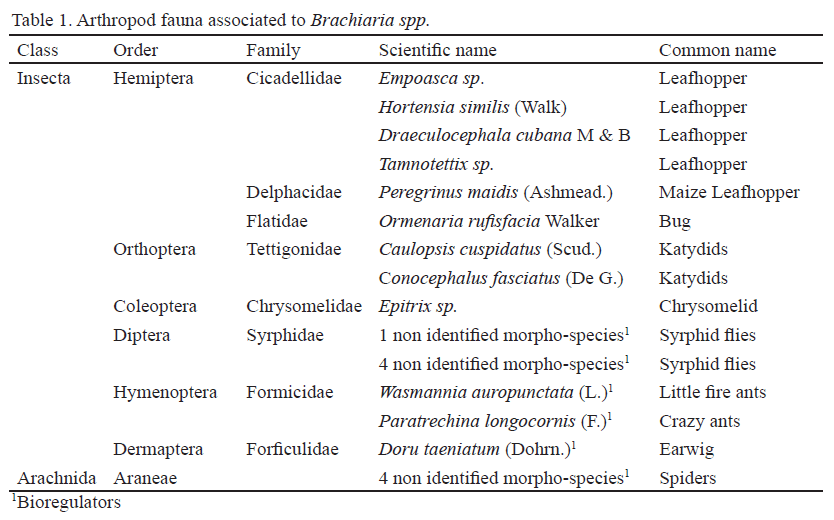
<body><![CDATA[<p align="justify" class="Cuerpodetexto"><span style="font-family:'Verdana','sans-serif'; font-size:10.0pt; ">In addition, Divers program  (Franja 1993) was used to calculate, per season, ecological indexes of  diversity (species richness, uniformity, index of Margalef, Simpson and  Shannon, among others) that show the performance of the biodiversity of  arthropod fauna associated to each area</span><font size="2" face="Verdana, Arial, Helvetica, sans-serif">.</font></p>     <p align="justify">&nbsp;</p>     <p align="justify"><font size="2" face="Verdana, Arial, Helvetica, sans-serif"><b><font size="3">RESULTS AND DISCUSSION</font></b></font></p>     <p align="justify" class="Cuerpodetexto"><span style="font-family:'Verdana','sans-serif'; font-size:10.0pt; ">The  main arthropods associated to Brachiaria genus were identified (<a href="/img/revistas/cjas/v49n4/t0119415.gif">table 1</a>).  Organisms were grouped, according to their taxonomic classification and their  feeding habits, into phytophagous and bioregulators. The results demonstrate  the superiority of Insecta class, with six orders, eight families and 21  identified morpho-species, in contrast to Arachnida class. The beneficial fauna  was represented by four orders (three of Insecta and one of Arachnida), with 8  morpho-species in    total.</span></p>     
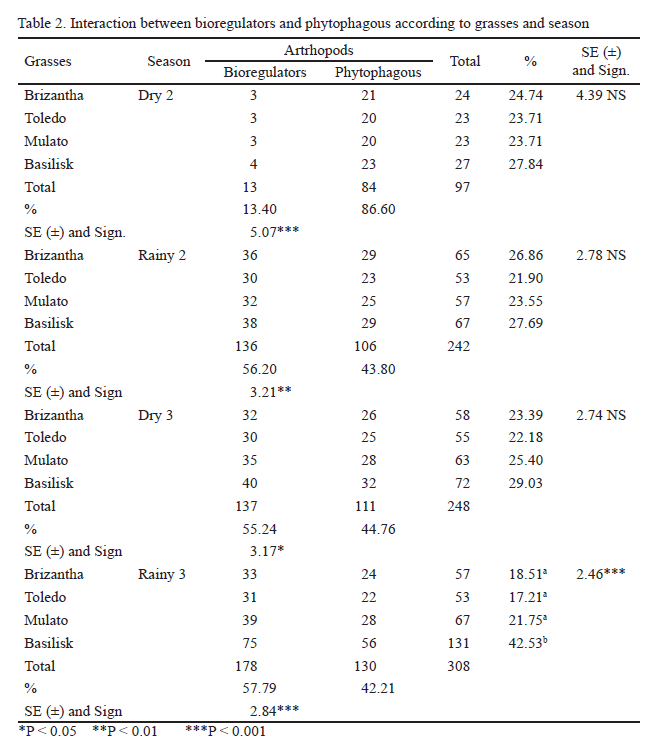
<p align="justify" class="Cuerpodetexto"><span style="font-family:'Verdana','sans-serif'; font-size:10.0pt; ">Rates  of damage caused by studied Brachiarias demonstrate that the damage did not  exceed grade two of the scale used, so they are considered as light. The  basilisk variety showed less resistance to insect-pest attack, manifesting the  same way in all evaluated periods, although without causing economic damage.</span></p>     <p align="justify" class="Cuerpodetexto"><span style="letter-spacing:.35pt; font-family:'Verdana','sans-serif'; font-size:10.0pt; ">Regarding the interaction between bioregulators and  phytophagous, in the evaluated grasses, according to the sampled season (<a href="/img/revistas/cjas/v49n4/t0219415.gif">table  2</a>), only during the rain of the third year, the proportions of collected  arthropods varied significantly among varieties. Basilisk was the variety with  the largest proportion (42.53%), which differed (P &lt; 0.005) from the other  varieties, which did not differ among themselves. As for the proportion of  phytophagous and bioregulators, except for the dry season in the second year,  there was a tendency of more amounts of bioregulators than phytophagous. This  is not common, because, except syrphid flies, the rest of the associated  beneficial fauna is predatory, and each individual requires a great number of  phytophagous specimens to feed themselves properly. Therefore, the proportion  of phytophagous should be superior. Nevertheless, in the case of bioregulators,  they can interact with the associated phytophagous fauna with other crops. The  reason for them to remain in these plants could be that the volume of foliage  and physiology of plants provides them shelter.</span><span style="font-family:'Verdana','sans-serif'; font-size:10.0pt; "> </span></p>     
<p align="justify" class="Cuerpodetexto"><span style="font-family:'Verdana','sans-serif'; font-size:10.0pt; ">Diversity  of arthropods among Brachiaria varieties had equal performance in species  richness, with a slight increase of two more species during rainy season (22),  in contrast to dry season (20). Basilisk variety showed higher number of  individuals compared to the rest of those evaluated, in dry (130) and rainy  (193) season. Shannon index ranged between 2.38 and 2.65 among the varieties,  conditioned by the species equality (uniformity), and not for having an  associated dominant species. Therefore, the values ranged from 0.09 to    0.12.</span></p>     <p align="justify" class="Cuerpodetexto"><span style="font-family:'Verdana','sans-serif'; font-size:10.0pt; ">Among the arthropods  associated to Brachiaria, Insecta class showed higher expression, with  increases during the rainy season. However, the absence of dominance among  species in seasons, phytophagous and bioregulators manage to live in harmony,  without causing economic damage among varieties and cultivars under study. It  is recommended to continue studies on arthropod population in other varieties  of Brachiaria and in other crop management.</span><font size="2" face="Verdana, Arial, Helvetica, sans-serif"></font></p>     <p align="justify">&nbsp;</p>      <p align="justify"><font size="2" face="Verdana, Arial, Helvetica, sans-serif"><font size="3"><b>REFERENCES</b></font></font></p>     ]]></body>
<body><![CDATA[<!-- ref --><p align="justify" class="MsoNormal" style="line-height:normal;"><span style="font-family:'Verdana','sans-serif'; font-size:10.0pt; ">Alayo, P. &amp;  Garc&eacute;s, G. 1989. <em>Introducci&oacute;n al Orden Diptera en Cuba</em>. Santiago de  Cuba, Cuba: Oriente, 223 p.    </span></p>     <!-- ref --><p align="justify" class="MsoNormal" style="line-height:normal;"><span style="font-family:'Verdana','sans-serif'; font-size:10.0pt; ">Anon, A. 1999. <em>Nueva  versi&oacute;n de clasificaci&oacute;n gen&eacute;tica de los suelos de Cuba</em>. La Habana, Cuba:  AGROINFOR, 64 p.    </span></p>     <p align="justify" class="MsoNormal" style="line-height:normal;"><span style="font-family:'Verdana','sans-serif'; font-size:10.0pt; ">Calder&oacute;n, M.  1982. &ldquo;Evaluaci&oacute;n del da&ntilde;o causado por insectos&rdquo;. In: <em>Manual para la  Evaluaci&oacute;n Agron&oacute;mica</em>, CIAT, p. 80.</span></p>     <p align="justify" class="MsoNormal" style="line-height:normal;"><span style="font-family:'Verdana','sans-serif'; font-size:10.0pt; ">Canchila, E.  R., Ojeda, F., Machado, R., Soca, M., Toral, O. &amp; Blanco, D. 2008.  &ldquo;Evaluaci&oacute;n agron&oacute;mica de accesiones de <em>Brachiaria</em> spp. en condiciones  agroecol&oacute;gicas de Barrancabermeja, Santander, Colombia.: II. Segundo a&ntilde;o de  evaluaci&oacute;n.&rdquo;. <em>Pastos y Forrajes</em>, 31 (2): 1&ndash;1.</span></p>     <p align="justify" class="MsoNormal" style="line-height:normal;"><span style="font-family:'Verdana','sans-serif'; font-size:10.0pt; ">Carrilho, P. H.  M., Alonso, J., Santos, L. D. T. &amp; Sampaio, R. A. 2012. </span><span style="font-family:'Verdana','sans-serif'; font-size:10.0pt; ">&ldquo;Vegetative and reproductive  behavior of <em>Brachiaria decumbens</em> cv. Basilisk under different shade  levels&rdquo;. <em>Cuban Journal of Agricultural Science</em>, 46 (1): 85.</span></p>     <p align="justify" class="MsoNormal" style="line-height:normal;"><span style="font-family:'Verdana','sans-serif'; font-size:10.0pt; ">Duncan, D. B. 1955. &ldquo;Multiple range and multiple  F tests&rdquo;. </span><em><span style="font-family:'Verdana','sans-serif'; font-size:10.0pt; ">Biometrics</span></em><span style="font-family:'Verdana','sans-serif'; font-size:10.0pt; ">, 11 (1): 1&ndash;42.</span></p>     <p align="justify" class="MsoNormal" style="line-height:normal;"><span style="font-family:'Verdana','sans-serif'; font-size:10.0pt; ">Gonz&aacute;lez, Y. 2001.  &ldquo;Momento &oacute;ptimo de cosecha de las semillas de <em>Brachiaria brizantha</em> cv.  CIAT-16448&rdquo;. <em>Pastos y Forrajes</em>, 24 (1): 27.</span></p>     <!-- ref --><p align="justify" class="MsoNormal" style="line-height:normal;"><span style="font-family:'Verdana','sans-serif'; font-size:10.0pt; ">Guti&eacute;rrez, A.,  Paretas, J. J., Su&aacute;rez, J. D., Cordovi, E., Pazos, R. &amp; Alfonso, H. A.  1990. <em>G&eacute;nero Brachiaria: Nueva alternativa para la ganader&iacute;a cubana</em>. La  Habana, Cuba: Instituto de Investigaciones de Pastos y Forrajes, 64 p.    </span></p>     <p align="justify" class="MsoNormal" style="line-height:normal;"><span style="font-family:'Verdana','sans-serif'; font-size:10.0pt; ">Ju&aacute;rez-Hern&aacute;ndez,  J., Bola&ntilde;os, E. D. &amp; Reinoso, M. 2004. &ldquo;Contenido de prote&iacute;na por unidad de  materia seca acumulada en pastos tropicales. Epoca de nortes&rdquo;. <em>Cuban Journal  of Agricultural Science</em>, 45: 423.</span></p>     <p align="justify" class="MsoNormal" style="line-height:normal;"><span style="font-family:'Verdana','sans-serif'; font-size:10.0pt; ">Su&aacute;rez, M.,  Padilla, C. &amp; Febles, G. 2013. &ldquo;Evaluaci&oacute;n preliminar de indicadores  morfol&oacute;gicos y productivos de semillas de 4 variedades de Brachiaria&rdquo;. In: <em>Congreso  de Producci&oacute;n Animal Tropical 2013</em>, La Habana, Cuba.</span></p>     <!-- ref --><p align="justify" class="MsoNormal" style="line-height:normal;"><span style="font-family:'Verdana','sans-serif'; font-size:10.0pt; ">Zayas, F.  1988. <em>Entomofauna cubana</em>. vol. 7, La Habana, Cuba: Cient&iacute;fico-T&eacute;cnica,  261 p</span><font size="2" face="Verdana,     Arial, Helvetica, sans-serif">.</font></p>     <p align="justify">&nbsp;</p>     <p align="justify">&nbsp;</p>     <p align="justify"><font size="2" face="Verdana, Arial, Helvetica, sans-serif">Received: November 24, 2015    <br>   Accepted: January 5, 2016</font></p>     <p align="justify">&nbsp;</p>     ]]></body>
<body><![CDATA[<p align="justify">&nbsp;</p>     <p align="justify"><font size="2" face="Verdana, Arial, Helvetica, sans-serif"><i>Nurys Valenciaga,</i> Instituto de Ciencia Animal, Apartado Postal 24, San José de Las Lajas, Mayabeque, Cuba.    Email: <a href="mailto:nvalenciaga@ica.co.cu">nvalenciaga@ica.co.cu</a></font></p>      ]]></body><back>
<ref-list>
<ref id="B1">
<nlm-citation citation-type="book">
<person-group person-group-type="author">
<name>
<surname><![CDATA[Alayo]]></surname>
<given-names><![CDATA[P.]]></given-names>
</name>
<name>
<surname><![CDATA[Garcés]]></surname>
<given-names><![CDATA[G.]]></given-names>
</name>
</person-group>
<source><![CDATA[Introducción al Orden Diptera en Cuba]]></source>
<year>1989</year>
<page-range>223</page-range><publisher-loc><![CDATA[Santiago de Cuba, Cuba ]]></publisher-loc>
<publisher-name><![CDATA[Oriente]]></publisher-name>
</nlm-citation>
</ref>
<ref id="B2">
<nlm-citation citation-type="book">
<person-group person-group-type="author">
<name>
<surname><![CDATA[Anon]]></surname>
<given-names><![CDATA[A.]]></given-names>
</name>
</person-group>
<source><![CDATA[Nueva versión de clasificación genética de los suelos de Cuba]]></source>
<year>1999</year>
<page-range>64</page-range><publisher-loc><![CDATA[La Habana, Cuba ]]></publisher-loc>
<publisher-name><![CDATA[AGROINFOR]]></publisher-name>
</nlm-citation>
</ref>
<ref id="B3">
<nlm-citation citation-type="book">
<person-group person-group-type="author">
<name>
<surname><![CDATA[Calderón]]></surname>
<given-names><![CDATA[M.]]></given-names>
</name>
</person-group>
<article-title xml:lang="nd"><![CDATA[Evaluación del daño causado por insectos]]></article-title>
<source><![CDATA[Manual para la Evaluación Agronómica]]></source>
<year>1982</year>
<page-range>80</page-range><publisher-name><![CDATA[CIAT]]></publisher-name>
</nlm-citation>
</ref>
<ref id="B4">
<nlm-citation citation-type="journal">
<person-group person-group-type="author">
<name>
<surname><![CDATA[Canchila]]></surname>
<given-names><![CDATA[E. R.]]></given-names>
</name>
<name>
<surname><![CDATA[Ojeda]]></surname>
<given-names><![CDATA[F.]]></given-names>
</name>
<name>
<surname><![CDATA[Machado]]></surname>
<given-names><![CDATA[R.]]></given-names>
</name>
<name>
<surname><![CDATA[Soca]]></surname>
<given-names><![CDATA[M.]]></given-names>
</name>
<name>
<surname><![CDATA[Toral]]></surname>
<given-names><![CDATA[O.]]></given-names>
</name>
<name>
<surname><![CDATA[Blanco]]></surname>
<given-names><![CDATA[D.]]></given-names>
</name>
</person-group>
<article-title xml:lang="nd"><![CDATA[Evaluación agronómica de accesiones de Brachiaria spp. en condiciones agroecológicas de Barrancabermeja, Santander, Colombia.: II. Segundo año de evaluación.]]></article-title>
<source><![CDATA[Pastos y Forrajes]]></source>
<year>2008</year>
<volume>31</volume>
<numero>2</numero>
<issue>2</issue>
<page-range>1–1</page-range></nlm-citation>
</ref>
<ref id="B5">
<nlm-citation citation-type="journal">
<person-group person-group-type="author">
<name>
<surname><![CDATA[Carrilho]]></surname>
<given-names><![CDATA[P. H. M.]]></given-names>
</name>
<name>
<surname><![CDATA[Alonso]]></surname>
<given-names><![CDATA[J.]]></given-names>
</name>
<name>
<surname><![CDATA[Santos]]></surname>
<given-names><![CDATA[L. D. T.]]></given-names>
</name>
<name>
<surname><![CDATA[Sampaio]]></surname>
<given-names><![CDATA[R. A.]]></given-names>
</name>
</person-group>
<article-title xml:lang="nd"><![CDATA[Vegetative and reproductive behavior of Brachiaria decumbens cv. Basilisk under different shade levels]]></article-title>
<source><![CDATA[Cuban Journal of Agricultural Science]]></source>
<year>2012</year>
<volume>46</volume>
<numero>1</numero>
<issue>1</issue>
<page-range>85</page-range></nlm-citation>
</ref>
<ref id="B6">
<nlm-citation citation-type="journal">
<person-group person-group-type="author">
<name>
<surname><![CDATA[Duncan]]></surname>
<given-names><![CDATA[D. B.]]></given-names>
</name>
</person-group>
<article-title xml:lang="nd"><![CDATA[Multiple range and multiple F tests]]></article-title>
<source><![CDATA[Biometrics]]></source>
<year>1955</year>
<volume>11</volume>
<numero>1</numero>
<issue>1</issue>
<page-range>1–42</page-range></nlm-citation>
</ref>
<ref id="B7">
<nlm-citation citation-type="journal">
<person-group person-group-type="author">
<name>
<surname><![CDATA[González]]></surname>
<given-names><![CDATA[Y.]]></given-names>
</name>
</person-group>
<article-title xml:lang="nd"><![CDATA[Momento óptimo de cosecha de las semillas de Brachiaria brizantha cv. CIAT-16448]]></article-title>
<source><![CDATA[Pastos y Forrajes]]></source>
<year>2001</year>
<volume>24</volume>
<numero>1</numero>
<issue>1</issue>
<page-range>27</page-range></nlm-citation>
</ref>
<ref id="B8">
<nlm-citation citation-type="book">
<person-group person-group-type="author">
<name>
<surname><![CDATA[Gutiérrez]]></surname>
<given-names><![CDATA[A.]]></given-names>
</name>
<name>
<surname><![CDATA[Paretas]]></surname>
<given-names><![CDATA[J. J.]]></given-names>
</name>
<name>
<surname><![CDATA[Suárez]]></surname>
<given-names><![CDATA[J. D.]]></given-names>
</name>
<name>
<surname><![CDATA[Cordovi]]></surname>
<given-names><![CDATA[E.]]></given-names>
</name>
<name>
<surname><![CDATA[Pazos]]></surname>
<given-names><![CDATA[R.]]></given-names>
</name>
<name>
<surname><![CDATA[Alfonso]]></surname>
<given-names><![CDATA[H. A.]]></given-names>
</name>
</person-group>
<source><![CDATA[Género Brachiaria: Nueva alternativa para la ganadería cubana]]></source>
<year>1990</year>
<page-range>64</page-range><publisher-loc><![CDATA[La Habana, Cuba ]]></publisher-loc>
<publisher-name><![CDATA[Instituto de Investigaciones de Pastos y Forrajes]]></publisher-name>
</nlm-citation>
</ref>
<ref id="B9">
<nlm-citation citation-type="journal">
<person-group person-group-type="author">
<name>
<surname><![CDATA[Juárez-Hernández]]></surname>
<given-names><![CDATA[J.]]></given-names>
</name>
<name>
<surname><![CDATA[Bolaños]]></surname>
<given-names><![CDATA[E. D.]]></given-names>
</name>
<name>
<surname><![CDATA[Reinoso]]></surname>
<given-names><![CDATA[M.]]></given-names>
</name>
</person-group>
<article-title xml:lang="nd"><![CDATA[Contenido de proteína por unidad de materia seca acumulada en pastos tropicales. Epoca de nortes]]></article-title>
<source><![CDATA[Cuban Journal of Agricultural Science]]></source>
<year>2004</year>
<volume>45</volume>
<page-range>423</page-range></nlm-citation>
</ref>
<ref id="B10">
<nlm-citation citation-type="">
<person-group person-group-type="author">
<name>
<surname><![CDATA[Suárez]]></surname>
<given-names><![CDATA[M.]]></given-names>
</name>
<name>
<surname><![CDATA[Padilla]]></surname>
<given-names><![CDATA[C.]]></given-names>
</name>
<name>
<surname><![CDATA[Febles]]></surname>
<given-names><![CDATA[G.]]></given-names>
</name>
</person-group>
<article-title xml:lang="nd"><![CDATA[Evaluación preliminar de indicadores morfológicos y productivos de semillas de 4 variedades de Brachiaria]]></article-title>
<source><![CDATA[]]></source>
<year>2013</year>
<publisher-loc><![CDATA[La Habana, Cuba ]]></publisher-loc>
</nlm-citation>
</ref>
<ref id="B11">
<nlm-citation citation-type="book">
<person-group person-group-type="author">
<name>
<surname><![CDATA[Zayas]]></surname>
<given-names><![CDATA[F.]]></given-names>
</name>
</person-group>
<source><![CDATA[Entomofauna cubana]]></source>
<year>1988</year>
<volume>7</volume>
<page-range>261</page-range><publisher-loc><![CDATA[La Habana, Cuba ]]></publisher-loc>
<publisher-name><![CDATA[Científico-Técnica]]></publisher-name>
</nlm-citation>
</ref>
</ref-list>
</back>
</article>