<?xml version="1.0" encoding="ISO-8859-1"?><article xmlns:mml="http://www.w3.org/1998/Math/MathML" xmlns:xlink="http://www.w3.org/1999/xlink" xmlns:xsi="http://www.w3.org/2001/XMLSchema-instance">
<front>
<journal-meta>
<journal-id>2079-3480</journal-id>
<journal-title><![CDATA[Cuban Journal of Agricultural Science]]></journal-title>
<abbrev-journal-title><![CDATA[Cuban J. Agric. Sci.]]></abbrev-journal-title>
<issn>2079-3480</issn>
<publisher>
<publisher-name><![CDATA[Editorial del Instituto de Ciencia Animal]]></publisher-name>
</publisher>
</journal-meta>
<article-meta>
<article-id>S2079-34802016000100003</article-id>
<title-group>
<article-title xml:lang="en"><![CDATA[High resolution melting analysis on temperature allows the genotype determination of indicators related to beef]]></article-title>
<article-title xml:lang="es"><![CDATA[El análisis de alta resolución en la temperatura de disociación permite genotipificación de marcadores relacionados con la carne de bovino]]></article-title>
</title-group>
<contrib-group>
<contrib contrib-type="author">
<name>
<surname><![CDATA[López Rojas]]></surname>
<given-names><![CDATA[L. E.]]></given-names>
</name>
<xref ref-type="aff" rid="A01"/>
</contrib>
<contrib contrib-type="author">
<name>
<surname><![CDATA[Patiño Cadavid]]></surname>
<given-names><![CDATA[Laura]]></given-names>
</name>
<xref ref-type="aff" rid="A01"/>
</contrib>
<contrib contrib-type="author">
<name>
<surname><![CDATA[Martínez Garro]]></surname>
<given-names><![CDATA[Juliana María]]></given-names>
</name>
<xref ref-type="aff" rid="A01"/>
</contrib>
<contrib contrib-type="author">
<name>
<surname><![CDATA[Durán Ortiz]]></surname>
<given-names><![CDATA[Silvana]]></given-names>
</name>
<xref ref-type="aff" rid="A01"/>
</contrib>
<contrib contrib-type="author">
<name>
<surname><![CDATA[Correa Agudelo]]></surname>
<given-names><![CDATA[Lina Johana]]></given-names>
</name>
<xref ref-type="aff" rid="A01"/>
</contrib>
<contrib contrib-type="author">
<name>
<surname><![CDATA[González Escudero]]></surname>
<given-names><![CDATA[Santiago]]></given-names>
</name>
<xref ref-type="aff" rid="A01"/>
</contrib>
<contrib contrib-type="author">
<name>
<surname><![CDATA[López Herrera]]></surname>
<given-names><![CDATA[Albeiro]]></given-names>
</name>
<xref ref-type="aff" rid="A02"/>
</contrib>
<contrib contrib-type="author">
<name>
<surname><![CDATA[Echeverri Zuluaga]]></surname>
<given-names><![CDATA[José Julián]]></given-names>
</name>
<xref ref-type="aff" rid="A02"/>
</contrib>
</contrib-group>
<aff id="A01">
<institution><![CDATA[,Universidad CES Facultad de Ciencias y Biotecnología Grupo Biología CES-EIA]]></institution>
<addr-line><![CDATA[ Medellín]]></addr-line>
<country>Colombia</country>
</aff>
<aff id="A02">
<institution><![CDATA[,Universidad Nacional de Colombia sede de Medellín Facultad de Ciencias Agropecuarias Grupo Biodiversidad y Genética Molecular BIOGEM]]></institution>
<addr-line><![CDATA[ ]]></addr-line>
</aff>
<pub-date pub-type="pub">
<day>00</day>
<month>03</month>
<year>2016</year>
</pub-date>
<pub-date pub-type="epub">
<day>00</day>
<month>03</month>
<year>2016</year>
</pub-date>
<volume>50</volume>
<numero>1</numero>
<fpage>05</fpage>
<lpage>10</lpage>
<copyright-statement/>
<copyright-year/>
<self-uri xlink:href="http://scielo.sld.cu/scielo.php?script=sci_arttext&amp;pid=S2079-34802016000100003&amp;lng=en&amp;nrm=iso"></self-uri><self-uri xlink:href="http://scielo.sld.cu/scielo.php?script=sci_abstract&amp;pid=S2079-34802016000100003&amp;lng=en&amp;nrm=iso"></self-uri><self-uri xlink:href="http://scielo.sld.cu/scielo.php?script=sci_pdf&amp;pid=S2079-34802016000100003&amp;lng=en&amp;nrm=iso"></self-uri><abstract abstract-type="short" xml:lang="en"><p><![CDATA[Some SNPs within µ-calpain (CAPN1), calpastatin (CAST) and leptin (LEP) genes have been associated to beef tenderness and, in order to optimize the processes of genetic improvement in cattle rearing farms, it is necessary to apply fast, reliable and accessible methodologies to producers, for determining the genotype of these polymorphisms. Although there are several methodologies, the HRM is stated as a promising alternative that meets these conditions. Therefore, the PCR-HRM was standardized and validated for genotyping the SNPs CAPN4751, CAPN316, CAST2959, CAST282, E2FB and E2JW of 50 animals from Bos taurus and Bos indicus breeds, using PCR-RFLP as gold standard test. There was an agreement among the results obtained by PCR-HRM, compared to PCR-RFLP, and high sensitivity, specificity and appropriate negative and positive predictive values for PCR-HRM. Similarly, repeatability and reproducibility were verified after obtaining homogeneity in the intra-run and inter-run results. Although the results show that the PCR-HRM is an efficient technique, and allows to obtain reliable results in a short time, these can be affected by the extraction method, quality and quantity of DNA, among other undetermined factors that can generate false positives and atypical dissociation profiles. Therefore, these variables must be controlled and the PCR should be monitored to identify unusual dissociation curves, caused by excess or deficiency in the amplification]]></p></abstract>
<abstract abstract-type="short" xml:lang="es"><p><![CDATA[Algunos SNPs presentes en los genes µ-calpaína (CAPN1), calpastatina (CAST) y leptina (LEP) han sido asociados a la terneza de la carne de bovino, y con el fin de optimizar los procesos de mejoramiento genético en ganaderías de carne, es necesario adoptar metodologías rápidas, confiables y accesibles a los productores para determinar el genotipo de estos polimorfismos. Aunque existen varias metodologías, la HRM se plantea como alternativa promisoria que cumple con estas condiciones. Por lo anterior, se estandarizó y validó la PCR-HRM para la genotipificación de los SNPs CAPN4751, CAPN316, el CAST2959, CAST282, E2FB y E2JW en 50 animales de razas Bos taurus y Bos indicus, utilizando la PCR-RFLP, como prueba de oro. Se observó concordancia entre los resultados obtenidos por PCR-HRM, comparado con la PCR-RFLP, y se observó alta sensibilidad, especificidad y valores predictivos negativos y positivos adecuados para la PCR-HRM. De igual manera se corroboró la repetitividad y reproducibilidad al obtener homogeneidad en los resultados intracorrida e intercorrida. Aunque los resultados muestran que la PCR-HRM es una técnica eficiente y permite obtener resultados confiables en poco tiempo, sin embargo, éstos pueden ser afectados por el método de extracción, la calidad y cantidad del DNA, entre otros factores no determinados que pueden generar perfiles de disociación atípicos y falsos positivos. Por lo anterior se deben controlar estas variables y la reacción de PCR para identificar las curvas de disociación inusuales ocasionadas por exceso o deficiencia en la amplificación]]></p></abstract>
<kwd-group>
<kwd lng="en"><![CDATA[quality]]></kwd>
<kwd lng="en"><![CDATA[calpastatin]]></kwd>
<kwd lng="en"><![CDATA[leptin]]></kwd>
<kwd lng="en"><![CDATA[µ-calpain]]></kwd>
<kwd lng="en"><![CDATA[HRM]]></kwd>
<kwd lng="es"><![CDATA[Calidad]]></kwd>
<kwd lng="es"><![CDATA[calpastatina]]></kwd>
<kwd lng="es"><![CDATA[leptina]]></kwd>
<kwd lng="es"><![CDATA[µ-calpaína]]></kwd>
<kwd lng="es"><![CDATA[HRM]]></kwd>
</kwd-group>
</article-meta>
</front><body><![CDATA[ <p align="right"><strong>Cuban Journal  of Agricultural Science, 50(1): 5-10, 2016, ISSN: 2079-3480</strong></p>     <p align="justify">&nbsp;</p>     <p align="right"><font size="2" face="Verdana, Arial, Helvetica, sans-serif"><b>ORIGINAL ARTICLE</b></font></p>     <p>&nbsp;</p>     <p align="justify"><font size="4" face="Verdana, Arial, Helvetica, sans-serif"><b>High resolution melting analysis on temperature allows the genotype determination of indicators related to beef</b></font></p>     <p align="justify">&nbsp;</p>     <p align="justify"><font size="3" face="Verdana, Arial, Helvetica, sans-serif"><b>El análisis de alta resolución en la temperatura de disociación permite genotipificación de marcadores relacionados con la carne de bovino</b></font></p>     <p align="justify">&nbsp;</p>     <p align="justify">&nbsp;</p>     <p align="justify"><font size="2" face="Verdana, Arial, Helvetica, sans-serif"><b>L. E. López Rojas,</b><sup><b>I,II</b></sup><b> Laura Patiño Cadavid,</b><sup><b>I</b></sup><b> Juliana María Martínez Garro,</b><sup><b>I</b></sup><b> Silvana Durán Ortiz,</b><sup><b>I</b></sup><b> Lina Johana Correa Agudelo,</b><sup><b>I</b></sup><b> Santiago González Escudero,</b><sup><b>I</b></sup><b> Albeiro López Herrera,</b><sup><b>II</b></sup><b> José Julián Echeverri Zuluaga,</b><sup><b>II</b></sup></font></p>     ]]></body>
<body><![CDATA[<p align="justify"><font size="2" face="Verdana, Arial, Helvetica, sans-serif"><b> </b></font><font size="2" face="Verdana, Arial, Helvetica, sans-serif"><sup>I</sup>Grupo Biología CES-EIA, Facultad de Ciencias y Biotecnología, Universidad CES, Colombia.  Calle 10 A No. 22-4, Medellín, Colombia.    <br>   <sup>II</sup>Grupo Biodiversidad y Genética Molecular "BIOGEM", Facultad de Ciencias Agropecuarias, Universidad  Nacional de Colombia sede de Medellín. </font></p>     <p align="justify">&nbsp;</p>     <p align="justify">&nbsp;</p> <hr align="JUSTIFY">     <p align="justify"><font size="2" face="Verdana, Arial, Helvetica, sans-serif"><b>ABSTRACT</b></font></p>     <p align="justify"><font size="2" face="Verdana, Arial, Helvetica, sans-serif"><span style=" letter-spacing:.1pt; font-family:'Verdana','sans-serif'; font-size:10.0pt; ">Some SNPs within &micro;-calpain (CAPN1), calpastatin (CAST) and leptin (LEP)  genes have been associated to beef tenderness and, in order to optimize the  processes of genetic improvement in cattle rearing farms, it is necessary to  apply fast, reliable and accessible methodologies to producers, for determining  the genotype of these polymorphisms. Although there are several methodologies,  the HRM is stated as a promising alternative that meets these conditions.  Therefore, the PCR-HRM was standardized and validated for genotyping the SNPs  CAPN4751, CAPN316, CAST2959, CAST282, E2FB and E2JW of 50 animals from <em>Bos  taurus</em> and <em>Bos indicus </em>breeds, using PCR-RFLP as gold standard test.  There was an agreement among the results obtained by PCR-HRM, compared to  PCR-RFLP, and high sensitivity, specificity and appropriate negative and  positive predictive values for PCR-HRM.&nbsp;  Similarly, repeatability and reproducibility were verified after  obtaining homogeneity in the intra-run and inter-run results. Although the  results show that the PCR-HRM is an efficient technique, and allows to obtain  reliable results in a short time, these can be affected by the extraction  method, quality and quantity of DNA, among other undetermined factors that can  generate false positives and atypical dissociation profiles. Therefore, these  variables must be controlled and the PCR should be monitored to identify  unusual dissociation curves, caused by excess or deficiency in the  amplification</span>.</font></p>     <p align="justify"><font size="2" face="Verdana, Arial, Helvetica, sans-serif"><b>Key words:</b> quality, calpastatin, leptin, µ-calpain, HRM.</font></p> <hr align="JUSTIFY">     <p align="justify"><font size="2" face="Verdana, Arial, Helvetica, sans-serif"><b>RESUMEN</b></font></p>     <p align="justify"><font size="2" face="Verdana, Arial, Helvetica, sans-serif"><span style=" letter-spacing:-.1pt; font-family:'Verdana','sans-serif'; font-size:10.0pt; ">Algunos SNPs presentes en los genes &micro;-calpa&iacute;na  (CAPN1), calpastatina (CAST) y leptina (LEP) han sido asociados a la terneza de  la carne de bovino, y con el fin de optimizar los procesos de mejoramiento  gen&eacute;tico en ganader&iacute;as de carne, es necesario adoptar metodolog&iacute;as r&aacute;pidas,  confiables y accesibles a los productores para determinar el genotipo de estos  polimorfismos. Aunque existen varias metodolog&iacute;as, la HRM se plantea como  alternativa promisoria que cumple con estas condiciones. Por lo anterior, se  estandariz&oacute; y valid&oacute; la PCR-HRM para la genotipificaci&oacute;n de los SNPs CAPN4751,  CAPN316, el CAST2959, CAST282, E2FB y E2JW en 50 animales de razas <em>Bos  taurus</em> y <em>Bos indicus</em>, utilizando la PCR-RFLP, como prueba de oro. Se  observ&oacute; concordancia entre los resultados obtenidos por PCR-HRM, comparado con  la PCR-RFLP, y se observ&oacute; alta sensibilidad, especificidad y valores  predictivos negativos y positivos adecuados para la PCR-HRM. De igual manera se  corrobor&oacute; la repetitividad y reproducibilidad al obtener homogeneidad en los  resultados intracorrida e intercorrida. Aunque los resultados muestran que la  PCR-HRM es una t&eacute;cnica eficiente y permite obtener resultados confiables en  poco tiempo, sin embargo, &eacute;stos pueden ser afectados por el m&eacute;todo de  extracci&oacute;n, la calidad y cantidad del DNA, entre otros factores no determinados  que pueden generar perfiles de disociaci&oacute;n at&iacute;picos y falsos positivos. Por lo  anterior se deben controlar estas variables y la reacci&oacute;n de PCR para  identificar las curvas de disociaci&oacute;n inusuales ocasionadas por exceso o  deficiencia en la amplificaci&oacute;n</span>.</font></p>     <p align="justify"><font size="2" face="Verdana, Arial, Helvetica, sans-serif"><b>Palabras    clave:</b>    Calidad, calpastatina, leptina, µ-calpaína, HRM.</font></p> <hr align="JUSTIFY">     ]]></body>
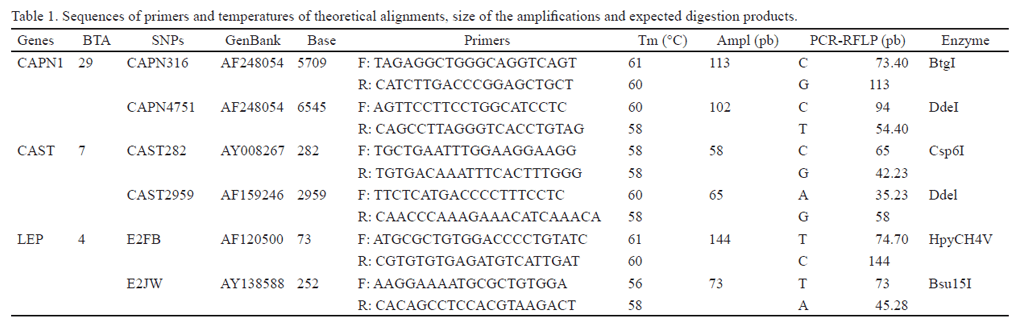
<body><![CDATA[<p align="justify">&nbsp;</p>     <p align="justify">&nbsp;</p>     <p align="justify"><font size="2" face="Verdana, Arial, Helvetica, sans-serif"><b><font size="3">INTRODUCTION</font></b></font></p>       <p align="justify" class="Cuerpodetexto" style="text-indent:0in;"><span style=" letter-spacing:.1pt; font-family:'Verdana','sans-serif'; font-size:10.0pt; ">High resolution analysis of the dissociation temperature  (HRM) of DNA fragments, amplified by the polymerase chain reaction (PCR),  allows detecting single nucleotide polymorphisms (SNPs) (Druml and Cichna-Markl  2014), very fast and at a low cost, with high sensitivity, specificity and low  contamination risking (Reed and Wittwer 2004 and Kyse&#318;ov&aacute; <em>et al.</em> 2012).  PRC-HRM is possible because of the development of sensors for detecting second  generation dyes, which fluoresce when they are bound to double stranded DNA  (dsDNA) and used in high concentrations to ensure saturation of dsDNA without  inhibiting PCR (Gudnason <em>et al.</em>, 2007). Diagnosis carried out by  analyzing the melting temperature (Tm) and the profile of HRM, plotting the  dissociation kinetics of dsDNA to single stranded DNA (ssDNA), when the  temperature increases (Kristensen and Dobrovic 2008).</span><span style=" font-family:'Verdana','sans-serif'; font-size:10.0pt; "> </span></p>       <p align="justify"><span style=" letter-spacing:.1pt; font-family:'Verdana','sans-serif'; font-size:10.0pt; ">Therefore,  taking into account the need of methodologies to improve productivity of animal  husbandry sector in Colombia, the PCR-HRM was standardized and validated for  determining the genotypes of SNPs related to tenderness of beef (CAPN316,  CAPN4751, CAST282, CAST2959, LEP E2FB and LEP E2FW), using PCR-RFLP as gold  standard test</span><font size="2" face="Verdana, Arial, Helvetica, sans-serif">.</font>   </p>       <p align="justify">&nbsp;</p>     <p align="justify"><font size="2" face="Verdana, Arial, Helvetica, sans-serif"><b><font size="3">MATERIALS AND METHODS</font></b></font></p>     <p align="justify" class="Cuerpodetexto" style="text-indent:0in;"><span style=" font-family:'Verdana','sans-serif'; font-size:10.0pt; ">Supported  by the Comit&eacute; Institucional para el Uso y Cuidado de los Animales (CICUA) from  the CES University, the total DNA of peripheral blood was obtained from 25 <em>Bos  taurus</em> and 25 <em>Bos indicus </em>  animals.</span></p>     <p align="justify" class="Cuerpodetexto" style="text-indent:0in;"><span style="font-family:'Verdana','sans-serif'; font-size:10.0pt; ">In  order to amplify by PCR, primers were designed, which surround fragments from  58 to 144 pb that potray the CAPN4751, CAPN316, CAST282, E2FB, and E2JW SNP  (<a href="/img/revistas/cjas/v50n1/t0103116.gif">table 1</a>).</span></p>     
<p align="justify" class="Cuerpodetexto" style="text-indent:0in;"><span style=" letter-spacing:.1pt; font-family:'Verdana','sans-serif'; font-size:10.0pt; ">Each SNP was analyzed independently, in a reaction mixture  of 25 &micro;L, containing 2 ng/&micro;L of total DNA,    10 &micro;M of primers, 12.5 &micro;L of Master Mix HRM Genotyping PCR (QIAGEN, Hilden,  Germany), diluted in water free of RNases. The amplification was performed in a  Rotor-Gene 6000 thermal cycler (Corbett Life Science, Concorde, NSW,  Australia), with preheating at 95 &deg;C for 5 minutes, followed by    40 cycles, with a denatoration step at 95 &deg;C for    10 seconds, a an annealing step, specific for each pair of primers for 30  seconds and one of elongation at 72&deg;C for 10 seconds. The high resolution melt  (HRM) profiles were built with the use of Rotor-Gene 6000 series&copy; program  (Corbett Life Science, Concorde, NSW, Australia), putting into a graph the  fluorescence values, after exposing the amplified ones to a gradient with  temperatures between 60 and 80 &deg;C, which increased at a rate of 0.05 &deg;C/s.</span><span style="font-family:'Verdana','sans-serif'; font-size:10.0pt; "> </span></p>     ]]></body>
<body><![CDATA[<p align="justify" class="Cuerpodetexto" style="text-indent:0in;"><span style="font-family:'Verdana','sans-serif'; font-size:10.0pt; ">As  gold standard test, the digestion of PCR fragments was used with restriction  enzymes (PCR-RFLP) (<a href="/img/revistas/cjas/v50n1/t0103116.gif">table 1</a>), incubated in a thermal cycler TC-512 (TechneTM),  according to the conditions suggested by the commercial house. Samples were  exposed to gel electrophoresis of agarose type II at 1%, dyed with SYBR Green&copy;  (Promega&copy;, Madison, Wisconsin), run at 60 V for 40 minutes, and photographed  under an UV light in a Epichemy System (UVP, Upland, CA) photo-documentation  equipment.</span></p>     
<p align="justify"><span style=" font-family:'Verdana','sans-serif'; font-size:10.0pt; ">Sensitivity, specificity,  predictive value of positive test, predictive value of negative test,  repeatability, reproducibility and strength of genotype discrimination with  HRM, were determined using RFLP as gold test, for each analyzed SNP</span><font size="2" face="Verdana, Arial, Helvetica, sans-serif">.</font> </p>     <p align="justify">&nbsp;</p>     <p align="justify"><font size="2" face="Verdana, Arial, Helvetica, sans-serif"><b><font size="3">RESULTS AND DISCUSSION</font></b></font></p>     <p align="justify" class="Cuerpodetexto" style="text-indent:0in;"><span style=" font-family:'Verdana','sans-serif'; font-size:10.0pt; ">The  efficiency of PCR-HRM was verified after comparing it with PCR-RFLP, and the  SNPs genotype was determined (CAPN4751, CAPN316, el CAST2959, CAST282, E2FB and  E2JW) in 50 <em>Bos taurus</em> and <em>Bos indicus </em>animals.</span></p>     <p align="justify" class="Cuerpodetexto" style="text-indent:0in;"><span style=" letter-spacing:.3pt; font-family:'Verdana','sans-serif'; font-size:10.0pt; ">All genotyped samples, with PCR-RFLP, showed bands with  the expected size in the amplification, after digestion of bovine genome  fragments that carried CC genotypes of CAST282 and TT of    E2FW.</span><span style="font-family:'Verdana','sans-serif'; font-size:10.0pt; "> </span></p>     <p align="justify" class="Cuerpodetexto" style="text-indent:0in;"><span style=" letter-spacing:.1pt; font-family:'Verdana','sans-serif'; font-size:10.0pt; ">Using PCR-HRM the differences between heterozygote and  homozygote genotypes were demonstrated using the melting profile, evidenced in  the normalized fluorescence curve, regarding the temperature (<a href="/img/revistas/cjas/v50n1/f0103116.gif">figure 1 A, C, G  and I</a>). On the other hand, homozygote genotypes were differentiated using a  graph with normalized fluorescence, regarding temperature, in which a genotype  was used as normalizer (<a href="/img/revistas/cjas/v50n1/f0103116.gif">figure 1. B, D, F, H, J, L</a>) and based on melting  temperature (Tm). </span></p>     
<p align="justify" class="Cuerpodetexto" style="text-indent:0in;"><span style=" letter-spacing:.2pt; font-family:'Verdana','sans-serif'; font-size:10.0pt; ">The SNP can be  classified according to the type of homoduplex (A/T and G/C) or heteroduplex  (A/G, A/C, T/C and T/G), which are produced after the amplification of a  heterozygote (Liew 2004). Group 1 includes C/T and A/G transitions, with  CAPN4751 and E2FB, presented by C/T, and CAST2959 with G/A. Group 2 shows C/A  and G/T transversions and group 3 is C/G transversion, which includes CAPN316  and CAST282. Finally, group 4 is T/A transversion that classifies E2FW. SNP  from group three and four were the most complex to differentiate,  theoretically, there would be similar Tm values for heterozygote and homozygote  due to the same pair of bases (C/G or T/A). Nevertheless, the HRM allows to  differentiate them efficiently, as it was verified in this    study.</span><span style="font-family:'Verdana','sans-serif'; font-size:10.0pt; "> </span></p>     <p align="justify" class="Cuerpodetexto" style="text-indent:0in;"><span style="font-family:'Verdana','sans-serif'; font-size:10.0pt; ">There  was an agreement among the results obtained by PCR-HRM, compared to PCR-RFLP.  This previous fact demonstrates high sensitivity, specificity and proper  positive and negative predictive values for PCR-HRM. Likewise, repeatability  and reproducibility were demonstrated after obtaining homogeneity in the  intra-run and inter-run results. The best results were reached with the use of  HRM and amplification reaction conditions, described in the methodology.  However, after evaluating the strength of the test, effect of the analyst skill  was evident because variables like amount of DNA and reaction volume may affect  the results.</span></p>     <p align="justify"><span style=" letter-spacing:.2pt; font-family:'Verdana','sans-serif'; font-size:10.0pt; ">The  previous information confirms the efficiency of PCR-HRM as a promising  molecular tool for determining the genotype of SNPs because of its high sensitivity,  specificity and strength, similar to the suggestions of other researchers  (Krypuy <em>et al.</em> 2006, Davoli <em>et al.</em> 2012 and Druml and  Cichna-Markl 2014)</span><font size="2" face="Verdana, Arial, Helvetica, sans-serif">.</font> </p>     ]]></body>
<body><![CDATA[<p align="justify">&nbsp;</p>     <p align="justify"><font size="2" face="Verdana, Arial, Helvetica, sans-serif"><b><font size="3">CONCLUSIONS</font></b></font></p>     <p align="justify" class="Cuerpodetexto" style="text-indent:0in;"><span style=" letter-spacing:.3pt; font-family:'Verdana','sans-serif'; font-size:10.0pt; ">The potential of PCR-HRM was confirmed for determining  genotype of SNPs CAPN4751, CAPN316, el CAST2959, CAST282, E2FB and E2JW,  determining the genotype on 50 <em>Bos taurus</em> and <em>Bos indicus </em>animals.  In all the samples evaluated by this technique, there was confirmation of the  genotypes observed when using PCR-RFLP and sequencing, and 100% of sensitivity  and specificity besides absence of false negative and false    positive. </span><span style=" letter-spacing:.2pt; font-family:'Verdana','sans-serif'; font-size:10.0pt; "> </span></p>     <p align="justify"><span style=" font-family:'Verdana','sans-serif'; font-size:10.0pt; ">Results demonstrate that  PCR-HRM is an efficient technique that allows to obtain reliable results in  short time. However, it may be affected by the extraction method, DNA amount  and quality, among other undetermined factors that may generate atypical  melting profiles and false positives (unpublished data). Therefore, these  variables should be controlled and PCR reaction should be monitored in order to  identify unusual dissociation curves, provoked by excess or deficiency of  amplification</span><font size="2" face="Verdana, Arial, Helvetica, sans-serif">.</font> </p>     <p align="justify">&nbsp;</p>     <p align="justify"><font size="2" face="Verdana, Arial, Helvetica, sans-serif"><b><font size="3">ACKNOWLEDGEMENTS</font></b></font></p>     <p align="justify"><font size="2" face="Verdana, Arial, Helvetica, sans-serif"><span style=" letter-spacing:.2pt; font-family:'Verdana','sans-serif'; font-size:10.0pt; ">The authors thank to Direcci&oacute;n de Gesti&oacute;n del Conocimiento de la  Universidad CES and to Colciencias (122870048969) for financing the research  project that supported the results presented in this study</span>.</font></p>     <p align="justify">&nbsp;</p>      <p align="justify"><font size="2" face="Verdana, Arial, Helvetica, sans-serif"><font size="3"><b>REFERENCES</b></font></font></p>     <p align="justify" class="MsoBibliography"><span style=" font-family:'Verdana','sans-serif'; font-size:10.0pt; ">Davoli,  R., Braglia, S., Valastro, V., Annarratone, C., Comella, M., Zambonelli, P.,  Nisi, I., Gallo, M., Buttazzoni, L. &amp; Russo, V. 2012. </span><span style="font-family:'Verdana','sans-serif'; font-size:10.0pt; ">&lsquo;&lsquo;Analysis of  MC4R polymorphism in Italian Large White and Italian Duroc pigs: Association  with carcass traits&rsquo;&rsquo;. <em>Meat Science</em>, 90 (4), pp. 887&ndash;892, ISSN:  0309-1740, DOI: 10.1016/j.meatsci.2011.11.025.</span></p>     ]]></body>
<body><![CDATA[<p align="justify" class="MsoBibliography"><span style="font-family:'Verdana','sans-serif'; font-size:10.0pt; ">Druml, B. &amp; Cichna-Markl, M. 2014. &lsquo;&lsquo;High  resolution melting (HRM) analysis of DNA &ndash; Its role and potential in food  analysis&rsquo;&rsquo;. <em>Food Chemistry</em>, 158, pp. 245&ndash;254, ISSN: 0308-8146, DOI:  10.1016/j.foodchem.2014.02.111.</span></p>     <p align="justify" class="MsoBibliography"><span style="font-family:'Verdana','sans-serif'; font-size:10.0pt; ">Gudnason, H., Dufva, M., Bang, D. D. &amp; Wolff, A.  2007. &lsquo;&lsquo;Comparison of multiple DNA dyes for real-time PCR: effects of dye  concentration and sequence composition on DNA amplification and melting  temperature&rsquo;&rsquo;. <em>Nucleic Acids Research</em>, 35 (19), p. e127, ISSN:  0305-1048, 1362-4962, DOI: 10.1093/nar/gkm671, PMID: 17897966.</span></p>     <p align="justify" class="MsoBibliography"><span style="font-family:'Verdana','sans-serif'; font-size:10.0pt; ">Kristensen,  L. S. &amp; Dobrovic, A. 2008. </span><span style="font-family:'Verdana','sans-serif'; font-size:10.0pt; ">&lsquo;&lsquo;Direct Genotyping of Single Nucleotide Polymorphisms  in Methyl Metabolism Genes Using Probe-Free High-Resolution Melting Analysis&rsquo;&rsquo;. <em>Cancer Epidemiology Biomarkers &amp; Prevention</em>, 17 (5), pp. 1240&ndash;1247,  ISSN: 1055-9965, 1538-7755, DOI: 10.1158/1055-9965.EPI-07-2531, PMID: 18483346.</span></p>     <p align="justify" class="MsoBibliography"><span style="font-family:'Verdana','sans-serif'; font-size:10.0pt; ">Krypuy, M., Newnham, G. M., Thomas, D. M., Conron, M.  &amp; Dobrovic, A. 2006. &lsquo;&lsquo;High resolution melting analysis for the rapid and  sensitive detection of mutations in clinical samples: KRAS codon 12 and 13  mutations in non-small cell lung cancer&rsquo;&rsquo;. <em>BMC Cancer</em>, 6, p. 295, ISSN:  1471-2407, DOI: 10.1186/1471-2407-6-295.</span></p>     <p align="justify" class="MsoBibliography"><span style="font-family:'Verdana','sans-serif'; font-size:10.0pt; ">Kyse&#318;ov&aacute;, J., Rycht&aacute;&#345;ov&aacute;, J., Sztank&oacute;ov&aacute;, Z. &amp;  Czernekov&aacute;, V. 2012. &lsquo;&lsquo;Simultaneous identification of <em>CSN3</em> and <em>LGB</em> genotypes in cattle by high-resolution melting curve analysis&rsquo;&rsquo;. <em>Livestock  Science</em>, 145 (1), pp. 275&ndash;279, ISSN: 1871-1413, DOI:  10.1016/j.livsci.2011.12.018.</span></p>     <p align="justify" class="MsoBibliography"><span style="font-family:'Verdana','sans-serif'; font-size:10.0pt; ">Liew, M., Pryor, R., Palais, R., Meadows, C., Erali,  M., Lyon, E. &amp; Wittwer, C. 2004. &lsquo;&lsquo;Genotyping of single-nucleotide  polymorphisms by high-resolution melting of small amplicons&rsquo;&rsquo;. <em>Clinical  Chemistry</em>, 50 (7), pp. 1156&ndash;1164, ISSN: 0009-9147, DOI:  10.1373/clinchem.2004.032136, PMID: 15229148.</span></p>     <p align="justify"><span style="font-family:'Verdana','sans-serif'; font-size:10.0pt; ">Reed, G. H. &amp; Wittwer, C. T. 2004. &lsquo;&lsquo;Sensitivity  and Specificity of Single-Nucleotide Polymorphism Scanning by High-Resolution  Melting Analysis&rsquo;&rsquo;. </span><em><span style="font-family:'Verdana','sans-serif'; font-size:10.0pt; ">Clinical Chemistry</span></em><span style="font-family:'Verdana','sans-serif'; font-size:10.0pt; ">, 50 (10), pp. 1748&ndash;1754, ISSN: 0009-9147, 1530-8561, DOI: 10.1373/clinchem.2003.029751,  PMID: 15308590</span><font size="2" face="Verdana, Arial, Helvetica, sans-serif">.</font> </p>     <p align="justify">&nbsp;</p>     <p align="justify">&nbsp;</p>     <p align="justify"><font size="2" face="Verdana, Arial, Helvetica, sans-serif">Received: November 26, 2015    ]]></body>
<body><![CDATA[<br>   Accepted: April 7, 2016</font></p>     <p align="justify">&nbsp;</p>     <p align="justify">&nbsp;</p>     <p align="justify"><font size="2" face="Verdana, Arial, Helvetica, sans-serif"><i>L. E. López Rojas,</i> Grupo Biología CES-EIA, Facultad de Ciencias y Biotecnología, Universidad CES, Colombia.  Calle 10 A No. 22-4, Medellín, Colombia.    Email: <a href="mailto:lelopez@ces.edu.co">lelopez@ces.edu.co</a></font></p>      ]]></body><back>
<ref-list>
<ref id="B1">
<nlm-citation citation-type="journal">
<person-group person-group-type="author">
<name>
<surname><![CDATA[Davoli]]></surname>
<given-names><![CDATA[R.]]></given-names>
</name>
<name>
<surname><![CDATA[Braglia]]></surname>
<given-names><![CDATA[S.]]></given-names>
</name>
<name>
<surname><![CDATA[Valastro]]></surname>
<given-names><![CDATA[V.]]></given-names>
</name>
<name>
<surname><![CDATA[Annarratone]]></surname>
<given-names><![CDATA[C.]]></given-names>
</name>
<name>
<surname><![CDATA[Comella]]></surname>
<given-names><![CDATA[M.]]></given-names>
</name>
<name>
<surname><![CDATA[Zambonelli]]></surname>
<given-names><![CDATA[P.]]></given-names>
</name>
<name>
<surname><![CDATA[Nisi]]></surname>
<given-names><![CDATA[I.]]></given-names>
</name>
<name>
<surname><![CDATA[Gallo]]></surname>
<given-names><![CDATA[M.]]></given-names>
</name>
<name>
<surname><![CDATA[Buttazzoni]]></surname>
<given-names><![CDATA[L.]]></given-names>
</name>
<name>
<surname><![CDATA[Russo]]></surname>
<given-names><![CDATA[V.]]></given-names>
</name>
</person-group>
<article-title xml:lang="nd"><![CDATA[Analysis of MC4R polymorphism in Italian Large White and Italian Duroc pigs: Association with carcass traits]]></article-title>
<source><![CDATA[Meat Science]]></source>
<year>2012</year>
<volume>90</volume>
<numero>4</numero>
<issue>4</issue>
<page-range>887-892</page-range></nlm-citation>
</ref>
<ref id="B2">
<nlm-citation citation-type="journal">
<person-group person-group-type="author">
<name>
<surname><![CDATA[Druml]]></surname>
<given-names><![CDATA[B.]]></given-names>
</name>
<name>
<surname><![CDATA[Cichna-Markl]]></surname>
<given-names><![CDATA[M.]]></given-names>
</name>
</person-group>
<article-title xml:lang="nd"><![CDATA[High resolution melting (HRM) analysis of DNA - Its role and potential in food analysis]]></article-title>
<source><![CDATA[Food Chemistry]]></source>
<year>2014</year>
<volume>158</volume>
<page-range>245-254</page-range></nlm-citation>
</ref>
<ref id="B3">
<nlm-citation citation-type="journal">
<person-group person-group-type="author">
<name>
<surname><![CDATA[Gudnason]]></surname>
<given-names><![CDATA[H.]]></given-names>
</name>
<name>
<surname><![CDATA[Dufva]]></surname>
<given-names><![CDATA[M.]]></given-names>
</name>
<name>
<surname><![CDATA[Bang]]></surname>
<given-names><![CDATA[D. D.]]></given-names>
</name>
<name>
<surname><![CDATA[Wolff]]></surname>
<given-names><![CDATA[A.]]></given-names>
</name>
</person-group>
<article-title xml:lang="nd"><![CDATA[Comparison of multiple DNA dyes for real-time PCR: effects of dye concentration and sequence composition on DNA amplification and melting temperature]]></article-title>
<source><![CDATA[Nucleic Acids Research]]></source>
<year>2007</year>
<volume>35</volume>
<numero>19</numero>
<issue>19</issue>
<page-range>e127</page-range></nlm-citation>
</ref>
<ref id="B4">
<nlm-citation citation-type="journal">
<person-group person-group-type="author">
<name>
<surname><![CDATA[Kristensen]]></surname>
<given-names><![CDATA[L. S.]]></given-names>
</name>
<name>
<surname><![CDATA[Dobrovic]]></surname>
<given-names><![CDATA[A.]]></given-names>
</name>
</person-group>
<article-title xml:lang="nd"><![CDATA[Direct Genotyping of Single Nucleotide Polymorphisms in Methyl Metabolism Genes Using Probe-Free High-Resolution Melting Analysis]]></article-title>
<source><![CDATA[Cancer Epidemiology Biomarkers & Prevention]]></source>
<year>2008</year>
<volume>17</volume>
<numero>5</numero>
<issue>5</issue>
<page-range>1240-1247</page-range></nlm-citation>
</ref>
<ref id="B5">
<nlm-citation citation-type="journal">
<person-group person-group-type="author">
<name>
<surname><![CDATA[Krypuy]]></surname>
<given-names><![CDATA[M.]]></given-names>
</name>
<name>
<surname><![CDATA[Newnham]]></surname>
<given-names><![CDATA[G. M.]]></given-names>
</name>
<name>
<surname><![CDATA[Thomas]]></surname>
<given-names><![CDATA[D. M.]]></given-names>
</name>
<name>
<surname><![CDATA[Conron]]></surname>
<given-names><![CDATA[M.]]></given-names>
</name>
<name>
<surname><![CDATA[Dobrovic]]></surname>
<given-names><![CDATA[A.]]></given-names>
</name>
</person-group>
<article-title xml:lang="nd"><![CDATA[High resolution melting analysis for the rapid and sensitive detection of mutations in clinical samples: KRAS codon 12 and 13 mutations in non-small cell lung cancer]]></article-title>
<source><![CDATA[BMC Cancer]]></source>
<year>2006</year>
<volume>6</volume>
<page-range>295</page-range></nlm-citation>
</ref>
<ref id="B6">
<nlm-citation citation-type="journal">
<person-group person-group-type="author">
<name>
<surname><![CDATA[Kyselová]]></surname>
<given-names><![CDATA[J.]]></given-names>
</name>
<name>
<surname><![CDATA[Rychtárová]]></surname>
<given-names><![CDATA[J.]]></given-names>
</name>
<name>
<surname><![CDATA[Sztankóová]]></surname>
<given-names><![CDATA[Z.]]></given-names>
</name>
<name>
<surname><![CDATA[Czerneková]]></surname>
<given-names><![CDATA[V.]]></given-names>
</name>
</person-group>
<article-title xml:lang="nd"><![CDATA[Simultaneous identification of CSN3 and LGB genotypes in cattle by high-resolution melting curve analysis]]></article-title>
<source><![CDATA[Livestock Science]]></source>
<year>2012</year>
<volume>145</volume>
<numero>1</numero>
<issue>1</issue>
<page-range>275-279</page-range></nlm-citation>
</ref>
<ref id="B7">
<nlm-citation citation-type="journal">
<person-group person-group-type="author">
<name>
<surname><![CDATA[Liew]]></surname>
<given-names><![CDATA[M.]]></given-names>
</name>
<name>
<surname><![CDATA[Pryor]]></surname>
<given-names><![CDATA[R.]]></given-names>
</name>
<name>
<surname><![CDATA[Palais]]></surname>
<given-names><![CDATA[R.]]></given-names>
</name>
<name>
<surname><![CDATA[Meadows]]></surname>
<given-names><![CDATA[C.]]></given-names>
</name>
<name>
<surname><![CDATA[Erali]]></surname>
<given-names><![CDATA[M.]]></given-names>
</name>
<name>
<surname><![CDATA[Lyon]]></surname>
<given-names><![CDATA[E.]]></given-names>
</name>
<name>
<surname><![CDATA[Wittwer]]></surname>
<given-names><![CDATA[C.]]></given-names>
</name>
</person-group>
<article-title xml:lang="nd"><![CDATA[Genotyping of single-nucleotide polymorphisms by high-resolution melting of small amplicons]]></article-title>
<source><![CDATA[Clinical Chemistry]]></source>
<year>2004</year>
<volume>50</volume>
<numero>7</numero>
<issue>7</issue>
<page-range>1156-1164</page-range></nlm-citation>
</ref>
<ref id="B8">
<nlm-citation citation-type="journal">
<person-group person-group-type="author">
<name>
<surname><![CDATA[Reed]]></surname>
<given-names><![CDATA[G. H.]]></given-names>
</name>
<name>
<surname><![CDATA[Wittwer]]></surname>
<given-names><![CDATA[C. T.]]></given-names>
</name>
</person-group>
<article-title xml:lang="nd"><![CDATA[Sensitivity and Specificity of Single-Nucleotide Polymorphism Scanning by High-Resolution Melting Analysis]]></article-title>
<source><![CDATA[Clinical Chemistry]]></source>
<year>2004</year>
<volume>50</volume>
<numero>10</numero>
<issue>10</issue>
<page-range>1748-1754</page-range></nlm-citation>
</ref>
</ref-list>
</back>
</article>