<?xml version="1.0" encoding="ISO-8859-1"?><article xmlns:mml="http://www.w3.org/1998/Math/MathML" xmlns:xlink="http://www.w3.org/1999/xlink" xmlns:xsi="http://www.w3.org/2001/XMLSchema-instance">
<front>
<journal-meta>
<journal-id>2079-3480</journal-id>
<journal-title><![CDATA[Cuban Journal of Agricultural Science]]></journal-title>
<abbrev-journal-title><![CDATA[Cuban J. Agric. Sci.]]></abbrev-journal-title>
<issn>2079-3480</issn>
<publisher>
<publisher-name><![CDATA[Editorial del Instituto de Ciencia Animal]]></publisher-name>
</publisher>
</journal-meta>
<article-meta>
<article-id>S2079-34802016000100006</article-id>
<title-group>
<article-title xml:lang="en"><![CDATA[Early weaning: an efficient and effective technological alternative for calf rearing corrals in grassland cattle systems in Latin America]]></article-title>
<article-title xml:lang="es"><![CDATA[Destete precoz: una alternativa tecnológica eficiente y eficaz para los rodeos de cría en sistemas ganaderos pastoriles de América Latina]]></article-title>
</title-group>
<contrib-group>
<contrib contrib-type="author">
<name>
<surname><![CDATA[Simeone]]></surname>
<given-names><![CDATA[A]]></given-names>
</name>
<xref ref-type="aff" rid="A01"/>
</contrib>
<contrib contrib-type="author">
<name>
<surname><![CDATA[Beretta]]></surname>
<given-names><![CDATA[V]]></given-names>
</name>
<xref ref-type="aff" rid="A01"/>
</contrib>
</contrib-group>
<aff id="A01">
<institution><![CDATA[,Universidad de la República Facultad de Agronomía ]]></institution>
<addr-line><![CDATA[ Paysandú]]></addr-line>
<country>Uruguay</country>
</aff>
<pub-date pub-type="pub">
<day>00</day>
<month>03</month>
<year>2016</year>
</pub-date>
<pub-date pub-type="epub">
<day>00</day>
<month>03</month>
<year>2016</year>
</pub-date>
<volume>50</volume>
<numero>1</numero>
<fpage>39</fpage>
<lpage>49</lpage>
<copyright-statement/>
<copyright-year/>
<self-uri xlink:href="http://scielo.sld.cu/scielo.php?script=sci_arttext&amp;pid=S2079-34802016000100006&amp;lng=en&amp;nrm=iso"></self-uri><self-uri xlink:href="http://scielo.sld.cu/scielo.php?script=sci_abstract&amp;pid=S2079-34802016000100006&amp;lng=en&amp;nrm=iso"></self-uri><self-uri xlink:href="http://scielo.sld.cu/scielo.php?script=sci_pdf&amp;pid=S2079-34802016000100006&amp;lng=en&amp;nrm=iso"></self-uri><abstract abstract-type="short" xml:lang="en"><p><![CDATA[The effect of early weaning in beef cattle is reviewed. Data on the impact of early weaning for restarting the post-calving sexual activity and consequently, on pregnancy percentage, are offered. Also the interaction of early weaning with the nutritional status of the cow, which was assessed by the body condition before mating, is underlined. Information on the nutritional management alternatives of the early weaned calf is presented classified according to grassland or confinement conditions. The nutritional management of the early weaned calf under grazing conditions is characterized by the management based on concentrate supplementation (18 % crude protein), at a rate of 1 % of the animal live weight. This strategy allowed attaining similar performances to those in which the calf remain with the cow. The nutritional management of the early weaned calf and managed under confinement is suggested as a strategy allowing higher profits than those attained under grazing with feed conversion around 3.5 kg of feed/kg live weight of calf produced. It is concluded that early weaning is an efficient and effective technological alternative for improving the productivity of the calf rearing corral and that there are different ways of realizing it that are adaptable to the cattle production system in question]]></p></abstract>
<abstract abstract-type="short" xml:lang="es"><p><![CDATA[Se revisa el efecto del destete precoz en ganado de carne. Se presenta información del impacto del destete precoz en el reinicio de la actividad sexual post-parto y consecuentemente, en el porcentaje de preñez, destacándose la interacción del destete precoz con el estado nutricional de las vacas, que se evaluó por la condición corporal a inicio del entore. La información acerca de las alternativas de manejo nutricional del ternero destetado precozmente se presenta clasificada, según las condiciones pastoriles o de confinamiento. El manejo nutricional del ternero destetado precozmente en condiciones de pastoreo se caracteriza por el manejo basado en suplementación con concentrados (18 % de proteína cruda), a razón del 1 % del peso vivo animal. Esta estrategia permitió alcanzar comportamientos similares a los que el ternero hubiera experimentado de haber permanecido al pie de la vaca. El manejo nutricional del ternero destetado precozmente y manejado en confinamiento se plantea como una estrategia que permite obtener ganancias superiores a las que se logran en pastoreo, con conversión del alimento en torno a 3.5 kg de alimento/kg de peso vivo de ternero producido. Se concluye que el destete precoz es una alternativa tecnológica eficiente y eficaz para mejorar la productividad del rodeo de cría y que existen diferentes formas de realizarlo, que son adaptables al sistema de producción ganadero que se trate]]></p></abstract>
<kwd-group>
<kwd lng="en"><![CDATA[cattle]]></kwd>
<kwd lng="en"><![CDATA[suckling]]></kwd>
<kwd lng="en"><![CDATA[growth]]></kwd>
<kwd lng="en"><![CDATA[calf]]></kwd>
<kwd lng="en"><![CDATA[efficiency]]></kwd>
<kwd lng="es"><![CDATA[vacunos]]></kwd>
<kwd lng="es"><![CDATA[amamantamiento]]></kwd>
<kwd lng="es"><![CDATA[crecimiento]]></kwd>
<kwd lng="es"><![CDATA[ternero]]></kwd>
<kwd lng="es"><![CDATA[eficiencia]]></kwd>
</kwd-group>
</article-meta>
</front><body><![CDATA[ <p align="right"><strong>Cuban Journal  of Agricultural Science, 50(1): 39-49, 2016, ISSN: 2079-3480</strong></p>     <p align="right">&nbsp;</p>     <p align="right"><font size="2" face="Verdana, Arial, Helvetica, sans-serif"><b>REVIEW</b></font></p>     <p align="justify">&nbsp;</p>     <p align="justify"><font size="4" face="Verdana, Arial, Helvetica, sans-serif"><b>Early weaning: an efficient and effective technological alternative for calf rearing corrals in grassland cattle systems in Latin America</b></font></p>     <p align="justify">&nbsp;</p>     <p align="justify"><font size="3" face="Verdana, Arial, Helvetica, sans-serif"><b>Destete precoz: una alternativa tecnológica eficiente y eficaz para los rodeos de cría en sistemas ganaderos pastoriles de América Latina</b></font></p>     <p align="justify">&nbsp;</p>     <p align="justify">&nbsp;</p>     <p align="justify"><font size="2" face="Verdana, Arial, Helvetica, sans-serif"><b>A. Simeone,</b><sup><b>I</b></sup><b> V. Beretta,</b><sup><b>I</b></sup></font></p>     ]]></body>
<body><![CDATA[<p align="justify"><font size="2" face="Verdana, Arial, Helvetica, sans-serif"><b> </b></font><font size="2" face="Verdana, Arial, Helvetica, sans-serif"><sup>I</sup>Facultad de Agronomía. Universidad de la República. Ruta 3, km 363, Paysandú, Uruguay. </font></p>     <p align="justify">&nbsp;</p>     <p align="justify">&nbsp;</p> <hr align="JUSTIFY">     <p align="justify"><font size="2" face="Verdana, Arial, Helvetica, sans-serif"><b>ABSTRACT</b></font></p>     <p align="justify"><font size="2" face="Verdana, Arial, Helvetica, sans-serif"><span style=" letter-spacing:.2pt; font-family:'Verdana','sans-serif'; font-size:10.0pt; ">The effect of early weaning in beef cattle is reviewed. Data on the  impact of early weaning for restarting the post-calving sexual activity and  consequently, on pregnancy percentage, are offered.&nbsp; Also the interaction of early weaning with  the nutritional status of the cow, which was assessed by the body condition  before mating, is underlined. Information on the nutritional management  alternatives of the early weaned calf is presented classified according to  grassland or confinement conditions.&nbsp; The  nutritional management of the early weaned calf under grazing conditions is  characterized by the management based on concentrate supplementation (18 %  crude protein), at a rate of 1 % of the animal live weight.&nbsp; This strategy allowed attaining similar  performances to those in which the calf remain with the cow. The nutritional  management of the early weaned calf and managed under confinement is suggested  as a strategy allowing higher profits than those attained under grazing with  feed conversion around 3.5 kg of feed/kg live weight of calf produced.&nbsp; It is concluded that early weaning is an  efficient and effective technological alternative for improving the  productivity of the calf rearing corral and that there are different ways of  realizing it that are adaptable to the cattle production system in  question</span>.</font></p>     <p align="justify"><font size="2" face="Verdana, Arial, Helvetica, sans-serif"><b>Key words:</b> cattle, suckling, growth, calf, efficiency.</font></p> <hr align="JUSTIFY">     <p align="justify"><font size="2" face="Verdana, Arial, Helvetica, sans-serif"><b>RESUMEN</b></font></p>     <p align="justify"><font size="2" face="Verdana, Arial, Helvetica, sans-serif"><span style=" letter-spacing:-.1pt; font-family:'Verdana','sans-serif'; font-size:10.0pt; ">Se revisa el efecto del destete precoz en ganado de  carne. Se presenta informaci&oacute;n del impacto del destete precoz en el reinicio de  la actividad sexual post-parto y consecuentemente, en el porcentaje de pre&ntilde;ez,  destac&aacute;ndose la interacci&oacute;n del destete precoz con el estado nutricional de las  vacas, que se evalu&oacute; por la condici&oacute;n corporal a inicio del entore. La  informaci&oacute;n acerca de las alternativas de manejo nutricional del ternero  destetado precozmente se presenta clasificada, seg&uacute;n las condiciones pastoriles  o de confinamiento. El manejo nutricional del ternero destetado precozmente en condiciones  de pastoreo se caracteriza por el manejo basado en suplementaci&oacute;n con  concentrados (18 % de prote&iacute;na cruda), a raz&oacute;n del 1 % del peso vivo animal.  Esta estrategia permiti&oacute; alcanzar comportamientos similares a los que el  ternero hubiera experimentado de haber permanecido al pie de la vaca. El manejo  nutricional del ternero destetado precozmente y manejado en confinamiento se  plantea como una estrategia que permite obtener ganancias superiores a las que  se logran en pastoreo, con conversi&oacute;n del alimento en torno a 3.5 kg de  alimento/kg de peso vivo de ternero producido. Se concluye que el destete  precoz es una alternativa tecnol&oacute;gica eficiente y eficaz para mejorar la  productividad del rodeo de cr&iacute;a y que existen diferentes formas de realizarlo, que  son adaptables al sistema de producci&oacute;n ganadero que se trate</span>.</font></p>     <p align="justify"><font size="2" face="Verdana, Arial, Helvetica, sans-serif"><b>Palabras    clave:</b>    vacunos, amamantamiento, crecimiento, ternero, eficiencia.</font></p> <hr align="JUSTIFY">     <p align="justify">&nbsp;</p>     ]]></body>
<body><![CDATA[<p align="justify">&nbsp;</p>     <p align="justify"><font size="2" face="Verdana, Arial, Helvetica, sans-serif"><b><font size="3">INTRODUCTION</font></b></font></p>       <p align="justify" class="Cuerpodetexto" style="text-indent:0in;"><span style=" font-family:'Verdana','sans-serif'; font-size:10.0pt; ">C<span style="letter-spacing:.1pt; ">attle rearing in Latin America countries are  carried out under grassland conditions characterized by poor reproductive  efficiency which conveys at the level of the production-breeder system in low  weaning percentage when the number cows producing one calf is related to the  amount of cows annually serviced. A very long post-partum anestrous accounts  for the low weaning percentage due to the low conception rate that hinders the  cows to restart the sexual activity before the removal of the bulls when used a  seasonal mating system (Simeone 2000). Even though the problems of the sexual  performance of cows destined for beef production during the puerperium can be  tackled multifactorially, the cow&rsquo;s nutritional status (Wettemann 2013) and the  suckling (Williams 1990) have been identified as the two most important factors  influencing on the duration of the post-partum anestrous (Short and Adams  1985). </span></span></p>       <p align="justify" class="Cuerpodetexto" style="text-indent:0in;"><span style="font-family:'Verdana','sans-serif'; font-size:10.0pt; ">Early  weaning, understood as the definitive interruption of the cow-calf relationship  60 d post calving, has demonstrated to be a very efficient and effective  technological alternative for improving the productivity of the calf rearing  corrals. Its effect is mediated by the simultaneous influence of the mentioned  two factors and it has been studied as technological tool for solving the  problem of low reproductive efficiency of the calf rearing corrals (Simeone and  Beretta 2002). The importance of the information created on early weaning in  Latin America countries could vary as result of the specific peculiarities of  each region which could give rise to a wide variety of approaches.</span></p>       <P align="justify"><span style=" font-family:'Verdana','sans-serif'; font-size:10.0pt; ">The objective of this paper  is to summarize from the information generated in Latin America and Caribbean  countries in general and, specifically, in Uruguay, the present awareness on  early weaning, as technological tool of great impact on cattle productivity  during the rearing stage, regarding its effect on cow reproduction as well as  on calf development</span><font size="2" face="Verdana, Arial, Helvetica, sans-serif">.</font>   </P>       <p align="justify">&nbsp;</p>     <p align="justify"><font size="2" face="Verdana, Arial, Helvetica, sans-serif"><b><font size="3">EARLY WEANING AND REPRODUCTIVE EFFICIENCY IN BREEDING COWS</font></b></font></p>     <p align="justify" class="Cuerpodetexto" style="text-indent:0in;"><em><span style=" letter-spacing:.2pt; font-family:'Verdana','sans-serif'; font-size:10.0pt; ">Theoretical bases of the early weaning effect. </span></em><span style="font-family:'Verdana','sans-serif'; font-size:10.0pt; ">The early weaning technique while improving the  reproductive performance is directed to the elimination of the endocrine  restrictions during suckling (Williams 1990). But, mainly, leads to the  improvement of the energetic balance of the post-calving cow through the  elimination of the nutritional demands for milk production and the modifications  in the energy division towards a recovery of the body condition (Short and  Adams 1985).&nbsp; This promotes a fast return  to the cyclic sexual activity and, consequently, a significant increase of the  pregnancy rate.&nbsp; Nonetheless, and  according to its way of action, results encountered demonstrate that the  reproductive response to the application of early weaning is higher in those  groups of animals forming part of the rearing corral, more energy demanding,  that is: a) cows that calved and were mated under bad body condition and b)  first calving cows.</span><span style=" font-family:'Verdana','sans-serif'; font-size:10.0pt; "> </span></p>     <p align="justify" class="Cuerpodetexto" style="text-indent:0in;"><span style="font-family:'Verdana','sans-serif'; font-size:10.0pt; ">Estimations realized by prediction equations for British  breed cows (AFRC 1993) indicate that the elimination of the requirements for  milk production is equivalent to an energy &ldquo;savings&rdquo; of 0.98 Mcal of metabolizable  energy (ME) per milk liter not produced by the cow.&nbsp; From this estimation it can be calculated  that for one beef cow with a daily production level of 7 L of milk with 3.4 %  fat, early weaning would allow the availability, without modifications in the  forage basis, of 6.86 Mcal of additional ME, that could be destined to the  improvement of the body condition (BC) promoting the restart of the cyclic     <br>   activity.</span><span style="font-family:'Verdana','sans-serif'; font-size:10.0pt; "> </span></p>     ]]></body>
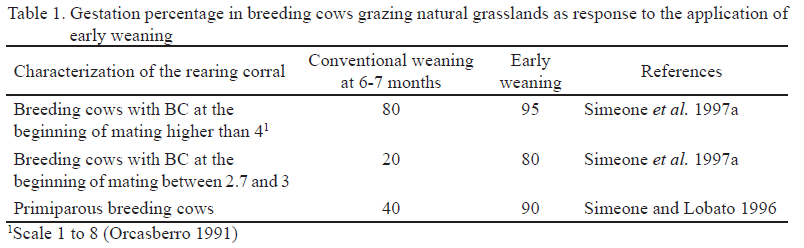
<body><![CDATA[<p align="justify" class="Cuerpodetexto" style="text-indent:0in;"><span style="font-family:'Verdana','sans-serif'; font-size:10.0pt; ">The  removal of the calf from the cow at 60 d of age eliminates the inhibitory  effects of the suckling act in the neuroendocrine&nbsp; hypothalamus-hypophysis-ovary axis and  increases the possibilities of the restart of the post calving sexual  activity.&nbsp; This effect indicates that the  calf presence could have greater effect on the length of post-partum anestrous  than the suckling act of the calf <em>per se</em> (Griffith and Williams 1996).</span></p>     <p align="justify" class="Cuerpodetexto" style="text-indent:0in;"><em><span style="font-family:'Verdana','sans-serif'; font-size:10.0pt; ">Effect  of early weaning on the reproductive performance of breeding cows</span></em><span style="font-family:'Verdana','sans-serif'; font-size:10.0pt; ">.  The suckling has an inhibitory effect on early ovulation during the  post-partum, but this effect is extended in bony cows (Wettemann 2013). The  reproductive response to the application of early weaning has been assessed in  multiparous cows in different body condition and in primiparous cows. In <a href="/img/revistas/cjas/v50n1/t0106116.gif">table  1</a> are summarized the main results obtained in beef cows grazing natural  grassland in Uruguay.</span></p>     
<p align="justify" class="Cuerpodetexto" style="text-indent:0in;"><span style="font-family:'Verdana','sans-serif'; font-size:10.0pt; ">From  the data of <a href="/img/revistas/cjas/v50n1/t0106116.gif">table 1</a> it can be inferred that all rearing corrals submitted to  early weaning register systematically, pregnancy rates around 80 and 90 %.&nbsp; This represents a mean response of 30 to 40  percentile units, regarding the average weaning rate of the rearing corrals  managed under extensive conditions.&nbsp;  However, when early weaning is applied to the most sensible groups of  the rearing corral, as to cows with BC lower than 3 or to primiparous cows,  this response grows to values close to 50 percenage units.&nbsp; In these cases, even though there is a  pregnancy improvement, the calving interval is not modified regarding the same  cows without early weaning, which could even represent a delay in the next  calving times.&nbsp; This latter must be  considered to the effects of not affecting pregnancy in the following mating.  On the contrary, the application of early weaning to cows in good body  condition, even though pregnancy percentage is not significantly modified, it  has been demonstrated to shorten the calving interval regarding cows in the  same condition and mated with its calf that can be used as management tool for  the concentration of calvings.</span></p>     
<p align="justify" class="Cuerpodetexto" style="text-indent:0in;"><span style="font-family:'Verdana','sans-serif'; font-size:10.0pt; ">According to these evidences, the possibility that this  technique have really positive effect on the rearing enterprise depends on its  application in cows showing, at the beginning of mating, a body condition 3 or  lower and in primiparous cows.&nbsp; For that,  it is recommended, prior to mating, to form cow lots with this BC for later in  these lots apply the early weaning, from the criterions related with the weight  and age of the calves.</span><span style="font-family:'Verdana','sans-serif'; font-size:10.0pt; "> </span></p>     <p align="justify" class="Cuerpodetexto" style="text-indent:0in;"><span style="font-family:'Verdana','sans-serif'; font-size:10.0pt; ">The alternative of realizing this task before mating has  the inconvenient of working with the cattle with calves with the known problem  of slow herd moving and other situations. For that, it is suggested to form cow  lots with different BC at calving, so as at the mating time lots with different  groups of cows are available: a) cows in bad BC (BC &lt; 3.5), to which early  weaning could be applied; b) cows in intermediate condition (BC between 3.5 and  4), to which temporary weaning could be applied and c) cows with good BC (BC  &gt; 4) not needing any suckling control technique</span><span style="font-family:'Verdana','sans-serif'; font-size:10.0pt; ">.</span></p>     <p align="justify" class="Cuerpodetexto" style="text-indent:0in;"><span style="font-family:'Verdana','sans-serif'; font-size:10.0pt; ">Certainly,  the classification of the breeding cows by different groups implies the availability  of a specific infrastructure regarding the number of paddocks.&nbsp; If at the establishment time there are not  sufficient paddocks as for managing three cow lots at calving, it is suggested  its classification in two lots at least from BC 3.5 as division criterion.&nbsp; To the cows calving with    BC &lt; 3.5 will be applied early weaning, while in cows with BC <span style="letter-spacing:.2pt; ">&gt; </span>35 other alternative techniques will be  applied or no intervention will be made.</span></p>     <P align="justify"><span style=" letter-spacing:.2pt; font-family:'Verdana','sans-serif'; font-size:10.0pt; ">The  economic viability of early weaning, as in any other technology, determines, of  course, its adoption.&nbsp; Therefore this  type of analysis must be realized for each one of the particular conditions in  which it is applied.&nbsp; According to the  previous statement, the highest bioeconomic impact will be attained on the  basis of the application of temporary early weaning to thin cows (body  condition between 3 and 3.5) in which the highest response is expected.&nbsp; The economic results of early weaning  practiced temporarily can be measured as the extra benefit obtained per cow,  which is determined by the extra income, derived from the implementation of the  techniques minus the additional total cost of the new management. The extra  income will correspond to the net increase in the pregnancy rate, materialized  in the kilograms of calves weaned conventionally (approximately at 180 d of  age) in the following year to the application of early weaning (representing 15  months of return on invested capital).&nbsp;  In this type of evaluations, temporary early weaning is exceptionally  made in a mating, returning the cows in the following to the mating without  calf weaning. No changes are made on the forage bases used by the cows.&nbsp; The studies carried out for assessing the  effects of the economic results from the application of early weaning, suggest  that the utilization of this tool produces positive results concerning the  input and product prices, since even under a situation of unfavorable price  relation due to low calf prices, early weaning could be equally justified in  such categories in which the response in terms of increase in the pregnancy  rate is higher than 40 %.&nbsp; As previously  indicated, primiparous cows and those arriving to mating with poor body  condition (between 2.5 and 3) are two rearing categories in which there will be  higher response to the application of early weaning.&nbsp; In these cases increase values of 50 % can be  attained.&nbsp; The highest response in  reproductive terms recorded in these categories will allow: a) pay rations at  higher prices, or b) apply early weaning even at the perspective of low prices  of the weaning    calves</span><font size="2" face="Verdana, Arial, Helvetica, sans-serif">.</font> </P>     <p align="justify">&nbsp;</p>     <p align="justify"><font size="2" face="Verdana, Arial, Helvetica, sans-serif"><b><font size="3">EFFECT OF EARLY WEANING ON CALF DEVELOPMENT</font></b></font></p>     <p align="justify" class="Cuerpodetexto" style="text-indent:0in;"><span style=" font-family:'Verdana','sans-serif'; font-size:10.0pt; ">The  application of early weaning in rearing corrals implies assuming the compromise  of feeding the calves so as to attaining, at least, the same gain rates they  would have reached if maintained with the cow until six months of age.&nbsp; Studies carried out by Monje and Hoffer in  Argentina (INTA 1996) on the application of early weaning in rearing corrals  under extensive cattle production and the creation of proposals for nutritional  management of calves have been pioneers on this subject matter and have  significantly contributed to the promotion of this technique.&nbsp; Therefore, the profile of the investigation  developed in countries such as Uruguay has been the assessment of management  alternatives of the calf feeding, adjusted to the specific production  conditions.&nbsp; In studies of Simeone and  Beretta (2002) great part of the information on this topic has been  synthesized.</span></p>     ]]></body>
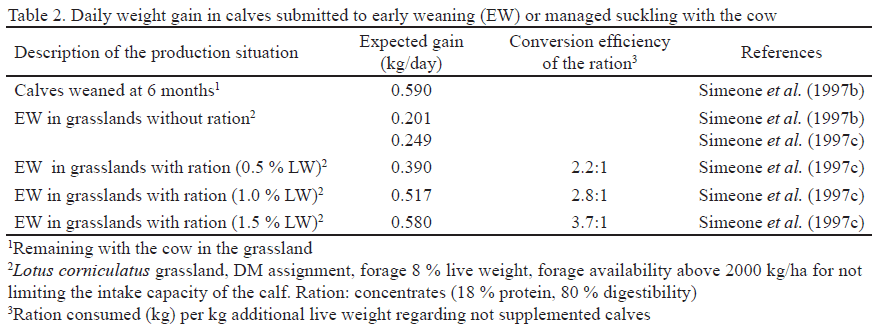
<body><![CDATA[<p align="justify" class="Cuerpodetexto" style="text-indent:0in;"><span style=" letter-spacing:.2pt; font-family:'Verdana','sans-serif'; font-size:10.0pt; ">At the Intensive Beef Production Unit (IBPU) of the Faculty  of Agronomy of Uruguay, the nutritional management of early weaned calves was  dealt with considering the characteristics of the feeding system under grazing  or confinement conditions.&nbsp; In this way,  the final product of the studies would be the quantification of daily live  weight gain of the early weaned calves according different management  alternatives, product of the combination of pasture and supplement in the case  of grassland systems and the conversion efficiency of the diet, when dealing  with the feeding in the corral. In both cases, the generation of technical  coefficients regarding the use of concentrates and coarse feeds has special  importance since it constitutes a main input for the evaluation of the economic  viability of the practice.&nbsp; Precisely,  research studies realized at IBPU, the same as the starting of the early  weaning practice at larger scale in the rearing corral of the Experimental  Station &ldquo;M. A. Cassinoni&rdquo; and in commercial rearing corrals associated with the  IBPU in the period 1997-2002, have served as experience for the implementation  of the technique allowing today the formulation of recommendations for  technicians and cattle producers of the Mercosur countries as the diverse  regions of Latin America and the Caribbean.</span><span style="font-family:'Verdana','sans-serif'; font-size:10.0pt; "> </span></p>     <p align="justify" class="Cuerpodetexto" style="text-indent:0in;"><span style="font-family:'Verdana','sans-serif'; font-size:10.0pt; ">Synthesizing,  results derived from this investigation line on the management of early weaned  calves can be grouped in two areas:&nbsp;  nutritional management of early weaned calves under grassland conditions  and b) nutritional management of early weaned calves under confinement  conditions.</span></p>     <p align="justify" class="Cuerpodetexto" style="text-indent:0in;"><em><span style="font-family:'Verdana','sans-serif'; font-size:10.0pt; ">Management  of grazing early weaned calves</span></em><span style="font-family:'Verdana','sans-serif'; font-size:10.0pt; ">. Research on the  nutritional management of early weaned calves and managed under grazing  conditions is directed towards development nutritional strategies that will  allow obtaining in calves live weight gain rates similar to those that would be  reached if maintained with the cow.&nbsp; In  <a href="/img/revistas/cjas/v50n1/t0206116.gif">table 2</a> is shown a synthesis of the main results obtained at IBPU with the  nutritional management of the early weaned grazing calf.</span></p>     
<p align="justify" class="Cuerpodetexto" style="text-indent:0in;"><span style="font-family:'Verdana','sans-serif'; font-size:10.0pt; ">Data  demonstrate the productive viability of the early weaning under grazing  conditions, since animal performance is similar to that reached in the suckling  calf. For attaining this objective, experimental data suggest calf grazing  management with forage supply (FS) of 8 kg DM/100 kg live weight and  supplementing with an energy-protein concentrate (18 % protein, 80 %  digestibility).&nbsp; It has been identified a  supplementation level of 1 % live weight as that optimizing gains (Simeone <em>et  al.</em> (1997c).</span></p>     <p align="justify" class="Cuerpodetexto" style="text-indent:0in;"><span style=" letter-spacing:.1pt; font-family:'Verdana','sans-serif'; font-size:10.0pt; ">Certainly the nutritional management of 80 kg live weight  calves involves an important operative challenge at production system  level.&nbsp; Thus, emphasis has been made in  the development of a very detailed protocol guaranteeing the before mentioned  productive objectives (Simeone and Beretta 2002).&nbsp; Early weaning must be divided into two  stages: I) weaning and adaptation of the calf to the new diet (10 &ndash; 15 d) and  II) grassland management and supplementation (60 to 90 d).</span><span style="font-family:'Verdana','sans-serif'; font-size:10.0pt; "> </span></p>     <p align="justify" class="Cuerpodetexto" style="text-indent:0in;"><span style="font-family:'Verdana','sans-serif'; font-size:10.0pt; ">During the first period, calves must be recovered from the  weaning stress and learn consuming a high quality solid diet that will  stimulate ruminal development. The definitive result of the technique at five  or six months of age depends directly from the success in this stage. Regarding  the weight and age of the calf, it is suggested considering a minimum critical  weight of 70 kg, considered as a reliable value, in case calving date is known,  60 d as minimum age for weaning. It is recommended a quick weaning in the  establishment corrals, early in the morning.&nbsp;  Cows must be immediately transferred to a far paddock for assuring the  definitive interruption of the cow-calf relationship.&nbsp; Aspects related with calf health must be  guaranteed and the application of antiparasitic treatments and vaccinations for  preventing diseases as kerato-conjunctivitis, clostridiosis, infectious bovine  rhino-tracheitis and viral diarrhea (bovine) among others. The adaptation of  the calf to the solid diet is the key and this period must last 10 d,  approximately, although under problematic situations can be extended to 15  d.&nbsp; Data created at the IBPU suggested  dividing this stage in four phases:</span></p>     <p align="justify" class="Cuerpodetexto" style="text-indent:0in;"><span style="font-family:'Verdana','sans-serif'; font-size:10.0pt; ">-  Phase 1 (day 1). It corresponds to the day when weaning is carried out.&nbsp; Calves are maintained in the corrals only  with shade and water, without access to any type of feed.&nbsp; Calves move around and bleat until they stay  calm.</span></p>     <p align="justify" class="Cuerpodetexto" style="text-indent:0in;"><span style="font-family:'Verdana','sans-serif'; font-size:10.0pt; ">- Phase 2 (day 2).&nbsp;  In the morning feed is offered, placing manually the stripped down bale,  as floor cover of the feeding trough at a rate of    0.500 kg/animal. The concentrate is distributed on the bale at a rate of 0.250  kg/animal. It is essential to allow the animals the access to the feeding  troughs once finished feed distribution so as there is equal consumption  opportunities for all calves. To these effects it is recommended the  availability of other short passage next to the adaptation corral or to put a  temporary sub-division with electric wire at the corner of the corral, only  while feeds are placed in the feeding    troughs.</span><span style="font-family:'Verdana','sans-serif'; font-size:10.0pt; "> </span></p>     <p align="justify" class="Cuerpodetexto" style="text-indent:0in;"><span style="font-family:'Verdana','sans-serif'; font-size:10.0pt; ">- Phase 3 (day 3 to 9).&nbsp;  From the third day it starts to increase daily the supply of  concentrates at a rate of 0.250 kg/animal, until reaching 1 % of the live  weight.&nbsp; At the last hour of the  afternoon the removal of the surplus feed is conducted. If there is no feed,  the bale can be gradually increased until attaining    1 % live weight.&nbsp; At this moment all  animals must eat uniformly.</span><span style="font-family:'Verdana','sans-serif'; font-size:10.0pt; "> </span></p>     <p align="justify" class="Cuerpodetexto" style="text-indent:0in;"><span style="font-family:'Verdana','sans-serif'; font-size:10.0pt; ">-  Phase 4 (day 10).&nbsp; The supply of the bale  is discontinued and the concentrate offered in the paddock where the animals  will be managed with the utilization of a feeding trough similar to that of the  corral. Once the supplement is consumed, calves are released to the pasture.</span></p>     ]]></body>
<body><![CDATA[<p align="justify" class="Cuerpodetexto" style="text-indent:0in;"><span style="font-family:'Verdana','sans-serif'; font-size:10.0pt; ">On  following these steps it has been demonstrated that the percentage of calves  not consuming the concentrate adequately is practically null.&nbsp; It has been achieved that calves maintain an  acceptable performance during the adaptation period without weight losses or  moderate average gains.</span></p>     <p align="justify" class="Cuerpodetexto" style="text-indent:0in;"><span style="font-family:'Verdana','sans-serif'; font-size:10.0pt; ">Regarding the management, during the second stage in the  field, it is recommended that during the first three days of concentrate  consumption, the staff observe attentively animal performance to know which  animals do not consume concentrate or is dispersed when supplied, registering  the problem cases.&nbsp; It is suggested to  offer the concentrate early in the morning avoiding the high temperature hours.&nbsp; For attaining that all animals consume  orderly, one next the other, it is essential to maintain a strict routine and  to respect the supply hours of the concentrate.&nbsp;  In this way the access of the animals to the feeding trough is avoided  until the concentrate distribution is finished.&nbsp;  Just like that during the adaptation to the feed, it can be available at  some paddock corner an electric wire for establishing a temporary sub-division  where the calves wait, while the workers place the feed in the feeding trough.  The staff must observe daily the animals for identifying eventual sanitary  problems in which the veterinary doctor must examine (actinomycosis,  respiratory problems, severe kerato-conjunctivitis and deaths of unknown cause,  among others).&nbsp; Also they must realize the  normal management that takes place during establishment (treating miasis and  identifying dominance problems between animals, among others).</span></p>     <p align="justify" class="Cuerpodetexto" style="text-indent:0in;"><em><span style="font-family:'Verdana','sans-serif'; font-size:10.0pt; ">Management  of early weaned calves under confinement conditions (EWC)</span></em><span style="font-family:'Verdana','sans-serif'; font-size:10.0pt; ">.  The research concerning the nutritional management of early weaned calves under  confinement has followed a different logic regarding the early weaning under  grazing, since different productive objectives are considered. While, the  management under grazing states as central axis to obtain the same performance  that a suckling control, the stabled management is presented as a correcting  option and accepts the challenge of exceeding significantly that performance.</span></p>     <p align="justify" class="Cuerpodetexto" style="text-indent:0in;"><span style="font-family:'Verdana','sans-serif'; font-size:10.0pt; ">Results achieved demonstrate the possibility of attaining  performances around 1.2 kg/d in early weaned calves, managed under confinement  with high concentrate diets.&nbsp; A  conversion efficiency of 3.5 kg of dry matter of feed/kg live weight gain is  obtained.&nbsp; This opens an interesting  perspective for improving the productivity of the rearing phase, since it  assures the possibility of attaining a calf of six month of age with 230 kg  live weight and, at the same time, fulfill with high gestation in its  dams.&nbsp; The excellent calf conversion  during confinement makes viable the application of this option from the  economic point of view in a broad scenario of feed and calf    prices.</span><span style="font-family:'Verdana','sans-serif'; font-size:10.0pt; "> </span></p>     <p align="justify" class="Cuerpodetexto" style="text-indent:0in;"><span style="font-family:'Verdana','sans-serif'; font-size:10.0pt; ">Some  aspects related with the application of EWC merit particular attention on  analyzing this technological alternative for cattle production systems.&nbsp; Among these outstands the evaluation of the  effect of animal welfare by the decrease of the caloric stress and of the type  of protein used in the diet formulation.</span></p>     <p align="justify" class="Cuerpodetexto" style="text-indent:0in;"><span style="font-family:'Verdana','sans-serif'; font-size:10.0pt; ">Simeone <em>et al.</em> (2012) reported an experiment  realized at the North Littoral of Uruguay, directed to assess the effect of the  shade on the performance of early weaned calves (86.6 &plusmn; 11.5 kg) fed under  confinement conditions during the first three months post-weaning: a)  management in corrals with free access to artificial shade in the corral and b)  management in corrals without shade.&nbsp;  Weight gains attained were high, in absolute terms and when compared to  mean gains obtained in suckling calves or early weaned and supplemented under  grazing (Simeone and Beretta 2002).&nbsp; This  response was expected given the higher energy concentration of the diet and the <em>ad libitum </em>supply of the feed. However, even under conditions of  expression of the animal&rsquo;s potential it was verified that calves with access to  the shade registered average daily gains of live weight significantly higher  than those with no access to it (1.45 vs. 1.30 kg/d P &lt; 0.05).&nbsp; Feed consumption tended to be higher in  animals that had access to the shade (5.3 vs. 5.0 kg of dry matter/d;    P = 0.1034).&nbsp; Nonetheless the highest  daily weight gain determined better feed conversion efficiency (3.68 vs. 3.91  kg DM/kg LW gained; P = 0.07).&nbsp; These  evidences suggest that the environmental conditions registered during the  summer predispose to the heat stress in early weaned calves.&nbsp; The possibility of having a shade area  reduces this effect.&nbsp; Animals with access  to the shade showed lower stress symptoms, mainly, lower respiratory rate and  better productive performance (Simeone <em>et al.</em> 2012).&nbsp; This could have important implications for  countries of tropical cattle production where temperatures can be higher.</span><span style="font-family:'Verdana','sans-serif'; font-size:10.0pt; "> </span></p>     <p align="justify" class="Cuerpodetexto" style="text-indent:0in;"><span style="font-family:'Verdana','sans-serif'; font-size:10.0pt; ">Concerning  the type of protein to be used in the diet formulation for early weaning  calves, characteristics of this animal category are determinant factors. Early  weaned calves present high protein demand and low daily consumption of dry  matter.&nbsp; The contribution of metabolizable  protein (MP) from the microbial protein can result insufficient for covering  the daily ME requirements.&nbsp; In this case,  the contribution of protein source supplying with higher diet contribution of  non degradable protein in the rumen (NDPR) could improve the performance of  early weaned calves.&nbsp; Likewise, higher  contribution of NDPR will also offer the possibility of adjusting more  precisely the requirements of some metabolizable amino acids which are  essential.&nbsp; This could improve the weight  gain or the conversion efficiency and even, both.&nbsp; Some background show that in iso-nitrogenous  diets, the supply of increasing levels of fish meal (+ 80 % NDPR) (NRC 2000) to  crossbred Frame steers half-confined (231 kg) increased amino acid absorption  at duodenal level and modified the plasma amino acid profile regarding the use  of urea as supplementary source (Zinn and Shen 1998), improving the energetic  efficiency and the contribution of net energy of the feed.</span></p>     <p align="justify" class="Cuerpodetexto" style="text-indent:0in;"><span style="font-family:'Verdana','sans-serif'; font-size:10.0pt; ">The protein supplement varies, not only in the protein  contribution (% DM) but also in the NDPR (% CP) and in the amino acid profile  of this fraction (NRC 2000). The sources of true protein most commonly used in  the formulation of rations for early weaned calves include soybean meal or  sunflower expeller which NDPR varies between 20 and 35 % (NRC 2000). In this  context, the substitution of this type of supplement by other protein sources  of poorer ruminal degradability could improve the performance of early weaned  calves and fed in corrals.&nbsp; From this hypothesis  at the IBPU was carried out an experimental study to assess the effect of  various protein sources differing in the ruminal degradability of the protein  contributed as ration ingredients for early weaned calves (Beretta <em>et al.</em> 2012).</span></p>     <P align="justify"><span style=" font-family:'Verdana','sans-serif'; font-size:10.0pt; ">Results obtained indicate  significant effect of the protein source on daily live weight gain of the  calves (P &lt; 0.05).&nbsp; There was lower  gain in calves receiving non protein nitrogen as supplementary protein source  (0.859 kg/d) regarding those receiving soybean    (0.990 kg/d) or fish meals (0.995 kg/d) which did not differ (P &lt; 0.05). Dry  matter intake of the diet did not vary between treatments. This was expected  since the study was realized with fixed feed supplies.&nbsp; As consequence, the conversion efficiency (kg  DM of feed consumed/kg live weight gained) tended    (P = 0.070) to be better for the treatments with soybean or fish meals compared  to that of urea.&nbsp; As average, calves  receiving urea required 13.4 % and 15.8 % more of feed for each kilogram of  live weight gained regarding those receiving soybean or fish meals,  respectively. These results suggest there is positive response in live weight  gain when the non degradable protein in the rumen is increased, probably  associated with the augment of the intestinal absorption of MP.&nbsp; This can be explained since, in a certain way  the NDPR will compensate a lower microbial protein synthesis in an animal  category with a development rumen</span><font size="2" face="Verdana, Arial, Helvetica, sans-serif">.</font> </P>     <p align="justify">&nbsp;</p>     ]]></body>
<body><![CDATA[<p align="justify"><font size="2" face="Verdana, Arial, Helvetica, sans-serif"><b><font size="3">CONCLUSIONS</font></b></font></p>     <p align="justify" class="Cuerpodetexto" style="text-indent:0in;"><span style=" font-family:'Verdana','sans-serif'; font-size:10.0pt; ">Early  weaning is a management practice allowing the increase of the reproductive performance  of the cows. Background point that in British cattle, continental, Indian or in  its crosses, it is reasonable to expect pregnant percentages of cows early  weaned around 85 &ndash; 90 %.&nbsp; The effect of  this practice is higher in second mating cows and with poor body condition (CC  &lt; 3). Body condition at the beginning of mating can be an adequate criterion  for deciding when the early weaning must be applied.</span></p>     <p align="justify" class="Cuerpodetexto" style="text-indent:0in;"><span style=" letter-spacing:.1pt; font-family:'Verdana','sans-serif'; font-size:10.0pt; ">It is necessary to create more information allowing the  characterization with greater precision of the existing relationships between  the nutritional stage of the animal and the response to early weaning, as well  as the existing interaction with other management practices as stocking rate  adjustment (INTA 1996), season and mating length (Berm&uacute;dez <em>et al.</em> 2005),  management of the natural grassland and intervention of hormonal treatments  (Menchaca <em>et al.</em> 2013). The quantification of these relationships will  positively contribute to increase the productivity of the rearing phase.</span><span style="font-family:'Verdana','sans-serif'; font-size:10.0pt; "> </span></p>     <P align="justify"><span style=" letter-spacing:.2pt; font-family:'Verdana','sans-serif'; font-size:10.0pt; ">Diverse  options of nutritional management for early weaned calves have been developed  under grazing conditions as in confinement.&nbsp;  Data gathered in that regard indicate that under grazing, with  supplementation strategy with energetic-protein balanced feeds at 1 % live  weight, it is possible attaining the same gain rate as in the suckling calf,  while under confinement, with high proportion of concentrate in the diet, it is  even possible to duplicate that performance.&nbsp;  The definition of one or other option will depend on the characteristics  of the production system in question</span><font size="2" face="Verdana, Arial, Helvetica, sans-serif">.</font></P>      <p align="justify">&nbsp;</p>      <p align="justify"><font size="2" face="Verdana, Arial, Helvetica, sans-serif"><font size="3"><b>REFERENCES</b></font></font></p>     <p align="justify" class="MsoBibliography"><span style=" font-family:'Verdana','sans-serif'; font-size:10.0pt; ">Alderman G.  &amp; Cottrill B. R. 1993. Energy and protein requirements of ruminants: an  advisory manual prepared by the AFRC Technical Committee on Responses to  Nutrients. UK: CAB International, 159 p., ISBN: 978-0-85198-851-1, Available:  &lt;<a href="http://www.cabdirect.org/abstracts/19941400396.html;jsessionid=7B833711E508B6F8D52EC3A87AD61F7E" target="_blank">http://www.cabdirect.org/abstracts/19941400396.html;jsessionid=7B833711E508B6F8D52EC3A87AD61F7E</a>&gt;,  [Accessed:&nbsp;February 24, 2016].</span></p>     <p align="justify" class="MsoBibliography"><span style="font-family:'Verdana','sans-serif'; font-size:10.0pt; ">Beretta V., Simeone A., Elizalde J., Gamba  D. &amp; Terzian A. 2012. </span><span style="font-family:'Verdana','sans-serif'; font-size:10.0pt; ">&lsquo;&lsquo;Effect  of protein source on feedlot performance of early-weaned beef calves&rsquo;&rsquo;. In:  Book of Abstracts of the 63rd Annual Meeting of the European Association for  Animal Production, Bratislava, Slovakia: Wageningen Academic Pub, p. 118, ISBN:  978-90-8686-206-1.</span></p>     <!-- ref --><p align="justify" class="MsoBibliography"><span style="font-family:'Verdana','sans-serif'; font-size:10.0pt; ">Berm&uacute;dez S., Canon F. &amp; Capurro A.  2005. Efectos de la &eacute;poca de servicios sobre la evoluci&oacute;n del estado  nutricional en tres momentos cr&iacute;ticos del ciclo productivo y la eficiencia  reproductiva de vacas Hereford destetadas precozmente. Graduate Theses,  Facultad de Agronom&iacute;a, Universidad de la Rep&uacute;blica, 84 p.    </span></p>     ]]></body>
<body><![CDATA[<p align="justify" class="MsoBibliography"><span style="font-family:'Verdana','sans-serif'; font-size:10.0pt; ">Galli I., Monje A., Vittone S., Sampedro D.  &amp; Busto C. 2005. Destete precoz en la cr&iacute;a vacuna. Manual para la toma de  decisiones y ejecuci&oacute;n de la t&eacute;cnica. (ser. Manual Cr&iacute;a Vacuna), vol. 2,  Argentina: Instituto Nacional de Tecnolog&iacute;a Agropecuaria, 64 p., Available:  &lt;<a href="http://inta.gob.ar/documentos/destete-precoz-en-cria-vacuna" target="_blank">http://inta.gob.ar/documentos/destete-precoz-en-cria-vacuna</a>&gt;,  [Accessed:&nbsp;March 10, 2016].</span></p>     <p align="justify" class="MsoBibliography"><span style="font-family:'Verdana','sans-serif'; font-size:10.0pt; ">Griffith M. K.  &amp; Williams G. L. 1996. &lsquo;&lsquo;Roles of maternal vision and olfaction in  suckling-mediated inhibition of luteinizing hormone secretion, expression of  maternal selectivity, and lactational performance of beef cows&rsquo;&rsquo;. </span><span style="font-family:'Verdana','sans-serif'; font-size:10.0pt; ">Biology  of Reproduction, 54 (4), pp. 761&ndash;768, ISSN: 0006-3363, 1529-7268, DOI:  10.1095/biolreprod54.4.761.</span></p>     <p align="justify" class="MsoBibliography"><span style="font-family:'Verdana','sans-serif'; font-size:10.0pt; ">Menchaca A., N&uacute;&ntilde;ez R., de Castro T., Pintos  C. G. &amp; Cuadro F. 2013. &lsquo;&lsquo;Implementaci&oacute;n de Programas de IATF en rodeos de  cr&iacute;a&rsquo;&rsquo;. Seminario de Actualizaci&oacute;n T&eacute;cnica: Cr&iacute;a Vacuna, (208), pp. 229&ndash;246,  ISSN: 1688-9266.</span></p>     <p align="justify" class="MsoBibliography"><span style="font-family:'Verdana','sans-serif'; font-size:10.0pt; ">National Research Council. </span><span style="font-family:'Verdana','sans-serif'; font-size:10.0pt; ">2000. Nutrient Requirements of Beef Cattle. 7th ed., Washington,  D.C.: National Academies Press, 248 p., ISBN: 978-0-309-06934-2, Available:  &lt;<a href="http://www.nap.edu/catalog/9791" target="_blank">http://www.nap.edu/catalog/9791</a>&gt;, [Accessed:&nbsp;February 24, 2016].</span></p>     <p align="justify" class="MsoBibliography"><span style="font-family:'Verdana','sans-serif'; font-size:10.0pt; ">Orcasberrro R. 1991. &lsquo;&lsquo;Estado corporal,  control del amamantamiento y performance reproductiva de rodeos de cr&iacute;a&rsquo;&rsquo;. In:  Carambula M., Vaz M. D. &amp; Indarte E. (eds.), Pasturas y Producci&oacute;n Animal  en &Aacute;reas de Ganader&iacute;a Extensiva, 2nd ed., Montevideo: INIA, pp. 158&ndash;163, ISBN:  9974-38-009-X.</span></p>     <p align="justify" class="MsoBibliography"><span style="font-family:'Verdana','sans-serif'; font-size:10.0pt; ">Short R. E.  &amp; Adams D. C. 1988. &lsquo;&lsquo;Nutritional and Hormonal Interrelationships in Beef  Cattle Reproduction&rsquo;&rsquo;. Canadian Journal of Animal Science, 68 (1), pp. 29&ndash;39,  ISSN: 0008-3984, DOI: 10.4141/cjas88-003.</span></p>     <p align="justify" class="MsoBibliography"><span style="font-family:'Verdana','sans-serif'; font-size:10.0pt; ">Simeone A.  2000. </span><span style="font-family:'Verdana','sans-serif'; font-size:10.0pt; ">&lsquo;&lsquo;Destete  temporario, destete precoz y comportamiento reproductivo en vacas de cr&iacute;a en  Uruguay&rsquo;&rsquo;. Estrategias para acortar el anestro posparto en vacas de carne,  (108), pp. 35&ndash;39, ISSN: 1688-9266.</span></p>     <!-- ref --><p align="justify" class="MsoBibliography"><span style="font-family:'Verdana','sans-serif'; font-size:10.0pt; ">Simeone A. &amp; Beretta V. 2002. Destete  Precoz en ganado de carne. Montevideo: Hemisferio Sur, 119 p., ISBN:  9974-645-23-9.    </span></p>     <p align="justify" class="MsoBibliography"><span style="font-family:'Verdana','sans-serif'; font-size:10.0pt; ">Simeone A., Beretta V., De Le&oacute;n M., Silvera  E., Torres S. &amp; Widmaier G. 1997a. &lsquo;&lsquo;Efecto del nivel de suplementaci&oacute;n en  pasturas sobre la ganancia de peso de terneros destetados precozmente&rsquo;&rsquo;.  Revista Argentina de Producci&oacute;n Animal, 17 (Supl. 1), p. 60, ISSN: 0326-0550,  2314-324X.</span></p>     ]]></body>
<body><![CDATA[<p align="justify" class="MsoBibliography"><span style="font-family:'Verdana','sans-serif'; font-size:10.0pt; ">Simeone A., Beretta V., Elizalde J. C.  &amp; Caorsi C. J. 2012. &lsquo;&lsquo;Efecto de la sombra sobre la performance de terneros  de destete precoz alimentados a corral&rsquo;&rsquo;. Revista Argentina de Producci&oacute;n  Animal, 32 (Supl. 1), p. 194, ISSN: 0326-0550, 2314-324X.</span></p>     <p align="justify" class="MsoBibliography"><span style="font-family:'Verdana','sans-serif'; font-size:10.0pt; ">Simeone A. &amp; Lobato J. F. P. 1996.  &lsquo;&lsquo;Efeitos da lota&ccedil;&atilde;o animal em campo nativo e do controle da amamenta&ccedil;&atilde;o no  comportamento reprodutivo de vacas de corte prim&iacute;paras&rsquo;&rsquo;. Revista Brasileira de  Zootecnia, 25 (6), pp. 1216&ndash;1227, ISSN: 1806-9290.</span></p>     <p align="justify" class="MsoBibliography"><span style="font-family:'Verdana','sans-serif'; font-size:10.0pt; ">Simeone A., Trujillo A. I., C&oacute;rdoba G., Gil  J., Rodr&iacute;guez M., Bej&eacute;rez A., Zanoniani R., Baccino F. &amp; Umpi&eacute;rrez M.  1997b. &lsquo;&lsquo;Efecto del destete precoz y de dos sistemas de alimentaci&oacute;n  post-destete sobre la ganancia de peso de terneros Hereford hasta los 15 meses  de edad&rsquo;&rsquo;. Revista Argentina de Producci&oacute;n Animal, 17 (1), pp. 58&ndash;59, ISSN:  2314-324X, 0326-0550.</span></p>     <p align="justify" class="MsoBibliography"><span style="font-family:'Verdana','sans-serif'; font-size:10.0pt; ">Simeone A., Trujillo A. I., C&oacute;rdoba G., Gil  J., Rodr&iacute;guez M., Zanoniani R., Botello A., Bejerez A. &amp; Fonseca F. 1997c.  &lsquo;&lsquo;Efecto del destete precoz sobre el estado corporal, la ganancia de peso y el  comportamiento reproductivo de vacas Hereford pastoreando campo natural&rsquo;&rsquo;.  Revista Argentina de Producci&oacute;n Animal, 17 (1), p. 258, ISSN: 0326-0550,  2314-324X.</span></p>     <p align="justify" class="MsoBibliography"><span style="font-family:'Verdana','sans-serif'; font-size:10.0pt; ">Wettemann R. P. 2013. </span><span style="font-family:'Verdana','sans-serif'; font-size:10.0pt; ">&lsquo;&lsquo;Nutritional influences on reproduction of beef  cows&rsquo;&rsquo;. </span><span style="font-family:'Verdana','sans-serif'; font-size:10.0pt; ">Seminario  de Actualizaci&oacute;n T&eacute;cnica: Cr&iacute;a Vacuna, (208), pp. 247&ndash;264, ISSN: 1688-9266.</span></p>     <p align="justify" class="MsoBibliography"><span style="font-family:'Verdana','sans-serif'; font-size:10.0pt; ">Williams G. l. 1990. </span><span style="font-family:'Verdana','sans-serif'; font-size:10.0pt; ">&lsquo;&lsquo;Suckling as a regulator of postpartum rebreeding in  cattle: a review&rsquo;&rsquo;. Journal of animal science, 68 (3), pp. 831&ndash;852, ISSN:  0021-8812.</span></p>     <P align="justify"><span style="font-family:'Verdana','sans-serif'; font-size:10.0pt; ">Zinn R. A. &amp; Shen Y. 1998.  &lsquo;&lsquo;An evaluation of ruminally degradable intake protein and metabolizable amino  acid requirements of feedlot calves&rsquo;&rsquo;. </span><span style="font-family:'Verdana','sans-serif'; font-size:10.0pt; ">Journal of Animal Science, 76 (5), pp. 1280&ndash;1289,  ISSN: 0021-8812, DOI: /1998.7651280x</span><font size="2" face="Verdana, Arial, Helvetica, sans-serif">.</font> </P>     <p align="justify">&nbsp;</p>     <p align="justify">&nbsp;</p>     <p align="justify"><font size="2" face="Verdana, Arial, Helvetica, sans-serif">Received: November 25, 2015    ]]></body>
<body><![CDATA[<br> Accepted: March 31, 2016</font></p>     <p align="justify">&nbsp;</p>     <p align="justify">&nbsp;</p>     <p align="justify"><font size="2" face="Verdana, Arial, Helvetica, sans-serif"><i>A. Simeone,</i> Facultad de Agronom&iacute;a. Universidad de la Rep&uacute;blica. Ruta 3, km 363, Paysand&uacute;, Uruguay.    Email: <a href="mailto:asimeone@adinet.com.uy">asimeone@adinet.com.uy</a></font></p>      ]]></body><back>
<ref-list>
<ref id="B1">
<nlm-citation citation-type="book">
<person-group person-group-type="author">
<name>
<surname><![CDATA[Alderman]]></surname>
<given-names><![CDATA[G.]]></given-names>
</name>
<name>
<surname><![CDATA[Cottrill]]></surname>
<given-names><![CDATA[B. R.]]></given-names>
</name>
</person-group>
<source><![CDATA[Energy and protein requirements of ruminants: an advisory manual prepared by the AFRC Technical Committee on Responses to Nutrients.]]></source>
<year>1993</year>
<page-range>159</page-range><publisher-loc><![CDATA[UK ]]></publisher-loc>
<publisher-name><![CDATA[CAB International]]></publisher-name>
</nlm-citation>
</ref>
<ref id="B2">
<nlm-citation citation-type="book">
<person-group person-group-type="author">
<name>
<surname><![CDATA[Beretta]]></surname>
<given-names><![CDATA[V.]]></given-names>
</name>
<name>
<surname><![CDATA[Simeone]]></surname>
<given-names><![CDATA[A.]]></given-names>
</name>
<name>
<surname><![CDATA[Elizalde]]></surname>
<given-names><![CDATA[J.]]></given-names>
</name>
<name>
<surname><![CDATA[Gamba]]></surname>
<given-names><![CDATA[D.]]></given-names>
</name>
<name>
<surname><![CDATA[Terzian]]></surname>
<given-names><![CDATA[A.]]></given-names>
</name>
</person-group>
<article-title xml:lang="nd"><![CDATA[Effect of protein source on feedlot performance of early-weaned beef calves]]></article-title>
<source><![CDATA[Book of Abstracts of the 63rd Annual Meeting of the European Association for Animal Production]]></source>
<year>2012</year>
<page-range>118</page-range><publisher-loc><![CDATA[Bratislava, Slovakia ]]></publisher-loc>
<publisher-name><![CDATA[Wageningen Academic Pub]]></publisher-name>
</nlm-citation>
</ref>
<ref id="B3">
<nlm-citation citation-type="book">
<person-group person-group-type="author">
<name>
<surname><![CDATA[Bermúdez]]></surname>
<given-names><![CDATA[S.]]></given-names>
</name>
<name>
<surname><![CDATA[Canon]]></surname>
<given-names><![CDATA[F.]]></given-names>
</name>
<name>
<surname><![CDATA[Capurro]]></surname>
<given-names><![CDATA[A.]]></given-names>
</name>
</person-group>
<source><![CDATA[Efectos de la época de servicios sobre la evolución del estado nutricional en tres momentos críticos del ciclo productivo y la eficiencia reproductiva de vacas Hereford destetadas precozmente]]></source>
<year>2005</year>
<page-range>84</page-range><publisher-name><![CDATA[Facultad de Agronomía, Universidad de la República]]></publisher-name>
</nlm-citation>
</ref>
<ref id="B4">
<nlm-citation citation-type="book">
<person-group person-group-type="author">
<name>
<surname><![CDATA[Galli]]></surname>
<given-names><![CDATA[I.]]></given-names>
</name>
<name>
<surname><![CDATA[Monje]]></surname>
<given-names><![CDATA[A.]]></given-names>
</name>
<name>
<surname><![CDATA[Vittone]]></surname>
<given-names><![CDATA[S.]]></given-names>
</name>
<name>
<surname><![CDATA[Sampedro]]></surname>
<given-names><![CDATA[D.]]></given-names>
</name>
<name>
<surname><![CDATA[Busto]]></surname>
<given-names><![CDATA[C.]]></given-names>
</name>
</person-group>
<source><![CDATA[Destete precoz en la cría vacuna. Manual para la toma de decisiones y ejecución de la técnica]]></source>
<year>2005</year>
<volume>2</volume>
<page-range>64</page-range><publisher-loc><![CDATA[Argentina ]]></publisher-loc>
<publisher-name><![CDATA[Instituto Nacional de Tecnología Agropecuaria]]></publisher-name>
</nlm-citation>
</ref>
<ref id="B5">
<nlm-citation citation-type="journal">
<person-group person-group-type="author">
<name>
<surname><![CDATA[Griffith]]></surname>
<given-names><![CDATA[M. K.]]></given-names>
</name>
<name>
<surname><![CDATA[Williams]]></surname>
<given-names><![CDATA[G. L.]]></given-names>
</name>
</person-group>
<article-title xml:lang="nd"><![CDATA[Roles of maternal vision and olfaction in suckling-mediated inhibition of luteinizing hormone secretion, expression of maternal selectivity, and lactational performance of beef cows]]></article-title>
<source><![CDATA[Biology of Reproduction]]></source>
<year>1996</year>
<volume>54</volume>
<numero>4</numero>
<issue>4</issue>
<page-range>761-768</page-range></nlm-citation>
</ref>
<ref id="B6">
<nlm-citation citation-type="journal">
<person-group person-group-type="author">
<name>
<surname><![CDATA[Menchaca]]></surname>
<given-names><![CDATA[A.]]></given-names>
</name>
<name>
<surname><![CDATA[Núñez]]></surname>
<given-names><![CDATA[R.]]></given-names>
</name>
<name>
<surname><![CDATA[de Castro]]></surname>
<given-names><![CDATA[T.]]></given-names>
</name>
<name>
<surname><![CDATA[Pintos]]></surname>
<given-names><![CDATA[C. G.]]></given-names>
</name>
<name>
<surname><![CDATA[Cuadro]]></surname>
<given-names><![CDATA[F.]]></given-names>
</name>
</person-group>
<article-title xml:lang="nd"><![CDATA[Implementación de Programas de IATF en rodeos de cría]]></article-title>
<source><![CDATA[Seminario de Actualización Técnica: Cría Vacuna]]></source>
<year>2013</year>
<numero>208</numero>
<issue>208</issue>
<page-range>229-246</page-range></nlm-citation>
</ref>
<ref id="B7">
<nlm-citation citation-type="book">
<person-group person-group-type="author">
<name>
<surname><![CDATA[National Research Council]]></surname>
</name>
</person-group>
<source><![CDATA[Nutrient Requirements of Beef Cattle]]></source>
<year>2000</year>
<edition>7th</edition>
<page-range>248</page-range><publisher-loc><![CDATA[Washington, D.C. ]]></publisher-loc>
<publisher-name><![CDATA[National Academies Press]]></publisher-name>
</nlm-citation>
</ref>
<ref id="B8">
<nlm-citation citation-type="book">
<person-group person-group-type="author">
<name>
<surname><![CDATA[Orcasberrro]]></surname>
<given-names><![CDATA[R.]]></given-names>
</name>
</person-group>
<article-title xml:lang="nd"><![CDATA[Estado corporal, control del amamantamiento y performance reproductiva de rodeos de cría]]></article-title>
<person-group person-group-type="editor">
<name>
<surname><![CDATA[Carambula]]></surname>
<given-names><![CDATA[M.]]></given-names>
</name>
<name>
<surname><![CDATA[Vaz]]></surname>
<given-names><![CDATA[M. D.]]></given-names>
</name>
<name>
<surname><![CDATA[Indarte]]></surname>
<given-names><![CDATA[E.]]></given-names>
</name>
</person-group>
<source><![CDATA[Pasturas y Producción Animal en Áreas de Ganadería Extensiva]]></source>
<year>1991</year>
<edition>2nd</edition>
<page-range>158-163</page-range><publisher-loc><![CDATA[Montevideo ]]></publisher-loc>
<publisher-name><![CDATA[INIA]]></publisher-name>
</nlm-citation>
</ref>
<ref id="B9">
<nlm-citation citation-type="journal">
<person-group person-group-type="author">
<name>
<surname><![CDATA[Short]]></surname>
<given-names><![CDATA[R. E.]]></given-names>
</name>
<name>
<surname><![CDATA[Adams]]></surname>
<given-names><![CDATA[D. C.]]></given-names>
</name>
</person-group>
<article-title xml:lang="nd"><![CDATA[Nutritional and Hormonal Interrelationships in Beef Cattle Reproduction]]></article-title>
<source><![CDATA[Canadian Journal of Animal Science]]></source>
<year>1988</year>
<volume>68</volume>
<numero>1</numero>
<issue>1</issue>
<page-range>29-39</page-range></nlm-citation>
</ref>
<ref id="B10">
<nlm-citation citation-type="journal">
<person-group person-group-type="author">
<name>
<surname><![CDATA[Simeone]]></surname>
<given-names><![CDATA[A.]]></given-names>
</name>
</person-group>
<article-title xml:lang="nd"><![CDATA[Destete temporario, destete precoz y comportamiento reproductivo en vacas de cría en Uruguay]]></article-title>
<source><![CDATA[Estrategias para acortar el anestro posparto en vacas de carne]]></source>
<year>2000</year>
<numero>108</numero>
<issue>108</issue>
<page-range>35-39</page-range></nlm-citation>
</ref>
<ref id="B11">
<nlm-citation citation-type="book">
<person-group person-group-type="author">
<name>
<surname><![CDATA[Simeone]]></surname>
<given-names><![CDATA[A.]]></given-names>
</name>
<name>
<surname><![CDATA[Beretta]]></surname>
<given-names><![CDATA[V.]]></given-names>
</name>
</person-group>
<source><![CDATA[Destete Precoz en ganado de carne]]></source>
<year>2002</year>
<page-range>119</page-range><publisher-loc><![CDATA[Montevideo ]]></publisher-loc>
<publisher-name><![CDATA[Hemisferio Sur]]></publisher-name>
</nlm-citation>
</ref>
<ref id="B12">
<nlm-citation citation-type="journal">
<person-group person-group-type="author">
<name>
<surname><![CDATA[Simeone]]></surname>
<given-names><![CDATA[A.]]></given-names>
</name>
<name>
<surname><![CDATA[Beretta]]></surname>
<given-names><![CDATA[V.]]></given-names>
</name>
<name>
<surname><![CDATA[De León]]></surname>
<given-names><![CDATA[M.]]></given-names>
</name>
<name>
<surname><![CDATA[Silvera]]></surname>
<given-names><![CDATA[E.]]></given-names>
</name>
<name>
<surname><![CDATA[Torres]]></surname>
<given-names><![CDATA[S.]]></given-names>
</name>
<name>
<surname><![CDATA[Widmaier]]></surname>
<given-names><![CDATA[G.]]></given-names>
</name>
</person-group>
<article-title xml:lang="nd"><![CDATA[Efecto del nivel de suplementación en pasturas sobre la ganancia de peso de terneros destetados precozmente]]></article-title>
<source><![CDATA[Revista Argentina de Producción Animal]]></source>
<year>1997</year>
<volume>17</volume>
<numero>Supl. 1</numero>
<issue>Supl. 1</issue>
<page-range>60</page-range></nlm-citation>
</ref>
<ref id="B13">
<nlm-citation citation-type="journal">
<person-group person-group-type="author">
<name>
<surname><![CDATA[Simeone]]></surname>
<given-names><![CDATA[A.]]></given-names>
</name>
<name>
<surname><![CDATA[Beretta]]></surname>
<given-names><![CDATA[V.]]></given-names>
</name>
<name>
<surname><![CDATA[Elizalde]]></surname>
<given-names><![CDATA[J. C.]]></given-names>
</name>
<name>
<surname><![CDATA[Caorsi]]></surname>
<given-names><![CDATA[C. J.]]></given-names>
</name>
</person-group>
<article-title xml:lang="nd"><![CDATA[Efecto de la sombra sobre la performance de terneros de destete precoz alimentados a corral]]></article-title>
<source><![CDATA[Revista Argentina de Producción Animal]]></source>
<year>2012</year>
<volume>32</volume>
<numero>Supl. 1</numero>
<issue>Supl. 1</issue>
<page-range>194</page-range></nlm-citation>
</ref>
<ref id="B14">
<nlm-citation citation-type="journal">
<person-group person-group-type="author">
<name>
<surname><![CDATA[Simeone]]></surname>
<given-names><![CDATA[A.]]></given-names>
</name>
<name>
<surname><![CDATA[Lobato]]></surname>
<given-names><![CDATA[J. F. P.]]></given-names>
</name>
</person-group>
<article-title xml:lang="nd"><![CDATA[Efeitos da lotação animal em campo nativo e do controle da amamentação no comportamento reprodutivo de vacas de corte primíparas]]></article-title>
<source><![CDATA[Revista Brasileira de Zootecnia]]></source>
<year>1996</year>
<volume>25</volume>
<numero>6</numero>
<issue>6</issue>
<page-range>1216-1227</page-range></nlm-citation>
</ref>
<ref id="B15">
<nlm-citation citation-type="journal">
<person-group person-group-type="author">
<name>
<surname><![CDATA[Simeone]]></surname>
<given-names><![CDATA[A.]]></given-names>
</name>
<name>
<surname><![CDATA[Trujillo]]></surname>
<given-names><![CDATA[A. I.]]></given-names>
</name>
<name>
<surname><![CDATA[Córdoba]]></surname>
<given-names><![CDATA[G.]]></given-names>
</name>
<name>
<surname><![CDATA[Gil]]></surname>
<given-names><![CDATA[J.]]></given-names>
</name>
<name>
<surname><![CDATA[Rodríguez]]></surname>
<given-names><![CDATA[M.]]></given-names>
</name>
<name>
<surname><![CDATA[Bejérez]]></surname>
<given-names><![CDATA[A.]]></given-names>
</name>
<name>
<surname><![CDATA[Zanoniani]]></surname>
<given-names><![CDATA[R.]]></given-names>
</name>
<name>
<surname><![CDATA[Baccino]]></surname>
<given-names><![CDATA[F.]]></given-names>
</name>
<name>
<surname><![CDATA[Umpiérrez]]></surname>
<given-names><![CDATA[M.]]></given-names>
</name>
</person-group>
<article-title xml:lang="nd"><![CDATA[Efecto del destete precoz y de dos sistemas de alimentación post-destete sobre la ganancia de peso de terneros Hereford hasta los 15 meses de edad]]></article-title>
<source><![CDATA[Revista Argentina de Producción Animal]]></source>
<year>1997</year>
<volume>17</volume>
<numero>1</numero>
<issue>1</issue>
<page-range>58-59</page-range></nlm-citation>
</ref>
<ref id="B16">
<nlm-citation citation-type="journal">
<person-group person-group-type="author">
<name>
<surname><![CDATA[Simeone]]></surname>
<given-names><![CDATA[A.]]></given-names>
</name>
<name>
<surname><![CDATA[Trujillo]]></surname>
<given-names><![CDATA[A. I.]]></given-names>
</name>
<name>
<surname><![CDATA[Córdoba]]></surname>
<given-names><![CDATA[G.]]></given-names>
</name>
<name>
<surname><![CDATA[Gil]]></surname>
<given-names><![CDATA[J.]]></given-names>
</name>
<name>
<surname><![CDATA[Rodríguez]]></surname>
<given-names><![CDATA[M.]]></given-names>
</name>
<name>
<surname><![CDATA[Zanoniani]]></surname>
<given-names><![CDATA[R.]]></given-names>
</name>
<name>
<surname><![CDATA[Botello]]></surname>
<given-names><![CDATA[A.]]></given-names>
</name>
<name>
<surname><![CDATA[Bejerez]]></surname>
<given-names><![CDATA[A.]]></given-names>
</name>
<name>
<surname><![CDATA[Fonseca]]></surname>
<given-names><![CDATA[F.]]></given-names>
</name>
</person-group>
<article-title xml:lang="nd"><![CDATA[Efecto del destete precoz sobre el estado corporal, la ganancia de peso y el comportamiento reproductivo de vacas Hereford pastoreando campo natural]]></article-title>
<source><![CDATA[Revista Argentina de Producción Animal]]></source>
<year>1997</year>
<volume>17</volume>
<numero>1</numero>
<issue>1</issue>
<page-range>258</page-range></nlm-citation>
</ref>
<ref id="B17">
<nlm-citation citation-type="journal">
<person-group person-group-type="author">
<name>
<surname><![CDATA[Wettemann]]></surname>
<given-names><![CDATA[R. P.]]></given-names>
</name>
</person-group>
<article-title xml:lang="nd"><![CDATA[Nutritional influences on reproduction of beef cows]]></article-title>
<source><![CDATA[Seminario de Actualización Técnica: Cría Vacuna]]></source>
<year>2013</year>
<numero>208</numero>
<issue>208</issue>
<page-range>247-264</page-range></nlm-citation>
</ref>
<ref id="B18">
<nlm-citation citation-type="journal">
<person-group person-group-type="author">
<name>
<surname><![CDATA[Williams]]></surname>
<given-names><![CDATA[G. l]]></given-names>
</name>
</person-group>
<article-title xml:lang="nd"><![CDATA[Suckling as a regulator of postpartum rebreeding in cattle: a review]]></article-title>
<source><![CDATA[Journal of animal science]]></source>
<year>1990</year>
<volume>68</volume>
<numero>3</numero>
<issue>3</issue>
<page-range>831-852</page-range></nlm-citation>
</ref>
<ref id="B19">
<nlm-citation citation-type="journal">
<person-group person-group-type="author">
<name>
<surname><![CDATA[Zinn]]></surname>
<given-names><![CDATA[R. A.]]></given-names>
</name>
<name>
<surname><![CDATA[Shen]]></surname>
<given-names><![CDATA[Y.]]></given-names>
</name>
</person-group>
<article-title xml:lang="nd"><![CDATA[An evaluation of ruminally degradable intake protein and metabolizable amino acid requirements of feedlot calves]]></article-title>
<source><![CDATA[Journal of Animal Science]]></source>
<year>1998</year>
<volume>76</volume>
<numero>5</numero>
<issue>5</issue>
<page-range>1280-1289</page-range></nlm-citation>
</ref>
</ref-list>
</back>
</article>