<?xml version="1.0" encoding="ISO-8859-1"?><article xmlns:mml="http://www.w3.org/1998/Math/MathML" xmlns:xlink="http://www.w3.org/1999/xlink" xmlns:xsi="http://www.w3.org/2001/XMLSchema-instance">
<front>
<journal-meta>
<journal-id>2079-3480</journal-id>
<journal-title><![CDATA[Cuban Journal of Agricultural Science]]></journal-title>
<abbrev-journal-title><![CDATA[Cuban J. Agric. Sci.]]></abbrev-journal-title>
<issn>2079-3480</issn>
<publisher>
<publisher-name><![CDATA[Editorial del Instituto de Ciencia Animal]]></publisher-name>
</publisher>
</journal-meta>
<article-meta>
<article-id>S2079-34802016000100010</article-id>
<title-group>
<article-title xml:lang="en"><![CDATA[Effect of a raw saponin extract on ruminal microbial population and in vitro methane production with star grass (Cynodon nlemfuensis) substrate]]></article-title>
<article-title xml:lang="es"><![CDATA[Efecto de un extracto crudo de saponinas en la población microbiana ruminal y en la producción de metano in vitro con sustrato de pasto estrella (Cynodon nlemfuensis)]]></article-title>
</title-group>
<contrib-group>
<contrib contrib-type="author">
<name>
<surname><![CDATA[Galindo]]></surname>
<given-names><![CDATA[Juana]]></given-names>
</name>
<xref ref-type="aff" rid="A01"/>
</contrib>
<contrib contrib-type="author">
<name>
<surname><![CDATA[González]]></surname>
<given-names><![CDATA[Niurca]]></given-names>
</name>
<xref ref-type="aff" rid="A01"/>
</contrib>
<contrib contrib-type="author">
<name>
<surname><![CDATA[Abdalla]]></surname>
<given-names><![CDATA[A. Luiz]]></given-names>
</name>
<xref ref-type="aff" rid="A02"/>
</contrib>
<contrib contrib-type="author">
<name>
<surname><![CDATA[Alberto]]></surname>
<given-names><![CDATA[Mariem]]></given-names>
</name>
<xref ref-type="aff" rid="A01"/>
</contrib>
<contrib contrib-type="author">
<name>
<surname><![CDATA[Lucas]]></surname>
<given-names><![CDATA[R.C]]></given-names>
</name>
<xref ref-type="aff" rid="A02"/>
</contrib>
<contrib contrib-type="author">
<name>
<surname><![CDATA[Dos Santos]]></surname>
<given-names><![CDATA[K. C]]></given-names>
</name>
<xref ref-type="aff" rid="A02"/>
</contrib>
<contrib contrib-type="author">
<name>
<surname><![CDATA[Santos]]></surname>
<given-names><![CDATA[M. Regina]]></given-names>
</name>
<xref ref-type="aff" rid="A02"/>
</contrib>
<contrib contrib-type="author">
<name>
<surname><![CDATA[Louvandini]]></surname>
<given-names><![CDATA[P.]]></given-names>
</name>
<xref ref-type="aff" rid="A02"/>
</contrib>
<contrib contrib-type="author">
<name>
<surname><![CDATA[Moreira]]></surname>
<given-names><![CDATA[O.]]></given-names>
</name>
<xref ref-type="aff" rid="A01"/>
</contrib>
<contrib contrib-type="author">
<name>
<surname><![CDATA[Sarduy]]></surname>
<given-names><![CDATA[Lucía]]></given-names>
</name>
<xref ref-type="aff" rid="A01"/>
</contrib>
</contrib-group>
<aff id="A01">
<institution><![CDATA[,Instituto de Ciencia Animal  ]]></institution>
<addr-line><![CDATA[ Mayabeque]]></addr-line>
<country>Cuba</country>
</aff>
<aff id="A02">
<institution><![CDATA[,Universidad de Sâo Paolo Centro de Energía Nuclear para la Agricultura (CENA) ]]></institution>
<addr-line><![CDATA[ Piracicaba]]></addr-line>
<country>Brasil</country>
</aff>
<pub-date pub-type="pub">
<day>00</day>
<month>03</month>
<year>2016</year>
</pub-date>
<pub-date pub-type="epub">
<day>00</day>
<month>03</month>
<year>2016</year>
</pub-date>
<volume>50</volume>
<numero>1</numero>
<fpage>77</fpage>
<lpage>87</lpage>
<copyright-statement/>
<copyright-year/>
<self-uri xlink:href="http://scielo.sld.cu/scielo.php?script=sci_arttext&amp;pid=S2079-34802016000100010&amp;lng=en&amp;nrm=iso"></self-uri><self-uri xlink:href="http://scielo.sld.cu/scielo.php?script=sci_abstract&amp;pid=S2079-34802016000100010&amp;lng=en&amp;nrm=iso"></self-uri><self-uri xlink:href="http://scielo.sld.cu/scielo.php?script=sci_pdf&amp;pid=S2079-34802016000100010&amp;lng=en&amp;nrm=iso"></self-uri><abstract abstract-type="short" xml:lang="en"><p><![CDATA[An experiment was conducted under in vitro conditions for determining the effect of a raw saponin extract on the ruminal microbial population and in vitro methane production with star grass (Cynodon nlemfuensis) substrate. Treatments were designed according to the quantity of saponin extract: 1) control, without saponins, 2) 0.6 %, 3) 1.2 % and 4) 1.8 % of the DM of raw saponin extract. The basal diet was star grass (C. nlemfuensis). The saponin extract was obtained from Sapindus saponaria fruit and its saponin content was of 139.5 mg, equivalent of diogenin.mL-1. There was a reduction in protozoa population, regardless the saponin level. Its effect on the main cellulolytic bacteria, determined by PCR-RT, showed that the amount of Fibrobacter succinogenes was not modified while the values of Ruminococcus albus were 25.92; 26.72; 25.2 and 22.35 CT for the levels 0; 0.6; 1.2 and 1.8 %, respectively. The acetic acid concentration was not modified by the saponins; the propionic was reduced with 1.2 % inclusion. The concentration of valeric acid was 0.68; 0.62; 0.52 and 0.49 mmol.L-1 for 0, 0.6; 1.2 and 1.8 % of saponin extract, respectively. Saponins increased methanogenic representation and methane production. It is concluded that the saponin extract modulates the fermentative process on reducing protozoa, does not modify the presence of F. succinogenes and decreases that of R. albus, probably due to the fact that both utilize the same resource, space and carbon source in the rumen. The quantity of methanogens was higher with 1.2 and 1.8 % coinciding with the highest methane production]]></p></abstract>
<abstract abstract-type="short" xml:lang="es"><p><![CDATA[Para determinar el efecto de un extracto crudo de saponinas en la población microbiana ruminal y producción de metano in vitro con sustrato de pasto estrella (Cynodon nlemfuensis) se condujo un experimento en condiciones in vitro. Los tratamientos se diseñaron de acuerdo con la cantidad de extracto de saponinas: 1) control, sin saponinas, 2) 0.6 %, 3) 1.2 % y 4) 1.8 % de la MS de extracto crudo de saponinas. La dieta base fue pasto estrella (Cynodon nlemfuensis). El extracto de saponinas se obtuvo a partir del fruto de Sapindus saponaria y su contenido en saponinas fue 139.5 mg, equivalente de diogenina.mL -1. Se encontró reducción en la población de protozoos, independientemente del nivel de saponinas. Su efecto en las principales bacterias celulolíticas, determinadas mediante PCR-RT, mostró que la cantidad de Fibrobacter succinogenes no se modificó, mientras que los valores de Ruminococcus albus fueron 25.92; 26.72; 25.2 y 22.35 CT para los niveles 0; 0.6; 1.2 y 1.8 %, respectivamente. La concentración de acido acético no se modificó por las saponinas, el propiónico se redujo con el 1.2 % de inclusión. La concentración de ácido valérico fue 0.68; 0.62; 0.52 y 0.49 mmol.L-1 para los niveles de 0, 0.6; 1.2 y 1.8 % de extracto de saponinas, respectivamente. Las saponinas incrementaron la representación de metanógenos y la producción de metano. Se concluye que el extracto de saponinas modula el proceso fermentativo al reducir los protozoos, no modifica la presencia de F. succinogenes y disminuye la de R. albus, debido probablemente a que ambas utilizan el mismo recurso, espacio y fuente de carbono en el rumen. La cantidad de metanógenos fue superior con 1,2 y 1.8 %, lo que coincidió con mayor producción de metano]]></p></abstract>
<kwd-group>
<kwd lng="en"><![CDATA[Fibrobacter succinogenes]]></kwd>
<kwd lng="en"><![CDATA[Ruminococcus albus]]></kwd>
<kwd lng="en"><![CDATA[star grass]]></kwd>
<kwd lng="en"><![CDATA[methanogens]]></kwd>
<kwd lng="es"><![CDATA[Fibrobacter succinogenes]]></kwd>
<kwd lng="es"><![CDATA[Ruminococcus albus]]></kwd>
<kwd lng="es"><![CDATA[pasto estrella]]></kwd>
<kwd lng="es"><![CDATA[metanógenos]]></kwd>
</kwd-group>
</article-meta>
</front><body><![CDATA[ <p align="right"><strong>Cuban Journal  of Agricultural Science, 50(1): 77-87, 2016, ISSN: 2079-3480</strong></p>     <p align="right">&nbsp;</p>     <p align="right"><font size="2" face="Verdana, Arial, Helvetica, sans-serif"><b>ORIGINAL ARTICLE</b></font></p>     <p align="justify">&nbsp;</p>     <p align="justify"><font size="4" face="Verdana, Arial, Helvetica, sans-serif"><b>Effect of a raw saponin extract on ruminal microbial population and in vitro methane production with star grass (<em>Cynodon nlemfuensis</em>) substrate</b></font></p>     <p align="justify">&nbsp;</p>     <p align="justify"><font size="3" face="Verdana, Arial, Helvetica, sans-serif"><b>Efecto de un extracto crudo de saponinas en la población  microbiana ruminal y en la producción de metano in vitro con sustrato de pasto estrella (<em>Cynodon nlemfuensis</em>)</b></font></p>     <p align="justify">&nbsp;</p>     <p align="justify">&nbsp;</p>     <p align="justify"><font size="2" face="Verdana, Arial, Helvetica, sans-serif"><b>Juana Galindo,</b><sup><b>I</b></sup><b> Niurca Gonz&aacute;lez,</b><sup><b>I</b></sup><b> A. Luiz Abdalla,</b><sup><b>II</b></sup><b> Mariem Alberto,</b><sup><b>I</b></sup><b> R.C. Lucas,</b><sup><b>II</b></sup><b> K. C. Dos  Santos,</b><sup><b>II</b></sup><b> M. Regina Santos,</b><sup><b>II</b></sup><b> P.  Louvandini,</b><sup><b>II</b></sup><b> O.  Moreira,</b><sup><b>I</b></sup><b> Luc&iacute;a Sarduy,</b><sup><b>I</b></sup></font></p>     ]]></body>
<body><![CDATA[<p align="justify"><font size="2" face="Verdana, Arial, Helvetica, sans-serif"><b> </b></font><font size="2" face="Verdana, Arial, Helvetica, sans-serif"><sup>I</sup>Instituto de Ciencia Animal, Apartado Postal 24, Mayabeque, Cuba.    <br>   <sup>II</sup>Centro de Energía Nuclear para la Agricultura (CENA), Universidad de Sâo Paolo, Piracicaba, Brasil. </font></p>     <p align="justify">&nbsp;</p>     <p align="justify">&nbsp;</p> <hr align="JUSTIFY">     <p align="justify"><font size="2" face="Verdana, Arial, Helvetica, sans-serif"><b>ABSTRACT</b></font></p>     <p align="justify"><font size="2" face="Verdana, Arial, Helvetica, sans-serif"><span style="letter-spacing:.1pt; font-family:'Verdana','sans-serif'; font-size:10.0pt; ">An experiment was conducted under <em>in vitro</em> conditions for  determining the effect of a raw saponin extract on the ruminal microbial  population and <em>in vitro</em> methane production with star grass (<em>Cynodon  nlemfuensis</em>) substrate. Treatments were designed according to the quantity  of saponin extract: 1) control, without saponins, 2) 0.6 %, 3) 1.2 % and 4) 1.8  % of the DM of raw saponin extract.&nbsp; The  basal diet was star grass (<em>C. nlemfuensis</em>). The saponin extract was obtained  from <em>Sapindus saponaria</em> fruit and its saponin content was of 139.5 mg,  equivalent of diogenin.mL<sup>-1</sup>. There was a reduction in protozoa  population, regardless the saponin level.&nbsp;  Its effect on the main cellulolytic bacteria, determined by  PCR-RT, showed that the amount of <em>Fibrobacter succinogenes</em> was not  modified while the values of <em>Ruminococcus albus</em> were 25.92; 26.72; 25.2  and 22.35 CT for the levels 0; 0.6; 1.2 and  1.8 %, respectively. The acetic acid concentration was not modified by the  saponins; the propionic was reduced with 1.2 % inclusion.&nbsp; The concentration of valeric acid was 0.68;  0.62; 0.52 and  0.49 mmol.L<sup>-1</sup> for 0, 0.6; 1.2 and 1.8 % of saponin extract,  respectively. Saponins increased methanogenic representation and methane  production.&nbsp; It is concluded that the  saponin extract modulates the fermentative process on reducing protozoa, does  not modify the presence of <em>F. succinogenes</em> and decreases that of <em>R.  albus</em>, probably due to the fact that both utilize the same resource, space  and carbon source in the rumen.&nbsp; The  quantity of methanogens was higher with 1.2 and 1.8 % coinciding with the  highest methane production</span>.</font></p>     <p align="justify"><font size="2" face="Verdana, Arial, Helvetica, sans-serif"><b>Key words:</b> Fibrobacter succinogenes, Ruminococcus albus, star grass, methanogens.</font></p> <hr align="JUSTIFY">     <p align="justify"><font size="2" face="Verdana, Arial, Helvetica, sans-serif"><b>RESUMEN</b></font></p>     <p align="justify"><font size="2" face="Verdana, Arial, Helvetica, sans-serif"><span style="letter-spacing:-.1pt; font-family:'Verdana','sans-serif'; font-size:10.0pt; ">Para determinar el&nbsp;  efecto de un extracto crudo de saponinas en la poblaci&oacute;n microbiana&nbsp; ruminal y producci&oacute;n de metano <em>in vitro</em> con sustrato de pasto estrella (<em>Cynodon nlemfuensis</em>) se condujo un  experimento en condiciones <em>in vitro</em>. Los tratamientos se dise&ntilde;aron de  acuerdo con la cantidad de extracto de saponinas: 1) control, sin saponinas, 2)  0.6 %, 3) 1.2 %&nbsp; y 4) 1.8 % de la MS de  extracto crudo de saponinas. La dieta base fue pasto estrella (<em>Cynodon  nlemfuensis</em>). El extracto de saponinas se obtuvo a partir del fruto de <em>Sapindus  saponaria</em> y su contenido en saponinas fue 139.5 mg, equivalente de  diogenina.mL <sup>-1</sup>. Se encontr&oacute; reducci&oacute;n en la poblaci&oacute;n de protozoos,  independientemente del nivel de saponinas. Su&nbsp;  efecto en las principales bacterias celulol&iacute;ticas, determinadas mediante  PCR-RT, mostr&oacute;&nbsp; que la cantidad de <em>Fibrobacter  succinogenes</em> no se modific&oacute;, mientras que los valores de <em>Ruminococcus  albus</em> fueron 25.92; 26.72; 25.2 y 22.35 CT para los niveles 0; 0.6; 1.2 y  1.8 %, respectivamente. La concentraci&oacute;n de acido ac&eacute;tico no se modific&oacute; por  las saponinas, el propi&oacute;nico se redujo con el 1.2 % de inclusi&oacute;n. La  concentraci&oacute;n de &aacute;cido val&eacute;rico fue 0.68; 0.62; 0.52 y 0.49 mmol.L<sup>-1</sup> para los niveles de 0, 0.6; 1.2 y 1.8 % de extracto de saponinas,  respectivamente. Las saponinas incrementaron la representaci&oacute;n de metan&oacute;genos y  la producci&oacute;n de metano.&nbsp; Se concluye que  el extracto de saponinas modula el&nbsp;  proceso fermentativo al reducir los protozoos, no modifica&nbsp; la presencia de <em>F. succinogenes</em> y  disminuye la de <em>R. albus</em>, debido probablemente a que ambas utilizan el  mismo recurso, espacio y fuente de carbono en el rumen. La cantidad de  metan&oacute;genos fue superior&nbsp; con 1,2 y 1.8  %, lo que coincidi&oacute; con mayor producci&oacute;n de metano</span>.</font></p>     <p align="justify"><font size="2" face="Verdana, Arial, Helvetica, sans-serif"><b>Palabras    clave:</b>    Fibrobacter succinogenes, Ruminococcus albus, pasto estrella, metanógenos.</font></p> <hr align="JUSTIFY">     ]]></body>
<body><![CDATA[<p align="justify">&nbsp;</p>     <p align="justify">&nbsp;</p>     <p align="justify"><font size="2" face="Verdana, Arial, Helvetica, sans-serif"><b><font size="3">INTRODUCTION</font></b></font></p>       <p align="justify" class="Cuerpodetexto" style="text-indent:0in;"><span style="font-family:'Verdana','sans-serif'; font-size:10.0pt; ">In  recent years has been increased the use of trees and shrubs as diet supplement  of domestic animals.&nbsp; One characteristics  of these plants is that they possess secondary metabolites that can modify the  degradation and passage rate of nutrients through the gastrointestinal tract  (Pedraza 2000, Garc&iacute;a <em>et al.</em> 2008 and Delgado <em>et al.</em> 2011), as  result of the direct effect on the ruminal ecology.</span></p>       <p align="justify" class="Cuerpodetexto" style="text-indent:0in;"><span style="font-family:'Verdana','sans-serif'; font-size:10.0pt; ">The  presence of secondary metabolites, in particular saponins can act on the  protozoa population and produce its lysis. The effect of these metabolites on  fungi population, cellylolytic bacteria and methanogens is indirect because  protozoa engulf huge amounts of these microbial groups and, consequently, improve  the digestive efficiency of the feeds (Coleman 1980, La O <em>et al.</em> 2008  and Galindo <em>et al.</em> 2014).</span></p>       <p align="justify" class="Cuerpodetexto" style="text-indent:0in;"><span style="font-family:'Verdana','sans-serif'; font-size:10.0pt; ">Saponins  are biomolecules that can affect ruminal fermentation in function of its  structure, biological activity and concentration (Hart <em>et al.</em> 2008). The  majority of the biological effects of these compounds can be attributed to its  toxic action and to its defaunating effects in the rumen (Newbold <em>et al.</em> 1997), although there are evidences of the influence of these compounds on  other microbial groups.</span></p>       <p align="justify" class="Cuerpodetexto" style="text-indent:0in;"><span style="font-family:'Verdana','sans-serif'; font-size:10.0pt; ">Probably  the saponin capacity of joining to sterols provokes the lysis of the cell  membranes of the protozoa, although there are also indications that these  compounds affect the mobility of ciliate protozoa and the contraction of the  holotrics, <em>Isotricha prostoma</em> and <em>Dasytricha ruminantium</em>. The  referred effects are transitory and disappear when animals stop consuming this  compound.&nbsp; In other studies it has been  demonstrated that several of the main fungi species of the rumen are sensible  to saponins and its growth is inhibited at very low concentrations of these  secondary metabolites (Wina <em>et al.</em> 2005).</span></p>       <p align="justify" class="Cuerpodetexto" style="text-indent:0in;"><span style="letter-spacing:.1pt; font-family:'Verdana','sans-serif'; font-size:10.0pt; ">Cunningham (2009) indicated that protozoa ingest large  volumes of bacteria and maintain constant its population in the rumen so that  defaunation implicate the disappearance of the ecological relationships  (predation and competition) affecting the type, genetic distribution and  metabolic activity of the fungi and bacterial population of the ruminal  ecosystem.&nbsp; The author reports that  protozoa of type A, among them <em>Polyplastrom multivesiculatum,</em> act as  predators of the cellulolytic bacteria <em>B. fibrisolvens</em>, <em>Ruminococcus  flavefaciens</em> regarding the amylolytics <em>Selenomonas ruminantium</em>, <em>Streptococcus  bovis</em> or the acidophilic species as <em>Megasphaera elsdenii</em>. However,  protozoa type B, including cellulolytic protozoa as <em>Epidinium ecaudatum</em>, <em>Eremoplastron bovis</em> and <em>Eudiplodinium maggii</em>, although acting  also as predators of the cellulolytic bacteria are more slow regarding this  process.</span><span style="font-family:'Verdana','sans-serif'; font-size:10.0pt; "> </span></p>       <p align="justify"><span style="font-family:'Verdana','sans-serif'; font-size:10.0pt; ">This study aimed at determining  the effect of a raw saponin extract on the ruminal microbial population and <em>in  vitro</em> methane production with star grass (<em>C. nlemfuensis</em>) substrate</span><font size="2" face="Verdana, Arial, Helvetica, sans-serif">.</font>   </p>       <p align="justify">&nbsp;</p>     ]]></body>
<body><![CDATA[<p align="justify"><font size="2" face="Verdana, Arial, Helvetica, sans-serif"><b><font size="3">MATERIALS AND METHODS</font></b></font></p>     <p align="justify" class="Cuerpodetexto" style="text-indent:0in;"><span style="font-family:'Verdana','sans-serif'; font-size:10.0pt; ">For  fulfilling the objective of this research, a saponin extraction process was  designed from <em>S. saponaria</em>  fruit.</span></p>     <p align="justify" class="Cuerpodetexto" style="text-indent:0in;"><span style="font-family:'Verdana','sans-serif'; font-size:10.0pt; ">Fruits  (30 in total) came from adult trees of approximately 3 m height from the  Botanical Garden of Havana.&nbsp; Samples were  collected in April-June, 2012.&nbsp; Once  collected the fruits were taken to the laboratory of rumen microbiology of the  Institute of Animal Science where the preparation process of the sample was  carried out. For that, fruits were cut in small pieces with laboratory  scissors. The cut material was sun-dried for three days and ground in a hammer  mill with a 2 mm sieve until reducing its size to fine dust.&nbsp; This process was executed by ethanol  extractions, evaporation, decanting with n-hexane, degreasing with n-butanol  water saturated. For determining saponin concentration in the extract, the  technique of Hansen <em>et al.</em> (2003) was used.&nbsp; The reaction was made with vanillin solution  in acid mean and the determination with the standard curve of diosgenin.</span></p>     <p align="justify" class="Cuerpodetexto" style="text-indent:0in;"><em><span style="letter-spacing:.1pt; font-family:'Verdana','sans-serif'; font-size:10.0pt; ">Experimental procedure</span></em><span style="font-family:'Verdana','sans-serif'; font-size:10.0pt; ">.&nbsp; The <em>in vitro</em> technique of gas production described by Theodorou <em>et al.</em> (1994) was used.  For that, 24 bottles of 160 mL containing    0.5 g of the experimental diets, 50 mL of buffer solution and 25 mL of ruminal  liquor (Bueno <em>et al.</em> 2005, Makkar 2005 and Longo 2006) were  employed.&nbsp; Also two bottles, without  substrate, were utilized as blanks for correcting the effect of the ruminal  liquor on the volumes of gas produced.&nbsp;  Gas pressure did not exceed 7 psi for avoiding the inhibition of the  process of microbial fermentation.</span><span style="font-family:'Verdana','sans-serif'; font-size:10.0pt; "> </span></p>     <p align="justify" class="Cuerpodetexto" style="text-indent:0in;"><span style="letter-spacing:.2pt; font-family:'Verdana','sans-serif'; font-size:10.0pt; ">The battery of experimental bottles was integrated by 24  units. For each experimental treatment six bottles were used. There were three  replications.&nbsp; </span></p>     <p align="justify" class="Cuerpodetexto" style="text-indent:0in;"><span style="font-family:'Verdana','sans-serif'; font-size:10.0pt; ">As donor animals of the ruminal liquor three adult female  sheep of Santa In&eacute;s breed canulated at the dorsal sac of the rumen were  employed.&nbsp; The ruminal liquor was  extracted to fasting animals through the cannula.&nbsp; With the help of a forceps the solid fraction  was extracted and the liquid was collected with a vaccum pump. The ruminal  liquor was kept in thermo for guaranteeing the temperature (39 &ordm;C) and  anaerobic conditions during the transportation to the laboratory.&nbsp; To the solid fraction a small portion of the  buffering solution of Menke and Steingass (1988) was added and agitated for  some seconds in a domestic blender for detaching the microorganisms joined to  the fiber.&nbsp; Later, the filtrate of this  portion is incorporated to the liquid fraction and it was agitated before its  use.&nbsp; The ruminal liquor obtained was  maintained in CO<sub>2</sub> atmosphere until the preparation of the  experimental units.</span></p>     <p align="justify" class="Cuerpodetexto" style="text-indent:0in;"><span style="font-family:'Verdana','sans-serif'; font-size:10.0pt; ">The  experimental units were placed for incubation for 24 h in a forced air stove.</span></p>     <p align="justify" class="Cuerpodetexto" style="text-indent:0in;"><em><span style="font-family:'Verdana','sans-serif'; font-size:10.0pt; ">Treatments.</span></em><span style="font-family:'Verdana','sans-serif'; font-size:10.0pt; ">&nbsp; Consisted of different saponin dosages  determined as percentage of the incubation DM:</span></p>     <p align="justify" class="Cuerpodetexto" style="text-indent:0in;"><span style="font-family:'Verdana','sans-serif'; font-size:10.0pt; ">1)&nbsp;&nbsp;&nbsp;&nbsp;&nbsp;&nbsp; Control, star grass (SG), 0 % saponins</span></p>     <p align="justify" class="Cuerpodetexto" style="text-indent:0in;"><span style="font-family:'Verdana','sans-serif'; font-size:10.0pt; ">2)&nbsp;&nbsp;&nbsp;&nbsp;&nbsp;&nbsp; SG + 0.6 % saponin extract</span></p>     ]]></body>
<body><![CDATA[<p align="justify" class="Cuerpodetexto" style="text-indent:0in;"><span style="font-family:'Verdana','sans-serif'; font-size:10.0pt; ">3)&nbsp;&nbsp;&nbsp;&nbsp;&nbsp;&nbsp; SG + 1.2 % saponin extract</span></p>     <p align="justify" class="Cuerpodetexto" style="text-indent:0in;"><span style="font-family:'Verdana','sans-serif'; font-size:10.0pt; ">4)&nbsp;&nbsp;&nbsp;&nbsp;&nbsp;&nbsp; SG + 1.8 % of saponin extract</span></p>     <p align="justify" class="Cuerpodetexto" style="text-indent:0in;"><span style="font-family:'Verdana','sans-serif'; font-size:10.0pt; ">The  saponin dosages were selected according to the results of Abreu <em>et al.</em> (2003), Guo <em>et al.</em>  (2008).</span></p>     <p align="justify" class="Cuerpodetexto" style="text-indent:0in;"><span style="font-family:'Verdana','sans-serif'; font-size:10.0pt; ">The chemical composition of the star grass was established  by AOAC (2012). The fibrous fraction was quantified according to the protocol  described by van Soest <em>et al.</em> (1991). Its composition in g/kg DM was: OM  (947.52), CP (89.47), EE (25.32), ash (52.44), NDF (585.2) and lignin (85.2  g/kg DM), respectively.</span><span style="font-family:'Verdana','sans-serif'; font-size:10.0pt; "> </span></p>     <p align="justify" class="Cuerpodetexto" style="text-indent:0in;"><span style="font-family:'Verdana','sans-serif'; font-size:10.0pt; ">Saponin  concentration in the raw extract was    139.5 mg equivalent of diogenin.mL<sup>-1</sup>.</span></p>     <p align="justify" class="Cuerpodetexto" style="text-indent:0in;"><em><span style="font-family:'Verdana','sans-serif'; font-size:10.0pt; ">Samplings</span></em><span style="font-family:'Verdana','sans-serif'; font-size:10.0pt; ">.  Sampling times for the determination of gas production in dynamics were 4, 8,  12 and 24 h.&nbsp; For determining CH<sub>4</sub>,  2.5 mL of gas were collected in each of the hours in which gas production was  measured for forming a pool. These were introduced in a vacuum test tube for  establishing methane production during 24 h of fermentation.</span></p>     <p align="justify" class="Cuerpodetexto" style="text-indent:0in;"><em><span style="font-family:'Verdana','sans-serif'; font-size:10.0pt; ">Determinations</span></em><span style="font-family:'Verdana','sans-serif'; font-size:10.0pt; ">. Gas and methane productions were determined.&nbsp; At 24 of fermentation, bottles containing the  samples were placed in ice for stopping the fermentative process. From the  supernatant samples were taken for establishing SCFA (total and individual) and  N-NH<sub>3</sub> and for quantifying the populations of <em>F. succinogenes</em>, <em>R. albus</em>, total methanogens and protozoa.</span><span style="font-family:'Verdana','sans-serif'; font-size:10.0pt; "> </span></p>     <p align="justify" class="Cuerpodetexto" style="text-indent:0in;"><em><span style="font-family:'Verdana','sans-serif'; font-size:10.0pt; ">Molecular  monitoring of the microorganism populations</span></em><span style="font-family:'Verdana','sans-serif'; font-size:10.0pt; ">.  The quantification of <em>F. succinogenes</em>, <em>R. albus</em> and total  methanogens were carried out by PCR-RT, according to Makkar and McSweeney  (2005).&nbsp; DNA was practiced with the  extraction kit (Kit PowerLyzer<sup>TM</sup>Power Soil. MOBIO). The extracted  DNA was amplified for each of the specific primers (total bacteria, fungi, <em>F.  succinogenes</em>, <em>R. flavefaciens</em> and methanogenic bacteria). The  primers were used at a concentration of 10 mM and the Sybr Green 490 was used.  The final volume of the reaction was 10 &micro;L.&nbsp; </span></p>     <p align="justify" class="Cuerpodetexto" style="text-indent:0in;"><span style="font-family:'Verdana','sans-serif'; font-size:10.0pt; ">The  DNA amplification was carried out through the following program: 1 cycle of 95  &ordm;C 10 min, 40 cycles of 95 &ordm;C    15 s, 60 &ordm;C 30 s, 72 &ordm;C 30 s and 1 cycle of 95 &ordm;C 15 s,    60 &ordm;C 1 min and 95 &ordm;C 15 s.</span></p>     <p align="justify" class="Cuerpodetexto" style="text-indent:0in;"><span style="font-family:'Verdana','sans-serif'; font-size:10.0pt; ">The amount of microbial populations studied was expressed  as proportion of total bacteria (&Delta;Ct).&nbsp;  These values of &Delta;Ct were calculated by the difference between the Ct  value (threshold cycle) of the tarjet gene and the reference gene (16S rRNA of  bacterium).&nbsp; The &Delta;&Delta;Ct was determined by  difference between the &Delta;Ct of the tarjet groups of the experimental diets and  the &Delta;Ct of the tarjet groups of the control diet. The percentage of  cellulolytic and methanogenic bacteria relative to the total bacteria  population was calculated from the values of &Delta;Ct as 100 x (2<sup>&Delta;Ct</sup>)<sup>-1</sup> and the expression of the tarjet groups, regarding the control treatment as 2<sup> &ndash;&Delta;&Delta;Ct</sup> (Denman and McSweeney    2006).</span><span style="font-family:'Verdana','sans-serif'; font-size:10.0pt; "> </span></p>     ]]></body>
<body><![CDATA[<p align="justify" class="Cuerpodetexto" style="text-indent:0in;"><em><span style="font-family:'Verdana','sans-serif'; font-size:10.0pt; ">Methane determination</span></em><span style="font-family:'Verdana','sans-serif'; font-size:10.0pt; ">. Methane was determined by gas chromatography in a  Philips PU-4400 chromatograph with a 25 m capillary column and DB-1 stationary  phase.&nbsp; A FID detector was used and H<sub>2</sub> as carrier (1 mL.min<sup>-1</sup>).&nbsp; The  temperature of the detector and injector was of 200 &ordm;C and the column  temperature was 60 &ordm;C.&nbsp; It was injected 1  mL of gas contained in the syringe.&nbsp;  Calculations of the methane concentration were realized from the  equation obtained in the calibration curve:</span><span style="font-family:'Verdana','sans-serif'; font-size:10.0pt; "> </span></p>     <p align="justify" class="Cuerpodetexto" style="text-indent:0in;"><span style="font-family:'Verdana','sans-serif'; font-size:10.0pt; ">y  = 0.0001x + 2.8515 (R<sup>2</sup> = 0.99)</span></p>     <p align="justify" class="Cuerpodetexto" style="text-indent:0in;"><span style="font-family:'Verdana','sans-serif'; font-size:10.0pt; ">A  completely randomized experimental design was applied. The statistical analysis  was made according to the design used.&nbsp;  For the particular case of gas production, results were analyzed as  random blocks. Each incubation group was  considered as a block. The levels of  saponin extract were considered as treatments and the average value of the  bottles per treatment of each incubation group as the experimental unit.&nbsp; Duncan (1955) multiple range tests weas used  for identifying differences between means.</span></p>     <p align="justify" class="Cuerpodetexto" style="text-indent:0in;"><span style="font-family:'Verdana','sans-serif'; font-size:10.0pt; ">For  the variables of molecular indicators the theoretical suppositions of the  analysis of variance were verified from the Shapiro&rsquo;s and Wilk (1965) tests for  the normality of the errors and Levene (1960) test for the homogeneity of the  variance, the variables analyzed did not fulfill the theoretical suppositions  of ANAVA, therefore, the ln transformation was employed for the delta CT  variables.&nbsp; The subsequent verification  demonstrated the fulfillment of the suppositions.&nbsp; For the CT indicator it was unnecessary to  realize transformations owing to the fact that the theoretical suppositions  were accomplished.</span></p>     <p align="justify"><span style="font-family:'Verdana','sans-serif'; font-size:10.0pt; ">The statistical INFOSTAT  package version 2001 from Di Rienzo <em>et al.</em> (2001) was utilized</span><font size="2" face="Verdana, Arial, Helvetica, sans-serif">.</font> </p>     <p align="justify">&nbsp;</p>     <p align="justify"><font size="2" face="Verdana, Arial, Helvetica, sans-serif"><b><font size="3">RESULTS AND DISCUSSION</font></b></font></p>     <p align="justify" class="Cuerpodetexto" style="text-indent:0in;"><span style="font-family:'Verdana','sans-serif'; font-size:10.0pt; ">The  incorporation of 0.6; 1.2 and 1.8 % of raw saponin extracted from <em>S.  saponaria</em> fruit in fermentations with star grass substrate reduced the  protozoa population regarding the control treatment without saponins (<a href="/img/revistas/cjas/v50n1/t0110116.gif">table 1</a>).</span></p>     
<p align="justify" class="Cuerpodetexto" style="text-indent:0in;"><span style="letter-spacing:.2pt; font-family:'Verdana','sans-serif'; font-size:10.0pt; ">According to Klita <em>et al.</em> (1996) a possible  mechanism that could account for the negative effect of the saponins on ciliate  protozoa is the mass change produced on the permeability of the cell membrane  due to the formation of complexes with the cholesterol and some proteins of  this membrane.&nbsp; Protozoa, among the  ruminal microorganisms, are especially susceptible to this change in the  properties of the cell wall.&nbsp; In studies  of Galindo <em>et al.</em> (2000) it was demonstrated that the inclusion of <em>S.  saponaria</em> leaves in <em>in vitro</em> fermentations with star grass reduced  protozoa population and modified its representation in species. Investigations  of Gonz&aacute;lez <em>et al.</em> (2007) reported the effect of this plant on gas and  methane production coinciding with the studies of Abreu <em>et al.</em> (2003)  referring the assessment of the effect of the pericarp and <em>S. saponaria</em> fruit on the ruminal Holotrics ciliate population.</span><span style="font-family:'Verdana','sans-serif'; font-size:10.0pt; "> </span></p>     <p align="justify" class="Cuerpodetexto" style="text-indent:0in;"><span style="font-family:'Verdana','sans-serif'; font-size:10.0pt; ">Hess <em>et al.</em> (2003 and 2004) results suggest that the saponin effects on  ruminal protozoa could depend on the quality of the diet consumed by the  animals, mainly when the CP content is high. In any case, it is important to  consider that defaunation reduces CH4 enteric emissions due to the flow of  microbial cells from the rumen and to the reduction of acetate/propionate  relationship, which are events considered as electron sinks (Leng 2014).</span></p>     ]]></body>
<body><![CDATA[<p align="justify" class="Cuerpodetexto" style="text-indent:0in;"><span style="font-family:'Verdana','sans-serif'; font-size:10.0pt; ">In  <a href="/img/revistas/cjas/v50n1/t0110116.gif">table 1</a> is shown that there were no effects of the saponin level on the ruminal  pH (P &lt; 0.05).&nbsp; This result agrees  with those obtained by Abreu <em>et al.</em> (2003), D&iacute;az <em>et al.</em> (1993)  and Navas-Camacho <em>et al.</em> (1994) <em>in vivo</em>, as well as in studies  realized <em>in vitro</em> by Hess <em>et al.</em> (2003) who did not find  significant changes in the pH of the ruminal liquor by effect of the pericarp  and the entire fruit of <em>S. saponaria</em>, respectively.</span></p>     
<p align="justify" class="Cuerpodetexto" style="text-indent:0in;"><span style="letter-spacing:.1pt; font-family:'Verdana','sans-serif'; font-size:10.0pt; ">Ammonia concentration was increased with 0.6 % saponins,  1.2 and 1.8 % did not differ from the control.&nbsp;  Similarly there was effect of the saponin extract on the SCFA  concentration.&nbsp; Supplementation with 1.2  % saponins reduced the concentration of total SCFA in the rumen, while 0.6 %  had no effects.&nbsp; The amount of 1.8 %  showed intermediate values between the control without saponins and 1.2 %. </span></p>     <p align="justify" class="Cuerpodetexto" style="text-indent:0in;"><span style="font-family:'Verdana','sans-serif'; font-size:10.0pt; ">Regarding the concentrations of the different SCFA, the  saponins did not produce effect on the concentration of acetic, isobutyric,  butyric and isovaleric acids.&nbsp; However,  from 1.2 % the concentrations of propionic and valeric acids were reduced. The  SCFA decreased from    72.53 mmol.L<sup>-1</sup> to 66.55 with 1.2 %. Santoso <em>et al.</em> (2007)  assessing the effect of 13, 19.5 and 26 mg of saponins kg LW<sup>-1</sup> reported reductions in the SCFA concentration while the percentage of butyrate  and isoacids, as well as the number of protozoa was linearly reduced regarding  the saponin contents.</span><span style="font-family:'Verdana','sans-serif'; font-size:10.0pt; "> </span></p>     <p align="justify" class="Cuerpodetexto" style="text-indent:0in;"><span style="font-family:'Verdana','sans-serif'; font-size:10.0pt; ">The  effect of the saponin level on gas production and total gas production  accumulated in 24 h of fermentation on fermenting star grass is shown in <a href="#f1">figure  1</a>. Net production (mL.g<sup>-1</sup> fermented DM) with star grass substrate is  shown in <a href="#f2">figure 2</a>.</span></p>     <p align="center" class="Cuerpodetexto" style="text-indent:0in;"><a name="f1"></a></p>     <p align="center" class="Cuerpodetexto" style="text-indent:0in;"><img src="../img/revistas/cjas/v50n1/f0110116.gif" width="458" height="286" longdesc="/img/revistas/cjas/v50n1/f0110116.gif"></p>     
<p align="center" class="Cuerpodetexto" style="text-indent:0in;"><a name="f2"></a></p>     <p align="center" class="Cuerpodetexto" style="text-indent:0in;"><img src="../img/revistas/cjas/v50n1/f0210116.gif" width="452" height="296" longdesc="/img/revistas/cjas/v50n1/f0210116.gif"></p>     
<p align="justify" class="Cuerpodetexto" style="text-indent:0in;"><span style="font-family:'Verdana','sans-serif'; font-size:10.0pt; ">In <a href="#f3">figure 3</a> can be observed the saponin effect on methane  production at 24 h when star grass is used as fermentation substrate.&nbsp; In all treatments including saponins in the  diet, methane production was increased.</span></p>     <p align="center" class="Cuerpodetexto" style="text-indent:0in;"><a name="f3"></a></p>     ]]></body>
<body><![CDATA[<p align="center" class="Cuerpodetexto" style="text-indent:0in;"><img src="../img/revistas/cjas/v50n1/f0310116.gif" width="442" height="342" longdesc="/img/revistas/cjas/v50n1/f0310116.gif"></p>     
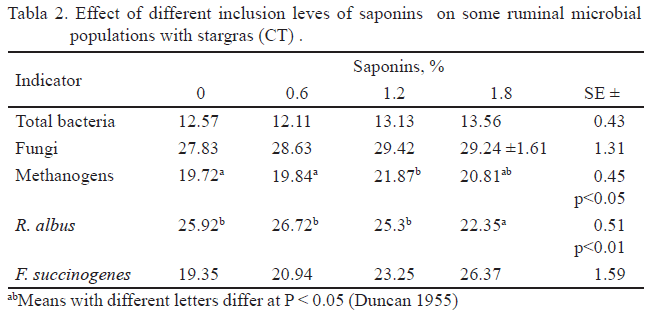
<p align="justify" class="Cuerpodetexto" style="text-indent:0in;"><span style="font-family:'Verdana','sans-serif'; font-size:10.0pt; ">These results do not coincide with the reports of previous  research studies in which saponins are indicated to reduce methane production  at rumen level (Wang <em>et al.</em> 2006 and 2009). This is related to lower  rumen protozoa population (</span><span style="letter-spacing:-.35pt; font-family:'Verdana','sans-serif'; font-size:10.0pt; ">Klita <em>et al.</em> 1996, Lila <em>et al.</em> 2003, 2005, Hess <em>et al.</em> 2004 and  Wallace    2004</span><span style="font-family:'Verdana','sans-serif'; font-size:10.0pt; ">).</span></p>     <p align="justify" class="Cuerpodetexto" style="text-indent:0in;"><span style="font-family:'Verdana','sans-serif'; font-size:10.0pt; ">In  research studies conducted by Gonz&aacute;lez <em>et al.</em> (2007) the supplementation  with 25 % <em>S. saponaria</em> to a <em>P. purpureum</em> cv. Cuba CT-115, found  reductions in ruminal methane production. They attributed this fact to the high  concentrations of saponins of <em>S.    saponaria.</em></span></p>     <p align="justify" class="Cuerpodetexto" style="text-indent:0in;"><span style="font-family:'Verdana','sans-serif'; font-size:10.0pt; ">Investigations of Rodr&iacute;guez and Fondevilla (2012) who  supplemented with <em>Enterolobium cyclocarpum</em> and raw saponin extracts  demonstrated that these reduce methane production by direct effect on the  protozoa population.&nbsp; Anyway, the  complexity of these processes at the rumen led to the continuity of studies  directed toward the assessment of saponin inclusion levels different to those  used in this experiment, as well as different nitrogen/energy relationships in  the diets.</span><span style="font-family:'Verdana','sans-serif'; font-size:10.0pt; "> </span></p>     <p align="justify" class="Cuerpodetexto" style="text-indent:0in;"><span style="font-family:'Verdana','sans-serif'; font-size:10.0pt; ">The use of the technique PCR-RT for monitoring two rumen  species of cellulolytic bacteria, <em>F. succinogenes</em> and <em>R. albus</em> and the population of cellulolytic and methanogen fungi was previously  described by Denman and McSweeney (2005, 2006). Since then, Gonz&aacute;lez <em>et al.</em> (2006) and Gonz&aacute;lez <em>et al. </em>(2010) used it in Cuba.</span><span style="font-family:'Verdana','sans-serif'; font-size:10.0pt; "> </span></p>     <p align="justify" class="Cuerpodetexto" style="text-indent:0in;"><span style="font-family:'Verdana','sans-serif'; font-size:10.0pt; ">In this experiment, the identification and quantification  by PCR-RT of the total bacteria and microorganism populations involved in fiber  degradation in the rumen (<em>F. succinogenes</em>, <em>R. albus</em> and fungi)  and of the total methanogen populations (<a href="/img/revistas/cjas/v50n1/t0210116.gif">table 2</a>) showed that saponins did not  have effects on the populations of total bacteria, fungi and the cellulolytic  bacteria <em>F. succinogenes</em>.</span></p>     
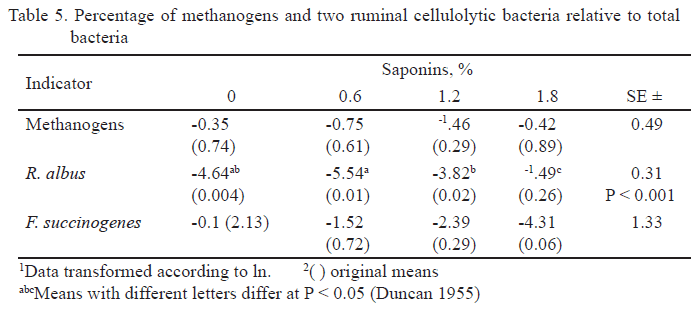
<p align="justify" class="Cuerpodetexto" style="text-indent:0in;"><span style="font-family:'Verdana','sans-serif'; font-size:10.0pt; ">There  are study reports, developed by different groups of researchers, referring that  saponins have antimicrobial activity against Gram+ bacteria, in relation to  Gram- (Patra and Saxena 2009).Wallace (2004) reported that saponins inhibit the  growth of <em>Butyrivibrio fibrisolvens</em> and<em> Streptococcus bovis</em>.  Patra and Yu (2013) observed that the addition of low doses of saponins,  combined with nitrate, increase the population of <em>F.&nbsp; succinogenes</em>, while using high doses, the  population is reduced. Zhou <em>et al</em>. (2011), when evaluating saponins  extracted from tea (Camellia sinensis), confirmed a decrease of <em>Ruminococcus  flavefaciens </em>and<em> Fibrobacter succinogenes</em>, and an increase of&nbsp; <em>B.&nbsp;  fibrisolvens</em>, without any effect on <em>Ruminococcus albus</em>.<span style="letter-spacing:.1pt; "> </span></span></p>     <p align="justify" class="Cuerpodetexto" style="text-indent:0in;"><span style="font-family:'Verdana','sans-serif'; font-size:10.0pt; ">The  0.6 % level of saponin extract did not modify methanogen population regarding  the control without this biomolecule. When 1.2 % of saponins were included  there was an increase in the methanogen population. With 1.8 % this microbial  group of the rumen attained intermediate population values. <em>R. albus</em> decreased its population in the rumen when    1.8 % saponins was&nbsp; incorporated in the  star grass&nbsp; diet. </span></p>     <p align="justify" class="Cuerpodetexto" style="text-indent:0in;"><span style="font-family:'Verdana','sans-serif'; font-size:10.0pt; ">The representation percentage of methanogens, <em>R. albus</em> and <em>F. succinogenes</em>, regarding the total bacteria population is shown in  <a href="/img/revistas/cjas/v50n1/t0310116.gif">table 3</a>. As can be observed, there was no effect of the saponins on the  methanogens and <em>F. succinogenes</em>. However, there were interesting  modifications in the <em>R. albus</em> population. With 0.6 % there was an  increase of its representation although not differing from the treatment  without saponins. The    1.2 % level produced a decrease regarding the    0.6 % level but no significant differences regarding the treatment without  saponins.&nbsp; With the inclusion of 1.8 %  saponins this cellulolytic rumen bacteria species reduced its representation.</span></p>     
<p align="justify" class="Cuerpodetexto" style="text-indent:0in;"><span style="font-family:'Verdana','sans-serif'; font-size:10.0pt; ">Values  of delta CT (<a href="/img/revistas/cjas/v50n1/t0410116.gif">table 4</a>) and the expression related to the control of microbial  populations of the rumen identified and quantified through molecular tools  (<a href="/img/revistas/cjas/v50n1/t0510116.gif">table 5</a>) indicated that all treatments including saponins showed the same  difference and expression relative to the control treatment for the microbial  populations of methanogens and <em>F. succinogenes</em>. On the contrary there  were effects that decreased the <em>R. albus</em> population diminishing in the  same magnitude as increasing levels of saponins were included in the diet.</span></p>     
]]></body>
<body><![CDATA[<p align="justify"><span style="letter-spacing:.2pt; font-family:'Verdana','sans-serif'; font-size:10.0pt; ">It is  concluded that the raw saponin extract modulate the fermentative process by  reducing protozoa.&nbsp; It does not modify  the presence of <em>F. succinogenes</em>, decreases <em>R. albus</em>, probably due  to the fact that both bacteria use the same resource, space and carbon source  in the rumen. The quantity of methanogens was higher with 1.2 and 1.8 %  coinciding with higher methane production</span><font size="2" face="Verdana, Arial, Helvetica, sans-serif">.</font></p>      <p align="justify">&nbsp;</p>      <p align="justify"><font size="2" face="Verdana, Arial, Helvetica, sans-serif"><font size="3"><b>REFERENCES</b></font></font></p>     <p align="justify" class="MsoBibliography" style="text-align:justify;"><span style="font-family:'Verdana','sans-serif'; font-size:10.0pt; ">Abreu, A.,  Fornaguera, J. E. C., Kreuzer, M., Lascano, C. E., Di&aacute;z, T. E., Cano, A. &amp;  Hess, H.-D. 2003. &ldquo;Efecto del fruto, del pericarpio y del extracto  semipurificado de saponinas de <em>Sapindus saponaria</em> sobre la fermentaci&oacute;n  ruminal y la metanog&eacute;nesis <em>in vitro</em> en un sistema RUSITEC&rdquo;. <em>Revista  Colombiana de Ciencias Pecuarias</em>, 16 (2): 147&ndash;154, ISSN: 0120-0690.</span></p>     <p align="justify" class="MsoBibliography" style="text-align:justify;"><span style="font-family:'Verdana','sans-serif'; font-size:10.0pt; ">Bueno, I. C. S.,  Cabral Filho, S. L. S., Gobbo, S. P., Louvandini, H., Vitti, D. M. S. S. &amp;  Abdalla, A. L. 2005. </span><span style="font-family:'Verdana','sans-serif'; font-size:10.0pt; ">&ldquo;Influence  of inoculum source in a gas production method&rdquo;. <em>Animal Feed Science and  Technology</em>, 123&ndash;124: 95&ndash;105, ISSN: 0377-8401, DOI:  10.1016/j.anifeedsci.2005.05.003.</span></p>     <p align="justify" class="MsoBibliography" style="text-align:justify;"><span style="font-family:'Verdana','sans-serif'; font-size:10.0pt; ">Coleman, G. S.  1980. &ldquo;Rumen ciliate protozoa&rdquo;. </span><span style="font-family:'Verdana','sans-serif'; font-size:10.0pt; ">In:  Lumsden W. H. R., Muller R. &amp; Bakes J. R. (eds.), <em>Advances in  parasitology</em>, vol. 18, London: Academic Press Inc. (London) Ltd., pp.  121&ndash;173, ISBN: 978-0-12-031718-9, Available:  &lt;<a href="http://www.cabdirect.org/abstracts/19812902063.html" target="_blank">http://www.cabdirect.org/abstracts/19812902063.html</a>&gt;,  [Consulted:&nbsp;February 21, 2016].</span></p>     <p align="justify" class="MsoBibliography" style="text-align:justify;"><span style="font-family:'Verdana','sans-serif'; font-size:10.0pt; ">Cunningham, J. G. 2009. <em>Fisiolog&iacute;a veterinaria</em>.  4th ed., Barcelona: Elsevier, 720 p., ISBN: 978-84-8086-391-9, Available:  &lt;<a href="https://www.amazon.es/Fisiolog%C3%ADa-veterinaria-incluye-evolve-Cunningham/dp/8480863919" target="_blank">https://www.amazon.es/Fisiolog%C3%ADa-veterinaria-incluye-evolve-Cunningham/dp/8480863919</a>&gt;,  [Consulted:&nbsp;May 3, 2016].</span></p>     <p align="justify" class="MsoBibliography" style="text-align:justify;"><span style="font-family:'Verdana','sans-serif'; font-size:10.0pt; ">Delgado, D. C.,  Galindo, J., Gonz&aacute;lez, R., Gonz&aacute;lez, N., Scull, I., Dihigo, L., Cairo, J.,  Aldama, A. I. &amp; Moreira, O. 2011. </span><span style="font-family:'Verdana','sans-serif'; font-size:10.0pt; ">&ldquo;Feeding of tropical trees and shrub foliages as a strategy to reduce  ruminal methanogenesis: studies conducted in Cuba&rdquo;. <em>Tropical Animal Health  and Production</em>, 44 (5): 1097&ndash;1104, ISSN: 0049-4747, 1573-7438, DOI:  10.1007/s11250-011-0045-5.</span></p>     <p align="justify" class="MsoBibliography" style="text-align:justify;"><span style="font-family:'Verdana','sans-serif'; font-size:10.0pt; ">Denman, S. E. &amp; McSweeney, C. S. 2005.  &ldquo;Quantitative (real-time) PCR&rdquo;. In: Makkar H. P. S. &amp; McSweeney C. S.  (eds.), <em>Methods in Gut Microbial Ecology for Ruminants</em>,  Berlin/Heidelberg: Springer-Verlag, ISBN: 978-1-4020-3790-0, Available:  &lt;<a href="http://link.springer.com/10.1007/1-4020-3791-0" target="_blank">http://link.springer.com/10.1007/1-4020-3791-0</a>&gt;,  [Consulted:&nbsp;February 21, 2016].</span></p>     <p align="justify" class="MsoBibliography" style="text-align:justify;"><span style="font-family:'Verdana','sans-serif'; font-size:10.0pt; ">Denman, S. E. &amp; McSweeney, C. S. 2006.  &ldquo;Development of a real</span><span style="font-family:'Cambria Math','serif'; font-size:10.0pt; ">&#8208;</span><span style="font-family:'Verdana','sans-serif'; font-size:10.0pt; ">time  PCR assay for monitoring anaerobic fungal and cellulolytic bacterial  populations within the rumen&rdquo;. <em>FEMS Microbiology Ecology</em>, 58 (3):  572&ndash;582, ISSN: 1574-6941, DOI: 10.1111/j.1574-6941.2006.00190.x.</span></p>     ]]></body>
<body><![CDATA[<p align="justify" class="MsoBibliography" style="text-align:justify;"><span style="font-family:'Verdana','sans-serif'; font-size:10.0pt; ">D&iacute;az, A., Avenda&ntilde;o, M. A. &amp; Escobar, A. 1993. &ldquo;Evaluation  of <em>Sapindus saponaria</em> as a defaunating agent and its effects on  different ruminal digestion parameters&rdquo;. <em>Livestock Research for Rural  Development</em>, 5 (2): 1&ndash;6, ISSN: 0121-3784.</span></p>     <p align="justify" class="MsoBibliography" style="text-align:justify;"><span style="font-family:'Verdana','sans-serif'; font-size:10.0pt; ">Di Rienzo, J. A., Casanoves, F., Balzarini, M. G.,  Gonz&aacute;lez, L., Tablada, M. &amp; Robledo, C. W. 2001. </span><em><span style="font-family:'Verdana','sans-serif'; font-size:10.0pt; ">InfoStat</span></em><span style="font-family:'Verdana','sans-serif'; font-size:10.0pt; ">.  version 2001, [Windows], Universidad Nacional de C&oacute;rdoba, Argentina: Grupo  InfoStat, Available: &lt;<a href="http://www.infostat.com.ar/" target="_blank">http://www.infostat.com.ar/</a>&gt;.</span></p>     <p align="justify" class="MsoBibliography" style="text-align:justify;"><span style="font-family:'Verdana','sans-serif'; font-size:10.0pt; ">Duncan, D. B. 1955. &ldquo;Multiple Range and Multiple F  Tests&rdquo;. <em>Biometrics</em>, 11 (1): 1&ndash;42, ISSN: 0006-341X, DOI: 10.2307/3001478.</span></p>     <p align="justify" class="MsoBibliography" style="text-align:justify;"><span style="font-family:'Verdana','sans-serif'; font-size:10.0pt; ">Francis, G., Kerem, Z., Makkar, H. P. S. &amp; Becker,  K. 2002. &ldquo;The biological action of saponins in animal systems: a review&rdquo;. <em>British  Journal of Nutrition</em>, 88 (06): 587&ndash;605, ISSN: 1475-2662, DOI:  10.1079/BJN2002725.</span></p>     <p align="justify" class="MsoBibliography" style="text-align:justify;"><span style="font-family:'Verdana','sans-serif'; font-size:10.0pt; ">Galindo, J., Aldama, A. I., Marrero, Y. &amp;  Gonz&aacute;lez, N. 2000. </span><span style="font-family:'Verdana','sans-serif'; font-size:10.0pt; ">&ldquo;Efecto de <em>Sapindus saponaria</em> en los  g&eacute;neros de protozoos y poblaciones de bacterias ruminales&rdquo;. <em>Cuban Journal of  Agricultural Science</em>, 34: 353&ndash;358, ISSN: 2079-3480.</span></p>     <p align="justify" class="MsoBibliography" style="text-align:justify;"><span style="font-family:'Verdana','sans-serif'; font-size:10.0pt; ">Galindo, J.,  Gonz&aacute;lez, N., Marrero, Y., Sosa, A., Ruiz, T., Febles, G., Torres, V., Aldana,  A. I., Achang, G., Moreira, O., Sarduy, L. &amp; Noda, A. C. 2014. </span><span style="font-family:'Verdana','sans-serif'; font-size:10.0pt; ">&ldquo;Effect of tropical plant foliage on the control of  methane production and <em>in vitro</em> ruminal protozoa population&rdquo;. <em>Cuban  Journal of Agricultural Science</em>, 48 (4): 359&ndash;364, ISSN: 2079-3480.</span></p>     <p align="justify" class="MsoBibliography" style="text-align:justify;"><span style="font-family:'Verdana','sans-serif'; font-size:10.0pt; ">Garc&iacute;a, D. E., Medina, M. G., Cova, L. J., Torres, A.,  Soca, M., Pizzani, P., Baldiz&aacute;n, A. &amp; Dom&iacute;nguez, C. E. 2008. </span><span style="font-family:'Verdana','sans-serif'; font-size:10.0pt; ">&ldquo;Preferencia  de vacunos por el follaje de doce especies con potencial para sistemas agrosilvopastoriles  en el Estado Trujillo, Venezuela&rdquo;. <em>Pastos y Forrajes</em>, 31 (3): 1&ndash;1, ISSN:  0864-0394.</span></p>     <p align="justify" class="MsoBibliography" style="text-align:justify;"><span style="font-family:'Verdana','sans-serif'; font-size:10.0pt; ">Gonz&aacute;lez, N.,  Galindo, J., Aldana, A. I., Moreira, O., Abdalla, L. A. &amp; Santos, M. R.  2010. &ldquo;Evaluaci&oacute;n de diferentes variedades de Morera (<em>Morus alba</em>) en el  control de la metanog&eacute;nesis ruminal en b&uacute;falos de r&iacute;o <em>in vitro</em>&rdquo;. <em>Cuban  Journal of Agricultural Science</em>, 44 (1): 37&ndash;41, ISSN: 2079-3480.</span></p>     <p align="justify" class="MsoBibliography" style="text-align:justify;"><span style="font-family:'Verdana','sans-serif'; font-size:10.0pt; ">Gonz&aacute;lez, N.,  Galindo, J., Gonz&aacute;lez, R., Sosa, A., Moreira, O., Delgado, D., Mart&iacute;n, E. &amp;  Sanabria, C. 2006. &ldquo;Utilizaci&oacute;n de la t&eacute;cnica de PCR en tiempo real y de la  producci&oacute;n de gas in vitro para determinar el efecto del &aacute;cido bromoetano  sulf&oacute;nico en la metanog&eacute;nesis y la poblaci&oacute;n microbiana ruminal&rdquo;. <em>Cuban  Journal of Agricultural Science</em>, 40 (2): 183&ndash;189, ISSN: 2079-3480.</span></p>     <p align="justify" class="MsoBibliography" style="text-align:justify;"><span style="font-family:'Verdana','sans-serif'; font-size:10.0pt; ">Gonz&aacute;lez, R.,  Delgado, D. &amp; Cairo, J. 2007. &ldquo;Efecto de la inclusi&oacute;n de <em>Sapindus  saponaria</em> en la producci&oacute;n de gas y metano en la fermentaci&oacute;n <em>in vitro</em> de <em>Pennisetun purpureum</em> cv Cuba CT-115&rdquo;. </span><em><span style="font-family:'Verdana','sans-serif'; font-size:10.0pt; ">Cuban Journal of Agricultural Science</span></em><span style="font-family:'Verdana','sans-serif'; font-size:10.0pt; ">, 41 (1): 39&ndash;41, ISSN: 2079-3480.</span></p>     ]]></body>
<body><![CDATA[<p align="justify" class="MsoBibliography" style="text-align:justify;"><span style="font-family:'Verdana','sans-serif'; font-size:10.0pt; ">Guo, Y. Q., Liu, J. X., Lu, Y., Zhu, W. Y., Denman, S.  E. &amp; McSweeney, C. S. 2008. &ldquo;Effect of tea saponin on methanogenesis,  microbial community structure and expression of mcrA gene, in cultures of rumen  micro-organisms&rdquo;. <em>Letters in Applied Microbiology</em>, 47 (5): 421&ndash;426,  ISSN: 1472-765X, DOI: 10.1111/j.1472-765X.2008.02459.x.</span></p>     <p align="justify" class="MsoBibliography" style="text-align:justify;"><span style="font-family:'Verdana','sans-serif'; font-size:10.0pt; ">Hansen, I., Brimer, L. &amp; M&oslash;lgaard, P. 2003.  &ldquo;Herbivore-deterring secondary compounds in heterophyllous woody species of the  Mascarene Islands&rdquo;. <em>Perspectives in Plant Ecology, Evolution and Systematics</em>,  6 (3): 187&ndash;203, ISSN: 1433-8319, DOI: 10.1078/1433-8319-00077.</span></p>     <p align="justify" class="MsoBibliography" style="text-align:justify;"><span style="font-family:'Verdana','sans-serif'; font-size:10.0pt; ">Hart, K. J., Y&aacute;&ntilde;ez-Ruiz, D. R., Duval, S. M., McEwan,  N. R. &amp; Newbold, C. J. 2008. &ldquo;Plant extracts to manipulate rumen  fermentation&rdquo;. <em>Animal Feed Science and Technology</em>, 147 (1&ndash;3): 8&ndash;35,  ISSN: 0377-8401, DOI: 10.1016/j.anifeedsci.2007.09.007.</span></p>     <p align="justify" class="MsoBibliography" style="text-align:justify;"><span style="font-family:'Verdana','sans-serif'; font-size:10.0pt; ">Hess, H. D., Beuret, R. A., Lotscher, M., Hindrichsen,  I. K., Machmuller, A., Carulla, J. E., Lascano, C. E. &amp; Kreuzer, M. 2004.  &ldquo;Ruminal fermentation, methanogenesis and nitrogen utilization of sheep  receiving tropical grass hay-concentrate diets offered with Sapindus saponaria  fruits and Cratylia argentea foliage&rdquo;. <em>Journal of Animal Science</em>, 79  (1): 177&ndash;189, ISSN: 0021-8812, 1525-3163.</span></p>     <p align="justify" class="MsoBibliography" style="text-align:justify;"><span style="font-family:'Verdana','sans-serif'; font-size:10.0pt; ">Hess, H. D., Kreuzer, M., D&#305;&#769;az, T. E., Lascano, C.  E., Carulla, J. E., Soliva, C. R. &amp; Machm&uuml;ller, A. 2003. &ldquo;Saponin rich  tropical fruits affect fermentation and methanogenesis in faunated and  defaunated rumen fluid&rdquo;. <em>Animal Feed Science and Technology</em>, 109 (1&ndash;4):  79&ndash;94, ISSN: 0377-8401, DOI: 10.1016/S0377-8401(03)00212-8.</span></p>     <p align="justify" class="MsoBibliography" style="text-align:justify;"><span style="font-family:'Verdana','sans-serif'; font-size:10.0pt; ">Klita, P. T., Mathison, G. W., Fenton, T. W. &amp;  Hardin, R. T. 1996. &ldquo;Effects of alfalfa root saponins on digestive function in  sheep&rdquo;. </span><em><span style="font-family:'Verdana','sans-serif'; font-size:10.0pt; ">Journal of Animal Science</span></em><span style="font-family:'Verdana','sans-serif'; font-size:10.0pt; ">,  74 (5): 1144&ndash;1156, ISSN: 0021-8812, DOI: /1996.7451144x.</span></p>     <p align="justify" class="MsoBibliography" style="text-align:justify;"><span style="font-family:'Verdana','sans-serif'; font-size:10.0pt; ">La O, O., Garc&iacute;a,  R., Ruiz, O., Castillo, Y., Muro, A., Rodr&iacute;guez, C., Arzola, C., Gonz&aacute;lez, H.  &amp; Ortiz, B. 2008. </span><span style="font-family:'Verdana','sans-serif'; font-size:10.0pt; ">&ldquo;<em>In  vitro</em> ruminal fermentative potential of two trees (<em>Pithecellobium dulce</em> and <em>Tamarindos indica</em>) of importance for livestock rearing in fragile,  saline ecosystems with high drought, located in the eastern part of Cuba&rdquo;. <em>Cuban  Journal of Agricultural Science</em>, 42 (1): 57&ndash;59, ISSN: 2079-3480.</span></p>     <p align="justify" class="MsoBibliography" style="text-align:justify;"><span style="font-family:'Verdana','sans-serif'; font-size:10.0pt; ">Latimer, G. W. 2012. <em>Official Methods of Analysis  of AOAC International</em>. 19th ed., Gaithersburg, Md.: AOAC International,  ISBN: 978-0-935584-83-7, Available: &lt;<a href="http://www.amazon.com/Official-Methods-Analysis-OFFICIAL-ANALYSIS/dp/0935584838/ref=pd_sim_sbs_14_1?ie=UTF8&dpID=31iikC-xl2L&dpSrc=sims&preST=_AC_UL160_SR160%2C160_&refRID=101AB94246X0EM9N7XMW" target="_blank">http://www.amazon.com/Official-Methods-Analysis-OFFICIAL-ANALYSIS/dp/0935584838/ref=pd_sim_sbs_14_1?ie=UTF8&amp;dpID=31iikC-xl2L&amp;dpSrc=sims&amp;preST=_AC_UL160_SR160%2C160_&amp;refRID=101AB94246X0EM9N7XMW</a>&gt;,  [Consulted:&nbsp;April 1, 2016].</span></p>     <p align="justify" class="MsoBibliography" style="text-align:justify;"><span style="font-family:'Verdana','sans-serif'; font-size:10.0pt; ">Leng, R. A. 2014. &ldquo;Interactions between microbial  consortia in biofilms: a paradigm shift in rumen microbial ecology and enteric  methane mitigation&rdquo;. <em>Animal Production Science</em>, 54 (5): 519&ndash;543, ISSN:  1836-0939, DOI: <a href="http://dx.doi.org/10.1071/AN13381" target="_blank">http://dx.doi.org/10.1071/AN13381</a>.</span></p>     <p align="justify" class="MsoBibliography" style="text-align:justify;"><span style="font-family:'Verdana','sans-serif'; font-size:10.0pt; ">Levene, H. 1960. &ldquo;Robust tests for the equality of  variance&rdquo;. In: Olkin I., <em>Contributions to Probability and Statistics: Essays  in Honor of Harold Hotelling</em>, Stanford University Press, pp. 278&ndash;292, ISBN:  978-0-8047-0596-7, Available:  &lt;<a href="https://books.google.com.cu/books?hl=es&lr=&id=ZUSsAAAAIAAJ&oi=fnd&pg=PA3&dq=Contributions+to+Probability+and+Statistics&ots=GchNfCzOVQ&sig=-W3BeBmuWhTzgRCkktOdQjq0Di4&redir_esc=y#v=onepage&q=Contributions%20to%20Probability%20and%20Statistics&f=false" target="_blank">https://books.google.com.cu/books?hl=es&amp;lr=&amp;id=ZUSsAAAAIAAJ&amp;oi=fnd&amp;pg=PA3&amp;dq=Contributions+to+Probability+and+Statistics&amp;ots=GchNfCzOVQ&amp;sig=-W3BeBmuWhTzgRCkktOdQjq0Di4&amp;redir_esc=y#v=onepage&amp;q=Contributions%20to%20Probability%20and%20Statistics&amp;f=false</a>&gt;,  [Consulted:&nbsp;April 19, 2016].</span></p>     ]]></body>
<body><![CDATA[<p align="justify" class="MsoBibliography" style="text-align:justify;"><span style="font-family:'Verdana','sans-serif'; font-size:10.0pt; ">Lila, Z. A.,  Mohammed, N., Kanda, S., Kamada, T. &amp; Itabashi, H. 2003. </span><span style="font-family:'Verdana','sans-serif'; font-size:10.0pt; ">&ldquo;Effect of Sarsaponin on Ruminal Fermentation with  Particular Reference to Methane Production <em>in vitro</em>&rdquo;. <em>Journal of  Dairy Science</em>, 86 (10): 3330&ndash;3336, ISSN: 0022-0302, DOI:  10.3168/jds.S0022-0302(03)73935-6.</span></p>     <p align="justify" class="MsoBibliography" style="text-align:justify;"><span style="font-family:'Verdana','sans-serif'; font-size:10.0pt; ">Lila, Z. A., Mohammed, N., Kanda, S., Kurihara, M.  &amp; Itabashi, H. 2005. &ldquo;Sarsaponin effects on ruminal fermentation and  microbes, methane production, digestibility and blood metabolites in steers&rdquo;. <em>Asian  Australasian Journal of Animal Sciences</em>, 18 (12): 1746, ISSN: 1011-2367.</span></p>     <p align="justify" class="MsoBibliography" style="text-align:justify;"><span style="font-family:'Verdana','sans-serif'; font-size:10.0pt; ">Longo, C. 2006. &ldquo;Methane production from tannin rich  plants incubated <em>in vitro</em>&rdquo;. In: <em>British Society of Animal Science  Meeting</em>, York: British Society of Animal Science.</span></p>     <p align="justify" class="MsoBibliography" style="text-align:justify;"><span style="font-family:'Verdana','sans-serif'; font-size:10.0pt; ">Makkar, H. P. S. 2005. &ldquo;<em>In vitro</em> gas methods  for evaluation of feeds containing phytochemicals&rdquo;. <em>Animal Feed Science and  Technology</em>, 123: 291&ndash;302, ISSN: 0377-8401, DOI:  10.1016/j.anifeedsci.2005.06.003.</span></p>     <!-- ref --><p align="justify" class="MsoBibliography" style="text-align:justify;"><span style="font-family:'Verdana','sans-serif'; font-size:10.0pt; ">Makkar H. P. S. &amp; McSweeney C. S. (eds.). 2005. <em>Methods  in Gut Microbial Ecology for Ruminants</em>. Berlin/Heidelberg: Springer-Verlag,  225 p., ISBN: 978-1-4020-3790-0, Available:  &lt;<a href="http://link.springer.com/10.1007/1-4020-3791-0" target="_blank">http://link.springer.com/10.1007/1-4020-3791-0</a>&gt;, [Consulted:&nbsp;April  19, 2016].    </span></p>     <p align="justify" class="MsoBibliography" style="text-align:justify;"><span style="font-family:'Verdana','sans-serif'; font-size:10.0pt; ">Menke, K. H. &amp; Steingass, H. 1988. &ldquo;Estimation of  the energetic feed value obtained from chemical analysis and <em>in vitro</em> gas production using rumen fluid&rdquo;. <em>Animal Research and Development</em>, 28  (1): 7&ndash;55, ISSN: 0340-3165.</span></p>     <p align="justify" class="MsoBibliography" style="text-align:justify;"><span style="font-family:'Verdana','sans-serif'; font-size:10.0pt; ">Newbold, C. J., el Hassan, S. M., Wang, J., Ortega, M.  E. &amp; Wallace, R. J. 1997. &ldquo;Influence of foliage from African multipurpose  trees on activity of rumen protozoa and bacteria&rdquo;. <em>The British Journal of  Nutrition</em>, 78 (2): 237&ndash;249, ISSN: 0007-1145, PMID: 9301414.</span></p>     <p align="justify" class="MsoBibliography" style="text-align:justify;"><span style="font-family:'Verdana','sans-serif'; font-size:10.0pt; ">Patra, A. K. &amp; Saxena, J. 2009. &ldquo;The effect and  mode of action of saponins on the microbial populations and fermentation in the  rumen and ruminant production&rdquo;. <em>Nutrition Research Reviews</em>, 22 (02):  204&ndash;219, ISSN: 1475-2700, DOI: 10.1017/S0954422409990163.</span></p>     <p align="justify" class="MsoBibliography" style="text-align:justify;"><span style="font-family:'Verdana','sans-serif'; font-size:10.0pt; ">Patra, A. K. &amp; Yu, Z. 2013. &ldquo;Effective reduction  of enteric methane production by a combination of nitrate and saponin without  adverse effect on feed degradability, fermentation, or bacterial and archaeal  communities of the rumen&rdquo;. </span><em><span style="font-family:'Verdana','sans-serif'; font-size:10.0pt; ">Bioresource Technology</span></em><span style="font-family:'Verdana','sans-serif'; font-size:10.0pt; ">,  148: 352&ndash;360, ISSN: 0960-8524, DOI: 10.1016/j.biortech.2013.08.140.</span></p>     ]]></body>
<body><![CDATA[<!-- ref --><p align="justify" class="MsoBibliography" style="text-align:justify;"><span style="font-family:'Verdana','sans-serif'; font-size:10.0pt; ">Pedraza, R. 2000. <em>Contribuci&oacute;n  al estudio del valor nutritivo de Gliricidia sepium en la alimentaci&oacute;n de  rumiantes</em>. Ph.D. Thesis, Instituto de Ciencia Animal, La Habana, Cuba.    </span></p>     <p align="justify" class="MsoBibliography" style="text-align:justify;"><span style="font-family:'Verdana','sans-serif'; font-size:10.0pt; ">Rodr&iacute;guez, R. &amp; Fondevila, M. 2012. &ldquo;Effect of  saponins from <em>Enterolobium cyclocarpum</em> on <em>in vitro</em> microbial  fermentation of the tropical grass <em>Pennisetum purpureum</em>&rdquo;. <em>Journal of  Animal Physiology and Animal Nutrition</em>, 96 (5): 762&ndash;769, ISSN: 1439-0396,  DOI: 10.1111/j.1439-0396.2011.01161.x.</span></p>     <p align="justify" class="MsoBibliography" style="text-align:justify;"><span style="font-family:'Verdana','sans-serif'; font-size:10.0pt; ">Santoso, B.,  Kilmaskossu, A. &amp; Sambodo, P. 2007. </span><span style="font-family:'Verdana','sans-serif'; font-size:10.0pt; ">&ldquo;Effects of saponin from <em>Biophytum petersianum</em> Klotzsch on ruminal fermentation, microbial protein synthesis and nitrogen  utilization in goats&rdquo;. <em>Animal Feed Science and Technology</em>, 137 (1&ndash;2):  58&ndash;68, ISSN: 0377-8401, DOI: 10.1016/j.anifeedsci.2006.10.005.</span></p>     <p align="justify" class="MsoBibliography" style="text-align:justify;"><span style="font-family:'Verdana','sans-serif'; font-size:10.0pt; ">Shapiro, S. S. &amp; Wilk, M. B. 1965. &ldquo;An analysis of  variance test for normality (complete samples)&rdquo;. <em>Biometrika</em>, 52 (3-4):  591&ndash;611, ISSN: 0006-3444, 1464-3510, DOI: 10.1093/biomet/52.3-4.591.</span></p>     <p align="justify" class="MsoBibliography" style="text-align:justify;"><span style="font-family:'Verdana','sans-serif'; font-size:10.0pt; ">Theodorou, M. K., Williams, B. A., Dhanoa, M. S.,  McAllan, A. B. &amp; France, J. 1994. &ldquo;A simple gas production method using a  pressure transducer to determine the fermentation kinetics of ruminant feeds&rdquo;. <em>Animal  Feed Science and Technology</em>, 48 (3&ndash;4): 185&ndash;197, ISSN: 0377-8401, DOI:  10.1016/0377-8401(94)90171-6.</span></p>     <p align="justify" class="MsoBibliography" style="text-align:justify;"><span style="font-family:'Verdana','sans-serif'; font-size:10.0pt; ">Van Soest, P. J., Robertson, J. B. &amp; Lewis, B. A.  1991. &ldquo;Methods for Dietary Fiber, Neutral Detergent Fiber, and Nonstarch Polysaccharides  in Relation to Animal Nutrition&rdquo;. <em>Journal of Dairy Science</em>, 74 (10):  3583&ndash;3597, ISSN: 0022-0302, DOI: 10.3168/jds.S0022-0302(91)78551-2.</span></p>     <p align="justify" class="MsoBibliography" style="text-align:justify;"><span style="font-family:'Verdana','sans-serif'; font-size:10.0pt; ">Wallace, R. J. 2004. &ldquo;Antimicrobial properties of  plant secondary metabolites&rdquo;. <em>Proceedings of the Nutrition Society</em>, 63  (04): 621&ndash;629, ISSN: 1475-2719, DOI: 10.1079/PNS2004393.</span></p>     <p align="justify" class="MsoBibliography" style="text-align:justify;"><span style="font-family:'Verdana','sans-serif'; font-size:10.0pt; ">Wang, C. J., Wang, S. P. &amp; Zhou, H. 2009.  &ldquo;Influences of flavomycin, ropadiar, and saponin on nutrient digestibility,  rumen fermentation, and methane emission from sheep&rdquo;. <em>Animal Feed Science  and Technology</em>, 148 (2&ndash;4): 157&ndash;166, ISSN: 0377-8401, DOI:  10.1016/j.anifeedsci.2008.03.008.</span></p>     <p align="justify" class="MsoBibliography" style="text-align:justify;"><span style="font-family:'Verdana','sans-serif'; font-size:10.0pt; ">Wang, C., Wang, S., Zhou, H. &amp; Glindemann, T.  2006. &ldquo;Effects of forage composition and growing season on methane emission  from sheep in the Inner Mongolia steppe of China&rdquo;. <em>Ecological Research</em>,  22 (1): 41&ndash;48, ISSN: 0912-3814, 1440-1703, DOI: 10.1007/s11284-006-0191-9.</span></p>     ]]></body>
<body><![CDATA[<p align="justify" class="MsoBibliography" style="text-align:justify;"><span style="font-family:'Verdana','sans-serif'; font-size:10.0pt; ">Wina, E., Muetzel, S., Hoftman, E., Makkar, H. P. S.  &amp; Becker, K. 2005. &ldquo;Effect of secondary compound in forages on rumen  microorganisms quantified by 16S and 18S rRNA&rdquo;. In: Makkar H. P. S. &amp;  Viljoen G. J. (eds.), <em>Applications of Gene-Based Technologies for Improving  Animal Production and Health in Developing Countries</em>, Dordrecht: Springer  Netherlands, ISBN: 978-1-4020-3311-7, Available: &lt;<a href="http://link.springer.com/10.1007/b105256" target="_blank">http://link.springer.com/10.1007/b105256</a>&gt;,  [Consulted:&nbsp;February 21, 2016].</span></p>     <p align="justify"><span style="font-family:'Verdana','sans-serif'; font-size:10.0pt; ">Zhou, Y. Y., Mao, H. L.,  Jiang, F., Wang, J. K., Liu, J. X. &amp; McSweeney, C. S. 2011. &ldquo;Inhibition of  rumen methanogenesis by tea saponins with reference to fermentation pattern and  microbial communities in Hu sheep&rdquo;. </span><em><span style="font-family:'Verdana','sans-serif'; font-size:10.0pt; ">Animal Feed Science and Technology</span></em><span style="font-family:'Verdana','sans-serif'; font-size:10.0pt; ">, 166&ndash;167: 93&ndash;100, ISSN:  0377-8401, DOI: 10.1016/j.anifeedsci.2011.04.007</span><font size="2" face="Verdana, Arial, Helvetica, sans-serif">.</font> </p>     <p align="justify">&nbsp;</p>     <p align="justify">&nbsp;</p>     <p align="justify"><font size="2" face="Verdana, Arial, Helvetica, sans-serif">Received: December 18, 2014    <br>   Accepted: January 28, 2016</font></p>     <p align="justify">&nbsp;</p>     <p align="justify">&nbsp;</p>     <p align="justify"><font size="2" face="Verdana, Arial, Helvetica, sans-serif"><i>Juana Galindo,</i> Instituto de Ciencia Animal, Apartado Postal 24, Mayabeque, Cuba.    Email: <a href="mailto:jgalindo@ica.co.cu">jgalindo@ica.co.cu</a></font></p>      ]]></body><back>
<ref-list>
<ref id="B1">
<nlm-citation citation-type="book">
<person-group person-group-type="author">
<name>
<surname><![CDATA[Makkar]]></surname>
<given-names><![CDATA[H. P. S.]]></given-names>
</name>
<name>
<surname><![CDATA[McSweeney]]></surname>
<given-names><![CDATA[C. S.]]></given-names>
</name>
</person-group>
<source><![CDATA[Methods in Gut Microbial Ecology for Ruminants]]></source>
<year>2005</year>
<page-range>225</page-range><publisher-loc><![CDATA[Berlin/Heidelberg ]]></publisher-loc>
<publisher-name><![CDATA[Springer-Verlag]]></publisher-name>
</nlm-citation>
</ref>
<ref id="B2">
<nlm-citation citation-type="journal">
<person-group person-group-type="author">
<name>
<surname><![CDATA[Abreu]]></surname>
<given-names><![CDATA[A.]]></given-names>
</name>
<name>
<surname><![CDATA[Fornaguera]]></surname>
<given-names><![CDATA[J. E. C.]]></given-names>
</name>
<name>
<surname><![CDATA[Kreuzer]]></surname>
<given-names><![CDATA[M.]]></given-names>
</name>
<name>
<surname><![CDATA[Lascano]]></surname>
<given-names><![CDATA[C. E.]]></given-names>
</name>
<name>
<surname><![CDATA[Diáz]]></surname>
<given-names><![CDATA[T. E.]]></given-names>
</name>
<name>
<surname><![CDATA[Cano]]></surname>
<given-names><![CDATA[A.]]></given-names>
</name>
<name>
<surname><![CDATA[Hess]]></surname>
<given-names><![CDATA[H.-D.]]></given-names>
</name>
</person-group>
<article-title xml:lang="nd"><![CDATA[Efecto del fruto, del pericarpio y del extracto semipurificado de saponinas de Sapindus saponaria sobre la fermentación ruminal y la metanogénesis in vitro en un sistema RUSITEC]]></article-title>
<source><![CDATA[Revista Colombiana de Ciencias Pecuarias]]></source>
<year>2003</year>
<volume>16</volume>
<numero>2</numero>
<issue>2</issue>
<page-range>147-154</page-range></nlm-citation>
</ref>
<ref id="B3">
<nlm-citation citation-type="journal">
<person-group person-group-type="author">
<name>
<surname><![CDATA[Bueno]]></surname>
<given-names><![CDATA[I. C. S.]]></given-names>
</name>
<name>
<surname><![CDATA[Cabral Filho]]></surname>
<given-names><![CDATA[S. L. S.]]></given-names>
</name>
<name>
<surname><![CDATA[Gobbo]]></surname>
<given-names><![CDATA[S. P.]]></given-names>
</name>
<name>
<surname><![CDATA[Louvandini]]></surname>
<given-names><![CDATA[H.]]></given-names>
</name>
<name>
<surname><![CDATA[Vitti]]></surname>
<given-names><![CDATA[D. M. S. S.]]></given-names>
</name>
<name>
<surname><![CDATA[Abdalla]]></surname>
<given-names><![CDATA[A. L.]]></given-names>
</name>
</person-group>
<article-title xml:lang="nd"><![CDATA[Influence of inoculum source in a gas production method]]></article-title>
<source><![CDATA[Animal Feed Science and Technology]]></source>
<year>2005</year>
<volume>123-124</volume>
<page-range>95-105</page-range></nlm-citation>
</ref>
<ref id="B4">
<nlm-citation citation-type="book">
<person-group person-group-type="author">
<name>
<surname><![CDATA[Coleman]]></surname>
<given-names><![CDATA[G. S.]]></given-names>
</name>
</person-group>
<article-title xml:lang="nd"><![CDATA[Rumen ciliate protozoa]]></article-title>
<person-group person-group-type="editor">
<name>
<surname><![CDATA[Lumsden]]></surname>
<given-names><![CDATA[W. H. R.]]></given-names>
</name>
<name>
<surname><![CDATA[Muller]]></surname>
<given-names><![CDATA[R.]]></given-names>
</name>
<name>
<surname><![CDATA[Bakes]]></surname>
<given-names><![CDATA[J. R.]]></given-names>
</name>
</person-group>
<source><![CDATA[Advances in parasitology]]></source>
<year>1980</year>
<volume>18</volume>
<page-range>121-173</page-range><publisher-loc><![CDATA[London ]]></publisher-loc>
<publisher-name><![CDATA[Academic Press Inc. (London) Ltd.]]></publisher-name>
</nlm-citation>
</ref>
<ref id="B5">
<nlm-citation citation-type="book">
<person-group person-group-type="author">
<name>
<surname><![CDATA[Cunningham]]></surname>
<given-names><![CDATA[J. G.]]></given-names>
</name>
</person-group>
<source><![CDATA[Fisiología veterinaria]]></source>
<year>2009</year>
<edition>4th</edition>
<page-range>720</page-range><publisher-loc><![CDATA[Barcelona ]]></publisher-loc>
<publisher-name><![CDATA[Elsevier]]></publisher-name>
</nlm-citation>
</ref>
<ref id="B6">
<nlm-citation citation-type="journal">
<person-group person-group-type="author">
<name>
<surname><![CDATA[Delgado]]></surname>
<given-names><![CDATA[D. C.]]></given-names>
</name>
<name>
<surname><![CDATA[Galindo]]></surname>
<given-names><![CDATA[J.]]></given-names>
</name>
<name>
<surname><![CDATA[González]]></surname>
<given-names><![CDATA[R.]]></given-names>
</name>
<name>
<surname><![CDATA[González]]></surname>
<given-names><![CDATA[N.]]></given-names>
</name>
<name>
<surname><![CDATA[Scull]]></surname>
<given-names><![CDATA[I.]]></given-names>
</name>
<name>
<surname><![CDATA[Dihigo]]></surname>
<given-names><![CDATA[L.]]></given-names>
</name>
<name>
<surname><![CDATA[Cairo]]></surname>
<given-names><![CDATA[J.]]></given-names>
</name>
<name>
<surname><![CDATA[Aldama]]></surname>
<given-names><![CDATA[A. I.]]></given-names>
</name>
<name>
<surname><![CDATA[Moreira]]></surname>
<given-names><![CDATA[O.]]></given-names>
</name>
</person-group>
<article-title xml:lang="nd"><![CDATA[Feeding of tropical trees and shrub foliages as a strategy to reduce ruminal methanogenesis: studies conducted in Cuba]]></article-title>
<source><![CDATA[Tropical Animal Health and Production]]></source>
<year>2011</year>
<volume>44</volume>
<numero>5</numero>
<issue>5</issue>
<page-range>1097-1104</page-range></nlm-citation>
</ref>
<ref id="B7">
<nlm-citation citation-type="book">
<person-group person-group-type="author">
<name>
<surname><![CDATA[Denman]]></surname>
<given-names><![CDATA[S. E.]]></given-names>
</name>
<name>
<surname><![CDATA[McSweeney]]></surname>
<given-names><![CDATA[C. S.]]></given-names>
</name>
</person-group>
<article-title xml:lang="nd"><![CDATA[Quantitative (real-time) PCR]]></article-title>
<person-group person-group-type="editor">
<name>
<surname><![CDATA[Makkar]]></surname>
<given-names><![CDATA[H. P. S.]]></given-names>
</name>
<name>
<surname><![CDATA[McSweeney]]></surname>
<given-names><![CDATA[C. S.]]></given-names>
</name>
</person-group>
<source><![CDATA[Methods in Gut Microbial Ecology for Ruminants]]></source>
<year>2005</year>
<publisher-loc><![CDATA[Berlin/Heidelberg ]]></publisher-loc>
<publisher-name><![CDATA[Springer-Verlag]]></publisher-name>
</nlm-citation>
</ref>
<ref id="B8">
<nlm-citation citation-type="journal">
<person-group person-group-type="author">
<name>
<surname><![CDATA[Denman]]></surname>
<given-names><![CDATA[S. E.]]></given-names>
</name>
<name>
<surname><![CDATA[McSweeney]]></surname>
<given-names><![CDATA[C. S.]]></given-names>
</name>
</person-group>
<article-title xml:lang="nd"><![CDATA[Development of a real-time PCR assay for monitoring anaerobic fungal and cellulolytic bacterial populations within the rumen]]></article-title>
<source><![CDATA[FEMS Microbiology Ecology]]></source>
<year>2006</year>
<volume>58</volume>
<numero>3</numero>
<issue>3</issue>
<page-range>572-582</page-range></nlm-citation>
</ref>
<ref id="B9">
<nlm-citation citation-type="journal">
<person-group person-group-type="author">
<name>
<surname><![CDATA[Díaz]]></surname>
<given-names><![CDATA[A.]]></given-names>
</name>
<name>
<surname><![CDATA[Avendaño]]></surname>
<given-names><![CDATA[M. A.]]></given-names>
</name>
<name>
<surname><![CDATA[Escobar]]></surname>
<given-names><![CDATA[A.]]></given-names>
</name>
</person-group>
<article-title xml:lang="nd"><![CDATA[Evaluation of Sapindus saponaria as a defaunating agent and its effects on different ruminal digestion parameters]]></article-title>
<source><![CDATA[Livestock Research for Rural Development]]></source>
<year>1993</year>
<volume>5</volume>
<numero>2</numero>
<issue>2</issue>
<page-range>1-6</page-range></nlm-citation>
</ref>
<ref id="B10">
<nlm-citation citation-type="book">
<person-group person-group-type="author">
<name>
<surname><![CDATA[Di Rienzo]]></surname>
<given-names><![CDATA[J. A.]]></given-names>
</name>
<name>
<surname><![CDATA[Casanoves]]></surname>
<given-names><![CDATA[F.]]></given-names>
</name>
<name>
<surname><![CDATA[Balzarini]]></surname>
<given-names><![CDATA[M. G.]]></given-names>
</name>
<name>
<surname><![CDATA[González]]></surname>
<given-names><![CDATA[L.]]></given-names>
</name>
<name>
<surname><![CDATA[Tablada]]></surname>
<given-names><![CDATA[M.]]></given-names>
</name>
<name>
<surname><![CDATA[Robledo]]></surname>
<given-names><![CDATA[C. W.]]></given-names>
</name>
</person-group>
<source><![CDATA[InfoStat]]></source>
<year>2001</year>
<publisher-loc><![CDATA[Universidad Nacional de Córdoba, Argentina ]]></publisher-loc>
<publisher-name><![CDATA[Grupo InfoStat]]></publisher-name>
</nlm-citation>
</ref>
<ref id="B11">
<nlm-citation citation-type="journal">
<person-group person-group-type="author">
<name>
<surname><![CDATA[Duncan]]></surname>
<given-names><![CDATA[D. B.]]></given-names>
</name>
</person-group>
<article-title xml:lang="nd"><![CDATA[Multiple Range and Multiple F Tests]]></article-title>
<source><![CDATA[Biometrics]]></source>
<year>1955</year>
<volume>11</volume>
<numero>1</numero>
<issue>1</issue>
<page-range>1-42</page-range></nlm-citation>
</ref>
<ref id="B12">
<nlm-citation citation-type="journal">
<person-group person-group-type="author">
<name>
<surname><![CDATA[Francis]]></surname>
<given-names><![CDATA[G.]]></given-names>
</name>
<name>
<surname><![CDATA[Kerem]]></surname>
<given-names><![CDATA[Z.]]></given-names>
</name>
<name>
<surname><![CDATA[Makkar]]></surname>
<given-names><![CDATA[H. P. S.]]></given-names>
</name>
<name>
<surname><![CDATA[Becker]]></surname>
<given-names><![CDATA[K.]]></given-names>
</name>
</person-group>
<article-title xml:lang="nd"><![CDATA[The biological action of saponins in animal systems: a review]]></article-title>
<source><![CDATA[British Journal of Nutrition]]></source>
<year>2002</year>
<volume>88</volume>
<numero>06</numero>
<issue>06</issue>
<page-range>587-605</page-range></nlm-citation>
</ref>
<ref id="B13">
<nlm-citation citation-type="journal">
<person-group person-group-type="author">
<name>
<surname><![CDATA[Galindo]]></surname>
<given-names><![CDATA[J.]]></given-names>
</name>
<name>
<surname><![CDATA[Aldama]]></surname>
<given-names><![CDATA[A. I.]]></given-names>
</name>
<name>
<surname><![CDATA[Marrero]]></surname>
<given-names><![CDATA[Y.]]></given-names>
</name>
<name>
<surname><![CDATA[González]]></surname>
<given-names><![CDATA[N.]]></given-names>
</name>
</person-group>
<article-title xml:lang="nd"><![CDATA[Efecto de Sapindus saponaria en los géneros de protozoos y poblaciones de bacterias ruminales]]></article-title>
<source><![CDATA[Cuban Journal of Agricultural Science]]></source>
<year>2000</year>
<volume>34</volume>
<page-range>353-358</page-range></nlm-citation>
</ref>
<ref id="B14">
<nlm-citation citation-type="journal">
<person-group person-group-type="author">
<name>
<surname><![CDATA[Galindo]]></surname>
<given-names><![CDATA[J.]]></given-names>
</name>
<name>
<surname><![CDATA[González]]></surname>
<given-names><![CDATA[N.]]></given-names>
</name>
<name>
<surname><![CDATA[Marrero]]></surname>
<given-names><![CDATA[Y.]]></given-names>
</name>
<name>
<surname><![CDATA[Sosa]]></surname>
<given-names><![CDATA[A.]]></given-names>
</name>
<name>
<surname><![CDATA[Ruiz]]></surname>
<given-names><![CDATA[T.]]></given-names>
</name>
<name>
<surname><![CDATA[Febles]]></surname>
<given-names><![CDATA[G.]]></given-names>
</name>
<name>
<surname><![CDATA[Torres]]></surname>
<given-names><![CDATA[V.]]></given-names>
</name>
<name>
<surname><![CDATA[Aldana]]></surname>
<given-names><![CDATA[A. I.]]></given-names>
</name>
<name>
<surname><![CDATA[Achang]]></surname>
<given-names><![CDATA[G.]]></given-names>
</name>
<name>
<surname><![CDATA[Moreira]]></surname>
<given-names><![CDATA[O.]]></given-names>
</name>
<name>
<surname><![CDATA[Sarduy]]></surname>
<given-names><![CDATA[L.]]></given-names>
</name>
<name>
<surname><![CDATA[Noda]]></surname>
<given-names><![CDATA[A. C.]]></given-names>
</name>
</person-group>
<article-title xml:lang="nd"><![CDATA[Effect of tropical plant foliage on the control of methane production and in vitro ruminal protozoa population]]></article-title>
<source><![CDATA[Cuban Journal of Agricultural Science]]></source>
<year>2014</year>
<volume>48</volume>
<numero>4</numero>
<issue>4</issue>
<page-range>359-364</page-range></nlm-citation>
</ref>
<ref id="B15">
<nlm-citation citation-type="journal">
<person-group person-group-type="author">
<name>
<surname><![CDATA[García]]></surname>
<given-names><![CDATA[D. E.]]></given-names>
</name>
<name>
<surname><![CDATA[Medina]]></surname>
<given-names><![CDATA[M. G.]]></given-names>
</name>
<name>
<surname><![CDATA[Cova]]></surname>
<given-names><![CDATA[L. J.]]></given-names>
</name>
<name>
<surname><![CDATA[Torres]]></surname>
<given-names><![CDATA[A.]]></given-names>
</name>
<name>
<surname><![CDATA[Soca]]></surname>
<given-names><![CDATA[M.]]></given-names>
</name>
<name>
<surname><![CDATA[Pizzani]]></surname>
<given-names><![CDATA[P.]]></given-names>
</name>
<name>
<surname><![CDATA[Baldizán]]></surname>
<given-names><![CDATA[A.]]></given-names>
</name>
<name>
<surname><![CDATA[Domínguez]]></surname>
<given-names><![CDATA[C. E.]]></given-names>
</name>
</person-group>
<article-title xml:lang="nd"><![CDATA[Preferencia de vacunos por el follaje de doce especies con potencial para sistemas agrosilvopastoriles en el Estado Trujillo, Venezuela]]></article-title>
<source><![CDATA[Pastos y Forrajes]]></source>
<year>2008</year>
<volume>31</volume>
<numero>3</numero>
<issue>3</issue>
<page-range>1-1</page-range></nlm-citation>
</ref>
<ref id="B16">
<nlm-citation citation-type="journal">
<person-group person-group-type="author">
<name>
<surname><![CDATA[González]]></surname>
<given-names><![CDATA[N.]]></given-names>
</name>
<name>
<surname><![CDATA[Galindo]]></surname>
<given-names><![CDATA[J.]]></given-names>
</name>
<name>
<surname><![CDATA[Aldana]]></surname>
<given-names><![CDATA[A. I.]]></given-names>
</name>
<name>
<surname><![CDATA[Moreira]]></surname>
<given-names><![CDATA[O.]]></given-names>
</name>
<name>
<surname><![CDATA[Abdalla]]></surname>
<given-names><![CDATA[L. A.]]></given-names>
</name>
<name>
<surname><![CDATA[Santos]]></surname>
<given-names><![CDATA[M. R.]]></given-names>
</name>
</person-group>
<article-title xml:lang="nd"><![CDATA[Evaluación de diferentes variedades de Morera (Morus alba) en el control de la metanogénesis ruminal en búfalos de río in vitro]]></article-title>
<source><![CDATA[Cuban Journal of Agricultural Science]]></source>
<year>2010</year>
<volume>44</volume>
<numero>1</numero>
<issue>1</issue>
<page-range>37-41</page-range></nlm-citation>
</ref>
<ref id="B17">
<nlm-citation citation-type="journal">
<person-group person-group-type="author">
<name>
<surname><![CDATA[González]]></surname>
<given-names><![CDATA[N.]]></given-names>
</name>
<name>
<surname><![CDATA[Galindo]]></surname>
<given-names><![CDATA[J.]]></given-names>
</name>
<name>
<surname><![CDATA[González]]></surname>
<given-names><![CDATA[R.]]></given-names>
</name>
<name>
<surname><![CDATA[Sosa]]></surname>
<given-names><![CDATA[A.]]></given-names>
</name>
<name>
<surname><![CDATA[Moreira]]></surname>
<given-names><![CDATA[O.]]></given-names>
</name>
<name>
<surname><![CDATA[Delgado]]></surname>
<given-names><![CDATA[D.]]></given-names>
</name>
<name>
<surname><![CDATA[Martín]]></surname>
<given-names><![CDATA[E.]]></given-names>
</name>
<name>
<surname><![CDATA[Sanabria]]></surname>
<given-names><![CDATA[C.]]></given-names>
</name>
</person-group>
<article-title xml:lang="nd"><![CDATA[Utilización de la técnica de PCR en tiempo real y de la producción de gas in vitro para determinar el efecto del ácido bromoetano sulfónico en la metanogénesis y la población microbiana ruminal]]></article-title>
<source><![CDATA[Cuban Journal of Agricultural Science]]></source>
<year>2006</year>
<volume>40</volume>
<numero>2</numero>
<issue>2</issue>
<page-range>183-189</page-range></nlm-citation>
</ref>
<ref id="B18">
<nlm-citation citation-type="journal">
<person-group person-group-type="author">
<name>
<surname><![CDATA[González]]></surname>
<given-names><![CDATA[R.]]></given-names>
</name>
<name>
<surname><![CDATA[Delgado]]></surname>
<given-names><![CDATA[D.]]></given-names>
</name>
<name>
<surname><![CDATA[Cairo]]></surname>
<given-names><![CDATA[J.]]></given-names>
</name>
</person-group>
<article-title xml:lang="nd"><![CDATA[Efecto de la inclusión de Sapindus saponaria en la producción de gas y metano en la fermentación in vitro de Pennisetun purpureum cv Cuba CT-115]]></article-title>
<source><![CDATA[Cuban Journal of Agricultural Science]]></source>
<year>2007</year>
<volume>41</volume>
<numero>1</numero>
<issue>1</issue>
<page-range>39-41</page-range></nlm-citation>
</ref>
<ref id="B19">
<nlm-citation citation-type="journal">
<person-group person-group-type="author">
<name>
<surname><![CDATA[Guo]]></surname>
<given-names><![CDATA[Y. Q.]]></given-names>
</name>
<name>
<surname><![CDATA[Liu]]></surname>
<given-names><![CDATA[J. X.]]></given-names>
</name>
<name>
<surname><![CDATA[Lu]]></surname>
<given-names><![CDATA[Y.]]></given-names>
</name>
<name>
<surname><![CDATA[Zhu]]></surname>
<given-names><![CDATA[W. Y.]]></given-names>
</name>
<name>
<surname><![CDATA[Denman]]></surname>
<given-names><![CDATA[S. E.]]></given-names>
</name>
<name>
<surname><![CDATA[McSweeney]]></surname>
<given-names><![CDATA[C. S.]]></given-names>
</name>
</person-group>
<article-title xml:lang="nd"><![CDATA[Effect of tea saponin on methanogenesis, microbial community structure and expression of mcrA gene, in cultures of rumen micro-organisms]]></article-title>
<source><![CDATA[Letters in Applied Microbiology]]></source>
<year>2008</year>
<volume>47</volume>
<numero>5</numero>
<issue>5</issue>
<page-range>421-426</page-range></nlm-citation>
</ref>
<ref id="B20">
<nlm-citation citation-type="journal">
<person-group person-group-type="author">
<name>
<surname><![CDATA[Hansen]]></surname>
<given-names><![CDATA[I.]]></given-names>
</name>
<name>
<surname><![CDATA[Brimer]]></surname>
<given-names><![CDATA[L.]]></given-names>
</name>
<name>
<surname><![CDATA[Mølgaard]]></surname>
<given-names><![CDATA[P.]]></given-names>
</name>
</person-group>
<article-title xml:lang="nd"><![CDATA[Herbivore-deterring secondary compounds in heterophyllous woody species of the Mascarene Islands]]></article-title>
<source><![CDATA[Perspectives in Plant Ecology, Evolution and Systematics]]></source>
<year>2003</year>
<volume>6</volume>
<numero>3</numero>
<issue>3</issue>
<page-range>187-203</page-range></nlm-citation>
</ref>
<ref id="B21">
<nlm-citation citation-type="journal">
<person-group person-group-type="author">
<name>
<surname><![CDATA[Hart]]></surname>
<given-names><![CDATA[K. J.]]></given-names>
</name>
<name>
<surname><![CDATA[Yáñez-Ruiz]]></surname>
<given-names><![CDATA[D. R.]]></given-names>
</name>
<name>
<surname><![CDATA[Duval]]></surname>
<given-names><![CDATA[S. M.]]></given-names>
</name>
<name>
<surname><![CDATA[McEwan]]></surname>
<given-names><![CDATA[N. R.]]></given-names>
</name>
<name>
<surname><![CDATA[Newbold]]></surname>
<given-names><![CDATA[C. J.]]></given-names>
</name>
</person-group>
<article-title xml:lang="nd"><![CDATA[Plant extracts to manipulate rumen fermentation]]></article-title>
<source><![CDATA[Animal Feed Science and Technology]]></source>
<year>2008</year>
<volume>147</volume>
<numero>1-3</numero>
<issue>1-3</issue>
<page-range>8-35</page-range></nlm-citation>
</ref>
<ref id="B22">
<nlm-citation citation-type="journal">
<person-group person-group-type="author">
<name>
<surname><![CDATA[Hess]]></surname>
<given-names><![CDATA[H. D.]]></given-names>
</name>
<name>
<surname><![CDATA[Beuret]]></surname>
<given-names><![CDATA[R. A.]]></given-names>
</name>
<name>
<surname><![CDATA[Lotscher]]></surname>
<given-names><![CDATA[M.]]></given-names>
</name>
<name>
<surname><![CDATA[Hindrichsen]]></surname>
<given-names><![CDATA[I. K.]]></given-names>
</name>
<name>
<surname><![CDATA[Machmuller]]></surname>
<given-names><![CDATA[A.]]></given-names>
</name>
<name>
<surname><![CDATA[Carulla]]></surname>
<given-names><![CDATA[J. E.]]></given-names>
</name>
<name>
<surname><![CDATA[Lascano]]></surname>
<given-names><![CDATA[C. E.]]></given-names>
</name>
<name>
<surname><![CDATA[Kreuzer]]></surname>
<given-names><![CDATA[M.]]></given-names>
</name>
</person-group>
<article-title xml:lang="nd"><![CDATA[Ruminal fermentation, methanogenesis and nitrogen utilization of sheep receiving tropical grass hay-concentrate diets offered with Sapindus saponaria fruits and Cratylia argentea foliage]]></article-title>
<source><![CDATA[Journal of Animal Science]]></source>
<year>2004</year>
<volume>79</volume>
<numero>1</numero>
<issue>1</issue>
<page-range>177-189</page-range></nlm-citation>
</ref>
<ref id="B23">
<nlm-citation citation-type="journal">
<person-group person-group-type="author">
<name>
<surname><![CDATA[Hess]]></surname>
<given-names><![CDATA[H. D.]]></given-names>
</name>
<name>
<surname><![CDATA[Kreuzer]]></surname>
<given-names><![CDATA[M.]]></given-names>
</name>
<name>
<surname><![CDATA[Di´az]]></surname>
<given-names><![CDATA[T. E.]]></given-names>
</name>
<name>
<surname><![CDATA[Lascano]]></surname>
<given-names><![CDATA[C. E.]]></given-names>
</name>
<name>
<surname><![CDATA[Carulla]]></surname>
<given-names><![CDATA[J. E.]]></given-names>
</name>
<name>
<surname><![CDATA[Soliva]]></surname>
<given-names><![CDATA[C. R.]]></given-names>
</name>
<name>
<surname><![CDATA[Machmüller]]></surname>
<given-names><![CDATA[A.]]></given-names>
</name>
</person-group>
<article-title xml:lang="nd"><![CDATA[Saponin rich tropical fruits affect fermentation and methanogenesis in faunated and defaunated rumen fluid]]></article-title>
<source><![CDATA[Animal Feed Science and Technology]]></source>
<year>2003</year>
<volume>109</volume>
<numero>1-4</numero>
<issue>1-4</issue>
<page-range>79-94</page-range></nlm-citation>
</ref>
<ref id="B24">
<nlm-citation citation-type="journal">
<person-group person-group-type="author">
<name>
<surname><![CDATA[Klita]]></surname>
<given-names><![CDATA[P. T.]]></given-names>
</name>
<name>
<surname><![CDATA[Mathison]]></surname>
<given-names><![CDATA[G. W.]]></given-names>
</name>
<name>
<surname><![CDATA[Fenton]]></surname>
<given-names><![CDATA[T. W.]]></given-names>
</name>
<name>
<surname><![CDATA[Hardin]]></surname>
<given-names><![CDATA[R. T.]]></given-names>
</name>
</person-group>
<article-title xml:lang="nd"><![CDATA[Effects of alfalfa root saponins on digestive function in sheep]]></article-title>
<source><![CDATA[Journal of Animal Science]]></source>
<year>1996</year>
<volume>74</volume>
<numero>5</numero>
<issue>5</issue>
<page-range>1144-1156</page-range></nlm-citation>
</ref>
<ref id="B25">
<nlm-citation citation-type="journal">
<person-group person-group-type="author">
<name>
<surname><![CDATA[La O]]></surname>
<given-names><![CDATA[O.]]></given-names>
</name>
<name>
<surname><![CDATA[García]]></surname>
<given-names><![CDATA[R.]]></given-names>
</name>
<name>
<surname><![CDATA[Ruiz]]></surname>
<given-names><![CDATA[O.]]></given-names>
</name>
<name>
<surname><![CDATA[Castillo]]></surname>
<given-names><![CDATA[Y.]]></given-names>
</name>
<name>
<surname><![CDATA[Muro]]></surname>
<given-names><![CDATA[A.]]></given-names>
</name>
<name>
<surname><![CDATA[Rodríguez]]></surname>
<given-names><![CDATA[C.]]></given-names>
</name>
<name>
<surname><![CDATA[Arzola]]></surname>
<given-names><![CDATA[C.]]></given-names>
</name>
<name>
<surname><![CDATA[González]]></surname>
<given-names><![CDATA[H.]]></given-names>
</name>
<name>
<surname><![CDATA[Ortiz]]></surname>
<given-names><![CDATA[B.]]></given-names>
</name>
</person-group>
<article-title xml:lang="nd"><![CDATA[In vitro ruminal fermentative potential of two trees (Pithecellobium dulce and Tamarindos indica) of importance for livestock rearing in fragile, saline ecosystems with high drought, located in the eastern part of Cuba]]></article-title>
<source><![CDATA[Cuban Journal of Agricultural Science]]></source>
<year>2008</year>
<volume>42</volume>
<numero>1</numero>
<issue>1</issue>
<page-range>57-59</page-range></nlm-citation>
</ref>
<ref id="B26">
<nlm-citation citation-type="book">
<person-group person-group-type="author">
<name>
<surname><![CDATA[Latimer]]></surname>
<given-names><![CDATA[G. W.]]></given-names>
</name>
</person-group>
<source><![CDATA[Official Methods of Analysis of AOAC International]]></source>
<year>2012</year>
<edition>19th</edition>
<publisher-loc><![CDATA[Gaithersburg, Md. ]]></publisher-loc>
<publisher-name><![CDATA[AOAC International]]></publisher-name>
</nlm-citation>
</ref>
<ref id="B27">
<nlm-citation citation-type="journal">
<person-group person-group-type="author">
<name>
<surname><![CDATA[Leng]]></surname>
<given-names><![CDATA[R. A.]]></given-names>
</name>
</person-group>
<article-title xml:lang="nd"><![CDATA[Interactions between microbial consortia in biofilms: a paradigm shift in rumen microbial ecology and enteric methane mitigation]]></article-title>
<source><![CDATA[Animal Production Science]]></source>
<year>2014</year>
<volume>54</volume>
<numero>5</numero>
<issue>5</issue>
<page-range>519-543</page-range></nlm-citation>
</ref>
<ref id="B28">
<nlm-citation citation-type="book">
<person-group person-group-type="author">
<name>
<surname><![CDATA[Levene]]></surname>
<given-names><![CDATA[H.]]></given-names>
</name>
</person-group>
<article-title xml:lang="nd"><![CDATA[Robust tests for the equality of variance]]></article-title>
<source><![CDATA[Contributions to Probability and Statistics: Essays in Honor of Harold Hotelling]]></source>
<year>1960</year>
<page-range>278-292</page-range><publisher-name><![CDATA[Stanford University Press]]></publisher-name>
</nlm-citation>
</ref>
<ref id="B29">
<nlm-citation citation-type="journal">
<person-group person-group-type="author">
<name>
<surname><![CDATA[Lila]]></surname>
<given-names><![CDATA[Z. A.]]></given-names>
</name>
<name>
<surname><![CDATA[Mohammed]]></surname>
<given-names><![CDATA[N.]]></given-names>
</name>
<name>
<surname><![CDATA[Kanda]]></surname>
<given-names><![CDATA[S.]]></given-names>
</name>
<name>
<surname><![CDATA[Kamada]]></surname>
<given-names><![CDATA[T.]]></given-names>
</name>
<name>
<surname><![CDATA[Itabashi]]></surname>
<given-names><![CDATA[H.]]></given-names>
</name>
</person-group>
<article-title xml:lang="nd"><![CDATA[Effect of Sarsaponin on Ruminal Fermentation with Particular Reference to Methane Production in vitro]]></article-title>
<source><![CDATA[Journal of Dairy Science]]></source>
<year>2003</year>
<volume>86</volume>
<numero>10</numero>
<issue>10</issue>
<page-range>3330-3336</page-range></nlm-citation>
</ref>
<ref id="B30">
<nlm-citation citation-type="journal">
<person-group person-group-type="author">
<name>
<surname><![CDATA[Lila]]></surname>
<given-names><![CDATA[Z. A.]]></given-names>
</name>
<name>
<surname><![CDATA[Mohammed]]></surname>
<given-names><![CDATA[N.]]></given-names>
</name>
<name>
<surname><![CDATA[Kanda]]></surname>
<given-names><![CDATA[S.]]></given-names>
</name>
<name>
<surname><![CDATA[Kurihara]]></surname>
<given-names><![CDATA[M.]]></given-names>
</name>
<name>
<surname><![CDATA[Itabashi]]></surname>
<given-names><![CDATA[H.]]></given-names>
</name>
</person-group>
<article-title xml:lang="nd"><![CDATA[Sarsaponin effects on ruminal fermentation and microbes, methane production, digestibility and blood metabolites in steers]]></article-title>
<source><![CDATA[Asian Australasian Journal of Animal Sciences]]></source>
<year>2005</year>
<volume>18</volume>
<numero>12</numero>
<issue>12</issue>
<page-range>1746</page-range></nlm-citation>
</ref>
<ref id="B31">
<nlm-citation citation-type="book">
<person-group person-group-type="author">
<name>
<surname><![CDATA[Longo]]></surname>
<given-names><![CDATA[C.]]></given-names>
</name>
</person-group>
<article-title xml:lang="nd"><![CDATA[Methane production from tannin rich plants incubated in vitro]]></article-title>
<source><![CDATA[]]></source>
<year>2006</year>
<publisher-loc><![CDATA[York ]]></publisher-loc>
<publisher-name><![CDATA[British Society of Animal Science]]></publisher-name>
</nlm-citation>
</ref>
<ref id="B32">
<nlm-citation citation-type="journal">
<person-group person-group-type="author">
<name>
<surname><![CDATA[Makkar]]></surname>
<given-names><![CDATA[H. P. S.]]></given-names>
</name>
</person-group>
<article-title xml:lang="nd"><![CDATA[In vitro gas methods for evaluation of feeds containing phytochemicals]]></article-title>
<source><![CDATA[Animal Feed Science and Technology]]></source>
<year>2005</year>
<volume>123</volume>
<page-range>291-302</page-range></nlm-citation>
</ref>
<ref id="B33">
<nlm-citation citation-type="journal">
<person-group person-group-type="author">
<name>
<surname><![CDATA[Menke]]></surname>
<given-names><![CDATA[K. H.]]></given-names>
</name>
<name>
<surname><![CDATA[Steingass]]></surname>
<given-names><![CDATA[H.]]></given-names>
</name>
</person-group>
<article-title xml:lang="nd"><![CDATA[Estimation of the energetic feed value obtained from chemical analysis and in vitro gas production using rumen fluid]]></article-title>
<source><![CDATA[Animal Research and Development]]></source>
<year>1988</year>
<volume>28</volume>
<numero>1</numero>
<issue>1</issue>
<page-range>7-55</page-range></nlm-citation>
</ref>
<ref id="B34">
<nlm-citation citation-type="journal">
<person-group person-group-type="author">
<name>
<surname><![CDATA[Newbold]]></surname>
<given-names><![CDATA[C. J.]]></given-names>
</name>
<name>
<surname><![CDATA[el Hassan]]></surname>
<given-names><![CDATA[S. M.]]></given-names>
</name>
<name>
<surname><![CDATA[Wang]]></surname>
<given-names><![CDATA[J.]]></given-names>
</name>
<name>
<surname><![CDATA[Ortega]]></surname>
<given-names><![CDATA[M. E.]]></given-names>
</name>
<name>
<surname><![CDATA[Wallace]]></surname>
<given-names><![CDATA[R. J.]]></given-names>
</name>
</person-group>
<article-title xml:lang="nd"><![CDATA[Influence of foliage from African multipurpose trees on activity of rumen protozoa and bacteria]]></article-title>
<source><![CDATA[The British Journal of Nutrition]]></source>
<year>1997</year>
<volume>78</volume>
<numero>2</numero>
<issue>2</issue>
<page-range>237-249</page-range></nlm-citation>
</ref>
<ref id="B35">
<nlm-citation citation-type="journal">
<person-group person-group-type="author">
<name>
<surname><![CDATA[Patra]]></surname>
<given-names><![CDATA[A. K.]]></given-names>
</name>
<name>
<surname><![CDATA[Saxena]]></surname>
<given-names><![CDATA[J.]]></given-names>
</name>
</person-group>
<article-title xml:lang="nd"><![CDATA[The effect and mode of action of saponins on the microbial populations and fermentation in the rumen and ruminant production]]></article-title>
<source><![CDATA[Nutrition Research Reviews]]></source>
<year>2009</year>
<volume>22</volume>
<numero>02</numero>
<issue>02</issue>
<page-range>204-219</page-range></nlm-citation>
</ref>
<ref id="B36">
<nlm-citation citation-type="journal">
<person-group person-group-type="author">
<name>
<surname><![CDATA[Patra]]></surname>
<given-names><![CDATA[A. K.]]></given-names>
</name>
<name>
<surname><![CDATA[Yu]]></surname>
<given-names><![CDATA[Z.]]></given-names>
</name>
</person-group>
<article-title xml:lang="nd"><![CDATA[Effective reduction of enteric methane production by a combination of nitrate and saponin without adverse effect on feed degradability, fermentation, or bacterial and archaeal communities of the rumen]]></article-title>
<source><![CDATA[Bioresource Technology]]></source>
<year>2013</year>
<volume>148</volume>
<page-range>352-360</page-range></nlm-citation>
</ref>
<ref id="B37">
<nlm-citation citation-type="book">
<person-group person-group-type="author">
<name>
<surname><![CDATA[Pedraza]]></surname>
<given-names><![CDATA[R.]]></given-names>
</name>
</person-group>
<source><![CDATA[Contribución al estudio del valor nutritivo de Gliricidia sepium en la alimentación de rumiantes]]></source>
<year>2000</year>
<publisher-loc><![CDATA[La Habana, Cuba ]]></publisher-loc>
<publisher-name><![CDATA[Instituto de Ciencia Animal]]></publisher-name>
</nlm-citation>
</ref>
<ref id="B38">
<nlm-citation citation-type="journal">
<person-group person-group-type="author">
<name>
<surname><![CDATA[Rodríguez]]></surname>
<given-names><![CDATA[R.]]></given-names>
</name>
<name>
<surname><![CDATA[Fondevila]]></surname>
<given-names><![CDATA[M.]]></given-names>
</name>
</person-group>
<article-title xml:lang="nd"><![CDATA[Effect of saponins from Enterolobium cyclocarpum on in vitro microbial fermentation of the tropical grass Pennisetum purpureum]]></article-title>
<source><![CDATA[Journal of Animal Physiology and Animal Nutrition]]></source>
<year>2012</year>
<volume>96</volume>
<numero>5</numero>
<issue>5</issue>
<page-range>762-769</page-range></nlm-citation>
</ref>
<ref id="B39">
<nlm-citation citation-type="journal">
<person-group person-group-type="author">
<name>
<surname><![CDATA[Santoso]]></surname>
<given-names><![CDATA[B.]]></given-names>
</name>
<name>
<surname><![CDATA[Kilmaskossu]]></surname>
<given-names><![CDATA[A.]]></given-names>
</name>
<name>
<surname><![CDATA[Sambodo]]></surname>
<given-names><![CDATA[P.]]></given-names>
</name>
</person-group>
<article-title xml:lang="nd"><![CDATA[Effects of saponin from Biophytum petersianum Klotzsch on ruminal fermentation, microbial protein synthesis and nitrogen utilization in goats]]></article-title>
<source><![CDATA[Animal Feed Science and Technology]]></source>
<year>2007</year>
<volume>137</volume>
<numero>1-2</numero>
<issue>1-2</issue>
<page-range>58-68</page-range></nlm-citation>
</ref>
<ref id="B40">
<nlm-citation citation-type="journal">
<person-group person-group-type="author">
<name>
<surname><![CDATA[Shapiro]]></surname>
<given-names><![CDATA[S. S.]]></given-names>
</name>
<name>
<surname><![CDATA[Wilk]]></surname>
<given-names><![CDATA[M. B.]]></given-names>
</name>
</person-group>
<article-title xml:lang="nd"><![CDATA[An analysis of variance test for normality (complete samples)]]></article-title>
<source><![CDATA[Biometrika]]></source>
<year>1965</year>
<volume>52</volume>
<numero>3-4</numero>
<issue>3-4</issue>
<page-range>591-611</page-range></nlm-citation>
</ref>
<ref id="B41">
<nlm-citation citation-type="journal">
<person-group person-group-type="author">
<name>
<surname><![CDATA[Theodorou]]></surname>
<given-names><![CDATA[M. K.]]></given-names>
</name>
<name>
<surname><![CDATA[Williams]]></surname>
<given-names><![CDATA[B. A.]]></given-names>
</name>
<name>
<surname><![CDATA[Dhanoa]]></surname>
<given-names><![CDATA[M. S.]]></given-names>
</name>
<name>
<surname><![CDATA[McAllan]]></surname>
<given-names><![CDATA[A. B.]]></given-names>
</name>
<name>
<surname><![CDATA[France]]></surname>
<given-names><![CDATA[J.]]></given-names>
</name>
</person-group>
<article-title xml:lang="nd"><![CDATA[A simple gas production method using a pressure transducer to determine the fermentation kinetics of ruminant feeds]]></article-title>
<source><![CDATA[Animal Feed Science and Technology]]></source>
<year>1994</year>
<volume>48</volume>
<numero>3-4</numero>
<issue>3-4</issue>
<page-range>185-197</page-range></nlm-citation>
</ref>
<ref id="B42">
<nlm-citation citation-type="journal">
<person-group person-group-type="author">
<name>
<surname><![CDATA[Van Soest]]></surname>
<given-names><![CDATA[P. J.]]></given-names>
</name>
<name>
<surname><![CDATA[Robertson]]></surname>
<given-names><![CDATA[J. B.]]></given-names>
</name>
<name>
<surname><![CDATA[Lewis]]></surname>
<given-names><![CDATA[B. A.]]></given-names>
</name>
</person-group>
<article-title xml:lang="nd"><![CDATA[Methods for Dietary Fiber, Neutral Detergent Fiber, and Nonstarch Polysaccharides in Relation to Animal Nutrition]]></article-title>
<source><![CDATA[Journal of Dairy Science]]></source>
<year>1991</year>
<volume>74</volume>
<numero>10</numero>
<issue>10</issue>
<page-range>3583-3597</page-range></nlm-citation>
</ref>
<ref id="B43">
<nlm-citation citation-type="journal">
<person-group person-group-type="author">
<name>
<surname><![CDATA[Wallace]]></surname>
<given-names><![CDATA[R. J.]]></given-names>
</name>
</person-group>
<article-title xml:lang="nd"><![CDATA[Antimicrobial properties of plant secondary metabolites]]></article-title>
<source><![CDATA[Proceedings of the Nutrition Society]]></source>
<year>2004</year>
<volume>63</volume>
<numero>04</numero>
<issue>04</issue>
<page-range>621-629</page-range></nlm-citation>
</ref>
<ref id="B44">
<nlm-citation citation-type="journal">
<person-group person-group-type="author">
<name>
<surname><![CDATA[Wang]]></surname>
<given-names><![CDATA[C.]]></given-names>
</name>
<name>
<surname><![CDATA[Wang]]></surname>
<given-names><![CDATA[S.]]></given-names>
</name>
<name>
<surname><![CDATA[Zhou]]></surname>
<given-names><![CDATA[H.]]></given-names>
</name>
<name>
<surname><![CDATA[Glindemann]]></surname>
<given-names><![CDATA[T.]]></given-names>
</name>
</person-group>
<article-title xml:lang="nd"><![CDATA[Effects of forage composition and growing season on methane emission from sheep in the Inner Mongolia steppe of China]]></article-title>
<source><![CDATA[Ecological Research]]></source>
<year>2006</year>
<volume>22</volume>
<numero>1</numero>
<issue>1</issue>
<page-range>41-48</page-range></nlm-citation>
</ref>
<ref id="B45">
<nlm-citation citation-type="journal">
<person-group person-group-type="author">
<name>
<surname><![CDATA[Wang]]></surname>
<given-names><![CDATA[C. J.]]></given-names>
</name>
<name>
<surname><![CDATA[Wang]]></surname>
<given-names><![CDATA[S. P.]]></given-names>
</name>
<name>
<surname><![CDATA[Zhou]]></surname>
<given-names><![CDATA[H.]]></given-names>
</name>
</person-group>
<article-title xml:lang="nd"><![CDATA[Influences of flavomycin, ropadiar, and saponin on nutrient digestibility, rumen fermentation, and methane emission from sheep]]></article-title>
<source><![CDATA[Animal Feed Science and Technology]]></source>
<year>2009</year>
<volume>148</volume>
<numero>2-4</numero>
<issue>2-4</issue>
<page-range>157-166</page-range></nlm-citation>
</ref>
<ref id="B46">
<nlm-citation citation-type="book">
<person-group person-group-type="author">
<name>
<surname><![CDATA[Wina]]></surname>
<given-names><![CDATA[E.]]></given-names>
</name>
<name>
<surname><![CDATA[Muetzel]]></surname>
<given-names><![CDATA[S.]]></given-names>
</name>
<name>
<surname><![CDATA[Hoftman]]></surname>
<given-names><![CDATA[E.]]></given-names>
</name>
<name>
<surname><![CDATA[Makkar]]></surname>
<given-names><![CDATA[H. P. S.]]></given-names>
</name>
<name>
<surname><![CDATA[Becker]]></surname>
<given-names><![CDATA[K.]]></given-names>
</name>
</person-group>
<article-title xml:lang="nd"><![CDATA[Effect of secondary compound in forages on rumen microorganisms quantified by 16S and 18S rRNA]]></article-title>
<person-group person-group-type="editor">
<name>
<surname><![CDATA[Makkar]]></surname>
<given-names><![CDATA[H. P. S.]]></given-names>
</name>
<name>
<surname><![CDATA[Viljoen]]></surname>
<given-names><![CDATA[G. J.]]></given-names>
</name>
</person-group>
<source><![CDATA[Applications of Gene-Based Technologies for Improving Animal Production and Health in Developing Countries]]></source>
<year>2005</year>
<publisher-loc><![CDATA[Dordrecht ]]></publisher-loc>
<publisher-name><![CDATA[Springer Netherlands]]></publisher-name>
</nlm-citation>
</ref>
<ref id="B47">
<nlm-citation citation-type="journal">
<person-group person-group-type="author">
<name>
<surname><![CDATA[Zhou]]></surname>
<given-names><![CDATA[Y. Y.]]></given-names>
</name>
<name>
<surname><![CDATA[Mao]]></surname>
<given-names><![CDATA[H. L.]]></given-names>
</name>
<name>
<surname><![CDATA[Jiang]]></surname>
<given-names><![CDATA[F.]]></given-names>
</name>
<name>
<surname><![CDATA[Wang]]></surname>
<given-names><![CDATA[J. K.]]></given-names>
</name>
<name>
<surname><![CDATA[Liu]]></surname>
<given-names><![CDATA[J. X.]]></given-names>
</name>
<name>
<surname><![CDATA[McSweeney]]></surname>
<given-names><![CDATA[C. S.]]></given-names>
</name>
</person-group>
<article-title xml:lang="nd"><![CDATA[Inhibition of rumen methanogenesis by tea saponins with reference to fermentation pattern and microbial communities in Hu sheep]]></article-title>
<source><![CDATA[Animal Feed Science and Technology]]></source>
<year>2011</year>
<volume>166-167</volume>
<page-range>93-100</page-range></nlm-citation>
</ref>
</ref-list>
</back>
</article>