<?xml version="1.0" encoding="ISO-8859-1"?><article xmlns:mml="http://www.w3.org/1998/Math/MathML" xmlns:xlink="http://www.w3.org/1999/xlink" xmlns:xsi="http://www.w3.org/2001/XMLSchema-instance">
<front>
<journal-meta>
<journal-id>2079-3480</journal-id>
<journal-title><![CDATA[Cuban Journal of Agricultural Science]]></journal-title>
<abbrev-journal-title><![CDATA[Cuban J. Agric. Sci.]]></abbrev-journal-title>
<issn>2079-3480</issn>
<publisher>
<publisher-name><![CDATA[Editorial del Instituto de Ciencia Animal]]></publisher-name>
</publisher>
</journal-meta>
<article-meta>
<article-id>S2079-34802016000100011</article-id>
<title-group>
<article-title xml:lang="en"><![CDATA[Biological effect of tannins from four tropical tree species on in vitro ruminal fermentation indicators]]></article-title>
<article-title xml:lang="es"><![CDATA[Efecto biológico de taninos de cuatro especies arbóreas tropicales en indicadores de la fermentación ruminal in vitro]]></article-title>
</title-group>
<contrib-group>
<contrib contrib-type="author">
<name>
<surname><![CDATA[Rodríguez]]></surname>
<given-names><![CDATA[R.]]></given-names>
</name>
<xref ref-type="aff" rid="A01"/>
</contrib>
<contrib contrib-type="author">
<name>
<surname><![CDATA[González]]></surname>
<given-names><![CDATA[Niurca]]></given-names>
</name>
<xref ref-type="aff" rid="A01"/>
</contrib>
<contrib contrib-type="author">
<name>
<surname><![CDATA[Alonso]]></surname>
<given-names><![CDATA[J.]]></given-names>
</name>
<xref ref-type="aff" rid="A01"/>
</contrib>
<contrib contrib-type="author">
<name>
<surname><![CDATA[Hernández]]></surname>
<given-names><![CDATA[Yasmila]]></given-names>
</name>
<xref ref-type="aff" rid="A01"/>
</contrib>
<contrib contrib-type="author">
<name>
<surname><![CDATA[Medina]]></surname>
<given-names><![CDATA[Yolaine]]></given-names>
</name>
<xref ref-type="aff" rid="A01"/>
</contrib>
</contrib-group>
<aff id="A01">
<institution><![CDATA[,Instituto de Ciencia Animal  ]]></institution>
<addr-line><![CDATA[San José de las Lajas Mayabeque]]></addr-line>
<country>Cuba</country>
</aff>
<pub-date pub-type="pub">
<day>00</day>
<month>03</month>
<year>2016</year>
</pub-date>
<pub-date pub-type="epub">
<day>00</day>
<month>03</month>
<year>2016</year>
</pub-date>
<volume>50</volume>
<numero>1</numero>
<fpage>89</fpage>
<lpage>97</lpage>
<copyright-statement/>
<copyright-year/>
<self-uri xlink:href="http://scielo.sld.cu/scielo.php?script=sci_arttext&amp;pid=S2079-34802016000100011&amp;lng=en&amp;nrm=iso"></self-uri><self-uri xlink:href="http://scielo.sld.cu/scielo.php?script=sci_abstract&amp;pid=S2079-34802016000100011&amp;lng=en&amp;nrm=iso"></self-uri><self-uri xlink:href="http://scielo.sld.cu/scielo.php?script=sci_pdf&amp;pid=S2079-34802016000100011&amp;lng=en&amp;nrm=iso"></self-uri><abstract abstract-type="short" xml:lang="en"><p><![CDATA[In order to estimate the in vitro biological effect of tannins within moringa (Moringa oleifeira cv. Super Genius), mulberry (Morus alba Linn cv. Cubana), trichanthera (Trichanthera gigantea) and leucaena (Leucaena leucocephala cv. Perú) foliage meals on ruminal fermentation indicators, the in vitro gas production was measured and the kinetics parameters were estimated according to Gompertz model, the in vitro degradability of the neutral detergent fiber (NDF) and the nitrogen. The biological effect was estimated as the quotient between the value of each indicator when the tannins are inactive and active, expressed as increase percent. A random block design was applied, with four incubations as repelicates and the biological effect of tannins as treatment. At the beginning of fermentation (4h), the trichanthera tannins had little effect on gas production (P < 0.05). At 12h, the mulberry and moringa tannins showed the lowest biological effects, while those of leucaena and trichanthera the highest (P < 0.01). After 24 h of incubation, the moringa and leucaena tannins had similar effects and lower to the trichanthera tannins (P <0.001). From 48 h, the performance of the biological effect of tannins was trichanthera&gt; leucaena&gt; moringa&gt; mulberry (P <0.001). There was only moderate biological effect on the kinetic parameters for leucaena and trichanthera tannins (P <0.001). Only the trichanthera tannins showed effect on the organic matter degradability (12%) and NDF (17.3%, P <0.01).The leucaena tannins had moderate biological effect in the NH3 concentration (11.3 %). The highest effects were observed for trichanthera tannins (29.4%, P <0.001). It is concluded that trichanthera tannins showed higher biological effect on the analyzed ruminal fermentation indicators, while in leucaena tannins were more moderate; those of moringa and mulberry did not influence on the nutritional value of them]]></p></abstract>
<abstract abstract-type="short" xml:lang="es"><p><![CDATA[Para estimar el efecto biológico in vitro de los taninos de harinas de follaje de moringa (Moringa oleifeira vc. Super Genius), morera (Morus alba Linn vc. Cubana), trichanthera (Trichanthera gigantea) y leucaena (Leucaena leucocephala vc. Perú) en indicadores de la fermentación ruminal, se midió la producción de gas in vitro y se estimaron los parámetros cinéticos según modelo de Gompertz, la degradabilidad in vitro de la fibra neutro detergente (FND) y del nitrógeno. El efecto biológico se estimó como el cociente entre el valor de cada indicador cuando los taninos están inactivos y activos, expresado como por ciento de incremento. Se aplicó diseño de bloques al azar, con las cuatro incubaciones realizadas como réplicas y el efecto biológico de los taninos como tratamiento. Al inicio de la fermentación (4 h), los taninos de trichanthera tuvieron poco efecto en la producción de gas (P < 0.05). A las 12 h, los taninos de morera y moringa mostraron los menores efectos biológicos, mientras que los de leucaena y trichanthera los mayores (P < 0.01). Luego de 24 h de incubación, los taninos de moringa y leucaena tuvieron efectos similares e inferiores a los taninos de trichanthera (P< 0.001). A partir de las 48 h, el comportamiento del efecto biológico de los taninos fue trichanthera &gt; leucaena &gt; moringa &gt; morera (P < 0.001). Solo hubo efecto biológico moderado en los parámetros cinéticos para los taninos de leucaena y trichanthera (P < 0.001). Solo los taninos de trichanthera mostraron efecto en la degradabilidad de la materia orgánica (12 %) y la FND (17.3 %, P< 0.01). Los taninos de leucaena tuvieron efecto biológico moderado en la concentración de NH3 (11.3 %). Los mayores efectos se observaron para los taninos de trichanthera (29.4 %, P< 0.001). Se concluye que los taninos de trichanthera mostraron mayor efecto biológico en los indicadores de la fermentación ruminal analizados, mientras que en los taninos de leucaena fueron más moderados; los de moringa y morera no influyeron en el valor nutritivo de ellas]]></p></abstract>
<kwd-group>
<kwd lng="en"><![CDATA[Moringa oleifera]]></kwd>
<kwd lng="en"><![CDATA[Trichanthera gigantea]]></kwd>
<kwd lng="en"><![CDATA[Morus alba]]></kwd>
<kwd lng="en"><![CDATA[Leucaena leucocephala]]></kwd>
<kwd lng="en"><![CDATA[tannins]]></kwd>
<kwd lng="es"><![CDATA[Moringa oleifera]]></kwd>
<kwd lng="es"><![CDATA[Trichanthera gigantea]]></kwd>
<kwd lng="es"><![CDATA[Morus alba]]></kwd>
<kwd lng="es"><![CDATA[Leucaena leucocephala]]></kwd>
<kwd lng="es"><![CDATA[taninos]]></kwd>
</kwd-group>
</article-meta>
</front><body><![CDATA[ <p align="right"><strong>Cuban Journal  of Agricultural Science, 50(1): 89-97, 2016, ISSN: 2079-3480</strong></p>     <p align="right">&nbsp;</p>     <p align="right"><font size="2" face="Verdana, Arial, Helvetica, sans-serif"><b>ORIGINAL ARTICLE</b></font></p>     <p align="justify">&nbsp;</p>     <p align="justify"><font size="4" face="Verdana, Arial, Helvetica, sans-serif"><b>Biological effect of tannins from four tropical tree species on <em>in vitro</em> ruminal fermentation indicators</b></font></p>     <p align="justify">&nbsp;</p>     <p align="justify"><font size="3" face="Verdana, Arial, Helvetica, sans-serif"><b>Efecto biológico de taninos de cuatro especies arbóreas tropicales en indicadores de la fermentación ruminal <em>in vitro</em></b></font></p>     <p align="justify">&nbsp;</p>     <p align="justify">&nbsp;</p>     <p align="justify"><font size="2" face="Verdana, Arial, Helvetica, sans-serif"><b>R. Rodr&iacute;guez,</b><sup><b>I</b></sup><b> Niurca González,</b><sup><b>I</b></sup><b> J. Alonso,</b><sup><b>I</b></sup><b> Yasmila Hern&aacute;ndez,</b><sup><b>I</b></sup><b> Yolaine Medina,</b><sup><b>I</b></sup></font></p>     ]]></body>
<body><![CDATA[<p align="justify"><font size="2" face="Verdana, Arial, Helvetica, sans-serif"><b> </b></font><font size="2" face="Verdana, Arial, Helvetica, sans-serif"><sup>I</sup>Instituto de Ciencia Animal, Apartado Postal 24, San José de las Lajas, Mayabeque, Cuba. </font></p>     <p align="justify">&nbsp;</p>     <p align="justify">&nbsp;</p> <hr align="JUSTIFY">     <p align="justify"><font size="2" face="Verdana, Arial, Helvetica, sans-serif"><b>ABSTRACT</b></font></p>     <p align="justify"><font size="2" face="Verdana, Arial, Helvetica, sans-serif"><span style="font-family:'Verdana','sans-serif'; font-size:10.0pt; ">In  order to estimate the <em>in vitro</em> biological effect of tannins within  moringa (<em>Moringa oleifeira</em> cv. Super Genius), mulberry (<em>Morus alba</em> Linn cv. Cubana), trichanthera (<em>Trichanthera gigantea</em>) and leucaena (<em>Leucaena  leucocephala</em> cv. Per&uacute;) foliage meals on ruminal fermentation indicators,  the <em>in vitro</em> gas production was measured and the kinetics parameters  were estimated according to Gompertz model, the <em>in vitro</em> degradability  of the neutral detergent fiber (NDF) and the nitrogen. The biological effect  was estimated as the quotient between the value of each indicator when the  tannins are inactive and active, expressed as increase percent. A random block  design was applied, with four incubations as repelicates and the biological  effect of tannins as treatment. At the beginning of fermentation (4h), the  trichanthera tannins had little effect on gas production (P &lt; 0.05). At 12h,  the mulberry and moringa tannins showed the lowest biological effects, while  those of leucaena and trichanthera the highest (P &lt; 0.01). After 24 h of  incubation, the moringa and leucaena tannins had similar effects and lower to  the trichanthera tannins (P &lt;0.001). From 48 h, the performance of the  biological effect of tannins was trichanthera&gt; leucaena&gt; moringa&gt;  mulberry (P &lt;0.001). There was only moderate biological effect on the  kinetic parameters for leucaena and trichanthera tannins  (P &lt;0.001). Only the trichanthera tannins showed effect on the organic  matter degradability (12%) and NDF (17.3%, P &lt;0.01).The leucaena tannins had  moderate biological effect in the NH<sub>3</sub> concentration (11.3 %). The  highest effects were observed for trichanthera tannins (29.4%, P &lt;0.001). It  is concluded that trichanthera tannins showed higher biological effect on the  analyzed ruminal fermentation indicators, while in leucaena tannins were more  moderate; those of mori<span style="letter-spacing:.1pt; ">nga and mulberry did  not influence on the nutritional value of them</span></span>.</font></p>     <p align="justify"><font size="2" face="Verdana, Arial, Helvetica, sans-serif"><b>Key words:</b> Moringa oleifera, Trichanthera gigantea, Morus alba, Leucaena leucocephala, tannins.</font></p> <hr align="JUSTIFY">     <p align="justify"><font size="2" face="Verdana, Arial, Helvetica, sans-serif"><b>RESUMEN</b></font></p>     <p align="justify"><font size="2" face="Verdana, Arial, Helvetica, sans-serif"><span style="letter-spacing:-.2pt; font-family:'Verdana','sans-serif'; font-size:10.0pt; ">Para estimar el efecto biol&oacute;gico <em>in vitro</em> de  los taninos de harinas de follaje de moringa (<em>Moringa oleifeira</em> vc.  Super Genius), morera (<em>Morus alba</em> Linn vc. Cubana), trichanthera (<em>Trichanthera  gigantea</em>) y leucaena (<em>Leucaena leucocephala</em> vc. Per&uacute;) en indicadores  de la fermentaci&oacute;n ruminal, se midi&oacute; la producci&oacute;n de gas <em>in vitro</em> y se  estimaron los par&aacute;metros cin&eacute;ticos seg&uacute;n modelo de Gompertz, la degradabilidad <em>in  vitro</em> de la fibra neutro detergente (FND) y del nitr&oacute;geno. El efecto  biol&oacute;gico se estim&oacute; como el cociente entre el valor de cada indicador cuando  los taninos est&aacute;n inactivos y activos, expresado como por ciento de incremento.  Se aplic&oacute; dise&ntilde;o de bloques al azar, con las cuatro incubaciones realizadas  como r&eacute;plicas y el efecto biol&oacute;gico de los taninos como tratamiento. Al inicio  de la fermentaci&oacute;n (4 h), los taninos de trichanthera tuvieron poco efecto en  la producci&oacute;n de gas (P &lt; 0.05). A las 12 h, los taninos de morera y moringa  mostraron los menores efectos biol&oacute;gicos, mientras que los de leucaena y trichanthera  los mayores  (P &lt; 0.01). Luego de 24 h de incubaci&oacute;n, los taninos de moringa y leucaena  tuvieron efectos similares e inferiores a los taninos de trichanthera  (P&lt; 0.001). A partir de las 48 h, el comportamiento del efecto biol&oacute;gico de  los taninos fue trichanthera &gt; leucaena &gt; moringa &gt; morera (P &lt;  0.001). Solo hubo efecto biol&oacute;gico moderado en los par&aacute;metros cin&eacute;ticos para  los taninos de leucaena y trichanthera (P &lt; 0.001). Solo los taninos de  trichanthera mostraron efecto en la degradabilidad de la materia org&aacute;nica (12  %) y la FND (17.3 %, P&lt; 0.01). Los taninos de leucaena tuvieron efecto  biol&oacute;gico moderado en la concentraci&oacute;n de NH<sub>3</sub> (11.3 %). Los mayores  efectos se observaron para los taninos de trichanthera (29.4 %, P&lt; 0.001).  Se concluye que los taninos de trichanthera mostraron mayor efecto biol&oacute;gico en  los indicadores de la fermentaci&oacute;n ruminal analizados, mientras que en los  taninos de leucaena fueron m&aacute;s moderados; los de moringa y morera no influyeron  en el valor nutritivo de ellas</span>.</font></p>     <p align="justify"><font size="2" face="Verdana, Arial, Helvetica, sans-serif"><b>Palabras    clave:</b>    Moringa oleifera, Trichanthera gigantea, Morus alba, Leucaena leucocephala, taninos.</font></p> <hr align="JUSTIFY">     <p align="justify">&nbsp;</p>     ]]></body>
<body><![CDATA[<p align="justify">&nbsp;</p>     <p align="justify"><font size="2" face="Verdana, Arial, Helvetica, sans-serif"><b><font size="3">INTRODUCTION</font></b></font></p>       <p align="justify" class="Cuerpodetexto" style="text-indent:0in;"><span style="letter-spacing:.1pt; font-family:'Verdana','sans-serif'; font-size:10.0pt; ">Shrubs are every time more frequent in the feeding systems  of ruminants in the tropical and subtropical region (Melesse 2012). The tree  species are important due to their high protein content, their contribution  with easy fermentation carbohydrates and fiber of better degradability, as well  as their positive effect on the use of nitrogen (N) within the rumen, elements  which&nbsp; allow to increase the productivity  of animals fed with grasses (Rubanza <em>et al.</em> 2007). However, these plants  also contain secondary metabolites that may decrease their nutritional value  and even affect the animal which intake them. Among the secondary compounds  that are more frequently in the shrubs plants are tannins, which can be  beneficial or harmful depending on their concentration, nature and reactivity  (Alexander <em>et al.</em> 2008).</span><span style="font-family:'Verdana','sans-serif'; font-size:10.0pt; "> </span></p>       <p align="justify" class="Cuerpodetexto" style="text-indent:0in;"><span style="font-family:'Verdana','sans-serif'; font-size:10.0pt; ">The <em>in vitro</em> gas production technique allows quantifying the effect of these  secondary compounds on the ruminal microbial fermentation, by incubating the  substrates to evaluate, alone or in the presence of polyethyleneglycol (PEG),  chemical compound of high affinity by tannins. The ability of PEG to join and  inactivate the activity of these secondary compounds, without affecting the  ruminal microbial activity (Makkar <em>et al.</em> 1995), is a simple and  reproducible tool to quantify the effect of these compounds, not only on gas  production, but in other fermentation indicators and nutritional value of  substrates (Rodriguez <em>et al.</em>    2014a).</span></p>       <p align="justify"><span style="letter-spacing:.1pt; font-family:'Verdana','sans-serif'; font-size:10.0pt; ">This  technique allows estimating the magnitude of the effect of these secondary  metabolites on the ruminal fermentation of plants which contain them, without  having to characterize the chemical nature of them nor determine their concentration  (Rodriguez <em>et al.</em> 2014a). The objective of this study was to estimate  the <em>in vitro</em> biological effect (BE) of tannins within moringa (<em>Moringa  oleifeira</em> cv. Super Genius), mulberry (<em>Morus alba</em> Linn cv. Cubana),  trichanthera (<em>Trichanthera gigantea</em>) and leucaena (<em>Leucaena  leucocephala</em> cv. Peru) foliage meal on ruminal fermentation      indicators</span><font size="2" face="Verdana, Arial, Helvetica, sans-serif">.</font>   </p>       <p align="justify">&nbsp;</p>     <p align="justify"><font size="2" face="Verdana, Arial, Helvetica, sans-serif"><b><font size="3">MATERIALS AND METHODS</font></b></font></p>     <p align="justify" class="Cuerpodetexto" style="text-indent:0in;"><em><span style="font-family:'Verdana','sans-serif'; font-size:10.0pt; ">Plant  material</span></em><span style="font-family:'Verdana','sans-serif'; font-size:10.0pt; ">. The foliage meals of tropical tree  species were evaluated: moringa (<em>M. oleifera</em> L, cv. Super Genius),  mulberry (<em>M. alba</em> Linn cv. Cubana), trichanthera (<em>T. gigantea</em> Humbolt et Bonpland, Ness) and leucaena (<em>L. leucocephala</em> cv. Per&uacute;). The  four species were collected during October, 2012, in experimental areas from  the Instituto de Ciencia Animal (ICA), located in San Jos&eacute; de las Lajas, Cuba.  Mainly young leaves and stems were collected from random plants. Every plant  used in sampling had several years of establishment in a typical red  ferrallitic soil (Hern&aacute;ndez <em>et al.</em> 1999), without irrigation and  fertilization, except those of <em>M. oleifeira </em>that had only ten months of    establishment.</span></p>     <p align="justify" class="Cuerpodetexto" style="text-indent:0in;"><span style="font-family:'Verdana','sans-serif'; font-size:10.0pt; ">The plant material was collected, at a rate of  around 200 g of fresh matter per each tree until obtaining, around, 2 kg from  each species. All the collected material was dried for 72 h, inside a forced  air oven, with a regulated temperature (60 &ordm;C).Later, it was grounded in a  hammer mill, until reaching a particle size of 1 mm. Later, it was properly  stored in sealed nylon bags.</span></p>     <p align="justify" class="Cuerpodetexto" style="text-indent:0in;"><em><span style="font-family:'Verdana','sans-serif'; font-size:10.0pt; ">Experimental procedure</span></em><span style="font-family:'Verdana','sans-serif'; font-size:10.0pt; ">.  The <em>in vitro</em> technique of gas production in glass bottles, described by  Theodorou <em>et al.</em> (1994), was applied. An amount of 1.0 g of dry matter  (DM) of each shrub was incubated in bottles of 100 mL, in a culture medium  (Menke and Steingass 2015) and an inoculum of ruminal microorganisms, in a proportion  of 0.20 regarding the total volume of incubation (80 mL). The evaluated  substrates were incubated alone or with 0.5 g of PEG to inactivate tannins. In  each case, four bottles (repetitions) were incubated. Four control bottles were  also incubated without substrate to determine the gas contribution of the  microbial inoculum.</span></p>     ]]></body>
<body><![CDATA[<p align="justify" class="Cuerpodetexto" style="text-indent:0in;"><span style="font-family:'Verdana','sans-serif'; font-size:10.0pt; ">The  inoculum used was the ruminal content of two cows with cannula in the rumen,  fed <em>ad libitum</em> with grasses forage and free access to water and mineral  salts. The ruminal content of each animal was collected before offering the  morning food. Later, it was kept in closed thermos until getting to the lab,  where it was filtered with several layers of gauze and the two inocula were  mixed in equal proportions. During the process, the temperature of the inoculum  was 39 &plusmn; 1 &ordm;C. The anaerobiosis conditions were kept through continuous flow of  CO<sub>2</sub>. The bottles were sealed and incubated in a bath at a controlled  temperature (39 &ordm;C).That moment was considered as the starting time of incubation.</span></p>     <p align="justify" class="Cuerpodetexto" style="text-indent:0in;"><span style="font-family:'Verdana','sans-serif'; font-size:10.0pt; ">Gas  production was measured at 2,4, 6, 8, 10, 12, 16, 20, 24, 36, 48, 72 and 96 h  using a manometer HD8804, connected to a pressure calibrator TP804 (DELTA OHM,  Italy).After each measuring, the gas was released until the external pressures  were equal to the internal pressure of the bottles. The volume of gas was  estimated using the pressure data of a previously established equation of  linear regression (Rodr&iacute;guez <em>et al.</em>2013).</span></p>     <p align="justify" class="Cuerpodetexto" style="text-indent:0in;"><span style="font-family:'Verdana','sans-serif'; font-size:10.0pt; ">The  volume of gas was expressed by grams of incubated organic matter (incOM). In  order to estimate the kinetics of gas production, the single-phased model of  Gompertz was used (parameter A; asymptote when t= &infin;; mL g<sup>-1</sup> incOM):</span></p>     <p align="justify" class="Cuerpodetexto" style="text-indent:0in;"><span style="font-family:'Verdana','sans-serif'; font-size:10.0pt; ">Y = A*Exp (&minus;B*Exp (-C*t))</span></p>     <p align="justify" class="Cuerpodetexto" style="text-indent:0in;"><span style="font-family:'Verdana','sans-serif'; font-size:10.0pt; ">Besides,  the maximum speed of gas production was estimated (Vmax; mL g<sup>-1</sup> incOM h<sup>-1</sup>), when substituting Tvmax( value of the inflexion point of  the sigmoidal model) in the first&nbsp;  derivative of the model.</span></p>     <p align="justify" class="Cuerpodetexto" style="text-indent:0in;"><span style="font-family:'Verdana','sans-serif'; font-size:10.0pt; ">At  the end of incubation (hour 96), the bottles were opened and its content was  filtered through nylon bags. A sample of the filtrate was preserved to  subsequently determine the NH<sub>3</sub> concentration.The bags with the  fermentation residues were dried for 72 h in a forced air ove<span style="letter-spacing:-.1pt; ">n, with a regulated temperature (60 &ordm;C). The  IVDNDF was determined using the gravimeter method as the difference between the  neutral detergent fiber    (NDF) within the incubated substrate and the solid residue of fermentation (96  h), divided by the NDF incubated in each bottle, respectively (Bl&uuml;mmel <em>et  al.</em> 1997).</span></span></p>     <p align="justify" class="Cuerpodetexto" style="text-indent:0in;"><span style="font-family:'Verdana','sans-serif'; font-size:10.0pt; ">Metabolizable  energy (ME) and the digestibility of organic matter (DOM) of the evaluated  substrates, at 24 h, were estimated through the equations proposed by Menke <em>et  al.</em> (1979):</span></p>     <p align="justify" class="Cuerpodetexto" style="text-indent:0in;"><span style="font-family:'Verdana','sans-serif'; font-size:10.0pt; ">ME  (MJ kg<sup>-1</sup> DM) = 2.20 + 0.136 GP24h + 0.057 CP</span></p>     <p align="justify" class="Cuerpodetexto" style="text-indent:0in;"><span style="font-family:'Verdana','sans-serif'; font-size:10.0pt; ">DOM  (%) = 14.88 + 0.889 PG24h + 0.45 CP</span></p>     <p align="justify" class="Cuerpodetexto" style="text-indent:0in;"><span style="font-family:'Verdana','sans-serif'; font-size:10.0pt; ">Where, </span></p>     ]]></body>
<body><![CDATA[<p align="justify" class="Cuerpodetexto" style="text-indent:0in;"><span style="font-family:'Verdana','sans-serif'; font-size:10.0pt; ">GP24h  is the volume of gas produced at 24 h    (mL&bull; 200 g<sup>-1</sup> incubated DM)</span></p>     <p align="justify" class="Cuerpodetexto" style="text-indent:0in;"><span style="font-family:'Verdana','sans-serif'; font-size:10.0pt; ">CP  is the crude protein expressed in percent&nbsp; </span></p>     <p align="justify" class="Cuerpodetexto" style="text-indent:0in;"><em><span style="font-family:'Verdana','sans-serif'; font-size:10.0pt; ">Chemical  analysis</span></em><span style="font-family:'Verdana','sans-serif'; font-size:10.0pt; ">. The DM, organic matter (OM) and CP were  determined according to AOAC (1995).The NDF was obtained by the procedure  described by van Soest <em>et al.</em> (1991).In addition the content of DM and  NDF was determined in the solid residues of fermentation. The analyses of  ammonia were carried out according to Conway (1957).</span></p>     <p align="justify" class="Cuerpodetexto" style="text-indent:0in;"><em><span style="font-family:'Verdana','sans-serif'; font-size:10.0pt; ">Estimation  of BE of tannins</span></em><span style="font-family:'Verdana','sans-serif'; font-size:10.0pt; ">. It is known as the tannins BE the  extent in which these compounds can affect a ruminal fermentation indicator of  substrates (Rodriguez <em>et al.</em> 2014a). The BE is estimated as the quotient  between the value of the indicator, when tannins are inactive (incubated  substrates in the presence of PEG) and when are active (substrates incubated  alone) (Makkar <em>et al.</em> 1995).</span></p>     <p align="justify" class="Cuerpodetexto" style="text-indent:0in;"><span style="font-family:'Verdana','sans-serif'; font-size:10.0pt; ">In  this research, the tannins BE of&nbsp; shrubs  was estimated for each of the indicators that were selected and expressed as  the increase (%) of these, when inactivating tannins with PEG, regarding&nbsp; to the values obtained for the plant with all  its active tannins (Makkar <em>et al.</em> 1993), according to the equation: </span></p>     <p align="justify" class="Cuerpodetexto" style="text-indent:0in;"><span style="font-family:'Verdana','sans-serif'; font-size:10.0pt; ">BE  (%) = [(Measured indicator (In presence of PEG)/Measured indicator (In absence  of PEG))X100]-100</span></p>     <p align="justify" class="Cuerpodetexto" style="text-indent:0in;"><span style="font-family:'Verdana','sans-serif'; font-size:10.0pt; ">The  BE in the indicators gas production, gas production potential, maximum speed of <em>in vitro</em> gas production, the NDF and the OM degradability, ME and  ammonia concentration was evaluated. <span style="letter-spacing:-.2pt; "> </span></span></p>     <p align="justify"><em><span style="letter-spacing:.1pt; font-family:'Verdana','sans-serif'; font-size:10.0pt; ">Statistical  analysis</span></em><span style="font-family:'Verdana','sans-serif'; font-size:10.0pt; ">. A random blocks experimental design was used, in which the four  incubations performed in the time (replications) were considered as blocks and  the tannins biological effect of the evaluated tree species in each  fermentation indicator as treatment. The results were analyzed by ANOVA by  means of the InfoStat statistical package (Di Rienzo <em>et al.</em> 2010). When  differences    (P &lt; 0.05) were found, treatment means were compared using the multiple  range test of Duncan (1955)</span><font size="2" face="Verdana, Arial, Helvetica, sans-serif">.</font> </p>     <p align="justify">&nbsp;</p>     <p align="justify"><font size="2" face="Verdana, Arial, Helvetica, sans-serif"><b><font size="3">RESULTS AND DISCUSSION</font></b></font></p>     ]]></body>
<body><![CDATA[<p align="justify" class="Cuerpodetexto" style="text-indent:0in;"><span style="font-family:'Verdana','sans-serif'; font-size:10.0pt; ">The  results of chemical composition, gas production, kinetic parameters, chemical  and gravimetric indicators of fermentation of the four shrubs were previously  reported (Rodriguez <em>et al.</em> 2014b). In this study only the biological  effects of tannins of these plants are informed on the previously reported  indicators.</span></p>     <p align="justify" class="Cuerpodetexto" style="text-indent:0in;"><span style="letter-spacing:.1pt; font-family:'Verdana','sans-serif'; font-size:10.0pt; "><a href="/img/revistas/cjas/v50n1/t0111116.gif">Table 1</a> shows the results of tannins BE of shrubs  evaluated in the gas production and two kinetic indicators of the <em>in vitro</em> fermentation. At the start of the fermentation (hour 4), the highest effects on  gas production were observed in leucaena and moringa     
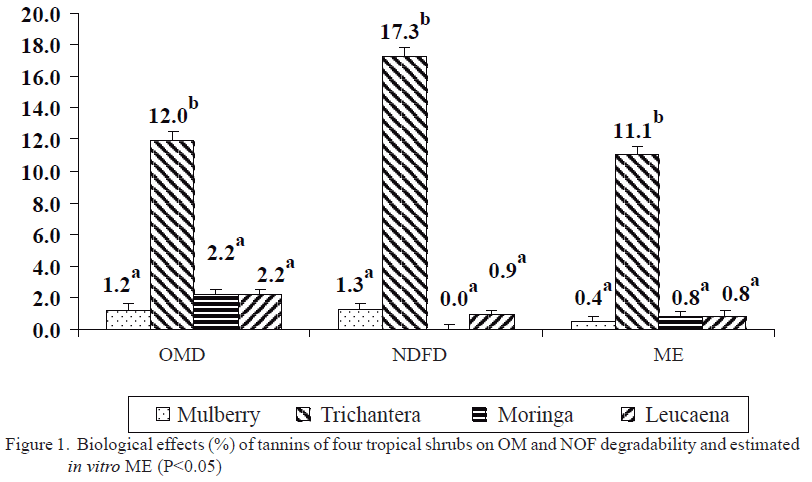
<br>   (P &lt;0.05), although the moringa effect not differ from the mulberry. The  trichanthera tannins had lower effect, and also did not differ from those of  mulberry. However, at 8 h of incubation all tannins showed similar biological  effect (P&gt; 0.05). At 12 h of incubation, the mulberry and moringa tannins  showed the lower BE, while those of leucaena and trichanthera produced the  highest (P &lt;0.01).</span><span style="font-family:'Verdana','sans-serif'; font-size:10.0pt; "> </span></p>     <p align="justify" class="Cuerpodetexto" style="text-indent:0in;"><span style="font-family:'Verdana','sans-serif'; font-size:10.0pt; ">A<span style="letter-spacing:.1pt; ">t 24h of incubation is not observed BE of mulberry  tannins on the <em>in vitro</em> gas production. The moringa and leucaena tannins  had similar and lower effects than those of trichanthera (P &lt;0.001). From 48  hours and until the end of the incubation, mulberry tannins either had BE on  gas production. The BE of tannins was the following: trichanthera&gt;  leucaena&gt; moringa&gt; mulberry (P &lt;0.001).</span></span></p>     <p align="justify" class="Cuerpodetexto" style="text-indent:0in;"><span style="font-family:'Verdana','sans-serif'; font-size:10.0pt; ">The  reduction of the biological effect in time for the moringa, leucaena and  mulberry tannins could be related with the presence of hydrolysable tannins.  The hydrolysable tannins could be degraded by the action of ruminal  microorganisms during the first incubation hours, which would explain the BE  decrease in time (Rodriguez <em>et al.</em> 2015). The increase in time of the  magnitude of the BE of trichanthera tannins may indicate that the tannins in  this shrub are linked to the insoluble fraction of plant material.</span></p>     <p align="justify" class="Cuerpodetexto" style="text-indent:0in;"><span style="font-family:'Verdana','sans-serif'; font-size:10.0pt; ">Respect  to the BE&nbsp; in the evaluated kinetic  parameters, mulberry tannins do not affect the potential of gas <em>in vitro</em> production of this shrub, while those of moringa had lower effect on this  parameter. A moderate BE for trichanthera and leucaena tannins, which did not  differ between them (P &lt;0.001) was appreciated. Similarly, mulberry tannins  do not affect the gas production Vmax. The effect of moringa tannins on this  parameter was moderate and the higher BE were observed for leucaena and  trichanthera tannins. The latter species showed the highest effects (P &lt;0.001).</span></p>     <p align="justify" class="Cuerpodetexto" style="text-indent:0in;"><span style="letter-spacing:.2pt; font-family:'Verdana','sans-serif'; font-size:10.0pt; ">There is available information about the tannins content  of the four shrubs species evaluated (Scull 2004, Garcia <em>et al.</em> 2008,  Bakhashwain <em>et al.</em> 2010 and Pedraza <em>et al.</em> 2013). However, it is  little known about their effects on ruminal fermentation. Getachew <em>et al.</em> (2002) studied the gas production of 39 tropical shrub species, when incubate  them with and without    PEG.</span><span style="font-family:'Verdana','sans-serif'; font-size:10.0pt; "> </span></p>     <p align="justify" class="Cuerpodetexto" style="text-indent:0in;"><span style="font-family:'Verdana','sans-serif'; font-size:10.0pt; ">These  authors observed a positive correlation    (r = 0.76; P &lt;0.001) between the BE on gas production and the tannins  content of the samples. However, the tannins BE on gas production not only  depend on the concentration of these compounds but also of their chemical  structure and reactivity (Bueno <em>et al.</em> 2008 and Rodriguez <em>et al.</em> 2015)</span></p>     <p align="justify" class="Cuerpodetexto" style="text-indent:0in;"><span style="font-family:'Verdana','sans-serif'; font-size:10.0pt; ">The tannins BE of the evaluated shrubs on the OM and NDF  degradability, as well as on the estimated ME, is show in <a href="/img/revistas/cjas/v50n1/f0111116.gif">figure 1</a>. Only the  trichanthera tannins showed effect on these indicators (P &lt;0.01), although  this BE was moderate in the three indicators (11-17%). The increase in the  available energy by the increase of degradability and ME, when inactivating the  trichanthera tannins, can lead to increases in the final products of  fermentation (short-chain fatty acid and gas) (<a href="/img/revistas/cjas/v50n1/t0111116.gif">table 1</a>), and also in the  microbial biomass synthesis. Both processes are inversely related (Blummel <em>et  al.</em> 1997).</span><span style="font-family:'Verdana','sans-serif'; font-size:10.0pt; "> </span></p>     
<p align="justify" class="Cuerpodetexto" style="text-indent:0in;"><span style="letter-spacing:-.1pt; font-family:'Verdana','sans-serif'; font-size:10.0pt; "><a href="/img/revistas/cjas/v50n1/f0211116.gif">Figure 2</a> shows the tannins BE of species evaluated on the  NH<sub>3</sub> concentration at 96 h of incubation, as an indicator of the  effect of these secondary metabolites on the nitrogenous metabolism. The  mulberry and moringa tannins do not have BE on the NH<sub>3</sub> concentration, while in leucaena tannins&nbsp;  the BE was moderate. The highest effects were observed for trichanthera  tannins (P &lt;0.001).</span><span style="font-family:'Verdana','sans-serif'; font-size:10.0pt; "> </span></p>     
]]></body>
<body><![CDATA[<p align="justify" class="Cuerpodetexto" style="text-indent:0in;"><span style="font-family:'Verdana','sans-serif'; font-size:10.0pt; ">The  higher affinity of tannins by the PEG causes, in presence of this compound, the  availability of such proteins is increased which would otherwise remain joined  to these secondary compounds as strong complex tannins: proteins and protected  from the action of microbial proteases (Mtui <em>et al.</em> 2009). Therefore,  the PEG inclusion favors the ruminal proteolysis (Getachew <em>et al.</em> 2000),  although the BE magnitude will depend on the source of tannins which is  evaluate (Rodriguez <em>et al.</em> 2014a) and the proteins protection degree  that these metabolites achieve in natural conditions.</span></p>     <p align="justify" class="Cuerpodetexto" style="text-indent:0in;"><span style="font-family:'Verdana','sans-serif'; font-size:10.0pt; ">Tannins can join to proteins and carbohydrates and have a  significant effect on their fermentation in the rumen, when limiting their use  by ruminal microorganisms (McAllister <em>et al.</em> 1994 and Makkar <em>et al.</em> 1995), to interfere in the microbial adherence to food particles or directly affect  their microbial populations or enzymatic complexes (Bakhashwain <em>et al.</em> 2010). These effects depend not only on the concentration of tannin in the  plant, but also from the reactivity of these compounds, that depends on their  chemical nature (Bueno <em>et al.</em> 2008 and Rodriguez <em>et al.</em> 2015). It  is known that the same tannins concentration from different sources can produce  effects of different magnitude (Bueno <em>et al.</em> 2008).</span><span style="font-family:'Verdana','sans-serif'; font-size:10.0pt; "> </span></p>     <p align="justify" class="Cuerpodetexto" style="text-indent:0in;"><span style="font-family:'Verdana','sans-serif'; font-size:10.0pt; ">In this study, the highest BE on the different monitored  indicators corresponded to trichanthera tannins. Scull (2004) found moderate  concentrations of these compounds in this species. However, the BE of  trichanthera tannins does not justify the low nutritional value attributed to  this species, probably because this could be the result of the combined effect  of its high fiber content (Rodriguez <em>et al.</em> 2014b), lignin and BE of  their tannins on the digestibility (Ammar <em>et al.</em> 2005), without taking  into account the anti-nutritional effect of other secondary compounds in this  shrub (Scull 2004).</span><span style="font-family:'Verdana','sans-serif'; font-size:10.0pt; "> </span></p>     <p align="justify" class="Cuerpodetexto" style="text-indent:0in;"><span style="font-family:'Verdana','sans-serif'; font-size:10.0pt; ">Leucaena  also showed moderates BE, but higher than the moringa and mulberry tannins in  gas production (96 h), gas production potential, maximum speed and proteins  degradation (NH<sub>3</sub> release to  the incubation medium). The moderates BE of leucaena coincide with previous  results on the nature and reactivity of the tannins which this legume species  contains (Rodriguez <em>et al.</em> 2013).</span></p>     <p align="justify" class="Cuerpodetexto" style="text-indent:0in;"><span style="font-family:'Verdana','sans-serif'; font-size:10.0pt; ">&nbsp;The low BE of moringa and mulberry tannins  coincide with the low concentration and the reported activity for these  compounds in these species (Garcia <em>et al.</em> 2008 and Bakhashwain <em>et al.</em> 2010).</span></p>     <p align="justify"><span style="letter-spacing:.1pt; font-family:'Verdana','sans-serif'; font-size:10.0pt; ">The  obtained results of tannins BE on gas production, degradability of OM and NDF,  ME and NH<sub>3</sub> concentration allow to concluded that the trichanthera  tannins showed the highest BE on the ruminal fermentation indicators analyzed,  while those of leucaena showed more moderate effects. The moringa and mulberry  tannins did not influence on the nutritional value of these shrubs</span><font size="2" face="Verdana, Arial, Helvetica, sans-serif">.</font></p>  </p>     <p align="justify">&nbsp;</p>      <p align="justify"><font size="2" face="Verdana, Arial, Helvetica, sans-serif"><font size="3"><b>REFERENCES</b></font></font></p>     <p align="justify" class="MsoBibliography" style="text-align:justify;"><span style="line-height:107%; font-family:'Verdana','sans-serif'; font-size:10.0pt; ">Alexander, G., Singh, B., Sahoo, A. &amp; Bhat, T. K.  2008. &lsquo;&lsquo;<em>In vitro</em> screening of plant extracts to enhance the efficiency  of utilization of energy and nitrogen in ruminant diets&rsquo;&rsquo;. <em>Animal Feed  Science and Technology</em>, 145 (1&ndash;4), pp. 229&ndash;244, ISSN: 0377-8401, DOI:  10.1016/j.anifeedsci.2007.05.036.</span></p>     <p align="justify" class="MsoBibliography" style="text-align:justify;"><span style="font-family:'Verdana','sans-serif'; font-size:10.0pt; ">Ammar, H., L&oacute;pez,  S. &amp; Gonz&aacute;lez, J. S. 2005. </span><span style="font-family:'Verdana','sans-serif'; font-size:10.0pt; ">&lsquo;&lsquo;Assessment  of the digestibility of some Mediterranean shrubs by <em>in vitro</em> techniques&rsquo;&rsquo;. <em>Animal Feed Science and Technology</em>, 119 (3&ndash;4), pp. 323&ndash;331,  ISSN: 0377-8401, DOI: 10.1016/j.anifeedsci.2004.12.013.</span></p>     ]]></body>
<body><![CDATA[<p align="justify" class="MsoBibliography" style="text-align:justify;"><span style="font-family:'Verdana','sans-serif'; font-size:10.0pt; ">AOAC International. 1995. <em>Official methods of  analysis of AOAC International</em>. 16th ed., vol. 1, AOAC International, ISBN:  978-0-935584-54-7, Available: &lt;<a href="http://www.cabdirect.org/abstracts/19951414840.html;jsessionid=F473A9F5FB5AA48E5B87E3FC0986D738" target="_blank">http://www.cabdirect.org/abstracts/19951414840.html;jsessionid=F473A9F5FB5AA48E5B87E3FC0986D738</a>&gt;,  [Accessed:&nbsp;February 21, 2016].</span></p>     <p align="justify" class="MsoBibliography" style="text-align:justify;"><span style="font-family:'Verdana','sans-serif'; font-size:10.0pt; ">Bakhashwain, A. A., Sallam, S. M. A. &amp; Allam, A.  M. 2010. &lsquo;&lsquo;Nutritive value assessment of some Saudi Arabian foliages by gas  production technique <em>in vitro</em>&rsquo;&rsquo;. <em>Meteorology, Environment and Arid  Land Agriculture Sciences</em>, 21 (1), p. 65, ISSN: 1319-1039.</span></p>     <p align="justify" class="MsoBibliography" style="text-align:justify;"><span style="font-family:'Verdana','sans-serif'; font-size:10.0pt; ">Bl&uuml;mmel, M., Steinga</span><span style="font-family:'Verdana','sans-serif'; font-size:10.0pt; ">&beta;</span><span style="font-family:'Verdana','sans-serif'; font-size:10.0pt; ">, H. &amp; Becker, K. 1997. &lsquo;&lsquo;The relationship between <em>in vitro</em> gas production, <em>in vitro</em> microbial biomass yield and <sup>15</sup>N  incorporation and its implications for the prediction of voluntary feed intake  of roughages&rsquo;&rsquo;. <em>British Journal of Nutrition</em>, 77 (06), pp. 911&ndash;921,  ISSN: 1475-2662, DOI: 10.1079/BJN19970089.</span></p>     <p align="justify" class="MsoBibliography" style="text-align:justify;"><span style="font-family:'Verdana','sans-serif'; font-size:10.0pt; ">Bueno, I. C. S., Vitti, D. M. S. S., Louvandini, H.  &amp; Abdalla, A. L. 2008. &lsquo;&lsquo;A new approach for <em>in vitro</em> bioassay to  measure tannin biological effects based on a gas production technique&rsquo;&rsquo;. <em>Animal  Feed Science and Technology</em>, 141 (1&ndash;2), pp. 153&ndash;170, ISSN: 0377-8401, DOI:  10.1016/j.anifeedsci.2007.04.011.</span></p>     <!-- ref --><p align="justify" class="MsoBibliography" style="text-align:justify;"><span style="font-family:'Verdana','sans-serif'; font-size:10.0pt; ">Conway, E. J. 1957. <em>Microdiffusion analysis and  volumetric error.</em> London: Crosby Lockwood &amp; Sons, 465 p.    , CABDirect2.</span></p>     <!-- ref --><p align="justify" class="MsoBibliography" style="text-align:justify;"><span style="font-family:'Verdana','sans-serif'; font-size:10.0pt; ">Di Rienzo, J. A., Casanoves, F., Balzarini, M. G.,  Gonz&aacute;lez, L., Tablada, M. &amp; Robledo, C. W. 2010. </span><em><span style="font-family:'Verdana','sans-serif'; font-size:10.0pt; ">InfoStat</span></em><span style="font-family:'Verdana','sans-serif'; font-size:10.0pt; ">.  version 2010, [Windows], Universidad Nacional de C&oacute;rdoba, Argentina: Grupo  InfoStat, Available: &lt;<a href="http://www.infostat.com.ar/" target="_blank">http://www.infostat.com.ar/</a>&gt;    .</span></p>     <p align="justify" class="MsoBibliography" style="text-align:justify;"><span style="font-family:'Verdana','sans-serif'; font-size:10.0pt; ">Duncan, D. B. 1955. &lsquo;&lsquo;Multiple Range and Multiple F  Tests&rsquo;&rsquo;. <em>Biometrics</em>, 11 (1), pp. 1&ndash;42, ISSN: 0006-341X, DOI:  10.2307/3001478.</span></p>     <p align="justify" class="MsoBibliography" style="text-align:justify;"><span style="font-family:'Verdana','sans-serif'; font-size:10.0pt; ">Garc&iacute;a, D. E.,  Medina, M. G., Cova, L. J., Torres, A., Soca, M., Pizzani, P., Baldiz&aacute;n, A.  &amp; Dom&iacute;nguez, C. E. 2008. &lsquo;&lsquo;Preferencia de vacunos por el follaje de doce  especies con potencial para sistemas agrosilvopastoriles en el Estado Trujillo,  Venezuela&rsquo;&rsquo;. </span><em><span style="font-family:'Verdana','sans-serif'; font-size:10.0pt; ">Pastos y  Forrajes</span></em><span style="font-family:'Verdana','sans-serif'; font-size:10.0pt; ">, 31 (3), pp. 1&ndash;1,  ISSN: 0864-0394.</span></p>     ]]></body>
<body><![CDATA[<p align="justify" class="MsoBibliography" style="text-align:justify;"><span style="font-family:'Verdana','sans-serif'; font-size:10.0pt; ">Getachew, G., Makkar, H. P. S. &amp; Becker, K. 2000.  &lsquo;&lsquo;Effect of polyethylene glycol on <em>in vitro</em> degradability ofnitrogen and  microbial protein synthesis fromtannin-rich browse and herbaceous legumes&rsquo;&rsquo;. <em>British  Journal of Nutrition</em>, 84 (01), pp. 73&ndash;83, ISSN: 1475-2662, DOI:  10.1017/S0007114500001252.</span></p>     <p align="justify" class="MsoBibliography" style="text-align:justify;"><span style="font-family:'Verdana','sans-serif'; font-size:10.0pt; ">Getachew, G., Makkar, H. P. S. &amp; Becker, K. 2002.  &lsquo;&lsquo;Tropical browses: contents of phenolic compounds, <em>in vitro</em> gas  production and stoichiometric relationship between short chain fatty acid and <em>in  vitro</em> gas production&rsquo;&rsquo;. <em>The Journal of Agricultural Science</em>, 139  (03), pp. 341&ndash;352, ISSN: 1469-5146, DOI: 10.1017/S0021859602002393.</span></p>     <p align="justify" class="MsoBibliography" style="text-align:justify;"><span style="font-family:'Verdana','sans-serif'; font-size:10.0pt; ">Hern&aacute;ndez, A., P&eacute;rez, J., Bosch, D. &amp; Castro, N.  2015. </span><em><span style="font-family:'Verdana','sans-serif'; font-size:10.0pt; ">Clasificaci&oacute;n de los suelos de Cuba 2015</span></em><span style="font-family:'Verdana','sans-serif'; font-size:10.0pt; ">.  Mayabeque, Cuba: Ediciones INCA, 93 p., ISBN: 978-959-7023-77-7.</span></p>     <p align="justify" class="MsoBibliography" style="text-align:justify;"><span style="font-family:'Verdana','sans-serif'; font-size:10.0pt; ">Makkar, H. P. S.,  Bl&uuml;mmel, M. &amp; Becker, K. 1995. </span><span style="font-family:'Verdana','sans-serif'; font-size:10.0pt; ">&lsquo;&lsquo;Formation of complexes between polyvinyl pyrrolidones or polyethylene  glycols and tannins, and their implication in gas production and true  digestibility in <em>in vitro</em> techniques&rsquo;&rsquo;. <em>British Journal of Nutrition</em>,  73 (06), pp. 897&ndash;913, ISSN: 1475-2662, DOI: 10.1079/BJN19950095.</span></p>     <p align="justify" class="MsoBibliography" style="text-align:justify;"><span style="font-family:'Verdana','sans-serif'; font-size:10.0pt; ">Makkar, H. P. S., Bl&uuml;mmel, M., Borowy, N. K. &amp;  Becker, K. 1993. &lsquo;&lsquo;Gravimetric determination of tannins and their correlations  with chemical and protein precipitation methods&rsquo;&rsquo;. <em>Journal of the Science of  Food and Agriculture</em>, 61 (2), pp. 161&ndash;165, ISSN: 1097-0010, DOI:  10.1002/jsfa.2740610205.</span></p>     <p align="justify" class="MsoBibliography" style="text-align:justify;"><span style="font-family:'Verdana','sans-serif'; font-size:10.0pt; ">McAllister, T. A., Bae, H. D., Jones, G. A. &amp;  Cheng, K. J. 1994. &lsquo;&lsquo;Microbial attachment and feed digestion in the rumen&rsquo;&rsquo;. <em>Journal  of animal science</em>, 72 (11), pp. 3004&ndash;3018, ISSN: 0021-8812, DOI: /1994.72113004x.</span></p>     <p align="justify" class="MsoBibliography" style="text-align:justify;"><span style="font-family:'Verdana','sans-serif'; font-size:10.0pt; ">Melesse, A. 2016. &lsquo;&lsquo;Assessing the feeding values of  leaves, seeds and seeds-removed pods of <em>Moringa stenopetala</em> using in  vitro gas production technique&rsquo;&rsquo;. <em>African Journal of Biotechnology</em>, 11  (51), pp. 11342&ndash;11349, ISSN: 1684-5315, DOI: 10.4314/ajb.v11i51.</span></p>     <p align="justify" class="MsoBibliography" style="text-align:justify;"><span style="font-family:'Verdana','sans-serif'; font-size:10.0pt; ">Menke, K. H., Raab, L., Salewski, A., Steingass, H.,  Fritz, D. &amp; Schneider, W. 1979. &lsquo;&lsquo;The estimation of the digestibility and  metabolizable energy content of ruminant feedingstuffs from the gas production  when they are incubated with rumen liquor <em>in vitro</em>&rsquo;&rsquo;. <em>The Journal of  Agricultural Science</em>, 93 (01), pp. 217&ndash;222, ISSN: 1469-5146, DOI:  10.1017/S0021859600086305.</span></p>     <p align="justify" class="MsoBibliography" style="text-align:justify;"><span style="font-family:'Verdana','sans-serif'; font-size:10.0pt; ">Menke, K. H. &amp; Steingass, H. 1988. &lsquo;&lsquo;Estimation of  the energetic feed value obtained from chemical analysis and <em>in vitro</em> gas production using rumen fluid&rsquo;&rsquo;. <em>Animal Research and Development</em>, 28  (1), pp. 7&ndash;55, ISSN: 0340-3165.</span></p>     <p align="justify" class="MsoBibliography" style="text-align:justify;"><span style="font-family:'Verdana','sans-serif'; font-size:10.0pt; ">Mtui, D. J., Lekule, F. P., Shem, M. N., Ichinohe, T.,  Fujihara, T. &amp; others. 2009. &lsquo;&lsquo;Comparative potential nutritive value of  grasses, creeping legumes and multipurpose trees commonly in sub humid region  in the Eastern parts of Tanzania&rsquo;&rsquo;. <em>Livestock Research for Rural Development</em>,  21 (10), ISSN: 0121-3784, Available:  &lt;<a href="http://www.lrrd.cipav.org.co/lrrd21/10/mtui21158.htm" target="_blank">http://www.lrrd.cipav.org.co/lrrd21/10/mtui21158.htm</a>&gt;,  [Accessed:&nbsp;March 2, 2016].</span></p>     ]]></body>
<body><![CDATA[<p align="justify" class="MsoBibliography" style="text-align:justify;"><span style="font-family:'Verdana','sans-serif'; font-size:10.0pt; ">Pedraza, O. R. M.,  P&eacute;rez, L. S., Gonz&aacute;lez, R. M., Gonz&aacute;lez, P. E., Le&oacute;n, G. M. &amp; Sifonte, E.  E. 2013. &lsquo;&lsquo;Indicadores <em>in vitro</em> del valor nutritivo de Moringa oleifera  en &eacute;poca de seca para rumiantes&rsquo;&rsquo;. <em>Revista de Producci&oacute;n Animal</em>, 25  (especial), ISSN: 2224-7920, Available:  &lt;<a href="https://www.researchgate.net/profile/Redimio_Pedraza_Olivera/publication/277022522_Indicadores_in_vitrodel_valor_nutritivo_de_Moringa_oleifera_en_poca_de_seca_para_rumiantes_Redimio_M._Pedraza_Olivera_Susana_Prez_Lpez_Mileidys_Gonzlez_Rodrguez_Eliane_Gonzlez_Prez_Marlene_Len_Gonzlez_y_Enrique_Espinosa_Sifonte/links/555ff99708ae9963a118b791.pdf" target="_blank">https://www.researchgate.net/profile/Redimio_Pedraza_Olivera/publication/277022522_Indicadores_in_vitrodel_valor_nutritivo_de_Moringa_oleifera_en_poca_de_seca_para_rumiantes_Redimio_M._Pedraza_Olivera_Susana_Prez_Lpez_Mileidys_Gonzlez_Rodrguez_Eliane_Gonzlez_Prez_Marlene_Len_Gonzlez_y_Enrique_Espinosa_Sifonte/links/555ff99708ae9963a118b791.pdf</a>&gt;,  [Accessed:&nbsp;March 2, 2016].</span></p>     <p align="justify" class="MsoBibliography" style="text-align:justify;"><span style="font-family:'Verdana','sans-serif'; font-size:10.0pt; ">Rodr&iacute;guez, R., de  la Fuente, G., G&oacute;mez, S. &amp; Fondevila, M. 2014a. </span><span style="font-family:'Verdana','sans-serif'; font-size:10.0pt; ">&lsquo;&lsquo;Biological effect of tannins from different vegetal  origin on microbial and fermentation traits <em>in vitro</em>&rsquo;&rsquo;. <em>Animal  Production Science</em>, 54 (8), pp. 1039&ndash;1046, ISSN: 1836-0939, DOI:  http://dx.doi.org/10.1071/AN13045.</span></p>     <p align="justify" class="MsoBibliography" style="text-align:justify;"><span style="font-family:'Verdana','sans-serif'; font-size:10.0pt; ">Rodr&iacute;guez, R.,  Frutos, P. &amp; Fondevila, M. 2015. </span><span style="font-family:'Verdana','sans-serif'; font-size:10.0pt; ">&lsquo;&lsquo;A new index to estimate reactivity and biological effect of tannins,  using tropical browse legumes as a model&rsquo;&rsquo;. <em>Animal Feed Science and  Technology</em>, 205, pp. 42&ndash;48, ISSN: 0377-8401, DOI:  10.1016/j.anifeedsci.2015.04.007.</span></p>     <p align="justify" class="MsoBibliography" style="text-align:justify;"><span style="font-family:'Verdana','sans-serif'; font-size:10.0pt; ">Rodr&iacute;guez, R.,  Gonz&aacute;lez, N., Alonso, J., Dom&iacute;nguez, M. &amp; Sarduy, L. 2014b. </span><span style="font-family:'Verdana','sans-serif'; font-size:10.0pt; ">&lsquo;&lsquo;Nutritional value of foliage meal from four species  of tropical trees for feeding ruminants&rsquo;&rsquo;. <em>Cuban Journal of Agricultural  Science</em>, 48 (4), p. 371, ISSN: 2079-3480.</span></p>     <p align="justify" class="MsoBibliography" style="text-align:justify;"><span style="font-family:'Verdana','sans-serif'; font-size:10.0pt; ">Rodr&iacute;guez, R., Lores, J., Guti&eacute;rrez, D., Ram&iacute;rez, A.,  G&oacute;mez, S., El&iacute;as, A., Aldana, A. I., Moreira, O., Sarduy, L. &amp; Jay, O.  2013. &lsquo;&lsquo;Inclusion of the microbial additive Vitafert in the &lt;i&gt;in  vitro&lt;i&gt; ruminal fermentation of a goat diet&rsquo;&rsquo;. <em>Cuban Journal of  Agricultural Science</em>, 47, p. 171, ISSN: 2079-3480.</span></p>     <p align="justify" class="MsoBibliography" style="text-align:justify;"><span style="font-family:'Verdana','sans-serif'; font-size:10.0pt; ">Rubanza, C. D. K., Shem, M. N., Bakengesa, S. S., Ichinohe,  T. &amp; Fujihara, T. 2007. &lsquo;&lsquo;Effects of <em>Acacia nilotica, A. polyacantha</em> and <em>Leucaena leucocephala</em> leaf meal supplementation on performance of  Small East African goats fed native pasture hay basal forages&rsquo;&rsquo;. <em>Small  Ruminant Research</em>, 70 (2&ndash;3), pp. 165&ndash;173, ISSN: 0921-4488, DOI:  10.1016/j.smallrumres.2006.02.008.</span></p>     <!-- ref --><p align="justify" class="MsoBibliography" style="text-align:justify;"><span style="font-family:'Verdana','sans-serif'; font-size:10.0pt; ">Scull, I. 2004. </span><em><span style="font-family:'Verdana','sans-serif'; font-size:10.0pt; ">Metodolog&iacute;a para la  determinaci&oacute;n de taninos en forrajes de plantas tropicales con potencialidades  de uso en la alimentaci&oacute;n animal</span></em><span style="font-family:'Verdana','sans-serif'; font-size:10.0pt; ">. Master Thesis,  Universidad de La Habana, La Habana, Cuba, 79 p.    </span></p>     <p align="justify" class="MsoBibliography" style="text-align:justify;"><span style="font-family:'Verdana','sans-serif'; font-size:10.0pt; ">Theodorou, M. K., Williams, B. A., Dhanoa, M. S.,  McAllan, A. B. &amp; France, J. 1994. &lsquo;&lsquo;A simple gas production method using a  pressure transducer to determine the fermentation kinetics of ruminant feeds&rsquo;&rsquo;. <em>Animal Feed Science and Technology</em>, 48 (3&ndash;4), pp. 185&ndash;197, ISSN:  0377-8401, DOI: 10.1016/0377-8401(94)90171-6.</span></p>     <p align="justify"><span style="font-family:'Verdana','sans-serif'; font-size:10.0pt; ">Van Soest, P. J.,  Robertson, J. B. &amp; Lewis, B. A. 1991. &lsquo;&lsquo;Methods for Dietary Fiber, Neutral  Detergent Fiber, and Nonstarch Polysaccharides in Relation to Animal  Nutrition&rsquo;&rsquo;. </span><em><span style="font-family:'Verdana','sans-serif'; font-size:10.0pt; ">Journal  of Dairy Science</span></em><span style="font-family:'Verdana','sans-serif'; font-size:10.0pt; ">, 74  (10), pp. 3583&ndash;3597, ISSN: 0022-0302, DOI: 10.3168/jds.S0022-0302(91)78551-2.</span> </p>     ]]></body>
<body><![CDATA[<p align="justify">&nbsp;</p>     <p align="justify">&nbsp;</p>     <p align="justify"><font size="2" face="Verdana, Arial, Helvetica, sans-serif">Received: July 9, 2015    <br>   Accepted: March 16, 2016</font></p>     <p align="justify">&nbsp;</p>     <p align="justify">&nbsp;</p>     <p align="justify"><font size="2" face="Verdana, Arial, Helvetica, sans-serif"><i>R. Rodríguez,</i> Instituto de Ciencia Animal, Apartado Postal 24, San José de las Lajas, Mayabeque, Cuba.    Email: <a href="mailto:rrodriguez@ica.co.cu">rrodriguez@ica.co.cu</a></font></p>      ]]></body><back>
<ref-list>
<ref id="B1">
<nlm-citation citation-type="journal">
<person-group person-group-type="author">
<name>
<surname><![CDATA[Alexander]]></surname>
<given-names><![CDATA[G.]]></given-names>
</name>
<name>
<surname><![CDATA[Singh]]></surname>
<given-names><![CDATA[B.]]></given-names>
</name>
<name>
<surname><![CDATA[Sahoo]]></surname>
<given-names><![CDATA[A.]]></given-names>
</name>
<name>
<surname><![CDATA[Bhat]]></surname>
<given-names><![CDATA[T. K.]]></given-names>
</name>
</person-group>
<article-title xml:lang="nd"><![CDATA[In vitro screening of plant extracts to enhance the efficiency of utilization of energy and nitrogen in ruminant diets]]></article-title>
<source><![CDATA[Animal Feed Science and Technology]]></source>
<year>2008</year>
<volume>145</volume>
<numero>1-4</numero>
<issue>1-4</issue>
<page-range>229-244</page-range></nlm-citation>
</ref>
<ref id="B2">
<nlm-citation citation-type="journal">
<person-group person-group-type="author">
<name>
<surname><![CDATA[Ammar]]></surname>
<given-names><![CDATA[H.]]></given-names>
</name>
<name>
<surname><![CDATA[López]]></surname>
<given-names><![CDATA[S.]]></given-names>
</name>
<name>
<surname><![CDATA[González]]></surname>
<given-names><![CDATA[J. S.]]></given-names>
</name>
</person-group>
<article-title xml:lang="nd"><![CDATA[Assessment of the digestibility of some Mediterranean shrubs by in vitro techniques]]></article-title>
<source><![CDATA[Animal Feed Science and Technology]]></source>
<year>2005</year>
<volume>119</volume>
<numero>3-4</numero>
<issue>3-4</issue>
<page-range>323-331</page-range></nlm-citation>
</ref>
<ref id="B3">
<nlm-citation citation-type="book">
<person-group person-group-type="author">
<name>
<surname><![CDATA[AOAC International]]></surname>
</name>
</person-group>
<source><![CDATA[Official methods of analysis of AOAC International]]></source>
<year>1995</year>
<volume>1</volume>
<edition>16th</edition>
<publisher-name><![CDATA[AOAC International]]></publisher-name>
</nlm-citation>
</ref>
<ref id="B4">
<nlm-citation citation-type="journal">
<person-group person-group-type="author">
<name>
<surname><![CDATA[Bakhashwain]]></surname>
<given-names><![CDATA[A. A.]]></given-names>
</name>
<name>
<surname><![CDATA[Sallam]]></surname>
<given-names><![CDATA[S. M. A.]]></given-names>
</name>
<name>
<surname><![CDATA[Allam]]></surname>
<given-names><![CDATA[A. M.]]></given-names>
</name>
</person-group>
<article-title xml:lang="nd"><![CDATA[Nutritive value assessment of some Saudi Arabian foliages by gas production technique in vitro]]></article-title>
<source><![CDATA[Meteorology, Environment and Arid Land Agriculture Sciences]]></source>
<year>2010</year>
<volume>21</volume>
<numero>1</numero>
<issue>1</issue>
<page-range>65</page-range></nlm-citation>
</ref>
<ref id="B5">
<nlm-citation citation-type="journal">
<person-group person-group-type="author">
<name>
<surname><![CDATA[Blümmel]]></surname>
<given-names><![CDATA[M.]]></given-names>
</name>
<name>
<surname><![CDATA[Steingaß]]></surname>
<given-names><![CDATA[H.]]></given-names>
</name>
<name>
<surname><![CDATA[Becker]]></surname>
<given-names><![CDATA[K.]]></given-names>
</name>
</person-group>
<article-title xml:lang="nd"><![CDATA[The relationship between in vitro gas production, in vitro microbial biomass yield and 15N incorporation and its implications for the prediction of voluntary feed intake of roughages]]></article-title>
<source><![CDATA[British Journal of Nutrition]]></source>
<year>1997</year>
<volume>77</volume>
<numero>06</numero>
<issue>06</issue>
<page-range>911-921</page-range></nlm-citation>
</ref>
<ref id="B6">
<nlm-citation citation-type="journal">
<person-group person-group-type="author">
<name>
<surname><![CDATA[Bueno]]></surname>
<given-names><![CDATA[I. C. S.]]></given-names>
</name>
<name>
<surname><![CDATA[Vitti]]></surname>
<given-names><![CDATA[D. M. S. S.]]></given-names>
</name>
<name>
<surname><![CDATA[Louvandini]]></surname>
<given-names><![CDATA[H.]]></given-names>
</name>
<name>
<surname><![CDATA[Abdalla]]></surname>
<given-names><![CDATA[A. L.]]></given-names>
</name>
</person-group>
<article-title xml:lang="nd"><![CDATA[A new approach for in vitro bioassay to measure tannin biological effects based on a gas production technique]]></article-title>
<source><![CDATA[Animal Feed Science and Technology]]></source>
<year>2008</year>
<volume>141</volume>
<numero>1-2</numero>
<issue>1-2</issue>
<page-range>153-170</page-range></nlm-citation>
</ref>
<ref id="B7">
<nlm-citation citation-type="book">
<person-group person-group-type="author">
<name>
<surname><![CDATA[Conway]]></surname>
<given-names><![CDATA[E. J.]]></given-names>
</name>
</person-group>
<source><![CDATA[Microdiffusion analysis and volumetric error.]]></source>
<year>1957</year>
<page-range>465</page-range><publisher-loc><![CDATA[London ]]></publisher-loc>
<publisher-name><![CDATA[Crosby Lockwood & Sons]]></publisher-name>
</nlm-citation>
</ref>
<ref id="B8">
<nlm-citation citation-type="book">
<person-group person-group-type="author">
<name>
<surname><![CDATA[Di Rienzo]]></surname>
<given-names><![CDATA[J. A.]]></given-names>
</name>
<name>
<surname><![CDATA[Casanoves]]></surname>
<given-names><![CDATA[F.]]></given-names>
</name>
<name>
<surname><![CDATA[Balzarini]]></surname>
<given-names><![CDATA[M. G.]]></given-names>
</name>
<name>
<surname><![CDATA[González]]></surname>
<given-names><![CDATA[L.]]></given-names>
</name>
<name>
<surname><![CDATA[Tablada]]></surname>
<given-names><![CDATA[M.]]></given-names>
</name>
<name>
<surname><![CDATA[Robledo]]></surname>
<given-names><![CDATA[C. W.]]></given-names>
</name>
</person-group>
<source><![CDATA[InfoStat]]></source>
<year>2010</year>
<publisher-loc><![CDATA[Universidad Nacional de Córdoba, Argentina ]]></publisher-loc>
<publisher-name><![CDATA[Grupo InfoStat]]></publisher-name>
</nlm-citation>
</ref>
<ref id="B9">
<nlm-citation citation-type="journal">
<person-group person-group-type="author">
<name>
<surname><![CDATA[Duncan]]></surname>
<given-names><![CDATA[D. B.]]></given-names>
</name>
</person-group>
<article-title xml:lang="nd"><![CDATA[Multiple Range and Multiple F Tests]]></article-title>
<source><![CDATA[Biometrics]]></source>
<year>1955</year>
<volume>11</volume>
<numero>1</numero>
<issue>1</issue>
<page-range>1-42</page-range></nlm-citation>
</ref>
<ref id="B10">
<nlm-citation citation-type="journal">
<person-group person-group-type="author">
<name>
<surname><![CDATA[García]]></surname>
<given-names><![CDATA[D. E.]]></given-names>
</name>
<name>
<surname><![CDATA[Medina]]></surname>
<given-names><![CDATA[M. G.]]></given-names>
</name>
<name>
<surname><![CDATA[Cova]]></surname>
<given-names><![CDATA[L. J.]]></given-names>
</name>
<name>
<surname><![CDATA[Torres]]></surname>
<given-names><![CDATA[A.]]></given-names>
</name>
<name>
<surname><![CDATA[Soca]]></surname>
<given-names><![CDATA[M.]]></given-names>
</name>
<name>
<surname><![CDATA[Pizzani]]></surname>
<given-names><![CDATA[P.]]></given-names>
</name>
<name>
<surname><![CDATA[Baldizán]]></surname>
<given-names><![CDATA[A.]]></given-names>
</name>
<name>
<surname><![CDATA[Domínguez]]></surname>
<given-names><![CDATA[C. E.]]></given-names>
</name>
</person-group>
<article-title xml:lang="nd"><![CDATA[Preferencia de vacunos por el follaje de doce especies con potencial para sistemas agrosilvopastoriles en el Estado Trujillo, Venezuela]]></article-title>
<source><![CDATA[Pastos y Forrajes]]></source>
<year>2008</year>
<volume>31</volume>
<numero>3</numero>
<issue>3</issue>
<page-range>1-1</page-range></nlm-citation>
</ref>
<ref id="B11">
<nlm-citation citation-type="journal">
<person-group person-group-type="author">
<name>
<surname><![CDATA[Getachew]]></surname>
<given-names><![CDATA[G.]]></given-names>
</name>
<name>
<surname><![CDATA[Makkar]]></surname>
<given-names><![CDATA[H. P. S.]]></given-names>
</name>
<name>
<surname><![CDATA[Becker]]></surname>
<given-names><![CDATA[K.]]></given-names>
</name>
</person-group>
<article-title xml:lang="nd"><![CDATA[Effect of polyethylene glycol on in vitro degradability ofnitrogen and microbial protein synthesis fromtannin-rich browse and herbaceous legumes]]></article-title>
<source><![CDATA[British Journal of Nutrition]]></source>
<year>2000</year>
<volume>84</volume>
<numero>01</numero>
<issue>01</issue>
<page-range>73-83</page-range></nlm-citation>
</ref>
<ref id="B12">
<nlm-citation citation-type="journal">
<person-group person-group-type="author">
<name>
<surname><![CDATA[Getachew]]></surname>
<given-names><![CDATA[G.]]></given-names>
</name>
<name>
<surname><![CDATA[Makkar]]></surname>
<given-names><![CDATA[H. P. S.]]></given-names>
</name>
<name>
<surname><![CDATA[Becker]]></surname>
<given-names><![CDATA[K.]]></given-names>
</name>
</person-group>
<article-title xml:lang="nd"><![CDATA[Tropical browses: contents of phenolic compounds, in vitro gas production and stoichiometric relationship between short chain fatty acid and in vitro gas production]]></article-title>
<source><![CDATA[The Journal of Agricultural Science]]></source>
<year>2002</year>
<volume>139</volume>
<numero>03</numero>
<issue>03</issue>
<page-range>341-352</page-range></nlm-citation>
</ref>
<ref id="B13">
<nlm-citation citation-type="book">
<person-group person-group-type="author">
<name>
<surname><![CDATA[Hernández]]></surname>
<given-names><![CDATA[J. A.]]></given-names>
</name>
<name>
<surname><![CDATA[Pérez]]></surname>
<given-names><![CDATA[J. J. M.]]></given-names>
</name>
<name>
<surname><![CDATA[Bosch]]></surname>
<given-names><![CDATA[I. D.]]></given-names>
</name>
<name>
<surname><![CDATA[Castro]]></surname>
<given-names><![CDATA[S. N.]]></given-names>
</name>
</person-group>
<source><![CDATA[Clasificación de los suelos de Cuba 2015]]></source>
<year>2015</year>
<page-range>93</page-range><publisher-loc><![CDATA[Mayabeque, Cuba ]]></publisher-loc>
<publisher-name><![CDATA[Ediciones INCA]]></publisher-name>
</nlm-citation>
</ref>
<ref id="B14">
<nlm-citation citation-type="journal">
<person-group person-group-type="author">
<name>
<surname><![CDATA[Makkar]]></surname>
<given-names><![CDATA[H. P. S.]]></given-names>
</name>
<name>
<surname><![CDATA[Blümmel]]></surname>
<given-names><![CDATA[M.]]></given-names>
</name>
<name>
<surname><![CDATA[Becker]]></surname>
<given-names><![CDATA[K.]]></given-names>
</name>
</person-group>
<article-title xml:lang="nd"><![CDATA[Formation of complexes between polyvinyl pyrrolidones or polyethylene glycols and tannins, and their implication in gas production and true digestibility in in vitro techniques]]></article-title>
<source><![CDATA[British Journal of Nutrition]]></source>
<year>1995</year>
<volume>73</volume>
<numero>06</numero>
<issue>06</issue>
<page-range>897-913</page-range></nlm-citation>
</ref>
<ref id="B15">
<nlm-citation citation-type="journal">
<person-group person-group-type="author">
<name>
<surname><![CDATA[Makkar]]></surname>
<given-names><![CDATA[H. P. S.]]></given-names>
</name>
<name>
<surname><![CDATA[Blümmel]]></surname>
<given-names><![CDATA[M.]]></given-names>
</name>
<name>
<surname><![CDATA[Borowy]]></surname>
<given-names><![CDATA[N. K.]]></given-names>
</name>
<name>
<surname><![CDATA[Becker]]></surname>
<given-names><![CDATA[K.]]></given-names>
</name>
</person-group>
<article-title xml:lang="nd"><![CDATA[Gravimetric determination of tannins and their correlations with chemical and protein precipitation methods]]></article-title>
<source><![CDATA[Journal of the Science of Food and Agriculture]]></source>
<year>1993</year>
<volume>61</volume>
<numero>2</numero>
<issue>2</issue>
<page-range>161-165</page-range></nlm-citation>
</ref>
<ref id="B16">
<nlm-citation citation-type="journal">
<person-group person-group-type="author">
<name>
<surname><![CDATA[McAllister]]></surname>
<given-names><![CDATA[T. A.]]></given-names>
</name>
<name>
<surname><![CDATA[Bae]]></surname>
<given-names><![CDATA[H. D.]]></given-names>
</name>
<name>
<surname><![CDATA[Jones]]></surname>
<given-names><![CDATA[G. A.]]></given-names>
</name>
<name>
<surname><![CDATA[Cheng]]></surname>
<given-names><![CDATA[K. J.]]></given-names>
</name>
</person-group>
<article-title xml:lang="nd"><![CDATA[Microbial attachment and feed digestion in the rumen]]></article-title>
<source><![CDATA[Journal of animal science]]></source>
<year>1994</year>
<volume>72</volume>
<numero>11</numero>
<issue>11</issue>
<page-range>3004-3018</page-range></nlm-citation>
</ref>
<ref id="B17">
<nlm-citation citation-type="journal">
<person-group person-group-type="author">
<name>
<surname><![CDATA[Melesse]]></surname>
<given-names><![CDATA[A.]]></given-names>
</name>
</person-group>
<article-title xml:lang="nd"><![CDATA[Assessing the feeding values of leaves, seeds and seeds-removed pods of Moringa stenopetala using in vitro gas production technique]]></article-title>
<source><![CDATA[African Journal of Biotechnology]]></source>
<year>2016</year>
<volume>11</volume>
<numero>51</numero>
<issue>51</issue>
<page-range>11342-11349</page-range></nlm-citation>
</ref>
<ref id="B18">
<nlm-citation citation-type="journal">
<person-group person-group-type="author">
<name>
<surname><![CDATA[Menke]]></surname>
<given-names><![CDATA[K. H.]]></given-names>
</name>
<name>
<surname><![CDATA[Raab]]></surname>
<given-names><![CDATA[L.]]></given-names>
</name>
<name>
<surname><![CDATA[Salewski]]></surname>
<given-names><![CDATA[A.]]></given-names>
</name>
<name>
<surname><![CDATA[Steingass]]></surname>
<given-names><![CDATA[H.]]></given-names>
</name>
<name>
<surname><![CDATA[Fritz]]></surname>
<given-names><![CDATA[D.]]></given-names>
</name>
<name>
<surname><![CDATA[Schneider]]></surname>
<given-names><![CDATA[W.]]></given-names>
</name>
</person-group>
<article-title xml:lang="nd"><![CDATA[The estimation of the digestibility and metabolizable energy content of ruminant feedingstuffs from the gas production when they are incubated with rumen liquor in vitro]]></article-title>
<source><![CDATA[The Journal of Agricultural Science]]></source>
<year>1979</year>
<volume>93</volume>
<numero>01</numero>
<issue>01</issue>
<page-range>217-222</page-range></nlm-citation>
</ref>
<ref id="B19">
<nlm-citation citation-type="journal">
<person-group person-group-type="author">
<name>
<surname><![CDATA[Menke]]></surname>
<given-names><![CDATA[K. H.]]></given-names>
</name>
<name>
<surname><![CDATA[Steingass]]></surname>
<given-names><![CDATA[H.]]></given-names>
</name>
</person-group>
<article-title xml:lang="nd"><![CDATA[Estimation of the energetic feed value obtained from chemical analysis and in vitro gas production using rumen fluid]]></article-title>
<source><![CDATA[Animal Research and Development]]></source>
<year>1988</year>
<volume>28</volume>
<numero>1</numero>
<issue>1</issue>
<page-range>7-55</page-range></nlm-citation>
</ref>
<ref id="B20">
<nlm-citation citation-type="journal">
<person-group person-group-type="author">
<name>
<surname><![CDATA[Mtui]]></surname>
<given-names><![CDATA[D. J.]]></given-names>
</name>
<name>
<surname><![CDATA[Lekule]]></surname>
<given-names><![CDATA[F. P.]]></given-names>
</name>
<name>
<surname><![CDATA[Shem]]></surname>
<given-names><![CDATA[M. N.]]></given-names>
</name>
<name>
<surname><![CDATA[Ichinohe]]></surname>
<given-names><![CDATA[T.]]></given-names>
</name>
<name>
<surname><![CDATA[Fujihara]]></surname>
<given-names><![CDATA[T.]]></given-names>
</name>
</person-group>
<article-title xml:lang="nd"><![CDATA[Comparative potential nutritive value of grasses, creeping legumes and multipurpose trees commonly in sub humid region in the Eastern parts of Tanzania]]></article-title>
<source><![CDATA[Livestock Research for Rural Development]]></source>
<year>2009</year>
<volume>21</volume>
<numero>10</numero>
<issue>10</issue>
</nlm-citation>
</ref>
<ref id="B21">
<nlm-citation citation-type="journal">
<person-group person-group-type="author">
<name>
<surname><![CDATA[Pedraza]]></surname>
<given-names><![CDATA[O. R. M.]]></given-names>
</name>
<name>
<surname><![CDATA[Pérez]]></surname>
<given-names><![CDATA[L. S.]]></given-names>
</name>
<name>
<surname><![CDATA[González]]></surname>
<given-names><![CDATA[R. M.]]></given-names>
</name>
<name>
<surname><![CDATA[González]]></surname>
<given-names><![CDATA[P. E.]]></given-names>
</name>
<name>
<surname><![CDATA[León]]></surname>
<given-names><![CDATA[G. M.]]></given-names>
</name>
<name>
<surname><![CDATA[Sifonte]]></surname>
<given-names><![CDATA[E. E.]]></given-names>
</name>
</person-group>
<article-title xml:lang="nd"><![CDATA[Indicadores in vitro del valor nutritivo de Moringa oleifera en época de seca para rumiantes]]></article-title>
<source><![CDATA[Revista de Producción Animal]]></source>
<year>2013</year>
<volume>25</volume>
<numero>especial</numero>
<issue>especial</issue>
</nlm-citation>
</ref>
<ref id="B22">
<nlm-citation citation-type="journal">
<person-group person-group-type="author">
<name>
<surname><![CDATA[Rodríguez]]></surname>
<given-names><![CDATA[R.]]></given-names>
</name>
<name>
<surname><![CDATA[de la Fuente]]></surname>
<given-names><![CDATA[G.]]></given-names>
</name>
<name>
<surname><![CDATA[Gómez]]></surname>
<given-names><![CDATA[S.]]></given-names>
</name>
<name>
<surname><![CDATA[Fondevila]]></surname>
<given-names><![CDATA[M.]]></given-names>
</name>
</person-group>
<article-title xml:lang="nd"><![CDATA[Biological effect of tannins from different vegetal origin on microbial and fermentation traits in vitro]]></article-title>
<source><![CDATA[Animal Production Science]]></source>
<year>2014</year>
<volume>54</volume>
<numero>8</numero>
<issue>8</issue>
<page-range>1039-1046</page-range></nlm-citation>
</ref>
<ref id="B23">
<nlm-citation citation-type="journal">
<person-group person-group-type="author">
<name>
<surname><![CDATA[Rodríguez]]></surname>
<given-names><![CDATA[R.]]></given-names>
</name>
<name>
<surname><![CDATA[Frutos]]></surname>
<given-names><![CDATA[P.]]></given-names>
</name>
<name>
<surname><![CDATA[Fondevila]]></surname>
<given-names><![CDATA[M.]]></given-names>
</name>
</person-group>
<article-title xml:lang="nd"><![CDATA[A new index to estimate reactivity and biological effect of tannins, using tropical browse legumes as a model]]></article-title>
<source><![CDATA[Animal Feed Science and Technology]]></source>
<year>2015</year>
<volume>205</volume>
<page-range>42-48</page-range></nlm-citation>
</ref>
<ref id="B24">
<nlm-citation citation-type="journal">
<person-group person-group-type="author">
<name>
<surname><![CDATA[Rodríguez]]></surname>
<given-names><![CDATA[R.]]></given-names>
</name>
<name>
<surname><![CDATA[González]]></surname>
<given-names><![CDATA[N.]]></given-names>
</name>
<name>
<surname><![CDATA[Alonso]]></surname>
<given-names><![CDATA[J.]]></given-names>
</name>
<name>
<surname><![CDATA[Domínguez]]></surname>
<given-names><![CDATA[M.]]></given-names>
</name>
<name>
<surname><![CDATA[Sarduy]]></surname>
<given-names><![CDATA[L.]]></given-names>
</name>
</person-group>
<article-title xml:lang="nd"><![CDATA[Nutritional value of foliage meal from four species of tropical trees for feeding ruminants]]></article-title>
<source><![CDATA[Cuban Journal of Agricultural Science]]></source>
<year>2014</year>
<volume>48</volume>
<numero>4</numero>
<issue>4</issue>
<page-range>371</page-range></nlm-citation>
</ref>
<ref id="B25">
<nlm-citation citation-type="journal">
<person-group person-group-type="author">
<name>
<surname><![CDATA[Rodríguez]]></surname>
<given-names><![CDATA[R.]]></given-names>
</name>
<name>
<surname><![CDATA[Lores]]></surname>
<given-names><![CDATA[J.]]></given-names>
</name>
<name>
<surname><![CDATA[Gutiérrez]]></surname>
<given-names><![CDATA[D.]]></given-names>
</name>
<name>
<surname><![CDATA[Ramírez]]></surname>
<given-names><![CDATA[A.]]></given-names>
</name>
<name>
<surname><![CDATA[Gómez]]></surname>
<given-names><![CDATA[S.]]></given-names>
</name>
<name>
<surname><![CDATA[Elías]]></surname>
<given-names><![CDATA[A.]]></given-names>
</name>
<name>
<surname><![CDATA[Aldana]]></surname>
<given-names><![CDATA[A. I.]]></given-names>
</name>
<name>
<surname><![CDATA[Moreira]]></surname>
<given-names><![CDATA[O.]]></given-names>
</name>
<name>
<surname><![CDATA[Sarduy]]></surname>
<given-names><![CDATA[L.]]></given-names>
</name>
<name>
<surname><![CDATA[Jay]]></surname>
<given-names><![CDATA[O.]]></given-names>
</name>
</person-group>
<article-title xml:lang="nd"><![CDATA[Inclusion of the microbial additive Vitafert in the in vitro ruminal fermentation of a goat diet]]></article-title>
<source><![CDATA[Cuban Journal of Agricultural Science]]></source>
<year>2013</year>
<volume>47</volume>
<page-range>171</page-range></nlm-citation>
</ref>
<ref id="B26">
<nlm-citation citation-type="journal">
<person-group person-group-type="author">
<name>
<surname><![CDATA[Rubanza]]></surname>
<given-names><![CDATA[C. D. K.]]></given-names>
</name>
<name>
<surname><![CDATA[Shem]]></surname>
<given-names><![CDATA[M. N.]]></given-names>
</name>
<name>
<surname><![CDATA[Bakengesa]]></surname>
<given-names><![CDATA[S. S.]]></given-names>
</name>
<name>
<surname><![CDATA[Ichinohe]]></surname>
<given-names><![CDATA[T.]]></given-names>
</name>
<name>
<surname><![CDATA[Fujihara]]></surname>
<given-names><![CDATA[T.]]></given-names>
</name>
</person-group>
<article-title xml:lang="nd"><![CDATA[Effects of Acacia nilotica, A. polyacantha and Leucaena leucocephala leaf meal supplementation on performance of Small East African goats fed native pasture hay basal forages]]></article-title>
<source><![CDATA[Small Ruminant Research]]></source>
<year>2007</year>
<volume>70</volume>
<numero>2-3</numero>
<issue>2-3</issue>
<page-range>165-173</page-range></nlm-citation>
</ref>
<ref id="B27">
<nlm-citation citation-type="book">
<person-group person-group-type="author">
<name>
<surname><![CDATA[Scull]]></surname>
<given-names><![CDATA[I.]]></given-names>
</name>
</person-group>
<source><![CDATA[Metodología para la determinación de taninos en forrajes de plantas tropicales con potencialidades de uso en la alimentación animal]]></source>
<year>2004</year>
<page-range>79</page-range><publisher-loc><![CDATA[La Habana, Cuba ]]></publisher-loc>
<publisher-name><![CDATA[Universidad de La Habana]]></publisher-name>
</nlm-citation>
</ref>
<ref id="B28">
<nlm-citation citation-type="journal">
<person-group person-group-type="author">
<name>
<surname><![CDATA[Theodorou]]></surname>
<given-names><![CDATA[M. K.]]></given-names>
</name>
<name>
<surname><![CDATA[Williams]]></surname>
<given-names><![CDATA[B. A.]]></given-names>
</name>
<name>
<surname><![CDATA[Dhanoa]]></surname>
<given-names><![CDATA[M. S.]]></given-names>
</name>
<name>
<surname><![CDATA[McAllan]]></surname>
<given-names><![CDATA[A. B.]]></given-names>
</name>
<name>
<surname><![CDATA[France]]></surname>
<given-names><![CDATA[J.]]></given-names>
</name>
</person-group>
<article-title xml:lang="nd"><![CDATA[A simple gas production method using a pressure transducer to determine the fermentation kinetics of ruminant feeds]]></article-title>
<source><![CDATA[Animal Feed Science and Technology]]></source>
<year>1994</year>
<volume>48</volume>
<numero>3-4</numero>
<issue>3-4</issue>
<page-range>185-197</page-range></nlm-citation>
</ref>
<ref id="B29">
<nlm-citation citation-type="journal">
<person-group person-group-type="author">
<name>
<surname><![CDATA[Van Soest]]></surname>
<given-names><![CDATA[P. J.]]></given-names>
</name>
<name>
<surname><![CDATA[Robertson]]></surname>
<given-names><![CDATA[J. B.]]></given-names>
</name>
<name>
<surname><![CDATA[Lewis]]></surname>
<given-names><![CDATA[B. A.]]></given-names>
</name>
</person-group>
<article-title xml:lang="nd"><![CDATA[Methods for Dietary Fiber, Neutral Detergent Fiber, and Nonstarch Polysaccharides in Relation to Animal Nutrition]]></article-title>
<source><![CDATA[Journal of Dairy Science]]></source>
<year>1991</year>
<volume>74</volume>
<numero>10</numero>
<issue>10</issue>
<page-range>3583-3597</page-range></nlm-citation>
</ref>
</ref-list>
</back>
</article>