<?xml version="1.0" encoding="ISO-8859-1"?><article xmlns:mml="http://www.w3.org/1998/Math/MathML" xmlns:xlink="http://www.w3.org/1999/xlink" xmlns:xsi="http://www.w3.org/2001/XMLSchema-instance">
<front>
<journal-meta>
<journal-id>2079-3480</journal-id>
<journal-title><![CDATA[Cuban Journal of Agricultural Science]]></journal-title>
<abbrev-journal-title><![CDATA[Cuban J. Agric. Sci.]]></abbrev-journal-title>
<issn>2079-3480</issn>
<publisher>
<publisher-name><![CDATA[Editorial del Instituto de Ciencia Animal]]></publisher-name>
</publisher>
</journal-meta>
<article-meta>
<article-id>S2079-34802016000100016</article-id>
<title-group>
<article-title xml:lang="en"><![CDATA[Characterization of grains and panicles quality of Cuban sorghum cultivars harvested at two grain vegetative stages and two harvesting season]]></article-title>
<article-title xml:lang="es"><![CDATA[Caracterización de la calidad de granos y panículas de cultivares cubanos de sorgos cosechados en dos estados vegetativos del grano y dos épocas de cosecha]]></article-title>
</title-group>
<contrib-group>
<contrib contrib-type="author">
<name>
<surname><![CDATA[Rodríguez-Mendieta]]></surname>
<given-names><![CDATA[Janhad L.]]></given-names>
</name>
<xref ref-type="aff" rid="A01"/>
</contrib>
<contrib contrib-type="author">
<name>
<surname><![CDATA[Gil-Díaz]]></surname>
<given-names><![CDATA[V.D.]]></given-names>
</name>
<xref ref-type="aff" rid="A02"/>
</contrib>
<contrib contrib-type="author">
<name>
<surname><![CDATA[Marrero-Suárez]]></surname>
<given-names><![CDATA[L. I.]]></given-names>
</name>
<xref ref-type="aff" rid="A01"/>
</contrib>
<contrib contrib-type="author">
<name>
<surname><![CDATA[Castro-Alegría]]></surname>
<given-names><![CDATA[A.]]></given-names>
</name>
<xref ref-type="aff" rid="A01"/>
</contrib>
<contrib contrib-type="author">
<name>
<surname><![CDATA[Hoedtke]]></surname>
<given-names><![CDATA[Sandra]]></given-names>
</name>
<xref ref-type="aff" rid="A03"/>
</contrib>
<contrib contrib-type="author">
<name>
<surname><![CDATA[Lima-Orozco]]></surname>
<given-names><![CDATA[R.]]></given-names>
</name>
<xref ref-type="aff" rid="A01"/>
</contrib>
</contrib-group>
<aff id="A01">
<institution><![CDATA[,Universidad Central Marta Abreu de Las Villas (UCLV) Departamento of Medicina Veterinaria y Zootecnia ]]></institution>
<addr-line><![CDATA[Santa Clara Villa Clara]]></addr-line>
<country>Cuba</country>
</aff>
<aff id="A02">
<institution><![CDATA[,Universidad Central Marta Abreu de Las Villas (UCLV) Centro de Investigaciones Agropecuarias ]]></institution>
<addr-line><![CDATA[Santa Clara ]]></addr-line>
<country>Cuba</country>
</aff>
<aff id="A03">
<institution><![CDATA[,University of Rostock Chair of Animal Physiology and Animal Nutrition ]]></institution>
<addr-line><![CDATA[ Rostock]]></addr-line>
<country>Germany</country>
</aff>
<pub-date pub-type="pub">
<day>00</day>
<month>03</month>
<year>2016</year>
</pub-date>
<pub-date pub-type="epub">
<day>00</day>
<month>03</month>
<year>2016</year>
</pub-date>
<volume>50</volume>
<numero>1</numero>
<fpage>139</fpage>
<lpage>149</lpage>
<copyright-statement/>
<copyright-year/>
<self-uri xlink:href="http://scielo.sld.cu/scielo.php?script=sci_arttext&amp;pid=S2079-34802016000100016&amp;lng=en&amp;nrm=iso"></self-uri><self-uri xlink:href="http://scielo.sld.cu/scielo.php?script=sci_abstract&amp;pid=S2079-34802016000100016&amp;lng=en&amp;nrm=iso"></self-uri><self-uri xlink:href="http://scielo.sld.cu/scielo.php?script=sci_pdf&amp;pid=S2079-34802016000100016&amp;lng=en&amp;nrm=iso"></self-uri><abstract abstract-type="short" xml:lang="en"><p><![CDATA[The effect of harvesting season (HS: rainy vs. dry) and grain vegetative stage (GVS: soft dough vs. hard dough) at harvesting time on grains and panicles quality parameters from three sorghum (Sorghum bicolor (L. Moench)) cultivars (new cultivar: CIAP MC-04-12, subsp. bicolor, race guinea; commercial cultivars: CIAP 2E-95 and CIAP 132R-05, subsp. bicolor, race bicolor) during two years (2011 and 2012) were determined. The GVS at harvesting time affected all studied parameters, while HS at harvesting time affected the dry matter, crude protein (CP), neutral detergent fiber, the slowly digestible starch fraction, organic matter (OM) digestibility and digestible energy (DE). The starch (St) of the new sorghum cultivar was classified as a St of slow digestibility and showed lower proportion of highly digestible St fraction as compared with the commercial sorghum cultivars. The hard dough grains showed the best nutritive value independent of HS (e.g., new sorghum cultivar: 127-130 g CP/kg DM, 673-677 g St/kg DM, 867-884 g digested OM/kg DM and 14.6-14.9 MJ DE/kg DM). In this study grains from new sorghum cultivar have good nutritional value to pigs and provide a basis for further studies as an interesting animal feed alternative, especially for non-ruminants]]></p></abstract>
<abstract abstract-type="short" xml:lang="es"><p><![CDATA[El efecto de la época de cosecha (EC: lluviosa vs. poco lluviosa) y estado vegetativo del grano (EVG: masa suave vs. masa dura) en el momento de la cosecha en los indicadores de calidad de granos y panículas de tres sorgos (Sorghum bicolor (L. Moench)) cultivares (nuevo cultivar: CIAP MC-04-12, subsp. bicolor, raza Guinea; cultivares comerciales: CIAP 2E-95 y CIAP 132R-05, subsp. bicolor, raza bicolor) durante dos años (2011 y 2012) fueron determinados. El EVG en el momento de la cosecha afectó todos los indicadores estudiados, mientras que en el momento de cosecha la EC afectó a la materia seca, proteína bruta (PB), fibra neutro detergente, la fracción de almidón de digestión lenta, digestibilidad de la materia orgánica (MO) y energía digestible (ED). El almidón (A) del nuevo cultivar de sorgo fue clasificado como un A de digestibilidad lenta y mostró menor proporción de fracción A altamente digerible en comparación con los cultivares comerciales de sorgo. Los granos de masa dura mostraron el mejor valor nutritivo independiente de la EC (por ejemplo: nuevo cultivar de sorgo: 127-130 g PB/kg MS, 673-677 g A/kg MS, 867-884 g MO digerida/kg MS y14.6- 14.9 MJ ED/kg MS). En este estudio los granos del nuevo cultivar de sorgo tienen buen valor nutricional para los cerdos y proporcionan las bases para estudios posteriores como una alternativa interesante para la alimentación animal, especialmente para los no rumiantes]]></p></abstract>
<kwd-group>
<kwd lng="en"><![CDATA[sorghum]]></kwd>
<kwd lng="en"><![CDATA[grain vegetative stage]]></kwd>
<kwd lng="en"><![CDATA[nutritive value]]></kwd>
<kwd lng="en"><![CDATA[grain quality]]></kwd>
<kwd lng="en"><![CDATA[starch]]></kwd>
<kwd lng="es"><![CDATA[sorgo]]></kwd>
<kwd lng="es"><![CDATA[estado vegetativo del grano]]></kwd>
<kwd lng="es"><![CDATA[valor nutritivo]]></kwd>
<kwd lng="es"><![CDATA[calidad del grano]]></kwd>
<kwd lng="es"><![CDATA[almidón]]></kwd>
</kwd-group>
</article-meta>
</front><body><![CDATA[ <p align="right"><strong>Cuban Journal  of Agricultural Science, 50(1): 139-149, 2016, ISSN: 2079-3480</strong></p>     <p align="right">&nbsp;</p>     <p align="right"><font size="2" face="Verdana, Arial, Helvetica, sans-serif"><b>ORIGINAL ARTICLE</b></font></p>     <p align="justify">&nbsp;</p>     <p align="justify"><font size="4" face="Verdana, Arial, Helvetica, sans-serif">  <b>Characterization of grains and panicles quality of Cuban sorghum cultivars harvested at two grain vegetative stages and two  harvesting season</b></font></p>      <p align="justify">&nbsp;</p>     <p align="justify"><font size="3" face="Verdana, Arial, Helvetica, sans-serif">  <b>Caracterización de la calidad de granos y panículas de cultivares cubanos de sorgos  cosechados en dos estados vegetativos del grano y dos épocas de cosecha</b></font></p>      <p align="justify">&nbsp;</p>     <p align="justify">&nbsp;</p>     <p align="justify"><font size="2" face="Verdana, Arial, Helvetica, sans-serif">  <b>Janhad L. Rodríguez-Mendieta,</b><sup><b>I</b></sup> <b> V.D. Gil-Díaz,</b><sup><b>II</b></sup> <b> L. I. Marrero-Suárez,</b><sup><b>I,II</b></sup> <b> A. Castro-Alegría,</b><sup><b>I</b></sup> <b> Sandra Hoedtke,</b><sup><b>III</b></sup> <b> R. Lima-Orozco,</b><sup><b>I,II</b></sup>  </font></p>     ]]></body>
<body><![CDATA[<p align="justify"><font size="2" face="Verdana, Arial, Helvetica, sans-serif"><b> </b></font><font size="2" face="Verdana, Arial, Helvetica, sans-serif">    <sup>I</sup>Universidad Central “Marta Abreu” de Las Villas (UCLV), Departamento of Medicina Veterinaria y Zootecnia,  Carretera a Camajuaní km 5.5. Santa Clara, Villa Clara .Cuba.    <br>   <sup>II</sup>UCLV, Centro de Investigaciones Agropecuarias, Santa Clara, Cuba.     <br>   <sup>III</sup>University of Rostock, Chair of Animal Physiology and Animal Nutrition, Justus-von–Liebig-Weg 8,  18059 Rostock, Germany. </font></p>     <p align="justify">&nbsp;</p>     <p align="justify">&nbsp;</p> <hr align="JUSTIFY">     <p align="justify"><font size="2" face="Verdana, Arial, Helvetica, sans-serif"><b>ABSTRACT</b></font></p>     <p align="justify"><font size="2" face="Verdana, Arial, Helvetica, sans-serif"><span style="letter-spacing:.2pt; font-family:'Verdana','sans-serif'; font-size:10.0pt; ">The effect of harvesting season (HS: rainy vs. dry) and grain vegetative  stage (GVS: soft dough vs. hard dough) at harvesting time on grains and  panicles quality parameters from three sorghum (<em>Sorghum bicolor </em>(L.  Moench)) cultivars (new cultivar: CIAP MC-04-12, subsp. bicolor, race guinea;  commercial cultivars: CIAP 2E-95 and CIAP 132R-05, subsp. bicolor, race  bicolor) during two years (2011 and 2012) were determined. The GVS at  harvesting time affected all studied parameters, while HS at harvesting time  affected the dry matter, crude protein (CP), neutral detergent fiber, the  slowly digestible starch fraction, organic matter (OM) digestibility and  digestible energy (DE). The starch (St) of the new sorghum cultivar was  classified as a St of slow digestibility and showed lower proportion of highly  digestible St fraction as compared with the commercial sorghum cultivars. The  hard dough grains showed the best nutritive value independent of HS (e.g., new  sorghum cultivar: 127-130 g CP/kg DM,  673-677 g St/kg DM, 867-884 g digested OM/kg DM and 14.6-14.9 MJ DE/kg DM). In  this study grains from new sorghum cultivar have good nutritional value to pigs  and provide a basis for further studies as an interesting animal feed alternative,  especially for non-ruminants</span>.</font></p>     <p align="justify"><font size="2" face="Verdana, Arial, Helvetica, sans-serif"><b>Key words:</b> sorghum, grain vegetative stage, nutritive value, grain quality, starch.</font></p> <hr align="JUSTIFY">     <p align="justify"><font size="2" face="Verdana, Arial, Helvetica, sans-serif"><b>RESUMEN</b></font></p>     <p align="justify"><font size="2" face="Verdana, Arial, Helvetica, sans-serif"><span style="letter-spacing:-.2pt; font-family:'Verdana','sans-serif'; font-size:10.0pt; ">El efecto de la &eacute;poca de cosecha (EC: lluviosa vs.  poco lluviosa) y estado vegetativo del grano (EVG: masa suave vs. masa dura) en  el momento de la cosecha en los indicadores de calidad de granos y pan&iacute;culas de  tres sorgos (<em>Sorghum bicolor </em>(L. Moench)) cultivares (nuevo cultivar:  CIAP MC-04-12, subsp. bicolor, raza Guinea; cultivares comerciales: CIAP 2E-95  y CIAP 132R-05, subsp. bicolor, raza bicolor) durante dos a&ntilde;os (2011 y 2012)  fueron determinados. El&nbsp; EVG en el  momento de la cosecha afect&oacute; todos los indicadores estudiados, mientras que en  el momento de&nbsp; cosecha&nbsp; la EC afect&oacute; a la materia seca, prote&iacute;na  bruta (PB), fibra neutro detergente, la fracci&oacute;n de almid&oacute;n de digesti&oacute;n lenta,  digestibilidad de la materia org&aacute;nica (MO) y energ&iacute;a digestible (ED). El  almid&oacute;n (A) del nuevo cultivar de sorgo fue clasificado como un A de  digestibilidad lenta y mostr&oacute; menor proporci&oacute;n de fracci&oacute;n A altamente  digerible en comparaci&oacute;n con los cultivares comerciales de sorgo. Los granos de  masa dura mostraron el mejor valor nutritivo independiente de la EC (por  ejemplo: nuevo cultivar de sorgo: 127-130 g PB/kg MS,  673-677 g A/kg MS, 867-884 g&nbsp; MO  digerida/kg MS y14.6- 14.9 MJ ED/kg MS). En este estudio los granos del nuevo cultivar de sorgo  tienen buen valor nutricional para los cerdos y proporcionan las bases  para&nbsp; estudios posteriores&nbsp; como una alternativa interesante para la  alimentaci&oacute;n animal, especialmente para los no rumiantes</span>.</font></p>     ]]></body>
<body><![CDATA[<p align="justify"><font size="2" face="Verdana, Arial, Helvetica, sans-serif"><b>Palabras    clave:</b>    sorgo, estado vegetativo del grano, valor nutritivo, calidad del grano, almidón.</font></p> <hr align="JUSTIFY">     <p align="justify">&nbsp;</p>     <p align="justify">&nbsp;</p>     <p align="justify"><font size="2" face="Verdana, Arial, Helvetica, sans-serif"><b><font size="3">INTRODUCTION</font></b></font></p>     <p align="justify"><font size="2" face="Verdana, Arial, Helvetica, sans-serif"><span style="letter-spacing:.2pt; font-family:'Verdana','sans-serif'; font-size:10.0pt; ">The low yield of cereals in tropical areas (e.g., corn, wheat) limit the  livestock production, especially of non-ruminant species, when cereal grains  are used as the main component in their feeding systems (Castro 2000).  Moreover, the increase of the cereals&rsquo; world market price brings the necessity  to use feedstuffs from crops adapted to diverse agro-ecological conditions of  the tropical areas such as sorghum and rice, that show higher yields and  nutritive values compared to not adapted crops (e.g., wheat, maize, barley)  under the same conditions. Sorghum (<em>Sorghum bicolor </em>(L. Moench)) is  among the cereals that show a good adaptability with acceptable grain yields in  drought-prone areas representing a good energy source for </span><span style="font-family:'Verdana','sans-serif'; font-size:10.0pt; ">pigs (Mushandu <em>et al.</em> 2005). The ICRISAT (2003) reported about a sorghum race (i.e., guinea) that  shows drought and water tolerance with high grain yields, resistance to bird  damage by adaptation characteristics (i.e., lax panicles and gaping glumes) and  acceptable crude protein contents, which is a viable alternative for producing  grains in the tropical agricultural systems, especially by small holders. CIAP  MC-04-12 (<em>Sorghum bicolor </em>(L.) Moench, subsp. bicolor, race guinea),  being a new cultivar that was obtained by genetic selection at the Centro de  Investigaciones Agropecuarias (CIAP, Santa Clara, Cuba), therefore requires an  evaluation of its nutritional value<span style="letter-spacing:.2pt; "> to </span>determine  adequate inclusion levels for the respective animal feeding systems. However,  the nutritional value might be affected by the grain vegetative stage (Black <em>et  al.</em> 1980) at harvesting time as well as by the harvesting season (rainy and  dry season), where most of the crops are negatively influenced in yield as much  as in nutritive value (P&eacute;rez <em>et al.</em> 2010). In addition, as feed, the  sorghum grain digestibility, and consequently its delivery energy, are lower  than those of other cereals such as maize, wheat and rice (Shewayrga <em>et al.</em> 2012); for that reason when sorghum grain cultivars are evaluated is necessary  to know the energy and digestibility values for its inclusion in feed systems  (Noblet and Jaguelin-Peyraud 2007), especially for non-ruminants species  (Annison and Topping 1994). The objective of this paper was to research the  harvesting time effects on nutritive value of grains and panicles from three  sorghum cultivars</span>.</font></p>     <p align="justify">&nbsp;</p>     <p align="justify"><font size="2" face="Verdana, Arial, Helvetica, sans-serif"><b><font size="3">MATERIALS AND METHODS</font></b></font></p>     <p align="justify" class="Cuerpodetexto" style="text-indent:0in;"><em><span style="letter-spacing:.2pt; font-family:'Verdana','sans-serif'; font-size:10.0pt; ">Plant material</span></em><span style="font-family:'Verdana','sans-serif'; font-size:10.0pt; ">: Sorghums were sown in the experimental station of CIAP,  Santa Clara, Cuba (Elevation: 100 m a.s.l., latitude: 22&ordm; 43&acute;N, longitude: 79&ordm;  90&acute;W) at row distances of 0.90 m and at rate of 25 plants/m<sup>2</sup>. Sowing  was carried out in different plots (per cultivar, three plots (0.20  ha/plot)/grain vegetative stage/harvesting season in each year) with similar  fertility (average &plusmn; SE: P<sub>2</sub>O<sub>5</sub>, 3.47&plusmn; 0.29 mg/100 g of  soil; K<sub>2</sub>O, 4.91&plusmn;0.22 mg/100 g of soil and OM, 1.88&plusmn;0.08%) and the  same soil type (brown calcareous inceptisol; McCune <em>et al.</em> 2011) and  crops were neither irrigated and fertilized. Grains and panicles were harvested  by hand at two vegetative grain stages (soft dough and hard dough) and in two  harvesting seasons [dry season (February for soft dough grain stage and March  for hard dough grain stage) and rainy season (August for soft dough grain stage  and September for hard dough grain stage)] during two years (2011 and 2012). Average  (&plusmn; SD) precipitation, temperature and humidity during the cropping period of  rainy and dry season in 2011 were 182 &plusmn;30 mm and 39 &plusmn;11 mm, 27.6 &plusmn;0.5 &deg;C and    22.1 &plusmn;0.9 &deg;C and 80 &plusmn;1 % and 75 &plusmn;2 %, respectively; for 2012 were 193 &plusmn;24 mm  and 46 &plusmn;14 mm,    28.2 &plusmn;0.4 &deg;C and 20.7 &plusmn;0.5 &deg;C and 80 &plusmn;2 % and    76 &plusmn;1 %, respectively.</span></p>     <p align="justify" class="Cuerpodetexto" style="text-indent:0in;"><em><span style="font-family:'Verdana','sans-serif'; font-size:10.0pt; ">Treatments  and design</span></em><span style="font-family:'Verdana','sans-serif'; font-size:10.0pt; ">. A split plot design with three  replications per grain vegetation stage was used to compare three sorghum  cultivars. They were the main plots, while the subplots were two harvesting  times (soft dough grain stage and hard dough stage) per season.</span></p>     <p align="justify" class="Cuerpodetexto" style="text-indent:0in;"><em><span style="letter-spacing:.1pt; font-family:'Verdana','sans-serif'; font-size:10.0pt; ">Sampling and proximate chemical analysis:</span></em><span style="font-family:'Verdana','sans-serif'; font-size:10.0pt; "> Immediately after harvesting 50 kg of panicles from  different areas of each plot were collected, from this a subsample of 40 kg of  panicles was used for takeout the grains from panicles to be used in further  procedures; the another subsample (10 kg of panicles) was performed to be used  in further procedures as whole panicle (without remove grains). These materials  collected per each plot were dried at 65 &deg;C during 72 h in triplicate.  Afterwards, the dried material was ground to pass a 1 mm sieve and 350 g of  grains or panicles stored in glass bottles at room temperature (28 &plusmn; 3 &deg;C)  before being further analyzed.</span></p>     ]]></body>
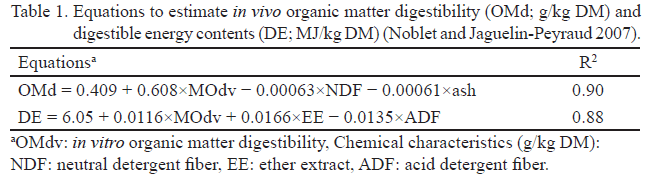
<body><![CDATA[<p align="justify" class="Cuerpodetexto" style="text-indent:0in;"><span style="font-family:'Verdana','sans-serif'; font-size:10.0pt; ">S<span style="letter-spacing:.1pt; ">amples were assayed (in duplicate) for the dry  matter (DM), ether extract (EE), crude protein (CP (N&times;6.25)) (AOAC, 1995) and  organic matter (OM) content by EEC (1971). Neutral detergent fiber (NDF) was  analyzed with a heat stable amylase (Sigma, reference A3176) and expressed exclusive  of residual ash (Van Soest <em>et al.</em> 1991), acid detergent fiber (ADF) was  determined by sequential analysis of the residual NDF and also expressed  exclusive of residual ash (Van Soest <em>et al.</em>, 1991), in which  hemicellulose was calculated as the difference between NDF and ADF. Cellulose  and lignin were determined according to Van Soest <em>et al.</em> (1991), with  lignin being oxidized with permanganate.</span></span></p>     <p align="justify" class="Cuerpodetexto" style="text-indent:0in;"><em><span style="font-family:'Verdana','sans-serif'; font-size:10.0pt; ">In vitro digestibility and energy estimation</span></em><span style="font-family:'Verdana','sans-serif'; font-size:10.0pt; ">: The starch (St) contents and their <em>in vitro</em> digestibility were determined in three steps simulating the digestion in mouth,  stomach and intestine in a closed system, by measuring glucose at different  incubation times (0, 0.5, 1.0, 2.0, 6.0 and 24 h) according to the enzymatic  methods suggested by Al-Rabadi <em>et al.</em> (2009). In briefly: 0.5 g of  sample were placed in an Erlenmeyer (250 mL of capacity) in which 5 mL of  carbonate buffer (39.2 g of NaHCO<sub>3</sub> per liter of distilled water, pH  7.0) containing 11.0 mg &alpha;-amylase /mL (enzyme activity of 25 units/mg) were  added and well mixed with the sample. This step was followed by the addition of    5 mL of pepsin solution (25 mg pepsin/mL of 0.02 M HCl solution). Hence, the  Erlenmeyers were placed in a shaking incubator at 37 &deg;C and 85 rpm during 30  min. After this time 25 mL of sodium acetate buffer containing 2 mg sodium  azide per mL (pH 6.0), 5 mL of 0.02 M NaOH and 5 mL of pancreatin and  amyloglucosidase solution (2 mg pancreatin and 0.9 mg amyloglucosidase per mL  of acetate buffer containing 2 mg sodium azide per mL) were added to the  mixture and placed into the shaking incubator at 37 &deg;C (zero hour) and 85 rpm  during 24 h, the incubation was stopped at 0.5, 1.0, 2.0, 6.0 and    24 h placing the Erlenmeyer in ice for 5 min to stop enzymatic activity and  taking 1.0 mL of supernatant to determine the glucose content by enzymatic  method. The kinetic of St digestion was calculated using a non-linear  regression model proposed by van Kempen <em>et al.</em> (2010).</span><span style="font-family:'Verdana','sans-serif'; font-size:10.0pt; "> </span></p>     <p align="justify" class="Cuerpodetexto" style="text-indent:0in;"><span style="font-family:'Verdana','sans-serif'; font-size:10.0pt; ">In addition, the St was classified in three fractions  according to their digestion rate (Muir and O&rsquo;Dea 1993 and van Kempen <em>et al.</em> 2010): &le; 120 min, St highly digestible (StHd); &gt; 120 min &le; 360 min, St  slowly digestible (StSd) and &gt; 360 min, St resistant to the digestion  (StRd).</span><span style="font-family:'Verdana','sans-serif'; font-size:10.0pt; "> </span></p>     <p align="justify" class="Cuerpodetexto" style="text-indent:0in;"><span style="letter-spacing:.3pt; font-family:'Verdana','sans-serif'; font-size:10.0pt; ">The <em>in vitro</em> OM digestibility (OMdv) was assessed  according to Noblet and Jaguelin-Peyraud, (2007) and Al-Rabadi <em>et al.</em> (2009). Based on OMdv results the <em>in vivo</em> OM digestibility (OMd) and  digestible energy (DE) were estimated (Noblet and Jaguelin-Peyraud 2007) using the  equations presented in    <a href="/img/revistas/cjas/v50n1/t0116116.gif">table 1</a>.</span></p>     
<p align="justify" class="Cuerpodetexto" style="text-indent:0in;"><em><span style="font-family:'Verdana','sans-serif'; font-size:10.0pt; ">Statistical  analysis:</span></em><span style="font-family:'Verdana','sans-serif'; font-size:10.0pt; "> To assess the effect of cultivar,  harvesting year, harvesting season and grain vegetative stage on the quality  and nutritive value of grains and panicles from both sorghums cultivars the  general linear model (GLM) analyses were performed with SPSS version  21(SPSS&nbsp; 2012) following the model:</span></p>     <p align="justify" class="Cuerpodetexto" style="text-indent:0in;"><span style="font-family:'Verdana','sans-serif'; font-size:10.0pt; ">Y<sub>ijk</sub>=&mu;  + SC<sub>i=1-2</sub> + HY<sub>j=1-2</sub> + GVS<sub>k=1-2</sub> + HS<sub>l=1-2</sub> + SC&times;HY + SC&times;GVS + SC&times;HS + HY&times;GVS + HY&times;HS + GVS&times;HS + SC&times;HY&times;GVS + SC&times;HY&times;HS +  SC&times;GVS&times;HS + HY&times;GVS&times;HS + SC&times;HY&times;GVS&times;HS + </span><span style="font-family:'Arial','sans-serif'; font-size:10.0pt; ">&#603;</span><sub><span style="font-family:'Verdana','sans-serif'; font-size:10.0pt; ">ijk</span></sub><span style="font-family:'Verdana','sans-serif'; font-size:10.0pt; ">,</span></p>     <p align="justify" class="Cuerpodetexto" style="text-indent:0in;"><span style="font-family:'Verdana','sans-serif'; font-size:10.0pt; ">with,  SC<sub>i=1-2</sub>, the sorghum cultivar (CIAP MC-04-12 vs. CIAP 2E-95); HY<sub>j=1-2</sub>,  harvesting year (2011 vs. 2012); GVS<sub>k=1-2</sub>, the grain vegetative  stage at the season time (soft dough vs. hard dough);    HS<sub>l=1-2</sub>, the harvesting season (rainy vs. dry); SC&times;HY, SC&times;GVS,  SC&times;HS, HY&times;GVS, HY&times;HS, GVS&times;HS, SC&times;HY&times;GVS, SC&times;HY&times;HS, SC&times;GVS&times;HS, HY&times;GVS&times;HS,  SC&times;HY&times;GVS&times;HS, the interaction among different factors and </span><span style="font-family:'Arial','sans-serif'; font-size:10.0pt; ">&#603;</span><sub><span style="font-family:'Verdana','sans-serif'; font-size:10.0pt; ">ijk</span></sub><span style="font-family:'Verdana','sans-serif'; font-size:10.0pt; ">,  the experimental      error.</span></p>     <p align="justify" class="Cuerpodetexto" style="text-indent:0in;"><span style="font-family:'Verdana','sans-serif'; font-size:10.0pt; ">A  non-linear regression model (van Kempen <em>et al.</em> 2010) was used to assess  the starch digestion kinetics as fallow:</span></p>     <p align="justify" class="Cuerpodetexto" style="text-indent:0in;"><em><span style="font-family:'Verdana','sans-serif'; font-size:10.0pt; ">dSt=(A+B&times;(</span></em><span style="font-family:'Verdana','sans-serif'; font-size:10.0pt; ">1<em>&ndash;exp(&ndash;k<sub>plateau</sub>/plateau&times;  t))&times;&times;(C<sub>plateau</sub>/plateau + </em>1))&times;10,</span></p>     <p align="justify"><span style="font-family:'Verdana','sans-serif'; font-size:10.0pt; ">with, dSt: starch  hydrolysis (g/kg starch); A, digested starch (glucose&times;starch conversion factor  (0.9)) expressed as g per g starch before enzymatic addition; B, starch  (glucose&times;0.9) released by exhaustive digestion expressed as g per g starch; k<sub>plateau</sub>,  the digestion rate of starch (g/kg starch per hour); plateau, maximal starch  (glucose &times; 0.9) release (A+B) as g per 100 g of sample weight; C<sub>plateau</sub>,  sigmoidal/shape modifier corrected for plateau effects, and t is the incubation  time; 10, conversion factor</span><font size="2" face="Verdana, Arial, Helvetica, sans-serif">.</font> </p>     ]]></body>
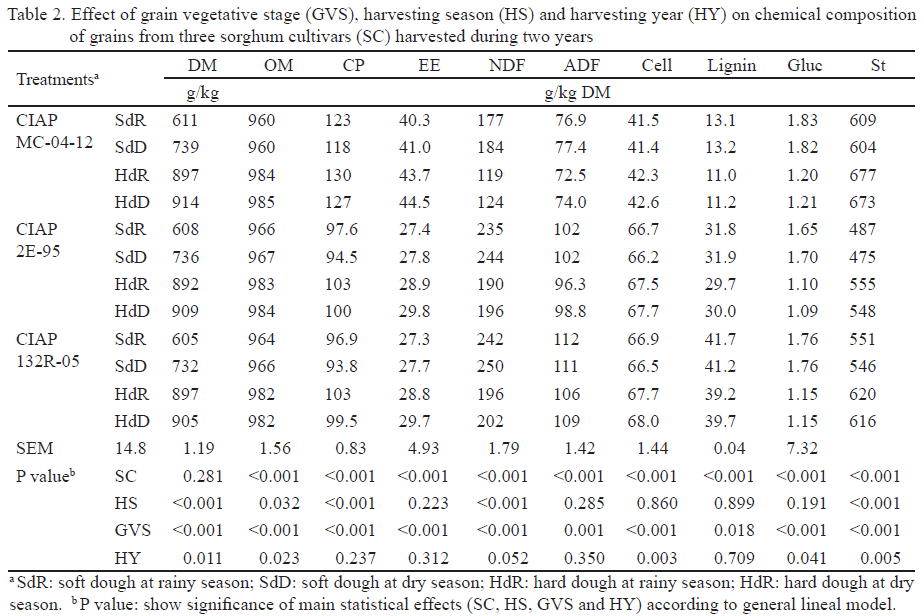
<body><![CDATA[<p align="justify">&nbsp;</p>     <p align="justify"><font size="2" face="Verdana, Arial, Helvetica, sans-serif"><b><font size="3">RESULTS AND DISCUSSION</font></b></font></p>     <p align="justify" class="Cuerpodetexto" style="text-indent:0in;"><em><span style="letter-spacing:.1pt; font-family:'Verdana','sans-serif'; font-size:10.0pt; ">Proximate chemical composition</span></em><span style="font-family:'Verdana','sans-serif'; font-size:10.0pt; ">: The GVS (<a href="/img/revistas/cjas/v50n1/t0216116.gif">table 2</a>) at harvesting time affected (P &lt;  0.001) the concentration of all studied parameters (DM, OM, CP, EE, NDF, ADF,  hemicellulose, cellulose, lignin, glucose and St) in grains from three sorghum  cultivars, whereas for the hard dough grain stage showed the best (P &lt;  0.001) concentrations of the referred parameters. The HS only affected (P &lt;  0.05) DM, CP, NDF, hemicelluloses and St, although there was an interaction (P  &lt; 0.001) between the HS and the GVS for DM contents. In addition, the HY had  influence (P &lt; 0.05) on the DM, OM, cellulose, glucose and St of the grains  from three sorghum cultivars. However the CIAP MC-04-12 sorghum cultivar show  higher    (P &lt; 0.001) concentration of CP, EE, glucose and St as well as lower (P &lt;  0.001) NDF, ADF, hemicellulose, cellulose and lignin than both commercial  sorghum cultivars.</span><span style="font-family:'Verdana','sans-serif'; font-size:10.0pt; "> </span></p>     
<p align="justify" class="Cuerpodetexto" style="text-indent:0in;"><span style="font-family:'Verdana','sans-serif'; font-size:10.0pt; ">Regarding  the panicles from three sorghum cultivars (<a href="/img/revistas/cjas/v50n1/t0316116.gif">table 3</a>) the grain vegetative stage  only had no effect    (P &gt; 0.05) on OM and lignin. In our study, the CP content of panicles from  CIAP MC-04-12 sorghum cultivar showed acceptable values with the best CP  content in the soft dough grain stage compared with panicles in the hard dough  grain stage (<a href="/img/revistas/cjas/v50n1/t0316116.gif">table 3</a>). Besides, the DM, CP, EE and cell wall contents of  panicles from three sorghum cultivars were affected (P &lt; 0.01) by harvesting  season (<a href="/img/revistas/cjas/v50n1/t0316116.gif">table 3</a>). Sorghum cultivar affected all parameters studied (P &lt;  0.001) except (P &gt; 0.05) to DM and OM; where panicles from CIAP MC-04-12  sorghum cultivar show higher (P &lt; 0.001) contents of CP, NDF, ADF,  hemicellulose, cellulose, glucose and St than panicles from both commercial  sorghum cultivars.</span></p>     
<p align="justify" class="Cuerpodetexto" style="text-indent:0in;"><em><span style="font-family:'Verdana','sans-serif'; font-size:10.0pt; ">Digestibility  and energy.</span></em><span style="font-family:'Verdana','sans-serif'; font-size:10.0pt; "> The <em>in vitro</em> digestibility and  energy contents as well as their estimated values for the <em>in vivo</em> digestibility are presented, for both grains and panicles from three sorghum  cultivars harvested at different GVS and HS in <a href="/img/revistas/cjas/v50n1/t0416116.gif">Table 4</a> and <a href="/img/revistas/cjas/v50n1/t0516116.gif">5</a>. The digestibility  parameters for OM (OMdv and OMd) and St (StHd, StSd, StRd and kplateau), as  well as DE of both grains and panicles from three sorghum cultivars were  affected (P &lt; 0.01) by SC and GVS at harvesting time (<a href="/img/revistas/cjas/v50n1/t0416116.gif">tables 4</a> and <a href="/img/revistas/cjas/v50n1/t0516116.gif">5</a>).</span></p>     
<p align="justify" class="MsoNormal"><span style="font-family:'Verdana','sans-serif'; font-size:10.0pt; ">The OM of both  grains and panicles was more digestible and showed a higher (P &lt; 0.05)  energy concentration when were harvested at the hard dough grain stage during  the rainy season (<a href="/img/revistas/cjas/v50n1/t0416116.gif">Tables 4</a> and <a href="/img/revistas/cjas/v50n1/t0516116.gif">5</a>). It seems that those results are influenced  by the higher grain quality under these crop conditions (e.g., higher content  of CP, St and EE).</span></p>     
<p align="justify" class="Cuerpodetexto" style="text-indent:0in;"><em><span style="font-family:'Verdana','sans-serif'; font-size:10.0pt; ">Proximate  chemical composition</span></em><span style="font-family:'Verdana','sans-serif'; font-size:10.0pt; ">: Sorghum grain quality is  affected by several factors, among them genotype, soil type, fertilization,  vegetative stage at harvesting and climate, which affect both the chemical  composition and the nutritive value (Jahadzad <em>et al.</em> 2013). In our  experiment was fixed the same soil type and similar fertility to reduce those  effects on the results and can to accurate better the effect of Sorghum  cultivar, harvesting season and grain vegetative stage.</span></p>     <p align="justify" class="Cuerpodetexto" style="text-indent:0in;"><span style="font-family:'Verdana','sans-serif'; font-size:10.0pt; ">The  chemical composition of grains from both Sorghum cultivars (<a href="/img/revistas/cjas/v50n1/t0216116.gif">table 2</a>) was inside  the range of other Sorghum, but those characteristics of the new sorghum  cultivar (CIAP MC-04-12) are closer to the characteristics of grains from  hybrid sorghum cultivars [e.g., 105-125 g CP/kg DM, 32.0-37.0 g EE/kg DM and  619-795 g St/kg DM, Liv <em>et al.</em>(2012) and Puga <em>et al.</em> (2013)]. </span></p>     
<p align="justify" class="Cuerpodetexto" style="text-indent:0in;"><span style="font-family:'Verdana','sans-serif'; font-size:10.0pt; ">The  CP and St contents are strongly related to the sorghum genotype with a range of  variation of    114-128 g CP/kg DM and 695-790 g St/kg DM in sorghum cultivars resistant to  birds (Hibberd <em>et al.</em>, 1982) or    115-165 g CP/kg DM and 600-795 g St/kg DM <span style="letter-spacing:.2pt; ">in  cultivars not resistant to birds (Hibberd <em>et al.</em>and 1982; Kriegshauser <em>et  al.</em>, 2006). Moreover, the CP content of the CIAP MC-04-12 sorghum cultivar  showed comparable values (<a href="/img/revistas/cjas/v50n1/t0216116.gif">table 2</a>) with other cultivars (110-125 g CP/kg DM;  e.g., Cauma 20-20, CG 34/4-3-2 and G 1636) from guinea race grown under the  environmental conditions of Burkina Faso (Ouattara <em>et al.</em> 2001) and even  higher than other grain sorghum cultivars (90-105 g CP/kg DM; e.g., UDG-110,  CIAP 9E-95, CIAP 2E-95, CIAP 132R-05, CIAP 6E-95) harvested in Cuba (P&eacute;rez <em>et  al.</em> 2010) or used in Venezuela (66-100 g CP/kg DM; e.g., Criollo,  Chaguaramas, Himeca, Pioneer) as feedstuff for animals (Ojeda <em>et al.</em> 2010).</span></span></p>     
<p align="justify" class="Cuerpodetexto" style="text-indent:0in;"><span style="font-family:'Verdana','sans-serif'; font-size:10.0pt; ">Regarding  the panicles and according to Johnson <em>et al.</em> (1971) the panicles from  bird resistant grain sorghum cultivars showed a higher DM content in the hard  dough grain stage (754 g/kg panicle) than in the soft dough grain stage (611  g/kg panicle), but similar cellulose contents between both stages (88.0 and  87.0 g/kg DM, respectively), while the panicles in the soft dough grain stage  showed higher CP contents than panicles in the hard dough grain stage (111 and    93.0 g/kg DM). The dry matter and cell wall contents of panicles in our study  were affected (P &lt; 0.05) by the harvesting season (<a href="/img/revistas/cjas/v50n1/t0316116.gif">table 3</a>). In this  respect, the drought stress could be responsible for increased contents of ADF  and DM in grasses and Poaceaes (P&eacute;rez <em>et al.</em> 2010 and Bean <em>et al.</em> 2013) grown and harvested under drought conditions. In our experiment, the  panicles from the CIAP MC-04-12 sorghum cultivar harvested during the dry  season (<a href="/img/revistas/cjas/v50n1/t0316116.gif">table 3</a>) showed higher    (P &lt; 0.001) ADF contents than panicles harvested during the rainy season. </span></p>     
]]></body>
<body><![CDATA[<p align="justify" class="Cuerpodetexto" style="text-indent:0in;"><em><span style="font-family:'Verdana','sans-serif'; font-size:10.0pt; ">Digestibility and energy:</span></em><span style="font-family:'Verdana','sans-serif'; font-size:10.0pt; "> The St of the CIAP MC-04-12 sorghum cultivar was  classified as a St of slow digestion according to the method proposed by Muir  and O&rsquo;Dea (1993) and van Kempen <em>et al.</em> (2010) and showed lower amount of  St highly digested than the commercial sorghum cultivars (CIAP 2E-95 or CIAP  132R-05). The St type of CIAP MC-04-12 sorghum cultivar let a slow but constant  release of glucose from the intestine toward the animal blood (Al-Rabadi <em>et  al.</em> 2009 and van Kempen <em>et al.</em> 2010). The highest St digestion in  both grains and panicles occurred between 120 and 360 minutes post digestion.  The St content resistant to the digestion under our experimental conditions was  low compared to studies for other sorghum cultivars (Singh <em>et al.</em> 2010),  with an acceptable degradation rate (k<sub>plateau</sub> &gt;200 g/kg St per h  (van Kempen <em>et al.</em> 2010), <a href="/img/revistas/cjas/v50n1/t0416116.gif">tables 4</a> and <a href="/img/revistas/cjas/v50n1/t0516116.gif">5</a>) for grains at hard dough stage  from CIAP MC-04-12 and CIAP 132R-05. The high proportion of St slowly degraded  could be related with the difficulty of the enzymatic diffusion into the St  granule (Al-Rabadi <em>et al.</em> 2009), due to the St that is enclosed within  plant cells and protein matrices (Al-Rabadi <em>et al.</em> 2009, Wong <em>et al.</em> 2009 and Singh <em>et al.</em> 2010) or because of the crystalline structure of  St (Singh <em>et al.</em> 2010).</span><span style="font-family:'Verdana','sans-serif'; font-size:10.0pt; "> </span></p>     
<p align="justify" class="Cuerpodetexto" style="text-indent:0in;"><span style="letter-spacing:.3pt; font-family:'Verdana','sans-serif'; font-size:10.0pt; ">The results obtained on estimated OM digestibility and DE  content are comparable with other values reported in experiments with pigs (<em>in  vivo</em> methods), in which pigs fed with sorghum or corn diets showed an  apparent total tract digestibility of more than    850 g DM/kg DM or 870 g DM/kg DM to sorghum or corn, respectively (Nyannor <em>et  al.</em> 2007). In our study, the grains from the new sorghum cultivar (CIAP  MC-04-12) showed a total digestibility between 805 and 870 g DM/kg DM which are  comparable with the </span><span style="font-family:'Verdana','sans-serif'; font-size:10.0pt; ">values (790 and 850 g DM/kg DM) of  commercial sorghum cultivar. In addition, as compared with soft dough stage,  the grains in hard dough stage showed the highest (P &lt; 0.05) OM  digestibility in both HS independently of SC. The DE content of the grains  (<a href="/img/revistas/cjas/v50n1/t0416116.gif">table 4</a>) suggests that it could be a valuable energy source for growing or  fattening pigs. The estimated energy contents showed by CIAP MC-04-12 sorghum  cultivar is comparable with other results obtained previously by <em>in vivo</em> trials (14.2-16.0 MJ of DE/kg DM) with other sorghum cultivars (Nyannor <em>et  al.</em> 2007) or corn distillers supplemented with oil (Ren <em>et al.</em> 2011). Although the panicles from three sorghum cultivars showed a lower DE  content than other grain sources and despite its fibrous characteristics, it  could be an adequate energy source (Yde <em>et al.</em> 2011 and Shewayrga <em>et  al.</em> 2012) to finishing fattening pigs, particularly to regions with a low  input of resources and furthermore it could be a valuable energy source to  ruminants. </span></p>     
<p align="justify"><span style="font-family:'Verdana','sans-serif'; font-size:10.0pt; ">As compared with commercial  sorghum cultivars the grains from the CIAP MC-04-12 sorghum cultivar at hard  dough grain stage in both HS (rainy and dry) showed a good nutritive value for  growing/fattening pigs. This study provide a basis for further studies as an  interesting animal feed alternative, especially for pig feeding systems in  areas of low grain yields of conventional cereals (e.g., corn, wheat or  barley). The panicles compared with grain cereals had a limited nutritive  value, especially the energy value, but could be an alternative to fattening  pigs in areas with a low input of resources or to feeding ruminants. The starch  of CIAP MC-04-12 sorghum cultivar was classified as starch of a slow  digestibility</span><font size="2" face="Verdana, Arial, Helvetica, sans-serif">.</font> </p>     <p align="justify">&nbsp;</p>     <p align="justify"><font size="2" face="Verdana, Arial, Helvetica, sans-serif"><b><font size="3">ACKNOWLEDGEMENTS</font></b></font></p>     <p align="justify"><font size="2" face="Verdana, Arial, Helvetica, sans-serif"><span style="font-family:'Verdana','sans-serif'; font-size:10.0pt; ">This  research was supported by Universidad Central &ldquo;Marta Abreu&rdquo; de Las Villas  (UCLV). Special acknowledgements to the staff from the Experimental Stations in  CIAP of the UCLV for the technical assistance during this research</span>.</font></p>     <p align="justify">&nbsp;</p>      <p align="justify"><font size="2" face="Verdana, Arial, Helvetica, sans-serif"><font size="3"><b>REFERENCES</b></font></font></p>     <p align="justify" class="MsoBibliography"><span style="font-family:'Verdana','sans-serif'; font-size:10.0pt; ">Al-Rabadi, G. J. S., Gilbert, R. G. &amp;  Gidley, M. J. 2009. </span><span style="font-family:'Verdana','sans-serif'; font-size:10.0pt; ">&lsquo;&lsquo;Effect of  particle size on kinetics of starch digestion in milled barley and sorghum  grains by porcine <em>alpha</em>-amylase&rsquo;&rsquo;. <em>Journal of Cereal Science</em>, 50  (2): 198&ndash;204, ISSN: 0733-5210, DOI: 10.1016/j.jcs.2009.05.001.</span></p>     <p align="justify" class="MsoBibliography"><span style="font-family:'Verdana','sans-serif'; font-size:10.0pt; ">Bean, B. W.,  Baumhardt, R. L., McCollum III, F. T. &amp; McCuistion, K. C. 2013.  &lsquo;&lsquo;Comparison of sorghum classes for grain and forage yield and forage nutritive  value&rsquo;&rsquo;. <em>Field Crops Research</em>, 142: 20&ndash;26, ISSN: 0378-4290, DOI:  10.1016/j.fcr.2012.11.014.</span></p>     ]]></body>
<body><![CDATA[<!-- ref --><p align="justify" class="MsoBibliography"><span style="font-family:'Verdana','sans-serif'; font-size:10.0pt; ">EC 2009. <em>Determination  of crude ash</em>. Commission Regulation, no. L152/2009, Offic. </span><span style="font-family:'Verdana','sans-serif'; font-size:10.0pt; ">J.  Eur. Com. L54, p. 50.    </span></p>     <p align="justify" class="MsoBibliography"><span style="font-family:'Verdana','sans-serif'; font-size:10.0pt; ">Gil, D. V. D., Quintero, F. E. &amp;  Artiles, G. Y. 2008. <em>Generalidades de cultivo. Millo-Cebada</em>. Informe  final de proyecto de investigaci&oacute;n, Santa Clara, Cuba: Centro de  Investigaciones Agropecuarias, Universidad Central &lsquo;Marta Abreu&rsquo; de Las Villas.</span></p>     <p align="justify" class="MsoBibliography"><span style="font-family:'Verdana','sans-serif'; font-size:10.0pt; ">Hibberd, C.  A., Wagner, D. G., Schemm, R. L., Mitchell, E. D., Hintz, R. L. &amp; Weibel,  D. E. 1982. &lsquo;&lsquo;Nutritive Characteristics of Different Varieties of Sorghum and  Corn Grains&rsquo;&rsquo;. <em>Journal of Animal Science</em>, 55 (3): 665&ndash;672, ISSN:  0021-8812, DOI: 10.2134/jas1982.553665x.</span></p>     <!-- ref --><p align="justify" class="MsoBibliography"><span style="font-family:'Verdana','sans-serif'; font-size:10.0pt; ">IBM  Corporation 2012. <em>IBM SPSS Statistics</em>. version 21, [Windows],  Multiplataforma, U.S: IBM Corporation, Available: &lt;<a href="http://www.ibm.com">http://www.ibm.com</a>&gt;    .</span></p>     <!-- ref --><p align="justify" class="MsoBibliography"><span style="font-family:'Verdana','sans-serif'; font-size:10.0pt; ">ICRISAT. 2003. <em>Lax panicles, gaping glumes</em>. SATrends, Available:  &lt;<a href="http://www.icrisat.org/what-we-do/satrends/may2003.htm">http://www.icrisat.org/what-we-do/satrends/may2003.htm</a>&gt;,  [Consulted:&nbsp;January 28, 2015].    </span></p>     <p align="justify" class="MsoBibliography"><span style="font-family:'Verdana','sans-serif'; font-size:10.0pt; ">Jahanzad, E.,  Jorat, M., Moghadam, H., Sadeghpour, A., Chaichi, M.-R. &amp; Dashtaki, M.  2013. &lsquo;&lsquo;Response of a new and a commonly grown forage sorghum cultivar to  limited irrigation and planting density&rsquo;&rsquo;. <em>Agricultural Water Management</em>,  117: 62&ndash;69, ISSN: 0378-3774, DOI: 10.1016/j.agwat.2012.11.001.</span></p>     <p align="justify" class="MsoBibliography"><span style="font-family:'Verdana','sans-serif'; font-size:10.0pt; ">Johnson, R.  R., de Faria, V. P. &amp; McClure, K. E. 1971. &lsquo;&lsquo;Effects of Maturity on  Chemical Composition and Digestibility of Bird Resistant Sorghum Plants When  Fed to Sheep as Silages&rsquo;&rsquo;. <em>Journal of Animal Science</em>, 33 (5): 1102&ndash;1109,  ISSN: 0021-8812, DOI: 10.2134/jas1971.3351102x.</span></p>     ]]></body>
<body><![CDATA[<p align="justify" class="MsoBibliography"><span style="font-family:'Verdana','sans-serif'; font-size:10.0pt; ">Kriegshauser,  T. D., Tuinstra, M. R. &amp; Hancock, J. D. 2006. &lsquo;&lsquo;Variation in Nutritional  Value of Sorghum Hybrids with Contrasting Seed Weight Characteristics and  Comparisons with Maize in Broiler Chicks&rsquo;&rsquo;. <em>Crop Science</em>, 46 (2): 695,  ISSN: 1435-0653, DOI: 10.2135/cropsci2005.07.0225.</span></p>     <p align="justify" class="MsoBibliography"><span style="font-family:'Verdana','sans-serif'; font-size:10.0pt; ">Latimer, G. W.  2012. <em>Official Methods of Analysis of AOAC International</em>. 19th ed.,  Gaithersburg, Md.: AOAC International, ISBN: 978-0-935584-83-7, Available:  &lt;<a href="http://www.amazon.com/Official-Methods-Analysis-OFFICIAL-ANALYSIS/dp/0935584838/ref=pd_sim_sbs_14_1?ie=UTF8&dpID=31iikC-xl2L&dpSrc=sims&preST=_AC_UL160_SR160%2C160_&refRID=101AB94246X0EM9N7XMW">http://www.amazon.com/Official-Methods-Analysis-OFFICIAL-ANALYSIS/dp/0935584838/ref=pd_sim_sbs_14_1?ie=UTF8&amp;dpID=31iikC-xl2L&amp;dpSrc=sims&amp;preST=_AC_UL160_SR160%2C160_&amp;refRID=101AB94246X0EM9N7XMW</a>&gt;,  [Consulted:&nbsp;April 1, 2016].</span></p>     <p align="justify" class="MsoBibliography"><span style="font-family:'Verdana','sans-serif'; font-size:10.0pt; ">Lima, O. R., Castro, A. A. &amp; Fievez, V.  2013. </span><span style="font-family:'Verdana','sans-serif'; font-size:10.0pt; ">&lsquo;&lsquo;Ensiled sorghum  and soybean as ruminant feed in the tropics, with emphasis on Cuba&rsquo;&rsquo;. <em>Grass  and Forage Science</em>, 68 (1): 20&ndash;32, ISSN: 1365-2494, DOI: 10.1111/j.1365-2494.2012.00890.x.</span></p>     <p align="justify" class="MsoBibliography"><span style="font-family:'Verdana','sans-serif'; font-size:10.0pt; ">Liu, L.,  Herald, T. J., Wang, D., Wilson, J. D., Bean, S. R. &amp; Aramouni, F. M. 2012.  &lsquo;&lsquo;Characterization of sorghum grain and evaluation of sorghum flour in a  Chinese egg noodle system&rsquo;&rsquo;. </span><em><span style="font-family:'Verdana','sans-serif'; font-size:10.0pt; ">Journal of Cereal Science</span></em><span style="font-family:'Verdana','sans-serif'; font-size:10.0pt; ">,  55 (1): 31&ndash;36, ISSN: 0733-5210, DOI: 10.1016/j.jcs.2011.09.007.</span></p>     <p align="justify" class="MsoBibliography"><span style="font-family:'Verdana','sans-serif'; font-size:10.0pt; ">McCune, N. M., Gonz&aacute;lez, Y. R., Alc&aacute;ntara,  E. A., Mart&iacute;nez, O. F., Fundora, C. O., Arzola, N. C., Cairo, P. C., D&rsquo;Haese,  M., DeNeve, S. &amp; Hern&aacute;ndez, F. G. 2011. </span><span style="font-family:'Verdana','sans-serif'; font-size:10.0pt; ">&lsquo;&lsquo;Global Questions, Local Answers: Soil Management and  Sustainable Intensification in Diverse Socioeconomic Contexts of Cuba&rsquo;&rsquo;. <em>Journal  of Sustainable Agriculture</em>, 35 (6): 650&ndash;670, ISSN: 1044-0046, DOI:  10.1080/10440046.2011.586595.</span></p>     <p align="justify" class="MsoBibliography"><span style="font-family:'Verdana','sans-serif'; font-size:10.0pt; ">Muir, J. G.  &amp; O&rsquo;Dea, K. 1993. &lsquo;&lsquo;Validation of an <em>in vitro</em> assay for predicting  the amount of starch that escapes digestion in the small intestine of  humans.&rsquo;&rsquo;. <em>The American Journal of Clinical Nutrition</em>, 57 (4): 540&ndash;546,  ISSN: 0002-9165, 1938-3207.</span></p>     <p align="justify" class="MsoBibliography"><span style="font-family:'Verdana','sans-serif'; font-size:10.0pt; ">Noblet, J.  &amp; Jaguelin, P. Y. 2007. &lsquo;&lsquo;Prediction of digestibility of organic matter and  energy in the growing pig from an <em>in vitro</em> method&rsquo;&rsquo;. <em>Animal Feed  Science and Technology</em>, 134 (3&ndash;4): 211&ndash;222, ISSN: 0377-8401, DOI:  10.1016/j.anifeedsci.2006.07.008.</span></p>     <p align="justify" class="MsoBibliography"><span style="font-family:'Verdana','sans-serif'; font-size:10.0pt; ">Nyannor, E. K.  D., Adedokun, S. A., Hamaker, B. R., Ejeta, G. &amp; Adeola, O. 2007.  &lsquo;&lsquo;Nutritional evaluation of high-digestible sorghum for pigs and broiler  chicks&rsquo;&rsquo;. </span><em><span style="font-family:'Verdana','sans-serif'; font-size:10.0pt; ">Journal of Animal Science</span></em><span style="font-family:'Verdana','sans-serif'; font-size:10.0pt; ">,  85 (1): 196&ndash;203, ISSN: 0021-8812, 1525-3163, DOI: 10.2527/jas.2006-116.</span></p>     <p align="justify" class="MsoBibliography"><span style="font-family:'Verdana','sans-serif'; font-size:10.0pt; ">Ojeda, A., Fr&iacute;as, A., Gonz&aacute;lez, R.,  Linares, Z. &amp; Pizzani, P. 2010. &lsquo;&lsquo;Contenido de taninos, f&oacute;sforo f&iacute;tico y  actividad de fitasas en el grano de 12 h&iacute;bridos de sorgo gran&iacute;fero (<em>Sorghum  bicolor</em> (L) Moench)&rsquo;&rsquo;. <em>Archivos Latinoamericanos de Nutrici&oacute;n</em>, 60  (1): 93, ISSN: 0004-0622.</span></p>     <p align="justify" class="MsoBibliography"><span style="font-family:'Verdana','sans-serif'; font-size:10.0pt; ">Ouattara, L., Trouche, G., Fliedel, G.  &amp; Diawara, B. 2001. </span><span style="font-family:'Verdana','sans-serif'; font-size:10.0pt; ">&lsquo;&lsquo;Potentialit&eacute;s  d&rsquo;utilisations des sorghos guinea tan au Burkina Faso&rsquo;&rsquo;. In: Akintayo I. &amp;  Sedgo J. (eds.), <em>Towards sustainable sorghum production, utilization, and  commercialization in West and Central Africa: Proceedings of a technical workshop  of the West and Central Africa sorghum research network</em>, Patancheru:  ICRISAT, pp. 24&ndash;41, Available:  &lt;<a href="http://catalogue-bibliotheques.cirad.fr/cgi-bin/koha/opac-detail.pl?biblionumber=7151">http://catalogue-bibliotheques.cirad.fr/cgi-bin/koha/opac-detail.pl?biblionumber=7151</a>&gt;,  [Consulted:&nbsp;April 4, 2016].</span></p>     ]]></body>
<body><![CDATA[<p align="justify" class="MsoBibliography"><span style="font-family:'Verdana','sans-serif'; font-size:10.0pt; ">P&eacute;rez, A., Saucedo, O., Iglesias, J.,  Wencomo, H. B., Reyes, F., Oquendo, G. &amp; Mili&aacute;n, I. 2010. &lsquo;&lsquo;Caracterizaci&oacute;n  y potencialidades del grano de sorgo (<em>Sorghum bicolor</em> L. Moench)&rsquo;&rsquo;. <em>Pastos  y Forrajes</em>, 33 (1): 1&ndash;1, ISSN: 0864-0394.</span></p>     <p align="justify" class="MsoBibliography"><span style="font-family:'Verdana','sans-serif'; font-size:10.0pt; ">Puga, A. P., de Mello Prado, R., Mattiuz,  B.-H., do Vale, D. W. &amp; Fonseca, I. M. 2013. </span><span style="font-family:'Verdana','sans-serif'; font-size:10.0pt; ">&lsquo;&lsquo;Chemical composition of corn and sorghum grains  cultivated in Oxisol with different application methods and doses of zinc&rsquo;&rsquo;. </span><em><span style="font-family:'Verdana','sans-serif'; font-size:10.0pt; ">Ciencia  e Investigaci&oacute;n Agraria</span></em><span style="font-family:'Verdana','sans-serif'; font-size:10.0pt; ">, 40 (1): 97&ndash;108, ISSN: 0718-1620,  DOI: 10.4067/S0718-16202013000100008.</span></p>     <p align="justify" class="MsoBibliography"><span style="font-family:'Verdana','sans-serif'; font-size:10.0pt; ">Ren, P., Zhu, Z., Dong, B., Zang, J. &amp;  Gong, L. 2011. </span><span style="font-family:'Verdana','sans-serif'; font-size:10.0pt; ">&lsquo;&lsquo;Determination  of energy and amino acid digestibility in growing pigs fed corn distillers&rsquo;  dried grains with solubles containing different lipid levels&rsquo;&rsquo;. <em>Archives of  Animal Nutrition</em>, 65 (4): 303&ndash;319, ISSN: 1745-039X.</span></p>     <!-- ref --><p align="justify" class="MsoBibliography"><span style="font-family:'Verdana','sans-serif'; font-size:10.0pt; ">Ruiz, Q. D.,  Victor, D. &amp; Lima, O. R. 2013. </span><em><span style="font-family:'Verdana','sans-serif'; font-size:10.0pt; ">El Millo Cebada En Villa  Clara, Cuba</span></em><span style="font-family:'Verdana','sans-serif'; font-size:10.0pt; ">. Saarbr&uuml;cken: Academia Espa&ntilde;ola, 80 p.,  ISBN: 978-3-8465-6928-3.    </span></p>     <p align="justify" class="MsoBibliography"><span style="font-family:'Verdana','sans-serif'; font-size:10.0pt; ">Shawrang, P., Sadeghi, A. A., Behgar, M.,  Zareshahi, H. &amp; Shahhoseini, G. 2011. </span><span style="font-family:'Verdana','sans-serif'; font-size:10.0pt; ">&lsquo;&lsquo;Study of chemical compositions, anti-nutritional  contents and digestibility of electron beam irradiated sorghum grains&rsquo;&rsquo;. </span><em><span style="font-family:'Verdana','sans-serif'; font-size:10.0pt; ">Food  Chemistry</span></em><span style="font-family:'Verdana','sans-serif'; font-size:10.0pt; ">, 125 (2): 376&ndash;379, ISSN: 0308-8146, DOI:  10.1016/j.foodchem.2010.09.010.</span></p>     <p align="justify" class="MsoBibliography"><span style="font-family:'Verdana','sans-serif'; font-size:10.0pt; ">Shewayrga, H., Sopade, P. A., Jordan, D. R.  &amp; Godwin, I. D. 2012. </span><span style="font-family:'Verdana','sans-serif'; font-size:10.0pt; ">&lsquo;&lsquo;Characterisation  of grain quality in diverse sorghum germplasm using a Rapid Visco-Analyzer and  near infrared reflectance spectroscopy&rsquo;&rsquo;. <em>Journal of the Science of Food and  Agriculture</em>, 92 (7): 1402&ndash;1410, ISSN: 1097-0010, DOI: 10.1002/jsfa.4714.</span></p>     <p align="justify" class="MsoBibliography"><span style="font-family:'Verdana','sans-serif'; font-size:10.0pt; ">Singh, J.,  Dartois, A. &amp; Kaur, L. 2010. &lsquo;&lsquo;Starch digestibility in food matrix: a  review&rsquo;&rsquo;. <em>Trends in Food Science &amp; Technology</em>, 21 (4): 168&ndash;180,  ISSN: 0924-2244, DOI: 10.1016/j.tifs.2009.12.001.</span></p>     <p align="justify" class="MsoBibliography"><span style="font-family:'Verdana','sans-serif'; font-size:10.0pt; ">Tolk, J. A.,  Howell, T. A. &amp; Miller, F. R. 2013. &lsquo;&lsquo;Yield component analysis of grain  sorghum grown under water stress&rsquo;&rsquo;. <em>Field Crops Research</em>, 145: 44&ndash;51,  ISSN: 0378-4290, DOI: 10.1016/j.fcr.2013.02.006.</span></p>     <p align="justify" class="MsoBibliography"><span style="font-family:'Verdana','sans-serif'; font-size:10.0pt; ">van Kempen, T.  A. T. G., Regmi, P. R., Matte, J. J. &amp; Zijlstra, R. T. 2010. &lsquo;&lsquo;<em>In Vitro</em> Starch Digestion Kinetics, Corrected for Estimated Gastric Emptying, Predict  Portal Glucose Appearance in Pigs&rsquo;&rsquo;. <em>The Journal of Nutrition</em>, 140 (7):  1227&ndash;1233, ISSN: 0022-3166, 1541-6100, DOI: 10.3945/jn.109.120584.</span></p>     ]]></body>
<body><![CDATA[<p align="justify" class="MsoBibliography"><span style="font-family:'Verdana','sans-serif'; font-size:10.0pt; ">van Soest, P.  J., Robertson, J. B. &amp; Lewis, B. A. 1991. &lsquo;&lsquo;Methods for Dietary Fiber,  Neutral Detergent Fiber, and Nonstarch Polysaccharides in Relation to Animal  Nutrition&rsquo;&rsquo;. <em>Journal of Dairy Science</em>, 74 (10): 3583&ndash;3597, ISSN:  0022-0302, DOI: 10.3168/jds.S0022-0302(91)78551-2.</span></p>     <p align="justify" class="MsoBibliography"><span style="font-family:'Verdana','sans-serif'; font-size:10.0pt; ">Wong, J. H.,  Lau, T., Cai, N., Singh, J., Pedersen, J. F., Vensel, W. H., Hurkman, W. J.,  Wilson, J. D., Lemaux, P. G. &amp; Buchanan, B. B. 2009. &lsquo;&lsquo;Digestibility of  protein and starch from sorghum (<em>Sorghum bicolor</em>) is linked to  biochemical and structural features of grain endosperm&rsquo;&rsquo;. </span><em><span style="font-family:'Verdana','sans-serif'; font-size:10.0pt; ">Journal  of Cereal Science</span></em><span style="font-family:'Verdana','sans-serif'; font-size:10.0pt; ">, 49 (1): 73&ndash;82, ISSN: 0733-5210, DOI:  10.1016/j.jcs.2008.07.013.</span></p>     <p align="justify"><span style="font-family:'Verdana','sans-serif'; font-size:10.0pt; ">Yde, C. C., Bertram, H. C.,  Theil, P. K. &amp; Knudsen, K. E. B. 2011. &lsquo;&lsquo;Effects of high dietary fibre  diets formulated from by-products from vegetable and agricultural industries on  plasma metabolites in gestating sows&rsquo;&rsquo;. </span><em><span style="font-family:'Verdana','sans-serif'; font-size:10.0pt; ">Archives of Animal Nutrition</span></em><span style="font-family:'Verdana','sans-serif'; font-size:10.0pt; ">, 65 (6): 460&ndash;476, ISSN:  1745-039X, DOI: 10.1080/1745039X.2011.621284</span><font size="2" face="Verdana, Arial, Helvetica, sans-serif">.</font> </p>     <p align="justify">&nbsp;</p>     <p align="justify">&nbsp;</p>     <p align="justify"><font size="2" face="Verdana, Arial, Helvetica, sans-serif">Received: June 8, 2015    <br>   Accepted: March 11, 2016</font></p>     <p align="justify">&nbsp;</p>     <p align="justify">&nbsp;</p>     <p align="justify"><font size="2" face="Verdana, Arial, Helvetica, sans-serif"><i>Janhad L. Rodríguez-Mendieta,</i> Universidad Central “Marta Abreu” de Las Villas (UCLV), Departamento of Medicina Veterinaria y Zootecnia,  Carretera a Camajuaní km 5.5. Santa Clara, Villa Clara .Cuba.    Email: <a href="mailto:raciello@uclv.edu.cu">raciello@uclv.edu.cu</a></font></p>     ]]></body>
<body><![CDATA[ ]]></body><back>
<ref-list>
<ref id="B1">
<nlm-citation citation-type="journal">
<person-group person-group-type="author">
<name>
<surname><![CDATA[Al-Rabadi]]></surname>
<given-names><![CDATA[G. J. S.]]></given-names>
</name>
<name>
<surname><![CDATA[Gilbert]]></surname>
<given-names><![CDATA[R. G.]]></given-names>
</name>
<name>
<surname><![CDATA[Gidley]]></surname>
<given-names><![CDATA[M. J.]]></given-names>
</name>
</person-group>
<article-title xml:lang="nd"><![CDATA[Effect of particle size on kinetics of starch digestion in milled barley and sorghum grains by porcine alpha-amylase]]></article-title>
<source><![CDATA[Journal of Cereal Science]]></source>
<year>2009</year>
<volume>50</volume>
<numero>2</numero>
<issue>2</issue>
<page-range>198-204</page-range></nlm-citation>
</ref>
<ref id="B2">
<nlm-citation citation-type="journal">
<person-group person-group-type="author">
<name>
<surname><![CDATA[Bean]]></surname>
<given-names><![CDATA[B. W.]]></given-names>
</name>
<name>
<surname><![CDATA[Baumhardt]]></surname>
<given-names><![CDATA[R. L.]]></given-names>
</name>
<name>
<surname><![CDATA[McCollum III]]></surname>
<given-names><![CDATA[F. T.]]></given-names>
</name>
<name>
<surname><![CDATA[McCuistion]]></surname>
<given-names><![CDATA[K. C.]]></given-names>
</name>
</person-group>
<article-title xml:lang="nd"><![CDATA[Comparison of sorghum classes for grain and forage yield and forage nutritive value]]></article-title>
<source><![CDATA[Field Crops Research]]></source>
<year>2013</year>
<volume>142</volume>
<page-range>20-26</page-range></nlm-citation>
</ref>
<ref id="B3">
<nlm-citation citation-type="book">
<person-group person-group-type="author">
<name>
<surname><![CDATA[EC]]></surname>
</name>
</person-group>
<source><![CDATA[Determination of crude ash]]></source>
<year>2009</year>
<page-range>50</page-range><publisher-name><![CDATA[Offic. J. Eur. Com. L54]]></publisher-name>
</nlm-citation>
</ref>
<ref id="B4">
<nlm-citation citation-type="book">
<person-group person-group-type="author">
<name>
<surname><![CDATA[Gil]]></surname>
<given-names><![CDATA[D. V. D.]]></given-names>
</name>
<name>
<surname><![CDATA[Quintero]]></surname>
<given-names><![CDATA[F. E.]]></given-names>
</name>
<name>
<surname><![CDATA[Artiles]]></surname>
<given-names><![CDATA[G. Y.]]></given-names>
</name>
</person-group>
<source><![CDATA[Generalidades de cultivo. Millo-Cebada]]></source>
<year>2008</year>
<publisher-loc><![CDATA[Santa Clara, Cuba ]]></publisher-loc>
<publisher-name><![CDATA[Centro de Investigaciones Agropecuarias, Universidad Central ‘Marta Abreu’ de Las Villas]]></publisher-name>
</nlm-citation>
</ref>
<ref id="B5">
<nlm-citation citation-type="journal">
<person-group person-group-type="author">
<name>
<surname><![CDATA[Hibberd]]></surname>
<given-names><![CDATA[C. A.]]></given-names>
</name>
<name>
<surname><![CDATA[Wagner]]></surname>
<given-names><![CDATA[D. G.]]></given-names>
</name>
<name>
<surname><![CDATA[Schemm]]></surname>
<given-names><![CDATA[R. L.]]></given-names>
</name>
<name>
<surname><![CDATA[Mitchell]]></surname>
<given-names><![CDATA[E. D.]]></given-names>
</name>
<name>
<surname><![CDATA[Hintz]]></surname>
<given-names><![CDATA[R. L.]]></given-names>
</name>
<name>
<surname><![CDATA[Weibel]]></surname>
<given-names><![CDATA[D. E.]]></given-names>
</name>
</person-group>
<article-title xml:lang="nd"><![CDATA[Nutritive Characteristics of Different Varieties of Sorghum and Corn Grains]]></article-title>
<source><![CDATA[Journal of Animal Science]]></source>
<year>1982</year>
<volume>55</volume>
<numero>3</numero>
<issue>3</issue>
<page-range>665-672</page-range></nlm-citation>
</ref>
<ref id="B6">
<nlm-citation citation-type="book">
<person-group person-group-type="author">
<name>
<surname><![CDATA[IBM Corporation]]></surname>
</name>
</person-group>
<source><![CDATA[IBM SPSS Statistics]]></source>
<year>2012</year>
<publisher-loc><![CDATA[U.S ]]></publisher-loc>
<publisher-name><![CDATA[IBM Corporation]]></publisher-name>
</nlm-citation>
</ref>
<ref id="B7">
<nlm-citation citation-type="">
<person-group person-group-type="author">
<name>
<surname><![CDATA[ICRISAT]]></surname>
</name>
</person-group>
<source><![CDATA[Lax panicles, gaping glumes]]></source>
<year>2003</year>
</nlm-citation>
</ref>
<ref id="B8">
<nlm-citation citation-type="journal">
<person-group person-group-type="author">
<name>
<surname><![CDATA[Jahanzad]]></surname>
<given-names><![CDATA[E.]]></given-names>
</name>
<name>
<surname><![CDATA[Jorat]]></surname>
<given-names><![CDATA[M.]]></given-names>
</name>
<name>
<surname><![CDATA[Moghadam]]></surname>
<given-names><![CDATA[H.]]></given-names>
</name>
<name>
<surname><![CDATA[Sadeghpour]]></surname>
<given-names><![CDATA[A.]]></given-names>
</name>
<name>
<surname><![CDATA[Chaichi]]></surname>
<given-names><![CDATA[M.-R.]]></given-names>
</name>
<name>
<surname><![CDATA[Dashtaki]]></surname>
<given-names><![CDATA[M.]]></given-names>
</name>
</person-group>
<article-title xml:lang="nd"><![CDATA[Response of a new and a commonly grown forage sorghum cultivar to limited irrigation and planting density]]></article-title>
<source><![CDATA[Agricultural Water Management]]></source>
<year>2013</year>
<volume>117</volume>
<page-range>62-69</page-range></nlm-citation>
</ref>
<ref id="B9">
<nlm-citation citation-type="journal">
<person-group person-group-type="author">
<name>
<surname><![CDATA[Johnson]]></surname>
<given-names><![CDATA[R. R.]]></given-names>
</name>
<name>
<surname><![CDATA[de Faria]]></surname>
<given-names><![CDATA[V. P.]]></given-names>
</name>
<name>
<surname><![CDATA[McClure]]></surname>
<given-names><![CDATA[K. E.]]></given-names>
</name>
</person-group>
<article-title xml:lang="nd"><![CDATA[Effects of Maturity on Chemical Composition and Digestibility of Bird Resistant Sorghum Plants When Fed to Sheep as Silages]]></article-title>
<source><![CDATA[Journal of Animal Science]]></source>
<year>1971</year>
<volume>33</volume>
<numero>5</numero>
<issue>5</issue>
<page-range>1102-1109</page-range></nlm-citation>
</ref>
<ref id="B10">
<nlm-citation citation-type="journal">
<person-group person-group-type="author">
<name>
<surname><![CDATA[Kriegshauser]]></surname>
<given-names><![CDATA[T. D.]]></given-names>
</name>
<name>
<surname><![CDATA[Tuinstra]]></surname>
<given-names><![CDATA[M. R.]]></given-names>
</name>
<name>
<surname><![CDATA[Hancock]]></surname>
<given-names><![CDATA[J. D.]]></given-names>
</name>
</person-group>
<article-title xml:lang="nd"><![CDATA[Variation in Nutritional Value of Sorghum Hybrids with Contrasting Seed Weight Characteristics and Comparisons with Maize in Broiler Chicks]]></article-title>
<source><![CDATA[Crop Science]]></source>
<year>2006</year>
<volume>46</volume>
<numero>2</numero>
<issue>2</issue>
<page-range>695</page-range></nlm-citation>
</ref>
<ref id="B11">
<nlm-citation citation-type="book">
<person-group person-group-type="author">
<name>
<surname><![CDATA[Latimer]]></surname>
<given-names><![CDATA[G. W.]]></given-names>
</name>
</person-group>
<source><![CDATA[Official Methods of Analysis of AOAC International]]></source>
<year>2012</year>
<edition>19th</edition>
<publisher-loc><![CDATA[Gaithersburg, Md. ]]></publisher-loc>
<publisher-name><![CDATA[AOAC International]]></publisher-name>
</nlm-citation>
</ref>
<ref id="B12">
<nlm-citation citation-type="journal">
<person-group person-group-type="author">
<name>
<surname><![CDATA[Lima]]></surname>
<given-names><![CDATA[O. R.]]></given-names>
</name>
<name>
<surname><![CDATA[Castro]]></surname>
<given-names><![CDATA[A. A.]]></given-names>
</name>
<name>
<surname><![CDATA[Fievez]]></surname>
<given-names><![CDATA[V.]]></given-names>
</name>
</person-group>
<article-title xml:lang="nd"><![CDATA[Ensiled sorghum and soybean as ruminant feed in the tropics, with emphasis on Cuba]]></article-title>
<source><![CDATA[Grass and Forage Science]]></source>
<year>2013</year>
<volume>68</volume>
<numero>1</numero>
<issue>1</issue>
<page-range>20-32</page-range></nlm-citation>
</ref>
<ref id="B13">
<nlm-citation citation-type="journal">
<person-group person-group-type="author">
<name>
<surname><![CDATA[Liu]]></surname>
<given-names><![CDATA[L.]]></given-names>
</name>
<name>
<surname><![CDATA[Herald]]></surname>
<given-names><![CDATA[T. J.]]></given-names>
</name>
<name>
<surname><![CDATA[Wang]]></surname>
<given-names><![CDATA[D.]]></given-names>
</name>
<name>
<surname><![CDATA[Wilson]]></surname>
<given-names><![CDATA[J. D.]]></given-names>
</name>
<name>
<surname><![CDATA[Bean]]></surname>
<given-names><![CDATA[S. R.]]></given-names>
</name>
<name>
<surname><![CDATA[Aramouni]]></surname>
<given-names><![CDATA[F. M.]]></given-names>
</name>
</person-group>
<article-title xml:lang="nd"><![CDATA[Characterization of sorghum grain and evaluation of sorghum flour in a Chinese egg noodle system]]></article-title>
<source><![CDATA[Journal of Cereal Science]]></source>
<year>2012</year>
<volume>55</volume>
<numero>1</numero>
<issue>1</issue>
<page-range>31-36</page-range></nlm-citation>
</ref>
<ref id="B14">
<nlm-citation citation-type="journal">
<person-group person-group-type="author">
<name>
<surname><![CDATA[McCune]]></surname>
<given-names><![CDATA[N. M.]]></given-names>
</name>
<name>
<surname><![CDATA[González]]></surname>
<given-names><![CDATA[Y. R.]]></given-names>
</name>
<name>
<surname><![CDATA[Alcántara]]></surname>
<given-names><![CDATA[E. A.]]></given-names>
</name>
<name>
<surname><![CDATA[Martínez]]></surname>
<given-names><![CDATA[O. F.]]></given-names>
</name>
<name>
<surname><![CDATA[Fundora]]></surname>
<given-names><![CDATA[C. O.]]></given-names>
</name>
<name>
<surname><![CDATA[Arzola]]></surname>
<given-names><![CDATA[N. C.]]></given-names>
</name>
<name>
<surname><![CDATA[Cairo]]></surname>
<given-names><![CDATA[P. C.]]></given-names>
</name>
<name>
<surname><![CDATA[D’Haese]]></surname>
<given-names><![CDATA[M.]]></given-names>
</name>
<name>
<surname><![CDATA[DeNeve]]></surname>
<given-names><![CDATA[S.]]></given-names>
</name>
<name>
<surname><![CDATA[Hernández]]></surname>
<given-names><![CDATA[F. G.]]></given-names>
</name>
</person-group>
<article-title xml:lang="nd"><![CDATA[Global Questions, Local Answers: Soil Management and Sustainable Intensification in Diverse Socioeconomic Contexts of Cuba]]></article-title>
<source><![CDATA[Journal of Sustainable Agriculture]]></source>
<year>2011</year>
<volume>35</volume>
<numero>6</numero>
<issue>6</issue>
<page-range>650-670</page-range></nlm-citation>
</ref>
<ref id="B15">
<nlm-citation citation-type="journal">
<person-group person-group-type="author">
<name>
<surname><![CDATA[Muir]]></surname>
<given-names><![CDATA[J. G.]]></given-names>
</name>
<name>
<surname><![CDATA[O’Dea]]></surname>
<given-names><![CDATA[K.]]></given-names>
</name>
</person-group>
<article-title xml:lang="nd"><![CDATA[Validation of an in vitro assay for predicting the amount of starch that escapes digestion in the small intestine of humans.]]></article-title>
<source><![CDATA[The American Journal of Clinical Nutrition]]></source>
<year>1993</year>
<volume>57</volume>
<numero>4</numero>
<issue>4</issue>
<page-range>540-546</page-range></nlm-citation>
</ref>
<ref id="B16">
<nlm-citation citation-type="journal">
<person-group person-group-type="author">
<name>
<surname><![CDATA[Noblet]]></surname>
<given-names><![CDATA[J.]]></given-names>
</name>
<name>
<surname><![CDATA[Jaguelin]]></surname>
<given-names><![CDATA[P. Y.]]></given-names>
</name>
</person-group>
<article-title xml:lang="nd"><![CDATA[Prediction of digestibility of organic matter and energy in the growing pig from an in vitro method]]></article-title>
<source><![CDATA[Animal Feed Science and Technology]]></source>
<year>2007</year>
<volume>134</volume>
<numero>3-4</numero>
<issue>3-4</issue>
<page-range>211-222</page-range></nlm-citation>
</ref>
<ref id="B17">
<nlm-citation citation-type="journal">
<person-group person-group-type="author">
<name>
<surname><![CDATA[Nyannor]]></surname>
<given-names><![CDATA[E. K. D.]]></given-names>
</name>
<name>
<surname><![CDATA[Adedokun]]></surname>
<given-names><![CDATA[S. A.]]></given-names>
</name>
<name>
<surname><![CDATA[Hamaker]]></surname>
<given-names><![CDATA[B. R.]]></given-names>
</name>
<name>
<surname><![CDATA[Ejeta]]></surname>
<given-names><![CDATA[G.]]></given-names>
</name>
<name>
<surname><![CDATA[Adeola]]></surname>
<given-names><![CDATA[O.]]></given-names>
</name>
</person-group>
<article-title xml:lang="nd"><![CDATA[Nutritional evaluation of high-digestible sorghum for pigs and broiler chicks]]></article-title>
<source><![CDATA[Journal of Animal Science]]></source>
<year>2007</year>
<volume>85</volume>
<numero>1</numero>
<issue>1</issue>
<page-range>196-203</page-range></nlm-citation>
</ref>
<ref id="B18">
<nlm-citation citation-type="journal">
<person-group person-group-type="author">
<name>
<surname><![CDATA[Ojeda]]></surname>
<given-names><![CDATA[A.]]></given-names>
</name>
<name>
<surname><![CDATA[Frías]]></surname>
<given-names><![CDATA[A.]]></given-names>
</name>
<name>
<surname><![CDATA[González]]></surname>
<given-names><![CDATA[R.]]></given-names>
</name>
<name>
<surname><![CDATA[Linares]]></surname>
<given-names><![CDATA[Z.]]></given-names>
</name>
<name>
<surname><![CDATA[Pizzani]]></surname>
<given-names><![CDATA[P.]]></given-names>
</name>
</person-group>
<article-title xml:lang="nd"><![CDATA[Contenido de taninos, fósforo fítico y actividad de fitasas en el grano de 12 híbridos de sorgo granífero (Sorghum bicolor (L) Moench)]]></article-title>
<source><![CDATA[Archivos Latinoamericanos de Nutrición]]></source>
<year>2010</year>
<volume>60</volume>
<numero>1</numero>
<issue>1</issue>
<page-range>93</page-range></nlm-citation>
</ref>
<ref id="B19">
<nlm-citation citation-type="book">
<person-group person-group-type="author">
<name>
<surname><![CDATA[Ouattara]]></surname>
<given-names><![CDATA[L.]]></given-names>
</name>
<name>
<surname><![CDATA[Trouche]]></surname>
<given-names><![CDATA[G.]]></given-names>
</name>
<name>
<surname><![CDATA[Fliedel]]></surname>
<given-names><![CDATA[G.]]></given-names>
</name>
<name>
<surname><![CDATA[Diawara]]></surname>
<given-names><![CDATA[B.]]></given-names>
</name>
</person-group>
<article-title xml:lang="nd"><![CDATA[Potentialités d’utilisations des sorghos guinea tan au Burkina Faso]]></article-title>
<person-group person-group-type="editor">
<name>
<surname><![CDATA[Akintayo]]></surname>
<given-names><![CDATA[I.]]></given-names>
</name>
<name>
<surname><![CDATA[Sedgo]]></surname>
<given-names><![CDATA[J.]]></given-names>
</name>
</person-group>
<source><![CDATA[]]></source>
<year>2001</year>
<page-range>24-41</page-range><publisher-loc><![CDATA[Patancheru ]]></publisher-loc>
<publisher-name><![CDATA[ICRISAT]]></publisher-name>
</nlm-citation>
</ref>
<ref id="B20">
<nlm-citation citation-type="journal">
<person-group person-group-type="author">
<name>
<surname><![CDATA[Pérez]]></surname>
<given-names><![CDATA[A.]]></given-names>
</name>
<name>
<surname><![CDATA[Saucedo]]></surname>
<given-names><![CDATA[O.]]></given-names>
</name>
<name>
<surname><![CDATA[Iglesias]]></surname>
<given-names><![CDATA[J.]]></given-names>
</name>
<name>
<surname><![CDATA[Wencomo]]></surname>
<given-names><![CDATA[H. B.]]></given-names>
</name>
<name>
<surname><![CDATA[Reyes]]></surname>
<given-names><![CDATA[F.]]></given-names>
</name>
<name>
<surname><![CDATA[Oquendo]]></surname>
<given-names><![CDATA[G.]]></given-names>
</name>
<name>
<surname><![CDATA[Milián]]></surname>
<given-names><![CDATA[I.]]></given-names>
</name>
</person-group>
<article-title xml:lang="nd"><![CDATA[Caracterización y potencialidades del grano de sorgo (Sorghum bicolor L. Moench)]]></article-title>
<source><![CDATA[Pastos y Forrajes]]></source>
<year>2010</year>
<volume>33</volume>
<numero>1</numero>
<issue>1</issue>
<page-range>1-1</page-range></nlm-citation>
</ref>
<ref id="B21">
<nlm-citation citation-type="journal">
<person-group person-group-type="author">
<name>
<surname><![CDATA[Puga]]></surname>
<given-names><![CDATA[A. P.]]></given-names>
</name>
<name>
<surname><![CDATA[de Mello Prado]]></surname>
<given-names><![CDATA[R.]]></given-names>
</name>
<name>
<surname><![CDATA[Mattiuz]]></surname>
<given-names><![CDATA[B.-H.]]></given-names>
</name>
<name>
<surname><![CDATA[do Vale]]></surname>
<given-names><![CDATA[D. W.]]></given-names>
</name>
<name>
<surname><![CDATA[Fonseca]]></surname>
<given-names><![CDATA[I. M.]]></given-names>
</name>
</person-group>
<article-title xml:lang="nd"><![CDATA[Chemical composition of corn and sorghum grains cultivated in Oxisol with different application methods and doses of zinc]]></article-title>
<source><![CDATA[Ciencia e Investigación Agraria]]></source>
<year>2013</year>
<volume>40</volume>
<numero>1</numero>
<issue>1</issue>
<page-range>97-108</page-range></nlm-citation>
</ref>
<ref id="B22">
<nlm-citation citation-type="journal">
<person-group person-group-type="author">
<name>
<surname><![CDATA[Ren]]></surname>
<given-names><![CDATA[P.]]></given-names>
</name>
<name>
<surname><![CDATA[Zhu]]></surname>
<given-names><![CDATA[Z.]]></given-names>
</name>
<name>
<surname><![CDATA[Dong]]></surname>
<given-names><![CDATA[B.]]></given-names>
</name>
<name>
<surname><![CDATA[Zang]]></surname>
<given-names><![CDATA[J.]]></given-names>
</name>
<name>
<surname><![CDATA[Gong]]></surname>
<given-names><![CDATA[L.]]></given-names>
</name>
</person-group>
<article-title xml:lang="nd"><![CDATA[Determination of energy and amino acid digestibility in growing pigs fed corn distillers’ dried grains with solubles containing different lipid levels]]></article-title>
<source><![CDATA[Archives of Animal Nutrition]]></source>
<year>2011</year>
<volume>65</volume>
<numero>4</numero>
<issue>4</issue>
<page-range>303-319</page-range></nlm-citation>
</ref>
<ref id="B23">
<nlm-citation citation-type="book">
<person-group person-group-type="author">
<name>
<surname><![CDATA[Ruiz]]></surname>
<given-names><![CDATA[Q. D.]]></given-names>
</name>
<name>
<surname><![CDATA[Victor]]></surname>
<given-names><![CDATA[D.]]></given-names>
</name>
<name>
<surname><![CDATA[Lima]]></surname>
<given-names><![CDATA[O. R.]]></given-names>
</name>
</person-group>
<source><![CDATA[El Millo Cebada En Villa Clara, Cuba]]></source>
<year>2013</year>
<page-range>80</page-range><publisher-loc><![CDATA[Saarbrücken ]]></publisher-loc>
<publisher-name><![CDATA[Academia Española]]></publisher-name>
</nlm-citation>
</ref>
<ref id="B24">
<nlm-citation citation-type="journal">
<person-group person-group-type="author">
<name>
<surname><![CDATA[Shawrang]]></surname>
<given-names><![CDATA[P.]]></given-names>
</name>
<name>
<surname><![CDATA[Sadeghi]]></surname>
<given-names><![CDATA[A. A.]]></given-names>
</name>
<name>
<surname><![CDATA[Behgar]]></surname>
<given-names><![CDATA[M.]]></given-names>
</name>
<name>
<surname><![CDATA[Zareshahi]]></surname>
<given-names><![CDATA[H.]]></given-names>
</name>
<name>
<surname><![CDATA[Shahhoseini]]></surname>
<given-names><![CDATA[G.]]></given-names>
</name>
</person-group>
<article-title xml:lang="nd"><![CDATA[Study of chemical compositions, anti-nutritional contents and digestibility of electron beam irradiated sorghum grains]]></article-title>
<source><![CDATA[Food Chemistry]]></source>
<year>2011</year>
<volume>125</volume>
<numero>2</numero>
<issue>2</issue>
<page-range>376-379</page-range></nlm-citation>
</ref>
<ref id="B25">
<nlm-citation citation-type="journal">
<person-group person-group-type="author">
<name>
<surname><![CDATA[Shewayrga]]></surname>
<given-names><![CDATA[H.]]></given-names>
</name>
<name>
<surname><![CDATA[Sopade]]></surname>
<given-names><![CDATA[P. A.]]></given-names>
</name>
<name>
<surname><![CDATA[Jordan]]></surname>
<given-names><![CDATA[D. R.]]></given-names>
</name>
<name>
<surname><![CDATA[Godwin]]></surname>
<given-names><![CDATA[I. D.]]></given-names>
</name>
</person-group>
<article-title xml:lang="nd"><![CDATA[Characterisation of grain quality in diverse sorghum germplasm using a Rapid Visco-Analyzer and near infrared reflectance spectroscopy]]></article-title>
<source><![CDATA[Journal of the Science of Food and Agriculture]]></source>
<year>2012</year>
<volume>92</volume>
<numero>7</numero>
<issue>7</issue>
<page-range>1402-1410</page-range></nlm-citation>
</ref>
<ref id="B26">
<nlm-citation citation-type="journal">
<person-group person-group-type="author">
<name>
<surname><![CDATA[Singh]]></surname>
<given-names><![CDATA[J.]]></given-names>
</name>
<name>
<surname><![CDATA[Dartois]]></surname>
<given-names><![CDATA[A.]]></given-names>
</name>
<name>
<surname><![CDATA[Kaur]]></surname>
<given-names><![CDATA[L.]]></given-names>
</name>
</person-group>
<article-title xml:lang="nd"><![CDATA[Starch digestibility in food matrix: a review]]></article-title>
<source><![CDATA[Trends in Food Science & Technology]]></source>
<year>2010</year>
<volume>21</volume>
<numero>4</numero>
<issue>4</issue>
<page-range>168-180</page-range></nlm-citation>
</ref>
<ref id="B27">
<nlm-citation citation-type="journal">
<person-group person-group-type="author">
<name>
<surname><![CDATA[Tolk]]></surname>
<given-names><![CDATA[J. A.]]></given-names>
</name>
<name>
<surname><![CDATA[Howell]]></surname>
<given-names><![CDATA[T. A.]]></given-names>
</name>
<name>
<surname><![CDATA[Miller]]></surname>
<given-names><![CDATA[F. R.]]></given-names>
</name>
</person-group>
<article-title xml:lang="nd"><![CDATA[Yield component analysis of grain sorghum grown under water stress]]></article-title>
<source><![CDATA[Field Crops Research]]></source>
<year>2013</year>
<volume>145</volume>
<page-range>44-51</page-range></nlm-citation>
</ref>
<ref id="B28">
<nlm-citation citation-type="journal">
<person-group person-group-type="author">
<name>
<surname><![CDATA[van Kempen]]></surname>
<given-names><![CDATA[T. A. T. G.]]></given-names>
</name>
<name>
<surname><![CDATA[Regmi]]></surname>
<given-names><![CDATA[P. R.]]></given-names>
</name>
<name>
<surname><![CDATA[Matte]]></surname>
<given-names><![CDATA[J. J.]]></given-names>
</name>
<name>
<surname><![CDATA[Zijlstra]]></surname>
<given-names><![CDATA[R. T.]]></given-names>
</name>
</person-group>
<article-title xml:lang="nd"><![CDATA[In Vitro Starch Digestion Kinetics, Corrected for Estimated Gastric Emptying, Predict Portal Glucose Appearance in Pigs]]></article-title>
<source><![CDATA[The Journal of Nutrition]]></source>
<year>2010</year>
<volume>140</volume>
<numero>7</numero>
<issue>7</issue>
<page-range>1227-1233</page-range></nlm-citation>
</ref>
<ref id="B29">
<nlm-citation citation-type="journal">
<person-group person-group-type="author">
<name>
<surname><![CDATA[van Soest]]></surname>
<given-names><![CDATA[P. J.]]></given-names>
</name>
<name>
<surname><![CDATA[Robertson]]></surname>
<given-names><![CDATA[J. B.]]></given-names>
</name>
<name>
<surname><![CDATA[Lewis]]></surname>
<given-names><![CDATA[B. A.]]></given-names>
</name>
</person-group>
<article-title xml:lang="nd"><![CDATA[Methods for Dietary Fiber, Neutral Detergent Fiber, and Nonstarch Polysaccharides in Relation to Animal Nutrition]]></article-title>
<source><![CDATA[Journal of Dairy Science]]></source>
<year>1991</year>
<volume>74</volume>
<numero>10</numero>
<issue>10</issue>
<page-range>3583-3597</page-range></nlm-citation>
</ref>
<ref id="B30">
<nlm-citation citation-type="journal">
<person-group person-group-type="author">
<name>
<surname><![CDATA[Wong]]></surname>
<given-names><![CDATA[J. H.]]></given-names>
</name>
<name>
<surname><![CDATA[Lau]]></surname>
<given-names><![CDATA[T.]]></given-names>
</name>
<name>
<surname><![CDATA[Cai]]></surname>
<given-names><![CDATA[N.]]></given-names>
</name>
<name>
<surname><![CDATA[Singh]]></surname>
<given-names><![CDATA[J.]]></given-names>
</name>
<name>
<surname><![CDATA[Pedersen]]></surname>
<given-names><![CDATA[J. F.]]></given-names>
</name>
<name>
<surname><![CDATA[Vensel]]></surname>
<given-names><![CDATA[W. H.]]></given-names>
</name>
<name>
<surname><![CDATA[Hurkman]]></surname>
<given-names><![CDATA[W. J.]]></given-names>
</name>
<name>
<surname><![CDATA[Wilson]]></surname>
<given-names><![CDATA[J. D.]]></given-names>
</name>
<name>
<surname><![CDATA[Lemaux]]></surname>
<given-names><![CDATA[P. G.]]></given-names>
</name>
<name>
<surname><![CDATA[Buchanan]]></surname>
<given-names><![CDATA[B. B.]]></given-names>
</name>
</person-group>
<article-title xml:lang="nd"><![CDATA[Digestibility of protein and starch from sorghum (Sorghum bicolor) is linked to biochemical and structural features of grain endosperm]]></article-title>
<source><![CDATA[Journal of Cereal Science]]></source>
<year>2009</year>
<volume>49</volume>
<numero>1</numero>
<issue>1</issue>
<page-range>73-82</page-range></nlm-citation>
</ref>
<ref id="B31">
<nlm-citation citation-type="journal">
<person-group person-group-type="author">
<name>
<surname><![CDATA[Yde]]></surname>
<given-names><![CDATA[C. C.]]></given-names>
</name>
<name>
<surname><![CDATA[Bertram]]></surname>
<given-names><![CDATA[H. C.]]></given-names>
</name>
<name>
<surname><![CDATA[Theil]]></surname>
<given-names><![CDATA[P. K.]]></given-names>
</name>
<name>
<surname><![CDATA[Knudsen]]></surname>
<given-names><![CDATA[K. E. B.]]></given-names>
</name>
</person-group>
<article-title xml:lang="nd"><![CDATA[Effects of high dietary fibre diets formulated from by-products from vegetable and agricultural industries on plasma metabolites in gestating sows]]></article-title>
<source><![CDATA[Archives of Animal Nutrition]]></source>
<year>2011</year>
<volume>65</volume>
<numero>6</numero>
<issue>6</issue>
<page-range>460-476</page-range></nlm-citation>
</ref>
</ref-list>
</back>
</article>