<?xml version="1.0" encoding="ISO-8859-1"?><article xmlns:mml="http://www.w3.org/1998/Math/MathML" xmlns:xlink="http://www.w3.org/1999/xlink" xmlns:xsi="http://www.w3.org/2001/XMLSchema-instance">
<front>
<journal-meta>
<journal-id>2079-3480</journal-id>
<journal-title><![CDATA[Cuban Journal of Agricultural Science]]></journal-title>
<abbrev-journal-title><![CDATA[Cuban J. Agric. Sci.]]></abbrev-journal-title>
<issn>2079-3480</issn>
<publisher>
<publisher-name><![CDATA[Editorial del Instituto de Ciencia Animal]]></publisher-name>
</publisher>
</journal-meta>
<article-meta>
<article-id>S2079-34802016000100017</article-id>
<title-group>
<article-title xml:lang="en"><![CDATA[Nutritive quality of foxtail millet (Setaria italica) grass, hay and silage, and seed fatty acid profile]]></article-title>
<article-title xml:lang="es"><![CDATA[Calidad nutritiva del mijo de cola de zorra (Setaria italica), heno y ensilaje, y perfil de ácidos grasos de las semillas]]></article-title>
</title-group>
<contrib-group>
<contrib contrib-type="author">
<name>
<surname><![CDATA[Peiretti]]></surname>
<given-names><![CDATA[P.G.]]></given-names>
</name>
<xref ref-type="aff" rid="A01"/>
</contrib>
<contrib contrib-type="author">
<name>
<surname><![CDATA[Tassone]]></surname>
<given-names><![CDATA[S.]]></given-names>
</name>
<xref ref-type="aff" rid="A02"/>
</contrib>
</contrib-group>
<aff id="A01">
<institution><![CDATA[,Institute of Sciences of Food Production National Research Council ]]></institution>
<addr-line><![CDATA[ ]]></addr-line>
<country>Italy</country>
</aff>
<aff id="A02">
<institution><![CDATA[,University of Torino Department of Agriculture, Forestry, and Food Sciences ]]></institution>
<addr-line><![CDATA[ ]]></addr-line>
<country>Italy</country>
</aff>
<pub-date pub-type="pub">
<day>00</day>
<month>03</month>
<year>2016</year>
</pub-date>
<pub-date pub-type="epub">
<day>00</day>
<month>03</month>
<year>2016</year>
</pub-date>
<volume>50</volume>
<numero>1</numero>
<fpage>151</fpage>
<lpage>159</lpage>
<copyright-statement/>
<copyright-year/>
<self-uri xlink:href="http://scielo.sld.cu/scielo.php?script=sci_arttext&amp;pid=S2079-34802016000100017&amp;lng=en&amp;nrm=iso"></self-uri><self-uri xlink:href="http://scielo.sld.cu/scielo.php?script=sci_abstract&amp;pid=S2079-34802016000100017&amp;lng=en&amp;nrm=iso"></self-uri><self-uri xlink:href="http://scielo.sld.cu/scielo.php?script=sci_pdf&amp;pid=S2079-34802016000100017&amp;lng=en&amp;nrm=iso"></self-uri><abstract abstract-type="short" xml:lang="en"><p><![CDATA[Foxtail millet (Setaria italica) is grown for green grass, hay and silage and is good forage for livestock. The aim of this study was to determine the nutritive quality of foxtail millet grass, hay and silage harvested in the Po valley (northern Italy) at cut or at wilted level. The forage samples used for the trial were cut at budding stage on 8 subplots of 1 m², randomLy located in 2 x 4 m plots. Two replicates were collected for each wilting levels: at cut (299 g/kg FM) and after 24 h of wilting (487 g/kg FM). Finally, two replicates of hay samples were collected after 36 h of wilting (918 g/kg FM) on the same two subplots, in order to determine chemical composition, gross energy, in vitro true digestibility (IVTD), indigestible neutral detergent fibre (INDF) of hay and grass samples. Moreover, herbage samples for ensiling were taken at cut and after 24 h of wilting, respectively. Foxtail millet forage was ensiled in sterile 2-litre laboratory glass silos. Two replications were performed at each dry matter level, in order to determine chemical composition, gross energy, IVTD, INDF, and fermentation characteristics of silages. The variability in herbage quality characteristics after different wilting periods and the variability in silage characteristics were analyzed for their statistical significance via analysis of variance (ANOVA) to test the effect of wilting level. Herbage wilting had no effects on nutritional parameters, reflecting excellent drying conditions. The results of ensiling indicate that the fermentation of foxtail millet is characterized by the presence of some alcohols and volatile fatty acids. No significant differences were found in crude protein, fibre, gross energy, pH or fermentation characteristics, with the exception of ethanol and butyric acid. The values of IVTD and INDF were improved in wilting silage. The good results obtained in lab-scale silos, with silage characterized by restricted fermentation at high wilting level, would seem to suggest that foxtail millet has the potential for large-scale ensiling, if it is harvested at budding stage and wilted to a DM level of more than 470 g/kg FM. Moreover, because few data are available in literature, the fat content and fatty acid (FA) profile of the seeds used in the agronomic trial were also determined. The lipid content of the foxtail millet seeds was 31.9 g/kg FM, while the predominant FAs were linoleic, oleic, and palmitic acid. The contents of stearic and linolenic acids were 32 and 27 g/kg total FA, respectively. The contents of palmitoleic, arachidic, gadoleic and behenic acid were lower than 7 g/kg total FA]]></p></abstract>
<abstract abstract-type="short" xml:lang="es"><p><![CDATA[El mijo de cola de zorra (Setaria italica) se cultiva para pasto verde, heno y ensilaje, y es bueno como forraje para el ganado. El objetivo de este estudio fue determinar la calidad nutritiva del pasto, heno y ensilaje de mijo de cola de zorra, cultivado en el valle del Po (norte de Italia), a nivel de corte o marchitos. Las muestras de forraje utilizadas se cortaron en etapa de yema, en ocho subparcelas de 1 m², ubicadas al azar en parcelas de 2 x 4 m. Se recolectaron dos réplicas para cada nivel de marchitez: en el momento del corte (299 g/kg MV) y después de 24 horas de marchitez (487 g/kg MV). Por último, se recolectaron réplicas de las muestras de heno después de 36 h de marchitez (918 g/kg MV) en las mismas subparcelas para determinar la composición química, energía bruta, digestibilidad verdadera in vitro (DVIV), fibra detergente neutra no digerible (FDNND) de las muestras de pasto y heno. Además, las muestras de plantas para ensilaje se tomaron en el momento del corte y después de 24 h de marchitez, respectivamente. El forraje de mijo cola de zorra se almacenó en silos de cristal de laboratorio de 2 litros esterilizados. Se realizaron dos réplicas en cada nivel de la materia seca para determinar la composición química, energía bruta, DVIV, FDNND y las características de la fermentación de los silos. La variabilidad en las características de la calidad de las plantas, después de diferentes períodos de marchitez y la variabilidad en las características del ensilaje se analizaron para establecer su significación estadística con el uso de el análisis de varianza (ANOVA) para probar lo efecto del nivel de marchitez. La marchitez de las plantas no influyó en los indicadores nutricionales, lo cual reflejó unas condiciones excelentes para el secado. Los resultados del ensilado indican que la fermentación del mijo de cola de zorra se caracteriza por la presencia de algunos alcoholes y ácidos grasos volátiles. No se encontraron diferencias significativas en la proteína cruda, fibra, energía bruta, características de fermentación o pH, con excepción del etanol y el ácido butírico. Los valores de DVIV y FDNND se mejoraron en el ensilaje de plantas marchitas. Los buenos resultados obtenidos en silos a escala de laboratorio, con ensilaje caracterizado por la fermentación restringida a alto nivel de marchitez, parecieran sugerir que el mijo de cola de zorra tiene el potencial para su ensilaje a gran escala, solo si se cosecha en la etapa de yema y se marchitó a un nivel de MS superior a 470 g/kg MV. Además, debido a que existen pocos datos disponibles en la literatura, se determinaron también el contenido de grasas y el perfil de ácidos grasos (AG) de las semillas utilizadas en la prueba agronómica. El contenido de lípidos de las semillas de mijo de cola de zorra fue 31.9 g/kg MV, mientras que los AG predominantes fueron el linolénico , oleico y palmítico. Los contenidos de los ácidos esteárico y linolénico fueron 32 y 27 g/kg AG totales, respectivamente. Los contenidos de los ácidos palmitoleico, araquídico, gadoleico y behénico fueron menores que 7 g/kg de AG totales]]></p></abstract>
<kwd-group>
<kwd lng="en"><![CDATA[Setaria italica]]></kwd>
<kwd lng="en"><![CDATA[chemical composition]]></kwd>
<kwd lng="en"><![CDATA[fatty acid]]></kwd>
<kwd lng="en"><![CDATA[ensilage]]></kwd>
<kwd lng="en"><![CDATA[forage]]></kwd>
<kwd lng="es"><![CDATA[Setaria italica]]></kwd>
<kwd lng="es"><![CDATA[composición química]]></kwd>
<kwd lng="es"><![CDATA[ácido graso]]></kwd>
<kwd lng="es"><![CDATA[ensilaje]]></kwd>
<kwd lng="es"><![CDATA[forraje]]></kwd>
</kwd-group>
</article-meta>
</front><body><![CDATA[ <p align="right"><strong>Cuban Journal  of Agricultural Science, 50(1): 151-159, 2016, ISSN: 2079-3480</strong></p>     <p align="right">&nbsp;</p>     <p align="right"><font size="2" face="Verdana, Arial, Helvetica, sans-serif"><b>ORIGINAL ARTICLE</b></font></p>     <p align="justify">&nbsp;</p>     <p align="justify"><font size="4" face="Verdana, Arial, Helvetica, sans-serif">  <b>Nutritive quality of foxtail millet (<em>Setaria italica</em>) grass, hay and silage, and seed fatty acid profile</b></font></p>      <p align="justify">&nbsp;</p>     <p align="justify"><font size="3" face="Verdana, Arial, Helvetica, sans-serif">  <b>Calidad nutritiva del mijo de cola de zorra (<em>Setaria italica</em>), heno y ensilaje, y perfil de ácidos grasos de las semillas</b></font></p>      <p align="justify">&nbsp;</p>     <p align="justify">&nbsp;</p>     <p align="justify"><font size="2" face="Verdana, Arial, Helvetica, sans-serif">  <b>P.G. Peiretti,</b><sup><b>I</b></sup> <b> S. Tassone,</b><sup><b>II</b></sup></font></p>     ]]></body>
<body><![CDATA[<p align="justify"><font size="2" face="Verdana, Arial, Helvetica, sans-serif"><b> </b></font><font size="2" face="Verdana, Arial, Helvetica, sans-serif">    <sup>I</sup>Institute of Sciences of Food Production, National Research Council, Largo Braccini 2, 10095  Grugliasco (TO), Italy.    <br>   <sup>II</sup>Department of Agriculture, Forestry, and Food Sciences, University of Torino, Largo Braccini 2, 10095  Grugliasco (TO), Italy. </font></p>     <p align="justify">&nbsp;</p>     <p align="justify">&nbsp;</p> <hr align="JUSTIFY">     <p align="justify"><font size="2" face="Verdana, Arial, Helvetica, sans-serif"><b>ABSTRACT</b></font></p>     <p align="justify"><font size="2" face="Verdana, Arial, Helvetica, sans-serif"><span style="letter-spacing:.2pt; font-family:'Verdana','sans-serif'; font-size:10.0pt; ">Foxtail millet (<em>Setaria italica</em>) is grown for green grass, hay  and silage and is good forage for livestock. The aim of this study was to  determine the nutritive quality of foxtail millet grass, hay and silage  harvested in the Po valley (northern Italy) at cut or at wilted level. The  forage samples used for the trial were cut at budding stage on 8 subplots of 1  m<sup>2</sup>, randomLy located in 2 x  4 m plots. Two replicates were collected for each wilting levels: at cut (299  g/kg FM) and after 24 h of wilting (487 g/kg FM). Finally, two replicates of  hay samples were collected after  36 h of wilting (918 g/kg FM) on the same two subplots, in order to determine  chemical composition, gross energy, <em>in vitro</em> true digestibility (IVTD),  indigestible neutral detergent fibre (INDF) of hay and grass samples. Moreover,  herbage samples for ensiling were taken at cut and after 24 h of wilting,  respectively. Foxtail millet forage was ensiled in sterile 2&ndash;litre laboratory  glass silos. Two replications were performed at each dry matter level, in order  to determine chemical composition, gross energy, IVTD, INDF, and fermentation  characteristics of silages. The variability in herbage quality characteristics  after different wilting periods and the variability in silage characteristics  were analyzed for their statistical significance via analysis of variance  (ANOVA) to test the effect of wilting level. Herbage wilting had no effects on  nutritional parameters, reflecting excellent drying conditions. The results of  ensiling indicate that the fermentation of foxtail millet is characterized by  the presence of some alcohols and volatile fatty acids. No significant  differences were found in crude protein, fibre, gross energy, pH or  fermentation characteristics, with the exception of ethanol and butyric acid.  The values of IVTD and INDF were improved in wilting silage. The good results  obtained in lab&ndash;scale silos, with silage characterized by restricted  fermentation at high wilting level, would seem to suggest that foxtail millet  has the potential for large&ndash;scale ensiling, if it is harvested at budding stage  and wilted to a DM level of more than 470 g/kg FM. Moreover, because few data  are available in literature, the fat content and fatty acid (FA) profile of the  seeds used in the agronomic trial were also determined. The lipid content of  the foxtail millet seeds was 31.9 g/kg FM, while the predominant FAs were  linoleic, oleic, and palmitic acid. The contents of stearic and linolenic acids  were 32 and 27 g/kg total FA, respectively. The contents of palmitoleic,  arachidic, gadoleic and behenic acid were lower than 7 g/kg total FA</span>.</font></p>     <p align="justify"><font size="2" face="Verdana, Arial, Helvetica, sans-serif"><b>Key words:</b> Setaria italica, chemical composition, fatty acid, ensilage, forage.</font></p> <hr align="JUSTIFY">     <p align="justify"><font size="2" face="Verdana, Arial, Helvetica, sans-serif"><b>RESUMEN</b></font></p>     <p align="justify"><font size="2" face="Verdana, Arial, Helvetica, sans-serif"><span style="letter-spacing:-.2pt; font-family:'Verdana','sans-serif'; font-size:10.0pt; ">El mijo de cola de zorra (<em>Setaria italica</em>) se  cultiva para pasto verde, heno y ensilaje, y es bueno como forraje para el  ganado. El objetivo de este estudio fue determinar la calidad nutritiva del  pasto, heno y ensilaje de mijo de cola de zorra, cultivado en el valle del Po  (norte de Italia), a nivel de corte o marchitos. Las muestras de forraje  utilizadas se cortaron en etapa de yema, en ocho subparcelas de 1 m<sup>2</sup>,  ubicadas al azar en parcelas de 2 x 4 m. Se recolectaron dos r&eacute;plicas para cada  nivel de marchitez: en el momento del corte (299 g/kg MV) y despu&eacute;s de 24 horas  de marchitez (487 g/kg MV). Por &uacute;ltimo, se recolectaron r&eacute;plicas&nbsp; de las muestras de heno despu&eacute;s de 36 h de  marchitez (918 g/kg MV) en las mismas subparcelas para determinar la  composici&oacute;n qu&iacute;mica, energ&iacute;a bruta, digestibilidad verdadera <em>in vitro</em> (DVIV), fibra detergente neutra no digerible (FDNND) de las muestras de pasto y  heno. Adem&aacute;s, las muestras de plantas para ensilaje se tomaron en el momento  del corte y despu&eacute;s de 24 h de marchitez, respectivamente. El forraje de mijo  cola de zorra se almacen&oacute; en silos de cristal de laboratorio de 2 litros  esterilizados. Se realizaron dos r&eacute;plicas en cada nivel de la materia seca para  determinar la composici&oacute;n qu&iacute;mica, energ&iacute;a bruta,&nbsp; DVIV, FDNND y las caracter&iacute;sticas de la  fermentaci&oacute;n de los silos. La variabilidad en las caracter&iacute;sticas de la calidad  de las plantas, despu&eacute;s de diferentes per&iacute;odos de marchitez y la variabilidad  en las caracter&iacute;sticas del ensilaje se analizaron para establecer su significaci&oacute;n  estad&iacute;stica con el uso de el an&aacute;lisis de varianza (ANOVA) para probar lo efecto  del nivel de&nbsp; marchitez. La marchitez de  las plantas no influy&oacute; en los indicadores nutricionales, lo cual reflej&oacute; unas  condiciones excelentes para el secado. Los resultados del ensilado indican que  la fermentaci&oacute;n del mijo de cola de zorra se caracteriza por la presencia de  algunos alcoholes y &aacute;cidos grasos vol&aacute;tiles. No se encontraron diferencias  significativas en la prote&iacute;na cruda, fibra, energ&iacute;a bruta, caracter&iacute;sticas de  fermentaci&oacute;n o pH, con excepci&oacute;n del etanol y el &aacute;cido but&iacute;rico. Los valores de DVIV y FDNND se mejoraron en  el ensilaje de plantas marchitas. Los buenos resultados obtenidos en silos a  escala de laboratorio,&nbsp; con ensilaje  caracterizado por la fermentaci&oacute;n restringida a alto nivel de marchitez,  parecieran sugerir que el mijo de cola de zorra tiene el potencial para su  ensilaje a gran escala, solo si se cosecha en la etapa de yema y se marchit&oacute; a  un nivel de MS superior a  470 g/kg MV. Adem&aacute;s, debido a que existen pocos datos disponibles en la  literatura, se determinaron tambi&eacute;n el contenido de grasas y el perfil de  &aacute;cidos grasos (AG) de las semillas utilizadas en la prueba agron&oacute;mica. El  contenido de l&iacute;pidos de las semillas de mijo de cola de zorra fue  31.9 g/kg MV, mientras que los AG predominantes fueron el linol&eacute;nico , oleico y  palm&iacute;tico. Los contenidos de los &aacute;cidos este&aacute;rico y linol&eacute;nico&nbsp; fueron 32 y 27 g/kg AG totales,  respectivamente. Los contenidos de los &aacute;cidos palmitoleico, araqu&iacute;dico, gadoleico  y beh&eacute;nico fueron menores que 7 g/kg de AG totales</span>.</font></p>     <p align="justify"><font size="2" face="Verdana, Arial, Helvetica, sans-serif"><b>Palabras    clave:</b>    Setaria italica, composición química, ácido graso, ensilaje, forraje.</font></p> <hr align="JUSTIFY">     ]]></body>
<body><![CDATA[<p align="justify">&nbsp;</p>     <p align="justify">&nbsp;</p>     <p align="justify"><font size="2" face="Verdana, Arial, Helvetica, sans-serif"><b><font size="3">INTRODUCTION</font></b></font></p>       <p align="justify" class="Cuerpodetexto" style="text-indent:0in;"><span style="letter-spacing:.2pt; font-family:'Verdana','sans-serif'; font-size:10.0pt; ">Foxtail millet (<em>Setaria italica</em>) is a summer annual  plant belonging to the Labiatae family and is one of the earth&rsquo;s oldest  cultivated crops. It is an important small millet crop, which grows rapidly  during warm weather and is one of the most efficient water&ndash;use crops, and is  therefore widely cultivated in semi&ndash;arid regions of the subtropics. This crop germinates  comparatively well in drought&ndash;prone areas and in very poor soils, where other  crops fail to grow (Torbatinejad <em>et al.</em>    2009).</span><span style="font-family:'Verdana','sans-serif'; font-size:10.0pt; "> </span></p>       <p align="justify" class="Cuerpodetexto" style="text-indent:0in;"><span style="letter-spacing:.1pt; font-family:'Verdana','sans-serif'; font-size:10.0pt; ">The principal use of foxtail millet, including its forage  and silage, is to feed cows and sheep. It is an important grain crop and is  grown for silage and hay in North and South America, Australia and North Africa  (</span><span style="letter-spacing:-.2pt; font-family:'Verdana','sans-serif'; font-size:10.0pt; ">Anderson 1999</span><span style="font-family:'Verdana','sans-serif'; font-size:10.0pt; ">). As a short&ndash;season forage crop may have the potential to  be grown for forage in dry&ndash;land cropping systems in the central Great Plains  region of North America (Nielsen <em>et al.</em> 2006). Foxtail millet produced  dense growth and excellent quality pasture for mid-late summer or hay, which  can either be stored or left in windrows (Koch 202). In Italy, the importance  of these crops has been diminishing, since production is intended for feeding  birds, and it can also be used as a fast&ndash;growing meadow grass in summer, to be  used from milk to waxy ripeness. Baltensperger (2002) indicates the  opportunities for foxtail millet as crops, but also points out the lack of  publications in this area. Svirskis (2009), found that threshed straw of  foxtail millet according to chemical composition was nearly identical to  conventional hay, since their stems with leaves remain green until seed  harvesting and concluded&nbsp; that this crop  can be used as forage for many animal species as green mass, hay or silage.  Fresh forage crops, such as foxtail millet, can be preserved by ensiling,  because the major advantages are the retention of the biological properties of  green plants and an increase in the nutrient value of the finished silage  (Bergero &amp; Peiretti 2011).</span><span style="font-family:'Verdana','sans-serif'; font-size:10.0pt; "> </span></p>       <p align="justify"><span style="font-family:'Verdana','sans-serif'; font-size:10.0pt; ">The aim of this study was  to determine the nutritive quality of foxtail millet grass, hay and silage  harvested at cut or at wilted level. Moreover, because few data are available,  the fatty acid profile of the seed used in the agronomic trial was also  determined</span><font size="2" face="Verdana, Arial, Helvetica, sans-serif">.</font>   </p>       <p align="justify">&nbsp;</p>     <p align="justify"><font size="2" face="Verdana, Arial, Helvetica, sans-serif"><b><font size="3">MATERIALS AND METHODS</font></b></font></p>     <p align="justify" class="Cuerpodetexto" style="text-indent:0in;"><em><span style="font-family:'Verdana','sans-serif'; font-size:10.0pt; ">P<span style="letter-spacing:.2pt; ">lant material and environmental conditions</span></span></em><span style="letter-spacing:.2pt; font-family:'Verdana','sans-serif'; font-size:10.0pt; ">. The foxtail millet seed was obtained from the Ornitalia  Product Service s.a.s. (Colleredo di Monte Albano, Italy). The trials were  carried out in the western Po Valley (Italy). No irrigation or fertilisers were  applied after spring sowing. The herbage samples (whole plant) were cut at  budding stage to a    1&ndash;2 cm stubble height with edging shears (0.1 m cutting width) on 8 subplots of  1 m<sup>2</sup>, randomLy located in 2 x 4 m plots. Sampling for chemical  analysis occurred only in favourable weather conditions and in the morning  after the disappearance of dew. </span></p>     <p align="justify" class="Cuerpodetexto" style="text-indent:0in;"><span style="letter-spacing:.2pt; font-family:'Verdana','sans-serif'; font-size:10.0pt; ">Due to the limited dimension of plots only two  replicates were collected on two subplots for each wilting level: at cut (299  g/kg FM) and after 24 h of wilting    (487 g/kg FM), respectively. Finally, two replicates of hay samples were  collected after 36 h of wilting    (918 g/kg FM) on the same subplots, in order to determine chemical composition,  gross energy, <em>in vitro</em> true digestibility (IVTD), indigestible neutral  detergent fibre (INDF) of hay and grass samples. Moreover, herbage samples  (whole plant) for ensiling were taken on the other four subplots: two subplots  harvested at cut and two subplots harvested after    24 h of wilting, respectively. </span></p>     ]]></body>
<body><![CDATA[<p align="justify" class="Cuerpodetexto" style="text-indent:0in;"><span style="letter-spacing:.2pt; font-family:'Verdana','sans-serif'; font-size:10.0pt; ">Foxtail millet sample was chopped with a paper  slicer to a 1&ndash;2 cm length and then ensiled in sterile 2&ndash;litre laboratory glass  silos each, equipped with a lid that enables gas release only. All the silages  were preserved by spontaneous fermentation and stored at 20&plusmn;2 &deg;C in a dark room  for 190 days. Silage samples were then immediately frozen and kept at -30 &deg;C  until analysis was carried out. Two replications were performed at each dry  matter level for a total of 4 laboratory glass silos, in order to determine  chemical composition, gross energy, IVTD, INDF, and fermentation  characteristics of silages</span><span style="font-family:'Verdana','sans-serif'; font-size:10.0pt; ">.</span></p>     <p align="justify" class="Cuerpodetexto" style="text-indent:0in;"><em><span style="font-family:'Verdana','sans-serif'; font-size:10.0pt; ">Chemical analysis</span></em><span style="font-family:'Verdana','sans-serif'; font-size:10.0pt; ">. The herbage and silage samples were immediately dried in  a forced draft air oven to a constant weight at 65 &deg;C. Samples were then  brought to air temperature, weighed, ground in a Cyclotec mill (Tecator,  Herndon, VA, USA) to pass through a 1 mm screen and stored for qualitative  analyses. They were analyzed by AOAC (1995) for dry matter (DM), crude protein  (CP), and ash by ignition to 550 &deg;C. Neutral detergent fibre (NDF), acid  detergent fibre (ADF) and acid detergent lignin (ADL) were determined with the  Ankom 200 Fiber Analyser, following the method of Van Soest <em>et al.</em> (1991). The NDF of herbage samples was analyzed without sodium sulfite or  &alpha;&ndash;amylase. Gross energy (GE) was determined using an adiabatic calorimeter bomb  (IKA C7000, Staufen, Germany) according to Meineri and Peiretti (2005). All  analyses were performed in duplicate. Hemicellulose was calculated as NDF-ADF  and cellulose as    ADF-ADL.</span><span style="font-family:'Verdana','sans-serif'; font-size:10.0pt; "> </span></p>     <p align="justify" class="Cuerpodetexto" style="text-indent:0in;"><em><span style="font-family:'Verdana','sans-serif'; font-size:10.0pt; ">In  vitro</span></em><span style="font-family:'Verdana','sans-serif'; font-size:10.0pt; "> <em>digestibility</em>. The herbage, silage  and hay samples were also analyzed to determine their <em>in vitro</em> true  digestibility (IVTD) and indigestible neutral detergent fibre (INDF) using the  DaisyII Incubator (Ankom Technology Corp. Fairport, NY. USA) as described by  ANKOM Technology (2005).</span></p>     <p align="justify" class="Cuerpodetexto" style="text-indent:0in;"><span style="font-family:'Verdana','sans-serif'; font-size:10.0pt; ">IVTD  was calculated using the following equation:</span></p>     <p align="justify" class="Cuerpodetexto" style="text-indent:0in;"><span style="font-family:'Verdana','sans-serif'; font-size:10.0pt; ">IVTD  = 1000-(W<sub>3</sub>-(W<sub>1</sub>*C<sub>1</sub>))*1000/(W<sub>2</sub>*DM),</span></p>     <p align="justify" class="Cuerpodetexto" style="text-indent:0in;"><span style="font-family:'Verdana','sans-serif'; font-size:10.0pt; ">where  W<sub>1</sub> was the filter bag weight, W<sub>2</sub> was the sample weight, W<sub>3</sub> was the final weight (filter bag+residue) after <em>in vitro</em> and sequential  treatment with NDF solution, C<sub>1</sub> was a comparison of the blank filter  bag weight after and before digestion treatment and DM was the dry matter  content of the samples.</span></p>     <p align="justify" class="Cuerpodetexto" style="text-indent:0in;"><span style="font-family:'Verdana','sans-serif'; font-size:10.0pt; ">INDF  was calculated using the following equation:</span></p>     <p align="justify" class="Cuerpodetexto" style="text-indent:0in;"><span style="font-family:'Verdana','sans-serif'; font-size:10.0pt; ">INDF  = NDF-dNDF</span></p>     <p align="justify" class="Cuerpodetexto" style="text-indent:0in;"><span style="font-family:'Verdana','sans-serif'; font-size:10.0pt; ">where  NDF was neutral detergent fibre content of the sample and dNDF was digestible  neutral detergent fibre (NDF*NDFD/1000).</span></p>     <p align="justify" class="Cuerpodetexto" style="text-indent:0in;"><span style="font-family:'Verdana','sans-serif'; font-size:10.0pt; ">NDFD  was calculated using the following equation:</span></p>     ]]></body>
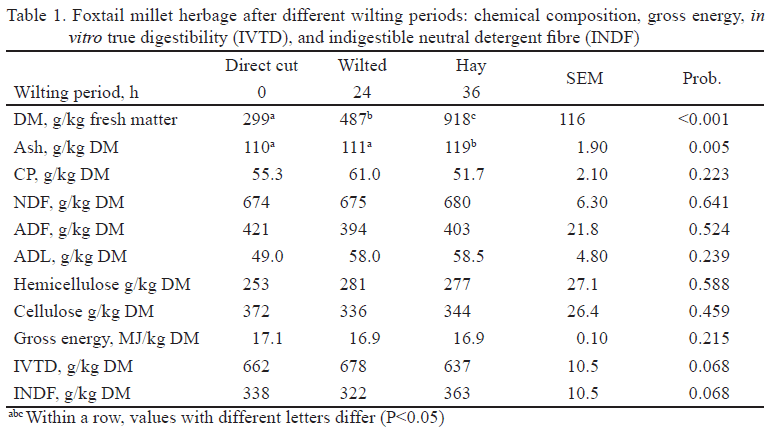
<body><![CDATA[<p align="justify" class="Cuerpodetexto" style="text-indent:0in;"><span style="font-family:'Verdana','sans-serif'; font-size:10.0pt; ">NDFD  = 1000-(W<sub>3</sub>-(W<sub>1</sub>*C<sub>1</sub>))*1000/(W<sub>2</sub>*NDF)</span></p>     <p align="justify" class="Cuerpodetexto" style="text-indent:0in;"><span style="font-family:'Verdana','sans-serif'; font-size:10.0pt; ">where  W<sub>1</sub> is the filter bag weight, W<sub>2</sub> is the sample weight, W<sub>3</sub> is the final weight (filter bag+residue) after <em>in vitro</em> and sequential  treatment with NDF solution, C<sub>1</sub> is a comparison of the blank filter  bag weight after and before digestion treatment and NDF is neutral detergent  fibre content of the sample.</span></p>     <p align="justify" class="Cuerpodetexto" style="text-indent:0in;"><em><span style="font-family:'Verdana','sans-serif'; font-size:10.0pt; ">Silage conservation quality analysis</span></em><span style="font-family:'Verdana','sans-serif'; font-size:10.0pt; ">. Ammonia, alcohol, volatile fatty acids, and lactic acid  concentrations were determined on acid silage extracts: samples of chopped  frozen silage were weighed (50 g) in a 400 mL poly&ndash;ethylene bag and extracted  with 200 mL of 0.1 N H<sub>2</sub>SO<sub>4</sub> at 20 &deg;C for 4 min in a Lab  Blender Stomacher 400. The mixture was centrifuged for 5 min at 3000 x g and  then filtered through a Schleicher and Schull membrane filter (BA&ndash;83, 0.2 &micro;m).</span><span style="font-family:'Verdana','sans-serif'; font-size:10.0pt; "> </span></p>     <p align="justify" class="Cuerpodetexto" style="text-indent:0in;"><span style="font-family:'Verdana','sans-serif'; font-size:10.0pt; ">pH  was determined on the water extracts of chopped frozen silage using a Crison  portable pH meter (Crison Instruments, S.A., Alella, Spain). Ammonia was  measured using an ammonia gas&ndash;sensing combination electrode (Orion, Model  95&ndash;12, Boston, MA) connected to an ion analyzer (Orion, Model 920A, Boston,    MA).</span></p>     <p align="justify" class="Cuerpodetexto" style="text-indent:0in;"><span style="font-family:'Verdana','sans-serif'; font-size:10.0pt; ">A  1 &micro;L aliquot of the extract was injected, using an on&ndash;column technique with an  auto&ndash;sampler (Dani Instruments SpA, ALS 1000, Cologno Monzese, Italy), into a  wide&ndash;bore capillary column (SGE BP21 25m x 0.53 mm internal diameter and 0.5 &micro;m  film thickness; P/N 054474, SGE International, Ringwood, Victoria, Australia)  installed in a gas chromatograph (Dani GC 1000 DPC), running in a  temperature&ndash;programmed mode and equipped with a flame ionization detector and a  PTV injection port, used in split mode, with a split vent flow of 100 mL/min.  The detector port was set to    240 &deg;C, hydrogen was used as the carrier gas and the oven temperature was  programmed to 50 &deg;C for 2 min and from 50 &deg;C to 190 &deg;C at 5 &deg;C per min giving a  run time of 30 min. The peak area was measured using a Dani Data Station DDS  1000. Each peak was identified and quantified according to pure standards  (Sigma Chemical, St. Louis, MO, USA).</span></p>     <p align="justify" class="Cuerpodetexto" style="text-indent:0in;"><em><span style="font-family:'Verdana','sans-serif'; font-size:10.0pt; ">Seed  fatty acid analysis</span></em><span style="font-family:'Verdana','sans-serif'; font-size:10.0pt; ">. Seeds obtained from the  Ornitalia Product Service s.a.s. were ground to pass through a 1 mm screen.  Lipid extraction, transesterification and fatty acid methyl esters  gas&ndash;chromatography determination was performed according to Peiretti <em>et al.</em> (2013).</span></p>     <p align="justify"><em><span style="letter-spacing:.1pt; font-family:'Verdana','sans-serif'; font-size:10.0pt; ">Statistical  analysis</span></em><span style="font-family:'Verdana','sans-serif'; font-size:10.0pt; ">. The data shown are mean values of the duplicate analyses performed for  each replications sample. The variability in foxtail millet (direct cut, wilted  and hay) quality characteristics and the variability in the silage (direct cut  and wilted) characteristics were analyzed with analysis of variance (ANOVA)  using the Statistical Package for Social Science, v. 11.5 (SPSS 2002) to test  the effect of wilting level and using Duncan&rsquo;s New Multiple Range Test for  post-hoc analysis. The significance was established at P&lt;0.05</span><font size="2" face="Verdana, Arial, Helvetica, sans-serif">.</font> </p>     <p align="justify">&nbsp;</p>     <p align="justify"><font size="2" face="Verdana, Arial, Helvetica, sans-serif"><b><font size="3">RESULTS AND DISCUSSION</font></b></font></p>     <p align="justify" class="Cuerpodetexto" style="text-indent:0in;"><span style="font-family:'Verdana','sans-serif'; font-size:10.0pt; ">Results  on different wilting treatments (0, 24, and 36 hours) on foxtail millet herbage  are reported in <a href="/img/revistas/cjas/v50n1/t0117116.gif">table 1</a>. No significant differences were found in any  parameters, with the exception of DM and ash content. Foxtail millet harvested  at budding stage is relatively poor in protein, that ranged from 52 to 61 g/kg  DM, and rich in fibre (NDF: 674&ndash;678 g/kg DM, ADF: 394&ndash;  421 g/kg DM, ADL: 49&ndash;58 g/kg DM). In agreement with Feedipedia (2012) IVTD  varied from 637 to 678 g/kg DM, while INDF ranged from 322 to 363 g/kg of DM.  The gross energy ranged from 16.9 to    17.1 MJ/kg DM.</span></p>     
]]></body>
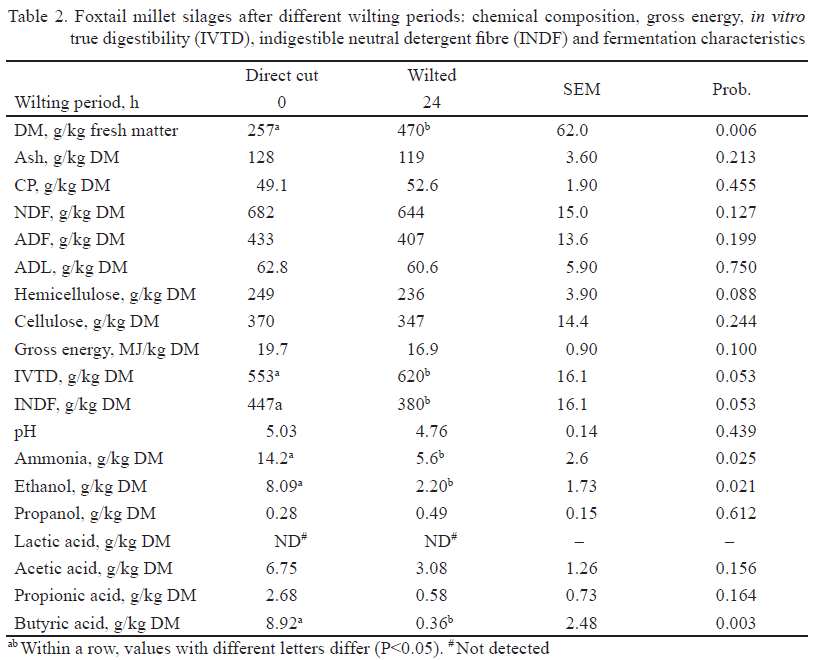
<body><![CDATA[<p align="justify" class="Cuerpodetexto" style="text-indent:0in;"><span style="letter-spacing:.2pt; font-family:'Verdana','sans-serif'; font-size:10.0pt; ">Wilting the plant had little effect on its chemical  composition and nutritive quality, as demonstrated for other forages (Rymer  2008). Extending the duration of wilting increased the DM concentration of  foxtail millet, but had no impact on protein content, fibre fractions, gross  energy and digestibility. Wilting for 36 hours resulted in a higher ash  concentration than wilting for 24 hours and fresh herbage (P&lt;0.05), in  agreement with Keles <em>et al.</em> (2009). The slight rise in ash concentration  with wilting may reflect the respiration of organic matter and/or some level of  soil contamination.</span><span style="font-family:'Verdana','sans-serif'; font-size:10.0pt; "> </span></p>     <p align="justify" class="Cuerpodetexto" style="text-indent:0in;"><span style="font-family:'Verdana','sans-serif'; font-size:10.0pt; ">In  order to avoid border effects, 20 cm of uncutted herbage was left between the  neighbouring plots; therefore the fresh matter mass was sufficient only for two  replicates for each collected sample. In a similar work, Peiretti <em>et al.</em> (2010), sampled two replicates of white lupin (<em>Lupinus albus</em> L.) for  each herbage sample with the aim to determine the effect of harvest date on the  chemical composition, gross energy, organic matter digestibility, nutritive  value and amino acid content of this plant.</span></p>     <p align="justify" class="Cuerpodetexto" style="text-indent:0in;"><span style="font-family:'Verdana','sans-serif'; font-size:10.0pt; ">The  chemical composition, gross energy, <em>in vitro</em> digestibility and  fermentation characteristics of the foxtail millet silages at the two DM levels  are reported in <a href="/img/revistas/cjas/v50n1/t0217116.gif">table 2</a>.</span></p>     
<p align="justify" class="Cuerpodetexto" style="text-indent:0in;"><span style="letter-spacing:.1pt; font-family:'Verdana','sans-serif'; font-size:10.0pt; ">As far as the chemical composition of foxtail millet  silages is concerned, ash and crude protein did not show any significant  differences between the two types of silage. Also the fibre fractions were not  affected by wilting level and this is in disagreement with other authors  (Repetto <em>et al.</em> 2005 and McEniry <em>et al.</em> 2007). The hemicellulose  content, which is the most digestible component of NDF and represents a  fermentable substrate for lactic acid bacteria during ensiling (McDonald <em>et  al.</em> 1991), showed similar values of about 240 g/kg DM. Aerobic exposure  resulted in an increase in IVTD (P=0.053) and decrease in INDF (P=0.053).</span><span style="font-family:'Verdana','sans-serif'; font-size:10.0pt; "> </span></p>     <p align="justify" class="Cuerpodetexto" style="text-indent:0in;"><span style="font-family:'Verdana','sans-serif'; font-size:10.0pt; ">Forage preservation (wilting, drying and ensiling) of the  crop may initiate or accelerate biological processes such as plant respiration,  enzymatic and microorganism activities, that are responsible for carbohydrate  oxidation, protein degradation and amino acid deamination. A consequence of  these processes may be a reduction in the nutritive value of forage preserved  compared with standing fresh forage (Repetto <em>et al.</em> 2005 and Bakken <em>et  al.</em> 2011). However, foxtail millet preservation had no significant effect  on its chemical composition, probably due to the rapid drying to hay under dry  sunny weather    conditions.</span></p>     <p align="justify" class="Cuerpodetexto" style="text-indent:0in;"><span style="font-family:'Verdana','sans-serif'; font-size:10.0pt; ">In particular NDF, the main chemical constituent of  foxtail millet forage (Torbatinejad <em>et al.</em> 2009), was stable among  preservation methods, and wilting had little effect on NDF concentration, in  accordance with McEniry <em>et al.</em> (2007). Keady <em>et al.</em> (2000)  demonstrated that NDF was more labile in crops harvested at early developmental  stages than in more mature crops. Moreover, the study by Torbatinejad <em>et al.</em> (2009), on foxtail millet indicated that a delay in the sowing date and  reducing the period of growth cause a reduction in fibre content and an  increase in its nutritional value. Indeed, the stage of growth, sowing date and  plant density are the most important factors that influence the composition and  nutritive value of forages (Howell 1990 and Fulkerson <em>et al.</em> 2008).  Unlike other grasses (Bakken <em>et al.</em> 2011), foxtail millet showed no  changes in fibre concentrations, although some soluble compounds were respired  during wilting. On the contrary, it improved IVTD and reduced INDF, the latter  being a major factor limiting the value of forages for animals. ADL is  generally the best single predictor of INDF content and hemicellulose the worst  (Jan&#269;ik <em>et al.</em>  2008).</span><span style="font-family:'Verdana','sans-serif'; font-size:10.0pt; "> </span></p>     <p align="justify" class="Cuerpodetexto" style="text-indent:0in;"><span style="font-family:'Verdana','sans-serif'; font-size:10.0pt; ">The  results obtained in lab&ndash;scale silos indicate that the fermentation of foxtail  millet is characterized by the presence of alcohols, volatile fatty acids and a  lack of lactic acid. No significant differences were found in the fermentation  characteristics, with the exception of ammonia, ethanol and butyric acid  (P&lt;0.05), which decreased with increasing DM content. Silage quality was  characterized by restricted fermentation and low content of butyric acid at the  high wilting level and this would seem to suggest that foxtail millet has the  potential for large&ndash;scale ensiling, if it is harvested at the budding stage and  wilted to a DM level of more than 470 g/kg fresh matter.</span></p>     <p align="justify" class="Cuerpodetexto" style="text-indent:0in;"><span style="font-family:'Verdana','sans-serif'; font-size:10.0pt; ">Further research is required to define the conservation  quality in farm&ndash;scale silos or in lab silos with additives, that improve silage  fermentation when foxtail millet is ensiled at cut or at low wilting levels.  Arbabi and Ghoorchi (2008), found that without additives, foxtail millet can be  turned into acceptable silage, but the quality, nutrition value, DM  digestibility and aerobic stability of silage were improved with the addition  of 7.5% molasses. The poor nutritive value of the silage is attributed to the  nature and composition of the material ensiled rather than to any defect in the  ensilage process itself, and may be a feature of most silage made from tropical  grasses (Nussio 2005).</span><span style="font-family:'Verdana','sans-serif'; font-size:10.0pt; "> </span></p>     <p align="justify" class="Cuerpodetexto" style="text-indent:0in;"><span style="font-family:'Verdana','sans-serif'; font-size:10.0pt; ">The lipid content of the foxtail millet seeds was 31.9  g/kg fresh matter. The present results are in agreement with the observation of  L&eacute;der    (2009).</span></p>     <p align="justify" class="Cuerpodetexto" style="text-indent:0in;"><span style="font-family:'Verdana','sans-serif'; font-size:10.0pt; ">The predominant fatty acids in seed were linoleic, oleic,  and palmitic acid. The contents of stearic and linolenic acids were 32 and 27  g/kg total fatty acid, respectively. The contents of palmitoleic, arachidic, gadoleic  and behenic acid were lower than 7 g/kg total fatty acid (<a href="#t3">Table 3</a>). Liang <em>et  al.</em> (2009), studied the fatty acid content of foxtail millet bran oil and  found that it was rich in linoleic acid (665 g/kg total fatty acid) and oleic  acid (130 g/kg total fatty acid) and poor in saturated fatty acids such as  palmitic acid (64 g/kg total fatty acid) and stearic acid    (63 g/kg total fatty acid).</span><span style="font-family:'Verdana','sans-serif'; font-size:10.0pt; "> </span></p>     ]]></body>
<body><![CDATA[<p align="center" class="Cuerpodetexto" style="text-indent:0in;"><a name="t3"></a></p>     <p align="center" class="Cuerpodetexto" style="text-indent:0in;"><img src="../img/revistas/cjas/v50n1/t0317116.gif" width="438" height="366" longdesc="/img/revistas/cjas/v50n1/t0317116.gif"></p>     
<p align="justify"><span style="letter-spacing:.2pt; font-family:'Verdana','sans-serif'; font-size:10.0pt; ">Although  foxtail millet is not a high&ndash;quality forage, results have shown that it could  be considered as an alternative or complement to traditional forage resources.  Herbage wilting did not affect nutritional parameters, reflecting excellent  drying conditions. The good conservation quality of wilted silage showed that  foxtail millet is suitable for conservation through ensiling, provided that  silage is well preserved with moderate ensiling losses. Further research is  required to define the most appropriate agronomic techniques to follow and the  conservation quality in farm&ndash;scale silos</span><font size="2" face="Verdana, Arial, Helvetica, sans-serif">.</font></p>      <p align="justify">&nbsp;</p>      <p align="justify"><font size="2" face="Verdana, Arial, Helvetica, sans-serif"><font size="3"><b>REFERENCES</b></font></font></p>     <p align="justify" class="MsoBibliography"><span style="font-family:'Verdana','sans-serif'; font-size:10.0pt; ">AOAC. 1995. <em>Official  methods of analysis of AOAC</em>. 16th ed., vol. 1, Washington, D.C.: AOAC  International, ISBN: 978-0-935584-54-7, Available:  &lt;<a href="http://www.cabdirect.org/abstracts/19951414840.html" target="_blank">http://www.cabdirect.org/abstracts/19951414840.html</a>&gt;,  [Accessed:&nbsp;February 16, 2016].</span></p>     <p align="justify" class="MsoBibliography"><span style="font-family:'Verdana','sans-serif'; font-size:10.0pt; ">Arbabi, S.  &amp; Ghoorchi, T. 2008. &lsquo;&lsquo;The Effect of Different Levels of Molasses as Silage  Additives on Fermentation Quality of Foxtail Millet (Setaria italica) Silage&rsquo;&rsquo;. <em>Asian Journal of Animal Sciences</em>, 2 (2), pp. 43&ndash;50, ISSN: 18191878, DOI:  10.3923/ajas.2008.43.50.</span></p>     <p align="justify" class="MsoBibliography"><span style="font-family:'Verdana','sans-serif'; font-size:10.0pt; ">Bakken, A. K.,  Randby, &Aring;. T. &amp; Ud&eacute;n, P. 2011. &lsquo;&lsquo;Changes in fibre content and degradability  during preservation of grass&ndash;clover crops&rsquo;&rsquo;. <em>Animal Feed Science and  Technology</em>, 168 (1&ndash;2), pp. 122&ndash;130, ISSN: 0377-8401, DOI:  10.1016/j.anifeedsci.2011.03.016.</span></p>     <p align="justify" class="MsoBibliography"><span style="font-family:'Verdana','sans-serif'; font-size:10.0pt; ">Baltensperger,  D. D. 2002. &lsquo;&lsquo;Progress with proso, pearl and other millets&rsquo;&rsquo;. In: Janick, J.  &amp; Whipkey, A. (eds.), <em>Trends in New Crops and New Uses</em>, ASHS Press,  pp. 100&ndash;103, ISBN: 978-0-09-707565-5.</span></p>     <p align="justify" class="MsoBibliography"><span style="font-family:'Verdana','sans-serif'; font-size:10.0pt; ">Bergero, D.  &amp; Peiretti, P. G. 2011. &lsquo;&lsquo;Intake and Apparent Digestibility of Permanent  Meadow Hay and Haylage in Ponies&rsquo;&rsquo;. <em>Journal of Equine Veterinary Science</em>,  31 (2), pp. 67&ndash;71, ISSN: 0737-0806, DOI: 10.1016/j.jevs.2010.12.006.</span></p>     ]]></body>
<body><![CDATA[<p align="justify" class="MsoBibliography"><span style="font-family:'Verdana','sans-serif'; font-size:10.0pt; ">Fulkerson, W.  J., Horadagoda, A., Neal, J. S., Barchia, I. &amp; Nandra, K. S. 2008.  &lsquo;&lsquo;Nutritive value of forage species grown in the warm temperate climate of  Australia for dairy cows: Herbs and grain crops&rsquo;&rsquo;. <em>Livestock Science</em>,  114 (1), pp. 75&ndash;83, ISSN: 1871-1413, DOI: 10.1016/j.livsci.2007.04.013.</span></p>     <p align="justify" class="MsoBibliography"><span style="font-family:'Verdana','sans-serif'; font-size:10.0pt; ">Howell, T. A.  1990. &lsquo;&lsquo;Grain, Dry Matter Yield Relationships for Winter Wheat and Grain  Sorghum-Southern High Plains&rsquo;&rsquo;. <em>Agronomy Journal</em>, 82 (5), pp. 914&ndash;918,  ISSN: 0002-1962, DOI: 10.2134/agronj1990.00021962008200050014x.</span></p>     <!-- ref --><p align="justify" class="MsoBibliography"><span style="font-family:'Verdana','sans-serif'; font-size:10.0pt; ">IBM  Corporation. 2002. <em>IBM SPSS Statistics</em>. version 11.5, [Windows], U.S,  Available: &lt;<a href="http://www.ibm.com" target="_blank">http://www.ibm.com</a>&gt;    .</span></p>     <p align="justify" class="MsoBibliography"><span style="font-family:'Verdana','sans-serif'; font-size:10.0pt; ">Jancik, F.,  Homolka, P., Cermak, B. &amp; L&aacute;d, F. 2008. &lsquo;&lsquo;Determination of indigestible  neutral detergent fibre contents of grasses and its prediction from chemical  composition&rsquo;&rsquo;. <em>Czech Journal of Animal Science-UZPI (Czech Republic)</em>, 53  (3), pp. 128&ndash;135, ISSN: 1212-1819, 1805-9309.</span></p>     <p align="justify" class="MsoBibliography"><span style="font-family:'Verdana','sans-serif'; font-size:10.0pt; ">Keady, T. W.  J., Mayne, C. S. &amp; Fitzpatrick, D. A. 2000. &lsquo;&lsquo;Prediction of silage feeding  value from the analysis of the herbage at ensiling and effects of nitrogen  fertilizer, date of harvest and additive treatment on grass silage  composition&rsquo;&rsquo;. <em>The Journal of Agricultural Science</em>, 134 (04), pp.  353&ndash;368, ISSN: 1469-5146.</span></p>     <p align="justify" class="MsoBibliography"><span style="font-family:'Verdana','sans-serif'; font-size:10.0pt; ">Keles, G.,  O&rsquo;Kiely, P., Lenehan, J. J. &amp; Forristal, P. D. 2009. &lsquo;&lsquo;Conservation  Characteristics of Baled Grass Silages Differing in Duration of Wilting, Bale  Density and Number of Layers of Plastic Stretch-Film&rsquo;&rsquo;. <em>Irish Journal of  Agricultural and Food Research</em>, 48 (1), pp. 21&ndash;34, ISSN: 0791-6833.</span></p>     <p align="justify" class="MsoBibliography"><span style="font-family:'Verdana','sans-serif'; font-size:10.0pt; ">L&eacute;der, I.  2009. &lsquo;&lsquo;Cultivated Plants, Primarily as Food Sources&rsquo;&rsquo;. In: Fuleky, G. (ed.), <em>Encyclopedia  of Life Support Systems</em>, vol. 1, Oxford ,UK: Eolss Publishers Company  Limited, ISBN: 978-1-84826-550-9.</span></p>     <p align="justify" class="MsoBibliography"><span style="font-family:'Verdana','sans-serif'; font-size:10.0pt; ">Liang, S.,  Yang, G. &amp; Ma, Y. 2009. &lsquo;&lsquo;Chemical Characteristics and Fatty Acid Profile  of Foxtail Millet Bran Oil&rsquo;&rsquo;. <em>Journal of the American Oil Chemists&rsquo; Society</em>,  87 (1), pp. 63&ndash;67, ISSN: 0003-021X, 1558-9331, DOI: 10.1007/s11746-009-1475-3.</span></p>     <!-- ref --><p align="justify" class="MsoBibliography"><span style="font-family:'Verdana','sans-serif'; font-size:10.0pt; ">McDonald, P.,  Henderson, A. R. &amp; Heron, S. J. E. 1991. <em>The Biochemistry of Silage</em>.  2nd ed., Kingston: Scholium Intl, 340 p., ISBN: 978-0-948617-22-5.    </span></p>     <p align="justify" class="MsoBibliography"><span style="font-family:'Verdana','sans-serif'; font-size:10.0pt; ">McEniry, J.,  O&rsquo;Kiely, P., Clipson, N. J. W., Forristal, P. D. &amp; Doyle, E. M. 2007. &lsquo;&lsquo;The  relative impacts of wilting, chopping, compaction and air infiltration on the  conservation characteristics of ensiled grass&rsquo;&rsquo;. <em>Grass and Forage Science</em>,  62 (4), pp. 470&ndash;484, ISSN: 1365-2494, DOI: 10.1111/j.1365-2494.2007.00602.x.</span></p>     <p align="justify" class="MsoBibliography"><span style="font-family:'Verdana','sans-serif'; font-size:10.0pt; ">Meineri, G.  &amp; Peiretti, P. G. 2010. &lsquo;&lsquo;Determination of gross energy of silages&rsquo;&rsquo;. <em>Italian  Journal of Animal Science</em>, 4 (2s), pp. 147&ndash;149, ISSN: 1828-051X, DOI:  10.4081/ijas.2005.2s.147.</span></p>     <p align="justify" class="MsoBibliography"><span style="font-family:'Verdana','sans-serif'; font-size:10.0pt; ">Nielsen, D. C., Vigil, M. F. &amp;  Benjamin, J. G. 2006. </span><span style="font-family:'Verdana','sans-serif'; font-size:10.0pt; ">&lsquo;&lsquo;Forage  Yield Response to Water Use for Dryland Corn, Millet, and Triticale in the  Central Great Plains&rsquo;&rsquo;. <em>Agronomy Journal</em>, 98 (4), p. 992, ISSN:  1435-0645, DOI: 10.2134/agronj2005.0356.</span></p>     <p align="justify" class="MsoBibliography"><span style="font-family:'Verdana','sans-serif'; font-size:10.0pt; ">Nussio, L. G.  2005. &lsquo;&lsquo;Silage production from tropical forages&rsquo;&rsquo;. In: Park, R. S. &amp;  Stronge, M. D. (eds.), <em>Proceedings of the XIV International Silage  Conference, a satellite workshop of the XX International Grassland Congress</em>,  Belfast, Northern Ireland: Wageningen Academic Publishers, pp. 97&ndash;107, ISBN:  978-90-76998-75-6.</span></p>     <p align="justify" class="MsoBibliography"><span style="font-family:'Verdana','sans-serif'; font-size:10.0pt; ">Peiretti, P.  G., Dapr&agrave;, F., Zunino, V. &amp; Meineri, G. 2010. &lsquo;&lsquo;The effect of harvest date  on the chemical composition, gross energy, organic matter digestibility,  nutritive value and amino acid content of white lupin (<em>Lupinus albus</em> L.)&rsquo;&rsquo;. <em>Cuban Journal of Agricultural Science</em>, 44 (2), pp. 169&ndash;173, ISSN:  2079-3480.</span></p>     <p align="justify" class="MsoBibliography"><span style="font-family:'Verdana','sans-serif'; font-size:10.0pt; ">Peiretti, P.  G., Gai, F. &amp; Tassone, S. 2013. &lsquo;&lsquo;Fatty acid profile and nutritive value of  quinoa (<em>Chenopodium quinoa</em> Willd.) seeds and plants at different growth  stages&rsquo;&rsquo;. <em>Animal Feed Science and Technology</em>, 183 (1), pp. 56&ndash;61, ISSN:  0377-8401, DOI: 10.1016/j.anifeedsci.2013.04.012.</span></p>     <p align="justify" class="MsoBibliography"><span style="font-family:'Verdana','sans-serif'; font-size:10.0pt; ">Repetto, J. L., Cajarville, C.,  D&rsquo;Alessandro, J., Curbelo, A., Soto, C. &amp; Gar&iacute;n, D. 2005. </span><span style="font-family:'Verdana','sans-serif'; font-size:10.0pt; ">&lsquo;&lsquo;Effect of wilting and ensiling on ruminal  degradability of temperate grass and legume mixtures&rsquo;&rsquo;. <em>Animal Research</em>,  54 (2), p. 8, ISSN: 1627-3583, 1627-3591, DOI: 10.1051/animres:2005007.</span></p>     <p align="justify" class="MsoBibliography"><span style="font-family:'Verdana','sans-serif'; font-size:10.0pt; ">Robinson, P.  H., Mathews, M. C. &amp; Fadel, J. G. 1999. &lsquo;&lsquo;Influence of storage time and  temperature on <em>in vitro</em> digestion of neutral detergent fibre at 48 h,  and comparison to 48 h in sacco neutral detergent fibre digestion&rsquo;&rsquo;. </span><em><span style="font-family:'Verdana','sans-serif'; font-size:10.0pt; ">Animal  Feed Science and Technology</span></em><span style="font-family:'Verdana','sans-serif'; font-size:10.0pt; ">, 80 (3), pp. 257&ndash;266, ISSN:  0377-8401, DOI: 10.1016/S0377-8401(99)00062-0.</span></p>     <p align="justify" class="MsoBibliography"><span style="font-family:'Verdana','sans-serif'; font-size:10.0pt; ">Rymer, C.  2008. &lsquo;&lsquo;The effect of wilting and soaking Eupatorium adenophorum on its  digestibility <em>in vitro</em> and voluntary intake by goats&rsquo;&rsquo;. <em>Animal Feed  Science and Technology</em>, 141 (1&ndash;2), pp. 49&ndash;60, ISSN: 0377-8401, DOI:  10.1016/j.anifeedsci.2007.04.013.</span></p>     ]]></body>
<body><![CDATA[<p align="justify" class="MsoBibliography"><span style="font-family:'Verdana','sans-serif'; font-size:10.0pt; ">Svirskis, A.  2009. &lsquo;&lsquo;Prospects for non-traditional plant species cultivated for forage in  Lithuania&rsquo;&rsquo;. <em>Notulae Botanicae Horti Agrobotanici Cluj-Napoca</em>, 37 (1),  p. 215, ISSN: 0255-965X.</span></p>     <p align="justify" class="MsoBibliography"><span style="font-family:'Verdana','sans-serif'; font-size:10.0pt; ">Torbatinejad,  N., Galeshi, S. &amp; Ghoorchi, T. 2009. &lsquo;&lsquo;Evaluation by Chemical and in vitro  Gas Production Techniques of Foxtail Millet Grown in Northern Iran&rsquo;&rsquo;. </span><em><span style="font-family:'Verdana','sans-serif'; font-size:10.0pt; ">Journal  of Animal and Veterinary Advances</span></em><span style="font-family:'Verdana','sans-serif'; font-size:10.0pt; ">, 8 (12), pp. 2662&ndash;2667,  ISSN: 1680-5593.</span></p>     <div align="justify"><span style="font-family:'Verdana','sans-serif'; font-size:10.0pt; ">Van Soest, P. J.,  Robertson, J. B. &amp; Lewis, B. A. 1991. &lsquo;&lsquo;Methods for Dietary Fiber, Neutral  Detergent Fiber, and Nonstarch Polysaccharides in Relation to Animal  Nutrition&rsquo;&rsquo;. <em>Journal of Dairy Science</em>, 74 (10), pp. 3583&ndash;3597, ISSN:  0022-0302, DOI: 10.3168/jds.S0022-0302(91)78551-2, PMID: 1660498</span><font size="2" face="Verdana, Arial, Helvetica, sans-serif">.</font>      <p align="justify">&nbsp;</p>     <p align="justify">&nbsp;</p>     <p align="justify"><font size="2" face="Verdana, Arial, Helvetica, sans-serif">Received: June 11, 2014    <br>   Accepted: March 28, 2016</font></p>     <p align="justify">&nbsp;</p>     <p align="justify">&nbsp;</p>     <p align="justify"><font size="2" face="Verdana, Arial, Helvetica, sans-serif"><i>P.G. Peiretti,</i> Institute of Sciences of Food Production, National Research Council, Largo Braccini 2, 10095  Grugliasco (TO), Italy.    Email: <a href="mailto:piergiorgio.peiretti@ispa.cnr.it">piergiorgio.peiretti@ispa.cnr.it</a></font></p>     ]]></body>
<body><![CDATA[ ]]></body><back>
<ref-list>
<ref id="B1">
<nlm-citation citation-type="book">
<person-group person-group-type="author">
<name>
<surname><![CDATA[AOAC]]></surname>
</name>
</person-group>
<source><![CDATA[Official methods of analysis of AOAC]]></source>
<year>1995</year>
<volume>1</volume>
<edition>16th</edition>
<publisher-loc><![CDATA[Washington, D.C. ]]></publisher-loc>
<publisher-name><![CDATA[AOAC International]]></publisher-name>
</nlm-citation>
</ref>
<ref id="B2">
<nlm-citation citation-type="journal">
<person-group person-group-type="author">
<name>
<surname><![CDATA[Arbabi]]></surname>
<given-names><![CDATA[S.]]></given-names>
</name>
<name>
<surname><![CDATA[Ghoorchi]]></surname>
<given-names><![CDATA[T.]]></given-names>
</name>
</person-group>
<article-title xml:lang="nd"><![CDATA[The Effect of Different Levels of Molasses as Silage Additives on Fermentation Quality of Foxtail Millet (Setaria italica) Silage]]></article-title>
<source><![CDATA[Asian Journal of Animal Sciences]]></source>
<year>2008</year>
<volume>2</volume>
<numero>2</numero>
<issue>2</issue>
<page-range>43-50</page-range></nlm-citation>
</ref>
<ref id="B3">
<nlm-citation citation-type="journal">
<person-group person-group-type="author">
<name>
<surname><![CDATA[Bakken]]></surname>
<given-names><![CDATA[A. K.]]></given-names>
</name>
<name>
<surname><![CDATA[Randby]]></surname>
<given-names><![CDATA[Å. T.]]></given-names>
</name>
<name>
<surname><![CDATA[Udén]]></surname>
<given-names><![CDATA[P.]]></given-names>
</name>
</person-group>
<article-title xml:lang="nd"><![CDATA[Changes in fibre content and degradability during preservation of grass-clover crops]]></article-title>
<source><![CDATA[Animal Feed Science and Technology]]></source>
<year>2011</year>
<volume>168</volume>
<numero>1-2</numero>
<issue>1-2</issue>
<page-range>122-130</page-range></nlm-citation>
</ref>
<ref id="B4">
<nlm-citation citation-type="book">
<person-group person-group-type="author">
<name>
<surname><![CDATA[Baltensperger]]></surname>
<given-names><![CDATA[D. D.]]></given-names>
</name>
</person-group>
<article-title xml:lang="nd"><![CDATA[Progress with proso, pearl and other millets]]></article-title>
<person-group person-group-type="editor">
<name>
<surname><![CDATA[Janick]]></surname>
<given-names><![CDATA[J.]]></given-names>
</name>
<name>
<surname><![CDATA[Whipkey]]></surname>
<given-names><![CDATA[A.]]></given-names>
</name>
</person-group>
<source><![CDATA[Trends in New Crops and New Uses]]></source>
<year>2002</year>
<page-range>100-103</page-range><publisher-name><![CDATA[ASHS Press]]></publisher-name>
</nlm-citation>
</ref>
<ref id="B5">
<nlm-citation citation-type="journal">
<person-group person-group-type="author">
<name>
<surname><![CDATA[Bergero]]></surname>
<given-names><![CDATA[D.]]></given-names>
</name>
<name>
<surname><![CDATA[Peiretti]]></surname>
<given-names><![CDATA[P. G.]]></given-names>
</name>
</person-group>
<article-title xml:lang="nd"><![CDATA[Intake and Apparent Digestibility of Permanent Meadow Hay and Haylage in Ponies]]></article-title>
<source><![CDATA[Journal of Equine Veterinary Science]]></source>
<year>2011</year>
<volume>31</volume>
<numero>2</numero>
<issue>2</issue>
<page-range>67-71</page-range></nlm-citation>
</ref>
<ref id="B6">
<nlm-citation citation-type="journal">
<person-group person-group-type="author">
<name>
<surname><![CDATA[Fulkerson]]></surname>
<given-names><![CDATA[W. J.]]></given-names>
</name>
<name>
<surname><![CDATA[Horadagoda]]></surname>
<given-names><![CDATA[A.]]></given-names>
</name>
<name>
<surname><![CDATA[Neal]]></surname>
<given-names><![CDATA[J. S.]]></given-names>
</name>
<name>
<surname><![CDATA[Barchia]]></surname>
<given-names><![CDATA[I.]]></given-names>
</name>
<name>
<surname><![CDATA[Nandra]]></surname>
<given-names><![CDATA[K. S.]]></given-names>
</name>
</person-group>
<article-title xml:lang="nd"><![CDATA[Nutritive value of forage species grown in the warm temperate climate of Australia for dairy cows: Herbs and grain crops]]></article-title>
<source><![CDATA[Livestock Science]]></source>
<year>2008</year>
<volume>114</volume>
<numero>1</numero>
<issue>1</issue>
<page-range>75-83</page-range></nlm-citation>
</ref>
<ref id="B7">
<nlm-citation citation-type="journal">
<person-group person-group-type="author">
<name>
<surname><![CDATA[Howell]]></surname>
<given-names><![CDATA[T. A.]]></given-names>
</name>
</person-group>
<article-title xml:lang="nd"><![CDATA[Grain, Dry Matter Yield Relationships for Winter Wheat and Grain Sorghum-Southern High Plains]]></article-title>
<source><![CDATA[Agronomy Journal]]></source>
<year>1990</year>
<volume>82</volume>
<numero>5</numero>
<issue>5</issue>
<page-range>914-918</page-range></nlm-citation>
</ref>
<ref id="B8">
<nlm-citation citation-type="">
<person-group person-group-type="author">
<name>
<surname><![CDATA[IBM Corporation]]></surname>
</name>
</person-group>
<source><![CDATA[IBM SPSS Statistics]]></source>
<year>2002</year>
<publisher-loc><![CDATA[U.S ]]></publisher-loc>
</nlm-citation>
</ref>
<ref id="B9">
<nlm-citation citation-type="journal">
<person-group person-group-type="author">
<name>
<surname><![CDATA[Jancik]]></surname>
<given-names><![CDATA[F.]]></given-names>
</name>
<name>
<surname><![CDATA[Homolka]]></surname>
<given-names><![CDATA[P.]]></given-names>
</name>
<name>
<surname><![CDATA[Cermak]]></surname>
<given-names><![CDATA[B.]]></given-names>
</name>
<name>
<surname><![CDATA[Lád]]></surname>
<given-names><![CDATA[F.]]></given-names>
</name>
</person-group>
<article-title xml:lang="nd"><![CDATA[Determination of indigestible neutral detergent fibre contents of grasses and its prediction from chemical composition]]></article-title>
<source><![CDATA[Czech Journal of Animal Science-UZPI (Czech Republic)]]></source>
<year>2008</year>
<volume>53</volume>
<numero>3</numero>
<issue>3</issue>
<page-range>128-135</page-range></nlm-citation>
</ref>
<ref id="B10">
<nlm-citation citation-type="journal">
<person-group person-group-type="author">
<name>
<surname><![CDATA[Keady]]></surname>
<given-names><![CDATA[T. W. J.]]></given-names>
</name>
<name>
<surname><![CDATA[Mayne]]></surname>
<given-names><![CDATA[C. S.]]></given-names>
</name>
<name>
<surname><![CDATA[Fitzpatrick]]></surname>
<given-names><![CDATA[D. A.]]></given-names>
</name>
</person-group>
<article-title xml:lang="nd"><![CDATA[Prediction of silage feeding value from the analysis of the herbage at ensiling and effects of nitrogen fertilizer, date of harvest and additive treatment on grass silage composition]]></article-title>
<source><![CDATA[The Journal of Agricultural Science]]></source>
<year>2000</year>
<volume>134</volume>
<numero>04</numero>
<issue>04</issue>
<page-range>353-368</page-range></nlm-citation>
</ref>
<ref id="B11">
<nlm-citation citation-type="journal">
<person-group person-group-type="author">
<name>
<surname><![CDATA[Keles]]></surname>
<given-names><![CDATA[G.]]></given-names>
</name>
<name>
<surname><![CDATA[O’Kiely]]></surname>
<given-names><![CDATA[P.]]></given-names>
</name>
<name>
<surname><![CDATA[Lenehan]]></surname>
<given-names><![CDATA[J. J.]]></given-names>
</name>
<name>
<surname><![CDATA[Forristal]]></surname>
<given-names><![CDATA[P. D.]]></given-names>
</name>
</person-group>
<article-title xml:lang="nd"><![CDATA[Conservation Characteristics of Baled Grass Silages Differing in Duration of Wilting, Bale Density and Number of Layers of Plastic Stretch-Film]]></article-title>
<source><![CDATA[Irish Journal of Agricultural and Food Research]]></source>
<year>2009</year>
<volume>48</volume>
<numero>1</numero>
<issue>1</issue>
<page-range>21-34</page-range></nlm-citation>
</ref>
<ref id="B12">
<nlm-citation citation-type="book">
<person-group person-group-type="author">
<name>
<surname><![CDATA[Léder]]></surname>
<given-names><![CDATA[I.]]></given-names>
</name>
</person-group>
<article-title xml:lang="nd"><![CDATA[Cultivated Plants, Primarily as Food Sources]]></article-title>
<person-group person-group-type="editor">
<name>
<surname><![CDATA[Fuleky]]></surname>
<given-names><![CDATA[G.]]></given-names>
</name>
</person-group>
<source><![CDATA[Encyclopedia of Life Support Systems]]></source>
<year>2009</year>
<volume>1</volume>
<publisher-loc><![CDATA[Oxford ,UK ]]></publisher-loc>
<publisher-name><![CDATA[Eolss Publishers Company Limited]]></publisher-name>
</nlm-citation>
</ref>
<ref id="B13">
<nlm-citation citation-type="journal">
<person-group person-group-type="author">
<name>
<surname><![CDATA[Liang]]></surname>
<given-names><![CDATA[S.]]></given-names>
</name>
<name>
<surname><![CDATA[Yang]]></surname>
<given-names><![CDATA[G.]]></given-names>
</name>
<name>
<surname><![CDATA[Ma]]></surname>
<given-names><![CDATA[Y.]]></given-names>
</name>
</person-group>
<article-title xml:lang="nd"><![CDATA[Chemical Characteristics and Fatty Acid Profile of Foxtail Millet Bran Oil]]></article-title>
<source><![CDATA[Journal of the American Oil Chemists’ Society]]></source>
<year>2009</year>
<volume>87</volume>
<numero>1</numero>
<issue>1</issue>
<page-range>63-67</page-range></nlm-citation>
</ref>
<ref id="B14">
<nlm-citation citation-type="book">
<person-group person-group-type="author">
<name>
<surname><![CDATA[McDonald]]></surname>
<given-names><![CDATA[P.]]></given-names>
</name>
<name>
<surname><![CDATA[Henderson]]></surname>
<given-names><![CDATA[A. R.]]></given-names>
</name>
<name>
<surname><![CDATA[Heron]]></surname>
<given-names><![CDATA[S. J. E.]]></given-names>
</name>
</person-group>
<source><![CDATA[The Biochemistry of Silage]]></source>
<year>1991</year>
<edition>2nd</edition>
<page-range>340</page-range><publisher-loc><![CDATA[Kingston ]]></publisher-loc>
<publisher-name><![CDATA[Scholium Intl]]></publisher-name>
</nlm-citation>
</ref>
<ref id="B15">
<nlm-citation citation-type="journal">
<person-group person-group-type="author">
<name>
<surname><![CDATA[McEniry]]></surname>
<given-names><![CDATA[J.]]></given-names>
</name>
<name>
<surname><![CDATA[O’Kiely]]></surname>
<given-names><![CDATA[P.]]></given-names>
</name>
<name>
<surname><![CDATA[Clipson]]></surname>
<given-names><![CDATA[N. J. W.]]></given-names>
</name>
<name>
<surname><![CDATA[Forristal]]></surname>
<given-names><![CDATA[P. D.]]></given-names>
</name>
<name>
<surname><![CDATA[Doyle]]></surname>
<given-names><![CDATA[E. M.]]></given-names>
</name>
</person-group>
<article-title xml:lang="nd"><![CDATA[The relative impacts of wilting, chopping, compaction and air infiltration on the conservation characteristics of ensiled grass]]></article-title>
<source><![CDATA[Grass and Forage Science]]></source>
<year>2007</year>
<volume>62</volume>
<numero>4</numero>
<issue>4</issue>
<page-range>470-484</page-range></nlm-citation>
</ref>
<ref id="B16">
<nlm-citation citation-type="journal">
<person-group person-group-type="author">
<name>
<surname><![CDATA[Meineri]]></surname>
<given-names><![CDATA[G.]]></given-names>
</name>
<name>
<surname><![CDATA[Peiretti]]></surname>
<given-names><![CDATA[P. G.]]></given-names>
</name>
</person-group>
<article-title xml:lang="nd"><![CDATA[Determination of gross energy of silages]]></article-title>
<source><![CDATA[Italian Journal of Animal Science]]></source>
<year>2010</year>
<volume>4</volume>
<numero>2s</numero>
<issue>2s</issue>
<page-range>147-149</page-range></nlm-citation>
</ref>
<ref id="B17">
<nlm-citation citation-type="journal">
<person-group person-group-type="author">
<name>
<surname><![CDATA[Nielsen]]></surname>
<given-names><![CDATA[D. C.]]></given-names>
</name>
<name>
<surname><![CDATA[Vigil]]></surname>
<given-names><![CDATA[M. F.]]></given-names>
</name>
<name>
<surname><![CDATA[Benjamin]]></surname>
<given-names><![CDATA[J. G.]]></given-names>
</name>
</person-group>
<article-title xml:lang="nd"><![CDATA[Forage Yield Response to Water Use for Dryland Corn, Millet, and Triticale in the Central Great Plains]]></article-title>
<source><![CDATA[Agronomy Journal]]></source>
<year>2006</year>
<volume>98</volume>
<numero>4</numero>
<issue>4</issue>
<page-range>992</page-range></nlm-citation>
</ref>
<ref id="B18">
<nlm-citation citation-type="book">
<person-group person-group-type="author">
<name>
<surname><![CDATA[Nussio]]></surname>
<given-names><![CDATA[L. G.]]></given-names>
</name>
</person-group>
<article-title xml:lang="nd"><![CDATA[Silage production from tropical forages]]></article-title>
<person-group person-group-type="editor">
<name>
<surname><![CDATA[Park]]></surname>
<given-names><![CDATA[R. S.]]></given-names>
</name>
<name>
<surname><![CDATA[Stronge]]></surname>
<given-names><![CDATA[M. D.]]></given-names>
</name>
</person-group>
<source><![CDATA[]]></source>
<year>2005</year>
<page-range>97-107</page-range><publisher-loc><![CDATA[Belfast, Northern Ireland ]]></publisher-loc>
<publisher-name><![CDATA[Wageningen Academic Publishers]]></publisher-name>
</nlm-citation>
</ref>
<ref id="B19">
<nlm-citation citation-type="journal">
<person-group person-group-type="author">
<name>
<surname><![CDATA[Peiretti]]></surname>
<given-names><![CDATA[P. G.]]></given-names>
</name>
<name>
<surname><![CDATA[Daprà]]></surname>
<given-names><![CDATA[F.]]></given-names>
</name>
<name>
<surname><![CDATA[Zunino]]></surname>
<given-names><![CDATA[V.]]></given-names>
</name>
<name>
<surname><![CDATA[Meineri]]></surname>
<given-names><![CDATA[G.]]></given-names>
</name>
</person-group>
<article-title xml:lang="nd"><![CDATA[The effect of harvest date on the chemical composition, gross energy, organic matter digestibility, nutritive value and amino acid content of white lupin (Lupinus albus L.)]]></article-title>
<source><![CDATA[Cuban Journal of Agricultural Science]]></source>
<year>2010</year>
<volume>44</volume>
<numero>2</numero>
<issue>2</issue>
<page-range>169-173</page-range></nlm-citation>
</ref>
<ref id="B20">
<nlm-citation citation-type="journal">
<person-group person-group-type="author">
<name>
<surname><![CDATA[Peiretti]]></surname>
<given-names><![CDATA[P. G.]]></given-names>
</name>
<name>
<surname><![CDATA[Gai]]></surname>
<given-names><![CDATA[F.]]></given-names>
</name>
<name>
<surname><![CDATA[Tassone]]></surname>
<given-names><![CDATA[S.]]></given-names>
</name>
</person-group>
<article-title xml:lang="nd"><![CDATA[Fatty acid profile and nutritive value of quinoa (Chenopodium quinoa Willd.) seeds and plants at different growth stages]]></article-title>
<source><![CDATA[Animal Feed Science and Technology]]></source>
<year>2013</year>
<volume>183</volume>
<numero>1</numero>
<issue>1</issue>
<page-range>56-61</page-range></nlm-citation>
</ref>
<ref id="B21">
<nlm-citation citation-type="journal">
<person-group person-group-type="author">
<name>
<surname><![CDATA[Repetto]]></surname>
<given-names><![CDATA[J. L.]]></given-names>
</name>
<name>
<surname><![CDATA[Cajarville]]></surname>
<given-names><![CDATA[C.]]></given-names>
</name>
<name>
<surname><![CDATA[D’Alessandro]]></surname>
<given-names><![CDATA[J.]]></given-names>
</name>
<name>
<surname><![CDATA[Curbelo]]></surname>
<given-names><![CDATA[A.]]></given-names>
</name>
<name>
<surname><![CDATA[Soto]]></surname>
<given-names><![CDATA[C.]]></given-names>
</name>
<name>
<surname><![CDATA[Garín]]></surname>
<given-names><![CDATA[D.]]></given-names>
</name>
</person-group>
<article-title xml:lang="nd"><![CDATA[Effect of wilting and ensiling on ruminal degradability of temperate grass and legume mixtures]]></article-title>
<source><![CDATA[Animal Research]]></source>
<year>2005</year>
<volume>54</volume>
<numero>2</numero>
<issue>2</issue>
<page-range>8</page-range></nlm-citation>
</ref>
<ref id="B22">
<nlm-citation citation-type="journal">
<person-group person-group-type="author">
<name>
<surname><![CDATA[Robinson]]></surname>
<given-names><![CDATA[P. H.]]></given-names>
</name>
<name>
<surname><![CDATA[Mathews]]></surname>
<given-names><![CDATA[M. C.]]></given-names>
</name>
<name>
<surname><![CDATA[Fadel]]></surname>
<given-names><![CDATA[J. G.]]></given-names>
</name>
</person-group>
<article-title xml:lang="nd"><![CDATA[Influence of storage time and temperature on in vitro digestion of neutral detergent fibre at 48 h, and comparison to 48 h in sacco neutral detergent fibre digestion]]></article-title>
<source><![CDATA[Animal Feed Science and Technology]]></source>
<year>1999</year>
<volume>80</volume>
<numero>3</numero>
<issue>3</issue>
<page-range>257-266</page-range></nlm-citation>
</ref>
<ref id="B23">
<nlm-citation citation-type="journal">
<person-group person-group-type="author">
<name>
<surname><![CDATA[Rymer]]></surname>
<given-names><![CDATA[C.]]></given-names>
</name>
</person-group>
<article-title xml:lang="nd"><![CDATA[The effect of wilting and soaking Eupatorium adenophorum on its digestibility in vitro and voluntary intake by goats]]></article-title>
<source><![CDATA[Animal Feed Science and Technology]]></source>
<year>2008</year>
<volume>141</volume>
<numero>1-2</numero>
<issue>1-2</issue>
<page-range>49-60</page-range></nlm-citation>
</ref>
<ref id="B24">
<nlm-citation citation-type="journal">
<person-group person-group-type="author">
<name>
<surname><![CDATA[Svirskis]]></surname>
<given-names><![CDATA[A.]]></given-names>
</name>
</person-group>
<article-title xml:lang="nd"><![CDATA[Prospects for non-traditional plant species cultivated for forage in Lithuania]]></article-title>
<source><![CDATA[Notulae Botanicae Horti Agrobotanici Cluj-Napoca]]></source>
<year>2009</year>
<volume>37</volume>
<numero>1</numero>
<issue>1</issue>
<page-range>215</page-range></nlm-citation>
</ref>
<ref id="B25">
<nlm-citation citation-type="journal">
<person-group person-group-type="author">
<name>
<surname><![CDATA[Torbatinejad]]></surname>
<given-names><![CDATA[N.]]></given-names>
</name>
<name>
<surname><![CDATA[Galeshi]]></surname>
<given-names><![CDATA[S.]]></given-names>
</name>
<name>
<surname><![CDATA[Ghoorchi]]></surname>
<given-names><![CDATA[T.]]></given-names>
</name>
</person-group>
<article-title xml:lang="nd"><![CDATA[Evaluation by Chemical and in vitro Gas Production Techniques of Foxtail Millet Grown in Northern Iran]]></article-title>
<source><![CDATA[Journal of Animal and Veterinary Advances]]></source>
<year>2009</year>
<volume>8</volume>
<numero>12</numero>
<issue>12</issue>
<page-range>2662-2667</page-range></nlm-citation>
</ref>
<ref id="B26">
<nlm-citation citation-type="journal">
<person-group person-group-type="author">
<name>
<surname><![CDATA[Van Soest]]></surname>
<given-names><![CDATA[P. J.]]></given-names>
</name>
<name>
<surname><![CDATA[Robertson]]></surname>
<given-names><![CDATA[J. B.]]></given-names>
</name>
<name>
<surname><![CDATA[Lewis]]></surname>
<given-names><![CDATA[B. A.]]></given-names>
</name>
</person-group>
<article-title xml:lang="nd"><![CDATA[Methods for Dietary Fiber, Neutral Detergent Fiber, and Nonstarch Polysaccharides in Relation to Animal Nutrition]]></article-title>
<source><![CDATA[Journal of Dairy Science]]></source>
<year>1991</year>
<volume>74</volume>
<numero>10</numero>
<issue>10</issue>
<page-range>3583-3597</page-range></nlm-citation>
</ref>
</ref-list>
</back>
</article>
