<?xml version="1.0" encoding="ISO-8859-1"?><article xmlns:mml="http://www.w3.org/1998/Math/MathML" xmlns:xlink="http://www.w3.org/1999/xlink" xmlns:xsi="http://www.w3.org/2001/XMLSchema-instance">
<front>
<journal-meta>
<journal-id>2079-3480</journal-id>
<journal-title><![CDATA[Cuban Journal of Agricultural Science]]></journal-title>
<abbrev-journal-title><![CDATA[Cuban J. Agric. Sci.]]></abbrev-journal-title>
<issn>2079-3480</issn>
<publisher>
<publisher-name><![CDATA[Editorial del Instituto de Ciencia Animal]]></publisher-name>
</publisher>
</journal-meta>
<article-meta>
<article-id>S2079-34802016000200013</article-id>
<title-group>
<article-title xml:lang="en"><![CDATA[Soils dedicated to cattle rearing in Cuba: characteristics, management, opportunities and challenges]]></article-title>
<article-title xml:lang="es"><![CDATA[Los suelos dedicados a la ganadería en Cuba: características, manejo, oportunidades y retos]]></article-title>
</title-group>
<contrib-group>
<contrib contrib-type="author">
<name>
<surname><![CDATA[Lok Mejías]]></surname>
<given-names><![CDATA[Sandra]]></given-names>
</name>
<xref ref-type="aff" rid="A01"/>
</contrib>
</contrib-group>
<aff id="A01">
<institution><![CDATA[,Instituto de Ciencia Animal  ]]></institution>
<addr-line><![CDATA[San José de las Lajas Mayabeque]]></addr-line>
<country>Cuba</country>
</aff>
<pub-date pub-type="pub">
<day>00</day>
<month>06</month>
<year>2016</year>
</pub-date>
<pub-date pub-type="epub">
<day>00</day>
<month>06</month>
<year>2016</year>
</pub-date>
<volume>50</volume>
<numero>2</numero>
<fpage>279</fpage>
<lpage>290</lpage>
<copyright-statement/>
<copyright-year/>
<self-uri xlink:href="http://scielo.sld.cu/scielo.php?script=sci_arttext&amp;pid=S2079-34802016000200013&amp;lng=en&amp;nrm=iso"></self-uri><self-uri xlink:href="http://scielo.sld.cu/scielo.php?script=sci_abstract&amp;pid=S2079-34802016000200013&amp;lng=en&amp;nrm=iso"></self-uri><self-uri xlink:href="http://scielo.sld.cu/scielo.php?script=sci_pdf&amp;pid=S2079-34802016000200013&amp;lng=en&amp;nrm=iso"></self-uri><abstract abstract-type="short" xml:lang="en"><p><![CDATA[This study reviews the state of soils dedicated to cattle rearing in Cuba, opportunities for a proper use and main challenges to guarantee their improvement and conservation. It is highlighted the progressive deterioration and the factor or factors that limit in 90.6 % the usable agricultural area of the main cattle enterprises from the country. An amount of 45 % has low natural fertility and 30.3% have low effective depth. This study shows the advances of agro-ecological management of soils and its maintenance and improvement may be possible if cultural practices that benefit their processes and functions are implemented. In addition, it is reported the main studies conducted in this subject during the last years, and challenges for research are stated, as well as the development of knowledge on soil in cattle rearing areas]]></p></abstract>
<abstract abstract-type="short" xml:lang="es"><p><![CDATA[Se reseña el estado de los suelos dedicados a la ganadería en Cuba, las oportunidades para su uso adecuado y los principales retos para garantizar su mejora y conservación. Se destaca el deterioro progresivo y el factor o los factores que limitan en 90.6 % el área agrícola utilizable de las principales empresas ganaderas del país, 45 % poseen baja fertilidad natural y 30.3% son de poca profundidad efectiva. Se muestra que existen avances en el manejo agroecológico de los suelos, y que su mantenimiento y mejora puede ser posible si se emplean prácticas culturales que beneficien sus procesos y funciones. Se informa además, de los principales estudios realizados en la temática en los últimos años y se plantean los desafíos para la investigación y el desarrollo del conocimiento del suelo en las áreas ganaderas]]></p></abstract>
<kwd-group>
<kwd lng="en"><![CDATA[soils]]></kwd>
<kwd lng="en"><![CDATA[cattle rearing]]></kwd>
<kwd lng="en"><![CDATA[opportunities]]></kwd>
<kwd lng="en"><![CDATA[challenges]]></kwd>
<kwd lng="es"><![CDATA[suelos]]></kwd>
<kwd lng="es"><![CDATA[ganadería]]></kwd>
<kwd lng="es"><![CDATA[oportunidades]]></kwd>
<kwd lng="es"><![CDATA[retos]]></kwd>
</kwd-group>
</article-meta>
</front><body><![CDATA[ <p align="right"><font size="2" face="Verdana, Arial, Helvetica, sans-serif"><b>Cuban Journal  of Agricultural Science, 50(2): 279-290, 2016, ISSN: 2079-3480</b></font></p>     <p align="right">&nbsp;</p>     <p align="right"><font size="2" face="Verdana, Arial, Helvetica, sans-serif"><b>REVIEW</b></font></p>     <p align="justify">&nbsp;</p>     <p align="justify"><font size="4" face="Verdana, Arial, Helvetica, sans-serif">  <b>Soils dedicated to cattle rearing in Cuba: characteristics, management, opportunities and challenges<sup>1</sup></b></font></p>      <p align="justify">&nbsp;</p>     <p align="justify"><font size="3" face="Verdana, Arial, Helvetica, sans-serif">  <b>Los suelos dedicados a la ganadería en Cuba: características, manejo, oportunidades y retos</b></font></p>      <p align="justify">&nbsp;</p>     <p align="justify">&nbsp;</p>     <p align="justify"><font size="2" face="Verdana, Arial, Helvetica, sans-serif">  <b>Sandra Lok Mejías</b></font></p>     ]]></body>
<body><![CDATA[<p align="justify"><font size="2" face="Verdana, Arial, Helvetica, sans-serif"><b> </b></font><font size="2" face="Verdana, Arial, Helvetica, sans-serif">Instituto de Ciencia Animal, Apartado Postal 24, San José de las Lajas, Mayabeque, Cuba. </font></p>     <p align="justify">&nbsp;</p>     <p align="justify">&nbsp;</p> <hr align="JUSTIFY">     <p align="justify"><font size="2" face="Verdana, Arial, Helvetica, sans-serif"><b>ABSTRACT</b></font></p>     <p align="justify"><font size="2" face="Verdana, Arial, Helvetica, sans-serif"><span style="font-family:'Verdana','sans-serif'; font-size:10.0pt; ">This  study reviews the state of soils dedicated to cattle rearing in Cuba,  opportunities for a proper use and main challenges to guarantee their  improvement and conservation. It is highlighted the progressive deterioration  and the factor or factors that limit in 90.6 % the usable agricultural area of  the main cattle enterprises from the country. An amount of 45 % has low natural  fertility and 30.3% have low effective depth. This study shows the advances of  agro-ecological management of soils and its maintenance and improvement may be  possible if cultural practices that benefit their processes and functions are  implemented. In addition, it is reported the main studies conducted in this  subject during the last years, and challenges for research are stated, as well  as the development of knowledge on soil in cattle rearing areas</span>.</font></p>     <p align="justify"><font size="2" face="Verdana, Arial, Helvetica, sans-serif"><b>Key words:</b> soils, cattle rearing, opportunities, challenges.</font></p> <hr align="JUSTIFY">     <p align="justify"><font size="2" face="Verdana, Arial, Helvetica, sans-serif"><b>RESUMEN</b></font></p>     <p align="justify"><font size="2" face="Verdana, Arial, Helvetica, sans-serif"><span style="font-family:'Verdana','sans-serif'; font-size:10.0pt; ">Se  rese&ntilde;a el estado de los suelos dedicados a la ganader&iacute;a en Cuba, las  oportunidades para su uso adecuado y los principales retos para garantizar su  mejora y conservaci&oacute;n. Se destaca el deterioro progresivo y el factor o los  factores que limitan en&nbsp; 90.6 % el &aacute;rea  agr&iacute;cola utilizable de las principales empresas ganaderas del pa&iacute;s,&nbsp; 45 % poseen baja fertilidad natural y 30.3%  son de poca profundidad efectiva. Se muestra que existen avances en el manejo  agroecol&oacute;gico de los suelos, y que su mantenimiento y mejora puede ser posible  si se emplean pr&aacute;cticas culturales que beneficien sus procesos y funciones. Se  informa adem&aacute;s, de los principales estudios realizados en la tem&aacute;tica en los  &uacute;ltimos a&ntilde;os y se plantean los desaf&iacute;os para la investigaci&oacute;n y el desarrollo  del conocimiento del suelo en las &aacute;reas ganaderas</span>.</font></p>     <p align="justify"><font size="2" face="Verdana, Arial, Helvetica, sans-serif"><b>Palabras    clave:</b>    suelos, ganadería, oportunidades, retos.</font></p> <hr align="JUSTIFY">     <p align="justify">&nbsp;</p>     ]]></body>
<body><![CDATA[<p align="justify">&nbsp;</p>     <p align="justify"><font size="2" face="Verdana, Arial, Helvetica, sans-serif"><b><font size="3">INTRODUCTION</font></b></font></p>     <p align="justify" class="Cuerpodetexto" style="margin-top:12.0pt;text-indent:0cm;"><span style="letter-spacing:.2pt; font-family:'Verdana','sans-serif'; font-size:10.0pt; ">Soil is the natural resource that,  through history, has provided livelihood to human population. However, growing  world population and their demand of food provoke, every day more, the increase  of pressure on this means. In tropical areas, there are people searching for  alternatives to preserve soils because it has been confirmed that it is not the  warm weather which prevents a proper production of soil, but the inadequate  management of them (S&aacute;nchez <em>et al.</em>  2011).</span></p>     <p align="justify" class="Cuerpodetexto" style="margin-top:12.0pt;text-indent:0cm;"><span style="letter-spacing:.1pt; font-family:'Verdana','sans-serif'; font-size:10.0pt; ">Soil deterioration is the threshold  of desertification and constitutes a contemporary ecological problem of major  importance in developing countries (Botero 2001). This process is defined as  &ldquo;the decrease or destruction of biological potential of this natural resource  due to its bad use and management, and produces degenerative processes from the  physical, economic and social environment in their surroundings&rdquo; (The  International Bank for Reconstruction and Development and The World Bank 2007).  Their main processes are degradation of plant cover, water and air erosion,  salinization, acidification, and physical, chemical and biological  deterioration (Garc&iacute;a <em>et al.</em> 2012). All of them, likewise, have an  inevitable contribution to the loss of their fertility and, therefore, their  agricultural productivity.</span><span style="font-family:'Verdana','sans-serif'; font-size:10.0pt; "> </span></p>     <p align="justify" class="Cuerpodetexto" style="margin-top:12.0pt;text-indent:0cm;"><span style="font-family:'Verdana','sans-serif'; font-size:10.0pt; ">&nbsp;<span style="letter-spacing:.2pt; ">Latin American soils have 45 % of losses of their  natural fertility, while in Cuba, 43 % is affected by erosion and 70 % shows  low content of OM, among other factors that confirm the loss of fertility and  the need of management for allowing recovery, improvement and preservation.  Cattle rearing is characterized by using those soils of lees productive value  and, therefore, the previously cited characteristics increase in them.</span></span></p>     <p align="justify" class="Cuerpodetexto" style="margin-top:12.0pt;text-indent:0cm;"><span style="font-family:'Verdana','sans-serif'; font-size:10.0pt; ">The objective of this study  is to review the state of soils dedicated to cattle rearing in Cuba,  opportunities for a proper use and main challenges to guarantee their  improvement and conservation</span><font size="2" face="Verdana, Arial, Helvetica, sans-serif">.</font></p>     <p align="justify">&nbsp;</p>     <p align="justify"><font size="2" face="Verdana, Arial, Helvetica, sans-serif"><b><font size="3">GENERAL CHARACTERISTICS OF SOILS DEDICATED TO CATTLE REARING IN CUBA</font></b></font></p>     <p align="justify" class="Cuerpodetexto" style="margin-top:12.0pt;text-indent:0cm;"><span style="font-family:'Verdana','sans-serif'; font-size:10.0pt; ">Soil sciences in Cuba started with studies of Hugh H.  Bennett and Robert Allison, who researched on soils related to sugar cane.  These authors introduced the classification of soils based on the America  System of Series and Families. Later, the first scientific publications related  to this subject were written: The Soils of Cuba (Bennett and Allison 1962) and  Some New Cuban Soils (Bennet 1932).</span></p>     <p align="justify" class="Cuerpodetexto" style="margin-top:12.0pt;text-indent:0cm;"><span style="font-family:'Verdana','sans-serif'; font-size:10.0pt; ">Specific studies in areas dedicated to cattle rearing  started after the revolutionary triumph, with the development of institutions  devoted to achieve a development in agriculture and animal husbandry.&nbsp;&nbsp; </span></p>     ]]></body>
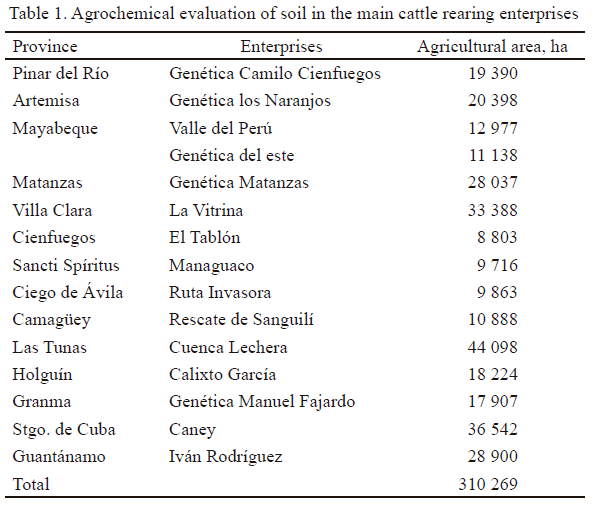
<body><![CDATA[<p align="justify" class="Cuerpodetexto" style="margin-top:12.0pt;text-indent:0cm;"><span style="font-family:'Verdana','sans-serif'; font-size:10.0pt; ">According to the second genetic classification of soils  from Cuba, they are divided into ten groups. Out of them, these occupy the  largest     <br>   area:</span></p>     <p align="justify" class="Cuerpodetexto" style="margin-top:12.0pt;text-indent:0cm;"><span style="font-family:'Verdana','sans-serif'; font-size:10.0pt; ">&bull; Brown (sialitic brown), representing 27.3 % of the  area with 2.4 MM ha</span></p>     <p align="justify" class="Cuerpodetexto" style="margin-top:12.0pt;text-indent:0cm;"><span style="font-family:'Verdana','sans-serif'; font-size:10.0pt; ">&bull; Ferrallitic, with 23.6 % and 2.0 MM ha</span></p>     <p align="justify" class="Cuerpodetexto" style="margin-top:12.0pt;text-indent:0cm;"><span style="font-family:'Verdana','sans-serif'; font-size:10.0pt; ">&bull; Vertisol, representing 12 % of the area, with     <br>   1.0 MM ha</span></p>     <p align="justify" class="Cuerpodetexto" style="margin-top:12.0pt;text-indent:0cm;"><span style="font-family:'Verdana','sans-serif'; font-size:10.0pt; ">Agro-productive categories of soils are classified  into: I) soils that allow crops to show their 70 % of their potential, II)  soils that favor between 51 and 70 %, III) those that admit between 30 and 50 %  and IV) those that only achieve 30 % of their potential.</span></p>     <p align="justify" class="Cuerpodetexto" style="margin-top:12.0pt;text-indent:0cm;"><span style="letter-spacing:.2pt; font-family:'Verdana','sans-serif'; font-size:10.0pt; ">Results of studies on crops with  national economic importance show that 23.2 % of the studied area is classified  from productive to very productive (category I and II), which indicates that  yields superior to 50 % of the potential may be obtained in a wide range of  crops. However, 76.8 % of the national agricultural area have soils classified  from low to very low productivity (category III and IV), affected by edaphic  factors that prevent them to reach potential yields. Therefore, it is necessary  to widen the measures for their conditioning and improvement, so their  productivity increases. Areas dedicated to cattle rearing are presicely located  in soils with these characteristics.&nbsp;&nbsp; </span><span style="font-family:'Verdana','sans-serif'; font-size:10.0pt; "> </span></p>     <p align="justify" class="Cuerpodetexto" style="margin-top:12.0pt;text-indent:0cm;"><span style="letter-spacing:.1pt; font-family:'Verdana','sans-serif'; font-size:10.0pt; ">The Instituto de Suelos, during the  year, conducted agrochemical studies in the main cattle enterprises in Cuba  (<a href="/img/revistas/cjas/v50n2/t0113216.gif">table 1</a>). These enterprises have 310,269 ha as total agricultural area, which  are equivalent to 12 % of the area dedicated to animal husbandry. Out of them,  77,562 ha (25 % of the area under evaluation) were sampled. The highest  production of milk and meat belongs to these enterprises, which also have the  highest concentration of cattle (Instituto de Suelos&nbsp; 2015b).</span><span style="font-family:'Verdana','sans-serif'; font-size:10.0pt; "> </span></p>     
<p align="justify" class="Cuerpodetexto" style="margin-top:12.0pt;text-indent:0cm;"><span style="font-family:'Verdana','sans-serif'; font-size:10.0pt; ">The analysis indicated that 90.6 %  of the agricultural usable areas of the evaluated cattle enterprises in all the  country was affected by one or more limiting factors: 45 % with low natural  fertility, which is the most frequent characteristic of cattle rearing soil;  30.3% with low effective depth, which reduces the volume of water and  nutrients, available for radicular system; 20.5 % with low capacity of humidity  retention, which is mainly present in sandy soils; 22 % shows an irregular  topography, which derives into low effective depth, erosion and fast losses of  humidity; 7.4 % contains salinity, which is associated to toxicity, increase of  osmotic pressure and unfavorable physical conditions; 29.7 % have bad drainage,  which affects the balance of water and air in the soil and favor compaction; 26  % shows acidity, which affects the availability of some essential nutrients or  the increase of toxic elements like aluminum; 11.8 % are rocky soils, which decreases  the volume of available soil to exploit due to the roots that provoke  mechanical damages to plants and animals, take part of the decrease of water  and nutrients storage and of the sowing labors of grasses and forages.&nbsp; </span><span style="font-family:'Verdana','sans-serif'; font-size:10.0pt; "> </span></p>     ]]></body>
<body><![CDATA[<p align="justify" class="Cuerpodetexto" style="margin-top:12.0pt;text-indent:0cm;"><span style="font-family:'Verdana','sans-serif'; font-size:10.0pt; "><a href="/img/revistas/cjas/v50n2/t0213216.gif">Table 2</a> shows a comparison among limiting  characteristics of soils dedicated to animal husbandry, according to reports of  Paretas (1990) and previously cited studies. It is evident the progressive  deterioration, mainly in the increase of erosion, from 32.5 to 43 %. Percentage  of soils with low natural fertility moved from 27.75 to 45 %, and acidity  ranged from 7 to    26 %.</span></p>     
<p align="justify" class="Cuerpodetexto" style="margin-top:12.0pt;text-indent:0cm;"><span style="font-family:'Verdana','sans-serif'; font-size:10.0pt; ">This performance is a product of inadequate management  through the use of agricultural practices and the application of technologies  that were not in accordance with properties and edaphic potentialities. In  addition, it is a consequence of overexploitation of agro-ecosystems, of the  excessive use of fertilizers or the lack of its application. Other problems are  the systematic occurrence of extreme climatic phenomena, lack of efficient  monitoring mechanisms and control of soil fertility, and inefficient management  policies insufficient efforts for improving training of    producers.</span></p>     <p align="justify" class="Cuerpodetexto" style="margin-top:12.0pt;text-indent:0cm;"><span style="font-family:'Verdana','sans-serif'; font-size:10.0pt; ">Hern&aacute;ndez <em>et al.</em> (2005) stated that one of the  most difficult and complex problems to solve is the rational and optimal use of  soils in humid tropical areas, without reaching, up to now, defining or  conclusive results that allow to diagnose the most proper use and management  according to the bio-physical environments that characterize each ecosystem.</span></p>     <p align="justify" class="Cuerpodetexto" style="margin-top:12.0pt;text-indent:0cm;"><span style="letter-spacing:.1pt; font-family:'Verdana','sans-serif'; font-size:10.0pt; ">Productive  diversification and efficient use of available resources should be essential  for guaranteeing soil life and improving life quality of the population (Vargas  2015). In this sense, competitivity of agroecological strategies to manage soil  will be determinant</span><font size="2" face="Verdana, Arial, Helvetica, sans-serif">.</font></p>     <p align="justify">&nbsp;</p>     <p align="justify"><font size="2" face="Verdana, Arial, Helvetica, sans-serif"><b><font size="3">AGROECOLOGICAL MANAGEMENT OF SOILS IN CATTLE  REARING </font></b></font></p>     <p align="justify" class="Cuerpodetexto" style="margin-top:12.0pt;text-indent:0cm;"><span style="font-family:'Verdana','sans-serif'; font-size:10.0pt; ">Grassland ecosystems show open vegetation dominated by  herbaceous species, which primary production is directly used by herbivorous  (Miller 1990). They may be also formed by the harmonic union of herbaceous,  shrub, tree and other species that originate the silvopastoral systems. They  are usually located in areas with soils of relatively low productivity,  inadequate for intensive agricultural uses (Kaine and Tozer 2005). In them,  grazing is an efficient procedure to collect and transform their primary  production in products for human consumption and use. In addition, their dungs  and urine may contribute to nutrient recycling.</span></p>     <p align="justify" class="Cuerpodetexto" style="margin-top:12.0pt;text-indent:0cm;"><span style="font-family:'Verdana','sans-serif'; font-size:10.0pt; ">Composition and productivity of grasses is regulated by  the activity of herviborous and the fact that its management requires to count  with other trophic level implies an added degree of complexity to the ecology  applied to management of natural resources (Quero <em>et al.</em> 2007).</span></p>     <p align="justify" class="Cuerpodetexto" style="margin-top:12.0pt;text-indent:0cm;"><span style="letter-spacing:.2pt; font-family:'Verdana','sans-serif'; font-size:10.0pt; ">Huss <em>et al.</em> (1996) and Yado  (1996) define &ldquo;grassland&rdquo; as any area that produces pasture for cattle intake.  According to these authors, there are two main types of grasslands: natural and  artificial. The main difference among them lies on management intensity and  cultural treatments they receive. Natural grasslands are those lands seating  native grass for animal intake. Artificial grasslands are grassing lands with  intensive management, which usually have introduced forage species and receive  cultural practices.</span><span style="font-family:'Verdana','sans-serif'; font-size:10.0pt; "> </span></p>     <p align="justify" class="Cuerpodetexto" style="margin-top:12.0pt;text-indent:0cm;"><span style="font-family:'Verdana','sans-serif'; font-size:10.0pt; ">&nbsp;According to  S&aacute;nchez <em>et al.</em> (2005), grasslands, regardless of type, are composed of  biotic and abiotic elements that complete an indissoluble unity, and the proper  functioning of the ecosystem depend on their dynamics and harmony. The abiotic  components include inorganic substances involved in material cycles, climate  regime, soil, topography and altitude. Biotic elements include autotrophic  organisms or plants, organic matter consumers and disintegrators, like  bacteria, fungi, nematodes and others. All components have specific functions  and interact with each other, so that productive stability of grasslands and  their persistence in time depend on the dynamic equilibrium between the parts  of the system.&nbsp;&nbsp;&nbsp;&nbsp;&nbsp; </span></p>     ]]></body>
<body><![CDATA[<p align="justify" class="Cuerpodetexto" style="margin-top:12.0pt;text-indent:0cm;"><span style="letter-spacing:.1pt; font-family:'Verdana','sans-serif'; font-size:10.0pt; ">Economic, social and cultural  factors also act on grassland ecosystems and are an inseparable part of them.  Their influence is reflected directly on the management they receive. These  components are interdependent and interactive, and function as a whole, in  which any change of one of them is reflected on the other and, therefore, on  the harmonic functioning of the ecosystem.</span><span style="font-family:'Verdana','sans-serif'; font-size:10.0pt; "> </span></p>     <p align="justify" class="Cuerpodetexto" style="margin-top:12.0pt;text-indent:0cm;"><span style="font-family:'Verdana','sans-serif'; font-size:10.0pt; ">Soil is a key component of these agro-ecosystems.  According to Milera (2013), it is the base of the pyramid to achieve their  appropriate ecological management. Soil conservation contributes to maintain  their health and quality. Reaching its proper functioning, which is manifested  through the state of their physical, chemical and biological properties, allows  to obtain a sustainable agricultural productivity with positive environmental  impact.</span></p>     <p align="justify" class="Cuerpodetexto" style="margin-top:12.0pt;text-indent:0cm;"><span style="font-family:'Verdana','sans-serif'; font-size:10.0pt; ">Likewise, edaphic conservation is related to soil  resilience, which is its ability to recover its functional integrity after a  disturbance, maintaining dynamic balance in their processes and functions  (Obando <em>et al.</em> 2011). When the soil is continually disturbed, its  ability to restore the dynamic balance of its functions decreases and requires  the application of good management practices in order to recover. When  disturbances are repeated, the soil may lose its ability to recover.&nbsp; At the same time, the factors affecting soil  resilience are primarily climate and management (burning, changes in plant  composition, animal management, cultural labors and others). </span></p>     <p align="justify" class="Cuerpodetexto" style="margin-top:12.0pt;text-indent:0cm;"><span style="font-family:'Verdana','sans-serif'; font-size:10.0pt; ">Soil conservation is determined from its specific  properties (organic matter content) and observation of its status (fertility).  Processes related to compaction and loss of soil structures and organic matter,  salinization and acidification are indicators of degradation (Kumar and Kafle  2009).</span></p>     <p align="justify" class="Cuerpodetexto" style="margin-top:12.0pt;text-indent:0cm;"><span style="font-family:'Verdana','sans-serif'; font-size:10.0pt; ">According to  Am&eacute;zquita <em>et al.</em> (2004), a good quality soil for the development of  agriculture must have adequate water conductivity, so that it allows water to  enter it and be easily redistributed in the volume of soil occupied by the  roots. In addition, resistance to penetration should allow that pressure from  the roots during their growth process be able to deform it so they can  penetrate it, with a porosity of at least 50% with good distribution of  macropores (18%), mesopores (25%) and micropores (12%) to ensure that water  entrance, storage and residual humidity are good. It should also have adequate  contents of all nutritional elements, with availability and good recycling.  Among these features, organic matter content (4-5%) has great importance for  its effect to balance physical, chemical and biological conditions.</span></p>     <p align="justify" class="Cuerpodetexto" style="margin-top:12.0pt;text-indent:0cm;"><span style="font-family:'Verdana','sans-serif'; font-size:10.0pt; ">A basic degraded  soil loses nutrients for crop development and soil micro-fauna. In addition,  one of the manifestations of its deterioration may be the decrease of its  coverage. According to Quiros (2002), the loss of this indicator may cause  output of about 124 kg N ha<sup>-1</sup>, 1.03 kg P ha<sup>-1</sup>, 23.91 kg K  ha<sup>-1</sup>, 31.94 kg Ca ha<sup>-1</sup> and    7.04 kg Mg ha<sup>-1</sup>. While, with 90% coverage, the decrease of nutrients  due to runoff is considerably less:    14.5 kg/ha of N; 0.12 kg/ha of P; 1.72 kg/ha of K;  2.56 kg/ha of Ca and 0.65 kg/ha of Mg.</span></p>     <p align="justify" class="Cuerpodetexto" style="margin-top:12.0pt;text-indent:0cm;"><span style="font-family:'Verdana','sans-serif'; font-size:10.0pt; ">Soil conservation in areas dedicated to cattle rearing  has the objective of performing management practices that allow to stop  degradation of this resource or recover its characteristics in a range that do  not affect production and quality of grasses and forages. It should be based on  the knowledge of the state of its properties, type of soil, pendant, grass,  goal of its exploitation and cattle characteristics.&nbsp;&nbsp; </span></p>     <p align="justify" class="Cuerpodetexto" style="margin-top:12.0pt;text-indent:0cm;"><span style="font-family:'Verdana','sans-serif'; font-size:10.0pt; ">The basic principles that allow  soil conservation in areas dedicated to cattle rearing include soil  utilization, according to agricultural aptitude, regionalization of grasses,  use of technologies that are suitable for the edaphoclimatic potentialities of  each system, use of legumes, silvopastoral systems, strategic fertilization,  use of organic fertilizers, minimal labors for sowing and adequate animal  management. It is also important to plant according to the level curves,  maintain a high cover of the soil, use green manures, apply bio-fertilizers and  bio-stimulants, and take into consideration those beneficial or effective  microorganisms, among other elements that, integrating and combining them  properly, favor the integrated management for soil conservation.</span></p>     <p align="justify" class="Cuerpodetexto" style="margin-top:12.0pt;text-indent:0cm;"><span style="font-family:'Verdana','sans-serif'; font-size:10.0pt; ">An appropriate management of situations associated to  soil degradation should be supported by a sequential process of analysis of the  problem (Lascano&nbsp; 2004, Lok <em>et al.</em> (2015):&nbsp; </span></p>     <p align="justify" class="Cuerpodetexto" style="margin-top:12.0pt;text-indent:0cm;"><span style="font-family:'Verdana','sans-serif'; font-size:10.0pt; ">1. Problem diagnosis (identification of the type of  degradation, effects of degradation and evaluation of ecological, social and  economic impact of degradation)</span></p>     ]]></body>
<body><![CDATA[<p align="justify" class="Cuerpodetexto" style="margin-top:12.0pt;text-indent:0cm;"><span style="font-family:'Verdana','sans-serif'; font-size:10.0pt; ">2. Application of technological alternatives that allow  prevention, reduction and rehabilitation </span></p>     <p align="justify" class="Cuerpodetexto" style="margin-top:12.0pt;text-indent:0cm;"><span style="font-family:'Verdana','sans-serif'; font-size:10.0pt; ">3. Systematic follow up and control of the effect of  technological responses applied through sustainability indicators</span></p>     <p align="justify" class="Cuerpodetexto" style="margin-top:12.0pt;text-indent:0cm;"><span style="font-family:'Verdana','sans-serif'; font-size:10.0pt; ">This analysis is particular for each agro-ecosystem.  The efficiency of the process of soil improvement and conservation depends on  the performance of this analysis.</span></p>     <p align="justify" class="Cuerpodetexto" style="margin-top:12.0pt;text-indent:0cm;"><span style="font-family:'Verdana','sans-serif'; font-size:10.0pt; ">In grasslands, integral evaluation of system  functioning have to be conducted with the group of indicators from  soil-plant-animal complex, which should be able of monitoring this functioning,  and alert in time and indicate the best actions for a proper    management.</span></p>     <p align="justify" class="Cuerpodetexto" style="margin-top:12.0pt;text-indent:0cm;"><span style="font-family:'Verdana','sans-serif'; font-size:10.0pt; ">It is foreseen the intensification of production due to  the growing needs of world population, and as a response to climate change in  agro-ecosystems where soil, as a biological base, should maintain its  functioning in the new conditions and guarantee the required production.</span></p>     <p align="justify" class="Cuerpodetexto" style="margin-top:12.0pt;text-indent:0cm;"><span style="font-family:'Verdana','sans-serif'; font-size:10.0pt; ">Cattle activity is one of the major greenhouse effect  gas releaser at a global level because it is the main source of CH<sub>4</sub> production (23 times better than CO<sub>2</sub>, and doubled its atmospheric  concentrations in the last years). Around 85 % of this methane is produced  during the digestion process of productive animals. Additional 15 % of methane  emissions from animal agriculture are produced by areas of untreated wastes,  from animals in production. These areas are a source of water contamination. It  is also important to consider that, in the terrestrial cycle of carbon, organic  carbon of soil represents the best reserve in interaction with the atmosphere.  Without any doubt, it is important the knowledge of processes and functions of  soil that guarantee stability of carbon in the soil.</span></p>     <p align="justify" class="Cuerpodetexto" style="margin-top:12.0pt;text-indent:0cm;"><span style="font-family:'Verdana','sans-serif'; font-size:10.0pt; ">In front of these issues, livestock technologies are  applied and monitored, which have demonstrated their efficiency for improving  and preserving soil. These technologies allow to storage carbon in soil, being  properly managed. Efficiency of some of them has been demonstrated: </span></p>     <p align="justify" class="Cuerpodetexto" style="margin-top:12.0pt;text-indent:0cm;"><span style="font-family:'Verdana','sans-serif'; font-size:10.0pt; ">&bull; Silvopastoral based on <em>Leucaena leucocephala</em> in association with grasses for milk and meat production</span></p>     <p align="justify" class="Cuerpodetexto" style="margin-top:12.0pt;text-indent:0cm;"><span style="font-family:'Verdana','sans-serif'; font-size:10.0pt; ">&bull; Association of grasses and mixture of creeping  legumes for meat production</span></p>     <p align="justify" class="Cuerpodetexto" style="margin-top:12.0pt;text-indent:0cm;"><span style="font-family:'Verdana','sans-serif'; font-size:10.0pt; ">&bull; Biomass banks with <em>Pennisetum purpureum</em> cv.  Cuba CT-115</span></p>     ]]></body>
<body><![CDATA[<p align="justify" class="Cuerpodetexto" style="margin-top:12.0pt;text-indent:0cm;"><span style="font-family:'Verdana','sans-serif'; font-size:10.0pt; ">&bull; Single crops of grasses</span></p>     <p align="justify" class="Cuerpodetexto" style="margin-top:12.0pt;text-indent:0cm;"><span style="font-family:'Verdana','sans-serif'; font-size:10.0pt; ">The evaluation of these technologies by Lok <em>et al.</em>(2015)  to determine stored carbon, demonstrated that silvopastoral systems, mixture of  legumes and biomass bank increased the carbon stored in the soil (CSS) with  exploitation time. Single cropping decreased CSS and reached the lowest values  among the evaluated technologies, which were between 60.4 and    43.7 t ha<sup>-1</sup>.</span></p>     <p align="justify" class="Cuerpodetexto" style="margin-top:12.0pt;text-indent:0cm;"><span style="font-family:'Verdana','sans-serif'; font-size:10.0pt; ">The CSS, during the three years of  evaluation and apart from technology, was between 43 and  65 t C ha<sup>-1</sup> and superior to reported facts (The International Bank  for Reconstruction and Development and The World Bank 2007) as average for  tropical regions. This source indicated that, generally, range between 35 and  40 t C ha<sup>-1</sup> from 0 to 30 cm of depth. The performance found should  have been related to the characteristics of technologies because carbon from  soil is stored as part of the organic matter&nbsp;  (Henderson <em>et al.</em> 2015), and the contents of organic matter and  their dynamics depend, among other factors, on vegetation, its characteristics  and management (Pellegrini <em>et al.</em> 2015).&nbsp; </span><span style="font-family:'Verdana','sans-serif'; font-size:10.0pt; "> </span></p>     <p align="justify" class="Cuerpodetexto" style="margin-top:12.0pt;text-indent:0cm;"><span style="font-family:'Verdana','sans-serif'; font-size:10.0pt; ">Developments in studies  related to soil fertility show that there are opportunities of efficient  management of this natural resource, and, besides the use livestock technologies,  there are more cultural practices to improve its cover, biodiversity,  resilience and    fertility</span><font size="2" face="Verdana, Arial, Helvetica, sans-serif">.</font></p>     <p align="justify">&nbsp;</p>     <p align="justify"><font size="2" face="Verdana, Arial, Helvetica, sans-serif"><font size="3"><b>CHALLENGES OF SOIL SCIENCE IN AREAS DEDICATED TO CATTLE REARING</b></font></font></p>     <p align="justify" class="Cuerpodetexto" style="margin-top:12.0pt;text-indent:0cm;"><span style="font-family:'Verdana','sans-serif'; font-size:10.0pt; ">Currently, there are many challenges in places where  climate changes are predominant and have direct implications on soil  performance.</span></p>     <p align="justify" class="Cuerpodetexto" style="margin-top:12.0pt;text-indent:0cm;"><span style="font-family:'Verdana','sans-serif'; font-size:10.0pt; ">Soil studies have been characterized by the description  of its state and consequent application of amendments that allow recovery of  its productive potential. It was applied to correct the effects of fertility loss  and not directly on causes, which are related to the decrease of dynamic  balance needed by the soil to maintain its processes and functions.</span></p>     <p align="justify" class="Cuerpodetexto" style="margin-top:12.0pt;text-indent:0cm;"><span style="font-family:'Verdana','sans-serif'; font-size:10.0pt; ">For many years, agrochemical analyses were important  for soil management. During the last decade, researches revealed that physical  and biological indicators are essential in variability of cattle rearing  systems mainly due to the effect of the animal component on the system and the  role of edaphic biota on formation and structure of soil aggregates, nutrient  availability, porous spaces, effective depth, apparent density, underground  phytomass, carbon cycle and its storage in soil, among other factors.</span></p>     <p align="justify" class="Cuerpodetexto" style="margin-top:12.0pt;text-indent:0cm;"><span style="font-family:'Verdana','sans-serif'; font-size:10.0pt; ">During the last ten years, soil science related to the  use of this resource in areas dedicated to cattle rearing, according to studies  presented in international meetings and congresses, mainly worked on:</span></p>     ]]></body>
<body><![CDATA[<p align="justify" class="Cuerpodetexto" style="margin-top:12.0pt;text-indent:0cm;"><span style="font-family:'Verdana','sans-serif'; font-size:10.0pt; ">&bull; Use of simulation models for preventing soil  conditions in different systems, according to its management and climate  characteristics</span></p>     <p align="justify" class="Cuerpodetexto" style="margin-top:12.0pt;text-indent:0cm;"><span style="font-family:'Verdana','sans-serif'; font-size:10.0pt; ">&bull; Application of new sampling methods and&nbsp; analytic techniques to evaluate fertility</span></p>     <p align="justify" class="Cuerpodetexto" style="margin-top:12.0pt;text-indent:0cm;"><span style="font-family:'Verdana','sans-serif'; font-size:10.0pt; ">&bull; Improvement of the knowledge of recycling and  nutrient mineralization processes, which determine the flow and storage of C,  biogeochemical processes and mechanisms that guarantee sustainability of soil  and water</span></p>     <p align="justify" class="Cuerpodetexto" style="margin-top:12.0pt;text-indent:0cm;"><span style="font-family:'Verdana','sans-serif'; font-size:10.0pt; ">&bull; Integral management of fertilization through the  application of organic and inorganic fertilizers, as well as bio-fertilizers</span></p>     <p align="justify" class="Cuerpodetexto" style="margin-top:12.0pt;text-indent:0cm;"><span style="font-family:'Verdana','sans-serif'; font-size:10.0pt; ">&bull; Effect of different fertility management systems </span></p>     <p align="justify" class="Cuerpodetexto" style="margin-top:12.0pt;text-indent:0cm;"><span style="font-family:'Verdana','sans-serif'; font-size:10.0pt; ">&bull; Sustainability indicators</span></p>     <p align="justify" class="Cuerpodetexto" style="margin-top:12.0pt;text-indent:0cm;"><span style="font-family:'Verdana','sans-serif'; font-size:10.0pt; ">&bull; Biological fixation of N through the use of legumes  in the systems</span></p>     <p align="justify" class="Cuerpodetexto" style="margin-top:12.0pt;text-indent:0cm;"><span style="font-family:'Verdana','sans-serif'; font-size:10.0pt; ">&bull; Biodiversity studies, determination of edaphic biota  associated to each system and its function in them </span></p>     <p align="justify" class="Cuerpodetexto" style="margin-top:12.0pt;text-indent:0cm;"><span style="font-family:'Verdana','sans-serif'; font-size:10.0pt; ">For example, in the 10th Congress of the Cuban Society  of Soil Sciences (Instituto de Suelos 2015a), only 24.5 % of the presented  papers belonged to cattle rearing results. Out of the discussed subject, there  was a predominance of soil conservation and biology. This demonstrated that,  currently, most of the studies are aimed to deepen on the knowledge of these  subjects as an essential way of reaching sustainability and useful life of  cattle rearing systems. There are still few efforts to dominate and know the  soil in scientific researches, regarding the use of other agricultural systems,  even though the total national agricultural area, the area dedicated to cattle  rearing, has around 40%.</span></p>     <p align="justify" class="Cuerpodetexto" style="margin-top:12.0pt;text-indent:0cm;"><span style="font-family:'Verdana','sans-serif'; font-size:10.0pt; ">From the performed analysis and the current state of  soil studies, knowing about its functioning and management actions to allow its  restoration, together with the development of cattle rearing technologies with  tested capacity for maintaining, recovering and preserving soil fertility and  the implementation of new methods of strategic and integral fertilization,  constitute important opportunities to reach an ecological management of soil  and its recovery. To all these facts, it can be added the proper knowledge of  forage and grass species with potential to adapt to different edaphoclimatic  conditions, which allows the regionalization of grasses. The conscience-taking  of decision-makers on the value of soil in cattle rearing systems and  generation of systematic evaluation practice of its evolution should be taken  into consideration.</span></p>     ]]></body>
<body><![CDATA[<p align="justify" class="Cuerpodetexto" style="margin-top:12.0pt;text-indent:0cm;"><span style="font-family:'Verdana','sans-serif'; font-size:10.0pt; ">In front of these conditions, challenges to guarantee a  sustainable use of soil in cattle areas contain three main components:</span></p>     <p align="justify" class="Cuerpodetexto" style="margin-top:12.0pt;text-indent:0cm;"><span style="font-family:'Verdana','sans-serif'; font-size:10.0pt; ">a) Research and development should be focus on  determining relationships among climatic and physical properties of soil and  enzymatic activity of microorganisms (mineralization and C sequestration). In  addition, the effect of good practices under different conditions, with the  application of new technologies, should be analyzed. The effect of climate  change on soil should be approached and work on achieving efficient  methodologies that allow to evaluate its impact on soil. It is necessary to  quantify and monitor the presence or absence of heavy metals in livestock  residuals and identify new efficient management methods. It is also necessary  to update the sampling techniques and soil analysis.&nbsp;&nbsp; </span></p>     <p align="justify" class="Cuerpodetexto" style="margin-top:12.0pt;text-indent:0cm;"><span style="font-family:'Verdana','sans-serif'; font-size:10.0pt; ">b) <span style="letter-spacing:.2pt; ">Knowledge management  and application of good soil management practices should be directed to  generalization of knowledge in production areas, so an integrated management on  agro-ecological basis could be achieved, which would encourage its resilience  and guarantee sustainability. Training, support to producers and creation of  reference scenarios are considered as essential. In addition, there must be an  adequate flow of knowledge, which will generate, disseminate and share  experiences of good research practices applicable to production. This process  should ensure the involvement and problem awareness of decision-makers, which  implies full social awareness and capacity building.</span></span></p>     <p align="justify" class="Cuerpodetexto" style="margin-top:12.0pt;text-indent:0cm;"><span style="font-family:'Verdana','sans-serif'; font-size:10.0pt; ">c) <span style="letter-spacing:.1pt; ">The policy and  decision making should be directed to promote sustainable cattle rearing on the  basis of improved production, environment conservation (soil) and cost  reduction. All this will allow soil profitability and resilience. It is  important to get a favorable environment by providing more support to small and  medium producers, and implementing appropriate policies, with adequate  infrastructure and credits and inputs to ensure the rights of land use. In  addition, mechanisms should be created to motivate and encourage those that  protect the ecosystems. It is necessary to ensure the extension and counseling  service with a system of systematic and safe diffusion of knowledge. In this  context, access to knowledge is considered essential.</span></span></p>     <p align="justify" class="Cuerpodetexto" style="margin-top:12.0pt;text-indent:0cm;"><span style="font-family:'Verdana','sans-serif'; font-size:10.0pt; ">For the  realization of these challenges, it is essential the redefinition of soil  management, which implies a change in its use and in the projection of its  exploitation at small, medium and large scale. All this leads to consider it as  a natural resource, slowly renewable and indispensable to human life. </span></p>     <p align="justify" class="Cuerpodetexto" style="margin-top:12.0pt;text-indent:0cm;"><span style="font-family:'Verdana','sans-serif'; font-size:10.0pt; ">The strategy for redefining soil management in grasslands  also implies the conscious participation of society (producers, technicians,  consultants, researchers, policy makers, and community) and planning and  organizing the process from local level to basin level. It is important to  encourage multifunctional soil use to promote synergies that favor appropriate  economic, ecological and social exchanges and strengthen ecosystem services.</span></p>     <p align="justify" class="Cuerpodetexto" style="margin-top:12.0pt;text-indent:0cm;"><span style="font-family:'Verdana','sans-serif'; font-size:10.0pt; ">It is concluded  that soils dedicated to cattle rearing have limiting factors and have lost  their fertility, which increased in the last years with its consequent effect  on productivity of cattle rearing systems. There are opportunities for proper  soil management to be considered for recovery and conservation.</span></p>     <p align="justify" class="Cuerpodetexto" style="margin-top:12.0pt;text-indent:0cm;"><span style="font-family:'Verdana','sans-serif'; font-size:10.0pt; ">The redefinition soil  management in grasslands should include research and development of science  associated to these areas, appropriate knowledge management and application of  good agro-ecological management practices, together with policies and  decision-makings that promote and guarantee a sustainable development of this resource</span><font size="2" face="Verdana, Arial, Helvetica, sans-serif">.</font></p>     <p align="justify">&nbsp;</p>     <p align="justify"><font size="2" face="Verdana, Arial, Helvetica, sans-serif"><font size="3"><b>NOTE</b></font></font></p>     ]]></body>
<body><![CDATA[<p align="justify"><font size="2" face="Verdana, Arial, Helvetica, sans-serif"><sup>1</sup>Paper presented at V Congreso de Producci&oacute;n Animal Tropical, 2015, La Habana, Cuba.</font></p>     <p align="justify">&nbsp;</p>     <p align="justify"><font size="2" face="Verdana, Arial, Helvetica, sans-serif"><font size="3"><b>REFERENCES</b></font></font></p>     <p align="justify" class="MsoBibliography" style="margin-top:12.0pt;"><span style="font-family:'Verdana','sans-serif'; font-size:10.0pt; ">Am&eacute;zquita,  E., Thomas, R. J., Rao, I. M., Molina, D. L. &amp; Hoyos, P. 2004. </span><span style="font-family:'Verdana','sans-serif'; font-size:10.0pt; ">&ldquo;Use of deep-rooted  tropical pastures to build-up an arable layer through improved soil properties  of an Oxisol in the Eastern Plains (Llanos Orientales) of Colombia&rdquo;. <em>Agriculture,  Ecosystems &amp; Environment</em>, 103 (2): 269&ndash;277, ISSN: 0167-8809, DOI:  10.1016/j.agee.2003.12.017.</span></p>     <!-- ref --><p align="justify" class="MsoBibliography" style="margin-top:12.0pt;"><span style="font-family:'Verdana','sans-serif'; font-size:10.0pt; ">Bennet, H. H. 1932. <em>Conservation  in Cuba: Some New Cuban Soils</em>. no. 22, Yonkers, New York: Tropical&nbsp; Plant Research Foundation Scientific  Contribution.    </span></p>     <!-- ref --><p align="justify" class="MsoBibliography" style="margin-top:12.0pt;"><span style="font-family:'Verdana','sans-serif'; font-size:10.0pt; ">Bennett, H. H. &amp;  Allison, R. V. 1962. </span><em><span style="font-family:'Verdana','sans-serif'; font-size:10.0pt; ">Los Suelos de  Cuba</span></em><span style="font-family:'Verdana','sans-serif'; font-size:10.0pt; ">. La Habana, Cuba: Comisi&oacute;n Nacional Cubana de  UNESCO, 380 p., Available: &lt;<a href="https://books.google.com.cu/books/about/Los_Suelos_de_Cuba_Por_H_H_Bennett_Y_R_V.html?id=m_Y3nwEACAAJ&redir_esc=y" target="_blank">https://books.google.com.cu/books/about/Los_Suelos_de_Cuba_Por_H_H_Bennett_Y_R_V.html?id=m_Y3nwEACAAJ&amp;redir_esc=y</a>&gt;,  [Consulted:&nbsp;May 3, 2016].    </span></p>     <p align="justify" class="MsoBibliography" style="margin-top:12.0pt;"><span style="font-family:'Verdana','sans-serif'; font-size:10.0pt; ">Botero,  B. J. A. 2001. &ldquo;Contribuci&oacute;n de los sistemas ganaderos tropicales al secuestro  de Carbono&rdquo;. In: S&aacute;nchez M. D. &amp; Rosales M. M. (eds.), <em>II Conferencia Electr&oacute;nica  de Agroforester&iacute;a para la Producci&oacute;n Animal</em>, Roma: FAO, pp. 75&ndash;92,  Available: &lt;<a href="ftp://ftp.fao.org/docrep/fao/005/y4435s/y4435s00.pdf" target="_blank">ftp://ftp.fao.org/docrep/fao/005/y4435s/y4435s00.pdf</a>&gt;,  [Consulted:&nbsp;March 30, 2016].</span></p>     <p align="justify" class="MsoBibliography" style="margin-top:12.0pt;"><span style="font-family:'Verdana','sans-serif'; font-size:10.0pt; ">Garc&iacute;a,  Y., Ram&iacute;rez, W. &amp; S&aacute;nchez, S. 2012. &ldquo;Indicadores de la calidad de los suelos:  una nueva manera de evaluar este recurso&rdquo;. <em>Pastos y Forrajes</em>, 35 (2):  125&ndash;138, ISSN: 0864-0394.</span></p>     ]]></body>
<body><![CDATA[<p align="justify" class="MsoBibliography" style="margin-top:12.0pt;"><span style="font-family:'Verdana','sans-serif'; font-size:10.0pt; ">Henderson,  D., Olivera, D., Richrad, P. &amp; Calero, A. 2015. &ldquo;Influencia de los sistemas  de uso del suelo en el comportamiento de los &aacute;cidos h&uacute;micos&rdquo;. In: <em>VIII  Congreso de la Sociedad Cubana de la Ciencia del Suelo</em>, La Habana, Cuba:  Instituto de Suelos, Ministerio de la Agricultura y Sociedad Cubana de la  Ciencia del Suelo, ISBN: 978-959-296-039-8.</span></p>     <p align="justify" class="MsoBibliography" style="margin-top:12.0pt;"><span style="font-family:'Verdana','sans-serif'; font-size:10.0pt; ">Hern&aacute;ndez,  S. R. Y., &Aacute;guila, H. C. &amp; P&eacute;rez, M. J. 2005. &ldquo;Uso del cesio 137 como  radiotrazador en la cuantificaci&oacute;n de la erosi&oacute;n de suelos tropicales&rdquo;. <em>Nucleus</em>,  (38): 19&ndash;24, ISSN: 0864084X.</span></p>     <!-- ref --><p align="justify" class="MsoBibliography" style="margin-top:12.0pt;"><span style="font-family:'Verdana','sans-serif'; font-size:10.0pt; ">Huss,  D., Instituto Nacional de Tecnolog&iacute;a Agropecuaria (Argentina) &amp; FAO Oficina  Regional para Am&eacute;rica Latina y el Caribe 1996. <em>Principios de manejo de  praderas naturales</em>. (ser. Zonas &aacute;ridas y semi&aacute;ridas, no. ser. 6), 2nd ed.,  Santiago de Chile, Chile: FAO, 272 p., Available:  &lt;<a href="https://books.google.com.cu/books/about/Principios_de_manejo_de_praderas_natural.html?id=uNk-HQAACAAJ&redir_esc=y" target="_blank">https://books.google.com.cu/books/about/Principios_de_manejo_de_praderas_natural.html?id=uNk-HQAACAAJ&amp;redir_esc=y</a>&gt;,  [Consulted:&nbsp;May 4, 2016].    </span></p>     <p align="justify" class="MsoBibliography" style="margin-top:12.0pt;"><span style="font-family:'Verdana','sans-serif'; font-size:10.0pt; ">Instituto  de Suelos 2015a. <em>Congreso de Suelos 2015</em>. La Habana, Cuba: Instituto de  Suelos, Ministerio de la Agricultura y Sociedad Cubana de la Ciencia del Suelo,  ISBN: 978-959-296-039-8.</span></p>     <p align="justify" class="MsoBibliography" style="margin-top:12.0pt;"><span style="font-family:'Verdana','sans-serif'; font-size:10.0pt; ">Instituto  de Suelos 2015b. <em>Estado agroqu&iacute;mico de los suelos en empresas ganaderas de  Cuba</em>. La Habana, Cuba: Ministerio de la Agricultura, p. 150.</span></p>     <p align="justify" class="MsoBibliography" style="margin-top:12.0pt;"><span style="font-family:'Verdana','sans-serif'; font-size:10.0pt; ">Kaine,  G. W. &amp; Tozer, P. R. 2005. &ldquo;Estabilidad, capacidad de recuperaci&oacute;n y  sostenibilidad basada en sistemas de pastos&rdquo;. </span><em><span style="font-family:'Verdana','sans-serif'; font-size:10.0pt; ">Systems. Los Sistemas  Agr&iacute;colas</span></em><span style="font-family:'Verdana','sans-serif'; font-size:10.0pt; ">, 83: 27&ndash;48.</span></p>     <p align="justify" class="MsoBibliography" style="margin-top:12.0pt;"><span style="font-family:'Verdana','sans-serif'; font-size:10.0pt; ">Kumar, A. A. &amp; Kafle,  N. 2009. &ldquo;Land Degradation Issues in Nepal and Its Management Through  Agroforestry&rdquo;. <em>Journal of Agriculture and Environment</em>, 10: 133&ndash;143,  ISSN: 2091-1009, DOI: 10.3126/aej.v10i0.2138.</span></p>     <p align="justify" class="MsoBibliography" style="margin-top:12.0pt;"><span style="font-family:'Verdana','sans-serif'; font-size:10.0pt; ">Lascano, C. 2004. </span><span style="font-family:'Verdana','sans-serif'; font-size:10.0pt; ">&ldquo;Prevenci&oacute;n, reducci&oacute;n y rehabilitaci&oacute;n de tierras  degradadas en los tr&oacute;picos,&nbsp; un desafi&oacute;  para CIAT y sus socios&rdquo;. In: <em>Simposio Fertilidad de suelo</em>, CIAT.</span></p>     <p align="justify" class="MsoBibliography" style="margin-top:12.0pt;"><span style="font-family:'Verdana','sans-serif'; font-size:10.0pt; ">Lok,  S., D&iacute;az, J., Crespo, G. &amp; Torres, V. 2015. &ldquo;Servicios ambientales  generados por la aplicaci&oacute;n de tecnolog&iacute;as ganaderas en sistemas agropecuarios  tropicales&rdquo;. In: <em>VIII Congreso de la Sociedad Cubana de la Ciencia del Suelo</em>,  La Habana, Cuba: Instituto de Suelos, Ministerio de la Agricultura y Sociedad  Cubana de la Ciencia del Suelo, ISBN: 978-959-296-039-8.</span></p>     ]]></body>
<body><![CDATA[<p align="justify" class="MsoBibliography" style="margin-top:12.0pt;"><span style="font-family:'Verdana','sans-serif'; font-size:10.0pt; ">Milera,  M. 2013. &ldquo;Contribuci&oacute;n de los sistemas silvopastoriles en la producci&oacute;n y el  medio ambiente&rdquo;. </span><em><span style="font-family:'Verdana','sans-serif'; font-size:10.0pt; ">Avances en Investigaci&oacute;n Agropecuaria</span></em><span style="font-family:'Verdana','sans-serif'; font-size:10.0pt; ">, 17 (3): 7&ndash;24, ISSN:  0188-7890.</span></p>     <p align="justify" class="MsoBibliography" style="margin-top:12.0pt;"><span style="font-family:'Verdana','sans-serif'; font-size:10.0pt; ">Miller, G. T. 1990.  &ldquo;Resource conservation and management&rdquo;. <em>ASHRAE Transactions</em>, 105 (1999):  993, ISSN: 0001-2505.</span></p>     <p align="justify" class="MsoBibliography" style="margin-top:12.0pt;"><span style="font-family:'Verdana','sans-serif'; font-size:10.0pt; ">Obando,  M. F. H., Tobasura, A. I. &amp; Miranda, G. J. 2011. &ldquo;Evaluaci&oacute;n de la calidad  del suelo por medio de indicadores locales en sistemas con predominio de caf&eacute; y  ganader&iacute;a en zonas de ladera en Colombia&rdquo;. In: Villanueva C., Sep&uacute;lveda C. J.  &amp; Ibrahim M. (eds.), <em>Manejo agroecol&oacute;gico como ruta para lograr la  sostenibilidad de fincas con caf&eacute; y ganader&iacute;a</em>, (ser. T&eacute;cnica, no. ser.  387), Turrialba, Costa Rica: Centro Agron&oacute;mico Tropical de Investigaci&oacute;n y  Ense&ntilde;anza (CATIE), pp. 71&ndash;91, ISBN: 978-9977-57-547-6, Available:  &lt;<a href="http://repositorio.bibliotecaorton.catie.ac.cr:8080/bitstream/handle/11554/2943/Manejo_agroecologico_como_ruta_para_lograr_la_sostenibilidad.pdf;jsessionid=35DCBCDFEDFF6C0B76925E0108369418?sequence=1#page=86" target="_blank">http://repositorio.bibliotecaorton.catie.ac.cr:8080/bitstream/handle/11554/2943/Manejo_agroecologico_como_ruta_para_lograr_la_sostenibilidad.pdf;jsessionid=35DCBCDFEDFF6C0B76925E0108369418?sequence=1#page=86</a>&gt;,  [Consulted:&nbsp;May 4, 2016].</span></p>     <!-- ref --><p align="justify" class="MsoBibliography" style="margin-top:12.0pt;"><span style="font-family:'Verdana','sans-serif'; font-size:10.0pt; ">Paretas,  F. J. J. 1990. <em>Ecosistemas y regionalizaci&oacute;n de pastos en Cuba</em>. La  Habana, Cuba: Ministerio de la Agricultura - Instituto de Investigaciones de  Pastos y Forrajes, 178 p., Available: &lt;<a href="https://books.google.com.cu/books/about/Ecosistemas_y_regionalizacion_de_pastos.html?id=alXwZwEACAAJ&redir_esc=y" target="_blank">https://books.google.com.cu/books/about/Ecosistemas_y_regionalizacion_de_pastos.html?id=alXwZwEACAAJ&amp;redir_esc=y</a>&gt;,  [Consulted:&nbsp;May 4, 2016].    </span></p>     <p align="justify" class="MsoBibliography" style="margin-top:12.0pt;"><span style="font-family:'Verdana','sans-serif'; font-size:10.0pt; ">Pellegrini,  A. E., Fr&iacute;as, A. &amp; Lanfranco, J. W. 2015. &ldquo;Comparaci&oacute;n de mitolog&iacute;as para  determinar la materia org&aacute;nica de suelos de la Regi&oacute;n Pampeana, Argentina&rdquo;. In: <em>VIII Congreso de la Sociedad Cubana de la Ciencia del Suelo</em>, La Habana,  Cuba: Instituto de Suelos, Ministerio de la Agricultura y Sociedad Cubana de la  Ciencia del Suelo, ISBN: 978-959-296-039-8.</span></p>     <p align="justify" class="MsoBibliography" style="margin-top:12.0pt;"><span style="font-family:'Verdana','sans-serif'; font-size:10.0pt; ">Quero,  C. A. R., Enr&iacute;quez, Q. J. F. &amp; Jim&eacute;nez, L. M. 2007. &ldquo;Evaluaci&oacute;n de especies  forrajeras en Am&eacute;rica tropical, avances o status quo&rdquo;. <em>Interciencia</em>, 32  (8): 566&ndash;571, ISSN: 0378-1844.</span></p>     <p align="justify" class="MsoBibliography" style="margin-top:12.0pt;"><span style="font-family:'Verdana','sans-serif'; font-size:10.0pt; ">Quir&oacute;s,  O. 2002. &ldquo;La conservaci&oacute;n de suelos en la producci&oacute;n org&aacute;nica&rdquo;. In: <em>II  Encuentro de Investigadores&nbsp; en Agricultura  Org&aacute;nica. Agricultura Conservacionista, MAG</em>, San Jos&eacute;, Puerto Rico.</span></p>     <p align="justify" class="MsoBibliography" style="margin-top:12.0pt;"><span style="font-family:'Verdana','sans-serif'; font-size:10.0pt; ">S&aacute;nchez,  G. P., L&oacute;pez, E. J. A., Vera, J. B., L&oacute;pez, R. C. &amp; Jim&eacute;nez, J. F. 2005.  &ldquo;Novedades corol&oacute;gicas para la flora vascular del sureste ib&eacute;rico&rdquo;. <em>Anales  de Biolog&iacute;a</em>, 27: 127&ndash;132, ISSN: 1989-2128, 1138-3399.</span></p>     <p align="justify" class="MsoBibliography" style="margin-top:12.0pt;"><span style="font-family:'Verdana','sans-serif'; font-size:10.0pt; ">S&aacute;nchez,  S., Hern&aacute;ndez, M. &amp; Ruz, F. 2011. &ldquo;Alternativas de manejo de la fertilidad  del suelo en ecosistemas agropecuarios&rdquo;. </span><em><span style="font-family:'Verdana','sans-serif'; font-size:10.0pt; ">Pastos y Forrajes</span></em><span style="font-family:'Verdana','sans-serif'; font-size:10.0pt; ">, 34 (4): 375&ndash;392, ISSN:  0864-0394.</span></p>     ]]></body>
<body><![CDATA[<!-- ref --><p align="justify" class="MsoBibliography" style="margin-top:12.0pt;"><span style="font-family:'Verdana','sans-serif'; font-size:10.0pt; ">The International Bank for  Reconstruction and Development &amp; The World Bank 2007. <em>World Development  Report 2008. Agriculture for Development</em>. Washington D.C.: The World Bank,  p. 365, ISBN: 978-0-8213-6807-7, DOI: 10.1596/978-0-8213-7233-3, Available:  &lt;<a href="http://siteresources.worldbank.org/INTWDRS/Resources/477365-1327599046334/8394679-1327606607122/WDR_00_book.pdf" target="_blank">http://siteresources.worldbank.org/INTWDRS/Resources/477365-1327599046334/8394679-1327606607122/WDR_00_book.pdf</a>&gt;,  [Consulted:&nbsp;March 30, 2016].    </span></p>     <p align="justify" class="MsoBibliography" style="margin-top:12.0pt;"><span style="font-family:'Verdana','sans-serif'; font-size:10.0pt; ">Vargas,  R. 2015. &ldquo;Plan de implementaci&oacute;n de la alianza regional de suelos&rdquo;. In: <em>VIII  Congreso de la Sociedad Cubana de la Ciencia del Suelo</em>, La Habana, Cuba:  Instituto de Suelos, Ministerio de la Agricultura y Sociedad Cubana de la  Ciencia del Suelo, ISBN: 978-959-296-039-8, Conferencia Magistral.</span></p>     <!-- ref --><p align="justify" class="MsoBibliography" style="margin-top:12.0pt;"><span style="font-family:'Verdana','sans-serif'; font-size:10.0pt; ">Yado,  P. R. 1996. <em>Manejo de recursos naturales</em>. 1st ed., Poitiers (111  Grand-rue, 86000): Universidad Aut&oacute;noma de Tamaulipas, Facultad de Medicina  Veterinaria y Zootecnia, 164 p., ISBN: 978-2-911299-06-3, Available:  &lt;<a href="http://www.amazon.com/Manejo-recursos-naturales-Spanish-Edition/dp/9687662093" target="_blank">http://www.amazon.com/Manejo-recursos-naturales-Spanish-Edition/dp/9687662093</a>&gt;,  [Consulted:&nbsp;April 4, 2016]</span><font size="2" face="Verdana,     Arial, Helvetica, sans-serif">.</font></p>     <p align="justify">&nbsp;</p>     <p align="justify">&nbsp;</p>     <p align="justify"><font size="2" face="Verdana, Arial, Helvetica, sans-serif">Received: 5/4/2016    <br>   Accepted: 4/7/2016</font></p>     <p align="justify">&nbsp;</p>     ]]></body>
<body><![CDATA[<p align="justify">&nbsp;</p>     <p align="justify"><font size="2" face="Verdana, Arial, Helvetica, sans-serif"><i>Sandra Lok Mejías,</i> Instituto de Ciencia Animal, Apartado Postal 24, San José de las Lajas, Mayabeque, Cuba.    Email: <a href="mailto:slok@ica.co.cu">slok@ica.co.cu</a></font></p>      ]]></body><back>
<ref-list>
<ref id="B1">
<nlm-citation citation-type="journal">
<person-group person-group-type="author">
<name>
<surname><![CDATA[Amézquita]]></surname>
<given-names><![CDATA[E.]]></given-names>
</name>
<name>
<surname><![CDATA[Thomas]]></surname>
<given-names><![CDATA[R. J.]]></given-names>
</name>
<name>
<surname><![CDATA[Rao]]></surname>
<given-names><![CDATA[I. M.]]></given-names>
</name>
<name>
<surname><![CDATA[Molina]]></surname>
<given-names><![CDATA[D. L.]]></given-names>
</name>
<name>
<surname><![CDATA[Hoyos]]></surname>
<given-names><![CDATA[P.]]></given-names>
</name>
</person-group>
<article-title xml:lang="nd"><![CDATA[Use of deep-rooted tropical pastures to build-up an arable layer through improved soil properties of an Oxisol in the Eastern Plains (Llanos Orientales) of Colombia]]></article-title>
<source><![CDATA[Agriculture, Ecosystems & Environment]]></source>
<year>2004</year>
<volume>103</volume>
<numero>2</numero>
<issue>2</issue>
<page-range>269-277</page-range></nlm-citation>
</ref>
<ref id="B2">
<nlm-citation citation-type="book">
<person-group person-group-type="author">
<name>
<surname><![CDATA[Bennet]]></surname>
<given-names><![CDATA[H. H.]]></given-names>
</name>
</person-group>
<source><![CDATA[Conservation in Cuba: Some New Cuban Soils]]></source>
<year>1932</year>
<publisher-loc><![CDATA[Yonkers, New York ]]></publisher-loc>
<publisher-name><![CDATA[Tropical Plant Research Foundation Scientific Contribution]]></publisher-name>
</nlm-citation>
</ref>
<ref id="B3">
<nlm-citation citation-type="book">
<person-group person-group-type="author">
<name>
<surname><![CDATA[Bennett]]></surname>
<given-names><![CDATA[H. H.]]></given-names>
</name>
<name>
<surname><![CDATA[Allison]]></surname>
<given-names><![CDATA[R. V.]]></given-names>
</name>
</person-group>
<source><![CDATA[Los Suelos de Cuba]]></source>
<year>1962</year>
<page-range>380</page-range><publisher-loc><![CDATA[La Habana, Cuba ]]></publisher-loc>
<publisher-name><![CDATA[Comisión Nacional Cubana de UNESCO]]></publisher-name>
</nlm-citation>
</ref>
<ref id="B4">
<nlm-citation citation-type="book">
<person-group person-group-type="author">
<name>
<surname><![CDATA[Botero]]></surname>
<given-names><![CDATA[B. J. A.]]></given-names>
</name>
</person-group>
<article-title xml:lang="nd"><![CDATA[Contribución de los sistemas ganaderos tropicales al secuestro de Carbono]]></article-title>
<person-group person-group-type="editor">
<name>
<surname><![CDATA[Sánchez]]></surname>
<given-names><![CDATA[M. D.]]></given-names>
</name>
<name>
<surname><![CDATA[Rosales]]></surname>
<given-names><![CDATA[M. M.]]></given-names>
</name>
</person-group>
<source><![CDATA[]]></source>
<year>2001</year>
<page-range>75-92</page-range><publisher-loc><![CDATA[Roma ]]></publisher-loc>
<publisher-name><![CDATA[FAO]]></publisher-name>
</nlm-citation>
</ref>
<ref id="B5">
<nlm-citation citation-type="journal">
<person-group person-group-type="author">
<name>
<surname><![CDATA[García]]></surname>
<given-names><![CDATA[Y.]]></given-names>
</name>
<name>
<surname><![CDATA[Ramírez]]></surname>
<given-names><![CDATA[W.]]></given-names>
</name>
<name>
<surname><![CDATA[Sánchez]]></surname>
<given-names><![CDATA[S.]]></given-names>
</name>
</person-group>
<article-title xml:lang="nd"><![CDATA[Indicadores de la calidad de los suelos: una nueva manera de evaluar este recurso]]></article-title>
<source><![CDATA[Pastos y Forrajes]]></source>
<year>2012</year>
<volume>35</volume>
<numero>2</numero>
<issue>2</issue>
<page-range>125-138</page-range></nlm-citation>
</ref>
<ref id="B6">
<nlm-citation citation-type="book">
<person-group person-group-type="author">
<name>
<surname><![CDATA[Henderson]]></surname>
<given-names><![CDATA[D.]]></given-names>
</name>
<name>
<surname><![CDATA[Olivera]]></surname>
<given-names><![CDATA[D.]]></given-names>
</name>
<name>
<surname><![CDATA[Richrad]]></surname>
<given-names><![CDATA[P.]]></given-names>
</name>
<name>
<surname><![CDATA[Calero]]></surname>
<given-names><![CDATA[A.]]></given-names>
</name>
</person-group>
<article-title xml:lang="nd"><![CDATA[Influencia de los sistemas de uso del suelo en el comportamiento de los ácidos húmicos]]></article-title>
<source><![CDATA[]]></source>
<year>2015</year>
<publisher-loc><![CDATA[La Habana, Cuba ]]></publisher-loc>
<publisher-name><![CDATA[Instituto de Suelos, Ministerio de la Agricultura y Sociedad Cubana de la Ciencia del Suelo]]></publisher-name>
</nlm-citation>
</ref>
<ref id="B7">
<nlm-citation citation-type="journal">
<person-group person-group-type="author">
<name>
<surname><![CDATA[Hernández]]></surname>
<given-names><![CDATA[S. R. Y.]]></given-names>
</name>
<name>
<surname><![CDATA[Águila]]></surname>
<given-names><![CDATA[H. C.]]></given-names>
</name>
<name>
<surname><![CDATA[Pérez]]></surname>
<given-names><![CDATA[M. J.]]></given-names>
</name>
</person-group>
<article-title xml:lang="nd"><![CDATA[Uso del cesio 137 como radiotrazador en la cuantificación de la erosión de suelos tropicales]]></article-title>
<source><![CDATA[Nucleus]]></source>
<year>2005</year>
<numero>38</numero>
<issue>38</issue>
<page-range>19-24</page-range></nlm-citation>
</ref>
<ref id="B8">
<nlm-citation citation-type="book">
<person-group person-group-type="author">
<name>
<surname><![CDATA[Huss]]></surname>
<given-names><![CDATA[D.]]></given-names>
</name>
<name>
<surname><![CDATA[Instituto Nacional de Tecnología Agropecuaria (Argentina)]]></surname>
</name>
<name>
<surname><![CDATA[FAO Oficina Regional para América Latina y el Caribe]]></surname>
</name>
</person-group>
<source><![CDATA[Principios de manejo de praderas naturales]]></source>
<year>1996</year>
<edition>2nd</edition>
<page-range>272</page-range><publisher-loc><![CDATA[Santiago de Chile, Chile ]]></publisher-loc>
<publisher-name><![CDATA[FAO]]></publisher-name>
</nlm-citation>
</ref>
<ref id="B9">
<nlm-citation citation-type="book">
<person-group person-group-type="author">
<name>
<surname><![CDATA[Instituto de Suelos]]></surname>
</name>
</person-group>
<source><![CDATA[Congreso de Suelos 2015]]></source>
<year>2015</year>
<publisher-loc><![CDATA[La Habana, Cuba ]]></publisher-loc>
<publisher-name><![CDATA[Instituto de Suelos, Ministerio de la Agricultura y Sociedad Cubana de la Ciencia del Suelo]]></publisher-name>
</nlm-citation>
</ref>
<ref id="B10">
<nlm-citation citation-type="book">
<person-group person-group-type="author">
<name>
<surname><![CDATA[Instituto de Suelos]]></surname>
</name>
</person-group>
<source><![CDATA[Estado agroquímico de los suelos en empresas ganaderas de Cuba]]></source>
<year>2015</year>
<page-range>150</page-range><publisher-loc><![CDATA[La Habana, Cuba ]]></publisher-loc>
<publisher-name><![CDATA[Ministerio de la Agricultura]]></publisher-name>
</nlm-citation>
</ref>
<ref id="B11">
<nlm-citation citation-type="journal">
<person-group person-group-type="author">
<name>
<surname><![CDATA[Kaine]]></surname>
<given-names><![CDATA[G. W.]]></given-names>
</name>
<name>
<surname><![CDATA[Tozer]]></surname>
<given-names><![CDATA[P. R.]]></given-names>
</name>
</person-group>
<article-title xml:lang="nd"><![CDATA[Estabilidad, capacidad de recuperación y sostenibilidad basada en sistemas de pastos]]></article-title>
<source><![CDATA[Systems. Los Sistemas Agrícolas]]></source>
<year>2005</year>
<volume>83</volume>
<page-range>27-48</page-range></nlm-citation>
</ref>
<ref id="B12">
<nlm-citation citation-type="journal">
<person-group person-group-type="author">
<name>
<surname><![CDATA[Kumar]]></surname>
<given-names><![CDATA[A. A.]]></given-names>
</name>
<name>
<surname><![CDATA[Kafle]]></surname>
<given-names><![CDATA[N.]]></given-names>
</name>
</person-group>
<article-title xml:lang="nd"><![CDATA[Land Degradation Issues in Nepal and Its Management Through Agroforestry]]></article-title>
<source><![CDATA[Journal of Agriculture and Environment]]></source>
<year>2009</year>
<volume>10</volume>
<page-range>133-143</page-range></nlm-citation>
</ref>
<ref id="B13">
<nlm-citation citation-type="book">
<person-group person-group-type="author">
<name>
<surname><![CDATA[Lascano]]></surname>
<given-names><![CDATA[C.]]></given-names>
</name>
</person-group>
<article-title xml:lang="nd"><![CDATA[Prevención, reducción y rehabilitación de tierras degradadas en los trópicos, un desafió para CIAT y sus socios]]></article-title>
<source><![CDATA[]]></source>
<year>2004</year>
<publisher-name><![CDATA[CIAT]]></publisher-name>
</nlm-citation>
</ref>
<ref id="B14">
<nlm-citation citation-type="book">
<person-group person-group-type="author">
<name>
<surname><![CDATA[Lok]]></surname>
<given-names><![CDATA[S.]]></given-names>
</name>
<name>
<surname><![CDATA[Díaz]]></surname>
<given-names><![CDATA[J.]]></given-names>
</name>
<name>
<surname><![CDATA[Crespo]]></surname>
<given-names><![CDATA[G.]]></given-names>
</name>
<name>
<surname><![CDATA[Torres]]></surname>
<given-names><![CDATA[V.]]></given-names>
</name>
</person-group>
<article-title xml:lang="nd"><![CDATA[Servicios ambientales generados por la aplicación de tecnologías ganaderas en sistemas agropecuarios tropicales]]></article-title>
<source><![CDATA[]]></source>
<year>2015</year>
<publisher-loc><![CDATA[La Habana, Cuba ]]></publisher-loc>
<publisher-name><![CDATA[Instituto de Suelos, Ministerio de la Agricultura y Sociedad Cubana de la Ciencia del Suelo]]></publisher-name>
</nlm-citation>
</ref>
<ref id="B15">
<nlm-citation citation-type="journal">
<person-group person-group-type="author">
<name>
<surname><![CDATA[Milera]]></surname>
<given-names><![CDATA[M.]]></given-names>
</name>
</person-group>
<article-title xml:lang="nd"><![CDATA[Contribución de los sistemas silvopastoriles en la producción y el medio ambiente]]></article-title>
<source><![CDATA[Avances en Investigación Agropecuaria]]></source>
<year>2013</year>
<volume>17</volume>
<numero>3</numero>
<issue>3</issue>
<page-range>7-24</page-range></nlm-citation>
</ref>
<ref id="B16">
<nlm-citation citation-type="journal">
<person-group person-group-type="author">
<name>
<surname><![CDATA[Miller]]></surname>
<given-names><![CDATA[G. T.]]></given-names>
</name>
</person-group>
<article-title xml:lang="nd"><![CDATA[Resource conservation and management]]></article-title>
<source><![CDATA[ASHRAE Transactions]]></source>
<year>1990</year>
<volume>105</volume>
<numero>1999</numero>
<issue>1999</issue>
<page-range>993</page-range></nlm-citation>
</ref>
<ref id="B17">
<nlm-citation citation-type="book">
<person-group person-group-type="author">
<name>
<surname><![CDATA[Obando]]></surname>
<given-names><![CDATA[M. F. H.]]></given-names>
</name>
<name>
<surname><![CDATA[Tobasura]]></surname>
<given-names><![CDATA[A. I.]]></given-names>
</name>
<name>
<surname><![CDATA[Miranda]]></surname>
<given-names><![CDATA[G. J.]]></given-names>
</name>
</person-group>
<article-title xml:lang="nd"><![CDATA[Evaluación de la calidad del suelo por medio de indicadores locales en sistemas con predominio de café y ganadería en zonas de ladera en Colombia]]></article-title>
<person-group person-group-type="editor">
<name>
<surname><![CDATA[Villanueva]]></surname>
<given-names><![CDATA[C.]]></given-names>
</name>
<name>
<surname><![CDATA[Sepúlveda]]></surname>
<given-names><![CDATA[C. J.]]></given-names>
</name>
<name>
<surname><![CDATA[Ibrahim]]></surname>
<given-names><![CDATA[M.]]></given-names>
</name>
</person-group>
<source><![CDATA[Manejo agroecológico como ruta para lograr la sostenibilidad de fincas con café y ganadería]]></source>
<year>2011</year>
<page-range>71-91</page-range><publisher-loc><![CDATA[Turrialba, Costa Rica ]]></publisher-loc>
<publisher-name><![CDATA[Centro Agronómico Tropical de Investigación y Enseñanza (CATIE)]]></publisher-name>
</nlm-citation>
</ref>
<ref id="B18">
<nlm-citation citation-type="book">
<person-group person-group-type="author">
<name>
<surname><![CDATA[Paretas]]></surname>
<given-names><![CDATA[F. J. J.]]></given-names>
</name>
</person-group>
<source><![CDATA[Ecosistemas y regionalización de pastos en Cuba]]></source>
<year>1990</year>
<page-range>178</page-range><publisher-loc><![CDATA[La Habana, Cuba ]]></publisher-loc>
<publisher-name><![CDATA[Ministerio de la Agricultura - Instituto de Investigaciones de Pastos y Forrajes]]></publisher-name>
</nlm-citation>
</ref>
<ref id="B19">
<nlm-citation citation-type="book">
<person-group person-group-type="author">
<name>
<surname><![CDATA[Pellegrini]]></surname>
<given-names><![CDATA[A. E.]]></given-names>
</name>
<name>
<surname><![CDATA[Frías]]></surname>
<given-names><![CDATA[A.]]></given-names>
</name>
<name>
<surname><![CDATA[Lanfranco]]></surname>
<given-names><![CDATA[J. W.]]></given-names>
</name>
</person-group>
<article-title xml:lang="nd"><![CDATA[Comparación de mitologías para determinar la materia orgánica de suelos de la Región Pampeana, Argentina]]></article-title>
<source><![CDATA[]]></source>
<year>2015</year>
<publisher-loc><![CDATA[La Habana, Cuba ]]></publisher-loc>
<publisher-name><![CDATA[Instituto de Suelos, Ministerio de la Agricultura y Sociedad Cubana de la Ciencia del Suelo]]></publisher-name>
</nlm-citation>
</ref>
<ref id="B20">
<nlm-citation citation-type="journal">
<person-group person-group-type="author">
<name>
<surname><![CDATA[Quero]]></surname>
<given-names><![CDATA[C. A. R.]]></given-names>
</name>
<name>
<surname><![CDATA[Enríquez]]></surname>
<given-names><![CDATA[Q. J. F.]]></given-names>
</name>
<name>
<surname><![CDATA[Jiménez]]></surname>
<given-names><![CDATA[L. M.]]></given-names>
</name>
</person-group>
<article-title xml:lang="nd"><![CDATA[Evaluación de especies forrajeras en América tropical, avances o status quo]]></article-title>
<source><![CDATA[Interciencia]]></source>
<year>2007</year>
<volume>32</volume>
<numero>8</numero>
<issue>8</issue>
<page-range>566-571</page-range></nlm-citation>
</ref>
<ref id="B21">
<nlm-citation citation-type="">
<person-group person-group-type="author">
<name>
<surname><![CDATA[Quirós]]></surname>
<given-names><![CDATA[O.]]></given-names>
</name>
</person-group>
<article-title xml:lang="nd"><![CDATA[La conservación de suelos en la producción orgánica]]></article-title>
<source><![CDATA[]]></source>
<year>2002</year>
<publisher-loc><![CDATA[San José, Puerto Rico ]]></publisher-loc>
</nlm-citation>
</ref>
<ref id="B22">
<nlm-citation citation-type="journal">
<person-group person-group-type="author">
<name>
<surname><![CDATA[Sánchez]]></surname>
<given-names><![CDATA[G. P.]]></given-names>
</name>
<name>
<surname><![CDATA[López]]></surname>
<given-names><![CDATA[E. J. A.]]></given-names>
</name>
<name>
<surname><![CDATA[Vera]]></surname>
<given-names><![CDATA[J. B.]]></given-names>
</name>
<name>
<surname><![CDATA[López]]></surname>
<given-names><![CDATA[R. C.]]></given-names>
</name>
<name>
<surname><![CDATA[Jiménez]]></surname>
<given-names><![CDATA[J. F.]]></given-names>
</name>
</person-group>
<article-title xml:lang="nd"><![CDATA[Novedades corológicas para la flora vascular del sureste ibérico]]></article-title>
<source><![CDATA[Anales de Biología]]></source>
<year>2005</year>
<volume>27</volume>
<page-range>127-132</page-range></nlm-citation>
</ref>
<ref id="B23">
<nlm-citation citation-type="journal">
<person-group person-group-type="author">
<name>
<surname><![CDATA[Sánchez]]></surname>
<given-names><![CDATA[S.]]></given-names>
</name>
<name>
<surname><![CDATA[Hernández]]></surname>
<given-names><![CDATA[M.]]></given-names>
</name>
<name>
<surname><![CDATA[Ruz]]></surname>
<given-names><![CDATA[F.]]></given-names>
</name>
</person-group>
<article-title xml:lang="nd"><![CDATA[Alternativas de manejo de la fertilidad del suelo en ecosistemas agropecuarios]]></article-title>
<source><![CDATA[Pastos y Forrajes]]></source>
<year>2011</year>
<volume>34</volume>
<numero>4</numero>
<issue>4</issue>
<page-range>375-392</page-range></nlm-citation>
</ref>
<ref id="B24">
<nlm-citation citation-type="book">
<person-group person-group-type="author">
<name>
<surname><![CDATA[The International Bank for Reconstruction and Development]]></surname>
</name>
<name>
<surname><![CDATA[The World Bank]]></surname>
</name>
</person-group>
<source><![CDATA[World Development Report 2008. Agriculture for Development]]></source>
<year>2007</year>
<page-range>365</page-range><publisher-loc><![CDATA[Washington D.C. ]]></publisher-loc>
<publisher-name><![CDATA[The World Bank]]></publisher-name>
</nlm-citation>
</ref>
<ref id="B25">
<nlm-citation citation-type="book">
<person-group person-group-type="author">
<name>
<surname><![CDATA[Vargas]]></surname>
<given-names><![CDATA[R.]]></given-names>
</name>
</person-group>
<article-title xml:lang="nd"><![CDATA[Plan de implementación de la alianza regional de suelos]]></article-title>
<source><![CDATA[]]></source>
<year>2015</year>
<publisher-loc><![CDATA[La Habana, Cuba ]]></publisher-loc>
<publisher-name><![CDATA[Instituto de Suelos, Ministerio de la Agricultura y Sociedad Cubana de la Ciencia del Suelo]]></publisher-name>
</nlm-citation>
</ref>
<ref id="B26">
<nlm-citation citation-type="book">
<person-group person-group-type="author">
<name>
<surname><![CDATA[Yado]]></surname>
<given-names><![CDATA[P. R.]]></given-names>
</name>
</person-group>
<source><![CDATA[Manejo de recursos naturales]]></source>
<year>1996</year>
<edition>1st</edition>
<page-range>164</page-range><publisher-loc><![CDATA[Poitiers (111 Grand-rue, 86000) ]]></publisher-loc>
<publisher-name><![CDATA[Universidad Autónoma de Tamaulipas, Facultad de Medicina Veterinaria y Zootecnia]]></publisher-name>
</nlm-citation>
</ref>
</ref-list>
</back>
</article>