<?xml version="1.0" encoding="ISO-8859-1"?><article xmlns:mml="http://www.w3.org/1998/Math/MathML" xmlns:xlink="http://www.w3.org/1999/xlink" xmlns:xsi="http://www.w3.org/2001/XMLSchema-instance">
<front>
<journal-meta>
<journal-id>2079-3480</journal-id>
<journal-title><![CDATA[Cuban Journal of Agricultural Science]]></journal-title>
<abbrev-journal-title><![CDATA[Cuban J. Agric. Sci.]]></abbrev-journal-title>
<issn>2079-3480</issn>
<publisher>
<publisher-name><![CDATA[Editorial del Instituto de Ciencia Animal]]></publisher-name>
</publisher>
</journal-meta>
<article-meta>
<article-id>S2079-34802016000300018</article-id>
<title-group>
<article-title xml:lang="en"><![CDATA[Simultaneous association of different tree species with Cuba CT-115 (Pennisetum purpureum)]]></article-title>
<article-title xml:lang="es"><![CDATA[Asociación simultánea de diferentes especies arbóreas con Cuba CT-115 (Pennisetum purpureum)]]></article-title>
</title-group>
<contrib-group>
<contrib contrib-type="author">
<name>
<surname><![CDATA[Sardiñas]]></surname>
<given-names><![CDATA[Y.]]></given-names>
</name>
<xref ref-type="aff" rid="A01"/>
</contrib>
<contrib contrib-type="author">
<name>
<surname><![CDATA[Del Viento]]></surname>
<given-names><![CDATA[Alejandra]]></given-names>
</name>
<xref ref-type="aff" rid="A02"/>
</contrib>
<contrib contrib-type="author">
<name>
<surname><![CDATA[Palma]]></surname>
<given-names><![CDATA[J. M.]]></given-names>
</name>
<xref ref-type="aff" rid="A02"/>
</contrib>
</contrib-group>
<aff id="A01">
<institution><![CDATA[,Instituto de Ciencia Animal Departamento de Pastos y Forrajes ]]></institution>
<addr-line><![CDATA[San José de las Lajas Mayabeque]]></addr-line>
<country>Cuba</country>
</aff>
<aff id="A02">
<institution><![CDATA[,Universidad de Colima  ]]></institution>
<addr-line><![CDATA[ Colima]]></addr-line>
<country>México</country>
</aff>
<pub-date pub-type="pub">
<day>00</day>
<month>09</month>
<year>2016</year>
</pub-date>
<pub-date pub-type="epub">
<day>00</day>
<month>09</month>
<year>2016</year>
</pub-date>
<volume>50</volume>
<numero>3</numero>
<fpage>503</fpage>
<lpage>510</lpage>
<copyright-statement/>
<copyright-year/>
<self-uri xlink:href="http://scielo.sld.cu/scielo.php?script=sci_arttext&amp;pid=S2079-34802016000300018&amp;lng=en&amp;nrm=iso"></self-uri><self-uri xlink:href="http://scielo.sld.cu/scielo.php?script=sci_abstract&amp;pid=S2079-34802016000300018&amp;lng=en&amp;nrm=iso"></self-uri><self-uri xlink:href="http://scielo.sld.cu/scielo.php?script=sci_pdf&amp;pid=S2079-34802016000300018&amp;lng=en&amp;nrm=iso"></self-uri><abstract abstract-type="short" xml:lang="en"><p><![CDATA[The initial performance of the simultaneous association between high sowing density of tree species and Cuba CT-115 (Pennisetum purpureum) was characterized through a random blocks design with a factorial arrangement (4 x 5) and four replications. Factors were determined by treatments and growth from 15 to 75 days old: T1) alternate furrows of CT-115 - leucaena (Leucaena leucocephala) cv. Peru; T2) CT-115 - leucaena - CT-115 - gliricidia (Gliricidia sepium); T3) CT-115 - leucaena- CT-115 - moringa (Moringa oleifera) and T4) CT-115 -leucaena - CT-115- caesealpinia (Caesealpinia platyloba). Results showed interaction for all variables corresponding to trees. The highest number of plants m-1 (P &#8804; 0.001) corresponded to moringa at 45 d from sowing (8.65) and it did not differ from leucaena at 60 d. The lowest population (P &#8804; 0.001) was shown in leucaena at 15 d, without differences from gliricidia, except at 15 d. Moringa reached the highest height (P &#8804; 0.001) with 104.69 cm at 75 d. The lowest height was found in leucaena at 15 d with a mean value of 3.71 cm. Leucaena showed the lowest insertion values of the first branch (P &#8804; 0.001), while moringa reached 30.35 cm long. In CT-115, there were no differences among treatments, only among growth ages. It can be concluded that moringa had the best performance during the initial development stage in the simultaneous association with CT-115]]></p></abstract>
<abstract abstract-type="short" xml:lang="es"><p><![CDATA[Se caracterizó el comportamiento inicial de la asociación simultánea entre especies arbóreas con alta densidad de siembra y Cuba CT-115 (Pennisetumpurpureum) mediante un diseño de bloques al azar con arreglo factorial (4 x 5) y cuatro réplicas. Los factores estuvieron determinados por los tratamientos y el crecimiento de 15 hasta 75 d de edad: T1) surcos alternos de CT-115 - leucaena (Leucaena leucocephala) vc. Perú; T2) CT-115 - leucaena - CT-115 - gliricidia (Gliricidia sepium); T3) CT-115 - leucaena- CT-115 - moringa (Moringa oleifera) y T4) CT-115 -leucaena - CT-115-coral (Caesealpinia platyloba). Los resultados mostraron interacción para todas las variables correspondientes a las arbóreas. El mayor número de plantas m-1 (P &#8804; 0.001) correspondió a moringa a 45 d de la siembra (8.65) y no difirió de leucaena a los 60 d. La menor población (P &#8804; 0.001) se apreció en leucaenaa los 15 d, sin diferir de gliricidia, excepto a los 15 d. Moringa alcanzó la mayor altura (P &#8804; 0.001) con 104.69 cm a los 75 d. La altura menor se encontró en leucaena, a los 15 d con valor promedio de 3.71 cm. Leucaena presentó menores valores de inserción de la primera rama (P &#8804; 0.001), mientras que moringa alcanzó 30.35 cm de longitud. En el CT-115 no hubo diferencias entre tratamientos, solo hubo diferencias entre edades de crecimiento. Se concluye que moringa fue la arbórea de mejor comportamiento durante la etapa de desarrollo inicial en la asociación de forma simultánea con CT-115]]></p></abstract>
<kwd-group>
<kwd lng="en"><![CDATA[silvopastoral system]]></kwd>
<kwd lng="en"><![CDATA[forages]]></kwd>
<kwd lng="en"><![CDATA[trees]]></kwd>
<kwd lng="en"><![CDATA[high density]]></kwd>
<kwd lng="es"><![CDATA[sistema silvopastoril]]></kwd>
<kwd lng="es"><![CDATA[forrajes]]></kwd>
<kwd lng="es"><![CDATA[árboles]]></kwd>
<kwd lng="es"><![CDATA[alta densidad]]></kwd>
</kwd-group>
</article-meta>
</front><body><![CDATA[ <p align="right"><font size="2" face="Verdana, Arial, Helvetica, sans-serif"><b>Cuban Journal  of Agricultural Science, 50(3): 503-510, 2016, ISSN: 2079-3480</b></font></p>     <p align="right">&nbsp;</p>     <p align="right"><font size="2" face="Verdana, Arial, Helvetica, sans-serif"><b>ORIGINAL ARTICLE</b></font></p>     <p align="justify">&nbsp;</p>     <p align="justify"><font size="4" face="Verdana, Arial, Helvetica, sans-serif">  <b>Simultaneous association of different tree species with Cuba CT-115 (<em>Pennisetum purpureum</em>)</b></font></p>      <p align="justify">&nbsp;</p>     <p align="justify"><font size="3" face="Verdana, Arial, Helvetica, sans-serif">  <b>Asociación simultánea de diferentes especies arbóreas con Cuba CT-115 (<em>Pennisetum purpureum</em>)</b></font></p>      <p align="justify">&nbsp;</p>     <p align="justify">&nbsp;</p>     <p align="justify"><font size="2" face="Verdana, Arial, Helvetica, sans-serif">  <b>Y. Sardiñas,</b><sup><b>I</b></sup> <b> Alejandra Del Viento,</b><sup><b>II</b></sup> <b> J. M. Palma,</b><sup><b>II</b></sup></font></p>     ]]></body>
<body><![CDATA[<p align="justify"><font size="2" face="Verdana, Arial, Helvetica, sans-serif"><b> </b></font><font size="2" face="Verdana, Arial, Helvetica, sans-serif">    <sup>I</sup>Departamento de Pastos y Forrajes, Instituto de Ciencia Animal, Apartado Postal 24, San José de las Lajas,  Mayabeque, Cuba.    <br>   <sup>II</sup>CUIDA - FMVZ, Universidad de Colima, Av. Gonzalo de Sandoval 444, CP 28045, Colima, México. </font></p>     <p align="justify">&nbsp;</p>     <p align="justify">&nbsp;</p> <hr align="JUSTIFY">     <p align="justify"><font size="2" face="Verdana, Arial, Helvetica, sans-serif"><b>ABSTRACT</b></font></p>     <p align="justify" class="resumen" style="margin-top:12.0pt;"><span style="line-height:120%; letter-spacing:.1pt; font-family:'Verdana','sans-serif'; font-size:10.0pt; color:windowtext; ">The initial performance of the  simultaneous association between high sowing density of tree species and Cuba  CT-115 (<em>Pennisetum purpureum</em>) was characterized through a random blocks  design with a factorial arrangement (4 x 5) and four replications. Factors were  determined by treatments and growth from 15 to 75 days old: T1) alternate  furrows of CT-115 - leucaena (<em>Leucaena leucocephala</em>) cv. Peru; T2)  CT-115 - leucaena - CT-115 - gliricidia (<em>Gliricidia sepium</em>); T3) CT-115  - leucaena- CT-115 - moringa (<em>Moringa oleifera</em>) and T4) CT-115 -leucaena  - CT-115- caesealpinia (<em>Caesealpinia platyloba</em>). Results showed  interaction for all variables corresponding to trees. The highest number of    plants m<sup>-1</sup> (P &le; 0.001) corresponded to moringa at 45 d from  sowing&nbsp; (8.65) and it did not differ from  leucaena at 60 d. The lowest population (P &le; 0.001) was shown in leucaena at 15  d, without differences from gliricidia, except at 15 d. Moringa reached the  highest height (P &le; 0.001) with 104.69 cm at 75 d. The lowest height was found  in leucaena at 15 d with a mean value of    3.71 cm. Leucaena showed the lowest insertion values of the first branch    (P &le; 0.001), while moringa reached 30.35 cm long. In CT-115, there were no  differences among treatments, only among growth ages. It can be concluded that  moringa had the best performance during the initial development stage in the  simultaneous association with  CT-115.</span><span style="line-height:120%; font-family:'Verdana','sans-serif'; font-size:10.0pt; color:windowtext; "> </span></p>     <div align="justify"><strong><span style="line-height:107%; font-family:'Verdana','sans-serif'; font-size:10.0pt; ">Key words:</span></strong><span style="font-family:'Verdana','sans-serif'; font-size:10.0pt; "> silvopastoral  system, forages, trees, high density</span><font size="2" face="Verdana, Arial, Helvetica, sans-serif">.</font> </div> <hr align="JUSTIFY">     <p align="justify"><font size="2" face="Verdana, Arial, Helvetica, sans-serif"><b>RESUMEN</b></font></p>     <p align="justify" class="resumen" style="margin-top:12.0pt;"><span style="line-height:120%; font-family:'Verdana','sans-serif'; font-size:10.0pt; color:windowtext; ">Se caracteriz&oacute; el comportamiento inicial  de la asociaci&oacute;n simult&aacute;nea entre especies arb&oacute;reas con alta densidad de  siembra y Cuba CT-115 (Pennisetumpurpureum) mediante un dise&ntilde;o de bloques al  azar con arreglo factorial (4 x 5) y cuatro r&eacute;plicas. Los factores estuvieron  determinados por los tratamientos y el crecimiento de 15 hasta    75 d de edad: T1) surcos alternos de CT-115 - leucaena (<em>Leucaena  leucocephala</em>) vc. Per&uacute;; T2) CT-115 - leucaena - CT-115 - gliricidia (<em>Gliricidia  sepium</em>); T3) CT-115 - leucaena- CT-115 - moringa (<em>Moringa oleifera</em>)  y T4) CT-115 -leucaena - CT-115-coral (<em>Caesealpinia platyloba</em>). Los  resultados mostraron interacci&oacute;n para todas las variables correspondientes a  las arb&oacute;reas. El mayor n&uacute;mero de plantas m<sup>-1</sup> (P &le; 0.001)  correspondi&oacute; a moringa a 45 d de la siembra (8.65) y no difiri&oacute; de leucaena a  los 60 d. La menor poblaci&oacute;n    (P &le; 0.001) se apreci&oacute; en leucaenaa los 15 d, sin diferir de gliricidia,  excepto a los 15 d. Moringa alcanz&oacute; la mayor altura (P &le; 0.001) con  104.69 cm a los 75 d. La altura menor se encontr&oacute; en leucaena, a los 15 d con  valor promedio de 3.71 cm. Leucaena present&oacute; menores valores de inserci&oacute;n de la  primera rama (P &le; 0.001), mientras que moringa alcanz&oacute; 30.35 cm de longitud. En  el CT-115 no hubo diferencias entre tratamientos, solo hubo diferencias entre  edades de crecimiento. Se concluye que moringa fue la arb&oacute;rea de mejor  comportamiento durante la etapa de desarrollo inicial en la asociaci&oacute;n de forma  simult&aacute;nea con CT-115.</span></p>     <div align="justify"><strong><span style="line-height:107%; font-family:'Verdana','sans-serif'; font-size:10.0pt; ">Palabras clave:</span></strong><span style="font-family:'Verdana','sans-serif'; font-size:10.0pt; "> sistema  silvopastoril, forrajes, &aacute;rboles, alta densidad</span><font size="2" face="Verdana, Arial, Helvetica, sans-serif">.</font> </div> <hr align="JUSTIFY">     ]]></body>
<body><![CDATA[<p align="justify">&nbsp;</p>     <p align="justify">&nbsp;</p>     <p align="justify"><font size="2" face="Verdana, Arial, Helvetica, sans-serif"><b><font size="3">INTRODUCTION</font></b></font></p>     <p align="justify" class="Cuerpodetexto" style="margin-top:12.0pt;text-indent:0cm;"><span style="line-height:120%; letter-spacing:.2pt; font-family:'Verdana','sans-serif'; font-size:10.0pt; color:windowtext; ">The loss of  vegetal cover in cattle rearing agro-ecosystems, together with inadequate  agricultural practices, is a synonym of degradation of natural and improved  grasslands, which may transform productive areas into fragile ecosystems  (Febles and Ruiz 2009). Implementation of silvopastoral systems with high  sowing density is a growing subject of interest in many regions of Latin  America. This responds to the need of reducing the effects of grass degradation  and to the intention of diversifying farms to preserve biodiversity and  increase carbon sequestration (Dias-Filho 2007, Ibrahim <em>et al.</em> 2007,  Anguiano <em>et al.</em>  2013).</span><span style="line-height:120%; font-family:'Verdana','sans-serif'; font-size:10.0pt; color:windowtext; "> </span></p>     <p align="justify" class="Cuerpodetexto" style="margin-top:12.0pt;text-indent:0cm;"><span style="font-family:'Verdana','sans-serif'; font-size:10.0pt; color:windowtext; ">In this sense, one of the most used  tree species is leucaena (<em>Leucaena leucocephala</em>) (Anguiano <em>et al.</em> 2012, Hou <em>et al.</em> 2015). Gliricidia (<em>Gliricidia sepium</em>) is also  used for cutting and carrying (Palma 2011), and moringa (<em>Moringa oleifera</em>)  due to its high sowing density and multiple uses (Nouman <em>et al.</em> 2014).</span></p>     <p align="justify" class="Cuerpodetexto" style="margin-top:12.0pt;text-indent:0cm;"><span style="font-family:'Verdana','sans-serif'; font-size:10.0pt; color:windowtext; ">Garc&iacute;a and Linares (2012) stated that  there are species that may be included on silvopastoral systems as shade trees,  live fences or as timber sources, like caesealpinia (<em>Caesalpinia platyloba</em>).</span></p>     <p align="justify" class="Cuerpodetexto" style="margin-top:12.0pt;text-indent:0cm;"><span style="font-family:'Verdana','sans-serif'; font-size:10.0pt; color:windowtext; ">There are herbaceous species with  potential for biomass production and proper quality (Herrera <em>et al.</em> 2014, Herrera 2015), like <em>Pennisetum purpureum</em> Schumach. In Cuba and  other countries from Latin America, like Mexico, this species is well spread in  areas for cattle rearing, but mostly on single-crop systems. The use of this  species could be an attractive option for producers who wish to have  agroecosystems in their farms, with a wide range of diversification and  sustainability in the meantime. Therefore, the objective of this research was  to characterize the initial performance of simultaneous association between tree  species with high sowing density and Cuba CT-115 (<em>Pennisetum purpureum</em>).</span></p>     <p align="justify" class="subtitulo" style="margin-top:12.0pt;text-align:justify;"><span style="font-family:'Verdana','sans-serif'; font-size:10.0pt; color:windowtext; ">&nbsp;</span></p>     <p align="justify" class="subtitulo" style="margin-top:12.0pt;text-align:justify;"><span style="line-height:120%; font-family:'Verdana','sans-serif'; font-size:13.0pt; color:windowtext; "><b>MATERIALS AND METHODS</b></span></p>     <p align="justify" class="Cuerpodetexto" style="margin-top:12.0pt;text-indent:0cm;"><em><span style="font-family:'Verdana','sans-serif'; font-size:10.0pt; color:windowtext; ">Experimental procedure.</span></em><span style="font-family:'Verdana','sans-serif'; font-size:10.0pt; color:windowtext; "> A random block design was used, with factorial arrangement  (4 x 5) and four replications. Factors were determined by treatments and growth  from 15 up to 75 days old.</span></p>     ]]></body>
<body><![CDATA[<p align="justify" class="Cuerpodetexto" style="margin-top:12.0pt;text-indent:0cm;"><span style="font-family:'Verdana','sans-serif'; font-size:10.0pt; color:windowtext; ">The experiment was  developed on a sandy loam soil (IUSS Working Group WRB 2014). Before the  application of treatments, a sampling of the soil from the experimental area  was carried out. For that purpose, three samples were taken, composed by three  subsamples each, from 0 to 20 cm deep. At the lab from INIFAT, in Colima, a  group of physical and chemical properties were determined. Later, a soil  preparation was performed by means of two sweeps of a truck with 7,500 kg of  weight. Plots of 80 m<sup>2</sup> (8 x 10 m) and furrows of 0.80 m were marked.  Before sowing the trees, all seeds, except moringa, were scarified by the  method proposed by Toral and Gonz&aacute;lez (1999). For a minute, four species were  submerged in watery solution of Aloe vera at 25 % and were mixed with 1 kg of  diatomaceous earth with high content of silica, up to obtaining a homogeneous  bleaching.</span></p>     <p align="justify" class="Cuerpodetexto" style="margin-top:12.0pt;text-indent:0cm;"><span style="font-family:'Verdana','sans-serif'; font-size:10.0pt; color:windowtext; ">Tree sowing was conducted in rows, at  2 cm deep, leaving 15 seeds m<sup>-1</sup> and 1.60 m between furrows, which  mean a density superior to 90,000 plants ha<sup>-1</sup>. </span></p>     <p align="justify" class="Cuerpodetexto" style="margin-top:12.0pt;text-indent:0cm;"><span style="font-family:'Verdana','sans-serif'; font-size:10.0pt; color:windowtext; ">Plantation of Cuba CT-115 was  performed according to the methodology proposed by Padilla and Curbelo (2005).  Stems were spread at the bottom of the furrows with juxtaposed tips, and  covered, at 25 cm deep. Treatments were divided as follows: T1) alternate  furrows of CT-115 - leucaena; T2) CT-115 -leucaena - CT-115 - gliricidia; T3)  CT-115 - leucaena - CT-115 - moringa and T4) CT-115 - leucaena - CT-115 -  caesealpinia. It is important to point out that limiting furrows of each plot  corresponded to CT-115.</span></p>     <p align="justify" class="Cuerpodetexto" style="margin-top:12.0pt;text-indent:0cm;"><em><span style="font-family:'Verdana','sans-serif'; font-size:10.0pt; color:windowtext; ">Evaluated variables</span></em><span style="font-family:'Verdana','sans-serif'; font-size:10.0pt; color:windowtext; ">. Variables evaluated were number of plants m<sup>-1</sup>,  plant height (cm) from soil surface to apex of the branch from the main stem,  basal diameter of the main stem (cm), number of leaves and height of insertion  of the first branch (cm).</span></p>     <p align="justify" class="Cuerpodetexto" style="margin-top:12.0pt;text-indent:0cm;"><span style="font-family:'Verdana','sans-serif'; font-size:10.0pt; color:windowtext; ">In Cuba CT-115 grass, variables  measured were number of plants m<sup>-1</sup>, number of leaves stem<sup>-1</sup>,  number of stems plant<sup>-1</sup> and plant height (cm). </span></p>     <p align="justify" class="Cuerpodetexto" style="margin-top:12.0pt;text-indent:0cm;"><span style="font-family:'Verdana','sans-serif'; font-size:10.0pt; color:windowtext; ">Sampling of trees was performed from  15 d after sowing and in CT-115, from 30 d after plantation.</span></p>     <p align="justify" class="Cuerpodetexto" style="margin-top:12.0pt;text-indent:0cm;"><em><span style="font-family:'Verdana','sans-serif'; font-size:10.0pt; color:windowtext; ">Statistical analysis of data</span></em><span style="font-family:'Verdana','sans-serif'; font-size:10.0pt; color:windowtext; ">. Data processing was performed with InfoStat statistical  package, version 1.0 (Di Rienzo <em>et al.</em> 2001). In the necessary cases,  Duncan (1955) test was applied. Variables number of plants m<sup>-1</sup>,  number of leaves stem<sup>-1</sup>, number of stems plant<sup>-1</sup> and  number of branches plant<sup>-1</sup> were transformed through  &radic;n.</span></p>     <p align="justify" class="subtitulo" style="margin-top:12.0pt;text-align:justify;"><span style="font-family:'Verdana','sans-serif'; font-size:10.0pt; color:windowtext; ">&nbsp;</span></p>     <p align="justify" class="subtitulo" style="margin-top:12.0pt;text-align:justify;"><span style="font-family:'Verdana','sans-serif'; font-size:13.0pt; color:windowtext; "><b>RESULTS AND DISCUSSION</b></span></p>     <p align="justify" class="Cuerpodetexto" style="margin-top:12.0pt;text-indent:0cm;"><span style="line-height:120%; letter-spacing:.1pt; font-family:'Verdana','sans-serif'; font-size:10.0pt; color:windowtext; ">Results of soil  analysis showed low content of organic matter (1.79 %) and of asimilable  phosphorus (1.29 mg    100 g<sup>-1)</sup>, a field capacity of 14.23 % and usable humidity of 6.48 %.  This information indicated that natural&nbsp;  soil fertility conditions of this research were not favorable. Despite  this fact, results achieved in all plant components were similar to those  indicated in the literature for the studied species and evaluated growth ages.</span><span style="font-family:'Verdana','sans-serif'; font-size:10.0pt; color:windowtext; "> </span></p>     ]]></body>
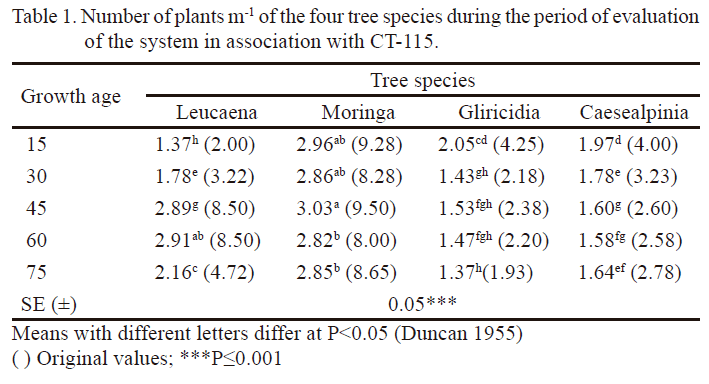
<body><![CDATA[<p align="justify" class="Cuerpodetexto" style="margin-top:12.0pt;text-indent:0cm;"><span style="font-family:'Verdana','sans-serif'; font-size:10.0pt; color:windowtext; ">The emergence of the four tree species  began from the fourth day after sowing, with a predominance of moringa and  caesealpinia.</span></p>     <p align="justify" class="Cuerpodetexto" style="margin-top:12.0pt;text-indent:0cm;"><span style="font-family:'Verdana','sans-serif'; font-size:10.0pt; color:windowtext; "><a href="/img/revistas/cjas/v50n3/t0118316.gif">Table 1</a> indicates  interaction for factors under study (treatments/growth age). At 15 d, moringa  had the highest emergence with 9.28 plant m<sup>-1</sup>, which represented a  population of 58,000 plants ha<sup>-1</sup>. At the end of the research, mean  population of leucaena and moringa was superior to 20,000 plants ha<sup>-1</sup>,  which is a value within the range described by Ibrahim <em>et al.</em> (2007) for  high sowing densities in silvopastoral systems. However, gliricidia and  caesealpinia were not higher than 12,000 and 17,300 plants ha<sup>-1</sup>,  respectively.</span><span style="font-family:'Verdana','sans-serif'; font-size:10.0pt; color:windowtext; "> </span></p>     
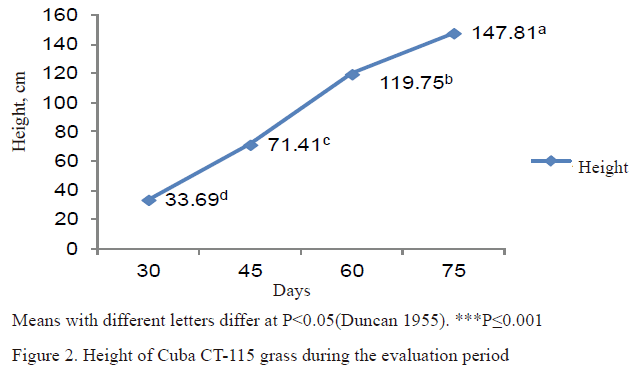
<p align="justify" class="Cuerpodetexto" style="margin-top:12.0pt;text-indent:0cm;"><span style="font-family:'Verdana','sans-serif'; font-size:10.0pt; color:windowtext; ">Attack of insects  and wild animals to leucaena plants appeared at 75 d old, which could be  related to the decrease of the population of this species.</span><span style="font-family:'Verdana','sans-serif'; font-size:10.0pt; color:windowtext; "> </span></p>     <p align="justify" class="Cuerpodetexto" style="margin-top:12.0pt;text-indent:0cm;"><span style="font-family:'Verdana','sans-serif'; font-size:10.0pt; color:windowtext; "><a href="/img/revistas/cjas/v50n3/f0118316.gif">Figure 1</a> represents the interaction  among factors treatment, growth age and height of trees. Moringa reached the  highest height with 104.69 cm at the end of evaluation (75 d). This species had  a growth speed of 1.34 cm per day. In the association with CT-115 (<a href="/img/revistas/cjas/v50n3/f0218316.gif">figure 2</a>),  there were no negative effect on the inter-specific competence. These results  evidence the possibility of establishing moringa at the same time of grasses of  large size like CT-115.</span></p>     
<p align="justify" class="Cuerpodetexto" style="margin-top:12.0pt;text-indent:0cm;"><span style="font-family:'Verdana','sans-serif'; font-size:10.0pt; color:windowtext; ">Leucaena had the lowest height, at 15  d after sowing, with a mean value of 3.71 cm. At 75 d of growth, this species  had a height of 60.25 cm, superior to that reported by Wencomo and Ortiz  (2010), after evaluating 23 accessions of leucaena, but under greenhouse    conditions.</span></p>     <p align="justify" class="Cuerpodetexto" style="margin-top:12.0pt;text-indent:0cm;"><span style="font-family:'Verdana','sans-serif'; font-size:10.0pt; color:windowtext; ">Anguiano <em>et al.</em> (2012)  evaluated the agronomical performance of leucaena in populations of    40,000 plants ha<sup>-1</sup>, under similar soil conditions to this  experiment. At 70 d, leucaena reached 63.89 cm. While plant density grows,  interspecific competence is superior and, therefore, plantlets from the initial  stage of growth reach a higher height.</span></p>     <p align="justify" class="Cuerpodetexto" style="margin-top:12.0pt;text-indent:0cm;"><span style="font-family:'Verdana','sans-serif'; font-size:10.0pt; color:windowtext; ">In gliricidia, height at 75 d was  similar to leucaena. Caesealpinia was not superior to 35 cm high after    75 d of growth. It is important to point out that usable humidity of 6.48 %,  within the sandy loam soil, may have had an unfavorable influence on growth of  these plant  species.</span></p>     <p align="justify" class="Cuerpodetexto" style="margin-top:12.0pt;text-indent:0cm;"><span style="font-family:'Verdana','sans-serif'; font-size:10.0pt; color:windowtext; "><a href="/img/revistas/cjas/v50n3/t0218316.gif">Table 2</a> indicates the interaction for  factors under study in relation to the insertion of the first branch from the  soil. </span></p>     
<p align="justify" class="Cuerpodetexto" style="margin-top:12.0pt;text-indent:0cm;"><span style="font-family:'Verdana','sans-serif'; font-size:10.0pt; color:windowtext; ">Leucaena had the lowest insertion  (1.59 and    4.01 cm) at 15 and 75 d old, respectively. Febles and Ruiz (2008), after  evaluating different origins of leucaena, from CIAT of Colombia, determined  that insertion of the first branch, between 0 and 8 cm, was one of the  characteristics that defined the use of these plant for grazing.</span></p>     <p align="justify" class="Cuerpodetexto" style="margin-top:12.0pt;text-indent:0cm;"><span style="font-family:'Verdana','sans-serif'; font-size:10.0pt; color:windowtext; ">Although the range of insertion of the  first branch, between 0 and 8 cm, according to cited authors, included only the  study of leucaena, it could be used as reference for other species like  moringa. In this case, it was    30.35 cm at 75 d.</span></p>     ]]></body>
<body><![CDATA[<p align="justify" class="Cuerpodetexto" style="margin-top:12.0pt;text-indent:0cm;"><span style="font-family:'Verdana','sans-serif'; font-size:10.0pt; color:windowtext; ">In the international literature, there  are results on the usefulness of moringa for forage production (Ramos <em>et al.</em> 2015), but not for grazing systems. This could be related to the length of  insertion of the first branch from soil surface.</span></p>     <p align="justify" class="Cuerpodetexto" style="margin-top:12.0pt;text-indent:0cm;"><span style="font-family:'Verdana','sans-serif'; font-size:10.0pt; color:windowtext; ">Other of the  considered variables for evaluating tree performance was the number of branches  plant<sup>-1</sup>. <a href="/img/revistas/cjas/v50n3/t0318316.gif">Table 3</a> shows the interaction among studied    factors.</span> </p>     
<p align="justify" class="Cuerpodetexto" style="margin-top:12.0pt;text-indent:0cm;"><span style="font-family:'Verdana','sans-serif'; font-size:10.0pt; color:windowtext; ">In gliricidia, there were 18.40  branches at 75 d of growth. This result was superior to that found by Palma  (1997), who pointed out that, in populations of    40,000 plants ha<sup>-1</sup>, at 150 d of establishment, there were nine  branches. In the meantime, in this study, at only half of the time and similar  population, the amount of branches was duplicated.</span></p>     <p align="justify" class="Cuerpodetexto" style="margin-top:12.0pt;text-indent:0cm;"><span style="font-family:'Verdana','sans-serif'; font-size:10.0pt; color:windowtext; ">Caesealpinia was the species with less  amount of branches plant <sup>-1</sup>, which may be associated to the lowest  height reached in the last sampling (<a href="/img/revistas/cjas/v50n3/f0118316.gif">figure 1</a>).</span></p>     
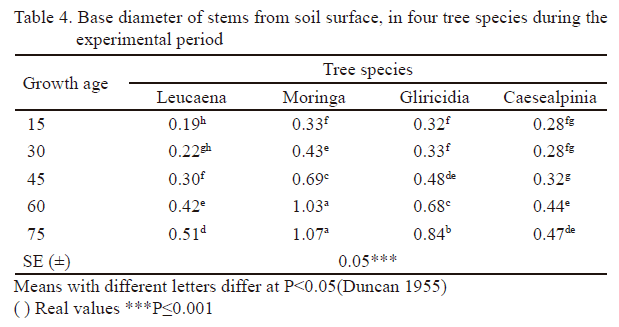
<p align="justify" class="Cuerpodetexto" style="margin-top:12.0pt;text-indent:0cm;"><span style="font-family:'Verdana','sans-serif'; font-size:10.0pt; color:windowtext; ">Analyzing the stem diameter, <a href="/img/revistas/cjas/v50n3/t0418316.gif">table 4</a>  indicates interaction among factors under study. Moringa had the highest basal  diameter, at 60 and 75 d, with 1.07 and 1.03 cm, respectively, differing (P &le;  0.001) from the rest of treatments. In that order, gliricidia followed with  0.84 cm. This value was superior to that reported by Palma (1997), finding a  basal diameter of 0.93 cm in 150 d of the plant.</span></p>     
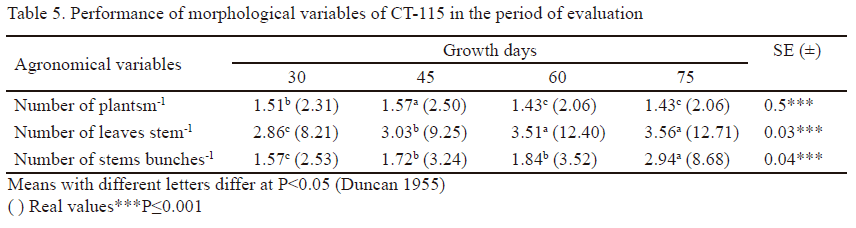
<p align="justify" class="Cuerpodetexto" style="margin-top:12.0pt;text-indent:0cm;"><span style="font-family:'Verdana','sans-serif'; font-size:10.0pt; color:windowtext; ">Regarding the  performance of CT-115, in association with tree species, there were no  differences in any of the variables. This is explained because this grass was  established at the same time and manner in each plot where trees were sown,  without modification of its management during the assay. Differences appeared  during different moment of evaluation of this    grass.</span><span style="font-family:'Verdana','sans-serif'; font-size:10.0pt; color:windowtext; "> </span></p>     <p align="justify" class="Cuerpodetexto" style="margin-top:12.0pt;text-indent:0cm;"><span style="font-family:'Verdana','sans-serif'; font-size:10.0pt; color:windowtext; "><a href="/img/revistas/cjas/v50n3/t0518316.gif">Table 5</a> indicates some morphological  variables and its performance during the experimental period. </span></p>     
<p align="justify" class="Cuerpodetexto" style="margin-top:12.0pt;text-indent:0cm;"><span style="font-family:'Verdana','sans-serif'; font-size:10.0pt; color:windowtext; ">At 15 d of sowing, the sampling was  omitted during the appearance of CT-115 buds. The first sampling was carried  out at 30 d, when the number of plants m<sup>-1</sup> was 2.31. The highest  value was found at 45 d. During the last two samplings, population decreased  regarding previous samplings.&nbsp; Herrera <em>et  al.</em> (2007), indicated values of 2.50 plants m<sup>-1</sup> at 80 d of  sowing CT-115.</span></p>     <p align="justify" class="Cuerpodetexto" style="margin-top:12.0pt;text-indent:0cm;"><span style="font-family:'Verdana','sans-serif'; font-size:10.0pt; color:windowtext; ">Evaluating the number of leaves stem<sup>-1</sup>,  between 60 and 75 d, the highest value was found. The highest amount of stems  bunchs<sup>-1</sup> was confirmed at the end of the experimental period.</span></p>     <p align="justify" class="Cuerpodetexto" style="margin-top:12.0pt;text-indent:0cm;"><span style="font-family:'Verdana','sans-serif'; font-size:10.0pt; color:windowtext; "><a href="/img/revistas/cjas/v50n3/f0218316.gif">Figure 2</a> shows the  performance of height in which this species was developed. At 75 d of growth,  Cuba CT-115 grass reached 147.81 cm. This result is considered as acceptable,  even when the content of organic matter and phosphorous in the soil was low like  the percentage of field capacity and usable humidity. Growth response pattern  was similar to the description of Mart&iacute;nez <em>et al.</em> (2010) in other clones  of <em>P. purpureum</em> at the age of 75 d of growth, although that study was  developed under conditions of soil, climate and productive purposes, different  from this    research.</span><span style="font-family:'Verdana','sans-serif'; font-size:10.0pt; color:windowtext; "> </span></p>     
]]></body>
<body><![CDATA[<p align="justify" class="Cuerpodetexto" style="margin-top:12.0pt;text-indent:0cm;"><span style="font-family:'Verdana','sans-serif'; font-size:10.0pt; color:windowtext; ">It can be concluded that <em>Moringa  oleifera</em> showed the most adequate performance in the simultaneous  association with a grass of large size like CT-115 during the initial stage of  growth. It is suggested the increase of evaluation time of these species. </span></p>     <p align="justify" class="subtitulo" style="margin-top:12.0pt;text-align:justify;"><span style="font-family:'Verdana','sans-serif'; font-size:10.0pt; color:windowtext; ">&nbsp;</span></p>     <p align="justify" class="subtitulo" style="margin-top:12.0pt;text-align:justify;"><span style="font-family:'Verdana','sans-serif'; font-size:13.0pt; color:windowtext; "><b>ACKNOWLEDGEMENTS</b></span></p>     <p align="justify"><span style="line-height:107%; font-family:'Verdana','sans-serif'; font-size:10.0pt; ">Thanks to the Mexican  Secretariat of Foreign Affairs from for granting a postdoctoral scholarship in  order to carry out this Project, which made possible the development of researches.  Thanks also to Dr. Jos&eacute; Manuel Palma and to FRABA 820/20 Project &ndash; University  of Colima</span><span style="font-family:'Verdana','sans-serif'; font-size:10.0pt; color:windowtext; ">.</span></p>     <p align="justify" class="MsoNormal" style="margin-top:12.0pt;text-align:justify;"><span style="line-height:107%; font-family:'Verdana','sans-serif'; font-size:10.0pt; ">&nbsp;</span></p>     <p align="justify" class="subtitulo" style="margin-top:12.0pt;text-align:justify;"><span style="font-family:'Verdana','sans-serif'; font-size:13.0pt; color:windowtext; "><b>REFERENCES</b></span></p>     <p align="justify" class="referencias" style="margin-top:12.0pt;margin-right:0cm;margin-bottom:.0001pt;margin-left:0cm;text-indent:0cm;"><span style="font-family:'Verdana','sans-serif'; font-size:10.0pt; color:windowtext; ">Anguiano, J. M., Aguirre, J. &amp; Palma, J. M. 2012. &ldquo;Establecimiento de <em>Leucaena  leucocephala</em> con alta densidad de siembra bajo cocotero (<em>Cocus nucifera</em>)&rdquo;.  Cuban Journal of Agricultural Science, 46(1): 103&ndash;107, ISSN: 2079-3480.</span></p>     <p align="justify" class="referencias" style="margin-top:12.0pt;margin-right:0cm;margin-bottom:.0001pt;margin-left:0cm;text-indent:0cm;"><span style="font-family:'Verdana','sans-serif'; font-size:10.0pt; color:windowtext; ">Anguiano, J. M., Aguirre, J. &amp; Palma, J. M. 2013. &ldquo;Secuestro de carbono  en la biomasa a&eacute;rea de un sistema agrosilvopastoril de Cocusnucifera, <em>Leucaena  leucocephala</em> Var. Cunningham y <em>Pennisetum purpureum</em> Cuba CT-115&rdquo;.  Avances en Investigaci&oacute;n Agropecuaria, 17(1): 149&ndash;160, ISSN: 0188-7890.</span></p>     <!-- ref --><p align="justify" class="referencias" style="margin-top:12.0pt;margin-right:0cm;margin-bottom:.0001pt;margin-left:0cm;text-indent:0cm;"><span style="font-family:'Verdana','sans-serif'; font-size:10.0pt; color:windowtext; ">Di Rienzo, J. A., Casanoves, F., Balzarini, M. G., Gonz&aacute;lez, L., Tablada,  M. &amp; Robledo, C. W. 2001. InfoStat. version 2001, [Windows], Universidad  Nacional de C&oacute;rdoba, Argentina: Grupo InfoStat, Available:  &lt;<a href="http://www.infostat.com.ar/" target="_blank">http://www.infostat.com.ar/</a>&gt;    .</span></p>     ]]></body>
<body><![CDATA[<p align="justify" class="referencias" style="margin-top:12.0pt;margin-right:0cm;margin-bottom:.0001pt;margin-left:0cm;text-indent:0cm;"><span style="font-family:'Verdana','sans-serif'; font-size:10.0pt; color:windowtext; ">Dias-Filho, M. B. 2007. Degrada&ccedil;&atilde;o de pastagens: processos, causas e  estrat&eacute;gias de recupera&ccedil;&atilde;o. </span><span style="font-family:'Verdana','sans-serif'; font-size:10.0pt; color:windowtext; ">3rd ed., Bel&eacute;m, PA: EmbrapaAmaz&ocirc;nia Oriental, 190 p., ISBN:  85-87690-65-4, OCLC: 708528415, Available:  &lt;<a href="http://www.diasfilho.com.br/Livro/3a.htm" target="_blank">http://www.diasfilho.com.br/Livro/3a.htm</a>&gt;, [Consulted: July 4, 2016].</span></p>     <p align="justify" class="referencias" style="margin-top:12.0pt;margin-right:0cm;margin-bottom:.0001pt;margin-left:0cm;text-indent:0cm;"><span style="font-family:'Verdana','sans-serif'; font-size:10.0pt; color:windowtext; ">Duncan,  D. B. 1955. &ldquo;Multiple Range and Multiple F Tests&rdquo;. </span><span style="font-family:'Verdana','sans-serif'; font-size:10.0pt; color:windowtext; ">Biometrics, 11(1): 1&ndash;42, ISSN: 0006-341X, DOI: 10.2307/3001478.</span></p>     <p align="justify" class="referencias" style="margin-top:12.0pt;margin-right:0cm;margin-bottom:.0001pt;margin-left:0cm;text-indent:0cm;"><span style="font-family:'Verdana','sans-serif'; font-size:10.0pt; color:windowtext; ">Febles, G. &amp; Ruiz, T. E. 2008. &ldquo;Evaluaci&oacute;n de especies arb&oacute;reas para  sistemas silvopastoriles&rdquo;. Avances en Investigaci&oacute;n Agropecuaria, 12(1): 5&ndash;27,  ISSN: 0188-7890.</span></p>     <p align="justify" class="referencias" style="margin-top:12.0pt;margin-right:0cm;margin-bottom:.0001pt;margin-left:0cm;text-indent:0cm;"><span style="font-family:'Verdana','sans-serif'; font-size:10.0pt; color:windowtext; ">Febles, G. &amp; Ruiz, T. E. 2009. </span><span style="font-family:'Verdana','sans-serif'; font-size:10.0pt; color:windowtext; ">&ldquo;The global  climatic change and its impacts in Cuba. Actions for the future&rdquo;. Cuban Journal  of Agricultural Science, 43(4): 327&ndash;334, ISSN: 2079-3480.</span></p>     <!-- ref --><p align="justify" class="referencias" style="margin-top:12.0pt;margin-right:0cm;margin-bottom:.0001pt;margin-left:0cm;text-indent:0cm;"><span style="font-family:'Verdana','sans-serif'; font-size:10.0pt; color:windowtext; ">Garc&iacute;a, R. I. &amp; Linares, L. A. 2012. &Aacute;rboles y arbustos de la Cuenca  del r&iacute;o Tepalcatepec (Michoac&aacute;n y Jalisco M&eacute;xico) para uso urbano. M&eacute;xico:  Instituto Polit&eacute;cnico Nacional-CIIDIR Unidad Michoac&aacute;n, 304 p., ISBN:  978-607-8257-07-2, Available:  &lt;<a href="http://www.libreriacolmich.com/indice/ficha.asp?id=690" target="_blank">http://www.libreriacolmich.com/indice/ficha.asp?id=690</a>&gt;, [Consulted:  July 17, 2016].    </span></p>     <p align="justify" class="referencias" style="margin-top:12.0pt;margin-right:0cm;margin-bottom:.0001pt;margin-left:0cm;text-indent:0cm;"><span style="font-family:'Verdana','sans-serif'; font-size:10.0pt; color:windowtext; ">Herrera,  R. S. 2015. &ldquo;Instituto de Ciencia Animal: fifty years of experience in the  evaluation of grasses with economical importance for animal husbandry&rdquo;. </span><span style="font-family:'Verdana','sans-serif'; font-size:10.0pt; color:windowtext; ">Cuban Journal of Agricultural Science, 49(2): 221&ndash;232, ISSN: 2079-3480.</span></p>     <p align="justify" class="referencias" style="margin-top:12.0pt;margin-right:0cm;margin-bottom:.0001pt;margin-left:0cm;text-indent:0cm;"><span style="font-family:'Verdana','sans-serif'; font-size:10.0pt; color:windowtext; ">Herrera, R. S., Garc&iacute;a, M., Cruz, A. M. &amp; Romero, A. 2007. &ldquo;Efecto de  un estimulante del crecimiento en el establecimiento de <em>Pennisetum purpureum</em> vc. Cuba CT-115&rdquo;. Cuban Journal of Agricultural Science, 41(2): 193&ndash;195, ISSN:  2079-3480.</span></p>     <p align="justify" class="referencias" style="margin-top:12.0pt;margin-right:0cm;margin-bottom:.0001pt;margin-left:0cm;text-indent:0cm;"><span style="font-family:'Verdana','sans-serif'; font-size:10.0pt; color:windowtext; ">Herrera, R. S., Mart&iacute;nez, R. O., Mart&iacute;nez, M., Tuero, R., Cruz, A. M. &amp;  Romero, A. 2014. </span><span style="font-family:'Verdana','sans-serif'; font-size:10.0pt; color:windowtext; ">&ldquo;Cutting frequency on quality indicators of Pennisetum and  Saccharum varieties during the dry period&rdquo;. Cuban Journal of Agricultural  Science, 48(2): 159&ndash;166, ISSN: 2079-3480.</span></p>     <p align="justify" class="referencias" style="margin-top:12.0pt;margin-right:0cm;margin-bottom:.0001pt;margin-left:0cm;text-indent:0cm;"><span style="font-family:'Verdana','sans-serif'; font-size:10.0pt; color:windowtext; ">Hou, C.  H., Liu, N. L. &amp; Hsi, H. C. 2015. &ldquo;Highly porous activated carbons from  resource-recovered <em>Leucaena leucocephala</em> wood as capacitive deionization  electrodes&rdquo;. </span><span style="font-family:'Verdana','sans-serif'; font-size:10.0pt; color:windowtext; ">Chemosphere, 141: 71&ndash;79, ISSN: 0045-6535, DOI:  10.1016/j.chemosphere.2015.06.055.</span></p>     ]]></body>
<body><![CDATA[<p align="justify" class="referencias" style="margin-top:12.0pt;margin-right:0cm;margin-bottom:.0001pt;margin-left:0cm;text-indent:0cm;"><span style="font-family:'Verdana','sans-serif'; font-size:10.0pt; color:windowtext; ">Ibrahim, M., Villanueva, C. &amp; Casasola, F. 2007. &ldquo;Sistemas  silvopastoriles como una herramienta para el mejoramiento de la productividad y  rehabilitaci&oacute;n ecol&oacute;gica de paisajes ganaderos en centro am&eacute;rica&rdquo;. </span><span style="font-family:'Verdana','sans-serif'; font-size:10.0pt; color:windowtext; ">Archivos  Latinoamericanos de Produccion Animal, 15(S1): 74&ndash;88, ISSN: 1022<sup>-1</sup>301.</span></p>     <!-- ref --><p align="justify" class="referencias" style="margin-top:12.0pt;margin-right:0cm;margin-bottom:.0001pt;margin-left:0cm;text-indent:0cm;"><span style="font-family:'Verdana','sans-serif'; font-size:10.0pt; color:windowtext; ">IUSS  Working Group WRB 2014. World Reference Base for soil resources 2014: international  soil classification system for naming soils and creating legends for soil maps.  (ser. World Soil Reports, no. ser. 106), Rome: Food and Agriculture  Organization of the United Nations, 191 p., ISBN: 978-92-5<sup>-1</sup>08370-3.    </span></p>     <p align="justify" class="referencias" style="margin-top:12.0pt;margin-right:0cm;margin-bottom:.0001pt;margin-left:0cm;text-indent:0cm;"><span style="font-family:'Verdana','sans-serif'; font-size:10.0pt; color:windowtext; ">Mart&iacute;nez, R. O., Tuero, R., Torres, V. &amp; Herrera, R. S. 2010. </span><span style="font-family:'Verdana','sans-serif'; font-size:10.0pt; color:windowtext; ">&ldquo;Models  of biomass accumulation and quality in varieties of elephant grass, Cuba  CT-169, OM-22, and king grass during the rainy season in the western part of  Cuba&rdquo;. Cuban Journal of Agricultural Science, 44(2): 185&ndash;188, ISSN: 2079-3480.</span></p>     <p align="justify" class="referencias" style="margin-top:12.0pt;margin-right:0cm;margin-bottom:.0001pt;margin-left:0cm;text-indent:0cm;"><span style="font-family:'Verdana','sans-serif'; font-size:10.0pt; color:windowtext; ">Nouman,  W., Basra, S. M. A., Siddiqui, M. T., Yasmeen, A., Gull, T. &amp; Alcayde, M.  A. C. 2014. &ldquo;Potential of <em>Moringa oleifera</em> L. as livestock fodder crop:  a review&rdquo;. Turkish Journal of Agriculture and Forestry, 38(1): 1&ndash;14, ISSN:  1300-011X.</span></p>     <p align="justify" class="referencias" style="margin-top:12.0pt;margin-right:0cm;margin-bottom:.0001pt;margin-left:0cm;text-indent:0cm;"><span style="font-family:'Verdana','sans-serif'; font-size:10.0pt; color:windowtext; ">Padilla,  C. &amp; Curbelo, F. 2005. </span><span style="font-family:'Verdana','sans-serif'; font-size:10.0pt; color:windowtext; ">&ldquo;Dos m&eacute;todos de plantaci&oacute;n en el  establecimiento de yerba elefante CT-115 (<em>Pennisetum purpureum</em>)&rdquo;. </span><span style="font-family:'Verdana','sans-serif'; font-size:10.0pt; color:windowtext; ">Cuban  Journal of Agricultural Science, 39(2): 219&ndash;222, ISSN: 2079-3480.</span></p>     <p align="justify" class="referencias" style="margin-top:12.0pt;margin-right:0cm;margin-bottom:.0001pt;margin-left:0cm;text-indent:0cm;"><span style="font-family:'Verdana','sans-serif'; font-size:10.0pt; color:windowtext; ">Palma,  G. J. M. 2011. </span><span style="font-family:'Verdana','sans-serif'; font-size:10.0pt; color:windowtext; ">&ldquo;Evaluaci&oacute;n de la leguminosa arb&oacute;rea <em>Gliricidia  sepium</em> (Jack) Kunth ex Walp como estrategia de desarrollo silvopastoril en  el tr&oacute;pico seco de Colima&rdquo;. In: Palma, G. J. M., Nahed, T. J. &amp; Sangin&eacute;s,  G. L. (eds.), Alternativas para una reconversi&oacute;n ganadera sustentable, (ser.  Agroforester&iacute;a pecuaria en M&eacute;xico, no. ser. 1), Colima, M&eacute;xico: Universidad de  Colima, pp. 87&ndash;106, ISBN: 978-607-7797-03-6.</span></p>     <p align="justify" class="referencias" style="margin-top:12.0pt;margin-right:0cm;margin-bottom:.0001pt;margin-left:0cm;text-indent:0cm;"><span style="font-family:'Verdana','sans-serif'; font-size:10.0pt; color:windowtext; ">Palma, J. M. 1997. &ldquo;Establecimiento de <em>Gliricidia sepium</em> en el  tr&oacute;pico seco con alta densidad de siembra&rdquo;. Archivos Latinoamericana de  Producci&oacute;n Animal, 5(sp. 1): 5&ndash;6, ISSN: 1022-1301.</span></p>     <p align="justify" class="referencias" style="margin-top:12.0pt;margin-right:0cm;margin-bottom:.0001pt;margin-left:0cm;text-indent:0cm;"><span style="font-family:'Verdana','sans-serif'; font-size:10.0pt; color:windowtext; ">Ramos, T. O., Castillo, H. J. &amp; Sandoval, G. J. J. 2015. </span><span style="font-family:'Verdana','sans-serif'; font-size:10.0pt; color:windowtext; ">&ldquo;Effect  of cutting intervals and heights in forage productivity of <em>Moringa oleifera</em>&rdquo;. </span><span style="font-family:'Verdana','sans-serif'; font-size:10.0pt; color:windowtext; ">Revista Bio Ciencias, 3(3): 187&ndash;194, ISSN: 2007-3380.</span></p>     <p align="justify" class="referencias" style="margin-top:12.0pt;margin-right:0cm;margin-bottom:.0001pt;margin-left:0cm;text-indent:0cm;"><span style="font-family:'Verdana','sans-serif'; font-size:10.0pt; color:windowtext; ">Toral, O. &amp; Gonz&aacute;lez, Y. 1999. &ldquo;Efecto del agua caliente en la  germinaci&oacute;n de diez especies arb&oacute;reas&rdquo;. Pastos y Forrajes, 22(1): 47&ndash;53, ISSN:  0864-0394, 2078-8452.</span></p>     ]]></body>
<body><![CDATA[<p align="justify" class="referencias" style="margin-top:12.0pt;margin-right:0cm;margin-bottom:.0001pt;margin-left:0cm;text-indent:0cm;"><span style="font-family:'Verdana','sans-serif'; font-size:10.0pt; ">Wencomo, H. B. &amp; Ortiz,  R. 2010. &ldquo;Comportamiento fenol&oacute;gico de 23 accesiones de Leucaenaspp.&rdquo;. Pastos y  Forrajes, 33(4): 1&ndash;1, ISSN: 0864-0394</span><font size="2" face="Verdana, Arial, Helvetica, sans-serif">.</font></p>     <p align="justify">&nbsp;</p>     <p align="justify">&nbsp;</p>     <p align="justify"><font size="2" face="Verdana, Arial, Helvetica, sans-serif">Received: 04/12/2013    <br> Accepted: 23/06/2016</font></p>     <p align="justify">&nbsp;</p>     <p align="justify">&nbsp;</p>     <p align="justify"><font size="2" face="Verdana, Arial, Helvetica, sans-serif"><i>Y. Sardiñas,</i> Departamento de Pastos y Forrajes, Instituto de Ciencia Animal, Apartado Postal 24, San José de las Lajas,  Mayabeque, Cuba.    Email: <a href="mailto:yurangel@ica.co.cu">yurangel@ica.co.cu</a></font></p>      ]]></body><back>
<ref-list>
<ref id="B1">
<nlm-citation citation-type="journal">
<person-group person-group-type="author">
<name>
<surname><![CDATA[Anguiano]]></surname>
<given-names><![CDATA[J. M.]]></given-names>
</name>
<name>
<surname><![CDATA[Aguirre]]></surname>
<given-names><![CDATA[J.]]></given-names>
</name>
<name>
<surname><![CDATA[Palma]]></surname>
<given-names><![CDATA[J. M.]]></given-names>
</name>
</person-group>
<article-title xml:lang="nd"><![CDATA[Establecimiento de Leucaena leucocephala con alta densidad de siembra bajo cocotero (Cocus nucifera)]]></article-title>
<source><![CDATA[Cuban Journal of Agricultural Science]]></source>
<year>2012</year>
<volume>46</volume>
<numero>1</numero>
<issue>1</issue>
<page-range>103–107</page-range></nlm-citation>
</ref>
<ref id="B2">
<nlm-citation citation-type="journal">
<person-group person-group-type="author">
<name>
<surname><![CDATA[Anguiano]]></surname>
<given-names><![CDATA[J. M.]]></given-names>
</name>
<name>
<surname><![CDATA[Aguirre]]></surname>
<given-names><![CDATA[J.]]></given-names>
</name>
<name>
<surname><![CDATA[Palma]]></surname>
<given-names><![CDATA[J. M.]]></given-names>
</name>
</person-group>
<article-title xml:lang="nd"><![CDATA[Secuestro de carbono en la biomasa aérea de un sistema agrosilvopastoril de Cocus nucifera, Leucaena leucocephala Var. Cunningham y Pennisetum purpureum Cuba CT-115]]></article-title>
<source><![CDATA[Avances en Investigación Agropecuaria]]></source>
<year>2013</year>
<volume>17</volume>
<numero>1</numero>
<issue>1</issue>
<page-range>149–160</page-range></nlm-citation>
</ref>
<ref id="B3">
<nlm-citation citation-type="book">
<person-group person-group-type="author">
<name>
<surname><![CDATA[Di Rienzo]]></surname>
<given-names><![CDATA[J. A.]]></given-names>
</name>
<name>
<surname><![CDATA[Casanoves]]></surname>
<given-names><![CDATA[F.]]></given-names>
</name>
<name>
<surname><![CDATA[Balzarini]]></surname>
<given-names><![CDATA[M. G.]]></given-names>
</name>
<name>
<surname><![CDATA[González]]></surname>
<given-names><![CDATA[L.]]></given-names>
</name>
<name>
<surname><![CDATA[Tablada]]></surname>
<given-names><![CDATA[M.]]></given-names>
</name>
<name>
<surname><![CDATA[Robledo]]></surname>
<given-names><![CDATA[C. W.]]></given-names>
</name>
</person-group>
<source><![CDATA[InfoStat]]></source>
<year>2001</year>
<publisher-loc><![CDATA[Universidad Nacional de Córdoba, Argentina ]]></publisher-loc>
<publisher-name><![CDATA[Grupo InfoStat]]></publisher-name>
</nlm-citation>
</ref>
<ref id="B4">
<nlm-citation citation-type="book">
<person-group person-group-type="author">
<name>
<surname><![CDATA[Dias-Filho]]></surname>
<given-names><![CDATA[M. B.]]></given-names>
</name>
</person-group>
<source><![CDATA[Degradação de pastagens: processos, causas e estratégias de recuperação]]></source>
<year>2007</year>
<edition>3rd</edition>
<page-range>190</page-range><publisher-loc><![CDATA[Belém, PA ]]></publisher-loc>
<publisher-name><![CDATA[Embrapa Amazônia Oriental]]></publisher-name>
</nlm-citation>
</ref>
<ref id="B5">
<nlm-citation citation-type="journal">
<person-group person-group-type="author">
<name>
<surname><![CDATA[Duncan]]></surname>
<given-names><![CDATA[D. B.]]></given-names>
</name>
</person-group>
<article-title xml:lang="nd"><![CDATA[Multiple Range and Multiple F Tests]]></article-title>
<source><![CDATA[Biometrics]]></source>
<year>1955</year>
<volume>11</volume>
<numero>1</numero>
<issue>1</issue>
<page-range>1–42</page-range></nlm-citation>
</ref>
<ref id="B6">
<nlm-citation citation-type="journal">
<person-group person-group-type="author">
<name>
<surname><![CDATA[Febles]]></surname>
<given-names><![CDATA[G.]]></given-names>
</name>
<name>
<surname><![CDATA[Ruiz]]></surname>
<given-names><![CDATA[T. E.]]></given-names>
</name>
</person-group>
<article-title xml:lang="nd"><![CDATA[Evaluación de especies arbóreas para sistemas silvopastoriles]]></article-title>
<source><![CDATA[Avances en Investigación Agropecuaria]]></source>
<year>2008</year>
<volume>12</volume>
<numero>1</numero>
<issue>1</issue>
<page-range>5–27</page-range></nlm-citation>
</ref>
<ref id="B7">
<nlm-citation citation-type="journal">
<person-group person-group-type="author">
<name>
<surname><![CDATA[Febles]]></surname>
<given-names><![CDATA[G.]]></given-names>
</name>
<name>
<surname><![CDATA[Ruiz]]></surname>
<given-names><![CDATA[T. E.]]></given-names>
</name>
</person-group>
<article-title xml:lang="nd"><![CDATA[The global climatic change and its impacts in Cuba. Actions for the future]]></article-title>
<source><![CDATA[Cuban Journal of Agricultural Science]]></source>
<year>2009</year>
<volume>43</volume>
<numero>4</numero>
<issue>4</issue>
<page-range>327–334</page-range></nlm-citation>
</ref>
<ref id="B8">
<nlm-citation citation-type="book">
<person-group person-group-type="author">
<name>
<surname><![CDATA[García]]></surname>
<given-names><![CDATA[R. I.]]></given-names>
</name>
<name>
<surname><![CDATA[Linares]]></surname>
<given-names><![CDATA[L. A.]]></given-names>
</name>
</person-group>
<source><![CDATA[Árboles y arbustos de la Cuenca del río Tepalcatepec (Michoacán y Jalisco México) para uso urbano]]></source>
<year>2012</year>
<page-range>304</page-range><publisher-loc><![CDATA[México ]]></publisher-loc>
<publisher-name><![CDATA[Instituto Politécnico Nacional-CIIDIR Unidad Michoacán]]></publisher-name>
</nlm-citation>
</ref>
<ref id="B9">
<nlm-citation citation-type="journal">
<person-group person-group-type="author">
<name>
<surname><![CDATA[Herrera]]></surname>
<given-names><![CDATA[R. S.]]></given-names>
</name>
</person-group>
<article-title xml:lang="nd"><![CDATA[Instituto de Ciencia Animal: fifty years of experience in the evaluation of grasses with economical importance for animal husbandry]]></article-title>
<source><![CDATA[Cuban Journal of Agricultural Science]]></source>
<year>2015</year>
<volume>49</volume>
<numero>2</numero>
<issue>2</issue>
<page-range>221–232</page-range></nlm-citation>
</ref>
<ref id="B10">
<nlm-citation citation-type="journal">
<person-group person-group-type="author">
<name>
<surname><![CDATA[Herrera]]></surname>
<given-names><![CDATA[R. S.]]></given-names>
</name>
<name>
<surname><![CDATA[García]]></surname>
<given-names><![CDATA[M.]]></given-names>
</name>
<name>
<surname><![CDATA[Cruz]]></surname>
<given-names><![CDATA[A. M.]]></given-names>
</name>
<name>
<surname><![CDATA[Romero]]></surname>
<given-names><![CDATA[A.]]></given-names>
</name>
</person-group>
<article-title xml:lang="nd"><![CDATA[Efecto de un estimulante del crecimiento en el establecimiento de Pennisetum purpureum vc. Cuba CT-115]]></article-title>
<source><![CDATA[Cuban Journal of Agricultural Science]]></source>
<year>2007</year>
<volume>41</volume>
<numero>2</numero>
<issue>2</issue>
<page-range>193–195</page-range></nlm-citation>
</ref>
<ref id="B11">
<nlm-citation citation-type="journal">
<person-group person-group-type="author">
<name>
<surname><![CDATA[Herrera]]></surname>
<given-names><![CDATA[R. S.]]></given-names>
</name>
<name>
<surname><![CDATA[Martínez]]></surname>
<given-names><![CDATA[R. O.]]></given-names>
</name>
<name>
<surname><![CDATA[Martínez]]></surname>
<given-names><![CDATA[M.]]></given-names>
</name>
<name>
<surname><![CDATA[Tuero]]></surname>
<given-names><![CDATA[R.]]></given-names>
</name>
<name>
<surname><![CDATA[Cruz]]></surname>
<given-names><![CDATA[A. M.]]></given-names>
</name>
<name>
<surname><![CDATA[Romero]]></surname>
<given-names><![CDATA[A.]]></given-names>
</name>
</person-group>
<article-title xml:lang="nd"><![CDATA[Cutting frequency on quality indicators of Pennisetum and Saccharum varieties during the dry period]]></article-title>
<source><![CDATA[Cuban Journal of Agricultural Science]]></source>
<year>2014</year>
<volume>48</volume>
<numero>2</numero>
<issue>2</issue>
<page-range>159–166</page-range></nlm-citation>
</ref>
<ref id="B12">
<nlm-citation citation-type="journal">
<person-group person-group-type="author">
<name>
<surname><![CDATA[Hou]]></surname>
<given-names><![CDATA[C. H.]]></given-names>
</name>
<name>
<surname><![CDATA[Liu]]></surname>
<given-names><![CDATA[N. L.]]></given-names>
</name>
<name>
<surname><![CDATA[Hsi]]></surname>
<given-names><![CDATA[H. C.]]></given-names>
</name>
</person-group>
<article-title xml:lang="nd"><![CDATA[Highly porous activated carbons from resource-recovered Leucaena leucocephala wood as capacitive deionization electrodes]]></article-title>
<source><![CDATA[Chemosphere]]></source>
<year>2015</year>
<volume>141</volume>
<page-range>71–79</page-range></nlm-citation>
</ref>
<ref id="B13">
<nlm-citation citation-type="journal">
<person-group person-group-type="author">
<name>
<surname><![CDATA[Ibrahim]]></surname>
<given-names><![CDATA[M.]]></given-names>
</name>
<name>
<surname><![CDATA[Villanueva]]></surname>
<given-names><![CDATA[C.]]></given-names>
</name>
<name>
<surname><![CDATA[Casasola]]></surname>
<given-names><![CDATA[F.]]></given-names>
</name>
</person-group>
<article-title xml:lang="nd"><![CDATA[Sistemas silvopastoriles como una herramienta para el mejoramiento de la productividad y rehabilitación ecológica de paisajes ganaderos en centro américa]]></article-title>
<source><![CDATA[Archivos Latinoamericanos de Produccion Animal]]></source>
<year>2007</year>
<volume>15</volume>
<numero>S1</numero>
<issue>S1</issue>
<page-range>74–88</page-range></nlm-citation>
</ref>
<ref id="B14">
<nlm-citation citation-type="journal">
<person-group person-group-type="author">
<name>
<surname><![CDATA[Martínez]]></surname>
<given-names><![CDATA[R. O.]]></given-names>
</name>
<name>
<surname><![CDATA[Tuero]]></surname>
<given-names><![CDATA[R.]]></given-names>
</name>
<name>
<surname><![CDATA[Torres]]></surname>
<given-names><![CDATA[V.]]></given-names>
</name>
<name>
<surname><![CDATA[Herrera]]></surname>
<given-names><![CDATA[R. S.]]></given-names>
</name>
</person-group>
<article-title xml:lang="nd"><![CDATA[Models of biomass accumulation and quality in varieties of elephant grass, Cuba CT-169, OM-22, and king grass during the rainy season in the western part of Cuba]]></article-title>
<source><![CDATA[Cuban Journal of Agricultural Science]]></source>
<year>2010</year>
<volume>44</volume>
<numero>2</numero>
<issue>2</issue>
<page-range>185–188</page-range></nlm-citation>
</ref>
<ref id="B15">
<nlm-citation citation-type="journal">
<person-group person-group-type="author">
<name>
<surname><![CDATA[Nouman]]></surname>
<given-names><![CDATA[W.]]></given-names>
</name>
<name>
<surname><![CDATA[Basra]]></surname>
<given-names><![CDATA[S. M. A.]]></given-names>
</name>
<name>
<surname><![CDATA[Siddiqui]]></surname>
<given-names><![CDATA[M. T.]]></given-names>
</name>
<name>
<surname><![CDATA[Yasmeen]]></surname>
<given-names><![CDATA[A.]]></given-names>
</name>
<name>
<surname><![CDATA[Gull]]></surname>
<given-names><![CDATA[T.]]></given-names>
</name>
<name>
<surname><![CDATA[Alcayde]]></surname>
<given-names><![CDATA[M. A. C.]]></given-names>
</name>
</person-group>
<article-title xml:lang="nd"><![CDATA[Potential of Moringa oleifera L. as livestock fodder crop: a review]]></article-title>
<source><![CDATA[Turkish Journal of Agriculture and Forestry]]></source>
<year>2014</year>
<volume>38</volume>
<numero>1</numero>
<issue>1</issue>
<page-range>1–14</page-range></nlm-citation>
</ref>
<ref id="B16">
<nlm-citation citation-type="journal">
<person-group person-group-type="author">
<name>
<surname><![CDATA[Padilla]]></surname>
<given-names><![CDATA[C.]]></given-names>
</name>
<name>
<surname><![CDATA[Curbelo]]></surname>
<given-names><![CDATA[F.]]></given-names>
</name>
</person-group>
<article-title xml:lang="nd"><![CDATA[Dos métodos de plantación en el establecimiento de yerba elefante CT-115 (Pennisetum purpureum)]]></article-title>
<source><![CDATA[Cuban Journal of Agricultural Science]]></source>
<year>2005</year>
<volume>39</volume>
<numero>2</numero>
<issue>2</issue>
<page-range>219–222</page-range></nlm-citation>
</ref>
<ref id="B17">
<nlm-citation citation-type="book">
<person-group person-group-type="author">
<name>
<surname><![CDATA[Palma]]></surname>
<given-names><![CDATA[G. J. M.]]></given-names>
</name>
</person-group>
<article-title xml:lang="nd"><![CDATA[Evaluación de la leguminosa arbórea Gliricidia sepium (Jack) Kunth ex Walp como estrategia de desarrollo silvopastoril en el trópico seco de Colima]]></article-title>
<person-group person-group-type="editor">
<name>
<surname><![CDATA[Palma]]></surname>
<given-names><![CDATA[G. J. M.]]></given-names>
</name>
<name>
<surname><![CDATA[Nahed]]></surname>
<given-names><![CDATA[T. J.]]></given-names>
</name>
<name>
<surname><![CDATA[Sanginés]]></surname>
<given-names><![CDATA[G. L.]]></given-names>
</name>
</person-group>
<source><![CDATA[Alternativas para una reconversión ganadera sustentable]]></source>
<year>2011</year>
<page-range>87–106</page-range><publisher-loc><![CDATA[Colima, México ]]></publisher-loc>
<publisher-name><![CDATA[Universidad de Colima]]></publisher-name>
</nlm-citation>
</ref>
<ref id="B18">
<nlm-citation citation-type="journal">
<person-group person-group-type="author">
<name>
<surname><![CDATA[Palma]]></surname>
<given-names><![CDATA[J. M.]]></given-names>
</name>
</person-group>
<article-title xml:lang="nd"><![CDATA[Establecimiento de Gliricidia sepium en el trópico seco con alta densidad de siembra]]></article-title>
<source><![CDATA[Archivos Latinoamericana de Producción Animal]]></source>
<year>1997</year>
<volume>5</volume>
<numero>sp. 1</numero>
<issue>sp. 1</issue>
<page-range>5–6</page-range></nlm-citation>
</ref>
<ref id="B19">
<nlm-citation citation-type="journal">
<person-group person-group-type="author">
<name>
<surname><![CDATA[Ramos]]></surname>
<given-names><![CDATA[T. O.]]></given-names>
</name>
<name>
<surname><![CDATA[Castillo]]></surname>
<given-names><![CDATA[H. J.]]></given-names>
</name>
<name>
<surname><![CDATA[Sandoval]]></surname>
<given-names><![CDATA[G. J. J.]]></given-names>
</name>
</person-group>
<article-title xml:lang="nd"><![CDATA[Effect of cutting intervals and heights in forage productivity of Moringa oleifera]]></article-title>
<source><![CDATA[Revista Bio Ciencias]]></source>
<year>2015</year>
<volume>3</volume>
<numero>3</numero>
<issue>3</issue>
<page-range>187–194</page-range></nlm-citation>
</ref>
<ref id="B20">
<nlm-citation citation-type="journal">
<person-group person-group-type="author">
<name>
<surname><![CDATA[Toral]]></surname>
<given-names><![CDATA[O.]]></given-names>
</name>
<name>
<surname><![CDATA[González]]></surname>
<given-names><![CDATA[Y.]]></given-names>
</name>
</person-group>
<article-title xml:lang="nd"><![CDATA[Efecto del agua caliente en la germinación de diez especies arbóreas]]></article-title>
<source><![CDATA[Pastos y Forrajes]]></source>
<year>1999</year>
<volume>22</volume>
<numero>1</numero>
<issue>1</issue>
<page-range>47–53</page-range></nlm-citation>
</ref>
<ref id="B21">
<nlm-citation citation-type="journal">
<person-group person-group-type="author">
<name>
<surname><![CDATA[Wencomo]]></surname>
<given-names><![CDATA[H. B.]]></given-names>
</name>
<name>
<surname><![CDATA[Ortiz]]></surname>
<given-names><![CDATA[R.]]></given-names>
</name>
</person-group>
<article-title xml:lang="nd"><![CDATA[Comportamiento fenológico de 23 accesiones de Leucaena spp.]]></article-title>
<source><![CDATA[Pastos y Forrajes]]></source>
<year>2010</year>
<volume>33</volume>
<numero>4</numero>
<issue>4</issue>
<page-range>1–1</page-range></nlm-citation>
</ref>
<ref id="B22">
<nlm-citation citation-type="book">
<source><![CDATA[World Reference Base for soil resources 2014: international soil classification system for naming soils and creating legends for soil maps]]></source>
<year>2014</year>
<page-range>191</page-range><publisher-loc><![CDATA[Rome ]]></publisher-loc>
<publisher-name><![CDATA[Food and Agriculture Organization of the United Nations]]></publisher-name>
</nlm-citation>
</ref>
</ref-list>
</back>
</article>