<?xml version="1.0" encoding="ISO-8859-1"?><article xmlns:mml="http://www.w3.org/1998/Math/MathML" xmlns:xlink="http://www.w3.org/1999/xlink" xmlns:xsi="http://www.w3.org/2001/XMLSchema-instance">
<front>
<journal-meta>
<journal-id>2224-5421</journal-id>
<journal-title><![CDATA[Revista Cubana de Química]]></journal-title>
<abbrev-journal-title><![CDATA[Rev Cub Quim]]></abbrev-journal-title>
<issn>2224-5421</issn>
<publisher>
<publisher-name><![CDATA[Ediciones UO, Universidad de Oriente]]></publisher-name>
</publisher>
</journal-meta>
<article-meta>
<article-id>S2224-54212015000200002</article-id>
<title-group>
<article-title xml:lang="es"><![CDATA[Construcción y evaluación de electrodos selectivos de iones cloruro]]></article-title>
<article-title xml:lang="en"><![CDATA[Construction and evaluation of chloride ion-selective electrodes]]></article-title>
</title-group>
<contrib-group>
<contrib contrib-type="author">
<name>
<surname><![CDATA[Arada]]></surname>
<given-names><![CDATA[María de los Ángeles]]></given-names>
</name>
<xref ref-type="aff" rid="A01"/>
</contrib>
<contrib contrib-type="author">
<name>
<surname><![CDATA[Vicente Luis]]></surname>
<given-names><![CDATA[Santiago]]></given-names>
</name>
<xref ref-type="aff" rid="A02"/>
</contrib>
<contrib contrib-type="author">
<name>
<surname><![CDATA[Altava]]></surname>
<given-names><![CDATA[Belén]]></given-names>
</name>
<xref ref-type="aff" rid="A02"/>
</contrib>
<contrib contrib-type="author">
<name>
<surname><![CDATA[Galindo]]></surname>
<given-names><![CDATA[Francisco]]></given-names>
</name>
<xref ref-type="aff" rid="A02"/>
</contrib>
</contrib-group>
<aff id="A01">
<institution><![CDATA[,Universidad de Oriente Department of Analytical Chemistry ]]></institution>
<addr-line><![CDATA[Santiago de Cuba ]]></addr-line>
<country>Cuba</country>
</aff>
<aff id="A02">
<institution><![CDATA[,Jaume I University Department of Inorganic and Organic Chemistry ]]></institution>
<addr-line><![CDATA[Castellón ]]></addr-line>
<country>Spain</country>
</aff>
<pub-date pub-type="pub">
<day>00</day>
<month>08</month>
<year>2015</year>
</pub-date>
<pub-date pub-type="epub">
<day>00</day>
<month>08</month>
<year>2015</year>
</pub-date>
<volume>27</volume>
<numero>2</numero>
<fpage>119</fpage>
<lpage>130</lpage>
<copyright-statement/>
<copyright-year/>
<self-uri xlink:href="http://scielo.sld.cu/scielo.php?script=sci_arttext&amp;pid=S2224-54212015000200002&amp;lng=en&amp;nrm=iso"></self-uri><self-uri xlink:href="http://scielo.sld.cu/scielo.php?script=sci_abstract&amp;pid=S2224-54212015000200002&amp;lng=en&amp;nrm=iso"></self-uri><self-uri xlink:href="http://scielo.sld.cu/scielo.php?script=sci_pdf&amp;pid=S2224-54212015000200002&amp;lng=en&amp;nrm=iso"></self-uri><abstract abstract-type="short" xml:lang="es"><p><![CDATA[En este artículo se presenta una membrana de PVC selectiva de iones cloruro, utilizando bis (2-etilhexilo) (DOS) como plastificante y 2-(5-(4-nitrofenil)furil)-4,5-difenil imidazol como ionóforo. Los electrodos construidos mostraron una rápida respuesta potenciométrica al ion cloruro en el rango de concentración de 10-6 a 10-2 mol . dm³ con pendiente nernstiana. En el caso de los electrodos preparados, que contienen el 1 % y el 3 % del peso del ionóforo, el tiempo de vida del sensor fue estimado de 6 a 7 días. El tiempo de vida del sensor que contiene el 7 % del peso del ionóforo fue de 15 a 18 días. El electrodo que contiene el 7 % del peso del ionóforo fue aplicado como electrodo indicador en la valoración potenciométrica de iones de plata con NaCl.]]></p></abstract>
<abstract abstract-type="short" xml:lang="en"><p><![CDATA[In this paper we report a chloride ion-selective PVC membrane, using bis (2-ethylhexyl) sebacate (DOS) as plasticizer and 2-(5-(4-nitrophenyl)furyl)-4,5-diphenyl imidazole (FFDFIN) as ionosphere. The constructed electrodes showed a fast potentiometric response to chloride in the concentration range from 0-6 to 10-2 mol . dm³ with Nernstian slopes. In the case of electrodes prepared containing 1 and 3 wt % of the ionosphere, the lifetime of the sensor was estimated to be about 6-7 days. The lifetime of the sensor containing 7 w t % of ionosphere was about 15-18 days. The electrode containing 7 w t % of ionosphere was applied as an indicator electrode in the potentiometric titration of silver ions with NaCl.]]></p></abstract>
<kwd-group>
<kwd lng="es"><![CDATA[membrana de PVC selectiva de iones cloruro]]></kwd>
<kwd lng="es"><![CDATA[electrodo selectivo de iones (ESI)]]></kwd>
<kwd lng="es"><![CDATA[2-(5-(4-nitrofenil)furil)-4,5-difenil imidazol]]></kwd>
<kwd lng="es"><![CDATA[sensor químico]]></kwd>
<kwd lng="en"><![CDATA[chloride ion-selective PVC membrane]]></kwd>
<kwd lng="en"><![CDATA[ion-selective electrode (ISE)]]></kwd>
<kwd lng="en"><![CDATA[2-(5-(4-nitrofenyl) furyl)-4,5-difenyl imidazole]]></kwd>
<kwd lng="en"><![CDATA[chemical sensor]]></kwd>
</kwd-group>
</article-meta>
</front><body><![CDATA[ <p align="right"><font face="Verdana" size="2"><b>ARTICULOS</b></font></p>     <p align="justify">&nbsp;</p>     <p align="left"><font size="2" face="Verdana"><b><font size="4"><strong> Construcci&oacute;n y evaluaci&oacute;n de electrodos selectivos de iones cloruro</strong></font></b></font></p>     <p>&nbsp;</p>     <p align="left"><font size="2" face="Verdana"><b><font size="3"> Construction and evaluation of chloride ion-selective electrodes</font></b></font></p>     <p align="justify">&nbsp;</p>     <p align="justify">&nbsp;</p>     <p align="justify"><font size="2" face="Verdana"><b> Dra. C. Mar&iacute;a de los &Aacute;ngeles Arada<sup>I</sup>,    Dr. C. Santiago Vicente Luis<sup>II</sup>,    Dra. C. Bel&eacute;n Altava<sup>II</sup><strong>,     Dr. C. Francisco Galindo</strong><sup>II</sup></b></font></p>     <p align="justify"><font size="2" face="Verdana"> <sup>I</sup></font><font size="2"><font face="Verdana">Department of Analytical Chemistry, Universidad de Oriente, Santiago de Cuba, Cuba, </font></font><font size="2" face="Verdana"><a href="mailto:may@cnt.uo.edu.cu">may@cnt.uo.edu.cu</a>    <br>   <sup>I</sup><sup>I</sup>Department of Inorganic and Organic Chemistry, Jaume I University, Castell&oacute;n, Spain, <a href="mailto:luiss@uji.es">luiss@uji.es</a></font></p>     ]]></body>
<body><![CDATA[<p align="justify">&nbsp;</p>     <p align="justify">&nbsp;</p> <hr>     <p align="justify"><font size="2" face="Verdana"><b>RESUMEN</b></font></p>     <p align="justify"><font size="2" face="Verdana"> </font><font size="2" face="Verdana"> En este art&iacute;culo se presenta una membrana de PVC selectiva de iones cloruro, utilizando bis (2-etilhexilo) (DOS) como plastificante y 2-(5-(4-nitrofenil)furil)-4,5-difenil imidazol como ion&oacute;foro. Los electrodos construidos mostraron una r&aacute;pida respuesta potenciom&eacute;trica al ion cloruro en el rango de concentraci&oacute;n de 10<sup>-6</sup> a 10<sup>-2</sup> mol . dm<sup>3</sup> con pendiente nernstiana. En el caso de los electrodos preparados, que contienen el 1 % y el 3 % del peso del ion&oacute;foro, el tiempo de vida del sensor fue estimado de 6 a 7 d&iacute;as. El tiempo de vida del sensor que contiene el 7 % del peso del ion&oacute;foro fue de 15 a 18 d&iacute;as. El electrodo que contiene el 7 % del peso del ion&oacute;foro fue aplicado como electrodo indicador en la valoraci&oacute;n potenciom&eacute;trica de iones de plata con NaCl. </font></p>     <p align="justify"><font size="2" face="Verdana"><b>Palabras clave:</b> membrana de PVC selectiva de iones cloruro, electrodo selectivo de iones (ESI), 2-(5-(4-nitrofenil)furil)-4,5-difenil imidazol, sensor qu&iacute;mico.</font></p> <hr>     <p align="justify"><font size="2" face="Verdana"> <b>ABSTRACT</b></font></p>     <p align="justify"><font size="2" face="Verdana"> In this paper we report a chloride ion-selective PVC membrane, using bis (2-ethylhexyl) sebacate (DOS) as plasticizer and 2-(5-(4-nitrophenyl)furyl)-4,5-diphenyl imidazole (FFDFIN) as ionosphere. The constructed electrodes showed a fast potentiometric response to chloride in the concentration range from 0<sup>-6</sup> to 10<sup>-2</sup> mol . dm<sup>3</sup> with Nernstian slopes. In the case of electrodes prepared containing 1 and 3 wt % of the ionosphere, the lifetime of the sensor was estimated to be about 6-7 days. The lifetime of the sensor containing 7 w t % of ionosphere was about 15-18 days. The electrode containing 7 w t % of ionosphere was applied as an indicator electrode in the potentiometric titration of silver ions with NaCl.</font></p>     <p align="justify"><font size="2" face="Verdana"> <b>Keywords:</b> chloride ion-selective PVC membrane, ion-selective electrode (ISE), 2-(5-(4-nitrofenyl) furyl)-4,5-difenyl imidazole, chemical sensor.</font></p> <hr>     <p>&nbsp;</p>     <p>&nbsp;</p>     ]]></body>
<body><![CDATA[<p align="justify"><b><font size="3" face="Verdana">INTRODUCTION</font></b></p>     <p align="justify"><font size="2" face="Verdana">The accurate determination of low levels of the chloride ion is essential, according to its important biological relevance [1]. As an example, chloride is an essential component of the human diet, being the minimal request for adults of 750 mg day. Besides, this ion plays an important role in the regulation of extra-cellular fluids and variations in its concentration in biological fluids are often associated to different abnormal metabolic processes and diseases [1].</font></p>     <p align="justify"><font size="2" face="Verdana">Different methodologies have been reported for the determination of the chloride ion. These include chromatographic, spectrophotometric, voltmetric, turbid metric and volumetric methods such as the classical Volhard titration [2-5]. Although several methodologies have become standard in the field for chloride determination, many of them suffer from important disadvantages, in particular due to the need of large analysis times and tedious sample pre-treatments.</font></p>     <p align="justify"><font size="2" face="Verdana">The use of selective electrodes represents an alternative method for the potentiometric determination of different species; allows reducing some of the drawbacks associated with the chloride ion analysis by other methodologies [6-17]. In the last few years , the construction of robust electrochemical sensors, sensitive and precise, capable of detecting and quantifying the concentration of different substances in a variety of solutions including biological fluids and direct samples from ecosystems has been a subject of much interest. Ion-selective electrodes (ISE) are very appropriate for this purpose because they are easy to build, the results are obtained quickly, they show good selectivity for inorganic ions, they are of relatively low cost and they are portable and easily handled so they can be used in the places of interest.</font></p>     <div align="justify"><font size="2" face="Verdana">Here we report the use of 2-(5-(4-nitrophenyl)furyl)-4, 5-diphenyl imidazole, a highly selective carrier for the building of ISE devices for the detection of the chloride ion using a PVC membrane with bis(2-ethylhexyl) sebacate (DOS) as the plasticizer.</font></div>     <p align="justify">&nbsp;</p>     <p align="justify"><font size="2" face="Verdana"><strong><b><font size="3" face="Verdana">EXPERIMENTAL</font></b></strong></font></p>     <p align="justify"><font size="2" face="Verdana">A pH/mV meter Crison digital pH meter with a precision of &plusmn; 0,1 mV was used for measuring the potential difference between reference and indicator electrodes. A microprocessor-based Hanna pH meter model 213 was used for all pH measurements using an Oaklon model WD–35881–00 combined electrode with epoxy body and an IKA hot plate-magnetic stirrer.</font></p>     <p align="justify"><font size="2" face="Verdana">All the reagents used in this study were of analytical grade. Polyvinylchloride (PVC) from Aldrich was directly used as received as the polymeric matrix, employing Araldite Ceys (mixing of A and B components) for the grafting. The plasticizer bis (2-ethylhexyl) sebacate (DOS) from Sigma-Aldrich was employed as supplied as the solvent mediator of the PVC liquid membrane. Tetrahydrofurane (THF) and NaCl were of analytical grade and obtained from Scharlau. Bidistilled water with conductivity less than 2 &micro;S/cm<sup>-1</sup> was used for all experiments. All reagents were weighed by using an analytical balance with a precision of &plusmn; 0,1 mg.</font></p>     <p align="justify"><font size="2" face="Verdana">The pH adjustments were made with dilute H<sub>2</sub>SO<sub>4</sub> or NaOH solutions as required. The ionophore was synthesized in the Polymer Laboratory of the Faculty of Chemical and Pharmaceutical Sciences, University of Chile, Santiago, Chile. Its characterization was carried out in the same department and in the Department of Inorganic and Organic Chemistry of the Jaume I University, Castell&oacute;n, Spain.</font></p>     ]]></body>
<body><![CDATA[<p align="justify"><font size="2" face="Verdana">The elemental analyses were carried out using a Carlo-Erba Ea 1110 Elemental Analyzer and melting points were determined with a Buchi melting point apparatus. FT-IR spectra were obtained on Bruker IFS28.</font></p>     <p align="justify"><font size="2" face="Verdana">The composition of the prepared membranes was as follows: 1, 3 or 7 w t % of the ionophore, 33 w t % of PVC and 66, 64 or 60 w t % of the plasticizer. The mixture was dissolved in 3 mL of dry THF. The resulting membrane cocktail was then deposited on a previously formed 1:1 epoxy-graphite composite solid contact and the solvent was evaporated to obtain the final membrane.</font></p>     <div align="justify"><font size="2" face="Verdana">The electrodes were conditioned in 1 . 10<sup>-2</sup> mol . dm<sup>-3</sup> solution containing their primary ions for 24 h before use. The reference electrode was a double-junction Ag-AgCl containing 0, 1 mol &middot; dm<sup>-3</sup> K<sub>2</sub>SO<sub>4</sub> solutions in the outer compartment. The electrochemical cell used was: Ag/AgCl| 0,1 mol&middot;dm<sup>-3</sup> KCl |0,1 mol&middot;dm<sup>-3</sup> K<sub>2</sub>SO<sub>4</sub> ||test solution||PVC memb.|cond.supp. |Cu<sub>(s)</sub>.</font></div>     <p align="justify"><font size="2" face="Verdana"><strong><em>Determination of the electromotive force (EMF)</em></strong></font></p>     <p align="justify"> <font size="2" face="Verdana"> The electromotive force (EMF) determinations were carried out by using an open cell to ambient temperature. Calibration curves were used to calculate such parameters as slope (S), practical detection limit (PDL) and lower limit of linear response (LLLR). This was done following the Nernst law through data adjustment by a linear regression method. The calibration parameters were obtained by applying the method of additions [18] , determining the activity of the principal ion by using the Debye-H&uuml;ckel equation (<a href="#e1">1</a>).</font></p>     <p align="center"><font size="2" face="Verdana"><a name="e1" id="e1"></a><img src="/img/revistas/ind/v27n2/e0102215.gif"></font></p>     
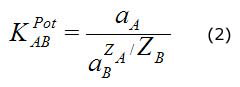
<p align="justify"><font size="2" face="Verdana">The selectivity coefficients (K<sub>AB</sub><sup>Pot</sup>) were determined in the presence of various foreign ions by using the method of mixed solutions [18] (<a href="#e2">2</a>). </font></p>     <p align="center"><font size="2" face="Verdana"><a name="e2" id="e2"></a><img src="/img/revistas/ind/v27n2/e0202215.gif"></font></p>     
<p><em><strong><font size="2" face="Verdana">Synthesis of 2-(5-(4-nitrophenyl) furyl)-4, 5-diphenyl imidazole </font></strong></em></p>     <p align="justify"><font size="2" face="Verdana">The synthesis of 2-(5-(4-nitrophenyl) furyl)-4, 5-diphenyl imidazole (FFDFIN) was carried out from 5-(4-nitrophenyl) furfural and benzyl in the presence of ammonium acetate and glacial acetic acid. The reaction between benzyl (I) and 5-(4-nitrophenyl)furfural (II) was carried out by adding 1,94 g (0,009 2 mol) of (I) to 2 g (0,009 2 mol) of (II) and in the presence of 14 g (0,2 mol) of ammonium acetate. Glacial acetic acid (40 mL) was used as solvent. The reaction mixture was heated for 5 h at reflux temperature and then 25 mL of distilled water was added. The crude product was then filtered and washed with water followed by dissolution in 250 mL of water. After cooling, the precipitate was filtered and the product was recrystallized from butyl acetate to yield the pure product in 64, 2 %.</font></p>     ]]></body>
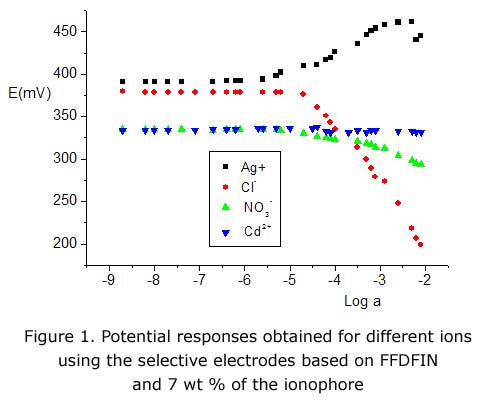
<body><![CDATA[<p align="justify"><font size="2" face="Verdana">The different analyses carried out on this compound were in good agreement with the formation of the expected structure. Thus, the FT-IR spectrum showed the presence of the N-H absorption bands at 3 500 cm<sup>-1</sup> along with absorption bands at 1 500-1 600 cm<sup>-1</sup> region corresponding to the aromatic fragments. The presence of the nitro group was confirmed by existing of the absorption bands at 1 370 and 1 517 cm<sup>-1</sup>. The spectrum also showed the complete absence of absorption bands in the C=O stretching region. The <sup>1</sup>H NMR of FFDFIN showed the presence of the expected signals at 7,1-7,6 ppm for the phenyl groups at C4 and C5 of the imidazole group, at 8,0-8,4 ppm for the 4-nitrophenyl group located at C2 of the imidazole and at 6,0-6,5 ppm for the imidazole N-H and for the hydrogen atoms at the furan ring. The elemental analysis of the salt gave: C 72,77 %, H 8,74 % and N 10,17 %.</font></p>     <p align="justify">&nbsp;</p>     <p align="justify"><font size="3" face="Verdana"><strong>RESULTS AND DISCUSSION</strong></font></p>     <p align="justify"><font size="2" face="Verdana"><em><strong>Electrode preparation and characterization</strong></em></font></p>     <p align="justify"> <font size="2" face="Verdana"> Different membranes were prepared through the combination of FFDFIN and PVC in different ratios. After optimization of the conditions of use, experimental data revealed that this kind of electrodes were highly selective to the chloride ion relative to several other ions (<a href="#f1">figure 1</a>).</font></p>     <p align="center"><font size="2" face="Verdana"></font><font size="2" face="Verdana"><a name="f1" id="f1"></a><img src="/img/revistas/ind/v27n2/f0102215.jpg"></font></p>     
<p align="justify"> <font size="2" face="Verdana"> In general, the characteristics and properties of an ion-selective electrode, i.e., sensitivity, lifetime, selectivity and other properties are dependent on the amount and type of plasticizer, polymer matrix and the nature of the carrier employed [19]. In this regard, we studied the influence of the different compositions assayed for the membranes on their properties. The characteristic parameters of the optimized membranes are summarized in <a href="#t1">table 1</a>.</font></p>     <p align="center"><font size="2" face="Verdana"><a name="t1" id="t1"></a><strong>TABLE 1. OPTIMIZATION OF THE SELECTIVE MEMBRANES</strong></font></p>     <div align="center">   <table border="1" cellpadding="0" cellspacing="0" bordercolor="#000000">     <tr>       <td width="99" valign="top">    <p align="center"><font size="2" face="Verdana">Membrane     ]]></body>
<body><![CDATA[<br>         No </font></p>       </td>       <td width="94" valign="top">    <p align="center"><font size="2" face="Verdana">Plasticizer    <br>       (%) </font></p>       </td>       <td width="56" valign="top">    <p align="center"><font size="2" face="Verdana">PVC    <br>       (%) </font></p>       </td>       <td width="94" valign="top">    <p align="center"><font size="2" face="Verdana">Ionophore (%) </font></p>       </td>       <td width="110" valign="top">    <p align="center"><font size="2" face="Verdana">Slope    <br>       (mV/decade) </font></p>       </td>     </tr>     <tr>       <td width="99" valign="top">    <p align="center"><font size="2" face="Verdana">1 </font></p></td>       <td width="94" valign="top">    <p align="center"><font size="2" face="Verdana">66 </font></p></td>       <td width="56" valign="top">    ]]></body>
<body><![CDATA[<p align="center"><font size="2" face="Verdana">33 </font></p></td>       <td width="94" valign="top">    <p align="center"><font size="2" face="Verdana">1 </font></p></td>       <td width="110" valign="top">    <p align="center"><font size="2" face="Verdana">-65,52 </font></p></td>     </tr>     <tr>       <td width="99" valign="top">    <p align="center"><font size="2" face="Verdana">2 </font></p></td>       <td width="94" valign="top">    <p align="center"><font size="2" face="Verdana">66 </font></p></td>       <td width="56" valign="top">    <p align="center"><font size="2" face="Verdana">33 </font></p></td>       <td width="94" valign="top">    <p align="center"><font size="2" face="Verdana">1 </font></p></td>       <td width="110" valign="top">    <p align="center"><font size="2" face="Verdana">-65,52 </font></p></td>     </tr>     <tr>       <td width="99" valign="top">    <p align="center"><font size="2" face="Verdana">3 </font></p></td>       <td width="94" valign="top">    <p align="center"><font size="2" face="Verdana">66 </font></p></td>       <td width="56" valign="top">    ]]></body>
<body><![CDATA[<p align="center"><font size="2" face="Verdana">33 </font></p></td>       <td width="94" valign="top">    <p align="center"><font size="2" face="Verdana">1 </font></p></td>       <td width="110" valign="top">    <p align="center"><font size="2" face="Verdana">-66,03 </font></p></td>     </tr>     <tr>       <td width="99" valign="top">    <p align="center"><font size="2" face="Verdana">4 </font></p></td>       <td width="94" valign="top">    <p align="center"><font size="2" face="Verdana">64 </font></p></td>       <td width="56" valign="top">    <p align="center"><font size="2" face="Verdana">33 </font></p></td>       <td width="94" valign="top">    <p align="center"><font size="2" face="Verdana">3 </font></p></td>       <td width="110" valign="top">    <p align="center"><font size="2" face="Verdana">-66,13 </font></p></td>     </tr>     <tr>       <td width="99" valign="top">    <p align="center"><font size="2" face="Verdana">5 </font></p></td>       <td width="94" valign="top">    <p align="center"><font size="2" face="Verdana">64 </font></p></td>       <td width="56" valign="top">    ]]></body>
<body><![CDATA[<p align="center"><font size="2" face="Verdana">33 </font></p></td>       <td width="94" valign="top">    <p align="center"><font size="2" face="Verdana">3 </font></p></td>       <td width="110" valign="top">    <p align="center"><font size="2" face="Verdana">-65,68 </font></p></td>     </tr>     <tr>       <td width="99" valign="top">    <p align="center"><font size="2" face="Verdana">6 </font></p></td>       <td width="94" valign="top">    <p align="center"><font size="2" face="Verdana">64 </font></p></td>       <td width="56" valign="top">    <p align="center"><font size="2" face="Verdana">33 </font></p></td>       <td width="94" valign="top">    <p align="center"><font size="2" face="Verdana">3 </font></p></td>       <td width="110" valign="top">    <p align="center"><font size="2" face="Verdana">-65,29 </font></p></td>     </tr>     <tr>       <td width="99" valign="top">    <p align="center"><font size="2" face="Verdana">7 </font></p></td>       <td width="94" valign="top">    <p align="center"><font size="2" face="Verdana">60 </font></p></td>       <td width="56" valign="top">    ]]></body>
<body><![CDATA[<p align="center"><font size="2" face="Verdana">33 </font></p></td>       <td width="94" valign="top">    <p align="center"><font size="2" face="Verdana">7 </font></p></td>       <td width="110" valign="top">    <p align="center"><font size="2" face="Verdana">-62,75 </font></p></td>     </tr>     <tr>       <td width="99" valign="top">    <p align="center"><font size="2" face="Verdana">8 </font></p></td>       <td width="94" valign="top">    <p align="center"><font size="2" face="Verdana">60 </font></p></td>       <td width="56" valign="top">    <p align="center"><font size="2" face="Verdana">33 </font></p></td>       <td width="94" valign="top">    <p align="center"><font size="2" face="Verdana">7 </font></p></td>       <td width="110" valign="top">    <p align="center"><font size="2" face="Verdana">-62,58 </font></p></td>     </tr>     <tr>       <td width="99" valign="top">    <p align="center"><font size="2" face="Verdana">9 </font></p></td>       <td width="94" valign="top">    <p align="center"><font size="2" face="Verdana">60 </font></p></td>       <td width="56" valign="top">    ]]></body>
<body><![CDATA[<p align="center"><font size="2" face="Verdana">33 </font></p></td>       <td width="94" valign="top">    <p align="center"><font size="2" face="Verdana">7 </font></p></td>       <td width="110" valign="top">    <p align="center"><font size="2" face="Verdana">-64,17 </font></p></td>     </tr>   </table> </div>     <p align="justify"><font size="2" face="Verdana">The response of the electrodes prepared with different amounts of plasticizers and ionophores was studied providing some clear trends. In all cases studied, the electrodes showed Nernstian slope per decade for chloride activity in wide range of the activity studied, showing detection limits in the order of 10<sup>-6</sup>-10<sup>-2</sup> mol . dm<sup>-3</sup>. The detection limit decreases considerably with the lifetime. The electrodes with 1 % of the ionophore shows short lifetime.</font></p>     <p align="justify"><font size="2" face="Verdana">Results obtained by 1, 3 or 7 w t % of the ionophore are statistically compared demonstrating that there are no significant differences between slope (mV/dec) results obtained with the ISEs.</font></p>     <p align="justify"><font size="2" face="Verdana">The statistical comparison of the slope measurements for the different membranes provided a level of significance of a = 0,05, which is an acceptable value and confirms the lack of significant differences in this regard.</font></p>     <div align="justify"><font size="2" face="Verdana">In order to achieve a detailed study of the response of the electrodes to the chloride anion, the corresponding calibration curves were obtained (<a href="#f2">figure 2</a>). These calibration curves were used to calculate the essential parameters such as slope (S), practical detection limit (PDL) and lower limit of linear response (LLLR). This was done through data fitting using a linear regression method following the Nernst law.</font></div>     <p align="center"><font size="2" face="Verdana"><a name="f2" id="f2"></a><img src="/img/revistas/ind/v27n2/f0202215.gif"></font></p>     
<p align="justify"> <font size="2" face="Verdana">The results obtained for the ISEs containing 1, 3 or 7 wt % of ionophore have been gathered in <a href="#t2">table 2</a>.</font></p>     <p align="center"><font size="2" face="Verdana"><a name="t2" id="t2"></a><strong>TABLE 2. CHARACTERISTIC CALIBRATION PARAMETERS     ]]></body>
<body><![CDATA[<br> FOR THE SENSORS CONTAINING 1, 3 OR 7 wt % OF THE IONOPHORE</strong> </font></p>     <div align="center">   <table border="1" cellpadding="0" cellspacing="0" bordercolor="#000000">     <tr>        <td width="272" valign="top">    <p align="center"><font size="2" face="Verdana">Ionophore            </font></p></td>       <td width="66" valign="top">    <p align="center"><font size="2" face="Verdana">ESI            </font></p></td>       <td width="217" valign="top">    <p align="center"><font size="2" face="Verdana">Calibration            parameters </font></p></td>     </tr>     <tr>        <td width="272" valign="top">    <p align="center"><font size="2" face="Verdana">2-(5-(4-nitrophenyl)furyl)-4,5-diphenyl            imidazole </font></p>       </td>       <td width="66" valign="top">    <p align="center"><font size="2" face="Verdana">Cl-                  <br>       </font><font size="2" face="Verdana">1 wt % </font></p>             <p align="center">&nbsp; </p></td>       <td width="217" valign="top">    <p align="center"><font size="2" face="Verdana">S(mV/dec)            -65,69 &plusmn; 0.8 </font><font size="2" face="Verdana">Correlation coefficient:            0,999 2    ]]></body>
<body><![CDATA[<br>           </font><font size="2" face="Verdana">LPD mol . dm<sup>-3</sup>  7,122 . 10<sup>-6    <br>           </sup></font><font size="2" face="Verdana">LIRL mol . dm<sup>-3</sup> 2,408 . 10<sup>-5</sup></font></p>        </td>     </tr>     <tr>       <td width="272" rowspan="4" valign="top">&nbsp;</td>        <td width="66" valign="top">    <p align="center"><font size="2" face="Verdana">Cl-    <br>       </font><font size="2" face="Verdana">3 wt % </font></p>             <p align="center">&nbsp; </p></td>       <td width="217" valign="top">    <p align="center"><font size="2" face="Verdana">S(mV/dec)            -65,70 &plusmn; 0.8     <br>       </font><font size="2" face="Verdana">Correlation coefficient:            0,999 2     <br>       </font><font size="2" face="Verdana">LPD mol . dm<sup>-3</sup>            7,020 . 10<sup>-6    <br>           </sup></font><font size="2" face="Verdana">LIRL mol . dm<sup>-3</sup>            2,102 . 10<sup>-5</sup></font></p>        </td>     </tr>     <tr>       <td width="66" valign="top">    <p align="center"><font size="2" face="Verdana">Cl-    ]]></body>
<body><![CDATA[<br>       </font><font size="2" face="Verdana">7 wt % </font></p>             <p align="center">&nbsp; </p></td>       <td width="217" valign="top">    <p align="center"><font size="2" face="Verdana">S(mV/dec)            -63,16 &plusmn; 0.8    <br>       Correlation coefficient:            0,999 2 LPD mol . dm<sup>-3</sup>            7,221 . 10<sup>-6    <br>           </sup>LIRL mol . dm<sup>-3</sup>            2,428 . 10<sup>-5</sup></font></p>        </td>     </tr>     <tr>       <td width="66" valign="top">    <p align="center"><font size="2" face="Verdana">Ag<sup>+ </sup>    <br>         7 wt            % </font></p></td>       <td width="217" valign="top">    <p align="center"><font size="2" face="Verdana">S(mV/dec)            15,57 </font></p></td>     </tr>     <tr>       <td width="66" valign="top">    <p align="center"><font size="2" face="Verdana">NO-<sub>3</sub>                  <br>           7 wt % </font></p></td>       <td width="217" valign="top">    ]]></body>
<body><![CDATA[<p align="center"><font size="2" face="Verdana">S(mV/dec)            -21,81 </font></p></td>     </tr>   </table> </div>     <p align="justify"><font size="2" face="Verdana">The effect of the pH of the test solutions on the response of the sensor was studied using different solutions being 1 . 10<sup>-1</sup> mol . dm<sup>-3</sup> in NaCl. In order to carry out properly this study, it is important avoiding simple combined pH electrodes. These contain an Ag/AgCl reference electrode immersed in a chloride ion solution (usually 3 mol . dm<sup>-3</sup>) and the potential diffusion of the chloride ion from this solution to the working solution could induce significant interferences in the measurements.</font></p>     <p align="justify"><font size="2" face="Verdana">A second aspect to be considered is the variation in the potential at the liquid union between the reference and the working solution. This variation can occur, in particular, at low pH because of the high mobility of the hydronium ion and can be minimized if the nature of the ionic species present in solution does not experiment significant variations. According to this, H<sub>2</sub>SO<sub>4</sub> was selected for the acidification of the medium taking into consideration that the sulphate anion is present in the reference electrode, while NaOH was selected as the base for the basification of the medium. In this way, the variation in the liquid union potential can be essentially attributed to the differences in concentrations, but not to the existence of different species in the solution. The responses in the values for the potential indicated that no significant changes take place within the pH range 2-6.</font></p>     <p align="justify"><font size="2" face="Verdana">In order to determine the true potential for the analytical application of this ISE, the possible interference by different anions was studied by using the method of mixed solutions [18]. Some results are gathered in <a href="#t3">table 3</a>, displaying the values for the corresponding selectivity coefficients in terms of K<sub>AB</sub><sup>Pot</sup>and Log K<sub>AB</sub><sup>Pot</sup>, using 7 wt % of the ionophore.</font></p>     <div align="justify"><font size="2" face="Verdana">As can be seen in <a href="#t3">table 3</a>, the selectivity coefficients range at about 10<sup>-2</sup>, indicating they most significantly disturb the functioning of the chloride selective membrane. The lifetime of the sensor is also an important parameter to assess its practical applicability. In the case of electrodes prepared containing 1 and 3 wt % of the ionophore, the lifetime of the sensor was estimated to be about 6 days. The lifetime of the sensor containing 7 w t % of the ionophore was about 15-18 days. After these periods of time, the electrochemical behaviors of the sensors gradually deteriorate.</font></div>     <p align="center"><font size="2" face="Verdana"><a name="t3" id="t3"></a><strong>TABLE    3. POTENTIOMETRIC SELECTIVITY COEFFICIENTS FOR VARIOUS INTERFERING  IONS</strong></font></p>     <div align="center">   <table border="1" cellpadding="0" cellspacing="0" bordercolor="#000000">     <tr>       <td width="180" height="28" valign="top">    <p align="center"><font size="2" face="Verdana">Ion </font></p></td>       <td width="180" valign="top">    <p align="center"><font size="2" face="Verdana">K<sub>AB</sub><sup>Pot</sup></font></p></td>       <td width="180" valign="top">    <p align="center"><font size="2" face="Verdana">Log            K<sub>AB</sub><sup>Pot</sup></font></p></td>     </tr>     <tr>       <td width="180" valign="top">    ]]></body>
<body><![CDATA[<p align="center"><font size="2" face="Verdana">NO<sup>-3</sup></font></p></td>       <td width="180" valign="top">    <p align="center"><font size="2" face="Verdana">5,424 . 10<sup>-2</sup></font></p></td>       <td width="180" valign="top">    <p align="center"><font size="2" face="Verdana">-1,265 6 </font></p></td>     </tr>     <tr>       <td width="180" valign="top">    <p align="center"><font size="2" face="Verdana">Br<sup>-</sup></font></p></td>       <td width="180" valign="top">    <p align="center"><font size="2" face="Verdana">5,575 . 10<sup>-2</sup></font></p></td>       <td width="180" valign="top">    <p align="center"><font size="2" face="Verdana">-1,253 7 </font></p></td>     </tr>     <tr>       <td width="180" valign="top">    <p align="center"><font size="2" face="Verdana">I<sup>-</sup></font></p></td>       <td width="180" valign="top">    <p align="center"><font size="2" face="Verdana">6,665 . 10<sup>-2</sup></font></p></td>       <td width="180" valign="top">    <p align="center"><font size="2" face="Verdana">-1,176 1 </font></p></td>     </tr>     <tr>       <td width="180" height="28" valign="top">    <p align="center"><font size="2" face="Verdana">BrO-<sub>3</sub></font></p></td>       <td width="180" valign="top">    ]]></body>
<body><![CDATA[<p align="center"><font size="2" face="Verdana">7,525 . 10<sup>-2</sup></font></p></td>       <td width="180" valign="top">    <p align="center"><font size="2" face="Verdana">-1,123 7 </font></p></td>     </tr>     <tr>       <td width="180" height="29" valign="top">    <p align="center"><font size="2" face="Verdana">IO-<sub>3</sub></font></p></td>       <td width="180" valign="top">    <p align="center"><font size="2" face="Verdana">8,75 . 10<sup>-2</sup></font></p></td>       <td width="180" valign="top">    <p align="center"><font size="2" face="Verdana">-1,057 9 </font></p></td>     </tr>   </table> </div>     <p align="justify"> <font size="2" face="Verdana">The response stability of the sensor as function of time was studied for an electrode constructed by using 7 wt % of ionophore (<a href="#f3">figure 3</a>). The static response time obtained was less than 30 seconds.</font></p>     <p align="center"><font size="2" face="Verdana"><a name="f3" id="f3"></a><img src="/img/revistas/ind/v27n2/f0302215.gif"></font></p>     
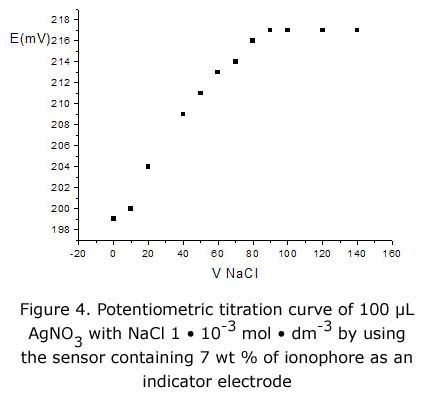
<p align="justify"><font size="2" face="Verdana"><strong><em>Preliminary analytical application of the sensor</em></strong></font></p>     <p align="justify"> <font size="2" face="Verdana"> The utility of the sensor for chloride ion determination was evaluated through its use as an indicator electrode in the titration of silver ions with NaCl (the sensor containing 7 wt % the ionophore). An example of the resulting titration curves is shown in <a href="#f4">figure 4</a>. As can be seen, the amount of silver ions in solution could be determined with the electrode.</font></p>     <p align="center"><font size="2" face="Verdana"><a name="f4" id="f4"></a><img src="/img/revistas/ind/v27n2/f0402215.gif"></font></p>     
]]></body>
<body><![CDATA[<p align="justify">&nbsp; </p>     <p align="justify"><font size="3" face="Verdana"><strong>CONCLUSION</strong></font></p>     <p align="justify"> <font size="2" face="Verdana"> A new ion-selective electrode formed by a polymeric liquid membrane and by using 2-(5-(4-nitrophenyl)furyl)-4,5-diphenyl imidazole (FFDFIN) as ionophore, DOS as plasticizer and PVC as matrix, sensible to chloride ion can be considered highly reproducible. The ISEs showed Nernstian slope with a practical detection limit (PDL) in order of 10<sup>-6</sup> mol . dm<sup>-3</sup> and short response time. The results obtained permitted the utilization of the constructed ion-selective electrode for precise determination of chloride.</font></p>     <p align="justify">&nbsp;</p>     <p align="justify"><font size="3" face="Verdana"><strong>REFERENCES</strong></font></p>     <!-- ref --><p align="justify"><font size="2" face="Verdana">1. MINETTI, M. L.; ZANNIER, M. S.;    SBODIO, O. A.; TERCERO, E. J., &quot;Determinaci&oacute;n de Cloruro de sodio    en quesos argentinos&quot;, <em>Revista FAVE-Ciencias Veterinarias</em>, 2002, 1(1), 43-48.    </font></p>     <div align="justify">       <!-- ref --><p><font size="2" face="Verdana">2. XIAO, J. B., &quot;Determination of nine components      in bayer liquors by high performance ion chromatography with conductivity      detector&quot;, <em>J. Chil. Chem. Soc.</em>,  2006, 51(3), 964-967.    </font></p>       ]]></body>
<body><![CDATA[<!-- ref --><p><font size="2" face="Verdana">3. JU&Aacute;REZ, M.;  MARTIN-HERN&Aacute;NDEZ,      M. C., &quot;Contenido de elementos minerales en quesos del      mercado espa&ntilde;ol, determinados por espectrofotometr&iacute;a de absorci&oacute;n      at&oacute;mica&quot;, <em>Revista Agroqu&iacute;mica de Tecnolog&iacute;a de Alimentos</em>,      1983, 23, 417-422.    </font></p> </div>     <!-- ref --><p align="justify"><font size="2" face="Verdana">4. ARAI, K.; KUSU, F.; NOGUCHI,    N.; TAKAMURA, K.; OSAWA H., &quot;Selective determination of chloride and bromide    ions in serum by     cyclelic   voltammeter&quot;, <em>Anal. Biochem.</em>, 1996, 15, 240(1), 109<strong>-</strong>113.    </font></p>     <!-- ref --><p align="justify"><font size="2" face="Verdana">5. HARRIS, D. C., <em>Quantitative    Chemical Analysis</em>,     6<sup>th</sup> ed., New York, W. H. Freeman &amp; Company, 2003.    </font></p>     <div align="justify">       <!-- ref --><p><font size="2" face="Verdana">6. ROTHMAIER, M.; SIMON, W., &quot;Chloride-Selective      Electrodes Based on Mercury Organic Compounds as Neutral Carriers&quot;, <em>Anal.      Chim. Acta</em>, 1993, 271, 135–141.    </font></p>       <!-- ref --><p><font size="2" face="Verdana">7. XIAO, K. P.; BUHLMANN, P.; NISHIZAWA, S.;      AMEMIYA S.;  UMEZAWA, Y., &quot;A Chloride Ion-Selective Solvent Polymeric      Membrane Electrode Based on a Hydrogen Bond Forming Ionophore&quot;, <em>Anal.    Chem</em>., 1997, 69, 1038–1043.    </font></p>       <!-- ref --><p><font size="2" face="Verdana">8. MAHAJAN, R. K.; <em>et al</em>., &quot;Anion Receptor Functions      of Lanthanide Tris (diketonate) Complexes&quot;, <em>Chem. Comm</em>., 2003,      22, 2238–2241.    </font></p>       <!-- ref --><p><font size="2" face="Verdana">9. BABU, J. N.; BHALLA, V.; KUMAR, M.; MAHAJAN,      R. K.; PURI, R. K., &quot;A Chloride Selective Sensor Based on a Calixarene      Possessing a Urea Moiety&quot;, <em>Tetrahedron Lett</em>., 2008, 49, 2772–2775.    </font></p>       <!-- ref --><p><font size="2" face="Verdana">10. BABU, J. N.; BHALLA, V.; KUMAR, M.; PURI,      R. K.; MAHAJAN, R. K., &quot;Chloride Ion Recognition Using Thiourea/Urea      Based Receptors Incorporated into 1,3-disubstituted Calixarenesw&quot;, <em>New      J. Chem</em>., 2009, 33, 675–681.    </font></p> </div>     <!-- ref --><p align="justify"><font size="2" face="Verdana">11.    COMISI&Oacute;N VENEZOLANA DE NORMAS INDUSTRIALES, <em>Carb&oacute;n: determinaci&oacute;n del contenido de cloro: m&eacute;todo del electrodo selectivo de ion</em>,     Norma Venezolana Covenin  2600-89, Caracas,    FONDONORMA, 1989, 7 p., ISBN: 9800604219.    </font></p>     <!-- ref --><p align="justify"><font size="2" face="Verdana">12. GARRIDO FERN&Aacute;NDEZ,    A.; GARC&Iacute;A GARC&Iacute;A, P., &quot;Estudio comparativo de m&eacute;todos    para la determinaci&oacute;n de NaCI en las salmueras de aceitunas&quot;, <em>Grasas    y Aceites</em>, 1985, 36, 134-137.    </font></p>     <!-- ref --><p align="justify"><font size="2" face="Verdana">13. RODR&Iacute;GUEZ, Z.; HERN&Aacute;NDEZ,    B., PERALTA, G.; GAYT&Aacute;N, E.; MOYA, R., &quot;Determinaci&oacute;n de halogenuros    en residuales del Laboratorio de Producci&oacute;n del Centro de Bioactivos    Qu&iacute;micos con electrodos selectivos&quot;, <em>Revista Cubana de Qu&iacute;mica,</em>    1998, 10(1-2), 80-87.    </font></p>     <!-- ref --><p align="justify"><font size="2" face="Verdana">14. &Aacute;LVAREZ ROMERO, G. A.;    RAM&Iacute;REZ SILVA, M. T.; GAL&Aacute;N VIDAL, C. A.; P&Aacute;EZ HERN&Aacute;NDEZ,    M. E., &quot;Uso de un compuesto de grafito-resina ep&oacute;xica-polipirrol para el desarrollo de un electrodo potenciom&eacute;trico selectivo a iones cloruro&quot;, en XXV Congreso de la Sociedad Mexicana de electroqu&iacute;mica, 3<sup>rd</sup> Meeting of the Mexican Section of the Electrochemical Society (31 may.-4 jun., 2010), Zacatecas, 2010.    </font></p>     <!-- ref --><p align="justify"><font size="2" face="Verdana">15. GARC&Iacute;A GARC&Iacute;A,    P.; BRENES BALBUENA, M.; GARRIDO FERN&Aacute;NDEZ, A., &quot;M&eacute;todos instrumentales    para la determinaci&oacute;n de NaCl en las salmueras de aceitunas&quot;, <em>Grasas    y Aceites</em>, 1991, 42(4), 261-266.    </font></p>     <!-- ref --><p align="justify"><font size="2" face="Verdana">16. GARRIDO FERN&Aacute;NDEZ,    A.; GARC&Iacute;A GARC&Iacute;A, P., &quot;Estudio comparativo de m&eacute;todos    para la determinaci&oacute;n de NaCI en las salmueras de aceitunas&quot;, <em>Grasas    y Aceites</em>, 1985, 36, 134-137.    </font></p>     <!-- ref --><p align="justify"><font size="2" face="Verdana">17. HOOKER, K.; ALVARADO,     ANA LORENA, &quot;Validaci&oacute;n de la determinaci&oacute;n de cloruros y humedad,    para la evaluaci&oacute;n de combustibles alternos para hornos de cementeras&quot;,    <em>Tecnolog&iacute;a en Marcha</em>, 2010, 23(3), 24-32.    </font></p>     <!-- ref --><p align="justify"><font size="2" face="Verdana">18.     INTERNATIONAL UNION OF PURE AND APPLIED CHEMISTRY, &quot;Recommendations    for nomenclature of ion-selective electrodes&quot;,       <em>Pure &amp; Appl. Chem.</em>, 48, 127-132, Great Britain, Pergamon Press, 1976.    </font></p>     <!-- ref --><p align="justify"><font size="2" face="Verdana">19. ARADA P&Eacute;REZ, M. DE    LOS &Aacute;.; P&Eacute;REZ MAR&Iacute;N, L.; CALVO QUINTANA, J.; YAZDANI PEDRAM,    M., &quot;Influence of different plasticizer on the response of chemical sensors    based on polymeric membrane for nitrate ion determination&quot;, <em>Sens. Actuat.    B-Chem</em>., 2003, 89, 262-268.    </font></p>     <p align="justify">&nbsp;</p>     <p align="justify">&nbsp;</p>     <p align="justify"><font size="2" face="Verdana">Recibido: 03/10/2014    <br> Aceptado: 03/12/2014</font></p>     <p align="justify">&nbsp;</p>     ]]></body>
<body><![CDATA[<p align="justify">&nbsp;</p>     <p align="justify"><font size="2" face="Verdana"> </font><font size="2" face="Verdana"><em>Dra. C. Mar&iacute;a de los &Aacute;ngeles Arada</em>,    </font><font size="2"><font face="Verdana">Department of Analytical Chemistry, Universidad de Oriente, Santiago de Cuba, Cuba, </font></font><font size="2" face="Verdana"><a href="mailto:may@cnt.uo.edu.cu">may@cnt.uo.edu.cu</a></font></p>      ]]></body><back>
<ref-list>
<ref id="B1">
<label>1</label><nlm-citation citation-type="">
<person-group person-group-type="author">
<name>
<surname><![CDATA[MINETTI]]></surname>
<given-names><![CDATA[M. L]]></given-names>
</name>
<name>
<surname><![CDATA[ZANNIER]]></surname>
<given-names><![CDATA[M. S]]></given-names>
</name>
<name>
<surname><![CDATA[SBODIO]]></surname>
<given-names><![CDATA[O. A]]></given-names>
</name>
<name>
<surname><![CDATA[TERCERO]]></surname>
<given-names><![CDATA[E. J]]></given-names>
</name>
</person-group>
<article-title xml:lang="es"><![CDATA[Determinación de Cloruro de sodio en quesos argentinos]]></article-title>
<source><![CDATA[]]></source>
<year>2002</year>
<volume>1</volume>
<numero>1</numero>
<issue>1</issue>
<page-range>43-48</page-range></nlm-citation>
</ref>
<ref id="B2">
<label>2</label><nlm-citation citation-type="">
<person-group person-group-type="author">
<name>
<surname><![CDATA[XIAO]]></surname>
<given-names><![CDATA[J. B]]></given-names>
</name>
</person-group>
<article-title xml:lang="en"><![CDATA[Determination of nine components in bayer liquors by high performance ion chromatography with conductivity detector]]></article-title>
<source><![CDATA[]]></source>
<year>2006</year>
<volume>51</volume>
<numero>3</numero>
<issue>3</issue>
<page-range>964-967</page-range></nlm-citation>
</ref>
<ref id="B3">
<label>3</label><nlm-citation citation-type="">
<person-group person-group-type="author">
<name>
<surname><![CDATA[JUÁREZ]]></surname>
<given-names><![CDATA[M]]></given-names>
</name>
<name>
<surname><![CDATA[MARTIN-HERNÁNDEZ]]></surname>
<given-names><![CDATA[M. C]]></given-names>
</name>
</person-group>
<article-title xml:lang="es"><![CDATA[Contenido de elementos minerales en quesos del mercado español, determinados por espectrofotometría de absorción atómica]]></article-title>
<source><![CDATA[]]></source>
<year>1983</year>
<volume>23</volume>
<page-range>417-422</page-range></nlm-citation>
</ref>
<ref id="B4">
<label>4</label><nlm-citation citation-type="">
<person-group person-group-type="author">
<name>
<surname><![CDATA[ARAI]]></surname>
<given-names><![CDATA[K]]></given-names>
</name>
<name>
<surname><![CDATA[KUSU]]></surname>
<given-names><![CDATA[F]]></given-names>
</name>
<name>
<surname><![CDATA[NOGUCHI]]></surname>
<given-names><![CDATA[N]]></given-names>
</name>
<name>
<surname><![CDATA[TAKAMURA]]></surname>
<given-names><![CDATA[K]]></given-names>
</name>
<name>
<surname><![CDATA[OSAWA]]></surname>
<given-names><![CDATA[H]]></given-names>
</name>
</person-group>
<article-title xml:lang="en"><![CDATA[Selective determination of chloride and bromide ions in serum by cyclelic voltammeter]]></article-title>
<source><![CDATA[]]></source>
<year>1996</year>
<volume>240</volume>
<numero>1</numero>
<issue>1</issue>
<page-range>109-113</page-range></nlm-citation>
</ref>
<ref id="B5">
<label>5</label><nlm-citation citation-type="book">
<person-group person-group-type="author">
<name>
<surname><![CDATA[HARRIS]]></surname>
<given-names><![CDATA[D. C]]></given-names>
</name>
</person-group>
<source><![CDATA[Quantitative Chemical Analysis]]></source>
<year>2003</year>
<edition>6</edition>
<publisher-loc><![CDATA[New York ]]></publisher-loc>
<publisher-name><![CDATA[W. H. Freeman & Company]]></publisher-name>
</nlm-citation>
</ref>
<ref id="B6">
<label>6</label><nlm-citation citation-type="">
<person-group person-group-type="author">
<name>
<surname><![CDATA[ROTHMAIER]]></surname>
<given-names><![CDATA[M]]></given-names>
</name>
<name>
<surname><![CDATA[SIMON]]></surname>
<given-names><![CDATA[W]]></given-names>
</name>
</person-group>
<article-title xml:lang="en"><![CDATA[Chloride-Selective Electrodes Based on Mercury Organic Compounds as Neutral Carriers]]></article-title>
<source><![CDATA[]]></source>
<year>1993</year>
<volume>271</volume>
<page-range>135-141</page-range></nlm-citation>
</ref>
<ref id="B7">
<label>7</label><nlm-citation citation-type="">
<person-group person-group-type="author">
<name>
<surname><![CDATA[XIAO]]></surname>
<given-names><![CDATA[K. P]]></given-names>
</name>
<name>
<surname><![CDATA[BUHLMANN]]></surname>
<given-names><![CDATA[P]]></given-names>
</name>
<name>
<surname><![CDATA[NISHIZAWA]]></surname>
<given-names><![CDATA[S]]></given-names>
</name>
<name>
<surname><![CDATA[AMEMIYA]]></surname>
<given-names><![CDATA[S]]></given-names>
</name>
<name>
<surname><![CDATA[UMEZAWA]]></surname>
<given-names><![CDATA[Y]]></given-names>
</name>
</person-group>
<article-title xml:lang="en"><![CDATA[A Chloride Ion-Selective Solvent Polymeric Membrane Electrode Based on a Hydrogen Bond Forming Ionophore]]></article-title>
<source><![CDATA[]]></source>
<year>1997</year>
<volume>69</volume>
<page-range>1038-1043</page-range></nlm-citation>
</ref>
<ref id="B8">
<label>8</label><nlm-citation citation-type="">
<person-group person-group-type="author">
<name>
<surname><![CDATA[MAHAJAN]]></surname>
<given-names><![CDATA[R. K]]></given-names>
</name>
</person-group>
<article-title xml:lang="en"><![CDATA[Anion Receptor Functions of Lanthanide Tris (diketonate) Complexes]]></article-title>
<source><![CDATA[]]></source>
<year>2003</year>
<volume>22</volume>
<page-range>2238-2241</page-range></nlm-citation>
</ref>
<ref id="B9">
<label>9</label><nlm-citation citation-type="">
<person-group person-group-type="author">
<name>
<surname><![CDATA[BABU]]></surname>
<given-names><![CDATA[J. N]]></given-names>
</name>
<name>
<surname><![CDATA[BHALLA]]></surname>
<given-names><![CDATA[V]]></given-names>
</name>
<name>
<surname><![CDATA[KUMAR]]></surname>
<given-names><![CDATA[M]]></given-names>
</name>
<name>
<surname><![CDATA[MAHAJAN]]></surname>
<given-names><![CDATA[R. K]]></given-names>
</name>
<name>
<surname><![CDATA[PURI]]></surname>
<given-names><![CDATA[R. K]]></given-names>
</name>
</person-group>
<article-title xml:lang="en"><![CDATA[A Chloride Selective Sensor Based on a Calixarene Possessing a Urea Moiety]]></article-title>
<source><![CDATA[]]></source>
<year>2008</year>
<volume>49</volume>
<page-range>2772-2775</page-range></nlm-citation>
</ref>
<ref id="B10">
<label>10</label><nlm-citation citation-type="">
<person-group person-group-type="author">
<name>
<surname><![CDATA[BABU]]></surname>
<given-names><![CDATA[J. N]]></given-names>
</name>
<name>
<surname><![CDATA[BHALLA]]></surname>
<given-names><![CDATA[V]]></given-names>
</name>
<name>
<surname><![CDATA[KUMAR]]></surname>
<given-names><![CDATA[M]]></given-names>
</name>
<name>
<surname><![CDATA[PURI]]></surname>
<given-names><![CDATA[R. K]]></given-names>
</name>
<name>
<surname><![CDATA[MAHAJAN]]></surname>
<given-names><![CDATA[R. K]]></given-names>
</name>
</person-group>
<article-title xml:lang="en"><![CDATA[Chloride Ion Recognition Using Thiourea/Urea Based Receptors Incorporated into 1,3-disubstituted Calixarenesw]]></article-title>
<source><![CDATA[]]></source>
<year>2009</year>
<volume>33</volume>
<page-range>675-681</page-range></nlm-citation>
</ref>
<ref id="B11">
<label>11</label><nlm-citation citation-type="book">
<collab>COMISIÓN VENEZOLANA DE NORMAS INDUSTRIALES</collab>
<source><![CDATA[Carbón: determinación del contenido de cloro: método del electrodo selectivo de ion]]></source>
<year>1989</year>
<page-range>7</page-range><publisher-loc><![CDATA[Caracas ]]></publisher-loc>
<publisher-name><![CDATA[FONDONORMA]]></publisher-name>
</nlm-citation>
</ref>
<ref id="B12">
<label>12</label><nlm-citation citation-type="">
<person-group person-group-type="author">
<name>
<surname><![CDATA[GARRIDO FERNÁNDEZ]]></surname>
<given-names><![CDATA[A]]></given-names>
</name>
<name>
<surname><![CDATA[GARCÍA GARCÍA]]></surname>
<given-names><![CDATA[P]]></given-names>
</name>
</person-group>
<article-title xml:lang="es"><![CDATA[Estudio comparativo de métodos para la determinación de NaCI en las salmueras de aceitunas]]></article-title>
<source><![CDATA[]]></source>
<year>1985</year>
<volume>36</volume>
<page-range>134-137</page-range></nlm-citation>
</ref>
<ref id="B13">
<label>13</label><nlm-citation citation-type="">
<person-group person-group-type="author">
<name>
<surname><![CDATA[RODRÍGUEZ]]></surname>
<given-names><![CDATA[Z]]></given-names>
</name>
<name>
<surname><![CDATA[HERNÁNDEZ]]></surname>
<given-names><![CDATA[B]]></given-names>
</name>
<name>
<surname><![CDATA[PERALTA]]></surname>
<given-names><![CDATA[G]]></given-names>
</name>
<name>
<surname><![CDATA[GAYTÁN]]></surname>
<given-names><![CDATA[E]]></given-names>
</name>
<name>
<surname><![CDATA[MOYA]]></surname>
<given-names><![CDATA[R]]></given-names>
</name>
</person-group>
<article-title xml:lang="es"><![CDATA[Determinación de halogenuros en residuales del Laboratorio de Producción del Centro de Bioactivos Químicos con electrodos selectivos]]></article-title>
<source><![CDATA[]]></source>
<year>1998</year>
<volume>10</volume>
<numero>1-2</numero>
<issue>1-2</issue>
<page-range>80-87</page-range></nlm-citation>
</ref>
<ref id="B14">
<label>14</label><nlm-citation citation-type="">
<person-group person-group-type="author">
<name>
<surname><![CDATA[ÁLVAREZ ROMERO]]></surname>
<given-names><![CDATA[G. A]]></given-names>
</name>
<name>
<surname><![CDATA[RAMÍREZ SILVA]]></surname>
<given-names><![CDATA[M. T]]></given-names>
</name>
<name>
<surname><![CDATA[GALÁN VIDAL]]></surname>
<given-names><![CDATA[C. A]]></given-names>
</name>
<name>
<surname><![CDATA[PÁEZ HERNÁNDEZ]]></surname>
<given-names><![CDATA[M. E]]></given-names>
</name>
</person-group>
<source><![CDATA[Uso de un compuesto de grafito-resina epóxica-polipirrol para el desarrollo de un electrodo potenciométrico selectivo a iones cloruro]]></source>
<year></year>
</nlm-citation>
</ref>
<ref id="B15">
<label>15</label><nlm-citation citation-type="">
<person-group person-group-type="author">
<name>
<surname><![CDATA[GARCÍA GARCÍA]]></surname>
<given-names><![CDATA[P]]></given-names>
</name>
<name>
<surname><![CDATA[BRENES BALBUENA]]></surname>
<given-names><![CDATA[M]]></given-names>
</name>
<name>
<surname><![CDATA[GARRIDO FERNÁNDEZ]]></surname>
<given-names><![CDATA[A]]></given-names>
</name>
</person-group>
<article-title xml:lang="es"><![CDATA[Métodos instrumentales para la determinación de NaCl en las salmueras de aceitunas]]></article-title>
<source><![CDATA[]]></source>
<year>1991</year>
<volume>42</volume>
<numero>4</numero>
<issue>4</issue>
<page-range>261-266</page-range></nlm-citation>
</ref>
<ref id="B16">
<label>16</label><nlm-citation citation-type="">
<person-group person-group-type="author">
<name>
<surname><![CDATA[GARRIDO FERNÁNDEZ]]></surname>
<given-names><![CDATA[A]]></given-names>
</name>
<name>
<surname><![CDATA[GARCÍA GARCÍA]]></surname>
<given-names><![CDATA[P]]></given-names>
</name>
</person-group>
<article-title xml:lang="es"><![CDATA[Estudio comparativo de métodos para la determinación de NaCI en las salmueras de aceitunas]]></article-title>
<source><![CDATA[]]></source>
<year>1985</year>
<volume>36</volume>
<page-range>134-137</page-range></nlm-citation>
</ref>
<ref id="B17">
<label>17</label><nlm-citation citation-type="">
<person-group person-group-type="author">
<name>
<surname><![CDATA[HOOKER]]></surname>
<given-names><![CDATA[K]]></given-names>
</name>
<name>
<surname><![CDATA[ALVARADO]]></surname>
<given-names><![CDATA[ANA LORENA]]></given-names>
</name>
</person-group>
<article-title xml:lang="es"><![CDATA[Validación de la determinación de cloruros y humedad, para la evaluación de combustibles alternos para hornos de cementeras]]></article-title>
<source><![CDATA[]]></source>
<year>2010</year>
<volume>23</volume>
<numero>3</numero>
<issue>3</issue>
<page-range>24-32</page-range></nlm-citation>
</ref>
<ref id="B18">
<label>18</label><nlm-citation citation-type="book">
<collab>INTERNATIONAL UNION OF PURE AND APPLIED CHEMISTRY</collab>
<article-title xml:lang="en"><![CDATA[Recommendations for nomenclature of ion-selective electrodes]]></article-title>
<source><![CDATA[]]></source>
<year>1976</year>
<volume>48</volume>
<page-range>127-132</page-range><publisher-loc><![CDATA[^eGreat Britain Great Britain]]></publisher-loc>
<publisher-name><![CDATA[Pergamon Press]]></publisher-name>
</nlm-citation>
</ref>
<ref id="B19">
<label>19</label><nlm-citation citation-type="">
<person-group person-group-type="author">
<name>
<surname><![CDATA[ARADA PÉREZ]]></surname>
<given-names><![CDATA[M. DE LOS Á]]></given-names>
</name>
<name>
<surname><![CDATA[PÉREZ MARÍN]]></surname>
<given-names><![CDATA[L]]></given-names>
</name>
<name>
<surname><![CDATA[CALVO QUINTANA]]></surname>
<given-names><![CDATA[J]]></given-names>
</name>
<name>
<surname><![CDATA[YAZDANI PEDRAM]]></surname>
<given-names><![CDATA[M]]></given-names>
</name>
</person-group>
<article-title xml:lang="en"><![CDATA[Influence of different plasticizer on the response of chemical sensors based on polymeric membrane for nitrate ion determination]]></article-title>
<source><![CDATA[]]></source>
<year>2003</year>
<volume>89</volume>
<page-range>262-268</page-range></nlm-citation>
</ref>
</ref-list>
</back>
</article>